ARAB AND WORLD

Thu 09 Apr 2026 8:39 pm - Jerusalem Time

Islamabad Negotiations: Deep Gaps Between Washington and Tehran on Nuclear and Strait of Hormuz Issues

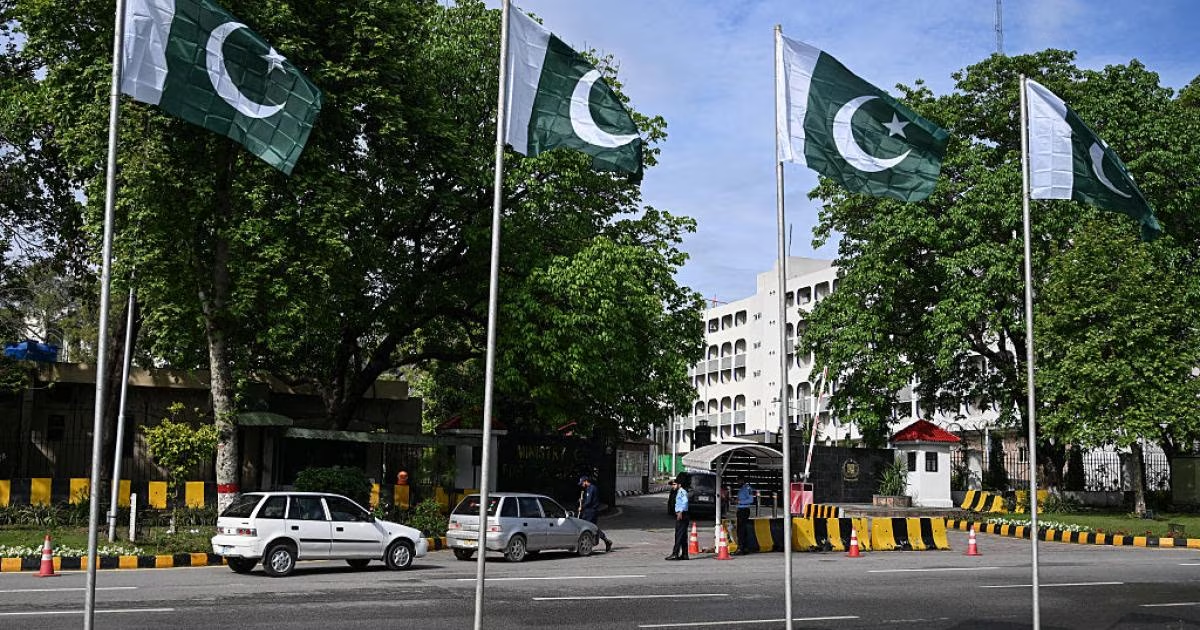
Attention turns to the Pakistani capital, Islamabad, where a new round of peace talks between the United States and Iran, sponsored by Pakistan, is scheduled to begin. This step comes amidst significant field and political complexities, as both sides try to bridge the chasm between completely opposing demands regarding ending the current conflict.

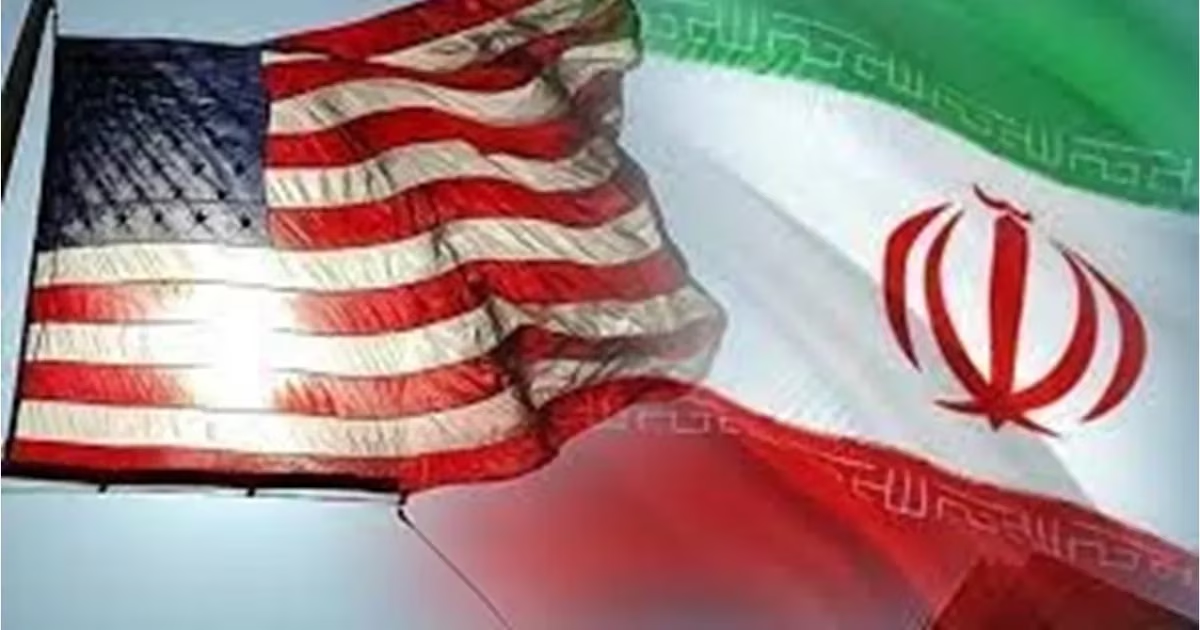
Despite US President Donald Trump showing relative flexibility by describing Iranian proposals as forming a 'basis' for negotiations, the reality indicates deep gaps. Tehran adheres to a ten-point proposal, while Washington insists on a previous plan consisting of fifteen items, reflecting divergent views on fundamental issues.

The issue of uranium enrichment is the most prominent sticking point in the diplomatic saw, as the Iranian proposal includes an explicit demand for recognition of its right to enrichment. In contrast, the US administration had previously ruled out this demand, with Trump's assurances that this file is non-negotiable from the American perspective.

In addition to the nuclear file, Iran's missile capabilities stand out as an additional stumbling block, as Washington and Tel Aviv demand their radical reduction. Tehran responds that its missile arsenal represents a pillar of its national security and is not open for discussion, despite the ambiguity surrounding the size of what remains of it after recent military operations.

In a related context, sources quoted a Pakistani official as saying that Iran might receive a response on reconstruction, compensation, and lifting economic sanctions. However, the official stressed that reaching an agreement on uranium enrichment remains unlikely given the current data and international pressures.

The weight of negotiations has shifted from military programs to waterways, with the fate of the Strait of Hormuz topping the list of international priorities. Approximately one-fifth of the world's oil and liquefied natural gas supplies pass through this strait, making the stability of navigation in it a matter of global national security.

The effective closure of the strait by Iranian forces since late last February has caused severe disruptions in global energy markets. This blockade has led to record jumps in oil prices, placing enormous economic pressure on importing countries and prompting Washington to seek urgent solutions.

Through negotiations, Tehran seeks to legitimize imposing financial fees on ships crossing the strait if a permanent peace agreement is reached. It justifies this by its geographical location and its control over the passage, which narrows to only 34 kilometers at the point of contact between Iran and Oman.

For his part, the US President did not hesitate to use threatening language, hinting at destroying Iran if it does not commit to a ceasefire and reopening the waterway. So far, there are no field indications of the lifting of the Iranian blockade, which Washington considers a blatant challenge to global energy supplies.

Iran explicitly stipulates, for de-escalation and opening the strait, the necessity of stopping Israeli military operations in Lebanon. The Iranian leadership affirms that it will not conclude any peace agreement as long as the intensive Israeli bombing of Lebanese territories and targeting of Hezbollah continues.

The ten-point Iranian proposal includes clauses that Washington describes as impossible, such as the complete withdrawal of US combat forces from the region. Tehran also demands the cancellation of all Security Council and International Atomic Energy Agency resolutions issued against it, as part of a comprehensive settlement.

In contrast, the American plan focuses on removing highly enriched uranium stockpiles and completely halting ballistic programs. Washington also demands cutting Iranian funding to all allies and proxies in the region, which Tehran sees as interference in its regional policies and strategic alliances.

On the Israeli side, sources reported that Tel Aviv agreed in principle to a ceasefire with Iran but drew a red line with the Lebanese front. Israel insists that military operations in Lebanon are not covered by any understandings with Tehran, which threatens to collapse the truce before it even begins.

The question remains about the chances of success of this settlement given each party's adherence to its strong cards; while Washington relies on its firepower, Tehran relies on 'strategic patience' and suffocating economic influence through the Strait of Hormuz. The coming days in Islamabad will determine whether the world will move towards a major de-escalation or unprecedented escalation.

Iran possesses economic influence through the Strait of Hormuz and will not conclude an agreement as long as Israeli aggression against Lebanon continues.

ISRAELI AFFAIRS

Thu 09 Apr 2026 8:39 pm - Jerusalem Time

Netanyahu directs the start of direct negotiations with Lebanon to 'disarm Hezbollah'

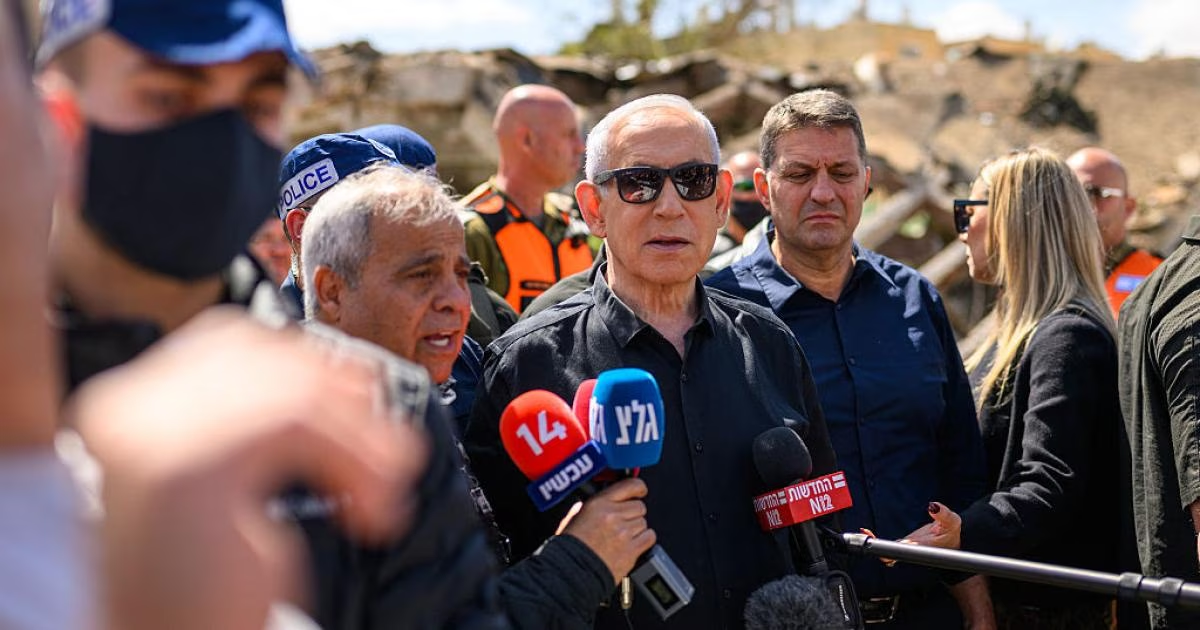
Israeli Prime Minister Benjamin Netanyahu issued official instructions today, Thursday, to begin direct negotiations with the Lebanese state as soon as possible. Netanyahu clarified that this move comes in response to what he described as 'repeated demands' from the capital Beirut to open official communication channels.

According to a statement issued by the Israeli Prime Minister's Office, the proposed agenda for these negotiations will focus primarily on the issue of disarming Hezbollah, in addition to discussing ways to formulate arrangements that lead to a peace agreement between the two sides, in a step that could represent a dramatic shift in the course of the border conflict.

In a related context, Netanyahu indicated that Tel Aviv views with appreciation the positions attributed to the Lebanese Prime Minister, which included calls to clear the capital Beirut of weapons, considering them a positive sign within the framework of moving towards de-escalation and changing the security reality on the northern front.

Our direct negotiations with Lebanon will focus on disarming Hezbollah and arranging peace relations between us.

ARAB AND WORLD

Thu 09 Apr 2026 8:39 pm - Jerusalem Time

US Assessments: Iran Emerges with Strategic Gains from Recent Confrontation Despite Military Strikes

International press reports indicate that the recent military confrontation between the United States and Iran has created a complex strategic reality, transcending the quick victory declarations promoted by President Donald Trump's administration. Sources believe that Tehran has succeeded in asserting its position as an indispensable regional player, especially with its continued de facto control over the Strait of Hormuz, which is the lifeline for global energy supplies.

Despite the White House's announcement of achieving its objectives less than a day after the ceasefire came into effect, field data suggests that the war did not bring about the desired radical change. Informed sources clarified that American forces did indeed achieve tactical gains, neutralizing large parts of the Iranian navy and destroying drone and missile manufacturing facilities, but they failed to undermine the political pillars of the regime.

Analyses indicate that the Iranian regime's continued hold on power and its retention of highly enriched uranium stockpiles represent a significant flaw in the American narrative of victory. The fundamental justifications for the military operations still stand, putting Washington in a predicament of redefining its objectives in the region before entering any new rounds of negotiations.

For his part, US Secretary of Defense Pete Hegseth defended the military operation, describing it as a historic strike that achieved all desired goals. Hegseth affirmed that the US military presence in the region will remain to ensure Tehran's compliance with the terms of the agreement, emphasizing that the deterrent capabilities of the United States are stronger than ever before.

In contrast, a state of skepticism prevails within international diplomatic circles regarding the effectiveness of these attacks in changing Iranian behavior in the long term. Sources quoted Asian diplomats as saying that merely destroying military hardware without bringing about internal political change could lead to counterproductive results, as Iran considers merely 'not losing' as a political victory for itself.

On the negotiation front, controversial Iranian demands have emerged within what is known as the 'Ten-Point Plan,' where Tehran seeks to impose exorbitant transit fees on ships passing through the Strait of Hormuz. Iranian proposals demand amounts up to two million dollars per ship, in a move aimed at compensating for the economic and military losses it incurred during the war.

US Vice President J.D. Vance described these developments as reflecting a 'fragile truce' that does not guarantee sustainable stability in the region. Vance is scheduled to lead a high-level delegation to anticipated talks in the Pakistani capital, Islamabad, in an attempt to solidify the ceasefire terms and establish a practical framework for the next phase.

Domestically in Washington, former military leaders and members of the House Armed Services Committee warned that the current agreement might be no more than 'buying time.' They indicated that the Iranian threat still exists as long as the nuclear and political infrastructure has not been decisively affected, warning of Tehran's ability to quickly restore its military capabilities.

The situation was further complicated by Iran's temporary closure of the Strait of Hormuz following Israeli raids targeting sites in the Lebanese capital, Beirut. Tehran closely links regional issues, insisting that any comprehensive de-escalation must include a cessation of military operations in Lebanon, which Washington and Tel Aviv reject outright.

Sources conclude by emphasizing that the state of combat readiness remains at its peak for both parties, with the option of returning to military confrontation strongly on the table. While Tehran asserts that 'its hands are on the trigger' to protect its interests, US forces emphasize their readiness to respond to any violation of the truce, leaving the future of the region dependent on the outcomes of the stalled diplomatic talks.

I don't know how this situation can be reversed without the United States fundamentally redefining its strategic objectives.

ARAB AND WORLD

Thu 09 Apr 2026 8:39 pm - Jerusalem Time

Tucker Carlson launches fierce attack on Trump and Israel: Our money is killing Lebanese

Prominent American journalist Tucker Carlson launched an unprecedented attack on the policies of President Donald Trump's administration regarding Israeli military escalation in Lebanon. Carlson, considered a pillar of the conservative movement, asserted that Washington directly contributes to funding and arming operations targeting Lebanese civilians, placing the American administration in a contradictory position with its electoral promises.

Carlson explained in the latest episodes of his program that the Israeli army continues its aggressions using American arsenal funded by US taxpayers' money. He pointed out that these attacks come at a time when President Trump had announced a ceasefire agreement, which Carlson considered a clear undermining of declared diplomatic efforts.

The American host highlighted what he called Israel's 'Eternal Darkness' operation, affirming that it targets densely populated civilian areas in the capital, Beirut. Carlson considered that this name carries deep religious connotations, as it is associated with the concept of hell in the New Testament, which Lebanese families are currently experiencing under the constant bombardment.

In a scathing critique of the political class in Washington, Carlson questioned the secret behind the inability of successive American presidents to take a firm stance towards Israel. He mocked the traditional justifications that describe Israel as the 'only democracy in the region,' considering that the continuation of this approach reflects either political stupidity or involvement in more complex calculations that harm American interests.

Carlson indicated the presence of figures within the White House who are fully aware of the seriousness of the current situation but continue to implement agendas that serve Israeli Prime Minister Benjamin Netanyahu. He warned that these officials are leading the region to the brink, with the prospect of an Israeli nuclear strike on Iran looming, which he described as a historical catastrophe.

Carlson warned of the catastrophic repercussions of any widespread ground intervention in the region, emphasizing that the greatest price would be paid by American citizens in terms of their security and economy. Carlson predicted that an all-out war would lead to significant human losses among Americans, in addition to economic collapses that the already exhausted American domestic front might not be able to bear.

Carlson also touched upon the suffering of Christians in Lebanon, explaining that American-backed Israeli policies spared no one and brought 'hell' to Christian communities there. He considered that pretending neutrality or seeking peace is no longer acceptable in light of the field realities that prove the exact opposite, calling for a comprehensive review of the relationship with Tel Aviv.

Tucker Carlson, born in 1969, is one of the most influential media figures in the 'MAGA' movement supporting Trump, which makes his recent criticisms resonate widely within the Republican Party's popular base. Observers believe that these statements may open a discussion about the utility of absolute support for Israel amid current geopolitical shifts.

In conclusion, Carlson stressed that the continuation of the conflict at this pace will inevitably lead to a global catastrophe that transcends the borders of the Middle East. He called for the necessity of American leadership capable of saying 'no' when Israeli policies conflict with American national security and the lives of innocent civilians in the region.

The Israeli army kills civilians in Lebanon with American weapons and taxpayer money, despite Trump's ceasefire announcement.

PALESTINE

Thu 09 Apr 2026 8:38 pm - Jerusalem Time

Horrific Crime in Jabalia: Occupation Bullets Assassinate a Child Inside Her Classroom

Educational and popular circles in the Gaza Strip were shocked today, Thursday, by the news of the martyrdom of a Palestinian child by Israeli occupation forces' bullets while she was inside her school in Jabalia camp, north of the Strip. Local sources confirmed that the bullets penetrated the classroom walls, hitting student Ritaj Rayhan, who was in the third grade of primary school, leading to her immediate death in front of her classmates and teachers.

The Ministry of Education in Gaza announced in an official statement that the crime occurred at 'Abu Obaida bin Al-Jarrah' school, where the child was exercising her natural right to education before being targeted by occupation fire. The ministry described the incident as a 'brutal, horrific, and bloody crime,' noting that Ritaj's blood, which flowed over her school books, reflects the true face of the ongoing aggression against Palestinian childhood.

The ministry clarified that targeting Ritaj is not merely an accidental or isolated incident, but an extension of a systematic policy pursued by the occupation forces to terrorize civilians and target Palestinian individuals in the safest places. The statement emphasized that the student committed no sin other than her steadfastness in remaining on her besieged land and her attempt to build her future through education despite the harsh war conditions.

The incident left a deep psychological impact and severe shock on the martyr's classmates who witnessed the details of the crime moment by moment, increasing the suffering of children in Gaza who face death daily. Educational sources indicated that these crimes aim to destroy the educational system and instill terror in the hearts of students to prevent them from going to their schools, which have become targets.

The educational authorities in the Strip held the international community and human rights organizations fully responsible for the continuation of these violations, considering that global silence is a green light for the occupation to continue its crimes. They affirmed that impunity encourages the Israeli army to target infrastructure and schools, which have turned into killing fields instead of cradles of knowledge.

This crime comes in the context of continuous aggression for more than two and a half years, which has resulted in tens of thousands of victims, most of them children and women. It also coincided with an escalation in violations of the ceasefire agreement, with statistics indicating the killing of 738 Palestinians and the injury of more than two thousand others due to repeated shelling and shooting since the start of the alleged truce.

In conclusion of its statement, the ministry mourned the child Ritaj, affirming that her blood will remain a witness to the brutality of the occupation and the failure of the international community. It called on international institutions to intervene immediately to provide protection for schools and students and to stop the daily killing spree that tears apart Palestinian families and assassinates the dreams of children while they are at their desks.

Killing children in such a brutal manner represents a stain on the forehead of the international community and human rights organizations that stand helpless in the face of targeting education.

ISRAELI AFFAIRS

Thu 09 Apr 2026 8:38 pm - Jerusalem Time

Former Security Official: Netanyahu is Dragging Washington into a Confrontation with Iran, and Tel Aviv's Standing is in Unprecedented Decline

Avi Kalo, a former security official in the occupation army and political writer, revealed a sharp and unprecedented decline in the standing and popularity of the occupation state within political and popular circles in the United States. He explained that there is a gradually solidifying conviction in Washington that the current Israeli government is pushing the American administration towards a direct military confrontation with Iran, which is causing widespread resentment in decision-making circles.

Kalo recalled Benjamin Netanyahu's political history in his analysis, pointing to his speech before Congress in 2002, in which he incited the overthrow of Saddam Hussein's regime in Iraq. He considered that war, which became a bleeding wound in American military history, made Netanyahu's name associated in the collective memory of the Democratic Party with someone who pushes for unnecessary wars in the Middle East.

The analysis indicated that this negative legacy later affected the decisions of the Obama and Biden administrations when concluding the nuclear agreement with Iran, an agreement that Netanyahu later incited former President Donald Trump to abrogate in 2018. The writer believes that withdrawing from the agreement without a strategic alternative created a dangerous vacuum that led to the current escalation, for which the United States is paying the price.

Sources reported that the narrative accusing Israel of dragging Washington into conflicts is no longer confined to the margins of American politics but has become a discourse gaining legitimacy within the State Department and moderate Republican Party circles. This shift reflects an erosion of the traditional support Tel Aviv enjoyed across various American political spectrums.

The former security official believes that the public discussion in the United States focuses on the repercussions of these wars on the domestic economy, away from political emotions. The rise in fuel prices and disruption of supply chains due to tensions in shipping lanes have led to widespread public discontent that negatively affected the American president's popular base.

Kalo pointed out that the cost of arming and defending waterways, which amounted to billions of dollars, has led American citizens to bitterly question the utility of these conflicts. This questioning deepens the rift that transforms Israel from a strategic asset linked to a deep emotional identity into a financial and military burden that negatively affects American national interests.

The writer warned that the prevailing impression that Netanyahu encouraged Trump to enter into a confrontation with Iran would exacerbate the damage at a very critical time. These developments coincide with the approaching congressional midterm elections and the beginning of sensitive deliberations to extend the US military aid budget for an additional decade.

Kalo criticized the lack of political responsibility among the current Israeli leadership, noting that any responsible leadership would have considered the impact of its military decisions on the special relationship with Washington. He considered neglecting this essential factor in managing the war a strategic danger that threatens the most valuable security assets of the occupation state.

The writer described Netanyahu's situation as 'strategic paralysis' resulting from being trapped by his legal and political constraints, making him prioritize his personal survival over national interest. This situation has led to a loss of the ability to maneuver politically and maintain vital international alliances that ensure Israel's long-term security.

In conclusion, the security official stressed that the lesson learned from the Iraq War is now more apparent to Americans than ever before. He affirmed that Washington might forgive intelligence failures, but it finds it extremely difficult to forgive allies who drag it into regional wars that do not serve its agenda, thus jeopardizing bilateral relations.

The United States may overlook intelligence errors, but it does not forgive allies who push it into wars it does not wish to fight.

ISRAELI AFFAIRS

Thu 09 Apr 2026 8:38 pm - Jerusalem Time

Israeli Reading Warns: Netanyahu Turns Tel Aviv from Strategic Asset to Burden on Washington

A recent Israeli analytical reading revealed a sharp and unprecedented decline in the popularity levels of the occupation state within political and popular circles in the United States. This deterioration coincides with a growing conviction among decision-making circles in Washington that the Israeli government is actively seeking to push the American administration towards a direct military confrontation with Iran.

Political analyst Avi Kalo explained in an article published by 'Yedioth Ahronoth' that history is repeating itself in a worrying way, recalling Benjamin Netanyahu's speech to Congress in 2002. At that time, Netanyahu used his rhetorical skills to convince American lawmakers that overthrowing Saddam Hussein's regime would lead to major positive transformations in the Middle East, which later proved to be the opposite.

The analysis indicated that the Iraq War gradually turned into a bleeding wound in American military and political memory, making Netanyahu's name associated in the mind of the Democratic Party with pushing for unnecessary wars. This legacy directly affected the orientations of the Obama and Biden administrations, which sought to conclude the nuclear agreement with Iran to avoid repeating collision scenarios.

Sources stated that Netanyahu repeated the same approach in 2018 when he encouraged former President Donald Trump to withdraw from the Iranian nuclear agreement. This incitement was done without formulating a strategic alternative for the vacuum that arose, which placed the region and the United States before complex and escalating security challenges at present.

A narrative currently prevails in Washington that Israel has dragged the United States into regional conflicts that serve Tel Aviv's interests at the expense of supreme American interests. This discourse is no longer limited to political margins, but has gained increasing legitimacy within the corridors of the State Department and moderate Republican Party circles.

On the American domestic front, the public debate about war differs from its counterpart in Israel, where Americans focus on the direct economic repercussions. Military tensions have led to a tangible rise in fuel prices and insurance costs, as well as supply chain disruptions, which has caused widespread discontent among the popular bases.

With the continued bloodshed and the rising bill for armament and protecting international shipping lanes to billions of dollars, the American citizen has begun to question the utility of these wars. This bitter question deepens the rift that is transforming Israel from an emotional strategic asset into a political and economic burden weighing on the decision-maker in Washington.

The writer warned that the prevailing impression that Netanyahu pushed Trump towards military escalation will lead to long-term strategic damage. These developments come at a very critical time, as the midterm congressional elections are approaching, and discussions begin on extending the US military aid budget to Israel.

The analysis criticized the absence of political responsibility among the current Israeli leadership, considering that Netanyahu suffers from 'strategic paralysis' resulting from his legal constraints and his ambitions for political survival. This situation prevents him from maintaining the 'special relationship' with Washington, which is considered the most valuable security and national asset of the occupation state.

The Israeli reading concluded that the lesson learned from the experiences of past decades confirms that Washington may forgive intelligence failures, but it does not forgive allies who involve it in wars it does not want. This shift in the American position represents an existential threat to Israel's international standing and its ability to maneuver in regional issues.

The United States can overlook intelligence errors, but it finds it difficult to forgive its allies when they push it into a war it did not want.

PALESTINE

Thu 09 Apr 2026 3:00 pm - Jerusalem Time

Hell's Truce: Trump's Bridge to Salvation from the Quagmire of Miscalculations

Dr. Hassan Ayoub: The path to a final agreement is still early, and Iran will not accept turning the ceasefire into an extended state of fragile calm or Israel resuming attacks. Dr. Osama Abdullah: The decision to respond to Pakistani mediation did not stem from a genuine desire for understanding, but from an attempt to escape a "strategic impasse" without admitting defeat. Noman Tawfiq Al-Abed: Israel is the biggest loser so far, as Netanyahu was counting on overthrowing the Iranian regime or striking its regional influence, but what happened constituted a "slap" to him. Dr. Tamara Haddad: The biggest losers in this confrontation are the Arab Gulf states, which will find themselves under the influence of Iranian power, especially concerning the movement in the Strait of Hormuz. Dr. Amjad Bashkar: The current truce is a mutual cessation of attacks, and the United States' acceptance of negotiations based on ten Iranian demands reflects a fundamental shift. Suleiman Basharat: Iran's ability to maintain its network of allies in the region and solidify their role within power equations may give it greater momentum in regional issues. Ramallah - Exclusive to "Al-Quds" - In an unexpected context and at crucial moments, the truce imposed on Wednesday dawn, through Pakistani mediation, brings the war between the United States and Iran into a delicate transitional phase, after the confrontation reached a major escalation that almost dragged the region and the world into an undesirable war. Writers, political analysts, specialists, and university professors, in separate interviews with "Al-Quds," believe that the escalation, which began with a high-threatening tone, ended with an American acceptance of a temporary ceasefire and the imposition of opening the Strait of Hormuz, which was originally open before the confrontation, a clear indication that the declared goals of the war were not achieved, and that continuing would have led to a cost greater than the American administration's ability to bear. They point out that Iran, in turn, managed to turn the time of confrontation into an opportunity to strengthen its regional influence and prove its resilience, making its negotiating card a relied-upon basis for future talks, and that this shift reflects an implicit acknowledgment of the limits of American power, and that Tehran has become a player whose conditions are difficult to bypass. They believe that despite the cessation of attacks, the truce remains surrounded by factors of fragility, amidst Israeli opposition to the path of understanding, and Iranian insistence on rejecting any long-term calm without guarantees, which makes the next phase a test of the mediators' ability to prevent a return to escalation and keep negotiation channels open. American-Israeli Recognition of the Limits of Power Political science professor and American affairs specialist Dr. Hassan Ayoub believes that the transformation of the issue of opening the Strait of Hormuz — an emergency matter during the war — into the primary American condition for stopping the American-Israeli war on Iran, clearly reveals that the declared goals of US President Donald Trump were not achieved. Ayoub believes that Washington's agreement to adopt the ten-point Iranian paper as a basis for future negotiations represents an American and Israeli recognition of the limits of power, after weeks of military escalation and widespread threats that did not translate into strategic achievements. According to Ayoub, Iran dealt with the war as an opportunity to establish a new deterrent equation at the regional level, and not just within the framework of confrontation with Israel. Despite the heavy price Tehran paid, it succeeded — according to Ayoub — in imposing a pattern of "response in kind" throughout the confrontation, which enhanced the credibility of its field threats. Ayoub points out that this pattern is what made Trump's recent threats to "wipe out Iranian civilization" unenforceable, especially after Iran responded by declaring its readiness to respond at the same level. American Political Retreat Ayoub confirms that Trump's acceptance of stopping the aggression can only be interpreted as a political retreat, especially after the widespread criticism of his statements domestically and internationally, and Washington and Tel Aviv's inability to achieve the declared war goals. The Path to a Final Agreement is Still Early However, Ayoub believes that the path to a final agreement is still early, as Iran will not accept turning the ceasefire into an extended state of fragile calm, while Israel and its allies within the Trump administration and decision-making institutions in Washington will push for a resumption of attacks. Ayoub believes that several field and political factors may open the door to a final agreement that meets a significant part of Iranian demands, including: Washington's recognition of the Iranian paper as a reference for negotiation, Iran's ability to continue the confrontation for a long time without collapse, Tehran's understandings with influential regional and international parties regarding the operation of the Strait of Hormuz, which gave it an additional strong card simultaneously with its acceptance of its re-operation, in addition to regional and international fears of a return to a widespread war, and the United States' failure to obtain international legitimacy for its military operations, alongside the noticeable decline in the legitimacy of the war within American society. Netanyahu Tries to Circumvent the Agreement As for Israel, Ayoub confirms that it played a fundamental role in pushing Washington towards the war, which he describes as "Israeli par excellence," but Trump was the party who forced Israeli Prime Minister Benjamin Netanyahu to accept its temporary cessation. Ayoub believes that the language of Netanyahu's statement reflects an attempt to circumvent the agreement, especially with Israel's refusal to apply it to Lebanon despite Pakistan's announcement that its provisions include the Lebanese arena. Ayoub points out that Israel is not satisfied with the current path and will work to obstruct the transition towards a final agreement that ends the war and lifts sanctions on Iran, leading to new understandings regarding its nuclear file without dismantling it, which are fundamental demands Tehran adheres to. A Forced Shift Imposed by Field Realities Political researcher and academic Dr. Osama Abdullah believes that the United States' acceptance of the Pakistani initiative regarding stopping the war on Iran cannot be described as a limited tactical retreat, but rather a forced shift imposed by field realities and the confusion of American policy during the recent confrontation. Abdullah explains that the Trump administration started with a high escalatory rhetoric based on the assumption of a quick decisive victory and achieving clear deterrent superiority, but the war, which lasted for more than a month, revealed a much higher cost than Washington expected, whether militarily, economically, or in terms of the stability of allies in the region. Attempt to Escape a "Strategic Impasse" Abdullah points out that the decision to respond to Pakistani mediation did not stem from a genuine desire for understanding, but from an attempt to escape a "strategic impasse" without admitting defeat, after the continuation of escalation threatened to expand the confrontation into a comprehensive regional conflict whose repercussions would be difficult to control. Abdullah believes that Tehran achieved three main gains by accepting the Pakistani initiative: resilience under pressure without internal tremor, imposing a mutual deterrence equation that ends American unilateral superiority, and shifting the confrontation to an intertwined regional level that limits Washington's ability to achieve a decisive victory. Abdullah explains that Iran's non-defeat constitutes an achievement in the current balance of power, in contrast to an American realization that the ceiling of its ability to impose its will has become limited. Phase of Testing Intentions Regarding the nature of the current phase, Abdullah stresses that the scene does not show signs of a comprehensive strategic settlement, but rather suggests a temporary tactical truce, as the fundamental issues that ignited the confrontation—from regional influence to the nuclear file and Israel's security—remain unresolved. Abdullah points out that talking about two weeks as a timeframe for de-escalation reflects that the parties are still testing intentions and rearranging their positions, not building a final agreement. Abdullah believes that the way out of the war will not be military, but political, through three parallel paths: controlling escalation through undeclared understandings, reactivating the negotiation process through regional and international mediators, and then reaching understandings on spheres of influence as the core and primary driver of the conflict. As for the future of the confrontation with Israel and Iran's allies, Abdullah expects the continuation of a low-intensity war pattern instead of a full-blown explosion, as Israel will continue its operations within limits that do not open a wide regional confrontation, while Iran's allies will continue calculated pressure, and Tehran will adopt a strategy of "managing engagement" to control the pace without going towards a costly open war for all parties. Abdullah points out that the regional scene is still in a fragile phase, whose main title is: conditional de-escalation, open conflict, and complex calculations governing what will happen next. The Rise of Pakistan's Role in International Balances Writer, political analyst, and international relations specialist Noman Tawfiq Al-Abed confirms that the role played by Pakistani Army Chief Marshal Asim Munir was a fundamental factor in pushing for the current truce between the United States and Iran, noting that Munir, by virtue of his previous security and military influence in the Pakistani intelligence administration, has become a regional player capable of influencing Middle East issues. Al-Abed believes that this mediation reflects the rise of Pakistan's role in international balances, and that its success opens the door for influential future interventions. Al-Abed explains that US President Donald Trump found himself involved in a war he was not prepared for, after being misled by the Israeli occupation state and some of his close advisors who supported Netanyahu. The Cohesion of the Iranian Regime Surprised Trump Al-Abed points out that Trump had been waiting for the collapse of the Iranian regime throughout the past period, before being surprised by its cohesion and its ability to absorb blows and its possession of pre-planned strategies for managing the confrontation. Al-Abed explains that Trump's mentality, based on the idea of a "deal," led him to believe that mere threats would force Iran to accept his terms, but he clashed with Tehran's refusal and discipline in managing the battle, which dealt a blow to his political thought and his illusions about the possibility of imposing dictates by force. Political Defeat for America Al-Abed believes that Trump's acceptance of the current truce, although temporary and lasting only two weeks, constitutes a political defeat in itself; the Iranian regime remained in place, enriched uranium remained under its control, and the Strait of Hormuz and Bab al-Mandab remained in Iranian hands, in addition to Tehran's continued influence through its regional proxies, which Washington had sought to curb without clear success. Al-Abed points out that the Iranian paper, which included conditions that were accepted as a basis for negotiation, represents a turning point in Trump's position, who realized, under the direct influence of the Pakistani mediator, that Iran is not a country that can be easily subdued. Israel the Biggest Loser Al-Abed confirms that Israel is the biggest loser so far, as Netanyahu was counting on overthrowing the Iranian regime or at least striking its regional influence, but what happened constituted a "slap" to him, especially after it became clear that Pakistan, which Israel had viewed as a potential target for negative influence, became the mediator that produced the truce. Al-Abed points out that the American administration's displeasure with Netanyahu has become clear, whether through marginalizing him in the negotiation process or through the statements of the US Vice President, who expressed his dissatisfaction with Tel Aviv misleading Washington. Tactical Repositioning Political writer and researcher Dr. Tamara Haddad confirms that the agreement between Iran and the United States came after US President Donald Trump responded to the Pakistani initiative, and it is not a complete strategic shift, but a tactical repositioning imposed by field results and the high cost of the war. Haddad believes that Iran's insistence on closing the Strait of Hormuz led to a global rise in oil and gas prices, which negatively affected the international economy and specifically the American domestic situation, which constituted a pressure factor on Trump and pushed him to back down from direct military threats. Haddad points out that Trump began to face escalating anxiety within the United States, manifested in the collection of signatures demanding his resignation, in addition to his fears of losing the midterm elections, which made him seek a way out that would reduce the cost of escalation without direct political loss. Haddad confirms that Trump, through his recent escalatory rhetoric, aimed to exert "rapid maximum pressure" to push Iran towards accepting urgent negotiating terms, without being drawn into a long or open war that the American administration does not desire. Washington – according to Haddad – is not concerned with overthrowing the Iranian regime, but with controlling its behavior and containing its influence, a policy closer to "managing the conflict" than ending it. Washington Reaches Deterrence Ceiling Without Sliding into War Haddad points out that Trump's response to Pakistani mediation reflects Washington reaching the ceiling of deterrence it can achieve without sliding into a wide regional war, especially with its fear of losing control over the Strait of Hormuz and global energy markets during an electorally sensitive period. Haddad explains that the mediation provided a way out that saved face for both parties, while Iran was neither defeated nor fully victorious, but it succeeded in avoiding a comprehensive strike that threatened its strategic structure, maintained its political survival, and imposed the principle of indirect negotiation through conditions it presented and Washington agreed to. Despite this, Haddad points out that Iran is still under significant military and economic pressure, which pushed it to accept a temporary truce, but it prefers a comprehensive de-escalation that prevents preemptive strikes, especially from the Israeli side, which does not show satisfaction with the American-Iranian understanding path. Short and Worrying Test Truce Haddad believes that what happened does not constitute a permanent settlement but a "short and worrying test truce," because fundamental issues such as the nuclear project, the level of enrichment, the mechanism for dealing with uranium stockpiles, in addition to sanctions, the missile project, and Iran's regional influence, have not yet been resolved. Haddad explains that exiting the cycle of war requires de-escalation, cessation of strikes, and limited security understandings in the Strait of Hormuz, followed by phased negotiations and a partial agreement in exchange for a gradual easing of sanctions, which is the approach the United States relies on in managing long-term conflicts. As for the Israeli position, Haddad believes that Tel Aviv does not consider de-escalation the end of the conflict and is preparing to continue preemptive strikes against Iran's proxies if it feels threats returning. Resetting the Conflict, Not Ending It Haddad expects the region to remain in a low-intensity friction, with the possibility of the return of a "shadow war" between different parties. Haddad stresses that what is happening is a resetting of the conflict, not its ending, as Trump did not retreat but moved from threats to forced negotiation, while Iran remained steadfast without achieving a complete victory. Haddad believes that the biggest loser in this confrontation is the Arab Gulf states, which will find themselves under the influence of Iranian power, especially with Tehran's ability to influence the movement of the Strait of Hormuz and impose fees on ships in partnership with the Sultanate of Oman, which makes the Gulf states "at the mercy of Iran" in the medium term. Haddad points out that the United States has practically abandoned its traditional reliance on Gulf states in favor of containing Iran. As for the Palestinian issue, Haddad believes that its absence from the agreements confirms that Iran acts according to its own interests, and that "only the Palestinian protects his cause." Iran Remained a True Rival Political science professor Dr. Amjad Bashkar believes that US President Donald Trump's acceptance of the Pakistani initiative regarding the truce and stopping the war on Iran represents a "significant retreat" from his previous threats, especially since Washington and Tel Aviv had aspired from the beginning of the war to overthrow the Iranian regime and replace it with opposition figures, in addition to forcibly controlling uranium enrichment materials. Bashkar points out that Trump was surprised by Iran's resilience, despite the significant difference in military power, as Tehran confronted "the strongest army in the world" and "the strongest army in the Middle East" combined, but it remained a true rival and did not break, which hindered a Western project that aimed to reshape the region. Bashkar explains that Iran suffered severe blows that affected infrastructure, bridges, petrochemical plants, and railway networks, but in return, it succeeded in preventing collapse and surrender, and became a dominant regional power militarily over the Gulf and the Strait of Hormuz. Bashkar points out that the effectiveness of the Arab Gulf states declined during the war and they did not provide real deterrence, while attacks involving parties allied with Iran from Yemen and Iraq contributed to exposing American bases and rendering them useless, which represents the beginning of a significant decline in American influence in the Middle East. Bashkar believes that Israel failed to achieve its goals in Lebanon, and that talk of disarming "Hezbollah" has become unrealistic, which puts the future of Benjamin Netanyahu's government "on the line" after this war. Trump Abandons His Fiery Statements Bashkar points out that Trump was forced to abandon his fiery statements, and that the only clause in which Iran can be considered to have made a concession relates to opening the Strait of Hormuz, although it was originally open, and that the opening is now conditional on coordination with Iranian forces, which gives Tehran an additional advantage. Bashkar confirms that the current truce is a mutual cessation of attacks, and that the United States has accepted negotiations based on ten Iranian demands, which reflects a fundamental shift in the American position. Two Crucial Weeks Bashkar believes that the next two weeks will be crucial: either reaching an agreement that ends the war completely, or returning to square one, although he believes that a renewed confrontation is difficult. Bashkar stresses that the Iranian regime has not changed, and the missile program is still in place and moving towards development, and Washington failed to obtain the uranium it sought. As for the American and Israeli bet on an internal explosion in Iran, Bashkar explains that its result was the opposite, as the national opposition rallied around the regime instead of overthrowing it. Bashkar confirms that Iran did not submit, and its military industries remained effective, while American military industries appeared exposed, noting that Tehran's allies in Lebanon, Iraq, and Yemen will grow stronger and more influential, as they are the front line in confronting American and Israeli influence in the region. Bashkar believes that the United States' agreement to negotiate according to the ten Iranian clauses, including compensating losses through unfreezing Iranian assets or fees on oil tankers in the Strait of Hormuz, means that Iran is the "real victor," confirming that these revenues could make it a major financial power within years. A Ladder for Trump to Climb Down From the Tree Political writer and analyst Suleiman Basharat believes that the Pakistani initiative constituted a "ladder" for what he considers US President Donald Trump climbing down from the "tree," given the level of extreme threats he escalated to during the war, after the region was on the verge of sliding into a confrontation that could spiral into unpredictable dangerous outcomes. He explains that the Pakistani initiative provided a last chance to reintroduce rationality into political discourse and move from brandishing force to diplomatic realism, without this meaning a definitive retreat by Washington, but rather a rearrangement of the tools used in managing the conflict. Basharat points out that the war caused widespread confusion in regional and international calculations, putting the United States on the verge of a clear strategic loss, which prompted it to try to stop the decline by opening the door to a temporary negotiation path. A Fragile Path Whose Outcomes Cannot Be Predicted Basharat stresses that this path is still fragile and its outcomes cannot be definitively predicted, but it gives the parties an opportunity to re-read the scene and reshape the paths in a way that serves the interests of the region and the world. In response to a question about whether Iran had won, Basharat confirms that Tehran succeeded in establishing a new strategic equation despite the losses it incurred, as it proved that military force cannot destroy its regional project or exclude its central role in the Middle East. Tehran, according to Basharat, also strengthened its political legitimacy and became a recognized partner in managing the Strait of Hormuz after reaching a clear mechanism for managing the maritime passage, which represents an implicit acknowledgment of its sovereignty and vital role. A Test for Iran to Maintain Its Allies Basharat points out that Iran's ability to maintain its network of allies in the region and solidify their role within the power equations in the region may give it greater momentum in regional issues, especially the Palestinian and Lebanese issues, in addition to a potential impact on other paths being formed in the region. Regarding the prospects for solidifying the temporary de-escalation, Basharat believes that the region is still at a delicate balance point between the impetus for a truce and factors of escalation, and that the negotiation path will remain hostage to the ability to narrow the gaps between Iranian and American demands, and to overcome the "detonators" that Israel might push to disrupt the agreement, foremost among them the attempt to separate the Lebanese front from the de-escalation path. Basharat believes that the ability of regional mediators — Pakistan, Egypt, and Turkey — to control the pace will determine the future of de-escalation in the coming weeks. Basharat confirms that the region is still on a "powder keg," and that the test of strength has shown everyone the price paid, especially by the Gulf states, which almost bore the cost of a war "that was not theirs," which confirms the need to build actual confidence-building steps to prevent a return to the cycle of escalation.


PALESTINE

Thu 09 Apr 2026 3:00 pm - Jerusalem Time

Young man martyred by settlers' bullets, body detained in Tubas

The Palestinian young man Alaa Sobeih, 28 years old, was martyred today, Thursday morning, after being shot by extremist settlers during violent confrontations witnessed in the Tubas governorate, northern occupied West Bank. The Palestinian Ministry of Health confirmed the news of the martyrdom, noting that the confrontations erupted in an area near the village of Tayasir, located east of the governorate, where citizens confronted attempts of settlement expansion in the area.

Local sources reported that the confrontations began after groups of extremist settlers, under heavy protection from Israeli occupation forces, started establishing a new settlement outpost in the lands located between the villages of Tayasir and Al-Aqaba. This provocative move led to the outbreak of field clashes during which residents tried to defend their lands threatened with confiscation, which prompted the settlers to use live ammunition directly against the citizens.

Following the incident, the Israeli occupation army detained the body of the martyr Alaa Sobeih, preventing medical teams and residents from reaching him or transferring him for burial. This step comes within the systematic policy of the occupation to detain the bodies of Palestinian martyrs, which increases the state of tension and popular anger in all cities of the West Bank, which faces continuous escalation in settler attacks.

Concurrently, large forces of the occupation army carried out a wide-ranging military operation in the town of Tubas, where military vehicles and bulldozers stormed the town's neighborhoods under heavy gunfire. The invading forces raided a number of citizens' homes and tampered with their contents after thoroughly searching them, amid a military siege imposed on the area to ensure the security of the new settlement outpost that the settlers began to establish.

The Palestinian Ministry of Health announced the martyrdom of the young man Alaa Sobeih (28 years old) by settlers' bullets during confrontations in Tubas governorate.

ARAB AND WORLD

Thu 09 Apr 2026 2:58 pm - Jerusalem Time

Islamabad Hosts Direct Iranian-American Negotiations Amidst Mutual Threats to Derail Truce

Diplomatic preparations are accelerating in the Pakistani capital, Islamabad, to host high-level delegations from the United States and Iran next Friday. These direct meetings aim to salvage the fragile ceasefire agreement and prevent the region from sliding into a full-scale confrontation, amidst intensive Pakistani mediation efforts to bridge the gap between the two sides.

Despite the diplomatic atmosphere, a language of threats and warnings has overshadowed the general scene, threatening to derail initial understandings before they even begin. Sources in the Iranian Foreign Ministry reported that Washington has begun to renege on its previous commitments, especially regarding the inclusion of the Lebanese arena within the terms of the proposed truce agreement, which Tehran considers a fundamental condition for moving forward.

For his part, a high-ranking source in the Pakistani Foreign Ministry confirmed that US President Donald Trump unexpectedly backed down from including Lebanon in the de-escalation agreement. The source clarified that the Pakistani mediator had previously received assurances that a two-week ceasefire would include the Lebanese front, but the recent American stance shocked the mediators.

In a firm message via his 'Truth Social' platform, US President Donald Trump stressed that US military forces, including ships and aircraft, would remain in their combat positions around Iran. Trump indicated that this deployment would continue until full and comprehensive compliance with the reached agreement is ensured, reflecting a lack of trust in the Iranian side.

In contrast, Iranian President Masoud Pezeshkian linked the stability of international waterways to the cessation of military operations in the region. Pezeshkian informed Pakistani Prime Minister Shehbaz Sharif that ensuring the security of the Strait of Hormuz and freedom of navigation there is directly contingent on a complete cessation of attacks targeting Lebanon, emphasizing the unity of arenas in the Iranian vision.

The Iranian military establishment entered the crisis, with the Iranian army announcing its full readiness for all possible scenarios. Army spokesman Mohammad Akrami Nia stated that his country forced the other party to sit at the negotiating table thanks to its firm stance, indicating that Tehran's conditions are the core of any future discussion.

Akrami Nia warned that Iran is dealing with the diplomatic path with extreme caution due to its bitter past experiences with American promises. He affirmed that the Iranian armed forces are prepared for a long-term war if negotiations fail, describing the American side as untrustworthy, citing what happened in the nuclear deal and previous rounds of negotiations.

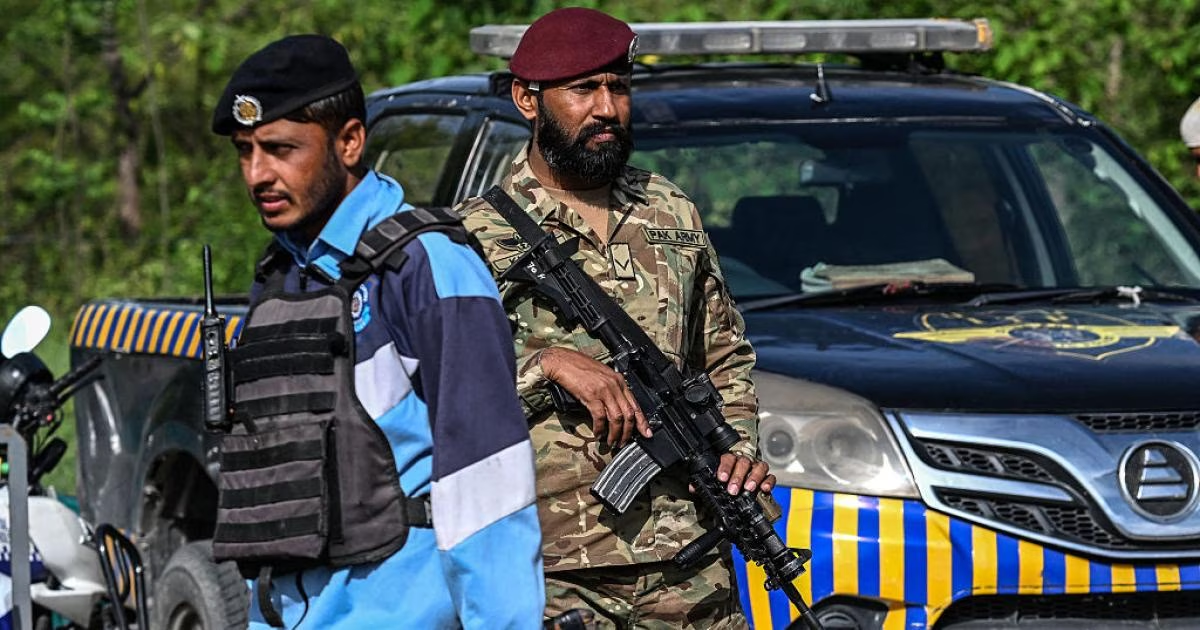
Islamabad is witnessing a security and diplomatic alert to secure the talks, which Pakistani Prime Minister Shehbaz Sharif described as a 'historic event.' Through this hosting, Sharif seeks to defuse a major regional crisis, calling on all parties to exercise restraint and give a real chance for peace to spare the region the ravages of a devastating war.

The Pakistani Prime Minister expressed his dissatisfaction with the recent military escalation in Lebanon, confirming that the Pakistani narrative aligns with the Iranian demand for Lebanon's inclusion in the truce. Pakistan believes there is an opportunity to transform the temporary ceasefire into a permanent and comprehensive peace agreement that ends the ongoing conflict between Iran on one side and the United States and Israel on the other.

Pakistani diplomacy is working in coordination with influential regional and international powers to ensure the success of this round, with continuous consultations taking place with Turkey, China, Saudi Arabia, and Egypt. These moves aim to mobilize international support for the Pakistani initiative and provide political cover to ensure the commitment of the conflicting parties to what will be agreed upon behind closed doors.

The US delegation will be headed by Vice President J.D. Vance, a move that reflects the White House's seriousness in directly managing this file. The US delegation also includes prominent figures such as Jared Kushner and Steve Witkoff, indicating Washington's desire to link the political track to broader regional arrangements that include economic and security files.

As for the Iranian delegation, it is led by Parliament Speaker Mohammad Bagher Ghalibaf and Foreign Minister Abbas Araghchi, a representation that combines legislative and diplomatic weight. The composition of the Iranian delegation reflects Tehran's desire to show internal unity behind the negotiator, while adhering to the military and political constants recently announced by the Iranian leadership.

Anticipation remains the master of the situation in international circles for what Friday's meetings will yield, as observers believe that the gap between the demands of the two sides is still wide. While Washington insists on specific technical and military compliance, Tehran rejects any agreement that does not guarantee the removal of the threat to its allies in the region, making the Islamabad negotiations a real test of the will for peace.

Our eyes are on the enemy, and our fingers are on the trigger; we are ready for a long war if negotiations fail.

PALESTINE

Thu 09 Apr 2026 2:58 pm - Jerusalem Time

Including a child.. 3 martyrs in continuous Israeli violations of the ceasefire agreement in Gaza

Israeli violations of the ceasefire agreement in the Gaza Strip continued, as medical and field sources reported the martyrdom of at least three citizens, including a child, as a result of shelling and gunfire operations targeting various areas of the Strip today, Thursday. These developments come in the context of a series of violations committed by the occupation army since the agreement came into effect last October, threatening the stability of the fragile truce.

In the details of the attacks, an Israeli drone directly targeted citizen Youssef Khalil Ahmed Mansour, 33 years old, in the Al-Barweil area in Mawasi Rafah, south of the Strip, leading to his immediate martyrdom. The city of Beit Lahia, north of the Strip, also witnessed another citizen being shot by occupation forces, who continue to target civilians in border and populated areas.

In another crime that shook local circles, 13-year-old child Ritaj Abdul Raouf Raihan was martyred after being shot by occupation forces while she was inside an educational tent in Beit Lahia. The child was receiving her lessons at Abu Obaida bin Al-Jarrah School when she was surprised by Israeli fire, reflecting the extent of direct targeting of educational and civilian facilities.

Local sources also documented the martyrdom of a young Palestinian man in the city of Khan Yunis, south of the Strip, by occupation bullets, and his identity has not yet been identified. These attacks coincide with the continued fall of victims, as a number of citizens were martyred yesterday, Wednesday, including journalist Muhammad Samir Washah, who joined a long list of journalistic martyrs, reaching 257 martyrs since the start of the war.

Regarding official statistics, medical sources in Gaza announced an increase in the total death toll from the genocide war since October 7, 2023, to 72,317 martyrs and 172,158 injured. The sources clarified that the period following the signing of the ceasefire agreement on October 11 alone witnessed the martyrdom of 738 people and the injury of more than two thousand other citizens.

Regarding rescue efforts, specialized teams have been able to recover 759 bodies from under the rubble since the truce came into effect, but large numbers of victims are still missing under the rubble and in rugged roads. Ambulance and civil defense teams face extreme difficulties in reaching all affected areas due to continuous Israeli targeting and a lack of logistical capabilities.

Child Ritaj Raihan was fatally shot while receiving education inside an educational tent belonging to Abu Obaida bin Al-Jarrah School in Beit Lahia.

ARAB AND WORLD

Thu 09 Apr 2026 2:58 pm - Jerusalem Time

The Battle of Narratives Between Washington and Tehran: When Political Marketing Precedes Field Results

Current developments in the international political scene do not appear to be merely a traditional conflict between a victor and a vanquished, but rather closer to an open confrontation temporarily frozen under a fragile negotiating cover. Each party enters the dialogue table burdened with a high ceiling of conditions, attempting to market a special narrative to its audience, implying that it has managed to impose its rhythm on the other party.

Upon closer inspection of the details, it becomes clear that what is presented as American points and Iranian proposals is nothing more than an expression of two completely contradictory visions. The United States, through the 15-point package it put forward, is trying to promote its success in shifting negotiations to the core sensitive issues that concern its national security and the security of its allies.

The American vision includes radical demands, including dismantling Iran's military nuclear program, halting enrichment operations, controlling the ballistic missile system, and ending Tehran's regional influence. Washington considers that merely including these items on the table represents a political achievement that proves its ability to exert pressure.

In contrast, Iran refuses to deal with these items as a fait accompli or self-evident truths, but rather places them in the context of 'proposals under negotiation.' Tehran promotes to its audience that the United States' acceptance of opening the door to dialogue and a temporary ceasefire is a direct result of its steadfastness and its rejection of dictates under the weight of economic pressures.

Tehran put forward ten counter-items through which it aims to redefine the international agenda, shifting it from a technical focus on the nuclear program to a broader discussion that includes comprehensive regional security. Iran seeks to obtain clear guarantees of non-aggression and sanctions relief as a fundamental condition for any future progress.

The paradox is clearly evident in the 'nuclear versus security' file, where Washington sets red lines related to halting enrichment and dismantling facilities. Meanwhile, Tehran avoids clear commitment to these issues, promoting that the top priority has become to ensure non-exposure to military attack and to end the ongoing state of war.

As for the sanctions file, the gap appears wide; the United States affirms its readiness to lift sanctions only within a comprehensive deal that guarantees major Iranian concessions. Meanwhile, Iran insists that lifting sanctions is a fundamental and unconditional sovereign right, and places it as a central item in any dialogue, away from the logic of bartering.

Regarding regional influence, Washington stipulates an end to support for factions and proxies in the region as evidence of good intentions and progress in the diplomatic path. Iran responds by demanding a halt to military strikes on its allies, considering that its regional role serves the interest of 'protecting stability' and consolidating its position as an indispensable power.

The Strait of Hormuz stands out as one of the most complex points of contention, where the United States demands guaranteed freedom of international navigation without any restrictions or threats. In contrast, Iran promotes itself as a regulatory and control authority by proposing the idea of transit fees, transforming the file from an international security issue into a sovereign and economic card.

Even the issue of a ceasefire is interpreted contradictorily; Washington presents it as a necessary step to create an atmosphere for serious negotiation. Meanwhile, Tehran considers it a forced American concession that came after the failure of the 'maximum pressure' policy to force the Iranian leadership to surrender under fire.

Minute contentious details, such as the inclusion of the term 'enrichment' in some drafts but not others, are used as tools in the media war between the two parties. Washington uses them to say that Iran is evading its obligations, while Tehran uses them to confirm that the final conditions have not yet been settled and that it still has the ability to modify.

The conclusion indicates that each party is not promoting what has actually been agreed upon, but rather what it has succeeded in introducing into the international discussion agenda. Washington boasts of forcing its adversary to discuss dismantling its capabilities, and Tehran boasts of forcing Washington to recognize its security conditions and halt military operations.

The current truce appears to be no more than a fragile tactical pause in a long and extended conflict, lacking the solid foundations that ensure its sustainability. It is likely that each party will use this time to rearrange its cards and strengthen its field and political capabilities in preparation for upcoming rounds that seem inevitable in the absence of radical solutions.

Ultimately, the 'victory' declared by both sides remains merely a media formulation directed at internal consumption rather than a tangible political reality. The distance between the American ceiling and the Iranian ceiling is still very wide, and the bitter truth is that no one has yet settled the conflict in their favor.

The scene looks as if everyone has won in their own narrative, while the truth is that no one has settled anything yet, and what happened was a consolidation of negotiating positions, not the achievement of their goals.

PALESTINE

Thu 09 Apr 2026 2:58 pm - Jerusalem Time

Leaks reveal occupation secretly approved establishment of 34 new settlements in West Bank

Hebrew media sources revealed that the Israeli occupation's Political-Security Cabinet (the Cabinet) secretly approved a large-scale settlement plan aimed at establishing 34 new settlements distributed throughout the occupied West Bank. This step comes as part of an unprecedented settlement escalation, as the number of recently approved settlements has risen to 103, reflecting a governmental trend to impose a new demographic and geographical reality that will be difficult to reverse in the future.

The new plan primarily targets sensitive areas deep within Palestinian territories, particularly in the northern West Bank and what is known as 'Northern Samaria,' where settlement outposts will be planted within densely populated Palestinian enclaves. Among the most prominent proposed locations are settlements named 'Noa' and 'Emek Dotan,' which are planned to be established in remote points aimed at severing the connections between surrounding Palestinian villages and completely isolating them from each other.

The secret decision's provisions include immediate executive measures aimed at accelerating construction operations and imposing a fait accompli on the ground, by starting to extend electricity and water networks and basic infrastructure to these sites before commencing the actual housing process. This tactic aims to ensure the legal and practical establishment of these settlements in record time, thereby reducing the ability to object to them or remove them in any future political settlements.

Despite political insistence, the Chief of Staff of the occupation army expressed clear reservations about this plan, pointing to the significant security challenges that forces will face in securing these remote locations. Military commanders explained that deploying forces in these scattered outposts would deplete limited manpower, but the political level in the occupation government ignored these warnings and insisted on proceeding with the approval of the settlement project.

The occupation government deliberately kept this decision out of the spotlight to avoid confrontation with the international community, especially the administration of US President Donald Trump, amidst ongoing diplomatic activity and regional talks. Observers believe that the occupation is racing against time to exploit the current circumstances and the state of war to achieve settlement leaps that will definitively eliminate any chance of establishing a geographically contiguous Palestinian state, and transform the West Bank into isolated cantons.

The plan includes establishing settlement outposts in very sensitive areas within densely populated Palestinian enclaves to complicate the geographical reality.

PALESTINE

Thu 09 Apr 2026 2:58 pm - Jerusalem Time

Field escalation in the West Bank: Kidnapping of a child in Nablus and a series of settler attacks targeting citizens and their property

Field sources reported an escalation in the pace of settler militia attacks in various areas of the West Bank and occupied Jerusalem, where settler groups carried out a series of organized attacks under heavy protection from the occupation forces. These violations focused on targeting unarmed citizens in pastoral communities and towns adjacent to settlements, leading to injuries and panic among the residents.

In a crime described as serious, a group of settlers kidnapped 14-year-old child Osaid Mahmoud Ghanem from the town of Qabalan, south of Nablus. The settlers took the child to a nearby settlement before he was later handed over to the Palestinian liaison, in an incident that reflects the extent of the threat facing children in areas classified as 'C'.

In Hebron Governorate, brothers Mahmoud and Muhammad Farid Al-Hamamda were subjected to a brutal assault by settlers in the Masafer Yatta area while they were herding livestock. The attackers did not stop at beating them, but also threatened the shepherds with weapons and prevented them from accessing natural pastures, as part of attempts to control land and displace its original owners.

The attacks extended to include the destruction of public and private property, as settlers pelted citizens' vehicles with stones east of Ramallah, causing damage to the windows of several cars and inflicting material losses. The 'Yitzhar' junction south of Nablus also witnessed provocative gatherings of settlers that obstructed traffic and spread panic among Palestinian travelers on bypass roads.

In occupied Jerusalem, settlers continued their violations against holy sites by storming the courtyards of the blessed Al-Aqsa Mosque from the Mughrabi Gate, where they carried out provocative tours and performed Talmudic rituals in the eastern area of the mosque. These incursions coincide with acts of sabotage that affected farms and facilities in the Mikhmas area, indicating the integration of roles between settler groups and occupation forces to tighten the noose on the Palestinian presence.

These increasing attacks reflect a systematic policy to displace Palestinians and tighten the noose on them with official cover from the occupation government.

ARAB AND WORLD

Thu 09 Apr 2026 2:58 pm - Jerusalem Time

Bloody Israeli escalation in southern Lebanon and Hezbollah resumes operations in response to truce violations

The Israeli occupation army escalated its aerial raids on wide areas in Lebanon, for the second consecutive day since the ceasefire agreement was concluded between Tehran and Washington. These attacks come amid a state of ambiguity and political contradictions regarding the extent to which the Lebanese arena is covered by the provisions of this truce, which has led to a rapid deterioration of the field situation.

The occupation forces committed bloody massacres in southern Lebanon, where medical and field sources reported the death of 7 martyrs in an initial toll as a result of a raid targeting the town of Abbasiyah in the Tyre district. Also, 10 other people, including women and children, were martyred in a violent aerial bombardment that targeted an inhabited house in the town of Zrarieh, raising the death toll from the recent raids to 17 martyrs.

The series of Israeli raids extended to include the towns of Kafra, Jumayjimah, Safad al-Battikh, Majdal Zoun, and Deir Antar, in addition to targeting the vicinity of the Qasmiyah bridge, Haboush, Kounin, and Jabshit. Warplanes also destroyed a two-story house at the entrance to the eastern town of Douair, coinciding with intense artillery shelling that targeted the outskirts of the town of Haris.

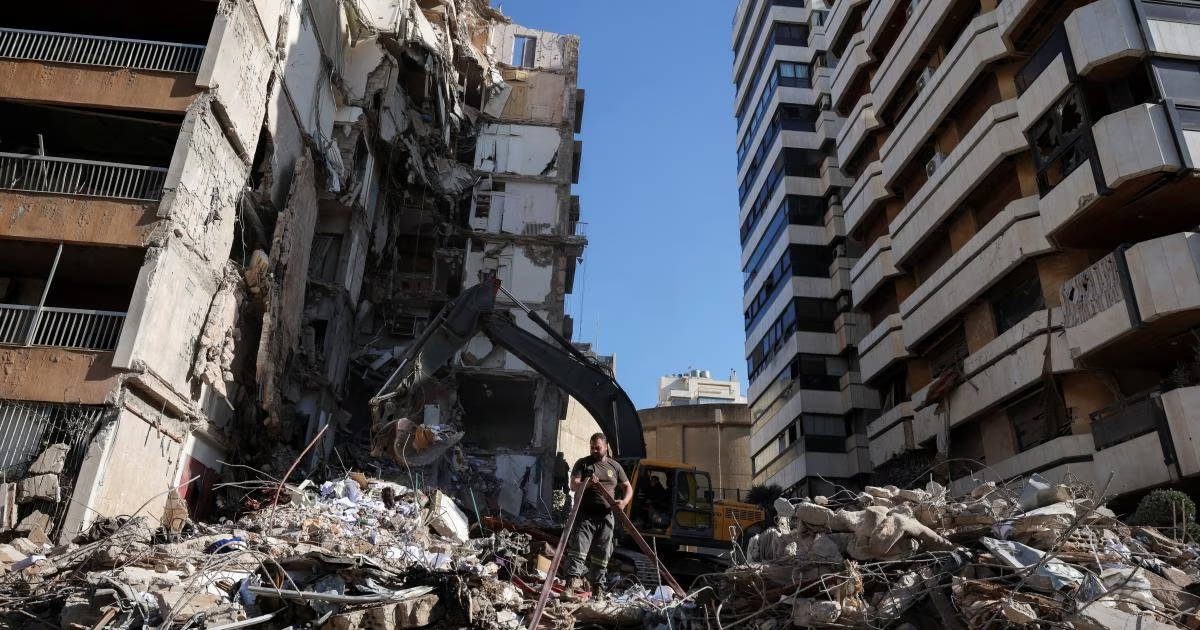
In the southern suburb of Beirut, occupation aircraft launched a raid at dawn today targeting the Chiyah area, resulting in massive destruction of buildings and properties. These strikes come within the framework of the continuous military pressure policy practiced by the occupation on the Lebanese interior despite talk of international understandings for de-escalation in the region.

On the humanitarian front, Lebanese families stranded in the south Litani region issued urgent distress calls to the international community to secure their evacuation under international patronage. These appeals came after the occupation army destroyed the Qasmiyah marine bridge, which led to the isolation of the area and cut off supply and displacement routes for besieged civilians.

For its part, Hezbollah announced the resumption of its military operations against occupation sites, confirming in official statements the targeting of the Manara settlement with a concentrated rocket barrage. The party indicated that its fighters were able to strike an Israeli force that was entrenched inside a house in the border town of Taybeh using a kamikaze drone that achieved a direct hit.

Hezbollah's operations also included targeting an Israeli military vehicle in the town of Taybeh with a guided missile, stressing that these moves are a natural response to repeated Israeli violations of the ceasefire agreement. The party's leadership affirmed that operations will not stop as long as the American-backed Israeli aggression on Lebanese territories continues.

Inside Israel, Hebrew media acknowledged the interception of rockets launched from Lebanon towards the Upper Galilee regions, and sources reported that air defense systems dealt with three rockets that targeted Avivim, Manara, and Margaliot. These rocket barrages reflect the occupation's failure to neutralize the party's offensive capabilities despite the intensity of the aerial raids.

Politically, media reports revealed Israeli Prime Minister Benjamin Netanyahu's dissatisfaction with the current truce formula, as he seeks to separate the Lebanese track from the Iranian one. Sources stated that Netanyahu asked US President Donald Trump to guarantee the continuation of military operations in Lebanon until the occupation's goals of disarming Hezbollah are achieved.

Journalistic sources quoted a senior Israeli official warning that Tel Aviv has put itself in a strategic dilemma, where it is now faced with the choice of either blowing up the entire agreement or backing down from the escalation. The official indicated that the continuation of the raids could lead to the American administration's patience running out and show Israel as a party seeking to thwart international diplomatic efforts.
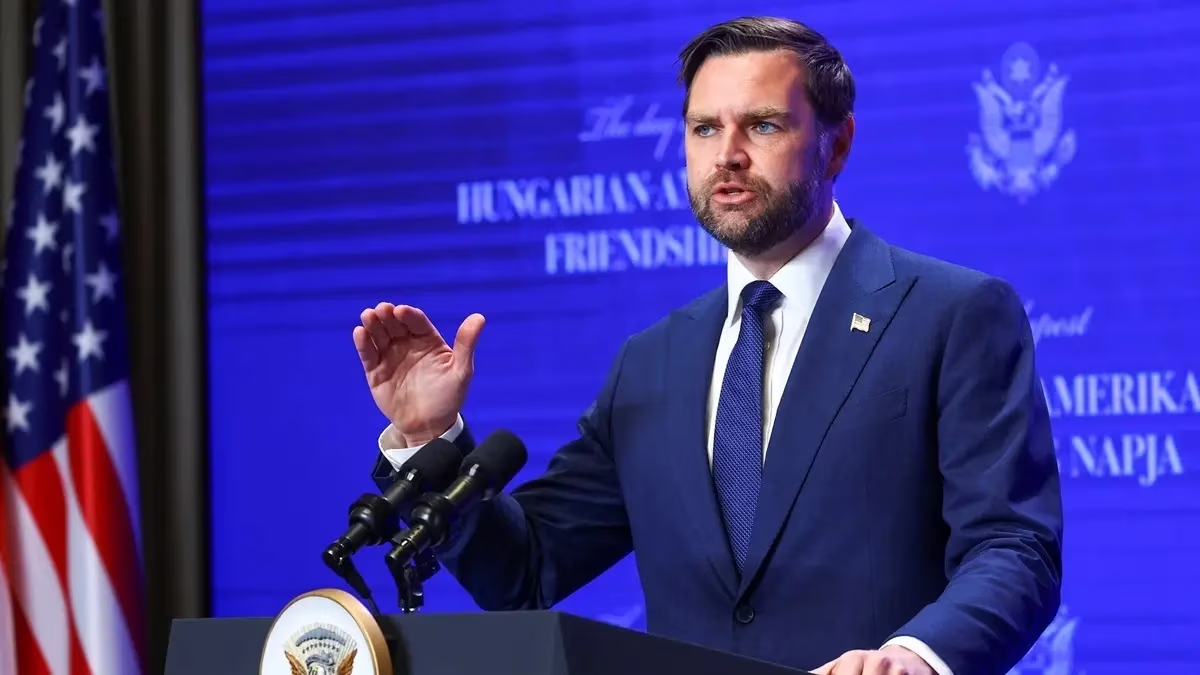
In a related context, senior officers in the occupation army questioned the realism of the declared goals of the war on Lebanon, considering that disarming Hezbollah requires a complete ground occupation of Lebanese villages and territories. Israeli military analyses suggested that the current confrontation will ultimately end with a political settlement, given the high cost and field complexities of a military solution.

The resistance's response will continue until the Israeli-American aggression on Lebanon stops.

ISRAELI AFFAIRS

Thu 09 Apr 2026 2:57 pm - Jerusalem Time

Eisenkot attacks Netanyahu: He leads us from one failure to another, and alleged victories are mere illusions

Reserve General and former commander of the occupation army, Gadi Eisenkot, launched sharp criticism against Prime Minister Benjamin Netanyahu, accusing him of selling illusions to the Israeli public. Eisenkot clarified that Netanyahu constantly speaks of triumphant military victories, while the reality on the ground proves that none of the strategic goals set at the beginning of the confrontations have been achieved.

Eisenkot pointed out in radio statements that Israel is now experiencing a state of imposed ceasefire, both in the Gaza Strip and in the confrontation with Iran. He expressed deep concern about the repercussions of this failure on the Lebanese front, calling on Netanyahu to resign immediately due to his inability to decisively win battles and translate supposed military achievements into political gains.

Regarding the evaluation of the war's outcomes, Eisenkot identified two basic criteria: the first is the extent to which declared goals are achieved, and the second is the improvement of Israel's strategic situation. He affirmed that failure was the government's ally in both criteria, as goals were not achieved, and Israel's international standing declined, especially in the United States, which began to view Israeli policies with suspicion.

Eisenkot conveyed warnings described as 'red flags' issued by the current army commander, cautioning against the risk of the military institution collapsing due to increasing burdens and a severe shortage of manpower. He considered that continuing the war without a political horizon drains the army's capabilities and places it before unprecedented existential challenges in its history.

The former commander touched upon what he described as the 'complete subservience' to the American administration, considering that Israel lost its independence in decision-making from the first days of the war. He explained that young people in America, including Jewish groups, have become strongly opposed to Israeli policies, which threatens the most important strategic alliance for the Hebrew state.

Regarding the Iranian file, Eisenkot described the retention of 440 kilograms of 60% enriched uranium by Tehran as a grave strategic failure. He warned that the Revolutionary Guard's control over the levers of power in Iran increases the likelihood of a rush towards nuclear weapons, which represents a direct threat that cannot be overlooked.

Eisenkot criticized the absence of a clear strategy in dealing with multiple fronts, noting that the current fighting contradicts the classical security doctrine based on rapid decisive action. He stressed that the failure to decisively win the battle in 'little Gaza' after two years of fierce fighting reflects the extent of the confusion experienced by the political and military leadership.

In a related context, Eisenkot attacked the composition of the current 'cabinet,' describing its members as 'empty and eccentric leaders' who do not realize the magnitude of the risks. He considered that the Talmudic and populist designations given to military operations, such as 'eternal darkness,' are merely attempts to cover up field and political failures.

Regarding the situation in northern occupied Palestine, he indicated that settlers there feel complete neglect and loss of security, despite repeated government promises. He criticized the management of the fight against Hezbollah, affirming that the party is conducting a successful guerrilla war while the government is unable to translate the army's tactical successes into a stable political reality.

For its part, Haaretz newspaper launched a similar attack in its editorial, criticizing the use of historical and religious terms to justify military failure. The newspaper affirmed that there is widespread disregard within Israel for the massacres committed in Lebanon and Gaza, where the focus is only on calculations of material and political profit and loss.

In contrast, Minister Ze'ev Elkin tried to defend the government's performance, claiming that Israel had achieved significant gains in southern Lebanon by establishing a security zone. Elkin claimed that removing residents from border areas up to the Litani River gives the army effective control and the ability to protect northern residents in the future.

However, Eisenkot responded to these claims by emphasizing that 'the proof of the pudding is in the eating,' and that the absence of a clear mechanism to end the war will make any tactical achievement merely a long-term attrition. He stressed the need for an alternative leadership capable of aligning goals with actual capabilities, away from empty promises.

Eisenkot also pointed out that a comparison between the Second Lebanon War in 2006 and the current situation shows a significant contradiction in Netanyahu's own positions. While Netanyahu then demanded the government's overthrow due to its failure to achieve decisive victory, today he clings to power despite the repetition of the same failures, and in a deeper and more dangerous way.

Eisenkot concluded his remarks by emphasizing that Israel needs to restore its moral and strategic balance, warning that continuing the current approach will lead to dire consequences. He considered that restoring deterrence is not achieved through resonant speeches, but through courageous decisions that place the state's interest above narrow political interests.

Netanyahu tells Israelis about triumphant victories while they see the war's goals not being achieved, and Israeli decision-making is no longer in its hands but in Washington's.

OPINIONS

Thu 09 Apr 2026 9:06 am - Jerusalem Time

The Balance of Profit and Loss in the War on Iran

Although the ceasefire agreement between the United States and Iran is temporary, the war has effectively ended and will not resume after two weeks. The one who started this war and boasted about eliminating "Iranian civilization" from existence and returning Iran to the "Stone Age where it belongs" can no longer continue it. Time was pressing on the American president, and any additional day this war continued, which he could not resolve as quickly and easily as he expected, and the continued rise in oil derivatives prices and financial market turmoil within America, would most likely lead to a certain loss for his party in the upcoming midterm elections, which would hinder the remainder of his presidential term and weaken the chances of any Republican candidate winning the presidential elections in 2028.

Iran's endurance of an intense American-Israeli aerial bombardment campaign, despite its heavy human and material cost, and Iran's ability to transform the war, which was intended by America and Israel to be swift and clean, into a fierce, open, and escalating war that plunged the entire world into a severe and worsening crisis, forced the American president to exert the highest levels of pressure in search of a way out that would save face not only for himself but also for his country, which he embroiled in an intractable war. When he failed, and discovered the extent of the limited American ability to achieve the imagined victory, he was forced to agree to a temporary cessation of a war that would not be renewed, and to return to negotiations with an Iranian regime he had fought to overthrow, in exchange for a conditional reopening of the Strait of Hormuz, which was originally open before the outbreak of the war. No matter how Trump now tries to embellish the claim of achieving victory in a war he chose to fight, not out of necessity, on behalf of Israel at Netanyahu's instigation, the objective truth indicates that he suffered a clear loss, which will have negative repercussions not only on him but also on his country.

The American president humiliated himself with the outcome of a war he launched with exaggerated expectations that he could not achieve, and he shook America's standing with it. All the declared goals for which he fought this war were not resolved on the battlefield, and he must now negotiate with Iran over them. His mere acceptance of a ceasefire and going to the negotiating table not only represents an implicit acknowledgment of the failure of using force, which he primarily relied on to impose his terms on Iran, but also his willingness to make concessions to it in order to reach an agreement. Iran imposed on America, the global superpower, the necessity of accepting a return to the path of negotiation, a path based on the necessity of mutual concessions between the negotiating parties. As a result of this American-losing war, the relationship that Trump imagined to be a vertical power relationship with a regionally faltering Iran, meaning that America, with its surplus power, could impose Iran's compliance with its terms, was revealed to be, in fact, a horizontal power relationship between it and Iran, where Washington cannot achieve part of its demands except through peer-to-peer negotiation with Tehran.

And what future repercussions this revelation will have on America's position as a global superpower. By excessive arrogance, underestimation of others, and recklessness in decision-making, Trump, in his hasty war on Iran, revealed the hidden truth: the extent of the deterioration in America's global standing since the beginning of this millennium. This deterioration has escalated since then as a result of serious revisionist attempts by major and regional powers to weaken the superpower, escape the grip of the unipolar international system, and transform the international system into multipolarity. The successive steps taken by China in the past two decades to expand its regional hegemony, Russia's war on Ukraine, the expansion and movement of "BRICS" countries, the establishment of new economic frameworks and the development of new international financial systems, and Europe's belated awakening, are but examples of the continuous movement in indirect confrontations with America, aimed at undermining its position as a global superpower.

Suddenly, a direct confrontation emerges, not imposed on this superpower, but chosen by it, as an "exam" to show all the powers and revisionist movements trying to drain its standing that it still possesses a superior ability to repel its "aggressors" and maintains its full hegemony as a superpower. Trump chose war on Iran believing it would be an easy task, through which he would show the world that America is still in the lead and controls global events. But the outcome of this war shows that America, even with its excessive use of military force, was actually weak and unable to resolve the matter even with a regional power that it itself said was weak and had dilapidated power. This is certainly an indicator of weakness, and a signal that all other parties seeking to strengthen their international standing will pick up, and an open invitation for them not to hesitate from now on, but rather to intensify their future challenges to America, because the door has been revealed to be wide open for them. He who could not contain Iran will not be able to impose compliance on revisionist and other rising regional powers. Since the beginning of the third millennium, the international system has been undergoing a transformation. By observing the behavior of major powers, especially China and Russia, and rising regional powers, such as India, Iran, Brazil, Turkey, South Africa, and North Korea, it was clear that they were unwilling to tolerate the continuation of the unipolar international system, under which America sat at the top of the international hierarchy. But now, as a result of Washington's failure to resolve the war on Iran in its favor, the change in the international system's status has become inevitable and irreversible. It has become clear that America is suffering from an irreversible state of decline in its power and a retreat in its standing. This does not mean at all that it will not remain a superpower with its influence in the global balance of power, but it does mean that it is no longer able to impose its absolute will on the world, as it was before the exposure of the limitations of its power and its ability to impose compliance on Iran. One of the revealing pieces of evidence for this is that despite the weakness and collapse of the standing and capabilities of international institutions due to American targeting, especially the United Nations, Washington was unable to even obtain a Security Council resolution from them authorizing the reopening of the Strait of Hormuz by all means, but was met with a double veto from Russia and China, which deprived it of the cover of international legitimacy for continuing its war on Iran. In addition to Trump and America, Netanyahu and Israel are the second biggest losers of this war, which was launched under intense and continuous pressure from them. Aside from the systematic destruction campaign carried out by warplanes on Iran, which caused significant but repairable and compensable damage, all Israeli goals for this war were not achieved. Aside from the details, such as the Iranians not taking to the streets to overthrow the regime, the failure to incite the Kurds to declare war on Iran, the Iranian regime not falling after a series of assassinations of its political and military leaders, the elimination of Hezbollah's military capability, and the continued shelling of Israeli sites with Iranian missiles, the most important and largest Israeli goal of ending Iran's status and role as a rival and equal regional power to Israel was not achieved, but rather actually strengthened.

Iran will negotiate with America, and the humiliated Israel will be forced to swallow the consequences, and it will be forced to comply, and it will not be able to do anything but try to sugarcoat the bitterness with false claims of imagined achievements. Even by sheltering behind America and involving it in using its excessive military force, it could not achieve its goals, so how will it fare after losing this cover? Netanyahu's desperate attempt for two decades to eliminate Iran as a regional power has failed miserably. The war is now ending, and the Middle East that Netanyahu promised to change is not only remaining as it was, but has undergone a transformation in the opposite direction to Israel's interests. Netanyahu's boastful declaration that Israel had become a global power was nothing more than an illusory claim with no substance other than the continued guarantee of American protection. But this protection is no longer as it was before the two wars, on Gaza and Iran, guaranteed and assured without any accountability or questioning.

The objective result that Israel must confront is that its sequence of military failures, in Gaza, Lebanon, Yemen, and Iran, proves that its absolute reliance on its military capabilities, supported by America, cannot achieve the legitimacy of its existence. What can achieve that for it are two fundamental things: the necessity of ending the occupation and upholding the legitimate national rights of the Palestinian people, represented by freedom and independence, and ending its hostility and continuous attempts to dominate the region. As long as these two conditions are not met, Israel will continue to suffer disappointments.

As for the third loser in this war, it is the dilapidated Arab system, composed of regimes that agreed to mortgage their continued existence by subordinating themselves to others, specifically to America. During this war, the false situation of this system was exposed, and it collapsed with extreme speed and ease, due to the failure of those who were relied upon to defend it to carry out the task, which regularly costs the depletion of Arab resources. This system has lost huge material resources, but more importantly, it has lost stability and reputation, which will require a lot of resources and years to restore. And even with restoration, the result may be that the situation, especially regarding the moral standing of many countries, will not return to its previous state until after a long period. This war, and the Arab choices that permeated it, revealed a lack of self-confidence, which, even if not available, lessons are learned and work will be done in the future to build it. It is clear that dependency is a state of mind before it is determined by the availability of material capability. The Arab system, in its current state, has condemned itself to remain dependent; it sits on the sidelines of the ongoing conflict to determine the position of influential regional powers in the region. And the situation of this system will remain dependent and marginalized as long as the forces controlling political decision remain as they are currently.

In contrast to the losers, Iran emerges from this war as the biggest winner. Despite its heavy but compensable material losses, the country and the regime stood firm, fought a war efficiently and competently, and forced America to negotiate to end the war according to terms presented by Iran, in exchange for American demands. The cohesion and good performance of Iran during the war earned Iran a great actual and moral standing, making it a power that should be taken into account, not only regionally, but also on the general international level. Tehran will emerge from this war stronger in its regional standing than it was, having achieved a very important victory, directly for itself, and with indirect effects for many parties in the world as well.

ANALYSIS

Thu 09 Apr 2026 9:05 am - Jerusalem Time

Putin's Revenge: How Iran Became a Russian Arena to Drain Washington?

For years of conflict in Eastern Europe, the United States and its allies have provided open and generous support to Ukraine, including billions of dollars, the latest weapon systems, and intelligence information. The Western goal of this support was clear: to use the Ukrainian arena as a proxy war to drain Russian military capabilities and weaken Moscow's international influence through harsh economic sanctions.

However, the geopolitical scene has recently witnessed a major reversal, as Russia strategically began to exchange roles with the West. While Washington engaged in extensive confrontations to support its allies against Iran, Russian President Vladimir Putin decided to employ Tehran as a tool for indirect confrontation with the United States from behind the scenes.

This Russian strategy manifested in providing unprecedented military and technical support to the Iranian side, including supplying it with accurate intelligence information and advanced field tactics. Observers believe that Moscow raised the slogan 'Ukraine for Iran' in a decisive response to European criticism of Russia's escalating role in the Middle East.

US President Trump acknowledged this new reality when asked about Russian support for Tehran, confirming that both parties are playing the same game in different arenas. Reports revealed that the Trump administration rejected an explicit Russian offer to stop supporting Iran in exchange for Washington ceasing to arm and finance Ukrainian forces.

Technical data indicates that Russian support goes beyond mere weapons, extending to providing high-resolution satellite imagery via the Russian Aerospace Forces (VKS). This data allows Tehran to monitor US and Zionist military bases and strategic assets in real-time, increasing the accuracy of potential Iranian strikes.

Ukrainian President Volodymyr Zelensky, in turn, confirmed this information, noting that Russian expertise is now flowing intensely towards Tehran. This cooperation represents a return of favor, after Iran had supplied Moscow with 'Shahed' kamikaze drones at the beginning of the Ukrainian war and provided it with manufacturing blueprints for local production.

Today, Iran adopts the Russian military approach based on using dense swarms of cheap drones to overwhelm advanced air defense systems. These swarms are followed by precise missile strikes targeting command and control centers and radars, tactics that have proven effective in the Ukrainian field and were transferred verbatim to Iranian advisors.

In addition to the military field, Russia employs its capabilities in artificial intelligence to wage a misleading propaganda war aimed at amplifying Iranian power and demonstrating its superiority. Russian official media works to widely disseminate this content to distract American focus and raise concerns in Western circles.

Putin's goal from this escalation appears to be to drain American resources away from the Ukrainian front, which has been partially achieved with Washington being forced to withdraw 'Patriot' systems from Europe. This shortage in Ukrainian air defenses came as a result of redirecting missiles towards the Gulf region, given the limited US production of no more than 65 missiles per month.

Moscow's gains were not limited to the military aspect but also extended to global energy markets, which witnessed a significant rise in prices due to tensions. This increase forced Washington to ease some oil sanctions on Russia, providing Moscow with billions of dollars in financial flows that were used to finance its war machine without directly firing a single bullet against US forces.

Ukraine for Iran... This is how Moscow responded to the West's draining of its forces by supporting Tehran with advanced military tactics and real-time space information.

OPINIONS

Thu 09 Apr 2026 5:41 am - Jerusalem Time

Vance Leads US Delegation to Negotiate with Iran in Islamabad Amid Fragile Ceasefire Test

Said Erikat

Opinion Writer

Washington – Saeed Erikat – 9/4/2026

News Analysis

On Wednesday, the White House announced that US Vice President J.D. Vance would lead the American negotiating team in the upcoming talks in Islamabad over the weekend. This move, according to initial indications, reflects an attempt to inject political momentum into a fragile negotiating path linked to a limited-duration ceasefire. This comes after the announcement, on Tuesday-Wednesday night, of a two-week agreement to cease hostilities between the United States, Israel, and Iran, amidst an atmosphere dominated by caution and skepticism about its sustainability.

According to White House Press Secretary Karoline Leavitt, Vance, who opposed the war from its beginning and even before, will head the delegation, which also includes President Donald Trump's envoys, Steve Witkoff and Jared Kushner. The level of American representation in these talks is seen as an indicator of the seriousness of engagement, especially after previous reports suggested Vance's potential absence for security reasons, or that the meetings would take place at a different time. The administration has affirmed its confidence in the security protection arrangements for the Vice President during his visit to Pakistan.

In contrast, diplomatic leaks indicate that Tehran prefers Vance to lead the negotiation process, given its reservations about Witkoff and Kushner's performance during previous rounds, and their accusation of misrepresenting some Iranian positions. Vance is also among the few voices within the administration who have expressed reservations, according to reports, about the option of military escalation with Iran, which may explain the Iranian bet on him as a more amenable negotiating partner.

During a speech in Budapest, Vance indicated that Trump is showing impatience with the slow progress towards ending the war, emphasizing that the President has directed his team to negotiate “in good faith.” However, these positive signals coincided with adverse developments on the ground, as the ceasefire was quickly subjected to serious tests, amidst mutual accusations and violations.

Iran accused Israel of targeting oil facilities, while Gulf countries reported being subjected to drone and missile attacks by Iran on Wednesday, after a night that saw missile strikes on Israel. This mutual escalation reflects the fragility of the announced understandings and raises questions about the mediators' ability to contain the deterioration.

The issue of including Lebanon in the ceasefire agreement stands out as one of the most prominent points of contention. While Pakistani mediators indicated that the agreement extends to include the Lebanese arena, the United States and Israel categorically denied this. Vance affirmed that what he described as a “legitimate misunderstanding” led Iran to believe that Lebanon was included, stressing that the agreement focuses exclusively on Iran and Washington's allies, specifically Israel and the Gulf states.

Despite Vance's talk of Israeli readiness to show some restraint in Lebanon in support of the negotiations, no clear field indications of this have emerged, as southern Lebanon witnessed a significant escalation in Israeli strikes. Vance considered that Iran's linking the fate of the negotiations to the situation in Lebanon remains an “option” taken by Tehran, in a reference to Washington's rejection of expanding the negotiation framework.

On another note, Iranian Parliament Speaker Mohammad Bagher Ghalibaf escalated his rhetoric, accusing the United States of violating three provisions of a ten-point Iranian proposal, presented as a basis for a long-term agreement. These provisions, according to the Iranian narrative, included the ceasefire covering Lebanon, preventing the penetration of Iranian airspace, and recognizing Tehran's right to enrich uranium.

While Trump had previously announced his acceptance of the Iranian proposal as a basis for negotiation, Washington later confirmed that the version published in Iranian media did not reflect the actual submitted formula, without revealing its details. This discrepancy reflects a persistent trust gap, explicitly pointed out by Ghalibaf, who considered the United States' record of “violating commitments” justifies Iranian suspicions.

For his part, Vance tried to downplay the importance of the differences, considering that focusing on three points of contention might mean a broader common ground. However, he stirred controversy by questioning the accuracy of Ghalibaf's understanding of some elements of the proposal, a comment that could be seen as further complicating the negotiating atmosphere.

In the same context, Leavitt described the ceasefire as a “victory” for the United States, pointing to the achievement of key military objectives, including weakening Iranian naval and missile capabilities and reducing its support for regional allies. However, she implicitly admitted that these capabilities were not completely destroyed, but rather set back years, which opens the door to varying assessments of the confrontation's outcomes.

The nature of current American moves reflects an attempt to manage the balance between escalation and containment, as Washington seeks to leverage military pressure to improve negotiation terms, without sliding into an open confrontation. However, the multiplicity of conflict paths, from the Gulf to Lebanon, makes it difficult to confine understandings to a narrow geographical framework. Moreover, the discrepancy between political rhetoric and ground realities may gradually erode trust, unless declared intentions are translated into verifiable commitments.

The selection of Vance to lead the negotiating delegation highlights an awareness within the administration of the importance of the personal dimension in managing international crises. Negotiations in such contexts do not rely solely on texts, but also on the level of trust between the parties. If it is true that Tehran sees Vance as a less hardline interlocutor, this could open a limited window for understanding, even if surrounded by internal political constraints on both sides.

The assignment of the negotiation task to Vance raises questions about the diminished roles of figures like Steve Witkoff and Jared Kushner, whose names were previously associated with Middle East files. This marginalization may reflect an assessment within the administration of their weak technical and diplomatic expertise in managing a complex conflict of this magnitude, or considerations related to the need to reset the negotiation path away from channels that proved to have limited effectiveness in previous crises.

Furthermore, the close association between some American negotiators and Israeli Prime Minister Benjamin Netanyahu raises doubts about the neutrality of American seriousness in negotiation, weakens Tehran's trust in Washington's seriousness, and reinforces the conviction that negotiations are taking place within a biased framework, especially since the United States launched a war on Iran twice while negotiating with the Witkoff-Kushner team. Therefore, the success of the diplomatic path requires demonstrating greater American independence, either by changing faces or modifying negotiation mechanisms to ensure a relative balance in the approach.

The disagreements over the provisions of the Iranian proposal reveal a deeper dilemma related to conflicting narratives, where each party adheres to a different interpretation of the same document. In the absence of full transparency, it becomes difficult to verify the validity of mutual claims, which reinforces an atmosphere of suspicion. Moreover, the introduction of sensitive sovereign issues, such as enrichment or airspace, into the core of negotiations, further complicates reaching a quick settlement, and makes any agreement vulnerable to instability at the first field test.

ISRAELI AFFAIRS

Thu 09 Apr 2026 5:41 am - Jerusalem Time

Netanyahu's Predicament: How Trump Surprised Israel by Halting the War with Iran?

Israeli Prime Minister Benjamin Netanyahu finds himself today facing a complex political and military reality, following the American President's sudden announcement of a two-week suspension of attacks on Iran. This decision, taken by Washington without prior consultation with Tel Aviv, sparked a wave of concern in Israeli circles about the utility of the heavy costs paid during the recent confrontation.

Analytical sources reported that Israel, despite its use of excessive military force, failed to achieve a decisive resolution that would eliminate what it describes as the 'Iranian threat'. Observers believe that Trump's announcement of the agreement, which was drafted away from the closed rooms in Tel Aviv, reflects a clear American desire to avoid sliding into a comprehensive regional war that does not serve Washington's current interests.

In this context, political analyst Aidan Kivlar pointed out that the emergence of JD Vance, the US Vice President, represents a 'new nightmare' for Netanyahu and his ambitions. The new trends in the White House seem more inclined towards de-escalation, which was clearly evident in the sharp drop in oil prices immediately after the announcement, strengthening Trump's political position domestically.

A state of skepticism prevails within the Israeli security and political establishment regarding the leaked terms of the agreement, especially since they focused on secondary issues such as navigation in the Strait of Hormuz. Critics believe that ignoring fundamental issues, such as uranium enrichment and ballistic missiles, empties Israeli military operations of their strategic content promoted by Netanyahu.

Despite official statements attempting to show full coordination between the two sides, behind the scenes reveals a deep gap in visions between the Trump administration and the right-wing government in Israel. Netanyahu had hoped for continued military pressure until the complete collapse of the Iranian regime, which was not achieved in the current form of the agreement.

Sources clarified that Iran succumbed to the demand to open the Strait of Hormuz after its infrastructure suffered severe blows, but this achievement is not enough for Israel, which fought the war for much broader goals. The current negotiations do not seem promising regarding the dismantling of the nuclear program, which puts Netanyahu in an embarrassing position before his right-wing public.

Reports indicate that Netanyahu ultimately realized that the political fate of his wars was linked to Trump's decisions, who seeks to achieve quick gains before the midterm elections. This realization reduced the room for maneuver available to the Israeli Prime Minister, who finds himself unable to openly oppose his strongest ally in the White House.

On the military front, Israel achieved successes in reducing Iranian missile capabilities and damaging vital facilities, but the cost was catastrophic on the home front. Missile barrages caused widespread destruction of homes and casualties, in addition to significant human losses among soldiers during ground operations in Lebanon.

Analysts believe that Israel has once again reached 'ground zero' or an intermediate state that is neither a resounding victory nor a crushing defeat. This strategic reality raises questions about the utility of the sacrifices made, as long as the Iranian regime still exists and possesses its uranium stockpile and missile capabilities.

Furthermore, the challenge posed by JD Vance stands out, as studies have shown that his popularity is rising among a public that does not prioritize Israel. Vance's sarcasm directed at Netanyahu regarding the possibility of overthrowing the Iranian regime reflects a shift in the political mood within the Republican Party itself.

The ceasefire, which also included the Lebanese front, means a return to cautious calm without resolving the outstanding issues that led to the outbreak of the confrontation in the first place. This situation puts Netanyahu under double pressure; from the internal opposition accusing him of failure, and from the American ally dictating its own pace.

Netanyahu is currently trying to cover up his disappointments through a mobilization speech aimed at boosting the morale of his right-wing camp, despite his awareness that strategic threats have not dissipated. The public, who was promised 'overwhelming victory', finds itself today facing a de-escalation agreement that returns things to what they were before the recent escalation.
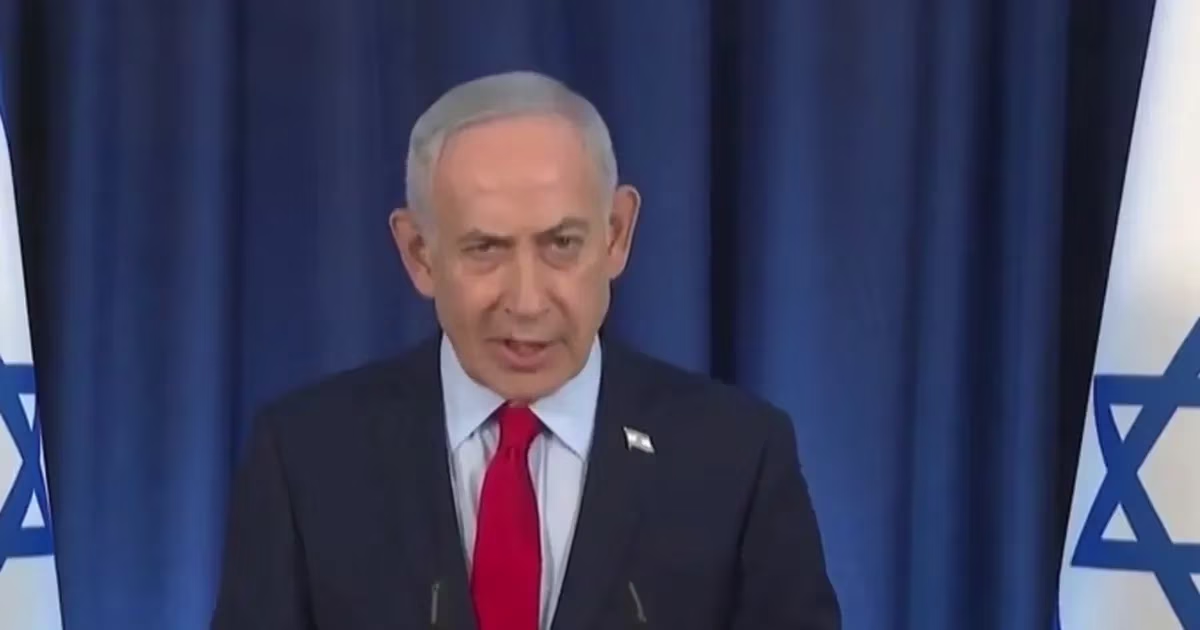
With elections approaching in both Israel and the United States, narrow political calculations become the primary driver of major decisions. Trump wants to present a diplomatic achievement that ends the exorbitant cost of the war, while Netanyahu fears that halting the war will open internal accountability files regarding its results.

In conclusion, it seems that the next phase will witness a silent struggle between Tel Aviv and Washington over the details of the final agreement with Iran. While Washington seeks to close this file, Israel insists that any agreement that does not guarantee the complete dismantling of Iranian nuclear capabilities is merely a postponement of a coming and more fierce conflict.

Israel has once again reached an intermediate point: not a clear victory, nor a complete defeat, but another round ending without a fundamental change in the strategic reality.

OPINIONS

Thu 09 Apr 2026 5:35 am - Jerusalem Time

A Fragile Truce Undermined: Vance’s Mission and the Troubled Legacy of U.S. Diplomacy with Iran

By: Said Arikat


April 9, 2026


News Analysis


Washington, D.C- The decision to send J.D. Vance to lead negotiations with Iran in Islamabad reflects more than a tactical diplomatic move—it exposes the accumulated contradictions in Washington’s long and troubled negotiating record with Tehran. Announced alongside a two-week ceasefire involving the United States, Israel, and Iran, the initiative is framed as a step toward de-escalation. Yet both the structure of the talks and the conduct surrounding them suggest that the United States continues to struggle with credibility, consistency, and control over its closest regional ally, Israel.


At first glance, Vance’s appointment appears to signal a course correction. Known for his skepticism toward military escalation, he contrasts with figures such as Steve Witkoff and Jared Kushner, whose earlier involvement in Middle East diplomacy has drawn criticism in Tehran and beyond. Iranian officials have openly questioned their reliability, accusing them of distorting positions and negotiating in parallel with military pressure. This perception is not incidental—it is rooted in a broader pattern in which diplomacy and coercion have proceeded simultaneously, often undermining each other.


Indeed, one of the most persistent Iranian grievances is that Washington has repeatedly negotiated while escalating militarily. Iranian officials point to past episodes in which talks coincided with strikes or threats, reinforcing a belief that diplomacy is used as cover rather than commitment.  This pattern has produced what Iranian leaders describe as a “zero trust” environment, where even genuine proposals are viewed through the lens of anticipated betrayal.


The legacy of the U.S. withdrawal from the 2015 nuclear agreement continues to loom over current efforts. That decision, coupled with subsequent pressure campaigns, entrenched skepticism not only in Tehran but also among regional actors. Analysts have long argued that inconsistent U.S. strategies—oscillating between maximalist demands and abrupt diplomatic overtures—have weakened the prospects for sustained engagement.  The current initiative risks falling into the same trap if it fails to reconcile rhetoric with practice.


Compounding this credibility gap is the role of Israel, which continues to operate as both a partner and a disruptor in the diplomatic process. Despite the announcement of a ceasefire, Israeli military operations—particularly in Lebanon—have persisted, directly contradicting the spirit, if not the letter, of the agreement. Recent reporting confirms that Israel not only rejected the inclusion of Lebanon in the truce but also continued strikes against alleged Hezbollah targets, even as negotiations were being prepared.


From Tehran’s perspective, this dynamic reinforces a longstanding accusation: that Israel acts as a spoiler, intervening at critical moments to derail diplomatic progress. Iranian officials have explicitly accused Israel of attempting to sabotage negotiations and provoke broader conflict, particularly when talks appear to gain traction.  Whether or not one accepts this framing in full, the timing of Israeli actions has repeatedly coincided with sensitive diplomatic junctures, complicating efforts to build momentum.


Washington’s response to this challenge has been notably ambivalent. While U.S. officials insist that the ceasefire does not extend to Lebanon, they have also called for restraint—without enforcing it. This dual posture allows Israel operational freedom while preserving a diplomatic narrative, but it comes at a cost: it undermines the coherence of the U.S. position and fuels perceptions of selective commitment to de-escalation.
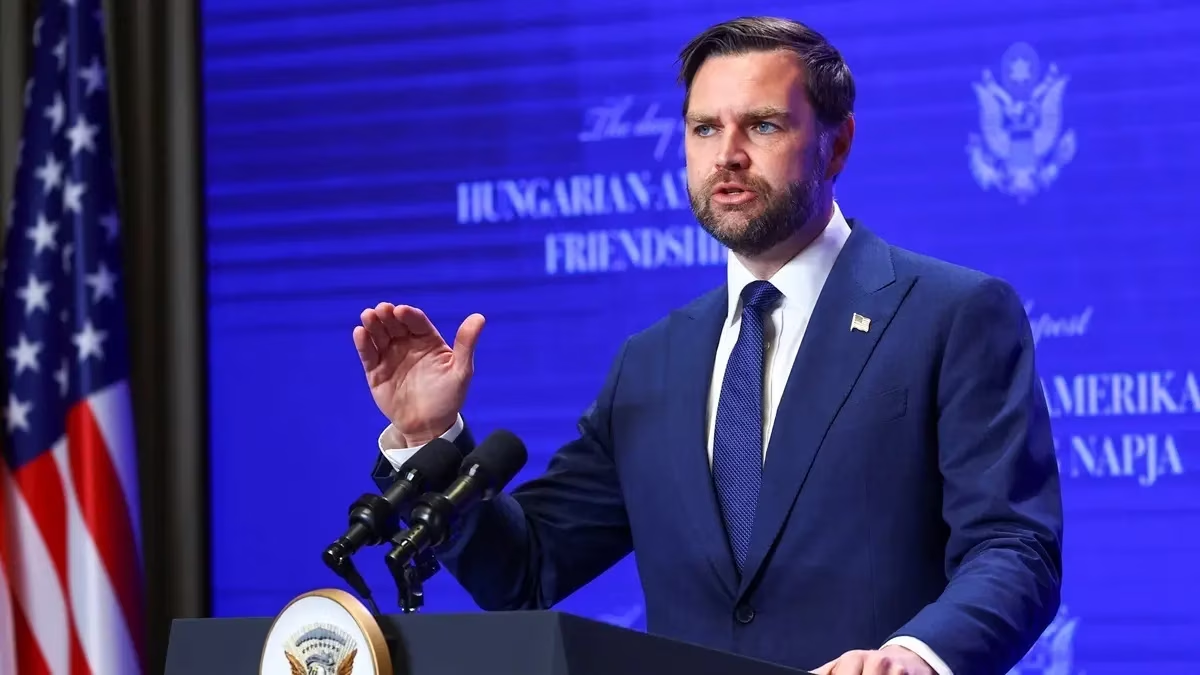

The result is a fragmented negotiating environment in which multiple, overlapping conflicts resist compartmentalization. Efforts to isolate the U.S.-Iran track from broader regional dynamics have proven ineffective, as events in Lebanon, the Gulf, and beyond continue to shape the strategic calculus of all parties. The insistence on a narrow geographic scope for the ceasefire may therefore reflect political expediency more than strategic realism.


Against this backdrop, Vance’s role becomes both more significant and more constrained. His perceived pragmatism may create a limited opening with Iranian negotiators, who appear to prefer engagement with figures less associated with prior breakdowns. Yet personal credibility, while important, cannot substitute for structural change. Without a clear shift in how the United States aligns its military actions, diplomatic messaging, and alliance management, even the most capable envoy will struggle to achieve lasting results.


The internal recalibration within the U.S. negotiating team also raises important questions. The apparent sidelining of Witkoff and Kushner suggests recognition—implicit if not explicit—that previous approaches have fallen short. Their close association with Benjamin Netanyahu has further complicated perceptions of U.S. neutrality, reinforcing Iranian suspicions that Washington’s diplomacy is shaped by Israeli priorities as much as its own.


For negotiations to gain traction, the United States may need to demonstrate a greater degree of independence—not only in personnel but in policy execution. This includes establishing clearer boundaries with Israel when its actions threaten to derail diplomatic efforts, as well as committing to a more consistent negotiating framework that avoids the oscillation between pressure and outreach.


Ultimately, the Islamabad talks are less a breakthrough than a stress test. They will reveal whether Washington has absorbed the lessons of its past engagements with Iran or remains bound by the same patterns that have repeatedly undermined them. If Israel continues to act as an unchecked spoiler, and if U.S. diplomacy continues to be paired with coercive tactics that erode trust, the current ceasefire will likely prove as fragile as those that came before it.


In that sense, the stakes extend beyond the immediate negotiations. They touch on a more fundamental question: whether the United States is prepared to conduct diplomacy with Iran as a strategic commitment rather than a tactical instrument.

OPINIONS

Wed 08 Apr 2026 8:37 pm - Jerusalem Time

How the decision to engage in war against Iran crystallized in the White House under Netanyahu's influence

Washington – Said Arikat – 8/4/2026

News Analysis

A report by New York Times journalists Jonathan Swan and Maggie Haberman provides a detailed account of Donald Trump's decision-making process to engage in military action against Iran, revealing a complex operation where personal assessments, divergent intelligence data, and divisions within his team intertwined, alongside a clear influence from coordination with Benjamin Netanyahu.

The story begins with a pivotal meeting on February 11 at the White House, where Netanyahu presented Trump with a plan supported by Israeli intelligence, focusing on an "opportune moment" to strike Iran quickly and effectively, while minimizing risks. The plan included destroying Iranian missile capabilities, weakening the regime, and even opening the door to its change. The Israeli side presented Iran as internally fragile and externally containable.

Trump showed clear responsiveness to this proposal from the outset, reflecting a growing convergence in his vision with Netanyahu, especially regarding Iran as an exceptional threat. However, this approach faced scrutiny from US intelligence agencies the following day, where the plan was broken down into four main objectives: targeting leadership, weakening military capabilities, igniting internal unrest, and achieving regime change. While the first two objectives were deemed achievable, the latter two were rejected as unrealistic.

Despite this, Trump focused on the feasible military objectives, ignoring reservations related to broader implications. This selective handling of information reflects a broader pattern in his leadership style, where he tends to adopt what aligns with his preconceived notions.

Within his team, Vice President J.D. Vance emerged as the most prominent opponent, warning of the risks of escalation and regional instability. In contrast, Pete Hegseth supported the military option, while Marco Rubio adopted a middle ground, advocating for limited strikes without sliding into major goals like regime change. Military and intelligence officials, such as John Ratcliffe and General Dan Caine, presented the risks without explicit opposition.

Geopolitical context played an additional role, as previous military successes boosted Trump's confidence, alongside his firm conviction of Iran's danger. At the same time, political efforts led by Jared Kushner and Steve Witkoff failed to achieve a breakthrough, further convincing the administration that the military option was the most viable.

With intelligence emerging about a rare opportunity to target Iranian leadership with a single strike, the pace of the decision accelerated. In a February 26 meeting, advisors reiterated their positions without a serious attempt to obstruct the general direction, leading Trump to finalize his decision to move forward, justifying it by the necessity of preventing Iran from acquiring nuclear weapons.

Ultimately, this trajectory reflects a decision shaped by a delicate balance between personal assessment and institutional evaluation, where presidential inclination outweighed reservations, driven by a strategic opportunity and implicit political consensus, leading to a choice with far-reaching consequences.

This trajectory reveals a structural problem in the US decision-making mechanism, where the president, driven by personal convictions, can reorder intelligence assessment priorities to serve his orientations. Instead of intelligence being a tool to control decisions, it transformed into a selective reservoir used to justify a preconceived choice. This pattern raises questions about the effectiveness of institutional checks and balances, especially when senior officials hesitate to offer explicit opposition, allowing political judgment to override long-term strategic analysis.

Israel's role in this issue stands out as a crucial factor in guiding the decision, not only through providing intelligence but also by shaping an entire framework for strategic thinking. Netanyahu's success in framing Iran as an "easy and available" target reflects the allies' ability to influence Washington's calculations, especially when it intersects with preconceived notions of the American leadership. This raises a question about the extent of the independence of American decision-making and the limits of allies' influence in pushing it towards high-risk military options.

J.D. Vance's limited opposition, despite the clarity of his warnings, reflects a recurring pattern in US administrations, where dissenting voices are contained within the framework of "ultimate commitment" to the president's decision. This behavior reinforces the impression that internal discussions, no matter how sharp, rarely become an actual obstacle to executive decisions. The result is an environment that prefers apparent cohesion over genuine debate, which can lead to underestimating risks, especially in complex issues such as regional wars and their international repercussions.

ISRAELI AFFAIRS

Wed 08 Apr 2026 8:36 pm - Jerusalem Time

Hebrew estimates: 24,000 Israeli soldiers suffer brain and psychological injuries due to the war

Day after day, the harsh repercussions of the ongoing wars waged by the Israeli occupation army are revealed, with the recent emergence of a crisis of deep psychological and neurological casualties affecting military ranks. Hebrew press sources reported an increasing number of soldiers, both in regular service and reserves, suffering from severe brain injuries that led to permanent disabilities that changed the course of their lives.

According to the reports, these soldiers face severe challenges in understanding social situations and making simple daily decisions, as well as severe sleep disturbances and memory loss. Specialists indicate that a large number of those injured do not initially realize the nature of their injuries, or are unable to link the deterioration of their health to the explosions they were exposed to on the battlefronts.

Professional estimates indicate that the scale of the phenomenon has become unprecedentedly widespread since October 7, 2023, with about 400 soldiers officially diagnosed with brain injuries. However, sources confirm that the actual number may reach about 24,000 injured, as many refrain from seeking treatment centers for fear of stigma or due to a lack of understanding of the symptoms.

Diagnosing these cases is a very complex process due to the overlap of symptoms of organic brain injuries with post-traumatic stress disorder. Sources quoted psychological expert Professor Alon Friedman as saying that a wide sector of soldiers suffered from a 'double trauma' combining organic brain damage and psychological collapse, which makes treatment and rehabilitation a major medical challenge.

In live testimonies reflecting the magnitude of the tragedy, families of injured soldiers recounted painful details about their sons turning into strangers after returning from Gaza. In the case of soldier Oz Okampo, who was injured in Khan Yunis, his mother described the situation as the family receiving a completely different person from the one they bid farewell before going to military service, noting his complete loss of independence.

As for soldier Udi Reches, 20 years old, he lost the ability to speak for many weeks after being injured in the Gaza battles at the end of last year. His family had to teach him basic skills again, starting from forming simple sentences to how to manage his daily affairs, after the left side of his face was shattered and his brain was damaged by a violent explosion.

Reports indicate that Reches's injury occurred during combing operations inside residential buildings in the Gaza Strip, where an explosion of a booby-trapped door caused him cut wounds and a violent concussion. His mother confirms that the rehabilitation journey seems 'arduous and endless', as her eldest son has turned into something like a small child who needs constant accompaniment even in the simplest movements.

For his part, Dr. Yaron Sahar, an official in the Israeli Ministry of Health, explained that brain injuries in the field often result from blast waves or shrapnel. These waves cause the brain to violently shake inside the skull, leading to the tearing of nerve fibers and damage to functional abilities, concentration, and the ability for social initiative.

In the same context, Dr. Gili Givati from the Rehabilitation Department of the Ministry of Defense warned of the profound change in the personality of the injured, describing it as a real shock for families. She confirmed that soldiers with brain injuries exhibit aggressive or withdrawn behaviors that were not previously present, making it almost impossible for their loved ones, who hope for their return as they were, to accept the new reality.

Despite this enormous number of injuries, sources indicate the absence of a comprehensive and unified national policy for dealing with the rehabilitation of brain-injured individuals. Experts warn that the medical and military establishment is unprepared to absorb this 'exceptional and unprecedented' number of permanent disabilities that will cast a shadow over Israeli society for many years.

These data complete a grim picture revealed by previous reports, which spoke of more than 20,000 soldiers suffering varying injuries during the aggression on Gaza. These numbers are added to tens of thousands of cases suffering from severe psychological disorders, reflecting a significant depletion of the human resources of the occupation army as a result of fierce resistance in the field.

This silent crisis within the Israeli military establishment reveals a heavy price paid by soldiers away from the announced casualty statistics. With the continuation of military operations, observers expect these numbers to worsen, placing enormous pressure on the rehabilitation system and social services, which have begun to show their inability to contain the repercussions of the long war.

To receive an injured son with a brain injury means you are receiving a completely different person from what he was when you sent him to the army.

PALESTINE

Wed 08 Apr 2026 8:36 pm - Jerusalem Time

Journalist Muhammad Wushah and his companion martyred in an Israeli raid targeting their vehicle in Gaza

Colleague journalist Muhammad Samir Wushah, who works as a correspondent for media sources, was martyred as a result of an Israeli airstrike that targeted a civilian vehicle he was riding in in the Sheikh Ajlin neighborhood, west of Gaza City. Medical and field sources confirmed that the bombing led to the martyrdom of Wushah and another companion immediately after the car was targeted on Al-Rasheed coastal street.

Civil defense crews explained that they were able to recover the bodies of the two martyrs from the wreckage of the vehicle, which was directly hit by the occupation aircraft. This targeting comes in the context of a series of attacks that have affected journalistic crews in the Strip, as data from the Palestinian Journalists Syndicate indicates a record rise in the number of martyrs among media workers since the start of the aggression in October 2023.

In a related context, Wednesday witnessed a significant field escalation, as sources reported the martyrdom of two other young men as a result of bombing and shooting operations carried out by the occupation forces east of the Zeitoun neighborhood, south of the city. These bloody field developments come amid continued repeated Israeli violations of the concluded ceasefire agreement, amid systematic targeting of civilians and movements on the main roads in the Strip.

Civil Defense in Gaza reported the martyrdom of two Palestinians, one of whom was a journalist, as a result of the occupation aircraft bombing a civilian car on Al-Rasheed Street, west of Gaza City.

ARAB AND WORLD

Wed 08 Apr 2026 8:36 pm - Jerusalem Time

Sharp divisions in Trump's base following threats of 'annihilation' of Iran

International press reports have indicated the emergence of sharp and unprecedented political divisions within the American arena, against the backdrop of escalating statements made by President Donald Trump against Tehran. Trump threatened to launch an attack that would lead to the annihilation of an entire civilization if Iran continued to refuse to conclude a new agreement guaranteeing the reopening of the Strait of Hormuz to international navigation, which sparked a storm of angry reactions inside and outside Washington.

Media sources considered these threats to have exceeded all customary diplomatic standards, leading to a sharp divergence in positions among political forces. While some Republicans supported what they described as a belated decisive action in the stalled negotiations, Democrats found in these statements additional legal and political material to bolster their efforts to impeach the president on the grounds of threatening global security.

The right-wing 'MAGA' base, which is the backbone of Trump's supporters, witnessed surprising cracks after prominent figures announced their separation from the president's approach. These leaders affirmed that the threat to target Iranian civilians and destroy their civilizational heritage represents a transgression of moral and political red lines, indicating a radical shift in the loyalties of the far-right, which has long supported Trump's controversial policies.

In this context, conservative broadcaster Tucker Carlson launched a scathing attack on the current American strategy, describing it as 'despicable' and lacking responsibility. Carlson expressed his shock at the move towards using deadly military force to kill civilians just weeks after the crisis erupted, warning of the catastrophic consequences of this military escalation on the image and international standing of the United States.

For her part, Congresswoman Marjorie Taylor Greene surprised political circles by joining the opposition front demanding Trump's removal through the activation of the Twenty-Fifth Amendment to the Constitution. Greene, who was classified as one of the president's strongest allies, explained that Trump's recent behavior has become an imminent danger to supreme national interests, necessitating urgent constitutional action to ensure the stability of the state.

The wave of criticism did not stop there, as right-wing conspiracy theorist Alex Jones described what was happening as 'the madness of the king,' calling on American institutions to immediately remove Trump. Jones indicated in statements on social media platforms that the sudden shift in leadership's mindset towards total violence reflects a sharp deterioration in the president's ability to manage international crises with wisdom and balance.

In the same vein, conservative activist Candace Owens described President Trump as a 'genocidal maniac,' demanding that Congress and the military intervene immediately to stop any military action that could lead to a humanitarian catastrophe. These hardened positions from former allies reflect the magnitude of the gap created by war escalation policies, threatening the cohesion of the political bases on which Trump relies for his future ambitions.

You might have a good leader, then suddenly he goes mad. This is the madness of the king.

ISRAELI AFFAIRS

Wed 08 Apr 2026 8:36 pm - Jerusalem Time

The Resilience of the Iranian Arsenal: Did Israel Miscalculate the Extent of the Damage?

Recent reports have raised fundamental questions about the accuracy of the security assessments provided by Benjamin Netanyahu's government regarding the destruction of Iranian military capabilities. While the Israeli leadership insists it has succeeded in 'strangling' the Iranian regime, field realities indicate that Tehran has shown no real signs of depleting its strategic missile stockpile.

In a striking field development, air raid sirens blared in major Israeli cities coinciding with Passover celebrations, following the launch of the largest Iranian missile barrage in weeks. This continuous bombardment has led international observers to question the effectiveness of the intensive airstrikes that targeted Iranian production and storage sites over the past months.

Journalistic sources indicate that Israeli estimates announced after the June 2025 war, which was then described as a 'historic victory,' may have involved significant exaggerations. Despite the severe strikes, Iran resumed missile production at an accelerated pace, leaving Israelis in a constant state of alert, seeking shelters.

Despite the numerical decrease in missiles compared to the first day of the war, Iran has succeeded in maintaining a stable daily launch rate. This stability reflects a logistical capability to maneuver and overcome joint Israeli and American airstrikes that targeted Iranian military infrastructure.

Western analysts believe that one reason for this resilience is Iran's possession of launch platforms far exceeding what external observers had believed. These platforms are highly capable of camouflage, with many taking the form of civilian trucks that are difficult to detect and track in Iran's vast geography.

Tehran has also resorted to a strategy of distributing its arsenal in distant eastern provinces, complicating the tasks of warplanes that face difficulty flying for long periods in those areas. Some of these missiles have been equipped with lighter warheads to ensure they reach their targets from much greater distances.

While Israel claims to have destroyed about three-quarters of the launch platforms, recent American intelligence assessments indicate that half of these platforms are still intact and operational. It appears that fortified underground 'missile cities' have played a crucial role in protecting these capabilities from concentrated aerial bombardment.

Information indicates that Iranian teams showed high flexibility in evacuating cave and tunnel entrances immediately after being bombed, allowing platforms to be brought out and surprise launches to be carried out. Cloudy weather conditions sometimes contributed to providing natural cover for these movements away from satellite eyes.

Building the Iranian missile program, which began decades ago, was not merely an arms assembly operation, but a multi-billion dollar investment in a complex network of manufacturing and research. This network was not limited to inside Iran but extended to providing regional allies with the necessary technological expertise to produce their own arsenals.

In this context, Hezbollah in Lebanon still represents an existing threat despite the destruction of part of its major warehouses, with military sources estimating it possesses thousands of short-range missiles. These capabilities give it the ability to strike vital targets deep inside Israel, further complicating security calculations in the region.

Indicators of broader regional coordination have also emerged, with reports suggesting the use of medium-range missiles to target military bases outside the direct geographical scope, such as the British base in Cyprus. This expansion in the target bank reflects an Iranian desire to demonstrate its ability to influence the trajectories of regional conflict.

Despite the strikes that targeted steel factories and electronic research centers, the ability to continue launching remains present and effective. Experts believe that rebuilding the entire arsenal may take years, but the current stockpile is sufficient to continue a long-term war of attrition against defense systems.

On the other hand, Israeli army officers acknowledge that the terrifying scenarios envisioned at the beginning of the war about widespread destruction in major cities have not been fully realized. However, Iran's failure to 'overwhelm' air defenses does not necessarily mean the end of the threat, but rather its transformation into a more sustainable and bothersome pattern.

Ultimately, the Iranian regime remains capable of using the missile card as a pivotal tool in its defensive and offensive strategy alike. Despite material and human losses, Tehran has shown no signs of military collapse, placing the Israeli leadership before a field reality contrary to political promises.

Israelis might be excused for doubting Netanyahu's words, especially since he declared a historic victory in 2025 while they are still rushing to shelters today.

PALESTINE

Wed 08 Apr 2026 8:36 pm - Jerusalem Time

Netanyahu stirs controversy: Truce with Iran does not include Lebanon despite Trump's announcement

Israeli Prime Minister Benjamin Netanyahu announced his support for US President Donald Trump's decision to suspend military attacks against Iran for two weeks. This stance comes amid dramatic shifts in the region after weeks of direct confrontation that erupted last February, with Netanyahu linking this support to Tehran's commitment to open navigation straits and cease all forms of hostile attacks.

In a move that raised questions about the unity of the field position, Netanyahu stressed that this agreement regarding the Iranian front does not extend to include the Lebanese arena. He clarified in his statements that military operations against Hezbollah are ongoing, indicating an Israeli desire to separate negotiation tracks and prevent Iran from gaining advantages for its regional allies within the initial understandings with Washington.

On the other hand, international media sources quoted a senior White House official confirming that Israel is an original party to the ceasefire agreement announced by Trump. The official indicated that Tel Aviv has already agreed to suspend its intensive air campaign, to make way for ongoing diplomatic negotiations to reach a final formula that ends the conflict that has lasted for weeks.

In a related context, Pakistani Prime Minister Shehbaz Sharif revealed different details, confirming that the Islamic Republic of Iran, the United States, and their allies have agreed to an immediate ceasefire on all fronts. Sharif clarified that the agreement takes effect immediately and includes Lebanese territories and any other areas experiencing armed conflict related to this regional confrontation.

High-level Israeli security sources reported that the understandings between Washington and Tehran explicitly include a cessation of fighting between the Israeli army and Lebanese Hezbollah. According to these sources, the agreement stipulates a mutual ceasefire in exchange for reopening the Strait of Hormuz to international navigation, which contradicts the public statements recently made by Netanyahu.

US President Donald Trump had earlier announced a two-week truce, describing it as a historic opportunity to conclude a long-term peace agreement. Trump affirmed that both the American and Iranian sides agreed to cease mutual shelling, noting that this period would be sufficient to address the remaining points of contention, which were significantly reduced during recent consultations.

Trump clarified that the truce is conditional on full and immediate Iranian approval to secure navigation in the Strait of Hormuz, considering that the United States has achieved and exceeded its military objectives. The US President revealed receiving a ten-point Iranian proposal, which he described as a valid basis for negotiation to end the chronic crisis that has plagued the region's stability throughout the past period.

These developments come at a time when Israel is suffering from significant field pressures, as military briefings acknowledged the difficulty of decisively ending the battle in Lebanon without a full occupation of the territories. The ongoing aggression has also caused the displacement of nearly one million Lebanese, amid growing Israeli fears of sliding into a long-term war of attrition that brings back bitter past military experiences in southern Lebanon.

Reports from informed sources indicate that the Israeli Broadcasting Corporation sensed a state of surprise in political circles in Tel Aviv due to the timing of Trump's announcement. It appears that the final updates to the agreement reached the Israeli leadership at the last minute, which explains the contradiction in statements between welcoming the truce with Iran and insisting on continuing the war in Lebanon.

Islamabad, the capital of Pakistan, is scheduled to host delegations from the United States and Iran next Friday, in an attempt to finalize the comprehensive agreement. This mediation aims to transform the temporary truce into a permanent cessation of hostilities that began on February 28, which the international community is cautiously awaiting.

Domestically in Israel, Netanyahu faces criticism regarding the absence of the final verbatim text of the agreement, which political analysts pointed out, considering that the lack of clarity could lead to the collapse of the truce. Tehran, for its part, insists on the necessity of including Lebanon in any settlement, considering that the security of the region is an indivisible whole, which puts additional pressure on the US administration to persuade its ally Israel to comply.

In conclusion, the question remains about the ability of the next two weeks to shape a new reality in the Middle East, away from the language of missiles and airstrikes. While Trump speaks of 'the verge of a final solution,' Netanyahu insists on keeping the northern front ablaze, leaving the region facing open scenarios between comprehensive peace or a return to comprehensive escalation.
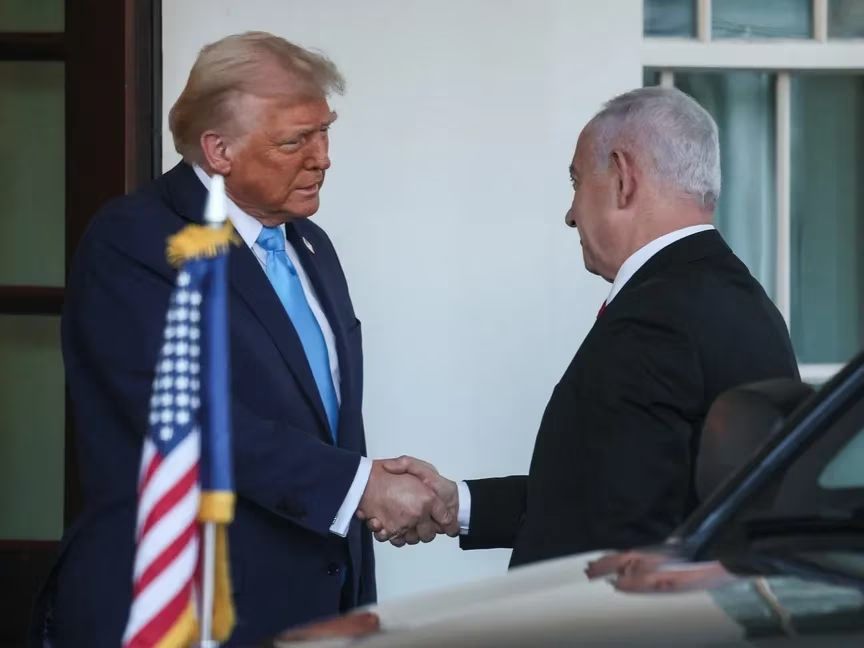
The ceasefire announced by US President Donald Trump for two weeks does not include military operations in Lebanon.

ANALYSIS

Wed 08 Apr 2026 8:36 pm - Jerusalem Time

Arab Survival Engineering: A Reading of the Repercussions of Regional Confrontation and the Dangers of Polarization

The Middle East is passing through a dangerous historical turning point that goes beyond mere fleeting military clashes, as the features of a wide-ranging confrontation led by the United States and Israel against Iran are crystallizing. Despite the announcement of fragile cease-fire agreements, field indicators confirm that the region is still living on a hot plate, especially with the continued escalation of fronts from Palestine to Lebanon.

What the region is witnessing today represents an embodiment of the concept of 'war without a center,' which geographically extends to include vital waterways from the Strait of Hormuz to Bab al-Mandab. This confrontation is not merely an attempt to dismantle a nuclear program, but rather a forced re-engineering of the region aimed at trapping Arab countries in a systematic bleeding and acute polarization.
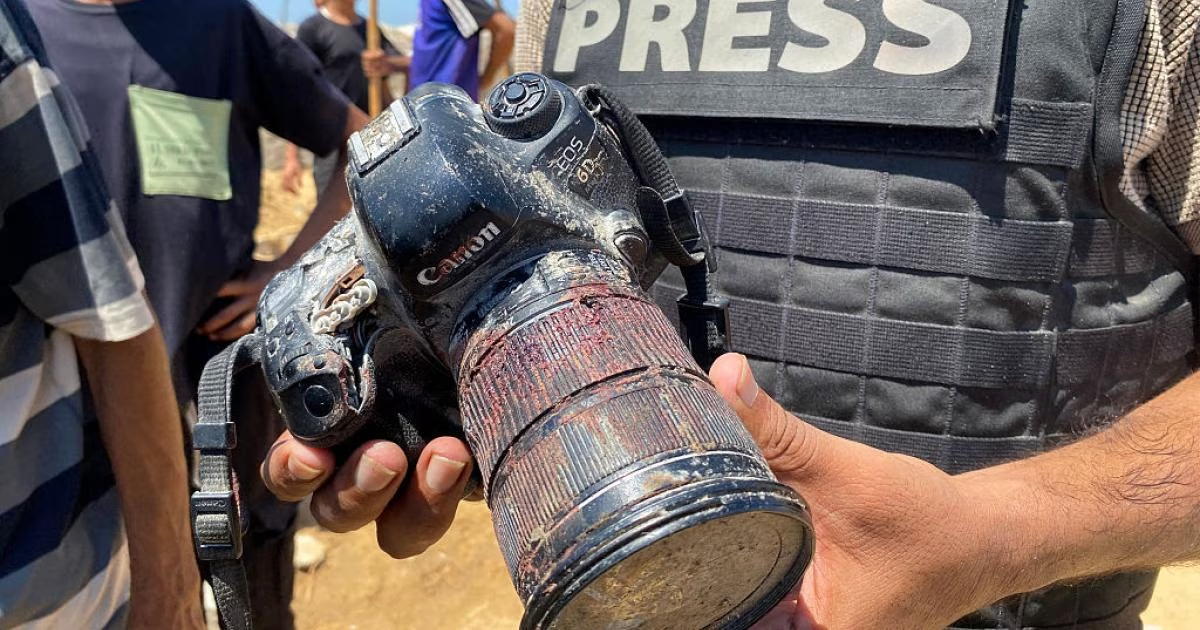
A careful reading of the scene reveals the collapse of the hypothesis of a rapid military decisive victory promoted by decision-making circles in Washington and Tel Aviv. The field reality has proven that we are facing a networked war of attrition, which does not recognize traditional borders and makes military bases and economic interests open targets in the absence of a clear political horizon.

American-Israeli strategy moves along paths aimed first at exhausting Iranian regional power and removing it from the sphere of influence while it is heavily wounded. The second path seeks to impose forced alignment on Arab capitals, pulling them from a position of positive neutrality into a furnace of conflict that does not serve their direct national interests.

'Managed chaos' emerges as a tactic to keep the region in a state of continuous turmoil, which justifies the continuation of Western security guardianship and control over global energy routes. This situation places Arab countries before difficult choices, ranging from engaging in international axes at a heavy moral cost, or passive withdrawal that may threaten their internal security.

Returning to history, we find that managing existential crises requires a mixture of political realism and defensive innovation, as happened in major historical junctures. The ability to disengage from hostile alliances and engage in complex diplomatic maneuvers remains the only way to neutralize the numerical and technical superiority of adversaries in moments of breakdown.

Jurisprudence of crisis management calls for the necessity of 'holding back' when fronts overlap and matters are ambiguous, which means refusing to be drawn into proxy wars. Converting national capabilities into fuel for conflicts that serve external agendas represents a direct threat to the future of coming generations and the stability of countries targeted by polarization.
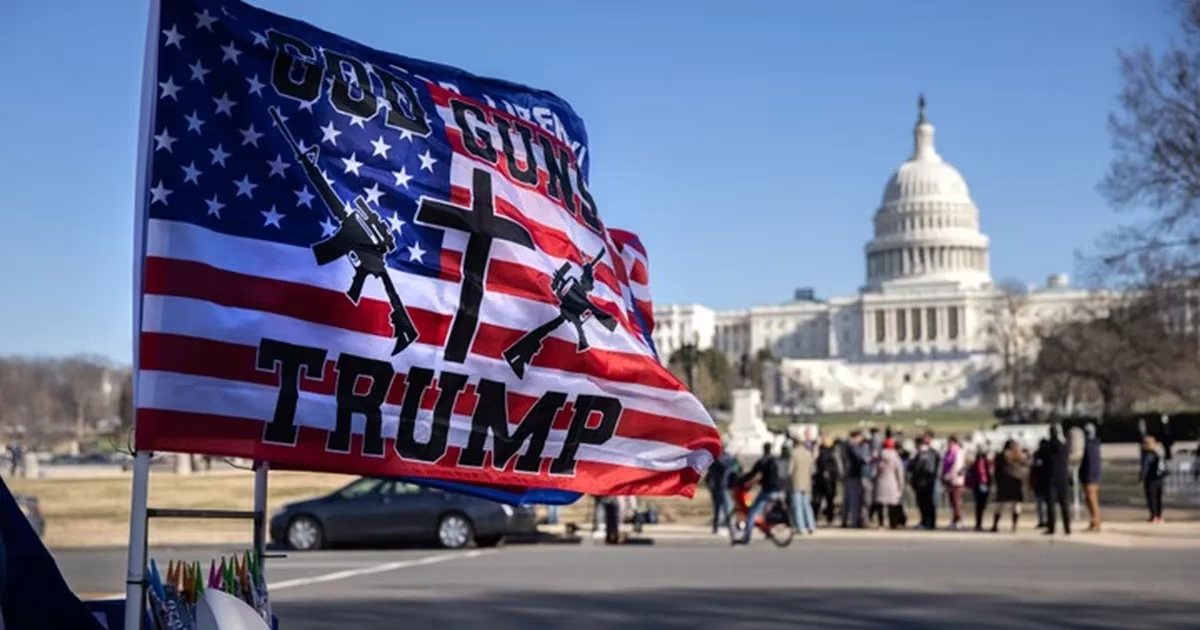
Survival engineering at the present time requires internal fortification based on collective awareness and national sovereignty, away from external dictates. The realization that material balances of power are not absolute gives the Arab decision-maker greater ability to maneuver and take sovereign positions stemming from the supreme interest of the state and the people.

Adherence to the principle of 'sovereign and geographical neutrality' is an urgent necessity to protect Arab lands and airspace from becoming an arena for settling international scores. There must be a collective stance that rejects the use of military bases scattered in the region as a starting point for any hostile action, because that deprives states of their sovereignty and makes them vulnerable to reciprocal retaliation.
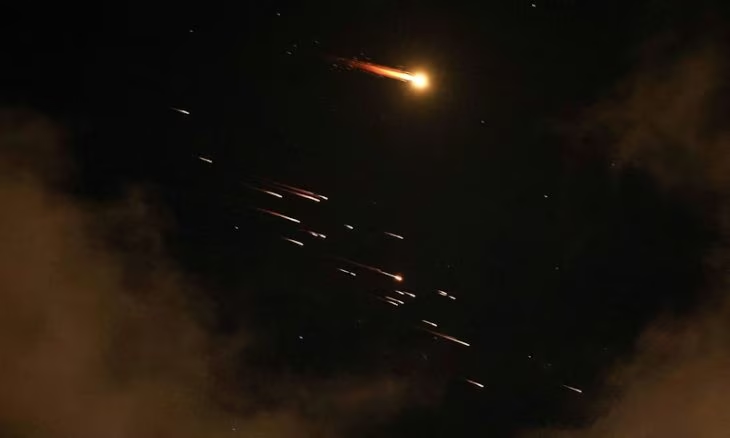
Activating 'preventive diplomacy' and building unified regional blocs represents the first line of defense against the military madness threatening the region. Pressure in international forums to stop the escalation must stem from a common regional security vision, which confirms that solutions do not come through foreign gunpowder but through arrangements originating from within.
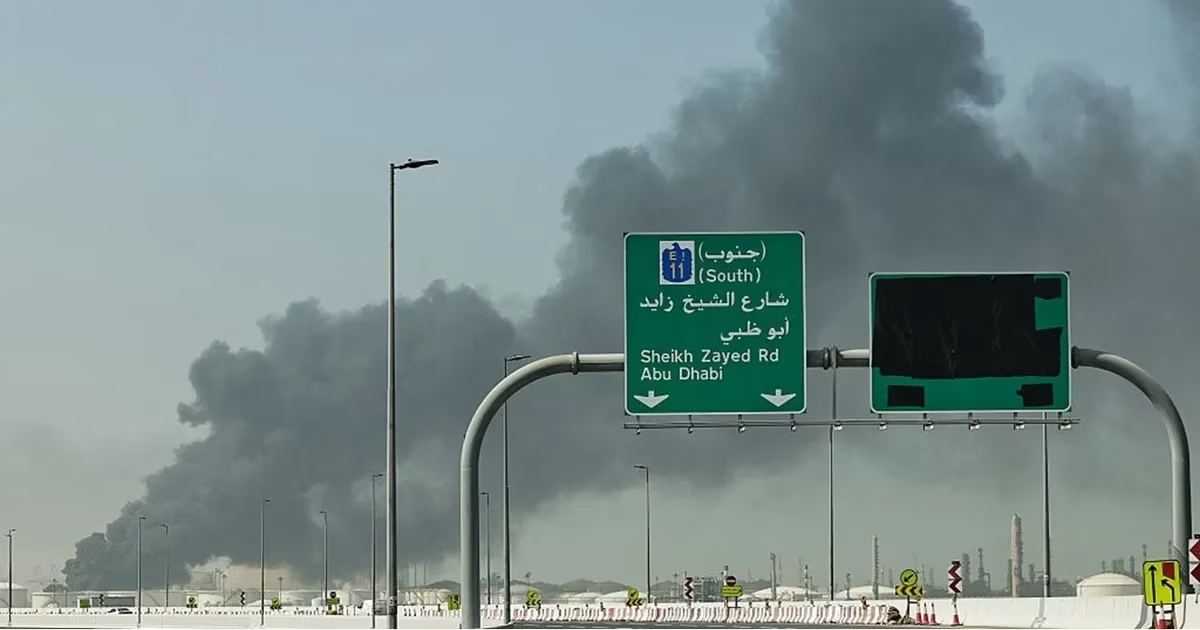
On the economic front, it has become imperative for Arab capitals to accelerate the pace of inter-integration to secure supply chains and basic needs. In light of the targeting of energy facilities and the threat to maritime passages, food and economic security become an integral part of the comprehensive national security defense system.
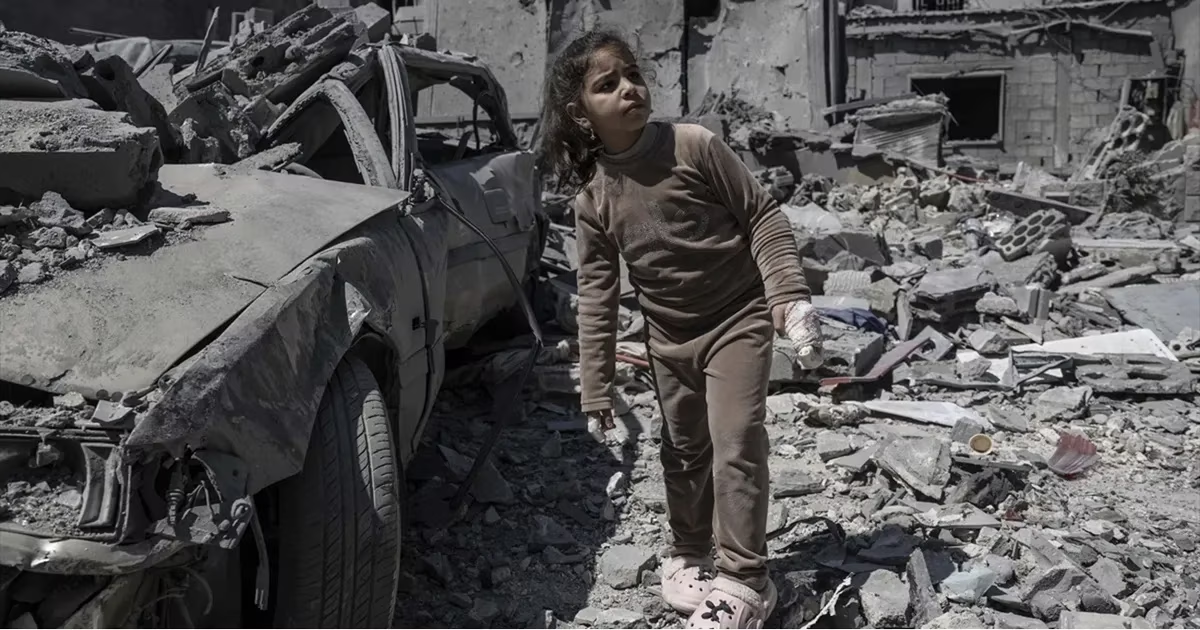
The brinkmanship policy currently being practiced aims to scatter the cards and reproduce relations of dependency in the Middle East. The response to these policies is not through momentary emotional reactions, but by adopting long-term strategies that ensure the independence of Arab decision-making and prevent the depletion of wealth in endless wars.

Arab countries today have a historical opportunity to impose a rational balance that protects their future from projects of hegemony and systematic destruction. Drawing lessons from history confirms that strong will and complete awareness are the real tools for achieving survival in an era of major geopolitical transformations and political earthquakes.

In conclusion, the current scene confirms that the region is living in the heart of an earthquake aimed at forcibly reshaping the political map. Survival from this earthquake requires a vision that combines conscious caution and deliberate practical action, to ensure that Arab geography does not turn into merely a 'mailbox' for the messages of competing great powers.

Survival from major traps requires flexible minds capable of defensive and diplomatic innovation, and not just emotional reactions.

ARAB AND WORLD

Wed 08 Apr 2026 8:36 pm - Jerusalem Time

Iran Conditions Participation in Islamabad Talks on Halting Aggression Against Lebanon, Threatens to Close Strait of Hormuz

International press reports revealed that Tehran informed international mediators that its presence at the upcoming Islamabad talks, scheduled for next Friday, is contingent on an end to Israeli aggression against Lebanese territories. This move comes amidst an escalation in the pace of military operations launched by the occupation, which sources described as brutal and directly targeting civilians.

The sources clarified that the Iranian side brandished a strategic card, namely, retracting previous commitments regarding the reopening of the Strait of Hormuz to international navigation. Observers believe that this threat raises the level of tension in the region to unprecedented levels, given the vital importance of the strait to global energy supplies.

In a related context, Tehran issued stern warnings that it would not stand idly by if the targeting of Lebanon or Iranian depth continues, affirming its determination to continue attacks against Israeli targets in the region. This stance reflects the interconnectedness of military and political fronts in the current confrontation between regional parties.

On the ground, Israeli occupation forces committed a series of horrific massacres in the Lebanese capital Beirut and various areas in the South and Bekaa during daylight hours. Air raids focused on residential neighborhoods and civilian facilities during peak hours, leading to dozens of casualties, including martyrs and injured.

A spokesperson for the Lebanese Ministry of Health stated that the toll of the recent aggression reached 89 martyrs and approximately 700 injured, noting that among the victims were 12 paramedics who died in raids targeting relief teams in the south of the country. These figures reflect the extent of the systematic targeting of vital and humanitarian sectors in Lebanon.

For its part, the occupation army announced the execution of what it described as 'the largest strike' since early March, with its aircraft targeting approximately 100 sites in just ten minutes. The occupation claimed that the attacks hit command headquarters and military systems belonging to Hezbollah, in an attempt to justify the intensity of the firepower used.

However, eyewitness accounts from the targeted areas refuted the occupation's narrative, as residents confirmed that the shelling hit predominantly Sunni areas located outside Hezbollah's usual geographical operational scope. Witnesses indicated that widespread destruction affected inhabited buildings and residential apartments, causing panic and widespread displacement.

Field reports indicate that the Israeli shelling did not spare main streets and public facilities, leading to a complete paralysis of movement in several Lebanese cities. This escalation comes at a time when diplomatic efforts were seeking to contain the situation and prevent the region from sliding into an all-out war.

Political analysts believe that the Iranian linkage between the negotiation process in Islamabad and the field situation in Lebanon presents complex challenges for mediators. Iranian demands for an immediate ceasefire place additional pressure on active international powers to intervene and stop the Israeli war machine.

Amidst this volatile scene, anticipation remains the dominant sentiment regarding what the coming hours will bring, both on the military front and in the corridors of international diplomacy. Threats related to international waterways remain a crucial factor that could prompt major powers to act quickly to avert a global economic and security crisis.

Iran warned that it would continue its attacks on Israel and the region if the targeting of Lebanon and Iran continues, and may retract its commitment to reopen the Strait of Hormuz.

PALESTINE

Wed 08 Apr 2026 4:22 pm - Jerusalem Time

Warnings of a 'legal trap'.. How does the Israeli court's decision solidify sovereignty over Al-Aqsa?

The Israeli Supreme Court rejected an urgent petition filed by the extremist Temple organizations' union, demanding that settlers be allowed to storm the blessed Al-Aqsa Mosque before the end of the Jewish Passover holiday. Although the decision was a rejection, legal experts see danger in the court's original acceptance to consider matters related to Al-Aqsa Mosque, which is considered a تجاوز (transgression) of the existing legal and historical status quo.

This judicial move raises fundamental questions about the legality of Israeli courts' intervention in the administration of Islamic holy sites, especially since international law does not recognize Israeli sovereignty over the occupied city of Jerusalem. The occupation authorities continue to ignore international resolutions by imposing a new reality in which they consider themselves the sole decision-maker in opening and closing holy places.

In a related context, the Israeli government extended the state of emergency until mid-April, which resulted in the Islamic Endowments Department being informed of the continued closure of Al-Aqsa Mosque. Observers believe that this extension comes within the framework of exploiting security circumstances to impose long-term political restrictions on Muslim worshippers' entry to their mosque.

For his part, lawyer specializing in Jerusalem issues, Khaled Zabarka, explained that the mere acceptance by the Supreme Court to consider the petition carries dangerous political dimensions that go beyond the legal aspect. He pointed out that this step implicitly means the court's declaration that Al-Aqsa Mosque falls under full Israeli sovereignty, and that the occupation authorities alone have the authority to control its gates.

Zabarka stressed that any decision related to opening or closing Al-Aqsa Mosque must be exclusively in the hands of the Hashemite Kingdom of Jordan, as the internationally recognized sovereign entity through the Hashemite custodianship. He considered that ignoring the role of the Islamic Endowments Department in this petition represents a clear attempt to marginalize the historical and legal Jordanian role in Jerusalem.

Legal sources pointed out that the occupation authorities deliberately closed Al-Aqsa Mosque and the Church of the Holy Sepulchre since the outbreak of the recent military confrontations, citing security and safety instructions issued by the Home Front. However, the fact that other places of worship remain open without restrictions proves that the motives behind the closure of Al-Aqsa are purely political motives aimed at imposing a new reality.

With talk of a possible de-escalation, specialists called on the Islamic Endowments Department and the Kingdom of Jordan to take the lead and initiate the announcement of opening the doors of Al-Aqsa Mosque to worshippers independently. This step is seen as an urgent necessity to restore administrative and field initiative and to thwart the occupation's attempts to link the opening of the mosque to settler incursions.

In an interpretation of the implications of the rejection, researcher Ziad Abhais believes that the court's decision did not reject the principle of incursions, but rather returned the authority to assess the situation to the extremist National Security Minister Itamar Ben-Gvir. This means that the court is solidifying the endeavor to annex Al-Aqsa Mosque to Israeli administrative and security sovereignty, away from any considerations of international law or signed agreements.

Abhais warns of a dangerous equation that the occupation is trying to impose, which is linking the entry of Muslims to Al-Aqsa Mosque to ensuring the security of settlers during their incursions into the outer courtyards. The occupation authorities exploit the absence of shelters in the open courtyards to justify preventing worshippers, while the covered prayer halls remain safe shelters that are only used to restrict the movement of Palestinians.

For his part, academic Abdullah Maarouf indicated that the opening of Al-Aqsa Mosque in the coming period may be according to Israeli conditions aimed at establishing the concept of 'shared holy site'. Maarouf fears that the occupation seeks to return to the plans of temporal and spatial division more strictly, by allocating specific times for Muslims and others for settlers equally.

Maarouf affirmed that any announcement by the occupation to open the mosque under its own conditions cannot be considered an achievement, but rather an attempt to legitimize Israeli intervention in matters of worship. He stressed the necessity of intense and unprecedented Palestinian presence in the mosque to thwart these plans and prove the pure Islamic identity of the place away from the dictates of the occupation.

In conclusion, Al-Aqsa Mosque remains an arena for intense legal and political conflict, where extremist organizations, supported by judicial and governmental cover, seek to impose a new reality. Attention is now turning to Palestinian and Jordanian popular and diplomatic movements to confront these challenges that threaten the status quo in one of the holiest Islamic sites in the world.

The Israeli Supreme Court's acceptance to consider the petition practically means that Al-Aqsa Mosque is subject to full Israeli sovereignty in the eyes of the occupation authorities.