







By: Said Arikat
April 9, 2026
News Analysis
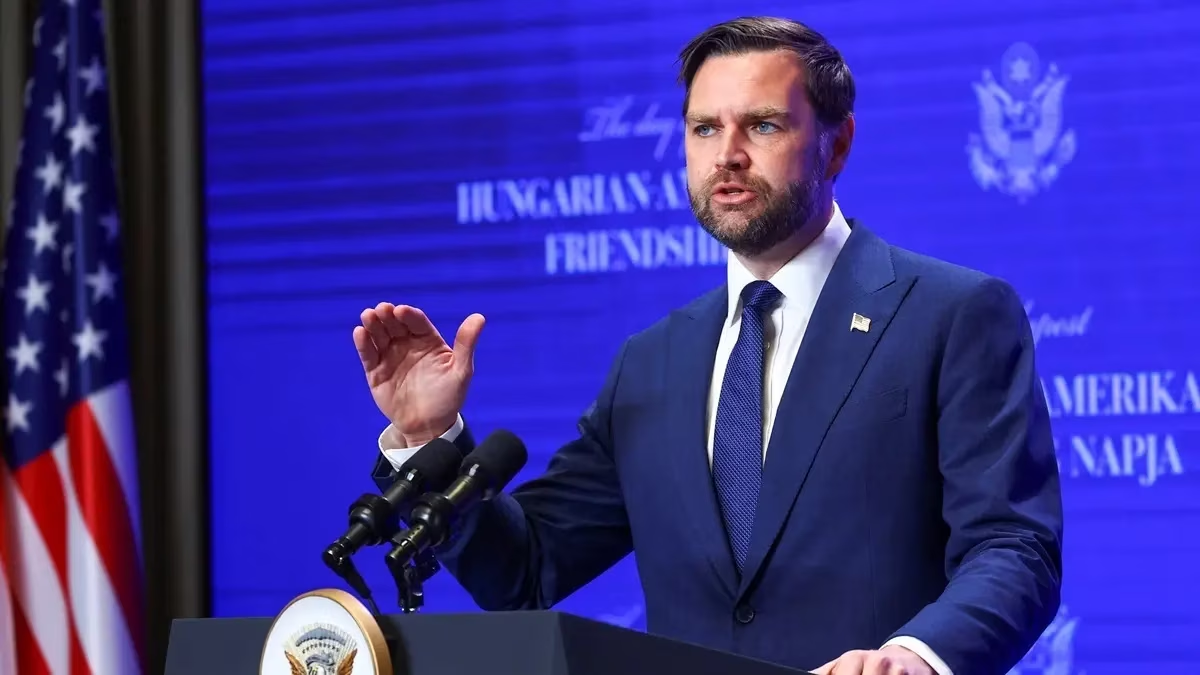
Washington, D.C- The decision to send J.D. Vance to lead negotiations with Iran in Islamabad reflects more than a tactical diplomatic move—it exposes the accumulated contradictions in Washington’s long and troubled negotiating record with Tehran. Announced alongside a two-week ceasefire involving the United States, Israel, and Iran, the initiative is framed as a step toward de-escalation. Yet both the structure of the talks and the conduct surrounding them suggest that the United States continues to struggle with credibility, consistency, and control over its closest regional ally, Israel.
At first glance, Vance’s appointment appears to signal a course correction. Known for his skepticism toward military escalation, he contrasts with figures such as Steve Witkoff and Jared Kushner, whose earlier involvement in Middle East diplomacy has drawn criticism in Tehran and beyond. Iranian officials have openly questioned their reliability, accusing them of distorting positions and negotiating in parallel with military pressure. This perception is not incidental—it is rooted in a broader pattern in which diplomacy and coercion have proceeded simultaneously, often undermining each other.
Indeed, one of the most persistent Iranian grievances is that Washington has repeatedly negotiated while escalating militarily. Iranian officials point to past episodes in which talks coincided with strikes or threats, reinforcing a belief that diplomacy is used as cover rather than commitment. This pattern has produced what Iranian leaders describe as a “zero trust” environment, where even genuine proposals are viewed through the lens of anticipated betrayal.
The legacy of the U.S. withdrawal from the 2015 nuclear agreement continues to loom over current efforts. That decision, coupled with subsequent pressure campaigns, entrenched skepticism not only in Tehran but also among regional actors. Analysts have long argued that inconsistent U.S. strategies—oscillating between maximalist demands and abrupt diplomatic overtures—have weakened the prospects for sustained engagement. The current initiative risks falling into the same trap if it fails to reconcile rhetoric with practice.
Compounding this credibility gap is the role of Israel, which continues to operate as both a partner and a disruptor in the diplomatic process. Despite the announcement of a ceasefire, Israeli military operations—particularly in Lebanon—have persisted, directly contradicting the spirit, if not the letter, of the agreement. Recent reporting confirms that Israel not only rejected the inclusion of Lebanon in the truce but also continued strikes against alleged Hezbollah targets, even as negotiations were being prepared.
From Tehran’s perspective, this dynamic reinforces a longstanding accusation: that Israel acts as a spoiler, intervening at critical moments to derail diplomatic progress. Iranian officials have explicitly accused Israel of attempting to sabotage negotiations and provoke broader conflict, particularly when talks appear to gain traction. Whether or not one accepts this framing in full, the timing of Israeli actions has repeatedly coincided with sensitive diplomatic junctures, complicating efforts to build momentum.
Washington’s response to this challenge has been notably ambivalent. While U.S. officials insist that the ceasefire does not extend to Lebanon, they have also called for restraint—without enforcing it. This dual posture allows Israel operational freedom while preserving a diplomatic narrative, but it comes at a cost: it undermines the coherence of the U.S. position and fuels perceptions of selective commitment to de-escalation.
The result is a fragmented negotiating environment in which multiple, overlapping conflicts resist compartmentalization. Efforts to isolate the U.S.-Iran track from broader regional dynamics have proven ineffective, as events in Lebanon, the Gulf, and beyond continue to shape the strategic calculus of all parties. The insistence on a narrow geographic scope for the ceasefire may therefore reflect political expediency more than strategic realism.
Against this backdrop, Vance’s role becomes both more significant and more constrained. His perceived pragmatism may create a limited opening with Iranian negotiators, who appear to prefer engagement with figures less associated with prior breakdowns. Yet personal credibility, while important, cannot substitute for structural change. Without a clear shift in how the United States aligns its military actions, diplomatic messaging, and alliance management, even the most capable envoy will struggle to achieve lasting results.
The internal recalibration within the U.S. negotiating team also raises important questions. The apparent sidelining of Witkoff and Kushner suggests recognition—implicit if not explicit—that previous approaches have fallen short. Their close association with Benjamin Netanyahu has further complicated perceptions of U.S. neutrality, reinforcing Iranian suspicions that Washington’s diplomacy is shaped by Israeli priorities as much as its own.
For negotiations to gain traction, the United States may need to demonstrate a greater degree of independence—not only in personnel but in policy execution. This includes establishing clearer boundaries with Israel when its actions threaten to derail diplomatic efforts, as well as committing to a more consistent negotiating framework that avoids the oscillation between pressure and outreach.
Ultimately, the Islamabad talks are less a breakthrough than a stress test. They will reveal whether Washington has absorbed the lessons of its past engagements with Iran or remains bound by the same patterns that have repeatedly undermined them. If Israel continues to act as an unchecked spoiler, and if U.S. diplomacy continues to be paired with coercive tactics that erode trust, the current ceasefire will likely prove as fragile as those that came before it.
In that sense, the stakes extend beyond the immediate negotiations. They touch on a more fundamental question: whether the United States is prepared to conduct diplomacy with Iran as a strategic commitment rather than a tactical instrument.
Share your opinion
A Fragile Truce Undermined: Vance’s Mission and the Troubled Legacy of U.S. Diplomacy with Iran