OPINIONS

Date unavailable - Jerusalem Time

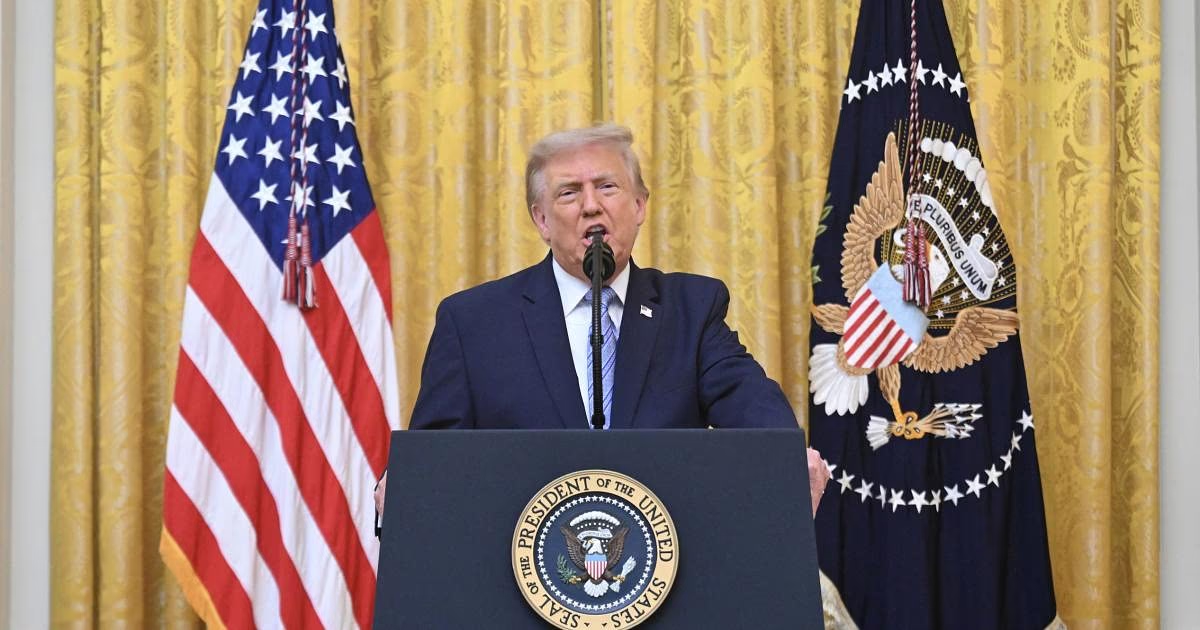
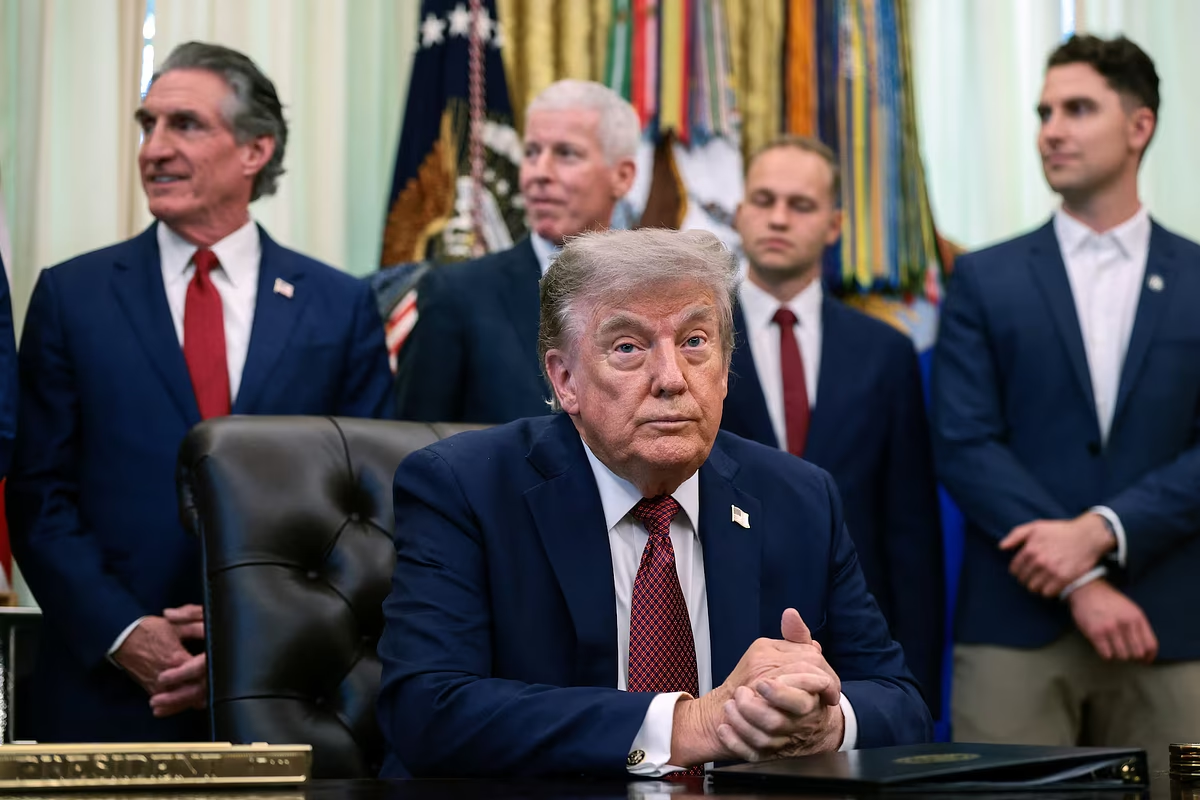
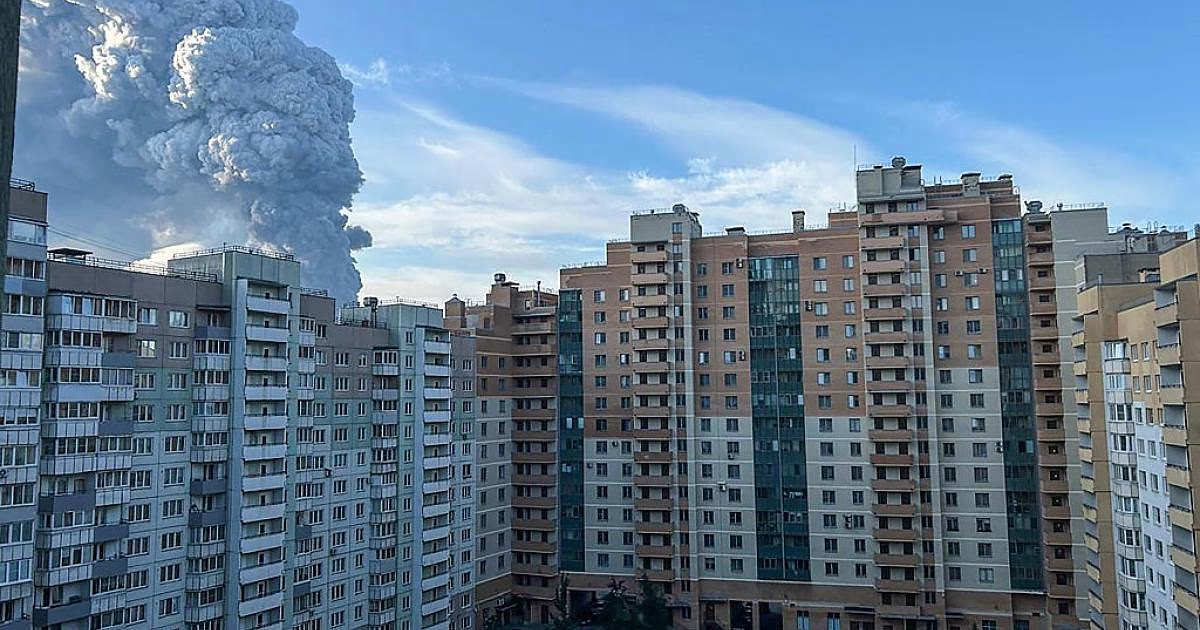
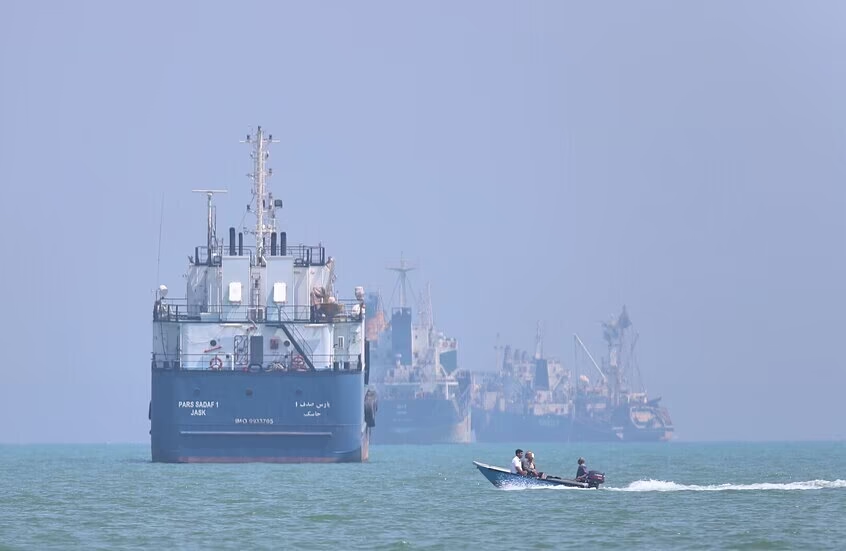
America, Iran, and Controlled Madness: Calculations of a War That Won't Happen

Despite the escalation in rhetoric, the unprecedented military buildup of American capabilities in the region, and President Donald Trump's "brinkmanship" policy, contrasted with Iranian Supreme Leader Ali Khamenei's statements reflecting a tone of defiance and insistence on responding to American and Israeli threats; the pressing question is: Are we on the verge of an imminent military confrontation between Washington and Tehran? What are the chances of the United States succeeding in changing the political regime in Iran? Conversely, what are the limits of Iran's military response capability? Can Iran target aircraft carriers and American bases in the region? And finally, what are the repercussions of all this on the security and stability of the region and the world?

Anyone who reads the scene with a cool eye, away from media sensationalism, will realize that what is happening is closer to "controlled madness" than to a blind rush towards war. The United States fully understands that any comprehensive war with Iran will not be a quick military picnic, nor will it end with a limited surgical strike. Instead, it could open the doors of the region to strategic chaos extending from the Gulf to the Eastern Mediterranean. The experiences of Iraq and Afghanistan are still fresh in American memory, with the costs in money, reputation, and lives.

As for talk of regime change in Iran, it is a slogan that has been repeated in the corridors of American politics for decades, but it has never turned into an executable strategy. The Iranian regime, despite its internal crises and suffocating sanctions, has proven an extraordinary ability to adapt and endure, relying on a cohesive institutional security and military structure, and an impressive network of regional and international alliances.

Conversely, Iran's capabilities cannot be underestimated. Over the past years, Tehran has developed an advanced missile system and has demonstrated its ability to operate in multiple theaters through its regional allies. While targeting American aircraft carriers or major bases would remain a high-cost and extremely risky option, it is not impossible should an open confrontation erupt. Any direct hit on strategic American interests would certainly mean the region entering a spiral of escalation whose outcomes cannot be controlled.

This is precisely where the danger of the situation lies: if war breaks out, it will not remain bilateral between Washington and Tehran, but will affect Gulf security, threaten the stability of Iraq, Syria, and Lebanon, and perhaps extend its effects to global energy markets, threatening the international economy with a new crisis. Therefore, the precise cost-benefit calculations of both parties make the option of a comprehensive war more likely to be brandished than actually implemented.

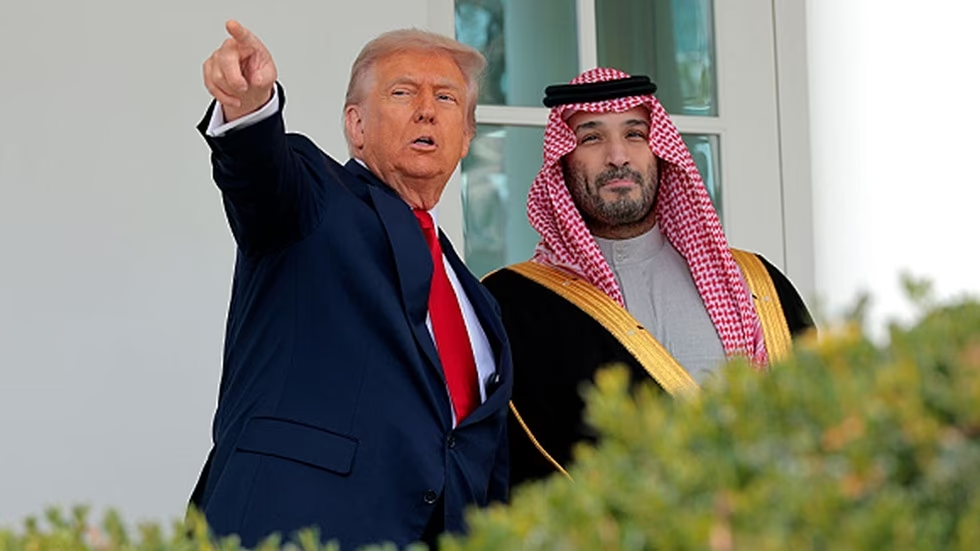
In my estimation, Trump will continue to mobilize, threaten, and warn, but he will not launch a military strike that leads to a wide regional war. The man realizes that any major slip could turn the tables on him domestically, especially in light of the political crises and scandals pursuing him, and the unrest and decline in support within his party. Despite the image he tries to project of himself as a president who does not hesitate to use force, he is not at all interested in the "Samson option" that would bring down the temple on himself and his adversaries at home and abroad.

It is more likely that this round of escalation will end in negotiated outcomes related to the Iranian nuclear program, which will be marketed domestically in Washington as a political and security achievement. If this happens, Israeli Prime Minister Benjamin Netanyahu will not dare to go it alone into a military confrontation with Iran, because any open war could mean the end of his political future, and perhaps plunge the Hebrew state into an existential dilemma, especially given its escalating international isolation after the Gaza war and the growing global calls for a just solution to the Palestinian issue.

As for Iran, it will not initiate a preemptive strike, nor will it seek to ignite a war it does not need at this stage. However, at the same time, it will not stand idly by in the face of what it considers existential threats. It will continue to develop its deterrent capabilities and strengthen its relations with Russia and China, thereby solidifying its position as a significant regional power within an international system that is gradually leaning towards multipolarity.

Iran, in historical memory, is not an emergent state, but the heir to the Persian Empire that once extended its influence over vast areas of the world. It understands that bowing under American pressure would mean undermining its regional project and international standing. Therefore, it will maneuver, negotiate, and accumulate power assets, without rushing into a comprehensive confrontation.

In conclusion: We are facing a calculated escalation, and fiery rhetoric that serves deterrence calculations more than it paves the way for war. A comprehensive military confrontation will not occur, because its exorbitant cost exceeds the capacity of both parties to bear. The Iranian regime will likely emerge with a greater presence and influence, while Washington seeks to save face through a new agreement or understanding. These are precise calculations for a war that is intended to be threatened, not to happen.

OPINIONS

Sat 25 Jul 2026 10:46 am - Jerusalem Time

Palestinian Agriculture... From a Pillar of Liberation to a Battlefield for Economic Sovereignty

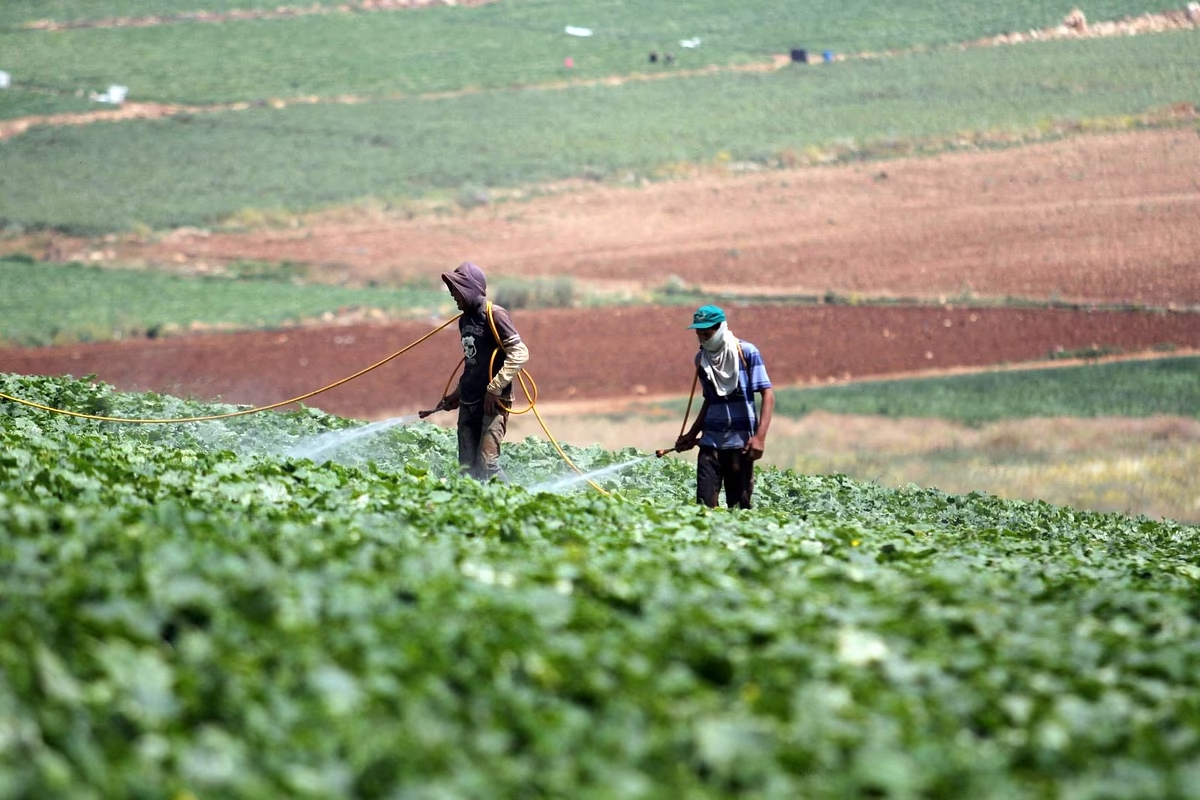
The crisis of Palestinian agriculture is not a crisis of seasons, nor a climate crisis, nor even a funding crisis. It is, at its core, a political and strategic crisis that reflects the nature of the conflict over land, economy, and sovereignty. Since the establishment of the Palestinian Authority after the Oslo Accords, agriculture has declined not only due to economic factors, but as a result of a complex interaction between systematic Israeli policies aimed at undermining the foundations of Palestinian production, and Palestinian policies that failed to transform agriculture into a fundamental pillar in the project of building the state and the national economy.

Historically, agriculture was not merely an economic activity for Palestinians; it was one of the most important tools for holding onto land and preserving the relationship between people and place. Therefore, targeting it was not just targeting a productive sector, but an assault on one of the foundations of national existence and steadfastness.

Perhaps the most dangerous outcome of the post-Oslo period was not only the re-division of Palestinian land into Areas (A), (B), and (C), but the reshaping of the Palestinian economy itself. The economy gradually shifted from an economy striving for production, despite limited resources, to a restricted economy increasingly dependent on imports, services, and aid, while productive sectors, primarily agriculture, declined.

Israel realized early on that control over land is not completed by walls and checkpoints alone, but by weakening the Palestinian's ability to invest in their land and remain on it. Therefore, Israeli policies towards the agricultural sector were not isolated measures, but part of a broader path to reshape geography and economy together.

Land confiscation, settlement expansion, control over water resources, restricting farmers' access to their lands, and controlling crossings and markets have made the agricultural sector operate within an environment lacking the foundations of economic sovereignty. Pressure tools did not stop at land and water, but extended to various links in the production process.

Agriculture begins before harvest; it begins with seeds, fertilizers, pesticides, equipment, and technology, and only ends with processing, marketing, and export. While the Israeli agricultural sector operates within an advanced system of research, development, control, and technical support, the Palestinian farmer often works in a more fragile environment, characterized by high costs, weak services, and varying quality of some agricultural inputs.

Many farmers point to the declining effectiveness of some agricultural inputs, such as pesticides, fertilizers, and seeds, and their high prices compared to production returns. This issue should not be treated as an individual complaint, but as an indicator of the need for an integrated national system for control, testing, and accreditation that ensures the quality of agricultural inputs and protects the farmer, producer, and consumer.

The effects of this problem are not limited to decreased productivity, but extend to increased risks of losing agricultural seasons, higher production costs, and a decline in the competitiveness of Palestinian products in local and foreign markets. The gap between Palestinian and Israeli agriculture lies not only in the type of inputs used, but in the entire production system; from scientific research and variety development, laboratories, and agricultural extension, to technology, financing, processing, and marketing.

Three Decades of Structural Decline

Economic indicators reveal the extent of the transformation that has affected the status of Palestinian agriculture over the past three decades. Agriculture's contribution to GDP declined from about 13% in the mid-1990s to about 6% in recent years. The percentage of workers in the agricultural sector also decreased from levels ranging between 12% and 16% during the early years of the Palestinian Authority to about 6%-7% in recent years.

These figures do not merely reflect economic changes, but reveal a deeper shift in the position of agriculture within the Palestinian economy; it moved from a central productive sector to a sector that lost part of its strategic weight due to political and economic restrictions, weak investment, and the absence of an integrated development vision.

Continued restrictions on land utilization, especially in classified Area (C), and increased reliance on food imports, have also made Palestinian food security more fragile in the face of political and economic crises.

However, reducing the crisis to the occupation alone, despite its primary responsibility, does not absolve the Palestinian side of the responsibility for review. After more than three decades, Palestinian policies have not succeeded in making agriculture a real national priority, nor has a vision been built that makes it part of an integrated economic project linking agriculture with industry, scientific research, innovation, technology, and value chains.

In political discourse, the Palestinian farmer has become a symbol of steadfastness, but steadfastness cannot remain a mere slogan. The farmer needs a production system that enables them to survive: water, land, reliable inputs, productive financing, and a fair market.

What has happened over the past decades can be described as a dual politicization of agriculture; on the one hand, Israel used agriculture as a tool to control land and markets and weaken Palestinian productive capacity, and on the other hand, Palestinian agriculture remained captive to crisis management and short-term projects, and did not become a central focus in the national development strategy.

The decline of agriculture was not just a loss for an economic sector, but an indicator of a broader imbalance in the Palestinian economic model; a model that became more dependent on imports, more linked to the Israeli economy, and less capable of building an independent productive base.

Therefore, saving agriculture should not be viewed as a limited sectoral policy, but as an entry point for rebuilding the national economy on the foundations of production, sovereignty, and self-reliance. Countries facing siege or conflicts do not abandon their productive sectors, but place them at the heart of their national strategies, because they realize that food security is an integral part of national security.

The issue today is not about increasing the number of greenhouses or distributing more seedlings or launching seasonal olive planting campaigns, despite their importance. The issue is deeper: it is about redefining the position of agriculture in the Palestinian national project.

Agriculture is not an administrative file belonging to a specific ministry, but a sovereign issue that intersects with land, water, energy, scientific research, investment, and food security.

This requires a shift from crisis management to a long-term productive strategy based on establishing a national fund for agricultural investment, strengthening agricultural scientific research and linking it to farmers' needs, developing food industries and value chains, building an effective national system for controlling agricultural inputs, and investing in smart farming technologies and sustainable water and energy management.

The future of Palestinian agriculture will not be decided in the fields alone, but in the nature of economic choices and national policies. Sovereignty is not measured only by who raises the flag over the land, but also by who has the ability to produce their food, protect their resources, cultivate their land, and transform their economy from a dependent consumer economy to a productive economy capable of steadfastness.

Restoring dignity to agriculture is not an issue for farmers alone, but it is restoring dignity to the idea of the state itself, and to the national liberation project in one of its most important economic manifestations. If the past three decades have shown how the occupation can use the economy as a tool for hegemony, then the next phase must prove that a productive economy, primarily agriculture, can be one of the most important tools for steadfastness, liberation, and building Palestinian sovereignty.

OPINIONS

Sat 25 Jul 2026 10:14 am - Jerusalem Time

Two Surprises from China

Days ago, Beijing announced two technological surprises that caused a stir in Silicon Valley. The first was the birth of a giant artificial intelligence language model called "Kimi Ki 3" from a startup company, which underwent the world's most important programming tests and outperformed some models from "Anthropic" and "OpenAI," proving its exceptional ability to analyze massive documents, reports, and long databases more than usual, which is attractive to companies.

The second surprise has a deeper impact due to its uniqueness. It is the launch of the "QiuShi" engine, developed by a team from "Zhejiang" University, as a specialized agent for independently conducting scientific research. It also outperformed "Open Science Desktop" and "Claude Code" systems from the American company "Anthropic" in the "Research Clo Bench" test, which was specifically designed to measure this type of intelligent skill and involved international companies.

For the first time, artificial intelligence proved its ability to act as a researcher who plans, conducts experiments, and corrects his own mistakes, like a graduate student. Therefore, the system was described as a "milestone" after successfully conducting a study by performing thousands of steps, from hypothesis formulation to experimental verification.

What concerns Silicon Valley giants is that China is no longer an imitator but is opening new fronts, with its comprehensive technological strategy. It is redefining standards and bringing about profound transformations by introducing a new way of building AI and its real-world applications.

The unveiling of the "Kimi Ki 3" system caused a real shock. It has become one of the largest open models, with a size of up to 2.8 trillion parameters, capable of handling very large and unprecedented contexts.

But more important than its skill in performing complex tasks and its high efficiency in utilizing resources is its low price, which is reminiscent of the cost-effective "DeepSeek" that shocked everyone on its announcement day. Therefore, even if Chinese models are not the smartest ever, their economic cost and open-source nature pose a real challenge and an attractive proposition for companies using AI.

The achievement of "QiuShi" attracted attention because it does not answer a scientific question based on what it has read or been provided with, but rather performs a series of interconnected steps, conducting experiments itself, analyzing results, and presenting conclusions and suggestions that were not previously put forward.

Chinese developers did not claim that their model would reliably succeed in all future tests it would undergo, and they admitted that it still needs training, qualification, and human intervention. However, it is an impressive step in scientific research and represents the beginning of a shift from "AI that assists the researcher" to "AI that leads the research itself," which is significant as it will make research advance at an unimaginable speed.

The two models reveal one aspect of China's multifaceted technological plan, which attempts to cover various fields and is not content with excelling in building language models. "Kimi Ki 3" competes in a known arena, while "QiuShi" is a breakthrough in a different arena, making us wonder: Can a machine become an actual researcher, or will it remain merely an assistive tool? And the success of both projects in close proximity by two completely different teams in their nature of work, i.e., through a startup on one hand and an academic university team on the other, is what gives the topic its importance and shows us that we are not facing two isolated announcements, but rather this is an indicator of an integrated system moving in multiple directions.

China has trained some of these advanced models on local processors from "Huawei," "Alibaba," and others. It still bets that through superior engineering skill, it can compensate for its lack of computing power and its weakness in the field of chips.

In China, nothing happens by chance. "QiuShi" was launched simultaneously with the World Artificial Intelligence Conference in Shanghai, where Chinese President Xi Jinping announced the start of a new global alliance to regulate AI to serve "common prosperity," with the clear goal of portraying China as a global technological power, not just a marginal competitor.

The next phase will be exciting because the competition will not be limited to developing smarter language models like "ChatGPT" and "Claude," as that has become self-evident. The real race will be to launch new super-intelligent specialized agents in science, medicine, and engineering, similar to "QiuShi." And perhaps another issue will come into play: who is more worthy of users' trust, in terms of safety, reliability, and personal privacy.

From "Asharq Al-Awsat"

PALESTINE

Sat 25 Jul 2026 10:14 am - Jerusalem Time

Escalation of settler violence in the West Bank: Homes burned and widespread injuries amid calls for international protection

The UN Special Rapporteur on human rights in the Palestinian territories, Francesca Albanese, issued strong warnings about the rapidly deteriorating security situation in the occupied West Bank. Albanese affirmed that settler attacks have reached dangerous levels, calling on the international community to intervene immediately to deploy a protective presence to safeguard Palestinian civilians from systematic assaults.

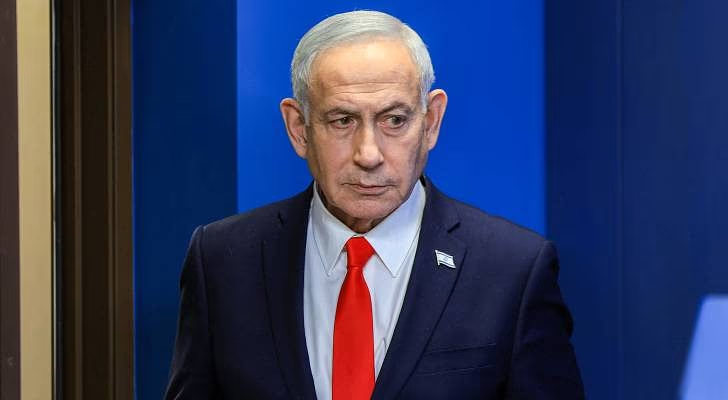
In an escalatory move, Israeli Prime Minister Benjamin Netanyahu issued directives to establish new settlement outposts deep in the West Bank, in response to confrontations that resulted in the deaths of two Israelis. These decisions come amidst a charged atmosphere following the martyrdom of four Palestinians in clashes near the 'Havat Gilad' settlement and the village of Tel, occupied since 1967.

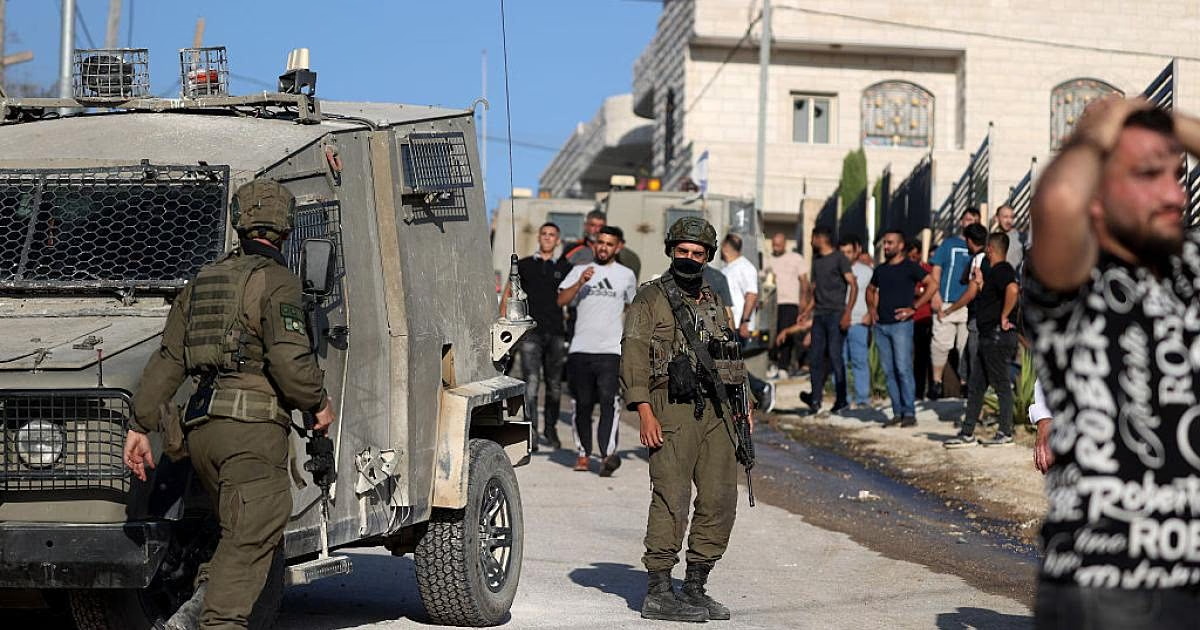
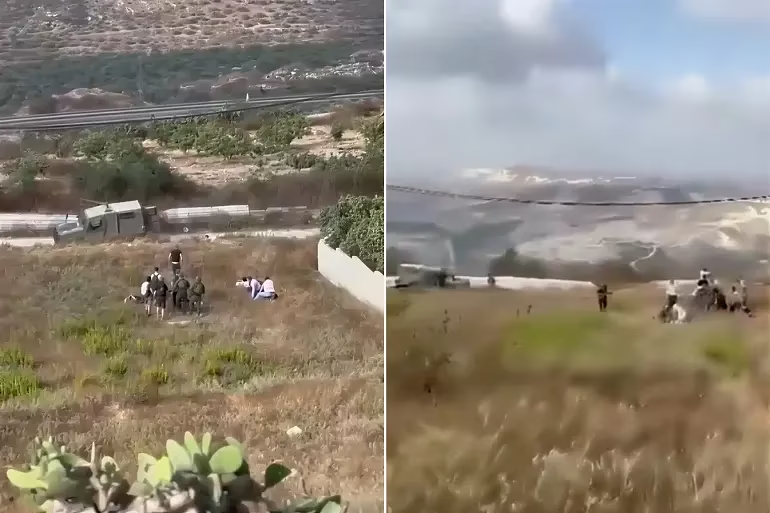
The town of Aqraba, south of Nablus, witnessed a widespread attack carried out by more than 200 settlers under the protection of the occupation army, leading to the complete and partial burning of three homes. Local sources reported that settlers targeted facilities and vehicles, while residents were unable to accurately assess the damage due to the army's incursion into the town after the settlers withdrew.

In a related context, the village of Surra, southwest of Nablus, was subjected to brutal attacks including the burning of six homes and five vehicles, in addition to setting fire to dozens of agricultural dunams. The attack resulted in three citizens sustaining various injuries due to severe beatings by armed settler groups who stormed the area.

Attacks were not limited to Nablus but extended to villages east of Qalqilya, where eight Palestinians were injured in the village of Fara'ata, six of whom were hit by live ammunition. Eyewitnesses described what happened as a bloody day par excellence, as groups of masked and armed settlers spread out in the fields and main roads to terrorize the residents.

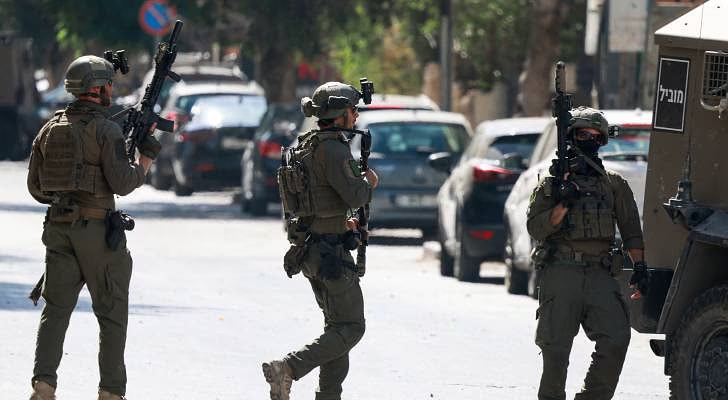
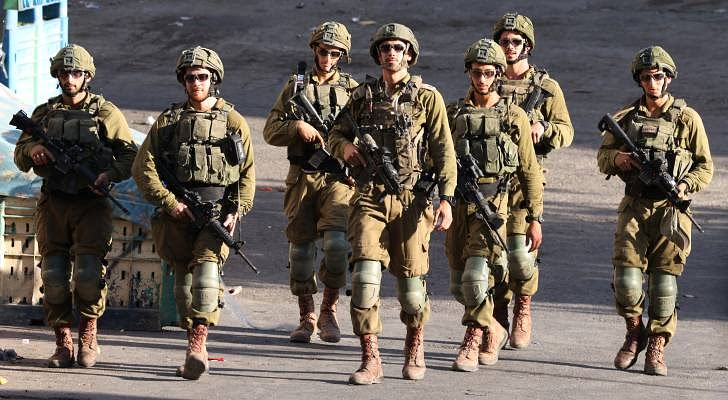
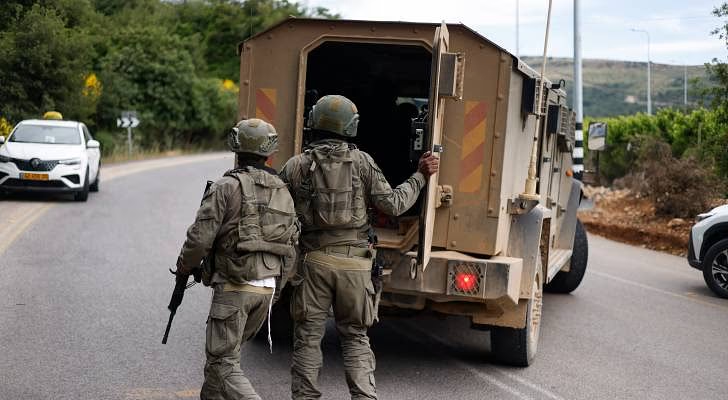
On the ground, occupation forces imposed a tight siege on Nablus Governorate, closing all roads leading to the town of Huwara, which isolated the governorate from its surroundings. This closure coincided with Israeli threats to launch a large-scale military operation in the area, including an arrest campaign targeting a number of citizens in the affected villages.

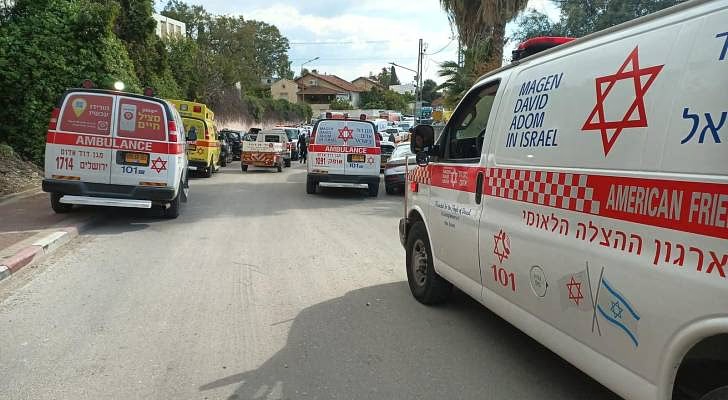
Medical sources reported that a Palestinian sustained serious head injuries while confronting settler attacks, while ambulances were heavily pelted with stones at the Za'atara checkpoint. Settlers attempted to obstruct the access of medical teams to the injured by damaging vehicle tires, in a blatant violation of international laws that guarantee the protection of relief teams.

In the village of Tel, a state of sadness and anger prevailed following the martyrdom of four citizens from one family by occupation and settler bullets, amid accusations of carrying out field executions. While the occupation claims that the martyrs carried out a shooting operation, residents confirm that they were acting in self-defense against a sudden attack targeting their homes in the eastern part of the village.

Official Palestinian data indicates that settlers have carried out more than 3,500 attacks since the beginning of this year, most of which were concentrated in the governorates of Nablus, Ramallah, and Hebron. This escalation, according to observers, aims to create an expelling environment for the indigenous population to push them towards forced displacement and facilitate illegal settlement expansion operations.

For its part, the Organization of Islamic Cooperation condemned these attacks, holding the occupation authorities fully responsible for the consequences of this escalation, which is taking place under the protection of soldiers. The organization warned that the continuation of this policy will lead to more violence and instability in the entire region, calling on the UN Security Council to assume its responsibilities.

In Jordan, Foreign Minister Ayman Safadi warned against pushing the West Bank towards a comprehensive explosion due to unilateral Israeli measures and the continued terrorism of settlers. Safadi affirmed that the absence of international accountability encourages the occupation to proceed with settlement and displacement policies that undermine the chances of a just peace.

Villages south of Nablus are living in a state of cautious anticipation amid the continued Israeli military build-up and threats to raid the homes of martyrs in the village of Tel. Citizens fear a new wave of night attacks that settlers may launch on isolated villages that lack security protection, while occupation forces are busy securing settler movements.

Videos circulated by activists documented moments of settlers attacking citizens' property in the village of Jit, where flames were seen rising from agricultural facilities. The videos show the participation of occupation soldiers in providing protection to settlers while they carry out burning and sabotage operations, which refutes the official narrative about attempts to control violence.

The scene in the West Bank remains open to all possibilities, with the Israeli government's insistence on legitimizing settlement outposts and expanding settler influence. Palestinians believe that their steadfastness on their land is the last line of defense against annexation and displacement plans that have accelerated at an unprecedented pace in recent months.

Gangsters of terrorist settlers, backed by Israeli soldiers, are literally calling for bloodshed in the West Bank.

PALESTINE

Sat 25 Jul 2026 10:14 am - Jerusalem Time

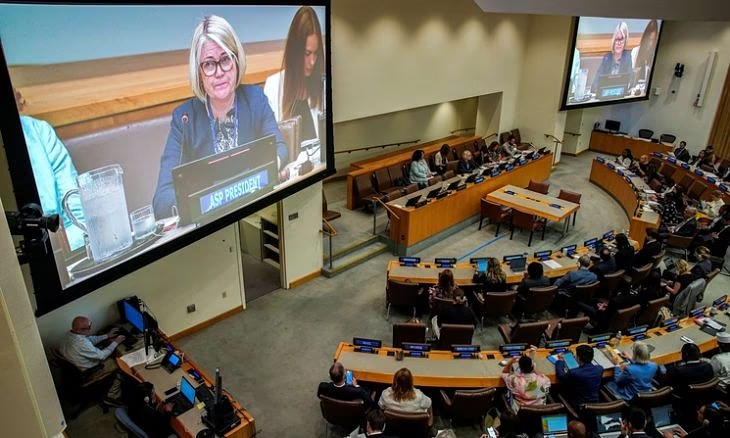
ICC Member States Remove Prosecutor Karim Khan with 82 Votes

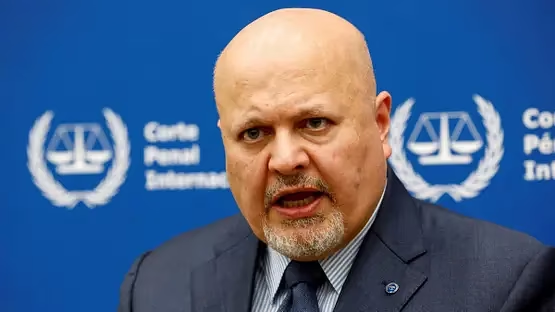
In an unprecedented move, the Assembly of States Parties to the International Criminal Court decided to remove Prosecutor Karim Khan from his position after a vote held at the United Nations headquarters in New York. The decision was supported by 82 out of 125 member states of the Court, during a secret ballot held in a special closed meeting to discuss the recommendations of the Court's oversight body.

This dismissal comes against the backdrop of accusations leveled against the 56-year-old British official, related to inappropriate sexual conduct with a junior staff member on his team. Despite Khan's categorical denial of these allegations, the majority of member states relied on the results of investigations that recommended ending his tenure to ensure the integrity of the international institution.

For its part, the legal team of the ousted prosecutor quickly announced its rejection of the decision and challenged its legitimacy, describing the procedures as unfair and not based on tangible material evidence. Lawyer Tayeb Ali affirmed that his client would pursue all available legal avenues to restore his reputation and refute what he described as false allegations that have affected his professional career.

In the first official reaction, the Israeli occupation authorities welcomed the dismissal decision, with Foreign Minister Gidon Sa'ar considering this step to reveal what he called Khan's 'moral bankruptcy'. Israel attempted to leverage this development to push for the cancellation of the arrest warrants issued against Prime Minister Benjamin Netanyahu and former Defense Minister Yoav Gallant.

Sa'ar claimed in his statements that the arrest requests submitted by Khan were an attempt to cover up his personal misconduct, which he feared would be exposed to the public. The Israeli minister demanded that the Court immediately retract the warrants, considering them 'politicized and disgraceful' and not falling within the jurisdiction of the International Court, as Israel is not a member of it.

Despite Israeli pressure, legal sources confirmed that the arrest warrants remain legally valid and are not automatically affected by the departure of the prosecutor. The sources clarified that Pre-Trial Chamber I is the judicial body that issued the warrants based on criminal evidence, and only the judges of the Court themselves have the authority to withdraw or cancel them.

The International Criminal Court had previously settled the issue of its territorial jurisdiction, affirming its authority over crimes committed in the Gaza Strip, the West Bank, and East Jerusalem. This decision came after the State of Palestine joined the Rome Statute, granting the Court the right to prosecute those responsible for war crimes in those areas.

In a related context, Israel's envoy to the United Nations, Danny Danon, exploited the dismissal decision to attack the Court and the prosecutor, claiming that Khan tried to use the 'campaign against Israel' as a shield to protect himself. Danon also issued veiled threats to some local officials in New York who called for the implementation of international arrest warrants if Netanyahu visited the city.

The International Criminal Court is currently facing existential challenges, especially with the United States announcing its intention to launch a broad diplomatic campaign to dismantle the Court. Washington, which previously imposed sanctions on Khan and other judges, views the Court's actions as a threat to its sovereignty and the sovereignty of its allies in the region.

It is worth noting that the arrest warrants issued in November 2024 accuse Netanyahu and Gallant of responsibility for war crimes including the use of starvation as a weapon, murder, and persecution. The Court found reasonable grounds to believe that the Israeli leaders deliberately directed attacks against the civilian population in the Gaza Strip during ongoing military operations.

Karim Khan is the third prosecutor of the International Criminal Court since its inception, but he is the first to leave his post through the dismissal mechanism by the Assembly of States Parties. The Court is expected to soon begin complex procedures to select his successor, amidst sharp international polarization over the Court's role in major conflicts.

Reports indicate that the process of electing a new prosecutor may take a long time, which could place the Prosecutor's Office under interim management for a period that may extend into next year. Observers fear that this leadership vacuum could slow down the pace of ongoing investigations into sensitive cases, especially the Palestinian file and the war in Ukraine.

Despite Washington and Tel Aviv not being members of the Court, the pressure exerted by the two countries has clearly affected the political climate surrounding the Court. European member states of the Court remain divided between commitment to the independence of international justice and consideration of strategic alliances with the United States and Israel.

The question remains in the halls of the Court in The Hague about the institution's ability to withstand these violent administrative and political upheavals. While some see Khan's dismissal as a victory for the Court's internal justice, others fear that the decision could be the beginning of a phase of retreat in prosecuting leaders of major countries and their allies.

Khan will challenge the legality and fairness of the decision through all available judicial mechanisms.

OPINIONS

Sat 25 Jul 2026 10:14 am - Jerusalem Time

Notes on the Application of the Open Education System in Primary Schools

Open education is the art of guiding and utilizing learning resources and enrichment activities in schools to improve the quality of education and motivate students.

There are many questions that weigh heavily on me and on many interested individuals who have expressed their observations in newspapers and on social media. These are questions for reflection:

1-What are the justifications for applying open education in the early grades?

2-Is it possible to rely on the results of a single study and generalize its findings to schools, knowing that in scientific research, if one variable changes, the results change?

3-Have rooms, educational resources, and learning corners been equipped for each specialization, such as an English language corner, an Arabic language corner, a mathematics corner, a science corner, an arts corner, and a sports corner?

4-All open education platforms are in English, so how can they be utilized?

5-Do the conditions experienced by Palestinian families and schools help in adopting open education?

6-What is the opinion of the Scientific Research Council?

7-In all Palestinian universities, there are hundreds of scientific research papers published in reliable journals on curricula, teacher preparation, educational supervision, leadership, evaluation, entrepreneurship, and critical thinking. Have they been utilized?

8-Many doctoral and master's theses have been conducted in Palestinian universities on active learning, cooperative learning, inquiry-based learning, curricula, educational leadership, critical thinking, evaluation, and many experimental studies. Have they been utilized?

9-If the student does not read, how will they understand mathematics and science?

10-Have the participating teachers been trained to use open education daily?

11-Do the large numbers of students in classes help in applying open education and digitalization?

There is a study at the level of Arab universities that states that in 2025, 2500 doctoral theses were discussed on various topics, but they were not utilized or applied.

Why did the Netherlands, two months ago, ban students under 16 from using mobile phones in schools and called for a return to pen, book, and paper?

And why did Britain, a few months ago, enact mandatory legislation for all schools to prohibit the introduction of mobile phones into schools, as well as obliging schools to provide enrichment activities for all subjects?

We are a generation that learned Arabic from the book of the late Khalil Al-Sakakini (Dar Door Ras Roos). It would be good to go back a little and benefit from it. We are not against digitalization because it provides an opportunity to look at education from new angles, but the move towards digitalization under economic and social conditions and difficulty of movement imposes on families to provide the requirements of digitalization such as devices and internet access, which will widen the gap between those who can and those who cannot.

In addition to that, schools, are all schools able to provide what is required for digitalization? There are capable schools and incapable schools.

Finally, I say, we, the educational interlocutors who have understood everything, need a second globe to plant in it the spirit of ethics, education, upbringing, and humility. We are the awakened ones, the compass holders, we make the compass for the next day and do not wait for it.

ARAB AND WORLD

Sat 25 Jul 2026 10:13 am - Jerusalem Time

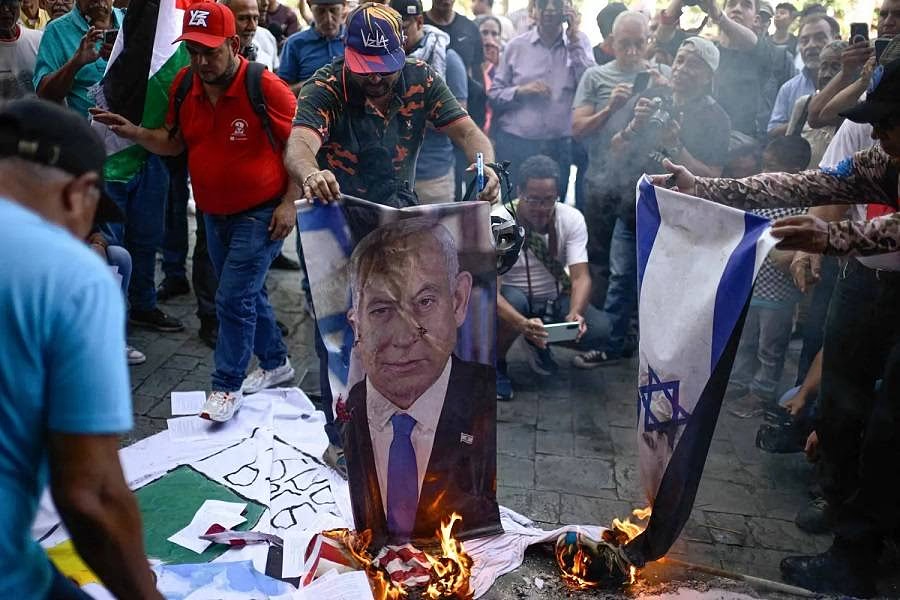
Maduro supporters burn US and Israeli flags in Caracas, Trump rules out early elections

Simon Bolivar Square in the heart of the Venezuelan capital, Caracas, witnessed a wave of angry protests, where about a hundred loyalists of former President Nicolas Maduro gathered to express their rejection of American policies. Protesters burned American and Israeli flags in an escalating move reflecting the extent of field tension, amidst chants condemning what they described as external hegemony over their country's resources.

The protests were not limited to burning flags; participants also trampled on images of US President Donald Trump and Israeli Prime Minister Benjamin Netanyahu. Protesters chanted slogans demanding the departure of American forces, considering the humanitarian aid provided by Washington after last June's earthquakes as merely a cover for a military and political occupation.

In a related context, US President Donald Trump made statements from the White House confirming that Venezuela is not yet ready for a new round of presidential elections at present. Trump indicated that despite not being fully ready, significant progress has been made since the US military arrested Maduro and transferred him to the United States earlier this year.

Trump notably praised the performance of Venezuela's acting president, Delcy Rodriguez, who served as vice president in the previous era and is currently cooperating with the US administration. Trump described Rodriguez's efforts as doing an excellent job in managing the transitional phase, emphasizing continued close coordination between Washington and the interim government in Caracas.

The US President touched upon the economic file, stressing the strategic importance of the Venezuelan oil sector for American markets. He explained that the United States imports huge quantities of Venezuelan crude, claiming that his policies contributed to rebuilding the economy, which was suffering from a state of near-total collapse before the recent US intervention.

For its part, press sources reported that a state of popular anger has prevailed among Maduro's supporters since the military operation carried out by the US army last January. These forces consider the arrest of Maduro and his wife a violation of national sovereignty, which fuels ongoing protests in public squares against the overwhelming American presence in the country.

On the diplomatic front, US Secretary of State Marco Rubio had set preconditions for the electoral process, including the necessity of ensuring freedom of the press and forming a new and independent electoral commission. These demands come amidst a legitimacy crisis that began since the 2024 elections, which did not receive widespread international recognition from Washington and its allies in Europe and Latin America.

Venezuela faces compounded challenges, as the political crisis intertwines with the repercussions of natural disasters that struck the country on June 24th. While the interim government tries to establish its pillars with American support, the opposition loyal to Maduro insists that external interventions are the main reason for the deterioration of living and security conditions in the country.

The American position remains fluctuating between the desire to secure oil flows and hesitation in announcing a specific date for elections, leaving Venezuela in a state of political uncertainty. Regional and international powers are closely monitoring developments on the streets of Caracas, amidst fears of a further escalation of the situation given the ongoing confrontation between supporters of the former regime and the current administration.

Regarding elections in Venezuela, they are not fully ready now, but significant progress has been made.

OPINIONS

Sat 25 Jul 2026 10:13 am - Jerusalem Time

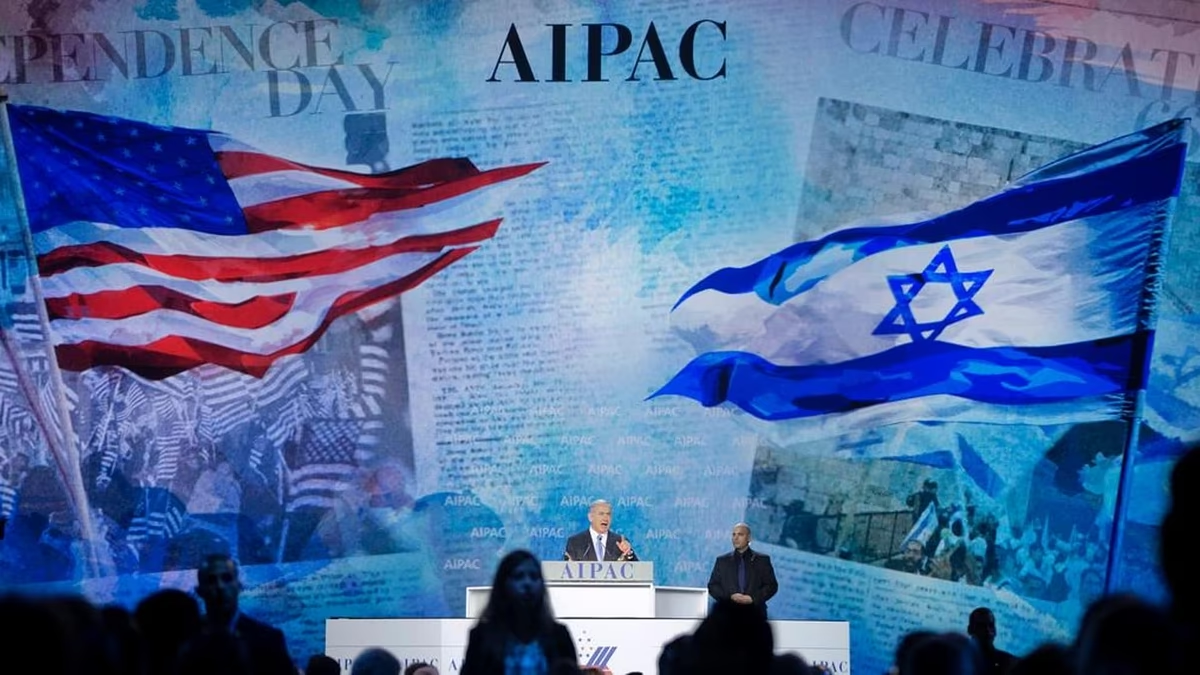
Israel Redraws Influence Strategy in the United States from "AIPAC" to Lobbying Firms and Digital Influence

Washington Message

Washington – Said Arikat - 25/7/2026

In a notable shift reflecting an Israeli realization of the declining effectiveness of its traditional tools in Washington, a new report from the Quincy Institute for Responsible Statecraft revealed that Israel is increasingly relying on political lobbying firms, public relations companies, and foreign agents registered under the US Foreign Agents Registration Act (FARA), instead of almost exclusive reliance on traditional lobbying groups, foremost among them the American Israel Public Affairs Committee (AIPAC), to enhance its influence within the United States.

The report, prepared by researcher Nick Cleveland-Stout, indicates that since 2023, Israel has spent more than a billion dollars on public diplomacy campaigns and improving its image abroad, including over 100 million dollars allocated for influence within the United States, according to official disclosures submitted under the FARA Act. The report adds that Israel is on track to become the largest foreign spender on registered political lobbying activities in the United States this year.

The report reveals that seventeen new companies registered themselves during 2024 and 2025 to work for Israeli interests, indicating an unprecedented expansion of the Israeli influence network within the United States.

Among the most prominent of these companies is Clock Tower X, founded by former campaign manager for President Donald Trump, Brad Parscale, which secured the largest contract valued at 46.5 million dollars. According to the report, the company admitted that it sought to introduce pro-Israel content into the data used to train large language AI models, through a network of websites designed to influence the responses of AI-powered chatbots, such as "ChatGPT."

FARA documents also showed that Israel spent millions of dollars to attract social media influencers, in addition to funding mass text messaging campaigns aimed at influencing American public opinion.

The report clarified that Israel paid 161,000 dollars to influencer Yoav Davis, who manages the "Jews of NY" account on Instagram, which has nearly 200,000 followers, and also paid 900,000 dollars to Bridges Partners to recruit more than a dozen influencers to publish content supporting Israel, even though these influencers were not registered as foreign agents.

The report notes that a significant portion of Israeli influence operations in the United States is managed through the French media company "Havas Media," which in turn contracted with seven American companies registered under the "FARA" Act, including the Democratic public relations firm SKDK and Bridges Partners.

The report states that these companies focus on reaching American segments where support for Israel has begun to decline, primarily American youth, evangelicals, and conservatives.

In this context, "Havas" signed a 3.2 million dollar contract in September 2025 with the Christian marketing company "Show Faith by Works" to implement a controversial propaganda campaign based on "geofencing" technology, which allows pro-Israel advertisements to be sent to the phones of people located inside or near American churches.

This escalation in influence campaigns comes at a time when Israel is facing a growing decline in its popularity within the United States, amidst rising criticism of its policies in Gaza, both from members of Congress and prominent figures in the American administration, including Vice President J.D. Vance.

The report's publication coincides with the announcement by Israeli Prime Minister Benjamin Netanyahu's office of his intention to visit Washington next week for talks with President Donald Trump, at a time when the Israeli government is seeking to restore its relations with increasing segments of American public opinion.

Researcher Nick Cleveland-Stout concludes that "the new methods adopted by Israel are reshaping the landscape of influence within the United States, but they have not yet succeeded in stopping the erosion of popular support, because the main reason for this decline is due to Israeli policies themselves, policies that are increasingly rejected by broad segments of Americans."

These figures reveal that Israel is no longer relying solely on traditional political influence within Washington, but is now heavily investing in the battle to shape American public awareness, utilizing the tools of the digital age, artificial intelligence, and influencer marketing. This shift reflects a realization that the battle for public opinion has become no less important than the battle to win the votes of members of Congress, especially with increasing criticism of the war on Gaza within universities, media, and social media platforms. However, pumping money alone does not guarantee the restoration of trust if Israeli policies themselves remain increasingly rejected.

The report also highlights a significant shift in the nature of foreign influence tools within the United States, as they are no longer limited to traditional lobbying groups or direct media campaigns, but have extended to attempting to influence the content produced by artificial intelligence applications, a new arena that may become one of the most influential fields of conflict over shaping information and narratives in the coming years. This raises legal and ethical questions about the limits of foreign interference in technologies that millions of users rely on for news, information, and analysis.

Despite this unprecedented expansion in spending, the report points to a striking paradox: the volume of financial resources does not necessarily equate to the extent of political or popular influence. Opinion polls over the past two years have shown a significant decline in popular support for Israel, especially among youth, Democrats, and independents. This means that public relations campaigns, no matter how costly, may find themselves unable to change the impressions formed by on-the-ground realities and images coming from conflict zones, which are now spreading moment by moment through media and digital platforms.

PALESTINE

Sat 25 Jul 2026 10:13 am - Jerusalem Time

Widespread escalation in the West Bank: Injuries from settler bullets and a campaign of raids targeting hospitals and displaced persons' residences

Since Friday night until dawn on Saturday, Israeli occupation forces have launched a series of widespread incursions and raids targeting dozens of towns and villages in various governorates of the occupied West Bank. These field military operations focused on the governorates of Jenin, Nablus, Tubas, Qalqilya, and occupied Jerusalem, where they involved thorough house searches and raids on the residences of displaced persons in the targeted areas amidst an atmosphere of intimidation.

In a serious field development, medical sources affiliated with the Palestinian Red Crescent reported 8 citizens sustained various injuries, including 6 people injured by live bullets, following an attack by settlers on the residents of the village of Fara'ata, located east of Qalqilya. This assault coincided with the continued Israeli forces' incursion into the Al-Naqqar neighborhood in the city, where they raided citizens' homes and arrested citizen Samir Hourani, while the city of Tubas witnessed a similar military operation that included raiding and searching citizens' properties.

Jenin Governorate received a large share of these violations, as the incursions affected the towns of Zababdeh, Qabatiya, Ya'bad, Faqqu'a, Burqin, Jilbon, and Jalqamus. Local sources reported that the forces raided the residences of displaced persons from Jenin refugee camp near the Arab American University, and arrested two young men, Taye Zakarneh and Jihad Al-Saadi, in addition to a third young man from the same area, amidst acts of vandalism to the contents of the raided homes.

In Nablus Governorate, occupation forces stormed the towns of Beit Furik, Tell, and Al-Lubban Al-Sharqiya, where soldiers deliberately fired sound bombs and tear gas to intimidate peaceful residents. The attacks also targeted the village of Qaryut to the south. Field sources confirmed that the invading forces raided Nablus Specialty Hospital in an escalatory measure targeting medical facilities, while intensive military movements were observed in front of the entrance to Qalandia refugee camp and the town of Kafr Aqab was raided north of occupied Jerusalem.

This wave of escalation comes after the occupation army announced the implementation of intensive operational activity in response to the events in the town of Tell, which earlier mourned the bodies of its sons who were killed by occupation bullets on Friday. Large crowds of citizens participated in the funeral amidst a state of anger and extreme tension, especially with the continuation of field pursuits and increasing restrictions imposed by the occupation forces on the movement of citizens between Palestinian governorates.

Military operations extended to include Aqabat Jabr refugee camp south of Jericho and the village of Kober in Ramallah, in addition to the village of Far'un south of Tulkarm, where Israeli forces continued their policy of night raids and arbitrary arrests. Palestinian families in these areas face harsh security conditions amid popular mobilization to confront repeated settler attacks that occur under the direct protection of the occupation army, which portends further deterioration in the field situation.

Medical sources reported 8 injuries among citizens, including 6 injuries by live bullets, as a result of a violent attack launched by settlers on the residents of Fara'ata village.

OPINIONS

Sat 25 Jul 2026 10:13 am - Jerusalem Time

Karim Khan's Dismissal Shakes the International Criminal Court: Between Allegations of Sexual Misconduct and Political Pressure in the Gaza File

Urgent

Urgent: Washington's Message

Washington – Said Arikat - 24/7/2026

In one of the most controversial stations in the history of the International Criminal Court, member states voted to dismiss the Court's Prosecutor, Karim Khan, from his position, in a precedent of its kind since the Court's establishment. The decision came after long months of investigations and accusations related to sexual misconduct, but it simultaneously reignited the debate about whether the case was purely legal, or if it was influenced by the political context surrounding Khan's decision to issue arrest warrants against Israeli Prime Minister Benjamin Netanyahu and his former Defense Minister Yoav Gallant in connection with the war in Gaza.

The vote was by secret ballot, with 82 members supporting Khan's dismissal, 13 opposing, and 15 abstaining. This is the first time a Prosecutor of the Court has been removed by this mechanism, reflecting the extent of division within the international judicial institution regarding the issue.

Accusations began within the Court

The roots of the case date back to May 2024, when a young legal officer who worked directly under Khan's supervision filed an internal complaint, stating that the Prosecutor, shortly after she joined his office in March 2023, began to exert sexual pressure on her, including repeated attempts to approach and touch her without her consent.

According to her account, these actions continued for months, in an unequal professional relationship that made it impossible, she said, to speak of any consensual relationship, given that Khan was “her direct superior and the head of all Court staff.”

These accusations came at a very sensitive time, as the Court was preparing to announce the issuance of arrest warrants against Netanyahu and Gallant, along with a number of Hamas leaders, including Yahya Sinwar, Ismail Haniyeh, and Mohammed Deif. Information indicates that the decision to issue the warrants had already been made before Khan was informed of the complaint against him.

Khan denies… and the investigation expands

Khan rejected all accusations from the outset, asserting that they were "completely baseless," and said that he had spent thirty years in judicial and international work without any similar complaint being made against him.

In November 2024, the Court announced the opening of an independent external investigation, before Khan decided, in May 2025, to temporarily step down and take administrative leave pending the conclusion of the investigations.

During that period, a second complaint emerged from a former intern in the Prosecutor's office, who stated that Khan used to invite staff to work from his home, and that each time, he would try to harass, touch, kiss, and push her towards an intimate relationship, which his defense team categorically denied.

Mixed investigation results

Last March, the investigation concluded that there was evidence indicating "non-consensual sexual contact," however, a judicial panel of three judges found that the evidence did not rise to the level of proving a legal violation warranting conviction under the Court's Statute.

But the Court's Executive Office was not satisfied with this, and decided to continue with disciplinary proceedings, before suspending Khan's work in June, and then later concluded that he had engaged in an inappropriate relationship with a subordinate employee, which it considered sufficient grounds for terminating his service.

A few days before the final vote, the first complainant gave her first television interview, confirming that the pressures she was subjected to lasted for about a year, and that she was later pressured to withdraw her statements or claim that they were fabricated, accusations that Khan also denied.

Division over justice and procedures

Despite the dismissal decision, the debate within legal and human rights circles has not ended. The former Executive Director of Human Rights Watch, Kenneth Roth, considered that the case concerned Khan's personal conduct and not his legal positions towards Israel or others, stressing that the Court's credibility requires accountability for any official proven to have committed ethical transgressions.

In contrast, more than 180 Palestinian and international organizations issued a joint statement affirming that they do not take a position on the validity or invalidity of the accusations, but expressed concern that the disciplinary procedures may have been mixed with political considerations, especially in light of the pressure and sanctions campaign the Court faced from the United States and Israel.

These organizations also warned that the Court's Executive Office, as a political body comprising diplomats, is not the most appropriate body to override judicial assessments issued after reviewing thousands of pages of evidence and testimonies, considering that this could weaken the Court's independence and undermine confidence in the rule of law.

Escalating American and Israeli pressure

These developments come at a time when the International Criminal Court is facing an unprecedented campaign of political pressure.

Since the issuance of arrest warrants against Israeli officials, the administration of US President Donald Trump has imposed new sanctions on Court officials, after Trump's first administration had imposed similar measures following the opening of an investigation into potential US war crimes in Afghanistan.

Israel, according to multiple reports, has also intensified its campaigns aimed at undermining the Court's work and questioning its officials, while US Secretary of State Marco Rubio, just days before the vote, announced the launch of a campaign aimed at “dismantling” the International Criminal Court and reducing its influence.

In contrast, the main complainant stressed that her case has nothing to do with Israel or the Gaza file, affirming that she fully supports the Court's investigations into crimes committed in the Palestinian territories, and that mixing personal accusations with political files has harmed her rights and the case itself.

Karim Khan's dismissal opens the door to a highly sensitive question regarding the International Criminal Court's ability to separate the ethical accountability of its officials from its judicial independence. On the one hand, ignoring serious accusations could undermine the institution's credibility, and on the other hand, the timing of the case coinciding with unprecedented legal prosecutions against Israeli officials, and with escalating American and Israeli pressure on the Court, makes it difficult to convince many that the two paths are completely separate. This explains the continued international division over whether justice has taken its course or has been affected by political polarization.

The crisis also reveals the fragility of international judicial institutions when they enter into direct confrontation with major international powers. Since the start of investigations related to the war in Gaza, the Court has been subjected to unprecedented political and media campaigns and economic sanctions, which has put its independence to a difficult test. Although the investigation into Karim Khan's conduct was based on internal complaints and institutional procedures, its timing and the way it was handled will remain a subject of long debate, especially in the absence of a clear legal consensus on the final results of the investigation.

As for the cases pending before the Court, Karim Khan's departure is not expected to lead to the cancellation or dropping of arrest warrants issued against Israeli officials or others, as these decisions are issued in the name of the Court and are not linked to the Prosecutor alone. However, the crisis may give the Court's opponents an additional opportunity to question its legitimacy and credibility, and may also delay some sensitive files until a new Prosecutor capable of restoring internal and external confidence in an institution facing one of the most serious crises in its history is appointed.

PALESTINE

Sat 25 Jul 2026 10:13 am - Jerusalem Time

Islamic-Christian: "Tel" massacre exposes the international community's impotence and makes it a partner in providing an environment of impunity

The Islamic-Christian Commission for the Support of Jerusalem and Holy Sites condemns the heinous terrorist crime committed by the occupation forces and settlers in the town of Tel, south of Nablus, which resulted in the martyrdom of a number of people and the injury of others, in a new episode in the series of organized bloody terrorism targeting our people in all places of their presence.

The Commission affirms that this crime is not an isolated incident, as the cold-blooded killing of Palestinians is no longer merely individual excesses, but has become an open war that reflects the occupation's doctrine based on killing, intimidation, and impunity, and providing all forms of support and protection for settler gangs to commit their bloody attacks against unarmed Palestinians.

The Commission expresses its regret at the suspicious and shameful international silence towards these repeated crimes, which is no longer merely inaction, but this silence has turned into a political and moral cover that encourages the occupation to proceed with its policy of killing, terrorism, and settlement. The continued reliance on statements of concern and condemnation without taking deterrent measures makes the international force a partner in providing an environment of impunity.

The Commission calls on the international community, the United Nations, and the International Criminal Court, which still believe in the values of justice and human rights, to take immediate action to stop the crimes of the occupation and its settlers, provide international protection for the Palestinian people, and hold those responsible for these crimes accountable as war crimes.

The Commission affirms that these crimes will not deter the Palestinian people from continuing to defend their land and adhere to their legitimate rights to life, freedom, and dignity, and that the terrorism of the occupation and its settlers will not succeed in breaking the will of our people to continue their legitimate struggle until they obtain their legitimate national rights.

PALESTINE

Sat 25 Jul 2026 10:13 am - Jerusalem Time

Al-Aqsa Storming: Escalation on the Eve of Elections to Garner Votes

Sheikh Dr. Ekrima Sabri: What happened is a "media demonstration" led by right-wing parties to show Al-Aqsa as if it is under their control and to encourage Jews to come to Palestine.

Sheikh Muhammad Hussein: The danger facing Al-Aqsa Mosque has become real as a result of continuous violations and attempts to undermine its historical and religious status.

Dr. Majed Saqr: "Temple" groups seek to prepare public opinion and the field to implement their final plan of demolishing Al-Aqsa Mosque and building the alleged Temple.

Ma'rouf Al-Rifai: These incursions have become part of a political and official process that seeks to change the historical and legal status quo in Al-Aqsa and impose manifestations of sovereignty.

Archbishop Atallah Hanna: Targeting Al-Aqsa does not only affect Muslims but also targets Christians, just as the assault on Christian endowments represents a targeting of all Palestinians.

Father Abdullah Yulio: Jerusalem will remain the focus of attention and a symbol that unites Muslims and Christians, and preserving it is a shared responsibility until it regains its status and rights.

Ismail Muslemani: Israeli far-right parties politically exploit these incursions to gain the support of their electoral bases and demonstrate adherence to the "sovereignty" agenda over Jerusalem.

Ramallah - Exclusive to "Y"-

In one of the largest waves of incursions into the blessed Al-Aqsa Mosque, more than four thousand settlers stormed the mosque's courtyards last Thursday, on the anniversary of what is called the "Temple Destruction Anniversary," amidst tight protection from Israeli occupation forces, in a scene that sparked widespread Palestinian warnings that these movements exceed the limits of traditional incursions, to fall within a path aimed at changing the status quo in the mosque and imposing a new reality within it.

Officials, Muslim and Christian clerics, and specialists confirm, in separate interviews with "Y", that the large gathering of settlers, which coincided with what is called the "Temple Destruction Anniversary," reflects a systematic escalation led by "Temple" groups with Israeli political and official support, in an attempt to turn Jewish religious occasions into stations for increasing the number of infiltrators, and showing Al-Aqsa Mosque as if it is under Israeli control.

They warn that the participation of extremist Israeli political figures in these incursions, led by the so-called Israeli National Security Minister Itamar Ben-Gvir and Knesset members, and allowing the performance of Jewish religious rituals within the mosque's courtyards, represent an indication of the transition of these practices from the activity of extremist groups to a policy supported by official institutions.

They affirm that the seriousness of the incursion lies not only in the number of participants, but in the nature of the political and religious messages carried by these movements, which aim to entrench the temporal and spatial division of Al-Aqsa Mosque and undermine its Islamic and historical identity, calling for strengthening Palestinian presence and steadfastness in the mosque, and activating Arab, Islamic and international action to pressure for an end to these measures and to preserve the status quo in Jerusalem and its holy sites.

Attempts to change the status quo

The head of the Supreme Islamic Council in Jerusalem, Sheikh Dr. Ekrima Sabri, confirms that the repeated incursions into Al-Aqsa Mosque, especially during Jewish religious occasions, come within the framework of attempts aimed at changing the status quo in the mosque, and opening the way for extremist Jews to enter it.

Sabri explains that the right-wing Israeli government uses these incursions to appease its political bases at the expense of Al-Aqsa Mosque and the rights of Muslims in it.

Al-Aqsa Mosque is a fixed legitimate right for Muslims

Sabri affirms that what happened in Al-Aqsa Mosque last Thursday represents an aggressive and provocative act, stressing that these incursions, no matter how often they are repeated, will not grant the occupation or the settlers any right in Al-Aqsa Mosque, because the right of Muslims in it is a fixed legitimate right.

Sabri points out that the settlers enter Al-Aqsa Mosque under the protection of the occupation forces, which reflects their lack of any right in it, while Palestinians are keen to adhere to their religious and historical right in the mosque.

A media demonstration led by right-wing parties

Sabri considers that what happened represents a "media demonstration" led by extremist right-wing parties to appease the Israeli street, and to show Al-Aqsa Mosque to the world as if it is under their control, in addition to encouraging Jews around the world to come to Palestine.

Sabri points out that these practices fall within a political and media propaganda that the Israeli right seeks to exploit to achieve gains in the upcoming elections.

Call to continue pilgrimage

Sheikh Dr. Ekrima Sabri calls on Palestinians in general, and the people of Jerusalem in particular, to continue their pilgrimage to Al-Aqsa Mosque and strengthen their presence in it as the most important way to confront these policies.

Sabri calls on the Islamic world and Arab governments to use their official, diplomatic and commercial tools to exert pressure on the occupation, which contributes to stopping its aggressive transgressions against Al-Aqsa Mosque and Jerusalem.

A blatant assault on the sanctity and inviolability of Al-Aqsa

The Mufti of Jerusalem and the Palestinian Territories, Sheikh Muhammad Hussein, confirms that the widespread incursion carried out by settlers into the blessed Al-Aqsa Mosque on Thursday represents a blatant assault on the sanctity and inviolability of the mosque, and a clear violation of the existing religious, historical and legal status quo in it, warning that these widespread incursions come within a plan aimed at changing the mosque's identity and status.

Sheikh Hussein explains that the number of infiltrators exceeded four thousand settlers, led by the so-called Israeli Minister of Internal Security Itamar Ben-Gvir and a number of Knesset members, considering that the participation of these official figures confirms that the Israeli government itself participates in and leads these incursions and assaults on Al-Aqsa Mosque, as part of a systematic policy aimed at imposing a new reality within the mosque.

He points out that the seriousness of what happened is not limited only to the size of the incursion, but includes the practices carried out by extremists within the courtyards of Al-Aqsa Mosque and its precincts, by performing their own religious rituals, considering this a clear message of defiance to the sanctity of the mosque and an assault on the right of Muslims in it. Hussein stresses that Al-Aqsa Mosque is a purely Islamic mosque for Muslims alone, and is not subject to temporal or spatial division, and no religious rituals other than Islamic worship may be introduced into it.

A comprehensive Israeli plan to Judaize the Holy City

The Mufti of Jerusalem confirms that these assaults come within the context of a comprehensive Israeli plan to Judaize the Holy City and change the existing conditions in Islamic and Christian holy sites, stressing that what happened is rejected and condemned according to international laws, regulations and customs.

He affirms that the danger facing Al-Aqsa Mosque has become real as a result of continuous violations and attempts to undermine its historical and religious status.

Sheikh Hussein calls on the Arab and Islamic nations, governments and peoples, to take a clear and effective stance towards these assaults, and to use available political, diplomatic and legal means to pressure the Israeli government to stop these practices.

The Mufti of Jerusalem calls on the international community to assume its responsibilities, in light of Israel, its government and its extremist organizations exceeding all limits against Al-Aqsa Mosque and the holy sites.

He points out that preventing worshipers from reaching Al-Aqsa Mosque since dawn, coinciding with allowing large numbers of settlers to storm it, represents a serious matter that should receive the attention of the Arab and Islamic worlds and the international community.

Sheikh Hussein stresses that preserving Al-Aqsa Mosque and Jerusalem is a collective responsibility, as they are part of the Arab, Palestinian and Islamic identity.

Incursions with dangerous political and religious goals

The Director of the Department of Preachers' Preparation in the Ministry of Endowments and Religious Affairs, Dr. Majed Saqr, confirms that the incursions into the blessed Al-Aqsa Mosque come within a plan that carries dangerous political and religious goals, most notably imposing a new reality within the mosque, in preparation for consecrating temporal and spatial division, and changing its Islamic and historical identity, leading to the achievement of the goal of extremist "Temple" groups to establish the "alleged Temple" in place of the mosque.

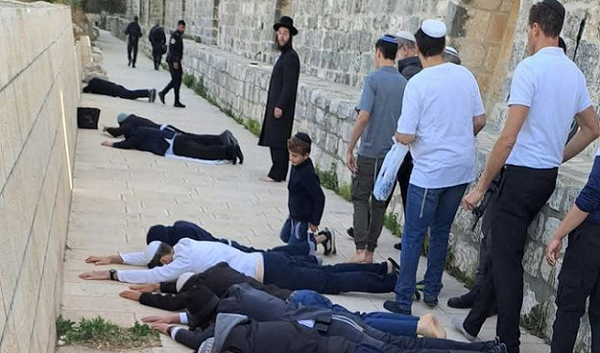
Saqr explains that the occupation authorities are working to change the existing legal and historical status in Al-Aqsa Mosque, by attempting to undermine the powers of the Islamic Endowments Department and ending the "status quo," which allows for imposing full occupation sovereignty over the mosque's administration, and allowing settlers to perform Talmudic rituals, such as "epic prostration" and reading the Torah, with the aim of transforming the Jewish religious presence into a fait accompli within the courtyards of Al-Aqsa.

Preparing to implement the final plan of the Temple groups

Saqr points out that "Temple" groups seek, through these practices, to prepare public opinion and the field to implement their final plan, which is to demolish Al-Aqsa Mosque and build the alleged Temple.

He criticizes the state of Arab and Islamic weakness towards what is happening, considering that the nation has become burdened with divisions and wounds, at a time when voices have emerged questioning the status of Al-Aqsa Mosque or trying to strip Muslims of their right in it.

Saqr stresses that what is required from Palestinians is to achieve unity and develop a national program to protect Al-Aqsa Mosque, calling on the Islamic nation to act and pressure by all means to preserve the first of the two qiblas, the second mosque built on earth, and the third mosque to which journeys are made.

Saqr calls on the international community to assume its responsibilities in protecting places of worship and the rights of worshipers, and not to turn international resolutions into mere ink on paper.

A systematic escalatory policy

The media advisor to the Governor of Jerusalem, Ma'rouf Al-Rifai, explains that the settlers' incursions into the blessed Al-Aqsa Mosque, which coincide with what is called the "Temple Destruction Anniversary," fall within a systematic escalatory policy led by "Temple" organizations with the support and protection of the Israeli occupation authorities, with the aim of turning Jewish religious occasions into stations for imposing new realities within the mosque, and expanding the scope of incursions temporally and spatially, in a way that serves the projects of temporal and spatial division of Al-Aqsa Mosque.

Al-Rifai confirms that these incursions are no longer limited to movements carried out by extremist groups, but have become part of a political and official process that seeks to change the historical and legal status quo in Al-Aqsa Mosque, and impose manifestations of Israeli sovereignty over it, by increasing the number of infiltrators, and allowing the performance of public Talmudic rituals within its courtyards, including wearing "tefillin" phylacteries, and performing what is called "epic prostration," in addition to chanting and prayers aloud, which reflects an escalation in the level of violations and attempts to establish a new reality within the mosque.

Raising the level of mobilization and incitement

Al-Rifai points out that the choice of this timing is linked to an attempt to exploit what is called the "Temple Destruction Anniversary" to raise the level of mobilization and incitement, and to turn Al-Aqsa Mosque into an arena for demonstrating control and imposing the Israeli narrative, noting that "Temple" organizations seek to achieve record numbers of infiltrators, and reach about five thousand settlers during this day, after the gradual increase in the number of participants during past years.

Al-Rifai warns that current indicators portend a stage that may witness further escalation, by expanding the times of incursions, increasing the number of infiltrators, and imposing new rituals within the mosque's courtyards, in addition to escalating demands to allow night incursions, change entry rules, and turn incursions into a more regular daily practice, which poses a direct threat to the mosque's Islamic identity and its historical and legal status.

Al-Rifai stresses that confronting these policies requires strengthening the Palestinian presence in Jerusalem and Al-Aqsa, unifying official and popular efforts to protect the city and its holy sites, in addition to effective Arab, Islamic and international action to pressure for an end to the measures targeting the status quo, and moving the issue of Al-Aqsa Mosque from the framework of statements and condemnations to practical political and legal steps that ensure the preservation of its status as a purely Islamic mosque, and safeguard freedom of worship and access to it.

A daily provocative phenomenon

The Archbishop of Sebastia for the Greek Orthodox, Archbishop Atallah Hanna, warns of the escalation of settler incursions into Al-Aqsa Mosque, considering them to have become a daily or semi-daily phenomenon, amidst settlers roaming inside it in a provocative, racist and hostile manner.

Hanna affirms his rejection of these practices, stressing that Al-Aqsa Mosque has a special religious status in Islam, which necessitates respecting its privacy and not storming it or provoking its custodians from the Islamic Endowments Department and worshipers in it with these unprecedented methods.

Hanna explains that the incursions are repeated on several occasions, including the anniversary of what is called the "Temple Destruction Anniversary," which reflects the existence of a plan aimed at changing the features of Al-Aqsa Mosque and imposing new realities within it.

Necessity of taking the highest degree of caution and vigilance

Hanna believes that what is happening requires the highest degree of caution and vigilance, warning that the current incursions may pave the way in the future for seizing parts of Al-Aqsa Mosque or imposing spatial and temporal changes in it.

Hanna affirms that the Holy City is going through a very dangerous and complex stage, stressing that targeting Al-Aqsa Mosque does not only affect Muslims, but also targets Christians and all members of the Palestinian people, just as the assault on Christian endowments represents a targeting of all Palestinians.

Hanna explains that Jerusalem is no longer facing merely a danger, but is experiencing a "real catastrophe," calling on the world to move beyond statements of condemnation and denunciation and to take practical steps and pressure the occupation to stop the practices that target Jerusalem in all its details.

Continuous escalation in Jerusalem and the Palestinian territories

Father Abdullah Yulio believes that the storming of Al-Aqsa Mosque by settlers coinciding with the anniversary of what is called the "Temple Destruction Anniversary" came within the framework of an "existing plan," considering that what was feared has come true, and that what happened does not represent an isolated incident, but falls within a continuous escalation witnessed in Jerusalem and the Palestinian territories.

Yulio explains that settlers are now moving under the protection and cover of the Israeli army, pointing out that they operate in different forms and organizations, which is a very dangerous development in the context of repeated assaults.

Yulio believes that Israel seeks to impose new realities on the ground and expand the boundaries of its control within the "Greater Israel" project, expressing hope that parties capable of stopping this path will intervene.

Serious concerns about the future of Al-Aqsa Mosque

Yulio affirms that the region is still experiencing the repercussions of war and regional tensions, warning that the continuation of these policies raises serious concerns about the future of Al-Aqsa Mosque, pointing out that he does not rule out the existence of a plan aimed at demolishing the mosque and establishing the "alleged Temple" in its place, if the current situation continues unchecked.

Father Yulio calls on Palestinians and Arabs, Muslims and Christians, to unite ranks and enhance awareness and field presence, and to work to convey the voice of the Palestinian people to the world, considering that unity of position and word can contribute to influencing international public opinion, and helping to stop what he described as the "devilish plan" and restore Palestinian rights.

Yulio stresses that the scenes of Al-Aqsa Mosque being stormed represent a dangerous development, but at the same time expresses his confidence in the end of the current stage, stressing that Jerusalem will remain the focus of attention and a symbol that unites Muslims and Christians, and that preserving it is a shared responsibility until it regains its status and rights, pointing out that what happened in Gaza was a gateway to defending Jerusalem and the blessed Al-Aqsa Mosque.

Attempts to entrench settler incursions into Al-Aqsa

The Jerusalemite writer and political analyst Ismail Muslemani believes that the intensification of settler incursions into the blessed Al-Aqsa Mosque during what is called the "Temple Destruction Anniversary" comes within an attempt to exploit a religious occasion with symbolic significance for national religious currents in Israel, with the aim of imposing new realities within the mosque and strengthening the presence of these groups in it.

Muslemani explains that these incursions aim to entrench settler incursions into Al-Aqsa Mosque as an ordinary and repeated matter, while working to increase the number of participants, and gradually pushing towards imposing an actual temporal and spatial division in Al-Aqsa, even without officially announcing it.

An attempt to test Palestinian, Arab and Islamic reactions

Muslemani points out that these practices also represent an attempt to test Palestinian, Arab and Islamic reactions, and to exploit existing regional circumstances and preoccupations to expand the margin of movement.

Muslemani points out that Israeli far-right parties politically exploit these incursions to gain the support of their electoral bases and demonstrate adherence to the "sovereignty" agenda over Jerusalem, noting that these issues have become electoral material, as each party seeks to prove that it is the most serving of the agendas of extremist Zionist currents.

Muslemani warns of continued attempts to increase the number of infiltrators, expand the times of incursions, and impose Jewish religious practices within the mosque's courtyards, especially during Jewish holidays and seasons, which may raise the probabilities of tension.

Muslemani calls for strengthening Palestinian steadfastness and presence in Jerusalem and Al-Aqsa, intensifying diplomatic and legal action, supporting the steadfastness of Jerusalemites, and activating the Arab and Islamic role, especially the role of Jordan, the custodian of Islamic holy sites, to preserve the historical and legal status quo and prevent any unilateral changes.


PALESTINE

Sat 25 Jul 2026 10:12 am - Jerusalem Time

Palestinian Presidency warns of explosion of conditions and condemns Nablus massacre and settler attacks

The Palestinian Presidency issued a strongly worded statement condemning the continuous series of crimes carried out by the Israeli occupation forces in cooperation with settler groups against citizens in the West Bank and occupied Jerusalem. The Presidency affirmed that these violations come within the context of a systematic policy aimed at intimidating Palestinians and breaking their will in various governorates, coinciding with the ongoing aggression on the Gaza Strip.

The Presidency highlighted the horrific massacre that took place in the village of Tal in Nablus Governorate, where occupation forces opened fire on a Palestinian family, leading to the martyrdom of four of its members and the serious injury of three others. The Presidency described this incident as a war crime added to the occupation's record full of aggressions against unarmed civilians who face the Israeli war machine with bare chests.

Official sources indicated that settler attacks did not stop at Nablus, but extended to include barbaric attacks on citizens' properties in the towns of Aqraba, Surra, Immatin, and Far'ata, in addition to the areas of Masafer Yatta and Imriha. These attacks included burning properties and terrorizing peaceful residents in their homes under the direct protection of the occupation army, which provides cover for these gangs.

In a dangerous development, field sources reported that occupation forces stormed Nablus Specialty Hospital, where they intimidated medical staff and patients and directly assaulted them. The occupation did not stop at the storming, but also carried out kidnappings of citizens from inside the health facility, in a flagrant violation of all international laws that protect medical institutions and civilians in times of conflict.

The Palestinian Presidency held the extremist right-wing occupation government fully responsible for the lives of citizens, noting that its financial and political support for settlers is the primary driver of this escalation. Official statistics revealed that 87 martyrs have fallen since the beginning of this year, including 21 citizens who died directly from settler bullets, reflecting the extent of organized terrorism practiced by these groups.

The statement also condemned the recent decisions issued by Benjamin Netanyahu and his war minister, which included accelerating the construction of illegal settlement outposts and intensifying military raids in West Bank cities. The Presidency considered that imposing a siege on the city of Nablus and its surroundings represents collective punishment aimed at tightening the noose on the Palestinian people and pushing the region towards the brink of a comprehensive explosion from which no one will be safe.

In conclusion of its statement, the Palestinian Presidency called on the American administration to break its silence and intervene immediately to compel the occupation authorities to stop their crimes and provide international protection for the Palestinian people. It stressed the need for the international community to bear its legal and moral responsibilities in holding the occupation leaders accountable for their crimes, warning that the continuation of this approach will lead to catastrophic repercussions that will destabilize the entire region.

The occupation government is pushing the West Bank towards a comprehensive explosion in implementation of its settlement and forced displacement plans.

ARAB AND WORLD

Sat 25 Jul 2026 10:12 am - Jerusalem Time

Trump conditions expanded military strikes on Iran's seriousness in negotiations

US President Donald Trump affirmed that he has not yet settled on a final decision to expand the scope of military strikes targeting Iranian objectives. Trump explained in press statements from the Oval Office that the American administration is closely monitoring Iranian behavior, indicating that Tehran has begun to show increasing signs of seriousness in the diplomatic talks currently underway with Washington.

These statements come at a time when press reports have revealed that the White House is studying a comprehensive military plan aimed at resuming expanded combat operations. According to informed sources, these operations may exceed in intensity what was previously known as 'Operation Epic Fury,' with these sources quoting Trump as saying that the Iranian side has not felt enough pain to fully change its behavior.

Despite hinting at the military option, the US President stressed that communication channels remain open with the Iranian side at present. Trump considered that the pressures exerted have begun to bear fruit, which explains the gradual change in Tehran's negotiating position, emphasizing that the coming days will be decisive in determining the path the American administration will take.

In contrast, the Iranian response was swift and firm through high-level military statements vowing to retaliate for any human losses. Ali Abdollahi, a leader in the Revolutionary Guard, announced a new field equation stipulating targeting an American soldier for every Iranian who falls in the ongoing attacks, considering that this principle will guide their movements in the next phase.

For nearly two weeks, the region has witnessed unprecedented field escalation, with US forces launching successive waves of airstrikes on strategic sites within Iranian territory. Tehran, for its part, responds by launching missile barrages and drones targeting military bases and facilities it describes as linked to American interests in the region.

This security deterioration comes despite a memorandum of understanding signed between the two parties last June, which aimed to cease hostilities and pave the way for a comprehensive agreement. However, that optimism quickly dissipated after mutual accusations of violating understandings, leading to the return of the language of weapons to dominate the political and military scene.

On July 8, the US President officially announced the termination of the ceasefire agreement that had been reached earlier. This decision followed a series of mysterious attacks targeting oil tankers in the Strait of Hormuz, attacks for which Washington held Tehran and its military apparatus directly responsible.

The United States adheres to clear demands regarding the necessity of ensuring freedom of international navigation in the Strait of Hormuz and stopping any threats to commercial vessels. Washington believes that Iranian behavior in vital waterways poses a direct threat to the global economy and energy security, which requires a firm response to deter any attempts to disrupt trade.

For its part, Tehran insists on imposing its own regulatory mechanism for ships to pass through the waterway overlooking its coasts, rejecting what it describes as external interference in its maritime sovereignty. This conflict of interests and visions has exacerbated global market fears about the possibility of disruptions to oil and gas exports, putting the region on the brink of a comprehensive confrontation.

I believe they are showing greater seriousness day by day, and perhaps the reason behind that has become clear to everyone.

ARAB AND WORLD

Sat 25 Jul 2026 10:12 am - Jerusalem Time

Threads of 'The Buttons Plan': How did Israel trap Hezbollah's communication network over decades?

A recent investigative report revealed the historical roots of the 'Pager' operation that shook Lebanon in September 2024, indicating that the seeds of the plan were sown after the occupation's failures in the July 2006 war. Israeli intelligence agencies, specifically the Mossad and Unit 8200, worked on a long-term strategy known as 'The Buttons Plan' to retaliate against Hezbollah by penetrating its infrastructure.

Following the recommendations of the 'Winograd Committee,' Israeli security doctrine shifted from direct military confrontation to deep intelligence work. According to security sources, the goal was to access the internal fabric of the party and undermine it by turning everyday communication tools into inert explosive devices awaiting an activation signal for many years.

On September 17, 2024, specifically at 3:30 PM, thousands of pagers simultaneously exploded in Hezbollah strongholds in the southern suburbs, Beqaa, and the South. The shock did not stop there, as the following day witnessed a second wave targeting 'walkie-talkie' devices, resulting in over 3500 casualties, including martyrs and injured.

Sources reported that the investigation team traced the path of the booby-trapped devices, discovering a high technical capability in converting small batteries into highly explosive devices. Traditional metal detonators were replaced with flammable chemical materials, allowing these devices to pass through airports and precise inspection machines without raising any security suspicions.

The operation relied on a complex network of shell companies in European capitals, most notably 'BAC Consulting' in Budapest and 'Norta Global' in Sofia. It was revealed that these companies were merely paper fronts established to provide legal and logistical cover for the death shipments, with their managers disappearing immediately after the explosions.

Technical experts indicated that Unit 8200 did not merely booby-trap the devices but also contributed to 'creating the need' for them through digital campaigns that led the party to believe that smartphones were completely compromised. This psychological and technical pressure pushed the party's leadership to revert to using older technologies like pagers, thinking they were safer and beyond surveillance.

The criminal design of the devices included selecting specific alert tones that would prompt the user to immediately take out the device and look at its screen. Engineers estimated that a user needs approximately seven seconds to read the message, which was the timing set to ensure the explosion occurred directly in the victim's face to achieve maximum physical harm.

Injured individuals recounted painful testimonies about the moment of the explosion, with some initially believing that the devices were experiencing a technical malfunction or overheating. Medical engineer Hassan Nasrallah confirmed that hospitals turned into war zones within minutes, receiving hundreds of injured who lost limbs or suffered facial injuries due to the sudden explosions.

Injuries were not limited to military personnel but also affected a wide range of civilians such as doctors, engineers, and teachers who use these devices in their professional lives. Field testimonies confirmed that the explosions occurred inside homes and public markets, leading to injuries among women and children who had no connection to the party's military activities.

The investigation revealed that Hezbollah began to suspect the safety of the devices shortly before the disaster occurred, as technicians noticed a defect in some shipments. Samples were sent to experts in Iran for laboratory tests, but the occupation quickly carried out the bombings before the booby-trapped shipments were fully exposed.

The successive assassinations carried out by Israel, especially the assassination of leader Nabil Qaouq, hindered the internal investigations that the party was conducting regarding procurement deals. Qaouq was following the security penetration file and supply chains, which prevented the party from accessing the full details of how the Mossad infiltrated its devices.

From a legal perspective, international law researchers considered the conversion of civilian devices into killing tools a blatant violation of the principles of distinction and proportionality. Researcher Irene Petrobaoli affirmed that this operation constitutes a dangerous precedent in the history of armed conflicts, where commercial supply chains were exploited to carry out indiscriminate attacks against the population.

Observers believe that the 'Pager' operation was merely a prelude to a broader phase of military escalation, which included the elimination of first and second-tier leaders in Hezbollah. This campaign later culminated in targeting the party's Secretary-General, Hassan Nasrallah, reflecting the extent of intelligence penetration achieved by the occupation over years of planning.

Many details of this operation remain undisclosed, but it has redrawn the boundaries of modern intelligence warfare and raised global questions about the security of electronic products. 'The Buttons Plan' has proven that future wars may not begin with missiles, but with a simple text message that turns a device in your pocket into a deadly bomb.

The operation took only seconds to execute, but its preparation had been ongoing for a long time by converting civilian devices into ticking bombs.

PALESTINE

Sat 25 Jul 2026 10:12 am - Jerusalem Time

Netanyahu decides to legalize new settlement outposts and the army launches a wide operation in the West Bank

Israeli Prime Minister Benjamin Netanyahu revealed today, Friday, his government's official direction to legalize a group of existing settlement outposts in the occupied West Bank, in addition to initiating the construction of new settlement outposts. This step comes in the context of the escalation policy pursued by the far-right to impose a new demographic and geographical reality on Palestinian territories internationally classified as occupied territories.

Netanyahu, in cooperation with his security minister, Israel Katz, confirmed the adoption of a package of field and political measures aimed at strengthening the settlement grip. These measures include intensive raids in Palestinian villages and towns, under the pretext of pursuing militants, in parallel with accelerating legal and administrative procedures to legalize agricultural settlement that encroaches on vast areas of citizens' lands.

On the field level, the Israeli army announced the start of preparations to implement a wide-ranging military operation in various areas of the West Bank. Sources reported that the Central Command of the army informed settler leaders of the need to prepare for a new phase of operations described as 'counter-terrorism', stressing that it would take all necessary measures to achieve its goals.

In a remarkable field development, the Israeli army admitted the killing of an officer with the rank of major, Yoav Ezra, 27 years old, during an operational activity in the area of Tel village. Israeli medical and relief sources also confirmed the killing of a second Israeli in the same incident, reflecting the extent of escalating tension and field confrontations at contact points in the West Bank.

Nablus city witnessed an incursion targeting a hospital, where occupation forces arrested two Palestinians from inside the medical institution. Occupation authorities claim that the detainees participated in a shooting incident that occurred on Friday morning, which represents a new violation of the sanctity of health facilities protected under international laws.

In Ramallah governorate, forces reinforced with armored and tracked vehicles stormed the town of Deir Jarir, where infantry teams spread in the town's alleys amid heavy firing of sound bombs. Eyewitnesses reported that the military force carried out extensive searches and provocations against residents, leading to limited confrontations in the eastern part of the town.

As for occupied Jerusalem, occupation forces escalated their attacks in the town of Al-Tur, where they stormed citizens' homes and severely beat members of one family. The operation ended with the arrest of a number of young men and their transfer to interrogation centers, amid a state of panic among women and children due to the violence used during the searches.

The measures were not limited to incursions, but also included an economic and social siege by closing the entrances to several villages and towns in Salfit governorate. Occupation forces tightened their military measures at checkpoints surrounding the governorate, hindering the movement of citizens and preventing them from reaching their lands and workplaces on Friday.

In a related context, settlers continued their systematic attacks under army protection, targeting vital Palestinian infrastructure. Settlers sabotaged water lines belonging to Ein Samiya wells east of Ramallah, causing the cessation of water pumping to thousands of citizens who primarily depend on these wells.

Jerusalem Governorate Water Authority clarified that this attack is the third of its kind targeting the Ein Samiya area in just one week. Technical teams confirmed that they are working hard to repair the damage and restart the wells, warning of the danger of targeting water sources as a tool for pressure and forced displacement against Palestinian communities.

Also in Jerusalem, extremist settlers closed Al-Sawana Street leading to the Mount of Olives, preventing Palestinian vehicles from passing. This was accompanied by stone-throwing at cars, which led to the shattering of glass in several of them and caused fear among passengers, in the absence of any intervention from the occupation police to deter the attackers.

These rapid developments confirm the existence of a comprehensive Israeli plan aimed at escalating the situation in the West Bank on all fronts. Between the political legalization of settlements, military operations on the ground, and settler attacks on infrastructure, Palestinians face a critical stage targeting their existence on their land.

We have taken a series of steps including accelerating procedures for legalizing agricultural settlement outposts and establishing new outposts in the West Bank.

ARAB AND WORLD

Sat 25 Jul 2026 10:12 am - Jerusalem Time

Trump: Talks underway with Iran, but Tehran not yet ready for a final agreement

US President Donald Trump announced today, Friday, that the United States is engaged in a round of talks with Iran with the aim of negotiating an end to the protracted conflict between the two countries. Trump clarified in statements to reporters from the White House that current indications suggest a desire to negotiate, but Tehran has not yet reached the stage of full readiness to sign a formal agreement.

The US President indicated that the American administration perceives a change in Iranian behavior, describing them as having become 'more serious' in dealing with the issues at hand compared to any time before. However, Trump stressed that this seriousness does not necessarily guarantee concrete results in the near future, saying: 'We will see what happens.'

These statements come at a sensitive time when the region is witnessing intensive diplomatic movements, as Washington seeks to assess the extent of Tehran's commitment to de-escalation requirements. According to informed sources, the White House is closely monitoring field and political developments before taking any additional escalatory or breakthrough steps in this complex issue.

I think they are serious... more serious than we have seen them so far, but that does not mean we will reach an agreement.

PALESTINE

Fri 24 Jul 2026 8:38 pm - Jerusalem Time

Excellence with the Taste of Blood.. Martyr Yahya Nasman Achieves 96.6% in General Secondary After the Annihilation of His Family

In a scene that embodies the intertwining of steadfastness with the tragedies of loss in the Gaza Strip, the General Secondary results were announced, carrying with them the story of the martyr Yahya Adham Ibrahim Nasman. Yahya, the young man who lived in Al-Shati Camp west of Gaza City, was not present to hear his name echoed among the top students, as death took him days before the great moment of anticipation. The numbers proved his exceptional excellence with an average of 96.6%, making this number a testament to a will unbroken by the machines of war.

Nine-thirty on Friday morning was not just a routine time for announcing results; it turned into a painful reckoning for a crime committed against an entire Palestinian family. When Yahya's result appeared, there was no one to greet it with ululations or distribute sweets, as is customary in the homes of high achievers. The occupation's planes had erased the entire family from the civil registry, so Yahya, his parents, and his siblings departed in one shroud, leaving behind an empty school desk and a certificate of excellence stained with blood.

Throughout a full year of suffocating siege and continuous bombing, Yahya fought his own battle over the rubble of his home and amidst the jaws of death. He stole hours of study from the darkness, relying on the glow of candles and the incessant sound of bombing, to draw a future he dreamed of. His mother was keen to provide him with quiet despite the noise of explosions, while his father supported his ambition with all his might, hoping that the results day would be a day of pride and celebration.

Yahya took his exams with unparalleled bravery, defying the harsh conditions faced by students in the Gaza Strip under the ongoing aggression. He placed his name among the elite geniuses of the nation, but the hand of treachery was quicker than the announcement of joy, as it assassinated his dreams before they saw the light. This certificate, which proves his genius, remains alone today, telling the story of a student who excelled despite his painful reality, but did not escape the occupation's missiles that do not differentiate between a civilian and an outstanding student.

Yahya's friends and everyone who knew him stood before the results screens with hearts squeezed by sadness mixed with pride, as they watched their colleague's name top the lists. Yahya was gone, and his family, who had eagerly awaited this moment, was also gone, leaving nothing but silence and rubble in their home. Yahya's average has become a national icon, reminding the world that in Gaza there are minds that build and dreams that are assassinated in cold blood, amidst the ongoing massacres that target people and stone.

Yahya Nasman's story remains a living wound that exposes the brutality of the occupation, which is not content with targeting bodies but seeks to erase Palestinian memory and future. Yahya's success after his martyrdom is a strong message of steadfastness, confirming that education in Palestine is a weapon for resistance and survival. Despite the absence of those who would celebrate, Yahya's name will remain etched in the memory of Al-Shati Camp and in the records of honor, as a student who achieved both worldly and otherworldly certificates simultaneously.

Yahya Nasman's name remained a star dripping light in the list of successful students, and a living wound exposing the brutality of an aggression that is not content with assassinating bodies.

ARAB AND WORLD

Fri 24 Jul 2026 8:38 pm - Jerusalem Time

Escalation on the Ground: Ukrainian Drones Strike Deep into Russia, Glide Bombs Target Zaporizhzhia

The past few hours have witnessed a significant military escalation between Moscow and Kyiv, as a large-scale Ukrainian drone attack led to a massive fire in logistics warehouses near the Russian city of St. Petersburg. Sources reported that the fire ignited in facilities belonging to 'Wildberries,' Russia's largest e-commerce platform, causing thick plumes of smoke to rise and cover large parts of the region.

For its part, the Russian army announced that it had repelled a wide wave of aerial attacks, confirming the downing of approximately 571 Ukrainian drones in one night. The Russian Ministry of Defense clarified that these drones were intercepted over 15 different regions, including the Crimean Peninsula, noting that the Ukrainian focus was particularly on the strategic Leningrad region.

In a related context, 'Wildberries' decided to temporarily suspend operations in two of its largest warehouses in St. Petersburg to assess the damage caused by the targeting. These strikes come as part of an intensive Ukrainian strategy aimed at hitting supply lines, logistics facilities, and energy infrastructure deep within Russia to undermine Moscow's military capabilities.

On the other hand, Russian forces launched a fierce attack using glide bombs targeting the city of Zaporizhzhia in southern Ukraine. The regional governor confirmed that five bombs fell on residential areas, resulting in injuries to at least 25 people, in a new escalation targeting populated areas.

Local authorities in Zaporizhzhia clarified that among the injured were six minors and an infant no older than three months, reflecting the scale of the humanitarian tragedy. The shelling also caused extensive destruction to residential buildings and severe damage to a private medical facility that provided services to citizens in the area.

Russian attacks were not limited to the south but also hit the city of Sloviansk in eastern Ukraine, where a residential area was subjected to an airstrike that injured nine people. Field sources reported that the Russian shelling caused significant destruction to civilian infrastructure, amid ongoing search and rescue operations under the rubble.

In justifying the targeting of 'Wildberries,' the Ukrainian presidency indicated that the company's facilities are used to store and transport components involved in the manufacture of military equipment. President Volodymyr Zelensky considered these operations to fall under the category of 'field sanctions' against companies that contribute to supporting the Russian war effort and circumventing international sanctions.

Also on the ground, the Russian Ministry of Defense announced the targeting of Ukrainian troop concentration points along the Krasnolyman axis north of Donetsk province. The ministry stated that its strikes were precise and succeeded in neutralizing military gatherings that were preparing to launch counter-offensive operations on that volatile front.

As part of the port war, Russian forces continued to shell Ukrainian naval infrastructure, targeting facilities in the strategic Yuzhny port. Russian sources confirmed that the raids hit fuel and lubricant depots intended to supply Ukrainian military vehicles for field movements.

Moscow also revealed the targeting of two cargo ships in the ports of Odesa and Chornomorsk, claiming that they were transporting vital military supplies to Kyiv. Russia insists that it will continue to pursue any ships or logistics centers used to support Ukrainian military operations via waterways.

Kyiv describes this phase of the confrontation as a necessary response to the continuous Russian missile attacks targeting Ukrainian cities day and night. The Ukrainian command asserts that expanding the war to include deep Russia aims to make the Russian interior feel the cost of the war that has been ongoing for years.

It is worth noting that these developments come at a time when the fighting fronts are experiencing relative stagnation in ground movements, in contrast to a significant escalation in the war of drones and long-range missiles. Civilians on both sides remain the biggest victims of this military escalation, which increasingly affects vital facilities and residential areas.

This campaign is a long-range sanction, in response to Russia's nightly drone and missile attacks on our cities.

PALESTINE

Fri 24 Jul 2026 8:38 pm - Jerusalem Time

Occupation forces storm a hospital in Nablus and arrest two wounded individuals after an officer and a soldier were killed in the town of Tal

On Friday, occupation forces stormed Nablus Specialty Hospital in the northern West Bank, where they carried out an arrest operation against two Palestinians from within the medical facility. Military sources claimed that the detainees were involved in the shooting operation that took place in the town of 'Tal' in Nablus Governorate, noting that the operation was based on accurate intelligence information that led to their apprehension inside the hospital and their immediate transfer to interrogation centers belonging to the intelligence service.

In an official acknowledgment of the extent of the losses, the occupation army revealed the identities of two killed individuals who fell during clashes and the military operation in the town of Tal. It was revealed that the first killed was an officer with the rank of major, serving as a unit commander in the armored corps. The military statement also confirmed the killing of another soldier belonging to the 'Al-Quds' Brigade, who died from his direct injuries during search operations and the pursuit of the perpetrators in the area that witnessed violent confrontations between resistance fighters and occupation forces.

These developments coincided with the occupation forces committing a massacre in the village of Tal, southwest of Nablus, which resulted in the martyrdom of four Palestinians and the injury of four others with varying degrees of wounds, amidst attempts by settlers to burn citizens' homes and shoot at them. Local sources reported that occupation vehicles stormed the city through the Huwara checkpoint and completely surrounded the specialty hospital, causing a state of terror and panic among patients and medical staff who were subjected to abuse and identity checks.

For his part, Nablus Governor Ghassan Daghlas refuted the narrative promoted by the occupation regarding the circumstances of the events, stressing that what happened was a heroic stand by the residents against an attack launched by armed settlers on the village under army protection. Daghlas explained that the occupation is trying to cover up its crimes by targeting health facilities and abducting the wounded, emphasizing that the steadfastness of the citizens in the town of Tal thwarted the plans of the settlers who tried to burn public and private property.

On the ground, occupation forces imposed a strict military cordon and a comprehensive siege on Nablus Governorate, with the declaration of a curfew in the village of Tal and its neighboring areas to secure the withdrawal of forces and vehicles. This widespread military campaign comes amid escalating tensions in the West Bank, where national and Islamic forces condemned the massacre, calling for an escalation of comprehensive confrontation in response to the targeting of hospitals and the cold-blooded killing of civilians.

The operation came after field intelligence efforts during the storming of the medical facility, where the detainees were transferred to interrogation centers.

PALESTINE

Fri 24 Jul 2026 8:38 pm - Jerusalem Time

Officer and Settler Killed in Shooting Operation in Tal Town West of Nablus

Media sources reported an increase in the death toll among the Israeli occupation forces to two, as a result of a qualitative shooting operation that targeted them in the town of Tal in Nablus Governorate, north of the West Bank. This announcement came after one of the injured succumbed to his severe wounds sustained during the clash, while a state of confusion prevailed among the forces present in the area.

Field reports revealed that the second fatality in the operation was a major-ranked officer in the occupation army, who held the position of company commander that rushed to the site to deal with the incident. Sources clarified that the officer was directly hit while attempting to control the situation after clashes erupted in the vicinity of the 'Havat Gilad' settlement outpost established on citizens' lands west of Nablus.

Regarding the details of the operation, Palestinian sources stated that a young man managed to seize a weapon from one of the settlers during the residents' confrontation of an incursion targeting the village of Tal. After gaining control of the weapon, the young man opened fire at a group of settlers and security personnel, initially resulting in four people sustaining injuries of varying severity before two of them were later announced dead.

Following the operation, the occupation army deployed large military reinforcements to the vicinity of Nablus, imposing a strict security cordon on the town of Tal and its surrounding villages. Occupation forces also closed a number of checkpoints and main entrances connecting the governorate to other West Bank cities, causing severe traffic congestion and a complete disruption of the movement of Palestinian citizens in the area.
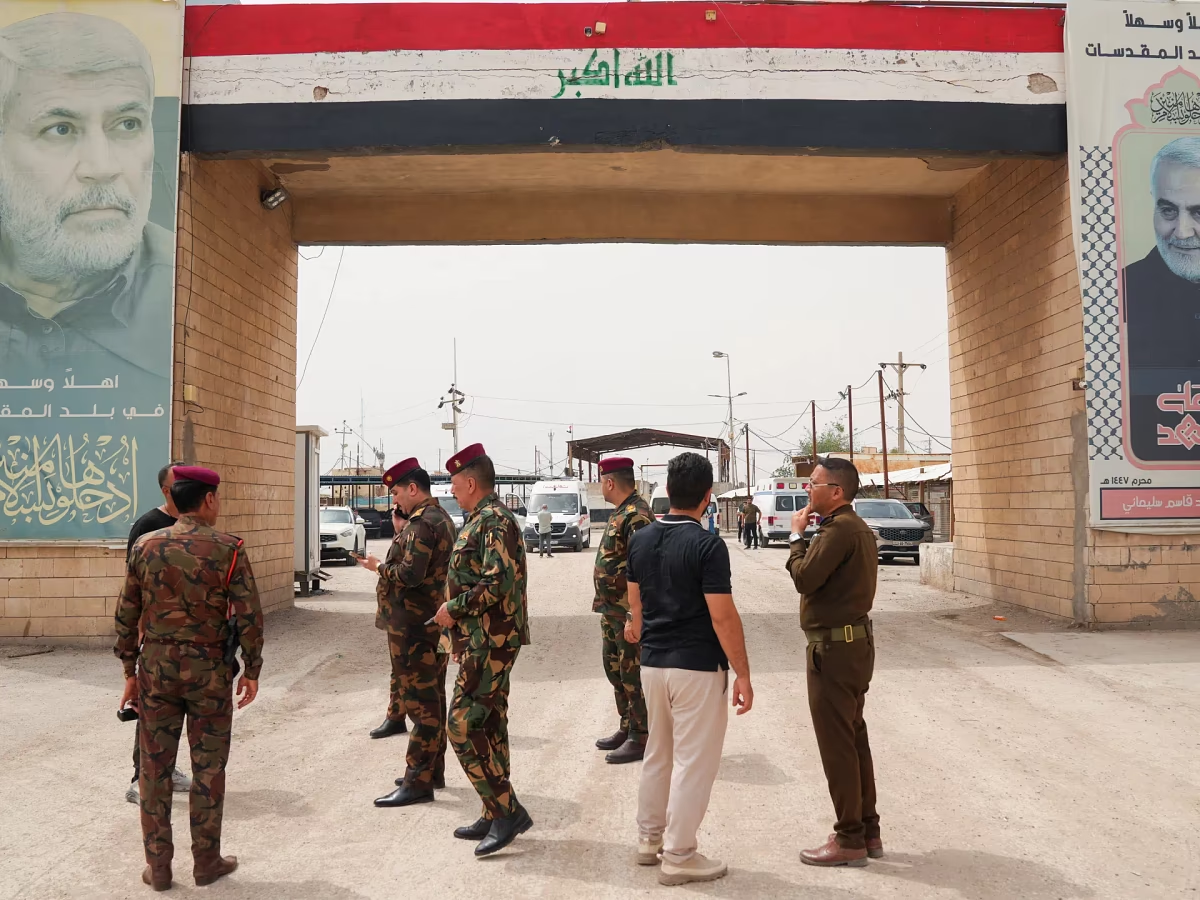
Occupation forces began carrying out widespread search operations, including raiding and meticulously searching dozens of homes, coinciding with subjecting vehicles and passersby to strict security checks. These repressive measures come amidst escalating field tensions in Nablus Governorate, where the occupation continues to pursue the perpetrators amid sporadic clashes with youths in several areas.

The second fatality in the Tal town incident is a major-ranked officer in the army, who holds the position of company commander that arrived at the site.

PALESTINE

Fri 24 Jul 2026 8:38 pm - Jerusalem Time

Occupation forces storm Nablus Specialty Hospital, causing panic among patients

Israeli occupation forces stormed Nablus Specialty Hospital, located in the city of Nablus in the northern occupied West Bank, today, Friday. Sources reported that elements of the occupation army spread extensively inside the corridors and departments of the medical facility, and began carrying out precise and extensive search operations, which caused a state of extreme panic and terror among the patients and medical teams present.

Sources stated that the operation began with military vehicles surrounding the hospital, followed by foot forces storming the building. Occupation soldiers detained a number of workers and escorts and checked their personal identification, coinciding with intense military activity launched by the occupation forces in various neighborhoods of Nablus.

These developments come in the context of a continuous military escalation witnessed across the cities and camps of the West Bank, where occupation forces repeatedly target health and service facilities and disrupt their work under security pretexts, at a time when the Israeli army continues to prepare to expand its field operations in the region.

Occupation vehicles surrounded the medical facility before foot forces entered its corridors, where they began checking the identities of some workers and escorts.

PALESTINE

Fri 24 Jul 2026 8:38 pm - Jerusalem Time

Russian-Israeli Alliance Opposes Extension of Human Rights Commissioner Volker Türk's Term

The corridors of the United Nations are witnessing intense diplomatic activity with the emergence of open opposition from Russia and Israel to the reappointment of Volker Türk as High Commissioner for Human Rights for a second term. These moves come ahead of a scheduled vote in the UN General Assembly on Secretary-General António Guterres' proposal to extend Türk's term until 2030.

Diplomatic sources reported that the General Assembly is preparing today, Friday, to consider Guterres' request, at a time when no alternative candidate for the position has been officially put forward yet. Türk, a seasoned Austrian lawyer, has held the position for years, and his first term is supposed to end next October.

The Russian mission submitted a counter-proposal for a technical extension of Türk's term only until the end of this year instead of the proposed four years. Moscow justified its position by the need to give the next Secretary-General, who will succeed Guterres in January, an opportunity to choose his own team in this sensitive position.

For its part, Israel joined the front of opponents of the full extension, as informed sources confirmed that Tel Aviv rejects Türk's continuation in his position for a long period. The Israeli position is linked to the sharp criticism directed by the High Commissioner at Israeli military operations in the Gaza Strip and the West Bank.

Reservations were not limited to Russia and Israel, but also extended to the United States, which expressed reservations about the extension, which could end the tradition of consensus on this position. Observers believe that this division could turn the appointment process into a public vote that reveals the extent of polarization within the international organization.

The Russian mission considers that insisting on appointing Türk for an additional four years represents an 'arbitrary idea' that ignores the sensitivity of the human rights system. The mission indicated that many member states share its concern about the appointment mechanism and its timing, which precedes the change of the UN's senior leadership.

In contrast, UN spokesman Stéphane Dujarric affirmed that Guterres adheres to the rules and procedures followed in the nomination process. He added that the Secretary-General highly values the efforts made by Türk during his years of service, emphasizing the importance of continuity of work in the human rights file.

Regarding field positions, Türk had provoked Moscow's ire with his repeated criticisms of serious violations in the Ukrainian war. The United Nations accuses Russian forces of committing violations of international humanitarian law, which Moscow denies outright and considers political bias.

As for the Palestinian issue, Türk has repeatedly condemned what he described as 'indiscriminate killing' by Israeli occupation forces in the Gaza Strip. Despite these positions, Türk faced criticism from human rights organizations for not using the term 'genocide' in describing what is happening in the Strip.

In a related context, Türk's criticisms extended to US policies, as he previously called for an investigation into migrant deaths in detention centers in the United States. He also criticized the military escalation between Washington and Tehran, which made his positions a subject of controversy among the major permanent members.
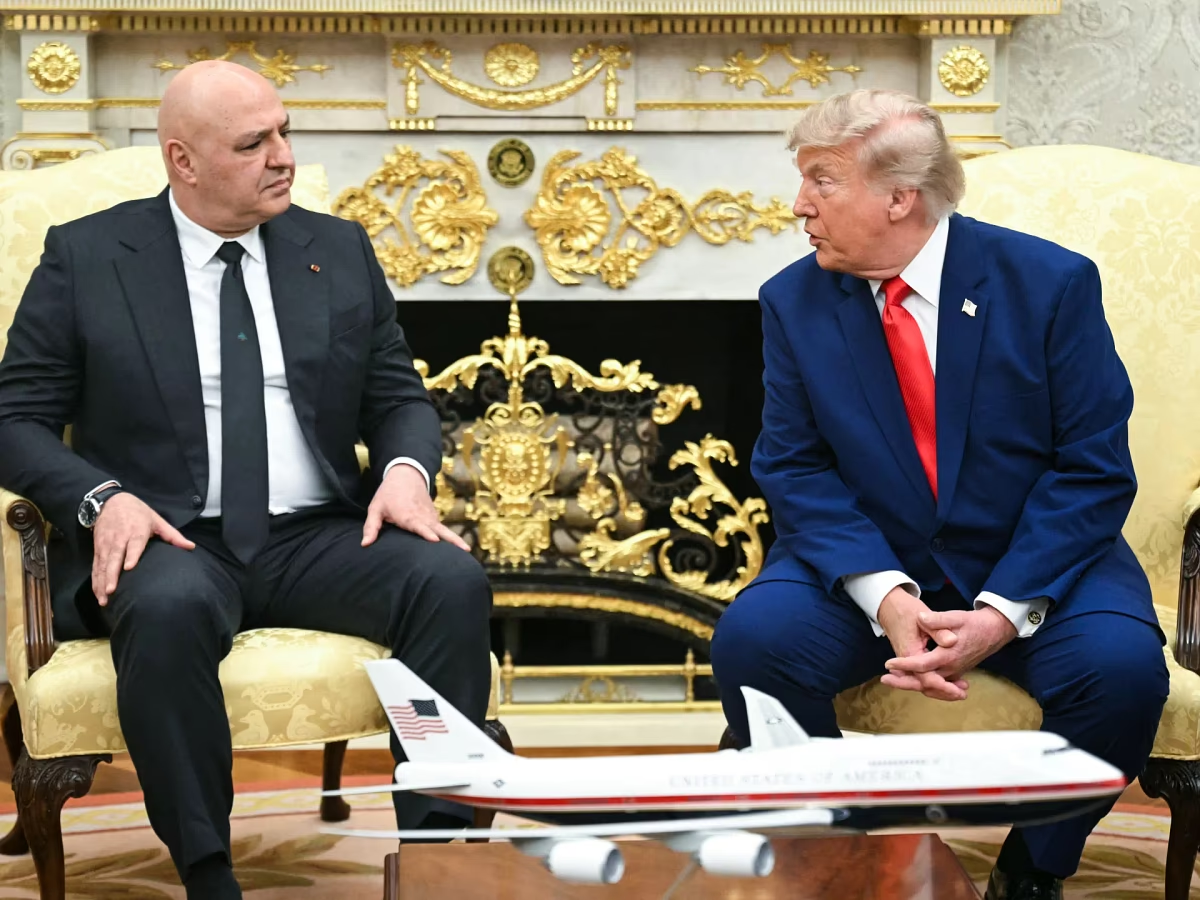
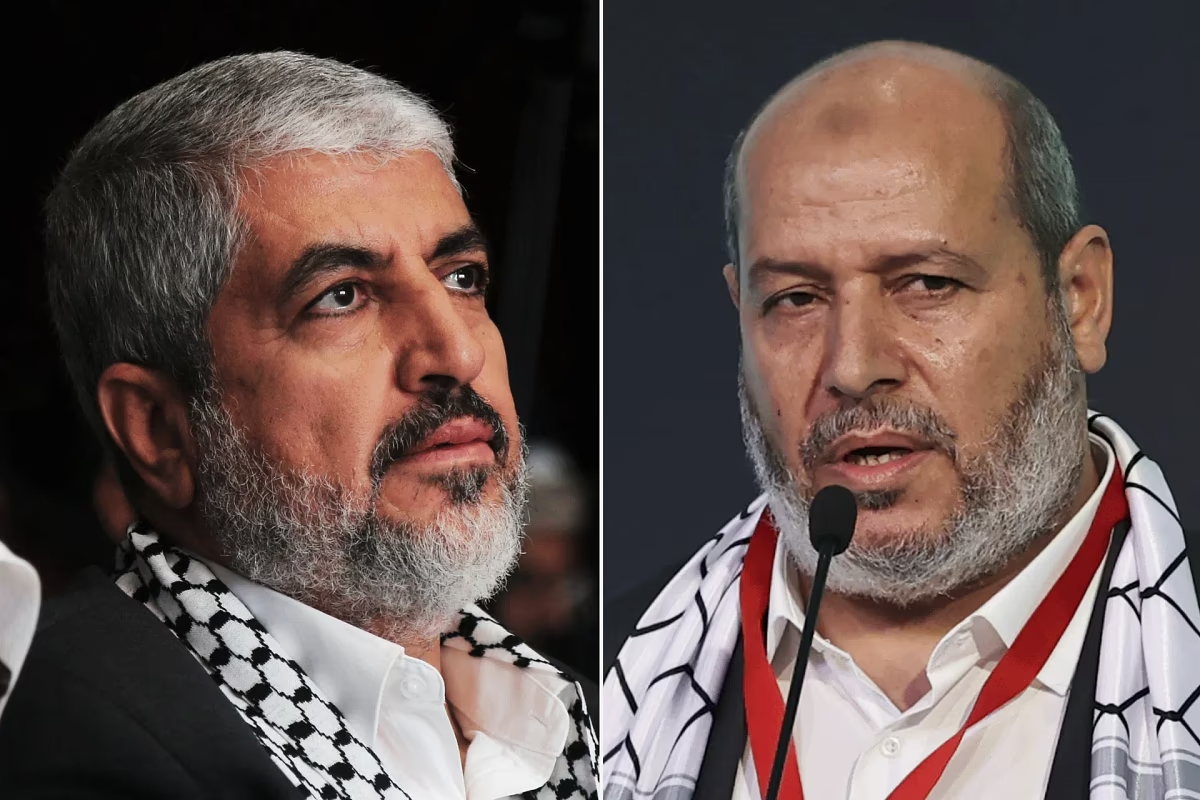
Despite this opposition, the High Commissioner enjoys broad support from the European bloc and many countries in Latin America and the African Union. Diplomatic documents showed that the African continent does not object to renewing Türk's term, which strengthens his position in the face of pressure from major powers.
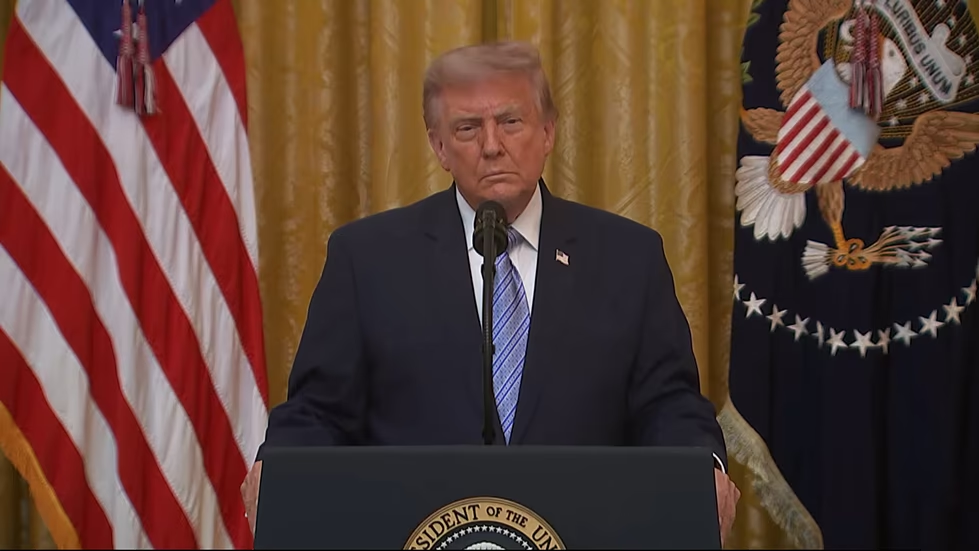
Since the vote will take place in the General Assembly, the 'veto' will not be available to Russia or the United States to obstruct the decision. The final outcome depends on Guterres' and Türk's allies' ability to mobilize a majority of votes from among the 193 member states.

It is worth noting that the position of High Commissioner for Human Rights was established in 1993 to be the moral voice of the United Nations in monitoring global violations. The biggest challenge facing Türk remains to maintain the independence of his position amid the increasing geopolitical conflict of interests between East and West.

The High Commissioner Volker Türk is ready to serve and continue his duties in monitoring human rights situations around the world.

PALESTINE

Fri 24 Jul 2026 8:38 pm - Jerusalem Time

Netanyahu and Katz decide to legalize settlement outposts and launch a wide-ranging military operation in the West Bank

The head of the occupation government, Benjamin Netanyahu, in cooperation with Minister of Security Israel Katz, issued direct directives to the occupation army to begin a wide-ranging military operation in various areas of the West Bank. These military movements come in the wake of a shooting incident in the town of 'Tel', where the occupation seeks to impose a new security reality by intensifying raids and field incursions.

The decisions issued by Netanyahu's office included immediate instructions to demolish the home of the perpetrator of the operation in Tel village, in addition to approving the expansion of military operations in neighboring villages and towns. The occupation authorities claim that these areas are a launching point for attacks, which prompted them to give the green light to field forces to operate 'with full force' without specific geographical restrictions.

As part of the collective punishment policy, the political and security leadership of the occupation decided to withdraw work permits from all residents of the targeted villages in the West Bank, as a punitive measure aimed at economic constriction. The orders also included conducting extensive search campaigns to collect weapons and increasing the pace of arrests, in an attempt to deter any future resistance operations in those areas.

On the settlement track, the joint statement announced the immediate start of government procedures aimed at legalizing a number of existing settlement outposts that were previously classified as 'illegal' even under occupation laws. The decision was not limited to that, but also included planning for the establishment of new settlement outposts in strategic locations in the West Bank, which portends a wide wave of seizure of Palestinian lands.

These developments come at a time when international warnings are escalating about the danger of settlement expansion, which undermines any chances for peace or stability in the region. Observers confirm that Netanyahu's and Katz's decisions represent a grave violation of international law, and push the field situation towards further explosion in the absence of any political horizon and the escalation of Israeli attacks.

Our forces will hunt down the perpetrators everywhere and will reach everyone behind them to hold them accountable.

PALESTINE

Fri 24 Jul 2026 2:09 pm - Jerusalem Time

Israeli sources: Riyadh insists on Palestinian state path as condition for normalization

Sources reported that Israeli political circles are cautiously anticipating Saudi Arabia's firm stance on the normalization issue. Hebrew media outlets quoted a senior political source confirming that Riyadh continues to condition any normalization on a serious and clear political path leading to the establishment of an independent Palestinian state. This revelation reaffirms Saudi constants that the Kingdom has always expressed in international forums, placing Palestinian rights at the forefront of any potential regional understandings.

In a parallel dramatic development, the nuclear deal between Washington and Riyadh emerged as a new pressure element in the regional equation, after the two parties signed a historic agreement on July 22 under Article 123 of the US Atomic Energy Act. This agreement, which spans decades and is worth billions of dollars, opens the door for extensive peaceful nuclear cooperation between the two countries, but it is now closely linked to the political normalization file.

Sources clarified that the nuclear deal grants Saudi Arabia the possibility of building a uranium enrichment facility on its territory after joint technical studies with the American side. This clause represents a departure from the 'gold standard' previously followed by Washington in its nuclear agreements in the region, reflecting the strategic importance the current US administration attaches to strengthening its partnership with Riyadh.

For his part, US President Donald Trump brought about a major shift in the course of negotiations after explicitly announcing via his 'Truth Social' platform that final approval of the nuclear deal is contingent on Saudi Arabia joining the 'Abraham Accords.' This direct linkage places the nuclear deal at the mercy of political tug-of-war, especially since the official announcement of the agreement on its first day did not openly and explicitly include this condition.

There is a state of concern in international human rights and oversight circles due to the absence of the 'Additional Protocol' of the International Atomic Energy Agency from the terms of the agreement, a protocol that allows for surprise and comprehensive inspections. Experts in nuclear non-proliferation believe that this absence could set a precedent allowing other countries in the Middle East to demand similar conditions, which could open the door to an uncontrolled nuclear arms race.

Domestically in Israel, the Saudi nuclear deal sparked a wave of sharp criticism against the current government, with former officials describing what happened as a 'complete strategic failure' for Benjamin Netanyahu. The Israeli opposition accuses Netanyahu of being unable to prevent the emergence of a nuclear program in the vicinity, despite his continuous attempts to portray himself as a guardian of Israeli national security in the face of regional nuclear ambitions.

Despite Israeli Prime Minister Benjamin Netanyahu's repeated welcome of the idea of normalization with Saudi Arabia, analysts point to a deep gap between his ambitions and political reality. The Saudi condition regarding the Palestinian state clashes with a categorical rejection from the ruling coalition in Israel, making it difficult to achieve a real breakthrough in this file without making fundamental concessions to the Palestinians.

Observers believe that the recent American move to link the nuclear file with normalization may be a tactic to regain influence in the complex negotiations, and an attempt to calm Israeli fears on the one hand, and pressure the Saudi side on the other. However, Riyadh maintains official silence regarding these new American conditions, adhering to its declared position that the Palestinian issue must be resolved first.

The nuclear deal is currently undergoing a 90-day review period in the US Congress, a period that will witness heated discussions among lawmakers about the security and political implications of the deal. Pro-Israel lobbies are expected to play a role in attempting to amend the terms of the agreement or impose additional guarantees to ensure that the peaceful program does not turn into other paths in the future.

Ultimately, the future of the region remains suspended between nuclear development ambitions and the requirements of a just peace, with the Palestinian state remaining the cornerstone of any lasting regional stability. With the continued tug-of-war between Washington, Riyadh, and Tel Aviv, it appears that the path towards formulating a new regional equation is still fraught with major political and security obstacles.

The nuclear deal will be approved, but it is entirely contingent on Saudi Arabia joining the Abraham Accords.

PALESTINE

Fri 24 Jul 2026 2:08 pm - Jerusalem Time

US-Iranian Escalation on the Iraqi Border: Targeting Crossings Changes Rules of Engagement

The American-Iranian conflict is no longer confined to traditional military bases, but has moved to a new phase of escalation by targeting civilian and sovereign facilities. Dawn on Thursday witnessed a bombing targeting the Shalamcheh border crossing in Basra Governorate, raising widespread fears of crossings turning into open engagement zones.

This dangerous security development comes at a very sensitive time, as the Iraqi borders are preparing to receive hundreds of thousands of Iranian visitors heading towards Karbala. Political circles in Baghdad fear that this targeting will undermine the policy of balance that the Iraqi government is trying to maintain between Washington and Tehran.

Official sources in the Border Crossings Authority reported that work at the Shalamcheh crossing was temporarily halted for three hours immediately after the American strike. This halt came at the request of the Iranian side to assess the security situation, before commercial and civilian traffic resumed normally later.

In a swift reaction, the Abdali border crossing, linking Iraq and the State of Kuwait, was subjected to an Iranian strike, described as a direct response to the Shalamcheh bombing. No precise details were available about the extent of the damage on the Kuwaiti side, as Iraqi authorities considered information regarding this crossing to be within the jurisdiction of the Kuwaiti side.

Observers believe that including border crossings in the military target bank represents a fundamental shift in the rules of engagement adopted by the two parties. These crossings are not limited to their economic function, but are vital logistical and political contact points connecting Iraq to its regional and international surroundings.

For his part, Iraqi MP Ahmed Al-Sharmani warned of the serious repercussions of this escalation on the country's security and economic stability. Al-Sharmani stressed that any disruption in the work of the crossings would negatively affect the flow of visitors and trade, pointing out that the current war indicators do not suggest its imminent decline.

In a related context, Mohammed Hassan Al-Saadi, a leader in the National Wisdom Movement, considered the targeting of crossings a clear violation of the sovereignty of independent states. Al-Saadi called for the necessity of launching a serious dialogue between the United States and Iran to spare the region the scourges of conflict, stressing that these areas are not legitimate military targets.

These political stances reflect growing concern within the Coordination Framework and Iraqi forces about the country turning into an arena for settling international scores. Baghdad is striving to establish its role as a regional mediator, but the targeting of crossings puts these diplomatic efforts to a real and difficult test.

On the economic front, experts downplayed the immediate long-term impact on trade, given the existence of alternative crossings that Iraq can rely on. Economist Abdul Rahman Al-Mashhadani explained that crossings such as Badra, Mandali, and Al-Munthiriya are capable of compensating for the shortfall if the Shalamcheh crossing is permanently disrupted.

However, Al-Mashhadani indicated that the purpose of targeting these corridors may be strategic to cut off supply and funding lines associated with armed factions. These crossings have faced American accusations for years of being corridors for smuggling hard currency and weapons, making them a constant target in the maximum pressure strategy.

The volume of trade exchange between Iraq and Iran is estimated at about 8 billion dollars annually, with Iraq heavily relying on importing food and construction materials. Any threat to this economic partnership could lead to disruptions in local Iraqi markets and an increase in the prices of basic goods.

The political message behind the bombing goes beyond merely disrupting transit for limited hours; it aims to demonstrate the fragility of Iranian logistical corridors. The Iraqi government now finds itself facing the challenge of protecting its long borders and preventing the conflict from extending into the internal depth, especially with increasing international pressures.

These developments come just weeks after a diplomatic tour by Prime Minister Ali Faleh Al-Zaidi that included Washington and Tehran. It appears that Baghdad's attempts to distance itself from the regional conflict are clashing with a field reality that forces it to be at the heart of the confrontation against its political will.

In conclusion, the Shalamcheh crossing remains a symbol of the close and complex relationship between Iraq and Iran, and its targeting opens the door to unprecedented escalation possibilities. Iraqi decision-makers will have to act quickly to secure border crossings and ensure they do not become weak points exploited by conflicting parties.

Targeting border areas constitutes a violation of state sovereignty and calls for a serious dialogue that preserves the security and stability of the region.

ARAB AND WORLD

Fri 24 Jul 2026 2:08 pm - Jerusalem Time

Trump and Aoun's White House Meeting: Has the Phase of Reducing Hezbollah and Iran's Influence Begun?

The meeting hosted at the White House between US President Donald Trump and his Lebanese counterpart Joseph Aoun marked a pivotal turning point in the trajectory of bilateral relations between Washington and Beirut. Although the announced results may seem protocol-driven, they carry deep political messages indicating an American desire to inaugurate a new phase that restores credibility to Lebanese state institutions.

Initial understandings included an explicit commitment to resume direct commercial flights between the United States and Lebanon, a measure that transcends the economic dimension to reach the security and sovereign dimensions. This step requires strict control and inspection standards that can only be undertaken by a state with real and complete control over its vital facilities and airports.

Observers believe that this approach represents a vote of confidence in the Lebanese state's ability to restore its sovereignty, which has been incomplete for decades. This American assessment comes at a sensitive time, as Washington seeks to prove that Beirut now possesses sufficient power to begin extending its actual authority over its entire national territory, away from the dominance of irregular forces.

If this path succeeds, the biggest losers will be Hezbollah and, behind it, Iran, who exploited the weakness of the central government for many years. The party has acted as a state within a state, managing its foreign policy and military relations independently of official Lebanese decisions, which has led to catastrophic consequences for the country's stability.

Lebanon suffered an economic and security collapse that peaked in 2019, prompting the United States to take an unprecedented step by paying the salaries of the Lebanese army. This step was a lifeline to prevent the demise of the state as an effective entity, and reflects the extent of international concern about the vacuum that was being filled by militias loyal to Tehran.

The importance of current moves stems from a pilot program that involves the withdrawal of Israeli forces from areas in the south and their handover to the Lebanese army. This program will be accompanied by intensive American support, including advanced training and the provision of necessary military equipment to enable the armed forces to effectively perform their defensive duties.

This development strikes at the heart of the narrative promoted by Hezbollah as the sole defender of Lebanese territories against Israel. With the national army taking responsibility for border protection with international support, the fundamental pretext on which the party relies to retain its weapons outside the state framework falls away.

Regionally, Hezbollah finds itself in a difficult defensive position after the fall of the Syrian regime, which represented its logistical lifeline. The absence of the strategic depth provided by Damascus has made the process of supplying the party with Iranian weapons and equipment a complex and almost impossible task in the new reality.

Sources reported that Tehran is anxiously monitoring the closure of vital corridors it built over the years, and is striving to involve Lebanon in ceasefire understandings to save its proxy. However, international and local pressures are increasing to disarm the party and strictly implement relevant international resolutions.

Reports indicate that Hezbollah may resort to escalatory options, including threatening confrontation with the Lebanese army or brandishing the specter of civil war. This behavior reflects a state of despair and loss of confidence in the future, as confident powers do not need to threaten to destroy civil peace to maintain their political gains.

The Trump administration is adopting a strategy of prioritizing economic development and investment as a tool to ensure long-term stability in Lebanon. Washington understands that achieving radical change requires creating an attractive economic environment that makes citizens rally around the project of a strong state capable of providing prosperity and security.

Despite these positive indicators, significant challenges remain for the Lebanese armed forces, which need to strengthen their ranks and unify their political decision. Moreover, the risk of militia elements infiltrating evacuated areas remains unless a real deterrent force is available to prevent any future security breaches.

This process also faces internal political resistance from parties that fear the repercussions of openness to the international community or changing traditional rules of engagement. The path towards restoring full sovereignty appears to be a long marathon race that requires strategic endurance and broad national consensus that transcends sectarian divisions.

In conclusion, the Washington meeting represents an explicit call for Lebanon to return to the international fold as an independent and sovereign state. While the United States is betting on Beirut's role in ending the era of proxies, the coming days will reveal the extent of Lebanese institutions' ability to seize this historic opportunity to end absolute Iranian influence.

Every square mile the Lebanese army extends its control over is equivalent to a square mile where Hezbollah's foundational justification for existence crumbles.

PALESTINE

Fri 24 Jul 2026 2:08 pm - Jerusalem Time

Khalil al-Hayya as Head of Hamas: Implications of the Rise of the 'Voice of Decisiveness' and the Challenges of the Stage

The corridors of the Hamas movement witnessed intense democratic activity in which the ballot boxes decided the identity of the new leader of the political bureau, succeeding the martyr Yahya Sinwar. The results reflected a state of intense competition and organizational integrity, as the results were not known until the last vote was counted in the movement's Shura Council.

By a single vote, Khalil al-Hayya (Abu Osama) managed to win the electoral race in his favor, receiving 35 votes compared to 34 votes for his prominent rival, Khaled Meshaal. 69 members representing all sectors of the movement in the Gaza Strip, the West Bank, prisons, and the diaspora participated in this election.

This step ends a transitional phase during which the movement was led by a five-member presidential council since October 2024. Through this procedure, Hamas affirms its ability to renew its leadership through Shura institutions, away from the concepts of inheritance or automatic extension that prevail in other factions.

Khalil al-Hayya, born in 1960, is not a new face to leadership, having spent nearly two decades in the political bureau. He has progressed through organizational and parliamentary work, heading the Change and Reform bloc in the Legislative Council after the 2006 elections.

Al-Hayya is known as one of the leaders forged in the field; he survived two Israeli assassination attempts, one in Gaza in 2007 and the other in Doha in 2025. His family also made great sacrifices, with four of his sons and a large number of his grandchildren and relatives martyred.

Observers believe that al-Hayya's election strengthens the influence of the Gaza school in the movement's leadership, given his long years of work alongside Yahya Sinwar. However, his involvement in external diplomatic missions in recent years has given him flexibility in dealing with complex international issues.

Throughout two years of war, al-Hayya handled the difficult negotiation file with mediators in Cairo and Doha, and built a wide network of political relations. This role gave him experience in managing political deals and diplomatic maneuvering under the pressures of the field and international politics.

Al-Hayya's presidency raises questions about the future of Hamas's regional alliances, especially with his strong relations with the axis of resistance in Tehran and Beirut. However, his rapprochement with mediating Arab capitals indicates continuity in the balanced political approach imposed by the necessities of the current stage.

The first and most urgent task facing the new leadership is to stop the war of extermination and starvation to which the Palestinian people in the Gaza Strip are subjected. Al-Hayya will have to balance military pressures with the requirements of reaching a just prisoner exchange deal that ends the suffering of thousands.

On the West Bank and Jerusalem fronts, al-Hayya faces the challenge of land depletion and unprecedented settlement expansion. The popular bases look forward to a comprehensive national strategy that revitalizes popular and political resistance to confront plans to liquidate the Palestinian cause.

Al-Hayya is expected to work on strengthening the 'historical bloc' that includes factions and national figures to restore the role of the Palestine Liberation Organization. This approach aims to redefine the Palestinian national project away from the bets that have proven to be failures in recent years.

The challenge of regional balance remains, as al-Hayya assumes his duties amidst sharp polarization and tension engulfing the entire region. He will have to maintain the independence of Palestinian decision-making while ensuring continued necessary support for the steadfastness of the people and the resistance.

Internally, al-Hayya faces the task of restoring organizational structures that have been damaged by direct Israeli targeting of cadres and leaders. Activating the role of young generations in middle leadership positions will be a real test of the movement's ability to continue and grow.

This term will extend for only one year until the comprehensive regular elections in late 2025. This is a sufficient period to conduct comprehensive reviews and evaluate the course of 'Al-Aqsa Flood' and the subsequent strategic shifts in the conflict with the occupation.

Al-Hayya ascends the leadership pyramid from atop a mountain of immense sacrifices; he is the survivor of assassination attempts and the father of four martyrs.

LATEST NEWS

Fri 24 Jul 2026 2:08 pm - Jerusalem Time

Trump threatens unprecedented military attack against Iran and holds it responsible for Houthi escalation

US President Donald Trump revealed that his administration is seriously studying a large-scale military attack against the Islamic Republic of Iran, describing the anticipated operation as the largest of its kind compared to any previous confrontations. Trump stated in remarks reported by media sources that he is very close to making his final decision regarding resuming expanded combat operations.

The US President indicated that coordination with allies is ongoing, affirming that Israel is ready to join the attacks within just two minutes if Washington makes a formal request. However, Trump stressed that the United States possesses sufficient capabilities to act alone and does not need assistance from any party to carry out its new operations against Tehran.

In his reading of the political situation, Trump mentioned that the Iranian leadership desires to negotiate, but is still unwilling to conclude a real agreement at the present time. He believed that Tehran has not yet felt enough pressure or what he described as 'pain' to push it to change its aggressive behavior in the region and seriously engage in a diplomatic path.

Despite the high tone of threat, Trump acknowledged that a decision of this magnitude would have severe repercussions regionally and internationally. He explained that he fully understands the extent of the risks associated with direct confrontation, which explains why he has not made the final decision yet, despite being close to it.

For their part, informed sources quoted senior American officials as saying that the military has not yet received any new operational orders to begin a comprehensive attack. Officials indicated that the option of returning to an open war with Iran faces internal challenges, especially since it does not enjoy widespread popularity among the American public at present.

These political and military tensions have directly reflected on global markets, with oil prices recording a significant rise to reach the $100 per barrel mark. Investors are concerned about disruptions to energy supplies in the event of an armed conflict in the Gulf region and vital waterways.

In the context of diplomatic efforts, regional sources involved in mediation efforts reported that Tehran has not responded to recent offers made to de-escalate the situation. One mediator confirmed that the efforts made are hampered by the Iranian side's lack of cooperation, complicating the chances of reaching a settlement that prevents military explosion.

The United States had already begun intensifying its air and missile strikes against Iran-linked targets over the past twelve days. These military moves come in an attempt to deter ongoing Iranian attacks targeting commercial vessels passing through the strategic Strait of Hormuz.

Reports indicate that Iranian policy has not seen any tangible change despite increasing military pressure, but rather has moved towards escalation on several regional fronts. US intelligence circles are closely monitoring field movements that indicate Tehran's insistence on continuing its current approach in the region.

In a new field development, the Houthis in Yemen began launching attacks targeting Saudi ships in the Red Sea, adding a new dimension to the crisis. These attacks have exacerbated instability in one of the world's most important oil passages, directly threatening global energy security.

Trump vowed via his 'Truth Social' platform to hold Iran fully responsible for any escalation by the Houthis in the Red Sea. He considered that the group operates as a direct proxy for Tehran, and therefore any targeting of ships will be met with a violent military response affecting both Iranian and Houthi interests.

Observers believe that Trump's statements aim to exert the maximum degree of psychological and political pressure on decision-makers in Tehran before taking any military step. The region remains in a state of high anticipation for what the coming days will bring, in the absence of any clear horizon for a stalled diplomatic solution.

The US administration faces pressure from its regional allies to ensure freedom of navigation and protect international trade routes from ongoing threats. Washington considers that the continuation of attacks on commercial vessels represents a red line that requires a firm response that may exceed the limits of currently implemented limited operations.

Finally, the question remains about the timing of the decision Trump hinted at, and the ability of regional mediations to defuse the crisis at the last minute. The rise of energy prices to record levels puts the global economy to a difficult test, given the possibilities of current skirmishes turning into a widespread regional conflict.

I am close to making a decision, and the attack on Iran will be bigger than ever if approved.

PALESTINE

Fri 24 Jul 2026 2:08 pm - Jerusalem Time

Bloody escalation in Nablus: Deaths in clashes in Tal village and Netanyahu vows firm response

Tal village and its surrounding areas southwest of Nablus witnessed a bloody field escalation today, Friday, leading to casualties on both sides. Local sources reported that the confrontations resulted in the martyrdom of four Palestinians and the killing of an Israeli settler, amidst a state of severe tension gripping the region.

The spark of events began in the early morning hours when groups of settlers launched an organized attack on the homes of Palestinian citizens on the outskirts of Tal village. Residents confronted this attack, leading to violent clashes that later developed into armed confrontations in several areas.

Field reports indicated that during the clashes, Palestinians managed to seize a weapon belonging to an Israeli security guard near the 'Havat Gilad' settlement, which is built on citizens' land. The seized weapon was used to carry out a shooting operation targeting Israeli forces and settlers in the area, causing direct injuries.

For its part, the Israeli army announced that its forces managed to kill the Palestinian youth who carried out the shooting operation near Tal village. The military statement clarified that forces fired directly at him immediately after locating him, noting the recovery of the weapon that had been seized earlier in the confrontation.

In a swift political reaction, Israeli Prime Minister Benjamin Netanyahu confirmed that he is holding a series of emergency security meetings with Defense Minister Yoav Gallant and the Chief of Staff. This move aims to assess the field situation and discuss ways to respond to the operation that occurred in the vicinity of the 'Havat Gilad' settlement.

Netanyahu stressed in his statements that his government would act firmly against those he described as perpetrators and the parties behind them, emphasizing that Israel would not allow the return of armed operations in the West Bank. These statements come at a time when the region is witnessing unprecedented military reinforcements and intensive movements of Israeli vehicles.

On the military front, the Israeli Chief of Staff issued immediate orders to widely reinforce the forces deployed in the Nablus area. The instructions included pursuing all participants in the events of Tal village, while continuing military operations targeting what the army described as the 'infrastructure of militants' in the northern West Bank, specifically in Beit Furik and Tubas.

In a related context, leaders of various fronts in the Israeli army are holding intensive meetings to assess the situation with the participation of commanders of the West Bank Division and the General Security Service 'Shin Bet'. These deliberations aim to develop operational plans to deal with the accelerating security deterioration and prevent the spread of confrontations to other areas.

Settler attacks were not limited to Tal village, as dozens of settlers attacked Palestinian homes in Jit village, east of Qalqilya city. These attacks caused material damage to citizens' property, amidst distress calls issued by residents to repel the settlement encroachment that occurs under the protection of the army.

The Palestinian Red Crescent teams also confirmed that similar attacks targeted Iraq Burin village in the Nablus district, where citizens' homes were subjected to stone-throwing and intimidation. At the same time, occupation forces are imposing a strict military siege on the entrances to the affected villages and towns, hindering movement and the arrival of medical aid.

We will act firmly against terrorists and those behind them, and we will not allow terrorism in the West Bank to re-emerge.