ARAB AND WORLD

Sat 11 Apr 2026 6:59 am - Jerusalem Time

Vatican Denies Its Ambassador Was 'Reprimanded' by US, Pope Criticizes Language of Bombs

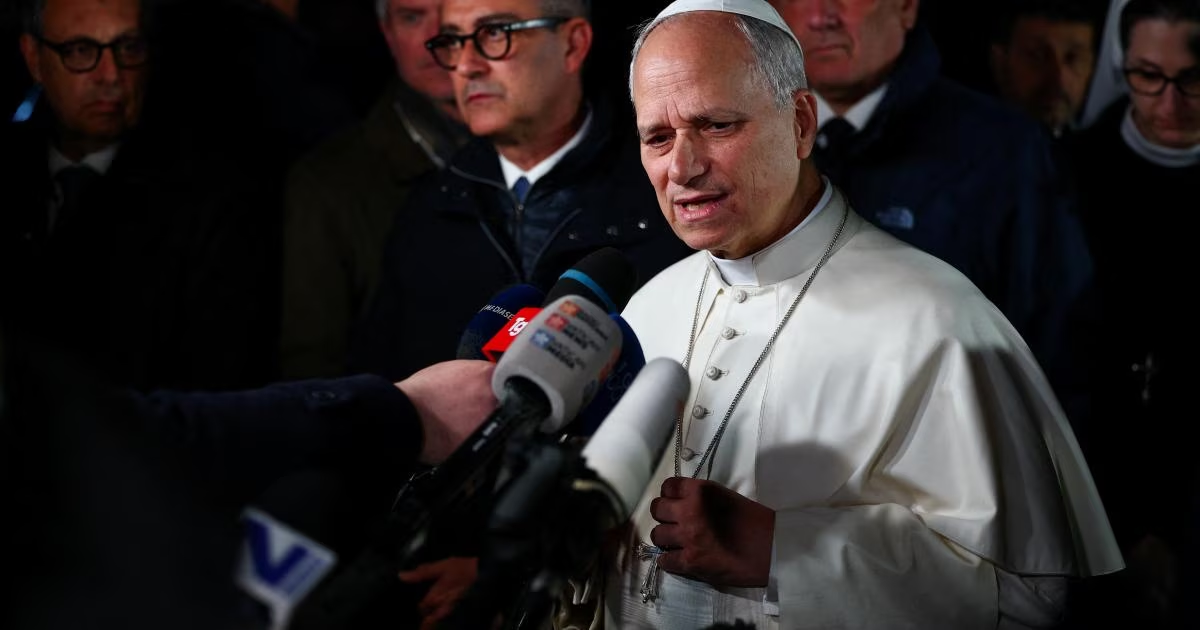
Pope Leo XIV of the Vatican today, Friday, issued strong statements implicitly criticizing the military policies of both the United States and Israel in the Middle East. The Pontiff affirmed that faith in Christ is incompatible with the practices of violence and the dropping of bombs currently witnessed in the region.

Through his official account on the 'X' platform, the Pope stressed that the Creator does not bless armed conflicts in any way. He clarified that those who follow the path of the 'Prince of Peace' cannot side with those who have chosen the language of the sword and bombing as a means of dealing with international crises.

Pope Leo XIV indicated that military operations and wars will not open horizons for freedom or establish sustainable peace in the world. He considered that the only way to achieve stability is through promoting the values of coexistence and managing dialogue between peoples with patience and deliberation.

These positions come amidst escalating international criticism directed at Washington and Tel Aviv, especially with the use of religious rhetoric in the context of military confrontation with Iran. Observers believe that these statements reflect the Church's concern about the transformation of political disputes into wars with a sacred character.

In a related context, the Vatican quickly denied reports that its former ambassador in Washington had been reprimanded by the US Department of War. This denial came concurrently with similar clarifications issued by the Pentagon to calm the charged diplomatic atmosphere.

An official spokesperson for the Holy See stated that the journalistic accounts circulated by some media outlets regarding last January's meeting were completely inaccurate. He affirmed that what was published had no connection to the truth, emphasizing the strength of existing diplomatic relations.

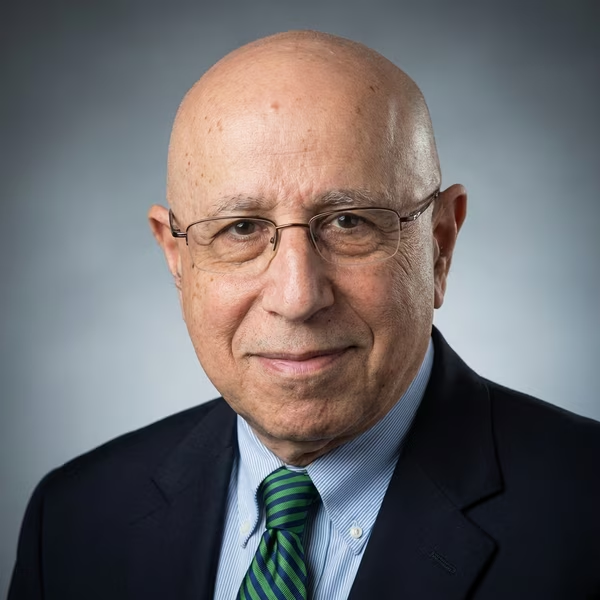
Press reports had claimed that Cardinal Christophe Pierre received a sharp reprimand from US Under Secretary of War for Policy, Elbridge Colby. These reports alleged that the American side demanded the Church explicitly support the military power of the United States.

For its part, the Pentagon, in an official statement, described these reports as greatly exaggerated and distorted and not reflective of the nature of the discussion. The statement clarified that the meeting was a respectful discussion that addressed issues of ethics in foreign policy and national security strategies in various regions.

In turn, the US Ambassador to the Vatican, Bryan Birch, confirmed that he had contacted Cardinal Pierre, who in turn denied the validity of those claims. The Cardinal described the meeting as 'frank and very friendly,' and falling within the usual routine diplomatic encounters.

Matteo Bruni, Director of the Holy See Press Office, explained that the dialogue with American officials addressed matters of common interest. He indicated that the meeting was part of the normal activities of the Papal Envoy within the framework of his diplomatic duties in Washington.

It is worth noting that Pope Leo XIV represents a unique case as the first Pope of American origin to assume the leadership of the Catholic Church. Despite this, he takes cautious and sometimes critical stances towards the directions of President Donald Trump's administration, especially regarding diplomacy based on force.

The Pontiff had previously called, on occasions including his Easter address, for influential international powers to choose the path of peace instead of igniting wars. The Church continues to emphasize the necessity of prioritizing peaceful solutions over military options in all global conflict zones.

God does not bless any conflict, and whoever follows Christ, the Prince of Peace, cannot stand with those who carried the sword yesterday and drop bombs today.

ARAB AND WORLD

Sat 11 Apr 2026 6:59 am - Jerusalem Time

Intensive Diplomatic Moves Ahead of Washington Negotiations: Lebanon Requests Truce, Trump Pushes for Ceasefire

Official sources revealed that Lebanese diplomacy in the American capital, Washington, is heading to demand an immediate cessation of military operations or the approval of a temporary truce. This step comes as a necessary goodwill gesture before engaging in the round of negotiations scheduled for next week, as Beirut seeks to establish a state of field stability preceding any political discussion.

In the context of ongoing preparations, there is widespread anticipation for a tripartite phone call bringing together Lebanon's ambassador in Washington with her Israeli counterpart, and with the participation of the American ambassador to Beirut. This preliminary communication aims to set the general frameworks for the upcoming discussions, amidst field and political complexities that impose themselves on the international research table.

For its part, international press reports stated that officials from the United States, Israel, and Lebanon have already held initial contacts to prepare the atmosphere before the start of official talks. These moves come at a very sensitive time, as international parties try to bridge divergent viewpoints regarding the conditions for stopping the ongoing military escalation.

On the American political front, media sources reported that President Donald Trump is exerting direct pressure on Israeli Prime Minister Benjamin Netanyahu to reach an agreement. Leaks speak of an American desire to announce a ceasefire by next Tuesday, to serve as a strong start for the negotiation process in Washington.

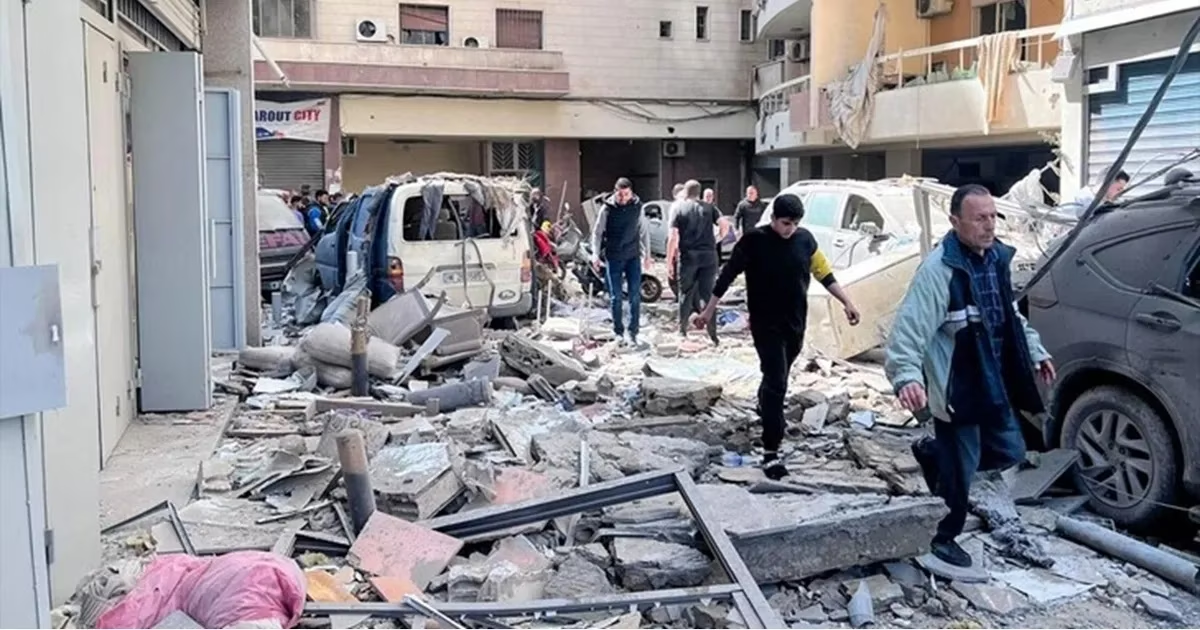
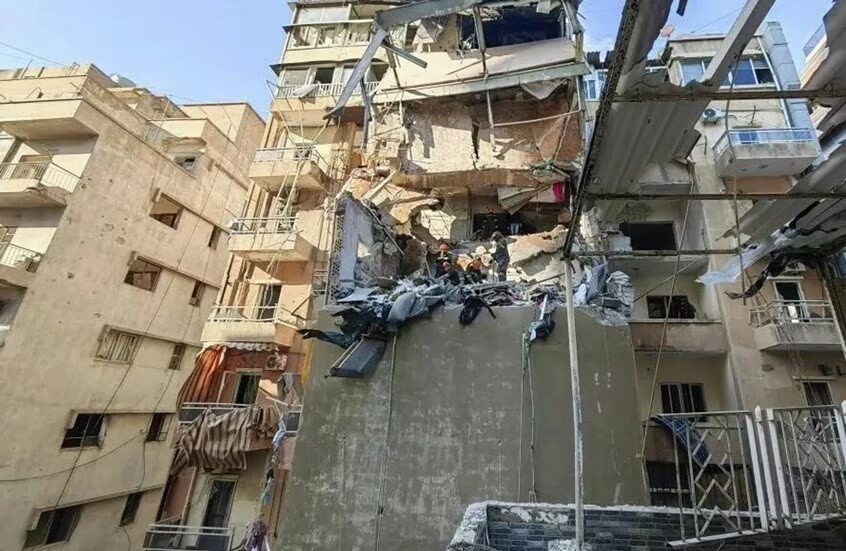
On the ground, the pace of military operations remains high, with Hebrew reports indicating that Netanyahu is personally overseeing the approval of air attacks targeting the capital, Beirut. This approach reflects the Israeli side's insistence on continuing military pressure simultaneously with diplomatic efforts, which Netanyahu described as negotiating 'under fire'.

Inside Lebanon, the intensity of political stances rejecting any concessions described as 'gratuitous' to the Israeli occupation is increasing. Hezbollah Secretary-General, Sheikh Naim Qassem, called on Lebanese officials to remain steadfast in their positions, stressing that the resistance will not accept the imposition of conditions that serve Israeli interests at the expense of national sovereignty.

Hezbollah representatives in the Lebanese parliament also affirmed their categorical rejection of any form of direct negotiations with the Israeli side at the present time. The party reiterated its demands for the complete and comprehensive withdrawal of occupation forces from all Lebanese territories in the south, considering it the only path to any future stability.

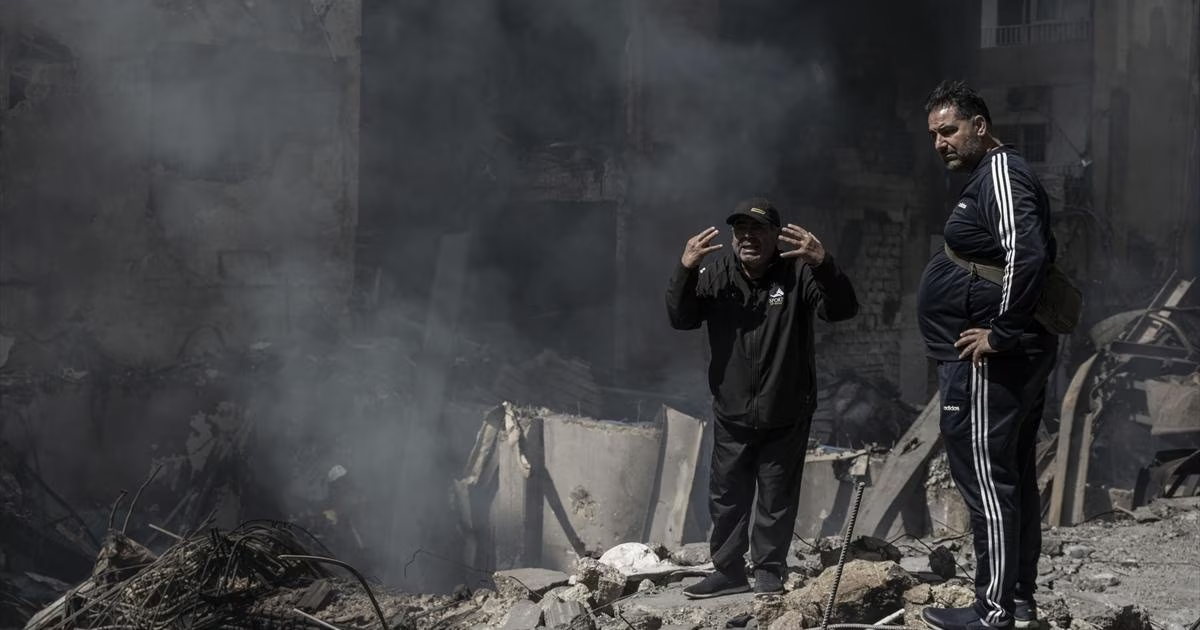
These developments come against the backdrop of a worsening humanitarian tragedy, as the Lebanese Ministry of Health announced a significant increase in the number of victims due to recent raids. The ministry documented the martyrdom of hundreds and the injury of thousands in the latest wave of escalation, which places the international community before an urgent responsibility to impose a de-escalation that ends the suffering of civilians.

The priority for Beirut lies in achieving a ceasefire before embarking on any official negotiations.

ARAB AND WORLD

Sat 11 Apr 2026 6:59 am - Jerusalem Time

Trump threatens Iran with military strikes ahead of Islamabad negotiations

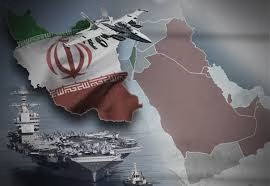
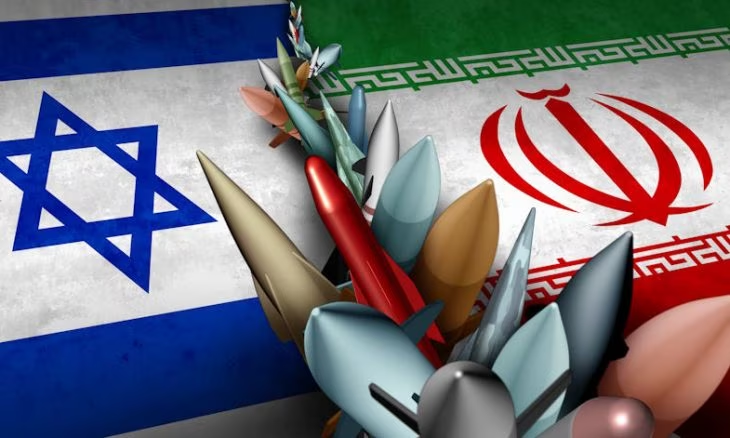
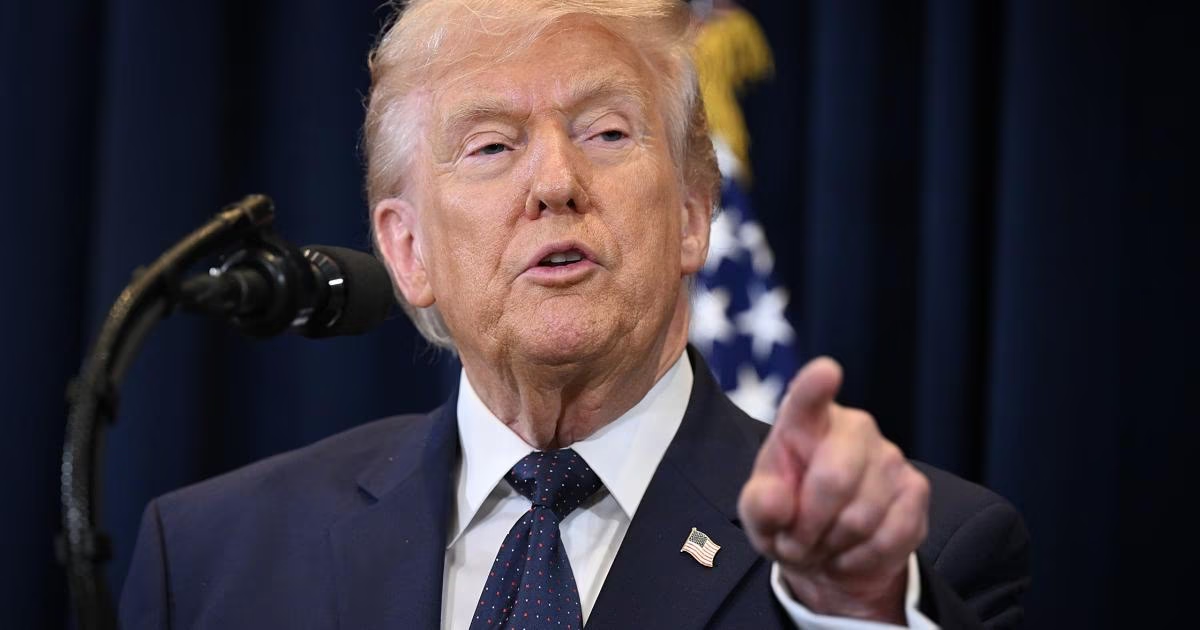
US President Donald Trump issued stern warnings to the Iranian leadership, hinting at the possibility of large-scale military strikes if the anticipated negotiations in the Pakistani capital, Islamabad, falter. These statements come in the context of a temporary ceasefire agreement through which both parties seek to reach broader understandings to end the escalating tension in the region.

Trump affirmed in statements reported by American media sources that the United States has already begun loading its warships with the latest types of advanced ammunition and newly manufactured weapons. He described this arsenal as far superior to what was used in previous confrontations, emphasizing that his country would not hesitate to use it with maximum effectiveness if a satisfactory agreement is not reached.

In his reading of Tehran's negotiating position, the US President considered that Iran does not possess any real leverage in the upcoming talks, with the exception of its ability to threaten maritime navigation in the Strait of Hormuz. He indicated via his 'Truth Social' platform that Tehran relies on a policy of international blackmail through waterways, asserting that Washington's acceptance of negotiations is what keeps the Iranian regime afloat so far.

For his part, US Vice President J.D. Vance traveled to Pakistan today, Friday, to represent Washington in the first round of these fateful negotiations. Vance expressed his hope for positive results, but at the same time warned against any Iranian attempts at evasion or deception, emphasizing that the American negotiating team would be firm and would not tolerate any manipulation.

Reports from Washington indicate that the US administration places the issue of releasing its citizens detained in Iranian prisons at the top of its priorities in this round. The administration seeks to extract clear commitments in this regard as an integral part of any comprehensive agreement that may be reached with the Iranian negotiating delegation.

On the other hand, Pakistani sources reported the arrival of the high-level Iranian delegation in Islamabad, headed by Parliament Speaker Mohammad Bagher Ghalibaf and Foreign Minister Abbas Araghchi. The level of Iranian representation reflects the importance Tehran attaches to these talks, despite the threatening tone emanating from the White House.

Tehran has set clear conditions for the start of official sessions, with Ghalibaf emphasizing the necessity of implementing a ceasefire in Lebanon first. Iran also demanded the immediate release of its frozen financial assets abroad, considering that these steps were previously agreed upon with the American side and cannot be bypassed.

Deputy Head of the National Security Committee in the Iranian Parliament explained that the negotiating team is working in direct and full coordination with Supreme Leader Mojtaba Khamenei. He affirmed that the announced Iranian conditions represent the official position of the state, and that Tehran will not enter into the details of the negotiations unless it perceives seriousness in implementing previous commitments related to assets and regional files.

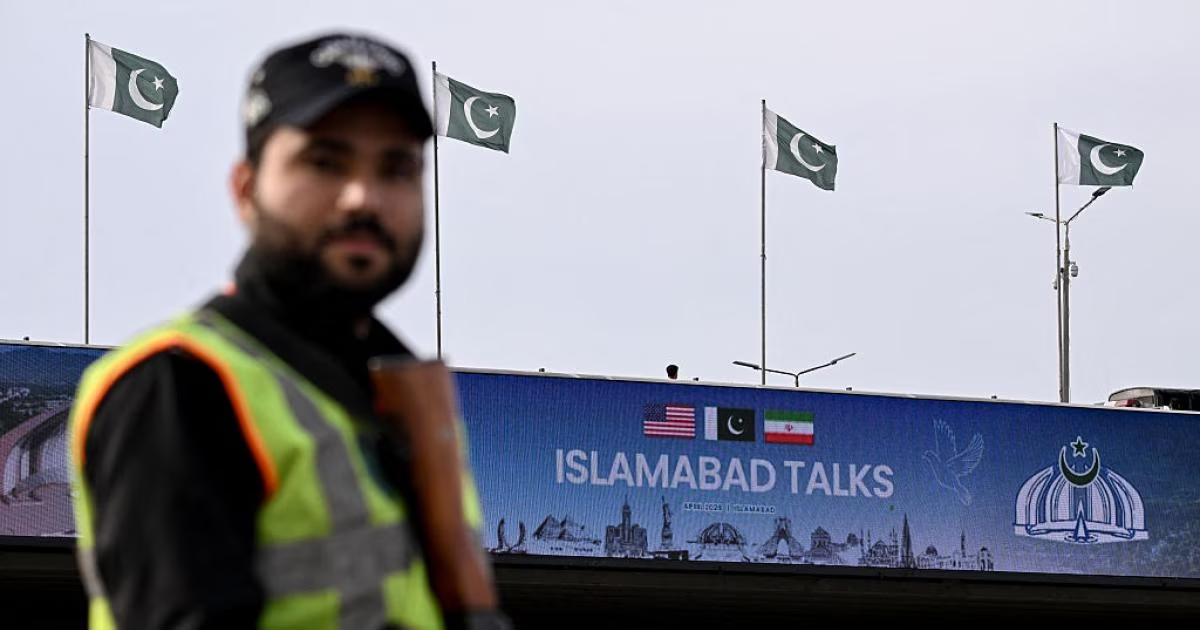
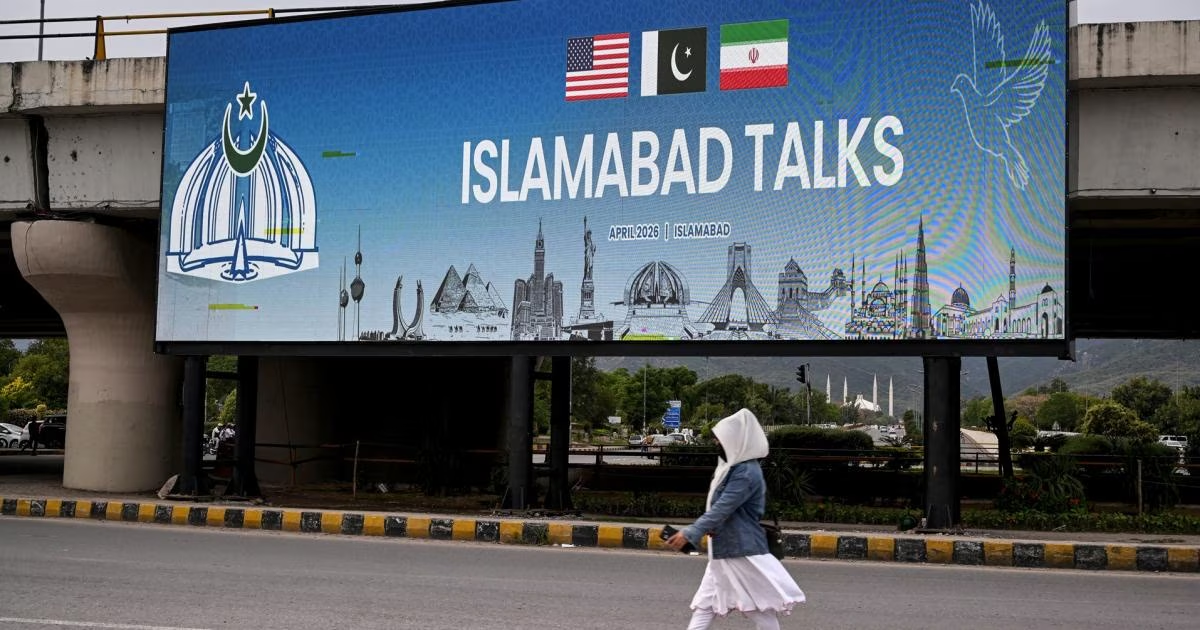
In the Pakistani capital, authorities mobilized their security agencies to secure this prominent diplomatic event, with more than 10,000 security personnel deployed around vital locations. Islamabad declared a state of high alert to ensure the safety of the participating delegations, amidst high-level military and security coordination supervised by the Pakistani army.

The Pakistani Ministry of Foreign Affairs also announced extensive facilities for international and local journalists to cover the events of the negotiations, which will officially begin tomorrow, Saturday. These facilities included a 'visa on arrival' system and instructions to airlines to allow concerned individuals to enter without procedural complications, to ensure transparency in conveying events to the world.

Trump had announced last Wednesday morning his approval of a two-week cessation of military operations against Iran, a move described as a last chance for diplomacy. The US President stipulated for the continuation of this calm the full and immediate opening of the Strait of Hormuz to global trade, and ensuring that ships are not exposed to any threats.

Observers believe that these negotiations represent a real test of the new US administration's ability to impose its conditions through 'power diplomacy'. In contrast, Iran is trying to maneuver with complex regional issues to reduce the economic and military pressures it faces, making the outcomes of the Islamabad meeting crucial for the future of stability in the Middle East.

All eyes are now on tomorrow's opening session, where it will become clear how capable mediators are of bridging the gap between explicit American threats and Iranian preconditions. The question remains whether the language of weapons brandished by Trump will push negotiations towards success or lead to a military escalation.

The American military buildup in the region, coinciding with these diplomatic moves, places the region on a hot plate awaiting what the coming hours will bring. Either the pressures succeed in extracting a comprehensive agreement, or the region finds itself facing a direct confrontation that could radically change the map of regional and international alliances.

It does not seem that the Iranians realize that they have no cards in their hands except blackmailing the world through international waterways, and the only reason they are alive today is negotiation.

PALESTINE

Sat 11 Apr 2026 6:59 am - Jerusalem Time

American journalist describes Israel as a 'rogue state' and documents genocidal rhetoric in its society

American journalist and TV presenter, Abby Martin, reopened the file on deeply rooted racism in Israeli society by re-publishing a previous field interview she conducted with Israeli settlers and citizens. Martin expressed her shock at the extent of hatred and explicit calls to kill Arabs and Palestinians she encountered during her tour, noting that the general atmosphere was charged with unprecedented hostility.

Martin likened her experience of walking through Israeli cities to walking through the streets of Berlin in 1932, a clear reference to the rise of Nazi and fascist ideology. She said she felt an enormous amount of disgust and disbelief as she listened to the hate speech adopted by Israelis from various segments of society, emphasizing that her Western features did not prevent passersby from questioning her about her ethnic origins.

The American journalist recounted a recurring situation where people would ask her immediately upon seeing her: 'Are you Arab?' And when she replied that she was American, they would immediately begin to express their deep hatred for Palestinians. Martin considered this behavior to reflect the nature of an 'ethnic state' based on the principle of racial superiority, which she described as the true essence of Zionism.

Martin issued a sharp call to the international community for the complete isolation of Israel, describing it as a 'rogue state' and an apartheid state that practices pathological lying and serial killing. She affirmed that continued support for this state or visits to it by academics, celebrities, and politicians represent a stain, especially after its true nature has been exposed to global public opinion.

In the context of her discussion of discriminatory laws, Martin pointed to the Israeli Knesset's approval of legislation allowing the execution of Palestinian prisoners exclusively, considering it a blatant face of explicit fascism. She explained that what she saw with her own eyes during her visit in 2016 was not just fleeting events, but an institutional approach that is becoming more brutal over time.

The report she re-published included shocking testimonies from Israelis, with one stating that there was no point in talking to Palestinians or trying to deal with them. Another went further by calling for their intensive and comprehensive bombing, considering that excessive military force is the only language that should be used against them.

The camera also documented extreme religious views rejecting mixing or marrying Arabs, with one speaker justifying this by saying that Jews are a 'special nation' to whom God gave the land, and there is no place for Arabs in it. These statements reflect the depth of the exclusionary ideology instilled in successive generations in Israeli society, which categorically rejects the Palestinian presence.

Martin expressed her horror at the 'genocidal rhetoric' that was not limited to the political elite but was common among ordinary people of all ages and walks of life. She noted that many did not hesitate to call for the use of nuclear bombs against Palestinians, which reflects a collective desire for comprehensive ethnic cleansing.

The American journalist concluded her remarks by emphasizing that the Zionist propaganda that lasted for decades has completely collapsed, and the world now sees Israel for its naked truth. She believed that this situation based on oppression and hatred cannot continue for long, especially with the increasing international awareness of the reality of the crimes committed against the Palestinian people.

It is an ethnic state built on superiority and hatred, and the entire world must isolate this rogue state obsessed with genocide.

OPINIONS

Sat 11 Apr 2026 6:58 am - Jerusalem Time

The War of Attrition and Metal Balances: How Did the Confrontation with Iran Reshape the American Armament Equation?

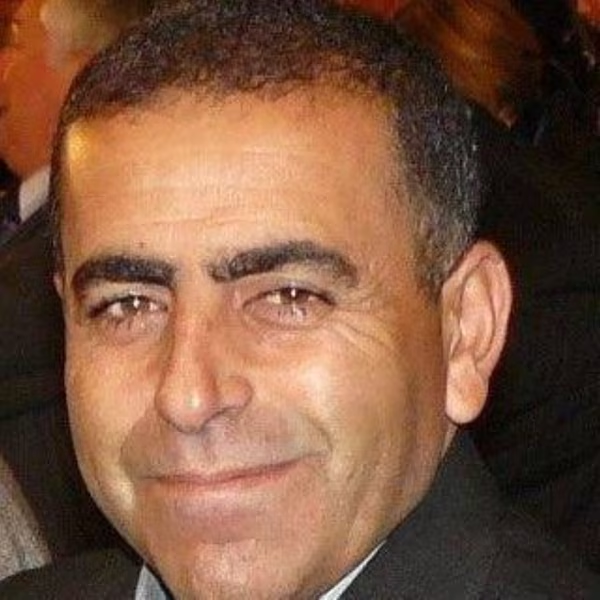
Said Erikat

Opinion Writer

Washington – Said Arikat – 11/4/2026

News Analysis

The American-Israeli war on Iran has brought renewed attention to strategic shifts that extend beyond the direct battlefield, revealing increasing fragility in the structure underpinning American military power, particularly concerning supply chains and reliance on critical metals. Within a limited number of weeks of confrontation, the extent of attrition suffered by American missile defense systems in the region became apparent, amidst concentrated Iranian attacks targeting radar and communication infrastructures, which weakened early detection and interception capabilities.

According to estimates reported by Politico magazine, rebuilding these systems does not only depend on domestic industrial capabilities but is closely linked to global supply chains dominated by China, especially regarding critical metals such as gallium. This metal is used in manufacturing essential components for interceptor missiles, as well as its applications in semiconductors and advanced technologies, making it a pivotal element in the rearmament equation.

During forty days of war, Iran targeted a number of advanced American radar units deployed across the region. These systems, which form the backbone of air defense systems, suffered severe damage, if not complete destruction of some, according to expert estimates. This directly impacted operational performance, as American forces and their allies were forced to launch a larger number of interceptor missiles to deal with threats, in some cases up to ten or eleven missiles to intercept a single target, leading to an unprecedented acceleration in the depletion of stockpiles.

This rapid attrition highlights a deeper dilemma concerning the United States' ability to replenish these stockpiles amidst production and structural constraints. American defense industries, despite their technological superiority, rely on complex supply networks that span several continents and are subject to intricate geopolitical and economic factors. In this context, China emerges as a central player, given its dominance over more than 90% of heavy rare earth metal processing operations, including essential elements for targeting systems such as terbium and dysprosium.

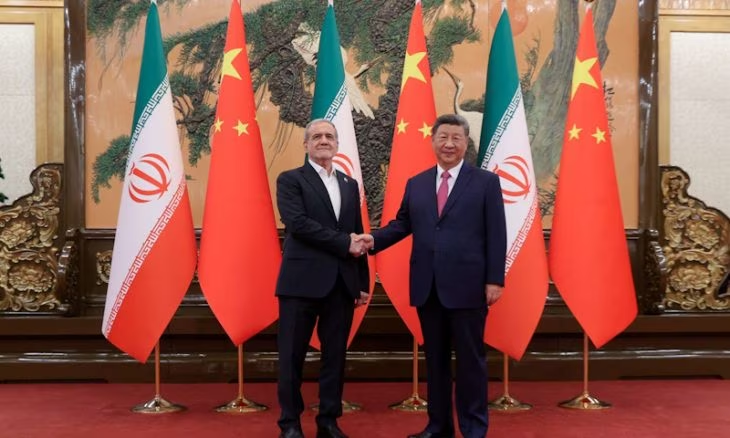
This dominance has been reflected in market movements, with gallium prices rising by 32% within one month, after a period of decline following previous trade understandings between Washington and Beijing. This increase reflects the market's sensitivity to any change in demand or supply and confirms that any increase in American demand to rebuild stockpiles will strengthen China's negotiating position, especially in light of preparations for an upcoming summit between President Donald Trump and his Chinese counterpart Xi Jinping.

In this context, statements by officials and experts indicate a growing awareness within Washington of the magnitude of the challenge. Former trade negotiator Wendy Cutler warns that appearing as the needy party gives the other party additional leverage, while analysts believe that any disruption in supply chains will create new bottlenecks in industries already struggling to meet demand. This concern grows with the realization that rebuilding stockpiles will not be a short-term matter, but a process that could extend for years.

Conversely, the United States is trying to use the temporary ceasefire with Iran to reassess the damage to its military arsenal and prioritize reconstruction. However, the challenge is not limited to replacing consumed quantities but extends to rethinking the structure of supply chains themselves and reducing reliance on external sources that could turn into political pressure tools.

Despite American efforts to develop alternatives, including mineral exploration projects in allied countries such as Australia, these initiatives are still in their early stages and will not be able to bridge the gap in the short or medium term. Building new supply chains also requires massive investments and a long time, at a time when the pace of military consumption is accelerating due to multiple conflicts.

In contrast, China appears keen to manage this card cautiously. Despite its ability to influence supply chains, it realizes that excessive escalation could lead to adverse reactions, including accelerating Western efforts to decouple economically. Therefore, Beijing may prefer to use its influence gradually and thoughtfully, achieving negotiating gains without harming the stability of economic relations with the United States.

Nevertheless, the scene remains open to multiple possibilities, especially in light of escalating tensions in the Middle East and the increasing intertwining of national security and the global economy. The war on Iran was not merely a military confrontation but revealed a complex network of interdependence, where natural resources become tools of influence, and supply chains become an integral part of the deterrence equation.

The war reveals a structural dilemma in the American ability to replenish advanced weapon stockpiles, as it is not just about increasing production, but about restarting complex manufacturing chains that rely on precise components and rare materials. Interceptor missiles, for example, require long production cycles and extensive testing to ensure their effectiveness. With the sudden surge in demand, this process faces constraints in production capacity, a shortage of specialized labor, and supply bottlenecks, making the process of refilling stockpiles extend for years, not months.

The challenge of maintaining military systems is no less complex than replacing them, as fighter jets and missile launch platforms require costly periodic maintenance cycles, which in turn depend on the availability of advanced spare parts and stable supply chains. With the increasing pace of operations, consumption and wear rates rise, putting pressure on combat readiness. In a geographically extended operational environment, as in the Middle East, these challenges are compounded by the need to transport and maintain equipment in distant bases, which exacerbates costs and increases the likelihood of malfunctions.

The war also demonstrates the fragility of the logistical structure supporting American military bases abroad, as these bases rely on a continuous flow of fuel, spare parts, and sensitive technical systems. With some of these bases being subjected to direct or indirect attacks, maintenance and supply operations become more complicated, especially in light of continuous threats to infrastructure. Any delay in supplies can also lead to a decline in operational efficiency, forcing military leadership to reassess its deployment and its ability to sustain itself in high-intensity conflict environments.

PALESTINE

Sat 11 Apr 2026 6:57 am - Jerusalem Time

Trump-led Peace Council denies funding setbacks for Gaza reconstruction plans

The Peace Council, chaired by US President Donald Trump, issued an official statement refuting circulating news about financial difficulties facing its planned projects in the Gaza Strip. The Council affirmed that all requested financial requirements have been fully and immediately provided, emphasizing the commitment of donor parties to their previously announced pledges.

These statements come in response to press reports citing informed sources that the Council is facing a real crisis, having received only meager amounts out of a total of $17 billion that had been pledged for the reconstruction of the Strip. These sources indicated that this severe liquidity shortage represents a major obstacle to Trump's efforts to implement his vision for the future of Gaza after the widespread destruction it suffered.

Informed sources on the progress of operations clarified that only three out of ten donor countries have fulfilled their financial commitments so far, including the United States of America. The sources mentioned that the total amounts collected did not exceed one billion dollars, a very small figure compared to the enormous needs for rehabilitating the collapsed infrastructure in the Strip.

In a related context, reports revealed that military tensions and the war with Iran cast heavy shadows on the financial and political scene, further complicating money transfer procedures. Sources reported that these circumstances led to a decline in donor enthusiasm and the postponement of many field steps that were planned within the American peace plan.

On the ground, the National Committee tasked with managing Gaza's affairs has not yet been able to commence its duties within the Strip, with sources attributing this setback to the overlap of security problems with a lack of funding. The Council's envoy, Nikolay Mladenov, explicitly informed Palestinian factions about the difficulty of the current financial situation and the unavailability of immediate operational budgets.

President Trump had organized an international conference in Washington prior to the outbreak of military confrontation with Iran, during which he succeeded in mobilizing billions of dollars in pledges from several countries. This move aims to find alternatives for managing the Strip and overseeing reconstruction operations after two years of war that left widespread destruction in all aspects of life in the Gaza Strip.

Despite six months having passed since the ceasefire agreement came into effect, humanitarian conditions remain stagnant amid continued field violations. The occupation authorities continue to practice a policy of procrastination in opening crossings and allowing essential aid to enter, which deepens the suffering of the residents and increases international warnings about a renewed explosion of the situation.

It is worth noting that the Peace Council, established at the beginning of this year, aspires, according to Trump's vision, to play a pivotal role that extends beyond the Palestinian issue to include other conflict areas around the world. The Council, in coordination with the United Nations, seeks to build an international platform capable of funding and implementing major projects aimed at stabilizing global stability under direct supervision from Washington.

However, the Council faces a wave of international skepticism due to its organizational structure, which grants the US President broad powers, including the right of veto and permanent appointment of members. Observers believe that these powers could turn the Council into a tool to bypass traditional international institutions such as the Security Council, which has led some countries to refrain from joining it or supporting its budget.

There are no obstacles regarding funding, and all requests have been met immediately and in full so far.

ARAB AND WORLD

Sat 11 Apr 2026 6:57 am - Jerusalem Time

Islamabad Negotiations: Five Thorny Issues Put US-Iranian Understanding to the Test

International attention is turning to the Pakistani capital, Islamabad, which is preparing to host a crucial round of negotiations between the United States and the Islamic Republic of Iran on Saturday. These talks come amidst an atmosphere charged with hopes and security and political complexities, as both sides seek to explore opportunities to reach a permanent ceasefire and cool down the burning conflict hotspots in the region.

A high-level Iranian delegation, headed by Parliament Speaker Mohammad Bagher Ghalibaf, and accompanied by Foreign Minister Abbas Araghchi and a group of security and economic advisors, arrived in Pakistan. On the American side, Vice President J.D. Vance, Special Envoy Steve Witkoff, and President Donald Trump's son-in-law Jared Kushner represent the US, reflecting the weight of this diplomatic round.

The Iranian Parliament Speaker, from Islamabad, expressed caution regarding American intentions, noting that past experiences have seen breaches of agreements despite what he described as Tehran's good faith. Ghalibaf stressed that his country had been subjected to American attacks twice in the past year during the negotiations, emphasizing that American seriousness is the only key to concluding a real agreement.

For his part, US Vice President J.D. Vance stated before heading to the meeting that Washington is ready to extend a hand if the Iranians show a sincere desire to negotiate. Vance warned against any attempts at manipulation or procrastination, asserting that the negotiating team chosen by President Donald Trump will not compromise in protecting American interests and regional security.

Lebanon's file stands out as one of the most complex points in these negotiations, as the Israeli occupation continues its aggression since early March. While Iranian President Masoud Pezeshkian warned that continued military escalation could empty the talks of their content, the Israeli side insists on continuing military operations against Hezbollah in Lebanon.

Media sources revealed a change in Israeli attack policy in Lebanon, where strikes targeting the capital Beirut now require personal approval from Benjamin Netanyahu. This change came in response to a direct request from US President Donald Trump, in an attempt to reduce the pace of escalation coinciding with the launch of the diplomatic track in Pakistan.

The Strait of Hormuz represents a major economic and security challenge, as it is the vital artery for global oil transport, over which Tehran threatens to impose its full sovereignty. The US President warned Iran against imposing any additional fees on shipping vessels passing through the strait, considering it a breach of the temporary truce understandings reached through Pakistani mediation.

The nuclear file remains the core of the historical conflict between the two sides, with differing views on Iran's right to enrich uranium. While Trump's plan demands a complete cessation of enrichment operations on Iranian soil, Tehran adheres to its ten-point proposal, which includes international recognition of its nuclear rights for peaceful purposes.

US Secretary of Defense Pete Hegseth previously stated that Washington's ultimate goal is to ensure that Iran does not possess nuclear weapons or the ability to acquire them. This hardline stance brings the crisis back to square one after the collapse of the 2015 nuclear deal, making the achievement of a new framework a daunting task for negotiators.

Iran's network of regional allies constitutes another fundamental point of contention, as Tehran considers it a strategic and defensive depth against external threats. In contrast, the United States and Israel are pushing to dismantle this influence, while voices within Iran are rising, calling for a focus on internal economic issues and a reduction in external spending.

Iran sets the lifting of comprehensive economic sanctions as an indispensable condition for moving forward with any long-term political agreement. Tehran demands the release of frozen financial assets estimated at about $120 billion, a demand that the Trump administration faces with extreme caution, preferring not to make major concessions in the early stages of negotiations.

US President Donald Trump announced on Wednesday morning a bilateral ceasefire with Iran for two weeks, conditional on the full opening of the Strait of Hormuz. Despite this announcement, ambiguity still surrounds the inclusion of the Lebanese arena in this truce, amidst American and Israeli denials and Iranian and Pakistani affirmations of the unity of the tracks.

The hours leading up to the negotiations witnessed an Israeli military escalation described as the most severe on Lebanon since the start of the aggression, putting immense pressure on the negotiating table. International parties fear that this field escalation could lead to the collapse of initial understandings before official sessions begin in Islamabad.

The Islamabad round of negotiations remains a true test of diplomacy's ability to contain a widespread regional conflict that threatens global energy stability. Negotiators from both sides will have to bridge the deep chasm of differences in sovereignty, nuclear security, and regional influence files to reach a formula that ensures the sustainability of the truce and its transformation into a comprehensive agreement.

Our experience in negotiating with the Americans has often ended in failure and breach of agreement, and if they are ready for a real agreement, they will realize our readiness for it.

PALESTINE

Sat 11 Apr 2026 6:57 am - Jerusalem Time

New truce violation: Two martyrs and widespread attacks targeting displaced people and schools in Gaza

The Gaza Strip witnessed a new field escalation on Thursday, as Israeli occupation forces committed a series of violations targeting civilians and displaced people. These attacks resulted in the martyrdom of two people and serious injuries to a woman, in a clear violation of the existing truce agreement, exacerbating the already deteriorating humanitarian conditions in various governorate of the Strip.

In details of the field crimes, medical sources reported the martyrdom of 13-year-old child Ritaj Abdul Raouf Raihan, as a result of being directly shot by the occupation forces. The incident occurred while the child was inside an educational tent belonging to 'Abu Ubaidah bin Al-Jarrah' school in the Beit Lahia area north of the Strip, where she was receiving her lessons before being surprised by Israeli bullets.

In the southern part of the Strip, a drone belonging to the occupation army targeted the Mawasi Rafah area, which is crowded with thousands of displaced people who sought safety there. This aerial bombardment led to the martyrdom of young man Youssef Khalil Mansour (33 years old), which caused a state of panic and terror among families residing in tents and shelters in the area.

The attacks did not stop there, as a Palestinian woman was injured by bullets from Israeli military vehicles stationed in the Al-Dhahr area in Beit Lahia. Local sources stated that the injury occurred inside the walls of 'Tel Al-Zaatar' school, where the vehicles continue to fire randomly and intensely towards displacement centers and neighboring residential areas since the early morning hours.

In a related context, Israeli artillery renewed its intense shelling of the eastern areas of Khan Yunis city, coinciding with heavy gunfire targeting citizens' properties and homes. These military movements put the ceasefire agreement at a serious test, in light of the continued systematic targeting of infrastructure and unarmed civilians in both border and internal areas.

For its part, the Palestinian Ministry of Health issued a periodic report revealing alarming figures for the victims of the ongoing aggression. The ministry stated that the number of martyrs since the announcement of the truce on October 11, 2025, has reached 736 martyrs, while the number of injured has risen to 2035, reflecting the extent of the field violations carried out by the occupation army on a daily basis.

Regarding the cumulative statistics since October 7, 2023, the ministry recorded the martyrdom of 72,315 people and the injury of 171,137 others in an unprecedented toll. Human rights activists appealed to the international community and the sponsors of the agreement for immediate intervention to pressure the occupation authorities to stop these crimes, warning that international silence gives the green light for the continuation of policies of killing and abuse.

The total number of martyrs since the announcement of the ceasefire on October 11 is about 736 martyrs, amid continued blatant violations of international conventions.

ISRAELI AFFAIRS

Sat 11 Apr 2026 6:57 am - Jerusalem Time

Sharp Israeli Division Over Ceasefire with Iran: Doubts About Victory and Declining Trust in Politicians

Israeli opinion polls conducted after the announcement of a ceasefire with Iran revealed a complex picture that contradicts the narrative of decisive victory that Benjamin Netanyahu's government attempted to promote. These results reflect a high appreciation for the military establishment's performance, while simultaneously indicating widespread doubts about the strategic utility of the war and a significant decline in trust in the political leadership.

According to a poll published by Hebrew media, the general mood in Israel is far from celebratory, with 63% of respondents expressing dissatisfaction with the outcome of the confrontation. Only 22% believed that Israel and the United States achieved victory, compared to 46% who affirmed the absence of any real achievement, reflecting a gap between official rhetoric and popular reality.

In another poll conducted by the Israeli Broadcasting Corporation, 58% stated that the battle did not end in favor of Tel Aviv and Washington, while 56% supported continuing military attacks instead of moving towards de-escalation. These figures reinforce the impression that the public views the ceasefire as an incomplete decision that did not achieve the desired deterrence against Tehran.

Israel's Channel 12 also reported that 53% of the public opposed the ceasefire decision, compared to only 30% who supported it, indicating a state of frustration. Opinions were also divided on the identity of the victor, with 40% believing that no one won this round, while 19% thought that Iran emerged with the upper hand.

The data indicates a strong conviction among the Israeli public that the confrontation with Iran is not over yet, but merely a temporary truce that could erupt at any moment. 45% of participants in the polls expected the conflict to resume within just two weeks, while others believed that the calm would not last for more than one year.

On the political front, the war's results were not in favor of the ruling Likud party, as polls showed a decline in its number of seats, ranging between 22 and 25. This decline puts Netanyahu in a critical position against his rivals, especially with the rise of figures like Naftali Bennett, who has begun to significantly narrow the gap with the current prime minister.

The biggest beneficiary of these shifts appears to be the security alternatives camp, as Gadi Eisenkot continued his progress in opinion polls, achieving between 12 and 14 seats. Eisenkot is seen as a more balanced figure in managing security and political files compared to the current leadership, which faces sharp criticism.

In contrast, Yair Lapid and Benny Gantz emerged as the biggest losers in the new political map, with Lapid's representation declining to only about 6 seats. As for Gantz, some polls showed his decline to dangerous levels approaching the electoral threshold, indicating a broad reshaping of the balance of power within the opposition.

The figures reveal a huge gap in assessment between the military and political levels, with Air Force Commander Tomer Bar receiving the trust of 77% of the public. Chief of Staff Eyal Zamir also received a positive rating of 71%, which illustrates the public's alignment with the security establishment at the expense of politicians.

In contrast, Benjamin Netanyahu received a satisfaction rating of no more than 47%, while Defense Minister Yoav Gallant was at the bottom of the list with 40%. This data suggests that Israelis clearly distinguish between the success of the army's field performance and the failure of the political level to translate that strength into sustainable political gains.

Despite the pessimism regarding the outcome of the war with Iran, polls showed a clear tendency towards toughness on other fronts, especially the northern front. 77% of Israelis demanded the continuation of military operations against Hezbollah in Lebanon until all declared objectives are achieved, without relying on de-escalation understandings.

This trend towards regional escalation reflects a broad current that believes Israel stopped the war before exhausting its full military capacity to achieve deterrence. The public appears to reject diplomatic compromises at this stage, preferring to expand military pressure in neighboring arenas to ensure long-term security.

The summary of these polls outlines four fundamental truths: first, the absence of popular satisfaction; second, deep skepticism about government claims of victory. The third truth is the continuous erosion of Netanyahu's standing, and the fourth is the strong rise of alternatives with security and military backgrounds.

The ceasefire did not end the internal debate in Israel, but rather opened the door to discussion about the utility of wars and the limits of military power in resolving conflicts. Israelis emerge from this round in a state of confusion, trusting generals more than politicians, and fearing the return of fighting more than believing in the narrative of decisive victory.

The Israeli public does not view the ceasefire as an acceptable conclusion to a successful war, but rather as a halt to a round of fighting whose results have not yet been decided.

PALESTINE

Sat 11 Apr 2026 6:57 am - Jerusalem Time

Unprecedented Diplomatic Development: Lebanon and Israel Agree to Direct Negotiations in Washington on Tuesday

The American capital, Washington, witnessed a significant diplomatic shift in the Lebanese-Israeli conflict, as both parties agreed on Friday to hold their first direct meeting at the US Department of State headquarters next Tuesday. This anticipated meeting aims to set a timeline and determine an official date for the launch of direct negotiations aimed at ending the ongoing military escalation.

This announcement followed the first historic phone call between Lebanon's Ambassador to the United States, Nada Hamadeh Maawad, and her Israeli counterpart, Yehiel Leiter. This communication took place with the active participation of the US Ambassador to Beirut, Michel Issa, as part of the American administration's efforts to bridge the views between the two sides.

The Lebanese presidency confirmed in an official statement that the meeting will primarily discuss a ceasefire declaration and determine the negotiation mechanisms, which will be under full American sponsorship. It clarified that this move comes based on the diplomatic initiative launched by President General Joseph Aoun on March 9, which calls for prioritizing political solutions.

For his part, the Israeli Ambassador in Washington stated that Tel Aviv has agreed to begin official peace negotiations with the Lebanese state, but at the same time, it categorically rejects discussing any ceasefire with Hezbollah as an independent party. This stance reflects the Israeli side's insistence on limiting diplomatic engagement to the official institutions of the Lebanese state only.

In the field context, Hebrew media sources revealed a change in Israeli military attack policy on Lebanon, where any raid targeting the capital Beirut now requires personal and direct approval from Prime Minister Benjamin Netanyahu. This measure comes in response to a direct request from US President Donald Trump to reduce escalation in populated areas.

Informed sources reported a very significant reduction in the pace of Israeli airstrikes in recent hours, despite no official announcement of a comprehensive truce. The political leadership in Israel is imposing strict restrictions on military operations coinciding with the ongoing preparations for the anticipated Washington meeting on Tuesday.

On the other hand, Hezbollah Secretary-General Naim Qassem sent a written message in which he affirmed the continuation of the resistance approach in confronting Israeli aggression. Qassem warned Lebanese officials against making what he described as 'free concessions' to the Israeli side, emphasizing the need to preserve the constants of the Lebanese position in any upcoming negotiations.

The initiative led by President Joseph Aoun is based on a comprehensive vision that includes establishing a complete truce and stopping all forms of Israeli aggression on Lebanese territories. The initiative also includes a sensitive clause related to providing logistical and technical support to the Lebanese army to enable it to extend its full control over areas of tension and confiscate illegal weapons.

The Lebanese government, through these moves, seeks to implement its previous decisions related to restricting weapons to the state, a plan approved in August 2025. This plan consists of five stages, aiming ultimately to disarm Hezbollah and dismantle its military depots and warehouses under national and international supervision.

Earlier in January, the Lebanese army announced the success of the first phase of the weapon restriction plan in the areas south of the Litani River. However, the military command warned that the continued Israeli occupation of some Lebanese sites and repeated aggressions hinder the completion of the remaining phases of the security plan.

In a related development, Washington had denied that the truce brokered by Pakistan between Iran and the United States included the Lebanese arena, despite Tehran and Islamabad's assurances to the contrary. This contradiction in news led to the continuation of violent military operations in Lebanon before reaching the latest understanding regarding the Washington meeting.

Reports from Tel Aviv indicate that the US administration may issue an official statement in the coming hours clarifying more details about the date of the talks and the terms of the ceasefire. These understandings largely depend on previous agreements reached in November 2024 that had not fully entered into force at that time.

Observers believe that entrusting the US Department of State with the role of direct mediator reflects Washington's desire to definitively end the conflict on Israel's northern front. These efforts face significant challenges, especially regarding Hezbollah's position, which clings to its weapons and links it to ending the Israeli occupation of Lebanese territories.

Anticipation remains the master of the situation, awaiting the outcome of Tuesday's meeting in Washington, which the international community relies on to open a breach in the wall of the complex Lebanese crisis. Attention is focused on the Lebanese state's ability to assert its sovereignty and implement the weapon restriction plan amidst increasing international and field pressures.

Lebanese Presidency: The agreement is based on the initiative launched by President Joseph Aoun for diplomatic action and direct negotiation with Israel.

OPINIONS

Sat 11 Apr 2026 6:51 am - Jerusalem Time

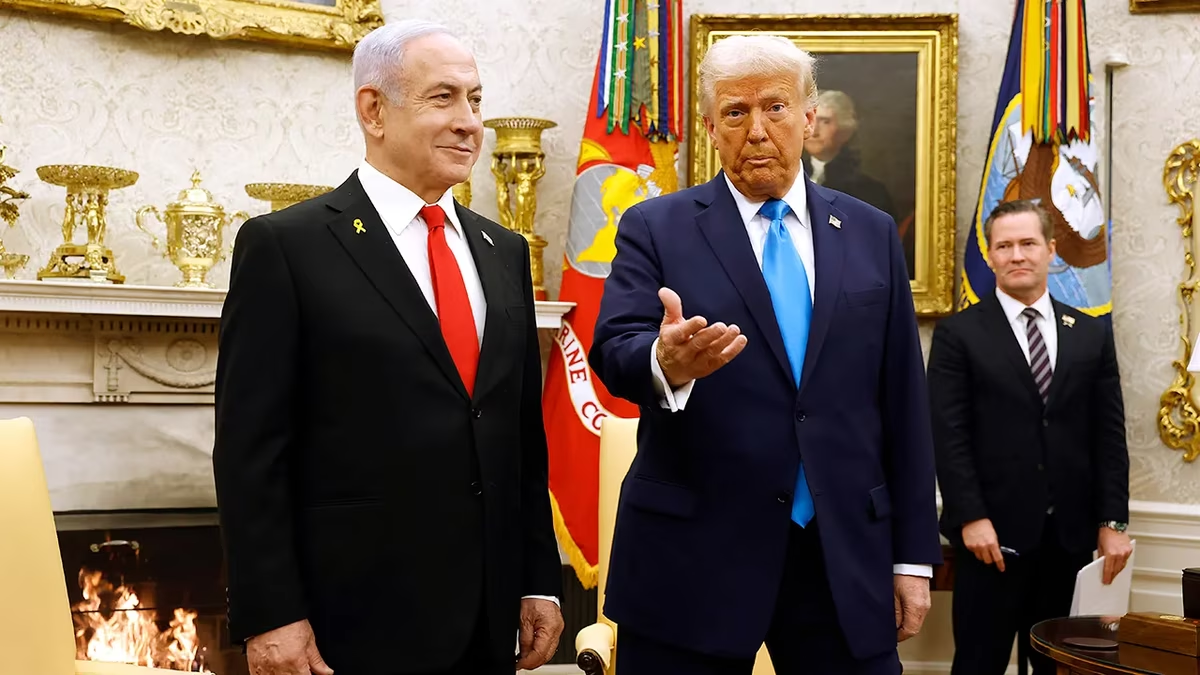
Netanyahu’s Long Game—And the President Who Finally Took the Bait


By: Said Arikat


April 11, 2026


News Analysis


Washington, D.C- The U.S. decision to strike Iran was not the product of a sudden intelligence breakthrough or a sober reassessment of strategic realities. It was the culmination of a decades-long campaign—one relentlessly pursued by Benjamin Netanyahu and ultimately realized under Donald Trump. What changed was not the evidence. It was the willingness to believe it.


For more than thirty years, Netanyahu has worked to draw the United States into direct confrontation with Iran—pressing successive presidents from Bill Clinton to George W. Bush, from Barack Obama to Joe Biden. The pitch was consistent: Iran as an existential threat, military action as both necessary and manageable. But behind the consistency lay a more troubling pattern—an enduring effort to steer U.S. power toward wars that align less with American national interests than with Netanyahu’s own political imperatives and regional ambitions. The intelligence used to support this case has repeatedly been challenged—criticized as exaggerated, selectively framed, or shaped to fit a predetermined outcome. Yet the objective remained unchanged: to manufacture urgency where caution might otherwise prevail.


Until now, U.S. institutions held. Skepticism—however imperfect—served as a brake. War was deferred not because the pressure was absent, but because it was resisted.


What makes this moment different is that the resistance collapsed. After decades of lobbying, warning, and at times outright alarmism, Netanyahu found in Trump a president uniquely susceptible to his methods—receptive to dramatic claims, dismissive of institutional caution, and inclined to view complex realities through the lens of simplified, force-driven solutions. Where previous presidents questioned the premises, Trump embraced them. Where others saw risk, he saw opportunity.


That convergence came into sharp focus during the February 11, 2026 meeting in the White House Situation Room—an extraordinary setting for what amounted to a foreign leader pitching the United States on a war of choice. Netanyahu reportedly presented a sweeping plan for a joint U.S.-Israeli strike on Iran, complete with a vision of regime change, a rapid timetable for dismantling Iran’s missile infrastructure, and even speculative projections of post-strike leadership. The sales pitch was as audacious as it was reductive: Iran could be neutralized quickly, cleanly, and with minimal blowback.


Trump’s reported response—“it sounds good”—spoke volumes. Not a demand for verification, but an instinctive endorsement. Yet within the room, alarm bells were ringing. Senior U.S. officials reportedly dismissed the presentation as “farcical,” a striking internal rebuke that highlighted how far the proposal strayed from serious strategic assessment. The idea that Iran—a complex, resilient state—could be toppled or fundamentally weakened through a limited strike was not just optimistic; it was detached from reality.


The political backlash, while limited, was telling. Ro Khanna denounced Netanyahu’s presence in the Situation Room as a “betrayal of the American people,” warning that U.S. foreign policy was being shaped under the influence of a foreign leader with his own agenda. His critique cut to the core of the issue: this was not merely consultation between allies, but the blurring of lines between national interests—where American military power risked being leveraged in service of another leader’s strategic vision.


Inside the administration, dissent was present but neutered. Intelligence officials dismantled the proposal’s assumptions, concluding that while certain military targets could be struck, the broader ambitions—internal unrest, regime collapse—were implausible. There was no credible pathway from airstrikes to political transformation. No evidence that Iranian society would unravel under external pressure in the way Netanyahu suggested.


But none of that proved decisive. Trump, impetuous and true to form, treated intelligence as a toolbox rather than a boundary—embracing what reinforced his instincts and discarding what complicated them. The result was not a failure of information, but a failure of judgment.


Key figures reflected this dynamic. Vice President J. D. Vance warned of escalation. Pete Hegseth, who’s unqualified for his job according to most assessments, supported military action. Marco Rubio advocated a narrower approach. Military and intelligence leaders outlined risks but stopped short of mounting meaningful resistance. The process gave the appearance of debate, but lacked the substance of constraint.


What emerges is a portrait not just of influence, but of manipulation refined over decades. Netanyahu did not simply advocate for action; he constructed a narrative designed to make war appear inevitable, even prudent. By repeatedly framing Iran as both an imminent threat and an easy target, he compressed complexity into urgency—turning caution into hesitation, and hesitation into danger.


This is not the first time such a pattern has surfaced in U.S. decision-making. The inflation of threats, the sidelining of dissent, the illusion of quick victories—these are familiar preludes to costly wars. The lessons of Iraq were supposed to inoculate Washington against precisely this kind of thinking. Instead, they have been selectively remembered and conveniently ignored.


As reports surfaced of a “rare opportunity” to strike Iranian leadership, the process accelerated. By late February, internal debate had effectively collapsed. Trump’s justification—preventing Iran from acquiring a nuclear weapon—provided political cover, but it also obscured the deeper reality: the decision was less about imminent necessity than about accumulated persuasion, years in the making.


Netanyahu’s long campaign has now borne fruit. Not because he proved his case, but because he wore down the resistance—and ultimately found a president willing to act on it. The more unsettling conclusion, however, is that this outcome was enabled from within. A system that allows intelligence to be bent, dissent to be contained, and external actors to guide decisions of war is not merely flawed—it is vulnerable.


The question now is not how Netanyahu succeeded. It is why the United States allowed itself, once again, to be led down a path where war becomes the product of persuasion rather than necessity—and where the costs, as always, will far outlast the arguments that justified it.

OPINIONS

Fri 10 Apr 2026 7:02 pm - Jerusalem Time

America and Iran: From Power Surplus to Its Limits

The war on Iran is no longer just a test of military might, but has transformed into a test of the limits of American influence itself. This was not an isolated event, but came in the context of a long trajectory of rising American hegemony, a trajectory that peaked at a moment when Washington seemed capable of managing global conflicts remotely, as happened in the Ukrainian war, where Russia was drawn into that war to exhaust and weaken it. There, power was not in direct confrontation, but in the ability to direct the conflict, in a tactic that showed the United States' ability to influence the world even with an adversary the size of Russia. But this pattern no longer guarantees results with the same effectiveness, as the limits of indirect attrition began to appear when confrontations moved to more complex arenas with multiple parties.

At that moment, it seemed that Washington still held the strings of the international game, capable of weakening its adversaries without direct involvement, and of reshaping the balance of power with tools that transcended traditional military force. But this path did not continue in the same manner. With the rise of Donald Trump, a clear shift occurred, where the reliance was no longer on smart attrition and managing balances, but on direct decisive action, in a clear intersection with Benjamin Netanyahu's approach of imposing facts by force, a shift that carried within it a transition from managing conflict to attempting to end it with hard power.

In this context, an additional dimension emerged, no less important than the internal American transformation, represented by the growing Israeli role in shaping the directions of this transformation. This war showed Israel's endeavor, led by Benjamin Netanyahu, to promote an unprecedented level of strategic integration with the United States, reflecting an old Israeli perception based on the idea that Israel's regional power is not complete except under a more engaged and decisive American umbrella. In this perception, Israel is not seen merely as a traditional ally of Washington, but as the central ally capable of pushing the United States towards a more direct and dominant role in the Middle East, thereby reshaping the regional balance of power on the basis of shared superiority.

This proposition, which has been politically and strategically promoted in decision-making circles, is based on the perception that the American-Israeli alliance is not just a relationship of mutual support, but a joint influence project, intended to give the United States a more dominant role, and in return give Israel the position of the most influential ally in directing this role. From here, one can understand how calculations intertwined, and how some bets on quick decisive action turned into a broader adventure, in which strategic logic mixed with political perceptions about the desired regional order.

The adventure led by Trump, and in many aspects inspired by this overlap of visions, did not achieve the hoped-for decisive outcome, but rather opened the door to a series of heavy costs whose features are already taking shape. The failure was not merely a setback on the ground, but transformed into a revealing moment, measured not only by what happened on the ground, but by its political, economic, and strategic repercussions that may accompany the United States for years.

When the greatest power fails to achieve a clear decisive outcome, despite overwhelming military superiority, it raises serious questions about its effectiveness and sends a message to its adversaries that the challenge is no longer impossible, but testable. Here, erosion begins, not suddenly, but gradually, in the image of power itself. The United States is no longer that absolutely irresistible force, but a force whose limits can be tested, and perhaps exhausted, with its superiority remaining but less certain than it once was.

As the war dragged on, the battlefield was not the only one paying the price. Modern wars are fought not only with missiles, but with budgets, and as operations expanded, Washington found itself facing open economic attrition, with costs accumulating, markets disrupted, and domestic pressures increasing. The problem was not the ability to pay, but the absence of a clear end, which turned the war into a heavy burden difficult to justify.

At the same time, this war did not enjoy full Western consensus, revealing a growing gap between Washington and its allies. There was no explicit collapse, but there was hesitation, reservation, and a safe political distance, reflecting a troubling reality: that American leadership is no longer able to rally alliances with the same ease as before, and that its position within NATO and its network of allies is no longer managed with the same automatic trust, but has become more complex, negotiated, and less certain.

On the other side, the most striking paradox emerged. Instead of weakening the adversary, the war contributed to reshaping it. Iran emerged more internally cohesive, the role of its allies escalated, and cooperation among anti-American hegemony powers grew. Thus, the confrontation was no longer merely an attempt to contain an adversary, but transformed into a factor in strengthening its position and reproducing its capacity for resilience.

As the scene became more complex, a fundamental contradiction emerged: the ability to destroy does not mean the ability to rebuild or impose stability. The model based on preemptive strikes and managing conflict by force proved its limitations, especially in a complex environment like the Middle East, where there are no quick or decisive ends.

These repercussions did not remain outside the borders. Domestically in the US, the war began to leave its mark, with political division escalating, trust in leadership declining, and debate returning about the utility of foreign interventions. With the absence of decisive results, the war was no longer presented as proof of strength, but as an increasing political burden.

Instead of Washington dictating the pace of events, it found itself in a reactive position, with multiple fronts and intertwined actors, making control over the course of the conflict more difficult. Here, the danger was no longer in direct loss, but in losing the ability to direct the course itself.

At this very moment, the world began to change its view of the United States. It was no longer seen only as a dominant power, but as a power whose centrality within the international system was changing, where the question was no longer how it exercises its hegemony, but whether it is capable of maintaining it in the way the world had become accustomed to since the end of the Cold War. Doubts began to arise, not only among adversaries, but also among allies, about the nature of this role and the limits of its continuity.

Thus, it can be said that what happened was not merely a failure in a war, but the beginning of a transitional phase in the structure of global power. It was not a sudden fall, but a slow reshaping in perceptions and balances, where the signs of decline began to appear, and the world, with its major powers and others, began to recalculate its position towards the United States, not as a power that exited the system, but as a power whose position within it was no longer as fixed as it once was.

In this broader context, the American-Israeli alliance becomes part of this transformation, not outside it, where it is no longer merely a traditional relationship between a superpower and a regional ally, but has become a subject of discussion about the limits of mutual influence, and the nature of the role each party can play in shaping the directions of American policy itself, at a moment when the concept of leadership and hegemony are being redefined together.


PALESTINE

Fri 10 Apr 2026 5:57 pm - Jerusalem Time

Qassem calls for rejecting concessions, and "Hezbollah" launches 21 attacks in response to Israeli violations

Hezbollah Secretary-General Naim Qassem issued a clear call to Lebanese state officials on the necessity of ceasing to offer what he described as "free concessions" to the Israeli occupation under the current circumstances. Qassem affirmed in a handwritten message broadcast today, Friday, that the resistance will not stop playing its role until the last breath, stressing the rejection of returning to the previous arrangements that were in place before the current escalation.

Qassem clarified in his message that solidarity between the state, the army, the people, and the resistance is the only way to protect Lebanon and restore its full sovereignty and expel the occupier from the territories it has encroached upon. He pointed out that the occupation failed militarily to achieve its declared goals in the ground invasion, which prompted it to repeatedly change its strategies and military objectives in the face of the steadfastness of the fighters in the field.

Hezbollah's Secretary-General accused the Israeli army of resorting to "bloody criminality" and targeting civilians in villages and densely populated neighborhoods to cover up its successive military failures. According to Lebanese Ministry of Health data, intensive Israeli attacks last Wednesday resulted in the martyrdom of more than 300 people, a toll that reflects the extent of the Israeli escalation against populated areas.

On the ground, Hezbollah announced the execution of 21 military attacks targeting settlements, forces, and vehicles belonging to the Israeli occupation throughout Friday. Hezbollah sources confirmed that these operations come within the framework of legitimate defense of Lebanon and its people, and in direct response to repeated Israeli violations of ceasefire agreements that the Israeli side has not adhered to.

Hezbollah's attacks included targeting six settlements in northern Israel using suicide drones and rocket barrages, with shelling concentrated on the Metulla settlement four times in a row. The attacks also targeted the settlements of Kiryat Shmona, Misgav Am, Dovev, Margaliot, and Shlomi, which led to the activation of sirens in wide areas of the Upper Galilee.

In details of the qualitative operations, field sources reported targeting a "Merkava" tank in the area southeast of Khiam detention center using a suicide drone that accurately hit its target. Hezbollah fighters also targeted five gatherings of occupation soldiers in the areas of Rashaf, Wata al-Khiam, and east of Khiam detention center, in addition to military sites within the border settlements.

Hezbollah's military statements also indicated the shelling of Ya'ara and Kiryat Shmona barracks, the Ghajar military site, and the occupation's artillery positions north of the Goren settlement. Hezbollah stressed that these military responses will continue as long as the American-backed Israeli aggression against Lebanese territories and the Lebanese people continues without international deterrence.

For its part, Israeli media acknowledged monitoring the launch of at least 25 rockets from Lebanese territory towards the north since the early morning hours. Hebrew sources confirmed that the rocket barrages caused power outages in the settlements of Metulla and Kiryat Shmona due to damage to the main power transmission lines, in addition to a fire breaking out in a residential building in Metulla.

On the political front, these rapid field developments come ahead of an anticipated round of negotiations in Washington next week between representatives from Beirut and Tel Aviv. Despite international efforts and talk of understandings for a ceasefire, the field reality indicates an unprecedented escalation that threatens to collapse all diplomatic efforts aimed at de-escalation.

In a related context, Israeli Prime Minister Benjamin Netanyahu stated that there is no intention to stop the war in Lebanon at the present time, despite giving the green light to begin direct negotiations. Netanyahu affirmed that any negotiation process would take place "under fire," a clear indication of the continuation of Israeli military operations in parallel with the proposed political path.

Lebanon is experiencing a state of anticipation and caution amid continued Israeli airstrikes targeting various areas, with the resistance insisting on establishing deterrence equations. Lebanese sources confirm that any future agreement must guarantee full national sovereignty and put a definitive end to Israeli aggressions that have directly affected infrastructure and civilians.

The resistance continues until the last breath, and we will not accept a return to the previous situation. Together, as a state, army, people, and resistance, we protect our country and restore its sovereignty.

PALESTINE

Fri 10 Apr 2026 5:57 pm - Jerusalem Time

Netanyahu decides to exclude Spain from the International Coordination Center for the Gaza Strip

The Prime Minister of the occupation entity, Benjamin Netanyahu, issued official directives today, Friday, for the immediate exclusion of representatives of Spain from the Civil-Military Coordination Center (CMCC) located in the city of 'Kiryat Gat'. This escalatory step comes as a punitive measure against the government of Pedro Sanchez, which the occupation accuses of adopting hostile stances and distorting the image of military operations in international forums.

Sources clarified that the decision was made in coordination with Foreign Minister Gideon Sa'ar, and the American administration was informed of it before its official issuance. Through this measure, Netanyahu seeks to isolate Madrid from any political or field role related to the arrangements for the Gaza Strip, in response to what he described as clear Spanish bias against Israel during its recent confrontations with Iran.

The 'Kiryat Gat' center is considered a fundamental pillar in the vision proposed by US President Donald Trump for managing Gaza's affairs in the post-war phase, having been established in the fall of 2025. The center undertakes sensitive tasks including overseeing the flow of humanitarian aid and monitoring compliance with ceasefire agreements under direct supervision from Washington.

With this exclusion, the European reconstruction and coordination plan loses one of its active parties, as Netanyahu stressed that countries that criticize Israeli military conduct will not be granted a seat in consultations on shaping the future of the region. This decision reflects the peak of diplomatic tension between the two sides, especially after Spain permanently withdrew its ambassador in protest of the crimes committed in Gaza and Lebanon.

Observers believe that the expulsion of the Spanish mission represents an Israeli attempt to reformulate the international alliances overseeing the Palestinian file in accordance with the occupation's conditions. While Madrid continues its sharp criticisms of expansionist and aggressive policies, it appears that the US-led international coordination system is beginning to narrow down on European partners who reject Israeli orientations.

Whoever attacks Israel instead of terrorist regimes will have no place in regional consultations and shaping the future of the region.

PALESTINE

Fri 10 Apr 2026 5:57 pm - Jerusalem Time

Report: Washington Faces Dilemma in Replenishing Air Defenses, Relies on China for Critical Minerals

International press reports indicate that the military confrontation waged by President Donald Trump's administration against Iran led to a severe depletion of vital American weapons stockpiles. Sources noted that rebuilding this depleted inventory requires forced cooperation with China, given its extensive control over the supply chains of essential minerals.

The roots of the crisis lie in Beijing's near-absolute dominance over the processing of critical minerals used in advanced military industries. This need became urgent after five weeks of combat operations that revealed gaps in the ability to quickly replenish damaged defensive systems.

During one month of conflict, Iranian attacks focused on targeting American radar units deployed in the region, which are advanced systems designed to detect and shoot down missiles and drones. Military experts believe that a large number of these units were destroyed or severely damaged, weakening the defensive cover for deployed forces.

Gallium stands out as a crucial element in this equation, being the primary component in radar and interception systems and high-tech semiconductors. Since China monopolizes the processing of this metal, it possesses a strategic leverage that it may use to restrict the United States' access to its defense needs.

This field situation strengthened Beijing's negotiating position ahead of the anticipated summit between President Trump and Chinese leader Xi Jinping. The increased American demand for gallium to rebuild interception systems gives China political and economic maneuvering power in thorny issues between the two countries.

Sources quoted investors specializing in critical minerals as saying that dependence on China in this area makes American national security more vulnerable. Experts affirmed that relying on adversaries to secure military manufacturing materials represents a strategic vulnerability that is difficult to close in the short term.

The metal markets have seen a significant increase in gallium prices, reaching 32% in the last month alone. This rise comes after a period of relative stability, reflecting international concern about supply shortages and a sudden increase in military demand.

China uses its control over the processing of rare earth minerals, which exceeds 90% in some varieties, as a tool for political pressure. Beijing has previously threatened to cut supplies to force Washington to the negotiating table in previous trade disputes.

In addition to gallium, interceptor missiles require heavy rare earth minerals such as 'terbium' and 'dysprosium' to ensure guidance accuracy. These minerals are vital not only for the military sector but also for major civilian industries such as electric vehicles and renewable energy generators.

Researchers at international study centers warned that disruptions in supply chains could create new 'bottlenecks' in American defense industries. These industries already face challenges in meeting increasing demand, making any shortage of raw materials an additional complication that is difficult to overcome.

Amidst the temporary ceasefire announced by the US President for two weeks, the military is seeking to assess the true extent of the damage. Reports indicate that Iranian strikes hit seven major American military sites, directly targeting communications infrastructure and radars.

Military analyses revealed that the depletion of interceptor missiles was very rapid, with shooting down one missile sometimes requiring the launch of more than 10 defensive missiles. This heavy consumption placed unprecedented pressure on strategic stockpiles that will take years to recover.

The federal government is currently trying to accelerate efforts to build alternative and independent supply chains from China through deals with allies such as Australia. The administration has allocated huge budgets to establish specialized offices in the Department of Energy and secure domestic mines for rare earth elements.

Despite these moves, experts agree that building domestic production and processing capacity will take a long time, exceeding the speed of weapons consumption in current conflicts. The question remains about China's willingness to use its influence at this sensitive time to extract concessions from Washington.

Does this make us more vulnerable in general? Yes, I think so. I don't think there's any doubt about that.

ISRAELI AFFAIRS

Fri 10 Apr 2026 5:56 pm - Jerusalem Time

Hebrew Report Reveals Behind-the-Scenes of Netanyahu's Failure in Iran War: 40 Days in Shelters and Misleading Promises to Trump

Israeli writer Barak Seri launched a scathing attack on the Prime Minister of the occupation government, Benjamin Netanyahu, accusing him of inflicting severe strategic damage on Israel's deterrence capability. Seri, in an article published on the Hebrew website 'Walla', indicated that Netanyahu failed to achieve any of the declared war objectives despite the heavy human and economic cost borne by Israeli society. He affirmed that Israelis were forced to stay in shelters for 40 days without receiving real explanations about the utility of this fierce confrontation.

The report revealed a diplomatic humiliation suffered by Tel Aviv, as it was completely excluded from the ceasefire negotiations that took place between Washington and Tehran. Sources explained that the United States managed the arrangements through the Pakistani mediator and in consultation with Russia and China, without informing the Israeli side of the details. This exclusion dispels the illusions that the government tried to promote, claiming that all steps were fully coordinated with the American ally.

On the ground, the writer confirmed that the war objectives set by Netanyahu caused economic paralysis and kept millions of children in their homes without achieving tangible results. The Strait of Hormuz, which was open before the war, remained open afterward, and the geopolitical reality did not change in Israel's favor. The frustration was exacerbated by statements from US President Trump, who clearly affirmed that Israel would do as it was told, reflecting a decline in Tel Aviv's political independence.
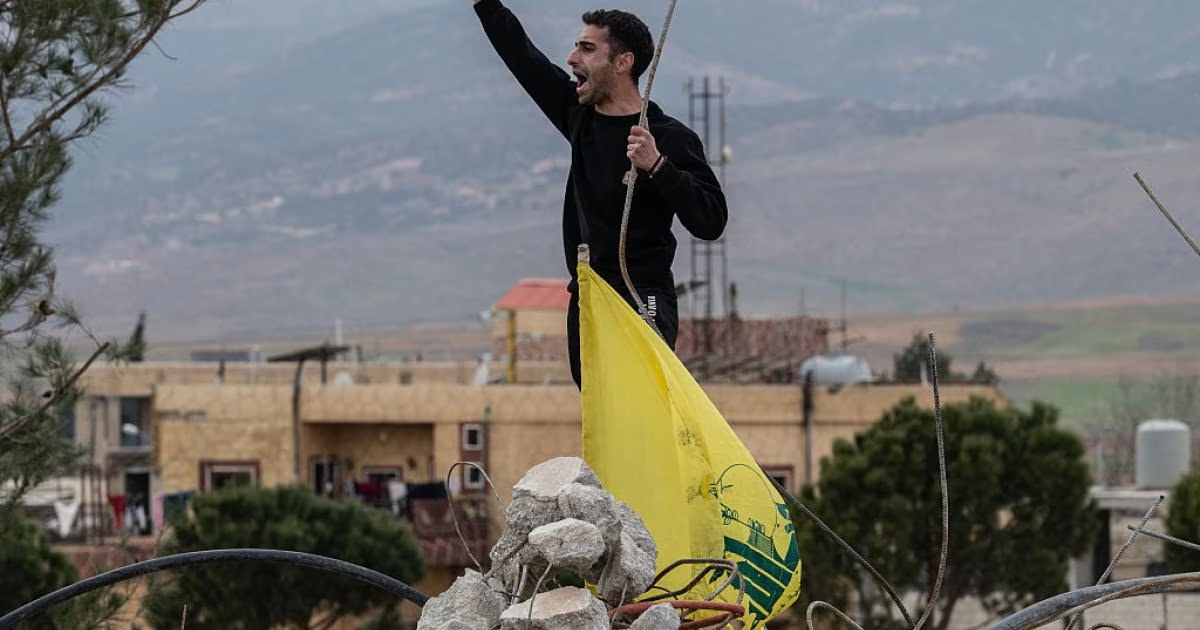
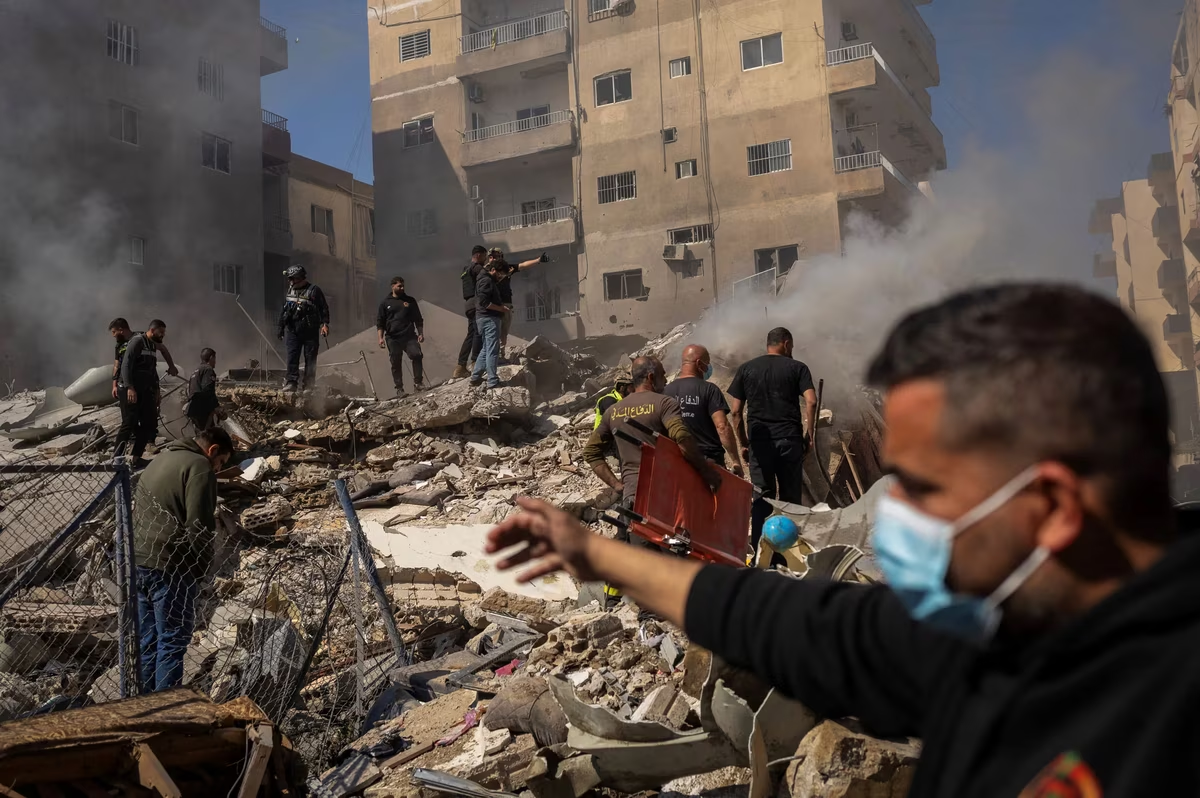
Regarding the Iranian nuclear program, Seri pointed out that Netanyahu's promises to end the threat came to naught, as Tehran still retains 440 kilograms of enriched uranium. He also noted that Iran's ballistic missile stockpile still exists, and the regime in Tehran emerged from the confrontation more cohesive and ruthless under the leadership of the Revolutionary Guard. At the same time, resistance forces in the region remained on high alert, and their military capabilities were not dismantled as hoped.

The article accused Netanyahu of dragging the United States into a major war based on misleading intelligence assessments and false promises to overthrow the Iranian regime. Sources stated that the prevailing impression in Washington now is that Netanyahu exploited Trump's desire for a quick victory to achieve personal ambitions. The CIA described the Israeli promises as a 'farce', while the Joint Chiefs of Staff considered the Israeli plans incomplete and exaggerated.

The behind-the-scenes of meetings in the operations room in Washington revealed that Netanyahu and a security team including Mossad chief David Barnea presented a proposal to Trump urging him to launch the war. Netanyahu then claimed that joint action would eliminate the Iranian leadership, reduce its regional influence, and push the people into the streets. Trump drew encouragement from previous successes, believing that the war would be short and would crown his term with a crushing victory that would reshape the Middle East.

The writer believes that Netanyahu's motives were purely personal and political, as he believed that achieving an American-backed military victory would grant him popular and legal immunity. He aspired to receive an immediate pardon from his legal prosecutions in light of the 'promised victory', in addition to ensuring a new electoral win. However, the results were disappointing, as Israel's position is now at its historical lowest within the decision-making circles of both the Republican and Democratic parties.

The report concluded that American opposition to the war existed from the beginning in narrow circles, where senior officials described it as 'nonsense' and 'absurdity'. Vice President J.D. Vance stands out as one of the harshest critics of Netanyahu's policies, considering that Israel has become a strategic burden. These facts confirm that the military adventure not only failed to achieve its security objectives but also led to a deep rift in strategic relations with the primary supporter of the occupation.

Israel has become a burden, not an asset, and Netanyahu dragged the United States into a wide war based on misleading promises to overthrow the Iranian regime.

ANALYSIS

Fri 10 Apr 2026 5:56 pm - Jerusalem Time

Fragile Truce and Unstable Power Balances: The Struggle for Influence Between Tehran and Washington Reshapes the Region's Map

The region is experiencing a state of political and military deadlock that can be described as a 'truce on hold,' as US-Iranian understandings have been widely breached across multiple fronts, from the Arabian Gulf to Lebanon. This collapse was evident in the bloody aggression launched by the Israeli entity on the capital Beirut, leaving hundreds of casualties, both dead and wounded, among civilians.

In response to this escalation, Tehran took escalatory steps by suspending navigation through the Strait of Hormuz, asserting that this measure was a direct response to the violation of agreements in the Lebanese arena. Iranian strikes also targeted facilities in Gulf countries, serving as a deterrent message against earlier air raids that targeted Iranian territories and facilities.

For his part, US President Donald Trump attempted to disclaim responsibility for the Israeli violations, claiming that the concluded truce agreement did not cover the Lebanese arena. This statement completely contradicted what the Pakistani mediator, Prime Minister Shahbaz Sharif, had announced, who affirmed the comprehensiveness of the agreement for all fronts related to the conflict.

This fragility in the ceasefire reflects an unstable balance of power and high fluidity in the regional alliance system, where the truce has become a bargaining chip in the hands of the warring parties. Through these breaches, each party seeks to redraw the features of the future confrontation in a way that ensures the strengthening of its negotiating positions in any upcoming settlement.

The results of the current battles have reached a level of danger that threatens to reshape the regional and international system, both in its security and economic aspects. Repeated breaches of the truce have become the norm, while adherence to it has become the exception, awaiting the crystallization of new international conditions that allow for a sustainable agreement to end the state of war.

The field in southern Lebanon and the Eastern Mediterranean, in parallel with developments in Bab al-Mandab, indicates major shifts that weaken traditional American influence. This unrest has left Washington and the Israeli occupation with no choice but to try to adhere to the outcomes of the September 2024 agreement and seek to replicate it in other areas to encircle Iranian influence.

In contrast, Iran, supported by regional powers such as Turkey and Pakistan, and to some extent Egypt and Saudi Arabia, is leading efforts to impose a new agreement that takes into account the changing balance of power. This approach aims to extend the impact of the understandings to include the Gaza Strip and southern Syria, while asserting control over vital waterways such as the Strait of Hormuz.

American threats launched by Trump and the commander of CENTCOM, Admiral Brad Cooper, to mobilize more forces, did not prevent Tehran from tightening its grip on maritime traffic. This direct challenge reflects an Iranian desire to impose new equations that deter any future Israeli breaches supported by Washington.

The repercussions of this truce are not limited to the direct parties only, but extend to major international powers such as China, Russia, and Europe. Everyone is observing the engineering of the new balance of power, as the international system is moving towards multipolarity that is not necessarily subject to American control or sole management.

The equation of 'American-controlled multipolarity' has become difficult to achieve given Washington's loss of ability to influence its historical spheres of influence. The failure to control regional systems in the Gulf and the Eastern Mediterranean opens the door for the rebellion of other sub-systems against American hegemony.

The Trump administration is currently racing against time to regain the initiative in the region after a series of failures and misjudgments in dealing with the Iranian file. It seems that the shattering of the current truce is a last attempt to adjust the balance of power, either through a new round of fighting or by imposing separate negotiation paths.

Washington is actively seeking to separate the Lebanese and Gaza tracks from the ongoing negotiations in Islamabad, calling for direct negotiations in Washington. The aim of this step is to grant the Israeli entity stable influence in the Eastern Mediterranean with normalization features, away from the pressures of rising regional axes.

The Israeli regional project is facing continuous erosion in favor of rising projects from major regional powers supported by China and Russia. This shift comes at a time when European resentment towards Trump's policies is increasing, and the 'deep state' in the United States is unable to curb his tendencies, which some describe as reckless.

In conclusion, the current truce remains merely a transitional phase in a broader struggle over the identity of the regional order, where each party seeks to consolidate its gains before reaching the moment of truth. The ability to control waterways and volatile arenas will determine who will impose their terms in the final agreement that may end decades of conflict.

The field reality in Lebanon and the Gulf has opened the door for major transformations that reflect the fragility of American influence and the instability of its military and political balances.

ARAB AND WORLD

Fri 10 Apr 2026 5:56 pm - Jerusalem Time

The Secrets of Mediation: How China Steered De-escalation Between Tehran and Washington?

Diplomatic reports and informed sources have revealed the hidden and crucial role played by the People's Republic of China in reaching a ceasefire agreement between the United States and Iran. Despite the international praise Pakistan received as the public mediator in this crisis, China's behind-the-scenes moves were the real key to achieving the diplomatic breakthrough.

Sources reported that hopes of avoiding escalation were fading hours before the truce was announced, especially with continued direct American threats against Tehran. At that critical moment, Beijing intervened with its political and economic weight to persuade the Iranian leadership to accept the initial ceasefire proposal, thereby preventing a global economic and military catastrophe.

Officials familiar with the negotiations confirmed that Pakistani efforts, despite their pivotal importance, would not have reached a final conclusion without direct Chinese intervention. Beijing succeeded in leveraging its strategic relations with Tehran to dispel Iranian concerns, which was reflected in the statements of the US President, who later acknowledged China's primary role.

Data indicates that Iran expressed a clear desire for a reliable international 'guarantor' for any future agreement, and found China to be the most capable party to play this role. This desire comes amid Iran's distrust of Western promises, and the exclusion of Russia as an acceptable party to the European Union given the current Ukrainian crisis.

Pakistan's capital, Islamabad, is preparing to host new rounds of talks between the two parties, having formed a team of technical experts to research complex issues. These files include maritime navigation in international waterways and the nuclear file, issues that require precise and sensitive agreements between major powers.

Experts believe that close coordination between Beijing and Islamabad has been in place since the first day of hostilities, with the aim of protecting common interests in the region. China is not only Iran's primary trading partner but also a huge investor in Pakistani infrastructure projects, making regional stability a top priority for it.

On the diplomatic front, China practiced a policy of 'quiet diplomacy' away from the media spotlight, with its foreign minister making dozens of calls to the concerned parties. The Chinese Special Envoy for the Middle East also made intensive shuttle trips to bridge viewpoints, while maintaining a distance that prevented Beijing from being openly drawn into the conflict.

In the UN Security Council, China and Russia used their veto power against draft resolutions aimed at pressuring Tehran regarding the strategic Strait of Hormuz. This stance enhanced Beijing's position with decision-makers in Iran and gave it the ability to exert positive pressure to ensure the success of the current de-escalation process.

Despite this initial success, thorny issues still hinder the achievement of lasting peace, most notably the escalation in Lebanon. Regional parties are seeking to include the Lebanese arena in the comprehensive truce agreement, which faces complications due to the separate American vision for this issue.

Sources indicate that the United States prefers to manage the Lebanese-Israeli negotiations file separately in Washington, away from the Iranian de-escalation path. This divergence in views places mediators before significant challenges that require painful concessions from all concerned parties to ensure the continuation of the truce.

China's growing role in the Middle East reflects a shift in the international balance of power, where Washington is no longer the only player capable of shaping agreements. The trust Tehran places in Beijing makes the latter a cornerstone of any future security arrangements related to energy security and navigation in the Gulf.

Observers believe that China fully understands the sensitivity of its position; it does not want to appear as a direct adversary to American interests, but at the same time, it protects its regional allies. This delicate balance is what allowed it to move in areas that traditional diplomacy failed to penetrate in recent months.

In a related context, Beijing continues its efforts in other regional issues, such as the conflict between Pakistan and Afghanistan, which enhances its image as a regional force for peace. Chinese cities host regular meetings between Taliban and Pakistani officials in an attempt to contain border crises that threaten 'Belt and Road' projects.

The question remains about the ability of this fragile agreement to withstand internal pressures in both Washington and Tehran. However, China's entry as a potential guarantor gives additional momentum to the negotiations and ushers the international community into a new phase of multipolar diplomacy in the world's most tense regions.

China's role will remain indispensable in concluding any final peace agreement as a key guarantor, given that Iran does not trust the Trump-Netanyahu duo.

ISRAELI AFFAIRS

Fri 10 Apr 2026 5:56 pm - Jerusalem Time

The Strategic Trap: How Netanyahu's Promises of 'Complete Victory' Against Iran Evaporated?

The latest round of confrontation between the United States and Iran ended with a ceasefire agreement, but the field and political results were disappointing for the Israeli leadership. Despite the grand promises made by Benjamin Netanyahu and his entourage, none of the three main objectives—overthrowing the regime in Tehran, dismantling the nuclear program, or eliminating the ballistic missile arsenal—were achieved.

Current data indicates that the Iranian regime still holds the reins, and its steadfastness in the face of the American and Israeli war machine is considered a strategic victory. In contrast, the issue of 440 kilograms of enriched uranium remains unresolved, while missile and drone programs continued to operate despite intensive airstrikes.

On the diplomatic front, Israel's standing in Washington faced a severe blow, possibly the harshest in decades, as accusations against Netanyahu for attempting to drag the United States into an unnecessary war escalated. Doubt began to creep even into the pro-President Trump base, who started questioning the true motives behind the continuous Israeli escalation.

International media reports revealed the behind-the-scenes of a crucial meeting at the White House last February, where Netanyahu and his security team presented a plan described as overly optimistic for reshaping the Middle East. The plan included promises to destroy Iran's missile capabilities within just one week and ensure the Strait of Hormuz remained open for international navigation without obstacles.

The controversial aspect of those meetings was Netanyahu's proposal for a 'succession' scenario in Iran, where Reza Pahlavi, the son of the former Shah, was presented as a potential alternative ruler. These proposals were met with muted sarcasm from senior American officials, with the CIA director describing such ideas as 'ridiculous,' while the Secretary of State considered them mere 'nonsense' not based on reality.

Field realities have proven that absolute air superiority does not necessarily translate into decisive political victory, just as happened in the Gaza Strip previously. Supporters of the Israeli government are currently trying to market new promises of an imminent final solution, in an attempt to postpone political accountability and escape the consequences of failing to achieve 'complete victory.'

Iran, for its part, succeeded in diagnosing the American weakness represented by the stability of global energy markets, and used the threat of the Strait of Hormuz as an effective bargaining chip. Reports speak of Tehran's potential to impose transit fees of up to two million dollars per ship, which implies implicit recognition of its sovereignty over this vital waterway.

Meanwhile, the northern front with Lebanon remains a political and military minefield threatening the stability of the entire region, despite the temporary ceasefire. The Israeli air force launched violent raids on Hezbollah headquarters, resulting in dozens of casualties, a move observers considered an attempt by Netanyahu to undermine American-Iranian understandings.

Residents of northern Israel live in a state of uncertainty, as the army still deploys five military divisions in ground operations in southern Lebanon with no clear horizon for withdrawal. This intensive military presence imposes significant economic and social burdens and threatens reconstruction projects in the Galilee that have completely halted due to ongoing confrontations.

Netanyahu's media machine is currently trying to craft a new narrative of victory, aimed at convincing the Israeli public that the operation achieved its deterrent goals. But this task seems impossible given the continued missile threats and the Iranian regime remaining strong and capable of maneuvering on the nuclear file.

The upcoming negotiations through the Pakistani mediator will reveal the fragility of the current agreement, especially with Tehran's insistence on lifting all international sanctions. Iran sees the ceasefire as an opportunity to strengthen its nuclear position, considering that the pressure it exerted on the global energy lifeline provided it with immunity against any future attacks.

Israel fell into a strategic trap as a result of betting on baseless desires and ignoring the opinions of military and political experts. Instead of becoming a 'great regional power' as Netanyahu promised, it found itself facing a long-term attrition on multiple fronts without a real resolution.

Trump, who dislikes losing, may soon begin searching for a scapegoat to blame for the faltering American strategy in the region, which causes great concern in the Israeli Prime Minister's office. The seemingly strong relationship between the two men could suffer a deep rift if the war is portrayed as a strategic failure for Washington.

Ultimately, Israelis emerge from shelters wondering about the utility of these endless rounds of fighting that do not lead to lasting peace. The gap between resonant speeches and the dire field reality has become too wide to be covered by political maneuvers, putting the future of the current leadership at stake before a public weary of empty promises.

His claims of transforming Israel into a regional power do not align with the strategic trap it fell into, or with the reality of Israelis' lives who emerged from shelters clinging to a faint hope.

PALESTINE

Fri 10 Apr 2026 5:56 pm - Jerusalem Time

Turkey prosecutes 35 Israelis for crimes against humanity in 'Freedom Flotilla' attack

Judicial authorities in Istanbul, Turkey, announced a significant legal step by preparing an official indictment targeting 35 individuals from the Israeli side, in connection with their involvement in the armed assault on the 'Global Freedom Flotilla'. The Public Prosecution confirmed that investigations conducted by the Anti-Terrorism Bureau proved that the attack occurred while the ships were sailing in international waters, making it a blatant violation of maritime and international laws.

According to the issued legal indictment, the Israeli military intervention was not merely a security measure, but was described as a systematic act lacking any legitimate cover. The merits included that the attacking forces used excessive force to stop the ships, and deliberately detained civilian activists under duress and coercion, while committing physical assaults that were humiliating to human dignity.

Turkish investigations revealed the identification of 35 suspects believed to be the masterminds and perpetrators of this military operation against international solidarity activists. Consequently, official arrest warrants were issued against a number of them, who were charged with a package of serious accusations that place them under international prosecution for committing unjustified atrocities.

The list of charges against the suspects includes committing 'crimes against humanity' and 'genocide', in addition to charges of forced deprivation of liberty and deliberate torture. The indictment also included accusations of looting, causing severe damage to private property, and detaining maritime transport without legal justification, which reflects the seriousness of the violations recorded in the case file.

In the context of ongoing legal procedures, the Public Prosecutor's Office in Istanbul assigned a team of 11 prosecutors to document the testimonies of the flotilla activists. These solidarity activists, who were detained at sea before being forcibly deported to Turkey, provided detailed statements about the circumstances of the assault and the harsh treatment they received at the hands of the occupation forces.

It is worth noting that the occupation army targeted 42 ships on October 1st last year, which formed the Freedom Flotilla heading to break the siege on the Gaza Strip. That attack resulted in the arrest of hundreds of activists of different nationalities, in an attempt to prevent the delivery of humanitarian and medical aid to the besieged population in the Strip, which is suffering the ravages of war.

These judicial moves come at a time when international reports indicate a catastrophic deterioration in the humanitarian situation inside the Gaza Strip as a result of the ongoing 18-year siege. Statistics confirm that the ongoing war of extermination since October 2023 has resulted in more than 72,000 martyrs, destroyed infrastructure and homes, leaving about 1.5 million Palestinians homeless under harsh living conditions.

The attack on the ships in international waters lacks legal legitimacy and is characterized by a grave and systematic nature against civilians.

OPINIONS

Fri 10 Apr 2026 7:15 am - Jerusalem Time

Trump asks Netanyahu to de-escalate attacks on Lebanon amid military escalation and new American diplomatic move

Washington – Said Arikat - 10/4/2026

News Analysis

At a time of escalating field sensitivity, the call announced by the US State Department to host a meeting next week on prospects for a ceasefire between Israel and Lebanon reflects a renewed attempt to reactivate the diplomatic track, even if from a position of containing repercussions rather than imposing a decisive settlement path. According to a US official, in an email statement received by Al-Quds newspaper's Washington office, the upcoming meeting comes amid a growing realization within Washington that continued escalation could open the door to a wider regional slide that would be difficult to control later.

However, this diplomatic movement coincides with a very harsh reality on the ground in Lebanon, where the death toll has exceeded 300 people, and the injured 1100, most of them civilians, amid widespread destruction that affected the southern suburbs of Beirut and areas in the south, and in which the Israeli occupation forces are carrying out ethnic cleansing in southern Lebanon after destroying bridges. This escalation reflects a qualitative shift in the nature of brutal Israeli military operations, both in terms of their intensity and their geographical scope, which doubles humanitarian pressures and puts any negotiation path to an early test.

In this context, indications of a divergence in the American-Israeli approach regarding the limits of de-escalation are emerging in Washington. While Israeli Prime Minister Benjamin Netanyahu adheres to his position rejecting linking the Lebanese arena to any ceasefire agreement reached with Iran, justifying this by saying that Lebanon is outside the scope of understanding, recent data revealed an American attempt to control this escalation. US President Donald Trump published a tweet on the "Truth Social" platform in which he confirmed that he had contacted Netanyahu, asking him to "de-escalate attacks on Lebanon," a reference that reflects growing concern within the US administration about the widening scope of the confrontation.

This public stance by Trump highlights a striking paradox: on the one hand, there were previous indications that Washington had given Israel something akin to a "limited green light" to continue its operations, but on the other hand, it seems that the accelerating pace of escalation and the scale of human losses pushed the White House to try to curb Tel Aviv's impulsiveness, even through direct political messages. This raises questions about Washington's ability to translate these calls into effective pressure that changes Israel's behavior on the ground.

In contrast, Netanyahu continues to pursue a dual path that combines military escalation and cautious openness to negotiation, as he announced that he had issued directives to begin direct negotiations with Lebanon "as soon as possible." This approach reflects a strategy based on using field pressure to improve negotiation conditions, at a time when he praised Lebanese Prime Minister Najib Mikati's call for disarmament in Beirut, considering that it could be an entry point for any future settlement, despite the internal political complexities surrounding this issue.

In parallel, this path is not separate from a wider regional movement, as attention turns to the upcoming talks between the United States and Iran in Islamabad, chaired by US Vice President JD Vance. These talks are seen as a test of the two sides' ability to contain tension, and perhaps pave the way for broader understandings that will be reflected in other arenas, including Lebanon.

Nevertheless, the main challenge facing the American move remains the gap between diplomatic rhetoric and the reality on the ground. The call to host negotiations, despite its importance, does not seem sufficient in the absence of decisive indications of Washington's readiness to use effective pressure tools on Israel. This weakens the image of the United States as an impartial mediator, and reinforces the impression that its move aims primarily to prevent the expansion of the crisis, not to address it fundamentally.

In contrast, the Israeli strategy based on imposing new facts on the ground entails increasing risks, as it may lead to a hardening of Lebanese positions, and perhaps to expanding the scope of the confrontation instead of containing it. Escalation, even if used as a negotiating tool, can quickly turn into a factor undermining any political path if it exceeds the limits of control.

Internally in Lebanon, the inclusion of the disarmament issue in a negotiating context under military pressure opens the door to additional complications, given the delicate political balances and thorny sovereign questions associated with this issue, which may hinder the achievement of national consensus on it in the short term.

In conclusion, the chances of success of any negotiation path seem dependent on the availability of three interrelated elements: a genuine political will on the part of the parties, effective international pressure led by Washington, and a broader framework that addresses the roots of the crisis, not just its symptoms. In the absence of that, diplomatic moves, including the upcoming meeting in Washington, may remain mere attempts to manage the crisis, not solve it.

ARAB AND WORLD

Fri 10 Apr 2026 7:15 am - Jerusalem Time

White House warnings against exploiting classified information for betting in oil markets

The White House Office of Administration issued a stern warning to its employees via official emails, demanding that they refrain from exploiting their positions or the information they access for betting in futures markets. This step came after suspicious financial movements were observed coinciding with sensitive political decisions taken by the US administration regarding military operations against Iran, raising questions about the integrity of information trading within government circles.

Stock exchange data revealed that anonymous traders injected approximately $500 million into Brent crude and West Texas Intermediate oil contracts just minutes before President Donald Trump announced the postponement of military strikes against Iranian energy facilities. This precise timing led to huge profits for bettors after oil prices fell by 15% immediately after the decision was issued, prompting economists to demand an investigation into the possibility of sovereign decisions being leaked before their official announcement.

For his part, White House spokesman Davis Engel stated that the administration is keen on a strong stock market but categorically rejects the exploitation of influence to achieve illicit financial gains. Engel pointed out that laws must be strictly applied to members of Congress and government officials to prevent them from trading based on classified information, stressing that transparency is the only guarantee for market stability and public trust.

On the political front, these developments come at a time when Washington and Tehran announced a temporary two-week truce, in an attempt to reach a comprehensive agreement that would end the armed conflict that erupted in late February. This agreement aims to stop the bloodshed after the confrontations left thousands of victims, as initial understandings included lifting Iranian restrictions on navigation in the Strait of Hormuz to ensure the flow of global energy supplies.

However, the optimism for the truce faced a rapid setback after the Israeli occupation violated the agreement by launching a wide-ranging aggression against Lebanon, resulting in hundreds of dead and wounded in one day. In response to this escalation, Tehran announced the re-imposition of navigation restrictions in the Strait of Hormuz, threatening the collapse of the diplomatic path and the return of the region to comprehensive military escalation.

Government officials should be prevented from using undisclosed information for personal financial gain.

PALESTINE

Fri 10 Apr 2026 7:14 am - Jerusalem Time

Gaza refutes Mladenov's statements: Only 207 trucks entered the Strip, not 602

The Government Media Office in the Gaza Strip refuted the claims made by the High Representative for Gaza, Nikolay Mladenov, regarding the flow of humanitarian aid. The office confirmed in an official statement that the figures mentioned by the international official concerning the entry of 602 trucks last Thursday are completely incorrect.

Mladenov had posted a tweet on his 'X' account claiming the arrival of hundreds of trucks loaded with essential supplies for Palestinian families suffering from the siege. The international official considered that this level of flow should become a daily standard to ensure an expanded humanitarian response in the Strip.

In contrast, the Government Media Office stressed that these statements lack accuracy and credibility and starkly contradict the on-the-ground realities monitored by specialized teams. The statement clarified that promoting such exaggerated figures contributes to misleading international public opinion about the reality of the humanitarian catastrophe.

According to actual documented data for April 9th, the total number of trucks that entered the Gaza Strip was only 207. Sources indicated that this number includes all needs, including trucks designated for the private commercial sector, not just relief aid.

Palestinian commercial sources explained that out of the 207 trucks, the number of humanitarian aid trucks did not exceed 79. The rest of the cargo consisted of commercial goods for private companies, which creates a huge gap between reality and what Mladenov stated.

The Media Office mentioned that the current number of trucks is by no means sufficient to meet the required response to the escalating famine. It affirmed that the compliance rate for truck entry since the ceasefire began has not exceeded 38 percent of the internationally agreed-upon quantities.

The statement warned that falsifying facts cannot conceal the magnitude of the humanitarian catastrophe experienced by the residents of the Strip, nor does it absolve any party of its responsibilities. It called on the international community to intervene immediately to save civilians from the repercussions of the ongoing siege and the manipulation of the humanitarian relief file.

It is worth noting that the ceasefire agreement protocol signed last October explicitly stipulates the necessity of 600 trucks entering daily. This agreement includes the regular entry of 50 fuel trucks, which the occupation authorities have so far refused to fully implement.

Despite Mladenov's talk of 'intensive efforts' made by his team in coordination with the National Committee for Gaza Management, the reality on the ground proves otherwise. Palestinians continue to face a severe crisis in food and medicine due to the occupation's evasion of its commitments regarding opening crossings.

Mladenov himself had acknowledged in a previous briefing to the UN Security Council that the situation in Gaza remains extremely difficult despite slight 'improvements'. He then pointed out that the health system has completely collapsed, and essential services are operating at a very small fraction of their pre-war capacity.

These developments come amidst American efforts to move to the second phase of the ceasefire agreement, according to a plan adopted by the UN Security Council. However, continuous Israeli violations of the truce have led to the deaths and injuries of hundreds since the signing of the last agreement.

The latest data from the Ministry of Health indicates that the occupation army's aggressions during the truce period resulted in the martyrdom of 736 Palestinians and the injury of over two thousand others. These figures confirm the fragility of the agreement in the absence of binding international guarantees for the Israeli side.

It is noted that the Gaza Strip was subjected to a comprehensive genocide war that began on October 8, 2023, and lasted for more than two years with direct American support. This war left widespread destruction affecting about 90 percent of the infrastructure and vital facilities in all governorates of the Strip.

According to official statistics, the number of victims of the ongoing aggression has exceeded 72,000 martyrs and more than 172,000 injured Palestinians. The humanitarian suffering continues under the policy of trickling aid followed by the occupation, amidst international silence regarding misleading figures.

Mladenov's statement regarding the entry of 602 trucks into the Strip is baseless, lacks accuracy and credibility, and contradicts documented facts on the ground.

ARAB AND WORLD

Fri 10 Apr 2026 7:14 am - Jerusalem Time

Trump threatens Tehran over Strait of Hormuz fees, Starmer discusses plan to ensure navigation

US President Donald Trump issued a strong warning to Iranian authorities, demanding that they refrain from imposing any financial fees on cargo ships and oil tankers crossing the Strait of Hormuz. These statements come after Tehran agreed to reopen the vital waterway as part of a two-week ceasefire agreement, which aims to de-escalate rising tensions in the region.

The US President had announced last Wednesday morning his official approval to suspend military strikes against Iranian targets for 14 days, provided the Strait is fully and immediately opened to international navigation. Trump stressed that the continuation of the ceasefire depends on both parties' commitment to de-escalation and ensuring that the flow of global trade through this strategic artery is not obstructed.

The roots of the crisis date back to early March, when Iran announced restrictions on navigation in the Strait, threatening to target any vessel attempting to cross without prior coordination with its forces. This closure caused severe disruptions in global markets, as approximately 20 million barrels of oil per day passed through the Strait before the recent tensions erupted.

On his 'Truth Social' platform, Trump expressed his displeasure with reports indicating Iranian attempts to collect money from passing ships, describing these actions as 'shameful' and contrary to what was agreed upon. The US President affirmed that the flow of oil would return to normal very soon, indicating that this would happen whether with or without Iranian cooperation.

In a related context, data from the marine monitoring service 'MarineTraffic' revealed very limited movement in the Strait since the truce began, with only ten ships having crossed by Thursday. These figures reflect the extreme caution prevailing among global shipping and insurance companies despite political de-escalation announcements.

For his part, British Prime Minister Keir Starmer entered the crisis, holding telephone talks with the US President to agree on a joint 'action plan' aimed at fully restoring navigation. The British Prime Minister's office clarified that both sides seek to enter a new phase of diplomatic solutions to ensure the security of international waterways.

Downing Street confirmed that the two leaders discussed the urgent need to restart maritime traffic as soon as possible to avoid further economic losses. Both parties agreed to continue close coordination and speak again soon to follow up on the implementation of the proposed action plan and overcome current obstacles.

These diplomatic moves coincide with a Gulf tour by Starmer, which included Qatar and Bahrain, to strengthen the fragile ceasefire in the Middle East. The British Prime Minister seeks, through his meetings with Gulf leaders, to build a united front that supports regional stability and secures global energy supplies.

In Bahrain, Starmer expressed his categorical rejection of any Iranian proposals regarding imposing transit fees, stressing that the concept of an 'open strait' means safe and free navigation without financial restrictions. He clarified in press statements that the British position is firm on the necessity of international waterways remaining free from political or economic blackmail.

Despite coordination with Washington, Starmer's stance was not without criticism of Trump's approach to managing the crisis, as he expressed reservations about the violent language used by the US President. Starmer indicated that he prefers sober diplomacy over statements that could exacerbate conflicts rather than resolve them.

1. The British Prime Minister also touched upon the Lebanese issue, describing the continuation of Israeli attacks there as unacceptable and something that must stop immediately. Starmer considered the call for de-escalation in Lebanon to be a 'matter of principle' consistent with international efforts aimed at achieving comprehensive stability on all fronts in the region.

Economic and political circles are awaiting the results of these international pressures on Tehran in the coming days, and the extent of the latter's response to demands to open the Strait without financial conditions. The Strait of Hormuz remains the focal point of the current conflict, as any disruption there poses a direct threat to the food and energy security of many countries around the world.

There are reports that Iran is charging fees for oil tankers passing through the Strait of Hormuz. They better not be doing that, and if they are, they better stop now!

PALESTINE

Fri 10 Apr 2026 7:14 am - Jerusalem Time

Shocking Testimonies from Palestinian Children Raped and Tortured by Israeli Female Soldiers in Rafah

Horrific testimonies were revealed by 17-year-old Ahmed Al-Helou, detailing how he and 15 other Palestinian children were subjected to severe sexual abuses, including rape and harassment, by Israeli female soldiers. Sources reported that these crimes occurred in one of the American aid centers and occupation camps near the city of Rafah in the southern Gaza Strip, following their arrest last June.

Al-Helou recounted the details of their detention by 10 Israeli female soldiers, where the children were forced to strip completely and were subjected to harsh physical harassment, culminating in rape at gunpoint. The boy explained that these practices took place in an environment of continuous psychological and physical torture within closed detention centers lacking the lowest standards of international oversight.

For her part, Wafaa Al-Helou, Ahmed's mother, expressed her shock and deep sorrow over what her son endured during his detention, noting that his psychological state had severely deteriorated. She confirmed that Ahmed is currently suffering from post-traumatic stress disorder and requires intensive specialized psychological care to overcome the catastrophic effects of what he was subjected to in the occupation camps.

These testimonies come in the context of increasing human rights reports speaking of systematic and organized violations within Israeli prisons and camps, particularly the 'Sde Teiman' detention center in the Negev desert. Human rights and international circles describe this detention center as 'Israel's Guantanamo' due to the practices it witnesses, aimed at the deliberate psychological and physical humiliation of Palestinian detainees.

Last November, the Palestinian Human Rights Monitor issued a report based on the testimonies of over 100 released detainees, who documented repeated rapes and terrorization by police dogs. The report also included details about the deliberate deprivation of food and clean water, and continuous beatings by prison guards away from the eyes of the International Committee of the Red Cross.

These incidents indicate a complete absence of oversight over Israeli detention centers, which have turned into hotbeds of war crimes and inhumane violations against civilians and children. Human rights advocates demand an urgent international investigation into these testimonies to ensure accountability for those responsible for these crimes, which violate all international conventions and laws related to the protection of prisoners and children.

We were forced to strip, then subjected to harassment and rape at gunpoint by 10 Israeli female soldiers inside a camp in Rafah.

ARAB AND WORLD

Fri 10 Apr 2026 7:14 am - Jerusalem Time

Mojtaba Khamenei: We do not seek war, but we will not give up our rights, and our support for the resistance continues

The Supreme Leader of the Islamic Republic of Iran, Ayatollah Mojtaba Khamenei, announced in a written message broadcast by state television that his country does not aim to enter into a military conflict with the United States or Israel. Khamenei clarified that this stance does not mean retreating from national principles, emphasizing that Tehran will not relinquish its legitimate rights under any pressures or current political circumstances.

These statements come at a sensitive time, coinciding with the commemoration of the fortieth day since the assassination of the former leader, Ali Khamenei, who was killed in airstrikes targeting the capital, Tehran, last February. The new leader linked the state's defensive posture with the legacy of the previous leadership, considering the resistance fronts in the region as an indivisible entity in confronting external challenges.

Regarding diplomatic moves, Khamenei pointed to the importance of public presence in public squares, considering the voice of the Iranian people as a fundamental pillar supporting negotiators in international forums. This اشاره comes after Tehran announced its approval of a temporary two-week truce with the American side, as a proactive step for peace negotiations scheduled to be held in Pakistan.

On the strategic level, the Supreme Leader revealed new directions related to the management of the Strait of Hormuz, emphasizing that control over this vital waterway has entered a new phase that enhances the country's defensive capabilities. He clarified that Iran will continue its role in protecting its national security while continuing to provide necessary support to its allies in the region, despite recent American threats that hinted at targeting the Iranian state.

Several Iranian cities, including Tehran, Urmia, and Gorgan, witnessed massive public gatherings attended by thousands to commemorate the passing of Ali Khamenei, who led the country for three and a half decades. Participants raised national flags and pictures of the deceased leaders, amidst popular calls for caution against American promises and not falling into what they described as 'Washington's trap' during upcoming negotiation rounds.

Informed sources reported that the current truce, reached through Pakistani mediation, led to a halt in airstrikes, providing an opportunity for a breather and the start of arrangements for political dialogue. Regional circles are awaiting the outcome of the Pakistan talks, especially in light of the ongoing tension with Israel and the continued military operations that targeted senior Iranian officials earlier.

In conclusion, Mojtaba Khamenei stressed that Iranian policy will remain steadfast in its support for Hezbollah and other resistance forces, considering this an integral part of the political doctrine of the Islamic Republic. He affirmed that any negotiations will not be at the expense of national sovereignty or the abandonment of regional allies, in light of the ongoing crisis that has plagued the region for months.

We did not seek war and do not want it, but we will not give up our legitimate rights under any circumstances.

PALESTINE

Fri 10 Apr 2026 7:13 am - Jerusalem Time

Washington to Host Direct Negotiations Between Lebanon and Israel Next Week

Sources in the US State Department revealed arrangements to host a high-level meeting in Washington next week, aimed at launching formal ceasefire negotiations between Lebanon and the Israeli occupation state. This step comes amid increasing international pressure to end the military operations that have ravaged the region in recent weeks.

Diplomatic sources stated that the anticipated negotiations will be led by Israel's ambassador to Washington, Yehiel Leiter, and Lebanese ambassador Nada Moawad, marking a shift towards direct diplomatic channels. This development follows Israeli Prime Minister Benjamin Netanyahu's announcement of clear instructions to open a direct negotiation path with the Lebanese side.

For his part, Lebanese President Michel Aoun announced that the proposal for direct negotiations has begun to receive widespread positive international engagement, indicating that Lebanon seeks to establish its rights and sovereignty. Aoun presented a comprehensive initiative consisting of four basic points aimed at ending the bloody conflict and providing sustainable security guarantees.

The Lebanese initiative includes establishing a comprehensive truce under which all Israeli ground, air, and sea aggressions on Lebanese territory would immediately cease. The initiative also stipulates providing urgent logistical support to the Lebanese armed forces to enable them to carry out their duties in maintaining security and extending sovereignty over all national territory.

The plan dictates that Lebanese security forces will immediately take control of all recent areas of tension, and work to confiscate illegal weapons and dismantle their caches. This step aims to end armed manifestations and confine weapons to the state, which observers considered a fundamental point in the current negotiation process.

According to the Lebanese vision, direct negotiations must begin under international patronage simultaneously with the implementation of security provisions, to ensure a final and comprehensive agreement. Through this path, Lebanon seeks to ensure the withdrawal of occupation forces from all points they infiltrated during the recent aggression.

In a related context, media sources reported that US President Donald Trump pressured Netanyahu to reduce the intensity of air strikes on Lebanon. This American desire aims to create an atmosphere conducive to the success of parallel negotiation tracks, especially those related to the Iranian nuclear file and the existing truce with Tehran.

Despite the diplomatic activity, Israeli officials confirmed that there is no official ceasefire yet, and that military operations may continue until talks begin. This stance indicates the occupation's desire to improve its negotiating terms through continuous field pressure on Lebanese villages and towns.

In contrast, Hezbollah announced its categorical rejection of any direct negotiations with Israel, considering it a concession of Lebanese national constants. In an official statement, the party stressed the necessity of adhering to the cessation of aggression and the withdrawal of occupation forces as a fundamental and non-negotiable condition before any political discussion.

Party representatives in the Lebanese parliament called on the government not to be drawn behind international promises before achieving a real and comprehensive ceasefire on the ground. They affirmed that the priority should be the return of displaced persons to their villages and reconstruction, away from the conditions that Washington and Tel Aviv are trying to impose.

On the ground, occupation aircraft continued to launch violent raids, resulting in hundreds of martyrs and wounded in the past twenty-four hours, raising the total number of casualties. Lebanese civil defense teams are working with extreme difficulty to retrieve the missing from under the rubble of destroyed civilian buildings in various governorates.

These developments coincide with a fragile truce between Washington and Tehran, mediated by Pakistan, which began last Wednesday morning and included understandings regarding navigation in the Strait of Hormuz. However, the Iranian side hinted at suspending these understandings if Israeli aggression against Lebanon continues, emphasizing the interconnectedness of the paths between the two fronts.

Reports indicate that navigation in the Strait of Hormuz has seen a sharp decline, with the number of crossing vessels significantly decreasing due to security and political tensions. This decline reflects the extent of international concern about a wider escalation of the situation if the anticipated Washington negotiations fail to achieve a real breakthrough.

Anticipation remains the master of the situation, awaiting the outcome of next week's meetings, amid a wide gap between Lebanese demands and American-backed Israeli conditions. Observers fear that these negotiations may be merely a cover for the continuation of military operations and the encroachment on more Lebanese territory in the south.

Instructions were issued to begin direct negotiations with Lebanon as soon as possible, and I appreciate the Lebanese President's call for disarmament.

ARAB AND WORLD

Fri 10 Apr 2026 7:13 am - Jerusalem Time

Netanyahu denies ceasefire in Lebanon, Hezbollah renews rejection of direct negotiations

Israeli Prime Minister Benjamin Netanyahu affirmed today, Thursday, that there is no intention for a ceasefire in Lebanon at the present time. These statements came shortly after he issued instructions to begin direct negotiations with the Lebanese side, reflecting a contradiction in the field and political scene.

Netanyahu stressed that Israel's objectives from any negotiation path are primarily focused on disarming Hezbollah and securing an agreement that guarantees sustainable peace on the northern border. He indicated that the move towards negotiation came in response to what he described as repeated requests from Beirut, expressing his appreciation for Lebanese statements calling for disarmament.

For its part, a high-ranking Lebanese official clarified that Beirut is looking for a negotiation path similar to the truce model between Iran and the United States. The official stressed the necessity of Washington's presence as an international guarantor for any agreement that may be reached with Tel Aviv, calling for a temporary truce to prepare the atmosphere for talks.

In the context of international movements, sources in the US State Department revealed arrangements to host an expanded meeting next week. This meeting aims to discuss prospects for ceasefire negotiations between Israel and Lebanon and try to bridge the views between the concerned parties.

In contrast, Hezbollah quickly renewed its firm stance rejecting any form of direct negotiations with the Israeli occupation. The party affirmed in official statements that the top priority remains a comprehensive cessation of aggression and a complete withdrawal from the occupied Lebanese territories.

Hezbollah MP Ali Fayyad stated that Lebanese national constants are non-negotiable, foremost among them the return of residents to their border villages and towns. Fayyad called on the Lebanese government to adhere to a ceasefire as a prerequisite and mandatory condition before engaging in any subsequent political steps.

Fayyad indicated that any official Lebanese position must prioritize the withdrawal of occupation forces from all border points. He considered that attempts to impose conditions under the pressure of arms will not succeed in changing the field or political reality imposed by the party.

On the other hand, press sources from occupied Jerusalem reported widespread doubts about Netanyahu's true intentions behind the call for negotiations. Observers believe that the Israeli move may be a political maneuver aimed at alleviating increasing international pressure on the occupation government in international forums.

Hebrew reports quoted high-ranking officials as saying that Israel seeks to maintain its international legitimacy to ensure the continuation of its confrontation with Iran in the next phase. These sources clarified that moving towards the negotiating table does not necessarily mean a desire to end military operations immediately.

Field data indicates that Israel is adopting a 'negotiation under fire' strategy, as it continues its raids and ground operations in parallel with diplomatic movement. The ceiling of expectations from these negotiations remains low in light of the occupation's insistence on establishing a buffer security zone in southern Lebanon.

It is worth noting that Israel has procrastinated on several previous occasions regarding official Lebanese calls for dialogue, and has backed down from understandings regarding the place and time of meetings. Previous French efforts also failed to break the diplomatic stalemate due to persistent Israeli intransigence and Tel Aviv's insistence on imposing harsh field conditions.

No ceasefire in Lebanon, and negotiations aim to disarm Hezbollah and achieve sustainable peace.

OPINIONS

Fri 10 Apr 2026 7:09 am - Jerusalem Time

Diplomacy Under Fire: Washington’s Complicity and Israel’s Unchecked War on Lebanon

By:  Said Arikat

April 10, 2026

News Analysis

Washington, D.C- At a moment when Lebanon is enduring one of the most intense and destructive military campaigns in recent memory, Washington’s announcement of yet another diplomatic meeting on the prospects of a ceasefire appears increasingly detached from reality. What is being presented as diplomatic engagement is, in practice, little more than political theatre—an effort to manage the optics of a war the United States has neither the will nor the political courage to restrain.


Behind the language of “concern” and “de-escalation,” a harsher truth is becoming impossible to ignore: the United States is not merely failing to stop the war in Lebanon—it is enabling the conditions under which it continues.


According to a U.S. official cited in correspondence received by Al-Quds newspaper’s Washington bureau, the upcoming meeting reflects fears in Washington that the conflict could spiral into a broader regional war. Yet these fears have not translated into policy. They remain confined to statements, briefings, and carefully calibrated diplomatic language that has no measurable impact on Israel’s conduct on the ground.


In Lebanon, the consequences of this paralysis are devastating. More than 300 people have reportedly been killed and over 1,100 wounded, the overwhelming majority civilians, in the span of ten-minute of Israel’s criminal assault on Wednesday, April 8. Entire neighborhoods in Beirut’s southern suburbs and large areas in the south have been flattened. Infrastructure has been systematically destroyed, and mass displacement continues under sustained bombardment. The scale and intensity of the assault have left little ambiguity about the nature of the war being waged: a campaign of overwhelming force against a densely populated civilian environment.


Yet despite this, Washington continues to act as though expressions of concern constitute a form of policy. They do not.


Israel’s military campaign proceeds with near-total impunity, sustained by unwavering U.S. political backing and an uninterrupted security relationship that shields it from meaningful consequences. The result is a structural imbalance in which Israel acts freely, while the United States periodically reacts rhetorically—after the damage is done, and without altering the underlying dynamics.


President Donald Trump’s reported call to Prime Minister Benjamin Netanyahu urging him to “low-key attacks on Lebanon” fits this pattern precisely: a symbolic gesture that acknowledges excess without imposing restraint, and signals discomfort without changing behavior. It is diplomacy reduced to commentary on a war it does not attempt to stop.


Netanyahu’s strategy, meanwhile, is unapologetically built on escalation. Israel continues to pursue a doctrine in which overwhelming military force is not a last resort but a negotiating instrument. The devastation of civilian areas is not an unintended consequence—it is part of the pressure architecture through which political outcomes are being shaped.


Within this framework, Israel’s reported openness to negotiations with Lebanon “at the earliest opportunity” is not a contradiction but a continuation of the same strategy: escalation first, negotiation later, on terms rewritten by force. Even Lebanese political statements, including calls for disarmament in Beirut, are absorbed into this logic and repurposed as evidence of success achieved under fire.


What emerges is a disturbing symmetry: Israeli escalation proceeds with full diplomatic insulation, while American diplomacy proceeds without enforcement power. One operates with force, the other with language—but the result is a single, coherent reality on the ground: continued destruction without consequence.


The United States insists on its role as mediator. But mediation without leverage is not mediation at all—it is performance. And in this case, it is performance that coincides with the systematic devastation of a country already pushed to the edge.


Parallel diplomatic tracks, including the upcoming U.S.–Iran talks in Islamabad led by Vice President J.D. Vance, are being presented as part of a broader regional effort to stabilize multiple fronts. Yet the assumption that fragmented diplomacy can offset active, escalating wars is increasingly untenable. The region is not moving toward order; it is moving through overlapping crises with no effective mechanism of restraint.


At the core of the current failure is not misunderstanding, but unwillingness: the unwillingness of Washington to use its considerable leverage over Israel, and the willingness of Israel to continue a campaign that has already exacted a devastating civilian toll. Together, these positions produce a system in which war is continuous, diplomacy is reactive, and accountability is absent.


Inside Lebanon, attempts to introduce politically sensitive issues such as disarmament into negotiations conducted under sustained bombardment only deepen the asymmetry. These are not neutral discussions—they are negotiations conducted under duress, where one side speaks from rubble and the other from the position of overwhelming force.


In such conditions, diplomacy ceases to function as a pathway to resolution. It becomes part of the conflict’s infrastructure—absorbing its consequences, legitimizing its continuation, and insulating its perpetrators from meaningful pressure.


For now, Lebanon remains caught in a cycle where destruction advances with operational speed, while diplomacy lags behind as a record of concern rather than a mechanism of restraint. And Washington, far from acting as a brake on this trajectory, appears increasingly positioned as its political enabler—speaking in the language of peace while presiding over the conditions of war

OPINIONS

Thu 09 Apr 2026 8:40 pm - Jerusalem Time

Growing Negative View of Israel and Netanyahu Among Americans, Especially Youth

Washington – Said Arikat – 4/9/2026

A recent study by the Pew Research Center showed that Americans have become more negative towards Israel and its Prime Minister, Benjamin Netanyahu.

The survey results showed:

60% of American adults have an unfavorable view of Israel, compared to 53% last year; and 59% have no confidence in Israel's Prime Minister Benjamin Netanyahu to do what is right globally, compared to 52% last year.

In both political parties, a majority of adults under the age of fifty view Israel and Netanyahu negatively.

The survey, published on Tuesday, April 7, was conducted from March 23 to 29 and included 3,507 American adults, about a month after the US-Israeli-led war in Iran.

Americans' View of Israel

The survey showed that six out of ten Americans have a partially or entirely negative view of Israel, an increase of 7 percentage points from last year, and nearly 20 points since 2022. The percentage of those with a very negative view of Israel also increased from 19% to 28% since last year, and tripled compared to 2022.

Among Democrats and Democratic-leaning independents, 80% have a negative view of Israel, compared to 69% last year and 53% in 2022. Democrats under the age of fifty are more likely to have a very negative assessment of Israel (47% versus 39% for older adults).

As for Republicans, a majority have a positive view of Israel (58% versus 41%). However, the percentage of young Republicans with a negative assessment has increased (57% of those aged 18 to 49 versus 50% last year).

Views on Israel also differ by religious affiliation: American Jews and white evangelical Christians often have a positive view (64% and 65% respectively), while a positive view is less common among white non-evangelical Protestants (39%), Catholics (35%), Black Protestants (33%), and the religiously unaffiliated (22%). Among American Muslims, only 4% view Israel positively.

Americans' Confidence in Netanyahu on Global Affairs

A majority of Democrats (76%) also distrust Netanyahu, a 6-point increase from last year. Nearly half of Democrats (52%) say they have no confidence in him at all, compared to 37% last year.

As for Republicans, their opinions are mixed, with 45% having some or a lot of confidence in Netanyahu, compared to 44% having little or no confidence. The assessment varies by age; Republicans over 50 are more confident in him compared to younger adults (58% versus 33% of older adults).

Americans' Confidence in Trump Regarding Relations with Israel

More than half of Americans (55%) do not trust former President Donald Trump to make good decisions regarding the relationship between the United States and Israel. Americans appear to have more confidence in Trump regarding this relationship compared to several other foreign policy issues, including US policy towards Iran (35%).

Among Republicans, 73% trust Trump to manage the relationship with Israel, compared to only 16% of Democrats. Young Republicans appear less confident than older adults (52% versus 93%).

Importance of the Israeli-Hamas Conflict to Americans

More than half of Americans (53%) consider the conflict between Israel and Hamas personally important to them, a percentage that has not changed much from last year before the ceasefire. The importance of this conflict is less compared to the American military campaign against Iran (53% versus 77%).

The importance varies by age and religion, with 91% of American Jews, 70% of Muslims, and 65% of white evangelicals considering the conflict important to them.

The survey results clearly show that young Americans under the age of fifty have become more negative towards Israel and Netanyahu compared to older adults. This phenomenon indicates radical shifts in the awareness of younger generations, perhaps due to media openness and interaction with human rights issues and regional conflicts. Current Israeli policy, especially amidst tensions with Palestinians, significantly affects youth public opinion, reflecting a long-term change in traditional support for Israel within the United States.

The survey reveals a clear gap between Democrats and Republicans regarding confidence in Netanyahu. Democrats express almost complete distrust, while Republicans are divided by age. This division reflects the impact of party affiliation on the evaluation of foreign policies, and shows that international issues are no longer a neutral topic in American politics. The reliance on age within the Republican party indicates that experience and political history play a role in shaping confidence, which is an important indicator for future US-Israeli relations strategy.

Religious affiliations play a clear role in shaping Americans' views of Israel and Netanyahu. American Jews and white evangelicals show relative loyalty, while Muslims, the religiously unaffiliated, and Catholics have clear negative assessments. This division reflects that religion is not just a matter of faith, but forms a cultural and political framework that determines attitudes towards international issues. These differences can affect domestic and foreign policies, especially in American election campaigns that target diverse religious groups with different positions.

Comment Four: Importance of the Israeli-Hamas Conflict Versus the American Campaign Against Iran

Despite escalating tensions in the Middle East, the survey shows that Americans consider the Israeli-Hamas conflict less personally important compared to the American campaign against Iran. This reflects Americans' strategic priorities, which tend to focus on policies that directly affect US national security. It also indicates that the media and political narrative surrounding the Israeli-Palestinian conflict no longer affects American public opinion to the same extent, compared to issues that citizens perceive as directly threatening US interests.

Despite escalating tensions in the Middle East, the survey shows that Americans consider the Israeli-Hamas conflict less personally important compared to the American campaign against Iran. This reflects Americans' strategic priorities, which tend to focus on policies that directly affect US national security. It also indicates that the media and political narrative surrounding the Israeli-Palestinian conflict no longer affects American public opinion to the same extent, compared to issues that citizens perceive as directly threatening US interests.