ARAB AND WORLD

Sat 02 May 2026 9:47 am - Jerusalem Time

Occupation Escalates in Southern Lebanon: Evacuation Orders for 9 Villages and Attempts to Isolate Nabatieh District

Israeli warplanes resumed their intense aerial raids on various areas in southern Lebanon this Saturday morning, coinciding with the issuance of immediate forced evacuation orders for residents of nine southern villages. Field sources reported that the occupation army targeted a civilian car with a drone on the Kfardajal road in the Nabatieh district, resulting in injuries and significant material damage in the area.

The aerial bombardment was accompanied by intense artillery shelling that targeted the towns of Zawtar Al-Gharbiya, Zawtar Al-Sharqiya, and Mayfadoun, in addition to a raid on the town of Adsheet. Field data indicates that the occupation is pursuing a strategy aimed at completely isolating the Nabatieh district from its surroundings, and transforming the area extending from the international border to the Litani River into a buffer zone devoid of inhabitants.

The urgent evacuation warnings issued by the occupation army included the towns of Qa'qa'iyat al-Jisr, Adsheet al-Shaqif, Jibshit, Abba, Kfarjouz, Harouf, Douair, Deir al-Zahrani, and Haboush. This step raises widespread fears of Israeli preparations to expand the scope of ground and military operations in the coming hours, amid the continued policy of systematic destruction of residential areas.

Regarding human casualties, the Lebanese Ministry of Health confirmed that the death toll from the ongoing aggression since last March has risen to 2,618 martyrs and 8,094 injured. The past twenty-four hours saw the martyrdom of 23 people and the injury of dozens as a result of 41 aerial and ground attacks, despite a supposed truce agreement that was extended until mid-this month.

Aerial raids in recent hours focused on towns belonging to the districts of Nabatieh, Tyre, and Bint Jbeil, where the occupation committed a massacre in the town of Haboush, claiming the lives of 8 martyrs, including a child and two women. Four citizens were also martyred in the town of Zararia, while rescue teams continue to retrieve the bodies of victims from under the rubble of destroyed buildings in Nabatieh al-Fawqa and Deir Qanoun Ras al-Ain.

Warplanes and drones carried out more than 34 aerial raids in a short period, coinciding with intense low-altitude reconnaissance flights over the south and the southern suburbs of Beirut. This aerial escalation aims to paralyze movement in the vital arteries connecting the southern villages to each other, and to reinforce the siege imposed on major population centers.

As part of the scorched-earth policy, Israeli forces carried out extensive demolition and destruction operations that affected entire residential neighborhoods and infrastructure in several border towns. Among the most prominent facilities that were completely destroyed were the monastery and school of the Salvatorian Sisters in the town of Yaroun, a prominent educational and historical institution in the Bint Jbeil district, representing a severe blow to the educational and social sectors.

For its part, Hezbollah announced the execution of 10 qualitative military operations targeting occupation army positions, gatherings, and military vehicles along the border line. The party's statements confirmed targeting 7 military gatherings with missile weapons and attack drones, in addition to destroying a Merkava tank that was participating in shelling operations on Lebanese villages.

The Israeli army officially admitted that two of its soldiers were injured as a result of an attack carried out by an explosive drone that targeted a military site, amid Hebrew reports speaking of increasing concern about the accuracy of the drones used by the party. Israeli defense systems face increasing challenges in intercepting these aircraft, which have become a direct threat to military movements in the northern region.

These developments come amid a deteriorating humanitarian situation, as displaced persons from the targeted villages suffer difficult conditions with the continued closure of roads and targeting of ambulances. Medical sources confirm that targeting public facilities, educational and religious institutions is part of a plan to permanently displace residents and prevent them from returning to their villages in the near future.

On the political level, the truce that began last April appears very fragile and incapable of curbing daily Israeli violations, which Tel Aviv justifies as 'self-defense.' The Lebanese side believes that the continued ground incursions and systematic demolition of homes undermine any real opportunities for achieving a sustainable calm, and open the door to a comprehensive confrontation.

Amid this escalation, Lebanese and international circles are awaiting the outcome of the situation in the Nabatieh district, which represents a significant demographic and administrative weight in the south. With the continuation of evacuation orders, fears are growing that the cities and villages of the south will turn into completely abandoned and destroyed areas, in the absence of any real international pressure to stop the ongoing aggression.

The occupation army is trying to isolate Nabatieh from the rest of the areas, and make the area from the border to the Litani River devoid of inhabitants.

PALESTINE

Sat 02 May 2026 9:47 am - Jerusalem Time

Between Survival and Death.. The Story of a Jerusalemite Family's Steadfastness in the Face of Settlement Expansion in Beit Iksa Village

In the besieged village of Beit Iksa, northwest of Jerusalem, the meanings of steadfastness are embodied in the story of citizen Maher Zayed and his son Kamal, who face the arrogance of settlers and their continuous attacks. The father and son find themselves in a daily struggle against attempts to uproot them from their ancestral land by force of arms and the protection of the occupation army and its arbitrary military laws.

The war on Gaza in October 2023 did not deter Maher from continuing to work on his land; instead, he redoubled his efforts to reclaim eight dunams and plant them with various types of trees, legumes, and leafy greens. He saw every seedling he planted as a new nail he hammered into the coffin of displacement plans aimed at emptying the village of its original inhabitants.
About three months ago, new chapters of suffering began when a settler stormed the land in a provocative attempt. Despite calling the police and army to remove him, his absence did not last long. The settlers returned with intensive military protection and blocked the roads leading to the land with piles of dirt, declaring that its owners were prohibited from accessing it.

A major shock befell the family when the occupation army officially informed them that their land had been converted into 'state land,' a term used by the occupation to legitimize seizure. Immediately after the decision, a tent and a mobile home were placed on the site, and a settler began grazing his sheep in the areas that used to support the Zayed family.

Maher describes with anguish how his land has become a closed military zone, where the settler roams freely, while the rightful owners are prevented from entering it, whether on foot or using agricultural tractors. Despite his repeated attempts to take alternative routes to access it, occupation soldiers pursued him with a barrage of sound bombs and tear gas.

On the same path walks the young agricultural engineer Kamal Zayed, who invested his knowledge and experience in developing a sheep farm and modern agriculture on his family's land. But the young man's dreams clashed with the arrogance of heavily armed soldiers who deliberately destroyed his facilities and expelled him from the place under threat of arms many times.

Kamal sadly says that the situation has become worse than imaginable, and when he tried to resort to Palestinian liaison for coordination to access his land, the response was disappointing. He was informed that the Israeli side was 'busy' and not responding to calls, leaving him alone to face a settler who had seized his dream and built his house on it.

Beit Iksa village lives in almost complete isolation, as the occupation imposes a military cordon on it, consisting of settlements, bypass roads, and the separation wall. Residents have only one entrance that passes through a strict military checkpoint, turning the simplest details of their daily lives into an arduous journey of harassment and waiting.

Since the establishment of the military checkpoint about 15 years ago, the village's conditions have worsened, and leaving home has become an unsafe adventure. Kamal confirms that the systematic tightening aims to push residents to voluntary departure, but the determination to stay remains paramount despite all challenges.

Maher points with his hand to a settlement outpost inhabited by only five settlers, but thanks to army protection, they have seized vast areas of the village's land. These five have deprived about 80% of Beit Iksa residents from accessing their historical properties inherited from their fathers.

The historical area of Beit Iksa is more than 14,000 dunams, but the occupation authorities have restricted urban expansion for residents to a narrow area not exceeding 650 dunams. This geographical and demographic siege aims to suffocate the village, which is inhabited by about 2,000 steadfast Palestinians in the face of Judaization.

The slogan of the Zayed family and the villagers remains 'either survival or death,' rejecting the idea of emigration or departure, no matter how severe the attacks. For Maher and Kamal, the land is not just an area for agriculture, but it is their identity and existence that cannot be relinquished under any circumstances.

They want us to die.. Yes, we will die, but we will not leave land we inherited from father to grandfather, no matter how varied the methods of aggression.

ARAB AND WORLD

Sat 02 May 2026 9:47 am - Jerusalem Time

Trump reveals Iranian offers for deals and confirms destruction of majority of Tehran's military capabilities

US President Donald Trump revealed rapid field and political developments in the confrontation with Tehran, confirming that American forces succeeded in neutralizing the Iranian navy, which was classified as the strongest force in the region. Trump explained in a speech in Florida that military operations led to the sinking of 159 Iranian naval vessels, stressing that Washington will not withdraw from the region before fully completing its missions and ensuring stability.

Regarding previous Iranian threats to close international waterways, the US President indicated that his country had gained control over the Strait of Hormuz in response to Iranian threats. He added that Tehran did not achieve any gains from its attempts at maritime blackmail, but rather found itself isolated and besieged in the most strategic waterways it had threatened to close to global trade.

On the diplomatic front, Trump dropped a bombshell by announcing that the US administration is receiving continuous communications from various Iranian figures offering to conclude bilateral deals. These communications, according to the American view, reflect a state of confusion or a desire to find exits to the current crisis away from traditional official channels, which appear to have reached a dead end for now.

Trump stressed the firm American stance of preventing Tehran from acquiring nuclear weapons under any circumstances. He considered that Iran's possession of this technology represents an existential and direct threat not only to Israel but also extends its danger to all countries in the Middle East and the European continent, which Washington and its allies categorically reject.

In his assessment of Iranian military capabilities, the US President acknowledged the effectiveness of drones produced by Tehran, but reassured allies that the United States has developed advanced defensive and offensive technologies to counter them. He confirmed that military efforts have already succeeded in destroying about 85% of Iran's production capacity for new missiles and drone factories.

Despite the heavy blows, Trump noted that Tehran still retains some limited military capabilities that it is trying to maneuver with. He explained that the current American strategy focuses on undermining the remaining military infrastructure to ensure that the Iranian regime is unable to launch large-scale attacks or threaten the region's security and stability.

Regarding the negotiation path, Trump expressed dissatisfaction with the recent offers made by the Iranian leadership, describing them as not meeting American aspirations. He indicated that negotiations are not currently moving in the desired direction, attributing this to clear divisions and differences in viewpoints among Iranian leaders themselves, which complicates the process of reaching a unified agreement.

The US President explained that Washington finds itself compelled to deal with multiple parties within the Iranian ruling system, which hinders progress in talks. He considered that the absence of unity in decision-making in Tehran reflects the extent of internal and external pressures facing the regime, stressing that the United States will continue its pressures until an offer that fully guarantees American interests is obtained.

For its part, media sources revealed Iranian movements through the Pakistani mediator, where Tehran presented a new offer aimed at resuming direct negotiations with Washington. The Iranian offer includes specific conditions for ending the state of war and reaching a comprehensive agreement, in an attempt to alleviate the burden of sanctions and military pressures exerted by the Trump administration.

Reports indicate that the Iranian proposal includes a willingness to fully open the Strait of Hormuz in exchange for a permanent ceasefire, with the nuclear issue being postponed to later stages. However, this proposal still seems far from American demands, which insist on addressing all issues, including the nuclear program and missile activity, as an indivisible package.

We cannot allow Iran to possess nuclear weapons because it will use them against Israel, the Middle East, and Europe.

PALESTINE

Sat 02 May 2026 9:46 am - Jerusalem Time

Real Estate Diplomacy.. How Does the Trump Administration Turn Gaza and Ukraine Conflicts into Investment Deals?

American foreign policy under President Donald Trump is undergoing a deep structural transformation, where the boundaries between private commercial interests and public diplomatic missions have blurred. Prominent in this new landscape are Jared Kushner and Stephen Witkoff, who act as civilian representatives transcending traditional State Department frameworks to manage thorny international issues.

Sources indicate that the current approach relies on a purely 'investment logic,' where conflict zones like the Gaza Strip and Ukraine are treated as real estate assets from which profit can be maximized. Instead of focusing on political solutions or humanitarian dimensions, the attention is on how to transform destruction into massive reconstruction projects that generate financial returns.

This vision is clearly manifested in Kushner's conception of the future of the Gaza Strip, where it is not viewed as a complex political issue, but rather as a real estate opportunity to create a special and developed economic zone. This approach proposes building modern infrastructure based on technology and digital currencies atop the rubble, transforming human tragedy into an attractive investment project.

In the Ukrainian file, diplomacy follows the same profit-driven approach, where mediation proposals included clauses guaranteeing the United States a direct share of the profits from reconstruction operations. This approach transforms the concept of peace from a cessation of hostilities into a 'financial asset' whose future returns are negotiated between the involved parties.

To advance this path, the American administration established what is called the 'Peace Council,' a quasi-international entity created by executive order to oversee international mediation operations. This council grants its members broad legal immunity, preventing their prosecution, which raises legal and ethical questions about the legitimacy and powers of this entity not based on international treaties.

Sources indicated that the council's 'gold-plated' slogan reflects a clear desire to create a parallel alternative to traditional international organizations such as the United Nations. This alternative aims to marginalize human rights and national sovereignty issues in favor of a 'managerial governance' model that primarily serves financial flows and cross-border investments.

This diplomacy raises serious concerns about conflicts of interest, especially since the envoys assigned these tasks do not receive official government salaries. This situation frees them from strict financial disclosure requirements, at a time when their private companies continue to collect billions of dollars from the countries they negotiate with in their official capacities.

Compared to historical models of businessmen who contributed to international peace, the current model appears as a unique case linking stability with direct financial returns. While previous efforts aimed to build international legal institutions, the current model focuses on transforming reconstruction into a purely commercial profit source.

Despite these intensive movements, field data indicates that 'businessman diplomacy' has not achieved stable or tangible results on the ground so far. Negotiations concerning Gaza and Ukraine remain stalled, and talks with Iran have not led to decisive agreements ending escalating regional tensions.

In conclusion, it appears that the 'profit model for peace' has succeeded in generating financial gains for negotiators and investors close to decision-making circles, but it has failed to deliver real stability. The political outcomes of this approach remain fragile, as wars continue to claim lives while efforts focus on dividing the future reconstruction pie.

The primary driver of current peace initiatives is not traditional political principles, but rather the investment logic that sees rubble as a real estate opportunity.

ISRAELI AFFAIRS

Sat 02 May 2026 9:46 am - Jerusalem Time

Israeli expert warns: Italy turns its back on the occupation, and our image in Europe has become 'ostracized'

The Israeli occupation state is facing an unprecedented wave of political isolation in the European continent, as signs of a gradual break are beginning to appear even with the systems closest to it. Israeli experts warned that Europe's turning its back on Tel Aviv is no longer limited to diplomatic statements, but has moved to practical and tangible measures on the ground.

In this context, Yossi Shain, a political science expert and head of the Knesset delegation to the European Parliament, revealed his shock at the extent of the turmoil against Israel in Italy. Shain explained that Israel's standing is experiencing a sharp decline not only in the corridors of high politics, but has extended to civil society institutions and Italian public opinion in general.

Shain pointed out that the name of the head of the occupation government, Benjamin Netanyahu, has become a 'curse' in European political circles, reflecting the accumulated hatred towards his policies. He quoted a member of the European Parliament as saying that Israel was part of the Western system, but this link is fading and disappearing if the current path does not change.

The report touched on the dramatic shift in the position of Italian Prime Minister Giorgia Meloni, who was classified as a personal friend and close ally of Netanyahu. Meloni, who previously warmly welcomed Netanyahu, began to radically change her political course, adopting a policy of distancing herself from the occupation government and increasingly criticizing its practices.

Observers believe that Meloni seeks to strengthen her position within the European Union by adopting more rational positions towards the conflict in the Middle East. Italian government-affiliated media described Israel as a 'war instigator', which reflects the extent of the gap that has widened between the former allies in recent months.

Degradation did not stop at the political level, but also reached military and security cooperation, which was a fundamental pillar in bilateral relations. Weeks ago, Italy canceled security agreements with Israel, a move that Shain considered an expression of deep disappointment and not just a fleeting political whim.

Sources indicate that the Italian view of Israel has changed from being a 'startup nation' and innovation to an entity that threatens the global order and human rights. This shift in mental image has led to the erosion of the moral and political standing of the occupation in one of the most important European capitals that used to provide it with political cover.

In meetings Shain held with Italian businessmen, it became clear that weariness with Israeli policies has reached unprecedented levels in the financial and business sector. A long-time commercial partner of Israel confirmed that its image has become associated with corruption and endless conflicts, making dealing with it a moral and commercial burden.

The report also monitored a shift in Italian public opinion, which now sees Israelis as 'violent individuals without purpose' as a result of daily scenes of aggression. Images of the collapse of the Israeli political system and internal protests topped Italian television screens, reinforcing the impression that Israeli society is heading towards disintegration.

Shain stated that hostility towards Israel is no longer confined to pro-Palestinian left-wing circles, but has seeped into the Italian right and political center. Israel is now seen as an obstacle to regional and international stability, which weakens any attempts to defend its narrative in international forums.

The new stereotype in Italy portrays Israelis as a constant source of problems and crises that affect Europe's security and stability. Media coverage of the occupation's crimes against Palestinian civilians plays a pivotal role in shaping this collective consciousness that rejects the continued unconditional support for Tel Aviv.

The Israeli expert concludes that Netanyahu, who was once seen as a shrewd politician, is now classified as the 'world's poison' and a real threat to peace. This harsh description reflects the extent of the isolation experienced by the head of the occupation government even in circles that considered him a strategic ally.

The decline in support in Italy sends a clear message to the occupation that its crimes in Gaza and Lebanon have begun to exact a heavy price on the diplomatic front. Israel's transformation into an 'ostracized entity' in Europe means the loss of a strategic depth that had provided it with protection from sanctions and international pressure for many years.

Finally, the report confirms that Israeli isolation in Europe is likely to worsen in light of the continued confrontational policies with the international community. If there is no fundamental change in Israeli behavior, the old continent may completely close its doors to the occupation state, leaving the latter alone to face the repercussions of its actions.

Netanyahu's name has become a curse, and if this path continues, Israel will become completely ostracized in the European continent.

LATEST NEWS

Sat 02 May 2026 9:46 am - Jerusalem Time

Renewed investigations into the death of Dr. Diaa El-Awady: Re-autopsy of the body to settle the controversy

The case of the death of Egyptian doctor Diaa El-Awady has witnessed a new dramatic development, as investigative authorities in Egypt decided to reopen the case file, which caused widespread controversy in medical and social circles. This step comes as part of efforts to settle the controversy surrounding the circumstances of his sudden death in the United Arab Emirates, through a precise technical examination of the body.

The Public Prosecution issued a decision to exhume El-Awady's body and present it to the Egyptian Forensic Medicine Authority for an autopsy. This legal procedure aims to ascertain the true causes of death and match them with the medical reports issued by the competent authorities abroad, to ensure full transparency in the course of the investigation.

Lawyer Mostafa Magdy, the agent for the family of the late doctor, explained that the decision to re-autopsy included taking all necessary legal measures to ensure the integrity of the procedures. He confirmed that the body had already been exhumed in accordance with established regulations, where a specialized forensic doctor carried out the examination before the body was reburied after the completion of the task.

The roots of the crisis go back to an official appeal submitted by the defense team to the Egyptian Public Prosecution, requesting a comprehensive investigation that goes beyond a mere superficial examination. The appeal included the necessity of coordinating with the Emirati authorities to obtain all documents and papers related to the incident, including initial police reports and medical reports issued by Dubai hospitals.

The defense did not stop at demanding paper documents, but also emphasized the importance of obtaining surveillance camera recordings from the hotel where the late doctor was staying before his death. Through this step, the lawyers seek to reconstruct the timeline of events that preceded the announcement of death, and to verify the identity of any persons who may have contacted him in his final hours.

In a parallel track, lawyer Sabra Al-Qasimi submitted an official report to the Attorney General, Counselor Mohamed Shawky, demanding the necessity of conducting a precise technical comparison between the results of the Egyptian autopsy and the reports received from abroad. The report aims to preempt any interpretations or rumors that might mislead public opinion, especially in light of the conflicting information that prevailed on social media platforms.

Dr. Diaa El-Awady had caused sharp division during his lifetime due to his promotion of what was known as the 'Al-Tayebat system' diet, which exposed him to harsh medical criticism. This professional debate ended with a decision by the Egyptian Medical Syndicate to strike his name from its records, which further complicated the scene surrounding his personality even after his death on April 19, 2026.

What further increased the suspicion of those close to him was the circulation of a previous video clip of El-Awady in which he hinted at feeling in danger, where he explicitly said: 'If I die, I was murdered.' These statements were considered by the defense team and those demanding an investigation as evidence that warrants attention, especially with news of his disappearance for several days before his body was found inside his hotel room in Dubai.

Although previous official correspondence between the concerned authorities in Egypt and the UAE had concluded that the death was natural, public and legal pressure pushed for further investigation. Observers believe that the re-autopsy is the only remaining means to put a definitive end to the conflicting narratives that speak of criminal suspicion behind the incident.

The family of the late doctor and the medical community in Egypt are awaiting the final report from the Forensic Medicine Authority, which is expected to close this thorny file. The results of this report will determine whether the case will take an international criminal turn or if the initial official narrative, which considered the death to be due to natural health causes, will be upheld.

If I die, I was murdered... a previous statement by the late doctor that aroused his family's suspicion and reopened the investigation.

ARAB AND WORLD

Sat 02 May 2026 9:46 am - Jerusalem Time

Trump defies Congress on military operations against Iran, rejects '60-day deadline' restrictions

US President Donald Trump has sparked widespread political and constitutional controversy after explicitly hinting that he does not intend to seek congressional approval to continue military operations against Iran. These statements come as the 60-day legal deadline approaches, which requires the US administration to obtain official authorization from lawmakers for any continued foreign military action.

Speaking to reporters from the White House, Trump attacked voices calling for adherence to the constitutional path, describing them as lacking patriotism. The US President affirmed that he sees no need to comply with this procedure, which he considered unconstitutional in the context of the executive powers granted to him as commander-in-chief of the armed forces.

Trump believes that the entry into force of the ceasefire agreement between Washington and Tehran on April 8 has given him a wider margin for political and temporal maneuver. He considered that this development practically suspended the 'countdown' of the legal deadline, giving him more time before facing legislative requirements on Capitol Hill.

Under the US Constitution, Congress alone has the authority to officially declare war, but the War Powers Act of 1973 granted the President exceptional powers. This law allows the White House to launch limited military interventions to respond to emergencies or direct attacks, provided that it returns to lawmakers two months after the start of operations.

Military operations against Iranian targets began on February 28, while official notification to Congress was delayed by two days. With the legal deadline approaching, a fundamental question arises about the extent to which the US administration can bypass the legislative authority in a sensitive issue such as regional war.

On the international front, China entered the crisis through its ambassador to the United Nations, Fu Cong, who stressed the utmost importance of maintaining the current state of calm. The Chinese ambassador emphasized that the most pressing issue at present is to ensure that the ceasefire does not collapse and return to a comprehensive military confrontation.

Beijing called on the international community to mobilize efforts and raise voices against any attempts to resume fighting between the American and Iranian sides. The Chinese diplomat pointed to the need for the concerned parties to engage in serious negotiations characterized by good faith, away from the language of threat and field escalation that threatens regional security.

China is preparing to assume the presidency of the UN Security Council for one month, where its foreign minister, Wang Yi, is scheduled to chair a high-level session on May 26. The features of potential bilateral meetings have not yet become clear, especially regarding a presumed meeting between Wang Yi and his American counterpart Marco Rubio during the anticipated visit.

The issue of the Strait of Hormuz constitutes a central axis on the international agenda, especially with the continued closure of this vital shipping lane to global trade. The Chinese ambassador affirmed that this issue will be at the forefront of discussions during Trump's anticipated visit to China, stressing the need to reopen the strait as soon as possible to avoid a global energy crisis.

Beijing expressed its deep concern about reports that the ceasefire is merely a temporary measure preceding a new round of violent attacks. China demanded that Iran lift all restrictions imposed on navigation in the Strait of Hormuz, and in return demanded that the United States end its naval blockade imposed on the region.

In conclusion of his statements, the Chinese ambassador completely denied the American accusations directed at his country regarding secret military cooperation with Tehran. Fu Cong described these allegations as 'false' and aimed at politicizing international positions, stressing that his country only seeks to achieve stability and ensure the flow of international trade through waterways.

I don't think what they're asking for is constitutional. Those who are asking for this procedure are not patriotic, and no one has ever asked for this procedure before.

PALESTINE

Sat 02 May 2026 9:46 am - Jerusalem Time

Israel intercepts 'Freedom Flotilla' ships bound for Gaza, transfers dozens of activists to Crete

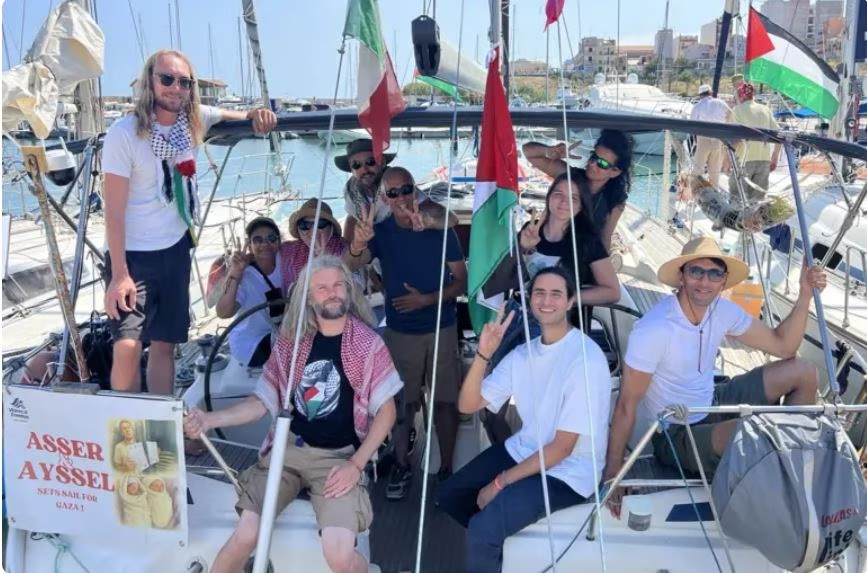
Organizers of the 'Global Freedom Flotilla Initiative' announced today, Friday, that more than 100 international activists have arrived at the Greek island of Crete, following the interception of their ships by Israeli naval forces in international waters. These ships had departed from the Spanish port of Barcelona on April 12, on a humanitarian mission aimed at breaking the siege imposed on the Gaza Strip and delivering relief aid to the besieged population.

Sources reported that a warship belonging to the occupation army transferred 168 participants in the flotilla to Greek boats, which then transported them to the shore, where buses and ambulance teams were waiting for them. This step comes after Israeli authorities confiscated several ships that formed the second convoy as part of the global initiative's efforts, which began several months ago to address the humanitarian crisis in the Strip.

In the context of diplomatic developments, Spanish Foreign Minister, José Manuel Albares Bueno, confirmed the arrival of 30 Spanish citizens in Crete after their release. However, the minister condemned the illegal detention of Spanish citizen Saif Abu Kashk, demanding that Israeli authorities release him immediately and ensure his safety during his forced transfer to Israel.

For its part, the Israeli Foreign Ministry claimed that the detention of Abu Kashk and another activist was due to suspicion of their affiliation with a 'terrorist organization' and engaging in illegal activities. Israeli authorities claimed they would transfer the activists to interrogation centers inside Israel to complete legal procedures against them, which sparked a wave of international human rights criticism.

Organizers of the flotilla revealed through their official channels horrific details about the conditions of the activists' detention on board Israeli warships, describing the treatment as '40 hours of deliberate cruelty.' They explained that the detainees were denied sufficient food and water, and soldiers deliberately flooded the floors where the activists slept repeatedly to increase their suffering.

Reports from the organizers spoke of severe physical injuries among the activists, including broken noses and ribs, as a result of being kicked and violently dragged across the ships' decks. These assaults occurred while participants were attempting to peacefully protest the detention of their colleagues and the restriction of their movement, reflecting the extent of violence used against the humanitarian mission.

On the international level, the foreign ministries of Germany and Italy expressed their grave concern over the recent developments in international waters near Greece. The two ministries issued a joint statement affirming that they are closely monitoring the situation, amidst escalating tensions resulting from the interception of civilian ships carrying essential humanitarian aid for the Gaza Strip.

Despite the Israeli interception of 22 ships, field sources confirmed that 47 other ships are still continuing their voyage off the southern coast of Crete. These ships plan to temporarily dock before continuing their journey towards Gaza, with each ship carrying about a ton of food and urgent medical supplies to support the collapsed health sector.

In a biased stance, the US State Department threatened to impose 'consequences' on entities and individuals supporting the Freedom Flotilla, describing the movement as supportive of Hamas. This threat comes at a time when international warnings of worsening famine in Gaza are increasing, and diplomatic efforts to secure safe and sustainable maritime corridors for aid have failed.

It is worth noting that this is not the first time the Israeli army has targeted the Freedom Flotilla, as it previously stopped a similar convoy last October and arrested hundreds of participants, including Swedish activist Greta Thunberg. These naval attempts continue amidst assurances from relief organizations that land supplies are still completely insufficient to meet the needs of more than two million displaced people living in catastrophic conditions.

The activists endured 40 hours of deliberate cruelty, forced to sleep on waterlogged floors, and some suffered fractures due to physical assault.

PALESTINE

Sat 02 May 2026 9:46 am - Jerusalem Time

31 Activists Injured and Horrific Details of Occupation's Ill-Treatment of Detainees in 'Freedom Flotilla'

Field sources reported that 31 international activists were injured as a result of an aggression carried out by the Israeli navy against the "Global Freedom Flotilla" in international waters in the Mediterranean Sea. The flotilla was en route to the besieged Gaza Strip with the aim of delivering urgent humanitarian aid, before Israeli forces intercepted its path off the Greek island of Crete.

The Israeli Ministry of Foreign Affairs announced the arrest of 175 activists who were on board more than 20 boats that were seized by force in the open sea. The sources explained that the military attack targeted boats carrying solidarity activists of various nationalities, resulting in varying injuries among the participants who tried to resist the boarding operation.

According to a statement issued by the Flotilla's administration, the list of injured included 4 activists from New Zealand and Australia, and 3 from Italy and the United States. Injuries also affected activists from Canada, the Netherlands, Spain, Britain, Colombia, and Germany, in addition to participants from Hungary, Ukraine, France, Poland, and Portugal, reflecting the wide international diversity of the mission.

The statement revealed shocking details regarding the ill-treatment suffered by the detainees on board Israeli navy ships for nearly 40 hours. The activists confirmed that they were deprived of sufficient food and water, and were forced to remain in harsh conditions that included sleeping on floors that the occupation forces deliberately wet with water to increase their suffering.

The boarding operation witnessed excessive use of violence, especially when activists tried to prevent the arrest of activist Saif Abu Kishk, a Palestinian of Spanish nationality, and Brazilian activist Thiago Avila. One participant recounted his testimony, confirming that he was kicked, punched, and dragged on the ground, indicating the possibility of suffering fractures to his nose and ribs as a result of the direct physical assault.

Logistically, the flotilla, which set sail under the name "Spring Mission 2026," included about 345 participants from 39 countries, sailing on board 55 boats from the Italian island of Sicily. Reports indicated that the Israeli army managed to detain 21 boats, while 17 boats succeeded in taking refuge in Greek territorial waters, and 14 other boats are still trying to sail in the area.

In the context of international reactions, the Greek government announced that it did not have the authority to intervene militarily against the attack because it occurred in international waters northwest of Crete. The Greek government spokesman confirmed that Israel did not coordinate or consult Athens before carrying out the operation, which drew widespread criticism from the Greek opposition, which accused the government of silent complicity.

On Friday evening, a private plane arrived at Istanbul Airport carrying 59 activists who were released by the occupation authorities after two days of abuse. This initiative is the second of its kind for the "Global Freedom Flotilla," after a previous attempt in September 2025 also ended with a violent Israeli attack and the arrest of hundreds of international solidarity activists before their deportation.

These developments come at a time when the occupation continues its strict siege on the Gaza Strip since 2007, which has catastrophically worsened during the ongoing war of extermination since October 2023. Israeli military operations have led to the destruction of infrastructure and homes, leaving about 1.5 million Palestinians homeless amidst extremely complex humanitarian and health conditions.

Official statistics indicate that the war of extermination has so far resulted in the martyrdom of more than 72,000 and the injury of more than 172,000 Palestinians. The Freedom Flotilla aims, through these sea voyages, to highlight this suffering and break the imposed siege that prevents the access of essential medical and food supplies to the besieged population.

The organizers of the flotilla affirmed that Israeli violence will not deter international solidarity activists from continuing their efforts to break the siege. They pointed out that targeting activists in international waters is a blatant violation of international law and the law of the sea, calling on the international community to hold the occupation authorities accountable for their repeated aggressions against humanitarian convoys.

In conclusion of their statement, the flotilla organizers stressed the need for immediate intervention to protect the remaining boats still sailing in the area, and to ensure the safety of activists who are still in detention. They called on international human rights organizations to document the testimonies of activists regarding torture and ill-treatment for use in international legal prosecutions against the leaders of the occupation.

"They kicked and punched us, and dragged us on the ground. We even heard gunshots at people as they tried to protect their colleagues from arrest."

PALESTINE

Sat 02 May 2026 9:45 am - Jerusalem Time

President of the Security Council: Chinese Companies in Settlements are 'Private' and We Have Launched an Investigation into Their Activities

China's Ambassador to the United Nations, Fu Cong, who holds the presidency of the UN Security Council for the current month of May, announced that his country is paying close attention to UN reports indicating the presence of Chinese companies operating within illegal Israeli settlements. The Ambassador clarified in a press conference that these companies belong to the private sector and are not government institutions, noting the difficulty of constantly tracking the activities of thousands of private companies, but he confirmed the launch of an official investigation to ascertain the facts.

Fu Cong stressed that the Palestinian issue remains at the core of Middle East crises, expressing Beijing's deep concern over the deteriorating conditions in the Gaza Strip and the West Bank. He pointed out that the continuation of settlement activities erodes the foundations of the two-state solution, placing responsibility on the Security Council to compel all parties, especially Israel, to an immediate ceasefire and to allow unimpeded passage of humanitarian aid.

In the context of the Chinese presidency's work program for the Council, the Ambassador revealed preparations for a high-level open meeting on May 26, which will be chaired by Foreign Minister Wang Yi. The meeting will focus on the necessity of adhering to the rules of international law and activating the UN Charter, in light of what he described as the recent disturbances in the international system and the marginalization of the international organization's role due to increasing divisions.

Regarding the field situation in Gaza, sources reported that the Security Council is awaiting a detailed report on compliance with Resolution No. 2803 of 2026. The Chinese Ambassador affirmed that his country is closely monitoring ongoing violations and calls for the necessity of reviving the political process to ensure regional stability and prevent the collapse of the international system, which relies on collective action and solidarity among member states.

Concerning the Lebanese file, the Ambassador described the situation on the southern border as still volatile and capable of igniting at any moment. He condemned attacks targeting civilians, infrastructure, and international peacekeeping forces, demanding that the Security Council send a firm message supporting Lebanon's sovereignty, independence, and territorial integrity, with the necessity of supporting the Lebanese government's efforts to achieve internal stability.

The Chinese Ambassador touched upon the Syrian crisis, considering that Damascus is going through a sensitive transitional phase that requires international support to achieve national reconciliation and reconstruction. He called on the Security Council to intensify efforts to combat terrorism in Syria and help the state regain its regional role, noting that diplomatic solutions are the only way to end long-standing conflicts in the region.

In a striking statement regarding regional tensions, Fu Cong described what is happening in the Strait of Hormuz as a result of what he called an 'illegal war' waged by the United States and Israel against Iran. He expressed his country's sympathy with Tehran, affirming that the only way out of the crisis lies in reopening the strait for international navigation in conjunction with lifting the blockade imposed on Iranian ports to ensure the flow of global trade.

Regarding the future of the 'UNIFIL' mission in southern Lebanon, the Ambassador explained that studies are currently underway within the UN corridors to explore possible alternatives in the event of the implementation of Resolution 2790, which calls for ending the mission's mandate. He affirmed that China awaits the official proposals to be submitted by the UN Secretary-General before taking a final stance on the continuation of international forces or their replacement with other mechanisms.

The Ambassador also reviewed his country's priorities regarding the African continent, affirming that the files of Sudan, Libya, and the Democratic Republic of Congo will be at the top of the Security Council's agenda during the current month. He indicated that China seeks to strengthen the role of peacekeeping missions in Africa and make practical decisions that contribute to monitoring conflict areas and supporting sustainable development as a tool to prevent the recurrence of armed conflicts.

The Chinese Ambassador concluded his conference by emphasizing Beijing's desire to build stable relations with Washington based on cooperation in addressing thorny international issues. He warned against some great powers tending towards unilateral action, expressing China's readiness to increase its financial contributions to the UN budget to cover any financial deficit that may result from a decline in contributions from other countries, in order to ensure the continuity of the international organization's work.

These are private companies, and not all their activities can be tracked, but we have opened an investigation and will ascertain the facts regarding their relationship with the settlements.

PALESTINE

Sat 02 May 2026 9:45 am - Jerusalem Time

Economist: Gaza Stuck Between Rubble and Political Stagnation Serving Conflict Parties

The "Economist" magazine painted a bleak picture of the current situation in the Gaza Strip, emphasizing that the absence of political progress is exacerbating the suffering of the population to an unprecedented degree. The report indicated that the current state of paralysis seems to suit all parties involved, despite its catastrophic impact on civilians.

Sources stated that rats have become the only creatures moving freely amidst piles of waste and worn-out tents housing hundreds of thousands. In contrast, Israeli authorities prevent the entry of equipment necessary to repair sewage and water networks available in areas they control.

Israel justifies its actions by claiming that materials needed for repairs are "dual-use" items that could be exploited for military purposes, leading to a complete halt in essential services. The Israeli ban included mobile homes, tents, and even rat poison, at a time when the Strip lives without electricity or formal education.

Despite the declaration of a ceasefire as part of US President Donald Trump's plan, Israeli raids have not completely ceased. Medical sources reported the martyrdom of more than 750 people since the truce was announced about seven months ago, emptying the agreement of its humanitarian content.

Trump's 20-point plan had promised immediate relief, including the entry of 600 aid trucks daily and the full opening of crossings. The plan also stipulated the gradual withdrawal of Israeli forces with the arrival of international forces and a Palestinian technocratic committee taking over the administration of the Strip's affairs.

The magazine comments that these provisions remained mere aspirations on paper, while current leaders prefer a state of anticipation that serves their political interests. It seems that the Israeli side is counting on the deterioration of conditions to push residents towards voluntary departure from the devastated Strip.

In contrast, Hamas clings to what remains of its authority in areas whose size is constantly shrinking due to military operations. The movement is raising fuel and basic commodity prices to generate revenue that enables it to pay its employees' salaries amidst resource scarcity.

As for the West Bank, Palestinian Authority President Mahmoud Abbas appears apprehensive about the disintegration of his authority and shows no real desire to engage in Gaza's administration. This coincides with the American administration's preoccupation with other regional issues, reducing pressure on Israel to fulfill its commitments.

The report revealed a strange situation for members of the "National Committee for the Administration of Gaza" who reside in luxury hotels in Cairo without performing any actual duties. These engineers and academics are under strict supervision from Nikolay Mladenov, the High Representative for the Peace Council, who controls their movements.

To date, Israel has only approved a thousand personnel out of 25,000 who are supposed to form the new Palestinian civil police force. The issue of disarming factions remains the major obstacle preventing any progress in the reconstruction process or Israeli withdrawal.

International parties demand that Hamas transform into a civilian political party and hand over its weapons caches and tunnel maps to the new administrative committee. However, the movement sets counter-conditions, including a complete Israeli withdrawal and the integration of its civilian employees into the Strip's new administrative structure.

Estimates indicate that the Al-Qassam Brigades still retain about 20,000 active fighters, which strengthens the movement's position in refusing to surrender weapons. The movement's leaders fear being liquidated by their local adversaries if they abandon their military arsenal.

Internally, Hamas continues to follow the hardline approach established by its late leader Yahya Sinwar, with new appointments based on the principle of continuity rather than reform. Recent municipal elections in Deir al-Balah showed the continued control of figures loyal to the movement despite low turnout.

The report concluded that lessons learned from regional wars confirm that whoever controls the land refuses to relinquish it, no matter the human cost. Consequently, Gaza's residents remain trapped in a cycle of poverty and destruction, while only rats continue to move freely.

Nothing moves freely in Gaza except the rats that multiply amidst piles of garbage and rubble.

PALESTINE

Sat 02 May 2026 9:45 am - Jerusalem Time

Rodents attack displaced people's tents in Gaza: Health crisis escalates amid siege on detergents and pesticides

Displaced persons' camps in the Gaza Strip are suffering from a suffocating health and environmental crisis due to the widespread proliferation of rats and parasites, which now pose a direct threat to the lives of residents. These rodents infiltrate dilapidated tents and destroyed homes, attacking children and the elderly while they sleep, causing direct physical wounds and injuries to their limbs.

This suffering coincides with the displacement of the majority of the Strip's population, who live in harsh conditions on top of rubble or in temporary tents that lack the most basic safety requirements. The accumulation of waste and the collapse of sewage networks have created a fertile environment for the reproduction of these pests, which no longer content themselves with spoiling property but have begun to attack bodies.

In Khan Yunis city, south of the Strip, young Amani Abu Salmi recounted her tragedy after discovering that rodents had torn her wedding clothes and trousseau, which she was preparing for her upcoming wedding. Amani explained that the rats had made large holes in her traditional embroidered dress, turning her feelings of joy into a state of severe oppression and sadness.

For his part, citizen Khalil Al-Mashharawi, residing amidst the rubble of his home in Al-Tuffah neighborhood, reported that his three-year-old child suffered bites on his hand and toes weeks ago. Al-Mashharawi added that he is forced to take turns staying up all night with his wife to protect their children from repeated rat attacks, which traditional traps are ineffective against.

Al-Mashharawi described the rodents' behavior as aggressive, disappearing for short periods before resuming their attack through cracks in the floor and broken walls. He affirmed that families are now living in a state of constant alert, unable to defend themselves in the absence of effective means to combat this invasion that threatens their health and safety.

Mohammed Abu Salmiya, director of Al-Shifa Hospital, warned that the problem is likely to worsen dangerously with the onset of summer and rising temperatures. He pointed out that the Israeli ban on the entry of pest control materials, especially rat poisons, deprives medical teams and municipalities of the necessary confrontation tools.

Occupation authorities justify preventing the entry of these materials by claiming they are 'dual-use,' which hinders any local efforts to control rodent proliferation. In contrast, Israeli military sources claim to facilitate the transfer of limited quantities of traps and chemical materials, which is denied by the deteriorating field reality in shelters.

Hospitals in the Gaza Strip receive daily cases of injuries resulting from rodent bites, most of which are concentrated among the most vulnerable groups such as children and patients. Medical staff expressed their grave concern about the possibility of serious epidemic diseases associated with this phenomenon, including rat-bite fever and leptospirosis.

Serious concerns also arise about the return of historical diseases such as the plague, given the complete collapse of the health and environmental system in the Strip. Medical sources confirm that the continued siege on detergents and insecticides contributes to turning the camps into hotbeds for epidemics that may be difficult to control later.

The fragile ceasefire agreements have not succeeded in improving the living reality of Palestinians, as humanitarian aid remains subject to strict restrictions. Military attacks continue to destroy what remains of the infrastructure, further complicating the environmental crisis and pushing residents towards more despair in the face of epidemics and rodents.

Reports from international relief organizations indicate that the cessation of waste collection operations has led to the accumulation of tons of garbage and stagnant water near tent gatherings. These informal gatherings have become major attractions for rodents, where they find a source of food and an ideal place to reproduce in the accumulated waste, away from any health supervision.

For her part, Reinheld van de Weerd, a representative of the World Health Organization, revealed that approximately 17,000 cases related to rodents and skin infections have been recorded since the beginning of this year. She considered these shocking figures a natural and expected result of living in a completely collapsed environment that lacks the most basic standards of public hygiene and municipal services.

Displaced persons in Gaza face difficult choices between staying in unsafe tents or returning to their destroyed homes, which have become shelters for rats and insects. Families appeal to the international community to intervene immediately to introduce the necessary materials to combat these pests and provide a living environment that preserves human dignity and protects children from diseases.

Amidst this bleak scene, the children of Gaza remain the most prominent victims of a war that is not content with bombing, but pursues them in their sleep through rodents that spread terror and disease. The international response remains below the required level to confront an environmental catastrophe whose effects may extend beyond the borders of the besieged Strip if the situation is not urgently addressed.

All the joy I experienced was lost; it turned into sadness and oppression after rats ruined my trousseau and belongings inside the tent.

OPINIONS

Fri 01 May 2026 8:22 pm - Jerusalem Time

Structural Duality and Mechanisms of Legitimacy Production in the Palestinian Context

Structural duality here refers to the unstable coexistence between the logic of the state, as an institutional-administrative logic seeking to produce legitimacy through legal and representative mechanisms, and the logic of the national liberation movement, as a mobilizational-historical logic deriving its legitimacy from continuous struggle and political symbolism, all within a politically incomplete sovereign structure.

Understanding the faltering democratic rotation and the erosion of popular sovereignty in the Palestinian context is impossible without returning to the foundational structure that emerged with the establishment of the Palestinian National Authority, which from the outset was based on an unresolved functional duality between the logic of the state and the logic of the liberation movement.

On the one hand, the Authority was formed as an administrative-governmental framework supposed to manage public affairs and gradually establish a modern state structure based on institutional stability, continuity of governance, and the reproduction of legitimacy through organized tools, primarily periodic elections and representative institutions. On the other hand, the Palestinian political space remained governed by the logic of a national liberation movement whose historical project was not yet complete, a logic based on continuous mobilization, symbolic leadership, and the continuity of the narrative of struggle as a primary source of legitimacy.

However, this coexistence did not produce functional integration as much as it produced continuous structural tension in the mechanisms of legitimacy production themselves. While administrative structures in modern states tend to reproduce their legitimacy through periodic institutional mechanisms, foremost among them elections, as a means of maintaining stability by renewing popular mandate within clear rules, national liberation movements rely more heavily on historical and symbolic legitimacy derived from the moment of founding and the path of struggle, which makes the issue of leadership rotation more complex, as it is also linked to the leadership's ability to represent political memory and the continuity of the national project.

Within this context, and over time, as the Palestinian National Authority transformed from a transitional framework to a more stable structure, the balance between these two logics was not resolved; instead, a state of continuous structural oscillation between the logic of the state and the logic of liberation was produced.

From here, a more dynamic interpretive approach can be adopted: the development of the Palestinian institutional structure, in parallel with the political settlement process with Israel, especially in the context of the Oslo Accords, contributed to tipping the balance towards the logic of state-building. During this phase, the focus was on building governing institutions, developing administrative apparatuses, and establishing representative mechanisms that were supposed to enhance the logic of constitutional legitimacy and democratic rotation.

However, this tendency was neither linear nor definitive; rather, it remained conditional on the progress of the political process itself. Whenever the settlement path seemed to approach a stable political horizon, the state-building approach and its associated democratic institutions and procedures were strengthened. Conversely, with the faltering or regression of this path, the logic of the liberation movement re-emerged as the dominant interpretive framework, with renewed emphasis on the priority of preserving the national political entity and the increasing role of the Palestine Liberation Organization as the comprehensive political umbrella.

Thus, there was no linear transition from one model to another; instead, a continuous structural oscillation formed, reshaping the tools of legitimacy and their priorities according to the degree of openness or closure of the political horizon.

This structural oscillation partially explains the faltering regularity of elections as a central tool for reproducing legitimacy. With the internal political instability and the multiplicity of decision-making centers, elections in some contexts become a potential factor for reproducing division rather than overcoming it, especially in the absence of a unified institutional consensus.

It also cannot be overlooked that any discussion about elections in the Palestinian context must be understood within its fundamental structural condition, which is the existence of the occupation. Palestinians live within a context where the conditions for full sovereignty are not available, making any electoral process subject to clear field and political constraints, whether in terms of freedom of movement and organization or in terms of the ability to exercise fully independent political action. As the occupation continues to reassert itself on the ground, these constraints become a direct part of the conditions of political action itself.

In this complex structural context, this tension is reflected at the level of Palestinian society itself, which exists in a dual state of political designation: on the one hand, it is governed by the Palestinian National Authority as an administrative-political framework, and on the other hand, it is under occupation as the deepest determinant of its political and social life. Here, popular performance towards the National Authority becomes relatively incomplete, as its attention is not confined to it as the sole reference; rather, a large part of its concerns, worries, and political orientations are directed towards the occupation as the most influential actor in shaping daily reality.

Thus, the absence of elections is not explained by a single factor, but by a complex interaction between: the structural duality between the logic of the state and the logic of liberation, internal instability and the multiplicity of decision-making centers, and the structural constraints resulting from the reality of occupation. The ultimate result remains that political legitimacy in the Palestinian context is not formed as a stable mechanism, but as a continuous arena of tension between multiple levels of action, pressure, and representation.

In this complex structural context, this tension is reflected at the level of the relationship between society and the political system, where criticism is often directed at the Palestinian people for what is perceived as a weakness in controlling the rhythm of the Palestinian National Authority's performance or the limited effectiveness in holding it accountable. However, this criticism, despite its partial validity, overlooks the deeper structural dimension, which is that the political engagement of Palestinian society is not exclusively directed towards the internal sphere, but is largely distributed towards the reality of the occupation as the most influential actor in shaping daily life.

Consequently, a significant part of society's political and social energy is consumed in interacting with the occupation system and its direct repercussions, which relatively limits its full focus on the internal sphere and the mechanisms of accountability for the Authority alone. This makes popular performance towards the Authority complex and incomplete at the same time, not in the sense of absence, but in the sense of the forced multiplicity of areas of political engagement.

From this, it can be said that this model is one of the most complex in contemporary political experiences, as the level of internal authority directly and effectively intertwines with the level of external control, making the relationship between the people and their authority governed by unusual conditions that do not apply to traditional political models of a stable state.

In this sense, the crisis of legitimacy in the Palestinian context cannot be understood as a procedural crisis related only to the absence or faltering of elections, but as a structural crisis related to the nature of the political entity itself, which has not yet stabilized between the model of a modern state and the model of a national liberation movement. This intertwining implies that legitimacy is not produced as a result of stable institutions, but as a continuous process of negotiation between multiple levels of representation: institutional representation, symbolic representation, and coercive representation under the conditions of occupation.

Therefore, the question remains open as to the possibility of producing stable democratic legitimacy in a context where actual centers of sovereignty are multiple, and internal authority intertwines with an active external occupation structure, or whether this type of legitimacy will remain structurally postponed until a radical redefinition of the concept of sovereignty itself in the Palestinian case.

PALESTINE

Fri 01 May 2026 8:22 pm - Jerusalem Time

Bleeding Livelihood: 47 Palestinian Workers Martyred Since Early 2026 and an Unprecedented Unemployment Crisis

Palestinian trade union sources reported the martyrdom of approximately 47 workers since the beginning of 2026, who fell either within the occupied territories of 1948 or near the apartheid wall. Abdul Hakam Al-Shaibani, head of the legal department at the Federation of Palestinian Trade Unions, confirmed that these figures reflect a bloody reality that workers face daily in order to secure a livelihood for their families.

Al-Shaibani explained that the labor sector has been experiencing a real catastrophe since October 7, 2023, with approximately 550,000 workers unable to practice their usual professions. This huge number represents immense pressure that exceeds the capabilities of local institutions and directly affects the livelihood of nearly half of Palestinian society, which relies entirely on the wages of these workers.

In light of these tragic circumstances, the General Federation of Palestinian Trade Unions decided to cancel all celebrations for Labor Day this year, in solidarity with the victims and those affected. Al-Shaibani pointed out that the current reality requires cooperation between the government, the Ministry of Labor, and the private sector to confront the economic and political challenges facing the Palestinian Authority and its partners.

Regarding workers resorting to rough and dangerous routes to reach their workplaces, Al-Shaibani described them as 'death traps' they are forced into to escape extreme poverty. He affirmed that the motives associated with difficult living conditions are the primary driver for this risk, as there is no real alternative that can absorb such large numbers of laborers in the local market.

The trade union official touched upon the employment projects recently proposed by the Ministries of Labor and Local Government, describing them as 'limited and temporary.' He clarified that these initiatives can only accommodate dozens of workers, while the actual need includes hundreds of thousands, necessitating the launch of major productive projects by Palestinian capitalists.

On the level of community initiatives, the 'Repaying the Favor' campaign launched by the private sector to support financially struggling workers stood out. The initiative aims to urge businessmen to forgive workers' debts and calls for the cancellation of arrest warrants related to personal checks and financial liabilities that have accumulated as a result of job losses and the siege imposed on the West Bank.

In a related context, Al-Shaibani criticized the policies of some international institutions, specifically mentioning UNRWA after it dismissed a number of employees in Qalqilya city. He considered that such measures complicate the humanitarian situation further, calling on the International Labor Organization and the International Trade Union Confederation to expose Israeli practices against Palestinian workers.

Al-Shaibani concluded his remarks by pointing to the absence of a social security law, emphasizing that its existence would have provided full protection and a safety net for workers in such crises. He stressed the need for the Board of Directors of the Arab Labor Organization to act internationally to support the Palestinian Employment Fund and provide urgent training programs and economic protection to stop the daily bloodshed.

What drives workers to take death routes other than the tragic economic conditions that exceed the capacity of any official or trade union body to solve individually.

PALESTINE

Fri 01 May 2026 8:21 pm - Jerusalem Time

Greece disclaims responsibility for intervention in Israeli attack on the "Freedom Flotilla"

The Greek government announced on Thursday its disavowal of intervention in the attack carried out by Israeli forces against the ships of the "Global Freedom Flotilla" in international waters. Athens affirmed that it does not have the legal authority to confront this military action, which occurred near the Greek island of Crete.

During a press conference held in the capital, Athens, government spokesman Pavlos Marinakis clarified that Israeli warships were operating in an area northwest of Crete. He pointed out that this area is outside Greece's territorial waters, which limits the ability of national forces to act.

Marinakis revealed that the Israeli side did not conduct any prior consultations with the Greek authorities before commencing the military operation against the activists. He also noted that the flotilla's boats did not report being in any imminent danger before the attack, which he used to justify the lack of immediate intervention.

The government spokesman stressed that the role of the Greek Coast Guard in international waters is strictly limited to search and rescue operations in accordance with international treaties. He explained that maritime navigation laws grant judicial and security jurisdiction to the state whose flag the ship flies, not to neighboring countries.

Official sources reported that diplomatic communication between the foreign ministries of Greece and Israel ultimately led to the withdrawal of Israeli ships from the area. This move came hours after intense tension prevailed in the vital maritime region of southern Europe.

Regarding the details of the field movements, Marinakis stated that the Search and Rescue Coordination Center responded to a distress call from one of the flotilla's ships 60 miles from Crete. A patrol boat was immediately dispatched to the location to assess the situation and provide necessary assistance to the participants.

Despite the arrival of the Greek boats, the leaders of the flotilla's ships informed the authorities via radio communications that they did not currently wish for security escort. The activists confirmed that they were not in a state of danger that warranted Coast Guard intervention, which prompted the Greek side to back down from taking additional measures.

Greek radars detected about 55 boats belonging to the flotilla, which were sailing on Wednesday evening accompanied by four hostile Israeli warships. This naval force was located 50 nautical miles southwest of Cape Tainaron, the southernmost point of mainland Greece.

The government confirmed that three Coast Guard patrol boats were present in the surrounding area to closely monitor developments. These reinforcements aim to ensure readiness to provide humanitarian assistance in the event of a further deterioration of security conditions in open waters.

The official Greek stance sparked a wave of widespread anger and criticism from opposition parties and civil society organizations in the country. Opposition political forces accused the government of being unable to protect territorial sovereignty or of tacit complicity with Israeli violations.

For his part, former Finance Minister Yanis Varoufakis sharply criticized the government, considering its silence on the attack near Greek waters a political blunder. Varoufakis described what happened as reflecting a weakness in Greek sovereign decision-making in the face of external pressures.

The "Spring 2026 Mission" had set sail last Sunday from the Italian island of Sicily, carrying hundreds of activists and humanitarian aid. The flotilla's primary goal is to break the Israeli blockade imposed on the Gaza Strip and deliver essential supplies to the besieged population.

According to field data, the Israeli army detained 21 of the flotilla's boats during the violent attack launched in international waters. Meanwhile, 17 other boats managed to escape and reach Greek territorial waters seeking protection, while 14 boats continue their journey.

It is worth noting that this flotilla includes 345 participants representing 39 countries around the world, including large delegations of Turkish solidarity activists. This attempt is the second of its kind after a similar attack targeted a previous flotilla in October 2025 and led to the arrest of hundreds of activists.

Greece does not have the authority to intervene in international waters except in search and rescue cases, and maritime law grants jurisdiction to the state whose flag the ship flies.

PALESTINE

Fri 01 May 2026 8:21 pm - Jerusalem Time

Warnings of a wide escalation in Al-Aqsa during May: Settlement efforts to legitimize incursions on Fridays

Extremist Temple groups are preparing to carry out a series of widespread incursions into the blessed Al-Aqsa Mosque during the current month of May, coinciding with three major Jewish holidays. These movements come amid strenuous attempts to impose a new reality that transcends usual restrictions, as these organizations seek to compensate for traditional closure days with intensive incursions preceding or overlapping with Fridays.

This month's settlement agenda includes what is called 'Second Passover', 'Jerusalem Day', and 'Shavuot', occasions during which settlers plan to escalate violations. Concerns are particularly prominent about repeated attempts to slaughter animal sacrifices within the mosque's courtyards, a Talmudic ritual through which extremists seek to consecrate the 'spiritual Temple' before the physical one.

In a remarkable development, the settlement movement has moved to the Knesset, where Likud MK 'Amit Halevi' demanded the opening of Al-Aqsa Mosque to intruders on the Friday that coincides with 'Jerusalem Day'. Halevi, in a letter addressed to National Security Minister Itamar Ben-Gvir, considered the closure of the mosque to Jews on this day unacceptable, calling for them to be enabled to perform public Talmudic prayers.

For its part, the extremist organization 'Beyadenu' launched a campaign to collect signatures aimed at legitimizing the mass raising of Israeli flags inside Al-Aqsa Mosque during mid-month celebrations. This petition aims to pressure security and political levels to allow full Israeli sovereign manifestations inside the first Qibla of Muslims, which portends an explosion of the field situation.

Experts in Israeli affairs believe that these demands reflect a desire to abolish what remains of the 'status quo' supervised by the Islamic Endowments. Sources reported that the actual decision-making inside Al-Aqsa is now subject to the assessments of the Israeli police, directly influenced by Ben-Gvir's directives and Temple groups, marginalizing the historical Jordanian role in managing the holy sites.

Researcher Adel Shadid warned that this year's 'Flags March' comes at the peak of profound political and security transformations within Israeli society, where the 'existential threat' is being exploited to promote extremist nationalist ideology. He explained that adherence to Islamic holy sites as Zionist targets has become the primary lever for the current government, making May a real test of sovereignty in Jerusalem.

In a related context, the director of the Jerusalem International Center, Hassan Khater, pointed out that settlers previously succeeded in breaking the rules of incursion during the last ten days of Ramadan. Khater confirmed that the settlement ambition is now directed towards Friday incursions, something that has not happened since 2003, warning that the presence of an extremist figure like Ben-Gvir could facilitate the implementation of this dangerous plan.

Palestinian academic circles consider the insistence on introducing sacrifices, whether live or slaughtered, to represent an advanced stage of the Judaization of Al-Aqsa Mosque. According to academic Abdullah Maarouf, these rituals aim to transform the mosque from a purely Islamic place of worship into a Jewish spiritual center, which requires widespread popular vigilance to confront this challenge.

Reports indicate that Benjamin Netanyahu's government seeks to achieve tangible accomplishments for its right-wing public before any upcoming elections, making the Al-Aqsa file a winning political card in Ben-Gvir's hand. This political impulsiveness ignores repeated security warnings that tampering with Al-Aqsa could lead to the entire region igniting and crossing red lines.

Despite factors that could contribute to containing the escalation, such as security concerns about an explosion of popular anger in Jerusalem, the religious Zionist tendency appears more determined to confront. Israeli security agencies fear that the large numbers of Muslim worshipers on Fridays could lead to bloody clashes if settlers are allowed to infiltrate at the same time.

Internal religious differences in Israel also emerge as a potential restraining factor, as the official rabbinate still prohibits incursions into 'Temple Mount' for religious and Torah reasons. However, the influence of religious nationalist currents now transcends these traditional fatwas, relying on direct political support from ministers in the current government who themselves participate in the incursions.

The success of settlers in smuggling parts of slaughtered sacrifices into the Dome of the Rock courtyard last year represents a dangerous precedent that extremist groups seek to build upon this year. These organizations are working to prepare Israeli public opinion to accept the idea of sacrificing offerings as a natural part of religious practice, amid clear turning a blind eye from law enforcement agencies.

In light of this reality, Jerusalemites find themselves on the front line against attempts at temporal and spatial division that have reached their final stages. Calls are increasing to travel to Al-Aqsa Mosque and intensify vigil there during the announced Jewish holidays, to block the plans of settlement associations that enjoy unprecedented government cover.

In conclusion, the current month of May remains open to all possibilities, as the far-right's desire to impose sovereignty clashes with warnings of a comprehensive security explosion. The international community and the bodies concerned with Hashemite custodianship should act urgently to stop these violations that aim to change the historical and legal identity of the blessed Al-Aqsa Mosque.

The tendency to ignite the situation in Al-Aqsa and the region is currently greater for the religious Zionist government than the containment factors.

OPINIONS

Fri 01 May 2026 6:04 pm - Jerusalem Time

Israel’s Piracy on the High Seas and the Death of International Law

By: Said Arikat

May 1, 2026

News analysis


Washington, D.C- Israel’s interception of the Global Sumud Flotilla in international waters was an act of piracy in every meaningful sense of the word — the armed seizure of civilian vessels on the high seas by a state that increasingly behaves as though international law does not apply to it. Israeli forces stormed aid boats far from their territorial waters, detained unarmed international activists, and forcibly shut down a humanitarian mission carrying assistance to besieged Palestinians in Gaza. This was not maritime security. It was the violent hijacking of civilian ships under the protection of overwhelming military power.


Had Russia, Iran, or China carried out such an operation in the Mediterranean — boarding foreign civilian vessels, abducting activists, and imposing military control over international waters — Western governments would have denounced it instantly as aggression and piracy. But because Israel was responsible, outrage dissolved into evasive legalisms and carefully managed diplomatic silence. The same capitals that endlessly invoke a “rules-based international order” suddenly discovered ambiguity when confronted with Israeli lawlessness.


That silence is not neutrality. It is complicity.


On April 30, Israeli naval forces intercepted 22 of the 58 vessels comprising the Global Sumud Flotilla, a civilian convoy attempting to challenge the siege imposed on Gaza. The flotilla, which departed Barcelona earlier in April, carried humanitarian supplies and hundreds of international activists determined to confront the starvation and isolation imposed on Palestinians trapped inside the enclave. According to organizers, more than 200 activists were detained after Israeli forces seized vessels near Greece’s Peloponnese Peninsula, hundreds of miles from Gaza and nowhere near Israeli territorial waters.


The legal implications are devastating. Under the United Nations Convention on the Law of the Sea, civilian vessels navigating international waters are protected by the principle of freedom of navigation. States do not possess unlimited authority to board, seize, or commandeer foreign ships on the high seas simply because they dislike their political purpose. Yet Israel increasingly acts as though the Mediterranean is an extension of its sovereign territory, policed according to its own unilateral rules and enforced through military intimidation.


This latest operation exposed the sheer extremity of that doctrine. Israel did not intercept armed combatants approaching an active battlefield. It hunted down civilian aid boats near European waters, projecting military force deep into the Mediterranean in order to crush a symbolic humanitarian challenge to its blockade. The message was unmistakable: Israel believes its power grants it the right to operate wherever it wishes, unconstrained by geography, law, or accountability.


Israel insists it was enforcing a lawful naval blockade against Hamas. But that argument has long since collapsed morally and legally. The blockade imposed on Gaza is not a narrowly tailored security measure. It is collective punishment inflicted upon an entire civilian population. International humanitarian law explicitly prohibits collective punishment under the Fourth Geneva Convention. Gaza’s civilians are being deprived of food, medicine, fuel, and freedom of movement not because they committed crimes, but because they exist under Israeli domination.


Years of siege have transformed Gaza into a humanitarian catastrophe engineered through policy. International aid agencies repeatedly warn of starvation, medical collapse, and mass deprivation. Yet instead of allowing humanitarian relief to reach desperate civilians, Israel seizes aid boats and arrests the activists aboard them. A state that obstructs food and medicine from reaching civilians while claiming moral legitimacy is not defending itself. It is institutionalizing cruelty.


Defenders of Israel routinely invoke security concerns to excuse virtually every abuse, no matter how extreme. But security has become the all-purpose justification for permanent siege, military occupation, and now piracy on the high seas. Under this logic, Israel reserves for itself powers no other state would be permitted to exercise. It claims the authority to bomb neighboring countries, assassinate opponents abroad, occupy territory indefinitely, and intercept civilian ships in international waters without consequence.


No legal system can survive such selective application.


The real scandal is not merely Israel’s conduct, but the international system that enables it. Western governments continue supplying diplomatic protection, military assistance, and political cover while pretending to defend international law elsewhere. They sanction rivals for violations far less severe while shielding Israel from accountability at the United Nations and beyond. The result is a grotesque double standard that has shattered the credibility of Western rhetoric on human rights and legality.


The seizure of the Global Sumud Flotilla was therefore more than an attack on humanitarian activists. It was another declaration that Israel considers itself above the law, and that its allies will tolerate almost any violation committed in the name of Israeli security. Every unpunished act reinforces the same dangerous lesson: military power nullifies legal restraint.


If the world accepts the normalization of Israeli piracy in international waters, then the collapse of international law is no longer a future danger. It is a present reality unfolding in plain sight across the Mediterranean Sea.

The broader danger extends far beyond Gaza. When a heavily armed state can seize civilian vessels in international waters, detain foreign nationals, and impose its will through force without consequences, every principle underpinning international order begins to erode. Freedom of navigation becomes conditional. Humanitarian law becomes selective. Accountability becomes nonexistent. Israel’s interception of the flotilla was not an isolated excess but part of a culture of impunity sustained by Western protection and cowardice. The Mediterranean is being transformed into a theater where legality is determined not by law, but by military supremacy.

PALESTINE

Fri 01 May 2026 5:37 pm - Jerusalem Time

Trump Imposes Restrictions on Netanyahu: Israel Faces Strategic Dilemma in Lebanon and Iran

Estimates from observers and security officials in Tel Aviv indicate that Israel is stuck in a complex predicament on the northern front, where Washington is imposing a ceasefire that has practically turned into a war of attrition. This field situation has disrupted Israeli calculations, especially with the failure to neutralize the threat of drones launched by Hezbollah in large numbers.

Media sources quoted a senior security official as saying that US President Donald Trump has begun to put brakes on Prime Minister Benjamin Netanyahu's movements. The security establishment fears that Hezbollah's experience in using drones will spread to resistance factions in Gaza and the West Bank, given their ease of smuggling and high effectiveness in the field.

A state of frustration prevails within Israeli military circles due to the increasing success of explosive drones in inflicting heavy human and material losses. This week alone, these attacks caused the death of three Israelis and injured dozens, revealing wide gaps in current air defense systems.

Security officials describe the current situation as a 'strategic trap' with no immediate way out, as American pressure prevents any broad military initiative. At the same time, military leaders believe that withdrawing from southern Lebanon at this stage would be an explicit admission of defeat to Hezbollah, which the government rejects.

Despite prior warnings, it appears that the Israeli army has not developed effective technical solutions to counter the swarms of drones that constantly penetrate its airspace. Soldiers in the field are currently forced to resort to primitive and improvised means, such as installing iron nets around military sites to prevent suicide drones from crashing into buildings and vehicles.

For their part, military analysts believe that Hezbollah has succeeded in discovering and cleverly exploiting structural weaknesses in Israeli defenses. Military units deployed in southern Lebanon question the utility of their presence given the strict restrictions imposed by the new US administration, which weakens morale and deterrence capability.

Regarding the Iranian file, there appears to be a divergence of views between Netanyahu and Trump on the timing and method of dealing with Tehran. While Netanyahu aspires to a rapid and comprehensive escalation, Trump tends to seek political exits and agreements that ensure calm in the Gulf region without sliding into a wide regional war.

Intelligence reports indicate that Israel is partially excluded from the behind-the-scenes secret negotiations that Washington is conducting with regional and international parties. This ambiguity raises great concern in Tel Aviv, where officials fear the conclusion of understandings that do not meet Israel's minimum security demands related to the Iranian nuclear program.

A third scenario discussed by senior officials in Israel is a return to a state of 'calm for calm' without a formal agreement or military resolution. This option, although considered a 'necessary evil' by some, leaves Israel the opportunity for future military action if Iran continues to develop its strategic capabilities.

In a related context, press sources revealed that the cancellation of Netanyahu's scheduled visit to Washington next week came at the implicit request of the White House. It appears that the Trump administration prefers to manage current crises away from the noise of direct meetings with Netanyahu, to avoid any political complications that his presence in Washington might impose.

The Israeli government is currently trying to limit the ceiling of negotiations with Lebanon to a specific period not exceeding three weeks, as a condition for continued restraint. Israel has informed the American side that it will return to its original military plan and escalate strikes deep into Lebanon if tangible results are not achieved within this deadline.

Domestically, Netanyahu faces increasing political pressure with a decline in his popularity in recent opinion polls, which clearly showed his rivals surpassing him. This decline comes at a sensitive time before the general elections, raising speculation about the possibility of him resorting to escalatory options to escape his political and judicial crises.

Political circles speak of efforts led by Israeli President Isaac Herzog to reach a deal that would end Netanyahu's trial in exchange for his permanent retirement from political life. This initiative aims to end the severe internal division and provide an 'honorable' exit for Netanyahu that guarantees him a general pardon away from the courts.

In conclusion, Israel finds itself in a critical transitional phase characterized by a loss of strategic initiative and dependence on decisions from the White House. With the continued threat of drones and escalating international pressure, the question remains about Netanyahu's ability to maneuver amidst the erosion of his domestic legitimacy and the changing priorities of his biggest ally in Washington.

We are in a strategic trap; we cannot withdraw from southern Lebanon because that would be an admission of loss, and we cannot advance because Trump is holding us back.

OPINIONS

Fri 01 May 2026 5:36 pm - Jerusalem Time

The Hidden Cost of the Iran War: Pentagon Figures Under Scrutiny

Washington – Said Arikat - 5/1/2026

The wide gap between the figures the Pentagon provides to Congress regarding the cost of the war on Iran and actual estimates, which indicate financial and military burdens that may far exceed what the US administration announces to the public, has gradually begun to emerge. While the Pentagon affirmed that the war cost 25 billion dollars, media reports and leaks from within the military establishment suggest that the real figure could approach 50 billion dollars, and perhaps far exceed that with the continuation of military operations and the expansion of destruction at American bases spread across the Middle East.

CNN quoted informed sources as saying that the official estimate provided by the Pentagon to Congress does not include the costs of rehabilitating damaged military bases, nor the replacement of equipment and weapons destroyed during confrontations. According to these sources, including these expenses could raise the total cost to between 40 and 50 billion dollars, meaning that the US military establishment deliberately presented a low initial figure to alleviate political pressure within Congress.

These estimates come at a time when criticism is escalating within the United States regarding the scale of military spending associated with the war, especially with increasing indications that the US administration has not set a clear ceiling for costs or for the duration of military operations.

Earlier, the Pentagon had announced that the first six days of the war alone cost 11.3 billion dollars, but observers have doubted the accuracy of this figure from the beginning, especially since military operations later expanded at a more violent pace, with an increase in airstrikes, the launch of long-range missiles, and the expansion of US military deployment in the Gulf and the region.

"The New York Times" had indicated in an earlier report that the 11.3 billion dollar estimate itself does not include essential costs that preceded the outbreak of the war, such as the movement of aircraft carriers, the deployment of thousands of soldiers, and the deployment of air defense systems and strategic munitions at bases in the region. This means that the US administration may be following an "accounting installment" policy by dividing expenses and concealing large parts of them outside the direct official accounts of the war.

The issue of figures does not seem to be merely a technical dispute over military calculations, but rather reflects a deeper crisis of transparency within the American political establishment. The recent history of American wars, from Iraq to Afghanistan, reveals a recurring pattern of deliberate underestimation of the true cost in the early stages of the war, before military operations turn into a long-term financial drain. In the case of Iran, the US administration seems keen to avoid an early internal shock, especially in light of economic deterioration and rising public debt, which pushes it to present partial and temporary figures instead of revealing the full picture to taxpayers.

During a congressional hearing, the Pentagon implicitly acknowledged that the announced figure was not final when it confirmed that the expected supplementary funding request for the war would be higher than 25 billion dollars. According to American media reports, the Trump administration may request additional funding ranging from 80 to 200 billion dollars to cover military operations and related needs.

At the same time, the Pentagon revealed that the war costs were not included in the annual military budget project for 2027, which already amounts to 1.5 trillion dollars, raising questions about the volume of military expenditures managed outside traditional financial oversight frameworks.

Democratic Representative Ro Khanna (from California) publicly questioned the credibility of the Pentagon's estimates, demanding that US Secretary of War Pete Hegseth reveal the true value of the expected supplementary funding. However, Hegseth evaded providing a clear figure, merely stating that the funding would not be limited to operations against Iran, but would also include the purchase of ammunition and compensating for shortages in US military stockpiles.

This ambiguity has fueled concerns that the war is gradually turning into an open-ended spending project, especially with increasing reports of the depletion of US ammunition and damage to a number of military bases in the region.

The war on Iran also reflects the complex relationship between the military industries and US foreign policy. Every expansion of military operations automatically means additional contracts for major arms companies, larger budgets for the Pentagon, and an increasing demand for ammunition and military technology. For this reason, critics believe that inflated costs are not just a side effect of the war, but part of an economic structure that benefits from the continuation of conflicts. Hence, the conflicting figures about the true cost of the war are also linked to an internal struggle over how to pass military funding without arousing the anger of the economically exhausted American public.

In another part of the hearing, Ro Khanna raised the issue of the US bombing of an elementary school in the city of Minab, southern Iran, which led to the death of 156 people, including 120 children, according to circulating reports. Khanna asked the US Secretary of War about the political and moral cost borne by the American taxpayer as a result of such operations.

However, Hegseth responded that the incident was still "under investigation," despite reports and evidence indicating the use of US Tomahawk missiles in the attack on the school.

This incident has led to an escalation of human rights and humanitarian criticism against the United States, especially with the increasing number of civilian casualties and the widening scope of targeting within Iranian cities.

The Minab school incident reveals another aspect of the war that US administrations often try to marginalize: the human and political cost that is not measured in dollars. When US weapons are used to bomb civilian facilities and kill children, the damage is not limited to the direct victims, but extends to the image of the United States globally, fueling waves of anger and hatred towards its policies. Moreover, the repetition of the phrase "investigation underway" after every massacre is now seen as a political tool to absorb anger, not a real path to accountability, especially in the absence of any actual accountability for past violations in Iraq, Afghanistan, and Gaza.

ISRAELI AFFAIRS

Fri 01 May 2026 5:36 pm - Jerusalem Time

International Analysis: UAE's Withdrawal from 'OPEC' Reflects a Rift in Alliance with Saudi Arabia and a Move Towards Independence

International press reports indicate that the decision by the United Arab Emirates to leave the Organization of the Petroleum Exporting Countries 'OPEC' cannot be read in isolation from the context of increasing tensions with the Kingdom of Saudi Arabia. Sources considered this step to transcend economic dimensions, serving as a clear political message, especially as it coincided with complex regional circumstances and ongoing wars in the region against Iran.

Sources drew attention to the absence of the President, Sheikh Mohammed bin Zayed Al Nahyan, from the recent consultative meeting of GCC leaders held in Jeddah. This absence was not merely a protocolary measure but was considered a strong indicator of cooling relations within the Gulf household, at a time when unity was supposed to be demonstrated to confront current security and economic repercussions.

Analysts believe that the timing of the withdrawal announcement, coinciding with the Jeddah summit, reflects an Emirati desire to distance itself from the traditional alignments that have characterized Gulf politics for decades. Through this step, Abu Dhabi seeks to redefine its position within the regional balance of power, away from the assumed dominance of some major regional powers.

This departure brings to mind the sharp disagreements that erupted between Abu Dhabi and Riyadh at the end of 2025, which were temporarily contained at the time without a radical solution. It appears that the UAE has decided this time to act completely independently, even if it leads to disruptions in the global energy market or an increase in tensions with its neighbors.

For his part, researcher Toby Matthiesen affirmed that this step directly weakens the cohesion of OPEC and reveals that recent military conflicts in the region have deepened divisions instead of unifying positions. He pointed out that the independence of the Emirati decision within the oil organization, of which it has been a member since the 1960s, represents a historical shift in the state's strategy.

In the official context, UAE Energy Minister Suhail Al Mazrouei clarified that the decision to withdraw is a purely sovereign decision and was not subject to consultations with external parties. Despite attempts by some parties to portray the decision as a technical and economic choice, political evidence indicates a desire to free itself from the production restrictions imposed by the organization.

Data indicates that the idea of leaving OPEC has been on the minds of decision-makers in Abu Dhabi for years, due to continuous disagreement over production quotas. The UAE wishes to raise its maximum production capacity to strengthen its international partnerships and increase financial returns, a trend that has accelerated significantly with the outbreak of military confrontations with Iran.

Although the immediate impact of the decision may be limited in the short term due to tensions in the Strait of Hormuz, international powers may exploit this division to push for lower oil prices. This comes at a sensitive time for the US administration, which is trying to balance ending regional conflicts and maintaining stability in energy markets.

The gap in strategies between Riyadh and Abu Dhabi is clearly evident; while Saudi Arabia prefers to maintain high prices to support its development projects, the UAE tends to accelerate the exploitation of its resources before global demand declines. This divergence has led to the erosion of the joint coordination that characterized the oil policy of the two countries for many years.

In conclusion of the situational reading, sources quoted diplomatic advisor Anwar Gargash as saying that previous containment policies are no longer effective in light of current changes. This pushes the UAE to a comprehensive review of its alliances, with a focus on strengthening its relationship with Washington and building new understandings in the region, which Riyadh sees as a departure from the usual logic of regional consensus.

The decision to withdraw was taken sovereignly without consultation with other parties, and it expresses the state's independent economic and political orientations.

PALESTINE

Fri 01 May 2026 5:36 pm - Jerusalem Time

WHO calls on occupation to end restrictions on medical supplies to Gaza

The World Health Organization (WHO) has issued an urgent appeal to lift restrictions on the entry of essential medicines and medical equipment into the Gaza Strip, emphasizing the need for these supplies to flow without any delay. This call comes amid a severe deterioration in the health system, as the international organization seeks to initiate large-scale reconstruction operations for medical services damaged by the blockade and ongoing aggression.

The Director-General of the organization, Tedros Adhanom Ghebreyesus, explained that international efforts recently succeeded in supporting the establishment of a new family health center in the northern areas of the Gaza Strip to compensate for the severe shortage in care. Ghebreyesus pointed out that residents of those areas suffer from extremely limited access to health services, making the presence of such centers an urgent necessity to deliver medical care directly to needy citizens.

The UN official affirmed in his statements that the scale of health needs throughout the Strip far exceeds current available capacities, requiring decisive international intervention. He stressed that the continued bureaucratic obstacles imposed by the occupation on the entry of essential medicines hinder life-saving efforts, calling for the opening of humanitarian corridors and ensuring free access to all areas of Gaza without restrictions.

Through these demands, the World Health Organization seeks to end the suffering of thousands of patients and injured individuals who lack the most basic elements of treatment due to the medical blockade. The organization considers that lifting restrictions is the first and essential step towards restoring the efficiency of hospitals and health centers, and ensuring the provision of curative and preventive services to the population facing harsh health and living conditions.

Health needs across Gaza are immense, and bureaucratic obstacles to essential medicines must be removed.

PALESTINE

Fri 01 May 2026 4:11 pm - Jerusalem Time

Hezbollah's Tactics and Drone Threat Raise Widespread Concern in Israeli Security Establishment

The security agencies in the occupying state have expressed growing concern over the combat methods and field tactics adopted by Lebanese Hezbollah in confronting the invading forces in southern Lebanon. Media sources indicated that the party has notably succeeded in enhancing its drone arsenal, overcoming all obstacles placed to hinder supply and smuggling operations.

Hebrew reports stated that the occupation's attempts to disrupt supply chains faced field failures, including the failure of an assassination attempt targeting an official responsible for importing these drones. Ambiguity surrounds the results of these operations, at a time when the party continues to develop its unmanned aerial capabilities despite restrictions imposed on land and air routes.

Security assessments indicate that smuggling routes through Syrian territory have become more complex, especially after the cessation of direct flights from Iran. Nevertheless, the continuous flow of military technologies suggests the existence of alternative and complex supply networks that Israeli intelligence finds difficult to fully track or permanently cripple.

In a related context, sources revealed the limited nature of interdiction operations carried out by Lebanese authorities, with only one recent shipment containing thousands of explosive drones being seized. This number reflects the enormous scale of activity undertaken by the party to secure its military needs away from the eyes of local and international oversight.

On the ground, suicide drones have caused direct and confirmed casualties among occupation soldiers since the resumption of hostilities on the northern front. These attacks confirm the effectiveness of the party's air weapon and its ability to penetrate Israeli air defense systems and reach sensitive military targets.

The occupation army warned that keeping forces in a static position within the buffer zone in southern Lebanon could turn them into easy prey and a permanent target for attacks. Military commanders demanded that the army be given broad daily freedom of action to change the field reality and prevent the party from regaining the initiative in those areas.

Senior officers in the Israeli General Staff described the current confrontations as an intense guerrilla war, where Hezbollah fighters demonstrate high tactical flexibility. They explained that the party has managed to integrate lessons learned from major international conflicts, such as the Russian-Ukrainian war, and apply them in the rugged environment of southern Lebanon.

Military sources also noted that the party has greatly benefited from the experience of fighting in the Gaza Strip, and has developed sniping methods and anti-tank missile launches. This qualitative development comes with continuous Iranian technical and logistical support, making ground confrontation more costly and complex for the occupation army, which is trying to consolidate its positions.

Currently, Israeli military activity focuses on attempting to remove direct threats and secure forces within limited defensive missions. Field commanders fear that merely playing this role could lead to security gaps that Hezbollah fighters exploit to launch surprise attacks from behind lines or through tunnels.

The buffer zone, extending up to 50 kilometers deep into Lebanese territory, has become a significant logistical and security challenge for the occupation forces. Reserve officers believe that the absence of continuous offensive activity will make this area a strategic burden instead of a security belt protecting northern settlements.

A senior officer affirmed that Israel is paying a heavy price in this confrontation due to the continuous development of the enemy's capabilities and its intensive use of drones and guided missiles. He indicated that the Northern Command and military intelligence are working on alternative plans to deal with worst-case scenarios should the intensity of fighting escalate.

Reports indicate that the Israeli Air Force and the Operations Directorate are preparing for a series of upcoming moves aimed at undermining Hezbollah's infrastructure deep within. These preparations come amid an implicit acknowledgment of the difficulty of eliminating the drone threat, which has become a source of concern for the security and political system in Tel Aviv.

Reliance on Iranian technology and its local development has given Hezbollah a tactical advantage in the ongoing war of attrition, which explains the escalating Israeli concern. Drones are no longer just a reconnaissance weapon but have transformed into a precise offensive tool capable of inflicting human and material losses on advancing forces.

In conclusion, the situation in southern Lebanon remains prone to further escalation amid the insistence of both sides on imposing new field equations. While the occupation attempts to enhance its effectiveness in the buffer zone, Hezbollah continues to prove its ability to adapt to military pressures and continue to deliver qualitative and painful blows.

What we encounter today is a Hezbollah fighting a high-intensity guerrilla war; they have learned from the war between Russia and Ukraine and from the fighting in the Gaza Strip.

ANALYSIS

Fri 01 May 2026 4:11 pm - Jerusalem Time

Between Tehran and Beirut: The Struggle of Financial Flows Imposes New Political Equations

The scene linking the Lebanese and Iranian crises is no longer just a fleeting intersection of political circumstances; it has transformed into a comprehensive model for managing conflicts through economic and financial tools. Current indicators reveal that the confrontation has shifted from the ground to the arena of cash flows, where numbers are used as strategic pressure tools that go beyond the traditional description of crises.

In the Iranian case, the economy, estimated at about $400 billion, faces deep structural pressures resulting from the accumulation of US sanctions imposed since 2018. These sanctions have not only reduced foreign investment but have also restricted Tehran's ability to integrate into the global financial system and hindered the transfer of vital oil revenues.

Despite the Iranian trade balance recording a nominal surplus ranging between $5 and $15 billion, this figure does not translate into tangible monetary stability. The fundamental dilemma lies in the inability to access these revenues immediately or transfer them, creating a gap between the volume of exports and the availability of dollar liquidity in local markets.

This financial strangulation has led to a chronic rise in inflation rates and a sharp deterioration in the value of the local currency, which in turn has eroded the purchasing power of Iranian families. International powers are betting on this internal pressure to create social tremors resulting from the stagflation affecting the state's core.

In Lebanon, the picture appears even bleaker, with GDP contracting by more than 60% since the beginning of the crisis in 2019. The Lebanese pound has lost more than 85% of its value, leaving public finances in a state of near-complete inability to meet the basic needs of citizens.

Recent military operations in southern Lebanon have caused severe damage estimated at tens of billions of dollars, at a time when the state is unable to secure even minimal funding. Israel is pursuing a destructive policy in the south reminiscent of what is happening in the Gaza Strip, exacerbating the displacement crisis and living burdens.

Lebanon differs from Iran in that it does not have room for maneuver or "economic circumvention," as it relies entirely on external flows, aid, and remittances from expatriates. These flows remain conditional on radical structural reforms and the restructuring of the banking sector, which places the country in a state of dependence on international positions.

The paths between Beirut and Tehran intersect at the point of financial strangulation; while Iran has resources it cannot access, Lebanon needs resources it cannot secure. The result in both cases is immense pressure on the national currency and social stability, making political solutions alone insufficient without an economic base.

Reports indicate that the reconstruction of Lebanon requires annual financial flows ranging from $5 to $10 billion for many years. This path requires a clear international political umbrella that ensures the stability of financial channels and the flow of investments away from the equations of direct military conflict.

For Iran, alleviating economic pressures is linked to the extent of its possible reintegration into the global financial system, which depends on political shifts in Washington. The question remains about Tehran's ability to draw a new regional role that allows it to convert its trade surpluses into actual liquidity that supports its ailing economy.

Reliance on an economically "scorched earth" policy aims to bring countries to the point of social explosion from within. Figures show that countries may withstand political and military pressures for a period, but they cannot long endure the erosion of currency and the collapse of living standards.

The paradox is that peoples accustomed to sanctions may develop mechanisms for resilience, but the cost of this resilience increases over time and with the accumulation of structural crises. In the absence of radical solutions, blocked economic channels remain the biggest obstacle to any sustainable stability in the region.

Ultimately, the numbers prove that any political settlement will not last unless it is based on stable financial flows and a balanced currency. Wars may end with ceasefires, but true stability requires opening economic channels and rebuilding trust in the financial and banking system.

The link between the Lebanese and Iranian paths reveals that the key to the solution lies in moving from crisis management to economic construction. Without this, the region will remain hostage to market fluctuations and the pressures of major powers that use money as a weapon no less deadly than missiles.

Politics may create a truce, but only economics creates lasting stability for nations.

OPINIONS

Fri 01 May 2026 4:11 pm - Jerusalem Time

Arabs Between the Constraints of Artificial Maps and the Postponed Nation Project

The loss of the Arabs was not merely the disappearance of a fleeting political idea, but rather the squandering of a comprehensive civilizational project that could have changed their position in world history. The geographical space that united them transformed from a force of political action into mere cultural nostalgia, as a result of adopting artificial borders drawn by major powers in closed rooms, far from the will of the peoples.

The actual dismantling began before the formal independences, as the Arab East was viewed as a space amenable to redesign and international bargaining. The Sykes-Picot Agreement was the foundational wound that not only divided the land but also divided the Arab future by creating separate political entities, each carrying a wary border narrative towards its neighbors.

The nation-state that emerged after colonialism was not a solution; instead, it often turned into a buffer wall preventing genuine interaction between peoples. Rather than being gateways to gradual integration, these states became closed political doctrines that viewed any unity project as a threat to their fragile sovereignty, often derived from external recognition.

Regimes replaced the concept of the nation with narrow citizenship, then reduced citizenship to loyalty to the ruling regime, leading to the decline of politics from the level of a national project to the level of authoritarian survival. This reality made every Arab entity preoccupied with protecting itself from its neighbor more than it was concerned with protecting comprehensive Arab national security.

Reports indicate that Arab fragmentation is no longer solely the product of external intervention, but is now managed by Arab hands seeking to impose their regional influence at the expense of the stability of sister states. In Yemen, Libya, and Sudan, regional roles emerged that supported parallel state formations, contributing to prolonging conflicts and entrenching societal divisions.

In the Sudanese and Yemeni cases, direct accusations were leveled against regional parties for providing military and logistical support to irregular forces, leading to humanitarian catastrophes and the tearing apart of the national fabric. These interventions reflect a vision that prefers security-disciplined or loyal regimes over socially vibrant and democratic states.

The 'Al-Aqsa Flood' war came as the clearest moral and political test, revealing the deep chasm between the pulse of the Arab street and the calculations of official regimes. While the masses moved in anger and solidarity with Gaza, most governments chose the language of cold calculations and avoided internal or international disruption.

Official Arab failure in confronting the aggression on Gaza was not merely a technical incapacity, but evidence of the collapse of the political compass of regimes that now see the Palestinian issue as a burden to be contained. The war exposed the official region's inability to transform its resources and capabilities into a pressure stance that protects fundamental Arab rights.

On the other hand, recent confrontations related to Iran revealed the fragility of the American security umbrella that Arab countries had relied on for decades. It became clear that external protection does not prevent political and economic costs; rather, it often ensures that Arabs are the first line to pay the price of international and regional conflicts.

Total reliance on great powers in shaping national security led to the loss of independent sovereign decision-making in Arab capitals. At the moment of true testing, countries hosting foreign bases discovered that their presence does not necessarily mean security, but can turn into a burden that drains resources without providing real deterrence.

Arab media played a pivotal role in entrenching this division by transforming into a tool for reproducing political borders and falsifying collective consciousness. Instead of building a unifying narrative, some media platforms adopted a discourse that downplayed central issues or adopted the narratives of adversaries, thereby weakening the Arab cultural front.

Arab nationalism failed in its official form because it was used as a cover for despotism and to justify oppression in the name of battle or supreme interest. The result was the loss of public trust in grand slogans after seeing how they were used to postpone democracy and monopolize power by family or military elites.

Despite this bleak reality, the Arab idea remains alive in the popular consciousness that transcends borders in every major crisis affecting Baghdad, Damascus, or Gaza. This innate awareness of a shared destiny is what regimes fear, because it represents the true legitimacy that can build a future project that overcomes the stumbling blocks of the past.

Exiting the dilemma of fragmentation requires moving from the trap of rhetoric to building common institutions based on economic integration and independent security coordination. Salvation will only be achieved by restoring the people's role as the source of legitimacy, and building Arab sovereignty based on cooperation, not on isolation behind maps drawn by the colonizer.

Arabs were not defeated because they lacked the components, but because these components were not translated into a solid political project that transforms language and history into institutional decisions.

OPINIONS

Fri 01 May 2026 4:11 pm - Jerusalem Time

The Iranian-American War Continues Despite the Fragile Truce

Amidst the fragile truce between the United States of America and the Islamic Republic of Iran, and the ambiguous, intermittent, and incomplete negotiations characterized by contradictory statements and extensions without a specified end time, and between the possibility of a third war breaking out between the two parties after the 12-day war and the recent war that America called the (Epic Fury) war, it is worth noting that the dominant feature of this war is the lack of clarity from the Iranian side. President Trump wrote on his 'Truth Social' platform: 'Iran just informed us that they are in a state of collapse. They want us to open the Strait of Hormuz as soon as possible, while they try to understand their leadership situation (and I think they will be able to!).' The demand to reopen the Strait of Hormuz and not continue closing the ports came in parallel with Iran's attempt to settle its leadership's situation and divisions. On the other hand, America is studying Iranian reactions and Trump's declaration of a historic unilateral victory for this war against Iran, without reaching a practical agreement for negotiations. Meanwhile, Trump's statements suggested the possibility of resuming the war again and then returning to the negotiating table.

It is worth mentioning the regional tour of Iranian Foreign Minister Abbas Araqchi, which included a visit to Moscow, carrying files of strategic bilateral cooperation. After his return to Tehran, he is expected to consult with the current leaders of the Iranian regime. The American-Iranian negotiation process is slow, without any meaningful or tangible progress. Moreover, there is difficulty in communicating with the current Supreme Leader Mojtaba Khamenei due to his injury and disappearance from public view. Within this framework, and after the closure of the Strait of Hormuz by the American blockade of Iranian ports, the internal Iranian power struggle is escalating with increasing differences of opinion regarding the sovereign decisions governing the Islamic Republic of Iran. Most likely, there are three forces with different decisions and opinions, consisting of the Revolutionary Guard, the technocratic government, and the Iranian people. Undoubtedly, the goals of these three are different, and no one accepts the decisions of the other. The contradictions have become clear on the ground. Following up on the above, the resignation of Iranian Parliament Speaker Mohammad Bagher Ghalibaf on April 23, who was part of the Iranian negotiating delegation in Islamabad, the main reason for his resignation was that he was ordered to do so and was placed under house arrest. Meanwhile, President Bazkeshian's government and his foreign minister are seeking a solution and an agreement with America. The Revolutionary Guard, despite being exhausted as a result of previous strikes from wars on the military structure's forces, wants to continue and pushes towards war again, threatening with new capabilities in the upcoming war. It is necessary to mention the mysterious explosions inside Iran, the deterioration of the economic situation, and the escalation of internal divisions. In contrast, America is not currently in a hurry to conclude any agreement, while its naval fleet is stationed in the region and is pushing for the presence of the (Ghost Saint) USS Santa Barbara, which is moving to resume the war against Iran again. The time factor at this stage plays a significant role in America's favor and the possibility of an internal Iranian economic explosion under the imposed blockade, and from this perspective, its political and economic isolation from the world, which naturally the Iranian people are not satisfied with in the first place and will cause a crack in the cohesion between the people and the regime, leading to popular protests and demands, especially after it has not been able to export oil, and after 12 days from now, oil storage capacity will reach its peak and it will be forced to stop production. The question remains whether Iran will continue to incur losses or whether it will force the Revolutionary Guard to comply with the agreement and curb its proxies in the Middle East (Yemen, Iraq, and Lebanon) from continuing missile attacks on Israel and Arab and Gulf countries? I must also mention that during the war, the Revolutionary Guard directed more missiles towards the United Arab Emirates, specifically Dubai, than it did towards American bases and Israel, according to statistics. Looking at the Arab countries, it directed missiles towards the Hashemite Kingdom of Jordan. In view of the foregoing, we find that the Bazkeshian government faces difficulty in making a decision and is seeking effective talks and a solution in this war that has not yet ended.

It cannot be denied that the Revolutionary Guard controls 40% of the Iranian economy in the construction, telecommunications, oil production, and banking sectors, not to mention military production forces. Undoubtedly, the Revolutionary Guard is not only a military force but also an economic empire, and its economic principle is 'resistant absorption.' However, the current stage that Iran is going through is described as a test phase under increasing sanctions on the banking sector, the blockade of ports, the closure of the Strait of Hormuz, and the repercussions of the war on the Iranian economy by not being able to export oil to its main ally, China. All these pressures and indicators point to the possibility of internal cracks day by day, and with the emergence of the group that calls for the term (Army and People) that rejects the policy of the Revolutionary Guard and the technocratic government, and the increasing use of this idea and term during this situation and the current divisions after it was demanded for the first time during previous demonstrations, it returns to the first demands of the people after the deterioration of the currency and Iran's inability to export oil and reaching full oil storage capacity. And in order to avoid closing oil wells due to the difficulty of reopening them and resuming oil pumping again, which may take a month at best and may not be restarted at worst, and in line with the foregoing, problems between the people and the ruling powers will worsen and destabilize the silent agreement between them, which is (the economic equation): no freedom of choice, but cheap oil derivatives for the people and state-subsidized bread. With these pressures and the increasing cost of living, the equation will be torn apart, and this is what urges the technocratic government to accelerate American negotiations, and with the tightening of the blockade, which necessarily prolongs the payment of salaries to the Revolutionary Guard. It must be noted that the economic deterioration and taking into account the popular explosion and the return to demonstrations and the exploitation of this situation by the external and internal opposition and supporting the movement to direct the blow towards what they want, it seems that the current regime is cracking externally and internally and the people's insistence on implementing the rule of (the people and the army) and seeking to destabilize the current situation, and in this context and with the possibility of resuming the American war on Iran again in the absence of an agreement in the near future.

External war and internal discontent are two factors that darken the future Iranian scene, and in this vein, it must be taken into account: if the war continues, will Iran resume striking its neighbors in the Gulf and Arab countries, such as the Kurdistan Region of Iraq and the Hashemite Kingdom of Jordan? It is important in this regard that the next battle, if it occurs with the continuation of the economic blockade, will lead to the dissipation of the forces of the Islamic Republic of Iran by supporting its arms and continuing its proxy war in the Middle Eastern countries, especially Iraq, Lebanon, and Yemen, who face multiple forces, the most important of which are the countries that seek to restore their sovereignty over the army and decisive state decisions without any parties supported by Iran that unfortunately plague some Arab Middle Eastern countries.

OPINIONS

Fri 01 May 2026 4:11 pm - Jerusalem Time

As settler violence in the West Bank continues without accountability, Britain must hold itself accountable for the legacy it left behind

The latest report that Israel has not prosecuted perpetrators of killings of Palestinian civilians in the occupied West Bank since the beginning of this decade is a stark indictment of justice, accountability, and the rules-based international order. Just last month, ten Palestinian civilians were killed in the occupied West Bank by Israeli settlers and police forces, including a mother, father, and their two young children, who were shot in the head while returning home from a shopping trip.

However, what this report reveals is not an exceptional incident, but rather the latest manifestation of a familiar and deeply damaging pattern: violence perpetrated against the Palestinian people by an occupying power, followed by silence, delay, and a lack of accountability.

This pattern has a disturbing precedent in Britain's own experience during its occupation of Palestine between 1918 and 1948. During the Arab Revolt between 1936 and 1939, British authorities not only responded to unrest but also established a legal and military framework that legitimized collective punishment, arbitrary detention, and the use of coercive force, while restricting access to courts. Thus, the law was not used to curb violence, but to justify it. The result was a system that allowed for abuses and impunity, much like what we see today.

Darkest Day

One of the clearest and most heinous examples of this is the Bassa massacre in September 1938, where there is strong evidence that the British army committed a massacre against approximately 50 Palestinian Christians and Muslims, in retaliation for a roadside bomb explosion. This incident is one of the most egregious facts uncovered from that period.

Therefore, the "Britain Owes Palestine" campaign comes at a critical time. The campaign, in cooperation with human rights lawyers and historians, submitted a 400-page legal petition to the government documenting alleged unlawful acts and systematic violations during that period.

This petition is not an attempt to exchange historical accusations, but rather a complex legal and moral case that asserts that Britain's conduct in Palestine was itself unlawful, and that the legacy of that conduct continues to contribute to shaping what is described as genocide and other violations of international law ongoing in Gaza and the West Bank today.

The petition explains how Britain occupied Palestine, supported the Balfour Declaration, deprived the Arab Palestinian majority of effective self-governance, and contributed to entrenching a political system in which demographic change and coercive control became normalized.

It then argues that the emergency laws used to suppress the Arab Revolt made violence and collective punishment formally "legal," while simultaneously allowing unlawful coercion to occur without accountability by denying individuals access to courts. The petition describes this as "rule by law" rather than "rule of law," and states that the system was a legal military rule, where military power superseded legal protection and judicial oversight.

This is not merely a historical critique; Britain's methods in Palestine contributed to creating a legacy of violence whose effects were not limited to the Mandate period. The tools of oppression, such as collective punishment, home demolitions, punitive searches, coercive interrogation, and impunity, were made in Britain, left in Palestine, and are still in use today.

Official Apology

Accordingly, the campaign demands more than mere general expressions of concern from the British government. It demands research into unpublished archives, a full public response, recognition of unlawful acts, an official apology in Parliament, and serious consideration of reparations and other forms of accountability. These are not symbolic steps, but the minimum required from a state that claims to uphold international law, transparency, and historical accountability. Britain has long prided itself on being a nation that champions justice, human rights, and fairness, principles that shape our identity today. Therefore, it is time for us to uphold these values, honor our national ideals, and atone for the mistakes of the past, so that we can move forward as a nation with integrity.

I recently joined a cross-party group of 45 MPs and members of the House of Lords and signed an open letter urging the Prime Minister to respond to the petition and issue an official apology acknowledging Britain's historical role. Even six months after its submission, the government has yet to provide a response.

Britain cannot credibly speak about upholding international law in the Middle East while simultaneously refusing to examine its role in shaping the conditions that made such violations possible. If impunity is tolerated in the present, it is because it was normalized in the past. If history is repeating itself in the West Bank, Britain has a duty not only to acknowledge this but to bear its historical responsibility for facilitating it.

The question is not whether Britain bears responsibility for decades of violence in Palestine, but whether it will finally acknowledge it.

OPINIONS

Fri 01 May 2026 4:10 pm - Jerusalem Time

Open Wars and Ceasefire Agreements on Paper..!

No one expected the war on Gaza to open the door to wars in the region and the area to this extent, as it seems that Israel seized the opportunity to open wars on fronts other than the Gaza front, believing that these fronts are interconnected and thus wants to eliminate this interconnectedness, which Palestinian factions before the war called "unity of the arenas," and at the same time, Israel wants to dismantle the military power of these fronts and disarm them. Hamas, Islamic Jihad, and some resistance factions in Gaza believed that this unity could achieve great goals, but it was not in the strategic vision of these movements that wars would continue for years without stopping until the Israelis were convinced that they had completely eliminated what is called the unity of the arenas and ended armament by disarming those factions in Gaza and some battalions that were operating in the West Bank, in addition to Hezbollah's weapons in Lebanon. The war in Gaza was not for revenge against Hamas after the October attack, nor was it a defensive war; rather, it is a strategic war to achieve strategic goals, the most important of which is to dismantle the issues of conflict and eliminate the Palestinian dream of establishing a Palestinian state on the 1967 borders. As long as these goals are not achieved, the Israelis may not close and end this war. I also believe that this applies to Lebanon, Iran, and the Houthis in Yemen. Everything I mentioned is based on the premise that Israel is a war state that seeks to create wars more than it seeks to make comprehensive peace that built the long conflict with the Palestinians. In fact, we noticed that it concludes peace agreements with countries that have no history of tensions or armed conflicts with Israel and leaves countries and regions experiencing border tensions or armed conflicts like Lebanon, Gaza, and the West Bank, not to achieve mutual calm, but rather to escalate fighting with these countries and regions whenever it deems that this might achieve its goals of perpetuating the conflict and not ending it.

"Eyal Zamir," Chief of Staff of the occupation army, said, "We are still in a multi-front battle, and the army is working and will continue to work to establish a new security reality, and the army remains on high alert and vigilance for the return of intense fighting in all sectors, and this may continue until the end of 2026." This indicates that Israel has no plans to close this war in the short term and abandon carrying out attacks under the name of security control and the new security reality. The occupation state believes that the new security reality has now been achieved by force and hegemony over Palestinian resources, not by real peace agreements, and it is skilled at finding pretexts to keep wars open for this purpose, and if it does not find them, we find it creating pretexts and employing them to keep wars open. When Israel launched the war on Gaza nearly thirty months ago, it wanted a war to change the geography and demography, not only in Gaza but in all the territories of 1967. Therefore, it does not want to close it merely by achieving operational goals and eliminating the first and second-tier leaders of Hamas and Islamic Jihad, and at the same time weakening these movements to the extent that they need years to rebuild their military structure, in my estimation. It is noted that this war has taken the form of intense offensive waves, through which it focused on demolishing cities and crushing their civilian infrastructure, and this is what it is doing now in southern Lebanon and is still doing in the yellow line in Gaza despite the ceasefire agreement in Gaza according to President Trump's plan to end the war in Gaza and despite the ceasefire between Israel and Lebanon that the Lebanon-Israel mechanism reached through negotiations between the two parties in Washington. The truth is that this is Israel's methodology in dealing with the fronts in the region, and even Iran, for which a ceasefire was announced between it and America by US President Trump, and mediations are now underway to reach a final agreement that ends the state of war between America and Iran, and of course, Israel remains unrestrained and unwilling to respect any agreement despite the understanding between America and Israel and the request from Israel to respect the agreements concluded by the Trump administration, whether in Gaza, Lebanon, or with Iran. The closest proof of this is the ceasefire agreement in Gaza, which was announced nearly two hundred days ago without Israel committing to stopping it for even one day, and the killing continues outside the yellow line, and we now see this extending to Lebanon, which is negotiating with Israel without committing to a ceasefire.

It is true that the pace of the war in both Gaza and Lebanon has decreased, but it has not stopped, and the war remains open; Israel does not want to end it. The negotiations taking place in Cairo between the representative of the Peace Council in Gaza, High Commissioner Mladenov, are nothing more than negotiations outside the framework of full commitment to a ceasefire, even if the National Committee for the Administration of Gaza takes over from Hamas, Israel will keep its hand free to carry out limited or unlimited military operations in any area it wants in the Strip, even within the areas it has designated as humanitarian areas in Al-Mawasi and displacement camps, and the ceasefire was required to be observed by one party without the other. In Lebanon, too, Israel unleashes its military power in what it calls a yellow line eight to ten kilometers deep from the border into Lebanese territory, where it does not commit to a ceasefire and continues to demolish villages in southern Lebanon and still uses its drone missiles to kill Lebanese whom it claims are members of Lebanese Hezbollah. I consider that all ceasefire agreements reached by mediators between Israel and Gaza on one hand, or between Israel and Lebanon on the other, are nothing more than ceasefire agreements on paper, and unfortunately, the United States knows all the details and constantly receives reports about the daily killing of Palestinian children and civilians in Gaza, the demolition of residential blocks, the destruction of buildings, and the changing reality of the yellow line to seize more land and the continued killing of Lebanese civilians, even reaching the point of killing some UNIFIL forces in southern Lebanon, and Israel may not intend to respect any ceasefire agreement to be a comprehensive stop in all areas of the Strip and all areas of Lebanon.

The question that all observers want to see answered now, for peace and stability to be achieved in the Middle East and the suffering of Palestinians and Lebanese to end, is: How long will Israeli wars remain open in the Middle East, and how long will the ceasefire remain mere words on paper? The truth is that our expectations that these wars would be prolonged were correct, but they will take the form of offensive waves on some areas, one after another, at a lower pace than the major war, and as long as the American approach to this does not change, and as long as the American administration does not resolve and completely end these wars, they will remain open and may not end by the end of 2026, as Israeli military leaders claim. Here we blame America, especially the current Trump administration, and we do not exclude any future administration, whether Democratic or Republican, because it has not reined in the Israeli leader who has come to consider himself a great leader like (Ben-Gurion and Herzl through planning to establish Greater Israel by force, i.e., "Netanyahu") despite all of Israel's human, material, moral, and political losses, which he puts behind him and does not care if Israel becomes a pariah or hated state because of these wars, as much as he cares about achieving his personal and strategic goals.

Israel believes that the strategy of open wars may achieve security control and operational control for it, but in the long run, in my opinion, it may become ineffective, and Israel will be forced to end them sooner or later through agreements, but these agreements may not achieve everything Israel wants. I believe it is now in Israel's interest to end these wars and close them at this stage with real peace agreements that end the long cycles of conflict with Palestinians and non-Palestinians, because keeping them open means they turn into wars of attrition that keep the conflict active, and wars that Israel may often not control. At the same time, keeping these wars open means exhausting Israeli human, material, and economic power, in addition to Israel's political loss in the eyes of global public opinion, which knows and realizes that Israel does not want to achieve comprehensive peace and does not want to provide an opportunity for others to live in peace, and that it has missed many opportunities and unilaterally withdrew from the agreements it signed with the Palestinians in (Oslo) and wants to resolve the conflict according to its perspective through annexation, settlement, dismantling the Palestinian Authority, and handing over the administration of Palestinian areas to local bodies, and at the same time achieving individual peace with regional countries without recognizing the political identity of Palestinians or recognizing their right to self-determination and establishing their state, as if it is turning the conflict back to square zero, and this, of course, does not achieve the security it claims to seek, and thus does not achieve the desired long-term stability that brings peace and prosperity to peoples and enables them to build the future of their citizens while ensuring their progress on all levels.

OPINIONS

Fri 01 May 2026 4:10 pm - Jerusalem Time

From Ben Gvir's Cell to Seattle's Halls: Palestine as a Compass for Global Conscience

The meeting I had via Zoom with a group of our community members and supporters in the American city of Seattle was not just a fleeting solidarity event; rather, it was a manifestation of the great confrontation between the "narrative of truth" and the ideology of monstrous brutality. For me, as a Palestinian who experienced imprisonment with all its brutal details, this meeting was the moment I realized that no matter how high prison walls may be, they cannot conceal the cry and testimony of the victim if it finds its way to human conscience.

The Prison as a Mirror of Fascism and the New Nazism

That day, I spoke about the radical transformation that occurred in Israeli prisons after October 7th—a transformation that was not merely a random retaliatory reaction, but a systematic policy led by Itamar Ben Gvir, the heir of Wilhelm Wagner, the Nazi. In my testimony, I recalled how the practices of Nazi concentration camps, from "Auschwitz" to the horrors of the Inquisition, were revived and mixed with a vengeful mentality aimed at crushing the human spirit. What is happening today in the depths of prisons is a stain of shame that humanity's memory will record, where the jailer surpasses history in inventing methods of torture saturated with ideology, hatred, and extremism.

The Moral Shock When the Historical Victim Apologizes

The biggest surprise came during the discussion session, when Melissa Choudhury, a Democratic congressional candidate of Jewish descent, spoke. Her intervention was not only political but also a moral shock, as she began with an explicit apology for the crimes committed in the name of her former religion, as she had converted to Islam, affirming that my testimony about the prisons brought back to her mind what her grandfather, who was imprisoned in Auschwitz, had told her about the horrors of Nazism.

When she asked me: How can I help you? I found no more eloquent answer than my saying: "Be human, and Palestine will be your compass." This phrase encapsulates the vision of leader Marwan Barghouti, who taught us that the "Holocaust" as a crime against humanity concerns us, as victims of injustice, more than its perpetrators, for the principle is one: killing a human being because of their race or religion is the greatest sin. And the crime committed against Palestinians today is no less painful; in fact, it is more severe because it is a continuous tragedy for a century, under the world's gaze.

The Diaspora: The Parallel Front of the Struggle

The scene in Seattle, where the hall was packed with young people, many of whom had never seen Palestine or mastered its language, carries deep political significance. I felt then that the years of sorrow had not been in vain, and that "cross-border awareness" is the weapon that the occupation fears.

We are facing a national imperative that requires us to re-read the role of communities abroad. The influence these individuals create in American decision-making centers is not a luxury, but a parallel struggle no less important than steadfastness at home. The support Israel enjoys has been built through decades of organized institutional work, and today we must learn the lesson:

1. Investing in people: We must pay extreme attention to diaspora members and international supporters.

2. Division: Palestine is greater than factions and ideologies; therefore, communities must remain immune to internal conflicts.

3. Unified identity: The only definition should be "Palestinian," the only belonging "Palestine," and the compass "justice."

Finally

The Seattle meeting proved that the Palestinian cause is not just a "legacy of memory," but a "cause for the future" led by a young generation crossing cultures and languages. Our success in transforming Palestine into a "standard for global ethics" is the shortest path to breaking chains, whether they are the chains of prison cells or the chains of international political bias.

ARAB AND WORLD

Fri 01 May 2026 4:10 pm - Jerusalem Time

Shocking details about a hidden message from Jeffrey Epstein before his death in prison

The name of the late American businessman Jeffrey Epstein, convicted of widespread sex crimes against minors, has once again returned to the global spotlight. This comes after the revelation of controversial details related to a secret message believed to have been written by him shortly before his mysterious death in custody nearly seven years ago.

The message, which remained hidden for many years, recently appeared in court filings in New York courts without being directly released to the public. This discovery has opened the door wide to new legal and security questions about the circumstances of the death of the billionaire whose case shook the foundations of the political and economic elite in the United States.

According to press reports based on court documents, the person who found this message was Nicholas Tartaglione, Epstein's cellmate at the Metropolitan Correctional Center in Manhattan. The written note was found after a previous incident where Epstein was found unconscious with signs of a failed suicide attempt using a piece of cloth around his neck.

Despite Epstein surviving that first attempt, fate only gave him 18 days, as he was found dead in his cell under circumstances that authorities at the time described as suicide. However, the appearance of this message now re-highlights the egregious security lapses that occurred at the prison before its eventual permanent closure.

The message attributed to Epstein included short phrases characterized by mystery and drama, in which he clearly wrote the sentence 'It's time to say goodbye.' He also added an indignant question directed at an unknown party, saying: 'What do you want me to do, break down and cry?', which reflects a complex psychological state he was experiencing before his death.

In addition to the farewell phrases, Epstein claimed in his message that federal investigators were unable to find any concrete evidence against him during extensive searches and investigations. These claims further complicate the official narrative about the extent of Epstein's cooperation or his feeling of legal defeat before the American judiciary.

For its part, press sources stated that they were unable to directly examine the original message, as it is included in sealed court files. The U.S. Department of Justice also issued a clarification denying that it possessed this message or that its officials were aware of its contents earlier, which adds a new layer of mystery.

The documents indicate that the message was attached to the case file of Tartaglione, a former police officer who was facing separate and serious criminal charges at the time. Tartaglione's lawyers confirmed the authenticity of the message, noting that it represents evidence of Epstein's mental state in his final days inside the controversial prison.

It is worth noting that Nicholas Tartaglione, who claimed to have found the message, was later convicted in 2023 of multiple murders and is currently serving four life sentences. His testimony about the message causes division between those who see it as a missing truth and those who consider it an attempt by him to influence the course of his own cases.

The contradiction in Epstein's own statements further confused investigators. After the July incident preceding his death, he accused his cellmate Tartaglione of attempting to kill him and denied wanting to commit suicide. But he quickly retracted those accusations a week later, confirming that there were no disagreements between them, which raises questions about whether he was subjected to certain pressures.

The revelation of this message at this time fuels a wide wave of conspiracy theories that have not stopped since 2019 about what really happened behind bars. The question remains whether the disregard of this evidence at the time would have changed the course of investigations in one of the most controversial cases in modern American history.

It's time to say goodbye.. What do you want me to do, break down and cry?

ISRAELI AFFAIRS

Fri 01 May 2026 4:10 pm - Jerusalem Time

Israeli Poll: Majority Opposes De-escalation with Iran and Doubts Victory

The results of a recent public opinion poll in the occupying state revealed a growing sense of pessimism regarding current military and political paths. The poll, conducted by the Institute for National Security Studies at Tel Aviv University, indicated that 61% of respondents oppose the recent ceasefire agreement with Iran, reflecting a desire for continued direct confrontation.

The data revealed a sharp decline in the Israeli public's confidence in the effectiveness of attacks directed against Tehran, especially concerning the actual extent of damage inflicted on Iranian capabilities. While the percentage of optimists regarding the weakness of the Iranian regime was 69% at the beginning of the confrontation, this percentage has dropped to only 31% at present.

Regarding field achievements, sources reported that only 37% of Israelis express complete satisfaction with what the army has achieved in recent confrontations. On the political front, the gap appears deeper, as the percentage of those satisfied with the government's diplomatic and political performance did not exceed 23%, which indicates a real crisis of confidence.

A state of anticipation prevails regarding the future of the conflict, as about 73% of survey participants believe that Israel will find itself compelled to launch a new military operation against Iran within one year. Also, 76% of the public believe that the strategic goals set by the government for the war will not be achieved through the anticipated negotiation table.

On the northern front, the Israeli position remains tough, with 69% of respondents expressing support for the continuation of military operations against Hezbollah in Lebanon. This support comes despite significant doubts among 62% of the public about the ability of this campaign to secure the northern borders and provide long-term security stability.

The poll also monitored a deterioration in the general feeling of national security among Israelis, with the percentage of those who describe the security situation as good decreasing from 38% at the beginning of the war to 29% currently. In contrast, the percentage of those who assess the security situation as bad has increased, amid continued rocket barrages and a state of attrition on multiple fronts.

As for the political leadership, the results confirmed the continued low popularity of the ruling coalition, with Benjamin Netanyahu receiving the trust of only 32% of the public. These figures reflect the sharp polarization between the coalition and opposition camps, with a relative consensus on the government's weak performance in managing complex war files.

According to the report, the Israeli public now defines threat priorities differently, with the Lebanese front topping the list of concerns at 84%. Iranian threats came in second place at 82%, placing additional pressure on the military establishment to deal with these files simultaneously.

An analytical reading of the poll results indicates a wide gap between the high expectations set by the leadership at the beginning of the war and the field reality experienced by settlers. This disparity has led to a state of uncertainty regarding the final strategic outcomes of the ongoing conflicts in Gaza, Lebanon, and Iran.

The poll concluded that the general mood in Israel is complex, combining broad support for the military establishment in its field operations with deep skepticism about the political leadership's ability to translate these operations into lasting political gains. Fears of a comprehensive regional war loom on the horizon with increasing conviction of the failure of diplomatic solutions.

76% of Israelis estimate that the war's objectives will not be achieved within the framework of anticipated negotiations, amid a sharp decline in the feeling of national security.