PALESTINE

Sun 03 May 2026 8:59 am - Jerusalem Time

New Israeli Escalation: Zamir Orders Strikes Deep Inside Lebanon to Target Drone Factories

The Israeli occupation army announced a series of wide-ranging airstrikes targeting various areas in southern Lebanon, claiming to have destroyed dozens of Hezbollah sites. According to a military statement, the attacks included the destruction of approximately 70 buildings allegedly used for military purposes, in addition to 50 other infrastructure sites, despite a fragile ceasefire agreement being in effect.

In a significant development, media sources revealed instructions issued by the Chief of Staff of the occupation army, Eyal Zamir, to expand the targeting scope to include deep inside Lebanese territory. These orders come at a time when ceasefire understandings impose restrictions on military operations, limiting confrontations to only southern Lebanese areas.

Zamir's directive focused directly on the necessity of striking Hezbollah's production line of explosive drones, which have become a major security problem for the occupation. Through this strategy, the army seeks to shift the battle from attempting to intercept drones in the air to destroying them at their primary manufacturing and assembly centers.

There is widespread skepticism regarding the accuracy of Israeli intelligence information about the locations of these factories, and whether the previous abstention from striking them was due to technical or political reasons. Sources indicated that Prime Minister Benjamin Netanyahu might override American reservations to carry out qualitative operations deep inside Lebanon to impose a new reality on the ground.

Observers believe that Zamir's moves are primarily aimed at absorbing public anger and sharp criticism directed at the military establishment due to its failure to counter the drone air force. Recent confrontations have demonstrated Hezbollah's ability to penetrate Israeli defense systems and reach sensitive targets with high precision.

Hezbollah had introduced new types of drones into service, including the 'optical drone,' which is difficult to detect by traditional radars. This technological development has increased the complexity of the occupation army's defensive mission, prompting the military leadership to search for alternative offensive solutions deep within Lebanese territory.

Reports indicate that Netanyahu is banking on a margin of maneuver with the American administration, allowing him to target vital facilities under the pretext of 'preemptive defense.' The occupation has previously targeted energy and gas infrastructure in Lebanon, despite previous international promises not to repeat such attacks that affect civilian and vital facilities.

In contrast, Hezbollah continues to carry out qualitative operations using kamikaze drones against gatherings and bases of the occupation forces, achieving direct hits as acknowledged by field commanders. These ongoing operations confirm that the option of escalation deep inside could lead to unexpected reactions, putting the ceasefire agreement on the brink of total collapse.

Zamir's statements fall under an attempt to reassure Israelis that the solution is to target factories, given the inability to intercept drones in the air.

PALESTINE

Sun 03 May 2026 8:59 am - Jerusalem Time

Gaza workers demonstrate in Khan Yunis condemning hunger, unemployment, and demanding an end to the siege

Hundreds of Palestinian workers in the city of Khan Yunis, southern Gaza Strip, marched on Saturday in a large protest that swept through the city's streets. Participants in the event demanded the securing of their basic rights to work, food, and shelter, warning of the continued deterioration of humanitarian and living conditions, which have reached catastrophic levels as a result of the ongoing war.

This march was organized at the call of leftist Palestinian factions, coinciding with the commemoration of International Workers' Day, which falls on May 1st of each year. Demonstrators raised banners condemning international silence regarding the suffering of workers in Gaza, emphasizing that the working class is the most affected by the policies of siege and continuous aggression on the Strip.

Participants, through their chants and slogans, stressed the urgent need for intervention by international and Arab bodies to open closed crossings and ensure the flow of humanitarian aid. They also demanded a complete end to the war and the initiation of reconstruction plans to compensate for the enormous losses incurred by economic and productive facilities.

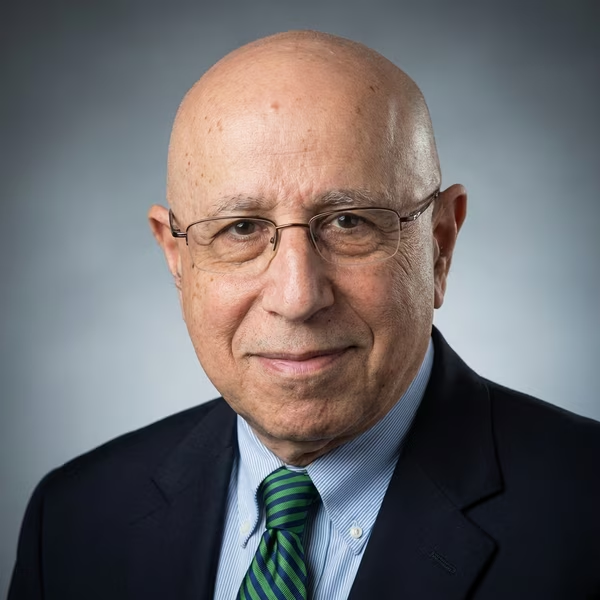
Ashour Banat, a leader in the Palestinian People's Party, affirmed during a speech at the march that Gaza workers today face the triangle of hunger, siege, and deprivation. Banat explained that workers' demands currently focus on stopping the aggression, ensuring fair wages, and providing a safe and healthy working environment that befits the dignity of the Palestinian human being.

For his part, Issam Muammar, a member of the Workers' Union in Khan Yunis, indicated that this event is a clear message to the world about the extent of the tragedy experienced by workers. He explained that the war has caused a near-complete paralysis in the agricultural and industrial sectors, leading to hundreds of thousands of workers losing their only sources of livelihood.

Muammar called on labor unions around the world to show effective solidarity with Palestinian workers and provide urgent material and relief support to their families. He considered that continued silence regarding what is happening in Gaza represents a green light for the continuation of the systematic starvation policy practiced against the population and displaced people in tents.

In a related context, Hani Al-Assar, a member of the Political Bureau of the Palestinian Arab Front, stated that the occupation deliberately destroyed economic infrastructure, including factories and agricultural lands. Al-Assar affirmed that this systematic destruction aims to push the Palestinian economy towards complete collapse and transform society into one entirely dependent on aid.

The latest data issued by the Palestinian Central Bureau of Statistics showed shocking figures regarding the reality of the labor market in the Strip during 2025. The unemployment rate jumped to 68 percent, an unprecedented rate reflecting the scale of the catastrophe that has befallen the Palestinian workforce as a result of ongoing military operations.

Statistics also indicated a sharp decline in the labor force participation rate, which fell from 40 percent before the outbreak of the war to only about 25 percent. This means that about three-quarters of those previously working in the public and private sectors are now out of the labor market or among the unemployed.

These protests coincide with international reports describing the economic situation in the Palestinian territories as the deepest and harshest in their modern history. The United Nations Conference on Trade and Development (UNCTAD) confirmed that the Gaza Strip faces a comprehensive economic collapse that will require many years of recovery if the war stops and the siege is lifted.

Currently, about 1.9 million displaced people live in temporary tents and very harsh living conditions, out of a total population of 2.4 million in the Strip. Despite the ceasefire agreement coming into effect last October, restrictions on crossings still hinder the arrival of basic necessities and fuel.

The suffering of workers continues under a tight siege imposed since 2007, exacerbated by the war of extermination that began in October 2023. This war, according to medical and local sources, has resulted in hundreds of thousands killed and injured, as well as widespread destruction of Palestinian cities and towns in various areas of the Strip.

Gaza workers do not celebrate their international day; instead, they face hunger, siege, and deprivation of the most basic rights amidst an unprecedented economic collapse.

OPINIONS

Sun 03 May 2026 8:10 am - Jerusalem Time

Iran Proposes New Plan to End War… Trump Faces Accusations of Turning Military Superiority into Political Quagmire

Washington – Said Arikat – 3/5/2026

News Analysis

Iran has presented a 14-point response to the American proposal aimed at ending the war that erupted following US and Israeli strikes against it on February 28. This move reflects Tehran's attempt to extract political and strategic gains from a military confrontation that continues to weigh heavily on Gulf security, energy markets, and international navigation.

According to the semi-official Tasnim news agency and official Iranian media, the Iranian plan demands an end to the war and the resolution of all outstanding issues within just thirty days, instead of a two-month truce previously proposed by Washington. Iranian demands also include guarantees against any future military attack, the withdrawal of US forces from Iran's vicinity, the lifting of the naval blockade, the unfreezing of Iranian assets, compensation payments, the lifting of economic sanctions, a halt to fighting in Lebanon, and the establishment of a new mechanism for regulating navigation in the Strait of Hormuz.

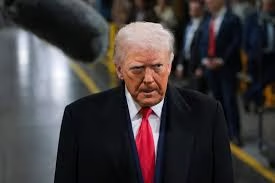
While none of the US media outlets have independently confirmed the authenticity of the points in the Iranian proposal, an Iranian official stated that the document was delivered to Pakistan, without officially disclosing its details. In response, US President Donald Trump announced on Saturday that he is reviewing the new proposal, while the Associated Press quoted him as saying he is "not satisfied" with the Iranian offer so far.

The United States had previously put forward a 15-point framework that included, among other things, the full reopening of the Strait of Hormuz and the complete termination of Iran's nuclear program. Tehran considers these conditions closer to "surrender dictates" than to a negotiated settlement.

Observers believe that the Iranian response reflects an understanding within the Iranian leadership that Washington, despite its military superiority, faces increasing difficulty in translating military pressure into lasting political achievement. After months of military operations, naval blockades, and reciprocal strikes, the region does not appear closer to stability, but rather to a more complex and dangerous phase.

An increasing number of strategic experts in Washington believe that Trump succeeded in achieving a limited tactical victory through the initial military strikes against Iranian infrastructure, but failed to turn that into a sustainable political gain. The blockade imposed on Iranian ports, the disruption of navigation, and the rigidity in negotiation terms have all pushed Tehran towards greater intransigence instead of collapse. According to these experts, the "complete strangulation" policy adopted by the White House has transformed a moment of American military superiority into a state of strategic stalemate, even into something resembling a political defeat that is draining Washington and its allies economically, securely, and diplomatically.

The latest Iranian demands confirm that Tehran seeks to redefine the rules of engagement in the Gulf, not just a temporary ceasefire. The reference to a "new mechanism" for regulating the Strait of Hormuz carries political dimensions that go beyond maritime security, as it practically means Iran's demand for a recognized regional role in managing one of the world's most important oil passages.

The demand to end fighting in Lebanon also reveals the interconnectedness of regional confrontation arenas, amid escalating tensions on the Lebanese-Israeli border and the widening scope of the conflict to more than one front. Analysts believe that Tehran is trying to use its regional influence as part of a comprehensive deal, rather than limiting negotiations to the nuclear file only.

Researchers at American think tanks believe that Trump made a classic strategic error by overusing economic and military force simultaneously. The naval blockade on Iranian ports, instead of pushing Tehran to a quick surrender, gave it an opportunity to portray itself as a "besieged and attacked" country, which helped it mobilize the Iranian interior and gain relative international sympathy, especially in Asia and some countries of the Global South. They emphasize that maximum sanctions and comprehensive blockades rarely produce stable political solutions, but often lead to prolonging the conflict and expanding its cost for everyone.

Meanwhile, the US administration faces a complex equation. Retreating from the blockade policy could be interpreted domestically as weakness, while continuing it threatens further escalation in a region on which global markets depend for energy supplies. These concerns have already been reflected in oil prices and maritime shipping, amid growing anxiety about any long-term disruption to navigation through the Gulf.

Iran's demand for the unfreezing of its assets and the lifting of sanctions also indicates that the economic file has become central to any potential settlement. Tehran understands that easing financial pressures could give it internal breathing room, while Washington fears that this could strengthen Iranian influence regionally.

Critics of Trump's policy say that the US president turned an opportunity to contain the crisis into an open confrontation with no clear horizon. Instead of leveraging American military superiority to impose a quick and balanced settlement, he chose a policy of naval blockade and maximum pressure, which pushed Iran to intransigence and to link any agreement to broad demands that go beyond the nuclear file. They believe that the continued strangulation of Iranian ports and the threat to its oil exports did not lead to the collapse of the Iranian state as some American circles expected, but rather created a regional attrition that harms American interests themselves and weakens Washington's international image as a power capable of managing crises.

In contrast, Trump insists that maximum pressure is necessary to force Iran to make real concessions, considering that any easing of sanctions before achieving Washington's goals would be seen as an Iranian victory. However, this argument faces criticism even within conservative American circles, where some Republicans warn against being drawn into a long and costly war of attrition in the Middle East.

Analysts suggest that the current Iranian response may be an attempt to test Washington's willingness to make actual concessions, especially in light of global economic pressures and increasing international criticism of the continued war and blockade.

According to experts in international relations, the most dangerous outcome of Trump's policy is not just the stalled negotiations, but the entrenchment of a conviction among Washington's adversaries that the United States is capable of starting wars but less capable of ending them politically. The blockade on Iranian ports and the disruption of maritime trade have created widespread global tension, without achieving a decisive negotiating breakthrough. They believe that Iran, through steadfastness and maneuvering, has managed to turn American pressure into an element of exhaustion for Washington itself, making the initial American "tactical victory" now appear closer to a strategic quagmire open to dangerous and uncalculated possibilities.

As the exchange of political and military messages continues, eyes remain on whether Washington and Tehran will succeed in moving from a logic of blockade and deterrence to a logic of settlement, or whether the region is heading towards a more turbulent phase, in which the Strait of Hormuz and other Middle Eastern arenas will be hostages to an open-ended conflict with no clear end.

ARAB AND WORLD

Sun 03 May 2026 8:10 am - Jerusalem Time

Trump Awaits Details of Iranian Proposal and Threatens Military Option

US President Donald Trump confirmed that he had received a briefing on the broad outlines of a potential agreement with the Islamic Republic of Iran, indicating that he is awaiting the precise and final wording of this proposal. Trump's statements came before his departure to Florida, where he clarified that the US administration is carefully studying the ideas presented before making any final decision on them.

In a cautionary tone, Trump did not rule out returning to the military option and targeting Iranian sites again if Washington deemed Tehran to be misbehaving. He added in statements via social media platforms that Iran has not yet paid a sufficiently heavy price for its past actions, reflecting skepticism about accepting the current proposals.

For its part, media sources revealed that Tehran had delivered a comprehensive 14-point proposal to the American side via the Pakistani mediator, in response to a previous American offer. This proposal includes a concrete roadmap aimed at ending ongoing hostilities and has undergone careful reviews within Iranian decision-making institutions before its adoption.

The Iranian provisions include fundamental demands, foremost among them the withdrawal of US forces from areas surrounding Iran and the complete lifting of the economic blockade imposed on it. Tehran also demands the release of all frozen financial assets abroad, financial compensation, and the lifting of sanctions that have burdened the Iranian economy for many years.

On the regional level, the Iranian proposal links ending the war in the region with a cessation of fighting on all active fronts, including the Lebanese arena. The Iranian side also proposes creating a new monitoring mechanism for navigation in the Strait, to ensure the stability of vital waterways and avoid any future military friction in the region.

In return, the Iranian proposal stipulates international guarantees from the United States and Israel not to launch any future attacks against Iranian territory in exchange for fully opening navigation. Tehran considers these guarantees to be the cornerstone of any long-term agreement that ensures mutual security and ends the existing state of tension in the Middle East.

For his part, Iranian Foreign Minister Abbas Araghchi stressed that his country remains open to the diplomatic path, but linked the success of this path to Washington changing its current approach. Araghchi clarified that Tehran is ready for serious negotiations if it perceives a genuine desire from the other side to respect Iranian sovereignty and adhere to international agreements.

Despite these diplomatic moves, the US President insists on his position rejecting Iran's possession of any nuclear weapons, considering this red line non-negotiable. These developments come at a sensitive time, as the international community monitors the extent of the two parties' ability to reach a compromise that spares the region a comprehensive military confrontation that could have catastrophic consequences.

If they misbehave, if they do something bad, we'll see then. But that's a possibility that could happen.

OPINIONS

Sun 03 May 2026 8:09 am - Jerusalem Time

The New School Student Union Freezes Hillel Funding Amid Rising American Anger Over the War on Gaza

Washington Message

Washington – Said Arikat – 5/2/2026

In an unprecedented move within an American university, the Student Union at The New School in New York City voted to place the Hillel student organization branch in a state of “ineligibility,” meaning it will be deprived of funding, logistical support, and joint activities provided by the Student Union. This decision comes amidst accusations related to supporting programs linked to the Israeli army during the ongoing war on the Gaza Strip.

The decision, approved by a majority vote on May 1st, followed a lengthy investigation by the Student Union's compliance committee, which concluded that Hillel had violated university principles that oblige student organizations to respect and adhere to international law.

According to the report on which the vote was based, the Hillel branch at The New School and its affiliated Baruch College branch participated in promoting programs that send students to Israel for volunteer work at military bases and to provide logistical support to the Israeli army. Among these programs are: "Hillel on Peace," "Onward Israel," and "Volunteers for Israel."

The student committee considered these programs to represent direct support for a military institution accused of committing widespread violations against Palestinians in Gaza, at a time when international criticism of the Israeli war and its widespread destruction and significant human casualties is increasing.

The report also pointed to direct financial partnerships worth millions of dollars between “Hillel International” and the Israeli Ministry of Foreign Affairs, which it said were aimed at “promoting pro-war propaganda” within American university campuses.

This decision is a significant development in the context of escalating student protests within American universities against the Israeli war on Gaza, where universities have, in recent months, become arenas of political and moral confrontation between students supporting Palestinian rights and groups supporting Israel.

Hillel International is considered one of the largest Jewish Zionist student networks in the United States and the world, active in hundreds of universities by offering cultural, political, and religious programs for Jewish students. However, the organization has faced increasing criticism for years due to its close ties to official Israeli institutions and its continuous defense of Tel Aviv's policies, including military operations against Palestinians. Student and human rights movements also accuse it of promoting the Israeli narrative within American universities and funding visit programs and activities aimed at strengthening political and moral support for Israel and justifying its aggressive policies against Palestinians historically.

It is worth noting that The New School was founded in 1919 as a progressive academic institution dedicated to freedom of thought and research, and includes several prominent colleges, including "Parsons" School of Design, "Eugene Lang" College of Liberal Arts, the College of Performing Arts, in addition to the College of Social Sciences.

The Student Union's decision comes at a time when the United States is witnessing a remarkable expansion of popular criticism of Israel, especially among youth and students, many of whom believe that the war on Gaza has exposed the limits of traditional American discourse on human rights and democracy.

The widening scope of protests within American universities indicates a profound shift in public sentiment, especially among young people who now view unconditional support for Israel as complicity in violence against Palestinians. After months of images of destruction and killing in Gaza, the official American narrative is no longer able to convince large segments of students and academics. Anger increases when university funds are used to support institutions linked to programs serving the Israeli army. This shift does not reflect fleeting sympathy for Palestinians, but rather a deepening crisis of confidence in political and media elites who have ignored the extent of suffering under decades of continuous military occupation.

Increasing criticism within American circles of Israel is no longer limited to traditional activists or human rights groups, but has extended to students, professors, artists, and even Jewish figures who oppose occupation policies. Many believe that successive American governments have granted Israel political immunity, encouraging it to continue using excessive force against Palestinian civilians in Gaza and the West Bank. A wide segment of Americans also feel resentment at attempts to silence voices critical of Israel through ready-made accusations of antisemitism. Therefore, universities today appear to be an arena of political and moral confrontation reflecting a growing American division over the limits of support provided to Tel Aviv domestically.

Decisions by student bodies in some American universities reflect a growing feeling that pro-Israel institutions ignore human rights principles when it comes to Palestinians. Many students believe that the continuation of the war on Gaza, and the accompanying killing, starvation, and widespread destruction, has exposed the double standards in Western discourse on freedom and democracy. Moreover, American political and media support for Israel has aroused increasing resentment among young people who see their country spending billions on foreign wars while social crises worsen domestically. For this reason, boycott and protest campaigns are expanding within universities as a means of moral and political pressure against the Israeli occupation in the current phase.

Observers believe that the escalating anger within American universities towards Israel reflects a clear generational shift in understanding the Palestinian-Israeli conflict. While previous American generations adopted the Israeli narrative as an almost absolute truth, students today rely on independent media and digital platforms that transmit images of Palestinian victims directly from Gaza and the West Bank. This daily influx of bloody scenes has made many question the unconditional pro-Israel American political discourse. It has also led youth segments to consider the defense of Palestinians a matter of human justice, and not merely a political stance related to the Middle East alone in the United States over the years.

OPINIONS

Sun 03 May 2026 8:03 am - Jerusalem Time

How Trump Turned Strategic Advantage Into Another Iran Failure

By: Said Arikat


May 2, 2026


News analysis


Washington, D.C-Trita Parsi’s latest analysis offers one of the most penetrating critiques yet of Donald Trump’s Iran policy and Washington’s enduring addiction to coercion. Writing in Responsible Statecraft, Parsi, a well known scholar and author, argues that Trump managed, once again, to “snatch defeat from the jaws of victory” by embracing the maximalist fantasies of the Foundation for Defense of Democracies (FDD), the hawkish Washington think tank ( launched by the Israeli army some 25 years ago, and funded by Sheldon and Miriam Adelson),  that has long promoted economic strangulation and military escalation against Tehran. The result, according to Parsi, is a self-inflicted strategic reversal that has weakened Washington’s position, destabilized global markets, and further narrowed the prospects for diplomacy.


Parsi’s central argument is both simple and devastating. Following the recent ceasefire between Iran and the United States, Trump had actually secured an advantageous position. The ceasefire allowed him to exit an increasingly dangerous confrontation without becoming trapped in another costly Middle Eastern war. Iran, meanwhile, lost its principal leverage: the inflationary shock caused by soaring oil prices and instability in the Strait of Hormuz. Tehran still faced crushing sanctions and remained dependent on negotiations with Washington if it hoped to secure meaningful economic relief.


This imbalance favored Trump heavily. The United States had time on its side, while Iran faced mounting economic pressure and diminishing leverage. Oil prices were stabilizing, global markets were calming, and Washington could have approached negotiations from a position of relative strength. In Parsi’s telling, Trump had inadvertently stumbled into a quiet strategic victory.


Yet instead of consolidating that advantage through diplomacy, Trump once again succumbed to the illusion that Iran could be forced into total capitulation through overwhelming pressure. Encouraged by FDD and allied hawks, the administration embraced a blockade strategy designed to choke off Iranian oil exports entirely. Advocates of the policy promised rapid economic collapse inside Iran, insisting that Tehran’s oil revenues would vanish within days and that its storage facilities would soon overflow, forcing the shutdown of oil production itself.


Trump reportedly celebrated the plan as “genius,” believing it would compel Iran to surrender without requiring additional military action. But as Parsi carefully documents, reality has moved in the opposite direction. Satellite imagery continues to show Iranian oil shipments moving through Kharg Island despite the blockade. The predicted collapse never materialized. Instead, the restrictions tightened global supply and pushed oil prices even higher than during the war itself.


The consequences extend far beyond Iran. Rising oil prices threaten inflation, increase domestic political pressure on the White House, and deepen economic uncertainty worldwide. Even more alarming are warnings that disruptions linked to the blockade could trigger fertilizer shortages and broader food insecurity in vulnerable regions. In other words, the policy designed to strengthen American leverage has instead amplified global instability while leaving Iran standing.


Parsi’s broader insight concerns what he describes as Washington’s pathological search for a “silver bullet” against Iran. Across nearly five decades, successive American administrations have convinced themselves that one more escalation, one more sanction regime, one more military threat, or one more covert operation would finally force Tehran into submission. Diplomacy, compromise, and mutual accommodation are repeatedly discarded in favor of fantasies of decisive victory.


Trump’s conduct exemplifies this cycle. First came the belief that military threats alone would intimidate Iran into surrender. When Tehran refused to yield, Washington escalated further through regional deployments and direct confrontation. Then came the fantasy that assassinating Supreme Leader Ali Khamenei would trigger either regime collapse or immediate capitulation. Even large-scale bombardment campaigns against civilian infrastructure failed to produce the promised breakthrough.


Each escalation generated more instability without delivering strategic success. Yet the architects of these policies continue to insist that the next escalation will finally work. Parsi’s critique is particularly powerful because it exposes the intellectual emptiness beneath these recurring schemes. The problem is not simply tactical failure. It is the refusal to accept that Iran cannot be coerced into unconditional surrender without catastrophic regional consequences.


What emerges from Parsi’s analysis is a portrait of a superpower trapped by its own illusions. Rather than recognizing the limits of coercion, Washington repeatedly mistakes resistance for weakness and escalation for strategy. The blockade represents merely the latest iteration of this destructive pattern.


Parsi’s profound assessment cuts through the rhetoric that often dominates Washington’s Iran debate. He demonstrates that the pursuit of domination rather than negotiated coexistence repeatedly transforms limited gains into setbacks. In doing so he offers a reminder that diplomacy remains the only path forward.

ARAB AND WORLD

Sat 02 May 2026 7:31 pm - Jerusalem Time

Trump Rejects Three-Point Iranian Proposal to End Crisis via Pakistani Mediator

US President Donald Trump announced his reservations and dissatisfaction with a new negotiating proposal put forward by Tehran aimed at ending the current state of tension between the two countries. Trump affirmed in his statements that Washington does not intend to retreat or withdraw early from the current confrontation strategy with Iran, emphasizing the need to ensure that the same crises do not re-emerge in the near future.

In a related context, informed sources reported a significant development in the mediation process, as Tehran conveyed new amendments through the Pakistani mediator related to previous negotiating papers. These amendments include an updated vision based on the paper presented by Iranian Foreign Minister Abbas Araghchi during his recent diplomatic tour, in an attempt to formulate understandings acceptable to the American administration.

The available data indicate that the Iranian initiative focuses on three strategic axes, foremost among them being a comprehensive cessation of hostilities in exchange for an American commitment not to launch any future attacks on Iranian territory. This axis aims to establish a state of mutual security stability as a first step to building trust between the two parties, who are experiencing a continuous state of crisis.

As for the second axis, it concerns the reformulation of security and navigation arrangements in the Strait of Hormuz, a file that is highly sensitive for global trade and energy security. The third axis focuses on the Iranian nuclear file, where reports speak of the possibility of an active Russian role in shaping this technical and political path to ensure its outcome in a balanced international format.

Despite these intensive diplomatic moves, indicators from the White House suggest a continued stalemate in the negotiation process. Observers believe that Trump's insistence on formulating a comprehensive agreement that ends all Iranian threats at once makes it difficult to accept fragmented proposals, leaving the door open to all possibilities in the region.

The United States does not want to withdraw early from its confrontation with Iran only for the problem to reappear.

PALESTINE

Sat 02 May 2026 7:30 pm - Jerusalem Time

Appointment of an envoy to the Christian world…a propaganda step and an attempt to beautify the ugly face of the occupation

Hatem Abdel Qader: The Christian world must stand up to its responsibilities in restraining the occupation from harming Islamic and Christian holy sites and change its behavior on the ground

Dimitri Diliani: A propaganda step to mislead public opinion and cover up the occupation's crimes against religions, the latest of which was an Israeli soldier destroying a statue of Christ in Dabel

Nevin Abu Rahmoun: The discourse collapses due to its contradiction with the facts, and any attempt at beautification through symbolic appointments will not change the reality that justice is not managed by diplomacy but measured by actions

Amir Makhoul: The appointed envoy to the Christian world does not represent Christians inside or in Palestine and does not speak on behalf of the church, which has condemned Israeli violations

Antoine Shalhat: A purely Israeli propaganda step to contain the isolation suffered by the occupying state in the Christian world due to multiple backgrounds

Jack Sara: The reality on the ground that the world sees is the decisive factor in changing public opinion, and no matter how many attempts are made, they will not succeed in beautifying the image of the occupation

Exclusive to "Al-Quds"-

In an attempt to improve its image, after many crimes and violations that caused criticism in the Christian world, the latest of which was a soldier destroying a statue of Christ in southern Lebanon, Israel announced the appointment of former ambassador George Deek as a special envoy to the Christian world, with the aim of "strengthening Israel's relations with Christian communities around the world."

Observers and analysts, in interviews with "Al-Quds," view this step as propaganda to mislead global public opinion and an attempt to improve Israel's image, which is increasingly politically isolated, noting that it will not be able to beautify Israel's ugly image, whose ugliness reached a great extent when an Israeli soldier destroyed a statue of Christ in southern Lebanon, in a crime that reflects a violation of religious symbols and a provocation to the feelings of millions of Christians and Muslims.

He considered that as long as violations against holy sites continue and access to Al-Aqsa Mosque and the Church of the Holy Sepulchre is restricted, any discourse about religious openness loses its meaning and becomes merely a political cover, pointing out that the relationship with any religious community is not built through envoys, but through actual respect for worship rights and the preservation of holy sites.

An ironic step

Hatem Abdel Qader, Secretary-General of the Islamic-Christian Commission for the Support of Jerusalem and Holy Sites, describes Israel's appointment of a Christian envoy to the Christian world as an absurd and ironic step that will not be able to beautify Israel's ugly image, whose ugliness reached a great extent when an Israeli soldier destroyed a statue of Christ in southern Lebanon, in a crime that reflects a violation of religious symbols and a provocation to the feelings of millions of Christians and Muslims.

Abdel Qader asks: Can a job title repair an ugly and shameful image of the occupation, shattered by documented criminal acts against Islamic and Christian holy sites and symbols? And does Israel believe that improving its image in the Christian world can be managed through the appointment of an envoy while the occupation persists in its violations against holy sites, imposing arbitrary restrictions that prevent worshipers from reaching their holy places, whether Al-Aqsa Mosque or the Church of the Holy Sepulchre, in addition to assaulting celebrants during Christian holidays, as happened on glorious Easter, and preventing the Patriarch of Jerusalem from entering the Church of the Holy Sepulchre?

The Christian world will not fall for black propaganda

Abdel Qader affirms that the Christian world will not fall for this black propaganda, and Israel will not succeed in deceiving anyone, because the truth has become clear to everyone that behind every envoy is a cover for the truth with a diplomatic cloak that reveals what is beneath it.

Abdel Qader concludes his statement by saying: The Christian world has a duty to stand up to its responsibilities in restraining the occupation from harming Islamic and Christian holy sites, and to send a clear message to the occupation that without a change in behavior on the ground, no envoy can beautify an ugly face.

Misleading international public opinion

Dimitri Diliani, head of the National Christian Gathering in the Holy Land, says: "The announcement by the foreign minister of the Israeli extermination state, Gidon Sa'ar, of the appointment of a so-called 'special envoy to the Christian world' is a propaganda step aimed at misleading international public opinion and covering up the occupation's crimes against religions. The latest of these crimes was an Israeli extermination army soldier destroying a statue of Christ in the Lebanese village of Dabel, and filming and boasting about committing this crime on social media."

Targeting the Palestinian Christian presence

Diliani affirms that the targeting of the Palestinian Christian presence is carried out through policies of uprooting and ethnic cleansing that have targeted all members of our Palestinian people for decades, and that these crimes against humanity are escalating in the context of a colonial reality that is inhumane par excellence.

Diliani reveals that the data available to the National Christian Gathering in the Holy Land records 111 attacks against churches, cemeteries, Christian clergy, nuns, and pilgrims during 2024, including 46 physical assaults and 35 attacks targeting churches, monasteries, and cemeteries. The number of attacks rose to 181 during the past year, including 109 physical assaults committed by settlers against Christian clergy and pilgrims.

He also affirms that the Israeli occupation authorities impose strict restrictions on the practice of religious rituals, especially during Easter at the Church of the Holy Sepulchre, thereby depriving Christian worshipers of their right to worship freely in their holy city, just as their Muslim brethren are deprived.

Diliani adds that the Israeli extermination army bombed the historic Saint Porphyrius Church in Gaza, leading to the martyrdom of 18 citizens, and the Holy Family Church was subjected to repeated Israeli attacks that resulted in martyrs and wounded among the displaced families there, in the context of ongoing hate crimes and genocide that have claimed more than 73,000 martyrs, including approximately 5% of Christians in Gaza over the past two and a half years.

Diliani stresses that Palestinian Christians are an integral part of the national fabric, bearing with the rest of the Palestinian people the responsibility of defending the land and identity, and no colonial propaganda will succeed in obliterating this truth.

It is unacceptable to turn religious and humanitarian issues into tools for polishing an image

Political writer Nevin Abu Rahmoun says: It is unacceptable to turn religious and humanitarian issues into tools for polishing an image.

Abu Rahmoun adds: When violations against holy sites continue and access to Al-Aqsa Mosque and the Church of the Holy Sepulchre is restricted, any discourse about religious openness loses its meaning and becomes merely a political cover.

Abu Rahmoun points out that "this is not a communication crisis with the Christian world but a credibility crisis," stressing that the relationship with any religious community is not built through envoys, but through actual respect for worship rights and the preservation of holy sites.

The issue is what Israel does, not who speaks for it

She says: What is happening on the ground presents a completely opposite picture, affirming that both political and moral stances necessitate rejecting this approach: rejecting the transformation of diplomacy into a mask, and rejecting dealing with violations as if they were a detail that can be overcome by a media campaign, stressing that the issue is not who speaks for Israel but what Israel does on the ground.

Abu Rahmoun says: When facts contradict discourse, discourse collapses, and any attempt to beautify the scene through symbolic appointments will not change one truth: justice is not managed by diplomacy but measured by actions.

The whole matter is largely flimsy

Amir Makhoul, a writer specializing in Israeli affairs, points to a popular proverb that says: "What can a hairdresser do with a sour face?" indicating that the whole matter is largely flimsy, and reflects a propaganda nature more than an expression of the reality on the ground.

Makhoul adds that the violations extend from the destruction of the statue of Christ in Lebanon, to the assault on holy sites in Jerusalem, through the demolition of churches in Gaza, and the assault on the Church of the Holy Sepulchre on glorious Easter, in addition to the assaults on Islamic endowments that seem to be permissible.

A message that the Islamic world is not of interest

Makhoul explains that the implicit message from appointing an envoy to the Christian world suggests that the Islamic world is not of interest, and that its oppression and the obliteration of its features can continue, especially regarding Islamic holy sites, foremost among them the blessed Al-Aqsa Mosque.

He affirms that no matter how much Israel tries to beautify its image, the truth on the ground remains stronger than any promotional campaigns, especially in light of the practices committed by the Israeli government, including the war on Gaza and the accompanying violations.

The Church's positions are clear in rejecting Israeli violations

Makhoul points out that the person appointed as an envoy to the Christian world does not represent Christians inside or in Palestine in general, and does not speak on behalf of the Church, which in turn expressed a clear position weeks ago through statements issued by churches in the region, condemning Israeli practices, including assaults on clergy, restrictions, and ongoing violations.

Makhoul also notes that the Church's positions were also evident through the statements of the Pope of the Vatican, who expressed clear humanitarian positions.

Makhoul affirms that the problem is not in the image that Israel is trying to improve, but in the essence of policies and practices on the ground, pointing to a shift in the army's identity towards religious Zionism, and the ideological dimensions that this entails, which are reflected in the targeting of religious symbols, including Christian ones.

Makhoul concludes by saying: This appointment will not change anything in reality, and he describes it as a formal procedure that will not affect Israel's image, which is shaped by the facts on the ground, stressing that the Palestinian narrative remains the strongest, because it is based on what the world sees as facts, and does not need propaganda campaigns as much as it needs the world to pay attention to these facts.

A predictable and not surprising step

Political writer Antoine Shalhat views the step of appointing G. Deek as Israel's ambassador to the Christian world as a purely Israeli propaganda step to contain the isolation suffered by the occupying state in the Christian world due to several backgrounds, including the war of extermination and comprehensive destruction against Palestinians, especially in the Gaza Strip, Israeli policy against Christian holy sites in the Holy Land, and Jewish religious extremism that affects Christianity and its symbols with repeated touching and assaults.

Writer Shalhat believes that it is a previously expected step and not surprising. But what is unexpected and surprising is that a Christian person from the 1948 Palestinians agrees to perform such a dirty mission, being one of the most prominent victims of criminal and hateful Israeli policy, whether against Palestinians or against Christians, simply because he is Palestinian and Christian.

Condemnation and denunciation

Shalhat adds: Therefore, it is natural that his step arouses a great deal of condemnation and denunciation, as well as wishes that his mission will suffer a dismal failure, in light of the increasing awareness throughout the world regarding the essence of Israeli policy despite all the propaganda efforts made to cover it up or beautify it.

Shalhat points out that despite this, this step reflects the political isolation that Israel has been suffering from recently, which warns that it will turn into a pariah state in the longer term.

Political isolation is increasing

He points out that this political isolation is increasing at the level of relations with states, but it has become exacerbated at the level of global public opinion, and is reflected, according to what is frequently published even in the media and research institute studies in Israel, in several manifestations, most notably the decline in popular support in Europe and America, especially among young people, the expansion of boycott movements, and the escalation of criticism within diaspora Jewish circles.

Shalhat adds: There is a consensus among everyone that the future implication of these developments lies in deepening the gap between the governmental policies of states supporting Israel and public opinion in these states.

Israel's image will remain bleak

For his part, the coordinator of the Holy Land Christian Forum, Wadie Abu Nassar, affirms that this step is in the right direction, but it may be insufficient, stressing the need to complete it with two main things.

Abu Nassar explains that the first is for Israel to reconsider its calculations regarding the violations and crimes it commits, not only against holy sites, but also against innocent people.

He affirms that such measures, even if a large number of envoys are appointed, will not improve Israel's image as long as these practices continue, especially those emanating from some soldiers and settlers.

Abu Nassar adds that the second is the importance for Israel to reconsider its decision-making mechanisms, explaining that it is not enough to appoint an envoy to polish the image, but it is necessary for decision-makers to surround themselves with honest and aware advisors, capable of understanding reality as it is, and contributing to changing it for the better.

Abu Nassar points out that in the absence of these fundamental reviews, any attempts at clarification or beautification will remain limited in effect, and Israel's image will remain bleak, and more importantly, violations will continue.

Abu Nassar concludes his statement by emphasizing the need for a radical change in policies, not just cosmetic adjustments in positions and roles.

An image stained with the blood of innocents

Jack Sara, President of Bethlehem Bible College, affirms that Israel does not lack money, recruits, employees, or envoys to try to beautify its image.

Sara points out that this image has been stained with the blood of the people of Gaza and with many crimes, both those committed against holy sites and against humanity and people on the ground.

He adds that this reality is not new, as much has been heard about initiatives and attempts, both from within and from various parts of the world, to improve its image.

Sara refers to a comment by one of the most prominent supporters, who expressed his anger at what an Israeli soldier did to a statue of Christ in southern Lebanon, saying that they work hundreds of days and spend thousands of dollars to beautify Israel's image, only for one soldier to undermine all those efforts with his actions.

Sara stresses at the end of his speech that no matter how many attempts are made, they will not succeed in beautifying the image, because the world today sees what is happening on the ground.

He says: Christians in this country are not represented only by church institutions or church leaders, despite the importance of their positions and statements, affirming that the reality on the ground has become the decisive factor in shaping public opinion.


PALESTINE

Sat 02 May 2026 7:29 pm - Jerusalem Time

Injuries among Palestinians following settler attacks in Nablus and Hebron

Various areas in the occupied West Bank witnessed a new wave of attacks by extremist settlers on Saturday, resulting in injuries among Palestinian citizens. These attacks focused on the town of Jalud, south of Nablus, as well as the Jabal Jales area in the eastern part of Hebron, leading to seven people sustaining various injuries and bruises.

Regarding the attack on Jalud, local sources reported that a group of settlers attacked the Al-Dhahr area and violently attempted to storm citizens' homes. The town's residents confronted this attempt with their bare chests, leading to clashes that resulted in three citizens being injured. They were immediately transported to a medical center in the neighboring town of Qabalan for necessary treatment.

In Hebron, the attack was characterized by excessive brutality, as armed settlers from the 'Havat Gal' settlement targeted citizens in the Jabal Jales area. The attack was carried out with direct support from occupation soldiers, resulting in four citizens being injured, including two women, amid a state of panic among the families residing in that settlement-targeted area.

Palestinian Red Crescent teams transferred three injured individuals from Hebron to the government hospital, among them the 71-year-old elderly woman 'Umm Hamed Al-Zarou Al-Tamimi'. Medical sources confirmed that the elderly woman was severely beaten by the settlers, necessitating urgent medical intervention to monitor her health condition, which was damaged due to the physical abuse.

Citizen Rashed Al-Zarou Al-Tamimi explained that large numbers of settlers gathered in the Jabal Jales area in a clear attempt to seize citizens' lands and expand the settlement area. He pointed out that these attacks are not isolated but come within a systematic policy aimed at pressuring residents and pushing them towards forced displacement to abandon their lands and properties.

These field developments come amid an escalation in the violence perpetrated by settlers in various governorates of the West Bank, with the protection and facilitation of the occupation army. Residents in threatened areas are appealing for urgent international protection to stop these crimes that target the Palestinian presence and work to change the demographic and geographical reality in the region.

Residents are subjected to continuous abuse aimed at forcibly displacing them for the benefit of settlement expansion in the Jabal Jales area.

PALESTINE

Sat 02 May 2026 7:29 pm - Jerusalem Time

Hamas Nears Selection of Political Bureau Head: Competition Narrows Between Haniyeh and Meshaal

Informed sources have reported that the Islamic Resistance Movement, Hamas, is on the verge of finalizing the selection for the head of its political bureau, following intensive consultations held recently. Current indications suggest that the competition has primarily narrowed down between Political Bureau member Khalil al-Hayya and the movement's leader abroad, Khaled Meshaal, with an official announcement expected in the coming days.

The sources confirmed that the Gaza Strip region has already completed its internal voting process to elect the head of the Political Bureau, which constitutes a fundamental pillar of the movement's electoral process. This step comes as part of Hamas's efforts to organize its internal affairs and overcome the leadership challenges imposed by the complex field and political circumstances in the current phase.

Concurrently, logistical and organizational arrangements are underway to complete the voting processes in the West Bank and diaspora regions, ensuring the participation of all organizational bases in decision-making. This accelerated electoral movement aims to conclude the leadership file in the shortest possible time, thereby ensuring the stability of the movement's administrative and political structure in anticipation of upcoming challenges.

In the context of internal arrangements to ensure a smooth transition of power, sources revealed that the Gaza region has also decided on the identity of who will succeed Khalil al-Hayya as the movement's head in the Strip, should he win the top position. This proactive step reflects the movement's desire to maintain the cohesion of its organizational frameworks and avoid any leadership vacuum that could affect operations in different regions.

It is worth noting that Hamas has been managed over the past year and a half by an interim leadership council, which undertook caretaker duties due to the difficulty of holding comprehensive elections under the current security conditions. The decision to activate the electoral path at the beginning of this year came as an urgent necessity to inject new blood into the senior leadership and establish organizational legitimacy for the next phase.

The current term of the Political Bureau was supposed to end in 2025, but the movement's institutions decided to extend the term for an additional year to ensure the completion of all technical arrangements. These moves are part of a broader vision aimed at completing the formation of the Political Bureau with all its members, in preparation for holding comprehensive general elections that may take place at the end of this year or early next year.

Political circles are awaiting the results of this competition between al-Hayya and Meshaal, given its implications for the movement's political and field orientations in the coming period. While al-Hayya represents significant weight internally and in the Gaza Strip, Meshaal possesses extensive diplomatic experience and broad regional relations, making the identity of the winner a focal point for observers of Palestinian and international affairs.

The Gaza Strip region has already completed the voting process to elect the head of the Political Bureau, a significant step forward in the movement's internal electoral path.

ANALYSIS

Sat 02 May 2026 7:29 pm - Jerusalem Time

Guardianship of the Islamic Jurist in the Balance: Roots of Ideology and Scenarios of an Unknown Fate

Recently, questions have been escalating regarding the future of the power hierarchy in Iran, especially with recurring reports about the health status of Supreme Leader Mojtaba Khamenei. These questions go beyond the personal dimension to touch upon the essence of the 'Leader of the Revolution' position and its pivotal role in formulating the country's supreme strategies, at a time when Tehran faces increasing international pressure.

The position of Supreme Leader is not merely a transient political function; rather, it is an entity formulated according to complex religious requirements consistent with the doctrine of the awaited Mahdi in Twelver Shiite thought. Although this position represents the highest authority in the country, the structure of the Iranian system is characterized by institutional entanglement that may absorb the shock of the absence of any personality, no matter how significant.

Historically, the problem of governance among Shiites began with the 'Major Occultation' in 941 AD, which created a vacuum in political and religious leadership. Initially, the idea of deputyship was confined to minor religious and social affairs, while major powers and the establishment of the state remained exclusive to the awaited Imam according to the traditional perspective.

The Safavid era witnessed a fundamental shift, as jurists began to lean towards accepting the legitimacy of the existing authority as a fait accompli to serve the community. The scholar Sabzevari in the 17th century represented this trend, emphasizing the legitimacy of political authority for non-Imams, which marked the beginning of a separation between temporal and religious authorities.

The theory of general deputyship developed in the 16th century by the Second Investigator, who granted authorization to rule in the name of the 'Deputy of the Imam'. By the early 19th century, jurists such as Ahmad al-Naraqi called for jurists to take direct control of affairs under the title of 'Grand Imamate', rejecting the idea of passive waiting.

In contrast, early 20th-century Iran witnessed the 'Constitutional Revolution' which called for an end to royal despotism and the establishment of the rule of law. This revolution represented a break with traditional Imamate thought, advocating for the necessity of a constitution to govern the relationship between ruler and ruled, away from absolute divine authorization.

Ayatollah Mohammad Hussein Na'ini emerged as one of the most important theorists of the constitutional state, considering that authority should be a trust in the hands of the people and not an individual possession. Na'ini warned that the absence of 'infallibility' from the jurist makes the concentration of power in his hands a gateway to injustice, suggesting that the constitution should be the alternative to the infallibility of the absent Imam.

Despite these liberal ideas, the current of absolute Guardianship of the Islamic Jurist re-emerged in the 1960s led by Khomeini, who argued that the jurist possesses all the powers of the infallible Imam. With the success of the revolution in 1979, this theory was constitutionally codified, making the final say in state affairs in the hands of the Supreme Leader.

The Iranian system created a unique blend that combines absolute guardianship with democratic mechanisms such as the election of parliament and the president. However, these institutions ultimately remain subject to the supervision of the Leader and the Assembly of Experts, ensuring that strategic decisions remain within the narrow religious circle.

This model has faced severe challenges in recent decades, manifested in waves of widespread popular protests that shook the foundations of the regime. Despite the severe repression these movements faced in 2009 and 2022, the roots of popular discontent remained dormant, awaiting the moment of explosion.

Current political readings indicate that Iran is experiencing a state of suppressed tension due to the decline of its regional influence and the economic consequences of wars. Observers believe that the end of current military crises may open the door to a popular explosion that will not be limited to livelihood demands, but will call for a radical change in the structure of the regime.

Historical experiences confirm that military defeats or existential crises often lead to the collapse of major ideological narratives. In the Iranian case, the erosion of the legitimacy of 'Guardianship of the Islamic Jurist' in the face of a young generation aspiring to citizenship and law may accelerate the end of this unique model of governance.

The conflict between the constitutional state and religious guardianship still exists in the Iranian political consciousness, a conflict fueled by successive crises. With the increasing gap between the aspirations of the people and the rigidity of the ruling establishment, it seems that the system is approaching a historical crossroads that will determine the country's fate for decades to come.

In conclusion, the Guardianship of the Islamic Jurist remains a controversial political experiment, combining religious sanctity and political pragmatism at the same time. While the ruling elites try to preserve their gains, the question remains about the ability of this system to withstand the winds of change sweeping the region and within Iran.

The reduction of power to the person of the Guardian Jurist may lead to injustice instead of justice, which prompted historical thinkers to demand the guardianship of the nation over itself.

PALESTINE

Sat 02 May 2026 7:29 pm - Jerusalem Time

Madrid and Brasilia Condemn Israel's Detention of 'Freedom Flotilla' Activists and Demand Immediate Release

The Spanish government strongly condemned the Israeli authorities' detention of Spanish-Palestinian activist Saif Abu Kashk, describing the action as illegal and a blatant disregard for international norms. Spanish Foreign Minister José Manuel Albares affirmed that this detention occurred in international waters, placing it outside any legal jurisdiction that would grant Israel the right to intercept ships or arrest those on board.

In press statements, Albares demanded the immediate release of Abu Kashk to ensure his safe return to Spain, emphasizing that his country would not tolerate any negligence in following up on the case of its forcibly detained citizens. These demands come at a time when diplomatic relations are experiencing escalating tension following the interception of the 'Global Freedom Flotilla,' which was en route to break the siege on the Gaza Strip.

For its part, the Israeli Ministry of Foreign Affairs confirmed the transfer of two activists from the flotilla to interrogation centers inside Israel: Saif Abu Kashk and Brazilian Thiago Avila. Israeli sources claimed that Abu Kashk is a prominent leader in the Palestinian Conference for Palestinians Abroad, while Avila was accused of engaging in activities that Tel Aviv describes as illegal and supportive of hostile organizations.

In a strongly worded joint statement, the Spanish and Brazilian governments described this Israeli action as a flagrant violation of international law that warrants accountability before competent international courts. The statement indicated that intercepting ships in the open sea, far from Israeli coasts, represents a dangerous precedent in infringing upon the freedom of international navigation and the rights of peaceful activists.

Last Thursday, the Israeli army intercepted the 'Freedom Flotilla' off the coast of the Greek island of Crete, an area hundreds of kilometers from the Gaza Strip. The operation resulted in the arrest of approximately 175 activists who were on board twenty boats, before an agreement was reached to release most of them in Greece, with the exception of the Spanish and Brazilian activists who were forcibly deported to Israel.

The organizers of the Freedom Flotilla aim through these voyages to highlight the escalating humanitarian suffering in the Gaza Strip and demand an end to the siege that has been ongoing for years. The organizations behind the flotilla affirm that the humanitarian aid entering the Strip remains below the minimum required to meet the needs of more than two million people living in catastrophic conditions.

Field reports indicate that the majority of the Strip's residents suffer from repeated displacement and live in temporary tents or on the ruins of their destroyed homes as a result of ongoing military operations. Despite previous understandings to increase the flow of aid, strict Israeli restrictions continue to impede the arrival of essential medical and food supplies, prompting international activists to organize such flotillas.

It is worth noting that this is not the first time the Israeli army has intercepted maritime attempts to break the siege; last October witnessed a similar incident during which hundreds of participants were arrested, including Swedish activist Greta Thunberg. These maritime confrontations continue in the absence of a comprehensive political solution that guarantees the lifting of the siege and the securing of permanent and stable humanitarian corridors for the residents of the besieged Gaza Strip.

We are facing an illegal detention in international waters, outside the jurisdiction of any Israeli authorities, and Saif Abu Kashk must be released immediately.

PALESTINE

Sat 02 May 2026 7:29 pm - Jerusalem Time

Occupation transfers international activists from 'Freedom Flotilla' for interrogation after their ship was intercepted

The Israeli occupation's Ministry of Foreign Affairs announced today, Saturday, the transfer of activists from the 'Global Freedom Flotilla,' dedicated to breaking the siege on the Gaza Strip, to interrogation centers within the occupied territories. This step came after the occupation army carried out a military interception operation against the flotilla's ship last Thursday while it was sailing off the Greek coast. Occupation authorities claim that the detainees will be investigated for links to banned organizations and activities they describe as illegal.

Sources revealed that the detained activists are the Spaniard Saif Abu Kashk, whom Tel Aviv accuses of leading the 'Palestinian Conference for Palestinians Abroad,' and the Brazilian activist Thiago Avila. They have been referred to law enforcement authorities to complete security investigations, amidst ongoing Israeli efforts to prevent any maritime aid convoys from reaching the residents of the Gaza Strip, who are suffering from a severe blockade.

Field reports indicate that the Freedom Flotilla was subjected to a violent assault in international waters in the Mediterranean Sea, where occupation forces used seven warships and drones to take control of the convoys. The attack resulted in injuries to about 31 activists, after occupation forces cut off all internet and communication services to the ships before suddenly storming them 1500 kilometers from the coast.

According to activists' testimonies, the occupation detained between 180 and 211 international solidarity activists on board a war destroyer, part of which was converted into a 'floating prison' for three days. Those released described the conditions inside the destroyer as inhumane, where they were subjected to beatings, sleep deprivation, and continuous abuse, before 59 of them were deported to Istanbul Airport and another group to the Greek island of Crete, with the Spanish and Brazilian activists remaining in detention.

It is worth noting that the Global Freedom Flotilla includes more than 20 boats loaded with essential medical and food aid, and is completely devoid of any weaponry. Participants, including human rights activists and international figures, aim to draw attention to the humanitarian crisis in Gaza. These Israeli measures face widespread international human rights criticism, as they constitute a violation of conventions guaranteeing freedom of navigation and the delivery of humanitarian relief to affected areas.

Intercepting ships in international waters is considered a blatant violation of freedom of navigation and humanitarian conventions that ensure the delivery of aid to besieged civilians.

ARAB AND WORLD

Sat 02 May 2026 7:28 pm - Jerusalem Time

A remarkable shift in the American Right: Why do influencers see Islam as an alternative to liberal modernity?

Press reports have observed a remarkable shift within the American Right, where prominent media figures and influencers have begun to re-evaluate their traditional anti-Islam stances. This trend has moved from viewing Islam as an existential threat to Western civilization to presenting it as an alternative model to confront liberal modernity, which they see as a cause of the decline of Western societies.

Sources indicated the emergence of a new wave within alternative media and podcast spaces, adopting a more sympathetic discourse towards Islamic values after decades of incitement following the September 11th events. These influencers believe that adherence to religious traditions represents a strong bulwark against what they describe as the erosion of values and the disintegration of the social fabric in the United States and Europe.

Famous names such as journalist Tucker Carlson and Candace Owens stand out in this context, as they have begun to show differing positions by praising aspects of Sharia and criticizing the systematic hostility towards Muslims. This trend reflects a desire to seek new allies who share with the conservative right a rejection of multiculturalism and modern liberal policies.

In more radical cases, the matter has gone beyond mere intellectual admiration to actual conversion to Islam, as happened with the controversial influencer Andrew Tate. These individuals promote the idea that Islam offers an effective means to restore social discipline and confront the challenges posed by globalization and the current world order to individual and collective identity.

Analysts believe that this shift does not stem from purely religious motives, but rather falls within a broader ideological vision aimed at dismantling the 'Judeo-Christian civilization' model. This current seeks to form what can be called the 'Islamist-Christian Right' which focuses on traditional family values and rejects liberal social patterns related to gender.

Some Western youth find a particular attraction to what they describe as the 'strong masculine model' they perceive in conservative Islamic discourse. They compare this clarity in social roles with what they consider to be a weak or hesitant contemporary Christian discourse in resolving issues of identity and authority within society.

Politically, Islam is used in this discourse as a tool to criticize American foreign policy and the global order led by liberal elites. This is evident in the proposals of thinkers such as Alexander Dugin, who calls for building a global alliance that includes traditional powers, including Islamic countries, to confront Western hegemony.

Proponents of this view believe that Islamic Sharia may offer a moral and economic alternative to the savage capitalism that has exhausted societies. Calls are increasing within these circles for rapprochement with the Islamic world, not out of religious tolerance, but as a strategic necessity in the struggle of major powers and the reshaping of the international order.

However, observers question the accuracy of these right-wing perceptions, considering them to be based on a selective and idealized vision that does not reflect the complex reality of Islamic countries. Arab and Islamic societies, in turn, face similar challenges to those in the West, and are not immune to the effects of modernity and profound social changes.

Data also indicates that Muslims residing in the United States often adopt more liberal positions than these right-wing influencers assume. This contradiction illustrates that the far-right's admiration for Islam may be superficial and linked to temporary political goals rather than a genuine understanding of the essence of the religion.

The report draws attention to the fact that the geopolitical reality does not necessarily support the idea of a unified Islamic front against the West at present. The significant divergence in the positions of Islamic countries on international conflicts and various political agreements makes the idea of a 'traditional alliance' merely a theoretical concept far from practical application.

In conclusion, this surprising admiration for Islam by the Western Right remains an attempt to build a symbolic alternative to the modernity they feel frustrated with. Despite all the criticisms directed at the Western model, its ability to absorb these contradictions and ultimately impose its conditions remains, making this right-wing shift a new test of the resilience of liberal values.

This shift is not merely a religious interest, but part of an ideological vision that seeks to replace the Judeo-Christian civilization model with what can be called the Islamist-Christian Right.

PALESTINE

Sat 02 May 2026 7:28 pm - Jerusalem Time

Press Freedom Facing Collapse: A Reading of the Reporters Without Borders 2026 Report

Today, the world is entering an unprecedented historical phase of collapse in press freedom, where the word is no longer the tool that demolishes the walls of tyranny as it once was. The Reporters Without Borders 2026 report indicates that freedom of expression has reached its lowest levels in a quarter-century, reflecting a bleak landscape where repression expands and the space for truth shrinks.

The figures in the international report are not just fleeting statistics; they are maps reflecting a turbulent political and ethical reality experienced by the international community. More than half of the world's countries are now classified as difficult or very dangerous environments for journalistic work, a serious indicator of the regression of human rights gains achieved over decades.

Alarmingly, the percentage of the population living in countries with truly free press has fallen to less than 1%, a harsh paradox in an era that claims technological and intellectual progress. This decline strikes at one of the most important pillars of democracy: the inherent right of citizens to access accurate and independent information.

Historically, the rise of political awareness has been linked to press freedom, which served as a mirror for major social transformations since the 19th century. However, what we are witnessing today is a disguised return to the logic of security control, but using more complex digital and legislative tools aimed at taming the free voice and turning it into a perpetual accused.

The tragedy appears in its worst forms in conflict zones, where international organizations have documented the martyrdom of over 220 journalists in the Gaza Strip since October 2023. This bloody toll represents not only a human loss but also a complete collapse of the protection function that international humanitarian law is supposed to provide for journalists.

The targeting of journalists in the field constitutes a blatant violation of the Geneva Conventions, which criminalize attacks on civilians and observers in armed conflicts. Nevertheless, the gap between legal texts and their application on the ground is widening, where the journalist is treated as an adversary in the conflict instead of a professional witness to events.

In the Arab world, the crisis takes on more complex dimensions due to increasing legislative pressures and direct censorship imposed by authorities. The restriction is no longer limited to preventing publication but has extended to transforming the media space into a permanent surveillance arena where the independent word is besieged and constrained by narrow political ceilings.

This sharp contraction in the space for expression has often led to a state of self-censorship, where many prefer to avoid fundamental issues for fear of prosecution. Thus, the media landscape transforms from a platform for public dialogue into a space for repeating official narratives that do not reflect the aspirations of the people.

In occupied Palestine, journalism faces a harsh existential test that goes beyond merely reporting the news to an attempt at survival. The silencing of the professional witness through killing or arrest primarily aims to obscure the crime and turn war zones into dark spaces where the narrative is told by only one side.

Globally, even countries once considered democratic models have not been spared from this decline, as hostility against journalists has escalated through smear campaigns and economic pressures. This hostile climate has made the profession of trouble a real risk even in environments without armed conflicts or direct wars.

_The current reality reveals a dangerous reshaping of the concept of freedom of expression, where the word has become a subject of conflict, besieged by laws at times and by force at others. The targeting of free pens reflects the desire of dominant powers to hide truths that do not align with their interests or political agendas.

This decline is also linked to negative social phenomena, such as the inflation of the 'model self' and illusory successes promoted by some platforms, far from true visions. This superficiality of content contributes to the absence of fundamental issues and their replacement with marginal discussions that do not serve the development of creative or conscious individuals.

The solution to confronting this collapse lies in adhering to the values of understanding and enlightenment and building media institutions capable of withstanding pressures. The balance between conveying the truth and upholding professional values must remain the compass guiding journalistic work in these complex and bitter times.

In conclusion, press freedom remains a value resistant to cancellation, no matter how intense the siege, because truth possesses an inherent ability to rise from the rubble. And when society realizes the importance of the free word as a guarantee for the future, fate will inevitably respond to the will of peoples to live in freedom and dignity.

When voices are suppressed, pens are targeted, and testimonies are silenced, we lose not only journalism but also our ability to understand the world as it is.

PALESTINE

Sat 02 May 2026 7:28 pm - Jerusalem Time

Childhood Under the Rubble.. The Story of Little 'Hassan' Who Supports 9 Family Members from Gaza's Debris

Ten-year-old Hassan Saad found himself forced to play the role of family head overnight, becoming solely responsible for supporting nine family members in the Gaza Strip. With the war entering its thirtieth month, there is no longer room for a normal childhood, as Hassan spends his day among piles of rubble and debris searching for a livelihood.

Hassan's daily task focuses on moving between the destroyed neighborhoods of Gaza, such as Shuja'iyya and Zeitoun, to collect salvageable stones and bricks resulting from the shelling that affected 90% of the Strip's buildings. The child uses his hammer and chisel to clean the stones from cement residue, in preparation for their reuse in primitive and temporary construction operations.

In return for this arduous effort that drains his small energy, Hassan receives a meager wage not exceeding 20 shekels daily, an amount barely enough to feed his family amidst a wave of exorbitant price increases hitting the markets. The child confirms that this work is not suitable for his age, but the lack of alternatives and dire need push him to continue despite the physical dangers surrounding him.

His mother, Yusra Saad, speaks bitterly about her son's condition as she pours water on his head to relieve the heat of the scorching sun he is exposed to for long hours. The mother says that what Hassan earns is the family's only income, noting that she lives in a constant state of anxiety, fearing heavy stones falling on his frail body.

Hassan suffers from chronic back and head pains as a result of the heavy loads he carries on his small shoulders to trucks, and he has already sustained several injuries and fractures in his hands and feet. The child describes his suffering, saying that he finds it very difficult to sleep due to the pains that plague his body, emphasizing that these arduous tasks are for adults, not children.

The tragedy is not limited to Hassan alone but extends to the owners of destroyed homes who are forced to sell the stones of their demolished houses to secure the price of food and drink. The child pities these people who face miserable conditions, considering that everyone in Gaza has become hostage to a bitter reality imposed by the war machine that has been ongoing for two and a half years.

Hassan's family lives in a dilapidated tent that leaks water, which increases the child's determination to continue working despite physical and psychological fatigue. The mother says that the harsh conditions have left them no other choice, either hard work or hunger in the absence of sufficient aid and the destruction of the Strip's economic infrastructure.

Despite all this hardship, Hassan still dreams of returning to school and living in safety and peace like other children in the world, away from the noise of hammers and the weight of stones. The little one hopes that this war will end so he can return to his normal life, where he can sleep without pain and wake up to go to school instead of rubble sites.

Hassan's story comes in a broader tragic context, as data from the Palestinian Central Bureau of Statistics indicates that more than 18,500 children have been killed in the Gaza Strip since the start of the aggression. Forced child labor is one of the harshest consequences of the war, which has deprived an entire generation of its basic rights to education, protection, and a dignified life.

This work is not for children like me but for adults; I sleep with difficulty and complain of pains all over my body.

ISRAELI AFFAIRS

Sat 02 May 2026 7:28 pm - Jerusalem Time

Commander of the Central Region of the Occupation Army: What the settlers are doing is 'Jewish terrorism' that leads us to an intifada

The commander of the Central Region in the Israeli occupation army, Major General Avi Bluth, condemned the escalating attacks by settlers in the occupied West Bank, describing them as explicit 'Jewish terrorism'. Bluth warned in statements made during a closed forum that the continuation of these practices would inevitably lead to the outbreak of a violent Palestinian intifada, noting that the current Palestinian indifference would not last forever.

Informed sources revealed that the military commander distinguished in his speech between settlement farms established in coordination with state institutions and the army, and random outposts from which most acts of violence originate. He stressed that the 150 coordinated farms serve the occupation's goals of preventing Palestinian urban expansion in areas classified as 'C', while the other outposts constitute a security and moral burden.

Bluth described the attacking settlers as 'anarchic youth' who need firm social and legal intervention, accusing them of trying to exploit the confrontation with Iran to escalate the situation in the West Bank. He explained that some of these people mistakenly believe that the time has come to fight a 'Gog and Magog' battle and fully occupy the areas under the Palestinian Authority.

The military official indicated that he conveyed direct warnings to Prime Minister Benjamin Netanyahu and ministers about the seriousness of the current situation in the West Bank. He stressed that the decline in operations at certain times does not mean permanent stability, but rather a cautious calm that could quickly collapse as a result of settler attacks and hardline government policies.

Bluth strongly criticized the policy of withholding Palestinian tax funds, stressing that it weakens the Palestinian security services, whose members have received only 40% of their salaries for about a year. He suggested to the cabinet the necessity of having tools to de-escalate tension through 'carrot and stick' together, and not relying solely on military force, which could increase street unrest.

In a remarkable admission, the military commander said that there is a direct and documented link between the 'price tag' acts carried out by settlers and violent Palestinian reactions. He explained that the occupation army monitored cases of Palestinian citizens who were subjected to brutal attacks and immediately decided to carry out retaliatory operations in response to the burning of their homes and property.

Bluth also expressed his shame at the behavior of settlers who 'do not consider Arabs to be human beings', referring to incidents of burning inhabited homes that occur almost daily. He mentioned an incident in which settlers burned military diagnostic equipment belonging to the army in the 'Bat Ayin' settlement to ensure that their identities were not revealed while they were on their way to attack the neighboring village of Surif.

The military commander attacked the Israeli judiciary and police system, describing their procedures against settlers as 'ridiculous' and not deterrent. He gave an example of the arrest of five masked men who burned three Palestinian villages, only to be released three days later by a judge's decision, and immediately returned to committing violence in other areas.

Bluth hinted that Defense Minister Yisrael Katz's decision to stop using administrative detention orders against settlers ties the hands of the security services in confronting this growing danger. He stressed that he is doing his utmost to curb these crimes despite legal restrictions, emphasizing that these 'savages' should be behind bars to protect the security of the region.

The commander of the Central Region concluded his speech by pointing out that Israeli society as a whole has become more violent after the Gaza war, which is clearly reflected in public discourse and field behavior. He warned that the presence of millions of Palestinians in direct contact with settlements and highways makes any upcoming explosion a massive event that exceeds the army's ability to contain it traditionally.

When homes are burned with their residents, this is called Israeli terrorism. These are savages and their natural place is prison.

PALESTINE

Sat 02 May 2026 7:27 pm - Jerusalem Time

Escalation of settler attacks and widespread raids targeting several governorates in the West Bank

Various areas of the West Bank witnessed a significant escalation in the pace of settler attacks and Israeli occupation forces today, Saturday, with attacks focusing on Palestinian properties and agricultural areas. Field sources reported that settlers attacked poultry farms located between the towns of Qusra and Jalud, south of Nablus, leading to violent confrontations with residents who tried to repel the attack, before occupation forces intervened by heavily firing tear gas canisters.

In the Jenin governorate, occupation forces carried out a series of raids and incursions at dawn today, targeting the village of Kafr Qud, west of the city, where citizens Moatasem Dandis and Youssef Ghanem were arrested after their homes were searched and their contents tampered with. Military activities also extended to the towns of Arraba, Bir al-Basha, and Silat al-Harithiya, amid strict security measures, with no additional arrests reported in those areas.

In the southern West Bank, settlers continued their systematic targeting of Masafer Yatta, south of Hebron, where they released their livestock into agricultural lands with the aim of destroying crops. Local sources documented settlers uprooting and breaking about 30 olive trees in Khirbet Rujum al-Ali, owned by a citizen, in addition to destroying large areas of crops in the Hamroush area, east of the town of Sa'ir.

The scope of Israeli raids expanded in recent hours to include vital centers and camps in the West Bank, including the city of Hebron, the town of Beit Ummar, and Al-Arroub refugee camp, extending to Bethlehem and the towns of Tuqu' and Al-Khader. Incursions also targeted the areas of Kafr Aqab and Qalandia, north of occupied Jerusalem, in addition to the towns of Deir Jarir and Silwad, east of Ramallah, and Dheisheh refugee camp, where many homes were searched and their residents terrorized.

These field developments come amidst official statistics indicating that the number of arrests in the West Bank and occupied Jerusalem has reached about 22,000 since October 2023, some of whom were later released. These figures reflect the scale of the ongoing escalation practiced by the occupation authorities, which coincides with daily acts of abuse and direct targeting of the infrastructure and economy of Palestinians in various governorates.

Regarding human casualties, documented data indicate that more than 1,155 martyrs have fallen and over 10,000 Palestinians have been injured by the fire of the army and settlers in recent months. Observers confirm that these attacks fall within a systematic policy aimed at restricting citizens and forcing them to leave their lands, especially in areas classified as 'C' which are witnessing intense settlement activity.

Israeli field operations continue almost daily in various governorates of the West Bank, with repeated raids and attacks on properties.

OPINIONS

Sat 02 May 2026 5:40 pm - Jerusalem Time

Memory Against Erasure: Cherien Dabis’s All That’s Left of You

By: Said Arikat


May 2, 2026


Washington, D.C- On Friday, May 1, I watched ‘All That’s Left of You’  , Cherien Dabis’s (2025) devastating cinematic chronicle of Palestinian dispossession and survival — a film that lays bare not only the original violence of the 1948 Nakba, but the continuity of Israeli aggression, displacement, and dehumanization that has persisted unabated for generations. What gives the film its extraordinary moral force is its refusal to present Palestinian suffering as an isolated historical tragedy. Instead, it exposes a system of domination and violence that continues to shape Palestinian life today, while expanding outward into Lebanon, Gaza, and even international waters with near-total impunity.


Dabis constructs her film around a painful but undeniable truth: the catastrophe that befell Palestinians in 1948 never ended. The destruction of villages, the theft of homes and land, the expulsions carried out by Zionist militias, and the mass uprooting of hundreds of thousands of Palestinians were not temporary wartime excesses. They became the foundation of an ongoing structure of occupation, siege, fragmentation, and systematic dispossession. Insists that the Nakba is not merely history; it is a continuing political reality.


The film opens in the occupied West Bank during the First Intifada, where teenage Noor navigates the suffocating landscape of checkpoints, armed patrols, and constant military intimidation. Dabis captures the physical and psychological violence of occupation with remarkable precision. Palestinian life unfolds under permanent surveillance and threat, where even ordinary acts — walking to the market, joining friends in the street, chanting at a protest — can provoke lethal force. When Israeli soldiers open fire on demonstrators, the scene is not framed as an aberration but as the predictable logic of military domination imposed on a civilian population denied freedom, sovereignty, and security.


From there, Dabis returns to 1948, tracing the destruction of Noor’s family in Jaffa. These sequences are among the film’s most haunting. Sharif and Munira lose their home, orange groves, and sense of permanence as Zionist armed gangs violently expel Palestinians to make way for the establishment of Israel. The terror generated by massacres such as Deir Yassin hangs over every decision, every hurried departure, every terrified glance exchanged between parents and children. Dabis presents these events not as disputed abstractions but as lived human devastation — families shattered, histories erased, entire communities transformed into refugees overnight.


What makes the film especially powerful is its implicit challenge to decades of Western political and media narratives that have minimized or rationalized Palestinian suffering while shielding Israel from accountability. Dabis understands that Palestinians have not only endured dispossession, but also the systematic denial of their narrative. The film therefore becomes an act of historical reclamation, restoring humanity and memory to people so often reduced to statistics, security threats, or diplomatic talking points.


That relevance has become even more urgent in light of contemporary events. Watching the film today, it is impossible not to connect its historical scenes of expulsion and bombardment to the ongoing devastation in Gaza, where entire neighborhoods have been obliterated, civilian infrastructure systematically destroyed, and tens of thousands of Palestinians killed under the justification of “self-defense.” The patterns are chillingly familiar: collective punishment, forced displacement, siege, starvation, and overwhelming military force directed against a trapped civilian population. The film’s argument is unmistakable — the mechanisms of dispossession inaugurated in 1948 continue to evolve, but never fundamentally cease.


Nor is this violence confined to Palestine alone. Israeli military aggression in Lebanon over decades, from invasions and bombardments to repeated violations of sovereignty, reflects the same broader doctrine of overwhelming force and regional impunity. Even the high seas have not been exempt, as seen in attacks and seizures involving humanitarian flotillas attempting to challenge the blockade of Gaza. Dabis’s film resonates precisely because it situates Palestinian suffering within this larger continuum of unchecked power.


Yet despite its fury and sorrow, it never abandons the humanity of its characters. Dabis fills the film with weddings, laughter, arguments, family rituals, flirtation, and communal warmth. Palestinians are not portrayed solely through suffering, but through life itself — resilient, wounded, loving, and stubbornly attached to memory and land. These moments of tenderness become acts of resistance against a political reality designed to erase them.


The performances are uniformly exceptional. Adam Bakri imbues Sharif with quiet dignity and restrained anguish, while Muhammad Abed Elrahman gives Noor a restless vulnerability that embodies a generation raised under occupation yet still searching for freedom and joy. The cinematography, rich with Mediterranean light, crowded alleyways, orchards, and weathered stone homes, gives the film both intimacy and epic scale.


At times, Dabis’s political messaging becomes direct and overt. Certain monologues function more as testimony than drama. But under present circumstances, such directness feels less like a flaw than a necessity. When entire populations continue to struggle for recognition of their basic humanity, silence and subtlety can become forms of evasion.


Ultimately, it is not simply a historical drama. It is an indictment — of dispossession, occupation, impunity, and the international normalization of Palestinian suffering. More importantly, it is a refusal to allow memory itself to be extinguished. Cherien Dabis has created a film of immense emotional gravity and political courage, one that confronts audiences with the enduring human consequences of a catastrophe that, for Palestinians, has never truly ended.

PALESTINE

Sat 02 May 2026 9:50 am - Jerusalem Time

Trump administration moves to close military coordination center in Gaza amid Israeli settlement expansion

Informed sources revealed the Trump administration's intention to close the civil-military coordination center overseen by Washington near the Gaza Strip. This move comes amidst widespread criticism directed at the center for its failure to monitor the truce agreement and ensure the effective flow of humanitarian aid to the besieged population.

The sources explained that the current direction is to transfer the center's tasks to a new international security mission led by the United States, which represents a comprehensive restructuring of the American role on the ground. These changes are expected to end the current format of the center, which was established as part of Trump's previous vision for dealing with the Strip's issues.

In a related context, diplomats indicated that the plan includes a sharp reduction in the number of American forces participating in the international force, with the number to be reduced from 190 personnel to just 40. This shortage will be compensated by bringing in civilian employees from other countries, amidst a noticeable decline in the enthusiasm of some participating countries that have withdrawn their experts and representatives.

For its part, the so-called 'Peace Council' denied the circulating news about the closure of the center, describing them as false claims not based on reality. The Council claimed in a post that the center continues its daily work to provide humanitarian aid at unprecedented levels, claiming an improvement in the food situation in the Strip based on international reports.

On the ground, UN reports confirmed that the Israeli occupation army expanded its control within the Gaza Strip by establishing the so-called 'Orange Line'. This new line falls within the scope of the 'Yellow Line', which already covers about 53% of the Strip's area, reducing the available areas for Palestinians and confining them to very narrow areas.

The 'Yellow Line' was considered a hypothetical boundary to which the Israeli army was supposed to temporarily withdraw under the ceasefire agreement, but recent updates to military maps show further encroachment on land. These measures have hindered the work of international relief organizations that rely on these maps to determine their movement routes.

Amidst these developments, medical sources recorded the martyrdom of more than 800 Palestinians since the ceasefire agreement came into effect due to continuous violations. Humanitarian aid continues to face strict Israeli restrictions, especially concerning materials classified by the occupation as 'dual-use', exacerbating the living crisis.

Hamas, for its part, accused the occupation authorities of extending the 'war of extermination' through daily violations of the ceasefire agreement, which has been signed for more than 200 days. The movement affirmed in an official statement the commitment of Palestinian factions to all provisions, including the delivery of prisoners and bodies according to agreed timelines.

The movement stressed that Israel breached its commitments by continuing military operations and killing hundreds of civilians in cold blood, in addition to tightening the siege and closing vital crossings. It also pointed to the occupation's deliberate movement of the 'Yellow Line' westward in several areas, which represents an explicit re-occupation of areas that were supposed to be evacuated.

Observers believe that the erosion of the effectiveness of international coordination mechanisms is due to these centers lacking the necessary powers to enforce a ceasefire on the ground. With the continuation of Israeli operations, doubts are growing about the usefulness of American promises not to deploy forces inside Gaza, in the absence of any real pressure to stop military expansion.

These shifts in the American position and Israeli movements reflect a new phase of ambiguity surrounding the future of the Gaza Strip and its reconstruction. While Washington talks about security restructuring, Israel continues to impose a new geographical reality that ends any chance for actual stability or the return of displaced persons to their original areas.

The center will be closed soon, with its tasks transferred to an international security mission led by the United States as part of a broader restructuring.

PALESTINE

Sat 02 May 2026 9:50 am - Jerusalem Time

Harsh Testimonies from Freedom Flotilla Activists After Their Release from an Israeli 'Floating Prison'

Live testimonies given by activists from the 'Global Freedom Flotilla' revealed atrocities committed by Israeli forces against them during their three-day detention at sea. Field sources reported that the activists, who arrived in Crete, Greece, showed signs of extreme exhaustion and ill-treatment, describing what they endured as a blatant violation of international laws applicable in regional and international waters.

Sources clarified that Israeli naval forces intercepted the flotilla's ships, which were carrying humanitarian aid to the Gaza Strip, and transferred about 180 activists aboard a war destroyer. A part of this military vessel was converted into what resembled a 'floating prison,' where the solidarity activists were placed in extremely cramped spaces lacking the most basic human necessities, amid a severe shortage of food and drinking water supplies.

One eyewitness recounted harsh details about the detention conditions, confirming that Israeli soldiers deliberately and repeatedly poured water into the areas designated for the detainees' sleep. This deliberate action made it impossible to sleep or move normally, prompting some activists to use pieces of wet mattresses as makeshift shoes to protect their feet from water and cold, while all their personal belongings, clothes, and phones were confiscated.

Upon the arrival of the first batch of released individuals to the shores of Crete via Greek coast guard boats, ambulances and buses were waiting to provide initial care. The survivors confirmed that they remained deprived of contact with the outside world or access to consular services throughout their abduction at sea, noting that the priority now is to secure their basic needs and contact their families.

In a related context, human rights reports confirmed that the release operation was not comprehensive, as the occupation still detains activists Saif Abu Kashk and Thiago Avila. Sources stated that Israeli authorities transferred the activists to Tel Aviv to begin a round of investigations, amid security allegations accusing them of participating in illegal activities and belonging to banned organizations, which the organizers deny entirely.

This Israeli aggression comes within the framework of attempts to thwart the 'Global Freedom Flotilla,' which includes more than 20 boats loaded with medicines and food supplies destined for the besieged residents of the Gaza Strip. Observers believe that the use of military force against civilian solidarity activists in international waters represents a dangerous escalation that places the international community before its legal and moral responsibilities to protect humanitarian convoys.

Diplomatic and legal efforts are currently underway to follow up on the fate of the remaining activists held by the occupation authorities, amid international demands for an independent investigation into the conditions of the activists' detention and their exposure to beatings and humiliation. The Freedom Flotilla file remains open to possibilities of political escalation, especially with the organizers' insistence on continuing efforts to break the naval blockade imposed on Gaza despite ongoing threats.

I have been barefoot for days, and I had to use parts of the mattresses we slept on so I could move because our detention place was flooded with water.

ISRAELI AFFAIRS

Sat 02 May 2026 9:50 am - Jerusalem Time

A wave of high prices hits Israeli markets: record increase in fuel, food, and rent prices

The severity of economic crises within the Israeli occupation state is escalating as a result of the continuous repercussions of the military aggression on the countries of the region, as markets have begun to witness a new wave of price increases. Economic sources reported that Israelis are about to face sharp increases that include vital sectors, most notably fuel, the price per liter of which will reach 8.07 shekels, in addition to the rise in prices of essential dairy products.

Professional estimates indicate that the consumer price index will see a sharp jump ranging between 1.3% and 1.5%, bringing the specter of inflation back to the forefront. This expected rise will make the annual inflation rate exceed the 2% barrier, which puts significant pressure on the Monetary Committee of the Bank of Israel, and will likely prevent it from deciding to cut the interest rate in the foreseeable future.

In the food sector, major dairy companies such as 'Tnuva', 'Tara', and 'Gad' announced new price lists that will come into effect immediately after the Jewish holidays. These increases will include long-life milk, cheeses, and butter at varying rates, with the companies justifying this step by the rising production costs and the current security conditions that have affected supply chains.

Israeli markets are suffering from a severe shortage of fruit and vegetable imports due to the cessation of supplies that previously came from Turkey, Jordan, and the Gaza Strip. The reliance on expensive European alternatives, along with damage to crops in confrontation areas on the Lebanese border and in the Gaza envelope, has led to an unprecedented surge in agricultural product prices.

The housing sector was not immune to this wave, as economic sources expect rental prices to rise by up to 6% in the coming months, especially in the central region. This increase coincides with the season for renewing contracts and increased demand, at a time when traders are refraining from lowering prices of imported goods despite fluctuations in the dollar exchange rate.

Regarding energy and transportation, serious concerns arise from the continued tensions in the Strait of Hormuz, due to their direct impact on global oil prices and shipping costs. This concern is clearly reflected in air ticket prices, which have reached record levels, especially with Israeli airlines exclusively operating flights to several international destinations after global companies suspended their flights.

Reports clarified that these successive increases will burden Israeli families, especially those with limited incomes, as the increase in the monthly consumption basket is estimated at tens of shekels. Other companies are expected to continue raising prices of unregulated products by up to 5% in the next two months, deepening the living crisis.

In light of these facts, banks and investment companies have updated their inflation forecasts for 2026, rising to levels ranging between 2.3% and 2.5%. This bleak picture indicates that the Israeli economy will remain under the weight of military and political pressures, which reduces the chances of a rapid recovery and continuously weakens the purchasing power of settlers.

The Israeli war on Iran has temporarily ended, but the economic war is still raging, and price increases will renew strongly.

PALESTINE

Sat 02 May 2026 9:50 am - Jerusalem Time

200 Days Since Gaza Truce: Continuous Israeli Violations and Seizure of 64% of the Strip's Area

The ceasefire agreement in the Gaza Strip completed its two hundredth day amidst international optimism that has dissipated in the face of continuous massacres and systematic Israeli violations. Despite the world's hope for an end to the war of extermination last October, field data confirm the occupation's reneging on all commitments of the 'Sharm El Sheikh Agreement,' concluded under American and international sponsorship.

Medical sources in the Gaza Strip reported that the Israeli killing machine has not stopped since the truce was announced last October 10, with 824 martyrs and over 2,300 injured. These figures refute claims of adherence to the calm and reveal the continued targeting of civilians through direct shelling and gunfire in various areas of the Strip.

For its part, the Islamic Resistance Movement (Hamas) affirmed its full commitment to the terms of the agreement, including the timelines for handing over prisoners and bodies, holding the occupation responsible for daily violations. The movement clarified in a statement that Israel continues to tighten the siege and almost completely close the Rafah crossing, considering this an extension of the genocide against the Palestinian people.

The Government Media Office in Gaza recorded about 2,400 Israeli violations during the first six months of the truce, including shelling operations and direct targeting of civilians. Statistics also indicated that the percentage of food and fuel aid entering did not exceed 37% of actual needs, exacerbating the humanitarian crisis and famine in the northern and central areas.

On the political front, the 'National Committee for Gaza Management,' formed under international understandings, suffers from complete paralysis due to the Israeli ban. Occupation authorities refuse to allow the 12-member technocrat committee to enter the Strip to carry out their duties, hindering any path for transition from military calm to administrative and civil arrangements.

Political analysts believe that isolating the committee in Cairo and preventing it from working on the ground aims to empty the agreement of its political and administrative content. Experts confirm that Israel seeks to prevent the return of any form of organized civil life in Gaza, to ensure the continuation of dependence on direct military occupation and undermine opportunities for establishing an independent Palestinian administration.

In the reconstruction file, the figures remain shocking, with the United Nations estimating the cost of repairing what the occupation destroyed at about $71.4 billion over a decade. Despite 200 days passing, actual work has not begun on removing the estimated 61 million tons of rubble, due to strict Israeli restrictions on the entry of heavy equipment and fuel necessary for operations.

Unexploded ordnance scattered among the rubble poses an additional obstacle to recovery efforts, as removal operations require careful inspection and exorbitant costs before any construction can begin. This systematic obstruction leads to a complete paralysis in trade and access to vital facilities such as hospitals and water networks, turning the lives of displaced persons into a continuous hell.

Israel uses the 'disarmament' issue as a pretext to obstruct the transition to the second phase of the agreement, which stipulates a complete withdrawal from the Strip. Researchers in Israeli affairs believe that this condition politically aims to create internal chaos and strip Palestinians of any means to defend themselves against continuous settler and army attacks.

Field reports and recent maps revealed a dangerous expansion of Israeli geographical control within the Strip through what is called the 'Orange Line.' Under these new divisions, the occupation seized an additional 11% of Gaza's area, bringing the total area under direct military control to about 64%, squeezing more than two million Palestinians into a very narrow space.

Israeli Prime Minister Benjamin Netanyahu affirmed in recent statements that more than half of Gaza's territory is now under the control of his army, emphasizing the continuation of the military initiative. These statements coincide with Defense Minister Israel Katz's assurances that the army will not retreat one millimeter from the 'Yellow Line,' undermining the promises of withdrawal stipulated in the Sharm El Sheikh Agreement.

Occupation authorities claim that the newly restricted areas are 'coordination zones' to facilitate aid, but reality indicates their transformation into open killing zones. Displaced persons in these areas face the risk of direct targeting, as the Israeli army deliberately changes the boundaries of these areas suddenly, making civilians military targets at any moment.

Hamas called on international mediators and guarantor states, primarily Egypt, Qatar, and Turkey, to uphold their responsibilities regarding the clear Israeli reneging. The movement stressed the need for a firm stance that obliges the occupation government to implement its commitments and end the policy of starvation and siege used as a political pressure tool against unarmed civilians.

The situation in Gaza, 200 days after the supposed truce, remains suspended between unfulfilled international promises and an increasingly harsh reality on the ground. With the continued seizure of land and obstruction of reconstruction, Palestinians find themselves facing a 'paper' agreement that has only changed the names of the occupation and siege, while the war machine continues to claim lives and destroy what remains of the necessities of life.

Israel deliberately prevents the entry of the technocrat committee to prevent the return of any political or civil life, with the aim of maintaining unlimited military occupation.

ARAB AND WORLD

Sat 02 May 2026 9:50 am - Jerusalem Time

American moves in Beirut to solidify truce: Lebanon stipulates end to violations to launch negotiations

The Lebanese capital, Beirut, witnessed intense diplomatic activity with the return of US Ambassador Michel Issa from Washington, where he held a series of meetings with senior Lebanese officials. These moves come at a time when the country is experiencing a fragile truce marred by much anxiety due to repeated and continuous Israeli violations in the border areas.

The US Ambassador began his tour by meeting Lebanese President Joseph Aoun at Baabda Palace, where discussions focused on solidifying the ceasefire and protecting civilians. During the meeting, the Lebanese side stressed the necessity of stopping the targeting of civilian facilities as a fundamental step preceding any continuation of the diplomatic meetings scheduled in the American capital, Washington.

At the Grand Serail, Issa met with Prime Minister Nawaf Salam to discuss mechanisms for indirect negotiations with the Israeli occupation and ways to enhance stability. The US Ambassador affirmed during these meetings the continued support of the United States for Lebanese institutions, considering that achieving lasting peace on the borders represents a priority for the US administration at the current stage.

Official data indicates that the Lebanese position has become stricter in linking the negotiation process to the on-the-ground reality. Beirut refuses to move to the formal negotiation format unless the occupation commits to a comprehensive cessation of all military operations and violations affecting medical teams and journalists in the South.

Informed sources reported that there are serious questions within Lebanese political circles about the utility of de-escalation in light of continued daily Israeli shelling. The sources clarified that the Lebanese government considers Israeli adherence to the truce as the only criterion that will determine the fate of upcoming rounds of Washington-sponsored talks.

On the ground, southern villages continue to witness extensive shelling and demolition of residential homes, threatening the collapse of the ceasefire agreement that began last April. Despite the extension of the truce until mid-May, the pace of Israeli attacks has not decreased, posing major challenges for international mediators.

Returning to the negotiation track, official Lebanon believes that the two rounds held in Washington last April did not go beyond the preliminary framework. Beirut confirms that real negotiations have not yet begun, and that previous sessions were only aimed at exploring positions and defining a framework for future work under international patronage.

In a notable development, the US Embassy in Beirut proposed a direct meeting between the Lebanese President and Israeli Prime Minister Benjamin Netanyahu under the patronage of Donald Trump. The embassy stated in a communiqué that such a meeting could provide tangible guarantees for Lebanese sovereignty and accelerate reconstruction efforts and the flow of humanitarian aid.

However, this proposal faces significant complexities given the Lebanese conditions insisting on stopping the aggression first and foremost. Observers believe that the official Lebanese link between negotiations and on-the-ground commitment aims to pressure the international community to compel Israel to stop its violations that have affected dozens of villages and towns.

In conclusion, the situation in Lebanon remains suspended between American diplomatic efforts and continuous Israeli escalation on the ground. The coming days will determine whether Washington's pressures will succeed in solidifying the truce, or whether on-the-ground violations will lead to the abortion of the negotiation process before it officially begins.

Lebanon stipulates for the launch of formal negotiations a full Israeli commitment to a ceasefire and to stopping the targeting of civilians and paramedics.

PALESTINE

Sat 02 May 2026 9:50 am - Jerusalem Time

Peace Council Denies Washington's Intent to Close Truce Monitoring Center in Gaza

The Peace Council, established by US President Donald Trump, refuted circulating news regarding the United States' intention to close the Civil-Military Coordination Center responsible for monitoring the implementation of the ceasefire agreement in the Gaza Strip. The Council affirmed that the center, located in the Kiryat Gat area near the Strip, continues to carry out its usual duties in overseeing field commitments.

The Council clarified in an official statement via the X platform that claims regarding the center's closure are unfounded, emphasizing that work is currently underway to enhance daily efforts to ensure the flow of humanitarian aid. The statement noted that the pace of aid delivery has reached levels described as unprecedented in the recent history of relief operations.

This denial came in response to press reports citing informed sources that the US administration plans to end the work of the center, which is managed by US forces. These reports claimed that the decision follows criticism directed at the center for failing to achieve its objectives related to monitoring the ceasefire and facilitating the entry of vital supplies to the besieged population.

Press sources stated that the alleged closure plan represented a new blow to Trump's initiatives towards Gaza, which faced significant challenges due to repeated military violations. The sources added that continuous Israeli attacks since the October 2025 truce contributed to undermining the center's effectiveness and its ability to control the field rhythm.

In a related context, diplomats indicated that the US trend towards restructuring reflects the extreme difficulties in overseeing the truce amidst geopolitical changes. Israel continues to seize more land in the Gaza Strip, while other field parties seek to strengthen their grip on the remaining areas under their control.

Washington's allies expressed concern about the possibility of reducing the direct US role in oversight, especially since they contributed funding and personnel based on encouragement from the US administration. The reconstruction plan had been effectively frozen as a result of the recent regional escalation and military confrontations involving international parties.

Reports quoted seven informed officials that the center may undergo a comprehensive transformation soon, with its responsibilities being transferred to a new international security mission led by Washington. This mission is scheduled to take over monitoring and aid coordination tasks as an alternative to the current structure of the center, which faces administrative and field pressures.

US officials described these steps in closed rooms as a comprehensive reform process aimed at increasing efficiency, but observers believe that it will effectively lead to the termination of the center's current role. Once the international stabilization force takes over its duties, the remaining cadres will be integrated into a new organizational framework consistent with the revised US vision.

The proposed plan includes a significant reduction in the number of US forces operating at the headquarters, with the number expected to decrease from 190 soldiers to only about 40 soldiers. The United States seeks to replace these military personnel with civilian employees from allied countries to ensure the continuity of the international character of the security mission.

Diplomats who spoke to media sources believe that the current center lacks the executive authority necessary to enforce a ceasefire on the ground. This lack of powers made it unclear whether the integration into an international stabilization force would lead to a tangible improvement in the humanitarian or security situation.

It is expected that the facility will be renamed 'The International Center for Gaza Support' upon completion of the integration process, to be led by US Major General Jasper Jeffers. Jeffers currently serves as the commander of the international stabilization force appointed by the White House to oversee the transitional phase in the Strip.

Despite some Peace Council officials refusing to comment directly on the details of the restructuring, they affirmed the pivotal role played by the center in advancing Trump's peace plan. Official bodies in the White House and the military command in the Middle East referred inquiries regarding this matter to the Peace Council administration.

On the other hand, media sources quoted US officials as categorically denying any intention to close the center at present, considering any discussion of it premature. These tensions come at a sensitive time when the Gaza Strip is suffering from the effects of an ongoing genocide since 2023.

It is worth noting that the Israeli aggression on Gaza has resulted in the martyrdom of more than 72,000 Palestinians, with near-total destruction of infrastructure and vital facilities. Despite reaching a fragile ceasefire agreement, daily Israeli violations have led to hundreds of new martyrs, further complicating the tasks of any international monitoring mission.

Any claim that the Civil-Military Coordination Center will close is a false claim, and the center is enhancing its efforts daily to continue delivering aid.

PALESTINE

Sat 02 May 2026 9:49 am - Jerusalem Time

Labor Day in Gaza: 10,000 Martyrs and Economic Collapse Pushing Thousands into Extreme Poverty

May 1st, International Labor Day, arrives in the Gaza Strip this year burdened with the weight of loss and destruction, as hundreds of thousands of workers and craftsmen have transformed from producers driving the economy to displaced persons searching for a meal in soup kitchen queues. Contractor Shadi Shuwaikh, who once managed a team of 60 workers, recounts how his professional dreams evaporated after 9 of his most skilled craftsmen were martyred and his home in the Shuja'iyya neighborhood was destroyed, leaving him now living in a tent that offers no protection from summer heat or winter cold.

The losses were not limited to lives and equipment but also extended to personal savings, which represented the last safety net for many families; Shuwaikh lost about 50,000 shekels hidden in his apartment, which was bombed by the occupation. Despite this bitter reality, he maintains contact with his remaining workers out of human loyalty, pinning his hopes on the start of the reconstruction process, which might revive the completely paralyzed construction sector.

In shelters, the tragedies of craftsmen are repeated; Jamil Arafat, a blacksmith who used to shape iron, now finds himself helpless in the face of closed doors to livelihood after his workshop and home in the Zeitoun neighborhood were destroyed. Arafat supports a family of 12, relying on meager aid that barely amounts to a few shekels, after his attempts to open a small street stall failed due to the insane rise in prices and the lack of purchasing power among citizens.

As for worker Abdullah Habib, displaced from the Shuja'iyya neighborhood, he embodies the forced unemployment imposed by the war after his home was demolished and he was injured in the shoulder. Habib is now forced to rely on his children, who roam the streets of Gaza selling and refilling water for the displaced, earning a meager income of no more than 15 shekels daily, an amount barely enough to secure daily bread and charge phones to communicate with relatives.

In the Tuffah neighborhood, Youssef Fattoum lives a double tragedy between losing his home and health problems that prevent him from practicing his former profession as a market vendor. Fattoum confirms that the nature of current markets lacks liquidity and the necessary capital to start any new commercial activity, which has made him almost entirely dependent on intermittent relief aid to secure the minimum needs of his family of six.

Field testimonies indicate that losing colleagues at work has become a deep wound in the souls of workers; Mamdouh Muhaysin, a professional construction worker, recounts how he lost three of his colleagues in a team of eight. Muhaysin, who previously earned 35 dollars a day, was forced to sell his remaining household furniture and personal phones to provide food for his children after all his financial savings ran out during the long months of war.

For his part, Sami Al-Amassi, head of the General Federation of Trade Unions in the Gaza Strip, revealed shocking figures reflecting the scale of the economic catastrophe, confirming that the unemployment rate has jumped to between 80 and 85%. Al-Amassi explained that the systematic targeting of economic facilities and agricultural lands by the occupation has led to the poverty rate among workers reaching over 90%, a historical precedent in the Strip.

According to union data, the number of unemployed workers in Gaza has risen to about 400,000, compared to about 200,000 before the outbreak of the war. This sharp increase is due to the complete halt of vital sectors that formed the backbone of the local economy, primarily the construction sector, which alone employed nearly 40,000 workers and craftsmen before its activity completely ceased.

The fishing sector was not immune to this collapse, as the number of working fishermen decreased from 5,000 to only 500 fishermen who risk their lives in an area not exceeding 500 meters at sea. This group faces continuous pursuit by occupation boats, making the fishing profession, which once provided food security for thousands, a source of constant danger and limited returns that do not meet basic needs.

In the agricultural sector, statistics indicate that more than 95% of agricultural lands and orchards located in border areas have been razed, reducing the number of agricultural workers from 35,000 to only two thousand workers. This systematic destruction of green spaces and agricultural facilities has caused thousands of families to lose their permanent livelihoods and contributed to deepening the food crisis and rising prices in local markets.

The industrial sector witnessed a similar decline, with the number of workers decreasing from 30,000 to about two thousand workers, due to the destruction of factories and workshops in industrial areas. Union sources reported that workers who find rare job opportunities are forced to accept very low wages and long working hours, in a desperate attempt to cope with the exorbitant cost of living, which has multiplied several times.

Initial estimates issued by union bodies indicate that more than 10,000 workers have been martyred since the beginning of the war of extermination, a number expected to increase with the ongoing recovery operations of the missing. Unions are currently working on launching a special digital platform to document data on martyred, wounded, and detained workers, to ensure the preservation of their rights and the documentation of crimes committed against the working class in Gaza.

Workers and union bodies in the Gaza Strip appeal to international institutions and donors for the necessity of launching emergency employment programs to save thousands of families from the clutches of hunger. Workers emphasize that relief aid, despite its importance, does not replace the provision of decent job opportunities that restore their dignity and enable them to support their families away from waiting for soup kitchen meals, which have become the only refuge for the majority of the Strip's residents.

The hope for reconstruction remains the only fuel that drives the remaining determination of Gaza's workers, who await the moment the aggression stops to begin rebuilding what the war destroyed. Despite the enormous scale of destruction, craftsmen and workers affirm their readiness to return to the field as soon as the necessary materials are available, stressing that their will to build is stronger than the machine of destruction that targeted all aspects of their professional and personal lives.

The Israeli aggression and the targeting of economic facilities have led to a near-complete collapse in the operational structure, with the poverty rate among workers exceeding 90%.

ARAB AND WORLD

Sat 02 May 2026 9:49 am - Jerusalem Time

Repercussions of the Naval Blockade on Iran: A Strategic Gamble Threatening Global Stability

The naval blockade imposed on Iran represents a dramatic shift in the nature of the ongoing conflict, moving from traditional sanctions to direct confrontation. This measure, with its strategic and legal implications, is an aggressive act aimed at isolating the country from its external environment and disrupting its ability to secure its basic needs.

The real danger lies in the fact that this type of pressure targets society at the core of its daily life, and its impact is not limited to the political system alone. When ports are deprived of receiving medicines and vital goods, a political dispute transforms into a humanitarian crisis affecting the food and general livelihood of millions of citizens.

From a military perspective, the naval blockade opens the door wide to the possibilities of miscalculation and errors in field assessments between deployed forces. Direct friction in international waterways and proximity to ships and patrols make an armed clash a possibility at any moment.

Comprehensive wars do not always begin with declared political decisions; rather, they can erupt as a result of an accumulation of small errors in an environment charged with military tension. Intercepting a ship or a misinterpretation of naval movement could be the spark that turns the blockade from a pressure tool into a theater for a widespread regional confrontation.

Economically, facts have proven that a blockade is not one-sided; it has strong repercussions that also affect the party that imposed it. This escalation has destabilized global energy markets, leading to record jumps in crude oil prices due to fears of supply disruptions.

Iran is not an entity isolated from the international trade equation, and any strangulation of its waterways immediately reflects on global shipping and insurance costs. This organic interconnectedness makes attempts at naval strangulation a very costly process that extends beyond the targeted country to affect the entire global economy.

The boomerang effect is clearly visible within the United States itself, where American consumers feel the results of the blockade through rising gasoline prices at local stations. The increase in fuel costs necessarily leads to higher transportation and production costs, placing additional pressure on the purchasing power of the American citizen.

In this sense, the naval blockade becomes an internal burden on decision-makers in Washington, re-exporting the crisis domestically instead of confining it to Tehran. It is the paradox of power that discovers its limits when it collides with the reality of an interconnected global economy that cannot be divided by one party.

Furthermore, this tense atmosphere contributes to fueling a global inflationary wave that increases the suffering of peoples across different continents. Rising energy prices are the primary driver of increased food and medicine prices, making the naval blockade a cause of rising living costs on a wide international scale.

In-depth analysis reveals that using violent tools in sensitive international navigation environments does not guarantee complete control over the final outcomes. While major powers have the ability to initiate pressure, they often lose control over the paths of its impact and its complex long-term repercussions.

Transforming seas from spaces for trade and connection into tools for separation and coercion reflects a structural flaw in the management of contemporary international conflicts. This approach prioritizes the logic of brute force over diplomatic solutions, putting global stability at risk for political gains that are questionable to achieve.

Continuing with the blockade option reinforces an environment of strategic fragility, where a return to full-scale war becomes a standing hypothesis rather than a distant possibility. The cost of maintaining this level of escalation burdens the international system and drains resources in avoidable conflicts.

Ultimately, popular and international rejection of this path remains a defense of political rationality and a protection of peoples' right to live away from power struggles. Global stability requires maintaining freedom of navigation and ensuring the flow of essential goods away from military and political tensions.

The lesson learned from the current naval blockade experience is that excessive force can lead to an inability to contain crises rather than resolve them. An interconnected world needs bridges for communication, not naval walls that exacerbate division and push everyone towards the brink of economic and security abyss.

A naval blockade is not merely a technical measure; it is an act bordering directly on war, where ports transform from arteries of life into arenas of political coercion.

ARAB AND WORLD

Sat 02 May 2026 9:49 am - Jerusalem Time

UN warns: Middle East war raises shipping costs, threatens global relief supplies

The United Nations has confirmed that the ongoing military escalation in the Middle East has cast a heavy shadow over global supply chains, causing a sharp rise in sea and land shipping costs. Reports indicated that this increase directly threatens the ability of international organizations to deliver vital aid to refugees and displaced persons in conflict zones and the African continent.

The United Nations High Commissioner for Refugees (UNHCR) stated in a recent announcement that shipping rates from key suppliers in India, Pakistan, and China have seen an 18% increase. UN sources noted that these increases coincide with severe port congestion and logistical delays, further complicating the arrival of emergency medical and food supplies.

At a press conference held in Geneva, UNHCR spokesperson Carlotta Wolf stated that the repercussions of the crisis have extended beyond the regional scope to affect humanitarian operations on other continents. Wolf mentioned that the costs of transporting relief materials from central warehouses in Dubai to field operations in Sudan and Chad have unprecedentedly doubled.

According to official figures, the budget for transporting shipments to Sudan and Chad jumped from approximately $927,000 to $1.87 million, placing immense pressure on limited financial resources. These figures reflect the magnitude of the challenge faced by humanitarian agencies amidst fluctuating fuel prices and rising insurance premiums for vessels passing through areas of tension.

UNHCR revealed a significant decline in the response of transport companies to its requests, with the fulfillment rate dropping from 97% at the beginning of this year to only 77% currently. This decline has forced the organization to seek expensive and complex logistical alternatives to ensure the continued flow of aid to those in need.

Among the emergency solutions adopted by UNHCR is rerouting sea shipments to Aqaba port in Jordan, in addition to activating long-distance land transport routes. These trucks pass from Dubai across the Arabian Peninsula to Turkey, in an attempt to bypass waterways experiencing security disturbances.

In the African continent, the United Nations described the situation as particularly alarming, especially in Kenya, which hosts one of the largest global emergency stockpiles. Rising local fuel prices have led to a shortage of available trucks, hindering the delivery of supplies to Ethiopia, the Democratic Republic of Congo, and South Sudan.

Within Sudan, the cost of humanitarian operations has doubled in recent months due to the necessity of rerouting ships via the Cape of Good Hope. Sources explained that this alternative route added up to 25 days of delay to original delivery times, exacerbating the suffering of displaced persons.

The UNHCR spokesperson warned that continued instability in the Middle East will inevitably lead to a reduction in the volume and speed of aid reaching those affected. She added that the consequences would be dire for millions of people who rely entirely on these supplies to survive under harsh displacement conditions.

Regarding the financial situation, UNHCR expressed deep concern about the funding gap, as its operations for this year require approximately $8.5 billion. Only 23% of this amount has been secured so far, placing the organization before critical challenges amidst continuously rising operating costs.

Every additional dollar spent on fuel and insurance in conflict zones means one less dollar allocated to direct field operations.

ARAB AND WORLD

Sat 02 May 2026 9:47 am - Jerusalem Time

Iran Threatens to 'Crush' UAE, Exploits Gulf Rift to Deepen Division

International press reports have revealed a new Iranian escalation targeting the United Arab Emirates, as Tehran informed both Saudi Arabia and Oman of its plans to launch intensive attacks against Emirati interests. These Iranian moves come in response to ongoing military confrontations and as part of a strategy aimed at creating a deeper rift in the joint Gulf cooperation system.

Media sources reported that Iranian officials used harsh language in their communication with the Saudi side, going as far as threatening to 'crush the Emiratis'. Tehran deliberately highlighted existing differences between Riyadh and Abu Dhabi during these discussions, in an attempt to win over the Saudi position or at least ensure its neutrality in the escalating conflict.

Emirati-Saudi relations have witnessed accumulated tensions for years, clearly emerging with Abu Dhabi's announcement of its withdrawal from the 'OPEC' organization this month. Observers believe that this withdrawal represents a strong indicator that regional pressures and the current war have deepened the gap between the two Gulf poles instead of uniting their ranks in the face of common threats.

Despite the Iranian threat language, Riyadh and Tehran have maintained open channels of communication, with high-level contacts recently taking place between the foreign ministers of the two countries. These moves reflect Tehran's awareness of the divisions within the Gulf house and its persistent endeavor to strategically exploit these differences to weaken US-linked alliances in the region.

The Saudi-Emirati rivalry was not limited to economic issues but extended to external spheres of influence such as Yemen and Sudan, where both parties support opposing forces. In a notable development, sources revealed the arrival of Saudi-funded Pakistani arms shipments to eastern Libya last March, in a move aimed at reducing Emirati influence there and supporting parties loyal to Riyadh.

On the ground, the UAE faced unprecedented military pressure, with data indicating that it has been subjected to at least 2000 ballistic missiles and drones launched by the Iranian side. Despite the public opposition of Gulf countries to an all-out war, the UAE was the most affected by the direct repercussions of this military confrontation.

Countries in the region, including Saudi Arabia, the UAE, and Qatar, host thousands of American soldiers and primarily rely on American air defense systems. However, a divergence in positions emerged; while Saudi Arabia provided military facilities to Washington and supported Pakistani mediation, the UAE pushed for the continuation of military operations against Tehran.

In an effort to enhance its defensive capabilities, the UAE resorted to deepening its partnership with the Israeli occupation state, which supplied it with an advanced laser defense system to counter missile attacks. Technical reports confirm that these advanced weapons have been deployed to protect vital Emirati facilities that have become a constant target for Iranian drones.

Intelligence questions were raised about the possibility of the UAE carrying out strikes inside Iranian territory, especially after a Chinese-made drone was shot down over the city of Shiraz. Analysts believe that this incident may indicate a shift in Emirati strategy from defense to direct offense, further complicating the regional security landscape.

The economic sectors in the UAE were directly affected by these tensions, especially in Dubai, which is a global center for tourism and finance. Major hotels recorded a significant decrease in occupancy rates and were forced to offer discounted deals to attract visitors amid increasing security concerns about repeated missile targeting.

Among the most prominent symbolic and economic losses was the closure of the famous 'Burj Al Arab' hotel for 18 months under the pretext of renovation work, after it was hit by an Iranian projectile in the early days of the conflict. This targeting represents a strong blow to the luxury tourism sector, on which the emirate heavily relies for its national income.

Despite the exorbitant costs, the UAE remains the toughest Gulf state in confronting Iranian influence, driven by fears of a potential US withdrawal that could leave the region under Tehran's hegemony. Abu Dhabi fears that any retreat in military pressure could consolidate Iran's control over vital waterways such as the Strait of Hormuz.

In the context of diplomatic moves, sources reported that the Emirati Foreign Minister informed American officials of his country's readiness to bear the consequences of the war for a long period, possibly up to nine months. These statements confirm the UAE's insistence on moving forward with the option of confrontation, despite security and economic challenges and deep-rooted differences with neighbors.

Iranian officials informed their Saudi counterparts that they intend to crush the Emiratis, a clear indication of exploiting the divergence between Riyadh and Abu Dhabi.

PALESTINE

Sat 02 May 2026 9:47 am - Jerusalem Time

Washington approves $1 billion precision missile deal for Israel, bypassing congressional review

The U.S. State Department has officially approved a major military deal for Israel, centered on the supply of advanced missile systems with a total value of $992.4 million. This move comes as part of a broader package of arms sales directed to Washington's allies in the Middle East, aimed at enhancing defensive and offensive capabilities amid escalating tensions.

The new deal includes providing the Israeli army with approximately 10,000 'APKWS' missiles, known for their high accuracy in hitting targets, in addition to a comprehensive set of associated technical equipment. Official sources clarified that these weapons aim to increase the efficiency of Israeli military operations and ensure their deterrence capability in the face of emerging and future regional threats.

In a notable move to accelerate the pace of armament, U.S. Secretary of State Marco Rubio invoked an 'emergency' clause to fast-track these deals. This procedure allows the U.S. administration to bypass traditional congressional review requirements, justifying it by U.S. national security imperatives that necessitate completing sales without delay.

This announcement coincided with statements by U.S. President Donald Trump, in which he revealed the content of discussions he held with Israeli Prime Minister Benjamin Netanyahu. Trump indicated that he urged the Israeli side to adopt surgical and precise strike tactics in ongoing military operations in Lebanon, which explains the focus on guided missiles in the latest deal.

In addition to the combat aspect, the agreement includes a comprehensive logistical and technical support package, comprising equipment for system testing, spare parts, and periodic maintenance. The United States also commits to providing necessary training for Israeli personnel and offering engineering and technical services through specialized contractors to ensure the sustained effectiveness of the supplied missile systems.

On the regional front, U.S. approvals included other massive deals, with Kuwait receiving approval for a combat command system worth $2.5 billion, while the UAE obtained precision missile systems valued at $147.6 million. Qatar also emerged as a key destination with upgrades to its 'Patriot' air defense system in a deal exceeding $4 billion.

Conversely, international press reports revealed a silent crisis facing Washington's European allies, as the U.S. administration informed countries such as Britain and Poland of the potential for long delays in the delivery of their military orders. This deficit is attributed to the depletion of U.S. strategic stockpiles due to involvement in the ongoing war against Iran, which erupted in late February.

The purpose of this deal is to enhance Israel's ability to confront current and future threats, strengthen its internal defense, and act as a deterrent to regional threats.