PALESTINE

Wed 27 May 2026 4:14 pm - Jerusalem Time

New Massacre in Al-Maghazi: 5 Martyrs in Drone Strike and Escalating Israeli Violations in Central Gaza

Israeli occupation forces committed a new massacre today, Tuesday, targeting a gathering of civilians east of Al-Maghazi camp in the central Gaza Strip, resulting in the martyrdom of 5 people and the injury of others. This crime comes within a series of continuous violations of the declared ceasefire agreement since October 10, 2025, raising the level of field tension in the central and southern areas.

Medical sources at Al-Aqsa Martyrs Hospital in Deir al-Balah reported the arrival of the bodies of 5 martyrs and 9 wounded as a result of the raid carried out by an Israeli drone. The emergency department explained that among the martyrs, at least one body arrived completely torn and charred due to the direct targeting, while the injuries of some of the wounded were described as serious.

Security sources reported that the airstrike coincided with an attempt by Palestinian citizens to confront armed groups described as supported by the occupation army, who tried to storm residential homes in the eastern area of the camp. These groups, believed to include hundreds of armed individuals, are stationed in areas under direct Israeli military control in the southern Strip.

In another field development in the southern Strip, medical sources announced the martyrdom of child Fatima Abdel Hadi Al-Khatib (14 years old), who succumbed to her severe injuries sustained yesterday. The child was targeted in an Israeli shelling that hit tents for displaced people in 'Ghaith' camp in the Al-Mawasi area west of Khan Yunis city, which is usually classified as a humanitarian area.

The same shelling on the Al-Mawasi area had earlier led to the martyrdom of child Menna Allah Nabil Abu Labda (6 years old) and citizen Hanan Abdel Nasser Mahmoud (31 years old). The attack, which used 'Apache' helicopters and concentrated missiles, also caused injuries to about 30 other people, the vast majority of whom were displaced children and women.

In Khan Yunis city as well, a Palestinian woman was injured by Israeli occupation army fire at dawn today in the Turkish slaughterhouse area, following a direct targeting of displaced people's tents there. The injured woman was transferred to Nasser Medical Hospital for treatment, amid continued sniping and indiscriminate firing towards residential gatherings and crowded tents.

On the maritime front, eyewitnesses reported that Israeli warships opened fire with their machine guns towards the coast of Rafah and Khan Yunis cities. Although no injuries were reported in this maritime targeting, the shelling caused a state of panic among fishermen and displaced people residing near the beach.

Data from the Ministry of Health in the Gaza Strip indicates that the toll of Israeli violations of the ceasefire agreement reached 904 martyrs and 2,713 wounded as of the beginning of this week. These figures reflect the occupation's insistence on continuing limited military operations and concentrated shelling despite international understandings that led to a halt in major operations.

The total toll of the Israeli aggression since October 8, 2023, until today, has reached about 72,797 martyrs and more than 172,821 wounded. The genocide war has caused the destruction of approximately 90% of the civilian infrastructure in the Strip, amid an unprecedented humanitarian and health crisis affecting two million Palestinians.

The United Nations estimates the cost of rebuilding what the occupation destroyed in the Gaza Strip at about 70 billion dollars, in light of the massive destruction that affected residential blocks, hospitals, and schools. With the aggression entering its twentieth month, hospitals continue to receive dozens of victims daily, with the past 24 hours alone recording the arrival of 6 martyrs and 8 wounded to medical facilities.

The raid occurred while a number of citizens were trying to confront gangs of occupation agents who attempted to storm a number of homes in the east of Al-Maghazi camp.

PALESTINE

Wed 27 May 2026 4:14 pm - Jerusalem Time

The occupation's war on charitable organizations in the West Bank.. an economic stranglehold pursuing the poor before Eid

The most vulnerable groups in the West Bank face a bitter reality as Eid al-Adha approaches, due to the escalating systematic campaign by the Israeli occupation to close Zakat committees and relief organizations. In the city of Jenin, hundreds of citizens found themselves facing doors welded shut with oxygen, after occupation forces raided the headquarters of the Central Zakat Committee, wreaked havoc, and confiscated its financial and administrative documents.\n\nThis closure was not merely an administrative measure, but a devastating blow to thousands of families who depend on the committee for securing medicine and food. Yasser Aref and the elderly 'Sa'da' were among dozens who were shocked by the decision, as they had hoped to receive prescriptions for chronic diseases that health directorates are unable to provide due to the severe shortage of medical supplies plaguing the West Bank.\n\nField testimonies indicate that the Jenin Zakat Committee was a lifeline for needy families, having provided nearly $150,000 in Eid gifts and cash assistance during the last Eid season alone. Today, these families find themselves deprived of 'Eid clothing' and meat parcels that were regularly distributed, which exacerbates the suffocating economic crisis.\n\nSamir Al-Souqi, the head of the committee, affirmed that the occupation dashed the hopes of thousands of families without prior warning or legal justification, noting that the committee has been working for more than 40 years to serve orphans and the poor. He explained that the targeting affected financial files and beneficiary data, which disrupted relief work and deprived orphans of their financial allocations that were scheduled to be disbursed before Eid.\n\nThis targeting is not limited to Jenin alone, but extends to all cities in the West Bank; weeks ago, occupation forces closed the Zakat Committee in the town of Idhna in Hebron, and the Madeed Charitable Society in Nablus. This policy aims, according to observers, to dry up sources of charitable work and intimidate donors from within Palestine and abroad, threatening the continuity of international relief programs.\n\nAmidst these restrictions, unemployment rates in the West Bank reached record levels of 27.5% during the current year, while poverty rates jumped to about 58%. This deterioration in living conditions coincides with an insane rise in the prices of sacrificial animals, where the price of a kilogram of live meat reached 50 shekels, making the revival of Eid rituals a distant dream for the vast majority.\n\nPolitical analysts believe that targeting relief institutions falls within a plan to dismantle the Palestinian social fabric and strike institutional existence. The occupation seeks through these measures to preoccupy Palestinians with their livelihoods and divert their attention from the accelerating Judaization projects in Jerusalem and the West Bank, by pushing them towards the line of extreme poverty.\n\nIn parallel with the strangulation of the West Bank, the occupation continues its brutal aggression on the Gaza Strip, where field sources reported the martyrdom of 5 Palestinians in an Israeli drone strike that targeted citizens east of the Maghazi refugee camp. The victims were trying to confront armed groups supported by Israel that attempted to storm citizens' homes in the area, resulting in severe injuries that reached Al-Aqsa Martyrs Hospital.\n\nIn Khan Yunis, the Israeli killing machine continues to claim the lives of children, as the child Fatima Abdel Hadi Al-Khatib (14 years old) was martyred due to her wounds from the shelling of displaced persons' tents. The child Menna Allah Nabil Abu Labda and the citizen Hanan Abdel Nasser also joined the list of martyrs, amidst the continued artillery and aerial bombardment that does not differentiate between civilians and vital infrastructure.\n\nOfficial statistics indicate that the toll of violations of the ceasefire agreement since last October reached 904 martyrs, while the total toll of the aggression since October 2023 exceeded 72,000 martyrs. These numbers reflect the magnitude of the humanitarian catastrophe experienced by the Palestinian people amidst international silence and declining global media attention to the issue.\n\nOn the humanitarian front in Gaza, the closure of crossings, especially the Rafah crossing, exacerbates the suffering of residents who were deprived of performing the Hajj pilgrimage this year. Strict Israeli control over the movement of individuals and goods has turned the Strip into a large prison, where medical and food aid is prevented from entering sufficiently, threatening the spread of famine and epidemics.\n\nDespite international talk about de-escalation efforts, the facts on the ground indicate the continuation of systematic assassinations and targeting of infrastructure. The United Nations estimates the cost of rebuilding what the occupation destroyed in Gaza at about $70 billion, a figure that reflects the enormous scale of destruction that has affected all aspects of life in the besieged Strip.\n\nIn the context of political attempts, the American administration continues to promote projects under the name of 'peace' and the 'Abrahamic Dome', projects that Palestinians see as an attempt to liquidate their cause. Despite all these economic and military pressures, the popular incubator for resistance shows remarkable steadfastness, thwarting the occupation's attempts to sow internal discord or break the will of the people.\n\nThe closure of Zakat committees in the West Bank is not merely a security measure, but part of a comprehensive war targeting the Palestinian presence. Between the hammer of shelling in Gaza and the anvil of economic siege in the West Bank, the Palestinian citizen remains steadfast on his land, despite thousands of orphans being deprived of 'Eid gifts' and patients being deprived of a dose of medicine that a charitable organization used to provide.\n\n"The closure of the committee's headquarters shocked us and put us in a difficult position, as we no longer have hope of providing medicine for our illness.

PALESTINE

Wed 27 May 2026 4:14 pm - Jerusalem Time

Washington Post: Netanyahu's Illusions of Regional Hegemony Drain Israel and Deepen Its International Isolation

The Washington Post highlighted the strategic dilemma facing Israeli Prime Minister Benjamin Netanyahu, with writer Max Boot arguing that Netanyahu's attempts to shape the Middle East according to his own vision have begun to backfire on Israel's security and international standing. The article noted that Netanyahu's continuous wars have caused increasing alienation within American circles, threatening the existential alliance between Washington and Tel Aviv.

The writer recalled the warnings of the state's founder, David Ben-Gurion, in 1951, who emphasized that security is not achieved by the army alone but by a foreign policy that seeks peace with neighbors. Boot believes that Netanyahu, who was relatively cautious in the past through a 'mowing the lawn' strategy, abandoned this approach after the events of October 7, drifting towards an illusory pursuit of 'absolute security' and complete revenge.

The extensive military operations in Gaza, the West Bank, and Lebanon, extending to confrontations with Iran and Yemen, have transformed Israel into an internationally ostracized state in the eyes of many. Instead of achieving deterrence, analysts believe that these wars have exhausted the Israeli army and made it unprecedentedly dependent on direct American protection for its survival.

Reports revealed that the US military consumed massive quantities of advanced ammunition to defend Israel during recent confrontations with Iran, quantities exceeding what Israeli forces themselves spent. Sources quoted US administration officials as saying that Israel is no longer capable of fighting and winning major wars on its own, despite attempts to obscure this fact behind the scenes.

Domestically in the US, Israel's popularity is experiencing a sharp and unprecedented decline, with opinion polls showing that Americans now sympathize more with Palestinians than with Israelis. According to the Pew Research Center, 60% of Americans hold a negative view of Israel, a significant increase compared to previous years, driven by reports of massive civilian casualties in the Gaza Strip.

Netanyahu's government, by including extremist elements like Itamar Ben-Gvir, appears to deliberately provoke the international community through practices described as despicable even by its closest allies. Despite Netanyahu's public criticism of some of his ministers' actions towards international activists, their continued presence in their positions reinforces the global impression that the Israeli government adopts a confrontational approach to humanitarian values.

Regarding the Lebanese front, Boot believes that Israel found itself embroiled in a long-term occupation of southern Lebanon, making its soldiers easy targets for Hezbollah's drones. Despite qualitative intelligence operations, the military threat remains, and excessive force has not succeeded in definitively securing the northern border as the government promised.

On the Iranian front, intelligence reports indicated that the Iranian army is recovering from the effects of airstrikes much faster than expected. This failure to achieve long-term strategic goals weakens Netanyahu's claims of achieving 'historic victories' and confirms that military force alone cannot change regimes or eliminate nuclear threats.

The Israeli army faces a severe internal attrition crisis, with Chief of Staff Eyal Zamir warning that the military establishment is 'collapsing on itself' due to continuous fighting for over a year. These warnings, described as 'red flags,' reflect the immense pressure on soldiers and reservists amid multiple active fronts without a clear political horizon.

The article indicates that Netanyahu has lost control over the course of events and has become subject to the dictates of the new US administration, specifically Donald Trump, who began marginalizing him in peace negotiations. Forcing Israel to accept a ceasefire in Lebanon reflects Netanyahu's declining ability to maneuver politically under pressure from Washington.

Israel's reliance on the United States now violates the old Zionist slogan of 'self-reliance,' placing the state in a position of strategic weakness. Without continuous American logistical and military support, Israel would find itself unable to continue large-scale confrontations on several fronts simultaneously.

In the Gaza Strip, despite the massive destruction and occupation of large areas, Hamas still retains its ability to maintain civilian control and direct the population, thus failing the declared war objectives. This reality confirms that technological military superiority does not necessarily translate into political victory or on-the-ground security stability, especially in the face of ongoing resistance.

The writer concludes his analysis by emphasizing that Israel, as a small country with 10 million inhabitants, cannot logically dominate a region with half a billion people. Continuing to pursue this 'illusory goal' will only drain Israel's national resources and undermine the security that Netanyahu claims to protect, putting the state's future at grave risk.

The shift in global public opinion, especially in the United States, represents the greatest long-term threat to Israel, as the Israeli narrative is no longer the only dominant one. With increasing awareness of Palestinian suffering, Israel finds itself in a race against time to repair its international relations, which have been severely damaged by the current government's extremist policies.

A country with a population of approximately 10 million, no matter how powerful, cannot dominate a region with a population exceeding 500 million.

PALESTINE

Wed 27 May 2026 4:14 pm - Jerusalem Time

US pressure to link Washington-Tehran agreement to expanding the circle of Arab normalization

The pace of diplomatic moves between Tehran and Washington is escalating in an attempt to end the open conflict and secure vital waterways, foremost among them the Strait of Hormuz. These negotiations come at a time when international parties insist on bypassing hot issues related to the ongoing aggression on the Gaza Strip and Lebanon, raising questions about the nature of the upcoming security arrangements.

In this context, Republican Senator Lindsey Graham's statements emerged, reflecting an intense desire to utilize any agreement with Iran to directly serve Israeli interests. Graham called on the Trump administration to exert real pressure on influential Arab and Islamic capitals to engage in the normalization path known as the Abraham Accords.

Graham did not stop at a general call but specifically named Saudi Arabia, Qatar, and the Republic of Pakistan as parties that should be part of the new system. The American senator considered that the accession of these countries would represent a historical turning point in the Middle East, describing the current moment as a time for 'boldness' for the future.

Graham's statements were not devoid of veiled and explicit threats, as he warned that refusing to go down this path would lead to dire consequences for bilateral relations with Washington. Observers believe that this language reflects an arrogant mindset that attempts to mortgage the interests of the region's countries to the shared Israeli and American vision.

Political readings indicate that the Trump administration, driven by the 'hawks' in its team, seeks to present Israel as the center for managing the region under the guise of peace. This approach completely ignores legitimate Palestinian rights and overlooks the genocide crimes committed by the occupation in the occupied territories.

The attempt to portray the anticipated agreement with Tehran as a 'victory' over what is described as Iranian evil aims primarily to polish the image of the occupation and present it as a strategic partner. This strategy works to divert attention from the failure to achieve military objectives on the ground in Gaza and Lebanon by achieving free diplomatic gains.

Analysts believe that the American political mind still refuses to read the real repercussions of its absolute compliance with Israeli desires at the expense of regional stability. The demand for free normalization amidst continued settlement and systematic killing reflects a deep gap between the reality on the ground and Washington's political ambitions.

It seems that there is insistence by decision-making circles in Washington to ignore the continuous bleeding in Gaza, the West Bank, and Jerusalem, and to focus only on security arrangements that guarantee the occupation's superiority. This policy places Arab regimes before major challenges related to their sovereignty and historical positions on the Palestinian issue.

The real danger lies not only in Graham's statements but in the attempt to impose a new political reality that makes dependence on the Israeli center a condition for stability. In this context, Washington uses economic and political pressure tools to intimidate countries that may oppose this forced path.

In contrast, the testimonies of international activists about the fascist practices of the occupation stand as a moral and humanitarian obstacle to any attempts at popular or official normalization. What the activists of the Freedom Flotilla reported about the types of torture and violations reflects the true face of the entity that Graham tries to market as a 'dove of peace'.

Data indicates that the winds of Netanyahu and Trump may not blow as their ships wish, especially with the growing global awareness of the nature of the colonial Zionist project. The rising generations in the region and the world are becoming more capable of exposing the falsehood of peaceful claims that accompany bloodshed.

Any agreement that ends the war with Iran without addressing the roots of the conflict in Palestine will remain a fragile and incomplete agreement and will not lead to real stability. Peace based on the extermination of the rightful owners and the suppression of their consciousness is merely an illusion that the American administration tries to market to serve electoral and ideological goals.

The question remains about the ability of the targeted Arab countries to withstand these increasing pressures and difficult political trade-offs. History will judge this stage based on the positions taken regarding Palestinian rights and national sovereignty, away from external dictates.

In conclusion, Lindsey Graham's statements may be a trial balloon to gauge reactions, but at the same time, they reveal the true intentions of the incoming administration. The attempt to draw a new map for the Middle East with a clear 'Zionist imprint' will inevitably face the realities of geography and history that cannot be overlooked.

If you refuse to go down this path as President Trump suggested, it will have dire consequences for our future relations and make this peaceful proposal unacceptable.

PALESTINE

Wed 27 May 2026 4:13 pm - Jerusalem Time

Violent Israeli escalation in Gaza and claims of targeting the new commander of Al-Qassam Brigades

Israeli occupation aircraft launched a series of violent airstrikes on Tuesday evening, targeting densely populated residential neighborhoods in Gaza City, resulting in injuries among civilians who were subsequently transferred to hospitals. These attacks come on the eve of Eid al-Adha, and are part of a continuous series of violations of the ceasefire agreement concluded in October 2025, threatening the collapse of the fragile truce in the Strip.

In a joint statement issued by the head of the occupation government, Benjamin Netanyahu, and his security minister, Yisrael Katz, the occupation claimed that the raids targeted Mohammed Odeh, who was described as the new commander of Al-Qassam Brigades in Gaza. The statement alleged that Odeh held the position of head of intelligence for the Hamas movement during the events of October 7, and that he assumed command of the brigades about a week ago, succeeding Izz al-Din al-Haddad, who was assassinated earlier.

On the ground, medical sources reported the martyrdom of five Palestinian citizens as a result of shelling carried out by an Israeli drone east of Al-Maghazi camp, where the shelling targeted a group of citizens who tried to confront armed groups supported by the occupation attempting to storm citizens' homes. Al-Aqsa Martyrs Hospital also received nine injured, some of whose conditions were described as serious, including charred bodies due to the intensity of the explosions.

In the southern part of the Strip, occupation forces continued their assaults, with the martyrdom of the child Fatima Abdul Hadi Al-Khatib (14 years old) succumbing to her wounds from a previous shelling of displaced persons' tents in Khan Yunis. Medical sources also recorded the deaths of the child Menna Allah Nabil Abu Labda and citizen Hanan Abdul Nasser Mahmoud, coinciding with gunfire from occupation soldiers in the Turkish slaughterhouse area, and artillery and naval shelling targeting the coasts of Rafah and Khan Yunis.

Official statistics indicate that the toll of occupation violations of the ceasefire agreement since October 2025 has reached 904 martyrs and more than 2700 injured. Thus, the total toll of the ongoing aggression since October 2023 rises to approximately 72,797 martyrs and 172,821 injured, at a time when the United Nations estimates the cost of rebuilding what the occupation destroyed in the Gaza Strip at about 70 billion dollars.

The attack targeted Mohammed Odeh, the new commander of Al-Qassam Brigades in Gaza, who previously served as head of intelligence.

PALESTINE

Wed 27 May 2026 4:13 pm - Jerusalem Time

Israeli plan to spread chaos in Gaza through local militias and disarm the resistance

The Israeli occupation authorities continue their field violations of the ceasefire agreement in the Gaza Strip, amidst increasing indications of their endeavor to create a state of comprehensive security chaos. This trend was recently manifested in the martyrdom of eight Palestinians due to raids and artillery shelling targeting various areas in the central and southern parts of the Strip, reflecting Tel Aviv's unwillingness to commit to calm.

Security sources reported that occupation aircraft targeted a group of citizens in Al-Maghazi refugee camp while they were trying to confront an armed gang supported by Israel. This gang was attempting to storm citizens' homes under the pretext of pursuing resistance activists, which reveals direct field coordination between the occupation army and these outlaw groups.

Field information indicates that armed Palestinian groups, believed to include hundreds of elements, are stationed in areas under direct Israeli military control in the southern Strip. These groups, including a militia known as 'Abu Shabab' in Rafah city, operate under full protection from the occupation army to implement suspicious security agendas.

These militias carried out a series of kidnappings and killings targeting Hamas activists and resistance elements in the southern areas. Local sources confirmed that these movements aim to destabilize internal stability and occupy the Palestinian internal front with side conflicts that drain its forces.

Hamas, for its part, stated that these criminal practices expose the continuation of the genocide war waged by Israel against the Palestinian people through various methods. The movement criticized the silence of the World Peace Council, describing it as impotent and completely biased towards the Israeli narrative at the expense of the victims' rights.

In the political context, the High Representative of the World Peace Council, Nikolay Mladenov, held consultations aimed at moving to the second phase of US President Donald Trump's plan. However, these efforts still face clear Israeli intransigence by refusing to abide by previous commitments related to stopping the aggression.

The Israeli government insists that any progress in the political track will not be possible until the resistance is completely disarmed. Tel Aviv threatened that it would carry out the disarmament operation itself if the international community failed to achieve this demand, which the resistance considers an impossible condition aimed at perpetuating the occupation.

Experts in Israeli affairs believe that the occupation is trying to reshape the geopolitical landscape of the Strip by supporting local gangs to undermine Hamas's authority. This plan aims to turn Gaza into an unsafe and uninhabitable environment by manipulating the demographic and social composition in the areas controlled by the army.

Reports indicate that the occupation army currently controls about 60% of the Gaza Strip, and seeks to impose a new reality in the remaining areas. The government of Benjamin Netanyahu, internationally wanted, supports these armed gangs to serve as an alternative tool to carry out security tasks that reduce the risks faced by Israeli soldiers.

Political analysts confirmed that the occupation army deliberately shells Palestinian police checkpoints and security headquarters to facilitate the movement of these armed gangs. This behavior comes within the framework of attempts to ignite internal strife or a 'civil war' that serves the occupation's goals of tearing apart the Palestinian social fabric and facilitating control over it.

In contrast, Washington adopts a different narrative, where former US State Department officials blamed the resistance for refusing to surrender its weapons. These claimed that Israeli moves are merely reactions to what they described as 'Hamas provocations,' ignoring the direct military support for local militias.

Sources close to the resistance responded to these claims by emphasizing that Hamas did not refuse the entry of technocrat committees or international stabilization forces. Rather, the movement discussed the details of the work of these bodies with mediators, and formed specialized committees to overcome obstacles to effective civil administration of the Strip.

Palestinian parties accuse international envoy Mladenov of manipulating facts and trying to rephrase agreements to serve only the Israeli vision. This approach seeks to confine the crisis to the issue of disarmament, and to jump over the humanitarian and political entitlements binding on the occupation under international laws.

Israel is trying to create a new area not fully controlled by Hamas by manipulating the demographic and social composition to make Gaza an uninhabitable place.

PALESTINE

Wed 27 May 2026 4:13 pm - Jerusalem Time

Hundreds of Palestinian children and women spend Eid al-Adha in occupation prisons amidst harsh conditions

This year, the blessed Eid al-Adha arrives with double bitterness for hundreds of Palestinian families, as 360 children and 84 female prisoners are absent behind the bars of Israeli occupation prisons. These detainees face conditions described as part of an 'organized genocide' targeting the Palestinian existence, where they are deprived of their most basic human rights and the ability to celebrate with their families on this religious occasion.

Human rights sources confirmed that among the 84 female prisoners are dozens of mothers whom the occupation has snatched from their children, causing entire families to be deprived of family warmth and the right to a safe life. These numbers are part of a total of over 9,400 Palestinian and Arab prisoners and detainees held in camps and prisons that lack the lowest international standards.

Abdullah Al-Zaghari, head of the Palestinian Prisoner's Club, explained that prisoners are subjected to an integrated system of systematic repression and abuse that has escalated unprecedentedly. He pointed out that these policies have led to the martyrdom of more than 100 prisoners from the prisoner movement since the start of the current war, with the identities of 89 of them revealed so far.

Field reports indicate that detainees daily face harsh starvation policies and deprivation of medical care, in addition to physical and sexual assaults aimed at humiliating them. The occupation authorities continue to isolate prisoners from the outside world by preventing family visits, which doubles their psychological and physical suffering inside the cells.

Regarding the detainees from the Gaza Strip, sources described their case as the most painful in light of the ongoing enforced disappearance of thousands of missing persons. Testimonies leaked from detention centers reveal horrific levels of violations that defy description, as detainees from the Strip are subjected to brutal torture away from any legal or international oversight.

According to official data, the number of detainees classified by the occupation as 'unlawful combatants' has reached approximately 1,283 detainees, who face exceptional legal procedures that deprive them of the right to defense or treatment as prisoners of war. The occupation authorities use this classification to justify their continued detention in inhumane conditions and for indefinite periods.

Human rights organizations appeal to the international community and humanitarian organizations to urgently intervene to stop these systematic crimes against prisoners, especially children and women. These organizations emphasize that the world's silence regarding what is happening in Israeli prisons gives the occupation a green light to continue its policy of abuse and slow killing practiced against thousands of Palestinians.

The occupation continues to deprive more than 9,400 prisoners of their freedom and human lives, amidst the escalation of its organized genocidal approach inside prisons and camps.

PALESTINE

Wed 27 May 2026 4:13 pm - Jerusalem Time

France threatens to sue Israel internationally in response to the abuse of 'Freedom Flotilla' activists

French Prime Minister, Sébastien Lecornu, announced that his country is seriously considering resorting to French and international courts to respond to the treatment of 'Gaza Flotilla' activists by Israeli authorities. Lecornu described these practices as 'horrific and shocking,' emphasizing that the French government will not stand idly by while the rights of its citizens are violated.

These statements were made during a hearing in the French National Assembly, where the Prime Minister stressed that the leaked footage of the events goes beyond mere images to reveal actions condemned both humanely and legally. He clarified that France rejects these violations, which disregard the principles of international law and fundamental human values.

In the context of official actions, Lecornu revealed that Foreign Minister Jean-Noël Barrot will meet with lawyers representing the affected activists. This step aims to assess the available legal avenues to ensure accountability for those responsible for the abuse of French solidarity activists.

Paris had previously taken a firm diplomatic step by preventing Israeli National Security Minister, Itamar Ben-Gvir, from entering French territory. This decision came in response to a video published by the extremist minister, in which he is seen mocking detained activists who were intercepted at sea while heading to break the siege on Gaza.

The video, which sparked a wave of global outrage, documents dozens of solidarity activists inside Israeli detention centers and in harsh conditions. Ben-Gvir appeared in the video waving the Israeli flag in front of the detainees in a provocative manner, chanting political slogans aimed at humiliating the detainees and belittling their cause.

The video also included scenes of direct physical assault, where Israeli security personnel violently pushed an activist to the ground. This assault occurred after the activist chanted 'Free Palestine' as the Israeli minister passed by, who in turn thanked the forces for their harsh handling.

Human rights sources reported shocking testimonies from volunteers who participated in the 'Freedom Flotillas,' in which they spoke of being subjected to systematic torture and verbal and physical harassment. These activists confirmed that what they faced in Israeli interrogation centers constitutes a blatant violation of the Geneva Conventions regarding the treatment of detainees.

For its part, the 'European Union for Freedom' called on Western countries to move from diplomatic condemnation to imposing tangible economic and political sanctions. The Union noted that the suffering of these international activists, despite its severity, is not comparable to the scale of daily crimes committed against Palestinian prisoners in occupation prisons.

As part of European pressure, the French Foreign Minister called on his counterparts in the European Union to include Itamar Ben-Gvir on sanction lists. This call comes amid growing consensus that the Israeli minister's behavior contributes to fueling violence and undermining any chances for justice or stability in the region.

On the internal Israeli front, there was no shortage of criticism, as Prime Minister Benjamin Netanyahu was forced to disavow the way the activists were handled. Netanyahu described those scenes as inconsistent with what he called 'Israel's values,' in an attempt to absorb the escalating international anger against his government.

It is worth noting that the 'Freedom Flotilla' had set sail from the Turkish coast in mid-May with the participation of about 50 ships carrying humanitarian aid. This international initiative aims to break the siege imposed on the Gaza Strip and highlight the escalating humanitarian suffering of the population there.

Statistics indicate that occupation forces detained approximately 430 international activists during the interception of the ships, including 37 French citizens. The issue of the 'public humiliation' of solidarity activists has received widespread condemnation from eight Arab and Islamic countries, which considered what happened a shameful assault on human dignity that warrants international prosecution.

The actions are horrific and very shocking, and we condemn them unreservedly because they violate human dignity and the perspective of international law.

PALESTINE

Wed 27 May 2026 4:13 pm - Jerusalem Time

Despite military restrictions.. 140,000 perform Eid al-Adha prayer in Al-Aqsa Mosque

The blessed Al-Aqsa Mosque witnessed a massive influx of worshipers from the early hours of Eid al-Adha, as nearly 140,000 Palestinians defied the strict military measures imposed by the occupation authorities around the Holy City. Sources in the Islamic Endowments Department confirmed that crowds of worshipers filled the courtyards and covered prayer areas, in a scene that embodies adherence to the Islamic identity of the holy sites despite continuous attempts at obstruction.

The Eid takbeers (chants) began in the precincts of the first Qibla for Muslims at 6:10 AM, in adherence to the time set by the Mufti of Jerusalem and the Palestinian Territories, Sheikh Muhammad Hussein. An atmosphere of spirituality and joy prevailed among the worshipers who flocked from various neighborhoods of Jerusalem and the occupied territories of 1948, affirming their natural and religious right to access their mosque and perform their rituals freely.

In contrast, the occupation forces transformed the city of Jerusalem and its Old City into a military barracks, where they erected iron barriers at the main gates and provocatively checked the identities of citizens. Field sources reported that these restrictions prevented a large number of young men from entering the mosque, forcing some of them to perform prayers in the nearby streets adjacent to the Old City walls.

The occupation's violations were not limited to prevention and inspection, but also included a campaign of arrests and direct assaults inside and around the Noble Sanctuary. Occupation forces arrested the media official in the Islamic Endowments Department, Firas Al-Dibs, while he was in the courtyards, in a move aimed at restricting the staff working in the mosque's administration and documenting events.

Sources also recorded a brutal assault at 'Bab Hutta', where a Palestinian girl was beaten and abused by occupation soldiers who removed her hijab before arresting her and taking her to interrogation centers. These practices come within the context of the systematic escalation policy pursued by the occupation authorities to intimidate worshipers and reduce the Palestinian presence in Al-Aqsa Mosque during major religious occasions.

The crowds of worshipers who revived the Eid rituals this season reached approximately 140,000, filling the courtyards and covered prayer areas despite the field restrictions.

PALESTINE

Wed 27 May 2026 4:12 pm - Jerusalem Time

US-Israeli Plan to End Jordanian Guardianship and Transform Al-Aqsa into a Multi-Faith Center

International press reports have revealed intensive American and Israeli moves aimed at stripping the Hashemite Kingdom of Jordan of its historical guardianship over the blessed Al-Aqsa Mosque in occupied Jerusalem. These moves seek to impose new administrative arrangements that would place the holy Islamic site under direct supervision that fully serves Israeli interests.

The plan, led by Jared Kushner, President Donald Trump's son-in-law, and former US Ambassador to Israel Mike Huckabee, calls for the sudden termination of the authority of the Islamic Endowments Department, which is affiliated with Jordan. The proposal aims to establish a new body appointed by the Israeli government, declaring Al-Aqsa Mosque a 'multi-faith center' open for official Jewish prayers.

According to informed sources, the new arrangements will grant settlers and Jews equal rights to enter the mosque and perform large-scale communal prayers. The plan also grants the Israeli occupation authorities the right to appoint imams and preachers, and to directly intervene in reviewing and approving the content of Friday sermons within the Al-Aqsa compound.

Diplomatic sources explained that Washington has drafted a working paper summarizing its vision for transforming Al-Aqsa Mosque from its purely Islamic identity into a global tourist landmark embracing the three religions. This step comes within broader efforts to change the religious and historical character of occupied Jerusalem to align with the Israeli right-wing vision.

The leaks indicate that the American proposal included granting Arab countries, including the UAE, Bahrain, Morocco, and Egypt, a 'rotational' supervisory role over the Al-Aqsa Mosque complex. These countries were briefed on the idea, while clear Saudi opposition to the proposal emerged due to the historical ties and close alliance between Riyadh and Amman.

For its part, a source close to decision-making circles in Jordan affirmed that the Kingdom adheres to the guardianship file and rejects any infringement upon it, considering it a red line that cannot be crossed. The source indicated that the Americans expressed their displeasure with continuous Jordanian complaints regarding repeated Israeli violations in the courtyards of Al-Aqsa Mosque.

The plan raises major concerns about the fate of Christian holy sites in Jerusalem, as King Abdullah II also holds guardianship over the Churches of the Holy Sepulchre and the Ascension. The American-Israeli proposal did not address the status of these holy sites, which opens the door to questions about the future of the Christian presence in the Holy City.

Jordanian officials stressed that the Hashemite guardianship is internationally recognized under the peace treaty signed in 1994 and cannot be canceled by unilateral decisions. They clarified that Jordan is currently coordinating with its Palestinian and Arab partners to prevent any change in the existing legal and historical status of Islamic and Christian holy sites.

The Israeli vision in this proposal relies on the model of the Ibrahimi Mosque in Hebron, where it was divided temporally and spatially between Muslims and Jews after the 1994 massacre. Palestinian circles fear that applying this model in Al-Aqsa will lead to the loss of full Islamic sovereignty over the mosque and its courtyards.

Guardianship over holy sites is a cornerstone of the legitimacy of the ruling family in Jordan since 1924, and it represents a safety valve for regional stability. Experts warned that any attempt to dismantle these arrangements could ignite a wave of widespread anger in the Arab and Islamic worlds, given the extreme sensitivity of the Jerusalem file.

In a related context, Gulf sources confirmed that Saudi Arabia views Jordanian guardianship as a guarantee of stability, despite some differences in other files. The sources indicated that Riyadh understands the dire consequences that could result from changing the status quo in Jerusalem, especially amid current regional tensions.

Despite the Emirati-Israeli rapprochement in the fields of technology and defense, observers warn of the danger of engaging in 'coexistence' initiatives that could be politically exploited. Palestinian officials fear that these initiatives may contribute to legitimizing a permanent Jewish presence within Al-Aqsa Mosque.

For its part, the Jerusalem Governorate denied knowledge of any official proposal in this regard, affirming its absolute rejection of any Israeli interference in the work of the Endowments Department. The Governorate indicated that the occupation is escalating its restrictions on the mosque's guards and employees concurrently with an increase in the frequency of settler incursions.

Following the circulation of this news, a White House official issued a brief statement denying the existence of an actual plan to strip Jordan of its guardianship at present. However, political circles in Amman and Jerusalem still view American moves with suspicion, especially with hardline figures like Mike Huckabee in influential positions.

The Hashemite guardianship is the cornerstone of stability in the region, and undermining it is tantamount to undermining the foundations of peace itself.

PALESTINE

Wed 27 May 2026 4:12 pm - Jerusalem Time

Arab Silence and Regional Apprehension.. Trump Pushes to Expand 'Abraham Accords' Amidst Israeli Intransigence

French press sources revealed a state of embarrassment that prevailed in diplomatic circles following US President Donald Trump's request for leaders of Arab and Islamic countries to join the normalization path. The polite, though unofficial so far, refusal reflected a gap in visions between Washington and the region's capitals regarding the future of the conflict in the Middle East.

During a phone conference held by Trump last Saturday with leaders from Gulf countries, Pakistan, and Turkey, a long and surprising silence prevailed from the interlocutors. This silence came in response to Trump's proposal to normalize relations with Israel once an anticipated agreement with Iran is reached, which observers considered a leap over the complex reality on the ground.

Through his 'Truth Social' platform, Trump stressed that the countries participating in diplomatic efforts are obligated to sign the 'Abraham Accords' at the same time. The US President considered this step a repayment for the efforts made by the United States in trying to resolve the complex regional crises that have plagued the region for years.

Despite these pressures, the concerned countries maintained official silence, while their diplomatic circles began to explain the reasons for the impossibility of responding to the American demand at the present time. Trump's request primarily targets pivotal countries such as Saudi Arabia, Pakistan, and Qatar, given their strategic roles in mediation efforts with Iran and Hamas.

Regarding the Saudi position, attention is focused on Crown Prince Mohammed bin Salman, whose country has maintained a steadfast and unwavering stance. Riyadh affirms that any step towards normalization is organically linked to an irreversible path towards the establishment of an independent Palestinian state, which the current Israeli government rejects outright.

Researchers believe that Benjamin Netanyahu's government and the Israeli Knesset have placed significant obstacles in this path after adopting resolutions rejecting the establishment of a Palestinian state. This Israeli intransigence has made the issue of Saudi normalization a postponed matter, especially amidst the ongoing war and the fall of thousands of victims in the Gaza Strip and the West Bank.

Reports indicate that Arab public opinion, angered by the continuous Israeli bombing, represents additional pressure on decision-makers in the region. Diplomatic risk at this time seems to have uncalculated consequences, especially with the growing gap between American promises and the tragic reality experienced by Palestinians under occupation.

Despite Gulf apprehension about Iranian policies, Saudi Arabia does not seem willing to engage in a security system led by Israel. Instead, Riyadh seeks to strengthen an Arab-Islamic Sunni axis that includes regional powers such as Egypt, Turkey, and Pakistan, away from absolute dependence on American-Israeli projects.

Former diplomats believe that regional competition between some Gulf capitals prevents the expansion of the 'Abraham Accords' in the way Trump dreams of. Experts described the US President's requests as lacking realism, especially when he previously suggested that Iran itself join these agreements, ignoring decades of mutual hostility.

Academic circles describe the current US administration as 'detached from reality' in its understanding of the dynamics of the new Middle East. The escalation initiated by Washington and Tel Aviv against Tehran has cost the region's countries dearly, making them more cautious about engaging in diplomatic adventures with uncertain outcomes.

In Pakistan, observers believe it is almost impossible to change foreign policy towards the Palestinian issue in response to fleeting desires from the White House. Popular and political sentiment in Islamabad rejects recognition of Israel without a just and comprehensive solution that guarantees the legitimate rights of the Palestinian people in their land.

It seems that Trump's attempts are essentially aimed at crafting a media narrative that shows the success of his strategy in containing Iran and reshaping the region. However, this illusion clashes with the realities on the ground, where the Palestinian issue remains the primary driver of stability or explosion in the Middle East, far from fragile normalization deals.

Normalization will not happen unless Israel is willing to commit to an irreversible path towards the establishment of a Palestinian state.

PALESTINE

Wed 27 May 2026 4:12 pm - Jerusalem Time

Harsh Testimonies from the Heart of the Genocide: Women of Gaza Face Death and the Dismantling of Life's Essentials

Alfat Al-Kurd, a field researcher at the Israeli Information Center for Human Rights in the Occupied Territories (B'Tselem), presented a moving testimony documenting the scale of the tragedy experienced by the Gaza Strip under the ongoing genocide. Al-Kurd affirmed that women represent the most affected segment, paying the highest price for Israeli war crimes that systematically aimed to dismantle homes and society.

The researcher recounts her bitter personal experience, having lost her father, brother, and his family, who are still under the rubble, before being forced to displace six times within the Strip to escape the intense bombardment. Al-Kurd described the displacement journey from the Shuja'iyya neighborhood to Al-Shifa Hospital, then to Al-Maghraqa and Khan Yunis, reaching Rafah, where her family lived in tents lacking the most basic necessities for human life.

Human rights and UN data point to a catastrophic reality, where occupation forces have killed over 38,000 women and girls, while approximately 11,000 others have suffered permanent disabilities that will accompany them for life. These figures reflect a direct targeting of the Palestinian social fabric and the community's ability to continue, turning the lives of survivors into a bitter daily struggle for survival.

The testimony touched upon tragic stories of women who lost their children before their eyes, such as the story of Safaa Al-Farmawi, whose 15-year-old daughter, Ghazal, was martyred by Israeli army bullets while trying to obtain a food parcel in Rafah. This incident reflects the extent of the famine used by the occupation as a weapon of war, where the journey to find bread turns into a direct confrontation with death.

Women in displacement centers and tents suffer from inhumane conditions, lacking privacy and basic sanitation facilities, forcing many to use worn-out cloth pieces as alternatives for sanitary supplies. This bitter reality is accompanied by a complete collapse of the healthcare system, making pregnancy monitoring or obtaining necessary medical care impossible for thousands of pregnant women.

Severe malnutrition and a lack of essential vitamins have led to the spread of diseases among newborns, while mothers are unable to breastfeed their infants due to hunger and general physical weakness. Families face extreme difficulties in securing formula milk, which has become scarce, putting the lives of an entire generation of Palestinian children at stake amidst a deafening international silence.

Nabila Abdel Nabi, a mother of six, describes her life as having turned into a continuous tragedy and an endless hell, spending her nights crying over the plight of her family. These feelings reflect the state of existential doubt and uncertainty that dominates the women of Gaza, who have often become the sole breadwinners for their families after losing their men.

Women in Gaza issued an urgent appeal to the world, demanding an immediate end to the genocide that has stripped them of their homes, freedom, and privacy. The testimonies affirmed that steadfastness in the face of this escalating violence is a form of resistance, as women insist on preserving their identity and motherhood despite systematic Israeli attempts to erase Palestinian existence.

The genocide committed by Israel means the systematic dismantling of all aspects of life and the destruction of any possibility for a Palestinian future in the Gaza Strip.

OPINIONS

Wed 27 May 2026 4:12 pm - Jerusalem Time

Israel Between the Myth of the "Chosen People" and the Collapse of the Zionist Narrative

Today, Israel is no longer facing a fleeting military or security crisis, but a deep moral and historical crisis that touches the very essence of the Zionist project itself, after the masks have fallen before the world, and the reality of the colonial and racist practices upon which the occupation state was founded, from its inception until today, has been exposed.

For many decades, the Zionist movement sought to present Israel as the "eternal victim" and the state representing Jews worldwide, exploiting the historical tragedy suffered by Jews in Europe during World War II to create unprecedented political, moral, and media immunity for itself. But what is happening in Palestine, especially in Gaza, has brought forth the great moral question before humanity: How can those who claimed to represent the historical victim practice such a degree of killing, starvation, destruction, and siege against an unarmed people under occupation?

The behavior of the occupation state, especially under the governments of the extreme religious and nationalist right led by Benjamin Netanyahu, reveals an arrogant mentality that considers Israel an entity above international law and above human values themselves. The Palestinian, in the extreme Israeli political and security discourse, is not seen as a human being with a natural right to life, freedom, and dignity, but as a demographic and security obstacle that must be subjugated, uprooted, or isolated.

Hence, war crimes and daily violations are no longer mere "military errors," but have become a systematic policy: killing civilians, destroying infrastructure, starving populations, targeting hospitals, torturing prisoners, and destroying the conditions for human life. These are practices that are no longer hidden from the world despite all attempts at media and political cover-up.

More dangerous than that, however, is that these policies are based, among wide segments of the Zionist and religious right, on a biblical and mythical narrative that considers Palestine a "promised land," and deals with Palestinians as mere "gentiles" who do not possess equal rights. Herein lies the danger of mixing religion, politics, and colonialism, when interpreted religious texts become a cover for settlement, uprooting, and military force.

However, this narrative is not exclusive to Jewish Zionism alone, but also intersects with evangelical Christian Zionist currents in the United States and Europe, which have linked support for Israel to religious doctrines and mystical prophecies, and have given the Zionist project broad political and ideological cover. This was clearly evident during the era of Donald Trump, who provided Israel with unprecedented political, strategic, and symbolic support.

But history holds its cruel ironies. Israel, which always tried to monopolize the role of the victim, has gradually begun to transform in the eyes of wide segments of global public opinion into a model of an occupation state, apartheid, and settler colonialism. This transformation is no longer limited to the peoples of the Arab and Islamic world, but has extended to Western universities, trade unions, human rights organizations, independent media, and even within Jewish circles themselves.

The Gaza war has revealed the extent of the moral contradiction within the Western system that speaks of human rights and democracy, while continuing to support the occupation politically and militarily. Therefore, the ready accusations of "anti-Semitism" are no longer able to silence free voices as before, because the world is increasingly distinguishing between Judaism as a respected heavenly religion and Zionism as a colonial and racist political project.

Here it must be clearly emphasized: rejecting the occupation and exposing its crimes does not mean hostility to Jews as Jews, but rather it is a humanitarian, moral, and legal stance against colonialism, discrimination, and organized violence. The Palestinian issue is not a religious conflict, but rather the issue of a people whose land has been uprooted, whose people have been displaced, and who continue to struggle for their natural right to freedom, independence, and self-determination.

History has proven that military force alone does not create legitimacy, and that all colonial projects, no matter how much military superiority and international support they possess, collapse when they lose their moral and human legitimacy. From South Africa to Algeria to other experiences of peoples, the moment the moral narrative collapsed was the beginning of the countdown to the collapse of systems of oppression and colonialism.

Today, Israel appears to be in an unprecedented historical dilemma: it possesses military power, but it is losing its moral image; it has official Western support, but it is losing global public opinion; and it triumphs with fire and destruction, but it defeats itself at the level of human consciousness and conscience.

As for the Palestinian people, despite the killing, siege, starvation, and attempts at annihilation, they continue to assert their historical and human presence, and affirm that peoples are not defeated as long as they cling to their right to life, freedom, and dignity.

OPINIONS

Wed 27 May 2026 9:55 am - Jerusalem Time

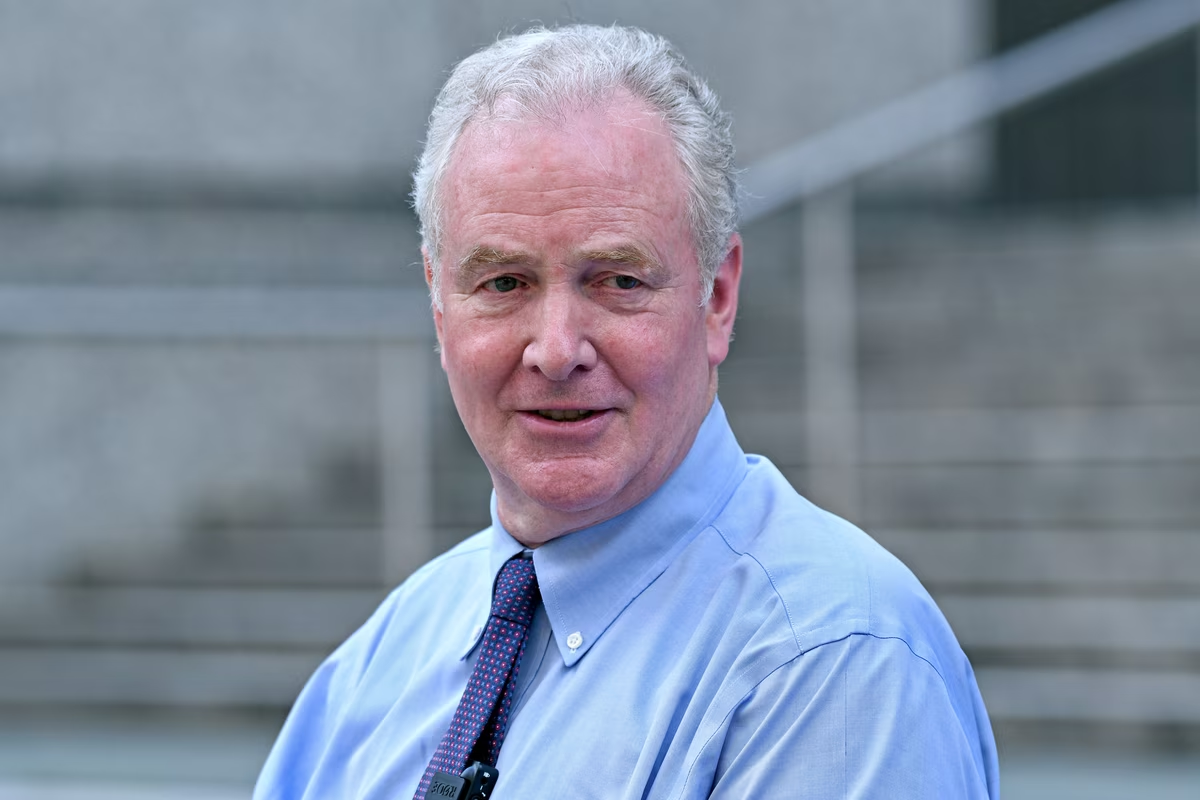
Chris Van Hollen’s Break With Democratic Orthodoxy May Mark a Turning Point


By: Said Arikat


May 27, 2026


News analysis


Washington, D.C- When Democratic Senator Chris Van Hollen published his sweeping denunciation of decades of U.S. policy toward Israel and Palestine, he did more than simply criticize Prime Minister Netanyahu. He effectively declared that the old bipartisan consensus is collapsing — and that the Democratic Party can no longer survive, politically or morally, by defending it.


The significance lies not just in what Van Hollen said in his article published in the New York Times on Tuesday, but in who is saying it. He is not a fringe activist but a senior Democratic senator from Maryland, a state embedded in Washington’s foreign-policy culture. His argument therefore carries the weight of an insider acknowledging that the architecture underpinning unconditional American support for Israel is no longer sustainable.


For decades, Democratic leaders tried to maintain two contradictory positions: professing support for Palestinian statehood while financing and diplomatically shielding Israeli governments that systematically destroyed its possibility. Van Hollen’s article openly admits this contradiction, puncturing one of modern American foreign policy’s central myths — that Washington was an honest broker.


His argument reflects a deeper societal shift. Poll after poll has shown a dramatic erosion of public support for Israel’s conduct in Gaza, especially among younger Americans, independents, Arab Americans, Black voters, and progressives. What was once near-automatic sympathy has increasingly been replaced by anger over images of devastated neighborhoods, starving civilians, bombed hospitals, and mass displacement. Van Hollen understands that this transformation is no longer marginal; it is structural.


That is why his language is strikingly direct. He does not merely criticize “excessive force.” He references apartheid in the West Bank, speaks of ethnic cleansing, and acknowledges that respected scholars and human rights organizations have concluded genocide may be occurring in Gaza. Such terminology would have been politically unthinkable for a mainstream Democratic senator only a few years ago.


Equally important is his recognition that Democratic administrations themselves bear responsibility. That admission breaks with the habit of portraying the crisis as solely the product of Republican extremism. Van Hollen argues that both parties enabled Israel’s trajectory toward permanent occupation and ultranationalism. His critique of former President Biden is especially notable: rather than a restraining force, Biden repeatedly failed to use American leverage even as Gaza was subjected to devastating collective punishment. This reflects growing frustration among Democratic voters who believe the administration’s rhetoric about human rights collapsed under the weight of unconditional military support.


That frustration became politically explosive during the 2024 election cycle. The war alienated large sections of the Democratic coalition, particularly young voters and Arab American communities in states like Michigan. Van Hollen explicitly warns that Democratic hypocrisy damaged the party’s credibility. This may be his most politically revealing point: the realization that support for Israel is no longer cost-free within Democratic politics.


For decades, organizations like AIPAC exercised enormous influence by framing criticism of Israeli policy as politically dangerous. Van Hollen openly challenges that structure of fear, arguing that Americans increasingly reject AIPAC’s positions. This signals an awareness that the lobby’s traditional power may be weakening, especially among Democratic voters who view Gaza through the lens of universal human rights rather than Cold War-era alliances.


Here the essay becomes historically significant. Van Hollen is signaling the emergence of a post-consensus Democratic foreign policy on Israel-Palestine. He is not advocating a revolutionary break with Israel itself and repeatedly affirms its right to security. But he argues that unconditional military and diplomatic protection must end. Conditioning arms transfers, recognizing a Palestinian state, sanctioning extremist settlers, and threatening consequences for annexation — once dismissed as politically radioactive — are now entering mainstream Democratic discourse.


The broader consequence may extend beyond Israel-Palestine. Gaza has become a moral test case for American credibility. Washington cannot claim to defend international law in Ukraine while appearing indifferent to mass civilian suffering in Gaza. Much of the Global South now sees American policy as deeply selective and hypocritical. Van Hollen appears to recognize that continuing this contradiction weakens American legitimacy internationally.


Yet the essay also reveals the limits of the Democratic establishment’s evolving position. Even while condemning Israeli actions in unusually harsh terms, Van Hollen still frames the two-state solution as the ultimate horizon, despite the reality that settlement expansion has fragmented the West Bank beyond territorial viability. Critics will argue that the political conditions for a genuine Palestinian state have already been systematically destroyed. Still, his willingness to acknowledge that failure distinguishes him from much of the Democratic leadership.


His most consequential line may be the warning that future Democratic presidential candidates will not be trusted if they supported bombing Gaza while refusing to confront Netanyahu’s policies. That sentence reads less like commentary and more like a declaration of ideological war within the party. He may be right. A generational rupture is clearly underway. Younger Americans increasingly do not view Israel through the emotional framework that shaped older generations after the Holocaust or the 1967 war. Instead, they see military occupation, asymmetrical violence, and a humanitarian catastrophe broadcast daily across social media. Attempts to suppress criticism by equating it automatically with antisemitism have begun losing effectiveness, especially among younger voters deeply suspicious of censorship and political double standards.


Whether Van Hollen’s vision ultimately prevails remains uncertain. The institutional forces defending the old order remain extraordinarily powerful. Congress is still heavily aligned with pro-Israel lobbying networks, and many Democratic leaders remain reluctant to challenge them openly. But something fundamental has undeniably shifted. A senior Democratic senator has now publicly declared that unconditional support for Israel has failed morally, strategically, and politically. More importantly, he is saying that millions of Americans already know it. That may prove the beginning of a profound realignment in American politics — one whose consequences will reverberate far beyond Gaza, Israel, or even the Democratic Party itself.

ARAB AND WORLD

Tue 26 May 2026 11:57 am - Jerusalem Time

Rubio: Agreement with Tehran still possible despite military strikes in southern Iran

US Secretary of State Marco Rubio ruled out any negative impact of the recent military strikes targeting southern Iran on the ongoing negotiations between Washington and Tehran. Rubio clarified in press statements that the US administration still sees a real opportunity to reach an agreement that ends the current conflict, emphasizing that diplomatic work is proceeding in parallel with field actions.

US Central Command announced on Monday that it had carried out a series of 'defensive strikes' targeting missile launch platforms and military boats belonging to the Iranian side. In contrast, authorities in Tehran confirmed four deaths as a result of these attacks, which targeted Iranian vessels in the area near the strategic Larak Island located within the Strait of Hormuz.

Speaking to reporters during his official visit to the Indian city of Jaipur, Rubio indicated that the Qatari capital, Doha, is currently witnessing rounds of intensive discussions. He added that negotiators are focusing on precise and vital details in the draft initial agreement, expecting that the final results will materialize in the coming days if the positive spirit in the discussion continues.

The US Secretary of State conveyed President Donald Trump's clear stance on this crisis, as the White House seeks to conclude a 'good deal' that guarantees American interests and regional security. Rubio affirmed that Washington is putting its weight behind the negotiation path as a strategic option to end the war, considering that the absence of a strong agreement means not entering into any commitments that do not serve stability.

These field and political developments come at a sensitive time, as senior Iranian negotiators have arrived in Qatar to participate in a new round of talks. These efforts aim to break the stalemate that led to Iran imposing a blockade on the Strait of Hormuz, a vital waterway for global energy supplies that has been significantly affected in recent months.

Rubio stressed the necessity of keeping international waterways open to navigation, describing Iranian actions in the Strait of Hormuz as illegal and lacking international legitimacy. He added in a firm tone that the strait will be opened 'by any means necessary,' considering that the continued blockade represents an unsustainable situation for the international community and cannot be accepted under any circumstances.

The US Secretary concluded his remarks by emphasizing that the United States is trying through diplomatic channels to bring about a sustainable end to the conflict, but at the same time, it will not hesitate to protect its interests. International circles are awaiting the outcome of the Doha meetings, amid escalating tension that threatens navigation security in one of the most important geopolitical regions in the world.

I think there's a lot of discussion going on about specific points in the initial document, so it's going to take a few days.

OPINIONS

Tue 26 May 2026 11:57 am - Jerusalem Time

Washington escalates rhetoric against "Hezbollah," accusing it of obstructing de-escalation and threatening Lebanon's reconstruction efforts

Washington's Message

Washington – Said Erikat – 25/5/2026

The correspondent for Al-Quds newspaper learned via an email received on Monday from a senior American official at the US State Department, who requested anonymity, that Washington holds "Hezbollah" fully responsible for the ongoing military escalation on the Lebanese-Israeli border. It believes that the party is undermining opportunities for de-escalation and ongoing negotiations between Lebanon and Israel, at a time when regional and international communications are intensifying to prevent the situation from sliding into a wider confrontation.

The American official stated, in a briefing provided "on a background not directly attributable," that "Hezbollah has repeatedly ignored requests for a ceasefire with Israel, including a recent ultimatum directed at it," adding that "Israel will never be asked to passively absorb attacks on its forces and civilians, and this is not the Biden administration's era."

The official pointed out that since April 17, the party has launched more than a thousand drones and over 700 rockets, "in an attempt to obstruct ongoing negotiations between Lebanon and Israel," considering that "the current situation is no longer sustainable."

In a clear escalation in American rhetoric towards the party, the official said that "Hezbollah bears full responsibility for the current situation after violating the ceasefire on March 2, and it is now seeking to deprive the Lebanese people of the opportunity for peace and reconstruction."

He added that the party views any negotiation path led by the Lebanese state as an "existential threat," because the success of the Lebanese government in reaching a ceasefire with American support "will strip Hezbollah of its power and its narrative based on resistance."

These statements come at a highly sensitive regional moment, where the war in Gaza intersects with the open confrontation in southern Lebanon, while American and Western pressure on the Lebanese government is increasing to control the borders and implement security understandings that prevent the expansion of the war.

Observers believe that the language used in the American stance reflects a significant shift compared to American rhetoric in past years. Washington today appears more willing to fully adopt the Israeli narrative and link any prospect of economic aid and reconstruction in Lebanon to weakening Hezbollah's political and military influence.

The statements also reveal a clear American bet on the role of the Lebanese state in any future settlement, in contrast to an attempt to isolate the party internally and portray it as an obstacle to stability. However, this bet clashes with a highly complex Lebanese reality, where "Hezbollah" still enjoys a wide political, popular, and military presence, in addition to being considered by a segment of Lebanese as a fundamental deterrent force against Israel.

The American message reflects a strategic shift in Washington's approach to the Lebanese file. The American administration is no longer just talking about containing the escalation, but has directly linked Lebanon's economic and political future to reducing Hezbollah's role. This shift means that any aid or reconstruction projects may become conditional on redrawing internal Lebanese balances. However, this approach carries significant risks, because excessive external pressure on the Lebanese structure may lead to counterproductive results and reinforce the party's narrative that the United States and Israel are seeking to impose political realities by force and economic blackmail.

In contrast, the American narrative ignores a fundamental aspect of the scene, which is that the Lebanese-Israeli border has been in a state of continuous escalation since the outbreak of the Gaza war, and a large part of Arab and Lebanese public opinion sees Hezbollah's actions as an extension of a broader regional battle related to defending Palestinians. Therefore, reducing the crisis to the responsibility of the party alone does not express the complexities of reality, but rather seems closer to a complete adoption of the Israeli security vision. Moreover, talk of "peace and reconstruction" loses much of its credibility in light of the continued massive destruction in Gaza and open American military and political support for Israel.

The most important question remains related to the ability of the Lebanese state itself to play the role Washington desires. Lebanon is experiencing one of its deepest economic and political crises, and its institutions suffer from weakness and sharp division, while political forces seem unable to produce a unified national vision towards war and peace. In light of this reality, any attempt to isolate "Hezbollah" by political or economic force may push the country towards further internal division. What is required in Lebanon, according to many observers, is not only to avoid war, but also to build a national consensus that protects Lebanese sovereignty and prevents the country from becoming an arena for regional and international score-settling.

ARAB AND WORLD

Tue 26 May 2026 11:56 am - Jerusalem Time

Unprecedented Tension: Chinese President Loses Composure Before Trump Over 'Japan's Militarization'

The recent summit between Chinese President Xi Jinping and his American counterpart Donald Trump witnessed extraordinary moments of tension, as informed press sources reported that the Chinese leader broke his usual silence and raised his voice at Trump. This unprecedented outburst occurred during the discussion of the Japanese issue, specifically the nationalist tendencies adopted by the new Prime Minister Sanae Takaichi, which are causing great concern in Beijing.

According to what international media sources reported from seven informed officials, Xi launched a scathing attack on current Japanese military policies, describing them as an attempt to 'remilitarize' that directly threatens regional stability. In contrast, Trump did not back down from his position, clearly informing his Chinese counterpart that he rejected this assessment, emphasizing that Tokyo finds itself compelled to develop its defensive capabilities to confront the growing missile and nuclear threats from North Korea.

The repercussions of this confrontation were not limited to closed rooms, as reports indicate that the American President, immediately after leaving Chinese airspace, initiated an urgent phone call with Japanese Prime Minister Takaichi. During the call, Trump reaffirmed the United States' ironclad commitment to defending Japan, in a move interpreted as a swift and direct response to the Chinese pressures exerted during the summit.

Takaichi's military policies represent dangerous remilitarization and a direct threat to regional peace.

ARAB AND WORLD

Tue 26 May 2026 11:56 am - Jerusalem Time

US-Israeli attack targets Iranian boats and missile platforms in the Strait of Hormuz

Warplanes belonging to the United States and Israel launched an aerial attack targeting Iranian boats in the area south of the strategic Larak Island in the Strait of Hormuz. Media sources reported that the bombing, which occurred on Monday, resulted in the death of at least four people, while efforts to count the total number of casualties are still ongoing, amid official assurances that the field situation in Bandar Abbas has returned to normal.

For its part, press reports quoted American officials as saying that the raids targeted a site for surface-to-air (SAM) missile systems in the Bandar Abbas area. A senior official explained that this move came in direct response to an attempt to target American fighters by those systems, describing the operation as falling within defensive measures to protect air forces in the region.

In a related context, informed sources stressed that these airstrikes do not necessarily mean the collapse of existing ceasefire understandings, but rather are a localized reaction to direct threats. International circles are cautiously monitoring the repercussions of this escalation in vital waterways, especially with the continued military tension in the Gulf region and the Strait of Hormuz.

US strikes in Iran are defensive and do not indicate the end of the ceasefire agreement.

ARAB AND WORLD

Tue 26 May 2026 11:56 am - Jerusalem Time

Plan to Open Strait of Hormuz a Month After Washington-Tehran Agreement to End Fighting

International press reports, citing diplomatic sources in the Middle East, have revealed advanced discussions between the United States and Iran aimed at reopening the Strait of Hormuz. The proposed plan includes resuming navigation in the vital waterway approximately 30 days after the two parties reach a formal agreement to end the ongoing hostilities between them.

For his part, Iranian Foreign Ministry spokesman Esmaeil Baghaei stated that the ongoing negotiations have led to tangible results on several issues included in a potential memorandum of understanding. Despite this progress, Baghaei stressed that reaching understandings does not necessarily mean that Tehran is close to signing a final agreement at this time.

The Iranian official indicated that his country is currently focused on ending the war, emphasizing that nuclear issues are not part of the current discussions. He also noted that the fluctuation in the positions of American officials still constitutes an obstacle to completing the agreement, describing talk of an imminent agreement as premature.

In a related context, Tehran announced the imposition of financial fees for what it described as 'navigation services' it provides to ships crossing the Strait of Hormuz. The Iranian Foreign Ministry affirmed that these fees are allocated to cover the costs of necessary measures to protect the marine environment in the Gulf and the Sea of Oman, denying that these amounts are traditional transit fees.

On the American side, Secretary of State Marco Rubio affirmed that Washington has a solid proposal regarding the reopening of the Strait, reflecting the seriousness of diplomatic efforts. Rubio's statements from New Delhi confirmed the continuation of American efforts despite the cautious statements recently issued by the White House regarding the timeline for the agreement.

US President Donald Trump had lowered optimistic expectations, indicating that he had instructed his representatives not to rush into any deal. Trump wrote on his social media platform that time is on the side of the United States, stressing the continuation of a full naval blockade on Iran until a comprehensive agreement is signed and ratified.

Media reports indicate that the US administration believes that the approval of Tehran's supreme leadership on the terms of the agreement may take several additional days. The US Secretary of State affirmed that President Trump will not accept a 'bad deal' and that he does not feel time pressure to complete the process before all American conditions are guaranteed.

The agreement under discussion aims to allow oil tankers to pass through the Strait of Hormuz again, which represents the lifeline for one-fifth of global oil supplies. This news immediately impacted global markets, with Brent crude and West Texas crude prices experiencing a significant decline of more than 5% immediately after news of progress in the negotiations spread.

According to informed sources, the terms of the latest proposal include the release of a portion of frozen Iranian assets in foreign banks as a gesture of goodwill. However, there are still obstacles related to the implementation mechanism, as Iranian media accuse Washington of obstructing some provisions related to the full release of these funds.

Initial understandings also include a temporary lifting of sanctions imposed on Iran's oil, gas, and petroleum product sectors during the negotiation period. This step will allow Tehran to resume exporting its vital resources to support its struggling economy, in exchange for committing to de-escalating hostilities and ensuring navigation security.

Despite the current focus on military and navigational aspects, the nuclear file still looms as a postponed and complex issue. Marco Rubio stated that nuclear talks require a long time due to their technical nature, indicating that negotiations on uranium enrichment may begin 60 days after the Strait is opened.

On the other hand, Israel entered the crisis, with Prime Minister Benjamin Netanyahu affirming that he coordinated with President Trump to ensure that any final agreement would lead to an end to the Iranian nuclear threat. The Israeli side insists on the necessity of strict guarantees to prevent Tehran from developing nuclear military capabilities under the guise of political agreements.

Within the framework of regional mediation, the Pakistani Prime Minister expressed his hope to host a new round of talks very soon to bridge viewpoints. Islamabad had hosted a previous round in mid-April, but it failed then to break the deadlock in the relationship between Washington and Tehran.

The world remains in anticipation of what the coming days will bring, as the opening of the Strait of Hormuz represents a strategic step to reduce regional tensions and stabilize energy markets. With continued economic and field pressures, it appears that both parties are seeking to achieve a delicate balance between security demands and political gains amidst volatile international circumstances.

We have something solid on the table regarding their ability to open the Strait of Hormuz.

PALESTINE

Tue 26 May 2026 11:55 am - Jerusalem Time

Unbreakable Sails: The Flotilla of Steadfastness Confronts Israeli Piracy with International Will to Break the Gaza Siege

Waves of international solidarity with the besieged Gaza Strip are escalating through the 'Flotilla of Steadfastness,' which represents a global humanitarian movement refusing to surrender to policies of ethnic cleansing. These men and women, who believed in justice, decided to seize freedom across the seas after the international system failed to end the suffering of two million people facing systematic killing and starvation for two decades.

This maritime movement comes as a balm for Gaza's wounds, which have been subjected to a comprehensive genocidal war since early October 2023. The organizers have proven that popular will can confront apartheid, turning Gaza into a beacon for free people who refuse the terrible silence regarding the escalating humanitarian tragedy in the Strip.

The flotilla was subjected to brutal acts of piracy by the Israeli occupation navy, with approximately 50 boats targeted on May 18th. Despite the violent attacks and the arrest of participants, the political message of the flotilla reached the world, confirming the failure of the isolation policy pursued by the occupation for decades.

Testimonies from released activists revealed atrocities committed by occupation forces inside detention centers, including physical and psychological torture. Human rights sources confirmed that activists faced harsh conditions aimed at breaking their will and preventing them from repeating attempts to break the naval blockade on Gaza.

Australian activist Violet Coco gave shocking testimony about being subjected to repeated beatings and sexual harassment in dark rooms belonging to the occupation authorities. She also pointed out the deliberate deprivation of essential medications for sick activists, such as insulin and blood pressure medications, in a blatant violation of international laws.

For her part, activist Gemma O'Toole described the Israeli treatment as causing her deep psychological trauma and unspeakable sadness due to the brutality she witnessed. These practices were not limited to verbal intimidation but extended to direct physical assaults during arrests and interrogations.

Activist Soraya Mac Ewan recounted details of her arrest for up to 80 hours, during which she was severely beaten by soldiers. She explained that occupation soldiers were abusing activists while chanting the Israeli national anthem, in an attempt to humiliate international solidarity activists and deter them from their positions.

The Flotilla of Steadfastness includes 428 activists from 44 countries around the world, reflecting the widespread global rejection of Israeli crimes. These elites of scientists, intellectuals, human rights defenders, and influencers are now exerting increasing political and human rights pressure that embarrasses the occupation in international forums.

These movements come at a time when the humanitarian crisis in Gaza has reached its peak, with the occupation completely destroying more than 300,000 housing units. Another 80,000 units were damaged, forcing millions of Palestinians to displace and live in very cramped spaces not exceeding 40% of the Strip's area.

Neither the health nor the education sector was spared from the destruction machine, as hospitals, schools, mosques, churches, and popular markets were targeted by bombing. This systematic destruction aims, according to observers, to make the Gaza Strip an uninhabitable place and push its people towards forced displacement.

The occupation's failure to uproot Palestinians from their land parallels its failure to stop the 'waves of freedom' coming from the high seas and oceans. The more brutality and piracy against the boats, the greater the global determination to participate in these flotillas, which have become a badge of honor for every free person.

The 'Freedom Flotilla' has transformed from a mere humanitarian initiative to provide aid into an international political crisis pursuing the leaders of the occupation. The increasing global awareness of the seriousness of aggressive Israeli policies has made the issue of the Gaza siege a strongly present file under the spotlight of the media and human rights organizations.

These heroic activities confirm that supporting the Palestinian people is not impossible, but a possible act that requires rising up and abandoning helplessness. The participants in the flotilla share the pain and hardship with the people of Gaza, to convey a message that Gaza is not alone in confronting fascism.

The Flotilla of Steadfastness will remain a witness to an era in which free people refuse to submit to the policy of brute force, affirming that the occupation will vanish no matter how much it arms itself and oppresses. These unbreakable sails will continue to sail towards the ports of Palestine until the shackles are broken and the unjust siege is permanently lifted.

Free popular will is stronger than the policy of ethnic cleansing, and the occupation can be besieged by the free people of the world who sailed towards Gaza.

PALESTINE

Tue 26 May 2026 11:55 am - Jerusalem Time

Details revealed of the incitement campaign against Lamine Yamal after he raised the Palestinian flag

The Palestinian issue has once again taken center stage in the global sports scene, after Barcelona and Spanish national team star Lamine Yamal's celebration of the Spanish League title turned into a widespread digital battle. The young player raised the Palestinian flag during the coronation ceremony, a moment that sparked a wide wave of solidarity, but in return ignited an organized incitement campaign that sought to criminalize him and link his humanitarian solidarity to a discourse of violence.

A technical analysis conducted by a specialized team in tracking misinformation revealed the trajectory of this digital campaign, as it monitored a sharp escalation in hostile interactions against Yamal starting from May 10th. The analysis clarified that the attack peaked on May 12th and 13th, coinciding with the spread of photos and videos documenting the moment he raised the Palestinian flag among his teammates in the Catalan team.

According to the monitored data, nearly half a million accounts participated in interacting with the player's name with a total of nearly one million posts, but the hostile side was represented by more than 39,000 incitement posts. This wave was led by Israeli accounts and others belonging to the Spanish-speaking far-right, which deliberately mixed solidarity with the Palestinian people with support for terrorism.

A review of the accounts involved in the attack showed extensive use of Israeli and US symbols and flags, in addition to far-right slogans associated with the Spanish 'Vox' party. A noticeable presence of the Salvadoran flag was also observed in some accounts, indicating the involvement of right-wing circles from outside the direct geographical scope of the crisis in the defamation campaign.

In terms of linguistic distribution, Spanish dominated 71% of the attack content, followed by English at 25%, while the remaining percentages were distributed among other European languages. This linguistic diversity reflects a clear attempt to internationalize the attack on the young player and transform a sporting act of solidarity into a cross-border international political polarization issue.

Geographically, the inciting accounts were concentrated in Spain at 36%, followed by Mexico at 14%, then the United States at 10%. Technical sources also monitored the participation of accounts from France and Venezuela, confirming that the campaign was not merely a spontaneous local reaction, but a coordinated digital wave aimed at influencing global public opinion.

Yamal's hostile discourse relied on specific keywords aimed at demonizing the act of solidarity, with terms such as 'terrorism,' 'Hamas,' and 'anti-Semitism' frequently appearing alongside the player's name. These posts sought to create a false mental link between the Palestinian flag and brutality, in an attempt to pressure the club and the national team to take punitive measures against him.

Official Israeli figures emerged at the forefront of the incitement, most notably Israeli Security Minister Israel Katz, who not only verbally attacked Yamal but also demanded his expulsion from the Spanish national team. Katz considered raising the Palestinian flag to be explicit support for what he described as terrorism, calling on the Barcelona club management to declare its innocence of its talented player's actions.

In the Spanish-speaking digital space, Salvadoran activist Eduardo Menoni led a parallel campaign, using his influence as a right-wing political analyst to attack the player. Menoni is known for his staunch defense of Israeli policies and has publicly called for an end to Yamal's international career with the Spanish national team in response to his political stance.

The analysis also monitored the involvement of influential accounts with ambiguous identities, including an account based in India, which published direct accusations against the player of supporting violence. Other accounts participated in publishing videos of Israeli influencers tearing up the player's shirt, a symbolic gesture reflecting the extent of the hatred directed against him.

Among the interesting observations in the technical analysis is the participation of nearly 4,400 low-impact accounts, where the number of followers of each does not exceed one hundred people. Despite their individual weak influence, their coordinated collective action contributed to increasing the momentum of the campaign and giving it a character that suggests the existence of popular consensus against the player's actions.

The data also revealed the creation of hundreds of new accounts during the current year specifically to participate in such digital campaigns, with 569 recent accounts being monitored. This pattern indicates the use of 'electronic armies' or fake accounts that are activated during crises to direct public opinion and exert psychological pressure on public figures who sympathize with Palestine.

The total number of accounts created in the last three years that participated in the attack reached approximately 2,616 accounts, which reinforces the hypothesis of a ready digital infrastructure for incitement. These accounts operate according to an organized strategy aimed at intimidating athletes and artists and preventing them from showing any sympathy for humanitarian issues related to Palestinians.

In conclusion, this fierce campaign against Lamine Yamal reflects a state of concern among pro-Israel circles about the growing awareness of the Palestinian issue in global sports circles. Despite attempts at intimidation and distortion, reality has proven that the voice of solidarity is still able to penetrate stadiums and reach millions, transcending the boundaries of digital censorship.

Israel Katz considered the player's action to be support for terrorism and demanded that Barcelona club issue a statement disavowing the young star's actions.

PALESTINE

Tue 26 May 2026 11:55 am - Jerusalem Time

Occupation carries out extensive demolition operations in Al-Bustan neighborhood in Jerusalem to advance settlement plans

Israeli occupation forces and machinery stormed Al-Bustan neighborhood in Silwan town, south of the blessed Al-Aqsa Mosque in occupied Jerusalem, this Monday morning. Bulldozers began carrying out extensive demolition and leveling operations targeting citizens' properties, a step that comes within the systematic forced displacement policy pursued by the occupation authorities against the steadfast residents of the neighborhood.

Official sources in Jerusalem Governorate reported that the demolition operations affected a two-story residential house belonging to citizen Fayez Awad, in addition to the demolition of a 'barracks' facility owned by the Ruwaidi family. The assaults also included the leveling of retaining walls and agricultural lands belonging to other citizens, amid a strict security cordon imposed by the occupation forces, preventing residents from accessing their properties or salvaging their contents.

Through this field escalation, the imposition of exorbitant fines, and repeated eviction notices, the occupation authorities seek to empty the area of its indigenous inhabitants. These measures aim to gain full control over Palestinian lands to implement Judaization settlement projects, most notably the 'King David Gardens' plan and tourist bus parking lots, based on biblical claims aimed at changing the city's identity.

Al-Bustan neighborhood is considered one of the most targeted areas in Silwan town, where hundreds of Jerusalemites who have lived there for decades face the threat of demolition and displacement. This attack comes in the context of the occupation's continuous attempts to change the geographical and demographic character in the immediate vicinity of Al-Aqsa Mosque, which deepens the suffering of Palestinian families facing the specter of displacement at any moment.

Occupation authorities escalate their policy of demolition and leveling with the aim of expelling Palestinian residents and seizing their lands to establish settlement projects.

PALESTINE

Tue 26 May 2026 11:54 am - Jerusalem Time

Memoirs of Emir Abdelkader: A Biography of State-Building and the Epics of Resistance Against Colonialism

The memoirs of Emir Abdelkader al-Jazairi encapsulate the journey of an exceptional leader who managed to combine the ideology of armed resistance with the genius of state-building simultaneously. This historical journey began after the fall of Algiers in 1830 and the signing of the surrender treaty, when an urgent need arose for a national leadership to unite the scattered tribes under one banner to confront French colonial expansion.

On November 27, 1832, a historic pledge of allegiance took place in the Mascara region under the 'Dardara Tree,' where Abdelkader bin Muhieddine was appointed Emir of the Believers. This choice came after his father, who declined leadership due to old age, endorsed him, betting on his son's courage and shrewdness, which had been evident in the early battles of Oran.

Emir Abdelkader's movement was not merely a military rebellion; it was a renaissance project that sought to establish a modern state with clear institutional features. He divided the country into eight administrative provinces and established a government comprising five ministers with specific tasks, reflecting an advanced vision for managing public and political affairs at that time.

On the military front, the Emir succeeded in organizing a regular army and building fortified castles across the high plateaus to serve as strategic refuges. He also focused on establishing factories for weapons and ammunition, realizing that true independence required self-sufficiency in military equipment to confront a regular army that outnumbered and out-equipped his forces.

Victories of the resistance forced French commanders to the negotiating table, resulting in the signing of the 'De Michel' treaty in 1834. This treaty served as an implicit diplomatic recognition of the Emir's authority and opened avenues for him to communicate with other international powers that were competing with France in the region.

The Emir's political gains evolved with the signing of the 'Tafna' treaty in 1837, in which Paris recognized his sovereignty over two-thirds of Algerian territory. Abdelkader used this truce to strengthen the pillars of his state and expand his administrative influence, while the French viewed the agreement as a warrior's respite to regroup their forces.

Emir Abdelkader invented the concept of 'Zmala,' a mobile capital that included thousands of people, treasuries, and administrative facilities, making it difficult for the occupation to strike at the heart of the state. This mobile city was an embodiment of the resistance's flexibility and its ability to adapt to the conditions of the asymmetrical warfare imposed by the colonizer.

France responded to the Emir's military genius by adopting a 'scorched earth' policy under the command of General Bugeaud, aiming to isolate the resistance from its popular base. This policy included destroying crops and displacing tribes allied with the Emir, creating immense humanitarian and economic pressure on the resistance army.

The fall of 'Zmala' into the hands of French forces dealt a devastating blow to the war effort, as the Emir lost most of his wealth and treasury, and the families of his senior commanders were captured. This loss led to a decline in morale and the dispersal of supporting forces, especially after increasing military pressures from multiple directions.

Amidst deteriorating conditions and the difficulty of securing supplies for the army, the Emir convened a consultative council to make a fateful decision regarding the continuation of fighting. The council favored saving lives and preserving what remained of the forces, so surrender negotiations began with the French commander 'Lamoricière' based on specific conditions.

Emir Abdelkader stipulated, in exchange for laying down arms, a guarantee of safe passage and the right to move with his followers to Alexandria or Acre in the Arab East. French commanders officially agreed to these terms, and the surrender took place in December 1847, with the Emir boarding a ship, believing his destination was Jerusalem or Damascus.

The French deception soon became apparent when the Emir realized that the ship was heading towards French ports instead of the East, in a clear breach of written agreements. The Emir transformed from a state leader into a prisoner in French castles, sparking a wave of international criticism and concern in European political circles regarding French conduct.

Despite imprisonment and exile, Emir Abdelkader remained in the Western imagination a symbol of the 'Noble Arab,' with historians likening him to Saladin al-Ayyubi in his wartime ethics. His personal integrity and his desperate defense of his country above any personal interest made his cause transform from a local matter into a global conscience issue.

Emir Abdelkader's memoirs remain a historical document witnessing a pivotal stage in modern Algerian history, laying the first foundations of the resistant national identity. The Emir's story is an epic that combines the ambition of institution-building with the bitterness of colonial betrayal, his memory remaining alive as the father of modern Algerian state institutions.

I accepted this position so that I would have the right to be the first to go to the battlefield.

PALESTINE

Tue 26 May 2026 11:54 am - Jerusalem Time

International Report: Occupation Controls 60% of Gaza, Builds Permanent Military Fortifications

International press sources reported that the Israeli occupation army has significantly expanded its field control within the Gaza Strip in recent months. These movements involve strengthening military fortifications and shifting separation lines with areas where Palestinian resistance is present, reflecting a trend towards imposing a new security reality.

Reports clarified that the area controlled by the occupation now approaches 60% of the total area of the Strip, having increased from 53% since last October. These developments raise serious concerns about military separation zones turning into permanent borders, further complicating any future political settlement.

The occupation army has pushed what is known as the 'Yellow Line,' which defines the separation areas, deeper into the Strip's territory. In some areas, this line intersected with Salah al-Din Road, which is the main artery connecting the north and south of the Strip, further impeding movement.

Satellite images showed the establishment of extensive military fortifications in the central region of the Gaza Strip, including deep trenches and high earthworks. The construction of at least seven new fully fortified military sites was also observed to counter any field threats.

Data indicates that some of these military sites have been paved with asphalt and include more than a dozen permanent buildings, which is an indicator of the occupation's readiness for a long-term presence. This infrastructure reflects a strategy of entrenching positions rather than the temporary presence previously announced.

Amid stalled political settlement efforts, observers believe that these fortifications deepen the geographical division within Gaza. This comes at a time when the occupation authorities insist on continuing military operations and refusing to fully withdraw from the areas they have encroached upon.

Field sources confirmed that dozens of Palestinians have been martyred near the 'Yellow Line' since the last ceasefire came into effect. The occupation army claims to target those it describes as 'suspects,' while residents confirm that the victims are civilians who lost their way due to the unclear new separation lines.

Sources quoted diplomats as saying that a number of Arab governments refuse to contribute to funding the reconstruction of the Gaza Strip under the current situation. These funders stipulate clarity of political and security vision before commencing any large-scale construction operations amidst ongoing destruction.

Diplomat Nikolay Mladenov warned that solidifying the current situation would make it very difficult to change in the near future. He pointed out that the continued construction of permanent military installations entrenches the reality of dividing the Strip and undermines opportunities for establishing a unified Palestinian administration.

In a related context, the occupation army continues excavation and search operations for resistance tunnels that may connect different control areas. The army announced the destruction of tens of kilometers of underground networks since the cessation of major combat operations last October.

To increase field control, the occupation placed concrete barriers painted yellow to define the boundaries of closed military zones. This step came after repeated incidents of shooting at civilians who approached these lines, whose features were previously unclear.

The occupation also introduced what is called the 'Orange Line,' an additional security zone within areas where Palestinians are allowed to move. This line requires international relief organizations to coordinate in advance and in a complex manner with the army before any trucks or medical teams can cross.

For his part, researcher Ofer Guterman considered that Israel seeks to strengthen its defensive posture in preparation for the possibility of renewed fighting at any moment. He added that the military establishment is working to improve its field conditions to ensure superiority should current understandings collapse.

In conclusion, the field reality indicates that the Gaza Strip is heading towards a state of military 'status quo' that serves the occupation's goals of control and dominance. With the continued construction of fortifications, the chances of returning to the pre-war situation remain slim amidst increasing security and political complexities.

The more we solidify the current situation, the more difficult it becomes to change, and there are real fears of a permanent division of the Gaza Strip.

PALESTINE

Tue 26 May 2026 11:54 am - Jerusalem Time

Global Fuel and Fertilizer Crisis Doubles the Suffering of Sudan's Agricultural Sector

Farmers and experts in Sudan confirmed that the sharp rise in global fuel and fertilizer prices, resulting from regional military tensions, will force them to reduce cultivated areas during the current summer season. This decline in agricultural activity threatens a severe shortage of food production in a country already suffering from the ravages of civil war and widespread famine.

Field sources reported that the costs of essential agricultural inputs have reached unprecedented levels, which will exacerbate the crises caused by the internal conflict. Strategic crops such as sorghum and millet are expected to be affected, in addition to cash crops designated for export like sesame, placing the exhausted Sudanese economy before additional challenges.

Data from the United Nations indicates that Sudan is one of the countries most vulnerable to the repercussions of regional crises, due to its heavy reliance on neighboring and Gulf countries to secure more than half of its fertilizer needs. The ongoing conflict between the army and the Rapid Support Forces has also made the country entirely dependent on importing fuel from abroad to operate machinery and irrigation pumps.

Sudan today stands at the forefront of countries affected by a looming global food crisis, especially with the shrinking budgets of international aid for relief. A global hunger monitor warned that about 19.5 million people, representing more than 40% of the total population, face critical levels of food insecurity, with a real risk of famine in several regions.

Although Sudan's enormous agricultural potential has always attracted investors, the sector has suffered for decades from mismanagement and armed conflicts. About two-thirds of the country's population depends on agriculture as a primary source of livelihood, making any deterioration in this sector a fatal blow to the livelihoods of millions of Sudanese families.

Sadiq Al-Amin, an analyst at the United Nations Food and Agriculture Organization (FAO), stated that recent regional conflicts have doubled the existing challenges, warning of a potential 40% decrease in overall production. He added that the continuation of these price shocks threatens to escalate the current food crisis to unprecedented catastrophic levels.

In areas controlled by the army in the center and east of the country, farmers are trying to resume their activities, but financial obstacles stand in their way. In the Al-Jumouia project south of Omdurman, farmers had hoped for a promising season after the area was recovered, but they were shocked by a 67% increase in fertilizer prices and more than double for fuel.

Farmers complain that the costs of operating diesel irrigation pumps now consume all expected profits, making agriculture an economically losing venture. Officials in the Al-Jumouia project indicated that only 500 feddans out of a total of 10,000 feddans have been cultivated, a serious indicator of declining production halfway through the agricultural season.

In a related context, the Al-Jazeera project, which was once Sudan's food basket, has faced significant infrastructure deterioration since the outbreak of fighting. Heads of agricultural associations confirmed that the absence of repair operations for canals and pumps, coupled with stagnant crop prices against rising costs, has led farmers to refrain from cultivating wheat and corn.

Sudan's Agricultural Bank, responsible for financing farmers, is suffering from near-total paralysis as a result of its impact by the conflict that hit the country's financial sector. Farmers say that the bank imposes harsh conditions and high prices for inputs, while buying products at low prices, trapping them in a cycle of accumulated debt with endless consequences.

For its part, the Sudanese Ministry of Agriculture announced attempts to establish a new fund in cooperation with the Agricultural Bank to finance farmers and alleviate the burden of fuel costs. Official sources in the ministry clarified that work is underway to rehabilitate irrigation canals and repair pumps in several vital locations to save what can be saved from the current season.

In the states of Darfur and Kordofan, the absence of security represents the greatest threat to the production of groundnuts and gum arabic, where looting and intimidation are widespread. Displaced farmers confirm that the lack of funding and machinery, in addition to the levies imposed by armed groups at checkpoints, has made agriculture an impossible task in those areas.

Field reports indicate that many agricultural machines and tractors have been looted during armed raids, while agricultural workers have been forcibly recruited to fight. This mass displacement of people from fertile agricultural areas has led to vast areas of land remaining unprepared or uncultivated for the upcoming season.

In conclusion, experts in agricultural supply companies believe that delivering supplies to conflict areas has become a costly and risky adventure. Small farmers, who cultivate only to secure their daily sustenance, remain the weakest link in this chain, facing the direct risk of hunger in the absence of government and international support.

Regional war has made matters worse, and Sudan's total agricultural production could decrease by at least 40 percent.

PALESTINE

Tue 26 May 2026 11:54 am - Jerusalem Time

Escalating Israeli Incitement Against European Stances Following the Targeting of the Freedom Flotilla

The media and political arena in Israel is witnessing an escalating wave of incitement against European countries, against the backdrop of stances condemning the Israeli attack on Freedom Flotilla activists. These tensions come at a time when international accusations against Tel Aviv of committing war crimes are increasing, coinciding with the continuation of the genocidal war that has entered its second year in the besieged Gaza Strip.

Israeli writer Sharon Luxemburg, in an article published in 'Maariv' newspaper, criticized the European view of the occupation army's behavior towards international solidarity activists. She considered that large parts of Europe adopt double standards and evaluate events completely differently when it comes to Israel, ignoring other humanitarian disasters in the world.

Sources indicated that European media coverage of the Freedom Flotilla event took long hours of live broadcasting and intensive political discussions. The writer believes that this attention reflects an unjustified focus on Israel, as if global crises of wars, refugees, and famines have ended, and only the pursuit of Israeli actions remains.

Luxemburg mentioned that this phenomenon is not new, but rather a continuous approach adopted by major international media institutions in their daily coverage. Despite Israel's population not exceeding ten million, it receives extensive news coverage not even granted to the most powerful superpowers in the current international system.

Sources explained that every Israeli move, whether military, political, or even cultural, is placed under the microscope of intense European scrutiny. This constant spotlight creates continuous international pressure on decision-makers in Tel Aviv and contributes to shaping a global public opinion hostile to Israeli policies in the occupied Palestinian territories.

The matter was not limited to political and military aspects but extended to cultural and entertainment events that are supposed to be far from conflicts. The European Song Contest 'Eurovision' has, in recent years, turned into a sharp political confrontation arena, witnessing widespread calls for boycott and massive popular protests against Israeli participation.

The writer spoke about the absurdity of a singing competition turning into a complex geopolitical discussion merely because of the presence of an Israeli representative. She considered that this reflects the extremely complex relationship between Europe, Jews, and the Middle East, making any media content related to Israel provoke waves of global anger and controversy.

Sources confirmed that videos coming from Gaza or occupied Jerusalem turn within minutes into digital battlegrounds for opinions and accusations. This rapid spread of information contributes to strengthening the Palestinian narrative and exposes the practices of the occupation to the European public, which has become more sensitive to human rights issues.

Israeli circles believe that Israel is no longer treated as an ordinary state but has become a global symbol used by political parties to define their identity and agendas. Among the radical European left, taking an anti-Israel stance has become an integral part of the political identity and principles promoted by these activists.

In contrast, the European right tries to portray Israel as a symbol of the struggle against what they describe as 'radical Islam,' placing the Hebrew state at the heart of internal European tug-of-war. In both cases, the preoccupation with Israel remains dominant in public discussions, exceeding its geographical size or demographic impact in the Middle East region.

This Israeli incitement reflects a state of internal anxiety regarding the erosion of international legitimacy and increasing isolation in the old continent. The accusations directed at Europe of bias are primarily aimed at diverting attention from the essence of the conflict, which is the continuous occupation and the siege of the Gaza Strip, which has led to an unprecedented humanitarian catastrophe.

Reports indicate that Israeli elites fear that European popular sympathy with the Palestinian cause will turn into political decisions and economic sanctions. Therefore, media discourse is employed to attack European journalistic institutions and accuse them of exaggerating events related to the Palestinian-Israeli conflict at the expense of other global issues.

It seems that Israel's attempts to escape international responsibility clash with the reality of media coverage that transmits the details of the genocidal war moment by moment. The scenes coming from Gaza leave no room for doubt about the extent of human suffering, making it difficult for European governments to ignore the pressures of their peoples demanding justice.

In conclusion, the Freedom Flotilla and the international reactions that followed remain a testament to the depth of the gap between the Israeli narrative and the reality seen by the world. While Tel Aviv tries to portray itself as a victim of media coverage, the international community sees its actions as a blatant violation of international laws and norms that require accountability.

Israel is no longer just a state; it is a global symbol used by all political parties in the world to define themselves, far exceeding the size of a small state in the Middle East.

PALESTINE

Tue 26 May 2026 11:54 am - Jerusalem Time

Light from the Heart of the Siege: Gaza Resumes Corneal Transplant Surgeries with Self-Effort and Community Solidarity

Amidst the rubble of destruction and the harsh conditions imposed by the siege on the Gaza Strip, a new hope has emerged for hundreds who lost their sight, as the Palestinian Ministry of Health announced the resumption of the national corneal transplant program. The Specialized Eye Hospital in Gaza City hosted these qualitative operations after a forced three-year hiatus due to successive wars and the collapse of the healthcare system. This step comes at a sensitive time when the Strip is suffering from a severe shortage of essential medicines and medical supplies.

Inside the operating rooms, whose equipment was not spared from the effects of the war, Dr. Hussam Dawood, a consultant in ophthalmology and eye surgery, led the first surgical operations, which were crowned with brilliant success. Medical sources reported that local teams were able to overcome the enormity of field obstacles and the scarcity of surgical instruments necessary to complete this complex medical procedure. This success represents a stark challenge to the policy of obstruction that the health sector has faced for many months.

Dr. Hussam Dawood affirmed that this case marks the actual launch of the national corneal transplant campaign, noting that preparing and maintaining surgical instruments was the most prominent challenge facing the team. He explained that the insistence on restoring this program aims to reduce the long waiting lists for patients living in almost complete darkness. These operations primarily rely on local expertise honed by years of successive crises.

Patient Beirut Al-Nakhalah, who was the first beneficiary of this program, described her feelings after regaining her sight as beyond description and cannot be reduced to words. Al-Nakhalah said that she did not expect such a complex operation to be performed inside Gaza under the current circumstances, especially after its complete cessation throughout the months of conflict. She added that the return of these operations brings life and colors back to thousands of patients who had lost hope of treatment abroad.

This medical achievement is rooted in the values of humanitarian solidarity that characterize Palestinian society in Gaza, as the transplanted corneas came as a donation from the family of martyr Mahmoud Abu Sisi. The family decided to donate their son's corneas to the Ministry of Health, in a noble step that gave two patients a new chance to see the world again. This stance reflects the extent of cohesion among the residents in the face of the policies of death and destruction surrounding them from all sides.

Martyr Abu Sisi's father expressed his humanitarian stance by referring to the psychological difficulty he initially faced, but he chose to give life to others as an ongoing charity for his son's soul. He affirmed that his son's martyrdom was a motive to help patients continue their lives and overcome their visual impairments. These individual initiatives are considered the main pillar upon which the national corneal transplant program is based, given the prevention of importing corneas from abroad.

Field reports indicate that the resumption of these operations goes beyond the purely medical dimension, to constitute a cry against the siege and the slow death policy pursued by the occupation. In light of the severe deprivation of the most basic treatment rights, Palestinians invent their own means of survival and continuity. These operations are a clear message about the ability of national cadres to innovate despite the lack of logistical capabilities.

Looking at the numbers, health statistics reveal a humanitarian catastrophe, with about 700 people in the Gaza Strip directly losing their eyes during the recent war. Among these, 600 injured people lost one eye, while nearly 100 people live in complete darkness after losing both eyes. Fears are growing that these numbers will increase amid the continued direct targeting of civilians in residential areas.

Health authorities in Gaza warn that thousands more, mostly children and youth, are at risk of losing their sight due to complex injuries from explosion shrapnel. Fire belts and heavy shelling cause direct injuries to the retina and cornea, requiring urgent surgical interventions that are not always available. Amid continued Israeli restrictions on the movement of medical supplies, local solidarity remains the only available window to save what can be saved.

These operations represent the beginning of the national corneal transplant campaign, and the biggest challenge was preparing surgical instruments given the current reality of hospitals.

PALESTINE

Tue 26 May 2026 11:54 am - Jerusalem Time

Widespread Islamic Condemnation of 'Somaliland' Plans to Open an Embassy in Occupied Jerusalem

Nineteen Islamic countries have expressed their categorical rejection of the separatist 'Somaliland' region's intentions to open an embassy with the Israeli occupation authorities in occupied Jerusalem. In a joint statement, these countries considered this step a departure from international consensus and a blatant challenge to resolutions of international legitimacy that affirm the special status of the holy city.

The statement was issued under the coordination led by the Egyptian Ministry of Foreign Affairs and included a wide list of countries, among them Turkey, Saudi Arabia, Qatar, Jordan, Palestine, Pakistan, and Indonesia. The drafting of the statement saw successive updates to include additional countries such as Kuwait, Algeria, Morocco, Bangladesh, and Mauritania, reflecting the extent of regional dissatisfaction with this move.

The foreign ministers of the signatory countries stressed that such a step by an internationally unrecognized entity is an illegal act and has no legitimate effect. They affirmed that tampering with the legal and historical status of occupied Jerusalem is a direct assault on the inalienable rights of the Palestinian people to their eternal capital.

The statement condemned in the strongest terms what it described as the 'alleged embassy,' noting that any attempts to establish an illegal reality in Jerusalem are doomed to failure. The ministers also reiterated that East Jerusalem remains occupied territory under international law, and its character cannot be changed through unilateral agreements.

In a related context, the 19 countries affirmed their full support for the sovereignty and territorial integrity of the Federal Republic of Somalia, declaring their rejection of any moves that undermine this sovereignty. They considered the separatist region's dealings with the occupation authorities a threat to regional stability and interference in the internal affairs of Arab and African countries.

The 'Somaliland' region announced in mid-May its intention to proceed with the establishment of a diplomatic representation in Jerusalem, a step that received immediate welcome from the occupation government. Through this step, the region aims to gain international recognition, breaking its political isolation that has persisted since its declaration of secession in the 1990s.

Mohammed Haji, who presents himself as the region's ambassador to the occupation, stated that the embassy would soon open its doors in Jerusalem, claiming increasing strategic cooperation with Tel Aviv. Haji indicated in his statements that Israel, in turn, intends to open a representative office in Hargeisa, the capital of the separatist region.

These developments come months after Tel Aviv's official recognition of 'Somaliland' in December 2025, a move that angered the central government in Mogadishu. Somalia at the time considered the Israeli recognition a violation of its sovereignty and an incitement to divide the country, calling on the international community to take a firm stance.

It is worth noting that the 'Somaliland' region has managed its affairs independently administratively and securely since 1991, but it has failed over the past decades to obtain official recognition from the United Nations or the African Union. The region now appears to be seeking to exploit political shifts in the region to build alliances with the Israeli occupation in exchange for political support.

The joint statement of the Islamic countries concluded by emphasizing the necessity of adhering to United Nations resolutions that prohibit the establishment of diplomatic missions in occupied Jerusalem. Diplomatic sources warned that proceeding with this step would lead to negative repercussions on the region's relations with its Arab and Islamic surroundings, affirming that Palestinian rights are inalienable.

East Jerusalem has been occupied Palestinian territory since 1967, and any steps aimed at changing its legal and historical status are considered null and void.

PALESTINE

Tue 26 May 2026 11:53 am - Jerusalem Time

3 Martyrs and 17 Wounded in Helicopter Shelling Targeting Displaced Persons' Tents in Khan Yunis and Gaza

A Palestinian child and woman were martyred today, Monday, as a result of rocket shelling carried out by 'Apache' attack helicopters belonging to the occupation army, targeting a gathering of displaced persons' tents in the vicinity of Street 5, west of Khan Yunis city, south of the Gaza Strip. Medical sources reported that the attack also resulted in injuries of varying severity to 17 citizens, in addition to fires breaking out in a number of tents housing displaced families, leading to a state of panic and destruction in the densely populated area.

Medical sources at the Kuwaiti Specialized Field Hospital stated that the bodies of the two victims arrived at the hospital, where they were identified as Menna Allah Nabil Abu Labda, a 6-year-old child, and Hanan Abdel Nasser Mahmoud, a 31-year-old citizen. These raids come at a time when the western areas of Khan Yunis city are subjected to intense military pressure and continuous airstrikes targeting shelters and already dilapidated infrastructure.

In another field development northwest of the Strip, medical teams announced the martyrdom of citizen Nidal Shalha, who succumbed to his serious injuries sustained days ago due to shelling that targeted civilians near the 17th roundabout in the Al-Tawam area. These successive injuries and deaths reflect the scale of the humanitarian tragedy experienced by the residents of the Strip as the aggression enters its twentieth month, amidst a near-total paralysis of medical facilities operating with minimal means of survival.

Regarding official statistics, data from the Ministry of Health in Gaza confirmed an increase in the total number of victims of the ongoing aggression since October 7, 2023, to 72,797 martyrs, in addition to 172,821 injured. The ministry clarified that hospitals received 6 martyrs during the past twenty-four hours, including one death due to previous injuries, along with 5 victims who fell in recent raids and 8 other wounded.

The humanitarian suffering continues to worsen inside shelters and tents that lack the minimum safety requirements, as the occupation continues to target these areas with various combat means from air and land. Observers confirm that the intensification of helicopter raids on displaced persons' tents aims to increase pressure on civilians in areas that the occupation previously claimed were 'safe,' thereby deepening the health and environmental crisis throughout the besieged Gaza Strip.

Hospitals received 6 martyrs and 8 wounded in the past 24 hours, amidst the continued direct targeting of shelters.

PALESTINE

Tue 26 May 2026 11:53 am - Jerusalem Time

A Lover from Palestine: When Mahmoud Darwish Forged the Nation's Identity with a Lover's Heart

The poem "A Lover from Palestine," penned by the late poet Mahmoud Darwish in 1966, remains a landmark in his early creative journey. At the age of twenty-five, Darwish managed to weave an extraordinary relationship between land and body, transforming Palestine from a geographical space into a beloved embodied in memory and identity, where the distinctions between romantic love and the militant attachment to life dissolve.

The poem begins with a simultaneous declaration of pain and loyalty through his words "Your eyes are a thorn in the heart," as the poet paints a picture of a homeland that inhabits daily details; he sees it in the mountains of thorns, the wheat jars, the ray of tears, all the way to the alleyways of the camps and the salt of the sea. This elaboration in describing the features of the 'beloved/homeland' reflects the poet's desire for complete fusion with the land to reclaim his lost human existence due to exile and occupation.

At the climax of the poem, the rhythmic repetition of the word "Palestinian" stands out seven times, encompassing voice, birth, death, and handkerchief, transforming the national cause into an eternal love story. Darwish concludes by shifting from the language of romance to words of sacrifice, describing himself as the "knight of knights" who transforms his poems into lightning and thunderbolts in the face of the occupier, asserting that the "eagles" born of the Palestinian people cannot surrender, and that the resistant word is capable of shaking the foundations of the occupation, no matter how long it lasts.

Palestinian eyes and tattoo.. Palestinian name.. Palestinian dreams and concerns