* The emergence of informal channels due to Israel's tightening of monetary movement control, which led to a large cash flow through parallel means.
* It is realistic not to rely on the return of clearance in the immediate term, and what is required is "zeroing out clearance" and alleviating burdens on citizens.
* In the absence of clearance funds and salary delays, it is not enough to ask people to be patient; rather, policies that directly alleviate daily burdens must be adopted.
* What is needed are well-thought-out political and economic measures and the development of more equitable tax tools.
* We need to adopt a stricter supply policy, and government consumer institutions can be established.
* We are facing a long confrontation that requires building comprehensive economic and social immunity consistent with reality.
* Gaza cannot wait for comprehensive reconstruction to begin life; what is needed is to operate the economy from the bottom up.
* It is important to create a widespread production state that transforms agriculture and industry into real tools for resilience.
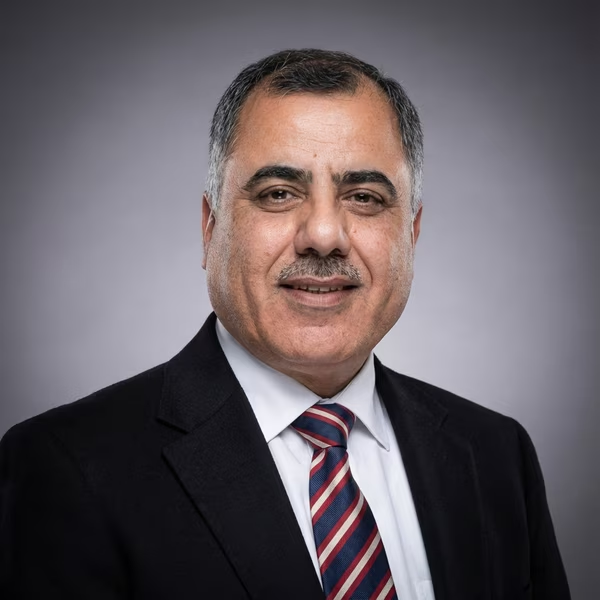
Ramallah - Special Interview "Al-Quds" - The financial crisis, primarily the shekel surplus, is deepening amidst complex economic transformations and the severe financial crisis faced by the Palestinian Authority. This necessitates, according to businessman and economic analyst Dr. Samir Hulileh, a comprehensive reformulation of economic policies to align with the new social reality.
Hulileh emphasizes in a special interview with "Al-Quds" that the financial crisis has become linked to strategic choices affecting the structure of the Palestinian economy itself, amidst the absence of a unified vision for the Palestinian National Authority that defines how to deal with the crisis and its limits, especially the shekel surplus crisis and mechanisms for controlling it in a way that aligns with national interest and alleviates the accumulated pressures on the financial system and banks.
Hulileh stresses that avoiding a deeper financial crisis requires moving from crisis management to producing effective economic policies capable of enhancing local revenues and reducing reliance on external sources, in addition to adopting well-considered interventions in basic commodity prices and taxes. The following is the text of the interview:
Sources of the Shekel Surplus
* First, what are the causes of the shekel surplus crisis in the Palestinian market?
The shekel surplus raises real questions, especially with the decline in the number of Palestinian workers inside Israel, who historically were among the main sources of shekel inflow into the Palestinian market, in addition to the large spending by Palestinians from inside Israel during their visits to the West Bank.
According to a study prepared in 2019, Palestinians from inside Israel spent between 9 to 10 billion shekels annually in the West Bank, while Palestinian workers brought in about 15 billion shekels in cash, totaling approximately 25 billion shekels annually. This figure was almost equivalent to the volume of Palestinian imports from Israel, which are paid in shekels.
At that time, the shekel surplus was estimated at about 18 billion shekels annually, and a mechanism was adopted to transfer about 1.5 billion shekels monthly to the Israeli Central Bank.
Causes of the Shekel Crisis Worsening
* But why has the crisis worsened today despite the decline of some traditional channels?
After the Corona pandemic, the Palestinian and Israeli economies witnessed a remarkable recovery, especially between 2021 and 2023, with the shekel-related cash cycle rising from about 35 billion shekels to current estimates ranging between 40 and 45 billion annually, an unjustified increase by traditional standards.
Therefore, new and informal channels for shekel flow emerged, amidst Israel's tightening of control over monetary movement within its borders, in contrast to the weak ability to control it in the Palestinian territories, which led to a large cash flow through parallel means.
Huge Price Differences
* What are the most prominent of these informal channels you are talking about?
There are huge price differences between the Palestinian and Israeli markets, most notably cigarettes, where the price difference sometimes reaches 50%, which created widespread smuggling and selling operations that generate large quantities of shekels in cash.
The same applies to the meat file, where the Palestinian quota exempt from duties, amounting to five thousand tons annually, is exploited for resale inside Israel at double prices, instead of being directed to reduce local prices.
The repercussions of the war, both on Gaza and the tension with Iran, also contributed to an unofficial Israeli demand for dollars and gold through Palestinian money changers, which led to an increase in dollar exchange rates outside official channels.
In addition, real estate purchases and shopping in West Bank cities confirm the existence of a wide informal economic movement that has become the main driver of the accumulation of shekel surplus in Palestinian banks.
What is happening has created a black market that is constantly expanding and requires special policies from the concerned authorities to contain and address it.
What is Required from Palestinians to Deal with the Crisis
* What policies are required from Palestinians to deal with the shekel surplus crisis?
The main question does not fall solely on the shoulders of the Monetary Authority, but on the official economic bodies, primarily the Ministry of Economy, to determine Palestinian economic policy: Are we interested in the continuation of all forms of shekel flow, or are there activities that should be controlled or limited?
Some paths may create a consumer market and revitalize the local economy, especially with the importance of Palestinians from inside Israel as a major economic incubator for the West Bank, given their higher income level and purchasing power compared to Palestinian citizens, which reflects on stimulating the markets of cities such as Nablus, Jenin, Tulkarm, and Qalqilya, especially after the decline in employment inside Israel, the contraction of the economic cycle, and the disappearance of the Gaza market, which constituted about 35 to 40% of West Bank sales.
Practical Mechanisms to Control the Shekel Surplus
* What are the practical mechanisms through which the shekel surplus can be controlled?
The beginning is to understand the paths through which the shekel flows, then make a clear economic decision about whether these flows serve the Palestinian interest or not.
If it is decided to maintain them, means of dealing with the surplus should be considered instead of merely complaining.
The most realistic solution, as happened in 2019, is to seek the assistance of a neutral international body agreed upon by the Monetary Authority and the Israeli Central Bank to examine the sources of the shekel surplus and determine its actual size, while raising the ceiling of annual quantities received by Israel to match current economic changes.
Alternatives in Case of Israeli Refusal
* And what are the alternatives if Israel refuses to cooperate?
Then the Authority will be forced to adopt internal policies that reduce reliance on the shekel, such as adopting preferential exchange rates for salaries and taxes in dinars or dollars, in coordination with Jordan, with the aim of gradually strengthening the presence of other currencies in the Palestinian market.
Repercussions of the Shekel Surplus Crisis
* What are the most prominent economic and social repercussions of the shekel surplus on society?
The direct and greatest impact falls on the banking sector, as banks bear the primary burden due to the accumulation of large shekel deposits that are not matched by sufficient demand within the Palestinian market.
It is true that part of the banking facilities consists of debit current accounts, but it remains limited compared to the volume of accumulated liquidity.
Banks also face additional challenges related to financing imports from Israel, most of which are paid in shekels, at a time when banks rely on transfers and transactions with international financial institutions that use the shekel within a complex system of guarantees and banking policies.
The citizen is not the primary victim currently, as the main problem affects banks whose vaults are filled with a cash surplus of limited utility and return.
However, the continuation of the crisis without solutions may expand its repercussions in the future, especially with the escalation of Israeli policies and the possibility of targeting the Palestinian banking relationship with Israeli banks, which may complicate the entire financial scene.
More Realistic Solutions
* What are the proposed solutions to overcome the crisis?
There are measures such as reducing reliance on cash and promoting electronic payments, but they are not enough to clear the existing surplus.
The most realistic solution is international intervention through a neutral party, preferably American and acceptable to both sides, to assess the volume and sources of the shekel, then raise the ceiling of quantities that Israel recovers annually to match the actual increase in cash circulation, in addition to more effective Palestinian and international action to pressure for a sustainable solution.
Practical Solutions Amidst the Clearance and Salary Crisis
* Amidst the clearance and salary crisis, are there still practical solutions that can enhance citizens' resilience, or is only more patience required?
In my opinion, there are many practical solutions, but the real challenge lies in the government's ability to take responsibility for implementing them.
What is happening is not a purely financial or economic crisis, but a clear political attack led by Israeli Finance Minister Bezalel Smotrich with the aim of weakening the Palestinian Authority and perhaps overthrowing it. Therefore, the confrontation requires a comprehensive political decision that goes beyond the capacity of the technocratic government alone.
What is required, in my estimation, is a unified political stance involving the presidency, the Palestine Liberation Organization, and national forces, because crisis management requires will and calculated confrontation.
Steps Under the Ceiling of Indirect Confrontation
* What is the nature of the steps that can be taken without reaching a direct confrontation?
The discussion is not about a major escalation or a breach of agreements, but about well-thought-out political and economic measures within the existing framework, including the Paris Protocol, to prove that Palestinians have tools of influence, and that the Israeli side is not the only one controlling the economic arena.
The problem, in my estimation, is not only related to Israel's strength or policies, but also to the state of Palestinian weakness and inability that allowed the situation to be exposed to this extent.
Not Relying on the Clearance File
* And how do you view the issue of clearance funds in the coming period?
It is realistic not to rely too much on the return of clearance in the immediate term; the current Israeli government, according to indicators, will continue the same approach in the coming months, and therefore the crisis must be dealt with on the basis of the absence of these revenues, and any potential breakthrough should be considered an exception, not a rule, and therefore "zeroing out clearance" is what is required.
Alleviating Burdens by Zeroing Out Clearance
* You propose the concept of "zeroing out clearance for Israel," what do you mean by that?
Zeroing out clearance for Israel means reformulating Palestinian economic policy to suit the social and economic state of emergency we are experiencing.
When about 70% of the population lives below the income level necessary to cover the minimum family living expenses, the priority becomes the social agenda, not any other consideration.
In the absence of clearance funds and salary delays, it is not enough to ask people to be patient; rather, policies that directly alleviate daily burdens must be adopted, and direct efforts must be made, within the scope of the Paris Protocol, to zero out the withheld clearance funds by reducing taxes.
The beginning is with taxes imposed on basic commodities. For example, the tax on gas cylinders can be significantly reduced in the coming months, so that their price drops from about 85 shekels to about 40 or 45 shekels, because the largest part of their current price consists of taxes that used to go to enhance clearance, and they no longer reach the Palestinian treasury.
The same applies to diesel, especially since transportation consumes about 18% of Palestinian family spending due to the absence of public transport and citizens' reliance on diesel-powered vehicles.
Here, the tax can be reduced to the minimum, which will significantly lower the price and give families greater resilience.
Extent of Impact on the Palestinian Government
* But wouldn't that lead to a financial loss for the government?
What is happening is an emergency measure, and this is not an actual loss for the Palestinian treasury as much as it is deductions that were originally going to Israel as part of the withheld clearance funds, and if things return to normal, these policies can be reconsidered.
Therefore, reducing taxes on basic commodities today is a social and economic gain for the Palestinian citizen, not a financial drain on the government.
Measures to Reduce Reliance on Israel
* Are there other measures to reduce financial reliance on Israel?
Yes, among them is temporarily stopping the import of new cars and allowing the import of vehicles one year old, so that customs duties are paid inside Palestine instead of Israeli ports, which saves hundreds of millions of shekels annually.
Customs duties on luxury cars and luxury goods must also be restructured, and the tax burden on the financially capable must be increased, in addition to reviewing corporate tax and value-added tax to match the rise in poverty and unemployment.
However, the success of these policies requires a unified political decision starting from the Palestinian leadership and translated into a single economic discourse in the face of Israeli pressures.
Financial Resilience Amidst the Current Crisis
* Can financial resilience be considered an essential part of national resilience amidst the current crisis?
Certainly, financial resilience has become an integral part of national resilience, as it is not possible to build comprehensive economic and social immunity realistically in the face of Israel, which continuously uses political, economic, security, and settlement pressure tools, while the Palestinian side remains in a waiting position.
Betting on a change in Israeli governments or upcoming elections alone is not enough, because the policies imposed in recent years, especially by Israeli Finance Minister Bezalel Smotrich, have created a new reality within the West Bank, both at the level of the Israeli civil administration and the Israeli security institutions associated with the settlements.
Therefore, what is required is not to violate existing agreements, but to use the available tools within them, especially the margins provided by the Paris Protocol that can be invested by Palestinians.
Integrated Economic Vision
* And what is the required international role to confront these pressures?
We need an integrated economic vision built in partnership between the private sector and civil society, and conveyed to the United States and its decision-making centers, whether at the level of Congress or the American administration.
If it is not possible to receive official representatives from the Authority, economic and civil delegations can explain the serious repercussions of Israeli policies and demand more effective American and European intervention, and legal and documentary preparations must also be made for any potential path before international courts in the future.
Emergency Budget Resilience
* How can the emergency budget remain resilient amidst the escalating financial deficit?
What is required is to enhance local revenues through different methods, not by increasing the burden on the citizen, but by restructuring the tax system.
Reliance on consumption taxes and customs related to Israel can be reduced, and in return, more equitable local tax tools can be developed. The problem is that the Palestinian economy relies mainly on value-added tax and customs, while income tax remains very limited compared to other countries, as a result of adopting a low tax model that does not keep pace with the current crisis, and the original intention is to activate income tax.
Reformulating Palestinian Economic Policy
* How can economic policy be reformulated to adapt to the current crisis and enhance citizens' resilience?
We are forced to reconsider Palestinian economic policy to suit the current circumstances, and the Ministry of Finance and the government have the technical capacity to search for alternatives if a clear political decision is available.
What is required are specialized workshops that re-adjust the economic system without violating existing agreements, and in a way that strengthens the Palestinian budget and limits Israel's financial benefit.
Even if the salary crisis continues and employees continue to receive half their salaries, reducing basic costs such as transportation and energy can significantly alleviate their living burden.
Practical Policies to Alleviate Living Burdens
* What practical policies can be adopted to alleviate living burdens?
What is required is to adopt a stricter supply policy towards basic commodities, similar to the experiences of countries like Jordan and Egypt.
The issue is not only the availability of goods, but their prices and mechanisms for controlling them. It is unacceptable that the prices of bread or meat in Palestine are much higher than in neighboring countries despite similar import sources and the absence of customs duties on some products. Balanced pricing policies can be imposed, so that markets and bakeries are obliged to provide basic items at low prices for poor segments, in exchange for different profit margins on other goods.
* Who should lead this process?
In the absence of a Ministry of Supply, the Ministry of National Economy, in cooperation with the relevant ministries, must lead a policy of control and pricing of basic materials, with the aim of protecting the most vulnerable groups, including those affected by the widespread economic crisis.
* What is your assessment of the effectiveness of indicative price lists in controlling markets?
Unfortunately, even these lists have become ineffective, as actual market prices are often lower than the indicative prices themselves, rendering them without real impact. What is required is not flexibility in application, but clear firmness, so that a price ceiling is set for basic commodities, and if prices exceed this limit, intervention is direct, including the option of state intervention in distribution if necessary, because the issue has become linked to national and livelihood security.
Direct State Role in the Market
* Do you propose a direct state role in the market?
Yes, consumer institutions or even government bakeries can be established, or a direct support system through coupons for basic materials, so that citizens receive bread, rice, or other basic commodities at clear subsidized prices, as the idea is for citizens to feel real protection, not superficial measures.
Authority's Handling of the Crisis
* How do you evaluate the Authority's current approach to dealing with the crisis?
There is clear hesitation, as if the solutions are temporary, but the crisis is prolonged, and we cannot wait any longer, especially since the new Israeli policies are ongoing and do not seem likely to change soon. Even in the international context, there are no guarantees to amend the laws imposed on us.
Economic and Social Immunity
* What is the general framework for the solution?
We are facing a long-term confrontation that requires building economic and social immunity, by reducing basic costs such as fuel, and converting available resources to strengthen 40% of the locally based economy instead of relying on the declining 60% external economy. The goal is to protect society from poverty and build an integrated social and economic program for resilience.
What is Needed to Revitalize Gaza's Economy
* How do you evaluate the performance of the economy in Gaza? And what is needed to revitalize it?
Throughout the years of war in Gaza, we lived in a state of perpetual waiting: American intervention, UN action, or international initiatives, as if we had abandoned our responsibility to build internal solutions.
This waiting weakened us instead of protecting us, while we should have worked to gradually build elements of local "economic immunity," away from continuous Israeli obstruction and the postponement of all political solutions.
* What are the most prominent elements of this proposed economic immunity?
The elements of this proposed economic immunity in the Gaza Strip begin with meeting basic needs. It should have been initiated early on to repair damaged bakeries and distribute flour to them to ensure the provision of free or low-cost bread for people. Indeed, about 45 bakeries have been rehabilitated through international efforts, but this effort must turn into a comprehensive policy that includes food industries, cattle and sheep farms, and even the re-operation of agricultural wells to gradually restore agricultural production.
Dealing with the Rubble File
* What about managing the physical effects of the war, such as rubble?
The rubble file is a clear example of the absence of initiative. A national project was launched to recycle rubble and convert it into building materials or bricks for paving roads in previous wars, especially since it does not require complex technologies as much as it requires simple labor and field management, and it constitutes an economic lever and employment for thousands of young people. However, in this war, it did not turn into a widespread project, and the waiting policy of donor countries in this regard was sufficient, despite the success of limited experiences at this stage.
Other Possible Solutions
* Are there other examples of possible solutions?
Yes, there are current experiences such as projects to rehabilitate damaged homes, where hundreds of housing units have been renovated at a relatively low cost, enabling hundreds of families to leave tents with funding and supervision from the Palestinian Housing Council.
As for the solid waste file, which has accumulated in hundreds of thousands of tons in Gaza, and despite the fact that 55-60% of solid waste can be converted into organic fertilizer to improve soil and employ hundreds of young people, without the need for complex technology, this project has not been started immediately by official bodies or local authorities, and has become a project awaiting international funding and the reconstruction file.
* What is the main message of this approach?
The message is that Gaza cannot wait for comprehensive reconstruction to begin life; what is needed is to restore life by operating the economy from the bottom up: agriculture, small industries, waste management, and the restoration of damaged infrastructure.
There are available resources and funding from institutions and organizations, but the most important thing is to activate a local will that makes people produce, live, and rebuild their lives despite the harsh conditions. We are not talking about reconstruction; we are talking about restoring life only, and this is not impossible.
Agriculture as the Safety Valve of Economic Immunity
* How can the agricultural sector contribute to strengthening economic resilience?
Agriculture is a fundamental sector in strengthening community resilience and the safety valve for economic immunity, but in many cases, it has become a source of pressure on the consumer due to exports to Israeli markets and rising prices domestically. Globally, agriculture is considered a "refuge for the poor" because it provides additional income, not basic income, as is the case for some employees who have been able to earn between one thousand and two thousand shekels monthly from their additional work in agriculture in addition to their salaries.
What is required is to significantly expand local production instead of focusing on exports to Israel, with a clear policy from the Ministry of Agriculture to regulate imports and exports in a way that primarily serves the local market.
It is not possible to prevent selling at higher prices, but local supply can be increased so that internal self-sufficiency becomes the basis.
There are great untapped potentials, such as hydroponics and other means that allow high production in small areas and with very low water costs, even in homes.
* How can the agricultural sector be practically activated?
This is done by encouraging people to engage in home and cooperative farming, and providing simple technical and financial support. Each group of employees or families can invest in small plots of land to generate additional income, and there are successful cooperative models that can be built upon. The goal is to create a widespread production state that makes society less dependent on the market, and transforms agriculture into a real tool for resilience instead of remaining a limited or seasonal activity.