






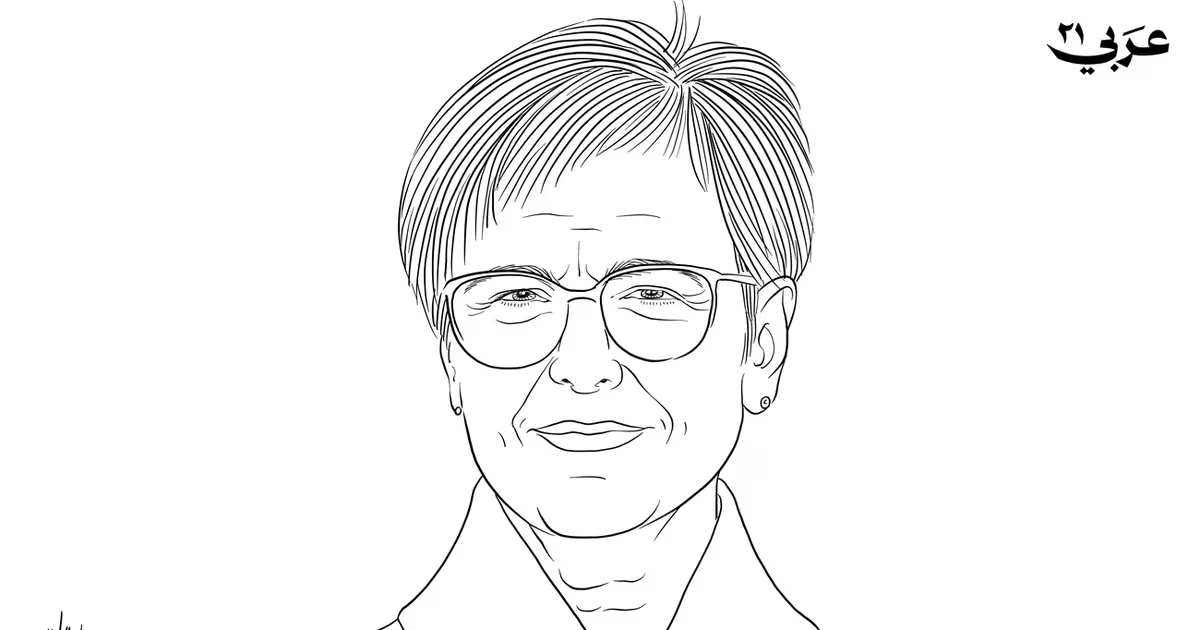
Australian journalist Mary Kostakidis embodies a model of ethical journalism that pays the price for its commitment to human justice. Her supportive stance towards Palestinians has put her in direct confrontation with the Zionist lobby in Australia. This journey recently culminated in her winning the 2026 'Gary Webb Press Freedom Award,' a prestigious international award granted by 'Consortium News' in recognition of her exceptional courage in reporting the truth.
Kostakidis was born in 1954 in Veria, Greece, before her family immigrated to Australia, where she completed her education at the University of Sydney, specializing in philosophy, languages, and education. She began her career in academic and research fields, but her true brilliance emerged in media and field work, especially concerning immigrant issues and human rights, which formed the core of her professional identity.
Kostakidis is considered one of the founding generation of the Australian public broadcaster (SBS) in 1980, where she contributed to building the translation unit and developing the station's editorial policies. Thanks to her efficiency, she transitioned from administrative work to become the most prominent face of the main evening news bulletin for over two decades, making her one of the most trusted media personalities in the country.
In 2007, Kostakidis made a pivotal decision to resign from the SBS newsroom in protest against changes she believed undermined the station's professional standards, including the insertion of advertisements into news programs. Not content with just resigning, she pursued a legal battle against the institution, alleging breach of contract and bullying, a case that ended in an amicable out-of-court settlement.
Kostakidis's role was not confined to the screen; she was also a powerful voice in human rights forums, chairing the Sydney Peace Foundation and being appointed to the National Human Rights Advisory Committee. She was known for her staunch defense of press freedom and played a prominent role in supporting WikiLeaks founder Julian Assange, to whom she awarded the Gold Medal for Peace and Justice in 2011.
Kostakidis's positions on the Palestinian issue took a sharper turn with the escalation of the genocidal war in the Gaza Strip, where she used her platforms to highlight the occupation's crimes. This moral clarity made her a direct target of the Australian Zionist Federation, which began legally pursuing her on charges related to anti-racial discrimination due to her posts supporting Palestinian rights.
In 2024, the Zionist Federation filed a complaint against her for reposting clips calling for settlers with dual nationalities to return to their home countries if they wished to feel safe. Kostakidis clarified then that her aim was to indicate that the occupation's policies provoke escalation and drag the region towards explosion through continuous massacres.
In 2025, the pursuit evolved into a lawsuit before the Australian Federal Court, where the Zionist lobby seeks to use local laws as a weapon to silence voices critical of 'Israel.' The trial is scheduled to begin later this year, amidst widespread human rights and media anticipation of the outcomes of this confrontation, which touches upon the core of freedom of expression in Australia.
Observers believe that the Australian Zionist Federation exploits its financial and political influence to access major media outlets, attempting to brand any criticism of the occupation's crimes as 'antisemitism.' However, Kostakidis refuses to back down from her positions, asserting that defending Gaza is defending truth and justice in the face of the war and destruction machine.
Kostakidis's win of the Gary Webb Award in 2026 comes at a sensitive time, as journalists face immense pressure to prevent them from revealing the truths about war crimes. The awarding institution considers Mary's journey a model of resilience in the face of intimidation attempts by forces supporting the occupation in Western societies.
Reports indicate that Gaza has become a historical turning point in global consciousness, where crimes committed against the Palestinian people can no longer be forgiven or overlooked. Kostakidis is part of a global movement comprising academics and intellectuals who reject 'moral panic' and insist on calling things by their true names despite the risks.
Kostakidis also contributed to developing the language of cultural dialogue in Australia, through her work on facilitating the understanding of legal procedures for Greek immigrants in major historical cases. This link between language and justice has always been the primary driver of her activism, whether in courtrooms or behind radio microphones and television screens.
Despite the legal and financial challenges posed by lawsuits, Mary enjoys widespread respect in independent circles that see her as an honest voice for her communities. Her supporters affirm that attempts to silence her will only increase her determination to expose media and political complicity with forces that violate human rights in the Middle East.
In conclusion, Mary Kostakidis remains a symbol of journalism that does not compromise its principles, having proven that true professionalism requires standing with the victim against the oppressor. Her upcoming battle in the Federal Courts will not be merely a personal case, but a true test of Australian democracy and its ability to protect freedom of expression from the encroachment of lobbies.
Israel provokes escalation and invites retaliation because it is committing genocide in the Gaza Strip.
شارك برأيك
Mary Kostakidis: Australian Media Icon Who Confronted the Zionist Lobby in Defense of Gaza