






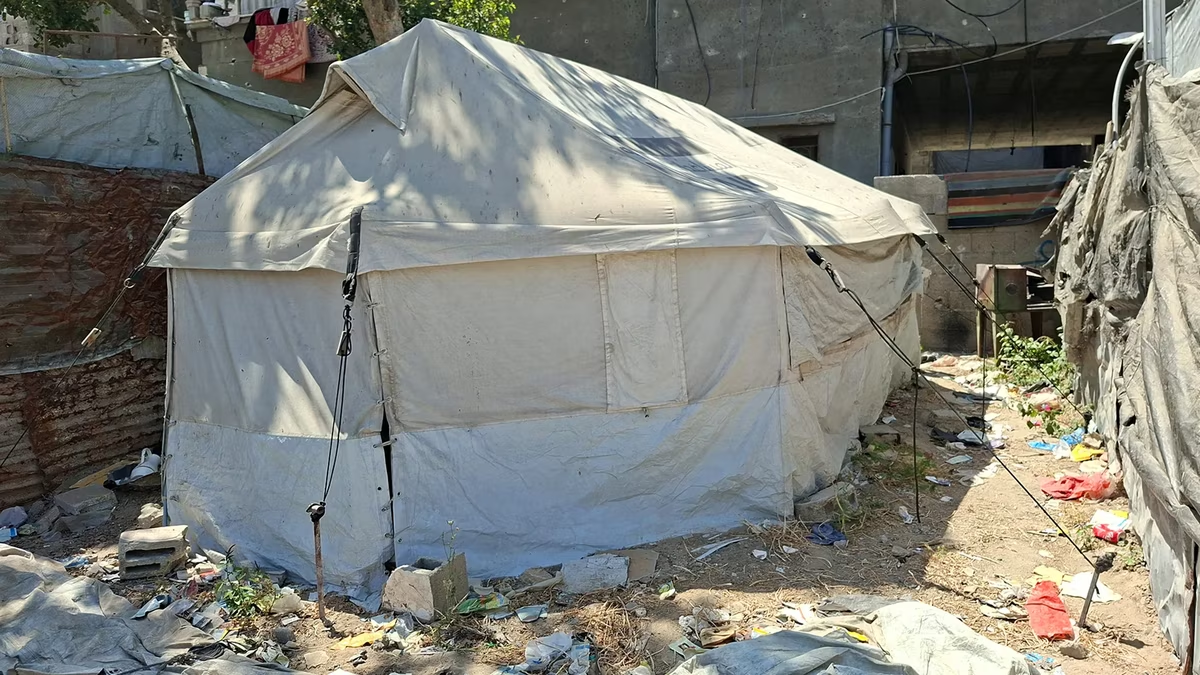
Mohammed Awad, a displaced citizen in the Sheikh Radwan neighborhood north of Gaza City, was shocked to find the body of a child buried at a shallow depth under his tent while he was trying to expand a sewage pit. The incident revealed the tragedy of random graves that residents were forced to create at the height of ground military operations, where playgrounds and public squares turned into temporary burial sites due to the inability to access official cemeteries.
Local sources reported that ambulance crews transported the discovered body to complete documentation procedures within the lists of unidentified martyrs, a humanitarian dilemma that is worsening over time. Awad lives in a tent on a playground where dozens of martyrs were buried in the first months of the war, and despite most bodies being moved later, some remained forgotten under the sand.
Paramedic Karim Al-Attal confirmed that the playground where the displaced are currently residing had previously contained about 100 bodies, pointing to the repeated incidents of unexpectedly finding the remains of martyrs in various areas of the Gaza Governorate. He explained that the absence of personal data for some victims makes it difficult to identify them, especially with the repeated displacement of families and the loss of contact with their relatives.
For its part, the Euro-Mediterranean Human Rights Monitor documented the existence of about 30 large random mass graves containing nearly 3,000 bodies in various governorates of the Strip. The monitor also pointed to the creation of more than 120 small mass graves, each containing three or more individuals, reflecting the scale of the catastrophe left by the ongoing aggression on civilian populations.
In a similar incident in the Al-Karama neighborhood, citizen Majed Shaheen found a decomposed body next to his home at the beginning of this year, and despite his repeated attempts through social media platforms to identify the owner of the body by his clothes, no one was able to identify him. Shaheen was forced to exhume the remains and rebury them in an official cemetery, awaiting any clue that might lead to his identity in the future.
Fares Afana, director of the ambulance unit in medical services, attributes the increase in the number of unidentified persons to the systematic policies followed by the occupation, including exhuming and bulldozing graves and preventing medical teams from recovering victims. He added that the extermination of entire families led to the absence of any relative who could identify the bodies left in the streets or under the rubble for long periods.
At Al-Shifa Medical Complex, the forensic medicine department manages a massive file containing more than 1,000 unidentified bodies, where each martyr is given a sequential number and a record that includes photos and DNA samples. Dr. Ahmed Adhheer explained that these procedures aim to facilitate the identification of victims in the future if the necessary laboratory equipment and materials for DNA testing become available.
Adhheer revealed that the occupation authorities handed over 480 bodies that had been held since the ceasefire agreement, but without providing any clarifying data about their identities or the circumstances of their martyrdom. Specialized committees succeeded in identifying only 110 bodies from this batch, while hundreds of them are still registered on the lists of unidentified persons.
Government estimates in Gaza indicate that the number of missing persons has reached about 10,000, most of whom are believed to still have their bodies under the rubble of destroyed homes. Civil defense teams face extreme difficulties in reaching these missing persons due to the lack of heavy machinery and the continued targeting of vital areas, which makes the actual number of martyrs likely to increase.
Medical reports confirm that there are dozens of martyrs who were buried in random graves during periods of strict siege without being presented to the competent authorities or having their data recorded. This absence of official documentation during harsh war moments complicates the legal and humanitarian file of these victims and deprives their families of the right to know and a dignified burial.
Medical sources stressed that the file of unidentified persons requires international intervention to provide mobile laboratories and the necessary chemical materials for analyzing remains, especially with the decomposition of many bodies. This issue is considered one of the deepest wounds left by the war, as thousands of families remain in limbo between the hope of finding their missing loved ones or obtaining final answers.
In the context of comprehensive statistics, the Palestinian Ministry of Health announced that the toll of the aggression has exceeded 72,000 martyrs and more than 173,000 injured, figures that reflect the unprecedented scale of destruction. These numbers are still likely to rise with the continuation of search operations in random graves and under the rubble of residential areas that have been razed to the ground.
In conclusion, random graves stand as a silent witness to the harsh conditions experienced by the residents of Gaza, where playgrounds and displacement sites have turned into forced burial grounds. The biggest challenge for human rights and medical organizations remains to ensure the documentation of every victim and the preservation of their dignity, in a reality that becomes more complex with each passing day since the end of major military operations.
The file of unidentified martyrs is becoming more complex over time and requires the availability of many materials, equipment, and tests to try to identify them.
شارك برأيك
Bodies under displaced persons' tents.. Random graves double the tragedy of unidentified martyrs in Gaza