






Washington – Said Arikat – 5/12/2026
News Analysis
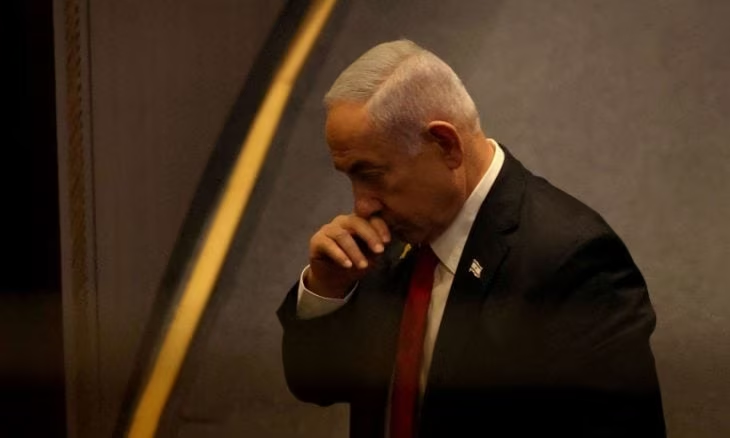
In his interview with "60 Minutes," Israeli Prime Minister Benjamin Netanyahu tried to present himself as a leader who faced an "existential moment" after the October 7, 2023 attack, rather than as the primary political official responsible for the security and intelligence collapse that shook Israel. While he admitted for the first time, almost indirectly, that responsibility "lies with everyone, from the prime minister down the hierarchy," he quickly tried to shift the discussion from the question of failure to the question of "what comes after failure," meaning the wars Israel has waged since that day against Gaza, Lebanon, Yemen, and Iran.
This shift in discourse is not improvised; rather, it reflects a clear attempt to reframe Israeli and international consciousness: from holding the political and military leadership accountable for the security catastrophe, to portraying Netanyahu as a historic war leader leading a battle to "save Israel" from the "Iranian encirclement." In this sense, the limited acknowledgment of responsibility was merely a political maneuver to alleviate internal pressure, not a prelude to genuine accountability.
Most tellingly, Netanyahu again refused to form an official independent investigative committee, preferring a politically-oriented committee whose results could be controlled. This refusal reveals the core of the crisis: the man not only fears the results of the investigation but also fears that the investigation will become a moment of collapse for his entire political project, especially after many years of presenting himself as the "security master" capable of protecting Israel and deterring its adversaries.
Netanyahu's statements reveal a deep dilemma within the Israeli political system: the ruling elite wants to acknowledge failure without paying its political price. Therefore, responsibility is generalized to everyone so that true responsibility is lost. When everyone is responsible, no one is actually responsible. This formula allows Netanyahu to remain in power despite the biggest security failure in modern Israeli history. But the problem is that societies do not regain their trust by collectively distributing blame, but by clear and transparent accountability that starts from the top of authority, not from soldiers or lower-ranking employees.
In the same interview, Netanyahu also tried to justify Israel's shift towards open regional wars, considering the Hamas attack as merely part of a comprehensive Iranian project to "strangle Israel." From this, he justified expanding the war to Lebanon and Yemen, and then direct confrontation with Iran in cooperation with the United States. But this discourse ignores a fundamental truth: that Israeli policies themselves, especially in Gaza and the West Bank, contributed to creating an environment of continuous explosion.
For years, Netanyahu relied on managing the conflict rather than resolving it, and on weakening the Palestinian Authority while turning a blind eye to the growing power of Hamas, based on a concept of keeping Palestinians divided. However, the October 7 attack revealed the complete collapse of this doctrine. Nevertheless, Netanyahu refuses to acknowledge that the crisis is not only security-related but also political and moral.
One of the most striking parts of the interview was Netanyahu's demand for the United States to send special forces into Iran to extract enriched Iranian uranium, considering it the "only way" to end what he called "Iranian nuclear ambitions." This proposal reveals the extent of escalation that now governs Israeli thinking, as it is no longer limited to airstrikes or economic sanctions but has moved to calling for direct military operations inside Iranian territory, with all the possibilities of a wide regional explosion that this entails. More strikingly, the interview did not address Israel's undeclared nuclear arsenal at all, which is one of the region's most obvious and simultaneously denied secrets. Thus, the discourse seemed to demand complete nuclear exclusivity for Israel, under the guise of "non-proliferation" and "stability protection," while Israel itself is exempt from any accountability or international oversight.
What is dangerous in Netanyahu's discourse is not only the justification of war but the transformation of war into a permanent doctrine. Instead of reviewing the causes of the explosion, military escalation is presented as the only solution. This vision makes the entire region hostage to the logic of open force. The wars that began in Gaza have spread to Lebanon, Yemen, and Iran, while the United States appears to be more entangled in Israeli calculations. The result is not the restoration of stability, but the production of a more turbulent Middle East, where politics recedes in favor of security, and diplomacy recedes in favor of the logic of aggression and occupation.
In his discussion of Iran, Netanyahu appeared less confident than he tries to show publicly. When asked about his previous predictions regarding Iran's weakness and inability to threaten the Strait of Hormuz, he admitted that "no one has a complete vision." He also acknowledged the existence of "risks and uncertainties" in the joint war with Washington against Tehran. This acknowledgment is important because it reveals the limits of military power, even for Israel and the United States.
Nevertheless, Netanyahu continued to bet on the idea of the gradual collapse of the Iranian regime, considering that its fall would automatically lead to the collapse of its allies in the region, from Hezbollah to Hamas and the Houthis. But this perception reflects a simplistic understanding of the structure of regional conflicts, as it ignores that these forces are no longer mere Iranian "proxies" but have become part of a complex political and social reality shaped over decades of wars, occupation, and divisions.
In another part of the interview, Netanyahu complained about the decline of Israel's image globally, attributing the reason to "propaganda wars" and social media. However, this explanation ignores the scenes of massive destruction in Gaza, the large number of civilian casualties, and the growing international criticism of Israel's military policies. The crisis is not just a "picture" crisis, but a crisis of political and humanitarian reality that has become difficult to market even within allied Western societies.
Netanyahu's attempt to reduce the global decline in Israel's popularity to a "propaganda" problem reflects a growing disconnect between official Israeli discourse and ongoing global transformations. Young generations in the West do not rely solely on the traditional narrative coming from governments and major media outlets but directly see images of war and destruction through digital platforms. Therefore, the crisis is deeper than just a media battle; it is a crisis of moral and political legitimacy. And as long as the war continues without a political horizon, the erosion of Israel's image will increase, even within societies that were historically more sympathetic to it.
شارك برأيك
Netanyahu Between Acknowledgment and Evasion: How Did the October 7 Failure Transform into an Open War Project?