By Said Arikat
May 7, 2026
News Analysis
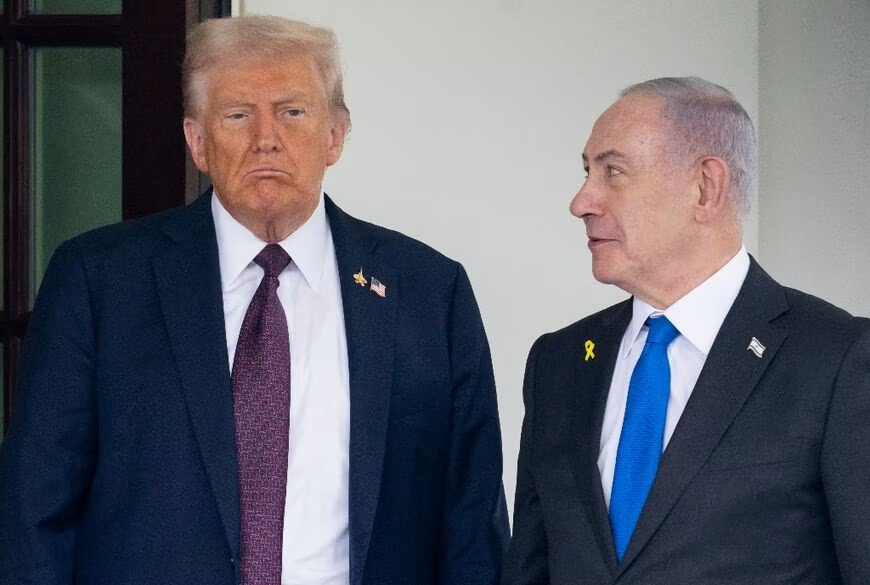
Washington, D.C- A political earthquake is quietly reshaping Washington, and few in the American establishment seem fully prepared for its consequences. According to a major report published by The Washington Post on Wednesday, May 6, 2026, the decades-old bipartisan consensus surrounding Israel is rapidly disintegrating across both the Democratic and Republican parties.
This is not a temporary disagreement over tactics or personalities. It is the gradual collapse of one of the most protected pillars of American foreign policy: the notion that unwavering support for Israel is politically untouchable, morally unquestionable, and strategically indispensable.
For generations, American politicians operated within carefully enforced boundaries when discussing Israel. Democrats and Republicans alike competed to demonstrate loyalty to the “special relationship,” while meaningful criticism of Israeli policy was treated almost as political heresy. Careers were threatened, donors mobilized, and accusations weaponized against those who dared challenge the status quo.
That era is ending.
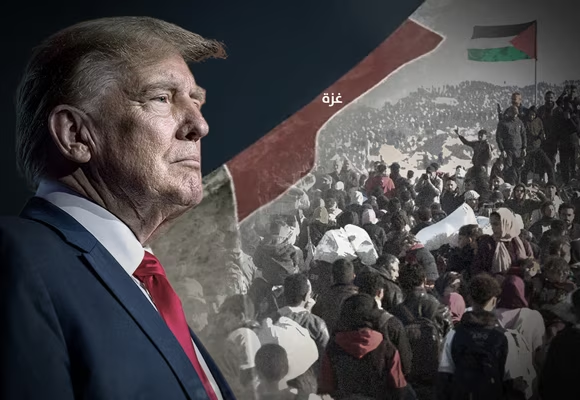
The reason is painfully obvious. The genocide and destruction of Gaza, broadcast daily across phones and computer screens around the world, has shattered decades of carefully constructed political narratives. Americans — especially younger Americans — are no longer seeing Israel exclusively through the traditional lens of democracy, victimhood, and strategic partnership. They are witnessing overwhelming military force deployed against a trapped civilian population, entire neighborhoods reduced to rubble, mass displacement, starvation, and the killing of thousands of children.
Washington’s political class continues speaking the language of “security” and “self-defense,” but much of the American public increasingly sees something far darker: collective punishment carried out with American weapons and financed by American taxpayers., and protected by American political and diplomatic stature on the world stage.
The numbers cited by The Washington Post are extraordinary. Nearly half of Republicans and almost three-quarters of Democrats now say support for Israel has become a divisive issue inside their own parties. Almost half of Americans believe the United States is too supportive of Israel — more than double the figure recorded a decade ago.
That transformation is not merely statistical. It reflects a moral and political rebellion against a foreign policy establishment that has spent decades demanding silence, conformity, and unconditional loyalty whenever Israel is involved.
The Democratic Party, in particular, is experiencing an open revolt from its base. Progressive candidates are no longer cautiously distancing themselves from Israeli policy; many are openly accusing Israel of genocide and apartheid. Senate candidates, congressional hopefuls, and local activists are increasingly framing support for Palestinian rights not as a fringe issue, but as a test of political integrity.
Their argument is devastatingly simple: if politicians cannot speak honestly about the mass killing of civilians and the destruction of an entire society, then what moral credibility do they possess on any other issue?
This explains why younger Democratic voters increasingly see the Palestinian struggle as connected to broader questions of racial justice, colonialism, militarism, and state violence. For them, Gaza is not a distant geopolitical abstraction. It is a mirror reflecting the hypocrisy of a political system that speaks endlessly about human rights while financing devastation abroad.
What makes this moment even more remarkable is that discontent is also growing on the American right.
The Republican fracture over Israel is driven less by humanitarian outrage and more by exhaustion with foreign entanglements and endless wars. The “America First” wing increasingly views Israel through a transactional lens, asking why American taxpayers should subsidize a wealthy nuclear-armed state while domestic crises deepen at home.
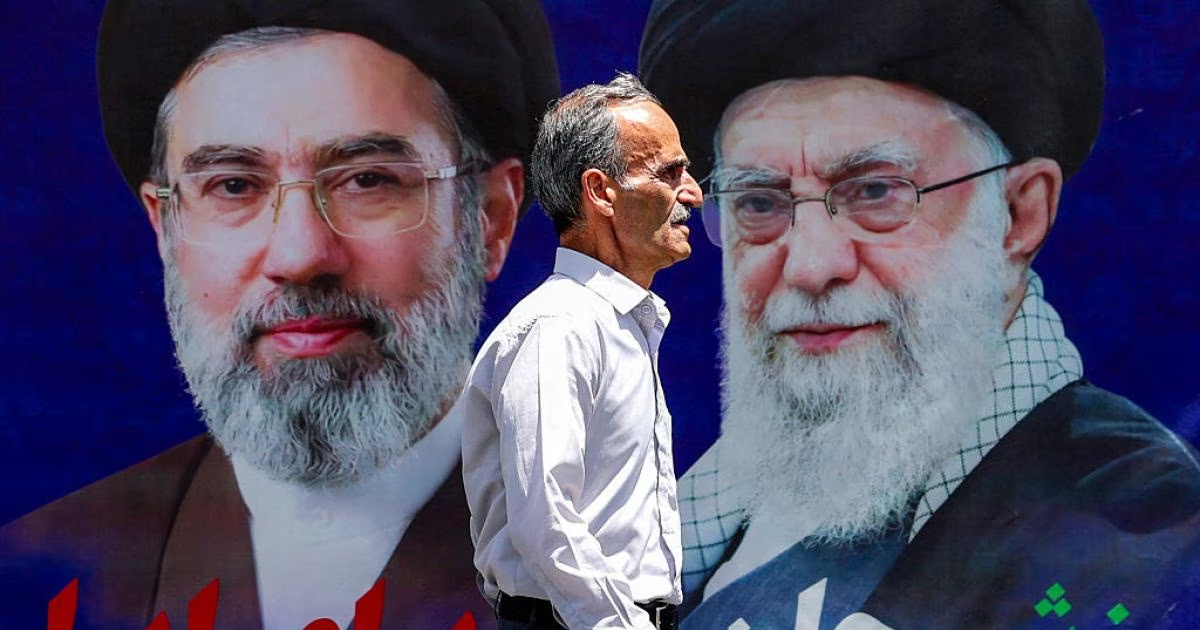
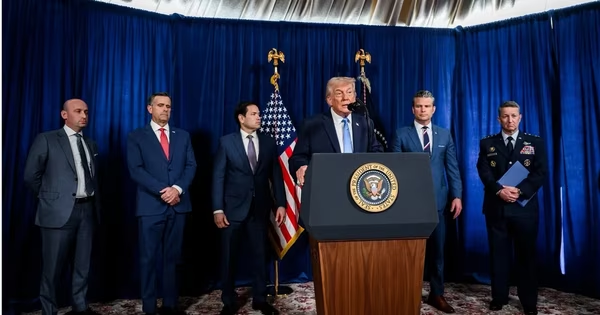
The widening war with Iran has intensified those frustrations. Many conservative voters now openly suspect that the United States is repeatedly being dragged into Middle Eastern conflicts not because of core American interests, but because of pressure from pro-Israel lobbying networks and ideological alliances inside Washington.
Figures such as Tucker Carlson and Marjorie Taylor Greene have capitalized on that anger, openly challenging the once-sacred political taboos surrounding Israel. While some rhetoric emerging from the far right maybe suspect, the broader political reality remains undeniable: unquestioning support for Israel is no longer automatic even within conservative circles.
This represents a historic failure for the American political establishment and for organizations such as AIPAC that long operated as some of the most feared forces in Washington. For decades, pro-Israel lobbying groups maintained influence through campaign financing, political intimidation, and bipartisan discipline. Politicians understood the risks of crossing certain lines.
But even these organizations now appear increasingly defensive. As The Washington Post report notes, pro-Israel political groups are often avoiding direct discussion of Israel itself in campaign advertisements, choosing instead to attack opponents on unrelated domestic issues. That strategic retreat reveals a growing awareness that public opinion is shifting in ways they can no longer fully control.
The generational divide is especially significant. Older Americans, shaped by Cold War alliances, evangelical politics, and memories of the Holocaust, often continue viewing Israel through the traditional framework of moral obligation and strategic partnership. Younger Americans do not. They see a heavily armed regional power enforcing occupation, expanding settlements, and waging wars with devastating civilian consequences.
No amount of official messaging can fully erase the images that now circulate daily across social media platforms outside the control of traditional media gatekeepers.
The political implications are enormous. Future administrations — whether Democratic or Republican — may find it increasingly difficult to sustain the blank-check relationship that has defined U.S.-Israel ties for decades. Military aid, diplomatic protection, and unconditional political cover are no longer guaranteed to remain immune from public scrutiny.
This does not mean the alliance will suddenly disappear. The institutional ties between Washington and Israel remain deep, powerful, and entrenched. But the moral consensus that once protected those ties has been profoundly damaged.
And perhaps that is the most important development of all.
For the first time in modern American political history, criticizing Israel is no longer automatically politically fatal. In many constituencies, especially among younger voters, silence in the face of Gaza may now carry greater political risk than criticism itself.
The old order is cracking. Washington can continue pretending otherwise for a while longer. But the American political landscape surrounding Israel has already changed — and it may never return to what it once was.