ARAB AND WORLD

Tue 31 Mar 2026 3:28 pm - Jerusalem Time

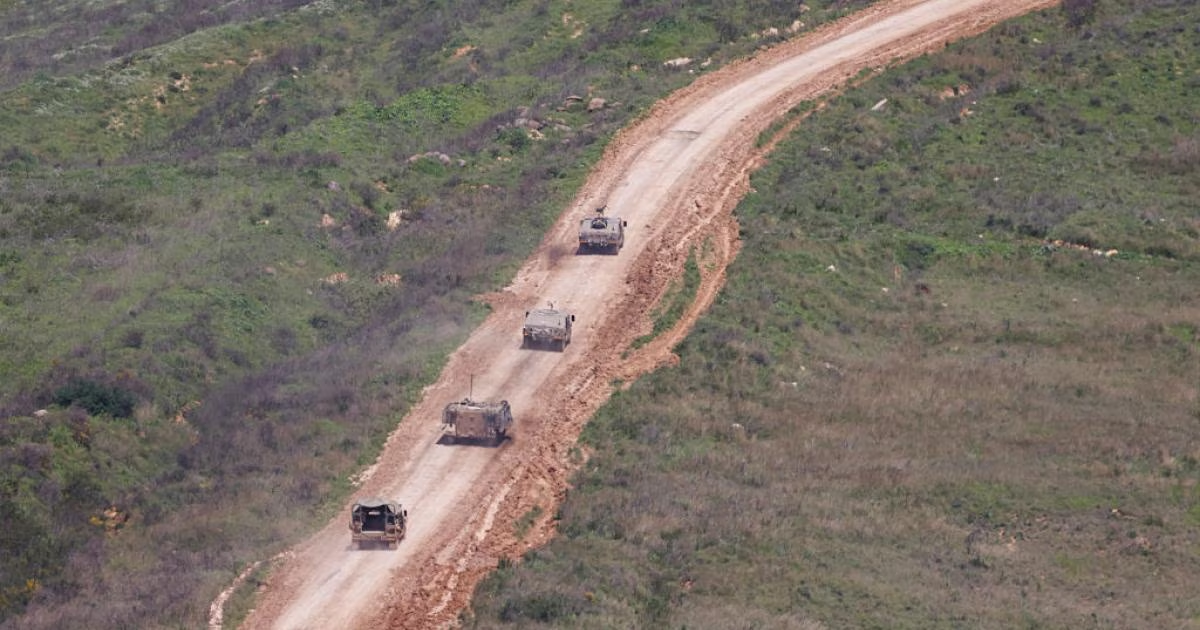
Deadly Israeli escalation in southern Lebanon, Katz vows to impose a buffer zone up to the Litani

Various areas in southern Lebanon and the southern suburbs of Beirut witnessed a deadly military escalation on Tuesday, as Israeli warplanes launched a series of intense raids resulting in casualties and injuries. Field sources confirmed the martyrdom of five citizens and the injury of three others in an initial toll of these attacks, which targeted vehicles and residential gatherings deep in southern Lebanon.

In field details, an airstrike targeted a civilian car in the Qasimiya area, leading to the martyrdom of two and the injury of three others with varying degrees of wounds, who were subsequently transferred to hospitals. The shelling also hit the town of Deirkifa, where two more people were martyred, while the town of Abba recorded the fall of a young martyr due to a direct aerial targeting of the area.

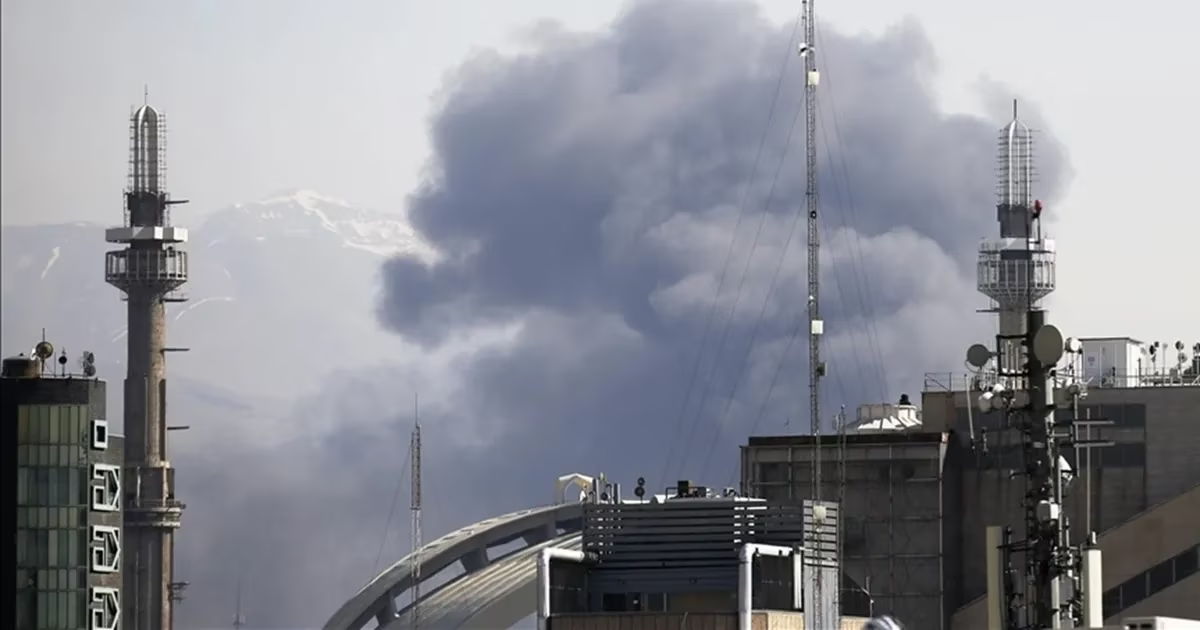
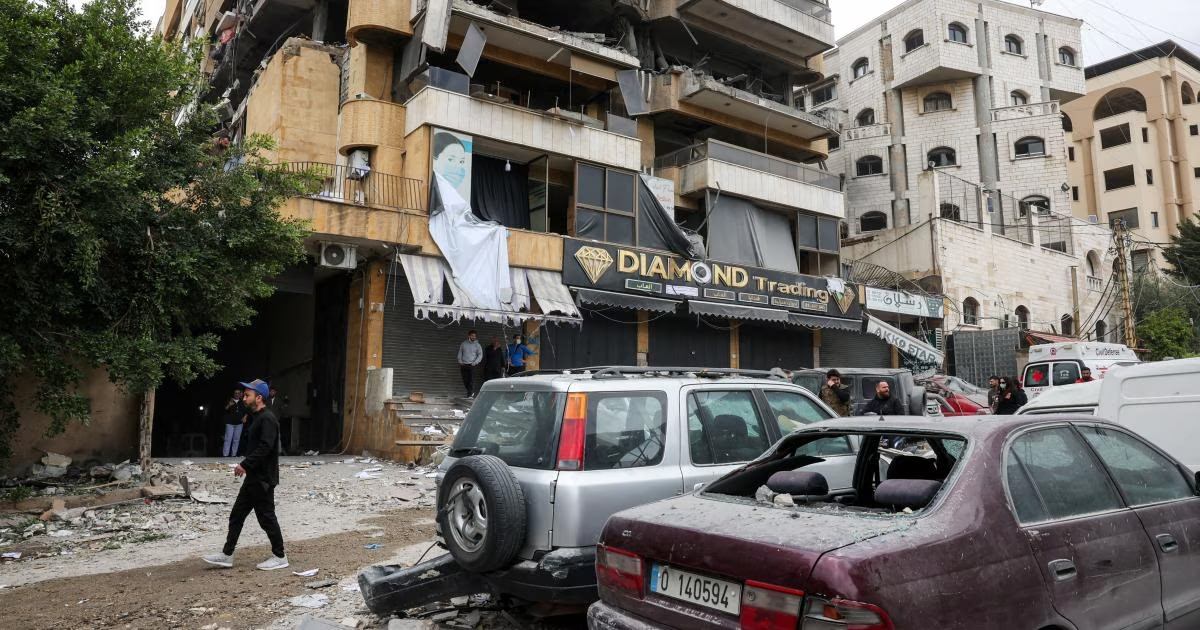
The military operations were not limited to concentrated aerial bombardment but extended to include intense raids on the town of Qleileh, south of the city of Tyre, coinciding with intense artillery shelling that targeted the outskirts of the town of Mansouri. In a later development in the afternoon, a massive explosion rocked the southern suburbs of Beirut due to an Israeli raid targeting one of the neighborhoods there, which increased the pace of the escalating field tension.

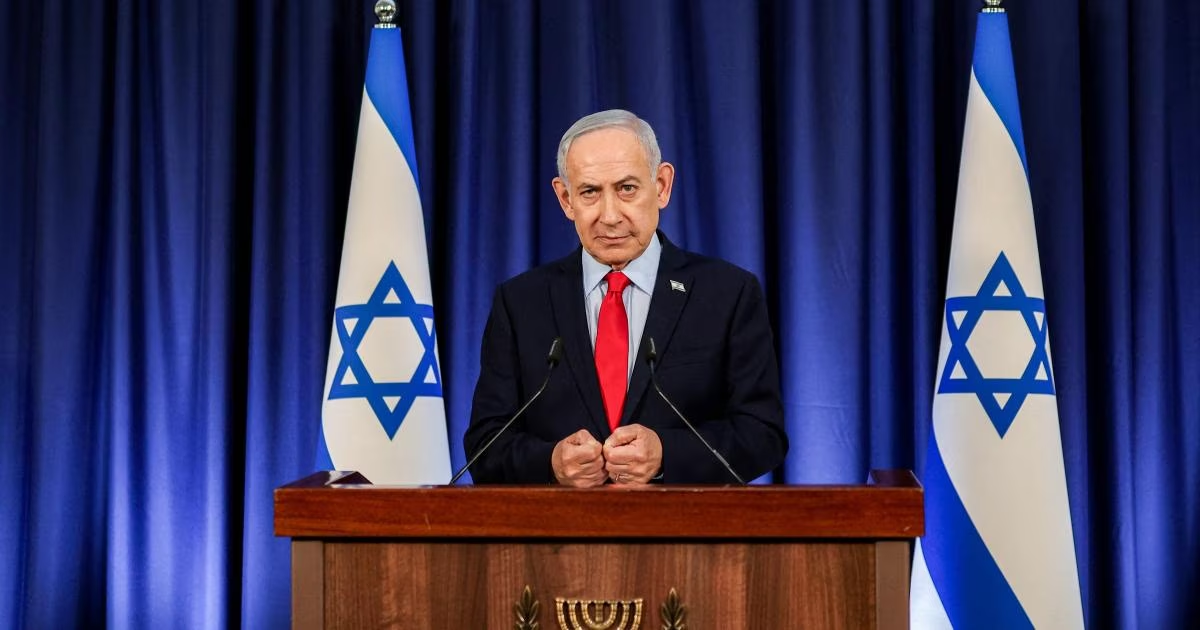
On the Israeli political and military front, Security Minister Israel Katz issued extremely serious statements, revealing the occupation's intention to impose a new geographical reality in southern Lebanon. Katz clarified that Israel intends to establish what he described as a 'security zone' that will extend from the international border to the course of the Litani River, with guaranteed military control over it.

Katz indicated in a statement issued after an assessment of the security situation that the Israeli army would not be content with transient operations but would seek full control over all strategic junctions, including bridges and geographical links. He stressed that this area would remain under Israeli security control even after the cessation of hostilities to ensure that no border threats return.

Regarding the displaced persons file, the Israeli Security Minister explicitly announced that more than 600,000 Lebanese who were displaced from their areas would not be allowed to return to their homes located south of the Litani River at present. Katz linked the return of Lebanese residents to what he considered 'achieving full security' for the residents of settlements in northern Israel, which portends a long-term humanitarian crisis.

The Israeli minister also threatened to adopt a 'scorched earth' policy in Lebanese villages near the border, confirming that the army would work to demolish homes and infrastructure in those towns. Katz likened these measures to what the occupation army implemented in the Rafah and Beit Hanoun areas in the Gaza Strip, with the aim of removing any visual obstacles or fortifications that the resistance might use.

These field and political developments reflect an Israeli trend towards comprehensive demographic and geographical change in southern Lebanon, amidst international warnings of the repercussions of these plans. These statements raise widespread fears of turning southern Lebanon into a devastated buffer zone, which deepens the humanitarian tragedy of the displaced and places the region before open scenarios of confrontation.

The Israeli army will work to fully control the area up to the Litani, including bridges, and displaced persons will not be allowed to return before ensuring the security of the north.

ARAB AND WORLD

Tue 31 Mar 2026 3:28 pm - Jerusalem Time

Officer and 3 Israeli Soldiers Killed in Ambush in Southern Lebanon

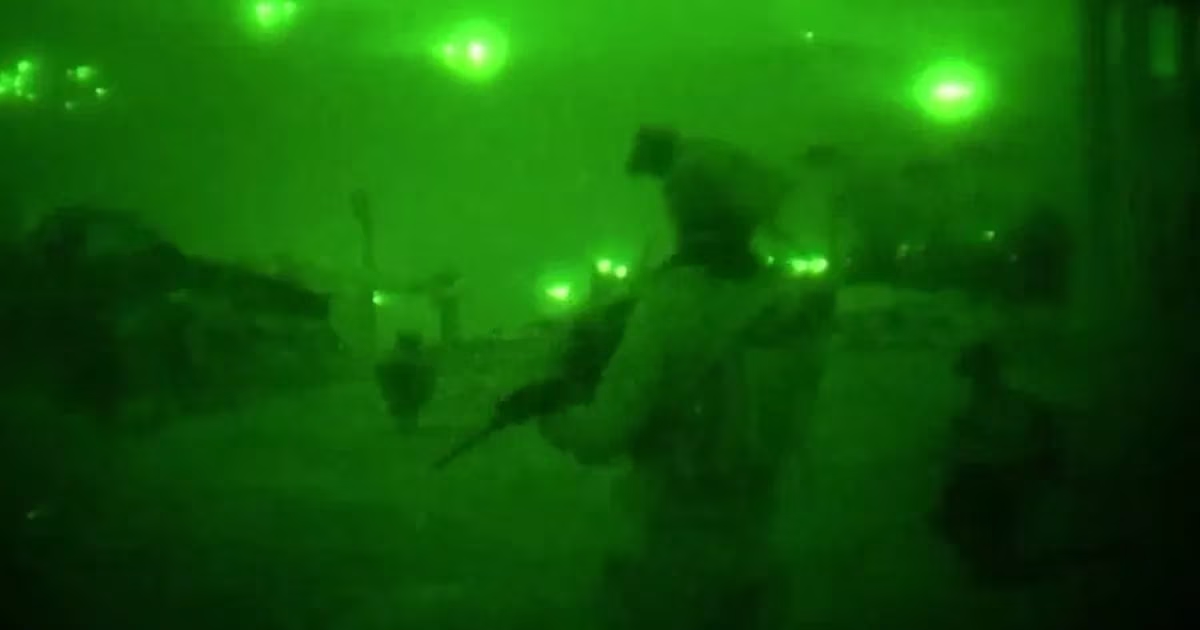
The Israeli occupation army admitted to the killing of four of its servicemen, including a high-ranking officer belonging to the elite 'Nahal' Brigade, following fierce confrontations on the southern Lebanon front. Hebrew sources clarified that the Israeli force was subjected to a coordinated attack that also resulted in three other soldiers sustaining injuries of varying degrees during the recent hours.

Field reports indicated that the Israeli unit fell into a well-planned ambush set by Hezbollah fighters in the vicinity of the town of Nabatieh, where close-quarters clashes took place. The fighters extensively used guided and anti-tank missiles, which hindered the initial attempts by the occupation to evacuate the casualties from the battlefield.

Media sources reported that the occupation army was forced to deploy intensive air and ground reinforcements, including airstrikes from warplanes and artillery and tank shelling, to provide fire cover for evacuation operations. Israeli military censorship is imposing a strict blackout on the details of the incident, attempting to limit the dissemination of information about the precise circumstances of the ambush.

This new toll raises the number of officially announced deaths in the ranks of the occupation army to 6 soldiers, in addition to more than 60 injured since the start of ground operations on the Lebanese border. Data indicates that the resistance in the South is employing tactics of luring and direct engagement to inflict the greatest possible losses on the invading forces.

In a related context, Monday saw an Israeli soldier seriously injured, described by the army as a result of an 'operational incident' in the border area. Two other soldiers also sustained moderate injuries due to the explosion of a kamikaze drone that fell near their location, reflecting the diversity of combat means used to counter the incursion.

On the political and military front, international press reports quoted officials in Tel Aviv expressing their intention to keep forces inside Lebanese territory for an indefinite period. This approach, according to the 'Wall Street Journal', aims to ensure the complete elimination of infrastructure and threats posed by Hezbollah to northern settlements.

For its part, the Hebrew newspaper 'Haaretz' revealed plans adopted by the military establishment aimed at the comprehensive destruction of all homes in the 'first-line' border villages. Through this policy, the occupation authorities seek to create a buffer zone devoid of residents and prevent the residents of those villages from returning to their homes in the near future.

Confrontations continue along the front line in southern Lebanon, amidst repeated attempts by the occupation army to advance and establish new military points. In contrast, the fighting groups continue to carry out qualitative operations and target gatherings of vehicles and soldiers, making the cost of the ground incursion continuously escalate.

Soldiers were killed during close-quarters clashes, where fighters launched anti-tank missiles during attempts to evacuate the dead and wounded.

PALESTINE

Tue 31 Mar 2026 3:28 pm - Jerusalem Time

Former B'Tselem Director: 'Deir Yassin' Mentality Drives Israeli Crimes to Displace Palestinians

Hagai El-Ad, former Executive Director of the human rights organization B'Tselem, affirmed that the massacres and military operations witnessed in the occupied West Bank are not random, but rather follow a clear strategy aimed at intimidating and displacing Palestinians. El-Ad explained that this policy is encapsulated by the 'Deir Yassin' mentality, which seeks to transform the entire country to be under the sole control of Jews by eliminating the Palestinian presence.

El-Ad believes that the Zionist project has achieved a near-complete victory militarily, politically, and economically, in addition to absolute control over natural resources and water. However, the demographic factor remains the only challenge that has not yet been decided in Israel's favor, as Palestinians still constitute half of the population between the river and the sea.

The Israeli human rights advocate pointed out that the outcomes of 1967 did not replicate the Nakba of 1948 in terms of the scale of displacement, leading to a state of 'numerical parity' that causes deep concern within the Israeli establishment. This numerical equality, despite the absence of equality in rights and power, places Israel in a structural dilemma that its leaders try to solve through tools of force and legislation.

El-Ad considered that the policies of the government, army, and courts revolve around bridging this demographic gap, either by recognizing the binational reality or resorting to ethnic cleansing. Since the first option is rejected by Zionists, the trend towards 'transfer' remains the dream that the occupation seeks to achieve to get rid of the burden of the apartheid system.

El-Ad recalled historical statements by David Ben-Gurion from 1949, where the latter linked the establishment of a Jewish state in the entire country with the necessity of carrying out massacres similar to Deir Yassin. According to Ben-Gurion, controlling the land without displacing Arabs would leave the state at the mercy of a non-Jewish majority, which Zionist ideology rejects.

Analysis concludes that Israel's borders were never merely a military matter, but rather demographic borders drawn by the extent to which forced displacement operations could be carried out. In 1948, Israel succeeded in creating a majority within the Green Line, but it failed to fully replicate that after the 1967 war.

El-Ad warned that Israel is currently escaping forward by escalating regional confrontations with Iran and Lebanon, but these wars will not address the fundamental crisis of the Palestinian presence. He stressed that diplomatic paths such as the 'Abraham Accords' will not change the demographic balance on the ground, because Palestinians are steadfast in their homeland.

Human rights sources warned that major wars are often exploited as an opportunity to pass 'postponed' displacement plans during times of relative peace. What is happening today in Gaza and the West Bank revives the 'Deir Yassin' option, which has never been removed from the Israeli decision-making table for many decades.

Regarding Area C in the West Bank, El-Ad explained that the violence practiced there aims to push residents towards gradual ethnic cleansing by destroying livelihoods. This logic also explains the bulldozing of camps and the uprooting of tens of thousands of Palestinians from their homes under flimsy security pretexts.

El-Ad described what is currently happening as 'internal cleansing,' where Palestinians are gathered in narrow, overcrowded enclaves while Israeli control over open lands expands. The Israeli gamble relies on making the lives of these residents impossible, so that they become more susceptible to final displacement when suitable political conditions arise.

Analysis confirmed that the issue is essentially about how to manage an unresolved demographic dilemma, where Israeli policy oscillates between an apartheid system and the option of forced displacement. The more military pressure increases, the more international sensitivities towards cold-blooded ethnic cleansing crimes fade.

El-Ad concluded that 'Deir Yassin' is not just a historical memory, but a reality that Palestinians live daily under continuous uprooting policies. It is the narrative that Israel tries to deny while actively practicing it in every neighborhood and alley, attempting to erase the fact that this land is home to another people.

The former B'Tselem director emphasized that understanding the extent of violence and bloodshed perpetrated by the 'founding fathers' is essential to understanding what the current generation of Israeli leaders is committing. The ultimate goal remains constant: to bequeath to their children a country free of Palestinians by generalizing the 'Deir Yassin' model everywhere.

In concluding his reading, El-Ad indicated that international silence towards the apartheid system encourages Israel to move to the more dangerous stage of comprehensive displacement. Palestinian steadfastness on the land is the only obstacle preventing the completion of the Zionist project as planned by Ben-Gurion more than seven decades ago.

Establishing a Jewish state in the existing reality, throughout the country without Deir Yassin, is not possible if it is democratic, because the number of Arabs exceeds the number of Jews.

PALESTINE

Tue 31 Mar 2026 3:27 pm - Jerusalem Time

Iranian Conditions for Ending the Confrontation: Comprehensive American Withdrawal and Linking Fate to the Gaza Strip

Media sources close to decision-making circles in Tehran have revealed a list of what they described as strict conditions to end the open military confrontation that began on February 28. These moves come amid unprecedented escalation, including direct confrontations and assassinations targeting the leadership hierarchy of the Islamic Republic.

The Iranian vision included nine fundamental demands, prioritizing the complete and full withdrawal of American forces from the Middle East and the dismantling of all their military bases. Tehran believes that the foreign military presence is the primary driver of instability in the region.

On the ground, Tehran stipulated an immediate cessation of all hostile operations and attacks targeting Iranian territory, in addition to an end to the aggression against Lebanon and the forces of the Axis of Resistance. This condition reinforces the concept of collective defense adopted by Iran's allied forces in the region.

Economically, Iran demanded a comprehensive lifting of all international sanctions imposed on it without reservation or condition, with the necessity of immediate release of all frozen financial assets in global banks. This step is considered a fundamental pillar for any future political understanding aimed at ending the state of hostility.

In a move to enhance its naval influence, the conditions included imposing a new economic system for navigation through the strategic Strait of Hormuz, making it fully subject to Iranian sovereignty. This demand aims to secure waterways according to Tehran's security vision and ensure its vital interests.

Legally and politically, Tehran insists on the necessity of the international community recognizing the United States and the Israeli occupation state as 'aggressor' parties in the ongoing war. It also demanded significant financial compensation for the human and material losses it incurred as a result of recent military operations.

The list of conditions did not exclude thorny regional issues, as Iran demanded that the United Arab Emirates cease its claims regarding the three disputed islands. Tehran also hinted at the option of withdrawing from the Nuclear Non-Proliferation Treaty, considering it a sovereign right that follows its national interests.

Regarding the Gaza Strip, urgent questions arise about the extent of Tehran's commitment to linking the fate of de-escalation to an end to the aggression against the Strip. Observers indicate that the concept of 'unity of fronts' compels Iranian decision-makers not to separate fronts in any potential settlement agreement with international powers.

Specialized sources on Iranian affairs stated that any agreement that does not start with a comprehensive and complete ceasefire will be an incomplete agreement and will not lead to sustainable stability. The sources stressed that Iran views the resistance fronts from Palestine to Lebanon as a single, indivisible bloc.

The sources clarified that excluding any arena, especially Gaza, from de-escalation understandings will keep the fuse of explosion lit and threaten the collapse of any agreement in early stages. The Iranian position sees the security of the region as an indivisible unit, and that addressing the roots of tension requires a comprehensive regional vision.

Historically, the confrontation has witnessed dramatic shifts since early 2024, starting with the targeting of the Iranian consulate in Damascus and culminating in the assassination of Hamas political bureau chief Ismail Haniyeh in the heart of Tehran. These events transformed the conflict from a 'shadow war' to a direct and open confrontation with missiles and drones.

Military operations launched by the occupation and the United States have continued since last February, which, according to reports, have led to the death of hundreds of people, including Supreme Leader Ali Khamenei. In response, Tehran continues its military responses by targeting what it describes as American and Israeli sites and interests in the region.

Any de-escalation that does not include all parties of the resistance front may be considered insufficient to achieve real stability, and a ceasefire must include Gaza as an essential part.

ISRAELI AFFAIRS

Tue 31 Mar 2026 3:27 pm - Jerusalem Time

Former Israeli National Security Council Head: Iran is a Resilient State and Will Not Surrender to Military Strikes

Major General (res.) Yaakov Amidror, former head of the Israeli National Security Council, emphasized that the Iranian state possesses elements of resilience that make its surrender in the near term highly unlikely. In press statements, he explained that Iran differs fundamentally from many regional states he described as 'artificial,' given its deep political and cultural structure and well-established institutional roots.

Amidror pointed out that betting on the collapse of the Iranian regime immediately after receiving major military strikes is a mistaken assessment not based on an understanding of the nature of the state there. He considered that any retreat by the regime due to pressure would not necessarily lead to the disappearance of the state, but might open the door for limited opposition movements without affecting its core ability to threaten Israeli interests.

Regarding the American role, the former security official revealed the existence of extensive military preparations led by Washington against Tehran. He affirmed that U.S. forces have amassed a deliberate campaign that goes beyond mere transient responses, as it includes multi-stage strategic options aimed at systematically undermining Iranian influence in the region.

The scenarios presented to the American administration, according to Amidror, include the possibility of working to open the Strait of Hormuz by military force if it is closed, in addition to the option of occupying the vital Kharg Island. Plans also include targeting uranium extraction facilities to ensure the paralysis of Iranian nuclear capabilities and prevent them from reaching the military manufacturing stage.

Amidror explained that these military options would be presented to the U.S. President for final decision, stressing that the current strategy relies on the gradual destruction of capabilities. He believes that the continuation of military operations serves Israel's interests, as each day of confrontation reduces Iran's relative strength and increases the pressure on its leadership.

He also noted precise coordination between Israeli and American forces to target dozens of vital sites deep within Iranian territory. These targets include major steel factories and sensitive military installations, with the aim of weakening the infrastructure that supports the Iranian war effort and its allies in the region.

On the northern front, Amidror affirmed that the Israeli army continues its operations against Hezbollah in Lebanon with high focus, but without allowing this front to distract from the main objective. He explained that military movements are primarily aimed at pushing Hezbollah's capabilities north of the Litani River and securing border settlements from any direct threat.

The former official ruled out a large-scale ground attack in Lebanese territory at present, considering that the current strategy favors active defense in southern Lebanon. He noted that most of the rockets launched by Hezbollah currently target Israeli troop concentrations, keeping the confrontation within tactical control limits.

Amidror mentioned that refraining from expanding operations in Lebanon allows the Israeli Air Force to concentrate its full power towards Iranian targets without the need to distribute air efforts. He considered that this policy makes operations more effective and ensures not being drawn into a long war of attrition in two different places simultaneously.

He affirmed that the ultimate goal remains the elimination of threats posed by organizations he described as 'terrorist,' but according to a timing that serves supreme strategic interests. He stressed that full military force would be used at the moment that guarantees decisive action without endangering other fronts.

In the context of his analysis of the nature of the conflict, Amidror called for a deep understanding of regional complexities before making fateful decisions. He explained that dealing with Iran requires patience, continuous and cautious planning, away from optimistic expectations of a rapid collapse of the regime due to external military pressure.

He pointed out that continuous air operations contribute to the erosion of Iranian deterrence, a path that must be maintained to ensure Israeli superiority in the region. He considered that success in this mission depends on close coordination with international allies, especially the United States, to ensure political and military cover for operations.

Amidror concluded by emphasizing that Israel will not allow developments in Lebanon to divert it from its strategic path towards Tehran. He considered that protecting the eastern sector and west of the Litani River represents a current defensive priority, while the Iranian file remains the existential challenge that requires the focus of all intelligence and operational efforts.

These statements come at a time when the region is witnessing escalating tensions, with international circles awaiting the nature of mutual responses between active parties. Amidror's vision reflects a trend within the Israeli security establishment that favors measured and organized escalation rather than rushing into comprehensive confrontations with uncertain outcomes.

Iran is a real state with clear organization, academia, and institutional strength, and anyone who expects its rapid collapse after military strikes is completely mistaken.

ARAB AND WORLD

Tue 31 Mar 2026 3:27 pm - Jerusalem Time

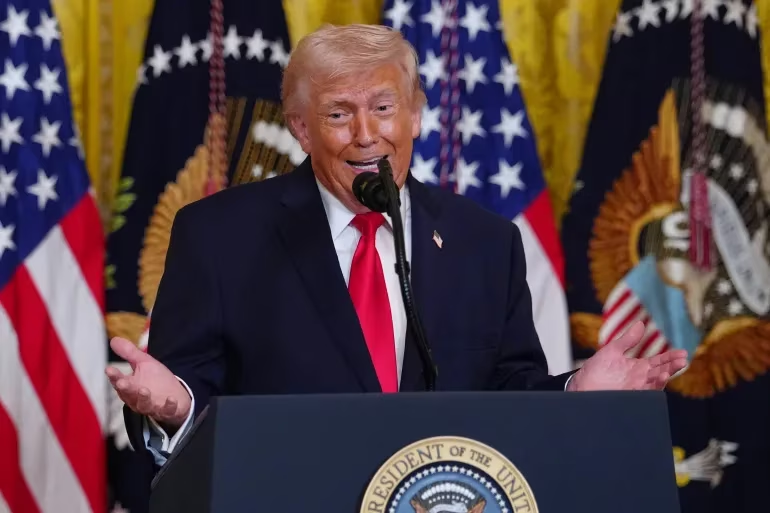
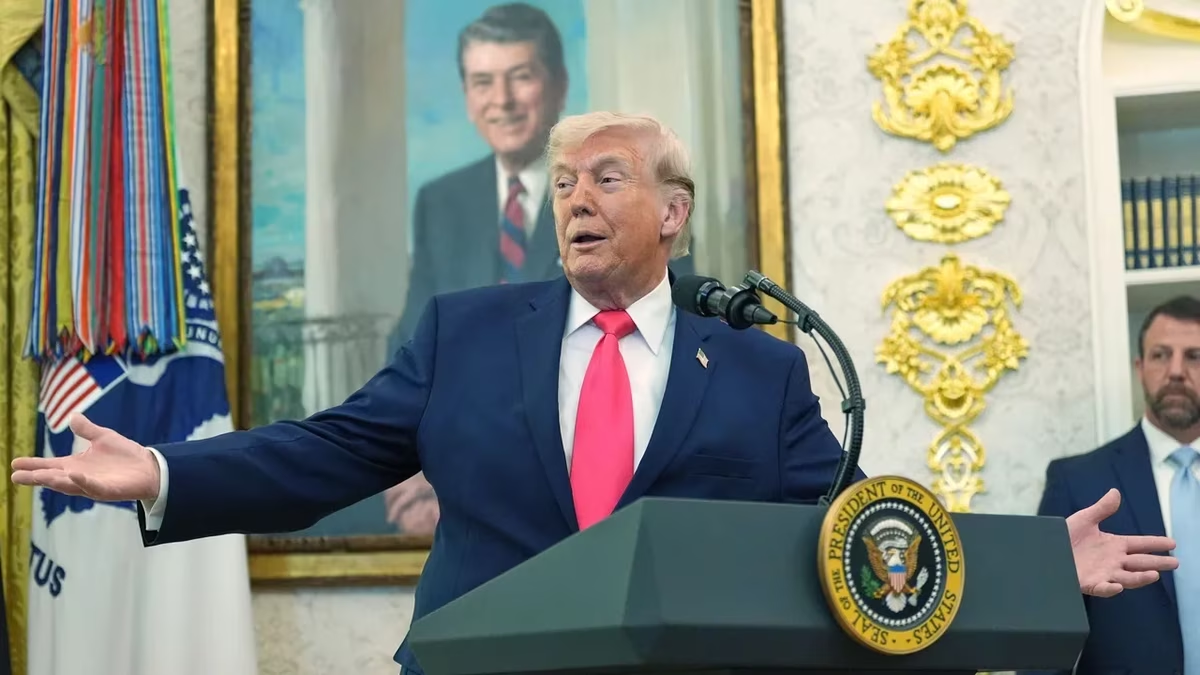
Trump Considers Commando Operation to Extract Iranian Uranium and Accepts Hormuz Closure

International media sources have revealed new behind-the-scenes developments within the White House, where US President Donald Trump has informed his aides of his readiness to end the military campaign against Iran. The sources clarified that Trump is showing flexibility in ending the conflict even if the Strait of Hormuz remains closed, a strategic shift that reflects his desire not to be drawn into a long-term confrontation.

In recent days, the US administration concluded that attempting to open the Strait of Hormuz by military force could lead to a widespread escalation exceeding the timeframe Trump set for ending operations. The President and his advisors believe that the mission could take longer than the four weeks he specified as a timeframe for ending the war, which prompted him to look for alternative options.

In a related context, Trump is considering implementing a specialized and complex military operation aimed at extracting approximately one thousand pounds of uranium from within Iranian facilities. This mission is considered one of the most dangerous options on the table, as it may require the infiltration of US ground forces and their presence inside Iranian territory for several days to secure the transfer of sensitive materials.

Informed sources stated that Trump has not yet made a final decision regarding this operation, as he is currently weighing the serious risks that US forces might face against the strategic goal of preventing Tehran from acquiring a nuclear weapon. Nevertheless, the President remains open to the idea as a final leverage tool to extract substantial concessions.

President Trump has encouraged his advisors to exert maximum pressure on the Iranian leadership to agree to hand over the nuclear stockpile as a prerequisite for a ceasefire. Trump emphasized in discussions with his political allies that Tehran cannot retain these materials, hinting at the option of seizing them by force if diplomatic efforts fail.

On the diplomatic front, mediation efforts led by Turkey, Egypt, and Pakistan have emerged to bridge the gap between Washington and Tehran and avoid a full-scale explosion. Despite these efforts, the parties involved have not yet engaged in formal direct negotiations to end the war, leaving the military option on the table.

For her part, White House spokeswoman Karoline Leavitt affirmed that the Department of Defense's role is currently limited to preparing all possible options to give the Commander-in-Chief flexibility in decision-making. In contrast, the Pentagon and US Central Command have remained silent regarding the leaked military plans related to uranium or the Strait of Hormuz.

Technical estimates indicate that Iran possessed large quantities of highly enriched uranium before the airstrikes carried out by the United States and Israel last June. According to international reports, the stockpile includes materials enriched to 60% and 20%, percentages that allow for their rapid conversion to the 90% level required for nuclear bombs.

Rafael Grossi, Director General of the International Atomic Energy Agency, suggested that these materials are stored in fortified underground locations, specifically in the Isfahan and Natanz facilities. Experts warned that any attempt to control these sites would require specialized teams to handle the radioactive materials, which are believed to be stored in special cylinders requiring equipped trucks for transport.

In contrast, military experts warned that carrying out a ground operation to seize uranium could lead to a violent Iranian reaction that would expand the scope of the war regionally. Analysts explained that the operation would place US forces under direct threat from missiles and drones, which could undermine the timeline Trump set for ending the conflict by mid-April.

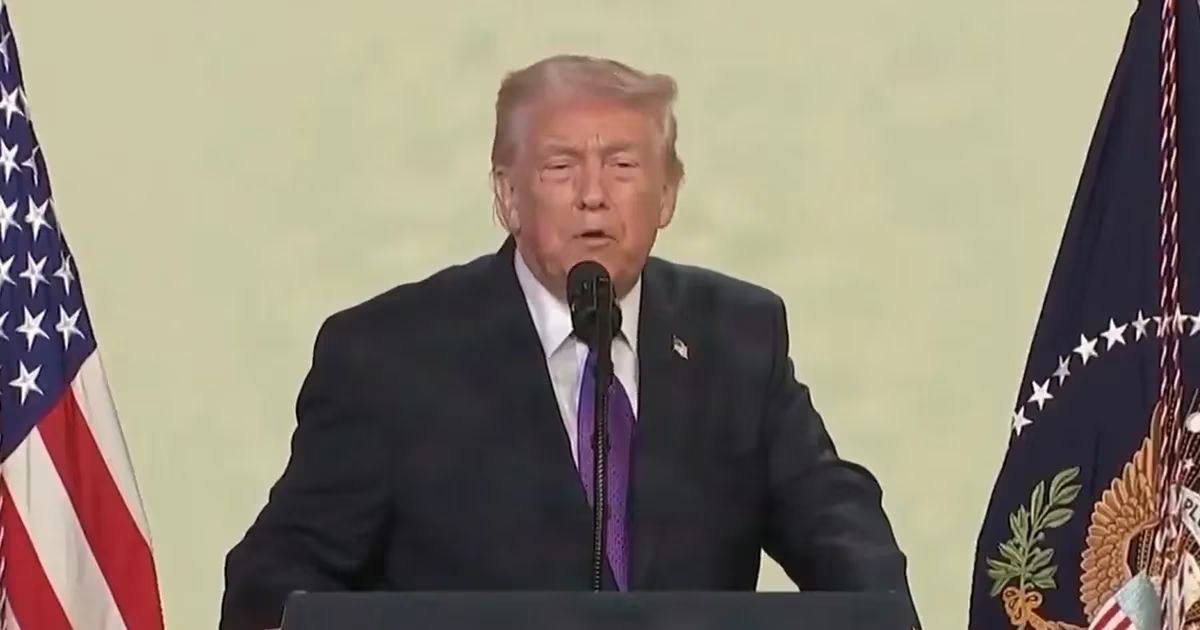
Trump warned Tehran of the consequences of non-compliance with US demands, saying: "Iran will not have a country if it doesn't, and they will give us nuclear dust."

ARAB AND WORLD

Tue 31 Mar 2026 3:27 pm - Jerusalem Time

Trump hints at ending military operations against Iran despite continued closure of the Strait of Hormuz

International media sources, quoting officials in the US administration, revealed that President Donald Trump has indicated to his aides a readiness to end military operations against Iran, even if the Strait of Hormuz remains closed. This surprising shift is set to redraw the lines of confrontation in the region, as this decision is likely to prolong Tehran's control over the vital waterway and postpone any complex operations to open it by force.

Estimates within the White House suggest that an attempt to militarily open the Strait could require a timeline of four to six weeks, which exceeds the timeframe Trump set for the military campaign. Accordingly, Washington has decided to reorder its field priorities to focus primarily on destroying Iranian naval capabilities and neutralizing missile stockpiles, rather than getting involved in a prolonged ground or naval operation.

In the context of this shift, the United States is seeking to intensify diplomatic pressure as a parallel path to restore the flow of global trade through the Strait. Should these efforts falter, Washington intends to push its allies in Europe and the Gulf region to take the lead in securing international navigation, while keeping other military options on the table without considering them an immediate priority for now.

This March has seen fluctuations in President Trump's statements regarding handling the crisis, as he previously threatened to strike Iran's energy infrastructure. However, he later downplayed the strategic importance of the Strait for the United States, considering that the countries benefiting from the oil passing through it should bear the brunt of resolving the crisis and securing its passages.

On the ground, this political direction has not prevented the continued American military reinforcements in the region, with the aircraft carrier 'USS Tripoli' arriving alongside the deployment of additional combat units. Despite Trump describing this war as 'short,' the stated objectives appear complex, especially concerning the control of Iranian nuclear sites and uranium stockpiles that continue to raise international concern.

Economically, the Strait of Hormuz represents an indispensable artery for global energy, with about one-fifth of the world's oil supplies flowing through it. Its continued closure has led to severe disruptions in global markets, with US oil prices jumping to exceed $100 per barrel for the first time since 2022, amid warnings of an economic catastrophe that could push prices towards $200.

The repercussions are not limited to fuel prices but also extend to a severe shortage of vital materials used in global industries such as fertilizers and helium gas. Many countries, including close allies of Washington, face a real crisis in securing energy supplies and supply chains, placing immense political and economic pressure on the US administration to take a decisive stance to end the navigational impasse.

For her part, Suzanne Maloney, Vice President of the Brookings Institution, criticized the move towards ending military operations before ensuring the opening of the Strait, describing the step as irresponsible. Maloney emphasized that global energy markets are organically interconnected, and any attempt to isolate the American economy from the effects of the Strait's closure will fail unless a comprehensive political settlement or military resolution guaranteeing freedom of navigation is reached.

Amid these complexities, about 40 countries have announced their commitment to contributing to an international force to secure navigation in the region, leaving all scenarios open. Expectations range from the success of diplomatic mediations in defusing the crisis to a slide towards broader military escalation if Tehran continues to close the world's most important waterway, threatening the stability of the global economy for years to come.

Ending military operations before reopening the Strait of Hormuz is irresponsible, given that the repercussions of the crisis cannot be isolated from the American economy.

PALESTINE

Tue 31 Mar 2026 3:27 pm - Jerusalem Time

The occupation demolishes 4 homes in Al-Bustan neighborhood as part of a plan to displace over 2200 Palestinians to build "City of David" and "King's Garden"

Under the guise of a purported "Biblical Garden": The occupation demolishes 4 homes in Al-Bustan neighborhood as part of a plan to displace over 2200 Palestinians to build "City of David" and "King's Garden"

- 257 families in Al-Bustan, Batn al-Hawa, and Wadi Hilweh neighborhoods are threatened with displacement

- 5 major settlement projects targeting Silwan: the suspended bridge, the Pilgrims' Tunnel, the "Kedem" project, the cable car, and the train

Jerusalem - "Al-Quds" dot com - Muhammad Abu Khdeir - Israeli occupation forces carried out extensive demolition operations yesterday morning in Al-Bustan neighborhood in Silwan, south of the blessed Al-Aqsa Mosque, affecting homes, retaining walls, and main and secondary streets, as part of major settlement plans and projects aimed at changing the historical and religious identity of Jerusalem.

Occupation forces stormed Al-Bustan neighborhood in the early hours of yesterday, reinforced by heavy machinery, municipal crews, special forces, undercover units, and settlement guards. They imposed a complete siege on all roads leading to the neighborhood, preventing residents and media crews from reaching the area. This raid resulted in the complete destruction of four homes, as follows: the homes of brothers Na'im and Ibrahim Shehadeh, the home of citizen Saleh Abu Shafea, and the home of elderly Ahmed Al-Abbasi (85 years old).

The demolition operations extended to include the destruction of retaining walls, the bulldozing of main and secondary streets, and the damage to infrastructure in the area. The occupation authorities also handed three other families in the neighborhood eviction notices for their homes by next Saturday at the latest, in preparation for their demolition.

58 homes remain out of 120

The figures monitored by the Silwan Land Defense Committees show the extent of the losses the neighborhood has suffered over the past years. Fakhri Abu Diab, a member of the Silwan Land Defense Committee and a resident of the neighborhood, explained that the number of homes in Al-Bustan neighborhood was about 120 homes a decade and a half ago, while the number decreased to only 66 homes by the end of last February, becoming 58 homes today after the recent demolition operations.

Abu Diab revealed a sharp escalation in the pace of demolition operations carried out by the occupation authorities in the neighborhood, with the number of homes demolished by the occupation since the outbreak of the war on Gaza on October 7, 2023, reaching about 37 homes.

These figures confirm that Al-Bustan neighborhood is shrinking year after year, in a systematic process aimed at emptying it of its original inhabitants in preparation for its abolition and annexation to settlement projects.

"King's Garden" as a pretext for demolishing Jerusalemites' homes

The occupation authorities, in their systematic campaign against Al-Bustan neighborhood, invoke a purported historical narrative, claiming that the area was a "garden of King David" in ancient times. According to this narrative, the occupation municipality and settlement associations seek to demolish the neighborhood's homes, with the aim of expanding the so-called "National Park" (National Garden) that extends from the adjacent Wadi Hilweh neighborhood, which has been managed since the 1990s by the extremist settlement association "Elad," with the support and assistance of the occupation government and municipality.

A report issued by the International Jerusalem Foundation indicates that this project is merely an extension of a broader plan aimed at transforming Al-Bustan neighborhood into the so-called "King's Garden." Documents reveal that the occupation has no claims of prior ownership or suspicion of settlement in the neighborhood, and that the sole pretext for displacement is based on a purely "Biblical narrative."

"Empty Land".. a misleading pretext

In a related context to the military campaign, the occupation municipality intensified its administrative and legal measures aimed at confiscating vast lands in the neighborhood. At the beginning of last January, the occupation municipality issued notices to a number of landowners in Al-Bustan neighborhood to confiscate about 7 dunams, under the pretext of "landscaping and establishing parking lots" on lands it described as "empty."

However, the Governor of Jerusalem clarified in a statement that these lands are not empty at all, but rather lands on which Palestinian homes stood, inhabited by their owners before the occupation forces demolished them and displaced them earlier. Legal experts describe this practice as the "empty land policy," which is a deceptive legal tool used by the occupation authorities to establish a new settlement reality on the ruins of demolished homes.

Theft under the guise of tourism and urban planning

In addition to field demolition operations, specialized reports monitor a more dangerous shift at the planning level, represented by changes in the official maps of the occupation municipality in Jerusalem. The Alternative Planning Center (AHC) team observed disturbing changes in the maps published on the occupation municipality's website, showing a deliberate reduction of the municipal boundaries of Silwan town, and the re-annexation of vital parts of it, particularly Wadi Hilweh neighborhood, to the so-called "City of David" settlement.

The Jerusalem Governorate warned in a report that this new classification falls within the framework of transforming parts of the town into a tourist and archaeological area subject to settlement projects, which limits the officially recognized Palestinian urban space in Silwan.

The Governorate affirmed that these divisions are unilateral and illegitimate measures, aimed at reshaping the spatial and demographic reality in East Jerusalem to serve settlement projects.

Silwan, two halves.. Arab and Jewish

In this context, Khalil Tufakji, an expert in maps and settlement affairs, explained that the new change in the maps effectively divides Silwan town into two halves: an Arab half and a Jewish-settlement half. Tufakji pointed out that the occupation municipality now considers the annexed parts of Wadi Hilweh neighborhood as part of the Jewish neighborhood whose borders are constantly expanding to be annexed and attached to West Jerusalem under the supervision of the municipality and settlement associations, especially "Elad," and there is the "Ateret Cohanim" association and smaller associations that have been fabricated to distribute roles.

This division, according to Tufakji, aims to transform the neighborhoods of Al-Bustan, Wadi al-Rababa, and Wadi Hilweh into areas with a complete Jewish character, where the annexed areas enjoy various advantages and services aimed at strengthening the settlement presence at the expense of the indigenous population who face the risk of displacement.

Sources and experts in the Palestinian Negotiations Affairs Department estimate the area of the planned Jewish neighborhood since 2005 in the heart of Silwan at approximately two square kilometers, all of which are located within the so-called "Holy Basin" surrounding the walls of the occupied Old City from the east and south completely and are subject to a special committee in the office of the Israeli Prime Minister.

Above and below ground.. major settlement projects

The demolition operations in Al-Bustan neighborhood are not isolated from a wide network of settlement projects aimed at encircling the town and linking it to the surrounding settlements. Reports from the Alternative Planning Center indicate that these movements are linked to major Judaization projects that have already been implemented, such as the planned suspended bridge, the "Kedem" settlement project, in addition to the "Pilgrims' Road" tunnel that passes under citizens' homes.

Among these projects, the so-called "King's Garden" stands out as the most dangerous project threatening the homes of Al-Bustan neighborhood, as the occupation seeks through it to establish Talmudic facilities in the area.

Tufakji believes that this redrawing of borders stems this time from religious motives that serve political expansionist goals, exploiting claims that parts of Silwan represent the historical "City of King David" as a legal cover for land confiscation and demographic change.

For the sake of settlement.. the Israeli government supports criminals and terrorists

The "Elad" settlement association has been managing the archaeological and tourist site known as "City of David" in Wadi Hilweh since the 1990s, and this association enjoys wide government support. Investigations indicate that the association has become a key partner of the official authorities - the far-right government - and enjoys the support of the Ministries of Settlement and Housing - and the Ministry of Finance - and branches of the Jewish Agency - and AIPAC in the United States and Europe, where the occupation as a state and army spends money from within and from donations from Jews around the world on projects, while profits go to the association, which employs about 650 settlers from the far-right current, some of whom are classified as "terrorists" and perpetrators of crimes - religious, moral, and embezzlement - especially followers of the "Shuvu Banim" association.

"Elad" is working to transform the area into something like an "archaeological Disneyland," according to the description of Israeli expert Talia Azrahi from the "Emek Shaveh" association, which includes critical archaeologists (who reject the falsification of history and geography and its exploitation for religious and settlement purposes). Tourist projects in the area include a 700-meter roller coaster, a 3D viewing platform, and a luxury hotel, in addition to a long suspended bridge.

In the northern part of Silwan, the "Ateret Cohanim" settlement association is active, working to seize Palestinian properties in Batn al-Hawa neighborhood.

B'Tselem reports indicate that settlement associations work in direct cooperation with the occupation authorities, and benefit from discriminatory laws such as the "Absentee Property Law" of 1950 and the "Property Law" of 1970, which effectively allow only Jews to seize Palestinian properties and claim properties inhabited or rented by Jews before the Nakba in 1948 under the pretext of protecting the tenant - absentee property in hostile countries - i.e., Arab countries.

1500 citizens threatened with immediate displacement

The figures issued by human rights organizations reflect the scale of the humanitarian catastrophe facing the residents of Al-Bustan neighborhood; according to a report issued by B'Tselem in February 2026, about 1500 residents of Al-Bustan neighborhood (about 150 families) face the risk of immediate displacement. The number of homes demolished by the occupation municipality in the neighborhood until last February reached 35 homes, in addition to 17 other demolition orders issued.

In the neighboring Batn al-Hawa neighborhood, about 700 Palestinians (90 families) face the risk of forced eviction, after Israeli courts rejected their appeals and ordered 157 residents of the neighborhood to evacuate their homes for the benefit of settlers.

The International Jerusalem Foundation indicates that success in displacing Al-Bustan neighborhood will pave the way for targeting other neighborhoods in Silwan, including Wadi Hilweh, Wadi al-Rababa, Batn al-Hawa, Ain al-Lozeh, and Wadi Yasul, all the way to Sheikh Jarrah neighborhood in northern Jerusalem.

"This is my mother's house and I will not leave"

Despite the brutality of the occupation bulldozers and demolition orders, the residents of Al-Bustan neighborhood remain steadfast on their land and in their homes. Fakhri Abu Diab, whose home was completely demolished after being partially demolished in February 2024, embodies this resilience; he now lives with his wife in a mobile home "small caravan" built on the ruins of his destroyed home, refusing to leave, saying: "This is my mother's house, I was born here and I will not leave."

Abu Diab reveals shocking details related to the mechanism of implementing demolition policies, where residents are forced to pay the costs of demolishing their homes themselves. He says: "I don't just pay for the bulldozers, I even pay for the sandwiches eaten by the policemen who were supervising the demolition of my home." Fakhri Abu Diab warns that "targeting Silwan is a direct targeting of the identity of Al-Aqsa Mosque," stressing that the occupation seeks, by changing the demographic composition of the town, to pave the way for an assault on Al-Aqsa Mosque itself.

Demolition even during Ramadan.. a political message

The timing of the escalating demolition operations in Al-Bustan neighborhood carries clear political messages. Ziad Bahis, an expert in Jerusalem and Al-Aqsa affairs, warned that the occupation carried out a "demolition massacre" in the neighborhood during the first week of the holy month of Ramadan, after previous years witnessed a "demolition truce" during the holy month, where the occupation municipality did not carry out demolition operations or violations. However, the occupation has changed this custom and no longer gives weight to religious occasions or respects the fasting of fasters.

Condemnations and appeals.. but

The Jerusalem Governorate repeatedly expressed its categorical rejection of the Israeli measures, affirming that all these measures are "null and illegal" under international law, and do not grant the occupation any right, regardless of their extent. It also warned that these policies amount to war crimes and crimes against humanity.

For its part, the International Jerusalem Foundation called for launching a popular, legal, and media campaign, Arab, Islamic, and international, under the title "Save Silwan.. Save Al-Bustan neighborhood," affirming that the neighborhood represents the "first line of defense" for the blessed Al-Aqsa Mosque from the southern and southeastern sides.

The Israeli human rights organization B'Tselem appealed to the international community to intervene urgently to stop what it described as the "forced eviction policy" pursued by the occupation authorities against the residents of Silwan, warning that more than 2200 Palestinians are at risk of immediate displacement in the neighborhoods of Al-Bustan, Batn al-Hawa, and Wadi Hilweh.

A battle of existence and identity

What is happening in Al-Bustan neighborhood is not just a passing demolition campaign, but rather a link in a long struggle over the identity of occupied Jerusalem and its Palestinian existence. While the occupation authorities and settlement associations use biblical narratives as a cover for displacing residents, Palestinians emphasize the deep Arab and Islamic roots of the area, citing Canaanite, Islamic, and Umayyad artifacts that bear witness to its authentic Arab history.

In light of this dangerous escalation, the residents of Al-Bustan neighborhood remain steadfast on their land, rejecting demolition and displacement policies, and demanding that the international community intervene urgently to provide them with protection, and stop what they consider a systematic attempt to erase the Palestinian presence in occupied Jerusalem.


OPINIONS

Tue 31 Mar 2026 3:25 pm - Jerusalem Time

Trump calls on affected countries to control the Strait of Hormuz by force

Washington – Saeed Erikat – 3/31/2026

US President Donald Trump on Tuesday called on a number of allied countries to head to the Strait of Hormuz and “simply take it,” in a statement that raised widespread questions about its realism and strategic implications. This call came in the context of Trump's criticism of countries that did not participate in the coordinated strikes against Iran, considering that they are now bearing the consequences of their inability to secure energy supplies, especially jet fuel.

In a post on the “Truth Social” platform, Trump suggested to those countries – such as the United Kingdom, which he said refused to participate in the war – two options: buy oil from the United States, or move militarily towards the strait to ensure the flow of supplies themselves. He went further when he called on these countries to “learn to fight in self-defense,” indicating that Washington might not be prepared in the future to provide support as before. He also considered that “Iran has been crushed,” a description that reflects a simplistic view of a highly complex conflict.

The Strait of Hormuz is one of the most important maritime passages in the world, as about one-fifth of the world's daily oil supplies pass through it. Iran controls a long coast on the northern side of the strait, while the Sultanate of Oman oversees the southern side, which makes any attempt to control it militarily fraught with enormous geopolitical and military risks. Historically, the strait has been a constant point of tension, especially during the “Tanker War” in the 1980s, as well as in repeated crises between Tehran and Washington.

The difficulty of controlling the strait stems from its narrow geographical nature, as its width in some areas does not exceed 33 kilometers, with specific navigation lanes not exceeding a few kilometers in each direction. This reality gives Iran a tactical advantage through the use of fast boats, naval mines, and coastal missiles, which are tools capable of disrupting navigation without the need for a large-scale conventional confrontation. Any military escalation in this region will likely lead to global disruption in energy markets and a sharp rise in prices, which will directly affect the international economy.

Trump's statements reflect a shift in American discourse from leading international alliances to adopting a more individualistic approach based on burden-sharing or even abandonment. This shift is not limited to the military dimension, but extends to redefining the role of the United States as a guarantor of global security. In this context, the call to “take” the Strait of Hormuz appears to be an attempt to redistribute responsibilities by force, but at the same time, it reveals a decline in the traditional American commitment to protecting international trade routes.

From a military perspective, the Strait of Hormuz is a classic example of “choke point warfare,” where asymmetric strategies outweigh conventional power. Even major naval powers will find it difficult to fully secure navigation in the face of low-cost, high-impact threats. This means that any attempt to “control” the strait will not be a decisive and quick operation, but will turn into a long-term attrition, raising the chances of sliding into a wider regional confrontation involving multiple parties.

Politically, the discourse carries implications beyond the current moment, as it reflects a trend towards legitimizing the use of force outside international legal frameworks. The call to control an international waterway without clear legal cover represents a dangerous precedent, which may open the door for other powers to adopt similar behavior in different regions of the world. Instead of promoting stability, this could undermine what remains of a rules-based international order, and replace it with the logic of influence and the ability to impose.

Trump's statements reveal a deep gap between political rhetoric and geostrategic reality. The Strait of Hormuz is not just a passage that can be “simply taken,” but a complex node where geography intertwines with international interests, and any attempt to deal with it with the logic of direct force may open doors that are difficult to close.

PALESTINE

Tue 31 Mar 2026 3:24 pm - Jerusalem Time

In response to its approval by the Knesset.. Al-Ahmad: The law to execute prisoners is a dangerous escalation and an assault on international laws and calls for immediate action

The Secretary of the Executive Committee of the Palestine Liberation Organization, Azzam Al-Ahmad, expressed the PLO's strong condemnation of the Israeli Knesset's approval of a law allowing the execution of Palestinian prisoners, considering this decision a crime and a blatant violation of international law and all international conventions.

Al-Ahmad affirmed that this law constitutes a dangerous escalation targeting the lives of Palestinian prisoners and directly affects the principles of justice and fair trial stipulated in the Geneva Conventions and international human rights legitimacy.

He pointed out that this step comes within a continuous series of policies and procedures pursued by the occupation authorities against our people in the West Bank, Gaza Strip, and Jerusalem, in an attempt to impose a reality by force and undermine the legitimate national rights of the Palestinian people.

He stressed that these policies will not succeed in breaking the will of our people or undermining their steadfastness, affirming that the prisoners will remain a symbol of the national struggle, and their cause will remain at the core of the Palestinian leadership's priorities until their freedom is achieved.

Al-Ahmad called on the international community to bear its legal and moral responsibilities and to take urgent action to stop this law and prevent its implementation, and to hold the occupation accountable for its continuous violations, thereby ensuring the protection of Palestinian prisoners.

He also warned of the serious repercussions of such steps, which would increase tension in the region and undermine any efforts to achieve stability, stressing that the continued international silence encourages the occupation to proceed with its policies.

Al-Ahmad concluded by stating that the Palestinian leadership will continue its movement at all political, legal, and diplomatic levels to protect prisoners and expose these measures in international forums, and to work towards ending the occupation and embodying the independent Palestinian state with Jerusalem as its capital.

ISRAELI AFFAIRS

Tue 31 Mar 2026 3:24 pm - Jerusalem Time

The Prisoners' Execution Law: Netanyahu's Maneuver to Escape Political Erosion and Dependence on the Right

The Israeli Knesset's approval of the Palestinian Prisoners' Execution Law cannot be separated from the turbulent political context currently engulfing the Israeli interior. This legislation appears, in essence, as a tool for direct political employment, far from being a security option that has undergone strategic study and scrutiny.

Occupation Prime Minister Benjamin Netanyahu is experiencing one of his most fragile political moments, as severe internal divisions and eroding public trust weigh heavily on him. These factors, in addition to ongoing judicial pressures, push him to seek quick exits to re-establish his shaky position in power.

The Prisoners' Execution Law stands out as a double-edged message Netanyahu directs to several parties simultaneously. He seeks to convince the internal front of his ability to achieve security decisiveness, while at the same time courting his allies on the far-right to prove that he is no less extreme than their radical proposals.

This legislative shift is closely linked to the rise of the far-right current led by Itamar Ben Gvir within the government. The political discourse has shifted from traditional conflict management attempts to overt bidding in the use of repressive and intimidating tools against Palestinians.

Ben Gvir and the pillars of the national right seek to completely redefine the rules of engagement to ensure the entrenchment of absolute power. Netanyahu finds himself in this framework trapped between the necessity of maintaining the cohesion of his government coalition and the fear of losing the initiative to his more extreme partners.

The law, in its current timing, seems more like a process of absorbing internal political pressure and redirecting it outwards. Instead of confronting the deep contradictions within Israeli society, the crisis is exported through a systematic escalation targeting the prisoner movement and the Palestinian people.

The authority in Tel Aviv adopts a classic political mechanism based on creating an external enemy or exaggerating existing threats to unite ranks. This strategy aims to reproduce lost legitimacy through the gateway of security and legislative escalation that satisfies the ego of the far-right.

Despite the temporary effectiveness of this approach in appeasing political partners, it carries within it the seeds of exacerbating structural crises. The exploitation of the sensitive prisoner issue does not address the roots of Israeli division but rather postpones an internal explosion and deepens societal gaps.

The polarized Israeli society will not find in this law a solution to its problems related to the state's identity or escalating social tensions. Bidding with the right puts Netanyahu in a losing equation in the long run, as he gradually loses his political distinctiveness as a pragmatic leader.

The closer Netanyahu gets to Ben Gvir's rhetoric, the more he transforms from a player who holds the strings of the game to a follower panting after the conditions of his hardline partners. This transformation reveals the weakness of the leadership position imposed by fragile coalition balances and narrow personal interests.

Regarding the conflict with the Palestinians, this escalation falls within a strategy aimed at redefining the rules of deterrence with excessive force. However, historical experiences prove that such extreme policies often lead to completely counterproductive results.

Instead of subjugating the Palestinian side, these unjust laws push towards more rigidity in positions and open new cycles of confrontation. Turning the issue of prisoners into a political bargaining chip raises the level of tension in the region to unprecedented levels.

Ultimately, the Prisoners' Execution Law is not merely a legal or security measure, but rather a reflection of a deep-rooted internal political crisis. It is an attempt to escape forward through a seemingly calculated escalation, but it carries major strategic risks that may have dire consequences.

Netanyahu finds himself today facing a complex equation that combines street pressure, the demands of the right, and the challenges of personal survival in power. The new legislation remains a mirror of a political system searching for its lost balance on the brink of the abyss, without possessing a real vision for a solution.

The law does not express the strength of the decision but rather the weakness of the position, as fragile balances impose sharper choices.

ARAB AND WORLD

Tue 31 Mar 2026 3:24 pm - Jerusalem Time

Unprecedented Military Escalation: Dead and Wounded in US-Israeli Raids Targeting Western Iran

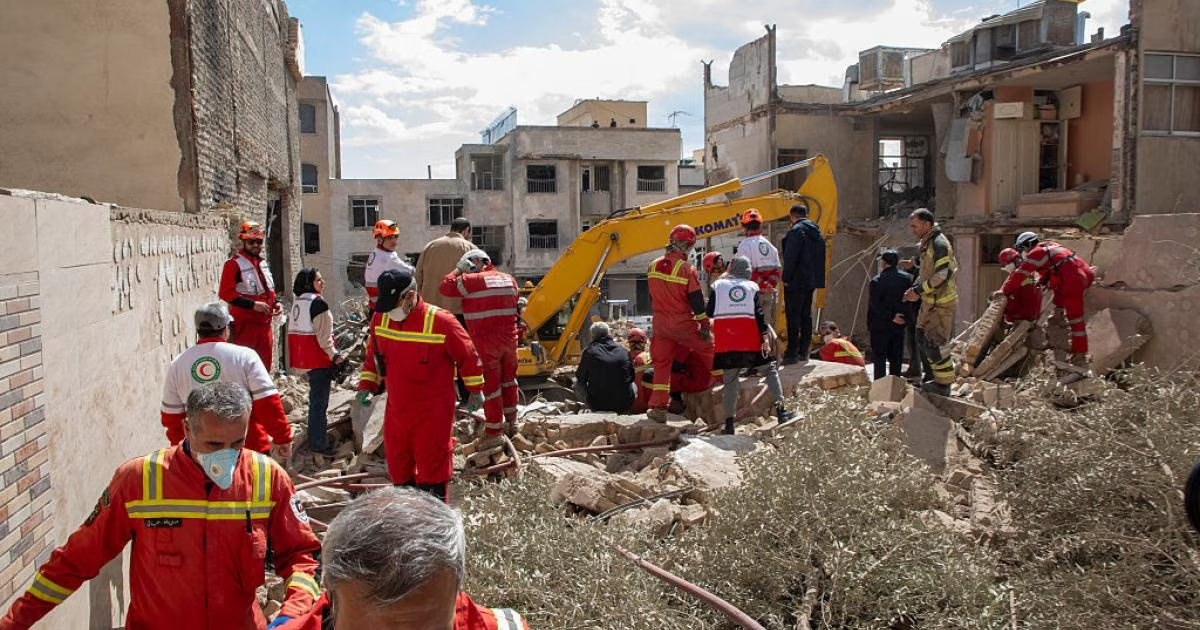
The Iranian arena witnessed a dangerous military escalation on Tuesday, as US and Israeli forces launched a series of intense air raids targeting the Markazi and Zanjan provinces in the west of the country. These attacks resulted in the death of 14 people and the injury of 15 others with varying degrees of wounds, a field development that reflects the intensity of the direct confrontation between Tehran and its international and regional adversaries.

Official Iranian sources confirmed that the aerial bombardment in Markazi province focused on populated residential areas, leading to the complete collapse of four buildings and severe damage to four other facilities. The night strikes particularly targeted the 'Mahallat' area, where rescue teams continue to work to extract victims from under the rubble amidst a state of security alert.

In Zanjan province, the bombardment hit the historic 'Grand Mosque' dating back to the 19th century, resulting in the death of three people and the destruction of large parts of the archaeological landmark. Reports indicated that the strike directly hit the meeting hall and the library adjacent to the main courtyard, as well as causing significant structural damage to the minarets of the historic mosque.

Military observers believe that the pattern of recent operations indicates the US use of heavy munitions and bunker-buster bombs, especially in targeting ammunition depots in Isfahan. This escalatory trend clearly aims to neutralize Iranian defensive capabilities and strike infrastructure related to sensitive military industries deep within Iranian territory.

These field developments intersect with Western intelligence reports indicating that the US administration is seriously considering options to control highly enriched uranium stockpiles within Iranian facilities. The intensification of raids on ballistic missile facilities appears to be a 'fire preparation' preceding potential ground movements carried out by elite units of the US Army.

Proposed scenarios include the possibility of intervention by the 82nd Airborne Division and units of the Marine Corps to carry out specific, time- and place-limited missions. These hypothetical plans focus on two axes; the first aims to control strategic islands in the Strait of Hormuz, and the second seeks to secure or transfer sensitive nuclear materials in the event of a deterioration of field conditions.

On the political front, US President Donald Trump continues to pursue a policy of 'maximum pressure' by threatening to target vital energy, water, and electricity infrastructure. Washington aims through this escalation to force the Iranian leadership to return to the negotiating table with new conditions that ensure the security of international navigation and the dismantling of the nuclear program.

These attacks come amid a political deadlock and the failure of diplomatic efforts aimed at containing tension in the region, especially with the continued arrival of Iranian missiles at targets deep within Israel. International concerns are growing about the region sliding into an all-out war as the deadlines set by the US administration to resolve outstanding issues with Tehran approach.

In the absence of any signs of de-escalation, the Iranian front remains open to all possibilities, as experts believe that the next phase will be the most complex in the history of the conflict. With the continued aerial bombardment, international circles await the nature of the Iranian response and the extent of the parties' ability to avoid a large-scale ground confrontation that could change the map of influence in the Middle East.

The attacks directly hit three residential areas, resulting in the collapse of buildings and damage to important historical sites in the country.

PALESTINE

Tue 31 Mar 2026 3:24 pm - Jerusalem Time

New Israeli Death Penalty Law: Entrenching Systemic Discrimination and Direct Targeting of Palestinians

The Israeli Knesset has finally approved new legislation granting military courts the authority to issue death sentences against Palestinians who carry out operations against Israeli targets. This step comes amid escalating hardline right-wing trends within the Israeli legislative body and represents a radical shift in criminal policy that has been in place for decades.

The new law stipulates the adoption of execution by hanging as a primary punishment in cases heard by the military judiciary, which is the legal path exclusively applied to Palestinians in the occupied territories. Observers believe that this amendment aims to tighten security control and impose a new legal reality that bypasses international and local human rights objections that warned of the repercussions of this step.

Legal experts pointed out that the structure of the law, despite its theoretical claim of universality for all citizens, was designed to be practically applied to Palestinians only. This analysis is based on the fact that Jewish extremists who commit similar crimes are tried before civilian courts that provide extensive legal guarantees, making the chances of death sentences against them almost non-existent.

This legislation reflects what human rights activists describe as a modern 'Saxony Law,' where punishments differ based on ethnic and religious identity rather than the nature of the crime committed. This duality is evident in the law's requirement of only a simple majority of military court judges to approve a death sentence, a very lenient standard compared to judicial systems that require full consensus in murder cases.

Furthermore, the military trials in which the law will be applied lack minimum guarantees of justice, including restrictions on the right to appeal or obtain a presidential pardon. Critics assert that these procedures undermine the principle of equality before the law and entrench a dual judicial system that treats Palestinians as targets for legal and physical elimination.

This legislative move coincides with field changes made by the Israeli army to the rules of engagement in the West Bank, giving soldiers a green light to use live ammunition against Palestinians. The new rules allow soldiers to open fire merely for feeling a perceived threat, completing a cycle of targeting that began with legislation in the Knesset and extends to field practices.

The wording of this law makes it practically applicable only to Palestinians, raising accusations of systemic discrimination in the application of justice.

PALESTINE

Tue 31 Mar 2026 3:24 pm - Jerusalem Time

10 Martyrs in Gaza and the West Bank in 24 Hours, Aggression Toll Exceeds 72,000

The intensity of Israeli military attacks in the Palestinian territories escalated over the past twenty-four hours, resulting in the martyrdom of ten individuals in both the Gaza Strip and the West Bank. The targeting map included airstrikes and direct shootings, amidst the ongoing comprehensive aggression across various governorates.

In the Gaza Strip, medical and field sources reported the martyrdom of nine citizens due to a series of raids carried out by drone aircraft, in addition to fire from military vehicles targeting civilian gatherings. This morning witnessed a direct shelling of a police point, leading to the martyrdom of one officer and varying injuries to several individuals present at the scene.

In the central part of the Strip, Al-Awda Medical Complex in Nuseirat camp announced the arrival of the body of a female martyr who fell by bullets from 'quadcopter' drones. Sources explained that the aircraft randomly opened fire towards citizens' homes in Camp (5) area, causing panic and destruction to residential properties.

In the northern part of the Strip, an elderly Palestinian woman was martyred by occupation forces' bullets in Beit Lahia city, adding her name to a long list of civilian victims who fell in scattered targeting incidents. These incidents coincide with the continuation of military operations affecting residential neighborhoods and the remaining infrastructure in the northern areas.

In the West Bank, a young man was martyred in Jenin city during confrontations with occupation forces, bringing the total number of martyrs in the West Bank and Gaza to ten in one day. These field developments reflect the occupation's insistence on escalating the pace of systematic killing across all Palestinian geography without exception.

For its part, the Ministry of Health issued a comprehensive update on the number of casualties, indicating that the death toll since October 7, 2023, has reached 72,280 martyrs, while the number of injured has exceeded 172,000. The ministry affirmed that these figures reflect the unprecedented humanitarian catastrophe experienced by the Palestinian people under the weight of continuous aggression.

The total statistics since the beginning of the aggression on October 7 reached 72,280 martyrs and 172,014 injured.

PALESTINE

Tue 31 Mar 2026 3:24 pm - Jerusalem Time

A hug after two years of absence.. 11 children from 'Al-Shifa Premature Babies' return to their families in Gaza

In a humanitarian scene overflowing with mixed emotions of joy and astonishment, the Nasser Medical Complex in Khan Yunis received 11 premature babies who had grown up away from their families for two full years. These children, who left the Strip as infants unaware of the harshness of war, returned today with changed features that summarize a long absence imposed by the ongoing war of extermination on the Gaza Strip.

The meeting held at the medical complex was not ordinary, as mothers' tears flowed as they hugged their children for the first time since their birth under exceptional circumstances. The new batch of children arrived accompanied by specialized teams from the United Nations Children's Fund (UNICEF), amidst medical procedures to ensure their safety after the arduous return journey.

The roots of this tragedy go back to the first days of the aggression, specifically when the Israeli army stormed Al-Shifa Medical Complex in November 2023. At that time, the hospital turned into a battlefield, threatening the lives of dozens of premature babies who depended on incubators and oxygen to survive.

Medical sources reported that the evacuation operation at the time included 31 premature babies, who were transferred from Al-Shifa Hospital, which lacked the most basic medical necessities due to the siege and direct targeting. These children were transferred to Egyptian hospitals to receive the necessary care, while their families remained in Gaza facing an unknown fate under bombardment.

For his part, the Director-General of the Ministry of Health in Gaza, Munir Al-Barsh, recalled the difficult moments that preceded the evacuation, describing them as a struggle with death. Al-Barsh explained that medical teams watched the small lives wither before their eyes as fuel ran out and incubators fell silent, amidst international appeals that did not find a quick response.

Al-Barsh added that the rescue journey began under a suffocating siege, where doctors moved children between hospital corridors in search of warmth or oxygen. He considered the return of these children today a victory for life over the machine of destruction that tried to bury their dreams in their early days.

Among the most painful stories was the testimony of young Ahmed Al-Harsh, who received his child today after losing his entire family in an Israeli raid. Al-Harsh believed that his child had been martyred with his mother and siblings, only to be surprised later that the infant had survived and was transferred with convoys of premature babies abroad without his knowledge.

Al-Harsh recounted how he learned of his wife's injury before her death, and how she left him this child who was born in his eighth month to be the sole survivor of the family. Today, after two years of bitter waiting, the father embraces his child whom he had only seen in short photos and videos that reached him through international intermediaries.

In another corner of the hospital, mother Rawan Al-Wadiya was embracing her daughter 'Sham' who left Gaza when she was not more than seven months old. The mother, with tears in her eyes, said that she did not know if her daughter was alive or had been martyred, until she accidentally saw her photos on social media from inside an Egyptian hospital.

Al-Wadiya described the moment of reunion as 'the return of the soul to the body', noting that she had been counting the days and hours waiting for this moment. She affirmed that her daughter, who grew up away from her, would need a long time to get used to her embrace again, but the most important thing is that she returned safely from the journey of death and forced displacement.

Initial medical examinations undergone by the children immediately upon their arrival confirmed the stability of their general health condition, despite their urgent need for special psychological and physical care. Medical sources indicated that the children would undergo a rehabilitation program to help them reintegrate into their family environments from which they had been deprived for a long time.

The Palestinian street's reaction to this return was widespread and moving, with activists considering the story of the premature babies a chilling tragedy that reflects the cruelty of the occupation. Bloggers pointed out that the most difficult part of the scene was some children not recognizing their relatives, due to the large time gap they spent in exile.

Observers confirmed that this issue opens the file of hundreds of children who were scattered or lost their families during the war, which requires international efforts to document their cases and return them. The story of these 11 children remains a symbol of hope amidst the rubble of destruction, and a living testament to the resilience of the Palestinian people in the face of attempts at extermination and displacement.

In conclusion, the biggest challenge facing these families is rebuilding emotional ties with their children who grew up in exceptional circumstances and away from parental affection. Nevertheless, the joy that filled the Nasser Medical Complex today confirms that the will to live in Gaza is still stronger than all attempts at marginalization and killing.

Souls returned from death.. The story of Al-Shifa children is a rescue journey that began under siege and ends with the return of life to Gaza.

PALESTINE

Tue 31 Mar 2026 3:23 pm - Jerusalem Time

Ben Gvir Celebrates with 'Nooses and Champagne': Knesset Finally Approves Death Penalty Law for Palestinian Prisoners

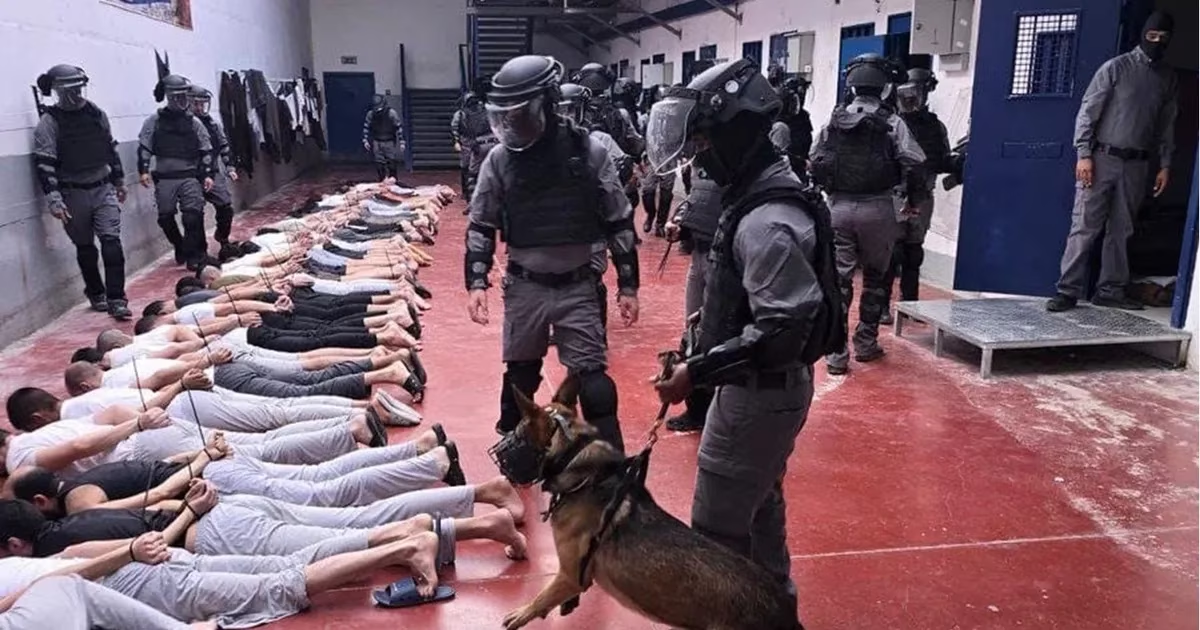
The Israeli Knesset's General Assembly, on Monday evening, finally approved, in its second and third readings, a bill allowing the imposition of the death penalty on Palestinian prisoners accused by the occupation of carrying out operations. The approval came with a majority of 62 votes against 48 opposing members, in a legislative step described by human rights circles as a dangerous and unprecedented escalation in the Israeli legal system against Palestinians.

Following the vote, the Knesset halls witnessed a provocative scene that sparked a massive wave of anger, as National Security Minister Itamar Ben Gvir appeared celebrating with members of his 'Otzma Yehudit' party. Ben Gvir was seen waving a 'champagne' bottle, attempting to open it, while drawing attention by wearing a pin on his clothes designed in the shape of a hangman's noose, a clear symbolic reference to the purpose of the new law.

In his first official comment after the legislation's approval, Ben Gvir considered this step to be 'history-making' and a radical change in Israeli deterrence policy. He issued a direct threat to Palestinian families in the West Bank, affirming that the fate of anyone who participates in resisting the occupation would be 'execution by hanging,' emphasizing that his government would not back down from this path despite pressure.

Earlier, the Knesset's National Security Committee had paved the way for this decision by approving the draft law last Tuesday, before referring it for a final vote. The law, in essence, legislates systematic killing against Palestinian detainees, which places the lives of thousands of prisoners in immediate and imminent danger under Israeli legal cover.

Ben Gvir's behavior and the celebrations accompanying the law's approval sparked angry Palestinian reactions on social media platforms, where activists described the scene as 'criminal and devoid of humanity.' Tweeters considered that the celebration with alcohol coinciding with the legislation of taking lives reflects the extremist mentality currently managing the security and political establishment in the occupation state.

Human rights advocates warned that approximately ten thousand Palestinian prisoners currently held in Israeli prisons face a 'black day' in the history of the prisoner movement. Human rights sources confirmed that this law transforms a prisoner from a political detainee or a freedom fighter into a 'corpse awaiting execution,' thereby closing all doors of hope for their release in future exchange deals.

Palestinian bloggers described the decision as a 'full-fledged war crime' and a natural extension of the policy of killing and displacement adopted by the occupation since 1948. They pointed out that this legislation gives official legitimacy to liquidation operations that were previously carried out outside the law, warning of catastrophic repercussions on stability inside and outside prisons.

In the context of questioning the justifications for the decision, activists noted that the occupation has effectively practiced 'slow execution' against prisoners for many years. They cited the deaths of more than 100 prisoners due to policies of deliberate medical negligence, physical torture, and deprivation of food, asserting that the new law is merely an institutionalization of this already existing approach.

Palestinian circles rejected Israeli claims that the law would not be applied retroactively, considering it a form of media deception to absorb temporary international anger. They affirmed that the mere existence of a legal text permitting execution represents an existential threat to every Palestinian who falls into captivity, regardless of the timing of their arrest or the details of their trial.

Prisoners' families expressed their deep concern that prisons would turn into a 'guillotine' under the supervision of extremist ministers like Ben Gvir and Smotrich. The families appealed to the international community and humanitarian organizations to intervene immediately to stop this 'organized terrorism' that enjoys parliamentary and judicial cover within Israel, stressing that international silence encourages the occupation to go too far.

International activists criticized Ben Gvir's provocative scene, considering that celebrating death with champagne bottles reflects a resounding moral fall. They pointed out that these actions increase Israel's international isolation and reveal its true face to the world as a state practicing apartheid and systematic killing against an unarmed people demanding their rights.

Institutions concerned with prisoner affairs called for urgent official Palestinian action at the international level to prosecute occupation leaders in international courts. They considered that the approval of the death penalty law should be a turning point in dealing with the prisoner issue, by internationalizing the issue more broadly and imposing sanctions on the legislators who voted in favor of this law.

Observers warned that the implementation of this law would lead to an explosion of the situation in the occupied Palestinian territories, as the Palestinian people would not stand idly by while their children are executed. They affirmed that such laws would not break the will of resistance, but would rather increase the state of tension and direct confrontation with occupation forces at all points of contact.

Activists concluded their interactions by emphasizing that Palestinian prisoners are not just numbers in prison service records, but rather national symbols and stories of struggle that will not end with nooses. They stressed that the 'doors of life' that Ben Gvir is trying to close will remain open through the steadfastness of the prisoners and the determination of the Palestinian people to achieve their freedom and reclaim their land.

We have made history; from now on, every mother in the West Bank will know that if her son goes out to kill someone, his fate will be execution by hanging.

ARAB AND WORLD

Tue 31 Mar 2026 8:42 am - Jerusalem Time

White House: Trump Considers Obligating Arab Countries to Contribute to Costs of War Against Iran

White House spokesperson, Caroline Leavitt, announced that US President Donald Trump is seriously considering inviting Arab countries to contribute to the financial costs associated with the military conflict with Iran. Leavitt clarified in a press briefing that this approach represents a fundamental idea the President is currently adopting, noting that the US administration will disclose more details about this matter soon.

The spokesperson refused to preempt the official final stance of the Republican President, but she affirmed that the proposal is strongly on the table for discussion in the West Wing. She stressed that Washington expects its regional allies to play a more effective role in funding military operations aimed at curbing Iranian influence in the region, which aligns with Trump's previous policy on burden-sharing.

In a related context, White House sources revealed the continuation of diplomatic channels with Tehran, confirming that talks are progressing positively despite the escalation on the ground. Leavitt pointed to a clear gap between the declared Iranian rhetoric and what is being achieved in closed meetings, where Tehran has shown flexibility towards some points and American demands recently raised.

The US administration clarified that any commitments made by Iran in closed rooms will be subject to strict testing on the ground to ensure credibility. Leavitt affirmed that the United States will not be content with verbal promises but will work to establish clear mechanisms to hold the Iranian side accountable and verify its fulfillment of the commitments agreed upon in private meetings.

These developments come after strong threats issued by Trump, in which he vowed to target Iranian power stations and oil wells if the Strait of Hormuz remains closed to international navigation. This escalation came in response to Tehran's description of American peace initiatives as lacking realism and its execution of widespread missile attacks targeting sites within Israel.

The President is very interested in inviting Arab countries to do this... It's an idea I know he's embracing, and you'll hear more from him about it.

ARAB AND WORLD

Tue 31 Mar 2026 8:42 am - Jerusalem Time

Massive US Reinforcements in the Middle East: 50,000 Troops and Options for Special Operations Against Iran

International press reports have indicated the arrival of hundreds of US Army special operations forces personnel in the Middle East, a move reflecting escalating military tensions. These reinforcements come amid close monitoring of Iranian movements in the region and threats related to international navigation.

According to informed sources, the total number of US military personnel deployed in regional bases has risen to approximately 50,000. This increase represents a rise of 10,000 troops from normal levels, which had been stable at around 40,000 personnel in previous periods.

These massive forces are distributed across a series of strategic military bases in several countries, including Saudi Arabia, Bahrain, Iraq, and Qatar. The US deployment map also includes Syria, Jordan, the UAE, and Kuwait, providing Washington with the ability to respond quickly to any emergency.

Sources indicated that the administration of US President Donald Trump is currently exploring the possibility of carrying out a large-scale military attack targeting Iranian territory. These discussions focus on the potential control of the strategic Kharg Island, located in the heart of the vital Strait of Hormuz.

Kharg Island holds paramount importance as the main platform for Iranian oil exports, with over 90% of Tehran's oil exports passing through it. By considering this step, Washington aims to secure international navigation and prevent Tehran from closing the strait to global oil tankers.

The plans being studied by the US Department of Defense suggest that the potential ground operation would not be a full-scale invasion of Iranian territory, but rather an operation with limited objectives. This move is expected to rely on a combination of special operations forces and infantry units, with a timeline that could extend for two months.

The Pentagon, through these military movements, seeks to destroy Iranian defense systems and weapons stationed on the coast overlooking the Gulf. These preparations come despite the significant risks that US soldiers might face if such a complex military penetration were to be carried out.

For her part, White House spokeswoman Caroline Leavitt affirmed that the Department of Defense is presenting a range of military and political options to the President for him to decide what he deems appropriate. Leavitt clarified that the presence of these plans on the table does not necessarily mean that the decision to attack has already been made by the high command.

In a related context, President Donald Trump stated that he has not yet made up his mind regarding direct ground intervention in Iran, emphasizing his preference for secrecy in military decision-making. Trump indicated that he would not inform any party in advance if he decided to take an escalatory military step of this kind.

On the diplomatic front, Secretary of State Marco Rubio attempted to reassure international allies during G7 meetings, indicating that there are no current plans for ground action. However, reports continue to speak of a potential widespread strike if diplomatic avenues fail, to ensure the opening of the Strait of Hormuz to global trade.

President Donald Trump's administration is currently considering launching a broader attack on Iran, which may include taking control of the strategic Kharg Island.

ARAB AND WORLD

Tue 31 Mar 2026 8:42 am - Jerusalem Time

Widespread Israeli escalation cuts off West Bekaa and targets 'UNIFIL' forces in southern Lebanon

Israeli occupation forces escalated their aerial and ground attacks on Monday evening, targeting wide areas in southern Lebanon and the West Bekaa in the eastern part of the country. These intensive raids come in the context of a clear Israeli attempt to isolate southern Lebanon and separate its geography from the rest of the Lebanese regions by destroying infrastructure and vital road networks.

The violent attacks included six villages in the West Bekaa region, where occupation aircraft carried out intensive raids after issuing forced evacuation orders to local residents. These strikes caused the destruction of large parts of the main roads connecting these villages, leading to a complete paralysis of movement and supply in the area.

In the city of Bint Jbeil, official sources reported the martyrdom of four citizens and the injury of others with varying degrees of wounds as a result of a raid that targeted the commercial market in the heart of the city. The aerial bombardment also hit the town of Shehabiya in the south of the country, where it targeted an inhabited house, resulting in the martyrdom of four and a number of wounded among civilians.

The raids were not limited to border areas but extended to the southern suburbs of Beirut, where the Lebanese Ministry of Health announced the martyrdom of one person and the injury of 17 others in a raid that targeted the Al-Rehab area. This coincided with artillery and aerial bombardment that hit the towns of Rashaf, Srifa, Jebchit, and Khiam, amidst continuous intensive flights of warplanes and drones.

Regarding international losses, the United Nations peacekeeping force 'UNIFIL' announced the killing of three Indonesian battalion soldiers in two separate incidents in southern Lebanon. The international force's statement clarified that two soldiers were killed after an explosion destroyed their vehicle near the town of Bani Hayyan, while the third was killed due to Israeli artillery shelling that targeted the unit's position near Adshit Al-Qusayr.

On the ground, Israeli army radio admitted the killing of a soldier and the serious injury of an officer during fierce battles in southern Lebanon. Occupation forces are engaged in violent confrontations with Hezbollah fighters who continue to resist attempts of ground infiltration in several border axes, using machine guns and rocket-propelled grenades.

In the context of military operations, the Israeli army announced that the 226th Brigade of the 146th Division continues its ground operations with the aim of what it described as 'expanding the security zone.' These operations are accompanied by Hebrew press reports indicating Tel Aviv's intention to completely destroy the 'first line of villages' in southern Lebanon to prevent residents from returning to them in the future.

For its part, Hezbollah intensified its military operations, targeting settlements, military bases, and gatherings of occupation soldiers within the occupied Palestinian territories and at border sites. The party confirmed in its official statements the execution of precise attacks using advanced missiles and kamikaze drones, achieving direct hits among Israeli forces.

Official statistics indicate that the ongoing Israeli escalation since early March has caused heavy human losses among Lebanese. The death toll has reached 1247 martyrs and more than 3680 wounded so far, in addition to the displacement of hundreds of thousands from their homes due to indiscriminate shelling and the destruction of residential areas.

The humanitarian and field conditions continue to deteriorate with the occupation's insistence on expanding the scope of targeting to include vital facilities and international teams. Rescue teams face extreme difficulties in reaching targeted areas due to the destruction of roads and continuous aerial bombardment, which portends a worsening humanitarian catastrophe in border areas and the Lebanese interior.

The United Nations Interim Force in Lebanon confirmed the killing of three members of the Indonesian battalion in two separate incidents due to explosions and Israeli shelling.

PALESTINE

Tue 31 Mar 2026 8:42 am - Jerusalem Time

Widespread Palestinian Anger After Knesset Approves Prisoner Execution Law: Official Legislation for Extermination

The Israeli Knesset finally approved, in its second and third readings, a law allowing the execution of Palestinian prisoners accused by the occupation of carrying out operations against it. The approval came with a majority of 62 members against 47, in a move described by Palestinian circles as official legislation for extrajudicial killing and an unprecedented escalation in policies of abuse.\n\nInformed sources confirmed that the law was designed with a clear racist character, as it exclusively targets those convicted of killing an Israeli out of 'racist or hostile' motives, while exempting Israelis who kill Palestinians. This legislation enjoys direct support from Prime Minister Benjamin Netanyahu and National Security Minister Itamar Ben-Gvir, along with far-right parties.\n\nFor its part, the Palestinian Presidency announced its absolute rejection of this law, considering it a blatant violation of the Fourth Geneva Convention and the International Covenant on Civil and Political Rights. The Presidency clarified in a statement that this legislation undermines all guarantees of protection and fair trial stipulated by international laws.\n\nThe Presidency warned of the serious repercussions of these racist laws on regional stability, emphasizing that the issue of prisoners will remain at the top of national priorities. It stressed that these measures will not succeed in breaking the will of the Palestinian people or deterring them from continuing their legitimate struggle to achieve their independence and establish their state with Jerusalem as its capital.\n\nIn a related context, the Palestinian Ministry of Foreign Affairs and Expatriates described the approval of the law as a 'dangerous shift in the legislation of genocide.' The Ministry stated that the occupation, through its legislative and judicial institutions, seeks to provide legal cover for extrajudicial executions, which puts the Israeli system in direct confrontation with international justice.\n\n"The Palestinian Foreign Ministry called on the international community to take effective steps to stop dealing with the Israeli Knesset and impose sanctions on its members. It also demanded the withdrawal of the occupation's membership from the Inter-Parliamentary Union, considering that international silence encourages the occupation to proceed with war crimes against the Palestinian people.\n\nIn turn, the Hamas movement saw the law as embodying the 'bloody and fascist' nature of the occupation, and exposing the falsity of its claims of adherence to humanitarian values. The movement affirmed that this legislation expresses the mentality of criminal gangs, holding the occupation leaders fully responsible for the consequences that may result from threatening the lives of prisoners.\n\nAs for the Islamic Jihad movement, it considered the approval of the law an escalation aimed at political revenge under parliamentary and judicial cover. The movement called on the International Court of Justice and UN investigative committees to classify this law as a crime against humanity, demanding the Palestinian people to escalate confrontation to protect prisoners from the danger of execution.\n\nFor its part, the Prisoners' Affairs Commission affirmed that the law represents the most dangerous stage in the history of the prisoner movement, as it transforms prisons into arenas for systematic extermination. The commission indicated that the law comes at a time when prisoners are suffering from the most horrific forms of torture, starvation, and deliberate medical neglect since the start of the aggression in October 2023.\n\nThe commission demanded the activation of universal jurisdiction to prosecute Israeli officials for war crimes committed against prisoners. It stressed the need to end administrative detention policies and military courts that lack the minimum standards of integrity, especially in light of the recent martyrdom of more than 100 prisoners inside detention centers.\n\nIn the legal framework, the 'Adalah' center clarified that the law entrenches a discriminatory legal system that targets Palestinians on a national basis. The center announced its intention to challenge the law before the competent courts, emphasizing that it violates the basic principles of human rights and the right to life guaranteed by international conventions.\n\nStatistical data indicates the presence of about 9,500 Palestinian prisoners in occupation prisons, including hundreds of children and women who live in tragic conditions. Human rights organizations document a sharp increase in cases of physical and sexual assault and deprivation of treatment, which has led to an unprecedented rise in the number of martyrs inside prisons.\n\nThis law brings back memories of the occupation's history of official executions, with the last execution carried out in 1962 against Nazi officer Adolf Eichmann. Observers believe that the return to this option reflects the far-right's control over Israeli decision-making and its desire to eliminate the Palestinian presence.\n\nFinally, national and Islamic forces affirmed that the approval of the execution law will not achieve security for the occupation, but will increase the pace of resistance and determination to liberate prisoners. The forces called for the broadest popular and international movement to support prisoners in their battle against unjust laws that target their lives and dignity.\n\nThis law amounts to a war crime committed against the Palestinian people, and comes in the context of the escalating policies pursued by the occupation authorities.

OPINIONS

Tue 31 Mar 2026 8:39 am - Jerusalem Time

When War Is Not Chaos: From Calculated Pressure to Reclaiming the Initiative

It is not easy to convince public opinion that a war that does not end quickly may, nonetheless, be proceeding according to a plan. The most prevalent image assumes that what is happening is an uncalculated slide led by impulsive decisions from Donald Trump. However, there is another reading, perhaps less populistically appealing, but more pragmatic in understanding the behavior of states: what appears to be chaos may, in its essence, be a rough management of pressure tools, and a conscious attempt at repositioning, not merely decision-making confusion.\n\nIn recent years, the United States has found itself operating in a different international environment; it is no longer the sole actor setting the pace, but a party interacting with major transformations, foremost among them the rise of China as a serious competitor. This shift has partially moved it from the position of initiator to that of recipient. From this perspective, the use of force—even in a limited way—becomes a tool to reverse the equation: from reaction to action, and from waiting for others' moves to forcing them to react to its own moves.\n\nFrom this angle, the story does not begin with misjudgment, but with a redefinition of the objective. The issue is not overthrowing the regime in Tehran, nor repeating the scenario of a full-scale invasion, but imposing a new equation: reducing capabilities, raising costs, and pushing the adversary to the negotiating table under different terms. In this context, airstrikes become a sufficient tool—not for decisive victory, but for reshaping the balance. Modern wars are not always fought to occupy land, but sometimes to redefine the boundaries of behavior, and to compel the adversary to recalculate within new rules.\n\nIt is precisely here that the criticism linking success to the necessity of a ground decisive victory loses much of its solidity. While experiences such as the Vietnam War or even the Iraq War proved that air power alone is insufficient to overthrow regimes, this conclusion assumes that overthrowing the regime is the original goal. What if it wasn't? What if the only requirement was "behavior modification" not "regime change"? Then, the absence of a decisive victory is no longer evidence of failure, but a natural consequence of a different objective.\n\nIn this sense, talk of "failure" is premature, because it measures results against an unstated goal, and ignores that what is happening may be an attempt to readjust the balance, not break it, and to move the adversary from a position of action to a position of reaction.\n\nFurthermore, the idea of an "inevitable slide" into an all-out war seems, in this reading, an overestimation of loss of control. The United States, with its long experience since the war in Afghanistan, no longer deals lightly with the option of ground intervention. The cost of armies on the ground is no longer just military, but also political and electoral. Therefore, avoiding this scenario is not an inability, but a conscious choice. The escalation here is controlled in pace, not open to the unknown, because it is part of a calculated management of pressure, not an impulse towards it.\n\nMore importantly, power, in this model, is not an alternative to negotiation, but a prelude to it. Modern history is full of moments when negotiations only began after a harsh display of force. Military pressure, in this case, is not an end in itself, but a language of negotiation. Every missile that falls is not only aimed at destruction, but at sending a clear message: the cost of rejection is higher than the cost of acceptance, and continuing on the current path is no longer a low-cost option.\n\nConversely, this argument assumes that the other party is not a completely free actor, but is constrained by internal and external calculations. A state facing economic pressures and sensitive internal balances does not easily rush into an all-out war. Its ability to retaliate exists, but it is often governed by a ceiling. And this ceiling is what the opposing strategy relies on: a calculated response that does not cross red lines, and a controlled escalation that does not explode into an open confrontation, thereby preserving the balance without sliding into a war that no one wants.\n\nIn the American case specifically, this behavior cannot be separated from a firm understanding that Iran has begun to move and influence areas traditionally considered within the sphere of American influence. This expansion—whether political, military, or through proxies—is viewed in Washington as a direct challenge that cannot be accepted in the long term. Great powers do not only deal with direct threats, but also with imbalances in the balance of influence. From this, pressure becomes a means to redraw the unannounced boundaries of this influence, and to prevent the establishment of a new reality at its expense.\n\nConversely, it seems that Iran itself has accurately read these intentions and dealt with them with a high degree of caution. Despite possessing the tools for retaliation, it has not slipped into recklessness, nor has it acted madly to push towards a comprehensive confrontation, but has sought to control its responses within a calculated margin. This behavior does not reflect weakness as much as it reflects an understanding of the nature of the moment: responding in a way that preserves the balance and confirms capability, without breaking the ceiling that could open the door to an uncontrollable war.\n\nAs for the argument that Benjamin Netanyahu is pushing the United States into war, it simplifies a much more complex relationship. The intersection of interests does not mean subservience, and the decision is ultimately governed by broader American calculations: balances of power, energy prices, and the country's position in the international system. Desires may converge, but this does not mean that one party is leading the other, as much as it reflects a convergence of interests within a broader strategic context.\n\nIn light of all this, the war—or what resembles it—appears less random than portrayed. It is not an endless path, but a gradual pressure trajectory, which may stop at a certain limit if its goal is achieved: behavior modification, not regime overthrow; imposing an equation, not occupying a capital. And, at the same time, it is not merely managing an immediate crisis, but a broader attempt to reclaim the initiative in a newly forming international system.\n\nHere the picture is reversed: what is read as a failure to achieve a decisive victory, may be a success in avoiding it. And what appears to be hesitation, may in fact be discipline. Between chaos and strategy, the difference is not always in what happens on the ground, but in how what happens is read—and in the objectives we believe the war seeks to achieve, and whether this war, in its essence, is a traditional military battle, or a tool to rearrange the balances of power, and move others from a position of action to a position of reaction.

PALESTINE

Tue 31 Mar 2026 8:39 am - Jerusalem Time

The occupation extends its aggression on Tulkarm and Nur Shams camps until the end of next May

Official Palestinian sources confirmed that the Israeli occupation authorities have decided to extend aggressive military operations in the Tulkarm and Nur Shams camps, north of the occupied West Bank. According to the new decision, these operations are scheduled to continue until the thirty-first of next May, a step that Palestinian national activities considered to be an entrenchment of the policy of forced displacement.

These field developments come as an extension of a series of military operations that began on January 21, 2025, when the occupation army first launched its aggression on Jenin camp. On the twenty-seventh of the same month, the occupation expanded its targeting to include the Tulkarm and Nur Shams camps, amidst a tight siege and repeated incursions that have not stopped since then.

For his part, the governor of Tulkarm, Abdullah Kameel, explained that the extension of the aggression represents a further targeting of the Palestinian presence within the camps, indicating that the occupation seeks to impose an impossible living reality. Kameel added that this policy has already led to waves of forced displacement of residents, as well as the deliberate destruction of water and electricity networks and main roads in the area.

The governor warned that the continuation of these military operations for long periods exacerbates the already deteriorating humanitarian conditions and increases the suffering of thousands of besieged citizens. He stressed that what is happening in Tulkarm is part of a broader plan aimed at emptying the camps of their residents and transforming them into uninhabitable areas through systematic demolition of residential facilities.

In a related context, the Department of Refugee Affairs in the Palestine Liberation Organization issued a statement strongly condemning the Israeli decision, describing it as a new link in the chain of continuous aggression. The department considered that targeting the camps specifically aims to liquidate the refugee issue, as the camp represents a living witness to the ongoing Palestinian Nakba for decades.

The department indicated that this decision cannot be separated from the comprehensive war of extermination waged by the occupation against the Palestinian people in the Gaza Strip and the West Bank alike. It affirmed that the occupation government is pursuing a systematic destruction of all components of life in the Palestinian camps, exploiting international silence towards the crimes committed against unarmed civilians.

Palestinian activities directed urgent appeals to the international community and the United Nations for the necessity of immediate action to stop this military encroachment and provide international protection for the Palestinian people. The Department of Refugee Affairs called on the UN Security Council and the Human Rights Council to hold the occupation leaders accountable for their blatant violations of international humanitarian law and the Geneva Conventions.

Since October 2023, the West Bank has witnessed an unprecedented escalation by the occupation army and settlers, with daily increases in killings, arrests, and property destruction. These attacks have so far resulted in the martyrdom of 1,139 people and the injury of about 11,700 Palestinians, in addition to arrest campaigns that affected nearly 22,000 citizens in various cities and villages.

These military operations coincide with international and UN warnings of Israeli intentions to annex large parts of the occupied West Bank and impose sovereignty over them. Observers believe that the extension of military operations in the north paves the way for the expansion of settlements and the creation of an environment that expels Palestinian residents, threatening to completely ignite the situation in the region.

This decision reflects a clear insistence on continuing the crime that resulted in forced displacement, widespread demolition of homes, and comprehensive destruction of infrastructure.

PALESTINE

Tue 31 Mar 2026 8:39 am - Jerusalem Time

Widespread International Condemnation of Israeli Restrictions on Holy Sites in Occupied Jerusalem

Arab and Islamic countries, supported by a stance from the European Union, have expressed their strong condemnation of the severe restrictions imposed by the Israeli occupation authorities on freedom of worship in the occupied city of Jerusalem. These condemnations come amidst the continued closure of the blessed Al-Aqsa Mosque and the Church of the Holy Sepulchre to worshippers for the second consecutive month, which is considered a dangerous escalation affecting fundamental religious rights.

In a unified diplomatic move, the foreign ministers of eight countries, including Qatar, Saudi Arabia, Jordan, the UAE, Egypt, Indonesia, Pakistan, and Turkey, issued a joint statement rejecting the prevention of Muslims and Christians from accessing their holy sites. The statement highlighted the seriousness of preventing the Latin Patriarch and the Custos of the Holy Land from holding Palm Sunday mass, considering it a blatant violation of the existing legal status.

The ministers emphasized in their statement that Israel, as the occupying power, has no sovereignty over the occupied city of Jerusalem and its holy sites. They affirmed that continuous attempts to change the historical identity of the city constitute a grave violation of international law, warning that these measures directly threaten peace and security at both regional and international levels.

The joint statement called on the international community to take a firm and effective stance to compel the occupation authorities to cease their illegal practices. The ministers also reiterated that Al-Aqsa Mosque, in its entirety, is an exclusive right for Muslims and is not subject to division or partnership, calling for ensuring free and unrestricted access for all worshippers without exception.

For its part, the Organization of Islamic Cooperation strongly condemned the targeting of the Christian presence in Jerusalem by preventing religious leaders from entering the Church of the Holy Sepulchre. In an official statement, the organization described these measures as a dangerous precedent not seen for centuries, aiming to marginalize the indigenous Christian component in the occupied Palestinian territories as part of a systematic Judaization policy.

The organization warned of the escalating pace of violations affecting holy sites, demanding real international pressure to ensure the preservation of the historical status of the city of Jerusalem. It affirmed that the continuation of these violations fuels conflict and undermines any opportunities for stability in the region, emphasizing the need to provide international protection for the Palestinian people and their holy sites.

In a related context, the European Union joined the condemnation through statements by the High Representative for Foreign Affairs, Kaja Kallas, who described the prevention of worshippers from entering the Church of the Holy Sepulchre as a clear violation of religious freedom. Kallas stated that these steps contradict the understandings and international regulations that have been in place for decades to protect holy places.

The European official stressed the necessity of ensuring freedom of worship in Jerusalem for all religions without discrimination or security obstacles. She indicated that preserving the pluralistic character of the holy city is of utmost necessity, calling on the Israeli authorities to respect their international obligations and cease actions that increase religious tension.

Diplomatically, Palestine initiated a move within the United Nations through identical messages sent by Permanent Representative Riyad Mansour to senior UN officials. The messages called for the necessity of providing immediate international protection for freedom of worship in Jerusalem, warning of the consequences of international silence regarding attempts to annex the city and change its features.

Mansour affirmed in his messages that Israel's impunity is the primary driver for the continuation of its violations of international legal norms. He clarified that the ultimate goal of the occupation is to consolidate its illegal control over East Jerusalem, disregarding all resolutions issued by the General Assembly and the Security Council in this regard.

Field reports indicate that the occupation authorities have closed the Church of the Holy Sepulchre and Al-Aqsa Mosque since the end of last February, citing current regional tensions. This closure comes in the context of a comprehensive escalation witnessed in the West Bank and Jerusalem since the start of the aggression on the Gaza Strip in October last year, which resulted in enormous human and material losses.

According to official sources, the ongoing Israeli escalation in the West Bank has resulted in the martyrdom of 1137 Palestinians and the injury of thousands of others with varying degrees of wounds. Arrest campaigns have also affected about 22,000 citizens, amidst a systematic policy of abuse, sabotage, and demolition of residential and commercial facilities in various Palestinian governorates.

Political and human rights circles warn that these measures in Jerusalem and the West Bank pave the way for actual annexation operations of the occupied territories. The United Nations considers these moves a clear violation of international legitimacy, as Israel continues to expand settlements and forcibly displace Palestinian residents from their homes in occupied Jerusalem and its surroundings.

In conclusion, the situation in Jerusalem remains prone to further explosion if worshippers continue to be denied access to their places of worship. Attention is now turned to the international community to see its ability to translate condemnation statements into practical measures that compel the occupation to respect the sanctity of Islamic and Christian holy sites in the holy city.

The blessed Al-Aqsa Mosque, with its entire area of 144 dunams, is a place of worship exclusively for Muslims.

PALESTINE

Tue 31 Mar 2026 8:39 am - Jerusalem Time

Netanyahu retreats and orders allowing Latin Patriarch to enter Church of the Holy Sepulchre after being prevented for hours

The head of the Israeli occupation government, Benjamin Netanyahu, announced that immediate instructions had been issued to the security and relevant authorities to allow Cardinal Pierbattista Pizzaballa, the Latin Patriarch, full and unconditional entry to the Church of the Holy Sepulchre in occupied Jerusalem. This decision came after hours of tension and procrastination that prevented the Catholic religious authority from accessing the holy site, which sparked a wave of widespread criticism.
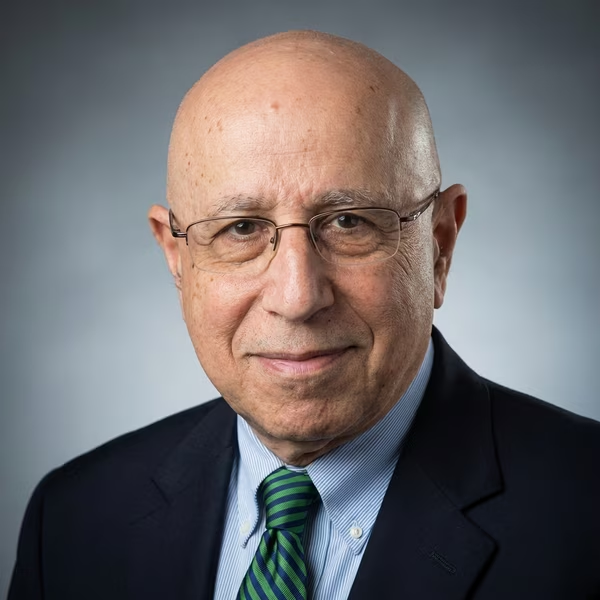
Netanyahu claimed in his statements that the previous measures that prevented the mass from being held on time were not due to bad intentions, but rather he claimed they were a result of security concerns and worry for the cardinal's safety in light of the current conditions in the holy city. The occupation authorities tried to justify this restriction as a precautionary measure, despite the categorical ecclesiastical and diplomatic rejection of these arguments, which were considered an infringement on freedom of worship.

Sources confirmed that Netanyahu stressed the need to enable the Patriarch to perform all religious rituals specific to 'Palm Sunday' in the manner he deems appropriate, thus overriding the security recommendations that imposed restrictions earlier in the day. The occupation seeks through this sudden retreat to contain the repercussions of the escalating diplomatic crisis with the Vatican and Western countries that condemned preventing senior clerics from accessing their holy sites.

These developments come at a sensitive time for the occupied city of Jerusalem, where the occupation authorities impose strict restrictions on the access of worshippers and pilgrims to holy sites during religious holidays. Observers considered Netanyahu's latest decision an attempt to avoid international political repercussions that could increase his government's isolation, especially after the news of preventing the Patriarch made headlines in international newspapers and caused widespread resentment in ecclesiastical circles.

Instructions were given to enable the Latin Patriarch to perform the religious rituals of Palm Sunday as he deems appropriate.

OPINIONS

Tue 31 Mar 2026 8:39 am - Jerusalem Time

Trump wants Gulf Arab states to share the cost of war with Iran

Washington – Said Arikat - 3/31/2026

News Analysis

In a striking development in American political discourse, White House Press Secretary Caroline Leavitt revealed that US President Donald Trump is open to the idea of asking Arab countries to contribute to covering the costs of a war with Iran, a signal reflecting a shift in the administration's approach to conflict management from purely military to also a financial and multilateral strategic issue.

During a press briefing, Leavitt avoided going into specific details, but she affirmed that the idea is being seriously considered within decision-making circles, and that the President may announce a clearer stance on it soon. This proposal opens the door to questions about the nature of partnerships Washington seeks to build, and whether the American administration is moving towards redefining the concept of "burden-sharing" in the context of regional conflicts.

In parallel, Leavitt indicated that indirect communication channels between Washington and Tehran are still active and making progress, despite the sharp divergence between public Iranian statements and what is being discussed behind the scenes. According to her, Tehran has shown flexibility on some points during private communications, which reflects a familiar duality in crisis management between political rhetoric and negotiating pragmatism.

However, these diplomatic indicators did not prevent a sharp escalation in the tone of threats, as Trump warned of comprehensive destruction of Iran's energy infrastructure if Tehran refused to open the Strait of Hormuz, following its rejection of American proposals and its missile attacks on Israel. This escalation comes amid estimates indicating that the cost of US military operations has exceeded $35 billion, according to specialized indicators tracking military spending.

In the same context, the "Wall Street Journal" quoted administration officials as saying that Trump has shown willingness to end the military campaign even if the Strait of Hormuz remains closed, with the issue being postponed to a later stage. This approach reflects an understanding of the complexity of reopening the vital maritime passage, through which about a fifth of global oil supplies pass.

For his part, Israeli Prime Minister Benjamin Netanyahu proposed an alternative vision based on redirecting Gulf energy pipelines westward, through Saudi Arabia to the Red and Mediterranean Seas, thereby reducing reliance on the Strait of Hormuz and limiting Iran's ability to use it as a geopolitical pressure card.

The proposal for Arab funding of the war reflects a disturbing tendency in the American president's approach, based on using Washington's military and political weight as a financial pressure tool on regional allies, rather than an equal partnership. Gulf states, most vulnerable to Iranian responses due to geography, are practically pushed to bear the cost of a conflict they may not have the decision to ignite or control its course. This logic is closer to "political blackmail" than strategic coordination, and threatens to erode trust in alliances, as security turns into a commodity exchanged for payment, not a mutual commitment based on common interests and long-term stability.

The discrepancy between military escalation and the continuation of diplomatic channels also reveals a familiar pattern in US-Iranian crisis management, where military pressure is used as a negotiating leverage rather than a final option. However, this approach carries high risks, as any miscalculation or field incident could turn "calculated pressure" into an open confrontation. Moreover, the duality of messages may weaken trust, not only between adversaries, but also among allies who find themselves facing a policy whose outcomes are difficult to predict.

The importance of the Strait of Hormuz extends beyond being a waterway to being a pivotal point in global energy balances. Any long-term disruption to it will accelerate alternative projects, such as proposed pipelines, which could redraw the map of energy and influence in the region. But these alternatives will take years and huge investments, meaning that the short term will remain hostage to geopolitical tensions. And in this

ARAB AND WORLD

Tue 31 Mar 2026 8:38 am - Jerusalem Time

Netanyahu: War on Iran has passed the halfway mark of its objectives, no specific end date

Israeli Prime Minister Benjamin Netanyahu confirmed in press statements on Monday that the direct military confrontation with Iran has achieved more than half of its strategic objectives. Netanyahu clarified that the operations, which began in late February, are proceeding according to a systematic plan, indicating that the talk of passing the halfway mark is related to the completion of field tasks and not necessarily to the time taken.

During his conversation with American media, the Israeli Prime Minister refused to set a specific timeline for ending the war, considering that the priority lies in completing the undermining of Iranian capabilities. These statements come at a time when the region is witnessing unprecedented escalation since the start of joint attacks between Tel Aviv and Washington, which have resulted in severe human and material losses among the Iranian leadership.

In the context of field responses, official sources in Tel Aviv revealed that missile and drone attacks launched by Tehran have injured more than 6,000 people on the Israeli side. The confrontations continue amidst international anticipation of the outcomes of this conflict, which has led to severe disruptions in global energy markets and a significant rise in oil prices.

For his part, US Secretary of State Marco Rubio indicated that the US administration expects military operations to continue for several additional weeks, ruling out that the conflict will extend for many months. The US administration faces increasing internal pressure and widespread public opposition to continued involvement in this war, especially with its direct economic repercussions on the American citizen.

Netanyahu claimed that joint forces have succeeded in eliminating thousands of elements of the Iranian Revolutionary Guard since the start of operations, considering this a devastating blow to the military structure of the regime. He added that current efforts are focused on completely erasing the military industrial base, including missile factories and facilities associated with the Iranian nuclear program, which represents a security obsession for Tel Aviv.

Despite repeated assurances from Netanyahu and Donald Trump regarding Iran's proximity to acquiring a nuclear weapon, reports from the International Atomic Energy Agency still lack evidence to support these claims. The Israeli side insists that the airstrikes targeted vital sites that were used to develop unconventional capabilities, despite international skepticism about the accuracy of some of this information.

Regarding the future of the political system in Tehran, Netanyahu expressed his conviction that the Islamic Republic faces the risk of internal collapse as a result of increasing military and economic pressures. He stressed that weakening missile and nuclear capabilities directly contributes to accelerating the pace of internal erosion of the regime, affirming that this path serves common security interests.

Despite expectations of regime collapse, Netanyahu was keen to clarify that the stated goal of the war is not regime change itself, but rather to cripple its military capabilities that threaten the region. This vision aligns with previous statements by US President Donald Trump, who called for limiting the targeting of energy facilities to avoid a global economic catastrophe, while focusing on purely military objectives.

The war, which began on February 28, continues to shape new features of the Middle East, amidst warnings of the conflict's expansion. While Tehran threatens overwhelming responses to the targeting of its facilities, Israeli military sources continue to affirm that operations will not stop until all objectives are achieved, ensuring Iran is stripped of its offensive power.

We have certainly passed the halfway mark in achieving the war's objectives, but I do not want to set a specific timeline for the end.

PALESTINE

Tue 31 Mar 2026 8:38 am - Jerusalem Time

Qaddoura Fares warns of repercussions of prisoners' execution law: A racist legislation targeting the resistance

Qaddoura Fares, the former head of the Prisoners and Ex-Prisoners Affairs Commission, called on the international community to take immediate and serious action to deter the Israeli occupation authorities from proceeding with the implementation of the law to execute Palestinian prisoners. Fares explained that this legislation, approved by the Knesset, represents a blatant violation of international norms, warning of the consequences of international silence or favoritism towards these criminal policies that reflect the true face of the occupation.

Fares affirmed in statements to media sources that the new law was specifically designed to target Palestinians who exercise their legitimate right to resist the occupation, as it stipulates the execution of anyone who kills an Israeli in the context of struggle. He pointed out that Israel is shedding its masks day by day, appearing as a fascist state that adopts racist legislation reeking of hatred rejected by civilized societies.

The Palestinian leader stressed that the approval of the law is a dangerous practical measure that could affect hundreds of prisoners in occupation prisons, which requires practical international countermeasures that do not stop at condemnation statements. He noted that the extremist right-wing currents that control the joints of power in Tel Aviv have become a real danger not only to Palestinians, but to the entire regional and international peace and security system.

The Israeli Knesset had finally approved, in its second and third readings, the death penalty bill for Palestinian prisoners by a majority of 62 votes against 48 opposing members. The law received direct support from the head of the occupation government, Benjamin Netanyahu, and the extremist National Security Minister, Itamar Ben-Gvir, in a move described by the Palestinian presidency as a blatant violation of the Fourth Geneva Convention and the International Covenant on Civil Rights.

Official statistics indicate that there are currently about 9,500 Palestinian prisoners in occupation detention centers, including 350 children and 66 women living in harsh conditions lacking the most basic humanitarian necessities. Human rights reports confirm that prisoners are subjected to systematic torture, starvation, and deliberate medical neglect, which has led to the death of more than 100 prisoners inside prisons since the start of the aggression on October 7, 2023.

Observers believe that this law legitimizes the field and institutional killings practiced by the occupation, as Israeli legislation excludes Israelis who kill Palestinians from this punishment, thus entrenching the legal 'apartheid' system. It is worth noting that the last official execution carried out by Israel was in 1962 against the Nazi leader Adolf Eichmann, which makes the return to this punishment a dramatic shift in the occupation's judicial system.
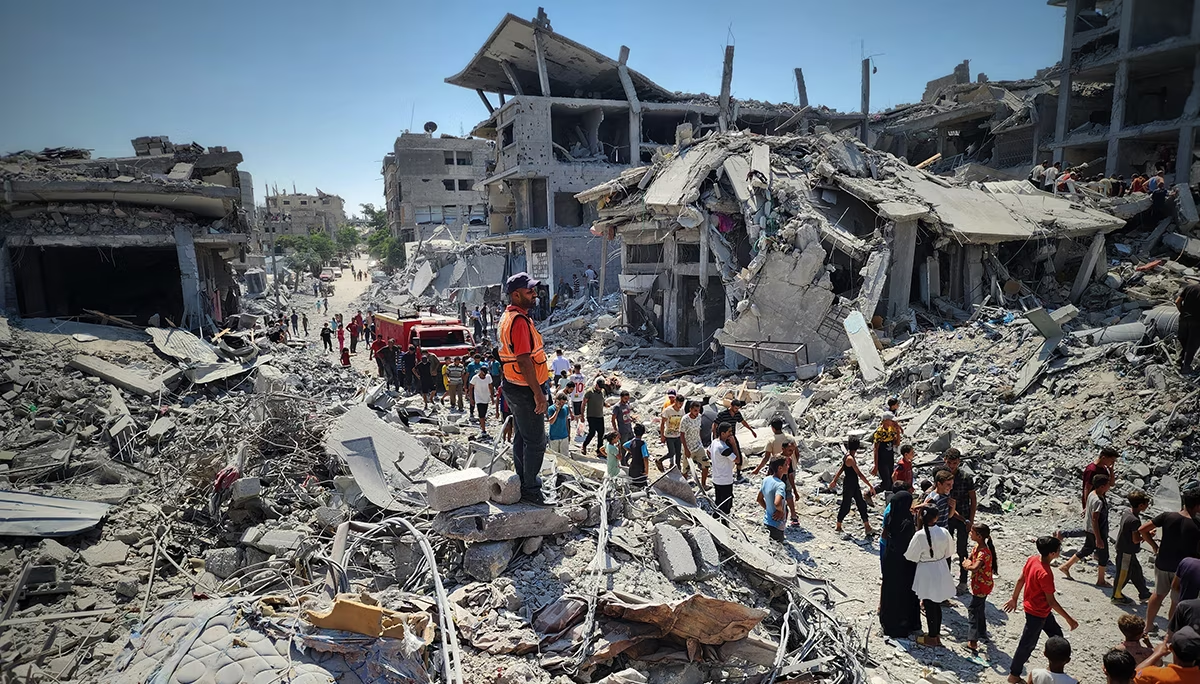

This legislative escalation comes in conjunction with the ongoing devastating war on the Gaza Strip, which has left a heavy toll of victims exceeding 72,000 martyrs and 172,000 injured, most of whom are women and children. The occupation government is exploiting the current circumstances to pass retaliatory laws aimed at breaking the will of the prisoner movement and tightening the security grip on Palestinians in all their locations.

This law was tailored to fit all the people of Palestine who fight and struggle against the occupation, and it represents the true image of Israel as a racist fascist state.

ARAB AND WORLD

Tue 31 Mar 2026 8:38 am - Jerusalem Time

Destruction of an American "AWACS" aircraft in an Iranian missile attack on a base in Saudi Arabia

Military and field sources reported that the US Air Force suffered a severe strategic blow, following the destruction of an Airborne Warning and Control System (AWACS) aircraft during an Iranian missile attack. The shelling targeted Prince Sultan Air Base in Saudi Arabia, causing extensive damage to equipment and severe injuries among American soldiers at the site.

The destroyed E-3 Sentry aircraft is classified as one of the most important strategic assets in the American air command and control system. Observers believe that the loss of this aircraft represents a direct blow to Washington's ability to monitor hostile military movements from long distances and manage complex air operations in the Middle East.

Images circulated from inside the air base showed the extent of the widespread damage to the aircraft, with damage concentrated in the tail area and the rotating radar dome. This radar dome is considered the beating heart of the system, as it gives forces the ability to scan vast areas and provide immediate intelligence on the battlefield.

According to technical data, AWACS aircraft operate as an integrated airborne command center capable of monitoring an area of up to 120,000 square miles simultaneously. They also possess the necessary technologies to track approximately 600 military targets concurrently and coordinate combat operations between aircraft, ships, and ground forces in the field.

Military experts confirmed that the destruction of this aircraft disrupts the ability of US forces to effectively direct fighters to intercept air threats. The loss of the ability to transmit immediate data to military decision-making centers will inevitably slow down the response time to urgent threats in the region, which is experiencing escalating tension.

For his part, former US Air Force Colonel Cedric Leighton described the incident as a "severe blow" to the American surveillance system. Leighton indicated that the successful targeting of the aircraft while it was on the ground reveals a "serious breach" in the protocols for protecting high-value and strategically sensitive military assets.

The attack raised deep questions about the security vulnerabilities that allowed missiles to reach a target of this size and importance, despite the strict protection usually imposed on these bases. Analysts suggest that the attack reflects a qualitative development in Tehran's capabilities to accurately identify vital targets using advanced coordinates.

Military analyses indicate that Iran is adopting a systematic strategy aimed at undermining elements of American air superiority in the region. This strategy focuses on targeting what is known as the "eye and head," which includes radar systems, refueling aircraft, and early warning aircraft to disrupt battle management.

The US Department of Defense faces an additional challenge in the limited fleet of operational E-3 aircraft, with only 17 aircraft worldwide. This limited number makes the loss of any aircraft a significant operational burden that is difficult to compensate for in the short term, especially with the aging of these aircraft.

These aircraft were designed and manufactured in the 1970s, entering active service for the first time in 1978. Despite continuous upgrades, intensive operations in the Middle East place enormous pressure on their technical readiness and ability to remain in service.

Despite the Pentagon's continuous efforts to develop modern alternatives for the early warning system, no alternative platform has yet been fully adopted. US forces currently rely on the Navy's E-2 Hawkeye aircraft as a complementary option, but they remain less capable and have less coverage compared to the massive AWACS aircraft.

This field development opens the door to a new phase of confrontation, as American bases and their strategic assets are now in direct firing range. Political and military circles are awaiting the American reaction to this targeting, which has affected the prestige of American military technology in the heart of the region.

The destruction of the aircraft on the ground represents a serious breach of procedures for protecting high-value military assets, and it is a severe blow to surveillance capabilities and fighter guidance.

OPINIONS

Tue 31 Mar 2026 8:04 am - Jerusalem Time

Gaza Is the Prototype of a World Where Power Overrides Law

By: Said Arikat

March 31, 2026

News Analysis

Washington, D.C- Chris Hedges, speaking at Princeton University last week, offered a stark warning in his lecture, “Iran and Gaza Are Only the Beginning.” The wars unfolding in Gaza, and now radiating outward toward Iran and Lebanon, are not discrete crises. They are the visible architecture of an emerging global order—one in which power, not law, determines outcomes.

For decades, the post–World War II system held out the promise—however imperfect—of rules constraining force. Institutions such as the United Nations and the International Court of Justice were meant to embody that aspiration. Today, they persist largely as symbols. When their rulings align with the interests of powerful states, they are invoked. When they do not, they are ignored. The result is not the collapse of order, but its transformation into something colder: a hierarchy enforced by strength, with legality applied selectively.

Nowhere is this transformation clearer than in Gaza. What is unfolding there is not simply war—it is a model. Overwhelming force is deployed with minimal restraint. Legal language is manipulated or avoided altogether. Narratives are tightly controlled. The cumulative effect is to normalize a form of warfare that would once have been widely condemned. Gaza is not an exception to the rules; it is evidence that the rules themselves have changed.

The expanding confrontation with Iran reflects the same logic. The rationale shifts—nuclear containment, missile threats, regime change—depending on political need. This fluidity is not confusion; it is strategy. As Hedges suggests, the objective is not reform but fragmentation: the systematic weakening of states into smaller, more controllable units. The precedents are well established in Iraq, Libya, and Syria, where intervention produced not stability but durable disorder. Such disorder is not incidental. It prevents the emergence of regional rivals and locks entire societies into cycles of dependency and crisis.

At the center of this dynamic is the convergence of long-term strategic agendas. Benjamin Netanyahu has spent decades advocating confrontation with Iran. That vision aligned, at a critical moment, with Donald Trump’s willingness to embrace risk and discard diplomatic constraints. But the significance of this alignment extends beyond individuals. It reflects a deeper continuity within political and military institutions, where strategic objectives persist across administrations, insulated from meaningful public accountability.

Hedges also directs attention to a more subtle, but equally powerful, instrument: historical memory. The Holocaust, one of the defining moral catastrophes of the modern era, is frequently invoked in ways that flatten complexity into binary categories of victim and perpetrator. Drawing on Primo Levi (the Italian Jewish author and Holocaust specialist) , Hedges warns that such framing obscures the ambiguities of human behavior and enables contemporary actors to claim moral immunity. In the context of Gaza, this selective memory can function as a shield, placing certain forms of violence beyond scrutiny.

This is not a new phenomenon. As Aimé Césaire ( the Afro-Martiniquan French poet and author), argued, the extreme violence associated with European fascism did not emerge in isolation—it was rooted in practices long deployed in colonial settings. What appears exceptional is often a continuation. Gaza, in this sense, sits within a broader historical continuum in which technological advances—precision weapons, surveillance systems, bureaucratic coordination—refine rather than replace older patterns of domination. Violence becomes more efficient, more distant, and, for those not directly affected, more abstract.

Equally important is the domestic dimension. Sustained external violence requires internal adaptation. Democratic safeguards—independent media, dissenting voices, institutional checks—must be weakened or bypassed. Language plays a central role. Terms such as “genocide” or “ethnic cleansing” are avoided, debated, or diluted, even when the scale of destruction demands clarity. This linguistic narrowing does more than shape perception; it structures what can be politically acknowledged. Over time, it erodes the capacity for moral judgment itself.

The relationship between foreign policy and domestic governance is therefore reciprocal. As states expand their ability to act without constraint abroad, they cultivate similar flexibility at home. Surveillance increases. Dissent is stigmatized. The boundaries of acceptable discourse contract. What begins as an external exception becomes an internal norm.

Gaza, then, is not only a humanitarian catastrophe. It is a prototype. It demonstrates how overwhelming force, narrative discipline, and selective legality can be combined into a coherent system—one that can be replicated elsewhere with minimal consequence. Iran and Lebanon are not separate theaters; they are extensions of the same model.

The implications are profound. If this trajectory continues, the distinction between lawful and unlawful violence will lose practical meaning. Accountability will become contingent, applied to the weak and withheld from the strong. International institutions will persist, but as instruments of legitimating rather than constraint. The language of human rights will remain, even as its substance erodes.

What is at stake is more than regional stability. It is the viability of the idea that power can be governed by law. If that idea collapses, so too does the framework that has—however inconsistently—limited the scale and frequency of mass violence in the modern era.

Hedges’ warning is ultimately about recognition. The danger lies not only in the actions themselves, but in their normalization. When societies accept that some lives are beyond protection, that some laws need not apply, and that some wars require no justification, they participate in the construction of a world where restraint is no longer expected.

That world is no longer hypothetical. It is already taking shape.

OPINIONS

Tue 31 Mar 2026 7:49 am - Jerusalem Time

Trump and the Rolling War

The winds of war did not blow as Trump wished; quite the opposite, he found himself in a predicament whose effects are deepening and widening day by day.

First, he started this war with a wrong decision. He entered it hastily, without a consensus from all wings of his administration, or prior preparation for a strong internal front, or a reliable and effective external alliance, or a clear definition of the objectives to be achieved, or a detailed and clear plan for how to achieve those objectives, or good calculations and estimations of the potential risks from an adversary whose capabilities and resilience were underestimated, in addition to a lack of sufficient military preparation to accomplish the mission professionally and skillfully, and to ensure victory in the war.

Countries, normally, do not wage a war they are likely to lose, which requires adequate preparation, based primarily on a prior accounting to assess the risks arising from it versus the anticipated benefits. But Trump's decision to wage this war was hasty and arbitrary; it did not come after the necessary calculations, as it was made under the impression, falsely embellished by Netanyahu, that it would be a swift, clean, and guaranteed-to-succeed war: an intense and painful air strike for a few days, which would lead masses of anti-regime Iranians, already exhausted, to take to the streets to finish the job and uproot it, with ease.

A tempting recipe for an easy and profitable "deal" that tickled the feelings and desires of an arrogant, deluded president who believes he is the center, abode, and stable of the universe, not just the world; capable of doing what he wants, when he wants, and how he wants: to be able to replicate what he did in Venezuela, and easily overthrow a regime that seeks to transform its country, Iran, into a major power in a region vital to Israeli and American interests.

Second, the outcome of the war was not decided within the promised days. On the contrary, a month after its outbreak, and despite Trump's successive statements that the mission was accomplished and Iran was completely destroyed, the Iranian regime held its ground and continued to deliver painful blows to Israel and American forces deployed in the region.

The hoped-for "deal" did not come swiftly and cleanly as Trump wished, but rather rolled into an extended, open-ended, and unpredictable conflict. The reason is not due to the weakness of the air strikes carried out by Washington and Tel Aviv, as they are violent, continuous, and escalating day by day. But the reason is, as history teaches us, that wars cannot be won by air strikes alone, no matter how powerful or continuous they are.

No matter how effective these strikes are, wars are only decided on the ground; ground forces invade, occupy, and win, to impose terms on the defeated party.

And it is not enough for invading forces to occupy peripheral parts of the hostile state being invaded; to achieve victory, these forces must control the "heart"; the seat of government, i.e., the capital, and seize power there, and from it impose a new reality on the rest of the country. After occupying all Russian territories west of Moscow, Hitler's invading forces of the Soviet Union reached the outskirts of the capital, Moscow, but were unable to occupy it, so they were repelled and lost the war.

Throughout its war on Vietnam, American ground forces were unable to establish control over Hanoi, the seat of the North Vietnamese regime, and were eventually repelled and lost the war.

Third, after falling into the trap and realizing the predicament he was in, Trump could have ended his reckless war within the first two weeks of its outbreak. He could have declared a significant tactical victory; air strikes had eliminated the first and second echelons of Iranian leadership, and there was widespread destruction of Iran's military capabilities.

Such an announcement, and a halt to continued air strikes, could have opened an avenue for him to begin negotiations that could have achieved a number of American demands and saved face for America. But instead of seizing this precious opportunity, which would have stopped the subsequent deterioration of the American situation, Trump's narcissism and excessive self-esteem, and his underestimation of others and of reality and facts, led to this window closing on him, and it is no longer available. And because it closed, and the exit was lost, and the possibility of a turnaround ended, he had no choice but to continue down the one-way street; to continue the war instead of ending it.

Fourth, thus, not only does involvement in a wide-open war continue, but the predicament deepens. America's prestige and standing as the world's superpower are now at stake, not just the arrogance and haughtiness of its president. Allies and adversaries alike are watching the situation with utmost interest, and they will base their future positions on the outcome.

And given that the international system is currently at a transformative turning point, the outcome of this war will have a significant impact on the future of this system, and on America's place within it; as it may lose its unique position as a superpower in favor of the rise of other countries to share the top of a pluralistic international order.

Consequently, and for this reason, Trump's reluctance to draw the necessary lesson from a reckless war has led to the entanglement and complexity of its repercussions; America's prestige and standing in the world have become subject to questioning and under scrutiny and examination.

It is no longer possible to rely on America using the "point of no return" in this war, as the predicament has become rolling, and it is likely to grow if it is not addressed in a way that avoids embarrassment, not only personal for Trump, but also moral for America.

Fifth, if the inventory of targets struck by the American and Israeli sides from the air is nearing exhaustion, according to Trump's successive statements in which the number of targets struck reached 13,000, and only 3,000 remain on the list, how will victory be achieved in a war where the targets have run out?

This implies that the continuation of this war inevitably drives it to shift from air strikes to ground intervention. This flow from one state to another will increase the level of involvement and move the conflict from an impasse to further impasses. Involvement in a ground landing, even if it starts limited and targets specific areas, such as occupying Kharg Island and/or occupying small islands in the Strait of Hormuz, will not overthrow the regime in Tehran, nor will it end Iranian resistance. Instead, it could help it escalate and concentrate, causing a continuous cascade of casualties among American forces.

If this happens, it will intensify opposition to the war within the United States, on the one hand, and increase the likelihood of expanding the ground invasion towards Tehran, on the other.

If the situation rolls in this direction, this war will then extend for a long period, and its data and repercussions will become so complex that it will be difficult to predict its final outcomes, except that it will turn the current American predicament into a deep and prolonged "quagmire." With a ground invasion and the involvement of soldiers on the ground, the chances of falling into the "mud" increase, and the Iranian mud trap will not be easier for Americans than the Vietnamese or Afghan, or even Iraqi, mud traps.

Sixth, Trump does not want to fall into the trap of what he arbitrarily and hastily got involved in a rolling war, as there are political costs he certainly does not want to pay. With internal and external pressures pushing him to end his reckless campaign and stop the possibility of it sliding into an open and long-term war, the only remaining opportunity to achieve this lies in a limited ground landing, which has become closer to happening than ever before, followed by an announcement from Trump declaring the end of the mission and the commencement, through the continued intervention of mediating parties, of achieving the goal of this war, which is to put in place measures to ensure the opening and flow of international navigation in the Strait of Hormuz for international navigation, as if it had been closed at the beginning of the war and was the cause of its outbreak. However, this opportunity remains subject to the interaction of two factors. First, the Iranian reaction to the American ground intervention after it occurs, and the level of Iranian capability to effectively confront it.

He who started the war as a result of a wrong decision and calculations is not necessarily the one who has the sole decision to end it; rather, the performance of the opposing party on the battlefield also has a significant impact in this regard. The second factor is the continued Israeli pressure on Trump to continue the war and not end it before overthrowing the regime in Iran.

This is the goal for which this war broke out, and although Trump's goal from it has shifted with its sliding course to exceed a month now, and he is no longer considering ending the rule of the Iranian revolution, but rather promotes that the current rulers of Iran are a different and favorable version for America than the situation was at the outbreak of the war, the goal of removing this regime remains a supreme goal for Israel, and it will continue to push towards achieving it.

It is no secret that Israel needs continued American involvement in this war, as it is a proxy war; Americans fight the battles for the Israelis.

In conclusion, we must await whom Trump will ultimately listen to: the rumble of battles, or the pressures of intervening parties seeking to find a way out of the predicament he has gotten himself into, or the incessant and pressing screeching from Tel Aviv?