






Washington – Said Arikat - 3/31/2026
News Analysis
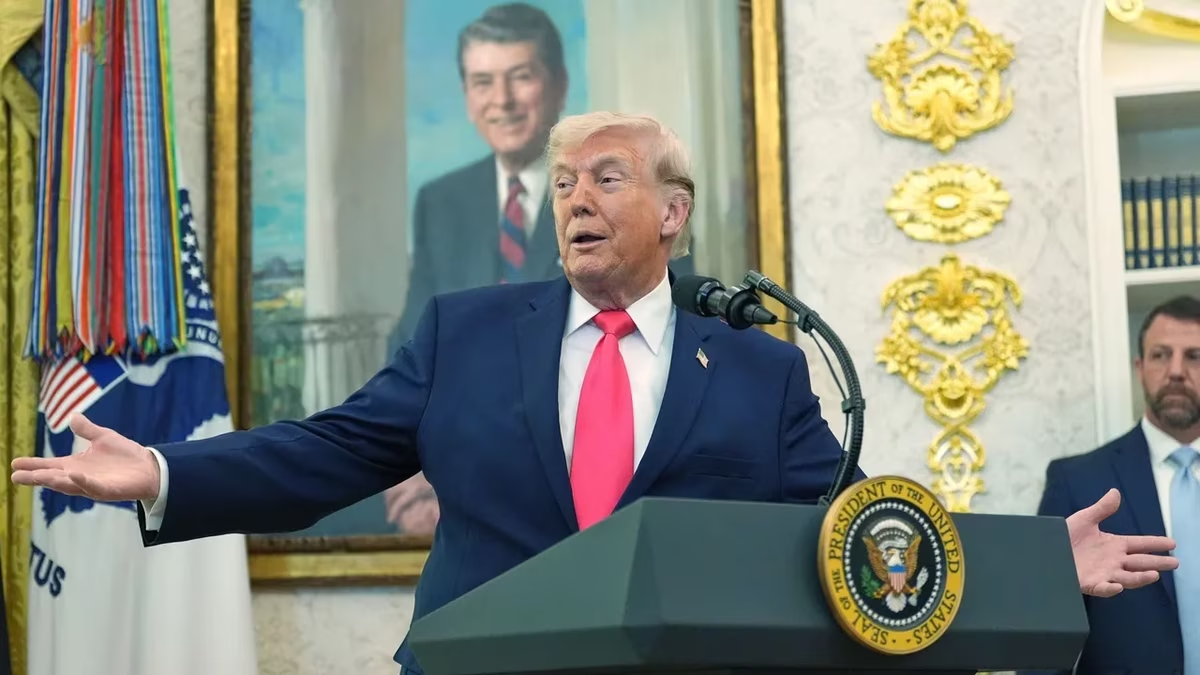
In a striking development in American political discourse, White House Press Secretary Caroline Leavitt revealed that US President Donald Trump is open to the idea of asking Arab countries to contribute to covering the costs of a war with Iran, a signal reflecting a shift in the administration's approach to conflict management from purely military to also a financial and multilateral strategic issue.
During a press briefing, Leavitt avoided going into specific details, but she affirmed that the idea is being seriously considered within decision-making circles, and that the President may announce a clearer stance on it soon. This proposal opens the door to questions about the nature of partnerships Washington seeks to build, and whether the American administration is moving towards redefining the concept of "burden-sharing" in the context of regional conflicts.
In parallel, Leavitt indicated that indirect communication channels between Washington and Tehran are still active and making progress, despite the sharp divergence between public Iranian statements and what is being discussed behind the scenes. According to her, Tehran has shown flexibility on some points during private communications, which reflects a familiar duality in crisis management between political rhetoric and negotiating pragmatism.
However, these diplomatic indicators did not prevent a sharp escalation in the tone of threats, as Trump warned of comprehensive destruction of Iran's energy infrastructure if Tehran refused to open the Strait of Hormuz, following its rejection of American proposals and its missile attacks on Israel. This escalation comes amid estimates indicating that the cost of US military operations has exceeded $35 billion, according to specialized indicators tracking military spending.
In the same context, the "Wall Street Journal" quoted administration officials as saying that Trump has shown willingness to end the military campaign even if the Strait of Hormuz remains closed, with the issue being postponed to a later stage. This approach reflects an understanding of the complexity of reopening the vital maritime passage, through which about a fifth of global oil supplies pass.
For his part, Israeli Prime Minister Benjamin Netanyahu proposed an alternative vision based on redirecting Gulf energy pipelines westward, through Saudi Arabia to the Red and Mediterranean Seas, thereby reducing reliance on the Strait of Hormuz and limiting Iran's ability to use it as a geopolitical pressure card.
The proposal for Arab funding of the war reflects a disturbing tendency in the American president's approach, based on using Washington's military and political weight as a financial pressure tool on regional allies, rather than an equal partnership. Gulf states, most vulnerable to Iranian responses due to geography, are practically pushed to bear the cost of a conflict they may not have the decision to ignite or control its course. This logic is closer to "political blackmail" than strategic coordination, and threatens to erode trust in alliances, as security turns into a commodity exchanged for payment, not a mutual commitment based on common interests and long-term stability.
The discrepancy between military escalation and the continuation of diplomatic channels also reveals a familiar pattern in US-Iranian crisis management, where military pressure is used as a negotiating leverage rather than a final option. However, this approach carries high risks, as any miscalculation or field incident could turn "calculated pressure" into an open confrontation. Moreover, the duality of messages may weaken trust, not only between adversaries, but also among allies who find themselves facing a policy whose outcomes are difficult to predict.
The importance of the Strait of Hormuz extends beyond being a waterway to being a pivotal point in global energy balances. Any long-term disruption to it will accelerate alternative projects, such as proposed pipelines, which could redraw the map of energy and influence in the region. But these alternatives will take years and huge investments, meaning that the short term will remain hostage to geopolitical tensions. And in this
Share your opinion
Trump wants Gulf Arab states to share the cost of war with Iran