






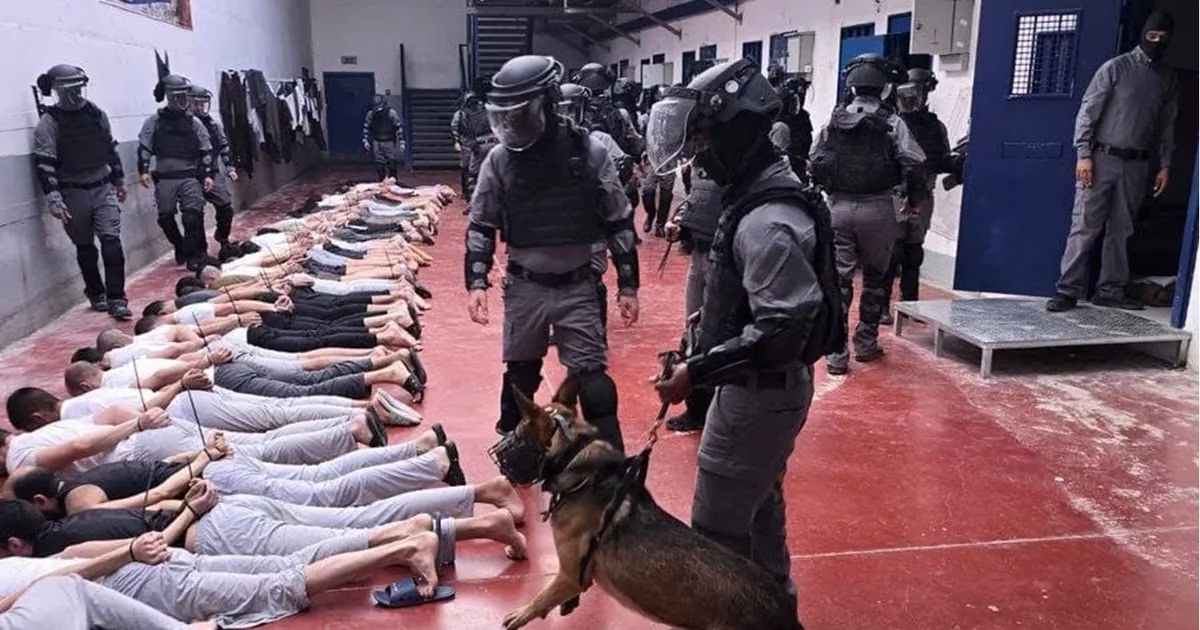
The Israeli Knesset's approval of the Palestinian Prisoners' Execution Law cannot be separated from the turbulent political context currently engulfing the Israeli interior. This legislation appears, in essence, as a tool for direct political employment, far from being a security option that has undergone strategic study and scrutiny.
Occupation Prime Minister Benjamin Netanyahu is experiencing one of his most fragile political moments, as severe internal divisions and eroding public trust weigh heavily on him. These factors, in addition to ongoing judicial pressures, push him to seek quick exits to re-establish his shaky position in power.
The Prisoners' Execution Law stands out as a double-edged message Netanyahu directs to several parties simultaneously. He seeks to convince the internal front of his ability to achieve security decisiveness, while at the same time courting his allies on the far-right to prove that he is no less extreme than their radical proposals.
This legislative shift is closely linked to the rise of the far-right current led by Itamar Ben Gvir within the government. The political discourse has shifted from traditional conflict management attempts to overt bidding in the use of repressive and intimidating tools against Palestinians.
Ben Gvir and the pillars of the national right seek to completely redefine the rules of engagement to ensure the entrenchment of absolute power. Netanyahu finds himself in this framework trapped between the necessity of maintaining the cohesion of his government coalition and the fear of losing the initiative to his more extreme partners.
The law, in its current timing, seems more like a process of absorbing internal political pressure and redirecting it outwards. Instead of confronting the deep contradictions within Israeli society, the crisis is exported through a systematic escalation targeting the prisoner movement and the Palestinian people.
The authority in Tel Aviv adopts a classic political mechanism based on creating an external enemy or exaggerating existing threats to unite ranks. This strategy aims to reproduce lost legitimacy through the gateway of security and legislative escalation that satisfies the ego of the far-right.
Despite the temporary effectiveness of this approach in appeasing political partners, it carries within it the seeds of exacerbating structural crises. The exploitation of the sensitive prisoner issue does not address the roots of Israeli division but rather postpones an internal explosion and deepens societal gaps.
The polarized Israeli society will not find in this law a solution to its problems related to the state's identity or escalating social tensions. Bidding with the right puts Netanyahu in a losing equation in the long run, as he gradually loses his political distinctiveness as a pragmatic leader.
The closer Netanyahu gets to Ben Gvir's rhetoric, the more he transforms from a player who holds the strings of the game to a follower panting after the conditions of his hardline partners. This transformation reveals the weakness of the leadership position imposed by fragile coalition balances and narrow personal interests.
Regarding the conflict with the Palestinians, this escalation falls within a strategy aimed at redefining the rules of deterrence with excessive force. However, historical experiences prove that such extreme policies often lead to completely counterproductive results.
Instead of subjugating the Palestinian side, these unjust laws push towards more rigidity in positions and open new cycles of confrontation. Turning the issue of prisoners into a political bargaining chip raises the level of tension in the region to unprecedented levels.
Ultimately, the Prisoners' Execution Law is not merely a legal or security measure, but rather a reflection of a deep-rooted internal political crisis. It is an attempt to escape forward through a seemingly calculated escalation, but it carries major strategic risks that may have dire consequences.
Netanyahu finds himself today facing a complex equation that combines street pressure, the demands of the right, and the challenges of personal survival in power. The new legislation remains a mirror of a political system searching for its lost balance on the brink of the abyss, without possessing a real vision for a solution.
The law does not express the strength of the decision but rather the weakness of the position, as fragile balances impose sharper choices.





Share your opinion
The Prisoners' Execution Law: Netanyahu's Maneuver to Escape Political Erosion and Dependence on the Right