





The Israeli Knesset finally approved, in its second and third readings, a law allowing the execution of Palestinian prisoners accused by the occupation of carrying out operations against it. The approval came with a majority of 62 members against 47, in a move described by Palestinian circles as official legislation for extrajudicial killing and an unprecedented escalation in policies of abuse.\n\nInformed sources confirmed that the law was designed with a clear racist character, as it exclusively targets those convicted of killing an Israeli out of 'racist or hostile' motives, while exempting Israelis who kill Palestinians. This legislation enjoys direct support from Prime Minister Benjamin Netanyahu and National Security Minister Itamar Ben-Gvir, along with far-right parties.\n\nFor its part, the Palestinian Presidency announced its absolute rejection of this law, considering it a blatant violation of the Fourth Geneva Convention and the International Covenant on Civil and Political Rights. The Presidency clarified in a statement that this legislation undermines all guarantees of protection and fair trial stipulated by international laws.\n\nThe Presidency warned of the serious repercussions of these racist laws on regional stability, emphasizing that the issue of prisoners will remain at the top of national priorities. It stressed that these measures will not succeed in breaking the will of the Palestinian people or deterring them from continuing their legitimate struggle to achieve their independence and establish their state with Jerusalem as its capital.\n\nIn a related context, the Palestinian Ministry of Foreign Affairs and Expatriates described the approval of the law as a 'dangerous shift in the legislation of genocide.' The Ministry stated that the occupation, through its legislative and judicial institutions, seeks to provide legal cover for extrajudicial executions, which puts the Israeli system in direct confrontation with international justice.\n\n"The Palestinian Foreign Ministry called on the international community to take effective steps to stop dealing with the Israeli Knesset and impose sanctions on its members. It also demanded the withdrawal of the occupation's membership from the Inter-Parliamentary Union, considering that international silence encourages the occupation to proceed with war crimes against the Palestinian people.\n\nIn turn, the Hamas movement saw the law as embodying the 'bloody and fascist' nature of the occupation, and exposing the falsity of its claims of adherence to humanitarian values. The movement affirmed that this legislation expresses the mentality of criminal gangs, holding the occupation leaders fully responsible for the consequences that may result from threatening the lives of prisoners.\n\nAs for the Islamic Jihad movement, it considered the approval of the law an escalation aimed at political revenge under parliamentary and judicial cover. The movement called on the International Court of Justice and UN investigative committees to classify this law as a crime against humanity, demanding the Palestinian people to escalate confrontation to protect prisoners from the danger of execution.\n\nFor its part, the Prisoners' Affairs Commission affirmed that the law represents the most dangerous stage in the history of the prisoner movement, as it transforms prisons into arenas for systematic extermination. The commission indicated that the law comes at a time when prisoners are suffering from the most horrific forms of torture, starvation, and deliberate medical neglect since the start of the aggression in October 2023.\n\nThe commission demanded the activation of universal jurisdiction to prosecute Israeli officials for war crimes committed against prisoners. It stressed the need to end administrative detention policies and military courts that lack the minimum standards of integrity, especially in light of the recent martyrdom of more than 100 prisoners inside detention centers.\n\nIn the legal framework, the 'Adalah' center clarified that the law entrenches a discriminatory legal system that targets Palestinians on a national basis. The center announced its intention to challenge the law before the competent courts, emphasizing that it violates the basic principles of human rights and the right to life guaranteed by international conventions.\n\nStatistical data indicates the presence of about 9,500 Palestinian prisoners in occupation prisons, including hundreds of children and women who live in tragic conditions. Human rights organizations document a sharp increase in cases of physical and sexual assault and deprivation of treatment, which has led to an unprecedented rise in the number of martyrs inside prisons.\n\nThis law brings back memories of the occupation's history of official executions, with the last execution carried out in 1962 against Nazi officer Adolf Eichmann. Observers believe that the return to this option reflects the far-right's control over Israeli decision-making and its desire to eliminate the Palestinian presence.\n\nFinally, national and Islamic forces affirmed that the approval of the execution law will not achieve security for the occupation, but will increase the pace of resistance and determination to liberate prisoners. The forces called for the broadest popular and international movement to support prisoners in their battle against unjust laws that target their lives and dignity.\n\nThis law amounts to a war crime committed against the Palestinian people, and comes in the context of the escalating policies pursued by the occupation authorities.

PALESTINE
Tue 31 Mar 2026 8:42 am - Jerusalem Time
Widespread Palestinian Anger After Knesset Approves Prisoner Execution Law: Official Legislation for Extermination

OPINIONS
Tue 31 Mar 2026 8:39 am - Jerusalem Time
When War Is Not Chaos: From Calculated Pressure to Reclaiming the Initiative
It is not easy to convince public opinion that a war that does not end quickly may, nonetheless, be proceeding according to a plan. The most prevalent image assumes that what is happening is an uncalculated slide led by impulsive decisions from Donald Trump. However, there is another reading, perhaps less populistically appealing, but more pragmatic in understanding the behavior of states: what appears to be chaos may, in its essence, be a rough management of pressure tools, and a conscious attempt at repositioning, not merely decision-making confusion.\n\nIn recent years, the United States has found itself operating in a different international environment; it is no longer the sole actor setting the pace, but a party interacting with major transformations, foremost among them the rise of China as a serious competitor. This shift has partially moved it from the position of initiator to that of recipient. From this perspective, the use of force—even in a limited way—becomes a tool to reverse the equation: from reaction to action, and from waiting for others' moves to forcing them to react to its own moves.\n\nFrom this angle, the story does not begin with misjudgment, but with a redefinition of the objective. The issue is not overthrowing the regime in Tehran, nor repeating the scenario of a full-scale invasion, but imposing a new equation: reducing capabilities, raising costs, and pushing the adversary to the negotiating table under different terms. In this context, airstrikes become a sufficient tool—not for decisive victory, but for reshaping the balance. Modern wars are not always fought to occupy land, but sometimes to redefine the boundaries of behavior, and to compel the adversary to recalculate within new rules.\n\nIt is precisely here that the criticism linking success to the necessity of a ground decisive victory loses much of its solidity. While experiences such as the Vietnam War or even the Iraq War proved that air power alone is insufficient to overthrow regimes, this conclusion assumes that overthrowing the regime is the original goal. What if it wasn't? What if the only requirement was "behavior modification" not "regime change"? Then, the absence of a decisive victory is no longer evidence of failure, but a natural consequence of a different objective.\n\nIn this sense, talk of "failure" is premature, because it measures results against an unstated goal, and ignores that what is happening may be an attempt to readjust the balance, not break it, and to move the adversary from a position of action to a position of reaction.\n\nFurthermore, the idea of an "inevitable slide" into an all-out war seems, in this reading, an overestimation of loss of control. The United States, with its long experience since the war in Afghanistan, no longer deals lightly with the option of ground intervention. The cost of armies on the ground is no longer just military, but also political and electoral. Therefore, avoiding this scenario is not an inability, but a conscious choice. The escalation here is controlled in pace, not open to the unknown, because it is part of a calculated management of pressure, not an impulse towards it.\n\nMore importantly, power, in this model, is not an alternative to negotiation, but a prelude to it. Modern history is full of moments when negotiations only began after a harsh display of force. Military pressure, in this case, is not an end in itself, but a language of negotiation. Every missile that falls is not only aimed at destruction, but at sending a clear message: the cost of rejection is higher than the cost of acceptance, and continuing on the current path is no longer a low-cost option.\n\nConversely, this argument assumes that the other party is not a completely free actor, but is constrained by internal and external calculations. A state facing economic pressures and sensitive internal balances does not easily rush into an all-out war. Its ability to retaliate exists, but it is often governed by a ceiling. And this ceiling is what the opposing strategy relies on: a calculated response that does not cross red lines, and a controlled escalation that does not explode into an open confrontation, thereby preserving the balance without sliding into a war that no one wants.\n\nIn the American case specifically, this behavior cannot be separated from a firm understanding that Iran has begun to move and influence areas traditionally considered within the sphere of American influence. This expansion—whether political, military, or through proxies—is viewed in Washington as a direct challenge that cannot be accepted in the long term. Great powers do not only deal with direct threats, but also with imbalances in the balance of influence. From this, pressure becomes a means to redraw the unannounced boundaries of this influence, and to prevent the establishment of a new reality at its expense.\n\nConversely, it seems that Iran itself has accurately read these intentions and dealt with them with a high degree of caution. Despite possessing the tools for retaliation, it has not slipped into recklessness, nor has it acted madly to push towards a comprehensive confrontation, but has sought to control its responses within a calculated margin. This behavior does not reflect weakness as much as it reflects an understanding of the nature of the moment: responding in a way that preserves the balance and confirms capability, without breaking the ceiling that could open the door to an uncontrollable war.\n\nAs for the argument that Benjamin Netanyahu is pushing the United States into war, it simplifies a much more complex relationship. The intersection of interests does not mean subservience, and the decision is ultimately governed by broader American calculations: balances of power, energy prices, and the country's position in the international system. Desires may converge, but this does not mean that one party is leading the other, as much as it reflects a convergence of interests within a broader strategic context.\n\nIn light of all this, the war—or what resembles it—appears less random than portrayed. It is not an endless path, but a gradual pressure trajectory, which may stop at a certain limit if its goal is achieved: behavior modification, not regime overthrow; imposing an equation, not occupying a capital. And, at the same time, it is not merely managing an immediate crisis, but a broader attempt to reclaim the initiative in a newly forming international system.\n\nHere the picture is reversed: what is read as a failure to achieve a decisive victory, may be a success in avoiding it. And what appears to be hesitation, may in fact be discipline. Between chaos and strategy, the difference is not always in what happens on the ground, but in how what happens is read—and in the objectives we believe the war seeks to achieve, and whether this war, in its essence, is a traditional military battle, or a tool to rearrange the balances of power, and move others from a position of action to a position of reaction.
PALESTINE
Tue 31 Mar 2026 8:39 am - Jerusalem Time
The occupation extends its aggression on Tulkarm and Nur Shams camps until the end of next May

Official Palestinian sources confirmed that the Israeli occupation authorities have decided to extend aggressive military operations in the Tulkarm and Nur Shams camps, north of the occupied West Bank. According to the new decision, these operations are scheduled to continue until the thirty-first of next May, a step that Palestinian national activities considered to be an entrenchment of the policy of forced displacement.
These field developments come as an extension of a series of military operations that began on January 21, 2025, when the occupation army first launched its aggression on Jenin camp. On the twenty-seventh of the same month, the occupation expanded its targeting to include the Tulkarm and Nur Shams camps, amidst a tight siege and repeated incursions that have not stopped since then.
For his part, the governor of Tulkarm, Abdullah Kameel, explained that the extension of the aggression represents a further targeting of the Palestinian presence within the camps, indicating that the occupation seeks to impose an impossible living reality. Kameel added that this policy has already led to waves of forced displacement of residents, as well as the deliberate destruction of water and electricity networks and main roads in the area.
The governor warned that the continuation of these military operations for long periods exacerbates the already deteriorating humanitarian conditions and increases the suffering of thousands of besieged citizens. He stressed that what is happening in Tulkarm is part of a broader plan aimed at emptying the camps of their residents and transforming them into uninhabitable areas through systematic demolition of residential facilities.
In a related context, the Department of Refugee Affairs in the Palestine Liberation Organization issued a statement strongly condemning the Israeli decision, describing it as a new link in the chain of continuous aggression. The department considered that targeting the camps specifically aims to liquidate the refugee issue, as the camp represents a living witness to the ongoing Palestinian Nakba for decades.
The department indicated that this decision cannot be separated from the comprehensive war of extermination waged by the occupation against the Palestinian people in the Gaza Strip and the West Bank alike. It affirmed that the occupation government is pursuing a systematic destruction of all components of life in the Palestinian camps, exploiting international silence towards the crimes committed against unarmed civilians.
Palestinian activities directed urgent appeals to the international community and the United Nations for the necessity of immediate action to stop this military encroachment and provide international protection for the Palestinian people. The Department of Refugee Affairs called on the UN Security Council and the Human Rights Council to hold the occupation leaders accountable for their blatant violations of international humanitarian law and the Geneva Conventions.
Since October 2023, the West Bank has witnessed an unprecedented escalation by the occupation army and settlers, with daily increases in killings, arrests, and property destruction. These attacks have so far resulted in the martyrdom of 1,139 people and the injury of about 11,700 Palestinians, in addition to arrest campaigns that affected nearly 22,000 citizens in various cities and villages.
These military operations coincide with international and UN warnings of Israeli intentions to annex large parts of the occupied West Bank and impose sovereignty over them. Observers believe that the extension of military operations in the north paves the way for the expansion of settlements and the creation of an environment that expels Palestinian residents, threatening to completely ignite the situation in the region.
This decision reflects a clear insistence on continuing the crime that resulted in forced displacement, widespread demolition of homes, and comprehensive destruction of infrastructure.
PALESTINE
Tue 31 Mar 2026 8:39 am - Jerusalem Time
Widespread International Condemnation of Israeli Restrictions on Holy Sites in Occupied Jerusalem

Arab and Islamic countries, supported by a stance from the European Union, have expressed their strong condemnation of the severe restrictions imposed by the Israeli occupation authorities on freedom of worship in the occupied city of Jerusalem. These condemnations come amidst the continued closure of the blessed Al-Aqsa Mosque and the Church of the Holy Sepulchre to worshippers for the second consecutive month, which is considered a dangerous escalation affecting fundamental religious rights.
In a unified diplomatic move, the foreign ministers of eight countries, including Qatar, Saudi Arabia, Jordan, the UAE, Egypt, Indonesia, Pakistan, and Turkey, issued a joint statement rejecting the prevention of Muslims and Christians from accessing their holy sites. The statement highlighted the seriousness of preventing the Latin Patriarch and the Custos of the Holy Land from holding Palm Sunday mass, considering it a blatant violation of the existing legal status.
The ministers emphasized in their statement that Israel, as the occupying power, has no sovereignty over the occupied city of Jerusalem and its holy sites. They affirmed that continuous attempts to change the historical identity of the city constitute a grave violation of international law, warning that these measures directly threaten peace and security at both regional and international levels.
The joint statement called on the international community to take a firm and effective stance to compel the occupation authorities to cease their illegal practices. The ministers also reiterated that Al-Aqsa Mosque, in its entirety, is an exclusive right for Muslims and is not subject to division or partnership, calling for ensuring free and unrestricted access for all worshippers without exception.
For its part, the Organization of Islamic Cooperation strongly condemned the targeting of the Christian presence in Jerusalem by preventing religious leaders from entering the Church of the Holy Sepulchre. In an official statement, the organization described these measures as a dangerous precedent not seen for centuries, aiming to marginalize the indigenous Christian component in the occupied Palestinian territories as part of a systematic Judaization policy.
The organization warned of the escalating pace of violations affecting holy sites, demanding real international pressure to ensure the preservation of the historical status of the city of Jerusalem. It affirmed that the continuation of these violations fuels conflict and undermines any opportunities for stability in the region, emphasizing the need to provide international protection for the Palestinian people and their holy sites.
In a related context, the European Union joined the condemnation through statements by the High Representative for Foreign Affairs, Kaja Kallas, who described the prevention of worshippers from entering the Church of the Holy Sepulchre as a clear violation of religious freedom. Kallas stated that these steps contradict the understandings and international regulations that have been in place for decades to protect holy places.
The European official stressed the necessity of ensuring freedom of worship in Jerusalem for all religions without discrimination or security obstacles. She indicated that preserving the pluralistic character of the holy city is of utmost necessity, calling on the Israeli authorities to respect their international obligations and cease actions that increase religious tension.
Diplomatically, Palestine initiated a move within the United Nations through identical messages sent by Permanent Representative Riyad Mansour to senior UN officials. The messages called for the necessity of providing immediate international protection for freedom of worship in Jerusalem, warning of the consequences of international silence regarding attempts to annex the city and change its features.
Mansour affirmed in his messages that Israel's impunity is the primary driver for the continuation of its violations of international legal norms. He clarified that the ultimate goal of the occupation is to consolidate its illegal control over East Jerusalem, disregarding all resolutions issued by the General Assembly and the Security Council in this regard.
Field reports indicate that the occupation authorities have closed the Church of the Holy Sepulchre and Al-Aqsa Mosque since the end of last February, citing current regional tensions. This closure comes in the context of a comprehensive escalation witnessed in the West Bank and Jerusalem since the start of the aggression on the Gaza Strip in October last year, which resulted in enormous human and material losses.
According to official sources, the ongoing Israeli escalation in the West Bank has resulted in the martyrdom of 1137 Palestinians and the injury of thousands of others with varying degrees of wounds. Arrest campaigns have also affected about 22,000 citizens, amidst a systematic policy of abuse, sabotage, and demolition of residential and commercial facilities in various Palestinian governorates.
Political and human rights circles warn that these measures in Jerusalem and the West Bank pave the way for actual annexation operations of the occupied territories. The United Nations considers these moves a clear violation of international legitimacy, as Israel continues to expand settlements and forcibly displace Palestinian residents from their homes in occupied Jerusalem and its surroundings.
In conclusion, the situation in Jerusalem remains prone to further explosion if worshippers continue to be denied access to their places of worship. Attention is now turned to the international community to see its ability to translate condemnation statements into practical measures that compel the occupation to respect the sanctity of Islamic and Christian holy sites in the holy city.
The blessed Al-Aqsa Mosque, with its entire area of 144 dunams, is a place of worship exclusively for Muslims.
PALESTINE
Tue 31 Mar 2026 8:39 am - Jerusalem Time
Netanyahu retreats and orders allowing Latin Patriarch to enter Church of the Holy Sepulchre after being prevented for hours

The head of the Israeli occupation government, Benjamin Netanyahu, announced that immediate instructions had been issued to the security and relevant authorities to allow Cardinal Pierbattista Pizzaballa, the Latin Patriarch, full and unconditional entry to the Church of the Holy Sepulchre in occupied Jerusalem. This decision came after hours of tension and procrastination that prevented the Catholic religious authority from accessing the holy site, which sparked a wave of widespread criticism.
Netanyahu claimed in his statements that the previous measures that prevented the mass from being held on time were not due to bad intentions, but rather he claimed they were a result of security concerns and worry for the cardinal's safety in light of the current conditions in the holy city. The occupation authorities tried to justify this restriction as a precautionary measure, despite the categorical ecclesiastical and diplomatic rejection of these arguments, which were considered an infringement on freedom of worship.
Sources confirmed that Netanyahu stressed the need to enable the Patriarch to perform all religious rituals specific to 'Palm Sunday' in the manner he deems appropriate, thus overriding the security recommendations that imposed restrictions earlier in the day. The occupation seeks through this sudden retreat to contain the repercussions of the escalating diplomatic crisis with the Vatican and Western countries that condemned preventing senior clerics from accessing their holy sites.
These developments come at a sensitive time for the occupied city of Jerusalem, where the occupation authorities impose strict restrictions on the access of worshippers and pilgrims to holy sites during religious holidays. Observers considered Netanyahu's latest decision an attempt to avoid international political repercussions that could increase his government's isolation, especially after the news of preventing the Patriarch made headlines in international newspapers and caused widespread resentment in ecclesiastical circles.
Instructions were given to enable the Latin Patriarch to perform the religious rituals of Palm Sunday as he deems appropriate.
OPINIONS
Tue 31 Mar 2026 8:39 am - Jerusalem Time
Trump wants Gulf Arab states to share the cost of war with Iran

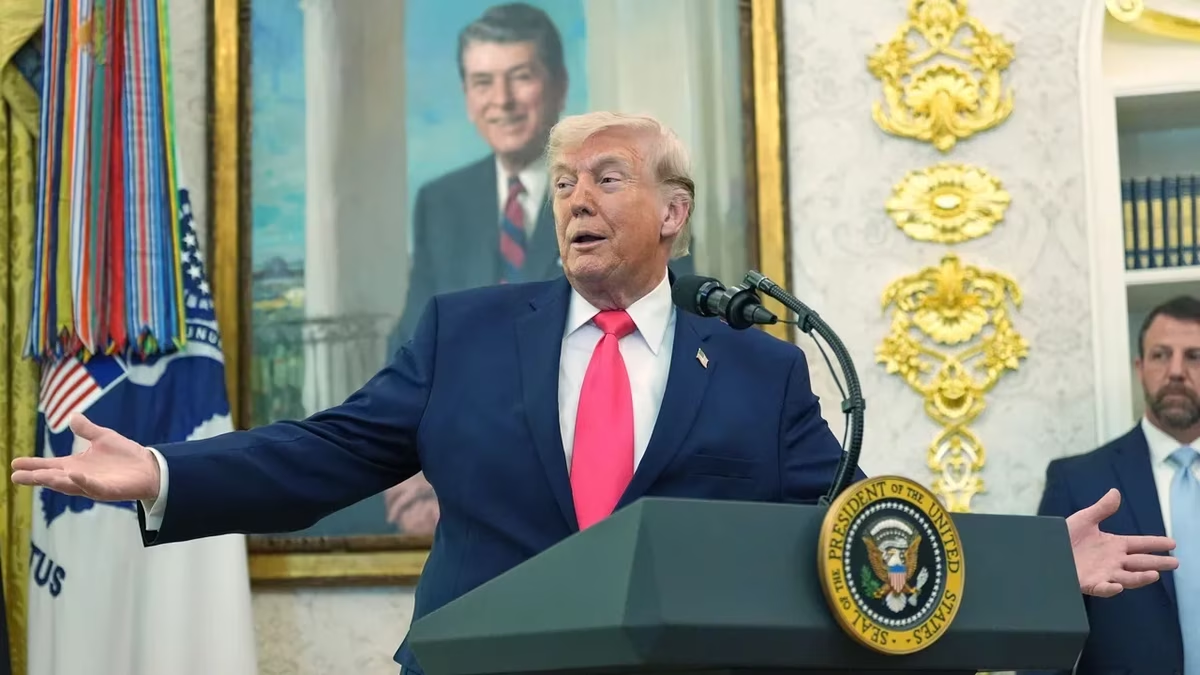
Washington – Said Arikat - 3/31/2026
News Analysis
In a striking development in American political discourse, White House Press Secretary Caroline Leavitt revealed that US President Donald Trump is open to the idea of asking Arab countries to contribute to covering the costs of a war with Iran, a signal reflecting a shift in the administration's approach to conflict management from purely military to also a financial and multilateral strategic issue.
During a press briefing, Leavitt avoided going into specific details, but she affirmed that the idea is being seriously considered within decision-making circles, and that the President may announce a clearer stance on it soon. This proposal opens the door to questions about the nature of partnerships Washington seeks to build, and whether the American administration is moving towards redefining the concept of "burden-sharing" in the context of regional conflicts.
In parallel, Leavitt indicated that indirect communication channels between Washington and Tehran are still active and making progress, despite the sharp divergence between public Iranian statements and what is being discussed behind the scenes. According to her, Tehran has shown flexibility on some points during private communications, which reflects a familiar duality in crisis management between political rhetoric and negotiating pragmatism.
However, these diplomatic indicators did not prevent a sharp escalation in the tone of threats, as Trump warned of comprehensive destruction of Iran's energy infrastructure if Tehran refused to open the Strait of Hormuz, following its rejection of American proposals and its missile attacks on Israel. This escalation comes amid estimates indicating that the cost of US military operations has exceeded $35 billion, according to specialized indicators tracking military spending.
In the same context, the "Wall Street Journal" quoted administration officials as saying that Trump has shown willingness to end the military campaign even if the Strait of Hormuz remains closed, with the issue being postponed to a later stage. This approach reflects an understanding of the complexity of reopening the vital maritime passage, through which about a fifth of global oil supplies pass.
For his part, Israeli Prime Minister Benjamin Netanyahu proposed an alternative vision based on redirecting Gulf energy pipelines westward, through Saudi Arabia to the Red and Mediterranean Seas, thereby reducing reliance on the Strait of Hormuz and limiting Iran's ability to use it as a geopolitical pressure card.
The proposal for Arab funding of the war reflects a disturbing tendency in the American president's approach, based on using Washington's military and political weight as a financial pressure tool on regional allies, rather than an equal partnership. Gulf states, most vulnerable to Iranian responses due to geography, are practically pushed to bear the cost of a conflict they may not have the decision to ignite or control its course. This logic is closer to "political blackmail" than strategic coordination, and threatens to erode trust in alliances, as security turns into a commodity exchanged for payment, not a mutual commitment based on common interests and long-term stability.
The discrepancy between military escalation and the continuation of diplomatic channels also reveals a familiar pattern in US-Iranian crisis management, where military pressure is used as a negotiating leverage rather than a final option. However, this approach carries high risks, as any miscalculation or field incident could turn "calculated pressure" into an open confrontation. Moreover, the duality of messages may weaken trust, not only between adversaries, but also among allies who find themselves facing a policy whose outcomes are difficult to predict.
The importance of the Strait of Hormuz extends beyond being a waterway to being a pivotal point in global energy balances. Any long-term disruption to it will accelerate alternative projects, such as proposed pipelines, which could redraw the map of energy and influence in the region. But these alternatives will take years and huge investments, meaning that the short term will remain hostage to geopolitical tensions. And in this
ARAB AND WORLD
Tue 31 Mar 2026 8:38 am - Jerusalem Time
Netanyahu: War on Iran has passed the halfway mark of its objectives, no specific end date
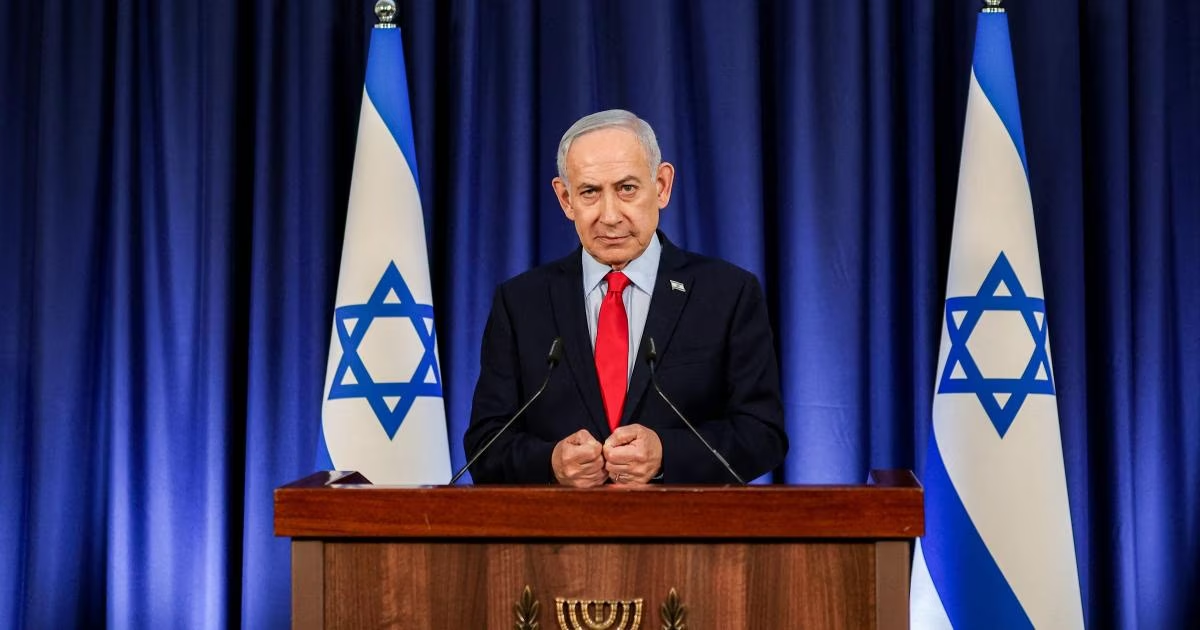
Israeli Prime Minister Benjamin Netanyahu confirmed in press statements on Monday that the direct military confrontation with Iran has achieved more than half of its strategic objectives. Netanyahu clarified that the operations, which began in late February, are proceeding according to a systematic plan, indicating that the talk of passing the halfway mark is related to the completion of field tasks and not necessarily to the time taken.
During his conversation with American media, the Israeli Prime Minister refused to set a specific timeline for ending the war, considering that the priority lies in completing the undermining of Iranian capabilities. These statements come at a time when the region is witnessing unprecedented escalation since the start of joint attacks between Tel Aviv and Washington, which have resulted in severe human and material losses among the Iranian leadership.
In the context of field responses, official sources in Tel Aviv revealed that missile and drone attacks launched by Tehran have injured more than 6,000 people on the Israeli side. The confrontations continue amidst international anticipation of the outcomes of this conflict, which has led to severe disruptions in global energy markets and a significant rise in oil prices.
For his part, US Secretary of State Marco Rubio indicated that the US administration expects military operations to continue for several additional weeks, ruling out that the conflict will extend for many months. The US administration faces increasing internal pressure and widespread public opposition to continued involvement in this war, especially with its direct economic repercussions on the American citizen.
Netanyahu claimed that joint forces have succeeded in eliminating thousands of elements of the Iranian Revolutionary Guard since the start of operations, considering this a devastating blow to the military structure of the regime. He added that current efforts are focused on completely erasing the military industrial base, including missile factories and facilities associated with the Iranian nuclear program, which represents a security obsession for Tel Aviv.
Despite repeated assurances from Netanyahu and Donald Trump regarding Iran's proximity to acquiring a nuclear weapon, reports from the International Atomic Energy Agency still lack evidence to support these claims. The Israeli side insists that the airstrikes targeted vital sites that were used to develop unconventional capabilities, despite international skepticism about the accuracy of some of this information.
Regarding the future of the political system in Tehran, Netanyahu expressed his conviction that the Islamic Republic faces the risk of internal collapse as a result of increasing military and economic pressures. He stressed that weakening missile and nuclear capabilities directly contributes to accelerating the pace of internal erosion of the regime, affirming that this path serves common security interests.
Despite expectations of regime collapse, Netanyahu was keen to clarify that the stated goal of the war is not regime change itself, but rather to cripple its military capabilities that threaten the region. This vision aligns with previous statements by US President Donald Trump, who called for limiting the targeting of energy facilities to avoid a global economic catastrophe, while focusing on purely military objectives.
The war, which began on February 28, continues to shape new features of the Middle East, amidst warnings of the conflict's expansion. While Tehran threatens overwhelming responses to the targeting of its facilities, Israeli military sources continue to affirm that operations will not stop until all objectives are achieved, ensuring Iran is stripped of its offensive power.
We have certainly passed the halfway mark in achieving the war's objectives, but I do not want to set a specific timeline for the end.
PALESTINE
Tue 31 Mar 2026 8:38 am - Jerusalem Time
Qaddoura Fares warns of repercussions of prisoners' execution law: A racist legislation targeting the resistance

Qaddoura Fares, the former head of the Prisoners and Ex-Prisoners Affairs Commission, called on the international community to take immediate and serious action to deter the Israeli occupation authorities from proceeding with the implementation of the law to execute Palestinian prisoners. Fares explained that this legislation, approved by the Knesset, represents a blatant violation of international norms, warning of the consequences of international silence or favoritism towards these criminal policies that reflect the true face of the occupation.
Fares affirmed in statements to media sources that the new law was specifically designed to target Palestinians who exercise their legitimate right to resist the occupation, as it stipulates the execution of anyone who kills an Israeli in the context of struggle. He pointed out that Israel is shedding its masks day by day, appearing as a fascist state that adopts racist legislation reeking of hatred rejected by civilized societies.
The Palestinian leader stressed that the approval of the law is a dangerous practical measure that could affect hundreds of prisoners in occupation prisons, which requires practical international countermeasures that do not stop at condemnation statements. He noted that the extremist right-wing currents that control the joints of power in Tel Aviv have become a real danger not only to Palestinians, but to the entire regional and international peace and security system.
The Israeli Knesset had finally approved, in its second and third readings, the death penalty bill for Palestinian prisoners by a majority of 62 votes against 48 opposing members. The law received direct support from the head of the occupation government, Benjamin Netanyahu, and the extremist National Security Minister, Itamar Ben-Gvir, in a move described by the Palestinian presidency as a blatant violation of the Fourth Geneva Convention and the International Covenant on Civil Rights.
Official statistics indicate that there are currently about 9,500 Palestinian prisoners in occupation detention centers, including 350 children and 66 women living in harsh conditions lacking the most basic humanitarian necessities. Human rights reports confirm that prisoners are subjected to systematic torture, starvation, and deliberate medical neglect, which has led to the death of more than 100 prisoners inside prisons since the start of the aggression on October 7, 2023.
Observers believe that this law legitimizes the field and institutional killings practiced by the occupation, as Israeli legislation excludes Israelis who kill Palestinians from this punishment, thus entrenching the legal 'apartheid' system. It is worth noting that the last official execution carried out by Israel was in 1962 against the Nazi leader Adolf Eichmann, which makes the return to this punishment a dramatic shift in the occupation's judicial system.
This legislative escalation comes in conjunction with the ongoing devastating war on the Gaza Strip, which has left a heavy toll of victims exceeding 72,000 martyrs and 172,000 injured, most of whom are women and children. The occupation government is exploiting the current circumstances to pass retaliatory laws aimed at breaking the will of the prisoner movement and tightening the security grip on Palestinians in all their locations.
This law was tailored to fit all the people of Palestine who fight and struggle against the occupation, and it represents the true image of Israel as a racist fascist state.
ARAB AND WORLD
Tue 31 Mar 2026 8:38 am - Jerusalem Time
Destruction of an American "AWACS" aircraft in an Iranian missile attack on a base in Saudi Arabia

Military and field sources reported that the US Air Force suffered a severe strategic blow, following the destruction of an Airborne Warning and Control System (AWACS) aircraft during an Iranian missile attack. The shelling targeted Prince Sultan Air Base in Saudi Arabia, causing extensive damage to equipment and severe injuries among American soldiers at the site.
The destroyed E-3 Sentry aircraft is classified as one of the most important strategic assets in the American air command and control system. Observers believe that the loss of this aircraft represents a direct blow to Washington's ability to monitor hostile military movements from long distances and manage complex air operations in the Middle East.
Images circulated from inside the air base showed the extent of the widespread damage to the aircraft, with damage concentrated in the tail area and the rotating radar dome. This radar dome is considered the beating heart of the system, as it gives forces the ability to scan vast areas and provide immediate intelligence on the battlefield.
According to technical data, AWACS aircraft operate as an integrated airborne command center capable of monitoring an area of up to 120,000 square miles simultaneously. They also possess the necessary technologies to track approximately 600 military targets concurrently and coordinate combat operations between aircraft, ships, and ground forces in the field.
Military experts confirmed that the destruction of this aircraft disrupts the ability of US forces to effectively direct fighters to intercept air threats. The loss of the ability to transmit immediate data to military decision-making centers will inevitably slow down the response time to urgent threats in the region, which is experiencing escalating tension.
For his part, former US Air Force Colonel Cedric Leighton described the incident as a "severe blow" to the American surveillance system. Leighton indicated that the successful targeting of the aircraft while it was on the ground reveals a "serious breach" in the protocols for protecting high-value and strategically sensitive military assets.
The attack raised deep questions about the security vulnerabilities that allowed missiles to reach a target of this size and importance, despite the strict protection usually imposed on these bases. Analysts suggest that the attack reflects a qualitative development in Tehran's capabilities to accurately identify vital targets using advanced coordinates.
Military analyses indicate that Iran is adopting a systematic strategy aimed at undermining elements of American air superiority in the region. This strategy focuses on targeting what is known as the "eye and head," which includes radar systems, refueling aircraft, and early warning aircraft to disrupt battle management.
The US Department of Defense faces an additional challenge in the limited fleet of operational E-3 aircraft, with only 17 aircraft worldwide. This limited number makes the loss of any aircraft a significant operational burden that is difficult to compensate for in the short term, especially with the aging of these aircraft.
These aircraft were designed and manufactured in the 1970s, entering active service for the first time in 1978. Despite continuous upgrades, intensive operations in the Middle East place enormous pressure on their technical readiness and ability to remain in service.
Despite the Pentagon's continuous efforts to develop modern alternatives for the early warning system, no alternative platform has yet been fully adopted. US forces currently rely on the Navy's E-2 Hawkeye aircraft as a complementary option, but they remain less capable and have less coverage compared to the massive AWACS aircraft.
This field development opens the door to a new phase of confrontation, as American bases and their strategic assets are now in direct firing range. Political and military circles are awaiting the American reaction to this targeting, which has affected the prestige of American military technology in the heart of the region.
The destruction of the aircraft on the ground represents a serious breach of procedures for protecting high-value military assets, and it is a severe blow to surveillance capabilities and fighter guidance.
OPINIONS
Tue 31 Mar 2026 8:04 am - Jerusalem Time
Gaza Is the Prototype of a World Where Power Overrides Law
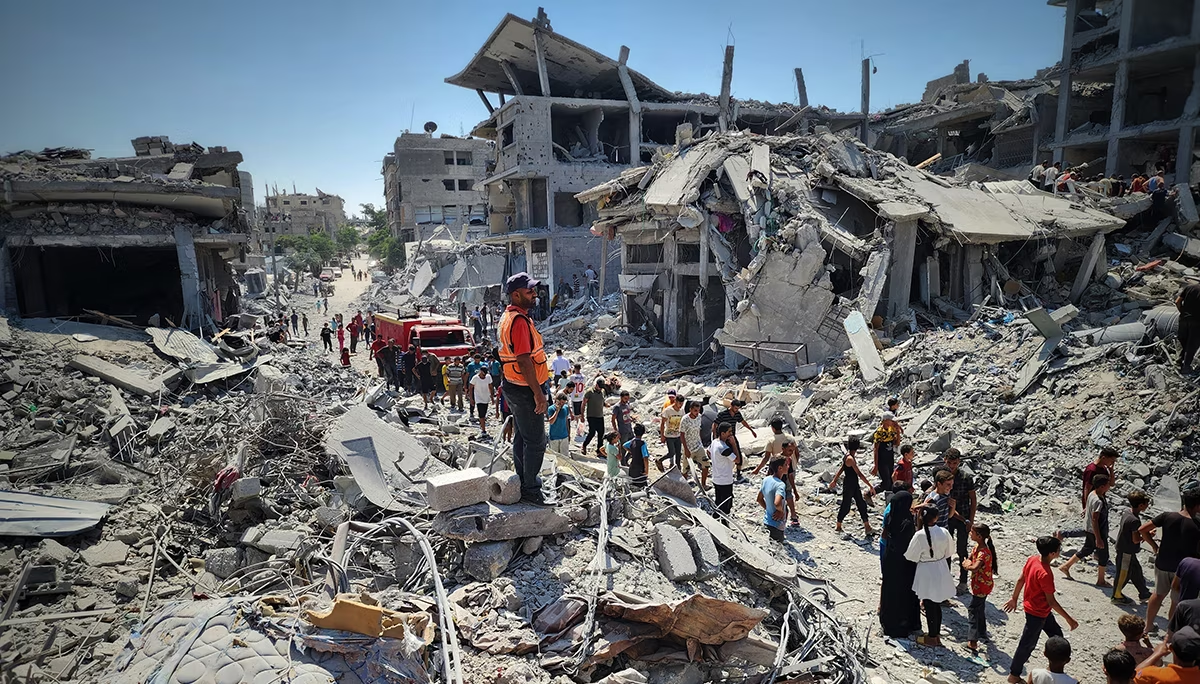
By: Said Arikat
March 31, 2026
News Analysis
Washington, D.C- Chris Hedges, speaking at Princeton University last week, offered a stark warning in his lecture, “Iran and Gaza Are Only the Beginning.” The wars unfolding in Gaza, and now radiating outward toward Iran and Lebanon, are not discrete crises. They are the visible architecture of an emerging global order—one in which power, not law, determines outcomes.
For decades, the post–World War II system held out the promise—however imperfect—of rules constraining force. Institutions such as the United Nations and the International Court of Justice were meant to embody that aspiration. Today, they persist largely as symbols. When their rulings align with the interests of powerful states, they are invoked. When they do not, they are ignored. The result is not the collapse of order, but its transformation into something colder: a hierarchy enforced by strength, with legality applied selectively.
Nowhere is this transformation clearer than in Gaza. What is unfolding there is not simply war—it is a model. Overwhelming force is deployed with minimal restraint. Legal language is manipulated or avoided altogether. Narratives are tightly controlled. The cumulative effect is to normalize a form of warfare that would once have been widely condemned. Gaza is not an exception to the rules; it is evidence that the rules themselves have changed.
The expanding confrontation with Iran reflects the same logic. The rationale shifts—nuclear containment, missile threats, regime change—depending on political need. This fluidity is not confusion; it is strategy. As Hedges suggests, the objective is not reform but fragmentation: the systematic weakening of states into smaller, more controllable units. The precedents are well established in Iraq, Libya, and Syria, where intervention produced not stability but durable disorder. Such disorder is not incidental. It prevents the emergence of regional rivals and locks entire societies into cycles of dependency and crisis.
At the center of this dynamic is the convergence of long-term strategic agendas. Benjamin Netanyahu has spent decades advocating confrontation with Iran. That vision aligned, at a critical moment, with Donald Trump’s willingness to embrace risk and discard diplomatic constraints. But the significance of this alignment extends beyond individuals. It reflects a deeper continuity within political and military institutions, where strategic objectives persist across administrations, insulated from meaningful public accountability.
Hedges also directs attention to a more subtle, but equally powerful, instrument: historical memory. The Holocaust, one of the defining moral catastrophes of the modern era, is frequently invoked in ways that flatten complexity into binary categories of victim and perpetrator. Drawing on Primo Levi (the Italian Jewish author and Holocaust specialist) , Hedges warns that such framing obscures the ambiguities of human behavior and enables contemporary actors to claim moral immunity. In the context of Gaza, this selective memory can function as a shield, placing certain forms of violence beyond scrutiny.
This is not a new phenomenon. As Aimé Césaire ( the Afro-Martiniquan French poet and author), argued, the extreme violence associated with European fascism did not emerge in isolation—it was rooted in practices long deployed in colonial settings. What appears exceptional is often a continuation. Gaza, in this sense, sits within a broader historical continuum in which technological advances—precision weapons, surveillance systems, bureaucratic coordination—refine rather than replace older patterns of domination. Violence becomes more efficient, more distant, and, for those not directly affected, more abstract.
Equally important is the domestic dimension. Sustained external violence requires internal adaptation. Democratic safeguards—independent media, dissenting voices, institutional checks—must be weakened or bypassed. Language plays a central role. Terms such as “genocide” or “ethnic cleansing” are avoided, debated, or diluted, even when the scale of destruction demands clarity. This linguistic narrowing does more than shape perception; it structures what can be politically acknowledged. Over time, it erodes the capacity for moral judgment itself.
The relationship between foreign policy and domestic governance is therefore reciprocal. As states expand their ability to act without constraint abroad, they cultivate similar flexibility at home. Surveillance increases. Dissent is stigmatized. The boundaries of acceptable discourse contract. What begins as an external exception becomes an internal norm.
Gaza, then, is not only a humanitarian catastrophe. It is a prototype. It demonstrates how overwhelming force, narrative discipline, and selective legality can be combined into a coherent system—one that can be replicated elsewhere with minimal consequence. Iran and Lebanon are not separate theaters; they are extensions of the same model.
The implications are profound. If this trajectory continues, the distinction between lawful and unlawful violence will lose practical meaning. Accountability will become contingent, applied to the weak and withheld from the strong. International institutions will persist, but as instruments of legitimating rather than constraint. The language of human rights will remain, even as its substance erodes.
What is at stake is more than regional stability. It is the viability of the idea that power can be governed by law. If that idea collapses, so too does the framework that has—however inconsistently—limited the scale and frequency of mass violence in the modern era.
Hedges’ warning is ultimately about recognition. The danger lies not only in the actions themselves, but in their normalization. When societies accept that some lives are beyond protection, that some laws need not apply, and that some wars require no justification, they participate in the construction of a world where restraint is no longer expected.
That world is no longer hypothetical. It is already taking shape.
OPINIONS
Tue 31 Mar 2026 7:49 am - Jerusalem Time
Trump and the Rolling War


The winds of war did not blow as Trump wished; quite the opposite, he found himself in a predicament whose effects are deepening and widening day by day.
First, he started this war with a wrong decision. He entered it hastily, without a consensus from all wings of his administration, or prior preparation for a strong internal front, or a reliable and effective external alliance, or a clear definition of the objectives to be achieved, or a detailed and clear plan for how to achieve those objectives, or good calculations and estimations of the potential risks from an adversary whose capabilities and resilience were underestimated, in addition to a lack of sufficient military preparation to accomplish the mission professionally and skillfully, and to ensure victory in the war.
Countries, normally, do not wage a war they are likely to lose, which requires adequate preparation, based primarily on a prior accounting to assess the risks arising from it versus the anticipated benefits. But Trump's decision to wage this war was hasty and arbitrary; it did not come after the necessary calculations, as it was made under the impression, falsely embellished by Netanyahu, that it would be a swift, clean, and guaranteed-to-succeed war: an intense and painful air strike for a few days, which would lead masses of anti-regime Iranians, already exhausted, to take to the streets to finish the job and uproot it, with ease.
A tempting recipe for an easy and profitable "deal" that tickled the feelings and desires of an arrogant, deluded president who believes he is the center, abode, and stable of the universe, not just the world; capable of doing what he wants, when he wants, and how he wants: to be able to replicate what he did in Venezuela, and easily overthrow a regime that seeks to transform its country, Iran, into a major power in a region vital to Israeli and American interests.
Second, the outcome of the war was not decided within the promised days. On the contrary, a month after its outbreak, and despite Trump's successive statements that the mission was accomplished and Iran was completely destroyed, the Iranian regime held its ground and continued to deliver painful blows to Israel and American forces deployed in the region.
The hoped-for "deal" did not come swiftly and cleanly as Trump wished, but rather rolled into an extended, open-ended, and unpredictable conflict. The reason is not due to the weakness of the air strikes carried out by Washington and Tel Aviv, as they are violent, continuous, and escalating day by day. But the reason is, as history teaches us, that wars cannot be won by air strikes alone, no matter how powerful or continuous they are.
No matter how effective these strikes are, wars are only decided on the ground; ground forces invade, occupy, and win, to impose terms on the defeated party.
And it is not enough for invading forces to occupy peripheral parts of the hostile state being invaded; to achieve victory, these forces must control the "heart"; the seat of government, i.e., the capital, and seize power there, and from it impose a new reality on the rest of the country. After occupying all Russian territories west of Moscow, Hitler's invading forces of the Soviet Union reached the outskirts of the capital, Moscow, but were unable to occupy it, so they were repelled and lost the war.
Throughout its war on Vietnam, American ground forces were unable to establish control over Hanoi, the seat of the North Vietnamese regime, and were eventually repelled and lost the war.
Third, after falling into the trap and realizing the predicament he was in, Trump could have ended his reckless war within the first two weeks of its outbreak. He could have declared a significant tactical victory; air strikes had eliminated the first and second echelons of Iranian leadership, and there was widespread destruction of Iran's military capabilities.
Such an announcement, and a halt to continued air strikes, could have opened an avenue for him to begin negotiations that could have achieved a number of American demands and saved face for America. But instead of seizing this precious opportunity, which would have stopped the subsequent deterioration of the American situation, Trump's narcissism and excessive self-esteem, and his underestimation of others and of reality and facts, led to this window closing on him, and it is no longer available. And because it closed, and the exit was lost, and the possibility of a turnaround ended, he had no choice but to continue down the one-way street; to continue the war instead of ending it.
Fourth, thus, not only does involvement in a wide-open war continue, but the predicament deepens. America's prestige and standing as the world's superpower are now at stake, not just the arrogance and haughtiness of its president. Allies and adversaries alike are watching the situation with utmost interest, and they will base their future positions on the outcome.
And given that the international system is currently at a transformative turning point, the outcome of this war will have a significant impact on the future of this system, and on America's place within it; as it may lose its unique position as a superpower in favor of the rise of other countries to share the top of a pluralistic international order.
Consequently, and for this reason, Trump's reluctance to draw the necessary lesson from a reckless war has led to the entanglement and complexity of its repercussions; America's prestige and standing in the world have become subject to questioning and under scrutiny and examination.
It is no longer possible to rely on America using the "point of no return" in this war, as the predicament has become rolling, and it is likely to grow if it is not addressed in a way that avoids embarrassment, not only personal for Trump, but also moral for America.
Fifth, if the inventory of targets struck by the American and Israeli sides from the air is nearing exhaustion, according to Trump's successive statements in which the number of targets struck reached 13,000, and only 3,000 remain on the list, how will victory be achieved in a war where the targets have run out?
This implies that the continuation of this war inevitably drives it to shift from air strikes to ground intervention. This flow from one state to another will increase the level of involvement and move the conflict from an impasse to further impasses. Involvement in a ground landing, even if it starts limited and targets specific areas, such as occupying Kharg Island and/or occupying small islands in the Strait of Hormuz, will not overthrow the regime in Tehran, nor will it end Iranian resistance. Instead, it could help it escalate and concentrate, causing a continuous cascade of casualties among American forces.
If this happens, it will intensify opposition to the war within the United States, on the one hand, and increase the likelihood of expanding the ground invasion towards Tehran, on the other.
If the situation rolls in this direction, this war will then extend for a long period, and its data and repercussions will become so complex that it will be difficult to predict its final outcomes, except that it will turn the current American predicament into a deep and prolonged "quagmire." With a ground invasion and the involvement of soldiers on the ground, the chances of falling into the "mud" increase, and the Iranian mud trap will not be easier for Americans than the Vietnamese or Afghan, or even Iraqi, mud traps.
Sixth, Trump does not want to fall into the trap of what he arbitrarily and hastily got involved in a rolling war, as there are political costs he certainly does not want to pay. With internal and external pressures pushing him to end his reckless campaign and stop the possibility of it sliding into an open and long-term war, the only remaining opportunity to achieve this lies in a limited ground landing, which has become closer to happening than ever before, followed by an announcement from Trump declaring the end of the mission and the commencement, through the continued intervention of mediating parties, of achieving the goal of this war, which is to put in place measures to ensure the opening and flow of international navigation in the Strait of Hormuz for international navigation, as if it had been closed at the beginning of the war and was the cause of its outbreak. However, this opportunity remains subject to the interaction of two factors. First, the Iranian reaction to the American ground intervention after it occurs, and the level of Iranian capability to effectively confront it.
He who started the war as a result of a wrong decision and calculations is not necessarily the one who has the sole decision to end it; rather, the performance of the opposing party on the battlefield also has a significant impact in this regard. The second factor is the continued Israeli pressure on Trump to continue the war and not end it before overthrowing the regime in Iran.
This is the goal for which this war broke out, and although Trump's goal from it has shifted with its sliding course to exceed a month now, and he is no longer considering ending the rule of the Iranian revolution, but rather promotes that the current rulers of Iran are a different and favorable version for America than the situation was at the outbreak of the war, the goal of removing this regime remains a supreme goal for Israel, and it will continue to push towards achieving it.
It is no secret that Israel needs continued American involvement in this war, as it is a proxy war; Americans fight the battles for the Israelis.
In conclusion, we must await whom Trump will ultimately listen to: the rumble of battles, or the pressures of intervening parties seeking to find a way out of the predicament he has gotten himself into, or the incessant and pressing screeching from Tel Aviv?
OPINIONS
Mon 30 Mar 2026 11:36 pm - Jerusalem Time
Rubio acknowledges communication channels with Tehran and demands it abandon drones and ballistic missiles

Washington - Said Arikat - 3/30/2026
US Secretary of State Marco Rubio acknowledged the existence of indirect communication channels between Washington and Tehran through intermediaries, at a time when President Donald Trump prefers to prioritize the diplomatic path, considering that an opportunity for progress in this direction was available in previous stages.
In an interview with Al Jazeera, Rubio indicated that the United States is open to any shift within Iran that leads to the emergence of a new leadership with a different orientation, affirming his country's readiness to benefit from such a development if it occurs. However, he noted the ambiguity of the decision-making mechanism within the Iranian regime, stressing that US policies were not fundamentally built on targeting the leadership itself.
He added that the picture of the internal scene in Iran is unclear, saying that the identity of the actual decision-maker is still in question, in the absence of public indicators regarding the supreme leadership, which further complicates American assessments.
Rubio reiterated his country's categorical rejection of Iran possessing nuclear weapons, calling on it to stop supporting armed groups in the region and to cease policies of threatening neighboring countries.
In the context of his criticisms, Rubio considered that the Iranian missile program, especially short-range missiles, poses a direct threat to the Gulf states, accusing Tehran of seeking to develop nuclear capabilities with the aim of exerting international pressure, and warning of serious repercussions if this approach continues.
He called on Tehran to take practical steps to abandon its nuclear ambitions and stop developing drones and missiles, considering that a complete abandonment of armament programs could open the door to better opportunities for the country's future.
He also stressed that the United States is working closely with its allies to strengthen defenses and counter attacks, affirming support for the security of the region's countries and international freedom of navigation, and warning of an escalation of the situation if the Houthis' involvement in Yemen intensifies.
Regarding Israel, Rubio explained that its priorities partially differ from Washington's, as Tel Aviv focuses on the threat of medium-range missiles, while the United States seeks to coordinate actions with it to avoid any field conflict.
Rubio's statements reflect the continuation of the American approach based on combining pressure and openness, where Washington keeps the door of diplomacy open in parallel with hinting at deterrent measures. This balance is not new, but today it faces greater challenges in light of the complexity of the regional scene and the multiplicity of actors. The talk about indirect channels also confirms that communication has not been cut off, despite the rhetorical escalation, which indicates that both parties recognize the difficulty of military decisive action and the danger of sliding into a comprehensive confrontation.
Referring to the possibility of a new Iranian leadership emerging carries deep political implications, as it suggests an American bet on internal transformations that could change Tehran's external behavior. However, this bet remains fraught with risks, given the complex nature of the Iranian regime, where official institutions intertwine with undeclared centers of influence. Therefore, any change in faces does not necessarily guarantee a radical shift in policies, especially in sovereign files such as security and the nuclear program.
The American focus on missiles and drones reflects a shift in regional security priorities, as the nuclear file is no longer the sole source of major concern. These military tools have come to play a pivotal role in unconventional conflicts, giving Tehran the ability to exert influence through local proxies. Therefore, American demands to stop these programs reflect an effort to reduce indirect Iranian influence, and not just to limit its major strategic capabilities.
The disparity between Washington's and Tel Aviv's priorities highlights the complexities of their alliance, especially regarding the definition of the nature of the Iranian threat. While Israel focuses on direct risks associated with missiles, the United States looks at the broader picture that includes regional balances and freedom of navigation. This difference does not necessarily mean a conflict, but it requires a high level of coordination to avoid any unilateral steps that could lead to an uncalculated escalation in the region.
ISRAELI AFFAIRS
Mon 30 Mar 2026 11:36 pm - Jerusalem Time
Hebrew reports reveal the occupation army resorting to 'dumb bombs' from the seventies era to strike Iran
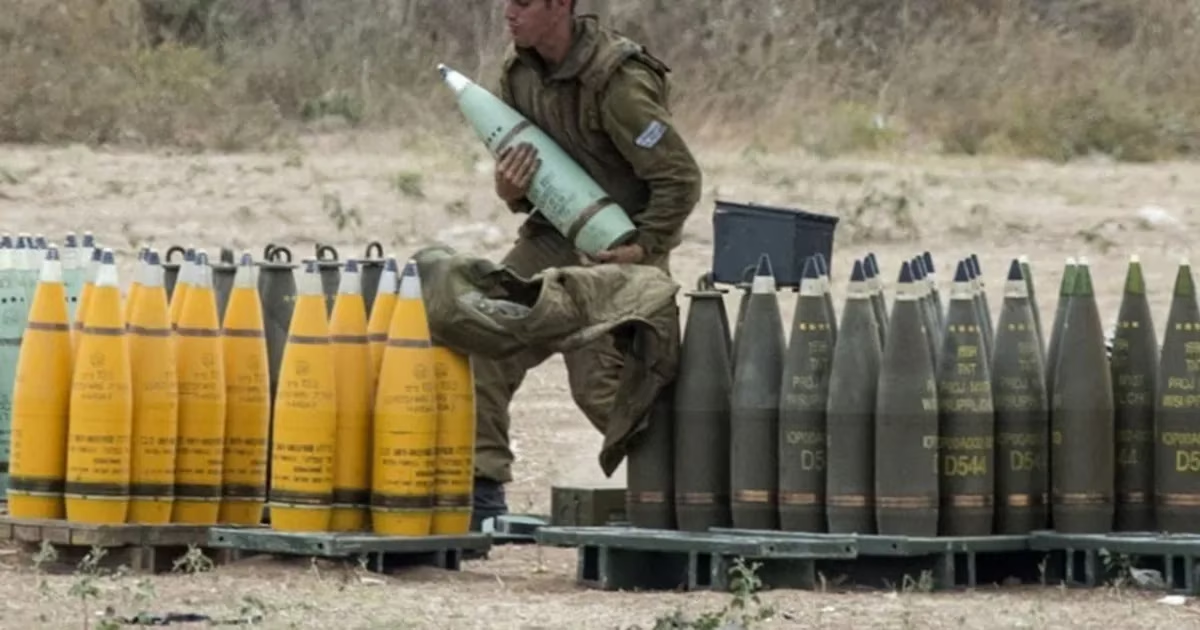
Hebrew media reports revealed that the occupation army recently resorted to using an old stock of unguided bombs, manufactured more than five decades ago, to carry out military strikes against targets inside Iranian territory. This development reflects fundamental shifts in the management of Israeli military resources amid the depletion of modern ammunition during ongoing confrontations on multiple fronts.
Journalistic sources stated that the army found warehouses containing thousands of bombs manufactured more than 50 years ago, which were originally intended for use in previous wars against Egypt before the signing of the peace agreement. However, the current field need prompted the military leadership to re-include them in the target bank directed against Iranian facilities.
These munitions are militarily classified as "dumb bombs," which are weapons that lack precise guidance systems via satellites or lasers, making their trajectory entirely dependent on the laws of gravity and the moment of launch. Reports explained that the air force currently relies on them to target military bases located in open areas far from population centers to reduce the risks of targeting errors.
For its part, official media sources reported that these munitions had been stored since the 1970s, but technical examinations showed that they were still in relatively good condition and suitable for operational use. This situation encouraged army commanders to decide to reuse them to alleviate the enormous financial pressure imposed by expensive smart weapons.
Reports quoted military sources as saying that the decision to return to the "historical stock" comes within the framework of a strategy to reduce the high financial costs of air operations. This step also aims to utilize huge quantities of explosives that have been out of service for many years without benefiting from their destructive capability.
Military analysts believe that this trend reveals increasing pressures facing Israeli military supply chains, especially with the continued high pace of air operations. Through this, the occupation is trying to achieve a difficult balance between maintaining combat efficiency in the field and reducing escalating military expenditures.
In contrast, the spokesperson for the occupation army tried to downplay these reports, indicating that the air force operates in various ways and uses different armament methods that are appropriate for the nature of the targets. He stressed that the choice of ammunition type is a purely operational decision subject to assessments of the field situation and the tactical needs of each raid individually.
The military spokesperson emphasized that the army follows strict procedures for checking the validity of any old ammunition before loading it onto aircraft, to ensure the safety of air and ground crews. These statements come in an attempt to reassure domestic public opinion about the safety of using weapons that have exceeded their lifespan by decades.
The use of this type of bomb was not entirely surprising, as there had been widespread controversy about their use during the ongoing aggression on the Gaza Strip. Earlier American intelligence reports revealed that a large percentage of the munitions dropped on the Strip were unguided, causing massive destruction and widespread human casualties.
Observers link this trend to previous American threats to stop supplies of precision bombs if military operations are expanded in certain areas such as Rafah. This possibility prompted Tel Aviv to search for local or stored alternatives to ensure the continuity of its military operations without complete reliance on external approvals.
Analysts in major Hebrew newspapers indicated that the army excessively used precision weapons at the beginning of the war, leading to the depletion of vital parts of the strategic stock. This explains the current reliance on "dumb bombs," which necessarily means reducing the level of targeting accuracy and increasing the damaged areas around the intended targets.
These field developments come at a time when the war waged by the occupation is entering a complex phase, having so far resulted in more than 72,000 Palestinian martyrs and tens of thousands injured. Amidst this widespread destruction, the use of unguided weapons emerges as an additional tool that increases the tragedy of the field scene and expands the scope of indiscriminate targeting.
The choice of ammunition type is an operational decision based on several factors, and the army does not use any ammunition until after an organized process of checking its validity.
PALESTINE
Mon 30 Mar 2026 11:35 pm - Jerusalem Time
Netanyahu is No Exception: A Reading into the Roots of Zionist Ideology from Ben-Gurion to the Gaza War

The political arena in the United States is facing a escalating campaign, involving a spectrum of the right and liberal left, aimed at placing full blame on Benjamin Netanyahu for exacerbating the region and dragging Washington into a confrontation with Iran. This narrative is based on an attempt to absolve Israel as an entity from its imperial crimes, and to portray current policies as a 'sudden deviation' from an alleged democratic and peaceful path that prevailed before the rise of the far-right.
This propaganda is led by liberal Zionist figures such as journalist Thomas Friedman and Senator Bernie Sanders, who insist on holding Netanyahu's coalition responsible for 'corrupting' the Israeli record. This discourse deliberately ignores that expansionist ambitions and daily massacres in the West Bank and Gaza are not new, but are the core of the settlement project since its very beginnings in the last century.
Looking back at history, we find that the language of demonization and racism towards Palestinians did not begin with Netanyahu; Menachem Begin described Palestinians as 'two-legged beasts'. He was preceded by leaders from the 'secular' Labor Party such as Moshe Dayan who called them 'dogs', and David Hacohen who denied their humanity, which confirms the unity of the ideology behind the different political faces.
The military doctrine practiced by the occupation army today in Gaza finds its roots in David Ben-Gurion's instructions in 1948, who explicitly called for striking 'without mercy'. Ben-Gurion then stressed the need to target women and children to ensure the effectiveness of deterrence, emphasizing that there is no need to distinguish between the guilty and the innocent in the field of operations, which Netanyahu literally applies today.
Historical facts indicate that Labor Party governments, promoted as partners for peace, were the ones who laid the foundations for major settlements in the occupied territories. Before Likud came to power in 1977, dozens of settlements had already been established in the West Bank, Gaza, Sinai, and the Golan, proving that geographical expansion is a high state strategy and not a narrow partisan agenda.
In occupied Jerusalem, the destruction of Palestinian neighborhoods was not a right-wing innovation, but was started by Haim Herzog, the city's first military governor, when he ordered the leveling of the Maghariba Quarter in 1967. Thousands of residents were displaced in a few minutes to transform the Islamic endowment dating back to the Ayyubid era into a prayer plaza for settlers, in a documented war crime that occurred under the leadership of the 'Zionist Left'.
The idea of 'transfer' or forced displacement, which Netanyahu's ministers are brandishing today, was strongly present in Levi Eshkol's discussions after the 1967 war. Eshkol drew inspiration from models of expelling populations from previous international experiences, and seriously explored ways to empty the Gaza Strip of its refugees and distribute them in other countries, proving that ethnic cleansing is an original idea in the 'founding' Zionist thought.
Yigal Allon, a leader in the Labor Party, formulated his famous plan to annex a third of the West Bank decades ago, a plan that Netanyahu is implementing today under new names and designations. This systematic alignment extends to the theft of water resources and land in the demilitarized zones with Syria, which were gradually controlled between 1949 and 1967 under the guise of 'Labor' governments.
The irony is that leaders like Abba Eban did not object to the massacres themselves, but rather to their 'promotion' which could harm Israel's international image. The concern was always how to maintain the facade of a 'democratic state' before the West, while the killing machine inside continued to perform its tasks away from the spotlight, a facade that completely collapsed during Netanyahu's era.
The savagery of settlers in the West Bank today is the natural maturation of a seed planted in the seventies under the watchful eye of Labor governments. The 'terrorism against terrorism' groups that targeted Palestinian civilians and buses during that period are the legitimate predecessors of the current settler militias that burn villages and towns under the protection of the occupation army.
Even the biblical discourse used by Netanyahu to justify the occupation of Sinai or Gaza was used by Ben-Gurion before him in 1956 when he spoke of the 'Third Kingdom of Israel'. Ben-Gurion drew inspiration from the texts of the prophets to justify the invasion and control of Tiran Island and Sinai, which clarifies that the use of religion in the service of colonialism is an old tool efficiently used by the early 'secularists'.
The attempt to portray Netanyahu as a 'rogue' leader who deviates from the entity's values is a propaganda strategy aimed at re-marketing Israel as a reformable entity. The truth proven by the record of facts is that Netanyahu is merely a more explicit and crude link in a continuous chain of leaders who established their entity on the ruins of Palestinian existence since the Nakba.
Palestinian and Arab consciousness must confront the attempts of Western liberals to reduce the conflict to the person of Netanyahu, because that paves the way for legitimizing the entity once he departs. Defending the 'truth of the crime' requires emphasizing that Netanyahu is a genuine war criminal, but he does not differ in essence from his predecessors who established the rules of extermination and displacement.
In conclusion, Netanyahu remains the most honest embodiment of Zionism in its current phase, where the entity no longer needs to hide its ugly face behind false slogans of peace. Exposing this historical sequence is the only way to confront attempts to falsify history and absolve the settler colony of its long bloody legacy continuing from 1948 until today.
Netanyahu is not a deviation from the path, but rather its faithful embodiment; his crimes are merely a cruder link in a continuous chain that began since the Nakba.
ARAB AND WORLD
Mon 30 Mar 2026 11:35 pm - Jerusalem Time
Suspicions of insider trading: Massive bets precede Trump's decisions, raising questions about 'political profiteering'

Press reports have highlighted unusual phenomena in global financial markets, where massive bets were observed preceding crucial decisions by US President Donald Trump. In a controversial incident, oil traders poured nearly half a billion dollars into futures contracts just minutes before Trump announced talks with Iran, leading to a drop in prices and massive profits.
Economic analysts described these movements as abnormal and raising deep suspicions about the possibility of leaks from decision-making circles in Washington. Sources reported that the timing of these deals indicates prior knowledge of the content of presidential announcements, which puts the integrity of information trading in the White House under scrutiny.
'Polymarket' stands out as one of the new players in this scene, an electronic prediction market that allows betting on major political and military events. It has been observed that newly established accounts were able to accurately predict the timing of US and Israeli military strikes a full day before they occurred, reinforcing the hypothesis of information breach.
This phenomenon was not limited to the Middle East but extended to events in Latin America, where an anonymous account made profits exceeding $400,000 coinciding with political movements in Venezuela. These recurring patterns raise legal and ethical questions about who truly benefits from these strange financial 'coincidences' in the absence of oversight.
Tracking these transactions becomes more difficult due to their reliance on cryptocurrencies like 'Bitcoin', which provides a cover of secrecy away from traditional banking oversight. Moreover, the decentralized nature of these platforms makes it impossible for a single judicial authority to effectively shut them down or regulate their cross-border activities.
Writer Nesrine Malik points out that the Trump family has openly engaged in cryptocurrency projects since he took office, opening the door to conflicts of interest. Despite the White House's continuous denial of any illegal involvement, the link between political decisions and personal financial gains has become the talk of the political circles.
A New York Times investigation revealed that Trump's wealth experienced significant growth, earning at least $1.5 billion during the first year of his second term. This rapid growth fuels speculation about how the presidential office is being used to enhance the family's and their close associates' financial empire.
The problem is not limited to the president alone but extends to a broader political culture in the United States that allows officials to invest in markets. Members of Congress have the right to trade stocks despite their daily access to secret intelligence and economic reports that could affect the value of those stocks.
Nancy Pelosi's name stands out as an example of this overlap, with digital platforms dedicated solely to tracking and imitating her financial investments based on her political moves. It is also noted that the Clinton family previously benefited from decades of public service to build massive financial networks through consulting and paid speeches.
Observers believe that Trump's second term represents an unprecedented acceleration in turning politics into a field for speculation and overt greed. Trump's approach to dealing with international events as entertainment has contributed to transforming crucial decisions into material for daily betting, similar to sports betting.
Turning the future into a tradable 'commodity' represents a dangerous cultural shift, where success becomes linked to possessing an 'inside edge' or leaked information instead of traditional effort. This trend coincides with a decline in job stability and the rise of a culture of investing in side projects and digital speculation.
Despite the difficulty of proving a direct link between Trump and these suspicious deals, the environment he created encourages this type of financial chaos. The wide circle of individuals and companies surrounding the administration increases the likelihood of information leakage and its exploitation by parties seeking quick profits.
In conclusion, it seems that the American political scene is heading towards more overlap between power and wealth, where the boundaries between public interest and private gains have blurred. These billion-dollar bets remain a testament to a new era of 'financial politics' that does not recognize traditional values of integrity.
These markets do not just speculate on assets; they turn the future itself into a commodity that can be bet on according to multiple scenarios.
ISRAELI AFFAIRS
Mon 30 Mar 2026 11:35 pm - Jerusalem Time
Israeli Intelligence Analyst: Settler Rampage in West Bank Threatens International Legitimacy and Drains the Army
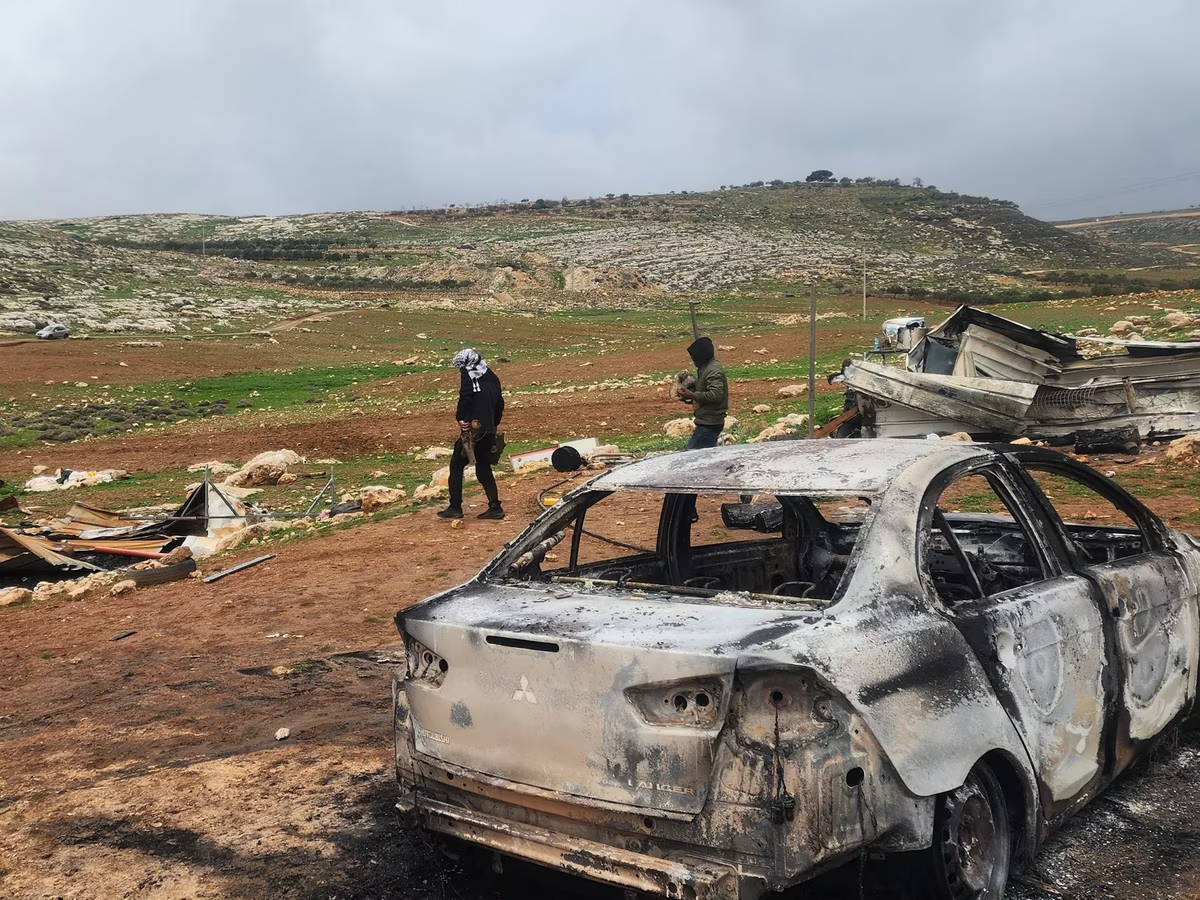
Prominent Israeli researcher and former intelligence officer, Michael Milshtein, stated that curbing settler violence in the West Bank represents one of the most complex strategic challenges facing Israel today. In an analysis published by Hebrew media, he indicated that failure to address this phenomenon directly threatens the state's global image and could pave the way for unprecedented international interventions in the region.
Milshtein, who previously headed the Palestinian Department in military intelligence, explained that what he described as 'nationalist crimes' committed by settlers not only threaten field stability but also undermine Israel's international standing. He argued that the continuation of this approach reinforces the global impression that Israel is losing control over extremist groups that impose their own agenda.
The Israeli analyst criticized the current government's attempts to blur the known 'Green Line' and its efforts to legally and structurally integrate the West Bank into the state entity. He affirmed that these policies have led to counterproductive results, transforming the West Bank into an area where 'the law of the jungle' prevails, lacking official state legal and institutional standards.
According to the analysis, the West Bank has become governed by extreme ideological and religious values that fundamentally differ from the culture of the official military establishment, creating a deep gap between the field and the leadership. This reality has reinforced the international perception that the area is detached from the Israeli legal system, necessitating intense international monitoring and pressure.
Milshtein refuted the justifications put forward by some right-wing elements for expanding settlement outposts under the pretext of security or strategic necessities. He described claims that settlements prevent armed operations as illusions that ignore the harsh lessons Israel learned from the events of October 7, emphasizing that those promoting these ideas are the same ones who contributed to the previous intelligence failure.
The article stressed that the proliferation of random settlement outposts and pastoral farms represents a heavy security burden that drains the resources and manpower of the Israeli army. Military units are forced to secure settlement points that have no clear strategic logic, leading to constant friction even with the security forces themselves.
Milshtein warned that the political leadership's loss of control over events in the West Bank will inevitably lead to the internationalization of the conflict and the imposition of external dictates on Israel. He noted that the international community, including successive US administrations, may find itself compelled to intervene directly if a balanced and responsible Israeli vision continues to be absent.
The analyst cited the example of what happened in the Gaza Strip, where the absence of a clear post-war strategy led to the erosion of Israeli influence and the emergence of international mechanisms for managing field affairs. He believes that a repeat of this scenario in the West Bank will lead to Israel losing its ability to determine the fate of the region according to its own interests.
Internally, Milshtein observed a sharp division between two currents in Israeli society; one ignores the demographic and political consequences of the one-state reality, and the other is driven by a mystical ideology seeking to expand settlements to include areas outside traditional borders such as Syria, Lebanon, and Gaza, disregarding political realities.
He asserted that these two currents ignore even the explicit positions of major international powers, including Donald Trump's statements rejecting annexation or displacement. He considered that the continuous pursuit of these strategic illusions will end in collapse in the face of a complex international and political reality that cannot be overcome by slogans.
The researcher warned that the continuous escalation in the West Bank distracts the national war effort, which should be focused on the northern fronts and Iran. Instead of directing all capabilities to confront existential threats, forces are being drained protecting settler aggressions, which distorts the international legitimacy necessary for military action on other fronts.
Milshtein called on the Israeli public to make the future of the West Bank the central issue in any upcoming elections, and to demand clear answers from leaders on how to deal with this threat. He emphasized that the state's identity and future are now being decided in the alleys of the West Bank, far from empty slogans about absolute sovereignty.
In a related context, sources quoted Mustafa Barghouti warning that Israel is exploiting global preoccupation with tensions with Iran to implement its plans in the Palestinian territories. Barghouti affirmed that there is deliberate media blackout aimed at covering up the escalating violations in both the Gaza Strip and the West Bank.
For his part, Israeli writer Gideon Levy supported this argument, asserting that the Israeli government is not concerned about settler violence but considers it an effective political tool. Levy explained that this violence is not merely an outburst of extremist groups, but a systematic policy aimed at imposing new realities on the ground and pushing Palestinians towards forced displacement.
The West Bank has transformed into what resembles an area outside legal control, where ideological standards prevail that differ from the culture of the state and the military establishment.
ISRAELI AFFAIRS
Mon 30 Mar 2026 11:35 pm - Jerusalem Time
The cost of war with Iran puts the Israeli economy on the brink of collapse and warnings of an unprecedented financial deficit
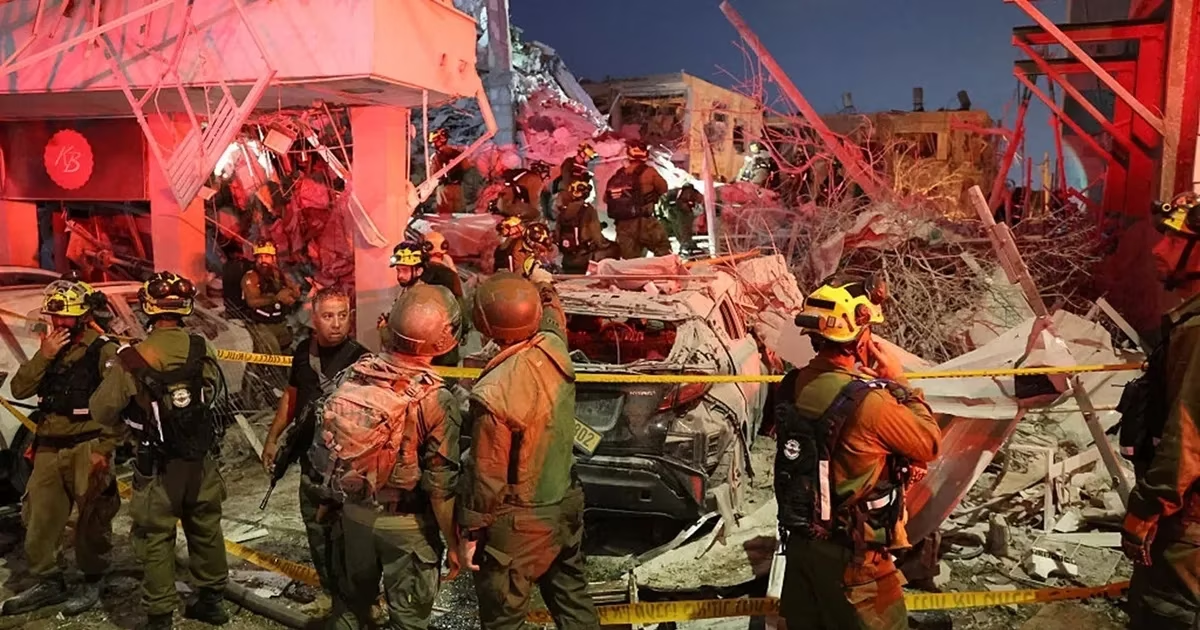
Economic circles in the occupation state are facing a state of shock after the revelation of the exorbitant financial cost of the military confrontation with Iran, as official data showed a huge gap in the public treasury. Economic sources confirmed that the current government has brought the economic cycle to the brink of collapse as a result of limiting compensation to specific sectors, which will force all Israelis to pay high living costs in the coming period.
In an interim report submitted by the Governor of the Bank of Israel, Amir Yaron, it was revealed that public spending since the beginning of October 2023 has exceeded 352 billion shekels, an unprecedented figure in the history of Israeli budgets. The report explained that the direct confrontation with Iran raised the average daily cost of military operations to between 1.5 and 1.7 billion shekels, which is a burden that the local economy cannot bear for long periods.
Yaron sharply criticized the government's performance, stressing that continued uncontrolled military spending and inflated sectoral funds threaten the confidence of international financial institutions. The governor warned that the absence of an austerity plan and a sharp reduction in non-growth-related spending would jeopardize Israeli financial stability, especially with the increasing financial deficit reaching dangerous levels.
Despite the suffocating crisis, the government quickly approved record amounts for the ruling coalition's funds for 2026, totaling about 6.1 billion shekels to ensure political loyalties. These allocations included billions of shekels directed to religious institutions affiliated with the Haredim, in addition to hundreds of millions for the Ministry of Settlement and the Jewish Identity Directorate, at a time when severe cuts are being imposed on health and education budgets.
These internal crises coincide with external pressures resulting from the turmoil in the global energy market, as tensions in the Arabian Gulf pushed oil prices to exceed $100 per barrel. While countries around the world are trying to absorb the price shock, the Israeli government appears unable to make economic decisions that protect its citizens from the escalating global inflation wave resulting from maritime threats.
For its part, Fitch Ratings maintained its negative outlook for the Israeli economy, noting that the political priorities of the ruling coalition take precedence over necessary growth reforms. The agency believes that the absence of fiscal discipline, an increase in the military budget, and a deepening deficit will turn this negative outlook into a difficult existential reality that will burden future generations of Israelis.
Regionally, the effects of this war extended directly to the Egyptian economy, as tensions in the Red Sea caused cumulative losses in Suez Canal revenues amounting to $10 billion. The halt of Israeli gas supplies since the end of last February also doubled Egypt's monthly gas import bill to $1.65 billion, increasing pressure on the local currency.
In a related context, the Egyptian pound recorded a significant decline against the dollar, which exceeded 53.63 pounds in official banks, amid expectations of continued decline due to the outflow of hot money. International reports indicate that the Egyptian economy has lost about 15% of its value since the start of the Iranian confrontation, with expectations that the exchange rate will reach record levels by 2028.
Reconstruction plans in the northern Israeli settlements are facing significant setbacks due to the absence of allocated budgets, despite the massive destruction they suffered from mutual shelling. Settler leaders protest what they describe as deliberate government neglect, asserting that reducing budgets instead of doubling them will hinder the return of residents and turn these areas into ghost towns for a long time.
The Israeli economy will not be able to continue bearing the enormous expenses for armaments and reserves, and the international community's confidence in our financial stability is in real danger.
ISRAELI AFFAIRS
Mon 30 Mar 2026 11:35 pm - Jerusalem Time
Israeli Assessments: Escalating Challenges on Iranian, Lebanese, and Yemeni Fronts, and Alternative Military Options
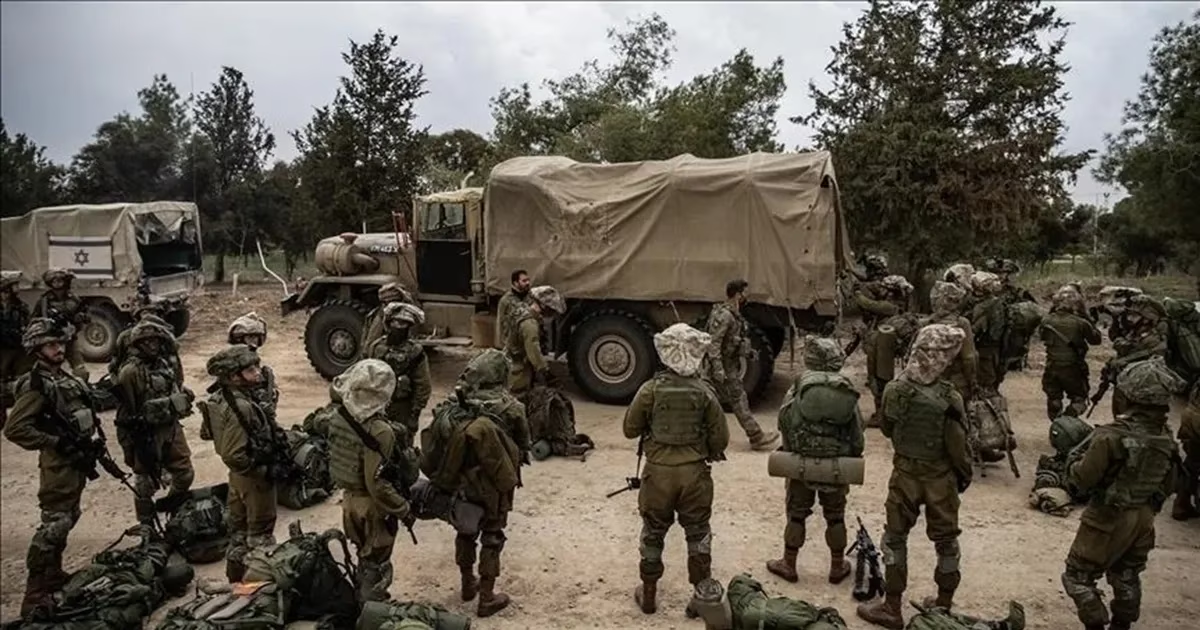
Security and political circles in the occupation state face a complex reality with the continued attrition of forces on multiple fronts, despite previous attempts to neutralize some arenas to focus on the Iranian file. Hebrew media sources reported that the arrival of US Marine reinforcements to the Gulf raises questions about the possibility of targeting Iranian oil facilities, especially Kharg Island, which represents the coronary artery of Tehran's economy with exports reaching 90% of its oil production.
Analysts believe that crippling Iranian export traffic may not necessarily require a costly ground invasion, but can be achieved through a tight naval blockade preventing tankers from departing, or by the US Fifth Fleet planting naval mines in vital passages. However, fears remain of an Iranian reaction targeting US forces stationed in the region with drones and missiles, without regard for the safety of oil facilities given the current state of alert.
In the context of strategic alternatives, proposals emerge to control strategic islands such as Abu Musa and Greater and Lesser Tunb near the Strait of Hormuz, as political and military leverage instead of getting involved in widespread ground confrontations. These moves come at a time when anxiety prevails in Tel Aviv over the new US administration's orientations, especially with the appointment of J.D. Vance as coordinator for negotiations, who is known for his reserved stances on foreign military interventions.
On the Lebanese front, the Israeli army continues its field attempts to create military 'pockets' aimed at isolating Hezbollah units in strategic areas such as Wadi Hujeir, Wadi Salouqi, and the town of Bint Jbeil. These moves seek to reduce the party's maneuverability, despite Hebrew sources acknowledging that the force currently used may not be sufficient to achieve a decisive outcome given the geographical and field complexities.
Israeli voices are escalating, demanding the expansion of pressure to include the political and social incubator in Lebanon, with calls emerging to place Parliament Speaker Nabih Berri within the direct targeting circle due to his continuous support for Hezbollah. These threats loom over new areas in southern Lebanon, such as the city of Tyre, to be included in evacuation and forced displacement lists, in an attempt to disengage the Amal movement from Hezbollah and deepen the internal Lebanese crisis.
Moving to the Yemeni arena, assessments indicate that the air attacks targeting Hodeidah port and Houthi infrastructure facilities have begun to bear economic fruit. Sources confirm that the extent of the damage to the regime in Sana'a has caused a shake-up in tribal alliances based on profit and benefit sharing, putting the group's leadership before difficult choices between continuing military escalation or maintaining internal stability.
In conclusion, it appears that the 'multi-front' strategy necessitates a comprehensive re-evaluation of the occupation's military capabilities and political objectives, given the intertwining regional and international files. While Tel Aviv relies on excessive military and economic pressure, the possibilities of sliding into a comprehensive confrontation remain, especially with armed factions in Yemen and Lebanon continuing to send missile messages confirming their unwavering involvement in the battle.
Israeli interests, in J.D. Vance's view, are entirely secondary, and his appointment as coordinator for negotiations with Iran does not guarantee the achievement of Tel Aviv's objectives.
ARAB AND WORLD
Mon 30 Mar 2026 4:36 pm - Jerusalem Time
The Departure of Liamine Zeroual: The Military Man Who Shunned Power and Voluntarily Left It
Last Saturday, Algeria lost one of its most prominent military and political figures, former President Liamine Zeroual, who passed away at the age of 84. The deceased is considered one of the professional military men who graduated from the National Liberation Army school, having joined the revolution in his early youth in 1957 on the historical territory of Wilaya I, charting a career path full of field and academic responsibilities.
Zeroual led the country in the mid-1990s, a period described as the most difficult in Algeria's modern history due to the tumultuous security and political crisis. Despite reaching the pinnacle of power from the Ministry of Defense and the Chief of Staff, he maintained his strict and aloof personality, untouched by the temptations of remaining in power, which was evident in his surprising decision to shorten his term and organize early elections.
Zeroual's relationship with the centers of power in the deep state was complex, as he clashed on many occasions with influential generals, most notably Khaled Nezzar, which led him to resign from the Chief of Staff in the late 1980s. This repeated behavior of preferring withdrawal when principles conflicted with political reality enhanced his popularity among Algerians, who saw in him a model of integrity and asceticism.
On the diplomatic front, Zeroual is remembered for his famous stance of refusing to meet French President Jacques Chirac in New York, considering the meeting arrangements inappropriate for the stature of the Algerian state. This stance, along with his supervision of the 'Mercy Law' in 1995, contributed to breaking the international isolation imposed on the country and marked the beginning of the state's regaining its prestige in international forums.
After leaving the El Mouradia Palace in 1999, Zeroual chose to return to his hometown of Batna, away from the spotlight and official political activity. Despite attempts by many popular delegations to persuade him to return to the scene during the events of the popular movement in 2019, he remained steadfast in his decision to stay away, emphasizing that the generation of the revolution had fulfilled its duty to the homeland.
The death of the deceased sparked a wave of sadness and appreciation in Algerian circles, with President Abdelmadjid Tebboune declaring three days of national mourning with flags at half-mast. This step reflects the great respect Zeroual enjoys among the current leadership, especially since President Tebboune was always keen to visit him and consult him on major national issues.
Liamine Zeroual departs, leaving behind a legacy of controversy surrounding the 'Black Decade,' but he remains in the memory of many as that 'free Chaoui' who was not tainted by factional struggles. His experience proved that leaving power with dignity is no less important than assuming it, and that history vindicates those who placed the interest of national stability above their personal ambitions.
Zeroual left the presidency in 1998 with a decision that was not surprising to those who knew his asceticism regarding the manifestations of power and prestige, and his clean hands.
PALESTINE
Mon 30 Mar 2026 4:36 pm - Jerusalem Time
Unknown Fate for Gaza's Only Joint Replacement Specialist Amid Warnings of Medical Paralysis

The Israeli occupation authorities continue to detain Palestinian doctor Ghassan Abu Zuhri, the only consultant specializing in joint surgery and replacement in the Gaza Strip, since his arrest from inside the Nasser Medical Complex. This arrest comes amidst harsh conditions experienced by the exhausted health sector due to the ongoing aggression, leaving hundreds of patients facing an unknown fate.
Local sources reported that Dr. Abu Zuhri's family is living in a state of extreme anxiety due to the complete قطع of all means of communication with him since his detention. His wife, Reem Ashour, stated that the information they receive is very scarce and limited to testimonies from some released prisoners, emphasizing the failure of all legal attempts through lawyers to reach him or ascertain his health condition.
Dr. Abu Zuhri's family appealed to human rights institutions and international medical organizations to intervene immediately to reveal his whereabouts and living conditions. His wife questioned the real reasons behind targeting a specialized medical professional who provides rare humanitarian services, demanding international pressure to ensure the protection of doctors while performing their professional duties in hospitals.
On the ground, Abu Zuhri's absence has led to a complete and comprehensive halt of joint replacement services in all hospitals in the Gaza Strip. These surgeries are considered highly specialized procedures that the detained doctor was uniquely providing, causing a disruption in the treatment journey of hundreds of injured individuals who were awaiting surgical interventions to save their limbs from disability.
For his part, Atef Al-Hout, director of the Nasser Medical Complex, stated that the absence of specialized medical staff due to the arrest has created an irreplaceable medical gap at present. He pointed out that the complex alone has over 400 urgent cases requiring joint replacement surgeries, warning that delays threaten to exacerbate the patients' health conditions.
Al-Hout explained that the crisis is deepening with the almost complete halt of medical referral systems for treatment abroad, in addition to the classification of bone injuries as 'non-emergency' cases by some international bodies. This classification deprives patients of the opportunity to travel for treatment, leaving them stranded in Gaza without hope of receiving the necessary surgery.
Health experts warn that delaying these delicate surgical operations will inevitably lead to permanent physical complications and chronic movement deformities. Fears are growing that these injuries will turn into total disabilities, increasing the humanitarian and social burden on the Palestinian community, which is already suffering from the ravages of war and displacement.
Medical reports indicate that targeting health personnel has become a systematic policy, with about 90 medical staff members held in occupation prisons since the escalation began. This deliberate depletion of medical minds deprives thousands of citizens of their basic rights to treatment and contributes to accelerating the collapse of the dilapidated health system.
In light of this reality, the injured in Gaza face bitter choices between an unknown wait that may end in disability, or attempting to find unavailable medical alternatives. Sources confirm that restrictions imposed on the entry of foreign medical delegations further complicate the situation, as the occupation prevents the arrival of specialists capable of filling the void left by the detained doctors.
The suffering of bone and joint patients in Gaza reflects one aspect of the larger tragedy experienced by the Strip, where treatable injuries turn into permanent disabilities due to the absence of specialization. Dr. Ghassan Abu Zuhri remains an example of hundreds of competencies lost to detention, leaving behind hundreds of patients facing their pain without medical support.
In conclusion, popular and medical demands continue for the necessity of neutralizing the health sector from military conflicts and ensuring the freedom of movement for doctors. With the continued lack of information about Dr. Abu Zuhri, the question remains about when vital medical services, forcibly halted behind prison bars, will resume.
The doctor's arrest has caused a complete halt to the service, and there are over 400 urgent cases requiring joint replacement surgeries that cannot be transferred abroad.
PALESTINE
Mon 30 Mar 2026 4:36 pm - Jerusalem Time
Occupation launches extensive demolition campaign in Silwan to expand settlement projects in Jerusalem

Israeli occupation forces stormed Al-Bustan neighborhood in Silwan, adjacent to Al-Aqsa Mosque in occupied Jerusalem, today, Monday, carrying out widespread demolitions. Occupation municipality bulldozers accompanied the military forces, which imposed a complete closure on the main and secondary roads leading to the neighborhood to prevent residents or media crews from accessing it.
Local sources reported that occupation machinery completely destroyed four homes, owned by brothers Naeem and Ibrahim Shehadeh, citizen Saleh Abu Shafea, in addition to the home of 85-year-old elderly Ahmed Al-Abbasi. The forces did not stop at demolishing homes but also began destroying retaining walls and bulldozing streets and infrastructure in the area.
In a related context, occupation authorities handed notices to three other families in the neighborhood, demanding them to evacuate their homes by next Saturday in preparation for their demolition. This step comes as part of the continuous pressure policy practiced by the occupation municipality to displace indigenous residents from the neighborhood, which is threatened with complete removal for Judaization projects.
Statistics issued by the Silwan Land Defense Committee indicate a sharp decline in the number of housing units in the neighborhood, as the number of homes decreased from 120 homes about a decade and a half ago to only 66 homes currently. The period following October 7, 2023, witnessed a significant escalation, with the occupation demolishing 37 homes during these few months.
The occupation authorities seek, through these operations, to level Al-Bustan neighborhood to the ground, under a historical pretext claiming that the area was 'King David's Garden.' This plan aims to expand the so-called 'National Park' managed by the extremist settlement association 'Elad,' which already controls vast areas in the adjacent Wadi Hilweh neighborhood.
Last January, the occupation municipality issued notices to confiscate about 7 dunams of the neighborhood's land, under the pretext of using it for landscaping and establishing parking lots. The municipality claims that these lands are 'empty,' while in reality, they are lands that previously contained inhabited Palestinian homes before the occupation forcibly demolished them and displaced their owners.
Al-Bustan neighborhood residents face existential risks amid the accelerating pace of demolition and confiscation during the last two years, as these measures are linked to the 'City of David' settlement project. Silwan residents appeal to international and human rights organizations for urgent intervention to stop the demolition massacre aimed at eliminating the Palestinian presence in the areas surrounding the Old City and Al-Aqsa Mosque.
The occupation continues to pressure families in Al-Bustan neighborhood to forcibly displace them and convert their lands into settlement projects.
OPINIONS
Mon 30 Mar 2026 4:10 pm - Jerusalem Time
Trump Threatens Iran Again with Destruction of All Energy Centers and Oil Wells
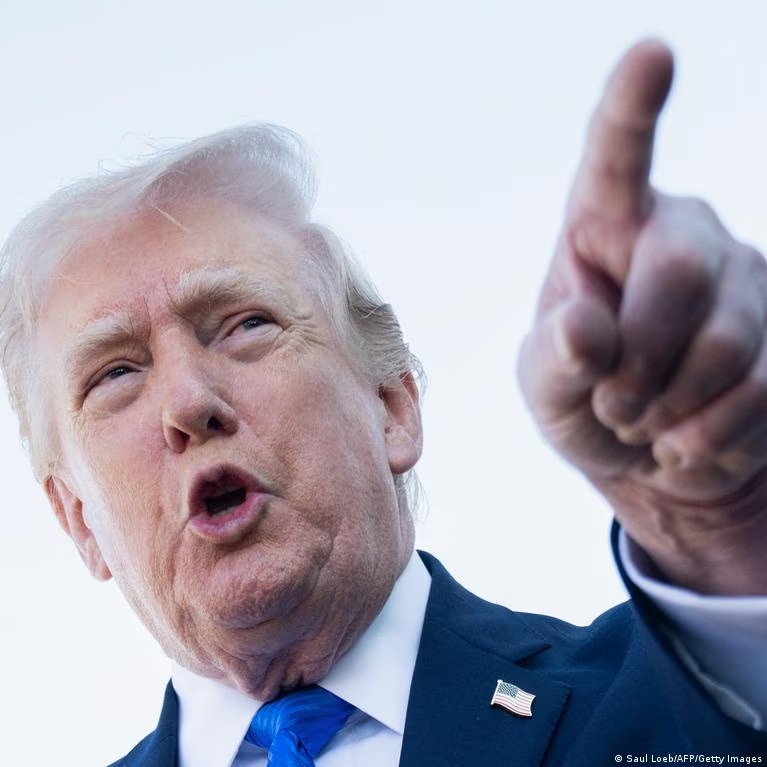
Washington – Said Arikat – 3/30/2026
The escalation between US President Donald Trump and Iran is witnessing an unprecedented turn, with the language of threat coming from President Trump shifting from traditional deterrence to hinting at the comprehensive destruction of vital infrastructure. In a Monday morning post on the "Truth Social" platform, Trump vowed to "wipe out" power plants, oil wells, and Iran's Kharg Island if the Strait of Hormuz is not immediately reopened. This threat comes in the context of an ongoing war and stalled peace negotiations, raising international concern about the situation sliding towards a broader confrontation.
Trump wrote in his post: "Significant progress has been made, but if an agreement is not reached soon for any reason, which is likely to happen, and if the Strait of Hormuz is not 'opened' immediately, we will end our beautiful 'stay' in Iran by blowing up all power plants, oil wells, and Kharg Island, and completely wiping them out."
This escalation cannot be separated from the broader context of US-Iranian relations, which have been characterized for decades by chronic tension and oscillation between indirect confrontation and cautious de-escalation. However, the current tone reflects a higher degree of political urgency, and perhaps an attempt to impose new realities on the ground before any potential settlement. Furthermore, the use of social media platforms as a channel for issuing threats of this magnitude adds an unconventional character to crisis management, where messages directed at domestic public opinion are mixed with strategic messages for abroad, in a scene that reflects a shift in the tools of contemporary political discourse.
The danger of these developments lies in the strategic importance of the Strait of Hormuz, through which about 20% of the world's oil passes. Iran's closure of the strait to most shipping traffic has led to severe disruptions in energy markets and a significant rise in prices. This reality puts the global economy to a harsh test, as geopolitical interests intersect with energy security at a very sensitive moment, especially given the reliance of major countries in Asia and Europe on a stable flow of Gulf oil, making any long-term disruption a threat to international economic stability.
The ultimatum issued by Trump reflects a gradual escalation; it was preceded by a 48-hour threat to target power stations, starting with the “largest first.” Reports also indicate that Washington is considering the option of a ground intervention to seize Kharg Island, the main center for Iranian oil exports, as leverage to force Tehran to make concessions. In response, Iran was quick to retaliate, threatening to target US and allied energy and desalination facilities in the region, signaling an escalating scenario open to dangerous possibilities.
In their coverage of this crisis, international media outlets such as CBS News, Newsweek, and others are following the details of this escalating tension, with a focus on its economic and military implications.
This escalation reflects a shift in American doctrine from a policy of containment to a policy of direct coercion, where the goal is no longer merely to deter Iran, but to impose conditions by force. However, this approach carries serious strategic risks, as it may push Tehran to adopt more radical options, including expanding the scope of the conflict regionally. Furthermore, targeting civilian infrastructure may provoke sharp international criticism and place Washington in a legal and moral confrontation with the international community.
Closing the Strait of Hormuz represents an ultimate bargaining chip for Iran, but it is also a double-edged sword. While it gives Tehran negotiating leverage, it threatens to isolate it economically and justifies international military responses. In this context, the crisis appears closer to a game of brinkmanship, where each side seeks to extract concessions without sliding into an all-out war, but the margin of error in such strategies remains very narrow.
The threat of a ground invasion of Kharg Island opens the door to more complex scenarios, as any such intervention could turn into a long-term confrontation, especially given the nature of Iranian geography and the complexities of the regional environment. Furthermore, such a move could prompt other international powers to intervene, either directly or indirectly, threatening to transform the crisis into a multilateral international conflict whose repercussions extend beyond the Middle East.
PALESTINE
Mon 30 Mar 2026 4:09 pm - Jerusalem Time
Forced Displacement in Southern Lebanon: Fears of Gaza Scenario Repetition and Demographic Reshaping

The ongoing war in southern Lebanon is no longer limited to material destruction or direct human casualties; it has transitioned to a dangerous phase measured by the scale of population displacement. Hundreds of thousands of civilians have found themselves forced to leave their villages under intense bombardment and evacuation orders that covered vast geographical areas, presenting us with a highly complex humanitarian and legal situation.
Updated field figures indicate a real catastrophe, with the number of displaced persons within Lebanese territory exceeding one million by late March 2026. According to UN data, approximately 1,049,328 people have fled their homes, while over 134,000 of them are crowded into collective shelters lacking the most basic elements of stability, and the vast majority live in fragile conditions outside these centers.
The nature of Israeli evacuation orders raises fundamental legal questions about their legitimacy, as they were not limited to narrow engagement zones but were comprehensive and repetitive. This broadness removes the evacuation from its context as a precautionary measure to protect civilians, transforming it into a tool of collective pressure aimed at emptying entire areas of their original inhabitants.
International humanitarian law sets strict conditions for civilian evacuations, requiring them to be necessary for imperative military considerations and to be temporary in nature. The Fourth Geneva Convention also obliges the occupying power to provide adequate shelter and ensure the return of residents as soon as operations cease, which appears to be completely absent in the current Lebanese situation.
Field indicators in southern Lebanon show a clear transgression of these legal boundaries, as displacement operations lack clear guarantees of return. Furthermore, targeting the displaced areas themselves with bombardment strips evacuation orders of their stated justification of protecting lives, opening the door to the possibility of displacement becoming a permanent state serving political and demographic objectives.
Israeli statements about establishing "buffer zones" and linking the return of residents to long-term security arrangements carry dangerous implications that go beyond temporary military necessities. This approach reflects a desire to reorganize the geographical and demographic space on the border, shifting the conflict from a military confrontation to a systematic policy of demographic change.
The comparison with the Gaza Strip stands as a stark warning of the consequences of this path, where displacement began with similar evacuation orders and ended with the displacement of 85% of the population. In Gaza, displacement transformed from an incidental result of war into a structural feature and a primary tool in managing the conflict, leading to military control over approximately 70% of the Strip's area.
The massive destruction that affected over 60% of housing units in Gaza has made the idea of return complicated even if the guns fall silent. This reality creates facts on the ground that are difficult to reverse, making displacement a means to impose new political and security conditions at the expense of fundamental civilian rights.
The real danger lies in this pattern becoming an adopted strategy in contemporary conflicts, where civilians are used as part of the military pressure equation. Controlling the movement of populations and making their return conditional blatantly contradicts the Rome Statute of the International Criminal Court, which criminalizes the forced transfer of populations.
From a legal perspective, any breach of the conditions of necessity and proportionality in evacuation orders transforms them into grave violations that warrant international accountability. International law was not established merely to prevent wars, but to set limits that prevent civilians from being used as fuel for strategic plans aimed at uprooting them from their land.
Lebanon is already suffering from severe economic and social crises, making the wave of millions of displaced people a double burden that threatens to disintegrate the social fabric. The loss of livelihoods and the destruction of infrastructure in southern villages create long-term humanitarian crises that cannot be addressed merely by providing urgent relief aid.
The current situation requires a clear legal approach that goes beyond mere humanitarian description, by documenting evacuation orders and analyzing their demographic impacts. International pressure must focus on ensuring the unconditional right of return and rejecting any attempt to impose buffer zones that lead to the encroachment on Lebanese territories and the displacement of their inhabitants.
International silence or merely issuing timid warnings gives a green light to entrenching a new reality in which forced displacement becomes a common practice. The challenge today is to stop policies that make displacement a fait accompli and to affirm that the protection of civilians is a binding legal obligation, not a negotiable political option.
In conclusion, what is happening in southern Lebanon cannot be separated from the broader regional context and attempts to redraw demographic maps by force. War, no matter how fierce, does not grant any party the right to uproot peoples, and justice remains contingent on the ability to hold accountable those who use displacement as a tool to reshape geography.
Forced displacement is not measured only by the direct act, but by the outcome; if military orders force residents to leave their areas without protection or guarantees of return, then we are facing a war crime.
PALESTINE
Mon 30 Mar 2026 4:09 pm - Jerusalem Time
Fifty Years Since Land Day: Demographic Resilience and Erosion of Geography and Politics

The fiftieth anniversary of Palestinian Land Day falls on March 30, 2026, bringing with it existential questions about what remains of the land in light of a complex geopolitical reality. This day, which began in 1976 as a protest against the confiscation of Galilee lands and saw six Palestinians martyred, has transformed over the decades into a symbol of rooted Palestinian identity and existence.
Today, half a century later, the Palestinian cause faces a major paradox; while Palestine's moral and legal presence in international forums is increasing, the field faces unprecedented geographical and political fragmentation. The struggle over land has become more brutal and exposed, as land is no longer merely a negotiating file but a battleground for daily survival against attempts at erasure.
On the legal front, Palestinians have achieved historical gains, most notably the International Court of Justice's opinion in July 2024, which deemed the Israeli presence illegal. The court affirmed that the occupied territories constitute a single territorial unit, emphasizing that the right to self-determination for the Palestinian people is unconditional and not subject to bargaining.
Despite these diplomatic victories, the reality on the ground in the West Bank is witnessing a dangerous deterioration due to settlement expansion and settler violence. International reports reveal that the West Bank is no longer merely under traditional occupation but is suffering from the pressures of forced displacement and systematic evictions targeting the Palestinian presence.
The latest UN data indicates that the first three months of 2026 saw the displacement of 1,697 Palestinians due to settler attacks and movement restrictions. This shocking figure exceeds the total number of displacements recorded throughout 2025, reflecting a dangerous acceleration in policies of demographic emptying of the land.
In a related context, 38 Palestinian communities have been completely emptied since 2023, indicating a clear strategy to reduce the geographical space for Palestinians. In East Jerusalem, forced evictions continue in favor of settlement associations, making the question of actual survival on the land the most prominent challenge today.
As for the Gaza Strip, recent events have returned the issue to its bare humanitarian origin as a matter of existential survival. According to UN estimates for 2026, approximately 1.7 million displaced persons live in tragic conditions within 1,600 displacement sites lacking the minimum requirements for a dignified life.
Residents of the Strip suffer from severe water and shelter shortages, with the spread of skin diseases and a crazy rise in the prices of basic goods and fuel. Restrictions on the movement of medical teams and aid have also exacerbated the health crisis, while half of school-aged children remain without education.
Politically, the Palestinian system faces a decline in effectiveness despite maintaining the historical national narrative. The division between Gaza and the West Bank, and the multiplicity of authorities between the Authority and resistance factions, have weakened Palestinian representative institutions before the international community despite the strength of the cause in the hearts of the people.
Diplomatically, Palestine has regained broad legitimacy, with the number of states recognizing it reaching 159 by the end of 2025. Despite the UN General Assembly's support for Palestine's full membership, the American veto in the Security Council remains the main obstacle to translating this recognition into full sovereignty.
Palestine has today transformed from an elite issue into a global public opinion issue, topping universities, unions, and international human rights organizations. This global momentum prevents the obliteration of historical truth, but it faces the challenge of transforming symbolic solidarity into actual pressure that changes the imbalanced power dynamics on the ground.
Amid regional escalation between major powers, the Palestinian issue has become part of broader deterrence equations that transcend direct geographical boundaries. This shift carries the risks of reducing Palestinian national rights to a "pressure card" within escalating regional and international power struggles in the region.
The conclusion on the fiftieth anniversary of Land Day confirms that what remains of Palestine is its people, memory, and established legal right. Despite the erosion of geographical unity and the effectiveness of international politics, Palestinian steadfastness remains the rock against which projects for the gradual liquidation of the cause are shattered.
The real challenge at this historical stage is to prevent the transformation of the Palestinian right into a legal text absent from the facts on the ground. Adherence to the land in the face of demographic and geographical reshaping is the essence of the Palestinian struggle in the sixth decade following the eternal Land Day uprising.
What remains of the land is what remains of the Palestinians on it, in it, and for it; the cause has not been defeated as long as people remain attached to their memory.
PALESTINE
Mon 30 Mar 2026 4:09 pm - Jerusalem Time
Two Martyrs by Occupation Fire in Tulkarm and Hebron, and Escalation of Demolition Operations in Jerusalem

A young Palestinian man was martyred today, Monday, by the bullets of Israeli occupation forces stationed at the Anab military checkpoint, located on the eastern side of the city of Tulkarm in the northern occupied West Bank. This crime followed claims made by the occupation army through its digital platforms, alleging that the young man attempted to carry out a ramming operation targeting soldiers present at the scene, which prompted them to open direct fire at him.
Following the incident, field sources reported that the occupation forces imposed a complete closure on the Anab checkpoint, which connects the cities of Tulkarm and Nablus, leading to a complete obstruction of the movement of Palestinian citizens. Forces stationed in the area prevented the passage of vehicles in both directions, amid a widespread military alert around the checkpoint and its nearby areas.
In the Hebron Governorate, young Ramzi Abdel Hakim Al-Awawdeh was martyred at dawn today, after being subjected to intense gunfire by occupation soldiers in the village of Kharsa, affiliated with the town of Dura. Local sources confirmed that occupation soldiers targeted Al-Awawdeh at the village triangle, and left him bleeding for a long time without allowing first aid to be provided to him.
Sources mentioned that the occupation forces deliberately restricted medical teams who tried to reach the scene of Al-Awawdeh's injury, by confiscating ambulance keys and preventing paramedics from performing their duty. The situation ended with the occupation army detaining the martyr's body and transferring it to an unknown location, as part of the policy of retaining bodies.
In the context of the ongoing escalation in occupied Jerusalem, heavy occupation machinery proceeded to demolish four residential homes in the Al-Bustan neighborhood of Silwan, south of the blessed Al-Aqsa Mosque. The demolition operation took place suddenly and without prior warning, as forces stormed the neighborhood and imposed a strict security cordon to secure the bulldozing operations that affected citizens' properties.
Demolition operations in Silwan come within the occupation's plans aimed at changing the demographic and geographical character around the Old City, and imposing strict restrictions that prevent Palestinians from building or expanding. Official reports from the Jerusalem Governorate indicate an escalation in the pace of demolition and eviction notices, coinciding with systematic land seizures for settlement projects.
Regarding pursuit and arrest campaigns, occupation forces launched a series of raids in various areas of the West Bank, including the town of Beit Duqqu northwest of Jerusalem, where a young man was arrested after his home was searched. Forces also stormed the village of Faqqu'a east of Jenin city, deployed patrols in residential neighborhoods, and raided a number of homes without immediate reports of arrests.
In the city of Jericho and Aqabat Jaber camp, Israeli forces carried out incursions that included thorough searches of homes and destruction of their contents, resulting in the arrest of Palestinian citizens. This coincided with similar military movements in the city of Tulkarm and its suburbs, where two Palestinians were detained and taken to occupation interrogation centers.
These field developments reflect a state of continuous escalation adopted by the occupation authorities in various governorates of the West Bank, through a combination of field killings, arbitrary arrests, and demolition of structures. Observers believe that this policy aims to tighten the noose on Palestinians and break their will, especially in areas experiencing constant friction points.
It is worth noting that Palestinian human rights data warned of a significant increase in the pace of Israeli violations since the beginning of the year, indicating that targeting civilians at military checkpoints has become a recurring event under flimsy pretexts. National institutions demand the necessity of providing international protection for the Palestinian people in light of the continued demolition and forced displacement operations in occupied Jerusalem.
Occupation forces fired live ammunition at the young man, left him bleeding, prevented his rescue, and confiscated ambulance keys.
PALESTINE
Mon 30 Mar 2026 4:08 pm - Jerusalem Time
Transformations in the International Legal Path: Karim Khan's Acquittal and Germany's Retreat Confuse Occupation Calculations

The acquittal of the International Criminal Court's Prosecutor, Karim Khan, holds exceptional importance at this sensitive time, coinciding with a remarkable retreat in the German position regarding support for the Israeli occupation in the genocide case. These developments clearly indicate a fundamental shift in the international legal landscape and reveal a crack in the wall of absolute support that the occupation has enjoyed for decades.
Attempts by Zionist and American lobbies to isolate the Prosecutor or deter him from proceeding with his legal actions have failed, despite immense pressure and blackmail with previous accusations to obscure the main issue. This acquittal reinforces the independence of the international judicial process in the face of political narratives that sought to protect occupation leaders from accountability for crimes committed in the Gaza Strip.
Horrific figures from the field redefine the ongoing aggressive war since October 2023, with statistics indicating the martyrdom of over 70,000 Palestinians. The vast majority of these victims are women, children, and the elderly, confirming the retaliatory and aggressive nature of this war, which directly and systematically targeted civilians.
In addition to the enormous human losses, the war has left hundreds of thousands injured and tens of thousands missing under the rubble, amid systematic destruction affecting over 70% of residential infrastructure. These data are not merely humanitarian figures; they are compelling evidence that forms the solid legal basis for holding the occupation accountable for policies of forced displacement and ethnic cleansing.
UN reports confirm the displacement of approximately 1.7 million Palestinians, representing about 75% of the total population of the Gaza Strip, in one of the largest forced displacement operations in modern history. This tragic reality places the international community before its moral and legal responsibilities to stop this catastrophe that threatens the Palestinian presence in the Strip.
In contrast, Germany's retreat from supporting the occupation before the International Court of Justice represents a dramatic shift, given that Berlin has always been the primary pillar of Western support based on historical considerations. This transition from absolute support to legal caution reflects a growing awareness of the cost of aligning with a state accused of committing genocide before the eyes of the world.
There are three main implications of this German retreat. The first is the real fear of international legal responsibility that may affect German officials on charges of complicity or providing assistance in committing international crimes. The principle of aiding in crime has become a legal concern for countries that continue to supply the occupation with weapons and political cover.
The second implication is the pressure from European public opinion, which has witnessed unprecedented popular mobilization condemning the massacres committed in Gaza and demanding an immediate halt to the aggression. This movement, in which political and cultural elites and influencers participated, forced European governments to re-evaluate their positions to avoid conflict with their peoples who reject double standards.
The third implication is related to the fear of legal precedents, as major countries fear that a ruling against the occupation could become a legal rule used against them in future conflicts. This cautious legal positioning aims to protect the national interests of these countries away from traditional political alliances that have become very costly.
Persistent attempts by the occupation to obstruct the legal process stem from its realization that international courts now threaten the narrative of victimhood it has promoted for decades. Legal prosecution means revealing facts to the world and dismantling the propaganda that tried to portray the aggression as an act of self-defense, while in reality, it is an organized crime.
Karim Khan's acquittal clearly means that administrative and legal blackmail attempts have utterly failed in the face of global support for continuing the case. The Gaza issue has become a matter of international public opinion and a humanitarian demand that peoples of various affiliations have united upon, giving international justice additional momentum to move forward.
The new German position, though cautious, represents an additional achievement that can be built upon in the path of isolating the occupation internationally, as traditional allies are beginning to feel the burden of defending indefensible crimes. This retreat opens the door for other countries to review their policies towards the Palestinian-Israeli conflict and adhere to international law.
These events, from the Prosecutor's acquittal to the retreat of European positions, are not mere temporal coincidences; rather, they are signs of a new path towards justice taking shape. This path requires continued popular and human rights momentum to ensure that criminals do not escape punishment and to preserve the rights of Palestinian victims.
In conclusion, the reliance remains on continuing efforts to isolate the occupation in all international forums as a rogue entity that transcends laws and humanitarian norms. The integration of field struggle and the legal path is the only way to end the era of impunity and achieve the aspirations of the Palestinian people for freedom and justice.
Karim Khan's acquittal is not just an administrative detail; it is an announcement of the failure of blackmail attempts aimed at obstructing the accountability of the occupation for its crimes in Gaza.
LATEST NEWS
Mon 30 Mar 2026 1:32 pm - Jerusalem Time
Thick smoke covers a petrochemical facility in Haifa following missile attacks
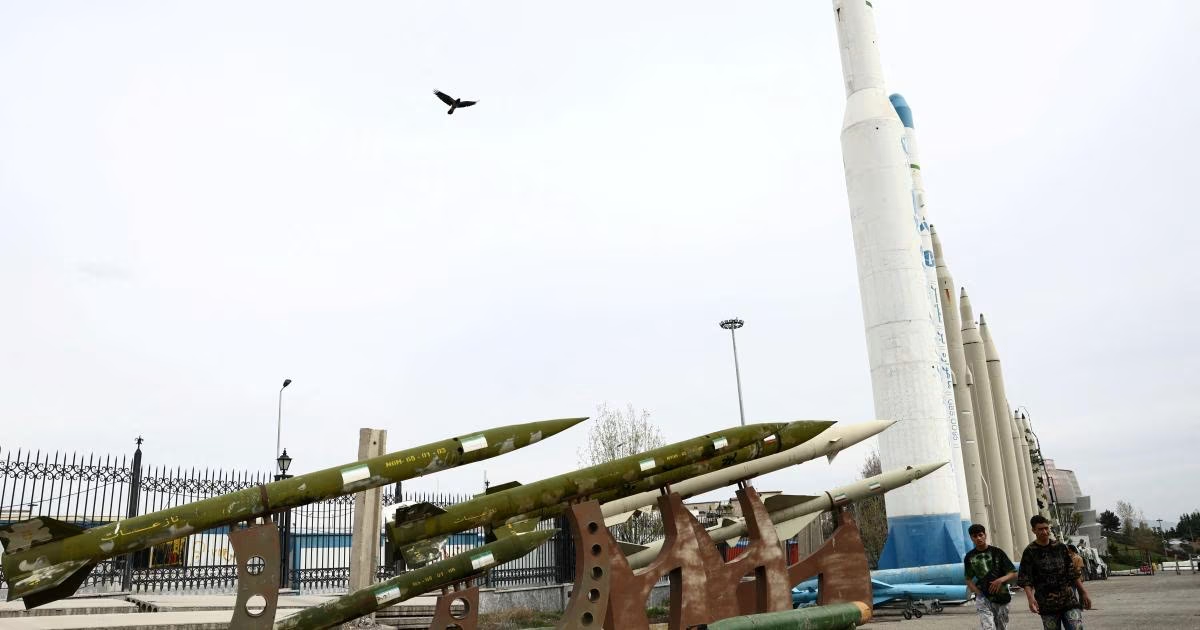
The occupied city of Haifa witnessed a state of widespread security alert after thick plumes of smoke rose from inside the strategic petrochemical facility in the north of the country. These scenes raised serious concerns among Israeli circles about the possibility of one of the most sensitive industrial areas suffering a direct hit that could lead to an environmental and economic catastrophe.
For its part, the Israeli army issued an initial statement in which it tried to downplay the incident, indicating that the fire and smoke might have resulted from the fall of shrapnel from interceptor missiles. Field sources confirmed that investigations are still underway to determine whether the projectile that fell inside the facility was a guided missile or merely remnants of aerial interception operations.
In a related context, Hezbollah in Lebanon announced the execution of a military operation targeting the Haifa naval base using a volley of advanced missiles. This announcement coincided with the monitoring of intense missile launches from Iranian territory towards vital targets deep in the northern and central Israeli areas.
Media sources reported a limited fire in the vicinity of the petrochemical complex, which necessitated the intervention of firefighting and emergency teams that deployed heavily in the area. Military helicopters were also seen flying at low altitudes over the facility to assess the damage, amid strict military censorship on the details of the incident.
Israel's Home Front Command had activated sirens over a wide area including the north, center, and south, warning of imminent missile attacks. Thousands of settlers rushed to fortified shelters, while air defense systems attempted to intercept hostile targets in the skies over Haifa Bay and neighboring cities.
Haifa Bay is considered a frequent target in the current round of escalation, as oil and industrial facilities have previously suffered material damage due to falling missile shrapnel. These previous incidents led to power outages and partial work stoppages in some industrial neighborhoods, increasing pressure on the home front.
The targeted petrochemical facility represents a cornerstone of Israel's energy and industry sector, and any major disruption to it threatens local supply chains. Observers believe that targeting these sites carries clear political and military messages related to the strategic target bank that has become exposed to advanced missile strikes.
This field development comes at a time when Israel is threatening to expand the scope of its airstrikes, which portends the regional confrontation entering a more complex phase. Ambiguity remains regarding the true extent of the losses inside the facility, amid the usual official Israeli secrecy in such sensitive security circumstances.
What fell inside the facility may have resulted from missile shrapnel or remnants of a missile that was intercepted by air defense systems.
PALESTINE
Mon 30 Mar 2026 1:32 pm - Jerusalem Time
The death of the young man Ramzi Al-Awawdeh by occupation bullets in the town of Kharsa in Hebron

The Israeli occupation army committed a new assassination crime on Monday, targeting a Palestinian young man in Kharsa village, affiliated with Dura town, southwest of Hebron city. Security and local sources reported that a military force set up a tight ambush at the village triangle, where soldiers immediately began firing a heavy barrage of live bullets directly at the young man Ramzi Abdul Hakim Al-Awawdeh, which led to him being seriously wounded before his martyrdom.
The occupation forces adopted a deliberate 'leave to bleed' policy against the injured Al-Awawdeh, as he remained lying on the ground for a long period without allowing any first aid to be provided to him. Eyewitnesses confirmed that the soldiers brandished their weapons in the faces of citizens who tried to approach to save the young man's life, threatening to shoot anyone who tried to provide assistance, in behavior aimed at ensuring his death.
In a related context, the area witnessed flagrant violations against the medical teams that rushed to the scene, as the occupation forces completely prevented ambulances from reaching the injured young man. Field sources stated that the occupation soldiers seized the keys of ambulance vehicles, abused paramedics, and expelled them from the scene, which hindered any medical intervention that could have saved Al-Awawdeh's life in his last moments.
This crime comes within the framework of the continuous escalation adopted by the occupation forces in the cities and villages of the West Bank, where incidents of executing young men in the field and preventing medical aid from reaching them have been repeated. Popular activities and human rights institutions condemned these practices that violate international and humanitarian laws, considering that what happened in Kharsa is a cold-blooded execution added to the record of daily crimes against the Palestinian people.
A state of anger and sadness prevailed in Dura town and its surroundings after the announcement of the martyrdom of the young man Ramzi Al-Awawdeh, as national forces mourned the martyr and called for participation in his funeral. The occupation forces continue to reinforce their military presence in the vicinity of the villages south of Hebron, amidst continuous restrictions on the movement of citizens and the setting up of sudden military checkpoints that impede the movement of residents between different towns.
Occupation soldiers seized the keys of ambulance vehicles and abused paramedics to prevent saving the injured.
ISRAELI AFFAIRS
Mon 30 Mar 2026 1:32 pm - Jerusalem Time
Discussions to expand US military presence and establish permanent bases in occupied Palestine
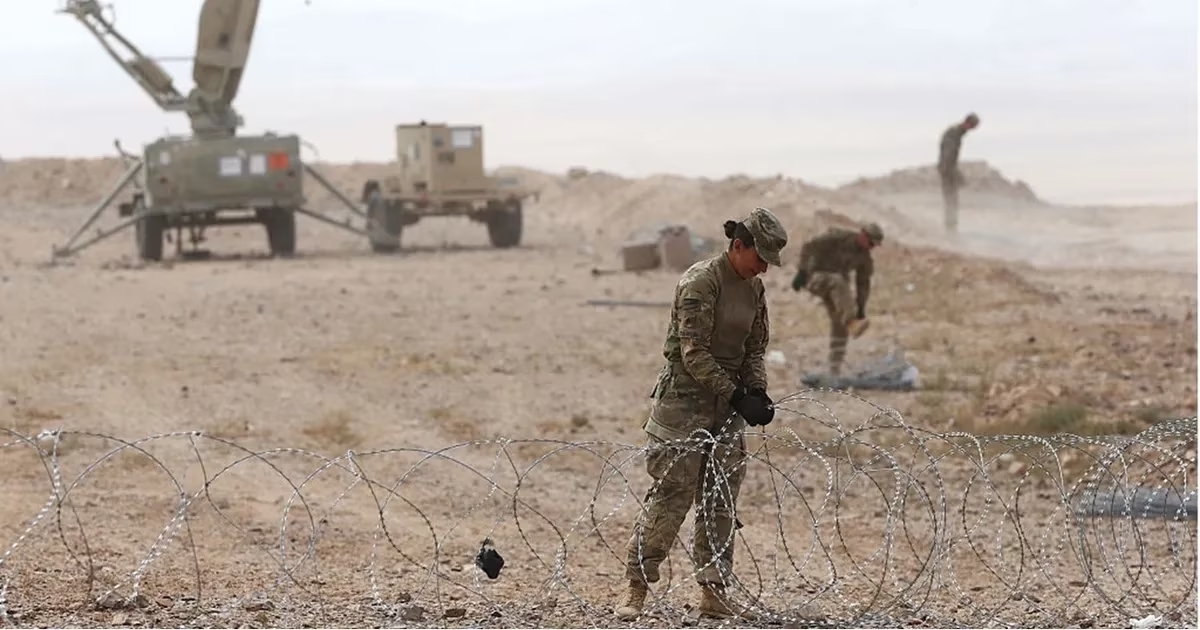
Hebrew media sources revealed intense strategic movements between the occupation authorities and the American administration aimed at studying the possibility of establishing permanent American military bases within occupied Palestine. This step comes amid rapid security developments in the region, especially with the continued direct military confrontation with Iran and the escalation of warfare.
Reports clarified that the proposed plan includes the possibility of transferring a number of American military bases currently located in various Middle Eastern countries and repositioning them within the occupied territories. This approach aims to maximize the benefit of American forces recently deployed to the region and enhance deterrence capabilities and joint operations between the two sides.
The ongoing discussions include not only the transfer of existing bases but also the establishment of entirely new military and logistical facilities capable of accommodating advanced equipment. This step is seen as part of redrawing the military map in the region, ensuring a faster response to the security challenges faced by the occupation in light of major regional changes.
Despite the seriousness of the discussions, sources confirmed that no final and decisive decision has been reached regarding these proposals yet. These discussions are taking place within high-level strategic frameworks between military and political leaders in Tel Aviv and Washington, with a focus on the logistical and legal aspects of such an unprecedented deployment.
This military movement is closely linked to the ongoing war since February 28, where the occupation, with American support, is launching widespread attacks against Iranian targets. These operations have led to the killing of high-ranking leaders, including former Supreme Leader Ali Khamenei, raising tensions to record levels.
In response, Tehran continues its military responses by launching batches of ballistic missiles and drones towards vital occupation sites. The scope of Iranian targeting has also extended to what it describes as American interests in several Arab countries, causing severe human and material losses that have drawn widespread international condemnation.
These developments bring to mind previous reports issued by specialized Palestinian research centers on Israeli affairs, which confirmed that the American military presence is not entirely new. These reports indicated the existence of secret emergency complexes and warehouses belonging to the US military distributed in strategic areas within existing Israeli bases.
One of the most prominent sites previously highlighted is 'Site 512' located in the Negev region of southern occupied Palestine, which includes an advanced American early warning radar. This facility operates in full coordination with the occupation's air defense systems, reflecting the depth of military integration between the two sides for years.
Available information also indicates that logistical cooperation extends to include the use of vital facilities such as the Port of Haifa, which is a focal point for American naval activities in the Eastern Mediterranean. The port is used for supply, provisioning, and maintenance operations for American warships, making it an integral part of the joint security system.
Observers believe that the announcement of studying the establishment of official bases represents a shift from secret or limited cooperation to an overt and direct military presence. This shift reflects Washington's desire to solidify its military presence in the heart of the region to ensure the protection of its interests and allies in the face of growing Iranian influence.
The military projects under discussion also include the construction of underground facilities and fortified bunkers for strategic weapons that American forces might need in extreme emergencies. These projects are highly secretive, with their technical details and precise locations kept confidential to avoid targeting in any future confrontation.
Intelligence and logistical integration between Washington and Tel Aviv has reached unprecedented levels, with real-time information exchanged on military movements in the region. The direct American presence contributes to enhancing the capabilities of monitoring, tracking, and intercepting missiles and drones launched from multiple fronts.
In this complex scenario, questions arise about the political and legal implications of permanent American bases on occupied territories. While the occupation sees this as an absolute security guarantee, regional parties consider it an escalation that could expand the scope of the conflict and draw more international powers into direct confrontation.
In conclusion, the issue of American bases remains subject to battlefield outcomes and developments in the war with Iran, as the future balance of power will determine the shape of foreign military presence in the region. With continued high coordination, it appears that the military partnership between the two sides is heading towards permanent institutionalization that transcends the boundaries of traditional technical cooperation.
The proposal includes transferring American bases from areas in the Middle East to within occupied Palestine, with the aim of enhancing direct military coordination.
ARAB AND WORLD
Mon 30 Mar 2026 1:31 pm - Jerusalem Time
Widespread Israeli Escalation on Lebanon: Raids Target Dahiyeh and UNIFIL Soldier Killed
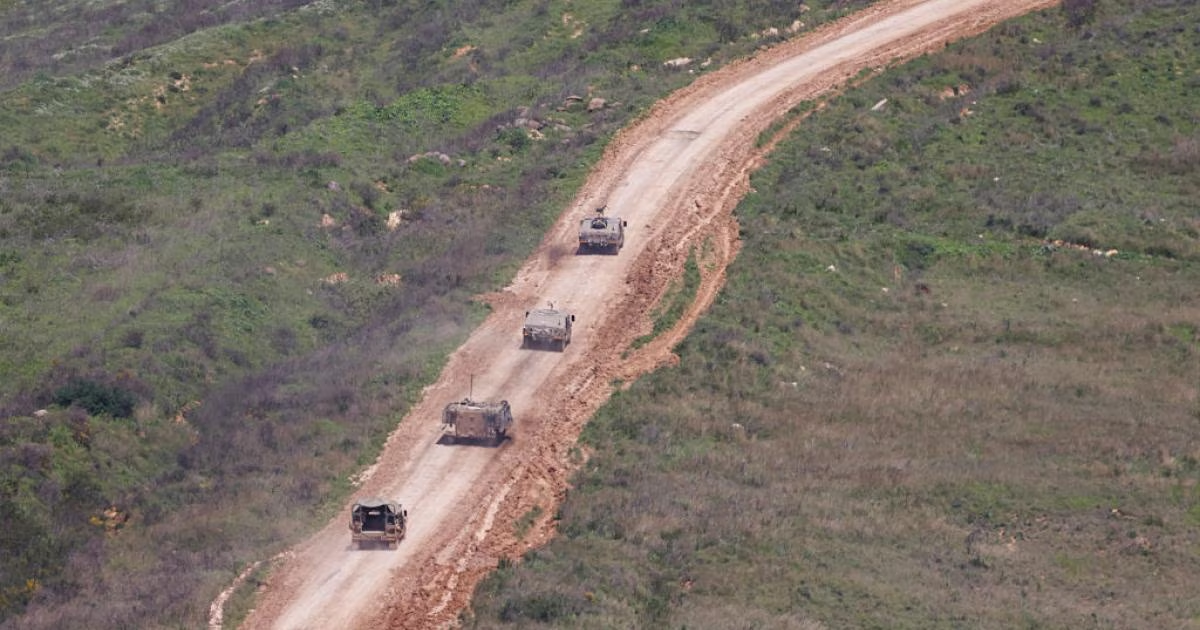
Israeli occupation forces intensified their military aggression on Lebanese territory this Monday morning, launching a series of violent airstrikes targeting the southern Dahiyeh of Beirut. These attacks followed threats and warnings issued by the occupation army to residents of seven neighborhoods in the area, leading to rising plumes of thick smoke covering the sky of the Lebanese capital amidst widespread displacement of residents.
In an official statistic reflecting the extent of human losses, the occupation army admitted that 261 of its soldiers have been injured since the outbreak of confrontation with Iran, noting that among the injured, 22 soldiers are in critical condition. The military statement also confirmed that 6 additional soldiers sustained varying injuries in recent hours due to separate clashes and field incidents that occurred in southern Lebanon.
On the ground in the south, local sources reported that Israeli warplanes and artillery targeted residential homes in the town of Deir Amess. Occupation forces also set fire to a number of homes in the border town of Naqoura, in a move aimed at destroying infrastructure and residential areas near the Blue Line.
In contrast, Hezbollah announced the execution of a series of qualitative military operations against occupation positions and gatherings, with rocket barrages targeting gatherings of soldiers and vehicles in the areas of Ainata, Houla, and Deir Sirian. The party affirmed that these strikes come as a response to continuous aggressions and to protect Lebanese territories from ground incursions.
The party's operations also included targeting the 'Ein Zeitim' military base located north of the occupied city of Safed, in addition to shelling positions in the 'Katzrin' settlement in the occupied Syrian Golan. Fighters used precision missiles and kamikaze drones in their attacks, targeting the vicinity of Deir Sirian school, reflecting an evolution in the military tactics employed.
In a dangerous development, the United Nations Interim Force in Lebanon (UNIFIL) announced the killing of one of its members and the serious injury of another following a shell explosion near the town of Adaysseh al-Qusayr. The international force clarified that the incident occurred while soldiers were performing their duties, raising international concern about the safety of UN personnel in conflict zones.
For its part, the Indonesian Ministry of Foreign Affairs confirmed that the killed soldier belonged to its battalion participating in peacekeeping forces, announcing that three other soldiers of the same nationality were injured. Jakarta strongly condemned this targeting, describing the attack on international forces as an unacceptable act that violates Lebanese sovereignty and applicable international laws.
The Indonesian government called on all parties to exercise restraint and respect the sanctity of international forces, emphasizing the need to adhere to UN resolutions that ensure the security and stability of the region. It demanded an urgent investigation into the circumstances of the incident that led to casualties from the Indonesian battalion operating in the south.
In international reactions, UN Secretary-General Antonio Guterres described the attacks targeting UNIFIL as grave violations that could amount to war crimes. Guterres stressed the need to hold those responsible for these aggressions accountable, affirming that ensuring the safety and security of UN personnel is a responsibility that falls on all warring parties.
Israeli military operations continue to escalate on various fronts, amidst warnings of the region sliding into a broader, comprehensive confrontation. These developments coincide with ongoing airstrikes targeting Lebanese villages and towns, causing widespread destruction of public and private property and increasing the suffering of civilians.
Attacks on peacekeeping forces constitute a grave violation of international humanitarian law and may amount to war crimes.