PALESTINE

Fri 15 May 2026 7:25 pm - Jerusalem Time

A Palestinian Youth killed in Nablus, Smotrich proposes plan to end 'Oslo' divisions and expand settlements

Tensions escalated in the occupied West Bank early Friday morning, following the martyrdom of a Palestinian youth by Israeli occupation forces' bullets in Nablus Governorate. The Palestinian Ministry of Health announced the death of 15-year-old Fahd Zidan Oweis, who was shot by occupation forces in the town of Al-Lubban Al-Sharqiya, noting that Israeli authorities detained his body and prevented medical teams from receiving it.

For its part, the Israeli occupation army attempted to justify the crime with claims made by a spokesperson, who alleged that the youth was participating in throwing stones at settlers' cars on a main road. This incident comes amid an escalation in the pursuit and direct targeting of Palestinian youth and children in various cities and villages of the West Bank under flimsy security pretexts.

In another attack reflecting the escalation of settler terrorism, extremist groups set fire to a mosque and several Palestinian vehicles in the village of Jibiya, northwest of Ramallah. Local sources reported that settlers infiltrated the village under the cover of darkness, set fire to the prayer hall, and spray-painted racist slogans in Hebrew on its walls before fleeing.

The Palestinian Ministry of Endowments and Religious Affairs condemned this attack, considering that the burning of the mosque and targeting of citizens' property is not merely a fleeting individual act. The ministry affirmed in an official statement that these attacks fall within a systematic policy that enjoys cover and incitement from the current Israeli government, with the aim of intimidating Palestinians and erasing their religious identity and presence on their land.

On the political front, Israeli Finance Minister Bezalel Smotrich revealed dangerous government directives aimed at changing the legal and geographical reality in the West Bank. Smotrich announced the government's approval to build approximately 60,000 new settlement units over the next three years, in a move aimed at solidifying the settlement project and blocking any future political solutions.

Smotrich, who leads the extremist 'Religious Zionism' party, called on Prime Minister Benjamin Netanyahu to adopt a plan aimed at the 'final erasure' of the dividing lines between Areas (A), (B), and (C). The Israeli minister considered that the divisions approved by the Oslo Agreement are no longer relevant, demanding the imposition of full and unified Israeli control over all West Bank territories without discrimination.

These statements came during a celebration for settlers marking the anniversary of the occupation of East Jerusalem, where Smotrich boasted about his government's achievements in 'legalizing' settlement outposts. He indicated that work is underway to organize more than 100 new settlement clusters, including the revival of previously evacuated settlements such as Homesh, Sa-Nur, Ganim, and Kadim.

Smotrich's plan, presented to the Israeli cabinet, seeks to undermine the limited powers of the Palestinian Authority in Areas (A) and (B). This move aims to abolish administrative and security distinctions, paving the way for effective and widespread annexation of Palestinian lands under the guise of 'settlement regulation' and preventing Palestinian urban expansion.

It is worth noting that the Oslo Agreement divided the West Bank into three administrative areas, with Area (C) under full Israeli control and constituting the largest area at 60%. However, the current trends of the far-right seek to bypass these divisions in favor of extending absolute Israeli sovereignty, which observers see as the final bullet for what remains of the signed agreements.

These field and political developments reflect a new phase of comprehensive Israeli escalation against the Palestinian presence in the West Bank. While field killings and settler attacks on holy sites continue, the Israeli government is proceeding with legislating laws and settlement plans aimed at resolving the conflict demographically and geographically on the ground.

It is time to finally erase the borders separating Areas (A), (B), and (C). I have presented a detailed plan to the cabinet and call for its adoption.

PALESTINE

Fri 15 May 2026 7:24 pm - Jerusalem Time

Provocative Celebrations by Settlers at Al-Aqsa Gates Amidst Security Siege on Worshippers

The occupied city of Jerusalem witnessed a new escalation today, Friday, in the intensity of provocations led by settlers in the vicinity of the Blessed Al-Aqsa Mosque. Groups of extremists organized noisy celebrations that included dancing and musical performances near the mosque's gates, specifically at the Bab Al-Asbat area, which sparked a state of intense anger among Palestinians present at the scene.

These provocative moves coincide with what the occupation authorities describe as the 'Jerusalem Unification Day' according to the Hebrew calendar, an occasion that the far-right exploits to impose new realities in the holy city. Participants in these celebrations deliberately performed their rituals at the closest possible point to the walls of Al-Aqsa Mosque under intense security protection.

In contrast, the Israeli police tightened their repressive measures against Palestinian worshippers, closing Bab Al-Asbat and Bab Al-Malik Faisal to those coming to pray. Forces imposed strict age restrictions, preventing hundreds of young men from entering the mosque courtyards, which forced many of them to pray in the streets surrounding the Old City.

These field developments come one day after the storming of Al-Aqsa Mosque courtyards by Israeli National Security Minister Itamar Ben-Gvir, leading a large group of settlers exceeding 1300 people. During the storming, Ben-Gvir raised the Israeli flag inside the Haram al-Sharif, a move considered a blatant challenge to Muslim sentiments and a violation of the status quo.

From inside the mosque, the extremist minister made racist statements, claiming to have restored what he described as 'sovereignty and governance' over the site that the occupation calls 'Temple Mount'. Ben-Gvir affirmed in his speech that all of Jerusalem is under Israeli control, which was met with widespread condemnation from national and religious bodies in Jerusalem.

Violations were not limited to incursions; Israeli government ministers, including Finance Minister Bezalel Smotrich, participated in the annual 'Flag March' that paraded through the streets of the Old City. The march witnessed physical and verbal assaults on Palestinian citizens and their property, amidst racist chants calling for death to Arabs.

Field sources reported that the occupation authorities transformed the Old City into a closed military barracks, after deploying about 14,000 security personnel to secure the settlers' routes. These measures led to a complete paralysis of commercial activity in the old markets, where shop owners were forced to close their doors to avoid assaults by march participants.

On the political front, Palestinian and Arab parties warned of the danger of these continuous violations that seek to transform the conflict into a comprehensive religious confrontation. Reports confirmed that the international community's continued silence regarding these practices encourages the occupation to proceed with its plans to Judaize Jerusalem and change its Arab and Islamic identity.

We have restored sovereignty and governance to the Temple Mount, and all of Jerusalem is ours.

PALESTINE

Fri 15 May 2026 7:24 pm - Jerusalem Time

Netanyahu announces occupation army's control over 60% of Gaza Strip area

Israeli Prime Minister Benjamin Netanyahu revealed that the occupation army has expanded the areas it controls within the Gaza Strip, reaching approximately 60% of the total area of the Strip. These statements came during an official ceremony marking the anniversary of the occupation of East Jerusalem, emphasizing that field movements have exceeded the boundaries drawn by previous agreements.

This announced percentage constitutes a clear violation of the terms of the ceasefire agreement reached through American mediation in October 2025, which set the Israeli control area at approximately 53%. Press reports indicated that the occupation deliberately moved what is known as the 'Yellow Line' towards the populated western areas, reducing the living spaces available to Palestinians.

Local sources confirmed that on May 10th, occupation mechanisms moved the separating concrete blocks westward along Salah al-Din Street in the Netzarim axis area. This step is part of the gradual encroachment strategy followed by the army to impose a new field reality that goes beyond recently concluded international understandings.

For her part, Lori Buffard, a GIS expert at Doctors Without Borders, explained that field assessments indicate a continuous escalation in land grabbing. Buffard stated that Israeli control is no longer limited to border areas but has extended to include new buffer zones that impose strict restrictions on the movement of humanitarian organizations.

The international expert pointed to the monitoring of new yellow blocks and boundary markers in the Zeitoun neighborhood of Gaza City over the past few weeks, confirming the continued expansion. These field changes force international institutions to coordinate in advance with the occupation army to enter areas previously classified as purely Palestinian lands.

In the same context, Hamas leader Basem Naim stated that the occupation has shifted the dividing line by an additional area ranging from 8 to 9% of the total area of the Strip. Naim added that this behavior reflects the Israeli government's reneging on its commitments and aims to transform the Strip into isolated pockets under full military control.

The plan of former US President Donald Trump, announced in September 2025, stipulated in its first phase a partial withdrawal of the occupation and a cessation of military operations. While the Palestinian resistance adhered to the requirements of this phase, the Israeli side continued its aggressions and field expansion deep into areas classified as 'safe'.

The second phase of the international plan includes a broader withdrawal of the occupation army and the start of reconstruction operations, which the Netanyahu government currently rejects. Israel insists on imposing new conditions related to disarming factions before implementing any withdrawal, putting the entire agreement on the verge of collapse.

The new areas encroached upon by the army are called the 'Orange Line,' which are areas that overlap with the geographical depth of the Gaza Strip and separate its main cities. Observers believe that this division aims to secure permanent military corridors that cut off the Strip and prevent geographical communication between its north and south.

It is worth noting that the Gaza Strip has been subjected to a genocidal war launched by Israel since October 2023, which lasted for two continuous years of systematic bombing and destruction. This war resulted in the martyrdom of more than 72,000 Palestinians and the injury of more than 172,000 others, the vast majority of whom were women and children.

Regarding infrastructure, military operations destroyed about 90% of vital facilities and residential buildings in the Strip, making it an uninhabitable area in large parts of it. The United Nations estimates the cost of rebuilding what the occupation destroyed at approximately $70 billion, amid a suffocating siege that prevents the entry of essential building materials.

Amidst the Israeli army's silence on commenting on international reports, field sources continue to document ongoing violations along the dividing lines. The situation in Gaza remains hostage to Israeli military movements that disregard all international conventions and covenants signed under American auspices.

The army currently controls 60% of the Gaza Strip, an area larger than what was stipulated in the ceasefire agreement.

OPINIONS

Fri 15 May 2026 1:33 pm - Jerusalem Time

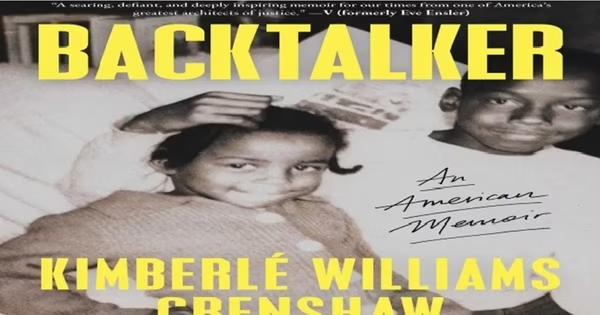
Kimberlé Crenshaw in Her Memoir: How 'Backtalker' Shaped the Concept of Intersectionality and Global Justice?

Ramallah - “Alquds ” dot com

Ramallah - “Alquds ” dot com

Opinion Writer

Since the end of direct slavery in the United States and society's transition to a 'freedom' constrained by laws, the question remains about the state's ability to reproduce discrimination through complex institutional tools. Kimberlé Crenshaw stands out in this context as one of the most important thinkers who worked to dismantle this structure, considering racism not just an individual behavior but an integrated system that shapes identity and status.\n\nIn her recently published memoir, 'Backtalker,' Crenshaw recounts the life of a Black woman who not only challenged reality but also presented an intellectual journey that led to the creation of the concept of 'intersectionality.' This concept has today become a cornerstone in studies of race, gender, and social justice, transforming personal suffering into a global political theory.\n\n"The book's title, 'Backtalker,' refers to an ethical act of resistance that goes beyond verbal rebellion, as Crenshaw learned from childhood that the system not only rejects Black people but also limits the ceiling of their dreams. She recalls how she was confined to marginal roles in school, which revealed to her early on the deep structure of the racial imagination that distributes roles of beauty and salvation.\n\nThe American thinker grew up under the strict 'Jim Crow' laws, where racial segregation was a legal system aimed at keeping Black people on the social and economic margins. However, her family was characterized by a rejection of the victim mentality, which was evident in her mother's attitudes, who faced discrimination in public places with resilience and defiance of white authority.\n\nCrenshaw explains that racism is a system that reproduces itself even after apparent legal defeats, which prompted her to question institutions that hide behind slogans of neutrality. This awareness deepened during her university studies, where she realized that American law historically contributed to shaping racial hierarchy rather than dismantling it.\n\nThe case of Black worker Emma DeGraffenreid against General Motors in 1976 is considered the pivotal moment that led to the birth of intersectionality theory. In that case, the court rejected the discrimination claim on the grounds that the company employed white women and Black men, ignoring the specific oppression faced by Black women.\n\nThis judicial incident revealed a deep 'flaw' in the legal system, where Black women remain invisible because they fall at the intersection of two oppressed identities. From this, Crenshaw set out to prove that an individual is not subjected to oppression due to a single factor, but as a result of a complex interaction between race, gender, and social class.\n\n"The theory formulated by Crenshaw asserts that any justice policy that does not take into account this identity entanglement will necessarily produce new injustice. Intersectionality is not just an academic term, but a tool for seeing the categories that fall out of the calculations of traditional laws and systems that deal with issues as separate paths.\n\nThe book goes beyond being an autobiography to become a living testimony to the major transformations in contemporary American society, from the battles for integrating Black people into higher education to the major issues that occupied public opinion. Crenshaw accurately monitors how American discourse on justice is shaped in moments of social and political crisis.\n\nThe book sharply criticizes the liberal elites who promoted the idea of 'post-racialism' after Barack Obama's presidency. Crenshaw believes that this discourse was misleading, as the deep structures of discrimination continued to operate effectively within the economic, educational, and judicial sectors away from the spotlight.\n\nOn the Arab level, Crenshaw's theses gain special importance for understanding injustice as a complex structure in which sect, class, gender, and geographical origin intertwine. Arab societies suffer from multiple forms of discrimination that traditional human rights discourses often fail to address due to their monolithic view of grievances.\n\nCrenshaw's experience offers a lesson in how to transform individual suffering into a liberatory project capable of changing political and human rights language. She calls for adopting 'mischievous hope' that does not wait for permission from authority to express itself, but confronts it with the truths that institutions try to obscure.\n\nThe chapters of the book review how educational and legal institutions can be tools of domination if their epistemological foundations are not dismantled. The author emphasizes that real change begins with calling things by their names and exposing the mechanisms that make some groups invisible in the public sphere.\n\nIn conclusion of her memoir, Kimberlé Crenshaw emerges as a global voice calling for the necessity of redefining the concept of justice to be comprehensive and genuine. The book 'Backtalker' is an invitation to all the oppressed in the world to see the hidden links between different forms of oppression and to work to confront them as one block.\n\nBlack women remained legally invisible because they fall at the intersection of two oppressed identities simultaneously, and from this gap, the concept of intersectionality was born.

ARAB AND WORLD

Fri 15 May 2026 1:33 pm - Jerusalem Time

Official Documents Reveal Trump's Massive Financial Deals with Tech Giants

Recent official documents published on Thursday revealed new details about US President Donald Trump's financial activities during 2026, uncovering his involvement in a series of massive financial deals with major American companies. According to documents issued by the Office of Government Ethics, these operations included prominent names in the technology and finance sectors, raising a wave of questions about the nature and timing of these investments.

The list included in the financial disclosure statements featured giant companies such as 'Amazon', 'Apple', 'Microsoft', and 'Uber', in addition to leading companies in other fields such as 'Nvidia', specializing in electronic chips, and 'Boeing', an aircraft manufacturer. The total value of these financial movements is estimated at hundreds of millions of dollars, which places the President's financial performance under the scrutiny of ethical and legal oversight in the United States.

Financial data indicates that the value of individual deals ranged between one million and five million dollars, while the documents recorded extensive sales targeting stakes in 'Meta', 'Microsoft', and 'Amazon'. The value of these financial divestments ranged between 5 million and 25 million dollars, although the documents did not precisely clarify whether these assets were direct shares or financial bonds.

For its part, the Office of Government Ethics aims, by publishing this data, to ensure transparency and prevent any potential conflict of interest within the executive branch. These developments come at a time when the US President's assets are managed through a special investment fund overseen by his son, Donald Jr., with a legal clause granting the President the right to regain direct control over these investments at any time he deems appropriate.

These disclosures spark widespread debate about the extent of the US administration's commitment to the rules of separation between private commercial interests and public political decisions. With the expansion of the Trump family's investments in multiple sectors, pressure from regulatory bodies is increasing to ensure that political influence is not exploited to achieve personal financial gains, especially given the enormous amounts reported in recent reports.

These disclosures aim to prevent any conflict of financial interests or violations of ethics rules within the executive branch and its agencies.

PALESTINE

Fri 15 May 2026 1:32 pm - Jerusalem Time

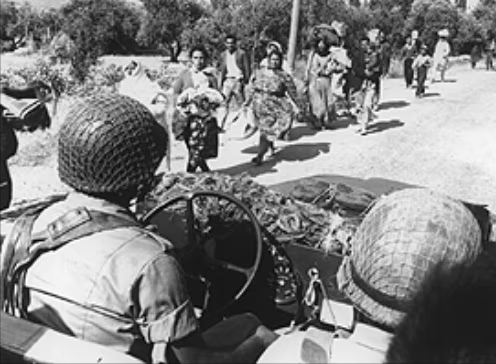
Nakba Maps.. Transformations of Palestinian Geography from Village to Camp and Exile

The Palestinian Nakba in 1948 was not merely a fleeting military or political setback, but a radical transformation that reshaped geography, people, and memory. The Israeli occupation imposed a new reality that turned a network of thriving cities, villages, and plains into a map of ruins, camps, and distant exiles.

Recent data issued by the Palestinian Central Bureau of Statistics on the occasion of the 78th anniversary of the Nakba indicate that the Palestinian presence has numerically doubled despite the uprooting. The number of Palestinians worldwide reached about 15.5 million by the end of 2025, distributed between inside Palestine and the diaspora.

Statistics show that 7.4 million Palestinians remain steadfast within the borders of historical Palestine, while 8.1 million live in diaspora countries and exiles. These figures reflect the continuity of the issue and its geographical expansion, which the occupation has failed to obliterate over decades of displacement.

Before the catastrophe, the Palestinian village represented an integrated economic and social unit of life connected to the land, seasons, and water springs. The destruction of these villages was not merely an attack on stones, but an attempt to tear apart the social fabric, relationships, and professions associated with the original place.

The Institute for Palestine Studies, in its historical publications, documents more than 400 Palestinian villages that were completely destroyed or forcibly emptied during the events of 1948. This field documentation relies on maps, photos, and live testimonies to prove the existence that the occupation tried to erase from the official map.

With the arrival of convoys of displaced people to the West Bank, Gaza Strip, and neighboring countries, the 'camp geography' emerged as a temporary alternative that lasted for a long time. The tent, which symbolized the anticipation of a quick return, transformed due to the continued occupation into permanent residential neighborhoods carrying the names of the lost villages.

UNRWA data indicates that more than 1.5 million Palestinian refugees currently reside in 58 official camps distributed among Jordan, Lebanon, Syria, and Palestine. These camps have become strongholds of identity, where refugees redefine themselves based on their original towns from which they were displaced.

Inside the alleys of the camps, the village identity did not disappear but was reproduced in language, daily relationships, and neighborhood naming. The camp is not just a narrow geographical space, but a living social map that preserves the details of homes and fields whose keys are still passed down through generations.

Palestinian geography expanded over the decades to include distant exiles in Europe and the Americas, where Palestinians are no longer confined to their Arab surroundings. Nevertheless, exile remained an extension of the homeland, where Palestinians carry the name of their original city as an integral part of their personal identity in exile.

Recent digital initiatives such as 'Visualizing Palestine' highlight efforts to reconnect refugees with their roots through data visualization techniques. These initiatives reveal that the majority of Gaza Strip refugees, numbering 1.7 million, originate from villages only a few kilometers behind the separation fence.

In the Palestinian conflict, the map is a tool of resistance and a counter-memory against attempts at erasure and Judaization practiced by the occupation authorities. Hence, applications like 'iNakba' emerged, allowing users to identify the locations of destroyed villages and digitally retrieve their images and historical data.

Restoring the names of villages on digital and paper maps is a documentary act that resists the physical absence imposed by military reality. Every name re-established is an affirmation that the Palestinian narrative has not closed, and that the place is still alive in the consciousness of its rightful owners.

The Nakba produced a parallel geography that lives in the collective consciousness, where cities and villages remain present in stories and family names despite changes in their features. This parallel geography is what makes the question of justice and return an open demand not limited by time or superseded by field realities.

In conclusion, the Nakba maps remain open to the future, telling the story of a people who continued to redefine their place despite loss. From the village to the camp and to the diaspora, Palestine remains the compass and the living memory that refuses to submit to the logic of force and occupation.

The Nakba was not merely a military operation, but a process that affected the social structure by transforming the village from an integrated living space into a physical absence present in memory.

PALESTINE

Fri 15 May 2026 10:00 am - Jerusalem Time

From Gandhi to Mandela and Clay.. How did the consciences of the world's free people unite around Palestine?

The memory of the painful Palestinian Nakba comes upon us, reopening the wounds of displacement and the uprooting of a people from their land. At the same time, it evokes the great moral legacy left by the world's great liberation leaders. Palestine has never been merely a border dispute or a contested geography; rather, it has become a moral compass and a criterion for the humanity of free people everywhere and at all times.

Great world figures formulated their positions on Palestine based on the principles of universal justice, affirming that Palestinian steadfastness represents the essence of human struggle against oppression. These historical testimonies serve as a beacon supporting the Palestinian right and confirming that this people is not alone in confronting the occupation machine, but rather relies on a global moral backing.

A decade before the great catastrophe occurred, the Indian leader Mahatma Gandhi laid the cornerstone for the moral vision rejecting settler colonialism in Palestine. In 1938, Gandhi issued his famous statement in which he affirmed that Palestine belongs to the Arabs just as England belongs to the English, rejecting any falsification of history.

Gandhi did not merely define historical ownership; he also expressed his strong opposition to imposing a Jewish presence on Arab land under the protection of arms or with the support of mandatory powers. He believed that rights are not acquired through political ambitions or brute force, but rather stem from the natural and historical presence of peoples on their land.

From the heart of the long suffering against the apartheid regime in South Africa, the voice of the international activist Nelson Mandela emerged as one of the strongest defenders of the Palestinian right. Mandela considered the Palestinian cause to be the central issue in the global struggle for dignity, and closely linked the fate of his people to that of the Palestinians.

Mandela's immortal quote, which still resonates in international forums today, declared that the freedom of his people in South Africa remains incomplete and unfinished as long as the Palestinians have not achieved their freedom. This connection was not merely a political slogan, but a deep conviction that justice is a single unit that cannot be divided under any circumstances.

Mandela believed that the walls of apartheid that fell in Pretoria must fall in Jerusalem, and that the struggle against racism is a unified global battle. Thanks to this stance, Palestine became a symbol of resistance against all forms of discrimination and oppression practiced by colonial powers in the modern era.

In the realm of sports and soft power, the global boxing legend Muhammad Ali Clay recorded a courageous historical stance from the heart of the United States of America. Clay did not fear the political consequences of his position; rather, he clearly and unequivocally declared his full support for the Palestinian struggle to reclaim the land and expel the Zionist invaders.

Clay spoke on behalf of minorities and Muslims in the West, considering that supporting Palestine is an integral part of his identity and creed, which rejects injustice in all its forms. He saw Palestinian resistance as a model to be emulated by all peoples seeking to wrest their freedom from the clutches of imperialist powers and settler occupation.

The convergence of figures of the stature of Gandhi, Mandela, and Clay in support of the Palestinian people reflects an undeniable truth that cannot be erased, no matter how long the occupation lasts. These testimonies confirm that the Nakba, despite its bitterness, did not succeed in isolating Palestine from the conscience of the free world, which sees it as the primary cause of justice.

Ultimately, Palestine remains the unerring compass in identifying the free, where its people derive their legitimacy from the justice of heaven and the support of honorable people in all parts of the earth. The legacy of these great figures remains alive in the memory of generations, to confirm that the dawn of freedom is inevitable, no matter the sacrifices.

Our freedom is incomplete without the freedom of the Palestinians.

OPINIONS

Fri 15 May 2026 10:00 am - Jerusalem Time

From the First Zionist Congress to the Eighth Congress: Challenges and Ways to Protect the National Project

First, we congratulate the Palestinian National Liberation Movement – Fatah on the convening of its Eighth Congress, which represents a pivotal national and democratic milestone in the history of the Palestinian people, given the historical role and political standing of the movement, which for decades has made it the backbone of the Palestinian national movement and the protector of the Palestinian national project through various stages and turning points. Fatah has never been merely an organizational framework; rather, it has formed the unifying political identity of the Palestinian people and led their struggle through the most difficult and complex circumstances. Therefore, the strength of the movement reflects strength upon the entire Palestinian situation, while any weakness or division within it directly impacts the overall Palestinian national project. Thus, the Eighth Congress cannot be viewed as merely an internal organizational station, but rather as a national congress par excellence, whose outcomes extend beyond the movement's boundaries to affect the future of the entire Palestinian cause, amidst unprecedented challenges targeting the land, people, narrative, and the very existence of Palestinians, to the point where Palestinians face a historical equation: to be or not to be. And, God willing, we will be.

Just as I congratulate the Fatah movement on this occasion, I congratulate myself as a witness to the founding of this movement from the very beginning, specifically since my first meeting with the martyrs Khalil al-Wazir "Abu Jihad" and the symbol Yasser Arafat "Abu Ammar" in Algiers in 1963. I also had the honor of participating in the consultative meeting for the establishment of the movement with the martyred brothers, in addition to the late Hamdan Ashour and Mohammed Abu Maizar, as well as the meeting that organized the relationship between the Palestine Liberation Organization and the Fatah movement in 1969, with the participation of the late Ahmed Shukeiri, Abdul Majeed Shoman, Haseeb Sabbagh, and Abdul Mohsen Qattan. The purpose of this meeting was to reconcile the views between Ahmed Shukeiri and Yasser Arafat.

In my previous article, titled "From Basel to Gaza, the Nakba of Humanity: The Historical Narrative and Dimensions of the Global Zionist Project," I summarized how this project, which was implemented based on a comprehensive ideology, program, and plan agreed upon by the interests of the Zionist movement and renewed Christian Zionism, has resulted in all the catastrophes, woes, and conflicts we experience today, particularly in the Arab Mashriq region, as it is the targeted area to be the homeland of this colonial-settler project. This project is being pursued and crowned through the establishment of Greater Israel. Since then, the Palestinian people have entered into an open confrontation with a colonial-settler project based on displacement, settlement, and the elimination of the other, within an expansionist vision that has long promoted a "Greater Israel" extending from the Nile to the Euphrates.

In contrast, the Palestinian people have not surrendered to these projects, but rather have embarked on a long journey of national struggle that began with successive revolutions, leading to the launch of the contemporary Palestinian revolution led by the Fatah movement in 1965, which restored the independent Palestinian national identity and transformed Palestinians from a state of refuge and diaspora to a state of political action and national struggle. However, the Palestinian people continued to pay heavy prices, starting with the Palestinian Nakba, which saw the uprooting of hundreds of thousands of Palestinians from their land, through the Naksa and the occupation of Jerusalem, the West Bank, and the Gaza Strip, leading to decades of settlement, siege, arrests, assassinations, attempts to erase the Palestinian national identity, and even the genocide practiced by the most extreme Israeli government led by Netanyahu.

Today, with the devastating war in the Gaza Strip and the West Bank, and the accompanying scenes of killing, starvation, and systematic destruction of human and urban infrastructure, the Palestinian cause appears to be at a very critical stage, as attempts to liquidate the Palestinian national project are accelerating through the imposition of new realities based on forced displacement, breaking the will of the Palestinian people, and ending any just political horizon. Amidst these challenges and the absence of democratic elections for more than twenty years, the catastrophic effects of the internal Palestinian division cannot be ignored, as it has weakened the national position and deprived Palestinians of the most important element of strength, which is the unity of decision, vision, and destiny.

Hence, the historical responsibility placed on the Eighth Congress of Fatah requires the emergence of a unifying national thought and a comprehensive national vision that rebuilds the Palestinian national project on the foundations of unity, partnership, democracy, and the renewal of national legitimacies, thereby ensuring the protection of the Palestinian national identity and strengthening the steadfastness of the Palestinian people, especially in Jerusalem, which is exposed to the most dangerous projects of Judaization, demographic, and political emptying. The stage also calls for developing tools of political, diplomatic, legal, and media struggle, and restoring the role of the Palestine Liberation Organization as the legitimate and sole representative of all Palestinians, and working diligently to end the division and restore national unity as the real gateway to any successful liberation project, which will encourage other countries in the world to recognize the State of Palestine and accept it as a full member of the United Nations.

In this context, the Eighth Congress must constitute a starting point towards a new Palestinian phase by adopting a set of fundamental decisions, foremost among them: launching a comprehensive national dialogue that ends the Palestinian division, rebuilding the Palestinian political system on the basis of national partnership, empowering women and youth to participate in national decision-making, and strengthening the steadfastness of Jerusalemites and all members of the Palestinian people, especially in Area C, economically and socially in light of an unprecedented financial siege and the continued piracy of the Palestinian people's funds by the Israeli government, and the necessity of developing a national strategy for awareness and protecting the Palestinian narrative in the face of campaigns of falsification and incitement, in addition to expanding the Palestinian presence on the international arena and activating international legal tools to hold the occupation accountable for its crimes.

In the face of Zionist ideology based on exclusion, racism, and the logic of force, Palestinians are also called upon to present a universal humanitarian and ethical ideology based on truth, justice, freedom, human dignity, and environmental protection. The Palestinian cause has never been the cause of a people seeking revenge, but rather the cause of a people demanding their right to life, freedom, and peace. Hence, the future vision must transcend the boundaries of traditional conflict towards building a more humane and just world, a world governed by the values of peace, cooperation, and shared development, free from epidemics, wars, hatred, racism, and cross-border conflicts. Moreover, achieving a just and comprehensive peace in the Middle East will only be possible through ending the occupation and embodying an independent Palestinian state with Jerusalem as its capital, based on the Arab Peace Initiative, and ensuring security, stability, and dignity for all peoples of the region. It is important to transform this into an ideology embraced by all Palestinians and free people and lovers of peace.

Palestine, despite all its wounds, will remain a cause of freedom and human justice, and the Palestinian people, with the support of Arabs, Muslims, and free people of the world, will remain capable of protecting their national project as long as they adhere to their unity, historical rights, and free will, because peoples who possess truth, awareness, and will cannot be defeated no matter how severe the challenges and how great the conspiracies.

In conclusion, and stemming from the national and moral responsibility I have undertaken for over 84 years, which was strengthened through my relationship with my companion on the path, the martyr Yasser Arafat, who entrusted me, along with other brothers, with the responsibility of legal, political, and developmental struggle, I have worked to contribute with all my capabilities to protect the Palestinian national project by supporting the Palestinian national movement and my membership in the National and Central Councils since the establishment of the organization, as well as my work as a volunteer in the government of my late friend Wasfi al-Tal in 1970 to mend the rift and strengthen Jordanian-Palestinian relations, and as a Minister of State in the first Palestinian government, and the establishment of developmental institutions, most notably the Welfare Association, the Health Work Committees, and the Munib and Angela Masri Foundation, which launched its charitable projects in all governorates of the homeland and other countries, and the Jerusalem Fund and Waqf, and the Nablus Governorate Civil Committee. I also contributed to the management and establishment of financial and investment institutions such as the Arab Bank and Palestine Development and Investment Company (PADICO), in addition to launching multiple projects, most notably the National Spatial Master Plan for the State of Palestine 2050, the project to document the Palestinian narrative, and the project to sue Britain regarding the consequences of the Balfour Declaration. Today, I find myself called upon to redouble efforts in light of the difficult circumstances and conspiracies we are experiencing, and the importance of focusing on ending the division, holding elections, building a unifying national and humanitarian ideology, and enhancing awareness among younger generations to work towards establishing a universal humanitarian message and ideology to build a planet governed by truth and justice, free from epidemics, wars, borders, and barriers. I call on everyone to bear their responsibility with honesty and sincerity, for Palestine and its people are a trust upon us, time is of the essence, and history will spare no one.

OPINIONS

Fri 15 May 2026 9:59 am - Jerusalem Time

The Nakba of the Palestinian People

 The Second Episode

The Palestinian people inherited the results of the political Nakba that afflicted them, their cause, and their homeland in 1948. They were scattered as a people who lost stability on their land, and the geography of their homeland was torn apart. They became prisoners of need, the harshness of life, and the hardship of living. The doors of employment in Arab Gulf countries were opened to them for two reasons: first, because they possessed qualified professional cadres, and second, by an American-European decision, aimed at integrating them into the demands of life away from Palestine. They also lost their identity, collective administration, and unified national leadership, with the exception of Jordan, which provided them with dignity and national partnership, before the birth of the Palestine Liberation Organization and its establishment by respected leading figures with representative status, officially owning them. The organization then became the unified political expression for the administration of the Palestinian national people.

In the Battle of Karameh, the Jordanian Arab Army achieved a tangible victory on March 21, 1968, over the forces of the Israeli colony. The Palestinian resistance achieved a political gain as a result, despite its modest capabilities at that time. However, its partnership with the Jordanian Arab Army, and the fall of Palestinian martyrs alongside their brethren from the Jordanian Arab Army, recorded a state of Palestinian presence with Jordanian support and backing, expressed by the late King Hussein, who attended the memorial service for the martyrs in Zahran Cinema in central Amman, without prior official arrangement, and delivered his famous speech saying: He is "the first fedayeen for Palestine."

The birth of the Palestine Liberation Organization on 28/5/1964, the launch of the Fatah movement on 1/1/1965, and the Battle of Karameh on 21/3/1968, formed the groundwork and prelude for the subsequent cumulative Palestinian achievements, culminating in the First Palestinian Intifada in 1987, which led to Israeli recognition by the government of Yitzhak Rabin of three key points:

1- The Palestinian people, 2- The Palestine Liberation Organization, 3- The political rights of Palestinians. Consequently, a gradual withdrawal from Palestinian cities took place, starting with Gaza and Jericho first, and the return of approximately half a million Palestinians to their homeland between 1994-1999, and the birth of the National Authority within Palestine, as a prelude to the birth of an independent state. More importantly, the Palestinian cause, struggle, and project were transferred from exile to the homeland due to the factors of the First Intifada and the Oslo Accords. The struggle then took place on Palestinian land, with Palestinian tools, in confrontation with the enemy of the Palestinian people, who occupies their land, confiscates their rights, and violates their dignity.

Before the end of 2000, in December, the Second Intifada erupted, forcing Sharon's government to dismantle settlements, remove occupation army bases, and withdraw from the Gaza Strip.

On October 7, 2023, the Hamas movement carried out an unprecedented struggle operation in its size and results, pushing the occupation army to invade and reoccupy the Gaza Strip. In return, the Palestinian people paid heavy prices in confronting and resisting the occupation forces, as a result of the most violent Israeli attack, and its commission of crimes of genocide, ethnic cleansing, and the complete destruction of the infrastructure of the Gaza Strip.

PALESTINE

Fri 15 May 2026 9:58 am - Jerusalem Time

Military escalation in southern Lebanon: Israeli soldier killed, Hezbollah thwarts infiltration attempts

The Israeli occupation army escalated its military operations in southern Lebanon at dawn today, Friday, carrying out a series of airstrikes and concentrated artillery shelling. Artillery targeted the outskirts of the towns of Qalawiya and Burj Qalawiya, while heavy machine guns fired towards Wadi Al-Hujair and the vicinity of the towns of Froun and Al-Ghandouriya, leading to a state of severe tension in the border area.

In a significant field development, an Israeli drone targeted a residential apartment in the Hosh Sour area during the night hours, causing a large fire and injuries among civilians. The war raids also included the towns of Qana, Al-Qalila, and the area between Al-Sultaniya and Tibnin, reaching the towns of Shahour and Dbaal, as part of a wide-ranging aerial campaign.

The occupation army issued urgent warnings to the residents of the villages of Shabriha, Hamadiya, Zuq Al-Mufdi, Maashouq, and Al-Housh, demanding them to evacuate their homes and head north immediately. These threats come amidst indications of the occupation's intention to expand its ground operations in the western and central sectors of southern Lebanon, amid international warnings of an exacerbation of the humanitarian crisis.

Regarding human losses, the Israeli army acknowledged the killing of Sergeant First Class Negev Dagan, 20 years old, during the fierce battles ongoing in southern Lebanon. With this announcement, the official toll of the occupation army's dead rises to 20 soldiers since the start of the widespread escalation in early March, according to data issued by Hebrew sources.

For its part, Hezbollah announced the implementation of a series of qualitative operations to confront the infiltrating forces, confirming the targeting of Israeli aircraft and drones in Lebanese airspace with surface-to-air missiles. The party's statements clarified that the fighters were able to detect an Israeli force that attempted to infiltrate towards the water pump north of the town of Al-Taybeh, where it was dealt with using appropriate weapons and forced to retreat.

In other operations, Hezbollah fighters targeted two 'D9' military bulldozers while they were moving between the towns of Rashaf and Hadatha, directly disabling them. The shelling also targeted a Merkava tank and an Israeli force in the Bidar Al-Faqani area in the town of Al-Taybeh, in addition to targeting the newly established Al-Bayada site that the occupation army recently established.

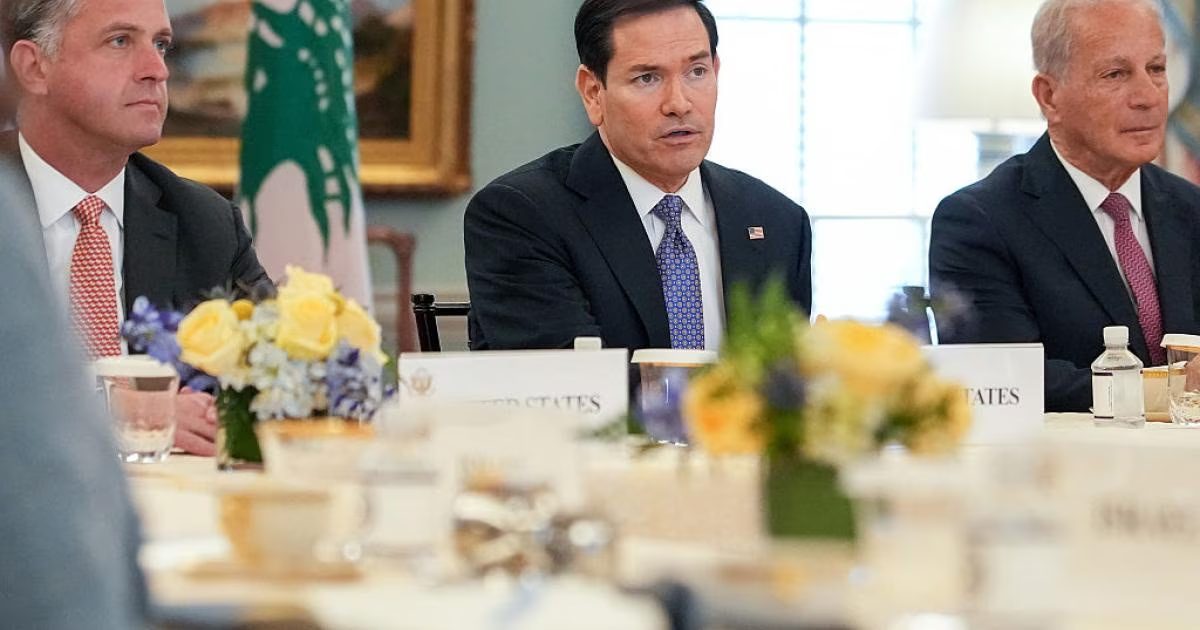
Politically, sources quoted a US State Department official as saying that the third round of Lebanese-Israeli talks held in Washington was positive and serious. These talks, which began under American patronage, aim to push towards a comprehensive agreement that ends the state of conflict, complementing the initial understandings that took place in last April's meetings.

In Beirut, the Lebanese President and Prime Minister discussed the progress of the ongoing negotiations in Washington, emphasizing the need to adhere to the national directives given to the Lebanese negotiating delegation. These meetings continue at the US State Department headquarters, where sessions are expected to resume this morning to discuss the outstanding contentious points between the two parties.

Coinciding with the Lebanon front, the occupation continues its aggression on the Gaza Strip, where four Palestinians were martyred on Thursday in shelling that targeted Jabalia, Beit Lahia, and Khan Yunis. Medical sources reported that the total death toll in Gaza since October 7, 2023, has risen to more than 72,000 martyrs, amidst continued artillery shelling and the demolition of residential blocks.

International reports issued by UNICEF indicate a tragic reality for children in Lebanon, where about 200 children have been martyred and hundreds injured since the escalation of confrontations last March. These figures coincide with the continuation of Israeli violations, which have entered their 217th day since October 2025, placing the international community before its responsibilities to stop the bloodshed.

The talks in Washington were positive and constructive and are scheduled to continue to reach a comprehensive agreement.

PALESTINE

Fri 15 May 2026 7:45 am - Jerusalem Time

Abbas at Fatah's Eighth Conference: We Adhere to the Single Legitimate Weapon and Reject the Liquidation of the Cause

Palestinian Authority President Mahmoud Abbas today, Thursday, opened the Eighth General Conference of the Fatah National Liberation Movement in Ramallah, amidst a wide leadership and diplomatic presence. In his opening speech, Abbas affirmed that the Palestinian people are facing unprecedented existential dangers at this stage, especially in light of the ongoing war of extermination targeting the Palestinian presence in the Gaza Strip and the West Bank.\n\nThe Palestinian President stressed the categorical rejection of all forced displacement projects or attempts to liquidate the Palestinian cause, considering what is happening in the Gaza Strip to be a humanitarian catastrophe unprecedented in modern history. He pointed out that the extent of the destruction affected more than 85% of vital facilities and camps, reflecting the occupation's desire to turn the Strip into an uninhabitable place.\n\nIn the context of his discussion of human losses, Abbas explained that the number of victims, martyrs and injured, exceeded 272,000, emphasizing that the vast majority of them are children, women, and the elderly. He drew attention to the atrocity of the crimes committed by completely erasing more than 2,500 Palestinian families from the civil registry, describing these actions as a clear embodiment of the crime of genocide.\n\nAbbas touched upon the events of October 7, noting that matters should be measured by their outcomes and results on the ground, regardless of initial assessments. He added that the Palestinian people paid a heavy price in blood and resources as a result of those events, as they were subjected to systematic slaughter and displacement and the complete destruction of their country's infrastructure.\n\nOn the internal political front, Abbas affirmed that the Gaza Strip is an integral part of the Palestinian state, stressing the rejection of any transitional or security arrangements that affect the unity of the land and the political system. He called for adherence to the Palestine Liberation Organization as the sole legitimate representative of the Palestinian people in all their places of presence, warning against any attempts to create alternatives to it.\n\nThe Palestinian President reiterated his adherence to the principle of 'the single legitimate weapon,' emphasizing that a state cannot exist with multiple armed authorities outside the framework of the law. He said that true national unity must be based on peaceful popular resistance and adherence to international legitimacy, considering that the existence of weapons outside the state's control threatens the entity of the Palestinian political system.\n\nRegarding the financial crisis, Abbas accused the Israeli government of practicing 'financial piracy' by withholding more than 5 billion dollars of Palestinian tax revenues. He explained that this policy caused a suffocating crisis that led to the Authority's inability to fulfill its full financial obligations towards public employees, which increases the suffering of citizens under the current circumstances.\n\nThe speech also addressed settlement expansion in the West Bank and Jerusalem, where Abbas pointed to the existence of hundreds of settlements and outposts that plunder Palestinian land daily. He warned against persistent Israeli efforts to change the historical and legal status of holy sites, especially continuous attempts to impose temporal and spatial division in the blessed Al-Aqsa Mosque.\n\nDespite widespread criticism, Abbas affirmed the Palestinian Authority's continued adherence to the Oslo Accords and agreements signed with the Israeli side, calling on the international community to pressure Israel to abide by them. He sarcastically referred to internal criticism of the agreement, emphasizing that preserving it represents a national necessity in the absence of effective international alternatives currently.\n\n The Palestinian President revealed understandings with the Lebanese presidency to hand over the weapons of PLO factions inside the camps in Lebanon to the official authorities there. Abbas described these weapons as no longer weapons of resistance but rather tools for internal killing, affirming the Authority's endeavor to improve the conditions of Palestinian refugees and protect their property in diaspora countries.\n\nIn the internal reform file, Abbas stressed that the Authority continues to implement comprehensive plans to develop the judiciary, administration, education, and combat corruption with utmost seriousness. He challenged skeptics by demanding that they provide any proven corruption files to be immediately referred for investigation, affirming that there is no cover-up for anyone who violates the law, regardless of their position.\n\nAbbas announced the Authority's intention to hold elections for the Palestinian National Council next November, as a first step towards renewing national legitimacies. He affirmed commitment to the democratic path and preparation for general and presidential elections as soon as suitable conditions are available that ensure the participation of all Palestinians, including the residents of occupied Jerusalem.\n\nAbbas sent a message to Israeli society, stating that continuing policies of extremism and settlement will not bring security or peace to any party in the region. He affirmed that the Palestinian peace option is still viable, but it requires the implementation of the two-state solution and recognition of legitimate national rights in accordance with international legitimacy resolutions and international law.\n\nThe President concluded his speech by saluting the steadfastness of Palestinians in all their places of presence, appreciating supportive Arab stances, and specifically mentioning Egypt and Jordan for their role in thwarting displacement schemes. He stressed that the Palestinian people will remain rooted in their land and will not repeat the tragedies of the past, emphasizing that victory will ultimately be the ally of those with rights.\n\n"Everyone having a weapon is not a state; we adhere to one system, one law, and one legitimate weapon.

PALESTINE

Fri 15 May 2026 7:45 am - Jerusalem Time

Jerusalem Expert Reviews Occupation Plans to Erase the 'Green Line' in Occupied Jerusalem

The Nakba of 1948 was not merely a fleeting political transformation in the history of Jerusalem; rather, it represented a geographical and demographic earthquake that overthrew the city's Arab identity. With the occupation of the western sector, Jerusalemites lost dozens of villages and neighborhoods that constituted the city's vibrant economic and social heart, imposing a bitter reality that separated families from their historical properties.

Academic Mansour Nsasra, a lecturer at Ben-Gurion University, explained that the 1949 Armistice Agreement enshrined a division he described as 'colonial.' This division confined the Palestinian presence to the eastern sector, which did not exceed 20% of Jerusalem's total area before the Nakba, turning neighborhoods like Sheikh Jarrah into a refuge for those displaced from occupied villages and cities.

The 'Mandelbaum Gate' became the most prominent symbol of the city's fragmentation, serving as the sole border crossing between the Jordanian administration and the occupation authorities. Palestinians called it the 'Gate of Tears' due to the harsh humanitarian scenes witnessed there when scattered families met between the diaspora and the interior under international supervision.

Following the occupation of the eastern sector in 1967, Israel began a new phase of systematic erasure of what was known as the Green Line. Nsasra considered the first four years after the 1967 War to be 'pivotal' in consolidating the occupation's coercive sovereignty through accelerated urban and political measures targeting the heart of the Old City.

The first steps of this plan involved demolishing the dividing wall that extended from Sheikh Jarrah to Jaffa Gate, to remove any physical barrier reminiscent of the division. This coincided with 'urban genocide' operations, including the complete demolition of the Maghariba Quarter and the displacement of its residents, in addition to seizing homes in the Sharaf Quarter and converting them into the so-called 'Jewish Quarter.'

The occupation authorities later moved to a phase of 'Israelization' of public space by transferring their sovereign institutions to the heart of Arab neighborhoods in the eastern part of the city. This included moving the Israeli Police Headquarters, the Ministry of Interior, and Border Guard headquarters to the Sheikh Jarrah neighborhood, to impose a new security and political reality that is difficult to reverse.

Settlement played the most prominent role in changing the demographic balance, with the number of settlers in East Jerusalem rising from zero in 1967 to about 230,000 today. This was achieved through the construction of massive settlement blocs and the infiltration of settlement outposts into the neighborhoods of Silwan, Ras al-Amud, and Musrara to sever Palestinian geographical connectivity.

The Amana settlement organization emerged as a powerful executive arm in this conflict, moving its headquarters to the eastern sector to enhance settlement expansion. These moves aim to connect the two parts of the city urbanistically and make the idea of its future division technically and practically impossible.

The 'Light Rail' project, launched in 2011, is considered one of the most dangerous technological tools used to effectively erase the Green Line. This project connects settlements in the north and south to the western city center, bypassing historical boundaries and turning them into mere memories in the minds of Jerusalemites.

The occupation authorities did not stop at construction; they also sought to 'Judaize memory' by changing the names of historical streets and markets and erecting memorials for their army's fallen in border areas. In contrast, the authorities prevent any Palestinian attempt to commemorate martyrs or preserve landmarks that indicate the place's Arab identity.

Despite these pressures, some Palestinian institutions continue to resist erasure policies, such as the Abdullah bin Al-Hussein School and some historical homes in Sheikh Jarrah. However, these landmarks face continuous threats, especially after the decision to ban UNRWA at the end of 2024, and attempts to seize its headquarters.

Nsasra pointed out that Israeli policy focused on annexing land while seeking to reduce the Palestinian human presence to its lowest levels. The occupation authorities use planning and building laws and identity card revocation as complementary tools to the military and settlement operations taking place on the ground.

The collective memory of Jerusalemites remains the last bastion against attempts at erasure, as residents refuse to forget their properties and homes in West Jerusalem. Despite all the 'colonial' tools used, the dividing line remains present in Palestinian consciousness as a testament to rights that do not expire by statute of limitations.

In conclusion, the report confirms that what is happening in Jerusalem is a struggle over narrative and place, where Israel is trying to impose the reality of a 'united city' with an iron fist. Nevertheless, international resolutions still consider all these changes illegal and an obstacle to any just and comprehensive political settlement in the region.

The division of Jerusalem in 1949 was a colonial division that imposed a new reality and paved the way for policies aimed at erasing the city's Palestinian identity.

PALESTINE

Fri 15 May 2026 7:45 am - Jerusalem Time

Between Silence and Dispersion.. The Occupation Blackmails Gaza Children with 'Sense of Hearing' in Exchange for Return

Palestinian children from the Gaza Strip are facing a new chapter of suffering, after Israeli occupation authorities linked their return home to abandoning the hearing devices through which they regained their ability to communicate with the world. These children, who underwent complex cochlear implant surgeries in Jordan, found themselves stranded at King Hussein Bridge, awaiting a decision that would allow them to pass with their essential medical equipment.

Sources reported that families initially received assurances of Israeli approval for the entry of cochlear devices and their technical accessories, but the reality at the crossing was completely different. Mothers were surprised by the stubbornness of occupation officers who refused to allow the entry of accessories without which the cochlear implant cannot function, leaving them with two bitter choices: either return to Jordan or enter Gaza and remain in a world of silence again.

The journey of these children began on October 30, 2025, when they left the Strip in coordination with the World Health Organization and international bodies to undergo operations in the Jordanian capital, Amman. Despite the success of the surgeries performed in early November, the occupation's procedures turned the joy of regaining hearing into a nightmare of waiting and uncertainty at the border.

Eleven families, who were on the first and second buses, made the difficult decision to return to Jordanian territory, considering that entering Gaza without the devices meant the complete failure of the therapeutic trip's purpose. Mothers confirmed that the surgically implanted cochlea inside the head is worthless without the headphones and external electronic parts that the occupation insists on confiscating.

In contrast, the occupation authorities allowed only five families to pass and return to the Gaza Strip, but under impossible conditions that included abandoning their mobile phones and all their personal belongings. The families on the third bus were forced to agree to these harsh conditions, including leaving behind medicines and special meals for the children, to ensure the preservation of their hearing devices.

One mother, who preferred not to be named, describes the situation of the stranded families in Amman as 'suspended between hope and pain,' as they demand their children's natural right to hearing and return to their homes. The families appealed to international and human rights organizations to intervene urgently to end this humanitarian crisis targeting a vulnerable group of children with hearing disabilities.

Documented testimonies indicate that the children are in a state of confusion, not understanding why they remain away from their homeland and relatives in Gaza despite the completion of their treatment. Mothers fear that the absence will be prolonged, especially since their hearts and minds are connected to their families who are living in difficult conditions inside the besieged Strip for many months.

The Jordanian Ministry of Social Development is currently hosting the stranded families in two hotels, providing them with basic care and accommodation while awaiting a solution to their crisis with the Israeli side. The women expressed their gratitude to Jordan, government and people, for the warm reception, affirming that they did not feel alienated given the humane treatment and great embrace they and their children received.

Official sources revealed that the occupation has consistently reneged on understandings regarding the return of patients, even though their departure was coordinated directly with international charitable organizations. The sources affirmed that the concerned parties will continue to care for these families and will not abandon them, with diplomatic efforts continuing to secure their dignified return with all their medical equipment.

Among the moving stories is that of the child Shams Badawi, who managed to return to Gaza, but her mother was forced to leave her phone and personal medicines at the crossing in exchange for allowing her daughter's device to enter. The mother said that the decision was painful but necessary, because losing any part of the device in Gaza means the child losing her sense of hearing due to the unavailability of spare parts inside the Strip.

Another child's mother, who recently returned, questioned the point of allowing them to travel for treatment if the occupation would prevent them from bringing in the necessary tools to complete this treatment. She described the return journey as extremely difficult, as soldiers even prevented the entry of biscuit pieces and small water bottles that were intended to feed the children during the long hours of waiting.

Experts warn that depriving these children of their devices will lead to the loss of everything they learned during their auditory and speech rehabilitation journey, returning them to square one. Gaza, under current conditions, lacks any maintenance centers or spare parts for these advanced devices, making the preservation of original accessories a matter of life or death for the children's future.

Appeals continue to be directed to the Red Cross and the World Health Organization to pressure the occupation authorities to stop the blackmail policy practiced against patients and children. The families affirm that what they are asking for is not a privilege, but a simple human right guaranteed by all international laws that prohibit harming patients or obstructing their access to necessary treatment.

The fate of 11 children and their families remains suspended in Jordan, watching the borders and hoping for a moment of crossing that will not deprive them of their right to hear the voices of their loved ones in Gaza. It is a silent cry launched by these children in the face of an international community that stands helpless in securing a safe return for patients who have committed no sin other than the desire to escape from a world of silence.

Either abandon the cochlear devices their children waited years to obtain, or remain away from Gaza, their families, and their homes.

PALESTINE

Fri 15 May 2026 7:44 am - Jerusalem Time

Testimonies from 'Hell'.. Palestinian Prisoners Face Slow Death and Policies of Crushing Dignity

Prisoner Ali Al-Samoudi emerged from the depths of prisons, trying to regain his exhausted strength, to bitterly recount the details of a harsh experience he described as a real hell that words cannot describe. His testimony and the testimonies of his comrades reveal a tragic reality lived by thousands of Palestinian prisoners since October 7, where detention rooms have turned into arenas for systematic revenge practiced by the occupation army away from the eyes of international oversight.

Shocking data issued by prisoner institutions indicate the martyrdom of about 90 detainees inside detention centers since the beginning of the war, who died as a result of the policy of 'slow killing' and deliberate neglect. Survivors recount harsh moments of comrades who died in cells while jailers watched their agony with cold blood, in a scene that reflects the stripping of prison administration of the lowest humanitarian and legal standards in dealing with detainees.

The violations did not stop at severe beatings, but extended to include performing complex surgical interventions on prisoners without the use of any type of medical anesthesia, turning treatment rooms into human slaughterhouses. Testimonies also documented the use of sexual assaults and threats of rape as tools to extract confessions and break the morale of prisoners, in addition to humiliating practices including urinating on detainees and continuous cursing.

On another note, the prison administration follows a policy of 'emptying the intestines' by systematically starving prisoners, which led to detainees losing tens of kilograms of their weight and appearing with emaciated bodies resembling skeletons. This policy was accompanied by complete isolation from the outside world, where doors are closed to international human rights organizations, while they are opened to Israeli media to portray this suffering as political achievements for the extremist National Security Minister Itamar Ben-Gvir.

The issue of prisoners is a fundamental pillar in the history of the Palestinian conflict, yet the current phase is classified as the most bloody and cruel since 1967. Prisons, which were once arenas for confrontation and strikes, have now become a place where prisoners are deprived of their most basic right to survival, amidst real fears of the continuation of these crimes in light of the complete international silence and the escalating pace of official Israeli incitement.

Seeing hell with your own eyes is not like hearing about it; this is how editor Ali Al-Samoudi summarized the reality of thousands of prisoners whose bodies have become arenas of revenge.

PALESTINE

Fri 15 May 2026 7:44 am - Jerusalem Time

Prince Harry Breaks Silence: Destruction of Gaza and Lebanon Raises Questions About International Law

Prince Harry, Duke of Sussex, expressed his deep concerns about the state of division plaguing British society, calling for the need to address both antisemitism and Islamophobia. In an article published by the British magazine 'The New Statesman,' the Prince implicitly and sharply criticized military operations in Gaza and Lebanon, considering them to be carried out without sufficient accountability.

The Prince noted in his article that what is happening in the region raises serious questions about adherence to international humanitarian law in light of the widespread destruction. He affirmed that silence in these times is not neutrality but an absence of moral responsibility, emphasizing that speaking out becomes necessary when human values are put to a real test.

The Duke of Sussex spoke about the consequences of living in a world where anger is faster than human emotions, where division swells in a way that obscures truth and reduces people to warring factions. He expressed his concern about the infiltration of this 'moral distortion' into parts of Britain, threatening the social fabric and the values the country has long prided itself on.

Harry stressed that responsibility requires standing up to injustice wherever it is found in defense of shared humanity, affirming that this belief does not change with place or political circumstances. He considered that the instinct to stand on the sidelines is what allows extremism and prosperity to grow unchecked, which must be confronted with reason and dialogue.

Regarding the domestic situation in Britain, the Prince drew attention to a worrying rise in antisemitism, where members of Jewish communities feel unsafe in their homeland. He described this bigotry as not a form of protest, but hatred directed against identity and belief, citing recent violent incidents in cities such as London and Manchester.

The Prince then spoke about the scene in the Middle East, describing images of destruction in Gaza and Lebanon as having deeply shaken people's feelings around the world. He explained that seeing entire neighborhoods razed to the ground and turned into rubble evokes a natural human instinct to express an opinion and demand an end to this catastrophic human suffering.

The article defended the right of protesters to express their positions on the Palestinian issue, considering that demanding accountability is an inherent part of human instinct. He warned against conflating legitimate protest against state practices with hostility towards religious communities at home, emphasizing that criticizing governments never justifies targeting peoples.

Prince Harry observed that public discourse has become so polarized that it prevents understanding of subtle details and ignores the diversity of opinions within communities themselves. He noted that there are voices within Jewish communities openly criticizing state actions, which must be taken into account to break the intensity of the division that fuels hatred.

The Duke of Sussex affirmed that the consequences of states' actions that violate international law are not limited to their borders but extend to shape global perceptions and fuel tensions in distant communities. He criticized the failure of repeated ceasefire agreements, noting that this has had catastrophic effects on civilians who pay the highest price.

He also highlighted the heavy loss of life among journalists in the Gaza Strip, considering that targeting them undermines transparency and accountability at a time when the need for truth is most urgent. He held states fully responsible for their actions, stressing the need to separate these political and military actions from religion or peoples.

In a personal note, the Prince touched upon his past mistakes, for which he apologized and learned from, in an implicit reference to the Nazi uniform incident two decades ago. He affirmed that these experiences reinforced his conviction that clarity in moral positions is the only way to confront the distortion of truth that causes real harm to societies.

Harry called for directing anger to its proper place instead of directing it towards Muslim or Jewish communities, because that turns the call for justice into a destructive tool. He affirmed that confronting injustice cannot be done with more injustice, otherwise the cycle of violence and division will continue and be inherited by future generations without end.

The Prince concluded his article by emphasizing the need for a decisive stand against all forms of racism, considering that Islamophobia and antisemitism stem from the same source. He called on the international community to take swift action and continuous scrutiny to stop the loss of innocent lives, and to act responsibly to break the cycle of hatred that threatens everyone.

When states act without accountability and in ways that raise serious questions under international humanitarian law, criticism becomes legitimate, necessary, and fundamental in any democratic system.

PALESTINE

Fri 15 May 2026 7:44 am - Jerusalem Time

Racist chants and widespread attacks.. Settlers storm Jerusalem with 'Flag March' under the protection of extremist ministers

Thousands of Israeli settlers gathered in the Damascus Gate area in the heart of occupied Jerusalem to participate in the annual 'Flag March,' which coincides with the anniversary of the occupation of the eastern part of the city in 1967. The scene was characterized by extreme tension due to the raising of inciting and racist slogans against Arabs and Muslims, amidst tight security protection from the occupation forces.

Participants roamed the streets and alleys of the Old City, chanting hostile slogans such as 'Death to Arabs' and 'May your villages burn,' in a provocative move aimed at asserting Israeli control over the holy city. Field sources observed groups of extremist right-wing youths dancing and verbally and physically assaulting Palestinian residents on their way to the Western Wall.

The scene was led by ministers and Knesset members from the extremist right-wing government coalition, most notably National Security Minister Itamar Ben-Gvir and Finance Minister Bezalel Smotrich. These officials participated in the march alongside leaders of the occupation police and army, reflecting the official cover for these provocative actions.

Sources reported that Minister Ben-Gvir did not only participate in the march but also stormed the Damascus Gate area, raising the Israeli flag, hours after participating in the storming of the courtyards of the blessed Al-Aqsa Mosque. The number of settlers who stormed Al-Aqsa was estimated at about 1,400, divided into morning and evening periods under tight guard.

During his presence in the courtyards of Al-Aqsa Mosque, Ben-Gvir made controversial statements claiming that 'sovereignty is in their hands,' in a clear reference to attempts to impose full Israeli sovereignty over Islamic holy sites. Settlers also chanted slogans describing Al-Aqsa Mosque as 'Temple Mount,' in an attempt to impose a Talmudic narrative on the place.

In contrast, the occupation authorities imposed suffocating military restrictions on Palestinians in the Old City, where they were prevented from organizing any counter-movements or raising the Palestinian flag. Sources indicated that the Palestinian presence in the Damascus Gate area was completely prohibited during the march, with the threat of immediate arrest for anyone who violated orders.

Journalists' cameras documented direct attacks by settlers on the homes of Palestinian citizens. One resident in the Old City recounted how about 20 settlers stormed his house and smashed its windows and doors. The citizen confirmed that these attacks occur under the eyes of the police, who do nothing to protect the indigenous residents but instead arrest those who try to defend themselves.

Journalist crews were not spared from these violations, as participants in the march attacked a number of journalists and photographers while they were doing their work, pushing them and preventing them from documenting the racist chants. These practices aim to conceal the truth of what is happening in the streets of Jerusalem, including brutal attacks and public incitement to murder and displacement.

On the ground, the march started from West Jerusalem and reached Damascus Gate, passing through the Muslim Quarter, a route that settlers insist on taking annually to provoke Palestinian sentiments. Occupation forces forcibly closed Palestinian shops, while settlers deliberately banged loudly on their metal gates to terrorize their owners.

The occupation forces turned the city of Jerusalem into a real military barracks, deploying snipers above the Damascus Gate wall and at high points overlooking the march route. Special units were also deployed in all alleys and streets surrounding the Old City under the pretext of securing the participants, which led to a complete paralysis of the lives of Jerusalemites.

These developments come amidst Palestinian and Arab warnings about the danger of these marches, which increase tension in the region and push towards further confrontations. National activities in Jerusalem affirm that these practices will not change the Arab and Islamic identity of the city, despite all systematic attempts at Judaization and intimidation.

Sovereignty is in our hands, and Jerusalem is ours alone.

PALESTINE

Fri 15 May 2026 7:44 am - Jerusalem Time

Violent Clashes in the Christian Quarter of Jerusalem Following Settler Incursion into the Christian Neighborhood

The Christian Quarter in the heart of occupied Jerusalem's Old City witnessed tense field events this evening, Thursday, following the incursion of groups of extremist settlers into the alleys of the Christian neighborhood. Local sources reported that clashes erupted directly when Palestinian residents confronted the settlers' attempts to bring noise and racist chants into the neighborhood, known for its traditional tranquility, in defense of their homes and presence.

These clashes come in the context of the annual 'Flag March' events, in which tens of thousands of right-wing extremists participate to commemorate the occupation of the eastern part of the city in 1967. Participants in the march attempted to provoke Jerusalemites by raising Israeli flags in sensitive areas, leading to widespread popular mobilization in various neighborhoods of the Old City to prevent the intruders from imposing a new reality.

In a parallel escalation, the Minister of National Security in the occupation government, Itamar Ben-Gvir, stormed the courtyards of the blessed Al-Aqsa Mosque under heavy security protection. This move sparked a wave of official and popular Palestinian condemnations, as it was described as a blatant provocation aimed at changing the historical and legal status quo in Islamic holy sites, and imposing temporal and spatial division schemes.

For their part, human rights organizations warned that these systematic practices reflect a broader strategy aimed at forcibly displacing Palestinians and completely Judaizing East Jerusalem. Reports indicated that turning residential neighborhoods into confrontation zones falls within the policy of tightening restrictions on the indigenous population, in complete disregard for international law which classifies Jerusalem as occupied territory whose features should not be altered.

Observers believe that the timing of the incursion into the Christian Quarter with the incursion into Al-Aqsa represents a clear message of escalation from the occupation government and settler groups against the Palestinian presence in all its components. Jerusalemites affirm that their steadfastness in the face of these provocative marches is the only way to thwart plans to control the holy city and preserve its Arab, Islamic, and Christian identity.

These marches are not just a celebration, but a tool to entrench the occupation and threaten the Palestinian presence in ancestral neighborhoods.

PALESTINE

Fri 15 May 2026 7:44 am - Jerusalem Time

News of Yasser Abbas's ascent to the Central Committee sparks a storm of controversy within Fatah

The Fatah movement is witnessing a growing state of anger and internal debate, following reports and information revealing attempts led by Palestinian Authority President Mahmoud Abbas to push his son, Yasser, towards playing an influential role within the movement's Central Committee. These moves coincide with the start of the Eighth Conference, where Yasser Abbas's name is strongly circulated as a potential candidate for membership in the movement's highest leadership body.

This step has provoked widespread objections and sharp criticism within Fatah circles, which view this direction as a clear attempt to 'inherit political and organizational influence' within the movement that leads the Palestinian Authority. Estimates suggest that the Eighth Conference may turn into a fierce battleground between the movement's different factions, especially with the escalating talk of rearranging power and influence centers.

Questions are increasing about the post-Mahmoud Abbas era given his advanced age, making the issue of his son's ascent a rich topic for discussion about the future of leadership. While no official announcement has yet been issued by Yasser Abbas regarding his candidacy, the volume of leaks and reports reflects the depth of the tensions the movement is experiencing at this sensitive historical stage.

A state of discontent prevails among Fatah cadres and leaders regarding the push to bring Yasser Abbas to the forefront, which opponents attribute to the man's lack of organizational history. Sources reported that Yasser Abbas did not follow the traditional path of the movement, nor did he progress through the known movement positions in the regions or leadership bodies, which makes his ascent lack the usual militant legitimacy.

Leaders in the movement warned that imposing specific names in advanced positions could lead to the eruption of new internal conflicts and deepen the already existing division. Observers believe that the competition between the movement's poles over Abbas's succession could get out of control if attempts to empower the president's inner circle at the expense of historical cadres continue.

Sources expressed concern about Yasser Abbas taking the lead with the support of a group described as 'beneficiaries' surrounding the presidency of the Authority, who see personal interest in accommodating him. This group, according to sources, seeks to secure its positions by ensuring the continued influence of the president's family in the movement's and the PLO's highest organizational and political structures.

Despite not holding an officially announced position yet, Yasser Abbas has begun to be presented in recent months as the 'President's Special Representative' in several official meetings and visits. Informed sources confirmed that his appointment to the National Council and his assignment of political tasks were made by unannounced decisions years ago, away from legal oversight or official publication.

Yasser Abbas's representative activity began to expand since 2020 through external participations, where he handled sensitive files that included the Lebanese arena and communication with state institutions there and its factions. Reports indicate that he intensified his activity in recent weeks to gain the support of various movement frameworks to support his membership in the Central Committee during the current conference.

It is worth noting that Yasser Abbas is primarily known as a businessman who manages a group of companies in the fields of contracting, tobacco, and various investments. He has never held any official organizational position within Fatah or PLO institutions, despite his frequent appearances in high-level political meetings alongside his father in international and local forums.

Yasser Abbas's sudden ascent is viewed as 'political inheritance' rather than an organizational entitlement, given the absence of movement progression.

OPINIONS

Fri 15 May 2026 7:43 am - Jerusalem Time

Microsoft and Unit "8200".. When Technology Becomes a Tool of Surveillance and War Against Palestinians

Washington – Said Arikat – 15/5/2026

News Analysis

In a development reflecting the escalating ethical and political debate surrounding the role of major technology companies in the Israeli war on Palestinians, Alon Himovitch, the General Manager of Microsoft's branch in Israel, was dismissed from his position after an internal investigation into the use of the "Azure" cloud computing platform by the Israeli military intelligence Unit "8200" in mass surveillance operations against Palestinians in Gaza and the occupied West Bank. This development comes at a time when Western technology companies are facing increasing pressure due to their cooperation with Israeli military and security institutions, amid accusations of facilitating widespread human rights violations.

According to media reports, Himovitch, who led Microsoft's operations in Israel for four years, will leave his position, and administrative oversight powers will be transferred to the company's branch in France. A number of officials in the governance department within Microsoft Israel also left, against the backdrop of concerns that they might have violated the company's ethical code of conduct, indicating the depth of the crisis sparked by the internal investigations.

Microsoft had opened an investigation last year following reports revealing that Unit "8200," the most advanced arm of the Israeli espionage system, used the "Azure" platform to store and analyze vast amounts of intercepted Palestinian communications. According to circulating information, the system was capable of collecting and analyzing "one million calls per hour," as part of a mass surveillance project targeting the daily lives of Palestinians in the occupied territories.

Leaked documents indicate that Himovitch played a pivotal role in solidifying the relationship between Microsoft and Unit "8200," especially after a meeting between the company's CEO Satya Nadella and the intelligence unit's leadership in 2021. The cooperation included the creation of an isolated space within the "Azure" cloud infrastructure to store sensitive intelligence materials, before the unit began transferring a vast archive of daily Palestinian communications to Microsoft's servers.

Following the investigation, the company concluded, according to press reports, that Unit "8200"'s use of its services violated the terms of use that prohibit employing technology to facilitate mass surveillance of civilians. Consequently, Microsoft suspended the unit's access to its cloud services and products related to the intelligence project.

However, the issue extends beyond the administrative dispute within a major tech company, opening the door to deeper questions about the nature of the relationship between Western technology companies and Israeli military institutions. For years, Silicon Valley giants have become essential partners in the modern digital control structure, by providing cloud computing, artificial intelligence, and big data analysis tools, technologies that have become an integral part of war and surveillance systems.

In this context, the Boycott, Divestment, and Sanctions (BDS) movement believes that Microsoft is "one of the most complicit technology companies" with what it describes as the "Israeli apartheid system" and the war on Gaza. The movement asserts that tech companies are no longer merely neutral service providers but have become direct parties in the digital dominance structure used against Palestinians.

This debate reflects a global shift in the perception of technology, which is no longer presented as merely a tool for communication and development, but also as a means of security control and managing populations under occupation. Widespread digital surveillance is no longer a marginal activity but has become part of Israeli security doctrine, where personal data and daily communications are used to draw complete social and political maps of Palestinian society, allowing for tracking individuals, analyzing relationships, and predicting behavioral patterns.

In a deeper reading, the issue reveals the structural contradiction within Western discourse on human rights and digital privacy. The very companies that champion data protection and individual freedom in Europe and the United States find themselves involved in intensive surveillance projects when it comes to Palestinians. This contradiction reinforces accusations of double standards and raises questions about the limits of ethical responsibility for multinational corporations, especially when technology becomes a tool to perpetuate occupation and tighten control over a people subjected to siege and constant surveillance.

The resignation of Himovitch also reflects growing concern within technology institutions themselves about the legal and political repercussions of such partnerships. With increasing human rights and media pressure, companies are becoming concerned about their global image and international markets, especially amid growing boycott campaigns and protests among employees and shareholders. Recent years have seen repeated protests from employees in major companies against contracts with the Israeli army, considering that technology should not be used to facilitate mass violations or support repressive surveillance systems.

Ultimately, the Microsoft case does not appear to be merely a fleeting administrative incident, but rather a sign of a new phase in the conflict over the ethics of technology and the limits of digital companies' involvement in political and military conflicts. The more artificial intelligence and cloud computing expand their ability to penetrate daily life, the more the debate intensifies over who owns these tools, how they are used, and who pays the real price for the world's transformation into a monitored and managed space by giant algorithms that are often not subject to any real political or human accountability. At the heart of this debate, Gaza stands out as the cruelest example of the human cost of this technical complicity, where technology, which is supposed to serve humanity, becomes a tool used to manage war, deepen the siege, and entrench military superiority against an unarmed people facing daily killing, destruction, and starvation.

In a more dangerous dimension, this technological cooperation cannot be separated from the immense human devastation suffered by Palestinians, especially in Gaza, where modern technology has become part of the war and extermination machine. Surveillance systems, data analysis, and artificial intelligence are no longer just security tools; they are used to identify targets, track individuals, and map the entire Palestinian society under bombardment and siege. While technology companies market themselves as symbols of progress and innovation, Palestinians find themselves facing a digital system that contributes to deepening mass killing, displacement, starvation, and the systematic destruction of civilian infrastructure. Thus, algorithms and cloud servers have become part of a bloody reality that affects the Palestinian individual in their daily life, future, and fundamental right to exist.

ARAB AND WORLD

Fri 15 May 2026 7:43 am - Jerusalem Time

Trump warns Tehran of 'running out of patience' and Iran affirms its readiness for all scenarios

US President Donald Trump issued a public warning to the Iranian leadership, stressing that the United States' patience regarding outstanding issues will not last much longer. Trump called on Tehran to engage in a comprehensive agreement that ends the state of conflict in the Middle East, while describing the officials he dealt with in Iran as rational despite the existing tensions.

In an interview from the Chinese capital, Beijing, Trump indicated that Washington is closely monitoring Iranian military movements related to the transfer of missile platforms. The US President warned that these military capabilities could be completely neutralized within one day if escalation continues, emphasizing that the diplomatic option and an agreement are the only available way out currently.

Trump touched upon the nuclear program file, expressing his desire to reach a formula that allows the United States to obtain enriched Iranian uranium instead of disposing of it by burial. These statements come at a sensitive time, coinciding with a major economic summit in China that included technological delegations and prominent American businessmen.

For its part, Tehran responded to these threats with a firm tone through its Foreign Minister Abbas Araghchi, who affirmed that issues related to his country cannot be resolved through military means. Araghchi clarified that Iran has long experience in confronting pressures and wars, stressing that any attempt at a new confrontation will only bring repeated failure to Washington.

The Iranian Foreign Minister pointed out that the American administration fully realizes the futility of the language of threat in extracting concessions from Tehran. He added during international meetings in New Delhi that whoever seeks to test Iranian strength again will reap the same results achieved in the past, stressing that the diplomatic path requires mutual respect away from dictates.

In a related context, informed sources stated that Tehran has shown initial readiness to continue diplomatic channels with Washington to avoid sliding into a comprehensive confrontation. However, the sources warned that any resumption of hostile action by the United States would lead to dire consequences whose impact on the stability of the entire region cannot be predicted.

On the ground, media sources in Tehran reported that current indicators do not reflect the imminent occurrence of a diplomatic breakthrough between the two parties. Observers believe that the current negotiation path is still in the 'ground-building' stage and has not yet reached the stage of drafting concrete agreements, given the depth of the gap in strategic positions.

Reports quoted Mohammad Ali Jafari, the former commander of the Revolutionary Guard, as saying that the current phase is witnessing an exchange of conditions and arrangements through back channels and international mediators. These indirect moves aim to establish a solid foundation that can be built upon in future negotiations that include complex security, political, and economic issues.

The Iranian leadership confirms a high level of coordination between decision-making institutions, where sensitive files are managed through the Supreme National Security Council and under the direct supervision of Supreme Leader Mojtaba Khamenei. This institutional harmony aims to ensure the state's readiness for all possible scenarios, whether diplomatic or military.

Political circles in Tehran believe that they possess a wide margin of maneuver and deterrent power that prevents American pressures from achieving their strategic goals. The Iranian government considers that the 'maximum pressure' policy has not succeeded in bringing the national economy to its knees or fundamentally changing the political behavior of the state.

In reference to the economic dimension of the conflict, the Speaker of the Iranian Parliament considered that the financial crises facing Washington, including rising sovereign debt, limit its ability to engage in costly military adventures. He described American policies as characterized by risk that could negatively affect global financial stability.

Tehran is waving strategic pressure cards, most notably its control over international navigation lanes in the Strait of Hormuz, which gives it the ability to influence global energy markets. This was clearly evident in the exceptions granted by Tehran to Chinese ships, as part of managing its balances with major powers.

Iran also continues its naval movements and the transfer of oil shipments in sensitive areas as a message of defiance to the restrictions imposed on it, affirming its ability to overcome sanctions. These moves are seen as part of a comprehensive strategy aimed at improving negotiation terms and demonstrating imperviousness to direct threats.

The official Iranian position concluded that engaging in negotiations does not mean excessive optimism about achieving a quick breakthrough, but rather it is a path to crisis management. Tehran stresses at the end of its officials' statements that any military escalation will not achieve the goals of hostile parties, but will rather complicate the regional and international scene.

I will not be more patient.. they must reach an agreement, and all missile movements could disappear in one day.

ARAB AND WORLD

Fri 15 May 2026 7:43 am - Jerusalem Time

Washington: Beijing Supports Freedom of Navigation in the Strait of Hormuz and Pledges to Reduce Military Support for Tehran

Official American sources reported that the Chinese leadership has shown a clear inclination towards ensuring the stability of navigation in the Strait of Hormuz, emphasizing the necessity of keeping the international waterway open to trade without restrictions or additional financial burdens. This stance emerged during high-level discussions held in the Chinese capital, Beijing, between US President Donald Trump and Chinese President Xi Jinping.

US Trade Representative Jamison Greer clarified in media statements that Beijing adopts a 'practical' approach in dealing with the Iranian issue, indicating that the Chinese side does not wish to take positions that would put it in confrontation with current international trends. Greer affirmed that the US administration perceived a Chinese desire to limit forms of military and material support provided to Tehran, in line with de-escalation efforts in the region.

The American official emphasized the convergence of interests between Washington and Beijing regarding establishing peace in the Middle East, expressing confidence that China will take concrete steps to undermine support from which Iran might militarily benefit. These statements reflect a potential shift in Chinese foreign policy towards its traditional allies in the region in exchange for maintaining the stability of global supply chains.

It is truly important for China that the Strait of Hormuz be open, without transit fees or military control, and this was clear from the meeting.

PALESTINE

Fri 15 May 2026 7:43 am - Jerusalem Time

Settlers burn agricultural crops in al-Mughayyir and the occupation suppresses residents in Ramallah

The village of al-Mughayyir, located northeast of Ramallah, witnessed a new attack by settlers on Wednesday evening, where the attacking groups deliberately set fire to large areas of citizens' lands. Local sources reported that flames engulfed agricultural crops and green areas, threatening the livelihoods of farmers in the region, which already suffers from continuous restrictions.

Following the villagers' attempt to confront the settlers and defend their properties, the occupation forces intervened violently to provide protection for the attackers instead of stopping their assaults. The army forces fired a heavy barrage of tear gas canisters towards citizens' homes, leading to violent field confrontations in the village's alleys and among its agricultural fields.

Sources stated that the Israeli suppression resulted in several local residents suffering severe suffocation due to inhaling the toxic gas that reached inside inhabited homes. This incident is part of a series of organized attacks carried out by settlers in the West Bank, which directly aim to intimidate residents and push them towards forced displacement from their lands.

Al-Mughayyir village faces major strategic challenges as it is surrounded by a belt of Israeli settlements seeking to expand their influence at the expense of the village's lands. Recently, the pace of what is known as 'settler terrorism' has escalated, enjoying support and backing from the occupation's military establishment, which turns the lives of Palestinians in those areas into a daily struggle for survival.

Al-Mughayyir village is considered one of the most targeted villages by settlers and the occupation due to its strategic location and its encirclement by settlements.

PALESTINE

Fri 15 May 2026 7:42 am - Jerusalem Time

Child killed by occupation bullets in Al-Lubban Al-Sharqiya village, south of Nablus

Local and medical sources announced the martyrdom of the sixteen-year-old youth, Fahd Zeidan Owais, after being shot by Israeli occupation army bullets in the village of Al-Lubban Al-Sharqiya, located south of Nablus city. This incident occurred during a sudden raid carried out by occupation forces on the village, where they directly fired live ammunition at citizens, resulting in the youth sustaining fatal injuries from which he later died.

At this time, a state of extreme tension and popular anger prevails in Al-Lubban Al-Sharqiya village and its surrounding areas, following the official announcement of the youth Owais's martyrdom. Dozens of residents and citizens gathered in front of the hospital where the martyr's body was taken, awaiting the completion of the necessary medical and legal procedures for his funeral in a solemn procession that reflects the magnitude of the tragedy experienced by Palestinian villages.

This new crime comes in the context of continuous military escalation practiced by the occupation army in various governorates of the occupied West Bank, where the targeting of children and youth has significantly increased recently. Field sources indicated that the occupation deliberately uses excessive force and live ammunition against unarmed civilians, which raises the death toll and further complicates the security and field situation.

In light of these tightened military measures, the occupation army continues to impose widespread restrictions on the movement of citizens around Nablus city, by closing some entrances and setting up sudden military checkpoints. National and local activists expressed their strong condemnation of the continuation of these blatant violations, stressing that targeting children represents a flagrant breach of all international laws and norms that protect civilians under occupation.

The youth Owais lost his life after being directly hit by live ammunition during the occupation forces' raid on the village.

OPINIONS

Fri 15 May 2026 7:35 am - Jerusalem Time

The Nakba Never Ended: Seventy-Eight Years of Erasure, Exile, and Western Complicity


By Said Arikat


May 15, 2026


News analysis


Washington, D.C. — Seventy-eight years after the Palestinian Nakba of 1948, the catastrophe endures not as memory, but as structure — a living system of dispossession sustained by military force, protected by Western power, and normalized through decades of political hypocrisy. What began with the expulsion of more than 750,000 Palestinians from their towns and villages evolved into one of the modern world’s longest-running projects of displacement and erasure. Hundreds of communities were destroyed, families scattered across refugee camps and exile, and an entire people condemned to occupation, siege, and statelessness. For Palestinians, the Nakba was never an event confined to history. It survives in settlement expansion, land confiscation, checkpoints, home demolitions, and the repeated destruction of Gaza.


The origins of this catastrophe lie in the logic of empire itself. The 1917 Balfour Declaration remains among the clearest expressions of colonial arrogance in modern history: Britain, ruling Palestine through imperial force, promised the homeland of one people to another political movement while denying the indigenous Palestinian population the right to determine its own future. Under the British Mandate, Zionist institutions were cultivated politically and militarily under imperial protection, while Palestinian resistance was crushed with extraordinary brutality, particularly during the Arab Revolt of 1936–1939. Palestinian aspirations for independence were treated not as legitimate national demands, but as obstacles to imperial strategy.


The Nakba did not emerge simply from the chaos of war. Decades of historical research — including by Israeli historians — have documented organized expulsions, massacres, psychological warfare campaigns, and the systematic destruction of Palestinian villages designed to prevent refugees from ever returning. The massacre at Deir Yassin became a symbol of terror that accelerated mass flight across Palestine. What followed was demographic engineering on a historic scale: the creation of a Jewish-majority state through the removal of much of the indigenous Arab population.


At the center of this history lies a moral contradiction that still haunts the modern world. European Jews, fleeing centuries of persecution culminating in the Holocaust, sought refuge after one of humanity’s greatest crimes. But Europe effectively resolved its “Jewish question” by transferring the consequences onto another people entirely innocent of European antisemitism. Palestinians — who bore no responsibility for the crimes of Nazi Germany — were forced to surrender their homeland so Europe could escape the full moral burden of its own history.


For Palestinians, and for much of the Global South, this remains the essence of the injustice: a settler-colonial project, backed by imperial power, displaced an existing population in the name of historical and biblical claims. Jewish historical attachment to the land may be real and deep, but Palestinians argue — with growing international resonance — that modern sovereignty cannot ethically rest on ancient claims while erasing the continuous presence, rights, and humanity of another people who lived on and cultivated that land for centuries.


What Palestinians lost in 1948 was far more than territory. They lost cities, ports, farms, businesses, libraries, cultural institutions, and entire social worlds. Jaffa and Haifa — once vibrant centers of Palestinian economic and intellectual life — were transformed through expulsion and confiscation. Under Israel’s “Absentee Property” laws, refugees who fled bombardment and massacres became legal ghosts: their homes, lands, and savings seized precisely because they were no longer physically present. Dispossession was not merely military. It was bureaucratic, legalized, and systematic.


Equally devastating was the assault on memory itself. Hundreds of Palestinian villages were erased from maps, repopulated, or renamed in Hebrew in an effort to sever the landscape from its Arab identity. Archives disappeared, books were looted, and historical records vanished. Increasingly, Palestinians see their struggle not only as resistance to occupation, but as resistance to erasure itself — a fight to preserve historical truth against a project determined to disconnect a people from their geography, culture, and legitimacy.


The violence of 1948 did not end with the armistice lines. The occupation of the West Bank and Gaza after 1967 became, for Palestinians, the continuation of the same catastrophe by different means. Settlements spread across confiscated land, checkpoints fragmented daily existence, homes were demolished, and military rule hardened into permanence. Gaza — subjected to blockade, siege, and repeated wars — emerged as the clearest symbol of collective punishment in the modern era.


The current destruction of Gaza has intensified global debate over whether the Nakba is continuing in real time. Images of flattened neighborhoods, starving civilians, mass displacement, and staggering civilian casualties have shattered decades of carefully managed Western narratives. Terms once dismissed as politically unacceptable — apartheid, ethnic cleansing, genocide — now dominate international legal and human rights discourse.


Nowhere has Western hypocrisy been more exposed. Governments that speak endlessly of human rights and a “rules-based international order” have armed, financed, and diplomatically shielded Israel even as entire Palestinian communities were obliterated. International law appeared absolute when applied to some conflicts, yet suddenly negotiable when Palestinians were the victims. In the moral hierarchy of global politics, Palestinian life remained conditional.


Yet the old consensus is fracturing. Across universities, civil society movements, human rights organizations, and even within Jewish communities, younger generations increasingly reject narratives that demanded recognition of Jewish suffering while denying Palestinian suffering equal humanity. The tragedy of Palestine lies not only in dispossession itself, but in the persistent refusal to acknowledge that dispossession. Palestinians were expected to negotiate endlessly over fragments of land while the foundational injustice of 1948 remained politically untouchable.


 Seventy-eight years later, the Nakba survives not only in refugee camps across Lebanon, Syria, Jordan, the West Bank, and Gaza, but in memory carried across generations. It survives in rusted house keys preserved by descendants of destroyed villages, in oral histories passed from grandparents to grandchildren, and in the unbroken Palestinian determination to remain on their land and live in freedom and dignity despite decades of occupation, siege, exile, and war.


The Nakba endures because the structures that created it were never dismantled. But Palestinians themselves remain the clearest refutation of that project of erasure. After seventy-eight years of dispossession, bombardment, and exile, they continue to insist that they are not a people destined for permanent displacement, but a nation determined to live freely in its homeland. Their survival has become an act of resistance. Their persistence stands as proof that memory cannot be bombed into silence, identity cannot be buried beneath rubble, and a people cannot be erased simply because the powerful wish them invisible.

OPINIONS

Thu 14 May 2026 7:22 pm - Jerusalem Time

Is Hamas Really Rebuilding Its Strength - or Is the Ground Being Prepared for Renewing the War?


In recent weeks, more and more reports and intelligence assessments have been published in Israel regarding a “renewed military strengthening” of Hamas in the Gaza Strip. The message is clear: Hamas is rebuilding its power, reorganizing, gathering weapons, and preparing itself for the next confrontation. The Israeli public is being left with the impression that only another military operation can prevent the “return of the threat.”

But behind this campaign lies a far more complex reality - and perhaps also a deliberate attempt to prepare Israeli and international public opinion for the renewal of the war.

The reality in Gaza today is very far from the image of a flourishing and powerful terrorist organization. Gaza is devastated, the population exhausted, and the civilian system has almost completely collapsed. Hamas itself is also experiencing profound distress. According to many sources inside Gaza, Hamas is suffering from an extremely severe financial crisis. It has no regular ability to pay salaries - neither to its fighters nor to employees of the civilian administration. The public in Gaza is exhausted from the war, and many oppose the continuation of Hamas rule in its current form.

And yet Hamas continues to be the controlling force in those parts of Gaza where the Palestinian population remains. Why? Not because Hamas currently enjoys broad public legitimacy, but because Israel refuses to allow the entry of the Palestinian technocratic committee (NCAG) that was intended to assume civilian administration of the Strip.

Five months after the end of the war, this committee has still not been allowed to enter Gaza and begin operating. Without an agreed and functioning governing alternative, the resulting vacuum continues to leave Hamas as the only organized force on the ground.

It is important to understand: according to messages coming from inside Gaza, Hamas is prepared to immediately transfer full civilian control to the technocratic committee - including the police, internal security, and the management of government ministries. This is no longer simply a question of “who will rule Gaza,” but rather whether Israel and the Americans are truly prepared to allow the creation of a new reality in the Strip.

This is precisely where the current deadlock lies.

The negotiations between the United States and Hamas are stuck around the issue of disarmament. The American position - which in practice adopts the Israeli demand - is that Hamas must commit in advance and unequivocally to the complete dismantling of its weapons before the other commitments are implemented: significant humanitarian aid, medical equipment, temporary housing units, heavy machinery for clearing rubble, the entry of the technocratic committee, the establishment of a new Palestinian police force, and a phased Israeli withdrawal in accordance with the understandings that were presented.

Hamas, for its part, argues that it is prepared for a gradual process of disarmament in parallel with the implementation of Israeli and international commitments, including phased Israeli withdrawal from Gaza. From its perspective, this is fundamentally a question of trust: why should it surrender its main leverage in advance when there is no guarantee whatsoever that the other side will fulfill its obligations?

Instead of addressing the real crisis of trust, the Americans have chosen to place additional pressure on Hamas and warn that if there is no full prior agreement to disarmament, they will not be able to prevent Israel from renewing the war.

The issue of mediation itself has also become part of the problem. In the eyes of many within Hamas, the representative of the Peace Council, Nikolay Mladenov, is perceived not as a neutral mediator but as someone who has effectively adopted the Israeli positions. This further deepens the distrust and makes reaching agreements even more difficult.

At the same time, an interesting development is taking place inside Gaza itself that has received almost no attention. Hamas has held internal elections, and the new leadership in Gaza is regarded by many as more realistic and pragmatic than the leadership abroad. The leaders inside Gaza are themselves living through the destruction, the hunger, and the daily suffering of the population. They understand better than anyone that continuation of the war could lead to total catastrophe.

The central question now is not whether Hamas is “rebuilding its strength,” but whether there exists genuine political will to prevent the renewal of the war and create a credible mechanism for political transition, reconstruction, and phased disarmament.

The real problem today is not only the issue of weapons - it is the complete absence of trust. Hamas does not believe Israel will fulfill its commitments after Hamas gives up its weapons in advance. Israel and the United States do not believe Hamas will ultimately agree to the full dismantling of its military capabilities. In this vacuum, each side waits for the other to make the first move - and the war could resume.

Therefore, a new mechanism is required to break the deadlock.

One possible solution may be the establishment of a small international panel composed of individuals with global experience in conflict resolution, disarmament of armed organizations, and political transition processes. People who do not currently represent governments, but who possess international credibility and the professional capacity to supervise, mediate, and provide guarantees to both sides.

Such a panel could:

supervise implementation of reciprocal commitments;

establish a phased and verified disarmament mechanism;

simultaneously ensure the entry of humanitarian aid and reconstruction efforts;

provide international guarantees for a phased Israeli withdrawal;

and prevent the renewed collapse of agreements.

Models of this kind have worked elsewhere in the world before - including in Northern Ireland - where disarmament processes succeeded only when a credible international mechanism was created that gave both sides confidence that commitments would actually be honored.

Without a credible mechanism of guarantees and oversight, the lack of trust will continue to dictate reality - and the path toward renewed war will become very short indeed.

The world must understand: Gaza does not need another war. It needs a credible political pathway that can provide both security for Israelis and a future for Palestinians.


PALESTINE

Thu 14 May 2026 7:02 pm - Jerusalem Time

Global Resilience Flotilla Sails from Marmaris, Turkey to Break Gaza Siege

The 'Global Resilience' flotilla began its sea journey today from the coast of the Turkish city of Marmaris, heading towards the Gaza Strip in a symbolic and humanitarian attempt to break the naval blockade imposed on the Strip for years. This move comes amid extremely complex humanitarian conditions experienced by the residents of the Strip, as organizers seek to deliver a message of international solidarity and urgent relief aid.

Field sources from Marmaris port reported that the flotilla consists of 54 boats and ships, carrying more than 500 activists and solidarity activists representing dozens of nationalities from around the world. These solidarity activists gathered in the Turkish coastal city days ago, completing the necessary preparations for sailing amidst an atmosphere of enthusiasm and determination to reach the shores of Gaza.

The nationalities of the participants in this international initiative vary, with the flotilla including activists from Arab countries such as Libya and Egypt, in addition to large delegations from various foreign countries. Participants affirmed that their motives are purely humanitarian, aiming to highlight the suffering of Palestinians and demand an end to the starvation and siege policy imposed by the occupation authorities.

The central ship in the flotilla takes center stage, hosting a large number of public figures and foreign human rights activists who are conducting continuous interviews with international media. Through their presence, they aim to document the journey and ensure the greatest possible international protection for the flotilla should it face any harassment in international waters.

For their part, the flotilla organizers expressed during a press conference their expectations of facing real risks and objections from the Israeli navy during the journey. The organizers revealed that some activists were arrested before departure, noting that five of them are still in custody, which they considered an attempt to intimidate participants.

In the legal context, Brazilian lawyer Natalia Maria, spokesperson for the flotilla's legal team, stated that the blockade imposed on the Gaza Strip lacks any international legal cover. Maria confirmed that the legal team has prepared complete files to prosecute any Israeli aggression that may affect the ships or participants before the competent international courts.

In turn, Saeed Abu Koshk, a member of the flotilla's board of directors, stressed that the current movement is a natural reaction to what he described as the 'slow genocide' to which Palestinians are subjected. Abu Koshk explained that the systematic starvation policy pursued by Israel requires international popular action to break the stalemate and open waterways for vital supplies.

This attempt comes just weeks after an incident on April 29, when the Israeli army intercepted ships belonging to the same flotilla off the Greek island of Crete. That attack resulted in the detention of 21 boats and about 175 activists, a move that human rights activists considered a blatant violation of international navigation laws.

The launch of this flotilla brings back painful memories associated with the 'Freedom Flotilla' in 2010, when Israeli commando forces attacked the Turkish ship 'Mavi Marmara'. That incident, which led to the martyrdom of 10 Turkish solidarity activists, caused a severe diplomatic crisis between Ankara and Tel Aviv, and still casts a shadow over any similar maritime movement.

The Gaza Strip has been suffering from a severe blockade since 2007, but its pace has escalated unprecedentedly since October 2023, leading to the destruction of infrastructure and the displacement of more than 1.5 million Palestinians. International reports confirm that the Strip now lacks the most basic necessities of life, making maritime aid convoys an urgent necessity.

The media teams accompanying the flotilla continue to broadcast live images from the open sea, showing the ships lining up in formation before venturing into the Mediterranean waters. The organizers of this initiative hope that international pressure will succeed in securing a safe passage for the ships, ensuring the delivery of humanitarian aid to thousands of besieged families in Gaza.

The blockade imposed on Gaza is illegal, and any Israeli attempt to intercept the ships will be met with international legal actions and measures.

OPINIONS

Thu 14 May 2026 4:43 pm - Jerusalem Time

A Reading of the Palestinian President's Speech at the Eighth Fatah Conference

In his speech before the Eighth General Conference of the Fatah movement, Palestinian President Mahmoud Abbas was not only addressing the movement's cadres gathered in Ramallah, but he also seemed to be addressing an entire world observing the Palestinian scene after the war on Gaza: Washington, Arab capitals, Europeans, Israel, and even the Palestinians themselves, who emerged from the war with a different political awareness, and perhaps a harsher one towards everything that preceded it.

Perhaps the Eighth Fatah Conference was not directed at the Palestinian internal audience as much as it appeared to be directed externally. From the very first moment, the Palestinian President's speech seemed more like a multi-faceted political message than an organizational speech for a movement holding its conference after a full decade of absence. The primary concern was not to revive the Fatah base or conduct a deep review of the movement's and the Authority's trajectory, but rather an attempt to re-present the Palestinian Authority as an indispensable player in the post-war arrangements for Gaza.

For this reason, terms such as "legitimacy," "reform," "one weapon," "two-state solution," and "elections" were heavily present in a speech that seemed to address Washington, Arab capitals, and Europeans more than it addressed the Palestinians themselves. Even the Palestinian President's tone seemed closer to the language of a president seeking to convince the world of his ability to manage the next phase, rather than a leader of a liberation movement addressing a people who had emerged from one of the bloodiest and most transformative wars in their modern history.

It was clear from the first moment that the speech did not belong to the traditional revolutionary mobilization language that Fatah was known for in its early stages, but rather to the language of the state, authority, and political system. Terms such as "law," "reconstruction," and "the single legitimate weapon" were heavily present, as if the Palestinian President was trying to re-establish the image of the Palestinian Authority as the only framework capable of controlling the Palestinian scene after the earthquake that struck Gaza.

On the surface of the speech, there was a focus on the scale of the humanitarian catastrophe: hundreds of thousands of victims and injured, widespread destruction, neighborhoods completely wiped out, and families erased from the civil registry. The Palestinian President used harsh language when speaking of "genocide" and the project of displacing Palestinians, in an attempt to re-establish the Palestinian narrative before the world. But what was more important than describing the tragedy was the political construct he tried to derive from it.

For the central message in the speech was clear: there is no future for any Palestinian formula outside the framework of the Authority and the Palestine Liberation Organization. For this reason, the Palestinian President reiterated his decisive trinity: "one system, one law, one legitimate weapon." These were not just administrative phrases or organizational slogans, but a direct political declaration against the reality of multiple Palestinian power centers, and specifically against the Hamas model in Gaza.

The man was speaking with a "day after the war" mentality. While Gaza is still under fire, the real political battle seems to have already begun: who will govern Gaza? Who will represent the Palestinians? Who will possess legitimacy before the international community? In this context, the Palestinian President's speech appeared to be a clear attempt to present the Palestinian Authority as the only party capable of managing the Strip in the future, not only because it is "Palestinian legitimacy," but also because it is the party accepted by Arabs and internationally.

However, the most sensitive moments of the speech came when the Palestinian President spoke about October 7th. He said that the operation was "glorious," but quickly added that "things are measured by their outcomes," considering that Palestinians were "slaughtered, displaced, and their country destroyed because of this act." This mixed formulation revealed the depth of the crisis facing the official Palestinian leadership. He cannot directly condemn the operation because the Palestinian popular mood still sees it as a moment of historical breakthrough, but at the same time, he cannot adopt it because it completely undermined the political logic upon which the Authority was founded since the Oslo Accords.

For this reason, the Palestinian President seemed to be trying to walk on a political minefield: acknowledging the popular mood without fully aligning with it, and condemning the results without explicitly attacking the act itself. But this fragile balance in fact reflects the deeper dilemma facing Fatah and the Authority together: how can the discourse of settlement continue after a war that has reshaped Palestinian consciousness in this way?

Perhaps for this reason, the most significant sentences in the speech were those in which the Palestinian President spoke about Oslo. He said it with a sarcastic and bitter tone at the same time: "We want the treacherous Oslo." It was not just a fleeting political joke, but an implicit acknowledgment that the agreement upon which the Authority was founded has become, in Palestinian consciousness, synonymous with political failure and historical deadlock. Nevertheless, the Palestinian President insists on adhering to it because he sees no other practical alternative.

Here precisely lies the structural contradiction in the entire speech. On the one hand, the Palestinian President speaks of genocide, settlement, ethnic cleansing, displacement, and unprecedented massacres, but on the other hand, he adheres to the same political path that has failed for decades to stop settlement, end the occupation, or even protect Palestinians from war. It is as if the Palestinian Authority, despite its awareness of the collapse of a large part of its previous bets, is still unable to imagine a different political project.

This contradiction was not only in the stance on Oslo, but also in the nature of the speech itself. The Palestinian President did not speak in the language of a national liberation movement engaged in an open struggle, but in the language of an authority president seeking to convince the world that he is still capable of managing the population, land, and institutions. Even when he spoke of resistance, he confined it to the framework of "peaceful popular resistance," meaning within a concept based on controlling the conflict, not expanding it.

In another part of the speech, the Palestinian President's talk about the agreement with Lebanese President Aoun to hand over the weapons of Palestinian factions in Lebanese camps carried deeper implications than it seemed. This announcement is not only about security arrangements within Lebanon, but reflects a broader regional trend towards re-regulating the armed Palestinian presence, and perhaps ending any formula for Palestinian weapons outside official Arab and Palestinian control. Therefore, when the Palestinian President described these weapons as "not resistance weapons but weapons of internal killing," he was sending a political message that goes beyond Lebanon itself.

But the most important question remains: Is this discourse still capable of convincing Palestinians?

After the war, it seems that the gap between the Palestinian street and the Palestinian Authority has widened more than ever before. While a large part of the popular mood tends to believe that the settlement project has practically ended, the official leadership still adheres to almost the same language: international legitimacy, the two-state solution, reforms, the political process, and negotiations.

Therefore, the Palestinian President's speech seemed like a belated attempt to regain control over a historical moment that is changing faster than the Authority's ability to keep up with it. It was a defensive speech rather than an offensive one, and a speech to stabilize the existing political system rather than proposing a new national project.

Nevertheless, the importance of what happened in Ramallah cannot be underestimated. The Eighth Fatah Conference comes after ten years of organizational stagnation, and at a moment that is perhaps the most dangerous in contemporary Palestinian history since the Nakba. The truth is that the Palestinian President's speech revealed, with unprecedented clarity, that the upcoming battle will not only be with Israel, but also over the form of the Palestinian political system itself: who possesses legitimacy? Who possesses weapons? Who defines the meaning of resistance? And who inherits political Palestine after Gaza?

These questions were present in almost every line of the speech, even if not directly stated.

ARAB AND WORLD

Thu 14 May 2026 3:42 pm - Jerusalem Time

Washington Hosts Third Round of Lebanon-Israel Negotiations Amidst Bloody Field Escalation

The American capital, Washington, is resuming today, Thursday, a third round of indirect talks between Beirut and Tel Aviv, with the aim of reaching a sustainable formula for a ceasefire. These diplomatic moves come at a very sensitive time, as the truce agreement faces the imminent risk of collapse due to ongoing Israeli military operations that have not ceased despite declared understandings.

Hours before the start of the negotiations witnessed a violent field escalation, as Israeli forces committed new massacres in Lebanon, resulting in the martyrdom of 22 citizens, including eight children. Official sources confirmed that warplanes carried out a series of intense raids targeting about 40 locations distributed between the southern and Beqaa regions, which complicates the negotiating scene and increases the state of tension.

Through this round, the American administration seeks to save the truce that President Donald Trump had announced an extension of for three weeks during a previous meeting at the White House. Despite Trump's optimism about the possibility of drafting a "historic agreement," the facts on the ground indicate a wide gap between political aspirations and the deteriorating security reality that claims civilian lives daily.

For his part, Lebanese President Joseph Aoun set clear conditions for moving forward with the political process, stressing that any symbolic meetings or joint summits must be preceded by an actual consolidation of the security agreement. Aoun clarified that the top priority now is to stop Israeli attacks and ensure the protection of Lebanese sovereignty before discussing any broader diplomatic arrangements.

In a related context, official statistics issued by the Lebanese Ministry of Health indicate a heavy toll of victims since the ceasefire came into effect in mid-April. Medical sources recorded the martyrdom of more than 400 people during the supposed truce period, raising the total number of victims of the confrontations since their outbreak to nearly 2,900 martyrs and thousands injured.

On the Israeli side, Prime Minister Benjamin Netanyahu adopts an escalating rhetoric, as he affirmed in statements following the assassination of a Hezbollah leader in the southern suburb that there is no immunity for any party that threatens Israel's security. This hardline stance reflects Tel Aviv's desire to impose new field conditions under the guise of negotiations, which Beirut completely rejects.

Regional powers are entering the crisis, with Iran demanding the necessity of reaching a permanent and comprehensive ceasefire in Lebanon as a fundamental condition for any broader regional settlement. This demand was met with resentment from the American administration, which is trying to limit negotiations to the Lebanese track according to its own vision that serves the interests of its allies in the region.

As for the American vision for a comprehensive solution, the State Department summarized it by linking peace to the Lebanese state restoring its full authority and disarming Hezbollah permanently. Washington considers that the current rounds aim to correct what it described as the "failed approach" that allowed armed factions to strengthen their influence at the expense of official state institutions in recent years.

President Trump and his Secretary of State Marco Rubio are absent from this pivotal round due to their official visit to China, but they have entrusted the mission to a specialized diplomatic team. The mediation is currently led by Washington's ambassador to Israel, Mike Huckabee, and the ambassador to Lebanon, Michel Issa, with the participation of close advisors from decision-making circles in the White House.

The Lebanese delegation in these talks is represented by Special Envoy Simon Karam, who carries technical and security files related to ongoing Israeli violations. In contrast, the Israeli delegation is headed by Ambassador Yehiel Leiter, a figure close to Netanyahu and known for his support of settlement projects, which adds a complex character to the nature of the anticipated discussions in Washington's corridors.

The Lebanese priority is to put an end to the series of death and destruction and to effectively establish a ceasefire on the ground.

PALESTINE

Thu 14 May 2026 3:42 pm - Jerusalem Time

The Eighth Conference.. Fateful Challenges and Questions That Need Practical Answers

Dr. Dalal Erekat: "Fatah" as a liberation movement is historically required to restore its role and legacy with a modern vision that responds to international transformations and the aspirations of the new Palestinian generation. Awni Al-Mashni: The challenges facing the Palestinian people are great, and the conference does not have practical answers to this reality, and its outcomes will be vague phrases and traditional rhetoric. Abdul Ghani Salameh: The discussion of Palestinian frameworks, including the Eighth Conference, ending Oslo, needs clear alternatives because its repercussions will affect the future of the Palestinian cause as a whole. Dr. Raed Al-Dabai: The current stage reflects a gradual transition from managing the Authority to managing a national liberation project that requires restoring the liberation dimension of the "Fatah" movement. Majed Hdeib: "Fatah" is expected to move towards rebuilding the political system and reviving the role of the PLO as the comprehensive representative of the Palestinian people. Muhammad Hawash: The conference is responsible for developing a political program to deal with the Israeli project and providing effective tools for renewing leadership frameworks through comprehensive elections. Ramallah – Exclusive to "Al-Quds" – The Eighth Conference of the Fatah movement is being held today, in one of the most complex and sensitive political stages the Palestinian people are going through, amidst accumulated challenges that impose themselves on its agenda, starting from the escalating Israeli trends aimed at undermining the Palestinian Authority and attempts to end the Oslo Accords and expand settlements, and not ending with internal Palestinian crises, which puts the movement before a political and organizational entitlement that goes beyond rearranging the internal house to searching for practical answers for the future of the Palestinian national project.

Writers, political analysts, specialists, and university professors confirm, in interviews with "Al-Quds", that the conference faces a set of fundamental challenges, foremost among them formulating a political vision capable of dealing with rapid regional and international changes, and redefining the relationship with Israel in light of escalating annexation policies and ending the two-state solution, in addition to discussing the future of the Oslo Accords and the possibilities of dealing with attempts by the Israeli right to disavow or cancel it, in the absence of clear alternatives that could ensure the stability of the Palestinian political system and preserve national institutions from collapse.

According to writers, analysts, specialists, and university professors, the conference also faces an equally complex internal challenge, which is its ability to move from an electoral and organizational nature to producing real political and strategic outcomes that address the crises of division, rebuild popular trust, and develop a unified national program that strengthens Palestinian steadfastness, and balances between preserving the institutions of the Palestinian Authority and restoring the liberation dimension of the movement, in light of escalating Israeli pressures and declining opportunities for traditional political settlement.

Challenges of canceling Oslo Dr. Dalal Erekat, Professor of Diplomacy and Conflict Resolution at the Arab American University, believes that the Israeli Knesset's moves towards pushing for the cancellation of the Oslo Accords do not represent merely a legal or internal political step, but rather reflect an attempt to issue a practical declaration of the end of a transitional phase that has been used for decades to manage the Palestinian-Israeli conflict instead of resolving it, which puts the Fatah movement before a "historical review moment" for the future of its national role.

She explains that its coincidence with the convening of the Eighth Conference of the "Fatah" movement is not limited to rearranging the organizational structure of the movement, but is supposed to produce a new national vision that transcends the logic of managing the Authority, towards redefining the function of the Palestinian political system in light of a reality characterized by escalating settlements, annexation policies, field tensions, and attempts to undermine the two-state solution.

Erekat confirms that the expected outcomes of the conference must include reformulating the relationship with Israel as an occupying power and not a partner in a peace process, in addition to renewing national legitimacy through democratic paths that enhance the trust of the Palestinian street, and developing resistance tools, including political, diplomatic, legal, and economic paths, in addition to strengthening national unity and ending the division as a strategic loophole affecting the national project.

The importance of empowering youth and women Erekat emphasizes the importance of empowering youth and women within the movement and decision-making institutions, in addition to restoring the status of the Palestine Liberation Organization as the comprehensive framework and primary reference for the Palestinian national project.

The conference at a pivotal stage Erekat believes that the conference is being held at a pivotal stage characterized by deep regional and international transformations, with an Israeli government that openly adopts annexation and displacement policies, which forces Palestinians to move from a state of crisis management to building a comprehensive and long-term national liberation project.

Erekat confirms that the fundamental challenge lies not only in describing the risks, but in possessing the political will necessary to move from reaction to strategic action, by formulating a unified national strategy that combines political, economic, and social steadfastness, and restoring public trust through reform, transparency, and participation, and activating Palestinian diplomacy and the national narrative in the international arena.

The necessity of unifying Palestinian geopolitics Erekat emphasizes the necessity of unifying Palestinian geopolitics between the West Bank, Gaza Strip, and Jerusalem within a single national vision, and moving from crisis management to managing a comprehensive national liberation project, stressing that the Fatah movement, as a historical liberation movement that led the national project, is today required to restore this role and legacy with a modern vision that responds to international transformations and the aspirations of the new Palestinian generation.

Two contradictory concepts proposed by the conference Writer and political analyst Awni Al-Mashni believes that the Eighth Conference of the "Fatah" movement proposes two contradictory concepts; the first is a real opportunity for political and organizational review and drawing lessons from the previous stage with the aim of formulating new strategies, and the second is no more than a process of "recycling organizational elites" without a fundamental impact on the course of the movement or the Palestinian political system.

Al-Mashni explains that the method of preparing for the conference, in addition to the orientations of the majority of participants, indicates that it tends to be primarily an electoral conference, while the political dimension is dealt with as a protocol discussion or a "formal dialogue", which limits the possibility of producing real strategic outcomes.

Possibility of repeating outcome scenarios Al-Mashni believes that the expected outcomes of the conference do not exceed, at best, a general statement containing traditional phrases and repeated political clichés, which will not have a tangible impact on the course of political action after the end of the conference, noting that this pattern has been repeated in previous conferences without actual change in decision-making mechanisms.

Al-Mashni points out that Palestinian policies are actually drawn up by a limited group that does not await the outcomes of internal conferences to adjust its course, which makes the conference's impact on political decision weak or almost non-existent.

Al-Mashni believes that the convening of the conference amidst a rapidly escalating regional and international conflict, witnessing deep geopolitical transformations in the region and the world, does not seem like a calculated step, questioning the conference's ability to formulate policies or determine a strategic path without awaiting the results of this open conflict.

Al-Mashni believes that this timing reflects, in essence, that the conference is not political as much as it is an "electoral bazaar", in the absence of a strategic vision capable of dealing with regional changes.

Outcomes that may not provide real and practical answers Al-Mashni points out that the challenges facing the Palestinian people are great and are not limited to annexation decisions or ending the Oslo Accords, but also include an escalating economic crisis, a war of displacement and extermination in the West Bank and Gaza Strip, in addition to settlement expansion, and the conference's outcomes are not expected to provide real and practical answers to these challenges and this reality.

Al-Mashni believes that what will be issued by the conference will not exceed vague phrases and traditional rhetoric that will quickly fade after hours of its conclusion, considering that the current stage does not indicate a solution to the crisis as much as it reflects its deepening.

Canceling Oslo.. within a broader project of the Israeli right Writer and political analyst Abdul Ghani Salameh confirms that the escalating trends within the Israeli right towards disavowing the Oslo Accords, leading to an attempt to officially cancel them, come within the context of a broader project adopted by the ruling right based on what he describes as "correcting Israel's historical mistakes", considering that this trend is not limited to Oslo alone, but includes all files related to the Palestinian cause and the Palestinian presence.

The Israeli right and the attempt to get rid of "mistakes" Salameh explains that the Israeli right views a number of historical stations as "mistakes" that should be corrected, foremost among them the failure to displace the Palestinians who remained within the 1948 territories, and who have become, according to the right-wing Israeli vision, a growing demographic challenge.

Salameh points out that the Israeli right considers the continued presence of Palestinians in the West Bank and Gaza Strip after 1967 another mistake, in addition to the continued work of the United Nations Relief and Works Agency for Palestine Refugees (UNRWA) and the related file of the right of return, amidst continuous Israeli-American attempts to reduce or end the agency's role.

Salameh notes that the Oslo Accords occupy a central position in this context, as it is viewed within Israeli right-wing circles as a "historical sin" committed by Yitzhak Rabin and the left-wing current in Israel, which pushes the current government to try to backtrack on it or empty it of its content.

Canceling Oslo is not an easy step Despite this, Salameh stresses that canceling Oslo is not an easy step or a decision that can be settled by a vote in the Knesset alone, given that the agreement is linked to considerations that go beyond the Israeli interior, including Israel's long-term strategy, regional geopolitical balances, as well as American patronage and international and European guarantees that accompanied its signing, which makes any radical change in it subject to broader approvals and understandings.

Palestinian decisions on Oslo not actually implemented Regarding the Palestinian position, Salameh points out that official Palestinian institutions, foremost among them the Palestinian Central Council, have taken decisions in recent years related to reconsidering the obligations arising from Oslo, including stopping security coordination, but most of these decisions have not been actually implemented, noting that the Eighth Conference and its decisions in this context are also important.

Salameh believes that the Palestinian Authority faces a deep political and economic crisis that limits its ability to make fateful decisions of this kind, explaining that the discussion of Palestinian frameworks, including the Eighth Conference, the issue of ending Oslo requires clear alternatives, because its repercussions will affect the future of the Palestinian cause as a whole.

Salameh expects the current situation to continue during the next stage, so that the Oslo Accords remain formally in place without the implementation of its basic entitlements by any party, in the absence of a state of peace or comprehensive war, and stalled negotiations, until broader changes occur in regional and international power balances, including files such as the Russian-Ukrainian war, US-Iranian tension, and the rearrangement of the Middle East.

Salameh confirms that preserving the Palestinian Authority represents a national priority in the current stage, as it embodies the Palestinian political and entity identity, in addition to its security, social, and economic role in supporting the steadfastness of Palestinians on their land.

The conference facing central questions Dr. Raed Al-Dabai, Professor of Political Science at An-Najah National University, confirms that the convening of the Eighth Conference of the "Fatah" movement comes at one of the most sensitive political stages since the signing of the Oslo Accords, in light of increasing indications of the erosion of this agreement on the ground and what is being discussed about voting in the Knesset on canceling the agreement, despite it being under international and American patronage, reflects the escalation of the discourse of the extremist religious right within the Knesset and its tendency to deny the Palestinian existence and consider the entire land "the land of Israel."

Al-Dabai explains that this reality forces the conference to answer central questions related to the future of the Palestinian national project, forms of resistance, national unity, and strengthening steadfastness, in addition to redefining the relationship between the Fatah movement and the Palestinian Authority, the movement's identity, its internal system, and its political program for the next stage, as well as the future of the relationship with Israel at the political, security, and economic levels, in light of continued settlement, annexation, incursions, and attempts to weaken the Palestinian Authority.

The importance of restoring Fatah's liberation dimension Al-Dabai points out that the current stage reflects a gradual transition from managing the Authority to managing a national liberation project, which requires restoring the liberation dimension of the Fatah movement, in light of Israeli transformations that are moving towards ending the idea of a Palestinian state, in contrast to Palestinian efforts to arrange the internal house and strengthen the political system.

Al-Dabai believes that what is happening within the conference tends to prioritize the electoral and organizational dimension at the expense of the programmatic dimension, which makes it difficult to expect a radical breakthrough in the movement's political program, attributing this to the conference's structure, which is dominated by a functional character in its security and civilian aspects, in addition to the large number of candidates for membership in the Central Committee and the Revolutionary Council, as well as the leadership's conviction that the current circumstances are not suitable for major strategic changes in light of regional and international challenges and external reform pressures.

Fatah must adopt new policies Al-Dabai believes that international and regional interest in the conference's outcomes will be determined by the extent of the movement's ability to adopt new policies that meet the requirements of the stage, without a fundamental change in general strategies, but rather in working tools, programs, and implementation mechanisms.

Al-Dabai confirms that the conference's ability to address challenges is directly linked to the size and role of the Fatah movement within the Palestinian political system, its history, and its wide presence in society, explaining that the conference does not only discuss organizational issues, but faces a fateful question related to the future of the national project in light of Israel's attempts to obliterate the idea of a Palestinian state, settlement expansion, regional and international transformations, and the decline of young generations' trust in traditional political frameworks.

Al-Dabai confirms that the success of the conference will not be measured only by the results of internal elections, but by its ability to provide practical answers to the central question: How can the Palestinian national project be rebuilt in a stage where occupation policies aim to dismantle its political and geographical foundations.

A crucial and sensitive moment Writer and political analyst Majed Hdeib explains that the convening of the Eighth Conference of the Fatah movement comes at a crucial and sensitive moment in the history of the Palestinian cause, in light of two factors that strongly impose themselves on the Palestinian scene; the first is the escalating Israeli trends towards ending the political framework of the Oslo Accords, and the second is the war on the Gaza Strip and the accompanying political and field changes, amidst attempts to separate the Strip from the legal and political jurisdiction of the Palestinian Authority.

Fatah.. the backbone of the Palestinian political system Hdeib points out that the expected outcomes of the conference can be read within four main axes that include political, organizational, national, and institutional dimensions, noting that the Fatah movement is no longer read as merely a political organization, but as the backbone of the Palestinian political system, and the central player in the Palestinian national project, especially in light of the challenges related to the future of the Authority and the Palestinian cause.

The importance of Fatah redefining its political discourse Hdeib expects the Fatah movement to redefine its political discourse, by adopting a more stringent language towards the Israeli occupation, and moving from the concept of settlement based on traditional political dialogue to a path based on combining political, legal, and diplomatic confrontation, by strengthening Palestinian presence in United Nations institutions, especially international courts, foremost among them the International Criminal Court.

Reshaping power balances within the movement Hdeib suggests that the conference will witness a reshaping of power balances within the movement through the election of a new leadership for the Central Committee and the Revolutionary Council, reflecting the rise of a new organizational generation that seeks to form internal alliances and redraw the features of the post-President Mahmoud Abbas era, which may limit the influence of traditional or historical leaders in shaping the policies of the next stage.

Conference outcomes are the most important axis Hdeib considers the conference outcomes to be the most important axis, expecting the movement to move towards rebuilding the Palestinian political system, and reviving the role of the Palestine Liberation Organization as the comprehensive representative of Palestinians, in addition to the functional separation between the institutions of the PLO, the Palestinian Authority, and the Fatah movement, while strengthening popular resistance and expanding the tools of political and legal confrontation with Israel.

The importance of preserving the Authority's institutions Hdeib points to the importance of the institutional dimension, considering that preserving the institutions of the Palestinian Authority and preventing their collapse is a priority, in parallel with launching internal reforms to address the decline in popular trust in the movement and confront Israeli policies aimed at undermining the Authority and weakening the chances of establishing a Palestinian state.

Hdeib explains that two main currents have emerged within the Fatah movement recently; the first focuses on preserving the Palestinian Authority as an entry point for the state through the continuation of the negotiation process, and the second pushes towards restoring the logic of national liberation through popular resistance and intensifying action in international forums to politically and legally besiege Israel.

Despite this, Hdeib suggests that the dominance of what he described as the "Authority current" within the movement will continue, which makes the possibilities of launching new strategies that go beyond Oslo limited, even if the Israeli Knesset proceeds to cancel the agreement.

Hdeib expects the Fatah movement to redefine itself as a national liberation movement, by adopting a more stringent political discourse, with hints of disengaging from some security obligations, and holding Israel responsible for the collapse of Oslo, in addition to strengthening Palestinian presence in international institutions, and reviving popular resistance, while at the same time insisting on preserving the Authority and preventing the collapse of its institutions.

It is not necessary to link the convening of the conference with the cancellation of Oslo Writer and political analyst Muhammad Hawash stresses that attempts by parties of the ruling right in Israel to push for the cancellation of the Oslo Accords or to disavow its obligations are not directly linked to the convening of the Eighth Conference of the Fatah movement, considering that linking the two events lacks political accuracy, because Israeli calls to end the agreement are not new, but date back years, and have escalated more clearly in recent months by ministers in the Israeli government, foremost among them Itamar Ben-Gvir and Bezalel Smotrich.

Hawash explains that the Israeli right's trends towards undermining Oslo are consistent with a continuous Israeli policy based on practically bypassing the agreement on the ground, by weakening the Palestinian Authority and preventing it from fulfilling its political and economic obligations towards Palestinian society, in addition to continuing settlement expansion, land confiscation, control over resources, and economic restrictions, including clearance funds and depriving Palestinian workers of working inside Israel.

Pushing Palestinians to abandon their national aspirations Hawash believes that these policies reflect an Israeli vision that seeks to push Palestinians to abandon their national aspirations related to the right to self-determination and the establishment of a Palestinian state, in exchange for keeping them as residents who have some individual rights without recognizing their national rights, in parallel with an attempt to control the largest possible area of Palestinian land in the West Bank, Jerusalem, and the Gaza Strip, and reducing Israeli responsibilities towards the residents.

Hawash stresses that the coincidence of Israeli calls to cancel Oslo with the convening of Fatah's Eighth Conference does not mean a causal relationship between them, considering that the issue goes beyond the Fatah movement to include all official and civil Palestinian institutions, frameworks, and political structures, in light of what he described as Israel's attempt, with American support, to obstruct any international accountability for its violations against Palestinians, whether in the United Nations or international courts.

Israel's reversal of the Oslo Accords Hawash rejects blaming the Oslo Accords for the current deterioration in the situation of Palestinians, confirming that the agreement – despite observations on it – set legal and administrative limits for the occupation, and was a transitional framework for ending the occupation within five years, but Israel reversed the agreement and the idea of political settlement after the assassination of Israeli Prime Minister Yitzhak Rabin and the late Palestinian President Yasser Arafat.

Hawash points out that the international community, despite its official adherence to the two-state solution, faces a challenge represented by broad American support for the right-wing Israeli government, despite shifts within American society that criticize Israeli policies towards Palestinians, in addition to European moves towards imposing sanctions on settlers involved in attacks against Palestinians.

Responsibility does not fall on Fatah alone Hawash believes that the Eighth Conference of the Fatah movement is responsible for developing a clear political program to deal with the Israeli project based on settlement expansion and undermining Palestinian rights, and providing effective tools to achieve this program, by renewing the leadership frameworks of Fatah, the Organization, and the Authority through comprehensive elections.

However, Hawash confirms that the responsibility does not fall on Fatah alone, but on all Palestinian factions and the Palestine Liberation Organization, by developing tools of steadfastness and political struggle, strengthening Arab and international partnerships, and preserving the possibility of implementing the two-state solution.

Hawash stresses that the Palestinian people face a project that targets their existence and national rights, which forces Palestinian forces to unite their efforts and build a political vision more capable of confronting Israeli policies, while developing tools for political and diplomatic action to protect Palestinian national rights and prevent their liquidation.


PALESTINE

Thu 14 May 2026 3:41 pm - Jerusalem Time

Fatah's Eighth Conference Kicks Off in Ramallah to Reorganize Internal Affairs

The eighth general conference of the Palestinian National Liberation Movement (Fatah) began today, Thursday, in Ramallah, in the occupied West Bank, marking the first organizational event of its kind in a decade. The conference convenes at a pivotal historical moment, coinciding with the ongoing war of extermination in the Gaza Strip and escalating security and political challenges in Jerusalem and the West Bank.

The Palestinian presidential headquarters hosts the main sessions of the conference, where participants aim to elect members of the Central Committee and the Revolutionary Council, the supreme leadership bodies that will manage the movement's affairs in the upcoming phase. Observers view this step as a practical prelude to reorganizing power centers within the movement, especially with the approaching post-President Mahmoud Abbas era, as he is over ninety years old.

Jibril Rajoub, Secretary of the movement's Central Committee, affirmed that this conference represents a crucial juncture in the history of the Palestinian national struggle, emphasizing the necessity of protecting independent national decision-making. Rajoub clarified that through this meeting, the movement seeks to solidify the presence of the Palestinian cause in international forums and enhance the role of the Palestine Liberation Organization (PLO) as the sole legitimate representative of the Palestinian people.

Rajoub indicated in his statements that the conference aims to build a genuine partnership with the international community to establish an independent Palestinian state, far from any illusions of partnership with the current Israeli government. He stressed that Benjamin Netanyahu's government categorically rejects the two-state solution, which compels Palestinians to organize their internal affairs to confront these extremist policies.

Approximately 2580 members are participating in the conference, geographically distributed to ensure representation from all arenas, with about 400 members in the Gaza Strip, a similar number in the Egyptian capital Cairo, and 200 members in Beirut. The movement utilizes video conferencing technologies to connect different arenas and ensure everyone's participation in voting and discussions despite geographical and security obstacles.

In the Gaza Strip, sessions began at Al-Azhar University amidst special security arrangements directly supervised by Fatah cadres. Sources reported that these arrangements were made without interference from Hamas security forces, which still control the reins of power in the Strip, reflecting a desire to smoothly pass the organizational entitlement.

The conference is expected to result in the election of 18 members to the Central Committee and 80 members to the Revolutionary Council, with the conference having the authority to amend these numbers according to organizational requirements. The nomination process is subject to strict conditions, most notably that the candidate must have spent at least two decades within the movement's ranks and progressed through its various organizational levels.

This entitlement comes at a time when Fatah faces internal and external criticism regarding its declining popular influence and the failure of the political settlement project. Analysts believe that the movement is increasingly relying on Palestinian Authority institutions and the PLO to solidify its legitimacy, in the absence of general legislative and presidential elections for nearly twenty years.

Hani Al-Masri, director of the Masarat Center, warned that the struggle for leadership positions might overshadow substantive discussions related to the movement's national and political program. Al-Masri pointed out that the legitimacy crisis suffered by Palestinian institutions requires radical reforms and comprehensive national consensus that goes beyond merely changing names in leadership bodies.

On the ground, the conference coincides with unprecedented Israeli escalation in the West Bank, where occupation forces continue their military operations and expand settlement activity. The Palestinian Authority faces increasing pressure from the Palestinian street, which demands more decisive stances against repeated settler attacks and the ongoing war of extermination in Gaza.

Prominent leadership figures are absent from the conference, including Nasser al-Qudwa, who questioned the legality of the conference and the legitimacy of the current leadership, in addition to the continued exclusion of Mohammed Dahlan. Despite this absence, some individuals affiliated with opposition currents are participating individually, amidst an atmosphere of anticipation for the new balances that the ballot boxes will reveal.
Attention is focused on prominent names competing to succeed President Abbas or strengthen their positions at the top of the leadership hierarchy, including Hussein al-Sheikh, Jibril Rajoub, and Majed Faraj. Yasser Abbas, the President's son, has also emerged as a potential candidate for Central Committee membership, based on his extensive political and economic activity and his wide-ranging connections within state agencies and the movement.

This conference is the most important in the history of the Palestinian national movement, and it is being held amidst the most dangerous challenges facing our struggle.