ARAB AND WORLD

Sat 16 May 2026 7:41 am - Jerusalem Time

Chinese moves to bridge views between Washington and Tehran on the nuclear file

The recent visit of US President Donald Trump to the Chinese capital, Beijing, and the accompanying in-depth discussions on the Iranian file, have stirred the stagnant waters in the path of negotiations between Tehran and Washington. These moves come at a sensitive time when international parties are seeking to avoid military escalation in the region and prioritize diplomatic channels.

For his part, Iranian Foreign Minister Abbas Araqchi affirmed that his country shows tangible interest in returning to the negotiating table, but he linked this approach to the seriousness of the other party in reaching real understandings. Araqchi indicated that Tehran had received messages from Washington stating the American administration's readiness to continue the stalled nuclear talks.

In a related context, the Iranian minister explained that his country is making efforts to maintain the current ceasefire, with the aim of giving diplomacy sufficient opportunity to achieve breakthroughs in the outstanding issues. These statements reflect an Iranian desire to explore the intentions of the new Trump administration and its ability to provide acceptable guarantees.

On the American side, President Donald Trump showed unprecedented openness to a proposal for Iran to suspend its nuclear program for up to twenty years. The White House stipulates for the success of this proposal the existence of strict monitoring mechanisms that ensure full compliance by the Iranian side with all agreed-upon terms.

China strongly entered the crisis, driven by its vital economic interests, as Beijing relies heavily on oil imports passing through the Strait of Hormuz. The Chinese Foreign Ministry issued a series of positions emphasizing the necessity of adopting the language of dialogue and moving away from options of violence and war that threaten regional stability.

In this context, Chinese Foreign Minister Wang Yi called for the necessity of working to reopen the Strait of Hormuz as soon as possible to ensure the flow of global trade. Wang Yi added that his country encourages both the United States and Iran to resolve their disputes through diplomatic channels and direct and indirect talks.

The spokesperson for the Chinese Foreign Ministry stressed that energy security and supply chains represent a fundamental pillar in the Middle East that cannot be compromised. Beijing considered that regional stability requires a comprehensive agreement that takes into account the interests of all parties and ensures that the situation does not slide into a comprehensive confrontation.

Reports from Washington indicate that proposals related to freezing Iranian nuclear activity are not entirely new, but have been circulated in previous rounds. These visions included varying time periods for the freezing process, as Washington seeks to extract the longest possible period to ensure the crippling of Iranian nuclear capabilities.

Media sources revealed leaks indicating that US Vice President, JD Vance, during his recent visit to Islamabad, presented a detailed proposal for a 20-year freeze. It appears that the current US administration is adopting this proposal as a basic foundation for any future agreement with the regime in Tehran.

In contrast, Iran had previously adhered to a short freeze period not exceeding five years, which created a wide gap in views. With the intervention of the Pakistani mediator, the proposals began to converge, with the proposed period ranging between 10 to 12 years, before Trump returned to propose the twenty-year formula again.

The current American vision is based on a complete and comprehensive freeze of any nuclear activity within Iranian facilities, whether those declared to the International Atomic Energy Agency or undeclared. This approach aims to ensure that centrifuges cease operation permanently during the proposed agreement period.

The corresponding Iranian vision is based on accepting a specific freeze period, followed by allowing Tehran to resume uranium enrichment operations at a percentage not exceeding 3.67%. Iran considers the right to peaceful enrichment a red line that cannot be compromised in any final settlement with international powers.

The fate of highly enriched uranium stockpiles remains one of the most complex outstanding issues preventing a final agreement between the two parties. While Washington pressures for the transfer or full surrender of this stockpile, Tehran proposes depositing it with a third country as a guarantee, while retaining the right to reclaim it if Washington breaks the covenant.

President Trump seeks through these moves to formulate a new agreement that differs fundamentally from the 2015 agreement concluded by the Obama administration. Trump's team believes that the previous agreement suffered from temporal and oversight loopholes, and therefore they insist on imposing longer and stricter restrictions on Iranian nuclear ambitions.

Iran is interested in negotiating only if the other party is serious, and we have been informed by Washington of its readiness to continue talks.

ARAB AND WORLD

Sat 16 May 2026 7:41 am - Jerusalem Time

Corruption allegations pursue Trump after huge stock deals and manipulation of the chip file with China

Political tensions in the United States escalated after prominent leaders in the Democratic Party directed direct accusations of corruption against President Donald Trump. These moves came after the disclosure of financial documents showing the execution of huge deals in global stock markets under his personal name, raising widespread legal and ethical questions.

Democratic Senator Elizabeth Warren launched a sharp attack via the 'X' platform, describing the President's practices as a 'disaster for national security'. Warren focused her criticism on suspicious trading operations of shares of 'Nvidia', a leading company in the artificial intelligence chip industry, pointing to a link between political decisions and financial profits.

Warren accused the US administration of facilitating the company's sales to China, which in turn led to a temporary jump in the stock's market value. She considered that these steps reflect a blatant conflict of interest, especially with millions of dollars in investments in Trump's name in the same company that benefited from the trade facilities.

Reports revealed that Trump took Jensen Huang, CEO of 'Nvidia', with him during his last official visit to Beijing. According to the accusations, the President pressured his Chinese counterpart Xi Jinping to increase his country's purchases of advanced chips, despite security warnings about the danger of this technology.

In contrast, Eric Trump, who manages part of the family's business empire, quickly denied these allegations in their entirety. He affirmed in press statements that all the family's assets are managed through an independent investment fund supervised by a major financial institution, without direct interference from family members in buying or selling decisions.

The President's son described the circulating accusations about individual stock trading as 'pure lies and slander' aimed at undermining his father's political reputation. He stressed that his presence on the China trip was in a personal capacity, and that businessmen accompanying the President on his foreign tours is a routine procedure to support the American economy.

For his part, Illinois Governor J.B. Pritzker entered the confrontation, describing Trump as 'the most corrupt president in US history'. These harsh statements reflect the extent of the deep political division in Washington regarding the current President's financial integrity file and how he manages his wealth.

Leaked documents showed that the volume of financial transactions recently executed in Trump's name exceeded $200 million. This investment portfolio included shares in major technology and industrial companies such as Amazon, Apple, and Microsoft, in addition to the aviation giant Boeing.

This intensive financial activity raises observers' concerns about the extent of the White House's adherence to the rules of separation between power and private business. These developments come at a time when reports indicate a relaxation of the ethical restrictions that were imposed during Trump's first presidential term, which opened the door to controversial foreign investments.

According to 'Forbes' magazine estimates issued in March 2026, Trump's personal wealth witnessed significant growth to reach $6.5 billion. This figure represents an increase of $1.4 billion in just one year, which fuels Democratic accusations of exploiting the presidential office to grow private wealth.

Political analysts believe that this issue may turn into rich material for parliamentary investigations in Congress in the coming period. Democrats seek to obtain more precise details about the timing of stock deals and the extent of their intersection with the executive decisions taken by the President regarding trade with China.

The issue of artificial intelligence chips is particularly sensitive due to its connection to the strategic competition between Washington and Beijing. While security institutions are trying to restrict China's access to these technologies, the President's recent moves show a different direction that serves the direct commercial interests of companies in which he owns shares.

Despite repeated denials from the Trump family, the lack of complete transparency about the 'blind trust' that manages their money remains a weakness exploited by opponents. Regulatory organizations demand the necessity of renewing measures to freeze foreign investments to ensure that foreign policy is not affected by personal financial interests.

The scene remains open to all possibilities with the continued leakage of financial documents that reveal the extent of the overlap between the private sector and political decision. In this charged atmosphere, the American public awaits what the coming days will bring in terms of legal confrontations that may redefine the standards of integrity in the American presidency.

Presidential corruption is a disaster for national security, and pressuring China to buy advanced chips poses a direct threat to our interests.

PALESTINE

Sat 16 May 2026 7:41 am - Jerusalem Time

Between the Bitterness of Refuge and Present Threats: Al-Bass Camp Recalls the Memory of the Nakba on its 78th Anniversary

Eight decades have not succeeded in erasing the details of the Nakba from the memory of the residents of Al-Bass Palestinian refugee camp in the Lebanese city of Tyre. Today, refugees live a mixture of the pain of the 78th anniversary of displacement and the harsh reality of escalating Israeli threats that loom with new waves of displacement, bringing back memories of the first exodus in 1948.

The Tyre region is witnessing a state of field tension that has driven large numbers of residents to seek safe havens. Al-Bass camp has received new displaced people despite its limited resources and cramped space. This influx has put the collective resilience of the camp's residents to a difficult test, amidst a suffocating economic crisis and an almost complete lack of job opportunities and basic necessities.

Field sources reported that the camp's atmosphere is dominated by constant anxiety fueled by the sounds of Israeli drones that do not leave the region's skies around the clock. Despite these security pressures and continuous harassment, refugees cling to staying in their temporary places of refuge, drawing strength from the stories of steadfastness they inherited from their ancestors who faced Zionist gangs during the Nakba.

One of the elderly women in the camp recounts the details of her village from which she was displaced when she was thirteen years old, confirming that she still remembers its landmarks house by house. The woman bitterly recalls how she lost her brother, who was run over by a military vehicle belonging to the occupation, to complete her journey of diaspora, orphaned from Safed to Tiberias, and then to the Lebanese coast.

Palestinian memory recalls the night of forced exodus, when some assured them that the return would be in just two days, only for a journey of wandering to begin that lasted for decades. From the border town of Naqoura to the Rashidieh and then Al-Bass camps, Palestinian families moved under the weight of systematic expulsion, but the dream of return remained steadfast and unwavering despite the passage of years.

Ibtisam Al-Jamal, a second-generation refugee, confirms that the camp opens its arms to new displaced people despite the scarcity of resources, considering it a national and humanitarian duty. She adds that the pain today is doubled, as the weight of historical memory mixes with the harshness of the present, which threatens what remains of temporary stability in the lands of refuge.

For his part, Hajj Muhammad Abdul Majeed Zaidani, originally from Al-Damoun village in the Acre district, recalls his father's journey, who was arrested in Atlit prison during the Nakba years. Zaidani, who was born in Lebanon, visited his village in 1995 to find it a pile of stones, but he still remembers the elegiac poems that were recited about the 'Bride of the Coast' and the beginning of the Galilee.

Official data from the Palestinian Central Bureau of Statistics indicates that the Nakba caused the displacement of about 957,000 Palestinians from their cities and villages, which exceeded 1,300 population centers. These displaced people were distributed between the West Bank, Gaza Strip, and neighboring Arab countries, in addition to thousands of Palestinians who were subjected to forced internal displacement.

Historical reports document the commission of more than 70 horrific massacres by Zionist gangs during the events of 1948, resulting in the martyrdom of more than 15,000 people. This systematic policy led to the occupation's control over more than 85% of historical Palestine, in a failed attempt to obliterate the national identity of the Palestinian people.

If I die, my will is to be buried in Palestine, otherwise, I am steadfast here, carrying the key of return in my heart.

PALESTINE

Sat 16 May 2026 7:40 am - Jerusalem Time

Two days after his father's martyrdom.. Young Tamer Al-Matouq joins the convoy of martyrs in Jabalia

Local sources reported the martyrdom of young Tamer Iyad Al-Matouq due to a raid launched by the Israeli occupation forces on the Jabalia area, north of the Gaza Strip. This tragic incident comes amidst an escalation in the pace of aerial and artillery bombardment targeting residential areas and civilians in the northern areas of the Strip intensively.

The tragedy of the Al-Matouq family doubled with the departure of their son Tamer, as only two days had passed since the martyrdom of his father, Iyad Al-Matouq, in a previous attack. The news of his martyrdom sparked deep sorrow among citizens who mourned his body amidst calls condemning the ongoing crimes against Palestinian families.

The Jabalia area and its camp are experiencing extremely harsh humanitarian and security conditions, as warplanes continue to target residential blocks, leading to the extermination of entire families and their erasure from the civil registry. The story of the Al-Matouq family is a recurring example of the daily suffering endured by residents of northern Gaza under the tight siege and continuous bombardment.

Eyewitnesses confirm that the shelling that targeted the area was sudden and violent, resulting in injuries and casualties among unarmed civilians. These targeting operations continue at a time when the area lacks the most basic medical care and civil defense capabilities due to the systematic destruction of infrastructure and health facilities.

His tears for his father, Iyad Al-Matouq, had barely dried when he too became a victim of the violent airstrikes.

PALESTINE

Sat 16 May 2026 7:40 am - Jerusalem Time

France begins deportation procedures for Palestinian activist Ramy Shaath on grounds of threatening public order

Legal sources announced that French authorities have officially begun legal procedures aimed at deporting Palestinian political activist Ramy Shaath from its territory. This move came after the Nanterre department classified Shaath as a 'serious threat to public order,' which paves the way for ending his residency in the country that hosted him years ago following his release from Egyptian prisons.

Lawyer Damia Tahraoui reported that the local administration informed the defense team of its intention to proceed with the deportation case, with a hearing scheduled before a specialized committee on May 21st. Despite this date being set, the lawyer warned that laws allow authorities to issue and execute a deportation order suddenly at any time they deem appropriate.

France's security perspective in this decision is based on an assessment that criticizes Shaath's intensive political activity since the outbreak of the war on the Gaza Strip in October 2023. Authorities accuse the Palestinian activist of strengthening his ties with entities described as extremist, including the 'Urgence Palestine' organization, which he helped found and which is active in organizing protest events against Israeli practices.

The list of accusations against Shaath included adopting political positions described as 'radical,' particularly regarding his opposition to ceasefire plans and his expression of hopes for a regional expansion of the conflict. Security reports also monitored his statements in Paris demonstrations, where he described the Israeli occupation as 'criminal' and accused Tel Aviv of committing grave violations against Palestinian civilians.

For his part, Ramy Shaath, son of former Palestinian minister and negotiator Nabil Shaath, responded to these measures by saying they are a clear attempt to silence his political voice. He affirmed in press statements that he only participated in peaceful events calling for an end to the genocide, imposing international sanctions, and banning arms exports to Israel, positions he sees as consistent with his principles.

Shaath is known for his prominent role as one of the faces of the January Revolution in Egypt, in addition to being a coordinator for the international Boycott, Divestment, Sanctions (BDS) movement, which calls for divesting from Israel. He previously spent about 900 days in detention in Egyptian prisons on charges related to incitement, before the French presidency intervened to secure his release and transfer to Paris in 2022.

This French move raises widespread questions about the limits of freedom of expression and political activity for Palestinian rights defenders in Europe. Observers are awaiting the outcome of the upcoming hearing, amid human rights pressures demanding a halt to deportation procedures and ensuring the protection of the activist who sought political safety in France.

My positions have not changed since France worked to get me out of Egyptian prisons... but today it seems they want to silence me.

PALESTINE

Sat 16 May 2026 7:40 am - Jerusalem Time

Targeting the 'Ghost of Al-Qassam' in Gaza: Details of the Al-Rimal Neighborhood Operation and Implications of Israeli Escalation

The recent Israeli military operation in the heart of Gaza City has once again highlighted Tel Aviv's systematic assassination strategy against first-tier leaders of the Izz al-Din al-Qassam Brigades. The announcement of the targeting of leader Izz al-Din al-Haddad, known by the nickname 'Ghost of Al-Qassam,' has escalated field tensions amid questions about the accuracy of the Israeli narrative and its impact on the structure of Hamas's military wing.

In a rare joint statement, Israeli Prime Minister Benjamin Netanyahu and Defense Minister Israel Katz confirmed that the airstrike targeting a residential apartment in the Al-Rimal neighborhood was carried out under their direct instructions. The statement emphasized that the army and the 'Shin Bet' agency would continue to pursue those they described as responsible for the October 7 attacks, considering al-Haddad one of the masterminds behind those operations.

On the ground, medical sources in the Gaza Strip reported 7 martyrs, including three women and a child, in addition to more than 50 citizens injured with varying degrees of severity due to the intense shelling. The sources clarified that the targeting hit a densely populated residential area, leading to this large number of casualties among civilians and displaced persons present in the area.

Local sources revealed that the operation was carried out in two consecutive phases to ensure the achievement of the objective, starting with the bombing of a residential apartment at the intersection of Al-Jalaa Street with side streets in the Al-Rimal neighborhood. A few minutes later, drones re-targeted a civilian car attempting to leave the site towards Al-Shifa Hospital, indicating an attempt by the occupation to cut off any attempt to rescue the targeted individuals.

The targeted area is located in the heart of dense civilian gatherings and near the tents of displaced persons surrounding Al-Yarmouk Stadium, which has for months been transformed into a shelter center for thousands of families fleeing the shelling. This sensitive geographical location explains the extent of the destruction and panic that afflicted the residents, as well as the noticeable increase in the number of injured who were transferred to the remaining medical points.

Izz al-Din al-Haddad is known in Israeli military circles for his high ability to hide and move secretly, which earned him the nickname 'The Ghost' throughout years of pursuit. Israeli security agencies consider him one of the pivotal figures who contributed to developing the combat capabilities of the Al-Qassam Brigades and transforming them into organized military formations capable of managing long-term battles.

For his part, political analyst Iyad Al-Qarra indicated that information about al-Haddad's fate is still preliminary and unconfirmed by the resistance, recalling previous Israeli claims that proved to be false. Al-Qarra explained that al-Haddad represents a cornerstone in the military council, but his absence - if confirmed - will not lead to the collapse of the military system that relies on alternative institutional work.

Observers believe that the occupation's resort to intensifying assassination operations at this time carries political messages directed at the Israeli interior rather than decisive military achievements. Netanyahu seeks through these operations to paint a picture of 'absolute victory' that he promotes, trying to repair his eroding popularity and justify the continuation of military operations in the Strip despite international pressure.

In a related context, academic Mahmoud Yazbek considered that Israel is still unable to achieve a real field decisive victory, and therefore resorts to 'hunting valuable targets' to compensate for its failures in full control. Yazbek added that the Israeli media discourse that talks about 'Hamas rebuilding its strength' paves the way for further escalation and assassinations in the coming period.

The timing of the operation is also linked to the stalled negotiations regarding calm and prisoner exchange, as Tel Aviv tries to use the blood of leaders as leverage to improve its negotiating terms. Analysts believe that this policy may lead to counterproductive results, as it increases the resistance's insistence on its terms and pushes for more deterrent operations deep within the occupation.

Al-Haddad is one of the first generation who joined Hamas since its inception in 1987, and rose through military ranks until he became commander of the Gaza Brigade, one of the largest Al-Qassam brigades. Israel placed his name at the top of the wanted list, and offered a huge financial reward for anyone who provides information leading to his capture, especially after the assassination of leaders such as Sinwar and Deif.

The military history of the Al-Qassam Brigades indicates that they have developed flexible mechanisms for leadership transition, where tasks are distributed in a way that ensures the continuation of operations even in the event of losing first-tier leaders. This explains the continuation of rocket barrages and ambush operations despite many months of war and the assassination of a number of historical figures of the movement.

Amid the continued airstrikes, the suffering of civilians in Gaza increases, as they find themselves in the line of Israeli fire that does not differentiate between a military target and a civilian facility. Human rights reports confirm that the use of heavy bombs in residential neighborhoods such as Al-Rimal constitutes a blatant violation of international humanitarian law and amounts to war crimes.

Anticipation remains the order of the day in the Gaza Strip, awaiting an official statement from the Al-Qassam Brigades clarifying the truth of what happened in the Al-Rimal neighborhood. Between the Israeli narrative seeking to achieve a moral victory and the complex field reality, Gaza remains an arena for an open conflict whose end does not seem near given the occupation's insistence on the policy of assassinations.

The occupation attempts to politically exploit assassination operations to strengthen its internal position ahead of any potential electoral entitlements.

ARAB AND WORLD

Sat 16 May 2026 7:40 am - Jerusalem Time

Washington Extends Lebanon Ceasefire for 45 Days Amid Bloody Field Escalation

The US State Department announced on Friday evening that an agreement had been reached to extend the ceasefire between the Lebanese and Israeli sides for an additional 45 days. Washington clarified that this step aims to give the parties an opportunity to make tangible progress on outstanding issues, noting that a new round of political negotiations will begin on the second and third of next June.

Despite the diplomatic announcement, Lebanese fields witnessed a dangerous military escalation, as Israeli warplanes launched intense raids targeting the heart of southern towns. Field sources reported that the shelling hit an ambulance center belonging to the Islamic Health Authority in the town of Harouf, completely destroying the medical facility and injuring a number of paramedics with varying degrees of severity.

In the Bint Jbeil district, warplanes carried out an airstrike targeting the town of Beit Yahoun, coinciding with other strikes that hit the town of Arab al-Jal in the Zahrani region. These attacks come as part of a wide wave of raids that have not stopped despite talks of de-escalation, putting the announced agreements to a real test on the ground.

The city of Tyre witnessed a state of panic after the Israeli army issued urgent warnings to residents of two buildings in the city to evacuate immediately and move at least 300 meters away. These warnings were followed by widespread fears of imminent targeting of densely populated residential areas, amid the continued flight of drones over the region.

For its part, Hezbollah responded with a series of qualitative military operations targeting occupation army positions and gatherings along the border. In official statements, the party announced the execution of an aerial attack with a swarm of kamikaze drones targeting the 'Liman' barracks, confirming that the drones accurately hit their targets and caused direct casualties among the forces stationed there.

Hezbollah's operations also included targeting the headquarters of the Israeli 300th Brigade using drones, in addition to shelling an Israeli force that was present near Birkat al-Marj in the town of Houla. Military sources affiliated with the party confirmed that these operations come in response to the continuous aggressions targeting villages and civilians in southern Lebanon.

In the Bint Jbeil axis, field reports indicated the targeting of gatherings of occupation soldiers and their military vehicles with intensive rocket salvos and artillery shells. Hezbollah units also managed to destroy 'D9' military bulldozers that were carrying out construction work on the Bayada-Naqoura road and in the town of Rashaf, hindering the occupation's movements in those areas.

Medical sources in the Tyre district confirmed that the Israeli raids carried out today, Friday, resulted in at least 37 injured, including a large number of children and women. The sources indicated that hospitals in the south are suffering from severe pressure due to the increasing number of injuries resulting from indiscriminate shelling that targeted more than thirty residential points.

Media reports from Beirut stated that the pace of raids did not decrease at all despite the intensive diplomatic activity in Washington, but rather the strikes focused more violently on the Nabatieh and Tyre regions. The sources pointed out that the occupation deliberately targets ambulance and civil defense crews to hinder rescue operations for the injured and the extraction of victims from under the rubble.

According to the latest updates from the Lebanese Ministry of Health, the total toll of the Israeli aggression has risen to 2951 martyrs, while the number of injured has exceeded 8900. These shocking figures come amid the continuation of military operations and the expansion of the scope of aerial targeting carried out by Israeli fighters and drones on a daily basis.

Extending the ceasefire aims to achieve further political progress, with early June set as the date for resuming official negotiations.

PALESTINE

Sat 16 May 2026 7:40 am - Jerusalem Time

Occupation escalates demolition operations in Jerusalem, forces citizen to self-demolish her home

The Israeli occupation authorities continue to implement a systematic demolition policy in the occupied city of Jerusalem, where they forced Jerusalemite citizen Awatef Mahmoud Al-Ghoul to demolish her home with her own hands in the Al-Suwaih neighborhood. This coercive measure was taken to avoid paying exorbitant fines and demolition costs imposed by the occupation municipality if the operation were carried out by its military machinery, leaving Jerusalemites with choices, the least bitter of which is still harsh.

In the town of Beit Hanina, north of Jerusalem, heavily armed forces stormed the Al-Marwaha area and began destroying extensive commercial and agricultural facilities. The demolition operations included containers designated for storing goods and sheep pens, causing severe material losses estimated at hundreds of thousands of shekels, amid a state of shock among the owners of these businesses who lost their livelihoods in a few minutes.

Local sources reported that military bulldozers ravaged everything they found on the ground without real prior warning, as those affected denied receiving any legal notifications allowing them to go to court. Citizen Faraj Abu Rumaila confirmed that his personal loss exceeded 300,000 shekels, indicating that the occupation seeks to impose a new reality in the area by destroying everything that exists on the ground.

Occupation authorities justify their operations with 'lack of permits,' an excuse that has become a primary means of combating the Palestinian presence in the Holy City. Human rights and international organizations confirm that obtaining building permits for Palestinians in Jerusalem is almost impossible, due to the deliberately obstructive administrative and political obstacles placed before them by the occupation municipality.

Data issued by the human rights association 'Bimkom' revealed that the gap in granting building permits reflects a blatant policy of racial discrimination, as only 600 housing units were approved for Palestinians in 2025. In contrast, the authorities gave the green light for the construction of about 9,000 housing units for Jewish settlers, which illustrates the extent of the demographic targeting of the city.

Although Palestinians constitute about 40% of the population of occupied Jerusalem, their share of approved housing units did not exceed 7% last year. These figures confirm that the occupation uses planning and building laws as a political tool to reduce the Arab presence and expand settlements at the expense of citizens' lands and private properties.

In his testimony on the destruction, Ayman Musallamani, one of those affected in Beit Hanina, explained that the demolition targeted agricultural facilities and goods containers that constituted the economic lifeline for a number of families. Musallamani considered what is happening to be an 'economic war' aimed at forcing Jerusalemites to leave their city against their will by restricting their livelihoods and preventing them from utilizing their lands.

Reports from the Jerusalem Governorate indicate a dangerous escalation in the pace of demolitions since the beginning of this year, with more than 200 homes and facilities documented as demolished so far. Demolition operations vary between those carried out by occupation machinery and 'self-demolition' which citizens are forced into under the pressure of threats of financial fines that can reach hundreds of thousands of shekels.

Occupation officers claim during incursions that the targeted lands fall within 'Area C,' which is administratively and security-controlled by them according to the Oslo Accords, in preparation for their official annexation to the Jerusalem municipality. This settlement expansion comes within a comprehensive plan to isolate Palestinian neighborhoods and turn them into isolated enclaves, which necessitates international action to stop these ongoing violations against Jerusalemites.

They do not grant us permits to build or use the land in the first place, and what is happening is a clear policy of displacement to empty Jerusalem and its suburbs.

OPINIONS

Sat 16 May 2026 7:09 am - Jerusalem Time

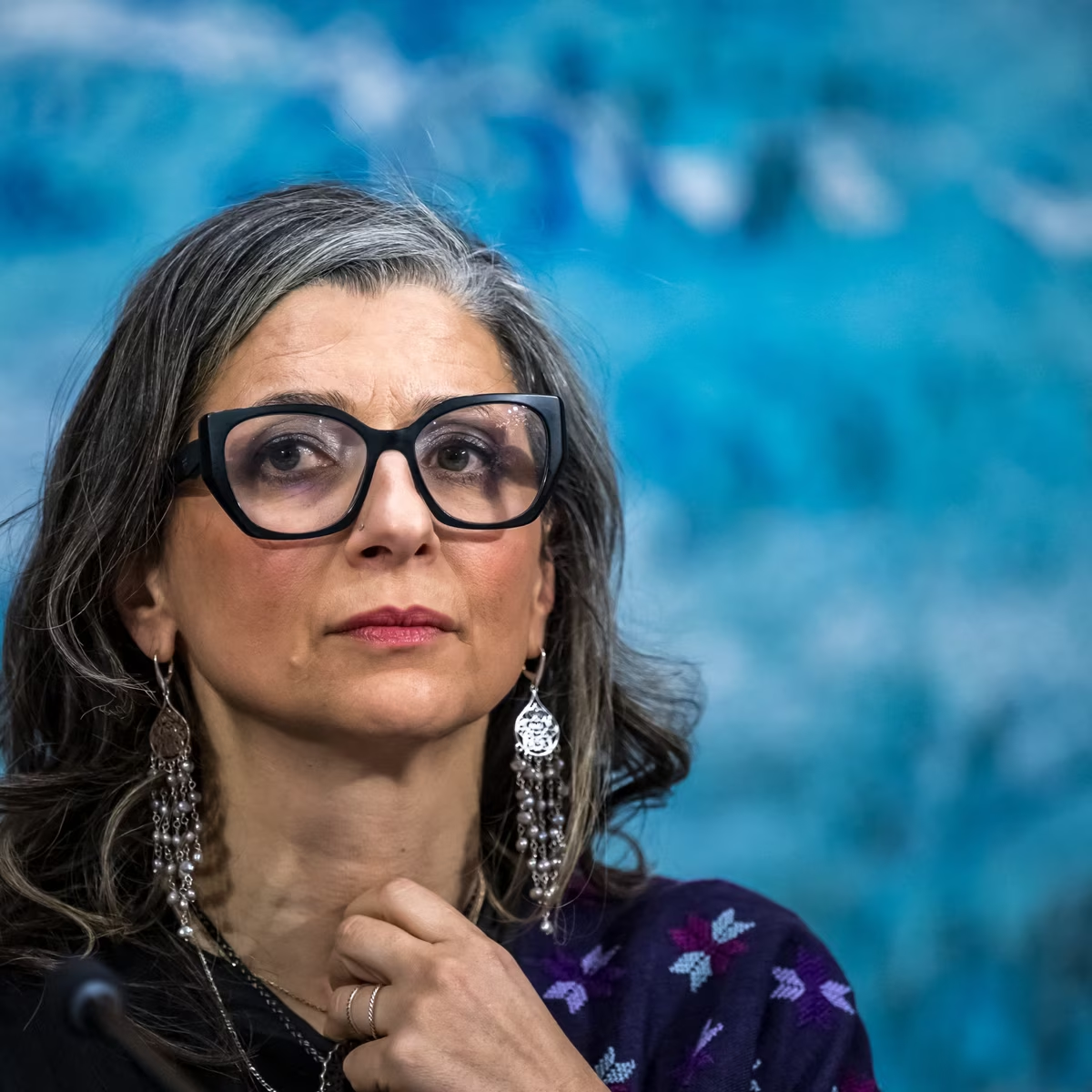
Judge Leon’s Decision Affirms Francesca Albanese’s Courageous Commitment to Principle and Palestinian Rights


By: Said Arikat


May 16, 2026


News analysis


In a moment when moral clarity is increasingly punished rather than rewarded, the recent ruling by U.S. District Judge Richard Leon temporarily blocking sanctions against Francesca Albanese, United Nations Special Rapporteur on the Occupied Palestinian Territories, stands as more than a legal decision. It is a reaffirmation of one of the most fundamental democratic principles: that speaking uncomfortable truths must never become a punishable offense.


The Trump administration’s sanctions against Albanese — including travel restrictions and financial penalties — were not imposed because she committed a crime. They were imposed because she dared to speak openly and consistently about the devastating human toll of Israel’s military campaign in Gaza and the broader realities of occupation, dispossession, and impunity faced by Palestinians.


Judge Leon recognized precisely that. In a forceful rebuke, he concluded that Albanese had “done nothing more than speak,” underscoring the obvious but increasingly endangered truth that criticism of state policy, including that of Israel, remains protected political speech. That this reminder had to come from a federal courtroom is itself an indictment of the current political climate.


Albanese’s courage deserves recognition because she has persisted despite relentless intimidation campaigns, political pressure, and personal attacks. As United Nations Special Rapporteur, her mandate is neither ceremonial nor selective. It requires documenting violations of international law wherever they occur and regardless of who commits them. Yet in fulfilling that mandate with integrity, she became the target of one of the world’s most powerful governments.


The sanctions were especially alarming because they sought to weaponize state power against an independent UN expert for engaging with international accountability mechanisms, including discussions surrounding investigations by the International Criminal Court. Such measures carried chilling implications not only for Albanese personally, but for every human rights investigator, journalist, scholar, or advocate willing to scrutinize Israeli conduct in the occupied Palestinian territories.


What makes Albanese particularly significant is her refusal to retreat into euphemism. At a time when many public officials carefully calibrate their language to avoid political backlash, she has spoken directly about Palestinian suffering, collective punishment, forced displacement, and the destruction of civilian life. Whether one agrees with every formulation she has used is ultimately secondary to the principle at stake: human rights advocates must be free to investigate and speak without fear of political retaliation.


The court’s finding that Albanese possesses sufficient constitutional protections despite being a non-U.S. citizen living abroad is also noteworthy. It reinforces the idea that free expression cannot be selectively granted only to those whose views align with prevailing political interests. Rights lose meaning when they become contingent upon ideological approval.


Equally disturbing was the collateral damage inflicted on her family. The lawsuit revealed how the sanctions effectively “debanked” Albanese and disrupted the lives of her American husband and daughter. This was not merely symbolic punishment. It was an attempt to isolate and silence through financial coercion and personal hardship.


The broader implications of this case extend well beyond one individual. Around the world, governments increasingly seek to blur the line between criticism of state conduct and illegitimate speech. Human rights defenders who challenge powerful actors are often smeared, threatened, or criminalized. Albanese’s case demonstrates how fragile independent international oversight can become when political interests supersede legal principles.


And yet, despite these pressures, she did not retreat.


That perseverance matters profoundly for Palestinians living under bombardment, occupation, and blockade, many of whom feel abandoned by the international community’s selective outrage and inconsistent application of international law. Voices like Albanese’s offer something increasingly rare: a willingness to affirm Palestinian humanity with the same urgency and dignity routinely afforded to others.


Supporting Francesca Albanese is not about endorsing every political argument she has made. It is about defending the principle that exposing suffering and demanding accountability should never invite state repression. Democracies do not weaken because people speak critically. They weaken when governments attempt to silence those who do.


Judge Leon’s ruling is only preliminary, and the legal battle is far from over. But for now, it offers a necessary reminder that conscience still has defenders — in courtrooms, in civil society, and among those unwilling to look away from injustice.


Francesca Albanese has shown remarkable resolve under extraordinary pressure. History often vindicates those who choose principle over convenience. Whatever the outcome of this legal fight, her determination to defend Palestinian rights in the face of intimidation has already secured her place among those who refused silence when silence was easier.

PALESTINE

Fri 15 May 2026 7:26 pm - Jerusalem Time

On its 78th anniversary.. The Palestinian Nakba renews with chapters of forced displacement and genocide

Today, Friday, May 15, marks the seventy-eighth anniversary of the Palestinian Nakba, at a time when the Palestinian people are experiencing new and horrific chapters of genocide and forced displacement. This anniversary, which has been entrenched in the collective consciousness since 1948, returns today to embody a tragic scene that recalls the miseries of the first diaspora, but with more lethal tools of destruction targeting the Palestinian presence in the Gaza Strip and the West Bank alike.

On this day, Palestinian memory recalls the roots of the tragedy that began in 1948, when Zionist gangs committed more than 70 horrific massacres against unarmed civilians. These massacres at the time resulted in the martyrdom of more than 15,000 Palestinians and the displacement of about 957,000 out of 1.4 million Palestinians who lived in 1,300 Palestinian villages and cities, marking the beginning of a refugee journey whose chapters have not yet ended.

During the first Nakba, the occupation managed to control about 85% of historical Palestine's area, and deliberately destroyed 531 villages completely in a systematic attempt to erase the cultural and human impact of the Palestinian people. Today, almost eight decades later, this policy continues through the destruction of residential neighborhoods and infrastructure in the Gaza Strip, with the aim of making the land uninhabitable and pushing residents towards new migration.

Statistical data issued by the Palestinian Central Bureau of Statistics for 2026 indicates a catastrophic reality, as the ongoing war of extermination in the Gaza Strip has led to the displacement of nearly two million Palestinians. These displaced people today live in dilapidated tents that reflect the image of the first refugee in 1948, confirming that the Nakba is not just a fleeting historical event but a continuous process of oppression and displacement.

The renewed chapters of the Nakba were not limited to the Gaza Strip, but extended to include camps and cities in the northern West Bank, which witnessed the displacement of about 40,000 Palestinians as a result of ongoing military operations. This field escalation raised the number of Palestinians in the diaspora and exile to about 8.1 million people, out of a total of 15.5 million Palestinians living around the world, clinging to the dream of returning to their homes.

On the political front, President Mahmoud Abbas described the current stage as pivotal and historic in the journey of the Palestinian struggle. Abbas affirmed in his statements that the 'Oslo Accord', which was supposed to establish an independent state, was fatally undermined as a result of rampant settlement expansion and occupation practices that nullified all understandings and agreements signed between the two sides.

The Palestinian President hinted that the leadership will not remain hostage to international agreements that only the Palestinian side respects, while the occupation completely disavows them. He considered that the forced displacement efforts currently practiced in Gaza and the West Bank undermine the essence of treaties, which forces Palestinians to return to demanding urgent international protection to confront what he described as the 'Second Nakba'.

In commemoration of this anniversary, massive marches were launched in various Palestinian cities and refugee camps under the slogan 'We will not leave.. Our roots are deeper than your destruction'. Participants, especially youth and children, raised 'keys of return' and the names of their original villages from which their ancestors were displaced, in a clear message to the occupation and the world that rights do not expire with time.

Popular activities stressed that the right of return guaranteed by UN Resolution 194 is a sacred and inalienable right. Speakers in the marches affirmed that legendary steadfastness on the ground is the optimal response to all attempts aimed at liquidating the Palestinian issue, including attempts to undermine UNRWA as an international witness to the refugee issue.

In conclusion, the 78th anniversary of the Nakba remains a living testament to the Palestinian people's ability to rise from under the rubble and adhere to their national identity despite all hardships. While politicians mourn past diplomatic paths, the Palestinian people renew their covenant with the land, affirming that true peace cannot be achieved through displacement or killing, but through the restoration of historical rights that were stolen since the autumn of 1948.

The Oslo Accord was fatally undermined by the practices of the occupation, and we will not remain hostage to agreements respected by one side.

PALESTINE

Fri 15 May 2026 7:26 pm - Jerusalem Time

Convoys of Faith: Palestinian Pilgrims from Inside Cross Jordan Towards the Holy Lands

Every Hajj season, a special story unfolds for Palestinian pilgrims from the occupied interior, known as '48-Arabs,' as they cross Jordanian territories on their way to the Holy Lands. This scene transcends a routine religious journey, carrying deep human and national dimensions where feelings of longing for Mecca intertwine with aspects of belonging, identity, and authentic Arab embrace.\n\nWith the departure of the first convoys this year, Jordanian stations transformed into major spiritual transit points, as dozens of buses headed south, laden with faces overflowing with prayers and nostalgia. Jordanian cities welcome these pilgrims with great hospitality, as if they were family returning home after a long absence, strengthening the fraternal ties between the people of one nation.\n\nMinister of Awqaf, Islamic Affairs, and Holy Sites, Mohammed Al-Khalayleh, affirmed that the Kingdom annually hosts approximately 4,500 pilgrims from inside Palestine to perform rituals under the full supervision of the Ministry. He clarified that about 40 buses have already departed for the Holy Lands, while a number of pilgrims have arrived in Medina to begin their rituals.\n\nAl-Khalayleh stressed that the Ministry had completed all preparations related to housing and hotels early, in addition to securing accompanying administrative, guidance, and medical missions. He pointed out that pilgrims from the '48-Arabs' are treated exactly like Jordanian pilgrims, whether in terms of transportation, accommodation, comprehensive health care, or religious guidance.\n\nThe roots of these special arrangements date back to 1978, when an agreement was reached during the reign of King Hussein bin Talal, in coordination with Saudi Arabia, to grant '48-pilgrims' temporary Jordanian passports. This step aimed to protect their right to access the holy places and has since carried highly significant political and humanitarian dimensions.\n\nOfficial sources confirmed that the Kingdom will not abandon this historical mission of supporting the Palestinian people and facilitating their access to the holy sites. Jordanian care includes providing preaching and guidance missions, in addition to facilitating Umrah trips throughout the year under the direct supervision of the competent authorities to ensure the comfort of Umrah performers and pilgrims.\n\nIn Ma'an Governorate, southern Jordan, human warmth was embodied in its finest forms upon the reception of the first batch of pilgrims at the designated Pilgrims' Oasis. Delegations of greeters from residents and officials lined up to offer Arabic coffee and dates, amidst remarkable spiritual and popular atmospheres reflecting inherent Jordanian hospitality.\n\nMa'an Governor stated that the governorate has mobilized all its capabilities to serve the guests of the Most Gracious coming from the occupied interior, emphasizing that this reception carries great national and religious significance. He considered serving pilgrims an honor sought by the people of the governorate who are keen to establish 'Sabeel Al-Maqam' to provide food and drink for travelers.\n\nFor his part, the head of the 48-Muslims Hajj Committee, Ziad Sharbaji, explained that the procedures from departure from Palestinian territories until crossing Jordan proceeded smoothly and with high organization. He praised the spirit of cooperation shown by the Jordanian security agencies and official bodies, which positively reflected on the comfort and reassurance of the pilgrims during the journey.\n\nSharbaji pointed out the presence of internal committees and arrangements accompanying the pilgrims at all their stations, with committee officials present in Medina and Mecca to coordinate needs. He affirmed that continuous coordination with the Jordanian Ministry of Awqaf contributes to overcoming any obstacles that may arise, expressing hope for the continuation of these facilities during the return journey.\n\nBetween the buses heading south, the sounds of 'Talbiyah' (pilgrim's chant) blend with similar Palestinian and Jordanian accents, dissolving political borders before the unity of the human and spiritual scene. The pilgrim coming from Nazareth or Umm al-Fahm finds in Jordan a natural extension of their journey, and a safe passage that preserves their religious right despite the complexities of geography and politics.\n\nThe head of the 48-pilgrims mission, Abdul Razzaq Abu Ras, confirmed that the journey is proceeding without significant complications since leaving Palestinian territories, praising the spiritual atmosphere experienced by the pilgrims. Abu Ras appreciated the efforts of the Kingdom of Saudi Arabia in serving the guests of the Most Gracious and providing suitable conditions for performing the rituals with ease and reassurance.\n\nDespite the available facilities, official sources noted that West Bank pilgrims sometimes face complex procedures and long delays at crossings controlled by the occupation. Nevertheless, for pilgrims from inside, this journey remains greater than the hardship of the road; it is a journey of patience and faith that returns them to their Arab embrace, which opens its doors to them every year.\n\n"The Kingdom cannot abandon its mission of supporting the Palestinian people, and 48-pilgrims are treated exactly like Jordanian pilgrims.

PALESTINE

Fri 15 May 2026 7:25 pm - Jerusalem Time

Occupation closes Lions' Gate, obstructs worshippers' access to Al-Aqsa Mosque

Occupation police closed Lions' Gate this Friday morning to Palestinian worshippers heading to the blessed Al-Aqsa Mosque, in a move aimed at securing a noisy celebratory ritual organized by settlers in the surrounding area. Field sources reported that this closure obstructed the access of hundreds of citizens who tried to attend dawn and Friday prayers.

Sources stated that occupation forces reinforced their military presence by deploying intensive patrols and special unit elements, and imposed a strict security cordon that included all entrances and the vicinity of the Old City in occupied Jerusalem. These restrictions come in the context of what is called the Hebrew anniversary of the occupation of the city, where Israeli authorities seek to provide full protection for settlers at the expense of Palestinians' freedom of worship.

Repressive measures were not limited to Lions' Gate only, but extended to include tightening inspection and scrutiny procedures at the rest of Al-Aqsa Mosque's gates, which led to tightening the noose on Jerusalemites and visitors from within the occupied territories. These practices fall within a systematic policy to change the temporal and spatial reality in the Noble Sanctuary.

Occupation forces deployed patrols reinforced with special forces elements, and imposed a strict security cordon around the Old City.

PALESTINE

Fri 15 May 2026 7:25 pm - Jerusalem Time

Secret document reveals details of Sinwar and Deif's message to Nasrallah on the morning of 'Al-Aqsa Flood'

Hebrew media sources revealed today, Friday, the content of a lengthy and highly confidential message sent by the leaders of the Al-Qassam Brigades on the morning of October 7, 2023, to the former Secretary-General of Hezbollah, Hassan Nasrallah. The message, signed by Yahya Sinwar, Mohammed Deif, and Marwan Issa, was found, according to reports, inside one of Hamas's strategic tunnels in the Gaza Strip after thorough inspections conducted by the occupation army.

The message began by informing Hezbollah's leadership that thousands of fighters had already launched a large-scale operation targeting settlements, military sites, and airports in the Gaza envelope and the southern region. The document clarified that the purpose of this move was to deliver an unprecedented blow to the Zionist entity in response to the increasing violations in the blessed Al-Aqsa Mosque, which had reached the point of performing Talmudic rituals and attempts at temporal and spatial division.

Al-Qassam's leadership emphasized in its message that preparations for the operation took place amidst strict security measures, with details withheld even from prominent leaders within the movement to ensure the element of surprise. The message indicated that maintaining the secrecy of the timing was of utmost necessity to prevent the occupation from carrying out any preemptive strike that might thwart the attack before its launch, asserting that success depended on surprising the Israeli security system.

The message reviewed a series of motives that led to the escalation of the situation, foremost among them the brutal attacks, arrests, and abuses suffered by worshippers and steadfast residents in Jerusalem. The leaders who signed the message considered that the occupation was diligently seeking to demolish Al-Aqsa Mosque and build the alleged Temple, citing the bringing of "red heifers" as evidence of the seriousness of Zionist plans to Judaize the first Qibla of Muslims.

The message did not overlook the situation in the West Bank, where it noted the escalation of assassinations and home demolitions in Jenin, Nablus, and Hebron, considering that silence on these crimes was no longer possible. The resistance leadership affirmed that the battle under the title "Jerusalem" is the only one capable of uniting the nation and mobilizing popular and official energies behind the option of comprehensive confrontation with the Zionist project.

In a striking strategic analysis, the message warned against an Israeli policy aimed at "fragmenting the conflict" by isolating each arena of resistance individually to avoid regional confrontation. It clarified that the occupation seeks to create internal crises in the 1948 territories, pursue resistance in the West Bank, and bomb airports in Syria, in order to reduce the chances of coordination among axis parties and weaken the motives for collective participation.

The message directed a clear and direct call to Hezbollah and the rest of the axis forces to immediately engage in fighting, emphasizing that concentrated missile bombardment on the vital arteries of the occupation would lead to decisive results. The plan proposed carrying out intensive drone attacks in parallel with missile barrages to deplete air defense systems and paralyze the Israeli air force's ability to operate effectively.

Al-Qassam's leadership affirmed in its document that expanding the circle of engagement to include several fronts for only two or three days would be sufficient to achieve a rapid collapse of the occupation's defensive system. The message saw that this participation would put Israel in a state of existential shock, paving the way for broader ground operations aimed at controlling the land and radically and permanently changing the geopolitical reality in the region.

The message warned in a firm tone that "the price of hesitation will be high," not only for the Palestinian cause but for the entire axis project, including Iran and Syria. It considered that any delay in supporting Gaza would give the occupation an opportunity to restore deterrence and carry out widespread retaliatory strikes, emphasizing that the historical moment requires courage in making the decision for direct confrontation.

On the political front, the message suggested adopting smart media discourse focusing on obliging the occupation to international resolutions and international law instead of using slogans of total destruction. This approach, according to the document, aims to neutralize Western powers and reduce the possibilities of their direct military intervention alongside Israel, by presenting the battle as a legitimate defense of rights and holy sites.

The document also touched upon the dangers of the regional normalization path, especially the efforts that were being made to integrate Israel into the Arab region, considering it a strategic threat to the axis of resistance. Hamas's leadership believed that the success of the October 7 attack would break these paths and bring the Palestinian issue back to the forefront of the global scene, thus thwarting plans to liquidate the cause.

The message described the Zionist entity as "weaker than a spider's web," citing the state of internal division and political crises that plagued Israeli society before the war. The leaders expressed their confidence that a coordinated strike from all fronts would lead to the disintegration of this entity, which suffers from deep cracks in its military and social structure, and that this moment must be exploited.

The message concluded by emphasizing that this battle will change the equations and rules that have prevailed for decades, and will end the phase of security coordination and the Oslo Accords that shackled the Palestinian people. The signatories stressed that the ultimate goal is to achieve a historical transformation that melts sectarian differences and unites the nation under one banner to confront the common enemy and liberate the holy sites from the defilement of occupation.

These leaks come at a sensitive time, as they redraw the picture of coordination among resistance forces before the outbreak of the war, and reveal the extent of expectations Hamas had for its allies. This document, according to observers, remains evidence of the complex strategic planning that preceded the operation, and a serious attempt by Al-Qassam's leadership to impose the reality of "unity of fronts" from the very first moments of fighting.

When you read these words of ours, thousands of Mujahideen from the Al-Qassam Brigades will have launched to attack the targets of the criminal Zionist occupation.

PALESTINE

Fri 15 May 2026 7:25 pm - Jerusalem Time

Prisoner's Club: Occupation Carried Out 23,000 Arrests in West Bank Since Start of Genocide War

The Palestinian Prisoner's Club confirmed in a statement issued on Friday that Israeli occupation forces have carried out over 23,000 arrests among Palestinians in the occupied West Bank. This horrifying toll coincides with the ongoing genocidal war waged by the occupation on the Gaza Strip since October 2023, which has been accompanied by widespread campaigns of abuse.

The statement clarified that these statistics do not include thousands of detainees from the Gaza Strip who face an unknown fate amid the ongoing crime of enforced disappearance. The club stressed that the detainees include diverse segments of Palestinian society, including women, children, and wounded individuals, in addition to former prisoners who were re-arrested as part of the policy of collective punishment.

The Prisoner's Club described the current reality of the prisoner movement as experiencing its most brutal and cruel phase since the 1967 occupation. It noted that Israeli prisons are no longer merely detention centers but have transformed into organized spaces for practicing all types of torture, starvation, and systematic humiliation against male and female prisoners.

The club considered the crime of arrest a fundamental pillar of the Israeli colonial project aimed at undermining Palestinian existence. It added that this policy is used as a systematic tool to break the social and national structure of the Palestinian people, and an attempt to empty the arena of active and influential cadres by disappearing them behind bars.

The human rights report revealed the martyrdom of 89 Palestinian prisoners inside occupation prisons since the start of the recent aggression, whose identities have been officially recognized and announced. Sources confirmed that these martyrs died as a result of direct torture, severe starvation policies, or deliberate medical crimes practiced by prison administrations.

With the ascension of these martyrs, the total number of martyrs of the prisoner movement since 1967 has risen to 326 martyrs who fell inside detention centers. The occupation authorities still refuse to disclose the fate of dozens of detainees from the Gaza Strip, which reinforces fears of a larger number of martyrs who have not yet been documented.

Over the past decades, the Prisoner's Club has documented the arrest of more than one million Palestinians, a clear indication of the comprehensiveness of the policy of mass arrests. The statement considered that these policies began even before the 1948 Nakba as a tool for colonial control and intimidation, and have continued and escalated with successive Israeli governments.

Despite repression, isolation, and harsh conditions, the club affirmed that the prisoner movement has succeeded in transforming prisons into arenas of resistance and national consciousness. Over many years, prisoners have been able to build an organizational and cultural system that confronted the occupation's attempts to strip them of their struggle and human content.

Current data indicate the presence of more than 9,400 Palestinian prisoners in occupation prisons, living in conditions lacking the most basic human necessities. Among these detainees are 86 female prisoners facing difficult conditions, in addition to hundreds of children who are deprived of their most basic educational and health rights.

The statement also drew attention to the sharp increase in the number of administrative detainees, which reached 3,376 detainees without charge or trial. The occupation uses this type of detention as a pretext to detain Palestinians for indefinite periods based on what are called 'secret files' that lawyers are not allowed to access.

In a related context, the occupation is holding approximately 1,283 Palestinians under the classification of 'unlawful combatants,' a law that allows Israeli authorities to detain Gaza residents for long periods without real judicial oversight. These detainees suffer from complete isolation from the outside world and deprivation of legal or family visits.

In parallel with these figures, a recent report by the Palestinian Central Bureau of Statistics showed the scale of the comprehensive humanitarian catastrophe experienced by the Palestinian people. The total number of martyrs since October 2023 until the end of April 2026 has exceeded 73,761 martyrs in all Palestinian territories.

The toll of martyrs was distributed to include 72,601 martyrs in the Gaza Strip, which is subjected to continuous genocide, and 1,160 martyrs in the occupied West Bank. These figures reflect the extent of direct targeting of civilians and infrastructure, amid international silence and an inability to stop the Israeli war machine.

The prisoner movement today is experiencing the most brutal and cruel phase in its history since 1967, as prisons have turned into organized spaces for torture and abuse.

PALESTINE

Fri 15 May 2026 7:25 pm - Jerusalem Time

Spain Grants Freed Prisoner Basem Khandaqji the Title of 'Galician Universal Writer of 2026'

The Association of Writers in Galician Language in Spain announced that it has granted the Palestinian novelist and freed prisoner, Basem Khandaqji, the title of 'Galician Universal Writer of 2026'. This high honor comes in recognition of his long creative journey and his steadfast positions in supporting Palestinian national dignity, despite the years of deprivation he spent behind bars.

The association confirmed in an official letter addressed to Khandaqji that this selection reflects a state of admiration and deep respect for him personally and for the literary achievement he has presented. Sources indicated that the award aims to highlight literature that defends Palestinian identity in the face of attempts at erasure, considering Khandaqji a model of the organic intellectual.

The choice of the announcement date for the award acquired special symbolic significance, as it coincided with the anniversary of the Palestinian Nakba on May 15th. This timing aims to emphasize the continued presence of the Palestinian cause in global cultural memory, and to link literary creativity with the historical rights of the Palestinian people.

The title of 'Galician Universal Writer' is one of the highest literary honors in the region of Galicia, northwestern Spain, awarded to names that have left a clear human and literary mark. Khandaqji's award joins a distinguished record that includes major literary figures, most notably the late poet Mahmoud Darwish, and the Mexican writer Elena Poniatowska.

In his first comment on this honor, Basem Khandaqji expressed his pride in this title, emphasizing that it represents not only himself but is also an honor for the renewed Palestinian literary scene. He explained in press statements that the award is an international recognition of prisoner literature that is born from the womb of suffering inside Israeli prisons.

Khandaqji stressed that Palestinian literature is currently engaged in a sharp 'cultural clash' with the prevailing Zionist narrative. He pointed out that building a national narrative capable of addressing the global conscience in a critical and humane language is the strongest weapon to confront attempts to falsify history and contemporary Palestinian reality.

Regarding the connotations of the Nakba anniversary, the Palestinian novelist believed that the people have not left the Nakba for it to become merely a fleeting memory, but rather it is a continuous reality that Palestinians live daily. He considered that what is currently happening in the Gaza Strip and the West Bank is a direct extension of that historical tragedy that is taking new forms of oppression and displacement.

Khandaqji touched upon his writing experience, explaining that creativity within detention was characterized by high intensity due to strict censorship conditions and the risks surrounding every text. He affirmed that he is currently striving to restore the 'health of language' in the space of freedom, away from the symbols and codes he was forced to use to protect his writings from confiscation.

The freed prisoner revealed his involvement in a new literary project titled 'Text of Freedom', through which he seeks to develop his style honed by prison. He affirmed his commitment to continue challenging exile and cultural restrictions with the same spirit with which he challenged the bars of cells, so that Palestinian literature remains a free voice in international forums.

Receiving this award after the great figure Mahmoud Darwish places a grave literary and moral responsibility on my shoulders towards the Palestinian narrative.

PALESTINE

Fri 15 May 2026 7:25 pm - Jerusalem Time

A Palestinian Youth killed in Nablus, Smotrich proposes plan to end 'Oslo' divisions and expand settlements

Tensions escalated in the occupied West Bank early Friday morning, following the martyrdom of a Palestinian youth by Israeli occupation forces' bullets in Nablus Governorate. The Palestinian Ministry of Health announced the death of 15-year-old Fahd Zidan Oweis, who was shot by occupation forces in the town of Al-Lubban Al-Sharqiya, noting that Israeli authorities detained his body and prevented medical teams from receiving it.

For its part, the Israeli occupation army attempted to justify the crime with claims made by a spokesperson, who alleged that the youth was participating in throwing stones at settlers' cars on a main road. This incident comes amid an escalation in the pursuit and direct targeting of Palestinian youth and children in various cities and villages of the West Bank under flimsy security pretexts.

In another attack reflecting the escalation of settler terrorism, extremist groups set fire to a mosque and several Palestinian vehicles in the village of Jibiya, northwest of Ramallah. Local sources reported that settlers infiltrated the village under the cover of darkness, set fire to the prayer hall, and spray-painted racist slogans in Hebrew on its walls before fleeing.

The Palestinian Ministry of Endowments and Religious Affairs condemned this attack, considering that the burning of the mosque and targeting of citizens' property is not merely a fleeting individual act. The ministry affirmed in an official statement that these attacks fall within a systematic policy that enjoys cover and incitement from the current Israeli government, with the aim of intimidating Palestinians and erasing their religious identity and presence on their land.

On the political front, Israeli Finance Minister Bezalel Smotrich revealed dangerous government directives aimed at changing the legal and geographical reality in the West Bank. Smotrich announced the government's approval to build approximately 60,000 new settlement units over the next three years, in a move aimed at solidifying the settlement project and blocking any future political solutions.

Smotrich, who leads the extremist 'Religious Zionism' party, called on Prime Minister Benjamin Netanyahu to adopt a plan aimed at the 'final erasure' of the dividing lines between Areas (A), (B), and (C). The Israeli minister considered that the divisions approved by the Oslo Agreement are no longer relevant, demanding the imposition of full and unified Israeli control over all West Bank territories without discrimination.

These statements came during a celebration for settlers marking the anniversary of the occupation of East Jerusalem, where Smotrich boasted about his government's achievements in 'legalizing' settlement outposts. He indicated that work is underway to organize more than 100 new settlement clusters, including the revival of previously evacuated settlements such as Homesh, Sa-Nur, Ganim, and Kadim.

Smotrich's plan, presented to the Israeli cabinet, seeks to undermine the limited powers of the Palestinian Authority in Areas (A) and (B). This move aims to abolish administrative and security distinctions, paving the way for effective and widespread annexation of Palestinian lands under the guise of 'settlement regulation' and preventing Palestinian urban expansion.

It is worth noting that the Oslo Agreement divided the West Bank into three administrative areas, with Area (C) under full Israeli control and constituting the largest area at 60%. However, the current trends of the far-right seek to bypass these divisions in favor of extending absolute Israeli sovereignty, which observers see as the final bullet for what remains of the signed agreements.

These field and political developments reflect a new phase of comprehensive Israeli escalation against the Palestinian presence in the West Bank. While field killings and settler attacks on holy sites continue, the Israeli government is proceeding with legislating laws and settlement plans aimed at resolving the conflict demographically and geographically on the ground.

It is time to finally erase the borders separating Areas (A), (B), and (C). I have presented a detailed plan to the cabinet and call for its adoption.

PALESTINE

Fri 15 May 2026 7:24 pm - Jerusalem Time

Provocative Celebrations by Settlers at Al-Aqsa Gates Amidst Security Siege on Worshippers

The occupied city of Jerusalem witnessed a new escalation today, Friday, in the intensity of provocations led by settlers in the vicinity of the Blessed Al-Aqsa Mosque. Groups of extremists organized noisy celebrations that included dancing and musical performances near the mosque's gates, specifically at the Bab Al-Asbat area, which sparked a state of intense anger among Palestinians present at the scene.

These provocative moves coincide with what the occupation authorities describe as the 'Jerusalem Unification Day' according to the Hebrew calendar, an occasion that the far-right exploits to impose new realities in the holy city. Participants in these celebrations deliberately performed their rituals at the closest possible point to the walls of Al-Aqsa Mosque under intense security protection.

In contrast, the Israeli police tightened their repressive measures against Palestinian worshippers, closing Bab Al-Asbat and Bab Al-Malik Faisal to those coming to pray. Forces imposed strict age restrictions, preventing hundreds of young men from entering the mosque courtyards, which forced many of them to pray in the streets surrounding the Old City.

These field developments come one day after the storming of Al-Aqsa Mosque courtyards by Israeli National Security Minister Itamar Ben-Gvir, leading a large group of settlers exceeding 1300 people. During the storming, Ben-Gvir raised the Israeli flag inside the Haram al-Sharif, a move considered a blatant challenge to Muslim sentiments and a violation of the status quo.

From inside the mosque, the extremist minister made racist statements, claiming to have restored what he described as 'sovereignty and governance' over the site that the occupation calls 'Temple Mount'. Ben-Gvir affirmed in his speech that all of Jerusalem is under Israeli control, which was met with widespread condemnation from national and religious bodies in Jerusalem.

Violations were not limited to incursions; Israeli government ministers, including Finance Minister Bezalel Smotrich, participated in the annual 'Flag March' that paraded through the streets of the Old City. The march witnessed physical and verbal assaults on Palestinian citizens and their property, amidst racist chants calling for death to Arabs.

Field sources reported that the occupation authorities transformed the Old City into a closed military barracks, after deploying about 14,000 security personnel to secure the settlers' routes. These measures led to a complete paralysis of commercial activity in the old markets, where shop owners were forced to close their doors to avoid assaults by march participants.

On the political front, Palestinian and Arab parties warned of the danger of these continuous violations that seek to transform the conflict into a comprehensive religious confrontation. Reports confirmed that the international community's continued silence regarding these practices encourages the occupation to proceed with its plans to Judaize Jerusalem and change its Arab and Islamic identity.

We have restored sovereignty and governance to the Temple Mount, and all of Jerusalem is ours.

PALESTINE

Fri 15 May 2026 7:24 pm - Jerusalem Time

Netanyahu announces occupation army's control over 60% of Gaza Strip area

Israeli Prime Minister Benjamin Netanyahu revealed that the occupation army has expanded the areas it controls within the Gaza Strip, reaching approximately 60% of the total area of the Strip. These statements came during an official ceremony marking the anniversary of the occupation of East Jerusalem, emphasizing that field movements have exceeded the boundaries drawn by previous agreements.

This announced percentage constitutes a clear violation of the terms of the ceasefire agreement reached through American mediation in October 2025, which set the Israeli control area at approximately 53%. Press reports indicated that the occupation deliberately moved what is known as the 'Yellow Line' towards the populated western areas, reducing the living spaces available to Palestinians.

Local sources confirmed that on May 10th, occupation mechanisms moved the separating concrete blocks westward along Salah al-Din Street in the Netzarim axis area. This step is part of the gradual encroachment strategy followed by the army to impose a new field reality that goes beyond recently concluded international understandings.

For her part, Lori Buffard, a GIS expert at Doctors Without Borders, explained that field assessments indicate a continuous escalation in land grabbing. Buffard stated that Israeli control is no longer limited to border areas but has extended to include new buffer zones that impose strict restrictions on the movement of humanitarian organizations.

The international expert pointed to the monitoring of new yellow blocks and boundary markers in the Zeitoun neighborhood of Gaza City over the past few weeks, confirming the continued expansion. These field changes force international institutions to coordinate in advance with the occupation army to enter areas previously classified as purely Palestinian lands.

In the same context, Hamas leader Basem Naim stated that the occupation has shifted the dividing line by an additional area ranging from 8 to 9% of the total area of the Strip. Naim added that this behavior reflects the Israeli government's reneging on its commitments and aims to transform the Strip into isolated pockets under full military control.

The plan of former US President Donald Trump, announced in September 2025, stipulated in its first phase a partial withdrawal of the occupation and a cessation of military operations. While the Palestinian resistance adhered to the requirements of this phase, the Israeli side continued its aggressions and field expansion deep into areas classified as 'safe'.

The second phase of the international plan includes a broader withdrawal of the occupation army and the start of reconstruction operations, which the Netanyahu government currently rejects. Israel insists on imposing new conditions related to disarming factions before implementing any withdrawal, putting the entire agreement on the verge of collapse.

The new areas encroached upon by the army are called the 'Orange Line,' which are areas that overlap with the geographical depth of the Gaza Strip and separate its main cities. Observers believe that this division aims to secure permanent military corridors that cut off the Strip and prevent geographical communication between its north and south.

It is worth noting that the Gaza Strip has been subjected to a genocidal war launched by Israel since October 2023, which lasted for two continuous years of systematic bombing and destruction. This war resulted in the martyrdom of more than 72,000 Palestinians and the injury of more than 172,000 others, the vast majority of whom were women and children.

Regarding infrastructure, military operations destroyed about 90% of vital facilities and residential buildings in the Strip, making it an uninhabitable area in large parts of it. The United Nations estimates the cost of rebuilding what the occupation destroyed at approximately $70 billion, amid a suffocating siege that prevents the entry of essential building materials.

Amidst the Israeli army's silence on commenting on international reports, field sources continue to document ongoing violations along the dividing lines. The situation in Gaza remains hostage to Israeli military movements that disregard all international conventions and covenants signed under American auspices.

The army currently controls 60% of the Gaza Strip, an area larger than what was stipulated in the ceasefire agreement.

OPINIONS

Fri 15 May 2026 1:33 pm - Jerusalem Time

Kimberlé Crenshaw in Her Memoir: How 'Backtalker' Shaped the Concept of Intersectionality and Global Justice?

Ramallah - “Alquds ” dot com

Ramallah - “Alquds ” dot com

Opinion Writer

Since the end of direct slavery in the United States and society's transition to a 'freedom' constrained by laws, the question remains about the state's ability to reproduce discrimination through complex institutional tools. Kimberlé Crenshaw stands out in this context as one of the most important thinkers who worked to dismantle this structure, considering racism not just an individual behavior but an integrated system that shapes identity and status.\n\nIn her recently published memoir, 'Backtalker,' Crenshaw recounts the life of a Black woman who not only challenged reality but also presented an intellectual journey that led to the creation of the concept of 'intersectionality.' This concept has today become a cornerstone in studies of race, gender, and social justice, transforming personal suffering into a global political theory.\n\n"The book's title, 'Backtalker,' refers to an ethical act of resistance that goes beyond verbal rebellion, as Crenshaw learned from childhood that the system not only rejects Black people but also limits the ceiling of their dreams. She recalls how she was confined to marginal roles in school, which revealed to her early on the deep structure of the racial imagination that distributes roles of beauty and salvation.\n\nThe American thinker grew up under the strict 'Jim Crow' laws, where racial segregation was a legal system aimed at keeping Black people on the social and economic margins. However, her family was characterized by a rejection of the victim mentality, which was evident in her mother's attitudes, who faced discrimination in public places with resilience and defiance of white authority.\n\nCrenshaw explains that racism is a system that reproduces itself even after apparent legal defeats, which prompted her to question institutions that hide behind slogans of neutrality. This awareness deepened during her university studies, where she realized that American law historically contributed to shaping racial hierarchy rather than dismantling it.\n\nThe case of Black worker Emma DeGraffenreid against General Motors in 1976 is considered the pivotal moment that led to the birth of intersectionality theory. In that case, the court rejected the discrimination claim on the grounds that the company employed white women and Black men, ignoring the specific oppression faced by Black women.\n\nThis judicial incident revealed a deep 'flaw' in the legal system, where Black women remain invisible because they fall at the intersection of two oppressed identities. From this, Crenshaw set out to prove that an individual is not subjected to oppression due to a single factor, but as a result of a complex interaction between race, gender, and social class.\n\n"The theory formulated by Crenshaw asserts that any justice policy that does not take into account this identity entanglement will necessarily produce new injustice. Intersectionality is not just an academic term, but a tool for seeing the categories that fall out of the calculations of traditional laws and systems that deal with issues as separate paths.\n\nThe book goes beyond being an autobiography to become a living testimony to the major transformations in contemporary American society, from the battles for integrating Black people into higher education to the major issues that occupied public opinion. Crenshaw accurately monitors how American discourse on justice is shaped in moments of social and political crisis.\n\nThe book sharply criticizes the liberal elites who promoted the idea of 'post-racialism' after Barack Obama's presidency. Crenshaw believes that this discourse was misleading, as the deep structures of discrimination continued to operate effectively within the economic, educational, and judicial sectors away from the spotlight.\n\nOn the Arab level, Crenshaw's theses gain special importance for understanding injustice as a complex structure in which sect, class, gender, and geographical origin intertwine. Arab societies suffer from multiple forms of discrimination that traditional human rights discourses often fail to address due to their monolithic view of grievances.\n\nCrenshaw's experience offers a lesson in how to transform individual suffering into a liberatory project capable of changing political and human rights language. She calls for adopting 'mischievous hope' that does not wait for permission from authority to express itself, but confronts it with the truths that institutions try to obscure.\n\nThe chapters of the book review how educational and legal institutions can be tools of domination if their epistemological foundations are not dismantled. The author emphasizes that real change begins with calling things by their names and exposing the mechanisms that make some groups invisible in the public sphere.\n\nIn conclusion of her memoir, Kimberlé Crenshaw emerges as a global voice calling for the necessity of redefining the concept of justice to be comprehensive and genuine. The book 'Backtalker' is an invitation to all the oppressed in the world to see the hidden links between different forms of oppression and to work to confront them as one block.\n\nBlack women remained legally invisible because they fall at the intersection of two oppressed identities simultaneously, and from this gap, the concept of intersectionality was born.

ARAB AND WORLD

Fri 15 May 2026 1:33 pm - Jerusalem Time

Official Documents Reveal Trump's Massive Financial Deals with Tech Giants

Recent official documents published on Thursday revealed new details about US President Donald Trump's financial activities during 2026, uncovering his involvement in a series of massive financial deals with major American companies. According to documents issued by the Office of Government Ethics, these operations included prominent names in the technology and finance sectors, raising a wave of questions about the nature and timing of these investments.

The list included in the financial disclosure statements featured giant companies such as 'Amazon', 'Apple', 'Microsoft', and 'Uber', in addition to leading companies in other fields such as 'Nvidia', specializing in electronic chips, and 'Boeing', an aircraft manufacturer. The total value of these financial movements is estimated at hundreds of millions of dollars, which places the President's financial performance under the scrutiny of ethical and legal oversight in the United States.

Financial data indicates that the value of individual deals ranged between one million and five million dollars, while the documents recorded extensive sales targeting stakes in 'Meta', 'Microsoft', and 'Amazon'. The value of these financial divestments ranged between 5 million and 25 million dollars, although the documents did not precisely clarify whether these assets were direct shares or financial bonds.

For its part, the Office of Government Ethics aims, by publishing this data, to ensure transparency and prevent any potential conflict of interest within the executive branch. These developments come at a time when the US President's assets are managed through a special investment fund overseen by his son, Donald Jr., with a legal clause granting the President the right to regain direct control over these investments at any time he deems appropriate.

These disclosures spark widespread debate about the extent of the US administration's commitment to the rules of separation between private commercial interests and public political decisions. With the expansion of the Trump family's investments in multiple sectors, pressure from regulatory bodies is increasing to ensure that political influence is not exploited to achieve personal financial gains, especially given the enormous amounts reported in recent reports.

These disclosures aim to prevent any conflict of financial interests or violations of ethics rules within the executive branch and its agencies.

PALESTINE

Fri 15 May 2026 1:32 pm - Jerusalem Time

Nakba Maps.. Transformations of Palestinian Geography from Village to Camp and Exile

The Palestinian Nakba in 1948 was not merely a fleeting military or political setback, but a radical transformation that reshaped geography, people, and memory. The Israeli occupation imposed a new reality that turned a network of thriving cities, villages, and plains into a map of ruins, camps, and distant exiles.

Recent data issued by the Palestinian Central Bureau of Statistics on the occasion of the 78th anniversary of the Nakba indicate that the Palestinian presence has numerically doubled despite the uprooting. The number of Palestinians worldwide reached about 15.5 million by the end of 2025, distributed between inside Palestine and the diaspora.

Statistics show that 7.4 million Palestinians remain steadfast within the borders of historical Palestine, while 8.1 million live in diaspora countries and exiles. These figures reflect the continuity of the issue and its geographical expansion, which the occupation has failed to obliterate over decades of displacement.

Before the catastrophe, the Palestinian village represented an integrated economic and social unit of life connected to the land, seasons, and water springs. The destruction of these villages was not merely an attack on stones, but an attempt to tear apart the social fabric, relationships, and professions associated with the original place.

The Institute for Palestine Studies, in its historical publications, documents more than 400 Palestinian villages that were completely destroyed or forcibly emptied during the events of 1948. This field documentation relies on maps, photos, and live testimonies to prove the existence that the occupation tried to erase from the official map.

With the arrival of convoys of displaced people to the West Bank, Gaza Strip, and neighboring countries, the 'camp geography' emerged as a temporary alternative that lasted for a long time. The tent, which symbolized the anticipation of a quick return, transformed due to the continued occupation into permanent residential neighborhoods carrying the names of the lost villages.

UNRWA data indicates that more than 1.5 million Palestinian refugees currently reside in 58 official camps distributed among Jordan, Lebanon, Syria, and Palestine. These camps have become strongholds of identity, where refugees redefine themselves based on their original towns from which they were displaced.

Inside the alleys of the camps, the village identity did not disappear but was reproduced in language, daily relationships, and neighborhood naming. The camp is not just a narrow geographical space, but a living social map that preserves the details of homes and fields whose keys are still passed down through generations.

Palestinian geography expanded over the decades to include distant exiles in Europe and the Americas, where Palestinians are no longer confined to their Arab surroundings. Nevertheless, exile remained an extension of the homeland, where Palestinians carry the name of their original city as an integral part of their personal identity in exile.

Recent digital initiatives such as 'Visualizing Palestine' highlight efforts to reconnect refugees with their roots through data visualization techniques. These initiatives reveal that the majority of Gaza Strip refugees, numbering 1.7 million, originate from villages only a few kilometers behind the separation fence.

In the Palestinian conflict, the map is a tool of resistance and a counter-memory against attempts at erasure and Judaization practiced by the occupation authorities. Hence, applications like 'iNakba' emerged, allowing users to identify the locations of destroyed villages and digitally retrieve their images and historical data.

Restoring the names of villages on digital and paper maps is a documentary act that resists the physical absence imposed by military reality. Every name re-established is an affirmation that the Palestinian narrative has not closed, and that the place is still alive in the consciousness of its rightful owners.

The Nakba produced a parallel geography that lives in the collective consciousness, where cities and villages remain present in stories and family names despite changes in their features. This parallel geography is what makes the question of justice and return an open demand not limited by time or superseded by field realities.

In conclusion, the Nakba maps remain open to the future, telling the story of a people who continued to redefine their place despite loss. From the village to the camp and to the diaspora, Palestine remains the compass and the living memory that refuses to submit to the logic of force and occupation.

The Nakba was not merely a military operation, but a process that affected the social structure by transforming the village from an integrated living space into a physical absence present in memory.

PALESTINE

Fri 15 May 2026 10:00 am - Jerusalem Time

From Gandhi to Mandela and Clay.. How did the consciences of the world's free people unite around Palestine?

The memory of the painful Palestinian Nakba comes upon us, reopening the wounds of displacement and the uprooting of a people from their land. At the same time, it evokes the great moral legacy left by the world's great liberation leaders. Palestine has never been merely a border dispute or a contested geography; rather, it has become a moral compass and a criterion for the humanity of free people everywhere and at all times.

Great world figures formulated their positions on Palestine based on the principles of universal justice, affirming that Palestinian steadfastness represents the essence of human struggle against oppression. These historical testimonies serve as a beacon supporting the Palestinian right and confirming that this people is not alone in confronting the occupation machine, but rather relies on a global moral backing.

A decade before the great catastrophe occurred, the Indian leader Mahatma Gandhi laid the cornerstone for the moral vision rejecting settler colonialism in Palestine. In 1938, Gandhi issued his famous statement in which he affirmed that Palestine belongs to the Arabs just as England belongs to the English, rejecting any falsification of history.

Gandhi did not merely define historical ownership; he also expressed his strong opposition to imposing a Jewish presence on Arab land under the protection of arms or with the support of mandatory powers. He believed that rights are not acquired through political ambitions or brute force, but rather stem from the natural and historical presence of peoples on their land.

From the heart of the long suffering against the apartheid regime in South Africa, the voice of the international activist Nelson Mandela emerged as one of the strongest defenders of the Palestinian right. Mandela considered the Palestinian cause to be the central issue in the global struggle for dignity, and closely linked the fate of his people to that of the Palestinians.

Mandela's immortal quote, which still resonates in international forums today, declared that the freedom of his people in South Africa remains incomplete and unfinished as long as the Palestinians have not achieved their freedom. This connection was not merely a political slogan, but a deep conviction that justice is a single unit that cannot be divided under any circumstances.

Mandela believed that the walls of apartheid that fell in Pretoria must fall in Jerusalem, and that the struggle against racism is a unified global battle. Thanks to this stance, Palestine became a symbol of resistance against all forms of discrimination and oppression practiced by colonial powers in the modern era.

In the realm of sports and soft power, the global boxing legend Muhammad Ali Clay recorded a courageous historical stance from the heart of the United States of America. Clay did not fear the political consequences of his position; rather, he clearly and unequivocally declared his full support for the Palestinian struggle to reclaim the land and expel the Zionist invaders.

Clay spoke on behalf of minorities and Muslims in the West, considering that supporting Palestine is an integral part of his identity and creed, which rejects injustice in all its forms. He saw Palestinian resistance as a model to be emulated by all peoples seeking to wrest their freedom from the clutches of imperialist powers and settler occupation.

The convergence of figures of the stature of Gandhi, Mandela, and Clay in support of the Palestinian people reflects an undeniable truth that cannot be erased, no matter how long the occupation lasts. These testimonies confirm that the Nakba, despite its bitterness, did not succeed in isolating Palestine from the conscience of the free world, which sees it as the primary cause of justice.

Ultimately, Palestine remains the unerring compass in identifying the free, where its people derive their legitimacy from the justice of heaven and the support of honorable people in all parts of the earth. The legacy of these great figures remains alive in the memory of generations, to confirm that the dawn of freedom is inevitable, no matter the sacrifices.

Our freedom is incomplete without the freedom of the Palestinians.

OPINIONS

Fri 15 May 2026 10:00 am - Jerusalem Time

From the First Zionist Congress to the Eighth Congress: Challenges and Ways to Protect the National Project

First, we congratulate the Palestinian National Liberation Movement – Fatah on the convening of its Eighth Congress, which represents a pivotal national and democratic milestone in the history of the Palestinian people, given the historical role and political standing of the movement, which for decades has made it the backbone of the Palestinian national movement and the protector of the Palestinian national project through various stages and turning points. Fatah has never been merely an organizational framework; rather, it has formed the unifying political identity of the Palestinian people and led their struggle through the most difficult and complex circumstances. Therefore, the strength of the movement reflects strength upon the entire Palestinian situation, while any weakness or division within it directly impacts the overall Palestinian national project. Thus, the Eighth Congress cannot be viewed as merely an internal organizational station, but rather as a national congress par excellence, whose outcomes extend beyond the movement's boundaries to affect the future of the entire Palestinian cause, amidst unprecedented challenges targeting the land, people, narrative, and the very existence of Palestinians, to the point where Palestinians face a historical equation: to be or not to be. And, God willing, we will be.

Just as I congratulate the Fatah movement on this occasion, I congratulate myself as a witness to the founding of this movement from the very beginning, specifically since my first meeting with the martyrs Khalil al-Wazir "Abu Jihad" and the symbol Yasser Arafat "Abu Ammar" in Algiers in 1963. I also had the honor of participating in the consultative meeting for the establishment of the movement with the martyred brothers, in addition to the late Hamdan Ashour and Mohammed Abu Maizar, as well as the meeting that organized the relationship between the Palestine Liberation Organization and the Fatah movement in 1969, with the participation of the late Ahmed Shukeiri, Abdul Majeed Shoman, Haseeb Sabbagh, and Abdul Mohsen Qattan. The purpose of this meeting was to reconcile the views between Ahmed Shukeiri and Yasser Arafat.

In my previous article, titled "From Basel to Gaza, the Nakba of Humanity: The Historical Narrative and Dimensions of the Global Zionist Project," I summarized how this project, which was implemented based on a comprehensive ideology, program, and plan agreed upon by the interests of the Zionist movement and renewed Christian Zionism, has resulted in all the catastrophes, woes, and conflicts we experience today, particularly in the Arab Mashriq region, as it is the targeted area to be the homeland of this colonial-settler project. This project is being pursued and crowned through the establishment of Greater Israel. Since then, the Palestinian people have entered into an open confrontation with a colonial-settler project based on displacement, settlement, and the elimination of the other, within an expansionist vision that has long promoted a "Greater Israel" extending from the Nile to the Euphrates.

In contrast, the Palestinian people have not surrendered to these projects, but rather have embarked on a long journey of national struggle that began with successive revolutions, leading to the launch of the contemporary Palestinian revolution led by the Fatah movement in 1965, which restored the independent Palestinian national identity and transformed Palestinians from a state of refuge and diaspora to a state of political action and national struggle. However, the Palestinian people continued to pay heavy prices, starting with the Palestinian Nakba, which saw the uprooting of hundreds of thousands of Palestinians from their land, through the Naksa and the occupation of Jerusalem, the West Bank, and the Gaza Strip, leading to decades of settlement, siege, arrests, assassinations, attempts to erase the Palestinian national identity, and even the genocide practiced by the most extreme Israeli government led by Netanyahu.

Today, with the devastating war in the Gaza Strip and the West Bank, and the accompanying scenes of killing, starvation, and systematic destruction of human and urban infrastructure, the Palestinian cause appears to be at a very critical stage, as attempts to liquidate the Palestinian national project are accelerating through the imposition of new realities based on forced displacement, breaking the will of the Palestinian people, and ending any just political horizon. Amidst these challenges and the absence of democratic elections for more than twenty years, the catastrophic effects of the internal Palestinian division cannot be ignored, as it has weakened the national position and deprived Palestinians of the most important element of strength, which is the unity of decision, vision, and destiny.

Hence, the historical responsibility placed on the Eighth Congress of Fatah requires the emergence of a unifying national thought and a comprehensive national vision that rebuilds the Palestinian national project on the foundations of unity, partnership, democracy, and the renewal of national legitimacies, thereby ensuring the protection of the Palestinian national identity and strengthening the steadfastness of the Palestinian people, especially in Jerusalem, which is exposed to the most dangerous projects of Judaization, demographic, and political emptying. The stage also calls for developing tools of political, diplomatic, legal, and media struggle, and restoring the role of the Palestine Liberation Organization as the legitimate and sole representative of all Palestinians, and working diligently to end the division and restore national unity as the real gateway to any successful liberation project, which will encourage other countries in the world to recognize the State of Palestine and accept it as a full member of the United Nations.

In this context, the Eighth Congress must constitute a starting point towards a new Palestinian phase by adopting a set of fundamental decisions, foremost among them: launching a comprehensive national dialogue that ends the Palestinian division, rebuilding the Palestinian political system on the basis of national partnership, empowering women and youth to participate in national decision-making, and strengthening the steadfastness of Jerusalemites and all members of the Palestinian people, especially in Area C, economically and socially in light of an unprecedented financial siege and the continued piracy of the Palestinian people's funds by the Israeli government, and the necessity of developing a national strategy for awareness and protecting the Palestinian narrative in the face of campaigns of falsification and incitement, in addition to expanding the Palestinian presence on the international arena and activating international legal tools to hold the occupation accountable for its crimes.

In the face of Zionist ideology based on exclusion, racism, and the logic of force, Palestinians are also called upon to present a universal humanitarian and ethical ideology based on truth, justice, freedom, human dignity, and environmental protection. The Palestinian cause has never been the cause of a people seeking revenge, but rather the cause of a people demanding their right to life, freedom, and peace. Hence, the future vision must transcend the boundaries of traditional conflict towards building a more humane and just world, a world governed by the values of peace, cooperation, and shared development, free from epidemics, wars, hatred, racism, and cross-border conflicts. Moreover, achieving a just and comprehensive peace in the Middle East will only be possible through ending the occupation and embodying an independent Palestinian state with Jerusalem as its capital, based on the Arab Peace Initiative, and ensuring security, stability, and dignity for all peoples of the region. It is important to transform this into an ideology embraced by all Palestinians and free people and lovers of peace.

Palestine, despite all its wounds, will remain a cause of freedom and human justice, and the Palestinian people, with the support of Arabs, Muslims, and free people of the world, will remain capable of protecting their national project as long as they adhere to their unity, historical rights, and free will, because peoples who possess truth, awareness, and will cannot be defeated no matter how severe the challenges and how great the conspiracies.

In conclusion, and stemming from the national and moral responsibility I have undertaken for over 84 years, which was strengthened through my relationship with my companion on the path, the martyr Yasser Arafat, who entrusted me, along with other brothers, with the responsibility of legal, political, and developmental struggle, I have worked to contribute with all my capabilities to protect the Palestinian national project by supporting the Palestinian national movement and my membership in the National and Central Councils since the establishment of the organization, as well as my work as a volunteer in the government of my late friend Wasfi al-Tal in 1970 to mend the rift and strengthen Jordanian-Palestinian relations, and as a Minister of State in the first Palestinian government, and the establishment of developmental institutions, most notably the Welfare Association, the Health Work Committees, and the Munib and Angela Masri Foundation, which launched its charitable projects in all governorates of the homeland and other countries, and the Jerusalem Fund and Waqf, and the Nablus Governorate Civil Committee. I also contributed to the management and establishment of financial and investment institutions such as the Arab Bank and Palestine Development and Investment Company (PADICO), in addition to launching multiple projects, most notably the National Spatial Master Plan for the State of Palestine 2050, the project to document the Palestinian narrative, and the project to sue Britain regarding the consequences of the Balfour Declaration. Today, I find myself called upon to redouble efforts in light of the difficult circumstances and conspiracies we are experiencing, and the importance of focusing on ending the division, holding elections, building a unifying national and humanitarian ideology, and enhancing awareness among younger generations to work towards establishing a universal humanitarian message and ideology to build a planet governed by truth and justice, free from epidemics, wars, borders, and barriers. I call on everyone to bear their responsibility with honesty and sincerity, for Palestine and its people are a trust upon us, time is of the essence, and history will spare no one.


OPINIONS

Fri 15 May 2026 9:59 am - Jerusalem Time

The Nakba of the Palestinian People

 The Second Episode

The Palestinian people inherited the results of the political Nakba that afflicted them, their cause, and their homeland in 1948. They were scattered as a people who lost stability on their land, and the geography of their homeland was torn apart. They became prisoners of need, the harshness of life, and the hardship of living. The doors of employment in Arab Gulf countries were opened to them for two reasons: first, because they possessed qualified professional cadres, and second, by an American-European decision, aimed at integrating them into the demands of life away from Palestine. They also lost their identity, collective administration, and unified national leadership, with the exception of Jordan, which provided them with dignity and national partnership, before the birth of the Palestine Liberation Organization and its establishment by respected leading figures with representative status, officially owning them. The organization then became the unified political expression for the administration of the Palestinian national people.

In the Battle of Karameh, the Jordanian Arab Army achieved a tangible victory on March 21, 1968, over the forces of the Israeli colony. The Palestinian resistance achieved a political gain as a result, despite its modest capabilities at that time. However, its partnership with the Jordanian Arab Army, and the fall of Palestinian martyrs alongside their brethren from the Jordanian Arab Army, recorded a state of Palestinian presence with Jordanian support and backing, expressed by the late King Hussein, who attended the memorial service for the martyrs in Zahran Cinema in central Amman, without prior official arrangement, and delivered his famous speech saying: He is "the first fedayeen for Palestine."

The birth of the Palestine Liberation Organization on 28/5/1964, the launch of the Fatah movement on 1/1/1965, and the Battle of Karameh on 21/3/1968, formed the groundwork and prelude for the subsequent cumulative Palestinian achievements, culminating in the First Palestinian Intifada in 1987, which led to Israeli recognition by the government of Yitzhak Rabin of three key points:

1- The Palestinian people, 2- The Palestine Liberation Organization, 3- The political rights of Palestinians. Consequently, a gradual withdrawal from Palestinian cities took place, starting with Gaza and Jericho first, and the return of approximately half a million Palestinians to their homeland between 1994-1999, and the birth of the National Authority within Palestine, as a prelude to the birth of an independent state. More importantly, the Palestinian cause, struggle, and project were transferred from exile to the homeland due to the factors of the First Intifada and the Oslo Accords. The struggle then took place on Palestinian land, with Palestinian tools, in confrontation with the enemy of the Palestinian people, who occupies their land, confiscates their rights, and violates their dignity.

Before the end of 2000, in December, the Second Intifada erupted, forcing Sharon's government to dismantle settlements, remove occupation army bases, and withdraw from the Gaza Strip.

On October 7, 2023, the Hamas movement carried out an unprecedented struggle operation in its size and results, pushing the occupation army to invade and reoccupy the Gaza Strip. In return, the Palestinian people paid heavy prices in confronting and resisting the occupation forces, as a result of the most violent Israeli attack, and its commission of crimes of genocide, ethnic cleansing, and the complete destruction of the infrastructure of the Gaza Strip.

PALESTINE

Fri 15 May 2026 9:58 am - Jerusalem Time

Military escalation in southern Lebanon: Israeli soldier killed, Hezbollah thwarts infiltration attempts

The Israeli occupation army escalated its military operations in southern Lebanon at dawn today, Friday, carrying out a series of airstrikes and concentrated artillery shelling. Artillery targeted the outskirts of the towns of Qalawiya and Burj Qalawiya, while heavy machine guns fired towards Wadi Al-Hujair and the vicinity of the towns of Froun and Al-Ghandouriya, leading to a state of severe tension in the border area.

In a significant field development, an Israeli drone targeted a residential apartment in the Hosh Sour area during the night hours, causing a large fire and injuries among civilians. The war raids also included the towns of Qana, Al-Qalila, and the area between Al-Sultaniya and Tibnin, reaching the towns of Shahour and Dbaal, as part of a wide-ranging aerial campaign.

The occupation army issued urgent warnings to the residents of the villages of Shabriha, Hamadiya, Zuq Al-Mufdi, Maashouq, and Al-Housh, demanding them to evacuate their homes and head north immediately. These threats come amidst indications of the occupation's intention to expand its ground operations in the western and central sectors of southern Lebanon, amid international warnings of an exacerbation of the humanitarian crisis.

Regarding human losses, the Israeli army acknowledged the killing of Sergeant First Class Negev Dagan, 20 years old, during the fierce battles ongoing in southern Lebanon. With this announcement, the official toll of the occupation army's dead rises to 20 soldiers since the start of the widespread escalation in early March, according to data issued by Hebrew sources.

For its part, Hezbollah announced the implementation of a series of qualitative operations to confront the infiltrating forces, confirming the targeting of Israeli aircraft and drones in Lebanese airspace with surface-to-air missiles. The party's statements clarified that the fighters were able to detect an Israeli force that attempted to infiltrate towards the water pump north of the town of Al-Taybeh, where it was dealt with using appropriate weapons and forced to retreat.

In other operations, Hezbollah fighters targeted two 'D9' military bulldozers while they were moving between the towns of Rashaf and Hadatha, directly disabling them. The shelling also targeted a Merkava tank and an Israeli force in the Bidar Al-Faqani area in the town of Al-Taybeh, in addition to targeting the newly established Al-Bayada site that the occupation army recently established.

Politically, sources quoted a US State Department official as saying that the third round of Lebanese-Israeli talks held in Washington was positive and serious. These talks, which began under American patronage, aim to push towards a comprehensive agreement that ends the state of conflict, complementing the initial understandings that took place in last April's meetings.

In Beirut, the Lebanese President and Prime Minister discussed the progress of the ongoing negotiations in Washington, emphasizing the need to adhere to the national directives given to the Lebanese negotiating delegation. These meetings continue at the US State Department headquarters, where sessions are expected to resume this morning to discuss the outstanding contentious points between the two parties.

Coinciding with the Lebanon front, the occupation continues its aggression on the Gaza Strip, where four Palestinians were martyred on Thursday in shelling that targeted Jabalia, Beit Lahia, and Khan Yunis. Medical sources reported that the total death toll in Gaza since October 7, 2023, has risen to more than 72,000 martyrs, amidst continued artillery shelling and the demolition of residential blocks.

International reports issued by UNICEF indicate a tragic reality for children in Lebanon, where about 200 children have been martyred and hundreds injured since the escalation of confrontations last March. These figures coincide with the continuation of Israeli violations, which have entered their 217th day since October 2025, placing the international community before its responsibilities to stop the bloodshed.

The talks in Washington were positive and constructive and are scheduled to continue to reach a comprehensive agreement.

PALESTINE

Fri 15 May 2026 7:45 am - Jerusalem Time

Abbas at Fatah's Eighth Conference: We Adhere to the Single Legitimate Weapon and Reject the Liquidation of the Cause

Palestinian Authority President Mahmoud Abbas today, Thursday, opened the Eighth General Conference of the Fatah National Liberation Movement in Ramallah, amidst a wide leadership and diplomatic presence. In his opening speech, Abbas affirmed that the Palestinian people are facing unprecedented existential dangers at this stage, especially in light of the ongoing war of extermination targeting the Palestinian presence in the Gaza Strip and the West Bank.\n\nThe Palestinian President stressed the categorical rejection of all forced displacement projects or attempts to liquidate the Palestinian cause, considering what is happening in the Gaza Strip to be a humanitarian catastrophe unprecedented in modern history. He pointed out that the extent of the destruction affected more than 85% of vital facilities and camps, reflecting the occupation's desire to turn the Strip into an uninhabitable place.\n\nIn the context of his discussion of human losses, Abbas explained that the number of victims, martyrs and injured, exceeded 272,000, emphasizing that the vast majority of them are children, women, and the elderly. He drew attention to the atrocity of the crimes committed by completely erasing more than 2,500 Palestinian families from the civil registry, describing these actions as a clear embodiment of the crime of genocide.\n\nAbbas touched upon the events of October 7, noting that matters should be measured by their outcomes and results on the ground, regardless of initial assessments. He added that the Palestinian people paid a heavy price in blood and resources as a result of those events, as they were subjected to systematic slaughter and displacement and the complete destruction of their country's infrastructure.\n\nOn the internal political front, Abbas affirmed that the Gaza Strip is an integral part of the Palestinian state, stressing the rejection of any transitional or security arrangements that affect the unity of the land and the political system. He called for adherence to the Palestine Liberation Organization as the sole legitimate representative of the Palestinian people in all their places of presence, warning against any attempts to create alternatives to it.\n\nThe Palestinian President reiterated his adherence to the principle of 'the single legitimate weapon,' emphasizing that a state cannot exist with multiple armed authorities outside the framework of the law. He said that true national unity must be based on peaceful popular resistance and adherence to international legitimacy, considering that the existence of weapons outside the state's control threatens the entity of the Palestinian political system.\n\nRegarding the financial crisis, Abbas accused the Israeli government of practicing 'financial piracy' by withholding more than 5 billion dollars of Palestinian tax revenues. He explained that this policy caused a suffocating crisis that led to the Authority's inability to fulfill its full financial obligations towards public employees, which increases the suffering of citizens under the current circumstances.\n\nThe speech also addressed settlement expansion in the West Bank and Jerusalem, where Abbas pointed to the existence of hundreds of settlements and outposts that plunder Palestinian land daily. He warned against persistent Israeli efforts to change the historical and legal status of holy sites, especially continuous attempts to impose temporal and spatial division in the blessed Al-Aqsa Mosque.\n\nDespite widespread criticism, Abbas affirmed the Palestinian Authority's continued adherence to the Oslo Accords and agreements signed with the Israeli side, calling on the international community to pressure Israel to abide by them. He sarcastically referred to internal criticism of the agreement, emphasizing that preserving it represents a national necessity in the absence of effective international alternatives currently.\n\n The Palestinian President revealed understandings with the Lebanese presidency to hand over the weapons of PLO factions inside the camps in Lebanon to the official authorities there. Abbas described these weapons as no longer weapons of resistance but rather tools for internal killing, affirming the Authority's endeavor to improve the conditions of Palestinian refugees and protect their property in diaspora countries.\n\nIn the internal reform file, Abbas stressed that the Authority continues to implement comprehensive plans to develop the judiciary, administration, education, and combat corruption with utmost seriousness. He challenged skeptics by demanding that they provide any proven corruption files to be immediately referred for investigation, affirming that there is no cover-up for anyone who violates the law, regardless of their position.\n\nAbbas announced the Authority's intention to hold elections for the Palestinian National Council next November, as a first step towards renewing national legitimacies. He affirmed commitment to the democratic path and preparation for general and presidential elections as soon as suitable conditions are available that ensure the participation of all Palestinians, including the residents of occupied Jerusalem.\n\nAbbas sent a message to Israeli society, stating that continuing policies of extremism and settlement will not bring security or peace to any party in the region. He affirmed that the Palestinian peace option is still viable, but it requires the implementation of the two-state solution and recognition of legitimate national rights in accordance with international legitimacy resolutions and international law.\n\nThe President concluded his speech by saluting the steadfastness of Palestinians in all their places of presence, appreciating supportive Arab stances, and specifically mentioning Egypt and Jordan for their role in thwarting displacement schemes. He stressed that the Palestinian people will remain rooted in their land and will not repeat the tragedies of the past, emphasizing that victory will ultimately be the ally of those with rights.\n\n"Everyone having a weapon is not a state; we adhere to one system, one law, and one legitimate weapon.

PALESTINE

Fri 15 May 2026 7:45 am - Jerusalem Time

Jerusalem Expert Reviews Occupation Plans to Erase the 'Green Line' in Occupied Jerusalem

The Nakba of 1948 was not merely a fleeting political transformation in the history of Jerusalem; rather, it represented a geographical and demographic earthquake that overthrew the city's Arab identity. With the occupation of the western sector, Jerusalemites lost dozens of villages and neighborhoods that constituted the city's vibrant economic and social heart, imposing a bitter reality that separated families from their historical properties.

Academic Mansour Nsasra, a lecturer at Ben-Gurion University, explained that the 1949 Armistice Agreement enshrined a division he described as 'colonial.' This division confined the Palestinian presence to the eastern sector, which did not exceed 20% of Jerusalem's total area before the Nakba, turning neighborhoods like Sheikh Jarrah into a refuge for those displaced from occupied villages and cities.

The 'Mandelbaum Gate' became the most prominent symbol of the city's fragmentation, serving as the sole border crossing between the Jordanian administration and the occupation authorities. Palestinians called it the 'Gate of Tears' due to the harsh humanitarian scenes witnessed there when scattered families met between the diaspora and the interior under international supervision.

Following the occupation of the eastern sector in 1967, Israel began a new phase of systematic erasure of what was known as the Green Line. Nsasra considered the first four years after the 1967 War to be 'pivotal' in consolidating the occupation's coercive sovereignty through accelerated urban and political measures targeting the heart of the Old City.

The first steps of this plan involved demolishing the dividing wall that extended from Sheikh Jarrah to Jaffa Gate, to remove any physical barrier reminiscent of the division. This coincided with 'urban genocide' operations, including the complete demolition of the Maghariba Quarter and the displacement of its residents, in addition to seizing homes in the Sharaf Quarter and converting them into the so-called 'Jewish Quarter.'

The occupation authorities later moved to a phase of 'Israelization' of public space by transferring their sovereign institutions to the heart of Arab neighborhoods in the eastern part of the city. This included moving the Israeli Police Headquarters, the Ministry of Interior, and Border Guard headquarters to the Sheikh Jarrah neighborhood, to impose a new security and political reality that is difficult to reverse.

Settlement played the most prominent role in changing the demographic balance, with the number of settlers in East Jerusalem rising from zero in 1967 to about 230,000 today. This was achieved through the construction of massive settlement blocs and the infiltration of settlement outposts into the neighborhoods of Silwan, Ras al-Amud, and Musrara to sever Palestinian geographical connectivity.

The Amana settlement organization emerged as a powerful executive arm in this conflict, moving its headquarters to the eastern sector to enhance settlement expansion. These moves aim to connect the two parts of the city urbanistically and make the idea of its future division technically and practically impossible.

The 'Light Rail' project, launched in 2011, is considered one of the most dangerous technological tools used to effectively erase the Green Line. This project connects settlements in the north and south to the western city center, bypassing historical boundaries and turning them into mere memories in the minds of Jerusalemites.

The occupation authorities did not stop at construction; they also sought to 'Judaize memory' by changing the names of historical streets and markets and erecting memorials for their army's fallen in border areas. In contrast, the authorities prevent any Palestinian attempt to commemorate martyrs or preserve landmarks that indicate the place's Arab identity.

Despite these pressures, some Palestinian institutions continue to resist erasure policies, such as the Abdullah bin Al-Hussein School and some historical homes in Sheikh Jarrah. However, these landmarks face continuous threats, especially after the decision to ban UNRWA at the end of 2024, and attempts to seize its headquarters.

Nsasra pointed out that Israeli policy focused on annexing land while seeking to reduce the Palestinian human presence to its lowest levels. The occupation authorities use planning and building laws and identity card revocation as complementary tools to the military and settlement operations taking place on the ground.

The collective memory of Jerusalemites remains the last bastion against attempts at erasure, as residents refuse to forget their properties and homes in West Jerusalem. Despite all the 'colonial' tools used, the dividing line remains present in Palestinian consciousness as a testament to rights that do not expire by statute of limitations.

In conclusion, the report confirms that what is happening in Jerusalem is a struggle over narrative and place, where Israel is trying to impose the reality of a 'united city' with an iron fist. Nevertheless, international resolutions still consider all these changes illegal and an obstacle to any just and comprehensive political settlement in the region.

The division of Jerusalem in 1949 was a colonial division that imposed a new reality and paved the way for policies aimed at erasing the city's Palestinian identity.

PALESTINE

Fri 15 May 2026 7:45 am - Jerusalem Time

Between Silence and Dispersion.. The Occupation Blackmails Gaza Children with 'Sense of Hearing' in Exchange for Return

Palestinian children from the Gaza Strip are facing a new chapter of suffering, after Israeli occupation authorities linked their return home to abandoning the hearing devices through which they regained their ability to communicate with the world. These children, who underwent complex cochlear implant surgeries in Jordan, found themselves stranded at King Hussein Bridge, awaiting a decision that would allow them to pass with their essential medical equipment.

Sources reported that families initially received assurances of Israeli approval for the entry of cochlear devices and their technical accessories, but the reality at the crossing was completely different. Mothers were surprised by the stubbornness of occupation officers who refused to allow the entry of accessories without which the cochlear implant cannot function, leaving them with two bitter choices: either return to Jordan or enter Gaza and remain in a world of silence again.

The journey of these children began on October 30, 2025, when they left the Strip in coordination with the World Health Organization and international bodies to undergo operations in the Jordanian capital, Amman. Despite the success of the surgeries performed in early November, the occupation's procedures turned the joy of regaining hearing into a nightmare of waiting and uncertainty at the border.

Eleven families, who were on the first and second buses, made the difficult decision to return to Jordanian territory, considering that entering Gaza without the devices meant the complete failure of the therapeutic trip's purpose. Mothers confirmed that the surgically implanted cochlea inside the head is worthless without the headphones and external electronic parts that the occupation insists on confiscating.

In contrast, the occupation authorities allowed only five families to pass and return to the Gaza Strip, but under impossible conditions that included abandoning their mobile phones and all their personal belongings. The families on the third bus were forced to agree to these harsh conditions, including leaving behind medicines and special meals for the children, to ensure the preservation of their hearing devices.

One mother, who preferred not to be named, describes the situation of the stranded families in Amman as 'suspended between hope and pain,' as they demand their children's natural right to hearing and return to their homes. The families appealed to international and human rights organizations to intervene urgently to end this humanitarian crisis targeting a vulnerable group of children with hearing disabilities.

Documented testimonies indicate that the children are in a state of confusion, not understanding why they remain away from their homeland and relatives in Gaza despite the completion of their treatment. Mothers fear that the absence will be prolonged, especially since their hearts and minds are connected to their families who are living in difficult conditions inside the besieged Strip for many months.

The Jordanian Ministry of Social Development is currently hosting the stranded families in two hotels, providing them with basic care and accommodation while awaiting a solution to their crisis with the Israeli side. The women expressed their gratitude to Jordan, government and people, for the warm reception, affirming that they did not feel alienated given the humane treatment and great embrace they and their children received.

Official sources revealed that the occupation has consistently reneged on understandings regarding the return of patients, even though their departure was coordinated directly with international charitable organizations. The sources affirmed that the concerned parties will continue to care for these families and will not abandon them, with diplomatic efforts continuing to secure their dignified return with all their medical equipment.

Among the moving stories is that of the child Shams Badawi, who managed to return to Gaza, but her mother was forced to leave her phone and personal medicines at the crossing in exchange for allowing her daughter's device to enter. The mother said that the decision was painful but necessary, because losing any part of the device in Gaza means the child losing her sense of hearing due to the unavailability of spare parts inside the Strip.

Another child's mother, who recently returned, questioned the point of allowing them to travel for treatment if the occupation would prevent them from bringing in the necessary tools to complete this treatment. She described the return journey as extremely difficult, as soldiers even prevented the entry of biscuit pieces and small water bottles that were intended to feed the children during the long hours of waiting.

Experts warn that depriving these children of their devices will lead to the loss of everything they learned during their auditory and speech rehabilitation journey, returning them to square one. Gaza, under current conditions, lacks any maintenance centers or spare parts for these advanced devices, making the preservation of original accessories a matter of life or death for the children's future.

Appeals continue to be directed to the Red Cross and the World Health Organization to pressure the occupation authorities to stop the blackmail policy practiced against patients and children. The families affirm that what they are asking for is not a privilege, but a simple human right guaranteed by all international laws that prohibit harming patients or obstructing their access to necessary treatment.

The fate of 11 children and their families remains suspended in Jordan, watching the borders and hoping for a moment of crossing that will not deprive them of their right to hear the voices of their loved ones in Gaza. It is a silent cry launched by these children in the face of an international community that stands helpless in securing a safe return for patients who have committed no sin other than the desire to escape from a world of silence.

Either abandon the cochlear devices their children waited years to obtain, or remain away from Gaza, their families, and their homes.

PALESTINE

Fri 15 May 2026 7:44 am - Jerusalem Time

Testimonies from 'Hell'.. Palestinian Prisoners Face Slow Death and Policies of Crushing Dignity

Prisoner Ali Al-Samoudi emerged from the depths of prisons, trying to regain his exhausted strength, to bitterly recount the details of a harsh experience he described as a real hell that words cannot describe. His testimony and the testimonies of his comrades reveal a tragic reality lived by thousands of Palestinian prisoners since October 7, where detention rooms have turned into arenas for systematic revenge practiced by the occupation army away from the eyes of international oversight.

Shocking data issued by prisoner institutions indicate the martyrdom of about 90 detainees inside detention centers since the beginning of the war, who died as a result of the policy of 'slow killing' and deliberate neglect. Survivors recount harsh moments of comrades who died in cells while jailers watched their agony with cold blood, in a scene that reflects the stripping of prison administration of the lowest humanitarian and legal standards in dealing with detainees.

The violations did not stop at severe beatings, but extended to include performing complex surgical interventions on prisoners without the use of any type of medical anesthesia, turning treatment rooms into human slaughterhouses. Testimonies also documented the use of sexual assaults and threats of rape as tools to extract confessions and break the morale of prisoners, in addition to humiliating practices including urinating on detainees and continuous cursing.

On another note, the prison administration follows a policy of 'emptying the intestines' by systematically starving prisoners, which led to detainees losing tens of kilograms of their weight and appearing with emaciated bodies resembling skeletons. This policy was accompanied by complete isolation from the outside world, where doors are closed to international human rights organizations, while they are opened to Israeli media to portray this suffering as political achievements for the extremist National Security Minister Itamar Ben-Gvir.

The issue of prisoners is a fundamental pillar in the history of the Palestinian conflict, yet the current phase is classified as the most bloody and cruel since 1967. Prisons, which were once arenas for confrontation and strikes, have now become a place where prisoners are deprived of their most basic right to survival, amidst real fears of the continuation of these crimes in light of the complete international silence and the escalating pace of official Israeli incitement.

Seeing hell with your own eyes is not like hearing about it; this is how editor Ali Al-Samoudi summarized the reality of thousands of prisoners whose bodies have become arenas of revenge.

PALESTINE

Fri 15 May 2026 7:44 am - Jerusalem Time

Prince Harry Breaks Silence: Destruction of Gaza and Lebanon Raises Questions About International Law

Prince Harry, Duke of Sussex, expressed his deep concerns about the state of division plaguing British society, calling for the need to address both antisemitism and Islamophobia. In an article published by the British magazine 'The New Statesman,' the Prince implicitly and sharply criticized military operations in Gaza and Lebanon, considering them to be carried out without sufficient accountability.

The Prince noted in his article that what is happening in the region raises serious questions about adherence to international humanitarian law in light of the widespread destruction. He affirmed that silence in these times is not neutrality but an absence of moral responsibility, emphasizing that speaking out becomes necessary when human values are put to a real test.

The Duke of Sussex spoke about the consequences of living in a world where anger is faster than human emotions, where division swells in a way that obscures truth and reduces people to warring factions. He expressed his concern about the infiltration of this 'moral distortion' into parts of Britain, threatening the social fabric and the values the country has long prided itself on.

Harry stressed that responsibility requires standing up to injustice wherever it is found in defense of shared humanity, affirming that this belief does not change with place or political circumstances. He considered that the instinct to stand on the sidelines is what allows extremism and prosperity to grow unchecked, which must be confronted with reason and dialogue.

Regarding the domestic situation in Britain, the Prince drew attention to a worrying rise in antisemitism, where members of Jewish communities feel unsafe in their homeland. He described this bigotry as not a form of protest, but hatred directed against identity and belief, citing recent violent incidents in cities such as London and Manchester.

The Prince then spoke about the scene in the Middle East, describing images of destruction in Gaza and Lebanon as having deeply shaken people's feelings around the world. He explained that seeing entire neighborhoods razed to the ground and turned into rubble evokes a natural human instinct to express an opinion and demand an end to this catastrophic human suffering.

The article defended the right of protesters to express their positions on the Palestinian issue, considering that demanding accountability is an inherent part of human instinct. He warned against conflating legitimate protest against state practices with hostility towards religious communities at home, emphasizing that criticizing governments never justifies targeting peoples.

Prince Harry observed that public discourse has become so polarized that it prevents understanding of subtle details and ignores the diversity of opinions within communities themselves. He noted that there are voices within Jewish communities openly criticizing state actions, which must be taken into account to break the intensity of the division that fuels hatred.

The Duke of Sussex affirmed that the consequences of states' actions that violate international law are not limited to their borders but extend to shape global perceptions and fuel tensions in distant communities. He criticized the failure of repeated ceasefire agreements, noting that this has had catastrophic effects on civilians who pay the highest price.

He also highlighted the heavy loss of life among journalists in the Gaza Strip, considering that targeting them undermines transparency and accountability at a time when the need for truth is most urgent. He held states fully responsible for their actions, stressing the need to separate these political and military actions from religion or peoples.

In a personal note, the Prince touched upon his past mistakes, for which he apologized and learned from, in an implicit reference to the Nazi uniform incident two decades ago. He affirmed that these experiences reinforced his conviction that clarity in moral positions is the only way to confront the distortion of truth that causes real harm to societies.

Harry called for directing anger to its proper place instead of directing it towards Muslim or Jewish communities, because that turns the call for justice into a destructive tool. He affirmed that confronting injustice cannot be done with more injustice, otherwise the cycle of violence and division will continue and be inherited by future generations without end.

The Prince concluded his article by emphasizing the need for a decisive stand against all forms of racism, considering that Islamophobia and antisemitism stem from the same source. He called on the international community to take swift action and continuous scrutiny to stop the loss of innocent lives, and to act responsibly to break the cycle of hatred that threatens everyone.

When states act without accountability and in ways that raise serious questions under international humanitarian law, criticism becomes legitimate, necessary, and fundamental in any democratic system.