







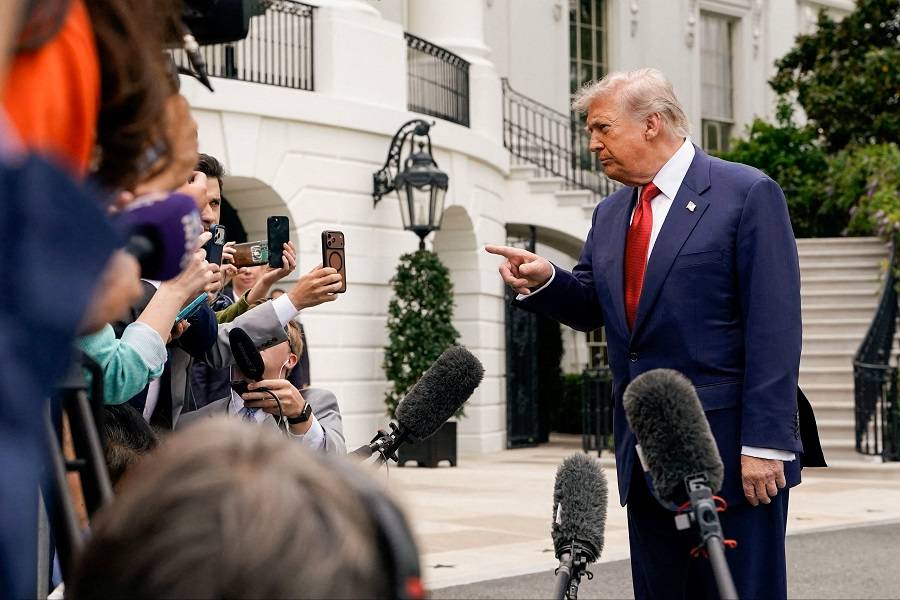
The recent visit of US President Donald Trump to the Chinese capital, Beijing, and the accompanying in-depth discussions on the Iranian file, have stirred the stagnant waters in the path of negotiations between Tehran and Washington. These moves come at a sensitive time when international parties are seeking to avoid military escalation in the region and prioritize diplomatic channels.
For his part, Iranian Foreign Minister Abbas Araqchi affirmed that his country shows tangible interest in returning to the negotiating table, but he linked this approach to the seriousness of the other party in reaching real understandings. Araqchi indicated that Tehran had received messages from Washington stating the American administration's readiness to continue the stalled nuclear talks.
In a related context, the Iranian minister explained that his country is making efforts to maintain the current ceasefire, with the aim of giving diplomacy sufficient opportunity to achieve breakthroughs in the outstanding issues. These statements reflect an Iranian desire to explore the intentions of the new Trump administration and its ability to provide acceptable guarantees.
On the American side, President Donald Trump showed unprecedented openness to a proposal for Iran to suspend its nuclear program for up to twenty years. The White House stipulates for the success of this proposal the existence of strict monitoring mechanisms that ensure full compliance by the Iranian side with all agreed-upon terms.
China strongly entered the crisis, driven by its vital economic interests, as Beijing relies heavily on oil imports passing through the Strait of Hormuz. The Chinese Foreign Ministry issued a series of positions emphasizing the necessity of adopting the language of dialogue and moving away from options of violence and war that threaten regional stability.
In this context, Chinese Foreign Minister Wang Yi called for the necessity of working to reopen the Strait of Hormuz as soon as possible to ensure the flow of global trade. Wang Yi added that his country encourages both the United States and Iran to resolve their disputes through diplomatic channels and direct and indirect talks.
The spokesperson for the Chinese Foreign Ministry stressed that energy security and supply chains represent a fundamental pillar in the Middle East that cannot be compromised. Beijing considered that regional stability requires a comprehensive agreement that takes into account the interests of all parties and ensures that the situation does not slide into a comprehensive confrontation.
Reports from Washington indicate that proposals related to freezing Iranian nuclear activity are not entirely new, but have been circulated in previous rounds. These visions included varying time periods for the freezing process, as Washington seeks to extract the longest possible period to ensure the crippling of Iranian nuclear capabilities.
Media sources revealed leaks indicating that US Vice President, JD Vance, during his recent visit to Islamabad, presented a detailed proposal for a 20-year freeze. It appears that the current US administration is adopting this proposal as a basic foundation for any future agreement with the regime in Tehran.
In contrast, Iran had previously adhered to a short freeze period not exceeding five years, which created a wide gap in views. With the intervention of the Pakistani mediator, the proposals began to converge, with the proposed period ranging between 10 to 12 years, before Trump returned to propose the twenty-year formula again.
The current American vision is based on a complete and comprehensive freeze of any nuclear activity within Iranian facilities, whether those declared to the International Atomic Energy Agency or undeclared. This approach aims to ensure that centrifuges cease operation permanently during the proposed agreement period.
The corresponding Iranian vision is based on accepting a specific freeze period, followed by allowing Tehran to resume uranium enrichment operations at a percentage not exceeding 3.67%. Iran considers the right to peaceful enrichment a red line that cannot be compromised in any final settlement with international powers.
The fate of highly enriched uranium stockpiles remains one of the most complex outstanding issues preventing a final agreement between the two parties. While Washington pressures for the transfer or full surrender of this stockpile, Tehran proposes depositing it with a third country as a guarantee, while retaining the right to reclaim it if Washington breaks the covenant.
President Trump seeks through these moves to formulate a new agreement that differs fundamentally from the 2015 agreement concluded by the Obama administration. Trump's team believes that the previous agreement suffered from temporal and oversight loopholes, and therefore they insist on imposing longer and stricter restrictions on Iranian nuclear ambitions.
Iran is interested in negotiating only if the other party is serious, and we have been informed by Washington of its readiness to continue talks.
Share your opinion
Chinese moves to bridge views between Washington and Tehran on the nuclear file