






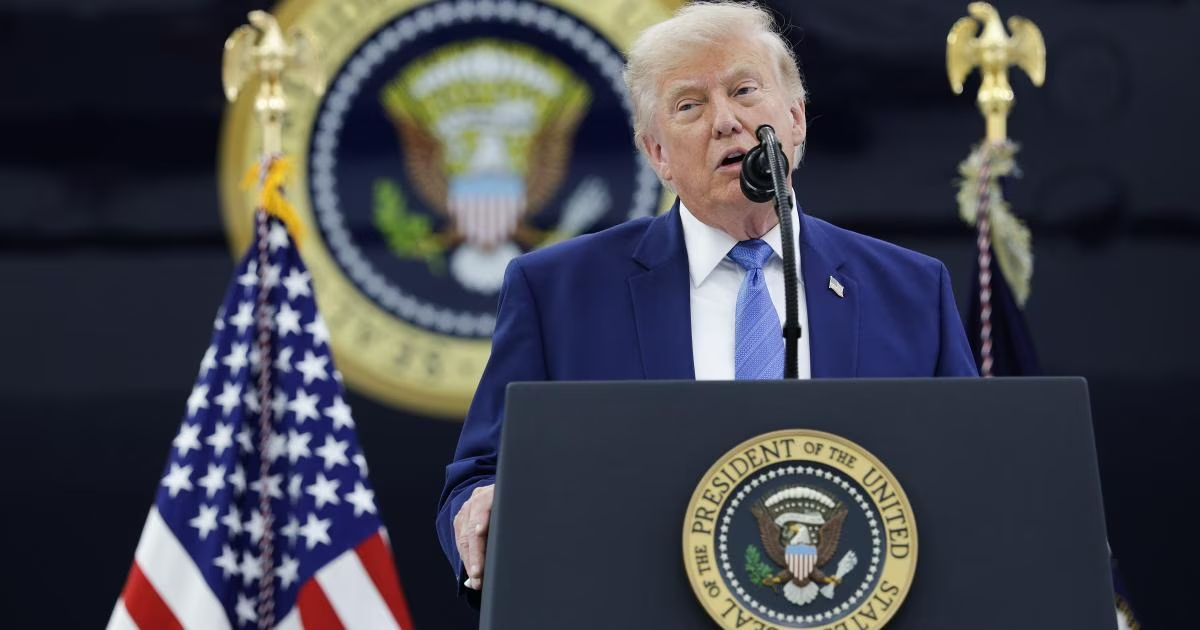
US President Donald Trump on Saturday hinted at the possibility of imposing American fees in the strategic Strait of Hormuz, indicating that this measure could be taken if ongoing negotiations with Iran fail. This threat comes as the announced 60-day ceasefire period approaches its end, placing additional pressure on the upcoming dialogue table.
Trump's statements coincide with the final preparations for the official talks between Washington and Tehran to begin at the Bürgenstock resort in Switzerland on Sunday. These meetings fall within the framework of the 'Islamabad Memorandum of Understanding,' which aims to end the ongoing military conflict between the United States and Israel on one side, and the Islamic Republic of Iran on the other.
The talks, which were scheduled to be held last Friday at the same resort, were postponed as the parties seek to reach a final and comprehensive agreement. These negotiations primarily focus on addressing the thorny issues related to Iran's nuclear and ballistic missile programs, and ensuring the stability of international waterways.
Through his 'Truth Social' platform, Trump affirmed his commitment not to impose any fees in the Strait of Hormuz throughout the current ceasefire period. However, he stressed that the United States would exercise its right to impose those fees after the deadline expires, unless an agreement is reached that satisfies American aspirations and secures its interests in the region.
The US President justified this approach by stating that it comes as compensation for the security and military services Washington has provided to protect Middle Eastern countries. He explained that the purpose of these fees is to cover the exorbitant financial costs incurred by the US Treasury in the past, and what it may bear in the future to secure the region.
In a related context, US Vice President J.D. Vance departed Washington for Switzerland to represent the US administration in this crucial round. In press statements before his departure, Vance expressed cautious optimism about the possibility of achieving a tangible breakthrough in the nuclear file, which represents the cornerstone of bilateral disagreements.
The Vice President indicated that the agenda of the talks would give top priority to the ceasefire file in Lebanon, in addition to nuclear issues. Vance affirmed that his presence in Switzerland would be for a short period, but he hopes to lay solid foundations for a lasting agreement that ends the state of military tension on multiple fronts.
For its part, Pakistani authorities announced high-level participation in the Bürgenstock talks, with Prime Minister Shehbaz Sharif and Army Chief of Staff Asim Munir representing Islamabad. Pakistan plays a pivotal role as a technical and political mediator to bridge the views between the two arch-rivals, Washington and Tehran.
The Pakistani Foreign Ministry confirmed that the meetings would include representatives from the United States and Iran, with the presence of mediators from Qatar and Pakistan to ensure the smooth conduct of negotiations. These steps complement the Memorandum of Understanding digitally signed in mid-June between Presidents Trump and Pezeshkian, which laid out a roadmap for peace.
The 'Islamabad Memorandum of Understanding' includes 14 basic clauses aimed at ending hostilities and resolving disputes through diplomatic channels. Among the most prominent provisions of the memorandum are the full reopening of the Strait of Hormuz to international navigation and the lifting of the US naval blockade imposed on Iranian ports in exchange for specific nuclear and security commitments.
No fees will be imposed in the Strait of Hormuz during the ceasefire period, unless imposed by the United States if no agreement is reached.
شارك برأيك
Trump hints at imposing fees in Strait of Hormuz ahead of Switzerland negotiations with Iran