






The rapid transformations in international conflicts in recent years have shown that traditional military superiority is no longer the sole guarantee for resolving disputes. According to international reports, superpowers have begun to realize that their ability to impose control over targeted countries now faces unprecedented technological and field obstacles.
Observers believe that modern technology has contributed to leveling the playing field between strong and weak nations, making traditional invasion wars extremely difficult. These developments have revealed that major powers do not possess the absolute influence they thought they enjoyed in past decades.
Despite some global leaders adopting the principle of 'might makes right' to reshape the international order, the reality on the ground has proven otherwise. The historical sayings that the powerful do as they please no longer apply to the complexities of contemporary warfare.
Sources indicate that the US military, despite its massive spending on long-range munitions and targeting Iranian leaders, has not been able to achieve a decisive strategic victory. Tehran still retains its ability to close vital waterways and launch missiles, reflecting the limits of American military power.
In the Ukrainian scene, Kyiv did not collapse despite significant diplomatic pressure and the cutting of military aid at certain stages. Instead, Ukrainian forces were able to turn the tide of the war and inflict painful blows deep into Russia, benefiting from qualitative technological superiority.
Drones and low-cost precision missiles have contributed to narrowing the gap between large regular armies and smaller forces. Diplomatic sources confirmed that this technological development has significantly limited what mere military power can achieve on battlefields.
China is closely monitoring these transformations as it considers its options regarding Taiwan, as Beijing realizes that a military invasion is no longer an easy stroll. The question arises whether military power alone can achieve long-term political goals in the face of popular resistance.
Italian Defense Minister Guido Crosetto affirmed that the model of traditional invasion and occupation wars is a thing of the past and no longer applicable. He stressed that the will of the people to fight makes it difficult for any superpower to achieve a quick and lasting victory.
The Palestinian example stands out as additional evidence for this theory, as Israel has achieved little success against resistance factions in the Gaza Strip despite the enormous disparity in capabilities. This field failure reinforces the conviction that changing regimes by military force alone has become an elusive goal.
Military leaders in Europe have acknowledged that swift attacks aimed at regime change often lead to an impenetrable dead end. Experts believe that failure to achieve military decisive action within the first weeks of a conflict means sinking into a long war of attrition.
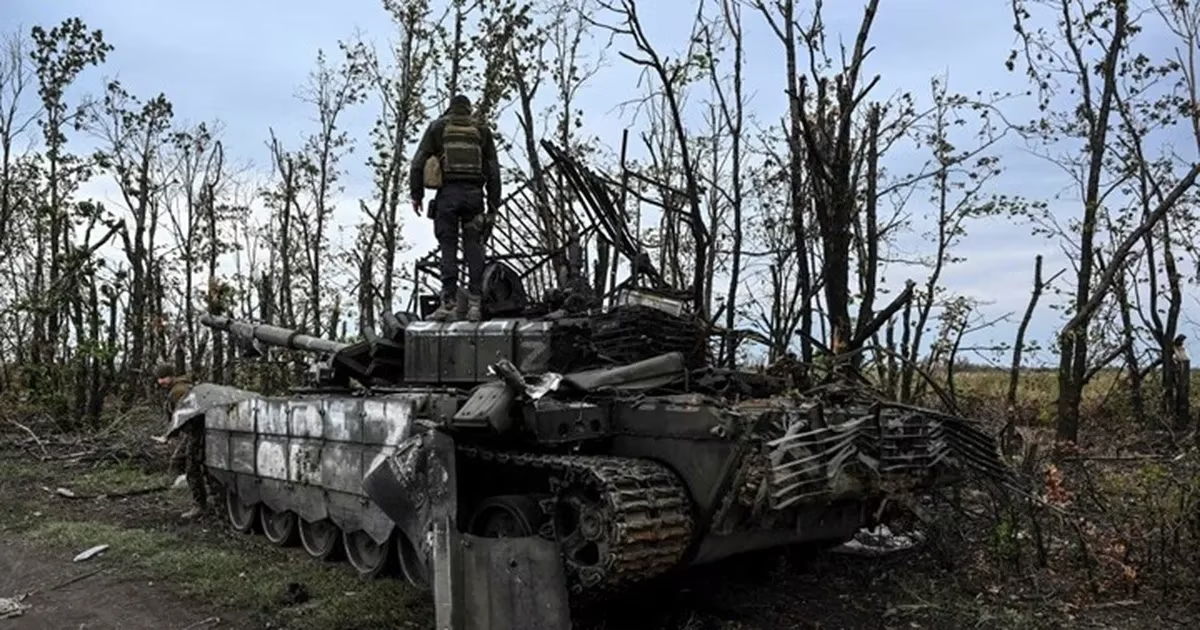
Historically, Washington and Moscow faced defeats in Vietnam and Afghanistan due to long-running insurgencies that drained popular support. But the difference today lies in the armies' inability to achieve even initial military victories, as happened with Russian tanks near Kyiv.
The revolution in drones and precision missile arsenals has eroded the enormous advantage that superpowers once enjoyed in reconnaissance and air power. It has become impossible to imagine traditional armored attacks achieving their objectives without incurring unbearable human and material losses.
Middle powers, such as Canada and European countries, are seeking to strengthen their military and economic alliances to reduce dependence on the American and Chinese poles. Analysts believe that the unity of these powers gives them the ability to resist the dictates of superpowers and impose independent international decisions.
The most important lesson from modern conflicts is that the will of the people and innovative technology have redefined the concept of power. The world is no longer an open arena for only the powerful, but has become a place where small nations possess effective tools to defend their sovereignty.
The type of war we were accustomed to, and the type of war Russia was planning in Ukraine - an invasion and occupation of a country - is no longer conceivable in the contemporary world.

شارك برأيك
The End of the Era of Traditional Invasion: How Technology Reshaped the Boundaries of Superpower?