






Washington Message
Washington – Said Arikat – 1/5/2026
The Democratic Party primary elections in Pennsylvania's Third District are witnessing a remarkable shift, with the issue of American support for Israel emerging as a crucial focal point in the race, surpassing traditional local issues. This shift reflects a repositioning within the Democratic base, which has begun to link foreign policy with domestic social justice priorities, according to "Mondoweiss."
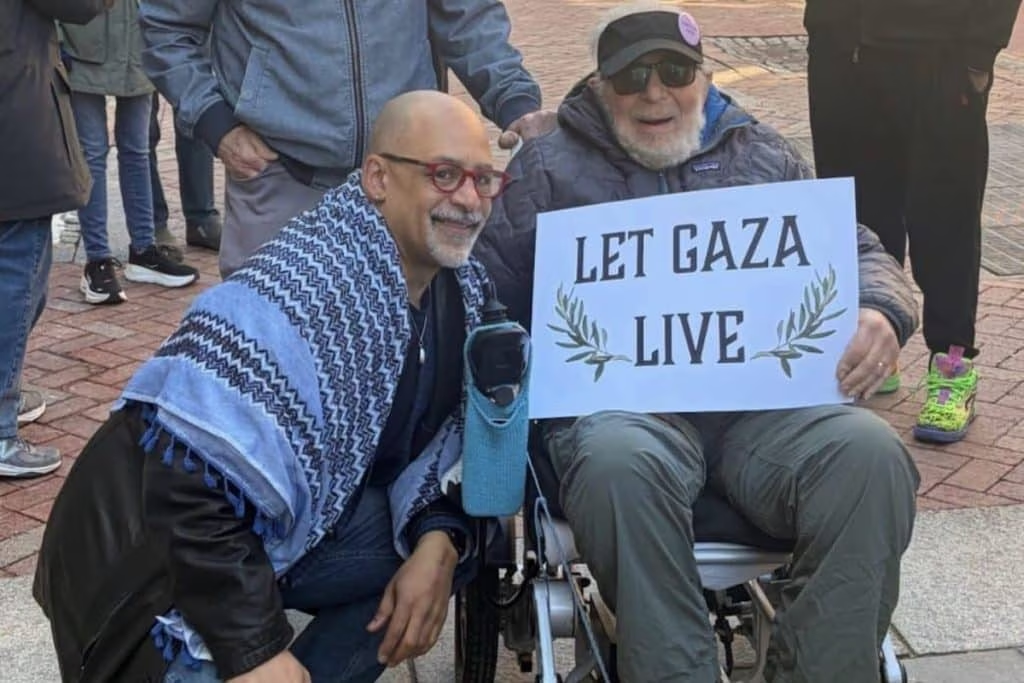
At the heart of this race is candidate Chris Rabb, who seeks to succeed retired Representative Dwight Evans, based on a progressive legislative record and explicit stances in defending Palestinian rights. Rabb's discourse is not limited to criticizing Israeli government policies; he adopts a comprehensive approach that calls for the right to self-determination for Palestinians, a permanent ceasefire, the release of detainees without fair trial, an embargo on arms exports to Israel, in addition to supporting the right of return for refugees.
His campaign asserts that this issue is no longer marginal but reflects a structural imbalance in US foreign policy directions, which is accused of prioritizing external military spending over domestic investment. This argument has resonated with segments of voters, especially in Philadelphia, where progressive bases are active and see the Palestinian issue as an extension of social justice struggles.
Activist Sarah Browning tells the website that the Democratic Party has failed to formulate a comprehensive economic and social vision, leading to feelings of marginalization among segments of the working class. She adds that Rabb's consistent stance on Palestine has enhanced his appeal, especially among voters who were disappointed with the party's performance in the last presidential election, where the Gaza war strongly factored into their political calculations.
For his part, Palestinian-American activist Samuel Qutab believes that Rabb is distinguished by the consistency of his positions and his boldness in confronting what he described as the stagnation within the Democratic establishment, noting that he was among the first to call for an end to the occupation and condemn what is happening in Gaza, according to the website.
These elections reveal a deep rift within the Democratic Party, extending beyond mere differences in vision to a struggle over defining the party's priorities. While the traditional current adheres to established foreign alliances, the progressive wing demands a re-evaluation of these relationships in light of declared human rights values. This tension reflects a broader shift in public sentiment, where foreign policy is no longer isolated from moral accountability. Moreover, linking external military spending to domestic decline in services reinforces a progressive populist discourse that finds receptive ears among youth and marginalized voters.
In contrast, Rabb faces strong competition from prominent figures, most notably State Senator Sharif Street and Dr. Alaa Stanford. Street adopts a more conservative stance; he described Israeli Prime Minister Benjamin Netanyahu as a war criminal but opposes imposing conditions on military aid to Israel and enjoys the support of pro-Israel liberal lobbying groups.
As for Stanford, she criticized Israeli government policies but sparked widespread controversy when she considered the use of the term “genocide” to describe what is happening in Gaza as harmful, likening it to the use of racist slurs. Despite her denial, Stanford received support from the American Israel Public Affairs Committee (AIPAC), and reports indicate an indirect flow of support through political action committees, highlighting the complexities of election funding and the role of lobbying groups.
Political funding plays a crucial role in shaping the outcomes of the democratic process in the United States, often reflecting the influence of lobbying groups more than the will of the voters. In this context, AIPAC's indirect role raises questions about transparency and accountability, especially when support is channeled through intermediaries. This pattern of funding deepens the trust gap between voters and political institutions and reinforces the impression that foreign policy is crafted behind closed doors. Furthermore, increasing public awareness of these mechanisms may be reflected in the ballot boxes, redrawing the boundaries of traditional influence within the party.
In contrast, Rabb has garnered significant support from prominent progressive figures, including Alexandria Ocasio-Cortez and Summer Lee, in addition to endorsements from organizations such as "Justice Democrats" and the "Sunrise Movement." He also received the support of the "Philadelphia Inquirer" newspaper, which defended the use of the term "genocide" as a legal and historical description, not an insult.
Rabb's supporters emphasize that his clear positions give him credibility at a time when skepticism towards traditional political discourse is increasing. Osama Andarabi, from the organization “s,” points out that this district is one of the most loyal to Democrats, making any intervention by lobbying groups a real test of their influence.
This electoral battle reflects a deeper shift in American political discourse, where the Palestinian issue has become part of an internal debate about the identity of the United States and its global role. The issue is no longer limited to foreign policy but has become linked to questions of justice, representation, and spending priorities. This overlap redefines the meaning of “progressivism” within the Democratic Party and forces its leaders to confront contradictions that have long been ignored. If candidates like Rabb succeed, it could mark a turning point that pushes the party towards more critical stances towards its traditional allies and reshapes the features of its foreign policy.
Given these facts, opinion polls indicate a close race, with Stanford leading by a narrow margin of no more than five points, according to a recent poll. While the outcome remains pending, it is clear that these elections have transcended their local boundaries to become a testing ground for the Democratic Party's directions and the future of its political discourse, at a moment when the United States is undergoing a rapid review of its domestic and foreign priorities.
شارك برأيك
Between Gaza and Philadelphia: A Conflict Within Democrats Redefines US Policy Priorities