






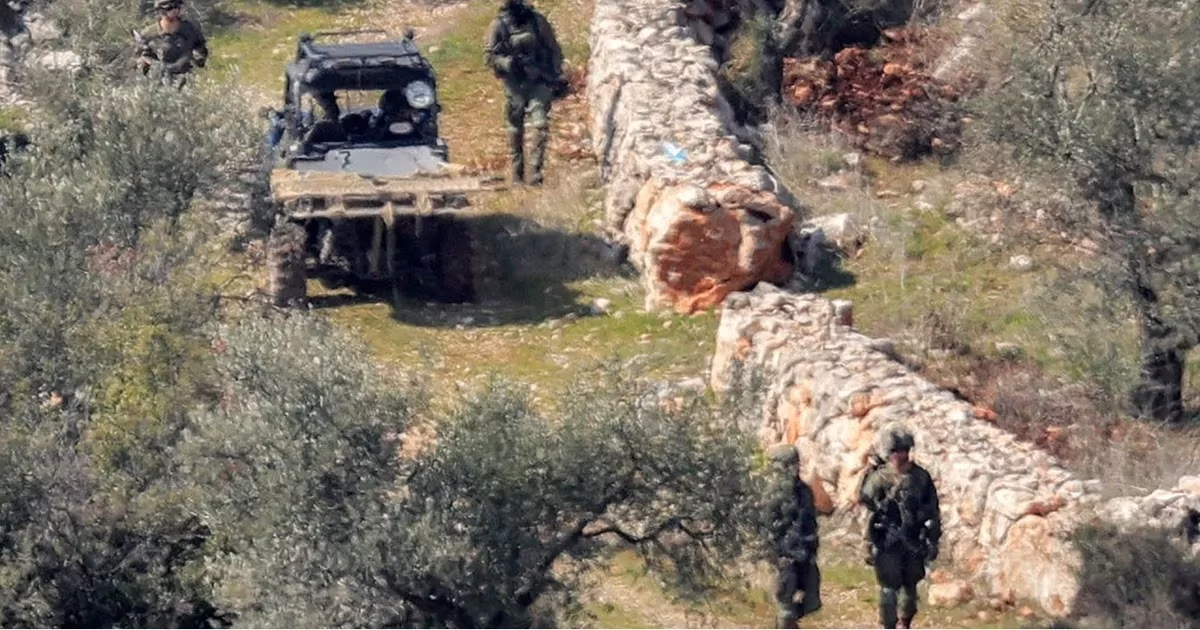
Hebrew media sources revealed escalating concerns within military circles in Tel Aviv about paying heavy costs due to the prolonged war in Lebanon. The sources indicated that the current strategy could lead to the attrition of Israeli forces in the absence of a clear and swift resolution to the ongoing confrontation with Hezbollah.
Currently, the Israeli army is operating five full military divisions in South Lebanon, with their tasks divided between deep penetration and securing the border line. These movements aim to pressure Hezbollah and prevent it from regaining its offensive capabilities in areas near northern settlements, through intensive air raids and ground operations.
Division 91 forces, under the command of Yuval Gaz, are working to deepen military activity to expand what is called the security zone along the border strip. This division seeks to create a new reality on the ground that prevents Hezbollah fighters from approaching the separation fence, in an attempt to provide longer-term protection for border areas.
In a related context, Division 146, led by Benny Aharon, is responsible for strengthening the front defensive line within Lebanese territory. The tasks of this force focus on protecting northern settlers from ground infiltrations, with military sources announcing the destruction of more than a thousand armed infrastructures and the killing of dozens of elements in its operational sector.
As for Division 36, led by Yiftah Norkin, it conducts deep maneuvers aimed at striking Hezbollah's military formations in areas previously untouched by forces. The operations of this division are characterized by secrecy, as full data regarding the results of its field operations have not yet been disclosed, according to Hebrew reports.
For its part, Division 98, led by Guy Levy, completed its deployment along the lines facing anti-tank threats. The forces are working to clear the area of warehouses and tunnels, in an attempt to reduce Hezbollah's ability to target Israeli vehicles moving in open areas and near villages.
Israeli military estimates indicate the elimination of more than 1,400 militants since the start of operations, and the destruction of thousands of logistical facilities. Despite these figures, the challenge remains in Hezbollah's ability to maneuver and force Israeli forces to divide their war effort between several combat axes.
Military sources admitted that Hezbollah succeeded in challenging the Northern Command, headed by Rafi Milo, by forcing the army to maneuver in depth. The army faces difficulty in identifying Hezbollah's main effort, which relies on Shiite villages as a central infrastructure for managing its defensive and offensive operations against the invading forces.
Division 98 forces were stationed at a distance of 5 to 6 kilometers from the border, a distance aimed at reducing the risk of guided missiles. However, Hezbollah's possession of anti-tank missiles with a range of up to 10 kilometers keeps Israeli forces under constant targeting despite being stationed in cleared areas.
Reports indicate that Hezbollah deployed about 1,000 fighters from the elite 'Radwan Force' to South Lebanon to strengthen its defensive lines. This move further complicated the Israeli mission, as the confrontation turned into a war of attrition based on mutual exhaustion and systematic clearing of residential and agricultural blocks.
The current pattern of military action raises significant concern within the Israeli home front, as it replicates the experience of fighting in the Gaza Strip, which has not yet achieved a decisive outcome. Military analysts fear that this pattern could lead to a long-term entanglement in the Lebanese quagmire without achieving clear political or security objectives.
The Israeli army is currently focused on destroying the logistical capabilities that allow Hezbollah to survive and operate for long periods in the rugged mountainous region. Operations include the destruction of strategic tunnels and weapons caches hidden underground, which form the backbone of Hezbollah's defensive system in the south.
Observers believe that the absence of a 'main trick' or element of surprise in the Israeli army's movements has made the forces vulnerable to encirclement and ambushes. This was evident in several combat centers where forces were surprised by the level of resistance, prompting the military leadership to constantly re-evaluate its field plans.
Ultimately, the question remains in Israeli circles about the utility of continuing operations at the same pace without an exit strategy. With rockets continuing to be launched towards the north, pressure is increasing on the Israeli government to find a solution that ends the state of attrition that has begun to exhaust the military budget and the morale of the soldiers.
The Israeli army largely replicates operational patterns from the Gaza Strip, where fighting has not yet ended, raising concerns about long-term attrition.
شارك برأيك
Israeli fears of long-term attrition in Lebanon and warnings of 'heavy costs'