






Hebrew press reports, citing sources in the occupation army, indicated that the military leadership is expressing growing concern about being drawn into a complex field situation in southern Lebanon. The sources clarified that the penetrating forces currently do not intend to advance northward, despite the Northern Command continuing to amass more military reinforcements on the front.
The sources pointed out that military units have already reached what is known as the 'front line' previously defined by operational plans. This geographical scope includes Lebanese villages located approximately ten kilometers from the Litani River, where the occupation seeks to establish its strongholds.
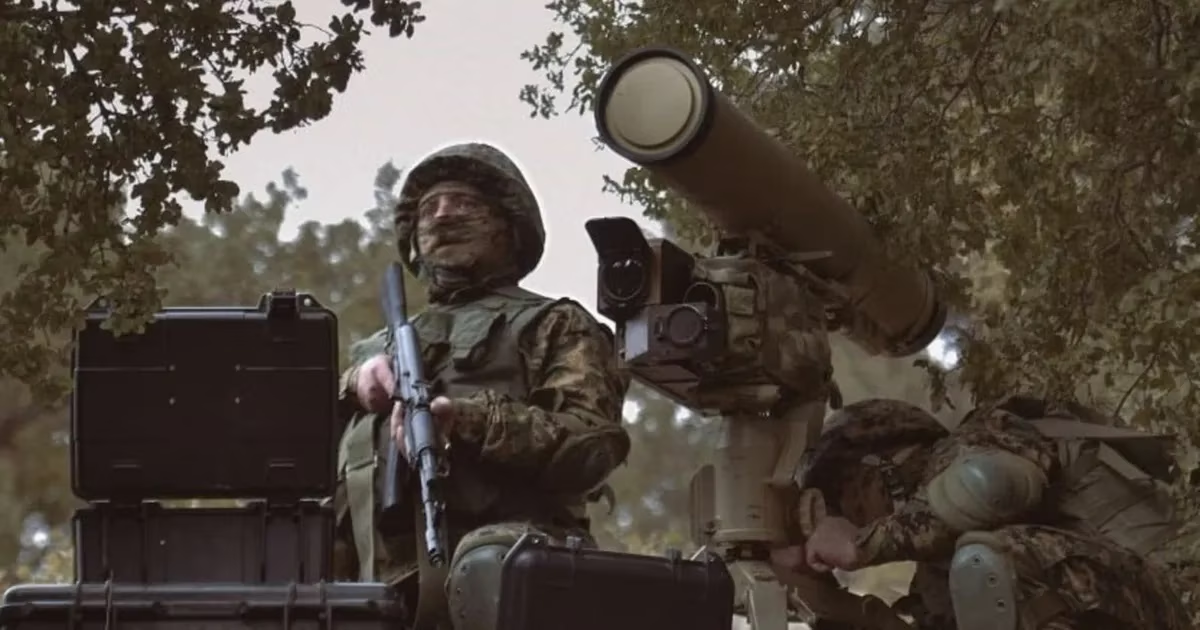
Army leaders believe that the current deployment primarily aims to secure settlements in northern occupied Palestine from anti-tank missile fire. Current operations also aim to thwart any infiltration attempts by Hezbollah fighters towards border areas, while avoiding a broader confrontation.
Reports spoke of serious concerns within the military establishment regarding the strategic link between the Iranian and Lebanese fronts at present. These sources believe that continued American involvement in a direct confrontation with Iran for a long period could hinder the occupation's ability to end the war in Lebanon unilaterally.
The occupation army has deployed four full military divisions to participate in ground operations, including all regular brigades in addition to a widespread call-up of reserve forces. These movements come amid increasing field pressures to secure the security belt that the occupation seeks to impose in the border region.
Military sources revealed that the leadership presented several options to the political level before the escalation began, ranging from limited operations to a 'broad decisive' plan. The decision ultimately settled on implementing the scaled-down plan currently underway, to avoid heavy human and political costs that could result from a full-scale invasion.
Recently, a clear gap has emerged in the media and political discourse between army commanders and ministers in the Israeli government. This disparity became evident after statements by a senior officer who indicated that disarming Hezbollah was not among the direct goals of the current war, which the army later rushed to deny.
Sources in the Northern Command stated that the contradiction between military intelligence assessments and politicians' statements contributes to the erosion of Israeli public trust in the operation's objectives. Field officers warn that raising political expectations may not align with the complex reality faced by forces on the ground.
For his part, Army Chief of Staff, Eyal Zamir, affirmed that the strategic objective is focused on transforming the area south of the Litani River into a completely demilitarized zone. However, it was noted that Zamir avoided giving categorical commitments to disarm Hezbollah throughout Lebanese territory, reflecting a cautious military realism.
Field data indicate that the occupation army is trying to balance achieving tangible security gains with avoiding getting bogged down in a new Lebanese 'quagmire'. Military circles fear that the absence of a clear political horizon could turn the military operation into a long-term attrition for regular and reserve forces.
Warnings continue within decision-making circles in Tel Aviv that Hezbollah still retains missile and tactical capabilities capable of inflicting losses on Israeli armor. This prompts the military leadership to demand greater clarity in political objectives to avoid repeating previous experiences in Lebanon that ended without real decisive action.
In a related context, Israeli security agencies are closely monitoring international reactions and diplomatic moves aimed at a ceasefire. Sources believe that any future agreement must ensure strict security arrangements that prevent the return of armed manifestations to areas from which the army withdrew or controlled.
The biggest challenge facing the occupation remains how to separate military and political tracks amidst the intertwining regional issues. Reports confirm that the coming days will be crucial in determining whether the army will be content with the current lines or will be forced to expand its operations under the pressure of the field reality.
There is a gap between military intelligence assessments and political statements, leading to an erosion of public trust.
شارك برأيك
Fears within the occupation army leadership of sliding into a complex operation in southern Lebanon