






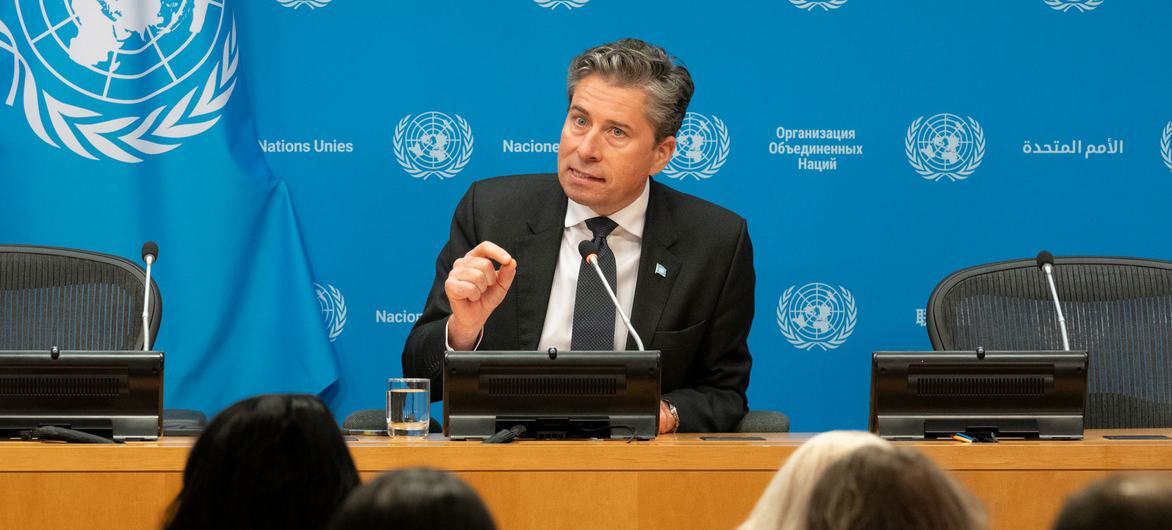
Tom Fletcher, the UN emergency relief chief, said that Israel eased some restrictions on the movement of aid into Gaza on Sunday, after Israel decided to "support an increase in the volume of aid for a week."
Fletcher added in a statement that initial reports indicate that more than 100 trucks loaded with aid have been collected from the crossings for transport to Gaza.
"This is progress, but massive amounts of aid are needed to ward off famine and a catastrophic health crisis," he added.
He said the UN would seek to reach "as many hungry people as possible" during the week.
Meanwhile, the UN World Food Programme confirms that it has enough food in the region, or on its way, to feed more than 2.1 million people in the Gaza Strip for approximately three months.
Hamas leader Khalil al-Hayya confirmed in his speech that progress had been made in the talks with Israel, and that the movement was surprised by the Israeli withdrawal. Al-Hayya, who currently resides in Qatar and is a member of the movement's negotiating team, said, "In the last round of negotiations, there was clear progress. We agreed to a large part of what the mediators proposed, and they conveyed to us positive responses from the Zionist occupation. We were surprised by the occupation's withdrawal from the negotiations," and that US Special Envoy Steve Voytkov "was coordinating with them."
Al-Hayya added that the occupation's Chief of Staff is covering up his army's failure to carry out genocide in Gaza, noting that the occupation's withdrawal from the negotiations is a transparent move aimed at wasting time and further genocide in Gaza.
Al-Hayya said there was no point in "continuing talks amidst a siege of destruction and starvation... We reject the shameful spectacle of so-called airdrops of aid. The real step is to open the crossings and allow aid to enter in a dignified manner for our people."
The Hamas leader also sharply criticized Egypt for its failure to aid Gaza, saying, "Egypt's leadership, its army, and its tribes—will your brothers in Gaza starve to death on your border?" He asked Cairo to "firmly declare that Gaza will not starve to death, and will not accept the Rafah crossing remaining closed to Gaza's residents."
Earlier on Sunday, Egyptian sources reported that aid trucks began entering Gaza from Egypt for the first time since the ceasefire on January 19.
On Sunday morning, Israel announced it would begin a daily "humanitarian truce" in three densely populated areas of Gaza, amid mounting international pressure to alleviate the worsening hunger crisis in the territory.
Other measures announced include the resumption of airlifts, the activation of the desalination plant, and the provision of humanitarian corridors to facilitate the delivery of UN aid to Gaza.
It's worth noting that last week, the Strip slid into a full-blown famine crisis, with dozens dying of starvation. According to the World Food Program, 90,000 women and children are in dire need of immediate treatment for malnutrition, while one in three people suffers from food shortages for days. Doctors in Gaza described their struggle to cope with the influx of patients seeking treatment for malnutrition, given the limited tools available to them to provide assistance.
"The malnutrition ward at the hospital is extremely overcrowded," Dr. Ahmed Al-Farra, director of the pediatric department at Nasser Medical Complex, said in a press statement. "Due to the large number of cases, some children are forced to sleep on the floor."
The hunger crisis has affected almost everyone in the Gaza Strip, with organizations like the United Nations describing their staff as “walking corpses.”
Even before the Israeli prime minister resumed the war on March 18, Israel had blocked all aid from entering Gaza on March 2, in what it described as an attempt to pressure Hamas to release the hostages.
In May, Israel began allowing small amounts of aid into Gaza, mostly through the US-backed Gaza Humanitarian Foundation (GHF). Israel proposed GHF as an alternative to the UN aid system after alleging—without providing evidence—that Hamas was systematically stealing aid from the UN.
More than 1,000 people have been killed while trying to obtain aid, most of them near food distribution sites run by the Gaza Humanitarian Foundation. In total, Israel has allowed 4,500 UN aid trucks into Gaza since May—an average of about 70 per day. This is a far cry from the pre-war numbers of 500 to 600 trucks per day, which the UN said was essential to help restore the health of Gaza's population.
The Israeli occupation authorities also announced the resumption of airdrops of aid, which humanitarian organizations said would provide a small amount of supplies. The Israeli occupation authorities also said that humanitarian corridors would be established to facilitate the entry of UN aid trucks into Gaza, although the number of trucks permitted to enter has not been specified.
NGOs say these steps may facilitate aid access, but with the ongoing mass famine, more is needed. In particular, humanitarian organizations have called for a complete ceasefire to deliver much-needed assistance to civilians.
For her part, Juliette Touma, UNRWA's Director of Communications, said in a statement on Sunday: "We must return to the levels we were at during the ceasefire, namely 500-600 aid trucks per day, managed by the United Nations, including UNRWA, and distributed by our teams at 400 distribution points."
She explained that relief agencies had previously succeeded in pulling Gaza back from the brink of famine, and that doing so again would require an unhindered flow of aid to "reverse the famine."
UNRWA, which Israel barred from operating in Gaza in January, has 6,000 aid trucks loaded with food, medicine, and other hygiene supplies in Jordan and Egypt. The World Food Programme said Sunday it has enough aid to feed Gaza's population for three months.
Israel's recent announcement also remains unclear regarding the duration of the ceasefires and corridors. Humanitarian workers have stated that consistency is essential to their work.
According to observers, Israel appears to be easing some of its restrictions on the UN's role in distributing aid in Gaza, but it is unclear to what extent. The UN has stated that it alone is capable of distributing aid efficiently within the Strip, pointing to the deadly killings around the World Health Organization facility as an example of the need for expertise.
Powered by Froala Editor
شارك برأيك
UN announces the easing of some restrictions on the movement of aid to Gaza.