PALESTINE

Sun 29 Mar 2026 7:57 am - Jerusalem Time

Deadly Escalation in Lebanon: 1189 Martyrs Since the Start of the Aggression, Hezbollah Sets Deadly Ambushes for the Occupation

The Lebanese Ministry of Health announced the martyrdom of 10 citizens and the injury of 12 others in an initial toll from two raids carried out by the Israeli occupation air force on Saturday evening, targeting the towns of Deir al-Zahrani and Kafrtibnit in the Nabatieh district in the south of the country. These new massacres come in the context of a continuous escalation that has led to the martyrdom of 47 people and the injury of 112 others in the past twenty-four hours alone.

Official data issued by the Lebanese health authorities revealed that the total number of martyrs since the start of the Israeli aggression on March 2 has risen to 1189 martyrs. Reports indicated that among the victims were 124 children and 86 women, reflecting the extent of direct targeting of civilians and residential areas in various Lebanese governorates.

On the ground, Hezbollah announced the execution of 32 diverse military operations on Saturday, targeting positions, gatherings, and movements of the Israeli occupation army. The resistance used advanced missiles, kamikaze drones, and artillery shells in its attacks, affirming that these operations come in response to continuous aggressions and the targeting of symbols and civilians.

In a rare official admission, the Israeli occupation army confirmed the injury of 9 of its soldiers, including two high-ranking officers, due to rocket barrages launched from southern Lebanon. Hebrew media sources reported that the injuries occurred among a force stationed in the border areas, without disclosing the severity of the injured's health condition.

A qualitative development occurred in the skies of Western Bekaa, where sources reported that resistance fighters confronted a manned reconnaissance aircraft of the 'RC12' type. Defensive fire forced the enemy aircraft to leave Lebanese airspace and retreat, in a move aimed at limiting the occupation's espionage capabilities and intelligence gathering deep inside Lebanon.

Regarding the destruction of vehicles, resistance data documented the targeting of 7 'Merkava' tanks and one 'Hummer' military vehicle using guided missiles. These targets were hit in the towns of Qantara, Dibel, and Bayada, where sources confirmed direct hits that led to the burning and destruction of a number of these vehicles and casualties among their crews.

The resistance's strikes extended to the strategic depth of the occupation, targeting the 'Mishar' base, which is the main intelligence headquarters for the northern region. The shelling also hit the 'Dado' base, the headquarters of the northern region command, and the 'Nashrim' base located southeast of Haifa, activating sirens over wide areas.

In details of the ground operations, Hezbollah revealed that an Israeli force was lured into a well-planned ambush at 'Baydar al-Faqani' in the border town of Taybeh. Sources explained that the Israeli force, which attempted to advance towards the Litani River, fell into a 'killing zone' prepared in advance by the fighters, where they were targeted with a barrage of shells and missiles.

Field reports confirmed that clashes in the ambush area continued for long hours, forcing the occupation army to request air reinforcements and launch dense smoke bombs. Israeli helicopters were seen attempting to evacuate the dead and wounded from the battlefield under intense covering fire, in an attempt to limit the heavy human losses suffered by the advancing force.

In the town of Bayada, resistance fighters engaged in fierce close-range clashes with an Israeli force entrenched inside a house, inflicting direct casualties among them. The confrontations also included the western outskirts of the town of Shama and the Al-Hazan area in the town of Qantara, where light and medium weapons were used to repel attempts at ground infiltration.

On the other side of the border, settlers in occupied northern Palestine experienced a day of terror, as residents of Acre, Haifa Bay, and Galilee were forced to take shelter 16 times. Hebrew media acknowledged that the pace of rocket and drone launches had not subsided since midnight on Friday, completely paralyzing movement in the major northern cities.

The resistance's rocket barrages directly targeted the settlements of Malkia, Avivim, and Shlomi, causing extensive material damage to properties. Field sources indicated that the shelling also included newly established artillery positions of the occupation in the town of Arab al-Luweiza and radar sites in Bayada, to disrupt the Israeli army's surveillance and artillery capabilities.

Current data indicate that the Israeli occupation is facing fierce and unexpected resistance in the limited ground infiltration axes it began in early March. Despite heavy air cover and alleged American participation in the operations, Israeli ground forces continue to suffer continuous attrition in lives and equipment on the front line of the border.

The humanitarian situation in Lebanon remains in continuous deterioration with the ongoing air raids targeting infrastructure and residential homes in the South, Bekaa, and the Southern Suburb. Ambulance and civil defense teams continue search operations for missing persons under the rubble, amidst international warnings of the conflict's expansion and its transformation into a comprehensive regional war.

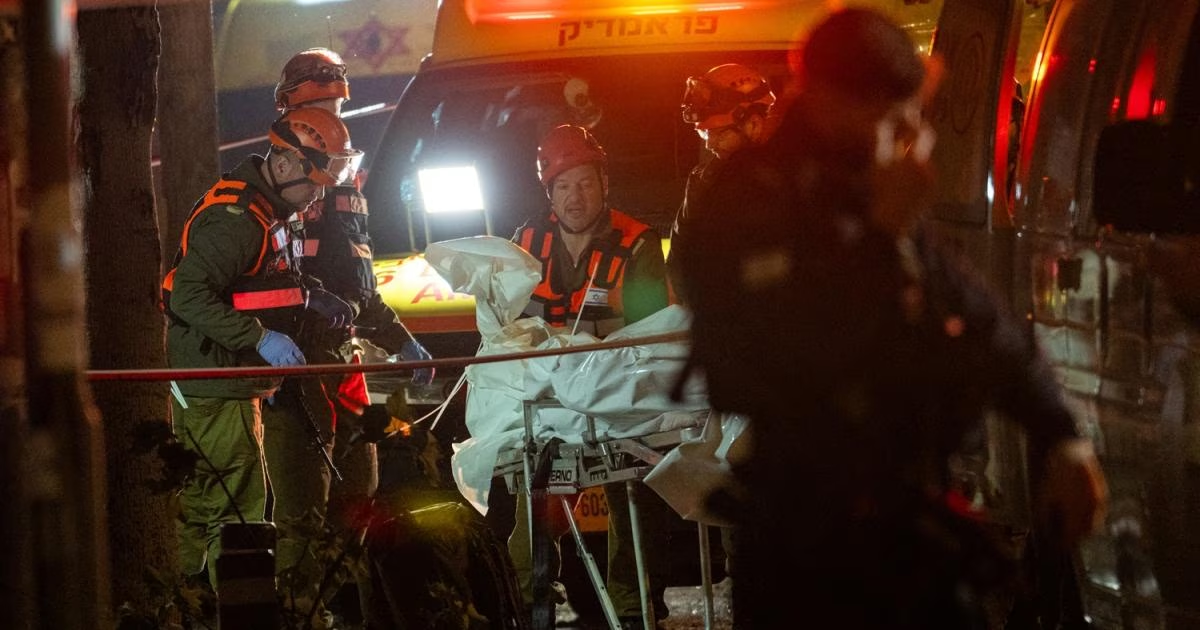
The ambush area in the town of Taybeh turned into a killing zone, resulting in casualties among the Israeli force that the occupation attempted to evacuate under intense covering fire.

PALESTINE

Sun 29 Mar 2026 7:57 am - Jerusalem Time

Documents Reveal 'Mossad' Plot to Displace Thousands of Gazans to Paraguay: History Repeats Itself

A lengthy investigative report by journalist Ben Reiff, deputy editor of the Hebrew magazine '972+', uncovered astonishing details of a secret plan led by the Israeli Mossad intelligence agency in the late 1960s. The plan aimed to displace tens of thousands of Palestinians from the Gaza Strip to Paraguay in South America, in an attempt to change the demographic composition of the occupied territory.

The investigation was based on a podcast series titled 'Palestinians in Paraguay' and official archival documents, which revealed an attempt to expel 60,000 Palestinians. The details of this plan intersect chillingly with current Israeli policies towards the Gaza Strip, especially after two years of war and widespread destruction currently witnessed in the Strip.

The chapters of deception began in September 1969, when the Mossad lured about 20 young Palestinian men to travel through an Israeli airport, deceiving them into believing they were heading to Brazil for work with attractive salaries. The fictitious program was managed by a travel agency called 'Batra,' and promised salaries of up to $3,000 per month and the possibility of their families joining them later.

Instead of arriving in Brazil, the young men found themselves in Paraguay's capital, Asunción, under the rule of dictator Alfredo Stroessner, without work, housing, or knowledge of the local language. The investigation confirmed that these men were stripped of their true identities and given identity cards with random professions before being left in completely isolated rural areas.

Talal Al-Dimasi, one of the survivors of that deception, recounts how he was explicitly threatened with the expulsion of his entire family if he did not join the program, describing it as a threat disguised as economic opportunities. Documents reveal that Israel agreed to pay $33 for each displaced person to the Paraguayan government, with an advance payment of $350,000 for the first 10,000 people.

The plan aimed to empty the Gaza Strip of a large percentage of its youth, as the population at the time did not exceed 400,000. Although the actual number of deportees remained unclear, Israeli documents dated May 1969 confirm that the project targeted a wide segment of Palestinian society in Gaza.

The operation did not last long due to the resistance of the displaced themselves and the harsh conditions they faced, which led some of them to flee to neighboring countries. In a dramatic turning point, Talal Al-Dimasi and his companion Khaled Kassab stormed the Israeli embassy in Asunción in 1970 to confront the ambassador, resulting in the death of the ambassador's secretary and injuries to others.

This clash caused a wide media uproar, and despite attempts to portray it as a political assassination, the trial revealed to the world the details of the secret 'Paraguay plot.' This public revelation forced the occupation authorities to completely halt the program, after the two young Palestinians spent years in prison during which they were subjected to assassination attempts.

The investigation links these historical events to current Israeli policies that seek to maximize control over the land while reducing the number of Palestinians. The author points out that this approach has continued since the Nakba of 1948 and the Naksa of 1967, where the strategy of displacement remains present in the Israeli security and political mindset.

These plans resurfaced strongly after the events of October 7, 2023, when Israeli officials put forward proposals for the deportation of Gaza residents under the guise of 'voluntary migration.' The investigation referred to statements by ministers such as Bezalel Smotrich and Itamar Ben-Gvir explicitly calling for the establishment of offices to organize the emigration of Palestinians abroad.

The investigation quoted Prime Minister Benjamin Netanyahu as saying that the destruction of homes in Gaza would lead to a clear outcome: emigration. '972+' magazine revealed recent operations suspected of being an extension of this approach, including organizing trips to transport Palestinians from Gaza to various countries without prior coordination with those countries.

Last November, the investigation tracked a mysterious flight that transported 153 Palestinians from Ramon Airport in the Negev to South Africa via Kenya. The passengers did not know their final destination and were not provided with accommodation, and it turned out that the flight was organized by a group called 'Al-Majd Europe' owned by an Israeli-Estonian businessman with an official license.

Despite the intense bombing and the destruction of 90% of the infrastructure in Gaza to force residents to leave, the investigation confirms that the mass displacement project is facing a dismal failure. The current Palestinian steadfastness recalls the failure of the 'Paraguay plan' in the 1960s, as Gazans refuse to leave their land despite all attempts to make the Strip uninhabitable.

The investigation concludes that the 'Paraguay plan' was not an isolated historical incident, but an early model for policies that are repeated in different forms to this day. Despite Israeli insistence on reducing the Palestinian presence, history proves that attempts at mass displacement always collide with the unwavering Palestinian will to survive.

By my actions, I saved 60,000 Palestinians who would have been deported to Paraguay… They remained in their homeland.

PALESTINE

Sun 29 Mar 2026 7:57 am - Jerusalem Time

Martyrdom of prisoner Marwan Harzallah in Megiddo prison and the rising list of martyrs of the prisoner movement

The General Authority for Civil Affairs announced on Saturday the martyrdom of Palestinian prisoner Marwan Fathi Hussein Harzallah inside Israeli occupation prisons. The authority clarified that it had informed the relevant official bodies, including the Commission of Detainees and Ex-Detainees Affairs and the Palestinian Prisoners' Society, of the details of the martyrdom of the 54-year-old prisoner.

Human rights sources reported that the martyr Harzallah, a resident of Nablus city in the northern West Bank, died in 'Megiddo' prison, located in the northern occupied territories. The occupation had arrested Harzallah on January 8, 2026, where he suffered from harsh detention conditions coinciding with the escalation of systematic violations against detainees.

With Harzallah's death, the number of martyrs of the Palestinian prisoner movement whose identities have been announced since the start of the genocide war in October 2023 rises to 89 martyrs. Statistics indicate that among these martyrs, 53 detainees from the Gaza Strip died as a result of torture and deliberate medical negligence.

Historical data from the Palestinian Prisoners' Society indicates that the total number of martyrs of the prisoner movement since 1967 has reached approximately 326 martyrs. These figures are limited to martyrs whose identities have been verified and whose martyrdom circumstances have been documented by specialized human rights institutions, amid fears of a larger undeclared number.

For its part, the Prisoners' Information Office considered Harzallah's martyrdom a new link in the chain of systematic killing and enforced disappearance crimes practiced by the occupation authorities. The office affirmed that these practices come within a policy aimed at physically liquidating prisoners through continuous torture and abuse away from international oversight.

Palestinian sources stressed that these crimes amount to war crimes that require urgent international action to hold the occupation leaders accountable. They pointed out that the shameful international silence provides the occupation with political and judicial cover to continue its policies of starvation and deliberate medical negligence against thousands of detainees.

In a related context, prisoner institutions warned of the danger of the Palestinian prisoners' execution bill recently passed in the Israeli Knesset. The institutions described this legislation as an unprecedented escalation that directly threatens the lives of prisoners and disregards all international humanitarian laws and conventions.

The Knesset's National Security Committee had approved the bill in its final reading, in preparation for its presentation to the General Assembly for a final vote next week. This law aims to legalize direct killings of prisoners, which portends the most dangerous phase for the fate of Palestinian detainees in prisons.

These developments coincide with the ongoing widespread Israeli attacks in the West Bank, which have resulted in the martyrdom of 1137 Palestinians and the injury of thousands of others since October 2023. Arrest campaigns have also peaked, with the number of detainees reaching approximately 22,000 Palestinians, living in conditions lacking the most basic human necessities.

Human rights organizations called on the international community and humanitarian institutions to assume their legal and moral responsibilities to stop these escalating violations. They called for the necessity of sending international investigation committees to examine the conditions inside Israeli prisons and to work for the release of prisoners who face the daily risk of death.

The death of martyr Harzallah inside prisons adds to the continuous record of occupation crimes against prisoners, as part of a systematic killing and enforced disappearance policy.

ARAB AND WORLD

Sun 29 Mar 2026 7:57 am - Jerusalem Time

Vance announces achievement of military objectives in Iran and targeting of water facility in Khuzestan

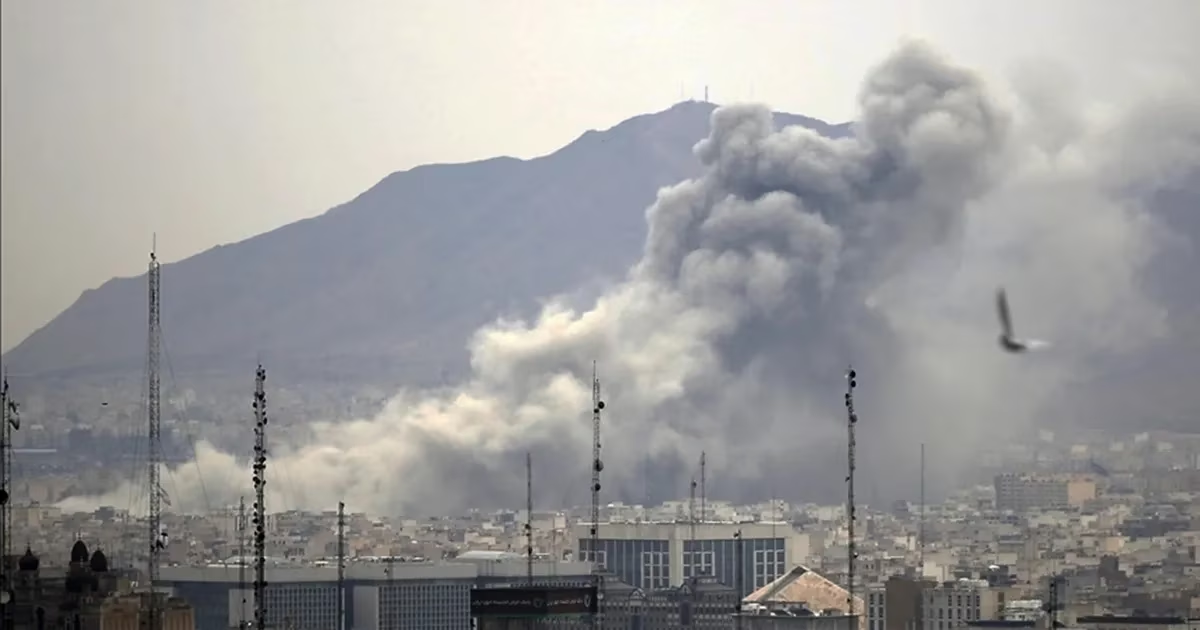
Local authorities in Iran's Khuzestan province revealed that a vital facility was subjected to an aerial attack carried out by American and Israeli forces, targeting a strategic water reservoir in Haftkel city. The assistant governor of Khuzestan for security affairs, Waliullah Hayati, clarified that the targeted facility has a capacity of about 10,000 cubic meters, confirming that the attack caused no human casualties.

The Iranian official reassured citizens that the bombed reservoir was designated for reserve use only, indicating that drinking water supplies in the region were not affected and did not experience any interruptions. This incident comes in the context of a large-scale military escalation witnessed in Iranian territories for weeks as a result of joint operations by Washington and Tel Aviv.

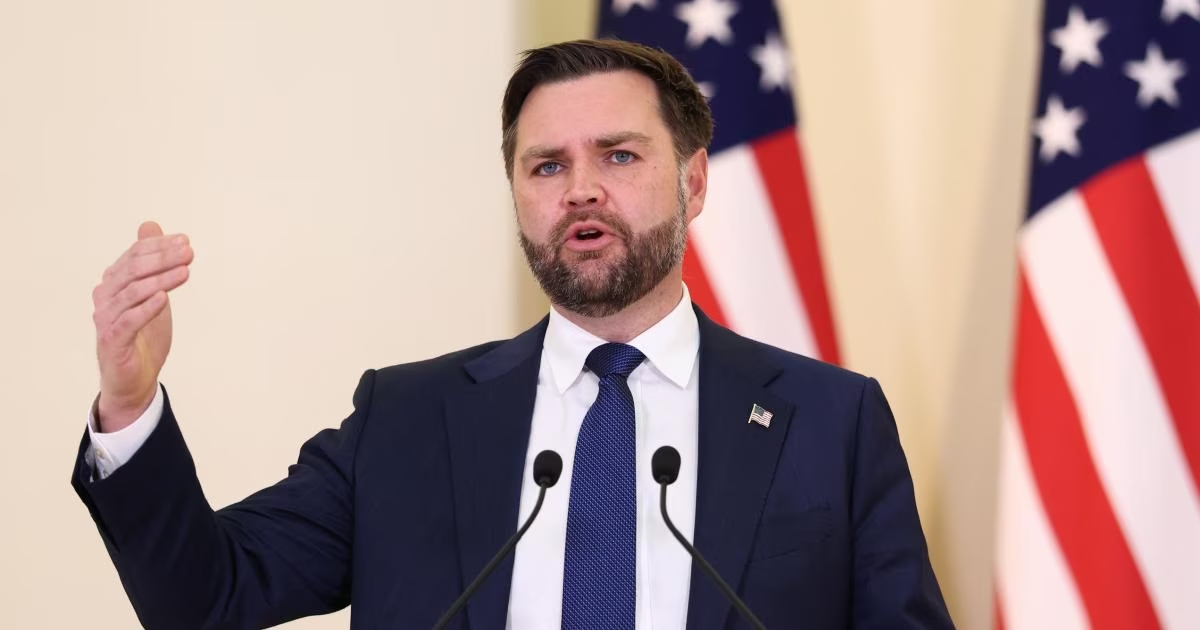
For his part, US Vice President J.D. Vance announced that the ongoing military operations in Iran have achieved the vast majority of the objectives set by the military leadership. Vance indicated in press statements that coordination with the Israeli side led to the neutralization of sensitive capabilities that posed a direct threat to regional and international security.

Vance affirmed that President Donald Trump intends to continue military pressure for a specified period to ensure there is no need to return to such operations in the near future. He stressed that Washington's strategic goal is to prevent Tehran from developing a nuclear weapon and to reduce its military influence that threatens American interests.

Regarding economic repercussions, the US Vice President described the noticeable rise in fuel prices as a natural and temporary result of the ongoing military operations. Vance expected energy markets to stabilize and prices to fall once the military mission ends and US forces leave the region soon.

The region has been witnessing an intense conflict since late February, with American and Israeli forces launching intensive attacks, while Tehran responds by firing barrages of missiles and drones. The mutual shelling has affected several strategic points, leading to a state of security and political alert throughout the Middle East.

Sources reported that the Iranian counter-attacks targeted sites that Tehran described as American bases and interests in some neighboring Arab countries. These attacks drew widespread condemnation from the affected countries, which called for an immediate cessation of aggressions and sparing civilian targets the ravages of armed conflict.

On the navigation front, tensions caused severe disruptions after Iran announced restrictions on ship movement in the strategic Strait of Hormuz since early March. Tehran threatened to target any tanker passing through the strait without prior coordination, leading to a significant jump in marine insurance costs and global oil shipping.

The Strait of Hormuz is the main lifeline for the global economy, with about 20 million barrels of crude oil flowing through it daily to international markets. The threat of its closure has raised serious concerns about a comprehensive global energy crisis, amid the continuous rise in inflation rates and the impact on global supply chains.

Major capitals are cautiously monitoring the course of the current military confrontation, amidst international calls for de-escalation and avoiding a slide into a comprehensive regional war. With military operations continuing, the scene remains open to all possibilities, especially with Washington's insistence on achieving its full objectives before withdrawal.

We have achieved all our military objectives, and we will continue to work for a period so that we do not have to do so again for a very long time.

PALESTINE

Sun 29 Mar 2026 7:56 am - Jerusalem Time

Houthis announce second missile attack on Israeli targets in southern Palestine

Yemeni sources reported on Saturday evening that the Houthi group carried out a second military operation targeting sites belonging to the Israeli occupation, as part of a new escalation that the group called the 'Battle of Holy Jihad.' The group's military spokesman, Yahya Saree, explained that the attack was carried out using winged missiles and suicide drones.

According to the military statement issued by the group, the strikes focused on vital and sensitive military targets located in the southern regions of occupied Palestine. The sources confirmed that the operation achieved its precisely drawn objectives, noting that this move comes in response to the continued crimes and massacres committed by the occupation in the region.

The military spokesman indicated that this attack coincided with widespread military movements by regional powers, aimed at enhancing coordination among the various resistance fronts. He stressed that the group's armed forces are working within a unified vision to support the resistance in Palestine, Lebanon, Iraq, and Iran to confront Israeli schemes.

In a related context, the group vowed to continue its military operations in the coming days, asserting that the attacks will not stop until the comprehensive Israeli aggression ceases. The group considered these operations a religious and moral duty towards peoples subjected to direct targeting by the Israeli war machine.

The group had announced earlier on Saturday the execution of its first military operation since the start of the current escalation, using long-range ballistic missiles. That operation targeted military sites described by the group as 'sensitive,' confirming that the Israeli interior is now within the direct targeting range of its forces.

The Houthi military leadership warned against any attempts to form international alliances led by the United States aimed at protecting the occupation or targeting the axis supporting Palestine. It affirmed that 'hands are on the trigger' for direct intervention if Iran or any of the countries of the Axis of Resistance are subjected to a large-scale military attack.

The speech also included a strong warning against the use of the Red Sea as a launching point for hostile operations against Islamic countries or to impose a new blockade on the Yemeni people. The group clarified that any move in this direction would be met with a decisive military response that would completely change the course of operations in the region.

The group concluded its statement by emphasizing that the theater of military operations imposes a new reality that requires preparation for all possibilities, including expanding the scope of confrontation. The group linked the stability of the region to the cessation of Israeli military escalation and the lifting of the blockade on peoples affected by American and Israeli policies.

Our operations come in support of the resistance fronts in Palestine, Iraq, Lebanon, and Iran, and to confront the Zionist scheme in the region.

ARAB AND WORLD

Sun 29 Mar 2026 7:56 am - Jerusalem Time

Fareed Zakaria: Trump's Contradictions on the Iranian File Undermine American Credibility and Create a Global Crisis

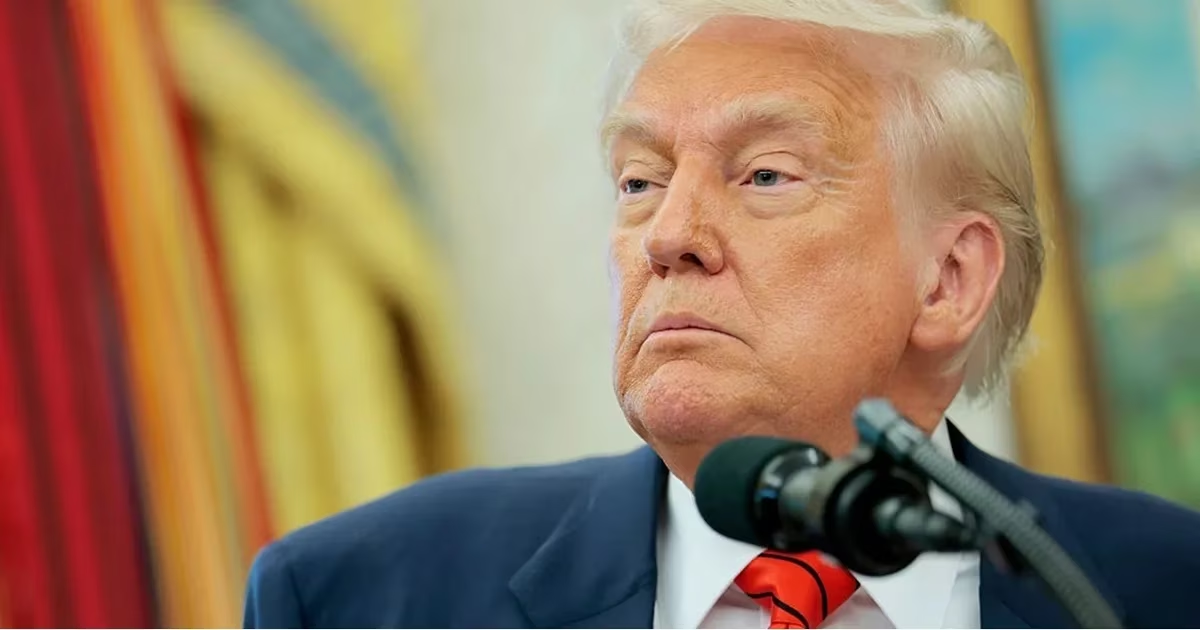
American journalist Fareed Zakaria, in an article published by the Washington Post, considered President Donald Trump's policies towards Iran to be a diplomatic disaster of his own making. Zakaria compared Trump's current floundering to former President Barack Obama's 'red line' mistake in Syria, noting that Obama's retreat at the time now seems more rational and wise given the magnitude of contradictions plaguing the White House today.

The article highlighted the threat Trump issued last week via social media platforms, giving Tehran 48 hours to fully open the Strait of Hormuz without conditions. Trump threatened, in case of non-compliance, to strike and destroy Iranian power plants, starting with major facilities, in an escalation that observers described as potentially igniting a comprehensive and uncontrollable regional confrontation.

Despite Iran's explicit refusal to comply with these threats and the continued closure of the strait, Trump's reaction was completely contrary to his previous promise. The American president unexpectedly announced a five-day postponement of military strikes, speaking of 'fruitful talks' with the Iranian side, which Tehran quickly and completely denied, putting the American administration in an embarrassing position.

The retreat did not stop there; Trump extended the truce for an additional week and a half, making his statements subject to changing and unstable standards before the international community. Zakaria believes that Trump's positions, whether raising tariffs or threatening to destroy gas fields, change within a few days, causing allies and adversaries alike to lose the ability to predict the next American move.

In a striking paradox, Trump announced on one day that the war was 'almost over,' only to return hours later and confirm that the victories achieved were insufficient and that he would not back down until a crushing defeat of the enemy was achieved. He also expressed his willingness to negotiate with Iranian leaders, before retracting again under the pretext of their deaths in military operations carried out by American and Israeli forces, which reflects a state of inconsistency in crisis management.

In a related context, previous reports indicate that American discourse towards the region has taken on a sharp ideological character, with the American Secretary of War describing the current conflict as resembling 'the Crusades.' This trend reflects the evangelical West's use of religious discourse as a tool to strip Arab peoples of their material and spiritual wealth, an extension of an orientalist ideology that historically paved the way for European colonialism in the region.

Analysts believe that modern Europe and the United States employ religious violence and accuse others of it, while monopolizing human rights discourse to justify military interventions. These powers view those belonging to the region as an Islamic bloc in an existential struggle, regardless of their political orientations, which explains the enthusiastic support shown by some of Trump's supporters for the current war despite their previous opposition to Middle East wars.

Zakaria asserts that the fundamental problem is that Trump may not find an easy way out of this war, given Iran's military capabilities that enable it to inflict severe damage on the global economy. While Trump's supporters see this contradiction as 'strategic genius' aimed at confusing adversaries, experts believe that policy fluctuations result from market disturbances and narrow internal political considerations that do not serve long-term national interests.

The article concluded by noting that American credibility has turned into something like a 'strange television show,' where the president tries to resolve crises that were essentially born from his reckless statements. After previously hinting that protecting the Strait of Hormuz was not Washington's concern, he returned to make it the focus of a global conflict, amidst praise from businessmen who previously criticized the instability of government policies and their negative impact on markets.

Obama's retreat from the red line in Syria now seems wiser compared to what has happened since the start of the Iranian war and the erratic nature of Trump's positions.

PALESTINE

Sun 29 Mar 2026 7:56 am - Jerusalem Time

Injuries and Arrests in Masafer Yatta Following Attacks by Settlers and Occupation Forces

A Palestinian teenager and a foreign solidarity activist sustained varying injuries on Saturday evening, following an attack carried out by groups of settlers in the Masafer Yatta area, south of Hebron city. Medical sources from the Red Crescent Society confirmed that their teams provided first aid to the injured, who suffered severe beating and pepper spray, noting that one of the injured was a teenager not exceeding sixteen years of age.

In details of the assault, local sources reported that settlers attacked the family of citizen Mohammed Abdul Rahman Al-Jabareen in the eastern part of the village of Sha'ab al-Butm. The attack resulted in injuries to the teenager Suhaib Raed Badawi, who sustained bruises and contusions throughout his body, in addition to the injury of a foreign activist who was present at the scene to document the ongoing violations against the residents.

Concurrently, occupation forces stormed the 'Abu Shaban' area in Masafer Yatta and launched an arrest campaign targeting four Palestinian citizens. These arrests followed sheep herders confronting an attack by settlers on their pastures, where army forces provided protection to the aggressors and pursued and arrested the residents, taking them to an unknown destination.

Reports issued by the Wall and Settlement Resistance Commission indicate a dangerous escalation in the pace of settler attacks, with more than 440 attacks recorded in the last month alone. These systematic attacks aim to pressure Palestinians in Area 'C' to forcibly displace them from their lands for the benefit of illegal settlement expansion.

The occupied Palestinian territories have been experiencing a state of severe tension since late February, amidst the integrated roles of the occupation army and armed settlers. These violations vary between direct killing, demolition of residential and agricultural structures, and preventing farmers from accessing their lands, amid warnings of Israeli plans to annex large parts of the West Bank.

It is worth noting that statistics from human rights organizations indicate the martyrdom of 1137 Palestinians in the West Bank since October 8, 2023, while the number of injured has exceeded 11,000. Arrest campaigns have also escalated unprecedentedly, affecting about 22,000 citizens, under harsh detention conditions imposed by the occupation authorities inside prisons.

Settlers have exploited the current situation to intensify their attacks on Palestinian villages and communities, with the Wall Resistance Commission recording 443 attacks within one month.

ARAB AND WORLD

Sun 29 Mar 2026 7:56 am - Jerusalem Time

Trump threatens to restructure NATO: 'Pay for influence' and disenfranchise non-compliant members

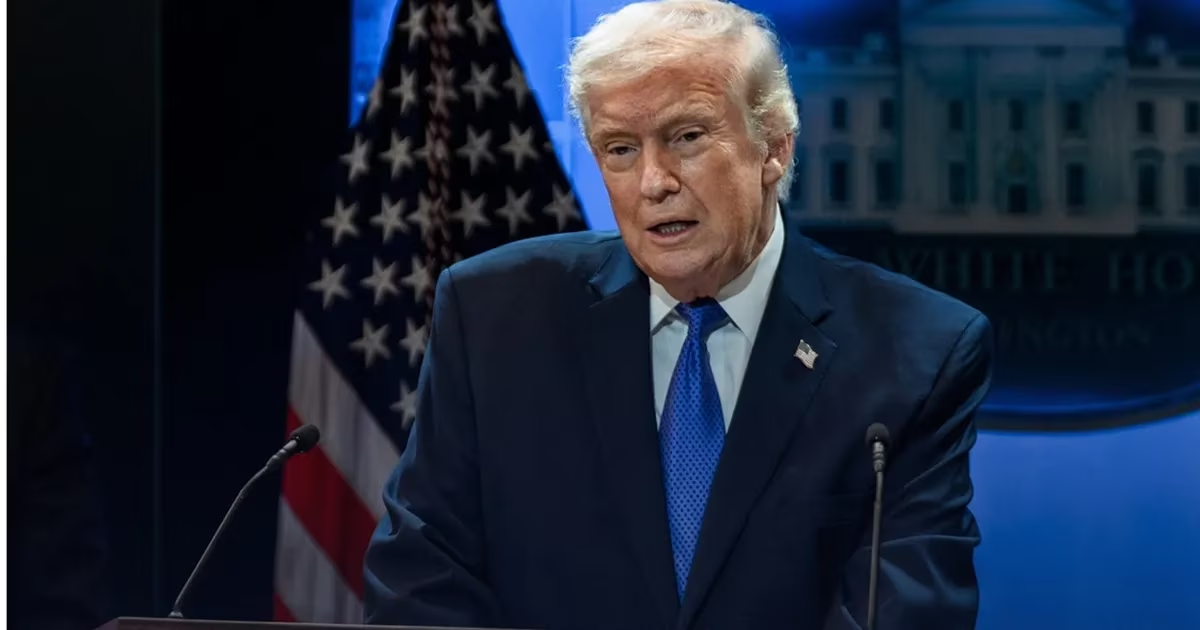
U.S. President Donald Trump is moving towards imposing radical changes in the structure of the North Atlantic Treaty Organization (NATO), aiming to link political influence and decision-making power to the size of each member state's military spending. According to press reports, Trump is exploring a new model known as 'pay for participation,' which could lead to stripping allies who do not meet the required financial standards of their sovereign rights within the alliance, including participation in war and peace decisions.

These moves come amid growing frustration within the U.S. administration over the failure of some European countries to meet Washington's defense demands. Informed sources confirmed that the new proposal sets a high spending ceiling of 5% of GDP, considering that countries that fail to achieve this figure should not have a voice in decisions related to expansion, joint operations, or the activation of the collective defense clause known as Article Five.

In a related context, the idea of withdrawing U.S. troops from Germany has returned to the White House's discussion table, a step that reflects the seriousness of Trump's re-evaluation of external military commitments. Observers believe that this approach represents direct pressure on Berlin and other European capitals to immediately increase their defense budgets, especially with the upcoming Ankara summit scheduled for later this year.

For his part, NATO Secretary-General Mark Rutte acknowledged that leaders would be forced to present concrete plans to reach the new spending target during the upcoming summit. Although all alliance countries currently adhere to a minimum of 2%, the new American ambitions place immense pressure on the budgets of countries such as Britain and Spain, which face economic difficulties in increasing their military allocations.

Sources indicate that the spark that ignited this American anger was the allies' refusal to send warships to participate in securing the Strait of Hormuz. This stance led Trump to question the utility of traditional alliances, considering that some countries benefit from the American security umbrella without making actual contributions to sensitive international crises.

Regarding field movements, sources reported that the U.S. Department of Defense has already begun taking steps that reflect this new approach, as Congress was notified of the intention to transfer $750 million that was allocated for arming Ukraine. These funds will be used to replenish U.S. military stockpiles, in a clear indication of prioritizing national interests over allied commitments.

Regarding tensions in the Middle East, diplomatic reports revealed that Secretary of State Marco Rubio informed G7 leaders of Washington's expectations regarding the duration of a potential conflict with Iran. According to American estimates, a military confrontation could last between two and four weeks, indicating preparations for an intense and rapid operation.

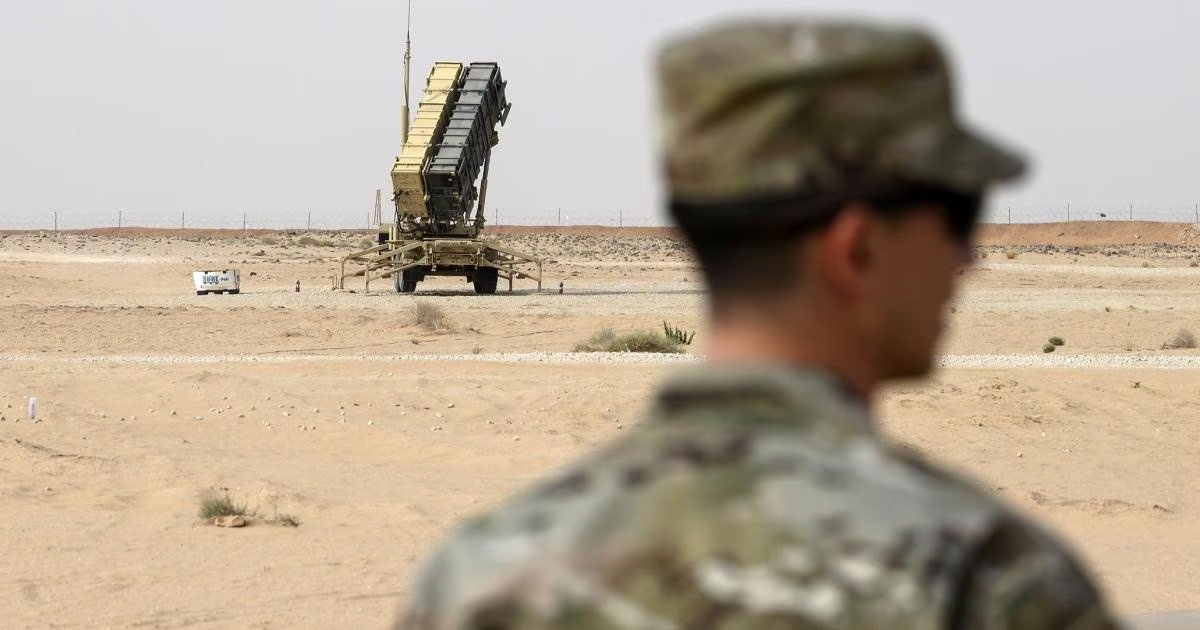
In parallel with these statements, the White House is considering strengthening its military presence in the region by sending an additional 10,000 troops, supported by squadrons of fighter jets and armored vehicles. These forces will join the thousands of paratroopers and marines currently deployed, raising U.S. combat readiness to unprecedented levels in the region.

Military analyses indicate that these reinforcements could be a prelude to a ground operation targeting Iran's Kharg Island, which is the main artery for oil exports in the country. This potential move aims to cripple Tehran's economic capabilities and secure international shipping lanes, which explains Trump's dissatisfaction with the lack of European and British support on this issue.

In conclusion, it appears that the relationship between Washington and London is experiencing silent tension, especially after the restrictions imposed by Keir Starmer's government on the use of Diego Garcia base. This tension reinforces the Trump administration's conviction of the need to redefine alliances based on direct interests and the ability to execute, away from the traditional protocols that have governed NATO for decades.

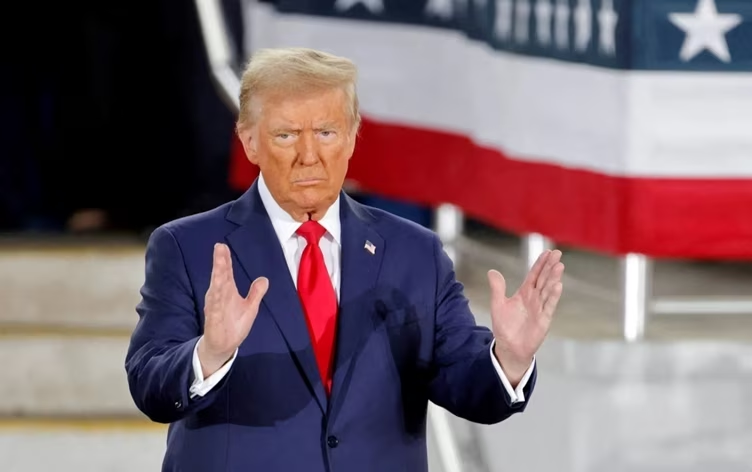
Any country that does not spend 5 percent of its GDP on defense should not have a vote within NATO.

ARAB AND WORLD

Sun 29 Mar 2026 7:56 am - Jerusalem Time

The Occupation Escalates its Aggression on Lebanon: Systematic Targeting of Hospitals and Dozens of Martyrs and Injured

The Lebanese Ministry of Health announced a new bloody toll due to the ongoing Israeli aggression, with 47 people martyred and 122 others injured in the past twenty-four hours. With these numbers, the total death toll since the beginning of March has risen to 1189 martyrs, amidst an escalation in air raids and military operations affecting various Lebanese regions.

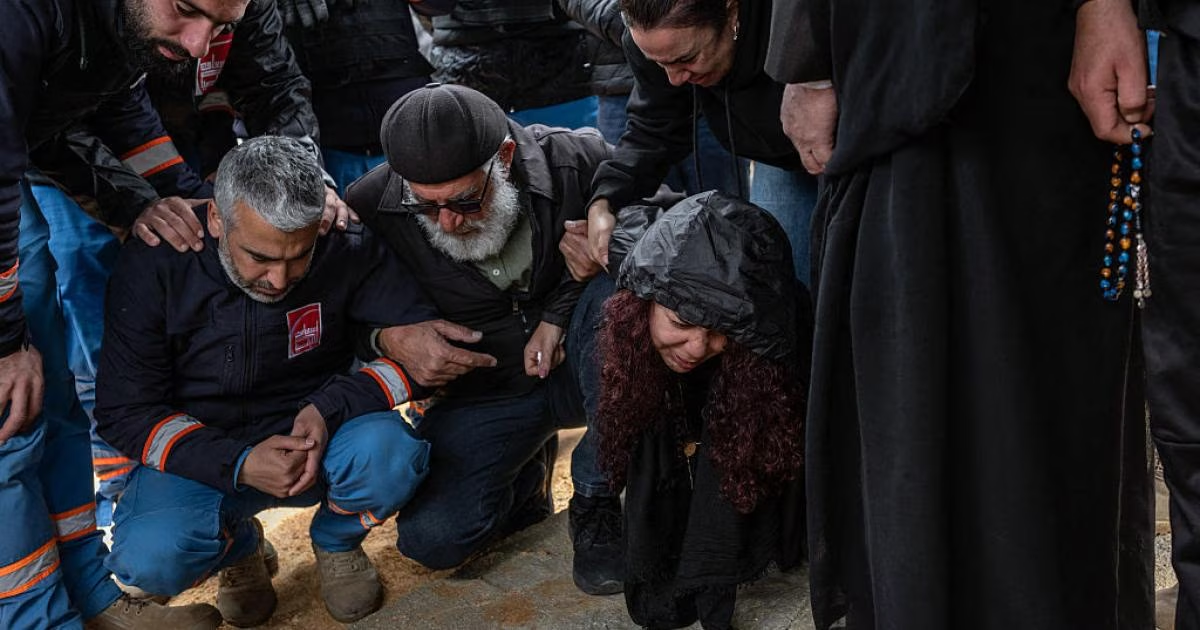
Official reports issued by the Ministry revealed that among the martyrs were 124 children and 86 women, reflecting the heavy human cost of attacks targeting residential areas and civilian facilities. In a related context, the Lebanese army mourned one of its members, Muhammad Mufid Tufaili, who was martyred following an airstrike that targeted the town of Deir al-Zahrani in the Nabatieh region in the south of the country.

In a press conference held to highlight Israeli violations, Minister of Health Rakan Nasser al-Din affirmed that the health sector has become a direct target of the aggression, with 51 medical personnel and ambulance workers martyred. Nasser al-Din explained that these targeting aims to paralyze the state's ability to provide emergency medical care to the injured and displaced under the current circumstances.

The Minister pointed out that the attacks directly affected 9 hospitals, leading to the complete closure of 5 of them and their being out of service due to the damage they sustained. The Ministry also monitored 18 targeting of ambulance centers and damage to 48 medical vehicles, which constitutes a blatant violation of international laws that grant special protection to medical facilities during times of conflict.

The Lebanese government intends to take international action to confront these crimes, as the Ministry of Health confirmed that it is preparing a comprehensive legal file to submit to the UN Security Council. This move aims to document the systematic attacks on the health system and demand that the international community hold the occupation accountable for its deliberate targeting of paramedics and hospitals.

On the ground, sources reported that the occupation expanded the scope of its aerial aggression to include the southern suburbs of Beirut and wide areas in the Beqaa and the South, coinciding with attempts at ground incursions that began on March 3rd. These developments come after the collapse of previous understandings, leading to an explosion of military situations on multiple fronts, including mutual strikes and political assassinations.

In response, field operations continued in response to Israeli aggressions, with military groups targeting positions belonging to the occupation army in border areas. Field sources confirm that the current escalation is the most severe in years, as the occupation insists on continuing to destroy Lebanese infrastructure amidst international silence regarding the targeting of medical teams.

The Ministry will submit a complete legal file to the Council of Ministers in preparation for filing a complaint with the Security Council regarding Israeli aggressions against the health sector.

PALESTINE

Sun 29 Mar 2026 7:56 am - Jerusalem Time

Child injured and Palestinian family suffocated in settler attack south of Hebron

Field sources reported that child Suhaib Raed Badawi sustained various bruises and contusions on Saturday evening, after being subjected to a brutal assault by groups of settlers in the Masafer Yatta area, south of Hebron. These attacks occurred under the direct protection of the occupation forces, who provided cover for the settlers while they targeted residential and pastoral communities in the area, leading to clashes and assaults on citizens and their property.

In the village of 'Shaab al-Butm' in Masafer, settlers attacked the family of citizen Muhammad Abd al-Rahman al-Jabarin using toxic pepper spray, causing severe suffocation to family members, a foreign activist, and a woman, requiring field intervention. These attacks come amidst a frantic wave of settlement escalation aimed at displacing Palestinians from their pastoral lands and expanding settlement outposts surrounding the city of Hebron.

On the ground, occupation forces arrested four citizens from the 'Abu Shaban' area following an attack targeting shepherds in the area. The detainees are Ismail Awad, Jaber Muhammad Alian Awad, and the brothers Saif and Karam Tawfiq Alian Awad. The occupation forces deliberately pursue shepherds in these open areas to reduce the grazing areas available to Palestinians, in a step aimed at undermining the local economy based on livestock.

In a related context, a recent report issued by the Wall and Settlement Resistance Commission revealed a dangerous escalation in the pace of settler attacks, with approximately 443 attacks documented in just one month. The commission explained that these operations are highly organized and carried out in coordination with the occupation army, and include the use of live ammunition and the burning of property and agricultural facilities to impose new demographic realities in the West Bank.

According to the commission's statistical data, Nablus Governorate topped the list of violations with 108 attacks, followed by Hebron Governorate with 99 attacks, and then Ramallah and Al-Bireh with 76 violations. The scope of these attacks also extended to include Bethlehem, Jerusalem, Salfit, Jericho, and Qalqilya governorates, reflecting a comprehensive strategy to intensify pressure on the Palestinian presence throughout the occupied territories.

This systematic tightening aims to push residents to leave their pastoral lands and empty the area of its original inhabitants.

ISRAELI AFFAIRS

Sun 29 Mar 2026 7:56 am - Jerusalem Time

International Warnings of Deterioration in the Israeli Economy and Forecasts of a Sharp Rise in Debt

Media sources reported that the Israeli economy faces increasing structural challenges that cannot be resolved on military battlefields, as financial markets have begun to reflect a reality different from security aspirations. Despite an initial 7% jump in the Tel Aviv Stock Exchange at the beginning of the confrontation with Iran, these gains quickly evaporated, bringing indices back to almost zero.

The 'Tel Aviv 90' index officially entered a technical correction phase after falling 10% from its recent peak, sending negative signals to international investors. Analysts believe this decline reflects a growing conviction that military achievements do not guarantee economic stability, but may instead lead to the long-term depletion of state financial resources.

In a related context, Fitch credit rating agency maintained Israel's rating at A, but attached a negative outlook, frustrating the Ministry of Finance's hopes for an improved rating. This stance indicates that the agency expects further deterioration in Israeli financial indicators, especially in the absence of a clear horizon for ending costly military operations.

The international agency predicted that Israel's debt-to-GDP ratio would reach approximately 72.5% by 2027, a very high percentage compared to the pre-war period. These figures significantly exceed the average for countries with similar credit ratings, which stands at only 56%, placing additional pressure on the public budget.

Economic estimates indicate that the actual budget deficit for 2026 will exceed government forecasts of 4.9% to reach approximately 5.7%, in line with the Bank of Israel's estimates. This increase is primarily due to increased military spending and the costs of reserve mobilization, as the government approved the possibility of calling up 400,000 soldiers when absolutely necessary.

Reports warned that internal political instability in Israel contributes to a state of financial extravagance and indiscipline in public resource management. Experts believe that the continuation of this approach could lead to an economic disaster if the local crisis coincides with disruptions in global energy markets or an international economic recession.

Despite the strengths of the Israeli economy, such as its advanced technology sector and defense industries, demographic and educational problems remain unresolved. Sources confirm that repeated wars deepen these structural crises and delay necessary investments in infrastructure and essential civilian services.

It appears that the optimism that prevailed in official Israeli circles at the beginning of the escalation has collided with a bitter economic reality imposed by the language of numbers and accumulated debts. The war, which began as a show of force, is now imposing financial burdens whose effects may extend beyond 2028, weakening international confidence in the government's ability to act with financial responsibility.

Reports concluded that Fitch's decision represents a real wake-up call for decision-makers in Tel Aviv, as military superiority does not necessarily translate into financial stability. With increasing reports of markets being negatively affected, the occupation finds itself facing the dilemma of balancing military ambitions with preserving what remains of economic resilience.

The Israeli stock market is no longer a safe haven for investment, and grim reality has replaced the excessive optimism that prevailed at the beginning of the war.

PALESTINE

Sun 29 Mar 2026 7:55 am - Jerusalem Time

Under the guise of regional escalation.. escalating settler attacks and military complicity in the West Bank

International media sources reported an escalation in the pace of settler attacks in various parts of the West Bank, exploiting the preoccupation with regional escalation and the ongoing war. Reports documented a brutal attack targeting a 75-year-old Palestinian man inside his home, a clear indication of the expanding scope of targeting to include civilians in their residential areas.

In a related context, a journalistic team was harassed and detained by occupation forces while attempting to document field violations. Sources indicated that the behavior of soldiers on the ground now reflects a dangerous alignment with settler ideology, as statements from soldiers clearly calling for revenge were observed, raising serious questions about troop discipline and their complicity in attacks against Palestinians.

For its part, the occupation army attempted to disavow these practices by claiming that the soldiers' behavior represents a deviation from established military standards, announcing the initiation of internal investigations. However, the occupation did not provide any clarifications regarding the continued growth of random settlement outposts or the actual measures to stop the growing wave of violence that threatens to completely ignite the situation in the West Bank.

The soldiers' actions do not align with expected standards, and we have opened an investigation into the incident.

OPINIONS

Sun 29 Mar 2026 4:58 am - Jerusalem Time

Trump’s Iran War Is Colliding With Political Reality


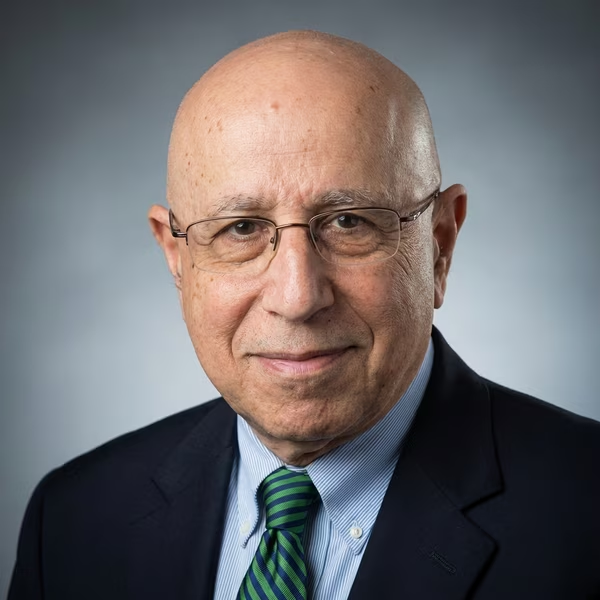
By: Said Arikat

March 29, 2026

News Analysis

Washington, D.C-One month into Donald Trump’s war against Iran, the most consequential front may not lie in the Persian Gulf but in Washington. There, the first visible fractures in Republican unity are beginning to surface. What initially appeared to be a controlled projection of American power is rapidly revealing itself as something far less coherent: a conflict shaped by strategic contradiction, fiscal indiscipline, and rising political risk.

At the center of the unease is a contradiction the administration has yet to resolve. Even as it escalates militarily—deploying thousands of additional U.S. troops to the region—the White House has simultaneously eased sanctions on Iranian and Russian oil exports in an effort to contain domestic fuel prices. The result is not strategic calibration but policy dissonance: the United States is effectively helping sustain the revenues of the very adversaries it is confronting. On Capitol Hill, that contradiction has not gone unnoticed.

Senior Republicans have begun, cautiously but unmistakably, to signal discomfort. Jerry Moran (R-KS) has questioned the logic of granting financial relief to hostile powers in the midst of an active conflict. Thom Tillis (R-NC) has warned that such policies risk strengthening adversaries under the guise of market stabilization. Even John Kennedy (R-LA)—rarely inclined toward open friction with the White House—has publicly grappled with the optics of sanction waivers that benefit both Tehran and Moscow.

These concerns are not isolated. They reflect a deeper problem: the administration has failed to define a coherent objective for the war. Is the aim deterrence, containment, or regime change? Each carries distinct implications for military commitment, financial cost, and political risk. Yet lawmakers emerging from classified briefings report not clarity but confusion. Mike Rounds (R-SD) has hesitated to endorse even a debate over a new authorization for the use of military force, while Nancy Mace (R-SC) has emerged from briefings more opposed to ground troop deployments than before. When briefings intended to reassure instead deepen skepticism, the problem is not presentation—it is substance.

That strategic ambiguity is compounded by mounting fiscal alarm. The administration is expected to request roughly $200 billion in emergency war funding—an extraordinary figure that would compress, into a single package, costs comparable to years of spending on past conflicts. Yet the Pentagon has not provided Congress with a detailed proposal, leaving lawmakers to contemplate a massive appropriation without clear cost projections or a defined timeline. Even typically supportive Republicans are signaling that such a request, absent transparency, will not pass without scrutiny.

The procedural maneuvers now under consideration underscore the depth of the political bind. Roger Wicker (R-MS) and others have floated the idea of folding Iran war funding into a partisan reconciliation bill, effectively bypassing Democratic opposition. But reconciliation is a blunt legislative tool, designed for budgetary adjustments—not for authorizing and sustaining war. Using it in this context would not only strain institutional norms but also expose Republican lawmakers to direct electoral accountability for a conflict that lacks broad public support.

That exposure may be the administration’s most immediate vulnerability. Public opinion remains, at best, ambivalent. While segments of the Republican base express conditional support for limited military action, that backing declines sharply when the prospect of escalation is introduced. At the same time, broader polling suggests that voters remain far more concerned with inflation and the cost of living than with another open-ended military engagement in the Middle East. Asking Congress to approve a $200 billion war package under these conditions is not merely a policy gamble—it is a political one.

Democrats have seized on the administration’s disarray, but their critique resonates because it reflects concerns increasingly voiced, if more cautiously, within Republican ranks. Chuck Schumer (D-NY) has described the administration’s approach as incoherent, arguing that waging war while facilitating adversaries’ oil revenues reveals a lack of strategic discipline. The charge is difficult to dismiss when echoed, even implicitly, by members of the president’s own party.

Meanwhile, efforts by Tim Kaine (D-VA) to force repeated war powers votes are steadily increasing pressure on Republicans to clarify their positions on the legality and scope of the conflict. Thus far, only Rand Paul (R-KY) has consistently broken with his party. But the absence of a broader revolt should not be mistaken for genuine consensus. It reflects a familiar dynamic: reluctance to confront a president of one’s own party—until the political costs of silence begin to outweigh the risks of dissent.

That tipping point may be approaching. Wars sustained by ambiguity and executive fiat tend to erode legislative support over time, particularly when they lack a compelling narrative of necessity or success. The Iran conflict, as currently framed, offers neither. It is a war without a clearly defined objective, financed through improvised trade-offs, and justified by arguments that shift as quickly as the conditions on the ground.

For now, Republican leaders appear intent on holding the line, betting that internal divisions can be managed and political fallout contained. But this is a short-term strategy confronting a long-term problem. The deeper the United States becomes militarily entangled, the harder it will be to reconcile the administration’s competing priorities—lower energy prices, sustained pressure on Iran, and domestic political stability.

In that sense, the strain now visible on Capitol Hill is not an anomaly; it is an early warning. The contradictions embedded in Trump’s Iran policy are no longer abstract. They are operational, fiscal, and political—and unless they are resolved, they will not merely complicate the war effort. They will define it.

PALESTINE

Sat 28 Mar 2026 12:58 pm - Jerusalem Time

New Yemeni Escalation: Missile Launch Detected from Yemen, Houthis Threaten Direct Intervention

The Israeli occupation army announced on Saturday morning the detection of a missile launch from Yemeni territory for the first time, amidst the ongoing American-Israeli aggression against Iran. This field development came just hours after statements by Houthi leaders affirming their full readiness to engage in direct confrontation if the targeting of Tehran and the components of the Axis of Resistance in the region continues.

Field data indicates that any direct intervention by the group could lead to widespread disruptions in international maritime navigation, especially around the Arabian Peninsula. This concern arises at a time when global trade is suffering from the repercussions of the near-complete closure of the Strait of Hormuz, making the Red Sea a strategic conflict arena that could deepen the global economic crisis.

Al-Houthi group is a military and political movement rooted in northern Yemen, where it fought years of guerrilla warfare against the Yemeni army before dramatically expanding its influence after the events of 2011. The group managed to seize control of the capital Sana'a in 2014, leading to a Saudi-led military intervention the following year to try to restore legitimacy, a conflict that has resulted in the world's worst humanitarian crisis.

Throughout the years of conflict, the Houthis have demonstrated advanced capabilities in using ballistic missiles and drones, with their attacks targeting vital oil installations and infrastructure deep within Saudi and Emirati territory. Despite the UN-sponsored truce since 2022, the group has maintained its military readiness and significantly developed its arsenal, affirming the independence of its military decision-making from any external parties.

The Houthis' name became closely associated with the regional conflict following the events of October 7, 2023, when they began launching attacks on Israeli-linked ships in the Red Sea in support of the Gaza Strip. The United States and Israel responded by launching airstrikes targeting the group's positions in Yemen, in an attempt to deter attacks that directly affected global supply chains passing through the Bab al-Mandab Strait.

Houthi attacks had seen a period of relative calm after the ceasefire reached in October 2025 between Israel and Hamas, mediated by the US. However, the outbreak of direct confrontation between Washington and Tel Aviv on one hand, and Iran on the other, in February 2026, reignited the Yemeni front with the latest missile launch detected by the occupation army.

In a televised speech, the group's leader, Abdul-Malik al-Houthi, affirmed that his forces are on high alert, indicating that 'hands are on the trigger' awaiting the outcome of field developments. Al-Houthi stressed that the group will not stand idly by in the face of what he described as escalation against the Islamic Republic, warning that any expansion of hostile alliances would be met with a firm and direct response.

The Houthi group differs from other factions of the Axis of Resistance in that it does not adhere to the direct religious authority of the Iranian Supreme Leader, despite significant political and military convergence. Experts believe that the group primarily acts according to a Yemeni national agenda, but finds in its alliance with Tehran and Hezbollah a means to strengthen its regional position and confront the international pressures imposed on it.

The United States accuses Iran of providing the Houthis with funding, training, and advanced weapons with the help of Lebanese Hezbollah experts, which the group consistently denies. The Houthis affirm that they rely on their self-capabilities in developing missiles and drones, considering that accusing them of subservience to Iran aims to internationalize the Yemeni conflict and justify external interventions in their affairs.

Attention is now focused on the potential paths the Houthis might take amidst the current escalation, as analysts believe the group may resort to scattered and surprise attacks to confuse opponents. This could include targeting the interests of countries that allow their territories or territorial waters to be used for attacks against Iran, raising the probability of a comprehensive and unprecedented regional confrontation.

Threatening to close shipping lanes represents the strongest card in the Houthis' hand, as disrupting navigation in the Red Sea could paralyze the export of oil and gas from Gulf countries. The group stated that it is ready to act if the Red Sea is used as a launchpad for hostile operations against Tehran, which puts international navigation at the mercy of rapid developments, in the absence of any horizon for a diplomatic solution to end the interconnected series of wars from Gaza to Tehran and Sana'a.

The Houthis demanded an immediate and comprehensive cessation of all military operations in Palestine, Lebanon, Iran, Iraq, and Yemen, as a fundamental condition for de-escalation in the region. Military spokesman Yahya Saree warned that the continued siege on the Yemeni people and its linkage to regional developments would lead to harsh reactions beyond expectations, emphasizing that the target bank is expanding to include vital and distant interests.

Reports confirm that the American-Israeli aggression against Iran, which began late last February, has pushed all factions of the Axis of Resistance to review their defensive and offensive strategies. The latest Yemeni move comes as a clear message that the southern front of the occupation will not be safe, and that the rules of engagement have fundamentally changed with the entry of long-range Yemeni missiles into active service.

In conclusion, the situation in Yemen remains organically linked to the trajectory of the major confrontation in the region, where the Houthis represent a difficult number in the regional military equation. With continued warnings of an explosion of the situation, international waterways remain at the mercy of rapid developments, in the absence of any horizon for a diplomatic solution to end the interconnected series of wars from Gaza to Tehran and Sana'a.

Our hands are on the trigger regarding escalation and military action at any moment developments require.

OPINIONS

Sat 28 Mar 2026 12:58 pm - Jerusalem Time

The Technology of Politics: How Digital Platforms Reshape Palestinian Consciousness?

Ramallah - "Al-Quds" Dot Com

Ramallah - "Al-Quds" Dot Com

Opinion Writer

By: Sidqi Abu Dhair / Researcher and Consultant in Digital Media and Marketing

Politics is no longer made only in decision-making rooms, and the shaping of public opinion is no longer exclusive to parties or traditional media. Instead, the center of gravity has shifted to a more complex and dangerous space: the realm of digital platforms. In this space, power is not measured by the number of votes or political programs, but by the algorithms' ability to direct attention, reorder priorities, and create collective perception in an invisible way. This is where the features of what can be called "the technology of politics" begin, where the algorithm transforms from a technical tool into an undeclared political actor.

In the Palestinian context, this transformation cannot be read in isolation from the general context in which society lives. A reality characterized by political and economic pressure, and daily restrictions, makes the digital space not just a communication area, but an alternative space for life and expression. This explains the deep integration of Palestinians into digital platforms, not only as a means of entertainment, but as an environment that provides a relative sense of freedom and control, even if this feeling is manufactured within a precise algorithmic structure.

However, the problem does not start with usage, but with the nature of the system that manages this usage. Algorithms do not operate according to the logic of truth or public interest, but according to the logic of interaction. They do not ask who is right, but rather what makes the user stay longer and interact more. In this sense, the most intense, angry, and provocative content becomes the most widespread, not because it is the most accurate, but because it is the most capable of attracting attention. Over time, the platform no longer reflects reality, but reshapes it.

Here arises the most sensitive question: Are we facing a natural effect of technology, or a new form of digital hegemony? The answer cannot be simplistic, because digital platforms today are not neutral entities, but structures owned by companies and states that have the ability to control data, algorithms, and infrastructure. This ability gives them unprecedented influence in shaping consciousness, not by imposing a direct discourse, but by controlling what appears and what is hidden, what is amplified and what is ignored. Multiple studies have indicated that artificial intelligence is capable of guiding public opinion through highly customized content, based on analyzing user behavior, which transforms influence from a traditional media process into a deep cognitive engineering process.

In this context, societies suffering from political or economic fragility appear more susceptible to influence. Palestine is no exception, but a clear example. A young society, highly digitally connected, living under constant pressure, and looking for a space for expression or even escape, finds itself within an algorithmic environment that gradually reshapes its consciousness. This does not mean a direct conspiracy as much as it means an environment ready for influence, where psychological need meets algorithmic design.

And here we reach the core of the hypothesis: Is the disagreement within Palestinian society truly based on a real difference of opinion, or is it digitally reproduced? The reality is that disagreement inherently exists in any society, but platforms do not merely reflect it; they amplify, accelerate, and recycle it. The user does not see the full picture, but rather what aligns with their inclinations, creating closed digital bubbles that reinforce convictions instead of testing them. Over time, discussion transforms from a space for dialogue into a space for conflict, and from natural disagreement into sharp polarization.

More dangerously, this influence is not exerted directly, but through what can be called "attention steering." The platform does not tell you what to think, but it decides what you see, when you see it, and with what intensity. What is displayed intensely becomes normal, and what is hidden fades from consciousness. Here, control over content transforms into control over perception, and thus into the shaping of attitudes. Moreover, recommendation algorithms are capable of building complete behavioral paths for the user, starting from interest and ending with adoption, without them feeling that they have been subjected to any external influence.

Nevertheless, the user cannot be absolved of responsibility. We do not just consume content; we produce it, re-share it, and reinforce it with our interaction. The data we leave daily turns into raw material used to analyze and influence us. In other words, we are not only influenced by algorithms, but partners in feeding them. We train the system that reshapes us, and we give it the ability to understand us more deeply than we sometimes understand ourselves.

In the end, politics cannot be separated from technology in the digital age, especially in a context like Palestine. The battle is no longer just on the ground, but over consciousness. It is no longer just about political decisions, but about individuals' perception of what is happening around them. The real danger is not in the existence of disagreement, but in this disagreement turning into an algorithmic product that is managed, amplified, and continuously reproduced, far from any unifying national project.

The question we must ask today is not who is right, but who determines what we see so that we can decide who is right. Because whoever has the ability to shape the digital landscape necessarily has the ability to influence consciousness, and whoever has consciousness, owns the future.

OPINIONS

Sat 28 Mar 2026 12:58 pm - Jerusalem Time

West Bank: Settler Terrorism as a Tool for Creeping Annexation and Imposing Sovereignty

While the world is preoccupied with the American-Israeli war against Iran and the regional tensions associated with the confrontation, a profound process of change is accelerating on the ground in the occupied West Bank, taking place away from the spotlight. As attention turns to the battlefields, the Israeli occupation government is exploiting this international preoccupation to deepen its policies of control over the land in the West Bank, through a combination of governmental decisions, settlement expansion, and organized settler terrorism against Palestinians.

What is referred to in the official discourse of the Israeli occupation state as "settler terrorism" is no longer a marginal phenomenon or acts of hooliganism carried out by a limited number of hilltop youth. The accumulated data and information in recent years, along with investigations published by Israeli, Palestinian, and international human rights organizations and the Israeli press, clearly indicate that these attacks have become part of a broader political and security system that is practically reshaping the geographical and demographic reality in the occupied West Bank.

The investigation published by "Haaretz" last Friday paints a disturbing picture of the collapse of the security and legal oversight system, which had, even partially, controlled these attacks. However, what is happening in reality cannot be understood as a fleeting phenomenon, but rather as an old policy that has deepened significantly with the rise of the current right-wing settlement government.

According to testimonies from officers and reserve soldiers who served in the West Bank, settler terrorism is no longer merely exceptional incidents but has transformed into a near-daily pattern. In many cases, soldiers arrive at the scene of attacks after they have occurred, only to find themselves in a clash between settlers and Palestinians, often ending with the arrest of Palestinians or the use of force against them.

But the problem is much deeper than mere security negligence. Settler terrorism is no longer a random act but has become a field tool within a broader strategy aimed at imposing new realities on the ground. Instead of dozens of hilltop youth, as the occupation government claims, the investigation speaks of hundreds participating in the attacks, operating within a wide support network that includes settlement outposts, settlement farms, and regional councils in the West Bank.

Some of these groups even publish monthly reports on their activities, boasting about burning Palestinian homes and vehicles, destroying olive trees, and assaulting residents of neighboring villages. This reflects an unprecedented degree of organization and implicit legitimization of this type of terrorism.

More dangerously, there is an increasing overlap between settlers and the military system. Some participants in the attacks move in military or semi-military vehicles, wear parts of military uniforms, and carry weapons obtained through regional defense systems. With the expansion of settler armament in recent years, the line between armed civilians and the Israeli army has become more blurred.

In this sense, settlers are gradually transforming into a paramilitary force operating in the field, enjoying army protection and sometimes moving under its direct supervision.

Politically, this transformation cannot be understood without considering the profound changes within the current Israeli occupation government. Finance Minister and Minister in the Ministry of Defense responsible for civil administration in the West Bank, Bezalel Smotrich, is clearly pushing for the implementation of his vision known as the "Decisive Plan," which he proposed in 2017.

This plan is based on expanding Israeli control over areas classified as "C," which constitute about 60% of the West Bank's area, while keeping Palestinians confined within population enclaves in areas "A" and "B." Within this framework, settler terrorism becomes a field tool to impose a new demographic reality.

Repeated attacks on Palestinian villages, burning crops, destroying water sources, and preventing herders from accessing pastures are not just isolated incidents but tools aimed at creating an expelling environment for Palestinian residents, especially in rural areas, the Jordan Valley, and south Hebron.

In contrast, the ability or willingness of Israeli law enforcement agencies to confront this phenomenon has declined. The occupation police in the West Bank, under the influence of National Security Minister Itamar Ben-Gvir, are facing increasing criticism for their failure to investigate settler attacks. The role of the Israeli General Security Service (Shin Bet) in monitoring what is known as "Jewish terrorism" has also diminished.

However, what appears to be negligence on the surface often reflects alignment with the current government's directives. The Israeli army, which in previous statements described some settler practices as "Jewish terrorism," now finds itself part of a political and security reality that pushes it to avoid confrontation with settlers.

Furthermore, Defense Minister Yoav Gallant's decisions to cancel administrative detention orders against settlers, despite their limited use initially, reflect a political trend that limits legal deterrents against these attacks.

These transformations have also been reflected within the military establishment itself. About two hundred reserve soldiers signed a letter to the military leadership warning of the erosion of the values on which the army is supposed to be based, and of the involvement of some soldiers in acts of violence against Palestinians or in condoning them.

However, this ethical discourse clashes with a different reality on the ground. The army itself carries out daily incursions and arrests in Palestinian cities and villages, and provides protection to settlers during or after their attacks. This contradiction between discourse and practice reveals the limits of the military establishment's ability or willingness to confront settler terrorism.

What is forming today in the West Bank is not merely an escalation in settler terrorism, but a gradual re-engineering of the political and geographical reality. Settlers move with almost complete freedom, while the security system appears hesitant or unable to control them, while the political leadership pushes for expanding control over the land and implementing creeping annexation policies.

In this sense, settler terrorism becomes a tool within a broader policy to reshape the demographic map of the West Bank. It is a systematic and slow process, based on pushing Palestinians to shrink into isolated population enclaves, in contrast to the continuous expansion of the settlement project, and establishing a new reality that serves Israel's strategic and political goals.

Amidst the devastating war on the Gaza Strip and escalating regional tensions, the West Bank appears to be a parallel arena for a profound process of change taking place away from the spotlight. While the humanitarian tragedy in Gaza continues, policies of control over the land are accelerating in the West Bank through a combination of governmental decisions, settler terrorism, and institutional complicity, to entrench a reality based on Israeli superiority and the de facto annexation of lands.

The final result is not merely settlement expansion, but the entrenchment of a system based on gradual annexation, ethnic superiority, and the gradual expulsion of Palestinians from their land, while the official occupation institutions and their security and political arms remain present to support and practically and directly participate in this project.

OPINIONS

Sat 28 Mar 2026 12:57 pm - Jerusalem Time

The Philosophy of Steadfastness: Why Do Nations Refuse to Break Before Great Powers?

Ramallah - "Al-Quds" Dot Com

Ramallah - "Al-Quds" Dot Com

Opinion Writer

When a voice that called for dignity and awakened a sense of belonging in people falls silent, the departure is not merely a fleeting event, but a moment of deep reflection on the essence of the legacy left behind. Thus departs Ahmed Kaabour, the author of the poem 'I Call Out to You,' which became an anthem for the Palestinian and Arab conscience, his voice remaining a testament to the power of words to create an awareness that resists breaking.

In the presence of this absence, the question of the secret behind the steadfastness of nations is not an intellectual luxury, but an extension of a humanitarian call that believed that the weak, when they cling to their dignity, refuse defeat. From here, the reading opens up to an attempt to understand the hidden power that makes societies resist and remain standing despite the imbalance of material power.

Some contemporary historical facts seem thought-provoking; the Taliban stood firm against the most violent military power in the world, represented by the United States and NATO. In Palestine, Hamas confronts the Israeli occupation and has managed to shake the myth of an army long described as invincible, despite the enormous technological disparities.

These examples, in addition to the Iranian case facing international isolation and direct threats, raise a fundamental question about the source of this capability. While central regimes collapse with astonishing speed, as happened in Iraq previously, these local forces show a superior ability to persist and engage in long-term confrontation.

A superficial explanation might limit the reason to 'patriotism' alone, but love of land is not enough to explain steadfastness against militarily and numerically superior forces. There is a deeper matter that fuels this determination, which is the societal, cultural, and religious dimension that gives these forces an existential meaning that transcends the defense of geographical borders.

In the Afghan case, we find a social dynamic based on a solid tribal and faith-based network that views resistance as a duty to impose its authentic values. The individual there feels part of a historical project that connects faith in divine power with societal duty towards family and land, making defeat an unthinkable option.

As for Palestine, resistance represents a response to a deep sense of historical injustice extending from the Nakba of 1948 to the present day. The Palestinian people experience steadfastness as a moral and national duty, where small victories turn into legends that nourish the morale of successive generations and create a sense of capability despite the siege.

Palestinian steadfastness is a collective experience shared by all generations, resulting from a mixture of historical awareness and belief in the justice of the cause. This belief gives resistance a dimension that transcends international laws and transient policies, making staying on the land an act of struggle in itself.

The Iranian regime represents another model, where the leadership builds its policies on an extended national identity supported by a deep religious dimension that links the nation to a common destiny. Power here lies not only in the arsenal of weapons but in transforming the conflict into a collective cultural project that views standing against hegemony as a moral duty.

In contrast, we find that hierarchical systems that rely on absolute individual authority collapse as soon as the head of the hierarchy falls. The absence of a cohesive social network and a shared faith-based project makes individuals lack a sense of continuous responsibility, leading to the disintegration of the state in the face of the first serious military test.

True steadfastness stems from the blending of national elements with a spiritual and cultural dimension that gives societies an invisible strength. This strength makes peoples see themselves as part of a project larger than mere material survival, which motivates them to confront injustice even if the adversary is materially and technologically superior.

These models teach us a human lesson that steadfastness is the product of social and spiritual complexity where identity intertwines with history. Defending dignity becomes an existential project, which explains how resource-limited societies can confront formidable international powers and continue to refuse submission.

Ultimately, steadfastness transforms from an exceptional heroic choice into a simple daily act repeated in people's stories and faces. It is a silent will that chooses each time to endure pain and not surrender to invaders, believing that what is preserved within is what makes continuity possible.

This is not a story of an invincible military force, but a story of human dignity that refuses to be violated, no matter how long the road and how many wounds. Enduring pain is always easier than being held captive by humiliation, and this is the golden rule that preserves societies' survival in the face of political storms and wars.

Steadfastness is not merely military capabilities, but the product of social, cultural, and spiritual complexity where nationalism intertwines with religious identity.

OPINIONS

Sat 28 Mar 2026 12:57 pm - Jerusalem Time

Towards a Renewed Arab Vision: Elites and the Responsibility of Confronting External Hegemony Projects

Ramallah - "Al-Quds" Dot Com

Ramallah - "Al-Quds" Dot Com

Opinion Writer

International and regional attempts to reshape the Middle East region according to the interests of external powers continue, while there is a striking absence of the indigenous people in shaping their own destiny. The projects that are put forward from time to time, whether European, American, or Israeli, aim essentially to re-engineer influence and suppress independent Arab will.

Throughout the last century, the Arab region experienced diverse renaissance movements, beginning with the nationalist current that called for unity, then socialist propositions, leading to Islamic awakening movements. However, these paths ended in faltering outcomes, leaving the Arab arena in a state of shocking intellectual and political vacuum that threatens the existence of states and the future of their peoples.

The state of paralysis suffered by joint Arab institutions, foremost among them the League of Arab States and the Arab Maghreb Union, reflects the depth of the current predicament. This institutional vacuum is what tempts regional and international powers to dominate, and pushes some of them to revive expansionist dreams such as the 'Greater Israel' project or to strengthen Iranian and international hegemony.

The current historical moment is considered the most dangerous for the region since the end of World War II, as a deep internal predicament converges with a real external threat. Arab elites, whether in power or opposition, bear the greatest responsibility for this comprehensive decline that has made the region an arena for settling scores between major powers.

Today, there is an urgent need to revive a new Arab project characterized by wisdom and realism, and responsive to the aspirations of rising generations who are looking for a clear compass. This required revival demands political imagination that rebels against the state of frustration and defeat, and formulates a vision that inspires peoples and motivates them towards common construction, away from ideological polarization.

Arab elites must transcend traditional conflicts and engage in a comprehensive de-escalation strategy aimed at creating an environment for building a 'national community' based on citizenship and pluralism. This move is not an intellectual luxury, but a national duty imposed by the existential threats lurking over Arab states in their entity and stability.

The absence of a guiding idea for Arab societies leaves individuals in a state of bewilderment and loss, which facilitates the dismantling of Arab political cohesion and the collapse of defensive immunity. This vacuum is the most dangerous recipe for handing over future generations to marginal cultures that lose their connection to their fateful issues and civilizational identity.

Despite the gloom, inspiring models of steadfastness and resistance emerge, as in the Gaza Strip, where the Palestinian people provide a living example of adherence to rights. However, this model still needs a broader Arab context that links the culture of resistance with the culture of construction and comprehensive advancement to ensure the sustainability of its impact.

Many voices demand the necessity of conducting comprehensive critical reviews of the paths of political and social forces that dominated the scene in past decades. Liberating oneself from the illusions of the past and rehashing its events is the first step towards formulating a renaissance project capable of emulating the complex reality and its accelerating challenges.

It is no longer acceptable for Arab elites to remain dependent on old visions formed under different temporal circumstances and no longer capable of providing solutions to today's crises. The acceleration of international transformations requires renewed minds that understand the intertwining elements of power in the modern world and are skilled in maneuvering to protect supreme Arab interests.

Squandering the region's resources and history for the benefit of the greedy represents a crime against future generations who deserve to live in a stable and sovereign region. It cannot be accepted that the Arab map remains merely an area for redistributing influence among international powers seeking to consolidate their strategic superiority at the expense of our peoples.

The new international system currently forming, with its multilateral characteristics and balance of power, offers a golden opportunity for Arabs to reposition themselves outside traditional axes. Political intelligence requires investing in these transformations to forge broader horizons that guarantee Arabs a place under the sun in a world that respects only the strong and organized.

Arab regimes and peoples face a decisive moment that requires courage in decision-making and clarity in defining strategic goals for the next stage. Active engagement in shaping the future is the only way out of the cycle of dependency that has lasted for long decades and exhausted the foundations of advancement.

In conclusion, Arabs must realize that they possess all the human and geographical components to be an active part of international negotiations on the future of the global system. The choice today is between being partners in drawing the new map, or remaining merely a meal on the table of negotiating powers that only consider their own interests.

It is not the destiny of this region to be, once again, a century after the first division, a map for the division and redistribution of influence among external powers.

ANALYSIS

Sat 28 Mar 2026 12:57 pm - Jerusalem Time

David Hearst: War on Iran Recreates Iraq Tragedy, Destroys International Order

British writer David Hearst considered the American-Israeli war on Iran, now entering its second month, to be the culmination of strategic failure built on misinformation. Hearst pointed out in an article that the military decision was not linked to the course of negotiations, but was based on intelligence illusions about the ease of overthrowing the Iranian regime from within.\n\nThe article revealed a pivotal role for Mossad director David Barnea, who presented reports to Netanyahu claiming the agency's ability to mobilize the Iranian opposition for a coup immediately after the start of aerial bombardment. These assessments prompted US President Donald Trump to proceed with the attack, ignoring warnings from other intelligence agencies that questioned the accuracy of these predictions.\n\nOn the ground, sources confirmed that the initial aerial attack resulted in the death of former Iranian Supreme Leader Ali Khamenei and the injury of his son Mojtaba, in addition to the elimination of dozens of generals. Despite the heavy losses in the Iranian air force and defenses, Tehran began a disproportionate response that has not stopped since the first hour of the aggression.\n\nHearst quoted Mohamed ElBaradei, former Director-General of the International Atomic Energy Agency, as saying that what is happening today is an exaggerated version of the deception that preceded the invasion of Iraq in 2003. ElBaradei explained that claims about Iran being close to possessing nuclear weapons reminded him of the lies promoted by the Bush administration about Iraqi weapons of mass destruction.\n\nElBaradei expressed his deep sorrow over the collapse of the international system, noting that Western powers have lost their moral and legal compass. He stressed that ignoring the decisions of the International Court of Justice and the International Criminal Court regarding Gaza and Iran sends a catastrophic message to the countries of the Global South that security can only be achieved by force.\n\nThe article touched upon recent American military movements, as flight data monitored the transfer of massive forces to Israel and Jordan in preparation for a possible ground operation. Hearst believes that this escalation reflects Trump's and Netanyahu's desire to reshape the region by brute force, far from any diplomatic or legal frameworks.\n\nIn the context of the Iranian response, Tehran succeeded in paralyzing a fifth of global oil and gas trade by targeting American bases and oil tankers and closing the Strait of Hormuz. The first weeks of the war proved that Iran is still capable of maintaining a continuous flow of missiles and drones despite the painful blows it received.\n\nElBaradei strongly criticized the assassination of political figures and negotiators, citing the recent killing of Ali Larijani in an Israeli raid, describing him as a man with whom negotiations could have been held. He considered that turning genocide and the assassination of journalists and philosophers into acceptable tools of war represents the end of the era of international law.\n\nThe article also drew attention to attempts to undermine the International Criminal Court from within, especially after the acquittal of Prosecutor Karim Khan from misconduct charges. Diplomatic sources explained that there are ongoing efforts by some parties to prevent Khan from resuming his duties, in an attempt to obstruct the prosecution of Israeli leaders.\n\nElBaradei warned that the feeling of injustice and oppression in the Arab world will inevitably lead to a new explosion, stressing that the spirit of the Arab Spring has not died. He pointed out that the absence of equality and political freedom, coupled with the persecution of peoples, are sufficient reasons for the outbreak of future revolutions that cannot be stopped.\n\nRegarding the European position, Hearst believes that Europe has marginalized itself in major conflicts from Gaza to Lebanon and Iran. He warned that the collapse of the American empire would leave Europe without military protection and without the strong international institutions it previously relied on.\n\nElBaradei described the current situation as a "war on science and logic," where the United States withdraws from international organizations and climate agreements while crises ignite. He indignantly questioned the role of the completely paralyzed UN Security Council in the face of what is happening in Ukraine, Gaza, and Iran, describing it as an empty forum.\n\nHearst concluded his article by emphasizing that Trump and Netanyahu are "burning the candle at both ends," and that the consequences of their actions will ultimately affect everyone. He pointed out that ignoring the rules of war today will open the door for future enemies to apply the same brutal rules against the West, its cities, and its hospitals.\n\nThis comprehensive regional war, according to the analysis, aims not only to change regimes but to fragment an entire geopolitical landscape and reshape it according to a unilateral vision. With continued bombing and destruction, the question remains about the exorbitant human cost that millions will pay in a conflict that may surpass in its brutality everything the region has witnessed in recent decades.\n\nHistory does not just repeat itself in the war on Iran, but it magnifies itself in the complete absence of international law.

ANALYSIS

Sat 28 Mar 2026 12:57 pm - Jerusalem Time

Tlaib Introduces Legislative Package in Congress to Halt US Aid to Israel in Lebanon

Said Erikat

Opinion Writer

Washington Message

28/3/2026

In a notable move reflecting escalating debate within the United States regarding its Middle East policy, US Congresswoman Rashida Tlaib announced on March 27, 2026, the introduction of a legislative package in the US House of Representatives aimed at halting US support for Israeli military operations in southern Lebanon. This initiative comes amidst an escalation of Israeli military operations against Hezbollah, following an incident that occurred in late February.

The legislative package consists of two main bills that reflect an escalating tone in the political discourse opposing US military support for Israel. The first is a House resolution declaring solidarity with the Lebanese people in the face of what Tlaib described as "illegal invasion, war crimes, and ethnic cleansing." The resolution calls for an immediate cessation of military operations, rejection of any threats of illegal occupation, and calls for international investigations into potential violations, as well as support for the return of displaced Lebanese to their areas.

The second bill is a resolution based on the War Powers Act, aiming to compel the US administration to withdraw any direct or indirect military support for ongoing operations in Lebanon. This includes halting assistance in military targeting or intelligence sharing with Israel, which, if passed, would represent a radical shift in the nature of US involvement in the conflict.

In justifying her move, Tlaib leveled sharp accusations against Israel, considering that it is applying in Lebanon what she described as a "genocide playbook," similar to what she claims happened in the Gaza Strip. She also held the United States directly responsible, asserting that these operations "would not have happened without US support funded by taxpayer money," calling for a comprehensive ban on arms exports to Israel.

Tlaib's statements indicate growing concern about the targeting of civilian infrastructure in southern Lebanon, where she spoke of widespread destruction of villages and mass displacement of residents. These allegations align with circulating reports of escalating airstrikes and ground operations, in the context of the ongoing confrontation with Hezbollah, further complicating the regional scene and raising fears of an expanding conflict.

Conversely, this initiative is expected to face strong opposition within Congress, given the continued traditional support for Israel by both Republican and Democratic parties, although this consensus is gradually eroding, especially within the progressive wing of the Democratic Party. This move is also likely to spark a broad debate about the limits of the President's powers in managing foreign military operations, and the role of Congress in curbing them.

This move comes at a sensitive political moment, as internal pressures on the US administration are increasing to re-evaluate its policy towards conflicts in the Middle East, amidst growing criticism from human rights organizations and political circles that see unconditional support for Israel undermining US credibility on the international stage.

Rashida Tlaib's initiative reflects a significant shift in political discourse within the United States, where criticism is no longer confined to academic or human rights circles, but is now embodied in tangible legislative actions. This shift indicates the growing influence of the progressive current that seeks to redefine the relationship with Israel on human rights and legal grounds. However, the success of this initiative remains limited given the balance of power within Congress, making it more of an attempt to change public debate rather than bring about immediate policy change, yet its cumulative impact could be profound.

The War Powers Resolution also raises fundamental questions about the nature of US involvement in foreign conflicts and the limits of executive authority in providing military support without explicit authorization. Historically, Congress has rarely succeeded in imposing effective restrictions on this type of involvement, but the escalating debate over the political and moral cost of military support may revive this role. In this context, the initiative is not only about Lebanon but represents a broader test of the ability of American institutions to rebalance power between the legislative and executive branches on issues of war and peace.

Regionally, this initiative may contribute to strengthening the discourse rejecting US support for Israel, but at the same time, it may intensify political polarization within the United States. While its supporters see it as a necessary step to hold military policies accountable, its opponents consider it a threat to strategic relations with Israel. This division reflects deeper shifts in American public opinion, especially among younger generations, who are becoming more critical of traditional policies. Therefore, the importance of this step lies in its long-term political implications, more than its direct legislative outcomes.

ARAB AND WORLD

Sat 28 Mar 2026 12:57 pm - Jerusalem Time

12 American soldiers injured in missile and drone attack targeting Prince Sultan Air Base in Saudi Arabia

Informed sources reported that 12 American soldiers were injured in an attack targeting Prince Sultan Air Base in Saudi Arabia on Friday. Officials confirmed that the attack was carried out by missiles and drones launched as part of a new wave of escalation in the region, resulting in injuries of varying severity among the forces stationed there.

Initial medical reports indicate that two of the injured soldiers are in critical condition, while eight others sustained serious injuries requiring urgent medical intervention. The health status of the remaining injured is still under continuous assessment and monitoring within the base's medical facilities, amid a widespread security alert.

Media sources revealed that the joint attack caused significant material damage to military air equipment, with two KC-135 refueling aircraft suffering extensive destruction. Satellite images showed the extent of the damage caused by the shelling inside the runways of the vital air base.

This targeting comes in the context of direct military confrontations that have erupted since late February between Iran on one hand, and Israel and the United States on the other. The parties are exchanging missile and air strikes, with Tehran targeting what it describes as American interests and sites in the region in response to ongoing military operations against it.

Sources explained that the attack occurred while soldiers were carrying out their routine duties inside the base, where they were surprised by at least one missile followed by swarms of suicide drones. This strike is considered one of the most accurate and impactful attacks on air defense systems stationed at military sites in the region.

In a related context, military data stated that the number of injured in the US Army since the outbreak of war with Iran has exceeded 300 soldiers. Although 273 of them have returned to active duty, the recurrence of these attacks raises concerns about the safety of forces deployed in overseas bases.

Official statistics recorded the deaths of 13 American soldiers since the start of combat operations, which puts the US administration under increasing pressure to deal with growing missile threats. Prince Sultan Air Base has been a frequent target recently, with this attack being the second targeting of the base in just a few weeks.

The same base was subjected to a previous attack on March 5, which resulted in damage to five military aircraft and the death of an American soldier who later succumbed to his wounds. This series of attacks confirms the determination of the attacking parties to cripple the air and logistical capabilities of US forces in strategic bases.

For its part, a number of countries condemned the targeting of civilian objects and international interests, warning of the region sliding into an uncontrollable comprehensive conflict. Affected capitals are demanding an immediate halt to these attacks, which now threaten regional security and the safety of air and land corridors in Arab countries hosting forces.

This attack is considered one of the most dangerous strikes suffered by US air defenses since the start of the war.

PALESTINE

Sat 28 Mar 2026 12:57 pm - Jerusalem Time

A Child killed in Bethlehem and warnings of displacement of 200 Palestinian families in Jerusalem

Palestinian medical sources announced on Friday evening the martyrdom of 15-year-old child Adham Sayed Saleh Dahman, who succumbed to injuries sustained from Israeli occupation army bullets. The incident occurred during a military raid targeting the Dheisheh refugee camp, located south of Bethlehem in the occupied West Bank.

The Ministry of Health clarified that child Dahman was hit by a live bullet in the abdomen, described as very critical, and was immediately transferred to Beit Jala Governmental Hospital. Despite the medical teams' attempts to save his life, he passed away due to the severe injuries he sustained during the confrontations.

With the martyrdom of child Dahman, the number of martyrs in the West Bank on Friday alone rises to three Palestinians, after the martyrdom of two other citizens aged 22 and 46. The other two martyrs fell during raids carried out by occupation forces in Kafr Aqab town and Qalandia refugee camp, north of occupied Jerusalem.

Official statistics indicate a continuous escalation in the number of victims since October 7, 2023, with the number of martyrs in the West Bank reaching 1138. Medical teams also recorded approximately 11,700 injuries, while the number of detainees in occupation prisons exceeded 22,000 Palestinians during the same period.

In a related context, the Palestinian Ministry of Foreign Affairs warned of an imminent danger threatening the Palestinian presence in occupied Jerusalem, specifically in Silwan town. The ministry affirmed that approximately 200 Palestinian families are currently facing the risk of forced displacement and imminent eviction from their homes and properties.

The Ministry of Foreign Affairs clarified in an official statement that these families include about 900 Jerusalemite citizens, who are facing lawsuits filed against them by extremist settlement associations. The ministry described these associations as terrorist tools aimed at emptying the city of its indigenous inhabitants for the benefit of settlers.

The Palestinian Ministry of Foreign Affairs strongly criticized the role of the Israeli judicial system, considering that the courts are being used as a legal cover to entrench an illegitimate reality in Jerusalem. It affirmed that these courts grant false legitimacy to the seizure of Palestinian properties and the alteration of the demographic identity of the holy city.

The ministry condemned the escalation of forced evictions, noting the displacement of 15 families from their homes in the Batn al-Hawa area of Silwan town in the past week alone. It also pointed out that the occupation municipality issued immediate and non-appealable demolition orders for seven homes in Qalandia town, further increasing the suffering of the residents.

The Palestinian statement considered that what is happening in Jerusalem falls within a systematic plan to Judaize the city and impose new facts on the ground. The ministry stressed that these measures aim to change the demographic situation in the short term, which necessitates urgent international intervention to stop these violations.

The Palestinian Ministry of Foreign Affairs called on the international community and international organizations to take firm steps to prevent the continuation of the policy of forced displacement. It called for activating diplomatic pressure tools on the occupation authorities to ensure the protection of Palestinian rights and the preservation of the status of the holy city.

The ministry also urged the strengthening of international presence on the ground to monitor Israeli violations and provide protection for the Palestinian people under occupation. It affirmed that all occupation measures in Jerusalem are considered null and void legally and have no legitimate effect.

On the ground, human rights sources reported that settlers seized 13 residential apartments in Silwan town last Wednesday, bringing the total number of seized apartments to 15 within four days. These operations took place under heavy protection from occupation forces, which secured the entry of settlers into the properties.

The Wadi Hilweh Information Center stated that Israeli enforcement and execution department teams began emptying the contents of 11 apartments belonging to the Rajabi family to hand them over to settlers. This had begun with the eviction of the Basbous family from two residential apartments in the same area, amidst a state of extreme tension.

It is worth noting that the 'Ateret Cohanim' settlement association had seized two additional apartments in Silwan early last week. These intensive settlement movements come within the framework of right-wing associations' efforts to control the entire Batn al-Hawa neighborhood overlooking the blessed Al-Aqsa Mosque.

Israeli courts are used as a tool to entrench an illegal and unprecedented reality and to give it false legitimacy in the holy city.

ISRAELI AFFAIRS

Sat 28 Mar 2026 12:56 pm - Jerusalem Time

Flocks of Crows Cover Tel Aviv Skies: Fears of 'Religious Prophecies' and Scientific Explanations Clarify the Truth

A state of anxiety and confusion prevailed among settlers in Tel Aviv after massive flocks of crows were observed flying in unusually dense formations in the sky. This scene coincided with ongoing military operations and missile exchanges, prompting many to document the phenomenon on social media platforms amidst questions about its implications at this critical time.

A segment of observers linked the birds' flight to religious texts from the 'Book of Revelation,' which speak of birds gathering in the sky as a sign preceding major battles and the immense human losses that follow. Discussions also brought up what is known as the 'curse of the eighth decade,' derived from Talmudic interpretations, which refers to radical transformations that the occupation state might face as it approaches eighty years of age.

Interpretations were not limited to the religious aspect; some recalled historical traditions dating back to ancient Roman times, where the movement of birds was seen as encrypted messages warning of impending disasters or the fall of kingdoms. The atmosphere charged with security tension contributed to reinforcing these fears and transforming a natural phenomenon into a subject of political and ideological debate within Israeli society.

In contrast, ornithology experts intervened to calm fears, affirming that the scene carries no mystical dimensions or indicators of imminent disasters. Scientific reports clarified that what happened falls within natural seasonal migration, as hundreds of millions of birds cross Palestinian airspace annually, and this period is the peak activity for some species that prefer to gather in urban areas.

Specialists pointed out that the 'hooded crow,' which is abundant in the region, tends to gather in large flocks during nesting seasons and when searching for food above tall buildings. Despite the logical scientific explanations, the timing of the phenomenon amidst the ongoing war made it a rich subject for the media, reflecting the extent of psychological fragility and anxiety about an unknown future in light of the continuous military escalation.

Some linked the scene to a passage in the Book of Revelation that calls birds to gather for 'the great supper of God' and eat the flesh of the slain after a great battle.

ISRAELI AFFAIRS

Sat 28 Mar 2026 12:56 pm - Jerusalem Time

Israeli killed, others injured in Iranian missile attack targeting Tel Aviv and Jerusalem

An Israeli was killed and two others sustained varying injuries early Friday morning following an intense Iranian missile attack targeting the greater Tel Aviv area and occupied Jerusalem. Israeli medical sources confirmed that the deceased was a result of a direct hit and shrapnel falling in several vital areas, amidst loud explosions that rocked the center, Jerusalem, and their surroundings.

The Israeli ambulance service reported that it responded to several calls regarding missile shrapnel falling in eight different locations within the greater Tel Aviv area and Jerusalem. These missile barrages caused widespread panic, with rescue teams rushing to affected areas to provide first aid to the injured and assess the material damage resulting from the bombardment.

Meanwhile, Hebrew media reported that one of the missiles directly hit a building in the heart of Tel Aviv, causing significant damage to the site. This coincided with the observation of shrapnel falling in various parts of Jerusalem, indicating the expansion of Iranian targeting to include the political and economic centers of gravity of the occupation.

Field sources explained that the explosions heard in the skies of Tel Aviv were a result of attempts to intercept at least one cluster missile launched from Iranian territory. This type of missile is characterized by its ability to fragment in the air into multiple small projectiles when intercepted, leading to the spread of shrapnel over wide and difficult-to-control areas.

Although cluster munitions may lack the massive destructive power of heavy ballistic missiles, their danger lies in distributing damage across multiple geographical points simultaneously. The falling shrapnel caused damage to civilian property and assets, which further complicated evacuation and rescue operations in populated areas.

Official Israeli statistics indicate a continuous escalation in the human toll since the outbreak of direct confrontation with Iran on February 28th. According to the latest data, the number of Israeli fatalities has reached 22, while the number of injured has exceeded five thousand due to ongoing missile and drone attacks.

These developments come amidst ongoing military operations launched by Israel and the United States against Iranian targets, which Tehran has met with missile responses targeting Israeli depth. Tehran also previously announced targeting what it describes as American interests and bases spread across the region, considering this a legitimate response to the attacks it has faced.

In a related context, several countries in the region expressed their condemnation of the escalating attacks that lead to civilian casualties and damage to non-military facilities. These parties called for an immediate cessation of escalation to avoid the region sliding into a comprehensive war whose regional and international repercussions may not be controllable given the current tension.

The cluster missile exploded and fragmented in the air, causing its shrapnel to fall in multiple areas, resulting in widespread damage.

PALESTINE

Sat 28 Mar 2026 12:56 pm - Jerusalem Time

Assassination attempt targeting Palestinian activist Nerdeen Kiswani in New York thwarted

New York Police, in cooperation with US federal authorities, announced their success in thwarting an imminent criminal plot that targeted the life of American activist of Palestinian origin, Nerdeen Kiswani. This announcement came after the arrest of a young man from New Jersey, in whose home a miniature arsenal of ready-to-detonate incendiary bombs was found, preventing a certain catastrophe.

Security sources explained that the accused is named Alexander Haifley, 26 years old, and was arrested on Thursday evening in the city of Hoboken. An undercover investigator managed to infiltrate digital communication groups that the accused was using to discuss methods of manufacturing incendiary bottles and identify his potential targets, which led security agencies to act quickly before the attack was carried out.

The criminal complaint filed against Haifley indicates that since last February, he began planning to manufacture 'Molotov' bombs under the pretext of self-defense, but investigations proved his intention to direct these explosives towards an address he believed to be the residence of activist Kiswani. The documents also revealed that the accused intended to flee outside the United States immediately after committing his crime, as he modified his travel dates to fit the plan.

For his part, the Federal Prosecutor for the State of New Jersey, Robert Fraser, praised the high coordination between the New York Police and federal agencies, which led to neutralizing this dangerous threat. The accused is scheduled to appear before a federal court in Newark to face heavy charges related to the possession and manufacture of illegal explosive materials intended to harm lives and property.

In her first reaction, Nerdeen Kiswani, who leads the protest group 'Within Our Lifetime,' confirmed that FBI agents contacted her to inform her of the seriousness of the situation she was about to face. Kiswani stressed that these threats will not deter her from continuing her political and human rights activities in support of the Palestinian cause, considering that her voice will remain loud despite attempts at intimidation.

Kiswani is one of the most prominent Palestinian figures in New York who leads demonstrations condemning the occupation, which has exposed her to widespread incitement campaigns by pro-Israel groups accusing her of anti-Semitism. The activist rejects these accusations outright, asserting that her criticisms are directed directly at Israeli policies and state structures, not at any religious or ethnic group.

It is worth noting that this threat comes in the context of legal and field pressures exerted by Kiswani, as she recently filed a lawsuit against the 'Betar USA' organization, accusing it of inciting her persecution and offering financial rewards to those who track her. Judicial authorities in New York had previously forced the aforementioned organization to cease activities described as widespread persecution against activists opposed to Israeli policies.

The FBI informed me that a plot against my life was about to happen, and I will not stop speaking out for the Palestinian people.

ANALYSIS

Sat 28 Mar 2026 12:56 pm - Jerusalem Time

Metaphysical Concepts in American Politics: The Cost of 'Absolute Evil' in Confronting Iran

The complex relationship between the United States and Iran is subject to a deep conceptual framework that transcends mere traditional geopolitical calculations, with the intense recent use of the term 'absolute evil' emerging. This interpretive framework redefines the Iranian adversary not as a state that can be contained, but as an entity that goes beyond the logic of interests to become an existential threat requiring zero-sum confrontation.

The shift in American political discourse has moved Iran from the category of a regional state with explainable behavior to a metaphysical actor not subject to traditional deterrence rules. This change was not accidental but resulted from the concerted efforts of pressure groups and think tanks that sought to establish a sharp dichotomy precluding any possibility of compromise or gradualism in positions.

Some political literature uses extreme historical comparisons, where Iranian behavior is measured against the model of Nazi Germany, transforming the conflict from a competition for influence into a struggle for survival. This type of framing primarily aims to close the door to diplomacy, as negotiating with an entity described as absolute evil becomes an act lacking political and moral legitimacy.

This approach found wide resonance among currents within the American establishment that, in the post-Cold War era, sought to find an alternative 'strategic enemy'. This imagined enemy provides sufficient justification for the continued American military superiority and widespread global presence, and intersects with the interests of regional allies, primarily Israel, to adjust the balances in the region.

From the perspective of the realist school in international relations, this slide towards sharp moral concepts represents a deviation from political rationality, which assumes that states seek to maximize their security. Researchers like John Mearsheimer argue that dealing with states as uncontainable entities inevitably leads to failed escalatory policies instead of wisely managing the international balance.

Experience has shown that 'maximum pressure' policies based on this perception did not weaken Iran but contributed to strengthening its deterrence motives. This strategic paradox indicates that the inflation of the threat in political discourse makes reality more complex and less containable, leading to continuous confrontational dynamics.

Furthermore, the excessive preoccupation with the Iranian file within this narrow moral framework has led to a massive drain on American strategic resources in the Middle East. This drain came at a sensitive time when the international system is undergoing major transformations, most notably the rapid rise of China and Russia's restoration of its active role on the global stage.

This policy raises fundamental questions about 'opportunity cost', where foreign policy is guided by ideological considerations rather than pure national interests. Reliance on simplistic narratives reduces decision-makers' options and turns manageable crises into open confrontations that do not serve long-term international stability.

Despite the interplay of other factors such as concerns about nuclear proliferation and the security of allies, the dominance of the concept of 'evil' remains the biggest obstacle to any political breakthrough. This concept acts as a filter that prevents seeing realistic shifts in the adversary's behavior and confines interaction to tools of hard power and economic sanctions that often harm civilians.

The true strategic cost lies in the erosion of the strategic thinking structure itself, where complex analysis of international reality is replaced by emotional slogans. This simplification of complex international issues prevents the United States from building a flexible strategy capable of adapting to the rapid regional and international changes in the twenty-first century.

Analysts indicate that overcoming this dilemma requires a strong return to realistic logic that recognizes that all international actors, no matter how great the disagreement with them, remain governed by the logic of interests. Recognizing Iran as a rational political actor seeking its security is the first step towards formulating an effective containment policy away from closed metaphysical classifications.

Extreme moral views in foreign policy lead to a kind of 'strategic blindness', where available diplomatic opportunities are ignored in favor of continuous escalation. This approach does not necessarily weaken the adversary but may push it towards adopting more radical options to protect its existence, increasing the risks of sliding into a comprehensive military confrontation.

Ultimately, the biggest challenge facing Washington remains balancing the protection of its allies' interests with maintaining the stability of the international system without being drawn into costly ideological narratives. Restoring rationality in managing the conflict with Tehran requires political courage to review the assumptions that have governed American discourse for decades.

Building a sustainable strategy in the Middle East requires abandoning 'good and evil' dichotomies in favor of a realistic vision that understands the complexities of the region and its power balances. Without this review, American policy will remain hostage to concepts that hinder its ability to maneuver and drain its status as a great power in a multipolar world.

Negotiating with 'absolute evil' loses its legitimacy within the American conceptual framework and is reinterpreted as weakness or unwarranted concession.

OPINIONS

Sat 28 Mar 2026 7:31 am - Jerusalem Time

When Strategy Becomes Spectacle: Trump’s Iran Plan and the Illusion of Control


By: Said Arikat

March 28, 2026

News Analysis

Washington, D.C-Somewhere between the tense waters of the Strait of Hormuz and the glowing screens of global trading desks, the basic logic of cause and effect appears to have broken down in President Donald Trump’s approach to the war in Iran. What passes for strategy increasingly resembles improvisation—an erratic cycle of threats, reversals, and narrative manipulation that has yet to produce meaningful diplomatic traction or military clarity. Instead, it has revealed a presidency governing by impulse, not design.

Trump’s latest initiative—a loosely sketched “peace plan” delivered alongside a blunt ultimatum—captures this dysfunction. Accept the terms, he warned, or “we’ll just keep bombing our little hearts out.” The phrasing was cavalier; the substance, even thinner. Tehran dismissed the reported 15-point proposal as maximalist and unserious, while analysts across Washington saw in it neither preparation nor plausibility. There was no evidence of prior engagement, no indication of mutual ground, and no sign that the administration had calibrated its demands to geopolitical reality.

This was not diplomacy. It was theater.

Iran’s response made that unmistakably clear. Rather than engage, Tehran escalated rhetorically, demanding sovereignty over the Strait of Hormuz—a move that reframed the conflict as one over regional power and global energy leverage. Far from appearing cornered, Iran signaled that it retains both strategic patience and disruptive capacity. The message was simple: pressure alone will not dictate terms.

Yet even as diplomacy stalled, global markets surged ahead as if resolution were imminent. Stocks climbed, oil prices dipped, and investors appeared willing to take Trump at his word that the conflict would soon end. This is not rational pricing; it is speculative faith. Markets are reacting not to facts, but to presidential assertions—treating rhetoric as reality, even as events on the ground point in the opposite direction.

That disconnect is nowhere more dangerous than in the widening gap between Trump’s words and his administration’s actions. While the president speaks of imminent peace, the Pentagon is quietly preparing for escalation. Elite units, including elements of the 82nd Airborne Division and a Marine expeditionary force, are being repositioned toward the region with capabilities tailored for rapid assault and territorial control. These are not symbolic deployments; they are operational signals. The United States is preparing, quite concretely, for the possibility that diplomacy will fail.

This contradiction—optimism at the podium, escalation in practice—is not merely confusing. It is destabilizing. Strategy requires coherence: a consistent alignment between objectives, messaging, and means. What Trump offers instead is oscillation—ultimatums followed by overtures, threats diluted by sudden talk of dialogue. Each pivot erodes credibility, leaving allies uncertain and adversaries unconvinced.

Even within the administration, there are signs that the original assumptions underpinning the war are beginning to fray. In a striking example, Vice President J. D. Vance reportedly confronted Israeli Prime Minister Benjamin Netanyahu in a tense phone call this week, according to Axios. Vance is said to have pushed back against what he viewed as overly optimistic—and ultimately misleading—Israeli assessments about the ease of triggering regime change in Iran, including expectations that decapitating the leadership, from Ali Khamenei downward, would rapidly unravel the regime. 

The implications are significant. If senior U.S. officials now believe they were sold an overly rosy scenario—one in which military strikes would quickly cascade into political collapse—then the very premise of the strategy is in question. What was framed as a swift, decisive intervention risks hardening into a protracted and unpredictable conflict.

Trump’s subsequent rhetorical pivot toward “negotiations” only deepens the sense of improvisation. Days after issuing a 48-hour ultimatum, he began suggesting that talks were underway, even hinting at undisclosed contacts with Tehran. Yet no credible evidence has emerged to support these claims. Instead, they bear the hallmarks of narrative construction—an attempt to manufacture the appearance of momentum where none exists.

This pattern is familiar: when coercion fails, redefine the narrative; when reality resists, reshape perception.

In Tehran, such signals are unlikely to persuade. Iranian leaders, conditioned by decades of volatile engagement with Washington, see little reason to trust sudden shifts in tone. If anything, the oscillation between threats and overtures reinforces a core belief: that U.S. policy is reactive, inconsistent, and driven more by optics than by strategy. Under those conditions, restraint becomes rational, and delay becomes leverage.

There is also a domestic dimension to Trump’s messaging. By suggesting secret contacts or hinting at divisions within Iran’s leadership, the administration may be attempting to project progress—to signal to domestic audiences that pressure is working, that victory is within reach. But such tactics carry risks. They can mislead not only the public, but policymakers themselves, creating feedback loops in which narrative substitutes for analysis.

What emerges, ultimately, is a policy untethered from strategic discipline. Trump appears to operate on the premise that assertion can shape reality—that by declaring an outcome, he can help bring it into being. It is an approach rooted in branding, not statecraft. And while it may succeed in shaping headlines or buoying markets in the short term, it falters in the face of complex geopolitical systems that do not yield to rhetoric alone.

The consequences are already visible. Diplomatic channels remain blocked. Military risks are rising. Internal doubts are surfacing. And yet the administration continues to project confidence, as though repetition might substitute for results.

The greater danger, however, lies ahead. Wars governed by improvisation rarely end cleanly. Misaligned expectations lead to miscalculations; miscalculations invite escalation. The longer the gap between narrative and reality persists, the more likely it is that events will break through the illusion of control.

And when they do, they will expose not just a plan gone wrong—but a presidency that mistook unpredictability for strategy, and spectacle for strength.

PALESTINE

Fri 27 Mar 2026 3:13 pm - Jerusalem Time

Ex-PM Olmert calls for ICC intervention against settler violence

Former prime minister Ehud Olmert urges the International Criminal Court to intervene against settler violence in the West Bank due to what he says has been the failure of Israeli authorities to crack down on the daily phenomenon.

“I have decided not only to not remain silent, but to draw the attention of the ICC in The Hague so that it may take enforcement measures and issue arrest warrants,'” Olmert says in a statement to the Guardian.

The former premier, who has long been critical of the policies of successive governments headed by Prime Minister Benjamin Netanyahu, urges The Hague to prosecute violent settlers who are “assisted, supported and inspired by government circles” as they seek to clear Palestinians from areas in the West Bank with attacks reminiscent of those “once directed against Jews in Europe.”

 “If law enforcement authorities in Israel do not fulfill their duty, perhaps international legal authorities will do what is necessary to save the Palestinians and us from the criminal acts being committed by Jewish terrorists right in front of all our eyes,” Olmert says.

While Olmert urges ICC intervention only in cases of Israeli civilian violence, he laments that “too many” attacks on Palestinians have been committed by Israeli soldiers.

OPINIONS

Fri 27 Mar 2026 3:12 pm - Jerusalem Time

Transitional Justice: A Gateway to Rebuilding the Palestinian National Project

In light of the continuous Palestinian division for years, the crisis is no longer merely a political dispute between factions, but has transformed into a complex situation that has affected various aspects of daily life for Palestinians, from the economy and services to trust in national institutions. With the continuation of this reality, the need arises for a different approach that goes beyond traditional solutions based on power-sharing or temporary agreements, towards a deeper treatment of the roots of the crisis, which opens the door to considering the adoption of a transitional justice path as a comprehensive national entry point for reconciliation.

Transitional justice, as proven by the experiences of many countries, is not just a legal tool, but an integrated framework aimed at addressing the legacy of violations and conflicts through truth-telling, acknowledging mistakes, redressing harm, and reforming institutions. Countries like Morocco, through the Equity and Reconciliation Commission, have succeeded in achieving a delicate balance between the demands of justice and stability, by adopting a comprehensive approach that did not rely on widespread trials as much as it focused on recognition, redress, and rebuilding trust between the state and society.

However, applying these experiences to the Palestinian case cannot be done literally, as Palestine is not experiencing a "post-conflict" phase as in most transitional justice experiences, but rather a dual reality that combines internal division and continued occupation. This complexity imposes additional challenges, most notably the weakness of sovereignty, the duality of institutions between the West Bank and Gaza Strip, and the absence of a unified national narrative about the events of the division, in addition to the decline of trust among political actors, and the impact of regional and international factors.

Despite these challenges, transitional justice remains a promising framework if adapted to the Palestinian specificity. True reconciliation cannot be achieved without acknowledging the mistakes committed during the years of division, whether at the political, institutional, or societal level. Ignoring this stage or skipping over it will only lead to the re-production of the crisis in new forms, even if elections or political agreements take place.

It cannot be overlooked that the division is no longer merely an emergency, but has become linked to structures of political and economic interests that arose during its years, which makes overcoming it more complex. Some actors may not see direct interest in reconciliation, which necessitates thinking about realistic incentive mechanisms that encourage engagement in this path, instead of merely calling for it.

In contrast, the continuation of the division does not only mean maintaining the status quo, but entails an increasing political and social cost, represented by the erosion of the legitimacy of institutions, the deepening of the gap between society and the political system, and the decline in the ability to confront external challenges, which makes reconciliation not an ideal option, but an existential necessity.

After the failure of leaders from all factions to overcome divisions, it has become imperative for the Palestinian people to stand up, self-reflect, and hold the past accountable, while looking forward to building a solid political, social, and economic structure, capable of endurance and confrontation. The people, as both the ruler and the affected, are the ones who possess the legitimacy to hold the past accountable, guide the present, and shape a future that reflects their interests and rights, away from factional affiliations and narrow calculations.

One of the most important tools of transitional justice is the establishment of an independent national framework for truth-telling, which allows Palestinian society in all its segments to narrate their experiences and contribute to building a shared collective memory. The absence of a unified narrative makes each party captive to its own narrative, which deepens the division instead of overcoming it. Mutual recognition does not necessarily mean comprehensive legal condemnation, but aims to dismantle the residues of the past and build a new moral foundation for national relations, reflecting that the people are the true ruler and the affected party for whose interest and legitimacy reconciliation must be built.

In addition, reparations constitute a pivotal element in any reconciliation process. The effects of the division were not only political, but also humanitarian, as thousands of citizens were harmed at both individual and collective levels. Therefore, compensation should not be limited to the material aspect, but must include moral and psychological dimensions, restoring to the affected their sense of fairness and dignity, and contributing to their reintegration into public life.

At the institutional level, true reconciliation cannot be discussed without reforming the structures that contributed to entrenching the division. This requires restructuring political, security, and judicial institutions on professional and national foundations, away from factional affiliations, to ensure their neutrality and effectiveness. The continuation of institutions in their current form means that the causes of division remain, even if a political agreement is reached.

However, a fundamental problem arises regarding how to reconcile justice and reconciliation. The call for accountability may raise fears of opening the door to conflicts, while ignoring it may lead to a sense of impunity. Therefore, a flexible approach based on the principle of "recognition in exchange for mitigation" can be adopted, focusing on moral and political responsibility, without sliding into widespread trials that may impede the entire process. The goal here is not revenge, but to learn from the past and prevent the repetition of mistakes.

Moreover, the success of any transitional justice process requires the involvement of all components of Palestinian society, and not limiting it to an agreement between political elites. True reconciliation begins with society, through local dialogue initiatives, promoting a culture of tolerance, and involving youth, women, and marginalized groups in shaping the future. In this context, civil society plays an important role in creating spaces for dialogue, monitoring the implementation of any agreement, and ensuring its continuity.

Furthermore, an entire Palestinian generation grew up under division, without experiencing national unity, which threatens to entrench division as a permanent reality in the collective consciousness, which doubles the importance of urgent action to rebuild a comprehensive national narrative.

On the other hand, the impact of the occupation on this path cannot be ignored, as it constitutes a pressing factor that limits the ability of institutions to operate freely, and affects the entire political environment. However, linking internal reconciliation to the end of the occupation may delay it indefinitely. Therefore, it seems necessary to work on two parallel tracks: addressing internal division on the one hand, and continuing to confront the occupation through political and legal tools on the other.

In this context, elections cannot be seen as a magic solution to the crisis, as any democratic process not based on a genuine national reconciliation base may reproduce division instead of overcoming it, making transitional justice a prerequisite, not an alternative, for any successful democratic path.

Adopting a transitional justice path in Palestine does not mean reaching quick solutions, but requires a gradual approach based on building trust first, then moving to deeper steps. The process may begin with informal dialogues and de-escalation measures, before moving to stages of truth-telling, reparations, and institutional reform. This gradual approach allows for risk reduction, and gives parties an opportunity to test intentions and build common ground.

Ultimately, Palestinian reconciliation is not only about closing the file of the past, but about redefining the relationship between politics and society, and between authority and citizens. It is a moment of testing the ability of the Palestinian political system to transform from managing division to building unity, and from the struggle for power to partnership in the national project. Between these two options, the shape of the Palestinian future is determined, with constant emphasis that the people are the ruler and the affected, and that every reconciliation path must be built for their interest and legitimacy.

ARAB AND WORLD

Fri 27 Mar 2026 2:30 pm - Jerusalem Time

Iran accuses 4 Arab countries of facilitating Israeli and American attacks on its territory

The Islamic Republic of Iran has escalated its diplomatic rhetoric towards its neighbors, with its permanent representative to the United Nations, Amir Saeid Iravani, directly accusing four Arab countries of facilitating military operations against his country. Sources reported that Iravani sent separate official letters to the UN Secretary-General and the President of the Security Council, concerning Saudi Arabia, the UAE, Qatar, and Kuwait, accusing them of opening their airspace and territories to American and Israeli forces.

Iranian messages clarified that these accusations are based on precise monitoring operations and field assessments conducted by the Iranian armed forces during the past period. Tehran affirmed that the United States and Israel continue to exploit the military infrastructure and airspace of these Gulf countries to carry out what it described as 'illegal military operations' targeting Iranian depth, which constitutes a violation of international conventions.

Iran's mission in New York demanded that the mentioned Arab countries adhere to the principles of good neighborliness and fulfill their international responsibilities, which require preventing the use of their territories as a launching pad for hostile acts against other countries. The messages stressed that the continuation of this situation threatens regional stability, calling on the concerned governments to take immediate steps to stop this military cooperation that directly affects Iranian sovereignty.

In a related context, Tehran affirmed that while fully respecting the sovereignty of neighboring countries, it will not hesitate to exercise its legitimate right to self-defense as guaranteed by international law. Sources indicated that the Iranian leadership reserves the right to take all necessary measures to protect its political independence and territorial integrity, in a clear reference to the possibility of expanding the scope of military response to include sources of threat in the region.

This diplomatic move comes amidst an unprecedented military escalation that began last late February, where Israel and the United States launched a series of attacks that resulted in significant human losses among the Iranian leadership. In response, Tehran continues its retaliations by launching drones and missiles, and targeting what it describes as American interests in the region, amid official silence from the four Arab countries regarding the recent accusations leveled against them in the halls of the United Nations.

Iran reserves the right to take all measures, including the right to self-defense, to protect its sovereignty, territorial integrity, and political independence.