PALESTINE

Thu 19 Jun 2025 8:50 am - Jerusalem Time

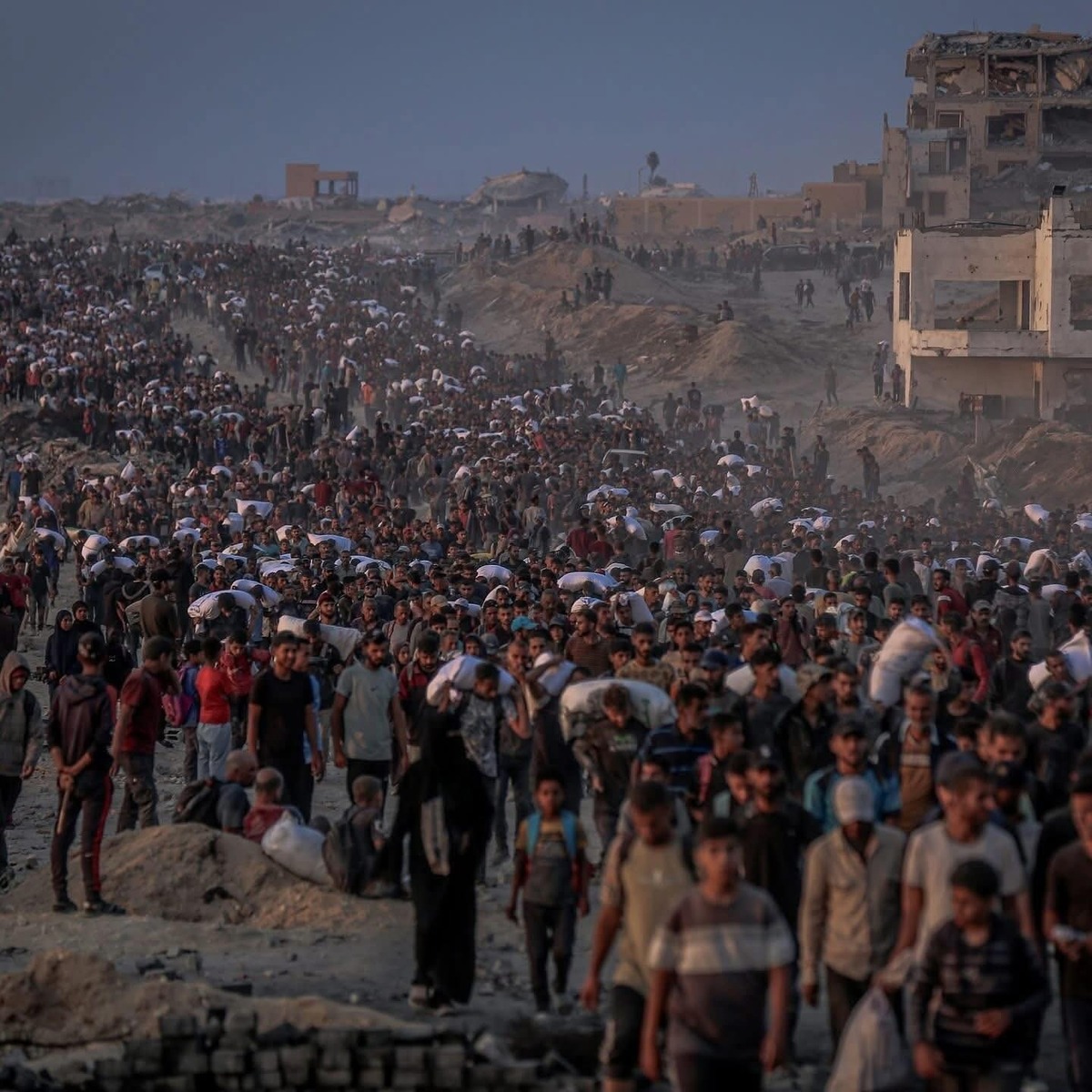
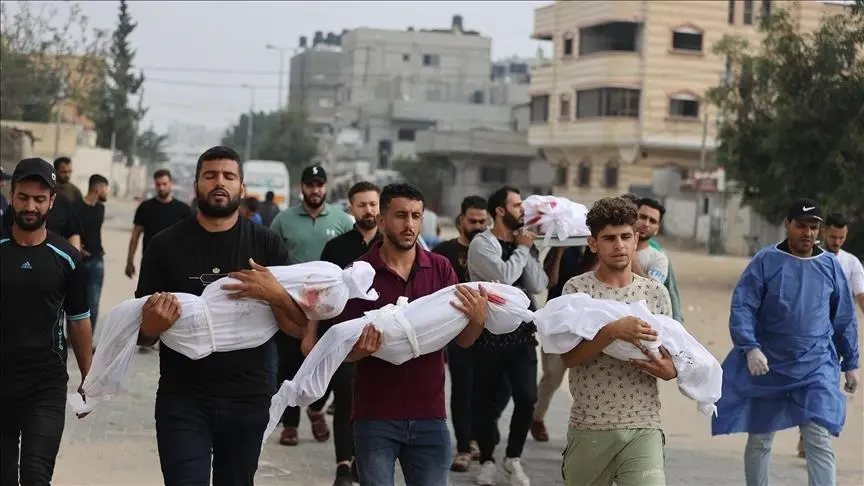
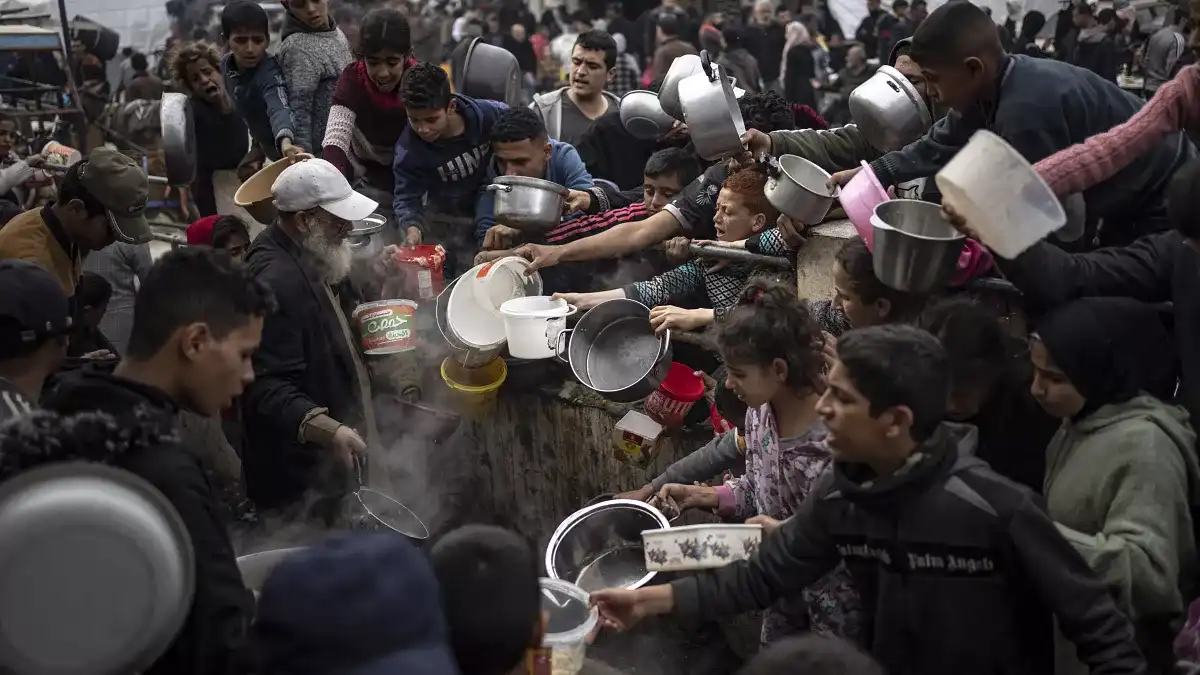
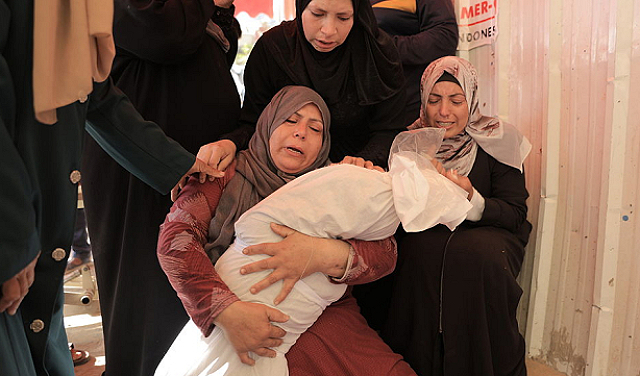
A new massacre: 16 dead and 100 injured among those waiting for aid in the central Gaza Strip.

Sixteen civilians were killed and nearly 100 others injured early Thursday morning when the Israeli occupation forces targeted people waiting for aid in the Gaza Valley area, north of Nuseirat, in the central Gaza Strip.

Local sources reported that Israeli forces' vehicles and drones targeted civilians waiting for aid in the central Gaza Strip, killing 16 people and wounding approximately 100 others.

The occupation army also blew up houses east of Jabalia al-Balad, north of the Gaza Strip.

The death toll in the Gaza Strip has risen to 55,637, and the number of injuries to 129,880, since the start of the aggression on October 7, 2023.

PALESTINE

Thu 19 Jun 2025 8:39 am - Jerusalem Time

A major missile attack on Tel Aviv and Beersheba

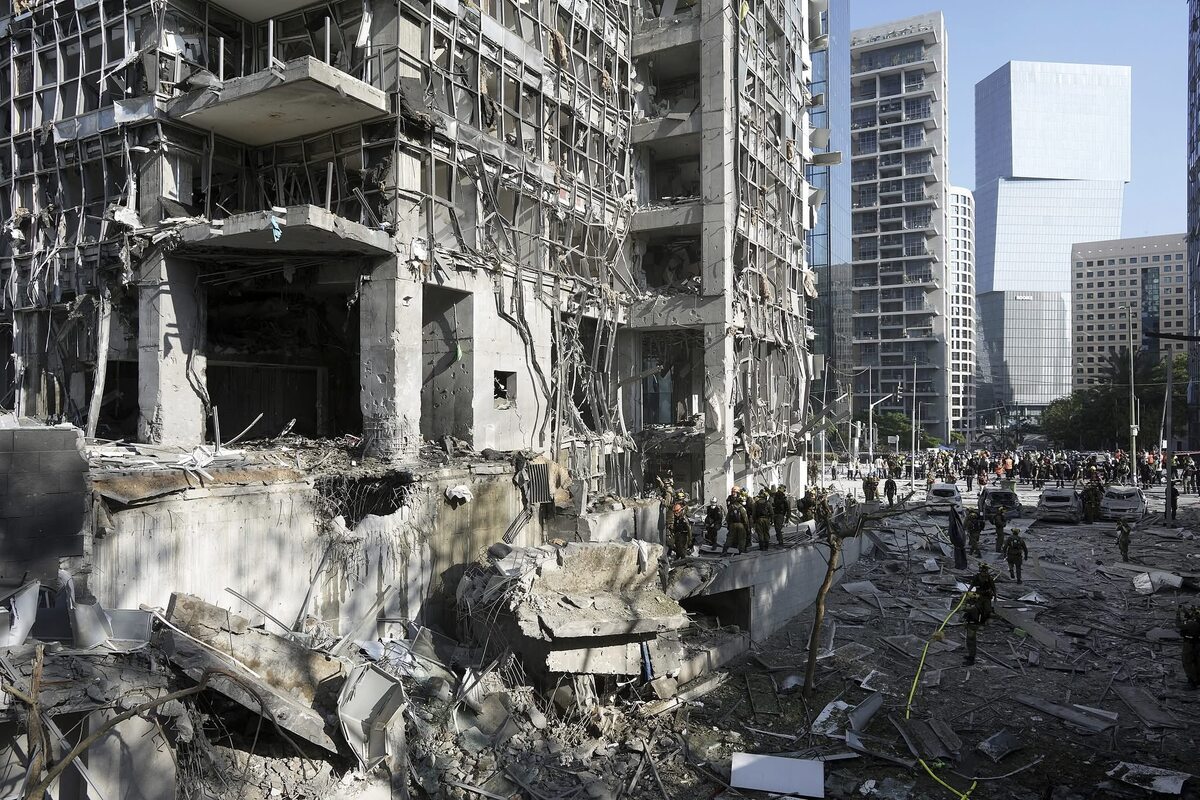
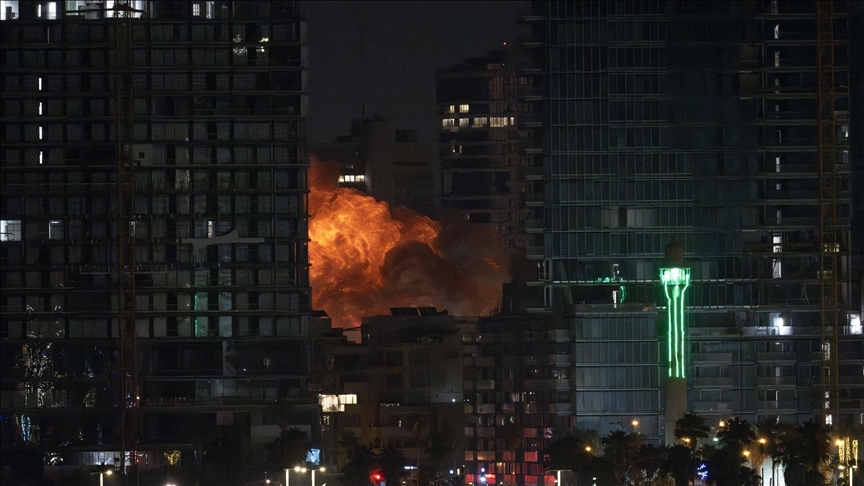
On the seventh day of the Iran-Israel war, Tehran launched a new barrage of missiles directly targeting Tel Aviv and Beersheba, causing massive explosions, collapses, and damage to several buildings.

50 injured in Iranian attack on Israel

Israeli media reported that the number of people injured in the Iranian attack rose to 50.

15 injured in Ramat Gan, east of Tel Aviv

Israeli Army Radio reported one serious and one moderate injury in Holon, and approximately 15 injuries in Ramat Gan, east of Tel Aviv.

Israeli media reported that Iranian missiles directly hit targets in the cities of Tel Aviv, Ramat Gan, Holon, and Beersheba.

Soroka Hospital evacuated after leak of hazardous materials

Israeli media reported that Soroka Hospital was completely evacuated after a hazardous material leaked from the hospital following an Iranian missile strike.

Trapped under buildings and rubble in Tel Aviv and Beersheba

Israeli media reported that people were trapped under buildings as a result of Iranian missiles fired at several sites in Israel.

It also reported that there were people trapped under the rubble at Soroka Hospital in Beersheba after it was hit by an Iranian missile attack.

A hospital in Beersheba was directly hit.

Israeli media reported that an Iranian missile struck Soroka Hospital in Beersheba, which treats soldiers wounded in Gaza, causing the entire building to collapse.

It reported that rockets fell in 4 locations, 3 in Gush Dan and one in the south.

ARAB AND WORLD

Wed 18 Jun 2025 10:52 pm - Jerusalem Time

Yemen warns of "dire consequences" if Houthis intervene in Israel-Iran war

Yemen's internationally recognized government warned on Wednesday of "dire consequences" for the country if the Houthi group intervenes militarily in the conflict between Israel and Iran.

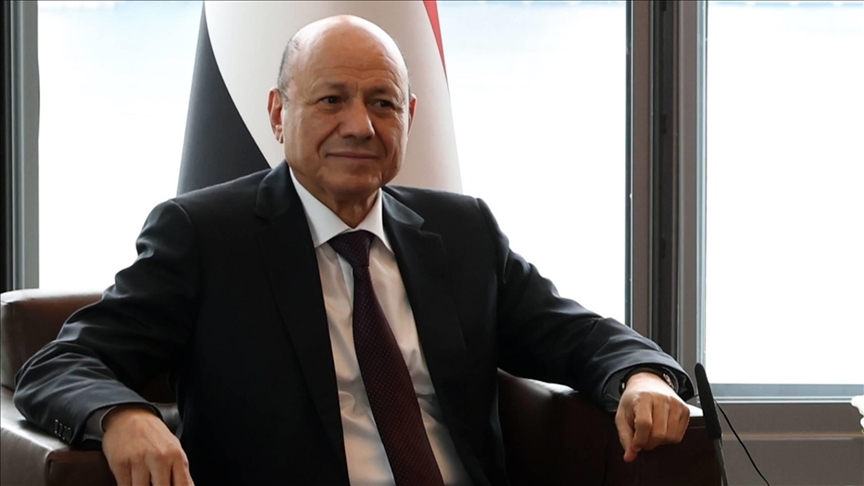
The official Yemeni news agency, Saba, reported that Presidential Leadership Council Chairman Rashad al-Alimi held a meeting in the interim capital, Aden, with the Economic and Humanitarian Crisis Management Committee, in the presence of Prime Minister Salem Saleh bin Braik, Foreign Minister Shaye' al-Zindani, and a number of officials.

The meeting discussed "the latest political, economic, service, and humanitarian developments, as well as regional developments in light of the Israeli-Iranian military escalation and its repercussions on Yemeni and regional security and the country's living conditions."

The meeting reviewed "an assessment of the situation regarding developments in the Israeli-Iranian war, its potential repercussions for regional and international peace and security, and the security, economic, and humanitarian conditions in Yemen."

On Tuesday, the Houthi group announced increased security readiness in the Yemeni capital, Sanaa, and the governorates under its control to confront any potential threats from Israel.

The Yemeni government warned the "terrorist Houthi militia against continuing to drag Yemen and its people into destructive regional conflicts (the Israel-Iran war)," according to the agency.

The legitimate government held the Houthi group "fully responsible for the dire consequences and repercussions of any additional reckless actions launched from Yemeni territory, which would plunge the country into further crises, including the increased militarization of waterways, threatening food security and the remaining livelihood opportunities, and exacerbating the humanitarian suffering of the Yemeni people."

Since dawn on June 13, Israel, with US support, has launched an aggression against Iran, including bombing nuclear facilities and missile bases, and assassinating military leaders and nuclear scientists. The attack has left 224 dead and 1,277 wounded. Tehran has responded with ballistic missiles and drones, leaving approximately 24 dead and hundreds wounded.

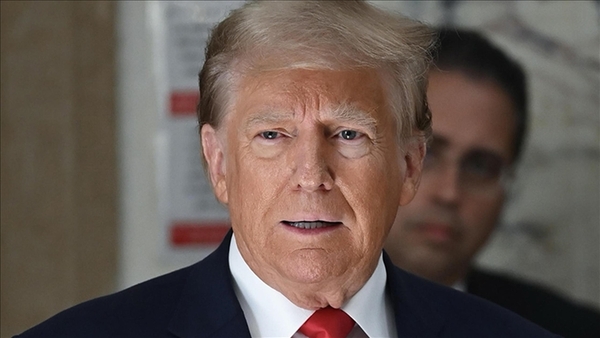
The risk of an escalation of the conflict looms, with Western and Israeli reports suggesting the United States could join Israel in its aggression against Iran. This coincides with statements by US President Donald Trump calling on Tehran to "surrender unconditionally" and threatening to target Supreme Leader Ali Khamenei.

PALESTINE

Wed 18 Jun 2025 10:19 pm - Jerusalem Time

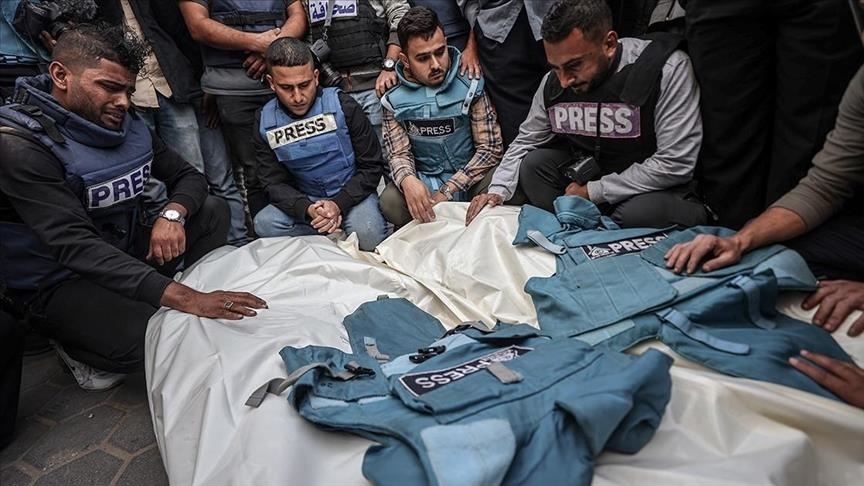
Journalists Syndicate: 12 journalists killed in May, 250 displaced from their homes

The Palestinian Journalists Syndicate confirmed that the Israeli occupation regime, with all its components, continues to commit crimes against Palestinian journalists in the Gaza Strip and the West Bank. These crimes, assaults, and violations against the Palestinian press have reached 137, most notably the martyrdom of 12 journalists and the destruction of four press offices in the Gaza Strip during the month of May.

According to the data and facts monitored and documented by the Syndicate's Freedoms Committee during the month of May, the occupation forces forced journalists to flee their homes in a dangerous manner. The displacement of approximately 250 journalists was monitored, most of them from Khan Yunis in the southern Gaza Strip, and approximately 100 from the northern Gaza Strip. This has deprived them of their livelihood and puts their lives at risk of death in light of the genocide being committed against the Palestinian people in the Gaza Strip.

The report indicated that last May witnessed the deaths of 12 martyrs, both male and female, as a result of Israeli occupation forces' shelling of the Gaza Strip, while the number of those who sustained fatal wounds from bullets and rocket shrapnel in the West Bank and Gaza Strip amounted to nine colleagues, some of whom are in critical condition.

The report indicated that Israeli missiles targeted a building in the Gaza Strip housing a media office housing four satellite channels, destroying it. Fourteen cases of severe beatings were monitored and documented, perpetrated by both occupation soldiers and settlers in the West Bank. Some colleagues were subsequently transferred to hospitals for treatment.

The report revealed 64 incidents of journalists and crews being detained and prevented from working, with 15 cases of suffocation due to being targeted with toxic tear gas, and five cases of shooting intended to intimidate and deter journalists from covering the protests. Four attempted run-overs were also recorded, along with three arrests, four cases brought before military courts, two summonses, and three cases of demolitions of journalists' buildings in the Gaza Strip.

The Journalists Syndicate affirmed its continued efforts with all relevant parties to provide protection for journalists, as well as to prosecute the occupation regime for its ongoing crimes against journalists, which have killed 226 journalists and media workers by the time this report was prepared.

ARAB AND WORLD

Wed 18 Jun 2025 9:00 pm - Jerusalem Time

Iran and Israel trade accusations of threatening shipping lanes in the Gulf and Red Sea.

Iran and Israel traded accusations during a session of the United Nations' International Maritime Organization (IMO) of endangering commercial activity in the Gulf and Red Sea waterways, as the military conflict between them escalates.

During a session of the Security Committee of the Organization of the Islamic Revolution, the Iranian delegation stated that Israel had expanded the scope of its "illegal attacks" in recent days to include petrochemical and gas infrastructure in Assaluyeh on Iran's Gulf coast.

"These actions directly jeopardize the security of international maritime navigation and the global energy supply chain," Iran added in a speech to the organization's delegates, which was broadcast live.

She added, "If the international community does not take urgent and concrete measures to stop this illegal aggression, the risk of escalation at sea becomes imminent."

Tehran has previously threatened to close the Strait of Hormuz to shipping in response to Western pressure. Closing the strait could impose restrictions on trade and impact global oil prices.

Maritime sources said today that maritime agencies are advising commercial vessels to avoid Iranian waters surrounding the Strait of Hormuz. Vessels heading to the Strait of Hormuz seek to minimize risks and sail close to the coast of Oman for most of the journey.

The Gulf of Oman is 200 miles wide, most of which is in international waters. It is bordered by the Sultanate and Iran, as well as the UAE and Pakistan, which have territorial waters extending 12 miles into the Gulf.

It will still be necessary to make trips through the Strait of Hormuz itself, which is 21 miles wide at its narrowest point.

Former Iranian Economy Minister Ehsan Khandouzi said that oil and liquefied natural gas tankers should not transit the Strait of Hormuz without Iran's permission.

Iranian Supreme Leader Ali Khamenei rejected US President Donald Trump's call for unconditional surrender today, while Trump said his patience was running out without offering any indication of his next move.

The Israeli delegation told delegates that the IMO's fundamental principle of global maritime safety is under "open and aggressive threat" from Iran, including through its support for the Houthi movement in Yemen, whose attacks have significantly disrupted maritime traffic through the Suez Canal and the Red Sea in recent years.

She added, "Iran has turned our entire region, and the Red Sea in particular, into a war zone. Through its political, financial, and military support for the Houthi rebels, Iran is enabling a campaign of maritime terrorism against civilian vessels."

She said that Iran "seeks to weaponize the world's busiest sea lanes... and impose its will through violence."

PALESTINE

Wed 18 Jun 2025 8:13 pm - Jerusalem Time

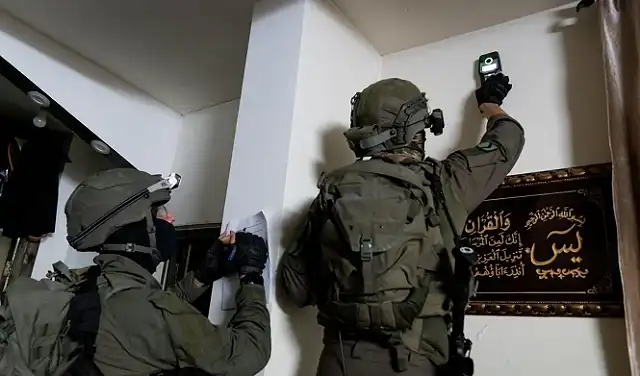
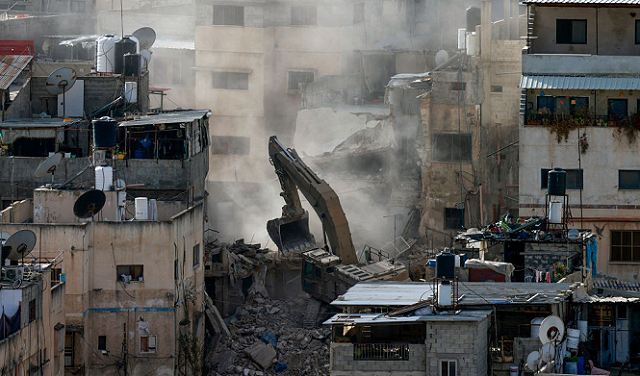
The occupation continues to demolish homes in Jenin camp.

Israeli occupation forces continued to demolish citizens' homes in Jenin camp on Wednesday.

Our correspondent reported that occupation bulldozers demolished homes in the Al-Damj neighborhood and in the eastern part of the camp.

Videos showed Israeli bulldozers demolishing several homes in the Al-Damj neighborhood, and the collapse of buildings.

Yesterday, Tuesday, the occupation forces demolished homes in the center of the camp, specifically in the "Samran" neighborhood. This is part of a plan announced by the occupation last week that includes the demolition of 95 homes in the camp, in addition to the 66 buildings demolished last March.

PALESTINE

Wed 18 Jun 2025 7:18 pm - Jerusalem Time

Settlers storm Al-Auja community, north of Jericho

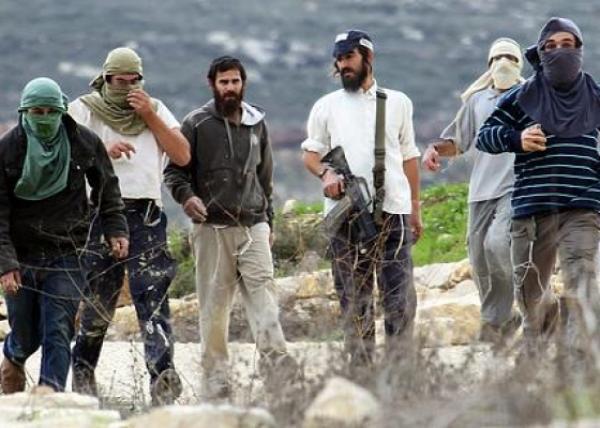
Settlers stormed the Al-Auja waterfall complex, north of Jericho, on Wednesday evening.

Hassan Malihat, general supervisor of the Al-Baidar Organization for the Defense of Bedouin Rights, said that the settlers stormed the community and grazed their sheep among the Bedouin straw bales, as part of the repeated violations targeting Bedouin communities in the Jordan Valley.

He pointed out that these practices are taking place under the protection of the occupation forces and are aimed at pressuring the residents and forcing them to flee.

He stressed that the continuation of these attacks exacerbates the suffering of the population and undermines prospects for stability in the region, calling for strengthening the resilience of Bedouin communities and supporting their right to remain on their lands in the face of policies of expulsion and oppression.

ARAB AND WORLD

Wed 18 Jun 2025 6:28 pm - Jerusalem Time

Americans, by a 60% majority, do not want a war with Iran.

A poll conducted by The Economist in partnership with YouGov between June 13 and 16 shows that, as speculation grows about whether US President Trump intends to join forces with Netanyahu in his war on Iran, Americans are expressing dissatisfaction with the way US President Donald Trump is handling issues related to the warring countries, according to the poll published on Wednesday.

When respondents were asked whether they "approve" or "disapprove" of Trump's dealings with Israel and Iran, 37% said they approved of dealings with both, while 44% disapproved of his dealings with Israel and 41% disapproved of his dealings with Iran. Trump's net approval rating for Iran is -4, and for Israel -7.

The poll found that 50% of Americans consider Iran an enemy of the United States, 25% consider it an unfriendly country, and 5% consider it an ally or friend.

The poll found that 50% of Americans consider Iran an enemy of the United States, 25% say it is not a friend, and 5% say it is an ally or friend.

Majorities showed they support diplomacy over the use of force. A majority (56%) believe the United States should enter into negotiations with Iran over its nuclear program, including 58% of Democrats and 61% of Republicans. This represents a sharp drop in opposition compared to 2015, when 32% of Americans—most notably 52% of Republicans—opposed nuclear talks during the Obama administration, according to a YouGov.hsj'bu d,y, poll.

At the level of general American attitudes that transcend partisanship, only 16% of Americans believe that the United States should intervene militarily, while 60% oppose it.

The poll also found that 36% of Americans consider Israel an ally of the United States, while nearly half say it is a "friend" or are unsure. Ten% consider Israel an unfriendly country, and 6% describe it as an enemy.

ARAB AND WORLD

Wed 18 Jun 2025 6:19 pm - Jerusalem Time

Trump: I asked Netanyahu to continue striking Iran

US President Donald Trump said on Wednesday that he encouraged Israeli Prime Minister Benjamin Netanyahu to continue his campaign in Iran.

"I told him, 'Keep going,'" Trump told CNN when asked about his message to the Israeli leader amid escalating regional tensions.

"I talk to him every day. He's a good guy and puts in a lot of effort," he added.

Trump's last known conversation with Netanyahu was on Tuesday, as the US president was considering joining Israel in bombing Iran.

President Trump declined to answer reporters' questions on Wednesday about whether the United States was planning to bomb Iran or its nuclear facilities, saying that the Iranians had communicated with Washington, but he believed "the time for talk has passed."

"There's a big difference between now and a week ago," Trump told reporters. "Nobody knows what I'm going to do."

Trump confirmed that Iran had contacted the United States for negotiations, several days after the exchange of strikes with Israel.

Asked whether Tehran had communicated with Washington, the US president replied, "Yes," adding, "I said it was too late for talks... There's a huge difference between today and a week ago. Isn't that right?" He continued, saying the Iranians "offered to come to the White House," describing the proposal as "brave."

He added that Iran had proposed holding talks at the White House. He did not provide details, describing Iran as having no air defense at all.

Trump said he believes Netanyahu has been "treated very unfairly by his country," in an apparent reference to ongoing legal cases in Israel.

When asked if he had given Netanyahu any indication that he might help the country beyond what he had already given, Trump denied it.

"No. So far, he's done a good job. He's been treated very unfairly. He's a wartime president, and he's going through this nonsense, it's ridiculous," Trump said.

PALESTINE

Wed 18 Jun 2025 5:59 pm - Jerusalem Time

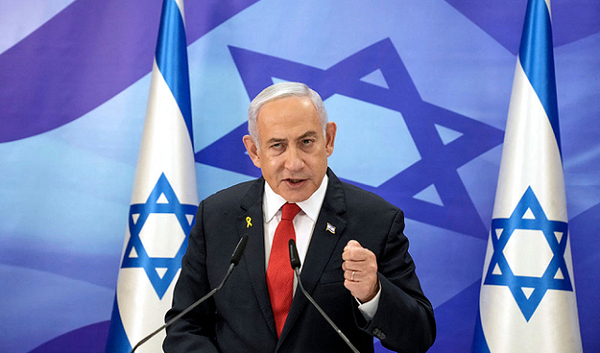
Netanyahu: War with Iran and an eye on the entire Middle East

"We will see a different Middle East than we have ever seen before." This statement was perhaps the most significant in a series of statements made by Israeli Prime Minister Benjamin Netanyahu two days ago, amid Israel's aggression against Iran since June 13.

This statement came in the context of his boasting about Israel's handling of what he described as a devastating blow to Iran's military leadership and nuclear scientists, and his pledge to continue destroying Iran's missile production facilities and thwarting its nuclear program.

Threatening a country with which you are at war may be common and expected, but what's striking recently is that Netanyahu's statements have repeatedly included the term "Middle East" and talk of changing it, particularly when he discusses his multiple wars, whether against the resistance in the Palestinian Gaza Strip, against Hezbollah in Lebanon, or against Iran.

If we follow Netanyahu's statements over the past few months, we find the following:

On September 30, 2024, in parallel with a military campaign against Hezbollah, Netanyahu said:

"Israel is pursuing a systematic plan to assassinate Hezbollah leaders with the aim of changing the strategic reality in the Middle East."

"Challenging days lie ahead. We have crushed Hamas in Gaza, and we will fight anyone who threatens our interests."

On October 31, 2024, in the midst of his war on Gaza and Lebanon, Netanyahu said:

"Israel is currently changing the face of the Middle East, but we are still in the eye of the storm and face major challenges, and I do not underestimate our enemies at all."

On January 6, 2025, Netanyahu said in statements reported by Maariv newspaper:

"We are at a time of fundamental change in the Middle East."

On February 2, 2025, before leaving for Washington to meet with the US President, Netanyahu said:

"I will discuss strategic issues with him. Cooperation with the Trump administration will enable Israel to strengthen its relations with countries in the region, transform the Middle East, enhance Israel's security, and achieve prosperity through strength."

On May 7, 2025, coinciding with an Israeli bombing of Sana'a airport in Yemen, Netanyahu said:

"I do not underestimate the challenges ahead. I have full confidence in the will of our people and our fighters to achieve the mission of victory."

"This mission is not just about defeating Hamas, but about releasing the kidnapped soldiers and changing the face of the Middle East."

"This is not an easy task, but it is achievable."

While the repeated phrase "changing the Middle East" is unmistakable to observers, the more important question is: What does Netanyahu mean by this? Will it generate counter-reactions from countries in the region?

Is this serious?

Some may initially wonder whether these statements are truly serious and dangerous, or whether they are merely mere statements. The truth is that what makes the first option more likely is that it was repeated by one of Israel's most powerful leaders in its history, dating back to 1948, when the Zionist gangs declared the establishment of a state on the land of Palestine.

What makes the matter even more serious is that these are not just repeated statements, but rather talk of a future that was paved over in the past and continues at an ever-more rapid pace in the present, as evidenced by the many instances around us in Palestine, Lebanon, and other Arab and Muslim countries.

What are the axes of change?

Perhaps we can summarize the axes of change that Israel, under Netanyahu's leadership, seeks in the Middle East in the following points:

Eliminating the idea of resistance and its movements.

Ensuring Israel's military superiority in the region, particularly in the military aspect, by relying on its Western allies, led by the United States, as well as in the economic and scientific fields.

This is linked to an attempt to impose and strengthen a state of strategic deterrence on the countries of the region, preventing them from even thinking about attacking Israel or even showing hostility towards it.

To contain or eliminate the major powers in the region that are currently hostile to Israel or may consider doing so in the future.

Eliminating Iran's nuclear program, as it is the only country in the region pursuing this course in a manner that raises concerns for Israel and its Western allies, led by the United States.

Spreading the culture of normalization by focusing on normalizing Israel's relations with key countries in the region, thus opening the door wide for other Arab and Islamic countries to follow the same path that has eluded Israel for decades.

All of the above leads us to one of the greatest sources of danger: the pursuit of regional hegemony and the attempt to change its stable borders, paving the way for the dream of Greater Israel, which Israel has never abandoned.

Reactions

On the other hand, statements issued by some countries in the region in recent days have focused on condemning the Israeli attacks on Iran, noting the threat they pose to regional security.

The most prominent Arab and Islamic positions on this matter were as follows:

Gulf Cooperation Council:

He condemned the Israeli aggression, considering it a clear violation of international law, according to a statement made between Iranian Foreign Minister Abbas Araqchi and GCC Secretary-General Jassim Al-Budaiwi, who affirmed the GCC states' rejection of the use of force and emphasized the need for dialogue to resolve disputes.

Qatar: It affirmed its strong condemnation and denunciation of the Israeli attack on Iran, considering it a flagrant violation of Iran's sovereignty and security, and a clear breach of the rules and principles of international law. It emphasized that the Israeli attack, which represents a dangerous escalation and a systematic policy of aggression, poses a serious threat to the stability of the region.

Doha also stressed that regional security cannot tolerate further crises and escalation.

Prime Minister and Minister of Foreign Affairs Mohammed bin Abdulrahman Al Thani expressed his country's deep concern over this dangerous escalation during calls with the foreign ministers of Saudi Arabia, Egypt, Oman, and Jordan, stressing that Qatar will work with its regional and international partners to halt the aggression against Iran and avoid its disastrous repercussions.

Turkey: President Recep Tayyip Erdoğan asserted that Israeli Prime Minister Netanyahu has once again demonstrated that he is the greatest threat to regional security, adding that Israel possesses nuclear weapons and does not recognize any international rules. The Turkish president emphasized that Israeli attacks cannot be allowed to overshadow the humanitarian crisis and genocide in the Gaza Strip, nor can these developments be allowed to spread to Syria.

Saudi Arabia: Condemned the Israeli aggression against Iran, and Crown Prince Mohammed bin Salman—in a call with Iranian President Masoud Pezeshkian—emphasized Riyadh's rejection of the use of force to resolve disputes and the need to adopt dialogue as the basis for resolving crises.

Foreign Minister Faisal bin Farhan, in a call with his Iranian counterpart, also condemned the "blatant Israeli aggression," which could disrupt de-escalation efforts, stressing the need to reach diplomatic solutions.

Egypt: Through its Foreign Minister, Badr Abdel Aty, it emphasized its rejection and condemnation of the violation of state sovereignty, warning of the "danger of the region sliding into total chaos."

Pakistan: Prime Minister Shehbaz Sharif declared full solidarity with Iran against the unjustified Israeli aggression in a phone call with the Iranian president.

Sharif also discussed with the Turkish President the dangerous regional situation following the unjustified Israeli aggression.

For his part, Pakistani Defense Minister Khawaja Muhammad Asif called on the Islamic world to unite against Israel over its attacks on Iran.

Condemnations were not limited to the aforementioned countries, nor were they limited to official bodies. However, the most recent and perhaps most provocative reaction came in a tweet from former Egyptian Foreign Minister Amr Moussa, who called for an urgent meeting of the Egyptian National Security Council, on the grounds that "the ongoing war between Israel and Iran and the signs of direct intervention by major powers, or some of them, pose serious threats to regional security in the Middle East, affecting its countries and societies."

Moussa, who also previously served as Secretary-General of the Arab League, spoke frankly, stressing that "Egypt and the Egyptian people are not far from this."


PALESTINE

Wed 18 Jun 2025 5:40 pm - Jerusalem Time

7 dead, including a child, in the occupation's bombing of Al-Bureij camp in the central Gaza Strip.

Seven civilians, including a child, were killed and others were injured when the Israeli occupation forces bombed the Al-Bureij refugee camp in the central Gaza Strip.

According to local sources, three civilians, including a child, were killed and 20 others were injured when an Israeli drone targeted a group of civilians in the camp.

He confirmed that three martyrs were transferred to Al-Awda Hospital, while four martyrs were transferred to Al-Aqsa Martyrs Hospital.

-

ARAB AND WORLD

Wed 18 Jun 2025 5:11 pm - Jerusalem Time

Trump: It's too late to negotiate with Iran... Next week will be decisive

US President Donald Trump said he had told Iran that it was too late to negotiate, and that "things have changed," referring to shifting political positions and circumstances.

He added, in press statements, that he does not rule out carrying out strikes against Iranian nuclear facilities, saying, "I may or may not strike Iranian nuclear facilities," explaining that Iran must have negotiated with his administration ahead of time.

Trump reiterated his stance toward Tehran, demanding unconditional surrender and the complete abandonment of its nuclear program. He emphasized that the Iranians had previously communicated with his administration, but that he was tired of the current situation and would no longer accept any further negotiations without a clear surrender.

Trump: Iran is seeking a deal

Regarding the negotiations, the US president confirmed that Iran is seeking to strike a deal with Washington, at a time of heightened tensions between the two sides over Iran's nuclear program and mutual attacks in the region.

Trump continued, saying that Iran has been threatening the United States for years, stressing that his country is closely monitoring developments, and that the coming days may witness significant changes in this regard.

Trump also emphasized that Iran has been threatening the United States for years, and that his country is closely monitoring developments. He predicted that next week would witness decisive changes in the Iranian situation, perhaps before the end of this week.

Where are interest rates going?

On the economic front, Trump asserted that his administration has saved $88 billion through tariffs, noting that the United States is not currently experiencing inflation, unlike what happened during President Joe Biden's term, which he described as the highest inflation rate in the country's history. His administration is also seeking to save $800 billion.

He added that Europe has made 10 interest rate cuts recently, while none have been made in the United States. He noted that money is beginning to flow back into the country's treasury and that many new factories are under construction.

PALESTINE

Wed 18 Jun 2025 4:24 pm - Jerusalem Time

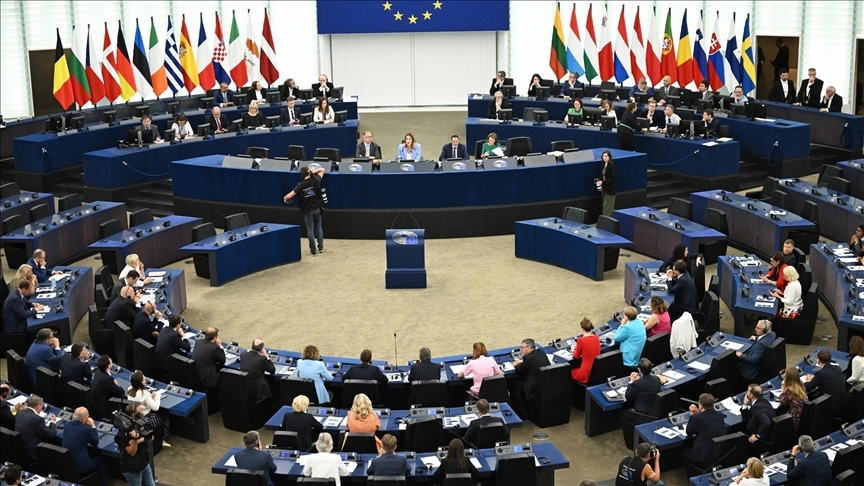
European MPs accuse EU countries of complicity in the war of extermination in Gaza.

Several members of the European Parliament have accused member states of complicity in Israel's genocide against Palestinians in the Gaza Strip and called for severing all ties with Tel Aviv.

This came during a session of the European Parliament in the French city of Strasbourg on Wednesday, in which Israel's practices in Gaza were described for the first time as "genocide."

The session, titled "Stop the Genocide in Gaza: Time for European Sanctions," was initiated by the 46-member European Left group and attended by EU High Representative for Foreign Affairs and Security Policy Kaya Kallas.

Several MPs, including the head of the Left Bloc, French MP Manon Aubry, delivered speeches at the session.

Aubrey Callas attacked, saying, "Genocide, genocide, genocide. I say this again because despite 18 months of massacres in Gaza, you deliberately refuse to use this term."

She stressed the need for the European Parliament to take action to protect civilians in Gaza, impose sanctions on Israel, and end EU member states' complicity with Tel Aviv.

Aubry noted that Rima Hassan, a French MP of Palestinian origin and member of the left-wing group, was aboard the Madeleine, a ship bound for Gaza to provide humanitarian aid.

She continued: "When Israel stopped her in international waters and detained her, there was no call from the European Union for her release."

Aubrey said that Israeli Prime Minister Benjamin Netanyahu was able to enter a European Union country (Hungary), despite an arrest warrant issued against him by the International Criminal Court.

She criticized the European Union's double standards, saying, "The EU imposed 17 packages of sanctions on Russia over its invasion of Ukraine, but it has not taken any similar action against Israel."

She added that the meeting of European Union foreign ministers scheduled for June 23 may witness, for the first time, discussion of the possibility of imposing sanctions on Israel.

She stressed that suspending the EU-Israel partnership agreement was "a demand of tens of thousands of protesters in the streets of Europe."

On May 20, the European Union, at the suggestion of the Netherlands, decided to review the Association Agreement with Israel, which grants Tel Aviv trade privileges.

Kallas is scheduled to announce the results of this review at a meeting of European foreign ministers on June 23.

With full American support, Israel has been committing genocidal crimes in Gaza since October 7, 2023, leaving more than 185,000 Palestinians dead or wounded, most of them children and women, and more than 11,000 missing, in addition to hundreds of thousands displaced.

PALESTINE

Wed 18 Jun 2025 3:30 pm - Jerusalem Time

Jerusalem Governorate: The occupation is exploiting regional tensions to expand colonization and isolate the city.

The Jerusalem Governorate expressed its deep concern over the escalating Israeli field measures aimed at strangling the city of Jerusalem and completely isolating it from its Palestinian surroundings. These measures include the installation of new iron gates, the intensification of military checkpoints, and the acceleration of colonial expansion and annexation.

Today, Wednesday, the occupation authorities installed a new gate at the entrance to the town of Anata, northeast of the city. A few days earlier, they had installed a gate at the entrance to Jaba' and another at the entrances to the town of Hizma. This is part of a rapidly escalating Israeli policy to fragment the city and exert complete control over movement within it.

The governorate explained that these developments coincide with the occupation's exploitation of the recent aggression on the Gaza Strip and the escalation with Iran. The Israeli government is seeking to implement annexation plans, expand the borders of the Jerusalem municipality, increase the number of settlers, and build new settlements in the area, all while the world is distracted by what is happening in the occupied city.

At the same time, the city is witnessing unprecedented tightening of security at major military checkpoints, most notably Qalandia, Shuafat, Jaba', and the Container. This has led to their near-total closure to vehicles, disrupting the lives of citizens. Waiting times have exceeded six hours per day, and many have been subjected to humiliation and abuse at the crossings.

The Jerusalem Governorate also highlighted the field impact of these measures, citing the incident at the Jaba' military checkpoint, where the deputy governor was forced to walk to his workplace in the town of al-Ram, amidst a complete lockdown and severe overcrowding. This scene epitomizes the suffering of thousands of Palestinians who are stuck for long hours every day at checkpoints.

The occupation forces also set up mobile "flying" checkpoints in Jerusalem towns and neighborhoods such as Silwan, Jabal al-Mukaber, Issawiya, al-Eizariya, and Hizma, in conjunction with search and arrest campaigns and the imposition of heavy fines.

The report indicated that Jerusalem is now surrounded by 85 checkpoints, including earthworks, fixed and mobile iron gates, and the expansionist apartheid wall, effectively turning it into a closed prison where racial segregation is enforced by force.

She emphasized that these measures are part of an integrated plan to fully control the city, including its Islamic and Christian holy sites, as part of an undeclared annexation project being implemented amid the international community's preoccupation with the Palestinian capital.

In this context, local and international media outlets and social media activists called for increased coverage of these violations and for efforts to convey the voice of Jerusalem and its events to the world, in the face of the policies of silencing and media blackout pursued by the occupation authorities, which aim to cover up crimes and restrict freedoms.

The report concluded by emphasizing that international silence gives the occupation a green light to proceed with its colonial and Judaization projects, and that media and popular solidarity with Jerusalem has become an urgent necessity to confront these existential threats.

PALESTINE

Wed 18 Jun 2025 3:28 pm - Jerusalem Time

UNRWA: 45% of basic supplies in the Gaza Strip have run out

The United Nations Relief and Works Agency for Palestine Refugees (UNRWA) said that the health sector in Gaza is in a critical situation due to the ongoing Israeli war of extermination.

In a statement issued on Wednesday, it stated that 45% of basic supplies have run out, and that nearly a quarter of them could run out within six weeks.

The statement noted that stocks of vital medicines and blood products are running low, while needs are urgent.

Since March 2, the Israeli occupation army has closed the Gaza Strip's crossings to the entry of food, relief, medical aid, and goods, causing a significant deterioration in the humanitarian situation.

PALESTINE

Wed 18 Jun 2025 2:27 pm - Jerusalem Time

The death toll in the Gaza Strip rises to 55,637.

The Ministry of Health in Gaza announced on Wednesday that the death toll in the Gaza Strip has risen to 55,637, the majority of whom are children and women, since the start of the Israeli occupation's aggression on October 7, 2023.

She added that the death toll has risen to 129,880 since the start of the aggression, while a number of victims remain under the rubble, unable to be reached by ambulances and civil defense teams.

She noted that 144 martyrs and 560 injuries arrived at Gaza Strip hospitals over the past 24 hours, while the death toll and injuries since March 18, when the occupation violated the ceasefire agreement, has reached 5,334 martyrs and 17,839 injuries.

She pointed out that a number of victims are still under the rubble and on the streets, and that ambulance and civil defense crews are unable to reach them.

Medical sources confirmed that the occupation forces have once again prevented international and UN organizations from accessing fuel storage sites designated for hospitals, claiming that they are located in red zones.

She stressed that obstructing fuel supplies to hospitals threatens to shut them down, as they rely on generators to power vital departments. She noted that the available fuel supplies to hospitals are sufficient for only three days.

PALESTINE

Wed 18 Jun 2025 2:12 pm - Jerusalem Time

The occupation forces transfer the child Hana Hammad from Hebron to administrative detention.

The occupation intelligence transferred the child prisoner, Hana Haitham Ismail Hammad (17 years old), from Hebron, to administrative detention for a period of four months, bringing the number of female prisoners held in administrative detention to 10, out of 41 female prisoners, in Israeli occupation prisons.

The Palestinian Prisoners' Affairs Commission and the Palestinian Prisoners' Club added that Hammad was arrested on June 9th after occupation forces raided her home in Al-Arroub refugee camp. During her arrest, Hanaa and her mother, who was detained with her during the arrest and later released, were subjected to field interrogations and abuse.

In this context, the Commission and the Club said in a joint statement that we have witnessed an unprecedented escalation since the beginning of the genocide in the number of administrative detainees, including women and children, as the number of administrative detainees until the beginning of June 2025 reached (3562) administrative detainees, including at least (95) children under the age of 18.

They pointed out that the number of administrative detainees since the beginning of the genocide is the highest in history and today is the highest in the number of prisoners, detainees, and detainees. The crime of administrative detention is one of the most prominent historical and systematic policies practiced by the occupation authorities against citizens, in a continuous attempt to undermine any escalating confrontation against it, and to target perpetrators on all social, political, and cultural levels. The occupation has expanded its use since the beginning of the genocide, targeting all segments of society. During one week, the occupation intelligence issued no less than 400 administrative detention orders, which are among the thousands of orders that have been monitored since the genocide.

The Commission and the Club stated that the occupation courts, at all levels, continue to function as a primary arm in entrenching this crime, through the sham trials they hold for detainees and their implementation of the orders of the intelligence service.

It's worth noting that the policy of administrative detention has undergone numerous transformations over the past few years. Despite the escalating level of resistance to this crime through hunger strikes and court boycotts, the occupation has devised new tools that have contributed to its entrenchment.

It is worth noting that 8 administrative detainees have been martyred in Israeli occupation prisons since the beginning of the war of extermination. They are among the 72 martyrs who have been martyred since the extermination in Israeli occupation prisons.

PALESTINE

Wed 18 Jun 2025 2:08 pm - Jerusalem Time

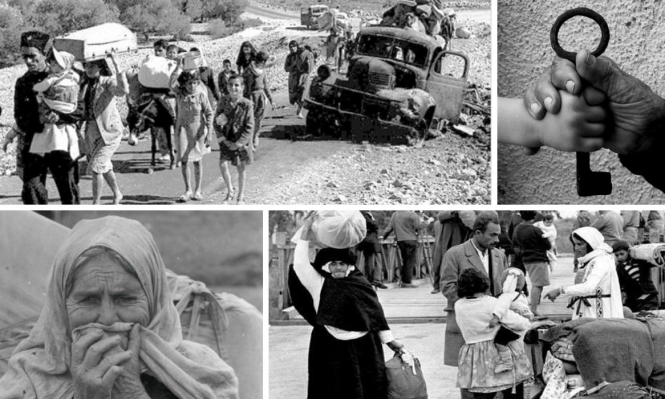
Statistics: 5.9 million Palestinian refugees registered with UNRWA

The Central Bureau of Statistics said that the number of Palestinian refugees registered with the United Nations Relief and Works Agency for Palestine Refugees (UNRWA) as of August 2023 is approximately 5.9 million.

The Central Bureau of Statistics (CBS) stated in a statement issued Wednesday on the occasion of World Refugee Day that there are approximately 2.5 million refugees in the West Bank and Gaza Strip, constituting approximately 42% of the total Palestinian refugees (15% in the West Bank compared to 27% in the Gaza Strip). At the level of Arab countries, the percentage of refugees registered with the Relief and Works Agency (UNRWA) in Jordan reached approximately 40% of the total refugees, while this percentage in Lebanon and Syria reached approximately 8% and 10%, respectively.

He pointed out that these estimates represent the minimum number of refugees, given the presence of unregistered refugees. This number does not include Palestinians who were displaced from 1949 until the eve of the June 1967 war (according to UNRWA's definition), nor does it include Palestinians who left or were deported in 1967 as a result of the war, who were not refugees to begin with.

The statistics indicated that the number of Palestinian and Arab martyrs since the Nakba in 1948 until today (inside and outside Palestine) has exceeded 156,000.

Based on population estimates prepared by the Palestinian Central Bureau of Statistics (PCBS), there are 15.2 million Palestinians worldwide by mid-2025, half of whom live outside of historic Palestine. Their number has reached approximately 7.4 million Palestinians in historic Palestine. Estimates also indicate that the number of Palestinians in the diaspora has reached approximately 7.8 million, including 6.5 million in Arab countries.

About 66% of the total population in the Gaza Strip are refugees.

The percentage of refugees in the State of Palestine amounted to approximately 42.2% of the total Palestinian resident population in 2017. 26.3% of the population in the West Bank were refugees, while the percentage of refugees in the Gaza Strip amounted to 66.1%.

Nearly two million Palestinians have been displaced from their homes within the Gaza Strip.

The statistics office continued, noting that Gaza residents have been repeatedly forced to flee their homes since the start of the aggression on October 7, 2023, under duress. They have lost their homes and become homeless in tents and schools, trapped between the walls of poverty and war. Nearly two million citizens have been displaced from their homes, out of a total of approximately 2.2 million who lived in the Strip on the eve of the occupation's aggression.

Approximately 55,000 citizens were martyred, including more than 18,000 children and more than 12,000 women, in addition to more than 219 journalists. More than 11,000 citizens are still missing, most of them women and children.

Estimates revealed that 39,384 children in the Gaza Strip lost one or both parents after 618 days of Israeli aggression, including approximately 17,000 children who were deprived of both parents, leaving them facing a harsh life without support or care.

In the West Bank, similar to the 1948 Nakba and the 1967 Naksa, thousands of citizens were forcibly displaced as a result of the aggression on the northern camps (Jenin, Tulkarm, and Tubas), in the largest displacement operations the West Bank has not witnessed in eight decades.

Since the beginning of the aggression on the Gaza Strip, at least 991 citizens have been martyred in the West Bank, amid the occupation's escalation of its aggression and ongoing violations against civilians.

According to data from the United Nations Relief and Works Agency for Palestine Refugees (UNRWA), more than 42,000 citizens have been displaced from camps in the northern West Bank, amid ongoing forced displacement and home demolitions, in light of ongoing arrest campaigns. The number of displaced persons from Jenin camp and its surroundings has risen to 21,000 people, representing 30% of the population of Jenin city and camp. Meanwhile, most of the residents of Tulkarm and Nur Shams camps, whose population, according to the agency's estimates, is approximately 19,000 refugees, have been displaced by mid-2025.

Ethnic cleansing, population replacement, and land control

The census noted that the population of historic Palestine in 1914 was approximately 690,000 people, of whom Jews constituted only 8%. In 1948, the population reached more than two million, of whom approximately 31.5% were Jews. Between 1932 and 1939, the largest number of Jewish immigrants, 225,000, flowed into Palestine. Between 1940 and 1947, more than 93,000 Jews flowed into Palestine. Thus, between 1932 and 1947, Palestine received approximately 318,000 Jews, and from 1948 until 2023, more than 3.3 million Jews flowed into Palestine.

He continued: Despite the displacement of approximately one million Palestinians in 1948 and more than 200,000 Palestinians after the June 1967 war, the estimated population of the State of Palestine reached approximately 5.5 million Palestinians in mid-2025 (3.4 million in the West Bank, 2.1 million in the Gaza Strip, a 10% decrease from the population estimates for the Gaza Strip for 2025).

Wed 18 Jun 2025 2:07 pm - Jerusalem Time

The Shame of Israeli Medicine

Faced with the destruction of Gaza’s hospitals and the systematic deprivation of Palestinians’ right to health, Israel’s medical establishment has disregarded the field’s most basic ethical principles.

May 31, 2025

In late March 2024 Israeli soldiers raided Nasser Hospital in the southern Gaza Strip. They arrested medical staff and patients, as well as civilians who were sheltering in the hospital compound. H., an orthopedic doctor, was partway through a shift when the soldiers began beating him. They kicked him in the stomach, groin, and testicles, told him to take his clothes off, handcuffed and blindfolded him, and escorted him to the hospital yard. Then they drove him across the Israeli border to the infamous Sde Teiman military base, near the southern city of Be’er Sheva, where at the time hundreds of Palestinians were being held blindfolded and shackled in overcrowded, filthy cages, some forced to sleep on the floor without mattresses or blankets.

In October 2024 H. gave an affidavit to Physicians for Human Rights–Israel (PHRI), a nonprofit where one of us, Guy Shalev, is the executive director and another, Osama Tanous, is a board member. H. recounted that at one point during his sixty-nine days at Sde Teiman his guards put him in a “disco room” with no mattresses, where deafening music blared at all times. Eventually they took him to an interrogation room, where, he testified, “for six days they tortured me by tying my hands and feet to a chair behind my back, hitting my stomach, and slapping me while I was blindfolded.” After forty-three days at Sde Teiman, he was sent to a prison not far from Tel Aviv to be interrogated.

There he saw a doctor, who affirmed that H. had developed inguinal and abdominal hernias as a result of the beatings. “He said I needed surgery and should not be interrogated,” H. said. But he was sent back to Sde Teiman without treatment. “As soon as I returned to the detention facility,” H. recounted, “the soldiers beat me up, banged my head on the ground and rubbed my face in the sand, kicked me and punched me.”

After another three weeks at Sde Teiman, they transferred H. once again, to a prison facility in Ashkelon, near the Gaza border. There he was seen by another doctor, who made him keep his blindfold on during the examination. “We are colleagues in the same profession,” H. said. “You are supposed to treat me humanely.” In response, he remembered, the Israeli doctor “slapped me while I was still blindfolded.” “You are a terrorist,” he recalls the man saying.

A few weeks later, at the Israel Prison Service’s medical facility in Ramleh, H. met with yet a third doctor, who confirmed in a ten-minute exam that he needed a hernia operation—yet the doctor insisted it was not urgent and H. was again returned, this time to Ofer prison. H. recalls in the affidavit that at a court hearing last July the judge extended his detention for forty-five days; neither there nor in the following interrogations was he given access to a lawyer. In August, when he appeared before a judge in a phone hearing, he was told that he is considered “affiliated with a terror organization.” Before the judge abruptly hung up the call, he told H. that he would be remanded to Ofer until further notice. “I am a doctor,” H. protested. Then the judge was gone.

*

H. remains incarcerated at Ofer awaiting trial—one of the over 380 health care workers from Gaza who have been detained by Israeli forces since October 2023. (According to Health Care Workers Watch, two dozen of them have been subjected to enforced disappearance and remain missing.) Between July and December 2024 PHRI gathered testimony from twenty-four of these Palestinian medical professionals, who were held across civilian and military prison systems in Israel. Practically all of them described suffering torture in the form of severe beatings, continuous shackling, and sleep deprivation. According to documents that PHRI obtained through a freedom of information request, at least sixty-three Palestinians died in Israeli custody between October 2023 and September 2024, including the doctors Adnan al-Bursh, Iyad al-Rantisi, and Ziad al-Dalou, as well as the paramedic Hamdan Abu Anaba. Since then, drawing on data gathered by rights organizations and the Palestinian Authority, the group has determined that at least twenty-seven further detainees have died in the past nineteen months, bringing the total number to ninety. In comparison, nine inmates died in detention at Guantánamo Bay over a period of more than twenty years.

The affidavits gathered by PHRI reveal some recurring themes. One is the use of dogs to attack and humiliate prisoners. M.T., the head of the surgery department at the Indonesian Hospital in northern Gaza, told PHRI that soldiers from a counterterrorism unit called Force 100 raided his detention enclosure in Sde Teiman with dogs three days in a row, “beating prisoners and allowing the dogs to urinate and defecate on us.” K.S., a twenty-nine-year-old surgeon at al-Shifa Hospital, recounted that “they beat us with batons, with their fists, and let their dogs urinate on us. There are always dogs with them…. They attacked me twice with dogs.”

Another repeatedly cited abuse was pervasive medical neglect. Echoing other detainees, a twenty-seven-year-old general practitioner from al-Aqsa Hospital named M.S. described the scabies outbreaks in his prison ward. “Nobody is treating these infections,” he said, “nor anything else.”

Those who did manage to see Israeli doctors often had experiences similar to the ones that H. described. K.S. recalled a doctor telling him his scabies “would heal on its own.” N.T., a forty-nine-year-old surgeon who takes medication for hypertension, was denied access to a physician for months after he was detained during the March 2024 raid on Nasser Hospital. In his affidavit, he describes being taken to Sde Teiman, handcuffed and blindfolded, and forced to wear only underwear for the first seventeen days. He spent the next month in a detention facility called Anatot, near the Palestinian village Anata in the occupied West Bank, then the next two months at Ofer, where he finally saw a physician. The doctor prescribed medication—but only for ten days.

Neglect can be a death sentence. In his testimony M.T. recounted that another prisoner, M., had a stroke in the enclosure where prisoners with medical conditions were held. “A shawish [an inmate delegated as a go-between by the prison authorities] called for a nurse,” M.T. recalled, “who told him, ‘You’re not a doctor, don’t interfere.’” The following day they alerted the guard, then a Shin Bet officer. “They warned him that the prisoner was going to die,” M.T. said. At last a doctor showed up, “but M. was already dead.” 

*

In 1989 the South African physicians William John Kalk and Yosuf Veriava treated twenty political prisoners who had been hospitalized in Johannesburg after participating in a hunger strike. When the authorities asked them to send their patients back to detention, they refused, fearing that the men might be tortured. Known in the literature of medical ethics as “Kalk’s refusal,” their action has since served as a moral roadmap for doctors unwilling to violate their ethical obligations toward patients. In 1999 it was cited in the Istanbul Protocol, the most important UN guideline for medical professionals who are documenting cases of torture and ill-treatment, which instructs doctors to refrain from returning a detainee to the place of detention if an examination supports allegations of abuse.

Over the past year and a half, however, a different kind of refusal has characterized medical institutions in Israel. Some hospitals initially refused to treat wounded Palestinian detainees. Later some doctors continued to refuse on an individual level; many who did treat detainees failed to demand that their blindfolds and shackles be taken off. When Palestinian doctors working in Israeli hospitals were persecuted, the medical establishment refused to support them. The overwhelming majority of doctors—not to mention every Israeli hospital and the Israeli Medical Association—refused to condemn the destruction of Gaza’s health care system; some openly praised it and even called for the demolition of hospitals in Gaza. As these offenses accumulated, in most cases the country’s major medical-ethics institutions refused to speak out.

The groundwork for these refusals has been laid for decades. Palestinians in general and prisoners in particular have long been dehumanized. The Israeli medical establishment has long had close ties with the state and security apparatus, not least because most senior officials come from the military Medical Corps.

1

 Leading hospitals have taken pride in joining war efforts: “In wartime, the civilian and military systems became one,” Yoel Har-Even, vice president of global affairs at Sheba Medical Center, said at the Jerusalem Post’s Miami summit this past December.

But in the first days of Israel’s attack on Gaza, cases of medical neglect and complicity escalated dramatically. On October 11, 2023, Israel’s then–health minister, Moshe Arbel, instructed hospital directors to refuse treatment to “terrorists” and send them back to medical facilities belonging to the prison authorities and the military. (In practice, government officials and the mainstream media tend to apply the word “terrorist” indiscriminately to Palestinian men between fifteen and seventy.) That same day Ichilov Hospital in Tel Aviv and Sheba Medical Center in Ramat Gan denied treatment to Palestinian detainees; a right-wing mob, meanwhile, stormed Sheba looking for “terrorists.” Less than a week later, reportedly fearing another such mob attack, Hadassah Hospital in Jerusalem refused to admit an injured Palestinian man whom the military had brought to the emergency room for serious gunshot wounds. “Sources within the hospital” told Haaretz that treating him would “hurt national feelings.”

Soroka Hospital, in Be’er Sheva, took this practice further. In the ten months following Hamas’s October 7 attacks, according to Haaretz’s reporting, hospital staff called the police on at least three undocumented Palestinian women when they reached the emergency room. (Spokespeople for the hospital stressed to the journalists that this was a policy devised “in coordination with the police,” even after the police themselves “denied that such a directive exists.”) In one instance a pregnant Palestinian woman from the West Bank arrived experiencing contractions. Since 2013 she had been living with her husband in Rahat, a Bedouin town in Israel; her three children are Israeli citizens. Once the physician had seen her, she was detained by the police before even being formally discharged, taken to a West Bank checkpoint, and left stranded there until her husband picked her up and drove her to Jenin, where her parents live. She gave birth five days later.

Even as hospitals turned away Palestinian detainees, their own Palestinian employees—who comprise a quarter of all doctors and almost half of new doctors and nurses in Israel—found themselves under suspicion. About a week after October 7 several people sent complaints alleging that Abed Samara, director of the cardiac intensive care unit at Hasharon Hospital in Petah Tikva, had expressed support for Hamas on Facebook. On October 18 Yinon Magal—a television anchor, right-wing influencer, and former Knesset member—insisted on his telegram channel that Samara had “changed his profile picture to a Hamas flag, agitating and talking about the Muslims’ ‘Day of Judgment.’” The image in question featured a green flag bearing the Shahada, a saying repeated by every observant Muslim five times a day: “There is no God but Allah and Muhammad is His Messenger.”

That same day the hospital suspended Samara after fifteen years of service. Israel’s brand-new health minister, Uriel Busso, insisted on social media that Samara had headed his profile with “Hamas flags” and written “words of support for the terrorist organization that slaughtered and murdered hundreds of Jews in cold blood.” By the time the police and Shin Bet notified the hospital that the picture had been posted in 2022 and merely expressed religious devotion, Samara had been subjected to death threats and hundreds of hate messages and had decided he no longer felt comfortable returning to work.

Other Palestinian doctors and nurses have confided in PHRI that they fear posting anything that could be construed as political on their private social media accounts. Hospitals, they testify, have been suffused with an atmosphere of militarization, scrutiny, and silencing. “Nowadays, to continue working in the hospital, you are required to become inhumane,” one medical worker said in a report issued by the Palestinian research center Mada al-Carmel. “You are not allowed to express sympathy for anyone dying on the other side, even if it is a child.”

*

Their Israeli colleagues have felt no such inhibitions about their own speech. Palestinian doctors and nurses who spoke to PHRI described overhearing coworkers suggesting that Israel should “ethnically cleanse Gaza,” “transform Gaza into rubble,” and “flatten it.” They have seen colleagues post messages on social media like the one recirculated on October 21, 2023, by a senior surgeon from Carmel Medical Centre in Haifa. Apparently first posted by someone serving in Gaza, it invoked the famous prisoner exchange Israel negotiated with Hamas for the release of the captured solider Gilad Shalit:

The UN is asking for a proportional response. So here, some proportions: for Gilad Shalit we released 1027 prisoners. One Jew is equal to 1027 terrorists. 1350 murdered Jews times 1027 [equals] 1,386,450 dead in Gaza. This is the proportion we have become accustomed to; I was happy to help.

This and other genocidal calls were not limited to the first weeks and months after the October 7 massacre. Nineteen months into the war on Gaza, Amos Sabo, a senior surgeon at Maccabi Healthcare Services, posted on X that he considered his reserve service a way of advancing public health by “eliminating cockroaches and other loathsome insects.” A few months earlier he wrote: “Gaza should be erased. There are no uninvolved people there.”

Hospitals themselves have likewise rallied on social media around Israel’s war in the Strip. In November 2023 Bnai Zion Medical Center in Haifa circulated an Instagram post featuring doctors dressed in military garb and stationed in Gaza, with the message “sending regards from the front.” A Sheba Medical Center Instagram story from June 2024 covered the “double life” of one of its doctors, who splits his time between the operating room and the cockpit of an F16 fighting jet. There are parallels between combat flying and surgery, the pilot says:

Both take you to the edge and both require precision, responsibility, decision-making under pressure, and the ability to deal with failure. There’s no such thing as “I almost hit the target”—either you hit it, or you didn’t. If you weren’t accurate at altitude, you crashed—if you cut a blood vessel one millimeter to the right, the result could be catastrophic.

These posts appeared at a time when Israel’s aerial and ground attacks were frequently killing scores of civilians a day and producing an extremely precarious environment for health care workers in Gaza, where, according to the UN, the number of health and aid professionals killed in military strikes is unprecedented in recent history.

In early November 2023—around the time the World Health Organization (WHO) reported that the Israeli military had already killed at least 9,770 Palestinians, including an estimated 4,000 children, and injured an additional 25,000—dozens of Jewish Israeli doctors published an open letter calling on the military to bomb Palestinian hospitals. The doctors were not dissuaded by the fact that fourteen out of Gaza’s thirty-six hospitals had already stopped functioning due to air strikes or shortages of fuel, oxygen, medicine, medical equipment, and food. Nor were they deterred by international humanitarian law, which stipulates that medical facilities “must be protected at all times and shall not be the object of an attack.” Because “the residents of Gaza saw fit to turn hospitals into terrorist nests to take advantage of western morality,” these doctors reasoned, they “brought destruction upon themselves.… Abandoning Israeli citizens while granting protection to mass murderers simply because they are hiding in hospitals is unthinkable.” One of the signatories, an American-born Israeli gynecologist named Chana Katan, explained: “I will do everything I can to defend and protect IDF soldiers and ensure they return safely to their homes. It is the IDF’s duty to bomb the terrorists hiding in hospitals in Gaza.” (UN officials as well as human rights organizations, such as Human Rights Watch, repeatedly emphasized that Israel had not provided sufficient evidence to substantiate its claims about militant groups’ use of hospitals. An analysis of Israeli visual material found those claims not credible.)

The acting head of the ethics committee at the Israeli Medical Association, Tammy Karni, soon issued a concise statement in response to the doctors’ letter. “Even in these sensitive days, in times of war, it is the role of doctors to treat the wounded,” Karni felt the need to explain:

Upholding a moral position is what distinguishes the State of Israel. Throughout history, Israeli doctors have not agreed to be dragged into the conscientious and moral decline that our enemy has reached…. The doctors of the IMA will not encourage crimes against humanity.

And yet less than three weeks later the IMA—a professional association that represents 95 percent of physicians in Israel—would itself sign on to a statement that, in effect, justified the Israeli army’s assaults on Palestinian hospitals in the Strip. In mid-November the Israeli military laid siege to al-Shifa Hospital, shelled its surroundings, cut off its supply of water and electricity, and sent ground troops into the compound, which then housed 7,000 displaced people, 1,500 healthcare staff, and 700 patients, including premature infants. Israeli military spokespeople had insisted that “Hamas’s headquarters” were located in tunnels directly under the medical facility—an accusation for which Israel failed to provide substantiating evidence, despite eventually occupying the entire site.

Starting on November 8, 2023, officials with the WHO and UNRWA had denounced the siege for its “disastrous” effect on medical conditions. On November 23 the ethics committees of six Israeli health associations—including the IMA, the National Association of Nurses, and the Israeli Psychological Association—sent a letter to the WHO not to join it in condemning the siege but to castigate it for its “silence” about Hamas’s alleged control of al-Shifa. Parroting the government’s delegitimizing rhetoric about the Palestinian health care system, the heads of the ethics committees explained that “once terrorists or militants see that no objections are raised when hospitals are used for combat, they will feel free to do so on other occasions and in other locations as well.”

*

Meanwhile the members of these associations’ ethics committees have remained largely silent as health care staff in Israel violate the profession’s ethical principles. What began as an institutional policy of refusing to admit detained Palestinians in October 2023 soon turned into a pervasive practice of individual refusals by practitioners: late that month, upon the arrival of a fifteen-year-old detainee to a hospital in Israel’s Center District, one nurse refused to provide medical treatment, while another forcibly removed his intravenous drip and demanded his immediate transfer from the hospital. The pattern persisted for many months after the war started; a nurse at Kaplan Medical Center in Rehovot refused to treat a detainee as recently as this past February.

When detainees are admitted, their hands and legs are regularly shackled to the bed in what the guards call “four-point restraints.” One doctor confided to one of us that coworkers “withheld painkillers after invasive procedures, and then explained to colleagues that pain medication is a privilege that Palestinian detainees do not deserve.” After months of complaints submitted by PHRI’s ethics committee, in February the IMA at last issued a letter condemning “the restraint of prisoners and detainees in hospitals across the country.”

In still other cases detainees have received only minimal treatment before being sent back to a detention facility, even when their conditions were life-threatening. On July 6, 2024, a detainee was transferred from Sde Teiman to Assuta Hospital in Ashdod after suffering critical injuries to his neck, chest, and abdomen, as well as a ruptured rectum. The medical examination indicated that he had been subjected to torture and sexual violence while in custody. Immediately after the treatment, however, he was sent back to his torturers. According to Human Rights Watch, detainees at Sde Teiman could hear the screams of other inmates being tortured; doctors at the field hospital—where patients routinely arrived with injuries indicative of severe violence—would surely have heard them, too. Physicians working there were prohibited by military authorities from using their names or license numbers when examining prisoners or signing medical reports. When doctors are asked to conceal their identity in this way, the aim is usually to shield them from future scrutiny over their complicity in the facility’s abuses.

In April 2024 Haaretz reported that an Israeli physician had sent a letter to the ministers of defense and health and the attorney general detailing the harsh conditions to which Palestinian detainees were subjected at the facility and the tacit assent expected from the medical staff. “Just this week,” he explained, “two patients had their legs amputated due to injuries from being cuffed. Sadly, this has become routine.” The doctor went on to describe how patients were fed through straws, made to use diapers for defecation, and kept handcuffed and blindfolded at all times. “Since the early days of the field hospital’s operation,” he wrote, “I have been grappling with challenging ethical dilemmas…. We have all become partners in violating Israeli law. As a physician, I am even more troubled by the violation of my fundamental commitment to provide equal care to all patients—a pledge I made upon graduating twenty years ago.” (In a response to the paper’s reporter, the ministry of health insisted that “the medical treatment provided at Sde Teiman complies with the international rules and conventions to which Israel is committed.”)

Between February and April 2024 PHRI published two reports detailing how incarcerated Palestinians had been systematically deprived of the right to health. In both reports the group urged the IMA to ensure that detainees receive medical care in line with Israeli law, international treaties, and ethical medical standards. Finally, that April, Yossef Walfisch, the new chairperson of the IMA’s ethics committee, responded with an official statement. “Israeli physicians,” he stressed, “are required to adhere by international conventions, medical ethics principles, and the Geneva Declaration.” They “must provide all necessary medical care, whether in hospitals, prisons, or military facilities, and should be guided exclusively by medical considerations.”

He elaborated on that letter in an article on Doctors Only, a website for the country’s medical community. Yet even here Walfisch paired his lofty pronouncements about the significance of providing everyone humane medical care with attempts to deny the evidence of Palestinians’ horrific treatment. Again and again he referred to Palestinian patients as “Hamas terrorists.” Because the medical staff’s “safety takes precedence over any other ethical consideration,” he explained, the professional bodies responsible for incarceration ought to determine who should be restrained and blindfolded, and although health care staff in prisons and hospitals should strive for “a minimum of handcuffing,” on the whole they should follow the authorities’ guidelines. He invoked Sde Teiman but failed to say a single word about the beatings, torture, and medical neglect there. Instead he revealed that, when he visited the base’s medical team, he found staffers who “work day and night to provide the most suitable treatment within the limitations of this type of facility.” Echoing a self-congratulatory trope often used to describe the Israeli military, he called them “among the most moral doctors I have met.”

It is hard not to conclude that the IMA has failed grievously in its obligations to defend medical ethics. It could have criticized Israeli doctors who posted genocidal messages on social media, investigated health professionals who allegedly facilitated torture, and defended Palestinian doctors like Abed Samara who were wrongly persecuted for supporting terror. Instead it has not just turned a blind eye to these abuses but adopted Israel’s line of defense, blaming Hamas for Israeli transgressions in Gaza that include not only egregious crimes of starvation, murder, and forced displacement—widely acknowledged by rights groups as amounting to genocide—but more specifically the destruction of the Strip’s medical system, the killing of more than 1,400 health care workers, and the unlawful detention of nearly four hundred others.  

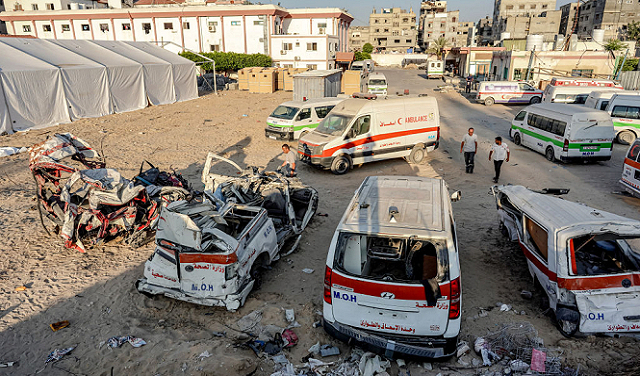
In recent months the Israeli medical establishment’s silence has grown all the more deafening. Not a single prominent medical official, to the best of our knowledge, spoke up after reports emerged that, in the early hours of March 23, Israeli forces had ambushed and massacred fifteen Palestinian paramedics and aid workers who were carrying out a rescue mission in southern Gaza, then tried to cover up the crime by burying the bodies in a sandy mass grave alongside their smashed ambulances and fire truck; nor when it was revealed that a military spokesperson had lied about the atrocity, falsely claiming that the ambulances’ emergency lights were off when they arrived at the scene and accusing the murdered paramedics of having “advanced suspiciously.” No hospital director, dean of medical faculty, or IMA official said a word even after two witnesses from the UN retrieval team claimed that at least one dead aid worker had his hands bound, nor after the doctor who carried out the postmortems said that several had been killed by gunshots to the head and torso.

A month earlier, Sheba Medical Center was named the eighth-best hospital in the world by Newsweek, a prestigious recognition that reflects not just Sheba’s reputation but that of Israel’s health care system as a whole. In a press release celebrating the designation, it promised that its doctors would “keep striving…to raise the standard of healthcare for all.”

Neve Gordon

Neve Gordon teaches at Queen Mary University of London. He is the author of Israel's Occupation and coauthor, with Nicola Perugini, of Human Shields: A History of People in the Line of Fire, both published by University of California Press.

Guy Shalev

Guy Shalev is a medical anthropologist and the executive director of Physicians for Human Rights Israel. (May 2025)

Osama Tanous

Osama Tanous is a pediatrician, public health scholar, and board member of Physicians for Human Rights Israel. (May 2025)


PALESTINE

Wed 18 Jun 2025 1:41 pm - Jerusalem Time

The Shame of Israeli Medicine


Faced with the destruction of Gaza’s hospitals and the systematic deprivation of Palestinians’ right to health, Israel’s medical establishment has disregarded the field’s most basic ethical principles.
May 31, 2025
In late March 2024 Israeli soldiers raided Nasser Hospital in the southern Gaza Strip. They arrested medical staff and patients, as well as civilians who were sheltering in the hospital compound. H., an orthopedic doctor, was partway through a shift when the soldiers began beating him. They kicked him in the stomach, groin, and testicles, told him to take his clothes off, handcuffed and blindfolded him, and escorted him to the hospital yard. Then they drove him across the Israeli border to the infamous Sde Teiman military base, near the southern city of Be’er Sheva, where at the time hundreds of Palestinians were being held blindfolded and shackled in overcrowded, filthy cages, some forced to sleep on the floor without mattresses or blankets.
In October 2024 H. gave an affidavit to Physicians for Human Rights–Israel (PHRI), a nonprofit where one of us, Guy Shalev, is the executive director and another, Osama Tanous, is a board member. H. recounted that at one point during his sixty-nine days at Sde Teiman his guards put him in a “disco room” with no mattresses, where deafening music blared at all times. Eventually they took him to an interrogation room, where, he testified, “for six days they tortured me by tying my hands and feet to a chair behind my back, hitting my stomach, and slapping me while I was blindfolded.” After forty-three days at Sde Teiman, he was sent to a prison not far from Tel Aviv to be interrogated.
There he saw a doctor, who affirmed that H. had developed inguinal and abdominal hernias as a result of the beatings. “He said I needed surgery and should not be interrogated,” H. said. But he was sent back to Sde Teiman without treatment. “As soon as I returned to the detention facility,” H. recounted, “the soldiers beat me up, banged my head on the ground and rubbed my face in the sand, kicked me and punched me.”
After another three weeks at Sde Teiman, they transferred H. once again, to a prison facility in Ashkelon, near the Gaza border. There he was seen by another doctor, who made him keep his blindfold on during the examination. “We are colleagues in the same profession,” H. said. “You are supposed to treat me humanely.” In response, he remembered, the Israeli doctor “slapped me while I was still blindfolded.” “You are a terrorist,” he recalls the man saying.
A few weeks later, at the Israel Prison Service’s medical facility in Ramleh, H. met with yet a third doctor, who confirmed in a ten-minute exam that he needed a hernia operation—yet the doctor insisted it was not urgent and H. was again returned, this time to Ofer prison. H. recalls in the affidavit that at a court hearing last July the judge extended his detention for forty-five days; neither there nor in the following interrogations was he given access to a lawyer. In August, when he appeared before a judge in a phone hearing, he was told that he is considered “affiliated with a terror organization.” Before the judge abruptly hung up the call, he told H. that he would be remanded to Ofer until further notice. “I am a doctor,” H. protested. Then the judge was gone.
*
H. remains incarcerated at Ofer awaiting trial—one of the over 380 health care workers from Gaza who have been detained by Israeli forces since October 2023. (According to Health Care Workers Watch, two dozen of them have been subjected to enforced disappearance and remain missing.) Between July and December 2024 PHRI gathered testimony from twenty-four of these Palestinian medical professionals, who were held across civilian and military prison systems in Israel. Practically all of them described suffering torture in the form of severe beatings, continuous shackling, and sleep deprivation. According to documents that PHRI obtained through a freedom of information request, at least sixty-three Palestinians died in Israeli custody between October 2023 and September 2024, including the doctors Adnan al-Bursh, Iyad al-Rantisi, and Ziad al-Dalou, as well as the paramedic Hamdan Abu Anaba. Since then, drawing on data gathered by rights organizations and the Palestinian Authority, the group has determined that at least twenty-seven further detainees have died in the past nineteen months, bringing the total number to ninety. In comparison, nine inmates died in detention at Guantánamo Bay over a period of more than twenty years.
The affidavits gathered by PHRI reveal some recurring themes. One is the use of dogs to attack and humiliate prisoners. M.T., the head of the surgery department at the Indonesian Hospital in northern Gaza, told PHRI that soldiers from a counterterrorism unit called Force 100 raided his detention enclosure in Sde Teiman with dogs three days in a row, “beating prisoners and allowing the dogs to urinate and defecate on us.” K.S., a twenty-nine-year-old surgeon at al-Shifa Hospital, recounted that “they beat us with batons, with their fists, and let their dogs urinate on us. There are always dogs with them…. They attacked me twice with dogs.”
Another repeatedly cited abuse was pervasive medical neglect. Echoing other detainees, a twenty-seven-year-old general practitioner from al-Aqsa Hospital named M.S. described the scabies outbreaks in his prison ward. “Nobody is treating these infections,” he said, “nor anything else.”
Those who did manage to see Israeli doctors often had experiences similar to the ones that H. described. K.S. recalled a doctor telling him his scabies “would heal on its own.” N.T., a forty-nine-year-old surgeon who takes medication for hypertension, was denied access to a physician for months after he was detained during the March 2024 raid on Nasser Hospital. In his affidavit, he describes being taken to Sde Teiman, handcuffed and blindfolded, and forced to wear only underwear for the first seventeen days. He spent the next month in a detention facility called Anatot, near the Palestinian village Anata in the occupied West Bank, then the next two months at Ofer, where he finally saw a physician. The doctor prescribed medication—but only for ten days.
Neglect can be a death sentence. In his testimony M.T. recounted that another prisoner, M., had a stroke in the enclosure where prisoners with medical conditions were held. “A shawish [an inmate delegated as a go-between by the prison authorities] called for a nurse,” M.T. recalled, “who told him, ‘You’re not a doctor, don’t interfere.’” The following day they alerted the guard, then a Shin Bet officer. “They warned him that the prisoner was going to die,” M.T. said. At last a doctor showed up, “but M. was already dead.”
*
In 1989 the South African physicians William John Kalk and Yosuf Veriava treated twenty political prisoners who had been hospitalized in Johannesburg after participating in a hunger strike. When the authorities asked them to send their patients back to detention, they refused, fearing that the men might be tortured. Known in the literature of medical ethics as “Kalk’s refusal,” their action has since served as a moral roadmap for doctors unwilling to violate their ethical obligations toward patients. In 1999 it was cited in the Istanbul Protocol, the most important UN guideline for medical professionals who are documenting cases of torture and ill-treatment, which instructs doctors to refrain from returning a detainee to the place of detention if an examination supports allegations of abuse.
Over the past year and a half, however, a different kind of refusal has characterized medical institutions in Israel. Some hospitals initially refused to treat wounded Palestinian detainees. Later some doctors continued to refuse on an individual level; many who did treat detainees failed to demand that their blindfolds and shackles be taken off. When Palestinian doctors working in Israeli hospitals were persecuted, the medical establishment refused to support them. The overwhelming majority of doctors—not to mention every Israeli hospital and the Israeli Medical Association—refused to condemn the destruction of Gaza’s health care system; some openly praised it and even called for the demolition of hospitals in Gaza. As these offenses accumulated, in most cases the country’s major medical-ethics institutions refused to speak out.
The groundwork for these refusals has been laid for decades. Palestinians in general and prisoners in particular have long been dehumanized. The Israeli medical establishment has long had close ties with the state and security apparatus, not least because most senior officials come from the military Medical Corps.
1
 Leading hospitals have taken pride in joining war efforts: “In wartime, the civilian and military systems became one,” Yoel Har-Even, vice president of global affairs at Sheba Medical Center, said at the Jerusalem Post’s Miami summit this past December.
But in the first days of Israel’s attack on Gaza, cases of medical neglect and complicity escalated dramatically. On October 11, 2023, Israel’s then–health minister, Moshe Arbel, instructed hospital directors to refuse treatment to “terrorists” and send them back to medical facilities belonging to the prison authorities and the military. (In practice, government officials and the mainstream media tend to apply the word “terrorist” indiscriminately to Palestinian men between fifteen and seventy.) That same day Ichilov Hospital in Tel Aviv and Sheba Medical Center in Ramat Gan denied treatment to Palestinian detainees; a right-wing mob, meanwhile, stormed Sheba looking for “terrorists.” Less than a week later, reportedly fearing another such mob attack, Hadassah Hospital in Jerusalem refused to admit an injured Palestinian man whom the military had brought to the emergency room for serious gunshot wounds. “Sources within the hospital” told Haaretz that treating him would “hurt national feelings.”
Soroka Hospital, in Be’er Sheva, took this practice further. In the ten months following Hamas’s October 7 attacks, according to Haaretz’s reporting, hospital staff called the police on at least three undocumented Palestinian women when they reached the emergency room. (Spokespeople for the hospital stressed to the journalists that this was a policy devised “in coordination with the police,” even after the police themselves “denied that such a directive exists.”) In one instance a pregnant Palestinian woman from the West Bank arrived experiencing contractions. Since 2013 she had been living with her husband in Rahat, a Bedouin town in Israel; her three children are Israeli citizens. Once the physician had seen her, she was detained by the police before even being formally discharged, taken to a West Bank checkpoint, and left stranded there until her husband picked her up and drove her to Jenin, where her parents live. She gave birth five days later.
Even as hospitals turned away Palestinian detainees, their own Palestinian employees—who comprise a quarter of all doctors and almost half of new doctors and nurses in Israel—found themselves under suspicion. About a week after October 7 several people sent complaints alleging that Abed Samara, director of the cardiac intensive care unit at Hasharon Hospital in Petah Tikva, had expressed support for Hamas on Facebook. On October 18 Yinon Magal—a television anchor, right-wing influencer, and former Knesset member—insisted on his telegram channel that Samara had “changed his profile picture to a Hamas flag, agitating and talking about the Muslims’ ‘Day of Judgment.’” The image in question featured a green flag bearing the Shahada, a saying repeated by every observant Muslim five times a day: “There is no God but Allah and Muhammad is His Messenger.”
That same day the hospital suspended Samara after fifteen years of service. Israel’s brand-new health minister, Uriel Busso, insisted on social media that Samara had headed his profile with “Hamas flags” and written “words of support for the terrorist organization that slaughtered and murdered hundreds of Jews in cold blood.” By the time the police and Shin Bet notified the hospital that the picture had been posted in 2022 and merely expressed religious devotion, Samara had been subjected to death threats and hundreds of hate messages and had decided he no longer felt comfortable returning to work.
Other Palestinian doctors and nurses have confided in PHRI that they fear posting anything that could be construed as political on their private social media accounts. Hospitals, they testify, have been suffused with an atmosphere of militarization, scrutiny, and silencing. “Nowadays, to continue working in the hospital, you are required to become inhumane,” one medical worker said in a report issued by the Palestinian research center Mada al-Carmel. “You are not allowed to express sympathy for anyone dying on the other side, even if it is a child.”
*
Their Israeli colleagues have felt no such inhibitions about their own speech. Palestinian doctors and nurses who spoke to PHRI described overhearing coworkers suggesting that Israel should “ethnically cleanse Gaza,” “transform Gaza into rubble,” and “flatten it.” They have seen colleagues post messages on social media like the one recirculated on October 21, 2023, by a senior surgeon from Carmel Medical Centre in Haifa. Apparently first posted by someone serving in Gaza, it invoked the famous prisoner exchange Israel negotiated with Hamas for the release of the captured solider Gilad Shalit:
The UN is asking for a proportional response. So here, some proportions: for Gilad Shalit we released 1027 prisoners. One Jew is equal to 1027 terrorists. 1350 murdered Jews times 1027 [equals] 1,386,450 dead in Gaza. This is the proportion we have become accustomed to; I was happy to help.
This and other genocidal calls were not limited to the first weeks and months after the October 7 massacre. Nineteen months into the war on Gaza, Amos Sabo, a senior surgeon at Maccabi Healthcare Services, posted on X that he considered his reserve service a way of advancing public health by “eliminating cockroaches and other loathsome insects.” A few months earlier he wrote: “Gaza should be erased. There are no uninvolved people there.”
Hospitals themselves have likewise rallied on social media around Israel’s war in the Strip. In November 2023 Bnai Zion Medical Center in Haifa circulated an Instagram post featuring doctors dressed in military garb and stationed in Gaza, with the message “sending regards from the front.” A Sheba Medical Center Instagram story from June 2024 covered the “double life” of one of its doctors, who splits his time between the operating room and the cockpit of an F16 fighting jet. There are parallels between combat flying and surgery, the pilot says:
Both take you to the edge and both require precision, responsibility, decision-making under pressure, and the ability to deal with failure. There’s no such thing as “I almost hit the target”—either you hit it, or you didn’t. If you weren’t accurate at altitude, you crashed—if you cut a blood vessel one millimeter to the right, the result could be catastrophic.
These posts appeared at a time when Israel’s aerial and ground attacks were frequently killing scores of civilians a day and producing an extremely precarious environment for health care workers in Gaza, where, according to the UN, the number of health and aid professionals killed in military strikes is unprecedented in recent history.
In early November 2023—around the time the World Health Organization (WHO) reported that the Israeli military had already killed at least 9,770 Palestinians, including an estimated 4,000 children, and injured an additional 25,000—dozens of Jewish Israeli doctors published an open letter calling on the military to bomb Palestinian hospitals. The doctors were not dissuaded by the fact that fourteen out of Gaza’s thirty-six hospitals had already stopped functioning due to air strikes or shortages of fuel, oxygen, medicine, medical equipment, and food. Nor were they deterred by international humanitarian law, which stipulates that medical facilities “must be protected at all times and shall not be the object of an attack.” Because “the residents of Gaza saw fit to turn hospitals into terrorist nests to take advantage of western morality,” these doctors reasoned, they “brought destruction upon themselves.… Abandoning Israeli citizens while granting protection to mass murderers simply because they are hiding in hospitals is unthinkable.” One of the signatories, an American-born Israeli gynecologist named Chana Katan, explained: “I will do everything I can to defend and protect IDF soldiers and ensure they return safely to their homes. It is the IDF’s duty to bomb the terrorists hiding in hospitals in Gaza.” (UN officials as well as human rights organizations, such as Human Rights Watch, repeatedly emphasized that Israel had not provided sufficient evidence to substantiate its claims about militant groups’ use of hospitals. An analysis of Israeli visual material found those claims not credible.)
The acting head of the ethics committee at the Israeli Medical Association, Tammy Karni, soon issued a concise statement in response to the doctors’ letter. “Even in these sensitive days, in times of war, it is the role of doctors to treat the wounded,” Karni felt the need to explain:
Upholding a moral position is what distinguishes the State of Israel. Throughout history, Israeli doctors have not agreed to be dragged into the conscientious and moral decline that our enemy has reached…. The doctors of the IMA will not encourage crimes against humanity.
And yet less than three weeks later the IMA—a professional association that represents 95 percent of physicians in Israel—would itself sign on to a statement that, in effect, justified the Israeli army’s assaults on Palestinian hospitals in the Strip. In mid-November the Israeli military laid siege to al-Shifa Hospital, shelled its surroundings, cut off its supply of water and electricity, and sent ground troops into the compound, which then housed 7,000 displaced people, 1,500 healthcare staff, and 700 patients, including premature infants. Israeli military spokespeople had insisted that “Hamas’s headquarters” were located in tunnels directly under the medical facility—an accusation for which Israel failed to provide substantiating evidence, despite eventually occupying the entire site.
Starting on November 8, 2023, officials with the WHO and UNRWA had denounced the siege for its “disastrous” effect on medical conditions. On November 23 the ethics committees of six Israeli health associations—including the IMA, the National Association of Nurses, and the Israeli Psychological Association—sent a letter to the WHO not to join it in condemning the siege but to castigate it for its “silence” about Hamas’s alleged control of al-Shifa. Parroting the government’s delegitimizing rhetoric about the Palestinian health care system, the heads of the ethics committees explained that “once terrorists or militants see that no objections are raised when hospitals are used for combat, they will feel free to do so on other occasions and in other locations as well.”
*
Meanwhile the members of these associations’ ethics committees have remained largely silent as health care staff in Israel violate the profession’s ethical principles. What began as an institutional policy of refusing to admit detained Palestinians in October 2023 soon turned into a pervasive practice of individual refusals by practitioners: late that month, upon the arrival of a fifteen-year-old detainee to a hospital in Israel’s Center District, one nurse refused to provide medical treatment, while another forcibly removed his intravenous drip and demanded his immediate transfer from the hospital. The pattern persisted for many months after the war started; a nurse at Kaplan Medical Center in Rehovot refused to treat a detainee as recently as this past February.
When detainees are admitted, their hands and legs are regularly shackled to the bed in what the guards call “four-point restraints.” One doctor confided to one of us that coworkers “withheld painkillers after invasive procedures, and then explained to colleagues that pain medication is a privilege that Palestinian detainees do not deserve.” After months of complaints submitted by PHRI’s ethics committee, in February the IMA at last issued a letter condemning “the restraint of prisoners and detainees in hospitals across the country.”
In still other cases detainees have received only minimal treatment before being sent back to a detention facility, even when their conditions were life-threatening. On July 6, 2024, a detainee was transferred from Sde Teiman to Assuta Hospital in Ashdod after suffering critical injuries to his neck, chest, and abdomen, as well as a ruptured rectum. The medical examination indicated that he had been subjected to torture and sexual violence while in custody. Immediately after the treatment, however, he was sent back to his torturers. According to Human Rights Watch, detainees at Sde Teiman could hear the screams of other inmates being tortured; doctors at the field hospital—where patients routinely arrived with injuries indicative of severe violence—would surely have heard them, too. Physicians working there were prohibited by military authorities from using their names or license numbers when examining prisoners or signing medical reports. When doctors are asked to conceal their identity in this way, the aim is usually to shield them from future scrutiny over their complicity in the facility’s abuses.
In April 2024 Haaretz reported that an Israeli physician had sent a letter to the ministers of defense and health and the attorney general detailing the harsh conditions to which Palestinian detainees were subjected at the facility and the tacit assent expected from the medical staff. “Just this week,” he explained, “two patients had their legs amputated due to injuries from being cuffed. Sadly, this has become routine.” The doctor went on to describe how patients were fed through straws, made to use diapers for defecation, and kept handcuffed and blindfolded at all times. “Since the early days of the field hospital’s operation,” he wrote, “I have been grappling with challenging ethical dilemmas…. We have all become partners in violating Israeli law. As a physician, I am even more troubled by the violation of my fundamental commitment to provide equal care to all patients—a pledge I made upon graduating twenty years ago.” (In a response to the paper’s reporter, the ministry of health insisted that “the medical treatment provided at Sde Teiman complies with the international rules and conventions to which Israel is committed.”)
Between February and April 2024 PHRI published two reports detailing how incarcerated Palestinians had been systematically deprived of the right to health. In both reports the group urged the IMA to ensure that detainees receive medical care in line with Israeli law, international treaties, and ethical medical standards. Finally, that April, Yossef Walfisch, the new chairperson of the IMA’s ethics committee, responded with an official statement. “Israeli physicians,” he stressed, “are required to adhere by international conventions, medical ethics principles, and the Geneva Declaration.” They “must provide all necessary medical care, whether in hospitals, prisons, or military facilities, and should be guided exclusively by medical considerations.”
He elaborated on that letter in an article on Doctors Only, a website for the country’s medical community. Yet even here Walfisch paired his lofty pronouncements about the significance of providing everyone humane medical care with attempts to deny the evidence of Palestinians’ horrific treatment. Again and again he referred to Palestinian patients as “Hamas terrorists.” Because the medical staff’s “safety takes precedence over any other ethical consideration,” he explained, the professional bodies responsible for incarceration ought to determine who should be restrained and blindfolded, and although health care staff in prisons and hospitals should strive for “a minimum of handcuffing,” on the whole they should follow the authorities’ guidelines. He invoked Sde Teiman but failed to say a single word about the beatings, torture, and medical neglect there. Instead he revealed that, when he visited the base’s medical team, he found staffers who “work day and night to provide the most suitable treatment within the limitations of this type of facility.” Echoing a self-congratulatory trope often used to describe the Israeli military, he called them “among the most moral doctors I have met.”
It is hard not to conclude that the IMA has failed grievously in its obligations to defend medical ethics. It could have criticized Israeli doctors who posted genocidal messages on social media, investigated health professionals who allegedly facilitated torture, and defended Palestinian doctors like Abed Samara who were wrongly persecuted for supporting terror. Instead it has not just turned a blind eye to these abuses but adopted Israel’s line of defense, blaming Hamas for Israeli transgressions in Gaza that include not only egregious crimes of starvation, murder, and forced displacement—widely acknowledged by rights groups as amounting to genocide—but more specifically the destruction of the Strip’s medical system, the killing of more than 1,400 health care workers, and the unlawful detention of nearly four hundred others.  
In recent months the Israeli medical establishment’s silence has grown all the more deafening. Not a single prominent medical official, to the best of our knowledge, spoke up after reports emerged that, in the early hours of March 23, Israeli forces had ambushed and massacred fifteen Palestinian paramedics and aid workers who were carrying out a rescue mission in southern Gaza, then tried to cover up the crime by burying the bodies in a sandy mass grave alongside their smashed ambulances and fire truck; nor when it was revealed that a military spokesperson had lied about the atrocity, falsely claiming that the ambulances’ emergency lights were off when they arrived at the scene and accusing the murdered paramedics of having “advanced suspiciously.” No hospital director, dean of medical faculty, or IMA official said a word even after two witnesses from the UN retrieval team claimed that at least one dead aid worker had his hands bound, nor after the doctor who carried out the postmortems said that several had been killed by gunshots to the head and torso.
A month earlier, Sheba Medical Center was named the eighth-best hospital in the world by Newsweek, a prestigious recognition that reflects not just Sheba’s reputation but that of Israel’s health care system as a whole. In a press release celebrating the designation, it promised that its doctors would “keep striving…to raise the standard of healthcare for all.”
Neve Gordon
Neve Gordon teaches at Queen Mary University of London. He is the author of Israel's Occupation and coauthor, with Nicola Perugini, of Human Shields: A History of People in the Line of Fire, both published by University of California Press.
Guy Shalev
Guy Shalev is a medical anthropologist and the executive director of Physicians for Human Rights Israel. (May 2025)
Osama Tanous
Osama Tanous is a pediatrician, public health scholar, and board member of Physicians for Human Rights Israel. (May 2025)




ARAB AND WORLD

Wed 18 Jun 2025 1:10 pm - Jerusalem Time

Damage and fires in Israel... Iran challenges Trump with Fatah missiles

Hebrew media reported, after midnight on Tuesday/Wednesday, that several Iranian missiles fell on Israel after defenses failed to intercept them, causing fires and damage to a building.

This came during two missile salvoes from Iran, which included approximately 30 missiles in less than an hour.

Meanwhile, the Iranian Revolutionary Guard announced that it had used hypersonic Fateh ballistic missiles in the attack for the first time, in a message of defiance to US President Donald Trump, who he said was inciting war.

At 00:35 local time (GMT+3), the Israeli military said in a statement: "Alerts were activated in several areas within the country after missiles were detected launched from Iran towards Israeli territory."

The army added: "Meanwhile, the Air Force is working to carry out interception and attack operations at every location that requires eliminating the threat."

For its part, the privately owned Hebrew newspaper Yedioth Ahronoth reported that air raid sirens sounded in the greater Tel Aviv area, as well as in the cities of Haifa and Jerusalem, following the Iranian missile barrage, the eighth since Tuesday morning.

An Anadolu Agency correspondent monitored the sounds of loud explosions in Jerusalem resulting from the interception of Iranian missiles.

Meanwhile, the private Israeli Channel 12 reported estimates indicating that Iran launched 20 missiles at Israel in that salvo.

Israeli Army Radio said some reports indicated that a number of Iranian missiles had fallen on Israel.

The radio station did not specify the locations where the rockets landed, but the privately owned Hebrew newspaper Israel Hayom reported that initial reports indicated that at least two rockets had fallen in Jerusalem and the Sharon region near Tel Aviv.

For its part, Channel 12 reported that damage was caused to a building in central Israel as a result of the Iranian missile barrage.

She added that missile fragments fell on a building in the northern region, while several fires broke out in open areas as a result of Iranian missiles or their fragments.

** Tenth missile salvo

At 1:28 a.m. local time, the same channel reported that air raid sirens sounded in central Israel, including Greater Tel Aviv, as well as the cities of Tel Aviv, Ashdod, Rishon LeZion, and Netanya, following the detection of new missile launches from Iran. This was the ninth salvo since Tuesday morning.

She added that the latest rocket barrage included the launch of at least 10 rockets towards Israel.

She noted that firefighting teams were dealing with a fire that engulfed 20 vehicles in central Israel as a result of Iranian missile fire.

This comes at a time when Israel is imposing a strict blackout on sites targeted by Iranian missiles and drones, particularly those targeting military or vital sites, claiming that revealing these sites would "aid the enemy."

** Fatah missiles

For its part, the Iranian Revolutionary Guard stated that these missiles were part of the eleventh wave of Operation True Promise 3, in response to Israeli aggression.

He added in a statement that, for the first time, he used first-generation hypersonic ballistic Fatah missiles in this wave of operations, which he said "conveyed a message of Iran's power to Tel Aviv's war-mongering ally," referring to President Trump.

He continued: "This evening, the powerful and highly maneuverable Fatah missiles repeatedly shook the shelters of the cowardly Zionists after penetrating their defensive shield."

He continued, "Tonight's missile attack proves that we have established complete control over the airspace of the occupied territories, and that their residents are now defenseless against Iranian missile attacks."

According to Army Technology, a leading global website specializing in analyzing and documenting information related to defense industries and military technologies, the Fateh missile is considered one of the most advanced weapons in the Iranian Revolutionary Guard's arsenal, thanks to its hypersonic speed, which ranges between Mach 13 and Mach 15.

The missile has a range of approximately 1,400 kilometers and features a movable nozzle and an advanced guidance system, allowing it to adjust its trajectory during flight and perform precise maneuvers both inside and outside the atmosphere, including lateral and rotational movements.

Since dawn last Friday, Israel, with US support, has launched an aggression against Iran, including bombing nuclear facilities and missile bases, and assassinating military leaders and nuclear scientists. The attack has left 224 dead and 1,277 wounded. Tehran has responded with ballistic missiles and drones, leaving approximately 24 dead and hundreds wounded.

The risk of an escalation of the conflict looms, with Western and Israeli reports suggesting the United States could join Israel in its aggression against Iran. This coincides with Trump's statements calling on Tehran to surrender unconditionally and threatening to target Supreme Leader Ali Khamenei.

PALESTINE

Wed 18 Jun 2025 12:43 pm - Jerusalem Time

The Israeli Supreme Court approves a mass demolition in Jenin camp.

Israel's Supreme Court on Tuesday rejected an urgent petition filed by the Adalah Legal Center on June 12 to halt the widespread demolition of the Jenin refugee camp, giving the Israeli military the green light to continue destroying approximately 90 civilian structures in the occupied West Bank.

Adalah, the Legal Center for Arab Minority Rights in Israel, said in a statement that the demolition orders went into effect on June 9, threatening approximately 300 housing units belonging to hundreds of Palestinian refugee families. They follow widespread demolitions recently carried out in Jenin and the Nur Shams and Tulkarm refugee camps, amid an ongoing military offensive targeting the camps, creating the largest wave of Palestinian displacement in the West Bank since the occupation in 1967.

In its decision, the court accepted the Israeli military's general argument that the demolitions were necessary to ensure "freedom of movement" for Israeli forces within the camp. However, the court did not address the fact that these areas are currently uninhabited and no clashes are taking place there, nor did it review the Israeli military's classification of the entire camp as a "combat zone," according to Adalah's statement.

The petition was submitted by Dr. Suhad Bishara, attorney and director of the Adalah Legal Center for Arab Minority Rights in Israel. She argued that these operations constitute a grave violation of international humanitarian law and that these orders follow a similar military order issued on March 19, 2025, authorizing the demolition of approximately 95 structures in the Jenin refugee camp. In recent months, numerous additional demolitions have been carried out without prior warning, making it difficult to fully assess the extent of the damage. The Supreme Court had previously rejected a petition against these demolition orders.

In response to Adalah's previous letter on the matter, military authorities claimed that the presence of what they called "terrorist infrastructure" in the camp transforms the entire area into a battlefield, justifying the demolitions under the pretext of "military necessity," even though the area is currently free of combat.

In its petition, Adalah warned that this logic erases any distinction between civilians and combatants and transforms Palestinian refugee camps into zones of unrestricted military destruction, in flagrant violation of international law and potentially constituting war crimes under the Rome Statute of the International Criminal Court.

In response, Adalah stated, "This decision provides legal cover for the Israeli military's systematic destruction of refugee camps in the West Bank, in flagrant violation of international law. The court's refusal to intervene entrenches the policy of collective punishment and widespread forced displacement, and perpetuates a culture of impunity."

It is worth noting that the demolition plans are issued amid an ongoing Israeli military escalation across the West Bank, particularly targeting refugee camps, which has displaced more than 40,000 Palestinians from their homes. These orders are an extension of widespread demolitions previously approved by the Supreme Court, which rejected Adalah's petition on May 7, 2025, against the demolition of more than 100 homes and civilian structures in the Nur Shams and Tulkarm refugee camps in the occupied West Bank, according to the rights center's statement.

PALESTINE

Wed 18 Jun 2025 12:28 pm - Jerusalem Time

Horrific testimonies reveal the "hell" experienced by Gaza detainees.

Prisoners' organizations have revealed horrific and shocking details contained in new testimonies given by detainees from the Gaza Strip, who are being held by the Israeli occupation authorities in various prisons and camps.

Testimonies obtained during legal visits between late May and early June document detainees' exposure to systematic torture, harsh interrogations, and harsh and "inhumane" detention conditions, which prisoners described as "hell" and the prisons as "graves."

According to data from the Israeli Prison Service, the number of detainees from Gaza in prisons alone, until the beginning of June, amounted to (2,214) detainees. This number does not include those detained in military camps.
The Commission and the Club indicated that the testimonies were collected from detainees held in the Negev Prison, the Ofer Camp, the Sde Teiman Camp, and the Rakefet Section located under the Nitzan Ramle Prison.

PALESTINE

Wed 18 Jun 2025 12:23 pm - Jerusalem Time

The occupation continues to close Al-Aqsa Mosque and the Church of the Holy Sepulchre for the sixth day.

The Israeli occupation authorities continue to close the Al-Aqsa Mosque and the Church of the Holy Sepulchre for the sixth consecutive day, imposing a tight military siege on the gates of the Old City. They also carry out daily nighttime raids targeting the towns and neighborhoods of the Jerusalem Governorate, and resort to retaliatory measures that exacerbate the suffering of citizens and disrupt their social and economic lives.

The Jerusalem Governorate stated in a statement that with the martyrdom of the young man, Moataz Hamza Hussein Al-Hajjajleh (21 years old), at dawn today, from the village of Al-Walaja, southwest of Jerusalem, after the occupation forces brutally assaulted him, the number of Jerusalemite martyrs whose bodies are still being held has risen to 47, the oldest of whom is the martyr Jasser Shatat from 1968, and the most recent is the martyr Al-Hajjajleh. The Governorate considered this policy to represent a collective punishment that contradicts international humanitarian law, and deprives families of the right to bid farewell to their children and bury them in a manner befitting their human dignity.

Hundreds of our people in the town of Al-Eizariya, last night, bid farewell to the body of the martyr Muhammad Hassan Hosni Abu Hammad (41 years old), after the occupation handed him over after detaining him since his martyrdom on March 25 near the town.

In a related development, the Jerusalem Governorate observed Israeli occupation forces closing the Jaba' military checkpoint, northeast of Jerusalem, intermittently from yesterday afternoon until this morning. The closures were intended to install new iron gates and observation and patrol rooms. This move aims to tighten control over the roads linking Jerusalem and Ramallah, and deepen the policy of isolation and oppression against Jerusalemites.

Thousands of citizens were forced to wait for long hours under the sun, causing widespread traffic congestion and additional suffering for students, patients, and employees. The system of barriers, gates, and earth mounds now exceeds 85 checkpoints, reflecting the occupation's escalating attempts to isolate Jerusalem from its Palestinian surroundings.

Jerusalem neighborhoods, particularly Silwan, Issawiya, At-Tur, and the Shuafat refugee camp, witnessed violent raids last night, including assaults on citizens, house searches, and the heavy firing of tear gas and sound bombs. In the town of Abu Dis, east of the city, several citizens were injured as a result of violent beatings and suffocation during widespread raids on neighborhoods.

The Jerusalem Governorate reported that occupation forces arrested Maher Ayed Rabie from the town of Beit Anan, northwest of the city, today, after raiding his home at dawn.

PALESTINE

Wed 18 Jun 2025 11:23 am - Jerusalem Time

Amid Israeli attacks on Iran, hundreds go on hunger strike in Gaza

More than 650 Israelis, Palestinians, and peace activists from around the world participated in the "Freedom Strike" – an initiative of the Combatants for Peace movement.

“A few days after the outbreak of war between Israel and Iran – in which dozens were killed, hundreds were injured, and the skies over Tehran and Tel Aviv were filled with missiles and drones – the Combatants for Peace movement, in cooperation with other peace organizations, organized a “Freedom Strike”: an all-day online protest event, with the participation of hundreds of Israelis, Palestinians, and peace activists from more than 25 countries, in an urgent call to stop the hunger in Gaza and end the war,” the movement said in a statement.

Against the backdrop of growing hunger in the Gaza Strip, where nearly two million people are struggling to survive, and the ongoing blockade in the West Bank, Combatants for Peace insisted on not turning a blind eye, even as media and public attention suddenly shifted to the new arena between Israel and Iran. More than 650 people registered for the event, some of whom fasted from their homes, and supported the call to raise a moral voice in times of bombardment, war, and fear of regional escalation.

During the day, more than 200 people participated in online dialogue sessions broadcast in three languages—Hebrew, Arabic, and English—to learn together about the deteriorating situation in Gaza and the history of fasting and hunger strikes as forms of protest and nonviolent resistance. Among the sessions were a juristic discussion on the prohibition of hamlets in Judaism, presented by Rabbi Yael Wergan; a “Testimonies from the Land” meeting featuring Palestinian family members from Gaza and Israeli activists from Sderot, a Gaza envelope area; a multilingual community discussion panel featuring dozens of participants from Israel, Palestine, South Africa, the United States, and other countries, who spoke openly about fears, anxieties, and loneliness, alongside hope, solidarity, and a deep commitment to action; and an international community meeting led by Friends of Combatants for Peace from the United States, with the participation of Rabbi Eli Tikva Sara, Tahiya Wekalo, and David Kataba.

“At this moment when another war is raging and civilians are once again paying the price, we have chosen to come together, to fast and to shout,” said Mia Byrne, Combatants for Peace’s director of activities. “Despite the bombardment, we refuse to look away from Gaza. This is exactly what the leaders want—for us to forget. And we refuse to forget.”

"The hunger strike is a humanitarian cry for help against hunger in Gaza," said activist Sayel Jabareen, campaigns director for the Combatants for Peace movement. "Every bite of food I give up is a reminder that Gaza is starving. It's an act of solidarity with those who no longer have anything to eat."

PALESTINE

Wed 18 Jun 2025 11:05 am - Jerusalem Time

Guterres criticizes the occupation's massacres against those waiting for aid in Gaza: "Unacceptable" and we demand an immediate investigation.

UN Secretary-General António Guterres said, "The killing and injury of civilians in southern Gaza while seeking food is unacceptable," and called for an "immediate and independent" investigation into the matter.

This came in statements made by Farhan Haq, Deputy Spokesman for the UN Secretary-General, during his daily press conference in Geneva, according to the UN News website.

On Tuesday morning, the Israeli occupation forces committed a horrific massacre against those waiting for aid at the Tahlia Roundabout in Khan Yunis Governorate, south of the Gaza Strip. The massacre resulted in the deaths of 51 Palestinians and the injury of more than 200, including 20 in critical condition.

Commenting on the new Israeli massacre against the starving people in the Gaza Strip, Haq conveyed Guterres' condemnation of "the loss of life and injuries among civilians in Gaza, who are once again being shot while seeking food."

The UN Secretary-General stressed that targeting people waiting for food under the siege is "unacceptable."

Haq explained that Guterres "continues to call for an immediate and independent investigation and accountability" into reports of civilians being targeted in Gaza at aid distribution centers.

The UN official stressed that the basic needs of the Palestinian population in Gaza are "enormous and remain unmet."

He stressed the need to resume the "immediate, widespread, and unhindered" delivery of humanitarian aid to the Gaza Strip.

He stressed the "need to allow the United Nations and all humanitarian actors to operate safely and in full respect of humanitarian principles."

OPINIONS

Wed 18 Jun 2025 9:37 am - Jerusalem Time

Unsustainable sustainability

With the increasing use of the term "sustainability" in development discourse and international and local support projects, fundamental questions arise about the realism of this concept, particularly in the complex political, economic, and social context of Palestine. Although "sustainability" is presented as a key principle for ensuring the sustainability of projects' impact and reducing dependence on donors, the reality points to a clear paradox, epitomized by the phrase that has become commonplace in field circles: "Sustainability is not sustainable."

In Palestinian development discourse, almost no project paper or international or local intervention strategy is devoid of the term "sustainability." It's presented as a magic solution for ensuring lasting impact, reducing dependence on donors, and enhancing local responsibility. But when we descend from rhetoric to reality, we encounter a harsh paradox: most projects marketed as "sustainable" either disappear after funding runs out, become a burden on local communities, or fail to effect any change, keeping the situation in a state of perpetual need.

Multiple studies and critical reviews indicate that sustainability, as presented in Palestinian development projects, does not stem from a fundamental analysis of local needs or limited sovereignty. Rather, it responds to funder requirements, market logic, and quick results. Implementing agencies are required to produce a "viable model," without providing a legal and economic framework that truly fosters this sustainability. Consequently, effective long-term planning is absent in favor of superficial and rapid achievements. Many projects become temporary initiatives that are discontinued when funding ends, reflecting a reality that illustrates the contradiction between lofty slogans and practical reality, especially in contexts such as development, projects, or public policy.

What do we mean by sustainability? Are our projects truly "sustainable"? What's the difference between "linguistic sustainability" and "actual sustainability"?

Within the workshops, and at the top of each project document, the golden word “sustainability” adorns the titles, promoting us as the magic solution (limited funding + short-term plan = long-term impact).

Reality, as most of us have come to know, is something else entirely. True sustainability doesn't come from an "output report" or an "end-of-project evaluation sheet." Sustainability begins when society is asked, "What do you want?" and when programs are built on people's trust, not the desires of funders. But all too often, they turn into an administrative illusion, wrapped in resonant words, expiring with the last funding installment. How many initiatives launched in the name of women were halted before reaching them? How many entrepreneurial, environmental, or youth programs were promoted as a "model for sustainable development," only to disappear without a trace? We are facing a phenomenon called "sustainability is not sustainable," where sustainability is merely rhetorical decoration, not actual practice. This is not just criticism; it is a call to stop... Let us redefine "sustainability" with the voices of women, the patience of female workers, and the will of communities.

First: Sustainability as a linguistic trap. Sustainability, as presented in most projects, is not an actual concept stemming from a Palestinian context. Rather, it is a hollowed-out version of its content, presented within donor terms such as exit strategy or value for money. Since conditional funding is the main tool in projects, any "sustainability" that does not take into account the structure of the occupation, the constraints of sovereignty, and the reality of geographical fragmentation is an illusory sustainability.

Second: Financing. "Sustainability" is often linked to a project's ability to "generate income" or "be self-reliant," without considering the conditions of the distorted Palestinian market, which is subject to Israeli control, resource restrictions, and unfair customs and tax policies. If the economic structure itself is not independent, how can we talk about sustainable projects? This approach reproduces the logic of neoliberalism: the withdrawal of the state, the dismantling of public responsibility, and the burden of continuity being placed on individuals.

Third: At the expense of women and marginalized groups, women's "economic empowerment" projects are often presented under the rubric of sustainability, but they do not address the structural causes of poverty or marginalization. Training or small-scale support is funded, and then women are asked to "maintain the project" without a protective legal structure, a fair market, or social protection. Thus, sustainability becomes a responsibility imposed on marginalized and vulnerable groups, rather than a systematic commitment by the state and society.

Fourth: The lack of governance and follow-up at the institutional level. There are no clear standards for measuring sustainability in the Palestinian public or civil society sectors. Most projects end with formal evaluation reports, with results not subject to in-depth analysis, and lessons learned not capitalized on. Policies are not reviewed, nor are programs modified based on impact. Instead, the same models are recycled.


Financing gap and economic reality

They call us a "sustainable project," but we discover that it's "sustainable, not sustainable." Where did the plan go? Where did the resources go? And the idea died when the funding ran out.

Many programs promoted under the banner of "sustainability" ignore the Palestinian economic context, which is based on occupation, control of resources, recurrent closures, and geographical dispersion. How can any local project be "sustainable" under these circumstances? And how can communities be held responsible for maintaining projects without actually empowering them? These questions open the door to critiquing prevailing development policies, which empty "sustainability" of its sovereign and just dimensions.

Women and marginalized and vulnerable groups are the first to be affected by "economic empowerment" programs. The burden of sustainability after the project ends is often placed on them, even though they still suffer from structural gaps in access to finance, markets, legal protection, and decent work. There are many cases of women's initiatives that ceased completely immediately after the funding period ended, leaving no institutional footprint or protection.

Social or serious follow-up, thus transforming "sustainability" from a support tool to an additional burden, and from a slogan to an actual commitment. Overcoming this reality requires redefining sustainability from a national and comprehensive perspective, taking into account the elements of sovereignty, social justice, and community ownership of programs.

What do we want? Towards true sustainability. From a slogan to a practical commitment. "Sustainability, not sustainability" is not just a sarcastic phrase; it is an accurate description of the structural condition we experience daily in Palestine. If we want to overcome this trap, we must move from consuming terminology to developing solutions based on understanding reality, not embellishing it.

To achieve this, there is a need to.

- Unconditional funding that is built around and takes into account real local community priorities.

- Real community partnerships start from the grassroots, not the donor.

- Real accountability for project outcomes and their actual sustainability, not just their money.

- A legal and economic structure that enables women and vulnerable groups to continue without dependence.

- Promoting the concepts of solidarity and social economy as sustainable alternatives.

- Activating the roles of the state and society, not withdrawing from them.

- Supporting the legislative structure to protect women, entrepreneurs, and vulnerable groups.

Sustainability is not just a nice word, it is not just funding, sustainability is a commitment, and a responsible discourse.

Sustainability is not just a clause in a project proposal, but a long-term commitment whose effectiveness is measured by what remains after each phase. If this sustainability is not linked to just national policies and a genuine capacity for resilience, we will continue to repeat the same pattern: "Sustainability is not sustainable."

True "sustainability" is not just a clause in a project proposal, or a "production line" within a project. Rather, it is a long-term commitment whose effectiveness is measured by what remains after each phase concludes, and by the people's ability to build what remains after everyone has departed. It is the result of a comprehensive national planning logic that links political and economic sovereignty and restores consideration for the public role. If this sustainability is not linked to just national policies and a genuine capacity for resilience, we will continue to repeat the same pattern: "unsustainable sustainability."


OPINIONS

Wed 18 Jun 2025 9:36 am - Jerusalem Time

The US-Israeli partnership in aggressive wars

Rasim Obeidat

Rasim Obeidat

Opinion Writer

It seems that there are those who are blind in sight and insight, and who do not read or see clearly the models and examples that America can never be a guarantor or mediator of any agreements and solutions that do not meet Israel's interests and goals. America sees Israel as the advanced base in the region to protect its interests and implement its projects and plans. Therefore, the aggressive war on the Gaza Strip was waged under the slogan of America being Zionist and Israel being the advanced material base to protect its interests in the region. The war and what is known as the Prosperity Alliance, the alliance of destruction that it formed to wage a proxy war on behalf of Israel against Yemen - Ansar Allah, did not come only to continue the exclusive control of American control over the seas and waterways, and to protect what is known as maritime navigation and international trade lines, but also to prevent Yemen from imposing an economic naval blockade on Israel and to stop Yemen from continuing its support war for the Gaza Strip, its people and its resistance. If Yemen had been, as is the case with the proponents of the theories of strategic patience, hesitation and coldness from the Iranians, Chinese and Russians, and this hesitation preceded that in Lebanon, it would have suffered a crushing defeat.

But the strength of the Yemeni leadership, its internal fortifications, its cohesion with the people, and its continuous initiatives forced America to escape and stop continuing its war against Yemen, on conditions that are considered humiliating for it, namely stopping its military support on the Yemeni front for Israel, without obligating Yemen to stop its support war in the Gaza Strip. This indicates and confirms the theory of waiting for strikes and absorbing the first strike and then gradual and accumulating in order to change the balance of power in favor of the attacked party, which is what struck Syria and Lebanon fatally, and America sought with Israel to impose it on the Gaza Strip, but it has not been able to impose its logic, vision, and choice in the Gaza Strip until now.

What happened and is happening in Iran is that some Iranians, or what is known as the Iranian reformist movement, are betting that America is seeking a peaceful solution to the Iranian nuclear issue, a solution that will lead to the realization of Iran's interests by possessing the technology and a peaceful nuclear program. This is devoid of reality. America is a direct partner in all of Israel's wars against the Axis powers. Not only that, but everyone enjoyed Netanyahu's statement when he said that after Iran is eliminated and defeated, it will be Pakistan's turn, because Israel's security and the protection of its existence extend to North Korea. This made the Pakistani leadership wake up early and make the decision to stand by Tehran and support it militarily and politically. This awakening will not be Arab, as the Arabs are a nation that died while it was still alive. They are American protectorates in which American military bases are widely deployed. They are the ones who help Israel intercept and confront Iranian missiles and drones, because they see themselves as part of the American-Israeli alliance in the region. Therefore, the attack and aggression that Israel launched against Iran at dawn on Friday, June 13, 2025, was in American partnership and by a clear American decision from Trump himself, who acknowledged this, as he said that this aggression came in order to punish Iran for its refusal to meet his conditions for reaching a nuclear agreement. At the same time, he continued to talk about the option of negotiating with Tehran, and that he warned Netanyahu against the consequences of launching a military action against Iranian nuclear facilities, so that the negotiating option would not fail. And to reach a peaceful solution to the Iranian nuclear issue, in return he was coordinating with Netanyahu the military strike on Tehran, and providing all forms of military, financial, intelligence, security and logistical support to Israel in this war. After the Israeli aggression on Tehran, he described this Israeli strike as successful, and one that Iran deserved, for its refusal to comply with his conditions for signing the agreement on its nuclear program.

As Iran quickly absorbed the blow and the shock, despite the severe loss it suffered, Trump said he was calling on Israel and Iran to negotiate. Some began to “confuse,” “fool around,” “nonsense,” “babbling,” and cleverly analyzing things on satellite channels, claiming that Trump had retracted his previous statements and that he would lead a negotiating process that would lead to a peaceful conclusion to the issue of concluding an agreement with Tehran over its nuclear program. However, it quickly became clear that this fool, who contradicted his statements in record time, clearly announced that he had been a partner in Netanyahu’s war on Tehran since its beginning. He is now announcing that he is considering moving to its side from a defensive war to an offensive war on Tehran, as he called for the evacuation of Tehran. At the same time, and in continuation of the deception, he said that he had assigned his special envoy, Witkov, to explore holding a negotiating meeting with Tehran. This is a continuation of the deceptions, plots, wars of deception and misinformation practiced by him and by Israel. The strange thing is that Israel is rampaging, bombing, launching aggression, and violating the sovereignty of… Countries enjoy all forms of protection from America and the colonial Western countries, and some believe these American deceptions and tricks.

Some believe that Netanyahu is seeking to draw the United States into direct participation in the aggression against Iran, as if the United States were outside the war and not the one arming, financing, providing security and intelligence information, and protecting Israel politically and legally in international institutions.

The US administration, with its deep state, its neoconservatives, and the Zionist lobbies, want not only to destroy Iran's nuclear program and its military capabilities in the field of ballistic and hypersonic missiles, but also to change the Iranian regime and return Iran to the "American embrace," so that the entire region is under absolute American control, and for Israel to be the exclusive agent in subjugating and disciplining anyone who says no to America. This must be accompanied by further dismantling and restructuring of Arab and Islamic geography, and the creation of more fragile social entities linked by security and military alliances with Israel, to be managed economically by the center of the global economy in Washington. This will lead to Trump joining Netanyahu in his war on Iran, for which Netanyahu has set the conditions: the assassination of Iranian Supreme Leader Ali Khamenei and the destruction of the "Fordo" nuclear facility located hundreds of meters deep. This will bring down the Iranian regime.

While the US President announces his joining Netanyahu in his war on Tehran, and seeks to move from a defensive war to an offensive war, he is practicing the same deception before the Israeli attack on Iran at dawn on June 13, 2025, by asking his special envoy, Witkov, to explore holding negotiations with Tehran to reach an agreement on its nuclear program. If the response occurs and the reformists in Tehran win by preferring this option, its fate will be no better than what happened in Syria and Lebanon and what they are seeking to impose on Gaza and its resistance in the Gaza Strip. The demands and conditions will not only demand that Tehran dismantle its nuclear project, destroy its nuclear facilities, stop enrichment, and dismantle and stop the operation of nuclear reactors, but also destroy its ballistic and hypersonic missile programs, and discuss its regional role and support for Arab and Palestinian resistance movements and forces.

Therefore, the Iranians, including their military, political, and religious leadership, as well as their Supreme Leader, must learn well that the goal is to completely destroy Iran, overthrow its regime, and completely change Iran so that it can return to the American fold. Therefore, they must show the utmost caution and vigilance against American traps.

OPINIONS

Wed 18 Jun 2025 9:31 am - Jerusalem Time

Crazy world..!

Dr. Afnan Nazir Druze

Dr. Afnan Nazir Druze

Opinion Writer

We live in a crazy world, a world in which man no longer distinguishes between right and wrong, between right and wrong, between what is forbidden and what is permissible. A world in which the strong justifies for themselves what they forbid for their weaker brother. Man is a selfish, greedy, mad man who wants everything for himself without leaving anything for his fellow man to eat or live for. A world in which man is hard-hearted, devoid of conscience, limited in mind, short-sighted, sadistic, skilled at committing evil and delighting in the pain of others. A world in which man no longer appreciates life or values it except when he is deprived of it or loses it. Otherwise, how do we explain the killing and terrorizing of innocents and civilians that is happening today? How do we explain the prolongation of wars and the delay in finding solutions as if the combatants are living in a movie and not in the fires of hell? How do we explain the counter-propaganda that fabricates news by all vile means to achieve personal hellish goals, turning truth into falsehood and falsehood into truth, good into evil and evil into good, the enemy into a friend and a friend into an enemy, the truth into a mirage and a mirage into truth? Rather, how do we justify the majority’s adoption of a method of evasion, lying, hypocrisy and misleading, as if it has become the staple food of the age, which is eaten by the young and the old, the educated and the ignorant, the believer and the unbeliever, the rich and the poor?

Yes, we live in a crazy world, a world where man can see no further than the tip of his nose. A world torn apart by material interests at the expense of principles, morals and divine laws. A world torn apart by personal desires at the expense of health, well-being and psychological comfort. He thinks only of pranks, lives only on problems, sleeps only on disasters, and wakes up only to wars as if they are a normal part of his daily routine. What's more, he finds pleasure in spreading corruption wherever he goes, sowing discord and inciting obscenities in every place and country, even in temples, churches and mosques. A crazy person lives in a crazy world whose hobby is stirring up strife and dividing sects and religions. He turns a people into a hundred peoples, and a religion into a thousand sects and parties, so that they kill and fight each other, sometimes in the name of religion and sometimes in the name of superiority, advancement, racism and civilization. A human being who has no compassion in his heart and no mercy, as if he lives in a jungle where animals lie in wait for their fellow human beings to pounce on them, devour them, and eat their flesh as if they were nothing. A contradictory human being who claims human rights while violating human rights, pretends to protect children, the elderly, the sick, and women while he assaults them and provides them no protection. Rather, you see him persisting in denying their rights and harming them, forgetting that he is of their kind, shares with them the human race and biological characteristics of hunger, thirst, fatigue, and exhaustion, and the joy, sadness, fear, anger, love, hate, hopes, and aspirations that afflict the soul and spirit. The human being of this mad world has forgotten that no matter how much he builds and rises, steals and plunders, kills and sheds, amasses wealth, and usurps, he should not take more than he needs in this mortal world, and that his life will remain short on this earth and his life will end tomorrow or the day after, no matter how long his life and time are. The reckless man of this world has forgotten that with his greed he is destroying his own efforts and demolishing everything he has built and constructed throughout his life. With his fanaticism he is destroying his own civilization with his own hands and burning the world around him so that not a stone, udder, tree, plant or animal remains! The question that arises is, why all this competition? Is it to satisfy his vanity and aggressive tendencies and achieve his immediate materialistic, sensual goals that will not last long and will quickly disappear, sooner or later?

If the people of this crazy age knew that when God created the universe, He created it in a way that provides space for all of His creatures, no matter how many they are, he would not have been driven by his instincts, lost his mind, waged wars, killed and destroyed. If he knew that God Almighty is the Provider who provides for all people, no matter how many they are, he would not have competed over food, waged wars, and killed children, women, the elderly, and the youth. If he believed that God is the Truth and does not remain silent in the face of injustice and oppression, he would not have transgressed the rights of others, oppressed, plundered, stolen, killed, displaced, and violated with his satanic deeds all the traditions of the prophets and divine religions, the simplest of which is “Whoever kills a soul unless for a soul or for corruption in the land - it is as if he had slain mankind entirely,” while forbidding him to steal, lie, commit adultery, etc., from the teachings that were sent only to elevate man and to give him preference and honor over all other creatures.

However, we must not despair, and we will continue to implore God that the human being of this age may awaken from his heedlessness, return to his senses, rid himself of his madness, and seek forgiveness for all the neglect he has committed against himself and others. A time may come when man will rise to the point where he will be disgusted when he reads about the history of his ancestors and what they did to each other in the ancient ages, which is our present age. He may also find it strange how they shed the blood of their fellow human beings like animals. Or at the very least, he may laugh at their greed and their preference for war over enjoying life and living in comfort and peace.

Who knows, an age may come when he reaches such sophistication and advancement that he becomes like an angel who denounces the actions of our present-day humanity and its blood-soaked history. Otherwise, are the wars we are witnessing today a harbinger of the end of time, which are based only on the evils of people? We hope that this fateful day never comes and the world ceases to exist, God forbid.

ARAB AND WORLD

Wed 18 Jun 2025 9:27 am - Jerusalem Time

"Not Our War": Bipartisan US lawmakers support resolution to prevent interference in Iran

As US President Donald Trump publicly threatens Iran with joining Israel in its ongoing bombing of Tehran and other parts of the Islamic Republic, an unlikely coalition of lawmakers has moved to prevent the president from committing US forces to the conflict without congressional approval.

On Tuesday, Kentucky Republican Representative Thomas Massie, whose liberal politics have often put him at odds with Trump, joined a number of progressive Democrats to introduce a war powers bill in the House of Representatives, which would require a congressional vote before Trump could attack Iran. Democratic Senator Tim Kaine has also introduced a similar bill in the Senate.

"This isn't our war. But if it were, Congress should decide such matters according to our Constitution," Massie wrote on Twitter when announcing the resolution. Democratic Reps. Ilhan Omar and Alexandria Ocasio-Cortez responded by approving the tweet, while Massie's office later announced that others, including Congressional Progressive Caucus Chairman Greg Casar, would also sponsor the resolution.

The announcements came hours after Trump left the G7 summit in Canada early to return to Washington, D.C., and demand Iran's "unconditional surrender" days after Israeli airstrikes targeted its top military leaders and nuclear facilities.

The White House later denied media reports that the United States had decided to intervene in the conflict, with White House spokesman Alex Pfeiffer saying, "American forces maintain their defensive posture, and that has not changed. We will defend American interests." However, American aircraft and warships have moved to the Middle East, and it is believed that Iran's deepest nuclear facilities could only be penetrated with a bunker-buster bomb that only the United States possesses. Trump focused his campaign on keeping the United States out of foreign wars, and last weekend, Vice President J.D. Vance addressed U.S. troops at a military parade in Washington, D.C., saying, "We will never ask you to go to war unless you have to."

Trump vetoed two war powers resolutions during his first term, regarding Iran and Yemen, and called for a primary challenge against Massie for opposing his priorities.

Such resolutions are considered privileged, meaning they must be put to a vote, although House Republican leaders have recently taken unconventional steps to undermine efforts targeting issues like tariffs.

In a press interview, Democratic Congressman Ro Khanna (D-CA), who co-sponsored the resolution with Massie, warned that if they did so, they would "anger their Republican base," citing anti-war statements by Trump and the vice president.

"This is an opportunity for Democrats to reclaim their position as the anti-war party," Khanna added. "Our leadership must be vocal about this and strongly condemn Trump, while keeping his promise to oppose the war."

He expected the resolution to pass "if it is presented to the House of Representatives," where the Republican Party holds only three seats more than the Democrats as a majority. However, it is unclear whether it will gain sufficient support from all parties.

“While I oppose American involvement in foreign wars and regime change, I don’t see the need to sign Rep. Massie’s War Powers Resolution yet, because we are not attacking Iran,” said Marjorie Taylor Greene, a Republican from Georgia who has opposed U.S. involvement in Israel’s air campaign against Iran. “I have confidence that President Trump will fulfill his campaign promises and transform this dangerous conflict between Israel and Iran into peace without war. If the situation changes, I may sign it. We’ll see what happens.”

It's worth noting that President Trump spoke with Israeli Prime Minister Benjamin Netanyahu on Tuesday evening, after meeting with his national security team, regarding the escalating war between Israel and Iran. According to US media reports, Trump is seriously considering joining the war and launching a US strike against Iranian nuclear facilities, particularly the underground uranium enrichment facility at Fordow.

Trump had boasted on Tuesday, saying, "We have complete control of the Iranian skies."

Trump added in another tweet, "We know exactly where the so-called 'Supreme Leader' is hiding. He is an easy target, but he is safe in his place, and we will not target (kill him!) him, at least not for now. But we do not tolerate missiles being fired at civilians or American soldiers. Our patience is running out. Thank you for your attention to this matter."

Trump concluded his series of posts with a short tweet in which he wrote: "Unconditional Surrender!" This appeared to be an escalatory tone, indicating the possibility of broader American involvement in the ongoing confrontation between Tel Aviv and Tehran.