PALESTINE

Mon 07 Jul 2025 2:33 pm - Jerusalem Time

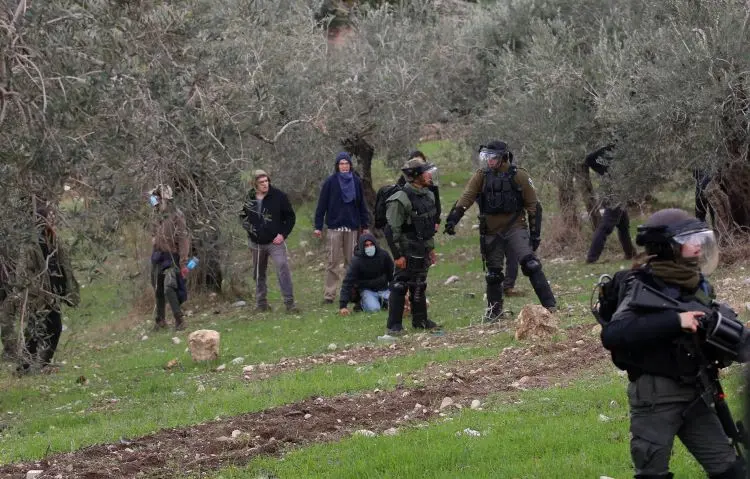
The occupation forces paved a military road north of Tubas.

Today, Monday, Israeli bulldozers began paving a military road on Palestinian lands in Khirbet Ibziq, northeast of Tubas.

Village Council head Abdul Majeed Khudairat reported that the occupation forces had begun constructing a military road on citizens' land, declaring the area "military closed."

He added that the occupation forces informed citizens not to approach their lands near the aforementioned street.

PALESTINE

Mon 07 Jul 2025 2:18 pm - Jerusalem Time

The death toll from the Israeli aggression on the Gaza Strip rises to 57,523 dead

The Ministry of Health in the Gaza Strip announced, on Monday afternoon, that the death toll from the Israeli aggression has risen to 57,523, and the number of injuries has risen to 136,617 since October 7, 2023.

The ministry confirmed in its daily statement that 105 dead (including one recovered) and 356 injuries had arrived at Gaza Strip hospitals in the past 24 hours.

It pointed out that the death toll and injuries since March 18, 2025 amounted to (6,964 dead, 24,576 injuries).

It explained that the death toll from aid workers arriving at hospitals over the past 24 hours has reached 7 dead and over 74 injuries, bringing the total number of livelihood victims arriving at hospitals to 758 dead and over 5,005 injuries.

In the latest developments on the ground: A number of civilians were killed and others injured Monday evening as a result of Israeli shelling that targeted a tent housing displaced persons opposite the Musab bin Omair Mosque in the Tal al-Hawa neighborhood in southern Gaza City.

Two members of the Ramlawi family were also killed in an attack that targeted their home in the Tuffah neighborhood east of Gaza City, completely destroying it and wounding several other family members.

Earlier today, three civilians were killed and others injured in shelling and shooting attacks carried out by Israeli occupation forces in various areas of Gaza City and Rafah.

According to the Ministry of Health, the death toll from the ongoing Israeli aggression on the Gaza Strip since October 7, 2023, has risen to 57,418 dead and 136,261 wounded. Thousands of bodies remain under the rubble and in the streets, as rescue and ambulance teams are unable to reach them due to the ongoing bombardment and lack of equipment.

The Israeli occupation continues its intensive bombardment of residential areas, medical centers, and displacement camps, amid catastrophic humanitarian conditions and severe shortages of food, water, and medicine. Meanwhile, humanitarian organizations continue to warn of the worsening health and environmental crisis in the besieged Gaza Strip.

ARAB AND WORLD

Mon 07 Jul 2025 2:14 pm - Jerusalem Time

Netanyahu asks Trump for guarantees that he will resume the war on Gaza if he agrees to a truce.

The Middle East Eye newspaper, citing Israeli media, reported that Israel has asked the United States for guarantees that it will resume its 21-month-old war of genocide in Gaza if it believes its conditions have not been met in negotiations with Hamas.

Israeli Prime Minister Benjamin Netanyahu arrived in Washington, where he will meet Monday to discuss details of the agreement negotiated by the United States, Qatar, and Egypt.

Under the potential agreement, the two sides would negotiate during the 60-day truce to reach a permanent ceasefire. According to an Israeli source speaking to Israel's Channel 14, "The current proposal includes a secret side letter from President Trump giving Israel the green light 'to resume attacks if our demands regarding the disarmament of Hamas and the exile of its leaders are not met,' and Israel would be able to decide whether to resume attacks on Gaza." The ceasefire agreement reached between Israel and Hezbollah in November 2024 also included a secret side letter from the United States to Israel stating that Israel could continue bombing Lebanon if it determined that Hezbollah was violating the agreement. As a result, Israel has consistently violated the ceasefire with airstrikes, ground raids, and its ongoing occupation of areas in southern Lebanon.

The Middle East Eye report noted that the Channel 14 report cited a "member of the political leadership," a phrase often used to refer to deliberate leaks by Israeli Prime Minister Benjamin Netanyahu. If the leak was deliberate, it could be intended to sabotage the ceasefire negotiations, as Hamas's main demand is a stronger US guarantee of its commitment to turning the agreement into a permanent ceasefire.

Hamas presented several amendments to the US-Israeli proposal for a 60-day ceasefire, including a stronger US guarantee, clearer language regarding an Israeli withdrawal from certain parts of Gaza, and unrestricted aid flows led by the UN and the Palestinian Red Crescent. Netanyahu described Hamas's amendments as "unacceptable," but also agreed to send negotiators to Doha for indirect talks. According to Palestinian sources who spoke to Reuters, the first round of talks ended "without reaching an agreement."

During previous negotiations, Netanyahu reiterated publicly unacceptable demands to Hamas to thwart the chances of reaching an agreement. An analysis published in Haaretz on Sunday indicated that the Israeli leader is trying to undermine the current negotiations, and that an agreement is unlikely to be reached unless President Trump forces him to do so.

Netanyahu will meet with President Trump at the White House on Monday, and a potential ceasefire in Gaza is expected to be a major topic of discussion, along with the recent 12-day US-Israeli war on Iran.

PALESTINE

Mon 07 Jul 2025 12:52 pm - Jerusalem Time

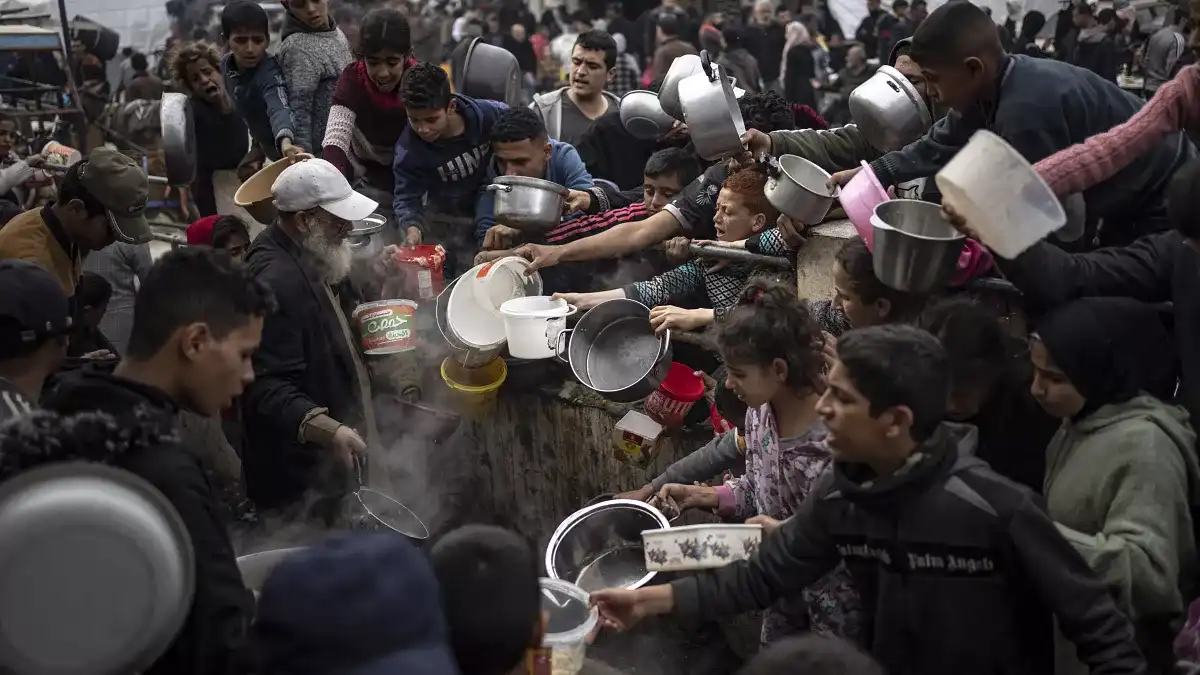
UN: Gaza's food system has collapsed completely

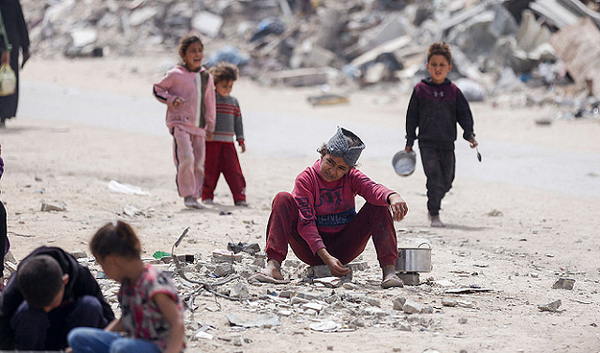
The United Nations Office for the Coordination of Humanitarian Affairs (OCHA) confirmed on Monday that the food system in Gaza is in complete collapse, and that the deepening famine in Gaza and the denial of aid access mean more lives will be lost.

According to the official United Nations website, the office noted that families in Gaza are forced to risk their lives to obtain food, explaining that rates of acute malnutrition have doubled among children, and that infant formula is running out.

UN Secretary-General António Guterres expressed his deep dismay at the worsening humanitarian crisis in Gaza, reiterating his call for an immediate and permanent ceasefire and the unconditional release of all hostages.

PALESTINE

Mon 07 Jul 2025 12:45 pm - Jerusalem Time

11,280 attacks carried out by the occupation and its settlers in the first half of 2025

Head of the Wall and Settlement Resistance Commission, Mu'ayyad Shaaban, said that the total number of attacks carried out by the occupying state in the first half of 2025 amounted to 11,280 attacks carried out by various state agencies, including its settler militias, against citizens and their property.

Shaaban added during a press conference held by the Commission to announce its semi-annual report, "The Occupying State's Attacks on Palestinian Territories and Colonial Expansion Measures" for the first half of 2025, that this significant escalation in the form, number and nature of attacks coincides with the aggression launched by the occupying state against our people in the Gaza Strip and all places of Palestinian presence, noting that the attacks ranged from imposing facts on the ground (seizing lands, colonial expansion and forced displacement), to field executions, vandalizing and bulldozing lands, uprooting trees and seizing property, and closures and barriers that sever the ties of Palestinian geography.

He pointed out that the attacks were concentrated in the governorates of Ramallah with 1,975 attacks, followed by Hebron with 1,918, and Nablus with 1,784.

Shaaban said: “Over the past six months, the occupying state has been racing against time, in every sense of the word, to encroach on Palestinian geography, not only by establishing colonial outposts or fattening settlements, nor by issuing military orders, nor by systematically assaulting citizens in villages, towns and Bedouin communities, besieging and strangling them, but also by an unprecedented series of legislation and government decisions that target the essence of Palestinian geography and its status, putting us face to face, government, people, institutions, councils and frameworks, before the most dangerous phase the Palestinian cause is going through in terms of attempts at theft, annexation and imposition of sovereignty.”

He added that the attacks carried out by settlers during the period monitored by the report amounted to a total of 2,153 attacks, resulting in the martyrdom of 4 citizens at the hands of settlers. The settlers’ attacks ranged from attacking Palestinian villages and assaulting the innocent, setting fire to homes with their owners on their heads, shooting at citizens, establishing colonial outposts, seizing control of citizens’ lands, attacking streets and vehicles, and launching organized and dangerous attacks that have characterized these attacks in the recent period, such as what happened in the villages of Kafr Malik, Al-Mughayyir, Beita, Sinjil, and others.

These attacks were concentrated in the governorates of: Ramallah with 491 attacks, Hebron with 409, and Nablus with 396.

Shaaban explained that from the beginning of 2025 until the end of June, the occupation authorities studied (deposited and approved) a total of 165 master plans for expanding settlements or establishing new ones, including: 124 plans in the West Bank settlements, and 41 plans for the Jerusalem settlements, through which they studied a total of more than 8,685 housing units in the West Bank settlements, and 8,865 for the Jerusalem settlements.

He continued: "In the first half of 2025, settlers established 23 colonial outposts on citizens' lands, most of which were pastoral outposts, in the governorates of Ramallah, Nablus, Hebron, Qalqilya, Tubas, and Jerusalem, in continuation of the policy of imposing facts on the ground pursued by settlers under the full auspices of the occupation army."

He added that during the period covered by the report, the occupation authorities seized more than 800 dunams of Palestinian land under various pretexts, by issuing 36 seizure orders for military purposes and one expropriation order under the pretext of paving and expanding roads.

Shaaban said that in the first half of 2025, the Israeli occupation authorities issued 556 demolition notices against Palestinian facilities on the pretext of lacking permits. These included 322 inhabited homes, 18 uninhabited ones, 151 facilities classified as agricultural, and 97 facilities classified as sources of livelihood, among others.

He continued: Most of these notices were concentrated in the governorates of Hebron with 145 notices, Ramallah with 131, Qalqilya with 49, and Jericho with 46. The occupation authorities carried out a total of 380 demolition operations, resulting in the demolition of 588 facilities, and 843 people were affected by the demolitions, including 411 children and 378 women.

Shaaban pointed out that the occupying state and the settler militias had caused the uprooting and damage of a total of 12,067 trees, including 6,144 olive trees, including 5,359 trees in the Bethlehem Governorate, 2,282 trees in the Ramallah and Al-Bireh Governorate, and 1,774 trees in the Nablus Governorate, in another record number recorded against the Palestinian tree, and in a clear and systematic targeting within the framework of emptying the Palestinian land and leaving it fallow.

Shaaban renewed his call for all Palestinians, including factions, popular unions, syndicates, and the masses, to unite under a national strategy to defend the land and national capabilities, one that looks only to Palestine, cares only about Palestine, and views the occupation's actions with a sense of national responsibility, free from self-interest and despicable malice.

He pointed out that the desired national strategy must, first, mobilize national and popular capabilities for its purpose, and second, be characterized by creativity and thinking outside the box of convention and previously used tools, in terms of reproducing new tools that are compatible with the current stage and adapt to its difficulties.

Shaaban emphasized that the current phase brings the old, new demand back to the forefront: the need for real and immediate international protection to safeguard the Palestinian people and their national capabilities against the thuggery of the occupation.

OPINIONS

Mon 07 Jul 2025 11:43 am - Jerusalem Time

Amid the regional storm: Gaza is left alone to face hunger and death.

While the Israeli-Iranian confrontation dominates the international media and political scene, Gaza, already exhausted, is absent from screens and news bulletins, as if it were no longer an open arena for fire and tragedy. A new war is capturing the world's attention, but the old war in Gaza has not stopped; it has instead escalated in deadly silence.

The prolonged blockade, ongoing airstrikes, and complete collapse of infrastructure have pushed the Gaza Strip into a state of near-total famine. With aid movement restricted and the entry of aid obstructed, aid distribution centers have often become a deadly trap for civilians. Scenes of bodies lying on the roads as they attempt to reach food trucks are no longer rare; they have become a recurring pattern, revealing an unprecedented brutality in the targeting of the poor and hungry.

Amid this tragic reality, the Abu Shabab group emerged, transforming from a local formation with limited influence into an effective force on the ground, tasked with protecting relief convoys and organizing their distribution. In the absence of a state and the confusion among factions, the group found itself in a position of responsibility, even influence.

The question many are asking today is: Has Hamas, the entity governing the Gaza Strip, begun to rely on the assistance of entities such as the Abu Shabab group or even American aid delivered through intermediaries? Has it shirked its direct responsibility to secure the people's basic needs and relied on aid as a permanent solution?

The facts on the ground indicate a complex situation: on the one hand, Hamas is facing enormous military and political pressure, while on the other, public confidence in its ability to manage the humanitarian situation has begun to erode. Leaving the arena open to local groups to assume vital roles raises questions about the true decision-making center in the Strip, and whether these groups are a temporary alternative or have transformed into a new, undeclared political actor.

It's clear that the war in Gaza has entered a new phase, not just a military one, but primarily a humanitarian one. What's striking is that global interest in it dwindles whenever a larger or more camera-grabbing conflict erupts. In the Israeli-Iranian war, the cameras and the positions were on full display, but in Gaza, people are dying of hunger under forgotten rubble, without any sufficient noise to stop the bleeding.

Ultimately, an entire people cannot be left as victims of geopolitical calculations and the balance of interests. While the world has chosen to temporarily turn its back on Gaza, local forces, led by Hamas, must reassess their priorities and face the truth: the responsibility to ensure life is not a secondary concern, but the core of moral and political legitimacy.

ARAB AND WORLD

Mon 07 Jul 2025 11:32 am - Jerusalem Time

After the truce between Iran and Israel... What is the fate of Gaza?

In light of the recent blow to Iran, fears are growing that Gaza could be next in line for exposure—not in terms of direct targeting, but rather in terms of the gradual abandonment of its most important backers. Hamas, which has long relied on Iranian support for funding and arms, now appears to be in an unenviable position. With Tehran preoccupied with its own internal crises and external pressures, it is only natural for it to reassess its priorities, and Gaza may not be at the top of the list.

The loss of this support not only means a decline in military capabilities, but also places the movement in an administrative and political quandary. As the governing body of a crowded and besieged Gaza Strip, Hamas is required to provide a minimum standard of living for its residents, a task that will become nearly impossible without external support. With regional options dwindling and the door to direct support from other Arab capitals closing, Hamas appears to be approaching the brink of a difficult decision, one that could plunge the entire Gaza Strip into chaos and internal collapse.

The fear today is not only for the future of the movement, but also for the fate of more than two million people living in tragic conditions, who may pay the price if Gaza enters a new phase of isolation and political starvation. If the path is not quickly reconsidered, the collapse will only be a matter of time, and the catastrophe will not distinguish between one party and another.

PALESTINE

Mon 07 Jul 2025 11:14 am - Jerusalem Time

Journalist Nasser Lahham's detention extended and he was transferred to Ofer Military Court.

The Palestinian Prisoners' Affairs Commission, citing its lawyer, said that the Israeli occupation authorities have decided to extend the detention of imprisoned journalist Nasser al-Lahham and transfer him to Ofer Military Court until next Thursday.

Israeli occupation forces arrested Al-Lahham at dawn today after raiding his home in the town of Doha in the Bethlehem Governorate and completely destroying its contents.

The number of journalists administratively detained in Israeli occupation prisons, under the pretext of having a “secret file,” is (22) journalists, out of (55) in occupation prisons, including (49) who have been detained since the beginning of the genocide.

The occupation continues to target journalists through what it calls detentions based on "incitement" on social media. This form of detention has become a tool for suppressing freedom of opinion and expression, and has become another form of the crime of administrative detention. The majority of those arrested on the grounds of "incitement," against whom the occupation was unable to file an indictment, were subsequently transferred to administrative detention.

Journalists detained in the occupation's prisons and camps face all the same crimes as prisoners, including systematic torture, severe beatings, starvation, and medical neglect, in addition to the ongoing humiliation and abuse they are subjected to. This is in addition to the ongoing policies of theft and deprivation against them, and their detention in harsh and degrading detention conditions.

PALESTINE

Mon 07 Jul 2025 11:00 am - Jerusalem Time

Three prisoners suffer from deliberate medical neglect in Janot Prison.

The Commission of Prisoners' Affairs and Ex-Prisoners said that three prisoners are suffering from deliberate medical neglect in Janot Prison.

The Commission explained, in its report, issued today, Monday, that its lawyers visited a number of sick prisoners, including: the case of prisoner Ziad Bazar (50 years old) from the town of Beitlu/Ramallah, who was arrested on 1/7/2004 and sentenced to 23 years in prison. He suffers from severe toothache, and he also needs new glasses, as the lenses he has now are no longer suitable for his vision today.

Prisoner Abdullah Al-Barghouthi (31 years old) from the town of Kobar/Ramallah, suffers from scabies, but his condition is stable.

Note that the prisoner was arrested on May 18, 2023, and is serving an administrative sentence, with his sentence extended for the fifth consecutive time.

Meanwhile, prisoner Mohammed Shamasneh (56 years old) from the town of Qatana/Jerusalem, has been suffering from scabies for a whole year. He received treatment in November of last year and did not improve. He also received treatment in January of this year without any benefit. In April of this year, he received treatment for the third time and no longer suffers from any itching. However, he continued to complain of boils and asked the prison clinic for an antibiotic to treat them, but they refused to give him one.

It is noteworthy that the prisoner has been detained since 11/12/1993, and has been sentenced to three life sentences and twenty-five years.

PALESTINE

Mon 07 Jul 2025 10:44 am - Jerusalem Time

Government Communication issues the most prominent reform and development legislation that the government worked on in its first year.

Four main pillars for developing and reforming public finances, strengthening the government system and the rule of law, improving the legislative environment for investment, and raising the level of basic services.

-10 reform and development legislations were completed and issued during the year.

Eleven draft reform and development laws and regulations are awaiting approval and adoption, and five other drafts are under study and preparation.

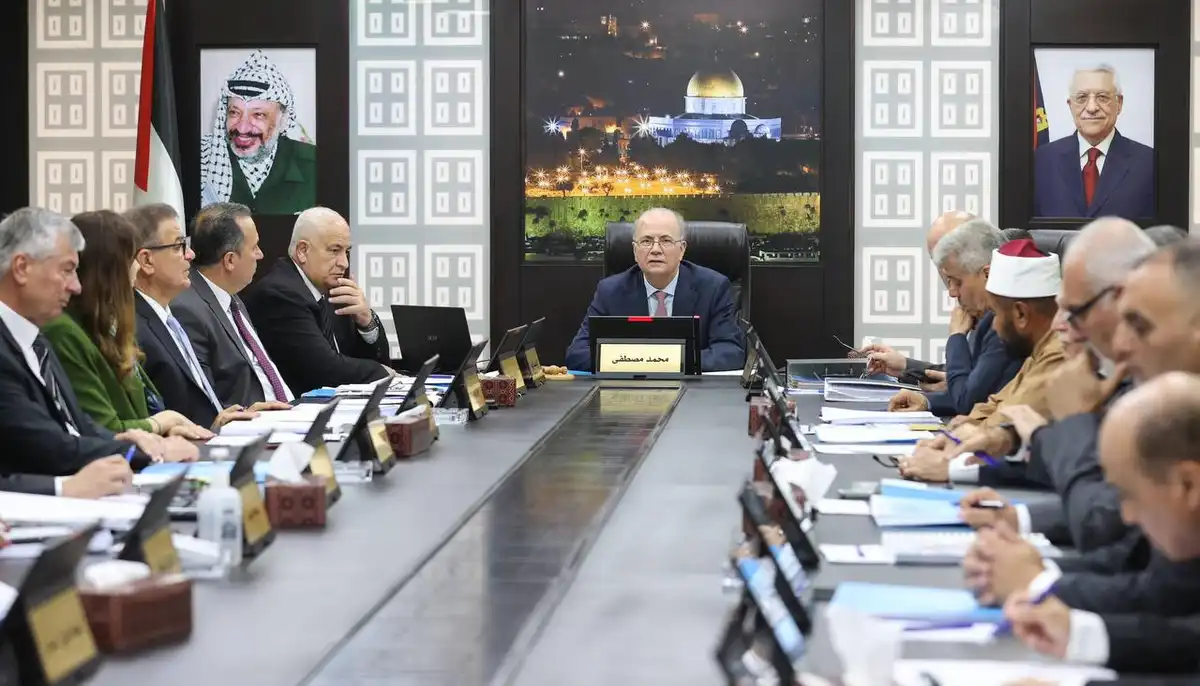
The Government Communication Center, in cooperation with the Executive Office for Institutional Development and Reform at the Prime Minister's Office, issued a report today, Monday, summarizing the results of monitoring the implementation of the executive plan to complete key developmental and reform-oriented legislation, which the 19th government, headed by Mohamed Mostafa, worked on during its first year.

These legislations are among the key priorities in the first phase of the National Development and Reform Programme, which includes seven initiatives and four reform pillars aimed at enhancing the legislative environment and strengthening the state's institutional structure.

According to a Government Communication Center report, the government has sought to develop the legislative environment to ensure the successful and effective implementation of government initiatives aimed at improving the quality of government services, strengthening the institutional structure, enhancing the performance of the government apparatus, and enhancing its flexibility and ability to adapt to rapid developments and changes. Efforts have focused on four main areas, as follows:

1. Developing financial policies and public finance management: by enhancing local revenues and rationalizing public spending, ensuring the efficiency and sustainability of financial resources.

2. Strengthening the governance system and the rule of law: by supporting legal frameworks and enhancing the efficiency of the judicial system, thus consolidating the principle of the rule of law and promoting integrity, transparency, and the speedy resolution of cases.

3. Improving the legislative and regulatory environment for investment and business: by digitizing business services and issuing and updating the laws regulating them, which contributes to facilitating the practice of economic activities and attracting investments.

4. Improving the level of basic services provided: This includes many sectors such as water, energy, health, communications, education, and social protection, ensuring the provision of more efficient, comprehensive, and equitable services.

In light of the above, and to follow up on the completion of the necessary legislation to implement the National Development Program in its first phase for the years 2025-2026, an executive plan was prepared for the legislation required to be completed during this year 2025, tracking its progress stages from preparation to issuance and publication, according to four classifications: 1. Completed, issued and published legislation. 2. Completed legislation awaiting ratification by the President. 3. Legislation currently being considered by the Council of Ministers for reading. 4. Legislation currently under public consultation with civil society and relevant authorities, in preparation for submission to the Council of Ministers.

First: Completed and issued reform legislation, which is:

1. Law Decree No. (25) of 2024 amending Enforcement Law No. (23) of 2005, which aims to ensure the acceleration of enforcement procedures before the competent enforcement departments, including the implementation of judicial rulings, which will contribute to enhancing the effectiveness of the judicial system, increasing confidence in the justice system and strengthening civil peace.

2. Decree-Law No. (26) of 2024 regarding value-added tax, which is a necessary step to achieve tax justice, improve national revenues, and enhance the efficiency of the tax system.

3. Decree-Law No. (24) of 2024 AD amending the Civil and Commercial Procedures Law No. (2) of 2001 AD and its amendments, which aims to employ electronic means in litigation procedures in a way that ensures the speedy adjudication of lawsuits, and saves time and effort in accessing justice.

4. Decree-Law No. (11) of 2025 regarding competition, which aims to protect and promote competition in the market, prohibit practices that prevent, restrict or harm competition, address any market imbalance resulting from practices that violate competition, and take the necessary measures in accordance with the provisions of the Decree-Law. In addition to ensuring that product prices are determined according to the rule of supply and demand, encouraging competitive behavior among establishments, ensuring the freedom of entry and exit of investors to the Palestinian market, and limiting exclusionary policies from the Palestinian market.

5. Within the framework of the government’s reform plan for the governance of public institutions in the country, with the aim of streamlining the institutional structure, promoting rationalization of spending in the public sector, preserving public funds, and improving the performance of institutions in providing more just and transparent services to citizens, the nineteenth government has done the following:

A. Cancellation of the (Agricultural Risk Mitigation and Insurance Fund) pursuant to Decree-Law No. (11) of 2024 AD.

B. (Cancellation of the Independence Bank for Investment and Development) pursuant to Decree-Law No. (14) of 2024 AD.

6. Decree-Law No. (17) of 2024 regarding electronic transactions and trust services, which aims to regulate and develop the legal infrastructure for electronic transactions and trust services, promote and protect e-commerce, and establish standards and procedures related to the integrity of electronic transactions and records. In addition to granting legal authority to electronic transactions and trust services, protecting the rights of users, promoting the use of electronic transactions in the public and private sectors, and reducing fraud and forgery crimes in electronic transactions.

7. Decree-Law No. (19) of 2024 AD amending Decree-Law No. (43) of 2021 AD regarding the management of state property, which aims to regulate the mechanisms for managing state property, in a manner that ensures its preservation, improving its exploitation and investment, and developing its resources in a better and more effective manner.

8. The Companies Registry and Electronic Registration Management, Procedures and Fees System No. (2) of 2025, which aims to reduce the administrative burden on new and existing companies, thus contributing to enhancing compliance with the law, and organizing and activating electronic registration and electronic signature on applications and documents submitted to the Companies Registry, through the automated registration system, which will help in the registration process in a faster and more transparent manner, and eliminate the need for paper transactions and personal visits to government offices.

9. The system for obligating the purchase of national products in public procurement No. (3) of 2025, which aims to obligate the purchase of national products in government tenders, in support of the national economy, local industry, and the creation of job opportunities, as the system obligates government purchasing agencies to apply a price preference for the national product at a rate of 15% in all purchasing operations that they implement.

Second: Completed legislation awaiting ratification (referred by the Council of Ministers to the President for issuance)

1. A decree-law amending the Public Debt Law of 2025. The amendment aims to provide appropriate economic indicators for financial and monetary policymakers to service public debt, consistent with the nature and capabilities of the Palestinian economy, to protect it and prevent it from being exposed to the risks of a worsening public debt crisis.

2. Decree-Law establishing the Cybersecurity Authority, which aims to build an effective cybersecurity system that protects the country from cyberspace threats and efficiently and effectively confronts them to protect individuals, property, and information.

3. A decree-law on e-commerce, which aims to regulate e-commerce in the absence of a legal and legislative environment governing it. This will contribute to enhancing consumer confidence, regulating the sale of products and services online, encouraging investment in the digital economy, and supporting start-up companies.

4. Cancelling and merging some state institutions to reduce financial expenditures: Through a draft decree-law on the governance of a number of non-ministerial government institutions, namely the Cooperative Labor Authority, the Land and Water Settlement Authority, the National Authority for Vocational and Technical Education and Training, the Palestinian National Institute of Public Health, and the Radiation and Nuclear Regulatory Authority.

Third: Legislation under development is currently being presented to the Council of Ministers for reading, as follows:

1. Laws:

A. A decree-law on the protection of personal data, which aims to protect individuals' privacy and regulate the methods of collecting, processing, and using their personal data. It also aims to achieve a balance between individuals' rights to protect their data and the legitimate needs of entities handling this data, whether governmental or private, in a manner that ensures the protection of data owners' rights from unlawful exploitation, supports digital transformation, enhances the digital economy, reduces legal risks that may hinder it, and enhances confidence in the digital environment. (A new draft decree-law has been presented in its first reading to the Council of Ministers, and work is ongoing to complete its presentation in the three readings until its proper approval. The Ministry of Communications and Digital Economy is working on introducing comments on the draft decree-law to complete its presentation to the Council of Ministers.)

b. Decree-Law on Investment Promotion, which is the regulatory legislation for the Investment Promotion Authority, specifies the mechanisms necessary to provide guarantees to investors, identifies the incentives offered to them, and sets out mechanisms for creating an appropriate climate to encourage investment with the aim of creating investment projects and providing new job opportunities to improve the country's economic level. (It was presented to the Council of Ministers in the first and second readings, and the Investment Promotion Authority is working on introducing comments on the draft decree-law to complete its presentation to the Council of Ministers.)

T. Decree-Law on Local Authorities Elections, which aims to amend the electoral system for local authorities by addressing the legal, procedural, and societal issues that accompanied the current law. (It was presented to the Council of Ministers in its first reading, and the Ministry of Local Government is working to incorporate comments on the draft decree-law to complete its presentation to the Council of Ministers.)

d. Amending Decree-Law No. (10) of 2018 regarding cybercrimes and its amendments, which is the legislation that defines and criminalizes illegal acts committed using technology and modern means of communication, and establishes the legal framework for addressing these crimes. This amendment aims to address the legal problems in the current legislation, the most important of which is not restricting or violating freedom of opinion and expression, and creating the necessary legal guarantees for that. (It was presented with comments to the Council of Ministers in the first reading, and a specialized national committee was formed to amend the Decree-Law. The formed committee is working on introducing comments on the draft Decree-Law to complete its presentation to the Council of Ministers.)

C. A decree-law amending the Civil Service Law No. (4) of 1998, which aims to regulate appointments in the public service in a manner that achieves justice, transparency, and equal opportunities for all citizens equally, and to amend the salary scale in a manner consistent with the public interest and the interest of public employees as well. (It was presented in the first reading to the Council of Ministers).

2. Regulations and systems:

1. Amending the Non-Profit Companies System No. (20) of 2022, which aims to facilitate and simplify the procedures for registering non-profit companies, and the procedures for obtaining the necessary funding to enable them to achieve the objectives for which they were established, within the framework of regulatory controls and follow-up by the competent ministry. (It was presented to the Council of Ministers in the first reading, and the remaining proposals are being completed for approval. The Ministry of National Economy is working on entering the comments to complete its presentation to the Council of Ministers).

2. The Electronic Judicial Notification System, which aims to integrate electronic means into judicial work to expedite the adjudication of lawsuits. (It was presented to the Council of Ministers in its first reading, and the remaining readings are being completed for approval.)

Fourth: Legislation under study and preparation and about to be presented to the Council of Ministers, shown as follows:

1. Decree-Law on Public-Private Partnerships (the private sector will be consulted through extensive discussion workshops prior to its submission to the Cabinet). The Decree-Law aims to enhance private sector participation in development and service projects implemented by the government sector, in addition to exchanging financial, administrative, organizational, technical, and technological expertise with the aim of raising the level of government services and contributing to the involvement of the private sector in providing services to citizens, which will alleviate the burden on the treasury and increase the state's financial returns.

2. Decree-Law on the Right to Access Information, which guarantees citizens' right to access information held by government agencies and public bodies. It aims to enhance transparency and accountability in government work and public institutions, empower citizens to participate effectively in public life, and enhance citizens' ability to search for and access information held by state institutions, regulating and activating the free flow of information within the limits set by law.

3. Amending Decree-Law No. (8) of 2011 regarding income tax, with the aim of strengthening the fight against evasion and fraud, protecting public funds, improving compliance, enhancing transparency and integrity in collection, achieving social justice, and enhancing citizens’ confidence in the state.

4. Amending Decree-Law No. (42) of 2021 regarding companies, with the aim of addressing the legal loopholes that arose during the implementation of the current Decree-Law, including digitizing the companies’ registry and online registration.

PALESTINE

Mon 07 Jul 2025 10:01 am - Jerusalem Time

Settlers storm Al-Aqsa Mosque

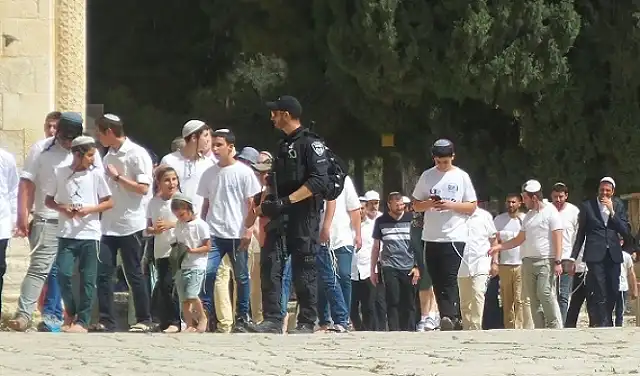
Dozens of settlers stormed Al-Aqsa Mosque today, Monday, under the protection of Israeli occupation forces.

Local sources reported that dozens of settlers stormed Al-Aqsa Mosque and performed provocative Talmudic rituals in its courtyards, under the protection of occupation forces, which tightened security measures at the gates of Al-Aqsa Mosque.

PALESTINE

Mon 07 Jul 2025 9:38 am - Jerusalem Time

A dangerous escalation... Settlers storm the "Ein Samia" wells again, destroying surveillance cameras, and the Jerusalem Water Authority warns of catastrophic repercussions.

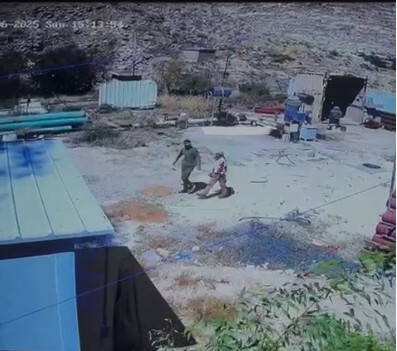
Yesterday, Sunday, settlers escalated their dangerous attacks on Palestinian water sources in the Ein Samia area, east of the town of Kafr Malik, by storming wells No. 2 and 3, vandalizing surveillance cameras installed on the stations' walls, and removing the gate of one of the stations and stealing it.

The Jerusalem Water Authority warned of the danger of recurring attacks, which threaten the continued supply of water to communities. It called for urgent and immediate intervention to halt these deliberate violations, which constitute a clear breach of all international laws and norms related to the human right to access water.

The utility emphasized that the Ein Samia wells constitute a primary water source for dozens of Palestinian communities in the Ramallah and al-Bireh Governorate, and that any attack on them would deprive thousands of citizens of their right to water, amidst already difficult water and living conditions.

In a related development, the utility confirmed that its crews are facing extreme difficulty in accessing and maintaining well sites due to repeated attacks by settlers. This exposes water facilities to greater damage and disrupts regular maintenance and monitoring, exacerbating the crisis.

The Authority emphasized that this attack is not the first, and it will not be the last, unless there is genuine and urgent intervention from the international community and protection and oversight institutions to deter the settlers and halt their systematic targeting of the area.

OPINIONS

Mon 07 Jul 2025 9:33 am - Jerusalem Time

Extremist Israeli positions calling for the annexation of the West Bank

Sari Al-Qudwa

Sari Al-Qudwa

Opinion Writer

The extremist occupation government is working on an extremely dangerous plan and is seeking in the next phase to annex the West Bank. The calls issued by a number of ministers and members of the occupation Knesset to apply Israeli sovereignty over the West Bank fall within the goals of the colonial right-wing government and represent an extremely dangerous development and an aggressive approach. The calls and statements issued by the Israeli Minister of Justice, which demand the annexation of the West Bank, constitute an exploitation of the current circumstances and set an irresponsible precedent and carry dangerous tendencies, as they are issued by an official in the occupation government and reflect an official trend to annex the West Bank.

The occupation government is now living in an extremist quagmire, exploiting its power to impose its power, which flouts any international laws or even moral rules. The approach of arrogance will lead to an endless cycle of violence. This policy is nothing but a blatant attempt to escalate the conflict and export the internal political crises facing the occupation government, through the policy of escaping forward and imposing facts by force. These racist colonial calls represent a dangerous escalation and a challenge to the international community, a blatant violation of international law, and an undermining of all efforts aimed at calming and achieving stability in the region, which is inflamed by the Israeli aggression. They clearly reveal the intentions and projects of the occupation to liquidate the Palestinian cause and impose a new fait accompli that bypasses the Palestinian people and their legitimate rights.

The extreme right-wing bloc and the occupation government are using the policy of annexation to prevent the establishment of a Palestinian state and to liquidate the Palestinian presence. Their policy of settler colonialism, annexation, and Judaization of Palestinian land is being promoted internationally to cover up these illegal measures and to avoid taking responsibility. This policy will exacerbate the conflict, increase the severity of the situation, and push towards a comprehensive explosion, as a result of the absence of political solutions and their replacement with aggression, expansion, and colonialism. It will not be granted any legal legitimacy.

Annexing the occupied West Bank is one of the goals of the extreme right in Israel, and the international community is called upon to take a real stand against this dangerous policy, which will inflame the situation in the region. The West Bank is occupied Palestinian territory under international law and UN resolutions, as well as the positions of countries around the world. Talk of annexing it is nothing more than a form of political bullying and a reversal of all international values and norms.

The US administration must compel the occupying power to respond to efforts aimed at achieving a comprehensive cessation of aggression that includes all Palestinian territories in the Gaza Strip and the West Bank, including Jerusalem, and to halt attacks on Islamic and Christian holy sites. The US administration's statements calling for a halt to the war in the Gaza Strip must be accompanied by a firm, strong, and effective stance to halt the aggression against the cities, villages, and camps of the West Bank, and to abide by international legitimacy resolutions as the only way to achieve security and stability in the region.

The international community, including the Security Council, the European Union, and the Arab League, must take urgent action and emphasize the importance of adopting clear positions and deterrent measures against the dangerous Israeli approach that not only targets Palestinian land but also undermines any possibility of reviving the peace process. The international community, which has repeatedly emphasized the need to end the Israeli occupation, must assume its legal and moral responsibilities and take immediate action to stop these serious violations, hold the occupation accountable for its aggressive practices, and take the necessary measures to ensure respect for international law and international legitimacy resolutions.

OPINIONS

Mon 07 Jul 2025 9:27 am - Jerusalem Time

Islamists are being targeted...the pressures of reality and the necessity of openness!

Ahmed Youssef

Ahmed Youssef

Opinion Writer

Since the outbreak of the war of extermination on the Gaza Strip, the violence and brutality of which has surpassed all imagination, the fragility of official Arab and Islamic positions, and even their moral collapse in many cases, has been exposed.

The tragedy was not limited to the scale of the destruction and the thousands of civilian casualties. It extended to an even greater shock: the world's silence, the West's complicity, and even its participation in the crime through political, military, and logistical support for Israel, under blatant pretexts and allegations.

It has become clear that the entire international system is operating with double standards, condemning the victims of the occupation and overlooking the crimes of the occupier, while the Arab and Islamic world stands helpless, shackled by fears or absorbed in its own internal crises.

What was even more bitter was that some Arab and Islamic capitals, instead of supporting the steadfastness of the Palestinian people, contributed—directly or indirectly—to placing the blame for what had happened on the victim, under the pretext of confronting Hamas and halting its resistance project.

Because Hamas is viewed by some regimes as an extension of a regional axis whose repercussions are feared, demonizing it has become a soft cover for remaining silent about the genocide, justifying official impotence, and perhaps even conspiring against the resistance. Unfortunately, some regimes have become internal enemies of their people and the nation, before becoming enemies of Hamas.

In light of this reality, it has become imperative for Islamists—who have always been the bearers of the nation's renaissance project—to boldly and honestly reconsider their political and advocacy discourse, and to read reality from a critical, rather than emotional, perspective, one that transcends denial and victimhood to initiative and action.

Correcting the course... a responsibility that cannot be postponed

In the face of the mounting challenges, Islamists must adopt a comprehensive reform vision that encompasses several axes, including:

1. Political openness and pragmatic flexibility

We must move away from ideological and extremist discourses and embrace a realistic, rational political discourse that balances principles and interests and draws on the experiences of Islamists in countries like Turkey and Morocco, where they were able, to a limited extent, to integrate into political life and achieve successes without compromising their fundamental principles.

2. Disengage from violence and emphasize peacefulness.

The necessity of publicly and clearly disavowing all forms of armed violence, whether domestically or falsely, committed in the name of Islam. This is to protect the Islamic project from being labeled as terrorist and to counter the pretexts that open the door to foreign intervention and security restrictions.

3. Prioritizing the Islamic project

Islamists must reorganize their priorities. A return to moral education, social work, and public service must be at the top of their agenda, while leaving the management of political affairs to those with the tools, knowledge, and requirements, if they themselves are not yet qualified to do so.

4. Building a positive relationship with political systems

The tendency toward escalation and confrontation with regimes has only reaped destruction and bloodshed. A more appropriate approach would be to seek to build bridges of communication, search for common ground, and foster a sense of support and solidarity for the regimes against all external threats, within the framework of a partnership that preserves stability and advances the national interest.

5. Benefiting from the Islamic presence in the West

Millions of Muslims in the West represent a golden opportunity to improve the image of Islamists, promote moderate Islamic thought, and correct the distorted image that has been entrenched by violent events and conflicts. What is needed is support for Muslim community institutions to serve as platforms for cultural communication, not fronts of confrontation.

6. Integrating the Islamic vision with national accounts

The Islamic vision, in its comprehensiveness, must be in harmony with national reality and respect the state's sovereignty and its unifying identity. Islamists must not be viewed as a transnational project, or as supranational. Rather, they must be partners in building the state, not transgressors.

7. Condemning extremist and takfiri thought

In fact, Islamists must be at the forefront of exposing extremist thought, deconstructing its rhetoric, and rejecting the culture of exclusion and excommunication.

Publicly denouncing violent ideology and presenting mature intellectual alternatives represents protection for the Islamist movement itself and a renewal of its credibility in the eyes of the people.

8. Adopting a continuous review approach

An Islamic movement that fails to examine itself and learn from its experiences is destined for erosion and isolation. Self-criticism is not a threat to unity; rather, it is a renewal of life, a correction of course, and a guarantee of continuity in a changing environment and an international context that is unforgiving of the weak.

Remarkable intellectual transformations...towards a realistic and moderate discourse

It is noteworthy that in recent years, an increasing number of intellectual, advocacy, and political figures affiliated with the Islamist movement have begun to lean toward a more balanced and realistic discourse, calling for moderate behavior, adopting rational relations with Arab regimes, and abandoning the logic of confrontation or absurd challenge. These shifts reflect not only intellectual maturity, but also a practical reading of developments in the regional and international landscape.

In Morocco, Dr. Saadeddine El Othmani emphasizes, "We must realize that reform cannot be achieved against the state, but rather in cooperation with it."

As for Dr. Ahmed Al-Raissouni, he called for the jurisprudence of balances, saying: “Whoever does not take reality into account in his interpretation, his interpretation is either invalid or deficient.”

In Algeria, Sheikh Abu Jarrah Sultani called for conscious integration into state institutions. Dr. Abderrazak Makri emphasized that "working within the system is the safest way to protect the country."

While Dr. Farouk Tayfour stressed that "political Islam will have no future unless it develops its relationship with the state."

In Egypt, Dr. Muhammad Salim al-Awa believed that “societies are not led from pulpits alone,” while Hisham Jaafar asserted that “the shift from the discourse of the group to the discourse of the nation requires a mind that recognizes the complexities of the state.”

In Jordan, Dr. Raheel Gharaibeh called for a comprehensive national project, while Dr. Sabry Samira said, "Review is a virtue, and cooperation with the regime when it serves the nation does not detract from the position, but rather strengthens it."

As for Palestine, Sheikh Imad Hamto emphasized that: “Sharia politics is not a battle of slogans,” while Sheikh Faisal Mawlawi (may God have mercy on him) said: “Islamic action should be reformist within the state, not a permanent opponent to it.”

From Sudan, Dr. Jaafar Sheikh Idris said: “If Islamic action is not based on understanding the objectives, understanding the Sunnah, and awareness of reality, it will turn into an enthusiasm isolated from wisdom.”

All of these reviews reflect a maturity within Islamist circles and indicate a growing awareness that the current situation can no longer tolerate confrontational rhetoric or the logic of forced change. They also indicate that the opportunities for true reform lie in understanding, not conflict, and in cumulative construction, not revolutionary demolition.

In conclusion, if the mechanisms of Islamic action are not renewed, cosmic laws do not favor anyone, and Islamists will pay the price for stagnation and inertia, as the future of political Islam depends on its ability to renew and adapt. Divine laws are not lenient, and those who do not change will be replaced.

OPINIONS

Mon 07 Jul 2025 9:25 am - Jerusalem Time

Everyone wants this American pressure.

Ahmed Rafiq Awad

Ahmed Rafiq Awad

Opinion Writer

Israel is sending its delegation to Qatar for public relations purposes. It publicly declares that it will eliminate Hamas and that it will expel Palestinian citizens, whether by force or by choice. It also publicly confirms that the so-called “day after” in Gaza will not include Hamas or even the Palestinian Authority. Israel is sending its delegation to Qatar while there are military scenarios ready for a complete military occupation, settlement scenarios, and investment scenarios. Israel is sending its delegation to Qatar because it sees itself as victorious, in a sense, and that Hamas cannot continue with more pressure, siege, dismantling, spreading chaos, and multi-purpose militias. Israel is sending its delegation to Qatar so as not to contradict the American momentum and the personal desire of Trump, Israel’s friend, the likes of whom will never be found. It is sending its delegation to convince its audience that it is dealing positively with the proposals it itself has proposed. It is also doing so to buy time, beautify the image, promote falsehoods, and demonize Hamas as much as it can.

Israel is sending its delegation knowing that the final decision lies with Trump, who wants calm in the Gaza Strip for the sake of his restive street, which can no longer remain silent about what is happening in Gaza. The war on Gaza and the atrocities taking place there have become a daily debate at various levels and in various American circles. The phenomenon of Zahran Mamdani, the proposed candidate for mayor of New York, is entirely new, and it is so disturbing that Trump has threatened him. This phenomenon epitomizes the power of the people against the power of money, the dominant media, comprehensive propaganda, and the Zionist, Jewish, Israeli, and extremist religious lobbies. Trump wants to provide a convincing answer to this angry public, which has clearly not been frightened or deterred by all the extremist measures of the US administration so far.

I believe that Israel, with its government, its public, its opposition, and its military establishment, needs this public American pressure to free it from the guilt of the decision to stop the war it has been embroiled in for twenty-one months, which seems to have no end or outcome.

Israel wants to appear as if it has stopped the war, not because of defeat, fatigue, or an inability to continue, but rather because of a joint decision with the US administration and also in consideration of its own interests.

Israel is sending its delegation because it believes it has not achieved its stated goals, at least by eliminating Hamas, forcibly releasing prisoners, and displacing citizens. It knows that the force option has exhausted all its potential. Therefore, it is seeking a political formula proposed by the United States and is pressing for its implementation.

The US administration wants to make the ceasefire in the Gaza Strip part of a comprehensive vision for the entire region. This means that the ceasefire would be a necessary step towards developing a new vision for resolving the Palestinian-Israeli conflict based on new principles and different references. The ceasefire would also be a step towards security and political settlements with the Arab and Islamic world, if possible and available. This depends on the strength of the Arab and Islamic position. The United States also wants the ceasefire to be a gateway to calming the political, security, and judicial debate in Israel. This means that the ceasefire would be a gateway to restructuring the Israeli government, either by restoring the mandate or by restructuring it anew.

For all of this, the decision rests with Trump, not only because he wants it, but also because Israel wants it. This decision will spare Israel and free it from an eternal war, relieve its society, and reconfigure its political map. A decision like this will also give America's friends and allies in the region a chance to catch their breath and escape embarrassment, societal explosions, or political tensions.

Therefore, the Israeli delegation in Qatar will have broader powers to reduce the ceiling on the required amendments, to register certain military advantages, or to establish certain conditions. This is because Israel is going to Qatar deeply embroiled in a war in which it cannot achieve what it calls absolute victory. It is impossible to defeat living peoples, nor can it defeat ideas or crush spirits.

Continued American pressure is essential to achieve a ceasefire. Israel alone cannot and does not want to achieve it. Israel ultimately knows that the American proposal, with its fourteen points, serves its current and future interests. Moreover, this proposal promises Israel various rewards. Therefore, Israel's negotiating tricks are very clear this time.

PALESTINE

Mon 07 Jul 2025 9:22 am - Jerusalem Time

Occupation forces begin demolishing a house west of Ramallah

Israeli bulldozers began demolishing a house in the village of Kharbatha al-Misbah, west of Ramallah, on Monday morning.

Local sources reported that the house, which is located on three floors, belongs to Mahmoud Al-Habal.

PALESTINE

Mon 07 Jul 2025 9:10 am - Jerusalem Time

Among them is journalist Nasser Al-Lahham.. The occupation launches an arrest campaign in the West Bank.

Israeli occupation forces launched an arrest campaign in the West Bank early Monday morning, including arrests of journalist Nasser Al-Lahham.

In Bethlehem, the occupation forces arrested the editor-in-chief of Ma'an News Agency, Nasser Al-Lahham (58 years old), after raiding his home, searching it, and ransacking its contents in the town of Doha.

Meanwhile, the occupation forces arrested Ahmed Mahmoud Ghanem from Al-Khader town and Rayan Mahmoud Al-Wahdneh from Al-Dheisheh camp, after raiding and searching their homes.

In Nablus, occupation forces arrested two young men, Mahmoud Awada and Nour Hassouna, after raiding and searching their homes in the village of Beit Imrin.

Meanwhile, occupation forces stormed Balata camp, raided several homes, and searched and vandalized their contents.

In addition, these forces seized a vehicle and smashed the windows of another during a raid on the village of Duma, south of Nablus.

In Hebron, occupation forces raided several neighborhoods in the city and arrested citizen Ismat Zahida after raiding and searching his home.

These forces also raided a number of homes in the southern region and abused citizens.

The occupation forces also raided the home of Mahmoud Al-Fasfous and arrested his wife, Yasmine Majed, and Awlad Muhammad, pending his surrender to the occupation.


PALESTINE

Mon 07 Jul 2025 9:07 am - Jerusalem Time

Ready to fight

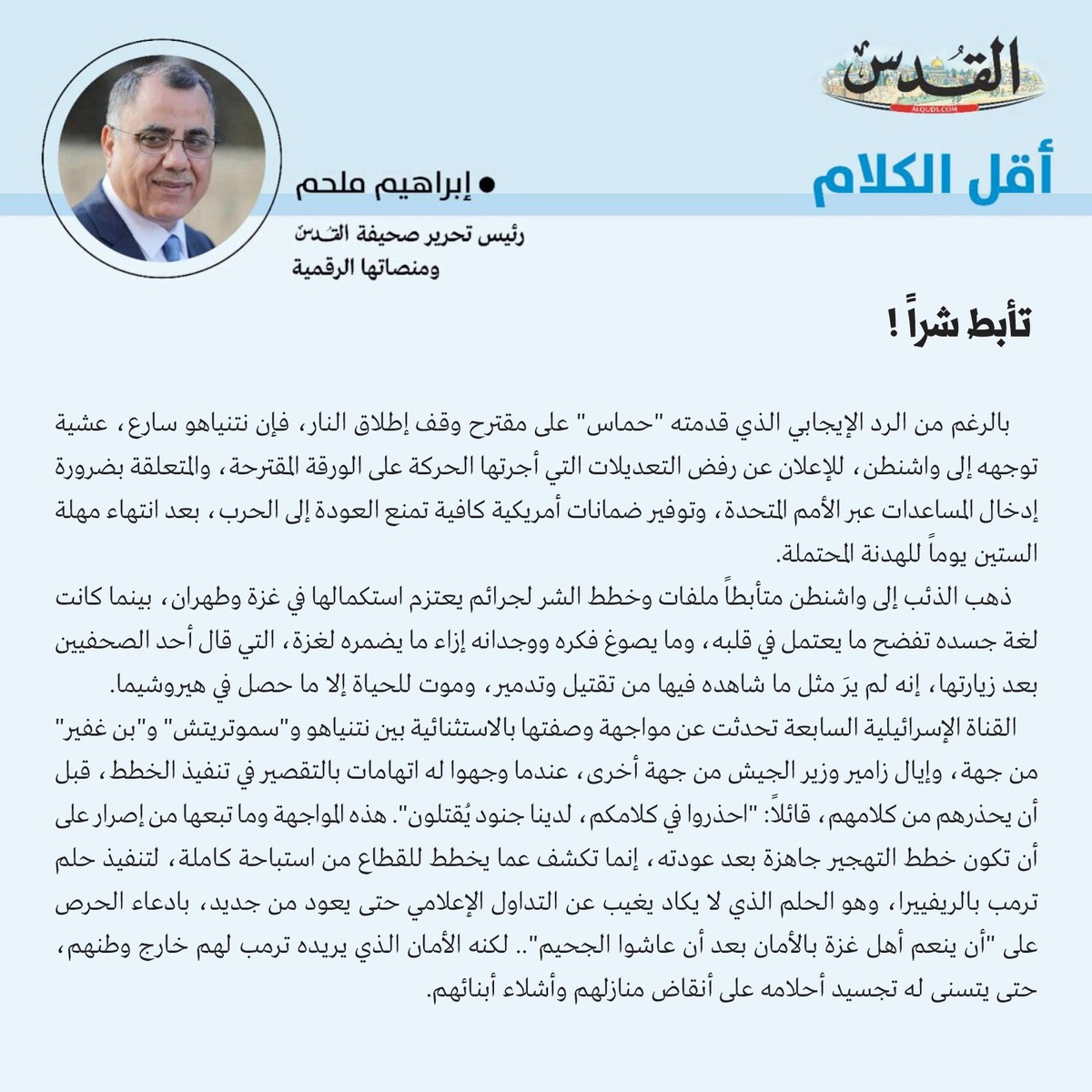
Despite Hamas's positive response to the ceasefire proposal, Netanyahu, on the eve of his trip to Washington, rushed to announce his rejection of the movement's amendments to the proposed document. These amendments required the delivery of aid through the United Nations and required sufficient American guarantees to prevent a return to war after the expiration of the sixty-day period for a potential truce.

The wolf went to Washington carrying files and evil plans for crimes he intended to commit in Gaza and Tehran, while his body language betrayed what was raging in his heart and what shaped his thoughts and feelings regarding what he harbored for Gaza. After visiting it, one journalist said that he had never seen anything like the killing, destruction, and death of life that he had witnessed there, except for what happened in Hiroshima.

Channel 7 Israel reported on an exceptional confrontation between Netanyahu, Smotrich, and Ben-Gvir on one side, and Defense Minister Eyal Zamir on the other. They accused him of failing to implement plans, before he warned them against their words, saying, "Be careful with your words. We have soldiers being killed." This confrontation, and the subsequent insistence that the evacuation plans be ready upon his return, reveals the complete desecration of the Gaza Strip planned for him, to fulfill Trump's dream of a Riviera, a dream that is constantly being circulated in the media until it reappears, under the pretext of ensuring "the people of Gaza enjoy security after they have lived through hell." However, this is the security that Trump wants for them outside their homeland, so that he can realize his dreams in the ruins of their homes and the remains of their children.

PALESTINE

Mon 07 Jul 2025 8:57 am - Jerusalem Time

Gaza: Dead, wounded, and progress in ceasefire talks

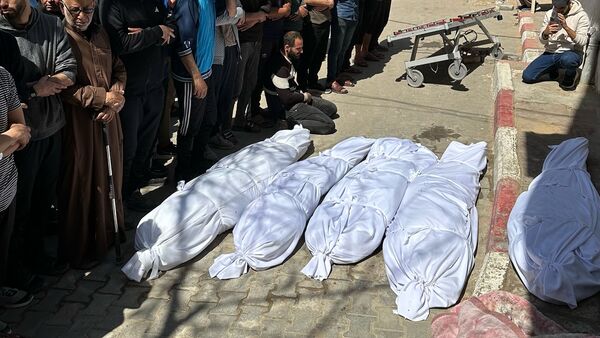
Six civilians, including a child, were killed and others injured tonight in an Israeli airstrike on a medical clinic in central Gaza City.

Local sources reported that six civilians, including a child, were killed and 15 others injured in an Israeli airstrike targeting a room in the Al-Rimal Clinic on Al-Wahda Street in central Gaza City.

Medical sources reported that 100 civilians, including 11 aid recipients, were killed on Sunday.

In Gaza City, 56 citizens were killed, including 30 in the bombing of two homes housing displaced people in the Sheikh Radwan neighborhood, northwest of the city; 7 martyrs in the bombing of the Abu Asi School, which houses displaced people in the Shati refugee camp, west of the city; 8 martyrs in two raids that targeted two gatherings of citizens in the Al-Rimal neighborhood in the center of the city; 4 martyrs in the bombing of a home in the Al-Daraj neighborhood, east of the city; and 3 martyrs in the bombing of a vehicle in the Sheikh Radwan neighborhood.

Two women were also killed in an Israeli drone strike on the al-Tuffah neighborhood east of the city, and another was killed in an airstrike targeting a tent housing displaced persons west of the city. The bodies of two other martyrs were also recovered from the al-Shuja'iyya neighborhood east of the city, having been killed as a result of Israeli shelling around the Sabha Medical Center.

In the central Gaza Strip, 26 citizens were killed, including 8 people waiting for aid near the Wadi Gaza Bridge, south of the Shuhada Junction. Seven were killed in a bombing that targeted a tent housing displaced people west of the Nuseirat camp. Four were killed in a bombing that targeted a house in the camp. Four were killed in a bombing that targeted a gathering of citizens north of the camp. Three were killed in a bombing that targeted a charitable hospice north of Deir al-Balah.

In the southern Gaza Strip, 18 civilians were killed, including 8 killed in an Israeli airstrike targeting tents housing displaced people in the Al-Mawasi area west of Khan Yunis, 3 killed by Israeli fire while waiting to receive aid northwest of Rafah, 3 killed by Israeli airstrikes while waiting to receive aid northwest of Rafah, 3 killed by Israeli fire while being recovered from various areas in Khan Yunis, and 2 killed by wounds sustained in a previous airstrike.

A citizen was also killed by Israeli occupation forces' fire in the town of Bani Suhaila, east of Khan Yunis, and another was killed in an Israeli shelling that targeted a gathering of citizens near Abu Hamid roundabout in the center of Khan Yunis.

In contrast, the Qassam Brigades, the military wing of Hamas, announced that it had targeted the settlements of Nirim and Ein HaShem in the Gaza Envelope with a number of Rajum rockets.

Israeli media also reported that two soldiers were injured when an anti-tank missile hit a military vehicle in the northern Gaza Strip, at a time when resistance operations are escalating amid anticipation of a possible prisoner exchange deal.

Politically, the Israeli negotiating delegation arrived in the Qatari capital, Doha, to officially begin negotiations, while Prime Minister Benjamin Netanyahu traveled to Washington to discuss the future of the Gaza Strip and the exchange deal with US President Donald Trump.

Trump announced that "the United States is very close to reaching a deal on Gaza," adding that there is a "great chance" of concluding an agreement with Hamas to release a large number of hostages.

However, Reuters quoted Palestinian officials as saying that the first round of ceasefire talks in Qatar ended without conclusive results.

The two officials explained that the Israeli delegation lacks sufficient authority, which is hindering the achievement of an agreement. Israeli officials asserted that the next 24 hours will be crucial for progress in the talks.

PALESTINE

Mon 07 Jul 2025 8:47 am - Jerusalem Time

The expected Gaza truce: negotiations in Doha, with all eyes on Washington

Dr. Saeed Shaheen: The anticipated truce may be "fragile" because the failure of negotiations or any individual incident could lead to its collapse.

Sari Samour: Israel may exploit negotiations to recover its prisoners and then resume its military operations, paving the way for the displacement or extermination of the population of the Gaza Strip.

Mohammed Joda: Hamas faces an internal challenge in controlling armed groups and maintaining unity of decision-making, which is crucial to the success of the truce.

Dr. Raed Al-Dabai: The next 60 days represent a crucial opportunity for Palestinians to build a serious national dialogue aimed at bridging the gaps resulting from the internal division.

Suleiman Basharat: The next few days will witness significant momentum in the negotiating rounds and may culminate in an agreement, but the Trump-Netanyahu meeting is decisive.

Talal Okal: The success of the ceasefire agreement or ending the war depends on the results of US efforts and the extent to which regional parties respond to Trump's vision.

As signs grow that a ceasefire agreement is imminent in the Gaza Strip, the threads of indirect negotiations between Israel and Hamas are becoming intertwined amidst anxiety and anticipation about the possibility of returning to square one and continuing the suffering.

In separate interviews with "I", writers, political analysts, and university professors believe that these efforts, which coincide with an escalating American role, seek to exploit the results of the truce in complex regional issues, starting with Iran and extending to arranging the normalization map in the region. However, fragility remains a key feature of these understandings, as they are accompanied by fears that Israel will exploit the truce as an opportunity to reposition itself or rearrange its military and political cards.

Despite the cautious optimism surrounding the ongoing talks, writers and university professors warn that any failure to translate the agreement into concrete commitments on the ground could undermine the chances of a de-escalation and return the region to a state of escalation. The success of these efforts hinges on the intentions of the parties and the ability of international mediators to secure solid guarantees that transform the truce from a mere temporary respite into a genuine path toward a more comprehensive and stable settlement.

Hamas faces enormous pressure from its popular base.

Dr. Saeed Shaheen, a professor of political media at Hebron University, says that the Palestinian resistance, particularly Hamas, is facing enormous pressure from its popular base in the Gaza Strip, which is being subjected to what he describes as "the most heinous genocide and ethnic cleansing in history."

Shaheen points out that these pressures, resulting from Israeli brutality that exceeds any people's tolerance, have prompted Hamas to accept, with reservations, a truce proposal it had previously rejected, despite its ambiguity, which could later be interpreted to serve the occupying state's objectives.

Shaheen explains that the qualitative operations and ambushes carried out by the resistance inflict significant damage on the occupation army and hinder the achievement of its strategic objectives in the war.

Shaheen points out that the current proposal for a truce, which extends to sixty days, raises concerns about interpretations that could lead to a breakdown in negotiations, particularly regarding the resistance's basic conditions, such as a final ceasefire, the withdrawal of occupation forces from the Gaza Strip, the immediate entry of humanitarian aid, and the reopening of the Rafah crossing and other crossings.

Shaheen believes that Hamas's acceptance of the proposal, despite its reservations, places the extremist occupation government led by Benjamin Netanyahu in a difficult position, as it will be difficult for it to reject the proposal without facing increasing American pressure to stop the war.

Shaheen points to statements by US President Donald Trump, who described Hamas's response as "good," indicating relief that could lead to pressure on Netanyahu to halt the war, paving the way for a focus on normalization projects and other regional issues.

Shaheen expects Trump to announce a truce agreement soon, scoring strategic points in his favor, especially as he seeks to reopen sensitive issues, such as the secret negotiations with Iran over its nuclear program and focusing on the Ukraine-Russia crisis.

The Trump administration's achievements in calming multiple fronts

Shaheen expects the region to witness widespread praise for the Trump administration's achievements in calming multiple fronts, including Syria, Lebanon, and Iran, while pushing forward ambitious economic projects spanning the entire region.

However, Shaheen warns that the anticipated truce may be "fragile," as failure of negotiations or any individual incident could lead to its collapse.

Shaheen asserts that the truce, while important in alleviating the humanitarian suffering in Gaza, does not guarantee a permanent end to the war. He points out that historical experience shows that truces can serve as bridges to a political solution if Israel commits to serious negotiations, free from pressure from the extreme Zionist right.

Shaheen warns of the dangers of the occupation's continued imposition of conditions such as the resistance surrendering its weapons or the withdrawal of its leaders from the Gaza Strip, which could open the door to a new round of war.

"The truce is not an end in itself, but rather a beginning that must be transformed into a comprehensive political process that includes the West Bank and East Jerusalem," Shaheen said.

Shaheen asserts that the success of the "day after" war depends on the intentions of Israel and the United States, as well as international support for building a just and comprehensive peace based on the two-state solution. He warns that any inaction could plunge the region back into a cycle of violence.

Warning of "Israeli ill intentions"

For his part, writer and political analyst Sari Samour believes that the ongoing negotiations between Israel and Hamas, following the latter's positive response, should begin with mechanisms for implementing a potential agreement.

But Samour warns that the details of implementation remain crucial, especially in light of what he described as "bad Israeli intentions."

Samour points out that Israel relies on unconditional American and Western support, coupled with "Arab weakness and impotence," which makes the situation tense and potentially explosive at any moment.

Samour warns that Israel may exploit the negotiations to recover its prisoners and then resume its military operations, paving the way for the displacement or extermination of the population of the Gaza Strip, in light of what he describes as "the shedding of the blood of the people of Gaza" and the international community's disregard.

Samour points out that Israeli aircraft returning from military missions against Iran were unloading their surplus ammunition in Gaza, reflecting a disregard for Palestinian lives.

Samour stresses the need for caution during negotiations, asserting that the issues under negotiation are related to details, not formalities, but rather fundamental issues related to the future and security of the sector.

Trump-Netanyahu meeting has strategic dimensions

Regarding the meeting between US President Donald Trump and Israeli Prime Minister Benjamin Netanyahu, Samour explains that it is not just a regular meeting whose schedule can be changed at the last minute, but rather carries strategic dimensions.

Samour believes that Trump seeks to crown Israel, led by Netanyahu, as the de facto ruler of the Middle East, with Netanyahu as the "king of the region" and a proxy for the United States, while Arabs and Muslims must accept this equation without objection. Samour notes that, in return, Trump is demanding that Netanyahu recognize him as the de facto leader who runs the entire scene.

Samour points out that the meeting between Trump and Netanyahu will discuss the Gaza issue, but it will not be its sole focus, as the Iranian issue, which has not yet been resolved, remains at the forefront of discussions.

Samour expects the meeting to result in an agreement on a new aggressive escalation, rather than peace, whether in the near or foreseeable future, which could include Gaza, Iran, Syria, and Lebanon.

Samour warns that the situation remains uncertain, with the possibility of renewed military escalation on more than one front, further exacerbating instability in the region.

Hamas' approval paves the way for a new negotiating track.

For his part, writer and political analyst Mohammed Joda considers Hamas's initial acceptance of a 60-day truce proposal in the Gaza Strip a significant political development that paves the way for a new negotiating process.

Joda explains that this approval came as a result of intensive international mediation efforts led by Egypt and Qatar, with support from the United Nations and the United States. This reflects growing international interest in containing the ongoing military escalation in the Gaza Strip and preparing the ground for a more stable political approach.

Joudeh points out that this approval will be followed by indirect negotiations between Israel and Hamas in Doha, as evidenced by Israel's announcement that it will send a delegation to Doha. These negotiations are based on an initiative by US envoy Steve Witkoff, which was prepared and modified through Qatari efforts.

Joudeh expects these negotiations to focus on drafting a detailed agreement that includes a clear timetable for a ceasefire, along with a plan for a phased and orderly withdrawal of Israeli forces from Gaza.

Joda asserts that Egyptian and Qatari mediation will play a pivotal role in monitoring the implementation of any understandings, with an emphasis on providing mutual security guarantees to ensure the truce's sustainability and prevent its collapse due to field violations or unexpected developments.

Implications of the upcoming talks between Trump and Netanyahu

In a related context, Joudeh discussed the implications of the upcoming talks between US President Donald Trump and Israeli Prime Minister Benjamin Netanyahu during their meeting in Washington, noting that they will address political and military support for Israel during the truce period, while coordinating positions on the next phase of the conflict.

Joudeh points out that these talks carry strategic dimensions, especially in light of the repercussions of the recent 12-day war between Israel and Iran, which significantly impacted regional dynamics.

Joudeh explains that these talks could influence Israel's position on the truce, whether by making it a permanent step or by considering it a temporary phase preceding a potential escalation.

Despite cautious optimism about the truce, Joudeh warns of fundamental challenges threatening its stability, pointing to the possibility of the truce being exploited to reposition Israeli forces, which could lead to a renewed escalation after the deadline expires.

Joudeh points to the internal pressures facing the Israeli government from right-wing and opposition groups, which view the truce as a political concession.

The truce holds potential gains for both sides.

On the other hand, Joudeh asserts that Hamas faces an internal challenge: controlling armed groups in Gaza and maintaining unity of military and political decision-making, which is crucial to the success of the truce.

Joudeh explains that the truce holds potential gains for both sides. For Hamas, it provides an opportunity to rebuild, reorganize, alleviate popular pressure stemming from the blockade and destruction, and strengthen its negotiating position and political legitimacy. Israel, on the other hand, benefits from the truce by minimizing losses, recovering some prisoners, restructuring its military strategies, and alleviating international pressure stemming from criticism of its military operations in Gaza.

Joudeh stresses that the success of the truce remains a true test of the political intentions of both parties, and depends on their strict adherence and effective monitoring by international mediators.

However, Joudeh warns that the possibility of renewed war remains, especially if negotiations reach a dead end within the specified period, or if violations occur on the ground without strong deterrent mechanisms, making the stability of the region dependent on the commitment of the parties and the accuracy of implementation.

The next stage of negotiations will be very complex.

For his part, Dr. Raed Al-Dabai, head of the Political Science Department at An-Najah National University, asserts that the next phase of negotiations between Israel and Hamas, following the latter's agreement to a ceasefire, will be extremely complex due to Israel's hardline stance.

Al-Dabai points out that Israel's official response to the proposal reflects significant difficulties in the next steps, as Israel continues its hardline approach for 60 days, driven by a sense of euphoria over victory on multiple fronts, including Lebanon, Iran, and the Gaza Strip, in addition to achieving strategic steps in the West Bank aimed at resolving the conflict rather than managing it.

Al-Dabai explains that Israel, despite pressure from the United States, particularly from President Donald Trump, will not reject the principle of a ceasefire, but it has been sending a clear message from day one that it is unwilling to make concessions or accept any settlement.

Al-Dabai addresses the most important issues that will be at the forefront of the negotiations, including a ceasefire, the provision of humanitarian aid such as food, and prisoner exchange.

Al-Dabai expects to discuss the opening of humanitarian corridors, such as the Kerem Shalom crossing or a sea corridor via Larnaca, along with the issue of the "day after" in Gaza, which includes the future of governance in the Strip, the possibility of forming a UN or Arab force, and the establishment of an international reconstruction fund.

Netanyahu is tied to his ruling coalition.

Al-Dabai asserts that the next 60 days represent a crucial opportunity for Palestinians to build a serious national dialogue aimed at bridging the gaps resulting from the internal division and preventing Israel from exploiting this division to circumvent the two-state solution and Palestinian national rights.

Al-Dabai stresses that the next phase is fragile and could collapse or continue as before, making it a true test of resilience.

Al-Dabai notes that the meeting between Trump and Netanyahu will discuss a potential agreement, which is highly fragile due to the internal pressure Netanyahu faces from the far-right coalition, which accuses him of betraying the war's objectives.

Al-Dabai explains that Netanyahu, who relies on this coalition to remain in power, remains tied to it, as opinion polls show he is unable to form a new coalition with other figures such as Yair Lapid.

Al-Dabai expects the meeting between Trump and Netanyahu to focus on issues related to Gaza, including the truce, security guarantees for Israel, and the future form of government in the Strip. Netanyahu rejects the return of the Palestinian Authority or the continued rule of Hamas, preferring the presence of US forces in Gaza, a scenario unwelcome to the US for security reasons.

The meeting will discuss the issues of Iran and Hezbollah.

On the regional level, Al-Dabai indicated that the meeting will discuss the issues of Iran and Hezbollah, including the possibility of Iran returning to the nuclear agreement negotiations, the withdrawal of Hezbollah's weapons to strategically neutralize it, and normalization with Saudi Arabia and the price Israel might pay.

Al-Dabai also expects the discussion to include the Syrian issue, as Netanyahu sees an opportunity to achieve a breakthrough through security arrangements with Syria's new rulers, even if it falls short of full normalization. He ruled out the possibility that relations between Israel and Syria would reach the point of normalization.

Al-Dabai points out that these issues will determine whether the anticipated agreement represents an end to the war or merely a temporary respite before the escalation resumes.

The meeting will outline the next agreement.

Writer and political analyst Suleiman Basharat explains that the next phase of indirect negotiations in Doha, which aim to reach an agreement between Israel and Hamas, comes after both sides agree to resume negotiations.

Basharat asserts that the parties are currently seeking to overcome obstacles and facilitate the negotiation process, rather than complicating it, with the United States playing a prominent role in this context.

Basharat believes that the next few days will witness significant momentum in the negotiating rounds, which could culminate in an agreement. However, Basharat emphasizes that US President Donald Trump's meeting with Israeli Prime Minister Benjamin Netanyahu at the White House will be the decisive factor in determining the nature of this agreement.

Basharat points out that this meeting will shape the future agreement, explaining that the central question is whether the agreement will be a serious and sustainable way to end the war, or whether it will be limited to being a temporary step that serves American and Israeli political goals and interests, with the situation subsequently returning to square one and the Israeli military escalation renewed.

Resistance and the "No-Options" Stage

Basharat believes that the Palestinian resistance, having learned from previous experiences, appears more prepared this time for confrontation, having demonstrated its military capabilities on the ground over the past week. Basharat believes that these operations aim to send a message that the continued Israeli military presence in Gaza will lead to significant attrition and increasing losses among the Israeli army, thus raising the cost of the occupation.

Basharat believes that the resistance has reached a stage where there are "no options" other than confrontation, which creates a pressure point in the negotiations, making Israeli calculations more precise and sensitive.

Regarding the Trump-Netanyahu meeting, Basharat notes that it could involve several levels. The first relates to Israel's political future, as Trump views Netanyahu as the most capable figure in managing the Israeli political landscape.

Basharat points to Trump's statements calling for Netanyahu to be celebrated rather than put on trial, reflecting his personal support for him.

Reorganizing the Israeli political house

Basharat expects Trump and Netanyahu to discuss restructuring the Israeli political house to ensure Netanyahu's survival, and possibly call for the dissolution of the Knesset or early elections to boost his popularity.

The second level of discussion at the meeting, according to Basharat, will address the regional situation, including expanding the Abraham Accords and promoting normalization. Trump is encouraging Netanyahu to move forward in this direction, given the intersection of American and Israeli interests.

Finally, Basharat believes that the most important issue at the meeting will be international challenges, particularly those related to Iran, China, and Russia. Trump will seek to push Netanyahu toward a more rational approach to these issues, one that serves American interests.

Basharat asserts that the results of this meeting will be decisive in shaping the next phase, both regarding the conflict in Gaza and the regional and international landscape.

Signs of an imminent agreement

For his part, writer and political analyst Talal Okal believes that indicators point to the imminent conclusion of a ceasefire agreement in the Gaza Strip, driven by intense US pressure on both Israel and Hamas.

Awkal explains that US President Donald Trump is taking a firm stance to impose an agreement that ends the escalation, noting that the United States clearly controls decisions on war and peace in the region and operates according to its own agenda, which focuses on American interests and defining the roles of regional actors.

Okal points out that internal dynamics within Israel reflect a readiness to acquiesce to the US president's decisions, which strengthens Washington's influence in this context. For its part, Hamas is aware of these dynamics and is exploiting them as an opportunity to improve the terms of the agreement, focusing on removing ambiguity on certain points, strengthening guarantees, and obtaining strategic advantages, especially since its position is considered decisive in determining the course of the negotiations.

Reengineering the Middle East

Okal believes the upcoming meeting between US President Donald Trump and Israeli Prime Minister Benjamin Netanyahu will focus on a comprehensive agenda titled "Reengineering the Middle East," aimed at reaping the fruits of the wars waged by the US-Israeli-Western alliance.

According to Okal, this agenda includes sensitive issues such as the position on Iran and its nuclear program, expanding the Abraham Accords toward establishing the "Abraham Shield," as well as the issues of Syria and Turkey. The Palestinian issue, both in Gaza and the West Bank, will also be discussed, with a focus on the possibility of saving Netanyahu from legal prosecution and supporting his political future.

Awkal asserts that the success of a ceasefire agreement or an end to the war in Gaza depends on the outcome of US efforts to manage these issues and the extent to which regional parties respond to US President Donald Trump's vision.


PALESTINE

Sun 06 Jul 2025 9:29 pm - Jerusalem Time

Two people were injured in an attack by Israeli occupation forces near the Anab checkpoint, east of Tulkarm.

Two citizens from Tulkarm refugee camp were injured Sunday evening when Israeli occupation forces attacked them while they were passing near the Anab military checkpoint, east of Tulkarm city.

According to the Palestinian Red Crescent Society, its crews responded to two injuries resulting from direct attacks by Israeli occupation forces on civilians. They were transferred to the Martyr Thabet Thabet Governmental Hospital for treatment, with their injuries described as moderate.

The Anab checkpoint has recently witnessed heightened military measures, including extensive searches and frequent detentions of citizens and their vehicles, as well as ongoing physical assaults and provocations, amidst the escalating situation in Tulkarm Governorate and its refugee camps.

PALESTINE

Sun 06 Jul 2025 8:26 pm - Jerusalem Time

Israeli soldier commits suicide due to repercussions of genocide in Gaza

The Hebrew news website Walla reported on Sunday that an Israeli reserve soldier committed suicide as a result of the repercussions of the genocide being waged by Tel Aviv in the Gaza Strip.

The website said, "Soldier Daniel Edri (24 years old), who served in the reserve forces in Gaza and Lebanon, ended his life after a long struggle with psychological trauma, and the loss of two of his friends in the attacks of October 7, 2023."

He explained that "Adri" was found dead in a forest near the city of Safed (north), after repeated attempts to obtain psychological treatment, to no avail.

The website did not specify when the dead soldier's body was found, but quoted his mother as saying, "He could no longer bear it. He was complaining of recurring visions of dead bodies and the smell of death."

According to the same source, the soldier's family is demanding that he be buried with a military funeral in recognition of his service, but the authorities did not immediately agree.

The website noted an increase in the number of soldiers committing suicide due to the repercussions of Israel's ongoing war of extermination in the Gaza Strip. Meanwhile, the Hebrew newspaper "Israel Hayom" reported that 21 Israeli soldiers took their own lives in 2024.

Last May, the privately owned newspaper Haaretz reported that 42 soldiers had committed suicide since the start of the war of extermination on Gaza in October 2023.

According to the latest statistics released by the Israeli military in January, 28 soldiers have been killed since the outbreak of the war of extermination in the Gaza Strip on October 7, 2023, in incidents described as "suspected suicides."

With American support, Israel has been committing genocide in Gaza since October 7, 2023, leaving more than 193,000 Palestinians dead and wounded, most of them children and women, and more than 11,000 missing, amid massive destruction and a famine that has killed dozens of children and the elderly, in one of the worst humanitarian disasters in the world.


PALESTINE

Sun 06 Jul 2025 8:21 pm - Jerusalem Time

A second Palestinian was shot dead by the occupation forces in the village of Salem, and his body was detained.

The Ministry of Health announced, Sunday evening, that the General Authority of Civil Affairs informed it of the martyrdom of the young man, Wissam Ghassan Hassan Ishtia (37 years old), by Israeli occupation bullets in the village of Salem, east of Nablus, and the occupation's detention of his body.

The occupation forces stormed the village of Salem and surrounded two houses on its eastern side, amidst the firing of live bullets, which resulted in the martyrdom of the young man Qusay Nasser Mahmoud Nassar (23 years old), who was transferred to Rafidia Governmental Hospital, and the injury of the young man Ishtiya, who was arrested while he was injured before his martyrdom was announced.

A 62-year-old citizen was also injured by live bullets, and was transferred to the hospital by Palestinian Red Crescent Society ambulance crews.

According to local sources, occupation forces stormed the town and surrounded two homes on its eastern side, amidst the sounds of gunfire. This coincided with the arrival of additional military reinforcements.

The sources added that clashes erupted between citizens and occupation forces, during which the latter fired live ammunition at civilians and their homes.

The Red Crescent Society reported that its crews received the body of martyr Qusay Nassar from inside one of the two besieged homes in the village and transported him to the hospital.

In parallel with the war of extermination in the Gaza Strip, the Israeli occupation army and settlers escalated their attacks in the West Bank, including occupied Jerusalem, leading to the martyrdom of approximately 1,000 citizens and the injury of approximately 7,000 others, according to official data.

PALESTINE

Sun 06 Jul 2025 7:57 pm - Jerusalem Time

A Knesset parliamentary committee approves a bill banning the employment of Palestinian university graduates.

The Education Committee of the Israeli Knesset (the Israeli parliament) approved, in second and third readings, a bill prohibiting the employment of teachers who hold academic degrees from the Palestinian Authority.

The bill, according to a report published on the Knesset website on Friday, was submitted by Knesset members from the Likud and Shas parties. In their proposal, they noted the increase in the number of Israeli citizens and residents receiving education at academic institutions in the Palestinian Authority in recent years, and the consequent increase in the number of graduates of these institutions who join the Israeli education system.

In their proposal, the Knesset members claimed that studies at these institutions often contain anti-Semitic content aimed at denying the existence of the State of Israel and inciting against it.

According to the Knesset website, the bill's initiators explained that its purpose is to "prevent the harmful influence of the Palestinian Authority, which is hostile to the State of Israel and its values, and to preserve the educational values of Israel as a Jewish and democratic state, as stipulated in the State Education Law."

4- A photo from inside Al-Quds University’s Abu Dis campus, showing it empty of students due to the current war (Al Jazeera Net)

About half of Al-Quds University's students are Jerusalemites with Israeli residency and 1948 Palestinians with Israeli passports (Al-Jazeera)

Lost academic certificate

Consequently, the law was amended to stipulate that anyone who holds an academic degree from a higher education institution in the Palestinian Authority, or from an institution affiliated with it, is deemed to lack the academic qualifications required to work as a teacher in Israel.

According to the Knesset, the new law does not apply to those already employed. Anyone who has already completed an academic degree in the Palestinian Authority, or part of it (one academic year or more), may work in the education system, provided they obtain a teaching certificate from a teacher training institution in Israel within two years.

The bill will not be effective until it is transferred to the Knesset plenum for approval in three readings.

digital data

It should be noted that according to data presented by the Knesset Research and Information Center during the deliberations, 30,339 teachers joined the Arab education system over the past decade, 11% of whom obtained academic degrees from the Palestinian Authority.

Of the 11%, 3,447 teachers, 62% teach in East Jerusalem, 29% in Bedouin education in the Negev, and 9% in other areas.

In the current academic year, approximately 6,700 teachers teach in East Jerusalem, at least 60% of whom are graduates of Palestinian academic institutions.

It's worth noting that 10 Palestinian universities in the West Bank will pay the price for this new law, with Palestinians in Jerusalem and within Israel being denied admission to certain majors, particularly in the science and arts faculties, from which teachers typically graduate.


PALESTINE

Sun 06 Jul 2025 7:53 pm - Jerusalem Time

Families of Israeli prisoners demand an agreement that would return all detainees.

The Israeli Prisoners' Families Authority described the dispatch of the negotiating delegation to Doha as a "necessary step," and said in a statement on the X platform, "It must lead to a comprehensive agreement that guarantees the return of the last abducted person within a clear timetable."

The commission demanded "a clear and transparent update from the Abductees' Administration and official sources regarding the conditions that Israel considers "unacceptable," which the families and the public have a right to know."

Israeli media reported Saturday evening that Israel had decided to send a negotiating delegation to the Qatari capital to discuss the details of the proposed ceasefire in Gaza and prisoner exchange after receiving Hamas' response.

A statement from Israeli Prime Minister Benjamin Netanyahu's office said he received last night "the amendments Hamas is requesting to the Qatari ceasefire proposal," stressing that they are unacceptable.

Israeli radio quoted unnamed sources as saying that Hamas is adhering to three basic demands to amend the terms of the agreement.

She explained that the first demand concerns a return to the previous model of humanitarian aid distribution, while the second concerns what will happen after the 60-day ceasefire expires. Israel believes that the expiration of the period without an agreement allows it to resume the war, while Hamas insists on extending the ceasefire as long as negotiations continue.

The third demand focuses on the map of the Israeli military's withdrawal from Gaza, as Hamas demands a clear and tangible withdrawal from the areas where the occupation army is deployed within the Strip.

Qatari proposal

The Israeli newspaper Haaretz said that the most prominent provisions of the Qatari proposal include Hamas releasing half of the living Israeli prisoners (10 prisoners), in addition to the bodies of 18 prisoners, in five stages during a ceasefire lasting 60 days.

According to the newspaper, the proposal includes the release of eight live Israeli prisoners on the first day of the agreement's entry into force, and two more on the 50th day. It also includes the handover of five bodies of Israeli prisoners on the seventh day, five bodies on the 30th day, and eight bodies on the 60th day.

In return, Israel will release a large number of Palestinian prisoners it is holding and gradually withdraw its forces from agreed-upon areas within Gaza. This clause could be a point of contention for Tel Aviv, which is demanding the disarmament of Hamas and the exile of its leaders abroad.

The Prisoners' Families Committee said in its statement, "The families are calling on the negotiating team to establish a mechanism to shorten the timeline to ensure a comprehensive agreement is reached within this week, and to ensure that the deal includes the return of all abductees without discrimination or selectivity." It concluded, "The abductees should not wait even one more day."

Israel estimates there are 50 Israeli prisoners in Gaza, 20 of whom are still alive. Meanwhile, thousands of Palestinians languish in its prisons, suffering torture, starvation, and medical neglect that has claimed the lives of many, according to Palestinian and Israeli human rights and media reports.

On Saturday evening, tens of thousands of Israelis demonstrated again in several cities—including Tel Aviv, Jerusalem, and Haifa—demanding a comprehensive agreement guaranteeing the return of all prisoners. They noted that all 50 prisoners were in dire humanitarian conditions, and warned that some were at risk of death or disappearance.

PALESTINE

Sun 06 Jul 2025 6:56 pm - Jerusalem Time

The occupation forces assaulted citizens as they headed to Tulkarm camp to evacuate their homes threatened with demolition.
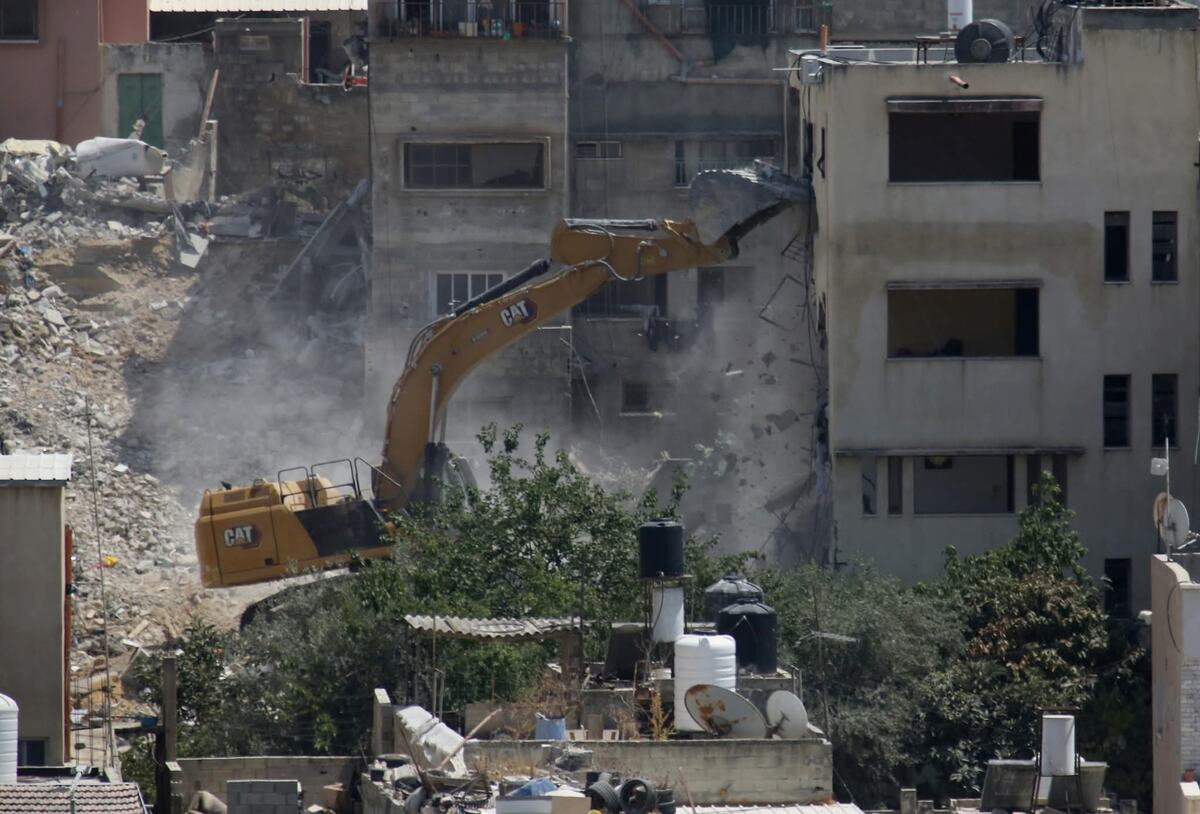
Israeli occupation forces on Sunday assaulted residents who had flocked to Tulkarm refugee camp in an attempt to remove their belongings from their homes, which are threatened with demolition as part of the latest Israeli plan to demolish 104 buildings inside the camp, allegedly for military purposes.

According to local sources, occupation soldiers deliberately obstructed residents' entry to their homes by checking their IDs, detaining a number of them, and subjecting others to field investigations and searches, amid an atmosphere of tension and provocation.
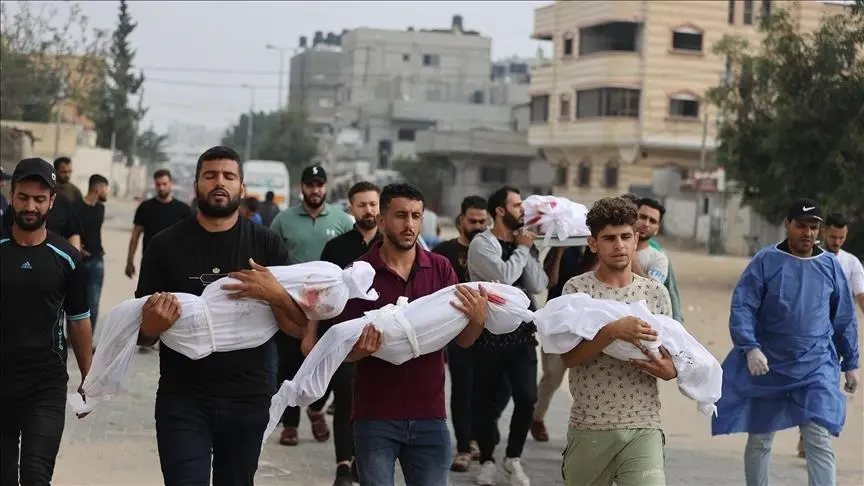
During the hours allotted, families were seen racing against time to evacuate their homes, escorted by volunteers from the Palestinian Red Crescent Society. Meanwhile, Israeli occupation forces surrounded the area, deploying heavily at the camp's entrances and among the alleys and houses they had transformed into military barracks. They pursued civilians, firing live ammunition and sound bombs to terrorize them.

The occupation army announced last night that it would allow what it described as a "second batch" of families who had been unable to evacuate their homes earlier to enter the camp to remove their belongings, this afternoon from 2:30 p.m. until 6:30 p.m.

He explained that the evacuation process will include only 54 homes included in the demolition plan, and that only three entrances and exits have been designated for residents to pass through: the entrance to the district's neighborhood, the entrance to Hanoun Square, and the entrance adjacent to Zenobia Girls' School, which leads to the UNRWA schools.

This measure comes as part of a policy of tightening restrictions on the camp's residents, who have faced forced evacuation orders since the start of the Israeli aggression on the city and its camp, which has lasted for 161 consecutive days. They are in a state of shock and grief, as a result of the continued threat of losing their homes and property. Meanwhile, the occupation forces are imposing a tight siege on the camp and its surrounding areas, which has included extensive demolitions of dozens of residential buildings over the past few days.

Meanwhile, the occupation forces continued to impose a tight siege on Nour Shams camp and its surroundings for the 148th consecutive day, with infantry units and military vehicles deployed in the alleys and entrances. The camp witnessed, over the past few days, the demolition of homes and residential buildings, creating wide streets that separated neighborhoods from each other.

Meanwhile, the city witnessed a deployment of occupation vehicles today, which roamed its main streets, specifically Nablus Street, the central market, Martyr Thabet Thabet Square, and Gamal Abdel Nasser Square, obstructing the movement of citizens and vehicles by sounding their horns in a provocative manner, driving against traffic, and crashing into a number of vehicles parked on the sidewalks, endangering the lives of citizens.

The occupation forces also stormed the suburbs of Shuwaika, Artah, and Dhnaba, deployed in their streets and neighborhoods, set up flying checkpoints, and arrested and detained young men after searching them and checking their IDs.

The occupation forces continue to transform Nablus Street into a military barracks, continuing their seizure of a number of residential buildings there, along with parts of the northern neighborhood of the city, specifically those facing Tulkarm refugee camp, and parts of the eastern neighborhood close to the camp. The occupation forces forcibly evacuated their residents, some of whom have been under occupation control for more than four months, and have deployed heavy machinery and bulldozers in their surroundings.

This street, which serves as a link between the Tulkarm and Nur Shams refugee camps, has suffered significant damage due to earth mounds placed by the occupation forces several months ago. The occupation forces are also heavily present, setting up flying and surprise checkpoints, obstructing vehicle movement and exacerbating the suffering of civilians.

The ongoing aggression has so far resulted in the deaths of 14 civilians, including a child and two women, one of whom was eight months pregnant. Dozens of people have been injured and arrested, and widespread destruction has affected infrastructure, homes, shops, and vehicles.

The escalation has led to the forced displacement of more than 5,000 families from the two camps, representing over 25,000 citizens. It has also led to the complete destruction of more than 600 homes and the partial damage of 2,573 others. Meanwhile, the entrances to the two camps remain blocked with barriers, transforming them into almost lifeless areas.

PALESTINE

Sun 06 Jul 2025 6:29 pm - Jerusalem Time

Three dead and wounded as a result of the occupation bombing of a charitable soup kitchen in the city of Deir al-Balah.

A number of civilians were killed and others injured on Sunday evening after the occupation forces bombed the city of Deir al-Balah in the central Gaza Strip.

A medical source in the Gaza Strip reported that three citizens were killed and several others were injured after the occupation targeted a charitable hospice north of Deir al-Balah.

Medical sources announced the deaths of 61 citizens in the occupation's bombing of the Gaza Strip since dawn today, including 39 in Gaza City.

-

PALESTINE

Sun 06 Jul 2025 4:57 pm - Jerusalem Time

The Israeli army and Shin Bet claim to have assassinated the commander of Hamas's naval force in northern Gaza.

The Israeli occupation army and the General Security Service (Shin Bet) claimed in a joint statement on Sunday that they assassinated what they described as the commander of Hamas's naval force in the northern Gaza Strip, in an airstrike targeting him last week.

According to the statement, an Air Force fighter jet, based on joint intelligence from the Navy, Military Intelligence, and the Shin Bet, launched an attack last Monday targeting a building in Gaza City.

The statement confirmed that the attack resulted in the martyrdom of Ramzi Ramadan Abdel Ali Saleh, whom it described as the commander of Hamas's naval force in the northern Gaza Strip.

The statement, according to the Israeli newspaper, The Jerusalem Post, indicated that Saleh served as a "key information center for the Hamas movement," and that he "promoted and planned military operations against Israeli military forces operating from the sea in recent weeks in the Gaza Strip."

He added that Saleh was killed while he was in the targeted building, accompanied by a number of "other militants."

The statement issued by the occupation army and the Shin Bet stated that the operation also resulted in the killing of two other people who were accompanying Saleh, namely:

Hisham Ayman Attiya Mansour, described as deputy head of a cell in Hamas's mortar unit.

Naseem Mohammed Suleiman Abu Subha, a member of the same unit.

PALESTINE

Sun 06 Jul 2025 4:29 pm - Jerusalem Time

Israel's Quiet War in the Occupied West Bank

The Financial Times reported on Sunday that over the past two years, Jewish settlers have set fire to a mosque in the village of Al-Ma'arjat, attacked its school, and stolen its residents' livestock.

"But the final straw came Thursday night (July 3), when dozens of settlers entered this remote Palestinian community in the occupied West Bank, after days of harassment during which they looted property, set up an outpost next to the village, and told local residents to leave."

By Friday afternoon (July 4), most of the remaining 200 residents of Al-Ma'arjat had done just that. The few remaining were slowly dismantling their wooden and metal homes, loading furniture, water tanks, and window frames onto trucks, facing the prospect of displacement, the newspaper reported.

"It's a terrible feeling to realize you're losing the place where you were born, where you had a community with shared values, where you earned your living. I can't even describe it," Suleiman Malihat, a 34-year-old villager, was quoted as saying by the newspaper. "But the problem is that it's not just this community... Today it's us. But many others will follow."

"The repeated attacks on al-Mu'arajat - an isolated cluster of low huts and livestock pens on a rocky hillside in the Jordan Valley - are part of an escalation of settler violence that has swept the West Bank since October 7, 2023, when Hamas's attack on Israel sparked the war in Gaza," the newspaper reported.

With the world focused on Israel's devastation in Gaza and its wars with Hezbollah and Iran, the occupied West Bank has experienced its own profound turmoil. Violence by zealous settlers has displaced more than two dozen rural communities. Benjamin Netanyahu's far-right government has accelerated Israel's decades-long campaign to tighten its grip on Palestinian territory, toward annexation.
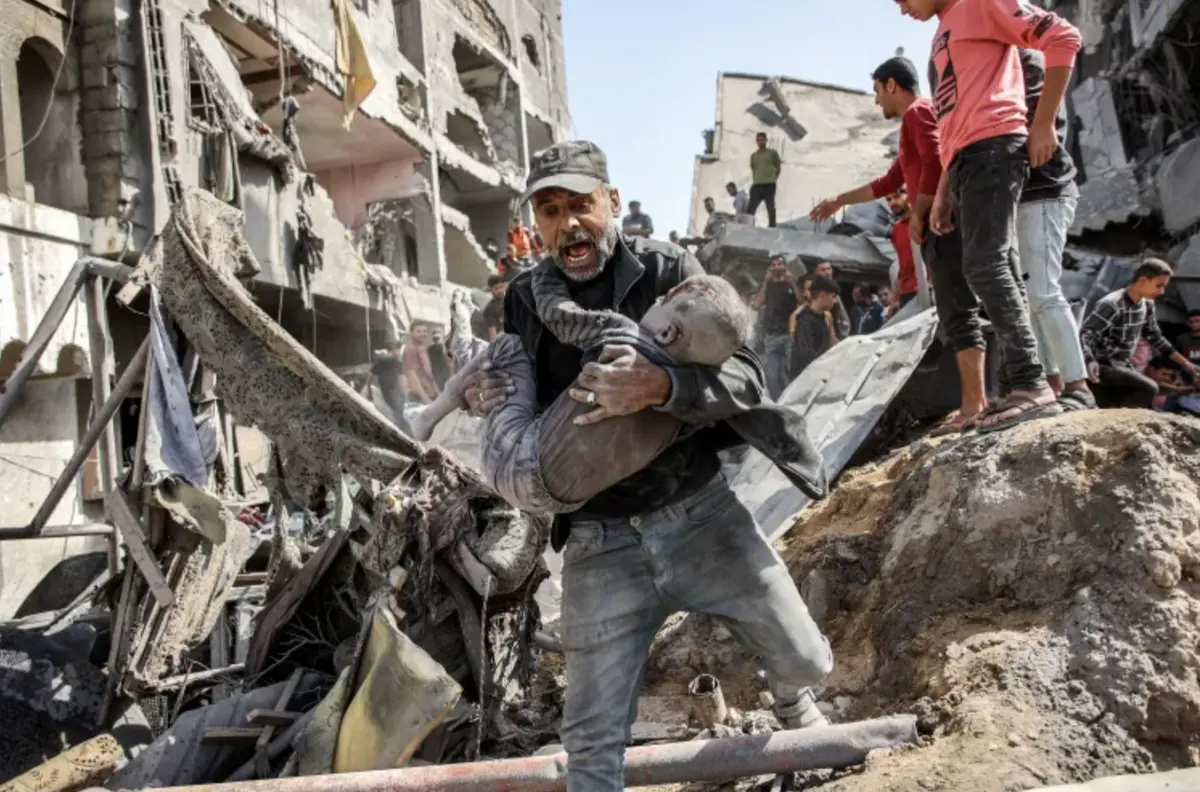
It's worth noting that last May, the Israeli occupation government approved the largest settlement expansion in 25 years. This week, members of Netanyahu's Likud party called on Israel to annex the occupied West Bank this month. Meanwhile, the occupation army has sharply intensified its operations against civilians, under the pretext of pursuing "militants" in the north of the region, displacing tens of thousands of citizens and raising the Palestinian death toll in the West Bank to its highest level in 20 years.
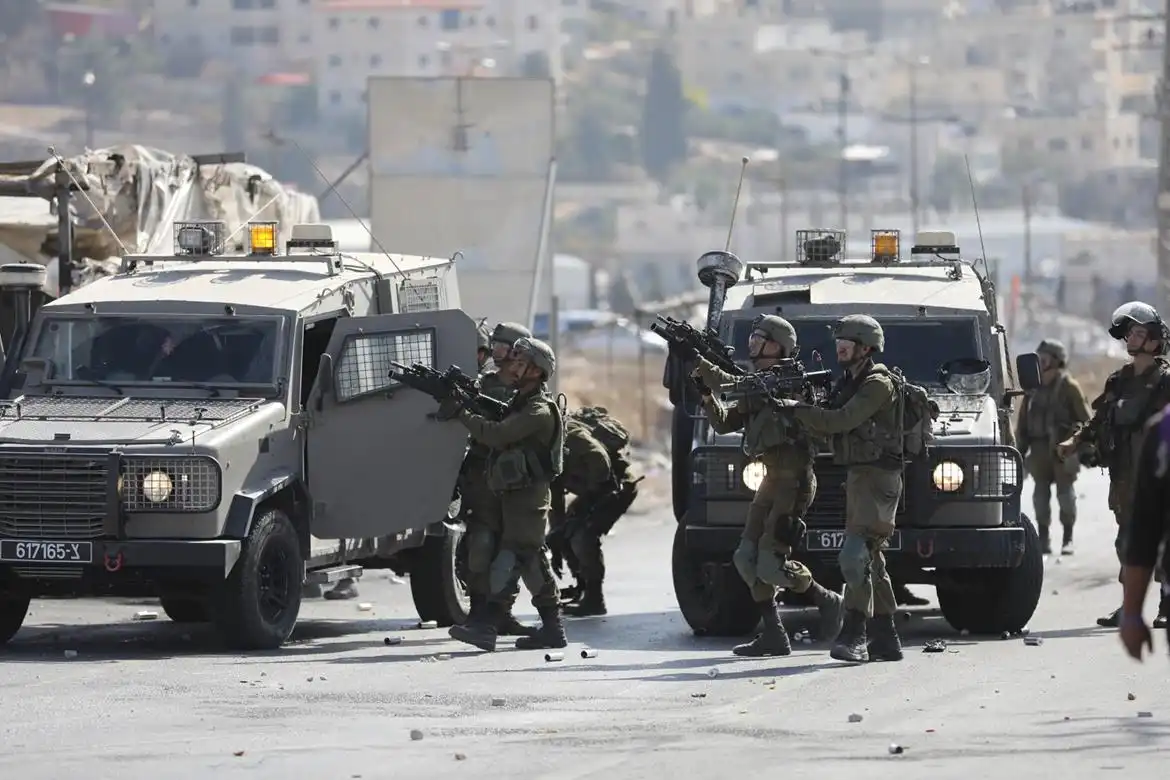
The deteriorating situation has drawn widespread condemnation, with the United Kingdom and other countries imposing sanctions on two extremist settlers in Netanyahu's government, and French President Emmanuel Macron seeking to rally international support for recognition of a Palestinian state.

But Netanyahu's government has not backed down. After Macron said in May that recognizing Palestine was a "moral duty," Israeli Defense Minister Israel Katz vowed that Israel would tighten its grip on the West Bank, which it has occupied since 1967.

He said, "They will recognize a Palestinian state on paper, and we will build the Jewish state of Israel on the ground." This piece of paper will be thrown in the trash, and the State of Israel will flourish and prosper.

Among the most notable steps taken by the Israeli occupation government was the approval of the construction of 22 new settlements—illegal under international law—signed last May. This expansion represents the largest since the 1990s, and includes settlements in locations that analysts say will further fragment the already fragmented Palestinian territories.

The newspaper quotes Ibrahim Dalalsha, director of the Horizon Center for Political Studies in Ramallah, as saying: "This expansion appears to be carefully designed to divide the West Bank, isolate Jerusalem, and essentially destroy the idea of a two-state solution." He added: "It is actual action on the ground for a specific purpose. It is strategic."

This move was accompanied by renewed calls from members of Netanyahu's coalition for Israel to formally annex the occupied West Bank – which the Palestinians seek as the heart of their future state. On Wednesday (July 25), 15 ministers from Israeli Prime Minister Netanyahu's Likud party called for this to be done before the current parliamentary session ends later this month.

Diplomats doubt Israel will annex the entire West Bank anytime soon, not least because it would complicate Netanyahu's ambitions to normalize relations with several Arab and Muslim countries.

But they say a smaller step, such as the formal annexation of some large settlements close to Israel, cannot be ruled out.

Palestinians and Arabs fear that with Trump in the White House, anything is possible.

“But for Palestinians in isolated communities like al-Mu’arrajat—many of whom have lived through multiple displacements and watched Israel’s gradual, de facto annexation of the rural West Bank eat away at their land for years—the violence is a more pressing problem. In the past 21 months, according to the United Nations Office for the Coordination of Humanitarian Affairs, settlers have carried out more than 2,500 attacks in the area, assaulting villagers, vandalizing property, and destroying their crops. In June alone, settler attacks injured 95 Palestinians—more than any other month in two decades,” the newspaper reported.

For the displaced, the attacks brought psychological trauma, forcing them to search for a new place to live. But they also upended the lives of those who didn't lose their homes, exacerbating the economic pressures on rural communities in the West Bank by cutting them off from vast swaths of land they used for grazing or growing crops. Meanwhile, livestock thefts deprived villagers of a major source of income. Even before this week's displacement, local residents were no longer able to access thousands of dunams of land between al-Mu'arjat and the neighboring village of al-'Auja due to the risk of settler attacks, according to Aref Daraghmeh, a field researcher with the Israeli human rights organization B'Tselem.

What makes the escalation of violence particularly worrying, villagers say, is the near-total impunity enjoyed by settlers.

"Before October 7, there were also attacks, but when we called the army and police, they helped us stop them," Malihat says. "After October 7, the attacks began to occur almost daily. The role of the police and army became not to protect us from the settlers, but to support and protect them as they attacked us." The Israeli military stated that it had not observed any "acts of violence or assault" during its soldiers' presence in the village of al-Mu'arjat "in recent days," and that it had taken disciplinary action against soldiers who did not comply with orders. The police emphasized that it has "zero tolerance for violence or acts of revenge."

There is little hope that the increasing international pressure on Israel—including new rounds of sanctions and threats by the European Union to review its trade arrangements with Israel—will have a greater impact.

Among the violent settlers sanctioned by the UK in the latest round of measures in May was Zohar Sabbah, who lives in a settlement outpost two kilometers from al-Mu'arrajat, whom the UK said in its decision was involved in "threatening, promoting, and supporting acts of aggression and violence against Palestinian individuals."

But local residents say the sanctions have not changed Sabah's behavior. According to B'Tselem, he was among the group of settlers who entered al-Mu'arrajat this week. Malihat says the sanctions imposed by the international community "are just to ease their consciences, so they can say they did something. But in reality, they don't stop anything."

He adds: "Part of our fear is that [the pressure on us] is not just a settler issue. It is the project of the State of Israel: They want to displace us from these areas... and the settlers are one of the tools of our displacement."

ARAB AND WORLD

Sun 06 Jul 2025 4:01 pm - Jerusalem Time

China imposes restrictions on European companies in medical device tenders.

China has announced a ban on European companies participating in government tenders for medical equipment, in response to recent EU restrictions on similar Chinese products.

The Chinese newspaper Global Times reported on Sunday that the Ministry of Finance has issued a decision barring European companies from entering Chinese government tenders for the purchase of medical equipment with budgets exceeding 45 million yuan (about $6.28 million).

According to the newspaper, the decision excludes European companies with investments and factories within China, while it only applies to those that produce goods outside of China.

The ministry added that the restrictions "have taken immediate effect," a move that reflects a mutual escalation of economic measures between the two sides.

For its part, the Chinese Ministry of Commerce confirmed in a statement that Beijing has repeatedly expressed its desire to resolve disputes with the European Union through dialogue, but the bloc has continued to "impose restrictive measures and build new protectionist barriers," according to the ministry.

This decision follows the European Commission's announcement on June 20 that it would exclude Chinese companies from participating in tenders for medical devices worth more than €5 million in EU member states, as part of what it said were measures to protect the European market from unfair practices.