





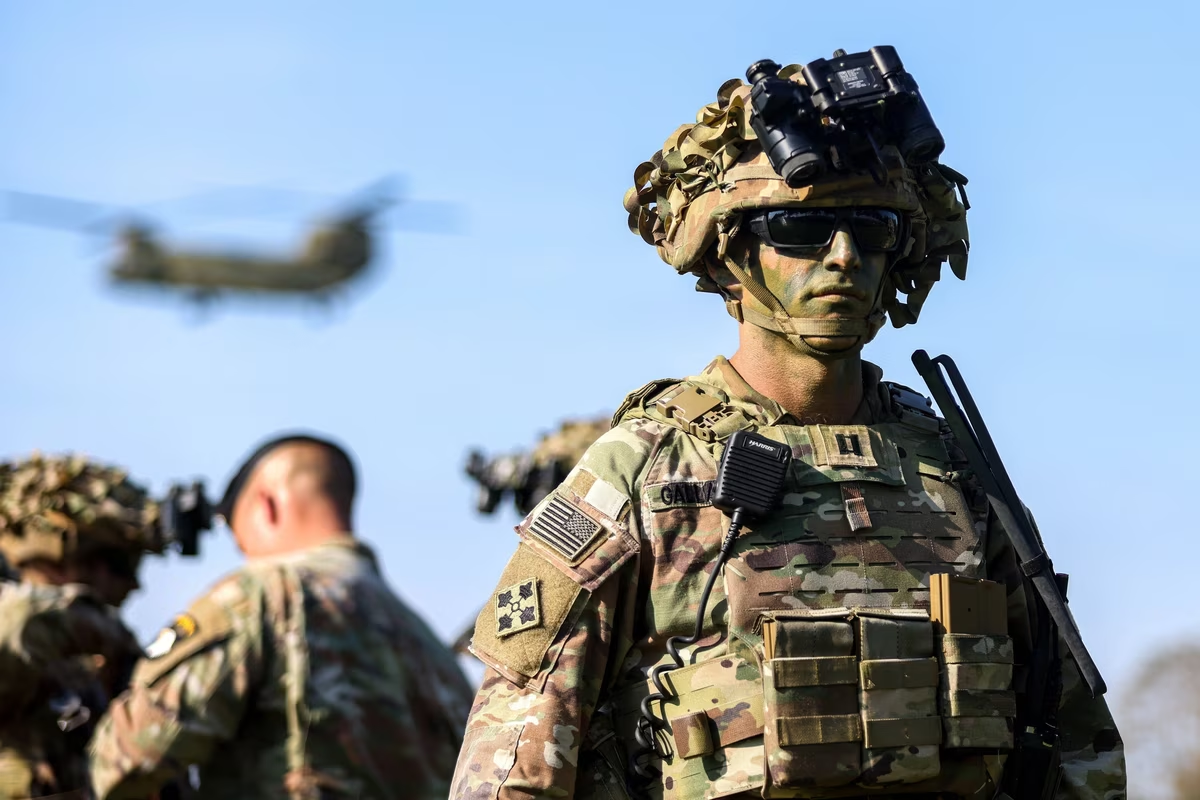
In a new indication of escalating regional tension, the United States on Wednesday began withdrawing some of its forces stationed at several military bases in the Middle East, a move coinciding with European intelligence assessments suggesting the possibility of a US attack on Iran within the next twenty-four hours. European officials told "Reuters" (Wednesday evening) that the ongoing military movements reflect field preparations for the potential slide into a direct confrontation.
These developments recall the scene before the twelve-day US-Israeli war against Iran in June 2025, when Washington then partially evacuated its forces from sensitive bases in the region in anticipation of an Iranian response. It appears that President Donald Trump's administration is adopting the same scenario today, albeit in a more complex context, given the shift in deterrence balances and the expansion of potential targeting areas.
Among the most prominent bases where the US military presence is being reduced is Al Udeid Air Base in Qatar, which is considered one of the most important pillars of the US military deployment in the Gulf. This base was subjected to a direct Iranian missile attack last June, in response to a US bombing targeting nuclear facilities inside Iran. Tehran had preceded that attack by informing Washington through indirect channels, which allowed US forces sufficient time for partial evacuation and preparation to intercept missiles.
However, current Iranian warnings suggest that any upcoming confrontation will be different in terms of rules of engagement. Iranian officials assert that the response to any new US strike will include targeting US military bases and ships deployed in the region, without prior warning this time, which raises the probability of casualties and complicates deterrence calculations.
In this context, Ali Shamkhani, assistant to Iran's Supreme Leader Ayatollah Ali Khamenei, wrote on "X" on Wednesday, criticizing the repeated American rhetoric about "preemptive strikes." He said: "The American president, who constantly repeats the futile narrative of attacking Iranian nuclear facilities, would do better to also recall the bombing of the #AlUdeid American base with Iranian missiles." Shamkhani, who survived an Israeli assassination attempt during the twelve-day war, added that "recalling that incident is sufficient to create a realistic understanding of Iran's will and ability to respond to any aggression."
In contrast, US President Donald Trump appeared to disregard these warnings, saying on Tuesday: "Iran said the same thing the last time I bombed them." On the same day, Trump held a closed meeting at the White House with his top national security and defense advisors, dedicated to discussing potential scenarios for dealing with Iran.
The "New York Times" quoted US officials as saying that intelligence assessments indicate that any US strike will likely be met with an Iranian missile response targeting Al Udeid Base, and possibly other US bases in Iraq and Syria. The newspaper confirmed that this assessment was the focus of extensive discussion within the White House on Tuesday evening.As for the "Washington Post," it quoted a US official as saying that the Trump administration "simply does not possess sufficient military assets in the region to carry out a comprehensive strike without risking retaliation," especially after withdrawing some military capabilities for use in other operations, including US movements against Venezuela. Nevertheless, the United States still maintains at least three naval destroyers equipped with guided missiles in the region's waters, in addition to the capability of B-2 strategic bombers, which previously launched from bases within US territory to carry out long-range strikes.
Recent US movements reflect a logic of "risk management" more than a readiness for an all-out war. Evacuating bases does not necessarily mean an intention to attack, but rather may be a dual deterrent message: reducing potential losses, and keeping the option of a strike open without getting involved in uncontrollable escalation. However, this approach simultaneously reveals the limits of American power in an increasingly hostile regional environment, where military dominance alone is no longer sufficient to impose equations.
In contrast, Iran appears confident in its ability to raise the cost of any US attack, based on the June 2025 experience which, albeit partially, broke the image of absolute American superiority. The threat of no prior warning this time indicates a strategic shift in Iranian doctrine, from calculated response to shocking response. Between this and that, the region stands on the brink of an escalation that no one may want, but which could erupt due to a single miscalculation.

ARAB AND WORLD
Thu 15 Jan 2026 2:07 pm - Jerusalem Time
United States redeploys forces in the Middle East amid anticipation of a potential strike against Iran
PALESTINE
Thu 15 Jan 2026 12:18 pm - Jerusalem Time
Tel Aviv adheres to the Yellow Line.. and America launches "Phase Two" to disarm Gaza and form a "technocratic administration"
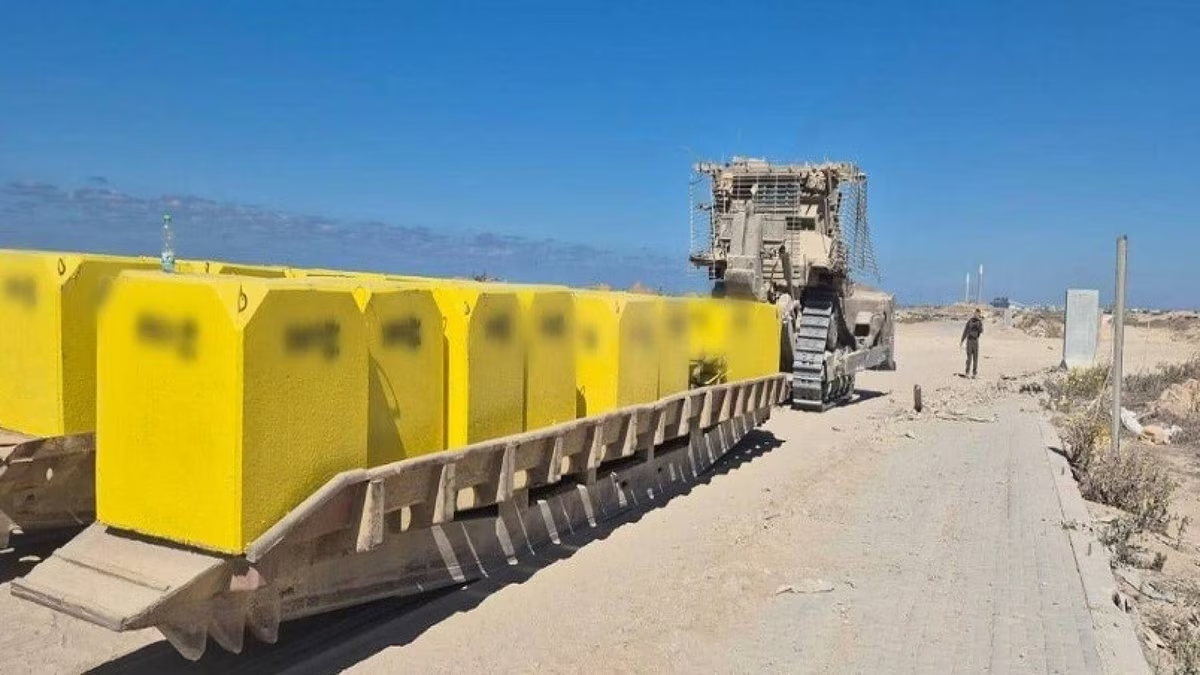
Hebrew and American reports on Thursday morning outlined the features of the next phase of the situation in the Gaza Strip, as Tel Aviv affirmed its refusal to withdraw from current positions without "disarmament," coinciding with Washington's announcement of the start of implementing the new peace plan.
Sources reported that Tel Aviv does not intend to withdraw from what is known as the "Yellow Line" east of the Gaza Strip at the current stage, linking any step back to achieving tangible and real progress in the disarmament of the Hamas movement.
This position comes with the announcement by the US envoy to the Middle East, Steve Witkoff, on Wednesday evening, of the launch of "Phase Two" of President Donald Trump's 20-point plan.
The plan aims to: establish a transitional Palestinian administration with a technocratic character. Immediately begin the disarmament process. Commence the full reconstruction of the Strip.
In this context, a Hebrew newspaper revealed that the US envoy did not address the issue of opening the Rafah crossing, amid the absence of any new instructions for the occupation.
The newspaper attributed this to Netanyahu's insistence on not opening the crossing before "recovering a last body" still held by Hamas, according to the newspaper's description.
Reports stated that the Israeli occupation army is preparing to launch new operations in full coordination with the United States, if Hamas refuses to disarm.
Hebrew estimates indicate that the movement: held at least 10,000 fighters. Succeeded in recruiting thousands more recently. Possesses strategic weapons.
The Hebrew newspaper highlighted the financial strength of the movement, as security agency estimates claim that Hamas possesses huge cash funds stored in tunnels (especially in Gaza City and Al-Shati refugee camp), estimated at no less than 400 million shekels, and could reach one billion shekels.
The movement used these funds as part of an "economic emergency plan" to pay the salaries of tens of thousands of its members throughout the war.
Hebrew estimates indicated that the entry of about 4,200 aid trucks weekly enabled Hamas to collect daily tax revenues in the millions, which contributed to: increasing the salaries of its members to about 1,500 shekels per month.
Regarding the day after, a Hebrew newspaper confirmed that Hamas demands the retention of its government teams (since 2007), which is rejected by the international community.
Alternatively, a "technocratic committee," including names "familiar and acceptable" to Tel Aviv and having good relations with the Palestinian Authority, will manage public services in coordination with "Ramallah" and the United Nations.
The Hebrew newspaper concluded that the testing of these arrangements will begin from an "experimental neighborhood" in Rafah, with an emphasis that there will be no immediate withdrawal from the "Yellow Line."
Tel Aviv does not intend to withdraw from what is known as the "Yellow Line" east of the Gaza Strip at the current stage, linking any step back to achieving tangible and real progress in the disarmament of the Hamas movement.
PALESTINE
Thu 15 Jan 2026 12:04 pm - Jerusalem Time
Ali Shaath Reveals Features of Gaza Reconstruction: 7 Years for Recovery
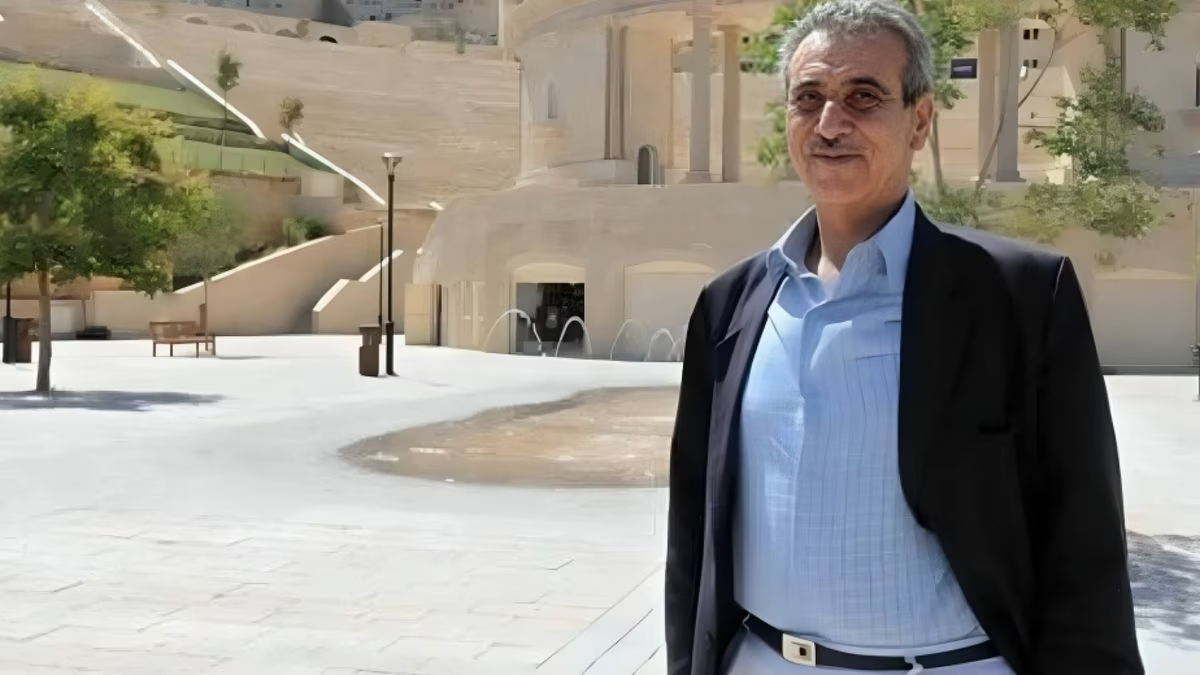
Dr. Ali Shaath, head of the Technocrat Committee for the administration of the Gaza Strip, affirmed that the committee's essential mission is to provide decent living conditions that preserve the dignity of the Palestinian citizen. Shaath, based on his professional experience, estimated that the Strip needs seven years of hard work to return to a better state than it was before.
Shaath explained that the reconstruction plan, prepared in cooperation with the World Bank and relevant ministries, is based on three main stages: emergency relief, which extends for six months; recovery, which takes two and a half years and includes the restoration of infrastructure and basic facilities; and then reconstruction and development.
Regarding the rubble, Shaath estimated that its removal would not take more than three years. Part of it will be recycled to create additional areas in the sea, and the rest will be used in construction materials to protect the environment.
The committee prioritizes water, electricity, and education files:
Water and Sanitation: Desalination plants will be maintained and new ones established, with an emphasis on adhering to the internationally stipulated "Mekorot" water lines. Treatment plants, about 25-30% of which were destroyed, will also be repaired.
Electricity: The sector currently operates with only about 60-70 megawatts out of the 150 megawatts it needs. Work is underway to restart the damaged power plant and improve the efficiency of the line coming from Egypt.
Education: Shaath stressed the need to compensate students for the loss of two and a half years of education, with the possibility of recruiting teachers from the West Bank.
Dr. Shaath affirmed that the Technocrat Committee works in full integration with the Palestinian Authority and Arab countries, relying on the Palestinian Basic Law as the sole reference. He clarified that the committee does not possess political or military powers, as these files fall within the jurisdiction of the "Peace Council" and the "International Stabilization Force." The committee's scope of work (currently covering 50% of the Strip) will gradually expand as the occupation army withdraws eastward under the Gaza agreement.
The commission's operations will be funded through a dedicated fund at the World Bank, relying on Arab and international donations. Egypt, Qatar, and Turkey announced in a joint statement on Wednesday evening the completion of the committee's formation, headed by Ali Shaath, considering it a pivotal step to improve humanitarian conditions. This move comes amidst a tragic reality left by the war of annihilation, where more than 242,000 Palestinians have been recorded as martyrs or injured, and widespread destruction has affected most cities in the Strip.
The committee's essential mission is to provide decent living conditions that preserve the dignity of the Palestinian citizen.
OPINIONS
Thu 15 Jan 2026 10:25 am - Jerusalem Time
The Decisive Moment: Between Administrative Responsibility and the Danger of a Vacuum
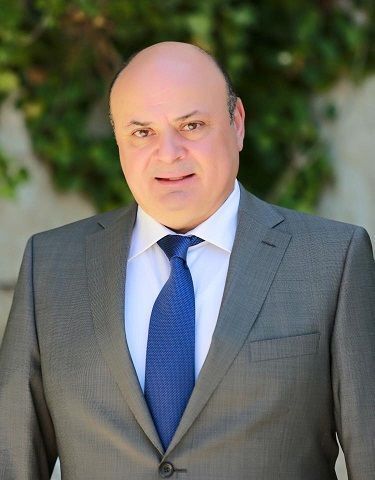
Azzam Abdulkarim Rashdi Shawwa
Opinion Writer
Gaza today is no longer merely a news headline or a battlefield of military confrontation. It has become a harsh mirror exposing the magnitude of political paralysis, the absence of unified decision-making, and the confusion surrounding crisis management at the most dangerous moment in the modern history of our people. The devastation, starvation, and collapse of essential services endured by its population have exceeded all limits of tolerance and can no longer be addressed with a mindset of waiting or political ambiguity.
Within this exceptional reality, the formation of the Administrative Committee for Gaza emerged as an emergency response imposed by the conditions of war and aggression, and by the near-total breakdown of the ability of official institutions to operate on the ground. Ignoring this reality, or bypassing it through rhetorical political discourse, serves neither Gaza nor its people. Instead, it opens the door to a dangerous administrative vacuum one for which ordinary citizens alone bear the cost.
The most serious threat facing Gaza today is not only the machinery of war, but the vacuum itself: a vacuum of decision-making, a vacuum of administration, and a vacuum of political courage. In times of catastrophe, a vacuum is not a neutral position; it is a national danger that threatens social cohesion, deepens collapse, and turns people’s suffering into an arena for political rivalry and internal conflict.
From this standpoint, any organized framework that seeks to manage the minimum requirements of daily life during this critical phase deserves responsible support—not pre-emptive suspicion or political demonization. In moments of emergency, politics is not measured by the purity of slogans, but by its capacity to protect people and prevent comprehensive collapse.
Accordingly, I hereby affirm my clear and explicit personal support along with that of the Shawwa family, and many Palestinian families and clans for the Administrative Committee for Gaza and its members, as a temporary national framework imposed by necessity. Its purpose is to protect society, provide essential services, and preserve civil peace. It is neither a permanent political project nor a substitute for national legitimacy.
This support does not constitute an open-ended mandate, nor does it grant cover for any deviation from the committee’s service-oriented mission. Rather, it is conditional upon full transparency, strict adherence to a non-factional character, accountability to the public, and a clear declaration that the committee’s mandate is limited to the emergency phase and ends immediately once conditions allow for the full resumption of national institutions.
Conversely, abstract opposition that is not accompanied by practical and implementable alternatives cannot be considered a responsible national position. Leaving Gaza without effective administration under any political pretext amounts to indirect participation in deepening the suffering of the population and prolonging chaos.
The primary responsibility also lies with all Palestinian factions, whose duty first and foremost is to manage the crisis. What is required today is a courageous and unified political decision that provides temporary national cover for administering people’s affairs, establishes a serious path toward ending division, restores institutional unity, and places Gaza at the center of Palestinian national priorities.
Gaza does not need additional statements; it needs responsible administration and clear decisions. It does not need competition over authority, but rather a genuine national partnership worthy of the scale of sacrifice. Every delay in this regard imposes an additional burden on a people exhausted by war and subjected to costs beyond endurance.
In conclusion, we state this with absolute clarity; those who choose hesitation or obstruction at this decisive moment bear national and moral responsibility before their people and before history. Managing Gaza today is not a political option open to debate; it is an urgent national duty. A vacuum is not a position it is a crime against the people. Gaza, which has endured and resisted under aggression, deserves decisions commensurate with its sacrifices no less.
At this critical juncture, it is also our duty to extend sincere appreciation to all Arab, Islamic, and international states that have contributed to reaching this decisive moment in Palestinian history.
PALESTINE
Thu 15 Jan 2026 10:21 am - Jerusalem Time
Who is affected by the electricity and water cut-off to UNRWA institutions in Jerusalem?
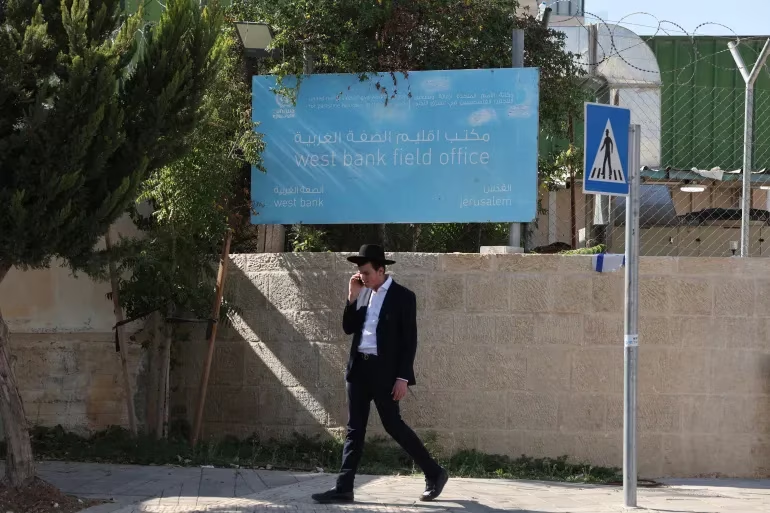
The cut-off of electricity and water to the buildings of the United Nations Relief and Works Agency for Palestine Refugees (UNRWA) in Jerusalem not only threatens the administrative workflow but also affects the rights of thousands of refugees whose daily lives depend on the agency's services. As part of practical steps to implement Knesset (Israeli Parliament) laws that banned the agency's work in "Israel," the latest of which was the final approval last Monday of a bill to cut off electricity and water to its offices, UNRWA was effectively notified of the cut-off of both services to its buildings in East Jerusalem.
This measure contradicts Israel's obligations as an occupying power under international humanitarian law, which guarantees the protection of humanitarian institutions and prevents obstruction of their work or the use of essential services as a tool of collective pressure. The notice delivered by the Israeli water and sewage company "Gihon" to the international agency stated that water service would be cut off within 15 days because the registered consumer name for the properties is UNRWA, while the Jerusalem District Electricity Company (Palestinian) notified the agency that it would refrain from providing electricity service to 10 of its facilities in Jerusalem, and that its name would be removed as a beneficiary or subscriber to this service.
On Monday, occupation forces stormed UNRWA's health clinic in the Old City, known among Jerusalemites as "Al-Zawiya," and demanded the removal of UN signs. "This raid was followed by a temporary closure order against the health center for 30 days, and it may never reopen," according to Roland Frederick, UNRWA's Director of West Bank Affairs, in a tweet on the "X" platform.
Abeer Ismail, the agency's media office director, told sources that the measure of cutting off electricity and water services includes all UNRWA facilities and buildings in East Jerusalem, including the administrative headquarters in Shuafat refugee camp, in addition to 3 schools, the health clinic, and the waste compactor.
According to the spokesperson, outside the camp, it also includes the health clinic in the Old City of Jerusalem, and two schools belonging to the agency in Silwan and Sur Baher, in addition to the presidency headquarters in Sheikh Jarrah and the Qalandia Training Center.
In addition to all staff in these facilities being affected, especially health staff, as the agency is currently working to transfer them and their patients to the nearest health point belonging to it in Jerusalem governorate, 16,419 refugees registered with UNRWA in Shuafat camp, out of 80,000 living there, will be affected by the new measure, according to the media office director, as well as 120 to 150 patients who visit UNRWA clinics daily in both the Old City and Shuafat camp.
"We are also talking about 4,741 children registered in UNRWA records in Shuafat camp, about 1,000 of whom received their vaccinations at the camp clinic, and 600 received their education in its three schools. All of these were deprived of learning inside the camp this academic year after the schools were closed, and 800 elderly people will also be deprived of treatment at the camp clinic," added the agency's media office director.
The international agency serves 192,000 refugees in Jerusalem governorate, and Abeer Ismail confirms that none of its facilities can operate without electricity and water services, adding that staff are subjected to harassment, and many of them have been detained and interrogated during raids by Israeli security forces on the headquarters.
She concluded by saying, "We are trying to deliver services to refugees as much as possible, but it is very difficult."
Roland Frederick, UNRWA's Director of West Bank Affairs, described the raid as "disgraceful" in a post on the X platform, referring to a center that has received support from member states for decades and has been visited by many of them, adding that all of this portends a rapid shrinking of the UN's presence in occupied East Jerusalem.
He stressed that these disgraceful tactics are part of an ongoing campaign by the Israeli authorities to prevent UNRWA from fulfilling its mandate granted by the UN General Assembly in occupied East Jerusalem, which is not under Israeli sovereignty, noting that the application of Israeli law to it is illegal.
He mentioned that the International Court of Justice ruled in October 2025 that Israel is obligated to facilitate UNRWA's relief operations, yet the current measures are precisely the opposite, and if these amendments are implemented, they indicate the approaching end of UNRWA's operational presence in East Jerusalem, which has spanned decades.
These developments come yesterday following amendments introduced in December 2025 to anti-UNRWA Knesset laws.
The Knesset General Assembly voted in the second and third readings on October 28, 2024, on the first law, which stipulates preventing UNRWA from carrying out any activities within "areas under Israeli sovereignty," withdrawing privileges and facilities from it, and preventing any official Israeli contact with it.
The law obliges the international agency not to operate any representation, and not to provide any services or any activities directly or indirectly from within "Israel's sovereign areas."
The second law stipulates that privileges obtained by the agency under exchanged letters between it and Israel in 1967, which address the facilities approved by the Israeli government regarding UNRWA's functions, do not apply, and also stipulates that no Israeli authority shall make any contact with UNRWA or any party on its behalf.
This measure contradicts Israel's obligations as an occupying power under international humanitarian law, which guarantees the protection of humanitarian institutions.
ARAB AND WORLD
Thu 15 Jan 2026 9:47 am - Jerusalem Time
Trump in the Corner: From Encouraging Protests to the Prospect of an Imminent American Strike Against Iran

News Analysis
US President Donald Trump put himself in a tight political and strategic corner when he sent a direct public message to Iranians, calling on them to continue protesting, asserting that "help is on the way." Experts believe that this statement, which went beyond the bounds of traditional diplomatic rhetoric, was not merely an expression of moral support, but carried with it a political commitment that would be difficult to retract. Since the White House linked its public stance to internal movements within Iran, the credibility of the American administration has been on the line, both domestically in the US and in the Iranian street and the international community.
This discourse came at a highly sensitive time, coinciding with the expansion of protests within Iran and the tightening of security measures against demonstrators, amidst reports of a large number of casualties and detainees. With each passing day without a practical translation of the phrase "help is coming," pressure on the Trump administration to take concrete action increases. Here the dilemma becomes clear: retreat is interpreted as weakness, while escalation, especially military, opens the door to a widespread regional confrontation whose rhythm cannot be easily controlled.
In this context, the role of the neoconservative current within Washington, supported by the influence of the Israeli lobby, clearly stands out in pushing for a broad military option against Iran that is not limited to deterrence or limited strikes, but aims to create a strategic shock leading to regime change. This current believes that the current moment represents a rare opportunity, where internal protests intersect with economic pressures and political isolation, and argues that any partial strike will give Tehran room to reorder its cards. From this perspective, they push for a harsh strike that targets the joints of military and security power, an argument that resonates strongly within Israeli circles who believe that the real danger lies not only in the Iranian nuclear program, but in the continuation of the regime itself.
In contrast, political and security assessments in Washington indicate that the option of an airstrike is being considered more seriously than ever before, especially after Trump canceled communication channels with Iranian officials and linked any diplomatic opening to an end to the repression of protesters. This shift reflects a transition from a policy of gradual pressure to a policy of brinkmanship, where deliberate ambiguity is used as a deterrent, but at the same time increases the likelihood of miscalculation and a rapid slide towards confrontation.
On the Iranian side, Trump's statements were met with direct accusations against Washington of interfering in internal affairs, and warnings that any attack would be met with a broad response, either directly or through Tehran's allies in the region. Iran has raised its military readiness, in a message aimed at deterring the United States and showing that the cost of a strike will not be limited or one-sided. This mutual interaction reinforces the climate of escalation, and makes any incident or miscalculation a potential spark for the outbreak of conflict.
Notably, American discourse has begun to link confrontation with Iran (allegedly) to a moral and humanitarian dimension, not limited to traditional issues such as nuclear activity or regional influence. This linkage gives Washington a broader political justification, but at the same time raises the bar of commitments. When confrontation is presented as a defense of a people subjected to oppression, it becomes difficult to be content with sanctions or statements, and military force becomes a potential tool to maintain the credibility of the discourse.
Ultimately, the Trump administration appears to be caught between the pressure of a current pushing for a strong strike that could change the balance of power in Iran, and the concerns of a security establishment that realizes that regime change is not a quick military task, but a path fraught with risks. Between these two options, impressions are reinforced that an American strike, if not inevitable, is at least imminent, as a result of the accumulation of political rhetoric more than it is the product of an isolated military decision.
The danger of Trump's position lies not only in the probabilities of war, but in the way his political decision has been constrained by public discourse directed at the people of an adversary state. This type of discourse transforms military action from a strategic option into a tool to save credibility, which explains the acceleration of talk about an imminent strike. In such cases, language itself becomes a driving factor for war, not merely a reflection of it.
The push by neoconservatives and the Israeli lobby to overthrow the Iranian regime brings to mind past experiences that showed the gap between overthrowing a state and managing its aftermath. A strong strike may disrupt the regime, but it does not guarantee a stable alternative, and may open the door to wider regional chaos. This contradiction between political ambition and on-the-ground reality will remain the decisive factor in Washington's final decision.
OPINIONS
Thu 15 Jan 2026 9:46 am - Jerusalem Time
The road to the second stage is more important than reaching it!
Ibrahim Melhem
Opinion Writer
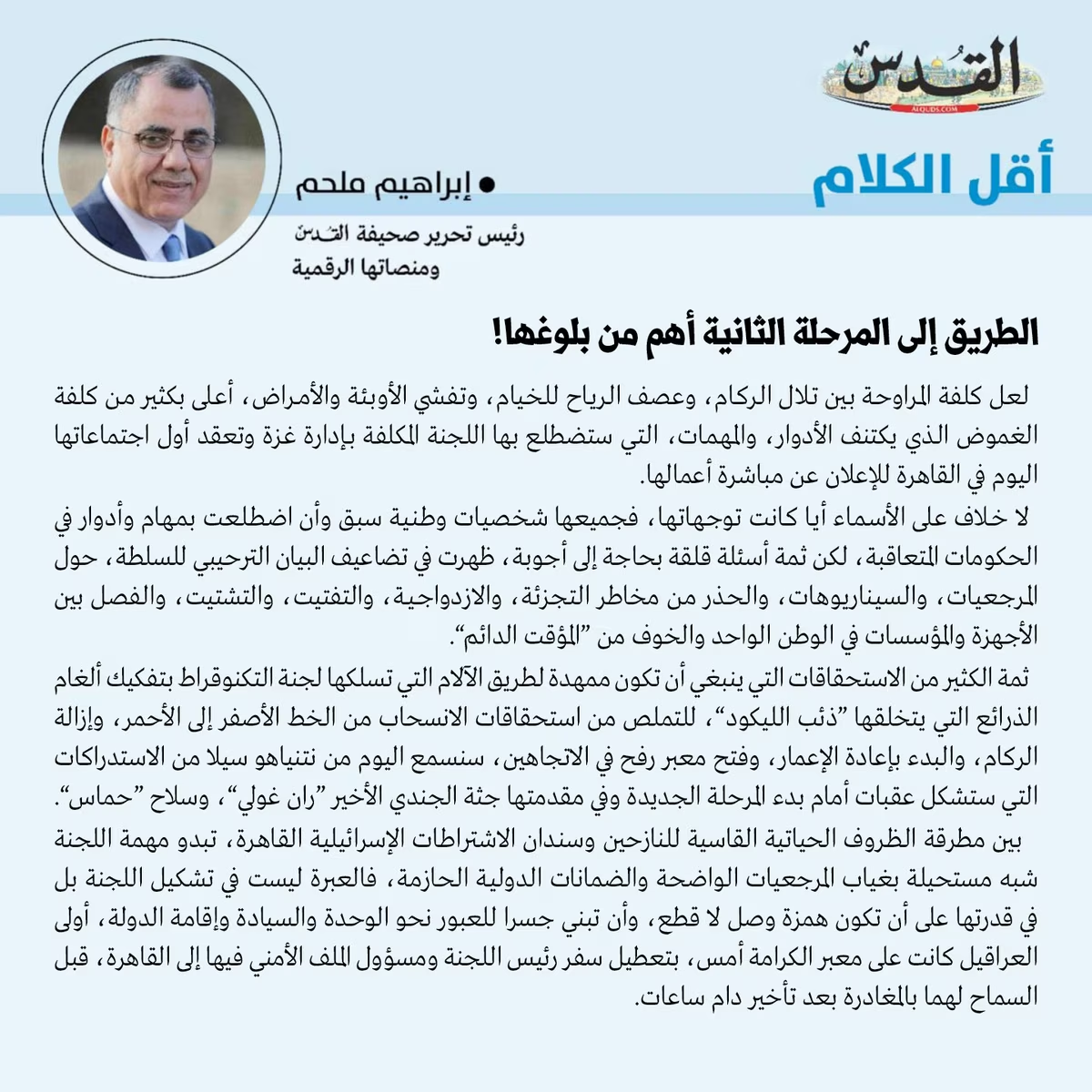
Perhaps the cost of lingering among the hills of rubble, the wind lashing at tents, and the spread of epidemics and diseases, is much higher than the cost of the ambiguity surrounding the roles and tasks that will be undertaken by the committee tasked with managing Gaza, which is holding its first meetings today in Cairo to announce the commencement of its work.
There is no disagreement on the names, whatever their orientations, as all of them are national figures who have previously undertaken tasks and roles in successive governments. However, there are anxious questions that need answers, which appeared in the welcoming statement of the Authority, regarding references, scenarios, and caution against the dangers of fragmentation, duality, disintegration, dispersion, and separation between agencies and institutions in one homeland, and the fear of “permanent temporary.”
There are many entitlements that should pave the way for the path of suffering that the technocrat committee is taking by dismantling the mines of pretexts created by the “Likud wolf” to evade the entitlements of withdrawal from the yellow line to the red, removing rubble, starting reconstruction, and opening the Rafah crossing in both directions. Today, we will hear from Netanyahu a flood of caveats that will pose obstacles to the start of the new phase, foremost among them the body of the last soldier, “Ran Gooli,” and the weapon of “Hamas.”
Between the hammer of the harsh living conditions of the displaced and the anvil of oppressive Israeli conditions, the committee's task seems almost impossible in the absence of clear references and firm international guarantees. The lesson is not in forming the committee but in its ability to be a link, not a break, and to build a bridge for crossing towards unity, sovereignty, and the establishment of a state. The first obstacles were at the Karama crossing yesterday, by obstructing the travel of the head of the committee and the official in charge of its security file to Cairo, before they were allowed to leave after a delay of several hours.
PALESTINE
Thu 15 Jan 2026 4:19 am - Jerusalem Time
Palestinian official: Qalandia Airport plan in Jerusalem aims to control 12% of West Bank lands
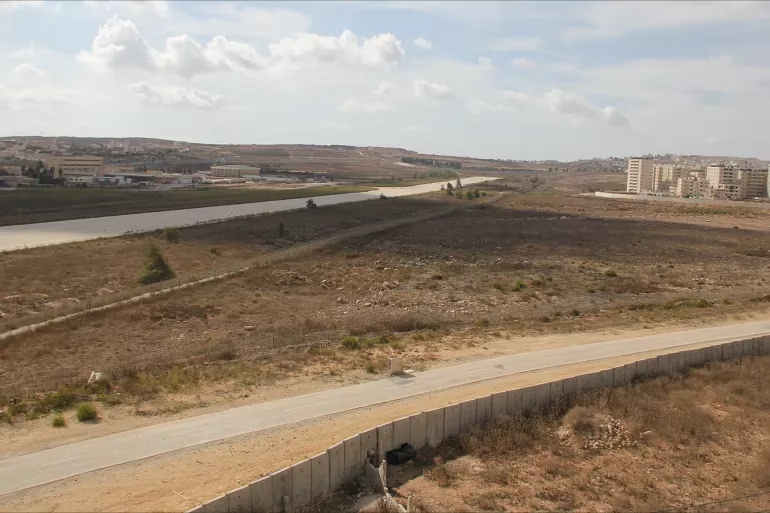
Salah Khawaja, an official in the Wall and Settlement Resistance Commission, warned of strategic dangers from a massive Israeli settlement project being established on the lands of the historic Qalandia Airport north of occupied Jerusalem.
Khawaja stated in remarks that the plan aims to change the features of the area and impose new realities on the ground as part of what is called the "Greater Jerusalem" project.
He explained that Qalandia Airport, which was a symbol of Palestinian sovereignty before the 1967 occupation, gradually transformed from a civilian airport into an Israeli military base, before becoming today a target for a settlement plan that includes the construction of about 9,000 housing units.
He clarified that the project aims to isolate Jerusalem from its Palestinian surroundings and displace dozens of Bedouin communities from the area.
The official in the Wall and Settlement Resistance Commission pointed out that this step will cut off geographical communication between the northern and southern West Bank, turning Palestinian villages into "closed cantons."
He added that the Israeli plan enjoys political consensus within both the occupation government and the opposition, and comes within the strategy of expanding settlements and linking them to the "Ma'ale Adumim" settlement, thereby strengthening Israeli control over approximately 12% of the West Bank lands.
Khawaja warned that the implementation of the project would lead to the "erasure of Qalandia's historical features," which included the fourth largest land area in the vicinity of Jerusalem and Ramallah, stressing that demolition operations in the area are accelerating rapidly, as part of a systematic displacement plan.
Yesterday, Monday, the Israeli District Planning and Building Committee in Jerusalem postponed to a later session the approval of a settlement project targeting the lands of the former Jerusalem International Airport, which provides for the construction of approximately 9,000 settlement units north of Jerusalem on an area estimated at about 1243 dunams (a dunam equals one thousand square meters), constituting a huge colonial barrier that cuts off geographical communication between Jerusalem and Ramallah, and deals a devastating blow to the possibility of an independent Palestinian state with geographical contiguity.
The Israeli plan enjoys political consensus within both the occupation government and the opposition, and comes within the strategy of expanding settlements.
ISRAELI AFFAIRS
Wed 14 Jan 2026 11:03 pm - Jerusalem Time
Hebrew media: Tel Aviv government races against time and opens shelters in anticipation of an Iranian strike
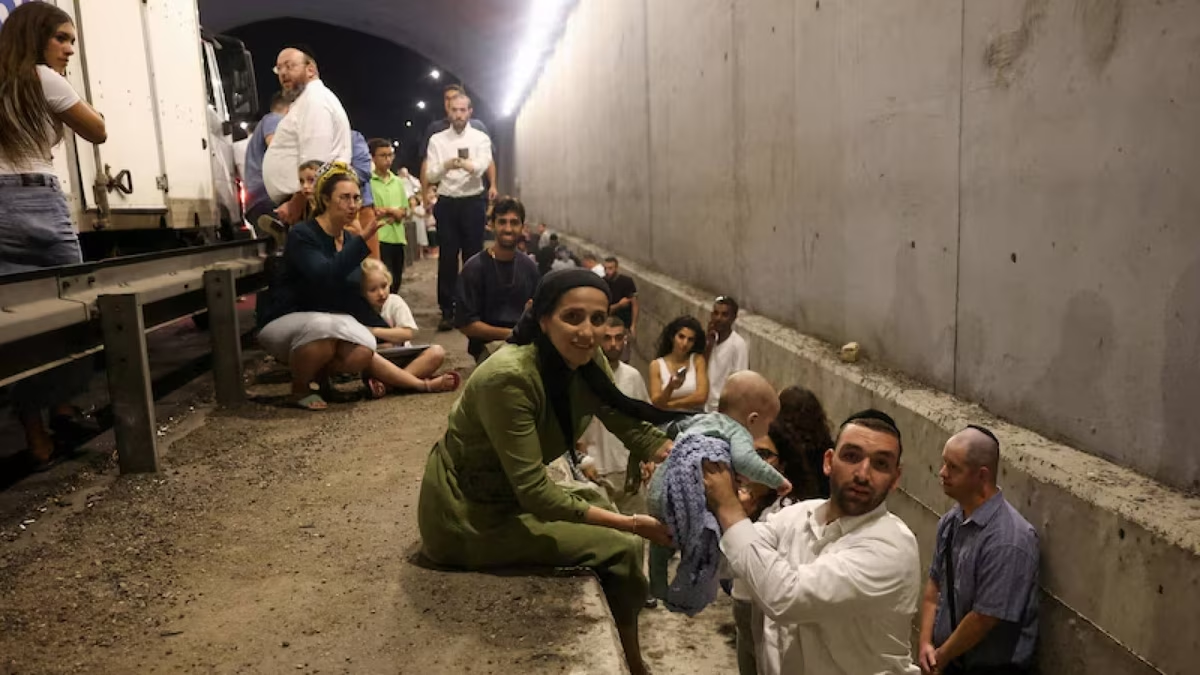
This readiness comes as a result of assessments that any American attack will be met with an Iranian attempt to bomb the "beating heart" of the occupation to achieve a balance of deterrence. According to sources, the municipalities of Ofakim in the south and Ra'anana north of Tel Aviv have decided to open public shelters.
Sources: The municipality of Kiryat Gat in the south opens its public shelters as the "zero hour" approaches for the anticipated American attack on Iran. The strategic areas in the occupied entity have witnessed unprecedented mobilization.
According to sources, municipalities in major cities, led by Tel Aviv, Beersheba, and Dimona, have begun opening and equipping public shelters, a clear indication of serious fears of a direct Iranian missile response that could target economic centers, military bases, and sensitive installations.
In Tel Aviv, the economic center of the occupation, the municipality announced the opening of shelters in all neighborhoods, along with the distribution of strict instructions to residents regarding the "response time" to air raid sirens.
This readiness comes as a result of assessments that any American attack will be met with an Iranian attempt to bomb the "beating heart" of the occupation to achieve a balance of deterrence.
As for Beersheba, which is considered the gateway to the south and includes vital command centers and air bases such as "Hatzerim," the readiness of fortified shelters has been raised to the highest level.
Sources indicate that the army expects the south to be targeted with intense missile barrages, either from inside Iran or via long-range missiles, which has made Beersheba a pivotal area in the internal defense plan.
Preparations in Dimona are of utmost importance and sensitivity, given the presence of the nuclear reactor there. Shelters have been opened for residents simultaneously with the reinforcement of air defense systems (such as Patriot and Arrow) around the city.
Security agencies fear that Tehran may launch a "symbolic or retaliatory strike" towards Dimona in response to any American targeting of its nuclear facilities.
Tel Aviv: Opening public shelters and securing metro stations as refuge areas.
Beersheba: Mobilization in surrounding air bases and equipping shelters in residential areas.
Dimona: Tightening air defense surveillance and opening shelters for residents to confront any qualitative missile threat.
The transition of Tel Aviv, Beersheba, and Dimona to a "shelter opening" status means that the occupation is not just awaiting an American attack, but is preparing for a heavy price it may pay deep within its cities. With continued coordination with "CENTCOM," these settlements remain in a state of bated breath, awaiting what the coming hours may bring, which could turn these shelters into havens for millions of residents fearing fire coming from the East.
According to sources, the settlements of Ofakim in the south and Ra'anana north of Tel Aviv have decided to open public shelters, and the settlement of Kiryat Gat in the south is opening its public shelters.
Sources reported that the opening of shelters in some settlements was by decision of the heads of the settlements and not by the Home Front Command, and the majority of municipalities that opened shelters are in the southern and central regions.
This readiness comes as a result of assessments that any American attack will be met with an Iranian attempt to bomb the "beating heart" of the occupation to achieve a balance of deterrence.
OPINIONS
Wed 14 Jan 2026 10:57 pm - Jerusalem Time
Palestinians and Greenland: From Humor to Political Discourse

Sometimes, comedy carries more than just fleeting laughter. A short scene in the 1987 series The Golden Girls, where the idea of “relocating Palestinians to Greenland” is proposed, seems at first glance to be merely a sarcastic joke. But upon reconsideration, this joke reveals a broader political logic: viewing land as a commodity, people as elements that can be redistributed, and ideas that are presented today as impossible can tomorrow become negotiable in political discourse. This article explores how a comedic joke transforms into a mirror of grand politics, and how a comedic idea can expose the most dangerous ethical slips in dealing with the issues and rights of peoples.
The reference to relocating Palestinians to Greenland, as it appeared in an American comedy show, The Golden Girls, was not just a fleeting joke or a sarcastic fantasy detached from political reality. The scene that included the phrase “Giving the Palestinians Greenland?” appeared in the final episode of the second season titled “Empty Nests,” where a new character made a sarcastic proposal on air in a radio show to solve the “Middle East crisis” by relocating Palestinians to the island of Greenland. The purpose of the scene was political satire, but today it acquires a broader meaning in the context of re-reading political discourse.
To be honest, I saw this scene years ago, and it was surprising to me. It came back to my memory since Donald Trump's announcements about his intention to buy Greenland, and I couldn't help but see a connection between the two ideas, between the joke and political reality, between sarcasm and the underlying seriousness in official discourse. Comedy, in moments of great transformation, does not function as an antithesis to politics, but as its first experimental space. Ideas are expressed there before they are formulated, and reactions are tested before positions are codified. Therefore, treating this proposal as laughter without consequences misses understanding what is deeper and more dangerous.
In the same context, Donald Trump's request to buy Greenland acquires its significance beyond being a shocking statement or a diplomatic misjudgment. What was revealed at that moment was not just geographical ignorance, but a political vision that sees land as a commodity, sovereignty as a matter of negotiation, and deals with the existence of peoples as a secondary element that can be bypassed. The question was not raised about the will of the people of Greenland, nor about their history or their right to self-determination, but about the island's feasibility and strategic value. This logic, when applied to Palestine, does not seem strange or unlikely, but rather entirely consistent with itself.
It is true that many analyses have rightly sought to deny the existence of any real conspiracy or practical plan aimed at specifically deporting Palestinians to Greenland, and to emphasize the impossibility of this scenario politically, legally, and logistically. However, denying the conspiracy does not mean denying the idea, nor does it deny that the patterns of thinking that produce such “fantasies” actually exist within some decision-making circles. Recent history teaches us that ideas once described as insane or unbelievable were not always dismissed, but were recycled in different forms when circumstances changed.
To look at the matter from a deeper perspective, it can be said that this proposal is not far from the logic of colonial projects and forced population distribution. The idea of settling Jews in Palestine, which formed the historical basis of the Palestinian-Israeli conflict and created a long and intractable path to solutions, produced a political world accustomed to thinking of land as a solution, and people as elements capable of redistribution. Today, it seems that this logic, after exhausting itself, has returned in a reversed and distorted form, where there is a hint of a “solution” based on resettling Palestinians in distant and harsh places like Greenland. However, what is more dangerous than this sarcastic or absurd proposal is what it implicitly reveals: that reaching a “final solution” to the conflict, in the minds of some who imagine it, is still governed by the same logic that originally created it, i.e., the search for an alternative place for a people instead of recognizing their rights where they are. If the settlement of Jews in Palestine was historically presented as a solution to the Jewish question in Europe, then the thinking today about deporting Palestinians, or even hinting at finding another homeland for them, reflects a deep ethical and political deadlock, where the same madness is reproduced instead of being dismantled. This is a kind of madness and revealing, because it reproduces the same mentality that sees human rights as merely a secondary variable in the face of geographical and political planning, but at the same time it highlights the dangers of cold thinking detached from ethics and popular sovereignty.
Here, Greenland is no longer an actual proposed place, but transforms into an intense symbol of a broader logic that believes the world can be rearranged if its problems become intractable, and that peoples outside the center of power are transferable or displaceable whenever their existence is considered an obstacle. In this context, sarcasm becomes an indirect means of normalization, as it does not raise the question of the moral legitimacy of displacement, but merely turns it into material for laughter, as if the problem lies in the strangeness of the idea, not in its enormity.
The danger does not lie in the existence of a ready plan, but in the fact that the idea of displacement itself has become negotiable, imaginable, and capable of appearing in popular culture without being met with outright fundamental rejection. Ideas do not give birth to policies all at once, but go through stages: from a joke in The Golden Girls, to a marginal discussion, to an “imperfect alternative,” and then to an option that is proposed when prospects are blocked.
This logic is the same that governed the “Deal of the Century,” where the Palestinian issue was dealt with not as a matter of occupation, rights, and history, but as an administrative obstacle that could be overcome through demographic or economic solutions. In this conception, the Palestinian is not seen as a landowner, but as a planning problem, and Palestine is not seen as a matter of justice, but as a file capable of redistribution.
What makes the connection between Greenland and Palestine necessary today is that both reveal an ethical shift in international political discourse, where dehumanization is no longer a scandal, but a possible outcome, sometimes stated frankly, sometimes sarcastically, and sometimes in the name of political realism.
The most dangerous aspect of this proposal is that it does not target Palestinians alone, but presents a model for dealing with indigenous peoples and anyone outside the equations of power. A world where the destinies of people are discussed as maps of influence are discussed, and solutions are proposed through displacement instead of justice.
Therefore, merely describing the idea of “Palestinians to Greenland” as a bad joke is not enough. The joke here is not an invention out of thin air, but a reflection of an existing logic, which may not be today's plan, but may turn into tomorrow's thinking when the limits of the possible are tested, and when what is “non-negotiable” is redefined.
In a world where major policies often begin as unreasonable ideas, the most dangerous thing to do is to be complacent that madness, simply because it is madness, will remain outside politics.
PALESTINE
Wed 14 Jan 2026 8:01 pm - Jerusalem Time
Netanyahu: There will be no withdrawal or reconstruction in Gaza before Hamas is disarmed and the body is recovered
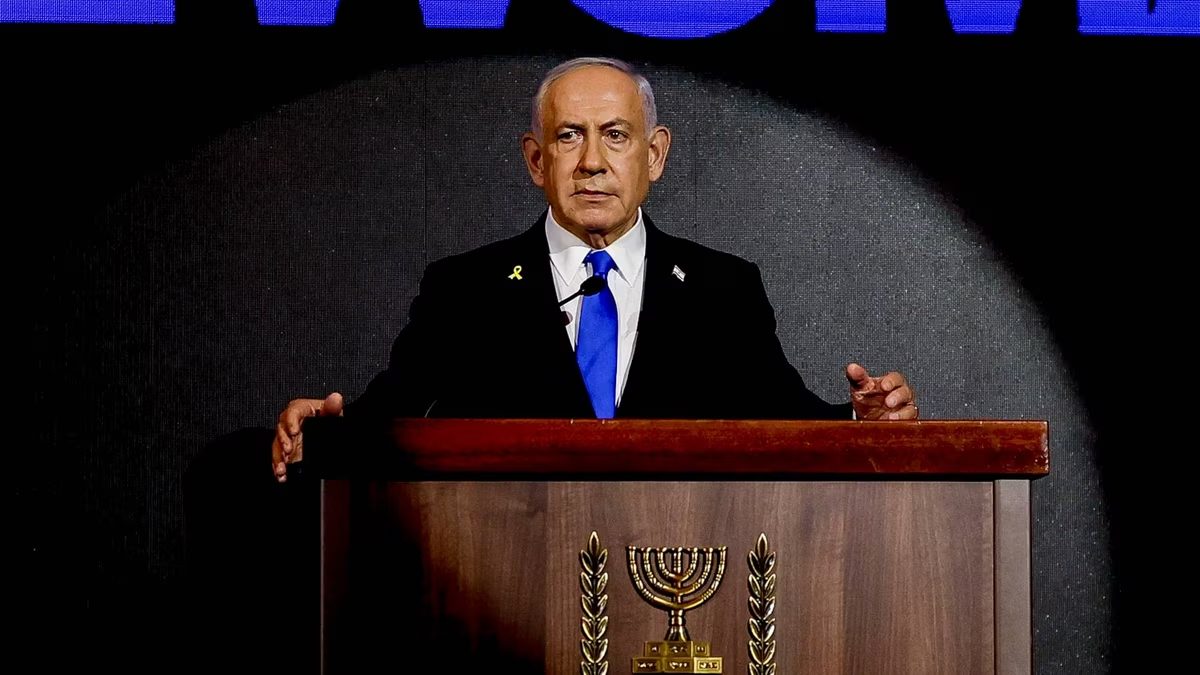
In a firm response to the American announcement of the start of the second phase, Israeli Prime Minister Benjamin Netanyahu, on Wednesday evening, reiterated that Israel will not proceed with any withdrawal or development steps without achieving its field conditions.
Netanyahu clarified, during a phone call with the family of soldier "Ran Guily" (the owner of the last body held in Gaza), that any announcement of the formation of a "technocrat" committee to manage the sector would not deter his government from its main demand to return "Ran" for burial in Israel.
Netanyahu was categorical in his stance on the reconstruction process, making its commencement conditional on "the complete disarmament of Hamas and the Gaza Strip." He indicated that the Israeli army would maintain its current positions to ensure this demand, and also revealed the continued closure of the Rafah crossing despite all international pressure, linking its reopening or any political concessions to the recovery of the body and the fulfillment of specific intelligence demands conveyed through mediators.
These statements reflect a chasm between Netanyahu's demands and the plan announced by US envoy "Witkoff," as Washington focuses on starting a transitional and reconstruction phase, while Netanyahu insists on "security first." Observers believe that the Prime Minister's insistence on recovering "Ran's" body as a prerequisite may practically hinder the launch of the second phase on the ground, posing a new challenge for the American administration and mediators (Egypt, Qatar, and Turkey) to reconcile positions between "humanitarian reconstruction" and stringent "Israeli security demands."
Israel will not proceed with any withdrawal or development steps without achieving its field conditions.
PALESTINE
Wed 14 Jan 2026 7:18 pm - Jerusalem Time
Washington Announces Launch of Second Phase in Gaza, Welcomes Palestinian Technocratic Administration
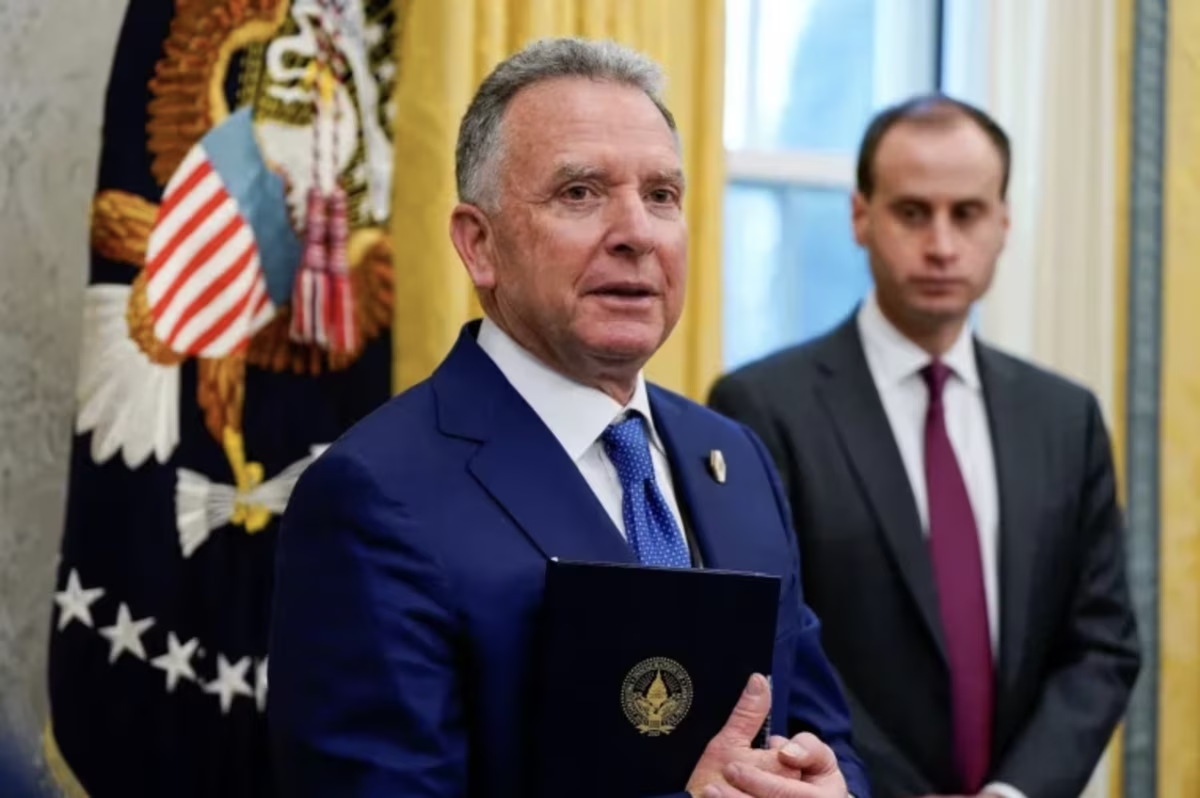
Washington – Said Arikat
The administration of US President Donald Trump announced the start of the second phase of its political plan to end the war in the Gaza Strip, a move described as a transition from temporary de-escalation to a path of re-engineering the security and administrative landscape in the afflicted Strip. The announcement coincided with Washington's welcome of the Palestinian-regional consensus on forming a fifteen-member Palestinian technocratic committee to manage Gaza during a transitional phase.
Steve Witkoff, the US President's Special Envoy, stated in a statement published on the "X" platform that the United States, on behalf of President Trump, is launching the second phase of the twenty-point American plan, which aims to transition from a ceasefire to disarmament, establish a technocratic government, and initiate comprehensive reconstruction of the Gaza Strip.
Witkoff clarified that the new phase stipulates the establishment of a transitional Palestinian administration with a technocratic character, named the "National Committee for Gaza Administration," which will be responsible for managing daily life affairs, overseeing reconstruction, and leading the process of complete disarmament, especially the withdrawal of weapons from all individuals and entities not officially authorized.
The US envoy affirmed that Washington expects full compliance from Hamas with its commitments, foremost among them the immediate release of the body of the last deceased hostage, warning that any breach of obligations would lead to "dire consequences." In contrast, Witkoff stressed that the first phase of the American plan contributed to providing unprecedented humanitarian aid, maintaining the ceasefire, returning all living hostages, in addition to recovering the remains of twenty-seven out of twenty-eight deceased hostages.
The US official praised the role of regional mediators, especially Egypt, Turkey, and Qatar, considering their diplomatic efforts crucial in achieving the progress made so far and paving the way for the more complex second phase.
For his part, Egyptian Foreign Minister Badr Abdel Ati announced on Wednesday that a consensus had been reached on the names of the members of the Palestinian technocratic committee, affirming that the committee enjoys the support of all Palestinian factions. He expressed hope for the official announcement of its formation soon, in preparation for its dispatch to the Gaza Strip to take over the management of essential services and organize daily life affairs.
Abdel Ati stressed that the formation of the committee does not in any way mean the political separation of the Gaza Strip from the West Bank, affirming that Egypt rejects any path that leads to entrenching division and adheres to the two-state solution as the only sustainable framework. He also expressed his anticipation for the launch of the second phase of the American plan immediately after the official announcement of the committee.
Circulating information indicates that some members of the committee reside within the Gaza Strip, while others are outside it, and the committee will temporarily be based in Cairo at the beginning of its work, which may necessitate the reopening of the Rafah crossing in coordination with Israel. However, the timing of the committee's start of work is still undecided, given the difficulties Washington faces in mobilizing the necessary international funding for the reconstruction program.
The anticipated committee is headed by Ali Shaath, former Deputy Minister of Transport in the Palestinian Authority, in an attempt to give a professional, non-factional character to the administration of the transitional phase.
The American plan, in essence, reflects a security-administrative approach more than a comprehensive political vision, as it focuses on disarmament and service management without addressing the roots of the conflict related to the occupation and Palestinian national rights. The establishment of a technocratic government stripped of political powers may provide fragile stability, but it does not constitute an alternative to a comprehensive political project, raising questions about the sustainability of this formula without a clear sovereign horizon.
It is worth noting that relying on a neutral technocratic committee seems theoretically attractive, but in practice it is fraught with challenges, given a divided Palestinian reality and a highly complex regional context. The success of the committee will not only depend on the competence of its members, but also on its ability to operate without Israeli security pressures or external dictates, a condition that is difficult to achieve in the absence of clear political and legal guarantees.
As for the disarmament process, it remains the most controversial item of the plan, as it is presented as a prerequisite for reconstruction, not as a result of an integrated political process. This approach reflects an imbalance in the balance of priorities and reproduces the equation of power instead of the equation of rights, which may turn reconstruction into a tool of political pressure, not a real gateway to achieving peace and stability.
PALESTINE
Wed 14 Jan 2026 7:15 pm - Jerusalem Time
Palestinian Presidency Welcomes Trump's Peace Efforts and Announces Support for Formation of Gaza Management Committee
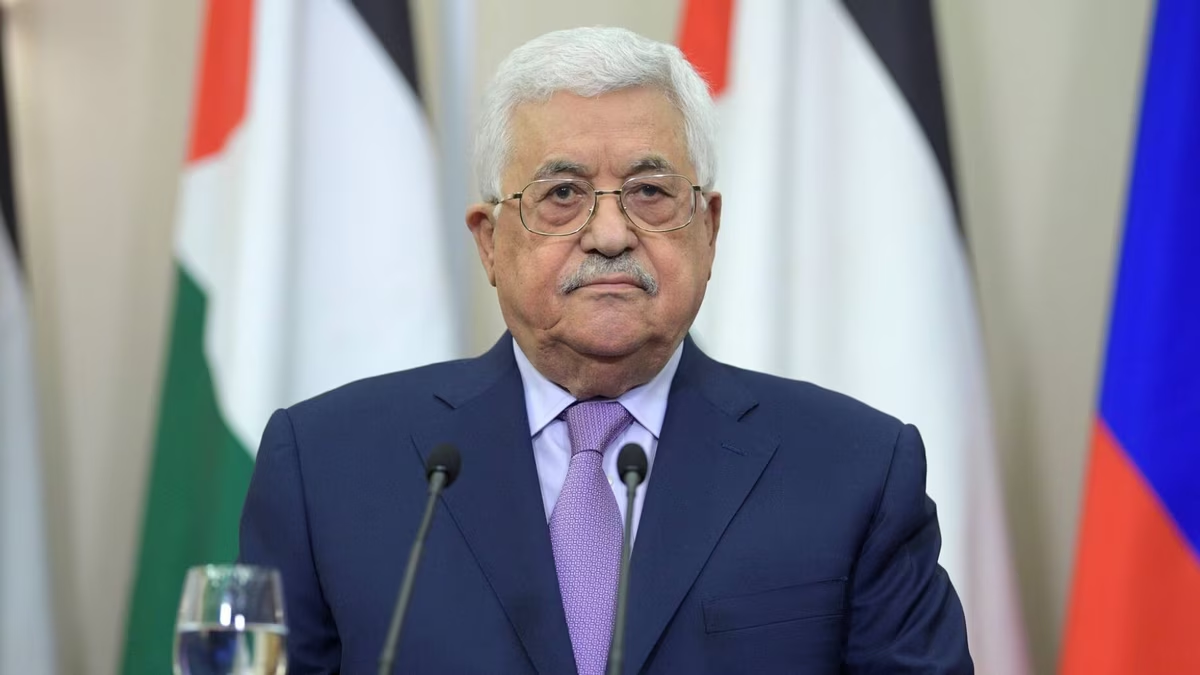
The Presidency expressed its support for the formation of a Palestinian committee to manage the Gaza Strip during the current transitional phase.
The Palestinian Presidency, in an official statement issued on Wednesday, welcomed the efforts made by US President Donald Trump to complete the implementation of his peace plan and activate Security Council Resolution 2803, including the inauguration of the "Peace Council" and its executive bodies.
The Presidency announced practical steps to support this path, most notably: the formation of the Palestinian Committee: The Presidency expressed its support for the formation of a Palestinian committee to manage the Gaza Strip during the current transitional phase.
Communication with Washington: The statement revealed close coordination with Special Envoy Steve Witkoff, Jared Kushner, and American teams, in addition to Nikolay Mladenov, to consolidate the ceasefire and move to the reconstruction phase.
Praise for Decisive Leadership: The Presidency expressed its gratitude for President Trump's "decisive leadership" and his direct involvement which created an opportunity for good governance in Gaza.
Unity of Institutions and Rejection of Division: The Presidency emphasized strict administrative and legal principles, stipulating: Rejection of Duplication: The necessity of linking the Authority's institutions in the West Bank and Gaza, and not establishing systems that entrench separation or division.
Principle of Legitimacy: Adherence to the rule of "one system, one law, and one legitimate weapon."
Simultaneous Demands in the West Bank: The Presidency called on the United States and partners (Egypt, Qatar, and Turkey) to take decisive steps in the West Bank in parallel with Gaza's efforts, to ensure: Halting Settlement: Disrupting settlement expansion plans and settler terrorism.
Financial and Political Protection: Releasing withheld funds, preventing displacement or annexation, and protecting the two-state solution from undermining.
The Presidency concluded its statement by calling on all factions and civil society institutions to assume their historical responsibilities to ensure the success of this delicate transitional phase.
The Presidency expressed its gratitude for President Trump's "decisive leadership" and his direct involvement which created an opportunity for good governance in Gaza.
PALESTINE
Wed 14 Jan 2026 2:07 pm - Jerusalem Time
UNICEF: More than 100 children killed in Gaza since ceasefire
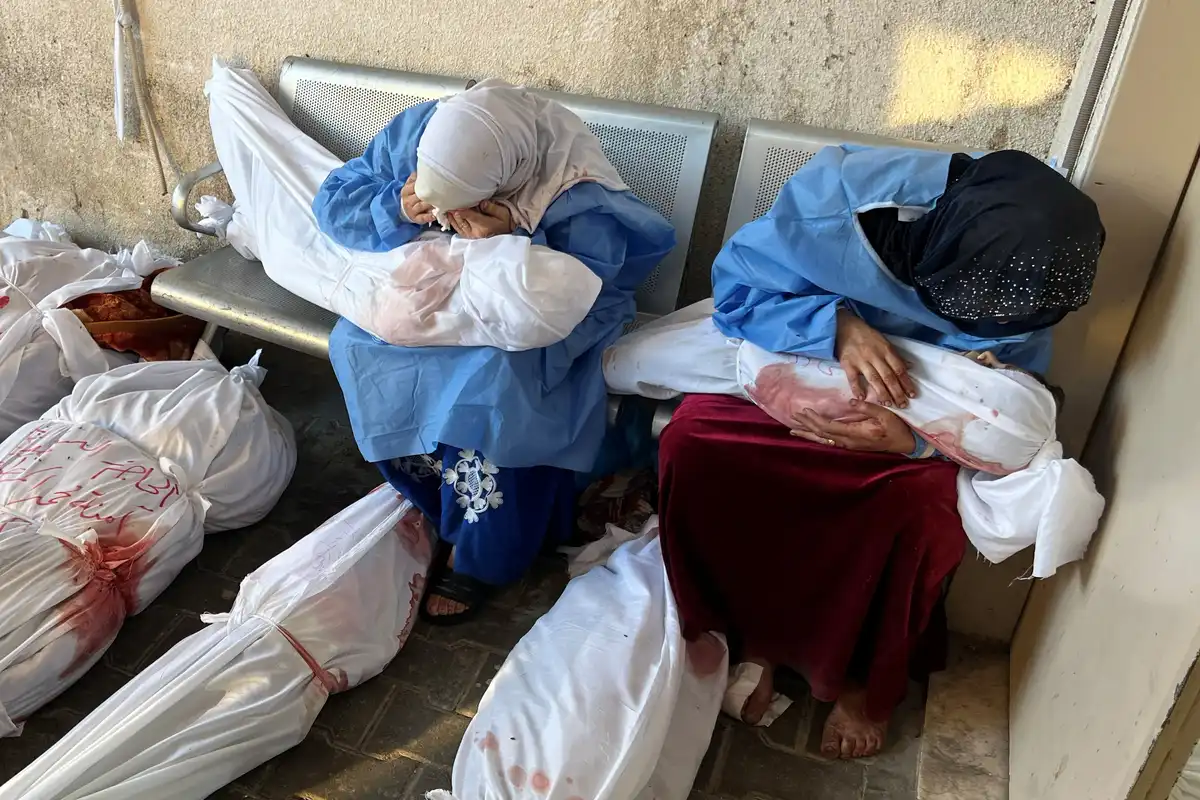
The United Nations Children's Fund (UNICEF) has revealed shocking figures confirming the killing of more than 100 Palestinian children in the Gaza Strip since the US-backed ceasefire began on October 10th. This ceasefire, the organization stated, has been repeatedly violated by the Israeli army. These figures, which represent at a minimum an ongoing humanitarian tragedy, reflect the fragility of the truce and its transformation from a tool to protect civilians into a cover for a bloody reality that has not ceased.
UNICEF spokesperson James Elder said that more than one hundred children have been killed during what is supposed to be a period of calm, meaning approximately one child per day. He explained that the organization documented the killing of at least 60 boys and 40 girls, noting that these statistics only include cases for which sufficient detailed data was available, meaning the actual number could be much higher. He added that hundreds of other children have suffered varying injuries, some of which leave permanent physical and psychological scars.
Elder indicated that the means of killing varied between airstrikes, drone attacks, including suicide drones, in addition to tank shells, live ammunition, and even remote-controlled quadcopters. This diversity in killing tools, according to observers, reflects the widening scope of military operations despite repeated political talk of de-escalation.
For its part, the Ministry of Health in Gaza announced that Israeli forces have killed 447 Palestinians and injured 1246 others since the ceasefire came into effect, noting that five Palestinians were killed in the past twenty-four hours alone. These figures show a clear gap between the international discourse that speaks of "de-escalation" and the reality on the ground, which indicates continued human bloodshed.
The suffering of children was not limited to direct shelling, as Elder pointed to other deaths resulting from harsh living conditions. Six children died this winter due to hypothermia, as thousands of families live in dilapidated tents or among the rubble of destroyed homes, and with continued Israeli restrictions on the entry of essential materials. Elder described scenes of strong winds tearing tents on the Gaza beach, and severe cold accompanied by high humidity, confirming that these conditions are no less deadly than shelling.
The UNICEF spokesperson noted that the humanitarian situation saw limited improvement in some areas after the signing of the ceasefire agreement, but he stressed that this improvement remains partial and temporary given the continued restrictions, especially those imposed on medical evacuations, the entry of aid, and freedom of movement. He called for the full and strict implementation of the truce, and the lifting of all restrictions that hinder the protection of civilians, especially children.
Elder affirmed that a ceasefire that reduces the pace of shelling is a positive step, but it is not enough as long as children continue to be buried under the rubble. He considered what is happening to be a "moral and legal warning" that requires a genuine commitment from all parties, accountability for those responsible for violations, and the transformation of temporary violence reduction into permanent security. He added that the current moment must be a turning point that definitively stops the killing of children in Gaza.
UNICEF's figures reveal a structural flaw in the concept of a "ceasefire" when it is emptied of its humanitarian content. A truce that does not protect children and does not guarantee their safety becomes merely a political measure to manage the conflict, not to end it. The continued killing during the truce raises legal and ethical questions about the responsibility of the parties sponsoring the agreement, and puts the international community to a real test: either protect civilians or implicitly accept the violation of the right to life.
The tragedy of Gaza's children also shows that violence is not measured only by the number of shells, but also by the policies that besiege daily life. Death from cold inside tents, or due to the absence of medical evacuation, is another form of systemic violence. The focus on numbers should not obscure the deeper human dimension: childhood stolen, future destroyed, and a collective memory that will remain burdened by loss unless this bleeding stops.
PALESTINE
Wed 14 Jan 2026 1:34 pm - Jerusalem Time
Why is the second phase of the Gaza ceasefire agreement faltering?

Analysts to Al-Quds: Netanyahu fears the second phase and seeks to create a “victory scene” to cover up the war's failure
Despite weeks passing since the Gaza Strip ceasefire agreement came into effect, its second phase remains stuck in a cycle of Israeli procrastination, while military violations escalate and the occupation army continues to invent pretexts to maintain its grip over large areas of the Strip, amidst an unprecedented humanitarian catastrophe.
What does the second phase include?
This phase does not represent a procedural detail in the path of de-escalation, but rather the essence of the agreement and its political spirit, as it includes the withdrawal of the occupation army from the areas it reoccupied, the establishment of new lines of contact, the launch of a reconstruction process, and the formation of a transitional Palestinian administration, which practically means breaking the logic of “control by fire” that governed Gaza throughout the war of annihilation.
According to what is known as the Trump plan (the 20-plan), the second phase includes the establishment of the so-called “Peace Council” and its executive arm, the “International Stability Force,” in addition to the withdrawal of the occupation army to what is known as the “Red Line,” so that Israel retains about 20% of the Gaza Strip without officially annexing it, in parallel with the formation of a Palestinian technocratic government, and the beginning of rubble removal and reconstruction under international supervision.
However, these entitlements today collide with a solid Israeli political wall, led by Benjamin Netanyahu, who sees the implementation of the second phase as the effective end of his war on Gaza and the beginning of a phase in which he loses political and military control.
Escalation as a tool to disrupt the second phase
As discussions related to the mechanisms for implementing this phase approached, the occupation army significantly escalated its aggression, through intensified aerial bombardment, the demolition of residential neighborhoods, and the expansion of the so-called “Yellow Line” within the Strip, in a clear attempt to impose new facts on the ground before any potential withdrawal, according to analysts' estimates.
Hamas considered this escalation part of a systematic Israeli strategy to empty the second phase of its content, and submitted official protests to the mediators, warning that continued violations could lead to the collapse of the entire agreement, especially after the martyrdom of 13 Palestinians in massacres committed by the occupation in one day.
The movement also accuses the American administration of providing political cover for these violations by remaining silent about them, even though they target the essence of the agreement, not its details.
No readiness to withdraw
In an additional indication of Israeli intentions, the Hebrew newspaper Haaretz quoted security sources as saying that the occupation government has not issued any instructions to the army to prepare for withdrawal from Gaza or to implement the second phase, which confirms that what is happening is not a field malfunction, but a political decision to freeze the agreement.
According to government monitoring in Gaza, the occupation army has committed 1193 violations since the ceasefire came into effect, leading to the martyrdom of more than 430 Palestinians, including women and children, in addition to obstructing the entry of aid, which did not exceed 42% of the agreed quantities, in a direct violation of the humanitarian dimension of the agreement.
Netanyahu and the search for an “illusory victory”
Writer and political analyst Dr. Muhammad Musleh believes that the political level in Israel is managing these violations, not the military establishment, despite the oversight of mediators, especially regarding Hamas's commitment to the terms of the agreement.
Musleh points out to “Al-Quds” that Turkey, Egypt, and Qatar have confirmed in official statements that Israel is repeatedly violating the agreement, and that the second phase faces fabricated complications because Netanyahu seeks to create a “victory scene” in Gaza, with which he covers up the failure of the war of annihilation, and uses it as a lifeline from his internal crises, corruption trials, and the pressures of the far-right within his government.
The second phase… the battle after the war
In turn, Egyptian writer and political analyst Ali Fawzy believes that Netanyahu fears the second phase more than the war itself, because it undermines the narrative of military achievement, and imposes on him political and security entitlements that he does not want to pay the price for, foremost among them the withdrawal from Gaza and the beginning of its reconstruction under international and Palestinian supervision.
Fawzy stressed to “Al-Quds” that Israel is trying to turn the ceasefire into a long truce without withdrawal, reconstruction, or Palestinian administration, meaning a freezing of the conflict on the occupation's terms, not its end.
Between a Palestinian readiness to move to a new political and humanitarian phase, and Israeli procrastination aimed at escaping the post-war entitlements, the second phase of the ceasefire agreement remains hostage to Netanyahu's decision, who so far seems to prefer managing the crisis over resolving it.
In a strip living under rubble, postponing withdrawal and reconstruction means only one thing:
The continuation of the war… but with other tools.
PALESTINE
Wed 14 Jan 2026 1:32 pm - Jerusalem Time
Winter ravages Gaza's displaced... Tents fly and cold claims lives!
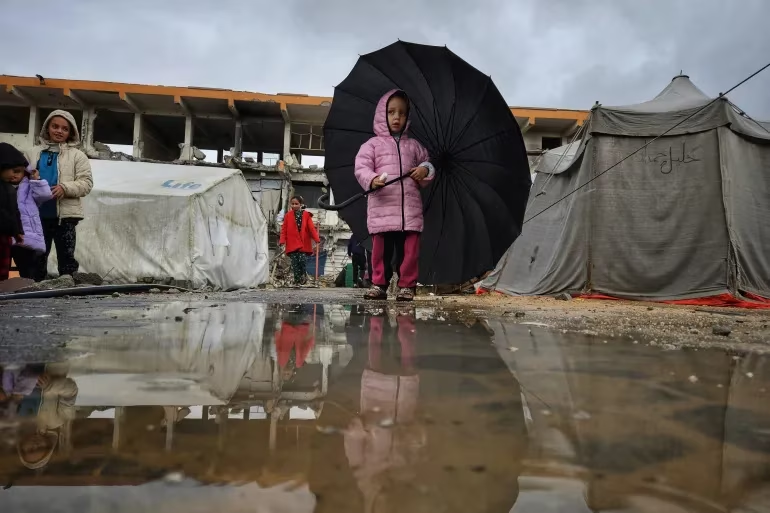
Heavy rains and strong winds over the past two days have destroyed large parts of the fragile displacement camps in the Gaza Strip, exacerbating the suffering of hundreds of thousands of Palestinians displaced by the ongoing Israeli war of extermination and leaving thousands of families in direct confrontation with the bitter cold without shelter or protection.
Displaced persons told "Al-Quds" that the violent winds completely uprooted their tents, while rainwater flooded other tents, turning their floors into swamps of mud and stagnant water, in the absence of any alternatives or heating methods, and the lack of the most basic necessities of life.
Displaced Abu Muhammad Al-Hindi (45 years old), whose family lives in one of the displacement camps west of Gaza City, says: "We woke up to the sound of the wind tearing the tent... Within minutes we were in the open. The children were shivering from the cold, and we only had wet blankets. No alternative tent and no one cares about us."
His wife bitterly recounts: "This is not life... Every low-pressure system means a new disaster. We fear illness more than bombing now, as water has entered the tent and the children have fallen ill, and there is no treatment or warmth."
A difficult night
Displaced Mahmoud Al-Salmi (38 years old), whose family lives in a dilapidated tent south of Gaza City, recounts the details of a difficult night: "The tent was completely submerged... We were lifting the children over the wet blankets and waiting for the wind to calm down. No sleep, no safety, just fear that the tent would collapse or we would get sick from the cold."
His neighbor, Umm Youssef, a displaced person from Jabalia camp, tells "Al-Quds": "We lost our home in the bombing, and now we are losing even the tent. Every low-pressure system makes death closer than life. My children sleep in wet clothes and we have no fuel or blankets."
Thousands of displaced people live in dilapidated tents that cannot withstand rain and wind, while other families have been forced to take shelter in cracked and dilapidated buildings, despite the serious risks, in the absence of any alternative options or safe shelters.
The suffering of more than a million displaced people is exacerbated with the onset of winter, in light of the continuous delay in the entry of reconstruction materials and shelter materials, especially caravans, which has turned tents into dangerous traps that do not provide protection from rain, wind, or bitter cold.
The violent weather conditions led to the flooding of hundreds of tents and their transformation into water pools, deepening the tragedy of displacement, and leaving thousands of families, especially children, women, and the elderly, in humanitarian conditions that directly threaten their lives and health, amidst continuous international silence and unprecedented humanitarian helplessness.
Collapse of damaged homes
For its part, the Government Media Office confirmed the collapse of more than 50 homes and residential buildings that were previously damaged or bombed since the beginning of the recent low-pressure systems, pointing to recorded deaths due to severe cold inside the displaced persons' tents, and the decommissioning of more than 127,000 tents due to their unsuitability to provide the minimum protection for more than 1.5 million displaced people.
Ismail Al-Thawabta, director of the Media Office for Al-Quds, explained that the recent low-pressure systems resulted in the martyrdom and injury of dozens of citizens due to the collapse of residential buildings over their residents, noting that thousands of citizens were forced to resort to damaged and dilapidated homes after the destruction of their original homes, in the absence of any safe alternatives.
Humanitarian catastrophe
In turn, the spokesman for the Palestinian Civil Defense in the Gaza Strip, Mahmoud Bassal, warned that the current low-pressure system caused severe damage to temporary shelter conditions, as thousands of tents were completely damaged, while a large number of them flew away, especially tents erected on the seashore, due to the intensity and speed of the wind.
Bassal confirmed to "Al-Quds" that thousands of tents are still threatened with flying away at any moment, in light of the continued unstable weather conditions and the absence of any means of stabilization or protection, noting that citizens were forced to erect their tents on the seashore due to the lack of space within cities after the widespread destruction of residential areas, and the unavailability of real alternatives for shelter.
He pointed to the existence of thousands of dilapidated homes in various areas of the Strip, which poses a direct threat to the lives of residents, especially with the exacerbation of cracks and partial collapses that are accelerating due to rain and wind, warning that every new low-pressure system turns into a real humanitarian catastrophe in light of the prevention of entry of building materials and the continued obstruction of reconstruction.
Bassal stressed that citizens are living in catastrophic conditions inside torn tents and cracked homes, without the slightest elements of safety or human dignity, confirming that what the Gaza Strip is witnessing today does not meet the minimum humanitarian standards, and constitutes a blatant violation of humanitarian principles and international humanitarian law.
He explained that civil defense teams are working with very limited capabilities, in light of the increasing reports of risks of building collapses, flying tents, and rainwater leakage, warning that the continuation of this reality portends a wider humanitarian catastrophe in the coming period, unless urgent intervention is made to provide safe shelter solutions, and the immediate entry of building materials and essential relief materials is allowed.
For its part, the Gaza Municipality said that the extensive destruction left by the Israeli aggression greatly hinders rainwater drainage, especially in low-lying areas and around shelter centers, which exacerbates the suffering of residents and displaced people.
The municipality confirmed, in a press statement received by Al-Quds, that the humanitarian situation in the Strip has become "extremely complex" with every low-pressure system, in light of a severe shortage of capabilities and mechanisms, and a suffocating financial crisis that hinders emergency response.
The United Nations Office for the Coordination of Humanitarian Affairs (OCHA) had warned of the continued deterioration of humanitarian conditions in displacement camps, confirming that about 65,000 homes were damaged during last December's storms, with water flooding large areas.
The office warned that the work of humanitarian organizations may face additional restrictions due to new Israeli laws that tighten their registration conditions, which, according to aid workers, could lead to "catastrophic consequences" for the lives of hundreds of thousands of displaced people.
PALESTINE
Wed 14 Jan 2026 12:59 pm - Jerusalem Time
During the "Family Event" at the Turkish Embassy in Cairo.. Ambassador Şen: Turkey's continuous support for preserving the rights and dignity of the Palestinian people
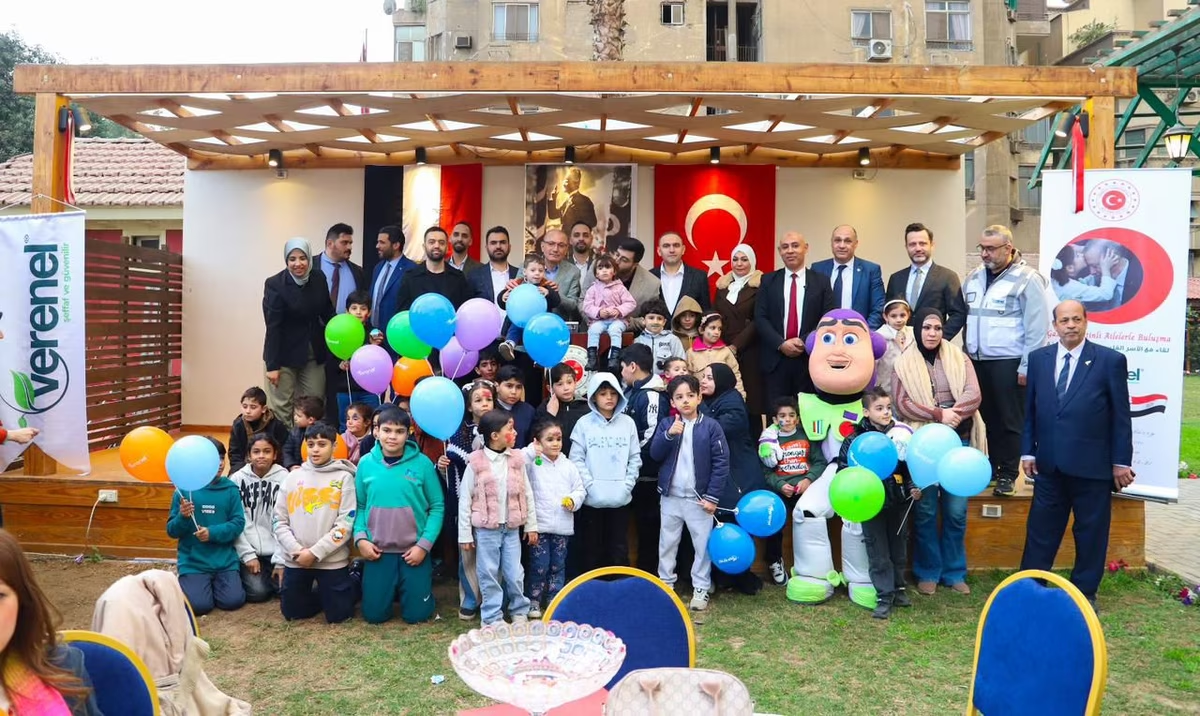
The Turkish state continues its ongoing support for the Palestinian cause and its brethren in the Gaza Strip at all levels and fronts. Among the most prominent of these efforts are those provided by the Turkish Embassy in Cairo through events to support Palestinian brethren in the Gaza Strip residing in Egypt. In this context, the Embassy organized its second solidarity and relief event in 2026, at the residence of the Turkish Ambassador in Cairo, Salih Mutlu Şen. The Embassy, in cooperation with the Turkish "Verenel" association, provided food and cash assistance to 100 Palestinian families, and involved 100 Palestinian children.
15 members of the "Verenel" association attended, having come specifically from Turkey to support the celebration, along with a number of senior journalists, media professionals, and social media influencers from Egypt and Palestine.
In his speech, Ambassador Şen said that President Recep Tayyip Erdoğan gives utmost priority to supporting the Palestinian cause, stressing that Turkey's support is continuous to ensure the rights and dignity of the Palestinian people, and to provide all forms of assistance, especially to the brethren from the Gaza Strip, in order to alleviate their suffering and that of their families.
Şen affirmed Turkey's desire to show its support for the Palestinian people not only through words, but also through tangible events and programs, pointing out that these humanitarian activities will continue and expand with the continued provision of all types of support to the people of Gaza during the upcoming blessed month of Ramadan.
Şen expressed the necessity of working tirelessly until the residents of Gaza enjoy safety, expressing his appreciation for the facilities provided by the Egyptian authorities in both Cairo and Arish to Turkish official institutions and civil society organizations in delivering aid, praising what Egypt provides and the embrace of the Egyptian state and institutions for Palestinians, and its role in delivering humanitarian aid to the Gaza Strip.
Ambassador Şen referred to the previous organization of a solidarity event for 200 Palestinian families during the first days of the new year.
Ambassador Şen thanked the Turkish relief organizations, affirming that Turkish official institutions and civil society organizations do not hesitate to provide their humanitarian assistance to ensure the dignity of the Palestinian people, their continued hopes of returning to Gaza, and their support in Egypt.
The event included setting up play areas for children to enjoy, in addition to various activities such as drawing, and Ambassador Şen showed special interest in Palestinian families and children throughout the event, interacting closely with them.
PALESTINE
Wed 14 Jan 2026 12:32 pm - Jerusalem Time
Who is "Ali Shaath," chosen by Washington to lead the "reconstruction phase" in Gaza?
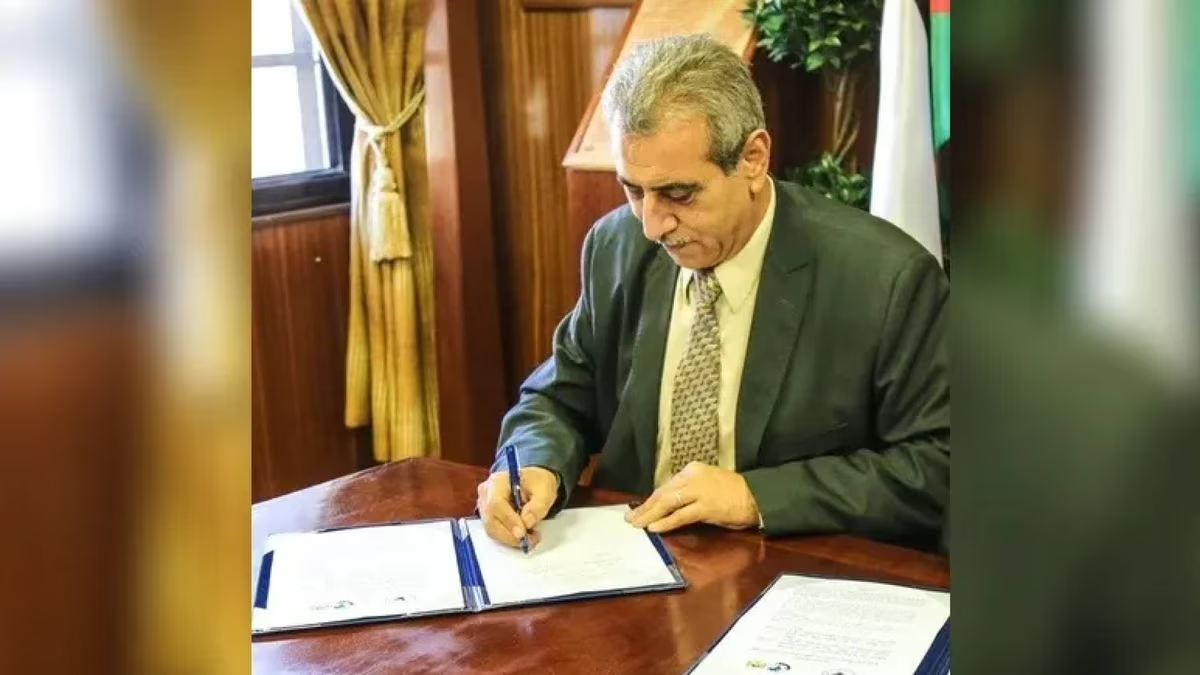
The committee headed by Shaath will oversee daily tasks in the Gaza Strip. On Wednesday, attention turns to Palestinian engineer Ali Shaath, whose selection to head the "Technocrat Committee" tasked with managing the Gaza Strip in the upcoming phase was revealed by American leaks, as part of President Donald Trump's administration plan to transition to the second phase of the agreement.
Ali Shaath is a Palestinian figure with extensive experience in developmental planning, civil engineering, and institutional development. Below are the most prominent milestones in his resume:
Shaath was born in Khan Yunis in the Gaza Strip, then left for Cairo to study, where he graduated from the Faculty of Engineering at Ain Shams University, and holds a doctorate in engineering.
Shaath held several high-ranking positions within the Palestinian Authority, gaining extensive experience in the economic and developmental fields, having previously served as Deputy Minister of Planning, and as Director-General of the Ministry of Planning and International Cooperation.
He served as Undersecretary of the Ministry of Transport, and also held the position of Executive Director of the General Authority for Industrial Cities and Free Zones.
Shaath currently resides in the West Bank. According to the American plan, this committee will be supervised by a new "Peace Council" headed by Trump, and will include international leaders who have not yet been announced.
Reports also revealed that the former UN envoy, Nikolay Mladenov, will assume a high-ranking position to oversee the committee's work, having recently held meetings with the Israeli Prime Minister and senior Palestinian officials.
Shaath and his team face enormous challenges, as government infrastructure has been completely destroyed, and residents still live in tents and semi-destroyed homes.
Analysts believe that the committee's success depends on its ability to provide tangible services, which is linked to easing "Israeli" restrictions on supplies.
The issue of civil servants who worked under the "Hamas" administration also poses an additional obstacle; it is difficult to work without them, while their inclusion may provoke "Israeli" objections.
On Wednesday, attention turns to Palestinian engineer Ali Shaath, whose selection to head the "Technocrat Committee" was revealed by American leaks.
PALESTINE
Wed 14 Jan 2026 11:31 am - Jerusalem Time
Riviera of the East.. Trump Prepares for "Reconstruction Phase" and Appoints a "Technocratic Committee" to Administer Gaza
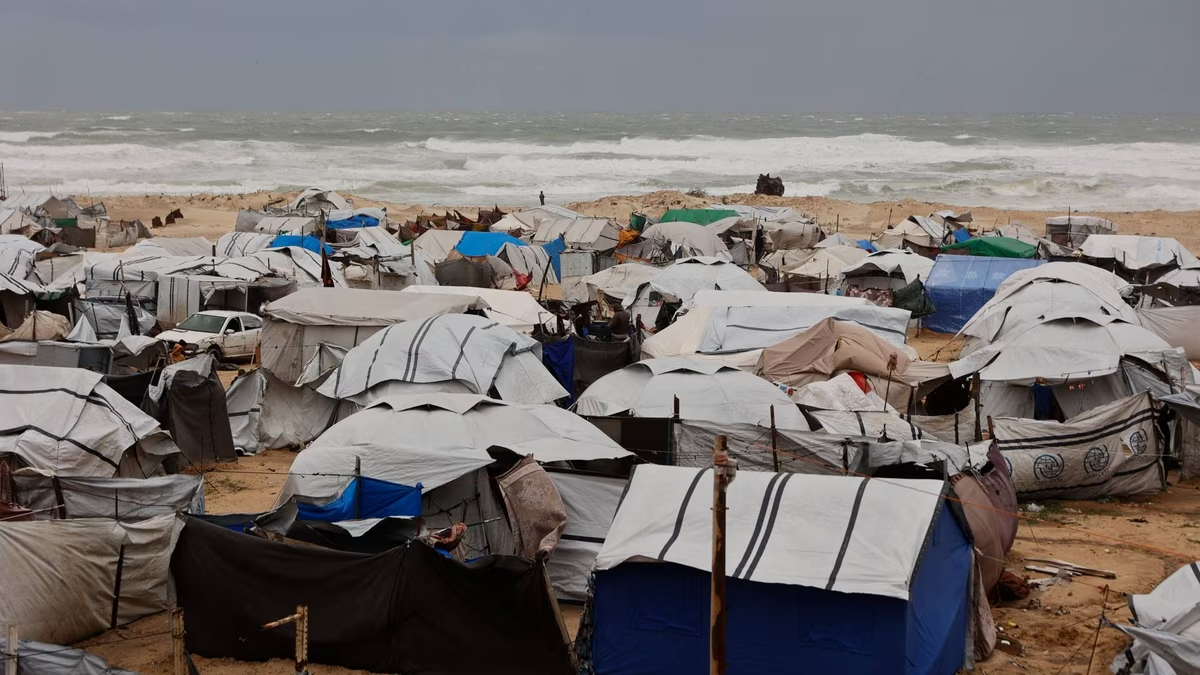
The ambitious plan seeks to transform Gaza into a "prosperous Riviera in the Middle East." US President Donald Trump is preparing, on Wednesday, to announce the official entry of the United States into the "next phase" of its plan for the Gaza Strip, where he will reveal the names of 15 members of the "Palestinian Committee" tasked with temporarily administering the Strip.
Sources, quoting American sources, stated that the administration decided to move from the "conflict cessation" phase to "governance and reconstruction"; due to the resilience of the ceasefire, and Hamas's return of all prisoners except one, Sergeant First Class "Ran Guili."
Reports revealed that Trump, despite promising the "Guili" family two weeks ago at his Florida resort to return their son, did not commit to postponing the plan until his return, preferring to proceed with the implementation of the American vision.
The plan aims to transform Gaza into a "prosperous Riviera in the Middle East," but it faces widespread skepticism; most notably the refusal of the "Hamas" movement - so far - to the condition of "disarmament," which is a fundamental pillar of the peace plan announced last October.
A committee of "technocrats" will take responsibility for vital services (cleanliness, infrastructure, education), according to officials, and includes the following names: Ali Shaath (Chairman): Former Undersecretary of the Ministry of Transport in the Palestinian Authority. Abdul Karim Ashour: Director of the Agricultural Relief Society. Aid Yaghi: Director of the Medical Relief Society. Aid Abu Ramadan: Director of the Chamber of Commerce in Gaza. Jabr Al-Daour: President of Palestine University. Bashir Al-Rayes: Engineering consultant. Omar Shamali: Director of "Palestinian Communications" in Gaza. Ali Barhoum: Engineer and consultant in Rafah Municipality. Hana Tarzi: Lawyer. Sami Nasman: Retired intelligence officer.
The executive steps began this morning, as committee members located in the West Bank departed for Cairo to hold a meeting with the UN Coordinator "Mladenov," while members located within the Gaza Strip will join the meeting via "Zoom" technology.
The plan aims to transform Gaza into a "prosperous Riviera in the Middle East," but it faces widespread skepticism.
OPINIONS
Wed 14 Jan 2026 10:11 am - Jerusalem Time
Trump Does Not See Netanyahu's Crimes
Hamada Faraneh
Opinion Writer
If US President Trump had done one thing, he would have credibility, because he certainly lacks it. He demands a halt to the Tehran government's actions against protest demonstrations, and expressed his anger at the mutual casualties among protesters and security forces, and that he would intervene to protect protesters from Tehran's "repressive" actions.
Initially, we sympathize with the Iranian people and their difficult circumstances caused by the unjust economic blockade by the United States and Europe. The cause is not government actions aimed at punishing its people for actions they did not commit, but rather the harsh blockade by Washington and its followers and tools that caused hardship in Iran, and pushed the government to take harsh precautionary measures that the Iranian people could not bear, prompting opposition forces to capitalize on two factors: the blockade and popular anger, to mobilize protests, and the street's response to incitement and protest motives.
Trump is "upset" about the conditions of the Iranian people and the practice of government "repression." Well, what about Netanyahu's actions and his blatant, egregious crimes against the Palestinian people, with direct, intentional killing of tens of thousands of Palestinian civilians, and the destruction of the Gaza Strip, making it uninhabitable??.
What about the gangs of foreign colonial settlers directly attacking villages and civilian neighborhoods throughout the Palestinian West Bank, burning farms and olive trees in particular, and burning cars and property of Palestinians, turning their lives into hell, and this is done under the protection of the Israeli army and security agencies, by a political security decision from the duo: Ben Gvir, the police minister responsible for security, and Smotrich, the deputy defense minister responsible for the army, and with the cover, consent, and acceptance of Netanyahu and all parties and ministers of the coalition, for a government considered the most extreme in its hostility to Palestinians, Arabs, Muslims, and Christians in the history of the colony from 1948 until today.
Netanyahu is wanted by the International Criminal Court for his blatant, egregious, brutal crimes against Palestinian civilians. Well, why is the "democratic," "humanitarian," "modern," and "president of the largest country in the world" silent and not showing sympathy for the suffering, pain, and hunger of Palestinians, and what they are exposed to in terms of killing and severe injuries, and natural conditions in the face of a harsh winter, and torn tents that do not protect them from the cold and do not provide them with opportunities for a decent life??.
Why is Trump silent about Netanyahu's behavior and crimes, and not working to hand him over to the International Criminal Court as a wanted war criminal for international justice??, compared to his demand that Iran's leaders cease harm, if harm actually occurred to their people, or to other neighboring peoples??.
Netanyahu commits war crimes against Palestinians, Lebanese, and Syrians, and infringes on the sovereignty of their countries, and finds no one to deter him??.
Rather, why does President Trump provide protection and political and security cover to Netanyahu and provide him and his colony with all the needs to continue the occupation and criminality against the Palestinian, Lebanese, and Syrian people??.
Therefore, President Trump truly lacks credibility in his illogical dealings with the colony's crimes against another people, and his illogical dealings with the Tehran government because of its dealings with its Iranian people??.
If Trump had dealt with both the Israeli and Iranian sides with the same pace and attention, we would have understood that he truly rejects injustice and cruelty. But the fact that he deals with the Tehran government with deliberate, targeted aggression, and deals with the colonial government with affection and protection, and does not see its crimes, unlike all governments and leaders of the world, including Europeans, this is deliberate blindness in favor of Netanyahu and his allies of fascist, racist, occupying criminals.
PALESTINE
Wed 14 Jan 2026 9:58 am - Jerusalem Time
The Wall of the Jordan Valley… Israel uses security as a pretext to isolate land and displace residents in preparation for annexation
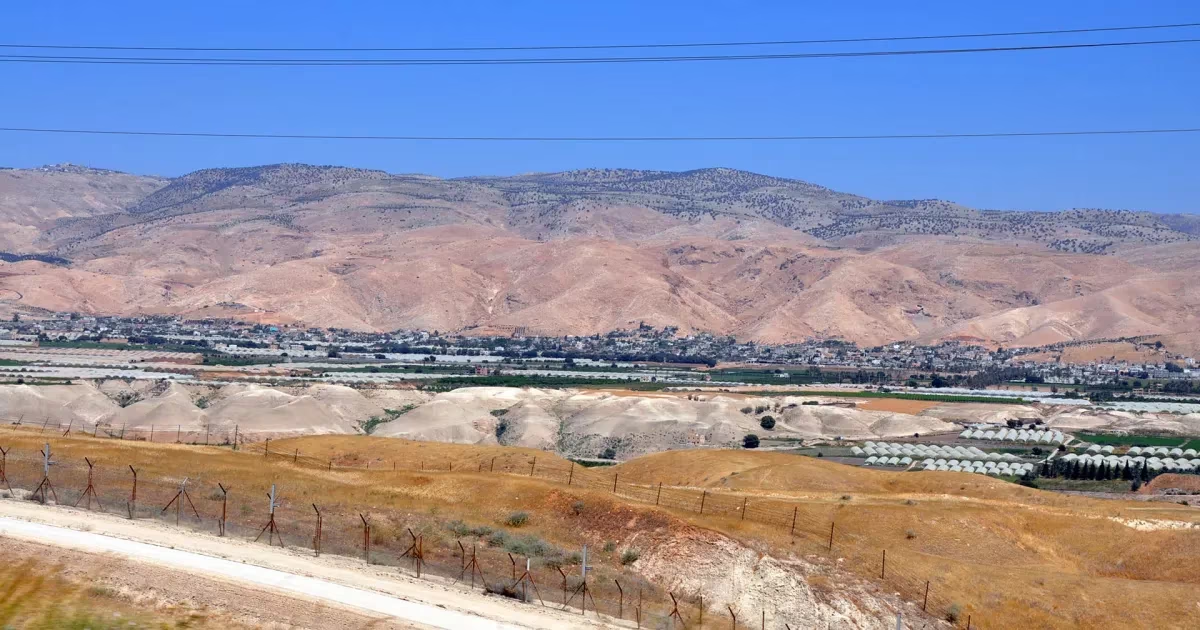
Dr. Khalil Tafakji: The construction of the wall in the Jordan Valley is an Israeli policy aimed at protecting and expanding the settlement project in the region, not for security reasons..
Abdullah Abu Rahma: The most dangerous aspect of the project is the isolation of areas estimated at about 190,000 dunams, which negatively impacts the economy, agriculture, and livestock farming..
Mohammed Abu Allan Daraghmeh: The new wall is consistent with Smotrich's vision of annexing about 82% of the West Bank and turning the remainder into isolated cantons..
Dr. Hassan Breijieh: What is happening in the Jordan Valley, the Jordan River Valley, and (E1) falls within a plan to empty them of Bedouin communities and seize control of the land..
Abdul Hadi Hantash: The construction of the wall is part of the "Allon Plan" to tighten control over the largest possible area of land rich in water and natural resources..
Suleiman Basharat: There is an exaggeration of security risks to legitimize strengthening control and imposing Israeli borders at the expense of the Palestinian presence..
Amidst settler attacks in the Jordan Valley and Bedouin communities, Israel's intentions to implement the wall project in the Jordan Valley come under the pretext of preventing arms smuggling into the West Bank, considering it a pivotal step to change the geographical and demographic landscape in one of the most sensitive Palestinian areas, paving the way for actual steps to displace residents and seize control of the land, leading to annexation.
Specialists, writers, political analysts, and officials explain in separate interviews with "Al-Quds" that the wall extending from Ein Shibli to Tayasir is not to be read as a fleeting security measure, but rather as a practical tool to impose new borders on the ground, reflecting a political orientation that seeks to tighten control and redefine the nature of the Palestinian presence in the region.
They emphasize that the new wall project will have direct impacts on the economic, social, and agricultural life in the Jordan Valley, as it will isolate vast areas of fertile agricultural land, disrupt production chains, and restrict access to water sources, putting thousands of families at risk of losing their primary livelihood and threatening the Jordan Valley's role as Palestine's food basket.
Demographically, they explain that the construction of the wall falls within a broader policy aimed at emptying the area of its indigenous inhabitants, by tightening the noose on Bedouin and pastoral communities, expanding settlements, and creating harsh living conditions that push towards forced displacement, in the context of a silent, gradual annexation that reshapes the Jordan Valley to serve the long-term settlement project.
A path that serves the establishment of new settlements..
Dr. Khalil Tafakji, an expert in settlement affairs, explains that the wall Israel intends to build in the Jordan Valley, extending from Ein Shibli to Tayasir, comes within the context of a clear Israeli policy aimed at protecting and expanding the settlement project in the region, not for security reasons as claimed by the occupation authorities.
Tafakji points out that the proposed wall's route serves plans to establish new settlements, most notably a settlement on the lands of Tammun and another in the Khirbet Ibziq area, which the occupation calls "Bezek," noting that the security pretext is used to cover deeper strategic goals, namely controlling what is known as the "Jordan Valley escarpment," especially the fertile agricultural areas.
Tafakji clarifies that the areas of Al-Buqai'a and Tammun, in addition to Al-Fari'a, are among the most fertile agricultural lands in the Jordan Valley, and that the construction of the wall and settlements there will lead to the displacement of Palestinian residents, preventing them from accessing their agricultural lands, as well as prohibiting grazing activities, which will undermine the basic livelihoods in these areas.
Ensuring the presence of Palestinian minorities..
Regarding Bedouin communities, Tafakji affirms that what is happening to them is systematic ethnic cleansing that falls within an Israeli policy based on "gradual annexation" with the fewest possible Palestinian residents, in exchange for controlling the largest possible area of land.
Tafakji indicates that this policy was implemented in stages, starting from northern Beisan and northern Jordan Valley in the areas of Bardala and Ein al-Beida, passing through the communities of Al-Farsiya and Al-Hadidiya, then south in the Jericho meanders, and Arab al-Rashayda near the Auja spring, all the way to Masafer Yatta.
Tafakji confirms that the results of this policy have led to the emptying of vast areas of Palestinian residents, where more than a third of the West Bank has become almost devoid of indigenous inhabitants, after their displacement and the replacement of settlement outposts.
Tafakji points out that Israel seeks, if annexation is officially implemented, to ensure the presence of only a Palestinian minority in these areas, not a majority, noting that Palestinian statistics indicate the presence of about 400,000 Palestinians in Area C, while Israel speaks of only 150,000, in an attempt to reduce the number to a controllable level.
Tafakji emphasizes that Palestinian communities in the Jordan Valley are sparsely populated, with Jericho being its largest city, alongside towns and villages such as Al-Auja, Marj Na'ja, Al-Zubeidat, Marj Ghazal, Bardala, Kardala, Ein al-Beida, and Al-Jiftlik, asserting that the use of "security" is merely a tool to achieve political goals, primarily gradual annexation and the establishment of new settlements, the latest of which was the announcement of about 19 new Israeli settlements within the West Bank.
Imposing the reality of annexation and sovereignty..
Abdullah Abu Rahma, Director General of the Popular Action Department in the Wall and Settlement Resistance Commission, warns of the danger of the new Israeli plan to build a wall in the northern Jordan Valley, stressing that it constitutes a central link in a systematic policy aimed at emptying Palestinian land of its inhabitants and forcibly imposing the reality of Israeli annexation and sovereignty.
Abu Rahma explains that the planned wall extends for about 22 kilometers from the Tayasir area to Ein Shibli, and is approximately 50 meters wide, which requires the confiscation of about 1042 dunams of Palestinian land under the pretext of "military purposes" and the construction of a security road.
Abu Rahma clarifies that this pretext quickly collapsed after what was published in the Israeli press about the occupation's intention to build an actual wall, not a security road, which reveals the true purpose of the project.
Abu Rahma points out that the wall will isolate wide residential areas, including Tayasir, Al-Aqaba, Tubas, and Tammun, from their fertile agricultural lands, which will deprive thousands of citizens of access to their primary source of livelihood, and directly affect various aspects of economic and social life.
Control over resources..
Abu Rahma indicates that the wall's route passes through Khirbet Yarza, where it will directly affect about 90 Palestinian families residing in the khirbet, threatening their forced displacement. The wall's impact will also extend to vital agricultural areas in the Al-Buqai'a plain and the Atouf plain, which include extensive agricultural projects such as greenhouses, grape and banana farms, in addition to vegetable cultivation, which means striking an agricultural sector that is considered one of the most important pillars of Palestinian food security.
Abu Rahma confirms that the wall will also cause the destruction of main water lines that feed agricultural fields, as well as isolating entire families living in those areas.
Abu Rahma considers that the most dangerous aspect of the project is the isolation of vast areas estimated at about 190,000 dunams of Tubas and Tammun lands, making access to them extremely difficult, which will negatively impact the local economy, agriculture, and livestock farming.
Accumulated violations to enforce displacement..
Abu Rahma speaks of a broader context of accumulated violations, noting that many Bedouin and pastoral communities in the Jordan Valley have been subjected for years to systematic displacement policies through continuous military training between homes and fields, accompanied by forcing residents to temporary leave, endangering their livestock, and burning their crops, with the aim of creating a hostile environment that pushes them to permanent departure.
Abu Rahma explains that these policies have recently been accompanied by the spread of dozens of pastoral settlement outposts, in addition to existing settlements, military camps, and training points, which has led to the displacement of hundreds of Palestinian families as a result of repeated attacks, livestock theft, and the siege of pastures.
Abu Rahma confirms that the new wall comes to accelerate this process, targeting the remaining steadfast communities by isolating them from their surroundings and resources, and opening the way for more attacks to force their residents to leave.
Flimsy and unconvincing security pretexts..
Abu Rahma categorically refutes the occupation's claims that the purpose of the wall is to prevent arms smuggling, explaining that Israel has had a constantly militarily combed border strip since 1967, and that it built an additional wall of about 6 kilometers in length east of Ein al-Beida, Kardala, Bardala, and Al-Sakut between 2000 and 2002, in addition to the presence of a security tunnel in the Al-Buqai'a plain area.
Abu Rahma points out that the area is already teeming with settlements, army posts, and training camps, which makes this pretext "flimsy and unconvincing."
Abu Rahma emphasizes that what is happening is a comprehensive annexation and emptying policy, officially implemented by the Israeli government, and complemented by the practices of settler militias on the ground, within a broad plan targeting Area C of the northern and central Jordan Valley, passing through the Jordan Valley escarpment east of Nablus and east of Ramallah, all the way to the eastern deserts of Jerusalem and Bethlehem and Masafer Yatta; with the aim of replacing Palestinians with settlers and imposing an unprecedented settlement reality.
Imposing new borders and actual annexation..
Writer and Israeli affairs specialist Mohammed Abu Allan Daraghmeh considers the Israeli pretext that the construction of the wall east of Tubas aims to prevent arms smuggling to be a "ridiculous and flimsy pretext," stressing that the true purpose of the project is to impose new eastern borders for the Tubas Governorate, and actual annexation of the Jordan Valley area, within a comprehensive political project aimed at ending the possibility of establishing a Palestinian state in the future.
Daraghmeh explains that if the occupation were serious about preventing arms smuggling, it would have built the wall directly on the Palestinian-Jordanian border, not at a distance of more than 20 kilometers inside the West Bank.
Daraghmeh points out that the wall's route leaves behind hundreds of thousands of dunams of Palestinian agricultural land, in an area that the occupation considers "ideal" in terms of soil fertility, availability of water sources, and low number of Palestinian residents, in contrast to a dense presence of Israeli agricultural settlements.
Daraghmeh clarifies that the pattern of settlement in the Jordan Valley is based on controlling vast agricultural areas, even though the settlements themselves occupy small urban areas, which is known as agricultural settlement.
Daraghmeh believes that the new wall serves this model, by tightening control over Palestinian land and confining Palestinians to narrow areas, in preparation for expanding settlements.
Deepening suffering..
Daraghmeh confirms that the occupation deals with the Jordan Valley area as a strategic area with security dimensions, which explains the widespread presence of army camps, military training areas, and closed lands classified as nature reserves.
Daraghmeh explains that the wall, which will extend between the "Ein Shibli" area and the "Tayasir" checkpoint, will be accompanied by more checkpoints and measures that deepen the suffering of Palestinians and increase restrictions on movement and daily life.
Daraghmeh points out that this section of the wall represents only a third stage of a longer wall whose full extent the occupation has not yet revealed, which means imposing new realities and borders on the ground.
Daraghmeh notes that the Jordan Valley area has been proposed for years as an initial annexation project, considering that what is happening today is the actual annexation of the Jordan Valley, away from official announcements.
Daraghmeh explains that one of the most prominent outcomes of this wall is the creation of a hostile environment for Palestinians in the Jordan Valley, pushing them towards forced migration, in addition to confining them to the smallest possible area, in exchange for expanding the area of control of settlers who fence off thousands of agricultural dunams, not only in the northern Jordan Valley, but in a geographical extension reaching from the Jordan Valley to the south of Mount Hebron and the Masafer Yatta areas.
Targeting the two-state solution..
Daraghmeh links the new wall project to a broader political context, which is the definitive targeting of the two-state solution, referring to public statements by ministers in Benjamin Netanyahu's government, led by Bezalel Smotrich, who announced that settlement is a "correction of a historical error" resulting from the Oslo Accords, and that its goal is to prevent the establishment of a Palestinian state.
Daraghmeh believes that the new wall is consistent with Smotrich's vision based on annexing about 82% of the West Bank, and turning the remainder into isolated cantons.
Daraghmeh confirms that the confiscation of more than a thousand dunams, most of which are private lands, and in parallel with the displacement of dozens of Bedouin communities, is taking place under the protection and patronage of the occupation army, within an integrated policy aimed at imposing Israeli sovereignty over the entire West Bank, and absolutely preventing the establishment of a Palestinian state.
Emptying the area of Bedouin communities..
Dr. Hassan Breijieh, a researcher in settlement affairs, confirms that the Jordan Valley, or the Jordan River Valley, is an essential part of the (E1) settlement project, through which Israel seeks to impose full control over the area and effectively annex it, given its strategic importance in Israeli security and political doctrine.
Breijieh explains that Israel views the Jordan Valley as a geographical barrier separating Jordan and Palestine, which drives it to intensify its policies aimed at controlling the area, whether through approving existing settlements, or through building a wall there, and linking the Jordan Valley to Jerusalem, which leads to its isolation and complete subjugation to Israeli control.
Breijieh points out that what is happening in the Jordan Valley, the Jordan River Valley, and also in the (E1) area, falls within a clear plan to empty these areas of Palestinian Bedouin communities and seize control of the land.
Breijieh clarifies that the occupation authorities have succeeded in recent years in emptying large parts of the Jordan Valley of its Bedouin residents, especially the Arab al-Malihat communities and the Al-Ma'arajat area, in addition to other Bedouin communities.
Breijieh explains that the (E1) project, of which the Khan al-Ahmar area is the most prominent feature, has witnessed forced displacement and evacuation operations that affected many Bedouin communities, as part of a systematic policy aimed at almost completely emptying the area of its indigenous inhabitants.
Expanding existing settlements..
Breijieh confirms that the primary goal of these policies is to gain full control of the land, expand existing settlements, and strengthen them demographically and geographically, while maintaining absolute Israeli control over the area.
Breijieh points out that the continuous attacks carried out by settlers against Bedouin communities, especially Arab al-Malihat, come in the context of continuous pressure to force residents into forced displacement.
Breijieh emphasizes that what is happening in the Jordan Valley and (E1) are not isolated incidents, but rather part of a comprehensive settlement project aimed at permanently changing the demographic and geographical reality of the area.
Land grabbing under security pretexts..
Abdul Hadi Hantash, an expert specializing in land and settlement affairs, affirms that the Israeli occupation's attempt to build a wall in the Jordan Valley under the pretext of preventing arms smuggling into the West Bank is a "false and unrealistic claim," stressing that what is happening comes within the context of an old strategic plan aimed at controlling Palestinian land and emptying it of its inhabitants, and has no relation to real security considerations.
Hantash explains that Israel has for many years stated that the Jordan Valley area will remain an integral part of Israeli control, even if any political settlement is reached, considering it an area of security and strategic importance.
Hantash points out that in light of the current data, talking about a peace process is unlikely, considering that the occupation is exploiting this reality to impose permanent facts on the ground by grabbing large areas of West Bank land under flimsy security pretexts.
Control over water sources..
Hantash points out that among the central goals of the occupation in the Jordan Valley is to control water sources, stressing that water is a fundamental element in the Palestinian-Israeli conflict.
Hantash notes that the occupation's policies are accompanied by a systematic emptying of the Jordan Valley area of its Palestinian residents, through their forced displacement, and giving free rein to settlers, especially in pastoral settlement, to impose a hostile reality on the ground.
Extension of the "Allon Plan"..
Hantash clarifies that these policies are not new, but rather rooted in the "Allon Plan" approved in 1970, which stipulates the confiscation of a wide strip of Palestinian land along the Jordan River and the Dead Sea, with a width ranging between 13 and 15 kilometers.
Hantash confirms that this plan is based on implementing successive stages of separation and control, including separating the city of Jerusalem from its natural surroundings in the West Bank, explaining that the occupation implements these plans gradually and in a way that may not be apparent at each stage individually, but together they form a comprehensive project of control.
Hantash believes that the announcement of the construction of the wall in the Jordan Valley represents one of the links in the implementation of the "Allon Plan," aimed at tightening control over the largest possible area of Palestinian land, especially in areas rich in water and natural resources.
Expected escalation..
Hantash warns that the next stage will witness a significant escalation against Bedouin communities and Palestinian lands, as part of an Israeli plan based on two parallel tracks.
Hantash explains that the first track is to establish full control over areas classified as (C), which were described in the Oslo Agreement as "empty" areas, a description that is incorrect, given the presence of Palestinian population centers there.
The second track, according to Hantash, is to expel Palestinian residents from these areas, which confirms that the real goal is to empty them of their people.
Hantash refers to what is happening in the south and southeast of Hebron Governorate, where Palestinian villages have become besieged between settlements and settlement outposts on one side, and the Green Line on the other, making their residents constantly vulnerable to attacks and denied access to water sources, which comes within a systematic pressure policy to force them to leave.
Hantash confirms that the occupation has given unprecedented free rein to settlers, and that its forces now provide them with protection during their attacks on Palestinian citizens and their property, a clear indication of an upcoming escalation targeting both Palestinian land and people.
Direct and complete resolution..
Writer and political analyst Suleiman Basharat explains that Israel is currently moving towards a "direct and complete resolution" of the shape and nature of its future borders, by accelerating the construction of apartheid walls, foremost among them the wall currently being built in the Jordan Valley, as a physical embodiment of the borders Israel wants to consecrate for what it calls the "Jewish state."
Basharat believes that the rapid Israeli push towards annexing lands and imposing Israeli control and sovereignty over them reflects a clear desire to highlight the features of these borders on the political, security, and military map, stressing that the construction of the wall in the Jordan Valley, under the pretext of preventing arms smuggling, cannot be separated from an Israeli project extending for two decades to re-engineer Palestinian geography to serve the Israeli vision of the state and its future borders.
Cloaking expansionist projects with a security cover..
Basharat explains that Israel has accustomed itself to cloaking its expansionist projects with a security cover, always keen to present the security dimension as the main driver of all its movements, whether related to expansion projects, imposing new realities, or changing the form of control over the land.
Basharat points out that Israel uses the issue of "arms smuggling" into the West Bank as a central pretext to justify its field and political actions.
Basharat confirms that the borders in the Jordan Valley area are not new or sudden, but rather historical borders that have existed for decades, questioning the reasons for portraying them today as a source of escalating security threat. Basharat notes that many estimates indicate that the actual volume of smuggling is much less than what Israel promotes, considering that there is a deliberate exaggeration of security risks with the aim of legitimizing political and military action aimed at strengthening control and imposing Israeli borders at the expense of the Palestinian presence.
Basharat emphasizes that this move is not limited to the security dimension, but rather constitutes part of putting the "final touches" on the shape and borders of the future Jewish state, by carving out Palestinian land, reducing the geographical space available to Palestinians, and transforming their presence into a fragile and limited one.
Harmony between the wall and settler attacks..
Basharat links the construction of the wall in the Jordan Valley to the escalation of settler attacks in the West Bank, considering that there is a clear harmony and integration between Israeli security and military behavior, and settler practices on the ground.
Basharat explains that settlers are acting within a parallel and complementary plan to the official plan, based on imposing facts, displacing Palestinians, and strengthening settlement control, under direct or indirect protection from the Israeli army.
Basharat believes that this intersection between the military and settlement institutions is not accidental, but rather reflects a single strategic vision, where each side reinforces the role of the other, leading to a stage aimed at imposing almost complete Israeli control over the West Bank.
In contrast, Basharat explains that the Palestinian presence is being pushed towards disintegration and fragmentation, transforming it into besieged and fragmented communities, within narrow geographical areas that Israel can easily control, without posing a political, security, or military burden on it in the future.
OPINIONS
Wed 14 Jan 2026 9:57 am - Jerusalem Time
Will the American response in Iran be an action without fingerprints..??
Rasem Obeidat
Opinion Writer

After the popular decision, Iran is preparing for the security decision, relying on the strength and popular immunity of the system, which appeared through the millions of crowds yesterday, Monday, in hundreds of Iranian cities and towns, which stood against chaos and called for stability and chanted for the homeland.
The security decision will be based on this popular base and momentum, as well as on the large numbers of Iranian security forces who were killed in clashes with those groups militarily, financially, and intelligently supported by America and "Israel." The focus is on the Kurdish provinces, in order to create a geopolitical reality in the region that tampers with the geography of Turkey, Iraq, and Syria, and revives hopes of establishing the desired Kurdish state at the expense of the geography of those countries.
It is true that we will face an American strike against Iran, but that strike seems to be outside the traditional military framework, and this is due to the fact that such an option will lead to targeting American bases in the region and bombing the depth of the occupation state. Therefore, other American options are being considered, including launching a wide cyber war with a military operation in northern Iran, or what America calls a joint strike, the goal of which is clear: to create a geopolitical reality in the region that serves the interests of America and Israel. This may be accompanied by what Trump announced as a new approach to confrontation with Iran, transferring the threat to Iran's trading partners, especially China, Pakistan, and Turkey, announcing the imposition of 25% tariffs on the goods of Iran's trading partners that they export to America.
<<<<<<<
It is true that we will face an American strike against Iran, but that strike seems to be outside the traditional military framework, and this is due to the fact that such an option will lead to targeting American bases in the region and bombing the depth of the occupation state.
<<<<<<<<<<<
In this regard, and before talking about the expected scenario for the American strike, which will take multiple forms, in which intensive air attacks, drones, cyber attacks, artificial intelligence, and trade sanctions against Iran's trading partners, especially Turkey, Pakistan, and China, will be used, by imposing customs duties on their commercial goods exported to America by 25%, if they do not cut their trade relations with Iran, and employing media, money, intelligence, and digital space in this war, we must refer to the following.
Those working in research, strategy, and public opinion centers in the occupation state considered that Trump's bullying against Venezuela and its kidnapped president Maduro is a blow to Iran first, especially at a time when matters are reaching the brink of confrontation between it and the United States, and at a time when Israeli incitement against Iran is at its peak. This blow to Venezuela was a direct blow to Tehran's global project and put an end to its intelligence and military capabilities on the one hand, and its investment capabilities on the other, which was represented by its departure from the SWIFT system for trading in dollars. Secondly, it is a blow to China, which quietly infiltrated through Caracas into the Latin continent and because it is the most important importer of Venezuelan oil outside the dollar trading system, and which, in their opinion, will be forced to climb down from the high tree and respond to its urgent need for Venezuelan oil by paying its price as determined by Washington and in green American cash.
America and "Israel" bet on the wave of popular livelihood protests that many Iranian cities witnessed, due to the American sanctions and siege policy, which the Iranian leadership announced through its leader and president, that those protests were legitimate, and they were part of the negotiation process with traders.
America and Israel worked to politicize those protests and involve their groups and sleeper cells of mercenaries and spies, some of whom are still present on Iranian territory, since the war of June 13 last year. These mercenaries and spies, it seems that their pursuit, tracking, exposure, and exposure of their affiliations, and the elimination of their cells, arms, and extensions, is continuous and ongoing by the Iranian security services, which worked to cut off internet lines throughout Iranian territory, in order to prevent them from organizing, communicating, and directing acts of sabotage, destruction, killing, and creating a widespread state of chaos and internal confusion. These acts of sabotage affected mosques, burning Qurans and vehicles, attacking government and civilian institutions, and brutally killing security men. Also, when the American businessman Elon Musk provided internet services to these people through his "Starlink" network, the Iranians succeeded with Chinese technologies and Russian equipment in jamming and blocking them from those cells and groups, and this even facilitated the detection of many of them.
Before the comprehensive cleansing, liquidation, and pursuit operation began by the security and intelligence agencies and elite units of the Iranian army, America and "Israel" see that their last chance, which must be exploited before its certain dissipation, and the duality of popular presence and security decisiveness will be the title of Iranian performance in the coming days, and according to US President Donald Trump's criterion for military intervention, he will have a lot of blood to use as a pretext, so will he go to war?
It is very clear that the American strategy that was in place until 2017, that America is the world's policeman, and that there is no need to dismantle the countries of the region and manage chaos, and that the central countries will fight that relentlessly. For example, America, which rejected the establishment of a Kurdish state in northern Iraq in September 2017, even though the referendum said that 92% were in favor of separation.
It seems that America and the occupation state, which are returning to the policy of bullying, and denying all laws, agreements, references, customs, charters, and international institutions, and achieving what is known as peace through force, are moving towards changing this strategy. Despite all the manifestations of power that these two countries are experiencing, America is experiencing a pressing economic crisis and a debt of up to 43 trillion dollars, and "Israel" has become convinced after October 7, 2023, that there are unprecedented existential risks to (its state), and this requires, after what they were able to achieve in terms of strategic achievement in overthrowing the state and government in Syria, and detailing a new system of government that serves their interests and responds to their conditions and dictates, and despite the major military strikes suffered by the axis of resistance, movements and states, but all of that did not enable America and "Israel" to resolve the conflict. This continuous and ongoing conflict says that for America to maintain its prestige, power, and role in leading the world, and for "Israel" to achieve its dream of "Greater Israel," there is no escape from dismantling and reassembling the Arab and Islamic geography along sectarian, confessional, and ethnic lines, by creating fragile social entities linked to security and military alliances with "Israel," and economically led by the global capitalist center in Washington.
And in a way that prevents the major economic and military powers, Russia and China, and with them Iran as a major regional power, from displacing it from leading the world, and creating a multipolar system that eliminates the financial "dollarization" system.
From here I say that we will face a multi-faceted American-"Israeli" aggression, concentrated in northern Iran, in order to cut off a part of Iranian territory, to ensure its instability, and to revive the idea of the rebirth of a Kurdish state, 10 million Kurds in Iran, 8 million in Iraq, 3 million in Syria, and 20 million in Turkey, and this opens the way for the establishment of a Kurdish state at the expense of Turkish, Iraqi, and Syrian geography, as is the case in Somalia, where the "Israeli" expansion is there, and in Yemen through what is known as the Southern Transitional Council, and what is happening in terms of dividing and dismantling the Libyan and Sudanese geographies.
Palestine - Occupied Jerusalem
13/1/2025
[email protected]
OPINIONS
Wed 14 Jan 2026 9:51 am - Jerusalem Time
After the Genocide: How is Palestinian Legitimacy Shaped Outside the Will of the People?
Mustafa Ibrahim
Opinion Writer

The genocide that Gaza Strip was subjected to did not turn into a moment of political accountability or comprehensive national review. Instead, it was quickly exploited as an entry point to re-engineer the Palestinian political system from the outside. While Palestinians are still stuck under rubble, displacement, and the collapse of living conditions, the “post-war” phase is being managed with an international-security logic that does not see the Palestinian people as a source of legitimacy, but rather as a population that needs to be controlled and managed.
In this context, both the Palestinian Authority and Hamas operate within a converging logic, despite their contradictory rhetoric: seeking external legitimacy that ensures survival or return to the political scene, even at the expense of popular will and national unity. Thus, Palestinian legitimacy is being reshaped after the genocide not as an expression of people's choices, but as a political product whose conditions are determined by major powers.
The Palestinian Authority continues to reproduce a familiar model in the region, where legitimacy is derived from outside rather than from society. Today, the Authority operates within an international framework in which its role and function are being reshaped under American, European, and Arab supervision, and with implicit Israeli approval that sees its continued existence in its weak form as a guarantee for managing the conflict without a radical solution. In this context, the international community does not deal with the Authority as a representative of the Palestinian people's will, but rather as a “modifiable partner” in post-war arrangements.
As for what is called “reforms,” it cannot be understood as a neutral administrative or financial path, but rather as an integrated political project to functionally rehabilitate the Authority according to clear security requirements: maintaining security, preventing resistance, managing the population, and building institutions capable of implementation without objection. Despite accumulated concessions, the outside world does not seem satisfied, but rather pushes for more dependence, in a relationship closer to political blackmail than to any real reform process.
In contrast, Hamas operates within the same logic, albeit with different tools. After the genocide and widespread destruction, the movement seeks to reposition itself as an indispensable political actor, by attempting to gain external recognition that guarantees it a place in the upcoming political system. Despite its rhetoric rejecting international tutelage, its practical behavior indicates a clear pursuit of external legitimacy, in light of unprecedented international intervention in the details of governance, administration, and security.
Some statements by Hamas leaders, including those that appeared as a direct appeal to the American administration, reflect the extent of the transformation imposed by the genocide: from a discourse of defiance to a discourse of seeking a position within an equation being shaped outside Palestine. This transformation cannot be separated from the reality that Gaza's future has become hostage to international arrangements, not the will of its people.
In this sense, the Palestinian scene after the genocide appears to be entirely managed from outside the borders. The United States seeks to determine the shape of the next phase: who governs Gaza, how it will be rebuilt, and what type of authority receives the “green light.” Europe presents itself as a funder conditioned on “political discipline,” while Israel, despite being the perpetrator of the genocide, remains the most influential party, through its efforts to ensure that any future authority will operate within the limits of its security concept, and in a way that prevents the return of resistance in all its forms.
In this climate, legitimacy turns into a commodity managed in back channels: restoration of the Authority with new faces, or conditional integration of Hamas into the governing equation, as long as both parties adhere to what is required of them. As for the Palestinians — survivors of death, displacement, and destruction — they are the last to be asked about their future.
The most dangerous aspect is that these formulations not only exclude popular will but also redraw the boundaries of what is possible for Palestinians: an authority without sovereignty, factions with conditional legitimacy, and a political process stripped of its democratic and ethical content. Instead of the post-genocide phase being a moment to rebuild the Palestinian political system on foundations of participation and accountability, it turns into a moment where Palestinians' right to choose their leadership and shape their future is confiscated.
The genocide experienced by the Gaza Strip did not turn into a moment of actual accountability, neither internally nor internationally. The Palestinian distance between decision-making powers and national institutions remained clear, while responsibilities for what happened over the past two years were not acknowledged, and no party was held accountable for the accumulation of previous failures that weakened the Palestinian Authority and opened the door to international hegemony. Thus, the absence of accountability and acknowledgment of error became an essential condition for reproducing dependency, and any possible national project was transformed into mere management of Palestinian existence according to the criteria of external powers. In the end, Palestinian legitimacy remains governed by international approval, not by the will of the people, and the national project continues to decline in the face of accumulating failure and political blackmail.
PALESTINE
Wed 14 Jan 2026 9:40 am - Jerusalem Time
Sources reveal to "Al-Quds" the names of the Gaza committee

Informed sources revealed to "Al-Quds" a number of names that will undertake tasks within the framework of the Gaza committee, which US President Donald Trump announced his intention to announce in the coming days.
Among the names on the list are: "Ali Shaath, who previously worked as Undersecretary of the Ministry of Transportation in the Palestinian Authority, Ayed Abu Ramadan, Director of the Chamber of Commerce in Gaza, Ayed Yaghi, Director of the Medical Relief Society, lawyer Hana Tarazi, Samira Helles, Bashir Al-Rayyes, Sami Nesman, and Hani Al-Mughni.
The committee is expected to begin its work immediately after its official announcement, headed by Nikolay Mladenov, who will be based in Dubai.
ARAB AND WORLD
Wed 14 Jan 2026 9:36 am - Jerusalem Time
Trump to Iranians: Keep protesting... help is coming

In a striking escalation reflecting a sharp shift in American rhetoric towards Tehran, US President Donald Trump announced on Tuesday the cancellation of all communication channels with Iranian officials, following the violent crackdown by authorities on ongoing popular protests since late last month. He directed a direct message to Iranians, saying: "Keep protesting... help is on its way."
Trump did not provide any clarifications regarding the nature of this "help," contenting himself with charged messages via the "Truth Social" platform, in which he called on protesters to "take control of their institutions" and urged them to "remember the names of the killers and aggressors," in a tone that seemed closer to political incitement than traditional diplomacy. This stance came just days after previous statements by the American president in which he hinted at an Iranian desire to open negotiations with Washington, following his threat to launch military strikes on the Islamic Republic.
This sudden shift in the American position raised widespread questions about the White House's intentions and the limits of its potential intervention, especially since Trump had repeatedly threatened to use military force if Tehran was proven to be using "lethal force" against protesters. However, the President refrained from announcing a final decision, confirming that he was still consulting with his national security team to assess the extent of human casualties and arrests.
Trump said that the circulating figures for the number of dead were "large and shocking," noting that he had received "five different estimates" about the victims, without being able to verify an accurate number. However, human rights organizations, led by the Human Rights Activists News Agency, reported that more than 2,000 people had been killed since the protests erupted on December 28, 2025, most of them civilians, in addition to the arrest of more than 16,700 protesters across the country.
In response, Tehran reacted angrily to the American president's statements. The Iranian ambassador to the United Nations, Amir Saeid Iravani, sent an official letter to UN officials, describing Trump's speech as "interfering and reckless," containing direct incitement to instability and violence, and infringing on Iran's sovereignty, territorial integrity, and national security.
Iranian state media continues to broadcast recorded confessions of protesters, numbering at least 97 clips, in which protesters express their "regret" and speak of "external conspiracies" behind the protests, with repeated references to the United States and Israel. However, human rights organizations in the West confirm that these confessions were extracted under duress, a method that Iranian state television has become accustomed to, but at an unprecedented pace.
Despite the escalation in his tone, Trump evaded a direct answer when asked about the nature of the help he promised Iranians, merely saying: "You'll have to find out for yourselves." However, his administration has already begun to study multiple options, ranging from intensified diplomatic pressure and imposing new economic sanctions, to "very strong" military options, according to the president.
In this context, Trump announced his intention to impose 25% tariffs on countries that continue to trade with Tehran, a move that would expand the confrontation to include major economic powers such as China, Russia, Turkey, and the UAE. In response, Iran warned that any American military intervention would make American and Israeli forces "legitimate targets."
This crisis coincides with the Trump administration's preoccupation with a series of thorny international issues, from Gaza and Ukraine to Venezuela, raising questions about Washington's ability to engage in a new open confrontation. Nevertheless, Iranian activists and opposition figures such as the "People's Mojahedin" believe that the current moment represents a historic opportunity to weaken the ruling regime, amid protests that are the largest in years, sparked by the currency collapse and turning into a direct challenge to the authority of Supreme Leader Ali Khamenei.
Trump's speech to Iranians carries a complex mix of political messages; on the one hand, it raises popular expectations within Iran, and on the other hand, it deliberately leaves a wide area of ambiguity about the nature of American intervention. This ambiguity may be intentional to increase psychological pressure on the Iranian regime, but at the same time, it puts protesters at dangerous stakes, as any miscalculated escalation could push Tehran to more violence under the pretext of an "external conspiracy."
The ongoing protests reveal a deep crisis in Tehran, extending beyond the economic dimension to a crisis of political legitimacy. However, relying on external intervention to bring about change remains a double-edged sword, as it exposes protesters to accusations of being agents of Western countries by the Iranian people. While Washington seeks to leverage the moment to its advantage, the future of the movement remains dependent on its ability to continue as an independent internal force, not as a pawn in a broader international conflict.
ARAB AND WORLD
Wed 14 Jan 2026 9:35 am - Jerusalem Time
The Illusion of American Isolation: A Deep Dive into the Historical Roots of Trump's Foreign Policy
News Analysis
Foreign Affairs magazine, specializing in international affairs, published a lengthy analytical article by political researcher and academic at the Brookings Institute, Michael O'Hanlon, titled: "The Illusion of American Isolation: A Reading into the Roots of Trump's Foreign Policy." The article is based on the theses of his new book: Dare to Do Great Things: American Defense Strategy Since the American Revolution (1776), where the author seeks to deconstruct the common image presented of US President Donald Trump's policies, particularly his description as an "isolationist" leader who returns the United States to 19th-century traditions.
This description, which was popular in the analyses of a large number of commentators and media outlets, is primarily based on Trump's sharp rhetoric towards allies, his explicit nationalist tendencies, and his hardline stances on immigration and international trade. However, O'Hanlon believes that this classification, despite its media appeal, lacks historical accuracy and does not stand up to a careful reading of the trajectory of American foreign policy, nor even to an examination of Trump's own behavior during his terms in office.
Trump, according to the author, does not seek to reduce the American role in the world or retreat within national borders, as much as he works to redefine this role based on the logic of maximizing national power, and reordering the costs of external commitments to serve a narrow conception of American interest. From this perspective, the disagreement is not about engagement or withdrawal, but about how and why.
O'Hanlon attributes this trend to deep-rooted traditions in American political history, extending to presidents such as James Monroe (the fifth president), Andrew Jackson (the seventh president), James Polk (the eleventh president), William McKinley (the 25th president), and Theodore Roosevelt (the 26th president). These, although their eras and contexts differed, were not isolationists in the classical sense, but rather pursued expansionist and aggressive policies, stemming from a fundamental conviction that the security of the United States is not achieved by retreat, but by initiative and imposing facts. Hence, the similarity between Trump and these figures does not lie in the desire for isolation, but in the insistence on maximizing American influence even if it comes at the expense of international consensus or prevailing norms.
The author reminds us that the United States, since its inception, has not been a self-contained nation. It engaged in early military and political confrontations, from the "quasi-war" with France in the late eighteenth century, to its campaigns against Mediterranean pirates, to westward expansion at the expense of indigenous peoples and Mexico. This historical record reveals that what is called "American isolationism" was only a short-lived exception in the 1920s and 1930s, which quickly collapsed with the outbreak of World War II.
In the nineteenth century, the United States adopted an expansionist strategy relying on a limited but highly efficient force, which allowed it to transform from a nascent coastal state into a sprawling continental power. This expansion was not the result of a peaceful tendency, but rather the product of precise calculations of power and interest. This path culminated in the American-Mexican War (1846-1848), which is considered one of the most daring and controversial territorial expansions in modern history.
By the end of the nineteenth century, American ambition shifted from land to sea, and from region to the world. The war with Spain, the building of the naval fleet, and the rise of naval strategic thought theorized by Alfred Mahan, established a growing American role in international politics. Despite Washington's attempts to avoid involvement in European conflicts, it found itself engaged in the First and Second World Wars, which put a definitive end to any illusion of permanent isolation.
In this historical context, Trump's policies in his second term appear to be an extension of this tradition, not a departure from it. Since his return to the White House in 2025, he has reaffirmed commitment to NATO, engaged directly in international conflict issues, used military force against Iran, and taken escalatory steps in Latin America. He also pushed for increased defense spending, without actually dismantling any existing strategic alliance, despite his confrontational nationalist rhetoric.
It is true that Trump criticizes the liberal international order, and sometimes undermines the spirit of partnership with allies through tariffs and unilateral policies, but these practices do not amount to adopting an isolationist strategy. Rather, they reflect a reductionist conception of national security, linking influence to hard power more than relying on multilateral agreements.
O'Hanlon warns that the use of American history to justify these policies is often done with selective reading, ignoring that the greatest American successes in the twentieth century were the result of combining power with alliance building and shaping a stable international order after World War II. History, he emphasizes, does not offer ready-made recipes, but lessons and warnings. What succeeded in the era of continental expansion or imperial competition may today lead to dangerous political isolation if not accompanied by a participatory vision that accommodates the complexities of the contemporary international system.
In conclusion, Trump cannot be understood as a historical exception or an anomalous phenomenon from the American trajectory. In the essence of his vision for national security, he is the heir to a long tradition that prioritizes power over partnership. However, history itself shows that this approach, if not tempered by broader considerations, may achieve quick gains, but it carries serious risks for the stability of the international order, and for the position of the United States itself in the long run.
ISRAELI AFFAIRS
Wed 14 Jan 2026 8:58 am - Jerusalem Time
Haaretz: Highly classified army data leaked via Google
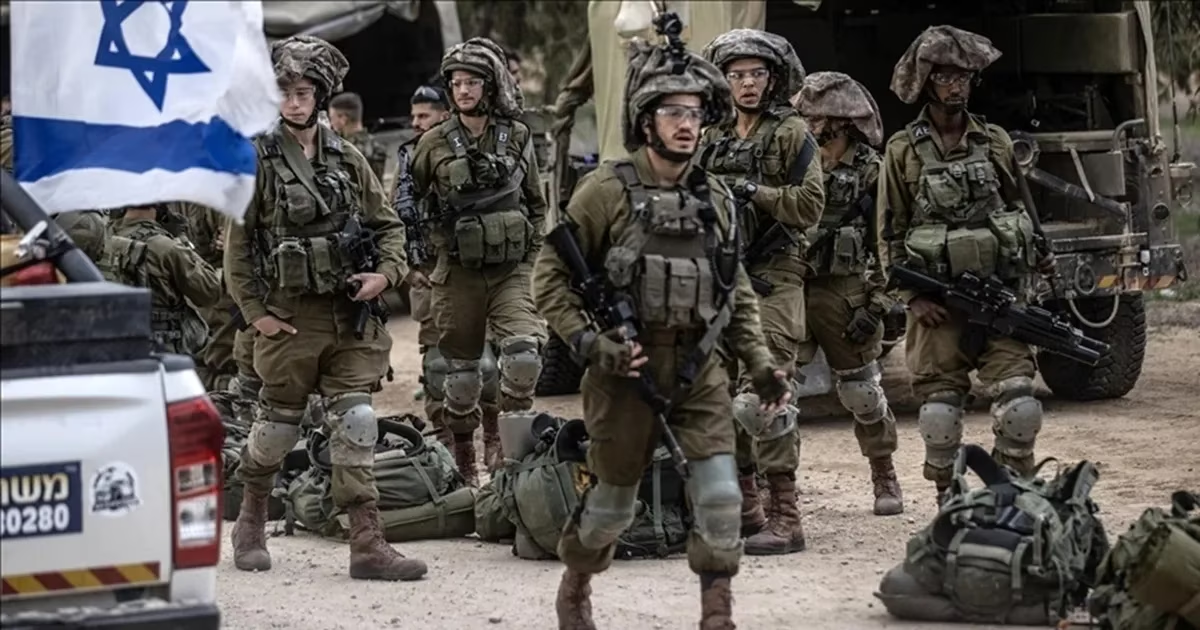
Sources said that secret documents belonging to the occupation army were leaked online, and it took a full six days to close the security vulnerability, despite the information being classified as life-threatening by military censorship.
According to sources, the full names of air force pilots of the occupation army involved in an airstrike on the city of Jenin in the West Bank were revealed, in addition to a detailed map of an occupation army detention facility, and information about the occupation's electronic systems targeting Iran, all within military documents stored insecurely in a public online folder belonging to the occupation army spokesperson's unit, easily accessible via a simple Google search.
It explained that some files were stored in an open folder without any authentication, and Google indexed a number of them, making them available to anyone with basic technical knowledge.
The number of files stored on the server reached 2590 PDF files, some of which contained sensitive and confidential information, including the full names of officers and soldiers in active, reserve, and professional service, who were supposed to be referred to only by their first initial.
The leaked materials also included the full names of air force pilots participating in the Jenin raid, internal reports issued by the occupation army spokesperson's unit, and information about various bases and facilities, without any redaction or censorship.
Sources reported that the documents were issued by the occupation army spokesperson's unit through a backup and distribution system belonging to a commercial company that also provides its services to private sector clients, and the system allows documents to be shared via links.
In recent years, the unit has used these links to distribute data and documents to journalists, in addition to storing some documents and distributing others after redacting sensitive names.
However, the problem, according to sources, was that everything uploaded to the system became publicly available, as employees of the occupation army spokesperson's unit did not realize that every document generated an easily guessable public link, including secret documents that the occupation army never intended to publish.
Sources described the failure as twofold: a misunderstanding of the consequences of uploading documents, and their easy discovery due to not being protected or stored with complex names.
Sources indicated that the documents were stored on a server using a commercial domain without encryption, some of which were available via Google, while others could be extracted using simple tools and software, with no restrictions on access attempts or blocking from hostile countries, allowing anyone anywhere in the world to download the documents without technical expertise.
Sources indicated that researcher Or Fialkov, specializing in occupation wars, was the one who informed them of the breach after a warning from one of his followers on the X platform, user EcoTerrorist101, who discovered the leak via a Google search and was able to obtain the documents by simple means.
Fialkov said that the documents included the full names of senior officers and air force pilots, identities usually concealed for their protection, warning of the possibility of this information being exploited by "Israel's bitterest enemies," including Iran, and the potential for harm or kidnapping attempts abroad.
Sources confirmed that they only publish reports on security breaches after the vulnerability has been closed or sensitive information removed, but what happened in this case was exceptional, as the closure of the breach was delayed despite repeated warnings.
After issuing a public appeal for help without details, sources received a call from military censorship demanding the immediate deletion of the appeal as life-threatening information.
Ultimately, a meeting was held with cybersecurity officials in the occupation army and representatives of its spokesperson's unit, during which the difficulty of closing the system was explained, as it is a civilian platform.
Sources stated that the technical solution was simple and only required a few lines of code on a Microsoft server, but the army was unable to implement it for several days, despite the involvement of multiple units, including the Mamram unit specializing in computing.
Six days after the initial report, the breach was finally closed, which sources described as unacceptable slowness from a sensitive and technologically advanced institution like the occupation army, noting that this is not the first time a similar leak has been discovered from the army spokesperson's unit.
The documents included the full names of senior officers and air force pilots, identities usually concealed for their protection.
PALESTINE
Wed 14 Jan 2026 8:12 am - Jerusalem Time
Wall Street Journal: Trump to announce Wednesday the transition to the next phase of his plan for Gaza
The "Wall Street Journal" revealed, citing senior American officials, that President Donald Trump's administration is officially about to announce, on Wednesday, the transition to the "next phase" of its plan for the Gaza Strip.
The officials confirmed that the most prominent step in this announcement will be the appointment of a "Palestinian committee" to take over the tasks of managing the devastated sector "temporarily", to fill the administrative vacuum in the current phase.
The newspaper explained that the American administration believes that the time is right to shift the focus from "stopping the conflict" to "managing and rebuilding the sector", which the administration calls "Phase Two" within its comprehensive 20-point plan.
These developments come in light of the "fragile" ceasefire in Gaza holding up so far, and after the Hamas movement returned all dead detainees - with the exception of only one - according to what the newspaper reported from American sources.
PALESTINE
Wed 14 Jan 2026 7:27 am - Jerusalem Time
Hebrew media: Two soldiers injured after clashes with Hamas in Rafah
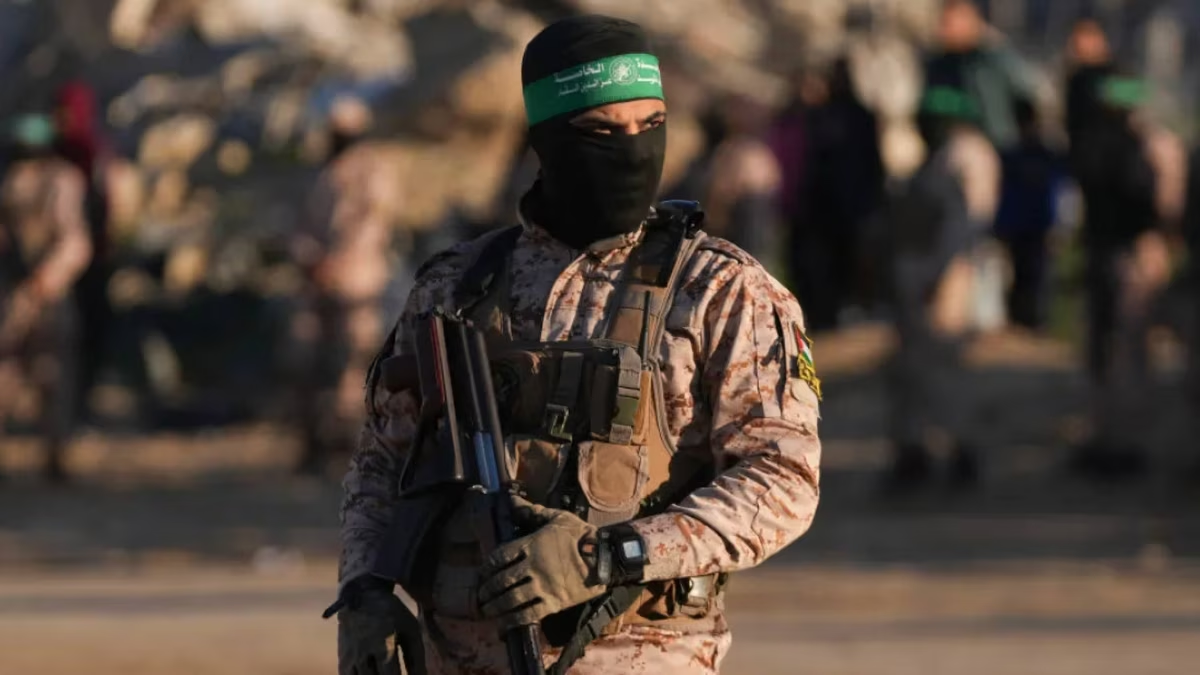
The occupation army announced that violent clashes erupted in the city of Rafah, south of the Gaza Strip, resulting in minor injuries to two of its soldiers, while the confrontations led to the martyrdom of a number of Palestinian fighters. This dangerous field development is considered by observers a blatant violation of the standing ceasefire agreement, putting diplomatic efforts aimed at de-escalating the situation at risk of returning to a phase of comprehensive escalation.
The details of the incident date back to the occupation army's "monitoring" of a group of armed men in the western Rafah area, near the forces deployed in the southern part of the Strip.
Immediately upon detection, the occupation sent tank reinforcements to the location, where fire was opened towards the group, leading to intense exchange of shelling, in which warplanes participated by launching aerial attacks on targets in the area to secure the engaged ground forces.
According to the official account of the occupation forces, the Palestinian fighters initiated targeting one of the tanks, which was followed by a direct engagement that has so far resulted in the targeting of seven Hamas fighters, according to sources, while the spokesman for the occupation army confirmed that field operations are still ongoing, as the forces are conducting extensive search and sweep operations to look for others who may be part of the detected group.
These developments come at a very sensitive time, as there is supposed to be a commitment to the ceasefire understandings reached through international mediation.
Officials in the occupation army considered what happened a "blatant violation" of the agreement, which means the possibility of changing the rules of engagement in the next phase.
Analyses indicate that Rafah has become the front line of the conflict due to the sensitivity of its geographical location and the concentration of forces there.
Meanwhile, America is making efforts to contain the situation and prevent a renewed explosion of the situation, as officials in Washington are in contact with the concerned parties to avoid the collapse of the fragile truce.
Observers believe that the continuation of such frictions reflects the difficulty of full field control in the absence of a comprehensive political solution that guarantees long-term calm.
The event in Rafah remains open to all possibilities, especially with the occupation's confirmation that the operation is not yet over. This sudden escalation could lead to a series of reactions, whether on the field front in Gaza or in international decision-making forums that demand the consolidation of calm to allow humanitarian aid.
In conclusion, the region stands at a dangerous crossroads; either mediations succeed in containing this incident and considering it a "localized breach," or it will be the spark that reignites the southern front more broadly. In both cases, civilians in Rafah remain the weakest link, anxiously awaiting what will unfold.
This dangerous field development is considered by observers a blatant violation of the standing ceasefire agreement.
PALESTINE
Wed 14 Jan 2026 5:55 am - Jerusalem Time
Reports on the appointment of a Palestinian committee to administer Gaza.. Who is nominated to head it?
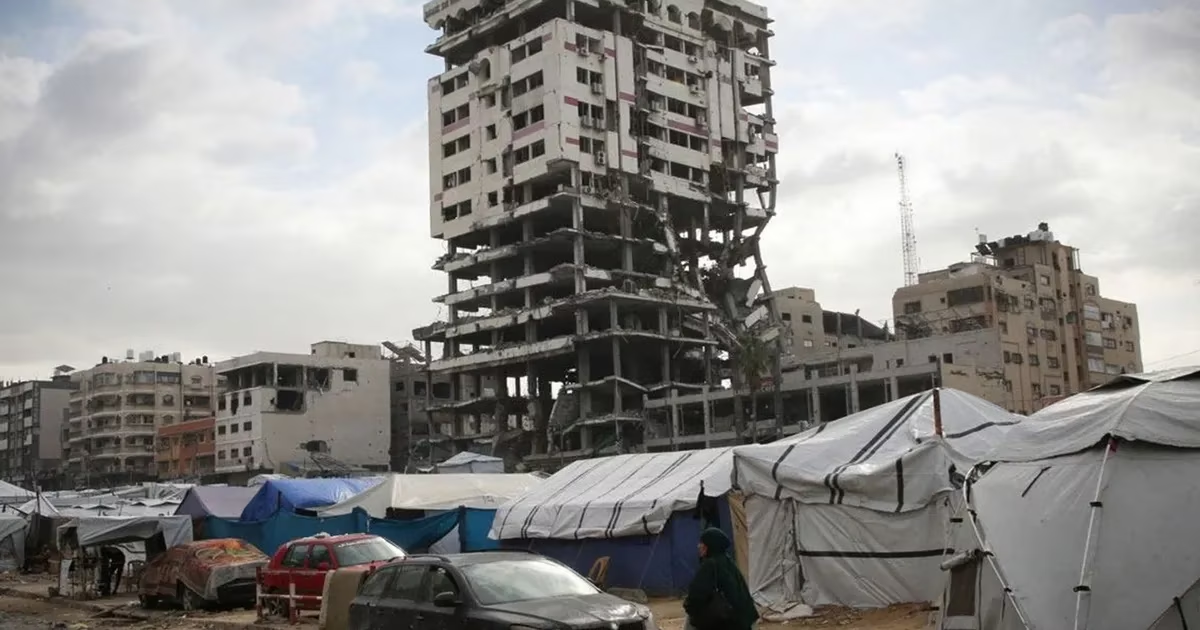
The "New York Times" quoted informed sources as saying that the Trump administration may announce today a Palestinian technocrat committee to oversee daily tasks in Gaza. The sources added that Ali Shaath, the former Palestinian Deputy Minister of Planning, was chosen to head the committee. They clarified that many insiders familiar with the plans related to the Gaza Strip file expect the announcement of this committee today, Wednesday, when Palestinian officials from Hamas and other factions meet in the Egyptian capital for talks. The New York Times indicated that the truce between Israel and Hamas has largely held, while US attempts to persuade many countries to send peacekeeping forces to Gaza have not yielded significant results.
On Tuesday evening, the Islamic Resistance Movement "Hamas" announced the arrival of its leadership delegation, headed by Khalil al-Hayya, the movement's head in the Gaza Strip and head of its negotiating delegation, in the Egyptian capital, Cairo, to hold discussions on completing the implementation of the ceasefire agreement and opening the Rafah crossing. The movement stated in a statement that "discussions with the Egyptian leadership will include completing the implementation of the provisions of the ceasefire agreement and its first phase, including opening the Rafah crossing in both directions." It clarified that "the delegation will also discuss accelerating entry into the second phase, including the formation of the administrative committee, and completing the withdrawal of the occupation from the Gaza Strip." The movement's statement added that the delegation is scheduled to hold meetings with leaders of Palestinian forces and factions to discuss the successive political and field developments in the Gaza Strip and the West Bank.
On November 18th, the UN Security Council adopted a US draft resolution on ending the Israeli war in Gaza, allowing for the establishment of a temporary international force until the end of 2027. According to the resolution, Gaza will be administered by a transitional Palestinian technocrat government, operating under the supervision of an executive "Peace Council" led by US President Donald Trump, according to his plan.
On September 29th, Trump announced a 20-point peace plan to end the war in Gaza, including the release of Israeli prisoners, a ceasefire, the disarmament of Hamas, Israel's withdrawal from the Strip, the formation of a technocrat government, and the deployment of an international stabilization force.
The first phase of the agreement came into effect on October 10th, but Israel repeatedly violated it and stalled in moving to its second phase, resulting in the killing and injury of hundreds of Palestinian civilians.
Over two years since October 8th, 2023, the Israeli genocide, with American support, in Gaza has resulted in more than 71,000 Palestinian deaths and 171,000 injuries, most of them children and women, and destruction affecting about 90 percent of civilian infrastructure, with reconstruction costs estimated by the United Nations at about 70 billion dollars.
Ali Shaath, the former Palestinian Deputy Minister of Planning, was chosen to head the committee.