OPINIONS

Sat 28 Feb 2026 7:02 pm - Jerusalem Time

A Dangerous Gamble: An American-Israeli Attack on Iran and the Beginning of a War That May Not End Soon

Said Erikat

Opinion Writer

Washington – Said Arikat – 2/28/2026

News Analysis

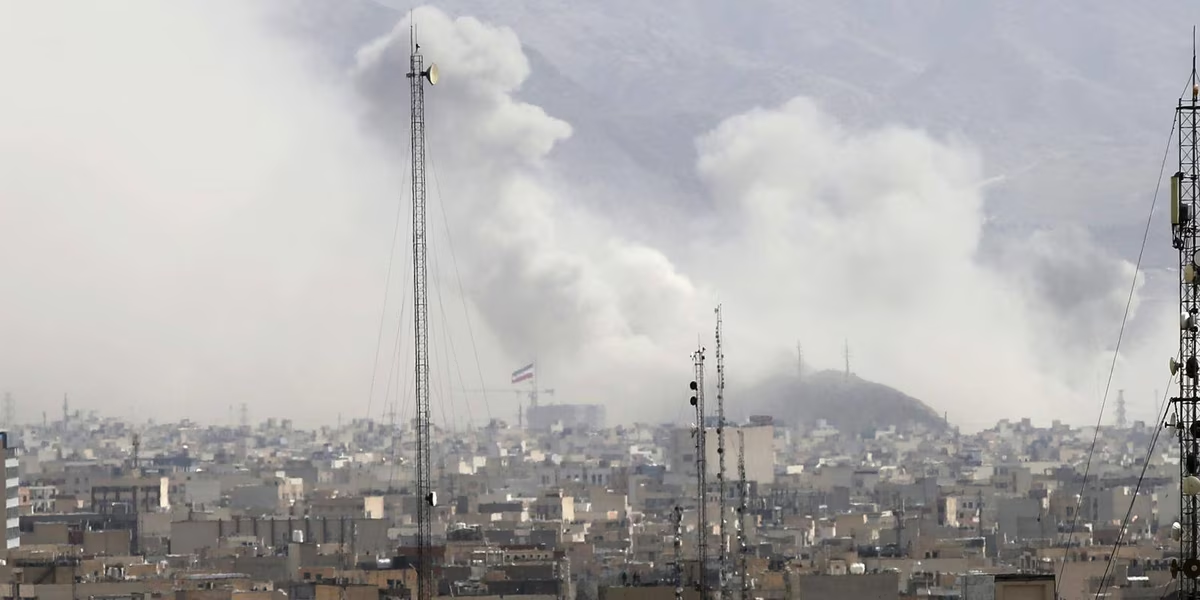
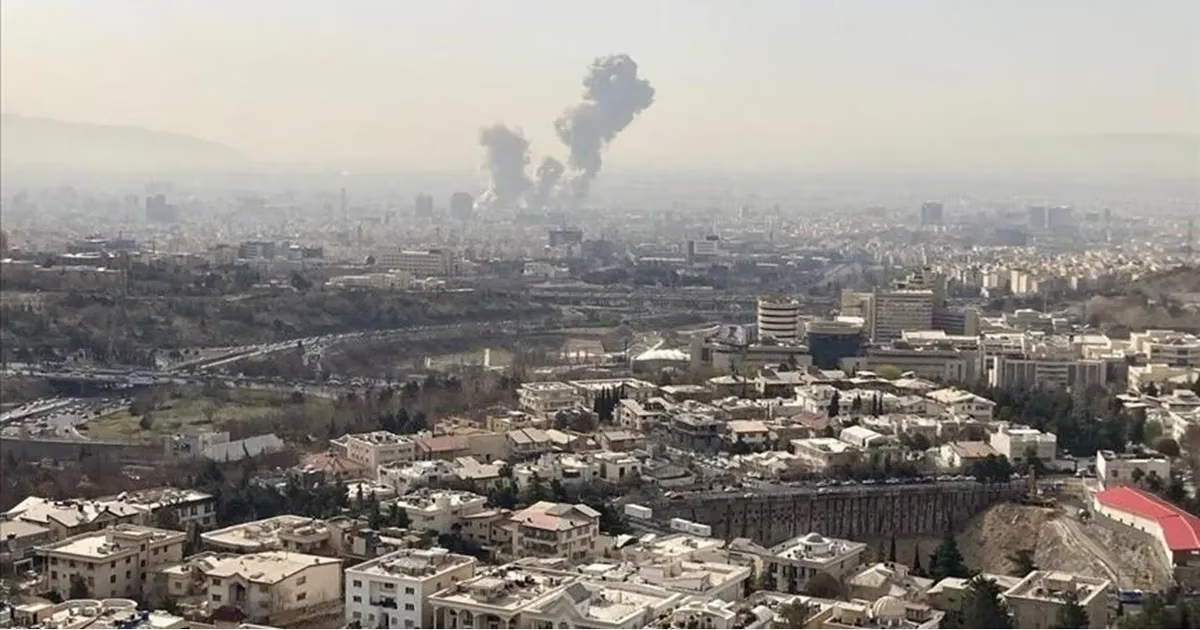
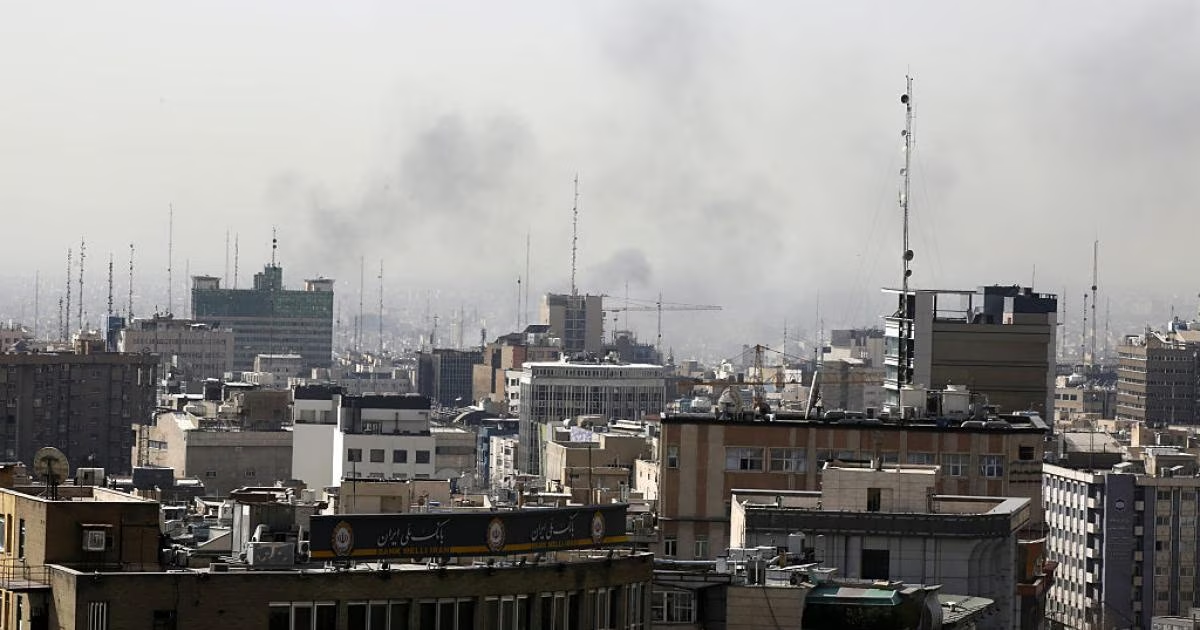
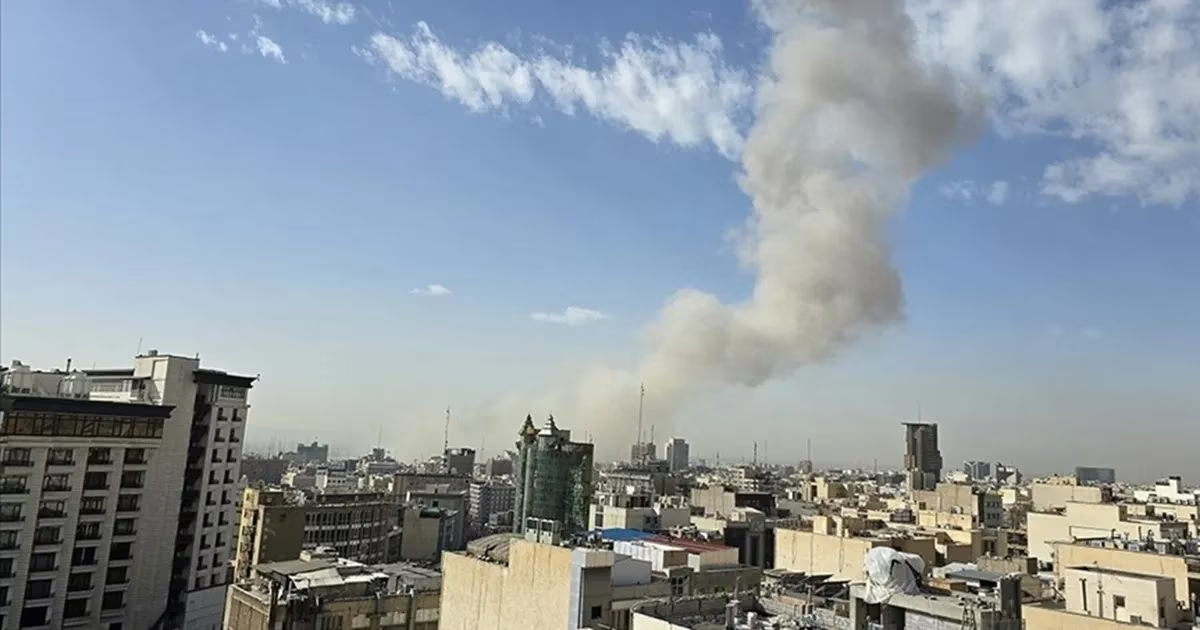
In an unprecedented escalation, the United States and Israel launched widespread military attacks on targets inside Iran on the dawn of February 28, 2026, targeting military and leadership sites and strategic facilities in several cities, amidst Washington's announcement of the start of "major combat operations" and public calls for regime change in Iran. Tehran quickly responded with missile and drone attacks targeting American bases and Israeli sites in the region, indicating from the first hours that the confrontation has entered an open war phase that will be difficult to contain quickly.

Field and political indicators suggest that the conflict will not be a limited strike or a short deterrence operation, but rather the beginning of a long war of attrition that could drag the Middle East into a new cycle of intertwined wars. The attacks did not target only a specific program, but included the Iranian state's security and military structure, while accompanied by American statements calling on Iranians to overthrow their government, which reinforces the impression that the true goal goes beyond deterrence towards reshaping the political system by force.

The war is presented as a preemptive step to prevent future threats, but the absence of evidence of an imminent danger raises questions about the legitimacy of resorting to military force of this magnitude. The American-Israeli discourse is based on a long record of accumulated conflicts and accusations against Iran, but it does not provide a convincing explanation for the necessity of launching an immediate war, which makes the operation closer to an optional war with long-term political goals.

The central assumption that seems to govern the current strategy is that intensive strikes will weaken the Iranian regime and push the internal society to revolt against it. However, recent history shows that external bombardment often strengthens nationalistic tendencies and grants targeted regimes defensive legitimacy, rather than leading to their collapse. Under external threat, societies tend to rally around the state, even if they oppose it internally.

More dangerous is the absence of a clear vision for the day after. The war does not seem to be accompanied by a political plan to manage a transitional phase in a large and complex country like Iran, whose population exceeds ninety million and possesses deeply rooted security and military institutions. Previous experiences in Iraq, Libya, and Afghanistan have shown that overthrowing regimes without a vision for reconstruction often leads to a security vacuum and extended chaos that transcends the borders of the state itself.

Moreover, the limited international support for the operation deepens the risks. The campaign is practically managed by a narrow alliance, which reinforces the image of unilateral military action and weakens its political and diplomatic cover. With the start of the Iranian response and the targeting of regional bases and interests, the risk of the conflict expanding to include other countries increases, either directly or through unconventional conflict arenas.

Potential scenarios range from widespread regional escalation, or a long war of attrition, or a partial collapse of the Iranian state that opens the door to security chaos and competing armed forces. In all these possibilities, military force alone does not seem capable of achieving stability or imposing a viable political system.

Most dangerously, the war could turn into a continuous series of strikes and responses, where no party can achieve a decisive victory, while human and economic losses accumulate and the circle of instability expands. With each round of escalation, exiting the conflict becomes more difficult, and the war transforms from a political decision into a permanent geopolitical reality.

In conclusion, the current confrontation appears to be a major strategic gamble, relying on optimistic assumptions about the speed of the adversary's collapse, while historical experiences indicate that wars that begin without a clear political vision often last much longer than expected or planned for.

ARAB AND WORLD

Sat 28 Feb 2026 7:01 pm - Jerusalem Time

Comprehensive Military Escalation: Iranian Missiles Target Israel and US Ship, Araqchi Affirms Impossibility of Regime Change

The region witnessed an unprecedented military escalation, as Iranian state television announced the launch of successive waves of missiles towards Israeli targets. These missile barrages come in response to what Tehran described as the joint aggression initiated by US and Israeli forces on Saturday morning, bringing the direct confrontation into a new and dangerous phase.

In a significant field development, the Iranian Revolutionary Guard Corps (IRGC) revealed that it had targeted an MST-class combat support ship belonging to the US Navy in the region's waters. The IRGC warned in its statement that all other US naval vessels are now within range of Iranian missiles and drones, emphasizing its readiness to expand the scope of the military response.

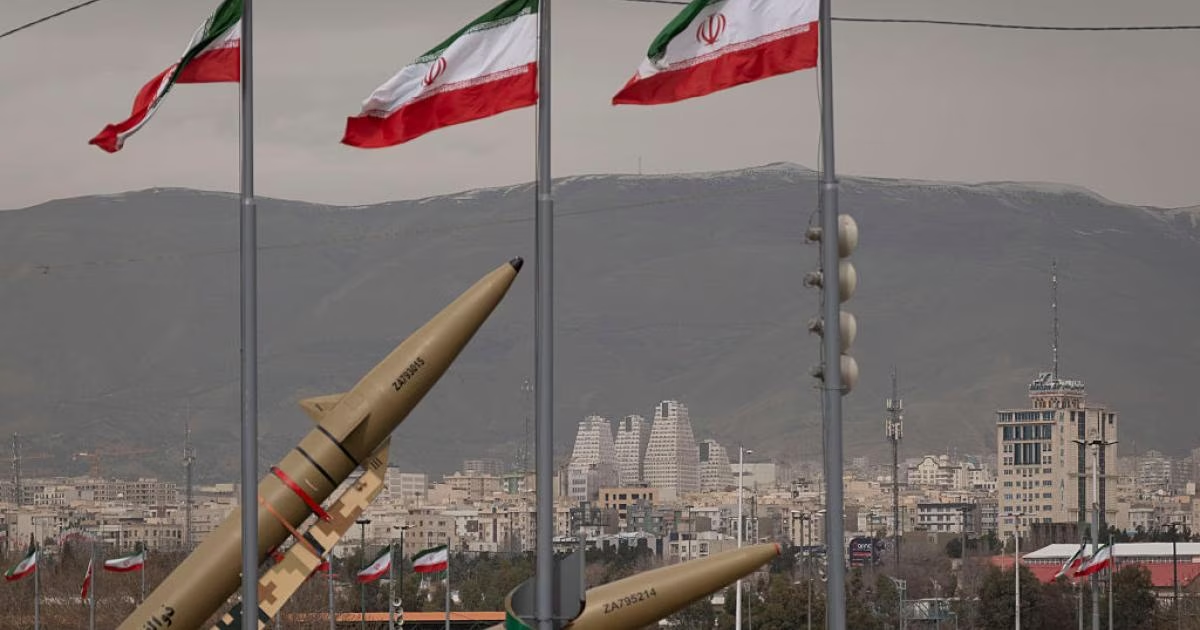
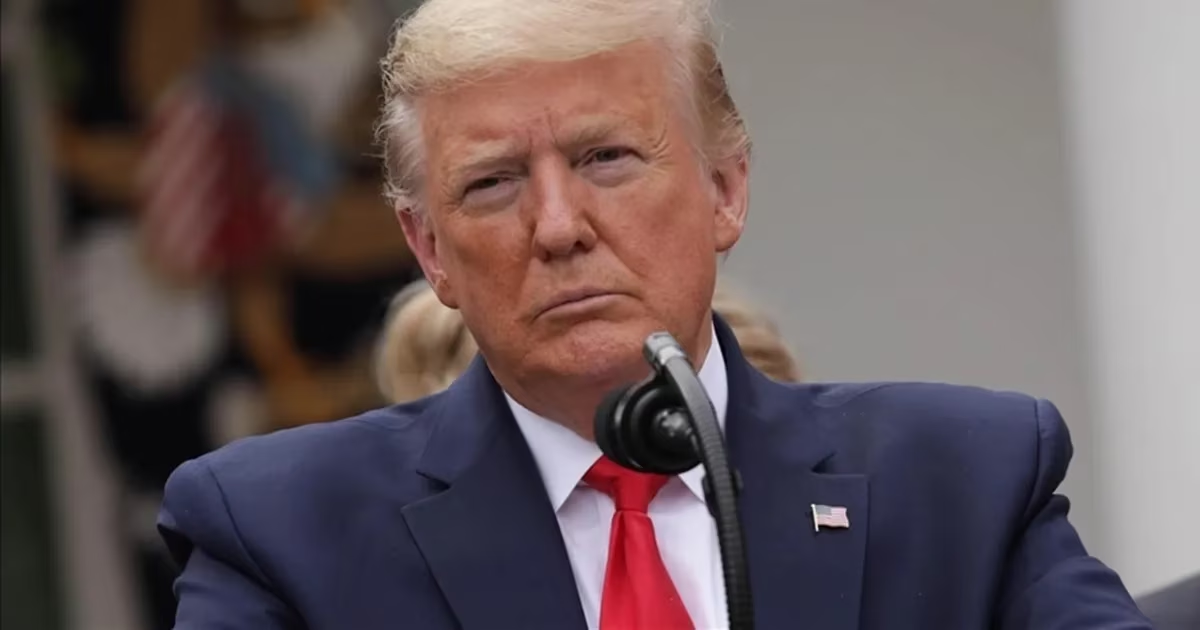
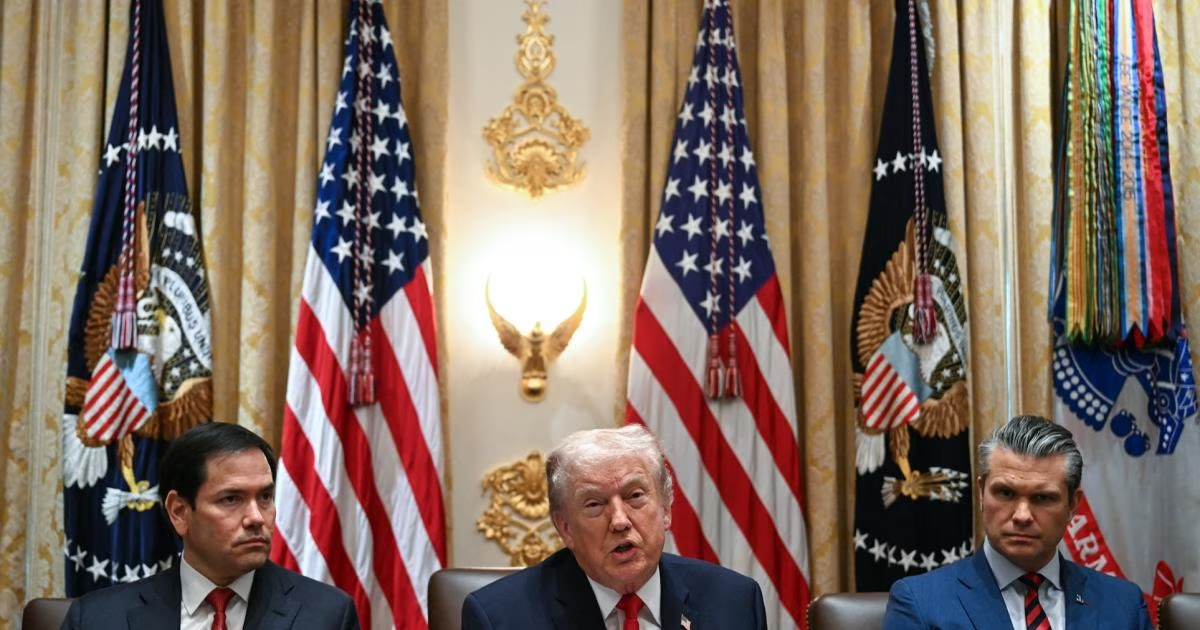
For his part, US President Donald Trump confirmed the start of large-scale combat operations inside Iranian territory under the name 'Lion's Roar'. Trump explained that the strategic objectives of this operation are to completely destroy Iran's missile program infrastructure, in addition to annihilating Tehran's naval fleet to ensure regional security.

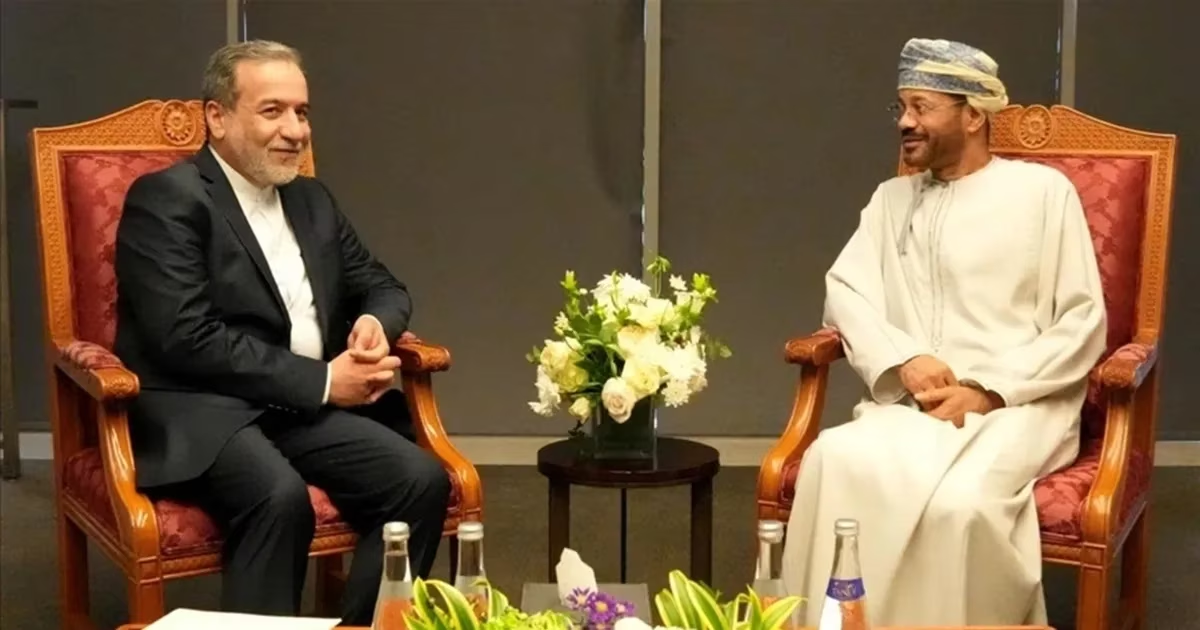
On the political front, Iranian Foreign Minister Abbas Araqchi described the attacks as illegal and lacking any legitimate justification. Araqchi affirmed that the Iranian armed forces had been preparing for this scenario for a long time, stressing that the aggressors would receive a harsh lesson that would redefine the balance of power in the Middle East.

Iran's chief diplomat accused the US President of prioritizing Israeli interests over his country's national interests, considering that the slogan 'America First' has effectively turned into 'Israel First'. Araqchi indicated that these policies place the United States at the bottom of the international list and drag it into conflicts that do not serve its people.

As part of intensive diplomatic moves, Araqchi held a phone call with his Russian counterpart, Sergey Lavrov, to discuss the repercussions of the military aggression. The Iranian minister called for the necessity of the UN Security Council's intervention to stop the aggressive actions and hold those responsible accountable, warning against the consequences of international silence regarding this dangerous escalation.

Araqchi stressed during his statements that betting on regime change in Iran is an 'impossible mission' that will not be achieved through military force or political pressure. The minister conditioned a return to any negotiation path on an immediate cessation of military attacks, emphasizing that Tehran will not negotiate under the weight of fire and direct threats.

It is worth noting that this military explosion came after the failure of three rounds of nuclear negotiations hosted by the Sultanate of Oman this month. The failure of the diplomatic track coincided with massive US military buildups in the region, paving the way for the outbreak of the current confrontation that has put Israel in a state of extreme emergency.

Regime change in Iran is an impossible mission, and the aggressors must stop first before talking about any negotiations.

ISRAELI AFFAIRS

Sat 28 Feb 2026 7:01 pm - Jerusalem Time

Five Defensive Layers.. How is the Occupation Preparing to Confront Iranian Missiles?

The Israeli occupation authorities announced an increase in the readiness of their defensive systems to confront any potential Iranian missile attacks, coinciding with joint military movements with the United States. This strategy relies on a multi-layered defense system aimed at intercepting threats at different atmospheric levels, starting from outer space down to short-range targets.

Media reports indicated that the lessons from military confrontations over the past two years have forced the occupation army to adopt a policy of 'armament economy' due to the high intensity of launches. Despite success in intercepting many missiles, the occupation incurred heavy material losses, which led the seven-battalion air defense system to redeploy and coordinate closely with US forces.

Military experts believe that the most dangerous scenario is Tehran possessing a stockpile of heavy missiles that have not yet been used in previous attacks. It is believed that in the event of a full-scale confrontation, Iran might resort to targeting symbolic non-military centers, which would require preemptive American intervention to disable launch platforms through a barrage of cruise missiles.

Informed sources revealed that the head of the occupation government, Benjamin Netanyahu, had previously requested a delay in military operations against Iran due to a severe shortage of interceptor missile stockpiles. However, the arrival of significant American reinforcements and the deployment of advanced systems helped fill these gaps, especially after the significant depletion of stockpiles in the June 2025 confrontations.

The 'Arrow 3' system forms the first line of defense for the occupation, designed to destroy ballistic missiles outside the atmosphere at distances up to 2400 kilometers. This system relies on pioneering technologies that allow it to deal with long-range strategic threats before they reach nearby airspace, reducing the risk of debris falling over populated areas.

The second defensive layer is the 'Arrow 2' system, which is responsible for intercepting ballistic missiles within the atmosphere at altitudes up to 100 kilometers. This system integrates with the American 'THAAD' system recently deployed in the region, providing dual protection and a high capability to track targets during the acceleration or descent phase.

Regarding medium-range threats, the occupation relies on the 'David's Sling' system, which has undergone extensive upgrades to counter cruise missiles and drones. This system operates using a direct hit method and is designed to deal with heavy projectiles that escape the upper layers, covering a range of 15 to 70 kilometers from the ground.

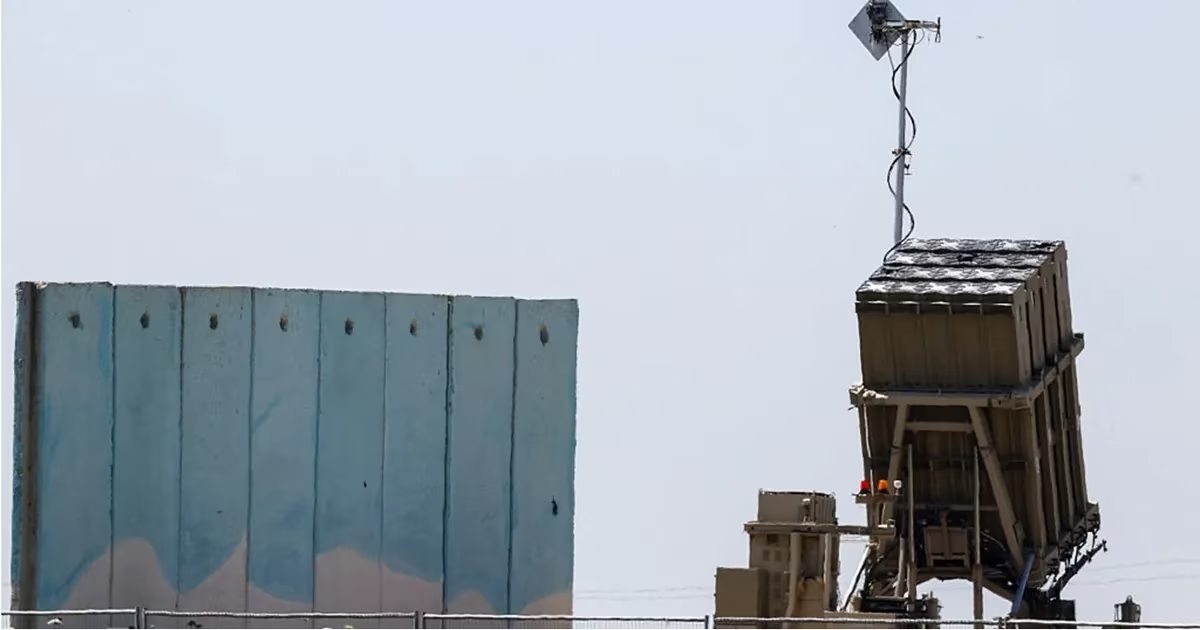
The Iron Dome comes in fourth place as a primary tool for dealing with short-range missiles and mortar shells, in both its land and naval versions installed on 'Sa'ar 6' ships. The naval dome plays a vital role in protecting gas platforms and strategic infrastructure offshore, supported by 'Barak' missiles designed for more distant and complex targets.

Laser technology, known as 'Iron Beam,' represents the fifth and newest layer in the occupation's defensive arsenal, aiming to provide low-cost and high-precision solutions. This system allows for the interception of drones and projectiles using advanced electro-optical guidance, which reduces the overall reliance on expensive traditional interceptor missiles.

Despite this extensive technological display, military reports confirm that these systems do not provide one hundred percent complete immunity against intensive Iranian attacks. Previous experiences have proven the ability of simultaneous missile barrages to overwhelm defense systems, keeping the occupation's home front in a constant state of anxiety from any large-scale escalation.

The worst-case scenario is Iran using heavier missiles not yet deployed if it feels an existential threat.

ARAB AND WORLD

Sat 28 Feb 2026 7:01 pm - Jerusalem Time

Massacre at 'Good Tree' School in Iran: 57 Female Students Killed in Joint Raids

Official sources in Iran announced a tragic increase in the number of victims of the attack that targeted the 'Good Tree' primary school for girls in the southern province of Hormozgan. Field reports confirmed that the number of female students killed reached 57, while about 60 others sustained injuries of varying severity, causing a state of shock in local and international circles.

Sources from the Iranian Ministry of Education reported that the airstrike targeting the Minab area not only resulted in the death of female students but also injured several teachers who were present inside the educational institution. This new toll updates previous data provided by Minab's governor, Mohammad Radmehr, which indicated the killing of 51 students before the numbers were updated.

These bloody field developments come in the context of a joint military operation launched by Israel and the United States early Saturday under the name 'Lion's Roar'. US President Donald Trump officially announced the start of widespread combat operations targeting Iranian territory, representing an unprecedented escalation in the region.

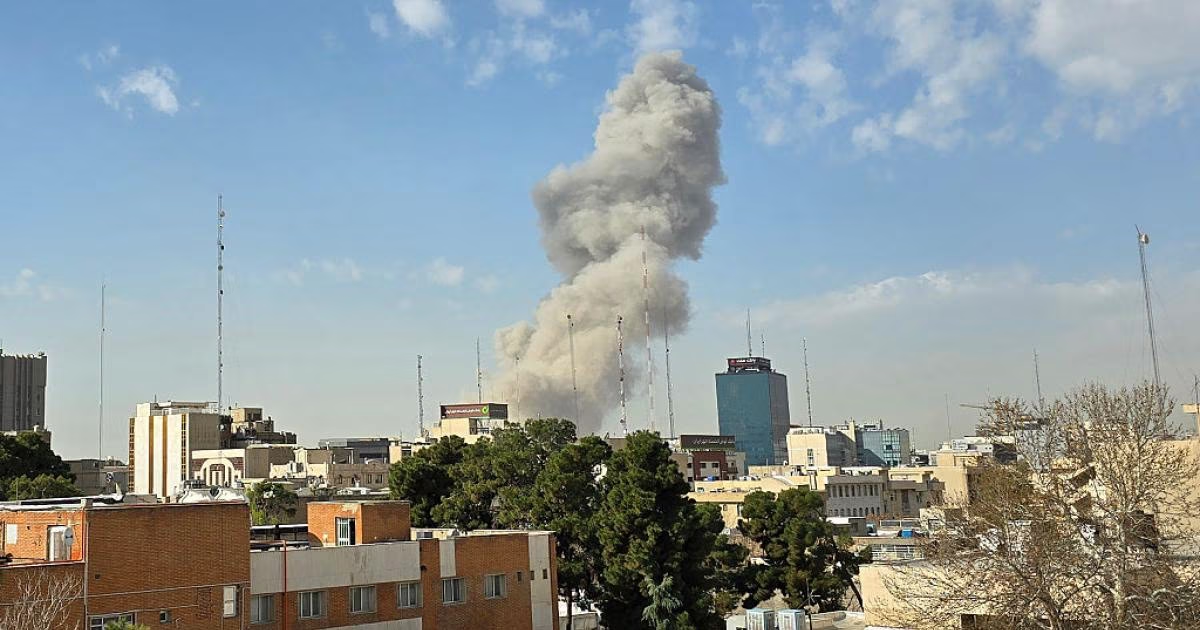
The past hours witnessed a series of violent explosions that rocked several Iranian cities, with social media platforms circulating images showing a massive explosion in Tabriz. The capital Tehran and other provinces are subjected to continuous raids, amid a partial blackout on the nature of the targets hit by the intense aerial bombardment since the early morning hours.

Media sources from Tehran indicated that the issue of targeting the girls' school topped the priorities of Iranian diplomatic action, as Tehran seeks to document what it described as aggression against civilian facilities. These attacks caused a state of panic and terror among the local population, especially with the rapidly and unexpectedly increasing number of civilian casualties.

Despite the intensity of the raids, no official statement has yet been issued clarifying the nature of all buildings targeted in Tehran and other provinces. Questions arise as to whether these sites include security or military installations, or if they are related to the Iranian nuclear program, especially since the bombing affected populated residential areas.

The field situation in Iran remains prone to further escalation, with ongoing air operations targeting infrastructure and civilian areas. Rescue teams face significant difficulties in dealing with the extent of the destruction resulting from the raids, at a time when hospitals continue to receive dozens of injured victims from the targeting of the 'Good Tree' school.

The United States launched widespread combat operations in Iran.

ARAB AND WORLD

Sat 28 Feb 2026 7:00 pm - Jerusalem Time

Lebanon on High Alert: Political Moves and Public Concern Following Attack on Iran

Lebanese President Joseph Aoun stressed today, Saturday, that protecting the Lebanese arena from potential disasters is an absolute priority for the state at this stage. Aoun's statements came after the start of the Israeli-American attack on Iranian territory, which raised fears of an escalation of the conflict.

President Aoun called on all constitutional authorities and relevant agencies to raise levels of readiness and joint coordination to ensure the country's stability. He pointed out that the critical nature of the current stage requires everyone to prioritize the supreme national interest above any partisan or external considerations to ensure sovereignty and security.

For his part, Lebanese Prime Minister Nawaf Salam warned against being drawn into ill-considered adventures that could threaten the unity and security of Lebanese territory. Salam emphasized, in an appeal to citizens and political forces, the necessity of wisdom and patriotism to overcome the dangerous developments currently sweeping the region.

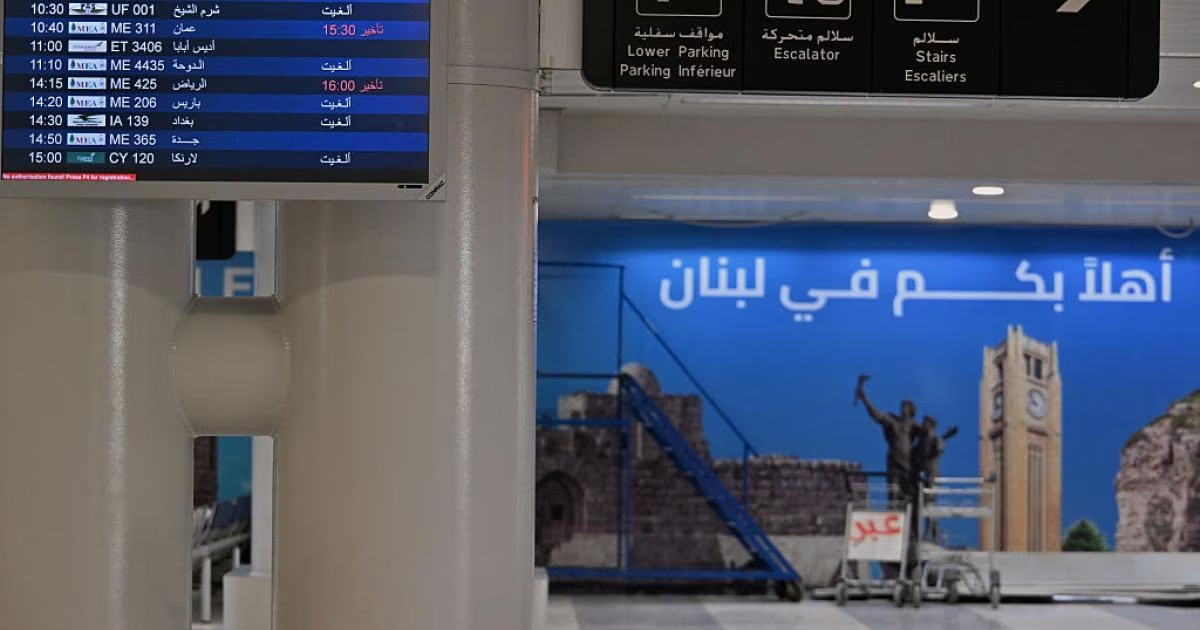
These official moves come amidst explicit Israeli threats to target civilian infrastructure in Lebanon, including Beirut International Airport. The occupation authorities stipulated that Hezbollah not engage in any direct military confrontation between the United States and Iran to avoid this scenario.

On the ground, media sources reported a clear state of anxiety gripping both the Lebanese street and official institutions. This tension was reflected in a series of intensive security and social meetings held by the Prime Minister to follow up on field and political developments.

In a related context, the Lebanese government affirmed that it is making strenuous diplomatic efforts with international and regional parties to spare the country the repercussions of war. These contacts aim to neutralize Lebanon from the ongoing conflict and ensure that it does not become an arena for settling major regional scores.

Fuel stations in various Lebanese regions witnessed a large rush from citizens fearing supply disruptions or the outbreak of a full-scale confrontation. This scene prompted the Ministry of Energy to issue a statement reassuring the public of the availability of sufficient quantities of fuel in the markets.

Official bodies also called on citizens not to rush to buy food items and store them excessively, emphasizing that supply chains are still operating. Despite these reassurances, anticipation remains the dominant sentiment among the public, who fear a repeat of previous crisis scenarios.

In the aviation sector, several foreign and regional airlines announced the suspension of their flights to and from Rafic Hariri International Airport in Beirut. Sources from within the airport clarified that this measure will continue for 24 hours, with the decision being reviewed periodically based on field developments.

In contrast, Middle East Airlines, the Lebanese national carrier, continued to operate its scheduled flights normally until now. Airport management and operating companies are closely monitoring the security situation to make appropriate decisions regarding the safety of air navigation in Lebanese airspace.

Protecting Lebanon from disasters is an absolute priority in the current critical phase, which requires commitment to national responsibility.

ARAB AND WORLD

Sat 28 Feb 2026 7:00 pm - Jerusalem Time

Escalation in Iraq: US Embassy Closure and Faction Mobilization Following Jurf al-Sakhar Raids

Informed sources reported the closure of the US Embassy in the Iraqi capital, Baghdad, as part of strict precautionary security measures. This step comes amid intelligence information indicating the intention of three Iraqi factions to carry out drone attacks targeting Israeli sites and US military bases in the region.

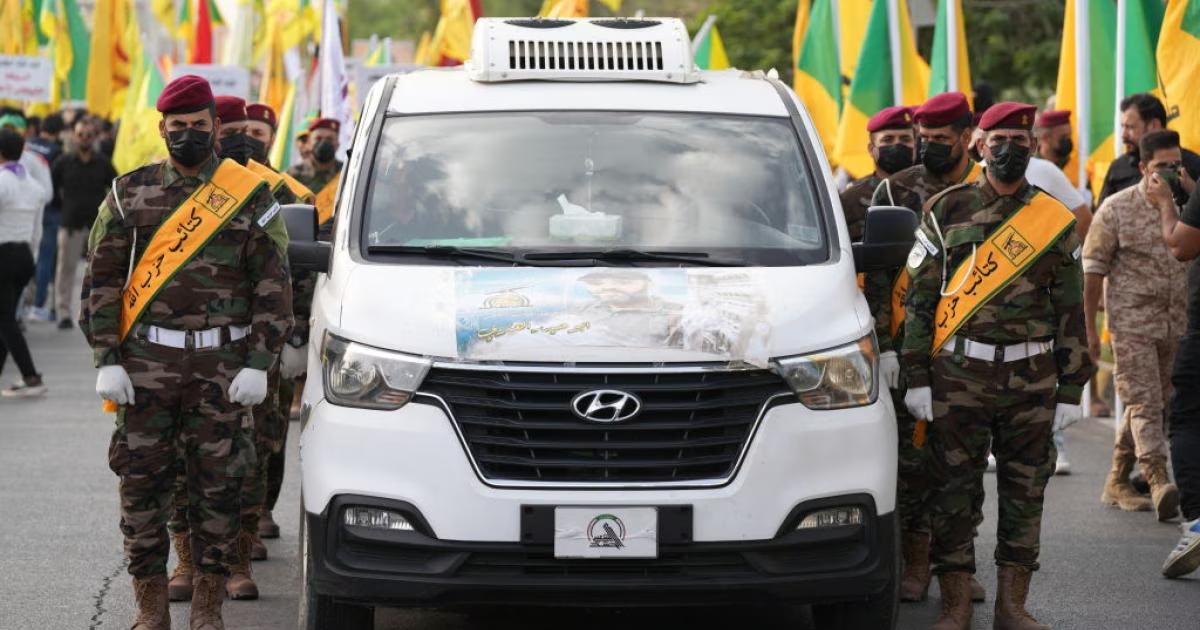
For its part, the Iraqi Kata'ib Hezbollah issued a direct warning, affirming its intention to launch imminent attacks on US bases deployed in the country. This threat came after a military base belonging to the group was subjected to aerial attacks, prompting the faction to call on its fighters to prepare for a long-term confrontation.

On the diplomatic front, Iranian Foreign Minister Abbas Araghchi held a phone call with his Iraqi counterpart, Fuad Hussein, to discuss the rapidly developing situation. Araghchi clarified during the call that any upcoming Iranian military action would be directed exclusively against American targets in response to the aggressions against Tehran, emphasizing that no other countries or capitals in the region would be targeted.

In the context of field developments, two people were killed and three others injured as a result of airstrikes targeting the Jurf al-Sakhar base, also known as Jurf al-Nasr, located south of Baghdad. This base is a vital center for the Kata'ib Hezbollah faction, which is part of the Popular Mobilization Forces and an official component of the state's security system.

The government's Security Media Cell confirmed that the airstrikes occurred at exactly 11:50 AM on Saturday in the northern Babil province. The cell stated in an official statement that the attack resulted in the martyrdom of two individuals and injuries to others, necessitating a medical and security mobilization in the area.

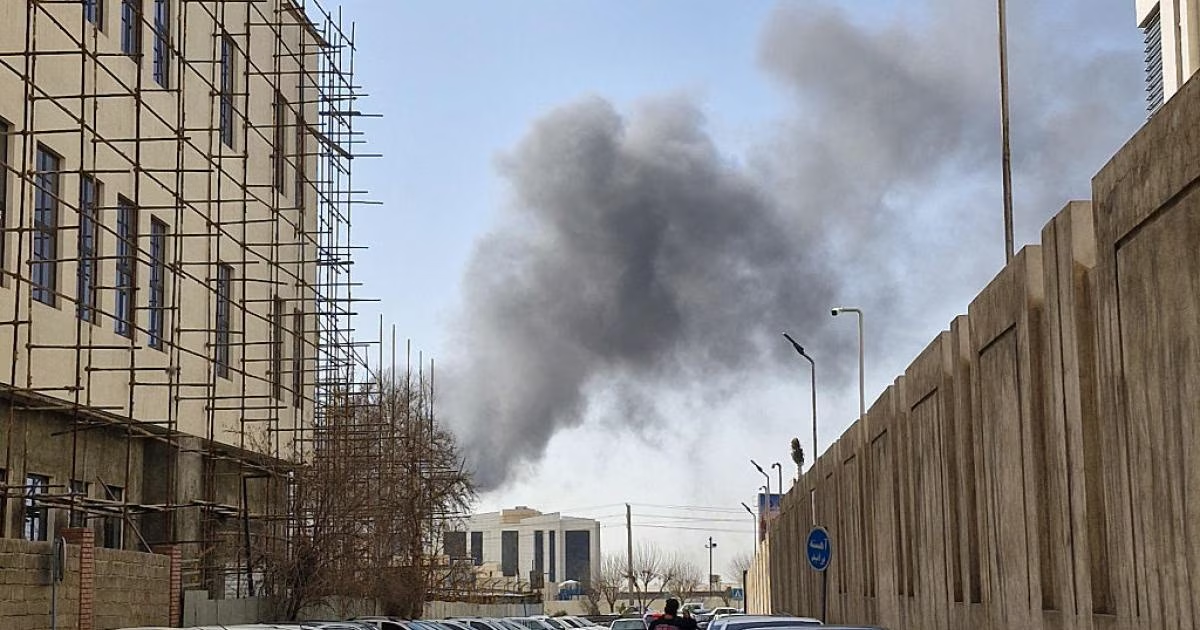
In the Kurdistan Region, media sources reported that US air defenses managed to intercept unknown drones flying over the city of Erbil. Loud explosions were heard around the US Consulate, where columns of smoke were seen rising, causing concern among the city's residents.

The Iraqi government in Baghdad is holding intensive high-level meetings to discuss the repercussions of the recent escalation and ways to contain the situation. These moves coincide with parliamentary calls for an emergency session to discuss security breaches and national sovereignty in light of the repeated airstrikes.

Kata'ib Hezbollah had previously warned Washington of incurring heavy losses if a full-scale confrontation erupted in the Middle East. The military leadership of the brigades urged its elements to be fully prepared for a prolonged war of attrition, signaling a change in the previously established rules of engagement.

It is worth noting that Iraqi factions had exercised restraint during previous rounds of escalation between Iran and Israel, but the recent attacks on Jurf al-Sakhar may push these forces towards direct involvement in the regional conflict, posing complex security and political challenges for the Iraqi government.

Any Iranian targeting will be against American facilities in response to the aggression against our country, and has no relation to other countries or capitals.

ARAB AND WORLD

Sat 28 Feb 2026 7:00 pm - Jerusalem Time

Washington and Tel Aviv's aggression against Iran thwarts an imminent nuclear deal

The joint military attack launched by Israel and the United States against Iranian territory raised deep questions about Washington's seriousness in the diplomatic path. This escalation comes at a time when negotiation channels were witnessing intense activity to reach a comprehensive settlement of the nuclear issue.

Data indicates that the aggression, which lasted for about 12 days, came a few days before the start of the sixth round of direct talks. This timing was considered by observers as a fatal blow to the chances of building trust between Tehran and the current US administration led by Donald Trump.

For his part, Iranian Foreign Minister Abbas Araghchi adopted a cautious approach towards American promises, aware of the possibility of Washington reneging on understandings. Nevertheless, the Iranian leadership considered that the risk of entering new negotiations was worth the experiment to avoid military escalation.

In the context of mediation, the Sultanate of Oman made diligent efforts to bridge the views between the two parties through high-level meetings in Washington. Omani Foreign Minister Badr Al Busaidi confirmed that the parties were on the verge of announcing a historic breakthrough in the thorny issue.

The draft agreement that was being worked on included unprecedented provisions related to strict nuclear oversight. Under it, Tehran agreed to liquidate its entire stockpile of highly enriched uranium, a demand that Western powers had long called for.

Iranian concessions were not limited to this, but also included granting the International Atomic Energy Agency full and unconditional access to facilities. A remarkable development also emerged with the approval of American weapons inspectors entering alongside international inspectors to ensure absolute transparency.

Future enrichment operations in Iran were supposed to be limited to civilian and research needs only. Optimism prevailed in diplomatic circles about the possibility of signing the final principles agreement during the week that witnessed the military attacks.

However, the coordinated military operations undermined this diplomatic path, leaving the region facing open scenarios of confrontation. Analysts believe that this attack reflects the dominance of the hawkish current in Washington and Tel Aviv at the expense of peaceful political solutions.

In his justification for the military action, US President Donald Trump ignored talking about the progress made in the secret negotiations. He merely indicated that Iranian activities pose a direct threat to American interests and bases and its allies in the region and the world.

The US administration is currently facing increasing internal criticism regarding the feasibility of resorting to force in light of the availability of a diplomatic alternative. Opponents accuse Trump of succumbing to Israeli pressure aimed at preventing any potential rapprochement that could end the decades-long state of tension.

The White House is also criticized for not providing sufficient clarifications to Congress or international allies about the objectives of this sudden escalation. It appears that the lack of coordination has confused allies who were counting on the success of Omani mediation to calm the situation in the Middle East.

The question remains about the ability of the Iranian regime to return to the negotiating table after this direct military strike. The trust, which was already shaky, suffered a rift that may be difficult to repair in the foreseeable future, opening the door to a new arms race.

A peace agreement was imminent, and talks were on the verge of achieving a major breakthrough that would surpass the 2015 agreement.

ARAB AND WORLD

Sat 28 Feb 2026 7:00 pm - Jerusalem Time

Widespread international diplomatic activity and France calls for an emergency Security Council session to stop escalation against Iran

The international arena is witnessing intense diplomatic activity following military attacks launched by Israeli and American forces against targets in Iran. International reactions have warned of the situation getting out of control, amidst explicit calls for the necessity of returning to the political path and avoiding military options that threaten the stability of the Middle East and the world.

In this context, Omani Foreign Minister Sayyid Badr Albusaidi sent a firm message to the American administration, demanding it not to slide further into this conflict. Albusaidi affirmed that this confrontation does not serve American interests nor does it contribute to achieving global peace, stressing that the ongoing military operations blatantly contradict the principles of international law.

For its part, Turkish diplomacy actively entered the crisis, as official sources in Ankara revealed extensive movements led by Foreign Minister Hakan Fidan. Fidan held a series of contacts that included his counterparts in Iran, Iraq, Saudi Arabia, Qatar, and Syria, with the aim of coordinating positions and searching for practical steps to stop the mutual attacks.

On the European level, Spanish Prime Minister Pedro Sánchez announced his categorical rejection of the unilateral military action carried out by the United States and Israel. In an official statement, Sánchez described this move as contributing to the creation of a more hostile and ambiguous international system, demanding the necessity of immediate de-escalation and adherence to international legitimacy.

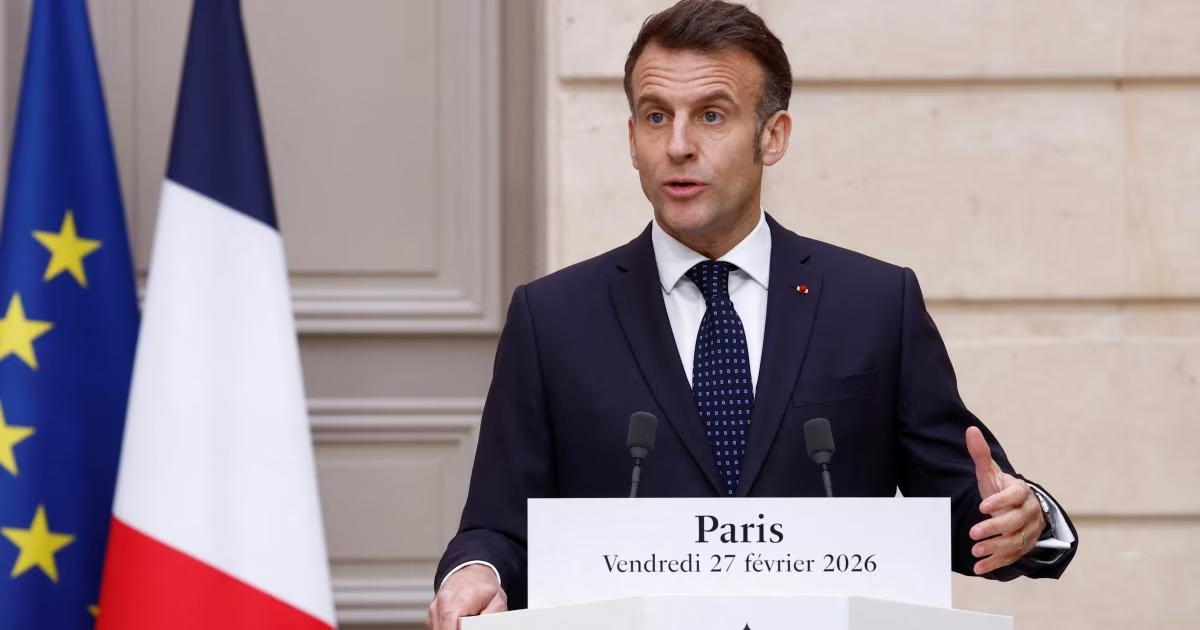
In an escalating diplomatic move, French President Emmanuel Macron called for an emergency meeting of the United Nations Security Council. Macron explained that the outbreak of a direct confrontation between Washington and Tel Aviv on one hand, and Tehran on the other, would lead to dire consequences whose impact on international peace and security cannot be predicted.

The French Presidency office reported that Macron held separate phone calls with the leaders of Saudi Arabia, the UAE, Qatar, and Jordan, in addition to the President of the Kurdistan Region of Iraq. These discussions focused on ways to protect regional stability and prevent the conflict from spreading to neighboring countries, in light of the extreme state of alert in the region.

The French President expressed his country's readiness to harness all necessary resources to protect Paris's closest partners in the region if they request it. However, Macron stressed that the Iranian regime is required to realize the seriousness of the situation and engage in serious negotiations to end its nuclear and missile programs that concern the international community.

In contrast, the Canadian position supported the American approach, as the Canadian Prime Minister affirmed his country's stand with Washington in its efforts to prevent Iran from acquiring nuclear weapons. Ottawa considered current Iranian policies a direct threat to global security, necessitating firm measures to deter Tehran.

Reports from diplomatic sources indicate that the coming hours will be crucial in the corridors of the United Nations, as several countries seek to formulate a resolution calling for a ceasefire. These efforts clash with differing visions among major powers on how to deal with the Iranian file and the repercussions of the recent attack.

Anticipation remains the master of the situation in regional capitals, as observers fear that these attacks could lead to retaliatory reactions that get out of control. Consultations continue behind the scenes to try to find a political solution that spares the region a comprehensive war that could burn everything and destroy global energy supplies.

This is not your war.. American involvement does not serve Washington's interests nor the cause of global peace.

PALESTINE

Sat 28 Feb 2026 7:00 pm - Jerusalem Time

9 Dead in Gaza in 24 Hours as Occupation Continues to Violate Ceasefire Agreement

The Ministry of Health in the Gaza Strip announced today, Saturday, an increase in the number of casualties from the ongoing Israeli aggression since October 7, 2023, to 72,095 martyrs and 171,784 injured. Medical sources clarified that hospitals received the bodies of 9 martyrs and 19 injured during the past twenty-four hours, as a result of a series of targeting incidents in various areas of the Strip, amid difficult field conditions that prevent rescue teams from reaching those missing under the rubble.

Regarding adherence to the ceasefire agreement concluded on October 11, official data revealed that 628 Palestinians have been martyred and 1,686 others injured since the agreement came into effect. Civil defense teams also managed to recover 735 bodies from various locations that had been previously bombed, reflecting the extent of the ongoing violations of the declared truce and the continuation of Israeli military operations.

On the ground, the early hours of Saturday witnessed a military escalation in the form of intensive airstrikes and artillery shelling targeting the eastern neighborhoods of Gaza City. Concurrently, occupation forces carried out widespread demolition operations of residential buildings in the eastern area of Khan Yunis city in the southern Strip, which falls within the policy of destroying infrastructure and residential blocks adopted by the Israeli army in border areas.

In the northern Strip, local sources reported the martyrdom of a Palestinian citizen by occupation forces' bullets in the town of Beit Lahia, which is under a strict siege and continuous military pressure. This incident comes in the context of direct targeting of civilians in contact areas, as Israeli vehicles continue to position themselves around residential areas and fire at anyone moving in those areas.

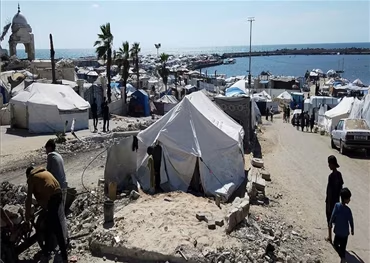
In Khan Yunis, an occupation drone targeted a tent sheltering displaced people inside a school near the Nasser Medical Complex, resulting in the martyrdom of one citizen and the injury of three others with varying degrees of wounds. The medical complex administration confirmed the arrival of victims as a result of this bombing, which targeted a densely populated tent area, exacerbating the suffering of the displaced who face harsh humanitarian conditions under the impact of the low-pressure weather system and repeated shelling.

A number of victims remain under the rubble and in the streets, as ambulance and rescue teams are unable to reach them due to continuous targeting.

ARAB AND WORLD

Sat 28 Feb 2026 6:59 pm - Jerusalem Time

Omani Foreign Minister announces historic breakthrough in Iranian nuclear file: 'Zero Stockpile' and imminent agreement

Omani Foreign Minister, Badr Al Busaidi, revealed dramatic developments in the course of negotiations related to the Iranian nuclear file, describing what has been achieved as an 'unprecedented breakthrough' that was not achieved in previous negotiation rounds. Al Busaidi affirmed in media statements that Tehran has given official approval to end the military aspect of its nuclear program, indicating that a diplomatic solution has become the only viable path to avoid military escalation in the region.

The Omani minister explained that the core of the new agreement is based on the principle of 'zero stockpile' of enriched materials, where Iran has agreed not to retain any quantities of uranium that could be used as fuel to make a nuclear weapon on its territory. He stressed that this clause represents a fundamental guarantee to prevent any future attempt to produce a nuclear bomb, which surpasses in its effectiveness the restrictions that were imposed in the nuclear agreement concluded in 2015 during the administration of former US President Barack Obama.

Al Busaidi touched upon the monitoring mechanisms, confirming that the agreement grants the International Atomic Energy Agency full powers for comprehensive and extensive verification of Iranian activities. He indicated that this strict monitoring system may, in advanced stages, allow American inspectors access to Iranian facilities, which enhances international trust levels in the peaceful nature of the Iranian nuclear program and Tehran's commitment to the terms of the new understandings.

Regarding technical details, sources mentioned that both sides agreed to reduce uranium enrichment levels to the lowest possible degrees, and to convert current materials into nuclear fuel designated for civilian purposes only. This transformation ensures no accumulation of any dual-use materials, and closes the door to any nuclear military ambitions, which the Omani minister considered a fundamental development that reshapes the security landscape in the Middle East.

The agreement was not limited to the nuclear aspect only, but also extended to include regional issues that concern Iran's neighbors; Al Busaidi announced an initial agreement to discuss Tehran's regional activities within the framework of an expanded dialogue with Arab countries. This parallel track aims to address outstanding issues outside the nuclear framework, ensuring regional stability and building relations based on good neighborliness and joint cooperation.

Regarding the timeline for implementation, the minister stated that the Austrian capital, Vienna, will host crucial meetings next Monday, followed by complementary rounds during the same week to complete the remaining technical details. Al Busaidi expected that all implementation procedures, including addressing the stockpile file and establishing final verification mechanisms, would be completed within a period not exceeding three months from now.

The head of Omani diplomacy stressed that his country is currently seeking to reach a 'comprehensive package' that includes all necessary components to ensure the sustainability of the agreement and its respect by all international parties. Despite his reservation about revealing all precise details at the present time, he affirmed that the general picture suggests that the final signing is within reach, provided that some outstanding points requiring a little additional time are completed.

Al Busaidi warned against resorting to any military action against Iranian facilities, considering that such steps would only complicate the crisis and increase regional tensions without offering real solutions. He affirmed that experience has proven that serious dialogue is the only way to permanently prevent Iran from acquiring a nuclear weapon, which is the goal that the international community currently agrees upon through active Omani mediation.

This announcement comes at a time when world capitals are awaiting the results of the upcoming Vienna rounds, where the Omani position represents a strong indicator of the imminent end of one of the most complex international crises in the last two decades. This agreement, if successful, is expected to alleviate regional polarization and open new horizons for economic and political cooperation between Iran and the international community, while ensuring the security and stability of neighboring countries.

I believe that we have solved the problem of the Iranian nuclear program through negotiation, by achieving a very important breakthrough that has not been achieved before, and if we build on this achievement, I believe that an agreement is very close.

ARAB AND WORLD

Sat 28 Feb 2026 6:59 pm - Jerusalem Time

The Struggle for Influence and the Redrawing of Maps: Is the Battle Over Iran or the Future of the Region?

The region is experiencing a state of turmoil following the Israeli-American aggression that targeted sites in the Iranian capital, Tehran, and several other areas on Saturday morning. This field escalation comes in the context of a prolonged conflict that goes beyond direct military details, raising fundamental questions about the future of political balances in the Middle East. The stance on Iran's role requires frankness without equivocation, especially in light of its deep interventions in thorny Arab issues.

Over the past decades, the Iranian regime has played a pivotal role in deepening crises within a number of Arab countries, starting from Iraq after 2003 to Syria, Lebanon, and Yemen. This project was not merely humanitarian solidarity, but was based on strategic, national, and sectarian calculations aimed at entrenching clear Iranian hegemony. It is natural that this expansion would face widespread rejection from peoples who have suffered from the disintegration of their national arenas.

However, criticizing Iranian policies does not mean being drawn into simplistic readings that seek to completely remove Iran from the regional equation. Iran is a country with deep roots in the history and geography of West Asia, and it is a constant component that cannot be ignored or treated as an alien element. Attempts to forcibly exclude regional powers often lead to counterproductive results that increase instability.

Historical readings indicate that the American-Iranian confrontation did not begin with the recent events in Gaza, but rather its roots go back to 1979 and the embassy crisis in Tehran. This tension deepened over decades of conflict over the nuclear file, economic sanctions, and regional influence. Therefore, linking the current confrontation exclusively to the Palestinian issue lacks historical accuracy, as Tehran's decisions have always been governed primarily by its supreme national interests.

Tehran has used the discourse of 'resistance and steadfastness' as a tool for political and media mobilization and to gain popular legitimacy in the Arab street. Despite the presence of this discourse, practical behavior has always been subject to the cost-benefit balance specific to the Iranian state alone. This was clearly demonstrated in managing the limits of confrontation after October 2023, where the pace of interventions was adjusted to protect the security of the Iranian regime.

The issue today goes beyond fears of the nuclear program or ballistic missiles, reaching an attempt to radically rearrange the regional balance of power. There is a clear endeavor to establish unilateral regional superiority by weakening competing powers and depleting their capabilities. The sole beneficiary of this path is the Israeli occupation, which seeks to create strategic vacuums that allow it to impose absolute hegemony over the region.

Field sources reported that the recent attacks prompted neighboring countries to take strict precautionary measures to protect their national security. Iraq announced the complete closure of its airspace, and flights at Erbil International Airport were suspended until further notice. These steps reflect the extent of concern about the region sliding into a comprehensive war that may not differentiate between warring parties and neutral states.

In a related context, Kuwait, Qatar, and the UAE announced similar measures, including suspending flights or modifying their air routes. Syria also closed its southern air corridors for 12 hours, adopting alternative routes to ensure navigation safety. These collective measures confirm that any explosion in the Iranian-Israeli conflict will affect the economic and security consequences of all countries in the region without exception.

Within the occupied territories, the occupation authorities declared a special state of emergency, including closing airspace and suspending studies in several areas. This alert reflects the occupation's fear of potential Iranian reactions that might target Israeli depth. This state of emergency places Israeli society before complex security challenges resulting from its government's escalation policies.

For its part, Iran closed its airspace for six hours after the explosions that rocked Tehran, in a measure aimed at controlling the airspace and securing vital sites. This field development places the region at a dangerous crossroads, where the language of weapons becomes dominant over the language of diplomacy. The consequences of this clash may reproduce new maps of influence at the expense of the stability of Arab societies.

The collapse of the existing balance in the region will not produce lasting stability, but will unleash new waves of chaos and uncertainty. The loss in the event of a widespread explosion will not be limited to one party, but will affect countries that will find themselves facing a reality where equations are imposed from outside. Therefore, protecting the interests of peoples requires an independent vision that rejects subservience to any project seeking subjugation.

What is required today is a conscious and balanced regional stance that balances criticism of expansionist Iranian policies with a rejection of projects aimed at dismantling the region. It is unacceptable to turn the Arab arena into a stage for settling international scores or for entrenching unilateral Israeli hegemony. Awareness of the dangers of the current moment requires moving away from blind alignments and focusing on protecting national sovereignty.

The ongoing battle is not just a technical confrontation over centrifuges or missile ranges, but a struggle over the identity of the coming regional order. Either the region emerges with a vision that guarantees the interests of its peoples, or it remains hostage to the conflicts of major powers and proxies. This pivotal moment will determine the shape of the Middle East for decades to come, and its results will affect the lives of millions.

In conclusion, the biggest challenge remains how to prevent the conflict from turning into a tool for redrawing maps by military force. The stability of the region depends on finding real balances that respect the sovereignty of states and reject hegemony in all its forms. Between the Iranian influence project and the opposing hegemony projects, the need for an independent Arab project emerges to protect what remains of stability in this turbulent region.

The ongoing battle today is not just a technical confrontation over uranium enrichment, but a struggle over the shape of the coming regional order.

ANALYSIS

Sat 28 Feb 2026 6:58 pm - Jerusalem Time

The Doctrinal Roots of American Bias: How 'Christian Zionism' Became a Pillar of Foreign Policy?

The book 'The Religious Dimension in American Policy Towards the Arab-Zionist Conflict' by researcher and diplomat Youssef Al-Hassan, raises fundamental questions about the nature of American desperation in defending the Zionist entity. The author believes that traditional explanations, which limit this support to strategic interests or the pressures of the Israeli lobby, remain inadequate for understanding the doctrinal depth that drives the ruling elites in Washington.

The book's central hypothesis revolves around the role of the contemporary Christian fundamentalist movement in the United States as a fundamental pillar of the Zionist project. Al-Hassan explains that this movement does not see Israel merely as a political ally, but considers its existence to be the fulfillment of biblical prophecies related to the Second Coming of Christ, making its defense a form of worship.

The book defines Christian fundamentalism as a radical movement that believes in the literal infallibility of the Bible, both Old and New Testaments. These individuals link the establishment of the occupation state in 1948 with the approaching end of time, as their belief stipulates the 'restoration of Israel' as a chosen people to their promised land to pave the way for the appearance of the awaited Savior.

As for Evangelicals, the author describes them as the solid bloc that believes in the necessity of the Second Coming of Christ, and sees supporting Israel as drawing closer to the Creator. These beliefs go so far as to consider any criticism of Israeli policies as a divine 'curse' that afflicts opponents, which explains the political immunity Israel enjoys in Congress.

Al-Hassan highlights 'Christian Zionism' as an ideology transcending Protestant churches, promoting the historical and religious right of Jews to Palestine. He cites the 'Ball Declaration' issued in 1985, in which leaders of global churches called on Jews to immigrate to Palestine, considering that it was God's hand that gathered their diaspora.

The book traces the roots of this thought back to the 16th century in Europe, specifically with the Protestant Reformation movement. King Henry VIII's decision to translate the Torah into English in 1538 made biblical culture an integral part of the popular consciousness, paving the way for the later Balfour Declaration.

These convictions were carried by the early settlers to the 'New World,' where the 'Puritans' considered themselves children of Israel fleeing Pharaoh Britain to the Promised Land. The doctrinal identification reached the extent of naming the United States 'New Canaan' and naming American geographical features after ancient biblical names.

The author reveals how the American founding elites internalized this history, to the extent that President Thomas Jefferson proposed a state symbol embodying the children of Israel led by a cloud and a pillar of fire. This overlap between American identity and Hebrew stories made support for Zionism part of the United States' 'religious nationalism' since its inception.

In the modern era, Christian Zionism has utilized advanced media to spread its ideas through what is called the 'visible church.' Statistics cited in the book confirm that programs by pastors supporting Israel, such as Billy Graham, reach millions of viewers and listeners through thousands of radio and television stations around the world.

Al-Hassan indicates that this continuous media influx has created a broad popular base that believes Israel's borders should extend from the Nile to the Euphrates. This explains why American policy towards the conflict does not change with changing presidents, as religious doctrine remains the constant compass guiding decision-makers in the White House.

The book affirms that American bias is not merely 'slips of the tongue' or fleeting positions by inexperienced diplomats, but rather the implementation of an ancient doctrinal program. The American official who supports settlement expansion often acts from a deeply rooted religious conviction that this expansion is a divine will that cannot be opposed.

Through his diplomatic experience, Youssef Al-Hassan analyzes how these ideas have permeated research centers and decision-making in Washington. He believes that confronting this bias requires a deep understanding of these religious roots, rather than merely betting on changing political or economic interests, which experience has shown to be secondary to doctrine.

The author concludes his study by emphasizing that Christian Zionism has succeeded in transforming the Palestinian issue in the Western imagination from a cause of a people under occupation into a cosmic religious battle. This transformation is what grants Israel moral and legal cover in the eyes of a large segment of the American public, despite its commission of genocide.

The book 'The Religious Dimension in American Policy' represents an important document for understanding the mechanisms of intellectual hegemony exercised by Evangelical fundamentalism. It provides the Arab reader and specialists in international affairs with a comprehensive vision of how religion intertwines with politics in the world's greatest power, and how this reflects on the future of the conflict in the region.

Supporting Israel is not an optional matter based on moral or strategic foundations, but rather a divine decree in the view of American Evangelical fundamentalism.

ANALYSIS

Sat 28 Feb 2026 6:58 pm - Jerusalem Time

The End of Hegemony: How 'Trumpism' Accelerates the Dismantling of the American Empire?

American intellectual Noam Chomsky believes that the global hegemony of the United States was not accidental, but rather the result of an imperial strategy crafted by economic and social elites since the end of World War II. These elites sought to preserve their interests through military, political, and economic tools, with blatant disregard for human rights despite the democratic slogans they espoused.

Since 1945, Washington has emerged as a key supporter of regimes involved in grave violations and ethnic cleansing, spanning vast geographical areas from El Salvador and Colombia to Israel and South Africa. This approach was not limited to political support but extended to direct military interventions in Vietnam, Yugoslavia, Afghanistan, and Iraq to ensure the flow of resources.

Analyses confirm that American foreign policy, whether under a Democratic or Republican administration, adheres to the same expansionist agenda aimed at strengthening dominance over global markets. However, observers believe that Donald Trump's return to the White House represents a negative turning point where the country has begun to lose its leading position in the global economy.

The United States inherited its influence from the British Empire, transforming many countries into satellite planets orbiting its sphere through loyal regimes or transnational corporations. These corporations, whose predatory nature resembles that of the old East India Company, contributed to a massive accumulation of capital within America, but it remained concentrated in the hands of a limited few.

American society today suffers from a huge economic gap, with wealth concentrated among the 'oligarchy' that controls the levers of the state from behind the scenes. Statistics indicate that 1% of the population controlled about 35% of the country's wealth by 2021, making the average American the most affected by inequality.

In the current Trumpian era, the power of money has merged with populist rhetoric, as billionaires and owners of major technology companies provided unlimited support for Trump's election campaigns. In return, Trump relied on mobilizing popular bases with nationalist slogans such as 'America First,' which analysts considered an official declaration of the end of the era of globalization.

Trump's economic policies, based on imposing exorbitant tariffs, led to counterproductive results that diminished Washington's trade influence instead of strengthening it. This economic isolation pushed historical partners, especially in Europe, towards strengthening their relations with China, the United States' primary strategic rival on the international stage.

The current administration did not stop at trade wars; its threats extended to allies and neighbors, with Trump hinting at occupying parts of Canada or seizing the Panama Canal. These statements, described by diplomatic sources as political ignorance, caused massive disruptions in the collective security system that Washington had led for centuries.

Regarding the Palestinian issue, the current administration adopts an extremist approach aimed at placing the Gaza Strip under American guardianship with international cover, after years of using the veto to prevent a ceasefire. This approach reflects a desire to impose coercive solutions that bypass Palestinian national rights and serve the security interests of the Israeli occupation.

Trump's recent speeches are characterized by an excessive focus on the language of numbers and trillions, moving away from traditional diplomacy, which has caused widespread international concern. Some European politicians, including French parliamentarians, went so far as to question the psychological fitness of the American president after analyzing his latest proposals in February 2026.

American threats have not stopped at its neighbors but have included countries such as Iran and Venezuela, reflecting a state of confusion in managing international files. Researchers see this aggressive behavior as evidence of the erosion of American soft power and its transformation into a power that relies solely on military threats and intimidation.

Analysts believe that Trump, unintentionally, is clipping his country's claws on the international stage by weakening traditional alliances such as NATO. This disintegration of international ties heralds the beginning of the end of the American era and the emergence of new international poles seeking to fill the vacuum left by Washington.

Historically, the American capitalist system had controls that ensured a minimum level of balance, but the current dominance of companies like 'Tesla' and 'Meta' has changed the rules of the political game. Political decisions have become hostage to the interests of a handful of wealthy individuals who prioritize quick gains over the long-term strategic stability of the state.

In conclusion, it seems that the United States faces an existential test under a leadership that adopts controversy and confrontation as a means of governance, which recalls historical sayings about the demise of nations due to the ignorance of their leaders. The current trajectory indicates that 'Trumpism' may be the tool that demolishes the pillars of hegemony built over eight decades.

United States foreign policy follows a consistent agenda to access resources and markets, but Trump's arrival has caused Washington to lose its leading position in the global economy.

PALESTINE

Sat 28 Feb 2026 6:58 pm - Jerusalem Time

Iran launches 'True Promise 4' operation, targets Haifa and US bases in the region

Iranian state television announced the launch of a large-scale military operation dubbed 'True Promise 4', in a direct and swift response to the Israeli-American attack that targeted Iranian sites early Saturday morning. Tehran affirmed that this move comes to defend its sovereignty after several areas in the country were subjected to intense airstrikes that hit security and missile facilities.

The past few hours witnessed air raid sirens blaring in wide areas within the Green Line, including the Galilee, Marj Ibn Amer, and Wadi Ara, all the way to the city of Tel Aviv. Field sources reported that the Iranian missile barrages caused a state of general panic, amidst attempts by Israeli air defense systems to intercept hostile targets.

In the occupied city of Haifa, Israeli media confirmed the direct impact of missiles, leading to thick columns of smoke rising from the targeted sites. Medical sources reported a number of injuries among settlers, while ambulance and rescue teams rushed to the affected areas to assess the extent of human and material losses.

Initial estimates from sources in the Iranian capital indicate that the Revolutionary Guard launched at least 30 ballistic missiles in the first wave of the attack. This escalation came just two hours after the raids that targeted Tehran, reflecting a high readiness of the Iranian missile force for an immediate response.

The Iranian response was not limited to the Israeli interior, but also extended to include the American military presence in the region, as Iranian news agencies reported targeting Washington's bases. Tasnim news agency confirmed that the missiles targeted vital centers used by American forces, in response to direct coordination with Tel Aviv in the recent attack.

In a related context, explosions rocked scattered areas of Bahrain and Abu Dhabi, coinciding with the activation of air raid sirens in Kuwait and Qatar due to intense missile activity in the skies. For its part, the Qatari authorities announced the success of their air defenses in intercepting and shooting down all targets that attempted to penetrate their airspace during the escalation round.

Fars news agency revealed that four major US military bases in the region were subjected to concentrated missile strikes carried out by the Iranian Revolutionary Guard. These attacks come in implementation of previous threats in which the Iranian military leadership affirmed that it would not stand idly by in the face of any aggression launched from the territories of neighboring countries or foreign bases.

The General Staff of the Iranian Armed Forces warned in a strongly worded statement that any country that places its bases or territories at the disposal of the United States and Israel will be considered a partner in the aggression. The statement stressed that those bases would be legitimate targets for Iranian fire if military operations against the Islamic Republic continued.

For its part, the National Security and Foreign Policy Committee in the Iranian Parliament described the current situation as a harbinger of a comprehensive regional war that may not stop at certain limits. The committee indicated that the American-Israeli coordination in bombing official and security sites in Tehran has pushed the region towards a dangerous slide that threatens international stability in general.

Any military base that provides support to the United States and Israel in their aggression will be a legitimate target for our armed forces.

ANALYSIS

Sat 28 Feb 2026 6:58 pm - Jerusalem Time

From the Logic of Deals to the Permanence of Rights: Deconstructing Schemes to Reshape the Palestinian Landscape

What was media-dubbed the 'Deal of the Century' was not merely a fleeting political event or a casual proposal, but rather an intense expression of an entire phase aimed at politically and strategically re-engineering the region. This perception transcends the technical details of the plan to reach the conceptual framework through which the Palestinian cause and its historical essence were redefined.

The use of the term 'deal' in the context of a national issue of Palestine's weight carries dangerous implications for the legal and ethical structure of the conflict. While deals are legally based on equality and mutual benefit, invoking them under an ongoing occupation aims to shift the issue from the realm of permanent rights to areas of political bargaining.

Land, sovereignty, and identity are non-negotiable elements in the Palestinian consciousness, yet the foundational logic of recent projects attempts to make them items on a commercial agenda. From the perspective of international law, the right of peoples to self-determination remains a peremptory norm that cannot be circumvented through economic arrangements or false developmental promises.

Occupation does not acquire legitimacy with the passage of time, nor can an illegitimate reality become legal merely by the recognition of major powers. In this context, the American role in sponsoring these projects was not neutral; rather, it was consistent with a strategic vision that reordered the region's priorities to exclusively serve Israeli interests.

These projects and schemes find fertile ground for expansion in societies suffering from political fragility and identity fragmentation. Nations exhausted by their internal conflicts and divisions become less capable of formulating a unified national stance, making them more susceptible to international pressures and bargains that target their constants.

Recently, a phenomenon of redirecting the compass of animosity has emerged in the consciousness of some regimes, where the centrality of the conflict with the occupation has been replaced by other regional rivalries. This shift aims to create an 'alternative enemy' in public awareness, which objectively leads to the dissipation of energies in side conflicts that serve the continuation of settlement realities on the ground.

The Iraqi model after the 2003 invasion offers a harsh lesson on the danger of managing countries according to the logic of external interests and dismantling national institutions. The imposed restructuring policies led to the opening of deep internal conflicts, proving that the imbalance of national sovereignty inevitably leads to an imbalance of overall stability.

Reading the 'Deal of the Century' in light of current data reveals that it was not a genuine peace initiative, but an attempt to impose a low political ceiling and normalize an illegitimate reality. Peace that is not based on removing the root causes of the conflict, foremost among them the occupation, remains fragile peace lacking justice and permanence.

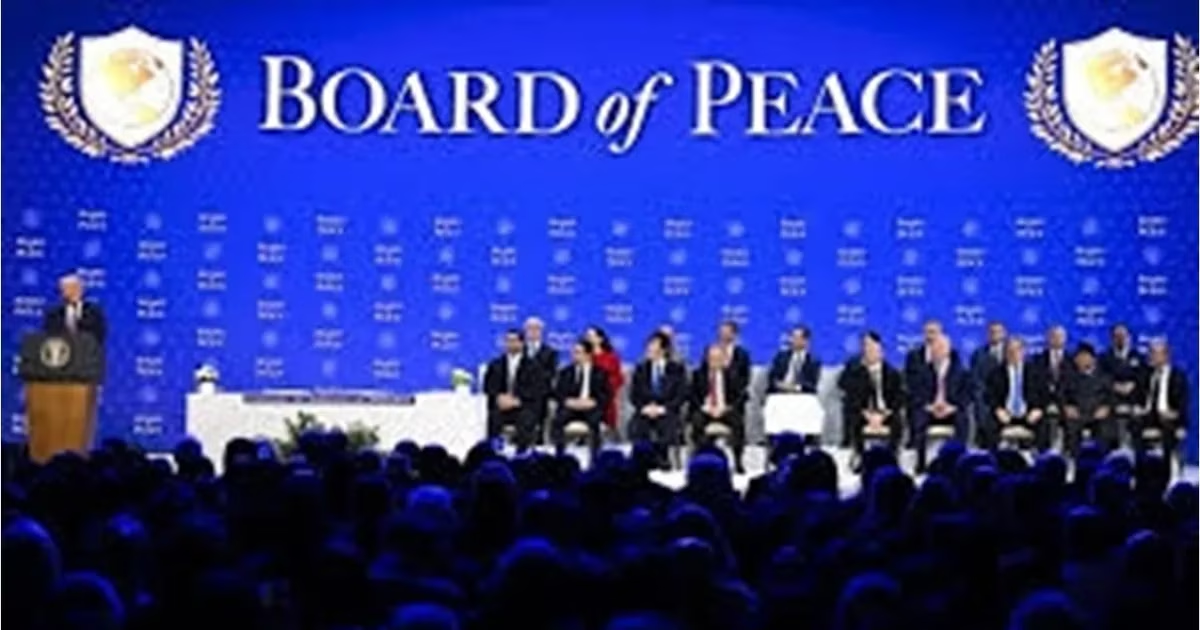
The widespread talk about forming a so-called 'Peace Council' emerges as an advanced institutional step aimed at translating the vision of political deals into permanent organizational structures. This transition from the level of theoretical initiatives to institutional building means an attempt to institutionalize the status quo and make it an integral part of the new regional order.

The establishment of such councils, if they move towards entrenching the imbalance instead of addressing it, will turn into a mechanism for managing the conflict, not for ending it justly. Here, the fundamental question arises as to whether peace is built on the foundations of international justice or on the basis of reorganizing the occupation in less politically costly forms.

The real danger in some political projects lies in the infrastructure and permanent structures they establish, which may make reversing their effects in the future extremely difficult. Therefore, the current battle is not merely a struggle over the texts of initiatives, but a battle of awareness to distinguish between true peace based on dignity and packaged peace.

The logic of rights remains more entrenched in history and has a deeper impact on the collective consciousness than the logic of fleeting deals imposed by temporary power balances. Between these two logics, the future of the Palestinian cause is determined: either a settlement that reproduces injustice, or a path based on law, justice, and human dignity.

The current stage requires political vigilance capable of deconstructing discourses that attempt to wrap concessions in the guise of development and economic prosperity. National sovereignty cannot be compensated by financial grants, and the right of return and self-determination remain the essence of any just and comprehensive solution to the Palestinian issue in the face of liquidation attempts.

In conclusion, the bet remains on the ability of the Palestinian people and their living forces to adhere to constants and refuse to engage in paths that legitimize the occupation. History proves that projects that override the rights of peoples and ignore their legitimate aspirations are doomed to failure, no matter how strong the international parties supporting them.

The mere use of the term 'deal' in the context of an issue of Palestine's magnitude implies a dangerous shift in the legal and ethical structure of the conflict.

ANALYSIS

Sat 28 Feb 2026 11:38 am - Jerusalem Time

UN Accusation Against Israel of Seeking Permanent Demographic Change: Linguistic Escalation Reflects a Shift in International Discourse

Said Erikat

Opinion Writer

Washington – Said Arikat - 28/2/2028

News Analysis

The words of the United Nations High Commissioner for Human Rights, Volker Türk, before the Human Rights Council this week were not merely a routine presentation of a human rights report, but rather seemed to indicate a significant shift in the nature of UN discourse regarding the war in Gaza and Israeli policies in the occupied Palestinian territories.

When Türk spoke of the possibility of Israel seeking to effect a "permanent demographic change" in the Gaza Strip and the West Bank, he used one of the most sensitive terms in international law, a description rarely appearing in UN statements with such political and legal clarity.

The report, covering the period between November 2024 and October 2025, concluded that there was what the UN official described as "total disregard for human rights," pointing to widespread destruction of residential areas, severe restrictions on the population, and the use of humanitarian aid within the context of military conflict.

Türk warned that the accumulation of these measures "appears to be aimed at permanent demographic change," cautioning against growing concerns about ethnic cleansing — a description that carries legal implications that could extend beyond political condemnation to discussions of international accountability.

Gaza: A Truce Without an End to the Crisis

Despite the announcement of a ceasefire in October 2025, the report indicates that the humanitarian reality in Gaza has not seen substantial improvement. More than 600 Palestinians have been killed and over 1600 injured since the truce began, while the UN documented approximately 1700 violations, including restrictions on aid, denial of medical treatment, and repeated attacks.

The United Nations had declared a famine in the Strip in August 2025, while malnutrition continued to spread due to limited humanitarian supply flows.

Türk noted that civilians are still dying from bombing, hunger, cold, and treatable diseases, adding that what is happening "would be considered a major global crisis if it occurred anywhere else."

UN estimates indicate that more than 72,000 Palestinians, mostly civilians, have been killed since Israel launched its brutal war on Gaza in October 2023, in addition to the destruction of over 80% of the infrastructure in the Strip, leading to a near-complete collapse of civil life.

The UN's use of the term "demographic change" marks a turning point in the description of the conflict, as the international institution moves from documenting the humanitarian consequences of the war to analyzing long-term political intentions and patterns. This development reflects growing concern within international legal circles that military operations are no longer understood solely as a security response, but as part of a new reality being reshaped on the ground. However, the central question remains whether the linguistic escalation will translate into actual political pressure or remain within the bounds of customary symbolic condemnation.

West Bank: Administrative Changes with Strategic Dimensions

In the occupied West Bank, the report described the situation as "extremely alarming," pointing to the killing of over a thousand Palestinians during the same period, in parallel with Israeli measures expanding the scope of civil administration in areas that were under military rule.

Türk believes that these steps solidify a reality that is gradually approaching annexation, which international law considers illegal in occupied territories. Observers note that these administrative shifts may have a more significant long-term impact than military operations themselves, as they change the legal and political structure of the land.

The High Commissioner described the overall situation as a "man-made catastrophe," holding Israel responsible for forced displacement and criticizing the absence of international accountability for grave violations.

Türk's statements reveal a deeper dilemma that transcends the Israeli-Palestinian conflict itself: the limited ability of the international system to translate legal reports into executive actions. While evidence and legal descriptions accumulate, accountability mechanisms remain subject to political considerations within the Security Council and international alliances. This gap between law and politics not only affects the course of the conflict but also threatens the credibility of the global human rights system, as the impression grows that state power, not the scale of the violation, is the decisive factor in determining the level of accountability.

Human Rights as a Condition for Stability

In concluding his speech, Türk stressed that any future reconstruction process or political path would not be sustainable without placing human rights at the center of the proposed solutions.

He stated that human rights in the Palestinian territories have been "crushed," emphasizing that achieving lasting stability requires addressing the root causes of the crisis, not just managing its humanitarian consequences.

As the war continues to reshape the political and geographical reality of the region, the High Commissioner's report does not merely describe the tragedy but poses a broader question to the international community: Is what is happening a fleeting humanitarian crisis, or a moment of permanent redefinition?

ARAB AND WORLD

Sat 28 Feb 2026 11:38 am - Jerusalem Time

Israeli-American aggression targets Tehran, security secrecy surrounds Supreme Leader's location

The Iranian capital, Tehran, witnessed a wave of intense airstrikes early Saturday morning as part of a joint Israeli-American aggression, targeting vital facilities and military sites belonging to the regime. Iranian media sources confirmed that President Masoud Pezeshkian was unharmed and in good condition, in response to Hebrew claims that alleged the targeting of all political and military leadership joints in the country.

Journalistic sources quoted security agencies in Tel Aviv as saying that the widespread attack was designed to target all elements of the Iranian regime without exception. The Israeli Army Radio clarified that the first wave of strikes focused directly on high-ranking leadership figures, and verification operations are currently underway to assess the results of these targets and their accuracy in achieving their objectives.

In a related context, field reports indicated that the targeting scope was not limited to military sites but also included sovereign ministries and headquarters belonging to the Revolutionary Guard. The raids also focused on destroying ballistic missile launch platforms and infrastructure associated with the Iranian missile program, in an attempt to undermine Tehran's deterrent capabilities.

Regarding the security movements of the supreme leadership, a state of extreme ambiguity and secrecy prevailed regarding the whereabouts of the Supreme Leader of the Iranian Revolution. While international news circulated information about his transfer to a fortified location outside the capital, Tehran, field sources confirmed the difficulty of ascertaining his exact location given the current security conditions and the strict measures surrounding his movements.

In recent days, the Supreme Leader had appeared publicly in massive public gatherings inside the Imam Khomeini Hosseiniyeh attached to his official residence in the heart of the capital. This public appearance was preceded by warnings of a potential escalation, but the pace of the recent attack imposed new security protocols that prevent the disclosure of details of the movements of the country's supreme leadership.

For its part, Israeli security and military agencies raised the alert level to the highest degree, declaring their readiness for prolonged rounds of exchange of blows that could last for several days. Military circles in Tel Aviv anticipate an imminent Iranian response, which prompted them to expand the target bank to include additional strategic facilities in the event of continued direct confrontation.

These rapid developments come amid full operational partnership between Washington and Tel Aviv, where the aggression was coordinated at high levels to ensure maximum impact. International capitals are watching with great concern the consequences of this unprecedented military escalation, which places the entire region on the brink of a comprehensive regional confrontation open to all possibilities.

We targeted all elements of the Iranian regime, and operations may extend for several days as part of a continuous exchange of blows.

ARAB AND WORLD

Sat 28 Feb 2026 11:38 am - Jerusalem Time

Intelligence Reports Refute Trump Administration Claims on Iranian Nuclear and Missile Threat

International media sources have revealed widespread doubts surrounding the justifications put forth by the administration of US President Donald Trump to pave the way for military action against Iran. An extensive report indicated that recent claims made by the White House were described as unproven or lacking scientific and intelligence accuracy.

The US administration's narrative focused on three main axes, claiming that Tehran had fully resumed its nuclear program and was capable of producing a nuclear bomb within a few days. Trump also alleged that Iran was developing long-range ballistic missiles capable of targeting American cities very soon.

In contrast, American and European officials painted a completely different picture of the situation on the ground, asserting that there was no concrete evidence of Tehran's pursuit of building a nuclear explosive device. Sources clarified that current Iranian activity is limited to restoring some sites damaged in previous attacks without achieving a strategic technical breakthrough.

Reports from the International Atomic Energy Agency confirmed that Iran's stockpile of 60% enriched uranium, estimated at about a thousand pounds, remains stored underground at the Isfahan facility. Sources added that extracting these materials and converting them into warheads would require many months, refuting claims of the ability to manufacture a bomb within days.

Regarding missile capabilities, intelligence sources reported that Trump significantly exaggerated the Iranian threat to American territory. Defense Intelligence Agency assessments concluded that the development of intercontinental missiles would require a decade and intensive technical efforts that Tehran has not yet begun.

Intelligence analysts expressed concern about the possibility of information being selectively or distortedly presented to the political leadership to justify preconceived decisions. Sources likened this atmosphere to what preceded the invasion of Iraq in 2003, when false claims about weapons of mass destruction were used to justify military action.

For his part, Representative Jim Himes, the ranking Democrat on the House Intelligence Committee, expressed deep concern following closed-door meetings with administration officials. Himes affirmed that he had not heard any convincing justification for the United States to engage in a new war in the already volatile Middle East region.

Despite Trump's assurances in his last speech that previous strikes had eliminated Iran's nuclear program, he returned to warn of Tehran's renewed ambitions. This contradiction in statements raised questions about the true objectives of the verbal and on-the-ground escalation pursued by the current administration regarding the Iranian file.

Data indicates that the sensitive Fordow nuclear site has remained out of service since the attacks that targeted it last June. Sources confirm that Iran has not established any new nuclear sites since then, despite observations of attempts to dig deeper to protect future facilities from bunker-buster bombs.

In a related context, observers noted that Trump's recent speech was characterized by a focus on the language of numbers and huge financial gains, reflecting his controversial political approach. The speech received widespread public attention, despite sharp international criticism of his foreign policies, including his use of the veto to halt the war in Gaza.

Secretary of State Marco Rubio later admitted in statements that there was no conclusive evidence of Iran enriching nuclear fuel at present. However, he continued to warn that Tehran is on a path to developing weapons that may one day reach the continental United States, without specifying a precise timeline.

Some Republican lawmakers questioned the reports relied upon by White House advisors, with Senator Marsha Blackburn stating that she had not seen any data supporting the imminent bomb hypothesis. This division within the Republican Party reflects a state of uncertainty regarding the accuracy of the information on which decisions of war and peace are based.

Historically, Iran has focused its missile capabilities on short and medium-range missiles to enhance regional deterrence against its adversaries in the region. Sources confirm that shifting this focus to intercontinental missiles has not yet become a top priority for Tehran, contrary to what the US administration promotes in international forums.

Tension remains high in Washington, with increasing pressure to provide transparent evidence before taking any military step that could ignite the region. Sources continue to warn that relying on questionable claims could lead to strategic disasters, repeating past mistakes in foreign military interventions.

Wars in the Middle East are not in the interest of presidents or the country, and we have not heard any convincing justification for another war now.

ISRAELI AFFAIRS

Sat 28 Feb 2026 11:37 am - Jerusalem Time

War of Economic Corridors: An Israeli Plan to Establish a New Regional System Connecting India to Europe

A strategic analysis published by the Hebrew newspaper 'Maariv', by Brigadier General (res.) Amit Yaari of the Israeli occupation army, discussed Israel's accelerating moves towards strengthening relations with India. The analysis clarified that these moves aim to build what he described as an 'axis of opportunities', which seeks to overcome traditional security threats and focus on common economic interests.

According to the vision presented by Yaari, the United States and Israel are working to establish a new regional system in the Middle East. This system is not based on tribal or religious affiliations, but rather primarily on the energy, trade, and cross-border economic partnerships sectors.

This ambitious plan relies on creating a modern 'Silk Road' extending from the Far East to the Western world and Europe. The Middle East is positioned at the heart of this project as a vital corridor connecting India and Europe, in what is known as the (IMEC) global economic corridor project.

According to the outlined plan, India will represent the major eastern gateway for this corridor due to its growing economic weight. In contrast, Israel will play the role of the western gateway leading to the European continent, giving it unprecedented geopolitical weight in the region.

The analysis indicates that countries such as the UAE, Saudi Arabia, and Jordan represent the 'heart of the corridor', where they will be used as land routes for transporting goods and energy after being unloaded from ships. This land connection aims to accelerate global trade movement and reduce reliance on traditional long maritime routes.

On the western front, Israel has succeeded in establishing a defensive and economic wing through alliances with Cyprus and Greece. This alliance ensures the flow of Israeli exports, whether goods or energy via pipelines, to reach the European interior through Greek and French ports.

The recent visit of the Indian Prime Minister is of great importance, as the Israeli analyst considered it an official announcement of the inauguration of the eastern wing of the axis. This step aims to solidify Israel's position as an indispensable element in any future regional or international arrangements.

From a security perspective, Yaari believes that the extensive defense agreements with India and Greece are not merely measures to protect borders. Rather, they are institutional tools aimed at strengthening strategic partnership and building an integrated regional infrastructure that protects the economic interests of the corridor participants.

In contrast, regional challenges to this plan emerge, as Turkey and Qatar seek to undermine this path by proposing alternatives that bypass Israel. These alternatives rely on directing trade flows from the East through Jordan and Syria to Turkish territories and from there to Europe.

The analysis also points to a conflict of influence aimed at affecting the Saudi and Emirati positions towards this project. Some parties are trying to push the UAE to abandon its close alliance with Israel, while Israel seeks to find alternative routes that overcome any political obstacles.

Among the proposed solutions to overcome geographical challenges, the trend towards recognizing 'Somaliland' stands out. This interest comes due to its strategic location controlling the southern entrance to the Red Sea, which provides additional security for navigation routes.

Regarding ports, the movements of Abu Dhabi Ports Group in the Jordanian port of Aqaba stand out as part of this integration. The group signed a long-term agreement to manage and operate the port, which enhances the efficiency of land and sea connectivity within the (IMEC) corridor system.

Adani, the Indian company that manages the port of Haifa, also plays a pivotal role in connecting with Europe through partnerships with the port of Marseille in France. This interconnectedness between ports managed by a single entity facilitates the movement of goods and reduces logistical barriers between East and West.

Yaari concluded his analysis by indicating that Israel's success in establishing the eastern and western wings of the axis proves its strategic value to the United States. He added that the project may expand in the future to include other countries if political conditions change, ensuring the dominance of this economic path.

Israel seeks to solidify its central position in the new regional fabric, so that it cannot be ignored in a system based on economy and energy.

PALESTINE

Sat 28 Feb 2026 11:37 am - Jerusalem Time

Widespread Israeli Attack on Iran with American Coordination and Declaration of Emergency

Israeli Defense Minister Israel Katz announced on Saturday morning the launch of a preemptive military operation against targets in the Islamic Republic of Iran. Katz affirmed that this attack comes with the alleged aim of removing direct Iranian threats, emphasizing the imposition of a maximum state of emergency throughout Israel to confront any potential repercussions.

In a related context, defense sources revealed that the ongoing military operation was fully and pre-coordinated with the American administration. Reports indicated that planning for this attack lasted for several months, while the zero hour was set weeks ago to ensure the achievement of desired strategic objectives.

Violent explosions rocked the Iranian capital, Tehran, as missiles fell in the vital University and Jumhouri streets. Field sources reported thick plumes of smoke rising from the center of the capital, specifically around Pasteur Street, causing panic among residents during the pre-dawn meal on the tenth day of Ramadan.

Media sources clarified that the airstrikes targeted various areas including the east and north of the capital, as well as the far west where Mehrabad International Airport is located. The targeting also affected sites in Palestine and Wesal streets, while Israeli Army Radio confirmed that the attack focuses on official facilities, missile bases, and sensitive security centers.

On the leadership front, informed sources stated that Iranian Supreme Leader Ali Khamenei was moved to a safe location outside the capital Tehran as a precautionary measure. At the same time, Iranian civil aviation authorities announced the complete closure of the country's airspace to all flights, a measure also taken by Iraqi authorities to secure their airspace.

On the Israeli side, the army issued immediate and strict instructions to the home front, including a ban on educational activities, public gatherings, and the closure of non-essential workplaces. The Ministry of Transport also decided to close Israeli airspace to civilian navigation, in anticipation of an imminent Iranian response after sirens were activated in several areas.

These rapid military developments come amidst severe political tension, as US President Donald Trump recently declared his complete rejection of any Iranian uranium enrichment activity. These statements followed a round of negotiations in Geneva that did not yield tangible results, prompting Washington to warn its citizens against traveling to Iran and urging residents there to leave immediately.

On the ground in Palestine, the Israeli aggression did not stop concurrently with the attack on Iran, as 7 Palestinians were martyred in scattered raids on the Gaza Strip. Drones targeted the slaughterhouse area in Khan Yunis, leading to the arrival of three martyrs at Nasser Hospital, while others were martyred in raids targeting the entrances to Al-Bureij refugee camp and Beit Lahia city.

Statistics indicate a dangerous escalation in the number of casualties, with the number of martyrs resulting from the occupation's violations of the ceasefire agreement signed last October reaching approximately 618. This raises the total number of victims of the ongoing aggression since October 2023 to more than 72,000 martyrs and 171,000 injured, amidst continued indiscriminate shelling and targeting of civilians.

In the West Bank, local sources reported the closure of iron gates surrounding Palestinian cities and villages as part of the emergency measures announced by the occupation authorities. The region is in a state of high anticipation for what the coming hours will bring, especially with Israeli assurances that they expect a direct Iranian military response to these raids.

It is worth noting that this major military escalation comes at a sensitive time during the holy month of Ramadan, further complicating the humanitarian and political landscape in the region. International and regional powers are monitoring the course of events, amidst fears of the region sliding into a comprehensive regional war that transcends the boundaries of the current direct clashes between Tehran and Tel Aviv.

Israel launched a preemptive attack against Iran to remove threats, with an immediate and special state of emergency declared.

ARAB AND WORLD

Sat 28 Feb 2026 11:37 am - Jerusalem Time

Widespread Escalation in Southern Lebanon: Intense Israeli Raids and Joint Attack with Washington Begins

Areas of southern Lebanon witnessed a fierce wave of Israeli airstrikes this Saturday morning, heavily concentrated on Iqlim al-Tuffah and Jezzine district. Field sources reported more than ten raids targeting various points, including the Qatrani area and Wadi Barghaz, leading to a dense rise of smoke plumes covering the skies of the targeted areas.

The aerial operations extended to the vicinity of Blat town in Marjayoun district, in addition to a series of concentrated raids between the towns of Rihan and Sajed. This bombing coincided with intensive low-altitude flights by Israeli warplanes over the Beqaa regions in the east of the country, causing a state of anxiety and anticipation among the public.

For its part, the Israeli occupation army announced that its attacks targeted what it described as 'terrorist infrastructure' belonging to Hezbollah, pointing to the striking of missile launch platforms and underground tunnel openings. The military statement claimed that these operations aim to prevent the party from restoring its military capabilities or rearming to ensure the removal of any future threat.

In a related context, media sources confirmed the targeting of eight military headquarters belonging to the 'Radwan Force,' which represents Hezbollah's elite forces, with precise strikes deep in the south. These moves come within the framework of a declared Israeli strategy to limit the party's ability to launch widespread attacks if regional conditions deteriorate.

On the other side of the border, settlement councils in northern Israel issued urgent warnings to residents about the need to be prepared to hear loud explosions resulting from air force activity. These warnings reflect the scale of the ongoing military operation and the expectation of potential reactions from the Lebanese side to the continuous escalation.

In a remarkable field development, news reports revealed the start of a joint Israeli-American attack on Saturday morning, a step indicating high-level military coordination between the two parties. This move came after reinforcements of American fighter jets arrived at Israeli bases in preparation for confronting any escalatory scenarios in the region.

Israeli political circles link these raids to the escalating tensions with Tehran, as Tel Aviv places its attacks in a preemptive context to prevent Hezbollah from intervening. Through these strikes, Israel seeks to send a clear deterrent message that any involvement of the party in a regional conflict will be met with a devastating military response.

Current data indicate that the region has entered a new phase of direct confrontation, especially with the involvement of American forces in the ongoing operations. International circles are cautiously monitoring the repercussions of this joint attack and its impact on the stability of the northern front and the possibility of it sliding into an all-out war.

It is worth noting that Israel had repeatedly threatened to target the Lebanese state and its vital facilities if Hezbollah decided to engage in any military confrontation between the United States and Iran. Today's raids confirm the seriousness of these threats in light of the unprecedented military buildup witnessed in the region.

We will not allow Hezbollah to rebuild its strength or rearm, and we will continue to work to remove every threat.

PALESTINE

Sat 28 Feb 2026 11:37 am - Jerusalem Time

Israel launches preemptive attack on Iran, explosions shake Tehran

The Israeli Minister of Security announced this Saturday morning the launch of a preemptive military operation targeting Iranian territory. This announcement coincided with field reports of violent explosions and rising smoke plumes from the center of the capital, Tehran, in a dramatic development that portends a widespread regional confrontation.

Media sources reported that sirens blared in wide areas within Israel, while the Home Front Command issued new and strict instructions to settlers, in anticipation of any retaliatory action that Tehran or its allies in the region might launch. These developments come at a time when American military buildup in the Middle East has reached its peak, reflecting coordination or preparation for comprehensive war scenarios.

On the ground, informed sources confirmed that the explosions in Tehran caused a state of major security alert, while the nature of the targets hit by the Israeli attack remains unclear at this moment. This attack follows a series of mutual threats and conflicting indications about the possibility of reaching a diplomatic de-escalation, which appears to have collapsed in favor of direct military escalation.

Israel launched a preemptive attack against Iran.

PALESTINE

Sat 28 Feb 2026 11:37 am - Jerusalem Time

Amnesty International: Settlement expansion in the West Bank a blatant challenge to international law and an entrenchment of annexation

Amnesty International confirmed that since last December, Israeli authorities have begun an unprecedented escalation in their settlement activities in the occupied West Bank, including East Jerusalem. In a recent report, the organization clarified that these moves come through a package of systematic decisions aimed at entrenching the annexation of Palestinian territories and imposing them as a fait accompli on the international community.

Recent Israeli steps included issuing tenders for the construction of new settlement units, approving the establishment of additional settlements, and significantly expanding existing ones. The organization also monitored legal and administrative measures related to registering vast areas of Palestinian land under the name 'state lands' for easy control later.

The report highlighted a tender issued on December 10 for the construction of 3,401 housing units in the strategic 'E1' area located east of occupied Jerusalem. This plan aims to expand the 'Ma'ale Adumim' settlement and geographically connect it to East Jerusalem, threatening to sever the geographical contiguity of the West Bank.

The international organization warned that the implementation of this settlement project would inevitably lead to the division of the West Bank into two separate parts, undermining any chance of establishing a contiguous Palestinian state. This expansion would also lead to the forced displacement of many Bedouin Palestinian communities that have resided in that area for many decades.

For her part, Erika Guevara-Rosas, an official at Amnesty International, stated that Israel is disregarding all UN resolutions and the legal opinion issued by the International Court of Justice. She pointed out that the continued settlement expansion represents a blatant challenge to international law and contributes to entrenching an 'apartheid' system that stifles the lives of Palestinians.

In terms of numbers, the Israeli Security Cabinet recently approved plans to establish 19 new settlements, bringing the number of settlements approved over the past three years to 68. These figures reflect an alarming acceleration in the pace of land seizure compared to previous periods.

Current statistics indicate the presence of about 210 official settlements in the West Bank and East Jerusalem, inhabited by approximately 750,000 Israeli settlers. These settlement blocs act as tools for military and civilian control over natural resources and the remaining geographical areas for Palestinians.

The organization quoted Israeli human rights sources as saying that 2025 alone saw the establishment of 86 new settlement outposts, most of which took on a pastoral or agricultural character to control vast areas of pastures. These outposts are usually accompanied by an escalation in settler attacks against Palestinian farmers to intimidate them and force them to leave.

In a dangerous administrative development, the Israeli Civil Administration announced last January the allocation of 694 dunams of land in the towns of the northern West Bank as state lands. This was followed by a government decision to allocate 244 million shekels to transfer land registration powers in Area 'C' to the Israeli Ministry of Justice, a step that paves the way for changing the legal status of the West Bank.

On the ground, human rights organizations condemned an attack carried out by masked settlers on activists in the village of Qusra in the northern West Bank using sticks and sharp tools. The assault resulted in two people being injured and taken to the hospital, amid complete silence from the Israeli security forces present in the area.

Human rights sources described these attacks as organized 'state violence' and 'terrorism' practiced under official cover to accelerate land seizure operations. These attacks fall within a broader strategy aimed at tightening the noose on the Palestinian presence in areas classified as 'C' and emptying them of their original inhabitants.

International and local organizations concluded that the escalation in the pace of settlement coincides with legislative changes that grant settlers broad powers in planning, construction, and water. These data confirm that the current Israeli government is moving forward with a plan for the de facto annexation of the West Bank, ignoring all international warnings about the repercussions of this policy.

Israel continues to brazenly expand settlements, defying international law and entrenching an apartheid system that destroys the lives of Palestinians.

ISRAELI AFFAIRS

Sat 28 Feb 2026 11:36 am - Jerusalem Time

Israeli Diplomat: Trump's Peace Council Paves the Way for a Palestinian State

The American capital, Washington, witnessed the launch of the first meeting of the Peace Council established by President Donald Trump, amidst regional and international anticipation for the outcomes of this new entity. Despite Israeli Prime Minister Benjamin Netanyahu's announcement of Tel Aviv's joining this council, he chose not to personally attend the inaugural discussions.\n\nPolitical assessments suggest that Netanyahu's absence may stem from his desire to avoid public appearances alongside leaders of countries with strained relations with Israel, such as Turkey and Qatar. It appears that mutual diplomatic sensitivities prevented direct participation of the Israeli leadership in these foundational sessions.\n\nNadav Tamir, CEO of J Street, considered the establishment of this council a fundamental shift in the structure of the international arena and regional crisis management. He explained that Trump's ambitions go beyond merely rebuilding the Gaza Strip to designing a new and more effective international framework.\n\nTamir believes that the council seeks to work in parallel with the United Nations, focusing on more flexible and limited membership executive mechanisms to ensure rapid achievement. The first meeting raises serious questions about the ability of this body to maintain a long-term ceasefire in Gaza.\n\nAnalytical sources confirmed that the fundamental question is not about the council's ability to replace the United Nations, but rather how to integrate different international mechanisms to achieve stability. The council has the potential to create regional momentum and diplomatic movement that is essential for both the Israeli and Palestinian sides at this stage.\n\n The author emphasized the necessity of not putting Israel in a position to choose between different international arenas, but rather to move intelligently in all available paths. Joining a strong regional alliance will contribute to empowering reconstruction efforts and ensuring regional stability under legitimate international cover.\n\nTamir explained that the current moment represents a unique historical opportunity, and the Israeli leadership must seize it instead of missing it under internal pressures. This requires a deep understanding of the geopolitical shifts brought about by the recent war in the Gaza Strip and their repercussions on Israeli national security.\n\nThe Israeli diplomat called for the urgent international and regional situation to be translated into a clear and defined political path that cannot be reversed. This path must ultimately lead to the establishment of a demilitarized Palestinian state that ensures the integration of all parties into the new Middle East system.\n\nThe analysis indicated that what is happening in Gaza is no longer a local matter, but its repercussions are echoing throughout the region and affecting major global policies. The establishment of the Peace Council is an explicit recognition of the need for radical solutions that go beyond the temporary security palliatives adopted in past decades.\n\nTamir warned against "putting spokes in the wheels" of the proposed political arrangements, urging the Israeli government not to shy away from its historical obligations. The world today is moving as one towards strengthening regional stability on the basis of a two-state solution as the only sustainable option.\n\nThe article affirmed that the movements, both within the Peace Council and in the corridors of the United Nations, are heading in one direction: ending the conflict through a comprehensive political settlement. This settlement alone is capable of achieving the lasting peace that the peoples of the region desire, away from repeated cycles of violence.\n\nIsraeli circles express muted concerns about the nature of the role Trump will play through this council, especially regarding imposing his political will on the Gaza issue. There is a growing conviction that Washington may impose specific projects that require Tel Aviv to make fundamental and painful concessions.\n\nThe Peace Council represents the beginning of a new chapter in regional diplomacy, where economic interests intertwine with security and political arrangements. Israel finds itself facing a real test of balancing its relations with the American administration and its right-wing vision for managing the conflict with the Palestinians.\n\nIn conclusion, Tamir concludes that international pressure will not stop at de-escalation, but will push towards final and comprehensive solutions. Recognition of a Palestinian state has become an integral part of any future vision proposed by the international community, including close allies in Washington.\n\nThe establishment of the council expresses widespread recognition of what is happening in Gaza, as it does not remain in Gaza, but resonates throughout the region and beyond.

PALESTINE

Sat 28 Feb 2026 11:36 am - Jerusalem Time

Targeting Agricultural Products: Israeli Defamation Campaigns to Achieve Political Goals

Mahmoud Fatafta: These claims are baseless and come within the context of the raging Israeli war on everything Palestinian, especially the agricultural sector.

Jamal Al-Deek: The Israeli defamation of Palestinian agricultural products represents a new stage in attempts to control the land and weaken citizens' attachment to it.

Abbas Melhem: These allegations are probably aimed at imposing the application of Israeli food law on the West Bank as part of escalating steps towards gradual annexation.

Munjed Abu Jaish: The primary goal of these allegations is to exert additional pressure on farmers, especially in Area C, where agricultural activity is concentrated.

Salah Haniyeh: Baseless claims that are not based on scientific foundations and aim to cause anxiety among consumers by promoting the idea that vegetables contain substances that may cause serious diseases.

Majdi Abdullah: Food safety files may be used as a competitive pressure tool, especially during seasons when competition for agricultural products is high.

Ramallah - Exclusive to "Al-Quds" -

At a time when the Palestinian agricultural sector is struggling to play an essential role in supporting the local economy, Israeli claims have emerged about the presence of pesticide residues in Palestinian vegetables, which has sparked a wide discussion about the objectives of these claims and their potential repercussions on farmers and markets.

Officials and agricultural specialists confirm, in separate interviews with "Al-Quds", that Palestinian agricultural production is subject to regular monitoring procedures and laboratory tests according to approved standards, while agriculture constitutes a main source of income and job opportunities, especially in rural areas and those classified as "C", which makes any targeting of this sector have direct economic and social effects, in addition to the existence of Israeli political goals in targeting the agricultural sector to impose a reality that pushes towards land migration to control it.

They believe that the recent Israeli campaign may have economic and political dimensions that go beyond the issue of food safety, as it is feared that it will lead to weakening consumer confidence in local products, and imposing restrictions on exports, which may negatively affect farmers, vegetable prices, and the stability of the Palestinian agricultural sector.

Agriculture: Israeli claims are baseless

The official spokesperson for the Palestinian Ministry of Agriculture, Mahmoud Fatafta, denies the validity of Israeli claims about the presence of toxic pesticide residues in Palestinian vegetables exported to Israeli markets, considering that these claims come within the context of the raging Israeli war on everything Palestinian, especially the agricultural sector, which represents one of the most important elements of citizens' steadfastness in their land.

Fatafta explains that the agricultural sector is continuously exposed to attacks by the occupation and settlers, as it is an extension of the Palestinian presence in the land, especially in the Jordan Valley, Masafer Yatta, and various agricultural areas, where agriculture is an essential means for farmers to remain on their lands.

Fatafta points out that Israeli attacks have varied between preventing access to agricultural lands, uprooting trees, preventing grazing in natural pastures, and confiscating and stealing sheep, but they have not deterred farmers from continuing their work, which prompted the occupation to target Palestinian agricultural products and try to undermine their reputation in local and international markets.

The political nature of these claims

Fatafta clarifies that Palestinian agricultural products have entered Israeli markets for many years without similar claims being recorded, noting that raising this issue came during a session of the Knesset Health Committee led by an extremist Knesset member, which reinforces the political nature of these claims, aimed at causing confusion and fighting the Palestinian economy, especially in light of declining job opportunities and agriculture being considered one of the most important remaining sources of income for citizens.

Strict monitoring procedures

Fatafta stresses that agricultural pesticides circulated in the Palestinian market are subject to strict monitoring procedures, and their entry is through crossings subject to Israeli control and Israeli approvals, which means that Palestinian agricultural products pass through a complex system of inspection and procedures, whether when introducing agricultural inputs or when exporting products.

Fatafta points out that the Ministry of Agriculture adopts a scientific system for monitoring pesticides through the Scientific Committee for Agricultural Pesticides, which is the authorized body to permit pesticides and their circulation, and which includes experts from universities, the private sector, and relevant ministries.

Reducing the number of permitted pesticides

Fatafta explains that the committee conducted scientific reviews that led to a reduction in the number of pesticides permitted for circulation in the Palestinian market from 538 pesticides to about 198 pesticides only, with the aim of enhancing the safety of agricultural products and eliminating any substances that may have an impact on human health.

Official requirements for export

Fatafta explains that the marketing or export of Palestinian agricultural products is subject to official requirements that include a certificate of origin, a health certificate, and import or export permits, which are mandatory documents without which no shipments can be passed.

Economic war linked to competition

Fatafta considers that what is happening represents an economic war linked to the competition between Palestinian and Israeli agricultural products, pointing out that Palestinian products have succeeded in reaching about 50 global markets directly and about 70 markets indirectly, and what is happening is a systematic Israeli attack aimed at harming Palestinian agricultural products.

Fatafta confirms that the Ministry continues to conduct periodic tests through its teams, in cooperation with other regulatory bodies such as the Ministry of Health, the Customs Police, and specialized agencies, to ensure the safety of agricultural products.

Fatafta stresses that there are no products designated for one market over another, as vegetables are produced from the same farms with the same water, pesticides, and fertilizers, whether for the local, Israeli, or international market.

Fatafta calls on citizens and the media to adopt the Ministry of Agriculture as an official reference regarding the safety of agricultural products, emphasizing the Ministry's keenness to protect the national economy and enhance citizens' confidence in local products, noting that Palestinian farmers are making great efforts to preserve their lands and continue agricultural production, especially in the Jordan Valley and threatened areas.

A broader incitement policy

The Secretary-General of the Palestinian Farmers' Union, Jamal Al-Deek, believes that Israeli claims about the presence of toxins in Palestinian vegetables fall within a broader incitement policy targeting everything Palestinian, including people, land, and agricultural products, stressing that these claims come within the framework of the continued siege policy imposed on the Palestinian people and attempts to intensify it.

Al-Deek explains that the incitement against Palestinian agricultural products represents an extension of the siege philosophy adopted by Israel in its dealings with the Palestinian people and Palestinian land, pointing out that the agricultural sector constitutes one of the main remaining outlets for Palestinians, which pushes the occupation to intensify pressure on farmers to force them out of the production and agricultural work cycle.

Attempts to empty the land of its owners

Al-Deek indicates that these policies essentially seek to empty the land of its owners, because leaving the land, in the Israeli concept, brings the Zionist project closer to achieving its goals.

Distinguished Palestinian product

Al-Deek confirms that Palestinian agricultural products are distinguished by their quality, special identity, and unique flavor, and enjoy a good reputation in global markets, pointing out the existence of official bodies and specialized laboratories that work responsibly and seriously to monitor the quality of agricultural products and ensure their safety, which enhances the confidence of Palestinian consumers in them.

Al-Deek clarifies that targeting Palestinian agriculture is not limited to field restrictions, but also includes controlling land and restricting farmers and herders in the Jordan Valley, hills, and Palestinian countryside, considering that Israeli defamation campaigns against Palestinian agricultural products represent a new stage in attempts to control the land and weaken Palestinians' attachment to it.

Al-Deek stresses that the goal of these claims is primarily political, calling on agricultural institutions and official bodies to present a clear vision that enhances the identity of Palestinian agricultural products and strengthens citizens' confidence in them, affirming the ability of Palestinians to protect their land and agricultural products and preserve them.

Attempts to undermine food security

The Executive Director of the General Union of Palestinian Farmers, Abbas Melhem, explains that what Israeli media reported about the presence of toxic pesticides in Palestinian vegetables exported to Israel falls within attempts to target the Palestinian agricultural sector and undermine food security, stressing that these claims come within the context of continuous policies aimed at weakening farmers and questioning the quality of Palestinian agricultural products.

Melhem explains that the Union is accustomed to dealing cautiously with narratives issued by the occupation, considering that these claims fall within "destructive steps" for the agricultural sector, in parallel with settler attacks aimed at displacing farmers from their lands.

Attempts to damage the reputation of agricultural products

Melhem points out that farmers who remain in the production cycle are subjected to attempts to damage the reputation of their products, leading to economic losses and weakening this vital sector.

He explains that Palestinian food products are subjected to strict monitoring standards, especially regarding the use of chemical pesticides, noting that the Union works with farmers to gradually transition from a production pattern based on chemicals, even within permitted limits, to a safe, environmentally friendly, and climate-adapted production pattern that relies on minimizing the use of chemical materials or eliminating them, and returning to traditional farming methods that were prevalent in the time of ancestors.

Opportunity to develop safe agricultural production patterns

Melhem clarifies that raising these issues constitutes an opportunity to refocus on developing safe agricultural production patterns, stressing that agricultural institutions play a continuous awareness role with farmers to enhance adherence to health and environmental standards and improve the quality of locally produced food.

Melhem stresses the need for specialized regulatory bodies, including the Ministries of Agriculture, Health, and Environment, to play their role in monitoring the nature of agricultural production and ensuring its compliance with specifications.

Melhem points out that refuting Israeli claims requires publishing the results of laboratory tests and highlighting the work of Palestinian laboratories, scientific committees, and consumer protection associations, calling on the Israeli side to present any scientific results it claims to possess instead of making general accusations.

Exaggerated and unrealistic claims

Melhem stresses that portraying Palestinian products as contaminated with chemicals is exaggerated and unrealistic, affirming that Palestinian agricultural production as a whole falls within acceptable standards despite limited individual violations sometimes related to non-compliance with safety margins or excessive use of pesticides.

Melhem points out that these individual violations do not reflect the reality of the agricultural sector, questioning the logic of claims that describe a large percentage of Palestinian food as contaminated, noting that the continued consumption of these products without widespread harm confirms the inaccuracy of these claims.

Applying Israeli food law to the West Bank

Melhem draws attention to the possibility of political objectives behind these claims, including an attempt to impose the application of Israeli food law on the West Bank as part of escalating steps towards gradual annexation, considering that raising the issue of food safety may be used as a pretext to impose Israeli laws on the Palestinian agricultural sector without coordination with Palestinian authorities.

Pushing consumers to be more cautious in choosing products

Melhem points out that these claims may push consumers to be more cautious in choosing products and perhaps turn to direct purchases from farmers, but he rules out a clear impact on prices given the high demand during the month of Ramadan.

Melhem affirms that the health of the Palestinian citizen is a fundamental priority, calling for strengthening agricultural and health control as a necessary step to ensure the quality of Palestinian products, while stressing that Palestinian agricultural production as a whole is still within an acceptable and good level in terms of safety and quality.

Claims lacking scientific basis

The Director-General of Agricultural Relief, Munjed Abu Jaish, confirms that the claims recently circulated by Israeli media regarding the presence of toxins or high levels of pesticides in Palestinian vegetables lack scientific basis, pointing out that they were not based on documented laboratory test results or official reports that can be relied upon, which makes them technically inaccurate claims.

Abu Jaish explains that the majority of locally produced Palestinian vegetables comply with the laws and instructions issued by the Palestinian Ministry of Agriculture, which regulate the use of pesticides and agricultural fertilizers, stressing that issuing judgments regarding the safety of agricultural products requires accurate laboratory analyses before reaching any conclusions.

Additional pressure on farmers

Abu Jaish suggests that the primary goal of these claims is to exert additional pressure on farmers, especially those working in areas classified as "C" according to the Oslo Agreement, where a large part of Palestinian agricultural activity is concentrated.

Abu Jaish points out that the continuation of such measures or the promotion of these claims may hinder the development of the Palestinian agricultural sector and affect farmer support programs, noting that a large percentage of Palestinian vegetables are marketed domestically, which makes farmers vulnerable to the impact of any restrictions or media disruption on export movement.

Developing the agricultural sector to confront

Abu Jaish clarifies that confronting these pressures requires developing the Palestinian agricultural sector and raising the level of farmers' adherence to approved specifications, stressing that adherence to approved agricultural standards benefits local consumption and supports export opportunities.

Abu Jaish confirms that the Ministries of Agriculture and Economy continuously monitor and control agricultural production, and do not allow unauthorized pesticides to enter the Palestinian market, noting that some pesticides may sometimes leak from settlements.

Encouraging organic farming

Abu Jaish stresses that Agricultural Relief works to support farmers through safe farming programs, including applying Global GAP and Pal GAP standards, in addition to encouraging organic farming, affirming that a large number of farmers adhere to these standards, which enhances the safety of local agricultural products.

Abu Jaish expresses his confidence in the safety of Palestinian agricultural production, calling on consumers to be reassured about the quality of local vegetables, and at the same time pointing out that these claims may negatively affect prices if export restrictions are imposed, as a decline in marketing to the Palestinian interior will lead to an increase in the quantities offered in the West Bank and a sharp drop in vegetable prices, which will result in direct losses for farmers.

Defining permitted substances

The head of the Palestinian Consumer Protection Association, Salah Haniyeh, believes that what was circulated in the Israeli media regarding the presence of "toxins" or high levels of pesticides in Palestinian vegetables comes within the context of a broader war targeting Palestinian land and the agricultural sector, pointing out that these claims complement field measures that began with preventing farmers from accessing their lands and closing large areas, especially in Tubas and the Jordan Valley, leading to attempts to displace Bedouin communities, and ending with an attempt to question the quality of Palestinian agricultural products.

Haniyeh explains that the Palestinian Ministry of Agriculture imposes strict control over the use of agricultural pesticides, and clearly defines permitted and prohibited substances, noting that this control has significantly developed since 2010 after a period that witnessed excessive use of pesticides, which prompted the competent authorities to regulate the sector and ban many dangerous substances.

Haniyeh confirms that the level of strictness in the use of pesticides in the Palestinian market exceeds that in the Israeli market, affirming that the pesticides permitted in Israel are almost double compared to what is permitted in Palestine, and that Palestinian standards largely comply with international standards.

Causing anxiety among Palestinian consumers

Haniyeh points out that Israeli claims also aim to cause anxiety among Palestinian consumers by promoting the idea that local vegetables contain substances that may cause serious diseases, stressing that these claims are baseless and not based on scientific foundations, and that the recent statement by the Ministry of Agriculture clarified the monitoring and rationalization procedures and penalties imposed on violators.

Haniyeh draws attention to smuggling operations of Israeli agricultural products and attempts to flood the Palestinian market with spoiled or expired products.

Individual violations

Haniyeh explains that the Palestinian market is not entirely free of violations, as there are limited individual violations such as some farmers using pesticides coming from settlements and not circulated in the Palestinian market, but these cases have been dealt with through awareness campaigns and monitoring procedures in cooperation between the Consumer Protection Association, the Ministry of Agriculture, the Farmers' Union, and the Peasants' Union, stressing that these violations have not affected consumer confidence in local products.

Haniyeh calls for strengthening control by taking periodic samples of agricultural products, especially those coming from the Israeli market, to ensure their safety and create a safe market that inspires confidence, emphasizing the importance of agricultural extension workers in the fields and strengthening control within central vegetable and fruit markets.

Haniyeh points out that the Israeli media campaign may temporarily affect farmers, especially if it impacts exports to the Israeli market.

Halting exports and a sharp drop in prices

Haniyeh believes that the possibility of Israel resorting to halting exports due to these claims will lead to a local surplus of vegetables and a sharp drop in prices, causing direct losses to farmers, stressing that the primary goal of these claims is to weaken the Palestinian farmer and negatively affect their ability to withstand and produce.

Food safety files as a competitive tool

Agricultural expert Engineer Majdi Abdullah believes that the claims circulated by Israeli media about the presence of toxins or pesticide residues in Palestinian vegetables exported to the Israeli market are incorrect.

Abdullah confirms that the Palestinian agricultural sector is subject to a strict technical and scientific monitoring system supervised by the Ministry of Agriculture according to approved standards. Abdullah points out that the Ministry denied these claims, explaining that the products circulated in the Israeli market are the same as those circulated locally, which reflects the keenness of official bodies on the safety of the Palestinian consumer first.

Abdullah explains that food safety files may sometimes be used as a competitive tool, especially during seasons when competition for agricultural products such as strawberries, peppers, and various vegetables is high.

Safety period

Abdullah points out that any agricultural sector in the world may witness limited individual cases related to non-compliance with what is known as the "safety period," which is the period that must elapse after spraying the pesticide before consuming the crop, noting that some pesticides such as "Confidor" may have a safety period of about 45 days.

Abdullah confirms that pesticides in Palestine are not allowed to be circulated unless they are officially registered, with recommended doses, safety periods, and pesticide residue limits specified.

A system of control

Abdullah clarifies that the monitoring system includes several levels, including pesticide registration, agricultural extension carried out by Ministry of Agriculture engineers to guide farmers on doses, safety periods, and not mixing incompatible pesticides, in addition to laboratory tests conducted on random samples before export according to technical and European standards.

Abdullah points out the existence of a tracking system through which agricultural products pass through approved packing stations, so that each farm has a record showing the pesticides used and the product's path.

Abdullah calls for refuting Israeli claims through transparency and publishing the results of official laboratory tests and the percentages of compliant and non-compliant samples, in addition to conducting joint tests or using internationally recognized laboratories and requesting detailed technical reports from the claiming parties, along with documenting adherence to safety periods and highlighting quality certificates such as "Global GAP" if available, emphasizing the need to adopt a scientific discourse based on numbers and analyses.

Abdullah confirms that if violations exist, they are very limited individual cases that may result from ignorance, error, or haste in harvesting before the end of the safety period or using incorrect doses, noting that the Ministry of Agriculture is working to intensify periodic tests, support pesticide residue analysis laboratories, strengthen agricultural extension, and tighten penalties for violators.

Claims with potential economic impact

Abdullah confirms that these claims and rumors may have a potential economic impact on farmers, but he stresses that the Palestinian farmer possesses the necessary experience and awareness to use pesticides according to principles, and that violating cases remain individual and cannot be generalized, considering that farmers are keen on product safety because they are the first consumers of it within Palestinian society.


ARAB AND WORLD

Sat 28 Feb 2026 11:36 am - Jerusalem Time

Republican Senator Criticizes Kushner and Witkoff's Assignment to Gaza and Iran Files: 'They Lack Experience'

Republican Senator Thom Tillis expressed his strong surprise at the assignment of the most complex foreign policy files to Jared Kushner and Steve Witkoff, questioning the usefulness of their leadership in peace talks with international powers such as Russia and Iran. Tillis pointed out that the two men clearly lack deep experience in international diplomatic affairs, in addition to bypassing the constitutional procedures of gaining Senate approval.

Tillis affirmed in press statements that managing hot files such as the ongoing violence in the Gaza Strip and the war in Ukraine, in addition to escalating tensions with Tehran, should not be left in the hands of figures who have not undergone official scrutiny. While acknowledging Kushner and Witkoff's success in the world of finance and business as brilliant negotiators, he stressed that diplomatic work and national security require entirely different standards.

The Republican Senator described placing Kushner and Witkoff at the head of these high-stakes negotiations as 'senseless' in the current political context. He explained that confining geographically and politically diverse files to only two individuals raises many questions about decision-making mechanisms within the US administration, especially in the absence of parliamentary accountability for their international actions.

In a related context, criticism was not limited to the Republican side, as Democratic representatives in Congress expressed their concerns about Kushner's growing role given his limited background in foreign policy. Democrats raised questions about conflicts of interest, especially regarding the investments of Kushner's company 'Affinity Partners,' which received massive funding from sovereign wealth funds in the Gulf region.

For their part, Senator Elizabeth Warren and Senator Chris Murphy led a campaign to warn against the overlap between Steve Witkoff's business interests and diplomatic duties. These warnings came after Witkoff's statements in which he confirmed his separation from his private company before assuming his duties as a special envoy for former President Donald Trump, which observers consider insufficient to dispel concerns.

On the ground, sources reported that Kushner and Witkoff were in Geneva, Switzerland, last Thursday for what were described as sensitive negotiations with the Iranian side. These talks aim to reach a new deal regarding Iran's nuclear program, a step that could determine the path of military escalation or de-escalation in the region in the coming period.

The round of negotiations included meetings with Omani officials, as Muscat plays the traditional mediator role between Washington and Tehran in thorny issues. These moves come at a sensitive time when the world awaits the nature of the decisions the US administration may take regarding potential missile strikes or a return to comprehensive diplomacy.

It is questionable to negotiate peace in Ukraine, or the Iranian situation, or Gaza, and for it to be the same two people; this makes no sense to me.

ARAB AND WORLD

Sat 28 Feb 2026 11:36 am - Jerusalem Time

Trump hints at 'friendly takeover' of Cuba, calls it a failed state

US President Donald Trump hinted at the possibility of what he described as a "friendly takeover" of Cuba, indicating that the US administration is closely monitoring the situation there. Trump clarified in statements to reporters before departing the White House for Texas that Secretary of State Marco Rubio is managing this file at very high levels, confirming that the Cuban government is seeking negotiations due to immense economic pressures.

The US President described Cuba as a "failed state" lacking basic resources such as money, oil, and food, considering that change has become an urgent necessity for the island, which has been suffering for decades. Trump added that Washington is receiving signals about Cuba's desire for American assistance, which opens the door to new scenarios for dealing with the communist regime there in light of its current crisis.

In contrast, the Cuban government quickly denied the existence of any official high-level negotiations with the American side, although it did not definitively deny reports of unofficial contacts. Press reports circulated about secret meetings between officials close to Secretary of State Marco Rubio and the grandson of former Cuban leader Raul Castro, in an attempt to open channels of communication away from traditional diplomatic frameworks.

Media sources indicated that these meetings took place on the sidelines of the Caribbean regional group conference in St. Kitts and Nevis, where the American side is seeking to explore opportunities for political change in Havana. These moves come at a time when economic pressures on Cuba have increased after Washington's decision to cut most vital oil supplies that were reaching the island, leading to an exacerbation of living crises.

On the ground, recent days have witnessed a dangerous security escalation after four Cuban exiles were killed and six others injured by Cuban forces while sailing in a Florida-registered boat. Although Havana accused the boat of firing on one of its patrols, Marco Rubio denied any involvement of the US government in this operation, confirming that it was not an official move by Washington.

Trump's recent statements reflect a tougher stance towards Cuba, as observers believe that the current US administration is seeking to exploit the island's economic collapse to impose a new political reality. The question remains about the nature of the "friendly takeover" that Trump referred to, and whether it will take an economic or political character that ultimately leads to the end of the decades-long communist rule.
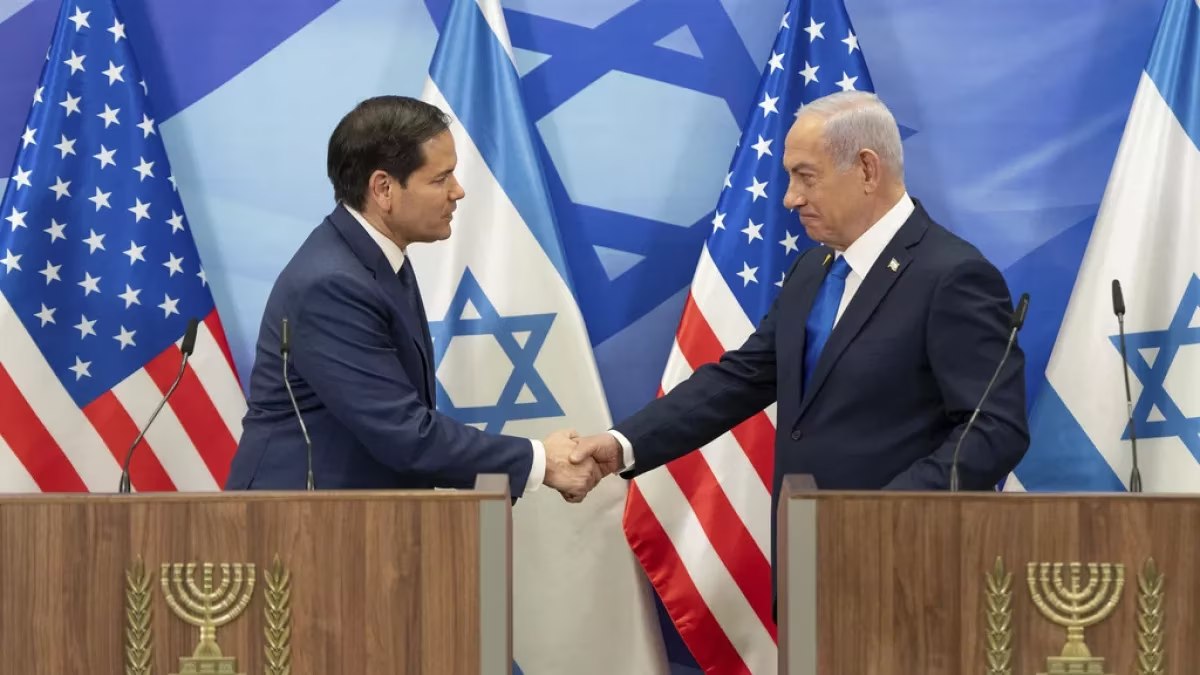
"Perhaps we'll do a friendly takeover of Cuba, they're negotiating with us now because they're in big trouble and they have nothing."

OPINIONS

Sat 28 Feb 2026 11:20 am - Jerusalem Time

Rubio’s Israel Visit and Washington’s Convenient Ceasefire Fiction

February 28, 2026

News Analysis

Washington, D.C. — As U.S. Secretary of State Marco Rubio prepares to visit Israel Monday, American diplomacy faces a familiar test: whether Washington intends to confront policies carried out by its closest Middle Eastern ally or continue managing their consequences through carefully calibrated language. Officially, Rubio’s trip aims to reinforce a Gaza ceasefire and coordinate regional strategy, including joint U.S.-Israeli positioning toward Iran. In practice, the visit risks reaffirming a diplomatic narrative that masks continuing violence while political and territorial realities move steadily in Israel’s favor.


Since October 11, Western governments have repeatedly described conditions in Gaza as a ceasefire. Increasingly, however, the term functions less as an objective description than as a political designation. Hundreds of Palestinians have reportedly been killed and thousands injured during this supposed pause amid recurring strikes, armed confrontations, and near-daily military incidents. Traditionally, a ceasefire implies a meaningful suspension of organized violence. What exists instead resembles a managed lowering of intensity sustained by diplomatic terminology rather than by verifiable restraint on the ground.


The language serves important political purposes. Labeling the situation a ceasefire reduces international urgency and shields Israel from mounting diplomatic pressure while allowing Washington to claim progress without exercising meaningful leverage. Israel retains operational freedom while avoiding the costs associated with an openly declared war. The United States, meanwhile, preserves the appearance of mediation without confronting policies that undermine de-escalation. Diplomacy, in this framework, becomes an instrument for stabilizing narratives rather than changing realities.


Gaza is only one dimension of the current moment. The more consequential transformation is unfolding in the occupied West Bank, where settlement expansion and de facto annexation have accelerated under the cover of war. Israeli monitoring organizations report record settlement approvals, legalization of previously unauthorized outposts, and infrastructure projects integrating settlements permanently into Israel’s administrative and economic systems. These measures increasingly resemble long-term territorial consolidation rather than temporary wartime adjustments.


Successive U.S. administrations — Republican and Democratic alike — have formally opposed settlement expansion while consistently avoiding enforcement mechanisms that might alter Israeli calculations. Statements of concern are issued with regularity, yet military assistance continues uninterrupted, diplomatic protection at international forums remains reliable, and political consequences remain absent. Over time, this gap between rhetoric and action has ceased to be a contradiction and instead become a policy signal: opposition without cost functions as tacit acceptance.


This permissive environment extends beyond settlement construction to violence carried out by extremist settlers against Palestinian communities. Human rights organizations and Israeli watchdog groups have documented repeated attacks on villages, farmland, and civilian infrastructure, often occurring near Israeli security forces and followed by limited investigation or accountability. Particularly striking are incidents involving Palestinian Americans, cases that theoretically warrant heightened U.S. intervention yet rarely produce sustained diplomatic pressure. The inconsistency reinforces perceptions that American protection is contingent on political convenience rather than citizenship or principle.
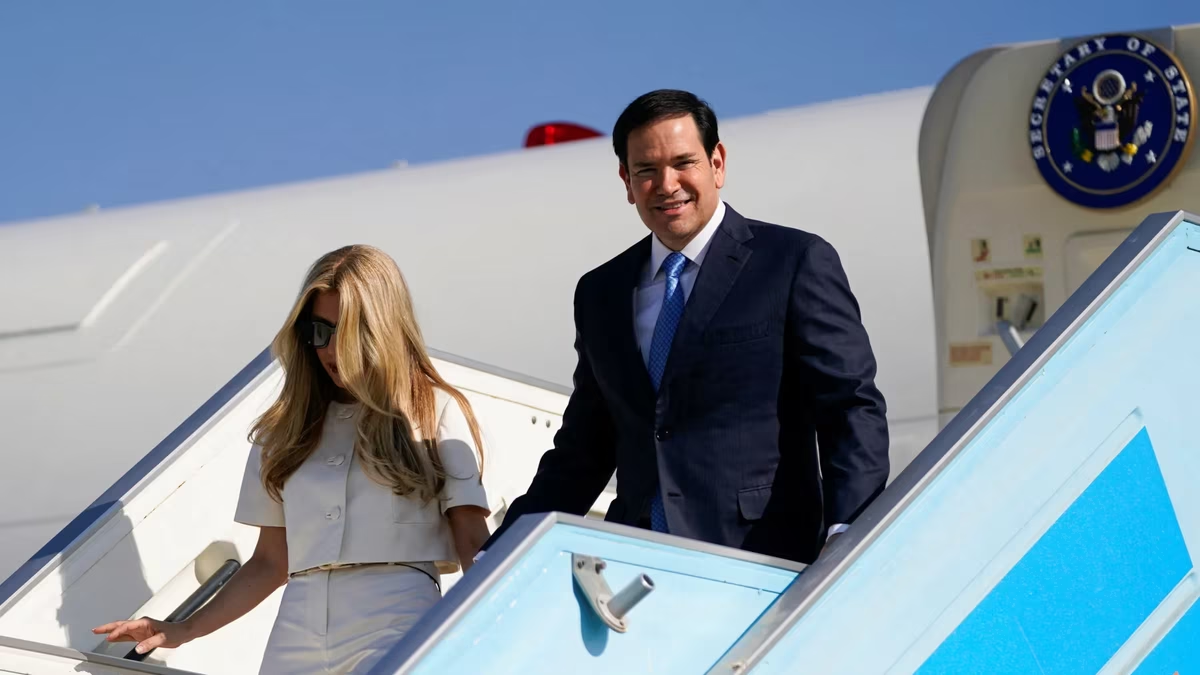
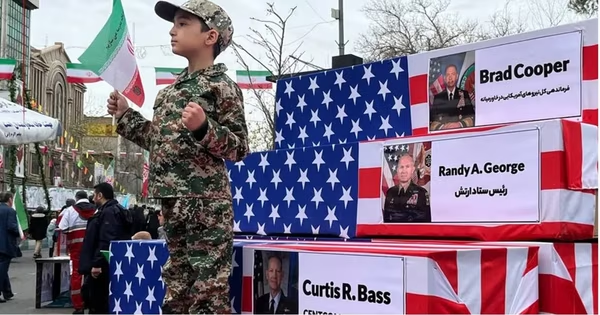

For Palestinians, these patterns deepen the conviction that international law is applied selectively. For Israeli hardliners, they confirm that expansion and coercive measures remain strategically sustainable. The resulting dynamic reflects not policy confusion but policy prioritization: preserving strategic alignment with Israel consistently outweighs enforcement of stated American commitments to human rights and negotiated conflict resolution.


Israeli leaders have adapted effectively to this reality. Maintaining the language of restraint and negotiation preserves Western legitimacy even as territorial consolidation advances incrementally. The ceasefire framework plays a central role by projecting moderation internationally while allowing irreversible changes to deepen locally. Under these conditions, diplomacy manages perception while structural outcomes proceed largely unchecked.


Meanwhile, humanitarian conditions in Gaza continue to deteriorate. Large portions of the territory remain uninhabitable, civilian infrastructure functions only partially, and aid delivery faces persistent political and administrative restrictions. Legal battles over humanitarian access — including court interventions preventing limits on relief organizations — underscore how basic assistance has itself become contested political terrain. That humanitarian operations increasingly depend on judicial intervention illustrates the erosion of norms governing civilian protection during conflict.


For Rubio, the challenge is therefore analytical as much as diplomatic. American policymakers traditionally treat ceasefires as entry points toward negotiations. Yet repeated cycles of large-scale violence followed by partial pauses suggest a different function: ceasefires increasingly operate as mechanisms for managing indefinite conflict while territorial realities evolve elsewhere. Stability, in this context, risks becoming another term for prolonged impasse under unequal conditions.


The credibility costs for the United States are growing. Across much of the Global South, Washington’s reluctance to impose consequences for settlement expansion contrasts sharply with its forceful invocation of international law in other conflicts. Allies may publicly support U.S. framing for strategic reasons, but broader global audiences increasingly interpret American policy as selectively principled — a perception that weakens Washington’s diplomatic authority far beyond the Israeli-Palestinian arena.


Israel continues to justify extensive military operations and territorial control as necessary for security. Yet sustainable security cannot rest indefinitely on military dominance, territorial expansion, or the normalization of civilian suffering under prolonged occupation. Nor can American diplomacy retain credibility while distinguishing between violations it condemns rhetorically and those it accommodates strategically.


Rubio’s visit therefore represents more than routine alliance management. It is a test of whether U.S. policy still treats settlement expansion and annexation as genuine obstacles to peace or merely as inconvenient developments to be managed rhetorically. Genuine diplomacy would align American leverage — military assistance, diplomatic backing, and political legitimacy — with stated legal commitments rather than subordinating them to short-term strategic alignment.


If Washington continues describing ongoing violence as ceasefire and structural annexation as temporary drift, it risks helping entrench a one-state reality defined by unequal rights and permanent instability. The question Rubio ultimately carries to Tel Aviv is not how to preserve the appearance of calm, but whether the United States is prepared to confront the consequences of policies it has long enabled. Until that question is addressed directly, ceasefire diplomacy will remain less a pathway to peace than a language designed to defer accountability.

OPINIONS

Fri 27 Feb 2026 6:09 pm - Jerusalem Time

Rubio's Visit to Israel: An American Attempt to Shape the Post-Gaza Phase Amidst a Turbulent Regional Environment

Said Erikat

Opinion Writer

Washington — Saeed Erikat – 27/2/2026

News Analysis

The anticipated visit of US Secretary of State Marco Rubio to Israel from March 2-3, 2026, reflects an American attempt to reset the course of regional policy in the Middle East, amidst the ongoing repercussions of the Gaza war and escalating fears of expanding regional tensions.

According to the US State Department, Rubio will discuss a range of issues with Israeli officials, most notably Iran's regional influence, tensions on the northern border with Lebanon, in addition to ongoing efforts to implement the 20-point peace plan proposed by President Donald Trump for the Gaza Strip. Although the visit is presented within a routine diplomatic framework, its timing reveals a sensitive transitional phase in US strategy towards the region.

From War Management to Engineering the Political Phase

Nearly two years after the war that altered political and security balances in the Middle East, Washington appears to be moving from a phase of crisis containment to an attempt to formulate long-term arrangements for the post-conflict phase. Rubio's visit comes in the context of this shift, as the US administration seeks to develop a practical vision for the political and security management of Gaza after the war.

The American peace plan, whose full details have not yet been revealed, is based on linking reconstruction with new security measures and different governance arrangements aimed — according to American officials — at preventing the Strip from returning to cycles of repeated military confrontation.

However, this approach reflects an old problem in American diplomacy: reconstruction requires political legitimacy, while legitimacy itself remains hostage to sovereign and security issues that have not yet been resolved. Therefore, observers believe that Rubio's mission is not aimed at achieving an immediate diplomatic breakthrough as much as it aims to unify the American-Israeli vision on what can be considered a realistic path for the next phase.

Iran and the Regional Deterrence Equation

Iran's regional role is expected to be central to the talks. Washington believes that Tehran's support for its allies in the region is a key factor in the continuation of instability, while Israel considers the Iranian presence near its borders to be the most prominent long-term strategic threat.

Accordingly, Rubio's visit carries a dual dimension: reaffirming the American commitment to Israel's security, and at the same time attempting to adjust the deterrence equation to prevent the region from sliding into a wider confrontation. The main challenge for Washington is to deter escalation without reaching a comprehensive direct confrontation.

The danger of this balance is highlighted by the increasing tensions on the Lebanese-Israeli border, where intermittent clashes raise fears of a limited conflict turning into a multi-front war. In this context, American diplomacy seems closer to managing risks than to resolving the roots of the conflict.

Rubio's visit reveals a deeper shift in American strategic thinking. Instead of seeking a comprehensive settlement — as was the case in previous stages of American diplomacy — Washington today tends towards a gradual approach based on first stabilizing the situation, through deterrence, regional cooperation, and economic reconstruction.

This approach reflects lessons learned from past failures, where major initiatives often clashed with political realities that could not be overcome by theoretical agreements alone. However, the gradual approach also carries clear risks, as it could turn into permanent crisis management instead of resolution.

Reconstructing Gaza, without a convincing political horizon for Palestinians, could create a fragile stability that does not address the deep causes of the conflict. Moreover, the multitude of international and regional mediators today reduces the United States' ability to monopolize the role of the main mediator, as it did in past decades.

Test of American Influence

The visit also represents a test of the actual extent of American influence in affecting Israeli decisions, especially given the complexities of internal politics on both sides. In the past, a close strategic partnership was sufficient to translate diplomatic coordination into tangible political changes, but today this ability is more constrained by intertwined internal and regional factors.

It is likely that the success of the visit will not be measured by major announcements, but by its ability to prevent deterioration: containing escalation on the northern front, maintaining security coordination, and keeping the Gaza reconstruction process ongoing pending more mature political conditions.

In conclusion, Rubio's visit reflects a shift in the nature of the American role in the Middle East — from a maker of major settlements to a manager of complex balances. While Washington seeks to remain an indispensable player in the region, the question remains open as to whether crisis management policy can truly produce lasting stability, or if it merely postpones potential future explosions.

OPINIONS

Fri 27 Feb 2026 6:09 pm - Jerusalem Time

Why do Arabs fear the scenario of regime change in Iran? A reading of the geopolitical repercussions

Ramallah - "Al-Quds" Dot Com

Ramallah - "Al-Quds" Dot Com

Opinion Writer

Recently, the drumbeat of war in the Middle East has been escalating, with American military reinforcements off the Iranian coast reaching unprecedented levels of readiness. It seems that the chasm between Washington and Tehran is widening, making diplomatic solutions a distant option, as each side adheres to its rigid positions on outstanding issues.

Observers believe that the American negotiator has become more rigid in demanding concessions, considering that any flexibility at the present time might be interpreted as a free retreat in front of the adversary. In contrast, the Iranian regime finds itself in a tight corner it has not experienced for decades, as its internal legitimacy and external pressures are subjected to severe tests that could destabilize it.

Recalling the experience of the invasion of Iraq casts a dark shadow over the current scene, as facts have proven that wars are not just a military stroll, no matter how imbalanced the balance of power. The fall of the Iraqi regime previously led to a reshaping of the regional sphere in a way that produced geopolitical disasters, and the peoples of the region paid heavy prices for their security and stability.

There are no real signs of progress in negotiations on the horizon, as the United States cannot retreat without achieving gains commensurate with the size of its military buildup. Similarly, the Iranian regime refuses to make fundamental concessions on ballistic missile and nuclear programs, as they represent essential pillars for its survival and the continuity of its political project.

A fundamental question arises in Arab circles about the shape of the region the day after the fall of the Iranian regime, and whether the new equations will serve stability or increase the intensity of chaos. Despite widespread criticism of Tehran's regional policies and its interventions in Arab affairs, a complete collapse of the regime could open the gates of hell for everyone.

Analyses suggest that the Iranian regime, which possesses a deeply rooted institutional and security structure, will not fall easily without a long-term war of attrition. If it feels an existential threat, it may resort to a retaliatory policy targeting neighboring countries and vital interests in the region, especially given the difficulty of direct access to fortified American targets.

Threatening to close vital waterways, such as the Strait of Hormuz and Bab al-Mandab, represents an economic nightmare for Arab countries that rely on these routes to export their energy. Tehran is likely to use its proxies in the region to carry out these threats, putting global trade and Arab national security in the eye of the storm.

There are serious fears that the overthrow of the regime could lead to the dismantling of the Iranian state and its transformation into warring cantons, a scenario whose impact could extend to other countries in the region. This geopolitical fragmentation will create a state of security vacuum that will only benefit powers aspiring to dominate the resources of the Middle East.

Talk of war coincides with the emergence of declared Israeli ambitions to expand its regional influence, exploiting the state of weakness and fragmentation that may afflict its neighbors. Experts believe that weakening major regional powers paves the way for the implementation of settlement and expansionist projects that transcend the current geographical borders of occupied Palestine.

Even if a new Iranian regime emerges, expectations indicate that it may be a creation of international powers, making it a tool in the hands of external axes rather than a stable neighbor. There is a fear of forming new alliances that include 'post-mullah' Iran with powers such as India, placing the Arab world between the jaws of a strategic pincer.

Reproducing the cycle of wars and attrition in the region will only lead to further squandering of wealth and the loss of the future of coming generations. The zero-sum competition between regional powers has proven its failure to achieve security, but rather contributed to deepening the sectarian and political divisions that have ravaged the body of the Arab nation.

Cold political calculations impose on Arab capitals the necessity of acting to prevent a slide towards a comprehensive military confrontation whose outcomes are unknown. The goal must be to preserve the state entity and prevent chaos, while working to modify the behavior of the Iranian regime through diplomatic channels and measured pressures.

Any change imposed by external military force often ends in counterproductive results, as previous experiences in the Arab region and its surroundings have shown. Therefore, Arab interests dictate avoiding being drawn into projects that may appear outwardly to be salvation from an enemy, but inwardly carry the seeds of comprehensive destruction.

In conclusion, the bet remains on the awareness of Arab peoples and regimes of the necessity of protecting their collective security away from sharp international polarizations. For a war on Iran, if it occurs, will not be just a passing event, but will be an earthquake that will redraw the map of the region in a way that may not serve Arab interests for many decades.

Cold calculations compel Arabs to press to prevent war, because the catastrophic results will ultimately serve expansionist projects in the region.