






February 28, 2026
News Analysis
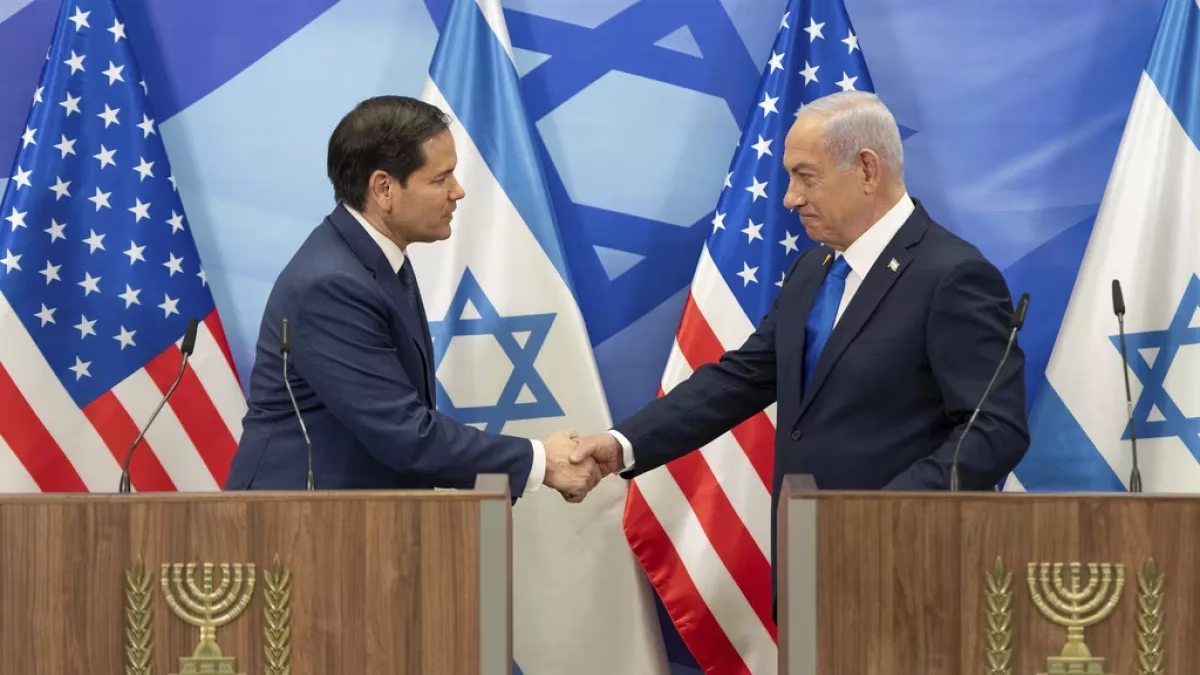
Washington, D.C. — As U.S. Secretary of State Marco Rubio prepares to visit Israel Monday, American diplomacy faces a familiar test: whether Washington intends to confront policies carried out by its closest Middle Eastern ally or continue managing their consequences through carefully calibrated language. Officially, Rubio’s trip aims to reinforce a Gaza ceasefire and coordinate regional strategy, including joint U.S.-Israeli positioning toward Iran. In practice, the visit risks reaffirming a diplomatic narrative that masks continuing violence while political and territorial realities move steadily in Israel’s favor.
Since October 11, Western governments have repeatedly described conditions in Gaza as a ceasefire. Increasingly, however, the term functions less as an objective description than as a political designation. Hundreds of Palestinians have reportedly been killed and thousands injured during this supposed pause amid recurring strikes, armed confrontations, and near-daily military incidents. Traditionally, a ceasefire implies a meaningful suspension of organized violence. What exists instead resembles a managed lowering of intensity sustained by diplomatic terminology rather than by verifiable restraint on the ground.
The language serves important political purposes. Labeling the situation a ceasefire reduces international urgency and shields Israel from mounting diplomatic pressure while allowing Washington to claim progress without exercising meaningful leverage. Israel retains operational freedom while avoiding the costs associated with an openly declared war. The United States, meanwhile, preserves the appearance of mediation without confronting policies that undermine de-escalation. Diplomacy, in this framework, becomes an instrument for stabilizing narratives rather than changing realities.
Gaza is only one dimension of the current moment. The more consequential transformation is unfolding in the occupied West Bank, where settlement expansion and de facto annexation have accelerated under the cover of war. Israeli monitoring organizations report record settlement approvals, legalization of previously unauthorized outposts, and infrastructure projects integrating settlements permanently into Israel’s administrative and economic systems. These measures increasingly resemble long-term territorial consolidation rather than temporary wartime adjustments.
Successive U.S. administrations — Republican and Democratic alike — have formally opposed settlement expansion while consistently avoiding enforcement mechanisms that might alter Israeli calculations. Statements of concern are issued with regularity, yet military assistance continues uninterrupted, diplomatic protection at international forums remains reliable, and political consequences remain absent. Over time, this gap between rhetoric and action has ceased to be a contradiction and instead become a policy signal: opposition without cost functions as tacit acceptance.
This permissive environment extends beyond settlement construction to violence carried out by extremist settlers against Palestinian communities. Human rights organizations and Israeli watchdog groups have documented repeated attacks on villages, farmland, and civilian infrastructure, often occurring near Israeli security forces and followed by limited investigation or accountability. Particularly striking are incidents involving Palestinian Americans, cases that theoretically warrant heightened U.S. intervention yet rarely produce sustained diplomatic pressure. The inconsistency reinforces perceptions that American protection is contingent on political convenience rather than citizenship or principle.
For Palestinians, these patterns deepen the conviction that international law is applied selectively. For Israeli hardliners, they confirm that expansion and coercive measures remain strategically sustainable. The resulting dynamic reflects not policy confusion but policy prioritization: preserving strategic alignment with Israel consistently outweighs enforcement of stated American commitments to human rights and negotiated conflict resolution.
Israeli leaders have adapted effectively to this reality. Maintaining the language of restraint and negotiation preserves Western legitimacy even as territorial consolidation advances incrementally. The ceasefire framework plays a central role by projecting moderation internationally while allowing irreversible changes to deepen locally. Under these conditions, diplomacy manages perception while structural outcomes proceed largely unchecked.
Meanwhile, humanitarian conditions in Gaza continue to deteriorate. Large portions of the territory remain uninhabitable, civilian infrastructure functions only partially, and aid delivery faces persistent political and administrative restrictions. Legal battles over humanitarian access — including court interventions preventing limits on relief organizations — underscore how basic assistance has itself become contested political terrain. That humanitarian operations increasingly depend on judicial intervention illustrates the erosion of norms governing civilian protection during conflict.
For Rubio, the challenge is therefore analytical as much as diplomatic. American policymakers traditionally treat ceasefires as entry points toward negotiations. Yet repeated cycles of large-scale violence followed by partial pauses suggest a different function: ceasefires increasingly operate as mechanisms for managing indefinite conflict while territorial realities evolve elsewhere. Stability, in this context, risks becoming another term for prolonged impasse under unequal conditions.
The credibility costs for the United States are growing. Across much of the Global South, Washington’s reluctance to impose consequences for settlement expansion contrasts sharply with its forceful invocation of international law in other conflicts. Allies may publicly support U.S. framing for strategic reasons, but broader global audiences increasingly interpret American policy as selectively principled — a perception that weakens Washington’s diplomatic authority far beyond the Israeli-Palestinian arena.
Israel continues to justify extensive military operations and territorial control as necessary for security. Yet sustainable security cannot rest indefinitely on military dominance, territorial expansion, or the normalization of civilian suffering under prolonged occupation. Nor can American diplomacy retain credibility while distinguishing between violations it condemns rhetorically and those it accommodates strategically.
Rubio’s visit therefore represents more than routine alliance management. It is a test of whether U.S. policy still treats settlement expansion and annexation as genuine obstacles to peace or merely as inconvenient developments to be managed rhetorically. Genuine diplomacy would align American leverage — military assistance, diplomatic backing, and political legitimacy — with stated legal commitments rather than subordinating them to short-term strategic alignment.
If Washington continues describing ongoing violence as ceasefire and structural annexation as temporary drift, it risks helping entrench a one-state reality defined by unequal rights and permanent instability. The question Rubio ultimately carries to Tel Aviv is not how to preserve the appearance of calm, but whether the United States is prepared to confront the consequences of policies it has long enabled. Until that question is addressed directly, ceasefire diplomacy will remain less a pathway to peace than a language designed to defer accountability.
Share your opinion
Rubio’s Israel Visit and Washington’s Convenient Ceasefire Fiction