LATEST NEWS

Sun 01 Mar 2026 6:26 pm - Jerusalem Time

Iran's Military Capabilities in 2026: A Huge Missile Arsenal and Advanced Global Ranking

The Islamic Republic of Iran continues to strengthen its position among the major military powers in the world, as the 2026 Global Firepower Index ranked it sixteenth out of 145 countries included in the careful review. Tehran achieved a power index of 0.3199, which reflects a remarkable development in its defensive and offensive capabilities compared to previous years, despite the continuation of international sanctions imposed on it.

Data from the International Institute for Strategic Studies indicates that the Iranian armed forces are among the largest in the West Asia region in terms of human power. The military formations include at least 580,000 active-duty soldiers, supported by about 200,000 trained reservists, distributed between the regular army and the Islamic Revolutionary Guard Corps, which represents a fundamental pillar in the country's military doctrine.

In addition to the regular forces, the "Basij" stands out as a voluntary paramilitary force directly affiliated with the Revolutionary Guard, with analysts estimating that the number of volunteers could reach millions. The Revolutionary Guard also manages the "Quds Force," an elite unit tasked with external missions, including coordination with allied forces within what is known as the "Axis of Resistance" in the region.

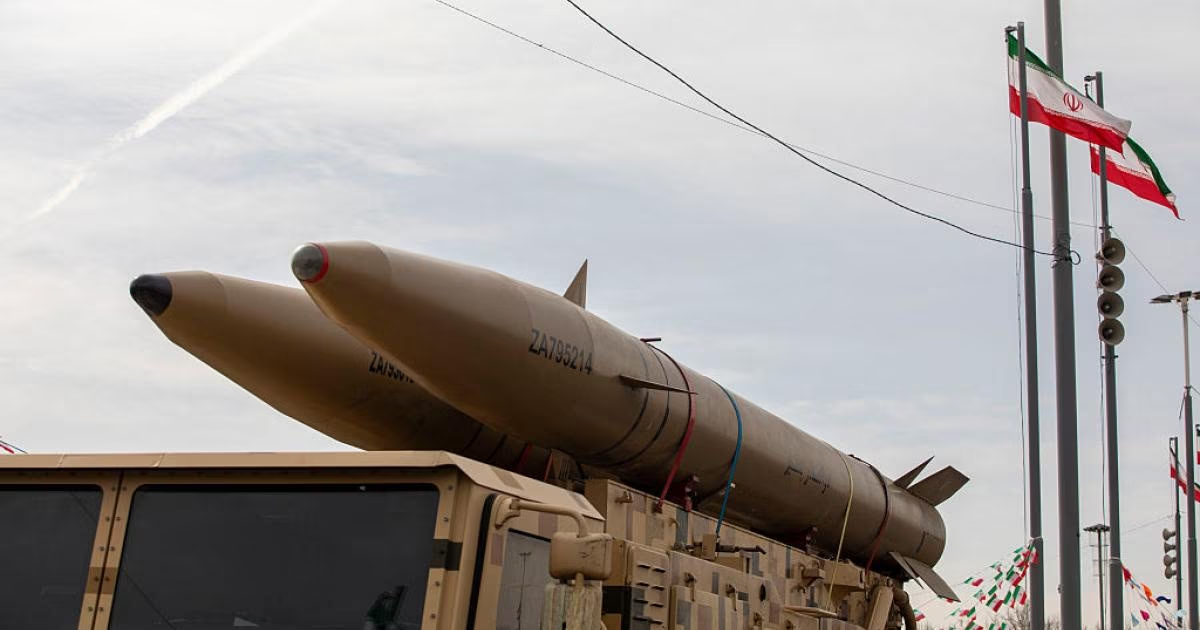
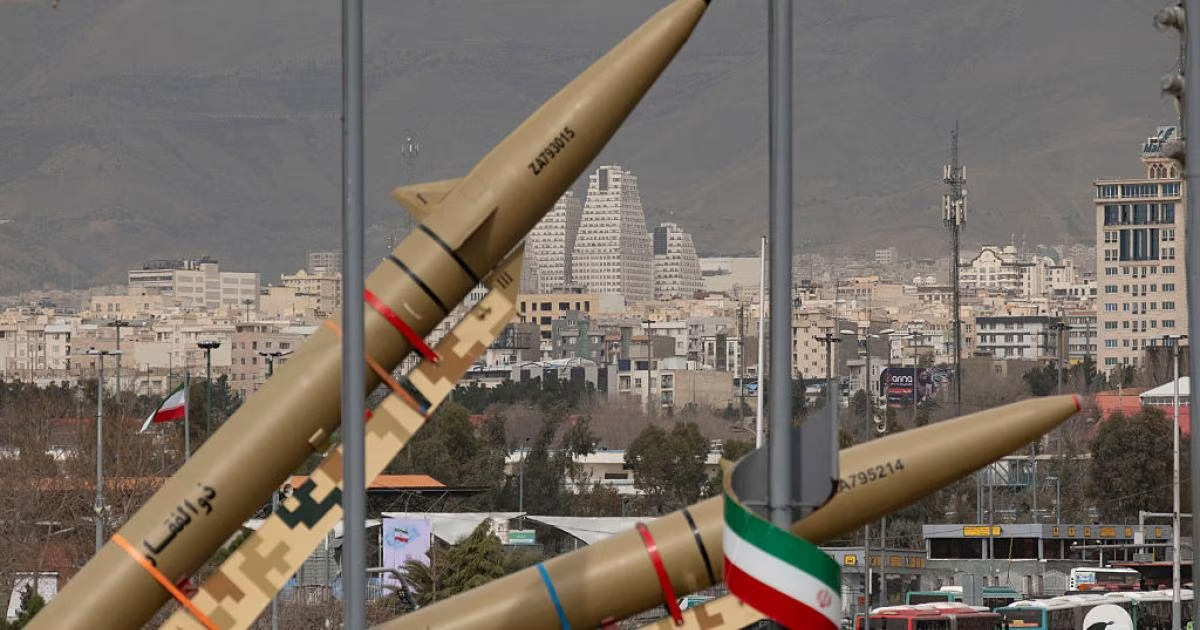
Regarding missile capabilities, Tehran possesses one of the largest and most diverse arsenals in the region, including more than 20 types of ballistic and cruise missiles. These missiles are characterized by varying ranges and high destructive capabilities, specifically designed to provide a strategic deterrent capability capable of reaching long-range targets exceeding 2,000 kilometers.

"Sejjil" and "Khorramshahr" missiles top the list of the most dangerous weapons with a range of 2,000 to 3,000 kilometers, capable of carrying heavy warheads weighing between 750 and 1,500 kilograms. The arsenal also includes "Ghadr," "Emad," and "Fattah 2" missiles, in addition to the "Paveh" cruise missile with a range of up to 1,650 kilometers, which places all regional bases within targeting range.

Iranian missile technology has witnessed a qualitative shift from reliance on liquid fuel in early generations such as "Shahab" missiles, to the use of solid fuel in newer models. This shift has significantly contributed to increasing thrust and reducing preparation time for launch, which enhances the effectiveness of missiles in rapid combat operations and defensive maneuvers.

In the skies of the region, Iran has emerged as a leading power in the field of drones, possessing, according to specialized sources, about 3,894 drones. These drones vary between reconnaissance missions, which constitute 82% of the total, and offensive missions, which represent 18%, and these drones have proven high tactical efficiency as a low-cost and high-impact weapon.

The "Shahed 129" drone is one of the most prominent offensive pieces in the Iranian arsenal, a drone capable of long-duration flight and carrying anti-armor missiles. The "Arash-2" drone also stands out with a range of up to 2,000 kilometers, and the "Mohajer 6" drone, which is used for surveillance and precise attack operations, giving Tehran flexible air capabilities away from traditional fighters.

As for the air force, it still relies mainly on a mix of old American fighters such as the "F-4 Phantom" and "F-14 Tomcat," along with Russian and Chinese aircraft. Despite the age of these aircraft, Iran has succeeded in developing domestically produced fighters such as "Saeqeh," "Kowsar," and "Azarakhsh," in an attempt to bridge the technological gap and modernize its aging air fleet.

On the ground force front, the Iranian army possesses a huge arsenal of approximately 1,500 main battle tanks, varying between Soviet "T-54/55" models and their developed Iranian versions. The ground force also includes hundreds of infantry fighting vehicles and armored personnel carriers, providing high mobility and troop protection in various operational theaters.

Regarding artillery, sources reported that Iran possesses approximately 7,000 artillery systems, including self-propelled howitzers of various models. These systems include domestically produced "Raad" cannons, and North Korean and American-made cannons, making it one of the strongest artillery forces in the region in terms of firepower density and variety of options.

Despite this significant conventional strength, defense experts indicate that Iran still faces technological challenges that make it lag behind the military development of the United States and Israel. However, reliance on local manufacturing and innovation in the fields of missiles and drones has enabled it to create a deterrent balance that compensates for the lack of some advanced technical aspects.

The nuclear file remains the most controversial issue, as international reports confirm that Iran possesses the knowledge and infrastructure necessary to produce a nuclear weapon if the political decision is made. Despite Tehran's continuous denial of any military intentions for its nuclear program, analysts believe in its ability to produce enough fissile material to make a bomb within a few months.

In conclusion, the 2026 military ranking shows that Iran has managed to build an integrated defense system based on self-sufficiency in many vital sectors. This development positions it as a regional player that cannot be overlooked, and represents a continuous challenge to security balances in the Middle East, especially with the continued development of the ranges and accuracy of its strategic weapons.

Tehran possesses one of the largest arsenals of ballistic missiles and drones in the West Asia region, with capabilities capable of striking targets up to 3,000 kilometers away.
ARAB AND WORLD

Sun 01 Mar 2026 6:26 pm - Jerusalem Time

Iran Enters Transitional Phase After Khamenei's Assassination: Ali Reza Arafi Leads Succession Scene

Iranian authorities officially announced the country's entry into a transitional phase following the assassination of the Supreme Leader of the Islamic Republic, Ali Khamenei, in an incident that shook the foundations of the political system in Tehran. The Secretary of the Supreme National Security Council, Ali Larijani, confirmed that arrangements for the transfer of power are underway in accordance with established constitutional frameworks to ensure the stability of state institutions.

In a swift move to address the leadership vacuum, the formation of a provisional leadership council was announced to urgently manage the country's affairs. This council includes Iranian President Masoud Pezeshkian, Head of the Judiciary Gholam-Hossein Mohseni Eje'i, and the jurist from the Guardian Council, Ali Reza Arafi.

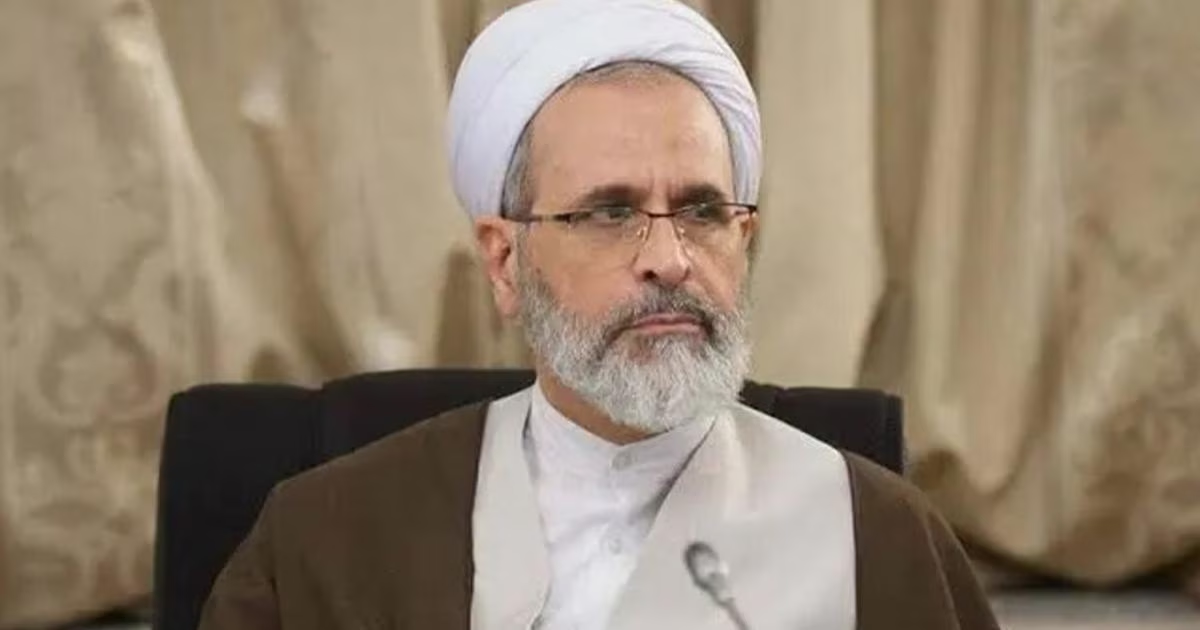
Mohsen Dehnavi, spokesman for the Expediency Discernment Council, revealed that the council chose Ayatollah Ali Reza Arafi to be the third member of the provisional leadership council. This selection comes due to his religious and political weight, as he is a member of both the Assembly of Experts and the Guardian Council, making him a formidable figure in the current governing equation.

Attention is now focused on the Assembly of Experts, which is constitutionally mandated to elect the new Supreme Leader of the Republic as soon as possible. This council consists of 88 Shia clerics and 5 Sunni members. For an election session to be held, two-thirds of the members must be present, and the proposed name must be approved by a two-thirds majority.

Article 111 of the Iranian Constitution stipulates that in the event of the leader's death or removal, a temporary body assumes leadership duties to ensure there is no vacuum at the top. The article clearly states that diagnosing the leader's incapacity or loss of required qualifications falls within the powers of the Assembly of Experts, which must act immediately to announce a replacement.

Ali Reza Arafi, born in 1959 in Meybod, is considered one of the most prominent candidates to assume the position of the third Supreme Leader in the history of the Republic. Arafi comes from an ancient religious family that opposed the Shah's regime, and his father, Mohammad Ibrahim Arafi, was close to the founder of the Republic, Ayatollah Khomeini, which gives him historical and religious legitimacy.

Arafi currently holds sensitive positions, including the management of the Qom Seminary and the presidency of Al-Mustafa International University, which has enabled him to build a wide network of relationships within the religious establishment. He is also known for his conservative and hardline rhetoric and his close ties to the Iranian Revolutionary Guard Corps, a crucial factor in his favor within decision-making circles.

In addition to Arafi, other names stand out on the list of potential candidates, including Mojtaba Khamenei, the son of the late leader, who enjoys wide influence within the security apparatus and the Basij. Despite his field strength, his lack of high jurisprudential standing among senior clerics may hinder his ambitions to reach the position of Vali-e Faqih.

Also appearing on the scene is Mohammad Mehdi Mir Bagheri, a hardline cleric who heads the Islamic Sciences Academy in Qom and is a member of the Assembly of Experts. Mir Bagheri represents the most radical current in the religious establishment and enjoys the support of sectors that believe in the necessity of tightening ideological control in the coming phase.

Among the proposed figures is also Hassan Khomeini, the grandson of the founder of the Republic, who holds the position of custodian of his grandfather's shrine. Despite his great symbolism, he is classified within the less hardline current, which may make consensus on him difficult given the conservative wing's control over key positions in the Assembly of Experts and the Revolutionary Guard.

Hashem Hosseini Bushehri, the First Deputy Chairman of the Assembly of Experts, is also a prominent name in the nominations. Bushehri was very close to Khamenei and has long experience in managing the affairs of the religious establishment, making him a consensual candidate in case of a split over other names.

Article 109 of the Constitution sets strict conditions for those who assume the position of leader, including scientific competence for jurisprudential ijtihad, justice, and piety. The article also emphasizes the necessity of having correct political and social vision, and the ability to manage and sufficient courage to lead the nation in complex circumstances.

Informed sources indicate that a special committee within the Assembly of Experts had already begun some time ago to study the files of potential candidates and verify their eligibility. With the assassination, the pace of this committee's work accelerated to submit its final report to the council, which will hold a historic session to determine the future of leadership in Iran.

The biggest challenge facing the new leadership remains maintaining internal cohesion and confronting the regional repercussions of the assassination. Under the system based on the Guardianship of the Islamic Jurist, the personality of the next leader will largely determine the course of Iranian foreign policy and its relationship with international powers in the coming phase.

The transitional phase after Khamenei's assassination has begun, and a provisional leadership council will be formed to take responsibility until the next leader is elected.

ISRAELI AFFAIRS

Sun 01 Mar 2026 6:26 pm - Jerusalem Time

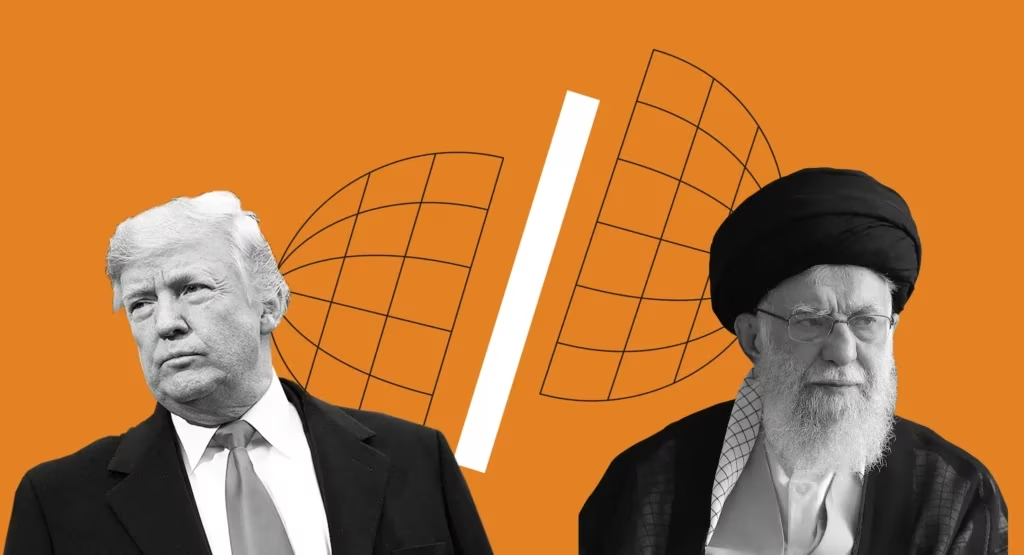
Ignatius: Is Trump giving the Iranian regime a 'kiss of life' through a martyrdom strategy?

Writer David Ignatius considered the military operation launched by US President Donald Trump against Iran to be a major gamble that might not end as quickly as the White House imagines. He pointed out that targeting the Supreme Leader of the Islamic Republic, Ali Khamenei, might technically succeed in 'decapitating the regime,' but it does not necessarily guarantee its political or ideological collapse.

The article explained that for 45 years, American presidents avoided entering into a comprehensive confrontation with Tehran due to grave risks, but Trump broke this custom by launching a wide-ranging attack. Ignatius believes that killing an elderly and frail leader like Khamenei, who was born in 1939 and suffered the consequences of a previous assassination attempt, may not represent the desired radical change.

The writer warned of the absence of a clear plan for the aftermath of the first strike, emphasizing that he had not heard from any American or Israeli official an accurate vision for the next phase. He mentioned that recent history proves the failure of wars aimed at regime change, citing the Russian models in Ukraine and the Israeli models in Gaza, where the conflict dragged on contrary to initial expectations.

According to the analysis, Trump, who urged Iranians to rise up and risk their lives, now finds himself obliged to end this war with overwhelming success. American generals believe that entering a war with a 'hated' regime requires a long breath, and there is no easy way out once the fuse of direct confrontation is lit.

Ignatius described Trump's approach as the 'Viking method,' which relies on quick entry and exit using the element of surprise to force the opponent to surrender. However, the confrontation quickly escalated with Iran carrying out counter-attacks that targeted vital facilities in Bahrain, Dubai, and Abu Dhabi, in addition to Israeli territory.

The military developments led to the closure of the Strait of Hormuz, causing severe disruption in global oil supplies, which prompted warnings that Iran is not a weak country that can be easily subdued. Sources quoted a security advisor in Bahrain that 14 Iranian drones successfully targeted the headquarters of the US Fifth Fleet with remarkable success.

The Bahraini security advisor expressed his astonishment at the inability of American defenses to intercept 'Shahed' drones, whose moments of impact with their targets were documented by video clips. These incidents reflect the Iranian regime's ability to inflict painful damage on the American military presence in the region despite the intensity of fire directed against it.

In an extreme speech, Trump called on elements of the Revolutionary Guard and the Iranian armed forces to immediately lay down their weapons in exchange for full immunity. The American president threatened those who refuse to comply with 'certain death,' asserting that the United States supports the Iranian people with overwhelming destructive power to achieve the moment of change.

Despite the writer's hatred for the Iranian regime, he warned against underestimating its ability to survive, recalling his visit to Tehran in 2008 where he noted strict security and administrative discipline. He pointed out that the regime, which spreads chaos abroad, simultaneously possesses precise internal control tools that make its rapid collapse difficult to predict.

The article revealed a division among allies, as Britain refused to use its facilities at Diego Garcia base to support the attack, while anxiety prevailed in the UAE and Saudi Arabia. In contrast, Israel emerged as the sole and enthusiastic supporter of this military operation, while the rest of the allies hope for a quick settlement that avoids a comprehensive regional war.

The greatest concern, according to Ignatius, is that the conflict could lead to the rehabilitation of the hardline current in Iran by granting the Supreme Leader the status of 'martyr.' While the regime was suffering from declining popularity and succession struggles, the American strike might contribute to unifying ranks behind the idea of historical oppression and martyrdom.

Western security sources reported that the strikes targeting Iranian intelligence headquarters led to the killing of four senior leaders, indicating a crack in the repression apparatus. Although this collapse might seem like good news, the writer believes that Iranian culture is capable of absorbing suffering and transforming it into a strong motive for resistance and perseverance.

Ignatius recalled the image of Imam Hussein he saw at the CIA's Iran operations center decades ago, as a symbol of the opponent's strong commitment to the doctrine of sacrifice. He quoted a retired CIA officer on the necessity of formulating a smart post-war strategy, instead of relying on illusions of a short and swift war.

The writer concluded his analysis by emphasizing that Trump bears a special responsibility to explain the dimensions of this conflict to the American people, given the grave and unknown risks involved. The current battle is not just a 'one-time intervention,' but the beginning of a long-term conflict that may be arduous and full of dangerous and unexpected turns.

Starting wars is always easier than ending them, especially when the goal is political, represented by regime change, rather than a clear military objective.

OPINIONS

Sun 01 Mar 2026 6:18 pm - Jerusalem Time

AIPAC’s Campaign Against Dissent Is Redrawing — and Constraining — Democratic Politics

News Analysis


Washington, D.C. — As the American Israel Public Affairs Committee (AIPAC) convenes its annual conference in Washington from March 1 to March 3, it does so amid an atmosphere of confident triumphalism, buoyed by what supporters portray as successful advocacy for a U.S. war on Iran. Yet beneath the celebratory tone lies a profound transformation in AIPAC’s political role. No longer operating chiefly as a traditional Capitol Hill lobbying organization, it has evolved into one of the most aggressive and best-funded actors in Democratic primary elections, sending an increasingly explicit message to lawmakers: forceful criticism of Israeli government policy may carry political consequences.


Over recent election cycles, AIPAC and its affiliated super PACs have poured tens of millions of dollars into congressional contests, frequently targeting safe Democratic districts where primaries effectively determine the winner. The organization argues it is defending the U.S.–Israel alliance. In practice, however, its spending has often focused on candidates who advocate conditioning military aid, emphasize Palestinian human rights, or sharply criticize the policies of Prime Minister Benjamin Netanyahu. This is not merely advocacy; it functions as political enforcement.


Missouri offered one of the clearest illustrations. Representative Cori Bush, a vocal critic of Israeli military operations in Gaza, faced a torrent of outside expenditures backing her challenger. Advertising saturated the district, largely centered on crime and local concerns rather than foreign policy. The scale of spending far exceeded what Bush’s campaign could match, and her defeat was celebrated by pro-Israel groups as proof that outspoken criticism carries electoral risk. The race demonstrated how decisively super PAC money can shape low-turnout primaries.


New York soon followed with an even more expensive contest. Representative Jamal Bowman became the focus of unprecedented outside spending in one of the costliest House primaries in modern history. AIPAC-aligned groups invested heavily after Bowman criticized Israeli government actions and called for reassessing U.S. aid. His eventual loss marked another high-profile victory for AIPAC — and, for critics, further evidence that ideological disputes within the Democratic Party were increasingly settled by financial power rather than persuasion.


Yet the strategy has not always produced the intended outcome. In Michigan, Representative Rashida Tlaib — among Congress’s most outspoken defenders of Palestinian rights — survived intense opposition efforts and won her primary decisively. Despite being a top target of pro-Israel advocacy networks, her strong grassroots base and deep ties to her district proved resilient. In Minnesota, Representative Ilhan Omar has likewise withstood repeated, well-funded attempts to unseat her, continuing to win reelection despite sustained outside pressure.


These contrasting outcomes underscore a central reality: money is powerful but not omnipotent. Where incumbents possess entrenched local support and ideological alignment with their voters, multimillion-dollar interventions can falter. Where margins are narrower, however, outside spending can decisively tilt the political field.


The broader concern extends beyond individual races to the chilling effect such interventions create. Democratic lawmakers increasingly operate with the understanding that strong criticism of Israeli government policy may trigger a deluge of negative advertising financed by national donors. Even those who ultimately prevail must divert time, energy, and resources toward political survival. The implicit warning is unmistakable: dissent is costly.


This dynamic unfolds amid a generational transformation within the Democratic electorate. Younger voters, in particular, are markedly more skeptical of Israeli government policies than previous generations, with growing support for conditioning military aid and prioritizing Palestinian human rights. Rather than engage this shift primarily through debate and persuasion, AIPAC’s approach has frequently relied on overwhelming financial intervention — a strategy that may secure short-term victories while deepening long-term political fractures.


Evidence of this changing public mood emerged starkly in a Gallup poll published on February 27, 2026, which found that, for the first time in the survey’s history, more Americans sympathize with Palestinians than with Israel, by 41 percent to 36 percent. The result signals a historic erosion of what was once a durable advantage in American public opinion and represents a potentially devastating development for AIPAC, whose influence has long rested on the assumption of broad pro-Israel consensus among U.S. voters. The finding suggests that while AIPAC may continue winning expensive primaries, it may be doing so against the direction of broader societal change.


The paradox is striking. By aggressively targeting progressive incumbents, AIPAC has demonstrated formidable tactical strength. Yet in districts represented by figures such as Tlaib and Omar, voters have resisted what they perceive as outside interference. In some instances, heavy spending has galvanized grassroots fundraising and intensified local loyalty to embattled incumbents rather than weakening them.


None of this diminishes AIPAC’s right to participate in the political process. Like labor unions, environmental organizations, and business associations, it operates within the legal framework governing super PACs and independent expenditures. The deeper question is whether the scale and strategic intent of its spending are narrowing the boundaries of legitimate debate within one of America’s two major political parties.


For decades, bipartisan support for Israel rested on a broad strategic and moral consensus. Today that consensus is under visible strain — not solely because of activists or progressive lawmakers, but because developments on the ground have forced difficult questions about occupation, settlement expansion, and civilian suffering. Attempting to suppress those debates through financial dominance does not resolve them; it postpones and intensifies them.


As AIPAC convenes its conference, it can point to victories in Missouri and New York as evidence of enduring clout. Yet the persistence of lawmakers such as Tlaib and Omar — alongside shifting national public opinion — illustrates the limits of that power. Democracy functions best when policy disagreements are decided through persuasion and voter deliberation, not overwhelming financial force.


If the price of questioning Israeli government policy becomes a multimillion-dollar campaign aimed at ending a political career, then the stakes extend far beyond any single election. The issue is whether robust foreign-policy debate can endure in an era when money increasingly speaks louder than democratic deliberation.

ANALYSIS

Sun 01 Mar 2026 5:31 pm - Jerusalem Time

Assassination of Khamenei: A Strategic Earthquake Reshaping the Confrontation Between Washington and Tehran

The ongoing war against Iran is no longer proceeding according to the traditional rules that preceded the assassination of Supreme Leader Ali Khamenei. This event was not merely a qualitative military strike, but a pivotal moment that shifted the conflict from the level of re-establishing deterrence to breaking the regime in its highest sovereign and ideological symbol. With this radical transformation, the level of confrontation has escalated to a point where a return to the logic of reciprocal tactical messages is no longer possible.

Before this assassination, the scene was interpreted as an intersection between Donald Trump's confrontational tendency to use force to impose major deals, and Benjamin Netanyahu's need to restore Israel's shaken deterrence image since October 7th. Strikes were understood as pressure tools within a controllable escalation equation, but targeting the head of the regime transformed the battle into an existential struggle that cannot be divided.

Khamenei's fall did not represent the absence of a transient military leader, but the absence of the religious and political authority that formed the backbone of the Iranian regime for decades. The impact of this event extends to millions of Muslims who see the Supreme Leader as an ideological symbol, making his targeting a symbolic insult that transcends political boundaries to affect the symbolic structure of Islamic identity in the face of what is described as American and Zionist savagery.

The assassination struck at the symbolic structure of the Iranian regime fatally. The man was the cornerstone around which the state's legitimacy and continuity revolved. When this symbol is targeted, the response is not merely a cold calculation of losses and gains, but a desperate defense of the entity itself to prove that the regime has not been broken and that the Supreme Leader's blood will have exorbitant and unprecedented costs.

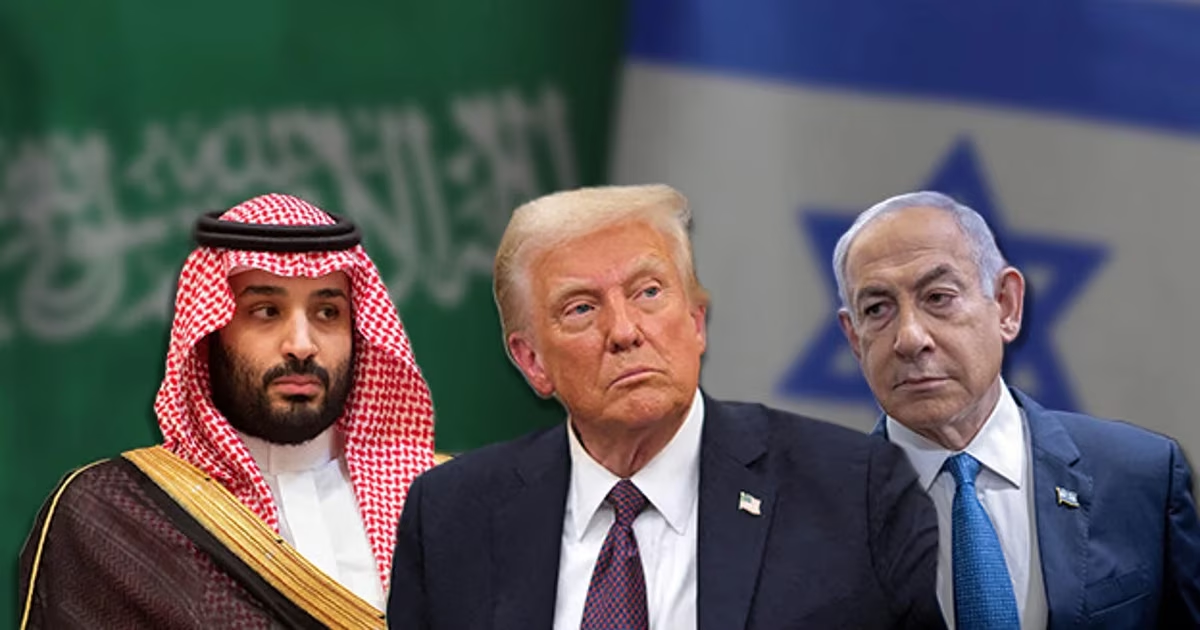
In this explosive context, the calculations of Trump and Netanyahu intersect in an increasingly dangerous way, as both believe that breaking the ceiling is the shortest path to imposing a new geopolitical reality. Trump, with his philosophy based on negotiation from a position of absolute power, sees the strike as a means to redefine the balance with Tehran, while Netanyahu sees it as a historic opportunity to transform his path from a beleaguered prime minister to a leader who delivered the knockout blow to his strategic adversary.

However, what appeared at the moment of decision-making as the peak of decisiveness quickly turned into a gateway to comprehensive and uncontrolled escalation, for a regime struck at its heart does not have the luxury of a limited response. Any faint reaction will be interpreted as weakness or the beginning of collapse, and therefore Tehran moved towards a broad escalation aimed primarily at restoring lost prestige and establishing its presence as an indispensable regional power.

The war has effectively moved from the logic of traditional conflict management to the logic of comprehensive chaos management, where transitioning to de-escalation has become extremely complex. Each party in this equation has become captive to its image before its audience; neither Trump can retreat after a strike of this magnitude, nor can Iran accept a reality that portrays it as broken, content with symbolic responses that do not rise to the level of the event.

The irony lies in the personal similarity between Trump and Netanyahu in their veneration of the strongman image, which may push the region towards a frantic escalation race. War, unlike commercial deals, does not always end at the points defined by its makers, but branches out into unexpected paths and imposes its own rhythm on everyone, making its outcomes open to all catastrophic possibilities.

The assassination of Khamenei completely reshaped the regional landscape, transforming the confrontation from a conflict of borders and deterrence to a battle that touches the essence of regimes and their image before their peoples. The region today faces an extremely dangerous equation, where the maximum strike has generated a maximum response, and between the alliance of fire and the vengeance of existence, the future of the Middle East will be determined, which may emerge with entirely new maps.

In contrast, the official Arab scene appears as a helpless bloc content with the position of an observer who receives blows and whose resources are exploited in the wars of others. This helplessness is evident in the absence of any effective role or real influence in the course of events. Indeed, some official positions seem complicit through silence or by merely issuing rhetorical statements calling for self-restraint at a time when the region is ablaze.

The terms of liberating Palestine have disappeared from the official political lexicon, replaced by vague phrases calling for resolving conflicts through peaceful means and de-escalation. This shift in discourse reflects a state of alienation from central issues, where anyone who tries to resist the occupation is pursued and criminalized, in a historical paradox that reflects the extent of the breakdown in the official Arab system.

The current conflict is no longer just about who possesses the greatest military power, but about who has the ability to bear the exorbitant cost of pursuing confrontation to its end. While major powers are busy shaping the features of the new regional order with blood and fire, the peoples remain the primary victims of these transformations, which may leave deep wounds that will be difficult to heal for many decades.

Iran's strategy in the coming phase will focus on rebuilding the wall of deterrence that was shattered by targeting the head of the pyramid, which means that responses may not be limited to Israeli geography but may extend to American interests in the region. This systematic escalation aims to send a clear message that the price of targeting sovereign symbols will be more expensive than decision-makers in Washington or Tel Aviv imagine.

In conclusion, the Middle East today stands on the brink of a historical transformation that could lead either to the birth of new power balances or to the region sinking into a spiral of open violence. The absence of a unified Arab project makes the region's arenas battlegrounds for settling international scores, putting the future of coming generations at stake amidst the conflict of existential wills between regional and international powers.

The assassination of Khamenei was not a fleeting chapter, but a moment that transformed the conflict from an attempt to redraw deterrence to a confrontation that touches the essence of regimes and their image.

ISRAELI AFFAIRS

Sun 01 Mar 2026 5:31 pm - Jerusalem Time

Celebrations and Warnings in Israel Following Khamenei's Assassination: Fears of a Long War 'Trap'

Political and military circles in Israel are experiencing a state of euphoria following the announcement of the assassination of Iranian Supreme Leader Ali Khamenei, amidst direct US involvement in military operations. Despite the celebration of this intelligence achievement, cautionary voices are emerging, warning against the danger of succumbing to 'the intoxication of power' and getting entangled in a protracted military confrontation with an unknown end.

Former National Security Advisor, Giora Eiland, pointed out that the nightmare scenario is Tehran adopting a strategy of 'strategic patience,' where the regime survives and continues to target Israeli and Gulf interests with missiles. Eiland stressed that the real test will be the field results after several months, calling for not rushing to declare final victory before the situation stabilizes.

Multiple scenarios are being proposed for the future of governance in Iran, with observers believing that the collapse of the regime may be possible if military strikes coincide with widespread popular protests. Some compare the current situation to what happened in Syria, where military and internal pressures led to the fragmentation of the ruling regime's structure and its loss of control over vast areas.

In contrast, questions arise about the intentions of US President Donald Trump, and whether he will seek to complete the war until the regime is overthrown or will look for a quick diplomatic exit. Experts suggest that Trump may maneuver by offering to resume negotiations with a new Iranian leadership that might be more pragmatic and less radical than the previous generation.

For his part, political analyst Nahum Barnea believes that the survival of the Iranian system as a whole is Tehran's top priority, not the survival of individuals. Barnea revealed, citing American sources, that Washington had indeed offered a ceasefire proposal, but the Iranian side showed intransigence and rejected the offer in its early stages.

Journalistic analyses called for the necessity of humility in defining war objectives, and focusing on destroying missile capabilities and nuclear facilities instead of betting entirely on regime change. Analysts considered that any success in destabilizing Tehran would have major repercussions reaching Europe and China, thus reshaping international balances.

Nadav Eyal warned that the Iranian regime might resort to deterring the United States by targeting strategic facilities in Gulf countries to raise the cost of the war. He explained that Tehran might be content with launching a limited number of missiles daily to ensure continuous attrition, as long as no internal revolution erupts to overthrow state institutions.

Intelligence experts believe that Israel exploited the state of 'strategic blindness' that afflicted the Iranian leadership and its involvement in outdated security concepts that are no longer effective. However, they stressed that tactical success in the assassination does not necessarily mean an immediate strategic change in the turbulent reality of the Middle East.

Media sources warned of the need to remember past experiences, where leaders declared victory in previous rounds only for it to become clear later that the confrontation was still ongoing. The newspaper 'Haaretz' in its editorial called for a responsible policy that precisely defines objectives and seeks political exits that ensure long-term security.

Questions were raised about the possibility of a war of succession erupting within the Iranian regime's factions between conservatives and radicals following Khamenei's absence. Observers confirm that aerial military gains, no matter how powerful, rarely succeed alone in overthrowing complex political systems without ground interventions or widespread revolutions.

Kasina Svetlana, an expert on Iranian affairs, warned that the failure of the war to overthrow the regime would make the region more violent and dangerous than it was. She pointed out that the world is currently watching the ability of the United States and Israel to impose a new reality, or to slide into the trap of a comprehensive regional confrontation.

In a different reading, analyst Gideon Levy believes that excessive reliance on military force will not solve the fundamental crises in the region. Levy called for the necessity of ending the occupation and stopping the oppression of the Palestinian people as the only way to achieve real stability away from the 'intoxication of power' that could end in a harsh shock.

Independent analysts expressed concern that Israel excels at waging wars but always lacks clear strategies to end them. They pointed out that continued escalation could ultimately strain relations with Washington if the latter feels it has been drawn into a war that does not serve its supreme interests.

Finally, fears arise that Prime Minister Benjamin Netanyahu will exploit the military momentum to achieve internal political gains and prolong his stay in power. Observers warn that appearing as a 'historical hero' could push towards additional military adventures, such as opening new fronts, thus placing the entire region on the brink of a volcano.

The day we can say that the operation has succeeded in strategically changing the reality of the Middle East is still far off.

ARAB AND WORLD

Sun 01 Mar 2026 5:31 pm - Jerusalem Time

Trump Vows 'Unprecedented' Strike on Iran Amid Military Alert and Rising Regional Tensions

US President Donald Trump, early Sunday morning, issued a stern warning to the Iranian leadership, affirming that any attempt to carry out a military strike against American interests would be met with an unprecedentedly powerful response. Trump indicated that the US administration had detected clear Iranian intentions to escalate the field situation in the coming hours.

The US President clarified in a post on his 'Truth Social' platform that Tehran had announced its intention to launch a strike it described as very powerful, emphasizing that the United States would not stand idly by in the face of these threats. He added that Washington-led military operations in the region would continue as long as security necessities dictated.

In the context of his controversial statements, Trump considered that the absence of Iranian Supreme Leader Ali Khamenei opens the door for the Iranian people to have a historic opportunity to change the ruling regime. He hinted at communication with or knowledge of individuals who might lead the transitional phase in Iran, describing them as good elements capable of governance.

On the other hand, the Iranian Revolutionary Guard issued a statement vowing a comprehensive and widespread response to the assassination of Supreme Leader Ali Khamenei, asserting that targets would not be limited to Israeli territory but would include US military bases deployed in the region. The statement indicated that air raid sirens would not cease in Israeli cities due to the expected missile intensity.

On the ground, military sources confirmed the activation of air defense systems in several areas after detecting waves of missile projectiles launched from Iranian territory. Reports from the Israeli Home Front stated that air raid sirens sounded in various locations, while attempts to intercept a number of aerial targets were successfully carried out.

Observers believe that Trump's threats come within the framework of his adopted maximum deterrence strategy, which relies on raising the level of confrontation to non-material levels to force adversaries to retreat. Sources reported that Washington had received accurate intelligence information about Iranian preparations to launch the most violent attack of its kind since the beginning of the current round of escalation.

Domestically, Trump faces increasing political pressure due to his involvement in extensive military operations without official authorization from the US Congress. This move raises constitutional questions about the President's powers to declare war, prompting the White House to classify current movements as limited military operations.

Democratic lawmakers and some Republican voices criticized this escalatory approach, warning against the United States sliding into an open regional war whose end cannot be predicted. The 'America First' movement expressed concern about being drawn into external conflicts that could drain American resources and contradict electoral promises to withdraw from Middle East wars.

Leaks from within the US administration indicate that military coordination between Washington and Tel Aviv has significantly strengthened since the meeting between Trump and Israeli Prime Minister Benjamin Netanyahu in Florida. These discussions focused on ways to curb Iran's missile program and deal with direct threats facing allies.

Recently, the US President has been trying to regulate his media appearances and avoid delving into precise field details, in order to avoid any political vulnerabilities that his opponents at home might exploit. Despite his usual inclination for lengthy appearances, the sensitivity of the military situation forced him to limit himself to brief and firm statements via social media.

Risks surrounding US forces deployed in military bases in the region are increasing, as these bases are considered easy targets for any retaliatory Iranian action. This reality places the US administration before the challenge of protecting its soldiers and diplomats while maintaining the prestige of military deterrence simultaneously.

Amidst this internal division, questions are escalating in Washington about how far this confrontation can go, and whether the anticipated Iranian strike will be the spark for a comprehensive war. Estimates fluctuate between the possibility of containing the situation through international mediation or heading towards a direct confrontation that changes the map of influence in the region.

In conclusion, the scene remains open to all possibilities with continued mutual military buildup, as the international community cautiously monitors the outcomes of the escalation between Washington and Tehran. All eyes remain on the coming hours, which will determine whether the region will move towards an enforced calm or a widespread military explosion.

Iran has just stated that they will be hitting us very hard today... It would be best if they don't do that, because if they do, we will hit them harder than they have ever been hit before!

ARAB AND WORLD

Sun 01 Mar 2026 5:26 pm - Jerusalem Time

Bloody Regional Escalation: Deaths in the Gulf Due to Iranian Retaliation and Saudi Arabia Summons Tehran's Ambassador

The Qatari Ministry of Foreign Affairs, today, Sunday, expressed its strong condemnation of the Iranian attacks that targeted several countries in the Arabian Gulf region. Doha considered these military movements a direct threat to the role of mediators and undermining the essential diplomatic tools used to contain regional crises.

The official spokesperson for the Qatari Ministry of Foreign Affairs, Majid Al-Ansari, affirmed in his statements that targeting the Sultanate of Oman represents an assault on the principle of mediation that Muscat has always adhered to in order to prevent bloodshed. He pointed out that Oman had made diligent efforts to keep the doors of diplomacy open until the last moments before the outbreak of confrontation.

The Qatari official stressed that this pattern of attacks represents a catastrophic development that threatens international peace and stability in the region. He noted that Qatar had previously warned against the consequences of targeting mediators, considering that what is currently happening weakens the ability to reach peaceful solutions to escalating crises.

In Riyadh, the Kingdom of Saudi Arabia took firm diplomatic measures by summoning its Iranian ambassador, Ali Reza Enayati. This step came to officially protest what the Kingdom described as flagrant aggressions that affected its territories and the territories of sisterly countries in the region during the past hours.

During the summoning process, the Saudi Deputy Minister of Foreign Affairs, Engineer Waleed bin Abdulkarim Al-Khuraiji, conveyed the Kingdom's strong displeasure and condemnation of these violations. Al-Khuraiji affirmed Riyadh's categorical rejection of any infringement on the sovereignty of states, noting that these actions seriously undermine regional security.

On the ground, the United Arab Emirates announced 3 deaths and 58 others injured with varying degrees of wounds since the start of the Iranian strikes. This toll comes amid continued military tension that has affected civilian facilities and properties in several Emirati regions as a result of missile barrages.

In Kuwait, the Ministry of Health confirmed one death and 32 other injuries, all of foreign nationalities, due to the attacks. The ministry's spokesperson, Dr. Abdullah Al-Sanad, explained that a number of the injured underwent delicate surgical operations at Al-Adan Hospital as a result of their injuries.

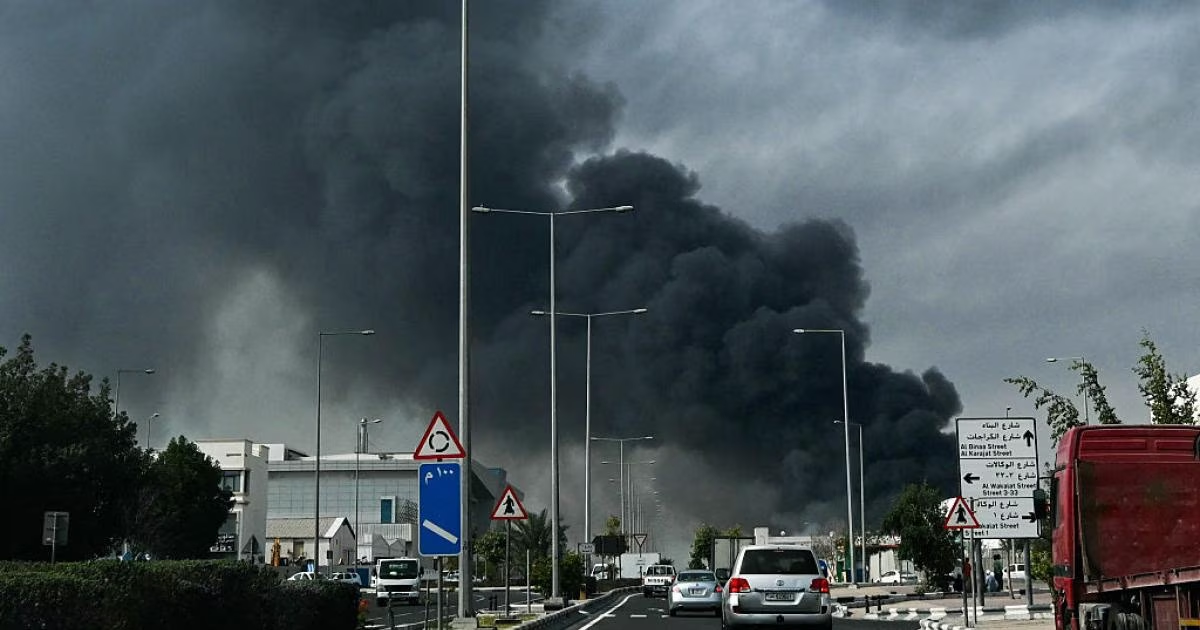
The electricity grid in Kuwait also suffered partial damage, leading to power outages in scattered areas, especially in the southern region. The Ministry of Electricity attributed this outage to falling shrapnel resulting from the interception of drones that targeted the country, confirming that emergency teams are working to repair the damage.

Field reports indicate that the Iranian attacks included 9 Arab countries: Saudi Arabia, Kuwait, UAE, Qatar, Bahrain, Oman, Jordan, Syria, and Iraq. These attacks caused material damage to airports, ports, and vital buildings, despite Tehran's assertion that it only targets American bases.

These developments come in response to a widespread military aggression launched by Israel and the United States against Iran since Saturday morning. Air and missile strikes on Tehran resulted in the deaths of 201 people, including Supreme Leader Ali Khamenei and a number of high-ranking security leaders in the country.

Sources reported that the recent military escalation came at a time when indirect negotiations between Washington and Tehran were making tangible progress. The Sultanate of Oman was playing the primary mediating role in these talks, which made its targeting a source of widespread international surprise and concern.

This is the second time that negotiation paths have collapsed due to direct military intervention, after a similar incident occurred in June 2025. Observers believe that the region has slipped into a comprehensive confrontation whose repercussions may expand to include all global shipping and energy lines.

For its part, Tehran insists that its military response was defensive and necessary to confront the aggression that targeted its supreme leadership. However, the scale of civilian casualties in neighboring Arab countries has sparked a widespread wave of international condemnation, amid calls for restraint and avoiding an all-out war.

Civil defense and emergency teams in the affected Gulf countries continue to assess losses and remove debris resulting from falling missiles and drones. Meanwhile, political circles are awaiting the nature of the upcoming response from Washington and Tel Aviv, which portends further escalation in the coming hours.

The deliberate targeting of brothers in Oman, a country that has made sincere efforts in mediation endeavors, is a targeting of the principle of mediation itself.

PALESTINE

Sun 01 Mar 2026 5:26 pm - Jerusalem Time

The End of the Flood: Will Netanyahu's Gamble Succeed in Dragging the Region into a Comprehensive Confrontation with Iran?

The roots of Israeli incitement against regional powers go back decades, with observers recalling Benjamin Netanyahu's role in 2002 when he pushed the American administration towards invading Iraq. At that time, Netanyahu promoted the idea that removing Saddam Hussein's regime would make the world safer, an approach he is now employing with Iran, exploiting the harmony with the current American administration.

Analysts believe that the Israeli desire to strike Iran is not merely a reaction to ongoing events, but a strategy embedded in Netanyahu's political thought. In his book 'Fighting Extremism,' he affirmed his constant pursuit to prevent Islamic countries, especially Iran, from possessing nuclear weapons, which explains the continuous demonization of Tehran in international forums.

The past months have witnessed a state of global tension as a result of escalating mutual threats and massive American military buildups in the region. Although some considered these buildups merely a show of force to achieve negotiating gains, the reality on the ground exceeded expectations with the start of direct military operations.

Israel launched a wide-ranging military operation targeting Iranian sites and leading figures under the name 'Lion's Roar,' moving the conflict from the shadows to open confrontation. This step comes in the context of an escalation that began with the launch of the Al-Aqsa Deluge battle in October 2023, due to Iran's declared support for the Palestinian resistance.

Internal American factors strongly influence the shaping of this explosive scene, with reports indicating that President Trump's decisions are affected by pressures resulting from the 'Epstein' scandals. It appears that escaping the legal and political consequences of these scandals is pushing towards adopting positions more compliant with Netanyahu's extremist desires in the region.

American and Israeli attempts to create popular chaos within Iran failed, which led Netanyahu to impose impossible conditions in any potential negotiations. These conditions include the complete cessation of the nuclear program and the dismantling of the ballistic missile system, which proved effective in previous rounds of escalation.

On the diplomatic front, the Sultanate of Oman continues to play a mediating role in back-channel negotiations between Washington and Tehran to try and contain the situation. However, the state of international turmoil and the formation of new political alignments make the mediation task extremely difficult amidst rapid field developments.

The American administration used its military buildups of warships and aircraft to create a state of terror and anticipation, and to test direct and indirect Iranian reactions. This buildup also aims to gauge Tehran's ability to threaten shipping lanes and American bases in the event of a comprehensive war.

This current round of confrontations is expected to continue for several days, coinciding with the imposition of new American sanctions and intense European political pressure. These pressures are based on the positions of some parties that condemn the targeting of American bases, deepening the division in the Arab and international political landscape.

Russia and China emerge as key players in supporting Iran's steadfastness against the American storm, providing effective support that prevents Washington from monopolizing the region. Both countries believe that a strong Iran hinders the United States from focusing on confronting them in other international issues, and deprives Trump of achieving an external political victory.

In response, Tehran launched the 'End of the Deluge' operation, which included shelling Israeli sites and American bases in the region through its allies. This response confirms that Tehran will not stand idly by in the face of targeting its sovereignty, and that it is prepared to expand the circle of fire if the aggression continues.

The Arab geography remains the main arena for settling scores and receiving mutual blows between the warring parties. In light of this major conflict, the official Arab role appears to be absent from real influence, making Arab countries merely a theater for events without the ability to shape outcomes.

The intertwining of issues, from the Iranian nuclear program to the war in Gaza and political scandals in Washington, makes it difficult to predict an early end to this round. Each party views this confrontation as an existential battle that does not accept half-solutions, which raises the level of danger to the stability of the entire region.

In conclusion, the question remains whether 'The End of the Deluge' will lead to a major settlement or be the spark for a regional war that leaves nothing untouched. The coming days will reveal the extent of international parties' ability to curb Netanyahu's military ambitions and prevent the region from sliding into the abyss.

What Israel is currently doing in terms of incitement against Iran is not a spur-of-the-moment act, but a continuous Israeli dream led by Netanyahu for decades.

ISRAELI AFFAIRS

Sun 01 Mar 2026 5:26 pm - Jerusalem Time

9 Israelis killed and dozens injured in Iranian missile attack on Beit Shemesh

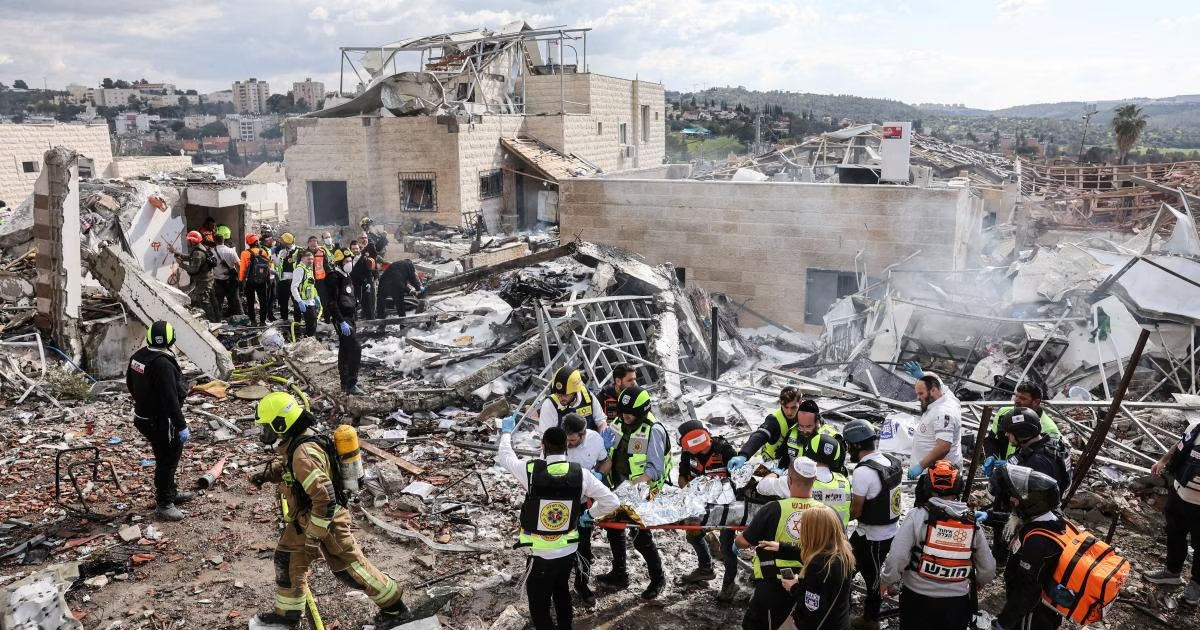
The city of Beit Shemesh, located west of occupied Jerusalem, witnessed a serious security incident that resulted in the death of 9 people and the injury of 27 others with varying degrees of wounds. This heavy toll came after a missile launched directly from Iran landed in a residential area, causing widespread destruction to property and infrastructure.

Medical and field sources reported that the shelling led to massive fires in the targeted building and adjacent buildings, while ambulance crews, police, and explosives experts rushed to the scene. Rescue teams are currently working to extract trapped individuals believed to be under the rubble of the damaged buildings due to the force of the explosion.

In striking field details, sources confirmed that the sirens were not activated in Beit Shemesh before the impact, which doubled the number of casualties among civilians who were unable to take shelter. The competent authorities have launched an urgent investigation to determine the reasons for the failure of the early warning system to detect the missile and alert residents.

This strike is the second of its kind within a few hours, as Tel Aviv was subjected to a similar attack last night, which resulted in the death of one person and the injury of more than 25 others. Last night's attack caused damage to about 40 buildings, indicating an unprecedented escalation in the intensity of the direct missile confrontation.

For its part, media sources explained that the missile that hit Beit Shemesh caused a state of extreme panic, especially as it coincided with the sound of powerful explosions heard in areas north of Jerusalem. The sources indicated that the extent of the material damage suggests the use of warheads with very high destructive power.

Military estimates indicate that advanced ballistic missiles were used in the recent attacks, with the possibility of hypersonic missiles entering service. These missiles are characterized by their high maneuverability and ability to penetrate air defense systems, making their interception a complex and extremely difficult task.

Meanwhile, the Israeli Home Front Command urged residents to strictly adhere to instructions and head to shelters immediately upon hearing any alert. The state of high alert continues in all cities, in anticipation of new waves of missile barrages targeting the interior amidst escalating regional tensions.

The fall of the Iranian missile on the Beit Shemesh neighborhood is considered the most difficult event the region has witnessed since the start of the Iranian response to Israeli and American strikes.

ARAB AND WORLD

Sun 01 Mar 2026 5:25 pm - Jerusalem Time

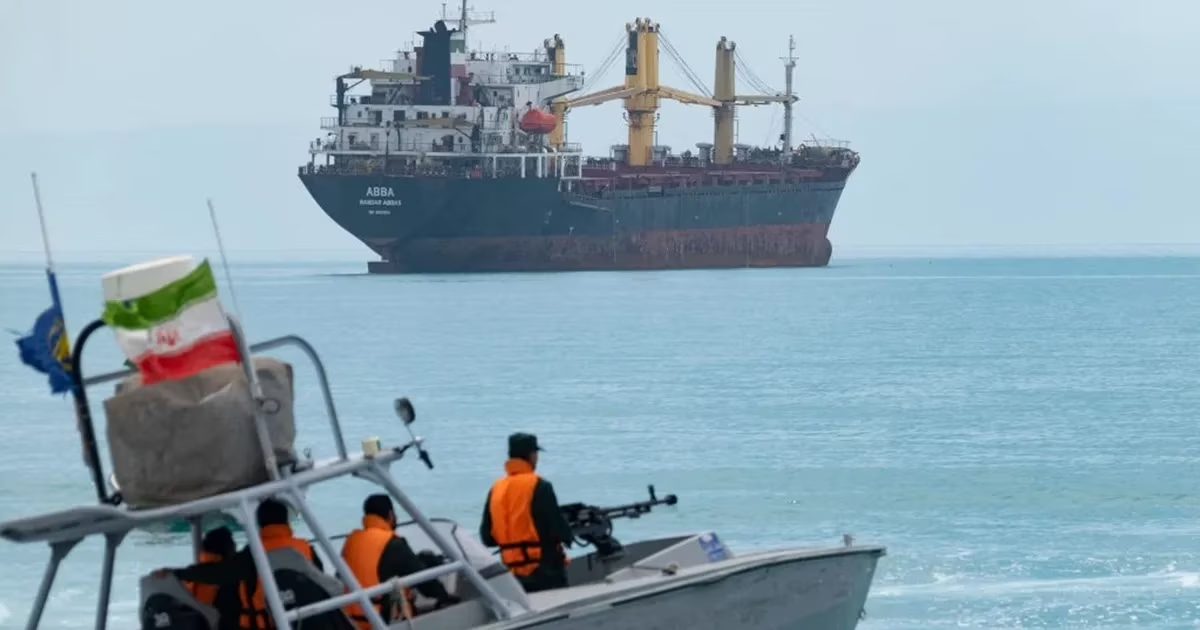
Strait of Hormuz at the Heart of the Confrontation: The Global Energy Nightmare Begins with the Outbreak of War Against Iran

Maritime straits have historically been at the forefront of major conflicts in the Middle East. Just as the Strait of Tiran was the spark of the 1967 war, and Bab al-Mandab a battleground in Yemen, the Strait of Hormuz today emerges as the focal point of the comprehensive confrontation waged by the United States and Israel against Iran. This war, whose features are beginning to take shape on the ground, places the world's most vital waterway under a direct threat that could change the map of the international economy.

Geographically, experts correct a common misconception that the strait is shared by Iran and the UAE. The reality is that the territories facing the Iranian bank are Omani enclaves located within Emirati borders. This geographical overlap gives Muscat a sensitive role, as it has special relations with Tehran that spared its cities from the missile bombardment that struck other Gulf capitals. However, it will not be able to prevent Iran from restricting navigation if the latter decides to do so in response to air raids.

The Strait of Hormuz represents the lifeline of global energy, with about 20% of the world's oil production flowing through it. Disrupting this lifeline does not require an official decision to close it; the outbreak of hostilities is enough for shipping companies to start changing their routes, which has already happened with four major oil companies announcing the suspension of their operations in the region immediately after the attacks began.

Shipping sources reported that the UK Maritime Trade Operations (UKMTO) received reports from vessels in the Gulf indicating that they had received Iranian messages warning of the strait's closure. Despite the absence of an official announcement from Tehran so far, these on-the-ground movements confirm that international shipping lanes have become an integral part of the ongoing war's tools, raising concerns in energy markets.

Analysts believe that the United States and Israel understand the catastrophic economic consequences of this escalation, raising questions about whether harming the global economy is an indirect goal. The biggest loser here is the Asian powers, especially China, which relies on Iranian oil for up to 90% of its needs, and most of its oil imports pass through this threatened waterway.

Iran's hesitation to officially announce the closure of the strait may be a calculated tactic that gives it the ability to be selective in dealing with tankers. This situation allows Tehran to facilitate the passage of vessels belonging to its Asian allies, primarily China, while imposing an undeclared blockade on tankers from Western countries that support military operations against it.

Disrupting navigation in Hormuz would immediately lead to insane jumps in oil prices, shipping costs, and insurance, which is described as an 'energy nightmare.' This increase will not be limited to the transport sector but will extend to electricity prices and basic commodities worldwide, putting the global financial system under immense pressure whose end cannot be predicted.

The Strait of Hormuz is distinguished by the length of the Iranian coast along the Arabian Gulf, which gives Iranian forces a geographical advantage in naval guerrilla warfare. Even if Western forces resort to opening the strait by military force, securing the safety of ships remains practically impossible as long as those ships remain within range of Iranian fire adjacent to the shores.

These developments come amid a strategic shift following the assassination of Iranian Supreme Leader Ali Khamenei, an event that moved the conflict from a stage of mutual deterrence to an attempt to completely break the regime. This assassination affected the religious and political authority of millions of Shiites around the world, making the Iranian response take an existential character to defend the legitimacy and survival of the state.

For his part, Israeli Prime Minister Benjamin Netanyahu seeks through this escalation to compensate for the security and military failures Israel suffered on October 7. Netanyahu sees targeting the head of the Iranian regime as an opportunity to reshape the balance of power in the region, moving beyond traditional rules of engagement towards a logic of 'chaos management.'

On the American side, Donald Trump adopts a strategy of raising the level of military escalation as much as possible before sitting at the negotiating table. This policy aims to force Tehran to make major concessions from a position of weakness, but at the same time, it risks dragging the world into an economic crisis that could spiral out of control due to the sensitivity of the energy issue.

The official Arab position remains characterized by clear helplessness in the face of accelerating events, with Arab capitals merely issuing statements calling for de-escalation and restraint. This absence of an active Arab role leaves the region an open arena for the clash of international and regional wills, while the peoples of the region pay the highest price for this conflict.

The transition from a logic of conflict management to a logic of existential confrontation means that the chances of returning to calm are slim in the foreseeable future. With international navigation held hostage in this conflict, the world stands on the threshold of a new phase of economic and political instability that could reshape the entire international order.

In conclusion, the Strait of Hormuz remains Tehran's strongest card to respond to air and missile attacks, a weapon that can hurt the West without firing a single shot. The mere threat of closing this artery is enough to disrupt political calculations in Washington and Tel Aviv, making the strait the real battleground in the coming days.

Any tension in the functioning of the Strait of Hormuz will create an economic crisis not only in the region but worldwide, as one-fifth of global oil production passes through it.

ARAB AND WORLD

Sun 01 Mar 2026 5:25 pm - Jerusalem Time

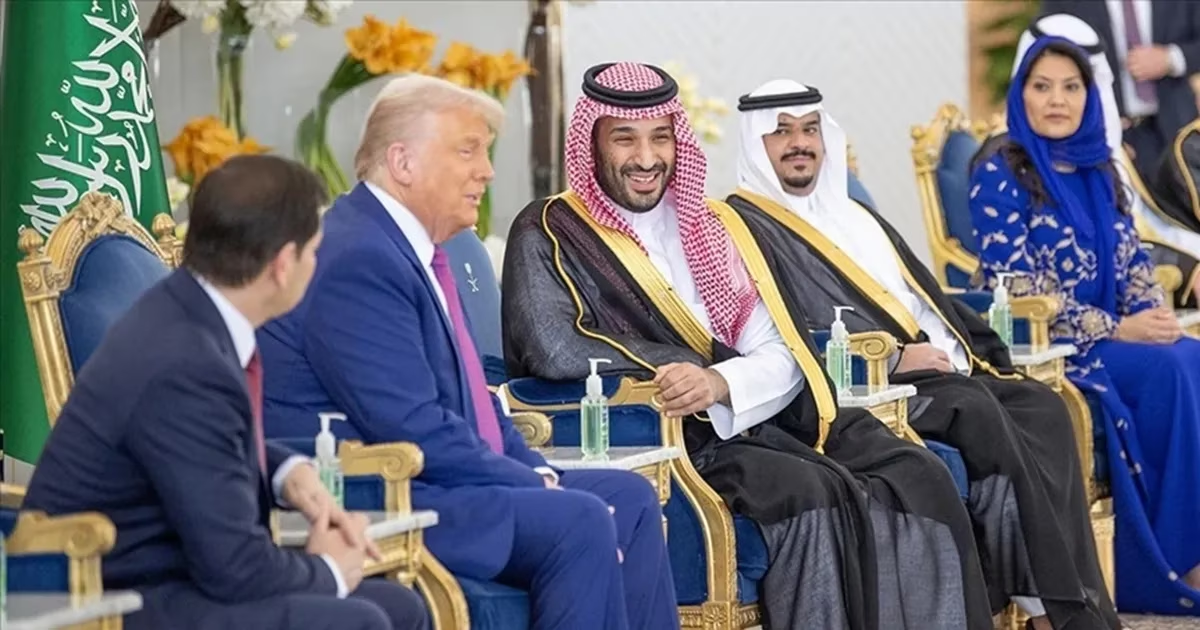
Israeli and Saudi Pressures Pushed Trump to Launch a Wide Attack on Iran

International press sources revealed the behind-the-scenes details of the widespread military attack launched by US President Donald Trump on Iran last Saturday. Reports indicated that this move was the result of weeks of intense pressure exerted by both Israel and Saudi Arabia, with the aim of fundamentally altering the balance of power in the region.

The sources noted that the lobbying efforts were led by two key US allies in the Middle East, where Israeli and Saudi interests converged on the necessity of curbing Iranian influence. This movement coincided with field and intelligence cooperation between American and Israeli forces aimed at overthrowing Iranian Supreme Leader Ali Khamenei and dismantling the regime's structure.

In details of secret diplomatic maneuvers, information indicated that Saudi Crown Prince Mohammed bin Salman held a series of private phone calls with Trump during the past month. The Saudi leader urged the US President on the necessity of direct military action, considering that leniency in confronting Tehran would make it more dangerous in the near future.

For his part, Israeli Prime Minister Benjamin Netanyahu did not cease his public and secret pressures, demanding devastating American strikes against what he describes as an existential enemy. These joint efforts contributed to crystallizing Trump's decision to issue orders to launch a comprehensive air campaign targeting command and control centers and military installations belonging to the Iranian army.

The paradox in the Saudi position emerged through the discrepancy between public rhetoric and secret deliberations; while Riyadh officially declared its adherence to diplomatic solutions and not allowing its territory to be used for attack, messages directed to Washington emphasized the necessity of utilizing the massive American military presence in the region to deliver a decisive blow.

Saudi Defense Minister Khalid bin Salman entered the crisis, holding closed meetings in Washington last January with high-ranking American officials. During those meetings, the Saudi minister warned of the negative repercussions of inaction, stressing that Iran represents the greatest threat to regional stability and common interests.

This military escalation came at a time when presidential envoy Steve Witkoff and Jared Kushner, Trump's son-in-law, were conducting complex negotiations with the Iranian side regarding the nuclear and missile files. It appears that the military path ultimately overshadowed the diplomatic attempts that sought to contain the crisis through dialogue.

Following the launch of the first wave of American attacks, sources recorded Iranian reactions targeting Saudi interests, which prompted Riyadh to issue a statement condemning the Iranian escalation. Saudi Arabia called on the international community to take decisive measures to confront Tehran, amidst increasing field complexities affecting energy security and infrastructure in the region.

Observers believe that Trump's decision represents a departure from traditional American policy that for decades avoided directly seeking to overthrow the regime in Tehran. This attack also reflects a radical shift in Trump's military strategy, which was previously characterized by limited operations and avoiding widespread interventions in Middle East conflicts.

In a message addressed to the Iranian people coinciding with the dropping of bombs, Trump affirmed that he had taken a step no previous president dared to take. The question remains about the extent to which these air operations can achieve sustainable political goals on the ground, in light of previous intelligence warnings that downplayed the direct Iranian threat to American territory.

No president was prepared to do what I am prepared to do tonight, now you have a president who gives you what you want.

OPINIONS

Sun 01 Mar 2026 5:25 pm - Jerusalem Time

Negotiating with Punches!

Dr. Ibrahim Melhem

Editor-in-Chief

For a few days, American-Israeli strikes on Iran will continue, before negotiators return from the boxing ring to the negotiating table with bleeding noses and broken teeth. After that, it will be possible to "soften" positions to make concessions to obtain preferential prices from Iran, which has reduced its enrichment to 20 percent instead of sixty. However, Trump's desire is for zero enrichment, which Iran rejected, leading to an acceleration of the confrontation whose signs were clear. The American goal behind the comprehensive strikes initiated by Washington, with the help of Tel Aviv, which gave the confrontation a biblical dimension days before its celebration of "Purim," and what it carries in terms of connotations related to the myth of historical animosity towards the Persian state, is to clip the regime's claws and weaken it. It was clear that Trump had tied himself to mobilizing ships, warships, and aircraft carriers, and he could not back down without an agreement that would give him a greater victory than Obama achieved. Will Tehran, after these strikes, double the work of its centrifuges and declare possession of nuclear weapons, especially since it has technologies capable of achieving its goal, as Witkoff hinted in statements in which he expressed his fear of Tehran's concealment of much larger quantities of enriched uranium than those it declared to the International Atomic Energy Agency? Witkoff's fear means that the American "Armada" has arrived late; while Trump announced the killing of the Supreme Leader and Israeli planes bombed civilian targets, including a girls' school, during which dozens of female students were killed, the "yellowcake" may have settled in fortified bunkers.

ISRAELI AFFAIRS

Sun 01 Mar 2026 5:25 pm - Jerusalem Time

Details of the extensive Israeli attack on Iran: 200 aircraft targeted 500 strategic sites

The direct conflict between the Israeli occupation and Iran witnessed a dramatic shift following a series of intense airstrikes that targeted deep inside Iranian territory. The strikes focused on strategic and vital sites in the capital, Tehran, including headquarters belonging to senior officials and advanced air defense systems.

Hebrew press reports revealed the behind-the-scenes of the operation, which was carried out on Saturday morning, describing it as the result of complex intelligence deception. This operation involved coordination between the air force and military intelligence to ensure the element of surprise against the selected targets.

Informed sources reported that the attack, described as a 'crushing blow,' directly targeted two key locations in Tehran where prominent leaders were present. Among those targeted were leaders in the Revolutionary Guard and heads of Iranian intelligence agencies, resulting in casualties among their ranks.

A senior defense official stated that the attack succeeded in catching the Iranian side completely by surprise. The official emphasized that precision in execution was the decisive factor in reaching the designated targets in record time.

The official revealed a precise division of the operational area between the Israeli Air Force and friendly American forces. Israel was responsible for targeting senior Iranian leaders, while the American side focused its strikes on logistical and other military sites across the country.

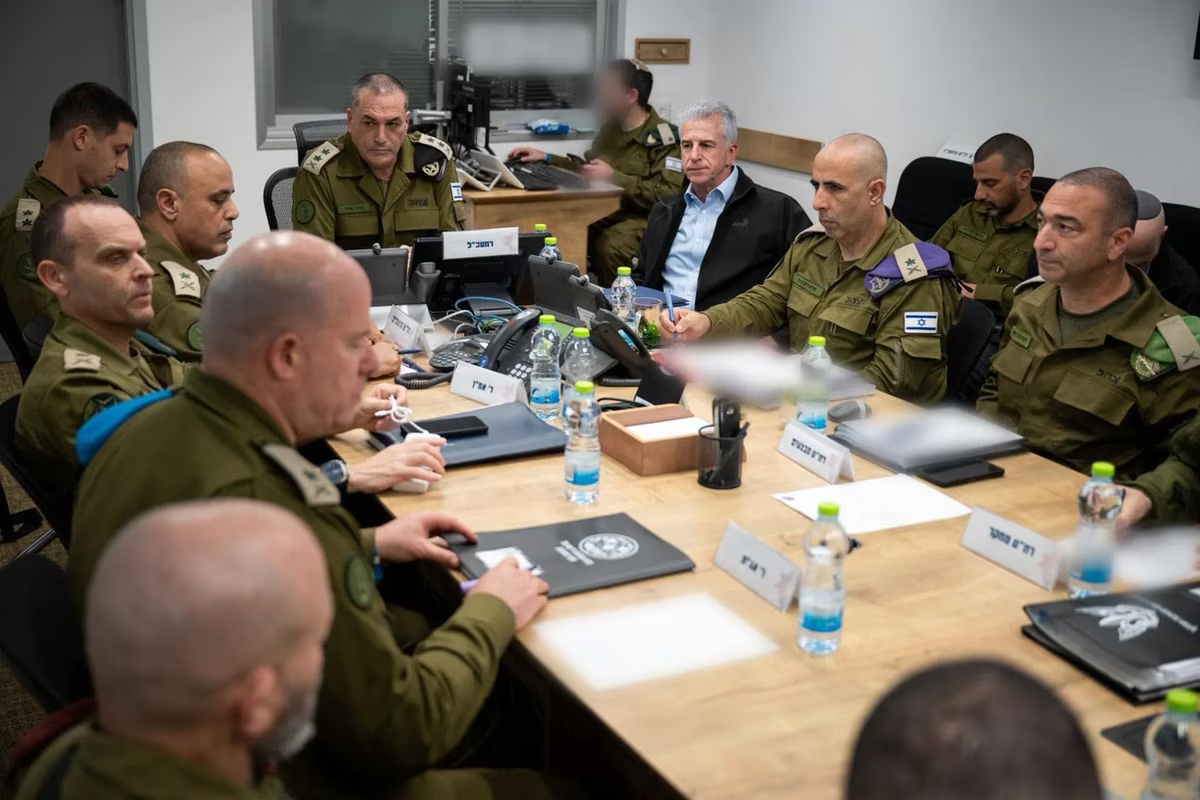
The air operation was led by Major General Tomer Bar, commander of the Air Force, who devised a plan aimed at paralyzing Iranian capabilities from the very first moments. The plan relied on a massive mobilization of air power to ensure intense firepower covering all strategic targets.

More than 200 fighter jets participated in the attack, taking off simultaneously to reach their targets at the same moment. These aircraft launched hundreds of shells and guided missiles towards 500 military and strategic targets inside Iran.

Intelligence played a pivotal role in providing pilots with accurate and sensitive information about the movements of Iranian officials. Meanwhile, air force intelligence was responsible for monitoring and identifying the locations of air defense systems and ballistic missile platforms.

Military sources confirmed the success of the strikes in destroying dozens of launch platforms and hundreds of ready-to-use missiles. Reconnaissance aircraft detected massive secondary explosions inside Iranian missile depots immediately after they were targeted.

The aim of intensifying strikes on weapons depots was to reduce Iran's ability to retaliate and prolong the military operation if necessary. Aerial images showed widespread destruction in the targeted military facilities in the suburbs of Tehran and other cities.

In contrast, monitoring devices detected the Iranian side launching approximately one hundred missiles towards the occupied territories since the morning hours. This Iranian response comes as an attempt to repel the extensive air attack that targeted its military infrastructure.

Military experts described this raid as the largest in the history of the Israeli Air Force, and perhaps among the largest air operations globally in terms of scale. They indicated that the planning relied entirely on advanced technology and close coordination with allies.

Sources explained that the operation would not have achieved this level of precision without the integration of intelligence information and striking power. They added that initial results indicate a significant decline in Iranian missile deterrence capabilities due to the destruction of key platforms.

Maximum alert remains in the region following these developments, amidst anticipation of the next phase of escalation between the two sides. Sources confirm that the air operation achieved its primary objectives in neutralizing imminent threats and targeting the top leadership in Tehran.

We were able to mobilize almost the entire air force, and the aircraft reached their targets simultaneously to launch hundreds of projectiles.

PALESTINE

Sun 01 Mar 2026 5:25 pm - Jerusalem Time

Total Closure of Palestinian Crossings: Fears of Famine Returning to Gaza Strip

Israeli occupation authorities announced on Saturday a decision to close all crossings in the occupied Palestinian territories, including the Rafah land crossing, starting from Sunday until further notice. This escalatory measure comes amidst escalating regional tensions following a military attack carried out by the Israeli and American armies against targets in Iran.

The Israeli Coordinator of Government Activities in the Palestinian Territories (COGAT) confirmed, via an official statement, that the closure decision includes all entry points leading to the West Bank and Gaza Strip. Sources clarified that this decision is not limited to the movement of individuals but also extends to halting the flow of vital goods and humanitarian aid.

A state of extreme concern prevails among the residents of the Gaza Strip about the return of the specter of famine that ravaged civilians in recent months due to the tight siege. Observers believe that the closure of crossings represents a political and military pressure tool aimed at tightening the noose on more than two million Palestinians who are already suffering from the ravages of war.

The decision sparked a wave of anger and protest on social media platforms, where Palestinian activists considered the security justifications related to the Iranian event as mere “flimsy pretexts.” They pointed out that the real goal is to deepen the humanitarian crisis away from the eyes of the international community, which is preoccupied with rapid regional developments.

Humanitarian organizations warned that the cessation of medical supplies and fuel entry would lead to the collapse of what remains of the health and service systems in the Strip. Sources confirmed that the complete reliance of the population on external aid makes the closure of crossings a slow death sentence for thousands of families lacking food security.

In a related context, tweeters indicated that the coincidence of this closure with the world's preoccupation with other issues gives the occupation space to impose collective punitive measures without effective international pressure. They warned that the continuation of this policy would lead to catastrophic repercussions affecting all basic necessities of life, including food, medicine, and electricity.

Citizens in Gaza expressed their fear that this phase would be the harshest since the beginning of the aggression, especially with the disappearance of local alternatives and the depletion of commodity stocks. Field testimonies confirmed that the prices of basic materials began to rise immediately after the decision was issued, increasing the suffering of families living below the poverty line.

Despite months passing since the ceasefire agreement that came into effect on October 10, 2025, the occupation has not adhered to the truce provisions related to opening the crossings. Palestinian parties accuse the Israeli side of constantly evading the entry of agreed-upon quantities of relief materials and mobile homes to shelter the displaced.

This new closure places the fate of two million Palestinians before existential questions about their ability to withstand the systematic starvation policy. Analysts believe that the absence of a clear political horizon and the repeated closure of vital crossings reinforce fears of an unprecedented explosion of humanitarian conditions in the near future.

In conclusion, the Gaza Strip remains hostage to Israeli military decisions that control its only lifeline, amidst distress calls for urgent international intervention. Palestinians demand a permanent opening of the crossings and guaranteed flow of humanitarian aid without restrictions, to ensure that the region does not slide back into a comprehensive famine catastrophe.

Closing the crossings threatens to re-choke food, medical, and fuel supplies in an area almost entirely dependent on what enters through these passages.

ANALYSIS

Sun 01 Mar 2026 9:49 am - Jerusalem Time

Washington Post: Saudi and Israeli Pressure Paved the Way for Trump's Decision to Strike Iran

Said Erikat

Opinion Writer

Washington – Said Erikat – 1/3/2026

News Analysis

The Washington Post reported on Saturday that US President Donald Trump's decision to launch a widespread military attack against Iran, which resulted in the death of Supreme Leader Ali Khamenei, came after weeks of intense diplomatic pressure from both Saudi Arabia and Israel. This development represents a significant shift in the pattern of US decision-making towards Tehran, reflecting Washington's transition from a policy of deterrence and containment to an attempt to impose strategic change through direct military force.

According to the report, which cited officials familiar with discussions within the US administration, Israeli Prime Minister Benjamin Netanyahu and Saudi Crown Prince Mohammed bin Salman led parallel efforts to influence the White House's stance. Netanyahu continued his public campaign, repeatedly demanding a decisive strike against Iran, considering its nuclear program an existential threat to Israel. Riyadh, meanwhile, preferred to act through private channels and direct communications with Trump, emphasizing the necessity of action before Tehran could consolidate its regional position.

These moves came at a time when Washington was still engaged in indirect negotiations with Iran regarding its nuclear and missile programs. US envoy Steve Witkoff, with the participation of Jared Kushner, held several meetings with Iranian officials in Geneva, hoping to reach an understanding that would reduce escalating tensions. However, US officials later concluded that Tehran sought to maintain its uranium enrichment capabilities, which the administration considered an indication of an intention to retain a future nuclear option, thus strengthening the arguments of those advocating for military decisive action.

The Saudi position appeared complex; Riyadh publicly announced its support for the diplomatic path and affirmed that it would not allow its territory to be used for attacks on Iran. However, in closed-door talks, it warned that American hesitation might give Tehran an opportunity to strengthen its regional influence. This balance reflects a Saudi attempt to combine confronting the Iranian adversary with avoiding retaliatory actions that could target its sensitive oil facilities, which was partially achieved when Iran responded with attacks following the US strike.

The American decision represents a clear departure from decades of strategic caution. US intelligence assessments did not indicate an imminent threat to US territory, and previous administrations refrained from seeking to overthrow the Iranian regime by force due to the complexities of a large country with a relatively cohesive political and security structure. Therefore, Trump's decision appeared to be a political and military gamble at once, betting on achieving political results through rapid air superiority without engaging in a long ground war.

Trump justified the operation as a response to a long history of conflict between Washington and Tehran, recalling the 1979 hostage crisis and attacks targeting US forces in the region. He also asserted that Iran was nearing the acquisition of nuclear and missile capabilities that directly threatened the United States, a narrative that faced skepticism from critics who relied on previous intelligence assessments that did not prove the existence of an active program to produce a nuclear weapon.

Trump's rhetoric was not limited to the military dimension; he also called on Iranians and security agencies to overthrow the regime, promising immunity to those who defect, without offering a practical vision for how to achieve this goal in the absence of US forces on the ground. This reveals the central contradiction in the new US strategy: seeking radical political change with limited military tools.

Within Washington, senior officials were keen to emphasize that the operation would not escalate into an open war. Vice President J.D. Vance stressed that the administration was not seeking a long military intervention, despite demands from lawmakers for clearer explanations regarding the legal and strategic basis of the attack, especially in the absence of public evidence of an immediate threat.

The report indicated that the timing of the strike was also influenced by the possibility of Israel carrying out a unilateral attack, which prompted Washington to participate in the operation rather than dealing later with the repercussions of an escalation that could endanger US forces in the region. Thus, the decision became a mix of security calculations, political alliances, and regional pressures.

Ultimately, this operation reveals an American attempt to combine a show of military resolve with avoiding the cost of occupation, an equation that successive administrations have sought since the end of the Cold War. However, past experiences indicate that air strikes may weaken regimes but rarely reshape them politically, as the absence of a clear vision for the post-conflict phase can turn rapid military success into long-term instability. At the same time, escalation may be a means to redefine future negotiation terms, so that any subsequent agreement with Iran is presented as a direct result of military pressure, not a continuation of a previous diplomatic path. However, this approach carries risks of miscalculation, as it may push Tehran to greater intransigence instead of retreat, increasing the likelihood of mutual escalation. Between the gamble of imposing a new political reality through air power alone and the possibility of the region sliding into a wider cycle of conflict, the question remains open as to whether this strategic gamble will succeed in redrawing regional balances, or will it reproduce the lessons of previous interventions that proved that ending wars is often much harder than starting them.

PALESTINE

Sun 01 Mar 2026 9:49 am - Jerusalem Time

Conflicting Reports on Khamenei's Fate: Trump Announces His Death, Tehran Denies and Affirms His Steadfastness

A state of conflict and ambiguity prevailed in the political and military scene following US President Donald Trump's announcement of the death of the Supreme Leader of the Islamic Republic of Iran, Ali Khamenei. This announcement came amidst an unprecedented military escalation in the region, as American and Israeli forces launched intensive airstrikes targeting strategic locations within Iranian territory.

For its part, official Iranian sources close to the Leader's office quickly denied these reports outright, describing the US President's statements as mere baseless claims. The sources affirmed that these narratives fall within the psychological warfare practiced by Washington and Tel Aviv in conjunction with the ongoing military aggression against the country.

In a related context, Iranian media reports indicated that Leader Ali Khamenei is still carrying out his leadership duties from the field, emphasizing his steadfastness and resilience in the face of the recent attacks. These sources clarified that the Iranian leadership is in control of the situation despite the strikes that targeted the capital Tehran and several other cities on Saturday morning.

US President Donald Trump had published a statement on his 'Truth Social' platform confirming Khamenei's elimination, considering his departure a historic opportunity for the Iranian people to reclaim their homeland. Trump indicated that advanced tracking systems and American intelligence agencies were able to accurately locate the Leader, preventing his escape from the attack.

Regarding field details, Hebrew media sources revealed that the joint attack, dubbed 'Lion's Roar,' involved dropping about 30 heavy bombs on the Leader's residence. Channel 12 Hebrew claimed that Israeli Prime Minister Benjamin Netanyahu viewed video documentation of the operation to retrieve Khamenei's body from under the rubble of the destroyed headquarters to confirm the success of the operation.

Meanwhile, Fox News quoted officials in Washington as believing that the attack not only targeted Khamenei but also resulted in the death of 5 to 10 senior Iranian commanders. These estimates come at a time when unconfirmed reports speak of the death of the Leader's son-in-law and daughter-in-law in the same airstrikes that targeted the residential complex.

Ali Khamenei, born in Mashhad in 1939, has been the pivotal figure in the Iranian regime since his election as Supreme Leader in 1989, succeeding Khomeini. His long political career has been marked by intense hostility towards the West, and he previously survived an assassination attempt in the early 1980s that left him with a permanent injury to his right hand.

In an additional comment to 'NBC News,' Trump reiterated his confirmation of the narrative of the Iranian leader's death, expressing hope that the Iranian armed forces and police would integrate with what he called 'patriots' to rebuild the state. The White House considered these operations a response to continuous Iranian threats to American interests and its allies in the region.

Despite repeated Iranian denials through official news agencies, the absolute silence from some high-ranking circles in Tehran raises questions about the truth of the Leader's health status. International circles are awaiting an official video statement or a public appearance by Khamenei to dispel any doubt about his fate, which has become a global headline.

Khamenei's death is not only justice for the Iranian people but for all great Americans, and he could not escape our intelligence agencies.

PALESTINE

Sun 01 Mar 2026 9:49 am - Jerusalem Time

7 Dead, Including a Policeman, in a Series of Israeli Raids and Attacks on the Gaza Strip

Bloody Israeli violations continued in the Gaza Strip despite the ongoing ceasefire agreement, as seven Palestinians, including a police officer, were martyred in separate attacks on Friday. Field sources reported that the occupation army directly shot a citizen in the Aslan area of Beit Lahia town, north of the Strip, leading to his immediate martyrdom, while occupation aircraft targeted a displaced persons' tent inside Mustafa Hafez School near Nasser Hospital in Khan Yunis, resulting in one martyr and injuries of varying severity to a woman and a child.

In another field escalation, the Ministry of Interior and National Security in Gaza announced the martyrdom of a police officer and serious injuries to his colleague following an airstrike that targeted a security checkpoint. The bombing occurred on the vital Salah al-Din Street at the entrance to al-Bureij refugee camp in the central Strip, which human rights organizations considered a direct targeting of agencies working to organize citizens' lives and secure aid in areas from which the occupation had withdrawn.

Northern areas of the Strip also witnessed similar attacks, where a Palestinian was martyred by occupation forces' bullets in the al-Atatra area of Beit Lahia. This attack came just hours after a dawn massacre targeted a gathering of civilians in the al-Mawasi area west of Khan Yunis city, where three citizens were martyred and others injured while having their suhoor meal on the tenth day of the holy month of Ramadan, reflecting the occupation's insistence on pursuing displaced persons in areas it claims are safe.

Official statistics indicate that all sites subjected to bombing or shooting are outside the scope of Israeli forces' deployment as stipulated by recent understandings. Since the agreement came into effect, daily violations in the form of artillery and aerial bombardment and sniping operations have resulted in the martyrdom of approximately 618 Palestinians and the injury of 1663 others, a clear indication of the fragility of Israeli commitment to the declared calm.

This field escalation comes after a two-year genocide war launched by Israel, which began on October 8, 2023, and left massive destruction affecting 90% of the civilian infrastructure in the Strip. The Ministry of Health recorded a heavy toll for this war, exceeding 72,000 martyrs and more than 171,000 injured, the vast majority of whom are children and women, amidst catastrophic humanitarian and health conditions experienced by the residents of the besieged Strip.

The areas targeted by the occupation are entirely outside its control and deployment scope under the recently signed ceasefire agreement.

ARAB AND WORLD

Sun 01 Mar 2026 9:48 am - Jerusalem Time

Sharp division in Washington after aggression against Iran: Republican welcome and Democratic warnings of an 'unconstitutional' war

The joint American-Israeli aggression on Iranian territory sparked a massive wave of mixed reactions within the decision-making circles in the United States, as Republican Party leaders rushed to bless the military operation, while prominent Democrats expressed strong opposition, describing the move as a violation of American law and the Constitution.

House Speaker Mike Johnson affirmed in an official statement that Tehran has begun to face severe consequences for what he described as its continuous hostile actions, noting that its involvement in supporting terrorism, targeting Americans, and its persistent pursuit of nuclear capabilities made this response inevitable, while at the same time calling for the protection of the forces participating in the operation he called 'Overwhelming Fury'.

In contrast, Senate Democratic Minority Leader Chuck Schumer demanded that President Donald Trump's administration provide immediate clarifications and an urgent briefing to Congress on the repercussions of this escalation, warning against the country being drawn into a new regional conflict that would drain American resources at a time when the domestic front faces complex economic and social challenges.

For his part, Republican Senator Lindsey Graham considered these strikes a historical turning point in the course of the Middle East, expecting that this violent confrontation would ultimately lead to the fall of the Iranian regime, which Graham sees as a justified and necessary goal to end what he described as the series of American blood that Tehran's hand has stained.

On the same note, Republican Representative Tom Emmer described the attack as a bold and decisive step that reflects the strength of the current American leadership, praising President Trump's decision to launch a preemptive strike to disrupt Iranian capabilities and protect the vital interests of the United States and its allies in the region.

Republican lawmakers recalled historical moments of conflict with Iran, such as the hostage crisis in 1979 and the Beirut bombings in 1983, to justify the current attack. Tom Cotton, chairman of the Senate Intelligence Committee, stated that Iran has been waging an undeclared war on Washington for decades, and that the time has come to make it pay the price.

Despite the near-complete Republican consensus, Representative Thomas Massie emerged as the sole dissenter within the party, announcing his categorical rejection of the war, considering it contrary to the 'America First' principle advocated by Trump, and affirming his intention to coordinate with Democrats to force a vote in Congress on the legitimacy of continuing these military operations.

The White House revealed that Secretary of State Marco Rubio had made proactive contacts with the leaders of the 'Gang of Eight' in Congress to brief them on secret intelligence reports that paved the way for the strike, but this step did not succeed in calming the Democrats' concerns, who saw it as an attempt to marginalize the legislative authority in the decision of war and peace.

Jack Reed, the top Democrat on the Senate Armed Services Committee, criticized the administration's lack of a clear vision on how to end this conflict, accusing Trump of involving the American military in a major confrontation without obtaining legal authorization or providing accurate estimates of the costs and risks of this military adventure.

Senator Ed Markey described the decision to attack as illegal and a blatant assault on the constitutional powers of Congress, stressing that the unilateral decision to go to war puts the American democratic system at risk and opens the door to unpredictable catastrophic international conflicts.

In a notable stance, Democratic Senator John Fetterman broke with his party's general line, announcing his support for Trump's steps, as he believed that the President showed courage in taking what was necessary to achieve lasting peace in the region by directly and strongly deterring Iranian threats, which he considered an urgent necessity for national security.

As for leftist Senator Bernie Sanders, he launched a scathing attack on the American administration, accusing it of lying to the people and igniting international chaos that would lead to widespread destruction and human misery, stressing that military force does not grant legitimacy to wrong political decisions that exceed the will of constitutional institutions.

Senator Ruben Gallego concluded the criticisms by reminding President Trump of his election promises based on ending 'endless wars' and bringing soldiers home, considering that what is happening today is a clear retreat from those commitments and a revival of military intervention policies that have exhausted the United States for many years.

The American people do not want another endless and costly war in the Middle East, at a time when we suffer from many internal problems.

PALESTINE

Sun 01 Mar 2026 9:48 am - Jerusalem Time

Israeli alert on northern and Jordanian fronts for fear of coordinated reactions after Iran strike

Military reports have revealed a state of apprehension within the Israeli occupation army regarding the possibility of surprise attacks on its northern and eastern borders. These fears come in the wake of the first aerial strike targeting Iranian missile systems, with estimates suggesting a potential repeat of the 'Al-Aqsa Flood' scenario across the Syrian or Jordanian borders.

Media sources reported that the joint attack carried out by Israeli and American forces primarily aimed to neutralize Iranian deterrence capabilities, represented by ballistic missile launch platforms. The first wave of raids focused on destroying ready-to-launch sites, whether above ground or in fortified underground facilities, in addition to targeting command and control centers.

According to military analyses, the attack also sought to undermine the remaining Iranian air defense network, including short-range systems. This measure aims to secure the routes of American 'Tomahawk' missiles and ensure their arrival at their targets without interception, paving the way for broader destructive waves targeting the joints of the sovereign system.

Field data indicates that the first strike inflicted severe damage on Tehran's ability to centrally manage missile launches. According to informed sources, current launches of drones and ballistic missiles are carried out by local commanders in areas not affected by the raids, who resort to rapid launches for fear of their depots being destroyed.

Field commanders in Iran face significant logistical challenges, as directing missiles towards American bases and Israeli facilities requires continuous replanning under the pressure of bombardment. This explains the launch of missiles in small, continuous groups instead of dense, coordinated volleys, which gives air defenses a greater chance to deal with them despite settlers remaining in shelters.

In a related context, the occupation army began an intensive military buildup along the borders with Lebanon and Syria, with close monitoring of the Jordanian borders based on intelligence reports. Fears prevail that Iraqi armed factions, in cooperation with the Houthis and the remaining Radwan force, may carry out a rapid ground infiltration using four-wheel-drive vehicles and vans through the Golan region.

Israeli fears are not limited to Iran-linked factions but also extend to movements of extremist elements in the Daraa region of southern Syria. Analysts believe that the potential state of chaos could push armed groups to exploit security loopholes and carry out offensive operations targeting the Israeli interior from unexpected directions, thus confusing internal front calculations.

These joint operations bring to mind previous military scenarios carried out by the United States against Iranian nuclear and military facilities in previous years. The current coordination aims to eliminate all threats that American bases deployed in the Middle East might face before full engagement in a comprehensive confrontation, while maintaining the element of strategic surprise.

On the naval front, sources reported that the American aircraft carrier 'Lincoln' played a pivotal role in targeting southwestern Iran and naval facilities belonging to the Revolutionary Guard. The raids included the strategic port of Bandar Abbas, in a preemptive move to prevent Iran from carrying out its threats to close the Strait of Hormuz and disrupt international navigation and global energy supplies.

Prior to the start of the attack on the Iranian interior, the occupation army launched intensive raids on Hezbollah sites in Lebanon, targeting surveillance and early warning systems. The aim of these strikes was to disable the party's ability to notify Tehran of the movement of warplanes, which contributed to delaying the initial Iranian reaction to the first wave of bombing.

On the ground in Tehran, the bombing hit vital streets, the vicinity of sovereign ministries, and Mehrabad Airport, while Iranian Supreme Leader Ali Khamenei was secured in a secret location outside the capital. This coincided with Yisrael Katz's announcement that the preemptive attack was carried out in full coordination with Washington to ensure the paralysis of Iranian offensive capabilities before they were launched.

Amidst this regional escalation, the occupation continues its aggression on the Gaza Strip, where 7 Palestinians were martyred in new raids on Friday. This raises the death toll in the Strip to more than 72,000 martyrs since October 2023, amidst the continued suffocating siege and destruction of infrastructure, coinciding with the ignition of regional fronts.

In conclusion, the region awaits the results of this unprecedented direct clash between the Israeli-American axis and Iran, amidst a complete closure of airspace in Iraq, Israel, and Iran. Questions remain about the ability of American air defenses to withstand potential Iranian response waves, especially with reports indicating a shortage of interceptor missiles.

The goal of the joint Israeli-American attack is to neutralize the first ready Iranian missile barrage on launch platforms.

ARAB AND WORLD

Sun 01 Mar 2026 9:48 am - Jerusalem Time

Military escalation in Iraq: Armed factions announce targeting US bases in response to attacks against Iran

Media sources affiliated with Iraqi armed factions reported on Saturday evening that military instructions had been issued to begin what they described as 'Islamic Resistance' operations against US facilities and bases in the country. The sources quoted a prominent leader in these factions as confirming that field groups had already begun carrying out a series of attacks since noon, indicating that the movements come as part of a comprehensive response to recent field developments.

This field escalation coincides with a wave of Israeli airstrikes, supported by the US, targeting vital sites in the Iranian capital Tehran and the cities of Isfahan, Qom, Karaj, and Kermanshah. In response, Iranian authorities announced the launch of a large-scale military response that included swarms of drones and ballistic missiles, putting the region on the brink of a comprehensive regional confrontation.

In the context of political and military responses, Akram al-Kaabi, Secretary-General of Harakat al-Nujaba, issued a strongly worded statement threatening the US administration, led by Donald Trump, with dire consequences. Al-Kaabi affirmed that continuous American transgressions would not go unpunished, stressing that the factions would not remain silent regarding what he described as 'tyranny and excessiveness' in targeting the sovereignty and resources of the region.

Al-Kaabi emphasized in his speech the rejection of a neutral stance in this battle, considering that standing against aggression is the only option available to his fighters. He added that the battlefield would be the judge and arbiter, threatening to 'shake the earth' under the feet of foreign forces, affirming that the faction's fighters possess the determination and steadfastness necessary to face current military challenges, no matter the sacrifices.

For his part, Abdul Qadir al-Karbalai, the military assistant of Harakat al-Nujaba, participated in the wave of escalation through brief messages on social media platforms indicating combat readiness. Abu Alaa al-Walai, Secretary-General of Kata'ib Sayyid al-Shuhada, also published Quranic verses referring to permission to fight in response to injustice, in a clear indication of the factions' transition from the threat stage to the actual implementation stage.

In Babil province, Kata'ib Hezbollah Iraq threatened to launch direct attacks on US bases in response to the shelling that targeted the Jurf al-Nasr area. The brigades affirmed that targeting Iraqi sites and the fall of casualties among fighters and civilians opens the door to unprecedented reactions, holding US forces fully responsible for the repercussions of this security escalation.

Earlier on Saturday, the Jurf al-Nasr area was subjected to violent airstrikes that resulted in the death of two people and the injury of three others with varying degrees of wounds. These raids sparked a state of popular and political anger in Iraq, as local parties considered them a violation of national sovereignty and a blatant aggression that requires a deterrent response from the armed forces and their supporting factions.

The Iraqi arena is currently witnessing a major security alert around the bases that include American advisors and forces, for fear of being subjected to missile attacks or suicide drones. International circles are closely monitoring developments in Baghdad and Tehran, amid fears that the situation could slide into a long-term war of attrition affecting energy stability and security in the Middle East.

We will not stand neutral, and we will not be spectators to injustice and aggression, but we will shake the earth under your feet.

ARAB AND WORLD

Sun 01 Mar 2026 9:48 am - Jerusalem Time

US intelligence estimates on Khamenei's successor and power scenarios in Iran

US President Donald Trump's announcement regarding the fate of Iranian Supreme Leader Ali Khamenei sparked a wave of international speculation, as he confirmed via his 'Truth Social' platform that Khamenei had been killed, describing him as one of the most evil figures in history. Despite the absence of official confirmation from Tehran so far, these statements coincided with indications from Israeli Prime Minister Benjamin Netanyahu about strong evidence supporting the hypothesis of the Supreme Leader's complete absence from the scene.

In a related context, Hebrew media sources reported that images, allegedly of the Iranian leader's body, had already been shown to both Trump and Netanyahu in recent hours. These developments come at a sensitive time when the region is witnessing unprecedented military escalation, amidst news of US and Israeli attacks targeting strategic sites within Iranian territory on Saturday dawn.

Regarding security assessments, informed sources revealed that the US Central Intelligence Agency (CIA) had prepared preemptive reports on the identity of Khamenei's potential successor. These estimates suggest that the most likely scenario is the rise of hardline leaders from the Iranian Revolutionary Guard to tighten their grip on key state institutions, which could complicate efforts for peaceful political change in the country.

Intelligence reports prepared over the past two weeks primarily focused on the repercussions of any direct US military intervention in Tehran. These documents examined the extent to which military operations could achieve Washington's stated goal of 'regime change,' considering the transfer of power to the military as one of the strong options on the table.

For his part, the US President did not only announce Khamenei's absence but also delivered a video address in which he described the regime in Tehran as 'terrorist.' Trump urged the Iranian people to seize the current moment to overthrow the government, considering that the recent air and missile strikes would pave the way for a widespread popular uprising that would end decades of clerical rule.

Despite these estimates, intelligence sources confirmed that the reports did not definitively determine the identity of the figure who would lead Iran in the next phase. The sources explained that ambiguity still surrounds the final American vision for the alternative form of government, despite repeated assurances from the White House about the necessity of ending Tehran's current regional influence through changing the structure of the supreme authority.

Global political circles are awaiting an official statement from the Iranian capital to confirm or deny this news, which could change the face of the Middle East. If the reports prove true, Iran will enter a critical transitional phase in which different factions of the regime will contend, amidst immense international and military pressures aimed at reshaping the balances in the region.

Khamenei, one of the most evil people in history, is dead, and military attacks will pave the way for a popular uprising.

OPINIONS

Sun 01 Mar 2026 9:48 am - Jerusalem Time

The Aggressive Hegemonic War on the Region... and Palestine in the Eye of the Storm

The question is no longer whether Washington's aggressive war for Tel Aviv's hegemony over the region will happen, but rather to what extent it is containable, or what the probability of controlling its outcomes is. According to the declarations of both Trump and Netanyahu, it aims to overthrow the Iranian regime. It seems that the sticking point was not Iran's readiness to reach a less-than-fair deal; this was confirmed by the Omani mediator, Foreign Minister Badr Al-Busaidi, before the war began in the American media, where he revealed what had been achieved in negotiations with Iran, stating, "If the ultimate goal of the negotiations is to prevent Iran from possessing nuclear weapons forever, then the negotiations have achieved an unprecedented breakthrough, as Iran has agreed not to manufacture any materials that could be used to produce a nuclear bomb, which was not present in the 2015 agreement, and that Iran's nuclear stockpile will be disposed of." However, according to media sources, the decision for war had been made three weeks prior, unrelated to the outcome of the Geneva negotiations. This aligns with Trump and Netanyahu's theory of imposing what they call peace and stability by force. Therefore, this war is aggressive and aims to enable Tel Aviv's comprehensive hegemony over the region, not just to change the Tehran regime. This war, whatever its parties' justifications, is neither a moral destiny nor a path to sustainable stability. It is an expression of policy failure and the triumph of the arrogance of hegemonic calculations by force over the logic of justice. From this position, rejecting it becomes a principled stance, not an alignment with an axis. It is a war that comes in multi-dimensional Israeli contexts, and certainly includes seizing the golden Trumpian opportunity to advance its plans against the Palestinian people, which, according to ongoing shifts in public opinion in the United States that are unfavorable to Israel, may not be repeated with future administrations. But the Palestinian question remains the most pressing: What happens to Palestine, which is in the eye of the storm for Tel Aviv? From Deterrence Attempts to All-Out Aggression In recent years, the region has been governed by the equation of "controlled escalation": limited strikes, deterrence messages, and attempts to avoid all-out war. Today, one of the dividing lines has been broken. When the confrontation moves into the open, calculations change and extend to multiple arenas across the entire region, and perhaps beyond. In such a context, the political role diminishes, and diplomacy becomes a tool subservient to managing the fire, not an alternative to it. The longer the war lasts, the greater the risk of it turning into a permanent reality that reshapes the region by brute force. Israel and Expanding the Margin of Maneuver In the climate of war, the Tel Aviv government finds an opportunity to expand its plans under the title of "the Iranian threat," not necessarily through an all-out war on the Palestinian arena, although that is not ruled out. It is certain that Tel Aviv, by exploiting the exceptional Trumpian opportunity for decisive action and liquidating the Palestinian issue, will expand the scope of implementing its plans, by accelerating the pace of settlement, consolidating creeping annexation, tightening security control in the West Bank and Jerusalem, and perhaps re-shaping the scene in Gaza within a harsher equation. Major wars do not freeze expansionist projects; rather, they often provide cover for them. In times of emergency, accountability for the occupation recedes, and international discussion shifts from ending injustice to preventing regional explosion. Here lies the moral dimension of this war: that the occupation transforms from a political crime that must be ended into a marginal detail within a larger war. The American Administration: A Tool for Israeli Hegemony Under Donald Trump's administration, the priority seems to be to establish a new balance of deterrence through direct brute force, with unlimited support for Israel and maximum pressure on Iran. Stability is redefined as the product of military superiority, not the fruit of a just settlement. However, the logic of deterrence by force, however decisive it may seem, does not produce sustainable peace, but rather establishes cycles of postponed violence. In this context, the Palestinian issue recedes to a secondary position within a broader conflict equation. The danger here is not only marginalization, but also redefining Palestine as a security file within a regional war, not a national liberation issue for a people under occupation. The Danger of Chaos: When the System Disintegrates Wars not only redraw the balance of power but can also dismantle the structures upon which the entire region is built. The question that arises today is not only who will win the deterrence round, but whether this war is pushing towards weakening states and unleashing long-term dynamics of chaos. There is a difference between a war aimed at modifying an adversary's behavior and a war used to re-engineer the entire political environment in the region. If the goal shifts from "deterrence" to comprehensive exhaustion or internal destabilization, then the region enters a dangerous phase of chaos, exceeding the limits of direct military confrontation, and perhaps leading to the collapse of regional security. The disintegration of any central state in the region does not remain an internal matter. It opens power vacuums, produces a multiplicity of weapon centers, encourages intertwined interventions, and re-ignites latent conflicts. Then the war is no longer a confrontation between specific parties, but turns into an extended state of instability. Here lies the deeper danger for Palestine. In a disintegrated regional environment, national issues recede before the logic of chaos. The slogan "security first" becomes a permanent justification for suspending any talk of justice. The occupation benefits from the collapse of the region, not from its stability. And chaos does not produce liberation, but creates a reality in which brute force is the only language. The most dangerous outcome of this war is not the victory of one party over another, but the disintegration of the regional system itself. And then Palestine becomes surrounded by a region preoccupied with its internal conflicts, not with its liberation issue. Marginalization and Exploitation Together In times of war, Palestine faces two intertwined dangers: First: marginalization, when international attention shifts to managing the major confrontation. Second: exploitation, when the Palestinian arena is used as a mutual bargaining chip: Israel to reinforce its security narrative, and Iran to prove its ability to influence deep within Israel. In both cases, the Palestinian situation fragments even further than it already is, and the issue is reduced to a function within a conflict it does not control or influence. What is required of Palestinians? To fortify the national decision from being drawn into the logic of axes, and this does not contradict the principled stance against aggressive war. It also immediately requires restoring the unity of the political framework on the basis of national consensus and genuine partnership that ends internal fragmentation. To re-establish the definition of the issue as a national liberation issue for a people under occupation, not a security file in a regional war. To develop a rational discourse based on international law and legitimate rights, and to preserve the independence of the Palestinian will. And to be wary of the illusion of relying on the clashes of others to achieve self-gain. For in times of war, the gamble is not on the outcomes of confrontations, but on protecting the issue from marginalization and exploitation, and restoring politics as a tool of independent national action.

ARAB AND WORLD

Sun 01 Mar 2026 9:47 am - Jerusalem Time

Iran announces the killing of Supreme Leader Ali Khamenei and vows a harsh response

Iranian state television announced today, Sunday, the killing of the Supreme Leader of the Islamic Republic, Ayatollah Ali Khamenei, putting an end to his nearly 36 years of rule. The official announcement did not disclose precise details about the circumstances of his death, but it coincided with intense airstrikes targeting the capital Tehran and the Supreme Leader's residence, as part of a large-scale military operation launched by the United States and Israel.

In the first military response, the Iranian Revolutionary Guard vowed to inflict "severe punishment" on those they described as the "killers" of the Supreme Leader, emphasizing that the response would be commensurate with the magnitude of the event. For his part, US President Donald Trump confirmed the news of the killing via his social media platform, indicating that the attack aims to destroy Iran's military capabilities and bring about a radical change in the structure of governance, while Israeli Prime Minister Benjamin Netanyahu described Khamenei as a "tyrant" who worked for decades to destabilize the region.

Khamenei (86 years old) has been the most powerful man in the Iranian system since his selection as Supreme Leader in 1989, succeeding the founder of the Islamic Republic, Ruhollah Khomeini. Throughout his career, he led the country through severe internal and external crises, including widespread popular protests and regional confrontations, adopting an "iron fist" policy domestically and absolute hostility towards the United States and Israel abroad.

Field reports indicate that Khamenei's killing came at the height of a joint military aggression dubbed 'Lion's Roar,' targeting command and control centers in Iran. Sources had previously reported that the Supreme Leader's residence was subjected to precise raids, which also resulted in the killing of several members of his family and high-ranking security officials, leaving the region facing open scenarios of military escalation.

Khamenei, one of the most evil people in history, has been killed.

PALESTINE

Sun 01 Mar 2026 9:47 am - Jerusalem Time

The occupation decides to close all West Bank and Gaza crossings, including the Rafah crossing, until further notice

The Israeli occupation authorities announced on Saturday evening a decision to close all crossings and border terminals in the occupied Palestinian territories, with the decision to take effect starting Sunday. Sources explained that this measure comes amid rapid field developments and escalating military operations in the region, noting that the closure will remain in effect until further notice without specifying a timeframe for reopening.

A statement issued by the Coordinator of Government Activities in the Territories (COGAT) stated that the decision was taken at the conclusion of a comprehensive security assessment and is directly linked to the military operation launched by the Israeli and American armies. The statement confirmed that the closure would include all crossings in the West Bank and Gaza Strip, including the Rafah land crossing, which is the only lifeline for the Strip's residents to the outside world, exacerbating the imposed siege.

According to the official announcement, the new restrictions will apply to all Palestinians, with very limited exceptions restricted to individuals with 'vital worker' permits to cross through specific, unnamed points. The occupation authorities claimed that this closure would not directly affect the humanitarian situation inside the Gaza Strip, which is contradicted by field data confirming the disruption of supply and passenger movement.

In a related context, Palestinian security sources reported receiving notifications about rocket shrapnel falling in four different areas of the occupied West Bank. Police spokesman Louay Irzeiqat confirmed that this shrapnel fell after loud explosions in the air, noting that no injuries were reported among citizens or significant material damage to property so far.

These developments coincided with the launch of a joint military aggression between Israel and the United States against Iranian targets under the name 'Roar of the Lion,' which prompted the occupation to declare a state of extreme emergency. Sirens were heard blaring in a large number of Israeli settlements, followed by explosions resulting from aerial interception operations in the skies of the West Bank and surrounding areas.

It is worth noting that the occupation has continued to impose strict restrictions on movement through the Rafah crossing for months, as the authorities have refused to adhere to previous understandings regarding the number of travelers since October 2025. This step further increases the suffering of thousands of Palestinians who relied on the crossing for their normal movement before the start of the genocide war and the destruction of infrastructure in the Strip.

It was decided to close all crossings in the West Bank and Gaza Strip - including the Rafah crossing - starting tomorrow until further notice.

ISRAELI AFFAIRS

Sun 01 Mar 2026 9:47 am - Jerusalem Time

Operation 'Lion's Roar': A Reading of the Dimensions of the Joint Israeli-American Attack on Iran

Media and analytical sources have revealed details of the extensive military operation launched by Tel Aviv under the name 'Lion's Roar,' which explicitly aims to overthrow the Iranian regime. This operation comes in full coordination with the American leadership, as the decision to expand or limit the scope of attacks is linked to the White House, amidst fears of the region sliding into a comprehensive regional escalation involving additional powers.

The initial phases of the airstrikes included targeting the Iranian regime's supreme leadership and security and political power centers in Tehran. The attack follows a gradual path seeking to radically weaken the Islamic Republic's defensive capabilities, paving the way for long-term strategic changes in the structure of power there.

For its part, Tehran did not stand idly by, responding with a counter-military operation it named 'True Promise 4.' Joint forces are currently imposing a tight siege on Iran, while continuing to target security systems to create an environment conducive to potential internal movements against the ruling regime.

The intensive aerial assault began on Saturday morning, with the first wave focusing on neutralizing Iranian air defenses to ensure complete air superiority. Following this, American forces intervened to enhance the impact of the strikes and expand their scope, specifically targeting missile depots and launch platforms that were ready for execution.

According to military analysts, the 'Lion's Roar' pattern relies on two main phases, beginning with a concentrated Israeli effort followed by full American military weight. This tactic aims to prevent Iran from executing a rapid and intense response, by destroying underground hidden platforms and short- and long-range defensive systems.

Sources reported that the operation targeted what are known as sensitive 'regime targets' to secure safe corridors for long-range American 'Tomahawk' missiles. This continuous military pressure forces the Iranian side to constantly reposition under fire, reducing its ability to coordinate large-scale missile attacks simultaneously.

Estimates indicate that Iranian missile salvos are now being launched in limited and intermittent numbers instead of the dense waves previously expected. Although this pattern forces settlers to remain in shelters for longer periods, it reduces the risk of exposure to concentrated and devastating strikes at once.

Observers believe that the final decision in the course of this war remains in the hands of US President Donald Trump, who has the authority to determine the ceiling of military operations. The United States is leading the bulk of the attacks through squadrons of fighter jets and drones that have targeted hundreds of vital targets deep inside Iran.

Tehran sensed the seriousness of the joint move, which prompted it to expand its response to include American bases and countries that had not officially declared their participation in the conflict. This development reflects the widening scope of engagement and the possibility of other regional parties, such as the Houthis in Yemen, entering the direct confrontation line.

Operation 'Lion's Roar' surpasses all previous operations in complexity and scale, including the 'Rising Lion' attack executed in mid-2025. The Israeli military establishment considers assassinations and concentrated strikes as part of a comprehensive strategy aimed at undermining the pillars of the regime in preparation for its collapse.

In contrast, Iran raised its military challenge by launching a barrage of missiles towards Israeli and American targets in the region. Experts suggest that the conflict will move towards greater geographical intensity, with the Israeli army preparing to open additional potential fronts from Lebanon, Iraq, and Yemen.

The direct attack on Iran represents a pivotal moment in the history of the conflict in the Middle East, with profound implications for the stability of the international system. The American side is betting on weakening the regime's central grip, while Tehran is preparing counter-scenarios to withstand this unprecedented military and political pressure.

The operational plan, which has been in place for months, includes striking missile infrastructure to prevent any threat to oil fields in the Arabian Gulf or strategic bases. The timing of the attack was chosen for the morning hours to achieve the element of tactical surprise, despite the state of maximum alert declared by Iranian agencies.

The third phase of the campaign aims to impose international isolation and a suffocating siege on Iran, coinciding with targeting security power centers. Through these continuous pressures, planners seek to create conditions to push the Iranian street towards a radical change in power, as part of a comprehensive path to end the current regime's influence.

The goal goes beyond a traditional military strike to an attempt to change the structure of governance in Tehran, as this confrontation constitutes a pivotal moment in the balances of the international system.

PALESTINE

Sun 01 Mar 2026 9:47 am - Jerusalem Time

American Message to Beirut: No Israeli Escalation Towards Lebanon in Exchange for Calm

The United States conveyed an urgent diplomatic message to the Lebanese authorities, affirming that the Israeli side does not plan to expand its military operations or escalate its attacks against Lebanon. The American message stipulated the continuation of calm and the absence of any hostile actions originating from Lebanese territory towards Israel to ensure the preservation of this commitment.

Lebanese President Joseph Aoun received the content of this message via the American Ambassador in Beirut, Michel Issa, where the Lebanese presidency clarified that the Israeli position is directly linked to the behavior of the northern front. President Aoun emphasized after the meeting that protecting Lebanon from the repercussions of external conflicts represents the state's top priority at the present time.

For his part, Lebanese Prime Minister Nawaf Salam warned of the danger of sliding into uncalculated adventures that could threaten the country's national security, affirming the government's rejection of entering into any regional conflict. Salam indicated that the Lebanese state is conducting intensive diplomatic contacts to spare the country the consequences of the ongoing war in the region, especially with the escalating tension between Iran and Israel.

On the ground, sources reported that the Israeli army carried out a series of airstrikes targeting what it described as military facilities belonging to Hezbollah in southern Lebanon. The recent days also witnessed an intensification of Israeli strikes on areas in the east of the country, which increased the fears of Lebanese political forces of the expansion of direct confrontation.

In the context of international positions, the UN Special Coordinator for Lebanon, Jeanine Hennis-Plasschaert, called on all Lebanese parties to prioritize the protection of the Lebanese people. Plasschaert demanded that words be translated into concrete actions that distance Lebanon from the rapid regional developments threatening the stability of the entire region.

Regarding Hezbollah, the party called on the peoples and countries of the region to stand against what it described as the aggressive scheme against Iran, warning of dire consequences that could affect everyone. However, the party did not announce a clear intention for direct military intervention, contenting itself with expressing its full solidarity with the Islamic Republic in facing external pressures.

Hezbollah decided to cancel a memorial ceremony where its Secretary-General Naim Qassem was scheduled to speak, attributing the reason to the current security and political developments. Qassem had previously warned that any comprehensive war against Iran could ignite the entire region, which raises international concern about the possibilities of opening new fronts.

Previous reports indicate that the current tension comes after a joint attack carried out by the United States and Israel in June 2025, targeting Iranian nuclear facilities and lasting for 12 days. That attack occurred at a sensitive time, as it preceded the sixth round of diplomatic talks aimed at reaching a comprehensive peace agreement.

Iran had shown flexibility before that attack, agreeing to liquidate its stockpile of highly enriched uranium and allowing American inspectors to enter its facilities. However, the American administration justified the military action at the time by stating that Iranian activities still posed a direct threat to American bases and allies in the region, which led to the failure of the diplomatic path.

In light of these complexities, the Lebanese Ministry of Foreign Affairs condemned what it described as Iranian aggressions that targeted Gulf countries in previous times, reflecting a division in internal positions. The Lebanese government continues its attempts to neutralize the local arena from the major conflict, amid increasing public concern about the repercussions of any potential military confrontation.

Sparing Lebanon the disasters and horrors of external conflicts, and preserving its sovereignty, security, and stability, are an absolute priority.

OPINIONS

Sun 01 Mar 2026 9:36 am - Jerusalem Time

Trump’s Iran Paradox: Escalation as a Path Back to Diplomacy

By Said Arikat


March 1, 2026


News Analysis


Washington, D.C- News of the assassination of Iran’s Supreme Leader, Ali Khamenei, in a joint American-Israeli strike has sent shockwaves across the Middle East, raising urgent questions about escalation, deterrence, and the future of diplomacy. President Donald Trump may derive personal and political satisfaction from eliminating a longtime adversary, presenting the operation as decisive strength. Yet history suggests that killing a leader rarely produces the regime change promised in triumphant rhetoric. Power structures adapt, hardliners consolidate, and conflicts often deepen rather than end. Trump himself may see this moment as an incentive to pursue meaningful rather than deceptive diplomacy, bringing the region closer not to victory, but to peace.


In the volatile aftermath of such escalation, growing speculation suggests Trump may ultimately accept a nuclear agreement with Iran closely resembling the Joint Comprehensive Plan of Action, the deal signed in July 2015 under President Barack Obama and abandoned by Trump in 2018. Despite years of denunciations portraying the accord as a diplomatic failure, emerging political and strategic realities appear to be guiding Washington back toward a framework that differs more in presentation than in substance.


The irony is difficult to ignore. Trump withdrew from the agreement promising a better deal, arguing that maximum pressure, combining crippling sanctions with diplomatic isolation, would force Iran to accept far stricter terms. Nearly a decade later, the United States faces an Iran with a significantly expanded nuclear program, diminished trust in American commitments, and stronger incentives to resist additional concessions. The negotiating landscape now suggests Tehran has little reason to offer more than what it already accepted in 2015.


Under the original agreement, Iran accepted sweeping compromises: strict caps on uranium enrichment, a drastic reduction of its nuclear stockpile, limits on centrifuge development, and one of the most intrusive international inspection regimes ever negotiated. Many arms control specialists argued even then that Iran had conceded the maximum politically sustainable limits. The collapse of the deal following the American withdrawal reinforced Iranian skepticism toward future guarantees, narrowing diplomatic possibilities and raising the political cost of renewed negotiations.


Against this backdrop, current tensions, including military signaling and escalating rhetoric, appear partly designed to create political cover. Accepting a deal similar to the original agreement without first demonstrating confrontation would risk exposing Trump to accusations that he reversed one of his defining foreign policy decisions. Escalation, therefore, may function less as a pathway to war than as a staging ground for declaring victory before returning to diplomacy under a different narrative.


Trump has framed recent military strikes in explicitly political terms, openly encouraging Iranians to overthrow their government. In a statement directed at the Iranian people after the bombardment, he urged citizens to seize what he described as an opportunity for change, effectively invoking regime change as an implicit objective. Yet modern history offers little evidence that aerial bombardment alone topples entrenched governments. Regime change has historically required prolonged occupation and massive troop deployments, commitments Washington shows no willingness to undertake. Few American policymakers appear prepared to send hundreds of thousands of troops to occupy Iran, rendering the rhetoric strategically disconnected from military reality.


The likely adjustments to any renewed agreement are expected to be modest. The most frequently discussed change involves extending the so called sunset clauses, which phase out certain nuclear restrictions over time. Lengthening these timelines, perhaps from roughly two decades to closer to thirty years, would allow Washington to claim improvements while leaving the agreement’s core architecture largely intact. Substantively, the framework would remain recognizably similar to the deal Trump once condemned as unacceptable.


A broader and more controversial dimension of the crisis lies in regional dynamics shaping American decision making, particularly Israel’s long standing opposition to diplomatic engagement with Iran. Successive Israeli governments have argued that sustained pressure, and if necessary military force, is the only reliable means of constraining Tehran. Critics within the United States counter that Israeli security priorities have repeatedly drawn Washington toward confrontations whose long term costs are borne primarily by American forces and taxpayers rather than regional actors themselves.


Recent history offers sobering precedents. The United States entered prolonged conflicts in Iraq, Libya, and Syria amid promises of quick strategic gains, only to find itself entangled in complex regional struggles that proved extraordinarily difficult to exit. Each intervention reshaped regional power balances in unpredictable ways while deepening American military and political commitments far beyond initial expectations. Skeptics warn that escalating confrontation with Iran risks repeating this familiar pattern, a cycle in which short term political messaging overrides long term strategy and locks Washington into conflicts it later struggles to unwind.


For Trump, the political calculus may ultimately outweigh ideological consistency. By escalating pressure first and negotiating later, he could present a revived agreement as proof that coercion succeeded where diplomacy alone allegedly failed. Such a narrative would allow him to claim personal triumph while effectively returning to a diplomatic baseline established years earlier, reframed as a new victory rather than a policy reversal.

OPINIONS

Sat 28 Feb 2026 7:10 pm - Jerusalem Time

Washington’s Iran Strike Is Not Strategy — It Is the Return of American Strategic Hubris


By: Said Arikat

February 28, 2026

Washington, D.C-The United States and Israel have presented their sweeping military strikes against Iran as an act of strategic necessity — a preemptive move meant to restore deterrence, prevent future threats, and stabilize an increasingly volatile Middle East. Yet stripped of official language, the operation appears less a coherent strategy than a familiar American gamble: the belief that military force can compensate for diplomatic failure and impose political outcomes that negotiations could not achieve.

If recent history offers any guidance, that belief has rarely produced stability.

Within hours of the strikes, Iran launched retaliatory missile and drone attacks against U.S. and Israeli-linked targets across the region, demonstrating how quickly the promise of controlled escalation collapses once violence begins. The operation intended to reestablish deterrence instead exposed its fragility. Deterrence cannot be restored unilaterally when each side believes escalation is necessary to preserve credibility. What Washington describes as stabilization increasingly resembles acceleration — a rapid transition from calculated risk to open-ended confrontation.

The intellectual logic behind the strikes is unmistakably familiar. Like the 2003 invasion of Iraq, the action rests on preventive war: attacking today to eliminate a potential threat tomorrow. Then, American officials argued that waiting would invite catastrophe. Instead, the invasion unleashed regional fragmentation, prolonged insurgency, and a severe erosion of U.S. credibility. Military victory proved easier than political reconstruction, and the promised transformation of the region never materialized.

Two decades later, similar assumptions appear to guide policy once again. Officials speak confidently of degrading capabilities and reshaping strategic calculations, as though military superiority naturally produces political change. Iraq demonstrated the opposite lesson: overwhelming force can dismantle states far more easily than it can construct durable order.

Iran presents an even more perilous test case. It is larger, more institutionally resilient, and deeply shaped by a historical memory of foreign intervention. External attack is therefore more likely to consolidate domestic legitimacy than provoke internal collapse. Nationalist mobilization under external threat remains one of the most predictable dynamics in modern conflict, yet it continues to be underestimated in strategic planning.

Equally significant is the diplomatic context surrounding the escalation. For months, American officials publicly emphasized negotiations and de-escalation while indirect diplomatic contacts with Tehran reportedly continued. The abrupt shift from dialogue to large-scale military action reinforces a perception long entrenched across the Middle East and much of the Global South: that U.S. calls for negotiations often coexist with preparations for force.

This perception hardened after Washington withdrew from the 2015 nuclear agreement despite verified Iranian compliance. The decision signaled that American commitments could be reversed by domestic political change, weakening the credibility of diplomacy itself. The collapse of the agreement removed constraints on Iran’s nuclear program while discrediting advocates of engagement inside Iran who had argued that negotiation with Washington could deliver lasting benefits.

Subsequent crises deepened mistrust. Last June’s escalation, unfolding amid ongoing diplomatic engagement, reinforced the belief that negotiations may function less as pathways toward compromise than as tactical pauses within broader coercive strategies. Whether intentional or structural, the pattern carries lasting consequences. Diplomacy without credibility becomes performance, and adversaries increasingly negotiate defensively, assuming talks may precede confrontation rather than prevent it.

The strikes also reveal a broader erosion of deterrence theory. Classical deterrence assumes rational actors avoid escalation when costs become clear. Yet contemporary Middle Eastern conflicts increasingly follow inverse logic: each actor escalates precisely to demonstrate that deterrence has not failed. Israel strikes to restore deterrence; Iran retaliates to prove resilience; the United States intervenes to defend credibility. Each action invites a response, producing a cycle in which escalation becomes self-sustaining.

Washington thus confronts a paradox of its own making. By relying on force to reinforce credibility, it signals that diplomatic guarantees alone lack durability. Adversaries draw an obvious conclusion: military capability, not negotiated restraint, provides the only reliable security.

What remains strikingly absent is a clearly defined political end state. Military objectives — degrading infrastructure, imposing costs, signaling resolve — are measurable. Political outcomes remain undefined. Is success meant to compel negotiations, alter Iranian behavior, weaken the regime, or simply demonstrate resolve? The ambiguity reflects a deeper strategic uncertainty masked by operational clarity.

Iran, a nation of more than ninety million people with entrenched institutions and regional networks, is unlikely to respond predictably to external coercion. The experiences of Iraq, Libya, and Afghanistan demonstrate that weakening state structures without a viable political framework often produces instability that spreads beyond borders and persists for years. Yet the current approach appears to assume political outcomes will emerge organically from sustained pressure, an assumption repeatedly contradicted by recent history.

American policymakers often assume escalation can be calibrated — that force can be applied precisely enough to compel adversaries without triggering uncontrollable war. Modern conflicts repeatedly challenge this belief. Once retaliation cycles begin, leaders become constrained by credibility, domestic pressures, and alliance expectations. Wars evolve through reaction and momentum rather than initial design.

The deeper danger of the Iran strikes lies not only in immediate escalation but in the persistence of strategic overconfidence. The assumption that American power can reshape complex political realities through force alone has survived Iraq, Afghanistan, and Libya largely intact despite their outcomes.

The strikes on Iran may ultimately be remembered less as a decisive demonstration of strength than as another turning point in a long pattern of miscalculation — a war begun in the conviction that escalation could restore order, only to reveal once again that power without political vision produces instability rather than control.


ISRAELI AFFAIRS

Sat 28 Feb 2026 7:02 pm - Jerusalem Time

Iran's Missile Arsenal: Transnational Ballistic Capabilities and Growing Security Challenges

Iran's missile system takes center stage in the military landscape with every new escalation in the region, as the rapid technological development of these weapons emerges as one of the most significant security and political challenges. This arsenal is a strategic tool employed by Tehran to enhance its regional influence and ensure its ability to retaliate against any potential external threats.

Ballistic missiles are known as weapons that rely on rocket propulsion in their initial stages before following a free-fall trajectory towards their targets, capable of carrying various warheads. These warheads include conventional explosives or unconventional munitions, making them a deadly weapon that raises concerns among international powers regarding the stability of the Middle East.

US intelligence sources reported that Tehran has succeeded in building the largest stockpile of ballistic missiles in the Middle East, with some reaching a range of approximately 2,000 kilometers. This declared range places many capitals and military bases, including locations within Israel, within the direct targeting circle of Iranian capabilities.

Iran's missile capabilities are distributed across multiple strategic locations, some concentrated in and around the capital Tehran, while other facilities are located in remote provinces. Reports reveal the existence of at least five fortified underground missile cities, located in areas such as Kermanshah and Semnan, and near the Persian Gulf coasts.

The list of long-range missiles includes advanced models such as the 'Sejjil' missile, which has a range of 2,000 kilometers, and the 'Emad' missile with a range of 1,700 kilometers. The arsenal also includes 'Ghadr' and 'Khorramshahr' missiles, which cover distances up to two thousand kilometers, enhancing the flexibility of Iranian military operations.

Media sources previously indicated that the 'Sejjil' missile boasts superior technical capabilities, capable of flying at speeds exceeding 17,000 kilometers per hour. Additionally, 'Kheibar' and 'Haj Qassem' missiles stand out as offensive tools capable of bypassing traditional air defenses due to their high range and speed.

Iran's arsenal is not limited to long-range missiles but also includes short and medium-range missiles such as 'Shahab-1' and 'Zolfaghar'. Tehran continuously works on developing new versions of these missiles, such as 'Emad-1', to increase their accuracy and destructive capability in the field.

In June 2025, these missiles were actually used during a 12-day military confrontation, where Tehran launched ballistic barrages that resulted in material and human losses. Iranian authorities affirm that these operations fall within their right to deterrence and retaliation against any aggressions affecting their sovereignty or interests.

Iran's development strategy relies on building underground storage and production centers equipped with advanced transport and launch systems, making them difficult to detect or destroy. Iran set a military precedent in 2020 when it launched a ballistic missile from a hidden underground facility for the first time.

Iranian military industries have successfully replicated and developed foreign technologies by dismantling and studying the components of imported missiles, enabling them to produce improved local versions. The use of lighter materials and modification of missile structures has significantly extended their geographical range and improved their field efficiency.

In a remarkable qualitative development, official Iranian sources announced in 2023 the production of the first hypersonic ballistic missile, a weapon that exceeds the speed of sound by at least five times. These missiles are characterized by their variable trajectories, making them very difficult for modern air defense systems to intercept or shoot down.

International reports indicate that Iran's missile program drew its roots from North Korean and Russian designs, with technical support from China at various stages. This blend of foreign expertise and local efforts led to the birth of a complex and diverse system of offensive and defensive weapons.

Iran also possesses significant capabilities in cruise missiles, most notably the 'Kh-55' air-launched missile, which has a range of 3,000 kilometers. The danger of this type of missile lies in its ability to fly at low altitudes and carry heavy warheads, making it a strategic weapon par excellence.

Tehran insists that its missile program is purely defensive and aims to protect its national security, denying any intention to develop nuclear warheads. Nevertheless, this arsenal remains a focal point in political negotiations and regional security arrangements, given its direct impact on the balance of power in the region.

Iran possesses the largest stockpile of ballistic missiles in the Middle East, granting it a strategic deterrent capability that extends beyond its geographical borders.