ARAB AND WORLD

Wed 15 Apr 2026 11:15 am - Jerusalem Time

Amal Movement Questions the Efficacy of Washington Talks and Adheres to Resolution 1701

Political skepticism is escalating in Lebanon regarding the efficacy of the new negotiation tracks sponsored by the United States to de-escalate the situation in the South. Influential political forces considered that any diplomatic move not based on clear guarantees and explicit Israeli commitments would remain mere attempts to sell illusions, especially in light of previous experiences with international agreements that Tel Aviv did not respect.

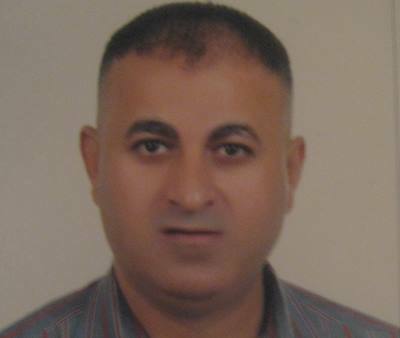
In this context, Hassan Qabalan, a member of the Political Bureau of the Amal Movement, affirmed that the movement's official position is firm and clear, and has been communicated to the President of the Republic and the Prime Minister through Speaker Nabih Berri. Qabalan pointed out in media statements that Lebanon possesses an international legal reference represented by Resolution 1701, warning against being drawn into what he described as 'the mirage of negotiations' that do not serve Lebanese national interests.

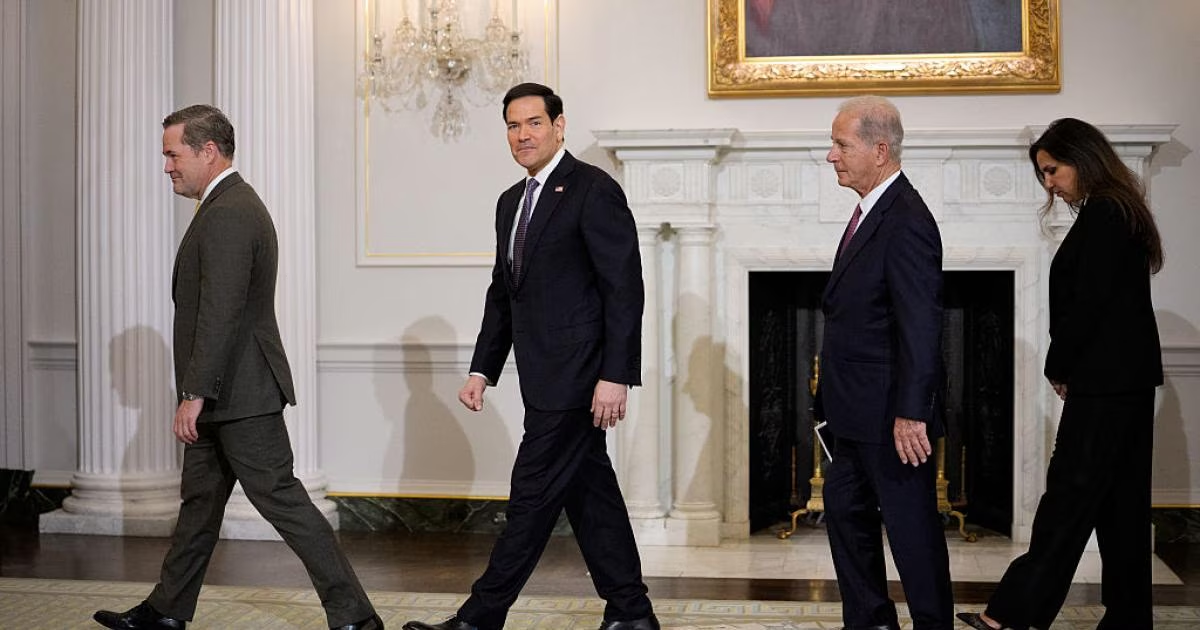
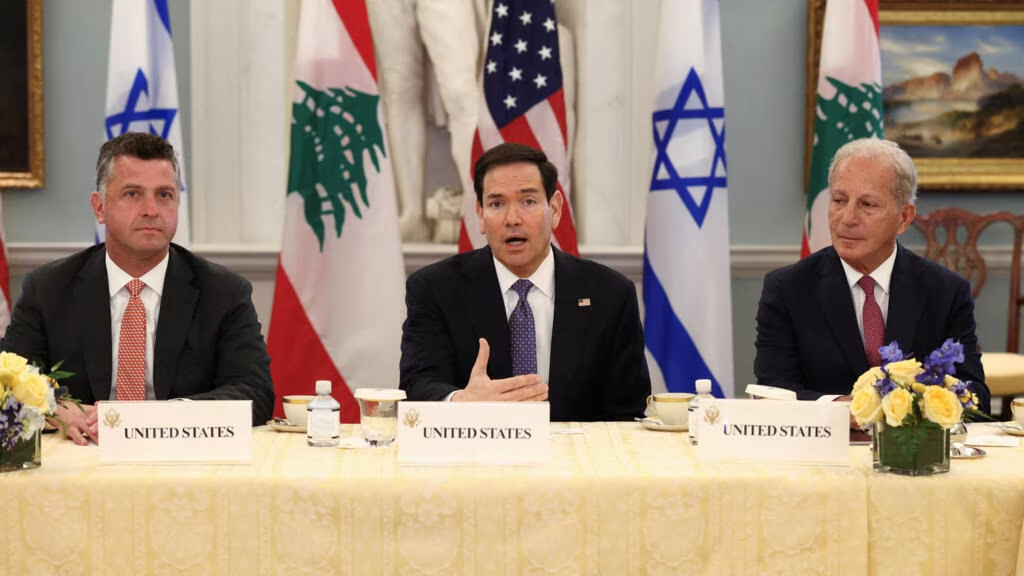
This stance comes after the conclusion of a round of talks in Washington, the capital, between delegations from Lebanon and Israel, the first of its kind in many decades. Despite the hopes expressed by Lebanese President Joseph Aoun that this step would contribute to alleviating the suffering of the Lebanese people, US Secretary of State Marco Rubio quickly lowered expectations, emphasizing that outstanding and complex issues cannot be settled in short sessions lasting no more than six hours.

Qabalan stressed that the reality on the ground completely contradicts any serious negotiating intentions, as Israeli forces continue systematic destruction operations and the bombing of homes in border villages extending from Naqoura to Khiam. He explained that this policy clearly aims to create a buffer zone and prevent the return of normal life to the border strip, which undermines the foundations of any potential diplomatic rapprochement at the present time.

The Amal Movement leader reviewed Lebanon's commitment to international agreements, noting that Lebanon has fulfilled what is required of it in the area south of the Litani, as acknowledged by major international powers. Approximately 9,500 Lebanese army soldiers have been deployed and military installations dismantled, steps that have received American and European praise, and even from the Israeli side itself in previous stages, without a similar commitment from the other party.

Qabalan pointed out that Resolution 1701, which was re-emphasized in November 2024, included clear mechanisms through the 'Mechanism' committee, which includes UNIFIL and other international parties. He considered that bypassing these mechanisms and moving towards new tracks is a waste of time, especially since Israeli leaders themselves, including their ambassador in Washington, downplayed the importance of these negotiating moves and mourned them before they even began.

Qabalan concluded that any negotiation process requires creating an atmosphere that reflects genuine positive intentions, which is completely lacking in the current reality. He affirmed that the Amal Movement does not get drawn into daily statements, but rather adheres to a national position that protects Lebanese sovereignty and is based on international resolutions that guarantee Lebanon's rights and put an end to continuous Israeli violations by land, sea, and air.

Lebanon has a previous international resolution and does not need to pursue the mirage of negotiations that many parties, and even Israeli leaders, have already dismissed.

ARAB AND WORLD

Wed 15 Apr 2026 11:15 am - Jerusalem Time

Trump Rules Out Extending Truce with Iran, US Navy Intercepts Oil Tankers in Hormuz

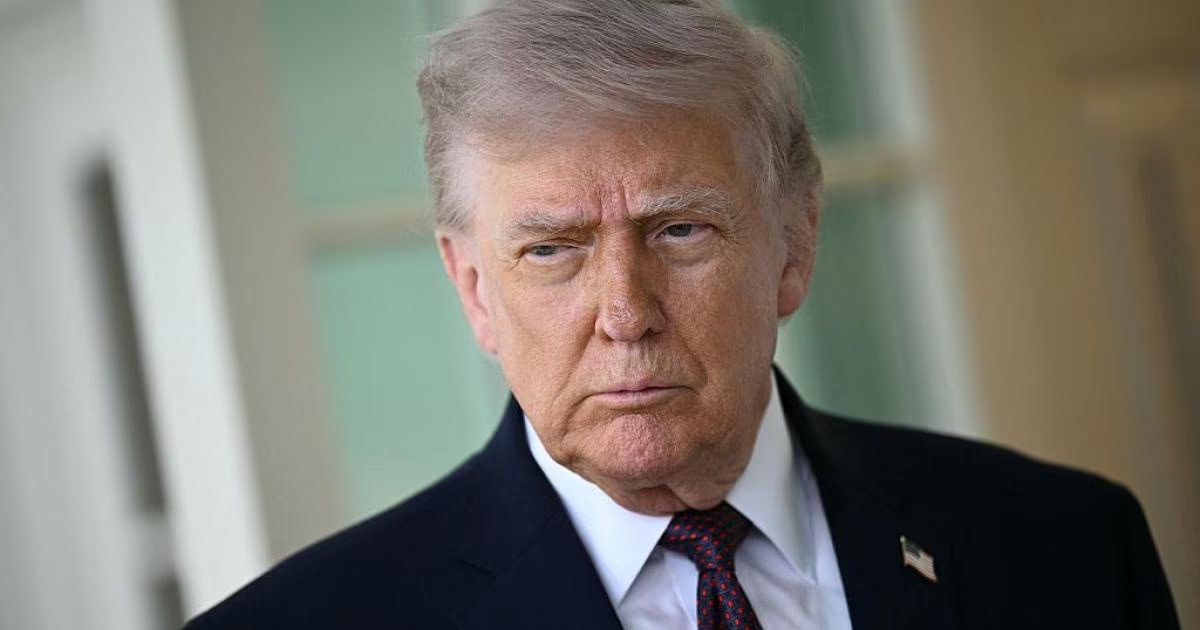
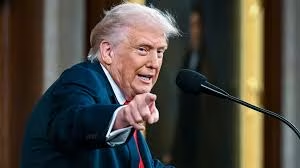
US President Donald Trump revealed his administration's intentions regarding the escalating conflict with Tehran, stating in media remarks that he is not inclined to extend the current ceasefire agreement. Trump indicated that the existing truce is approaching its inevitable end, suggesting it will cease in one way or another under current circumstances.

Despite the escalatory tone, the US President expressed his preference for diplomatic solutions if they lead to a comprehensive new agreement. Trump considered reaching a political settlement to be the optimal choice, as it would give the Iranian state an opportunity to rebuild its economy and infrastructure, which have been damaged by the confrontations.

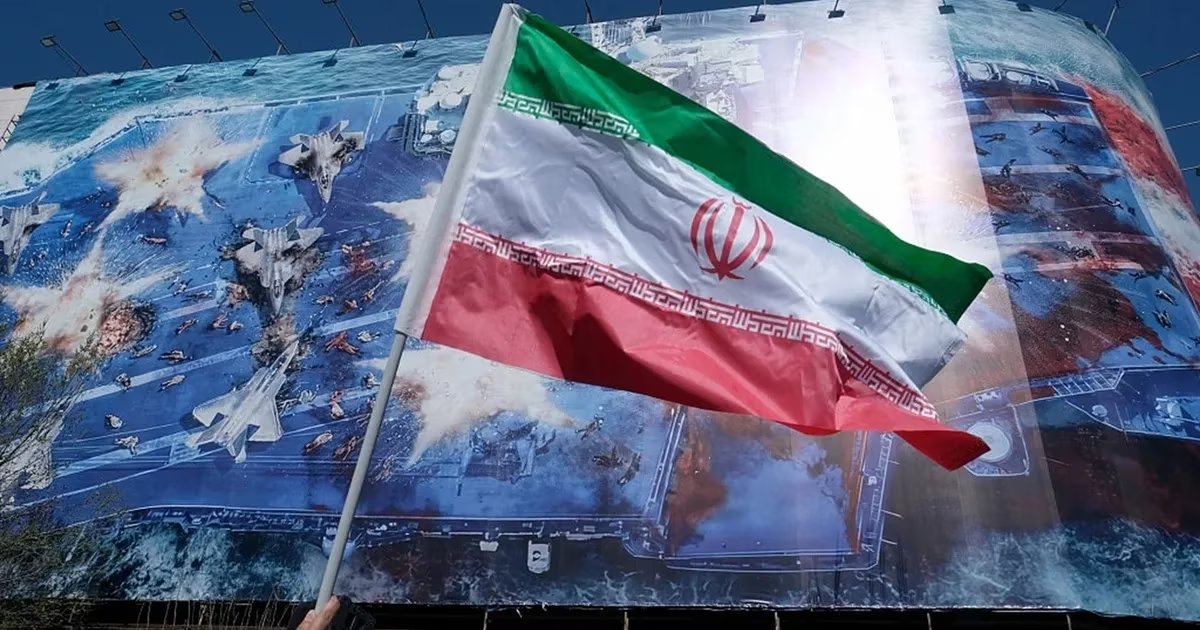
On the ground, the confrontation entered a new phase with the United States beginning to implement a comprehensive naval blockade targeting vital waterways. This military step aims to tighten the noose on Iranian foreign trade and cut off oil supply lines, reflecting the failure of previously attempted diplomatic paths.

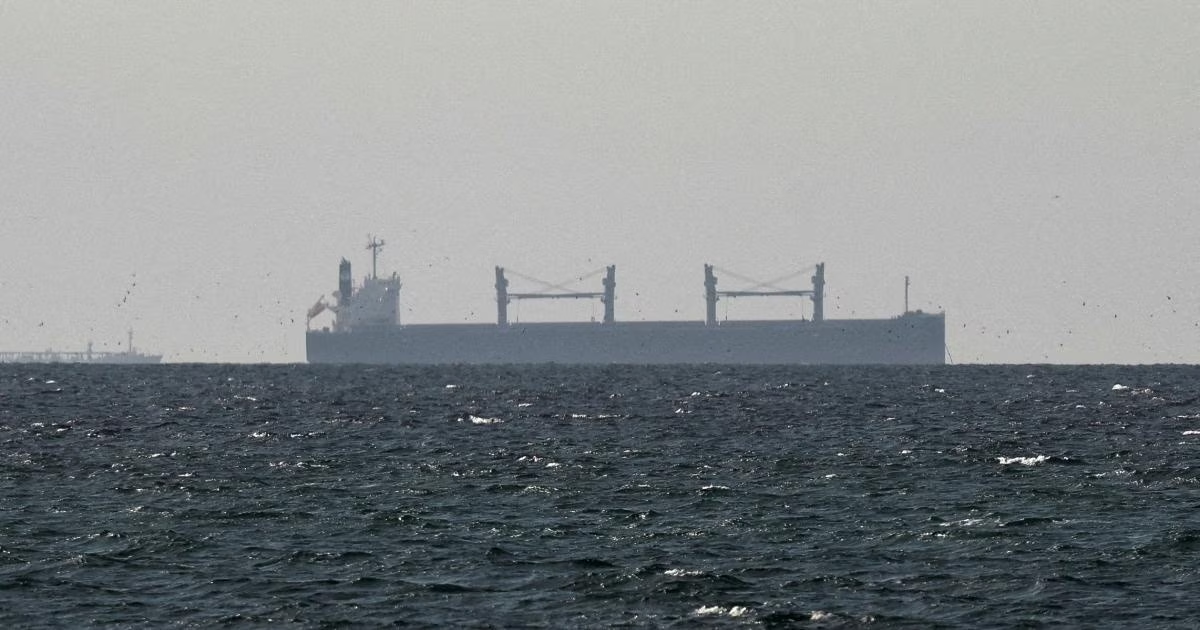
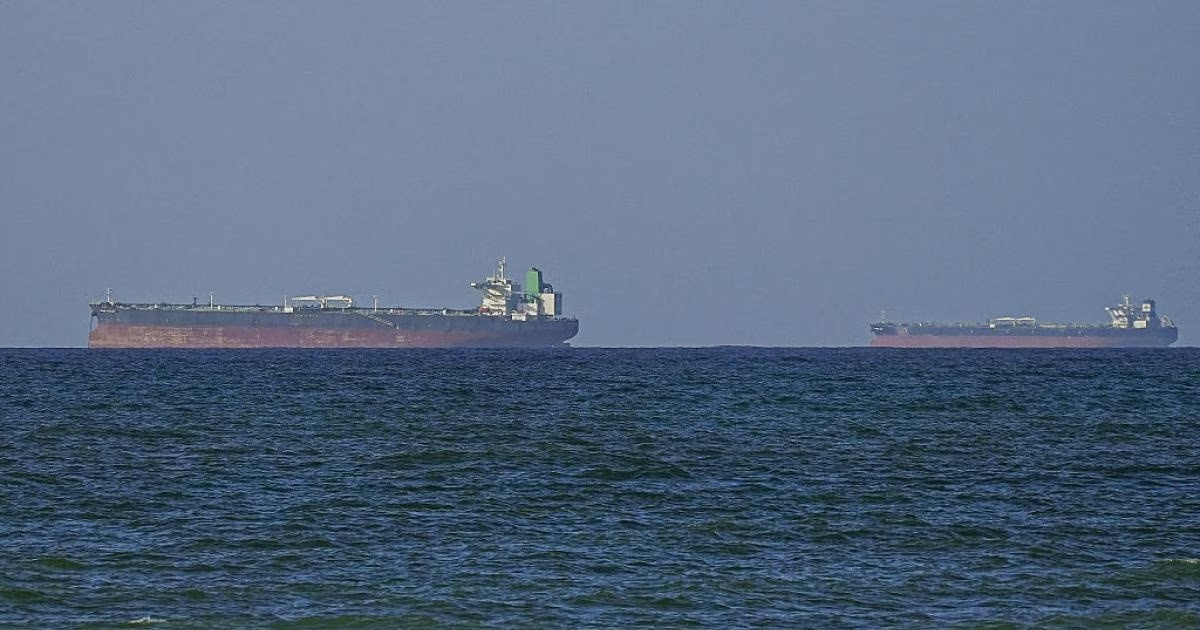
In the first practical application of this blockade, military sources reported that a US Navy destroyer intercepted two oil tankers attempting to exit Iranian territorial waters. US forces compelled the ships to return to Chabahar Port on the Gulf of Oman, sending a firm message about the seriousness of the measures being taken.

Reports from the US Central Command indicate that the naval blockade is being implemented through a massive and unprecedented military operation in the region. More than 10,000 US troops are participating in these missions, supported by 12 naval warships and dozens of fighter jets and reconnaissance aircraft to ensure complete closure of the passages.

Responsible sources confirmed that no vessel has succeeded in breaching the security cordon imposed since the announcement of the start of military operations. These moves aim to force Tehran to retract its previous threats to close the Strait of Hormuz, which represents a major artery through which one-fifth of the world's oil supplies flow.

Economically, these successive developments have caused confusion in global energy markets, with oil prices soaring to exceed $100 per barrel. Despite a slight decline later, markets remain cautiously awaiting the outcomes of the military escalation in the Gulf region and its impact on supply chains.

Observers believe that the effectiveness of the US blockade is still being tested in its early days, especially with the detection of changes in the routes of many vessels associated with Iranian oil. Political analysts warn that continued military pressure could push Tehran towards retaliatory options targeting international navigation or US interests in the region.

These tensions come in the context of an armed conflict that erupted since late February, leading to heavy human and material losses among Iranian forces. Despite the blows to Tehran's military infrastructure, it still retains strategic capabilities that make any comprehensive confrontation complex and costly.

Amidst this escalation, a faint glimmer of hope emerges regarding the possibility of resuming peace talks in the Pakistani capital, Islamabad, in the coming days. The question remains whether the region will slide into a full-scale war or if economic and military pressures will force the parties to return to the negotiating table.

I am not thinking of extending the ceasefire, and the truce will end in any case, but we prefer to reach an agreement that allows Iran to rebuild itself.

ARAB AND WORLD

Wed 15 Apr 2026 11:15 am - Jerusalem Time

European move led by France and Britain to secure the Strait of Hormuz independently of Washington

The Élysée Palace is preparing to host a virtual summit next Friday, chaired by French President Emmanuel Macron and British Prime Minister Keir Starmer, with the participation of dozens of countries. This expanded meeting aims to formulate a comprehensive international strategy to secure the Strait of Hormuz and ensure the flow of global trade once combat operations in the region cease.

Reports indicate that Starmer will attend the meeting in Paris in person, while the rest of the delegations will join via video conference, a step reflecting the European desire to lead the navigation security file. Notably, the United States is absent from the list of participants, while invitations have been extended to major powers such as China and India to ensure the broadest possible international consensus.

The emerging European plan seeks to build a broad international coalition that avoids the direct involvement of parties described as 'belligerents,' namely the United States, Israel, and Iran. This approach aims to create a neutral security environment that enjoys regional and international acceptance, thereby facilitating the restoration of confidence among global shipping companies that have been affected by the conflict.

Informed sources reported that the proposed defensive mission will focus in its first phase on three complex logistical and military axes. The first axis involves providing technical and navigational support to hundreds of commercial vessels currently stranded in the waterway, awaiting sufficient security guarantees to resume their voyages safely.

The second axis involves launching a large-scale operation to clear the waters of naval mines laid at the beginning of the conflict, a significant technical challenge requiring specialized expertise. The strategic importance of European countries, which possess a huge fleet of over 150 specialized vessels for detecting and removing naval mines, is highlighted here.

In the third axis, the European force intends to provide permanent military escort by deploying frigates and destroyers that will regularly patrol the strait to deter any potential threats. The operation's planners believe that this military presence will remain necessary for a long period even after ceasefire agreements are concluded, to meet the requirements of international insurance companies.

Diplomatic discussions reveal a divergence of views between Paris and London regarding Washington's role in this ambitious plan. While the French side believes that excluding the United States makes the mission more acceptable to Tehran, British officials express concern that this marginalization could strain relations with President Donald Trump's administration.

Germany is expected to officially join the initiative soon, which will give the plan additional military and financial weight given Berlin's naval capabilities. Germany has a specialized unit in the port of Kiel that includes mine-sweeping vessels and advanced submarines, capable of playing a pivotal role in securing deep waterways.

This initiative draws inspiration from the 'Aspides' operation model previously launched by the European Union to protect navigation in the Red Sea, which proved the effectiveness of independent European coordination. The plan relies on rotating the deployment of naval assets and helicopters belonging to countries such as Italy, Greece, and France to ensure sustainable monitoring and rapid intervention when necessary.

Observers link this plan to the concept of a 'coalition of the willing' previously proposed in other international contexts to enhance stability in conflict zones after peace agreements are reached. The European move ultimately aims to prevent the Strait of Hormuz from becoming a closed sphere of influence, and to ensure that it remains an open international passage for global trade and energy traffic.

The plan is based on establishing an international defensive mission that does not include the belligerent parties, referring to the United States, Israel, and Iran.

PALESTINE

Wed 15 Apr 2026 11:14 am - Jerusalem Time

The Fumbling of the American-Israeli Strategy: From Illusions of Overthrowing the Iranian Regime to the International Navigation Crisis

The path of military escalation led by Israel and the United States against Iran since the end of last February indicates a state of absurdity in managing international relations. War has transformed from a means to achieve political goals into an end in itself, which the two countries seek to sustain through political discourse that justifies the continuation of military operations despite their catastrophic repercussions.

This confrontation began with declared objectives: to overthrow the Iranian regime and strip it of its three elements of power: nuclear capabilities, the ballistic missile program, and the extended regional alliance system. This was clearly demonstrated in the map displayed by Benjamin Netanyahu, which identified five countries as direct military targets for Israeli operations.

Despite the intensity of the destruction caused by what is called the 'Seven Fronts War' in Gaza, the West Bank, and Lebanon, the reality on the ground confirms Israel's failure to achieve a strategic breakthrough. The regime in Tehran did not fall, and the Iranian masses did not respond to the calls for revolution repeatedly launched by Netanyahu and Trump, which caused clear disappointment to the Israeli leadership.

The appointment of Meir Ben-Shabbat as head of the 'Mossad' indicates an Israeli desire to continue attempts to stimulate internal change in Iran. However, Ben-Shabbat's previous criticisms of the lack of real preparation for this goal reflect a significant gap between political ambitions and operational capabilities on the ground.

On the other hand, Iran showed resilience in dealing with the strikes, quickly choosing a successor to the Supreme Leader after the assassination attempt targeting him. This move sent a clear message about the continuity and cohesion of the regime, at a time when Iranian air defenses succeeded in altering the balance of power in the theater of operations.

Tehran rediscovered the importance of the Strait of Hormuz as an effective strategic asset in the confrontation, forcing the American administration to change its rhetoric. President Trump shifted from talking about regime change to focusing on 'opening the strait,' which is a tactical retreat imposed by global economic and navigational necessities.

American strategic confusion reveals a division in views between Washington and Tel Aviv, especially after Trump accepted the principle of negotiation and a temporary truce. This decision caused turmoil in Netanyahu's office, who fears that diplomatic paths could undermine his military goals aimed at prolonging the conflict.

Marathon negotiations lasting 21 hours took place in the Pakistani capital, Islamabad, between a high-level American delegation and an Iranian one led by Mohammad Bagher Ghalibaf. These discussions addressed thorny issues including the nuclear program, frozen assets, and navigation security in the Gulf, in an attempt to defuse a full-scale explosion.

The chances of success for these negotiations depend on the flexibility of both parties in making mutual concessions, away from the logic of a 'zero-sum game.' However, the pro-war lobby in Israel and the United States is striving to thwart any diplomatic rapprochement, promoting claims about the futility of dialogue with Tehran.

Should war reignite, its objectives will shift for the third time towards imposing a comprehensive naval blockade on Iranian ports. Trump claims that this measure aims to force Iran back to the negotiating table, a clear reversal of facts given that he was the one who previously withdrew from diplomatic paths.

The proposed naval blockade poses a threat not only to Iran but also to the interests of dozens of countries that rely on maritime transport in the Gulf and the Arabian Sea. Major countries like China and India, as well as European powers, have expressed their rejection of this step, which contradicts the freedom of global trade.

China clearly warned that a naval blockade would lead to severe global economic repercussions, while NATO countries refused to participate in it. This stance puts the United States in a potential confrontation with its traditional allies and increases its international isolation on this issue.

It seems that the American administration does not realize the extent of the strategic losses that could result from the continuation of an open confrontation with Iran. Regional allies, who are paying the price for these policies, find themselves without real means of defense against the exorbitant consequences of the ongoing war's folly.

Ultimately, the scene remains open to possibilities of escalation or a return to negotiations under the pressure of international need for navigation stability. But the only constant is that the American-Israeli strategy suffers from deep confusion, as objectives change with every new field setback.

The official shift from war to negotiations represents a dramatic change in the American strategic approach and reveals Washington's lack of confidence in the military option's ability to resolve the navigation issue.

OPINIONS

Wed 15 Apr 2026 11:14 am - Jerusalem Time

Washington's Lebanese-Israeli Meeting: A Contentless Showcase and a Path Lacking Seriousness

Washington – Said Arikat – 14/4/2026

News Analysis

In a move that sparked widespread political debate, the US capital, Washington, hosted a meeting between the Lebanese Ambassador to the United States, Nada Mouawad, and the Israeli Ambassador to Washington, Yehiel Leiter, under the patronage of US Secretary of State Marco Rubio, and with the participation of the US Ambassador to Lebanon, Michel Issa, the US Ambassador to the United Nations, Mike Waltz, in addition to the advisor at the US State Department, Michael Wyndham.

Israeli Ambassador Leiter is known for being one of the most extreme settlers. He was born and raised in America before making a settlement located north of Ramallah in the occupied West Bank his residence for many years. He did not stop at living there but also contributed to the establishment of 'One Israel Fund,' an organization dedicated to raising financial donations to support settlement projects and consolidate the presence of settlers in the occupied Palestinian territories.

According to a US State Department official who spoke on condition of anonymity, preparations for this meeting lasted for about a full month, i.e., before the date of the US-Iranian negotiations in Islamabad was set, in a clear attempt to separate the two tracks, despite their temporal overlap. The official stressed that the US administration believes there is no link between the talks with Iran and this Lebanese-Israeli meeting, indicating Washington's desire to keep each file within an independent negotiating framework.

In the same context of statements, the official emphasized that Iran “has dragged the Lebanese people into a war that it cannot then claim to protect them from,” considering Hezbollah an “unworthy terrorist organization that should have no political role, and its weapons must be completely disarmed,” affirming US support for this goal. He added that Washington would not allow Tehran to determine Lebanon's future, and that this meeting falls within broader efforts to redraw balances in the country away from Iranian influence.

On the humanitarian front, the official revealed that the US State Department recently approved new funding of $58.8 million to support humanitarian programs in Lebanon, aimed at providing vital assistance to displaced persons, including food, healthcare, water, sanitation services, and shelter, as well as supporting emergency response for those most affected by the conflict. He noted that Washington continuously coordinates with international organizations and donors to ensure that this aid is utilized within a coherent and effective international response.

Despite the official diplomatic nature of the meeting, political and media circles viewed it as a step lacking seriousness, considering it merely an attempt to create a visual scene showing Lebanon and Israel side-by-side under an American umbrella, without reflecting actual progress on core outstanding issues. This interpretation suggests that the meeting reflects a desire to achieve media breakthrough rather than a genuine negotiating path, in the absence of any indications of the parties' readiness to address sensitive files.

Critics also believe that the timing of the meeting and the nature of its diplomatic representation suggest that it is closer to a public relations initiative than a serious political effort, especially given the sharp internal Lebanese divisions regarding any form of communication with Israel. They add that this type of meeting may exacerbate internal tensions instead of contributing to their resolution, by giving the impression of an undeclared normalization process.

Observers warn that the American focus on disarming Hezbollah, regardless of addressing the broader context of the Lebanese crisis, may lead to counterproductive results, as this approach is seen as ignoring complex internal balances and reducing the crisis to its security dimension only, overlooking its political and economic roots.

This meeting reflects a traditional American approach that focuses on managing crises rather than solving them, where the emphasis is on creating superficial dialogue platforms without providing the necessary political conditions for their success. The absence of a clear agenda and the non-involvement of key Lebanese parties make it difficult to consider this meeting a serious step towards a sustainable settlement. Moreover, the insistence on separating negotiating tracks, despite their actual interconnectedness, reflects a simplistic reading of the complexities of the regional scene, which limits the chances of achieving a real breakthrough.

The meeting also raises the issue of Lebanese sovereignty, as its arrangement and management appear to have been largely carried out according to an external agenda, without clear internal Lebanese consensus. This reality reinforces the impression that Lebanon remains an arena for settling regional and international scores, rather than being an active party in determining its political path. Furthermore, focusing on disarming Hezbollah as the sole entry point for a solution ignores internal power balances and may complicate the scene rather than simplify it.

It is clear that the media dimension was strongly present in this meeting, as the appearance of representatives from Lebanon and Israel in one picture under American patronage constitutes a symbolic message directed at more than one party. However, this symbolism, in the absence of real political content, may be counterproductive, as it reinforces doubts about the meeting's objectives and fuels narratives rejecting any diplomatic openness. Therefore, the success of any future path requires moving beyond the logic of image towards a deeper and more realistic approach.

OPINIONS

Wed 15 Apr 2026 11:14 am - Jerusalem Time

The Limits of Excessive Force: How Asymmetric Deterrence Made Negotiation Inevitable?

Ramallah - “Alquds ” dot com

Ramallah - “Alquds ” dot com

Opinion Writer

Recent military shifts in the region have proven that the pursuit of excessive armament is no longer the sole guarantor of political or field victories. Despite vast disparities in defense budgets, qualitative armament and negotiated solutions have emerged as an indispensable strategic alternative in contemporary international relations, especially after direct confrontations revealed the limitations of conventional power against smart deterrence strategies.

Figures indicate a wide gap between major powers and developing nations, with the US defense budget exceeding $919 billion, equivalent to more than a third of global military spending. However, this financial superiority has not translated into military decisive action against a country like Iran, whose defense budget does not exceed $7.9 billion, reflecting a shift in the concept of power from quantity and massive equipment to quality and military intelligence.

Joint military operations aimed at crippling Iranian capabilities revealed the inability of modern technologies to achieve their political objectives, despite continuous raids for 40 days and the use of the deadliest bombs. This failure to neutralize command and control centers or overthrow the political regime confirms that advanced technology alone is not enough to break the will of nations that possess asymmetric defense systems capable of absorbing shocks.

In a related context, the ongoing war of annihilation in the Gaza Strip stands out as additional evidence of the limits of excessive force, as the occupation failed to achieve its primary goal of forcing the resistance to surrender. Despite widespread destruction and massacres committed against civilians, field steadfastness has proven that the impact of technical and quantitative superiority diminishes in the face of strong political will and those who refuse to compromise on their national principles.

This new reality stems from the breaking of the West's monopoly on advanced technology, as technical knowledge has become shared and accessible to Southern countries through faster and less costly means. The rise of China as a dominant technological power has played a pivotal role in this transformation, especially with its complete control over supply chains for rare metals and nano-chips, enabling developing countries to build defense arsenals capable of confronting the strongest armies in the world.

These lessons learned are expected to prompt countries worldwide to conduct a deep review of their military doctrines, shifting from investing in heavy equipment and traditional mechanisms to focusing on missile and drone control systems. Radar systems, electronic jamming methods, and satellite reconnaissance will become the cornerstone of future defense budgets, ensuring the achievement of deterrence balance at the lowest possible costs.

Ultimately, major powers will find themselves compelled to accept the concept of asymmetric deterrence and resort to negotiated approaches as the only rational option to avoid wars of attrition. Were it not for the arrogance and extremist ideological tendencies dominating decision-making circles in Washington and Tel Aviv, the world would be safer, especially with the emergence of Chinese wisdom that prioritizes economic and political stability over considerations of military dominance.

Advanced technology is no longer the exclusive domain of the capitalist West, and the new reality has forced major powers to re-evaluate their calculations and accept the concept of asymmetric deterrence.

OPINIONS

Wed 15 Apr 2026 4:48 am - Jerusalem Time

Sanctioning Truth: How the West Turned on Francesca Albanese Instead of Defending Human Rights


By: Said Arikat


April 15, 2026


News Analysis


Washington, D.C- Julian Borger’s reporting in The Guardian lays bare a disturbing inversion at the heart of Western policy: rather than defending the universal principles they claim to uphold, the United States and key European governments have, in the case of Francesca Albanese, chosen to target the messenger. His portrait of the UN special rapporteur is not only the story of one official under siege, but an indictment of a political order that punishes dissent more swiftly than it confronts alleged war crimes.


I have known Julian Borger since 2003, and I have known Francesca Albanese since she assumed her role as UN Special Rapporteur. From that vantage point, I can say with confidence that few journalists match Borger’s professionalism, rigor, and integrity as an interviewer. Equally, it is hard to think of a human rights advocate as steadfastly principled as Albanese—someone whose integrity is not only evident but immovable, even under extraordinary pressure. She is relentless, unyielding in the face of intimidation, and unwavering in her commitment to the truth, regardless of the personal or political cost. In a field that often rewards caution, her stubborn integrity sets her apart as one of the most formidable voices in human rights today.


Albanese’s offense, in essence, has been to speak with clarity. In the wake of the October 7, 2023 Hamas attacks and Israel’s devastating military response in Gaza, she became the first UN official of her rank to characterize Israel’s actions as genocide. Whether one agrees with that legal conclusion or not, it is a claim grounded in her mandate: to investigate and report on human rights violations. Yet instead of engaging with the substance of her findings, Washington and several European capitals moved to discredit, isolate, and ultimately punish her.


The sanctions imposed by Donald Trump’s administration represent a particularly egregious example. By designating Albanese in a category typically reserved for terrorists and transnational criminals, the United States crossed a dangerous line. This was not mere diplomatic disagreement; it was an attempt to erase her capacity to function. As Borger recounts, the consequences have been sweeping—financial exclusion, the seizure of property, and restrictions so severe they amount to what has been described as a “civil death.” Such measures are not only disproportionate; they are fundamentally incompatible with the principles of due process and free expression that the United States claims to champion.


Europe’s role, while sometimes less overt, has been no less troubling. Germany’s attempt to suppress Albanese’s public appearances, reportedly going so far as to deploy police and threaten arrest over her language, reflects a broader pattern of constraining debate on Israel-Palestine. The justification—protecting the memory of the Holocaust or preventing antisemitism—is, of course, serious and necessary. But when such concerns are used to silence legitimate criticism of a state’s conduct, they risk being instrumentalized in ways that ultimately undermine both human rights and historical responsibility.


The United Kingdom and other European governments have likewise failed to provide meaningful support for an independent UN mandate holder facing extraordinary pressure. Instead, their posture has too often mirrored Washington’s: cautious at best, complicit at worst. The result is a chilling message to international civil servants and human rights advocates alike—step beyond the bounds of acceptable discourse, and you may find yourself abandoned or worse.


What makes this response particularly indefensible is the scale of the humanitarian crisis that forms its backdrop. The war in Gaza has produced staggering levels of death, displacement, and destruction. Entire neighborhoods have been reduced to rubble; civilian infrastructure has been decimated; and a population already living under blockade has been pushed to the brink. In such circumstances, the need for rigorous, independent scrutiny is not optional—it is essential. Yet instead of strengthening mechanisms of accountability, Western governments have chosen to undermine one of the very figures tasked with providing it.


Borger’s interview also highlights the personal cost of this political failure. Albanese has faced death threats, harassment, and sustained campaigns against her family. These are not the actions of a system confident in its moral standing; they are the symptoms of a climate in which dissent is treated as danger. That such conditions have been tolerated—if not implicitly encouraged—by governments that regularly invoke human rights as a cornerstone of their foreign policy is deeply revealing.


There is, of course, a broader context to this reaction. Albanese’s reports do not stop at documenting alleged violations by Israel; they extend responsibility to the network of states and corporations that enable them. This includes arms suppliers, financial institutions, and political allies—many of them in the United States and Europe. In this sense, the backlash against her is not only about what she has said regarding Gaza; it is about what her findings imply for those who have supported, financed, or defended the status quo. To accept her conclusions would require a level of self-scrutiny that Western governments have thus far been unwilling to undertake.


Critics argue that Albanese’s rhetoric blurs the line between legal analysis and political advocacy, potentially weakening the impact of her work. There is merit in the concern that international law depends on precision and restraint. But this critique cannot justify the punitive measures she has faced. Disagreement with tone or framing should be addressed through debate, not sanctions or suppression. To conflate the two is to erode the very norms that underpin democratic societies.


Ultimately, the treatment of Francesca Albanese is a test—one that the United States and Europe are, at present, failing. It is a test of whether human rights are truly universal, or whether they are contingent on political convenience. It is a test of whether international institutions can operate independently, or whether they will be bent to the will of powerful states. And it is a test of whether those who speak uncomfortable truths will be protected or punished.


Julian Borger’s reporting makes one thing clear: this is not simply about one rapporteur or one conflict. It is about the credibility of a system that claims to stand for justice while sidelining those who seek to uphold it. If Western governments continue down this path—prioritizing alliance politics over accountability, and suppression over scrutiny—they risk not only abandoning the Palestinians, but also hollowing out the very ideals they profess to defend.

ISRAELI AFFAIRS

Tue 14 Apr 2026 4:06 pm - Jerusalem Time

Honoring a Rabbi Who Boasted of Gaza's Annihilation: Israel Chooses a 'Symbol of Destruction' to Light Its Celebration Torch

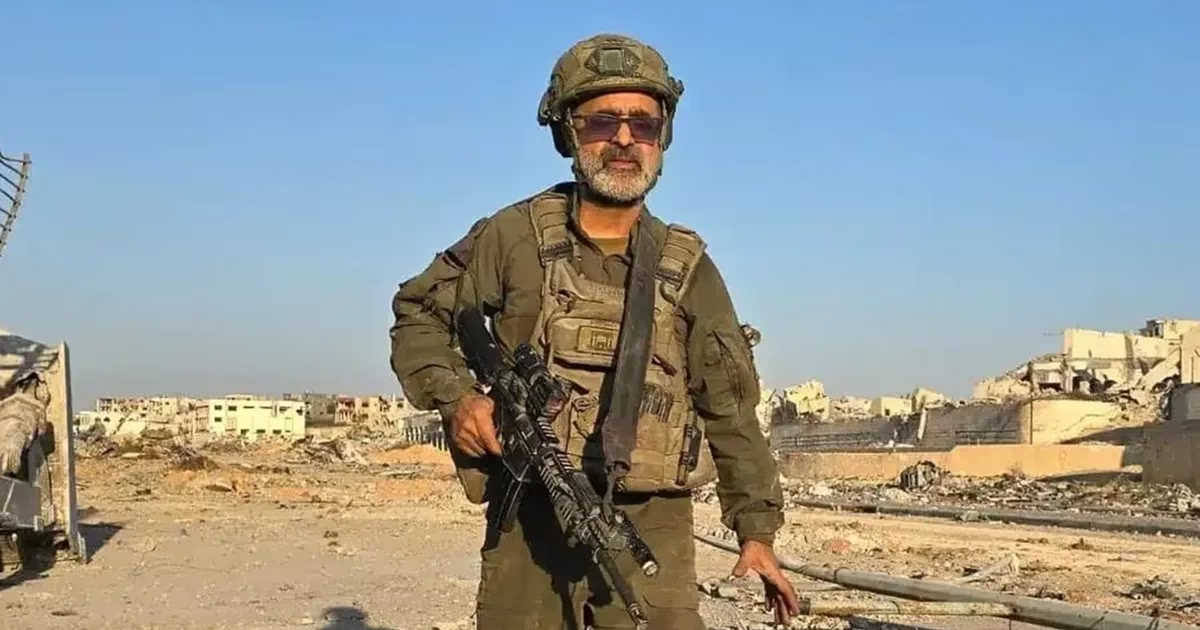
Hebrew press reports revealed the decision by the Minister of Transportation in the occupation government, Miri Regev, to choose Rabbi Avraham Zerbiv to participate in the main torch-lighting ceremony as part of the so-called 'Independence Day' celebrations. This choice comes despite the controversial record of the rabbi, who serves as a reserve officer in the army, having openly boasted about systematic destruction operations in the Gaza Strip.

Haaretz newspaper, in its editorial, considered this decision further evidence of the internal collapse Israel is experiencing and its loss of moral compass. The newspaper pointed out that honoring a figure who adopts genocidal rhetoric reflects the current government's tendency to normalize violence and mass destruction as an official state policy.

Published photos of Rabbi Zerbiv documented blatant violations, with one showing him occupying a school classroom in the Gaza Strip, placing his military weapon on a Muslim prayer rug. The photos also showed writings on the school walls indicating the establishment of a 'rabbinical court' in the heart of Khan Yunis city, signaling the extreme religious dimension in military operations.

The matter did not stop at photos; Zerbiv also posted a video clip on social media platforms showing him driving a military bulldozer to demolish a residential building in Gaza. This video gained widespread circulation, with the rabbi considering it a source of pride, which prompted Minister Regev to nominate him for this official honor in government celebrations.

In subsequent statements to the media, Zerbiv affirmed his extremist vision towards the Strip, saying that the solution lies in completely leveling Gaza to the ground. These statements were met with sharp criticism from left-wing and liberal circles within Israeli society, who saw them as an embodiment of war crimes committed under political cover.

Haaretz strongly criticized Minister Miri Regev's stance, describing her as indifferent to how the outside world views these actions. The newspaper added that the current government believes it lives in isolation from international values and the Western civilization it claims to belong to, while it is immersed in glorifying war and destruction.

Reports noted the transformation of the rabbi's family name 'Zerbiv' into a new linguistic verb in colloquial Hebrew, where the term 'to zerbiv' now means erasure and mass destruction. This term is currently used to describe what Gaza has suffered from the complete obliteration of residential neighborhoods, reflecting the deep penetration of the idea of annihilation into the Israeli collective consciousness.

Journalistic circles believe that using a person's name as a verb to express destruction is a powerful indictment of current Israeli policy, which has adopted this rabbi's behavior as a general approach. The phrase 'Israel zerbived Gaza' has come to embody the grim image the state presents to the international community, far from any humanitarian or legal standards.

For her part, Yedioth Ahronoth writer Einav Schiff launched a scathing attack on the decision to honor, asserting that the right-wing government is destroying all attempts to beautify its image abroad. Schiff said that choosing a person who represents 'ethnic cleansing' to light the torch is a clear message that extremists are leading the official scene.

Schiff added that the Minister of Transportation, and the government behind her, are directly contributing to confirming the international accusations directed at Israel, instead of trying to deny them. She considered that this behavior reinforces Israel's international isolation and places it in the category of countries that celebrate human rights violators and war criminals.

This controversy reflects a sharp division within Israeli society regarding the ethics of the war in Gaza, where the far-right sees Zerbiv as a national hero worthy of honor. In contrast, his critics see his honoring as an 'indelible stain' and confirmation that Israel has lost its conscience in the rubble of destroyed homes in the Strip.

Choosing Zerbiv to light the torch is not just a procedural measure, but a political declaration of Israel's new identity that prides itself on destruction. The rabbi who turned a prayer rug into a platform for his weapon has today become the symbol the government has chosen to represent its values in its most important national celebrations.

Reports concluded that Israel's standing in the world has become closely linked to the images of destruction proudly promoted by its soldiers and rabbis. With the continuation of these policies, it seems that the gap between Israel and universal human values is widening, under a government that finds no shame in celebrating extremism and devastation.

We simply need to level the Strip to the ground.

ISRAELI AFFAIRS

Tue 14 Apr 2026 4:06 pm - Jerusalem Time

Israeli Health: Number of Injured Rises to 7740 Due to Clashes with Iran and Lebanon

The Israeli Ministry of Health, in an official statement issued on Tuesday, revealed new updates regarding the human casualties among settlers, confirming that 47 people were injured during the past twenty-four hours. With this new statistic, the total number of injured recorded by medical departments rises to 7740 since the start of the current round of military escalation on the Iranian and Lebanese fronts, which has seen an intensification of cross-border combat operations.

Medical sources clarified that the recent injuries resulted from barrages of ballistic missiles launched from Iranian territory, in addition to shells and rockets launched by Hezbollah from southern Lebanon towards settlements and occupied cities. Reports also indicated that some of these injuries occurred due to stampedes and falls suffered by residents as they rushed to fortified shelters immediately after sirens were activated in various areas, with the severity of cases ranging from mild to moderate and serious.

Regarding the health status of the injured within medical facilities, reports indicated that about 120 injured individuals are still in hospitals receiving necessary treatments, including a limited number of cases described as very critical. This continuous increase in the number of injured comes since the outbreak of direct confrontation with Iran in late February, a confrontation that has expanded to include the northern front with Lebanon more fiercely in recent weeks.

Despite the significant increase in the number of injured, sources stated that the death toll on the Israeli side remains relatively limited compared to the scale of the bombardment, with estimates ranging between 23 and 33 fatalities. Reports attributed this disparity to the effectiveness of air defense systems and early warning systems that reduce direct human losses, while the opposing fronts in Lebanon and Iran are witnessing heavy human and material losses due to intensive airstrikes carried out by the Israeli Air Force.

The past twenty-four hours recorded 47 Israeli injuries, raising the total number of injured to 7740 people since the outbreak of military confrontations.

ISRAELI AFFAIRS

Tue 14 Apr 2026 4:06 pm - Jerusalem Time

Israeli Pessimism Regarding Washington's Negotiations with Lebanon and Expectations of Renewed Confrontation

A state of skepticism prevails within political and security circles in Israel regarding the possibility of achieving a serious breakthrough in the ongoing negotiations between the Israeli and Lebanese ambassadors in Washington. Analytical readings indicate that Israel still expects the failure of diplomatic tracks, not only on the Lebanese front, but even in the Iranian nuclear file, where the military establishment is preparing for the possibility of renewed war.

Leaks from within the Israeli security establishment indicate that the gap between the two sides is still very deep, making the option of military escalation closer than political settlement. Tel Aviv fears that any agreement between Washington and Tehran might give the latter an opportunity to restore its military and missile capabilities, which directly reflects on the strength of its allies in the region, especially Hezbollah.

For his part, military analyst Amos Harel warned that the Israeli leadership's continued search for a 'victory image' could lead to counterproductive results that threaten the army's efficiency. Harel pointed out that the chances of success for the Washington negotiations are slim, given that the declared Israeli goal is to dismantle Hezbollah's military structure, which the party rejects outright.

Observers believe that Israel found itself compelled to sit at the negotiating table in response to direct pressure from US President Donald Trump's administration. This shift comes after a long period of Israeli rejection of Lebanese demands, as Benjamin Netanyahu's government currently adopts a security doctrine based on exercising maximum military force to impose its conditions.

In a related context, media sources explained that Netanyahu is trying to balance American pressure with his promises to the Israeli public to crush Hezbollah's capabilities. Washington has provided Netanyahu with a diplomatic exit by launching 'peace negotiations' essentially aimed at reaching a temporary ceasefire or reducing the intensity of combat operations without appearing defeated.

Israeli experts recall previous failed experiences in negotiating with Lebanon, such as the 1983 attempts that did not yield tangible results on the ground. Professor Eyal Zisser confirms that the Lebanese side is currently focused on securing a ceasefire only, without possessing the actual ability to implement Israel's demands regarding the disarmament of armed factions.

Zisser adds that the official Israeli narrative that speaks of permanently weakening Hezbollah lacks accuracy, stressing that the party still retains a huge arsenal of missiles and drones. According to his estimates, Hezbollah is capable of managing a long-term war of attrition, citing the failure to decisively end the battle in the Gaza Strip despite a long time since its outbreak.

On the ground, reports indicate that Hezbollah still controls the initiative at many border points despite the limited Israeli incursion. Observers believe that the advance of Israeli forces has not exceeded a few kilometers in some axes after weeks of fighting, which reinforces the party's narrative about its ability to withstand and confront.

On the other hand, the fundamental disagreement over the timing of the ceasefire emerges, as Lebanon stipulates a cessation of military operations as a first step preceding any diplomatic coordination. In contrast, the Israeli government insists on the principle of 'negotiating under fire,' wishing to continue military pressure to achieve greater political gains at the negotiating table.

Analyst Tzvi Bar'el considered these negotiations to represent a 'sovereignty test' for the Lebanese state and the future of its institutions in light of the ongoing conflict. He pointed out that the gaps in positions are not only technical but relate to each party's vision for the future stability on the shared borders, which makes reaching a comprehensive agreement elusive at present.

Regarding the Iranian role, Tehran clearly linked the Islamabad negotiations track with the field developments in Lebanon, complicating the regional scene. This linkage places the Israeli negotiator before the challenge of dealing with multiple interconnected fronts, where any understandings in Washington affect the balance of power in the entire region.

In conclusion, all eyes remain on the outcome of the Washington meetings, despite the prevalence of pessimism in the statements of officials and analysts in Tel Aviv. With the continued mutual shelling, it seems that the field will remain the primary arbiter in determining the ceiling of political demands for both Israel and Lebanon in the coming period.

Israel is going to these negotiations reluctantly and at Trump's request, after having previously rejected the Lebanese government's requests for negotiations.

ARAB AND WORLD

Tue 14 Apr 2026 4:05 pm - Jerusalem Time

Deadly Israeli Escalation in Lebanon: Martyrs in Bekaa and the South, and a Plan to Isolate Western Bekaa Villages

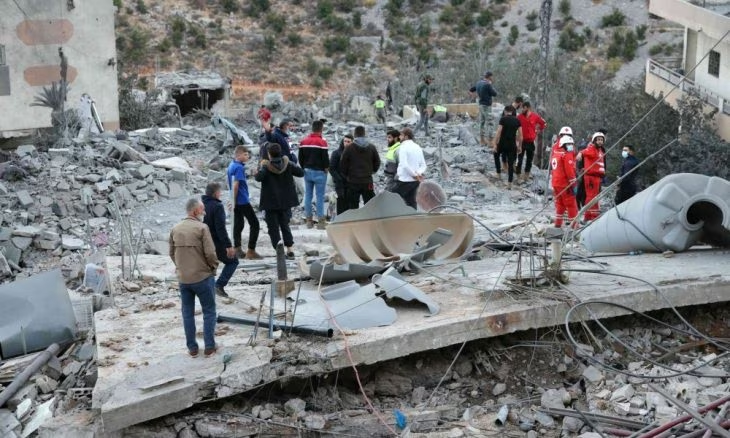
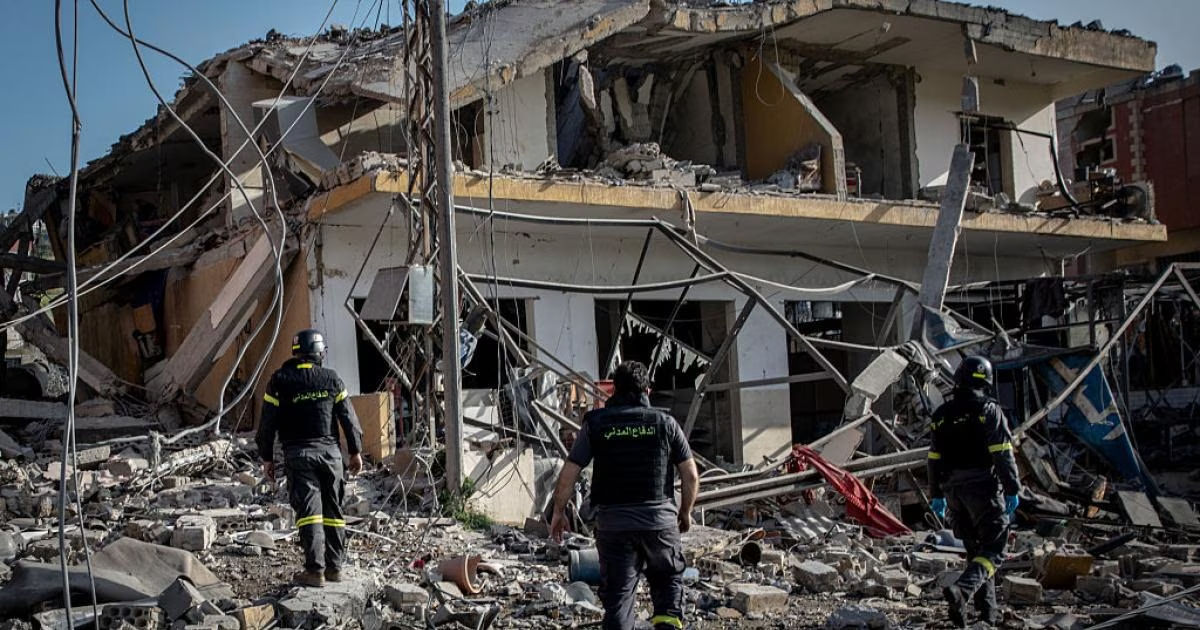
The Israeli army has intensified its aerial attacks on wide areas in South Lebanon and Western Bekaa, resulting in the martyrdom of several individuals and injuries among civilians. The raids included the destruction of dozens of residential units and targeting municipal centers, amidst ongoing aggression that affected the towns of Qleileh, Shemaa, the outskirts of Shebaa, and Arabsalim.

In the Western Bekaa region, intense shelling focused on the town of Sahmar, where field sources reported the martyrdom of four members of one family: a mother and her three children. This direct targeting led to the complete destruction of more than ten homes, causing widespread panic and devastation in the residential area.

Local sources reported the fall of two martyrs in an airstrike that targeted the Al-Mahmoudiya area near the town of Aishiya in the Jezzine district. The town of Adloun also recorded the fall of three more martyrs due to a similar raid, while warplanes continued to sweep Lebanese airspace and carry out precise strikes on civilian targets and infrastructure.

In the town of Arabsalim, an airstrike targeted a house in the Al-Hara Al-Tahta area, leading to the martyrdom of two people and injuring a woman with varying degrees of severity. The strike leveled the house to the ground and damaged neighboring buildings, amidst attempts by residents to pull victims from under the rubble.

Regarding drone operations, an Israeli drone targeted a civilian car on the Al-Musaylih - Nabatieh road after midnight. The attack resulted in the martyrdom of two people inside, as part of the assassination and pursuit policy adopted by the occupation on vital roads connecting southern cities.

The center of the Hosh-Sour area witnessed extensive destruction affecting shops, electricity networks, and homes, following a series of violent raids that targeted the area. These attacks caused power outages in wide neighborhoods, increasing the suffering of residents trapped in those areas under the weight of continuous shelling.

Field data indicates that Israeli aviation is specifically targeting the town of Sahmar, one of the six towns recently included in forced evacuation orders. This military focus aims to impose a new security reality that isolates the town from its geographical surroundings in Western Bekaa and the South.

Through intensifying raids on Sahmar and its surroundings, Israeli forces seek to cut off supply and movement routes between it and the villages of Yahmar, Zlaya, and Qleileh. This move comes within a strategy aimed at paralyzing movement in Western Bekaa and separating villages from each other by targeting vital bridges and mountain passes.

Ambulance and civil defense teams face immense challenges in reaching targeted sites to provide assistance and evacuate the injured. This is due to the intensive flying of drones that target any movement on the roads, making rescue operations fraught with high risks and taking longer than usual.

A state of extreme tension and anxiety prevails among the residents of Western Bekaa villages, with fears of the aggression expanding to include new areas that were not within the direct target bank. These fears coincide with the continued intensive military flights that do not leave the airspace, portending a new wave of field escalation.

The intensity of the targeting in Sahmar and its surroundings practically aims to isolate the town and the villages located south of it, which hinders movement between them and the villages of Western Bekaa.

PALESTINE

Tue 14 Apr 2026 4:05 pm - Jerusalem Time

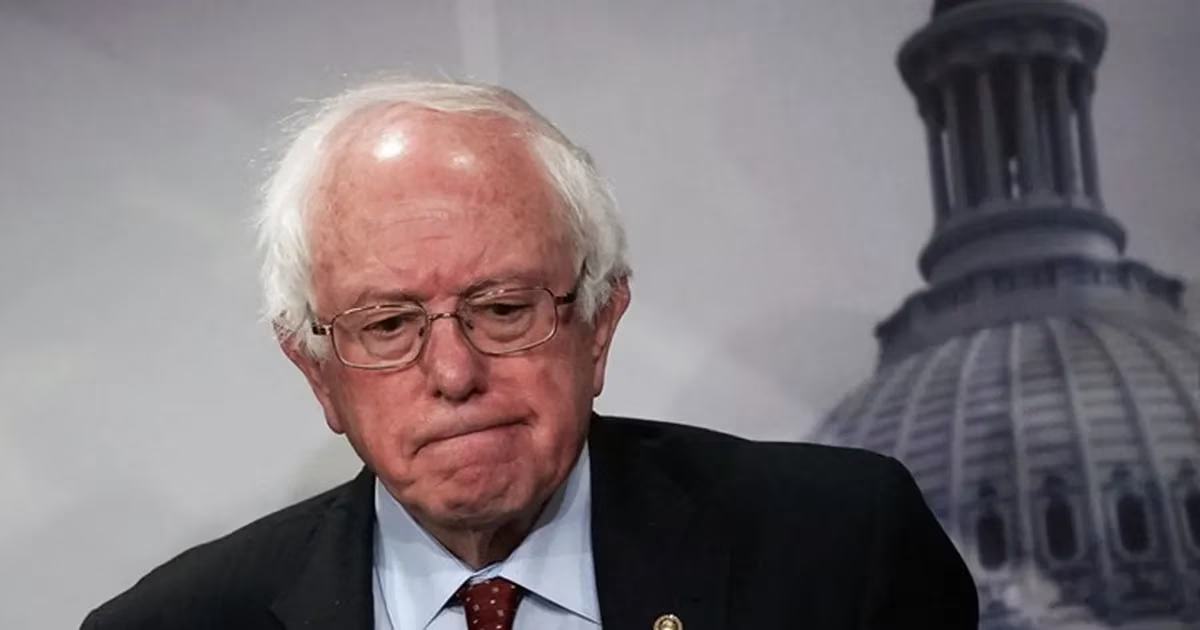
Sanders moves legislatively to stop arms exports to the occupation and accuses Netanyahu of committing genocide

US Senator Bernie Sanders announced an upcoming legislative move aimed at freezing massive arms deals destined for the Israeli occupation army. Sanders affirmed in his statements that he would seek to force a vote in the Senate to prevent the export of bombs, military equipment, and bulldozers estimated at about $500 million, stressing that US taxpayers should not contribute to funding the current war machine.

The US Senator described Benjamin Netanyahu's government as representing an extremist current leading operations that amount to genocide in the Gaza Strip. He pointed out that continued unconditional military support is no longer acceptable in light of the crimes committed against civilians, considering that the time has come for a radical review of the security relationship between Washington and Tel Aviv, which drains American resources in destructive conflicts.

These parliamentary moves come at a time when the American political scene is witnessing a sharp division between the Democratic and Republican parties over the feasibility of continuing to arm the occupation. The bill is expected to spark heated debates within the halls of Congress, as popular pressure is increasing to stop Israeli violations and adhere to international laws that prohibit the use of American weapons in war crimes.

Regarding public opinion, recent data issued by the 'Pew' Research Center revealed a tangible shift in Americans' view of the occupation state, with the percentage of those with a negative view reaching about 60 percent. The results also showed that nearly 59 percent of respondents do not trust Netanyahu's ability to make balanced international decisions, which reflects a significant decline in popular support for Israeli policies within the United States.

In a related context, Sanders did not neglect to criticize internal political behavior, as he attacked former President Donald Trump's statements against the Pope of the Vatican after the latter criticized the war. Sanders described Trump's attack as 'disturbed and selfish' behavior, criticizing attempts to employ religious symbols in political conflicts, and emphasizing the need to respect international voices calling for a halt to military escalation in the region.

This week I will force a vote on legislation aimed at preventing the sale of nearly half a billion dollars worth of bombs and bulldozers to the Israeli army.

ARAB AND WORLD

Tue 14 Apr 2026 4:05 pm - Jerusalem Time

Clash of Values and Interests: Pope Leo XIV Confronts Trump's 'Power Diplomacy' in the Iran War

Since ascending to the Holy See in May 2025, Pope Leo XIV of the Vatican has pursued a cautious path towards the American administration, avoiding mentioning President Donald Trump by name until last March. This break from silence came in the form of a rare appeal to end military operations against Iran, warning of the escalating hatred in the Middle East. Reports reveal a deep chill in bilateral relations, with no meeting between the two parties yet, despite repeated invitations.

Pope Leo, who made history as the first pontiff of American origin, succeeded the late Pope Francis, who passed away in April 2025. Although his election was a source of pride for many Americans, including President Trump, expectations of a rapprochement quickly faded. Subsequent positions showed a radical divergence in ethical and political views on issues of immigration and international armed conflicts.

In a move reflecting the extent of the coolness, press sources reported the Pope's refusal of an official invitation to attend the celebrations of the 250th anniversary of the founding of the United States. Reports quoted Vatican officials confirming no intention to visit Washington as long as the current policies of the American administration continued. This stance comes despite the participation of senior American officials, such as J.D. Vance and Marco Rubio, in the Pope's inauguration ceremony in their capacity as Catholics.

Tensions escalated publicly after the Pentagon summoned the Vatican's representative to Washington, Cardinal Christophe Pierre, last January. This action came in response to the Pope's criticisms of the use of military force, with American officials informing the Holy See's representative that Washington had the ability to impose its will militarily. The United States Ambassador to the Vatican later attempted to downplay the incident, describing the meeting as a frank discussion about political ethics.

With the outbreak of the American-Israeli war on Iran on February 28, 2026, the confrontation entered a new phase of verbal and moral escalation. The Pope considered the recourse of leaders involved in the conflict to religious discourse to justify the war as utterly unacceptable. He emphasized in his homilies that 'God does not listen to those who make war,' a clear reference to rejecting the use of Christian symbols in armed conflicts.

On the ground, the war caused devastating human losses, including the assassination of senior Iranian leaders and the destruction of extensive infrastructure, which raised deep concern in the Vatican. The Pope expressed his profound sorrow for the killing of civilians, including Father Pierre Raad of the Lebanese town of Qleia, who died in an Israeli bombardment. These events prompted the Holy See to intensify its calls to stop the 'cycle of violence' that now threatens global stability unprecedentedly.

The Vatican strongly criticized what it described as 'power diplomacy' and the decline of international multilateralism in favor of military fervor that began to spread in various regions. The Pope warned that war had once again become 'the fashion of the age,' criticizing the undermining of state sovereignty and direct military interventions. These positions placed the Catholic Church as a moral force in direct confrontation with the military and political ambitions of the current American administration.

In contrast, the American administration was quick to respond, with the White House spokesperson describing the Pope's statements as weak, considering prayer for military personnel a noble act. This disagreement highlights the significant gap between the Vatican's vision of global peace and Washington's vision, which relies on military superiority. Observers interpreted this debate as a direct response to the US Secretary of Defense, who uses religious language associated with historical wars.

The final days of March witnessed an escalation in the Pope's tone, as he explicitly called on President Trump to seek a peaceful resolution to the conflict. This call came at a time when tensions were at their peak, with Washington threatening to completely destroy Iranian civilization. The Pope considered such threats unacceptable and contrary to the most basic human and religious values advocated by the Church.

Despite the announcement of a temporary ceasefire on April 8, doubts still surround the prospects for lasting peace given the complex conditions of both parties. Sources indicate that the first round of negotiations failed after long hours of discussions due to conflicting American and Iranian demands. The exclusion of the Lebanese front from the truce further complicated the humanitarian and political landscape in the region.

Incoming reports confirm that the American administration's bet on regime change in Tehran in a short period did not materialize, leading to increased global economic pressures. The closure of the Strait of Hormuz continues to cast a shadow over supply chains and energy supplies, putting the world before a suffocating economic crisis. In this context, the Vatican believes that military solutions have proven ineffective in achieving the desired stability.

This conflict brings to mind the legacy of the late Pope Francis, whose relationship with Trump was also strained due to immigration and climate change issues. It seems that Pope Leo XIV is following the same approach but with greater intensity imposed by the conditions of direct war. The current tension goes beyond political differences to reach the core of religious identity and how it is represented in the public sphere.

The Catholic Church continues to exert its moral pressure by calling on citizens of the concerned countries to contact their leaders to reject the option of war. The Vatican believes that solidarity with the victims in schools, hospitals, and residential areas is the primary duty under these circumstances. The Pope's calls for peace remain a cry against what he describes as the 'absurd claim' that conflicts can be resolved through armed force.

In conclusion, the world awaits what the coming days will bring amidst the fragility of the announced truce and the continued military buildup in the region. The Vatican's position remains firm in opposing the 'logic of force,' emphasizing that true peace is not built on the ruins of civilizations. With diplomatic channels remaining closed, the clash between the Holy See and the White House is poised for more chapters under an administration that places military power above all else.

God does not listen to the prayers of those who make war, and their hands are stained with blood.

ISRAELI AFFAIRS

Tue 14 Apr 2026 4:05 pm - Jerusalem Time

Israeli Study Center: Ceasefire with Tehran a 'Fragile Truce' Hiding Future Conflict

Research sources in Tel Aviv reported that the current strategic vision aligns with government directives in considering the conditional ceasefire with Iran as merely a temporary de-escalation. A strategic affairs research center believes that this agreement, which came after forty days of military confrontation, does not provide real guarantees for ending the fighting or achieving a decisive victory over the Iranian project in the region.

The institute noted in its analysis that the ceasefire, brokered by Pakistan, represents a diplomatic truce to alleviate humanitarian suffering, but it lacks the required sustainability. The sources confirmed that the fragility of this path raises widespread concern in security circles, as its success is linked to the extent of the American administration's insistence on enforcing the fifteen provisions put forward by Donald Trump as a framework for a solution.

The analytical reading warned that the ongoing negotiations in Islamabad would be complex and long-term, with the possibility of military operations resuming at any moment not ruled out. The institute considered that the military achievements remain incomplete unless the Iranian nuclear threat is fully neutralized and the development of cross-border ballistic missiles is halted.

Israeli sources claimed that Tehran is trying to market the agreement as a 'great victory' to cover up the extent of the losses inflicted on its infrastructure and its collapsing economy. The analysis claimed that the Iranian regime has become internationally isolated after losing a large part of its missile arsenal and its field military leaders, amidst a suffocating living crisis suffered by the population inside the country.

Despite these losses, the institute acknowledged that geography poses major challenges, as Tehran is more than 1900 kilometers away from the Israeli border, making it a global threat. The study affirmed that Israel, despite its regional power, does not possess the sole ability to overthrow the regime in Tehran, which requires high-level strategic coordination with Washington.

Based on these facts, the center recommended that the United States be entrusted with leading the negotiating process with Iran, while the Israeli army focuses on confronting direct threats on the borders. The report stressed that the highest priority should be given to dismantling Hezbollah's capabilities in Lebanon and Hamas in the Gaza Strip to ensure the security of settlements in the north and south.

The institute criticized what it described as the 'arrogant' speeches of some Israeli leaders that find no way to be implemented on the ground, calling for focusing on protecting residents in the front lines. It called for increasing military pressure on Hezbollah in parallel with opening direct diplomatic channels with the Lebanese government to impose a new security reality away from the influence of militias.

The center also directed sharp criticism at the European position, describing the absence of the old continent from the confrontation with Iran as 'shameful'. It urged European countries to fully classify Hezbollah as a terrorist organization and support talks aimed at disarming it, considering that the stability of the Middle East is linked to ending the hegemony of Shiite militias over Lebanese decision-making.

In a related context, the institute claimed that field changes in Syria and the collapse of some Iranian military capabilities may open the door to new opportunities for normalization in the region. Analysts believe that weakening the Iranian axis will facilitate the process of integrating Israel into the regional system, especially with Gulf countries that see Tehran as a common threat to their interests.

The center concluded that Israel must adopt a flexible diplomatic policy that demonstrates the 'justice of its cause' to the international community, instead of relying entirely on military force. It stressed that changing the rules of the game requires a bold strategy that balances military deterrence with smart political action in international forums and social media platforms to enhance Israel's image.

A partial agreement that does not end the nuclear threat or stop ballistic missiles will be a bitter victory for Israel.

ISRAELI AFFAIRS

Tue 14 Apr 2026 4:05 pm - Jerusalem Time

Phase of "Uncertainty": Israeli Assessments Warn of Ambiguity in US-Iranian Negotiations and Comprehensive Military Alert

A state of ambiguity and sharp fluctuations dominates the ongoing negotiations between the United States and Iran, with the final picture of the diplomatic path completely absent from clear expectations. Probabilities currently oscillate between reaching partial understandings or returning to open escalation, leaving the region in a state of cautious anticipation.

According to analyses published by Hebrew media sources, the current negotiation approach is extremely dangerous, as the parties employ tactics based on intense pressure and sudden withdrawal at the last minute. This pattern of crisis management keeps all international actors in a constant state of waiting, with increasing chances of the political path collapsing at any time without warning.

Sources indicated that this ambiguity forces the Israeli military establishment to remain on constant alert and at maximum readiness, given the absence of indicators that definitively determine the direction of events. Analysts believe that the Israeli army finds itself compelled to deal with an unstable reality, where it is impossible to predict whether the path will lead to an agreement or a military confrontation.

In light of these assessments, the Israeli military command has raised the level of alert in the air force and intelligence agencies, in addition to intensifying the activity of operational circles. These steps come as part of preparations for the possibility of resuming direct confrontation, especially with increasing fears of miscalculation by any party.

Security circles in Tel Aviv fear that misunderstanding or misreading diplomatic moves could lead to preemptive escalatory steps, which could ignite a wide regional crisis. Therefore, the current phase is being treated as an "undecided" phase that requires careful monitoring of every small detail behind the scenes of international talks.

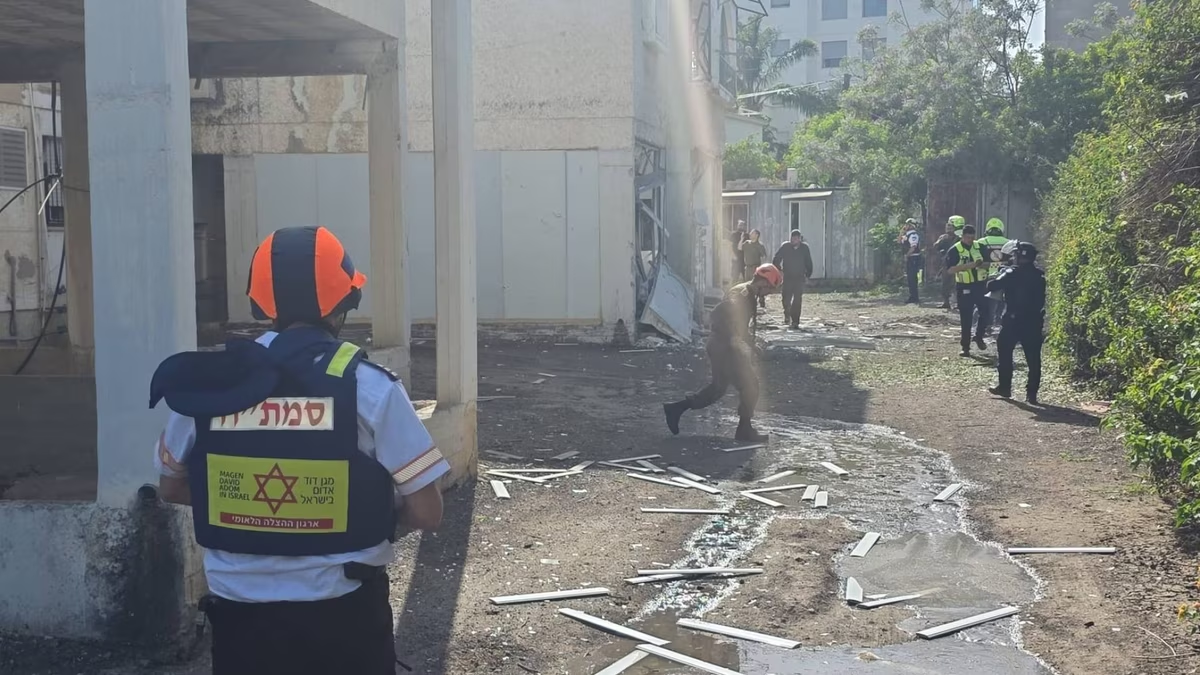
In parallel with the tension on the Iranian front, the Lebanese arena emerges as an additional pressure element in the regional equation, where violent confrontations continue in the southern regions. These field operations are taking place at a time when political corridors are witnessing indirect talks aimed at containing the situation, but the complexities on the ground still dominate.

The Israeli army continues its military operations in South Lebanon, focusing on attempts to encircle specific engagement areas to impose a new reality on the ground. Military assessments indicate that the coming days will be crucial and highly sensitive, as political developments are closely linked to the balance of power emerging in the field.

On the internal Lebanese front, reports have observed an increase in the intensity of political tensions and differences in positions among various components regarding what is happening on the border. Initial indications of attempts to redraw lines of influence within the Lebanese arena are emerging, coinciding with the continued intense Israeli military pressure on southern villages and towns.

The state of "cautious waiting" that hangs over the regional scene reflects the complexity of intertwined issues, from the Iranian nuclear program to direct confrontation fronts. The final decision on war or peace remains pending, awaiting what the coming hours will bring in terms of sudden diplomatic or field movements.

Hebrew sources confirmed that the cinematic analogies applied to the negotiating reality reflect the extent of frustration at the inability to reach tangible results. The current political game relies on nerve-wracking, with each party trying to improve its terms by brandishing military force at times, and diplomatic openness at other times.

In this context, Israeli intelligence remains in a constant state of scrutinizing Iranian intentions, trying to decipher the contradictory messages emanating from Tehran. The security establishment believes that any laxity in monitoring could give adversaries an opportunity to achieve strategic gains at the expense of Israeli security, which explains the declared state of alert.

The report also touches on the fact that international pressures have so far failed to break the stalemate, but have rather complicated the calculations of decision-makers in Tel Aviv. The United States seeks to avoid comprehensive escalation, while Israel believes that Iranian procrastination serves Tehran's goals of strengthening its regional influence and developing its military capabilities.

The field in South Lebanon is still boiling, with raids and limited ground operations continuing amidst anticipation of the results of international contacts aimed at a ceasefire. Observers believe that the link between the Lebanese front and the Iranian file has become a reality that cannot be ignored in any potential future settlement.

In conclusion, it seems that the region has entered a dark tunnel of possibilities, where no scenario, however extreme, can be ruled out. All eyes remain fixed on Washington and Tehran, awaiting a signal that could end this state of uncertainty, either with an agreement that calms spirits or an explosion that reshapes the region anew.

The Israeli army is dealing with the current situation as an undecided phase, where all scenarios remain open to the possibility of the diplomatic path collapsing.

PALESTINE

Tue 14 Apr 2026 4:05 pm - Jerusalem Time

Government Media Office in Gaza Documents 2400 Israeli Violations of Truce and Martyrdom of 754 Citizens in 6 Months

The Government Media Office in the Gaza Strip issued a detailed report documenting the violations by the Israeli occupation since the ceasefire agreement came into effect on October 10, 2025. The report confirmed that the occupation committed approximately 2400 field and humanitarian violations, posing a direct threat to the stability of the fragile truce and an attempt to undermine all international efforts aimed at alleviating the suffering of the Strip's residents.

Regarding human casualties, official sources reported that these violations resulted in the martyrdom of 754 people over the past six months, including 312 women, children, and elderly. The statement clarified that the percentage of civilians among the victims reached 99%, and more than 2100 citizens were injured due to direct targeting within populated residential areas and away from any military contact points, in addition to recording 50 arrests.

The field crimes carried out by the occupation forces varied to include 921 shooting incidents and 1109 bombing operations targeting various facilities. The report also monitored 97 ground incursions into residential areas, and the engineering units of the occupation army demolishing 273 homes and residential buildings, with continued land grabbing operations and exceeding the agreed geographical boundaries known as the 'Yellow Line'.

Regarding the humanitarian file and crossings movement, the report revealed a sharp decline in the occupation's commitment to the agreed operating terms, as the movement of travelers through the Rafah crossing did not exceed 7% of the assumed operational capacity. This intransigence led to an exacerbation of humanitarian crises for patients, students, and those stranded who had hoped for smooth travel in accordance with the internationally sponsored truce agreement.

As for relief supplies, only 41,714 trucks entered out of 110,000 trucks that were supposed to reach the Strip, representing 37% of the agreed needs. The energy sector was the most affected, as the occupation only allowed the entry of 14% of the necessary fuel quantities, causing a near-complete paralysis of infrastructure reconstruction operations and the shutdown of the only power generation plant.

The Media Office concluded its statement by holding the Israeli occupation fully responsible for the catastrophic consequences of these ongoing violations. The office appealed to the US administration led by Donald Trump and the international sponsors of the agreement to intervene immediately to compel the occupation to fulfill its commitments and ensure the flow of urgent shelter and food aid to address the escalating humanitarian catastrophe in Gaza.

These practices represent a deliberate undermining of humanitarian efforts and a dangerous circumvention of the agreement to impose a policy of starvation and blackmail.

ANALYSIS

Tue 14 Apr 2026 4:03 pm - Jerusalem Time

Lebanese-Israeli Talks in Washington Spark Wide Controversy Amid Lack of Internal Consensus

News Analysis

Washington – Said Arikat – 14/4/2026

On Thursday, a delegation from Lebanon will meet with a delegation from Israel in Washington to discuss the ongoing Israeli aggression against Lebanon. According to a State Department official who spoke on condition of anonymity, the composition of attendees at the meeting itself underscores the sensitivity and high-level interest surrounding these talks. It includes US Secretary of State Marco Rubio, US Ambassador to Lebanon Michel Issa, Advisor Michael Needham, Israeli Ambassador to the United States Yechiel Leiter, and Lebanon's Ambassador to the United States Nada Hamadeh. While the presence of such high-ranking figures may suggest serious intentions, it also raises the stakes in a process that appears to lack both internal legitimacy and strategic clarity.

At a highly sensitive moment for Lebanon, the government's decision to engage in ambassador-level talks with Israel in Washington raises broad questions that extend beyond the diplomatic dimension to the depth of internal political calculations. Instead of reflecting national cohesion or a clear strategic vision, this move seems to deepen the impression of a gap between the authorities and fundamental components of the Lebanese political scene, at a time when current challenges demand the highest degree of coordination and unity.

The fundamental problem lies in the absence of a comprehensive national consensus on this step. Key Lebanese political forces have expressed their rejection or deep skepticism about the utility of engaging in such talks while Israeli military pressure continues. This divergence does not merely reflect a difference in viewpoints but indicates a deeper flaw in the structure of political decision-making, where a step of a sovereign nature is taken without securing sufficient internal cover. In similar contexts, states tend to unify their positions to enhance their negotiating power, while Lebanon appears to be moving in the opposite direction.

The timing of these talks acquires an even more sensitive dimension, as they come amidst ongoing Israeli aggression. In the absence of clear conditions or reciprocal leverage, engaging in dialogue might be interpreted as a gratuitous concession rather than a calculated political initiative. Critics argue that merely holding the meeting grants Israel a diplomatic gain by legitimizing communication, without offering concrete commitments in return, thus exacerbating the imbalance of power from the outset.

In this context, Israeli Prime Minister Benjamin Netanyahu could utilize the convening of these talks to bolster his political and diplomatic standing, especially amid increasing international criticism. The mere existence of a dialogue channel—even if merely formal—provides political material that can be used to suggest engagement in de-escalation efforts, without having to make real concessions on the ground.

The absence of national consensus on this step not only weakens Lebanon's negotiating position but also undermines the very concept of political legitimacy. Effective diplomacy stems from a solid internal base, allowing negotiators to speak on behalf of a unified state, not a divided arena. In the Lebanese case, this condition appears to be missing, turning the negotiation process into a risky endeavor that could open the door to further questioning of the institutions' efficacy and their ability to represent the collective national will.

Another flaw emerges in the structural disparity between the two parties. While Israel enters these talks within a centralized decision-making system and a clear strategy, Lebanon suffers from sharp political divisions and weak institutions. This imbalance directly reflects on the nature of the negotiation, where the Lebanese side lacks the ability to present a unified position or make enforceable commitments, transforming the process into an unequal path in terms of form and content.

Domestically, concerns about the repercussions of this step are compounded by the suffocating economic crisis Lebanon is experiencing, alongside declining public trust in official institutions. Launching a controversial negotiation process at this time could deepen political divisions and fuel doubts about the motives and limits of the decision, especially if done without sufficient transparency or a clear mandate from political and societal forces.

The timing of these talks reflects a fundamental problem in assessing the balance of power. Entering negotiations under a clear imbalance, and without preconditions, might be understood as a response to pressure rather than a deliberate sovereign choice. In the world of politics, the success of diplomacy is not measured merely by sitting at the table, but by the ability to protect national interests and achieve tangible gains. This remains highly questionable in the current situation.

Complications increase with the absence of a clear mandate defining the scope and objectives of the negotiation. Successful diplomacy relies on internal legitimacy, whether through political consensus or institutional support, which does not appear to be sufficiently available in this case. Without this foundation, any potential outcomes remain subject to challenge or reversal, limiting their effectiveness and weakening their sustainability.

Also prominent is the absence of a clear negotiating framework that defines the issues at hand, implementation mechanisms, and guarantees. In the absence of specific criteria or guaranteeing international sponsorship, the talks appear closer to an exchange of political messages than to a fully-fledged negotiation process, which reduces the chances of achieving tangible results or applicable agreements.

According to observers, these talks cannot be separated from the broader regional context, where Lebanon's calculations intersect with balances involving Iran, Israel, and non-state actors. Ignoring this entanglement makes any bilateral negotiation path limited in impact, because it does not address the roots of the crisis but is limited to its manifestations. Without a comprehensive approach that takes these complexities into account, the chances of success remain slim, and diplomacy becomes merely a tool for managing the crisis, not resolving it.

In conclusion, the Washington talks reflect a deeper problem related to the assessment of timing and tools. Instead of strengthening Lebanon's position, they may weaken it by exposing its internal divisions and giving its adversary a diplomatic advantage. While this step is presented as a path to dialogue, it raises serious questions about whether it truly constitutes an entry point to a solution, or merely an attempt to give a diplomatic appearance to an increasingly complex reality.

OPINIONS

Tue 14 Apr 2026 11:21 am - Jerusalem Time

The Change in the Approach of Settlers in the West Bank

In this article, we discuss the practices of settlers in the West Bank, and why the intensity of terrorist acts has escalated recently in the northern West Bank with the support of extremist right-wing currents that control the Israeli government, which seeks to annex the West Bank and make it an integral part of Israel. The Israeli government has taken many decisions supporting settlements and settlers, in addition to providing protection, financial support, and arming hundreds of thousands of them. It has legalized dozens of settlement outposts, both agricultural and pastoral, that control hundreds of thousands of dunams, and given them free rein to burn, kill, assault, and steal citizens' property, specifically livestock, and transfer it to settlement outposts in plain sight of citizens, as settlers now possess one-third of the citizens' sheep after stealing them. Settlers are acting as a state with its army by displacing all Bedouin encampments in Area "C", and all of this aims at complete control over the land, as settlers seek to systematically seize Palestinian lands and annex large parts of the West Bank, which they refer to biblically as "Judea and Samaria," in order to transform them into permanent Israeli settlements, and to implement a policy of forced displacement of Palestinians through escalating attacks, which reach the level of "silent war," and create an unbearable and intolerable life, imposing psychological warfare, constant fear, and loss of security, which has forced and continues to force Palestinians to leave their lands and villages in areas classified as "C." This has included a new policy and approach by settlers who work day and night to expand settlements and build many random settlement outposts, numbering around 300, including pastoral and agricultural ones, to seize the largest possible amount of land and mountains. These outposts allow a single settler to control an area larger than ten settlements alone, so wherever they reach, they control, as is happening in the northern West Bank in the lands of Burqa, Silat ad-Dhahr, Beit Amrin, Fandaqumiya, and Jaba', to impose a tight cordon on Palestinian villages and fragment the geographical continuity of the future Palestinian state. The second approach is to control all natural resources, especially agricultural lands, which are a source of livelihood for Palestinians, particularly in the Jordan Valley region of "Tubas," which is considered the food basket of the Palestinian people, and the plains for cultivation and grazing by settlers, as is happening in Beit Dajan, Beit Furik, the plain of Burqa, Ramin, and other plains and mountainous areas in the West Bank, with a particular focus recently on the northern mountains, and water sources, springs, and wells. This is what happened in the Jordan Valley and Tubas, where the Israeli Finance Minister, Bezalel Smotrich, visited this area months ago and said that water sources in the Jordan Valley had been seized and the remaining springs would be confiscated. The third approach is defined by the so-called religious factor, "the Torah," and the ideological motive, where Israeli leaders and settlers claim that the West Bank is a biblical land "promised by God to the people of Israel," and that their presence there is the fulfillment of a religious prophecy, not merely settlement. This claim is a fundamental motive behind the seizure of the West Bank, and this motive is shared between government leaders and settlers, which explains the unlimited support for settlers by the government, the army, and all components of the occupation state, as everyone works towards supporting the annexation and control of the West Bank. As for the fourth approach, which is embodied in the economic factor that grants settlers enormous privileges, very significant facilities, and unparalleled financial support in the world, where housing in settlements is provided at almost free living costs and economic and housing advantages compared to living inside Israel, and the government works to facilitate and fulfill the demands of the settlement council in the West Bank, it also provides them with protection, arms them, and extends road, water, and electricity networks, and then legalizes these so-called random settlement outposts. Israel has not held them accountable for the attacks they carry out against Palestinians, and the army itself has reached the point of stealing livestock, cows, and sheep from Palestinians and handing them over to settlers. The Wall and Settlement Resistance Commission has documented an unprecedented field escalation with thousands of attacks since October 2023, including burning homes, vehicles, physical assaults, and even the killing of 43 Palestinian citizens by settlers and the wounding of hundreds, with the aim of achieving this comprehensive biblical settlement project. Settlers seek to extend sovereignty and actual annexation of the West Bank with the support of the Israeli government, which has worked and continues to work daily to enact laws approved by the Knesset, including decisions to legalize settlement outposts and transform them into settlements, as happened at the end of last year and the beginning of this year by legalizing more than twenty settlement outposts and transforming them into settlements, in addition to the decision to cancel the disengagement that occurred in 2005 in dismantling five settlements, and a decision was made to return to these settlements, and they have actually been returned to, with the size of Homesh settlement increasing twenty times its previous geographical size, and thousands of dunams have been confiscated to build roads for these settlements between Nablus and Jenin. The fifth approach is implemented by the occupation state and the settlers' state, reaching the point of a war of olive tree extermination. In the past, settlers cut down olive trees next to settlements, but today they cut down olive trees everywhere, even in Area "A." The Israeli government is currently waging a clear war against ancient olive trees, whose age exceeds that of the occupation state, by bulldozing olive trees along all public roads and demolishing vital facilities on the sides of the roads, and carrying out the largest demolition operation of homes in Area "C" and on the outskirts of Area "B," and controlling archaeological and tourist areas as happened in Sebastia, Al-Masoudiya, and others, which harms the Palestinian economy, cuts off citizens' livelihoods, and besieges the Palestinian people to push them to migrate from the Palestinian countryside to the cities, especially from areas classified as "C" and "B," which constitute 81% of the West Bank's area. Settlers in the northern West Bank have even placed settlement outposts in Area "A," according to the Hebrew newspaper "Haaretz," settlers established three new settlement outposts in the heart of Area "A" for the first time in the West Bank, which Israelis are prohibited from entering, within the last 24 hours on March 26, 2026, in addition to one settlement in Area "B" and another in Area "C." This leads to the expansion of settlements to include all classifications stipulated in the Oslo Accords of 1993, and all of this is backed by religious ties, as settlers view the West Bank as the biblical "land of the ancestors," "Judea and Samaria," and consider settlement there a religious duty to regain control of the West Bank. The beginning of this year, specifically March, witnessed a sharp escalation in these practices, attacks, and movements by settlers and the settlement government, to impose a fait accompli policy on the ground in the West Bank. The sixth approach is a joint approach between the government, the army, and the settlers, which is embodied in targeting citizens by closing villages and cities with iron gates, fixed and mobile checkpoints, and the spread of settlers protected by the army who prevent citizens from passing, assault citizens, and burn their cars. This is a planned and systematic approach to pressure the Palestinian people to displace and then migrate from the West Bank. In the end, everything that is happening in the West Bank is due to the Israeli government, which legalizes and enacts laws that serve settlements and settlers, and the practices of its army, which have reached the level of terrorism, starting with arrest and demolition and the extermination of olive trees, passing through killing, and ending with protecting and arming settlers, and the organized and systematic criminality committed by settlers in the West Bank, which will escalate and may reach the point of committing massacres in Palestinian villages given the opportunity available to them to create a terrorist reality aimed at pushing the Palestinian people to displace to city centers and towns and not access their lands, and then achieve the ultimate goal of displacing the Palestinian people abroad and extending sovereignty over the West Bank, leading to actual annexation, of which only the official media announcement by Israel remains that it has completed the annexation process of the West Bank. This was expressed by the far-right journalist and political analyst Shimon Riklin on March 29, 2026, when he said about settler violence: "The prophet; Joshua bin Nun sent messages to the inhabitants of the land and told them: the people of Israel are coming to their inheritance, they have two options - either accept that this is their land, or leave here. The current inhabitants of the land do not accept the fact that this is our land - why don't they expel them? All respect to the hill youth." *Palestinian writer and researcher specializing in ideological movements


ARAB AND WORLD

Tue 14 Apr 2026 11:21 am - Jerusalem Time

Diplomatic Moves to Resume Negotiations Between Washington and Tehran Amidst Complexities of Enrichment and Strait of Hormuz Files

The corridors of international politics are once again abuzz with talk of the potential resumption of the negotiation process between the United States and Iran, with reports indicating serious consideration of a new round of talks soon. These moves come at a highly sensitive time, as both parties face complex challenges related to the uranium enrichment file and the repercussions of the American blockade imposed on the Strait of Hormuz.

International media sources reported that officials in the administration of US President Donald Trump are currently engaged in intensive discussions to arrange the details of a potential second meeting with the Iranian side. This move aims to revive the diplomatic path that faltered in its first round, amidst a desire to avoid sliding into a comprehensive military confrontation in the region.

The issue of uranium enrichment stands out as one of the biggest obstacles to agreement, with leaks revealing a wide gap in positions between the two sides. While Tehran offered to suspend enrichment operations for five years, Washington insists that the suspension period extend to twenty years to ensure no return to a military nuclear program.

In addition to the nuclear file, the American blockade on the Strait of Hormuz presents itself as a major sticking point in the ongoing negotiations, especially with its direct impact on the global economy. This blockade has led to a significant jump in oil prices, exceeding the $100 per barrel mark, increasing economic pressure on the US administration and consumers.

Informed sources indicate that the disagreement over these two points was the direct cause of the collapse of previous Islamabad talks, despite what US officials described as significant progress. US Vice President J.D. Vance had previously indicated an agreement on most issues, while international reports estimated the agreement rate at about 80% before the sudden halt.

Against this backdrop, discussions continue regarding the venue for the next round, with Islamabad and Geneva emerging as potential host cities. However, no final decision has been made on this matter, pending initial agreements to ensure that the scenario of the previous collapse following the Islamabad round is not repeated.

The time factor further complicates the situation, as the agreed-upon truce is nearing its end, with only one week remaining out of two. This tight timeline raises serious concerns about a return to military escalation if diplomats fail to reach a new framework before the deadline expires.

From the Iranian side, there is cautious official silence regarding the circulating news of new negotiations, but diplomatic moves on the ground indicate an initial openness. Tehran has intensified its international contacts, with its foreign minister holding a series of phone discussions with his counterparts in influential regional and international countries.

Iranian contacts included Oman, Qatar, Saudi Arabia, Egypt, and Russia, in addition to a previous presidential call with France, all of which focused on the necessity of adopting a balanced diplomatic approach. Tehran emphasizes in these meetings that exaggerated American demands will not lead to tangible results on the ground.

Iran adheres to its position rejecting concessions outside the framework of international agreements and the regulations governing the work of the International Atomic Energy Agency. The Iranian leadership believes that demanding a long-term suspension of enrichment contradicts its sovereign rights and the IAEA charter, which makes negotiating this point extremely thorny.
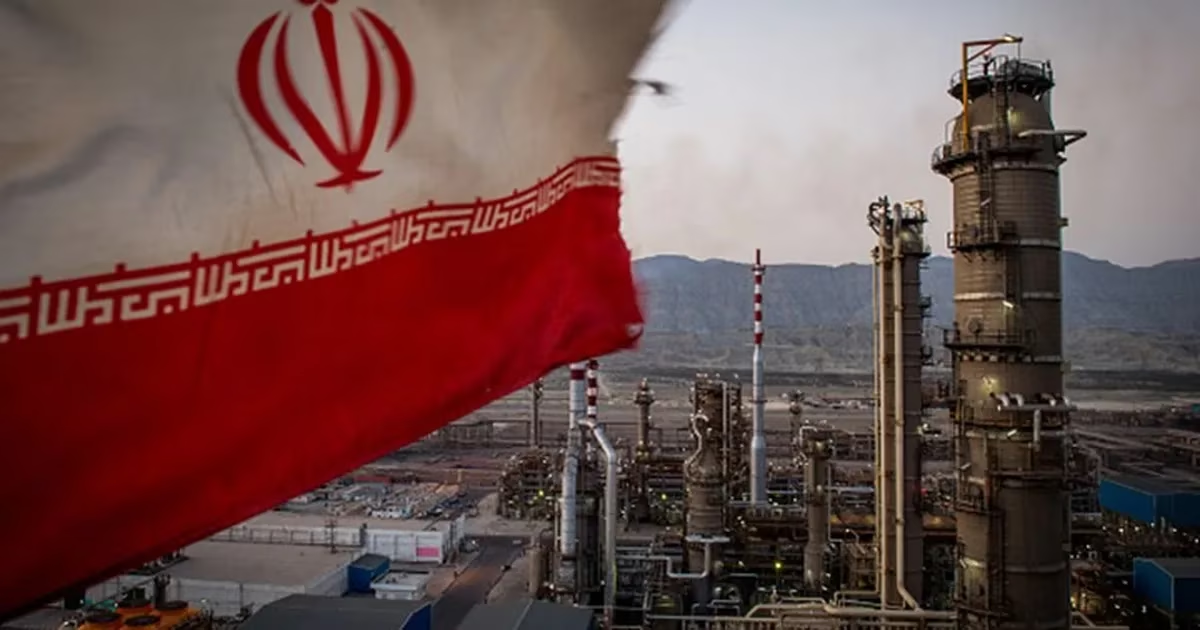
In Tehran, sources reported that authorities have given local media space to discuss the possibilities of resuming dialogue, which is interpreted as a sign of a desire to prepare public opinion. The spokesman for the Iranian Foreign Ministry, Ismail Baqaei, affirmed that diplomatic opportunities still exist despite the complexity of the outstanding issues between the two countries.

Observers believe that the coming hours will be crucial in determining the course of the crisis, as the picture regarding the new negotiation round is expected to become clear. These developments coincide with a field escalation in the Strait of Hormuz and parallel discussions on the Lebanese-Israeli front, placing the region on a hot plate.

The option of a US withdrawal from the negotiation process or a return to military escalation remains strongly on the table if Iranian responses do not align with expectations in Washington. The closure of the Strait of Hormuz represents a strong bargaining chip for Tehran, while Washington uses the weapon of sanctions and economic blockade to extract broader concessions.
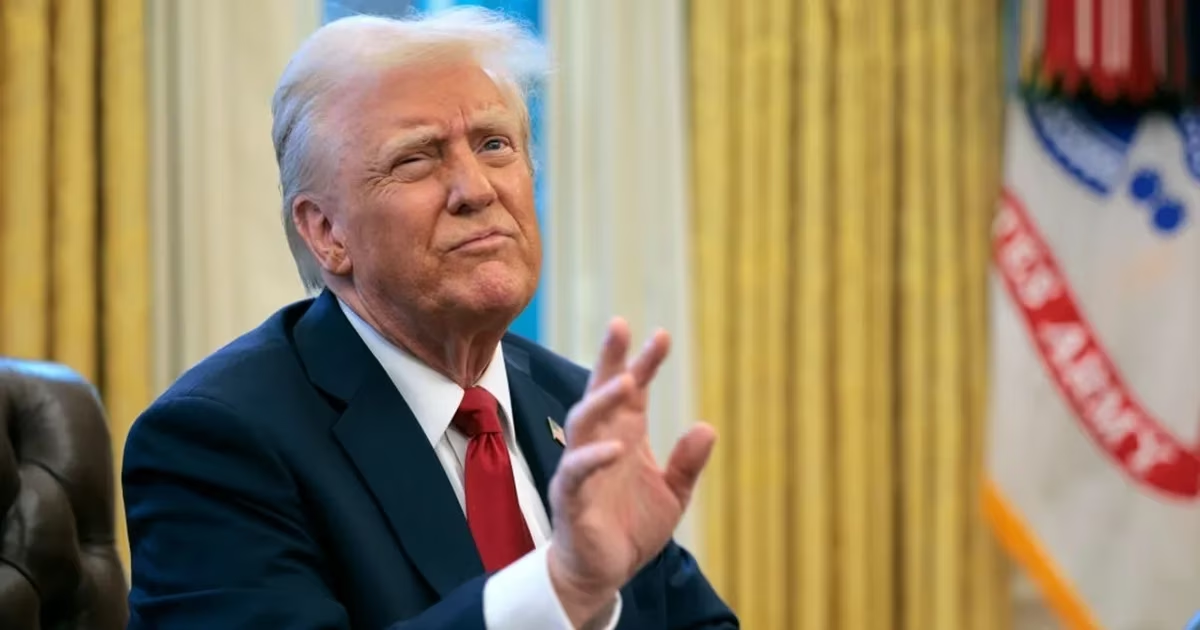
In conclusion, the international community cautiously awaits the results of these diplomatic moves, given their direct implications for global energy security and Middle East stability. Either the parties succeed in bridging the deep gap between 5 and 20 years of enrichment suspension, or the world faces a new round of open confrontation.

The complex issues between Tehran and Washington cannot be resolved in one round, but diplomatic opportunities still exist.

PALESTINE

Tue 14 Apr 2026 11:20 am - Jerusalem Time

Gaza faces environmental catastrophe: Rodents invade displaced persons' tents, increasing rat bite injuries

Hospitals in the Gaza Strip, particularly in the northern areas and Gaza City, are witnessing an alarming influx of injuries resulting from rodent bites, a field indicator of deteriorating environmental conditions. Medical sources confirmed that these injuries have affected vulnerable groups including children, the elderly, and chronically ill patients, portending a major health catastrophe threatening thousands of displaced persons in overcrowded camps.

The sources explained that the recorded injuries have caused severe complications for some patients, including severe bacterial infections that, in advanced cases, could lead to limb amputation or permanent deformities. These developments come at a time when the health sector is suffering from a near-total collapse due to systematic targeting and the ongoing blockade that deprives the wounded of necessary treatment.

For his part, Palestinian Minister of Health, Majed Abu Ramadan, warned of the dire consequences of deadly epidemics spreading due to the dangerous escalation in the proliferation of rodents and insects. The minister pointed out that the severe deterioration in the environmental system is a direct result of the aggression and blockade, stressing that the current situation requires urgent international intervention to stop the health and environmental bleeding.

In a related context, the World Health Organization warned that the continued Israeli restrictions on the entry of medical aid hinder any effective health response. The organization's regional director said that the spread of diseases within Gaza does not only represent a local threat, but now threatens the health security of the entire region if the situation is not immediately addressed.

Despite the ceasefire agreement coming into effect on October 10, the occupation continues to shirk its commitments to open crossings. Approximately 2.4 million Palestinians, including 1.4 million displaced persons, face harsh living conditions amid a severe shortage of relief and medical supplies and essential shelter materials.

Husni Muhanna, spokesman for the Gaza Municipality, attributed the causes of this phenomenon to the accumulation of massive quantities of solid waste, which reached 350,000 tons in the city alone. He explained that the destruction of collection mechanisms and the lack of fuel, in addition to preventing access to major landfills, has made streets and the vicinity of tents a fertile environment for rodent breeding.

Muhanna confirmed that the municipality is unable to combat these pests due to the occupation's prevention of the entry of insecticides and poisonous baits for many months. He described the environmental situation in Gaza as a "real catastrophe" that exceeds the capabilities of available local teams, in light of the complete destruction of infrastructure and sewage networks.

Stories of human suffering highlight the magnitude of the tragedy, as displaced person Basel Al-Dahnon, who suffers from diabetes and kidney failure, recounts how he was bitten by a rat while sleeping without feeling it. Due to the loss of sensation in his limbs as a result of his illness, he only discovered the injury after his foot bled, which now puts him at risk of foot amputation due to contamination and inflammation.

The suffering of displaced person Inshirah Hajjaj is no different, as she describes the daily terror she experiences with her children inside the tent due to the spread of rats over blankets and food. Hajjaj says that the fear of contracting diseases now haunts everyone at night, in the absence of the most basic public hygiene facilities or the ability to secure tents from rodent infiltration.

Medically, Dr. Munir Al-Shakhrit, a consultant in medicine and emergency at Al-Shifa Medical Complex, confirmed that the hospital is receiving an increasing number of cases requiring urgent intervention with serums and antibiotics. Al-Shakhrit warned of the risks of contracting "rat-bite fever," a bacterial condition that may require intensive care admission, especially for those with weakened immune systems.

The health system in Gaza faces a drug deficit exceeding 50%, with a severe shortage of essential medical consumables and laboratory testing materials. According to Ministry of Health data, this shortage threatens the lives of thousands of patients who require continuous care, especially in light of the occupation's targeting of hospitals and medical centers.

The accumulation of rubble and waste among the tents of displaced persons has created a distorted ecosystem that allows epidemics to multiply away from any health oversight. Civil Defense reports confirm that preventing access to the eastern areas where the main landfills are located has exacerbated the crisis of waste accumulation, which has become ticking time bombs threatening the lives of civilians residing in shelter centers.

This environmental deterioration comes two years after the genocidal war launched by Israel, which resulted in the destruction of 90% of the infrastructure in the Strip. With the continued blockade, environmental solutions remain stalled, awaiting real international pressure that obliges the occupation to allow the entry of equipment, fuel, and materials necessary to combat rodents and epidemics.

In conclusion, the Palestinian displaced person in Gaza remains trapped between the war machine and the deadly diseases that pursue him in his dilapidated tent. International silence regarding the prevention of the entry of pesticides and medical supplies contributes to the exacerbation of this humanitarian catastrophe, which no longer differentiates between an injury from occupation bullets or a rodent bite in the dead of night.

Waste has become a breeding ground for disease-carrying rodents and insects, in the absence of insecticides and poisonous baits due to the blockade and the occupation's refusal to allow their entry into the Strip.

ARAB AND WORLD

Tue 14 Apr 2026 11:20 am - Jerusalem Time

J.D. Vance Sets Washington's Conditions for a "Grand Bargain" with Iran, Emphasizing Nuclear and Navigation Issues

U.S. Vice President J.D. Vance announced that the American administration sees a golden opportunity to conclude a comprehensive strategic agreement with Iran, indicating that the next step now rests with the leadership in Tehran. Vance clarified in media statements that the recent rounds of negotiations hosted by the Pakistani capital, Islamabad, were not entirely negative, but rather witnessed tangible Iranian moves towards American demands.

Despite slight progress in the negotiations, the Vice President affirmed that what the Iranian side has presented so far does not meet American expectations and is insufficient to end the state of tension. He stressed that Washington sets strict, non-negotiable conditions, foremost among them the complete stripping of Iran's uranium enrichment capabilities, and ensuring that all enriched stockpiles are removed from the country to guarantee no return to a military program.

In a related context, J.D. Vance linked reaching this "grand bargain" to Tehran's definitive abandonment of its ambitions to acquire nuclear weapons, in addition to halting all activities that Washington describes as supporting terrorism in the region. He described Iranian negotiators as being extremely tough in dialogue, warning that Iran's possession of a nuclear bomb would impose severe and unbearable security and economic consequences and costs on the world.

On the ground, the American official indicated that the United States has succeeded in achieving a number of its strategic objectives on the ground, paving the way for a gradual and deliberate process of ending the conflict. He affirmed that the vision adopted by President Donald Trump aims to reach a successful and final agreement without being drawn into long-term or time-consuming negotiations.

Regarding the security of international navigation, J.D. Vance sent a firm message concerning the Strait of Hormuz, emphasizing that any Iranian attempt to backtrack on its commitments to open the strait would lead to a radical and immediate change in Washington's approach to Tehran. He considered that complete freedom of navigation in this vital waterway is a non-negotiable condition, and the Iranian side has been clearly informed of this position during recent meetings.

The Vice President also touched upon the economic pressures facing Iran, explaining that the restrictions imposed on oil exports through the Strait of Hormuz increase the financial burdens on Tehran. He indicated that these pressures aim to push the Iranian regime towards making rational decisions that serve regional and international stability, and end the country's isolation resulting from its previous policies.

In conclusion, J.D. Vance acknowledged the economic challenges faced by American citizens due to rising energy prices, affirming that the administration is making intensive diplomatic and negotiating efforts to address this crisis. He explained that reaching a stable agreement in the Middle East will directly contribute to calming global markets and alleviating the cost of living burdens on Americans in the near future.

Iran possessing a nuclear weapon would impose terrible costs on the world, and we need to see the Strait of Hormuz fully open as a fundamental condition.

OPINIONS

Tue 14 Apr 2026 6:15 am - Jerusalem Time

Indicators for the resumption of Washington-Tehran negotiations amidst escalating naval blockade

Washington – Saeed Erikat – 4/14/2026

News Analysis

The crisis between the United States and Iran has entered a highly sensitive phase, with increasing indications of a possible resumption of negotiations in the coming days, despite the absence of any decisive resolution on the matter so far. According to an American official quoted by the "Associated Press" agency, a new round of talks might resume perhaps on Thursday, without official confirmation of either its final date or its potential venue. This comes amidst intensive diplomatic efforts led by Pakistan, in an attempt to bring both parties back to the negotiating table after the collapse of the previous round.

In contrast, this fragile diplomatic activity reflects an escalating on-the-ground reality, where the United States has begun imposing strict naval measures on Iranian ports, described as an actual naval blockade, which portends serious repercussions for regional security and global economic stability, especially with the fragile ceasefire still tenuously holding.

In this context, US Vice President J.D. Vance stated on Monday that the United States sees the possibility of reaching a “grand bargain” with Iran, but he stressed that the next step is up to Tehran. In an interview with "Fox News," Vance clarified that the Islamabad talks "were not entirely bad," indicating that the Iranian side showed some flexibility and moved towards the American position, but these steps "were not enough to satisfy Washington," according to his expression.

Vance affirmed that the primary condition for the American administration is the complete disarmament of Iran from any uranium enrichment capability, adding: "We want to get enriched uranium completely out of Iran." He also linked the possibility of concluding the desired deal to Tehran abandoning its pursuit of nuclear weapons and stopping what he described as "support for terrorism," reflecting the continued deep gap between the positions of the two parties.

The previous round of talks, which lasted about 21 hours in the Pakistani capital Islamabad, ended on April 11 without reaching an agreement, despite being the highest level since 1979. According to diplomatic sources, disagreements focused on complex strategic issues, most notably the Iranian nuclear program, Tehran's regional role, and security arrangements in the Strait of Hormuz.

Following the announcement of the failure of negotiations, signs of military escalation began to appear, with reports indicating that the US Navy began, as of April 13, implementing strict measures to monitor Iranian ports, in a step aimed, according to Washington, at preventing arms smuggling and imposing further economic pressure. However, Tehran considered this step a dangerous escalation, warning that it could lead to widespread disruptions in global energy markets, especially if shipping in the Gulf is affected.

These measures were accompanied by a tough American tone, with President Donald Trump threatening to target any Iranian ships attempting to break the blockade or threaten US forces. In contrast, Iran affirmed that any infringement on its maritime sovereignty would be met with a firm response, stressing that the security of the Strait of Hormuz represents a "red line."

Regarding negotiating obstacles, gaps remain on key issues, foremost among them Iran's insistence on retaining its right to enrich uranium and its adherence to its regional role, against American demands for a comprehensive halt to high-level enrichment, a reduction of regional influence, and linking any sanctions relief to tangible concessions.

Despite this deadlock, Pakistan continues its mediation efforts, with its Foreign Minister Ishaq Dar seeking to bridge viewpoints, leveraging his country's balanced relations with both parties. Estimates suggest that the success of this mediation will remain contingent on the extent of Washington's and Tehran's willingness to make mutual concessions.

Meanwhile, international concerns are growing about the repercussions of the naval blockade, given the Gulf's importance as a vital corridor for energy supplies. Any disruption in oil traffic through the Strait of Hormuz could lead to a sharp rise in prices and threaten global economic stability at a stage already characterized by market fragility.

This blockade also complements the system of economic sanctions that the United States seeks to tighten, by targeting Iranian oil exports and its commercial networks, which pushes Tehran to seek alternatives, either through circumvention channels or by strengthening its relations with rival international powers.

The rapid collapse of negotiations reveals a structural flaw in the American approach, which combines military escalation and diplomatic engagement without providing sufficient ground for trust. The "maximum pressure" policy may succeed in weakening the adversary economically, but it rarely pushes it to make strategic concessions that affect the core of its national security. On the contrary, these pressures often reinforce the hardline tendency of Iranian decision-makers, pushing them to adopt more rigid positions, which complicates the chances of reaching a sustainable settlement.

In contrast, the Iranian position based on full adherence to its nuclear and regional rights poses significant challenges, as it clashes with an international reality that does not easily allow for the consecration of such a role without cost. Insistence on this approach, amidst escalating blockade and pressures, could lead to further isolation and restrict Tehran's economic options. Hence, there is an urgent need to adopt a more flexible approach that balances sovereign constants with the requirements of realistic engagement in the international system.

As for Pakistani mediation, it faces a complex test in a highly turbulent political and security environment. Its success depends not only on bringing the two parties together but also on its ability to formulate innovative compromises that take into account the sensitivities of the issues at hand. In light of the deep distrust between Washington and Tehran, this mediation could represent a rare opportunity to avoid escalation, but it remains contingent on a political will that so far appears hesitant, if not entirely absent.

OPINIONS

Tue 14 Apr 2026 6:01 am - Jerusalem Time

Trump's escalating rhetoric shatters prospects for settlement with Iran and puts the region on the brink of open confrontation

Washington – Saeed Erikat – 13/4/2026

Hopes for a swift diplomatic breakthrough in the crisis between the United States and Iran seemed to fade, with the sharp statements made by US President Donald Trump during a hastily arranged press conference at the White House on Monday, at a politically charged moment where internal calculations intertwine with geopolitical stakes.

Speaking to reporters, Trump emphasized that Iran "will never have a nuclear weapon," a stance reflecting increasing rigidity in the American approach and indicating a shrinking margin for diplomatic maneuver. His statements came moments after an unconventional scene inside the White House, where he received a "McDonald's" meal via "DoorDash" delivery, celebrating the approval of a new tax law exempting tips from taxes—a scene reflecting the overlap between political symbolism and media spectacle in managing the issue.

But behind this image, the rhetoric was sharper and clearer. Trump said: "If they don't agree, there will be no deal… and we will retrieve the nuclear materials, either from them or by force," a clear indication that the military option remains on the table, and may even be closer than ever before.

These statements coincided with the entry into force of the blockade imposed by the US administration on the Strait of Hormuz, one of the most vital arteries for global oil trade, raising increasing fears of widespread disruptions in energy markets and international supply chains. Trump also described Iran as "blackmailing the world," accusing it of seeking to impose gains through threats and pressure.

In a further escalation, the US President went so far as to say that Tehran seeks to acquire a nuclear weapon "to annihilate the world," a description that raises the level of political discourse to unprecedented levels, reflecting a trend towards framing the conflict in an existential context, not merely a negotiable strategic dispute.

When asked about the possibility of issuing an "ultimatum" to Iran, Trump refrained from giving a direct answer, merely saying that "it will not be pleasant," leaving the door open for multiple scenarios, ranging from gradual escalation to a sudden military strike.

Meanwhile, press reports, including those published by Axios, revealed details of recent negotiations in Pakistan, where the United States asked Iran to suspend uranium enrichment for up to 20 years, a demand observers described as far exceeding the red lines previously set by Tehran.

According to sources, Iran responded by proposing a much shorter timeframe, not exceeding a "single digit number of years," in an attempt to maintain the minimum of its nuclear sovereignty, while expressing willingness to reduce enrichment levels under international supervision.

Washington also demanded that Iran remove all its stockpile of highly enriched uranium from the country, a condition Tehran considers a fundamental infringement on its strategic capabilities. This point, along with the duration of restrictions on the nuclear program, remains one of the main obstacles hindering an agreement.

As the gap in differences widens, the negotiation path appears to be facing the risk of collapse, especially in light of the escalating rhetoric and simultaneous field policies, which reinforces fears of the situation sliding towards an open confrontation that may extend beyond the region's borders.

Trump's statements reflect a clear shift from coercive diplomacy to brinkmanship, where military threat is used as a primary tool rather than a last resort. This approach not only weakens the chances of reaching an agreement but also strengthens the position of hardline factions within Iran, which have long warned of the unreliability of the United States as a negotiating partner. In the absence of stable communication channels, the risk of strategic miscalculation increases, which could lead to an uncalculated escalation. Furthermore, linking the nuclear issue to existential rhetoric further complicates the crisis and reduces opportunities for compromise.

The American demands, as leaked, reflect a high negotiating ceiling that is practically difficult to achieve, especially regarding the duration of enrichment suspension and the removal of nuclear materials. These conditions may be interpreted in Tehran not as an attempt to control the nuclear program, but as an endeavor to dismantle it completely, which contradicts the concept of national sovereignty. In this context, negotiations seem closer to imposing dictates than to an equal negotiating process, which reduces their chances of success and increases the likelihood of collapse. The absence of tangible economic incentives also weakens the attractiveness of any potential agreement.

The decision to impose a blockade on the Strait of Hormuz adds a dangerous dimension to the crisis, as it shifts it from a political-diplomatic framework to a level that directly affects the global economy. This measure could push other international powers, such as China and the European Union, to intervene to protect their interests, opening the door to a broader internationalization of the crisis. Any disruption in oil flow will also lead to price increases, negatively impacting the already fragile global economy. Amidst this escalation, it becomes difficult to separate the nuclear path from regional tensions, which complicates the scene and increases the probabilities of an explosion.

PALESTINE

Tue 14 Apr 2026 6:01 am - Jerusalem Time

Moscow questions the objectives of Trump's 'Peace Council' on Gaza

The Russian Ministry of Foreign Affairs has expressed serious reservations and growing questions about the nature and objectives of the 'Peace Council' recently announced by US President Donald Trump to address the situation in the Gaza Strip. Kirill Logvinov, Head of the Department of International Organizations at the Russian Foreign Ministry, affirmed that ambiguity surrounds the true tasks of this council and its operational mechanisms on the ground, raising international community suspicion about its usefulness given the current circumstances.

The Russian official explained in statements reported by media sources that a state of uncertainty prevails even among the countries that officially agreed to join this new entity. He pointed out that a large number of international delegations preferred to be merely 'observers' within the council instead of full engagement, which reflects a lack of trust in the American direction behind this political initiative.

In a related context, Moscow strongly criticized the continued Israeli military activities in the Gaza Strip, noting that the occupation continues to significantly restrict humanitarian aid access despite the catastrophic deterioration of living conditions. The Russian Foreign Ministry considered these practices to be completely contradictory to any genuine peace efforts, especially given the unprecedented historical escalation of settlement activities in the occupied West Bank.

Logvinov also drew attention to the escalation of violence and extremism by settlers in the Palestinian territories, affirming that it has reached extraordinary levels under the protection of occupation forces. He added that the past religious holiday period witnessed flagrant violations of the existing legal and historical status in the holy sites in Jerusalem, where worshippers were prevented from accessing them and freely practicing their rituals.

Russian diplomacy warned of the expansion of the conflict in the region, citing United Nations reports that warn of the possibility of a repeat of the Gaza Strip tragedy in Lebanese territories. Sources indicated that tensions remain at their peak in southern Syria, specifically in the governorates of Sweida, Quneitra, and the occupied Golan, threatening a comprehensive regional explosion whose repercussions cannot be controlled.

It is worth noting that US President Donald Trump announced last January the establishment of the 'Peace Council' under his direct presidency, inviting several countries to participate in it. The council was supposed to monitor the implementation of ceasefire agreements in Gaza, with future plans to expand its powers to include other international issues, which Moscow sees as an attempt to marginalize the UN's role in conflict resolution.

The latest developments in the Middle East raise further questions about the true objectives and tasks of the Peace Council and its working methods.

ANALYSIS

Tue 14 Apr 2026 6:01 am - Jerusalem Time

Strait of Hormuz Crisis: A Strategic Driver for Deepening the Russia-China Alliance

The prevailing question in political and economic circles is no longer limited to the extent of the Strait of Hormuz crisis's impact on global energy price surges. Instead, the focus has shifted to how coordination levels among major powers affected by any bottleneck in vital maritime passages will be reshaped.

China tops the list of these powers as the largest Asian importer of oil transiting the strait, while Russia sees this disruption as a strategic opportunity to enhance its influence. Any American move to impose a naval blockade on Iran will not pass as a fleeting military event; rather, it will become a driving force for Moscow and Beijing to elevate their cooperation.

Beijing views the Strait of Hormuz from the perspective of national energy security, as it represents the most critical oil chokepoint in the world. Data from the first half of 2025 revealed that approximately 23.2 million barrels per day passed through it, accounting for nearly one-third of global maritime trade.

Any widespread disruption in this waterway would critically wound the Asian economy, which explains China's excessive sensitivity to the issue. This sensitivity is heightened by the fact that the majority of sanctioned Iranian oil historically finds its way to Chinese refineries.

Cross-referenced sources, based on shipping monitoring data, reported that China accounted for over 80% of seaborne Iranian oil exports. With a flow rate of 1.38 million barrels per day, the close link between Beijing and Iranian oil is clearly evident despite international restrictions.

This significant dependence is the primary driver pushing China to deepen coordination with Russia on energy matters. Despite Beijing's strategic reserves, it views Russia as a partner capable of compensating for any sudden shortage in Gulf supplies.

In this scenario, Russia transforms from merely a traditional supplier into a tool for absorbing economic shocks that might result from the strait's closure. Thus, Moscow becomes a more crucial partner in moments of global turmoil, strengthening the Eastern front against Western pressures.

From Moscow's perspective, the Hormuz crisis is not just a threat to markets, but a window to enhance geopolitical and financial influence. The greater the risks to Gulf supplies, the higher the market value of Russian energy destined for Asian markets hungry for stable alternatives.

However, Russia does not desire to see widespread chaos that could lead to a collapse of the global economy and uncontrollable repercussions. It prefers to capitalize on Chinese and Asian anxiety to push them towards land-based energy alternatives or maritime routes less susceptible to American control.

In this context, Russian diplomatic moves within the 'BRICS' group have emerged, aiming to build a system to counter the repercussions of Middle East crises. This coordination includes vital sectors such as food and fertilizers, to ensure the stability of supply chains away from direct Western influences.

Indicators of this rapprochement were not limited to economic aspects but clearly extended to the corridors of the UN Security Council. Russia and China used their veto power against Western draft resolutions concerning navigation in Hormuz, considering them unbalanced approaches.

This step reflects a shared desire to break the American monopoly on defining international crises and the conditions for their security management. Recent public statements have shown a convergence in political language that rejects unilateral escalation and calls for negotiated solutions that preserve the balance of international markets.

If the situation escalates towards a complete closure of the strait or a long-term blockade, we will witness a leap in the level of financial coordination between the two countries. This could include the development of alternative payment systems within the 'BRICS' framework to reduce reliance on financial systems controlled by Washington.

In conclusion, it appears that the Strait of Hormuz has become a real laboratory for testing the resilience of the Russia-China partnership in the 21st century. American pressure on waterways not only threatens oil flow but also accelerates the process of reordering major international balances.

The Strait of Hormuz may not forge a new Russia-China alliance, but it accelerates the birth of a more cohesive phase in the relationship between the two poles to counter American maritime hegemony.

PALESTINE

Tue 14 Apr 2026 6:00 am - Jerusalem Time

More than 100 settlers attack Kifl Hares town north of Salfit

The town of Kifl Hares, located north of Salfit city in the occupied West Bank, witnessed a large-scale attack carried out by groups of settlers last night, amidst an escalation in the pace of field attacks against Palestinian villages and towns.

Local sources reported that more than 100 settlers stormed the town's neighborhoods, including the central area and the outskirts, and began randomly and heavily pelting citizens' homes with stones. This assault resulted in the smashing of glass and windows of several homes, causing a state of panic and terror among the residents, especially among women and children who were inside their homes at the moment of the attack.

The acts of vandalism were not limited to homes but also affected citizens' properties and vehicles parked in the streets and in front of houses; the settlers deliberately smashed the windows of several cars and damaged their tires before withdrawing from the area, amid the ongoing field tensions witnessed in Salfit Governorate.

Settlers stormed the town center and its outskirts, and began randomly throwing stones at citizens' homes, leading to smashed windows and terrorized families.

ANALYSIS

Tue 14 Apr 2026 6:00 am - Jerusalem Time

Leadership Crisis in Washington: Has Trump's Health Condition Become a Threat to Global Security?

In early April 2026, the global political scene shifted from the halls of traditional diplomacy to the realm of catastrophic predictions. The fate of regional stability and major powers became dependent on social media posts by President Donald Trump, threatening widespread destruction.

Trump's post on 'Truth Social' caused widespread astonishment in international capitals, as he set a deadline for an agreement on the Strait of Hormuz, threatening to wipe out 'an entire civilization.' This rhetoric escalated the conflict from a navigational dispute to a direct threat of genocide, necessitating urgent international intervention.

Observers believe that the world is no longer facing political maneuvers within the 'madman theory,' but rather a tangible biological reality concerning the mental well-being of the occupant of the White House. The President's health condition has transformed from a private matter into an existential threat to global peace and security.

The roots of this crisis trace back to warnings issued by hundreds of mental health experts since late 2024, when they observed signs of cognitive decline in Trump. Specialists pointed to symptoms of 'frontotemporal dementia,' which destroys an individual's capacity for logical judgment and social filtering.

These medical predictions materialized in the current crisis with Iran, where the President appears to be seeking an absolute personal victory, detached from the strategic interests of the state. The 'all or nothing' mentality is a primary symptom of malignant narcissism and excessive paranoia, against which doctors had warned.

The crisis was temporarily suspended thanks to regional mediation that led to a 15-day truce, officially described as a diplomatic achievement. However, sources within Washington confirm that this respite is not directed externally, but rather serves as an opportunity for the American institutional system to put its internal affairs in order.

Discussions within government circles escalated regarding the '25th Constitutional Amendment,' which allows the government to remove the President if he is unable to perform his duties. For the first time, this discussion is no longer confined to partisan frameworks but has become a national necessity to confront a leader who appears detached from reality.

Reports indicate that nearly a quarter of American lawmakers are now convinced of the President's mental incapacity, especially after his recent threats. The brandishing of a threat to destroy an entire civilization is considered conclusive legal evidence of the absence of the discernment and human empathy necessary for leadership.

Meanwhile, the Pentagon is experiencing a state of 'passive resistance' and a breakdown in the traditional military chain of command. Senior generals face a moral and legal dilemma between obeying the orders of the Commander-in-Chief and avoiding involvement in war crimes that could lead to international prosecution.

Legal teams at the Department of Defense are currently working to determine the legality of orders issued by the President amidst doubts about his mental soundness. When the military begins to question the rationality of its commander, the nation enters a deep constitutional crisis that threatens the entire structure of the state.

Internationally, this confusion was reflected at the United Nations, where Russia and China used a 'double veto' against American proposals. International powers openly declared a loss of confidence in American leadership due to the 'apocalyptic' threats emanating from the White House.

Analysts criticized the phenomenon of 'rationalizing discourse' practiced by some media outlets for years, by rephrasing the President's scattered statements to appear logical. However, the intensity of recent posts has made attempts at embellishment impossible in the eyes of global and local public opinion.

The world is now in a heated race between the deterioration of the President's health and the ability of American institutions to withstand and contain the situation. The greatest burden falls on the Vice President and cabinet members to make a historic decision regarding whether the 'nuclear trigger' remains in the hands of an unstable person.

The 15-day truce is considered a biological and institutional countdown, with the world holding its breath awaiting what the coming days will bring. Restoring rationality to the seat of power has become the sole demand to prevent humanity from drifting behind the psychological collapse of one man.

We are not dealing with ordinary political negotiations, but rather a medical emergency being managed on the stage of global politics.

LATEST NEWS

Tue 14 Apr 2026 6:00 am - Jerusalem Time

Brazilian model threatens to expose Trump and wife's secrets in Epstein file

The media debate surrounding the relationship between former US President Donald Trump and his wife Melania with the late billionaire Jeffrey Epstein has escalated, following sharp public accusations from a Brazilian model. These developments came after an official denial issued by Melania Trump, in which she denied any connection to the billionaire convicted of sex crimes, prompting the former model to respond with threats to reveal what is hidden.

Amanda Ungaro, 41, is the central figure in this crisis, having lived in the United States for more than two decades after becoming involved in elite social circles. She began her career in New York at the turn of the millennium under the patronage of model agent Paolo Zambolli, who enabled her to build a wide network of relationships in influential diplomatic and social circles.

Ungaro launched a scathing attack through a series of posts, accusing the Trumps of lying and misleading public opinion about the nature of their relationship with Epstein. The Brazilian model confirmed that she has additional information that will lead to the downfall of what she described as 'the corrupt system,' indicating that she will no longer remain silent on this thorny issue.

Ungaro claims that she maintained a close connection with Donald and Melania Trump for nearly twenty years, through mutual acquaintances and meetings at high-level social events. She explained that she was a regular attendee at events held at Trump's famous 'Mar-a-Lago' resort, which gave her direct insight into certain details.

In a related context, Ungaro revealed details dating back to her teenage years, stating that she traveled at the age of seventeen on Epstein's private plane from Paris to New York. The trip was accompanied by French model agent Jean-Luc Brunel, whose name was later linked to Epstein's crimes, and a number of other girls at that time.

Although the Brazilian model did not directly accuse her of physical assault during that trip, she described a deep feeling of discomfort and anxiety that she experienced at the time. She later classified herself as one of the survivors of Epstein's extensive network, affirming her determination to legally pursue those involved, including the former president's family.

October of last year witnessed a dramatic turn in Ungaro's life, as US immigration authorities suddenly deported her to her hometown in Brazil. The model linked this action to the influence of her ex-husband, Paolo Zambolli, who has a very close relationship with Donald Trump, considering the deportation an attempt to silence her.

International press reports, including those published by 'The New York Times,' indicated that Zambolli had indeed contacted a senior immigration official to discuss Ungaro's legal status. This intervention raised serious questions about the political and personal motives behind the deportation decision, and whether it aimed to protect certain parties from potential scandals.

Ungaro is currently preparing to take escalating legal steps, constantly hinting that she possesses evidence that could change the course of the Trump family's official narrative regarding the Epstein file. In the absence of publicly documented evidence so far, the American public remains in anticipation of what this heated legal and media confrontation may yield.

The corrupt system will fall, and I will reveal the truth about the Trump family's years-long relationship with the Epstein file.

PALESTINE

Tue 14 Apr 2026 6:00 am - Jerusalem Time

Widespread Israeli escalation targets a cafe in Gaza, and the occupation controls 56% of the Strip

Field sources reported that a number of Palestinian citizens were injured after an Israeli drone strike targeted a popular cafe in the center of Gaza City without prior warning. The injured were quickly transferred to Al-Shifa Medical Complex for treatment, where medical teams confirmed that the condition of one of the wounded was critical due to direct shrapnel hitting the crowded location.

The attack on the cafe coincided with a fierce artillery bombardment campaign that targeted the eastern neighborhoods of Gaza City and Jabalia refugee camp in the north, leading to widespread destruction of property. Local sources also monitored the firing of dozens of shells from the Morag axis towards Bani Suhaila town and neighboring areas east of Khan Yunis, in a systematic escalation striking multiple fronts simultaneously.

In the central Strip, three citizens were martyred at dawn on Monday due to shelling carried out by an Israeli drone in Deir al-Balah city, while another martyr fell to occupation bullets near Bani Suhaila roundabout on Salah al-Din Street. The victims and injured were transferred to Nasser Medical Complex, amidst warnings of continued targeting of civilians in areas claimed to be outside the scope of direct military operations.

Human rights and field reports documented the extrajudicial execution of an elderly Palestinian man in the Al-Mawasi area west of Rafah city, where he was subjected to direct gunfire that led to his immediate martyrdom. This incident comes amidst a escalating Israeli policy targeting anyone approaching the 'yellow line' within 100 meters of the occupation forces' positions, which reduces the remaining safe areas for residents.

On the strategic level, the Government Media Office in Gaza revealed dangerous data indicating that the occupation forces now effectively control more than 56% of the total area of the Strip. This field expansion is accompanied by the imposition of buffer zones and the expansion of what are called yellow areas, which exacerbates humanitarian pressure and deprives thousands of families of access to their homes or freedom of movement.

In a recent update to victim data, the Palestinian Ministry of Health announced that the toll of the ongoing Israeli aggression since October 7, 2023, has risen to 72,329 martyrs. The number of injured and wounded has reached approximately 172,192 people, amidst a near-complete collapse of the health system and its ability to deal with the massive and diverse scale of injuries.

Israel now effectively controls more than 56% of the Gaza Strip, tightening the noose on civilian movement in the yellow areas.

PALESTINE

Tue 14 Apr 2026 6:00 am - Jerusalem Time

Gaza Municipalities Union warns of environmental and health catastrophe due to continued Israeli blockade

Dr. Yahya Al-Sarraj, head of the Gaza Municipalities Union, affirmed that the Gaza Strip is facing a suffocating and systematic blockade imposed by the Israeli occupation, preventing the entry of heavy equipment and fuel necessary to operate vital facilities. Al-Sarraj explained that this intransigence has led to a near-complete paralysis in the operation of water wells and electricity generators, threatening the cessation of remaining basic services provided to displaced citizens in various areas of the Strip.

Al-Sarraj warned of an imminent explosion of health and environmental crises due to the accumulation of solid and hazardous medical waste, which has led to a widespread proliferation of insects, epidemics, and rats. Local sources indicated that these rodents have begun to directly attack children while they sleep, amidst the inability of municipal teams to control random dumps due to the lack of oils and spare parts for trucks and heavy equipment.

Regarding the water sector, the head of the union revealed that residents currently receive only about 40% of their minimum drinking water needs, with expectations of this percentage decreasing during the summer. This deficit is linked to the occupation's refusal to allow the entry of fuel and electrical transformers necessary to operate desalination plants and wells, placing hundreds of thousands of families at risk of imminent thirst and drought.

For its part, the Government Media Office in Gaza reported that the Israeli occupation authorities' compliance rate in allowing the entry of agreed-upon fuel trucks has not exceeded 14% since the start of the latest understandings. The office explained that this severe shortage hinders the work of the Civil Defense, which has lost 23 vehicles due to bombing, and prevents it from removing rubble or opening vital roads for ambulances and humanitarian services.

Official statistics indicate massive destruction to infrastructure, with the occupation destroying about 90% of urban facilities and over 106,000 housing units completely. The systematic destruction also included 700 water wells and 3,000 kilometers of electricity networks, in addition to 400,000 linear meters of water networks, making rehabilitation impossible under the imposed ban on equipment.

On the humanitarian front, displaced persons in tents face a deliberate policy of starvation and constriction, as food aid is limited to very small quantities that do not meet the minimum sustenance. Government sources stated that the cooking gas crisis has worsened unprecedentedly, with each family receiving only 8 kilograms every two months, a quantity insufficient for basic needs for more than three weeks.

The Municipalities Union launched an urgent appeal to the international community and UN organizations for immediate intervention and pressure on the occupation to allow the entry of generators and spare parts necessary for infrastructure. The union stressed the need to adhere to international agreements that stipulate the entry of 600 aid trucks daily, emphasizing that the continuation of the current situation means a death sentence for the environmental system in the Strip.

Those in charge of managing the sector directed direct warnings to the international bodies overseeing the ceasefire agreement that began last October, holding them responsible for their silence regarding Israeli violations. They affirmed that the continued prevention of the entry of oils and heavy equipment aims to make Gaza an uninhabitable area, which necessitates urgent international action to break the blockade and provide the means of survival for the population.

Rats have begun to attack children while they sleep amidst the inability of municipalities to remove waste due to lack of fuel and equipment.