OPINIONS

Thu 16 Apr 2026 8:20 am - Jerusalem Time

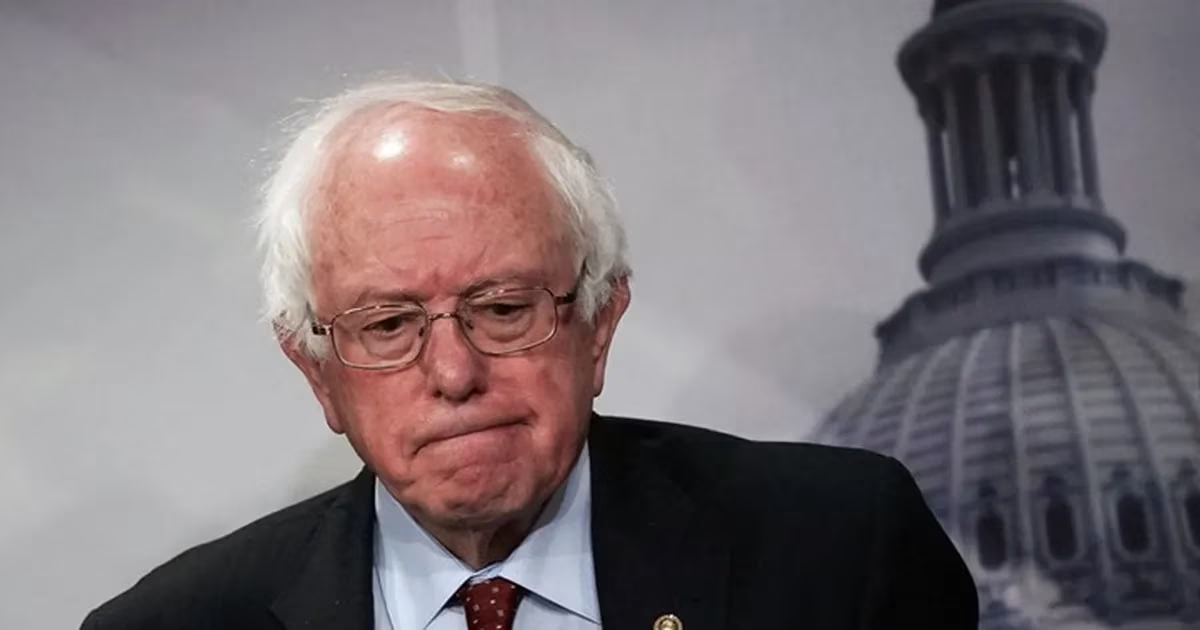
Forty Democratic Senators out of 47 Vote in Favor of Banning Arms to Israel

Washington – Said Arikat – 4/16/2026

In a striking indication of a rapid shift within the Democratic Party, the US Senate rejected two bills aimed at halting arms sales to Israel. However, the voting process revealed an unprecedented alignment; the majority of Democrats joined the minority opposing the deals, a move reflecting a growing re-evaluation of the relationship with Israel within the party.

Forty Democratic senators out of 47 voted in favor of a resolution to block a $295 million bulldozer deal, equipment that Senator Bernie Sanders said is used to demolish homes in the West Bank, Gaza Strip, and Lebanon. In contrast, 59 senators—mostly Republicans—opposed this direction, leading to the resolution's defeat.

Thirty-six Democrats also supported a second bill to halt a deal for one-thousand-pound bombs, valued at approximately $152 million, which Sanders indicated would be used in military operations in Gaza and Lebanon. However, 63 senators voted against the bill, preventing its passage.

Despite the failure of these initiatives, their political implications appeared deeper than their legislative outcomes; the number of Democrats who joined Sanders more than doubled compared to similar attempts in 2024 and 2025, amidst escalating Israeli military operations and widening criticism within the party's base, which now views the stance on Israel as a true test of politicians' commitment to human rights issues.

In the same context, Democratic Senator from Virginia, Tim Kaine, expressed in an interview with CNN on Wednesday evening, a "growing sense of weariness and frustration" within Democratic ranks regarding what he described as aggressive Israeli actions against Palestinian and Lebanese civilians. He noted that this sentiment is no longer limited to activists but is resonating within legislative institutions, with increasing calls to reconsider the terms of US military support.

This shift within the Democratic Party reflects a structural change in the American political mood, where support for Israel no longer enjoys the traditional consensus that characterized past decades. The rise of a new generation of voters, along with the growing influence of progressive movements, has contributed to redefining foreign policy priorities, linking them to human rights and accountability standards. Moreover, increased media coverage of civilian suffering in conflict zones has played a pivotal role in shaping a more critical public opinion, pushing lawmakers to adopt more cautious positions regarding unconditional military support.

This change gains additional importance in the context of acute partisan polarization in the United States, as the issue of Israel has become part of the internal division between Republicans and Democrats. While Republicans continue their strong traditional support for Tel Aviv, a growing current within the Democratic Party calls for reformulating the relationship on new foundations, including clear restrictions on the use of military aid. This division not only reflects a difference in political visions but also indicates a deeper change in the values that govern the electoral base of each party.

It is worth noting that a Pew Research Center poll published last week shows that a majority among Republicans under the age of 40 view Israel negatively.

In the long run, this shift may have strategic implications that extend beyond internal debate, affecting the nature of the US-Israeli alliance itself. The continued growth of critical voices within Congress could lead to stricter conditions on arms deals, or even a comprehensive re-evaluation of forms of military support. This trend may also encourage other international allies to adopt more independent positions towards Israel, reflecting the beginning of a new phase characterized by multiple centers of influence in shaping international policies related to the conflict in the Middle East.

OPINIONS

Thu 16 Apr 2026 8:19 am - Jerusalem Time

Trump, Iran, and the Limits of American Power


By: Said Arikat


April 16, 2026


News Analysis


Washington, D.C- By any conventional measure, the president of the United States sits atop the most powerful political system in modern history. Yet, as John Mearsheimer argues, even that power has limits—especially when it comes to the Middle East.


Speaking on April 14, 2026, in a conversation with Andrew Napolitano on the program “Judging Freedom,” Mearsheimer offered a stark assessment: Donald Trump is in no position to negotiate a meaningful settlement with Iran. The reason, he insists, is not diplomatic complexity or Iranian intransigence, but a far more decisive constraint—Israel and its influence over American policy.


At the heart of Mearsheimer’s argument lies a blunt proposition: Israel has no interest in a ceasefire with Iran, let alone an agreement that accommodates Tehran’s core demands. Chief among those demands is the right to maintain uranium enrichment capabilities—an issue that has long stood at the center of international negotiations. For Israel, Mearsheimer contends, such a concession is unacceptable under any circumstances.


Indeed, he goes further. Israel, in this telling, does not merely seek to contain Iran but to fundamentally weaken it—to “wreck” it, in his words, much as Syria has been devastated over the past decade. This characterization underscores the depth of mistrust and the scale of ambition that Mearsheimer attributes to Israeli strategy.


But the argument does not stop in the Middle East. Its real force lies in what it says about Washington.


According to Mearsheimer, Israel’s preferences do not remain confined to its own borders; they are projected into the American political system through what he describes as an “enormously powerful lobby.” This network of influence, he suggests, has repeatedly demonstrated its ability to shape U.S. policy at the highest levels. Since Trump’s return to the White House in January 2025, Mearsheimer argues, the pattern has only intensified.


The implication is difficult to ignore: American foreign policy toward Iran is not fully autonomous. Instead, it operates within boundaries set, in significant part, by Israeli strategic priorities and their domestic political backing in the United States.


History offers at least partial support for this view. U.S. policy toward Israel has long enjoyed bipartisan consensus, reinforced by military sponsorship, intelligence sharing, and deep cultural and political ties. Skepticism toward Iran—particularly regarding its nuclear ambitions—runs just as deep. In such an environment, any American president seeking a grand bargain with Tehran faces formidable headwinds at home.


Yet Mearsheimer’s argument is not simply about influence; it is about constraint. It suggests that Trump is not merely aligned with Israel by choice, but effectively unable to deviate from it in any meaningful way. In this sense, the president’s room for maneuver is not just narrow—it is structurally limited.


There is, however, one exception.


Mearsheimer suggests that Trump might resist Israeli pressure under a single, extreme condition: a looming global economic catastrophe. If escalating conflict with Iran were to threaten the stability of the world economy—through disrupted energy markets, financial shocks, or broader geopolitical turmoil—the calculus could change. Faced with such stakes, the president might conclude that the costs of alignment outweigh the benefits.


Short of that scenario, however, Mearsheimer sees little reason for optimism. Diplomacy, in this framework, is not simply a matter of negotiation skill or political will. It is bounded by power relationships that lie beyond the negotiating table.


Critics will undoubtedly challenge this perspective. They may point to moments when U.S. presidents have acted against Israeli preferences, or argue that American policy emerges from a complex interplay of institutions, interests, and global pressures—not a single overriding influence. They may also question whether Israel truly seeks the kind of maximal outcome Mearsheimer describes, given the risks of regional instability.


Still, the power of Mearsheimer’s analysis lies in its clarity. It forces a difficult question into the open: how independent is American foreign policy when it comes to its closest allies?


In the case of Iran, his answer is unequivocal. As long as Israel opposes a deal—especially one that permits uranium enrichment—no American president, including Trump, can deliver a meaningful agreement. The obstacles are not just diplomatic; they are structural, embedded in the very fabric of U.S. politics.


Whether that diagnosis proves correct remains to be seen. But it serves as a sobering reminder that even great powers operate within limits—and that, in the high-stakes arena of Middle Eastern politics, those limits may be tighter than they appear.


In this light, critics contend that the longstanding alignment with Israel—and the outsized role of the Israeli lobby in Washington—has increasingly undermined U.S. interests and eroded its global credibility. Unconditional support for Israeli policies, particularly in the context of devastating military campaigns, has alienated allies, inflamed anti-American sentiment, and weakened Washington’s claims to uphold international norms. At home, the Israeli lobby’s influence is now the subject of sharper scrutiny, feeding public unease about distorted policy priorities. Most notably, American public opinion is no longer merely shifting but turning decisively more critical of Israel, especially among younger voters, signaling a profound and potentially lasting political realignment.

ANALYSIS

Wed 15 Apr 2026 3:05 pm - Jerusalem Time

The Labor of the New International Order: A Reading of the Features of the 'Day After' the War and Global Power Shifts

In-depth discussions are escalating in research and intellectual circles about the features of the 'day after' the ongoing war, amidst ambiguity surrounding the future of negotiations and the field results on various fronts. Observers believe that the repercussions of this confrontation will not be limited to the direct parties, but will extend to reshape the international order and relations between major powers, with fundamental impacts on the future of the Palestinian issue and the global ethical system.

In this context, Al-Zaytouna Centre for Studies and Consultations issued a recent scientific paper anticipating the features of the global system in the coming years, suggesting that the world is entering a deep transitional phase. The study indicates that unipolar hegemony has actually begun to decline in favor of a more complex system based on the multiplicity of power centers and the intertwining of hard and soft tools in managing international conflicts.

The research paper prepared by Dr. Walid Abdel Hay confirms that power balances are undergoing a gradual reshaping, with China emerging as a dominant technological and economic power through cross-continental strategic projects. In contrast, Russia seeks to restore its influence by employing its military and geopolitical capabilities, while Washington tries to maintain its leadership position through technological innovation and its network of international alliances.

The criteria of power have changed in the modern era; military arsenals are no longer the sole measure of superiority among nations. Control over vital waterways such as Hormuz and Bab al-Mandab, and control over the advanced electronic chip industry, have become crucial elements in determining who holds the initiative in the new international order forming under the weight of crises.

The study draws attention to the growing role of giant technology companies that have transformed into international actors whose influence extends beyond the economy to shaping global public opinion. These companies now control the flow of data and information, posing unprecedented challenges to the traditional concept of national sovereignty, and making the digital space a political battleground par excellence.

The next phase is expected to witness a decline in direct traditional wars in favor of what is known as 'hybrid wars' that combine multiple and innovative tools. These wars include systematic cyberattacks against infrastructure, the use of economic sanctions as a political pressure tool, in addition to media disinformation campaigns aimed at destabilizing the internal stability of states.

Regarding international alliances, there are indications of an erosion of long-term solid commitments in favor of flexible and temporary alliances dictated by changing interests. This was evident in the sharp criticisms directed by former American leaders at NATO, describing it as a 'paper tiger,' which prompts countries to diversify their security and economic partnerships away from fixed axis politics.

As for the Middle East, it will remain at the heart of international competition due to its vital resources and unique geopolitical location connecting continents. However, the nature of external influence may change, with direct military intervention declining in favor of economic and investment influence tools, with the emergence of leading roles for regional powers seeking to impose new balances in the region.

Strategic readings propose a new concept that goes beyond 'multipolarity' to 'multicentricity,' where digital platforms and non-governmental actors participate in global decision-making. This overlap creates a complex network of influences that makes it difficult for any single state to control the course of international events as was previously the case.

Ongoing transformations raise fundamental questions about whether the world is heading towards a stable balance or towards a state of open and continuous competition. The question also remains about the role of technology in narrowing the gap between developed and developing countries, or whether it will lead to deepening technological and economic dependence in light of the intense race for artificial intelligence.

Understanding these profound transformations is no longer merely an intellectual luxury for researchers, but has become a strategic necessity for decision-makers in the Arab region. The world being reshaped today recognizes only power based on knowledge and the ability to control the flows of the digital economy, which requires analytical tools that go beyond inherited traditional models.

Regarding the value aspect, the current war will reopen the discussion about the role of religious and intellectual values in major international conflicts. The political and military outcomes of this confrontation are expected to affect the future of Islamic movements and the position of political regimes in the region, putting the international ethical system to a real test.

Research from study centers emphasizes the necessity of not waiting for the end of the cannons to start planning for the future, as the new reality is being shaped now in operations rooms and research centers. The strategic fluidity and uncertainty surrounding the global scene require high flexibility in dealing with accelerating variables to ensure a place in the coming international order.

In conclusion, the features of the new international order paint a picture of a world that is both more interconnected and confrontational, where economic interests intersect with geopolitical conflicts. The ability to adapt to the 'digital age' and shifts in major power balances will have the final say in determining the political map of the Middle East in the coming decades.

The world is heading towards a gradual reshaping of power balances, where power is no longer measured by military capabilities alone but by control over technology and vital straits.

ARAB AND WORLD

Wed 15 Apr 2026 3:05 pm - Jerusalem Time

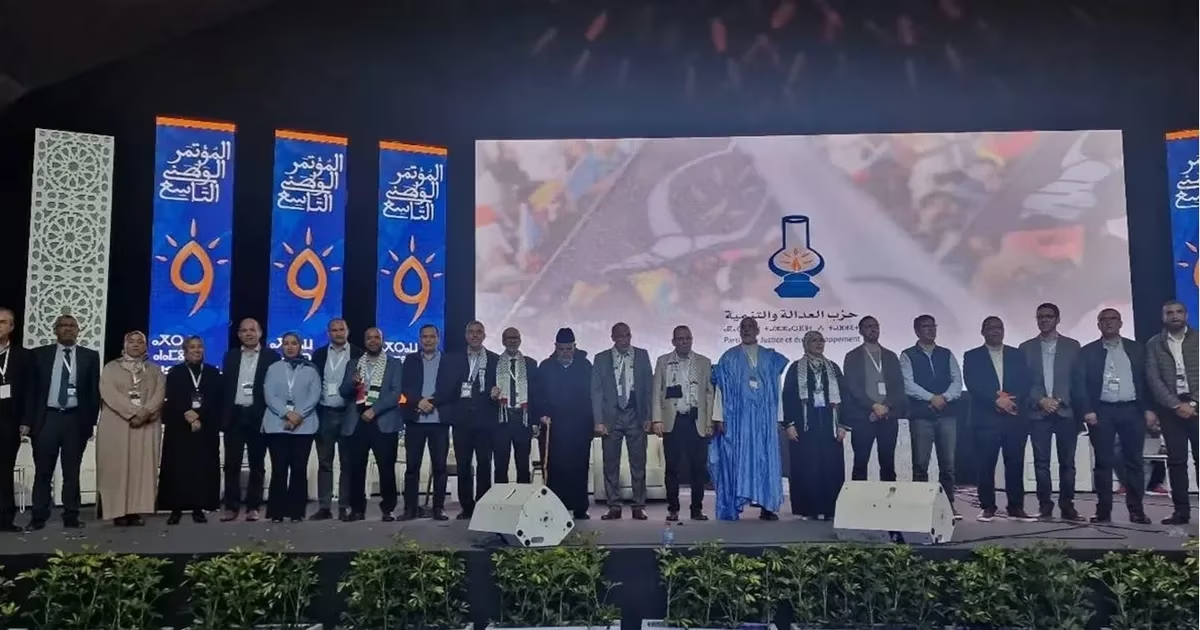
The Moroccan Justice and Development Party: Paths of Reconfiguration and the Test of Regaining Political Initiative

The Moroccan political scene has witnessed remarkable movements by the Justice and Development Party since February 2026, movements that fundamentally transcend mere routine activities to reach a deep attempt at party self-reproduction. This movement comes amidst structural transformations in the political field, as the party seeks to overcome the state of confusion in representation and legitimacy that followed the results of the 2021 elections.

The party is currently engaged in a gradual path aimed at repositioning itself, relying on a strategy of quiet accumulation rather than sudden tactical leaps. The first signs of this approach are evident in what is known as 'rationalizing the internal organizational field,' which aims to put the house in order before embarking on any new political venture.

The party leadership has launched the process of organizing regional general assemblies for nominations, a step that not only reflects early preparation for upcoming elections but also indicates an awareness of the need to restore organizational capital. This capital suffered significant erosion due to the pressures of the second governmental term and its repercussions, which negatively impacted the party's base.

These organizational movements are not limited to arranging electoral lists but extend to re-adjusting the dialectical relationship between the center and the geographical area. Through this, the party seeks to ensure a minimum level of internal harmony between the leadership and the base, which is an essential condition for any potential political recovery in the near future.

Restoring political legitimacy in its societal dimension is considered the biggest challenge facing the 'Brothers of Morocco' at the current stage. The party is well aware that the crisis that afflicted it was not merely a decline in the number of seats, but a deep crisis of trust that affected the roots of its connection with the social groups that constituted its electoral reservoir.

As part of attempts to restore social intermediaries, the party's trend towards renewing institutional ties with the National Union of Labor in Morocco emerged. This step carries great significance, as the party seeks to transform from merely a seasonal electoral actor into a true bearer of the demands of affected professional and social groups.

At the level of political discourse, the party's General Secretariat began to adopt a tone reflecting a diligent endeavor to position itself as a structured institutional opposition. This approach moves away from mere protest and tries to focus on producing alternative policies that can convince the public of the feasibility of returning to support the party's political project.

However, this ambition clashes with a structural paradox related to how to build a convincing opposition discourse after spending two full terms at the heart of government management. The party faces a fundamental question about its ability to criticize current policies without falling into the trap of selective disavowal of its previous governmental legacy and the decisions that accompanied it.

The process of transitioning from 'the legitimacy of achievement' to 'the legitimacy of criticism' forces the party to confront internal tensions and gaps in the current political discourse. This stage requires courage in reviewing past mistakes while preserving the political identity that has distinguished the party throughout the past decades in the Moroccan arena.

These movements come in a national context characterized by weak party mediation and an increasing level of political apathy among broad segments of citizens. All representative institutions in Morocco face the challenge of declining trust, making the task of the Justice and Development Party in attracting the masses again more complex and difficult.

Sources following party affairs reported that the party is now facing a 'general mood' structure that is skeptical of the utility of political action as a whole, and not just the performance of parties. This skepticism forces the party to innovate new communication tools that go beyond traditional slogans and directly touch upon the daily concerns of the Moroccan citizen.

What distinguishes the party's movements after its last National Council meeting is the conviction of the limits of political action at the current stage. The sharp escalationist tone and declared major stakes have disappeared, replaced by quiet work focused on building the minimum conditions for returning to the forefront of the political scene.

The party's current work is based on three main pillars: a cohesive organization, a social extension that can be activated, and a credible political discourse. This strategic triangle aims to rebuild trust with society without claiming to possess absolute truth or making unrealistic rosy promises.

In conclusion, the Justice and Development Party is going through a critical transitional phase between a past burdened by the cost of participating in power and a future whose final features are not yet clear. Its success will depend on its ability to produce a new political contract that transcends narrow electoral logic towards a broader reformist horizon from within institutions.

The party realizes that its crisis was not merely representative or electoral, but affected the structure of trust that connected it to its social extensions.

PALESTINE

Wed 15 Apr 2026 3:05 pm - Jerusalem Time

Tragic Scenes.. The Occupation Abuses Dozens of Palestinian Workers Found Inside a Garbage Truck

A state of widespread anger prevailed in Palestinian circles following the spread of tragic scenes documenting the Israeli occupation forces' abuse of a large group of Palestinian workers. These workers were forced to hide inside a truck designated for waste transport in a desperate attempt to reach their workplaces inside the occupied territories of 1948, in pursuit of a livelihood whose avenues have narrowed in the West Bank.

The widely circulated video clips showed between 40 and 70 workers crammed in inhumane conditions inside the iron container. The truck was stopped at a military checkpoint north of the West Bank, where occupation soldiers began to practice various forms of humiliation and physical assault against the unarmed workers immediately upon discovering them.

For his part, the Secretary-General of the Palestinian General Federation of Trade Unions, Shaher Saed, condemned the brutality with which the occupation forces treated the workers, confirming that dozens of them were severely beaten. Saed explained in press statements that about half of the detained workers were transferred to hospitals as a result of severe bruises and contusions from this systematic abuse.

Saed pointed out that this incident reflects the depth of suffering experienced by Palestinian workers for three years, amidst rising unemployment rates reaching 40% of the workforce. He added that there are more than 550,000 unemployed people facing dire economic conditions, which pushes them to risk their lives and dignity to secure their families' basic needs.

The federation revealed the exorbitant costs incurred by workers in their search for work, as a worker pays between 1200 and 1500 shekels to smuggling brokers. Despite these large sums, workers face the risk of arrest or returning without finding a job opportunity, which doubles their financial and psychological burdens in light of the blocked political and economic horizon.

Union officials called on the International Labour Organization to intervene urgently and investigate the conditions of treatment of Palestinian workers, and to raise the issue to international forums such as the International Court of Justice. They stressed that the occupation bears full responsibility for these conditions, especially after thousands of workers were arbitrarily expelled and deprived of their financial and legal rights.

In the legal context, legal advisors explained that the occupation authorities treat Palestinian workers as security targets rather than as human beings seeking a livelihood. Occupation courts impose exorbitant fines and actual prison sentences ranging from six months to two years on workers caught without official work permits.

Observers described the scene as a living embodiment of Ghassan Kanafani's novel 'Men in the Sun,' but with a harsher and more tragic reality. While the protagonists of the novel hid in a water tank, the current reality forced Palestinian workers to hide among the waste, a picture reflecting the extent of degradation that living conditions have reached under the weight of the siege.

Academics and activists criticized the official and international silence regarding these blatant violations, considering that the scene is not just a passing news item but a cry in the face of global conscience. They affirmed that the piling of bodies in an iron box saturated with foul odors represents the peak of collective humiliation practiced by the occupation system against the Palestinian people.

Activists also directed sharp criticism at Palestinian leaders and unions, demanding the necessity of finding national economic alternatives that protect workers from the occupation's aggression and brokers' exploitation. They considered that the absence of real development plans has left the Palestinian worker alone facing the choice between deadly unemployment or humiliating risk.

Experts in Israeli affairs indicated that these practices are part of a comprehensive retaliatory policy adopted by the occupation government since October 7th. These policies aim to break the morale of Palestinians by targeting their livelihoods, humiliating them at military checkpoints, and theatrically broadcasting images of their suffering.

Estimates indicate that there are about 240,000 Palestinian workers who rely entirely on working inside the occupied territories, and integrating them into the local market requires many years of serious government work. In light of the financial crisis suffered by the Palestinian Authority, the economic gap widens and the suffering of families dependent on these wages exacerbates.

Union sources stated that the occupation is withholding funds and workers' entitlements estimated at about 9 billion dollars, amounts that would have been sufficient to alleviate the severity of the economic crisis if disbursed. These sources considered that preventing workers from accessing their entitlements is part of an economic war aimed at pushing Palestinian society towards comprehensive collapse.

Human rights activists concluded by emphasizing that the image of workers inside the garbage truck will remain a stain of shame that will haunt all who accept the continuation of this reality. They stressed the need to transform this pain into a pressing national action that guarantees the dignity of the Palestinian individual and protects their right to work and a decent life away from the machines of oppression and abuse.

This is not a garbage container, but a mirror of a homeland where dignity is insulted, and a reality that forces people to choose between hunger and humiliation.

ISRAELI AFFAIRS

Wed 15 Apr 2026 3:05 pm - Jerusalem Time

Escalating Diplomatic Crisis: The Occupation Faces the Risk of Isolation in Europe and Severe Tension with Germany and Italy

Diplomatic relations between the Israeli occupation authorities and several European capitals are undergoing a period of severe and unprecedented tension, driven by increasing international criticism of the far-right government's policies. Germany and Italy have been at the forefront of recent disputes, with Hebrew reports noting a tangible decline in the level of political and security understandings due to the continued settlement expansion and ongoing military operations.

In a move reflecting the depth of the internal and external crisis, the occupation's ambassador in Berlin, Ron Prosor, publicly leveled sharp criticism at Finance Minister Bezalel Smotrich. These criticisms came in the wake of Smotrich's statements, which were deemed offensive to Germany, prompting the veteran Israeli diplomat to warn against the consequences of harming strategic relations with one of the most important allies on the old continent.

The crisis with Berlin escalated after an official German condemnation of settlement construction policies in the occupied Palestinian territories, which was met with a hostile and populist response from Smotrich. The right-wing minister used historical references related to the 'Holocaust' in his political debate, which sparked widespread resentment in German diplomatic circles and was considered by Ambassador Prosor to be a harmful conflation of history and current politics.

In a related context, media sources indicated that Israeli-European relations are currently experiencing their most difficult period in decades, with traditional political support gradually fading. The occupation no longer enjoys solid support except in very limited countries such as Serbia and the Czech Republic, while major powers have begun to review their positions based on facts on the ground and international law.

In a notable shift, Italy, under the leadership of Giorgia Meloni, has begun to take steps interpreted as a decline in the level of security and political cooperation with Tel Aviv. Reports indicated that Rome has started reviewing or suspending some security agreements, which constitutes a severe blow to the coordination that had existed between the two sides for many years under the umbrella of common interests.

In Spain, Prime Minister Pedro Sánchez continued to escalate his rhetoric against the occupation's practices, describing them as blatant violations of international humanitarian law. This stance has led to a significant decline in mutual diplomatic representation, reinforcing the hypothesis that Europe is no longer a comfortable environment for Israeli political maneuvers as it once was.

Analysts warned that this 'unprecedented erosion' of the occupation's standing within Europe will have far-reaching strategic repercussions on all fronts. In addition to political isolation, there is a prominent risk of affecting trade exchange and close scientific and academic cooperation between the two parties, areas on which Israel vitally depends for its economic and technological growth.

Analytical readings suggest that the Israeli government's attempts to compensate for the loss of European support by turning to the United States or Asian powers like India will not be sufficient. The traditional European role remains a fundamental pillar of international legitimacy and the global economic system, and its loss could put Tel Aviv in direct confrontation with increasing international sanctions or pressures.

Internally, critical voices against the current government's policy have escalated, holding the hardline right-wing responsible for the deterioration of foreign relations due to positions described as 'diplomatically ill-considered.' Observers believe that years of neglecting the European continent in favor of absolute focus on Washington have led to a backlash that reduced the occupation's influence in European forums.

In conclusion, it appears that the media and political landscape in countries like Italy has become more critical of the occupation, placing European governments under immense popular and parliamentary pressure. If the occupation does not conduct a comprehensive review of its diplomatic policies, the path of gradual political isolation may become a reality that will be difficult to reverse in the near future.

Conflating history and politics harms the memory of the Holocaust, and Israel has serious criticisms of Germany's policies regarding the protection of Jewish communities.

PALESTINE

Wed 15 Apr 2026 3:04 pm - Jerusalem Time

With an iron chair and electric shocks.. The story of the prisoner Mahmoud whose sight was extinguished by the occupation in 'Sde Teiman'

The wounds from the amputation of his left leg were not enough to deter the Israeli machine of oppression from brutalizing the thirty-year-old Mahmoud Abu Al-Foul, who faced chapters of torment inside the notorious 'Sde Teiman' detention center. Mahmoud's tragedy began in 2015 when shrapnel from an Israeli missile hit his leg, leading to its amputation later in 2017 after strenuous medical attempts to save it.

In late December 2024, during the occupation's implementation of what was known as the 'Generals' Plan' north of the Gaza Strip, Israeli forces stormed Kamal Adwan Hospital where Mahmoud was receiving treatment. The injured young man was forced to leave the hospital walking on one leg without his crutches, to be arrested and transferred to interrogation centers in the Gaza envelope.

Inside the dark interrogation rooms, Mahmoud faced an officer devoid of all humanity, who severely beat him using an iron chair, directly targeting his head. These successive blows caused Mahmoud to lose consciousness, and upon waking, his vision gradually faded until he plunged into complete darkness from which he has not emerged until now.

Sources reported that the occupation deliberately neglected the health condition of prisoner Abu Al-Foul, as the jailers refused to refer him to specialized doctors despite his repeated pleas. When Mahmoud tried to protest his deprivation of medical care by going on a hunger strike, the jailers met his steadfastness with electric shocks and threats of humiliating forced feeding.

Mahmoud's suffering continued for eight months inside prisons, receiving only simple painkillers and ineffective eye drops, amidst the mockery of military doctors regarding his condition. The Israeli doctor would only give false promises about the return of his sight, while inflammation ravaged his eyelids, which completely closed due to deliberate neglect.

Mahmoud was later transferred to 'Ofer' prison and then to 'Naqab' prison, where he lived in harsh conditions, moving on one leg and with lost sight, which exposed him to repeated falls and collisions with walls. Mahmoud remained isolated from news of his family, who were besieged in the northern Strip, not knowing whether they had survived the continuous bombing or had ascended as martyrs.

In October 2025, with the ceasefire decision coming into effect, the International Committee of the Red Cross informed Mahmoud of his release, beginning his journey back to Gaza. The shock was severe for his elderly mother, who received him at Nasser Hospital in Khan Yunis, only to find that he had lost his sight after losing his leg in previous years.

Amal Abu Al-Foul, Mahmoud's mother, says that seeing her son in this condition plunged her into a fit of bitter crying, wondering what crime he had committed to be deprived of what he held most dear. The family is now appealing to international bodies to provide urgent medical transfer outside the Strip, hoping that Mahmoud will find treatment that will restore his sight, which the jailer took from him.

Mahmoud's story is just one example of thousands of prisoners who face slow death inside occupation prisons, where statistics indicate there are currently more than 9,600 prisoners. Among these prisoners are 350 minors who live in conditions lacking the most basic elements of a dignified life and international laws.

Human rights sources confirmed that occupation prisons have witnessed the martyrdom of 326 prisoners since 1967, including 89 martyrs whose identities have been documented since the start of the genocide war on October 7, 2023. The fate of hundreds of detainees from the Gaza Strip remains unknown, as the occupation authorities refuse to disclose their places of detention or their health status.

The prisoner movement suffers from a systematic starvation policy that has led to a sharp deterioration in the weight and general health of detainees, in addition to severe overcrowding in cells. Prisoners are deprived of visits from lawyers or communication with their relatives, leaving them in complete isolation from the outside world and at the mercy of the jailers.

The Palestinian Prisoner's Day, on April 17 of each year, reminds the world of the tragedy of a people behind bars, but this year it carries a more tragic character. The testimonies given by released prisoners reveal atrocities committed daily, exceeding all red lines of international and humanitarian norms.

The scene was further darkened by the Israeli Knesset's approval of the prisoner execution law last March, which represents a green light for the legal liquidation of Palestinian detainees. This legislative escalation coincides with field practices aimed at breaking the will of prisoners and turning their lives into a continuous hell inside detention centers.

Mahmoud Abu Al-Foul remains a living witness, with his extinguished eyes, to the crimes of the occupation that do not fall by prescription, awaiting international justice that may not come soon. Popular and official demands continue for the international community to intervene to stop the bleeding of suffering inside prisons and protect prisoners from policies of deliberate killing and medical neglect.

The interrogation room and the image of the dehumanized officer were the last things Mahmoud saw before darkness fell on his eyes forever.

PALESTINE

Wed 15 Apr 2026 3:04 pm - Jerusalem Time

Major Heart Crisis in Gaza: Severe Shortage of Supplies and Travel Ban Threaten Lives of Thousands of Patients

The risk of death for heart patients in the Gaza Strip is escalating unprecedentedly, with thousands suffering from chronic and acute diseases facing a severe shortage of essential medicines and medical supplies. This crisis is exacerbated by the continued closure of crossings and the severe complications imposed by the occupation on the travel of urgent cases for treatment abroad, turning Gaza into a large prison lacking the most basic healthcare provisions.

In a testimony reflecting the depth of the tragedy, the family of elderly Salma Abu Nadi (78 years old) recounts the suffering of their mother, who has been bedridden for two months awaiting the availability of a pacemaker battery. The patient's daughter confirms that her mother's life now hangs on the availability of this medical component, which is missing in the Strip, noting that any further delay could lead to her death given the doctors' inability to provide alternative treatments.

On the ground, continuous military operations have led to most specialized centers for cardiac surgery and catheterization going out of service, with only one center remaining operational at Al-Quds Hospital in Gaza City. This sole center faces immense pressure and a shortage of staff and equipment, making it unable to meet the growing needs of patients in the besieged Strip.

Majed Shanat, a cardiology consultant at Al-Quds Hospital, described the current health situation as 'catastrophic' by all standards, explaining that the Strip suffered from shortages before the war, but now lacks the simplest tools. Shanat pointed out that the only device currently available can only handle a very limited number of patients, not exceeding 5 cases per day, which is a tiny number compared to the volume of injuries and medical cases.

The suffering does not stop at the lack of devices but extends to delays in travel coordination procedures, as is the case with patient Mustafa Madi, who suffered cardiac arrest twice in two months. Despite the seriousness of his condition, Madi is still awaiting approval to leave the Strip, amid bureaucracy and strict security restrictions imposed by the occupation on patients and their companions.

According to data issued by the Ministry of Health in Gaza, heart diseases have become the leading cause of death in the Strip, accounting for over 56%. The ministry attributes this shocking increase to the complete cessation of operations at 5 specialized centers, the disruption of open-heart surgeries, and the complete absence of stents and essential cardiac catheterization tools.

Amid the ongoing blockade and bombardment, the Gaza Strip is witnessing what can be described as a silent humanitarian tragedy, where patients are slowly dying away from the spotlight due to the collapse of the healthcare system. Despite repeated international demands, the occupation continues to prevent the entry of life-saving medical supplies, placing the international community before a moral and legal responsibility towards thousands of threatened lives.

Heart diseases now account for more than 56% of deaths in Gaza, with specialized centers ceasing operations and essential supplies being unavailable.

PALESTINE

Wed 15 Apr 2026 11:16 am - Jerusalem Time

Meloni suspends defense agreement with Israel, Lapid calls the move a 'shameful failure' for Netanyahu

Italian Prime Minister Giorgia Meloni announced on Tuesday her government's decision to suspend the joint defense agreement with Israel, which regulated the exchange of military equipment and advanced technological research. Meloni clarified during an event in Verona that this decision comes in response to the current circumstances in the region, which necessitated halting the automatic renewal of this security protocol.

In the context of executive measures, official sources confirmed that Italian Defense Minister Guido Crosetto sent an official letter to his Israeli counterpart, Yoav Gallant, informing him of the decision to suspend military cooperation. This agreement is a fundamental pillar of bilateral relations, having been subject to periodic renewal every five years since its entry into force in April 2016.

For his part, Israeli opposition leader Yair Lapid launched a sharp attack on Prime Minister Benjamin Netanyahu, describing the Italian decision as a 'shameful failure' for Israeli foreign policy. Lapid pointed out that Meloni represents the conservative right-wing current, which is supposed to be a natural ally of Israel, making the loss of her support a dangerous indicator of Tel Aviv's international isolation.

Sources in the Italian Ministry of Defense confirmed that one of the direct consequences of this decision is the immediate cessation of all forms of joint military training between the Italian and Israeli armies. The sources indicated that the decision was made after extensive consultations involving the foreign and defense ministers and the deputy prime minister, amid increasing Italian criticism of recent Israeli attacks.

Relations between Rome and Tel Aviv are experiencing increasing tension, especially after Italian forces operating within the UN mission in Lebanon were exposed to risks due to Israeli military operations. The right-wing government in Italy, which was considered one of Israel's closest allies, has begun to adopt a tougher tone towards Israeli military practices in the Palestinian and Lebanese territories.

On the European level, public pressure on governments to take firm stances against Israel is increasing, with more than a million citizens signing an initiative demanding the suspension of trade with Tel Aviv. Observers believe that the gap between European public opinion and official policies has begun to narrow in favor of taking tangible punitive measures against the policies of occupation and settlement.

In an attempt to circumvent this isolation, Israel is seeking to strengthen its partnerships with other countries in Eastern Europe and the Balkans, such as the Czech Republic and Serbia. Israeli Foreign Minister Gidon Sa'ar revealed proposals to transfer part of Israeli arms manufacturing operations to Czech territory to ensure the continuity of supplies and technical cooperation.

In the same context, Serbian President Aleksandar Vučić announced plans to produce combat drones in cooperation with the Israeli company 'Elbit', in a move aimed at enhancing his country's defense capabilities. The Israeli company will hold a majority stake in this joint project, reflecting a new Israeli strategy to seek security alternatives outside the traditional European Union framework.

The tensions were not limited to Italy but extended to Germany, where Israeli Finance Minister Bezalel Smotrich sharply attacked German Chancellor Friedrich Merz. This attack came in response to Merz's criticism of Israeli settlement plans and his explicit warning against the de facto annexation of the West Bank, which Smotrich considered unacceptable 'moral sermons'.

The German Chancellor had a phone call with Netanyahu, in which he expressed his deep concern about the developments on the ground in the occupied Palestinian territories. Merz stressed that settlement expansion undermines peace prospects, a position welcomed by the Palestinian presidency, which praised the German rejection of Israeli annexation efforts.

Reports indicate that Israel is facing difficulties in maintaining the momentum of military support from its traditional European partners, including Germany, which is its second-largest arms supplier. The general mood on the old continent is clearly leaning towards opposing the continuation of the war, putting European governments under significant political and moral pressure.

In the European Parliament, left-wing deputies believe that the recent decisions by Meloni and other European leaders are an inevitable result of street pressure that can no longer tolerate silence. They stressed that continued disregard for popular demands to stop cooperation with a state practicing 'apartheid' will lead to severe political consequences within European societies themselves.

Israeli diplomacy is currently trying to contain the repercussions of the Italian decision, fearing that it may be a prelude to similar steps from other European countries that were classified as 'friendly camps'. However, the extremist statements by ministers in Netanyahu's government, such as Smotrich and Ben-Gvir, further complicate the diplomatic mission and deepen the gap with Western capitals.

In conclusion, the suspension of the Italian defense agreement represents a fundamental shift in the map of security alliances in the Mediterranean, as the national interests of European countries have begun to directly clash with Israeli military policies. The question remains about Tel Aviv's ability to find technological and military alternatives to compensate for the loss of partnership with a major industrial power like Italy.

Given the current situation, the government decided to suspend the automatic renewal of the defense agreement with Israel.

ISRAELI AFFAIRS

Wed 15 Apr 2026 11:16 am - Jerusalem Time

The New Iran: Transformations from a Religious State to a Military Dictatorship after the 'Lion's Roar'

Initial readings of the results of the 'Epic Fury' operation and the subsequent military developments indicate that Iran is undergoing a crucial transitional phase, where the regime has shifted from its traditional religious form to an authoritarian dictatorship suffering from structural weakness. This transformation was not accidental; rather, it is the result of a continuous erosion of the regime's political and religious legitimacy over the past two decades, leading to the current moment characterized by fragmentation of the supreme leadership.

The concept of 'Velayat-e Faqih' (Guardianship of the Jurist), established by Khomeini, was partly based on popular acceptance and public faith, which second-generation leaders tried to maintain through delicate balances. With the rise of the extremist bureaucratic current led by Ali Khamenei, and now the current prominence of his son Mojtaba Khamenei, it seems the regime has definitively abandoned the facade of popular legitimacy in favor of absolute authoritarian rule that offers no ideological promises to the masses.

The departure of historical leaders and the escalation of assassinations targeting senior officials have created a leadership vacuum that is difficult to fill, weakening the regime's ability to mediate between warring factions. This vacuum has pushed the Revolutionary Guard to the forefront as the sole force capable of maintaining internal security and confronting external threats, signifying a comprehensive militarization of decision-making circles in Tehran and the marginalization of civilian and diplomatic tools.

The features of 'The New Iran' are evident in the transition to a new generation of leadership for whom the Iran-Iraq War is no longer the sole reference point; rather, their consciousness has been shaped by internal repression operations and modern military confrontations. This generation adopts a security doctrine based on advanced fire deterrence and confronting internal sabotage, which requires them to formulate strategies that go beyond the traditional frameworks established by the regime's founding leaders.

In dealing with the street, the regime has removed the 'silk gloves' it used to conceal its iron fist, especially after the events of January 2026, which witnessed unprecedented public violence. The damage to traditional repression mechanisms has forced the authorities to adopt brutal direct violence as the sole tool for survival, ending an era of organized protests and heralding a phase of chaos and street violence.

Economically, the regime faces a real dilemma with the damage to major industries and the deterioration of financial resources due to sanctions and military operations. In the coming phase, the regime will be forced to direct remaining resources to support only its solid base and loyalists to ensure their allegiance, which will lead to the deliberate impoverishment of the majority of the Iranian people and the widening of the class and social gap between the authorities and citizens.

The existential threats currently facing the regime represent a strong impetus to cross all red lines, including the religious barriers that once prevented the pursuit of unconventional weapons. The desire to acquire a nuclear weapon or major strategic capabilities has become a matter of technological survival, as the regime sees these weapons as the only guarantee to prevent the state's collapse in the face of direct external attacks.

Regionally, the mask that covered Iranian movements through proxies has fallen, as Tehran was forced into direct confrontations that revealed the damage to its conventional military capabilities. This shift will push Iran to adopt 'guerrilla warfare' tactics in the air and sea, focusing on carrying out qualitative operations that serve its urgent security and economic needs instead of long-term strategic plans.

The events of October 7th caused a shock to the Iranian timeline, with analysts believing that the move came earlier than Tehran had planned within its 'annihilation of Israel' strategy. This confusion has made Iranian foreign policy more responsive to immediate crises and less reliant on organized planning, increasing instability in the region and making Iranian moves unpredictable.

Supporters of the regime currently live in a state of complete isolation from the rest of society, being fed misleading media narratives that are completely detached from economic and field realities. This isolation will push them to defend the regime more fiercely because their fate is organically linked to its survival, which increases the likelihood of bloody clashes between different segments of the population in the near future.

For ethnic and religious minorities in Iran, the current crisis will force them to strengthen their self-autonomy and internal solidarity, away from the state's centralism that has neglected their needs. While this trend may not immediately transform into an organized revolution, it weakens the cohesion of the Iranian state as a unified entity and increases the chances of independent activity that could threaten the territorial integrity of Iran.

The international community must re-evaluate the situation in Iran based on these new facts and abandon the classical perceptions that prevailed before 2026. Betting on a popular revolution similar to the events of 1979 may be unrealistic given the current brutality of repression, requiring the search for new tools to support the Iranian people and protect them from the authoritarian killing machine.

Economic sanctions will play a more effective role in the next phase due to the fragility of the Iranian economy and the regime's desperate need for liquidity to rebuild its authority. It is essential to continue economic pressure and prevent the regime from developing its offensive capabilities, especially in light of indicators confirming its pursuit of unconventional military technology to threaten regional and global security.

In conclusion, the Iran that the world knew for decades has ended, replaced by a more violent and less stable political entity, opening the door to grave dangers and new strategic opportunities. Monitoring developments in Tehran in the coming months will be crucial to determining the region's direction, as the confrontation between the regime's desire to survive and the people's aspiration for liberation will be the main driver of events.

Iran today is a completely different state; it has transitioned from a religious regime seeking legitimacy to a weak dictatorship fighting for survival through excessive violence.

OPINIONS

Wed 15 Apr 2026 11:15 am - Jerusalem Time

No Ideal Solutions: Managing the Economic Crisis Realistically

Ramallah - “Alquds ” dot com

Ramallah - “Alquds ” dot com

Opinion Writer

In previous articles, I attempted to diagnose the features of the dual crisis afflicting the Palestinian economy, represented by public finance imbalances on one hand, and the limited capacity of the macroeconomy for recovery and growth on the other. However, theoretical diagnosis, no matter how accurate or data-driven, remains incomplete without moving to the more pressing practical question: What can be done to halt the accelerating economic deterioration in a complex regional environment, and amidst the ongoing suffocating Israeli measures that exacerbate the ambiguity of the economic and financial landscape?The realistic answer does not lie in searching for a "comprehensive solution" capable of addressing all issues at once, but rather in formulating a practical framework for crisis management that balances gradually reducing losses and maintaining a minimum level of stability, while keeping a window open for future recovery and seizing opportunities when conditions improve. The current priorities are centered on three main axes: recalibrating public finances, enhancing labor market flexibility, and preserving existing investment assets.First, recalibrating public finances requires a shift from traditional austerity measures to fiscal policies that enhance the efficiency of public spending and redefine the government's role in the economy to suit the Palestinian context. Unsustainable austerity and emergency budgets in an economy already suffering from weak aggregate demand may exacerbate the recession instead of containing it. What is needed is a move towards intelligent rationalization of public expenditures, distinguishing between productive and non-productive spending, while maintaining the minimum necessary social spending to avoid further societal instability.Conversely, enhancing local revenue collection from various sources remains crucial for reducing the fiscal deficit and providing liquidity. However, relying on increased revenues through traditional tools without risking stifling the fragile private sector, especially small and medium-sized enterprises that constitute the majority of operating companies in Palestine, is not feasible. Therefore, there is a need to focus on improving collection efficiency rather than raising the tax burden, enabling the government to increase collection on one hand, and helping officially operating economic establishments play their role as drivers of economic growth, job creation, and production enhancement on the other.In addition to adjusting public finances, there is also a need to adopt more cautious management of domestic debt, which has exceeded three billion dollars according to the latest estimates. This debt constitutes a necessary financing tool given the exceptional circumstances and limited liquidity faced by the Palestinian government. At a time when public debt management has become a risky path, there is a need to search for innovative mechanisms to manage these debts, such as converting part of them into long-term bonds supported by appropriate guarantee mechanisms, enabling the government to meet its obligations not only to the banking sector but also to gradually repay arrears owed to civil servants and private sector suppliers.Second, addressing negative fluctuations in the Palestinian labor market requires adopting smart policies capable of reducing high unemployment rates, which reflect a structural crisis beyond the limits of the traditional economic cycle. Given the Israeli restrictions on movement and trade, it has become necessary to think outside traditional frameworks. In the short term, temporary intervention programs such as wage subsidies or emergency employment programs may be needed, not as sustainable solutions, but as practical tools to absorb shocks and prevent deeper deterioration in the labor market.In the medium term, investing in skills and technical education may be one of the few growth paths despite the restrictions, by enhancing employment in local productive sectors including industry and agriculture, in addition to strengthening the role of the digital economy by encouraging remote work, which allows overcoming some of the geographical restrictions imposed on Palestinian labor and connecting it to regional and international markets.Third, in an environment characterized by high political and economic risks, talking about attracting investment becomes closer to theoretical ambition. The most urgent priority has become preventing the erosion of existing investment assets, as local capital flight may be more costly than the absence of new investment flows. As practical solutions, tools such as credit guarantees through international financial institutions and multilateral development banks can play an important role in helping companies survive. Furthermore, accelerating the pace of reforms that enhance access to finance may help design innovative investment tools that are appropriate for the high level of risk in Palestine, and capable of attracting additional capital, whether from the Palestinian diaspora or through investment funds and Arab and Islamic sovereign wealth funds.Certainly, regional tensions contribute to exacerbating the uncertainty about the future of the Palestinian economy, through their potential effects on international support levels and on trade and financial flows. Nevertheless, the scene is not without narrow margins for maneuver that can be explored, such as repositioning some supply chains to create conditions for supporting import substitution in a number of essential goods, and building economic partnerships in productive sectors.Perhaps the most important transformation that should be realized is that the Palestinian economy is not facing a fleeting crisis, but an extended state of complex fragility and successive shocks. In such a context, the realistic goal becomes managing the crisis realistically, by minimizing losses as much as possible, and maintaining the continuity of economic activities in various sectors, without sliding into a state of deeper instability.Ultimately, the Palestinian economy today stands between two choices: continued economic and institutional erosion in the absence of well-considered interventions, or practical resilience based on a pragmatic approach that balances the possible and the hoped for, recognizes the limits of reality, and works to determine who will remain standing when conditions change.

ARAB AND WORLD

Wed 15 Apr 2026 11:15 am - Jerusalem Time

Amal Movement Questions the Efficacy of Washington Talks and Adheres to Resolution 1701

Political skepticism is escalating in Lebanon regarding the efficacy of the new negotiation tracks sponsored by the United States to de-escalate the situation in the South. Influential political forces considered that any diplomatic move not based on clear guarantees and explicit Israeli commitments would remain mere attempts to sell illusions, especially in light of previous experiences with international agreements that Tel Aviv did not respect.

In this context, Hassan Qabalan, a member of the Political Bureau of the Amal Movement, affirmed that the movement's official position is firm and clear, and has been communicated to the President of the Republic and the Prime Minister through Speaker Nabih Berri. Qabalan pointed out in media statements that Lebanon possesses an international legal reference represented by Resolution 1701, warning against being drawn into what he described as 'the mirage of negotiations' that do not serve Lebanese national interests.

This stance comes after the conclusion of a round of talks in Washington, the capital, between delegations from Lebanon and Israel, the first of its kind in many decades. Despite the hopes expressed by Lebanese President Joseph Aoun that this step would contribute to alleviating the suffering of the Lebanese people, US Secretary of State Marco Rubio quickly lowered expectations, emphasizing that outstanding and complex issues cannot be settled in short sessions lasting no more than six hours.

Qabalan stressed that the reality on the ground completely contradicts any serious negotiating intentions, as Israeli forces continue systematic destruction operations and the bombing of homes in border villages extending from Naqoura to Khiam. He explained that this policy clearly aims to create a buffer zone and prevent the return of normal life to the border strip, which undermines the foundations of any potential diplomatic rapprochement at the present time.

The Amal Movement leader reviewed Lebanon's commitment to international agreements, noting that Lebanon has fulfilled what is required of it in the area south of the Litani, as acknowledged by major international powers. Approximately 9,500 Lebanese army soldiers have been deployed and military installations dismantled, steps that have received American and European praise, and even from the Israeli side itself in previous stages, without a similar commitment from the other party.

Qabalan pointed out that Resolution 1701, which was re-emphasized in November 2024, included clear mechanisms through the 'Mechanism' committee, which includes UNIFIL and other international parties. He considered that bypassing these mechanisms and moving towards new tracks is a waste of time, especially since Israeli leaders themselves, including their ambassador in Washington, downplayed the importance of these negotiating moves and mourned them before they even began.

Qabalan concluded that any negotiation process requires creating an atmosphere that reflects genuine positive intentions, which is completely lacking in the current reality. He affirmed that the Amal Movement does not get drawn into daily statements, but rather adheres to a national position that protects Lebanese sovereignty and is based on international resolutions that guarantee Lebanon's rights and put an end to continuous Israeli violations by land, sea, and air.

Lebanon has a previous international resolution and does not need to pursue the mirage of negotiations that many parties, and even Israeli leaders, have already dismissed.

ARAB AND WORLD

Wed 15 Apr 2026 11:15 am - Jerusalem Time

Trump Rules Out Extending Truce with Iran, US Navy Intercepts Oil Tankers in Hormuz

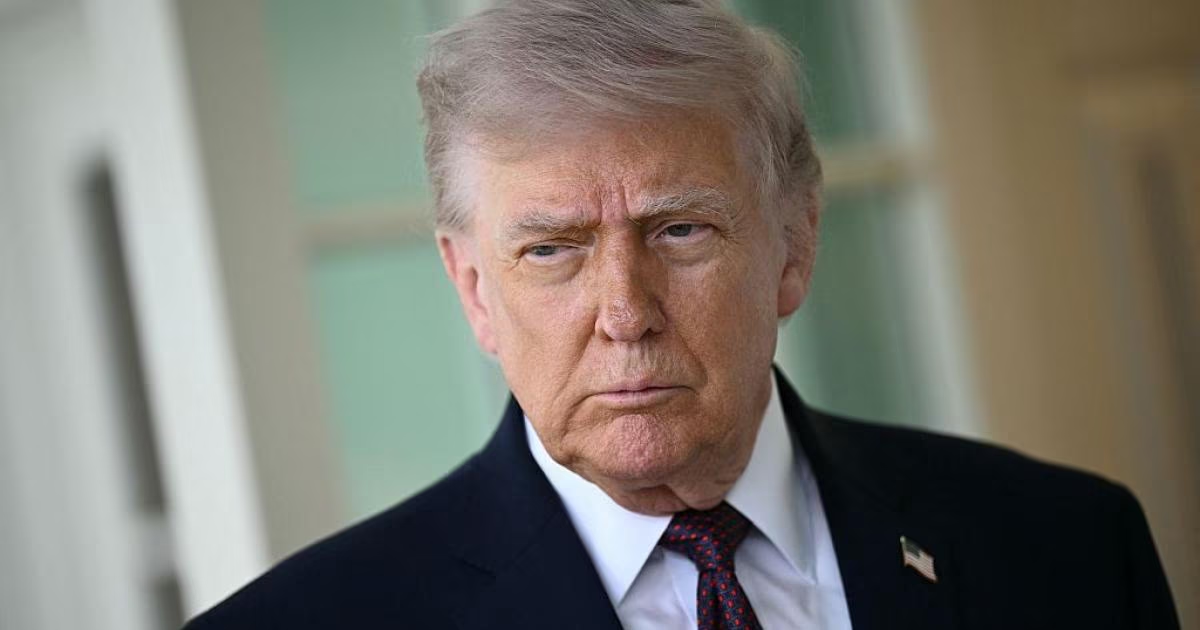
US President Donald Trump revealed his administration's intentions regarding the escalating conflict with Tehran, stating in media remarks that he is not inclined to extend the current ceasefire agreement. Trump indicated that the existing truce is approaching its inevitable end, suggesting it will cease in one way or another under current circumstances.

Despite the escalatory tone, the US President expressed his preference for diplomatic solutions if they lead to a comprehensive new agreement. Trump considered reaching a political settlement to be the optimal choice, as it would give the Iranian state an opportunity to rebuild its economy and infrastructure, which have been damaged by the confrontations.

On the ground, the confrontation entered a new phase with the United States beginning to implement a comprehensive naval blockade targeting vital waterways. This military step aims to tighten the noose on Iranian foreign trade and cut off oil supply lines, reflecting the failure of previously attempted diplomatic paths.

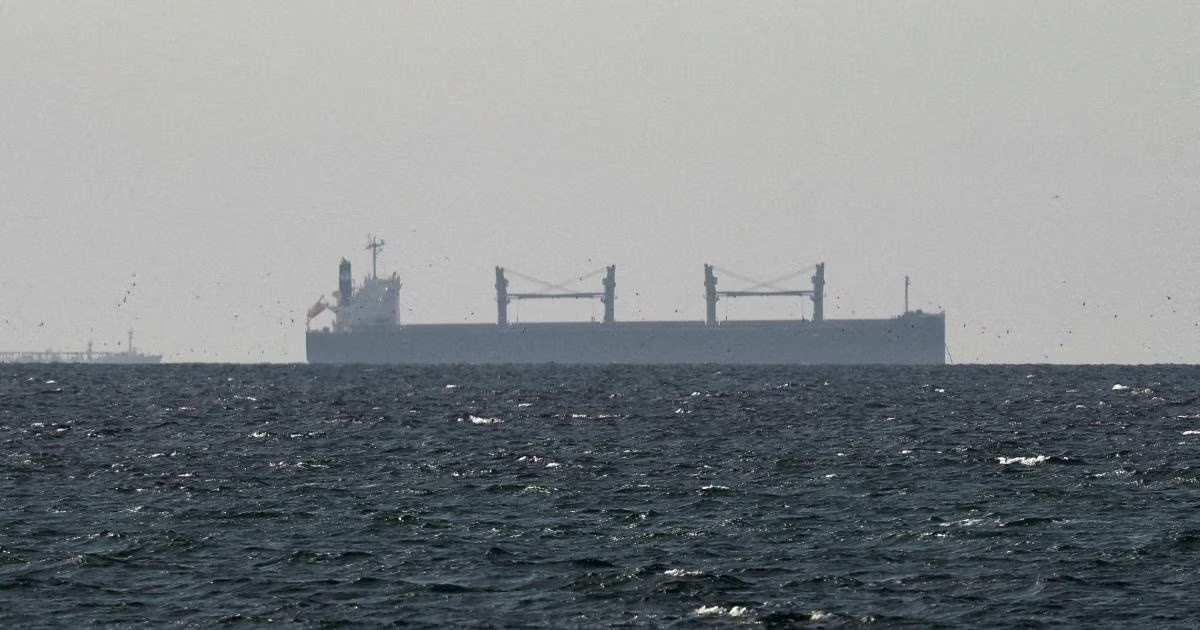
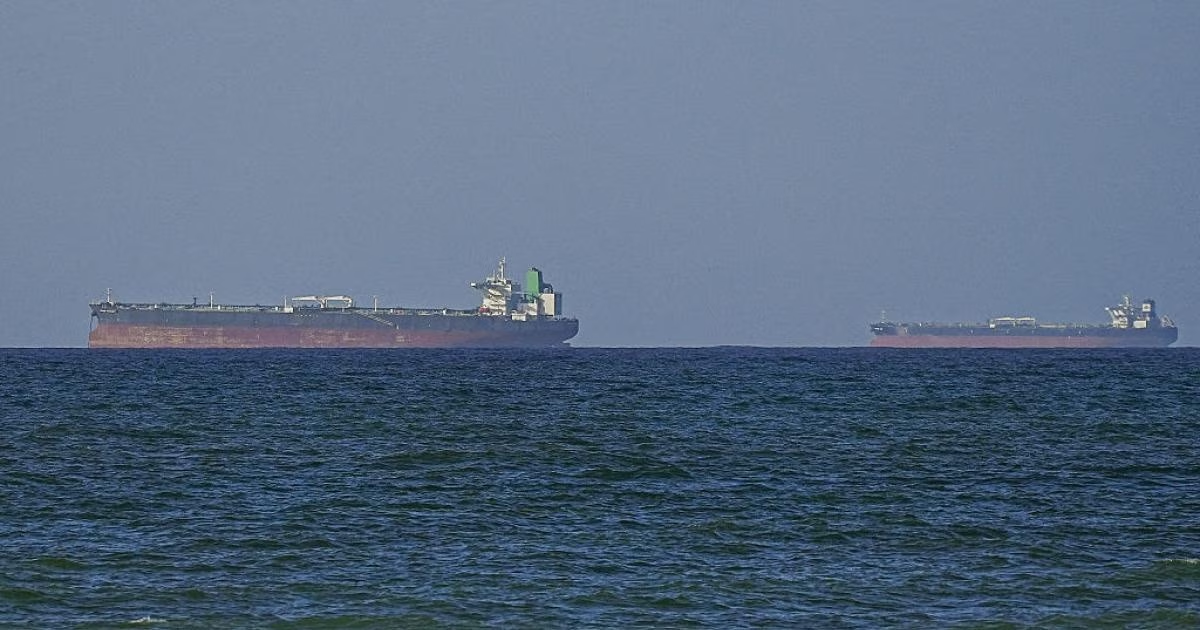
In the first practical application of this blockade, military sources reported that a US Navy destroyer intercepted two oil tankers attempting to exit Iranian territorial waters. US forces compelled the ships to return to Chabahar Port on the Gulf of Oman, sending a firm message about the seriousness of the measures being taken.

Reports from the US Central Command indicate that the naval blockade is being implemented through a massive and unprecedented military operation in the region. More than 10,000 US troops are participating in these missions, supported by 12 naval warships and dozens of fighter jets and reconnaissance aircraft to ensure complete closure of the passages.

Responsible sources confirmed that no vessel has succeeded in breaching the security cordon imposed since the announcement of the start of military operations. These moves aim to force Tehran to retract its previous threats to close the Strait of Hormuz, which represents a major artery through which one-fifth of the world's oil supplies flow.

Economically, these successive developments have caused confusion in global energy markets, with oil prices soaring to exceed $100 per barrel. Despite a slight decline later, markets remain cautiously awaiting the outcomes of the military escalation in the Gulf region and its impact on supply chains.

Observers believe that the effectiveness of the US blockade is still being tested in its early days, especially with the detection of changes in the routes of many vessels associated with Iranian oil. Political analysts warn that continued military pressure could push Tehran towards retaliatory options targeting international navigation or US interests in the region.

These tensions come in the context of an armed conflict that erupted since late February, leading to heavy human and material losses among Iranian forces. Despite the blows to Tehran's military infrastructure, it still retains strategic capabilities that make any comprehensive confrontation complex and costly.

Amidst this escalation, a faint glimmer of hope emerges regarding the possibility of resuming peace talks in the Pakistani capital, Islamabad, in the coming days. The question remains whether the region will slide into a full-scale war or if economic and military pressures will force the parties to return to the negotiating table.

I am not thinking of extending the ceasefire, and the truce will end in any case, but we prefer to reach an agreement that allows Iran to rebuild itself.

ARAB AND WORLD

Wed 15 Apr 2026 11:15 am - Jerusalem Time

European move led by France and Britain to secure the Strait of Hormuz independently of Washington

The Élysée Palace is preparing to host a virtual summit next Friday, chaired by French President Emmanuel Macron and British Prime Minister Keir Starmer, with the participation of dozens of countries. This expanded meeting aims to formulate a comprehensive international strategy to secure the Strait of Hormuz and ensure the flow of global trade once combat operations in the region cease.

Reports indicate that Starmer will attend the meeting in Paris in person, while the rest of the delegations will join via video conference, a step reflecting the European desire to lead the navigation security file. Notably, the United States is absent from the list of participants, while invitations have been extended to major powers such as China and India to ensure the broadest possible international consensus.

The emerging European plan seeks to build a broad international coalition that avoids the direct involvement of parties described as 'belligerents,' namely the United States, Israel, and Iran. This approach aims to create a neutral security environment that enjoys regional and international acceptance, thereby facilitating the restoration of confidence among global shipping companies that have been affected by the conflict.

Informed sources reported that the proposed defensive mission will focus in its first phase on three complex logistical and military axes. The first axis involves providing technical and navigational support to hundreds of commercial vessels currently stranded in the waterway, awaiting sufficient security guarantees to resume their voyages safely.

The second axis involves launching a large-scale operation to clear the waters of naval mines laid at the beginning of the conflict, a significant technical challenge requiring specialized expertise. The strategic importance of European countries, which possess a huge fleet of over 150 specialized vessels for detecting and removing naval mines, is highlighted here.

In the third axis, the European force intends to provide permanent military escort by deploying frigates and destroyers that will regularly patrol the strait to deter any potential threats. The operation's planners believe that this military presence will remain necessary for a long period even after ceasefire agreements are concluded, to meet the requirements of international insurance companies.

Diplomatic discussions reveal a divergence of views between Paris and London regarding Washington's role in this ambitious plan. While the French side believes that excluding the United States makes the mission more acceptable to Tehran, British officials express concern that this marginalization could strain relations with President Donald Trump's administration.

Germany is expected to officially join the initiative soon, which will give the plan additional military and financial weight given Berlin's naval capabilities. Germany has a specialized unit in the port of Kiel that includes mine-sweeping vessels and advanced submarines, capable of playing a pivotal role in securing deep waterways.

This initiative draws inspiration from the 'Aspides' operation model previously launched by the European Union to protect navigation in the Red Sea, which proved the effectiveness of independent European coordination. The plan relies on rotating the deployment of naval assets and helicopters belonging to countries such as Italy, Greece, and France to ensure sustainable monitoring and rapid intervention when necessary.

Observers link this plan to the concept of a 'coalition of the willing' previously proposed in other international contexts to enhance stability in conflict zones after peace agreements are reached. The European move ultimately aims to prevent the Strait of Hormuz from becoming a closed sphere of influence, and to ensure that it remains an open international passage for global trade and energy traffic.

The plan is based on establishing an international defensive mission that does not include the belligerent parties, referring to the United States, Israel, and Iran.

PALESTINE

Wed 15 Apr 2026 11:14 am - Jerusalem Time

The Fumbling of the American-Israeli Strategy: From Illusions of Overthrowing the Iranian Regime to the International Navigation Crisis

The path of military escalation led by Israel and the United States against Iran since the end of last February indicates a state of absurdity in managing international relations. War has transformed from a means to achieve political goals into an end in itself, which the two countries seek to sustain through political discourse that justifies the continuation of military operations despite their catastrophic repercussions.

This confrontation began with declared objectives: to overthrow the Iranian regime and strip it of its three elements of power: nuclear capabilities, the ballistic missile program, and the extended regional alliance system. This was clearly demonstrated in the map displayed by Benjamin Netanyahu, which identified five countries as direct military targets for Israeli operations.

Despite the intensity of the destruction caused by what is called the 'Seven Fronts War' in Gaza, the West Bank, and Lebanon, the reality on the ground confirms Israel's failure to achieve a strategic breakthrough. The regime in Tehran did not fall, and the Iranian masses did not respond to the calls for revolution repeatedly launched by Netanyahu and Trump, which caused clear disappointment to the Israeli leadership.

The appointment of Meir Ben-Shabbat as head of the 'Mossad' indicates an Israeli desire to continue attempts to stimulate internal change in Iran. However, Ben-Shabbat's previous criticisms of the lack of real preparation for this goal reflect a significant gap between political ambitions and operational capabilities on the ground.

On the other hand, Iran showed resilience in dealing with the strikes, quickly choosing a successor to the Supreme Leader after the assassination attempt targeting him. This move sent a clear message about the continuity and cohesion of the regime, at a time when Iranian air defenses succeeded in altering the balance of power in the theater of operations.

Tehran rediscovered the importance of the Strait of Hormuz as an effective strategic asset in the confrontation, forcing the American administration to change its rhetoric. President Trump shifted from talking about regime change to focusing on 'opening the strait,' which is a tactical retreat imposed by global economic and navigational necessities.

American strategic confusion reveals a division in views between Washington and Tel Aviv, especially after Trump accepted the principle of negotiation and a temporary truce. This decision caused turmoil in Netanyahu's office, who fears that diplomatic paths could undermine his military goals aimed at prolonging the conflict.

Marathon negotiations lasting 21 hours took place in the Pakistani capital, Islamabad, between a high-level American delegation and an Iranian one led by Mohammad Bagher Ghalibaf. These discussions addressed thorny issues including the nuclear program, frozen assets, and navigation security in the Gulf, in an attempt to defuse a full-scale explosion.

The chances of success for these negotiations depend on the flexibility of both parties in making mutual concessions, away from the logic of a 'zero-sum game.' However, the pro-war lobby in Israel and the United States is striving to thwart any diplomatic rapprochement, promoting claims about the futility of dialogue with Tehran.

Should war reignite, its objectives will shift for the third time towards imposing a comprehensive naval blockade on Iranian ports. Trump claims that this measure aims to force Iran back to the negotiating table, a clear reversal of facts given that he was the one who previously withdrew from diplomatic paths.

The proposed naval blockade poses a threat not only to Iran but also to the interests of dozens of countries that rely on maritime transport in the Gulf and the Arabian Sea. Major countries like China and India, as well as European powers, have expressed their rejection of this step, which contradicts the freedom of global trade.

China clearly warned that a naval blockade would lead to severe global economic repercussions, while NATO countries refused to participate in it. This stance puts the United States in a potential confrontation with its traditional allies and increases its international isolation on this issue.

It seems that the American administration does not realize the extent of the strategic losses that could result from the continuation of an open confrontation with Iran. Regional allies, who are paying the price for these policies, find themselves without real means of defense against the exorbitant consequences of the ongoing war's folly.

Ultimately, the scene remains open to possibilities of escalation or a return to negotiations under the pressure of international need for navigation stability. But the only constant is that the American-Israeli strategy suffers from deep confusion, as objectives change with every new field setback.

The official shift from war to negotiations represents a dramatic change in the American strategic approach and reveals Washington's lack of confidence in the military option's ability to resolve the navigation issue.

OPINIONS

Wed 15 Apr 2026 11:14 am - Jerusalem Time

Washington's Lebanese-Israeli Meeting: A Contentless Showcase and a Path Lacking Seriousness

Washington – Said Arikat – 14/4/2026

News Analysis

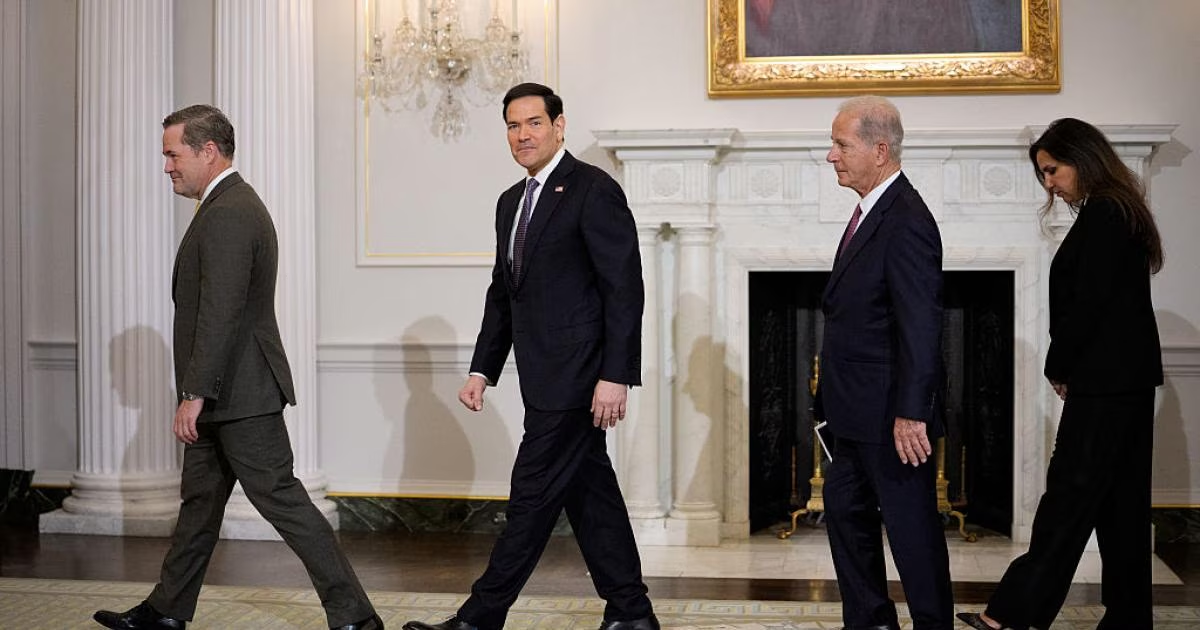
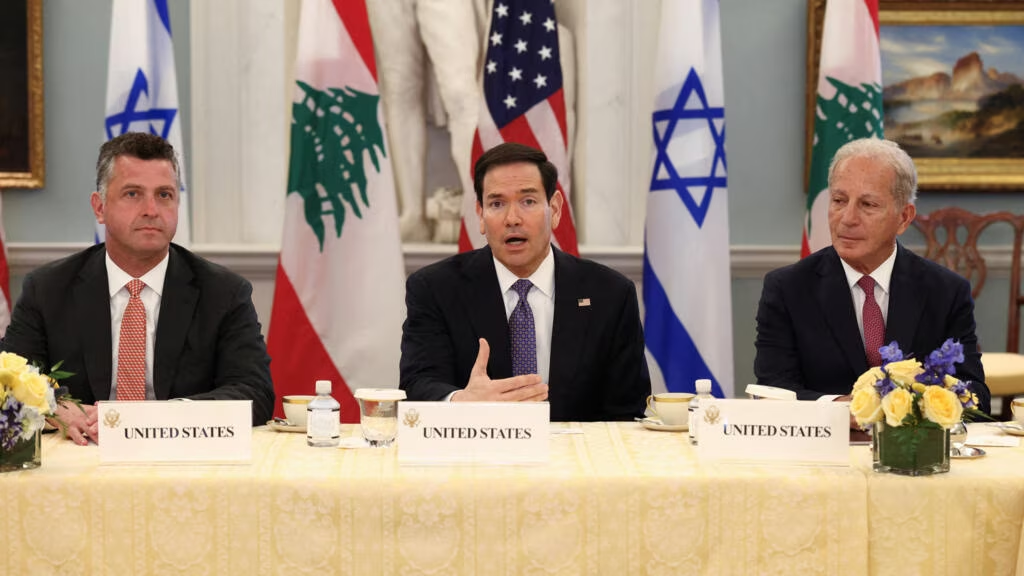
In a move that sparked widespread political debate, the US capital, Washington, hosted a meeting between the Lebanese Ambassador to the United States, Nada Mouawad, and the Israeli Ambassador to Washington, Yehiel Leiter, under the patronage of US Secretary of State Marco Rubio, and with the participation of the US Ambassador to Lebanon, Michel Issa, the US Ambassador to the United Nations, Mike Waltz, in addition to the advisor at the US State Department, Michael Wyndham.

Israeli Ambassador Leiter is known for being one of the most extreme settlers. He was born and raised in America before making a settlement located north of Ramallah in the occupied West Bank his residence for many years. He did not stop at living there but also contributed to the establishment of 'One Israel Fund,' an organization dedicated to raising financial donations to support settlement projects and consolidate the presence of settlers in the occupied Palestinian territories.

According to a US State Department official who spoke on condition of anonymity, preparations for this meeting lasted for about a full month, i.e., before the date of the US-Iranian negotiations in Islamabad was set, in a clear attempt to separate the two tracks, despite their temporal overlap. The official stressed that the US administration believes there is no link between the talks with Iran and this Lebanese-Israeli meeting, indicating Washington's desire to keep each file within an independent negotiating framework.

In the same context of statements, the official emphasized that Iran “has dragged the Lebanese people into a war that it cannot then claim to protect them from,” considering Hezbollah an “unworthy terrorist organization that should have no political role, and its weapons must be completely disarmed,” affirming US support for this goal. He added that Washington would not allow Tehran to determine Lebanon's future, and that this meeting falls within broader efforts to redraw balances in the country away from Iranian influence.

On the humanitarian front, the official revealed that the US State Department recently approved new funding of $58.8 million to support humanitarian programs in Lebanon, aimed at providing vital assistance to displaced persons, including food, healthcare, water, sanitation services, and shelter, as well as supporting emergency response for those most affected by the conflict. He noted that Washington continuously coordinates with international organizations and donors to ensure that this aid is utilized within a coherent and effective international response.

Despite the official diplomatic nature of the meeting, political and media circles viewed it as a step lacking seriousness, considering it merely an attempt to create a visual scene showing Lebanon and Israel side-by-side under an American umbrella, without reflecting actual progress on core outstanding issues. This interpretation suggests that the meeting reflects a desire to achieve media breakthrough rather than a genuine negotiating path, in the absence of any indications of the parties' readiness to address sensitive files.

Critics also believe that the timing of the meeting and the nature of its diplomatic representation suggest that it is closer to a public relations initiative than a serious political effort, especially given the sharp internal Lebanese divisions regarding any form of communication with Israel. They add that this type of meeting may exacerbate internal tensions instead of contributing to their resolution, by giving the impression of an undeclared normalization process.

Observers warn that the American focus on disarming Hezbollah, regardless of addressing the broader context of the Lebanese crisis, may lead to counterproductive results, as this approach is seen as ignoring complex internal balances and reducing the crisis to its security dimension only, overlooking its political and economic roots.

This meeting reflects a traditional American approach that focuses on managing crises rather than solving them, where the emphasis is on creating superficial dialogue platforms without providing the necessary political conditions for their success. The absence of a clear agenda and the non-involvement of key Lebanese parties make it difficult to consider this meeting a serious step towards a sustainable settlement. Moreover, the insistence on separating negotiating tracks, despite their actual interconnectedness, reflects a simplistic reading of the complexities of the regional scene, which limits the chances of achieving a real breakthrough.

The meeting also raises the issue of Lebanese sovereignty, as its arrangement and management appear to have been largely carried out according to an external agenda, without clear internal Lebanese consensus. This reality reinforces the impression that Lebanon remains an arena for settling regional and international scores, rather than being an active party in determining its political path. Furthermore, focusing on disarming Hezbollah as the sole entry point for a solution ignores internal power balances and may complicate the scene rather than simplify it.

It is clear that the media dimension was strongly present in this meeting, as the appearance of representatives from Lebanon and Israel in one picture under American patronage constitutes a symbolic message directed at more than one party. However, this symbolism, in the absence of real political content, may be counterproductive, as it reinforces doubts about the meeting's objectives and fuels narratives rejecting any diplomatic openness. Therefore, the success of any future path requires moving beyond the logic of image towards a deeper and more realistic approach.

OPINIONS

Wed 15 Apr 2026 11:14 am - Jerusalem Time

The Limits of Excessive Force: How Asymmetric Deterrence Made Negotiation Inevitable?

Ramallah - “Alquds ” dot com

Ramallah - “Alquds ” dot com

Opinion Writer

Recent military shifts in the region have proven that the pursuit of excessive armament is no longer the sole guarantor of political or field victories. Despite vast disparities in defense budgets, qualitative armament and negotiated solutions have emerged as an indispensable strategic alternative in contemporary international relations, especially after direct confrontations revealed the limitations of conventional power against smart deterrence strategies.

Figures indicate a wide gap between major powers and developing nations, with the US defense budget exceeding $919 billion, equivalent to more than a third of global military spending. However, this financial superiority has not translated into military decisive action against a country like Iran, whose defense budget does not exceed $7.9 billion, reflecting a shift in the concept of power from quantity and massive equipment to quality and military intelligence.

Joint military operations aimed at crippling Iranian capabilities revealed the inability of modern technologies to achieve their political objectives, despite continuous raids for 40 days and the use of the deadliest bombs. This failure to neutralize command and control centers or overthrow the political regime confirms that advanced technology alone is not enough to break the will of nations that possess asymmetric defense systems capable of absorbing shocks.

In a related context, the ongoing war of annihilation in the Gaza Strip stands out as additional evidence of the limits of excessive force, as the occupation failed to achieve its primary goal of forcing the resistance to surrender. Despite widespread destruction and massacres committed against civilians, field steadfastness has proven that the impact of technical and quantitative superiority diminishes in the face of strong political will and those who refuse to compromise on their national principles.

This new reality stems from the breaking of the West's monopoly on advanced technology, as technical knowledge has become shared and accessible to Southern countries through faster and less costly means. The rise of China as a dominant technological power has played a pivotal role in this transformation, especially with its complete control over supply chains for rare metals and nano-chips, enabling developing countries to build defense arsenals capable of confronting the strongest armies in the world.

These lessons learned are expected to prompt countries worldwide to conduct a deep review of their military doctrines, shifting from investing in heavy equipment and traditional mechanisms to focusing on missile and drone control systems. Radar systems, electronic jamming methods, and satellite reconnaissance will become the cornerstone of future defense budgets, ensuring the achievement of deterrence balance at the lowest possible costs.

Ultimately, major powers will find themselves compelled to accept the concept of asymmetric deterrence and resort to negotiated approaches as the only rational option to avoid wars of attrition. Were it not for the arrogance and extremist ideological tendencies dominating decision-making circles in Washington and Tel Aviv, the world would be safer, especially with the emergence of Chinese wisdom that prioritizes economic and political stability over considerations of military dominance.

Advanced technology is no longer the exclusive domain of the capitalist West, and the new reality has forced major powers to re-evaluate their calculations and accept the concept of asymmetric deterrence.

OPINIONS

Wed 15 Apr 2026 4:48 am - Jerusalem Time

Sanctioning Truth: How the West Turned on Francesca Albanese Instead of Defending Human Rights


By: Said Arikat


April 15, 2026


News Analysis


Washington, D.C- Julian Borger’s reporting in The Guardian lays bare a disturbing inversion at the heart of Western policy: rather than defending the universal principles they claim to uphold, the United States and key European governments have, in the case of Francesca Albanese, chosen to target the messenger. His portrait of the UN special rapporteur is not only the story of one official under siege, but an indictment of a political order that punishes dissent more swiftly than it confronts alleged war crimes.


I have known Julian Borger since 2003, and I have known Francesca Albanese since she assumed her role as UN Special Rapporteur. From that vantage point, I can say with confidence that few journalists match Borger’s professionalism, rigor, and integrity as an interviewer. Equally, it is hard to think of a human rights advocate as steadfastly principled as Albanese—someone whose integrity is not only evident but immovable, even under extraordinary pressure. She is relentless, unyielding in the face of intimidation, and unwavering in her commitment to the truth, regardless of the personal or political cost. In a field that often rewards caution, her stubborn integrity sets her apart as one of the most formidable voices in human rights today.


Albanese’s offense, in essence, has been to speak with clarity. In the wake of the October 7, 2023 Hamas attacks and Israel’s devastating military response in Gaza, she became the first UN official of her rank to characterize Israel’s actions as genocide. Whether one agrees with that legal conclusion or not, it is a claim grounded in her mandate: to investigate and report on human rights violations. Yet instead of engaging with the substance of her findings, Washington and several European capitals moved to discredit, isolate, and ultimately punish her.


The sanctions imposed by Donald Trump’s administration represent a particularly egregious example. By designating Albanese in a category typically reserved for terrorists and transnational criminals, the United States crossed a dangerous line. This was not mere diplomatic disagreement; it was an attempt to erase her capacity to function. As Borger recounts, the consequences have been sweeping—financial exclusion, the seizure of property, and restrictions so severe they amount to what has been described as a “civil death.” Such measures are not only disproportionate; they are fundamentally incompatible with the principles of due process and free expression that the United States claims to champion.


Europe’s role, while sometimes less overt, has been no less troubling. Germany’s attempt to suppress Albanese’s public appearances, reportedly going so far as to deploy police and threaten arrest over her language, reflects a broader pattern of constraining debate on Israel-Palestine. The justification—protecting the memory of the Holocaust or preventing antisemitism—is, of course, serious and necessary. But when such concerns are used to silence legitimate criticism of a state’s conduct, they risk being instrumentalized in ways that ultimately undermine both human rights and historical responsibility.


The United Kingdom and other European governments have likewise failed to provide meaningful support for an independent UN mandate holder facing extraordinary pressure. Instead, their posture has too often mirrored Washington’s: cautious at best, complicit at worst. The result is a chilling message to international civil servants and human rights advocates alike—step beyond the bounds of acceptable discourse, and you may find yourself abandoned or worse.


What makes this response particularly indefensible is the scale of the humanitarian crisis that forms its backdrop. The war in Gaza has produced staggering levels of death, displacement, and destruction. Entire neighborhoods have been reduced to rubble; civilian infrastructure has been decimated; and a population already living under blockade has been pushed to the brink. In such circumstances, the need for rigorous, independent scrutiny is not optional—it is essential. Yet instead of strengthening mechanisms of accountability, Western governments have chosen to undermine one of the very figures tasked with providing it.


Borger’s interview also highlights the personal cost of this political failure. Albanese has faced death threats, harassment, and sustained campaigns against her family. These are not the actions of a system confident in its moral standing; they are the symptoms of a climate in which dissent is treated as danger. That such conditions have been tolerated—if not implicitly encouraged—by governments that regularly invoke human rights as a cornerstone of their foreign policy is deeply revealing.


There is, of course, a broader context to this reaction. Albanese’s reports do not stop at documenting alleged violations by Israel; they extend responsibility to the network of states and corporations that enable them. This includes arms suppliers, financial institutions, and political allies—many of them in the United States and Europe. In this sense, the backlash against her is not only about what she has said regarding Gaza; it is about what her findings imply for those who have supported, financed, or defended the status quo. To accept her conclusions would require a level of self-scrutiny that Western governments have thus far been unwilling to undertake.


Critics argue that Albanese’s rhetoric blurs the line between legal analysis and political advocacy, potentially weakening the impact of her work. There is merit in the concern that international law depends on precision and restraint. But this critique cannot justify the punitive measures she has faced. Disagreement with tone or framing should be addressed through debate, not sanctions or suppression. To conflate the two is to erode the very norms that underpin democratic societies.


Ultimately, the treatment of Francesca Albanese is a test—one that the United States and Europe are, at present, failing. It is a test of whether human rights are truly universal, or whether they are contingent on political convenience. It is a test of whether international institutions can operate independently, or whether they will be bent to the will of powerful states. And it is a test of whether those who speak uncomfortable truths will be protected or punished.


Julian Borger’s reporting makes one thing clear: this is not simply about one rapporteur or one conflict. It is about the credibility of a system that claims to stand for justice while sidelining those who seek to uphold it. If Western governments continue down this path—prioritizing alliance politics over accountability, and suppression over scrutiny—they risk not only abandoning the Palestinians, but also hollowing out the very ideals they profess to defend.

ISRAELI AFFAIRS

Tue 14 Apr 2026 4:06 pm - Jerusalem Time

Honoring a Rabbi Who Boasted of Gaza's Annihilation: Israel Chooses a 'Symbol of Destruction' to Light Its Celebration Torch

Hebrew press reports revealed the decision by the Minister of Transportation in the occupation government, Miri Regev, to choose Rabbi Avraham Zerbiv to participate in the main torch-lighting ceremony as part of the so-called 'Independence Day' celebrations. This choice comes despite the controversial record of the rabbi, who serves as a reserve officer in the army, having openly boasted about systematic destruction operations in the Gaza Strip.

Haaretz newspaper, in its editorial, considered this decision further evidence of the internal collapse Israel is experiencing and its loss of moral compass. The newspaper pointed out that honoring a figure who adopts genocidal rhetoric reflects the current government's tendency to normalize violence and mass destruction as an official state policy.

Published photos of Rabbi Zerbiv documented blatant violations, with one showing him occupying a school classroom in the Gaza Strip, placing his military weapon on a Muslim prayer rug. The photos also showed writings on the school walls indicating the establishment of a 'rabbinical court' in the heart of Khan Yunis city, signaling the extreme religious dimension in military operations.

The matter did not stop at photos; Zerbiv also posted a video clip on social media platforms showing him driving a military bulldozer to demolish a residential building in Gaza. This video gained widespread circulation, with the rabbi considering it a source of pride, which prompted Minister Regev to nominate him for this official honor in government celebrations.

In subsequent statements to the media, Zerbiv affirmed his extremist vision towards the Strip, saying that the solution lies in completely leveling Gaza to the ground. These statements were met with sharp criticism from left-wing and liberal circles within Israeli society, who saw them as an embodiment of war crimes committed under political cover.

Haaretz strongly criticized Minister Miri Regev's stance, describing her as indifferent to how the outside world views these actions. The newspaper added that the current government believes it lives in isolation from international values and the Western civilization it claims to belong to, while it is immersed in glorifying war and destruction.

Reports noted the transformation of the rabbi's family name 'Zerbiv' into a new linguistic verb in colloquial Hebrew, where the term 'to zerbiv' now means erasure and mass destruction. This term is currently used to describe what Gaza has suffered from the complete obliteration of residential neighborhoods, reflecting the deep penetration of the idea of annihilation into the Israeli collective consciousness.

Journalistic circles believe that using a person's name as a verb to express destruction is a powerful indictment of current Israeli policy, which has adopted this rabbi's behavior as a general approach. The phrase 'Israel zerbived Gaza' has come to embody the grim image the state presents to the international community, far from any humanitarian or legal standards.

For her part, Yedioth Ahronoth writer Einav Schiff launched a scathing attack on the decision to honor, asserting that the right-wing government is destroying all attempts to beautify its image abroad. Schiff said that choosing a person who represents 'ethnic cleansing' to light the torch is a clear message that extremists are leading the official scene.

Schiff added that the Minister of Transportation, and the government behind her, are directly contributing to confirming the international accusations directed at Israel, instead of trying to deny them. She considered that this behavior reinforces Israel's international isolation and places it in the category of countries that celebrate human rights violators and war criminals.

This controversy reflects a sharp division within Israeli society regarding the ethics of the war in Gaza, where the far-right sees Zerbiv as a national hero worthy of honor. In contrast, his critics see his honoring as an 'indelible stain' and confirmation that Israel has lost its conscience in the rubble of destroyed homes in the Strip.

Choosing Zerbiv to light the torch is not just a procedural measure, but a political declaration of Israel's new identity that prides itself on destruction. The rabbi who turned a prayer rug into a platform for his weapon has today become the symbol the government has chosen to represent its values in its most important national celebrations.

Reports concluded that Israel's standing in the world has become closely linked to the images of destruction proudly promoted by its soldiers and rabbis. With the continuation of these policies, it seems that the gap between Israel and universal human values is widening, under a government that finds no shame in celebrating extremism and devastation.

We simply need to level the Strip to the ground.

ISRAELI AFFAIRS

Tue 14 Apr 2026 4:06 pm - Jerusalem Time

Israeli Health: Number of Injured Rises to 7740 Due to Clashes with Iran and Lebanon

The Israeli Ministry of Health, in an official statement issued on Tuesday, revealed new updates regarding the human casualties among settlers, confirming that 47 people were injured during the past twenty-four hours. With this new statistic, the total number of injured recorded by medical departments rises to 7740 since the start of the current round of military escalation on the Iranian and Lebanese fronts, which has seen an intensification of cross-border combat operations.

Medical sources clarified that the recent injuries resulted from barrages of ballistic missiles launched from Iranian territory, in addition to shells and rockets launched by Hezbollah from southern Lebanon towards settlements and occupied cities. Reports also indicated that some of these injuries occurred due to stampedes and falls suffered by residents as they rushed to fortified shelters immediately after sirens were activated in various areas, with the severity of cases ranging from mild to moderate and serious.

Regarding the health status of the injured within medical facilities, reports indicated that about 120 injured individuals are still in hospitals receiving necessary treatments, including a limited number of cases described as very critical. This continuous increase in the number of injured comes since the outbreak of direct confrontation with Iran in late February, a confrontation that has expanded to include the northern front with Lebanon more fiercely in recent weeks.

Despite the significant increase in the number of injured, sources stated that the death toll on the Israeli side remains relatively limited compared to the scale of the bombardment, with estimates ranging between 23 and 33 fatalities. Reports attributed this disparity to the effectiveness of air defense systems and early warning systems that reduce direct human losses, while the opposing fronts in Lebanon and Iran are witnessing heavy human and material losses due to intensive airstrikes carried out by the Israeli Air Force.

The past twenty-four hours recorded 47 Israeli injuries, raising the total number of injured to 7740 people since the outbreak of military confrontations.

ISRAELI AFFAIRS

Tue 14 Apr 2026 4:06 pm - Jerusalem Time

Israeli Pessimism Regarding Washington's Negotiations with Lebanon and Expectations of Renewed Confrontation

A state of skepticism prevails within political and security circles in Israel regarding the possibility of achieving a serious breakthrough in the ongoing negotiations between the Israeli and Lebanese ambassadors in Washington. Analytical readings indicate that Israel still expects the failure of diplomatic tracks, not only on the Lebanese front, but even in the Iranian nuclear file, where the military establishment is preparing for the possibility of renewed war.

Leaks from within the Israeli security establishment indicate that the gap between the two sides is still very deep, making the option of military escalation closer than political settlement. Tel Aviv fears that any agreement between Washington and Tehran might give the latter an opportunity to restore its military and missile capabilities, which directly reflects on the strength of its allies in the region, especially Hezbollah.

For his part, military analyst Amos Harel warned that the Israeli leadership's continued search for a 'victory image' could lead to counterproductive results that threaten the army's efficiency. Harel pointed out that the chances of success for the Washington negotiations are slim, given that the declared Israeli goal is to dismantle Hezbollah's military structure, which the party rejects outright.

Observers believe that Israel found itself compelled to sit at the negotiating table in response to direct pressure from US President Donald Trump's administration. This shift comes after a long period of Israeli rejection of Lebanese demands, as Benjamin Netanyahu's government currently adopts a security doctrine based on exercising maximum military force to impose its conditions.

In a related context, media sources explained that Netanyahu is trying to balance American pressure with his promises to the Israeli public to crush Hezbollah's capabilities. Washington has provided Netanyahu with a diplomatic exit by launching 'peace negotiations' essentially aimed at reaching a temporary ceasefire or reducing the intensity of combat operations without appearing defeated.

Israeli experts recall previous failed experiences in negotiating with Lebanon, such as the 1983 attempts that did not yield tangible results on the ground. Professor Eyal Zisser confirms that the Lebanese side is currently focused on securing a ceasefire only, without possessing the actual ability to implement Israel's demands regarding the disarmament of armed factions.

Zisser adds that the official Israeli narrative that speaks of permanently weakening Hezbollah lacks accuracy, stressing that the party still retains a huge arsenal of missiles and drones. According to his estimates, Hezbollah is capable of managing a long-term war of attrition, citing the failure to decisively end the battle in the Gaza Strip despite a long time since its outbreak.

On the ground, reports indicate that Hezbollah still controls the initiative at many border points despite the limited Israeli incursion. Observers believe that the advance of Israeli forces has not exceeded a few kilometers in some axes after weeks of fighting, which reinforces the party's narrative about its ability to withstand and confront.

On the other hand, the fundamental disagreement over the timing of the ceasefire emerges, as Lebanon stipulates a cessation of military operations as a first step preceding any diplomatic coordination. In contrast, the Israeli government insists on the principle of 'negotiating under fire,' wishing to continue military pressure to achieve greater political gains at the negotiating table.

Analyst Tzvi Bar'el considered these negotiations to represent a 'sovereignty test' for the Lebanese state and the future of its institutions in light of the ongoing conflict. He pointed out that the gaps in positions are not only technical but relate to each party's vision for the future stability on the shared borders, which makes reaching a comprehensive agreement elusive at present.

Regarding the Iranian role, Tehran clearly linked the Islamabad negotiations track with the field developments in Lebanon, complicating the regional scene. This linkage places the Israeli negotiator before the challenge of dealing with multiple interconnected fronts, where any understandings in Washington affect the balance of power in the entire region.

In conclusion, all eyes remain on the outcome of the Washington meetings, despite the prevalence of pessimism in the statements of officials and analysts in Tel Aviv. With the continued mutual shelling, it seems that the field will remain the primary arbiter in determining the ceiling of political demands for both Israel and Lebanon in the coming period.

Israel is going to these negotiations reluctantly and at Trump's request, after having previously rejected the Lebanese government's requests for negotiations.

ARAB AND WORLD

Tue 14 Apr 2026 4:05 pm - Jerusalem Time

Deadly Israeli Escalation in Lebanon: Martyrs in Bekaa and the South, and a Plan to Isolate Western Bekaa Villages

The Israeli army has intensified its aerial attacks on wide areas in South Lebanon and Western Bekaa, resulting in the martyrdom of several individuals and injuries among civilians. The raids included the destruction of dozens of residential units and targeting municipal centers, amidst ongoing aggression that affected the towns of Qleileh, Shemaa, the outskirts of Shebaa, and Arabsalim.

In the Western Bekaa region, intense shelling focused on the town of Sahmar, where field sources reported the martyrdom of four members of one family: a mother and her three children. This direct targeting led to the complete destruction of more than ten homes, causing widespread panic and devastation in the residential area.

Local sources reported the fall of two martyrs in an airstrike that targeted the Al-Mahmoudiya area near the town of Aishiya in the Jezzine district. The town of Adloun also recorded the fall of three more martyrs due to a similar raid, while warplanes continued to sweep Lebanese airspace and carry out precise strikes on civilian targets and infrastructure.

In the town of Arabsalim, an airstrike targeted a house in the Al-Hara Al-Tahta area, leading to the martyrdom of two people and injuring a woman with varying degrees of severity. The strike leveled the house to the ground and damaged neighboring buildings, amidst attempts by residents to pull victims from under the rubble.

Regarding drone operations, an Israeli drone targeted a civilian car on the Al-Musaylih - Nabatieh road after midnight. The attack resulted in the martyrdom of two people inside, as part of the assassination and pursuit policy adopted by the occupation on vital roads connecting southern cities.

The center of the Hosh-Sour area witnessed extensive destruction affecting shops, electricity networks, and homes, following a series of violent raids that targeted the area. These attacks caused power outages in wide neighborhoods, increasing the suffering of residents trapped in those areas under the weight of continuous shelling.

Field data indicates that Israeli aviation is specifically targeting the town of Sahmar, one of the six towns recently included in forced evacuation orders. This military focus aims to impose a new security reality that isolates the town from its geographical surroundings in Western Bekaa and the South.

Through intensifying raids on Sahmar and its surroundings, Israeli forces seek to cut off supply and movement routes between it and the villages of Yahmar, Zlaya, and Qleileh. This move comes within a strategy aimed at paralyzing movement in Western Bekaa and separating villages from each other by targeting vital bridges and mountain passes.

Ambulance and civil defense teams face immense challenges in reaching targeted sites to provide assistance and evacuate the injured. This is due to the intensive flying of drones that target any movement on the roads, making rescue operations fraught with high risks and taking longer than usual.

A state of extreme tension and anxiety prevails among the residents of Western Bekaa villages, with fears of the aggression expanding to include new areas that were not within the direct target bank. These fears coincide with the continued intensive military flights that do not leave the airspace, portending a new wave of field escalation.

The intensity of the targeting in Sahmar and its surroundings practically aims to isolate the town and the villages located south of it, which hinders movement between them and the villages of Western Bekaa.

PALESTINE

Tue 14 Apr 2026 4:05 pm - Jerusalem Time

Sanders moves legislatively to stop arms exports to the occupation and accuses Netanyahu of committing genocide

US Senator Bernie Sanders announced an upcoming legislative move aimed at freezing massive arms deals destined for the Israeli occupation army. Sanders affirmed in his statements that he would seek to force a vote in the Senate to prevent the export of bombs, military equipment, and bulldozers estimated at about $500 million, stressing that US taxpayers should not contribute to funding the current war machine.

The US Senator described Benjamin Netanyahu's government as representing an extremist current leading operations that amount to genocide in the Gaza Strip. He pointed out that continued unconditional military support is no longer acceptable in light of the crimes committed against civilians, considering that the time has come for a radical review of the security relationship between Washington and Tel Aviv, which drains American resources in destructive conflicts.

These parliamentary moves come at a time when the American political scene is witnessing a sharp division between the Democratic and Republican parties over the feasibility of continuing to arm the occupation. The bill is expected to spark heated debates within the halls of Congress, as popular pressure is increasing to stop Israeli violations and adhere to international laws that prohibit the use of American weapons in war crimes.

Regarding public opinion, recent data issued by the 'Pew' Research Center revealed a tangible shift in Americans' view of the occupation state, with the percentage of those with a negative view reaching about 60 percent. The results also showed that nearly 59 percent of respondents do not trust Netanyahu's ability to make balanced international decisions, which reflects a significant decline in popular support for Israeli policies within the United States.

In a related context, Sanders did not neglect to criticize internal political behavior, as he attacked former President Donald Trump's statements against the Pope of the Vatican after the latter criticized the war. Sanders described Trump's attack as 'disturbed and selfish' behavior, criticizing attempts to employ religious symbols in political conflicts, and emphasizing the need to respect international voices calling for a halt to military escalation in the region.

This week I will force a vote on legislation aimed at preventing the sale of nearly half a billion dollars worth of bombs and bulldozers to the Israeli army.

ARAB AND WORLD

Tue 14 Apr 2026 4:05 pm - Jerusalem Time

Clash of Values and Interests: Pope Leo XIV Confronts Trump's 'Power Diplomacy' in the Iran War

Since ascending to the Holy See in May 2025, Pope Leo XIV of the Vatican has pursued a cautious path towards the American administration, avoiding mentioning President Donald Trump by name until last March. This break from silence came in the form of a rare appeal to end military operations against Iran, warning of the escalating hatred in the Middle East. Reports reveal a deep chill in bilateral relations, with no meeting between the two parties yet, despite repeated invitations.

Pope Leo, who made history as the first pontiff of American origin, succeeded the late Pope Francis, who passed away in April 2025. Although his election was a source of pride for many Americans, including President Trump, expectations of a rapprochement quickly faded. Subsequent positions showed a radical divergence in ethical and political views on issues of immigration and international armed conflicts.

In a move reflecting the extent of the coolness, press sources reported the Pope's refusal of an official invitation to attend the celebrations of the 250th anniversary of the founding of the United States. Reports quoted Vatican officials confirming no intention to visit Washington as long as the current policies of the American administration continued. This stance comes despite the participation of senior American officials, such as J.D. Vance and Marco Rubio, in the Pope's inauguration ceremony in their capacity as Catholics.

Tensions escalated publicly after the Pentagon summoned the Vatican's representative to Washington, Cardinal Christophe Pierre, last January. This action came in response to the Pope's criticisms of the use of military force, with American officials informing the Holy See's representative that Washington had the ability to impose its will militarily. The United States Ambassador to the Vatican later attempted to downplay the incident, describing the meeting as a frank discussion about political ethics.

With the outbreak of the American-Israeli war on Iran on February 28, 2026, the confrontation entered a new phase of verbal and moral escalation. The Pope considered the recourse of leaders involved in the conflict to religious discourse to justify the war as utterly unacceptable. He emphasized in his homilies that 'God does not listen to those who make war,' a clear reference to rejecting the use of Christian symbols in armed conflicts.

On the ground, the war caused devastating human losses, including the assassination of senior Iranian leaders and the destruction of extensive infrastructure, which raised deep concern in the Vatican. The Pope expressed his profound sorrow for the killing of civilians, including Father Pierre Raad of the Lebanese town of Qleia, who died in an Israeli bombardment. These events prompted the Holy See to intensify its calls to stop the 'cycle of violence' that now threatens global stability unprecedentedly.

The Vatican strongly criticized what it described as 'power diplomacy' and the decline of international multilateralism in favor of military fervor that began to spread in various regions. The Pope warned that war had once again become 'the fashion of the age,' criticizing the undermining of state sovereignty and direct military interventions. These positions placed the Catholic Church as a moral force in direct confrontation with the military and political ambitions of the current American administration.

In contrast, the American administration was quick to respond, with the White House spokesperson describing the Pope's statements as weak, considering prayer for military personnel a noble act. This disagreement highlights the significant gap between the Vatican's vision of global peace and Washington's vision, which relies on military superiority. Observers interpreted this debate as a direct response to the US Secretary of Defense, who uses religious language associated with historical wars.

The final days of March witnessed an escalation in the Pope's tone, as he explicitly called on President Trump to seek a peaceful resolution to the conflict. This call came at a time when tensions were at their peak, with Washington threatening to completely destroy Iranian civilization. The Pope considered such threats unacceptable and contrary to the most basic human and religious values advocated by the Church.

Despite the announcement of a temporary ceasefire on April 8, doubts still surround the prospects for lasting peace given the complex conditions of both parties. Sources indicate that the first round of negotiations failed after long hours of discussions due to conflicting American and Iranian demands. The exclusion of the Lebanese front from the truce further complicated the humanitarian and political landscape in the region.

Incoming reports confirm that the American administration's bet on regime change in Tehran in a short period did not materialize, leading to increased global economic pressures. The closure of the Strait of Hormuz continues to cast a shadow over supply chains and energy supplies, putting the world before a suffocating economic crisis. In this context, the Vatican believes that military solutions have proven ineffective in achieving the desired stability.

This conflict brings to mind the legacy of the late Pope Francis, whose relationship with Trump was also strained due to immigration and climate change issues. It seems that Pope Leo XIV is following the same approach but with greater intensity imposed by the conditions of direct war. The current tension goes beyond political differences to reach the core of religious identity and how it is represented in the public sphere.

The Catholic Church continues to exert its moral pressure by calling on citizens of the concerned countries to contact their leaders to reject the option of war. The Vatican believes that solidarity with the victims in schools, hospitals, and residential areas is the primary duty under these circumstances. The Pope's calls for peace remain a cry against what he describes as the 'absurd claim' that conflicts can be resolved through armed force.

In conclusion, the world awaits what the coming days will bring amidst the fragility of the announced truce and the continued military buildup in the region. The Vatican's position remains firm in opposing the 'logic of force,' emphasizing that true peace is not built on the ruins of civilizations. With diplomatic channels remaining closed, the clash between the Holy See and the White House is poised for more chapters under an administration that places military power above all else.

God does not listen to the prayers of those who make war, and their hands are stained with blood.

ISRAELI AFFAIRS

Tue 14 Apr 2026 4:05 pm - Jerusalem Time

Israeli Study Center: Ceasefire with Tehran a 'Fragile Truce' Hiding Future Conflict

Research sources in Tel Aviv reported that the current strategic vision aligns with government directives in considering the conditional ceasefire with Iran as merely a temporary de-escalation. A strategic affairs research center believes that this agreement, which came after forty days of military confrontation, does not provide real guarantees for ending the fighting or achieving a decisive victory over the Iranian project in the region.

The institute noted in its analysis that the ceasefire, brokered by Pakistan, represents a diplomatic truce to alleviate humanitarian suffering, but it lacks the required sustainability. The sources confirmed that the fragility of this path raises widespread concern in security circles, as its success is linked to the extent of the American administration's insistence on enforcing the fifteen provisions put forward by Donald Trump as a framework for a solution.

The analytical reading warned that the ongoing negotiations in Islamabad would be complex and long-term, with the possibility of military operations resuming at any moment not ruled out. The institute considered that the military achievements remain incomplete unless the Iranian nuclear threat is fully neutralized and the development of cross-border ballistic missiles is halted.

Israeli sources claimed that Tehran is trying to market the agreement as a 'great victory' to cover up the extent of the losses inflicted on its infrastructure and its collapsing economy. The analysis claimed that the Iranian regime has become internationally isolated after losing a large part of its missile arsenal and its field military leaders, amidst a suffocating living crisis suffered by the population inside the country.

Despite these losses, the institute acknowledged that geography poses major challenges, as Tehran is more than 1900 kilometers away from the Israeli border, making it a global threat. The study affirmed that Israel, despite its regional power, does not possess the sole ability to overthrow the regime in Tehran, which requires high-level strategic coordination with Washington.

Based on these facts, the center recommended that the United States be entrusted with leading the negotiating process with Iran, while the Israeli army focuses on confronting direct threats on the borders. The report stressed that the highest priority should be given to dismantling Hezbollah's capabilities in Lebanon and Hamas in the Gaza Strip to ensure the security of settlements in the north and south.

The institute criticized what it described as the 'arrogant' speeches of some Israeli leaders that find no way to be implemented on the ground, calling for focusing on protecting residents in the front lines. It called for increasing military pressure on Hezbollah in parallel with opening direct diplomatic channels with the Lebanese government to impose a new security reality away from the influence of militias.

The center also directed sharp criticism at the European position, describing the absence of the old continent from the confrontation with Iran as 'shameful'. It urged European countries to fully classify Hezbollah as a terrorist organization and support talks aimed at disarming it, considering that the stability of the Middle East is linked to ending the hegemony of Shiite militias over Lebanese decision-making.

In a related context, the institute claimed that field changes in Syria and the collapse of some Iranian military capabilities may open the door to new opportunities for normalization in the region. Analysts believe that weakening the Iranian axis will facilitate the process of integrating Israel into the regional system, especially with Gulf countries that see Tehran as a common threat to their interests.

The center concluded that Israel must adopt a flexible diplomatic policy that demonstrates the 'justice of its cause' to the international community, instead of relying entirely on military force. It stressed that changing the rules of the game requires a bold strategy that balances military deterrence with smart political action in international forums and social media platforms to enhance Israel's image.

A partial agreement that does not end the nuclear threat or stop ballistic missiles will be a bitter victory for Israel.

ISRAELI AFFAIRS

Tue 14 Apr 2026 4:05 pm - Jerusalem Time

Phase of "Uncertainty": Israeli Assessments Warn of Ambiguity in US-Iranian Negotiations and Comprehensive Military Alert

A state of ambiguity and sharp fluctuations dominates the ongoing negotiations between the United States and Iran, with the final picture of the diplomatic path completely absent from clear expectations. Probabilities currently oscillate between reaching partial understandings or returning to open escalation, leaving the region in a state of cautious anticipation.

According to analyses published by Hebrew media sources, the current negotiation approach is extremely dangerous, as the parties employ tactics based on intense pressure and sudden withdrawal at the last minute. This pattern of crisis management keeps all international actors in a constant state of waiting, with increasing chances of the political path collapsing at any time without warning.

Sources indicated that this ambiguity forces the Israeli military establishment to remain on constant alert and at maximum readiness, given the absence of indicators that definitively determine the direction of events. Analysts believe that the Israeli army finds itself compelled to deal with an unstable reality, where it is impossible to predict whether the path will lead to an agreement or a military confrontation.

In light of these assessments, the Israeli military command has raised the level of alert in the air force and intelligence agencies, in addition to intensifying the activity of operational circles. These steps come as part of preparations for the possibility of resuming direct confrontation, especially with increasing fears of miscalculation by any party.

Security circles in Tel Aviv fear that misunderstanding or misreading diplomatic moves could lead to preemptive escalatory steps, which could ignite a wide regional crisis. Therefore, the current phase is being treated as an "undecided" phase that requires careful monitoring of every small detail behind the scenes of international talks.

In parallel with the tension on the Iranian front, the Lebanese arena emerges as an additional pressure element in the regional equation, where violent confrontations continue in the southern regions. These field operations are taking place at a time when political corridors are witnessing indirect talks aimed at containing the situation, but the complexities on the ground still dominate.

The Israeli army continues its military operations in South Lebanon, focusing on attempts to encircle specific engagement areas to impose a new reality on the ground. Military assessments indicate that the coming days will be crucial and highly sensitive, as political developments are closely linked to the balance of power emerging in the field.

On the internal Lebanese front, reports have observed an increase in the intensity of political tensions and differences in positions among various components regarding what is happening on the border. Initial indications of attempts to redraw lines of influence within the Lebanese arena are emerging, coinciding with the continued intense Israeli military pressure on southern villages and towns.

The state of "cautious waiting" that hangs over the regional scene reflects the complexity of intertwined issues, from the Iranian nuclear program to direct confrontation fronts. The final decision on war or peace remains pending, awaiting what the coming hours will bring in terms of sudden diplomatic or field movements.

Hebrew sources confirmed that the cinematic analogies applied to the negotiating reality reflect the extent of frustration at the inability to reach tangible results. The current political game relies on nerve-wracking, with each party trying to improve its terms by brandishing military force at times, and diplomatic openness at other times.

In this context, Israeli intelligence remains in a constant state of scrutinizing Iranian intentions, trying to decipher the contradictory messages emanating from Tehran. The security establishment believes that any laxity in monitoring could give adversaries an opportunity to achieve strategic gains at the expense of Israeli security, which explains the declared state of alert.

The report also touches on the fact that international pressures have so far failed to break the stalemate, but have rather complicated the calculations of decision-makers in Tel Aviv. The United States seeks to avoid comprehensive escalation, while Israel believes that Iranian procrastination serves Tehran's goals of strengthening its regional influence and developing its military capabilities.

The field in South Lebanon is still boiling, with raids and limited ground operations continuing amidst anticipation of the results of international contacts aimed at a ceasefire. Observers believe that the link between the Lebanese front and the Iranian file has become a reality that cannot be ignored in any potential future settlement.

In conclusion, it seems that the region has entered a dark tunnel of possibilities, where no scenario, however extreme, can be ruled out. All eyes remain fixed on Washington and Tehran, awaiting a signal that could end this state of uncertainty, either with an agreement that calms spirits or an explosion that reshapes the region anew.

The Israeli army is dealing with the current situation as an undecided phase, where all scenarios remain open to the possibility of the diplomatic path collapsing.

PALESTINE

Tue 14 Apr 2026 4:05 pm - Jerusalem Time

Government Media Office in Gaza Documents 2400 Israeli Violations of Truce and Martyrdom of 754 Citizens in 6 Months

The Government Media Office in the Gaza Strip issued a detailed report documenting the violations by the Israeli occupation since the ceasefire agreement came into effect on October 10, 2025. The report confirmed that the occupation committed approximately 2400 field and humanitarian violations, posing a direct threat to the stability of the fragile truce and an attempt to undermine all international efforts aimed at alleviating the suffering of the Strip's residents.

Regarding human casualties, official sources reported that these violations resulted in the martyrdom of 754 people over the past six months, including 312 women, children, and elderly. The statement clarified that the percentage of civilians among the victims reached 99%, and more than 2100 citizens were injured due to direct targeting within populated residential areas and away from any military contact points, in addition to recording 50 arrests.

The field crimes carried out by the occupation forces varied to include 921 shooting incidents and 1109 bombing operations targeting various facilities. The report also monitored 97 ground incursions into residential areas, and the engineering units of the occupation army demolishing 273 homes and residential buildings, with continued land grabbing operations and exceeding the agreed geographical boundaries known as the 'Yellow Line'.

Regarding the humanitarian file and crossings movement, the report revealed a sharp decline in the occupation's commitment to the agreed operating terms, as the movement of travelers through the Rafah crossing did not exceed 7% of the assumed operational capacity. This intransigence led to an exacerbation of humanitarian crises for patients, students, and those stranded who had hoped for smooth travel in accordance with the internationally sponsored truce agreement.

As for relief supplies, only 41,714 trucks entered out of 110,000 trucks that were supposed to reach the Strip, representing 37% of the agreed needs. The energy sector was the most affected, as the occupation only allowed the entry of 14% of the necessary fuel quantities, causing a near-complete paralysis of infrastructure reconstruction operations and the shutdown of the only power generation plant.

The Media Office concluded its statement by holding the Israeli occupation fully responsible for the catastrophic consequences of these ongoing violations. The office appealed to the US administration led by Donald Trump and the international sponsors of the agreement to intervene immediately to compel the occupation to fulfill its commitments and ensure the flow of urgent shelter and food aid to address the escalating humanitarian catastrophe in Gaza.

These practices represent a deliberate undermining of humanitarian efforts and a dangerous circumvention of the agreement to impose a policy of starvation and blackmail.

ANALYSIS

Tue 14 Apr 2026 4:03 pm - Jerusalem Time

Lebanese-Israeli Talks in Washington Spark Wide Controversy Amid Lack of Internal Consensus

News Analysis

Washington – Said Arikat – 14/4/2026

On Thursday, a delegation from Lebanon will meet with a delegation from Israel in Washington to discuss the ongoing Israeli aggression against Lebanon. According to a State Department official who spoke on condition of anonymity, the composition of attendees at the meeting itself underscores the sensitivity and high-level interest surrounding these talks. It includes US Secretary of State Marco Rubio, US Ambassador to Lebanon Michel Issa, Advisor Michael Needham, Israeli Ambassador to the United States Yechiel Leiter, and Lebanon's Ambassador to the United States Nada Hamadeh. While the presence of such high-ranking figures may suggest serious intentions, it also raises the stakes in a process that appears to lack both internal legitimacy and strategic clarity.

At a highly sensitive moment for Lebanon, the government's decision to engage in ambassador-level talks with Israel in Washington raises broad questions that extend beyond the diplomatic dimension to the depth of internal political calculations. Instead of reflecting national cohesion or a clear strategic vision, this move seems to deepen the impression of a gap between the authorities and fundamental components of the Lebanese political scene, at a time when current challenges demand the highest degree of coordination and unity.

The fundamental problem lies in the absence of a comprehensive national consensus on this step. Key Lebanese political forces have expressed their rejection or deep skepticism about the utility of engaging in such talks while Israeli military pressure continues. This divergence does not merely reflect a difference in viewpoints but indicates a deeper flaw in the structure of political decision-making, where a step of a sovereign nature is taken without securing sufficient internal cover. In similar contexts, states tend to unify their positions to enhance their negotiating power, while Lebanon appears to be moving in the opposite direction.

The timing of these talks acquires an even more sensitive dimension, as they come amidst ongoing Israeli aggression. In the absence of clear conditions or reciprocal leverage, engaging in dialogue might be interpreted as a gratuitous concession rather than a calculated political initiative. Critics argue that merely holding the meeting grants Israel a diplomatic gain by legitimizing communication, without offering concrete commitments in return, thus exacerbating the imbalance of power from the outset.

In this context, Israeli Prime Minister Benjamin Netanyahu could utilize the convening of these talks to bolster his political and diplomatic standing, especially amid increasing international criticism. The mere existence of a dialogue channel—even if merely formal—provides political material that can be used to suggest engagement in de-escalation efforts, without having to make real concessions on the ground.

The absence of national consensus on this step not only weakens Lebanon's negotiating position but also undermines the very concept of political legitimacy. Effective diplomacy stems from a solid internal base, allowing negotiators to speak on behalf of a unified state, not a divided arena. In the Lebanese case, this condition appears to be missing, turning the negotiation process into a risky endeavor that could open the door to further questioning of the institutions' efficacy and their ability to represent the collective national will.

Another flaw emerges in the structural disparity between the two parties. While Israel enters these talks within a centralized decision-making system and a clear strategy, Lebanon suffers from sharp political divisions and weak institutions. This imbalance directly reflects on the nature of the negotiation, where the Lebanese side lacks the ability to present a unified position or make enforceable commitments, transforming the process into an unequal path in terms of form and content.

Domestically, concerns about the repercussions of this step are compounded by the suffocating economic crisis Lebanon is experiencing, alongside declining public trust in official institutions. Launching a controversial negotiation process at this time could deepen political divisions and fuel doubts about the motives and limits of the decision, especially if done without sufficient transparency or a clear mandate from political and societal forces.

The timing of these talks reflects a fundamental problem in assessing the balance of power. Entering negotiations under a clear imbalance, and without preconditions, might be understood as a response to pressure rather than a deliberate sovereign choice. In the world of politics, the success of diplomacy is not measured merely by sitting at the table, but by the ability to protect national interests and achieve tangible gains. This remains highly questionable in the current situation.

Complications increase with the absence of a clear mandate defining the scope and objectives of the negotiation. Successful diplomacy relies on internal legitimacy, whether through political consensus or institutional support, which does not appear to be sufficiently available in this case. Without this foundation, any potential outcomes remain subject to challenge or reversal, limiting their effectiveness and weakening their sustainability.

Also prominent is the absence of a clear negotiating framework that defines the issues at hand, implementation mechanisms, and guarantees. In the absence of specific criteria or guaranteeing international sponsorship, the talks appear closer to an exchange of political messages than to a fully-fledged negotiation process, which reduces the chances of achieving tangible results or applicable agreements.

According to observers, these talks cannot be separated from the broader regional context, where Lebanon's calculations intersect with balances involving Iran, Israel, and non-state actors. Ignoring this entanglement makes any bilateral negotiation path limited in impact, because it does not address the roots of the crisis but is limited to its manifestations. Without a comprehensive approach that takes these complexities into account, the chances of success remain slim, and diplomacy becomes merely a tool for managing the crisis, not resolving it.

In conclusion, the Washington talks reflect a deeper problem related to the assessment of timing and tools. Instead of strengthening Lebanon's position, they may weaken it by exposing its internal divisions and giving its adversary a diplomatic advantage. While this step is presented as a path to dialogue, it raises serious questions about whether it truly constitutes an entry point to a solution, or merely an attempt to give a diplomatic appearance to an increasingly complex reality.

OPINIONS

Tue 14 Apr 2026 11:21 am - Jerusalem Time

The Change in the Approach of Settlers in the West Bank

In this article, we discuss the practices of settlers in the West Bank, and why the intensity of terrorist acts has escalated recently in the northern West Bank with the support of extremist right-wing currents that control the Israeli government, which seeks to annex the West Bank and make it an integral part of Israel. The Israeli government has taken many decisions supporting settlements and settlers, in addition to providing protection, financial support, and arming hundreds of thousands of them. It has legalized dozens of settlement outposts, both agricultural and pastoral, that control hundreds of thousands of dunams, and given them free rein to burn, kill, assault, and steal citizens' property, specifically livestock, and transfer it to settlement outposts in plain sight of citizens, as settlers now possess one-third of the citizens' sheep after stealing them. Settlers are acting as a state with its army by displacing all Bedouin encampments in Area "C", and all of this aims at complete control over the land, as settlers seek to systematically seize Palestinian lands and annex large parts of the West Bank, which they refer to biblically as "Judea and Samaria," in order to transform them into permanent Israeli settlements, and to implement a policy of forced displacement of Palestinians through escalating attacks, which reach the level of "silent war," and create an unbearable and intolerable life, imposing psychological warfare, constant fear, and loss of security, which has forced and continues to force Palestinians to leave their lands and villages in areas classified as "C." This has included a new policy and approach by settlers who work day and night to expand settlements and build many random settlement outposts, numbering around 300, including pastoral and agricultural ones, to seize the largest possible amount of land and mountains. These outposts allow a single settler to control an area larger than ten settlements alone, so wherever they reach, they control, as is happening in the northern West Bank in the lands of Burqa, Silat ad-Dhahr, Beit Amrin, Fandaqumiya, and Jaba', to impose a tight cordon on Palestinian villages and fragment the geographical continuity of the future Palestinian state. The second approach is to control all natural resources, especially agricultural lands, which are a source of livelihood for Palestinians, particularly in the Jordan Valley region of "Tubas," which is considered the food basket of the Palestinian people, and the plains for cultivation and grazing by settlers, as is happening in Beit Dajan, Beit Furik, the plain of Burqa, Ramin, and other plains and mountainous areas in the West Bank, with a particular focus recently on the northern mountains, and water sources, springs, and wells. This is what happened in the Jordan Valley and Tubas, where the Israeli Finance Minister, Bezalel Smotrich, visited this area months ago and said that water sources in the Jordan Valley had been seized and the remaining springs would be confiscated. The third approach is defined by the so-called religious factor, "the Torah," and the ideological motive, where Israeli leaders and settlers claim that the West Bank is a biblical land "promised by God to the people of Israel," and that their presence there is the fulfillment of a religious prophecy, not merely settlement. This claim is a fundamental motive behind the seizure of the West Bank, and this motive is shared between government leaders and settlers, which explains the unlimited support for settlers by the government, the army, and all components of the occupation state, as everyone works towards supporting the annexation and control of the West Bank. As for the fourth approach, which is embodied in the economic factor that grants settlers enormous privileges, very significant facilities, and unparalleled financial support in the world, where housing in settlements is provided at almost free living costs and economic and housing advantages compared to living inside Israel, and the government works to facilitate and fulfill the demands of the settlement council in the West Bank, it also provides them with protection, arms them, and extends road, water, and electricity networks, and then legalizes these so-called random settlement outposts. Israel has not held them accountable for the attacks they carry out against Palestinians, and the army itself has reached the point of stealing livestock, cows, and sheep from Palestinians and handing them over to settlers. The Wall and Settlement Resistance Commission has documented an unprecedented field escalation with thousands of attacks since October 2023, including burning homes, vehicles, physical assaults, and even the killing of 43 Palestinian citizens by settlers and the wounding of hundreds, with the aim of achieving this comprehensive biblical settlement project. Settlers seek to extend sovereignty and actual annexation of the West Bank with the support of the Israeli government, which has worked and continues to work daily to enact laws approved by the Knesset, including decisions to legalize settlement outposts and transform them into settlements, as happened at the end of last year and the beginning of this year by legalizing more than twenty settlement outposts and transforming them into settlements, in addition to the decision to cancel the disengagement that occurred in 2005 in dismantling five settlements, and a decision was made to return to these settlements, and they have actually been returned to, with the size of Homesh settlement increasing twenty times its previous geographical size, and thousands of dunams have been confiscated to build roads for these settlements between Nablus and Jenin. The fifth approach is implemented by the occupation state and the settlers' state, reaching the point of a war of olive tree extermination. In the past, settlers cut down olive trees next to settlements, but today they cut down olive trees everywhere, even in Area "A." The Israeli government is currently waging a clear war against ancient olive trees, whose age exceeds that of the occupation state, by bulldozing olive trees along all public roads and demolishing vital facilities on the sides of the roads, and carrying out the largest demolition operation of homes in Area "C" and on the outskirts of Area "B," and controlling archaeological and tourist areas as happened in Sebastia, Al-Masoudiya, and others, which harms the Palestinian economy, cuts off citizens' livelihoods, and besieges the Palestinian people to push them to migrate from the Palestinian countryside to the cities, especially from areas classified as "C" and "B," which constitute 81% of the West Bank's area. Settlers in the northern West Bank have even placed settlement outposts in Area "A," according to the Hebrew newspaper "Haaretz," settlers established three new settlement outposts in the heart of Area "A" for the first time in the West Bank, which Israelis are prohibited from entering, within the last 24 hours on March 26, 2026, in addition to one settlement in Area "B" and another in Area "C." This leads to the expansion of settlements to include all classifications stipulated in the Oslo Accords of 1993, and all of this is backed by religious ties, as settlers view the West Bank as the biblical "land of the ancestors," "Judea and Samaria," and consider settlement there a religious duty to regain control of the West Bank. The beginning of this year, specifically March, witnessed a sharp escalation in these practices, attacks, and movements by settlers and the settlement government, to impose a fait accompli policy on the ground in the West Bank. The sixth approach is a joint approach between the government, the army, and the settlers, which is embodied in targeting citizens by closing villages and cities with iron gates, fixed and mobile checkpoints, and the spread of settlers protected by the army who prevent citizens from passing, assault citizens, and burn their cars. This is a planned and systematic approach to pressure the Palestinian people to displace and then migrate from the West Bank. In the end, everything that is happening in the West Bank is due to the Israeli government, which legalizes and enacts laws that serve settlements and settlers, and the practices of its army, which have reached the level of terrorism, starting with arrest and demolition and the extermination of olive trees, passing through killing, and ending with protecting and arming settlers, and the organized and systematic criminality committed by settlers in the West Bank, which will escalate and may reach the point of committing massacres in Palestinian villages given the opportunity available to them to create a terrorist reality aimed at pushing the Palestinian people to displace to city centers and towns and not access their lands, and then achieve the ultimate goal of displacing the Palestinian people abroad and extending sovereignty over the West Bank, leading to actual annexation, of which only the official media announcement by Israel remains that it has completed the annexation process of the West Bank. This was expressed by the far-right journalist and political analyst Shimon Riklin on March 29, 2026, when he said about settler violence: "The prophet; Joshua bin Nun sent messages to the inhabitants of the land and told them: the people of Israel are coming to their inheritance, they have two options - either accept that this is their land, or leave here. The current inhabitants of the land do not accept the fact that this is our land - why don't they expel them? All respect to the hill youth." *Palestinian writer and researcher specializing in ideological movements


ARAB AND WORLD

Tue 14 Apr 2026 11:21 am - Jerusalem Time

Diplomatic Moves to Resume Negotiations Between Washington and Tehran Amidst Complexities of Enrichment and Strait of Hormuz Files

The corridors of international politics are once again abuzz with talk of the potential resumption of the negotiation process between the United States and Iran, with reports indicating serious consideration of a new round of talks soon. These moves come at a highly sensitive time, as both parties face complex challenges related to the uranium enrichment file and the repercussions of the American blockade imposed on the Strait of Hormuz.

International media sources reported that officials in the administration of US President Donald Trump are currently engaged in intensive discussions to arrange the details of a potential second meeting with the Iranian side. This move aims to revive the diplomatic path that faltered in its first round, amidst a desire to avoid sliding into a comprehensive military confrontation in the region.

The issue of uranium enrichment stands out as one of the biggest obstacles to agreement, with leaks revealing a wide gap in positions between the two sides. While Tehran offered to suspend enrichment operations for five years, Washington insists that the suspension period extend to twenty years to ensure no return to a military nuclear program.

In addition to the nuclear file, the American blockade on the Strait of Hormuz presents itself as a major sticking point in the ongoing negotiations, especially with its direct impact on the global economy. This blockade has led to a significant jump in oil prices, exceeding the $100 per barrel mark, increasing economic pressure on the US administration and consumers.

Informed sources indicate that the disagreement over these two points was the direct cause of the collapse of previous Islamabad talks, despite what US officials described as significant progress. US Vice President J.D. Vance had previously indicated an agreement on most issues, while international reports estimated the agreement rate at about 80% before the sudden halt.

Against this backdrop, discussions continue regarding the venue for the next round, with Islamabad and Geneva emerging as potential host cities. However, no final decision has been made on this matter, pending initial agreements to ensure that the scenario of the previous collapse following the Islamabad round is not repeated.

The time factor further complicates the situation, as the agreed-upon truce is nearing its end, with only one week remaining out of two. This tight timeline raises serious concerns about a return to military escalation if diplomats fail to reach a new framework before the deadline expires.

From the Iranian side, there is cautious official silence regarding the circulating news of new negotiations, but diplomatic moves on the ground indicate an initial openness. Tehran has intensified its international contacts, with its foreign minister holding a series of phone discussions with his counterparts in influential regional and international countries.

Iranian contacts included Oman, Qatar, Saudi Arabia, Egypt, and Russia, in addition to a previous presidential call with France, all of which focused on the necessity of adopting a balanced diplomatic approach. Tehran emphasizes in these meetings that exaggerated American demands will not lead to tangible results on the ground.

Iran adheres to its position rejecting concessions outside the framework of international agreements and the regulations governing the work of the International Atomic Energy Agency. The Iranian leadership believes that demanding a long-term suspension of enrichment contradicts its sovereign rights and the IAEA charter, which makes negotiating this point extremely thorny.
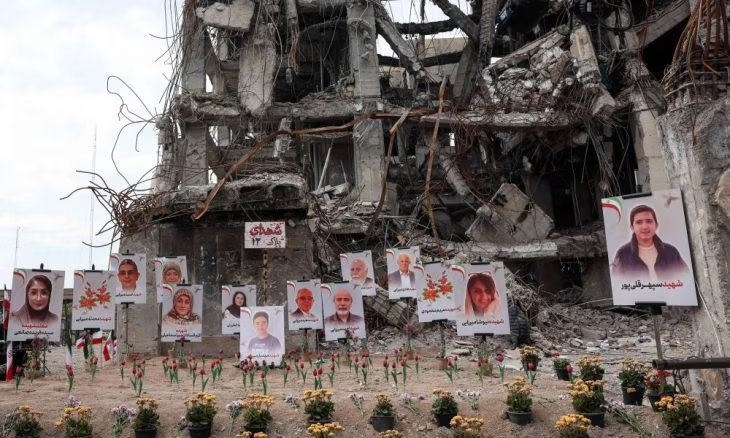
In Tehran, sources reported that authorities have given local media space to discuss the possibilities of resuming dialogue, which is interpreted as a sign of a desire to prepare public opinion. The spokesman for the Iranian Foreign Ministry, Ismail Baqaei, affirmed that diplomatic opportunities still exist despite the complexity of the outstanding issues between the two countries.

Observers believe that the coming hours will be crucial in determining the course of the crisis, as the picture regarding the new negotiation round is expected to become clear. These developments coincide with a field escalation in the Strait of Hormuz and parallel discussions on the Lebanese-Israeli front, placing the region on a hot plate.
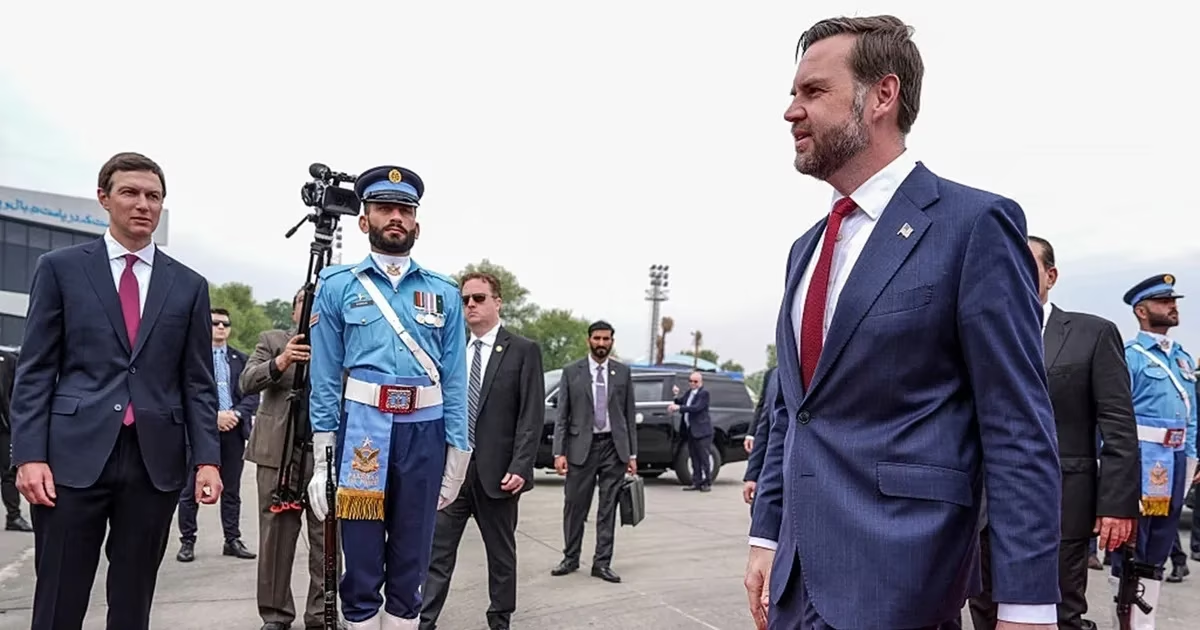
The option of a US withdrawal from the negotiation process or a return to military escalation remains strongly on the table if Iranian responses do not align with expectations in Washington. The closure of the Strait of Hormuz represents a strong bargaining chip for Tehran, while Washington uses the weapon of sanctions and economic blockade to extract broader concessions.
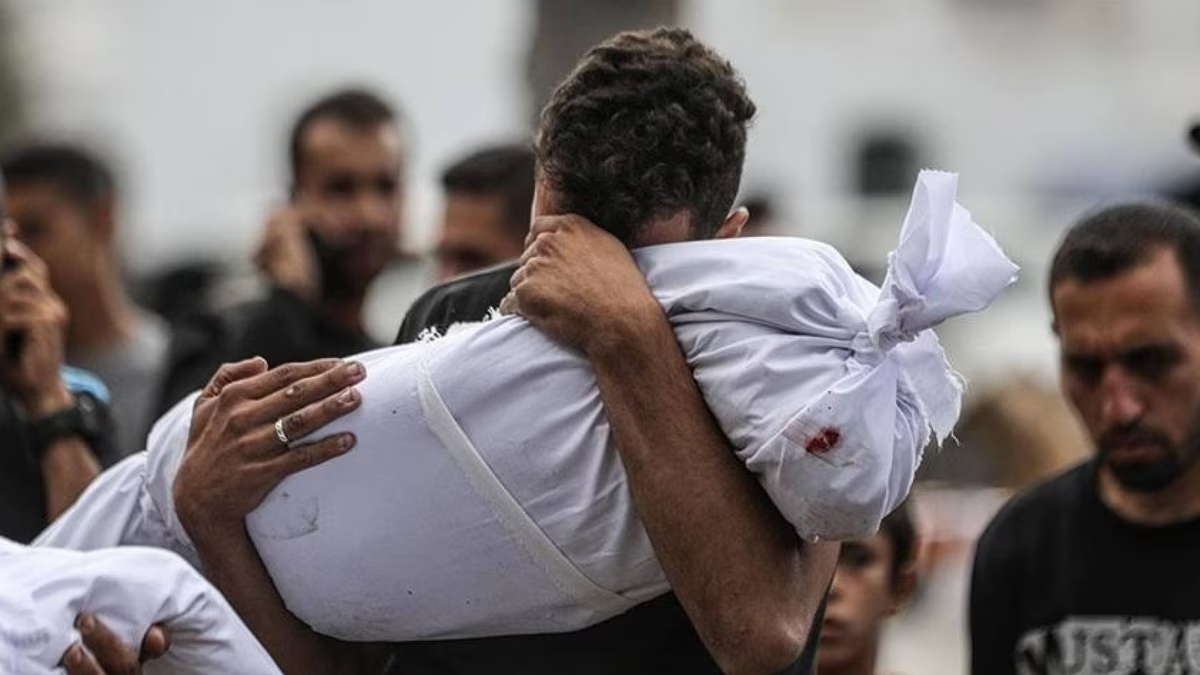
In conclusion, the international community cautiously awaits the results of these diplomatic moves, given their direct implications for global energy security and Middle East stability. Either the parties succeed in bridging the deep gap between 5 and 20 years of enrichment suspension, or the world faces a new round of open confrontation.
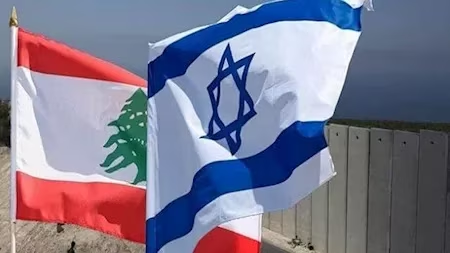
The complex issues between Tehran and Washington cannot be resolved in one round, but diplomatic opportunities still exist.