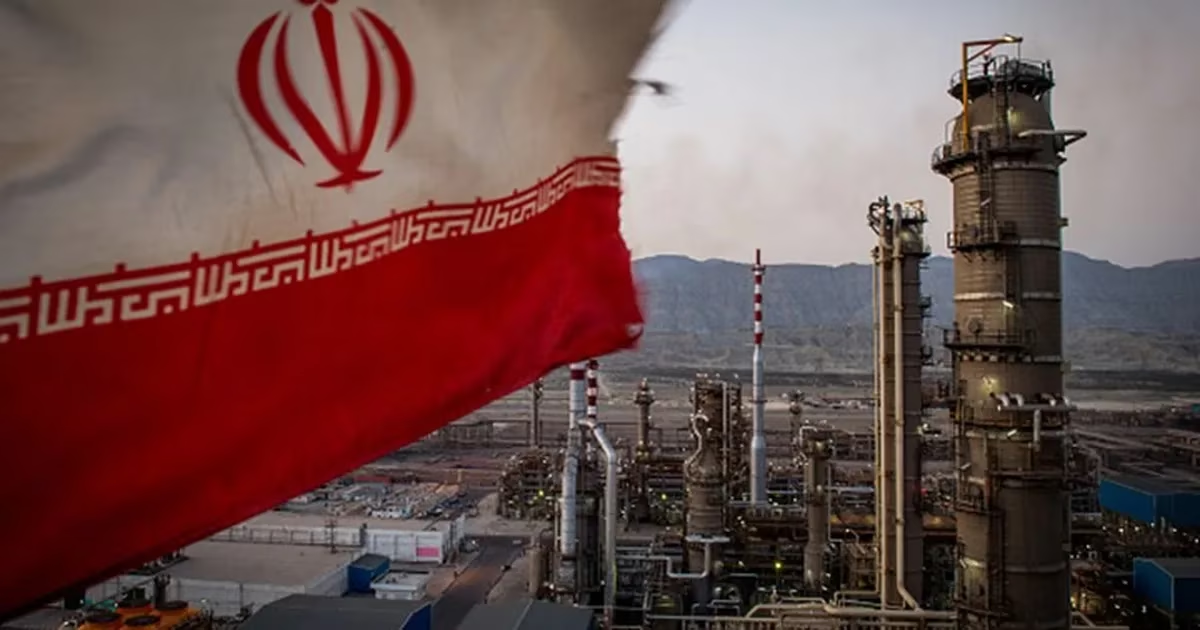







The prevailing question in political and economic circles is no longer limited to the extent of the Strait of Hormuz crisis's impact on global energy price surges. Instead, the focus has shifted to how coordination levels among major powers affected by any bottleneck in vital maritime passages will be reshaped.
China tops the list of these powers as the largest Asian importer of oil transiting the strait, while Russia sees this disruption as a strategic opportunity to enhance its influence. Any American move to impose a naval blockade on Iran will not pass as a fleeting military event; rather, it will become a driving force for Moscow and Beijing to elevate their cooperation.
Beijing views the Strait of Hormuz from the perspective of national energy security, as it represents the most critical oil chokepoint in the world. Data from the first half of 2025 revealed that approximately 23.2 million barrels per day passed through it, accounting for nearly one-third of global maritime trade.
Any widespread disruption in this waterway would critically wound the Asian economy, which explains China's excessive sensitivity to the issue. This sensitivity is heightened by the fact that the majority of sanctioned Iranian oil historically finds its way to Chinese refineries.
Cross-referenced sources, based on shipping monitoring data, reported that China accounted for over 80% of seaborne Iranian oil exports. With a flow rate of 1.38 million barrels per day, the close link between Beijing and Iranian oil is clearly evident despite international restrictions.
This significant dependence is the primary driver pushing China to deepen coordination with Russia on energy matters. Despite Beijing's strategic reserves, it views Russia as a partner capable of compensating for any sudden shortage in Gulf supplies.
In this scenario, Russia transforms from merely a traditional supplier into a tool for absorbing economic shocks that might result from the strait's closure. Thus, Moscow becomes a more crucial partner in moments of global turmoil, strengthening the Eastern front against Western pressures.
From Moscow's perspective, the Hormuz crisis is not just a threat to markets, but a window to enhance geopolitical and financial influence. The greater the risks to Gulf supplies, the higher the market value of Russian energy destined for Asian markets hungry for stable alternatives.
However, Russia does not desire to see widespread chaos that could lead to a collapse of the global economy and uncontrollable repercussions. It prefers to capitalize on Chinese and Asian anxiety to push them towards land-based energy alternatives or maritime routes less susceptible to American control.
In this context, Russian diplomatic moves within the 'BRICS' group have emerged, aiming to build a system to counter the repercussions of Middle East crises. This coordination includes vital sectors such as food and fertilizers, to ensure the stability of supply chains away from direct Western influences.
Indicators of this rapprochement were not limited to economic aspects but clearly extended to the corridors of the UN Security Council. Russia and China used their veto power against Western draft resolutions concerning navigation in Hormuz, considering them unbalanced approaches.
This step reflects a shared desire to break the American monopoly on defining international crises and the conditions for their security management. Recent public statements have shown a convergence in political language that rejects unilateral escalation and calls for negotiated solutions that preserve the balance of international markets.
If the situation escalates towards a complete closure of the strait or a long-term blockade, we will witness a leap in the level of financial coordination between the two countries. This could include the development of alternative payment systems within the 'BRICS' framework to reduce reliance on financial systems controlled by Washington.
In conclusion, it appears that the Strait of Hormuz has become a real laboratory for testing the resilience of the Russia-China partnership in the 21st century. American pressure on waterways not only threatens oil flow but also accelerates the process of reordering major international balances.
The Strait of Hormuz may not forge a new Russia-China alliance, but it accelerates the birth of a more cohesive phase in the relationship between the two poles to counter American maritime hegemony.



Share your opinion
Strait of Hormuz Crisis: A Strategic Driver for Deepening the Russia-China Alliance