







By: Said Arikat
April 15, 2026
News Analysis
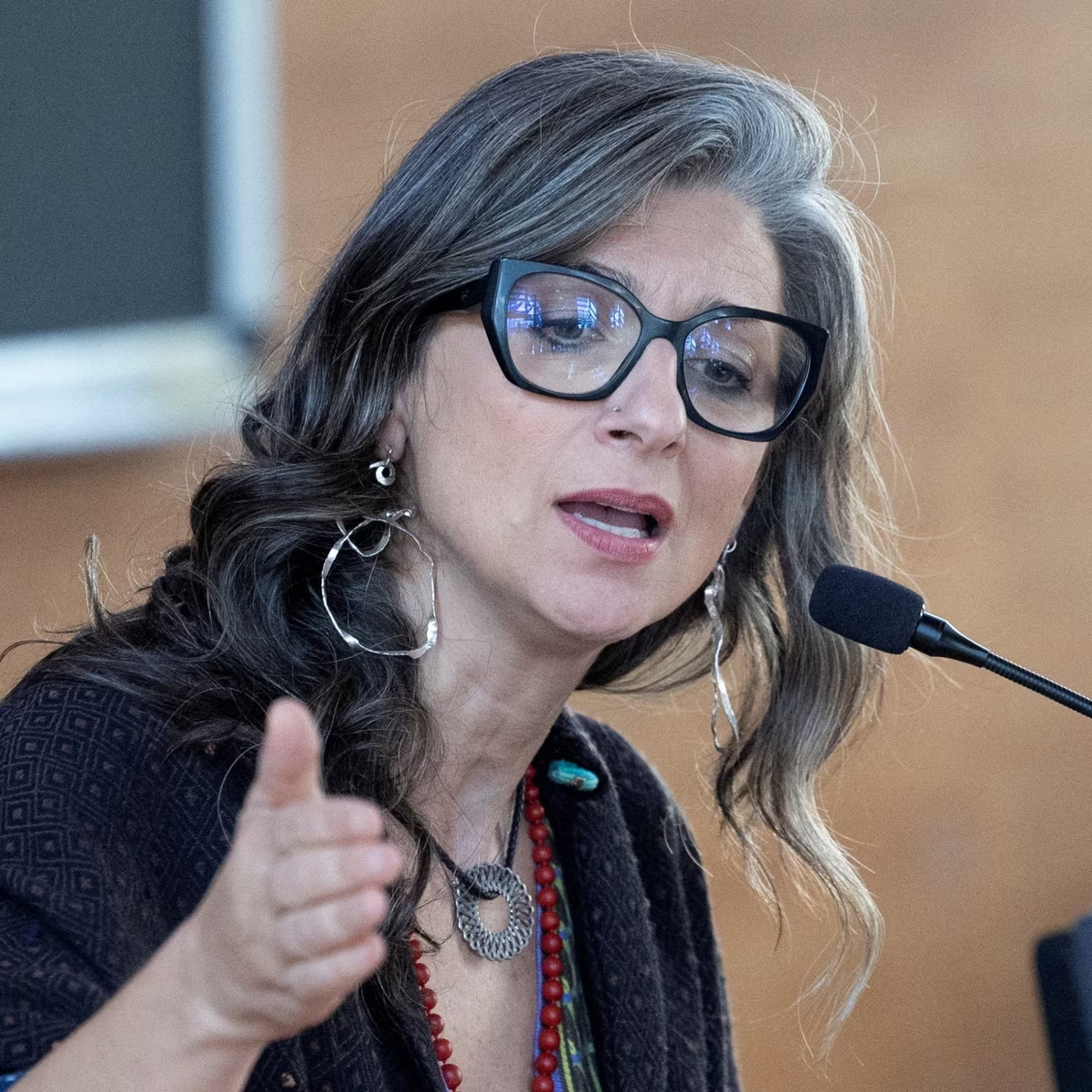
Washington, D.C- Julian Borger’s reporting in The Guardian lays bare a disturbing inversion at the heart of Western policy: rather than defending the universal principles they claim to uphold, the United States and key European governments have, in the case of Francesca Albanese, chosen to target the messenger. His portrait of the UN special rapporteur is not only the story of one official under siege, but an indictment of a political order that punishes dissent more swiftly than it confronts alleged war crimes.
I have known Julian Borger since 2003, and I have known Francesca Albanese since she assumed her role as UN Special Rapporteur. From that vantage point, I can say with confidence that few journalists match Borger’s professionalism, rigor, and integrity as an interviewer. Equally, it is hard to think of a human rights advocate as steadfastly principled as Albanese—someone whose integrity is not only evident but immovable, even under extraordinary pressure. She is relentless, unyielding in the face of intimidation, and unwavering in her commitment to the truth, regardless of the personal or political cost. In a field that often rewards caution, her stubborn integrity sets her apart as one of the most formidable voices in human rights today.
Albanese’s offense, in essence, has been to speak with clarity. In the wake of the October 7, 2023 Hamas attacks and Israel’s devastating military response in Gaza, she became the first UN official of her rank to characterize Israel’s actions as genocide. Whether one agrees with that legal conclusion or not, it is a claim grounded in her mandate: to investigate and report on human rights violations. Yet instead of engaging with the substance of her findings, Washington and several European capitals moved to discredit, isolate, and ultimately punish her.
The sanctions imposed by Donald Trump’s administration represent a particularly egregious example. By designating Albanese in a category typically reserved for terrorists and transnational criminals, the United States crossed a dangerous line. This was not mere diplomatic disagreement; it was an attempt to erase her capacity to function. As Borger recounts, the consequences have been sweeping—financial exclusion, the seizure of property, and restrictions so severe they amount to what has been described as a “civil death.” Such measures are not only disproportionate; they are fundamentally incompatible with the principles of due process and free expression that the United States claims to champion.
Europe’s role, while sometimes less overt, has been no less troubling. Germany’s attempt to suppress Albanese’s public appearances, reportedly going so far as to deploy police and threaten arrest over her language, reflects a broader pattern of constraining debate on Israel-Palestine. The justification—protecting the memory of the Holocaust or preventing antisemitism—is, of course, serious and necessary. But when such concerns are used to silence legitimate criticism of a state’s conduct, they risk being instrumentalized in ways that ultimately undermine both human rights and historical responsibility.
The United Kingdom and other European governments have likewise failed to provide meaningful support for an independent UN mandate holder facing extraordinary pressure. Instead, their posture has too often mirrored Washington’s: cautious at best, complicit at worst. The result is a chilling message to international civil servants and human rights advocates alike—step beyond the bounds of acceptable discourse, and you may find yourself abandoned or worse.
What makes this response particularly indefensible is the scale of the humanitarian crisis that forms its backdrop. The war in Gaza has produced staggering levels of death, displacement, and destruction. Entire neighborhoods have been reduced to rubble; civilian infrastructure has been decimated; and a population already living under blockade has been pushed to the brink. In such circumstances, the need for rigorous, independent scrutiny is not optional—it is essential. Yet instead of strengthening mechanisms of accountability, Western governments have chosen to undermine one of the very figures tasked with providing it.
Borger’s interview also highlights the personal cost of this political failure. Albanese has faced death threats, harassment, and sustained campaigns against her family. These are not the actions of a system confident in its moral standing; they are the symptoms of a climate in which dissent is treated as danger. That such conditions have been tolerated—if not implicitly encouraged—by governments that regularly invoke human rights as a cornerstone of their foreign policy is deeply revealing.
There is, of course, a broader context to this reaction. Albanese’s reports do not stop at documenting alleged violations by Israel; they extend responsibility to the network of states and corporations that enable them. This includes arms suppliers, financial institutions, and political allies—many of them in the United States and Europe. In this sense, the backlash against her is not only about what she has said regarding Gaza; it is about what her findings imply for those who have supported, financed, or defended the status quo. To accept her conclusions would require a level of self-scrutiny that Western governments have thus far been unwilling to undertake.
Critics argue that Albanese’s rhetoric blurs the line between legal analysis and political advocacy, potentially weakening the impact of her work. There is merit in the concern that international law depends on precision and restraint. But this critique cannot justify the punitive measures she has faced. Disagreement with tone or framing should be addressed through debate, not sanctions or suppression. To conflate the two is to erode the very norms that underpin democratic societies.
Ultimately, the treatment of Francesca Albanese is a test—one that the United States and Europe are, at present, failing. It is a test of whether human rights are truly universal, or whether they are contingent on political convenience. It is a test of whether international institutions can operate independently, or whether they will be bent to the will of powerful states. And it is a test of whether those who speak uncomfortable truths will be protected or punished.
Julian Borger’s reporting makes one thing clear: this is not simply about one rapporteur or one conflict. It is about the credibility of a system that claims to stand for justice while sidelining those who seek to uphold it. If Western governments continue down this path—prioritizing alliance politics over accountability, and suppression over scrutiny—they risk not only abandoning the Palestinians, but also hollowing out the very ideals they profess to defend.
Share your opinion
Sanctioning Truth: How the West Turned on Francesca Albanese Instead of Defending Human Rights