ISRAELI AFFAIRS

Tue 14 Apr 2026 6:00 am - Jerusalem Time

Widespread Israeli Preparedness in Anticipation of Truce Collapse and Renewed Confrontation with Iran

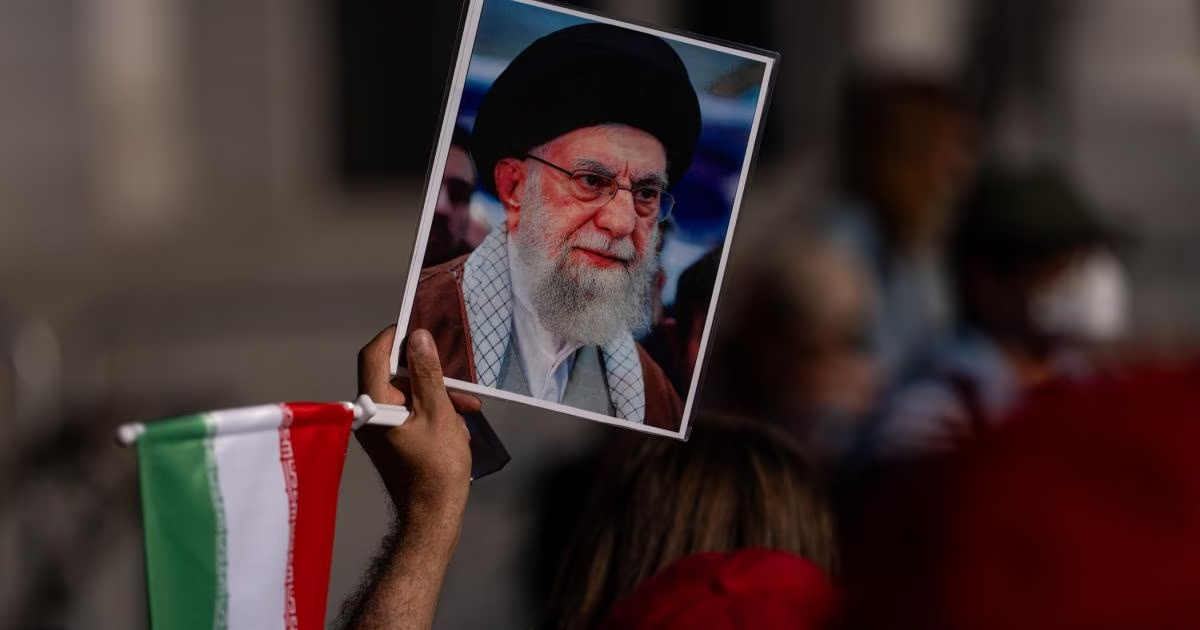
Hebrew media sources reported that the security establishment in Tel Aviv adopts a strategic assessment that foresees an inevitable return to direct military confrontation with Iran in the near future. Despite the ceasefire agreement reached between Washington and Tehran last week, Israeli intelligence and military agencies believe that this calm is temporary and will not last long in the face of escalating tensions.

Within the framework of these assessments, the Israeli Chief of Staff issued strict instructions to all combat units to maintain the highest levels of readiness and preparedness. This step comes in anticipation of any sudden breach of the truce agreement, as the military leadership seeks to ensure full readiness to respond to any potential Iranian move on various fronts.

Reports from informed sources indicate that the Israeli army has developed multiple scenarios to deal with the next phase, including the possibility of the Israeli heartland being subjected to intense missile barrages. These defensive and offensive plans also include countering sudden Iranian attacks that may target vital installations, which has necessitated intensified training and aerial and ground surveillance.

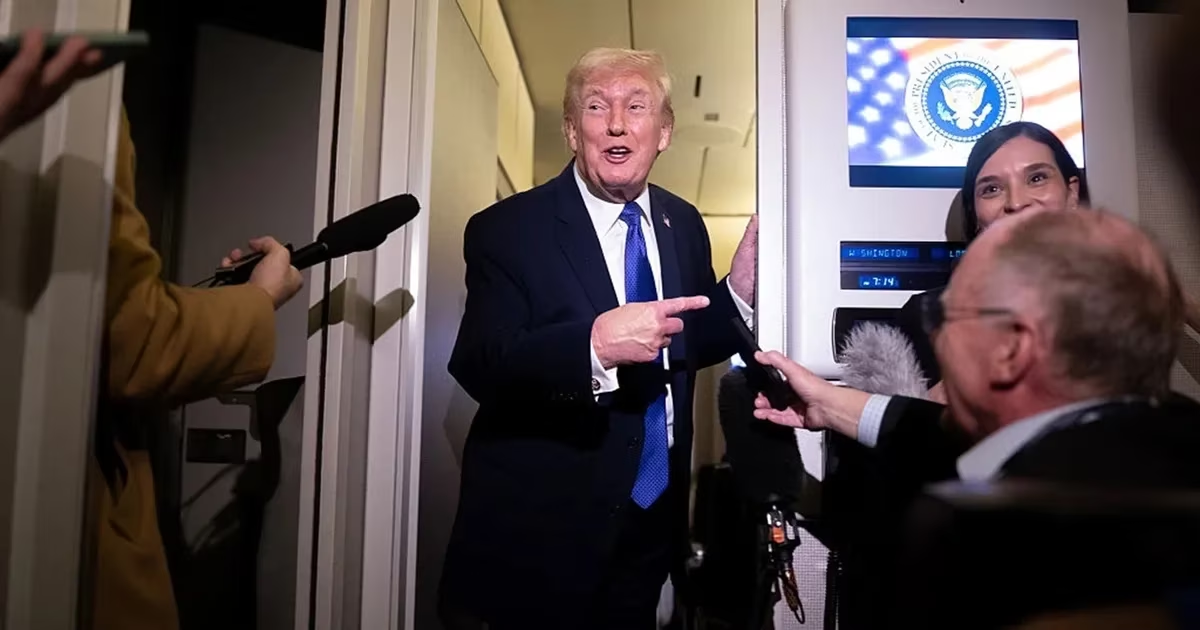
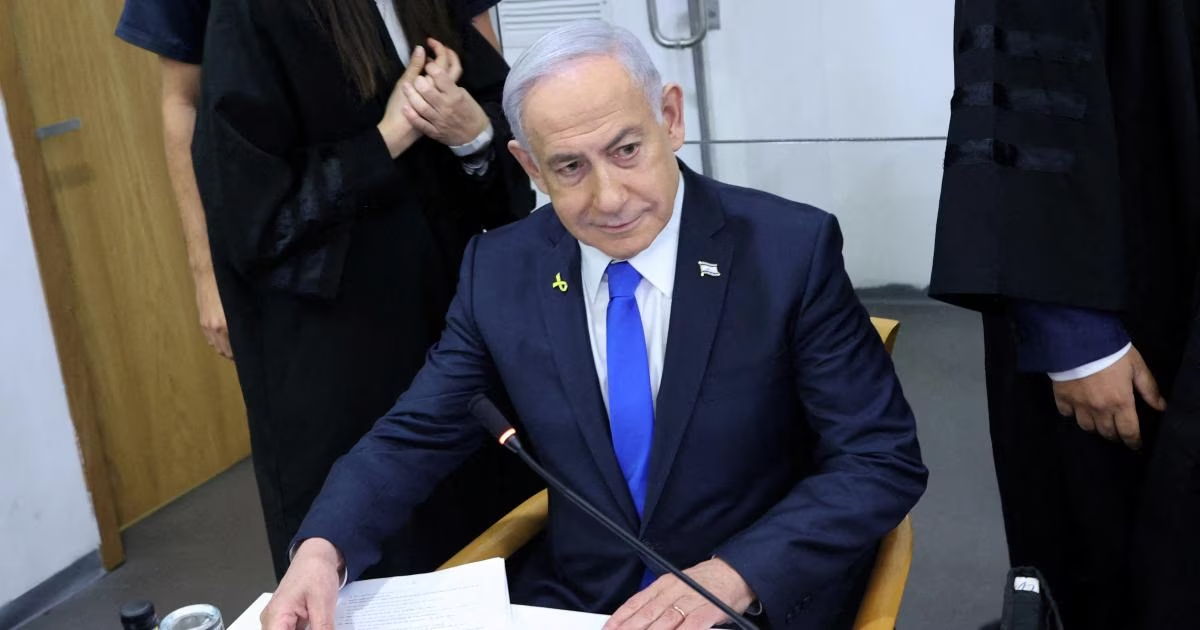
For his part, Israeli Prime Minister Benjamin Netanyahu announced his full support for the United States' decision to impose a comprehensive naval blockade on Iran, describing the move as necessary. Netanyahu affirmed during his government meeting that Israel fully aligns with the firm stance taken by the American administration led by Donald Trump, emphasizing that economic and military pressure is the only way to deal with Iranian threats.

Netanyahu warned that the current state of calm with Tehran is very fragile and could collapse within a short period, especially given the faltering diplomatic track in the Islamabad negotiations. He clarified that Israel is closely monitoring all field movements and will not hesitate to take preventive measures if it perceives an imminent danger threatening its national security.

In a related context, press sources reported that Israeli preparations coincide with the commencement of the American naval blockade of the Strait of Hormuz, which could reignite the confrontation. Security officials believe that Iran may resort to military escalation in response to the tightening noose on its oil exports and the movement of its ships, making the possibility of a direct clash very likely in the coming days.

Pakistani mediation had resulted on April 8th in the announcement of a two-week truce between Tehran and Washington to open the way for final negotiations, but field developments indicate otherwise. While the US military focuses its blockade on Iranian ports, Tehran responded by imposing strict restrictions on the navigation of ships belonging to countries involved in the coalition against it.

On the political coordination front, Netanyahu revealed that he had a phone call with US Vice President J.D. Vance, during which they discussed the details of the impending collapse of negotiations and the next steps. Netanyahu described the level of security and intelligence cooperation between Tel Aviv and Washington as having reached unprecedented levels, which enhances the ability of both parties to confront common challenges in the region.

The ceasefire with Iran could change in a very short time, and coordination between Tel Aviv and Washington is unprecedented.

ARAB AND WORLD

Tue 14 Apr 2026 5:59 am - Jerusalem Time

Washington begins a comprehensive naval blockade on Iran, and the history of conflicts recalls 5 similar experiences

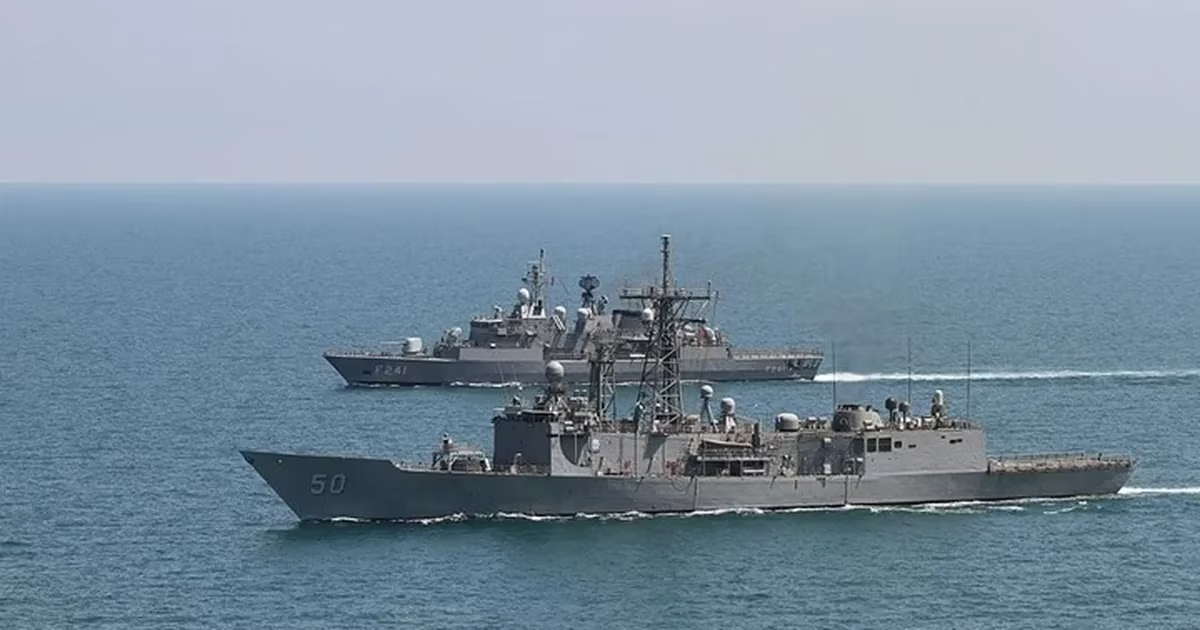
The region entered a new phase of military escalation with the US Army's announcement on Monday that it had officially begun implementing a comprehensive naval blockade on Iran. This step aims to restrict navigation to and from all Iranian ports, following the failure of the Islamabad negotiations, which sought to reach an agreement to end the military operations that began on February 28.

Military sources clarified that the field movement comes in implementation of direct instructions from President Donald Trump, which stipulate imposing full control over ships attempting to cross the Strait of Hormuz towards Iran. The US Central Command affirmed that this blockade exclusively targets Iranian supplies, emphasizing its commitment not to obstruct international navigation for ships heading to ports of other countries in the region.

Historically, naval blockades have not been mere fleeting military measures but have represented a strategic tool to stifle the economies of adversaries, as was evident in the American Civil War (1861-1865). Union forces implemented the famous 'Anaconda Plan,' which imposed a blockade on the Southern states to prevent cotton exports and arms imports, leading to the depletion of the South's military capabilities and its fall.

In World War I, Britain used the naval blockade weapon against Germany between 1914 and 1919, which caused a devastating humanitarian crisis and a severe food shortage. Historical reports indicate that this blockade was a decisive factor in the Allies' victory, despite its heavy human cost, which amounted to hundreds of thousands of deaths due to hunger and disease.

World War II witnessed another chapter of blockade conflicts during the 'Battle of the Atlantic,' where German submarines attempted to isolate Britain from its supplies coming from the United States. Despite Britain reaching the brink of starvation, technological advancements in sonar and radar systems enabled the Allies to break the blockade and neutralize the threat of Nazi submarines.

During the height of the Cold War in 1962, the Cuban Missile Crisis emerged as one of the most dangerous nuclear confrontations when Washington imposed a naval 'quarantine' on Cuba. The goal was to prevent the arrival of Soviet missiles, and the crisis ended with a secret agreement to remove missile bases in exchange for a US pledge not to invade the island and to remove similar missiles from Turkey.

In the modern era, the Israeli blockade imposed on the Gaza Strip since 2007 stands out as the longest continuous naval and land blockade, whose intensity has unprecedentedly increased since October 2023. This blockade has restricted fishing areas and prevented the arrival of commercial ships, and witnessed bloody confrontations in international waters, such as the incident of the Turkish ship 'Mavi Marmara' in 2010.

Observers believe that Washington's recourse to this option against Tehran reflects a desire to exert 'maximum pressure' by drying up Iran's national income sources, which rely on maritime exports. Attention is now turning to the Strait of Hormuz, the most vital waterway in global energy trade, to monitor Iran's reaction to these measures that threaten regional stability.

The current blockade is not limited to military aspects but extends to include legal and international dimensions related to freedom of navigation in international waterways. Sources confirm that the US Central Command has deployed additional naval units to ensure the implementation of the decision, with close monitoring of all tankers crossing the Gulf of Oman and the Arabian Gulf to ensure no violation of the ban.

Returning to historical lessons, naval blockades are often a prelude to major political shifts or internal economic collapses for besieged countries. In the Iranian case, it appears that Washington is betting that preventing access to vital ports will force Tehran to make fundamental concessions on its regional and nuclear files.

International concerns are growing that this blockade could lead to a direct clash at sea, especially if Iranian or allied ships attempt to break the American security cordon. Major powers such as China and Russia are cautiously monitoring the situation, given the impact of these developments on global oil prices and supply chains passing through the region.

On the humanitarian front, previous blockade experiences raise questions about the extent to which civilians in Iran will be affected by these measures, especially in light of potential shortages of basic necessities. Despite Washington's assurances that the blockade targets the regime, historical evidence in Germany, Cuba, and Gaza confirms that peoples bear the brunt of these strategies.

The Strait of Hormuz now represents the focal point of this conflict, through which about a fifth of the world's oil supplies pass, and any serious obstruction there could lead to a global economic crisis. The new US blockade puts international navigation to a real test, amid questions about the international community's ability to balance political pressures with maritime laws.

In conclusion, the naval blockade on Iran remains a new chapter in an extended conflict, combining traditional warfare tools and modern economic attrition. With the continued blockade on Gaza as a contemporary model, it seems that the world is moving towards increased use of the 'weapon of ports' as a tool to resolve political and military disputes in the twenty-first century.

The measures will apply only to ships traveling to and from Iran, including all ports on the Gulf and the Gulf of Oman, and will not impede the freedom of navigation for other ships.

PALESTINE

Tue 14 Apr 2026 5:59 am - Jerusalem Time

Injuries and arrests in a series of settler and occupation forces attacks in the West Bank and Jerusalem

The wave of violence carried out by settlers in various areas of the occupied West Bank has renewed, with local sources reporting that two citizens were injured and bruised in the town of Beita, south of Nablus. These injuries occurred after a group of settlers stormed Jabal Sobeih area and severely beat the residents present in the area.

In the southern Hebron, specifically in the Masafer Yatta area, settlers seized a cave and a dwelling belonging to a Palestinian citizen in Khirbet al-Fakhit. Human rights sources indicated that the attackers brought with them a herd of livestock and camels in a move aimed at imposing a new reality and restricting the indigenous population to force them into forced displacement.

As for occupied Jerusalem, the occupation forces carried out an arrest operation targeting two young men from the town of Al-Eizariya, east of the city. The arrest operation came based on claims made by a settler shepherd, who alleged that he was assaulted by Palestinian youths inside the 'Mishor Adumim' settlement, which is built on citizens' lands.

The Jerusalem Governorate warned in a statement of the escalating pace of systematic violations practiced by settlers against citizens and their properties in the eastern villages and towns. The statement affirmed that these attacks coincide with severe military restrictions imposed by the occupation forces to restrict the movement of Palestinians in those areas.

In a related context, the village of Khan al-Ahmar, east of Jerusalem, was attacked by groups of settlers, and despite no physical injuries being recorded among the residents, the attack caused a state of panic. Khan al-Ahmar village is a constant target for displacement and settlement schemes that seek to empty the area of Palestinian presence.

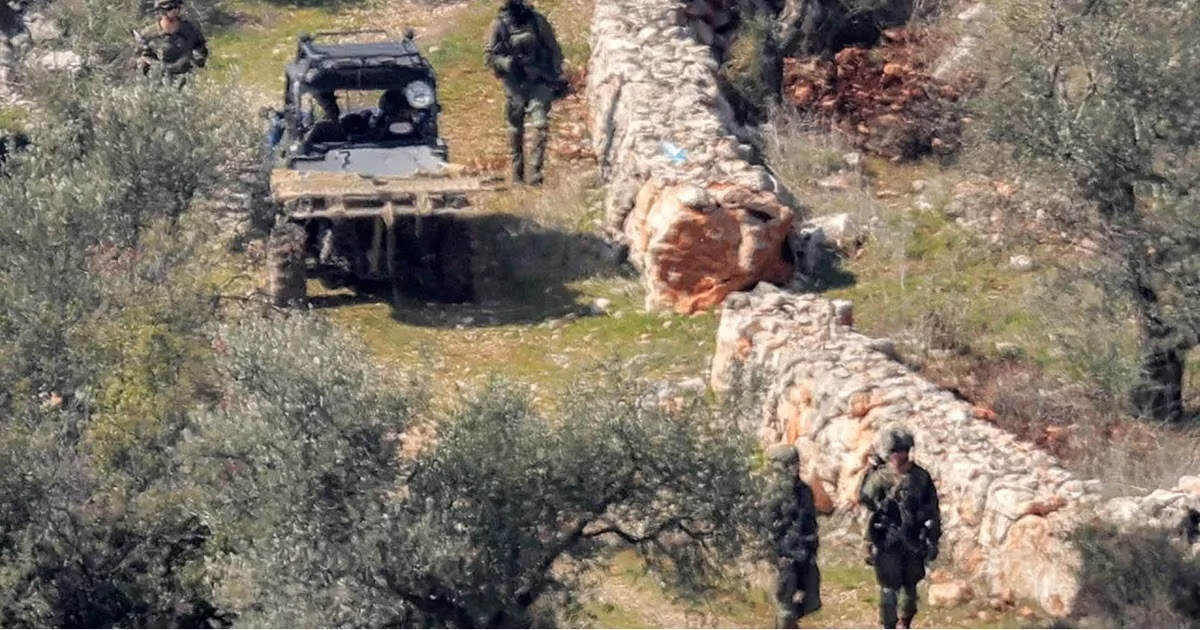
North in Nablus Governorate, the occupation forces stormed the village of Al-Lubban Al-Sharqiya this evening, accompanied by military tow trucks and guards from the neighboring 'Eli' settlement. The raid lasted for more than four hours, during which extensive searches and harassment of residents occurred in various neighborhoods of the village.

The raid in Al-Lubban Al-Sharqiya resulted in the seizure of six private vehicles belonging to citizens, in addition to the complete closure of the main entrance to the village. This closure obstructed traffic and prevented citizens from reaching Salfit city and neighboring villages, which increased the daily suffering of the residents.

These field developments come amid a sharp escalation in settler attacks, with the Wall and Settlement Resistance Commission documenting about 497 attacks during last March alone. These systematic attacks led to the martyrdom of nine Palestinians, reflecting the seriousness of the security situation and the escalating policy of intimidation in the West Bank.

Settlers brought with them a herd of livestock and camels, as part of continuous attempts to restrict residents to force them to leave their lands in Masafer Yatta.

OPINIONS

Tue 14 Apr 2026 5:53 am - Jerusalem Time

Diplomacy Without Consensus: Lebanon’s Risky Gamble in Washington


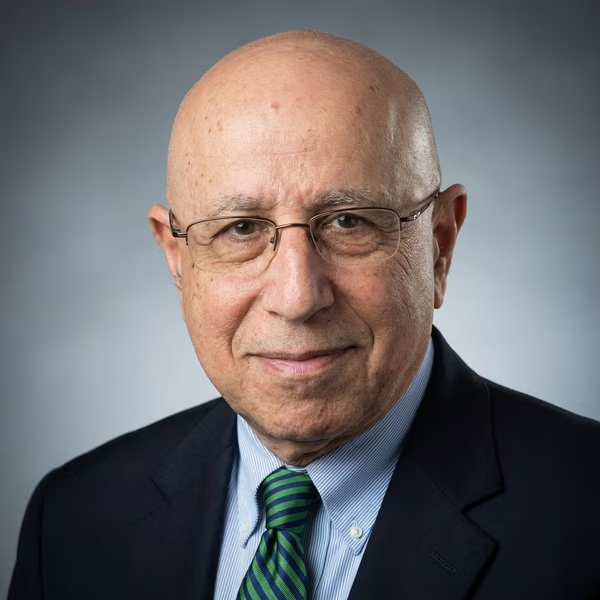
By: Said Arikat


April 14, 2026


News Analysis


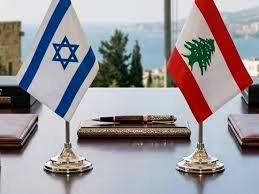
Washington, D.C-The decision by the Lebanese government to engage in ambassador-level talks with Israel in Washington, D.C. is not merely futile—it is politically reckless given the gravity of the moment and the overwhelming domestic opposition it faces. At a time when Lebanon is under sustained military pressure, such a move risks projecting weakness, fragmentation, and a troubling disconnect between the state and large segments of its own political landscape. Rather than reinforcing national resilience, this initiative exposes internal fractures at precisely the moment unity is most urgently required.


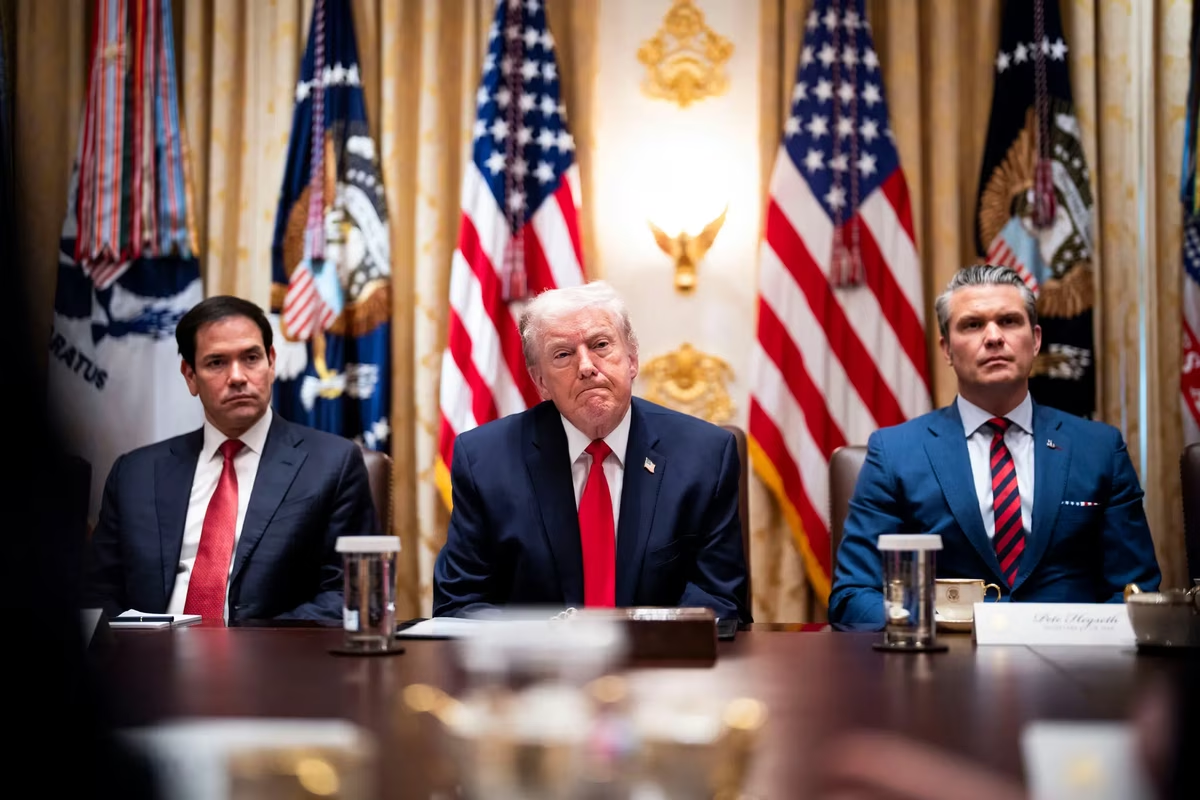
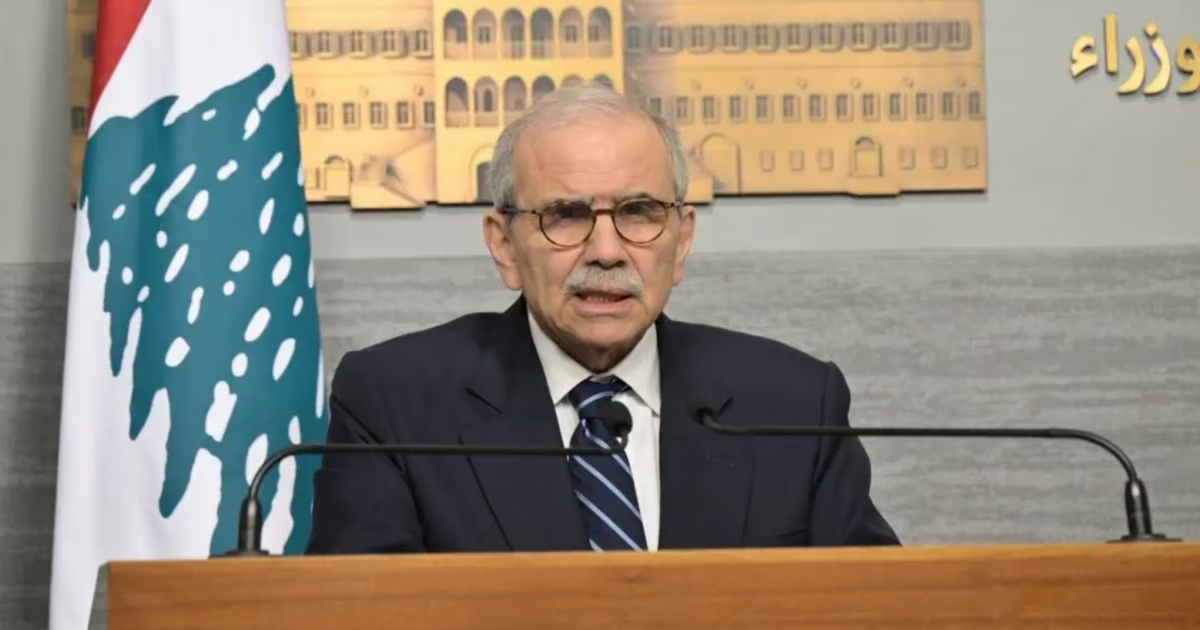
According to a State Department official speaking on background, the composition of the meeting itself underscores the sensitivity and high-level attention surrounding the talks. Participants are expected to include U.S Secretary of State, Marco Rubio, U.S Ambassador to Lebanon, Michel Issa, Counselor Michael Needham,Israeli Ambassador to the United States,  Yechiel Leiter, and Lebanon’s Ambassador to the United States, Nada Hamadeh. While the presence of such senior figures might suggest seriousness of intent, it also raises the stakes of a process that appears to lack both domestic legitimacy and strategic clarity.


Far from advancing Lebanon’s strategic interests, these talks appear detached from both reality on the ground and the national consensus. Most major Lebanese political factions have either rejected or expressed deep skepticism toward any form of engagement under fire. Proceeding regardless does not signal pragmatism; it signals a leadership willing to bypass internal cohesion on an issue that demands precisely the opposite. In moments of external threat, states typically consolidate political positions to project strength and clarity. Here, the government is doing the reverse—opening another front internally while failing to secure any tangible diplomatic leverage externally.


The timing is especially damaging. With Israel continuing its military operations, any diplomatic overture absent clear leverage or preconditions risks being interpreted not as a peace initiative but as capitulation. More critically, the very act of convening such a meeting—under fire, without consensus, and without reciprocal commitments—amounts to a substantial and gratuitous concession to Israel. It offers engagement, legitimacy, and the optics of dialogue without extracting anything in return. In effect, Lebanon is placing a significant bargaining chip on the table for free, weakening its negotiating position before talks have even begun.


This dynamic hands a political advantage to Israeli Prime Minister Benjamin Netanyahu, who has long demonstrated a preference for managing conflict rather than resolving it. For Netanyahu, the mere existence of talks—regardless of their substance—can be weaponized diplomatically to deflect criticism, particularly in Western capitals eager to point to dialogue as evidence of restraint. The meeting itself thus becomes an asset for Israel: a diplomatic gain secured without the need for concessions, reinforcing an already asymmetric balance.


This dynamic underscores a deeper problem: the asymmetry embedded in such engagements. Lebanon enters these discussions politically divided and institutionally weakened, while Israel operates with a far more centralized decision-making structure and a clear strategic doctrine. Without internal alignment, Lebanese negotiators lack both the authority and the credibility to commit to meaningful outcomes. This imbalance turns the talks into a performative exercise, where one side manages optics and the other struggles to define its own position.


More troubling is the internal cost. Lebanon is already navigating one of the most severe economic crises in its modern history, alongside institutional paralysis and widespread public disillusionment. Introducing a highly polarizing diplomatic track—particularly one that lacks transparency and broad-based support—risks deepening these crises. It invites accusations of political overreach, fuels suspicion among rival factions, and erodes what little trust remains between the public and the state. At a time when the country needs a unifying national strategy, this move does the opposite: it sharpens divisions and amplifies uncertainty.


The absence of a clear mandate further complicates matters. Effective diplomacy requires not only external engagement but also internal legitimacy. Without a coherent national consensus or parliamentary backing, any commitments made in such talks are inherently fragile. They can be contested, reversed, or undermined by domestic actors, rendering the entire process unstable. This raises a fundamental question: who, exactly, is the Lebanese government negotiating on behalf of, and with what authority?


Equally problematic is the lack of a defined framework. Successful negotiations are typically anchored in clear parameters—whether territorial, security-related, or political—along with mechanisms for enforcement and accountability. None of these elements appear to be present here. There is no indication of binding commitments, no credible third-party enforcement mechanism, and no alignment with a broader regional de-escalation strategy. In the absence of these components, the talks are unlikely to produce anything beyond vague statements and temporary gestures.


Meanwhile, the broader regional context cannot be ignored. Lebanon’s position is deeply intertwined with regional dynamics, including tensions involving Iran, Israel, and various non-state actors. Engaging in isolated bilateral discussions without addressing these larger forces risks reducing the talks to a narrow, ineffective channel disconnected from the realities shaping the conflict. Diplomacy that ignores context is diplomacy destined to fail.


Ultimately, this initiative reflects a deeper misreading of both timing and leverage. By entering talks under pressure, without unity, and without a clear strategic framework, the Lebanese government risks undermining its own position while inadvertently strengthening that of its adversary. It allows Israel to claim engagement without making concessions, and it exposes Lebanon’s internal divisions to external scrutiny.


This is not diplomacy as a tool of strength or statecraft. It is diplomacy as miscalculation—an exercise that prioritizes appearance over substance and risks compounding the very challenges it seeks to address. At a moment that demands clarity, cohesion, and disciplined strategy, Lebanon’s leadership has chosen a path that delivers none of these. Instead, it gambles national unity for the illusion of diplomatic relevance, with consequences that could reverberate far beyond the walls of meeting rooms in Washington.

ARAB AND WORLD

Mon 13 Apr 2026 5:06 pm - Jerusalem Time

Independent: Trump faces strategic failure in his war against Iran, and his negotiators lack leverage

The British newspaper The Independent launched a sharp attack on US President Donald Trump's policies towards Iran, considering that his declaration of victory in the recent confrontation is not based on tangible reality. The editorial explained that the military and diplomatic campaign led by the White House ended in failure on all fronts, leading to an exacerbation of crises in the Middle East.

The newspaper pointed out that the American approach to dealing with Tehran, whether through military pressure or diplomatic attempts to secure a new nuclear agreement, led the region to a real catastrophe. It considered that expectations of resolving a conflict that has lasted for nearly half a century during a single negotiating session in the Pakistani capital, Islamabad, were a figment of imagination and completely unrealistic.

The report strongly criticized Trump's decision to send individuals lacking the necessary diplomatic experience to manage such a complex file, as real estate mogul Steve Witkoff and Jared Kushner were assigned the task. The newspaper believed that these negotiators entered the talks without real leverage, which made the United States' position appear weak in front of the seasoned Iranian negotiator.

The editorial also drew attention to the deliberate marginalization of the US State Department and its Secretary, Marco Rubio, as they were excluded from their essential role in formulating and managing foreign policy. This marginalization did not serve American interests, but rather led to confusion in strategic vision and a loss of coordination between sovereign institutions in Washington.

In a related context, the newspaper considered that assigning Vice President J.D. Vance to head the delegation in Islamabad was a grave mistake, despite his political weight. Vance, who had previously warned against falling into this predicament, found himself facing inevitable failure, which sparked speculation that Trump wanted to blame him for the expected diplomatic failure.

Analytical sources warned that the fragile ceasefire might not last more than two weeks, especially in light of continuous attempts to undermine peace efforts by regional parties. This situation places civilians in the region and the global economy under direct threat, amid a deadlock in prospects for sustainable political solutions.

The newspaper believes that the weak American negotiating position stems from the inability to make mutual concessions, as Trump and his team refuse to acknowledge strategic defeat. In contrast, Tehran appears to be controlling most of the cards in the game currently, benefiting from the tactical errors made by the American administration in choosing the timing and tools of the conflict.

Before the outbreak of this confrontation, the Strait of Hormuz was open to international navigation, and the Gulf states were experiencing a state of relative stability away from the drums of war. However, current policies have led to the closure of vital waterways and placed the entire region on the brink of a volcano, with increasing probabilities of uncalculated military escalation.

On the nuclear front, the newspaper confirmed that the Islamic Republic survived the fierce war and still retains its enriched uranium stockpile in fortified sites. This reality gives Tehran the ability to develop a nuclear weapon at any time, which the newspaper considers a strategic victory for Iran against an American failure to achieve the goal of disarmament.

Despite Trump's statements in which he insists on describing America as victorious regardless of the results, the reality on the ground indicates the exact opposite. The war, which caused global economic disruption and intimidated neighbors, did not achieve any of the goals announced by Washington at the beginning of the escalation.

The editorial predicted that the United States would eventually be forced to accept conditions imposed by Tehran, or a complete withdrawal and leave the region to other international powers such as China and Europe. This scenario would represent a historical humiliation for the American administration, reminiscent of the Saigon withdrawal in 1975 or the chaotic exit from Kabul in 2021.

The real tragedy lies in Trump's abandonment of diplomatic agreements that could have achieved American interests without bloodshed, most notably the 2015 nuclear deal. According to the newspaper, tearing up that agreement was driven by Trump's desire to erase the legacy of his predecessor Barack Obama, and not based on a sound strategic assessment.

The newspaper also pointed to a more recent Omani-brokered agreement that was ready for signing before Trump decided to resort to the option of military force last February. This shift towards escalation proved its futility, as force did not succeed in imposing a new reality, but rather increased the complexity of the political and military scene.

The newspaper concluded its analysis by recalling Winston Churchill's saying that 'jaw-jaw is better than war-war,' calling on Trump to review his calculations before it is too late. The internal political repercussions could devastate the Republican Party in the upcoming elections, which could pave the way for impeachment proceedings against the president if control of Congress is lost.

Whatever happens now, America has lost this war, whether it ends with an agreement or Trump decides to escalate the military effort.

PALESTINE

Mon 13 Apr 2026 5:06 pm - Jerusalem Time

Widespread Arrest Campaign Targets 30 Palestinians in the West Bank and Occupied Jerusalem

Israeli occupation forces carried out a series of extensive raids and incursions in various cities and towns across the West Bank and occupied Jerusalem early Monday morning. These military operations resulted in the arrest of at least 30 Palestinian citizens, mostly concentrated in vital and densely populated areas.

Local sources reported that the list of detainees included released prisoners and two children, indicating a systematic targeting of vital segments within Palestinian society. The raids involved violent incursions into residential homes, where forces deliberately vandalized private property and instilled a state of terror among families.

In occupied Jerusalem, teams affiliated with the occupation municipality, supported by military forces, stormed the town of Silwan, located south of Al-Aqsa Mosque. The incursions focused on the Al-Bustan neighborhood, where forces conducted provocative tours without reports of direct confrontations or additional arrests specifically in that area.

These movements come as part of an ongoing escalation policy pursued by the occupation in the West Bank since October 2023, aimed at tightening security control. Observers believe that the intensification of arrests falls within attempts to undermine the social and political stability of Palestinians in the occupied territories.

Regarding general statistics, field data indicates a sharp increase in the number of victims and detainees since the start of the war on the Gaza Strip. Human rights organizations have recorded the martyrdom of more than 1148 Palestinians in the West Bank, while the number of detainees has exceeded 22,000 arrests in a record period.

These figures reflect the extent of daily violations to which Palestinians are subjected, with approximately 11,750 citizens sustaining various injuries due to attacks by the army and settlers. These campaigns continue in the absence of effective international oversight over the occupation's practices in Palestinian cities and villages.

The escalation of arrest campaigns reflects a systematic policy aimed at restricting Palestinian society and undermining stability.

PALESTINE

Mon 13 Apr 2026 5:06 pm - Jerusalem Time

WHO warns: Occupation practices in Gaza threaten spread of epidemics in the region

Dr. Hanan Balkhy, WHO Regional Director for the Eastern Mediterranean, warned of serious repercussions from Israeli occupation practices in the Gaza Strip. She affirmed that preventing the entry of humanitarian aid and obstructing medical response will inevitably lead to the outbreak of diseases and epidemics that may not stop at the borders of the Strip, but rather threaten the health security of the entire region.

Balkhy explained in press statements today, Monday, that the severe deterioration in the health situation is no longer limited to direct injuries resulting from military attacks. Rather, it now includes systematic deprivation of basic medical services, which puts hundreds of thousands of residents at risk of existential health risks due to the absence of preventive and curative care.

The UN official pointed out that the remaining medical staff in Gaza are working in impossible conditions, as the health system faces pressures far exceeding its capacity. This comes at a time when medical resources are sharply decreasing, while the health needs of the population are rapidly increasing as a result of the ongoing aggression and blockade.

Sources in the organization revealed that huge quantities of life-saving medicines and medical supplies are still stuck in trucks awaiting permission to enter. In contrast, patients and injured people inside the Strip suffer from a lack of access to these supplies, due to the closure of most vital crossings and the strict restrictions imposed by the occupation on the flow of aid.

Regarding the energy crisis, Balkhy noted that the quantities of fuel allowed to enter do not meet the minimum needs of medical facilities. This severe shortage has forced the remaining hospitals to adopt an alternating operating system for vital departments, which threatens the lives of patients in intensive care units and surgical operations.

The international official also criticized the lack of regularity in medical evacuation operations for critically ill patients, considering that this slowdown deprives thousands of opportunities for survival. Official data indicated that since the ceasefire came into effect, only 388 patients have been able to leave the Strip for treatment, including 47 children.

In the long term, Balkhy warned that the process of rebuilding what the occupation destroyed in the Gaza Strip may take decades. She explained that the destruction of infrastructure and housing creates a fertile environment for the establishment of infectious diseases and the exacerbation of chronic health crises, making health recovery a distant prospect under current conditions.

The UN official concluded by referring to the organization's continuous efforts since October 2023, where it contributed to coordinating the evacuation of some 3668 patients to receive treatment abroad. Despite these efforts, the number remains very small compared to the magnitude of the health catastrophe caused by the ongoing aggression on the medical system in Gaza.

The health system is operating at its maximum capacity, with severely dwindling resources, limited access, and rapidly increasing needs, while life-saving supplies await behind the crossings.

ISRAELI AFFAIRS

Mon 13 Apr 2026 5:05 pm - Jerusalem Time

Hebrew Report Reveals Air Defense Systems Failed to Intercept a Quarter of Iranian Missiles

Hebrew press reports revealed a significant and worrying decline in the performance of the Israeli occupation's air defense systems, especially during the last days leading up to the truce. Sources explained that the intensity and advanced nature of Iranian missile attacks put Israeli defensive technology in a real predicament, as the systems failed to intercept about a quarter of the missiles launched in the last week of the confrontation, leading to unprecedented severe damage.

According to leaked security data, Iran launched nearly 650 missiles over forty days, 77 of which successfully penetrated the airspace and reached their designated targets. Among these missiles, 16 were identified as carrying heavy warheads weighing between 100 and 500 kilograms of explosives, which resulted in the deaths of 14 people and the complete destruction of buildings in several targeted areas.

The report indicated that the biggest challenge was the cluster missiles launched by Tehran, with 61 such missiles reaching their targets without interception. This technology relies on dispersing small bombs over wide areas, which led to damage at more than 380 sites, amid an admission by occupation army officers that they do not yet possess advanced technical solutions to deal with this type of ballistic projectile that disperses its payload before impact.

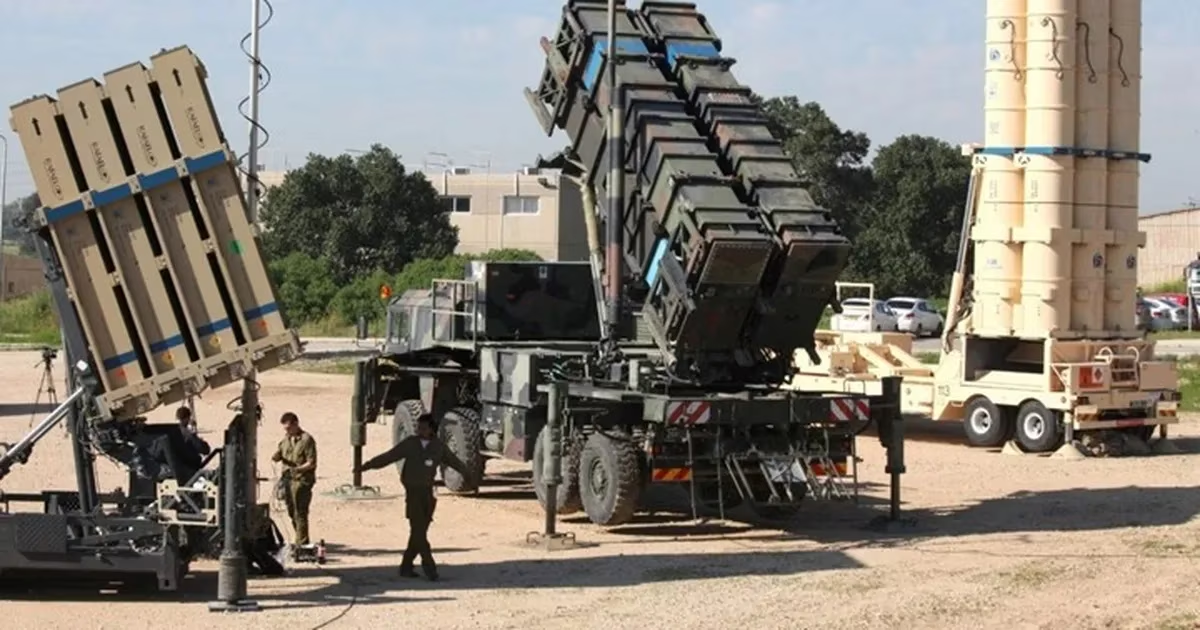
In the context of military analysis, security experts confirmed that the destructive capability of these attacks exceeded expectations, as the cluster bombs emanating from the missiles are capable of completely destroying residential apartments and causing paralysis in vital facilities. These results raise deep questions within the Israeli military establishment about the effectiveness of massive investments in the 'Iron Dome' and 'David's Sling' systems in the face of the advanced offensive tactics that Iran has adopted in its recent confrontations.

The data indicates that 77 Iranian missiles successfully bypassed Israeli air defenses and accurately hit their targets.

ANALYSIS

Mon 13 Apr 2026 5:05 pm - Jerusalem Time

From 'Manifest Destiny' to Financial Hegemony: A Reading in the Philosophy of American Control Throughout History

Retired American federal analyst Richard C. Cook, in his recently published book 'Our Country, Past and Present,' offers a deep critical review of American history, revealing the dark roots upon which the superpower was built. The book emphasizes that America's rise was not mere coincidence, but rather the result of systematic strategies that included the extermination of indigenous populations and the enslavement of Africans, leading to the financial elites' control over the state's key institutions.

Cook points out that the arrival of Europeans to the American continent caused the greatest demographic catastrophe in human history, as the indigenous population declined from 15 million to only a quarter of a million within three centuries. The author believes that this cleansing was not merely a result of epidemics, but a deliberate policy to dispossess tribes of their lands and consider them subordinate entities without the right to self-determination.

The book discusses the emergence of the ideology of 'Manifest Destiny' in the mid-19th century, a philosophy that granted America a supposed 'divine right' to expansion and dominance. Although the term has disappeared from contemporary political discourse, its spirit remains alive in the concept of 'American exceptionalism,' which justifies military interventions and the imposition of political will on countries around the world under the pretext of spreading democracy.

The author highlights the radical transformation in the American economy at the end of the 19th century, where power shifted from industrial production to financial speculation led by families such as Rockefeller and Morgan. This financial alliance managed to control the press and buy off politicians, paving the way for the creation of a monetary system that served the interests of the financial oligarchy at the expense of the people.

The book considers the assassination of President McKinley in 1901 a crucial turning point, as Theodore Roosevelt's ascent to power led to the end of an independent foreign policy. Since then, American interests have been linked to Anglo-American rapprochement, opening the door to a century of wars and foreign interventions that continue to this day.

Cook reveals the behind-the-scenes creation of the Federal Reserve system in 1913, describing it as a 'constitutional concession' that granted private bankers the authority to issue currency. This system enabled the United States to finance its entry into World War I, transforming it from a debtor nation into the world's largest creditor and a financial center dominating global gold reserves.

The 'Council on Foreign Relations' played a pivotal role as a tool for international financial control since its establishment in 1919, working to formulate foreign policies that transcended administrations. According to the book, this council saw in the world wars a golden opportunity to consolidate absolute American hegemony and ensure the continuity of the global agenda regardless of the ruling party in Washington.

The author believes that the 'Great Depression' in the 1930s was not merely a spontaneous market crisis, but resulted from deliberate decisions by central bank governors to raise interest rates. This crisis enabled financial elites to tighten their grip on the business sector and contributed to destabilizing Europe and creating the climate for the outbreak of World War II.

The book touches upon the role of the Central Intelligence Agency (CIA) as an executive arm of financial interests, transcending its role in information gathering to executing coups and assassinations. Cook asserts that the agency worked in coordination with the Rockefeller family to build a 'national security state' that seeks to integrate the world into a single political and economic structure serving major capitalist powers.

In his reading of President John F. Kennedy's assassination, Cook believes that Kennedy's orientation towards peaceful coexistence with the Soviet Union and his rejection of military escalation put him in direct conflict with the national security establishment. He points out that the cancellation of plans to withdraw from Vietnam immediately after his assassination confirms that the deep state rejected any approach that threatened the interests of the military-industrial complex.

The 'Petrodollar' system established in the 1970s is the primary pillar of current global hegemony, as the dollar was linked to Saudi oil in exchange for military protection. This agreement created a permanent global demand for the American currency, allowing Washington to print dollars without restrictions and finance its trade deficit at the expense of other countries forced to store their reserves in dollars.

The book explains that the 'Wolfowitz Doctrine' issued in 1992 represents contemporary American military doctrine, which is based on preventing the emergence of any international or regional competitor. This vision perpetuates a state of 'permanent war' and justifies preemptive interventions in conflict zones to ensure the United States remains the sole dominant power over strategic resources.

The author explains how regime change strategies shifted from violent coups to 'color revolutions' through organizations such as the National Endowment for Democracy (NED). These organizations use the guise of 'promoting democracy' to fund oppositions and delegitimize governments that reject American subservience, as was evident in Eastern European and Middle Eastern countries.

Cook concludes his reading by warning that current policies, including the conflict in Ukraine and tensions with China and Russia, are desperate attempts to preserve the eroding petrodollar system. He believes that the world is moving towards multipolarity, ending a century of American financial and military hegemony, amid increasing global awareness of the mechanisms of control he revealed in his book.

The underlying attitude of 'Manifest Destiny' of American exceptionalism and entitlement to global dominance has persisted to this day, manifesting in the imposition of will around the world.

ANALYSIS

Mon 13 Apr 2026 8:24 am - Jerusalem Time

The Cracking of the Petrodollar System: Is US Financial Hegemony Nearing Its End?

The year 1971 marked a pivotal turning point in the history of the global financial system when the United States decided to decouple its currency from gold due to the financial drain caused by the Vietnam War. This measure, taken by President Nixon, plunged the dollar into a vortex of uncertainty, before American diplomacy intervened to reassert its influence through the gateway of energy.

Henry Kissinger successfully brokered a strategic agreement with Saudi Arabia, stipulating that oil would be priced exclusively in dollars in exchange for security protection. This arrangement, which expanded to include all Gulf states, made the American currency a mandatory requirement for all countries wishing to secure their energy needs, thereby strengthening Washington's position as the sole financial pole.

This system granted the United States what is known as the 'exorbitant privilege,' allowing it to finance its structural deficit and borrow at very low costs. As a result, the dollar transformed from merely a medium of exchange into a cross-border geopolitical tool of influence, used to manage and direct the global economy according to American interests.

Today, this financial edifice faces unprecedented challenges as the US national debt reaches record levels, approaching $39 trillion. These figures, exceeding 120% of GDP, reflect a deep crisis in American fiscal discipline and raise questions about the sustainability of this economic model based on excessive borrowing.

At the recent G7 foreign ministers' meeting, notable statements emerged from US Secretary of State Marco Rubio regarding threats in the Strait of Hormuz. Rubio called on the world to take a firm stance against attempts to impose fees on navigation, hinting that Washington would not bear the burden of protecting this vital waterway alone. Observers considered this a retreat from historical commitments.

This American approach raises fundamental questions about the feasibility of countries continuing to price their oil in dollars if Washington reneges on guaranteeing the stability of the system. The paradox is that the United States might be the biggest loser from any disruption in navigation in the Strait, as it represents the fundamental pillar of the petrodollar system.

Although talk of a complete collapse of the petrodollar may seem exaggerated at present, there are serious indications of a disintegration phase beginning. Some Gulf countries have already started diversifying their currency basket for pricing through experimental deals in yuan and euro, indicating a desire to reduce absolute reliance on the greenback.

In contrast, Iran is adopting a strategy aimed at imposing the Chinese yuan as an alternative reference currency in the Strait of Hormuz, leveraging Beijing's economic weight as the largest oil importer. This trend is reinforced by China's success in developing a sovereign digital currency capable of completing massive financial settlements away from the traditional oversight of the Western financial system.

Current data indicate that the Middle East is on the cusp of a structural transformation that could end the dollar's monopoly on global energy trade. With the expanding use of national currencies in buying and selling transactions, the contours of a multipolar financial system are taking shape, redistributing economic power centers in the world.

The current scene reflects a decline in the strategic vision upon which American hegemony was built for decades, as current decisions appear to lack deep historical understanding. If the original architects of the petrodollar system were present today, they would feel bitterness at the crumbling of this structure, which was designed to be the permanent cornerstone of American power.

The dollar is our currency... but it's your problem.

ARAB AND WORLD

Mon 13 Apr 2026 8:24 am - Jerusalem Time

Political earthquake in Hungary: Historic defeat for Orbán and rise of the opposition led by Magyar

Hungary witnessed a dramatic shift in its political landscape, as veteran Prime Minister Viktor Orbán conceded defeat in the general elections held this Sunday. This announcement came after preliminary results confirmed a vast lead for the nascent opposition party, ending a long era of absolute dominance by the ruling Fidesz party.

Orbán, considered one of the most prominent allies of Donald Trump and Benjamin Netanyahu in Europe, described the election results as clear and painful at the same time. He stated that he congratulated the winning party, emphasizing his commitment to continue political work from the opposition benches without abandoning his principles.

Official data indicates a landslide victory for the center-right Tisza party, led by rising politician Péter Magyar. The opposition party garnered between 55 and 57 percent of the votes, which represents a devastating blow to Orbán's political ambitions and his nationalist project.

These results are expected to give the Tisza party a comfortable majority in the 199-seat Hungarian Parliament, with estimates suggesting it will secure approximately 135 seats. These figures reflect a widespread popular desire for change after years of controversial policies pursued by the previous government.

_The electoral process was characterized by a massive and unprecedented turnout of Hungarian voters, with participation reaching approximately 74.23 percent. This rate significantly exceeded the figures recorded in the 2022 elections, reflecting the state of polarization and great interest in the country's future.

Observers believe that Orbán's fall will cost Israeli occupation Prime Minister Benjamin Netanyahu a strategic ally within the European Union. Orbán had consistently used his 'veto' to obstruct any European decisions condemning Israeli practices or imposing sanctions in response to the war in the Gaza Strip.

On the European front, this defeat is likely to end the opposing role Hungary has played within the continental bloc for many years. Orbán's departure will pave the way for the approval of a massive aid package for Ukraine worth 90 billion euros, which the defeated prime minister had consistently blocked.

Russian-Hungarian relations will also be affected by this shift, as Orbán was considered President Vladimir Putin's closest ally within the European Union. The opposition's victory would realign Budapest's foreign policy with the general orientations of Brussels and Washington in confronting Russian influence.

In his first reaction, Péter Magyar expressed great optimism about the results, affirming that his party's optimism was based on field participation data. Through his political program, Magyar seeks to combat rampant corruption and restore judicial independence, which was damaged under the previous government.

Economic analysts attributed Orbán's declining popularity to the economic recession that hit the country and the sharp rise in living costs. A large segment of Hungarians expressed their dissatisfaction with the growing wealth of businessmen close to power at a time when the average citizen was suffering from financial pressures.

During his election campaign, Orbán tried to portray the election as a choice between 'war and peace,' accusing the opposition of seeking to drag the country into the conflict in Ukraine. However, this narrative failed to convince voters who preferred to focus on domestic issues and promised democratic reforms.

The victory of the Tisza party may open the door for the release of billions of euros in EU funds allocated to Hungary, which had been frozen due to Brussels' concerns about declining democratic standards. This possibility represents a glimmer of hope for the struggling Hungarian economy, which needs urgent liquidity.

In the capital Budapest, sources observed long queues in front of polling stations, where young voters expressed their urgent need to improve the general mood and end the state of political tension. They affirmed that the previous government focused on stirring up emotions instead of solving the real crises facing society.

This defeat is a shock to far-right circles in the West, which viewed Orbán's model of 'illiberal democracy' as an inspiring example. With the fall of this model at the ballot box, Hungary begins a new phase that may bring it back to the heart of European and democratic consensus.

The election result is clear and painful, and I will serve my nation from the opposition and will never give up.

ARAB AND WORLD

Mon 13 Apr 2026 8:24 am - Jerusalem Time

Trump launches fierce attack on Pope: "Weak and bad at foreign policy"

US President Donald Trump launched a scathing attack on Pope Leo XIV, expressing his strong displeasure with the political and religious orientations adopted by the Pontiff. These statements came on Monday morning, revealing a deep gap in visions between the White House and the Holy See regarding thorny international issues.

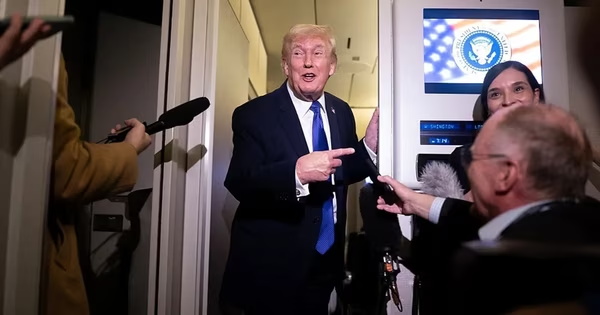
In statements made from Andrews Air Force Base in Maryland, Trump described the Pope as a "very liberal" figure, indicating that he does not trust the Pope's ability to understand national security imperatives. The US President added that the Vatican's current positions do not serve efforts to combat crime or the stability of the international order.

Trump explicitly accused the Pope of leniency with powers that threaten global security, specifically regarding the Iranian issue, saying that the Pope is courting a country seeking to acquire nuclear weapons. Trump considered this approach a danger to American interests and its allies in the region and the world.

On his 'Truth Social' platform, Trump continued his criticisms, asserting that he does not accept the existence of a Pope who considers Iran's possession of nuclear weapons acceptable, or who opposes US military movements in Venezuela. Trump described Pope Leo as "weak" in dealing with criminal issues and a failure in managing foreign policy from his perspective.

These attacks come in response to the calls of Pope Leo XIV, aged 70, who appealed to international leaders for the necessity of ending wars immediately. The Pope had called last Friday to stop what he described as 'self-worship and money' and displays of military power that claim lives.

Not content with general calls, the Pope directed sharp implicit criticisms at both the United States and Israel over the ongoing conflicts in the Middle East. He affirmed in a message via the 'X' platform that those who follow Christ's teachings cannot participate in dropping bombs or supporting armed conflicts.

In his recent stances, the Pontiff stressed that military action will not open horizons for freedom or sustainable peace, but rather complicate humanitarian crises. He called instead for promoting dialogue and peaceful coexistence among peoples, considering patience the only key to achieving stability.

In a related context, the Vatican and the Pentagon denied the accuracy of press reports that spoke of American pressure exerted on the Catholic Church to support the military power of the United States. A spokesman for the Holy See clarified that the circulating narratives about the papal ambassador's meeting with officials in the Ministry of War are not related to the truth.

Media reports had claimed that Cardinal Christophe Pierre was subjected to a 'scathing rebuke' by Elbridge Colby, Under Secretary of War for Policy, during a meeting last January. The reports alleged that the American side demanded the Church fully align with American military power as the dominant force.

However, the US Department of Defense and the US Ambassador to the Holy See quickly denied these reports, affirming that diplomatic meetings proceed in their usual official framework. They indicated that what some newspapers published about the behind-the-scenes of the January meeting lacks accuracy and editorial credibility.

These escalating debates reflect unprecedented tension in the relationship between Washington and the Vatican, especially with Trump's insistence on adopting 'Ministry of War' policies instead of 'Defense'. The question remains about the extent of this public clash's impact on the Catholic electoral base in the United States and on the Vatican's diplomatic role in global crises.

I am not a big fan of Pope Leo, he is a very liberal person, a man who does not believe in stopping crime.

ARAB AND WORLD

Mon 13 Apr 2026 8:23 am - Jerusalem Time

Oil prices jump above $100 after Trump announces Strait of Hormuz blockade

Global oil markets witnessed a dramatic surge in today's trading, with prices rising by over 8% immediately after the White House's escalating decisions against Tehran. Brent crude futures surpassed the $102.59 per barrel mark, while West Texas Intermediate (WTI) crude reached record levels at $104.51, amidst widespread concern in the global energy sector about the cessation of crude supplies through vital waterways.

These rapid economic developments come after US President Donald Trump announced the immediate initiation of measures to impose a comprehensive naval blockade on the Strait of Hormuz, the most important waterway for global oil trade. Sources confirmed that this military move aims to completely prevent the movement of ships to and from the Strait, in response to what Trump described as the failure of recent diplomatic efforts to control Iran's nuclear program.

The US President revealed, via his 'Truth Social' platform, details of a marathon negotiation round that lasted approximately 20 hours in the Pakistani capital, Islamabad, bringing together his senior advisors with a high-level Iranian delegation. The American delegation included J.D. Vance, Jared Kushner, and Steve Witkoff, in a final attempt to reach an agreement to end the nuclear crisis, but the talks reached an impasse due to Tehran's insistence on its conditions.

Trump clarified in his statement that the negotiations saw agreement on several technical points, but Iran's nuclear ambitions remained an insurmountable obstacle, stressing that Washington would not allow Tehran to possess nuclear weapons under any circumstances. He accused the Iranian administration of engaging in 'global blackmail' by threatening international navigation and planting naval mines, in addition to imposing illegal fees on ships crossing international waters.

As part of the announced blockade, the White House indicated that the military operation would involve allied countries to ensure the closure of the waterway until navigation is fully secured and Iran's threatening capabilities are dismantled. Trump directly threatened to destroy what remains of Iran's military capabilities if the defiance continues, placing the region on the brink of a direct military confrontation that could change the map of regional balances.

In the markets, analysts are anxiously monitoring the repercussions of this blockade on global supply chains, especially as West Texas Intermediate crude recorded an increase of $7.86 to reach $104.43 per barrel. Economic experts believe that continued tension in the Strait of Hormuz could push energy prices to unprecedented levels, which will cast a shadow over global inflation rates and economic growth across the five continents.

Iran will never have a nuclear weapon, and instructions have been issued to immediately begin a comprehensive naval blockade to ensure the security of waterways.

PALESTINE

Mon 13 Apr 2026 8:23 am - Jerusalem Time

Amsterdam Hosts Massive Event to Commemorate Gaza's Children and Journalists and Condemn Genocide

Dam Square, the famous square in the heart of the Dutch capital Amsterdam, hosted a large solidarity event on Sunday to commemorate Palestinian children and journalists who have fallen victim to the ongoing Israeli attacks on the Gaza Strip. The event gathered hundreds of supporters who condemned the crimes of genocide, emphasizing the necessity of holding the occupation accountable for its blatant violations of international and humanitarian laws.

'Plant an Olive Tree' foundation supervised the organization of this symbolic demonstration, where the central square was transformed into an open exhibition embodying the scale of the humanitarian tragedy in the Strip. Thousands of children's shoes were displayed, symbolizing the lost lives, alongside platforms raising pictures and names of journalists targeted by the occupation while performing their professional duty of conveying the truth.

The event included moving segments in which a selection of Dutch artists, actors, and producers participated, taking turns reading the names and ages of the martyred children one by one. Silence prevailed throughout the venue with each name pronounced, in an attempt to humanize the stark numbers and remind the world that behind every number is a life story cut short by bombing and aggression.

Esther van der Most, director of the 'Plant an Olive Tree' foundation, stated that this event is being organized for the sixteenth time in loyalty to the children of Gaza, and for the fourth time in honor of the martyred journalists. She affirmed in her speech that the popular movement in the Netherlands aims to break the barrier of international silence regarding the systematic extermination and direct targeting of civilians that the Palestinian people are subjected to.

Van der Most pointed out that the official statistics speaking of 20,000 martyred children do not reflect the true scale of the catastrophe, given the thousands missing under the rubble of destroyed homes. She also drew attention to the suffering of detained children in Israeli prisons, who face harsh conditions away from any human rights or international oversight, which exacerbates the tragedy of Palestinian families.

The event highlighted the systematic targeting of journalistic cadres, as sources revealed the martyrdom of 313 journalists over the past two and a half years, an unprecedented toll globally. Participants considered the killing of journalists a desperate attempt by the occupation to obscure the crime and prevent images of massacres from reaching global public opinion, which has begun to grow restless with the Israeli narrative.

The director of the foundation strongly criticized the Dutch government's stance, describing it as weak and hesitant in the face of a regime openly practicing genocide. She demanded the necessity of taking firm political measures, including imposing economic and diplomatic sanctions on Israel, stressing that continued support or silence constitutes indirect participation in the crimes committed against innocent people.

For her part, Dutch artist Georgina Verbaan expressed her full solidarity with the Palestinian cause, noting that her participation comes from a purely humanitarian motive to draw attention to the suffering of children. Verbaan said that through her voice and fame, she seeks to motivate decision-makers to take immediate action to stop the bloodshed, emphasizing that the scenes coming from Gaza cannot be endured by any living conscience.

Volunteers in the square made great efforts to distribute awareness leaflets to passersby and tourists, explaining the roots of the conflict and the details of the ongoing war of extermination since October 2023. This step aimed to correct misconceptions and present a documented Palestinian narrative with facts and figures about the extent of the destruction that has affected infrastructure and vital facilities in the Gaza Strip.

This event comes at a sensitive time, as field reports indicate that Israel continues to disregard humanitarian work protocols despite a ceasefire agreement. The occupation authorities prevent sufficient entry of medical aid, food, and fuel, which has led to an exacerbation of famine and the spread of diseases among displaced persons in overcrowded camps.

Local sources confirmed that the toll of the genocidal war that began on October 7 has exceeded 72,000 martyrs and more than 172,000 injured, most of whom are women and children. Despite international pressure and demonstrations sweeping global capitals, the Israeli war machine continues its operations in various forms, threatening more victims amid the collapse of the health system.

The event in Amsterdam concluded with calls to escalate popular action in Europe to pressure parliaments and governments to stop exporting weapons to the occupation. The organizers affirmed that Dam Square will remain a platform for the Palestinian voice until the people achieve their legitimate rights and the daily massacres committed in cold blood before the eyes and ears of the whole world cease.

What the Dutch government is doing towards a regime practicing genocide is very weak, and these violations must stop immediately.

PALESTINE

Mon 13 Apr 2026 8:23 am - Jerusalem Time

3 Martyrs in an Israeli Drone Strike on Deir al-Balah and Artillery Shelling Targets Various Areas in the Strip

Medical sources reported the martyrdom of three Palestinian citizens and the injury of others with varying degrees of wounds, as a result of a raid carried out by an Israeli occupation army drone on Sunday evening. The raid targeted a gathering of citizens in the Al-Mazra'a area, located east of Deir al-Balah city in the central Gaza Strip, leading to casualties among the displaced and local residents in that densely populated area.

The sources stated that the shelling was concentrated around Al-Mazra'a School near the end of Abu Aref Street, an area that has witnessed repeated waves of displacement due to previous military threats. The bodies of the martyrs and the injured were transferred to Al-Aqsa Martyrs Hospital for necessary treatment, while the full identities of the victims are still undergoing official verification due to the severity of the injuries.

In another field development in the northern Strip, four Palestinians were injured by the bullets of occupation forces stationed near Al-Halabi roundabout in Jabalia camp. This coincided with an escalation in artillery shelling that targeted the Al-Shakoush area west of Rafah city in the south, in addition to targeting the eastern outskirts of Al-Tuffah neighborhood northeast of Gaza City, and the border areas of Khan Younis city.

Official data issued by the Palestinian Ministry of Health indicates a tragic increase in the number of casualties since the start of the aggression on October 7, 2023, with the toll reaching 72,329 martyrs and 172,192 injured. These figures reflect the immense human devastation left by the ongoing military operations in various governorates of the Gaza Strip without cessation.

These attacks come amidst the continued violation by the Israeli occupation army of the ceasefire understandings that came into effect last October. Israeli forces continue to launch air raids and concentrated artillery shelling operations on civilian gatherings and infrastructure, threatening the collapse of the fragile calm and the exacerbation of the already deteriorating humanitarian conditions in the besieged Strip.

The death toll from the ongoing Israeli aggression since October 7 has risen to over 72,000 martyrs and 172,000 injured.

PALESTINE

Mon 13 Apr 2026 8:23 am - Jerusalem Time

Trump-led Peace Council Denies Funding Crisis Amid Reports of Gaza Plan Stalling

The Peace Council, headed by US President Donald Trump, announced the stability of its financial situation and categorically denied any obstacles preventing the implementation of its planned initiatives. In an official statement, the Council affirmed that all funding requests submitted had been met immediately and in full, emphasizing that work is proceeding according to the specified timelines without delays due to resource shortages.

In contrast, informed sources revealed a significant gap between official statements and reality, indicating that the Council had received only a small fraction of the $17 billion previously pledged for the reconstruction of the Gaza Strip. The sources explained that this severe liquidity shortage represents a real impediment to Trump's ambitions to move forward with his vision for the future of the war-torn sector.

According to available data, only three out of ten countries that pledged support have committed to paying their financial shares, with the United States leading these committed nations. Sources stated that the total amounts actually received did not exceed one billion dollars, a very small figure compared to the enormous needs required by the administration and reconstruction plan proposed by the Peace Council.

Sources attributed this financial setback to escalating regional tensions, asserting that the military confrontation with Iran directly impacted donor priorities and international supply and funding chains. This tense climate has led to increased logistical and security difficulties, making it challenging to secure the necessary cash flows to support emergency projects in the Palestinian territories.

On the ground, reports indicated that the national committee tasked with managing the Gaza Strip has not yet been able to enter the sector to begin its duties, due to the intertwining of financial problems with security complexities. In a related context, Palestinian sources quoted international envoy Nikolay Mladenov as explicitly telling Palestinian factions that no funds are currently available, which puts the future of the new administration of the sector at risk.

No funds are currently available at a time when the war with Iran has affected everything and increased funding difficulties.

PALESTINE

Mon 13 Apr 2026 8:23 am - Jerusalem Time

Arab Youth Expels Occupation Supporters from His Store in Pennsylvania in Defense of 'Map of Palestine'

The American state of Pennsylvania witnessed a remarkable incident, documented by surveillance cameras inside a store, where an American youth of Arab descent confronted an attempt at provocation by two individuals who support the Israeli occupation. The incident began when the two individuals targeted the young man because he was wearing a necklace depicting the historical map of Palestine, leading to a verbal altercation that ended with their expulsion from the premises.

According to the recordings, one of the customers initiated a question to the young man about the symbolism of the necklace he was wearing, in a manner that carried a hint of veiled sarcasm. The young man responded clearly and firmly, saying: 'You know exactly what it represents,' and when the other party tried to claim that the map symbolized 'Israel,' the young man firmly corrected him, asserting: 'No, it is Palestine.'

As the discussion escalated, the store owner asked the two individuals to leave immediately if the presence of the Palestinian symbol bothered them. However, one of them tried to question his right to the place and asked him if he was the actual owner of the store. The young man's response was decisive: 'This is my store, and I own it, get out of here now,' refusing any attempt at intimidation or belittling him within his private property.

The young man explained the motives behind his decision to expel them, indicating that it was not about religion but about ethical and political behavior, saying: 'Let's call the police if you want, I am not expelling you because you are Jewish, but because you acted rudely and insulted my country.' He emphasized in his speech that the land whose symbolism he defends is Palestine, and he will not allow it to be insulted inside his store under any circumstances.

The video clip gained widespread circulation on social media platforms, where thousands of followers expressed their admiration for the young man's courage and his ability to maintain self-control while adhering to his national stance. Commentators described his action as 'heroic,' affirming that defending Palestinian identity in diaspora requires great boldness in light of the pressures that business owners may face.

In the context of public interaction, activists expressed their desire to visit the store located in Pennsylvania to provide moral and material support to its owner, considering that what he did represents a model of dignity and pride in one's roots. Encouraging words continued to pour in, urging the young man to persist in his stance, with an emphasis that the Palestinian cause remains present in the hearts of expatriates no matter how long time passes.

I am not expelling you because you are Jewish, but because you acted rudely and insulted my country… It is Palestine.

ISRAELI AFFAIRS

Mon 13 Apr 2026 8:23 am - Jerusalem Time

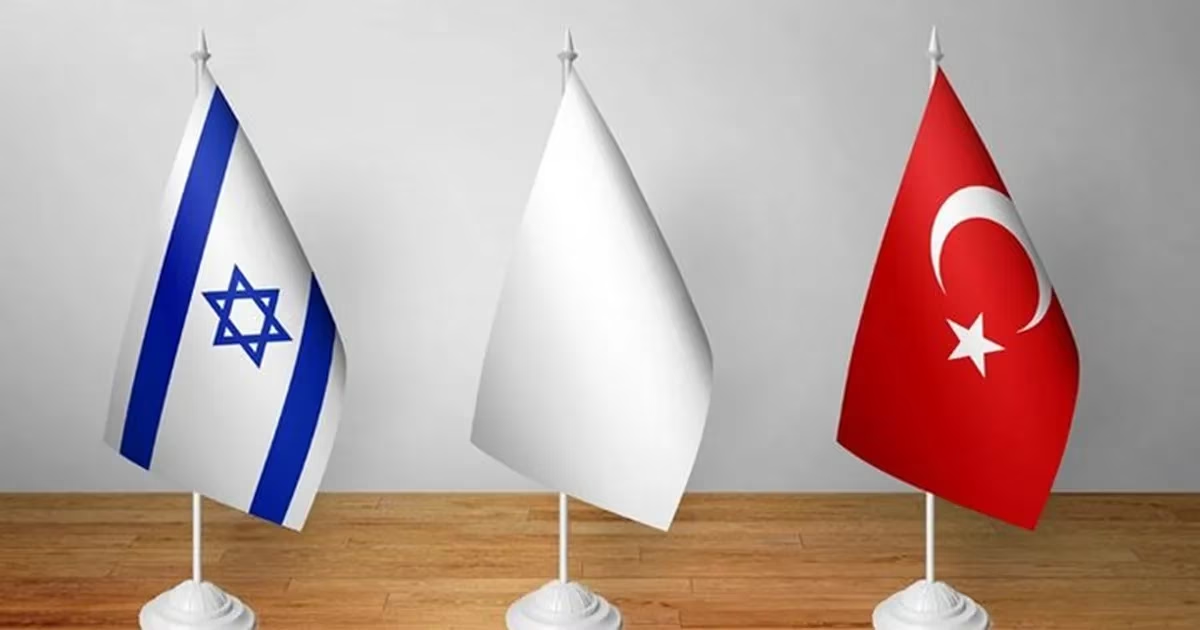
Widespread Israeli Incitement Against Turkey: Calls for Washington to Isolate Ankara and Exclude it from the 'Regional Order'

The intensity of official and media Israeli incitement against the Republic of Turkey has escalated, with explicit calls emerging for the new US administration, led by Donald Trump, to exclude Ankara from any future political or security arrangements in the Middle East. Security circles in Tel Aviv accuse the Turkish leadership of working to undermine what is called the 'new regional order' that Israel and the United States seek to establish through hybrid economic and military alliances.

In this context, General Amit Jagur, former head of Israeli Naval Intelligence, claimed that the time has come to confront what he described as the 'ideological axis' led by President Recep Tayyip Erdogan. Jagur, in an analysis published by the occupation press, considered that Turkish moves are no longer limited to political statements but have turned into a direct military threat targeting both Israeli and American interests in the region.

The former security official indicated that President Erdogan's recent speeches, in which he hinted at the possibility of his country's military intervention to protect Palestinians, as it did in Libya and the Karabakh region, represent an actual declaration of war. Jagur called on the Secretaries of State and Defense in the Trump administration to take these threats with utmost seriousness, considering that Turkey has become a strategic obstacle to the military and security campaigns launched by Israel.

Hebrew sources touched upon the legal aspect of the conflict, expressing concern about the moves led by the Public Prosecutor's Office in Istanbul to bring charges of 'crimes against humanity' against the Israeli leadership. Tel Aviv believes that these legal steps aim to tighten the noose on Western movements in the region and portray the conflict with the Iranian axis as an illegal act contrary to international laws.

Israeli incitement accused Turkey of acting as a 'strategic safety net' for Iran from within NATO, citing Ankara's decision to prevent the use of Incirlik Air Base in any military operations targeting Tehran. Israeli observers believe that this Turkish stance endangers American forces and undermines the effectiveness of military operations aimed at imposing hegemony in the region.

Regarding support for the resistance, Israeli reports claimed that Turkey has become the de facto global haven for Hamas and the Muslim Brotherhood, describing them as 'freedom fighters' in official Turkish discourse. The sources alleged that the thwarting of resistance cells in the West Bank proved the existence of active activity originating from Turkish territory to harm the stability that Israel seeks to impose in the occupied territories.

In the geopolitical dimension, the conflict over trade corridors stands out as one of the motives for incitement, as Erdogan tries to obstruct the US-backed IMEC economic corridor in favor of the 'Development Road' linked to the Chinese-Iranian axis. Ankara asserts in its official statements that no economic or political axis can be established in the Middle East without passing through Turkish territory, which Israel considers a blatant challenge to its economic vision.

Jagur described Turkish officials as 'jihadists in suits,' warning that they are patiently awaiting the end of Trump's term to prevent complete American hegemony over the region. He called for a firm message to be delivered to Ankara that continued military threats against Washington's allies would inevitably lead to the suspension of Turkey's NATO membership and the imposition of comprehensive economic isolation.

Israeli demands also included the necessity of obliging Turkey to ban Hamas and classify it as a terrorist organization, and to act decisively against its funding sources within the country as a test of Erdogan's true intentions. Hebrew circles believe that Washington's silence regarding Turkish moves encourages Ankara to proceed with building an alternative 'axis of resistance' that would replace Iranian influence if it declines.

The reports reviewed a series of statements by Turkish ministers that were considered 'red lights,' including Foreign Minister Hakan Fidan's description of Israel as living in an illusion of security by undermining its neighbors. Tehran's praise for Turkish positions was also considered a 'certificate of honor' reflecting a shared destiny against what Turkish officials described as 'Western imperialism' in the region.

The intensity of Israeli anger was further fueled by statements from Turkish Defense Minister Yaşar Güler, who officially announced that Turkish territory would not be a launching point for attacking any Muslim country, in a clear reference to Iran. Israel believes that this stance empties Western military alliances of their content and provides its adversaries with strategic cover that protects them from preemptive strikes.

In a related context, sources indicated that Turkish intelligence chief Ibrahim Kalin is exerting intense international pressure to prevent the expansion of the war, holding the Israeli side responsible for igniting global crises. Tel Aviv believes that this active diplomacy aims to isolate Israel internationally and portray it as a rogue entity threatening international peace and security for the sake of its leadership's personal whims.

Israeli incitement concluded that Turkey has become the 'voice of conscience' that challenges what Ankara describes as the 'Zionist evil machine,' which raises serious concerns about the growing Turkish power as an obstacle to Israeli expansion. These reports confirm that curbing Turkey has become a strategic necessity to ensure the success of American-Israeli plans to reshape the region's map.

In conclusion, these lines reflect the extent of Israeli concern about Turkey's escalating role, as the occupation's propaganda machine seeks to demonize Turkish positions and link them to terrorism to ensure pressing American action. The relationship between Ankara and Washington remains under significant test amidst these continuous Israeli pressures to break down communication bridges between the two parties.

It is time to act against Turkey's operational ideological axis, and against its attempts to sabotage the military operation against Iran and Washington's intentions for the future of the region.

OPINIONS

Mon 13 Apr 2026 4:33 am - Jerusalem Time

Between Failed Negotiations and Hormuz Escalation: Washington in a Dilemma of Difficult Choices

Washington – Said Arikat – 13/4/2026

News Analysis

The collapse of the Islamabad negotiations between the United States and Iran confirmed that the crisis between the two parties is no longer merely a technical dispute over the nuclear program, but has transformed into an open conflict of wills where politics intertwines with military and economic aspects. After more than twenty hours of intensive talks, US Vice President JD Vance announced the end of the round without an agreement, a clear indication of the depth of the gap between the two sides, especially regarding the American conditions that Tehran rejected as an infringement on its sovereignty.

However, what followed this failure was even more significant and dangerous. US President Donald Trump quickly announced a naval blockade on the Strait of Hormuz, a move reflecting Washington's shift from the logic of negotiation to a policy of imposing facts by force. This shift not only reflects the faltering diplomatic path but also reveals confusion in American strategy, which appears unable to achieve a negotiating breakthrough, and at the same time unwilling to retreat.

American demands, as leaked from the negotiation atmosphere, were not limited to halting uranium enrichment but extended to dismantling parts of Iran's nuclear infrastructure and imposing strict restrictions on missile programs. These are conditions that, from Tehran's perspective, go beyond any balanced negotiating framework and are closer to dictation. Therefore, it was not surprising that the round ended without results, given the absence of a minimum level of trust between the two parties, a gap that has deepened since Washington's withdrawal from the nuclear agreement in 2018.

In this context, it appears that the United States is still captive to the “maximum pressure” approach, even though previous experience has shown its limited effectiveness. Instead of pushing Iran to make concessions, this policy contributed to strengthening its negotiating position and encouraging it to develop deterrence tools. Nevertheless, Washington continues to use the same tools, as if expecting different results, which reflects the absence of a real strategic review.

This approach cannot be separated from internal considerations and regional alliances, especially the relationship with Israel, which plays a pivotal role in shaping the American position. This intertwining of domestic and foreign policy weakens Washington's credibility as a mediator and reinforces Tehran's conviction that any potential agreement may be temporary and subject to collapse with changes in administrations.

The announcement of the naval blockade on the Strait of Hormuz represents a dangerous turning point in the crisis. The blockade, even if presented as a pressure tool, is considered a hostile act under international law and could push Iran to unconventional responses, either through indirect targeting or by expanding the scope of the confrontation. In a region already suffering from security fragility, such an escalation could quickly spiral out of control.

The strategic importance of the Strait of Hormuz makes any tension there a global, not just regional, issue. The strait is a vital artery for the flow of about one-fifth of the world's oil supplies, and any effective disruption would immediately impact international markets through a sharp rise in prices and disruption of supply chains. This factor puts all parties under significant pressure, but at the same time gives Iran a bargaining chip that cannot be ignored.

On the international level, the situation in the Security Council reflects a clear division among the major powers. The double Russian-Chinese veto led to the rejection of a draft resolution that would have legitimized the use of force to keep the strait open. This international rejection indicates limits to American escalation, but at the same time reveals the international system's inability to impose effective collective solutions.

Amidst these developments, the United States finds itself in a complex strategic dilemma. Military escalation carries the risk of sliding into a widespread war whose political and economic costs could be exorbitant, especially in the absence of supportive international consensus. Conversely, retreat or making concessions could be interpreted as weakness, which would reflect on America's deterrence image. As for the diplomatic option, it remains constrained by a high ceiling of demands that are difficult to achieve, leaving Washington stuck in an equation that allows neither decisive action nor withdrawal.

The potential scenarios in the coming days reflect this complexity. We may witness a limited and calculated escalation through indirect military messages, aimed at imposing a balance of deterrence without reaching an all-out confrontation. Conversely, economic pressures, especially in energy markets, may push towards tactical de-escalation and the opening of indirect negotiation channels through regional mediators.

However, the most dangerous scenario remains the possibility of sliding into a wider confrontation, should events spiral out of control or a miscalculation occur, especially in a charged environment lacking effective communication channels. Nevertheless, there remains a fourth possibility: Trump announcing an extension of the ceasefire, in response to pressure from countries like Pakistan and Oman, in an attempt to give diplomacy a new chance.

Ultimately, the current crisis appears more like an open test of the parties' ability to manage escalation rather than resolve it. The absence of trust, conflicting interests, and high demands all make any negotiating breakthrough difficult in the short term. Between the logic of force and its limits, the region stands on the brink of a new phase, which may redraw the features of its balances, or push it towards further turmoil.

The current crisis reflects a deeper dilemma in American strategic thinking, where complex issues are dealt with a short-term mindset focused on achieving quick political gains, without building sustainable paths. This pattern is clearly evident in the rapid transition from negotiation to escalation, which weakens the credibility of any future diplomatic initiative. Moreover, the absence of a comprehensive vision for managing the relationship with Iran makes American policy appear to oscillate between pressure and containment, without being able to decisively achieve either.

This crisis also highlights a flaw in assessing regional balances, as Washington assumes that its traditional tools are still sufficient to impose its will, despite profound changes in the balance of power. Iran, supported by a network of regional alliances and unconventional tools, is no longer a party that can be easily contained. This reality compels American decision-makers to re-evaluate their strategy, because continuing the current approach only increases complexity and raises the cost of any potential confrontation without guaranteeing the achievement of clear objectives.


PALESTINE

Mon 13 Apr 2026 4:32 am - Jerusalem Time

Fears of losing the remains of thousands of martyrs under Gaza's rubble.. Accusations against the occupation of recycling debris

The tragedy of the Engineers' Tower in Nuseirat camp remains a testament to one of the most horrific chapters of the genocide war in the Gaza Strip, where more than 250 Palestinians were martyred under the rubble of 22 residential apartments. More than a year later, at least half of these victims are still under the rubble, their bodies turned into remains mixed with the debris of the destroyed building due to the absence of heavy equipment.

The bereaved families live in a state of helplessness and oppression, as the pain did not stop at losing loved ones, but extended to depriving them of the right to a dignified burial and a final farewell. Fears are escalating that the remains of these martyrs will be lost to the wind amidst the continued prevention by the occupation of the entry of necessary machinery to retrieve them from under tons of cement.

Islam Darwish, a young woman who lost her husband and two children in the bombing, expresses her fear that the remains of her family will be transported with the rubble to be disposed of in the sea or reused in waste recycling projects. She bitterly wonders if anything remains of their bodies that can be buried after such a long period of decomposition under the rubble.

In the city of Rafah, Shaher Abu Awda recounts the story of the extermination of his family of 14, who are still under the rubble of their home in the Swedish Village. Shaher describes what happened as a complex crime, where the house was bombed, then the entire neighborhood was bulldozed, and the rubble, including the remains, was transported to unknown destinations without providing an opportunity to retrieve them.

In the Beit Lahia project north of the Strip, the Abu Al-Nasr family is still waiting to retrieve the remains of 23 of its members from among 150 martyrs who died in a horrific massacre. Survivor Aya Abu Al-Nasr confirms that the missiles tore the bodies into pieces mixed with the rubble, making identification extremely difficult and complex.

Palestinian Civil Defense data indicates shocking numbers of missing persons under the rubble, with Gaza Governorate topping the list with 4,210 martyrs under the rubble of 589 homes. North Gaza follows with 2,341 martyrs, while the remaining numbers are distributed among the Central Governorate, Khan Yunis, and Rafah, reflecting the immense scale of destruction.

Sources in the Civil Defense reported that their teams faced extreme difficulties in a previous project to retrieve martyrs, as no trace was found of about half of the targeted individuals. This is due to the severe decomposition of the bodies and the impact of the deadly weapons used, which caused the bodies to disintegrate and mix with soil and debris.

Officials in the Civil Defense in Rafah Governorate revealed dangerous practices by the occupation, including the use of robots and automated means to disintegrate bodies before bulldozing sites. Reports circulated about the transfer of this rubble for use in construction work within the occupied territories or in military areas, in flagrant violation of all international norms.

For its part, the Government Media Office in Gaza stressed the existence of field data confirming the deliberate bulldozing of homes over the heads of victims and mixing their remains with the rubble. The office called for the necessity of a swift and independent international investigation to uncover the fate of thousands of missing persons and hold accountable those responsible for these crimes that affect human dignity.

The International Committee of the Red Cross explained that it is trying to facilitate the access of rescue teams through dialogue with the parties to the conflict, but the final decisions remain in the hands of the occupation authorities. The committee confirmed that search operations are extremely complex and require significant technical capabilities not currently available due to the tight siege on the Strip.

According to the Palestinian Ministry of Health, the number of martyrs still under the rubble is estimated at about 9,000 missing persons, most of whom have not yet been included in official records. Officials indicate that entire families have been erased from the civil registry, making accurate counting of victims almost impossible at present.

International law experts describe what the remains of the martyrs are subjected to as a 'full-fledged war crime' falling within the context of ongoing genocide. Preventing the retrieval of bodies and obstructing the work of humanitarian teams constitutes a grave violation of the Geneva Conventions, which mandate respect for the dead and facilitating their burial.

The continued presence of bodies under the rubble prevents the healing of the bleeding wounds of thousands of Palestinian families who live on the hope of recovering the remains of their loved ones. These families appeal to the international community to pressure for the entry of heavy equipment and fuel necessary for the work of the Civil Defense before it is too late and all traces are completely lost.

The issue of the missing in Gaza remains an open wound that summarizes the tragedy of a people subjected to extermination and mutilation, both alive and dead. With each passing day, the chances of finding the remains fade, turning the destroyed homes into unmarked mass graves, awaiting someone to do justice to their victims and reveal to the world the fate of their lost bodies.

Bulldozing rubble mixed with the remains of victims, transporting it, and reusing it represents a blatant affront to human dignity and a serious violation of international law.

PALESTINE

Mon 13 Apr 2026 4:32 am - Jerusalem Time

Deadly escalation in southern Lebanon: 4 martyrs in a raid on Maaroub and Hezbollah carries out 44 offensive operations

Lebanese medical sources reported early Sunday that four citizens, including a woman, were martyred and three others were injured as a result of an airstrike carried out by Israeli occupation aircraft targeting the town of Maaroub in the southern sector. This raid comes in the context of an ongoing military escalation that affects Lebanese villages and towns daily.

The Lebanese Ministry of Health revealed in its latest statistics a tragic increase in the number of victims, as the toll of the extensive Israeli aggression since the beginning of last March reached about 2055 martyrs. Medical teams also recorded 6588 people injured with varying degrees of severity due to continuous air and artillery shelling.

On the ground, Hezbollah announced the implementation of a wide series of military operations, totaling 44 attacks, targeting gatherings, vehicles, and sites belonging to the occupation army. The party confirmed in its statements that these operations come in response to the continued aggression and to protect Lebanese territories and their residents from ground incursions.

Missile attacks included six major settlements in occupied northern Palestine, with shelling focusing on Shlomi, Yir'on, and Kiryat Shmona. Missile barrages also hit the settlements of Margaliot, Avivim, and Nahariya, triggering air defense systems and sirens.

In the context of confronting ground infiltration attempts, Hezbollah fighters targeted gatherings of occupation soldiers at eight border points in southern Lebanon. Clashes focused around the city of Bint Jbeil and the Liberation Triangle, in addition to Shamran Hill and the Aqaba area in the town of Ain Ebel and Khiam.

Hezbollah used suicide drones and guided missiles in its operations to strike occupation movements in the towns of Dibel, Rashaf, and Beit Leif. Field sources also reported targeting military gatherings in Al-Qawzah, Al-Bayadah, and Shema, confirming direct hits among the invading forces.

Regarding military bases, Hezbollah announced the shelling of four strategic bases, including Filyoun base south of Rosh Pina settlement and Jabal Neria base. Fighters also targeted Al-Mutla base and the newly established Blat site in southern Lebanon with precise missile strikes that disabled some equipment.

In a qualitative development, suicide drones targeted the command headquarters of the Al-Sahl Battalion in Beit Hillel barracks, in addition to Ya'ara, Shomera, and Kiryat Shmona barracks. Military statements mentioned that swarms of drones successfully reached their targets despite intensive Israeli interception attempts.

The shelling was not limited to the Galilee but extended to include military infrastructure in Karmiel settlement and Katzrin settlement located in the occupied Syrian Golan. Hezbollah also targeted Dafna settlement with missile volleys, confirming that its target bank is expanding to include all logistical support points for the Israeli army.

In terms of intelligence and leadership, the communications station in Al-Aliqa barracks in the occupied Golan was targeted using a sophisticated qualitative drone. Hezbollah also announced the shelling of the command headquarters of Division 146 in Ja'atoun settlement, and the targeting of a military vehicle carrying a leadership team in the border town of Al-Taybeh.

Israeli artillery positions were also within the targeting circle, as Hezbollah sources shelled artillery positions in the settlements of Goren, Dishon, and Yiftah. This shelling aims to reduce the intensity of fire used by the occupation to pave the way for its ground forces attempting to advance in the front villages.

In contrast, areas of northern Israel experienced a state of constant alert, with sirens sounding 18 times within a few hours in more than 20 towns. Warnings included wide areas in the Upper and Western Galilee and the Galilee Panhandle, amid reports of rockets falling in open and populated areas.

Our response will continue until the Israeli-American aggression against Lebanon and its people stops.

PALESTINE

Mon 13 Apr 2026 4:32 am - Jerusalem Time

Warnings of a complete collapse of the health system in Gaza due to the occupation's intransigence

The director of Nasser Medical Complex, Atef Al-Hout, issued a final warning cry about the dire consequences of a complete collapse of all medical services provided to patients in the Gaza Strip. Al-Hout explained that the occupation authorities continue their intransigence by preventing the entry of oils and necessary supplies for operating electricity generators, which threatens to stop vital equipment in hospitals. He called on the international community to intervene immediately and pressure the occupation to secure the basic needs of the dilapidated health sector.

For its part, the Ministry of Health in Gaza revealed a tragic reality experienced by patients, as the sector records daily deaths of injured people and patients who were waiting for permission to travel to receive treatment abroad. The ministry confirmed in a statement that time has become a real threat to the lives of thousands, stressing that the health system is no longer able to withstand the severe blockade that deprives patients of their most basic medical rights.

Field reports indicate that the health system in Gaza is in a state of 'agony' as a result of years of direct targeting and destruction of sewage infrastructure, which has led to a widespread outbreak of epidemics and infectious diseases such as viral hepatitis. Patients with chronic diseases, especially those undergoing dialysis and heart and diabetes patients, suffer from an almost complete lack of medical services and life-saving medicines, which puts them in direct confrontation with the imminent risk of death.

On the ground, Israel continues to violate the terms of the truce agreement reached under American auspices several months ago, by launching airstrikes that have resulted in hundreds of martyrs and wounded. In parallel with the military escalation, the occupation authorities refuse to abide by commitments to open crossings and allow the entry of humanitarian and medical aid, which exacerbates the living and health crisis and undermines any opportunities for stabilizing the humanitarian situation in the besieged Strip.

The lives of patients cannot bear any more waiting, and time is running out amidst the continued medical blockade.

ARAB AND WORLD

Mon 13 Apr 2026 4:32 am - Jerusalem Time

Salam affirms efforts to stop the war and withdrawal of occupation amidst fierce battles in Bint Jbeil

Lebanese Prime Minister Nawaf Salam affirmed that the Lebanese government prioritizes stopping the Israeli aggression and ensuring a complete withdrawal of occupation forces from Lebanese territories. Salam clarified in a speech addressed to the Lebanese people that diplomatic efforts are ongoing to end the war through available negotiation channels.

The Prime Minister indicated that Lebanese efforts are primarily based on the initiative presented by President Joseph Aoun, which aims to reach an agreement guaranteeing national sovereignty. These statements come at a sensitive time, preceding the start of an anticipated round of negotiations in Washington between representatives from Lebanon and Israel next Tuesday.

On the ground, sources reported that the past forty-eight hours witnessed a relative calm in the pace of airstrikes on the capital Beirut and its southern suburbs. However, this calm in the center was met with an unprecedented military escalation on the southern Lebanese fronts, where the occupation intensified its aerial and artillery strikes.

Sources recorded dozens of daily raids targeting the western, central, and eastern sectors of southern Lebanon, with intense focus on towns in the rear lines. The attacks targeted the city of Nabatieh and its surrounding villages, leading to widespread destruction of property and infrastructure and more casualties.

The toll of the ongoing Israeli aggression since early March has risen to approximately 2055 martyrs, while the number of injured has exceeded 6400. In recent hours, occupation forces committed bloody massacres in the towns of Maaroub, Qana, and Tuffahta, following successive raids targeting inhabited homes.

In the context of ground confrontations, the city of Bint Jbeil has become an arena for the fiercest battles between Hezbollah fighters and encroaching occupation forces. Israeli units are attempting to control the city due to its geographical importance and historical symbolism linked to resistance against occupation since 2000.

Field reports indicate that occupation forces advanced from rugged axes through the town of Ain Ebel, reaching a distance estimated at about 200 meters from the city's stadium. Despite this field advance, Israeli forces have not yet succeeded in imposing full control over residential neighborhoods or key landmarks.

For its part, Hezbollah continues to carry out intensive military operations against gatherings of occupation soldiers and their vehicles in the vicinity of Bint Jbeil and within some of its neighborhoods. These operations aim to prevent occupation forces from consolidating their positions or turning the city into a launching pad for deeper operations inside Lebanese territory.

Regarding rocket fire, Hezbollah launched successive volleys targeting settlements in the Western Galilee, Kiryat Shmona, Avivim, and Margaliot. The shelling also targeted the Meron air surveillance base and military sites in the occupied Syrian Golan, as a response to the massacres committed against civilians.

Monitoring the pace of sirens inside the occupied territories indicates that resistance operations are occurring at a rate of approximately one operation per hour. This continuous rocket fire reflects Hezbollah's ability to maintain its command and logistical system despite the intensity of Israeli airstrikes.

Observers believe that the current Israeli escalation aims to achieve major field gains before sitting at the negotiating table in the United States. The occupation army seeks to expand its control in the central sector to strengthen its negotiating position and impose a new reality on the border.

The depth of the Israeli incursion at some border points reached between 8 to 9 kilometers, where the occupation is trying to establish military strongholds. The battle of Bint Jbeil is considered the toughest test for both sides, as it represents a significant demographic and military weight in the border operations area.

Coinciding with these developments, Israeli Prime Minister Benjamin Netanyahu paid an inspection visit to the forces encroaching in southern Lebanon. Lebanese sources considered this visit to carry escalatory messages and confirm the occupation's insistence on continuing the ground operation despite international diplomatic movements.

In conclusion, southern Lebanon is experiencing its bloodiest and most violent phase in weeks, amidst the absence of any real signs of immediate de-escalation. The field remains the primary driver of the anticipated negotiations, given Lebanon's insistence on the withdrawal of the occupation from all its occupied territories.

We will continue to work to stop this war and ensure the Israeli withdrawal from all our territories through negotiation and proposed initiatives.

ISRAELI AFFAIRS

Mon 13 Apr 2026 4:32 am - Jerusalem Time

Israeli fears of long-term attrition in Lebanon and warnings of 'heavy costs'

Hebrew media sources revealed escalating concerns within military circles in Tel Aviv about paying heavy costs due to the prolonged war in Lebanon. The sources indicated that the current strategy could lead to the attrition of Israeli forces in the absence of a clear and swift resolution to the ongoing confrontation with Hezbollah.

Currently, the Israeli army is operating five full military divisions in South Lebanon, with their tasks divided between deep penetration and securing the border line. These movements aim to pressure Hezbollah and prevent it from regaining its offensive capabilities in areas near northern settlements, through intensive air raids and ground operations.

Division 91 forces, under the command of Yuval Gaz, are working to deepen military activity to expand what is called the security zone along the border strip. This division seeks to create a new reality on the ground that prevents Hezbollah fighters from approaching the separation fence, in an attempt to provide longer-term protection for border areas.

In a related context, Division 146, led by Benny Aharon, is responsible for strengthening the front defensive line within Lebanese territory. The tasks of this force focus on protecting northern settlers from ground infiltrations, with military sources announcing the destruction of more than a thousand armed infrastructures and the killing of dozens of elements in its operational sector.

As for Division 36, led by Yiftah Norkin, it conducts deep maneuvers aimed at striking Hezbollah's military formations in areas previously untouched by forces. The operations of this division are characterized by secrecy, as full data regarding the results of its field operations have not yet been disclosed, according to Hebrew reports.

For its part, Division 98, led by Guy Levy, completed its deployment along the lines facing anti-tank threats. The forces are working to clear the area of warehouses and tunnels, in an attempt to reduce Hezbollah's ability to target Israeli vehicles moving in open areas and near villages.

Israeli military estimates indicate the elimination of more than 1,400 militants since the start of operations, and the destruction of thousands of logistical facilities. Despite these figures, the challenge remains in Hezbollah's ability to maneuver and force Israeli forces to divide their war effort between several combat axes.

Military sources admitted that Hezbollah succeeded in challenging the Northern Command, headed by Rafi Milo, by forcing the army to maneuver in depth. The army faces difficulty in identifying Hezbollah's main effort, which relies on Shiite villages as a central infrastructure for managing its defensive and offensive operations against the invading forces.

Division 98 forces were stationed at a distance of 5 to 6 kilometers from the border, a distance aimed at reducing the risk of guided missiles. However, Hezbollah's possession of anti-tank missiles with a range of up to 10 kilometers keeps Israeli forces under constant targeting despite being stationed in cleared areas.

Reports indicate that Hezbollah deployed about 1,000 fighters from the elite 'Radwan Force' to South Lebanon to strengthen its defensive lines. This move further complicated the Israeli mission, as the confrontation turned into a war of attrition based on mutual exhaustion and systematic clearing of residential and agricultural blocks.

The current pattern of military action raises significant concern within the Israeli home front, as it replicates the experience of fighting in the Gaza Strip, which has not yet achieved a decisive outcome. Military analysts fear that this pattern could lead to a long-term entanglement in the Lebanese quagmire without achieving clear political or security objectives.

The Israeli army is currently focused on destroying the logistical capabilities that allow Hezbollah to survive and operate for long periods in the rugged mountainous region. Operations include the destruction of strategic tunnels and weapons caches hidden underground, which form the backbone of Hezbollah's defensive system in the south.

Observers believe that the absence of a 'main trick' or element of surprise in the Israeli army's movements has made the forces vulnerable to encirclement and ambushes. This was evident in several combat centers where forces were surprised by the level of resistance, prompting the military leadership to constantly re-evaluate its field plans.
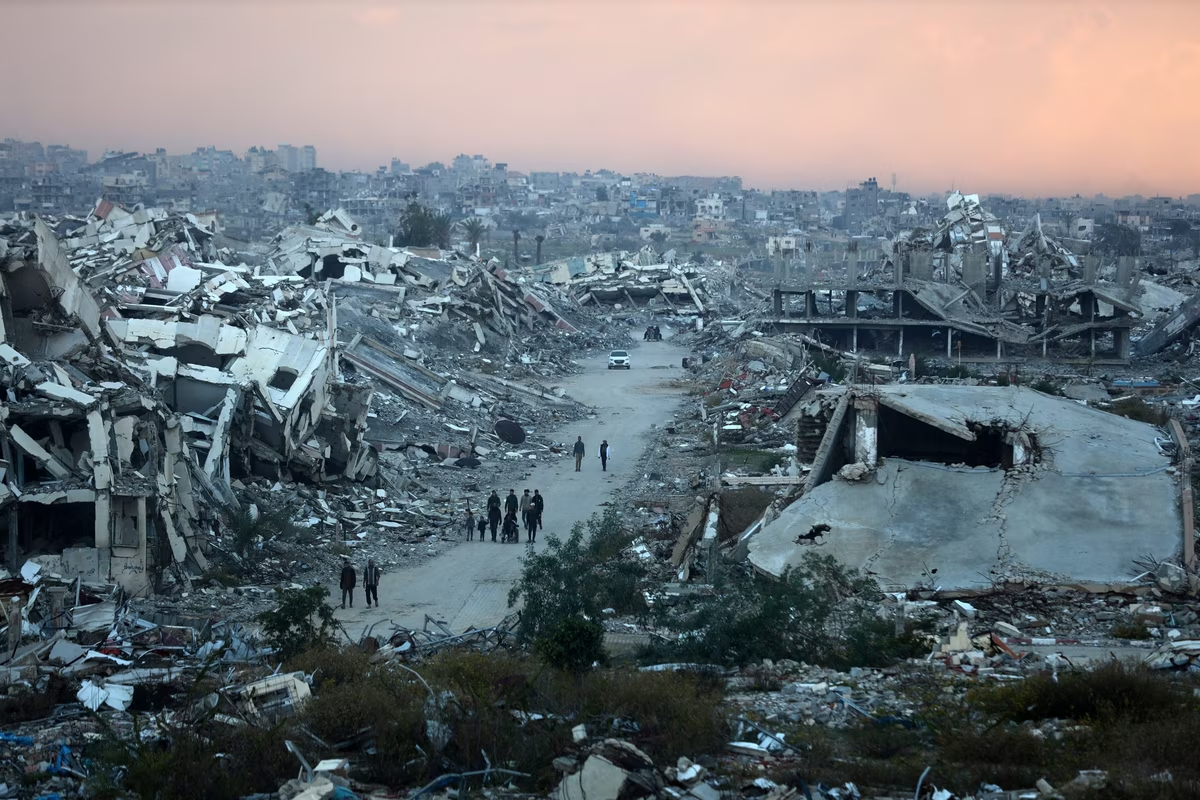
Ultimately, the question remains in Israeli circles about the utility of continuing operations at the same pace without an exit strategy. With rockets continuing to be launched towards the north, pressure is increasing on the Israeli government to find a solution that ends the state of attrition that has begun to exhaust the military budget and the morale of the soldiers.
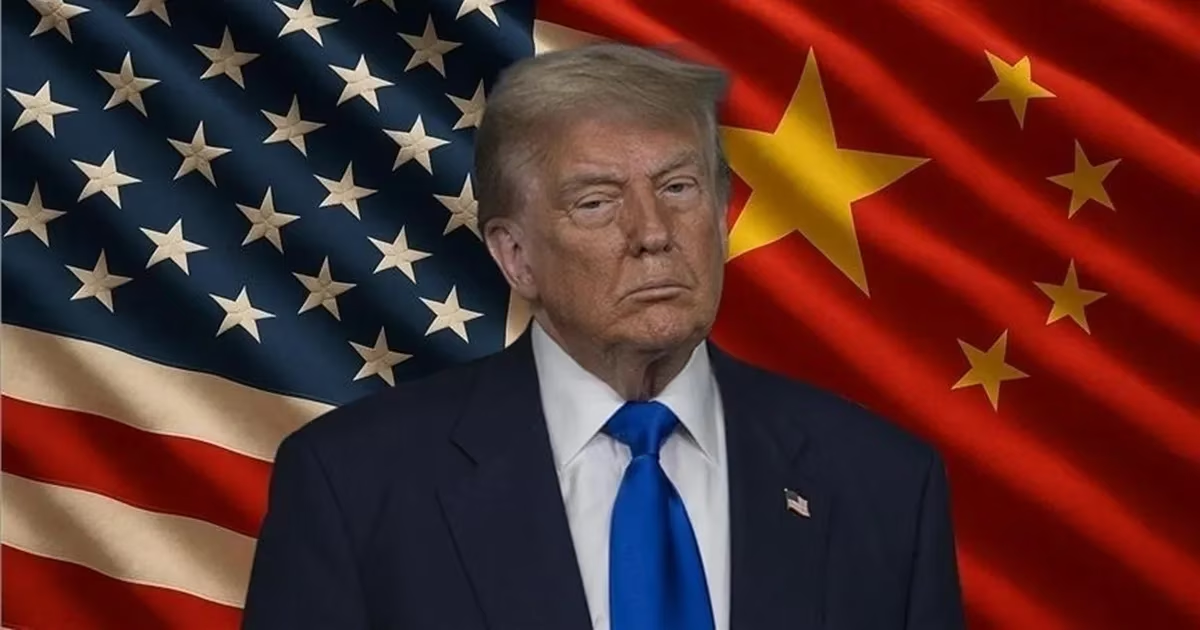
The Israeli army largely replicates operational patterns from the Gaza Strip, where fighting has not yet ended, raising concerns about long-term attrition.

OPINIONS

Mon 13 Apr 2026 4:32 am - Jerusalem Time

Trump and International Institutions: A Strategy of Confrontation and Reshaping American Hegemony

Ramallah - “Alquds ” dot com

Ramallah - “Alquds ” dot com

Opinion Writer

Regional and international organizations are currently facing unprecedented challenges, finding themselves vulnerable to the fluctuations of American political moods. Although these institutions have historically revolved around major powers, they have not been spared from direct targeting that has affected their structure and functional role on the global stage.

Since President Donald Trump came to power, he has pursued an aggressive policy that has included countries, institutions, and individuals alike. Observers believe that this approach stems from Trump's conviction that these organizations no longer serve the vital interests of the United States, but rather have become a financial and political burden that requires change or abolition.

Trump's 'firing line' included pivotal institutions such as the United Nations and the World Health Organization, in addition to the Human Rights Council and UNESCO. The matter did not stop at verbal criticism, but extended to practical measures such as reducing financial contributions and delaying sensitive administrative appointments to disrupt organizational effectiveness.

The American administration took decisive steps by withdrawing from the World Health Organization and completely freezing its funding at the peak of global need for it. This step came in parallel with ending participation in the UN Human Rights Council, under the pretext of political biases against Washington and its ally Israel.

Regarding the Palestinian issue, the most prominent decision was to permanently cut funding to the United Nations Relief and Works Agency for Palestine Refugees (UNRWA). This decision was not merely a financial measure, but represented an attempt to dismantle one of the most important international symbols of the historical rights of Palestinian refugees.

NATO was not spared from these pressures, as Trump repeatedly threatened to withdraw from it unless member states increased their military spending shares. He also demanded that the alliance take on roles beyond its traditional limits, such as participating in military operations to forcibly open the Strait of Hormuz to ensure energy flow.

These policies raise a fundamental question about the message Trump wishes to convey to the international community. Some analyze these moves as an attempt to build a new international system characterized by absolute 'Americanization,' where the terms of American hegemony are directly imposed, away from multilateral diplomacy.

Supporters of this approach believe that what Trump is doing is a 'rational repositioning' aimed at protecting the American taxpayer. The prevailing logic here is that the United States has borne enormous economic and military burdens for decades without reaping political fruits commensurate with the scale of its sacrifices.

In a striking statement on January 20, 2026, Trump publicly affirmed that the United Nations had not provided him with any significant benefit. He hinted at the possibility of replacing it with a 'World Peace Council,' a new entity he seeks to establish as an alternative to the traditional, dilapidated international system, as he described it.

The 'World Peace Council' proposal is linked to Trump's initiative to end the aggression on Gaza, where he demands countries join and contribute financially with huge sums amounting to one billion dollars. This proposal reflects a desire to privatize international work and make it conditional on financial capacity and political loyalty to the new American vision.

On the other hand, analysts believe that this policy could lead to counterproductive results that accelerate the decline of American influence globally. Weakening international organizations opens the door wide for rising international powers, such as China and Russia, to fill the vacuum and lead institutions with different programs and agendas.

The erosion of Washington's leadership role could negatively impact the lives of American society itself in the long run. Despite the enormous military power that the United States still possesses, internal divisions and the erosion of institutions are reminiscent of the periods of weakness that major empires historically experienced.

Expectations are growing for sharp divisions within international organizations, not only because of American behavior, but also as a result of varying reactions from other members. Some countries are already expressing their discontent through actions and behavior, while others remain silent and wait on 'gray ground' for what comes after the Trump era.

The upcoming challenge remains the international system's ability to withstand these violent shocks in the structure of international relations. The future will reveal whether America will reclaim its traditional role, or whether the world is truly heading towards a multipolar system in which Washington is not the sole player.

The United Nations has never done me any good; my council might replace it.

ARAB AND WORLD

Mon 13 Apr 2026 4:31 am - Jerusalem Time

Netanyahu announces control over 'security zone' in Lebanon, Israeli intention to expand operations towards the Awali River

Israeli Prime Minister Benjamin Netanyahu confirmed, during a field visit to southern Lebanon, that Israeli forces had succeeded in neutralizing what he described as the 'invasion threat' posed by Hezbollah. Netanyahu appeared in a video recording wearing a bulletproof vest amidst heavy security, emphasizing that military operations would continue within the security zone to ensure that border threats do not return.

In the context of the escalating field operations, sources reported that the Israeli army carried out more than 200 airstrikes in recent hours, targeting various locations in southern Lebanon. This intensity of fire comes at a time when questions are mounting about future strategic objectives, and whether Tel Aviv seeks to impose a new military reality as an alternative to permanent diplomatic solutions.

Field assessments indicate that the Israeli military command is preparing to shift the focus of its operations from south of the Litani River to the area between the Litani and Awali Rivers. This shift aims to pursue missile launch platforms that Israel claims are now concentrated in those northern areas, necessitating an expansion of the presumed security belt.

For its part, Hebrew press reports revealed an Israeli intention to exert intense political pressure on the Lebanese negotiating delegation in Washington. These pressures center on the necessity of disarming Hezbollah in the 'central Lebanon' region, a term Israel uses to refer to the geographical areas extending behind the current front lines of confrontation.

On the diplomatic front, a new round of negotiations is expected to begin in the United States next Tuesday, involving officials from Lebanon, Israel, and the American side. Through these talks, Israel seeks to secure security gains that legitimize its presence or operations in areas it considers a source of continuous missile threat.

In contrast, the pace of Hezbollah's military response has not stopped, with field sources observing missile and drone attacks at a rate of approximately one operation per hour. Sirens have repeatedly sounded in the Nahariya and Galilee regions, and around Metula, extending to the occupied Syrian Golan, reflecting the party's insistence on continued attrition.

Israeli military censorship conceals the extent of human and material losses resulting from these missile barrages, and they are only disclosed in cases of confirmed casualties. The field situation remains open to all possibilities with the continuation of mutual 'messages of fire' between the two sides, awaiting the outcome of political movements in Washington.

The war continues within the security zone in Lebanon, and we have eliminated the invasion threat that Hezbollah was planning.

ISRAELI AFFAIRS

Mon 13 Apr 2026 4:31 am - Jerusalem Time

Behind the Scenes of Khamenei's Assassination: A Secret AI System and 40 Missiles in 40 Seconds

Hebrew press reports revealed new technical and intelligence details regarding the assassination operation of Iranian Supreme Leader Ali Khamenei, which was carried out more than forty days ago. The reports clarified that the operation was the result of intensive intelligence cooperation between Israel and the United States, combining fieldwork with the latest digital espionage technologies.

According to what was published by the "Israel Hayom" newspaper, the Military Intelligence Directorate of the Israeli Army formed a high-level secret team to prepare for the operation. This team included members from elite technological units such as Unit 8200 and Unit 9900, in addition to experts from the research and operations departments to ensure precise execution.

The intelligence plan relied primarily on close and continuous monitoring of the mobile phones of Khamenei's inner circle. Technical teams also managed to penetrate internet-connected surveillance camera networks inside Iranian territory, allowing for extremely precise monitoring of the Leader's movements around the clock.

To analyze this massive amount of data, intelligence used a "secret artificial intelligence system" specifically developed for this mission. The system analyzed the Leader's daily movement patterns and predicted his future locations, enabling planners to develop multiple targeting scenarios.

Sources indicated that the planning team developed a "flexible execution mechanism" that allowed for striking multiple targets simultaneously and in various ways. The goal of this flexibility was to reduce error margins to zero and ensure that the desired targets would not escape, regardless of changing field conditions.

The decisive moment came on the morning of February twenty-eighth, specifically at 8:15 AM. Tracking devices detected Khamenei's presence inside a fortified compound in the capital, Tehran, accompanied by several senior security and military leaders of the Iranian regime.

The air force carried out a swift and concentrated strike targeting three locations simultaneously using high-precision guidance technologies. Reports stated that the attack involved launching 40 missiles in a record time of no more than 40 seconds, resulting in the death of 40 high-ranking officials who were at the site.

The newspaper quoted sources in military intelligence as saying that the system Khamenei had built over decades had suffered a sudden structural collapse. The sources added that the current Iranian leadership is suffering from severe communication confusion and difficulty in making fateful decisions that required direct approval from the Leader.

Following the operation, the region witnessed a widespread military escalation as Tehran responded by launching barrages of missiles and drones towards Israeli targets. Iranian attacks also targeted what it described as American interests in several Arab countries, amidst a state of instability that still hangs over the new leadership.

The system designed by Khamenei has collapsed, and the current leadership is in a state of deep confusion.

PALESTINE

Mon 13 Apr 2026 4:31 am - Jerusalem Time

Gaza death toll exceeds 72,000 as victims continue to be pulled from under the rubble

Medical sources in the Gaza Strip revealed today, Sunday, a new update to the bloody toll of the ongoing occupation aggression since October 7, 2023. According to official data, the number of martyrs has risen to 72,329, while medical records show 172,192 injuries, highlighting the unprecedented humanitarian catastrophe that has befallen the Strip.

Regarding the past twenty-four hours, sources reported the arrival of a new martyr's body at hospitals, in addition to the recovery of another body from under the rubble, while health centers received 8 injuries of varying severity. These figures come amid complex field conditions that limit the health system's ability to immediately monitor all victims.

As for the statistics recorded since the ceasefire came into effect on October 11, reports indicated the martyrdom of 750 people and the injury of 2,090 others during this period. Civil Defense teams also succeeded in recovering the bodies of 760 missing persons from various locations, while hundreds remain missing under the rubble of collapsed buildings and due to the destruction of infrastructure that hinders the access of rescue vehicles.

Medical teams continue to confirm that hundreds of victims remain under the rubble of destroyed buildings and on roadsides due to the inability of rescue teams to reach them.

OPINIONS

Mon 13 Apr 2026 4:25 am - Jerusalem Time

Gaza’s Ceasefire Illusion: A Blueprint for Capitulation, Not Peace


By : Said Arikat


News Analysis


Washington, D.C- The latest round of negotiations in Cairo—bringing together Hamas, Egyptian mediators, and representatives of the so-called “Peace Council”—is being presented as a serious effort to advance the second phase of a fragile ceasefire in Gaza. In reality, it resembles a familiar diplomatic ritual: one in which the language of peace masks an agenda that entrenches Israeli dominance while extracting unilateral concessions from the Palestinian side. Beneath the procedural language and staged optimism lies a framework that is not only unbalanced, but structurally coercive.


At the center of the talks is a proposal associated with the Council’s high representative, Nickolay Mladenov, which conditions everything—humanitarian relief, reconstruction, and even Israeli withdrawal—on the prior disarmament of Palestinian factions. This is not a technical sequencing issue; it is a political demand presented as a prerequisite for progress. It effectively requires Hamas and other groups to surrender their only meaningful leverage before Israel is required to deliver anything tangible. In any credible negotiation, reciprocity is essential. Here, it is notably absent.


Hamas’s response, as conveyed by sources close to the talks, is comparatively measured given the scale of what is being demanded. The movement is not insisting on maximalist outcomes but on basic procedural guarantees: clear timelines for Israeli withdrawal from Gaza, where Israeli forces reportedly still control more than half the territory; the immediate deployment of a national administrative committee to oversee governance and reconstruction; and, crucially, the full implementation of the first phase of the ceasefire agreement before any transition to the second. These are not excessive demands—they are the minimum threshold for credibility.


What makes the current proposal particularly problematic is that it treats Israeli violations as secondary concerns rather than fundamental obstacles. Since the ceasefire took effect, Israel has reportedly continued lethal operations, including targeted killings and shelling, while severely restricting humanitarian access. Commitments to allow hundreds of aid trucks into Gaza daily have not been met. Medical evacuations remain tightly constrained. Civilians continue to die under what are supposed to be de-escalation conditions. Yet instead of enforcing compliance with these obligations, the plan shifts the burden onto the Palestinian side to meet new and far-reaching conditions.


This is not mediation; it is managed imbalance. It reflects a longstanding pattern in international diplomacy: Israeli non-compliance is normalized or overlooked, while Palestinian resistance is framed as the central obstacle to peace. Disarmament is treated as a prerequisite rather than a potential outcome of a just and enforceable agreement. The result is a negotiation framework that begins by stripping one side of its bargaining power and ends by asking it to rely on the good faith of a party that has repeatedly demonstrated otherwise.


The demand for disarmament, in this context, is not only unrealistic but fundamentally disingenuous. It ignores the profound asymmetry between a heavily armed state and a population living under occupation and blockade. To insist that Palestinian factions lay down their arms before there is any credible end to that occupation is to demand submission, not compromise. It institutionalizes vulnerability while offering only vague and non-binding assurances in return. Such an arrangement cannot plausibly be described as a path to sustainable peace.


Even more troubling is the sequencing embedded in the proposal: disarmament first, withdrawal later. This inversion raises an obvious and critical question—what guarantees exist that withdrawal will ever occur? The historical record offers little reassurance. Israel has repeatedly entered into agreements only to delay, reinterpret, or fail to implement their terms when it aligns with its strategic interests. Without enforceable timelines and robust international guarantees, promises of withdrawal remain hypothetical, while disarmament would be immediate and irreversible.


The role of the so-called Peace Council in advancing this framework also warrants scrutiny. By aligning so closely with Israeli priorities, it risks abandoning any claim to neutrality. Effective mediation requires not only balancing interests but actively addressing power disparities. Instead, this proposal amplifies them. It places the Palestinian side under sustained pressure to concede, while insulating Israel from meaningful accountability. That is not conflict resolution; it is the management of conflict on terms favorable to the stronger party.


The plan’s governance component—centered on the creation of a national committee to administer Gaza—raises further concerns. While presented as a technocratic solution, it sidesteps the underlying political realities. There is no clear timeline for transferring authority to the Palestinian Authority, no mechanism to ensure that governance structures are locally legitimate, and no acknowledgment that administrative arrangements cannot substitute for political rights. Reconstruction without sovereignty is, at best, a temporary measure rather than a durable solution.


Unsurprisingly, Palestinian factions appear united in their rejection of the plan in its current form. Hamas is reportedly coordinating closely with other groups, including Islamic Jihad and leftist factions, to present a common position. This convergence reflects not ideological alignment but a shared recognition of what is at stake. The proposal is widely seen not as a step toward peace, but as an attempt to reshape the balance of power under the cover of diplomacy.


If the Cairo talks are to yield meaningful results, a fundamental shift in approach is required. The starting point must be the enforcement of existing commitments: a complete halt to hostilities, full and sustained humanitarian access, and clearly defined, verifiable timelines for Israeli withdrawal. Only once these conditions are met can more complex and sensitive issues—such as the future of armed factions—be addressed in an environment where trust is possible and reciprocity is genuine.


Without a meaningful recalibration, the current process is likely to collapse, repeating the failures of numerous previous efforts. More troublingly, it risks intensifying public disillusionment while reinforcing a status quo marked by recurring violence, a deepening humanitarian crisis, and prolonged political paralysis. For Gaza’s civilian population, the consequences are neither abstract nor distant—they are immediate and severe. Their suffering is being exploited as a bargaining tool to extract concessions, rather than treated as an urgent moral imperative requiring decisive action.


There is a persistent illusion in diplomatic circles that process alone constitutes progress—that the mere continuation of talks signals movement in the right direction. But a process without fairness is not progress; it is performance. In Gaza today, that performance is wearing thin. A framework that demands disarmament before dignity, compliance before reciprocity, and trust without accountability is not a peace plan. It is a blueprint for capitulation—one that risks perpetuating the very conflict it claims to resolve.

ARAB AND WORLD

Sun 12 Apr 2026 7:36 pm - Jerusalem Time

Trump threatens China with 'major problems' if it supplies Iran with air defense systems

US President Donald Trump issued a strongly worded warning to the Chinese leadership, asserting that Beijing would face serious repercussions and major problems if it were proven to have supplied Iran with weapons. These statements came after media and intelligence reports indicated that the Chinese side intended to enhance Tehran's defensive capabilities amid current regional tensions.

Informed sources stated that US intelligence agencies had detected serious indications of Beijing's readiness to deliver advanced air defense systems to Iran in the coming weeks. The sources clarified that these shipments might include shoulder-fired anti-aircraft missile systems, technologies that cause significant concern among military circles in Washington due to their ability to threaten air forces.

Intelligence estimates suggest that Beijing might resort to complex strategies to deliver these weapons, including using third countries as transit platforms to conceal the true source of the shipments and avoid direct sanctions. Washington is closely monitoring these movements, which it described as secret, considering any direct military support to Tehran a crossing of American red lines in the region.

In a related context, press reports revealed an undeclared Chinese role in supporting the Iranian military effort by allowing Chinese companies to export chemicals, fuel, and technical components used in military industries. Observers believe that these materials directly contribute to enhancing Iran's local military production, further complicating the security and political landscape.

Despite these accusations, US officials acknowledged that recently obtained intelligence information still lacks conclusive confirmation. Officials noted that there is no concrete evidence yet proving the use of any Chinese-made missiles against US or Israeli forces in the field, which places the issue within the framework of preemptive warnings.

For its part, the Chinese Ministry of Foreign Affairs promptly and completely denied these allegations. Its spokesperson affirmed that his country adheres to a neutral stance and does not provide military support to any party in ongoing conflicts. The Chinese spokesperson described the circulating information as inaccurate and aimed at distorting Beijing's image, calling on the US administration to stop making accusations not based on facts.

These developments come at a time when US-Chinese relations are experiencing escalating tension over multiple economic and political issues. Trump's latest threat represents a new episode in the series of maximum pressure exerted by Washington to curb Iranian influence and an attempt to cut off military and logistical supply lines that might reach Tehran from major international powers.

China will face major problems if it exports weapons to Iran.