






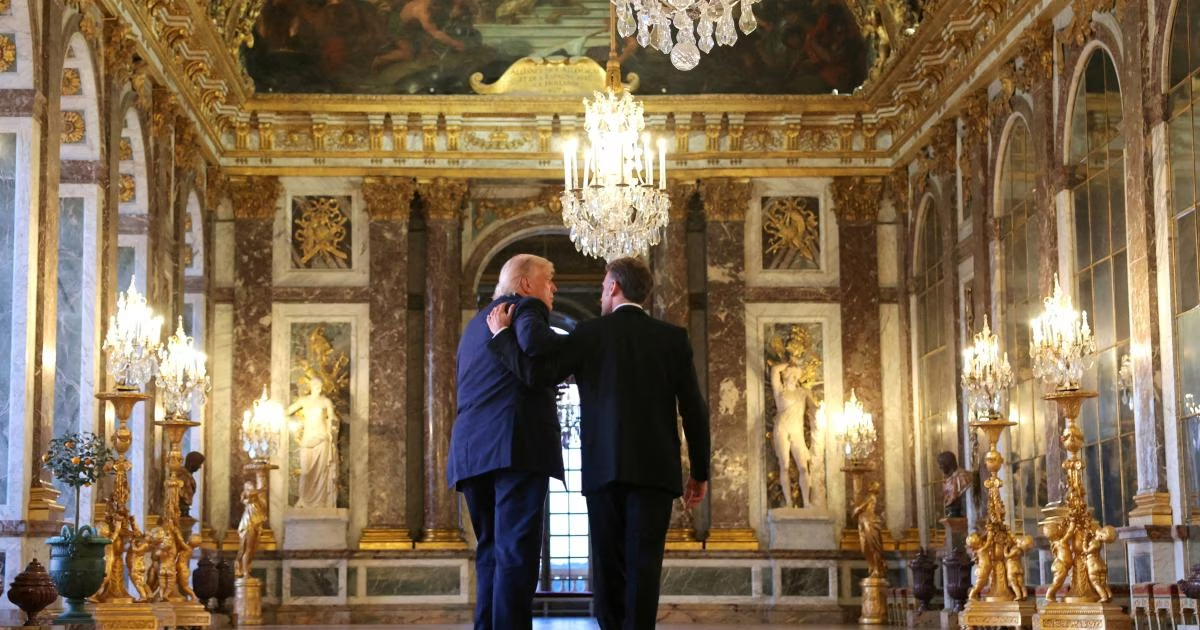
US President Donald Trump's choice of the historic Palace of Versailles as the venue for signing the memorandum of understanding between the United States and Iran was not merely a fleeting protocolary procedure. Rather, this choice carried deep political messages that transcended the technical clauses of the agreement, aiming to leverage the historical symbolism of the location within the context of international conflict.
The palace, located west of the French capital Paris, has been a stage for pivotal moments that changed the face of European and world history over centuries. Today, it returns to be the facade for an event through which the parties seek to turn a long page of hostility and tension, and launch a new negotiating path between Washington and Tehran under the shadows of history.
In the world of modern diplomacy, location is used as an integral part of the political discourse directed at the world, where the signing venue is no less important than the text of the agreement itself. Halls, walls, and architectural symbols transform into tools for conveying messages of power and influence, and highlighting the strategic dimensions of the event before the international community.
The name of Versailles Palace has been associated with the concept of absolute central authority since the 17th century, when King Louis XIV transformed it into a center of government and a headquarters for administering the French state. The palace was not merely a luxurious royal residence, but evolved into an architectural space where balances of power were managed and the features of high policies were drawn.
Every detail within the palace, from reception ceremonies to seating arrangements, reflects a precise system aimed at demonstrating the greatness of the state and the strength of its institutions. This political function of the palace continued through the decades, becoming a witness to major shifts in global power balances and historic peace agreements.
In 1783, Versailles' name was associated with the settlements that ended the American War of Independence concurrently with the signing of the famous Treaty of Paris. French President Emmanuel Macron recently recalled this era, noting that the roots of American independence were formulated and built within the walls of this ancient French landmark.
The palace also witnessed agreements that reshaped the European continent, most notably the Treaty of Versailles in 1756, which altered the network of alliances before the outbreak of the Seven Years' War. The palace was also a witness to the agreement that paved the way for the transfer of the island of Corsica to French sovereignty in 1768, reinforcing its status as a center of sovereign decision-making.
The most influential event in the palace's history remains the signing of the Treaty of Versailles in 1919, which officially ended World War I. Although that treaty ended a bloody conflict, historians point out that it carried the seeds of subsequent conflicts, making the place a symbol of complex and sensitive settlements.
From this historical perspective, the signing of the US-Iranian memorandum of understanding within the walls of Versailles acquires an additional symbolic dimension that connects the present with the past. The event brings together a contemporary political reality with a place long associated with the making of major settlements and the reshaping of political maps in moments of international crisis.
At Versailles Palace, history does not stop at what the walls tell about ancient kings and wars, but extends to include new attempts to formulate international understandings. The palace halls remain witnesses to the great powers' endeavor to contain conflicts in a world that never stops rewriting chapters of its political history.
The independence of the United States was also built here.
شارك برأيك
Versailles Palace: The Significance of Choosing the 'Theater of Power' for the US-Iran Agreement Signing