






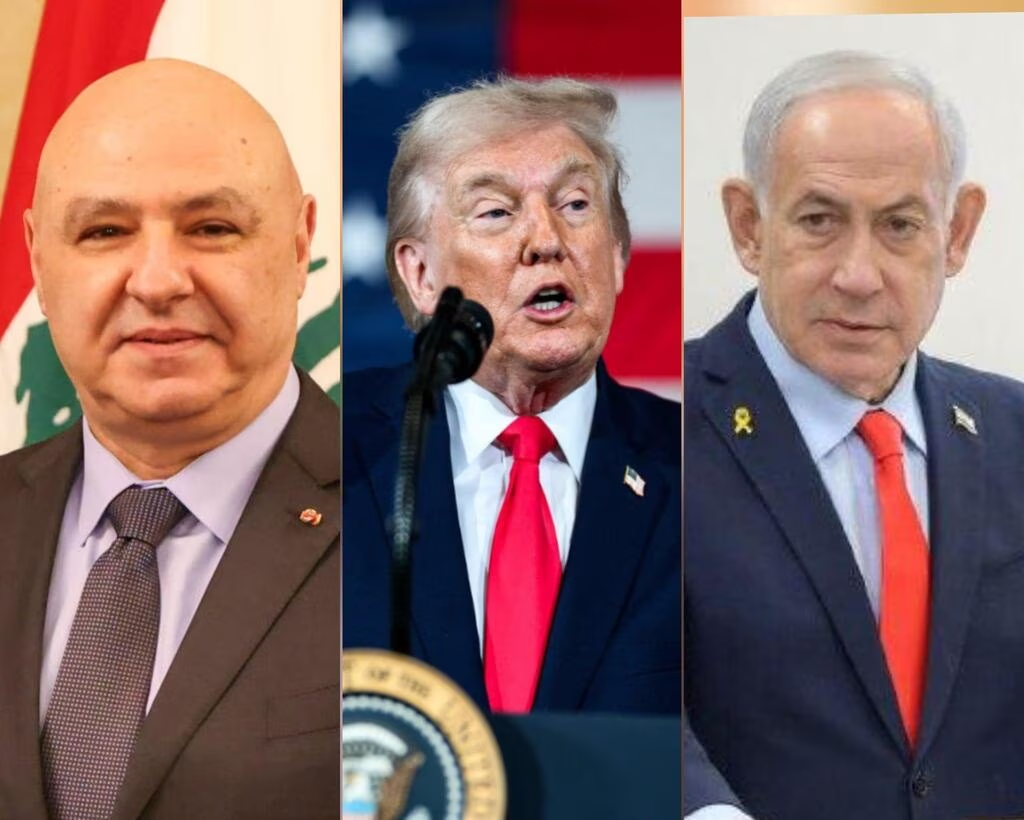
Washington – Said Arikat – 16/4/2026
In a remarkable development in the regional escalation, US President Donald Trump announced on Thursday that Lebanese President Joseph Aoun and Israeli Prime Minister Benjamin Netanyahu had reached a ten-day ceasefire agreement, at a time when clashes between Israel and "Hezbollah" were still at their peak, driven by complex regional interventions.
Trump's announcement came via his "Truth Social" platform, where he clarified that the ceasefire would take effect at 5:00 PM Eastern Time, a step he described as a prelude to achieving "lasting peace." He revealed that he had instructed his Vice President, Jez De Fance, and his Secretary of State, Marco Rubio, to work with both parties to advance the political process, extending an official invitation to both Aoun and Netanyahu to participate in upcoming peace talks at the White House.
In Beirut, the announcement was met with cautious welcome. Lebanese Prime Minister Nawaf Salam considered the ceasefire a central goal for Lebanon in the negotiations that took place in recent days. However, the Israeli position appeared more rigid; Netanyahu confirmed agreement to a temporary truce, but stressed that his country would not withdraw from southern Lebanon, announcing Israel's intention to maintain an "expanded security zone," and reiterating the demand for the dismantling of "Hezbollah" as a fundamental condition for any settlement.
On the ground, the picture remained blurry. The mechanisms for implementing the ceasefire, and the fate of hundreds of thousands of displaced people in southern Lebanon, whom the Lebanese army warned against returning to combat zones or approaching Israeli troop deployment sites, were not yet clear. Moreover, "Hezbollah"—a key player militarily and politically—was not a direct party to the negotiations, raising questions about the extent of its commitment to any agreement it did not help draft.
In this context, media reports quoted a party official as saying that any commitment to a cessation of hostilities is contingent on a comprehensive Israeli commitment, reflecting the continued trust gap between the two parties. The scene becomes more complex with the strong entry of the Iranian factor, as Tehran stressed the need to stop strikes on Lebanon as part of any broader agreement, while Iran's chief negotiator, Mohammad Bagher Ghalibaf, stated that de-escalation in Lebanon is "no less important" than a ceasefire in Iran.
This development comes amid continued Israeli aggression against Lebanon, despite a separate truce in the confrontation with Iran. While Washington and Tel Aviv denied that the recent agreement included Lebanon, Tehran hinted otherwise, based on statements from regional mediators, reflecting conflicting narratives that increase the fragility of any understanding.
The spark for the escalation ignited last month, coinciding with the US-Israeli war on Iran, with Israel responding with a series of widespread strikes and a ground invasion in the south, announcing its intention to establish a buffer zone on the border.
According to official Lebanese sources, the clashes resulted in the deaths of more than 2,100 people and the displacement of over a million civilians, while 21 people were killed in Israel as a result of retaliatory strikes from Iran and "Hezbollah." These figures reflect a heavy human cost that pushes towards any de-escalation path, even if temporary.
The announced truce reflects a delicate balance between the necessities of de-escalation and the pressures on the ground, but it lacks the elements of sustainability. The absence of "Hezbollah" from the negotiating table practically weakens the legitimacy of the agreement, making it closer to an understanding between two states that do not have full control over the theater of operations. Moreover, Israel's insistence on remaining in southern Lebanon creates a fundamental contradiction with the idea of a ceasefire. In this context, the truce appears to be merely a tactical pause, not a strategic shift, unless it is complemented by a more comprehensive negotiating framework that includes all key actors.
The American role in this agreement reveals an attempt to regain diplomatic initiative in a region where crises are intertwined. However, the multiplicity of messages and statements, especially from Donald Trump, creates confusion within the US and weakens the clarity of foreign strategy. This discrepancy is reflected in the regional parties' confidence in Washington's ability to ensure the implementation of any long-term agreement. Therefore, the success of the American initiative depends on its ability to unify its political discourse and provide tangible guarantees that go beyond media announcements.
This agreement cannot be separated from the broader regional context, where Iran seeks to link conflict arenas to strengthen its negotiating position. This linkage gives Tehran additional leverage, but in turn increases the complexity of any partial settlement. Achieving de-escalation in Lebanon without addressing the roots of tension with Iran seems difficult. Therefore, any real peace path requires a comprehensive approach that addresses the overlap between issues, rather than settling for localized agreements that are prone to collapse at the first field test.
شارك برأيك
Trump announces temporary truce between Lebanon and Israel