






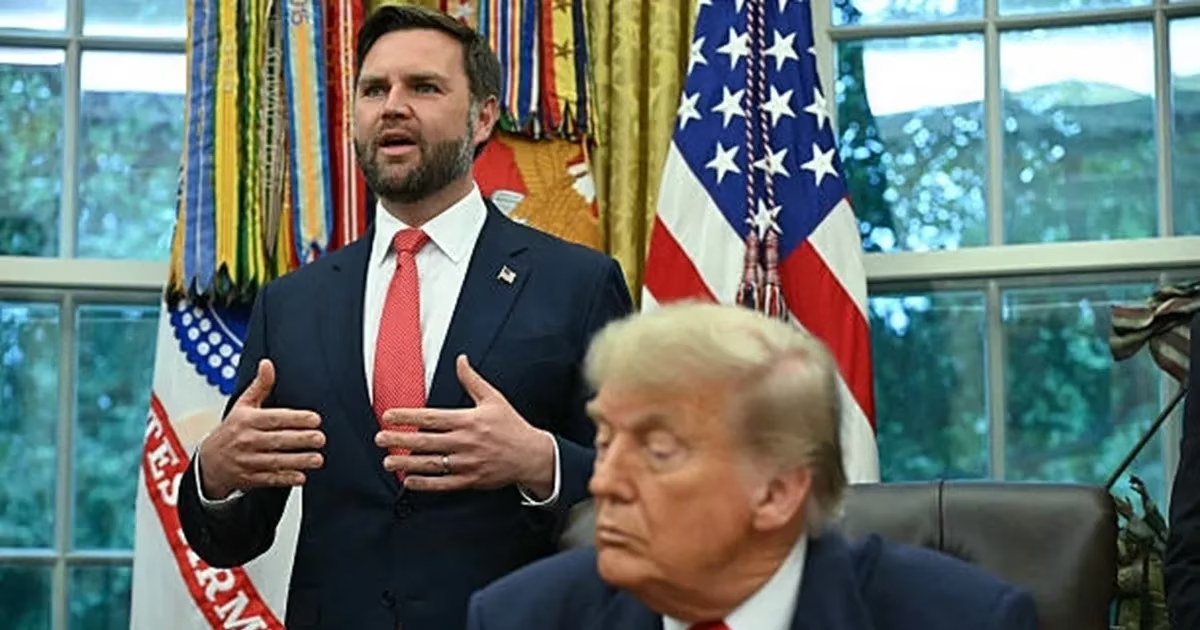
U.S. Vice President J.D. Vance announced that the American administration sees a golden opportunity to conclude a comprehensive strategic agreement with Iran, indicating that the next step now rests with the leadership in Tehran. Vance clarified in media statements that the recent rounds of negotiations hosted by the Pakistani capital, Islamabad, were not entirely negative, but rather witnessed tangible Iranian moves towards American demands.
Despite slight progress in the negotiations, the Vice President affirmed that what the Iranian side has presented so far does not meet American expectations and is insufficient to end the state of tension. He stressed that Washington sets strict, non-negotiable conditions, foremost among them the complete stripping of Iran's uranium enrichment capabilities, and ensuring that all enriched stockpiles are removed from the country to guarantee no return to a military program.
In a related context, J.D. Vance linked reaching this "grand bargain" to Tehran's definitive abandonment of its ambitions to acquire nuclear weapons, in addition to halting all activities that Washington describes as supporting terrorism in the region. He described Iranian negotiators as being extremely tough in dialogue, warning that Iran's possession of a nuclear bomb would impose severe and unbearable security and economic consequences and costs on the world.
On the ground, the American official indicated that the United States has succeeded in achieving a number of its strategic objectives on the ground, paving the way for a gradual and deliberate process of ending the conflict. He affirmed that the vision adopted by President Donald Trump aims to reach a successful and final agreement without being drawn into long-term or time-consuming negotiations.
Regarding the security of international navigation, J.D. Vance sent a firm message concerning the Strait of Hormuz, emphasizing that any Iranian attempt to backtrack on its commitments to open the strait would lead to a radical and immediate change in Washington's approach to Tehran. He considered that complete freedom of navigation in this vital waterway is a non-negotiable condition, and the Iranian side has been clearly informed of this position during recent meetings.
The Vice President also touched upon the economic pressures facing Iran, explaining that the restrictions imposed on oil exports through the Strait of Hormuz increase the financial burdens on Tehran. He indicated that these pressures aim to push the Iranian regime towards making rational decisions that serve regional and international stability, and end the country's isolation resulting from its previous policies.
In conclusion, J.D. Vance acknowledged the economic challenges faced by American citizens due to rising energy prices, affirming that the administration is making intensive diplomatic and negotiating efforts to address this crisis. He explained that reaching a stable agreement in the Middle East will directly contribute to calming global markets and alleviating the cost of living burdens on Americans in the near future.
Iran possessing a nuclear weapon would impose terrible costs on the world, and we need to see the Strait of Hormuz fully open as a fundamental condition.
شارك برأيك
J.D. Vance Sets Washington's Conditions for a "Grand Bargain" with Iran, Emphasizing Nuclear and Navigation Issues