






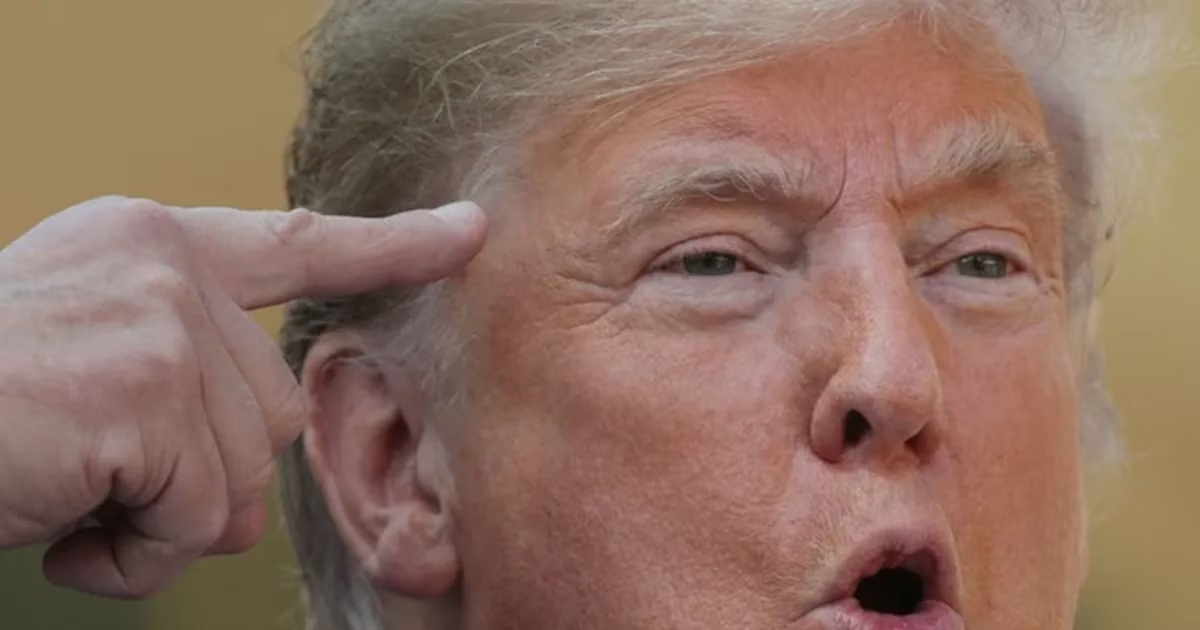
Press reports have highlighted unusual phenomena in global financial markets, where massive bets were observed preceding crucial decisions by US President Donald Trump. In a controversial incident, oil traders poured nearly half a billion dollars into futures contracts just minutes before Trump announced talks with Iran, leading to a drop in prices and massive profits.
Economic analysts described these movements as abnormal and raising deep suspicions about the possibility of leaks from decision-making circles in Washington. Sources reported that the timing of these deals indicates prior knowledge of the content of presidential announcements, which puts the integrity of information trading in the White House under scrutiny.
'Polymarket' stands out as one of the new players in this scene, an electronic prediction market that allows betting on major political and military events. It has been observed that newly established accounts were able to accurately predict the timing of US and Israeli military strikes a full day before they occurred, reinforcing the hypothesis of information breach.
This phenomenon was not limited to the Middle East but extended to events in Latin America, where an anonymous account made profits exceeding $400,000 coinciding with political movements in Venezuela. These recurring patterns raise legal and ethical questions about who truly benefits from these strange financial 'coincidences' in the absence of oversight.
Tracking these transactions becomes more difficult due to their reliance on cryptocurrencies like 'Bitcoin', which provides a cover of secrecy away from traditional banking oversight. Moreover, the decentralized nature of these platforms makes it impossible for a single judicial authority to effectively shut them down or regulate their cross-border activities.
Writer Nesrine Malik points out that the Trump family has openly engaged in cryptocurrency projects since he took office, opening the door to conflicts of interest. Despite the White House's continuous denial of any illegal involvement, the link between political decisions and personal financial gains has become the talk of the political circles.
A New York Times investigation revealed that Trump's wealth experienced significant growth, earning at least $1.5 billion during the first year of his second term. This rapid growth fuels speculation about how the presidential office is being used to enhance the family's and their close associates' financial empire.
The problem is not limited to the president alone but extends to a broader political culture in the United States that allows officials to invest in markets. Members of Congress have the right to trade stocks despite their daily access to secret intelligence and economic reports that could affect the value of those stocks.
Nancy Pelosi's name stands out as an example of this overlap, with digital platforms dedicated solely to tracking and imitating her financial investments based on her political moves. It is also noted that the Clinton family previously benefited from decades of public service to build massive financial networks through consulting and paid speeches.
Observers believe that Trump's second term represents an unprecedented acceleration in turning politics into a field for speculation and overt greed. Trump's approach to dealing with international events as entertainment has contributed to transforming crucial decisions into material for daily betting, similar to sports betting.
Turning the future into a tradable 'commodity' represents a dangerous cultural shift, where success becomes linked to possessing an 'inside edge' or leaked information instead of traditional effort. This trend coincides with a decline in job stability and the rise of a culture of investing in side projects and digital speculation.
Despite the difficulty of proving a direct link between Trump and these suspicious deals, the environment he created encourages this type of financial chaos. The wide circle of individuals and companies surrounding the administration increases the likelihood of information leakage and its exploitation by parties seeking quick profits.
In conclusion, it seems that the American political scene is heading towards more overlap between power and wealth, where the boundaries between public interest and private gains have blurred. These billion-dollar bets remain a testament to a new era of 'financial politics' that does not recognize traditional values of integrity.
These markets do not just speculate on assets; they turn the future itself into a commodity that can be bet on according to multiple scenarios.
شارك برأيك
Suspicions of insider trading: Massive bets precede Trump's decisions, raising questions about 'political profiteering'