






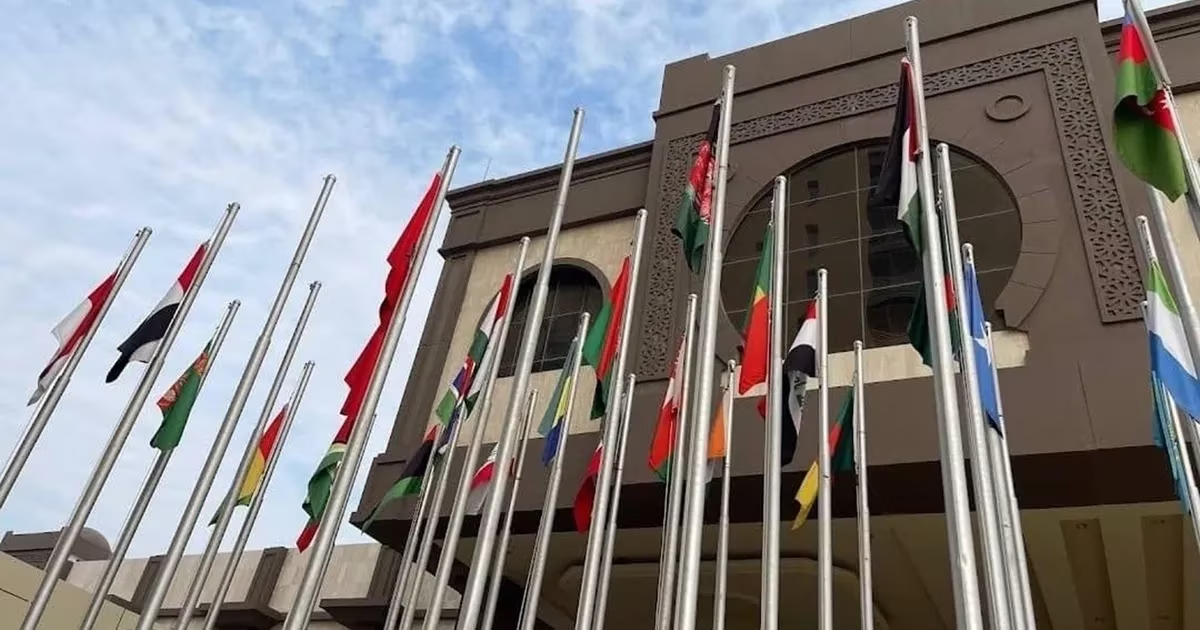
The Islamic world today is at a historical turning point, most in need of a unified stance, in light of a brutal aggression targeting Islamic countries and holy sites, foremost among them Al-Aqsa Mosque. Although Al-Aqsa was the primary catalyst for the establishment of the Organization of Islamic Cooperation, the current reality reveals a complete inability to even convene an emergency meeting to confront the ongoing violations.
Last Ramadan and the subsequent Eid al-Fitr witnessed a dangerous precedent with the prohibition of prayer and the call to prayer (adhan) in Al-Aqsa Mosque, without any movement from official systems. In contrast, we see swift international and regional action from the Arab League and the European Union when certain geopolitical interests are affected, highlighting a clear double standard in dealing with crises.
The deafening silence regarding statements by occupation leaders and the US Department of Defense about targeting all Islamic components reflects a state of political anesthesia that has afflicted the body of the Ummah. This behavior is no longer a mere coincidence; it has become a recurring pattern that reveals a deep structural imbalance in the nature of the regional system, which has replaced the idea of the Ummah with the narrow nation-state.
The first pillar of this impotence lies in the political decision-making of some countries being held hostage by international and security alliance systems led by major powers. These arrangements restrict the positions of states to a specific ceiling that cannot be exceeded, for fear of collision with Western allies who define the limits of permissible action in the region.
Sharp regional polarization also plays a destructive role in fragmenting any collective effort, as conflicts are read from the perspective of influence and interests, not from the perspective of civilizational belonging. Instead of considering aggressions a common threat, they are categorized within axis conflicts, which deprives the issue of its unifying dimension and turns it into material for political polarization.
There is also a deep fear among many regimes of sliding into open confrontations whose economic or political consequences they may not be able to bear. This logic, based on 'risk management' rather than 'conflict leadership,' leads to a preference for silence or gray positions at the expense of principled solidarity with the Ummah's existential issues.
Regional institutions, especially the Organization of Islamic Cooperation and the Arab League, have transformed into ceremonial structures that merely issue declarative statements that do not translate into actions. This institutional weakness has led to an erosion of people's trust in the ability of these entities to protect common interests or influence international decisions.
What we are witnessing today is a gradual disintegration of the idea of collective action, where a large gap emerges between international blocs that move quickly to protect their interests and an Islamic world that lives in individual reactions. This transformation from an 'Ummah' to 'functional units' within the international system makes states act only when asked to, and remain silent when international necessities dictate.
Sectarian factors and the division among major powers in the region have further complicated the scene, as internal animosity has become a priority over confronting external threats. This fragmentation has made shared identity a burden to be ignored rather than a source of strength and pressure in international forums, thus depriving the Islamic bloc of its strategic weight.
Since the fall of the Ottoman Caliphate, the idea of a 'political Ummah' has faded, replaced by disparate states governed by calculations of survival and internal legitimacy. Many of these regimes face economic and social challenges that make them retreat into themselves, avoiding involvement in external issues that might open new fronts they cannot manage.
The shocking truth is that the world does not respect entities that do not respect the foundations of their existence or seriously defend their holy sites. The speed with which international conferences are convened to protect trade routes or military bases, compared to the slowness in supporting the oppressed, reflects a severe imbalance in the compass of Islamic political decision-making.
This bitter reality is not just a transient 'failure'; it is a logical consequence of profound transformations in the structure of the political system, which has shifted from a logic of solidarity to a logic of numerical calculations. The nation-state has become the sole actor, while the 'Ummah' remains merely an emotional slogan used in speeches without real substance on the ground.
The continuation of this approach will inevitably lead to further weakness and loss of ability to influence the future of the region, opening the door for unofficial forces to fill the void. The absence of will and a shared vision is the real problem, not the lack of resources or capabilities that the Islamic world possesses in various fields.
In conclusion, restoring the civilizational role of the Ummah requires rebuilding the concept of common interests, away from being held hostage by external forces or drowning in internal conflicts. The upcoming challenge lies in how to transform emotional rhetoric into institutional political action that restores the Ummah's prestige and protects its holy sites from continuous encroachment.
What we see today is not just a temporary dereliction; it is a declaration of the death of the idea of joint Islamic action and the transformation of the Ummah into separate islands.
شارك برأيك
The Disintegration of the 'Ummah' Concept: Why is Collective Islamic Action Absent in Major Crises?