ARAB AND WORLD

Sun 14 Jan 2024 10:13 am - Jerusalem Time

Palestinian-American analyst: Blinken' s last middle east tour marked by a change in tone towards Israel

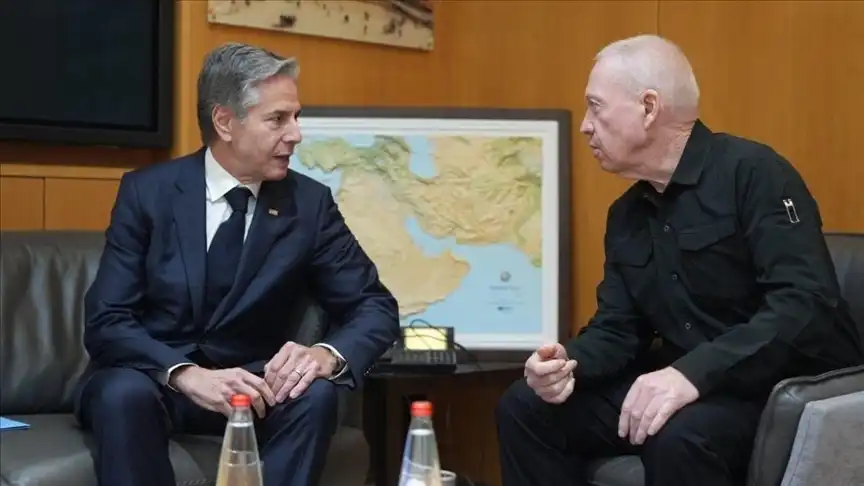
US Secretary of State Antony Blinken concluded his fourth trip to the Middle East since Oct. 7 on Friday, a tour marked by a change in tone, according to a US-based Palestinian-American analyst.  Khalil Jahshan, executive director of Arab Center in Washington, welcomed this shift, which saw Blinken warn Israel that the civilian toll in Israel’s war in Gaza was "far too high," alongside usual US statements of continued support for Tel Aviv, one of the stops on his 10-country tour. 

Blinken made these remarks in a news conference in Tel Aviv after a day of talks with Israeli officials, whom he urged to ensure a "clear pathway to the realization of Palestinian political rights and a Palestinian state."Speaking to Anadolu, Jahshan had his reservations, but added that this was a change in language that "we haven't heard in a long time in this town." "We haven't heard somebody talk about Palestinian state since maybe that 2022 visit by the President (Joe Biden) to Bethlehem in which he referred to it but then said that time is not conducive to that at this time," he told Anadolu. "It's very hard for me to be optimistic, although I welcome that change in tone," he added. 


Blinken's official visit to the region also included stops in Türkiye, Greece, Qatar, the United Arab Emirates, Saudi Arabia, Israel, the West Bank and Egypt. "I have a feeling this is probably the most important of all his trips," said Jahshan, pointing specifically to the risk of the war in Gaza spreading throughout the region."This campaign by Israel has taken too long from an American perspective. 

It has not achieved the intended result. It's beginning to harm US national interests, and therefore, they saw the need to embark on this diplomatic initiative," he explained.

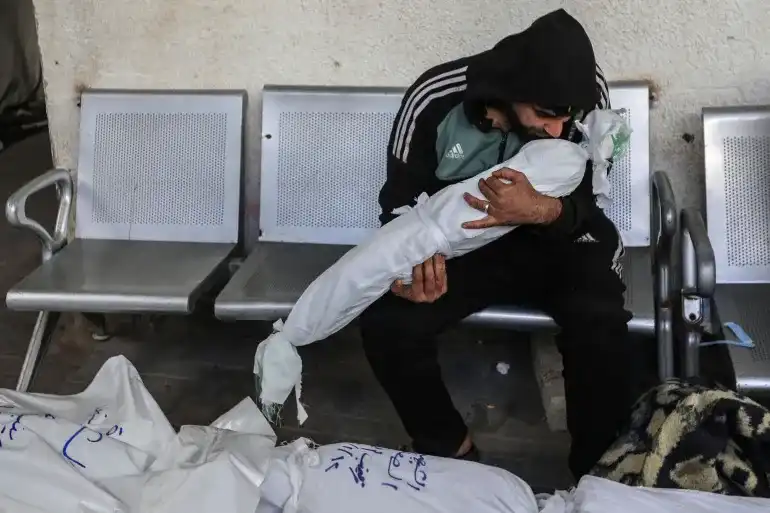
Blinken's tour came at a time when the Israeli army has waged a devastating war on Gaza since Oct. 7 that has resulted in the killing of at least 23,084 Palestinians and wounding 58,926 others.

Israel launched its relentless air and ground attacks on the Gaza Strip after a cross-border attack by Palestinian resistance group Hamas, which Tel Aviv says killed around 1,200 people. 

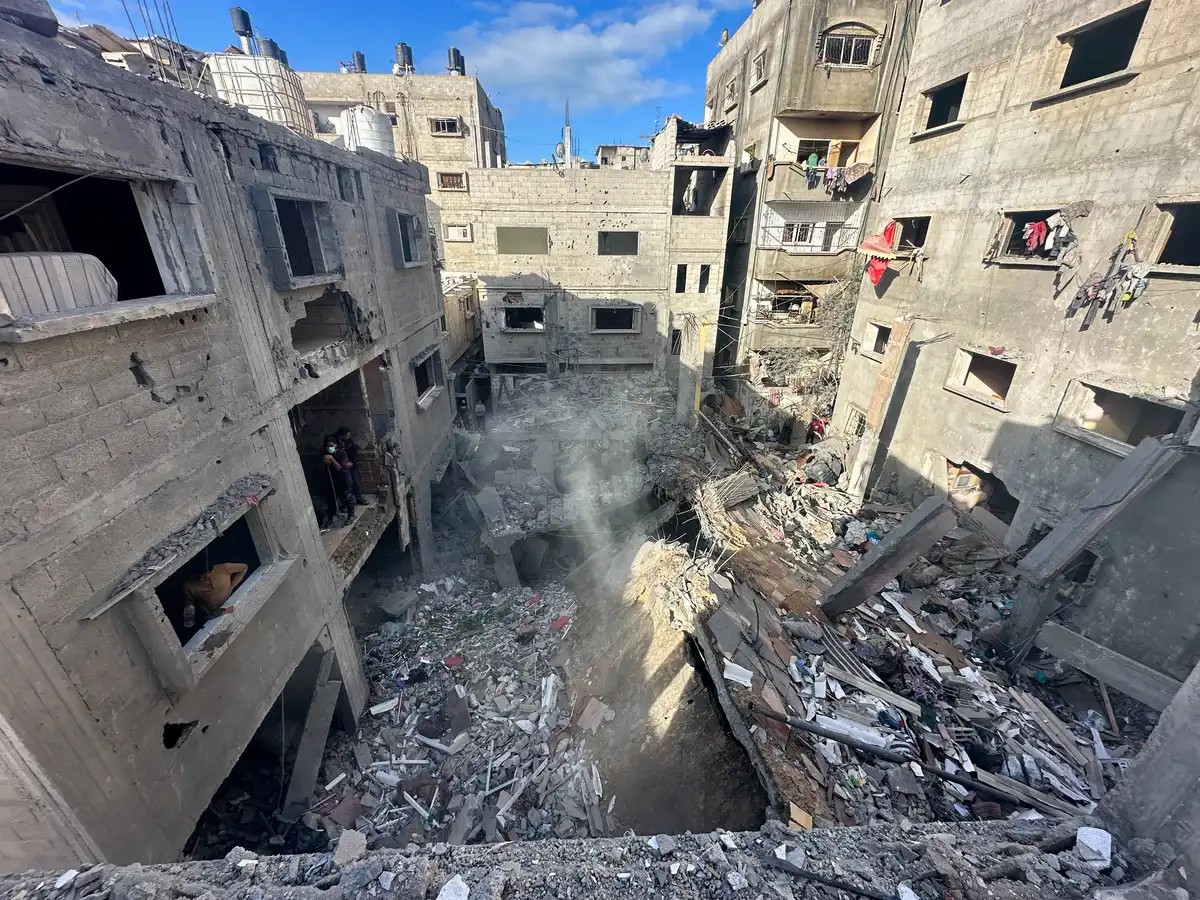
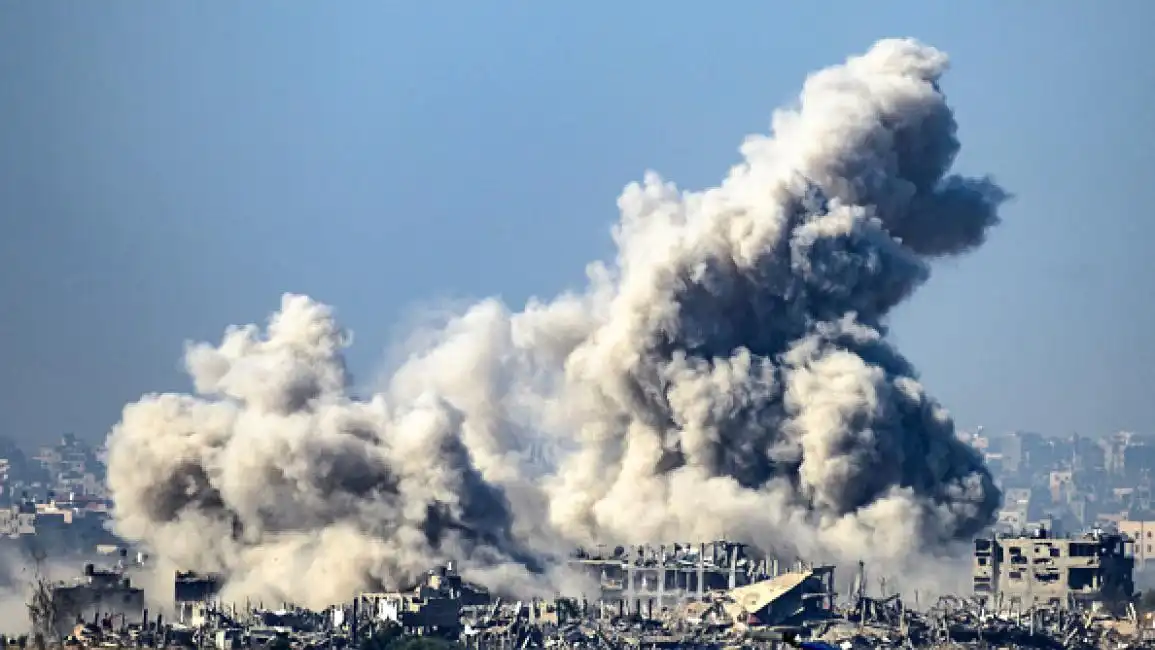
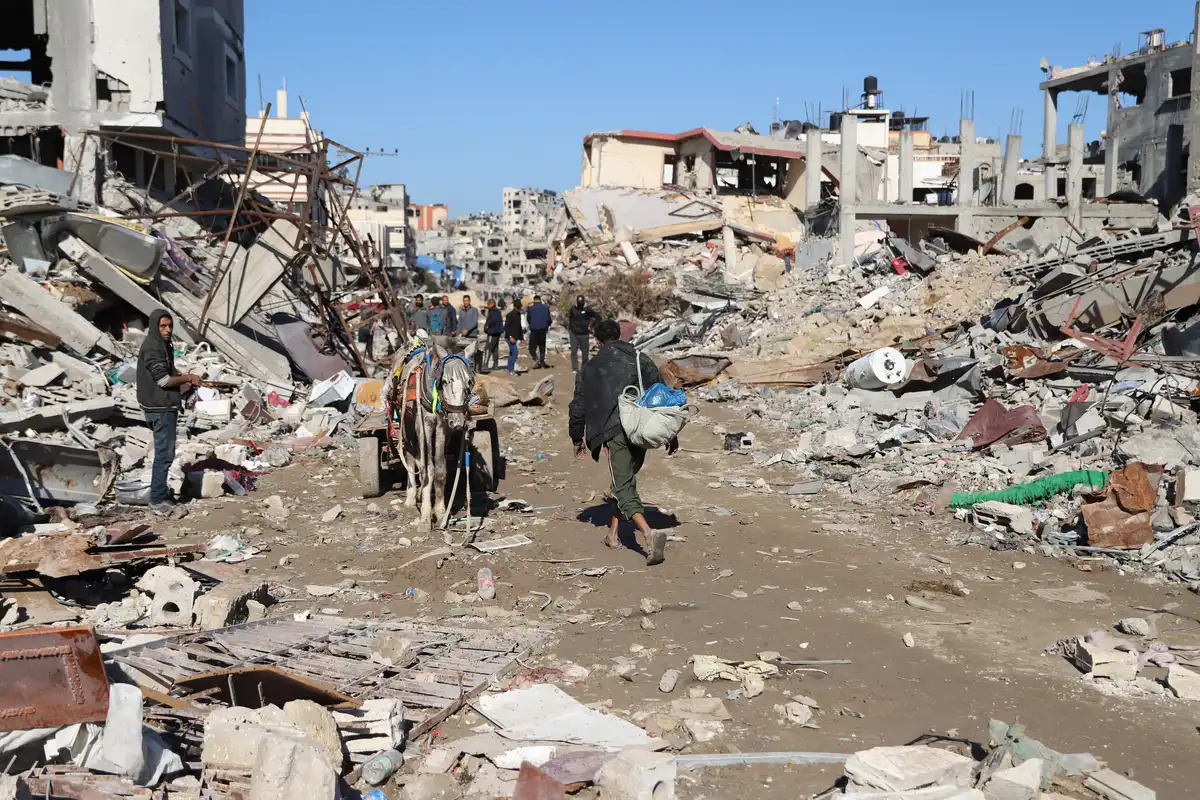
The Israeli onslaught has left Gaza in ruins, with 60% of the enclave’s infrastructure damaged or destroyed and nearly 2 million residents displaced amid acute shortages of food, clean water and medicine. "Particularly, the main purpose of the trip is to prevent this conflict in Gaza from going way beyond the Gaza borders and involve other parts of the region," said Jahshan.He noted that there have been "unilateral requests" from the US, Israel's main supporter, and funder and arms supplier in its war in Gaza, adding that "no response" has come from the government of Israel on these requests."But at the same time, the US is seeing its own national interest in jeopardy. 

It's seeing its own relationship with the Arab and Muslim world in jeopardy," he continued."It reached such a crescendo this time that the administration is beginning to feel," he said, noting the upcoming presidential elections in the US, as well as Washington's ties with other countries in the region, and the threat of violence erupting in Lebanon."Whether the results will prove that remains to be seen, even after the rather forthcoming — unprecedented, I would say — press conference that we saw," he said, referring to Blinken's statements in Tel Aviv.

Source: Anadolu

ARAB AND WORLD

Sun 14 Jan 2024 10:05 am - Jerusalem Time

Israeli Historian Raz Segal blasts Israel’s ‘genocidal incitement’ against Gazans

‘Incitement in Israel is clear, explicit and unashamed,’ says Segal

Israeli historian Raz Segal blasted Israel’s aggression against the people of Gaza on Saturday and said that it amounts to “incitement to genocide.”

Segal told Breaking Points YouTube channel that the incitement is dealt with in Article 3 of the “The Convention on the Prevention and Punishment of the Crime of Genocide, or the Genocide Convention for short -- an international agreement that criminalizes genocide and obligates countries to pursue the enforcement of its prohibition.

“Incitement to genocide, which usually happens actually in media discourses, but also in political discourses, sometimes in public spaces in various ways,” he said. “Anyone who follows Hebrew language sources” would know about the “genocidal discourse” in Israeli media and outdoor signs as well.


“I'm talking about, you know, huge signs hanging on the bridges of the Tel Aviv Freeway right after the 7th of October, calling to flatten Gaza, to destroy Gaza, written on them directly that the ‘image of triumph would be zero people in Gaza.’ Very direct, very explicit,” he said, noting Hamas’ surprise attack that resulted in the flare-up of the current Israeli-Palestinian conflict.


“You don't need a degree in comparative literature to interpret these signs and statements in the media discourse and in the political discourse in Israel after 7th of October. We see clear incitement to genocide, right? Clear, clear incitement to genocide.”


Segal noted the Rwanda genocide as another example.


“One of the cases that comes close to this kind of society, immersed in a genocidal discourse, perhaps, is Rwanda and the Rwanda genocide in 1994,” he said. “We had journalists, radio channels and people inciting for genocide, for the murder of Tutsis in that case.”

“In the case of Rwanda, there was also a media case where journalists indeed stood trial and were convicted for incitement to genocide. So that's another element that actually differentiates genocide from other crimes and international law,” he said.


“Incitement in Israel is clear, explicit and unashamed. Just to give a recent example, journalist Zvi Yehezkeli on Channel 13 just openly and outright said that he thinks that at the beginning, Israel made a mistake because (its) attack on Gaza should have been much more actually violent and severe, and it should have killed 100,000 Palestinians right now,” said Segal.


“And the official response of Channel 13 was that ‘We're just expressing the plurality of positions in Israeli society.’ So this is outright unashamed, right? It's very common today in Israel, and it's something I think we should all be paying attention to.”


Since a cross-border attack by Hamas on Oct. 7, Israel has continued relentless attacks on the Gaza Strip, killing more than 21,000 Palestinians and injuring more than twice that number, according to Palestinian health officials.


Israeli authorities claim the Hamas attack has killed around 1,200 Israelis.

The Israeli onslaught has left Gaza in ruins, with 60% of the enclave's infrastructure damaged or destroyed, and nearly 2 million residents displaced amid acute shortages of food, clean water and medicine.


ARAB AND WORLD

Sun 14 Jan 2024 9:53 am - Jerusalem Time

New York Times: Do not back down from accusing Israel of genocide

An article in the New York Times stated that the administration of President Joe Biden used the method of “naïve rejection” regarding accusing Israel before the International Court of Justice of committing genocide in Gaza, contenting itself with the term “baseless,” in exchange for a file full of overwhelming evidence submitted by South Africa to prove Tel Aviv’s violation of  its obligations under the 1948 Genocide Convention.


The American newspaper pointed out - in an article written by Megan K. Stack - to Secretary of State Anthony Blinken saying in Tel Aviv that “the charge of genocide is baseless,” and National Security Council spokesman John Kirby saying that it is “worthless, counterproductive, and has absolutely no basis in reality,” noting that this indifferent stance taken by the administration suggests naivety.


The author explained that the document presented to the court was documented and its sources carefully controlled, and many experts say that the legal argument in it is unusually strong.


The words of Israeli officials have provided evidence of intent, from Prime Minister Benjamin Netanyahu urging Israelis to “remember” the Old Testament account of the Amalek massacre, “Pardon no one, but kill the men and women,” to Defense Minister Yoav Galant, who pledged that “Gaza will not return to what it was before, we will remove everything,” the Minister of Energy and Infrastructure pledged, “They will not have a drop of water or a single battery until they leave this world.”


Openly genocide

By speaking publicly about the destruction of Gaza and the dispersion of its population, Israeli leaders - as Stack believes - succeeded in publishing what was hidden or denied in other cases of genocide. However, the sessions of the International Court of Justice will not answer whether Israel did or did not commit genocide. But if the panel of judges is convinced that the accusation of genocide is plausible, it must "urgently" order Israel to halt its attack in order to protect the Palestinians and preserve evidence.


Even asserting that the evidence points to genocide would force the international community to protect the traumatized and starved population of Gaza by demanding a ceasefire and the introduction of aid, and in the long term the issue could lay the groundwork for early sanctions on Israel or prosecute its officials.


The writer continues that these measures are also meaningful for the United States because the Biden administration is the indispensable sponsor of this war, as it has armed, financed and diplomatically protected Israel despite the increasingly horrific reports of the killing and displacement of Palestinians, and therefore if it turns out that the violence in Gaza represents Genocide, Washington may be accused of complicity in genocide, which is a crime in itself.


But given the power that the United States wields, and its track record of impunity at the international level, the odds of any major consequences are slim. However, Americans should understand that the issue is fundamental and serious, and that their government is involved in it, Stack says.


No justifications

Israeli and American officials have repeatedly cited “self-defense” to explain the violence in Gaza, but this argument cannot justify acts of genocide, especially since the Israeli attack on Gaza constitutes - according to the author - a disproportionate response to the October 7 attack.


In an Israeli television clip cited by South Africa in its lawsuit, Colonel Yogev Bar Sheshet spoke from Gaza, saying, “Whoever returns here - if he returns here after that - will find scorched earth, no homes, no agriculture, nothing. They have no future.”


Israeli officials tried to improve their image by saying that “our war is against Hamas, not the people of Gaza,” and Netanyahu warned his ministers of the need to be careful in what they say about the war, saying, “Choose your words carefully,” despite his violent rhetoric.


Israeli government spokesman Elon Levy repeatedly described the South African case as a “bloody slander,” referring to anti-Semitic European conspiracy theories that have fueled the persecution of Jews since the Middle Ages. Addressing the South African government, he said, “History will judge you, and it will judge you without mercy.” 


Raz Segal, an Israeli historian and genocide expert, said that Israel's actions in Gaza are indeed "a model case of genocide."


Source: New York Times +Aljazeera

ARAB AND WORLD

Sun 14 Jan 2024 9:48 am - Jerusalem Time

Demonstrations in more than 120 cities in 45 countries to support Gaza

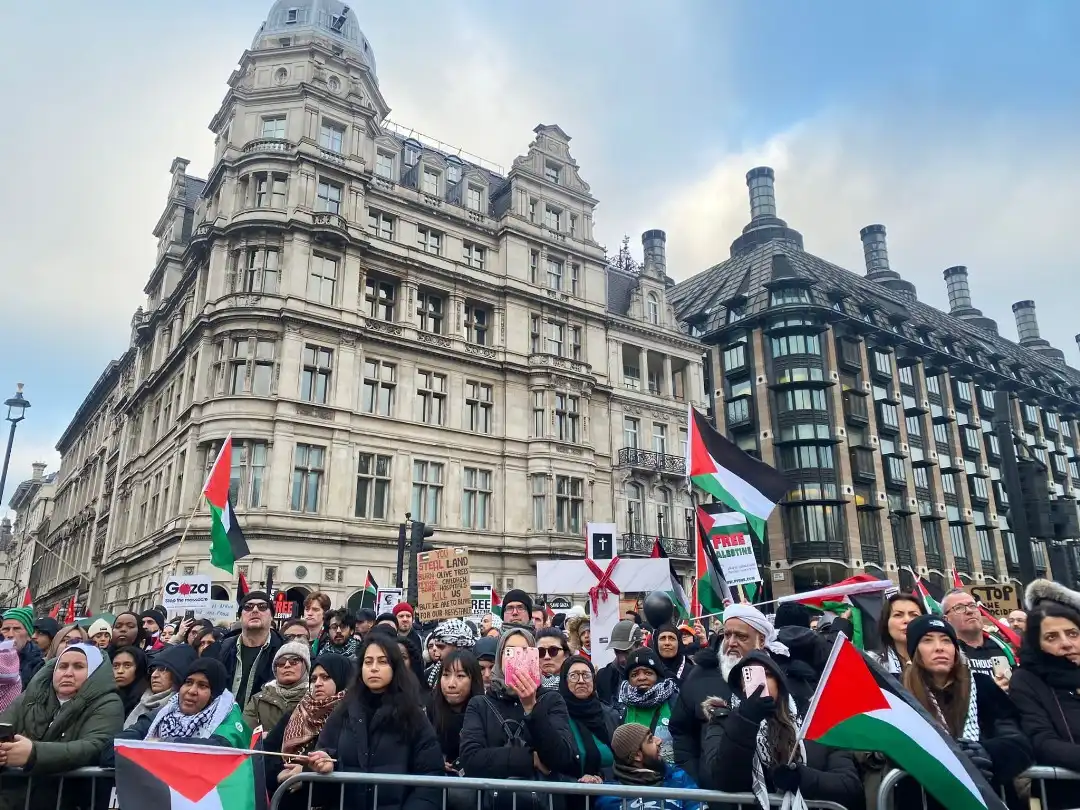
Millions participated in major demonstrations in more than 120 cities in 45 countries around the world as part of the International Gaza Day event, today, Saturday, to demand an end to the war that Israel has been waging for 100 days.


The demonstrations were called for by a coalition of British organizations to stop the war in Gaza, which included: the Palestinian Forum in Britain, the Palestine Solidarity Campaign in Britain, the Stop the War Coalition, the Nuclear Disarmament Campaign, the Friends of Al-Aqsa Society, and the Islamic League in Britain.


Britain

More than half a million people demonstrated in the British capital, London, on International Day in Support of Gaza. To demand an immediate ceasefire and an end to the aggression against the Gaza Strip. The participants called for urgent aid to be brought into Gaza and for Israel to be held accountable for committing crimes in the current war. Jeremy Corbyn, former leader of the British Labor Party, said in his speech during the demonstration: “Our demands are international. We are a million-man movement in solidarity with the people of Palestine. Our solidarity extends beyond borders, and our hearts are connected across continents.” He added, “We will continue our common pursuit of justice, and we will stand united for the rights and freedom of the Palestinian people.”

He continued: “There must be a ceasefire, and justice must prevail, but this cannot be achieved by bombing Yemen, or expanding the war to Lebanon, the Red Sea, or anywhere else.”

As for Loujain Abdullah, spokeswoman for the Palestinian Forum in Britain, she was inspired by the historical role of South Africa in bringing the case of genocide against the occupation before the International Court of Justice: “Today represents a historic moment... We saw how apartheid can be overcome, how genocide can be stopped, and that it is possible to achieve Justice".


America

Tens of thousands of activists demonstrated in Washington, within the framework of the “Global Action Day,” to demand an immediate ceasefire in Gaza and to reject American support for Israel. The demonstrators, whose number was estimated at more than 400,000, raised Palestinian flags, and many of them wore the Palestinian keffiyeh, in a solidarity march on the 100th day of the Israeli aggression on the Gaza Strip. The demonstrators chanted “ceasefire now,” while carrying banners and posters reading “Free Palestine,” “Stop the war on Gaza,” and “Stop funding genocide.” Close to the White House, speakers urged US President Joe Biden to end military and financial support for Israel.

“President Biden can easily stop this madness,” one of them said, to loud applause, by putting pressure on Israeli Prime Minister Benjamin Netanyahu.


Many Palestinian Americans from Gaza gave moving accounts of their friends and relatives who were martyred or injured in the Gaza Strip.


Thailand

Large numbers participated in a demonstration in front of the American embassy in Thailand.


Germany

In Germany, a massive demonstration took place in the city of Munich, in solidarity with Gaza and to demand an end to the Israeli war.


In the German capital, demonstrators occupied Berlin Central Station to stop the war on Gaza, and the police arrested a number of demonstrators after beating them. Dozens also demonstrated in the German city of Kiel, demanding an end to the war and the entry of humanitarian aid into the Gaza Strip.


Sweden

A massive demonstration also took place in the Swedish capital, Stockholm, in support of Gaza and to demand an end to the Israeli war. A similar demonstration took place in the city of Uppsala, rejecting the Israeli aggression and the ongoing massacres against civilians in the Gaza Strip.


Luxembourg

In Luxembourg, thousands demonstrated in front of the US embassy to denounce the US administration’s continued support for the ongoing Israeli war on the Gaza Strip.


Denmark

In Denmark, thousands demonstrated in the capital, Copenhagen, in support of Gaza and to demand an end to the Israeli war.


Holland

In The Hague, Netherlands, hundreds of people in solidarity with Palestine continued to demonstrate in front of the International Court of Justice, demanding that Israel be tried for its crimes against civilians in the Gaza Strip.


France

In the French capital, Paris, people in solidarity with Palestine organized a massive rally on World Solidarity Day to demand a ceasefire in Gaza.


Italy

A massive demonstration also took place in the Italian city of Florence, in support of Gaza and Palestine and denouncing the occupation’s aggression against the Gaza Strip, which has been ongoing for 100 days.


Australia

A march was also launched in Sydney, Australia, in support of Palestine and denouncing the occupation’s crimes against civilians in the Gaza Strip, as part of the “International Day for Gaza” activities.


Türkiye

In Turkey, thousands demonstrated in the city of Konya in support of Palestine and Gaza, to denounce the continuation of the Israeli war on the Gaza Strip.


South Korea

On the Asian continent, demonstrations took place in Seoul, the capital of South Korea, to demand an end to the Israeli war on the Gaza Strip. The demonstrators expressed their solidarity with Gaza and denounced the Israeli aggression and crimes committed against civilians.


Japan

Mass demonstrations also took place in several Japanese cities to demand an end to the Israeli aggression on the Gaza Strip, the entry of humanitarian aid and the lifting of the siege on the Strip.


Indonesia

18 Indonesian cities also witnessed protests and demonstrations in solidarity with the people of Gaza and in denunciation of the Israeli war on the Strip on the eve of its 100th day. The protesters organized a large demonstration in front of the US Embassy in the capital, Jakarta, at the invitation of community and religious organizations. They called on the American government to stop supporting the Israeli war on the Gaza Strip.

The city of Bandung, the capital of West Java, the largest province in Indonesia, also witnessed another demonstration, denouncing the crimes committed by the Israeli occupation forces against the residents of the Gaza Strip and the West Bank.


South Africa

On the African continent, massive demonstrations took place in various cities in South Africa to demand an end to the genocidal war carried out by the Israeli occupation army against civilians in the Gaza Strip.


Morocco

In Morocco, the Moroccan Authority for Supporting the Nation’s Issues organized 113 demonstrations in 56 cities in the Kingdom, in support of Gaza, which has been suffering from war for more than 3 months. The demonstrators raised the slogan “No to the displacement of Palestinians,” and they also denounced the continuation of the Israeli war on the Gaza Strip amid official international silence.


PALESTINE

Sun 14 Jan 2024 9:40 am - Jerusalem Time

Dozens of Israeli settlers storm Al-Aqsa protected by army

Today, Sunday, dozens of settlers stormed the blessed Al-Aqsa Mosque, amid heavy protection from Israeli police.


The settlers made provocative tours inside the courtyards of Al-Aqsa Mosque, and performed Talmudic rituals.


Groups of settlers storm Al-Aqsa on a daily basis except Friday and Saturday.


PALESTINE

Sun 14 Jan 2024 9:32 am - Jerusalem Time

West Bank: Israeli forces launches a massive arrest campaign

The Israeli army carried out a new campaign of incursions and arrests in the West Bank, in a scene that has been repeated every day, especially since last October 7.


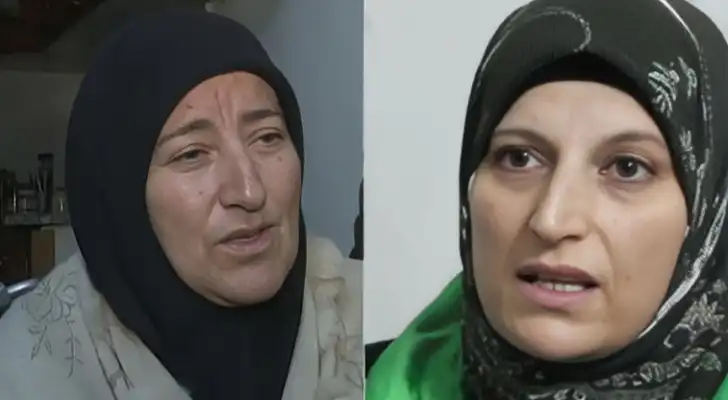
On Saturday evening, Israeli forces stormed the city of Jenin in the northern West Bank amid the outbreak of armed clashes, while three Palestinians were wounded in the town of Arraba, south of the city, and the two sisters of the deputy head of the Hamas political bureau Saleh Al-Arouri, were arrested.


Military vehicles accompanied by bulldozers were deployed in several neighborhoods in the city of Jenin, coinciding with the outbreak of armed clashes.


When the storming began, sirens sounded throughout the city of Jenin and its camp, and the resistance fighters called for a general mobilization through loudspeakers in the mosques.


At dawn today, Sunday, the occupation forces, reinforced with military vehicles, stormed several towns in the Ramallah and Al-Bireh Governorates in the West Bank, raided several homes, and carried out extensive arrests, raids, and searches.


The raids targeted the towns of Al-Mazraa Al-Gharbiyya, Aroura, Birzeit, and Al-Jalazoun Camp, northwest and north of the city of Ramallah.


Local sources indicated that the occupation forces arrested Dalal and Fatima Al-Arouri, the sisters of the deputy head of the Hamas political bureau, Saleh Al-Arouri, who was assassinated by the occupation on January 2 in the Lebanese capital, Beirut.


The occupation forces surrounded their homes in both Al-Bireh and Aroura as part of the widespread arrest campaigns they have carried out since October 7.


PALESTINE

Sun 14 Jan 2024 8:56 am - Jerusalem Time

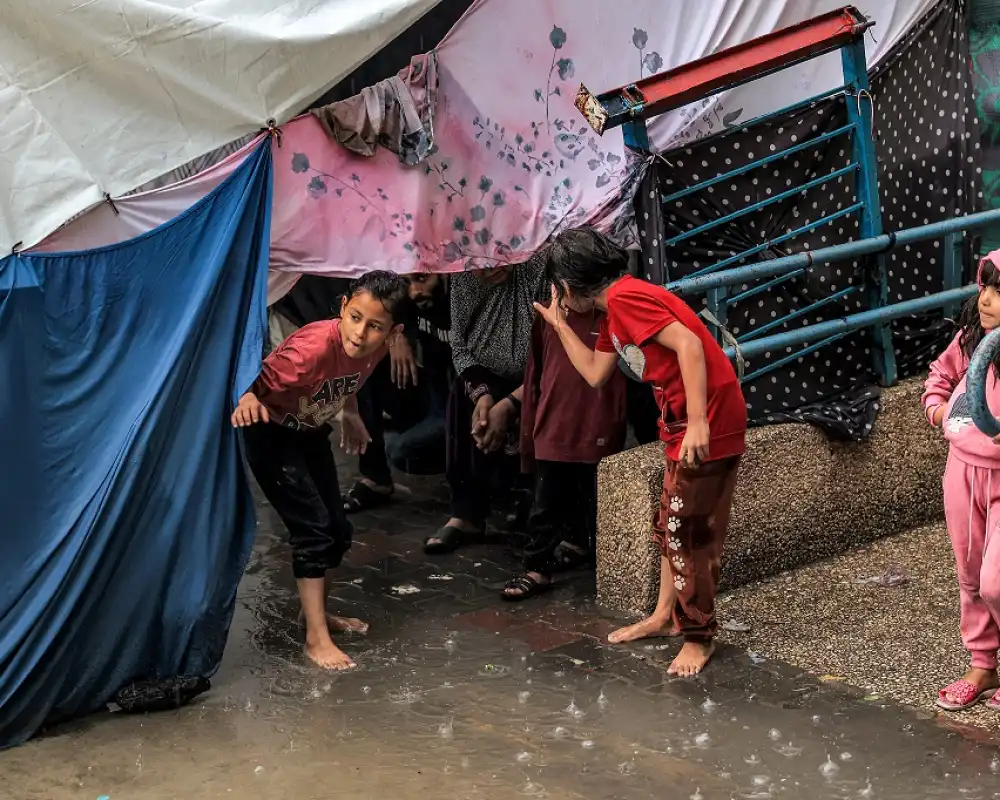
Dozens of shelter centers in the Gaza Strip were flooded by heavy rainwater

Dozens of shelter centers housing tens of thousands of citizens in the northern and southern areas of the Gaza Strip flooded, after rainwater mixed with sewage entered classrooms, tents, and citizens’ homes.


Press sources reported that in the northern Gaza Strip, several centers housing thousands of displaced people, in addition to the homes and tents of citizens, were flooded in Jabalia, Beit Hanoun, and Beit Lahia, due to the heavy rains that fell over the past hours and at dawn today.


It added that the shelter centers in Gaza City flooded, as rainwater entered UNRWA schools, in the Al-Rimal neighborhood, the University Square area, the Askola area, and the Al-Zaytoun, Al-Shuja’iya, Al-Daraj and Al-Tuffah neighborhoods.


In the center of the Gaza Strip, rainwater entered the shelter centers, which include a number of UNRWA and government schools, in addition to the flooding of the shelter centers in the cities of Khan Yunis and Rafah, and the majority of tents in the city of Rafah sank and were blown away as a result of the strong winds, indicating that all the tents house children.


The citizens appealed to all international institutions and the World Health Organization for the need to take urgent action to stop the Israeli aggression in the first place, and to provide centers to shelter them from the rain and the extreme cold, in light of their inability to return to their homes, most of which were demolished.


Citizens, especially the displaced, are suffering from difficult conditions in light of the ongoing Israeli aggression for the 100th day in a row, in addition to the weather depression hitting Palestine.


PALESTINE

Sun 14 Jan 2024 8:56 am - Jerusalem Time

War on Gaza: Israeli heavy raids launched by aircraft, artillery, and gunboats on various areas in the Strip

Dozens of citizens were killed and others were injured, in a series of raids launched by aircraft, artillery, and Israeli gunboats on various areas in the Gaza Strip.


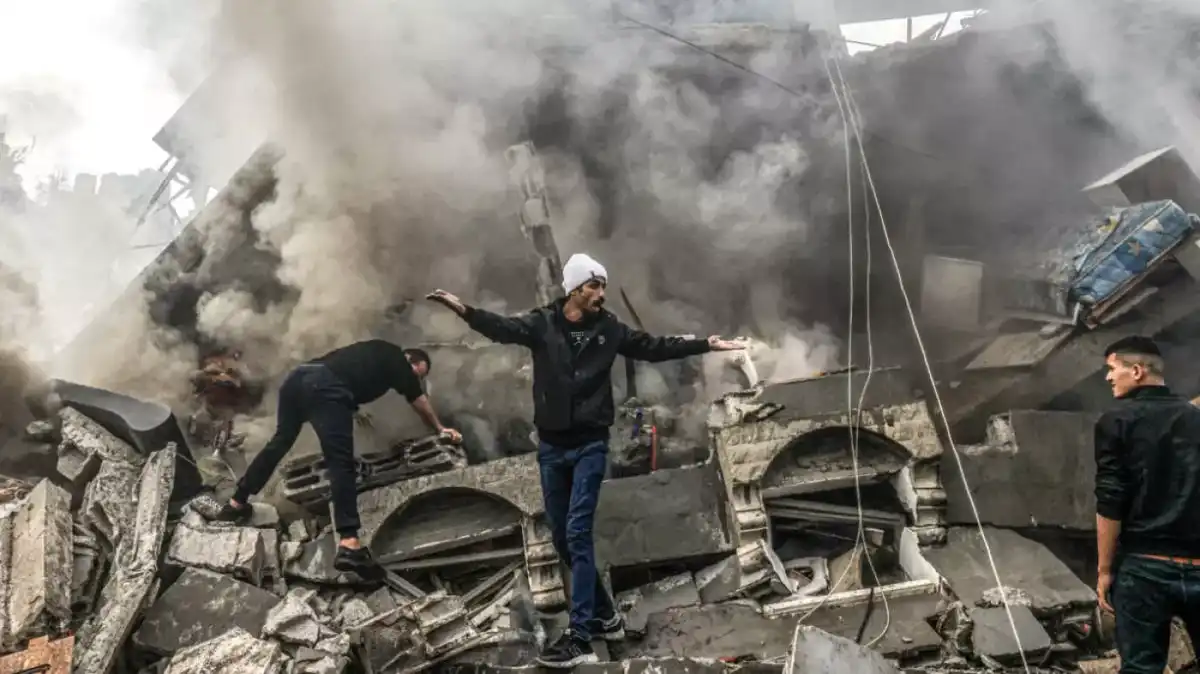
Press sources reported that 50 dead were recovered following the bombing of a three-story house with at least two missiles, housing a number of Al-Shubaki, Al-Zoukh, Al-Hassouna, and Al-Qasim families in the densely populated Al-Daraj neighborhood in the center of Gaza City, on the heads of its residents. The majority of the martyrs and wounded were transferred to Al-Shifa’ and Al-Mamadani hospitals in the city.


5 citizens were killed, and 10 others were injured, in artillery shelling on the Al-Sabra and Al-Zaytoun neighborhoods in the city.


Israeli artillery and boats bombed citizens' homes in the Tal al-Hawa and Sheikh Ajlin areas, southwest of Gaza City, with a number of shells.


In the Al-Sawarha area in the central Gaza Strip, 3 killed were recovered after a house was targeted west of the camp, in addition to 6 killed who were recovered from Al-Maghazi and Al-Braih camps, and were transferred to Al-Aqsa Martyrs Hospital in the city of Deir Al-Balah.


In the south of the Gaza Strip, more than 30 citizens were killed as a result of raids targeting citizens’ homes in the center and east of the city of Khan Yunis, and the majority of them, children and women, were transferred to the European and Kamal Nasser hospitals.


At least 23 citizens werekilled after two houses in the center of Rafah and a vehicle were targeted on the western road of the city. The majority of them were displaced people, and they were transferred to Abu Youssef Al-Najjar and Al-Kuwaiti hospitals.


The Israeli aggression on the Gaza Strip has been continuing for 100 days, resulting in about 23,843 dead, 60,317 injured, more than 7,000 missing, and the destruction of homes and infrastructure.


OPINIONS

Sun 14 Jan 2024 8:38 am - Jerusalem Time

Opinion | The path to peace in the Mideast could be paved by fuzzy language

The Washington Post

The Washington Post

Opinion Writer

By David Ignatius

Secretary of State Antony Blinken decided to try something different last week on his fourth trip to the Middle East since the Gaza war exploded in October. Rather than stopping first in Israel, as he often does, he began by visiting Arab capitals.

Blinken was hoping to gather some bargaining chips that might persuade Israel to move toward peace, and he got what he wanted from the Arabs. Saudi Crown Prince Mohammed bin Salman and other key leaders pledged they would support a postwar reconstruction of Gaza — and normalize relations with Israel — but only if Israel ended the conflict in Gaza and committed to a process for creating a future Palestinian state in the West Bank and Gaza.

Israeli Prime Minister Benjamin Netanyahu didn’t agree to either demand. So, in that respect, Blinken’s gambit failed. But knowledgeable U.S. and Israeli sources say the diplomatic situation could be more promising than it might appear. Speculating about positive outcomes in the Middle East is often a mistake, but let’s consider some of the factors at work behind the scenes.

Blinken knows he’s negotiating with an Israel still badly shaken by Hamas’s Oct. 7 terrorist attack. That’s why he laid out the Arabs’ proposal to a broad audience — not just to Netanyahu but also individually with each member of Israel’s war cabinet. And he explained it in a news conference to a traumatized Israeli public that’s deeply skeptical about a Palestinian state.


Here’s the core question: Is the opportunity for Saudi normalization — and the united front against Iran that it would encourage in the region — the proverbial “offer you can’t refuse”? Netanyahu’s right-wing government would rebel if he even hinted at support for a two-state solution. But Israelis who know Netanyahu well say he might pay that political cost to gain the prize of Saudi normalization that he’s been chasing for years. Battered by the Gaza war, Netanyahu’s career is finished — unless he finds a way to repair his ruined legacy.

Israeli officials tried to answer Blinken’s push for a quick de-escalation in Gaza by pledging to move into a new phase of “lower intensity” combat that should mean fewer civilian casualties and more humanitarian aid. They plan to reduce Israel Defense Forces’ presence inside Gaza from 21 brigades at the war’s outset to four or five by next month. That’s partly because of international pressure but also because they’ve already hammered Hamas. Officials estimate that more than half of Hamas’s 24 battalions no longer operate and that more than 60 percent of its battalion and company commanders have been killed.

Israeli won’t yet allow Palestinian civilians to return to northern Gaza, arguing that Hamas fighters are still active there. The Israelis fear this remnant could meld into the returning civilian population — triggering renewed heavy combat and, perhaps, another forced evacuation. Better to wait, they contend. But to get ready, Israel has agreed to allow a U.N. team to make a detailed survey of water, sewage, health and housing needs in northern Gaza, starting immediately.

Israel also claims it’s working with international aid agencies to create a large refugee camp south of Gaza City to house some of the hundreds of thousands who fled south to Rafah, on the Egyptian border. To provide more humanitarian assistance without the inspection bottlenecks at existing land crossings, Israel and other countries are exploring delivering more aid from ships.

Blinken is said to have responded that these Israeli de-escalation steps aren’t enough. Israel plans to continue airstrikes and shelling of some targets in southern Gaza, but Blinken said in a news conference this week that the civilian toll is “far too high.” Israeli sources concede that they’re still killing one Palestinian civilian for every Hamas fighter they take out. The Biden administration wants Israel to focus on Hamas’s high-value targets.

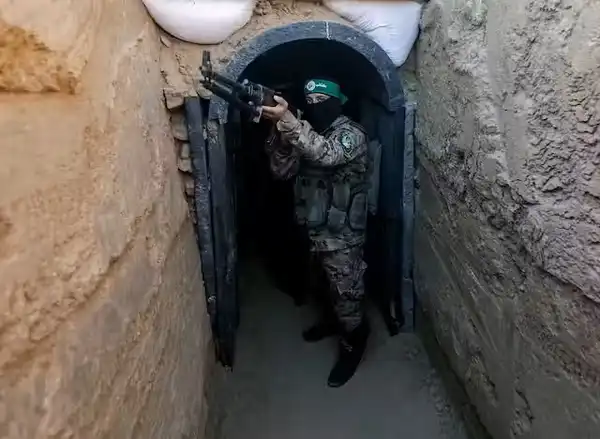
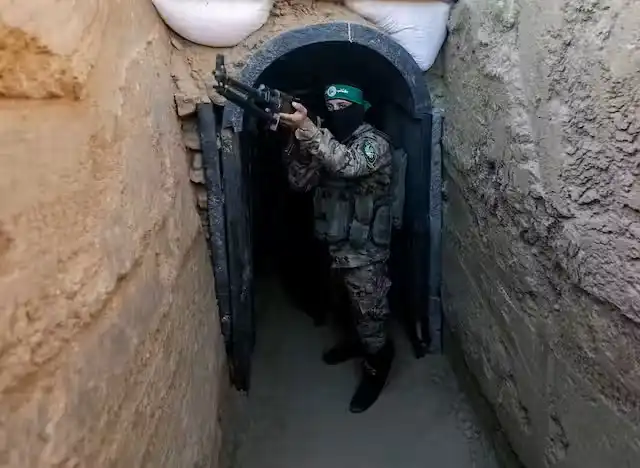
The future battlespace in Gaza is underground, in Hamas’s vast network of tunnels. Israeli officials recognize that they initially underestimated this “Gaza metro,” as it’s called, which they now reckon zigs and zags more than 300 miles under a strip that’s just 25 miles long and 7 miles wide. The Israelis say they have finally mapped this underground empire, thanks to captured computer diagrams, interrogations of Hamas members who helped build the tunnels, and new listening and location technology.

Israelis warn that the siege of the tunnels could continue for months. The IDF has capped many of the shafts with emulsions known as “sponge bombs” that form a permanent chemical barrier. They’re developing other exotic tools to help them find Hamas leaders Yahya Sinwar and Mohammed Deif and others. U.S. officials know that Israel isn’t likely to stop fighting until those planners of Oct. 7 are dead.

Who will maintain order in Gaza as Israeli troops withdraw? That might be the weakest link in this planning chain. As Hamas is diminished, Israel plans to work with an ad hoc governance network of local municipal councils, business groups, trade unions, clans and employees of the Palestinian Authority, which Netanyahu rejects but whose role might be inescapable. The United States has been training Authority security forces for nearly two decades and wants them to oversee the Gaza transition. Netanyahu should welcome that plan but, so far, he hasn’t.

As the Gaza war begins to recede, Israel is sending some of its troops north to the Lebanese border, where its forces have been trading fire with the Iran-backed Hezbollah militia. The Hezbollah threat has driven about 80,000 Israelis from northern towns. The IDF has responded by pounding Hezbollah targets, killing more than 160 fighters and driving the militia several miles back from the border. But Israel demands a real buffer zone, created through a diplomatic agreement or, if necessary, military force.

The Biden administration is scrambling to craft a deal that would send the Lebanese Army into this buffer and defuse the border crisis. Amos Hochstein, a White House aide, has been shuttling between Beirut and Jerusalem, and Israeli officials think a diplomatic settlement is possible. Hezbollah leader Hasan Nasrallah hinted that he might support such a deal in a speech last week.

With Mohammed bin Salman’s offer on the table, the question is how to get to yes. Diplomats are skilled at devising language that fuzzes, say, the process of transition to a Palestinian state or the definition of the interim governing entity in Gaza. We can expect some fuzzy language ahead, but that won’t soften the hard choices.

But what’s really needed is international momentum that drives Israelis and Palestinians toward the right outcome. The Biden administration is planning soon to form “coordination groups” to facilitate Gaza reconstruction and regional peace among the moderate Arab states and the Group of Seven advanced democracies. That’s a good step to keep this ball rolling.

There’s one more inescapable pressure: A U.S. presidential election will take place in November, which means that Blinken — and all those who favor the administration’s effort to end the Gaza war and normalize relations between Israel and the Arabs — might have a short window of time to get there.


ARAB AND WORLD

Sun 14 Jan 2024 8:29 am - Jerusalem Time

Wall Street Journal: Israel informed Egypt of its plan to control the Philadelphia axis

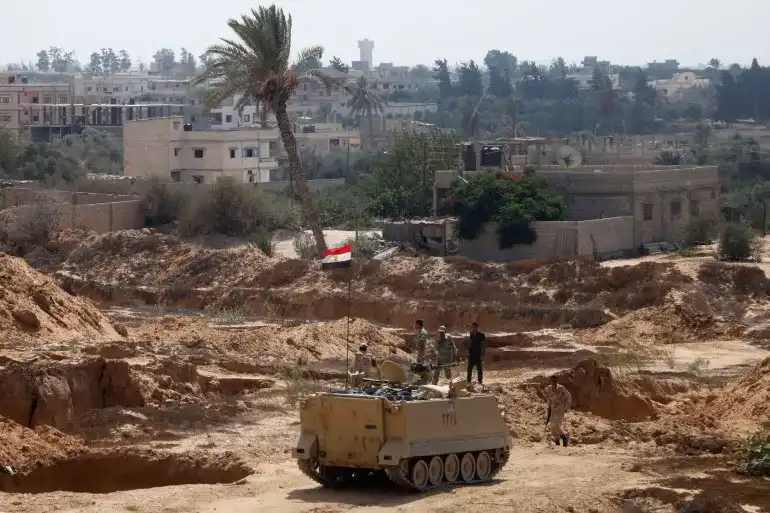
The American Wall Street Journal reported yesterday, Saturday, that Israel informed Egypt of its plan to carry out a military operation to control the Gaza Strip border with Egypt, in reference to the Philadelphia axis.


The American newspaper published its news under the title, “Israel is planning a risky mission to control the last border in Gaza that it does not control.”


It added that the military operation planned by Israel will be “militarily complex” due to the alignment of the border with Egypt and the region’s hosting of more than a million displaced Palestinians.


The newspaper attributed its news to unnamed Israeli and Egyptian officials, noting that “Israeli officials informed Egypt that they are planning a military operation on the border from the Gaza side.”


According to the news, Egypt has assured Israel that it will strengthen the barriers on its border with Gaza, and will install more surveillance towers and cameras, but it will not share the recordings with the Israeli side.


Cairo did not give Tel Aviv final approval for the alleged operation, according to the newspaper’s report.


A few days ago, Yedioth Ahronoth newspaper reported that Egypt rejected a request for Israel to secure the Philadelphia border area between it and the Gaza Strip.


According to the Israeli newspaper, the Coordinator of Israeli government operations in the Palestinian territories, Major General Ghassan Alyan, visited Cairo last Tuesday, heading a security delegation.


The newspaper explained that the purpose of the visit was to discuss security arrangements in the Philadelphia axis area.


In a press conference on Saturday evening, Netanyahu touched on the Philadelphia axis between the Gaza Strip and Egypt, saying, “Without controlling the Philadelphia axis in Gaza, we cannot eliminate the (Islamic Resistance) movement Hamas, and we are examining all options regarding it.”


On the other hand, Egyptian Foreign Ministry spokesman Ahmed Abu Zeid told a local satellite channel that Egypt controls its borders and has full control over them. These issues are subject to security and legal agreements, and any talk in this regard is subject to scrutiny and is responded to with declared positions, without further clarifications.


In late December, Israeli Prime Minister Benjamin Netanyahu announced his desire to control the Philadelphia border axis between Gaza and Egypt.


Netanyahu stated at the time that his country wanted to ensure that Gaza did not pose a threat to it, and added that the Philadelphia axis must be in Israeli hands and control, and that Israel would not accept any other option.


In 2007, the Hamas movement took control of the Gaza Strip, and the Philadelphia axis came under its control. Israel imposed a stifling siege on the Strip, which forced the Palestinians to cross the border strip towards Egypt to obtain food, drink and basic materials for their lives. As a result, the Egyptian forces imposed security in Philadelphia and then retreated to their places. 


The Philadelphia axis area is no longer devoid of Palestinian residents as it was during the period of the Israeli presence in that region. Palestinian homes extended very close to the border fence, and at some points they are completely adjacent to it, with the exception of the areas east of the Rafah crossing and the area near the seashore.


Source: American press

ARAB AND WORLD

Sun 14 Jan 2024 8:21 am - Jerusalem Time

More than 120,000 people gathered in Tel Aviv for the return of prisoners

The families of Israeli detainees in the Gaza Strip began a 24-hour march in Tel Aviv last night, Saturday, demanding that Israeli Prime Minister Benjamin Netanyahu return them, after 100 days they spent in Hamas captivity.


Thousands flocked to what became known as “Hostage Square” in Tel Aviv, a central square opposite the Israeli Ministry of Defense that served as a gathering point for activists, according to the Associated Press.


Hamas fighters had captured about 250 people during Operation “Al-Aqsa Flood” on October 7, in which Palestinian resistance fighters were able to penetrate the security barriers that the occupation surrounded the Gaza Strip.


More than 100 detainees were released in a prisoner exchange agreement during a temporary truce last November, and 132 detainees remain in Gaza, including the remains of about 24 detainees who died or were killed.


The Associated Press quoted Ronen Neutra, the father of Omar Neutra, a captured Israeli soldier: “We were here on the 50th day and we spoke on this platform. We will never talk again about 50 days. It is time to bring them back... They are being held in terrible conditions. They are starving, they are dying."


No significant progress has been made towards reaching a new agreement to release the prisoners, and their families are using the 100-day mark to make a new appeal to the Israeli government headed by Benjamin Netanyahu to prioritize their return.


Bringing medicines to prisoners

The office of the Israeli occupation Prime Minister, Benjamin Netanyahu, announced, the day before yesterday, Friday, that an agreement had been reached with the State of Qatar regarding the entry of medicines into the Gaza Strip, including medicines for Israeli prisoners, and he confirmed, in a statement, that “the head of the Israeli Mossad (David Barnea) ) Reached an agreement with the State of Qatar that would allow the entry of medicines to Israeli detainees in Gaza.


Yesterday, Saturday, Israeli Channel 12 said that the International Red Cross Committee would complete the transfer of medicines to Israeli prisoners held by Hamas in Gaza within the next 24 hours.


Meanwhile, the leader of the Hamas movement, Osama Hamdan, said in a press conference from the Lebanese capital, Beirut, on Saturday, that the movement is keen to treat the Israeli prisoners, but only with the available medicine that will reach the Gaza Strip, explaining that “the matter has two problems: that our people need medicine, and that the first is that, and the second is the security dimension and the sensitivity of the issue of prisoners.”


The humanitarian crisis in Gaza is worsening, with the continuation of Israeli attacks and massacres on the Strip, amid the scarcity of food, water, and fuel needed for the generators that supply hospitals and other facilities with energy. 

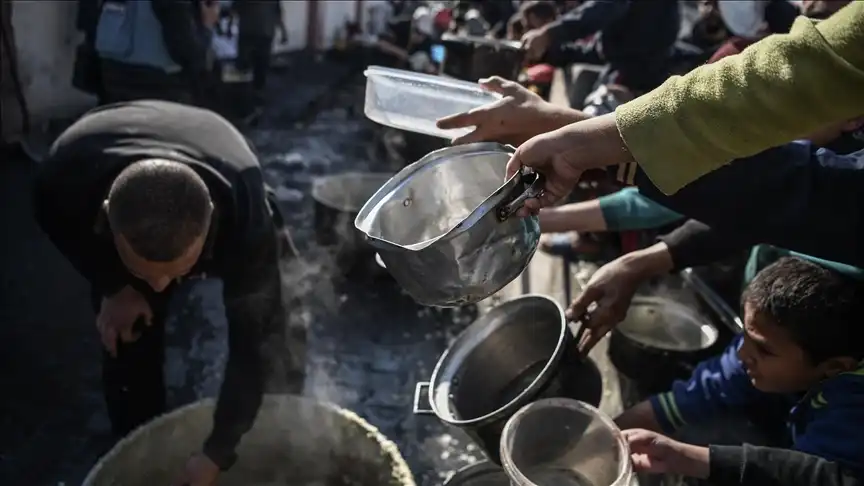
The government media office in Gaza said yesterday, Saturday, that the northern Strip needs 1,300 food trucks daily to get out of the hunger situation, noting that Israel killed 14 Palestinians who tried to obtain food.

PALESTINE

Sun 14 Jan 2024 8:16 am - Jerusalem Time

War on Gaza: 100 days of killing, destruction and displacement

The Israeli war on the Gaza Strip is entering its 100th day, with the number of dead, since the beginning of the war until yesterday, Saturday, reaching 23,843 dead and 60,317 injured, according to the spokesman for the Palestinian Ministry of Health in the Strip, Dr. Ashraf Al-Qudra.


The Israeli forces continue their relentless air, ground and sea bombardment campaigns on various areas of the Gaza Strip, with a focus on the center and south of the Gaza Strip, and the city of Khan Yunis is still subjected to continuous violent bombardment.


With the blockade policy implemented by Israel, preventing food and medical aid from entering the Gaza Strip, and the systematic targeting of infrastructure facilities, especially the health sector, warnings continue of catastrophic effects on the people of Gaza, who are now threatened with starvation, in addition to the necessity of providing urgent medical aid.


The government media office in Gaza warned yesterday that the continued policy of starvation and thirst threatens the lives of 800,000 citizens in the northern Gaza Strip, explaining that the northern Gaza governorate currently needs 600 trucks of aid and food on a daily basis.


Regarding Israeli prisoners, the “Al-Qassam Brigades”, the military arm of the Hamas movement, said that it had lost contact with the cell responsible for four Israeli prisoners it had held since 2014. “Al-Qassam” broadcast a video under the title “Time is running out” in reference to the faltering efforts to conclude an exchange deal. Until now, pictures of the four prisoners appeared in the video.

ARAB AND WORLD

Sat 13 Jan 2024 10:28 pm - Jerusalem Time

Guardian: Supporting the Gaza war generates money for Israel's supporters in Congress

An analysis conducted by the British newspaper The Guardian, of data related to election campaigns in the United States, revealed that members of Congress who showed stronger support for Israel at the beginning of its war on the Gaza Strip received $100,000 on average from donors loyal to Israel during the last elections, more than their competitors received, most of whom supported Palestine.


It explained that those who received money were those who often called on the US government to provide military support to Israel and stand by its side in its war on Gaza, even in light of the high civilian death toll in the Palestinian Strip.


Experts in the field of election campaign finance who reviewed the data believe that donor spending contributed to increasing Congress's massive support for Israel.


The analysis compared the contributions made by pro-Israel groups and individuals to almost every member of the current Congress, with the statements issued by each of their legislators about the war in Gaza until mid-November.


Supporting Israeli massacres

The Guardian reported that about 82% of members of Congress were more supportive of Israel, while only 9% showed their support for Palestine during the same period, while the rest had “divergent” opinions.


The newspaper revealed that legislators classified as pro-Israel received $125,000 on average during their recent election campaigns, while those loyal to Palestine received about $18,000 on average.


The newspaper added that the volume and breadth of donor spending was large, as the current members of Congress received a total of $58 million, and all but 33 of them received donations.


The Guardian quoted University of Chicago political science professor John Mearsheimer - who co-authored the book "The Israeli Lobby and American Foreign Policy" - as saying that "the results of these data reflect the reality of American policy towards Israel."


Mearsheimer added, "If there had not been a political pressure group (lobby) pushing Congress in a certain direction and in a really strong way, its position on the war in Gaza would have been radically different."


Various contributions

According to the Guardian report, donor contributions have different goals depending on the member of Congress himself.


Sarah Bryner, spokeswoman for Open Secrets, which tracks spending on American election campaigns, says that donations may be of a “defensive” nature or aim to increase support for their allies in Congress who share their funders’ support for Israel.


However, campaign finance observers and political strategists who reviewed the data believe that donations could also be “offensive” in nature, or aimed at persuading a lawmaker to adopt a position supportive of Israel.


The donors fought their most prominent battles with a small group of progressive Democrats in the House of Representatives, known as “the Squad,” including Ilhan Omar and Rashida Tlaib, who are among the most vocal critics of Israel.


According to The Guardian, the statements made by 3 representatives - Don Bacon, Dan Kildee, and Andre Carson - following the attack by the Islamic Resistance Movement (Hamas) on Israel on October 7, help explain the varying degrees of donations and responses of representatives in Congress.


Loyal to Israel

The three representatives initially strongly condemned the perpetrators of the attack, and expressed their "deep" sympathy for the victims, but their messages quickly varied.


While Bacon, who received a donation worth $250,000, expressed his full support for Israel, Carlson (who received only $3,000) criticized it, while Kildee - who received $91,000 - chose to take a position between the positions of his two colleagues, as he stressed the Israel preserved its security and its right to respond, while expressing its “deep concern about the killing of thousands of Palestinians due to Israeli air strikes.”


The most prominent campaign funders among the 33 pro-Israel groups include the American Israel Public Affairs Committee (AIPAC), the Democratic Majority for Israel, and J Street.


In his memoirs issued in 2020, former US President Barack Obama detailed the threat AIPAC poses to critics of Israel, who risk being labeled “anti-Israel” and perhaps anti-Semitic, making them face well-funded opponents in the elections, he said.


ARAB AND WORLD

Sat 13 Jan 2024 9:48 pm - Jerusalem Time

Lieberman describes South Africa's case against Israel as a farce and calls to hold it accountable

Former Israeli Defense Minister Avigdor Lieberman called on Saturday for South Africa to be held accountable for the case it filed against his country before the International Court of Justice, on charges of committing genocide in the Gaza Strip.


Lieberman, who heads the "Israel Our Home" party, said in a blog post on his account on the X platform, "The price must be paid for the anti-Semitic farce currently taking place in The Hague, which was started by South Africa."


The former Israeli Prime Minister called for the severing of diplomatic relations with South Africa and all countries that support the Islamic Resistance Movement (Hamas) and the Lebanese Hezbollah, describing them as terrorism.


He urged Israel to call on Jews living in South Africa to immigrate to Israel and not to wait until acts related to anti-Semitism erupt, which may include persecution of Jews and harm to them, as he put it.


The number of the Jewish community in South Africa is about 77,500 people, which is the largest Jewish community on the African continent, and most of them are concentrated in major cities such as Johannesburg, Cape Town and Durban.


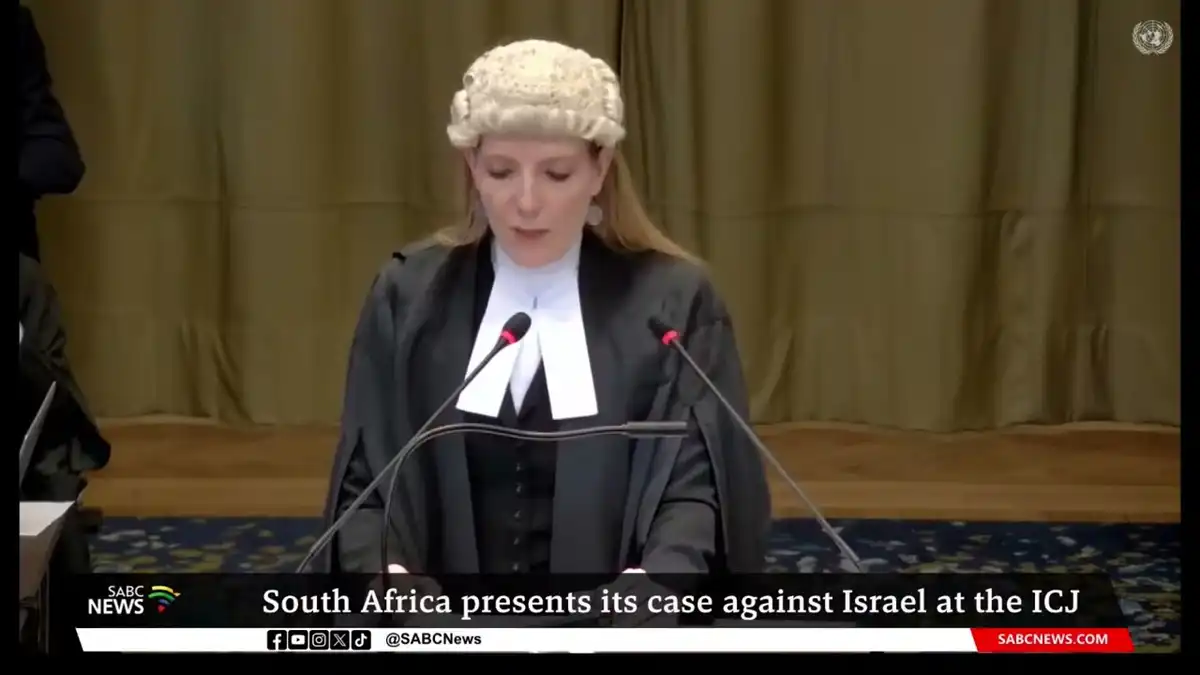
On Thursday and Friday, the International Court of Justice in The Hague held two public hearings as part of the start of consideration of the case brought by South Africa against Israel on charges of committing “genocide crimes” against Palestinians in the Gaza Strip.


On December 29, South Africa filed an 84-page lawsuit, presenting evidence of Israel’s violation of its obligations under the United Nations Charter, and its involvement in committing genocide crimes against the Palestinian people in the Gaza Strip.


Israel has rejected the accusation against it of committing genocide against the Palestinians, and Israel's defense team claimed, during its argument in a session held by the International Court of Justice yesterday, Friday, that Israel's war on Gaza was "self-defense."


In the coming days, the International Court of Justice is scheduled to determine its new steps regarding the case against Israel.


Since last October 7, the Israeli army has been waging a devastating war on Gaza that, as of Saturday, left 23,843 dead and 60,317 injured, massive infrastructure destruction and an unprecedented humanitarian catastrophe, according to the Gaza Strip authorities and the United Nations.


ARAB AND WORLD

Sat 13 Jan 2024 8:49 pm - Jerusalem Time

Netanyahu: The Hague Court will not stop us from the Gaza war

Israeli Prime Minister Benjamin Netanyahu said on Saturday that Tel Aviv is continuing its war against the Gaza Strip, and the International Court of Justice in The Hague will not stop it through the lawsuit filed against it by South Africa.


Netanyahu said in a press conference: “We will continue the war in the Gaza Strip until we achieve all our goals. Neither the Hague Court nor the axis of evil will stop us,” without clarifying what is meant by the axis of evil.


He added: "Today we mark the 100th day of the war. We will continue this war until we achieve all our goals, which are eliminating Hamas, returning all prisoners, and ensuring that Gaza will not pose a threat to our country."


He continued: "To achieve this goal, tomorrow (Sunday) we will present a budget that will bring more funds for security."


On Thursday and Friday, the International Court of Justice in The Hague held two public hearings as part of the start of consideration of the lawsuit filed by South Africa against Israel on charges of committing “genocide crimes” against the Palestinians in the Gaza Strip.


On December 29, South Africa filed an 84-page lawsuit, presenting evidence that Israel, the occupying power, violated its obligations under the United Nations Charter, and its involvement in “committing acts of genocide against the Palestinian people in the Gaza Strip.”


In the coming days, International Justice is scheduled to determine its future steps regarding the lawsuit filed by South Africa against Israel.


In his speech, Netanyahu touched on the Philadelphia axis in the southern Gaza Strip, saying: “Without controlling the Philadelphia axis in Gaza, we cannot eliminate the Hamas movement, and we are examining all options regarding it.”


The Philadelphia Corridor is also known as the Salah al-Din Corridor, which is a 14-kilometre border strip between the Gaza Strip and Egypt.


The Israeli Prime Minister said that Tel Aviv "will not transfer funds to the Palestinian Authority that might help Hamas in any way."


ARAB AND WORLD

Sat 13 Jan 2024 6:40 pm - Jerusalem Time

The Hague: Israel’s Genocide Exposed By Irish Lawyer's HISTORIC Speech At The ICJ

At The Hague yesterday, Blinne Ní Ghrálaigh KC delivered an unbelievably powerful speech - condemning the Israeli state for the utter horror it has unleashed against Gaza. Here it is in full - everyone needs to see it. 


ARAB AND WORLD

Sat 13 Jan 2024 6:32 pm - Jerusalem Time

U.S. OFFICIALS CARE MORE ABOUT PROTECTING OIL TANKERS THAN PALESTINIANS

The United States is demanding an end to attacks on commercial vessels in the Red Sea, but it won’t support a ceasefire in Gaza.


By Edward Hunt 


While Israel continues its military offensive in Gaza, the United States is directing a major military operation in the Red Sea, where U.S. warships are maintaining a persistent presence to protect shipping lanes.

With its recently launched Operation Prosperity Guardian, the United States is leading a multinational military coalition to occupy the Red Sea and the Bab al-Mandab, where oil tankers and commercial vessels have come under attack by Houthi militants in Yemen. The U.S.-led military intervention has brought the United States into direct conflict with the Houthis, who insist that they will continue their attacks until Israel ends its military offensive in Gaza.

“This is about the protection of one of the major commerce routes of the world in the Red Sea and Bab al-Mandab,” a senior official in the Biden administration said.


Strategic Waterways

For years, the U.S. military has played a central role in the Red Sea, a large waterway between northeastern Africa and the Arabian peninsula that facilitates regional commerce. In April 2022, the U.S. military oversaw the creation of Combined Task Force 153, a multinational naval partnership to patrol the Red Sea, Bab al-Mandab, and Gulf of Aden.

“As everyone can appreciate, those waters are critical to the free flow of commerce throughout the region,” Vice Admiral Brad Cooper, the regional U.S. naval commander, explained at the time.

The Red Sea is a vital shipping route, accounting for nearly 15 percent of all seaborne trade. It facilitates commerce between Europe and Asia, enabling commercial ships to save time by passing through the Middle East rather than taking a longer route around Africa.

The Red Sea is also a major transit route for the world’s oil and natural gas. Significant amounts of oil from Iraq, Saudi Arabia, and other countries in the Persian Gulf are routed through the Red Sea to markets in Asia, Europe, and North America. Overall, the Red Sea accounts for 8 percent of global trade in liquefied natural gas and 12 percent of seaborne trade in oil.

“The Red Sea is a vital waterway,” White House spokesperson John Kirby said at a January 3 press briefing. “A significant amount of global trade flows through that Red Sea.”

Of particular concern to U.S. officials is the Bab al-Mandab, a strait at the southern end of the Red Sea. Only 18 miles wide at its narrowest point, the strait forms a chokepoint that forces commercial vessels into tight shipping lanes. As of early 2023, an estimated 8.8 million barrels of oil passed through the Bab al-Mandab every day, making it one of the world’s most significant chokepoints.

“The Bab al-Mandab Strait is a strategic route for oil and natural gas shipments,” the U.S. Energy Information Agency notes.


Operation Prosperity Guardian

Now that the Houthis are attacking commercial vessels in the Red Sea, the United States is establishing a larger military presence in the region with Operation Prosperity Guardian. Under this new initiative, the United States is working with its coalition partners to establish what U.S. officials call a “persistent presence” in the southern Red Sea, meaning that coalition warships and other military assets will remain actively spread out across the area in a kind of military occupation.

“Together, we now have the largest surface and air presence in the southern Red Sea in years,” Cooper said at a January 4 press briefing.

As part of the operation, warships from France, Great Britain, and the United States are positioned throughout the southern Red Sea. They have been reinforced by the Eisenhower Carrier Strike Group, which is located in the Gulf of Aden.

Already, the U.S.-led military coalition has engaged in hostilities with the Houthis, including one incident on December 31 in which U.S. forces sank three Houthi small boats, killing 10 fighters.

“It’s up to the Houthis to halt the attacks,” Cooper insisted. “They’re the instigator and initiator.”


The United States and the Houthis

This is not the first time that the United States has come into conflict with the Houthis. For years, the United States supported Saudi Arabia’s war in Yemen against the Houthis. Both the Obama and Trump administrations provided a Saudi-led military coalition with advanced weaponry and military advice, even as it repeatedly committed war crimes by striking civilian targets.

The Saudi-led military intervention sparked one of the world’s worst humanitarian crises, leading to the deaths of more than 377,000 people. A temporary truce that began in April 2022 led to a reduction in hostilities, but the war has never ended, creating fears that it could reignite at any moment.

“Nobody should believe that the current state of affairs with relatively low levels of fighting is going to last,” Senator Chris Murphy (D-CT) noted late last year.

Throughout Saudi Arabia’s military campaign in Yemen and Israel’s military campaign in Gaza, the United States has been the main power behind the scenes, arming its allies while their military operations have caused tremendous harm to civilians. Officials in Washington have insisted that they have sought to minimize civilian casualties, but their priority has been to prevent the wars from disrupting commerce in nearby waterways, especially in the Red Sea and Bab al-Mandab.

“There’s no question in my mind that this is very important, not only to the countries in the region but globally,” Secretary of Defense Lloyd Austin said last month, referring to the need to ensure freedom of navigation. “What the Houthis are doing affects commerce around the globe.”


U.S. Considerations

As several powerful companies have begun halting their operations in the Red Sea, some current and former U.S. officials have been calling for stronger military action, such as military strikes against Houthi targets in Yemen. The United States previously took direct action against the Houthis in October 2016, when a U.S. warship fired cruise missiles against radar sites in Yemen.

Still, high-level officials have been careful about taking the war directly to the Houthis. So far, President Biden has decided against striking Houthi targets, even after being presented with military options.

A major concern in Washington is that any kind of escalation against the Houthis could reignite the war in Yemen, which has already left the Houthis with the upper hand. When former CIA analyst Bruce Riedel considered the prospect of a U.S. war in Yemen late last year, he questioned whether the people of the United States would support such a war.

“I would venture that if you ask 100 Americans, ‘who are the Houthis?’” Riedel said, “99 percent of them would say, ‘the whats, the whats?’”

Another major concern is that a U.S. war against the Houthis would create further complications for the United States and its allies. If the United States attacked the Houthis, then the Houthis might respond by bringing the war to areas beyond the Red Sea, such as Israel. Already, the Houthis have launched drones and missiles toward Israel.

Officials in the Biden administration have been so concerned about the implications of going to war against the Houthis that they have not accused the Houthis of attacking the United States, even as the Houthis have repeatedly fired drones and missiles in the direction of U.S. warships. Administration officials have claimed that they cannot conclude with certainty that the Houthis have deliberately targeted U.S. military forces.

Additional members of the current U.S.-led military coalition share similar concerns, with some even going so far as to refuse to disclose their participation in the U.S.-led military coalition. Whereas some are concerned about retaliation, others fear what people might think about their participation in a military operation that is indifferent to the suffering of the people of Gaza.

“Not all want to become public,” Kirby acknowledged.


Implications for Gaza

While officials in Washington weigh their options, they are doing little to address the core issue, which is Israel’s ongoing military campaign in Gaza. The Biden administration opposes a ceasefire, even as it repeatedly demands that the Houthis end their attacks on commercial vessels in the Red Sea.

Essentially, the Biden administration is engaging in a form of imperial management, as its works to help Israel continue its military campaign in Gaza while limiting its effects on regional dynamics and global markets. Rather than backing a ceasefire, the Biden administration is hoping to minimize the repercussions of Israel’s offensive for the global economy and contain any movement toward a wider war.

What the Biden administration has shown, in short, is that it cares far more about protecting fossil fuels and the world’s most powerful businesses than it does about protecting the people of Gaza.


ARAB AND WORLD

Sat 13 Jan 2024 6:24 pm - Jerusalem Time

Intercept: 77 GROUPS WORLDWIDE BACK GENOCIDE LAWSUIT AGAINST BIDEN IN U.S. COURT

By Prem Thakker

The Biden administration is due in federal court later this month, while Israel faces charges of genocide at The Hague this week.


DOZENS OF LEGAL and civil society organizations from around the world have thrown their weight behind a U.S. lawsuit accusing President Joe Biden, Secretary of State Antony Blinken, and Secretary of Defense Lloyd Austin for failing to “prevent an unfolding genocide” in Gaza.

In late December, 77 groups — representing tens of thousands of lawyers, civil society leaders, and activists from six continents — filed an amicus brief in a lawsuit that Palestinian human rights organizations, residents of Gaza, and U.S. citizens with family members impacted by Israel’s ongoing assault brought against the Biden administration. In the amicus brief, which is an avenue for groups not directly involved in a lawsuit to give the court information to consider in its ruling, the organizations argue that the plaintiffs establish that a genocide, or serious risk of genocide, of Palestinians in Gaza is occurring. They also argue that the U.S. is violating its duties under international law to prevent and not be complicit in genocide, and that those U.S. failures contribute to the erosion of “long and widely-held norms of international law,” including the Genocide Convention and Universal Declaration of Human Rights, both established in 1948 in the wake of World War II.

The lawsuit is headed for a hearing in the U.S. District Court for the Northern District of California later this month. Meanwhile, in an 84-page complaint brought by South Africa, Israel faces charges of genocide at the International Court of Justice at The Hague. The court will begin to hear arguments in that case on Thursday and could issue provisional measures. That could include directing Israel to suspend its military operations in Gaza, stop any procedures that are forcibly displacing or starving Palestinians in Gaza, or preserve evidence related to the allegations.

The lawyers overseeing the U.S. lawsuit believe that the decisions rendered by the ICJ could indirectly impact their case as well. “While the District Court is obviously not bound by the ICJ, it will have to, and the government will have to, contend with the fact that the highest authority, the world court, has issued an order in which it has found that the case of genocide — there’s a plausible case,” said Astha Sharma Pokharel, staff attorney at the Center for Constitutional Rights, an organization representing the plaintiffs against the U.S. “It will have implications for the United States around both its failure to prevent this genocide and for its complicity.” In December, the Biden administration filed a motion to dismiss the lawsuit, that the plaintiffs are asking the court to act beyond its purview to “override the executive branch’s foreign policy and national security determinations.” The administration also argued that the plaintiffs don’t have standing to bring the lawsuit because the court has no authority over the activities of another sovereign state. Top administration officials have been dismissive of the case before the ICJ as well, with White House National Security Council spokesperson John Kirby calling  it “meritless, counterproductive, and completely without any basis in fact whatsoever,” and Blinken deriding it on similar terms. On Wednesday, Kirby doubled down in his assessment.


BOTH THE LAWSUIT against the Biden administration and South Africa’s case against Israel lay out in extreme detail expressions of genocidal intent by Israeli officials. On October 9, just two days after Hamas’s attack on Israel, Defense Minister Yoav Gallant ordered a complete siege of Gaza, which is home to more than 2 million people. “I have ordered a complete siege on the Gaza Strip. There will be no electricity, no food, no fuel, everything is closed,” Gallant said at the time. “We are fighting human animals and we are acting accordingly.”

In late October, Prime Minister Benjamin Netanyahu invoked a biblical verse about an enemy of ancient Israel that has long been cited to justify killing Palestinians. “You must remember what Amalek has done to you, says our holy Bible,” he said. “And we do remember, and we are fighting.” (South Africa’s ICJ complaint points out that weeks later, Israeli soldiers were recorded in Gaza dancing and chanting, “May their village burn, may Gaza be erased,” and “We know our motto: there are no uninvolved civilians,” and “to wipe off the seed of Amalek.”)According to Law for Palestine, a human rights and legal advocacy organization, there have been at least 500 instances of Israeli lawmakers, officials, and officers inciting genocide.


Basel Sourani from the Palestinian Centre for Human Rights, which signed the amicus brief, told The Intercept that Israel has been emboldened by the lack of consequences for its conduct in Gaza. “We warned from the very first moment that this is a genocide unfolding because of the many statements that we have seen from Israeli political, military, and security leaders,” he said. Sourani said that the statements by Israeli officials, along with the actual blockade, the indiscriminate attacks on civilians and civilian buildings, the basic lack of safe space, and the mass displacement of millions of Palestinians makes it clear: “All of this is tantamount to genocide.”

The plaintiffs responded to the administration’s motion to dismiss on December 22, arguing that there is precedent for U.S. courts to adjudicate questions surrounding genocide and that their legal challenge is about more than the actions of a foreign state. Rather, the plaintiffs argued, their injuries are “fairly traceable” to the actions of the U.S. government. “The suggestion that the U.S. does not or cannot influence Israel borders on the absurd, not least because the Israeli government acknowledges its actions could not happen without U.S. license and support, and Defendants have boasted about their coordination with and influence over Israel,” the plaintiffs wrote. The Biden administration has until Friday to issue a response. 

The Oakland, California-based federal court is set to hear arguments on the plaintiffs’ motion for a preliminary injunction, and on the Biden administration’s motion to dismiss, on January 26. (The Biden administration is facing another federal lawsuit that accuses it of failing to protect Palestinian Americans stuck in Gaza, drawing a contrast to its efforts to help Israeli dual nationals.)In the lead-up to the ICJ trial, U.S. officials said that their Israeli counterparts told them they will be shifting away from a wide-scale assault on Gaza to a more “targeted” approach. 


On Tuesday, the Israel Defense Forces posted a video expressing its concern for the “suffering of civilians in Gaza,” arguing they are “ready and willing to facilitate as much humanitarian aid as the world will give.” Despite such claims, Israel has continued to drop bombs on civilians, reportedly targeting ambulances, hospitals, and Doctors Without Borders shelters with little abandon. As of Wednesday, Israeli forces had killed at least 147 people in the past 24 hours.

OPINIONS

Sat 13 Jan 2024 5:59 pm - Jerusalem Time

Israeli opinion: Unfortunately, it seems that Hamas is going nowhere

Yedioth Ahronoth

Yedioth Ahronoth

Opinion Writer

By Nahum Barnea

Call the plan to free the hostages whatever you want - the Qatari proposal, the Egyptian proposal, or the American proposal - all of these suggestions indicate that the Israeli side is beginning to come to terms with the limited consequences of the war. According to my information, there is no deal yet. We have to hope there is a deal. However, as 100 days have passed since failure and devastation, there is no escape except by seeing reality as it is. There are readers who refuse to accept this description of reality, and this is their right. I believe that the army leadership has begun to understand well. The question now is how Netanyahu and the ministers will deal with the gap between the irresponsible expectations they have created among the public, and the difficult decisions they have to make. Don't envy them.

The talk is about a 3-month ceasefire agreement. Implementation will be gradual, and will include the liberation of all hostages, living and dead, in stages. The first phase will be humanitarian - freeing the sick, injured and elderly. In addition to the liberation of thousands of Palestinian prisoners, both officials and non-officials, there are other demands: a significant increase in humanitarian aid to the Strip; Return of residents to the northern areas of Gaza; Withdrawal of army forces; Building an administration with international funding to reconstruct the Gaza Strip after the demolition - and worst of all, the participation of “Hamas” in controlling the Gaza Strip in the future.

The Israeli side would have been happy to allow the Hamas leadership, including Sinwar and Deif, to go into exile in Qatar, or to any other country. Exile is what Arafat and his men got in Beirut, during the First Lebanon War. But Gaza is not Beirut, and Sinwar is not Arafat. He does not appear to be looking for exile now - he is planning victory celebrations in Gaza.

Circumstances can change during negotiations. The collapse of negotiations is also possible. However, the difficult question is the following: Does the hope of life for 136 Israelis justify these prices? I say yes, and not just because they were kidnapped from their homes, and the government and the army are responsible for the unparalleled failure, they were abandoned before and during October 7. When Netanyahu meets with the families of the hostages, he emphasizes accompanying his wife, as if the conversation was about poor people who needed Mother Teresa and the kindness that only women had in the ancient world. In my view, this is a crisis. President Biden can meet hostages; As for Netanyahu, he is responsible for their situation. This is his job.

At the political and military levels, there are those who prefer to ignore the hostage issue. The claim there is that the hostages are a burden: preoccupation with them hinders the forces in the field and strengthens Hamas. It is better to come to terms with their fate and move on. This position is prominent among the Messianic "religious Zionism" movement. For some of them, the events of October 7 are not a disaster, but a historic opportunity: Israel will occupy Gaza, expel the population and settle the Jews; If another front opens in the West Bank, we will expel the Palestinians from there as well.

This trend is prominent in combat units in the army. I'm saying this for their own good. But this does not mean that they are allowed to fill the walls with graffiti calling for a return to Gush Katif. The army does not succeed in controlling their political impulse.

Another, worse story, concerns General Barak Hiram, who, on October 7, gave orders to the tank to bomb a building in which there were hostages with “Hamas terrorists.” She killed 12 hostages. This was revealed by the New York Times, and the army is now investigating the case. Members of the alert ranks of Kibbutz Be'eri demanded that his appointment as commander of the Gaza Battalion be postponed until the investigations are completed. The army refused. As stated in “Deception 22” by Joseph Heller, the one who bombed the kibbutz people would be the officer in charge of them.

Hiram is a resident of the Tekoa settlement, which adds a political dimension to the case. In my opinion, it does not matter where he lives - what matters is what he thinks. In this war, the army talks a lot about killing soldiers and civilians under the pretext that there is no other solution. This is what happens on the battlefields. This argument is not always convincing.

No wheat, no Torah


The fate of the hostages is not the only thing preventing the army from occupying Gaza. Sometimes, the hostages are the explanation, and sometimes the argument: not everyone who wears a chain around his neck, or wears a yellow badge on his uniform, is actually conscripted for them.

The cabinet was supposed to discuss on Wednesday evening the vision for the future of Gaza - Gaza the next day. At the last minute, the issue was removed from the agenda: there were those who remembered that deliberations in The Hague regarding the lawsuit filed by South Africa would begin, and who knew how leaks from within the session would affect the deliberations.

A small story, but it teaches a lot: Israel's current government cannot manage a war. It is torn between Smotrich and Ben Gvir on one side, Biden and Blinken on the other, and Gantz and Eizenkot in the middle. Netanyahu discussed with Blinken the entry of 150 tons of wheat into Gaza. This contradicts everything Netanyahu committed to the public at the beginning of the war. The deliberations took place without informing the cabinet ministers. Netanyahu gave a half-reply, and Blinken felt despair, so he decided to thank Netanyahu, publicly, in front of the cabinet for the wheat. The Prime Minister's Office was quick to deny. The result: The Americans do not believe him, the cabinet ministers do not believe him, no wheat, and no Torah.

Unfortunately, it seems that Hamas is going nowhere. Its role in dismantling will come in the next rounds, when it breaks the agreement (and it will break it). If there was an opportunity to establish a non-jihadist alternative in Gaza, and I doubt it, the Israeli government has rejected it.

However, the hostages will return to their homes, and the army will devote itself to the northern front. It is possible for the Israelis to devote themselves to arranging the internal house. This is what Rauma Kadam, whose 5 members of her family were killed, said and promised to Defense Minister Yoav Galant. Her statements must be placed on the doors of the offices of the Prime Minister and the Chief of Staff. This is what will happen in the best case scenario. In a bad scenario, there will be no agreement, and the army will be stuck in Gaza without a plan, versus two million displaced people with nowhere to go, versus a hostile world and a tired American administration, with hostages that will not last, and residents who have been evacuated from their homes and will not return, with... An economic crisis, inflated budgets, and a political system preoccupied with itself.

In the end, as in every Hollywood movie, there will be a happy ending. I just don't know what it is.

PALESTINE

Sat 13 Jan 2024 5:56 pm - Jerusalem Time

"Gaza Government": 800 thousand people are threatened with death from hunger and thirst

The government media office in the Gaza Strip said, on Saturday, that “death threatens about 800,000 people in the Gaza and northern governorates due to the continued policy of starvation and thirst pursued by the Israeli army against them.”


The office stated in a statement, “The continuation of the policy of thirst and starvation threatens the lives of about 800,000 citizens in the Gaza and North governorates with death.”


It explained that the two governorates "need 1,300 food trucks daily to get out of hunger, with 600 trucks for the north and 700 for Gaza."


It pointed out that Israel "is accelerating the creation of a real famine and killing 14 martyrs who tried to obtain food (without giving details about their deaths)."


The "government journalist" warned of the Israeli army's "deliberate and intentional efforts to cause a real famine in Gaza and the north."


It pointed out that the army continues to prevent the entry of "aid, supplies, food and supplies to the two governorates, in addition to shooting at trucks trying to reach them, targeting drinking water lines and wells and disrupting all aspects of life."


The statement held "the international community, the United States, and the occupation fully responsible for the catastrophic results and death due to famine and thirst," calling on them to "immediately and urgently stop the war."


Since October 7, 2023, Israel has continued to close the crossings between Gaza and the outside world, while the Rafah crossing is partially opened for the entry of limited aid and the exit of dozens of sick and injured people and a number of foreign passport holders.


On November 24, 2023, Israel allowed limited amounts of humanitarian aid to enter the Gaza Strip through the Rafah crossing, as part of a week-long truce between the factions in Gaza and Israel, which was reached through Qatari-Egyptian-American mediation, which included a prisoner exchange deal.


Trucks continue to enter areas south of the Gaza Strip on a limited basis, with the exception of the Gaza and North governorates.

ARAB AND WORLD

Sat 13 Jan 2024 5:51 pm - Jerusalem Time

Israel-Palestine war: 100 days into Gaza war, Biden fails to achieve basic policy goals

By Sean Mathews


US efforts to cobble together a plan for post-war Gaza lay bare the contradictory goals the administration has failed to resolve

 The US's top diplomat came to Israel this week carrying a message from Washington's regional allies: Israel's neighbors are prepared to invest in Gaza's security and reconstruction.

"But it is essential to them that there also be a clear pathway to the realization of a Palestinian political state," US Secretary of State Anthony Blinken said. 

By holding out to Israel the carrot of regional buy-in for the post-war fate of Gaza, Blinken seemingly tried to leverage the US's Arab partners and Turkey to sway Israel in a way that the Biden administration has been unable, or unwilling, to do alone.

But Blinken's comments on his fourth visit to the region since the war broke out following the 7 October Hamas-led attacks also underline how, 100 days after the onset of the crisis, Washington is still no closer to moving the needle on one of its primary goals.

The US lobbied Israel to delay its invasion of Gaza as it pressed its ally to come up with a post-war plan for the besieged enclave's future. 


Bottom of Form

"Since 7 October, the US has prioritized above all else Israel's right to defend itself," said Brian Katulis, senior fellow and vice president of policy at the Washington-based Middle East Institute. "But most of its other goals are incomplete.

“The administration's weakest link remains reaching some sort of consensus on a Gaza endgame."

Instead, the Biden administration has been occupied with other issues. 


'Significantly get out of Gaza'

US diplomats spent recent days scolding Prime Minister Benjamin Netanyahu's political allies for floating a forced displacement of Palestinians from Gaza and a return of Israeli settlements to the besieged enclave.

The recent assassinations of senior Hamas and Hezbollah officials in Lebanon have also sparked fears of a wider regional war that could drag in the US.


At the same time, the US has had to divert valuable military resources to fend off missile and drone attacks on commercial ships by Houthis in Yemen; the Biden administration, along with the UK on Thursday, lost patience and has launched strikes against the Houthis.

There are signs that as the war reaches 100 days, and attention slowly turns to US presidential elections, fatigue is setting in among Biden and his senior staff.

Biden's pledge to give Israel the military tools it needs to "finish the job" against Hamas is now followed by a campaign promise that he is "doing all that he can" so Israel can "significantly get out of Gaza".


Biden set the tone of the conflict with his October wartime visit to Israel. Analysts and officials say that decision effectively created an impression of US ownership of Israel's offensive.

Backing Israel unconditionally has left the US open to criticism that it is participating in an Israeli bombing campaign which Biden himself described as "indiscriminate", as 23,000 Palestinians, mainly women and children, have been killed in the war in Gaza so far and many are still unaccounted for. 


A hearing on Friday ended two days of testimonies at the International Court of Justice, in a genocide case brought against Israel by South Africa, with the latter demanding the top UN court order an end to Israel's military attacks in Gaza.

An estimated 70 percent of Gaza's homes have been damaged or destroyed in Israeli air strikes since the fighting started after Hamas-led attacks killed 1,140 people in southern Israel and around 240 hostages were taken back to Gaza. 


US officials defended Biden's embrace of Israel as a practical way to give the US more leverage to shape Israel's military campaign and respond to the humanitarian crisis in Gaza, but little progress has been made on that front.


This week, Biden's top allies in Congress issued a stark assessment of that plan. 

"Secretary Blinken and President Biden had been right to insist on two things: a reduction in the unacceptable levels of civilian casualties, and much more cooperation when it comes to providing humanitarian assistance," Democratic Senator Chris Van Hollen said after a visit to Egypt's Rafah crossing into Gaza.

"We've not seen that," he said.


Dilemma

The tension between supporting Israel militarily and reducing Palestinian suffering in Gaza is just one of the diplomatic dilemmas facing the administration.

US efforts to produce a workable plan for post-war Gaza lay bare the competing and contradictory goals the administration has been unable to resolve at the 100-day mark of the war. 

Washington wants a "revitalized" Palestinian Authority (PA) to take over Gaza. The PA has conditioned its return to the besieged enclave on the creation of an independent Palestinian state comprising Gaza, the occupied West Bank and East Jerusalem.

Israeli Prime Minister Benjamin Netanyahu's government not only opposes the PA's return to Gaza, but is against the creation of a Palestinian state.


"There is a fundamental difference with Israel over the role of the PA in Gaza. After 100 days, the US still hasn't been able to square that difference," David Schenker, a senior fellow at the Washington Institute for Near East Policy and a previous assistant secretary of state for near eastern affairs.

Further muddying the waters, the PA's ageing political leaders say they are open to a national unity government that includes some Hamas factions in Gaza.


The PA's dominant faction, Fatah, and Hamas fought a bloody conflict with each other in 2007 and seized control of the Strip, though they had fought sporadically after Hamas won elections in 2006.

However, experts say the PA would be unable to govern Gaza without some Hamas backing. The PA is viewed by many Palestinians as being a corrupt Israeli collaborator.

Recent polling shows a surge in support for Hamas in the occupied West Bank and steady backing in Gaza since the group launched its 7 October attack on Israel. 

Israeli Defence Minister Yoav Gallant has floated the most detailed post-war plan for Gaza to date on the Israeli side.

It calls for Palestinians to administer the Gaza Strip, but rules out a return of the PA and envisions a "multinational task force" led by the US and Arab states to oversee Gaza's reconstruction. Under the plan, Israel will also maintain overall security control of Gaza, but it does not address the resettling of displaced Palestinians in Gaza.

"What the Israelis have offered so far is unworkable," Schenker said.

The US's regional allies say they want to see a ceasefire in Gaza before engaging in serious talks about a day-after plan. But privately they also have competing interests in Gaza, with Turkey and Qatar more open to Hamas and Saudi Arabia and the United Arab Emirates wary of the group.


Promises

Chas Freeman, a former US ambassador to Saudi Arabia, said Blinken's trip this week underscored the toll the war in Gaza has taken on the US's "convening power".

"Blinken came to Israel with promises of support for a post-war Gaza plan by Turkey and the Arab states, but it was just that, promises. No one committed to anything." 


Members of the al-Qedra family, who were injured during Israeli bombardment, receive treatment at Nasser hospital in Khan Younis in the southern Gaza Strip, on 16 December 2023 (AFP)

Freeman says the US is increasingly isolated on the world stage as a result of its support for Israel.

At the UN, the US has had to exercise its veto power three times to defend Israel from global criticism since the war erupted. Inside the region, the US has been unable to recruit key allies to join a naval task force to guard the Red Sea against Iran-aligned Houthis who are attacking commercial ships in what they say is solidarity with Palestine. 

This week, the International Court of Justice began hearing a genocide case against Israel introduced by South Africa.

The US slammed the case as "meritless". But even among the US’s western allies, calls for an end to the fighting are growing.

The UK, Germany and France have stepped up their calls for a ceasefire. The EU's foreign policy chief, Josep Borrell, says the international community needs to "impose" a solution to the conflict.

"There is a tremendous disconnect between the administration and what's happening globally," Freeman said. "I think the war has destroyed US credibility abroad. That has real-world consequences when you consider the war in Ukraine and competition with China.

"Other countries are going to sit these things out."


'Displacement out of desperation'

The Middle East has also seen an outpouring of support for Palestinians over the last 100 days that poses a challenge to some of the US's closest regional partners.

In Jordan, a key US ally, protesters have denounced Biden and called on Hamas to attack Israel with more rockets.

In Saudi Arabia, where the Biden administration was working to normalize ties with Israel, 96 percent of people now say that Arab countries should cut all ties with Israel.


The Arab world has been galvanized by 24-hour coverage of the war and the humanitarian crisis unfolding in Gaza.

Half of the besieged enclave's population is at risk of starving, according to the UN. Around 1.9 million people, about 85 percent of the Strip's population, are displaced.

A million Palestinians are crammed into the town of Rafah, on the border with Egypt, where water-borne diseases are spreading and people have been forced to sleep, and defecate, on the street.

While Biden has publicly pledged to oppose a displacement of Palestinians from Gaza, a former senior US intelligence official told MEE that the humanitarian crisis has set the stage for "displacement out of desperation".


The war in Gaza has revived memories of the Nakba or "catastrophe", when Palestinians were forcibly displaced from their homes in 1948 after the creation of the state of Israel. A refugee crisis at Egypt’s border with Gaza could spark political upheaval in Cairo, a key US ally.


'Escalation trap'

The Biden administration also faces a brewing crisis along Israel's northern border with Lebanon.

Fighting between Iran-aligned Hezbollah and Israel has ebbed and flowed since the start of the war, displacing about 80,000 Israelis.

But the risk that the conflict could widen, threatening the administration's claim to have contained the fighting to Gaza, has grown over the last two weeks.

Israel was blamed for the recent killing of the deputy political leader of Hamas, Saleh al-Arouri, in a Beirut suburb that is a Hezbollah stronghold. A few days later, Israel assassinated Wissam Tawil, a commander of Hezbollah's elite Radwan force.

"The US is stuck in an escalation trap," Freeman said. "Israel is openly courting an expansion of the war with these assassinations."

But Schenker believes the Israeli strikes are paying off.


"It's clear Hezbollah has decided not go to war on behalf of the Palestinians," he told MEE. "Israel is taking the opportunity to raise the price for Hezbollah's adventurism on its southern border."

Meanwhile, American troops in the region have been attacked more than 115 times since mid-October by Iranian-aligned groups, according to the Pentagon.

In response, the US launched a strike on Baghdad that killed a senior member of the Popular Mobilization Units, a group of Iran-backed Shia militia groups in Iraq. 

The strike has sparked a crisis in Washington's delicate diplomatic ties to Baghdad. Iraq's prime minister, Mohammed Shia' al-Sudani, called the attack "unjustified" and said he would move to expel more than 2,000 US troops in response. 

Besides the Baghdad strike, the US had generally refrained from escalating against Iranian-aligned groups out of concern it could spark a wider war, but even that restraint has run its course.

Among Tehran's so-called axis of resistance groups, Yemen's Houthis have proven to be the most assertive, launching missile and drone attacks that have disrupted shipping in the Red Sea, a passage-way for 12 percent of global trade.

The US, along with the UK, has been forced to respond by launching several strikes targeting Yemen over the past week, with the Houthis vowing to respond in kind. 


'An endless war'

But others say that, after 100 days, the US isn't in as dire a situation as some say.

"The administration is in a better place than they think they are," James Jeffrey, a former senior US official now at the Washington-based Wilson Center, told MEE.


Jeffrey said those who believe the US could dictate terms to Israel to end the fighting overestimate the US's leverage with an ally that has fought three wars with its Arab neighbors and decades of lower-level conflicts with Palestinian fighters since its founding.

"If we pull our support from Israel, let me tell you, they will keep fighting. And that's not because of some plot by Bibi [Netanyahu] to stay in office, that's because the Israeli public realizes that 7 October presented the specter of an existential crisis to Israel's future," he told MEE.

He says the US has achieved its goal of giving Israel the space to push its offensive against Hamas while staving off a widening war.

"Biden is holding his nose against protests about civilian Palestinian casualties because he wants Hamas degraded," Jeffrey said. "As do our Arab allies, although they can't say it in public."

In private conversations, some US officials chaff at allegations that Washington's support for Israel is eroding its position in the region.


"If we hadn't supported Israel fully after Hamas's attack, what would our Arab partners think," A former senior US official told MEE, speaking on condition of anonymity.

"They would say we abandoned an ally like we did with Mubarak in 2011," referring to the former president of Egypt who resigned in 2011 amid mass protests. "You are damned if you do, damned if you don't."

Israel estimates that it has killed 8,000 Hamas fighters in Gaza, but the group's senior leadership in the enclave remains, and Hamas continues to hold more than 100 hostages. On Wednesday, a senior Hamas official said they would not be returned alive until Israel agrees to a full ceasefire in Gaza. 

Katulis, at the MEI, said that, 100 days into the war, the US and Israel have failed to define what a successful degradation of Hamas looks like.

US officials now admit publicly that Israel will be unable to eliminate the group, echoing the warnings they have received from Arab capitals. 

"It's an open question," Katulis said. "And that means we are looking at the formula for an endless war that Biden warned the Israelis against from day one of this conflict."

OPINIONS

Sat 13 Jan 2024 5:44 pm - Jerusalem Time

War on Gaza: 100 days on, a regional catastrophe looms

David Hearst

David Hearst

Opinion Writer

Israel has not achieved any of its goals of destroying Hamas, emptying Gaza or reshaping the Middle East. So what happens next?

This weekend will mark 100 days since Israel launched its offensive in Gaza, and there have been a flurry of briefings that the war would be “transitioning” to a new phase, with fewer troops, less bombing, and more use of “targeted” strikes. 

To make it appear as if the troop drawdown was the act of a sovereign state, and not the result of constant pressure from Washington, the Israeli military claimed to have wrested northern Gaza from Hamas’s control.

And yet, as these briefings took place, the Israeli military announced that at least 103 soldiers had been wounded in fighting during the previous 24 hours. A day later, the army announced the deaths of nine soldiers. In the same period, Gaza’s health ministry announced that 126 Palestinians had been killed in Israeli attacks. In the latest 24-hour period, 147 more have been killed, the ministry said.

A contradiction looms large. The casualties being sustained by the Israeli army and Palestinian civilians in Gaza on a daily basis are at odds with the claims of a new, “lower-intensity” war. 

The more obvious explanation for the casualties is that 100 days on, the war is being fought as ferociously as it was on day one. Hamas is not waving a white flag.

Bottom of Form

Yoav Gallant, the Israeli defense minister and member of the three-man war cabinet, qualified the claim that his army had established control over the north by adding “at least above ground”. Well might he say that.

So what has Israel achieved as a result of throwing the full might of its Airforce and army at Gaza, regardless of the cost in civilian lives, and with the full intent to make the land uninhabitable for its population of 2.3 million?

The war cabinet had three objectives in this campaign: to wipe Hamas off the face of the earth, irrespective of the fate of the hostages held; to change the unfavorable demographic balance of Jews to Arabs by forcing as many Palestinians out of Gaza as possible; and to alter the landscape so that no other militant group could ever again do what Hamas did on 7 October.

How has it fared on each count?

Has Israel achieved its military objectives? 

Plainly no, according to Gallant’s account, as he warned of an even longer period of fighting to come. Only one hostage has been released alive by Israel’s military operation, Ori Megidish, who Israel said it rescued during ground operations - although it is disputed whether she was “released” by Hamas or actively “freed” by Israel during its operations.

But what about dismantling the tunnel network that forms the backbone of the military structure of Hamas, which is proscribed as a terrorist organization in the UK and other countries?

The Israeli army went into this operation with the most advanced capabilities in the detection, mapping and destruction of tunnels of any army in the world - and yet, it appears to have been overwhelmed by the scale of the task, with specialized units walking into a series of booby traps. 

As Daphne Richemond-Barak, an assistant professor in the Lauder School of Government, Diplomacy and Strategy at Reichman University in Israel, wrote in Foreign Affairs: “These units have also uncovered a new generation of Hamas tunnels. The group’s rudimentary structures of the early 2000s were reinforced with wood planks. The current networks are deeper and more hardened, resembling the large infiltration tunnels of North Korea. Hamas used advanced civilian boring technologies to dig them, taking its subterranean capabilities to the next level.

“Hamas’s growing reliance on the tunnels and its elaborate construction effort have paid off. Never in the history of tunnel warfare has a defender been able to spend months in such confined spaces. The digging itself, the innovative ways Hamas has made use of the tunnels, and the group’s survival underground for this long have been unprecedented.”

It's the strategically weak being led by the tactically angry - and that path leads to mutual oblivion

High praise indeed. What Richemond-Barak failed to point out was the extent of the tunnel network, which runs, I am told, to many hundreds of kilometers. 

Perhaps this can explain why just after midnight at the start of the new year, a fresh volley of rockets was launched at Tel Aviv.

One hundred days into the most ferocious aerial bombardment the world has witnessed since the bombing of Dresden, Hamburg and Tokyo by the Allies in the Second World War, Hamas has retained its ability to fight and to inflict losses on Israeli tanks and soldiers.

There is now some sensitivity in Israel about the scale of the casualties it is taking. After persistent reports about the high number of injured soldiers, the Israeli army put up its own webpage, which currently reports that from the beginning of the ground attack, 186 soldiers have been killed. The site also notes that around 2,500 soldiers have been wounded since the start of the war.

The real picture is worse. Yediot Ahronoth reported that at least 12,500 soldiers are predicted to be recognized as disabled as a result of action in Gaza. A company hired by the defense ministry said even this figure could be conservative, noting the number of cases requesting disability recognition could reach 20,000. There are 60,000 soldiers currently undergoing rehabilitation.

Has Israel forced an exodus from Gaza?

Whatever the International Court of Justice (ICJ) in the Hague decides about South Africa’s claim that Israel is responsible for a genocide, Israel has undoubtedly created a humanitarian catastrophe in Gaza - and it has done so by design. 

A UN report compiled in December, using evidence from 17 different agencies, found that 80 percent of everyone in the world who is in a catastrophic state of hunger is in Gaza right now.

Even if the war stopped tomorrow, Gaza is rife for a pandemic, with the World Health Organization reporting that on average, there is one shower for every 4,500 people and one toilet for every 220. Put this all together and a year from now, the mortality rate could be many times greater than at the height of the blitzkrieg. 

Giora Eiland, former head of the Israeli National Security Council and a government adviser, has been foolish enough to put the war cabinet’s strategy into words. Eiland said it was not enough to cut off water, electricity and diesel in Gaza. 

In comments cited as evidence before the ICJ of genocidal intent, Eiland wrote in an online journal: “In order to make the siege effective, we have to prevent others from giving assistance to Gaza … The people should be told that they have two choices; to stay and to starve, or to leave.”

Israel has successfully created a humanitarian disaster in Gaza, but it has so far failed to create the exodus of Palestinians so heartily desired by Zionist fundamentalists. Certainly some foreign nationals have left Gaza, as have the gravely ill - but in the main, there have been no attempts to storm the border with Egypt at Rafah. Nor is there any evidence, so far, of a popular revolt against Hamas.

Listen, instead, to what Hanaa Abu Sharkh says. She lives in a tent outside her destroyed house. She forms part of a long queue for fresh water, which often runs out by the time it’s her turn. 

“Every time I do something, like to wash, make food or collect firewood, I remember what our people used to tell us about how they were exiled and how they used to live. I used to find it strange that they used to live in tents, but now I am living in a tent … It’s not easy to leave your land or your home, and it’s not easy to be exiled … Look, this is the land that you were born and raised in. It’s hard to forget it,” she says.

“I keep saying: ‘When will I go back to my house?’ Even though it’s destroyed. This tent, I will keep it outside my house until God alleviates this hardship, and I can rebuild it,” Abu Sharkh adds. “Nobody leaves their home just for the sake of a vile plan, the so-called Greater Israel Plan. And where are we? Are we ‘a people without a land’, like they said? ‘For a land without a people?’ No. They are the ones who should leave, not us.”

She also had this warning for Israel: “You exiled us in 1948 and in 1967, and you want to exile us again in 2023; it’s enough. I will console myself and tell myself that I am not exiled, and I am still in my land.”

If there is a voice that describes the determination of Palestinians to stay in the hell Israel has created, it is the voice of Abu Sharkh.

Has Israel redrawn the Middle East map?

This is the most ambitious of the war cabinet’s objectives, but as the war develops, it is also one on which the cabinet is most consistent. Benjamin Netanyahu, the embattled Israeli prime minister, said within hours of the 7 October attack that Israel would change the face of the Middle East - and this sentiment has been repeated frequently since, not least by Gallant. 

Ahead of a recent visit by US Secretary of State Antony Blinken to douse the flames of regional war, Gallant signaled what the Wall Street Journal described as an enduring shift in Israel’s military posture.

“My basic view: We are fighting an axis, not a single enemy,” Gallant said. “Iran is building up military power around Israel in order to use it.”

Gallant’s words, and those of many others, could lead one to think that a war whose aim is to push Hezbollah’s elite brigades north of the Litani River, and away from Israel’s northern border, is a matter of when, not if.

Israeli Prime Minister Benjamin Netanyahu and Defense Minister Yoav Gallant attend a news conference in Tel Aviv on 28 October 2023 (Abir Sultan/Pool/AFP)

This also means that a war with Iran could follow soon after. But not far beneath the surface of Israeli military rhetoric, there is more hesitancy - and even less certainty that the army could finish the job in Lebanon, than it can in Gaza.

As if to frame this war aim as a fact on the ground, as Blinken was flying into the region for the fourth time to stop this very thing from happening, Israel carried out two targeted assassinations on Hezbollah’s home turf. 

Hamas’s second-in-command, Saleh al-Arouri, had no forewarning of the attack on 7 October, like every other Hamas member outside Gaza - and yet, he was still targeted in a missile attack on his office in Dahiyeh, the densely populated heart of southern Beirut, at rush hour. The area is considered to be a security zone for Hezbollah.  

Both his assassination and that of Wissam al-Tawil, the deputy head of a unit in the elite Radwan force, were conceived of as blows against Hezbollah. The message Israel wanted to send to the most powerful militia on its borders was that it can strike at the group in their heartland.

No brakes on regional response

Earlier in the war, leader Hassan Nasrallah had said that Hezbollah was not a party to the Hamas attack, but suggested that Israel’s war aim of eradicating Hamas was a red line for Hezbollah’s further involvement in the conflict. 

After Arouri’s death, Nasrallah vowed revenge in a speech marking the fourth anniversary of the killing of Iranian General Qassem Soleimani, but kept to his basic message about Hezbollah’s red lines.

In response to Arouri’s killing, Hezbollah struck Israel’s Mount Meron air base in the north with 62 rockets; and after Tawil’s killing, it launched a drone attack on Israel’s northern command. These are high-value military targets, and Hezbollah was sending its own reply to Israel about the accuracy and sophistication of the group’s military reach. Hezbollah made its point. 

But there are no brakes on what is happening elsewhere. Soleimani was the architect of the axis of resistance, which has begun to get engaged in a response to Israel’s campaign in Gaza. 

Arab regimes, and the Gulf countries in particular, have notably ducked any role in leadership against Israel's actions

The Houthis in Yemen, after more than two dozen attacks on western shipping going through the Bab al-Mandeb Strait, have forced hundreds of container ships to divert from the Suez Canal. In Iraq, after US air strikes targeted local militia members, Prime Minister Mohammed Shia al-Sudani promptly announced that his government would close all US military bases in Iraq - a major objective of Iran since the killing of Soleimani.

A war of attrition on Israel’s borders is making itself felt. This leaves the US and Britain, the two powers with the biggest responsibility for the carnage in Gaza, with few if any cards to play - and time is fast running out. 

Neither are hapless spectators, having fully backed Israel’s war of revenge - the former by supplying the bombs and shells Israel has used to level Gaza to rubble, and both by stopping international attempts to impose an immediate ceasefire, and targeting Yemen's Houthis with air strikes.

The lamentable performance of the British foreign secretary, David Cameron, under the determined examination of the Foreign Affairs Committee fully revealed the moral and legal hole Britain had climbed into, by letting Israel “take its gloves off” in Gaza. Cameron could not - or would not - answer whether he had been advised by government lawyers that Israeli actions in Gaza were war crimes.

Opening shots of a larger war

Arab regimes, and the Gulf countries in particular, have notably ducked any role in leadership against Israel’s actions. The most guilty are the Saudis, under whose patronage the last serious attempt to end the conflict was made with the Arab Peace Initiative in 2002. But Riyadh cannot look past its own survival. It looks at Hamas as a threat to its own plans to claim leadership of the Sunni world by normalizing ties with Israel.

The Hamas attack, and staunch resistance since then, have provided a rival model - one that was thought dead and buried - of pan-Arab unity. This is closely linked to the popular revolts of the Arab Spring, which Saudi Arabia, the UAE and Egypt spent a decade suppressing. 

To a rational mind, kicking this hornet’s nest of highly armed, largely autonomous and battle-hardened militia groups, all nestling in weak states and within striking distance of Israel’s northern and eastern borders, is the last thing Israel’s defense establishment should be doing. 

An Israeli soldier wears a patch on the back of his jacket showing Hezbollah leader Hassan Nasrallah as a target, in northern Israel on 4 January 2024 (Jalaa Marey/AFP)

They don’t have the troops to fight on three fronts at once. Israel is too small, and its population centers too vulnerable to missile attacks. Nasrallah is not exaggerating when he says that Israel would be the first to pay the price if full-blown war erupts. 

A former senior Israeli army officer and defense ministry ombudsman, Major General (Reserve) Yitzhak Brick, recently said that thousands of rockets and missiles could be fired daily at population centers, army bases, and electricity and water infrastructure: “Everybody knows this, not only Nasrallah. We know this. They know what they have. We haven’t prepared for this.” Nor will they get the US to back an attack against Iran.

To do all this, while having thrown away Israel’s relationship with Russia over the war in Ukraine, is the height of folly. 

After an Israeli missile attack last month killed Seyyed Reza Mousavi, a senior commander of Iran’s Islamic Revolutionary Guard Corps Quds Force in Syria, questions were asked in Tehran about why the Russians had not deployed their S-300 system to protect Iranian advisers in Syria. Russian President Vladimir Putin is waiting, and he still has cards to play in Syria.

But Israel is not acting rationally. Netanyahu knows he is finished the moment the war stops. The Israeli public - even after 100 days - cannot get enough Palestinian blood to satisfy its demand for revenge, and a clear majority wants Gaza flattened. 

There is no anti-war movement. What remains of Israel’s left wing has, or is, fleeing abroad. Meanwhile, the streets, cafes and markets are filled with Jewish Israelis armed with guns. The Palestinian citizens of Israel have never felt more alone or more vulnerable. 

Can any of this rank as an achievement to anyone thinking rationally? If anything, these 100 days feel like the opening shots of a much larger and longer war, which would be catastrophic for everyone - both Jews and Arabs. 

As far as the US and Israel, the two principal antagonists of this war, are concerned, it’s no longer a question of the blind leading the blind. It’s the strategically weak being led by the tactically angry.

On Thursday, US and UK warplanes struck Houthi positions in Yemen, a blow the Houthis will be well able to sustain, having survived seven years of bombardment by Saudi Arabia.

A shooting war in the Red Sea will follow. And this is the result of a week of US diplomacy attempting to limit a regional war. So much for diplomacy first.

The path Israel is taking the US down leads to mutual oblivion in the Middle East.

Israel’s war on Gaza could yet spell the end of this US president.

Source: Middle east Aye


ARAB AND WORLD

Sat 13 Jan 2024 4:36 pm - Jerusalem Time

Yemen: Al-Houthi confirms continuation of military operations against Israel

The Yemeni Houthi group confirmed on Saturday that it would continue its military operations against Israel and prevent the passage of its ships in the Red Sea, vowing that "the American and British aggression will not go unpunished."


This came in a statement issued by the Houthi government (not internationally recognized) published by the group's "Saba" news agency, hours after the Yemeni capital, Sana'a, was subjected to new raids.


The statement said, "The blatant American and British aggression, which comes in support of the Israeli occupation, will not discourage Yemen from continuing its military operations against the Israeli occupation and preventing its ships and the rest of the ships heading to the ports of occupied Palestine."


He added, "This aggression, which will certainly not go unpunished by our armed forces, demonstrates the great impact of Yemen's military operations against the Israeli occupation and preventing the passage of its ships and other nationalities loaded with goods destined for it."


At dawn on Saturday, the United States renewed its launch of a number of raids on Sanaa, a day after it carried out attacks with Britain against targets in areas controlled by the Houthis in Yemen.


After Friday's attacks, which left five dead and six wounded among the Houthi ranks, the group vowed, in a statement issued by its Political Council (the highest political authority), that all American and British interests had become "legitimate targets" for its forces, in response to their "direct and declared aggression" against Yemen. .


In "solidarity with the Gaza Strip", which has been exposed to an Israeli war with American support since last October 7, the Houthis are targeting, with missiles and drones, cargo ships in the Red Sea that are owned or operated by Israeli companies or that transport goods to and from Israel.


Maritime trade accounts for 70 percent of Israel's imports, and 98 percent of its foreign trade passes through the Red Sea and the Mediterranean, and trade through the Red Sea contributes 34.6 percent to Israel's economy, according to its Ministry of Finance.

PALESTINE

Sat 13 Jan 2024 2:15 pm - Jerusalem Time

West Bank: Unprecedented violence by Israeli settlers

The colonists became more dangerous and organized into military and paramilitary formations


A report prepared by the National Office for Land Defense and Settlement Resistance said that the colonialists are exploiting the circumstances of the brutal aggression against the Gaza Strip, to inflame the situation in more than one governorate and region in the West Bank.


The office added in its weekly settlement report issued today, Saturday, that these settlers have become more organized and dangerous, after the Israeli occupation government decided to arm them in light of a large number of them joining the occupation army to fight in the Gaza Strip.


It explained that the colonists today are organized into military and paramilitary formations, “militias,” that work side by side with the forces designated to ensure the security of the colonies and colonists in the West Bank, so that they do not face the fate of their counterparts in the Gaza envelope, according to the claim.


The report pointed out that the Kfir Brigade, within which was the “Nitzach Yehuda” Brigade, was, before the aggression, the brutal strike force storming cities, villages and camps, in which daily crimes are being committed these days, in which more than 350 citizens have been killed since the start of the aggression on October 7.


It pointed out that this force moved to the battle front in the Gaza Strip, and as an alternative, the occupation government decided to build formations with various names, including “Emergency Teams,” “Qatari Defense - Haghmar,” and others, in which a large number of members of the “Price Paying” terrorist group joined, Which uses the name “Hill Youth” as a civil cover for its practices.


The report indicated that since these colonists joined the ranks of these military and paramilitary formations in the West Bank, testimonies began to accumulate about their involvement in acts of violence, threats, and sabotage of Palestinian property. They began wearing army uniforms, demolishing homes, sabotaging infrastructure, bulldozing and sabotaging fields, building roads, and demolishing wells. water, and preventing citizens from accessing their fields and lands.


It stressed that, according to data from the B'Tselem Foundation, the residents of 16 Bedouin and herding villages in Area C were forced to leave them since the beginning of the aggression, due to the acts of violence and threats practiced by these colonists, sometimes with the protection of the soldiers, and with their participation at other times.


It pointed out that the Yesh Din - There is a Law organization confirmed in its latest reports that acts of violence committed by colonialists against Palestinians in the West Bank set a record high last year, while the United Nations, for its part, also recorded 1,225 attacks against Palestinians during the same year.


The report stated that the frequency was high compared to previous years, while the highest frequency occurred after the seventh of last October, and the attacks were concentrated, especially at the beginning of this year, in the south of Mount Hebron, including in the village of Wadi Jahish and Sha’b al-Batm, without anyone intervening to prevent them, despite The Palestinians identified the soldiers as colonizers from the region in a number of cases.


The report said that hundreds of attacks have been recorded since the beginning of the aggression, and yet only two investigations were opened in the military police on suspicion of committing criminal crimes by soldiers of the “Emergency Teams” and “Haghmar” by the so-called “Central Region Command,” which It turns a blind eye to the violence of these people, and says that the process of recruiting “Haghmar” took place within the framework of a quick examination as possible regarding each case, and recruitment decisions were made according to the special circumstances, and in the event that there is other information, which was not in the hands of the decision-making body at the time of recruitment, it will be carried out. Re-examine the matter, and decisions will be made accordingly.


This week's settlement report highlighted the unbridled violence of the colonists, especially in the governorates of Hebron, Bethlehem, and the Palestinian Jordan Valley.


It said that the colonists' orgy covered several areas of the Hebron Governorate, where they, accompanied by the occupation soldiers, severely beat citizens in the vicinity of the city of Dura, which led to the transfer of a number of them to Dura Hospital, and they also destroyed their agricultural crops.


In Yatta, in the south, colonists from the "Itzkhar Man" colony attacked sheep shepherds in Wadi al-Jawaya, forced them to leave the pastures after assaulting them, vandalized a fence surrounding the area's lands, unleashed their livestock on citizens' agricultural crops, and prevented others from cultivating their lands.


In the "Wadi Ajhish" area in Musafer Yatta, occupation soldiers, accompanied by colonists, detained citizens, abused them, and forced them to leave their lands.


In the “Quwaiwis” area, colonists planted trees on citizens’ lands, and others chased sheep herders and prevented them from reaching pastures in the “Wadi Ma’in” area.


Dozens of armed colonists from "Tzkhar Man" and "Ma'on" also attacked the Al-Jawaya community in Masafer Yatta and the homes of its citizens, and caused damage to their contents.


The colonists of "Susya and Havat Ma'on" destroyed citizens' crops in the villages of Al-Rakiz, Al-Tuwanah, Al-Mufaqara, and Susiya, and released their livestock there under the protection of heavily armed occupation police and soldiers.


In the Ma'in area, east of Yatta, the occupation forces, accompanied by armed colonists, attacked citizens, chased them, prevented them from working on their lands, and seized their agricultural equipment, as they did with the sheep shepherds in the "Fateh Sidra" area in Al-Musafer and prevented them from reaching their lands.


The town of Tarqumiya was not spared the colonists’ attacks. They demolished agricultural rooms and stone chains, and bulldozed 20 dunams of the town’s land, while the occupation forces prevented citizens from approaching their lands in the Al-Taybeh area, close to the “Adora” colony, an area that witnesses continuous attacks on citizens' property.


In the city of Hebron, which was not spared from the violence of the heavily armed colonists, they abused citizens in the Old City of Hebron accompanied by occupation soldiers, while colonists from the established “Kiryat Arba” assaulted Palestinian citizens in the Jaber neighborhood in the town, searched them in a humiliating manner, and prevented them from standing on the street. Their homes' balconies, windows, roofs, and entrances.


Bethlehem Governorate, which was also the scene of an orgy of colonists, who stormed an archaeological and historical site in the town of “Janatah” to the east, and others wreaked havoc in “Ain Hamda”, a water spring belonging to the municipality, surrounded by the bypass road and close to the “Takwa” settlement. They began restoration work in an attempt to seize hundreds of dunams of surrounding land.


In the Tekoa Wilderness, colonists set up two mobile homes in the “Danyan Hill” area, bringing the number of mobile homes in that area to 5. They also installed an iron gate in the “Fatura” area to prevent citizens from reaching their lands, and they extended an electricity network to an old house, which they had built. They seized it after forcing its owner to evacuate it by force. They also built roads in preparation for establishing a new colonial outpost in that area, after it had been emptied of its owners, and their tents and homes were demolished.


In Khallet an-Nahlah, south of Bethlehem, the colonists uprooted 250 olive seedlings and stole agricultural equipment in a scene that is constantly repeated in that area.


In the Jordan Valley, throughout the north, center and south, orgies and violations continue from one week to the next without stopping.


Armed colonists, accompanied by the occupation army, attacked citizens’ lands in Arab al-Mlihat, west of the city of Jericho. According to the Al-Baidar Organization for Defending Bedouin Rights, they installed a number of iron corners, with the aim of provoking citizens and expanding their control over their lands in the area located at the beginning of the Al-Ma’rajat Road, west of Jericho.


These attacks come within the framework of the occupation's ongoing policy of expanding settlements at the expense of the Palestinian territories.


In the northern Jordan Valley, the Palestinian Red Crescent crews transported the citizen, Qadri Alian Daraghmeh, who was a victim of the colonists’ attack on residents’ tents in the “Shuwayer” area, and his livestock were seized.


In this context, Israeli occupation Prime Minister Benjamin Netanyahu decided last week to stop the evacuation and demolition of colonial outposts established by colonists in the West Bank during the aggression, contrary to the instructions of Defense Minister Yoav Allant, who instructed the evacuation of one colonial outpost in what the occupying state calls “Gush Etzion.” In the Bethlehem Governorate, after the extremist National Security Minister Itamar Ben Gvir launched a violent attack on the Army Minister.


The National Office followed up on colonial activities last week, noting that Jerusalem remains the focus of the Judaization policy of the occupation government and municipality.


The report confirmed that the "fictitious" five-year plan projects for the development of East Jerusalem, which were approved by the occupation government in August last year, have disappeared, to be replaced by projects to blatantly Judaize the city.


At this level, and in the context of political propaganda and preparation for the campaign for municipal elections and local authorities in the occupying state, the occupation municipality in Jerusalem early last week, without legal basis, preempted judicial procedures in the Jerusalem courts, and announced in advance its approval of the colonial plan called “Silicon Valley,” which It extends along Wadi Al-Jouz Road and Othman bin Affan Street, to build buildings from 8 to 14 floors on the ruins of commercial and industrial shops in the Jerusalem Industrial Zone.


The report indicated that the plan, as confirmed by the petitioners from the city of Jerusalem, is disastrous for Jerusalemites, and affects the owners of shops in the industrial zone and their property rights by seizing their shops, despite their need for housing and an industrial area, and not for a colonial project aimed at eliminating an entire industrial zone for Jerusalemites that was originally established before the occupation.


The plan includes seizing 2,000 dunams of Palestinian-owned land, and demolishing 200 industrial facilities and workshops in Wadi Joz, to establish a high-tech and technology complex, with services, cafes, hotels, huge towers, and commercial centers.


In its plan, the occupation municipality aims to transform the Palestinian neighborhoods near the walls of the Old City and the blessed Al-Aqsa Mosque into a technological, industrial and commercial center, and a colonial attraction and investment area at the expense of the lands of Jerusalemites.


It is worth noting that 87% of the land in the city is not available for Palestinian construction, and that only 13% of the land is allocated for Palestinian use, even though most of these areas are already built up and overcrowded.


At the same time, the occupation municipality approved the establishment of a garbage dump on an area of 109 dunums in an area densely populated with Jerusalemites in a valley near Al-Issawiya, Anata, and Ras Shehadeh, east of occupied Jerusalem. This plan dates back to the year 2012, when the municipality intended to establish it on an area of 520 dunums in the same place. However, the people of Jerusalem, with the help of the “Bimkom - Planners for Planning Rights” association, prevented this in the Israeli courts for a full decade, and were able to reduce the damage and stop the demolition of 70 residential and commercial facilities to implement this plan.


According to the new plan, the landfill area will be spread over an area of only 109 dunums, that is, a quarter of the area allocated to the landfill in the previous version of the plan for the year 2022, and about a fifth of this size from the original plan for the year 2012, when the landfill was supposed to extend over about 520 dunums.


In addition, the new plan requires that the volume of waste not exceed 350 thousand cubic meters only, which is an amount that constitutes between 4-7% of the volume of dust planned in previous versions, which ranged between 5-8 million cubic meters.


The weekly violations documented by the National Office for Land Defense and Settlement Resistance were as follows during the reporting period:


Jerusalem: The occupation forces blew up the homes of the two martyrs, Murad (38 years old), and Ibrahim Nimr (30 years old) in the town of Sur Baher. The occupation had closed the two houses on the second of last month by welding the doors and windows to prevent entry to them, and another house in the town belonged to the Al-Khatib family after... Assaulting his companions.


The occupation forces also demolished a shed belonging to citizen Ismail Alyan in the town of Anata, and bulldozed lands in the Wadi Al-Rababa neighborhood in the town of Silwan.


Hebron: The occupation forces bulldozed a 6-dunum area of land in the Tel Rumeida neighborhood in the center of the city, which belongs to the Hebron Municipality and is planted with 50 perennial olives, in preparation for seizing it, in addition to installing an iron gate at the entrance to the land.


The occupation forces are working to build new colonial roads, located between the areas of Al-Thaala and Umm Al-Khair, east of Yatta, in order to connect the “Karmiel” and “Ma’on” settlements, another road between the “Bani Hefer” colony and the Bireen area northeast of Yatta, and a third road between "Atnael" settlement, west of Yatta, towards Khallet Al-Farra.


The occupation forces also closed with dirt barriers the entrances to the population centers in Masafer Yatta and its east. It demolished a house and a barn with an area of 120 square metres, built before the occupation and more than 80 years old, and bulldozed lands around them and agricultural beds, and uprooted several fruit and forest trees, owned by the citizen Murad Abdel Samie Ashour in the village of Birin, south of Hebron.


The occupation soldiers and colonists assaulted the young man, Omar Abdel Hadi Al-Qassas (33 years old), south of Hebron, resulting in bruises, after which he was transferred to Dura Hospital. In the town of Yatta, they detained the citizen, Muhammad Al-Nawajaa, and abused him.


Ramallah: Colonists uprooted a number of grape and almond trees on the land of citizen Qassem Ghafri, in the Abu Al-Awf area in Sinjil, and vandalized the water tanks he used to irrigate his land.


Bethlehem: The occupation forces bulldozed a land of two dunums, belonging to the citizen Omar Ismail Issa, in the Khalayel Al-Luz area, southeast of Bethlehem. The citizen, Ibrahim Aweida Sawarka (40 years old), was also injured with fractures, wounds, and bruises, after colonists severely beat him while he and his family were in the tent. In the Kaisan wilderness, they unleashed police dogs on him, which bit his leg and caused him fractures, wounds, and bruises throughout his body. He was transferred to the hospital in Bethlehem to receive treatment, in addition to destroying all the contents of the tent.


The occupation forces arrested the child Mahmoud Abayat (16 years old) while grazing his sheep, and stole 60 heads from him while he was on his land in the “Esh Ghurab” area, east of Bethlehem.


The occupation forces stormed the town of Nahalin, stationed at the northern entrance in the Wadi Salem area, searched agricultural lands, and forced the citizens Obaida Ibrahim Shakarna and Muhammad Sawad to leave their lands, while they seized an agricultural tractor belonging to the citizen Ali Shakarna, burned a vehicle, destroyed solar panels, and damaged cameras. Surveillance belongs to citizen Moataz Najajra.


Settlers uprooted 250 olive seedlings in Khallet al-Nahla, south of Bethlehem, from land belonging to citizen Naji Farraj. The occupation forces also seized an excavator in the village of Nahalin, owned by a citizen, while he was working to reclaim agricultural land in the Khallet al-Dalia area, and prevented farmers from working on their land, knowing that the Khallet al-Dalia area Its area is estimated at 200 dunams, planted with perennial olive trees, vines, and almond trees, and it is private property for citizens.


Nablus: The occupation forces seized a vehicle belonging to detainee Ghassan Dhouqan, raided his house and tampered with its contents. They also raided a printing press belonging to the Dhouqan family, and seized its equipment after vandalizing its contents.


Colonists demolished the walls of an agricultural room belonging to the citizen Thaer from the town of Qusra, and equipment was stolen from it, and the house of the citizen Raed Yassin in Burqa, north of Nablus, was destroyed following an attack by the colonists.


Salfit: The occupation forces demolished a car wash and a nursery belonging to the citizen Muhammad Mansour in the town of Kafl Haris, while colonists burned an agricultural room and olive trees owned by the citizen Najeh Harb from the town of Kafr Al-Di in the Al-Jaffa area in the northern face of the town.


Jenin: Colonists, protected by the occupation forces, attacked Khirbet Al-Hamam between Kafr Ra’i, Al-Nazlat, and Khirbet Al-Mukhal, and assaulted and beat the citizen Majdi Al-Mukhal. They also attacked citizens’ lands in the northern region, “the Tabars region,” of Kafr Ra’i’s lands, and prevented citizens from entering their lands and working on them, while others assaulted them. The young man, Ihsan Muhammad Saabna, from the village of Fahma.


Tulkarm: Two months ago, occupation bulldozers bulldozed lands near the colony known as “Al-Sunbula” or the “Harmish” settlement from the lands of Al-Nazla Al-Sharqiya, north of Tulkarm, with the aim of expanding it. They prevented their owners from entering it and informed the owners of the houses built on it of the intention to demolish them in the coming days.


The soldiers assault and beat anyone who approaches the area, fire live bullets at them, and seize tractors and agricultural equipment belonging to farmers who work on the Al-Mughraqa agricultural land, adjacent to and belonging to Al-Nazla Al-Sharqiya, who make a living from this land, and it is considered their only source of livelihood.


Jordan Valley: The occupation forces seized a bulldozer while it was working to facilitate a road in the Ras al-Ahmar area in the northern Jordan Valley. On an agricultural tractor owned by Hussein Zuhdi Daraghmeh, while he was working in the “Nab’ Ghazal” area in Al-Farsiyya.


Two Palestinian shepherds were severely beaten by colonialists in the northern Jordan Valley, along Route 90, and one of them was transferred to the Turkish Hospital in Tubas for treatment.


The colonists also opened fire on a private vehicle belonging to Louay Qadri Alyan Daraghmeh, causing serious damage to it, while the occupation police then seized it.


Under the protection of the occupation army and police, the colonists seized 500 heads of cows, belonging to citizens Qadri Daraghmeh and Adel Alyan Zamil Daraghmeh, and headed them to the Rosh HaBqaa camp of the occupation army, where they loaded them into large trucks and headed to an unknown destination.



PALESTINE

Sat 13 Jan 2024 2:13 pm - Jerusalem Time

Organization: The humanitarian situation in Rafah has reached the breaking point

Action Aid International said that the humanitarian situation in the city of Rafah in the southern Gaza Strip has reached the breaking point, as more than a million people are gathering in a very crowded area, with more arriving every day, with an area estimated at about 32 square kilometers.


The organization explained in a statement issued today, Saturday, that hundreds of thousands of people are sleeping in the open, without adequate clothing and shelter against the cold and rain, due to overcrowding in shelter centers and exceeding their capacity.


It pointed out that more than 20 people share the tent, and every day represents a struggle for citizens to find food and water, as all residents of the Gaza Strip now face levels of hunger, with the risk of famine increasing day by day.


Abdel Hakim Awad, a member of a youth group for a partner organization of ActionAid/Palestine, touched on the catastrophic humanitarian conditions that people face in Rafah, saying: “We live in a situation that cannot be described as humanitarian. There is no health, no food, no… The basic necessities of life, and there are not enough tents that can accommodate all the people who came from the central region of the Gaza Strip, as they sleep in the open, and you must have 3,000 shekels (equivalent to 635 British pounds) in order to be able to buy a tent. He added: If you want to buy something, like food in the morning, afternoon, or night, it should be one meal, which you might get in the middle of the day, and that meal costs at least 50 shekels (£10.58).


As for the health situation, he pointed out that whoever is infected must remain in his home, because there is no place to receive him at all, as there is no electricity, and solar energy or solar cells are used for charging on normal days, and you must wait three days until you receive a charge, and there is “There are queues for fresh water, there are queues for salt water, there are queues for food, there are queues for drinking, everything has a queue.”


UNICEF explained that there were approximately 3,200 new cases of diarrhea on average every day among children under the age of five, and in one week of December, while diarrhea cases usually recorded before October 7 reached approximately 2,000 cases in this category. age every month, and maintaining hygiene levels is almost impossible, due to the lack of potable water and sanitation, as hundreds of people are forced to use a single toilet or bathroom to shower.


According to Action Aid, the picture is similar elsewhere in the south and central Gaza Strip, where air strikes have intensified in recent days, and more than 85% of the population - about 1.9 million people - have been displaced from their homes several times, and face a daily struggle to meet their basic needs. .


Citizen Laila was displaced from her home, and now resides in a tent with her children and extended family in a camp located in southern Gaza, which she says is home to 100,000 people.


She said: “We live in tents. There are none of the necessities for the life we live. We are starving and struggle to find water and food. We were flooded with water during the nights when it rained on us. Our children have no way to keep them warm. There are no blankets, nothing, and our mother She suffers from asthma, and she also had a traffic accident during the war. My sister is also about to give birth, and we have no blankets or things to keep her or our children warm.”


Another humanitarian case is for citizen Amira, who was displaced from her home in the north, and is currently living in a tent with her four children, the youngest of whom is one and a half years old, in Khan Yunis, while her husband is still in the north.


She says: “Thank God we found what is called a ‘shelter’, but frankly for me, my children and my family, it is not a shelter. Here I suffer from the cold, because my children and I do not find enough blankets. We suffer a lot when we want to go to the bathroom. We stand in line.” "For a long time, the bathrooms were far away. We suffered from gastroenteritis more than once. My children all fell ill in succession and recovered again... I have no shelter, no income or money to spend or buy anything with."


The international organization noted in its report that the amount of aid entering Gaza is still completely insufficient to cover this huge level of needs, as approximately 200 trucks carrying food, medicines, and other supplies are currently entering on average daily.


Despite the enormous challenges, the organization and its local partners, such as: Al-Wefaq Association for Women and Children’s Care, support them by providing food aid, hygiene supplies, and “winter supplies” that contain warm clothes, blankets, and mattresses, as well as providing a number of people with cash assistance. To enable them to purchase basic materials.


The organization is also working in partnership with the "Wefaq" Association to build 60 health units for women and girls in Rafah, giving them a private space to maintain their hygiene with dignity.


For her part, Reham Jaafari, communications and advocacy officer at ActionAid/Palestine, says: “The conditions that people face in Rafah are incredible, as the infrastructure collapses, under the pressure of meeting the needs of the population, at nearly four times its usual capacity, and aid flows at a rapid pace.” Painfully slow We heard miserable stories of 20 family members having to cram into one tent, people having to stand in line for hours to use the toilet, and parents not eating their share meal after meal so they could at least give their children something to eat.


It is likely that the situation will worsen with the displacement of more people from the central region and other areas in southern Gaza, and with the intensification of air strikes.


She stressed that only an immediate and permanent ceasefire will stop the death toll from rising, allow enough life-saving aid to enter Gaza, and provide some relief to those struggling to survive in Rafah and elsewhere in the Gaza Strip.


ARAB AND WORLD

Sat 13 Jan 2024 1:55 pm - Jerusalem Time

China warns of forced displacement of Palestinians

A Chinese envoy warned of the consequences of the forced displacement of Palestinians from Gaza, stressing the importance of an immediate ceasefire.


Zhang Jun, China's permanent representative to the United Nations, said at the Security Council meeting that after nearly 100 days of ongoing Palestinian-Israeli conflict, more than 23,000 people have been killed in Gaza and more than 200 UN workers and journalists have been displaced, and 90 have been displaced. percent of the population of Gaza.


Regarding the rhetoric of “voluntary displacement” out of Gaza, he said that any forced displacement of Palestinians must be strongly rejected.


"This means pushing two million people out of Gaza and turning it into a so-called safe, depopulated zone. If put into practice, such a horrific idea would constitute terrible crimes under international law and could completely destroy the prospects for a two-state solution," Zhang said.


In addition, Zhang called for all possible efforts to alleviate the humanitarian crisis in Gaza.


Zhang continued, saying that Israel must respect its obligations as an occupying power, ensure the safety of humanitarian workers and provide full cooperation in humanitarian relief affairs.


He added that China supports the Security Council taking further additional measures to remove obstacles in order for sufficient humanitarian aid to enter Gaza safely, quickly and without obstacles.


Meanwhile, Zhang called for efforts to consolidate the ceasefire in Gaza as quickly as possible.


He said that only through a ceasefire can further civilian casualties and humanitarian disasters be prevented, and only through a ceasefire can the entire Middle East region be prevented from falling into disaster.


Zhang added that it is worrying that instead of seeing prospects for an immediate ceasefire, we see the conflict expanding.


He went on to say that an immediate ceasefire has become the widespread call of the international community, however, one of the permanent members of the Security Council is using various excuses to prevent reaching a consensus on this issue in the Council by using his veto power. This is a blatant disdain for international justice and fairness and the authority of the Security Council.


"Some people were always talking about protecting human rights and preventing genocide, while in the face of the horrific situation in Gaza, they played a fool, continued to procrastinate and tried to divert attention," he said, adding that this represented the use of double standards. “It is necessary to remove all obstacles and take strict measures to end the fighting, save lives and restore peace.”


Zhang explained that China urges the international community, especially countries with great influence, to achieve a ceasefire, which is a major urgent task.


He continued, saying that China is concerned about the indirect effects of the conflict in Gaza on the situation in the Red Sea, as the military operation launched by the United States and Britain against Yemen will undoubtedly exacerbate regional tensions.

PALESTINE

Sat 13 Jan 2024 12:12 pm - Jerusalem Time

An Israeli newspaper reveals details of the first hours of October 7

An extensive report by the Israeli newspaper Yedioth Ahronoth revealed details of the events of October 7, which witnessed the Hamas attack on the Gaza Strip, which led to the death of 1,200 people, causing Israel to launch an ongoing aggression against the Gaza Strip until today.


Yedioth Ahronoth reported that, early on October 7, when Hamas was making its last preparations before carrying out its expected attack in the morning, senior officials in the Shin Bet and the Israeli army were discussing “some important indicators of a possible attack,” but the newspaper adds that all these indicators "did not constitute a clear warning of war."


It continued: "In the period preceding the major attack, Hamas directly attacked surveillance cameras, communications poles, and other means of collecting information."


It explained that Hamas used “suicide drones, which blinded the Israeli army leadership and prevented it from forming a picture of the event.”


The newspaper pointed out that “due to blindness on the ground, the officers resorted to television broadcasts as well as to social media networks, especially Telegram channels, which included pictures and video clips of what was happening through information on social media sites, the army realized that it was a large-scale event.”


In response to the question, “Where was the Israeli army in the early hours of the morning of October 7?” Yedioth Ahronoth says that through its conversations with dozens of officers and commanders, some of whom are senior commanders in the army, it became clear to it that the latter suffered “the most difficult and embarrassing and angering moments.” 


It explains this by saying: “These moments include an almost failed command system, instructions to shoot at the cars of terrorists heading to Gaza, even if there was a fear of the presence of hostages in them, Marines who were sent into battle without the necessary equipment, old and unchanged orders, and fighter planes roaming the skies without striking, and pilots forced to enter WhatsApp groups to find out which targets to hit.”


"Everything was crazy, chaotic and improvised," it concluded.


Commenting on what happened, the Israeli army says: “These days, we are fighting the Hamas terrorist organization in the Gaza Strip... The Israeli army will conduct a detailed and in-depth investigation to clarify what happened, when the operational situation allows it and will publish the results to the public.”


OPINIONS

Sat 13 Jan 2024 12:09 pm - Jerusalem Time

South Africa to the aid of Palestine: the overthrow of the world

Translation for "Al-Quds" dot com

Translation for "Al-Quds" dot com

Opinion Writer


By Edwy Plenel

Europe and its North American projection claim a universality of human rights that their actions have continued to contradict. Faced with their inaction in the face of the destruction of Palestine by the State of Israel, it is South Africa which, today, defends this universal.

South Africa's application before the United Nations International Court of Justice (ICJ) against the State of Israel, on the "genocidal nature" of its war against the Palestinians of Gaza, is not only an unprecedented legal event. It marks a geopolitical reversal: while all the peoples of the world note, through the Palestinian tragedy, the variable geometry use by Europe and the United States of America of the universalist values to which they claim, it is a country emblematic of the emancipatory causes of the Third World, anti-colonial and anti-racist, which is taking up the torch.


You just need to read the exceptional document produced by South African diplomacy and listen to the presentation (see below, especially since our audiovisual media hardly relayed it), Thursday January 11, of its arguments before the ICJ to take stock of the intellectual eclipse of a continent, ours, whose nation-states have for so long claimed to speak, codify and impose the good, the just and the true.

Because, in real time and under the gaze of the whole world, in the face of the martyrdom of Gaza, they said nothing – or very little: a few hypocritical calls for restraint – and did nothing – or worse: did quite the opposite by delivering massively and only recently, like the United States, arms and ammunition to Israel. Nothing said and nothing done when the population of one of the most densely populated territories on the planet is attacked by one of the most powerful armies in the world, that of the State which besieges it after having occupied it, in the most intensive bombing campaign in modern military history.


Worse than Aleppo in Syria, worse than Mariupol in Ukraine, to stick to two contemporary references which implicate Russia, but also proportionally worse, in intensity, than the Allied bombings on Nazi Germany.


Indiscriminate punishment

By the actions of its army as well as by the words of its leaders, it is indeed a people that the State of Israel targeted in its vengeful response to the attack of October 7, 2023 carried out by Hamas and its massacres Israeli civilians. Far from a proportionate response, it is an indiscriminate punishment which was implemented against a population because of its origin, its identity, its culture, its history.

It is the Palestinian people of Gaza, and, through them, the very idea of a viable Palestine, of a life and an existence under this name, with what it conveys of sociability and citizenship, who was designated as the culprit who needed to be punished, without any discernment. And this, explicitly on the first day, through the voice of the Israeli Prime Minister, Benjamin Netanyahu himself, calling for a holy war by referring to Amalek, this people that, in the Bible (I Samuel XV, 3), God commands extermination – “You shall not spare him, and you shall put to death men and women, children and infants, oxen and sheep, camels and donkeys”


What Palestine says to the world 

In barely three months of war, there have already been tens of thousands of dead, missing and wounded, mostly civilians, the majority children and women. An entire world has been destroyed forever, homes and hospitals, places of life and worship, schools and universities, administrations, stores, monuments, libraries, even cemeteries.

“No place is safe in Gaza,” United Nations Secretary General António Guterres did not hesitate to assert on December 6, 2023 in his solemn letter to the Security Council. Since then, humanitarian NGOs and UN agencies have continued to warn of polluted water, the risk of famine, immeasurable poverty and infinite despair, in short the irreversible destruction of part of occupied Palestine. .

Sinister reversal: the State whose initial legitimacy was based on awareness of the crime of genocide committed against the Jews by Nazism and its allies is today faced with the accusation of reproducing it against the Palestinians. In the 1948 Convention invoked by South Africa, the crime of genocide designates acts “committed with intent to destroy, in whole or in part, a national, ethnic, racial or religious group, as such”. Rafael Lemkin, the inventor of the word – from the Greek genos and the Latin cide – defined it as “a plot aimed at annihilating or weakening national, religious or racial groups”.


The legal debate will be conducted on the merits but, in the immediate future – and this is the challenge of the emergency procedure before the ICJ – it is a question of interrupting as quickly as possible a process of annihilation, of purification, expulsion, erasure and destruction of Palestinians in Gaza which has genocidal characteristics.

As the genocides committed in Rwanda in 1994 and in Bosnia in 1995 have tragically reminded us, this is in no way to put into perspective the uniqueness of the Shoah, this plan concerted by the Nazi regime for the industrial extermination of millions of beings. human beings, than to maintain universal vigilance over the repetition, in other contexts and in different forms, of this immeasurable crime of humanity against itself.

But history will remember that the powers which embody the West, this political reality born from the projection of Europe on the world, even though they glory in having proclaimed the universality and equality of rights , evaded this vigilance by abandoning Palestine to its sad fate. Through South African audacity, it is the people and nations who have suffered from this dominating appropriation of the universal by Western powers who are now its best defenders. Which, in short, remind Europe of the promise it has betrayed.

“If we want to respond to the expectations of our people, we must look elsewhere than in Europe”: these are almost the last words of The Wretched of the Earth (1961), this essay by Frantz Fanon which, since its publication, has goes around the planet, and they can be read as the prediction of the reversal which, today, is being accomplished. This call to “change sides” claimed an emancipatory escape in the quest for true humanism, where the concern for humanity is no longer eclipsed by the interests of dominating nations or by the identities of conquering peoples. In the wake of the Discourse on Colonialism (1955) by his Martinican compatriot Aimé Césaire, The Wretched of the Earth magnified a true universalism, without an owner nation, without identity boundaries.

“May I be permitted to discover and desire man, wherever he may be,” wrote Fanon at the conclusion of his first book, Black Skin, White Masks (1952), where he recalled this warning. from “[his] philosophy professor, of West Indian origin: “When you hear bad things about Jews, prick up your ears, people are talking about you””, with this comment: “An anti-Semite is necessarily negrophobic. » At the outset of one of the chapters, he placed these words of Aimé Césaire: “There is not in the world a poor lynched guy, a poor tortured man, in whom I would not be murdered and humiliated. »

Europe has refused all humility, all modesty, but also all solicitude, all tenderness.

International law is the legal translation of this essential humanism. A humanism which Fanon, a decade later, that of the French colonial wars, from Vietnam to Algeria, angrily noted that Europe had denied.

“Let us leave,” he wrote in The Wretched of the Earth, “this Europe which never stops talking about man while massacring him wherever it meets him, at every corner of its own streets, at every corners of the world. […] Europe has refused all humility, all modesty, but also all solicitude, all tenderness. She only showed herself to be parsimonious with man, petty, carnivorous and homicidal only with man. So, brothers, how can we not understand that we have better things to do than follow this Europe. »

In this indictment in which he pits Europe against itself, Fanon brandishes its betrayed promise in order to better claim an overcoming which, finally, accomplishes it. This Europe which proclaimed natural equality, then decreed the universality of rights, trampled and ransacked both through colonialism and imperialism, denying them to the peoples and humanities that it oppressed and exploited.


Deadly poison

And it is this devastating imposture that the long injustice done to Palestine by the occupation and colonization of its territories since 1967, the segregation and discrimination of its people which result from it, have perpetuated even in our present, spreading within even from Israeli society a deadly poison for democratic ideals as evidenced by the rise of far-right Jewish forces, as racist as anti-Semites are.

The current resonance of this book-manifesto proves that the internationalist and humanist hope of decolonization is not a bygone old thing, but still an active promise. Published a few days before the death of its author, who had espoused the Algerian independence cause, The Wretched of the Earth was published at the end of 1961, the same year in which Nelson Mandela, renouncing the non-violent strategy of the South African ANC facing the apartheid regime, went to train in armed struggle with the Algerian FLN in its clandestine bases in Morocco, a few months before his arrest on August 5, 1962.


But the resonance goes even further: apartheid, a regime of racial segregation, was instituted in 1948, the year in which, at the same time, the creation of the State of Israel was endorsed by the United Nations, proclaimed the Universal Declaration of Human Rights and approved the Genocide Convention.

The fundamental principles, values and rights invoked by South Africa in the face of the actions of the State of Israel in Gaza do not only apply to Palestine.


Re-reading Frantz Fanon is therefore taking stock of what is at stake for our future around what Palestine has been saying to the world since its right to exist as a sovereign state has been denied to it, whereas with Yasser Arafat at its head, it ended up granting this right to the State of Israel, despite the expulsion – the Nakba – of which part of its people were victims in 1948. Who, today, will save the universality and, above all, the universalizability – in the sense of sharing and solidarity – of rights, justice and equality, thus escaping their predatory appropriation by States, peoples and nations who claim to be legitimate owners of a universal to the point of authorizing themselves to contradict and flout it as soon as their selfishness, particularly economic, is in danger?

South Africa provides the answer before the Court of The Hague: origin does not protect anything, there is no universal of which a given nation, civilization, culture, etc., has the monopoly or privilege, there is only the universalizable that is at stake in each concrete ordeal where the fate of a particular humanity – attacked, persecuted, violated, discriminated against, erased, exterminated, etc. – endangers that of all humanity. Rigorously legal in the field of international law, this request before the ICJ raises the politically decisive question of the borderless universality of the supranational values claimed, at least on paper, by the nation states of our continent and the European Union. which brings them together.

The fundamental principles, values and rights invoked by South Africa in the face of the actions of the State of Israel in Gaza do not only apply to Palestine. They apply, at the same time, to Ukraine, the victim of a war of aggression by Russian imperialism, with its procession of war crimes and crimes against humanity – and this reminder applies to the South African leaders who, to date have not condemned Moscow. But they also apply to the people of Syria, yesterday and still martyrs to the dictatorial regime which oppresses them with the support of Iran and Russia. The same applies to the Uighurs, the predominantly Muslim Turkic-speaking people persecuted by China in Xinjiang. Just as they apply to all people who suffer the yoke of state powers whose apparent support for the Palestinian cause serves as a diversion from the iniquitous fate they impose on them, from Iran to Turkey, without forgetting absolutism. monarchies who reign on the Arabian Peninsula.

There is only internationalist humanism. This is what Nelson Mandela meant when he expressed his gratitude to the Palestinian people for their help in the fight against apartheid: “We know very well that our freedom is incomplete without the freedom of the Palestinians,” he confided. Conversely, the indifference of most European leaders towards the fate of Palestine endangers the idea that Europe has of itself, its values and its principles.

What will it be able to say tomorrow in the face of violations of international law which alarm or threaten it, like Russia's war of aggression against Ukraine, after not having been able to come to the rescue? of Palestine? How will it dare to lecture other powers, authoritarian and imperialist, who reject any supranational right that could thwart their ambitions when it has not been able to defend it against the State of Israel, or even when it has simply renounced through the voice of some of its officials assuming “unconditional” support for this State, whatever its actions?

Just over a year ago, on October 13, 2022, Josep Borrell, Vice-President of the European Commission and High Representative of the European Union for Foreign Affairs, delivered the opening speech of the new Diplomatic Academy European in Bruges.

“Europe”, he then explained not without pride, “is a garden” where “everything works”, “the best combination of political freedom, economic prosperity and social cohesion that humanity has been able to build ". Conversely, he worried, “most of the rest of the world is a jungle, and the jungle could take over the garden.” “[European] gardeners must go into the jungle,” he recommended. Europeans need to be much more engaged with the rest of the world. Otherwise, the rest of the world will invade us, in different ways and by different means. »

In the light of ravaged Gaza and bruised Palestine, where is the garden, where is the jungle? And where have these official European “gardeners” gone who, in recent months, have deserted concern for the world and humanity? Far from being foreign to us, the jungle proliferates through the blindness of conquest and power, exploitation and domination. As for the garden, however clean it may appear, it can be the breeding ground for the worst barbarities, those which, in the name of identities, origins, civilizations believing themselves superior to others, lead to the crime of genocide.

Source: Media Part

ARAB AND WORLD

Sat 13 Jan 2024 11:56 am - Jerusalem Time

Jews in Congress meet with the Israeli ambassador to object to Ben Gvir and Smotrich's statements

American media said that Jewish members of Congress met with the Israeli ambassador to Washington to object to the statements of Ministers Itamar Ben Gvir and Bezalel Smotrich regarding the displacement of Palestinians.


Axios reported that Jewish members of the US House of Representatives met with Israeli Ambassador Michael Herzog to discuss Ben Gvir and Smotrich’s statements, warning that these statements not only harm the efforts made to reach a hostage deal and stop the fighting in Gaza, but they also harm public opinion. America towards Israel.
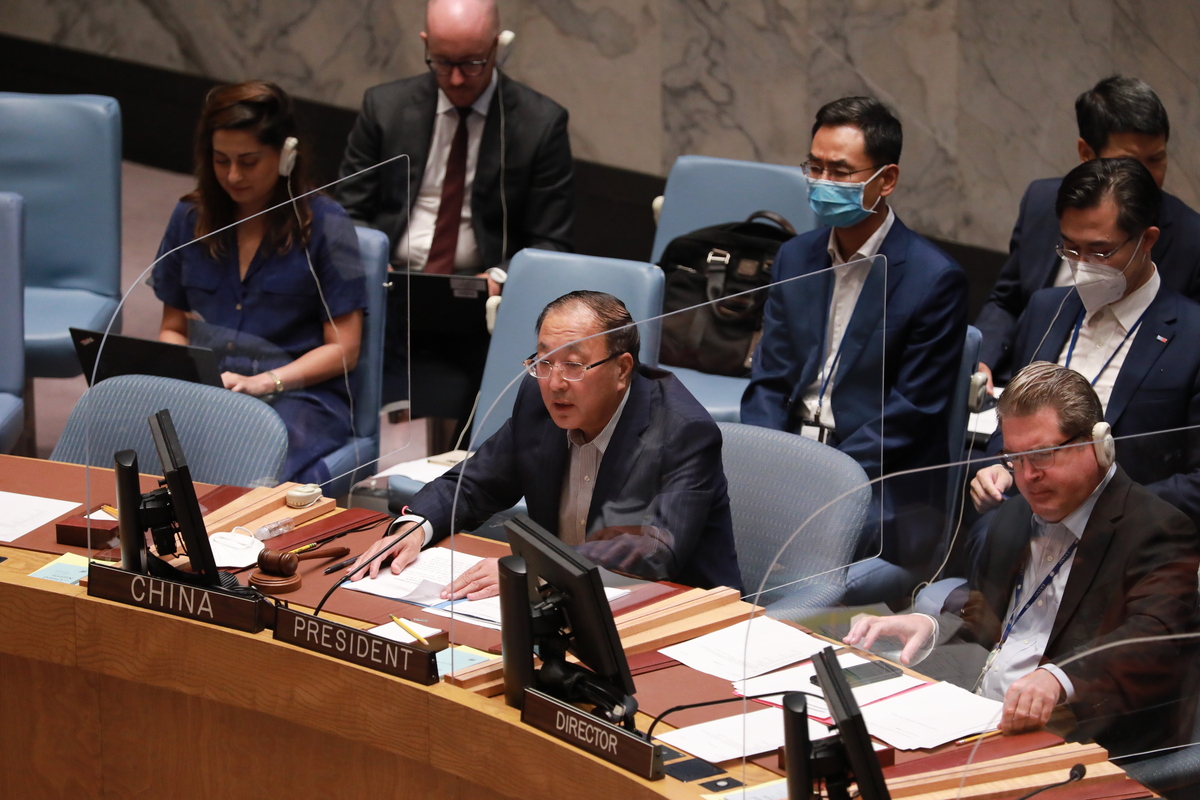


According to the American website, the meeting held last Thursday included 15 Jewish members belonging to the Democratic Party in the House of Representatives, including those who strongly support Israel, and others who are more critical of the right-wing government in Israel.


The website quoted the Israeli embassy in the United States as saying, “Ambassador Herzog maintains regular contact with members of the US Congress, which allows him to keep them informed of the official policy of the Israeli government, but we do not comment on the content of these private discussions.”


According to "Axios", some representatives revealed the course of the meeting, as Representative Jan Schakowski said that some lawmakers stressed "the necessity of expelling Ben Gvir and Smotrich from the government," while Representative Brad Schneider said that "while the comments of the two ministers were the main focus of the meeting, a whole list of ill-advised statements was presented to members of the Knesset.”


A source familiar with the meeting said that Herzog responded to the concerns of American lawmakers by recalling the statement of Israeli Prime Minister Benjamin Netanyahu, who stressed that Israel "does not seek to forcefully displace the Palestinians, or reoccupy Gaza."


Three members of the US House of Representatives told Axios that Herzog also stressed that “Ben Gvir and Smotrich are allowed to speak freely, but their statements do not necessarily represent the government’s official position.”


The Israeli Minister of Finance, Bezalel Smotrich, said earlier that Israel must take steps to encourage the migration of the majority of Palestinians in Gaza to other countries, while Ben Gvir expressed his support for such a step, saying that it would allow Israel to rebuild Jewish settlements in Gaza. .


In response to these statements, the United Nations expressed “deep concern,” and the High Commissioner for Human Rights, Volker Türk, stated that “international law prohibits the forcible transfer of persons who are protected within occupied territory, or their deportation from it.”


Source: Axios

OPINIONS

Sat 13 Jan 2024 11:32 am - Jerusalem Time

“Falseness lasts an hour, and truth lasts until end of time”

op-ed Al Quds dot com

op-ed Al Quds dot com

Opinion Writer

Yesterday, the world watched the second day of the International Court of Justice sessions in The Hague, when Israel submitted its responses to South Africa’s lawsuit regarding committing genocide against the Palestinians in the Gaza Strip.
Israel failed in its responses, as South Africa did not leave it with a single loophole in a tight and elaborate file and did not give it any opportunity to achieve an element of surprise for the judges who heard the lawsuit and the Israeli objections, and they were left with issuing timely decisions and then waiting for a longer period for the issuance of the decision regarding the genocide.
Israel has asked the judges of the Court of Justice to drop the genocide case brought against it by South Africa, which asked the UN court to order an immediate halt to the Israeli military campaign in the Gaza Strip.
In its response to the accusations made by South Africa before the court on Thursday, Israel said yesterday that the demand to stop its attack against the Palestinian Islamic Resistance Movement (Hamas) in Gaza has no basis because it will allegedly lose its freedom to work to protect the Israelis and repel any military attack from the Gaza Strip, in addition to preventing the return of 136 hostages.
Israel claimed that its response to the attack of last October 7 was legitimate and claimed that it respected international law and that the Israeli army “did not violate the rules of war, and there will be an Israeli judicial investigation and there was no intention to carry out genocide.”
Many questions were raised after the Israeli interventions. There is no doubt that the most important of them revolves around the massive scale of destruction and the very large number of Palestinian dead. Does this confirm the freedom of action, as Israel claims, to protect the Israelis? Does self-defense require the demolition of about half a million Palestinian facilities on the heads of their families and owners? In light of its monitoring, can these actions be considered an army of occupation that has adopted the rules of international action and has not violated the law?
Yesterday, Israel failed to respond to what we presented. (The Minister of Justice of South Africa) added: We adhere to the facts of the law and the evidence that we presented and are confident that they confirm the existence of an intention to carry out genocide against the Palestinians.
Can Israel ignore the statements of its officials? Most importantly, according to the Genocide Convention, nothing justifies the way Israel is waging war, which confirms the existence of genocide.
Is it reasonable for the resistance in Gaza to kill this tumultuous number of civilians, and for Israel to attempt a circumvention that has been exposed and whose claims have been refuted, to give itself justification for bombing shelter centers, displaced people, hospitals, schools, UNRWA headquarters, mosques, churches, and others? It says and claims that Hamas misused these headquarters and that it is the reason for the high number of casualties.
There are many weak points of Israeli arguments in this file, and there is no doubt that the confidence of South Africa and its legal team makes us feel comfortable, as it gave a press conference yesterday in which it confirmed that it will win the case.
South Africa, which had suffered for many years of persecution, racism, and discrimination, triumphed in the end, and here it is a country that takes the scales of justice as an approach in managing its affairs. When it addressed this issue and advocated for Palestine and its people, it inevitably started from the common saying “Falseness lasts an hour, and truth lasts until end of time.”

 The round of injustice will not last, O Israel, and no matter how much darkness prevails, the light will shine in the end to shed light on the justice and integrity of our cause.