






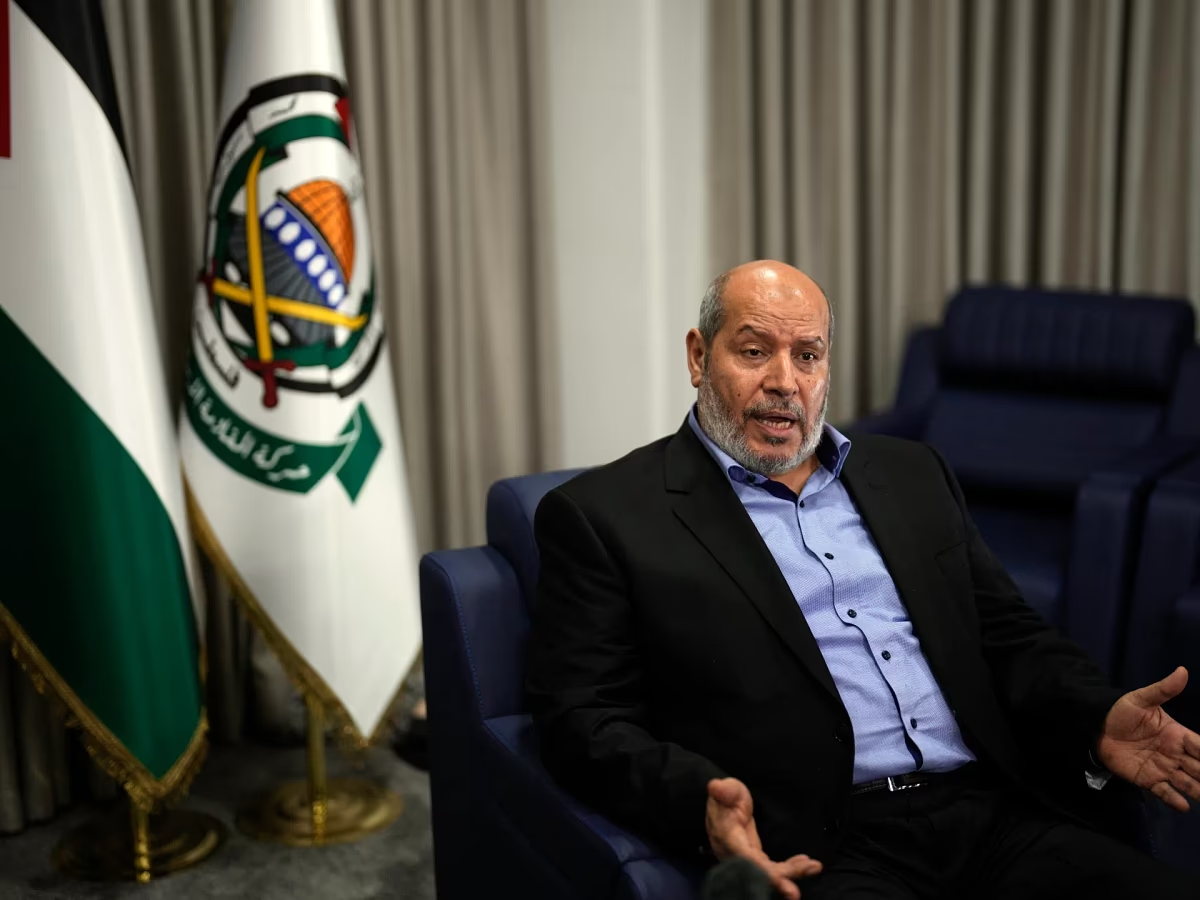
The Islamic Resistance Movement (Hamas) announced the selection of Khalil al-Hayya as the new head of its political bureau, following internal elections held on Monday, July 20th. Al-Hayya's assumption of this high-ranking position, succeeding leader Yahya Sinwar, comes at a pivotal stage in the movement's history and the Palestinian cause in general.
The results of the internal ballot revealed a fierce competition, with al-Hayya securing victory after receiving 35 votes, surpassing Khaled Meshaal, the movement's head abroad, by only one vote, who garnered 34 votes. These figures reflect the vitality of the consultative process within the movement's corridors despite the imposed security and field complexities.
Observers believe that holding these elections in the midst of the ongoing battle in the Gaza Strip sends a strong message about the cohesion of the movement's organizational structure. Despite intensive Israeli attempts to dismantle Hamas's political and military capabilities since October 7th, the completion of the electoral process indicates the movement's ability to recover quickly.
Hamas's success in restructuring its senior leadership represents a direct challenge to the strategic goals announced by Benjamin Netanyahu. The Israeli government, through intense military pressure, sought to force the movement to surrender its weapons and end its political existence, which seems far-fetched given the current circumstances.
The implications of this election extend beyond the internal organizational framework to touch upon major regional projects that Israel seeks to impose in the region. The Israeli project, which aims to transform Gaza into part of a new economic system, clashes with the steadfastness of the Palestinian political stance represented by the newly elected leadership.
Analysts link the steadfastness of the resistance to the faltering of strategic projects such as the proposed 'Ben Gurion Canal,' which aims to compete with the Egyptian Suez Canal. Hamas's continued presence as an active force in the political scene obstructs Israeli ambitions to make Haifa port the sole link between Asian and European trade.
The struggle for economic corridors also emerges on the horizon, as Israel, in cooperation with international powers, seeks to market the 'Indian Corridor' as an alternative to China's Silk Road. Hamas, from an Israeli perspective, is considered a geopolitical obstacle to the implementation of this corridor, which was announced at the last G20 summit in New Delhi.
Within Israel, these developments raise increasing questions about the utility of the war led by Netanyahu without achieving a decisive victory. Hamas's continued existence and its ability to choose new leadership weaken the right-wing government's position before the Israeli public, which has begun to lose confidence in promises of completely eliminating the movement.
This leadership change in Hamas coincides with the approaching Israeli Knesset elections, where Netanyahu faces fierce competition from Gadi Eisenkot. Opinion polls confirm a decline in the popularity of the ruling coalition, making Hamas's steadfastness an influential factor in the internal political map of the occupation.
Regionally, Hamas's continued existence is a demand for some powers that view the Palestinian cause as a cornerstone for regional stability. The article indicates that Turkish and Qatari support contributes to strengthening the Palestinian people's steadfastness against attempts of forced displacement and liquidation projects adopted by the far-right.
The selection of Khalil al-Hayya, with his political experience and regional relations, is considered a 'slap' to the Israeli far-right. This step proves that Israel's option of killing and assassinations has not succeeded in bending the arm of the resistance or ending the will for liberation among Palestinians.
Experts believe that al-Hayya's election lays the foundation for a new phase of political and diplomatic confrontation, aimed at establishing Palestinian rights in international forums. Through this step, the movement seeks to affirm its political legitimacy and its ability to manage Palestinian affairs even in the direst circumstances.
Ultimately, the steadfastness of the people of the Gaza Strip remains the primary lever for any political action undertaken by the new leadership. The popular embrace of the resistance option is what thwarts the 'New Middle East' projects that Netanyahu tries to promote on the ruins of destroyed Palestinian cities.
The next stage will undoubtedly witness difficult tests for the new leadership, whether in managing the negotiation file or arranging the internal Palestinian house. Nevertheless, the mere completion of the electoral process at this time is a moral and political victory recorded for the movement in the face of the Israeli war machine.
Hamas electing a head for its bureau amidst an ongoing war means that it is still standing and cohesive, and even in the process of organizational recovery.
Share your opinion
Khalil al-Hayya as Head of Hamas Political Bureau Succeeding Sinwar: Implications of Timing and Strategic Messages