PALESTINE

Tue 22 Jul 2025 11:57 am - Jerusalem Time

The occupation forces arrested a young man and seized gold jewelry and a sum of money south of Jenin.

Today, Tuesday, the Israeli occupation forces arrested a young man from the village of Nazlat Zeid, south of Jenin.

According to the Prisoners Club, the occupation forces arrested the young man, Muhammad Jihad Zaid, after raiding and searching his home. They also raided and searched the home of citizen Saleh Zaid, seizing gold jewelry valued at 29 thousand shekels from inside, in addition to stealing an amount of money estimated at 1,500 shekels.

The occupation has intensified its raids on towns and villages in the Jenin Governorate since the start of its assault on the city and refugee camp on January 21. The occupation has launched a campaign of arrests, raids on homes and property, and widespread destruction of infrastructure.

ARAB AND WORLD

Tue 22 Jul 2025 11:25 am - Jerusalem Time

The Israeli army is planning a military operation in the territories it occupies in southern Syria.

The Israeli military is planning a large-scale military operation in the territories it occupies in southern Syria, alleging that attacks similar to the October 7 Hamas attacks against settlements in the occupied Golan Heights and Israeli army positions and patrols are likely to be launched from this area by "global jihad activists and Bedouins."

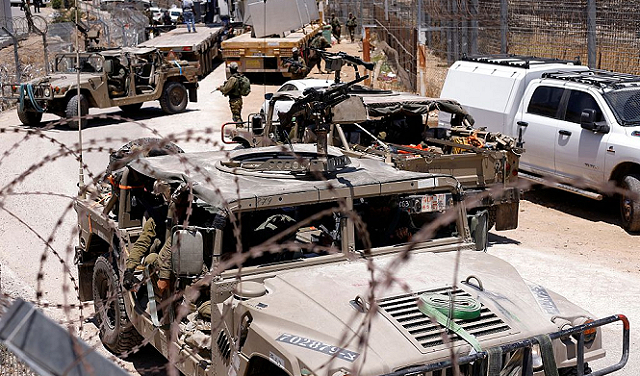
According to a report published by the Walla website on Tuesday, the Israeli army is increasingly concerned about Iranian cells attempting to infiltrate the buffer zone in the Syrian Golan Heights (occupied by Israel since last December) to carry out attacks against Israeli forces, including by armed men in pickup trucks, similar to attacks on Bashar al-Assad's government institutions in the years preceding the fall of some of the areas under his control.

The report indicated that the Israeli Military Intelligence Directorate (Aman) and Unit 504, which operates agents, "have recently intensified their operations in this area, through arrests in Syrian villages, some of which have been reported in the media."

The report quoted a senior Israeli officer as saying, "The numerous arrests in recent times have helped the IDF build a picture of the situation of terrorist cells. The Northern Command (of the IDF) conducted a training exercise for the 210th Division, in cooperation with defense and intervention units established during the war. The exercise simulated attempts to occupy Israeli towns."

The officer added that the forces had trained on how to direct warplanes to "launch attacks inside Israeli territory against terrorists who had penetrated," and that "we built an eastern barrier to prevent vehicles from crossing, and we built walls, ditches, and a missile line. Even if they try to penetrate using motorized parachutes, we are ready on the home front."

The officer continued, "My instructions to the brigades and battalions are not to wait for information, but to produce it. Your responsibility is to organize and organize the information. Today we have 1,100 fighters in various defensive units, who live in the towns (settlements in the Golan) and have machine guns, rifles, ammunition, and military equipment. These units have carried out four surprise exercises. We have an intervention unit of about 100 fighters from the Golan Heights, with high mobility, lethal capabilities, and most importantly, they know the area, and this includes operating drones," meaning small unmanned aerial vehicles.

OPINIONS

Tue 22 Jul 2025 11:03 am - Jerusalem Time

The decision to commit genocide and public killing in Gaza

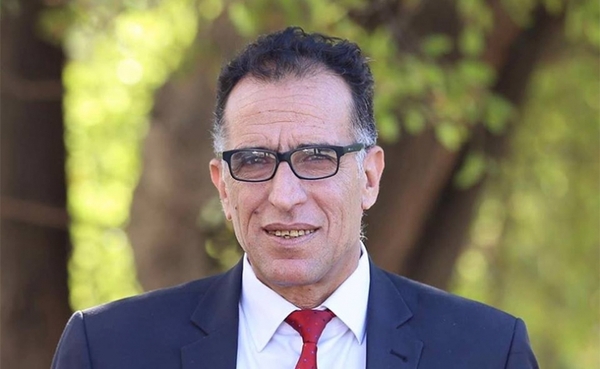
Mustafa Ibrahim

Mustafa Ibrahim

Opinion Writer

It's as if Gaza has become a permanent scene for emotional outrage, while the world merely stares. For 21 months, condemnations and appeals have poured in from countries either complicit in the war of extermination, complicit in the conspiracy, or complicit in their silence. Hunger in Gaza is neither a passing phenomenon nor a temporary phenomenon; it is a systematic policy and a weapon directed against the Palestinians.


The humanitarian situation is catastrophic. Hunger has become the norm, and famine is spreading like wildfire through the human stubble. When hunger turns into famine, we are faced with a full-fledged war crime and a stain on humanity. Everyone in Gaza feels hungry, but it's not a passing sensation; it's a deadly reality. People are literally dying of hunger, amid a combination of disease, neglect, siege, and isolation. The pain is no longer in the bombing or displacement, but in the silence of empty stomachs.


Yesterday, the United Nations Population Fund reported that approximately 55,000 pregnant women in the Gaza Strip, 11,000 of whom are at risk of starvation, are expected to give birth within the next month.


A mother bitterly recounts: “The problem is with children. When my son says to me, ‘Mom, I’m hungry,’ what do I say? I say, ‘Where will I get it?’ He replies, ‘What do I have to do with it? I’m hungry.’”

A woman says, weeping, "I feed my children water. We eat water all day long." This phrase is no longer a popular metaphor, but an accurate description of reality.


The Gazan body has begun to devour itself. No food can be bought, even if money is available. The markets are empty, and what food is available is delivered to death centers, where people are forced to choose between starvation and death by the occupation's bullets.

Killing by starvation, where the occupying state prevents food from entering, obstructs aid trucks, and imposes a distribution system that summons Palestinians to points resembling mass execution sites. They are required to arrive immediately, without prior coordination, and are forced to line up in inhumane conditions. If anyone deviates from these "instructions," they are killed in cold blood, and the crime is justified as "legitimate."


Skeptics ask brazenly, "Where are the bodies?" The bodies are not lying on the streets, but behind walls, in hunger corridors, and in front of killing centers falsely called "humanitarian aid points."

Hunger doesn't scream, but it kills, and famine doesn't need images of corpses to be believed. What's happening is a declared crime, committed loudly, in full view of the world. This is genocide, not the chaos of war. There's a system operating around the clock: issuing orders, telling soldiers they can kill with impunity, overseeing the starvation mechanism, and preventing food and medicine from arriving. This is precisely the definition of genocide: intent, execution, and continuity.


In Gaza, the Palestinian hides his pain behind a heavy silence. He ignores his hunger to preserve his dignity, convincing himself that he is still human, despite everything that humiliates and shatters him psychologically and physically. He tries to appear normal, just to remain coherent. There is no need to refer to the "Gaza Holocaust," as every genocide is unique in its brutality. What distinguishes this genocide is that it is without secrecy, without pause, and without any regard for the existence of Palestinians as human beings. Crimes are committed openly, without shame, without deterrence, without punishment. There are no hidden orders, because the intention has become the message.


Medical and human rights reports confirm that mass starvation has already begun to claim lives. We have passed the point of no return. Everything was known, expected, and warned against. Yet the crime is being perpetrated in front of cameras and orchestrated from military and political operations rooms.


No one in this world is innocent. Those who "doubt," those who issue false reports claiming that Gazans are receiving enough food, those who stop aid trucks, and those who develop plans for a "food response" instead of stopping the killing are all complicit in the crime.


As for Arab regimes, most of them have normalized the killing rather than confronting it. Moral and humanitarian concepts have disintegrated and become hollow slogans. Solidarity is no longer a moral luxury, but an existential necessity, defending the very meaning of humanity.


Regarding "individual solutions," and reports that some Arab and European countries—which do not recognize genocide—are preparing to bring in aid via airdrops, they are a repetition of failed attempts that have previously cost lives rather than saved them. They do not reach everyone, are not distributed fairly, and are used to polish the image of the occupying state. Everyone knows that the solution is not to drop crumbs on the hungry, but rather to end collective punishment and open the crossings to allow the flow of aid with dignity and justice.


What a world that is not helpless, but rather perpetuates injustice, legalizes famine, and buries what remains of the humanity of the Palestinians in the Gaza Strip. Nothing is more important than saving lives. Israel devotes all its efforts to liquidating the Palestinians. And if this is not the living definition of genocide, then what is? Right now, nothing is more important than saving children and infants from the food and medicine blockade. Everything else comes later.

PALESTINE

Tue 22 Jul 2025 10:47 am - Jerusalem Time

Three deaths since this morning in Gaza due to malnutrition and famine.

Medical sources announced this morning, Tuesday, the deaths of three citizens, including two children, in the Gaza Strip due to malnutrition.

According to sources, Yousef Al-Safadi from the northern Gaza Strip was martyred in Al-Shifa Hospital, Abdul Hamid Al-Ghalban from Khan Yunis in the south was martyred in Nasser Hospital, and Ahmed Al-Hasanat was martyred in Al-Aqsa Martyrs Hospital.

According to the same sources, 23 citizens, including children, died in several areas of the Gaza Strip due to malnutrition over the course of two days.

Hospitals in the Gaza Strip are treating hundreds of people of all ages who are suffering from severe hunger and malnutrition, and are in a state of extreme stress.

The same sources indicated that 17,000 children are suffering from severe malnutrition, and that patients are being treated for stress and memory loss resulting from severe hunger. Hospitals lack sufficient beds and medications for the massive number of people suffering from severe malnutrition.

The United Nations Relief and Works Agency for Palestine Refugees (UNRWA) warned that malnutrition among children under the age of five doubled between March and June, as a result of the Israeli blockade of the Gaza Strip.

It explained that UNRWA health centers and medical points conducted approximately 74,000 malnutrition tests for children during this period, identifying approximately 5,500 cases of global acute malnutrition and more than 800 cases of severe acute malnutrition.

PALESTINE

Tue 22 Jul 2025 10:07 am - Jerusalem Time

WHO: The occupation forces bombed our headquarters in Deir al-Balah and arrested our staff under threat.

The World Health Organization accused the Israeli military of launching direct attacks on its staff residence and main warehouse in Deir al-Balah, central Gaza, on Monday, posing a grave risk to the lives of staff and negatively impacting the organization's ability to continue providing health services in the Strip.

The organization reported that the staff residence was attacked three times, causing fires and significant material damage. Israeli military forces forcibly entered the building, forcing women and children to evacuate on foot amid active clashes. Male staff members and their family members were handcuffed, stripped naked, and interrogated at gunpoint.

WHO Director-General Tedros Adhanom Ghebreyesus explained that two WHO staff members and two of their relatives were arrested, three of whom were later released, while one remains in detention. He emphasized that the organization demands the immediate release of the detained staff member and full protection for all its employees.

Ghebreyesus noted that these attacks followed Israeli evacuation orders for multiple areas in Deir al-Balah, which also impacted the organization's health facilities, particularly the main warehouse, which sustained extensive damage in an attack that resulted in explosions and fires, severely crippling the organization's ability to deliver support to hospitals and emergency teams.

He added that the extensive Israeli attacks on Deir al-Balah neighborhoods, which are home to tens of thousands of displaced people, targeted homes and mosques, resulting in deaths and injuries. Entire families were displaced to safer areas amid the heavy bombardment, particularly in the areas of Abu Holi, east of al-Barakah, and west of it.

Ghebreyesus stressed that Gaza's health sector is facing imminent collapse, with medical supplies and fuel running out. He emphasized that a ceasefire has become an urgent humanitarian necessity, not just a political demand, and called on UN member states to take urgent action to ensure the continued flow of medical aid into Gaza.

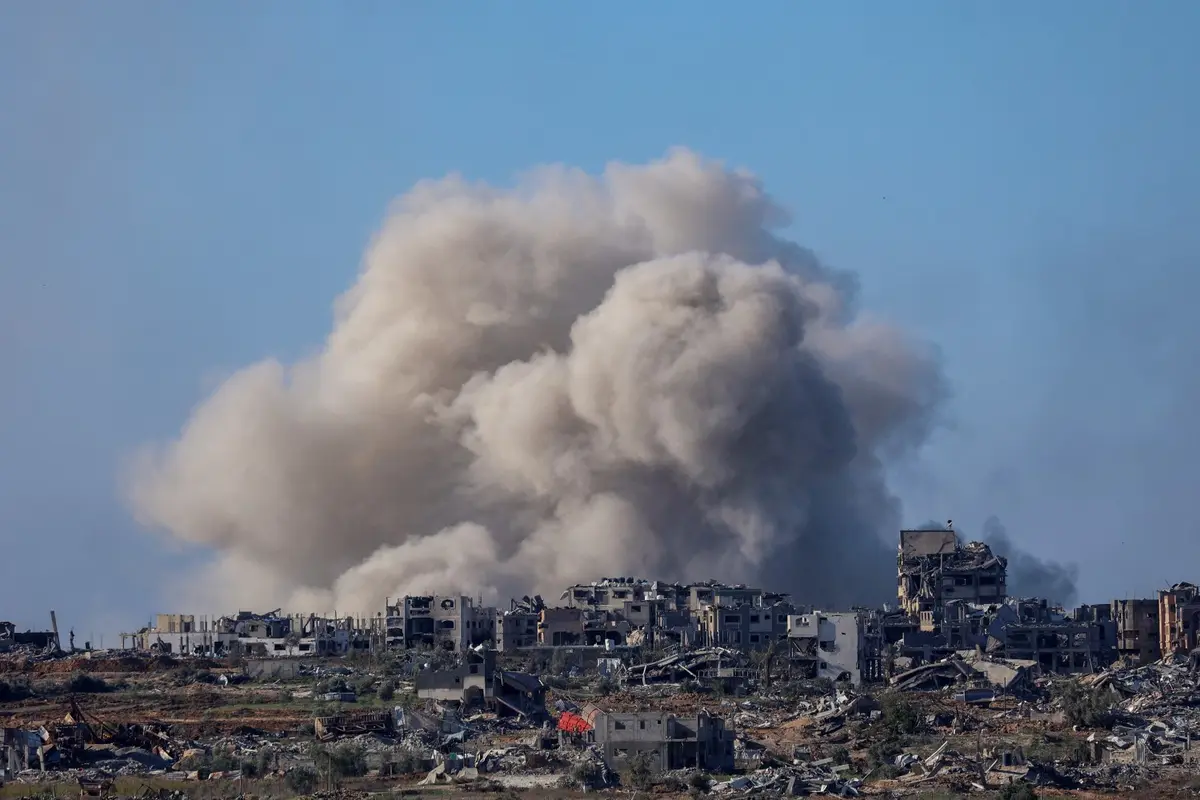
This comes as the Israeli military intensifies its operations in Deir al-Balah, with tanks penetrating the eastern and southern areas for the first time since the start of the ground offensive, allegedly to search for hostages. Meanwhile, air and artillery attacks continue, causing widespread destruction and worsening humanitarian suffering.

ARAB AND WORLD

Tue 22 Jul 2025 9:44 am - Jerusalem Time

Trump 'surprised' by Israel's actions in Gaza and Syria last week

White House press secretary Caroline Levitt noted on Monday that US President Donald Trump was surprised last week by Israeli actions in Gaza and Syria, and in both cases called Prime Minister Benjamin Netanyahu to "set the record straight."


This confirms what sources described as an increasingly tense dynamic between the two leaders, according to observers.


An attack on Gaza's only Catholic church last Thursday drew an immediate negative response from Trump, who called Netanyahu to express his dismay and ensure the Israeli leader issued a statement calling the strike a mistake.


Trump was also surprised by Israeli airstrikes targeting government buildings in the Syrian capital, Damascus, last week, as his administration works to rebuild the war-torn country.


"The president has a good working relationship with Bibi (Benjamin) Netanyahu and is in constant contact with him. He was surprised by the bombing in Syria, as well as the bombing of a Catholic church in Gaza," Levitt told reporters at her daily White House press briefing on Monday. "In both cases, the president quickly called the prime minister (Netanyahu) to rectify the situation."


Levitt pointed to Secretary of State Marco Rubio's efforts to de-escalate tensions in Syria, where Trump has eased sanctions and supported the new president, former rebel leader Ahmed al-Sharaa.


According to observers, Trump, who hosted Netanyahu at the White House earlier this month (for the third time), has long had a complex relationship with the Israeli leader. Although they are strong allies, the two men are not personally close, people familiar with the relationship told CNN, and their relationship has sometimes been marred by mutual mistrust.


However, Trump appeared closer than ever to Netanyahu after his decision to join the Israeli air campaign against Iran on June 21. It is noteworthy that during a dinner in the Blue Room of the White House on July 7, Netanyahu ostentatiously displayed a letter he had written to the Nobel Committee nominating Trump for the Peace Prize.


Trump had hoped that Netanyahu's four-day visit to Washington would yield progress on a ceasefire in Gaza, which would include the release of hostages still held by Hamas and a significant increase in the amount of humanitarian aid allowed into the besieged enclave. The US president had repeatedly stated before the visit that he expected a ceasefire to take place this week.


But Netanyahu left the United States without announcing any agreement. Now, nearly a week after mediators presented their latest proposal for a ceasefire and hostage release to Hamas, all parties are still waiting for a response from Hamas leaders in Gaza, according to two sources familiar with the negotiations who spoke to CNN. Hamas said in a statement Monday that it is "expending all its efforts and energies around the clock" to reach an agreement on a ceasefire in Gaza and the release of the hostages.


Trump has watched with increasing concern the war on Gaza, which has claimed more lives—including three in a church bombing last week. "The president's message about this conflict that we've seen in the Middle East for a very long time has become very brutal, especially in recent days, as reports have come in of more people being killed," Levitt said. "I think the president never wants to see that; he wants the killing to end."


Levitt also praised the administration's efforts to allow aid into Gaza, even as foreign ministers from 25 Western countries condemned Israel for its "drip-feeding" of aid to the territory. The Gaza Health Ministry said more than 1,000 people have been killed seeking humanitarian relief there since late May.


"The president is the reason aid is being distributed in Gaza in the first place," Levitt argued. "He wants it to be done peacefully, so no more lives are lost."


"It's a very difficult and complex situation that the president inherited due to the weakness of the previous administration," Levitt said. "I think he deserves credit."


"The president wants to see peace and he has been very clear about that."

PALESTINE

Tue 22 Jul 2025 9:26 am - Jerusalem Time

Occupation forces launch arrest campaign in the West Bank


Israeli occupation forces launched a campaign of raids and arrests in the West Bank at dawn and early Tuesday morning.

In Ramallah, occupation forces stormed the town of Beitunia and arrested citizens Baraa Al-Sarsour and Muhammad Ayman Abu Atiya (28 years old), after raiding their homes, searching them, and tampering with their contents.

In the town of Kafr Ni'ma, occupation forces arrested citizens Ahmed Ishaq and Ahmed Marwan after raiding their homes and vandalizing some of their property.

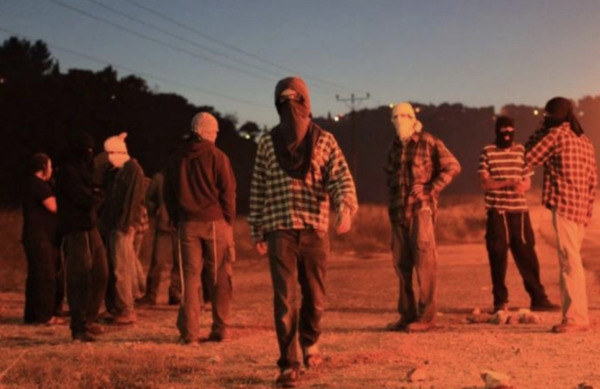
In a related development, Israeli occupation forces fired live ammunition at a Palestinian citizen's vehicle near the entrance to the town of Deir Jarir, east of Ramallah, without causing any injuries. Meanwhile, settlers attempted to set fire to a car garage in the village of Burqa, east of the city, in a new attack in the latest in a series of attacks targeting Palestinian property.

In Bethlehem, the occupation forces arrested Amir Mahmoud Abu Eida (20 years old), Jihad Mahmoud Abu Eida (21 years old), and Atef Yousef Al-Boum Al-Bo (20 years old), after raiding their homes and searching them thoroughly.

Meanwhile, the occupation forces raided and searched the homes of citizens Azzam Daoud Tarish, Atta Hassan Danoun in the Za'tara wilderness, Ali Ibrahim Dhuib, and Muhammad Al-Bu, causing material damage.

In Nablus, Israeli jeeps stormed several neighborhoods of the city, raided and searched several homes, and arrested Abdullah Basem al-Dabiya, from the al-Junaid area west of the city.

They also raided the village of Deir al-Hatab, east of Nablus, and arrested Ahmed Abdel Rahman Imran, after searching his home and ransacking its contents.

In Hebron, the occupation forces arrested: Yusri and Musab Abu Sneineh, Muhammad al-Natsheh, Raed and Hosni, and Izz Mataria from the city of Hebron, and Muhammad Issa Marai from the town of Bani Naim to the east.

Meanwhile, the forces arrested the young man Samir Tamizah from the town of Idhna, west of Hebron, and three citizens were arrested from the town of Surif, northwest of the city: Abdullah Muhammad Ghunaimat, Rami Ibrahim Ghunaimat, and Raed Ali Ghunaimat.

These forces also set up several military checkpoints at the entrances to Hebron, its towns, villages, and camps, and closed a number of main and secondary roads with iron gates, cement blocks, and earth mounds.

PALESTINE

Tue 22 Jul 2025 9:22 am - Jerusalem Time

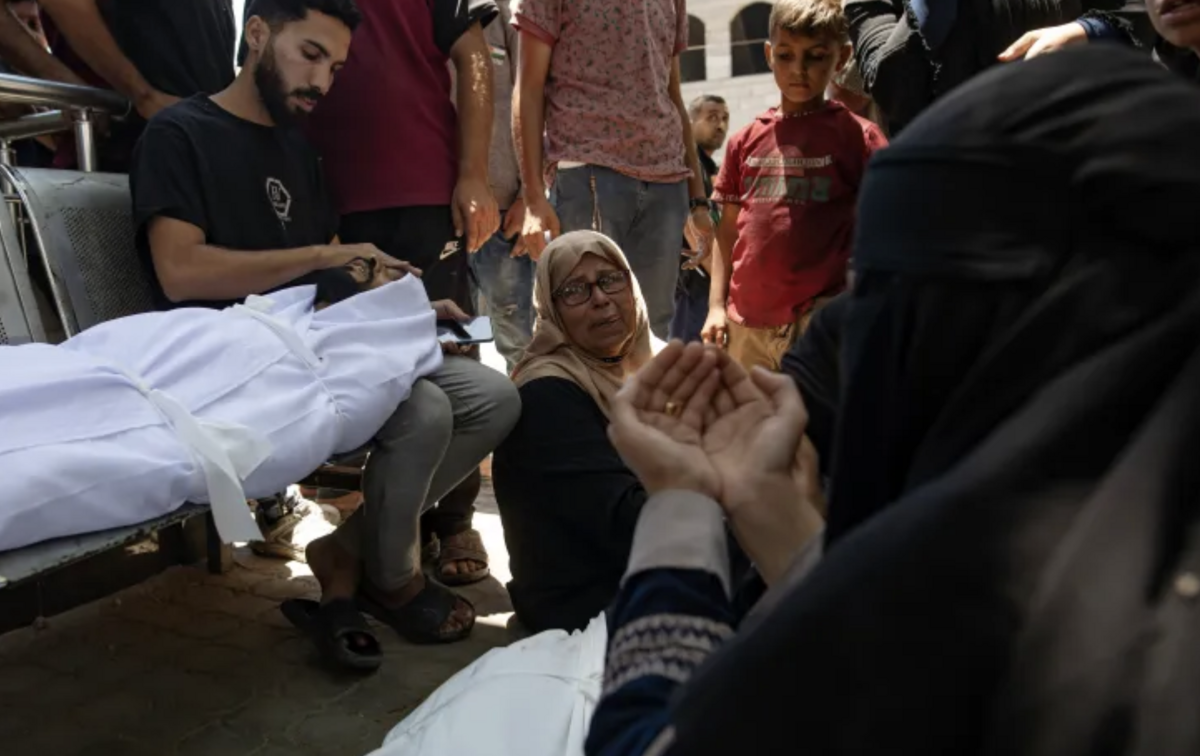
26 dead, including 7 forcibly starved, in the Gaza Strip since dawn today.

26 citizens have been killed since dawn on Tuesday, as a result of the ongoing war of extermination in the Gaza Strip.

Gaza's Civil Defense announced that 16 people were killed and more than 50 injured in a new massacre perpetrated by the Israeli occupation forces, which bombed tents housing displaced people near the Shati refugee camp, west of Gaza City.

The Civil Defense in Gaza also announced the death of the child Iman Muhammad Abdul Karim Haraz (9 years old), who succumbed to the severe wounds she sustained as a result of an Israeli attack on a group of displaced persons, which occurred yesterday near the Al-Sahaba complex in the center of Gaza City.

Two citizens were killed and others were injured when Israeli warplanes bombed the Al-Hakr area, south of Deir al-Balah, in the central Gaza Strip.

Seven civilians were killed and others injured when Israeli occupation forces targeted people waiting for humanitarian aid near the Netzarim axis, south of Gaza City.

PALESTINE

Tue 22 Jul 2025 9:12 am - Jerusalem Time

Gaza is dying of hunger... No one has passed the test of humanity and living conscience.

Dr. Jamal Harfoush: Humanity is being violated in Gaza, as more victims fall in a crime in which food and medicine are used as cold weapons to slowly kill innocent people.

Nour Odeh: Political starvation should not be met with tears and condemnation, but with calculated actions that make Israel's continued crimes a burden and a heavy price to pay.

Mohammed Joda: Hamas is required to make an immediate decision to suspend negotiations until Israel commits to making the entry of aid and relief to the population a priority.

Dr. Amjad Bashkar: The ongoing starvation in the Gaza Strip represents a pivotal moment and a fateful test for the will of the Arab and Islamic nations.

Samer Anabtawi: The Arab and Islamic worlds are capable of threatening the economic interests of Israel and America if they have the political will.

Adnan Al-Sabah: The real solution is a collective popular movement by citizens in the Gaza Strip to confront death and hold everyone accountable.


As the killing and genocide in the Gaza Strip escalates through bombing, sniping, and starvation, more than two million Palestinians find themselves trapped in a stifling siege in which food and medicine are used as weapons of slow-motion genocide.

In separate interviews with "I", writers, political analysts, specialists, and university professors say that the humanitarian scene in Gaza is no longer just images of thin or sick children without medicine. Rather, it has become a symbol of a full-fledged crime being committed daily before the eyes of the world, which is content with silence or formal condemnations. Meanwhile, humanitarian aid becomes a distant dream, crossings are closed to aid trucks, and disease and malnutrition spread in the besieged neighborhoods and camps.

With every passing hour, the number of victims increases, including children, women, and the elderly, who are facing a deliberate starvation policy aimed at breaking the will of the people and dismantling their social fabric.

Faced with this reality, the author, analysts, specialists, and university professors emphasize that a unified Palestinian stance is required to break the division, and for Arab and Islamic parties to shoulder the burden of demanding the immediate opening of the crossings and the end of the blockade. Meanwhile, the international community is required to take concrete steps beyond mere declarations and statements to save those remaining in Gaza from inevitable death, for which there is little time left. Some have even called on Hamas to withdraw from the negotiations until aid is delivered and the suffering of the Gazans is ended.


Full-fledged genocide


Dr. Jamal Harfoush, professor of scientific research methods and political studies at the University of the Academic Research Center in Brazil, says that what the children, women, and elderly of Gaza are experiencing today cannot be described as a mere humanitarian crisis. Rather, it is a full-blown genocide, taking place in full view of a world that continues to maintain its disturbing silence.

Harfoush explains that the inhumane blockade imposed by the Israeli occupation prevents food, medicine, and humanitarian aid from reaching more than two million Palestinians, in flagrant violation of international humanitarian law and the Geneva Conventions, which oblige parties to the conflict to ensure the basic needs of civilians.

Harfoush believes that the tragic situation in Gaza today confirms that humanity is being violated at every moment, with more victims falling due to deliberate starvation, a crime in which food and medicine are used as cold weapons to slowly kill innocent people.

As this crime continues, Harfouche calls for serious action on three key levels: Palestinian, Arab, and international.

On the Palestinian level, Harfoush stresses that the current situation calls for ending the internal division and unifying the ranks of all Palestinian factions and forces to confront the common enemy with a unified front.

Harfoush asserts that political bickering weakens the Palestinian people's ability to persevere and confront the situation. He calls for efforts to be directed toward activating legal and political paths to prosecute the occupation in international courts, including the International Criminal Court, and holding Israel fully responsible for the crimes committed against civilians.

On the Arab front, Harfoush points out that Arab countries bear a historical responsibility today to support Palestinian rights, arguing that statements and declarations alone are no longer sufficient in the face of the daily death toll in Gaza.

Harfoush calls for practical steps, starting with the urgent opening of humanitarian crossings and lifting the blockade on the Gaza Strip, in addition to providing direct logistical and financial support to humanitarian organizations operating in the field.


A unified Arab position is required that rises to the level of the catastrophe.


Harfoush calls for strong and swift diplomatic action through the Arab League to enforce a unified Arab position that rises to the level of the gravity of the ongoing humanitarian catastrophe.

On the international level, Harfoush explains that the Israeli occupation continues its crimes with unconditional support from major powers such as the United States and Europe, whose political interests prevail over humanitarian values.

Harfoush stresses the need to impose real pressure on these forces to change their policies, calling for the implementation of international sanctions against Israel and for its officials to be held accountable under international law, rather than simply offering superficial condemnations that fail to halt the ongoing massacre.

Harfoush asserts that there is no longer time for evasion or waiting. Children in Gaza are dying of hunger and disease every day, and everyone must realize that Gaza is not just a Palestinian issue, but a global humanitarian issue that requires urgent action.

Harfoush emphasizes that efforts must be integrated between the Palestinians, the Arab community, and the international community to compel Israel to lift the blockade, ensure the delivery of aid, protect civilians, and end this ongoing crime against humanity.


It is not a famine, but a systematic starvation by political decision.


For her part, writer and political analyst Nour Odeh, who specializes in diplomatic affairs and international relations, says that the food and medicine deprivation the Palestinian people are experiencing today is not a natural famine, but rather a systematic starvation policy driven by political decision. She cautions against treating the situation as if it were merely a temporary humanitarian crisis that can be resolved with some food or the introduction of aid.

Awda emphasizes that Israel is pursuing this policy with unrestrained brutality, and that what is required today is not only the entry of food, medicine, and fuel—these are self-evident and fundamental rights—but also practical political and economic steps that will make these crimes costly for the occupying state.

Awda explains that this starvation is political and cannot be confronted with tears or condemnation, but rather with calculated actions that make the continuation of these crimes a burden and a heavy price for Israel to pay before the international community.

Awda calls for a reconsideration of the fundamental question: "How did we get here?" referring to the new wave of starvation affecting more than two million Palestinians in the Gaza Strip at a time when life seems as if nothing has happened in the rest of Palestine.

Awda points out that people's preoccupation with trivial matters while their children in Gaza are forced to eat tree leaves reflects a miserable situation that will go down in history as a black mark against everyone.

Awda explains that what is required, in addition to expressing rage and anger, is a true public disclosure and national accountability after this massacre ends, even if it is a moral accountability that will at least preserve in the history books how everyone failed politically and morally.


The necessity of boycotting Israel as a "rogue state"


Awda urges effective international and Arab action, starting with boycotting Israel as a "rogue state," imposing economic and military sanctions on it, halting the cover-up of its crimes, and not treating it as a normal or acceptable entity in the international community until it abides by the law and its leaders are prosecuted for crimes and atrocities unprecedented in modern history.

Awda points out that there are many practical steps countries can take to inflict pain on Israel, such as the resolutions adopted at the Bogotá meeting in Colombia, where some countries demonstrated their ability to take real action by imposing sanctions, cutting off military cooperation, banning settlement goods, and preventing Israeli aircraft from flying over their airspace in compliance with the arrest warrants issued by the International Criminal Court against Netanyahu and Galant.

Awda stresses the importance of Arab ports beginning to refuse passage to ships carrying Israeli weapons or refueling them, describing this as "the least we can do" in confronting these crimes.

Awda emphasizes that the strength of any international movement against Israel rests primarily on the strength of the Palestinian position itself and its ability to move things in the right direction.

She added: "As a Palestinian, it is necessary to overcome the state of schizophrenia and political delirium to create a unified national position capable of influencing the international position.


A deliberate policy aimed at subjugating the population


For his part, writer and political analyst Mohammed Joda asserts that the tragedy of hunger in the Gaza Strip cannot be reduced to images of emaciated children or empty stomachs alone. Rather, it is part of an integrated system that uses hunger as a central tool within a complex strategy that combines military force with economic and political tools of control.

Joudeh explains that what is happening in Gaza is not a side effect of a war or a temporary blockade, but rather a deliberate policy aimed at subjugating the population by destroying the health and economic infrastructure and imposing severe restrictions that make life almost impossible.

Joudeh points out that the tools of this system vary, from a stifling blockade, to the closure of crossings, to banking restrictions that stifle the flow of funds, thus crippling people's ability to secure the most basic necessities of daily life.

According to Joudeh, hunger in Gaza has become a political weapon par excellence, supported by an arsenal of economic measures that tear apart the social fabric and turn daily life into an open battle for survival.

Joudah asserts that daily testimonies from doctors and field correspondents reveal the depth of the disaster, with the health system collapsing at an unprecedented rate amid a severe shortage of food, clean water, and medicine, leading to the spread of disease and malnutrition at shocking rates.

Joudeh emphasizes that this tragedy turns food deprivation into a "lethal medicine," used coldly as a weapon to weaken society's resilience.


The international position is helpless and limited to formal condemnations.


Despite the clarity of this policy in the eyes and ears of the international community, Joudeh believes that the official global response has remained ineffective and paralyzed, not going beyond formal condemnations that do nothing to stop the machine of starvation and genocide.

Joudeh points out that relief stations, which were supposed to be safe havens for civilians, have been transformed into dangerous areas, where Palestinians are exposed to danger when attempting to reach them to obtain scraps of aid.

Joudeh explains that Israel has not only imposed a military blockade, but has also penetrated deep into society by encouraging "warmongers" and affiliated local agents to steal aid and resell it at exorbitant prices, thus deepening internal divisions and deliberately exacerbating the humanitarian crisis.

Joudeh asserts that the Gaza Strip is no longer just a battlefield, but has become a political and social laboratory testing the limits of human patience, where hunger is used as a means to force people to surrender, either by starvation, murder, or forced displacement.

Joudeh believes that all parties today bear a share of responsibility for this crime, explaining that Israel is proceeding with its policies with clear support from the United States, which gives it a green light to do whatever it wants in Gaza without real deterrence. He explains that this American complicity exceeds the international community's ability to impose solutions or conditions that would halt this inhumane policy.


Timid Arab statements and condemnations that are useless


On the Arab level, Joudeh believes that Arab countries have become tools for implementing American and Israeli policies, contenting themselves with timid statements and meaningless condemnations. Joudeh emphasizes that the absence of a serious stance reflects the subservience of Arab decision-making to American and Israeli interests, rendering statements of condemnation a mere cover for impotence.

Regarding the Palestinian side, Joudeh describes the situation as even more tragic, as the Palestinian cause is experiencing a state of fragmentation and division that has deprived the official parties of their influence and ability to play any effective role in halting the catastrophe that has been raging for more than 21 months.

Joudeh specifically criticizes Hamas's position, which continues to conduct negotiations from luxurious Doha hotels far removed from Gaza's hunger and daily suffering. He calls on the movement to immediately suspend negotiations until Israel commits to prioritizing the entry of aid and relief for the population.

Joudeh emphasizes that the starvation policy in Gaza is not an isolated act, but rather a deliberate tactic that combines a military blockade with economic and political control with the aim of dismantling Palestinian society. He asserts that confronting this policy requires Arab, Islamic, and international action that goes beyond condemnations to imposing real pressure mechanisms on Israel, ensuring the safe delivery of humanitarian aid, and protecting the population and relief organizations from targeting.


A siege, starvation and genocide unprecedented in modern history.


For his part, political science professor Dr. Amjad Bashkar believes that the current starvation situation in the Gaza Strip represents a pivotal moment and a fateful test for the will of the Arab and Islamic nation. He asserts that the ongoing siege, starvation, and mass extermination of women, children, and the elderly in Gaza is unprecedented in modern history.

Bashkar emphasizes that what is lacking is not the tools or means, but rather the lack of a genuine will to use them, pointing out that Arab and Islamic countries possess painful leverage and are capable of halting the war and breaking the siege if they so desire.

Bashkar explains that the joint committee between the Arab League and the Organization of Islamic Cooperation, which comprises approximately 52 countries, could have played a pivotal role in halting the massacre had it declared that it could no longer remain silent in the face of genocide and starvation.

Bashkar said: If every Arab and Islamic country sent ten ships carrying humanitarian aid to Gaza, Israel would not dare bomb 500 humanitarian ships from fifty countries.

Bashkar stresses the importance of Egypt's role in the Rafah crossing issue, which must not remain closed to international relief convoys. Egypt has the capacity to open the crossing and allow aid into the Strip. Closing the crossing effectively contributes to the continuation of the famine and undermines Egypt's role at this critical moment.

Bashkar points out that more than 900 people have been killed and 6,000 wounded so far at aid distribution centers in Gaza, warning that these sites have become "death traps" rather than genuine humanitarian relief points, given the continued targeting of those attempting to reach them by the occupation forces.


Call on Egypt and Qatar to withdraw from mediation


Bashkar stresses that the mediators in the negotiations, Egypt and Qatar, must declare a clear position that what is happening in Gaza is not a means of negotiating pressure but rather a full-blown genocide. He calls for their withdrawal from any negotiating tracks that cover up the occupation's crimes under the guise of mediation.

Bashkar raises a major question about the absent role of the Organization of Islamic Cooperation and the Arab League, emphasizing that if these two institutions do not have an effective position today, when will they ever have a real role in any other Arab or Islamic country?

Bashkar calls on nationalist, Islamic, and leftist parties to mobilize the Arab and Islamic street to pressure governments and take practical steps to stop the massacre.

Bashkar stresses that Israel has crossed all boundaries of human morality in war and peace.

Bashkar also questions the lack of genuine effort by Palestinian ambassadors in Europe and Arab and Islamic countries, arguing that the time has come for a unified political and media campaign to confront the genocide and put an end to the catastrophic starvation.


What is happening in Gaza is unprecedented in modern history.


Writer and political analyst Samer Anabtawi asserts that what is happening in the Gaza Strip today represents an unprecedented situation in modern history. More than two million people are being besieged by means of genocide and systematic starvation, with the goal of rendering the environment uninhabitable and forcibly forcing people to emigrate.

Anbatawi explains that Israel has exhausted all its means against the Palestinians in Gaza, from direct killing and displacement to deliberate starvation, which recently reached its peak. He asserts that children, women, and the elderly are already dying from hunger and the financial inability to purchase food, if it is available at all.

Anbatawi points out that the entire world is clearly seeing these crimes, but it is shameful that it remains silent or unable to stop this massacre, which has so far killed approximately 60,000 people, including more than 18,000 children and 10,000 women, while the bombing and targeting of even those attempting to bring food aid continues.

Anbatawi points out that the occupation's policy explicitly aims to completely empty the Gaza Strip of its population, a claim confirmed by Israeli Prime Minister Benjamin Netanyahu, who insists on continuing the war to achieve this goal.

Anbatawi explains that what is happening in Gaza is linked to the economic pressures and repeated attacks by settlers and the Israeli army in the West Bank, all aimed at making the West Bank an inhospitable environment.


A long-term Israeli plan to liquidate the Palestinian cause


Anbatawi asserts that this proves the existence of a long-term Israeli plan to liquidate the Palestinian issue from its roots.

Regarding possible solutions, Anbatawi emphasizes that the beginning must be from within Palestine, by unifying ranks, strengthening the internal front, and forming a unified national leadership that adopts a comprehensive national project to confront the Zionist project.

Anbatawi calls for building a resilient national economy and activating popular resistance within villages and areas threatened by attacks.

Anabtawi calls for effective Arab and Islamic action that goes beyond statements of condemnation to include imposing sanctions, boycotting the occupation, withdrawing investments, and severing diplomatic relations, similar to the measures taken against the apartheid regime in South Africa.

Anbatawi stresses the need to pressure governments to take stronger positions, asserting that the Arab and Islamic worlds, which comprise nearly two billion people, are capable of threatening the economic interests of Israel and the United States if the political will is present.

Anbatawi warns that Israel is using starvation as a means of pressure to impose its terms in negotiations, paving the way for the forced displacement of Gaza's population. This requires a broad international response that exposes these policies and puts pressure on the Palestinian people to halt the massacre.


A complex issue with political and humanitarian dimensions


For his part, writer and political analyst Adnan Al-Sabah asserts that the starvation crisis in the Gaza Strip is not merely a fleeting humanitarian issue, but rather a complex one with both political and humanitarian dimensions.

Al-Sabah explains that humanitarian solutions alone are no longer sufficient, noting that the international community, after two years of crisis, has completely turned its back on Gaza and no longer cares about what is happening there, making waiting for external solutions unrealistic or predictable.

Al-Sabah believes that the only real and practical solution lies in a collective popular movement within Gaza to confront death and hold everyone accountable for ending the ongoing situation.

Al-Sabah said: "All segments of the Palestinian people in the Gaza Strip - children, women, elderly, and men - must stand together as one unified bloc to confront the occupation."

Al-Sabah explains that the Chief of Staff of the Israeli Defense Forces, Eyal Zamir, had previously confirmed that the army could not confront two million people moving as a single mass.

Al-Sabah asserts that this collective popular confrontation is the only way to break the international silence and hold the occupation accountable.

According to Al-Sabah, the people of Gaza have been left alone, and everyone has let them down, even the Palestinians themselves. He stressed that there is no justification for any person on earth to remain silent, inactive, or wait for Gaza and its children to die.


The world closed its ears and closed its eyes


"The world has closed its ears and shut its eyes, and no longer wants to see or hear," Al Sabah says. "Therefore, the Gazans must protect themselves."

Regarding the Arab and international role, Al-Sabah emphasizes the need for collective, institutional, rather than individual, initiatives, noting that individual actions alone do not have the power to bring about historic change.

Al-Sabah stresses that political parties, forces, organizations, and activists in the Arab world and the Islamic world must take action, and that there must be tangible public support in Arab and international arenas through solidarity movements that include hunger strikes and political pressure.

Al-Sabah suggests that millions of people taking to the streets around the world and demonstrating their hunger alongside Gaza will have a powerful impact on the governments of these countries, prompting them to respond to the demands of their people and end the suffering of the Gaza Strip. This could create real pressure to achieve tangible results.

Al-Sabah asserts that there is no longer time for waiting or remaining silent, and that the lives of millions in Gaza are at stake, calling for a serious and responsible stance from everyone.



PALESTINE

Mon 21 Jul 2025 10:22 pm - Jerusalem Time

Settlers assault a Palestinian child in Bethlehem

This evening, Monday, settlers attacked the child Ibrahim Mustafa Ibrahim Al-Abayat (15 years old) with an electric shock, while he was returning from the town of Tuqu to his home in the village of Kisan, east of Bethlehem.

The Secretary of the Fatah Movement in Kisan, Ahmed Ghazal, told WAFA that settlers intercepted the child, Al-Abayat, near the Minya roundabout on the main street. They pursued him and threw an electric shock device at him, causing minor injuries to his hand.

Ghazal emphasized that this attack comes within the context of a systematic escalation practiced by settlers against citizens, especially children, in villages east and southeast of Bethlehem, noting that the settlers are directly targeting citizens without deterrence.

He said, "We witness a daily series of attacks targeting children and farmers, ranging from harassment, intimidation, physical assault, and even the unleashing of trained dogs, all under the protection of the occupation army."

Ghazal called on local and international human rights and humanitarian organizations to urgently intervene to provide protection for citizens, particularly in Area C, which is witnessing a continued escalation by settlers.

Villages east of Bethlehem, particularly Kisan, Al-Minya, and Tuqu', are witnessing a dangerous escalation in settler attacks in an attempt to impose control over the land and displace residents, as part of a systematic Israeli policy targeting Palestinian presence in agricultural and open areas.

It's worth noting that the village of Kisan is surrounded by several settlements, most notably Ma'ale Amos and Ibi Hanahel, and its lands are subject to ongoing confiscation operations amid escalating settler attacks on citizens' homes and farms.

PALESTINE

Mon 21 Jul 2025 9:21 pm - Jerusalem Time

A Palestinian citizen was injured in a settler attack south of Hebron.

A citizen was injured on Monday evening in an attack by settlers on the Masafer Yatta area, south of Hebron.

According to local sources, settlers from the "Avi Gal" settlement, built on Palestinian land and property east of Yatta, attacked homes in the village of Al-Rakeez in Al-Masafir, under the protection of occupation forces, and assaulted residents, resulting in injuries and bruises to a citizen from the Al-Amour family.

The sources added that the occupation forces detained a number of citizens in the village and fired live bullets, sound bombs, and tear gas, without any injuries being reported.

PALESTINE

Mon 21 Jul 2025 7:27 pm - Jerusalem Time

Settlers open fire on a citizen in the northern Jordan Valley.

Settlers opened fire on Monday evening at a citizen while he was grazing his cows near his tents in the northern Jordan Valley.

According to local sources, a number of settlers got out of three vehicles and opened fire at him while he was grazing his cows near his tents in Khallet al-Hamma in the northern Jordan Valley.

He added that this comes as part of a policy of continuous pressure to force them to abandon their pastures and leave the area.

Since last summer, more than 20 Palestinian families have been displaced from their homes in the northern Jordan Valley due to escalating settler attacks. Meanwhile, three Palestinian communities in the northern Jordan Valley have been completely emptied of their residents as a result of these attacks, and families from other communities have also left for the same reason.

PALESTINE

Mon 21 Jul 2025 7:03 pm - Jerusalem Time

WFP exposes an Israeli massacre against the starving people of Gaza.

The World Food Programme accused Israel of using tanks, snipers, and other weapons to fire on a crowd of Palestinians seeking food aid in the Gaza Strip, in what the Gaza Health Ministry called "one of the bloodiest days for aid seekers in more than 21 months."

This accusation, made by the World Food Programme, is based on accounts from eyewitnesses and others who said that Israel fired on the crowd.

The program stated that the crowd surrounding its convoy "was subjected to Israeli tank, sniper, and other fire." The statement did not specify the number of casualties, saying only that the incident resulted in "countless loss of life."

The Gaza Health Ministry, eyewitnesses, and a UN official reported that Israeli forces opened fire on crowds trying to obtain food from a 25-truck convoy that entered the badly damaged area.

Following Sunday's incident, an Associated Press photographer counted 31 bodies at Al-Shifa Hospital in Gaza City, and another 20 in the courtyard of Sheikh Radwan Clinic.

"These people were simply trying to get food to feed themselves and their families on the brink of starvation," the WFP said in a statement, adding that the incident occurred despite assurances from Israeli authorities that aid delivery was improving.

According to the statement, "Part of these assurances is the absence of armed forces or interference along aid routes. A ceasefire must be immediately implemented near humanitarian missions, convoys, and food distribution points."

The bloodshed surrounding aid deliveries highlights the increasingly dire situation of Gazans, who are desperately seeking food and other assistance, with no sign of an end to the war that has ravaged the region.

As the talks continued, the death toll in the war-torn territory rose to more than 59,000 Palestinians, according to the Gaza Ministry of Health, which reported that more than half of the dead were women and children.

Meanwhile, Israel expanded its evacuation orders for the Strip to include a less severely affected area, suggesting the possibility of further Israeli attacks to further strangle Palestinians in smaller areas of Gaza.

It is noteworthy that the Israeli occupation authorities did not allow international media to enter Gaza throughout the war.


PALESTINE

Mon 21 Jul 2025 6:26 pm - Jerusalem Time

The occupation is isolating two million Palestinians in 17% of Gaza's area.

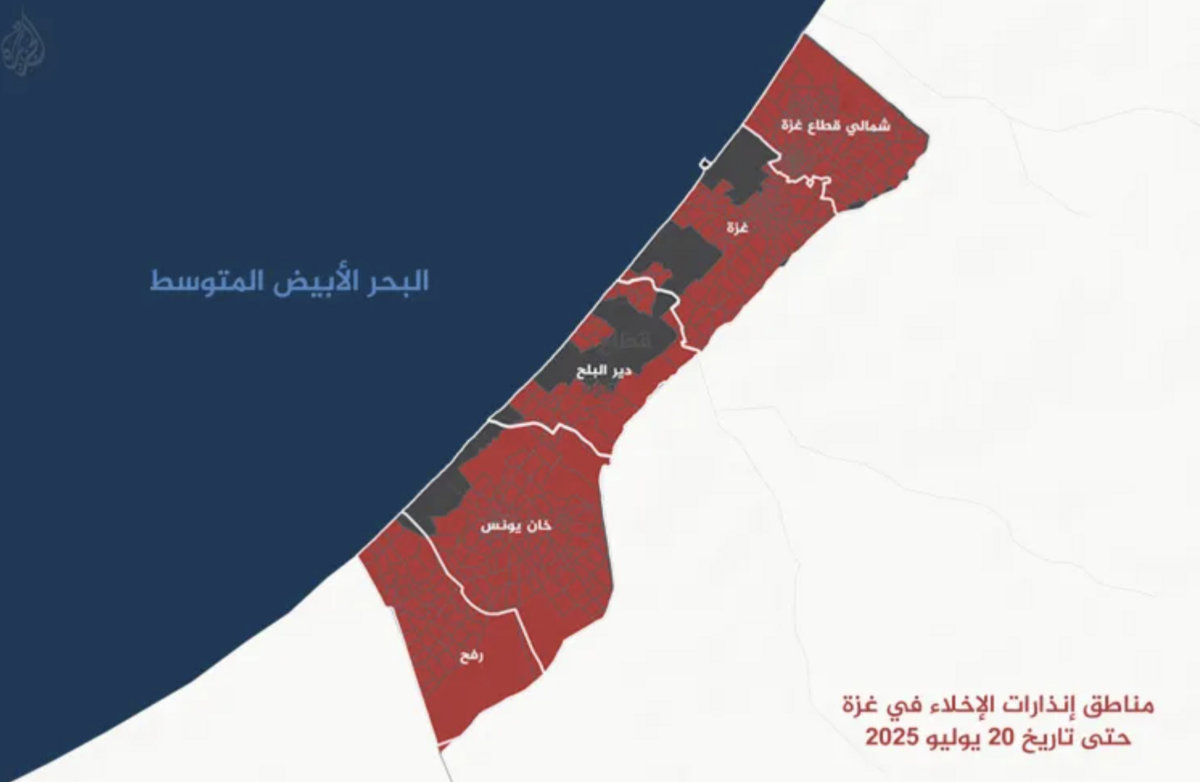
Approximately 82.4% of the Gaza Strip has become a hazardous area, while the remaining 17.6% is home to nearly two million displaced Palestinians, according to a data map prepared by Al Jazeera's Sanad News Verification Agency.

Recent map developments indicate that the warnings have included the Kissufim axis, which separates Deir al-Balah from Khan Yunis. The area between the two cities has become a danger to displaced persons, while the coastal Rashid Street remains the only road connecting the central and southern governorates and has not yet been classified as a danger zone.
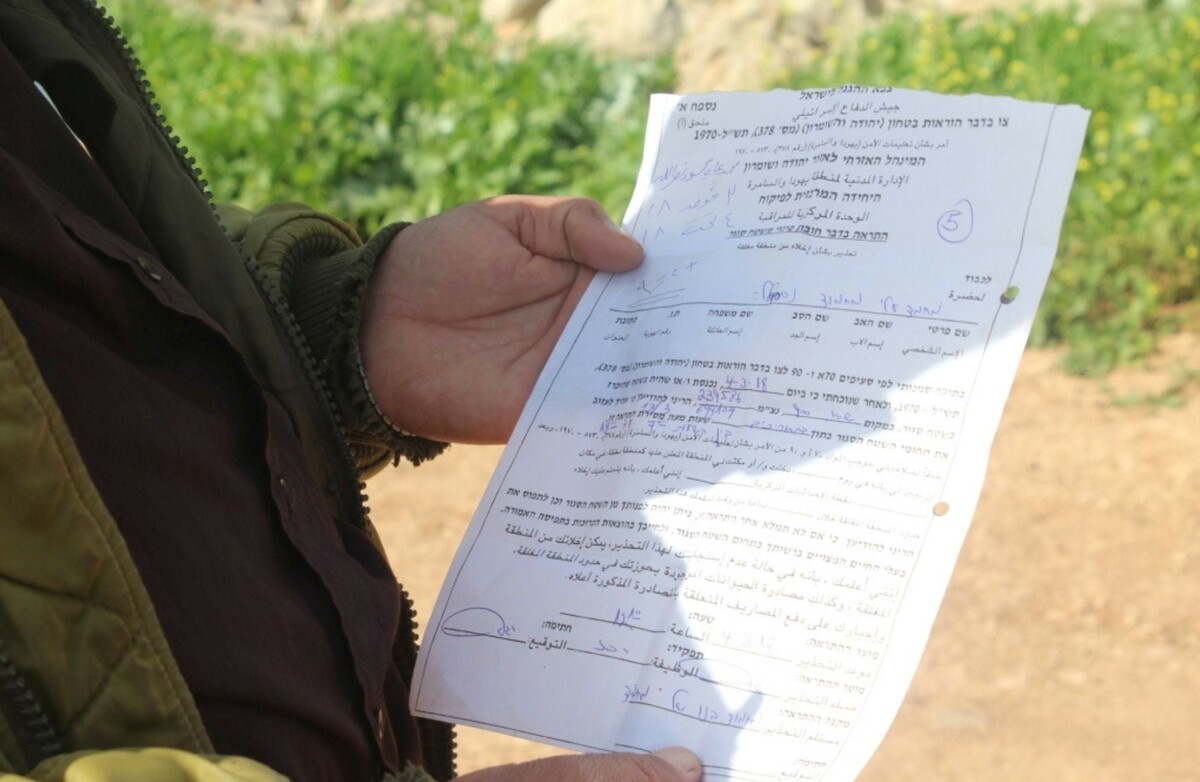
The process of narrowing safe zones and confining hundreds of thousands of people to limited areas coincides with the worsening famine disaster caused by the lack of sufficient aid, coupled with inadequate distribution methods that do not guarantee its access to all displaced persons north and south of the Gaza Valley.

According to a data analysis conducted by Al Jazeera, Israeli evacuation orders peaked last April, with the complete evacuation of Rafah and the Israeli army's announcement of the start of a military operation codenamed "Gideon's Wagons," which displaced hundreds of thousands of residents of Beit Hanoun, Beit Lahia, Sheikh Zayed, Tel al-Zaatar, Jabalia, and the al-Tuffah and al-Shuja'iyya neighborhoods in eastern Gaza. Later, evacuation orders extended to include large areas of Deir al-Balah and most of Khan Yunis, with the exception of some parts of the al-Mawasi area.

Sanad Agency analyzed satellite imagery, along with a collection of evacuation warnings issued by the Israeli military between March 18 and July 20, 2025, and plotted them on a single map based on the block numbers contained in those warnings. These are divisions the Israeli military has adopted since the start of its operations in Gaza on October 7, 2023.

Evacuation of 300 square kilometers

The analysis results showed that the area covered by evacuation warnings amounted to approximately 300.6 square kilometers, representing 82.4% of the Gaza Strip's total area of 364.8 square kilometers, compared to a narrow, scattered area of no more than 17.6%, with an area estimated at 64.2 square kilometers, which is considered the last resort for the displaced.

Over the past 48 hours, the Israeli army issued evacuation warnings for 9 blocks in the Deir al-Balah area, namely Blocks 130, 132, 133, 134, 136, 137, 138, 139, and 2351.

According to satellite images taken yesterday, Sunday, July 20, these areas are densely populated with displaced people's tents, with a combined area of approximately 5.6 square kilometers.

Despite the Israeli military's orders for displaced persons in Deir al-Balah to move south to the Mawasi area, areas considered safe in Khan Yunis have become extremely limited and overcrowded with displaced persons who have flocked to the area over the past months as a result of Israeli operations.

Commenting on the latest eviction orders in Deir al-Balah, the United Nations Relief and Works Agency for Palestine Refugees (UNRWA) said that Israeli authorities had issued further forced displacement orders to families who had previously been displaced repeatedly. In a post on the X platform, it asked, "Where will they go this time?"

UNRWA added, "The bombing continues, and there is no safe place in Gaza. People are starving and cannot find food. Aid must be allowed to enter on a large scale and be distributed safely. UNRWA must be allowed to do its work. The ceasefire must be now."

**Interior** Satellite images show the overcrowding and suffering of displaced people in front of the US aid point.

crowds of food seekers

Other photos obtained by Sanad Agency show the tragic scene of crowds of displaced people searching for food at US aid points in the southern Gaza Strip.

Satellite images taken on July 13 show a large crowd of displaced people streaming from their tents in the Mawasi area of Khan Yunis and Deir al-Balah toward the US aid point located in the "Shakoush" area of Rafah, near Khan Yunis.

Image analysis reveals the Israeli military's complete control over the area, while displaced people wait for the gate to open to receive aid. Thousands of displaced people gather among the sand dunes at at least three locations in an area known locally as "Al-Jura," a sand pit used by displaced people to seek shelter from Israeli army fire, often staying there for hours.

Separating the crowds from the aid point are a number of Israeli vehicles, which surround the area with fire and completely control it. Another military post and buildings surrounding the aid point are fortified by the army, including snipers, according to eyewitnesses.

Image analysis indicates that displaced people walk at least 1.5 kilometers from the last vehicle-free zone to the aid point, which translates to a journey of approximately 3 kilometers each way. The ordeal doesn't stop there, as people arrive 12-24 hours in advance, under the scorching sun, in an attempt to secure the aid they need due to the large numbers of people waiting.

Journalist Muhannad Qashta, a displaced person from Rafah who has documented the events in the US aid zone on numerous occasions, pointed to the extent of the chaos resulting from the disorganization of thousands of people and the lack of precise and announced opening times for the aid points run by the US-based Gaza Humanitarian Foundation.

He explained that the area known as "Al-Jura" has become a death knell for the displaced, as they are subjected to heavy fire from Israeli military vehicles positioned opposite their locations, despite their attempts to seek cover from the fire.

Qashta reviewed satellite images for this report and noted that the number of people around the aid point was many times greater than what was shown in the images.

He said the displaced people's journey begins by staying or sleeping near the aid point, then moving to a vehicle stop, then sneaking into the Al-Joura area to wait for the gate to open. The waiting period is long, and they are then allowed to reach the point, but most of them do not receive food due to the insufficient quantities available for thousands of people.

On July 14, Palestinian activists posted a video showing Israeli vehicles firing heavy rounds of bullets at aid seekers who were gathering in the al-Joura area, preparing to reach the aid distribution point in Rafah. Sanad verified the video and found it to be recent, dating back to July 12, in the same area where the satellite images were taken.

Two days ago, the Government Media Office announced that 877 civilians had lost their lives in what it called "death traps—US-Israeli aid centers." More than 5,666 citizens had been injured, while 42 others remained missing.

PALESTINE

Mon 21 Jul 2025 6:23 pm - Jerusalem Time

The UK, France and 23 other countries say the war in Gaza "must end now."

Twenty-five countries, including Britain, France, and several European countries, issued a joint statement on Monday stressing the need to end the war in Gaza "immediately" and the need for Israel to comply with international law.

Foreign ministers from countries including Australia, Canada, and Japan said that "the suffering of civilians in Gaza has reached unprecedented levels." They condemned "the trickle-down approach to humanitarian aid entering the devastated Strip and the inhumane killing of civilians, including children, seeking to meet their basic needs of water and food."

The statement described the killing of more than 800 Palestinians seeking aid as "horrific," according to figures released by the Ministry of Health in Gaza and the Office of the United Nations High Commissioner for Human Rights.

"The Israeli government's aid model is dangerous, fuels instability, and deprives the people of Gaza of their human dignity," the statement added. "The Israeli government's deprivation of the civilian population of essential humanitarian assistance is unacceptable. Israel must comply with its obligations under international humanitarian law," the statement added.

Gaza's more than two million residents are experiencing a catastrophic humanitarian crisis and are now heavily dependent on the limited aid allowed into the Strip. Many residents have been displaced multiple times.

Most of the food supplies allowed into Gaza by Israel go to the Gaza Humanitarian Foundation, a US-based contractor supported by Israel. Since the foundation began operations in late May, hundreds of Palestinians have been shot dead by Israeli soldiers as they made their way to the targeted sites, according to witnesses and health officials.

The signatories to the statement included the foreign ministers of approximately 20 European countries, as well as Canada, Australia, and New Zealand, and the European Commissioner for Equality, Preparedness, and Crisis Management, Hadja Lahbib.

The United States and Germany were notably absent from the list.

The signatories called for an immediate ceasefire, affirming their readiness to take action to support a political process for peace in the region. The statement, issued by many of Israel's Western allies, deepens its isolation 21 months after its war on Gaza, which pushed Gaza to the brink of famine, sparked global protests, and led to an international arrest warrant for Israeli Prime Minister Benjamin Netanyahu. Israel rejects criticism of its wartime conduct, saying its forces acted lawfully and blaming Hamas for civilian deaths because militants operate in populated areas. It says it allowed enough food into Gaza to feed the population and accuses Hamas of misappropriating much of it. The United Nations says there is no evidence of widespread diversion of humanitarian aid.

The Israeli war, which experts believe was a war of genocide, resulted in the deaths of more than 59,000 Palestinians, according to the Gaza Health Ministry, most of them women and children. However, the British Lancet group puts the death toll much higher.

Israel and Hamas have engaged in ceasefire talks, but no progress appears to have been made, and it is unclear whether any truce will permanently end the war. Israeli Prime Minister Benjamin Netanyahu has repeatedly emphasized that expanding Israeli military operations in Gaza will pressure Hamas in the negotiations.

ARAB AND WORLD

Mon 21 Jul 2025 5:23 pm - Jerusalem Time

Britain and 25 countries call on Israel to stop the war in the Gaza Strip and lift restrictions on the flow of aid immediately.

The United Kingdom and 25 international partners called on Israel, in a joint statement issued on Monday, to stop the war in the Gaza Strip now and lift restrictions on the flow of aid immediately.

The UK, along with the foreign ministers of Australia, Austria, Belgium, Canada, Denmark, Estonia, Finland, France, Iceland, Ireland, Italy, Japan, Latvia, Lithuania, Luxembourg, the Netherlands, New Zealand, Norway, Poland, Portugal, Slovenia, Spain, Sweden, Switzerland, and the EU Commissioner for Equality, Preparedness and Crisis Management, called on all parties to protect civilians and abide by their obligations under international humanitarian law.

They considered proposals to transfer Palestinian residents to a "humanitarian city" completely unacceptable, and that permanent forced displacement constitutes a violation of international humanitarian law.

They said: We, the undersigned, come together with a simple and urgent message: The war in Gaza must end now.

They added: The suffering of civilians in Gaza has reached unprecedented levels. The Israeli government's model of providing aid is dangerous, fuels instability, and deprives the people of Gaza of their human dignity.

They condemned the drip-feeding of aid and the inhumane killing of civilians, including children, seeking to meet their basic needs of water and food. It is horrific that more than 800 Palestinians have been killed while seeking aid.

They stressed that the Israeli government's deprivation of civilians of basic humanitarian assistance is "unacceptable," and that it must comply with its obligations under international humanitarian law.

They called on the Israeli government to immediately lift restrictions on the flow of aid, and urgently enable the United Nations and humanitarian NGOs to carry out their life-saving work safely and effectively.

They also called on all parties to protect civilians and abide by their obligations under international humanitarian law.

They expressed their strong opposition to any steps aimed at changing the geography or demographics of the occupied Palestinian territories, noting that the E1 settlement plan announced by the Israeli government, if implemented, would divide the Palestinian state into two parts, which constitutes a flagrant violation of international law and decisively undermines the two-state solution.

They added: "Meanwhile, settlement construction in the West Bank, including East Jerusalem, has accelerated, while settler violence against Palestinians has escalated. This must stop."

They added: We urge the parties and the international community to join forces in a joint effort to end this bitter conflict through an immediate, unconditional, and permanent ceasefire. There is no point in shedding more blood, and we affirm our full support for the efforts of the United States, Qatar, and Egypt to achieve this.

They expressed their readiness to take further measures to support an immediate ceasefire and a political path towards security and peace for Israelis, Palestinians, and the entire region.

ARAB AND WORLD

Mon 21 Jul 2025 4:27 pm - Jerusalem Time

Yedioth Ahronoth claims: Syrian President Ahmad al-Sharaa survived three assassination attempts. Details.

The Hebrew newspaper Yedioth Ahronoth claimed in a report published on Monday that what it described as "Syrian President Ahmed al-Sharaa" has been the target of three assassination attempts over the past seven months, pointing to ISIS involvement and American and Turkish concerns for his safety.

Details of the alleged attempts

According to the newspaper, the three attempts were as follows:

First Attempt (March): A Turkish force detected suspicious movements as Sharaa left the People's Palace. Three of his guards held onto him while the perpetrator was arrested. According to the newspaper, Sharaa ordered the incident not to be made public to preserve his image as a strong leader.

Second Attempt (in Daraa): While heading to Daraa Governorate, his Syrian and Turkish security guards noticed two suspicious individuals, prompting them to change the convoy's route at the last minute.

The third attempt (in Damascus): The newspaper described it as "almost fatal," as an assassin ambushed Sharaa on the road he planned to take from the presidential palace.

American concern and mutual warnings

The newspaper quoted US Special Envoy to Syria, Thomas Barrack, as warning of "extremely serious threats" facing Sharaa and the need to protect him. According to the newspaper, Barrack said, "The United States is increasingly concerned about Sharaa's safety, and we must establish a special security unit to protect the president's life."

The report indicated that the United States relies primarily on Turkish intelligence in this regard.

In contrast, the newspaper reported that Israeli Prime Minister Benjamin Netanyahu revealed that "explicit warnings" had been issued to senior Syrian officials, possibly during semi-secret negotiations in Azerbaijan. A similar warning was also issued to the Turks that Israel "will not refrain from responding to the Druze attacks."

Sharia accuses the occupying entity

The report noted that, under these pressures and following the recent violence in Sweida, Sharaa was quick to level accusations against the occupying entity, claiming that its intervention in the south of the country and in Damascus was what threatened Syria's security.

The newspaper concluded its analysis by stating that Sharaa is now trying to place the blame on the occupying entity, "as if he is trying to turn Syria into a battleground in order to divide its people."

PALESTINE

Mon 21 Jul 2025 4:06 pm - Jerusalem Time

The Organization of Islamic Cooperation holds an emergency meeting to discuss the Israeli aggression and developments in Palestine.
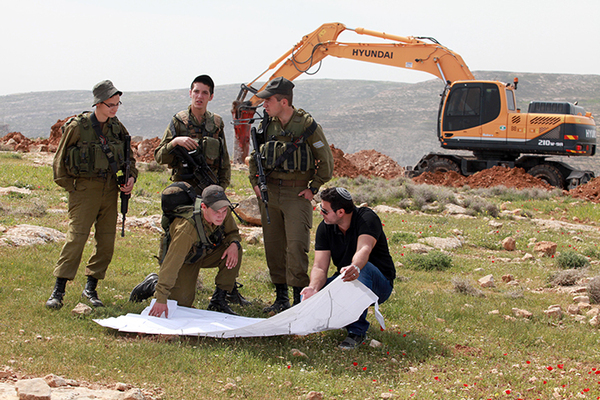
The Organization of Islamic Cooperation (OIC) will hold an emergency meeting of its Executive Committee at the level of permanent representatives tomorrow, Tuesday, to discuss the ongoing Israeli aggression against the Palestinian people and the targeting of holy sites in the occupied Palestinian territories, particularly the Ibrahimi Mosque in Hebron.

This meeting comes amid an unprecedented humanitarian crisis in the Gaza Strip, resulting from the ongoing crimes of genocide, starvation, and forced displacement perpetrated by the Israeli occupation, along with escalating attacks on Islamic and Christian places of worship, which constitute a flagrant violation of international and humanitarian law.

The meeting aims to discuss mechanisms for Islamic and international action to halt the aggression, coordinate political and diplomatic efforts to defend the rights of the Palestinian people, and confront the repeated violations of the sanctity of Islamic and Christian holy sites in the occupied Palestinian territories.

ARAB AND WORLD

Mon 21 Jul 2025 3:42 pm - Jerusalem Time

Belgium investigates two Israeli soldiers for war crimes in Gaza

The Hind Rajab Foundation confirmed on Monday that Belgian police arrested and interrogated two Israeli soldiers on charges of committing war crimes in the Gaza Strip, before releasing them.

The statement added that the arrest and investigation of the two soldiers came in response to an urgent criminal complaint filed this week by the Hind Rajab Foundation and the Global Legal Action Network.

She added that the two suspects were identified and arrested in a visible and decisive manner during the Tomorrowland festival in Boom. After being detained, they underwent formal interrogation and were then released.

She noted that the Belgian Federal Prosecutor's Office had opened a criminal investigation into the case.

The foundation considered the investigation into the two soldiers a turning point in the global quest for justice, sending a message that "credible evidence of international crimes must be met with legal action, not political indifference."

"Starting something important"

"We do not claim that justice has been served, not yet. But we believe that something important has begun. For the first time in Europe, Israeli suspects linked to crimes in Gaza are being formally arrested and interrogated. This would not have happened without the force of the law and the will to enforce it," Hind Rajab's foundation said in the statement.


In recent months, dozens of legal complaints have been filed in European and Latin American countries against Israeli soldiers for committing war crimes in the Gaza Strip. The complaints were filed by the Hind Rajab Foundation. In March, the International Center for Justice for Palestinians launched the "Global 195" initiative to prosecute Israelis involved in war crimes against the Palestinian people in Gaza. It is worth noting that in press interviews, a number of Israeli soldiers admitted to committing war crimes in the Gaza Strip, and they also documented some of them in video clips they shared on social media.

Source: Al Jazeera


PALESTINE

Mon 21 Jul 2025 3:01 pm - Jerusalem Time

Germany: Aid distribution mechanism in Gaza does not comply with humanitarian principles

The German government criticized the insufficient aid provided by the Gaza Humanitarian Foundation to Palestinians in the Gaza Strip on Monday, saying its distribution method does not comply with humanitarian principles.

Beyond the supervision of the United Nations and international relief organizations, Tel Aviv began implementing a plan on May 27 to distribute limited aid through the so-called "Gaza Humanitarian Foundation," which is supported by Israel and the United States but rejected by the United Nations.

In response to a parliamentary question from the Green Party, the German government criticized the aid distribution mechanism used by the Gaza Humanitarian Foundation.

"The German government believes it is now clear that this mechanism does not reach the civilian population sufficiently and does not operate in accordance with humanitarian principles," she said.

She described the humanitarian situation in the Gaza Strip as unbearable, saying, "The suffering of the population must be alleviated and the humanitarian situation improved in accordance with humanitarian principles and international humanitarian law."

She noted that people had lost their lives while trying to obtain relief supplies, and called for a comprehensive explanation of these horrific events to be provided as soon as possible.

The German government affirmed that Israel bears responsibility for complying with international humanitarian law and protecting Palestinian civilians in Gaza.

Israel called for facilitating the resumption of aid distribution in Gaza and ensuring the ability of the United Nations and humanitarian organizations to carry out their work independently and impartially.

PALESTINE

Mon 21 Jul 2025 2:18 pm - Jerusalem Time

Netanyahu decides to remove Edelstein from the chairmanship of the Foreign Affairs and Defense Committee.

Israeli Prime Minister Benjamin Netanyahu decided on Monday to dismiss MK Yuli Edelstein from his position as chairman of the Knesset's Foreign Affairs and Defense Committee, following his opposition to a law exempting ultra-Orthodox citizens from military service.

A statement issued by the Likud faction in the Knesset read: "The head of the faction, MK Ofir Katz, has decided to accede to a request addressed to him to hold elections for the position of chairman of the Knesset Foreign Affairs and Defense Committee, in accordance with the faction's powers in the Likud constitution."

The statement added, "The elections will be held at the bloc's meeting on Wednesday (the day after tomorrow). Nominations may be submitted until 8:00 PM tomorrow, Tuesday."

The Likud MKs who have run for the position so far are: Hanoch Milevitsky, Nissim Vaturi, Boaz Bismuth, Amit Halevi, Moshe Saada, and Avichai Boaron.

Following disagreements over the conscription law and the ultra-Orthodox parties' demand for a law exempting ultra-Orthodox citizens from conscription, the ultra-Orthodox withdrew from the government, but did not withdraw from the coalition until Netanyahu decides on the matter.

PALESTINE

Mon 21 Jul 2025 2:12 pm - Jerusalem Time

Gaza Health: 134 dead in 24 hours, including 99 forcibly starved.

The Ministry of Health in Gaza reported on Monday that 134 dead (including 4 recovered dead) and 1,155 injuries had arrived at the Strip's hospitals in the past 24 hours.

The ministry said in its daily statement, "The number of aid victims who arrived at hospitals over the past 24 hours reached 99 dead and more than 650 injuries, bringing the total number of livelihood victims who arrived at hospitals to 1,021 dead and more than 6,511 injuries."

It pointed out that the death toll from the Israeli aggression has risen to 59,029 dead and 142,135 injuries since October 7, 2023.

It noted that the death toll and injuries since March 18, 2025, has reached 8,196 dead and 30,094 injuries.

PALESTINE

Mon 21 Jul 2025 1:59 pm - Jerusalem Time

UNRWA reflects the lasting impact of the Nakba and global commitment to Palestinian refugees: Arab League


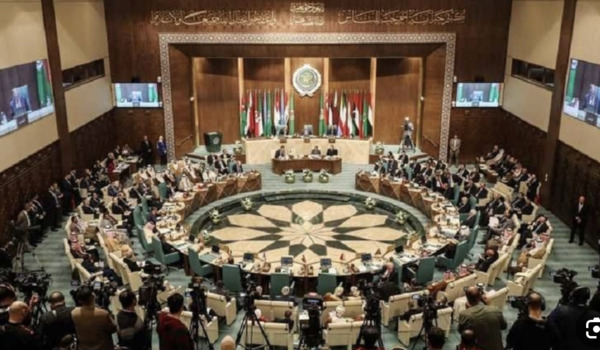
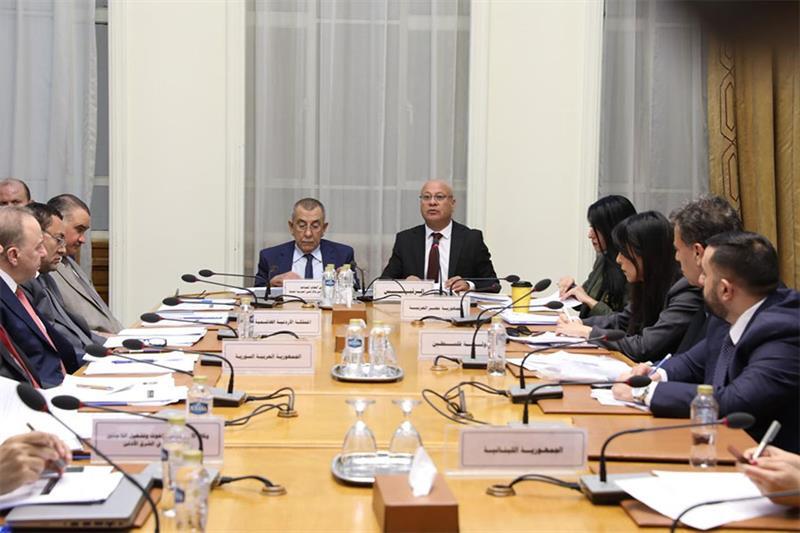
The 113th session of the Conference of Supervisors of Palestinian Refugee Affairs in Arab Host Countries kicked off in Cairo on Saturday, with participating Arab states and organisations affirming support for UNRWA amid an escalating financial crisis and renewed threats to Palestinian refugee rights.

Official delegations from Jordan, Syria, Palestine, Egypt, and Lebanon participated in the meeting, along with representatives from the Arab League Educational, Cultural and Scientific Organisation (ALECSO) and the United Nations Relief and Works Agency for Palestine Refugees in the Near East (UNRWA).

The opening discussions focused on the worsening financial crisis facing UNRWA and the urgent need to mobilise resources to ensure it continues to operate. The delegates also addressed efforts to renew the agency's mandate for another three years and reviewed the agency's strategic evaluation report.

The participating delegations stressed the importance of providing UNRWA with robust financial and political support. They rejected ongoing attempts to undermine or dismantle it. They emphasised the collective responsibility to preserve the rights of Palestinian refugees, including their right of return as stipulated by UN Resolution 194.

Ambassador Saeed Abu Ali, Assistant Secretary-General of the League of Arab States, described the situation in Gaza as a "full-fledged war of extermination" that reflects a total collapse of humanitarian principles. He warned that the situation in the West Bank is equally dire, citing more than 1,000 martyrs, over 7,000 wounded, the destruction of 1,500 buildings in refugee camps, and the displacement of around 52,000 Palestinians due to settler violence backed by Israeli occupation forces.

Abu Ali stressed that UNRWA remains a living witness to the Nakba, the 1948 mass displacement of Palestinians, and symbolises the international community's enduring commitment to the rights and well-being of Palestinian refugees. He cautioned against attempts to liquidate the agency and erase the refugee issue.

Ambassador Mahmoud Omar, Assistant Minister of Foreign Affairs of Egypt and Director of the Palestine Department, described the meeting as coming at a decisive and dangerous moment for the Palestinian cause. He called for an immediate and sustainable ceasefire, urging the international community to fulfil its moral and humanitarian duty by contributing to Gaza's reconstruction through the endorsement of the Egyptian-Arab reconstruction plan and strengthening the Palestinian National Authority.

Omar also mentioned Egypt's swift action on three humanitarian fronts since the outbreak of the war: facilitating aid delivery, evacuating the wounded for treatment, and collaborating with partners to develop post-conflict governance arrangements for Gaza. He reiterated Egypt's firm rejection of any proposals to forcibly displace Palestinians, including the establishment of a so-called "humanitarian city," which he described as a flagrant violation of international law and a threat to the two-state solution.

Ahmed Abu Holi, member of the PLO Executive Committee and head of the Department of Refugee Affairs, accused the Israeli occupation of seeking to undermine and dismantle UNRWA through incitement campaigns, restrictions, and efforts to replace it with alternative bodies. He condemned the proposed humanitarian city in Rafah as a thinly veiled displacement project designed to eliminate the refugee issue and liquidate the Palestinian cause.

Abu Holi stressed that President Mahmoud Abbas's vision, as presented at the extraordinary Arab Summit and the UN General Assembly, offers a clear Palestinian roadmap for ending the aggression, halting forced displacement, rebuilding Gaza, and achieving a just peace based on international resolutions and the Arab Peace Initiative.

Sahar Al-Jubouri, Head of the Office of the Representative of UNRWA, confirmed that the agency is facing its most severe financial crisis since its establishment, with a budget deficit exceeding $200 million. She said the situation has forced UNRWA to implement exceptional measures, including deferring payments to suppliers to ensure the payment of staff salaries.


PALESTINE

Mon 21 Jul 2025 1:45 pm - Jerusalem Time

The occupation forces arrest the director of field hospitals in Gaza, Marwan al-Hams.

The Director-General of the Ministry of Health in Gaza, Dr. Munir al-Barsh, reported that Israeli occupation forces arrested Marwan al-Hams, the director of field hospitals in the Strip, while he was on duty, visiting the Red Cross Hospital west of Khan Yunis.

Al-Barash explained that Al-Hams was arrested by an Israeli special forces force, noting that the driver accompanying Al-Hams was injured and that two civilians, one of whom was a journalist, who were nearby were killed.

Al-Barash held the occupation responsible for Dr. Al-Hams's safety, noting that the arrest was part of a direct targeting of the health system. He said that the occupation had previously arrested more than 360 health workers and killed 1,589.

For his part, the director of Al-Shifa Medical Complex, Dr. Mohammed Abu Salmiya, called on international organizations to pressure the occupation to reveal the fate of Dr. Marwan al-Hams.

He added that Al-Hams's arrest is a message aimed at silencing Palestinian voices and those calling for an end to the suffering of the people, noting that the press system is facing increasing risks while its workers continue to fulfill their duties despite all the difficulties.

The arrest of Dr. Al-Hamas comes amid confirmations from the Ministry of Health in Gaza that Dr. Hussam Abu Safiya, director of Kamal Adwan Hospital in the northern Gaza Strip, who has been detained by the occupation since December 27, 2024, is suffering from a critical health condition and is being deliberately deprived of medical treatment. He has lost 40 kilograms (88 pounds) in weight.

A statement from the ministry stated that medical personnel in occupation detention centers are living under tragic and difficult conditions, as Israel imposes strict restrictions on them. It added that Israeli occupation forces have "arrested hundreds of medical personnel in the Gaza Strip since the outbreak of the genocidal war."

PALESTINE

Mon 21 Jul 2025 1:31 pm - Jerusalem Time

Director of the Ministry of Health in Gaza: Occupation forces arrested Dr. Marwan Al-Hams west of Rafah.

The Director-General of the Ministry of Health in the Gaza Strip said, "The occupation forces arrested the director of field hospitals in the Strip, Marwan al-Hams."

The Director General added in a statement to Al Jazeera, "Al-Hams was arrested during his visit to the Red Cross Hospital west of Rafah, south of the Gaza Strip."

The Director General of the Ministry of Health in Gaza held the Israeli occupation fully responsible for the life of Dr. Marwan Al-Hams.

In the incident, journalist Tamer Al-Za'anin was martyred, while journalist Ibrahim Abu Asheba was seriously injured while filming Dr. Al-Hamas in the Fash Farsh area, west of Rafah.

PALESTINE

Mon 21 Jul 2025 1:24 pm - Jerusalem Time

Eye Hospital: 1,200 new cases of total or partial blindness recorded in Gaza

The director of Gaza's Eye Hospital, Abdul Salam Sabah, announced that nearly 1,200 new cases of total or partial blindness have been recorded over the past two weeks in the Nasr neighborhood and Gaza City alone.

Sabah told Voice of Palestine that approximately 1,500 cases of total or partial blindness had been recorded as a result of direct eye injuries, in addition to cases of gradual blindness due to chronic diseases that worsened due to the lack of appropriate treatment.

Sabah explained that between 4,000 and 5,000 patients who regularly visited the eye hospital before the war are now without medical follow-up or treatment and are at risk of losing their sight. He emphasized that severe malnutrition leads to vitamin and mineral deficiencies, which weaken the optic nerves and increase the likelihood of gradual vision loss and impairment, especially for diabetics.

Since March 2, 2025, the occupying forces have closed all crossings with the Gaza Strip and prevented the entry of food and medical aid, causing a famine to spread within the Strip.

It is worth noting that the ongoing Israeli aggression against our people in the Gaza Strip since October 7, 2023, has so far resulted in the martyrdom of 58,895 citizens, the majority of whom are children and women, and the injury of 140,980 others, in a preliminary toll, as a number of victims remain under the rubble and in the streets, and ambulance and rescue crews are unable to reach them.

ARAB AND WORLD

Mon 21 Jul 2025 1:08 pm - Jerusalem Time

Israel attacks Hodeidah port, Katz threatens Houthis

The Israeli military announced that it attacked facilities inside the port of Hodeidah in western Yemen on Monday, claiming to prevent the Houthis from rehabilitating their infrastructure.
The army said in a statement that it targeted fuel tankers and engineering vehicles working to restore infrastructure at the port of Hodeidah.
He added that he targeted ships and boats used by the Houthis for military purposes, he claimed.
In turn, Israeli Defense Minister Israel Katz said that Israel "is working vigorously to prevent any attempt to rehabilitate Houthi infrastructure in Yemen."
He continued, threatening that Yemen's fate would be the same as Iran's, vowing that the Houthis would pay a "heavy price for launching missiles at Israel."
For its part, Houthi-affiliated media outlets confirmed that a series of Israeli airstrikes targeted the country's port of Hodeidah.
Last Friday, the Houthis attacked Ben Gurion Airport in Tel Aviv with a "Palestine 2" hypersonic ballistic missile, while the Israeli military confirmed that it had intercepted the missile.
Since the start of Israel's genocidal war in the Gaza Strip, the Houthis have launched dozens of missile attacks on Israel under the banner of "supporting Gaza." Israel, in turn, has launched dozens of attacks on sites in Hodeidah and Sana'a.
Absence of goal bank
Regarding the recent Israeli threat against the Houthis, Ahmed Naji, senior Yemen analyst at the International Crisis Group, said there are differences between Israel's war against the Houthis and its war against Iran.
Naji explained in a statement to Al Jazeera Net that the obstacle facing Israel in Yemen is the lack of a target bank due to the scarcity of intelligence regarding the Houthis' military capabilities. Therefore, Israeli strikes are currently focused on large facilities such as ports, airports, and power plants to create a scene of destruction, while no strikes have been carried out against actual military targets.
He pointed out that the Houthis rely on ambiguity in their military structure, making it difficult to track their leaders. They also use mobile missile platforms that are easy to replace if targeted, thus reducing the significance of any Israeli military operations against these targets.
Source: Al Jazeera


PALESTINE

Mon 21 Jul 2025 12:58 pm - Jerusalem Time

OCHA: 88% of Gaza's area is subject to military evacuation orders.

The United Nations Office for the Coordination of Humanitarian Affairs (OCHA) said on Monday that 88 percent of the Gaza Strip is subject to military evacuation orders, which entail the forced displacement of citizens.

OCHA explained in a statement that the so-called "evacuation orders" will affect between 50,000 and 80,000 Palestinians living in the affected areas of the Gaza Strip.

He added that 88 percent of the Gaza Strip's area, approximately 360 square kilometers and home to approximately 2.3 million residents, is subject to so-called Israeli "evacuation orders."

On Sunday, the occupation forces issued a new evacuation order for large areas of Deir al-Balah, followed by a continued exodus of civilians into other areas last night.

Since March 2, 2025, the occupying forces have closed all crossings with the Gaza Strip and prevented the entry of food and medical aid, causing a famine to spread within the Strip.

It is worth noting that the ongoing Israeli aggression against our people in the Gaza Strip since October 7, 2023, has so far resulted in the martyrdom of 58,895 citizens, the majority of whom are children and women, and the injury of 140,980 others, in a preliminary toll, as a number of victims remain under the rubble and in the streets, and ambulance and rescue crews are unable to reach them.

PALESTINE

Mon 21 Jul 2025 12:51 pm - Jerusalem Time

The occupation threatens to seize 7 dunams east of Qalqilya.

Today, Monday, the Israeli occupation authorities notified the seizure of 7 dunams of land in the village of Jinsafut, east of Qalqilya.

According to the Wall and Settlement Resistance Commission, this decision is intended to expand and pave a new military road for the settlements of Neve Menachem and Ramat Gilad.

In the Commission's mid-term report, the total number of attacks carried out by the occupation and its settlers against citizens and their property in the first half of this year reached 11,280.

In the first half of 2025, settlers established 23 outposts on citizens' lands, most of them pastoral outposts, in the governorates of Ramallah, Nablus, Hebron, Qalqilya, Tubas, and Jerusalem. This is a continuation of the policy of imposing facts on the ground, pursued by settlers under the full auspices of the occupation army.

The occupation authorities also seized more than 800 dunams of Palestinian land under various pretexts, issuing 36 seizure orders for military purposes and one expropriation order under the pretext of paving and expanding roads.

PALESTINE

Mon 21 Jul 2025 12:27 pm - Jerusalem Time

The Jerusalem Governorate warns of a settlement plan in East Jerusalem, describing it as "dangerous."

The Jerusalem Governorate considered the Israeli occupation authorities' resumption of the dangerous settlement plan in the E1 area east of Jerusalem a dangerous decision that comes within the context of colonial policies aimed at undermining any prospect for a just and lasting political solution and imposing Judaization facts on the ground.

The governorate added in a statement on Monday that this plan, which has been revived after years of being frozen due to international pressure, is considered one of the most dangerous settlement projects, as it aims to divide the West Bank into two separate parts, thereby undermining the geographical unity of the Palestinian territories, isolating the city of Jerusalem from its natural Palestinian surroundings, and eliminating the possibility of establishing a geographically contiguous Palestinian state with East Jerusalem as its capital.

She warned that the implementation of this project would lead to the destruction of what remains of the Palestinian urban fabric between Ramallah, Jerusalem, and Bethlehem, and would threaten the existence of nearly one million residents in the area by creating a colonial continuum extending from the central West Bank to Jerusalem, a blatant violation of the red lines the international community has long warned against.

The governorate emphasized that this occupation move, which comes amid regional and international preoccupation with the war on Gaza, constitutes a blatant exploitation of crises to impose illegal facts on the ground. It constitutes a political crime that adds to the occupation's long record of violations, settlement expansion, and creeping annexation.

The Jerusalem Governorate called on the United Nations and the international community, particularly the peace-sponsoring states, to assume their political, legal, and moral responsibilities and take effective and immediate steps to halt this settlement plan, which threatens security and stability in the entire region and leads to a new escalation that will have serious repercussions at all levels.

The Jerusalem Governorate commended the objections of citizens and human rights and humanitarian organizations that have confronted this project, and emphasized the need to expand the scope of popular, diplomatic, and legal resistance to this plan and similar colonial projects, which seek to legitimize the occupation and entrench the apartheid system.