By: Said Arikat
May 20, 2026
News analysis
Washington, D.C- By any serious historical or moral measure, the claim that the United Arab Emirates merely maintains “state-to-state” relations with Israel collapses under scrutiny. Diplomacy is never morally neutral. It never has been. States are judged not only by whom they recognize, but by what systems of domination they choose to normalize, legitimize, and sustain through engagement.
Had governments in the late 1980s embraced full normalization with apartheid South Africa while insisting they were simply practicing pragmatic diplomacy, they would not be remembered as neutral actors. They would be remembered as enablers of a system defined by racial hierarchy, territorial fragmentation, and institutionalized dispossession. The anti-apartheid struggle was never about symbolism. It was about whether the international community would tolerate a political order built on permanent legal and structural inequality.
It is worth noting that during apartheid South Africa, the UAE itself had no formal relations with the regime—reflecting a once widely shared international consensus that systems of institutionalized domination were incompatible with normal diplomacy.
That consensus is now deeply eroded in the case of Israel’s rule over Palestinians.
A broad body of human rights organizations and legal scholars—including B’Tselem, Human Rights Watch, and Amnesty International—have concluded that Israel operates a system of institutionalized domination over Palestinians that meets the legal definition of apartheid. B’Tselem describes it as “a regime of Jewish supremacy from the Jordan River to the Mediterranean Sea.” While governments contest terminology, they do not contest the underlying documented record: dual legal systems, territorial fragmentation, discriminatory governance structures, and entrenched structural inequality.
This is not abstraction. It is architecture.
In the occupied West Bank, Palestinian life is shaped by checkpoints, roadblocks, restricted roads, military zones, and a separation barrier that cuts deeply into territory and fragments communities into disconnected enclaves. Movement is tightly controlled and often unpredictably restricted. Access to hospitals, schools, farmland, workplaces, and family networks is governed by a dense system of permits, closures, and military discretion.
Alongside this physical fragmentation is a legal duality that human rights organizations consistently identify as central to the system. Israeli settlers live under Israeli civil law, with full rights and political representation. Palestinians live under military law, are tried in military courts, face administrative detention without charge in many cases, and are subject to sweeping restrictions on movement, construction, protest, and civil life. Two populations in the same territory are governed by two entirely different legal regimes based on identity.
In parallel, settler violence in the West Bank has been repeatedly documented by Israeli and international human rights organizations and journalists. Reports describe intimidation, attacks on villages, destruction of homes and property, and sustained assaults on farmland and livelihoods. These incidents frequently occur in environments where accountability is limited and enforcement inconsistent, reinforcing concerns about impunity and the erosion of legal protections.
Nowhere has scrutiny intensified more sharply than in the context of detention practices.
Since the escalation of the Gaza war, the United Nations, Amnesty International, Human Rights Watch, and Israeli organizations such as B’Tselem have documented serious allegations of abuse in Israeli detention facilities. These reports describe patterns of ill-treatment, humiliation, physical violence, and credible allegations of sexual violence in detention contexts.
A 2024 United Nations report concluded that thousands of Palestinian detainees were subjected to treatment consistent with torture and called for independent investigations and accountability mechanisms. Amnesty International and Human Rights Watch have similarly raised concerns about systemic abuse and the absence of effective oversight.
Journalistic reporting has reinforced these findings. Nicholas Kristof, writing in The New York Times (May 18), cited testimonies from former detainees describing severe abuse, including allegations of sexual violence, and called for urgent independent investigation. His reporting reflects a broader pattern across international journalism: sustained allegations emerging from multiple credible sources that demand scrutiny rather than dismissal.
High-profile cases have further intensified concern. In one widely reported incident, Israeli soldiers were arrested in connection with allegations of sexual assault against a Palestinian detainee at the Sde Teiman facility. The case triggered internal military proceedings and public controversy. According to BBC reporting, Israeli military authorities later dropped charges, citing evidentiary and procedural difficulties—a decision widely criticized by human rights organizations as emblematic of persistent accountability failures in detention-related cases.
These cases are not isolated proof of doctrine, but part of a broader, well-documented pattern of allegations, investigations, and unresolved accountability that has drawn sustained international attention.
In Gaza, the scale of destruction since October 2023 has fundamentally altered global perception. Entire neighborhoods have been reduced to rubble. Hospitals, schools, universities, bakeries, water systems, and refugee shelters have been severely damaged or destroyed. Humanitarian agencies warn of catastrophic conditions: mass displacement, famine risk, and the collapse of basic infrastructure under prolonged siege and sustained military operations.
Some genocide scholars and legal experts have warned that the situation may meet the threshold of genocide under international law, while others stress that only judicial determination can establish legal classification. What is beyond dispute is the scale of civilian suffering and infrastructural collapse.
Against this backdrop, normalization acquires a more precise meaning: not transformation, but accommodation.
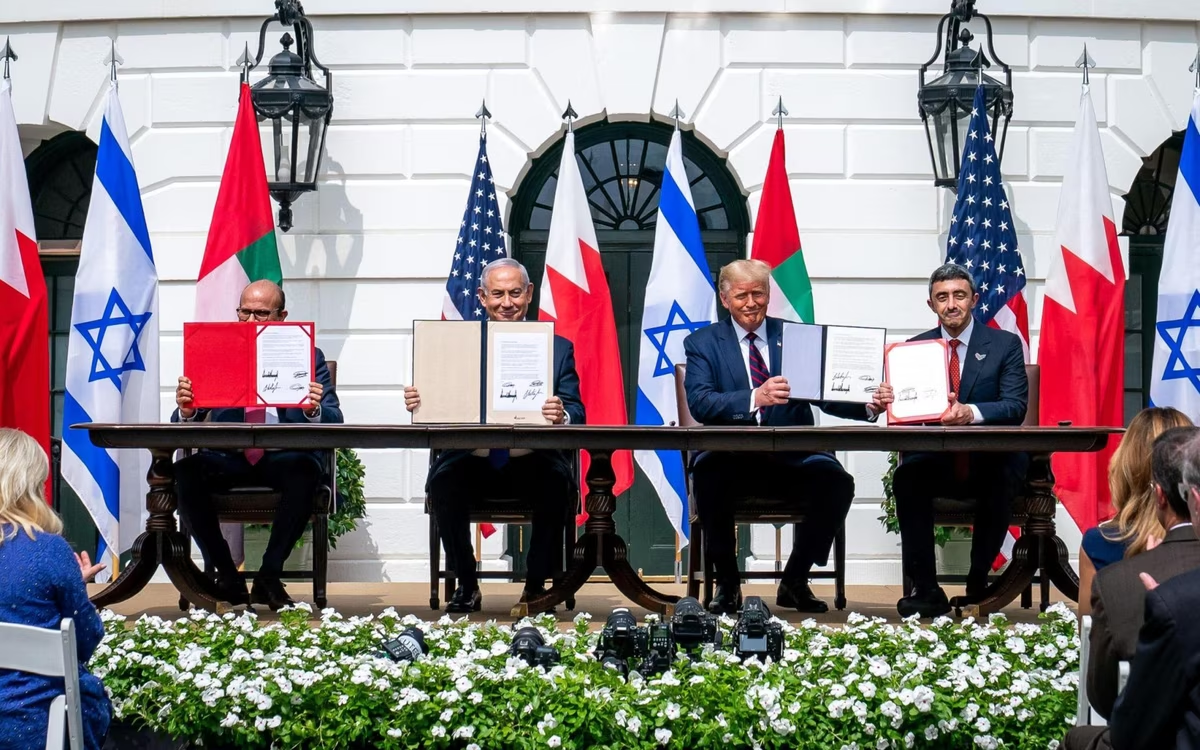
The UAE’s decision to establish formal relations with Israel under the Abraham Accords was presented as a breakthrough for regional stability and pragmatic diplomacy. Its proponents argued it would generate leverage and moderation. Yet despite expanded diplomatic, economic, and security ties, the underlying realities—occupation, settlement expansion, displacement, blockade, and recurring cycles of violence—have not fundamentally changed.
Normalization has not altered the structure. It has stabilized it.
This exposes the central flaw in reducing diplomacy to “state-to-state relations.” Such a framework abstracts political engagement from human consequence. It treats deeply unequal systems of power as neutral administrative arrangements rather than lived systems of coercion, fragmentation, and control over an entire population.
History offers a clear warning. During apartheid South Africa, many states justified continued engagement in the name of pragmatism and influence. In hindsight, those positions are widely regarded as having prolonged an unjust system by granting it legitimacy and delaying accountability.
The same moral question now returns under conditions of far greater visibility.
None of this negates Jewish historical suffering or the enduring reality of antisemitism, both of which remain serious and must be confronted unequivocally. But historical trauma cannot function as permanent exemption from accountability. History repeatedly shows that societies shaped by persecution can, when empowered, reproduce systems of domination over others.
The tragedy of normalization is that it was marketed as a pathway to peace, yet increasingly functions as a mechanism that stabilizes diplomatic relations while leaving intact the structures that produce inequality, fragmentation, and recurring violence.
True peace cannot be built on unequal rights, fragmented geography, permanent military control, and institutionalized racism. Nor can diplomacy detached from accountability produce genuine stability. It can only defer reckoning.
Ultimately, the question is not whether states have the sovereign right to engage with Israel. The question is whether such engagement, under present conditions, amounts to normalization of a system that a growing body of international legal experts and human rights organizations increasingly describe as apartheid, and which remains under sustained allegations of grave violations requiring independent judicial scrutiny.
History will not judge this moment on diplomatic language or strategic convenience.
It will judge whether the world saw a system of domination unfolding in real time—and chose normalization anyway.