ARAB AND WORLD

Fri 22 May 2026 1:37 pm - Jerusalem Time

Lebanon Between the Hammer of Negotiations and the Anvil of Internal Conflict: A Reading of the Outcomes of Escalation and Sanctions

The Lebanese state has entered a pivotal stage in its political and military history by engaging in direct negotiations with the Israeli side under the auspices of the United States of America. This step comes amidst extreme field complexities, as Hezbollah expresses absolute rejection of this path and its outcomes, considering it an infringement on Lebanese sovereignty and a retreat in the face of external pressures.

These diplomatic moves coincided with a remarkable American escalation, represented by the imposition of a wide package of sanctions that included leaders in Hezbollah and the Amal movement, in addition to officers in the Lebanese army and the Iranian ambassador in Beirut. Observers believe that these sanctions do not only aim at political pressure but also pave the way for the complete dismantling of the financial and military system associated with the party.

In a reading of the negotiation scene, political researchers indicate that Lebanon entered the dialogue table in Washington stripped of essential power cards, which led to successive concessions without obtaining security guarantees. The paradox lies in the fact that the continuation of negotiations failed to curb Israeli military operations; rather, the pace of attacks increased under the guise of 'negotiating under fire'.

On the other hand, experts believe that the recent American sanctions are part of a comprehensive strategy aimed at reshaping the Lebanese reality beyond the issue of disarmament. The current path seeks to undermine the political and financial influence of forces allied with Tehran, which puts official Lebanese institutions in direct confrontation with the challenges of survival and sovereignty.

Despite the pressures, Hezbollah still relies on its ability to withstand on the ground and inflict qualitative losses on the occupation to impose its conditions at the negotiating table. Attention is also turning to the results of the Iranian-American dialogue in Islamabad, where the party hopes that any regional rapprochement will positively reflect on its internal situation in Lebanon.

However, media warnings have emerged to confirm that relying on past experiences such as those of 2000 and 2006 may be misleading at present. The widespread destruction of southern villages and the displacement of residents, along with the fracturing of national unity and the absence of traditional regional support, are all factors that make military steadfastness alone a risky option and insufficient to save the country.

The future prospects for Lebanon oscillate between three grim scenarios: the first is the failure of negotiations, which will inevitably lead to a widespread military explosion. The second scenario is an armed internal conflict if the Lebanese government agrees to a security agreement and begins to implement it forcibly, while the third scenario remains dependent on a major regional breakthrough.

In conclusion, analysts agree that the existential threat facing Lebanon is the demographic and sovereign erosion of the state, especially with Israeli ambitions threatening vast areas of Lebanese territory. Lebanon today lives in a state of political schizophrenia between two contradictory projects, amidst an Arab consensus on the necessity of confining weapons to the state without agreeing on the future relationship with Israel.

Lebanon is experiencing a severe state of schizophrenia between two irreconcilable projects, amidst a real danger threatening the demographic and sovereign erosion of the state.

OPINIONS

Thu 21 May 2026 11:08 pm - Jerusalem Time

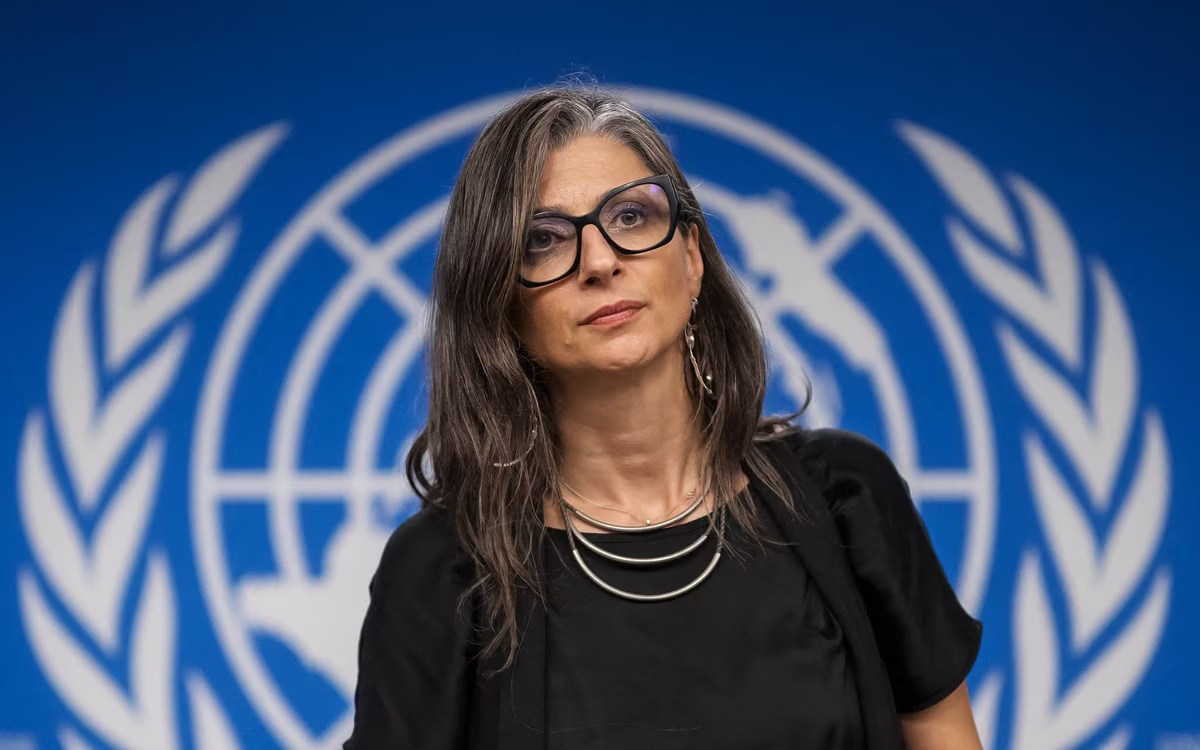
Francesca Albanese’s Vindication and the Crisis of Western Credibility


By Said Arikat


May 21, 2026


News analysis


Washington, D.C-For nearly two years, Francesca Albanese endured one of the most aggressive political intimidation campaigns launched against a United Nations official in recent memory. She was smeared as an extremist, denounced in Congress, targeted by pro-Israel lobbying groups, attacked across major media platforms, flooded with threats online, and ultimately sanctioned by the United States government itself.


Her offense was neither corruption nor incitement nor criminal conduct.


It was insisting that Palestinians are entitled to the same protections under international law as every other human being.


Now, that campaign has suffered a humiliating collapse.


Last week, U.S. Federal Judge Richard Leon ruled that the sanctions imposed on Albanese were likely unconstitutional and amounted to an unlawful punishment of protected speech. Days later, the Treasury Department quietly removed the UN Special Rapporteur on the occupied Palestinian territories from its sanctions list, effectively retreating from a measure that had become legally and politically indefensible.


The reversal was more than a personal vindication for Albanese. It exposed something far more troubling: the extent to which Washington was willing to weaponize state power to silence criticism of Israel’s conduct in Gaza.


Albanese’s real crime was consistency.


As the UN official tasked with documenting conditions in the occupied Palestinian territories, she refused to sanitize what Palestinians were enduring. While Western leaders hid behind carefully engineered euphemisms, Albanese spoke openly about collective punishment, forced displacement, siege warfare, starvation, settler violence, and what she repeatedly warned could constitute genocide in Gaza.


She did not invent those realities. She documented them.


But in today’s political climate, particularly in Washington, describing Palestinian suffering in direct moral and legal terms has itself become intolerable.


That is what made Albanese dangerous.


The campaign against her followed a familiar pattern. Israeli officials accused her of antisemitism. American politicians portrayed her as biased and radical. Media commentators questioned her credibility rather than confront the substance of her findings. Lobbying organizations demanded her removal. The goal was not debate but delegitimization: make the messenger toxic enough so the message itself could be ignored.


When that failed, the United States escalated further.


The sanctions imposed against Albanese marked an extraordinary moment in modern American politics. Washington effectively used its financial and legal machinery against a UN human rights investigator for carrying out her mandate. The symbolism could not have been clearer. The world’s most powerful democracy sanctioned a human rights expert because her conclusions were politically inconvenient to Israel and its allies.


The implications extended far beyond Albanese herself.


The sanctions sent a warning to journalists, academics, lawyers, activists, and international officials everywhere: sustained criticism of Israeli conduct could carry professional, financial, and political consequences. The objective was not simply to punish Albanese but to create a wider climate of fear around Palestine.


And for a time, that intimidation worked.


Universities silenced dissent. Journalists softened language. Public officials avoided direct criticism of Israel even as Gaza descended into catastrophe. Entire careers became vulnerable to accusations designed less to prove wrongdoing than to enforce political conformity.


Albanese refused to conform.


That refusal came at enormous personal cost. She endured relentless public attacks, threats to her safety, attempts to destroy her professional credibility, and extraordinary political pressure from governments far more powerful than the institution she represented. Yet she did not retract her findings or dilute her conclusions to satisfy Washington’s political sensitivities.


That persistence matters because Albanese’s position was never legally or morally extreme. She called for investigations into alleged war crimes, accountability for attacks on civilians, and enforcement of international humanitarian law. Those are not radical demands. They are the foundational principles the international system claims to uphold.


What made them controversial was their application to Israel.


This is the contradiction that Albanese’s case exposed so clearly. Western governments invoke human rights language constantly when confronting official enemies. International law is presented as sacred when violations are committed by rivals of the United States. But when those same standards are applied to Israel, legal principles suddenly become negotiable, inconvenient, or dangerous.


The result is a hierarchy of human rights in which Palestinian suffering is treated as politically manageable rather than morally urgent.


Judge Leon’s ruling cut directly through that logic. His decision recognized that Albanese’s statements constituted protected political speech, not sanctionable conduct. In doing so, the court effectively acknowledged that Washington had crossed a constitutional line by attempting to punish criticism of Israeli policy.


The Treasury Department’s quiet removal of the sanctions days later only reinforced the point. There was no public defense of the policy because none remained credible. The administration retreated because the legal foundation had collapsed.


But the moral damage cannot be undone so easily.


The spectacle of the United States sanctioning a UN human rights rapporteur for documenting Palestinian suffering will remain one of the defining symbols of this political era. It revealed how deeply the defense of Israel has become embedded within American power structures, to the point where even basic human rights investigations can trigger state retaliation.


Yet the collapse of the campaign against Albanese revealed something else as well: intimidation has limits.


Despite immense pressure, Albanese survived politically because events on the ground kept validating her warnings. As Gaza’s destruction deepened, as civilian casualties mounted, as starvation spread, and as international outrage intensified, efforts to portray her as irrational or extremist became increasingly difficult to sustain.


History often clarifies what politics tries to obscure.


Those who challenged systems of racial domination, occupation, and collective punishment were rarely celebrated in real time. They were attacked as dangerous, biased, irresponsible, or radical. Only later does moral clarity become obvious.


That process may already be unfolding around Gaza.


Francesca Albanese’s victory matters not because a single UN official won a legal battle, but because her case exposed the extraordinary lengths powerful governments were willing to take to suppress accountability for Palestinian suffering. She endured vilification, isolation, and punishment rather than abandon the principle that international law must apply equally to everyone – and long after the sanctions are forgotten, that may be what endures most.

PALESTINE

Thu 21 May 2026 9:53 pm - Jerusalem Time

Trump's Gaza Reconstruction Plan Stalls: Hesitant Donors and Empty Coffers Threaten 'Peace Council'

International press reports have revealed a state of stagnation gripping the so-called 'Peace Council' headed by US President Donald Trump, as plans for the reconstruction of the Gaza Strip face major financial and political obstacles. Sources indicated that countries that previously pledged financial support are now showing clear reluctance to fulfill their commitments more than seven months after the ceasefire agreement.

Leaked financial data points to a huge gap between promises and reality; out of $7 billion pledged by nine countries, only meager amounts, not exceeding $1.75 for every $100 promised, have actually arrived. The United Arab Emirates and Morocco are the only two entities that have transferred actual funds to support the Council's operational activities, while the rest of the pledges remain ink on paper.

In a memo submitted to the UN Security Council, the Peace Council considered that the main obstacle to implementing its vision is Hamas's refusal to surrender its weapons and relinquish administrative control over the Strip. However, informed sources confirm that the lack of funding represents the real and existential threat to reconstruction efforts, putting the credibility of the American initiative at stake before the international community.

This financial crisis comes at a time when the United Nations estimates that the cost of rebuilding what the war destroyed in Gaza exceeds $70 billion, a process that could take decades. Despite Trump's personal pledge to provide $10 billion in US funding, these funds have not yet been disbursed and have not been officially requested by Council officials to date.

On the internal administration front, the Council faces sharp criticism due to the high salaries received by senior officials and Palestinian technocrats chosen to manage the sector. These officials are currently residing in Egypt awaiting entry permits to Gaza, where they receive monthly salaries ranging between $16,000 and $17,000, while the salary of the High Representative Nickolay Mladenov is about $400,000 annually.

Field sources reported that the National Committee for Gaza Management, affiliated with Mladenov, has not succeeded in bringing about any tangible change in the lives of the residents within the afflicted Strip. The sources confirmed that not a single bottle of water has entered Gaza under the banner of this committee since the beginning of this year, reflecting the state of functional paralysis suffered by the institutions stemming from Trump's plan.

In Jerusalem, Bulgarian diplomat Nickolay Mladenov admitted that the world has failed the Palestinians in Gaza, indicating that the doors to the future remain tightly closed. Mladenov urged donor countries to disburse the committed funds without delay, considering that delay transforms the framework from tangible results into mere paper plans that neither feed nor enrich.

On the other hand, diplomats believe that regional escalation and the conflict with Iran have provided political cover for some countries to delay paying their financial shares into the Gaza reconstruction fund. It seems that those with financial influence now have a strong excuse to freeze their contributions, awaiting the outcome of the complex political and security situations in the Middle East in general.

Despite prominent Peace Council officials denying the existence of urgent funding challenges, the reality on the ground indicates the absence of any practical plans for reconstruction or debris removal. Israeli occupation forces still control more than half of the Strip's area and impose strict restrictions on the entry of vital shipments of food, medicine, and basic necessities.

Hundreds of thousands of survivors live in temporary camps lacking the most basic necessities for a dignified life, where hunger is widespread and health crises are exacerbated by the destruction of infrastructure and hospitals. In light of this bitter reality, Trump's vision of transforming Gaza into a tourist and commercial hub with 'smart cities' seems far removed from the humanitarian catastrophe that residents experience daily.

Reports indicate that major contracting companies have submitted bids to remove rubble and build residential complexes, but they have not received any official contracts or assignments to begin work. This confusion reflects the lack of coordination between major political promises and executive capacity on the ground, amid ongoing military operations and strict security restrictions imposed by the occupation.

Observers warn that the 'worst-case scenario' for the Peace Council is a sudden agreement by Palestinian factions to disarm, as the Council would find itself unable to provide any actual support. They emphasize that the Council is not logistically or financially prepared to deal with the scale of the massive destruction, which could lead to a complete collapse of popular and international expectations regarding the American role.

Regarding the security aspect, the international force stipulated by the ceasefire agreement is still completely absent from the scene, and there are no signs of its formation in the foreseeable future. This security vacuum contributes to strengthening the occupation forces' control over vital passages, hindering any serious attempt to bring in humanitarian aid or begin restoring vital facilities.

The future of more than two million Palestinians in the Gaza Strip remains suspended between unfulfilled international promises and a ground reality characterized by widespread destruction and continuous displacement. With increasing international reports describing what happened in Gaza as genocide, pressure is mounting on the 'Peace Council' to prove its seriousness beyond media statements and ambitious plans that lack funding and implementation.

The door to Gaza's future remains closed; this is not what the Palestinians were promised, and not what they deserve.

PALESTINE

Thu 21 May 2026 9:53 pm - Jerusalem Time

Controversy in Morocco after a Salafi sheikh insulted activists of the 'Fleet of Steadfastness' heading to Gaza

Social media platforms in Morocco witnessed a state of widespread anger following a post published by the Salafi Sheikh Mohamed Fizazi, which included direct insults to Moroccan female activists participating in the 'Global Fleet of Steadfastness'. Critics considered Fizazi's statements to have exceeded the bounds of political criticism, reaching the level of impugning intentions and honor, especially after he used descriptions inspired by controversial terms that emerged during previous regional conflicts.

Fizazi, in his post that stirred the storm, likened the ships heading to break the siege on the Gaza Strip to what he called 'nikah boats', a direct allusion to the term 'nikah jihad'. Despite acknowledging that the term was unjust in other contexts, he sarcastically questioned whether the current scene was repeating the same experience, which activists considered a grave insult to the participants in the humanitarian initiative.

For his part, writer and journalist Younes Maskine described this post as 'an insult reaching the point of shock', emphasizing that transforming a noble humanitarian act into material for moral ridicule is a decline in the language of dialogue. Maskine explained that the fleet includes an elite group of doctors, human rights activists, and journalists who seek to break an unjust siege, and are not looking for personal gains or false fame.

In the same context, activist Aziz Henaoui attacked Fizazi's stance, pointing out that the latter claims to be a sheikh while mocking Moroccan female doctors and activists who have dedicated themselves to the Palestinian cause. Henaoui considered that this discourse reproduces the smear campaigns that targeted popular movements in previous years, and aims to undermine solidarity work with Gaza.

Journalist Kamal Essami believed that what Fizazi said reflects a return to the language of tension and provocation that does not serve public debate in the country. Essami affirmed that disagreement over the usefulness of naval fleets is a legitimate right, but resorting to insinuation and moral questioning distracts attention from the real priorities of the Palestinian cause and the suffering of the besieged.

The 'Global Fleet of Steadfastness' is an international civil movement aimed at highlighting the Israeli siege imposed on the Gaza Strip since 2007. Participants from various nationalities take part in this movement, carrying symbolic aid and seeking to break the international isolation imposed on the residents of the Strip through organized sea voyages.

Moroccan participation in this fleet was not merely symbolic, but included a wide spectrum of civil and human rights actors from different political orientations. This diversity reflects the popular Moroccan consensus on supporting Palestinian rights, where Islamists, leftists, and nationalists unite in one trench to defend just humanitarian causes.

Fizazi did not limit himself to criticizing the female activists, but extended his attack to include the Secretary-General of the Justice and Development Party, Abdelilah Benkirane. Fizazi accused Benkirane of inciting women's participation in these trips without a 'mahram' or permission from their husbands, which added a new political dimension to the ongoing religious and moral debate.

Observers believe that this verbal escalation comes in the context of political maneuvering before the upcoming elections in Morocco. Regional issues, such as the relationship with Gaza or positions on regional powers, are being used as tools in the internal electoral struggle to reshape the image of political opponents in the eyes of public opinion.

Mohamed Fizazi's history is full of transformations, as he moved from a hardline discourse before the events of 2003 to announcing comprehensive intellectual revisions towards moderation. However, his critics believe that his recent statements indicate a relapse into a shocking discourse style that relies on inciting societal polarization to achieve media presence.

The current debate opens the door to major questions about the limits of religious discourse in political and humanitarian issues. While some believe that the sheikh has the right to express his legitimate opinion, others believe that using religion to impugn the honor of solidarity activists represents a dangerous deviation from the values of solidarity that Moroccan society is built upon.

Moroccan solidarity initiatives towards Palestine have always been characterized by continuity, whether through land convoys or naval fleets. These movements have never been linked to a narrow partisan agenda, but rather were an expression of the pulse of the street that sees the siege of Gaza as a humanitarian crime that requires action by all available peaceful means.

In light of the ongoing Israeli war on Gaza, these civil initiatives gain double importance in pressuring the international community. Human rights sources confirm that internal smear attempts will not deter activists from continuing their efforts, but may even increase their determination to deliver the Moroccan message of solidarity to those besieged in the Strip.

Finally, the debate sparked by Fizazi is likely to escalate given the division over the method of criticism used. While political circles are busy with mutual responses, eyes remain fixed on the ships crossing the sea, carrying with them hopes of breaking a long-standing siege, far from battles of 'treason' and 'questioning' intentions.

Are we facing nikah boats? The term nikah jihad was certainly unjust, but the migration of women to battlefields was a grave mistake.

ARAB AND WORLD

Thu 21 May 2026 9:53 pm - Jerusalem Time

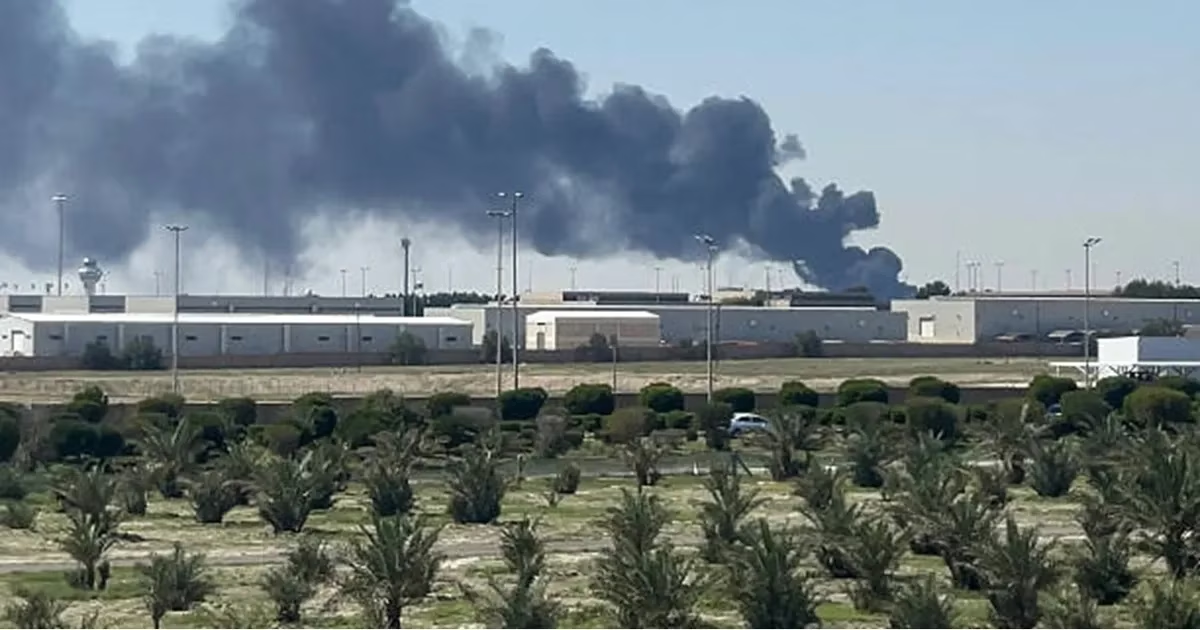
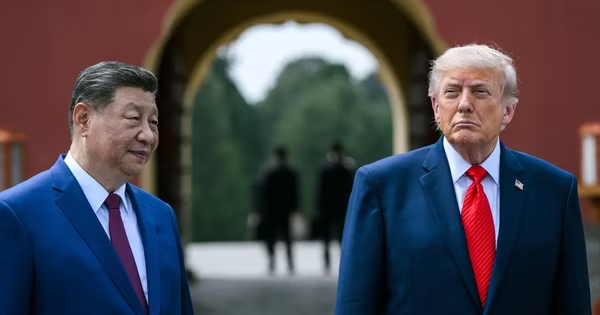
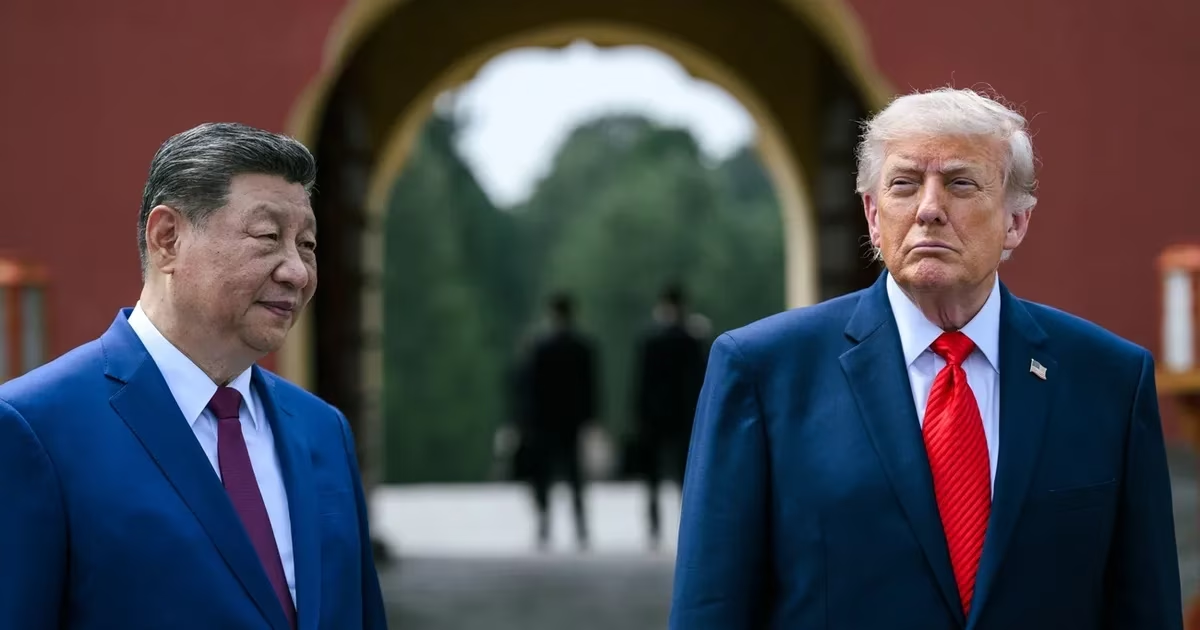
Trump threatens to destroy Iranian uranium stockpile, Pakistani mediation enters crisis line

US President Donald Trump affirmed that the United States is focused on acquiring Iran's entire stockpile of highly enriched uranium in the next phase. Trump explained in a statement to reporters from inside the White House that Washington has no desire to keep this stockpile, but rather aims primarily to strip Tehran of it to ensure it is not used militarily.

In a striking statement, the US President indicated that this stockpile might face destruction once Washington takes control of it, emphasizing that his country will not allow Iran to continue possessing it under any circumstances. Trump also touched on the issue of international navigation, affirming the US administration's categorical rejection of any attempts to impose transit fees in the strategic Strait of Hormuz.

On the international front, Moscow entered the crisis with a new proposal aimed at breaking the deadlock in the nuclear file. Diplomatic sources reported that Russian President Vladimir Putin put forward an idea to transfer Iran's highly enriched uranium and store it within Russian territory, as an international guarantee to help de-escalate the rising tension between Tehran and Washington.

In contrast, official Iranian positions continue to show resistance to harsh American conditions, with local media in Tehran reporting a categorical rejection of the issue of transferring uranium outside the country. Tehran considers that abandoning its enriched uranium stockpile represents a concession of essential leverage in the ongoing negotiation process with international powers.

For his part, US Secretary of State Marco Rubio warned of the repercussions of any Iranian escalation in the Strait of Hormuz, especially regarding the imposition of a fee collection system. Rubio explained that such steps would make reaching a diplomatic agreement almost impossible, which could push the region towards more complex and dangerous options.

Despite the warning tone, Rubio revealed the existence of positive indicators and tangible developments in the recent talks between Washington and Tehran. The US Secretary described the current situation as having "good signs" that could lead to a comprehensive agreement, noting that the US administration sees a real opportunity to push diplomatic solutions forward at present.

On the ground, the Iranian Revolutionary Guard Corps seeks to assert its control over the world's most important shipping lane, announcing the passage of more than thirty ships through the strait in one day. Iranian military sources confirmed that this movement was carried out in full coordination with the Guard's naval forces, in a clear message about the continuation of navigation under its supervision.

In the context of regional efforts to de-escalate the situation, Pakistan's role emerged as a mediating player seeking to bridge the views between the two parties. Pakistani officials are scheduled to arrive in Tehran today to discuss ways to reduce escalation, in a step that international parties are counting on to open a breach in the wall of the complex nuclear and political crisis.

These moves coincide with news of an anticipated visit by the Pakistani army chief, General Asim Munir, to the Iranian capital to support the dialogue process. This visit comes at a very sensitive time, as the Iranian leadership is studying a comprehensive American proposal aimed at ending the escalation that began last late February.

Questions remain about the extent to which these mediations can persuade Tehran to accept the American demand regarding uranium, especially in light of economic and political pressures. International circles are awaiting the results of these shuttle rounds, which may determine the features of the next phase, whether by reaching a historic agreement or returning to the square of open escalation.

We will get the uranium, we don't need it and we don't want it, and we may destroy it after getting it, but we will not allow them to possess it.

PALESTINE

Thu 21 May 2026 9:52 pm - Jerusalem Time

Mladenov Proposes 15-Point Roadmap to End War and Disarm Gaza

The Executive Director of the Gaza Peace Council, Nikolay Mladenov, today, Thursday, outlined a new 15-point UN roadmap aimed at ending the current conflict and establishing a stable transitional phase. This initiative is based on the principle of reciprocity, where each security or political step taken by one party is linked to a parallel measure by the other party to ensure full commitment.

During a video briefing to the UN Security Council, Mladenov explained that the plan is based on five fundamental principles, starting with the necessity of implementing Security Council Resolution 2803. The initial principles also emphasize the completion of all ceasefire conditions, including opening border crossings, providing fuel supplies, and implementing the humanitarian protocol agreed upon in Sharm El Sheikh.

The plan proposes the establishment of an independent international verification mechanism comprising representatives from donor countries and an international force stabilization committee to monitor progress on the ground. Under this proposal, no party will be able to move to a new phase of the agreement without official confirmation that all requirements and obligations of the preceding phase have been met.

Regarding governance, the roadmap stipulates the formation of an international stabilization force to oversee local administration and major reconstruction operations. This measure aims to create suitable conditions for the Palestinian Authority to resume its full administrative and security responsibilities within the Gaza Strip after a defined transitional period.

The UN vision included excluding Hamas and other Palestinian factions from any role in the administration of the Strip, whether directly or indirectly. Points six to nine focus on the impossibility of building a stable society in the presence of military structures parallel to state institutions, which necessitates a comprehensive and gradual disarmament process.

Mladenov stressed that the disarmament process would proceed according to a precise timetable and under international supervision, but he affirmed that the factions would not hand over their weapons to the Israeli side. Instead, military equipment would be handed over to the 'National Committee for Gaza Administration,' which would be responsible for internal security matters in coordination with relevant international bodies.

Point twelve of the plan calls for the deployment of an international stabilization force as a geographical and security barrier between Israeli forces and the areas managed by the National Committee. In return, Israel commits to a full withdrawal from the Strip in phases linked to the progress made in disarmament operations and verification that the areas are free of military manifestations.

For his part, the Deputy UN Special Coordinator for the Peace Process, Ramez Al-Akbarov, warned of the danger of delaying the implementation of international resolutions given the Israeli army's control over approximately 60% of Gaza's area. He indicated that humanitarian conditions have reached catastrophic levels, with the vast majority of the population relying on limited external aid arriving through the crossings.

UN sources concluded by affirming that reconstruction operations would begin immediately in areas officially declared disarmed. They considered accelerating the transitional process to be the only key to ensuring the urgent withdrawal of Israeli forces, while simultaneously warning of the worsening situation in the West Bank due to continuous settlement expansion.

No armed Palestinian group will be asked to hand over its weapons to Israel, but rather to the National Committee for Gaza Administration.

PALESTINE

Thu 21 May 2026 9:52 pm - Jerusalem Time

Hundreds of settlers storm Al-Aqsa, and the occupation releases leader Muhammad Abu Tir

Hundreds of Israeli settlers stormed the courtyards of the blessed Al-Aqsa Mosque today, Thursday, where they carried out provocative tours and performed public Torah rituals. Official sources in Jerusalem Governorate reported that the number of intruders reached 492 settlers, who completed their incursions in two periods, morning and afternoon, under tight guard from the occupation police, who secured their routes inside the Haram al-Sharif.

These escalating movements come in response to calls launched by alleged Temple groups under the name of 'compensatory storming,' coinciding with the Torah 'Feast of Weeks' which falls tomorrow, Friday. According to the Hebrew calendar, settlers seek to intensify their presence today due to their inability to storm the mosque on the actual holiday, which prompted them to turn Al-Aqsa's courtyards into a scene of religious rituals.

The eastern courtyard of Al-Aqsa Mosque witnessed the performance of what is known as 'epic prostration,' which is full prostration on the face, in addition to provocative collective prayers that caused great tension. Local sources explained that these practices are part of attempts to impose a new Judaization reality and the efforts of extremist groups to introduce plant and animal 'sacrifices' into the mosque to consecrate Torah worship there.

In a separate context, the Israeli occupation authorities released the exiled Jerusalemite lawmaker Muhammad Abu Tir, 76 years old, after the end of his administrative detention period. Abu Tir had been held for 6 months under a secret file and without any official charges, a procedure that the occupation authorities have consistently used against Palestinian leaders in occupied Jerusalem.

Lawmaker Muhammad Abu Tir is considered one of the most prominent Jerusalemite figures who have been subjected to systematic persecution, having spent approximately 44 years intermittently in occupation prisons over decades. His suffering with forced deportation began in 2010 when the occupation authorities revoked his Jerusalem identity card and decided to exile him outside his hometown as part of targeting elected representatives.

Human rights reports confirmed that Abu Tir's release highlights the ongoing policy of persecuting Jerusalem's representatives, including Ahmed Attoun, Muhammad Toutah, and former minister Khaled Abu Arafeh. These national figures face fierce campaigns that include repeated arrests and revocation of residency permits, with the aim of emptying the holy city of its influential leaders and silencing their voices from the political and social arena.

Concurrently, Jerusalemite prisoner John William Qaqish breathed freedom after serving a long sentence of 11 years in occupation detention centers. Qaqish was arrested in 2015 after being accused of carrying out a stabbing attack targeting a settler in the alleys of the Old City of occupied Jerusalem, where he was transferred between several Israeli detention centers under harsh conditions during his years in prison.

These successive events in the city of Jerusalem embody a bitter reality experienced by Jerusalemites between the hammer of daily incursions and violations of holy sites, and the anvil of arrests and forced displacement. The issue of prisoners and Jerusalem remains the main axis in the ongoing confrontation with the occupation, amidst the Palestinians' insistence on steadfastness and defending their national and religious identity in the face of Judaization schemes.

The Feast of Weeks is one of the occasions that extremist groups seek to exploit to establish a new Judaization reality inside Al-Aqsa Mosque.

OPINIONS

Thu 21 May 2026 9:52 pm - Jerusalem Time

Security Council Faces First Test for "Peace Council": Report Blames Palestinians and Provides Political Cover for Israel

Washington's Message

Washington – Said Arikat – 21/5/2026

News Analysis

Nikolay Mladenov, the former UN Special Coordinator for the Middle East Peace Process, will brief the UN Security Council on Thursday on the first official report issued by what is known as the "Peace Council," the body formed at the beginning of this year as part of the American initiative for ceasefire arrangements and reconstruction in Gaza.

However, the report, which is supposed to aim at evaluating the implementation of the truce and reconstruction agreement, has sparked widespread criticism since its content was leaked, as it appeared to place primary responsibility for the agreement's failure on the Palestinians, specifically Hamas, while almost completely ignoring the Israeli and American roles in the continuation of the war and the humanitarian collapse in the Strip.

According to information circulated before the Security Council session, the report focuses on what it describes as "Hamas's refusal to give up its weapons" as the main obstacle to implementing the reconstruction plan and political transition in Gaza. It also calls on the international council to exert public pressure on the movement to accept a mechanism of "internationally verifiable disarmament" as a prerequisite for any economic or political progress.

The report comes at a time when Gaza is still experiencing one of the worst humanitarian disasters in its modern history, amidst ongoing Israeli military operations, destruction of infrastructure, restriction of aid entry, and worsening famine and mass displacement. Nevertheless, the report – according to leaks – does not provide serious space for holding Israel accountable for these facts, but rather treats them as “field challenges” related to the security situation.

The "Peace Council" was established within a framework sponsored by the administration of US President Donald Trump, as an international body to monitor the implementation of the ceasefire agreement, oversee the reconstruction of Gaza, and transitional governance arrangements. However, critics have considered from the outset that the Council was designed in a way that gives the United States and Israel the upper hand in determining the future of the Strip, with effective marginalization of the Palestinians themselves and traditional UN institutions.

Observers believe that the Council's first report clearly reveals the nature of the political approach governing its work; it reduces the crisis to the issue of "Hamas's weapons," while avoiding delving into the roots of the conflict related to occupation, settlement, siege, and the ongoing war against Palestinians.

The report reflects a deliberate attempt to reframe the political narrative of the war, transforming Israel from an occupying power accused of committing widespread violations into a party seeking “stability and security,” while presenting Palestinians as the primary obstacle to peace. This approach not only ignores the scale of destruction and killing suffered by civilians in Gaza but also practically seeks to criminalize the Palestinian right to resist occupation and turn the humanitarian tragedy into a political pressure tool to impose Israeli and American conditions under the guise of reconstruction and stability.

What is striking in the report is that it speaks at length about the necessity of "disarmament," but it almost avoids any mention of ending the occupation, lifting the siege, or holding Israel accountable for the destruction of Gaza. This imbalance does not seem accidental, but rather reflects an entire political structure that attempts to redefine peace as a complete Palestinian surrender to Israeli conditions. Instead of addressing the roots of the conflict, the focus is on managing its security outcomes, thereby transforming the United Nations from a platform that is supposed to defend international law into a body that provides diplomatic cover for the balance of power imposed by Washington and Tel Aviv.

The most dangerous aspect of the "Peace Council" is not only its political content but also that it is an attempt to bypass traditional international institutions and replace them with a structure closer to a political platform led by the United States to serve the Israeli vision for the war and its aftermath. The Council, as its first report shows, does not treat Palestinians as a people with national and political rights, but rather as a security and humanitarian file that needs “management and control.” From this perspective, the proposed idea of peace seems closer to a project to re-engineer Palestinian reality under American and Israeli supervision, rather than a genuine path to achieving justice or ending the occupation.

PALESTINE

Thu 21 May 2026 9:52 pm - Jerusalem Time

Israeli Minister Attacks Palestinians in Knesset with Racist Remarks

Israeli Heritage Minister Amichai Eliyahu sparked outrage after renewing his racist and offensive remarks against Palestinian citizens in the occupied territories of 1948. During an official session in the Israeli Knesset, the minister, a member of the far-right 'Jewish Power' party, deliberately mocked Arab Knesset member Waleed Al-Hawashla, representative of the United Arab List, in a scene reflecting the growing extremist rhetoric within the Israeli government.

Eliyahu directly addressed MP Al-Hawashla with what were described as insulting remarks, claiming that if the State of Israel had not been established, Palestinians would still be living a primitive life and riding camels. These statements come in the context of a series of hostile stances adopted by the extremist minister towards the Palestinian presence, and it is not the first time he has stirred controversy with his incitement against Arabs.

The Israeli minister's claims ignore documented historical facts about Palestine before the 1948 Nakba, when the country enjoyed a developed urban society and a prosperous economy. Cities such as Jaffa, Haifa, and Acre were major cultural and economic centers, home to modern schools, daily newspapers, theaters, and cinemas, in addition to a banking sector and commercial companies that connected Palestine to the outside world.

Furthermore, the Palestinian economy at that time relied on advanced agriculture, especially in the citrus sector, which was exported to various continents, alongside active international trade through Palestinian ports. Palestinians enjoyed high educational and cultural levels compared to their regional surroundings, which refutes the Zionist narrative that attempts to portray the country as barren land before the occupation.

Currently, Palestinians within Israel constitute about 21 percent of the total population, and despite systematic discriminatory policies practiced against them, they have achieved remarkable successes in scientific, medical, and professional fields. International reports from organizations such as 'Amnesty International' and 'Human Rights Watch' confirm that this segment of the population faces a system of apartheid and continuous oppression in various aspects of life.

Minister Eliyahu is known for his radical positions, having previously openly called for striking the Gaza Strip with a nuclear bomb following the events of October 7, 2023. These statements reflect the mindset that governs some ministerial portfolios in the current government, which adopts policies of genocide and forced displacement against the Palestinian people wherever they are.

These developments come at a time when the occupation authorities continue their widespread aggression on the Gaza Strip, which has caused massive destruction affecting about 90 percent of the civilian infrastructure. Medical sources reported that the number of casualties exceeded 172,000, including martyrs and injured, amidst ongoing military operations targeting civilians and vital facilities despite international warnings and demands to stop the war of extermination.

If the State of Israel had not been established, Waleed and his friends would still be riding camels.

PALESTINE

Thu 21 May 2026 5:59 pm - Jerusalem Time

London summons Israeli diplomat in protest of Ben Gvir's abuse of Freedom Flotilla activists

The British government, today, Thursday, summoned the Israeli Chargé d'Affaires in London, following a wave of international outrage sparked by a video posted by the extremist Israeli National Security Minister Itamar Ben Gvir. In the recording, Ben Gvir was seen directing sarcastic and demeaning remarks at a group of 'Global Freedom Flotilla' activists who were arrested after their boats, headed to break the siege on the Gaza Strip, were intercepted. The activists appeared in harsh conditions, bound and kneeling on the ground.

The British Foreign Office confirmed in an official statement that this provocative behavior raises deep concern for the United Kingdom, emphasizing its strong condemnation of actions aimed at undermining the dignity of those participating in the humanitarian flotilla. Sources clarified that London demanded urgent and transparent explanations from the occupation authorities regarding the circumstances of these activists' detention, considering what appeared in the video to be a blatant violation of international standards related to respect and human dignity.

During its meeting with the Israeli diplomat, the British Foreign Office stressed the necessity for the occupation authorities to commit to protecting the rights of all detainees under their custody and respecting applicable international laws in this regard. This British move comes in the context of increasing international pressure, as London joined a long list of capitals that have summoned occupation ambassadors, including Paris, Madrid, Berlin, and Canberra, in protest of the abuse of solidarity activists holding nationalities from more than 40 countries.

Reports indicate that the occupation army had intercepted dozens of the flotilla's boats in international waters over the past two days, resulting in the detention of approximately 430 international activists. These solidarity activists were forcibly transferred to Ashdod port, and then deported to 'Ketziot' prison in the Negev desert, amidst demands from Ben Gvir to treat them with the same harshness with which Palestinian prisoners are treated in occupation prisons.

In the same context, European parties, including European Council President Antonio Costa, described the leaked scenes as 'shocking and unacceptable,' while some countries have already begun procedures for repatriating their citizens through intermediary countries such as Turkey. Human rights warnings are escalating regarding the continued detention of these activists in inhumane conditions, especially after footage showed the deliberate humiliation of them by the occupation police under the direct supervision of ministers in the extremist right-wing government.

The provocative video posted by Minister Ben Gvir raises serious concerns and violates the most basic standards of human dignity.

PALESTINE

Thu 21 May 2026 5:59 pm - Jerusalem Time

Navigational Data Reveals Details of 'Freedom Flotilla' Interception and Prevention from Reaching Gaza

Precise navigational data revealed the full course of the 'Freedom Flotilla' journey, which began from the Spanish city of Barcelona on April 12th. This civilian maritime mission was launched with the aim of breaking the naval blockade imposed on the Gaza Strip and opening a direct humanitarian corridor, with broad participation from multiple countries, including dozens of ships and hundreds of international solidarity activists.

The first phase of the journey saw additional ships join as they crossed the Mediterranean Sea, with over 50 vessels departing from Augusta port in Sicily, Italy, on April 27th. The convoy was accompanied by well-known support ships such as Greenpeace's 'Arctic Sunrise' and the 'Open Arms' vessel, marking the campaign's transition to the actual approach phase to the Eastern Mediterranean.

Ship tracking data from 'Marine Traffic' showed the first obstacles off the Greek island of Crete, where the convoy experienced a sharp division after interceptions in international waters. According to monitoring data on April 30th, 22 ships were classified as 'intercepted,' while 36 other ships insisted on continuing their voyage towards their final destination in the Gaza Strip.

The remaining ships and boats were spread over a wide area southwest of Crete, while organizers used symbolic Palestinian names for the ships on their official website. However, commercial navigation platforms continued to track them via their registered official names and the Automatic Identification System (AIS), which continued to broadcast its signals despite the field challenges.

Turkish coasts later became a strategic gathering point for regrouping, with about 15 ships arriving in the Marmaris area on May 10th. The flotilla organizers explained that this stop was a 'technical' one par excellence, aimed at holding meetings for representatives from 50 countries to discuss the mission's strategic plans before resuming sailing.

On May 14th, the flotilla announced the launch of the final and decisive phase from Marmaris towards the Gaza Strip, after completing the necessary political and technical arrangements. A number of participants returned aboard the ships after being released by authorities who had intercepted them at previous stops, reaffirming their determination to reach the Palestinian coasts.

Prior to the widespread Israeli interception, tracking devices detected the ships approaching eastern Cyprus, amid reports of unknown drones flying overhead and fast boats surrounding the convoy. Field sources reported that Israeli forces began widespread interception operations on May 18th in an area located within international waters.

The main interception operations took place approximately 143 kilometers west of the island of Cyprus, a distance estimated at about 468 kilometers from the Gaza Strip's coasts. This military move came after a arduous sea journey that lasted more than five weeks, during which participants faced significant political and field pressures to prevent them from completing their journey.

For its part, the Israeli Ministry of Foreign Affairs affirmed that Tel Aviv would not allow any breach of the naval blockade imposed on Gaza, regardless of the justifications. Israeli authorities described the flotilla as a 'provocative act' serving the interests of the Hamas movement, stressing that they would take all necessary measures to prevent the ships from reaching the shores of the Strip.

The flotilla organizers announced that their ships were besieged by Israeli warships in international waters 250 nautical miles from Gaza. The number of ships visible on tracking maps gradually decreased from dozens of boats to just ten, then to eight ships, before the two ships 'Aka' and 'Beit Hanoun' were fully intercepted.

Navigational data indicated that the last ship intercepted was only 100 nautical miles from the Palestinian coast, reflecting the extent the campaign had reached. The flotilla confirmed that the ship 'Ramla,' known navigationally as 'Sirius,' was the closest to the Strip, reaching a distance of 80 nautical miles before being taken over by Israeli forces.

The final tally of interception operations reached 69 ships and boats, with 428 participants from over 40 countries worldwide arrested. Organizers accused Israeli forces of firing on at least two boats within the convoy, which Tel Aviv denied, claiming no live ammunition was used during the operations to take control of the ships.

The attack sparked angry international reactions, with ten countries, including Turkey, Spain, Jordan, and Libya, issuing a joint statement condemning the attacks in the strongest terms. These countries considered the targeting of civilian ships and the detention of activists a blatant violation of international humanitarian law, calling on the international community to end the policy of impunity.

In a related context, the United Nations expressed deep concern about the safety of the detained activists held by Israeli authorities. The spokesperson for the Secretary-General, Farhan Haq, called for the situation to be handled peacefully and for ensuring that none of the participants were harmed, emphasizing the importance of respecting human rights in dealing with such humanitarian missions.

The attacks on civilian ships and the detention of activists constitute a blatant violation of international law and international humanitarian law.

PALESTINE

Thu 21 May 2026 5:58 pm - Jerusalem Time

Albanese: Ben-Gvir's Violations Represent the Israeli Government's Approach, and the Gaza Scenario Threatens Other Countries

The UN Special Rapporteur on human rights in the occupied Palestinian territories, Francesca Albanese, affirmed that European reactions to the Israeli attacks on the Global Freedom Flotilla were necessary but severely delayed. She explained in media statements that these stances did not rise to the level of crimes committed by Tel Aviv against Palestinians daily, noting that limiting condemnation to National Security Minister Itamar Ben-Gvir is an inadequacy in describing the situation.

Albanese stressed that what happened to the international solidarity activists represents the behavior of an entire government, not just individual actions, as activists were abducted from international waters and their ships were seized in a manner resembling piracy. She added that these activists were subjected to assault, beating, and arrest merely for their courage and refusal to back down in the face of Israeli threats while heading to break the siege on the Gaza Strip.

The UN Rapporteur considered that Benjamin Netanyahu's government, supported by the Knesset and the Israeli judiciary, has succeeded in transforming grave violations against Palestinians into a permanent behavior and an acquired right exercised against any opponent of its policies. She indicated that this institutional approach provides legal and political cover for repressive practices that transcend all applicable international laws and norms.

Albanese affirmed that the violations committed by Ben-Gvir against the Flotilla activists are an extension of what tens of thousands of Palestinians are subjected to, who are abducted, tortured, and raped in detention centers. She expressed her astonishment at the absence of clear European condemnations of these systematic crimes targeting Palestinian individuals through various inhumane means.

She called on countries to stop funding Israel through economic agreements and immediately refrain from supplying it with weapons used to kill civilians. She also appealed to some Arab countries that support Tel Aviv's policies to review their positions and stop this support, which contributes to the continued suffering of the Palestinian people under occupation.

Albanese warned that Israel will not cease its practices unless it faces a real international deterrent, asserting that it will continue its policies of killing, starvation, and assaults within prisons as a permanent approach. She cautioned that international silence would give the green light for the Gaza scenario to be repeated in other countries in the region, which has already begun to manifest clearly in attacks on Lebanon and Iran.

The UN Rapporteur revealed shocking figures documented in her latest report for 2024, confirming the disappearance of over 4,000 Palestinians after their arrest by occupation forces. She indicated that the report included documentation of cases of rape and serious physical and psychological violations systematically practiced within Israeli interrogation centers and detention facilities.

In a related context, Albanese mentioned that about 100 Palestinians have died in Israeli prisons since the current government began using abuse as an official policy. She held National Security Minister Ben-Gvir directly responsible, while also emphasizing that responsibility lies with the parliament and judiciary, which enacted harsh laws, including the law for executing prisoners.

Albanese expressed her surprise at the silence of academic, human rights, and judicial elites within Israel regarding these crimes, despite the existence of limited Israeli voices protesting the apartheid policy. She described Ben-Gvir's filming of the abuse of activists as a narcissistic behavior reflecting arrogance resulting from an absolute feeling of impunity and lack of international accountability.

On the international level, sources reported that France, Italy, Spain, the Netherlands, Belgium, and Canada summoned Israeli ambassadors to provide official explanations regarding the attack on activists. Britain also expressed its shock at the videos published by Ben-Gvir, which show the humiliation of international solidarity activists during their arbitrary arrest.

Regarding the decision to remove her name from the US sanctions list, Albanese explained that this development resulted from an independent judicial decision, not a change in US administration policy. She noted that her daughter, who holds US citizenship, had filed a legal protest to end the injustice against an international employee enjoying UN protection.

The UN Rapporteur anticipated that attempts to silence her would continue, especially by the current US administration, similar to what is happening with International Criminal Court judges. She affirmed that these pressures would not deter her from performing her duty to document crimes and provide necessary recommendations to prosecute those involved in human rights violations.

Albanese had previously recommended prosecuting Israeli and American officials for war crimes before international courts. She also accused major American companies in her reports of complicity in the ongoing genocide campaign in the Gaza Strip, which exposed her to widespread pressure and financial and diplomatic sanctions.

It is worth noting that the US Federal Judiciary found that the sanctions imposed on Albanese likely violated her right to freedom of expression, leading to their temporary suspension. Albanese remains one of the most prominent international voices documenting occupation violations, despite continuous incitement campaigns against her by official circles in Tel Aviv and Washington.

Failure to confront Israel means it will repeat what it did in Gaza in other countries, which it has already done in Lebanon and Iran.

PALESTINE

Thu 21 May 2026 5:58 pm - Jerusalem Time

Funeral of a martyred child in Beit Lahia and retrieval of 3 other bodies south of the Gaza Strip

Large crowds in the Beit Lahia project, north of the Gaza Strip, bid farewell to the body of the martyred child, Jude Al-Dweik, 13 years old, who was killed as a result of an attack carried out by a drone belonging to the occupation army. Medical sources at Al-Shifa Hospital confirmed the arrival of the child's body and two other injured individuals, after a 'quadcopter' drone directly dropped a bomb on a gathering of citizens in the area, leading to these casualties among civilians.

In the southern areas of the Strip, ambulance and civil defense teams were able to retrieve the bodies of three Palestinian martyrs who had fallen earlier by the fire of the occupation forces. Medical sources at Nasser Hospital explained that two of the martyrs, who were retrieved from the Al-Alam roundabout area in Mawasi Rafah, were working as drivers of humanitarian aid trucks, where Israeli bullets targeted them while they were performing their duties days ago.

Medical teams also succeeded in retrieving the body of a third martyr from the Al-Qarara area, located northeast of Khan Yunis city, who had been killed by the occupation army's fire in recent days without the teams being able to reach him at the time. In a related context, field sources reported that a Palestinian citizen was injured with varying degrees of wounds as a result of a bomb dropped by an Israeli drone targeting the vicinity of the Halawa displacement camp in the Jabalia Al-Balad area, north of the Strip.

These field developments come amidst the continued violation by the occupation state of the ceasefire agreement that came into effect on October 10, 2025. Official statistics indicate that these violations have so far resulted in the martyrdom of 881 Palestinians and the injury of 2621 others, adding these numbers to the catastrophic toll of the ongoing war of extermination since October 2023, which has left more than 72,000 martyrs and massive destruction to the infrastructure of the Strip.

The occupation continues to violate the ceasefire agreement, with the death toll since last October 10 reaching 881 martyrs and 2621 injured.

PALESTINE

Thu 21 May 2026 5:58 pm - Jerusalem Time

Occupation closes Zakat Committee in Jenin and launches widespread arrest campaign in West Bank

The Israeli occupation army carried out a series of widespread incursions and raids targeting several cities and towns in the occupied West Bank this Thursday morning. These operations focused on the governorates of Nablus, Jenin, and Hebron, resulting in the arrest of a number of citizens and the destruction of private property and public institutions.

In a significant development in Jenin city, occupation forces stormed the headquarters of the Zakat Fund Committee, wreaking havoc before deciding to completely close it. Local sources reported that soldiers seized a collection of belongings and documents belonging to the committee, which provides humanitarian and relief services to needy families in the area.

The violations in Jenin were not limited to charitable institutions but extended to the commercial market in the city center, where Israeli forces raided commercial shops. Sources confirmed that the occupation seized quantities of agricultural materials from one of the stores before withdrawing from the area.

In the Nablus governorate, north of the West Bank, occupation forces launched a raid campaign that affected various neighborhoods and villages, resulting in the arrest of at least three citizens. The incursion involved a thorough search of homes and tampering with their contents, causing a state of panic among local residents, especially children and women.

Moving to the southern West Bank, specifically in the city of Dura in the Hebron governorate, occupation forces arrested three Palestinians, including a released prisoner who had spent years in prisons. These arrests came after raiding and provocatively searching their homes, as part of the continuous policy of pursuing released prisoners.

In the town of Bani Na'im, east of Hebron, occupation vehicles stormed the town and subjected dozens of young men to harsh field interrogations in the open. Videos circulated on social media platforms showed occupation soldiers detaining and abusing citizens amidst strict security measures.

For its part, the Prisoners' Information Office confirmed in a press statement that these daily campaigns fall within the policy of collective punishment practiced by the occupation against the Palestinian people. The statement clarified that the acts of abuse and destruction accompanying the incursions aim to break the will of citizens and systematically intimidate them.

These measures in Jenin are a continuation of the policy of targeting charitable organizations, as the occupation had previously closed similar headquarters in the town of Idhna in Hebron last month. The occupation had then arrested former Minister of Endowments Hatem Al-Bakri after storming the headquarters of the Islamic Charitable Society which he heads.

Regarding settler attacks, the Masafer Yatta area, south of Hebron, witnessed a widespread theft incident targeting the livelihoods of Palestinian citizens. A group of settlers infiltrated Khirbet Huraibat al-Nabi at dawn and cut the locks of a sheep pen belonging to the Abu Ali family.

Citizen Mohammed Abu Ali reported that the settlers stole approximately 50 sheep, in addition to the guard dogs that were protecting the flock. He pointed out that these livestock represent the sole source of livelihood for his family, accusing the settlers of working in coordination with the army to displace them from their lands.

Residents of Masafer Yatta described the recent attacks as the most severe in years, as they are subjected to almost daily attacks including tear gas and beatings. These practices, according to observers, aim to tighten the noose on Bedouin and agricultural communities to force them to leave for the sake of settlement expansion.

In a related context, the Wall and Settlement Resistance Commission revealed in its latest report a frightening escalation in the pace of settler attacks in the West Bank. The governmental body documented more than 1600 attacks in April alone, including armed attacks, property destruction, and uprooting trees.

Official Palestinian data indicates that the West Bank has been in a state of turmoil since the start of the aggression on the Gaza Strip in October 2023. The death toll in the West Bank has risen to 1162 martyrs, while the number of injured has exceeded 12,000 as a result of ongoing confrontations.

Arrest campaigns also peaked in recent months, with human rights organizations recording the arrest of nearly 23,000 Palestinians from various West Bank governorates. These arrests are often made under administrative detention or on charges related to political and field activity against the occupation.

The continuation of daily arrest campaigns, acts of abuse, and destruction reflects the escalation of the policy of repression and collective punishment pursued by the occupation forces.

PALESTINE

Thu 21 May 2026 5:58 pm - Jerusalem Time

4 Martyrs in Gaza and the Retrieval of Bodies of Aid Drivers Amidst Continued Occupation Violations

The death toll in the Gaza Strip rose today, Thursday, due to attacks by Israeli occupation forces, with four citizens martyred and others injured in targeted attacks across various areas of the Strip. Medical and field sources reported that the attacks focused on the northern and southern parts of the Strip, noting that the occupation continues to use drones and direct sniping against civilians despite the ongoing ceasefire agreement.

In details of the field aggression, 13-year-old child Jude Dweik was martyred, and two other Palestinians were injured with varying degrees of severity after a 'quadcopter' drone dropped a bomb on a gathering of citizens in the Beit Lahia project in the northern Strip. Another drone also targeted the vicinity of the Halawa displacement camp in the Jabalia البلد area, resulting in an injury among the displaced who are suffering from harsh humanitarian conditions.

In the southern Strip, two Palestinians were martyred by the bullets of occupation soldiers stationed in military control areas in Mawasi, Rafah city, an area that witnesses repeated incursions and attacks. In the town of Al-Qarara, northeast of Khan Yunis city, a fourth martyr fell by the bullets of occupation forces who continue to target anyone moving near the lines of contact.

Regarding search and rescue operations, ambulance crews were able to retrieve the bodies of two martyrs from the Al-Alam roundabout area in Mawasi, Rafah, who were later identified as drivers of humanitarian aid trucks. Medical sources at Nasser Hospital confirmed that the drivers were martyred by the bullets of the occupation army several days ago while attempting to carry out their relief duties, without any field justifications for targeting them.

In a related context, medical teams retrieved the body of another martyr from the Al-Qarara area who had fallen by occupation fire days earlier, as field conditions had prevented access to him sooner. These developments come amidst continued Israeli violations of the ceasefire agreement signed in October 2025, with human rights organizations documenting the martyrdom of 881 Palestinians and the injury of 2621 others since the agreement came into effect.

It is worth noting that the Gaza Strip is still recovering from the wounds of two years of genocidal war that began on October 7, 2023, which left massive destruction affecting about 90% of civilian infrastructure. The ongoing aggression in its various forms has resulted in the martyrdom of more than 72,000 and the injury of over 172,000 citizens, amidst international support and silence regarding the continuous violations of international laws.

The total number of victims of ceasefire violations since October 10, 2025, has reached 881 martyrs and 2621 injured.

PALESTINE

Thu 21 May 2026 5:58 pm - Jerusalem Time

Hundreds of settlers storm Al-Aqsa Mosque during 'Shavuot' amid tight protection

Hundreds of extremist settlers stormed the courtyards of the blessed Al-Aqsa Mosque in occupied Jerusalem this Thursday morning, to commemorate what is called 'Shavuot' or 'The Giving of the Torah'. These incursions took place under tight security protection provided by the Israeli occupation forces, who were heavily deployed throughout the Al-Haram Al-Sharif area to secure the paths of the intruders and prevent Palestinian worshipers from obstructing them.

Field sources in Jerusalem reported that the invading groups, whose number was estimated at about 270 settlers during the morning tour, deliberately performed public Talmudic rituals in the eastern part of the mosque. The extremists also carried out provocative tours in the courtyards, which included explanations about the alleged 'Temple', amid strict restrictions imposed by the occupation police on the entry of Palestinian worshipers and checking their identities at the outer gates.

These escalating actions come as part of a series of widespread violations witnessed at Al-Aqsa Mosque over the past week, where extremist 'Temple' groups led intensive mobilization campaigns. According to Jerusalemite data, the number of settlers who desecrated the mosque during the past seven days exceeded 2772 intruders, who entered under the guise of 'tourism' and with direct protection from Israeli security and police forces.

In recent days, serious transgressions occurred inside the mosque's prayer hall and its courtyards, including organizing dance circles and group singing, in addition to raising the flags of the occupation authorities in a blatant defiance of Muslim sentiments. These provocations culminated last Thursday, coinciding with the organization of the Judaization 'Flags March' which paraded through the streets of the Old City and reached the Al-Buraq Wall area.

For their part, national and religious bodies in Jerusalem warned of the accelerating pace of Judaization practices aimed at changing the existing historical and legal status in Al-Aqsa Mosque. These bodies affirmed that the occupation is trying, through the policy of 'temporal and spatial division', to impose a new reality aimed at consolidating complete control over Islamic holy sites, calling on Palestinians to intensify their presence and steadfastness in the mosque to thwart these plans.

The occupation seeks, through these systematic incursions, to impose a new reality by force and consolidate its complete control over Islamic holy sites.

PALESTINE

Thu 21 May 2026 12:30 pm - Jerusalem Time

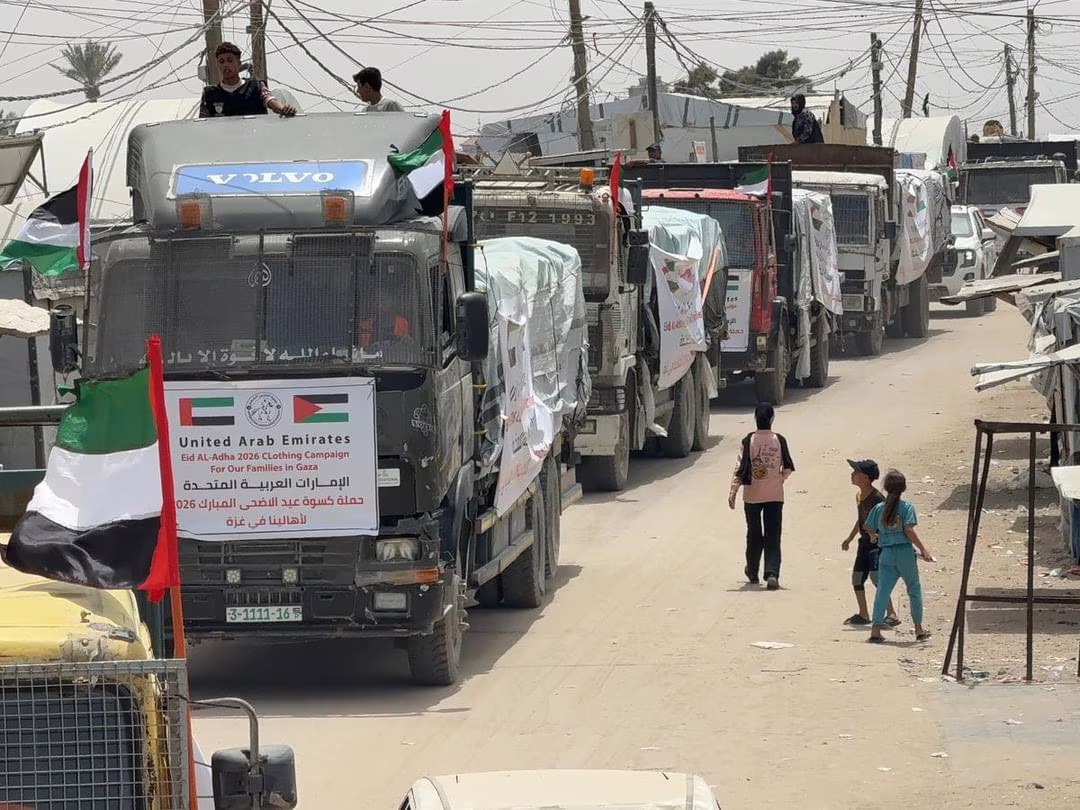
Supported by the UAE International Aid Agency.. "Gallant Knight 3" operation brings Eid joy to Gaza via 40 Emirati aid trucks

Extending the continuous bridges of giving, the UAE dispatched a new aid convoy to the Gaza Strip loaded with Eid clothing, as part of the "Gallant Knight 3" operation, in a step that embodies the state's firm commitment to supporting and assisting Palestinian brethren in light of the current circumstances.

The humanitarian convoy included 40 trucks loaded with 600 'pallets' with a total weight of nearly 540 tons of Eid clothing designated for Gaza children; in a kind gesture aimed at extracting joy from the heart of suffering and the harsh conditions the Strip is experiencing.

This initiative comes as a dedication to the UAE's pioneering humanitarian role, and an affirmation of its consistent approach in leading urgent relief response, and extending a helping hand and support to affected families and groups, foremost among them children.

The wheel of giving for the "Gallant Knight 3" operation does not stop, as it continues to launch and implement its integrated humanitarian plans, which constitute a lifeline to provide basic necessities for living, and alleviate the burden of the harsh conditions weighing on the brethren in Gaza.

OPINIONS

Thu 21 May 2026 12:30 pm - Jerusalem Time

Between the Alleys of the South and the Rubble of Gaza.. Mothers Carry Nations and Weddings Defy Annihilation

Ramallah - “Alquds ” dot com

Ramallah - “Alquds ” dot com

Opinion Writer

In a scene that encapsulates the recurring tragedy of displacement, women from South Lebanon emerged carrying their children and fragments of crumbling homelands, fleeing from a war machine that distinguishes not between home and playground. These children, unaware of the complexities of politics or military maps, now embody the concept of homeland in their mother's embrace, the only place that still makes them feel safe amidst the desolate paths of displacement and the hastily abandoned homes, leaving behind details of an entire life that may never return.

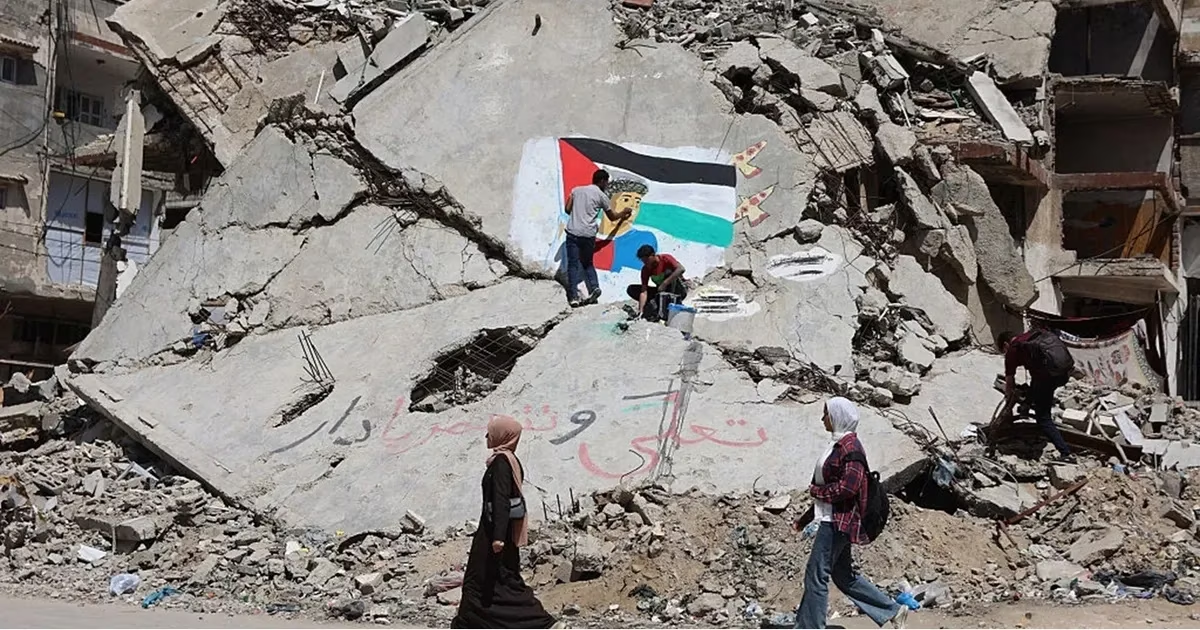
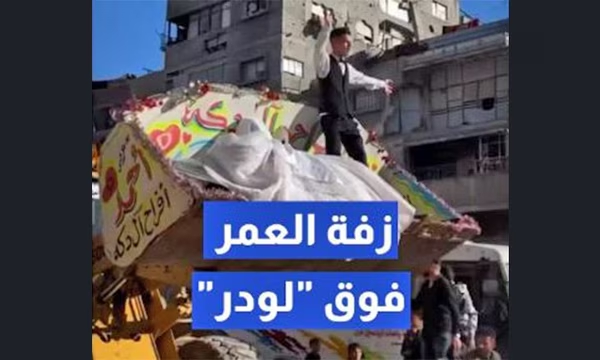
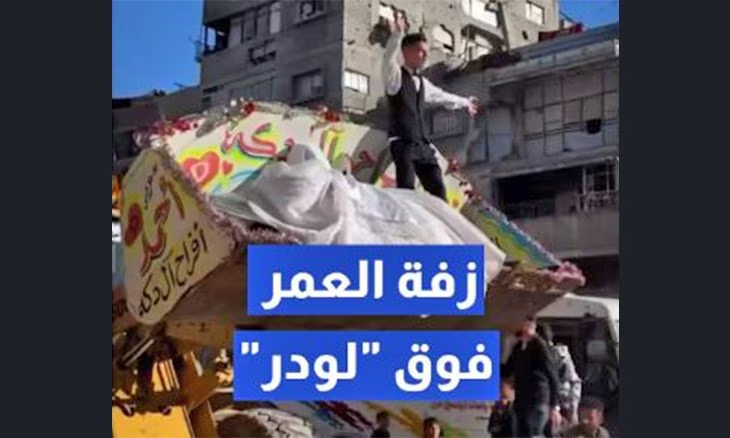
On the other side of the pain, specifically in the Gaza Strip, a different image of resilience emerged; where bulldozers accustomed to clearing rubble became platforms for weddings. There, a bride in her pristine white dress was paraded atop a massive bulldozer 'scoop', in a surreal scene that breaks the intensity of the gray color dominating the shattered city. This joy was not merely a traditional celebration, but a cry in the face of annihilation, and an affirmation that the will to live is capable of snatching moments of happiness from the jaws of catastrophe.

Connecting the suffering of the displaced mother in Lebanon and the resilient bride in Gaza reflects the unity of pain and destiny in the region. Wars that steal the innate sense of security always fail to strip away the inner dignity of humanity. While civilians and children pay the highest price for war decisions, clinging to life, whether by protecting a child or holding a wedding amidst the ruins, remains the greatest human miracle that proves the human heart is stronger than all tools of destruction.

Gaza does not dance because it does not hurt, but dances because it hurts so much; joy amidst death transforms into a small miracle.

PALESTINE

Thu 21 May 2026 12:30 pm - Jerusalem Time

Khan al-Ahmar Displacement Plan: Israeli Efforts to Impose a New Settlement Reality East of Jerusalem

Recently, fears have been escalating among Palestinian residents in the Bedouin community of Khan al-Ahmar, located east of occupied Jerusalem, regarding the implementation of an immediate eviction order issued by Israeli Finance Minister Bezalel Smotrich. This step comes amidst widespread Palestinian warnings that the true goal is to pave the way for the implementation of the massive settlement project known as 'E1', which aims to connect the 'Ma'ale Adumim' settlement with the city of Jerusalem.

Field sources reported that the community is located in a strategic area alongside the road connecting the Palestinian Jordan Valley and Jerusalem, where approximately 200 Palestinian citizens have resided for many decades. These residents face severe restrictions imposed by the occupation authorities, forcing them to use rough and dangerous dirt roads to reach their homes and secure their basic daily needs.

In light of these threats, activists and solidarity supporters from the Wall and Settlement Resistance Commission have begun to arrive at the community to strengthen the steadfastness of the residents and prevent any attempt to implement the eviction order by force. Observers believe that this popular presence represents the first line of defense against plans aimed at liquidating the Palestinian presence in areas classified as 'C' in the occupied West Bank.

For his part, Abdullah Abu Rahma, Director General of the Popular Action Department at the Commission, stated that the decision to evict Khan al-Ahmar comes at a sensitive time when regional tensions and wars occupy the attention of the international community. He affirmed that the occupation authorities are exploiting this preoccupation to pass settlement projects that were previously frozen due to international pressure, warning of the seriousness of the current stage.

Abu Rahma explained that systematic attacks, demolition operations, and displacement have witnessed an unprecedented escalation since the events of last October 7th, with more than 80 Palestinian communities displaced in various areas. He also pointed to the expansion of settlement outposts, which have reached approximately 380 outposts, in an attempt to impose full Israeli sovereignty over Palestinian lands.

Minister Smotrich is leading an extremist government trend aimed at legitimizing and expanding settlements, having recently boasted about approving 103 new settlements in the West Bank. The Wall Resistance Commission considers that this policy aims to undermine any future opportunity for the establishment of a Palestinian state by tearing apart Palestinian geography and transforming it into isolated enclaves.

Abu Rahma stressed that attempts to displace Khan al-Ahmar are not new, as popular steadfastness and international pressure thwarted them in 2018, making the community a national symbol of popular resistance. He warned that the fall of Khan al-Ahmar would necessarily mean the fall of dozens of other Bedouin communities surrounding the city of Jerusalem, which face the same fate.

The 'E1' settlement plan aims to create geographical contiguity between the major settlements surrounding Jerusalem, which will practically lead to the complete separation of the northern West Bank from its south. This scenario will make the establishment of a geographically contiguous Palestinian state technically and politically impossible, which is what the right-wing currents in the Israeli government seek.

On the humanitarian level, Haj Abu Ismail, one of the residents of the community, recounts that his family settled in Khan al-Ahmar in the 1950s after their first forced displacement from their original lands. He affirmed that five generations of his family were born and raised on this land, making their connection to it an existential matter that cannot be compromised or bartered.

The residents affirm their categorical rejection of all temptations or pressures exerted by the occupation authorities to move them to other areas such as Al-Eizariya or Nuweima. Residents describe the displacement attempts as 'slow death', affirming their determination to stay even if tents and houses are demolished over their heads, preferring to live under the sun rather than leave again.

Daily violations by settlers against residents continue under direct protection from the occupation army, with these attacks including intimidating children and vandalizing property. Residents reported that these harassments continue day and night with the aim of driving them to despair and voluntarily leaving the area, but this has only increased the residents' attachment to their locations.

Khan al-Ahmar is currently surrounded by approximately five new settlement outposts established in recent years to tighten the siege on the Bedouin community and isolate it from its Palestinian surroundings. These outposts act as field pressure tools to confiscate pastures and prevent residents from raising their livestock, which has been their sole and primary source of livelihood for decades.

Despite these harsh conditions, the Khan al-Ahmar primary school remains steadfast and receives dozens of students from neighboring communities, despite several demolition orders issued against it. This school represents an educational and political challenge to the occupation, as teaching staff and residents insist on the continuation of the educational process as part of the battle for survival.

Israel exploits the Oslo Accords classifications of 'C' areas to justify demolition and displacement operations under flimsy security pretexts, while the reality on the ground confirms that it is a policy of settlement expansion. Khan al-Ahmar remains today in the eye of the storm, as it represents the last obstacle to the completion of the Greater Jerusalem project and the liquidation of the Palestinian presence east of the holy city.

Displacement is death... if they demolish all the houses, we will stay here and sit under the sun.

PALESTINE

Thu 21 May 2026 12:30 pm - Jerusalem Time

UNRWA warns of health catastrophe: 125,000 skin infections in Gaza due to rodents

The United Nations Relief and Works Agency for Palestine Refugees (UNRWA) has revealed shocking figures reflecting the scale of health deterioration in the Gaza Strip, with over 125,000 cases of skin infections reported due to the spread of rodents and parasites. The agency clarified that this statistic covers the first five months of 2026, indicating a dangerous acceleration in the pace of environmental crises afflicting the besieged strip.

The international agency affirmed that its field medical teams are making strenuous efforts to deal with this crisis, providing treatment to approximately 400 cases daily suffering from various skin symptoms. However, medical sources affiliated with the agency stressed that the ability to contain this outbreak remains dependent on the availability of sufficient medical supplies, which suffer from a severe shortage due to ongoing restrictions on aid entry.

Health experts attribute this sharp increase in infections to the widespread destruction of vital infrastructure, particularly sewage and water drainage networks, which has transformed large areas into fertile environments for the proliferation of insects and rodents. This suffering is exacerbated by the overcrowding of displaced persons in camps lacking the most basic public hygiene facilities, which facilitates the transmission of skin infections and parasites among the population.

UNRWA warned through its official platforms that the continuation of war and destruction increases the risks of more dangerous epidemic outbreaks, given the health system's inability to provide a full response. It pointed out that the severe shortage of fuel needed to operate health facilities and water treatment plants directly contributes to deepening this humanitarian tragedy experienced by more than two million Palestinians.

It is worth noting that the Gaza Strip has faced harsh living conditions for many years, but the recent military escalation has led to a near-complete collapse of basic services. International warnings are increasing that the continuation of this situation without urgent intervention to restore the health sector and provide medical supplies will lead to an uncontrollable epidemic catastrophe in the near future.

The Gaza Strip is witnessing a worsening health crisis with the increasing spread of rodents and parasites and rising rates of skin infections.

PALESTINE

Thu 21 May 2026 11:30 am - Jerusalem Time

Smotrich's Threats: Harbingers of a New Phase, with the Evacuation of Khan al-Ahmar as its Gateway

Dr. Khalil Tafakji: Targeting Khan al-Ahmar is part of the "Greater Jerusalem 2050" project and aims to create a geographical reality where the area becomes a contiguous Israeli space without a Palestinian presence. Abdullah Abu Rahma: The targeting of Khan al-Ahmar comes within the framework of the "E1" plan, which aims to connect "Ma'ale Adumim" with surrounding settlements, extending to Jerusalem. Dr. Hassan Breijieh: Talk of reclaiming Areas (A) and (B) reflects a growing Israeli trend to undermine Palestinian authorities and re-impose direct control. Mohammed Abu Allan Dragmeh: Smotrich's vision is to control about 82% of the West Bank and leave Palestinians with about 18% of it in the form of "cantons." Dr. Suhail Diab: The movements in Khan al-Ahmar, Jerusalem, and Al-Aqsa are part of an Israeli strategic vision to resolve the conflict and impose a fait accompli in a race against time. Fayez Abbas: Netanyahu giving Smotrich the green light to evacuate Khan al-Ahmar is unlikely given the absence of American support and the potential for escalating international reactions. Ramallah - Exclusive to "Al-Quds" - The recent threats made by Israeli Finance Minister Bezalel Smotrich to evacuate the Khan al-Ahmar community east of Jerusalem, along with his statements regarding reclaiming control over areas classified as (A) and (B), and the threat of further targeting the Palestinian Authority, raise concerns about accelerated Israeli trends towards a new phase aimed at reshaping the geographical and political reality in the West Bank, in parallel with escalating pressures on the Palestinian Authority. Officials and specialists in settlement and Israeli affairs, in separate interviews with "Al-Quds," warn that targeting Khan al-Ahmar is not merely a limited field measure, but rather comes within the context of broad settlement projects that seek to create geographical contiguity between the settlements surrounding Jerusalem and connect them to the Jordan Valley area, by removing Palestinian Bedouin communities and imposing new realities that would entrench the separation between the north and south of the West Bank, and isolate Jerusalem from its Palestinian extension, thereby weakening the chances of establishing a geographically contiguous Palestinian state. At the same time, they believe that Smotrich's threat to reclaim areas (A) and (B), coupled with continuous threats against the Palestinian Authority, reflects a trend towards reducing the PA's role and weakening its political and administrative presence, whether through economic and financial pressures or through expanding field and security interventions, amid indications that the Israeli government seeks to impose a new equation based on strengthening direct control over the land and undermining the foundations of any future political settlement and striking the two-state solution. The "Greater Jerusalem 2050" Settlement Project The expert in settlement affairs, Dr. Khalil Tafakji, believes that the threats of Israeli Finance Minister Bezalel Smotrich regarding the displacement of the Khan al-Ahmar Bedouin community east of Jerusalem cannot be read in isolation from a broader strategic project that Israel seeks to implement under the title "Greater Jerusalem 2050," which aims to reshape the Palestinian geography and demography east of Jerusalem and connect the occupied city with the Jordan Valley area, through settlement expansion and the displacement of Palestinian Bedouin communities from large areas in the West Bank. Ethnic Cleansing Against Bedouin Communities Tafakji explains that Khan al-Ahmar represents one of the central links in this project, as it is the largest Bedouin community extending towards the Jordan Valley, pointing out that what is happening falls within a systematic ethnic cleansing policy targeting Bedouin communities, which began in the northern and central Jordan Valley and extends south towards Masafer Yatta, with the aim of emptying those areas of their Palestinian residents and tightening Israeli control over them. Exploiting the International Criminal Court Issue Tafakji indicates that Smotrich is trying to exploit the International Criminal Court issue to justify accelerating the implementation of these plans, by portraying them as a response to what the Israeli side describes as hostile actions or a declaration of war, but the real motives go beyond the current political moment and are linked to long-term Israeli plans that have been prepared in advance. Tafakji clarifies that the Israeli focus on Khan al-Ahmar is not limited to the E1 settlement project, as some Israeli organizations, including the "Peace Now" movement, present it, but rather is linked to a broader plan related to the "Jerusalem 2050" project, which includes establishing an integrated settlement, economic, and tourism infrastructure extending east of Jerusalem to the Nabi Musa and Al-Buqai'a area, where Israel plans to build a large airport, in addition to developing extensive infrastructure including drilling groundwater wells, laying water networks, and establishing railway lines. Settlement Tourism Space Tafakji also points out that the Israeli plan includes transforming the area into a huge tourist and hotel space, in parallel with expanding existing settlements and establishing 32 new settlements, most notably the "Nof Prat" settlement located north of Khan al-Ahmar, in addition to establishing industrial zones and infrastructure projects that serve the settlement expansion in the area. Removing Khan al-Ahmar as a Condition for Implementation According to Tafakji, the removal of Khan al-Ahmar is a fundamental condition for the completion of this project, explaining that Israel seeks to create a geographical reality where anyone coming to the area feels that they are moving within a contiguous Israeli space, "without seeing any Arab presence on either side of Road No. 1" connecting Jerusalem and the Jordan Valley. Tafakji stresses that Israel has been working for years to build an integrated infrastructure network connecting settlements with water, roads, and sewage networks, separately from Palestinian communities, thereby ensuring full readiness for any future step related to annexation. "Al-Hay Al-Shami" Plan Tafakji notes that the "Al-Hay Al-Shami" plan in the town of Al-Eizariya southeast of Jerusalem may constitute a potential location for relocating the residents of Khan al-Ahmar, similar to what happened previously with the Jahalin Arabs, considering that all current indicators point to a field preparation process awaiting the appropriate pretext for implementing the displacement. A Practical Trend to Annul Oslo On the other hand, Tafakji considers that the recent Israeli moves in areas (A) and (B) reflect a practical trend to completely end the Oslo Accords, citing what happened in Jenin with the control of lands in the Al-Jabriyat area, and the repeated Israeli talk about returning evacuated settlements such as "Ganim" and "Kadim," in addition to continuous military orders to confiscate lands, as happened in Qabatiya. Tafakji points out that Israeli interventions in the administration of the Ibrahimi Mosque in Hebron represent a direct intervention in the civil powers granted to Palestinians in areas (B), as part of a gradual process to expand Israeli influence. Burying Any Possibility of an Independent Palestinian State Abdullah Abu Rahma, Director General of the Popular Action Department in the Wall and Settlement Resistance Commission, confirms that Israeli Finance Minister Bezalel Smotrich has continued, since joining the government, to work on imposing Israeli sovereignty over the West Bank, and preparing the political and legal groundwork for a broad annexation process, leading to "burying any possibility of establishing an independent Palestinian state." Supporting and Empowering Settler Militias Abu Rahma explains that Smotrich's role was not limited to the governmental aspect, but rather he moved through multiple channels, including enacting laws within the Knesset, and exploiting his position in the Ministry of Finance to inject huge sums of money into settlements, in parallel with policies aimed at accelerating the demolition of Palestinian homes and displacing residents, in addition to his role in the Ministry of War and the Civil Administration, which allows him to issue demolition orders, stop construction, and expand field control over the land. Abu Rahma refers to the "unofficial aspect" of Smotrich's activity, which is represented by supporting and empowering settler militias, by providing funding, vehicles, infrastructure, and roads, in addition to what he announced about legitimizing more than 103 settlements and about 160 settlement outposts during the recent period, bringing the number of settlement outposts to between 360 and 380 outposts on Palestinian lands. In the Context of the Decisive Plan Abu Rahma confirms that these policies come within what is called the "Decisive Plan," which is based on three options for Palestinians: displacement, killing, or living under the conditions of occupation, considering that this vision does not distinguish between areas (A), (B), and (C), but rather targets the entire Palestinian geography. Khan al-Ahmar and the "E1" Plan Regarding the Khan al-Ahmar community, Abu Rahma believes that its targeting comes within a political and settlement context linked to the "E1" plan, which aims to connect the "Ma'ale Adumim" settlement with the surrounding settlements, extending to Jerusalem, which would lead to the separation of the northern West Bank from its south, and the isolation of Jerusalem from its Palestinian surroundings. Abu Rahma points out that Khan al-Ahmar constitutes a central community, but it is surrounded by eighteen other Bedouin communities threatened with targeting within the same plan, which are communities extending between Jabal al-Baba and Nabi Musa. Escalation Against Palestinians to Boost Electoral Position Abu Rahma notes that these moves coincide with internal political pressures faced by Smotrich, and his attempt to use the escalation against Palestinians to strengthen his electoral position, given that he has not yet exceeded the electoral threshold in the upcoming elections, which pushes him to "escalate the rhetoric of displacement and settlement." Abu Rahma confirms that Israeli plans, including the "E1" project, which was approved within a vision extending until 2050, aim to create settlement contiguity between "Ma'ale Adumim" and Jerusalem, with serious implications for the possibility of establishing a Palestinian state, and for separating the north of the West Bank from its south, and completely isolating Jerusalem. Efforts to Confront Abu Rahma confirms that the Commission is conducting a field visit to the Khan al-Ahmar area to consult with the residents and assess developments, with the aim of formulating a plan to confront any potential demolition or displacement steps, stressing that the steadfastness of the residents and popular solidarity are capable of thwarting these plans, as happened in previous stages. Towards Transcending Existing Political Agreements Dr. Hassan Breijieh, a researcher in wall and settlement affairs, believes that the threats of Israeli Finance Minister Bezalel Smotrich to displace the residents of Khan al-Ahmar and reclaim control over areas classified as (A) and (B) carry clear political implications that reflect the current Israeli government's tendency to transcend existing political agreements, foremost among them the Oslo Accords, in parallel with accelerating settlement expansion projects in the West Bank. Breijieh explains that Smotrich's statements indicate, first and foremost, his non-recognition of the Oslo Accords and the administrative and geographical divisions that resulted from them in the Palestinian territories, pointing out that talk of reclaiming areas (A) and (B) reflects a growing Israeli trend to undermine Palestinian authorities and re-impose direct control over more lands in the West Bank. Breijieh confirms that these positions also reflect a clear disregard for international conventions and laws, considering that the Israeli escalation towards Khan al-Ahmar comes in the context of a political response to the steps of the International Criminal Court, especially after the issuance of summonses against Israeli Prime Minister Benjamin Netanyahu and Smotrich, which also links the threats to political messages directed to the international community. Breijieh warns that proceeding with the displacement of Khan al-Ahmar will practically pave the way for accelerating the implementation of the E1 project, which would geographically divide the West Bank, by separating its north from its south and isolating Jerusalem, in addition to strengthening Israeli control over major roads and axes, thereby entrenching a reality similar to the apartheid system on Palestinian land. Expanding Settlements and Imposing Control Mohammed Abu Allan Dragmeh, a writer specializing in Israeli affairs, believes that the threats of Israeli Finance Minister and Minister in the Israeli Ministry of War, Bezalel Smotrich, to displace the Khan al-Ahmar community and reclaim areas classified as (A) and (B), represent an extension of a systematic Israeli policy led by Benjamin Netanyahu's government, aimed at expanding settlements and imposing control over the largest possible area of West Bank lands, in parallel with reducing the Palestinian presence geographically and politically, which effectively leads to the elimination of the two-state solution project. Dragmeh explains that Smotrich's statements cannot be separated from the general context adopted by the current Israeli government since its formation, pointing out that talk of displacing Khan al-Ahmar comes within a broader policy targeting Palestinian communities, especially pastoral ones, in different areas of the West Bank. Dragmeh notes that recent years, especially since the start of the war on the Gaza Strip, have witnessed the displacement of dozens of Palestinian Bedouin communities, as part of a continuous escalation of the settlement project and policies of restricting Palestinian residents. Dragmeh indicates that Smotrich's calls to "reclaim" areas classified as (A) and (B) are directly linked to his political slogan based on canceling the Oslo Accords, which he previously described as a "disgrace" that must be erased, considering that this proposal is consistent with an Israeli vision based on controlling the largest possible area of Palestinian lands with the fewest possible number of Palestinians, which would lead to ending any realistic possibility of establishing an independent Palestinian state. Dragmeh confirms that what is happening in the Jordan Valley and the northern West Bank provides a practical model for understanding the nature of the threats associated with Khan al-Ahmar, explaining that the policies implemented on the ground reflect a trend towards imposing new realities through settlement expansion and land confiscation, thereby gradually redrawing the geographical and political map of the West Bank. Not a Reaction to the ICC Memorandum Dragmeh refutes the Israeli narrative that attempts to present these threats as a reaction to the decisions of the International Criminal Court, describing this justification as "lacking substance." Dragmeh points out that Smotrich himself spoke during a press conference in which he announced his intention to displace Khan al-Ahmar about what he described as the current government's settlement "achievements," boasting about building 100 Israeli settlements and establishing 160 agricultural settlement outposts that controlled approximately one million dunams of West Bank lands, and considered these steps a "revolution" in the settlement file. The Palestinian Authority and the Accumulated Crisis Regarding the Palestinian Authority, Dragmeh believes that Smotrich's threats to launch a "war" against it are not new, explaining that the PA has been facing an escalating economic siege for more than three years since the formation of Netanyahu's current government, through financial deductions and Israeli legislation that targeted its resources, including deductions related to allocations for prisoners and the families of martyrs, in addition to laws compensating those Israel describes as victims of resistance operations. According to Dragmeh, the ultimate goal of these policies is to push the Palestinian Authority towards a state of institutional incapacity, which could lead to internal unrest or weakening its political structure, ultimately undermining the Palestinian entity itself. Control Over Approximately 82% of the West Bank Area Dragmeh believes that the vision proposed by Smotrich is based on Israel's control over approximately 82% of the West Bank area, while keeping Palestinians in fragmented areas that constitute about 18% of the area in the form of "cantons" that do not amount to a viable political entity. Dragmeh believes that the final outcomes of these policies, according to existing indicators, are moving towards confiscating more Palestinian lands, confining Palestinians to the narrowest possible area, and ending any horizon for a political solution based on two states, in addition to weakening the Palestinian Authority, which, from the Israeli perspective, is a political structure that could form the basis for any future Palestinian state. Resolution of the Palestinian-Israeli Conflict Suhail Diab, a professor of political science and specialist in Israeli affairs, confirms that what is happening in Khan al-Ahmar, Jerusalem, and Al-Aqsa Mosque cannot be read as separate or cumulative events, but rather falls within a comprehensive Israeli "strategic vision" aimed at resolving the Palestinian-Israeli conflict in a race against time, especially in the current phase preceding the Israeli elections. Eliminating the Palestinian Dream Diab explains that the coming months will be a pivotal stage in focusing Israeli efforts on the West Bank, through policies aimed at "eliminating the Palestinian dream" by imposing new realities on the ground, taking advantage of the international community's preoccupation with regional wars and crises, such as the war in Ukraine and tensions with Iran, which allows for the passage of settlement and political projects that have been on the table for many years. Imposing a Fait Accompli in the West Bank Diab points out that the central goal, according to this vision, is not limited to influencing the results of the Israeli elections, but extends to imposing a fait accompli in the West Bank, thereby determining the future of the Palestinian-Israeli conflict for many years to come, whether towards strengthening the Palestinian narrative internationally or breaking it in favor of the Israeli vision. Diab clarifies that the current Israeli strategy, especially after the events of October 7, 2023, is based on radically reshaping the reality in the West Bank, through a gradual cancellation of what was agreed upon in Oslo, and transforming more than 80% of the West Bank area into areas under Israeli security and administrative control, while confining about 90% of the Palestinian population to no more than 10% of the land, as part of an attempt to re-engineer Palestinian "demography and geography." Diab confirms that these policies also include the complete Judaization of Jerusalem, and isolating it from its Palestinian surroundings, in addition to intensifying settlement activity, where more than 100 settlements and 106 settlement outposts are in the process of being established during the recent period, in parallel with attempts to "dry up the Palestinian Authority" economically and weaken it until its collapse. Completely Ending the PA's Existence Diab confirms that the recent statements by Israeli Finance Minister Bezalel Smotrich reflect this trend, especially his talk about "declaring war" on the Palestinian Authority in light of its approach to the International Criminal Court, pointing out that the declared goal in extremist Israeli discourse is to completely end the PA's existence. Diab considers that the West Bank has become a "main theater" for the conflict at this stage, as the Israeli government seeks to regain "strategic initiative" after recent military and political failures in more than one regional arena, which pushes it to refocus on the Palestinian arena as the most amenable field for imposing political and field achievements. Diab confirms that what is happening today represents an Israeli attempt to reproduce a reality similar to what happened in 1948, by reducing and reshaping the Palestinian presence, stressing that the coming months will be decisive in determining the direction of the conflict, whether towards strengthening the Palestinian narrative internationally or towards entrenching Israeli control over the land. Justifying the Targeting with the ICC Issue Fayez Abbas, a writer specializing in Israeli affairs, believes that the threats of Israeli Finance Minister and Minister in the Israeli Ministry of War, Bezalel Smotrich, to evacuate the Khan al-Ahmar community, came in the context of a direct reaction to the International Criminal Court's announcement of issuing an arrest warrant against him, pointing out that Smotrich seemed to have entered a state of political escalation following the decision. Abbas explains that Smotrich quickly attacked the International Criminal Court and accused it of "anti-Semitism" and hostility to Jews, coinciding with his announcement of his intention to sign an order to evacuate Khan al-Ahmar, a file that has been a subject of Israeli hesitation for many years due to political sensitivity and anticipated international reactions. Khan al-Ahmar as an International Symbol Abbas points out that Khan al-Ahmar has become an "international symbol" in confronting Israeli settlement policies over the past years, especially since its geographical location is central in the area connecting the northern and southern West Bank, which makes any evacuation or settlement expansion there have direct implications for the possibility of implementing the two-state solution, by entrenching the geographical separation between parts of the West Bank. Abbas explains that Smotrich did not stop at the Khan al-Ahmar file, but also escalated his threats towards the Palestinian Authority, again declaring "war" on the PA through economic and security tools, including continuing to deduct clearance funds and pressuring the Palestinian economy through his powers in the Ministry of Finance and the Ministry of War. Abbas believes that Smotrich needs political support from Israeli Prime Minister Benjamin Netanyahu at this stage, but Abbas rules out that Netanyahu would give the green light to evacuate Khan al-Ahmar in the absence of American support and the potential for escalating international reactions, noting that Smotrich continues to promote what he calls a "revolution" in the "Biblical homeland" in the occupied West Bank.


OPINIONS

Thu 21 May 2026 11:29 am - Jerusalem Time

The Settlement Pincer Plan: Suffocating the Palestinian Authority Between Collapse and Displacement

The discourse emanating from Israeli settler right-wing circles, associated with Bezalel Smotrich's faction, is no longer merely an extreme ideological expression or inflammatory material directed at the internal Israeli public. Instead, it has become a comprehensive political and strategic action plan aimed at reshaping the entire Palestinian reality, by dismantling the political, economic, and legal foundations upon which the political process has been built since the Oslo Accords, leading to the weakening of the Palestinian National Authority and pushing Palestinian society towards chaos or emigration.The report published on a website affiliated with the settler right-wing reveals with unprecedented clarity the essence of the current vision of the most extreme Israeli government in Israel's history, which no longer views the Palestinian Authority as a political partner—even formally—but rather considers it an "enemy entity" that must be dismantled and stripped of any political, economic, or security capabilities.The danger in the report is not only its hostile tone but also its clarity in discussing the use of economics as a strategic weapon to de facto annul Oslo. When there is explicit talk of "cutting off the Authority's financial oxygen tube," targeting clearance funds and correspondent banks, and pushing for the collapse of public services, education, and employee salaries, we are not facing transient financial measures, but rather an organized policy of collective punishment and political and economic starvation.This approach reflects the transition of the settlement project from the stage of "conflict management" to the stage of "re-engineering Palestinian reality," by creating an economic and social environment hostile to life, thereby pushing segments of Palestinians towards silent forced migration under the pressure of poverty, despair, and a closed horizon. Therefore, the discussion in the report about the possibility of "pushing the population towards emigration" is not just an analysis, but clearly reveals the demographic dimension of the settlement project, based on reducing the Palestinian presence in the West Bank without an official declaration of expulsion.From a legal perspective, these policies represent a blatant violation of the rules of international humanitarian law, especially the provisions of the Fourth Geneva Convention, which prohibit collective punishment, targeting civilian populations, and depriving them of basic necessities of life. Furthermore, the use of economic tools to dismantle the Palestinian social structure falls within the framework of illicit pressures exerted on a people under occupation.Even more dangerous, the report reveals a qualitative shift within Israeli political thought; the settler right-wing is no longer content with rejecting the two-state solution or politically attacking Oslo, but is now actively seeking to end any possibility of a Palestinian political or administrative entity, even if limited in powers. Therefore, targeting the Palestinian Authority today is not only related to its political positions but also to its representation of a symbol of Palestinian national identity and a legal and political cornerstone for the idea of a future Palestinian state.The statements of some figures mentioned in the report also reflect a complete disregard for signed agreements and international legitimacy, by claiming that Israel alone remains committed to Oslo, while the Palestinians have "canceled it" by resorting to international institutions and the International Criminal Court. This, in essence, is nothing more than an attempt to delegitimize any Palestinian legal or diplomatic move that seeks to hold the occupation accountable for its crimes and violations.What is happening today goes beyond financial pressure or political bickering; it is an organized attempt to reshape the Palestinian issue according to an exclusionary settlement vision, by dismantling the Authority, weakening society, and imposing new demographic and geographical realities that make permanent occupation normal and acceptable.In the face of this project, what is required from the Palestinian side is no longer merely crisis management or waiting for international changes, but rather rebuilding elements of national steadfastness on the foundations of political unity, strengthening the national economy, protecting public institutions, and expanding political, legal, and diplomatic engagement with the occupation, considering that the battle is no longer only on the ground, but on the very Palestinian national existence.

ARAB AND WORLD

Thu 21 May 2026 11:29 am - Jerusalem Time

The 'Triple Coercion' Strategy: How Tehran Succeeded in Neutralizing American and Israeli Military Superiority?

Despite vast military disparities, Tehran managed to forge a new reality on the ground that prevented the United States and the Israeli occupation from achieving a swift victory in the confrontation that erupted in early 2026. According to analytical readings, Iran adopted an innovative strategy known as 'Triple Coercion,' which focuses on shifting pressure from direct confrontation to targeting the vital interests of third parties with strategic ties to Washington.

This strategy enabled the Iranian leadership to overcome the initial shocks and the wave of assassinations that targeted its cadres, quickly moving to a phase of imposing military and political stalemate. This was clearly demonstrated by Tehran's ability to expand the conflict to include international energy corridors and neighboring countries, putting global economic interests at risk.

Since mid-March, Iranian forces have tightened their grip on the Strait of Hormuz, the most important shipping lane for oil and gas trade in the world. This move was not merely a show of force, but part of a calculated plan to limit the targeting of vital facilities deep within Iran by threatening to completely paralyze global energy movement.

At its core, the 'Triple Coercion' theory relies on attacking the weaker party in the adversary's equation to force them to retreat, which Tehran applied by targeting Gulf countries. Experts in deterrence strategies believe that Iran considered these countries the 'fragile link' through which pressure could be exerted on political decision-making in Washington, making them pay a heavy price.

The major turning point occurred on March 18, when the Israeli occupation army bombed the 'South Pars' natural gas field. The Iranian response was immediate and unconventional, with Iranian drones and missiles targeting the 'Ras Laffan' facility in Qatar, as well as vital oil facilities in Saudi Arabia and Kuwait, thereby drawing new boundaries for the conflict.

This Iranian escalation directed against Gulf energy facilities led to a historic surge in oil prices, placing President Donald Trump's administration under immense domestic and international pressure. Washington then realized that continued absolute support for Israeli operations could lead to an uncontrollable global economic collapse.

In a surprising move, the American president quickly disavowed the Israeli attack on the Iranian field, asserting via social media platforms that the strike was not coordinated with his country. This American stance represented a clear tactical retreat, as Trump pledged to stop attacks on Iranian facilities in exchange for Tehran ceasing to target allies in the Gulf.

Observers believe that this moment was an implicit declaration of the success of the Iranian deterrence equation, as serious discussions began about setting a ceiling for military escalation. Despite continued skirmishes, the basic rules of engagement changed in favor of the party that was able to efficiently threaten international energy flows.

The field results showed that the United States and the occupation, despite their relative immunity to direct strikes, remain exposed to the targeting of their regional allies. Tehran cleverly exploited this loophole to achieve political influence that forced the White House into a direct negotiating path to end the crisis.

On April 8, a ceasefire agreement was reached, but it did not include the reopening of the Strait of Hormuz, leaving the strongest leverage in Iran's hands. All subsequent American attempts, including naval blockades and economic pressures, failed to force Tehran to relinquish control of the shipping lane.

The American administration launched what it called 'Operation Freedom' to secure the ships stranded in the strait, which numbered over a thousand cargo ships and oil tankers. However, Washington was forced to withdraw from this operation a few days later, a clear indication of its inability to confront Iranian threats in a complex geographical environment.

Researcher Nicole Grajewski confirms that Iran's ability to curb American power reflects a shift in regional power balances, where traditional military power is no longer sufficient to resolve conflicts. Tehran now possesses a geopolitical 'insurance policy' that prevents its adversaries from considering launching comprehensive attacks in the future.

The strategic implications of this confrontation extend beyond the current war, as it has solidified Iran's position as an indispensable party in any future security arrangements. Chatham House believes that prolonged control over maritime navigation has granted Tehran gains that it will leverage in any upcoming international negotiations.

In conclusion, this experience revealed deep flaws in American foreign policy and its ability to protect its allies in major crises. It is likely that other regional powers will resort to emulating the Iranian model of using 'indirect coercion' to counter Western influence, ushering in a new phase of hybrid conflicts.

Iran currently holds a clear advantage, while the United States appears to be in disarray as a result of targeting the weakest links in its alliance system.

OPINIONS

Thu 21 May 2026 11:28 am - Jerusalem Time

The Return of Bipolarity: How the Beijing Summit Redrew the Map of Global Powers?

Ramallah - “Alquds ” dot com

Ramallah - “Alquds ” dot com

Opinion Writer

US President Donald Trump's visit to the Chinese capital, Beijing, marked a fundamental turning point in contemporary political history. It was not merely a diplomatic protocol but an implicit declaration of the end of the unipolar era. These meetings solidified the return of international balance between two great powers, bringing to mind the era of bipolarity that previously dominated the world, but this time with an overwhelming economic and commercial character.

After decades of American unipolarity following the collapse of the Soviet Union and the decline of Russian influence, China, with its characteristic calm, managed to climb the ladder of power to reach peer status. The conflict today is no longer ideological between communism and capitalism, as it was in the last century, but has become a fierce competition within the halls of global stock exchanges and the philosophy of the free market, in which everyone has become involved.

The features of this shift were evident in the nature of American demands, as the White House leader stood before his Chinese counterpart requesting trade facilitations and the opening of closed markets, in addition to seeking Beijing's support on thorny political issues such as the Iranian file. This scene summarizes a new reality in which absolute hegemony has faded in favor of a forced partnership imposed by mutual interests and the growing economic power of the East.

While the American and Chinese poles dominate the scene, other traditional powers such as Europe and Russia appear to have receded to the back rows, content to observe the major transformations with diplomatic smiles. In contrast, rising Asian powers from Singapore to India are emerging as future players who refuse to remain in the shadows, reinforcing the hypothesis that the future is now being written with Asian ink.

As for the African continent, it still lives in a state of political stagnation under the weight of regimes, some of which have lasted for half a century without real change that keeps pace with the acceleration of global time. While the world races in the arena of technological and economic development, the question remains about the ability of these regions to catch up with the new bipolarity train, which does not wait for those who are late for the modern imperial transformations.

The leader of the free world came asking for open markets and the demolition of walls from his Chinese counterpart, as if time is witnessing the return of imperial eras.

OPINIONS

Thu 21 May 2026 11:28 am - Jerusalem Time

Washington Threatens to Revoke Visas of Palestinian Mission to UN

Washington – Said Arikat 21/5/2026

A leaked American diplomatic document revealed pressures exerted by the administration of US President Donald Trump on the Palestinian leadership to withdraw the nomination of Palestine's Permanent Representative to the United Nations, Riyad Mansour, for the position of Vice-President of the UN General Assembly, hinting at punitive measures that could include revoking the visas of members of the Palestinian mission in New York.

According to a cable issued by the US State Department on May 19, classified as "sensitive but unclassified" as reported by National Public Radio (NPR), American diplomats in Jerusalem were asked to exert direct pressure on Palestinian officials this week to persuade them to abandon the nomination, on the grounds that Mansour "has a history of accusing Israel of genocide" and that his assumption of a high-ranking position in the General Assembly "would fuel tensions and undermine Trump's peace plan for Gaza."

The cable included language considered threatening by observers, as it indicated that "Congress will take very seriously" the continuation of the Palestinian nomination, adding that "reconsidering visa waivers remains an available option."

This escalation comes at a time when the international arena is witnessing a sharp division over the Israeli war on Gaza, while the Palestinian Authority is trying to strengthen its diplomatic presence within the United Nations, benefiting from widespread international sympathy for Palestinian civilians after many months of war and destruction.

In a text message to Al-Quds newspaper correspondent, the Palestinian Permanent Ambassador to the United Nations, Riyad Mansour, denied the validity of these claims, noting that the US mission to the United Nations also denied the validity of these claims.

According to the radio, the office of Palestinian President Mahmoud Abbas refused to comment on the content of the cable, while the US State Department did not issue any official clarification regarding the leaks.

Unprecedented Diplomatic Precedent

Former diplomats say that threatening to revoke the visas of an accredited diplomatic mission to the United Nations is an unprecedented step in US-Palestinian relations. Despite successive US administrations, both Republican and Democratic, opposing Palestinian attempts to expand their international representation, resorting to the visa card against an entire UN mission raises broad legal and political questions.

Last year, the Trump administration prevented a number of senior Palestinian officials, including Palestinian Authority President Mahmoud Abbas, from obtaining visas to enter the United States ahead of General Assembly meetings, but at the time refrained from affecting the Palestinian mission to the United Nations.

In this context, former US official specializing in Palestinian affairs, Hady Amr, stated to the radio that threatening to use visa restrictions is "extremely rare" and is usually only used in extreme cases related to espionage or security interventions.

He added that "expelling diplomats or restricting their work undermines the ability of countries to resolve disputes through political and diplomatic channels."

Mansour had withdrawn his nomination for the presidency of the UN General Assembly last February, after similar American pressures, according to the leaked cable.

Israel's Ambassador to the United Nations, Danny Danon, welcomed the decision, considering the Palestinian nomination to be "an attempt to turn the General Assembly into a political circus against Israel."

Danon's statements reflect the extent of Israeli concern about the rising Palestinian political presence within the corridors of the United Nations, especially after the influential speeches delivered by Mansour during the war on Gaza, which received wide interaction within and outside the international organization.

Elections for the Vice-Presidents of the General Assembly are scheduled for June 2, with the list of candidates from the Asia-Pacific group including several countries such as Afghanistan, Iraq, Mongolia, and Palestine.

Washington fears, according to the cable, a "worst-case scenario" in which a Palestinian official is tasked with managing high-level UN sessions addressing the war in Gaza or Israeli policies.

Humanitarian Speeches that Angered Washington and Tel Aviv

Riyad Mansour's name prominently emerged in recent months due to his emotional speeches within the United Nations, especially when he broke down in tears during a session in May 2025 while speaking about Palestinian children killed in Israeli raids on Gaza.

He said then: "These are children… children," as he pounded the table with his fist, affected by the scenes of mothers embracing their dead children.

In August 2025, he also called for a ceasefire as "the only way to save Israelis and Palestinians together," emphasizing that the continuation of killing "is not an inevitable fate."

Observers believe that these speeches contributed to diplomatically embarrassing Israel, especially with the increasing international accusations regarding blatant humanitarian violations in Gaza by Israeli occupation forces, which explains the American and Israeli sensitivity to any broader UN role for Mansour.

The American pressures on the Palestinian mission reveal a clear contradiction between American rhetoric about freedom of diplomatic work and actual practice when it comes to the Palestinian issue. Washington, which constantly defends the "rules-based international order," seems willing to use immigration and visa tools to punish diplomatic representatives for political stances within the United Nations. This behavior not only weakens the image of the United States as an international mediator but also reinforces the prevailing global impression that the American administration treats international institutions as an arena for politically protecting Israel, not an independent space for balanced discussion and diplomatic representation.

The Israeli and American concern about the rise of Palestinian presence in the United Nations reflects a growing realization that the real battle is no longer just military, but also moral and informational. Riyad Mansour's influential speeches, especially those related to children and civilian victims, succeeded in conveying the Palestinian tragedy to global public opinion in direct humanitarian language that is difficult to contain with traditional propaganda. Therefore, Washington and Tel Aviv seek to reduce the space for this voice within international forums, fearing that global popular sympathy will turn into increasing political and legal pressure on Israel in international arenas.

This crisis also reflects the fragility of the relationship between the Palestinian Authority and the Trump administration, which, since its return to the White House, has re-adopted a policy of maximum political and diplomatic pressure on Palestinians. Instead of pushing for a real political process or ending the war in Gaza, the American priority seems to be focused on controlling Palestinian discourse and preventing any move that might give Palestinians symbolic momentum within the United Nations. However, this policy may backfire, as it grants Palestinian diplomacy more international sympathy and portrays Palestinians as a party being punished even within multilateral institutions that are supposed to represent the entire international community.

PALESTINE

Thu 21 May 2026 10:50 am - Jerusalem Time

Israeli Anger at the Growing Palestinian Narrative in New York: Mamdani Breaks American Consensus

Israeli concerns are mounting with the commemoration of the 78th anniversary of the Palestinian Nakba, as attention focuses on New York State and the emergence of political figures like Zohran Mamdani. Observers believe that Mamdani represents a current that rejects recognition of the legitimacy of the occupation, indicating a profound shift in the American political landscape regarding the Palestinian issue.

Conflict expert Uzi Rabi considered Mamdani's involvement in defending Palestinian rights to reflect the collapse of the traditional consensus around Israel within the United States. He explained that for the progressive left, the Palestinian issue has become a symbol of the global struggle against injustice, no longer merely a border dispute but a conflict between two opposing moral and historical narratives.

Mamdani has adopted the 1948 Palestinian narrative in all its dimensions, considering the Nakba a universal concept symbolizing the loss of homeland and ongoing systematic oppression. This approach places the Palestinian issue within a global discourse that connects the oppressed around the world, which raises suspicion among pro-occupation institutions in Washington.

Analysts point out that the new generation of progressive politicians, many of whom come from immigrant backgrounds, do not see Palestine as merely a foreign policy file. For them, the Palestinian issue is an integral part of their political identity based on anti-colonialism and the pursuit of social justice and international equality.

In this context, the so-called 'Red-Green Alliance' stands out, an intellectual coalition that combines the radical left and anti-Western Islamic political discourse. This alliance, though not a formal organization, forms a united front against what they describe as Israeli colonialism and subservience to traditional American institutions.

What directly concerns the occupation is that this current does not merely criticize specific government policies but challenges the legitimacy of the Jewish state's existence from its very foundation. Once Israel is categorized within the framework of 'colonial projects,' the goal for these activists becomes to delegitimize the entire political structure of the occupation, not just to negotiate borders.

Sources confirmed that the success of the Boycott, Divestment, Sanctions (BDS) movement was not primarily economic, but rather a remarkable success in shaping the consciousness of a new generation of students and politicians. These young people now speak a new moral language that describes Israel as an oppressive system, which represents a fundamental change in discourse that was once exclusive to academic circles.

In conclusion, the Israeli side believes that the transfer of these ideas from university halls to decision-making centers in major cities represents a long-term strategic threat. The 'Nakba' storm in New York is not a fleeting event, but an indicator that the American-Israeli relationship is entering a new phase of sharp polarization that touches the core of the Zionist narrative.

For a new generation of progressive politicians in the United States, the Nakba is not just a foreign policy stance, but part of their political identity.

PALESTINE

Thu 21 May 2026 10:50 am - Jerusalem Time

Fisherman martyred and 16 others injured in occupation attacks on Gaza Strip

Medical sources at Al-Shifa Hospital in Gaza City reported today, Wednesday, the martyrdom of Palestinian fisherman Muhammad Shamalakh after his boat was directly shot at by naval vessels belonging to the occupation. The sources explained that the fisherman was practicing his profession in the open Mediterranean Sea off the coast of Sheikh Ajlin, southwest of the city, when Israeli forces targeted him, leading to his immediate death and his arrival at the hospital as a lifeless body.

In a related context, Israeli warplanes launched a series of airstrikes targeting residential areas in the central part of the Strip, where a house belonging to the Abu Shamala family in Al-Bureij camp was bombed. The destruction operation came after the occupation army issued warnings to residents and neighboring homes about the necessity of immediate evacuation, causing a state of panic and forced displacement of families in the targeted area.

Regarding the overall toll, the Ministry of Health in Gaza announced an increase in the number of victims of the ongoing Israeli aggression since October 7, 2023, to 72,773 martyrs, in addition to 172,723 others with varying injuries. The ministry indicated in its periodic statement that the health system is still dealing with the influx of injured despite major challenges and the lack of necessary medical capabilities.

Official data issued by the ministry showed that the past twenty-four hours witnessed the registration of one martyr and 16 new injuries that arrived at hospitals. The sources also pointed out that the period following the ceasefire on October 11 saw an escalation in violations, during which 881 martyrs were killed and 2,621 Palestinians were injured in scattered attacks.

As part of search and rescue operations, medical and civil defense teams were able to recover 776 bodies from under the rubble and in border areas that witnessed previous incursions. Field teams continue their attempts to reach the missing despite the continuous intensive Israeli air activity and targeting of movements in the eastern and northern areas of the Strip.

Gaza Strip hospitals received one martyr and 16 injuries in the past twenty-four hours due to the ongoing attacks.

PALESTINE

Thu 21 May 2026 10:49 am - Jerusalem Time

Widespread International Condemnation of Israeli Humiliation of Freedom Flotilla Activists and Recall of Tel Aviv Ambassadors in Rome and Paris

Italian Prime Minister Giorgia Meloni expressed her strong condemnation of the way Israeli authorities treated the detained activists of the Global Freedom Flotilla. Meloni affirmed in an official statement that her country would not tolerate the violation of its citizens' dignity, demanding the immediate release of all detained Italians and an official apology from the Israeli government.

In an escalating diplomatic move, the Italian Ministry of Foreign Affairs summoned the Israeli ambassador in Rome to provide clear explanations regarding the circulated videos. Sources indicated that the Italian government considers the disregard of its previous demands concerning the activists' safety unacceptable, negatively impacting bilateral relations between the two sides.

For his part, Italian Foreign Minister Antonio Tajani described the leaked scenes as contradicting the most basic principles of human rights and human dignity. Tajani clarified through his official accounts that coordination with the Prime Minister's office led to immediate actions to respond to what he described as unjustified excesses against unarmed civilians.

On the French side, the position was not much different, as Foreign Minister Jean-Noël Barrot announced Paris's strong condemnation of the actions by Israeli National Security Minister Itamar Ben-Gvir. Barrot confirmed that he had issued instructions to summon the Israeli ambassador to France to express official protest and obtain immediate clarifications regarding the safety of French nationals.

The French minister stressed that the protection of French citizens abroad is a top priority for the French state, and their exposure to any kind of humiliation or ill-treatment cannot be accepted. Barrot demanded the swift release of all participants in the flotilla and ensuring their safe return to their countries without further delay.

The far-right Israeli minister, Itamar Ben-Gvir, had stirred a storm of controversy after publishing a video documenting moments of Israeli forces arresting and abusing activists. The video shows dozens of solidarity activists with their hands tied and kneeling in humiliating positions, while soldiers shout at them under the supervision of the minister himself.

In shocking footage, Ben-Gvir appeared waving the Israeli flag in front of the handcuffed activists, chanting provocative slogans inside a detention center. The video also documented the minister's demands to his prime minister, Benjamin Netanyahu, to place these activists in prisons designated for Palestinian prisoners, describing them as 'saboteurs' in open incitement against them.

The video also included a violent assault by Israeli soldiers on an activist who chanted 'Freedom for Palestine' as Ben-Gvir passed by, where the elements pulled her hair and threw her to the ground forcefully. Instead of stopping the assault, the Israeli minister appeared smiling and directing abusive words at her, demanding her silence amidst the laughter of the surrounding soldiers.

The scenes also showed the abducted individuals being taken to detention tents under harsh conditions and sarcastic comments from Ben-Gvir, who was chanting 'The people of Israel live.' These images, according to observers, reflect a state of political showmanship practiced by the far-right in Israel at the expense of international laws and norms regarding the treatment of international solidarity activists.

In turn, the Islamic Resistance Movement (Hamas) strongly condemned these practices, describing them as scenes of abuse and humiliation that reflect the sadism of the occupation leaders. The movement said in a press statement that what happened was a desperate attempt to intimidate international activists and deter them from performing their humanitarian role in trying to break the unjust siege imposed on the Gaza Strip.

The movement considered that these behaviors confirm the state of moral degradation reached by the occupation army and its political leaders, while at the same time praising the courage of the activists. It affirmed that the will to break the siege will not stop in the face of these attacks, but will increase the international community's determination to expose the ongoing crimes of the occupation against the Palestinian people.

Amnesty International joined the condemnations, describing the seizure of the flotilla ships and the abduction of those on board as a 'shameful and inhumane' act. The organization called on the international community to exert real pressure on Israel to stop its piracy in international waters and ensure the protection of human rights activists who seek to provide humanitarian aid.

The 'Global Freedom Flotilla' comes as part of a series of initiatives aimed at highlighting the escalating humanitarian suffering in the Gaza Strip since last October. The Strip suffers from a severe shortage of all basic necessities of life as a result of the tight siege and ongoing military operations that have destroyed infrastructure and the health system.

It is worth noting that this is not the first time Israeli forces have intercepted ships carrying humanitarian aid in international waters, as incidents of abduction and forced deportation of activists have been repeated. Israel continues to impose its siege on Gaza since 2007, ignoring all international resolutions and appeals to open crossings and facilitate the passage of relief convoys.

It is unacceptable that these protesters, including many Italian citizens, are subjected to such treatment that violates human dignity.

PALESTINE

Thu 21 May 2026 10:49 am - Jerusalem Time

Behind the Scenes of the Failure of 'Trump's Plan' in Gaza: Billions of Dollars in Promises and a Reality Drowning in Rubble

The American plan to reconstruct the Gaza Strip is facing a real predicament more than seven months after the ceasefire agreement brokered by US President Donald Trump in October 2025. Field data reveals a state of complete paralysis in construction operations, amidst funding difficulties plaguing the 'Peace Council' tasked with overseeing the transitional phase.

According to international press reports, the reality in Gaza is characterized by bleak ambiguity, as Palestinian technocrats assigned to administer the Strip remain stranded in Egyptian territory. Israeli occupation authorities prevent these officials from entering the Strip to carry out their duties, which has marginalized their role and rendered the administrative committee an inoperative entity.

Regarding financial support, figures have shown a huge gap between promises and reality; out of 7 billion dollars pledged by nine countries during the inaugural meeting of the Peace Council, only the UAE and Morocco have committed to payment. An informed source indicates that donor countries are now hesitant to transfer their shares due to the ongoing diplomatic stalemate and the absence of any tangible progress on the ground.

The shocking figures indicate that what has actually been collected represents only $1.75 for every $100 of the announced pledges. This financial scarcity starkly contrasts with estimates issued by the United Nations, which confirm that the cost of reconstructing what the war destroyed exceeds 70 billion dollars and could take many decades.

In a related context, a separate pledge of 10 billion dollars made by Trump remains shelved and under the control of US State Department official Jeremy Lewin. Sources reported that the Peace Council has not officially requested these funds yet, while some donors use regional tensions as a pretext to delay paying their financial commitments to the Strip.

While Gaza residents suffer from a lack of services, a salary crisis emerged for the 'National Committee for Gaza Administration' based in Egypt, where its 12 members receive salaries ranging from 16 to 17 thousand dollars monthly. Reports also revealed that the salary of Nikolay Mladenov, the High Representative for Gaza, amounts to about 400 thousand dollars annually, figures that sparked widespread criticism within the Council itself.

Despite these budgets allocated for administration, field sources confirmed that not a single bottle of water has entered Gaza under the banner of this committee since the beginning of this year. This paradox reflects the lack of field impact of the entities created by the American plan to manage Palestinian affairs in the afflicted Strip.

While US President's advisor Jared Kushner was promising donors in Davos an 'amazing success' and the transformation of Gaza into a global tourist hub with smart cities and airports, reality is drowning in an unprecedented humanitarian tragedy. Israel still controls more than half of the Strip's area and imposes strict restrictions preventing essential aid from reaching the displaced.

Hundreds of thousands of Palestinians live in temporary and makeshift tents amidst widespread hunger and a complete collapse of the health and education systems. Even American promises to establish 'fenced and semi-permanent' camps as a temporary alternative have not materialized on the ground, leaving residents in direct confrontation with harsh living conditions with no prospect of a solution.

Local and international contractors, for their part, expressed their frustration at the halt of tenders for rubble removal, as no actual contracts have been signed yet. They confirmed that machinery remains idle, and no practical step has been taken to prepare the ground for the start of construction operations promised to residents after the cessation of aggression.

In contrast, the Peace Council defends its performance, with a senior official denying the existence of a suffocating financial crisis, considering the liquidity shortage as part of a broader funding crisis for UN programs. The Council clarified in a report addressed to the international organization that the gap between pledges and disbursement is what separates a 'framework on paper' from real results.

Nikolay Mladenov acknowledged in a briefing to the Security Council that 'the door to Gaza's future remains closed,' pointing out that continuous violations of the ceasefire by both sides hinder any reconstruction effort. This admission reflects the magnitude of political complexity surrounding the Palestinian issue and the intertwining international agendas that impede relief.

Informed sources raise pessimistic questions about the Council's ability to implement even in the event of major political shifts such as the disarmament of factions. Observers believe that the worst outcome could be the Palestinian parties agreeing to international conditions, followed by the international community's inability to provide the necessary logistical and financial support to begin implementation.

The future of more than two million Palestinians in Gaza remains suspended between glittering American promises and the bitter reality left by the war of annihilation. While officials in Washington talk about 'smart cities,' displaced people struggle for survival in camps lacking the most basic necessities of life, awaiting a genuine international will to end their ongoing suffering.

Not a single bottle of water has entered Gaza under the banner of the National Committee since January 2026, and promises of smart cities remain ink on paper.

PALESTINE

Thu 21 May 2026 10:49 am - Jerusalem Time

Washington lifts sanctions on UN rapporteur Francesca Albanese by judicial decision

US authorities announced on Wednesday the lifting of financial and legal sanctions that had been imposed on the United Nations Special Rapporteur on the situation of human rights in the occupied Palestinian territories, Francesca Albanese. This step came in implementation of a judicial order issued by federal courts, after a period of diplomatic and legal tension surrounding the international official's positions on the war in the Gaza Strip.

A formal notice published on the US Treasury Department's website confirmed the removal of Albanese's name from the global blacklist, a measure that had prohibited her from using major credit cards or conducting any transactions through the international banking system. This reversal represents a shift in the punitive measures taken by the US administration against UN figures critical of Israeli policies.

Washington had imposed these sanctions in July 2025, in response to statements made by Albanese criticizing US support for military operations in the Gaza Strip. The justifications for the sanctions at the time also included her recommendation to the International Criminal Court to issue arrest warrants for Israeli Prime Minister Benjamin Netanyahu on charges related to war crimes.

For his part, Federal Judge Richard Leon issued a decision to suspend these sanctions last week, emphasizing in his ruling that the protection of freedom of expression must remain a priority that serves the public interest. The judicial decision considered that restricting the UN official's financial movement due to her political views represents a legal overreach that requires immediate correction.

In contrast, Secretary of State Marco Rubio had launched a sharp attack on Albanese when the sanctions were announced last year, describing her activities as "biased and malicious." Rubio explicitly accused her of antisemitism and supporting terrorism, accusations that Albanese categorically rejected, asserting that she was performing her professional duty in monitoring human rights violations.

Albanese, an Italian lawyer, has held her UN position since 2022 under a mandate from the Human Rights Council, and although she does not officially speak on behalf of the international organization, her reports receive widespread attention. In previous reports, she accused the Israeli occupation authorities of committing acts amounting to "genocide" in the Gaza Strip, which exposed her to intense international pressure.

The UN rapporteur confirms that she has been subjected to a series of threats and harassment since assuming her duties, due to her outspoken positions on violations in the occupied territories. The lifting of sanctions against her brings renewed attention to the legal and political conflict within the United States regarding the limits of criticizing Israel and protecting immunities associated with international human rights work.

Protecting freedom of expression always serves the public interest.