ARAB AND WORLD

Mon 05 Jan 2026 8:23 pm - Jerusalem Time

Moscow-Beijing Alliance Attacks Washington in the Security Council: 'Aggression' on Venezuela Threatens International Peace

The corridors of the United Nations Security Council witnessed a heated diplomatic confrontation, where Russia and China formed a united front to condemn the American military intervention in Venezuela.

The two global powers described what happened as a 'blatant assault' that undermines the principles of multilateralism and pushes the global system toward the brink of chaos, as a result of Washington's preference for military force over diplomatic paths.

In a sharp speech, the Russian representative to the Security Council condemned what he described as the 'American aggression' on Venezuela, considering it a blatant violation of the norms of international law.

The Russian diplomat pointed out that the hegemonic approach practiced by America with the force of arms has begun to negatively affect dozens of countries in various regions around the world.

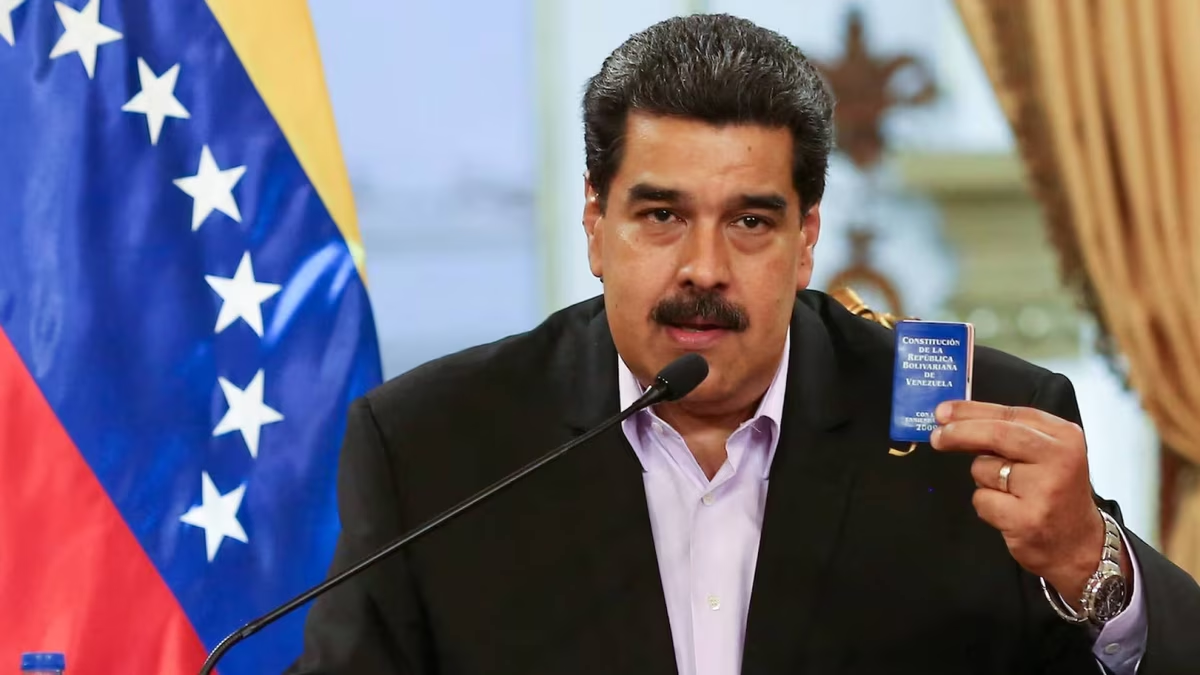
The Russian representative also directly called on the American leadership to immediately and unconditionally release Nicolas Maduro, as the legitimately elected president of an independent state, and release his wife who was detained with him during the operation.

For his part, the deputy Chinese representative strongly condemned what he described as the 'unilateral illegal actions' taken by the United States.

The deputy representative sharply criticized Washington's policy, which prioritized its interests and influence at the expense of the principles of international multilateralism, affirming that resorting to military action as an alternative to diplomacy represents a direct threat to security and peace, not only in Latin America, but on the international level as a whole.

These firm positions reflect the depth of the rift in the Security Council, where visions clash between Washington's justifications for its operation and the insistence of 'Moscow and Beijing' on the principle of national sovereignty.

This bodes ill for a diplomatic paralysis that may hinder any UN move to resolve the crisis in the foreseeable future.

ARAB AND WORLD

Mon 05 Jan 2026 6:53 pm - Jerusalem Time

The occupation's aviation launches a series of violent raids on southern Lebanon

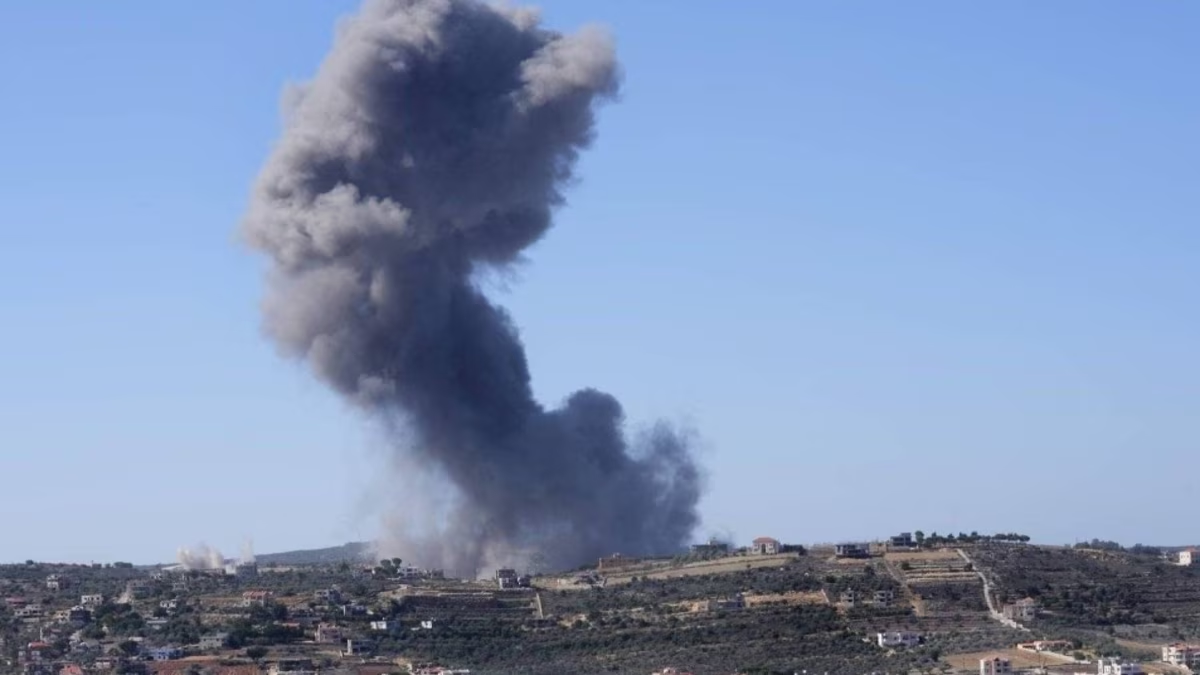
The occupation's aviation launched an air raid on the town of Anan in the Jizzine district in southern Lebanon.

The occupation carried out three raids targeting the towns of Ain al-Tineh and al-Manara in the Bekaa region east of the country, in addition to the town of Anan in the south.

The occupation army launched a series of air attacks on Monday, targeting scattered areas in southern Lebanon, in a new escalation of security tension on the southern border.

The occupation's raids targeted a building in the town of Ain al-Tineh located in the western Bekaa region east of Lebanon, while other raids hit a building in the town of Anan in the Jizzine district south of the country.

The occupation army had previously issued evacuation warnings to residents of four villages in southern and eastern Lebanon, claiming its intention to target what it described as "military infrastructure" affiliated with the "Hamas" and "Hezbollah" movements in those areas.

The warnings included areas in the towns of "Anan" and "al-Hamara", in addition to "Kafr Hatta" and "Ain al-Tineh", where the spokesperson for the occupation army published maps specifying targets set for logical targeting, which sparked a state of panic and rapid displacement of residents from those residential squares.

These developments come amid Israeli claims of monitoring "movements to rebuild military infrastructure" affiliated with Hezbollah in those areas.

PALESTINE

Mon 05 Jan 2026 5:49 pm - Jerusalem Time

Death of 4 Palestinians in Occupation's Bombing on Displaced Persons' Tents in Khan Yunis

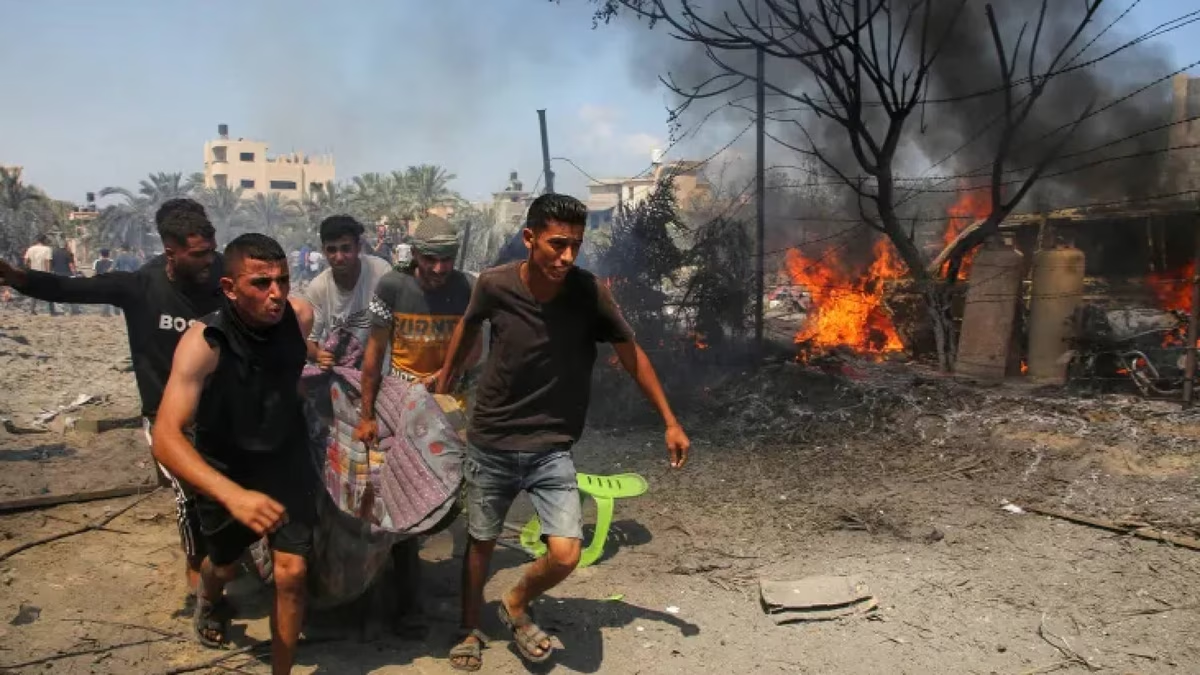
Four Palestinians were killed, and a number of civilians, including children, were injured on Monday, as a result of an Israeli air strike targeting displaced persons' tents in the Moasi Al-Qarara area northwest of Khan Yunis city in southern Gaza Strip.

Palestinian sources reported that a drone belonging to the occupation launched missiles towards the area, leading to martyrs and injuries among civilians, as ambulances rushed to the scene and transported the injured to hospitals.

According to the same sources, the strike targeted a tent for displaced persons near Al-Huda Mosque in Moasi Al-Qarara, resulting in four martyrs and a number of wounded, some of whose injuries were described as serious.

Medical sources confirmed the arrival of the martyrs and injured to Nasser Medical Complex, while the Ambulance and Emergency Unit stated that the toll of the strike reached four martyrs and a number of injured.

In a related context, occupation forces continued operations of demolishing and destroying residential buildings in the eastern areas of Khan Yunis city, as part of an ongoing military escalation in southern Gaza Strip.

These aggressions come amid the occupation's continued violations of the ceasefire and truce agreement, which came into effect on October 10, 2025, amid a continuous deterioration of the humanitarian situation in the sector.

ARAB AND WORLD

Mon 05 Jan 2026 5:40 pm - Jerusalem Time

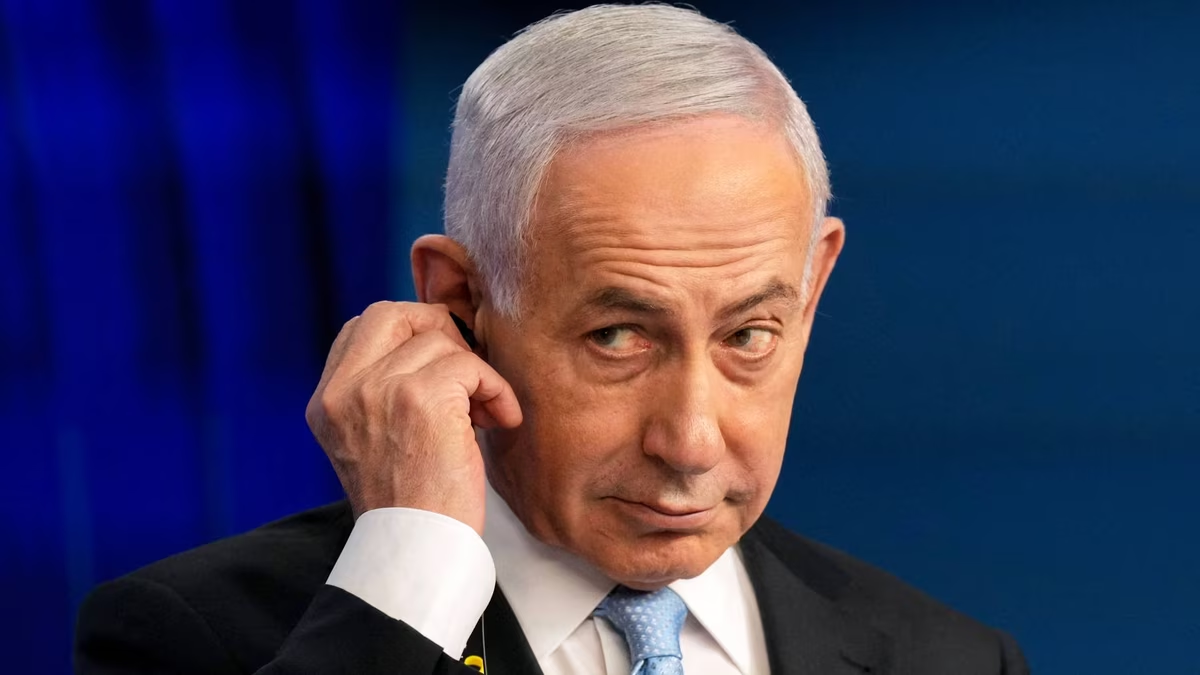
Netanyahu: If we are attacked by Iran, the repercussions will be very serious

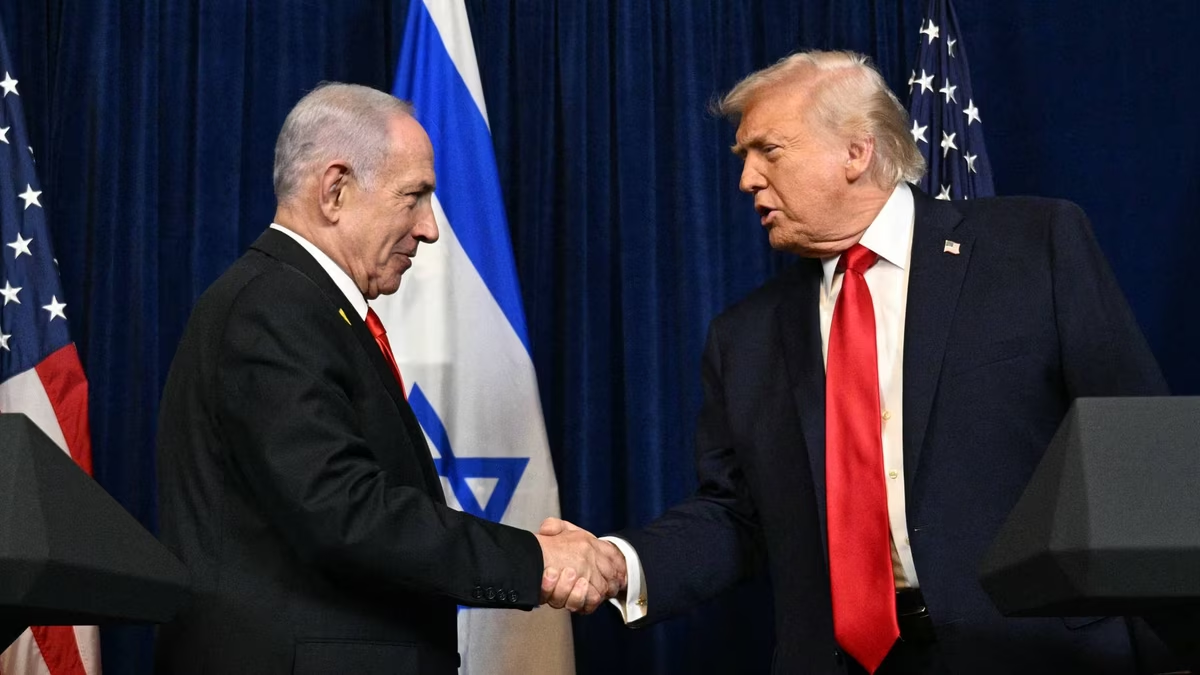
The Prime Minister of the occupation, Benjamin Netanyahu, announced a series of essential understandings with the American President Donald Trump, centered on "dismantling the military capabilities of Hamas" and ensuring complete disarmament from the Gaza Strip.

Netanyahu confirmed that the American administration shows a firm commitment to this vision, which establishes a new security reality where cross-border threats are absent, according to his expression.

In a humanitarian and internal political aspect, Netanyahu revealed an intensive exchange of messages with Trump regarding the fate of the Israeli detainees, emphasizing the diligent work to recover the last body still held in the sector.

He explained that the government is exerting strenuous efforts at this time, with strong support from Washington, to close this file that constitutes continuous pressure on the political scene in Tel Aviv.

Netanyahu's speech was not limited to the Gaza field, but extended to include Iranian ambitions, where he renewed his affirmation of his position aligned with President Trump's policy regarding preventing Tehran from reviving its nuclear program.

With decisive language, he emphasized that the bilateral cooperation will focus on disrupting any attempt to restore Iran's ballistic missile industry, considering that any leniency in this field represents an existential threat that cannot be accepted under any circumstance. In the context of the relationship with the American ally, Netanyahu revealed a new chemistry linking him to the current administration, noting that the vision of both sides agrees on major strategic issues, despite some marginal differences in viewpoints.

He did not miss directing a direct tone of threat to the Iranian leadership, warning that any attack on Israel will be met with "very grave" repercussions, exceeding in their scope all previous estimates.

Netanyahu's speech did not pass quietly, as local media reported the outbreak of sharp verbal clashes inside the Knesset hall, reflecting the extent of division regarding some political orientations.

Away from the regional issue, the Prime Minister announced his full support for the recent American actions in Venezuela, considering that the moves led by President Trump align with strengthening principles of stability and enforcing international will, which confirms Tel Aviv's full engagement in the political axis led by Washington globally.

PALESTINE

Mon 05 Jan 2026 2:50 pm - Jerusalem Time

"A night of fire and destruction".. Gaza wakes up to the sound of 12 raids and "demolition" operations that shook Khan Yunis

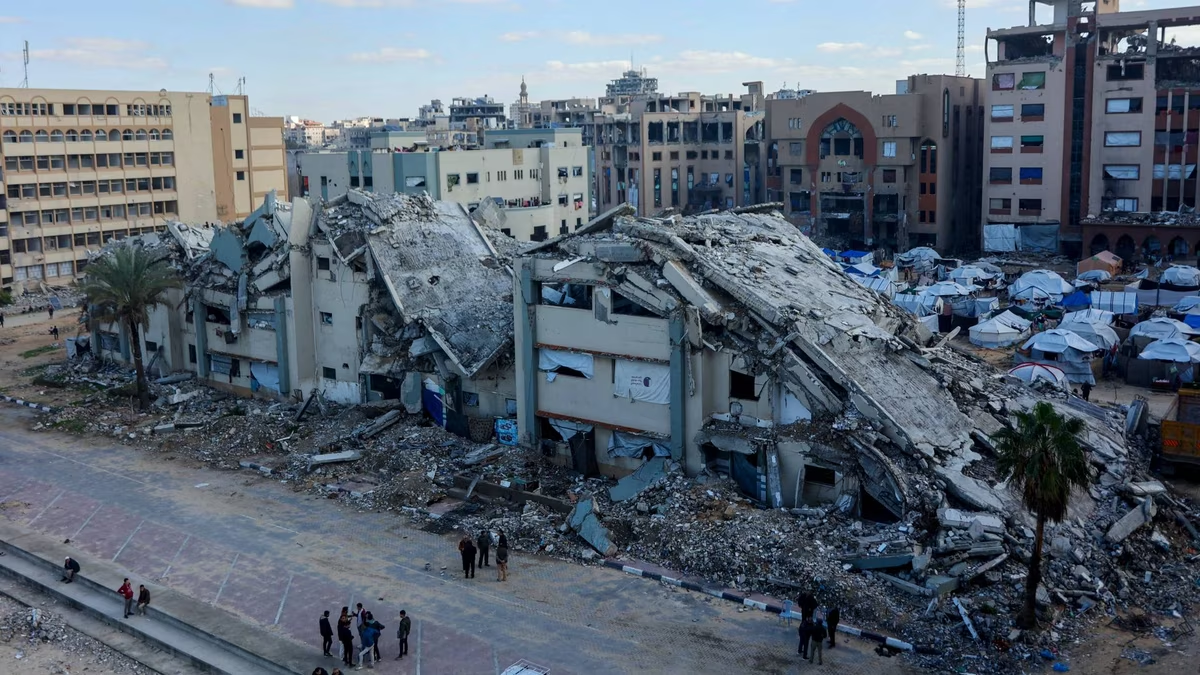
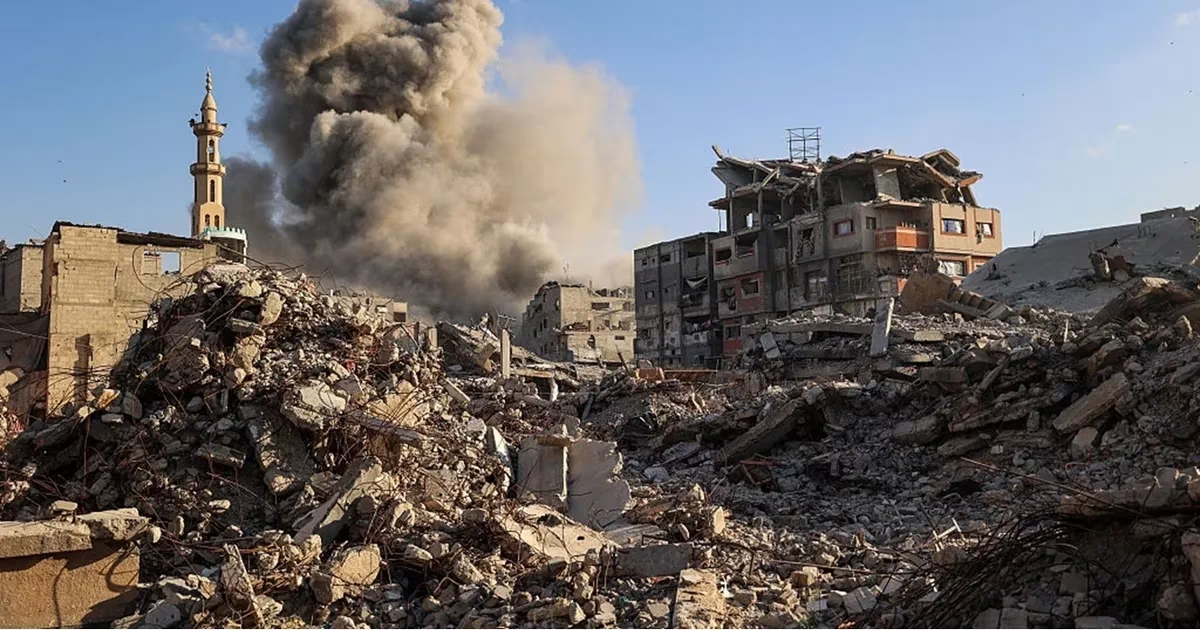
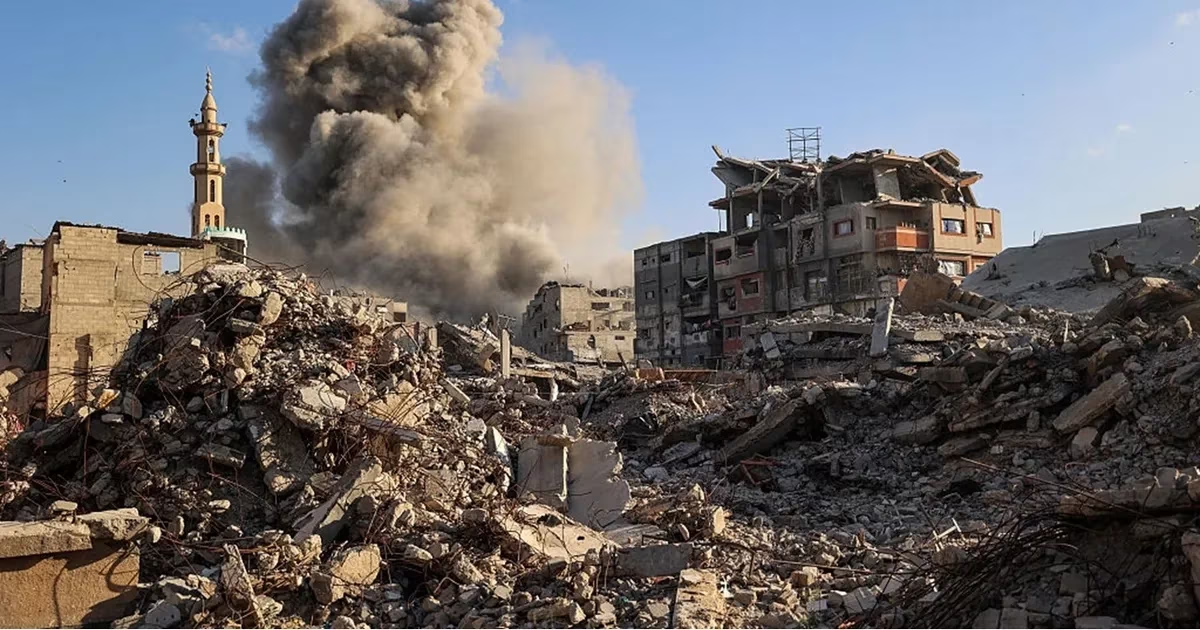
In a dangerous military escalation that threatens the collapse of the fragile truce, the Israeli occupation's air force launched a violent and intense series of air raids at dawn on Monday, targeting scattered areas in the Gaza Strip, focusing its fire on the southern regions, specifically the cities of Rafah and Khan Yunis, alongside bulldozing and demolition operations that recalled scenes of open warfare.

The eastern areas of Khan Yunis city in the south of the Strip were the stage for the fiercest operations during the night and dawn hours.

Occupation warplanes carried out two direct air raids on residential neighborhoods and agricultural lands east of the city, causing widespread destruction and panic among the displaced and residents.

The aggression was not limited to aerial bombardment; the raids coincided with the sound of massive explosions that shook the governorate, later revealed to be the result of programmed demolition operations carried out by the occupation army's engineering corps, targeting entire residential blocks in the eastern areas, as part of the "scorched earth" policy and expanding buffer zones.

Tanks and military vehicles also participated in the attack, firing their heavy machine guns and shells randomly and densely towards the southern and northern areas of the city, hindering the movement of ambulances and citizens.

To the far south, Rafah city was not spared from the escalation; the Israeli warplanes launched three consecutive air raids targeting sites deep in the city and its outskirts.

The air raids were accompanied by continuous and violent artillery shelling targeting the northwestern areas of Rafah city, where dozens of shells fell on citizens' homes and infrastructure, exacerbating the catastrophic humanitarian situation in the already overcrowded city.

According to preliminary field statistics, the total number of air raids carried out by the occupation army from the early night hours until dawn today reached 12 air raids, most of which were concentrated on the governorates of Rafah and Khan Yunis, leaving massive destruction.

In the north of the Strip, the occupation artillery continued its systematic targeting of border areas. The eastern areas of Jabalia camp were subjected to concentrated artillery bombardment, coinciding with the fall of shells on scattered neighborhoods east of Gaza City, in the Shujaiya and Zaytoun areas, in an attempt to exhaust the residents' resilience and prevent any attempt to return life to normal in those afflicted areas.

On the human losses front, the blood of the martyrs continues to flow in Khan Yunis; three citizens were killed yesterday by the occupation's snipers and vehicles, amid the escalating daily violations.

In another tragic development this morning, a cracked and dilapidated residential building collapsed in one of the Strip's neighborhoods, which had been previously bombed during the war.

Civil defense sources reported that rescue teams are racing against time to search for missing persons believed to be under the rubble, highlighting the danger of "cracked buildings" that have become time bombs threatening the lives of thousands.

These military developments come in a clear context by the occupation army to strike all international understandings aside, as it continues its blatant violation of the ceasefire agreement theoretically in effect since October 10th.

Observers believe that this escalation, which combines aerial, artillery, and engineering demolition operations, indicates premeditated Israeli intentions to impose a new security and geographical reality by force of arms, without regard for international appeals or the collapsed humanitarian situation.

PALESTINE

Mon 05 Jan 2026 2:46 pm - Jerusalem Time

Palestinian Human Rights Center: Occupation Continues Violations in Gaza Under Pretext of 'Yellow Line'

A Palestinian human rights center said today, Monday, that the Israeli occupation continues, since the implementation of the ceasefire agreement, to commit serious and ongoing violations against the civilian population in the Gaza Strip, under the pretext of approaching or crossing the 'yellow line', which it imposed as a new security line inside the sector's territories.

The Gaza Center for Human Rights stated in a statement that this matter is 'a clear violation of the provisions of international humanitarian law, the rules for protecting civilians during armed conflicts, and what was agreed upon in the ceasefire agreement'. The center monitored what it described as 'a dangerous escalation in the policy of excessive leniency in using lethal force by the occupation forces', where fire is directly opened on Palestinian civilians who approach the yellow line or live in its vicinity, including farmers, displaced persons, and residents trying to reach their homes or lands.

The number of Palestinian martyrs exceeded 420 citizens, including 151 children and 60 women, in addition to 1184 injured, since the start of the firing on October 10 last year, most of them within the scope of what is called the yellow line, according to the human rights center, which said that the number is still continuously increasing, as a result of the daily ongoing violations committed by the occupation forces around the mentioned line, including direct shooting from occupation snipers, targeting via armed reconnaissance aircraft of the 'Quad Copter' type, in addition to artillery shelling, which confirms the systematic nature of using lethal force against civilians, and not as individual or exceptional incidents.

The center documented the Israeli army forces repeatedly expanding the scope of the lands under their control within the yellow line, where the percentage of these lands rose from 53% to more than 60% within the past three weeks, as those forces work on moving the yellow concrete blocks that mark the beginning of the line, which Palestinians are prohibited from crossing.

In addition, the center documented the continuation of systematic demolition and bulldozing operations for what remains of civilian homes and properties within the yellow line, where the occupation forces work to destroy entire residential neighborhoods or what remains of them, as part of a clear policy to impose a new demographic and security reality, aiming to prevent residents from returning to their original areas, and constitutes a crime of forced displacement prohibited under international law.

It also confirmed that 'these practices represent a direct violation of the terms of the ceasefire agreement, which is supposed to ensure the cessation of hostile actions, protection of civilians, and preparation of conditions for the return of residents to their areas and homes, not imposing new military lines inside populated areas, or using the agreement as a cover to continue field control by force'.

It pointed out that these field violations come alongside official statements issued by the Israeli occupation leadership, reflecting a premeditated intention to use the yellow line as an open killing zone. Israeli Security Minister Yisrael Katz had previously said that the Israeli army began placing field markers along the yellow line, warning that 'any attempt to approach or cross this line will be met with gunfire'.

Previously, Israeli Army Chief of Staff Eyal Zamir announced that the yellow line represents 'the new security line' or 'an advanced security border' for Israel inside the Gaza Strip, in a clear confirmation of the occupation's pursuit to turn this line into a permanent security reality, and impose it by armed force, in direct contradiction to the essence of the ceasefire agreement.

The coordinator of the Gaza Center for Human Rights in the sector, Muhammad Al-Khairi, considered in the same statement that what is happening along the 'yellow line' constitutes a clear model of state terrorism, where the field behavior of the soldiers harmonizes with the public statements issued by the political and military leadership of the occupation, which legitimized shooting at anyone approaching this line, and considered it 'the new security line'.

He pointed out that 'this harmony between the political decision and military implementation proves that killing and demolition are not individual acts, but official systematic policies implemented at the expense of the lives of Palestinian civilians, and in a flagrant violation of the ceasefire agreement and international humanitarian law'.

PALESTINE

Mon 05 Jan 2026 2:46 pm - Jerusalem Time

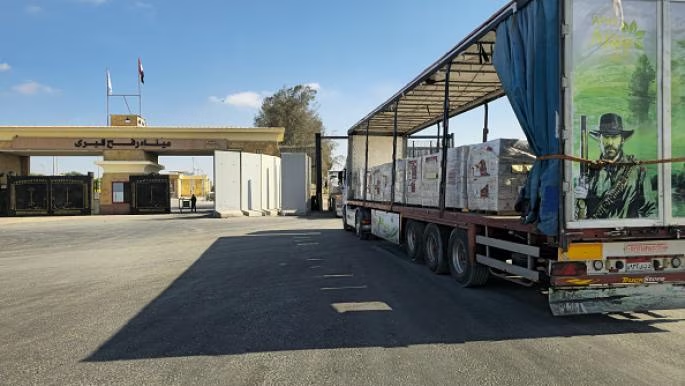
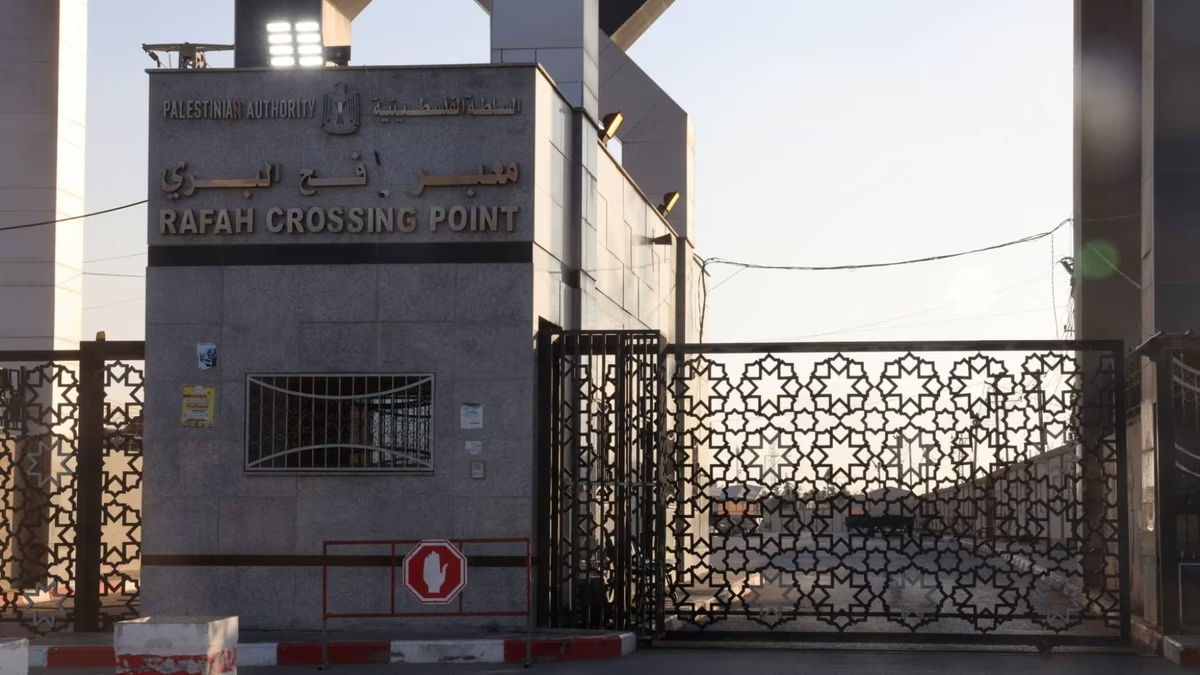
Israel has not given instructions to open the Rafah crossing.. and Trump did not request that

The Israeli political level has not yet given instructions to its army to open the Rafah crossing, which separates the Gaza Strip from Egypt; moreover, the American President, Donald Trump, did not request that during his meeting with the Prime Minister of the occupation, Benjamin Netanyahu, at the Mar-a-Lago resort in Florida, at the end of last year. The "Israel Hayom" newspaper reported that uncertainty prevails regarding the possibility of opening the crossing soon, recalling that "Trump said last week that allowing Gazans to leave would push them to emigrate".

Despite the ambiguity surrounding the date of reopening the crossing, the newspaper noted today, Monday, that after the pressure exerted by Trump's envoys, Jared Kushner and Steve Witkoff, Netanyahu is likely to give instructions to activate the crossing. According to it, if that happens, the mechanism for opening and supervising it "will benefit Israel manifold this time, compared to the past".

Based on Trump's plan for a ceasefire in Gaza, and in agreement with international parties, a monitoring force affiliated with the European Union will operate the crossing, while Israel monitors it remotely via cameras. However, the matter will go beyond that, as revealed by the newspaper; the occupying army is planning to establish checkpoints to inspect all those entering Gaza to "ensure they are not smuggling anything prohibited (weapons, money..)". This is in response to the request of the Southern Command in the army to grant the latter the leading role in the physical inspection process of those entering the sector.

To implement this goal, a corridor will be established that obliges all those entering Gaza from Egypt to pass from the European inspection point to the point operated by the "Coordinator of Government Activities in the Territories (West Bank and Gaza Strip)"; where entrants and their belongings will be inspected again. Note that the two inspection centers will be within the Blue Line, which is entirely under Israeli control.

According to the newspaper, under the understandings between the American administration and the Israeli government, it was agreed that opening the Rafah crossing "will not constitute a means to flood the sector with population again. Accordingly, the number of entrants and exits will be directed so that a greater number leaves Gaza than enters it". In this regard, estimates indicate that about 150 people will leave daily to Egypt, while only a third of that number will enter the sector, after Egypt insisted that the crossing not operate in the exit direction only. In addition to the above, exit will only be allowed for patients and their companions.

Furthermore, the far-right Israeli Finance Minister, Bezalel Smotrich, said during a tribute event in the Knesset, "I address from here to the Prime Minister: do not open the Rafah crossing under any circumstances, and do not advance an inch until Ran returns! (the body of the last Israeli captive in the sector, soldier Ran Gvili) This is our duty. Hamas can, and should, return Ran to be buried in Israel".

PALESTINE

Mon 05 Jan 2026 2:46 pm - Jerusalem Time

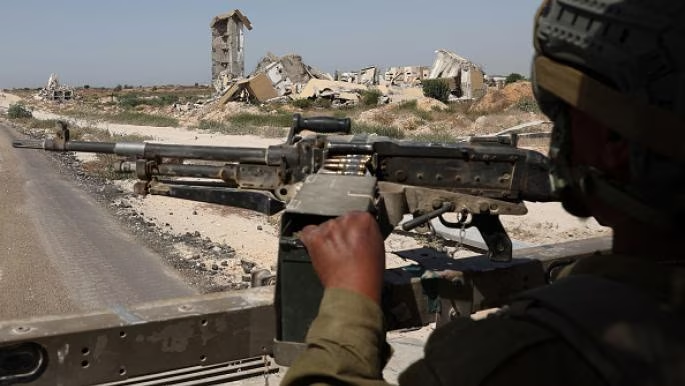
Israeli soldier fires randomly in Gaza claiming to celebrate the New Year

An Israeli soldier fired randomly in the Gaza Strip, "claiming to celebrate the new Gregorian year," on Monday.

The soldier appears in a video clip standing at a position in front of barbed wire, firing randomly from his machine gun.

A video clip spread on social media showing a soldier from the Golani Brigade documenting himself while firing randomly from a machine gun towards the Gaza Strip, claiming to celebrate the new year.

It added: "The soldier posted the video on his personal account," without further details about his identity.

It quoted the Israeli army spokesperson's office as saying that the soldier "acted contrary to orders and instructions."

The office continued: "The incident will undergo a thorough investigation, and based on its results, the necessary measures will be taken against the soldier."

Since the start of the Israeli genocide war in Gaza on October 8, 2023, Israeli soldiers have documented themselves committing widespread violations and crimes in the sector without Tel Aviv announcing any punishment for them.

With American support, the Israeli genocide in Gaza has left more than 71,000 dead and 171,000 injured, mostly children and women, and destruction affecting 90 percent of the civilian infrastructure, with reconstruction costs estimated by the United Nations at about 70 billion dollars.

On October 10, a ceasefire between the "Hamas" movement and Israel came into effect, but the latter violates it daily, resulting in the killing of 420 Palestinians and the injury of 1,184, according to the Palestinian Health Ministry in the sector on Sunday.

PALESTINE

Mon 05 Jan 2026 1:14 pm - Jerusalem Time

Gaza Children Cling to Education Despite Destruction and Dangers

The education sector in the Gaza Strip is facing great difficulties amid the widespread destruction of educational facilities and the worsening displacement crisis, yet despite this and the dangers, students and pupils cling to their right to education.

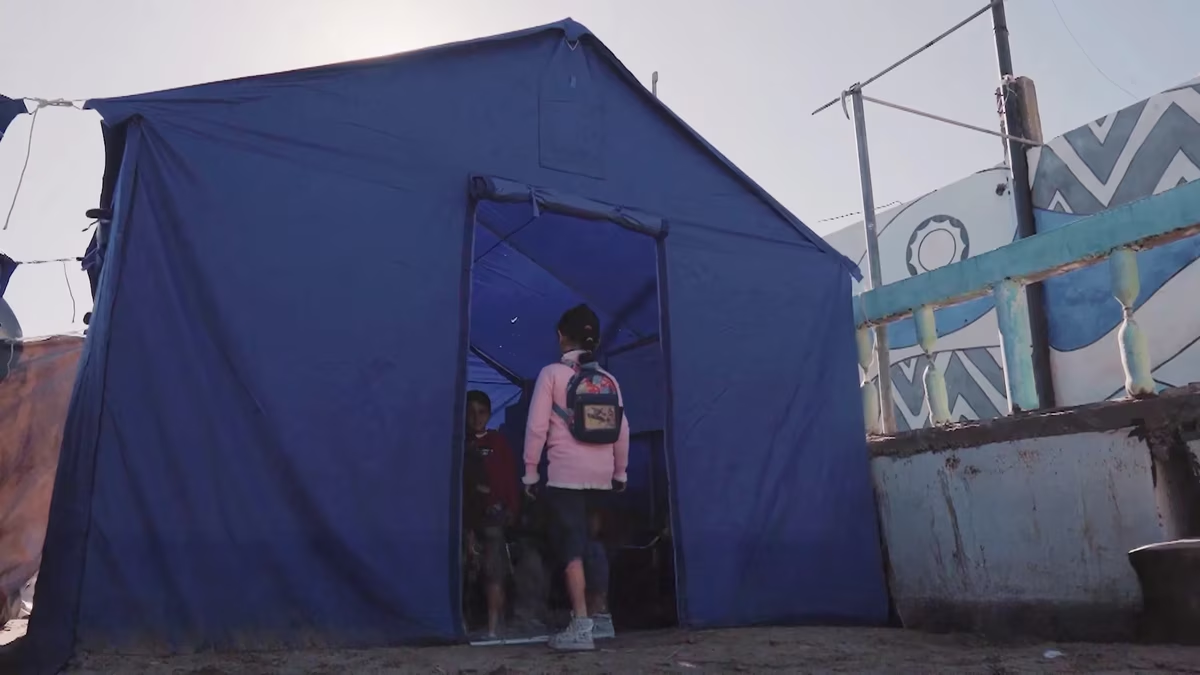
A report by Shadi Shamiya sheds light on the reality of education in Gaza by tracking the journey of young children to school, which consists of educational tents set up in northern Gaza Strip adjacent to the yellow line, where Israeli occupation forces are stationed. The children walk towards these tents despite the gunfire fired by Israeli occupation forces and the ongoing assaults.

The child Towleen (7 years old) was followed as she prepared inside a small tent overshadowed by the sound of gunfire, heading to school for the first time after two years of deprivation due to the Israeli war.

Towleen's mother expresses her intense fear for her daughter when she goes to school, but she wants her to learn, after her kindergarten education was interrupted due to the Israeli war on the sector. She monitors her daughter's studies at home, in addition to what she receives in lessons at school.

Towleen was shown carrying her bag on her back and walking amidst rubble and great destruction towards the tent school set up just meters away from the presence of the Israeli occupation army in what is known as the zero zone.

To the sound of gunfire, Towleen walks towards her school, and she is afraid—as she says—of being targeted by the bullets fired by Israeli occupation forces, especially since there are no places to shelter her from the gunfire.

Ahmed, whose father was martyred, dreams of a safe environment for learning away from the occupation's bullets, and says they learn despite the difficult circumstances, where they face troubles and difficulties when coming to school and when leaving it, due to the gunfire. Ahmed wishes to fulfill his martyred father's dream of becoming a doctor.

Towleen and the rest of the students study inside tents that cannot prevent the occupation's bullets from penetrating them or penetrating the children's bodies, as pointed out by a teacher who described the educational conditions inside the tents as very bad, saying that the children study without desks, and that the tents do not protect or shield from the gunfire that has targeted them more than once, nor from the rain, yet they will continue education because the occupation targets spreading ignorance among Palestinians.

The Director of Education in West Gaza, Jawad Sheikh Khalil, said in an interview that Gaza's schools are educational tents where the student sits on the ground, confirming that all the capabilities of the Ministry of Education have been destroyed by the occupation, but they are trying, in cooperation with local and international institutions, to rise again by establishing schools in tents so that the student and pupil can receive information from the teacher.

According to the Government Media Office in Gaza, 168 schools were used to shelter displaced people during the Israeli war on the sector.

ARAB AND WORLD

Mon 05 Jan 2026 1:14 pm - Jerusalem Time

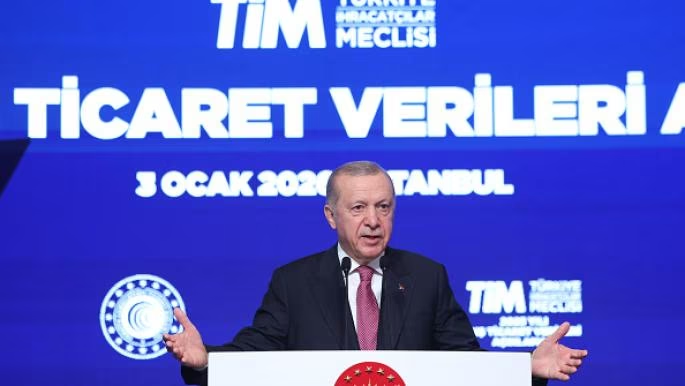
Erdogan: Success of international stabilization force in Gaza depends on involving legitimate parties

Turkish President Recep Tayyip Erdogan stated today, Monday, that the success of the international stabilization force planned to be deployed in the Gaza Strip depends on involving the legitimate parties in it, specifying them as the countries that signed on October 13 last on the Sharm El-Sheikh declaration regarding the ceasefire and peace stages. This came in statements made by Erdogan, in which he addressed some developments in the local and international arena.

The Turkish President said that "the success of the international stabilization force planned to be deployed in the Gaza Strip depends on involving the legitimate parties on the ground, which means the countries parties to the Sharm El-Sheikh declaration, including Turkey, are the most legitimate countries in this force", and added "it is difficult for a mechanism that does not include Turkey to gain the trust of the Palestinian people", considering that "Turkey is a key country in such a mission due to its deep historical relations with the Palestinian people, the security and diplomatic channels it has maintained with Israel since the past, in addition to its regional influence as a member of the North Atlantic Alliance".

Turkey was a key party in the ceasefire agreement reached between Hamas and Israel in October, while Erdogan constantly criticizes Israeli Prime Minister Benjamin Netanyahu and his government for their practices in Gaza and their reneging on their commitments, especially regarding the ceasefire and the entry of aid.

Regarding Turkish-American relations, Erdogan said "with the return of President (Donald) Trump to office, the opportunity has arisen to move to a more rational and positive ground in Turkish-American relations, as the delivery of F-35 aircraft to Turkey, which has already paid for them, and its re-inclusion in the production program, are important and necessary matters for the security of Turkey and the United States as strategic partners, and also for the North Atlantic Alliance".

He considered what happened to Turkey of being deprived of the aircraft and removed from the fighter manufacturing program due to the purchase of Russian "S-400" missiles as "unfair actions", adding "what concerns us is protecting Turkey's reputation and not punishing it unfairly, while discussions continue in this framework, and we hope to reach a fair result that is legally sound and commensurate with the strategic partnership between the two countries".

He stated that "Turkey's position is completely clear, and it acts in accordance with its national interests and energy security, considering that Turkey provides its energy needs through imports, and acts cautiously and balanced in every issue that affects its energy security", and added "Turkey is the only party capable of communicating directly with both Russian President (Vladimir) Putin and Ukrainian President (Volodymyr) Zelenskyy, and at the same time it can conduct strong and balanced diplomatic communications through taking concrete initiatives in Washington, Brussels, the North Atlantic Alliance, and the United Nations".

PALESTINE

Mon 05 Jan 2026 12:35 pm - Jerusalem Time

Two youths injured by live fire in Al-Ram town and incursions and arrests in the West Bank

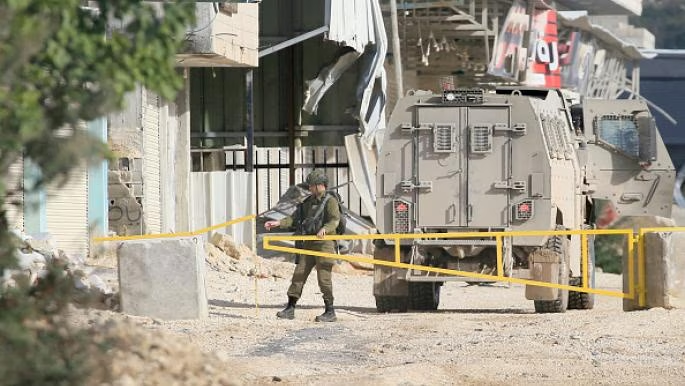
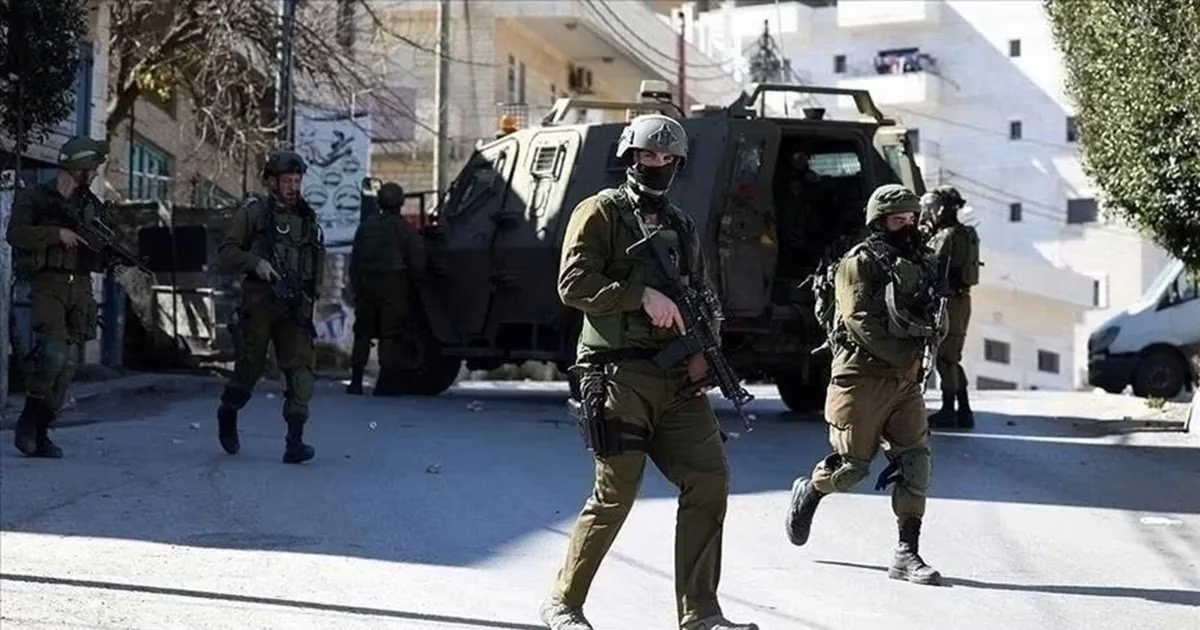
On Sunday evening, two Palestinian youths were injured by live fire from the Israeli occupation army in Al-Ram town, north of Jerusalem, while the Israeli army raided several Palestinian towns and neighborhoods in the occupied West Bank. The Palestinian Red Crescent Society stated in a statement that its crews transported to the hospital in Ramallah "two youths (30 and 34 years old) who were injured by live fire while attempting to cross the apartheid separation wall in Al-Ram town." The society clarified that the injuries were from live bullets in the thighs.

North-east of Jerusalem, the Israeli army closed two iron gates erected at the town's entrances, set up military checkpoints, and prevented vehicles from passing in both directions, causing a traffic crisis, according to the same source.

On another front, Israeli occupation forces carried out raids and searches of Palestinian homes in various areas of the occupied West Bank, early Monday morning and last Sunday night, resulting in the arrest and detention of a number of Palestinians, including journalist Inas Ikhlawi. Local sources reported the arrest of Ikhlawi after raiding Idhna town west of Hebron in the south of the West Bank, early today, following a search of her home. In Nablus, local sources confirmed that occupation forces arrested 21 Palestinians from Awarta village south-east of Nablus, after raiding dozens of homes, tampering with their contents, and turning some into field interrogation centers.

The occupation forces also detained a number of Palestinians in Aida camp north of Bethlehem today, interrogated them, and later released them. In Tulkarm, occupation forces arrested three Palestinians, including the child Yazan Al-Aloul (15 years old), while early today, they arrested a young man from Silwad town north-east of Ramallah, after raiding and searching his home. On another note, local sources reported that occupation forces raided Jaba town south of Jenin, turned one of the homes into a military barracks, and interrogated a number of youths inside after arresting and mistreating them.

The Palestinian News Agency (WAFA) reported that the occupation army raided the village of Nabi Saleh, north-west of Ramallah city, raided a number of commercial shops, and checked their private surveillance cameras "and no arrests were reported." The occupation also raided the areas of Jannat neighborhood and Jabal al-Tawil in Birzeit city, and the villages of Beitain and Dura al-Qara, east and north of Ramallah.

In the north of the West Bank, Palestine TV (official) said that the army raided the vicinity of Far'a camp, and raided a home during the raid on Tammun town south of Tubas city. In another context, Israeli occupation forces closed the Attara military checkpoint north of Ramallah this morning, which caused disruption to the movement of Palestinian citizens.

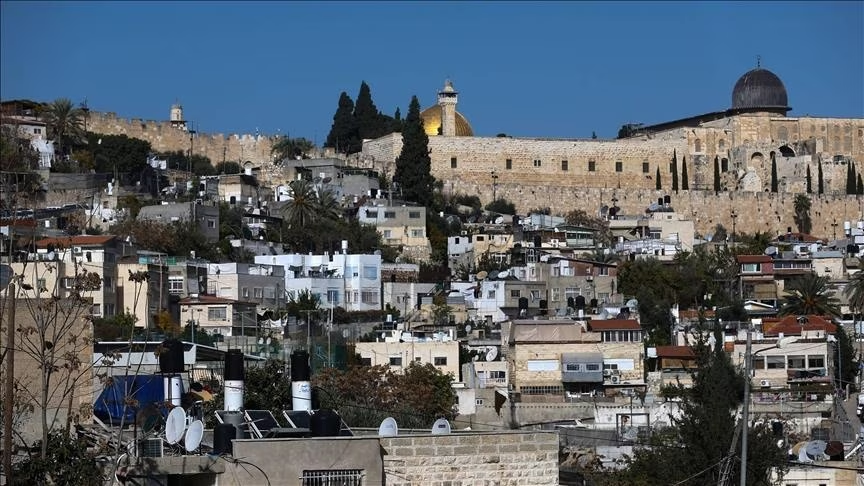
Meanwhile, settlers seized a Palestinian home in Silwan town south of Al-Aqsa Mosque early today, alongside a new assault on an Islamic cemetery near the Old City of Jerusalem. Local sources reported that settlers seized a Palestinian home belonging to the Bsbous family in Batn al-Hawa neighborhood in Silwan town south of occupied Jerusalem early today. The home consists of two apartments and is inhabited by 13 family members. According to local sources, Israeli occupation forces raided the neighborhood last Sunday night, photographed Palestinian homes, coinciding with takbirs chanted by the residents in protest against the eviction of the Bsbous family from their home, in favor of settlers who carried out the seizure operation in the early hours of today.

In another context, local sources and Jerusalem media centers reported a new assault on an Islamic cemetery near the Old City in occupied Jerusalem, where settlers smashed the tombstones of a number of graves, in a clear violation of the sanctity of the dead and the religious and historical status of Jerusalem. The sources indicated that this assault comes as part of a continuous series of violations targeting cemeteries and Islamic holy sites in the city, as part of attempts to impose a new reality and erase Palestinian and Islamic historical landmarks.

PALESTINE

Mon 05 Jan 2026 12:35 pm - Jerusalem Time

Artillery shelling and gunfire north and east of Rafah and Khan Yunis.. and a building collapse in Al-Maghazi injures 5 and missing others

Intensive artillery shelling and gunfire from helicopters are being witnessed in areas where occupation forces are deployed north and east of the cities of Rafah and Khan Yunis in the southern sector, as part of a series of ceasefire violations.

Local sources confirmed that occupation forces fired their weapons at displaced people's tents on the outskirts of Rafah city at dawn on Monday. Without details on injuries being reported.

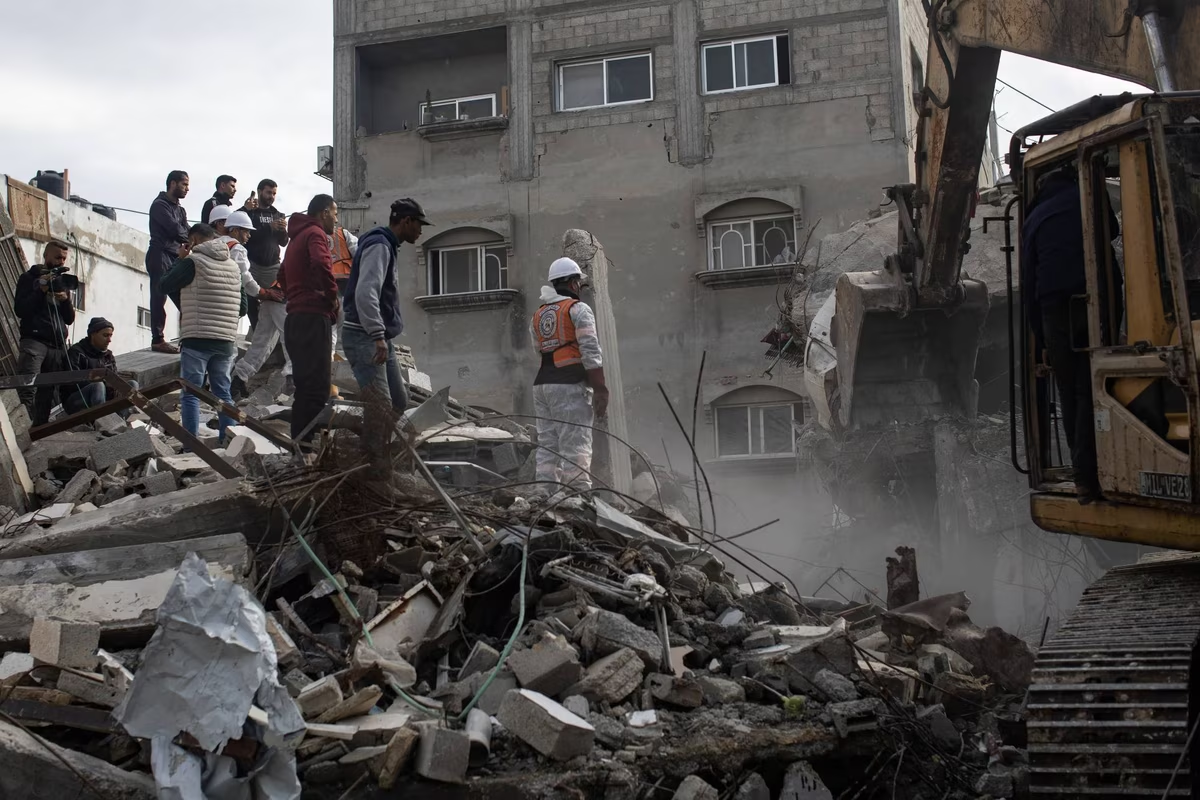
On the other hand, 5 Palestinians were injured and others went missing at dawn on Monday, following the collapse of a building in the Al-Maghazi refugee camp in the center of the Gaza Strip, which had been subjected to Israeli bombing during the two years of the genocide war.

The Civil Defense said in a statement that its crews dealt with "5 injuries, including serious cases, and continue searching for missing persons, following the collapse of a 4-story residential building, at dawn today".

The statement clarified that the building belongs to the "Al-Shana" family and is located in the Al-Maghazi refugee camp in the center of the sector.

It indicated that the building was damaged from previous Israeli bombing, while today it suffered a complete collapse due to the impact of the intensive shelling that the eastern area of the camp is witnessing".

Dozens of residential buildings damaged from previous Israeli bombing collapsed due to the impact of the low-pressure systems that hit the sector and were accompanied by strong winds and heavy rains, which caused the death and injury of Palestinians.

Palestinians are forced to resort to living in cracked and crumbling buildings due to the lack of options amid the occupation's destruction of most buildings in the sector, and its prevention of importing mobile homes, construction materials, and reconstruction, breaching its commitments stipulated in the ceasefire agreement.

The Palestinian Ministry of Health in the Gaza Strip announced on Sunday the arrival of 3 new martyrs to hospitals in the past 24 hours, including a citizen who was martyred due to a building collapse in Khan Yunis city, in addition to 13 new injuries.

According to the ministry, the total number of martyrs since the ceasefire came into effect on October 11, 2025, reached about 420 martyrs, while hospitals recorded 1,184 injuries, and 684 bodies were extracted from under the rubble.

PALESTINE

Mon 05 Jan 2026 12:35 pm - Jerusalem Time

Israeli occupation forces arrest dozens of Palestinians, including a child and a journalist in the West Bank

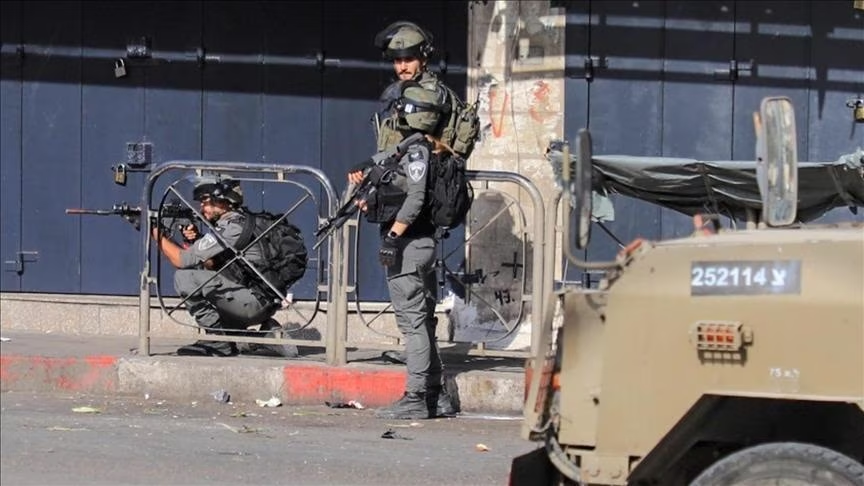
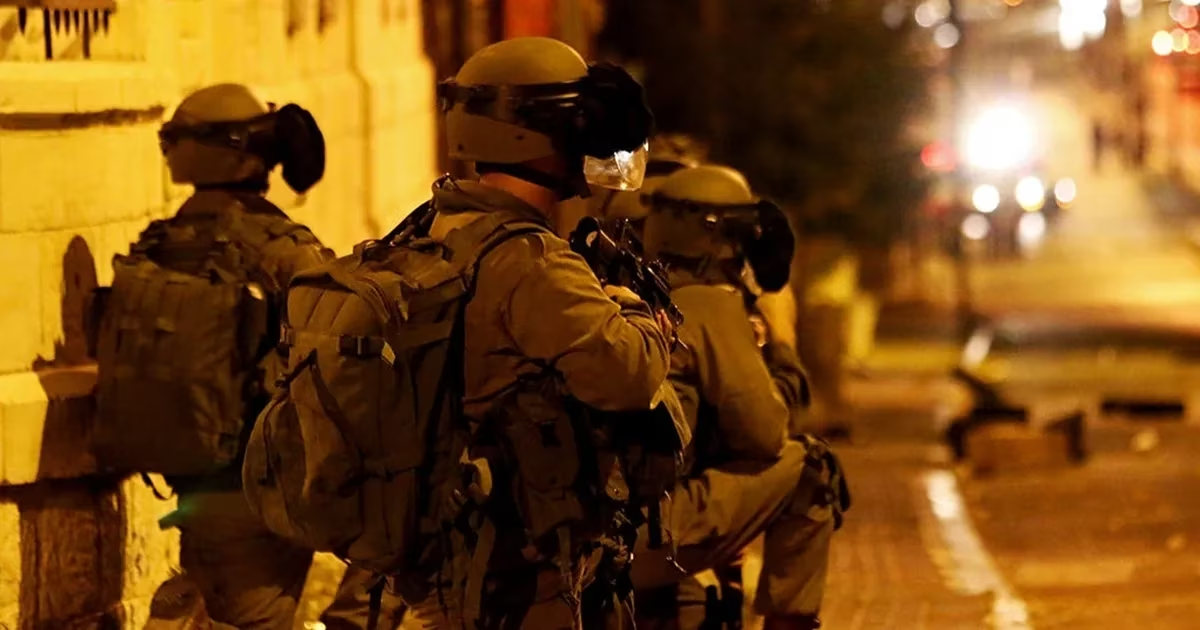
Israeli occupation forces carried out a wide-scale raid campaign in various areas of the occupied West Bank at dawn on Monday, resulting in the arrest of dozens of Palestinians, including a child and a journalist.

The campaign included intensive raids on Palestinian homes in several governorates, accompanied by extensive military deployment, searches, and tampering with household contents.

Sources indicated that the town of Awarta, south of Nablus city in the northern West Bank, witnessed the largest number of arrests, where 21 Palestinians were detained, in addition to arresting one citizen from Nablus city itself. The Israeli forces also arrested 20 Palestinians from Aida camp north of Bethlehem, in the southern West Bank.

In the northern West Bank, sources reported the arrest of three Palestinians from Tulkarm city, including a child, along with arresting two from Tubas governorate, and five others from Qalqilya governorate. The arrests also targeted one citizen from the town of Silwad east of Ramallah, in the central West Bank.

In Hebron governorate in the south, Israeli forces arrested journalist Inas Akhlaoui from the town of Idhna, without announcing the reasons for the arrest or issuing official charges so far.

Sources noted that the raid operations were accompanied by deliberate vandalism of household contents and destruction of furniture, in addition to subjecting some residents to field interrogations, amid an atmosphere of tension and fear, especially among women and children.

These arrests come in the context of ongoing escalation in the West Bank since the outbreak of the Israeli war on the Gaza Strip on October 8, 2023. According to official Palestinian data, at least 1,105 Palestinians have been killed in the West Bank, including East Jerusalem, by Israeli army fire and settlers, while about 11,000 others were injured, alongside the arrest of more than 21,000 Palestinians during the same period.

In the Gaza Strip, Israel's occupation war, with American support, has resulted in the killing of more than 71,000 Palestinians and injuring about 171,000, mostly children and women, in addition to widespread destruction affecting nearly 90% of the civilian infrastructure, according to UN estimates, which put the cost of reconstruction at around 70 billion dollars.

It is worth noting that Israel was declared in 1948 on Palestinian lands that were occupied by force, and it continues to control the occupied Palestinian territories, amid ongoing refusal to fully withdraw or allow the establishment of an independent Palestinian state.

PALESTINE

Mon 05 Jan 2026 12:34 pm - Jerusalem Time

Settlers seize residential building in Silwan, East Jerusalem

Israeli settlers seized a residential building in the Batn al-Hawa neighborhood in the town of Silwan on Sunday evening, the area most targeted by settlement activity in East Jerusalem.

This comes following what was announced by the Israeli organization "Ir Amim" (left-wing) that monitors Jerusalem affairs, on January 2, about more than 130 Palestinians from 26 families in the Batn al-Hawa neighborhood facing "imminent eviction risk", after the Israeli Supreme Court rejected their final appeals.

Zahir al-Rajbi, head of the Batn al-Hawa neighborhood defense committee, said: "Settlers stormed the building owned by the Bsbous family and forced its members out during the evening hours, noting that today (Monday) is the final deadline set by the Supreme Court for the family to evacuate their home".

He pointed out that the Bsbous family, consisting of 13 people, had been living in two residential apartments before being forced to evacuate.

In a related context, al-Rajbi said that the Israeli Supreme Court's decision also included evacuating "the Rajbi family from 3 buildings containing 11 residential apartments", noting that "about 20 families" are threatened with eviction.

He added: "We do not know when the eviction will take place, but it could happen at any moment".

According to al-Rajbi, the Batn al-Hawa neighborhood has 87 families, with 15 families evicted since the start of the genocide war in October 2023.

He said: "There are about 15 other families residing on nearby land (to the neighborhood), so we are talking about more than 100 families, some of whom have been evicted, and dozens of families are still under imminent eviction threat".

He added: "The settlers want to evict all families from their homes in preparation for turning the neighborhood into a settlement", noting that the families have been living in their homes since the 1950s and 1960s.

He mentioned that the families "have been fighting in the courts for many years" to object to the eviction orders, but the courts "issue successive rulings in favor of the settlers, making all families threatened", according to him.

He warned that the pace of evicting Palestinians from their homes in East Jerusalem has become faster under the current Benjamin Netanyahu government.

In this regard, he said: "What happened recently did not happen in the past; we have been in the courts for more than 12 years, but the pace of eviction decisions and the implementation of these decisions is unprecedented".

He added: "They are exploiting the international community's preoccupation with what is happening in various parts of the world to pounce on the Batn al-Hawa neighborhood, and frankly, we feel that we are alone in this battle".

Al-Rajbi continued: "The threats to the residents do not stop and are ongoing around the clock".

Last week, the left-wing Israeli movement "Peace Now", specializing in monitoring settlement, said in a statement: "The eviction lawsuits (in Batn al-Hawa) are part of a large operation aimed at forcibly transferring an entire community of about 700 residents (Palestinians) from the neighborhood in East Jerusalem, and establishing a settlement in its place".

It pointed out that "the basis of all legal claims is: the Legal and Administrative Arrangements Law, enacted by the Knesset in 1970, which enabled Jews claiming ownership of properties in East Jerusalem, who lost their assets in 1948, to recover them from the Israeli Custodian General, despite receiving alternative properties since that year".

It pointed out that this law "applies only to East Jerusalem, and to Jews only and not to Palestinians who lost their properties in the same war and under similar circumstances".

According to the statement from the "Ir Amim" organization on January 2, the Israeli Supreme Court rejected appeals from 20 families in the past three days, including the Zahir Rajbi family, likely issuing final eviction orders at any time, with possible implementation of evictions within weeks.

It indicated that eviction orders were issued against the Khalil Bsbous family, expected to be implemented at the beginning of January.

The Palestinians say that East Jerusalem is the capital of the Palestinian state, but Israel says that Jerusalem in its eastern and western parts is its capital.

PALESTINE

Mon 05 Jan 2026 12:34 pm - Jerusalem Time

Two killed and 5 injured in collapse of residential building in central Gaza

Two Palestinians were killed and five others injured this morning, Monday, due to the collapse of a residential building in Al-Maghazi camp in the central Gaza Strip.

The collapse of a multi-story building belonging to a family in Al-Maghazi camp in the central Gaza Strip, which had been subjected to Israeli bombing during the genocide war on Gaza.

The bodies of two martyrs were recovered from under the rubble of the house, confirming that civil defense teams are searching for missing persons beneath it.

This was not the first incident, as more than one building collapse occurred last month for damaged or partially collapsed structures, and many Gazans had no choice but to live in them, unconcerned about their crumbling walls or demolished sides, as they are better in their eyes than crowded tents buffeted by winds, flooded by rains, and lacking the basic necessities of safe life.

With the intensity of the wind and the heavy rain that poured over the sector for days, buildings and homes collapsed on their inhabitants; at least 20 buildings and homes collapsed within 10 days; causing the death of more than 15 Palestinians. The spokesperson for the Gaza Civil Defense warned of the consequences of "delaying" the reconstruction file.

In the last week of December (January) last year, a new residential building collapsed in Sheikh Radwan neighborhood in northern Gaza City; leading to the death of 5 Palestinians, including: a man, his wife, their two daughters, and his granddaughter who had lost her father and brothers in Israeli bombing during the war. Civil defense teams managed to rescue 3 family members from under the rubble of the partially damaged building, which consisted of several floors.

Before that, at least 6 buildings collapsed in Sheikh Radwan alone, while other buildings and homes collapsed, all in Gaza City, mostly in its western and northern areas, such as Al-Nasr neighborhood, Al-Shati camp, and Tal Al-Hawa neighborhood.

Experts attribute the increase in cracks and collapses to the demolition operations carried out by Israeli forces using explosive vehicles in various parts of the sector, where tons of explosives are placed inside the vehicles before being detonated remotely; causing strong tremors whose effects extend several kilometers, reaching central Israel in some cases.

These operations continue on both sides of the green line, despite the ceasefire agreement that came into effect on October 10 last year.

PALESTINE

Mon 05 Jan 2026 10:57 am - Jerusalem Time

Journalists' Syndicate Warns: Life of Journalist Ali Al-Samoudi in Danger Due to Administrative Detention and Medical Neglect

The Palestinian Journalists' Syndicate has warned of the risk of death threatening the life of colleague journalist Ali Al-Samoudi (59 years old), due to the Israeli occupation court's decision to extend his administrative detention for the third consecutive time, for an additional four months, without charging him with any crime or providing him with a fair trial, in a blatant violation of international law and freedom of journalistic work.

The Syndicate holds the occupation authorities fully responsible for the serious deterioration in the health condition of colleague Al-Samoudi, confirming that the Palestinian Prisoners' Club reported that he has lost about 40 kilograms of his weight, and suffers from multiple diseases, including: scabies, diabetes, high blood pressure, stomach ulcers, continuous bleeding in the teeth, sudden increase in heartbeats, in addition to recurrent fainting, constant headaches, inflammation in the urinary tract, and problems in the left ear, all under deliberate medical neglect.

The Syndicate condemned what colleague Al-Samoudi is subjected to in "Majd" prison, including beating, suppression, and humiliations, and his detention in harsh humanitarian conditions, considering it a form of torture and degrading treatment prohibited under international covenants and agreements.

The Syndicate also issued an urgent appeal to the international community, human rights institutions, journalists' unions, and international media outlets, to take immediate action and exert serious pressure on the Israeli occupation government, in order to end the policy of administrative detention against journalists, and to immediately release colleague Ali Al-Samoudi, and hold accountable those responsible for the ongoing violations against Palestinian journalism.

The Syndicate affirmed that the continuation of administrative detention against journalists constitutes a systematic policy to silence the Palestinian voice and muzzle the truth, demanding the immediate and unconditional release of colleague Al-Samoudi, and ensuring the provision of urgent medical care for him.

OPINIONS

Mon 05 Jan 2026 9:52 am - Jerusalem Time

Israel will implement the second phase as it did in the first

Dr. Ahmed Rafiq Awad

Dr. Ahmed Rafiq Awad

Opinion Writer

Israel implemented the first phase of the ceasefire agreement in the Gaza Strip as it wanted and how it wanted, and transformed the agreement or used it to stop the comprehensive war into another war, low-intensity, understandable and unspoken about, and thus was able to breach the agreement hundreds of times, killing hundreds of Palestinians during it, and controlled the number of trucks entering the sector and determined the permitted and prohibited goods according to its criteria, no tents, no medicines, no high-calorie foods, and managed during that, in cooperation with others, a black market that generates millions as mentioned by international newspapers and others, more than that, Israel during the first phase did not commit to opening the Rafah crossing, and did not commit to the red line, but moved it westward several times, in addition to recovering its prisoners and killed, and took the entire sector hostage in order to release the body of a last Israeli killed, and accused the Palestinian side of delaying and not seriously searching for his body, despite Israel preventing the entry of heavy machinery to search under rubble weighing more than 70 million tons.
In short, Israel applied the first phase as it wanted without criticism or condemnation or restraint or accountability, and all this happened under the eyes of the American camp in Kiryat Gat, and under the hearing and sight of everyone who signed the Sharm el-Sheikh agreement and voted in favor of UN Resolution 2803, and it can be said that Israel benefited greatly from the first phase completely, as it controlled the entire sector security-wise and fire-wise, cleaned the area it fully occupies and leveled it, dealt with two hundred elements of Hamas elements in a way no one knew about, and works diplomatically and security-wise on settling parts of the sector, and did not withdraw from Salah al-Din axis, and more importantly, Israel was not held accountable and was not asked to apologize or pay compensation, and more than that, Israel is actually rewarded for its war against the Palestinian people, and considered itself the winning side, and therefore it can set complete conditions on the defeated side, and exchanged roles in all that with the American administration that provided it with all the financial, military, and diplomatic support it wants, and thus marginalized all mediators, guarantors, and signatories.
And if all that happened in the first phase, then the second phase, which is doubtful to enter, will also witness the Israeli style in its implementation, and will work to empty it of its content and purpose, as it wants to disarm the Hamas movement by the hands of the stabilization force or by its own hands, and it is clear that Israel wants to do that through disruption and conditioning and bargaining in the formation and operation of the stabilization force, Israel does not want at all to implement the second phase as stipulated in the Trump plan, Israel is against internationalizing the conflict and against rebuilding Gaza and against forming a Palestinian body whatever it is, and Israel is against there being even a distant indication of a Palestinian state in the future, and therefore, it will work on detonating the mines one after the other so that there is no second phase except on its terms and what serves its interests, and its interests are represented in occupying more than half the sector and turning the western area into an area afflicted with disease, poverty, overcrowding, and hunger, and in settlement and investment and dismantling the Palestinian society and separating its sector from its West Bank, and in overthrowing the Palestinian Authority and searching for other forms of regional or municipal or administrative representation.
For all that, and more, we expect there to be long negotiations and repeated threats, and perhaps scattered strikes and constant blackmail through aid and others, all that so that Israel makes the second phase a final phase, and here we are not talking about a political settlement, but rather arrangements or procedures for calm only, and in that, Israel is concerned with talking about procedures instead of final settlements, and thus imposes practically two operational scenarios in each of the sector and the occupied West Bank, unspoken occupation in the sector and unspoken annexation in the occupied West Bank.
————————————————————————
Israel does not want at all to implement the second phase as stipulated in the Trump plan, Israel is against internationalizing the conflict and against rebuilding Gaza and against forming a Palestinian body whatever it is, and Israel is against there being even a distant indication of a Palestinian state in the future,

PALESTINE

Mon 05 Jan 2026 9:46 am - Jerusalem Time

Injury of two Palestinian youths by Israeli army gunfire north of Jerusalem

Ramallah/ Awad Al-Rajoub/

Two Palestinian youths were injured by Israeli army gunfire in the town of Al-Ram, north of Jerusalem, on Sunday evening.

The Palestinian Red Crescent Society stated in a statement that its crews transported to the hospital in Ramallah "two youths (30 and 34 years old) who were injured by live fire while attempting to cross the apartheid separation wall in the town of Al-Ram".

The society clarified that the injuries were from live fire in the thighs.

Almost daily, injuries to Palestinians recur near the separation wall around Jerusalem and along the borders between the West Bank and Israel, as Palestinians, most of whom are workers, attempt to cross it in search of work inside Israel, which occupies their lands.

Data from the General Union of Palestinian Workers indicates that 44 Palestinian workers have been killed by Israeli army gunfire, and more than 32,000 others have been arrested, either at workplaces or while seeking work, since the start of the genocide war on October 8, 2023, until October 28 of the same month.

Since the start of the genocide war on Gaza in October 2023, Israel has prevented Palestinian workers from returning to their workplaces, so some resort to climbing the separation wall despite the risks involved in the endeavor.

Jerusalem is surrounded by a wall of cement and barbed wire, most of which was built on West Bank lands, with a height exceeding 8 meters and a length of about 202 kilometers, according to the Israeli human rights organization "B'Tselem".

While Israel claims it built it for security reasons, Palestinians and the United Nations affirm that its construction was part of a plan to annex Palestinian lands to Israel.

In 2004, the International Court of Justice in The Hague issued an advisory opinion on the illegality of the wall, due to its construction on occupied Palestinian lands.

Concurrently with the start of the genocide war on October 8, 2023, the Israeli army and settlers escalated their attacks in the West Bank, including East Jerusalem, resulting in the killing of at least 1,105 Palestinians, injuring about 11,000, in addition to arresting more than 21,000.

The genocide war, which left more than 71,000 dead and 171,000 injured, ended with an agreement to cease fire, the first phase of which began last October.

PALESTINE

Mon 05 Jan 2026 9:43 am - Jerusalem Time

Artillery shelling and firing from helicopters north and east of Rafah and Khan Yunis

Local websites reported that areas where occupation forces are deployed north and east of the cities of Rafah and Khan Yunis in the southern sector are witnessing intense artillery shelling and helicopter fire, as part of a series of violations of the ceasefire.

Local sources confirmed that occupation forces fired their weapons towards displaced people's tents in the outskirts of Rafah city at dawn on Monday. No details on injuries were reported.

On the other hand, a partially destroyed five-story building in Al-Maghazi camp in the central sector collapsed, which had been subjected to Israeli bombing during the genocide war.

The Palestinian Ministry of Health in Gaza announced on Sunday the arrival of 3 new martyrs to hospitals in the past 24 hours, including a citizen who was martyred due to the collapse of a building in Khan Yunis city, in addition to 13 new injuries.

According to the ministry, the total number of martyrs since the ceasefire came into effect on October 11, 2025, is about 420 martyrs, while hospitals recorded 1,184 injuries, and 684 bodies were recovered from under the rubble.

ARAB AND WORLD

Mon 05 Jan 2026 9:25 am - Jerusalem Time

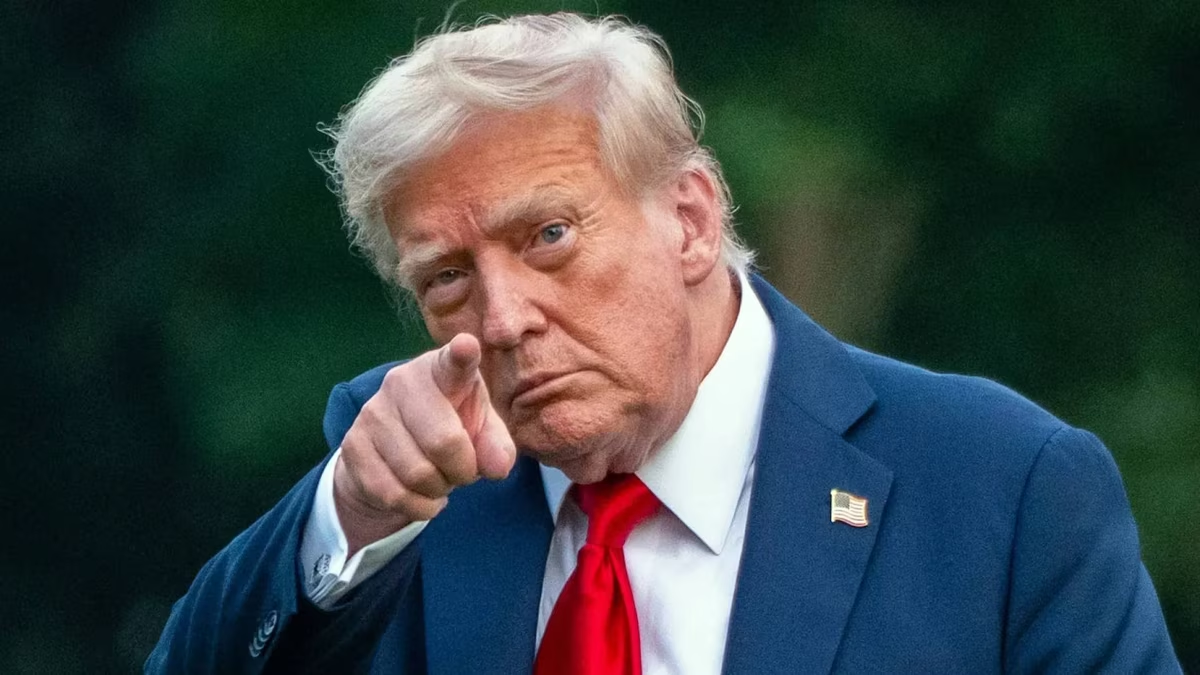
Trump Wields Force from Tehran to the Caribbean

On Sunday, US President Donald Trump threatened Iran that it would face a "very severe strike" from the United States if more protesters were killed during the protests that entered their second week, in a notable escalation of his rhetoric towards Tehran at a highly sensitive regional and international moment.

In statements to journalists aboard the presidential plane returning to Washington, Trump said his administration "is closely monitoring the situation," repeating a threat he issued days earlier: "If they start killing people as they did in the past, I think they will face a very severe strike from the United States." Western organizations claim that at least 16 people have been killed since the protests erupted in several Iranian cities, which is considered one of the most serious internal challenges facing the Iranian authorities in years.

However, Trump's threat to Iran does not come in isolation from a broader context, but fits within what the US President himself described as a "new phase" in American foreign policy, based on simultaneous escalation in more than one international arena. In just a few days, Trump combined military threats to Tehran, direct intervention in Venezuela, hints at overthrowing the state in Cuba, and reopening the file of control over Greenland, in a scene reflecting Washington's shift to a policy of maximum pressure relying on military force, and multi-directional.

In Latin America, Venezuela constituted the most prominent testing ground for this phase. Trump announced that the overthrow of President Nicolas Maduro, his kidnapping along with his wife, and his trial in a federal court in New York, represents the beginning of a "new phase" aimed, according to the American narrative, at dismantling "criminal regimes" that threaten regional security. The US administration asserts that its intervention came to combat drug trafficking and restore democracy, but several countries in Latin America, alongside major international powers, saw in the move a blatant violation of sovereignty and international law.

Despite Washington's announcement of its success in ending Maduro's rule, Venezuela continues to experience political and economic turmoil. Internal conflicts have not been resolved, the exhausted economic structure has not recovered, while anti-American sentiments are rising within the country. Nevertheless, Trump continues his escalating rhetoric, hinting at sanctions and harsher measures against any leaders who refuse to submit to the path set by Washington, alongside public talk of restructuring Venezuela's oil sector under the control of American companies.

The escalation did not stop at Venezuela. Trump expanded the circle of pressure to include Cuba, accusing Havana of playing a pivotal role in supporting Maduro and destabilizing regional stability. He went further by saying that Cuba "is ready to fall," in a statement that evoked Cold War language and raised widespread concern in the Caribbean region. Cuban authorities responded by accusing Washington of seeking to impose hegemony by force, warning that any aggression would be met with resistance, while several countries in the region expressed their fear of a new slide towards confrontation.

In a notable shift outside the traditional framework of American conflicts, Trump revived the Greenland file, considering American control over the polar territory a "vital" matter for national security in the face of Russia and China. These statements were met with outright rejection from Denmark and Greenland's leadership, which emphasized that the territory is not for sale, and that determining its fate is a sovereign matter. This move sparked tension within NATO and raised questions about the limits of American pressure even on its closest allies.

Overall, these moves reflect an American approach based on using threats and force as primary tools for managing international relations. Iran, Venezuela, Cuba, and Greenland, despite differing contexts, are all managed with one logic: impose facts first, then negotiate later. While the US administration sees this approach as a means to impose deterrence and restore prestige, experts warn that it threatens to undermine the rules-based international system and increases the likelihood of unplanned escalation.

The blatant American intervention in Venezuela sets a dangerous precedent in contemporary international relations. Overthrowing the leadership of a sovereign state without broad international authorization strengthens the logic of power at the expense of law. While Washington believes it has achieved immediate gains, the price will be weakening the legal deterrence system that protects weaker states. Such an approach opens the door for other powers to justify similar interventions, heralding a less stable world.

Moreover, re-portraying Cuba as an "imminent target" reflects a return to ideological rhetoric that ignores the complexities of reality. Excessive pressure does not necessarily lead to change, but may push Havana to strengthen its alliances with Washington's adversaries. Also, evoking the Cold War climate raises historical fears in the region and undermines any opportunities for building a regional system based on cooperation rather than polarization.

The Greenland issue reveals the tension between American geopolitical ambitions and the requirements of maintaining alliances. Seeking control over a territory belonging to a key ally sends a troubling message about the limits of mutual respect within Western alliances. At a time when international competition in the Arctic is increasing, pressuring allies may lead to counterproductive results, weakening unity instead of strengthening it.

Amid this "new phase" promoted by Trump, the question remains open: Will multi-front escalation lead to strengthening American influence, or to its exhaustion and opening the door to broader international chaos? The answer may determine the contours of the global system in the coming years.


PALESTINE

Mon 05 Jan 2026 7:22 am - Jerusalem Time

Israeli occupation army besieges Ramallah and its entrances under the pretext of security suspicions

The Israeli occupation army, on Sunday evening, besieged the city of Ramallah and its entrances, under the pretext of security suspicions, following initial reports of a hit-and-run incident near the city of Rawabi, in the occupied West Bank.

The Hebrew newspaper "Yedioth Ahronoth" reported that Israeli forces imposed a military siege on the city, set up barriers, and conducted searches, claiming suspicion of a hit-and-run incident near the Atirat settlement adjacent to Rawabi.

According to a statement issued by the Israeli army, there are suspicions of a hit-and-run operation near the Atirat settlement (central West Bank).

The army indicated that its forces are investigating the circumstances of the incident.

According to the army's official radio, the incident resulted in one minor injury, while Israeli authorities did not immediately confirm the background of what happened.

PALESTINE

Mon 05 Jan 2026 7:10 am - Jerusalem Time

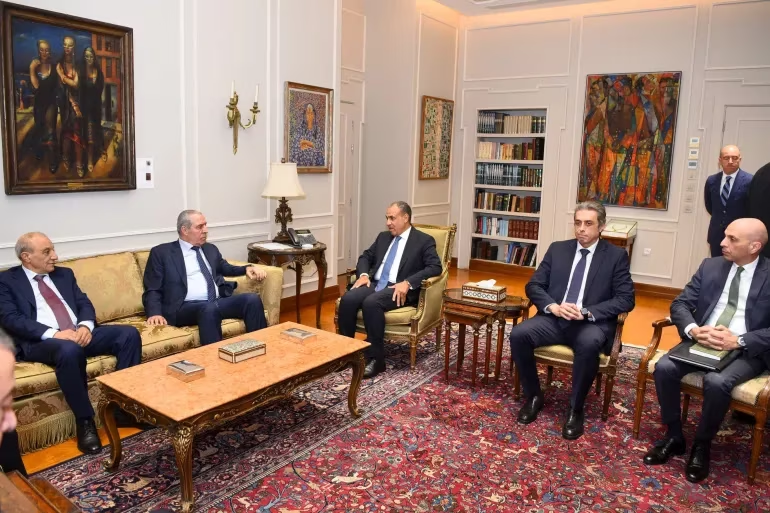
Hussein Al-Sheikh Discusses in Cairo Ways to Advance to the Second Phase of Trump's Plan for Ceasefire in Gaza

Hussein Al-Sheikh, the Palestinian Vice President, discussed yesterday, Sunday in Cairo, ways to advance towards transitioning to the second phase of US President Donald Trump's plan for ceasefire in the Gaza Strip, at a time when the Islamic Resistance Movement (Hamas) accuses Israel of expanding its violations of the agreement, while Israeli Prime Minister Benjamin Netanyahu insists on the condition of disarming the movement to move to the second phase.

Al-Sheikh said -in a post on his X account- that he met in Cairo, in the presence of the Director of Palestinian General Intelligence Majid Faraj, both the Director of Egyptian Intelligence Hassan Rashad and Egyptian Foreign Minister Badr Abdel Ati, in two separate meetings.

He explained that during the two meetings, they discussed "ways to stabilize the situation in all Palestinian territories, and to advance towards the second phase of Trump's plan and related UN Security Council resolutions", in addition to "enhancing coordination and consultation to face challenges in Palestine and the region".

Violations to sabotage the agreement

For its part, Hamas said that "the Zionist occupation is expanding its violations of the war ceasefire agreement by escalating operations to kill civilians and removing the yellow line in Khan Yunis south of the sector".

The movement added that "the occupation escalated house demolition operations in the eastern half of the Gaza Strip, continuing the urban genocide and ethnic cleansing", noting that "it still closes the Rafah crossing and restricts the entry of aid, contrary to what was stipulated in the war ceasefire agreement on the sector".

Hamas considered these violations "a systematic policy to sabotage the agreement that all parties approved and signed", calling on mediators, guarantor countries, and parties that met in Sharm El-Sheikh to "pressure the occupation to stop its violations".

Rafah Crossing and Trump's Plan

These Palestinian moves and statements coincided with what the Israeli newspaper Haaretz reported, that the security establishment in Tel Aviv "is finalizing preparations to reopen the Rafah crossing (between Gaza and Egypt) soon, for Gaza residents to enter and exit".

The crossing was scheduled to be reopened in October 2025 as part of the first phase of the ceasefire agreement proposed by Trump, but Israel did not adhere to the agreed timeline.

According to the newspaper, Trump's plan to end the war stipulates that the Rafah crossing be managed "according to the same mechanism that was applied during the ceasefire in January 2025", which was the last time the crossing was opened. Based on that mechanism, forces affiliated with the Palestinian Authority manage the Palestinian side of the crossing, with the assistance of a European force.

Haaretz quoted an unnamed European source saying that "the Palestinian representatives who previously managed the crossing did not wear Palestinian Authority badges, due to Israel's sensitivity towards its presence in the Gaza Strip".

Netanyahu puts obstacles

Meanwhile, Israeli sources said that Netanyahu is holding meetings to discuss transitioning to the second phase of the war ceasefire agreement in Gaza, in light of ongoing contacts with the US administration and regional parties.

During the weekly session of his government, Netanyahu said that US President Donald Trump assured him, during their meeting in Washington last week, that he "will not show any flexibility or concessions regarding disarming Hamas, and that there is no other option for implementing his peace plan in Gaza".

Netanyahu said that Trump was "very decisive in his position regarding Gaza; that disarming Hamas is a necessary and fundamental condition for implementing the 20-point plan for the sector, and there is no other option in this regard".

Since the ceasefire agreement in Gaza came into effect, the occupation has committed hundreds of violations, resulting in the martyrdom of 416 Palestinians and the injury of 1,153 others.

The agreement ended a genocide war launched by Israel on October 7, 2023, lasting two years, leaving more than 71,000 Palestinian martyrs, over 171,000 injured, and massive destruction affecting 90% of the civilian infrastructure, with reconstruction costs estimated by the United Nations at about $70 billion.

PALESTINE

Mon 05 Jan 2026 7:07 am - Jerusalem Time

Netanyahu Supports US Action in Venezuela and Emphasizes Disarming Hamas

Netanyahu placed "disarming Hamas" as a major obstacle and an indispensable condition for passing the American peace proposal.

The Prime Minister of the occupation, Benjamin Netanyahu, sent multi-directional political messages, linking absolute support for the American "surprising" step in Caracas with his strict security conditions for accepting the American roadmap for peace in the Middle East.

In his commentary on the accelerating international developments, "Netanyahu" did not hesitate to declare his government's unwavering support for what he described as "American firmness" that led to the arrest of the Venezuelan President Nicolas Maduro, considering that this move redefines the concept of "historical leadership".

It quoted the Prime Minister of the occupation praising the performance of the American forces and the precision of their execution of the operation, noting that this event once again proves the depth of coordination and the strength of the strategic alliance that binds Tel Aviv to Washington in facing global challenges.

Read also: Italian Prime Minister Meloni: The American operation in Venezuela is legitimate and defensive

On the Palestinian file, Netanyahu placed "disarming Hamas" as a major obstacle and an indispensable condition for passing the American peace proposal, consisting of 20 points.
He emphasized that any talk of calm or permanent solutions will remain contingent on stripping the movement of its military capabilities, cutting off the path to any concessions in this context, and placing this demand at the top of Israeli security priorities.

In another regional context, Netanyahu turned his gaze towards Tehran, declaring his sympathy with the recent popular protests, and confirming his country's support for what he called "the aspirations of the Iranian people towards freedom" and their right to determine their destiny away from the domination of the ruling regime, in an attempt to exploit the internal movement to pressure the Iranian leadership.

PALESTINE

Mon 05 Jan 2026 7:07 am - Jerusalem Time

European Supervision of Rafah Crossing Amid International Pressures to Alleviate the Humanitarian Crisis in Gaza

The Israeli security apparatuses have completed all their field and logistical preparations to reopen the Rafah border crossing very soon.

The Hebrew newspaper "Haaretz", quoting high-level security sources, revealed that the Israeli security apparatuses have completed all their field and logistical preparations to reopen the Rafah border crossing very soon.

It is scheduled that the movement of entry and exit of residents from and to the sector will resume, which indicates a change in the course of the restrictions imposed on the crossing throughout the past period.

In a prominent development that reveals the nature of the new management, the sources confirmed that "European forces" will play a pivotal and central role in the operations of supervision and monitoring of the crossing.

The newspaper added that these European elements are already present inside Israel, in preparation for moving to their work sites upon the issuance of the final signal for operation.

This step comes amid increasing international pressures to alleviate the humanitarian burden on the residents of the Gaza Strip, where European engagement is seen as a guarantee to facilitate the movement of civilians and ensure the flow of crossing services within agreed international standards.

This transformation, if implemented, is likely to reduce the intensity of field tension and open new horizons for calm in the region.

ANALYSIS

Mon 05 Jan 2026 7:05 am - Jerusalem Time

Unconventional Presidents as a Mirror of U.S. System's Crisis and Its Transformations in the 21st Century

The phenomenon of the rise of non-traditional presidents in the United States cannot be fully understood through moral or psychological lenses alone, nor by reducing it to personal traits or individual deviations. At its core, this phenomenon reflects a profound structural transformation in how the United States manages its power and role in the international system, as well as a cumulative crisis in its ability to sustain global leadership according to the frameworks established during the twentieth century.

During the era of stable hegemony, the United States successfully combined hard power with soft legitimacy, exercising influence through international institutions, alliances, legal frameworks, and value-driven narratives linked to democracy and human rights. This model allowed Washington to manage the international system as a leading power rather than merely a dominant one. However, this balance began to erode gradually after the end of the Cold War and accelerated with the rise of competing international powers, particularly China, as well as the declining ability of the U.S. to regulate the global system through multilateral consensus.

In this context, the civilizational discourse shifted from a source of power to a political constraint. The wider the gap between America’s strategic interests and its publicly declared values, the higher the cost of adhering to norms, and the less effective moral justifications became. It is precisely here that the non-traditional president emerges, a leader who feels little need to maintain institutional decorum or rhetorical consistency, treating politics as a direct exercise of power and replacing persuasion with confrontation, legitimacy with capability.

What is commonly referred to, in populist terms, as “clownish” or non-traditional presidents does not necessarily reflect a weakness in the American state; rather, it reveals its structural dilemma. A president who breaks norms, disregards institutions, and relies on performative and media-driven strategies grants the political system a broader margin of maneuver beyond the constraints imposed during the era of unipolar stability. In this sense, political performance becomes a functional instrument, not merely a behavioral deviation.

Historically, this function can be traced in pivotal moments. George W. Bush exemplified a president suited to the post-9/11 phase, when the United States needed to normalize preemptive wars, suspend international legal norms, and redefine the concepts of security and the enemy. Donald Trump, in contrast, represents a more radical transition, abandoning much of the civilizational mask and treating the presidency as a confrontational platform enabling the implementation of harsh policies without ethical or institutional justification.

These practices, however, cannot be separated from the deeper crisis of the U.S. system itself. The rise of China and other emerging powers has limited America’s capacity to maintain its position as the sole global superpower, revealing the boundaries of its power to prevent structural shifts in economic, technological, and political balances worldwide. As traditional instruments of containment became less effective, the inclination within Washington to adopt more direct and forceful approaches grew, reflecting an increasing perception of diminishing control rather than its enhancement.

In this context, the non-traditional presidency becomes a reflection of systemic crisis rather than a deviation from it. It is a political front that absorbs symbolic chaos and political shock, allowing enduring institutions to maintain core policies without shouldering the full burden of justification. What appears as deviation in form is, in essence, a redistribution of roles between political performance and strategic depth.

Entering the twenty-first century, this transformation appears neither temporary nor incidental but rather likely to deepen. The American system is undergoing a dramatic shift in its character and behavior, moving from a power that long sought to manage the international order through rules to a power striving to assert its position in a world no longer accepting unipolarity. This transformation will not affect the United States alone; the world will also bear the repercussions, whether through increased conflicts, erosion of regulatory norms in international relations, or the emergence of new forms of contestation that traditional instruments cannot contain.

We are thus entering a transitional phase in which the political reality is being redefined, not according to a clear plan but through a series of shocks, experiments, and tests. The American system, in its attempt to adapt, is likely to become one of the most significant sources of uncertainty. The new pattern emerging today may shape the global system in radically different ways from the model the United States crafted at the peak of its power—ways we cannot yet fully predict or comprehend.

In conclusion, non-traditional presidents in the United States are neither an incidental phenomenon nor a transient democratic flaw; they are a direct reflection of deep structural transformations in America’s position and role. They mirror the crisis of unipolarity and function as instruments to manage a historically critical transition, one that may determine the shape of the international system for decades to come. While this mode of leadership may provide temporary capacity for action and decisiveness, in the long term it exposes the limits of American power in an increasingly multipolar and unpredictable world.


ARAB AND WORLD

Mon 05 Jan 2026 5:47 am - Jerusalem Time

Trump outlines 'post-Maduro' contours: Oil is top priority.. and clear threats to Colombia, Mexico, and India

Vice President Delcy Rodríguez "will comply with American demands" in the transitional phase.

Following the success of the swift military operation in Venezuela, US President Donald Trump, in a series of fiery statements, outlined the contours of the next phase, confirming that his country "needs full access to the oil and other resources in Venezuela", while at the same time directing direct threat messages to neighboring countries and even to Washington's allies in Asia.

Venezuela.. Reform before elections and the New York Times newspaper revealed, quoting prominent White House officials, the American administration's conviction that Vice President Delcy Rodríguez "will comply with American demands" in the transitional phase.

In this context, Trump confirmed that his administration is currently dealing with "the people who have just taken the constitutional oath", noting that the focus is now on "reforming Venezuela" more than the elections, which he said "will be held at the appropriate time".

"The second wave".. A drawn sword and Trump's speech was not devoid of brandishing the big stick, where he was quoted as issuing a stern warning: "If they do not comply in Venezuela, we will execute a second strike".

The US President clarified that the forces were "prepared for a second wave and everything was ready", adding that he does not believe the need will arise given the current data, reassuring the public that "all injured military personnel are in good condition".

Attack on Colombia and warning to Mexico and on the regional level, Trump launched a personal attack on the Colombian president in response to his recent criticisms, describing him as "the sick man", and threatening that "he will not continue like this for long", even hinting at the possibility of another intervention saying: "Operation Colombia looks good to me".

The threats also extended to Cuba, which Trump saw as "on the verge of collapse", and Mexico, which he demanded to "sort out its affairs", stressing the necessity of doing something about it.

Economic message to India and away from the American continent, Trump brandished the weapon of customs duties against India, threatening to raise them if New Delhi does not help in the issue of "Russian oil", in reference to Washington's desire to tighten the siege on Russian and Venezuelan energy sources alike.

ARAB AND WORLD

Mon 05 Jan 2026 12:44 am - Jerusalem Time

Maduro's son vows: 'You will see us in the streets' amid reports of 'betrayal' that aided in the kidnapping of his father

He indicated that history will reveal the 'traitors' and the truth, in reference to reports talking about a spy in the close circle of the kidnapped president who facilitated the operation

In his first appearance after the shocking American military operation, Nicolas Maduro Guerra, known as 'Nicolasito', sent an enthusiastic voice message to supporters of the ruling party, vowing to confront American intervention in the field.

These statements come as the new Venezuelan government, led by Delcy Rodriguez, begins to gather its papers after the 'kidnapping' of Maduro and his wife in an attack launched by Washington last Saturday.

'Nicolasito', who is a deputy in parliament and one of those wanted by the American judiciary on charges of 'drug-related terrorism', denied that his family or the regime is in a state of collapse.

And he said in his recording broadcast on social media sites: 'They want to see us weak, but they will not see us weak'.

Maduro's son swore by his life and his parents to get out of this ordeal, confirming his family's determination to endure.

On the ground, Tabashir correspondents monitored movement of Maduro supporters in the streets of Caracas since noon on Sunday, in response to calls from 'Nicolasito' who said: 'You will see us in the streets raising flags of dignity'.

What increased the tension in the situation was Maduro's son's hint at the existence of internal 'betrayal' that enabled American forces to reach his father (63 years old) and his father's wife Cilia Flores (69 years old).

He indicated that history will reveal the 'traitors' and the truth, in reference to reports talking about a spy in the close circle of the kidnapped president who facilitated the operation.

On the political track, the Venezuelan army today Sunday announced its recognition of Delcy Rodriguez as interim president of the country, after her appointment by the Supreme Court following the vacancy of the presidency as a result of the American operation. This recognition strengthens the pillars of the current authority in the face of American threats and possible internal divisions.

ARAB AND WORLD

Mon 05 Jan 2026 12:34 am - Jerusalem Time

Danish Warnings to "Trump": Greenland is Not for Sale and Fears of Repeating the "Venezuelan Scenario"

Although Greenland has the right to declare independence under the 2009 agreement, it still relies financially on Denmark.

Diplomatic tensions escalated between Copenhagen and Washington today, Sunday, following controversial statements made by US President "Donald Trump" expressing his desire to annex the island of "Greenland".

These demands, which Trump reiterated in an interview with "The Atlantic" magazine, provoked leaders in Denmark and Greenland, who called on the White House to stop threatening the national sovereignty of a historical ally.

In a strongly worded statement, Danish Prime Minister "Mette Frederiksen" confirmed that America has no right to annex any part of the Danish Kingdom, describing talk of seizing the island as "utterly meaningless".

Frederiksen emphasized that Greenland's people and government have clearly stated that their land "is not for sale".

For his part, "Jens Frederik Nielsen", Prime Minister of Greenland, expressed his deep dismay at Trump's linking of the island's fate to military intervention in Venezuela. Nielsen considered such comparisons to entail "disrespect" and to be completely misguided.

These statements come just one day after US forces arrested Venezuelan President "Nicolas Maduro" and Washington's announcement of taking over the administration of his country.

This field development has sparked panic in Danish circles about the possibility of "Trump" seeking to apply a similar model in the Arctic.

What increased suspicion was Trump's appointment on December 21 of "Jeff Landry", Governor of Louisiana, as special envoy to Greenland.

Landry openly declared his support for the annexation idea, which was seen as a practical step towards realizing Washington's ambitions in the mineral-rich island.

Greenland forms a vital pivot point between Europe and North America, and is an integral part of the US missile defense system. America seeks through acquiring it to:

Secure strategic sites for the ballistic missile defense system.

Benefit from its immense mineral wealth to reduce dependence on Chinese exports.

And although Greenland has the right to declare independence under the 2009 agreement, it still relies financially on Denmark.

Copenhagen has tried throughout the past year to calm the atmosphere with the "Trump" administration by increasing defense investments in the Arctic, but these efforts were not enough to curb the American president's ambitions.

OPINIONS

Sun 04 Jan 2026 7:23 pm - Jerusalem Time

Iran Protests Break Fear Barrier to Overthrow Mullahs' Regime

By: Christine Hanna Nasr

By: Christine Hanna Nasr

Opinion Writer

The new year began with changes for the Iranian people, and the pace of popular demonstrations has been expanding day by day. The main and primary reasons for this are the rising cost of living, the worsening water scarcity problems in Iranian cities, as well as the increase in inflation and the sharp collapse of the currency against the American dollar, and the country's entry into a crisis and a rapid collapse of the Iranian economy.

Millions of citizens are demonstrating in the streets of Iranian cities. The first blow started from the Iranian capital, and the clock stopped for the old regime, and Iran entered a new phase in its history titled the radical new change coming to the Iranian scene, and the ruling class entering a dead end where the power of the mullahs is diminishing day by day in parallel with the increasing intensity of the angry people's demonstrations in the streets of the Islamic Republic of Iran, and the huge high arrogant wall of suppressing the people is cracking, its prestige falls, and with it the people's fear is gradually overcome, erasing the shadows of the terrifying past, and the demonstrators' revolutions intensify, and their voices rise in the streets to enter a new phase and a strong start for the people and the demonstrators, expanding to the rest of the Iranian cities, and the revolutionaries' voice is heard as they chant for Shah Reza Pahlavi and strive to cling to the past to save them from the tyrant's rule and give them hope to continue strongly. The phase of silence has ended, and the elements of the ruling past symbols are falling day by day with the intensity of the demonstrations, and Iran enters a new phase with the strong voice of the people  which scatters the high repressive wall, and the angry people begin to break all barriers of fear and strive to get rid of the ruling mullahs' dictatorship starting from Tehran to Isfahan, expanding to Khuzestan and to the city of Mashhad and to the rest of the Iranian cities where the echo of the high voices of the demonstrators resonates, and with determination to overthrow this ruling system, and here the fear of the past turns into the strength of the Iranian people's anger, united strongly emanating from the bazaar merchants to the university students, and from everywhere pictures of Khamenei are burning, and with it the prestige of the regime's symbols is being erased day by day with the continuation of the demonstrations in parallel with the beginning of the new year that heralds relief for the Iranian people, asserting these demonstrations " Khamenei will fall and the Shah of Iran will return "  The nightmare of the 1979 regime has returned strongly, but the situations have reversed and changed in the 2026 new year demonstrations, and the roles have changed in it for the past revolution that overthrew the Shah's rule in 1979 from Khamenei coming from Paris and now the son of the Shah of Iran Reza Pahlavi from exile supporting the people in these revolutionary demonstrations from abroad to overthrow the ruling mullahs' regime, and on the other hand, President Trump threatens the mullahs' regime with intervention to protect the Iranian people if the demonstrators are suppressed or killed in a brutal way as happened in the past, as the Iranian leader Ayatollah Khamenei responded to the statements of the American President Trump " We will not submit to the enemy " and " We will triumph and defeat the enemy " as some officials stated that if America exceeds Iran's sovereignty and intervenes in the Iranian internal home, its response will be harsh  ,  It appears from the current developments and data that this regime will inevitably fall without any intervention from President Donald Trump because the people are determined and assertive to overthrow the current Iranian regime  where the pace of events accelerates, government buildings and police centers in several cities are burning, and the Shah in exile adds fuel to the fire, and his public appearance declaring support for the demonstrators stating " The final victory is ours " is considered an indicator of gathering himself with this group, and notably, the economic advisors of the current regime have submitted their resignations and distanced themselves from the scene, and on the other hand, Iran's allies like Russia are preoccupied with their problems and their current war with Ukraine, and it is difficult to intervene to save their ally from its people, and while China has remained silent and has not made any statement to support its ally Iran  , and since the outbreak of the demonstrations and the economic crisis, the rescue of the current regime from falling seems impossible, it seems that there is no one to save what can be saved and leave it destined to fall in this sensitive and difficult phase it is going through.

I believe that things have reached the explosion and the point of no return, and the demonstrators' voices are chanting everywhere " Enough is enough " and here specifically Iran enters the new era born from the womb of the angry people who may triumph over the dictatorship and the mullahs' regime of the Islamic Republic of Iran, and what increased the people's revolution and anger was Bazargan's statement when he admitted that the state treasury is empty and they are not able to distribute to the people as in the past, igniting the volcano of the demonstrators, especially for the bazaar merchants who closed their shops and joined the revolution for the overwhelming demonstrations supported by university students, and recently people joined chanting collectively " No to Gaza and no to Lebanon, let my life be sacrificed for Iran " criticizing the foreign policy of the mullahs' regime that supported proxy wars in the Middle East and unlimited financial support for arming its militias and armed parties, especially in Syria, Lebanon, Iraq, and Yemen at the expense of the Iranian people who are suffering economically, and instead of spending on its people, it supported and backed the Syrian Ba'ath regime for the deceased Bashar al-Assad with billions of dollars that unfortunately were not repaid, these amounts were spent to destroy and kill the peoples of the Arab East countries in the wars supported by Iran in Syria, Lebanon, and Iraq, and the Iranian people's situation is deteriorating where inflation has reached 41% as basic food commodities have risen by 70% with the deterioration of the Iranian rial, and unfortunately the Iranian citizen works for a full month in Iran to earn only an amount equivalent to one gram of gold, after 47 years of the mullahs' rule over Iran resulting in a collapsed economy, an empty state treasury meaning no money for the people, increasing administrative corruption, and worsening water scarcity, and Ayatollah Khamenei has been hiding for days, and the rule and its institutions are burning at the hands of the determined demonstrators to overthrow the regime, chanting at the top of their voices to overthrow it, and at Mashhad University the students chant " We prefer death over the situation we live in " it seems that the people's current battle intends to overthrow the  mullahs' regime, where Shah Reza Pahlavi breaks the silence and addresses the demonstrators yesterday from his exile in America calling on the army and security forces to defect from the rule and support the people in this revolution before it's too late, asserting that this regime will inevitably fall, and in contrast, the regime is collapsing day by day, and the security forces are dissolving in the face of the people's anger, fleeing from their burning cars, it is clear that the people have broken through and overcome the fear barrier, and this heralds the continuation of the demonstrations and the possibility of success of this popular revolution to overthrow the regime, especially when the army unites with the people and they defect together to shake the foundations of the rule and overthrow it, as the Shah's appearance and his public declaration of support for the popular revolution gives them the strength to continue and succeed in their revolution  .

The coming days are full of developments, and the Iranian street is burning and scorching on a hot plate, and all indicators point to the advancement of the demonstrations and their intensification to strive for success in overthrowing the mullahs' regime, and there are fears of the situation deteriorating into a civil war, and if this revolution succeeds in overthrowing the regime, it will inevitably lead to relief for the Arab East countries as well, especially from Iranian dominance over the joints and sovereignty of countries like Iraq and Lebanon in particular, and helping them to eliminate the weapon of the factions and parties loyal and supported by Iran, where the material and moral support for them will stop upon the fall of the mullahs' regime, as it will help to settle  the weapon only in the hands of the army, and the Arab East countries regain their sovereignty dominated by Iran, their strength, and impose their sovereignty and restore their resources and assets, and this will inevitably produce a new government in Iraq not loyal to Iran and enter a new phase  titled imposing the state's sovereignty and the army, and on its sovereign political decision, and Lebanon and Iraq get rid of and become independent from Iranian hegemony over them.

OPINIONS

Sun 04 Jan 2026 5:28 pm - Jerusalem Time

Was Gaza the Laboratory of a New U.S. Foreign Policy?

Dr. Ibrahim Na'irat

Dr. Ibrahim Na'irat

Opinion Writer

The transformations witnessed by American foreign policy in recent years cannot be understood solely through changes in administrations, but rather through a deeper shift in the tools and references that govern the behavior of American power in the international system. During Donald Trump's era, the strategic objectives of the United States did not change as much as the mechanisms for achieving them, where a clear trend emerged towards reducing the cost of foreign intervention, whether at the human, financial, or political level, while maintaining the ability to impose facts and achieve results.

This approach was distinguished by a relative departure from the traditional model of regime change that prevailed in previous decades, which relied on large-scale wars, long-term occupations, and often complex legal and ethical narratives that later proved to be fragile or selective. In contrast, the new approach shifted towards the logic of direct and time-limited intervention, based on targeting political decision-making centers, and employing economic, legal, and security pressure tools simultaneously, allowing for significant political impact without engaging in open conflicts.

This shift reflects a pragmatic mentality that sees foreign policy as an extension of the deal logic, where successes are measured by the balance of cost and return, not by the extent of commitment to value discourse. From this perspective, intervention is no longer presented as war, but as an executive, security, or legal measure, even if it inherently involves a clear violation of the principles of sovereignty and non-interference stipulated in international law. This method gives the American decision-maker a wider margin of movement, given the reduced likelihood of internal opposition linked to human losses or long-term financial exhaustion.

However, this shift cannot be isolated from the structural context of the international system. The new pattern in American thinking indicates a gradual transition from the hegemony model that characterized the twentieth century, based on managing influence through international institutions, alliances, and formal legitimacy, to a logic closer to imperial mentality, where power is exercised more directly and openly. This shift comes amid a growing awareness in Washington of its declining status as the sole superpower, and the rise of competing international powers, foremost among them China, seeking to reshape global power balances.

In this framework, the question arises about the role of the war on Gaza in crystallizing or accelerating this approach. The political and military coverage provided by the United States to Israel constituted a practical model for how to disrupt international accountability mechanisms, neutralize UN institutions, and provide full cover for the use of force to achieve specific political and military objectives. This support was not merely an expression of a traditional alliance, but a manifestation of a political will that allows suspending rules when they conflict with calculations of power and interest.

From this perspective, Gaza can be seen as a testing ground for a new phase where international legitimacy is redefined based on the ability to impose facts, not on commitment to the law. The international incapacity, or silence regarding what happened, contributed to consolidating this model, encouraging its generalization in other contexts, where direct force becomes a legitimate tool for reshaping political environments.

Although this type of intervention may seem less bloody in its direct form compared to traditional wars, it does not necessarily mean a reduction in violence or stability. The cost in this case does not disappear, but transforms into an invisible or deferred cost, often borne by weak societies, whether through economic exhaustion, dismantling of political structures, or perpetuating instability.

In conclusion, what American foreign policy is witnessing is not a withdrawal from the international system, but a repositioning within it, based on the transition from disguised institutional hegemony to a more explicit exercise of power. If this shift stabilizes as a permanent pattern, it portends further erosion of the rules of the international system, and poses serious challenges to the future of global stability in a phase where power centers are increasing and the ability of shared rules to regulate international behavior is declining.