PALESTINE

Wed 07 Jan 2026 9:27 pm - Jerusalem Time

Tensions escalate in northern Gaza: Occupation claims targeting Hamas leader in response to field attack

Hamas has not yet commented on the assassination reports or the identity of the target

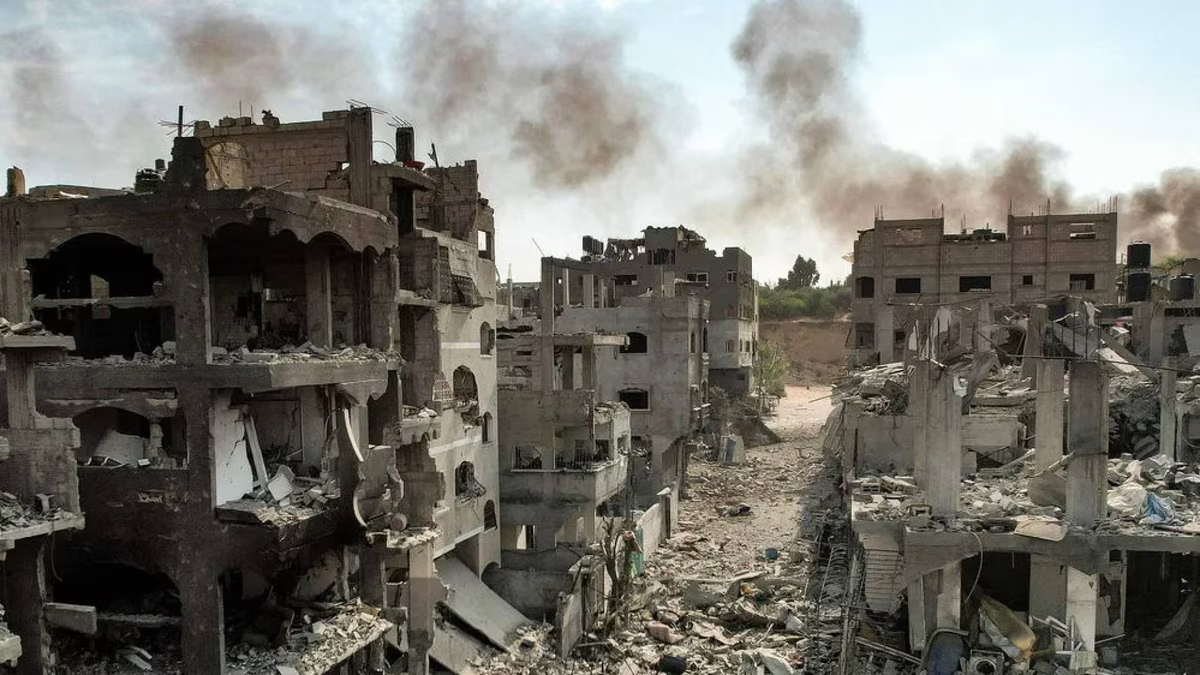
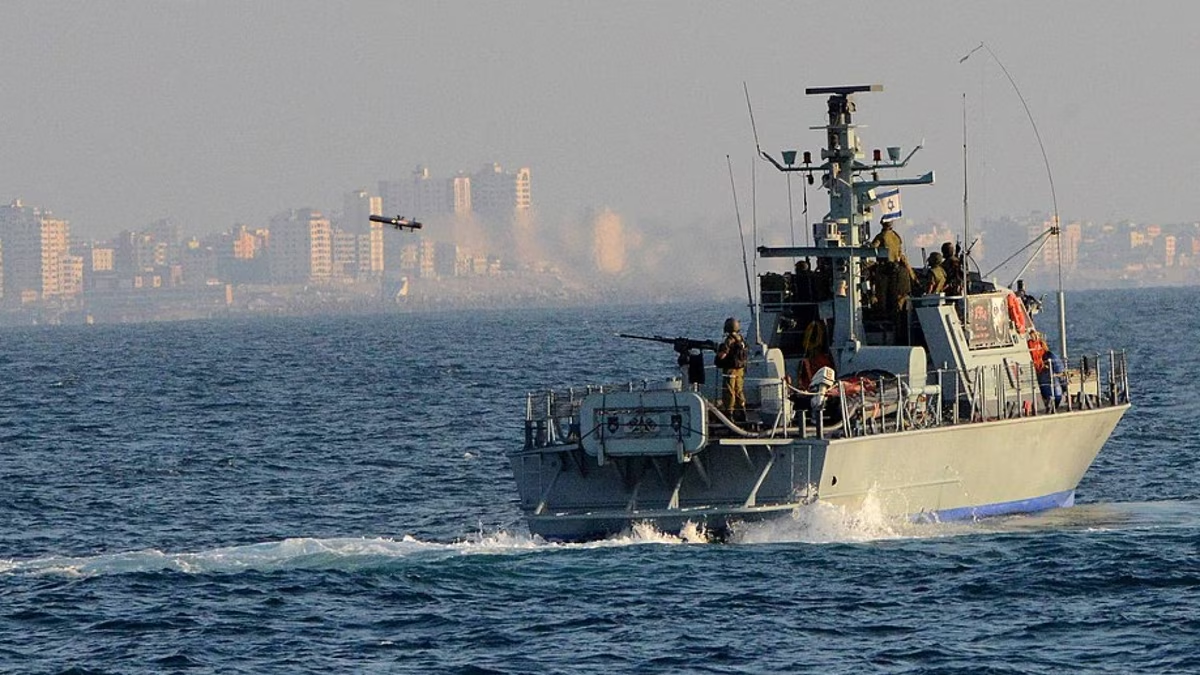
The occupation army announced on Wednesday the execution of a military operation targeting a prominent leader in the "Hamas" movement in the northern Gaza Strip.

This operation comes in the context of a new wave of field escalation, with the occupation attributing this move to an urgent reaction to a shooting incident carried out by militants earlier today, threatening to plunge the northern region into a new spiral of violent confrontations after a period of relative calm.

The northern Gaza Strip is a center of military weight and ongoing conflict, having witnessed repeated ground and air operations over the past months.

Despite successive announcements about undermining the military capabilities of Palestinian factions, the field continues to witness surprise attacks targeting the positions of occupation forces.

This latest targeting confirms the continuation of the "targeted assassination" policy pursued by the occupation against leadership cadres, in an attempt to hinder any efforts to reorganize ranks or plan future operations against its military presence in the region.

In the details of the statement issued by the occupation army, it was mentioned that the attack was carried out after precise monitoring of the movements of the targeted leader, whose name has not yet been revealed.

The occupation statement claimed that this leader was "actively working on planning qualitative attacks" against Israeli forces stationed in the north, describing him as a "pivotal element" in the movement's military structure.

This attack coincided with reports of field clashes that occurred earlier, where an occupation army position was subjected to heavy gunfire.

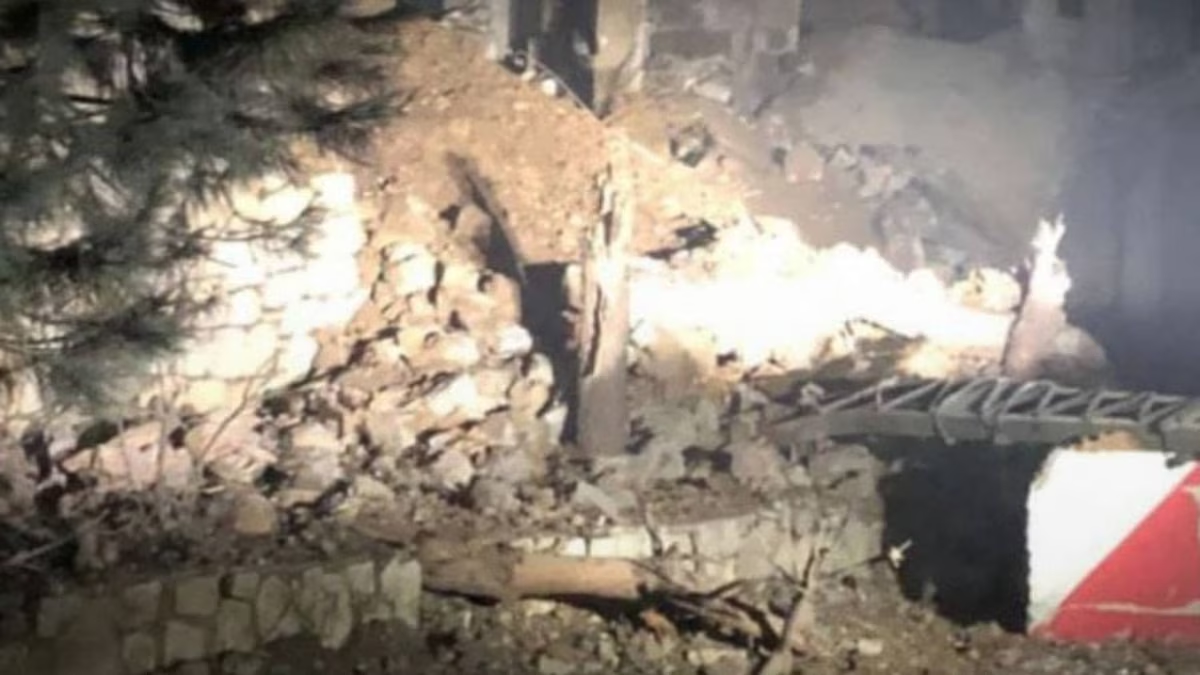
While the "Hamas" movement has not yet commented on the assassination reports or the identity of the target, eyewitnesses in the northern Strip reported hearing massive explosions followed by intensive drone (Zanana) flights.

The operation has led to a state of confusion among displaced civilians in those areas, amid fears that this targeting will be followed by a wider escalation including artillery shelling or retaliatory air raids.

These latest developments put de-escalation efforts to a real test, as the field in Gaza proves that the "embers of confrontation" are still burning under the ashes of the fragile truce.

Observers believe that the occupation's reliance on targeted strikes reflects its desire to send strong deterrence messages at the beginning of 2026, while the response paths from Palestinian factions remain open to all possibilities, which may lead to a change in the map of field stability in the near future.

PALESTINE

Wed 07 Jan 2026 9:19 pm - Jerusalem Time

UNRWA's woes worsen.. hundreds of employees laid off due to "unprecedented financial crisis"

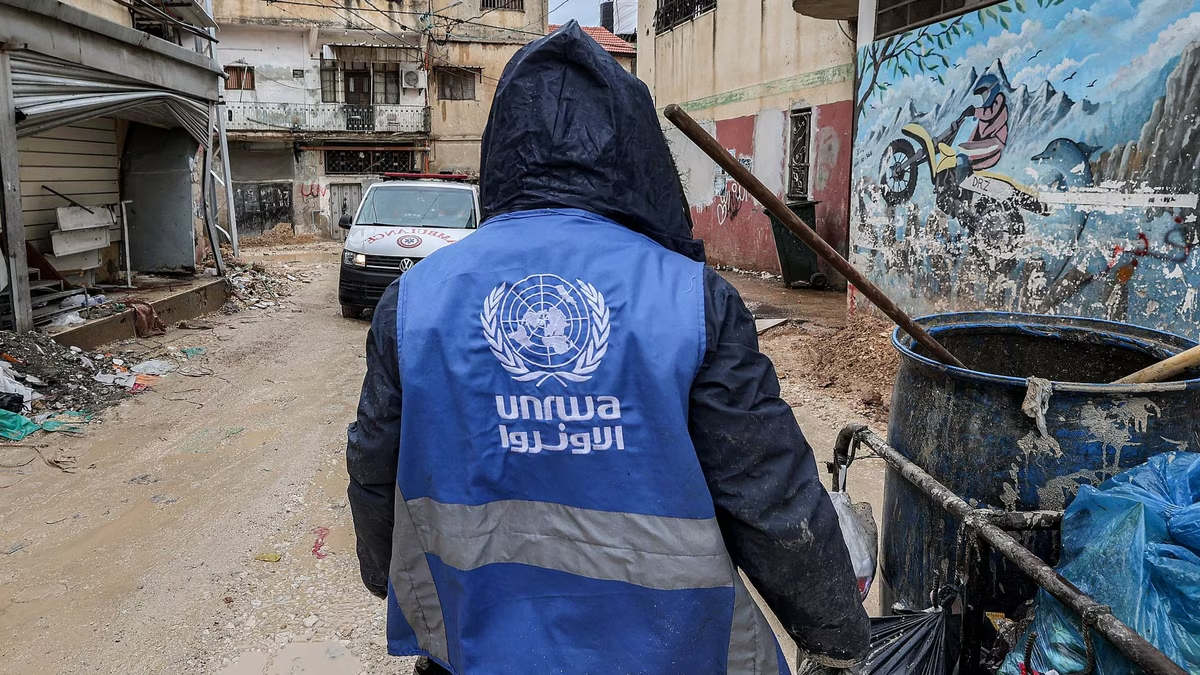
Amidst suffocating funding conditions, the United Nations Relief and Works Agency for Palestine Refugees (UNRWA) announced on Wednesday a difficult decision to terminate the services of hundreds of its local employees.

This step comes as a result of a massive financial deficit and continuous smear campaigns that led to a decline in international donations, placing the UN agency before an existential challenge affecting its ability to care for millions of refugees in the region.

A spokesperson for UNRWA clarified that 571 local employees were informed of the immediate termination of their services.

This category includes employees who left the Gaza Strip at the beginning of the war that erupted in October 2023, as they were unable to perform their duties remotely and continued to receive their salaries until last March before being transferred to involuntary unpaid leave.

The spokesperson indicated that this decision, despite its harshness, will allow those affected to access quick financial resources such as "end-of-service compensation," especially since they have been without income for more than ten months, with no prospect of resuming their work due to field conditions beyond the agency's control.

UNRWA faces a deep financial abyss; the cost of its assigned activities reached about $880 million in 2025, of which it has only received $570 million.

The spokesperson warned that this deficit will extend to threaten the 2026 budget, which could lead to additional cuts in the relief, health, and educational services it provides to refugees in Gaza, the West Bank, Lebanon, Jordan, and Syria.

This financial collapse comes at a time when the agency is under severe pressure from the occupation, which has banned its activities on its territory and accused it of supporting "Hamas."

Although international investigations have not provided conclusive evidence for the substantive Israeli accusations, these "systematic campaigns" have succeeded in discouraging donors and reducing their contributions.

It is worth noting that the agency has lost more than 300 employees in the Gaza Strip since the beginning of the aggression, and still manages its operations through about 12,000 steadfast employees within the Strip.

The reduction in the number of employees today is a final warning bell to the international community, confirming that the lung through which Palestinian refugees breathe is suffering from systematic financial and political suffocation.

OPINIONS

Wed 07 Jan 2026 8:34 pm - Jerusalem Time

Return to the People: The Dilemma of Multi-Partyism and the Failure of Political Representation

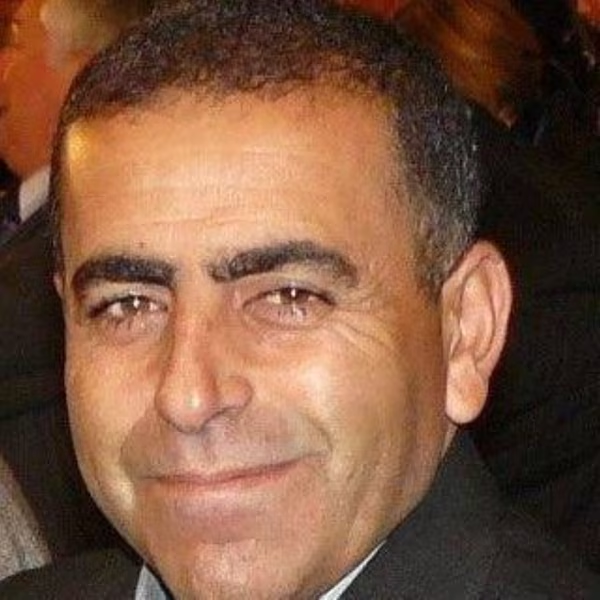
Dr. Ibrahim Na'irat

Dr. Ibrahim Na'irat

Opinion Writer

In the current Palestinian moment, the political crisis is no longer merely a direct result of the occupation or complex regional and international balances. Instead, it has become clear that it is a structural crisis within the Palestinian political system itself, related to its relationship with the people, the nature of party action, and the absence of accountability and participation mechanisms. The Palestinian people, despite all the historical catastrophes and continuous tragedies they have endured, remain united in their major national goals: freedom, independence, and the right of return. However, this popular cohesion is not reflected in the existing political structure, which suffers from deep stagnation and increasing detachment from the popular base.

“National unity” has long been treated as an overarching slogan used to overcome crises, but the fundamental problem lies in misdiagnosing the nature of the division. The real division in the Palestinian situation is not a popular division, but a partisan and organizational one. The Palestinian people, in the West Bank, Gaza, Jerusalem, and the diaspora, share national values and constants, while factions and parties suffer from disagreements related to power management, political and resistance action strategies, and decision-making mechanisms. The deliberate or unconscious confusion between popular division and partisan division has led to blaming society for a crisis it did not create, and to exempting political structures from accountability.

In this context, multi-partyism, in its current form, no longer performs its supposed democratic function. On the contrary, it has become a factor of weakening and disintegration, contributing to a series of political catastrophes for which the Palestinian people have paid heavy prices. When pluralism is separated from a unifying national reference, effective representative institutions, and genuine democratic mechanisms, it ceases to be healthy pluralism and transforms into a zero-sum conflict between organizations competing for influence and legitimacy, rather than for national programs and strategies.

The problem here is not with the principle of pluralism itself, but with its distorted context. The absence of a state under occupation, the suspension of elections, and the monopolization of political decision-making have caused parties to transform from tools of representation and organization into alternatives to the state, vying for resources, decisions, and legitimacy. Instead of factions expressing the social and political diversity within Palestinian society, they have become closed entities, rigid in their leaderships, tools, and strategies, unable to adapt to daily changes or respond to the renewed needs of citizens.

This paralyzed partisan reality has contributed to shifting the focus of the conflict from confronting the occupation to managing internal disagreements. Instead of directing popular energy towards building a cohesive liberation project, it has been drained in internal conflicts, in justifying failure, and in imposing political visions without offering real choices to the public. Here, the Nakba is no longer an exceptional event in Palestinian history, but a recurring path that is politically reproduced, in the absence of accountability and the lack of genuine popular participation.

From a political science perspective, the utility of pluralism is not measured by the number of parties, but by its ability to produce effective public policies, achieve stability, represent popular will, and renew legitimacies. When pluralism fails to perform these functions, it becomes a burden on society rather than a guarantee for it. This is what Palestinians are experiencing today, where multi-partyism, in its current form, has become an obstacle to rebuilding the political system, formulating a comprehensive national program, and unifying political decision-making in confronting the occupation.

In contrast, the Palestinian people remain the most stable element in the equation. Their strength lies not only in their steadfastness, but in their value unity and their inherent capacity for initiative and change. However, this strength has remained politically paralyzed, trapped between factions that do not truly represent them and do not involve them in decision-making. Hence, returning to the people, not as a slogan but as a political methodology, becomes the real gateway to any serious national change.

The current stage requires the people to move from the position of spectator to that of actor, by taking the initiative to build new political and civil frameworks, or by reasserting their role within existing frameworks, thereby creating genuine competition for their representation, and pushing traditional parties to change or be superseded. It also requires activating popular accountability tools, so that factions are evaluated based on their performance and the results of their policies, not on their history or rhetoric.

National political change cannot be achieved through slogans or general calls, but through a clear and comprehensive plan, starting with a re-evaluation of factions and parties and measuring the extent of their representation of the people, moving through strengthening the civil and youth space as the primary driver of any political transformation, and setting a long-term national agenda that includes political, economic, and social dimensions, away from narrow partisan conflicts.

Moreover, investing Palestinian time has become a strategic necessity. Every day that passes without building real internal strength is a wasted day. Investing in education, educating youth, building economic projects that enhance steadfastness, activating media campaigns, and using international law and international legitimacy to defend Palestinian rights are all cumulative tools that strengthen the national position and give any future strategy credibility and power.

The current historical stage may necessitate reducing the dominance of parties over national decision-making, without eliminating differences or confiscating pluralism, but by subjecting it to a general popular will and a comprehensive national program. What is required is functional unity in decision and strategy, not a formal unity between competing organizations. Factions must return to being tools in the service of the people, not centers of decision above them.

Ultimately, the Palestinian people remain the solid foundation for any successful national project, and recognizing that the division is partisan, not popular, is the first step towards real change. Without rebuilding the relationship between the people and the political system on the basis of participation, accountability, and initiative, multi-partyism, in its current form, will remain part of the crisis, not part of the solution, and political catastrophes will continue to recur, while only the people have the power to break this cycle and build a national future based on awareness, internal strength, and a comprehensive strategy.

Continuing to manage the Palestinian political scene with the same tools, the same mentalities, and the same multi-party structure is no longer a tactical error that can be tolerated, but has become a strategic danger to the entire national project. Parties that are not held accountable, do not renew their legitimacies, and do not involve the people in decision-making, transform from tools of struggle into centers of obstruction, regardless of their slogans or history.

The current moment cannot tolerate more political courtesies or the recycling of illusions. Time is working against the Palestinian people, not in favor of the factions, and every day wasted in internal conflicts or decisions detached from the popular will is a day added to the record of political catastrophes for which the occupation alone is no longer responsible. Insisting on the continuation of multi-partyism in its current form, without review or accountability, means tacitly accepting the continuation of division, the perpetuation of failure, and the reproduction of impotence under different guises.

What is needed is no longer a superficial reform within worn-out structures, but a re-establishment of the relationship between the people and politics from its roots. Either the national decision returns to the people as the sole source of legitimacy, or the political system continues to detach from them until it loses what little meaning and representation it has left. In this equation, there are no comfortable compromises, and no room to postpone confronting reality.

Palestinian history proves that the people have always been ahead of their leaders in awareness and sacrifice, and that catastrophes did not arise from a weak popular will, but from its poor political management. Hence, any national project that does not begin with holding factions accountable, reducing their dominance over decision-making, and freeing political action from their monopoly, is doomed to failure, no matter its intentions.

The choice today is clear and decisive: either a political system that reflects the will of a living and active people, or the continuation of a crisis-ridden partisan reality that produces only more internal erosion. Unless this battle is decided in favor of the people, talk of national unity or political salvation will remain mere rhetoric for consumption, while the Nakba advances silently and, this time, with local tools.


ARAB AND WORLD

Wed 07 Jan 2026 7:17 pm - Jerusalem Time

Venezuelan Oil in "American Custody".. Washington Strikes Deal with Caracas to Release Blocked Shipments

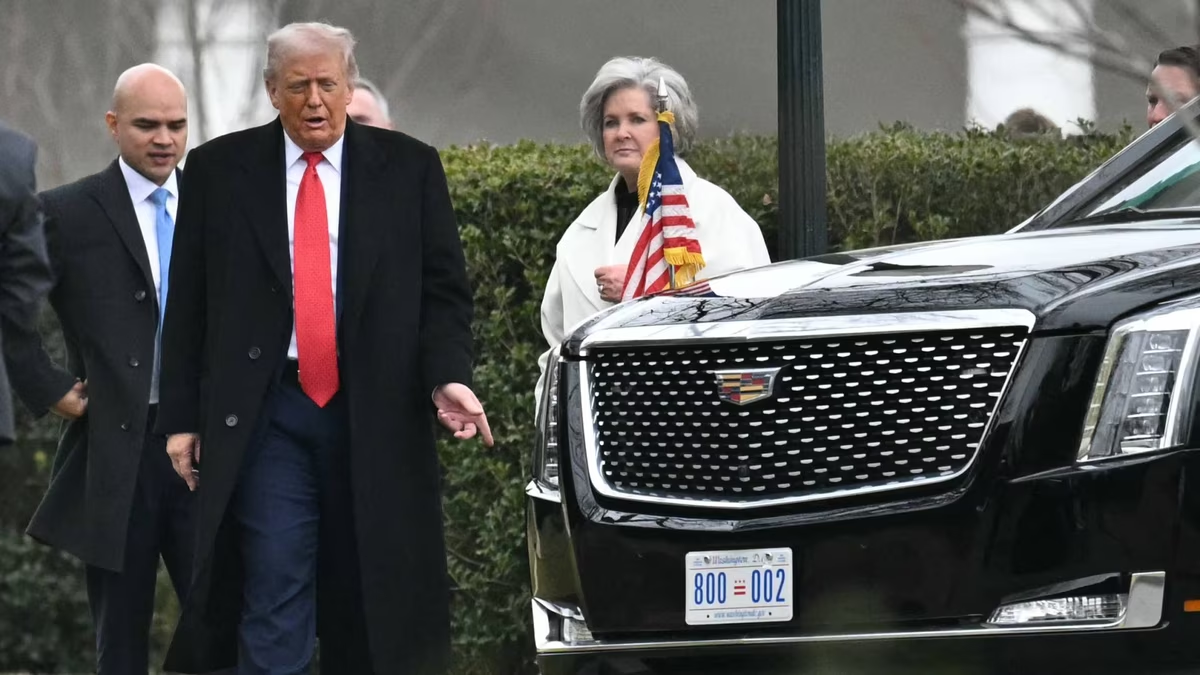
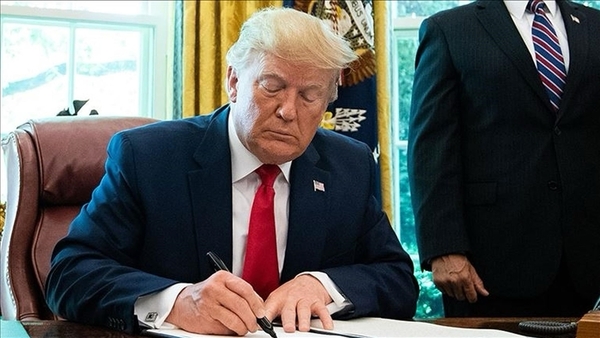
In a rapidly developing political and economic turn, the White House announced today, Wednesday, that the Trump administration has reached a pivotal agreement with the interim Venezuelan authorities regarding the energy file.

The deal stipulates the transfer of massive quantities of Venezuelan crude to American shores very soon, including shipments that have been stagnant for months on board ships due to previous international sanctions, which means a significant breakthrough in supply chains for American refineries.

The US presidency confirmed that there is "close and continuous communication" with the transitional leadership in Caracas, which took over after the fall of the Maduro regime.

The new deal is based on the disposal of millions of barrels that were stuck in territorial and international waters, as these ships will be redirected to American ports, in a move aimed at strengthening Washington's strategic energy reserves and lowering prices in the local market.

Perhaps the most controversial clause in this agreement is the mechanism for dealing with financial revenues; the White House clarified that the proceeds from the sales of this oil will not be handed over in cash to Caracas at the current stage.

Instead, the funds will be deposited in international banks under the direct management and supervision of the United States, to ensure their use in reconstruction efforts and supporting transitional stability, and to prevent them from reaching remnants of the former regime.

Observers believe that the speed of concluding this deal reflects Trump's seriousness in turning the previous military victory into a quick economic gain.

On the one hand, Washington can deprive its international rivals, such as China, of oil shipments they relied on, and on the other hand, it asserts control over Venezuela's financial resources, making the interim government entirely dependent on American approval.

The arrival of Venezuelan oil to the ports of Texas and Louisiana in the coming days will be an official announcement of the beginning of a new era in the American continent, where "energy diplomacy" returns to be the main focus of the White House's movements in the Caribbean region.

PALESTINE

Wed 07 Jan 2026 6:30 pm - Jerusalem Time

A Palestinian Girl died due to her injuries and the occupation's continued violations of the ceasefire in Gaza

A Palestinian girl was martyred on Wednesday, succumbing to her injuries from an occupation shelling that targeted the Al-Mawasi area west of Khan Yunis city days ago, amidst the occupation's continued violations of the ceasefire agreement for the eighty-eighth consecutive day.

Palestinian sources reported that the martyr Farah Muhammad Shaqfa passed away due to injuries she sustained in the "Al-Iqlimi" area in Mawasi Khan Yunis.

In the same context, Israeli occupation forces escalated their violations of the truce agreement, carrying out new demolitions of residential buildings east of the Al-Zaytoun neighborhood, southeast of Gaza City, concurrently with artillery shelling targeting the eastern areas of the city.

Occupation aircraft also launched two airstrikes east of Khan Yunis, while occupation helicopters fired towards the eastern areas of the city, and the airstrikes extended to target areas east of Deir al-Balah city in the central sector.

The number of martyrs since the ceasefire came into effect on October 10th has risen to 425, in addition to 1189 injured as a result of the ongoing occupation aggressions.

ARAB AND WORLD

Wed 07 Jan 2026 5:28 pm - Jerusalem Time

Commentary (Xinhua): The strike against Venezuela shows who truly undermines international law

In this photo taken on December 23, 2025, an oil tanker is anchored in Lake Maracaibo in Zulia State, Venezuela. (Xinhua)

The US military incursion into Venezuela, and the action taken against its president, Nicolas Maduro, as announced by the US administration, once again reveal Washington's reliance on unilateral force to impose outcomes beyond its borders.

This aggression also empties decades of American rhetoric, which presents the United States as the guardian of the rules of the international order, of its content. By bypassing the UN Security Council, Washington has once again acted in direct contradiction to the principles of international law.

Article 2 (4) of the United Nations Charter, a foundational principle of international law, explicitly prohibits the use or threat of force against the sovereignty, territorial integrity, and political independence of any state. Consequently, the action taken against the leader of a sovereign state has unequivocally shown the world who the true violator of international law is.

History offers ample precedents. From Iraq and Libya to Panama and Grenada, the United States has repeatedly used or threatened to use force under dubious pretexts, often leaving behind long-term instability. Venezuela, long subjected to sanctions and political pressure, now joins that list, with diplomacy once again sidelined in favor of military coercion.

In this photo taken on August 4, 2022, the White House and a sign reading "STOP", in Washington D.C., United States. (Xinhua)

This aggression is all the more reprehensible because it occurred in Latin America. The region has a long history of US interventions, and the logic behind them has never truly disappeared.

As CNN noted in its analysis, "At the heart of this move lies Washington's broader ambitions to exert greater control over its immediate neighborhood, in what they called an updated version of the Monroe Doctrine."

This doctrine may no longer be explicitly declared, but its essence remains: the Western Hemisphere is still treated as Washington's exclusive sphere of influence.

Through its own repeated actions, Washington has emerged as one of the most dangerous threats to the international order it claims to defend.

For the rest of the world, speaking clearly and firmly in defense of sovereignty and multilateralism is no longer an optional choice. Rather, it has become essential to prevent a return to a world where power, not law, determines the fate of nations.

ARAB AND WORLD

Wed 07 Jan 2026 4:28 pm - Jerusalem Time

Comprehensive American Demands from New Venezuelan President to Allow Oil Exports

Washington – Said Arikat

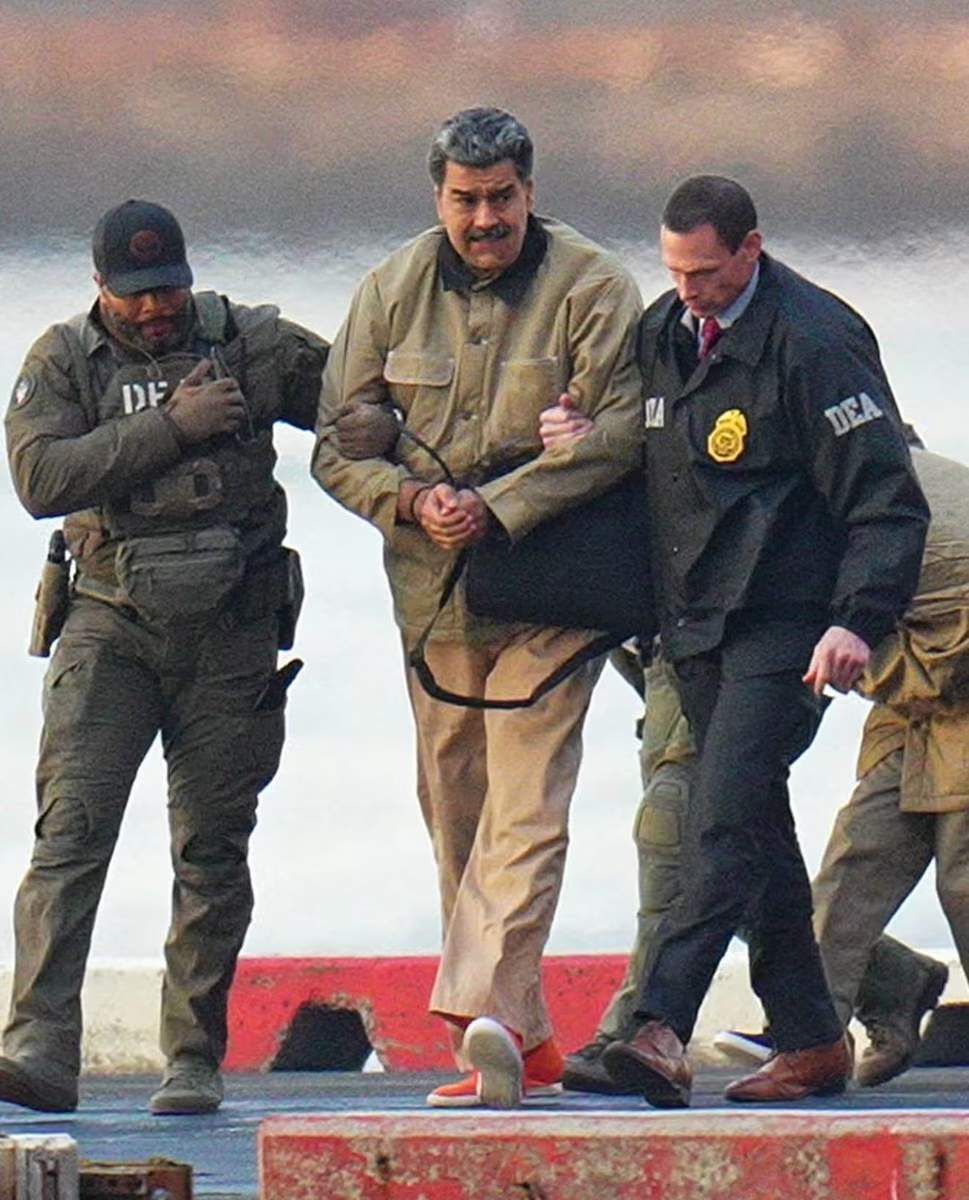
In a remarkable development reflecting the scale of the shift in the relationship between the United States and Venezuela, US President Donald Trump presented a broad package of demands to the new Venezuelan President, Delcy Rodriguez, after she took the constitutional oath following the overthrow of former President Nicolas Maduro in a US military operation that sparked widespread international controversy.

According to US officials and converging media reports, Washington seeks to reshape the political, security, and economic landscape in Venezuela, considering the new phase a "historic opportunity" to end the influence of its adversaries in Latin America, primarily Russia, China, Iran, and Cuba.

Cutting International Alliances at the Forefront of Demands

Topping the list of American demands is a clear call to sever strategic, military, and security ties with Moscow, Beijing, Tehran, and Havana. Washington accuses these countries of using Venezuela as a platform to expand their political and intelligence influence in the Western Hemisphere, which it considers a direct threat to US national security.

Diplomatic sources indicate that the US administration is not content with merely reducing the level of relations but demands concrete steps, including ending military agreements, expelling foreign advisors, and halting any intelligence cooperation with these countries.

Security and Anti-Drug Efforts

On the security front, Washington is pressuring the new government to enhance cooperation in combating drug trafficking. The United States accuses previous governments in Caracas of complicity with international trafficking networks, an accusation officially denied by Venezuela.

US demands include restructuring security agencies, facilitating the work of American agencies, and exchanging intelligence information, a move observers see as an attempt to rebuild American influence within Venezuelan state institutions.

Oil and Economy: The Heart of the Equation

Economically, the oil sector is a key focus of the American vision. Washington demands redirecting Venezuelan oil exports away from countries classified as adversaries and opening the energy sector to American companies after years of sanctions and isolation.

In this regard, President Trump said on his Truth Social platform on Tuesday: "I am pleased to announce that the transitional authorities in Venezuela will deliver between 30 and 50 million barrels of high-quality, sanctioned oil to the United States of America. This oil will be sold at market price, and I, as President of the United States of America, will oversee the management of its proceeds to ensure they are used for the benefit of my people in Venezuela and the United States! I have asked Secretary of Energy Chris Wright to implement this plan immediately. The oil will be transported by storage tankers and delivered directly to discharge ports in the United States. Thank you for your attention to this matter!"

Initial talks have already begun on resuming oil exports to the United States, which could provide an economic lifeline for Caracas, but at the same time raises questions about the level of economic sovereignty in the coming phase.

Political Reforms and Elections

Politically, Washington calls for a "real democratic transition," including launching a process of constitutional reforms and organizing free elections. However, the US administration has not announced a clear timeline, reinforcing the impression that these demands are being used as a negotiating leverage rather than an immediate commitment.

Analysts believe that the easing of sanctions and the provision of financial aid will be conditional on the new government's response to these terms.

Caracas's Reaction: A Delicate Balance

For her part, President Rodriguez adopted a cautious tone. She condemned the US military intervention as a violation of the country's sovereignty, but at the same time called for dialogue and avoiding escalation, emphasizing that Venezuela needs stability and reconstruction.

This stance reflects a clear attempt to balance external pressures with maintaining a minimum level of internal legitimacy in a country suffering from a deep economic and social crisis.

Divergent International Positions

The US moves were met with sharp criticism from Russia, which described them as "neo-colonial threats," warning of serious repercussions for regional stability. China and Iran also expressed concern about the precedent of military intervention and the imposition of political dictates.

In contrast, some Latin American countries remained silent, while others expressed caution about escalating tensions in the region.

The American demands from the new Venezuelan government reflect a clear direction to reassert US influence in Latin America using a mix of military force and economic pressure. Washington is not content with regime change but seeks to re-engineer Venezuela's alliances and regional role. However, this approach carries real risks, as it could deepen internal divisions and provoke popular resistance against any government perceived as subservient to external dictates.

For President Rodriguez, the current phase represents an extremely difficult political test. Full compliance with US demands could provide her government with rapid economic support, but it could weaken her national legitimacy. Conversely, rejecting these conditions could expose the country to further pressure and isolation. Caracas's ability to maneuver between these two options will determine the shape of the Venezuelan state and its political future in the coming years.

PALESTINE

Wed 07 Jan 2026 12:48 pm - Jerusalem Time

Settlers Carry Out Series of Attacks in the West Bank

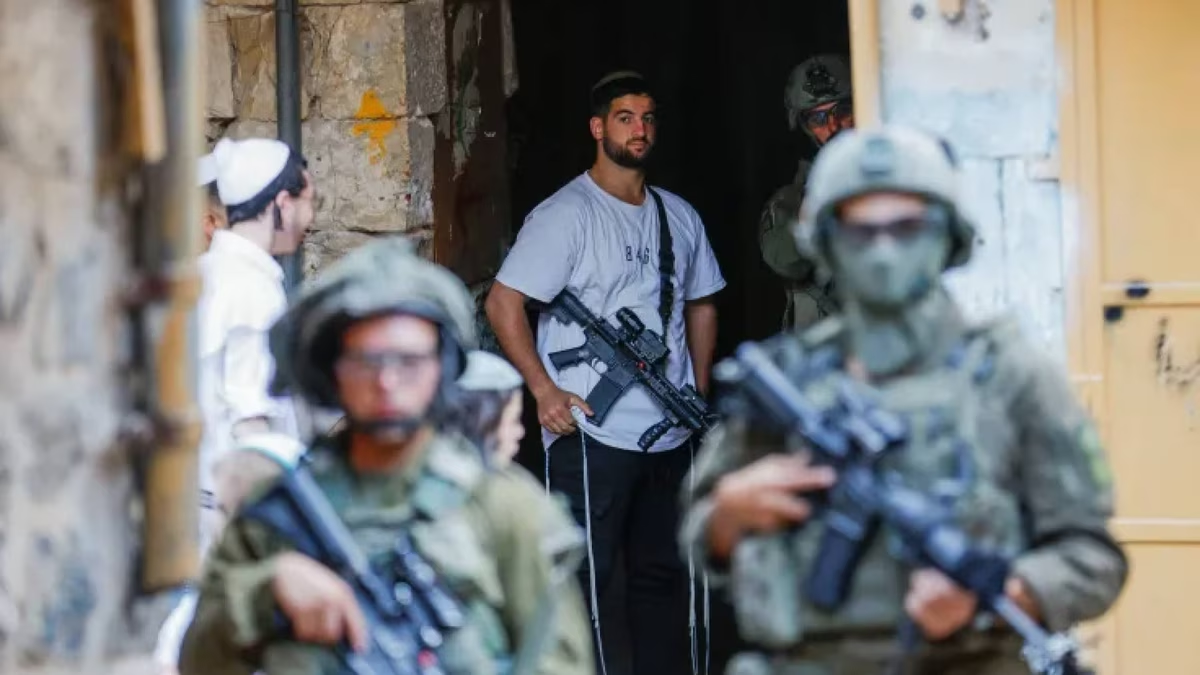
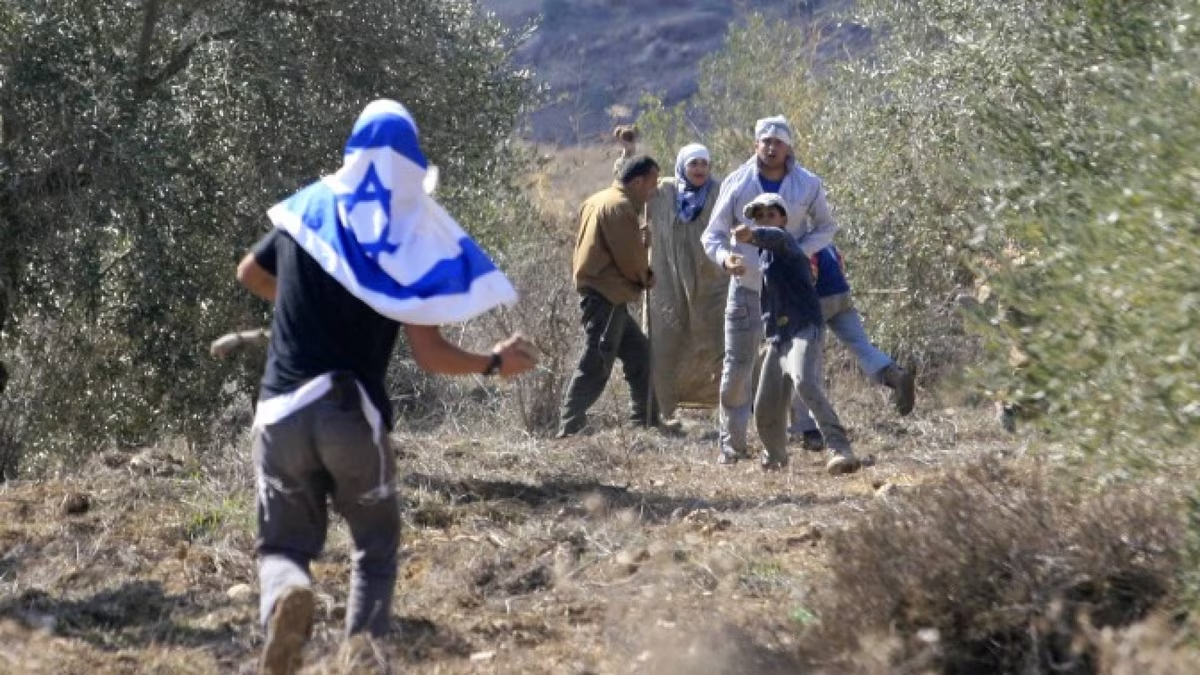
On Wednesday, groups of settlers carried out a series of new attacks in scattered areas of the West Bank, concentrated in the governorates of Jenin, Nablus, and Jerusalem, accompanied by provocative actions against the locals.

Palestinian sources reported that settlers stormed the vicinity of one of the farms in the town of Raba, located southeast of Jenin governorate, and provoked the local residents. In a related context, settlers attacked Palestinian lands near the town of Mukhmas, northeast of occupied Jerusalem.

Settlers also attacked citizens' vehicles near the village of Madama south of Nablus on Wednesday; which led to damaging several of them, and following these attacks, occupation army forces raided homes of some citizens near the area, tampered with their contents, and proceeded to vandalize them.

This comes amid the escalation of settler attacks in the West Bank, where on Tuesday, settlers detained an agricultural tractor in the northern Jordan Valley, and a group of settlers stormed the village of Keisan east of Bethlehem, and grazed their sheep on the lands of citizens adjacent to their homes, in an attempt to attack some residents.

PALESTINE

Wed 07 Jan 2026 8:23 am - Jerusalem Time

Another genocide... International institutions stop turning Gaza into an uninhabitable area, leading to displacement

Dr. Basem Abu Jrayy: The decision reflects a pre-prepared plan aimed at dismantling the structures supporting the steadfastness of the Palestinian people in the context of genocide..

Akram Attallah: The central goal of the step is to "kill life" and turn the Strip into an uninhabitable area, pushing towards a comprehensive displacement project..

Amjad Al-Shawa: The timing of the decision precedes the second phase, which portends further humanitarian complexity and a tendency to pressure residents and push them towards displacement..

Dr. Ahmed Awad: The closure of these institutions is to prevent the internationalization of the Palestinian issue, weaken Palestinian society, and cut off its communication with the outside world..

Sari Sammour: Israel may seek to monopolize the "management of suffering" in the Strip through institutions linked to it with international facades to achieve financial and security gains..

Dr. Tamara Haddad: The cessation of institutions' work negatively affects civil peace and turns aid into a pressure tool in the absence of "day after" arrangements..

Suleiman Basharat: Israel seeks to create a real humanitarian institutional vacuum in the Strip, which opens the door for it to propose "alternatives" that are completely subject to it... 

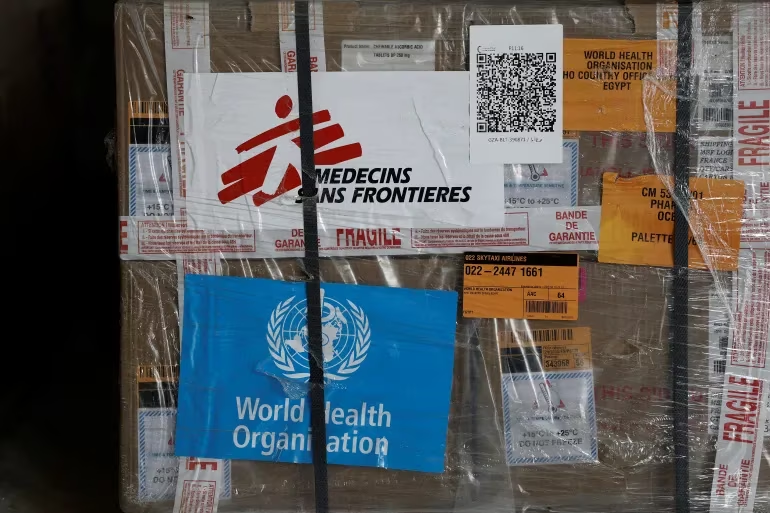
 The Gaza Strip is preparing to face serious repercussions due to the Israeli occupation's decision to halt the work of humanitarian institutions by the end of this month, which directly threatens the lives of residents and exacerbates crises of food, medicine, and basic services, in the context of escalating pressures leading to a displacement plan.

Officials, specialists, writers, and political analysts explain in separate conversations with "Al-Quds" that this decision comes within a sequential context of systematic targeting of local and international organizations, which began with attempts to undermine the United Nations Relief and Works Agency for Palestine Refugees (UNRWA) and then included human rights institutions and relief organizations, as part of a policy aimed at dismantling the humanitarian structure supporting the steadfastness of the population and controlling it to serve the occupation's agenda.

Officials, specialists, writers, and analysts point out that the step practically aims to turn the Strip into an uninhabitable area, as a political pressure tool to push Palestinians towards forced migration. 

They believe that the decision aims to cut off international oversight channels and the absence of documentation of Israeli violations, which isolates residents from the outside world and weakens civil society, in addition to creating an institutional vacuum, allowing it to fully control the management of suffering, and provide alternatives affiliated with the occupation, thereby strengthening control over the Strip.

Violation of the principles of international humanitarian law..

Dr. Basem Abu Jrayy, a researcher in development and human rights from the Gaza Strip, warns of the serious repercussions of the Israeli occupation's decision to halt the work of humanitarian institutions in the Strip by the end of this month, describing the decision as arbitrary and dangerous, and constituting a clear violation of the principles of international humanitarian law, particularly the principle of facilitating the work of neutral humanitarian organizations.

Abu Jrayy explains that this decision directly contradicts the obligations of the occupying power under the Geneva Conventions, which oblige it to ensure the unimpeded and good-faith access of humanitarian aid to civilian populations under occupation. 

Tools to restrict humanitarian work..

Abu Jrayy clarifies that the conditions imposed by the occupation, related to requesting extensive security information about workers in humanitarian organizations, are merely tools to restrict humanitarian work and undermine its independence, and a pretext to exclude a large number of organizations, including effective international organizations.

Abu Jrayy points out that the exclusion of this wide number of institutions will inevitably lead to a serious decline in access to basic services, foremost among them healthcare, water, food, and protection, at a time when the Gaza Strip is experiencing a catastrophic and unprecedented humanitarian situation.  

Abu Jrayy emphasizes that civilians, especially children, women, and the elderly, face increasing risks that threaten their lives and dignity in light of this accelerating deterioration.

Escalating systematic targeting..

Abu Jrayy explains that the decision comes within an escalating context of systematic targeting, which began with attempts to undermine the role of the United Nations Relief and Works Agency for Palestine Refugees (UNRWA), then expanded to include Palestinian human rights institutions that were subjected to organized smear and criminalization campaigns, reaching the point of imposing sanctions on them by the US Treasury, before extending today to dozens of humanitarian and relief organizations.

Abu Jrayy stresses that this sequence in targeting local and international organizations cannot be separated from each other, but rather reflects the existence of a pre-prepared plan aimed at dismantling the structures supporting the steadfastness of the Palestinian people in the context of ongoing genocide, emptying Palestinian land of any humanitarian or human rights protection, and isolating civilian populations and obliterating their cause.

Abu Jrayy affirms that the protection of humanitarian work is not a procedural or technical matter, but a legal and moral obligation that should not be subjected to political considerations or manipulated under any pretext.

Serious repercussions on the overall humanitarian situation..

Writer and political analyst Akram Attallah confirms that the cessation of humanitarian institutions' work in the Gaza Strip by the end of this month will have serious repercussions on the overall humanitarian and living situation, pointing out that the Strip has become almost entirely dependent on humanitarian work, in the absence of any service or economic infrastructure capable of meeting the needs of the population.

Attallah explains that Israel has succeeded, during the past period, in diverting the compass of dealing with the Gaza Strip from the essence of the conflict and its political and historical dimensions, to reducing the Strip to a purely "humanitarian case," for which no services are provided except through international institutions.

Attallah points out that the continuous tightening of restrictions on the United Nations Relief and Works Agency for Palestine Refugees (UNRWA), and the withdrawal of recognition from it, have led to a reduction in its role, making other international humanitarian institutions almost the sole provider of minimal services to the residents of the Strip.

Attallah notes that halting the work of these institutions practically means depriving Gaza of basic services, or keeping them at their lowest levels, as part of a policy aimed at maintaining the state of suffering and daily torture of residents within the Strip.

Killing life for the sake of displacement..

Attallah considers that this policy tightens the noose on citizens to push them to consider leaving Gaza, citing statements by US President Donald Trump in which he spoke about the readiness of a large part of the Strip's residents to leave if they had the opportunity.

Attallah believes that the central goal of this step is to "kill life" in the Gaza Strip, and turn it into an uninhabitable area, which pushes residents to search for other more livable places, not within the Strip nor even in areas that Israel describes as "safe," but completely outside Gaza, in the context of a comprehensive displacement project.

Attallah points to the existence of more than one scenario related to halting the work of these institutions, but all of them point in one direction, which is the continued tightening of restrictions on parts of the Strip, especially what is known as western Gaza, by preventing humanitarian aid, stopping reconstruction, and disrupting any means of life, to force residents to leave. 

Attallah notes that talking about temporary solutions, such as caravans or transitional residential areas, does not mean providing a stable humanitarian environment, but rather constitutes a transitional phase until residents are pushed to search for an alternative homeland outside the Gaza Strip.

Preventing the entry of international institutions' aid..

Amjad Al-Shawa, head of the Palestinian NGO Network in the Gaza Strip, warns of serious consequences resulting from the Israeli decision to halt the work of international humanitarian institutions in the Strip by the end of this month, stressing that this decision comes in the context of systematic targeting of the already deteriorating humanitarian situation, and represents a dangerous escalation that directly threatens the lives of residents.

Al-Shawa explains that one of the most dangerous indicators of this decision is the Israeli occupation forces' prevention of the entry of humanitarian aid belonging to international institutions, pointing out that thousands of trucks loaded with aid are still prevented from reaching the Gaza Strip, including essential medicines and medical supplies, shelter supplies, water sector needs, in addition to supplies for dealing with escalating malnutrition cases, especially among children and patients.

Al-Shawa affirms that humanitarian institutions operating in the Strip play a pivotal role that is not limited to hospitals, but also includes operating a large number of malnutrition treatment centers, and working in vital sectors such as water and sanitation, in addition to shelter.

Al-Shawa points out that the occupation began, as of Tuesday, preventing the arrival of international staff working in these institutions, whether administrative, technical, or medical, which practically means paralyzing the ability of these organizations to respond to increasing humanitarian needs, at a time when the Strip is witnessing a near-complete collapse in various service sectors.

Al-Shawa notes that this decision coincides with the Israeli occupation's ban on the work of the United Nations Relief and Works Agency for Palestine Refugees (UNRWA), and preventing the entry of its aid into the Gaza Strip, explaining that about 6,000 trucks belonging to the agency are not allowed to reach the Strip, despite the widespread reliance of residents on its basic services.

Al-Shawa clarifies that the impact of this decision will be extremely serious in light of a tragic humanitarian reality, where about one and a half million citizens have lost their homes, and nearly 900,000 of them live in dilapidated tents that do not meet the minimum requirements for a decent life, and do not represent a real or sustainable solution to the ongoing displacement crisis.

Silencing the voice of international institutions..

Al-Shawa affirms that the occupation aims through this decision to achieve several goals, most notably the complete isolation of the Gaza Strip, and silencing the voice of international institutions that have worked for decades in the Strip and the Palestinian territories, in addition to disrupting the provision of basic services, especially in the health sector, where these institutions contribute to providing more than a third of health services through civilian hospitals and medical centers.

Al-Shawa stresses that the presence of international staff and teams constitutes a form of international oversight over what is happening in the Gaza Strip, pointing out that among the goals of the Israeli occupation in disrupting the work of these institutions is to silence their voice, and prevent the issuance of reports that document Israeli violations and reveal the deterioration of humanitarian conditions in the Strip.

Timing of the decision with the start of the second phase..

Al-Shawa stresses that halting the work of these organizations will deepen the humanitarian crisis at all levels, and poses a real threat to the lives of residents, noting that the timing of the decision precedes the start of the second phase of the ceasefire, which portends further humanitarian complexity and escalation, and reflects a tendency to increase pressure on residents and push them towards displacement plans.

Al-Shawa affirms that this decision constitutes a blatant violation of the principles of humanitarian action and international humanitarian law, and of the ceasefire agreement and the humanitarian protocol, as well as the advisory opinion of the International Court of Justice which stressed the need to ensure the access of aid through humanitarian institutions and "UNRWA."

Al-Shawa points to ongoing efforts and pressures to find solutions that ensure the continued work of these institutions, and prevent the expansion of the decision's repercussions on Gaza and the West Bank, including Jerusalem.

Closing the Palestinians' window to the outside world..

Writer and political analyst Dr. Ahmed Rafiq Awad warns of the serious repercussions of the Israeli occupation's decision to halt the work of humanitarian institutions in the Gaza Strip by the end of this month, stressing that the direct impact of this decision is a comprehensive and severe shortage of aid in all its forms, foremost among them medical and humanitarian aid, in addition to closing the "only remaining window" that connects Palestinians to the outside world.

Awad explains that halting the work of these institutions will lead to a widespread deterioration in societal conditions, rising unemployment rates, and the dismissal of large numbers of workers, employees, and beneficiaries of these organizations' programs, which will negatively affect the overall economic and social life in the Gaza Strip. 

Awad considers that this closure practically means a shortage of everything, from food, medicine, services, and training and rehabilitation opportunities, which leads to the systematic impoverishment of the Palestinian people.

Cutting off the lifeline of international oversight..

Awad points out that the closure of international and UN institutions is not limited to stopping the flow of aid, but also means cutting off the lifeline of international oversight, as these institutions play a fundamental role in documenting the damages resulting from the siege, military operations, overcrowding, and the spread of diseases, and submit reliable reports to the international community.

Awad notes that the absence of these reports will deprive the world of knowing the true extent of the violations suffered by Palestinians, which is what Israel seeks by removing any international presence witnessing what is happening in the occupied Palestinian territories.

Awad clarifies that among the main goals of closing these institutions are preventing the internationalization of the Palestinian issue, weakening civil society, and cutting off communication between Palestinians and the outside world, in addition to bypassing international bodies and organizations, foremost among them the United Nations.

Awad considers that targeting UNRWA constituted the beginning of this path, which amounts to a direct assault on the United Nations system, and on European civil society, and even an insult to the European Union, given that most of these institutions have European roots and enjoy widespread official and popular support in Europe.

Awad affirms that Israel seeks through this policy to monopolize the narrative and media discourse, and prevent any independent and credible party from conveying what is happening on the ground, which allows it to control news and information, and monopolize the Palestinian people without international oversight or accountability.

Awad points to the possibility of an attempt by the European Union and humanitarian and social forces in Europe to exert political pressure to reopen the field for the work of these institutions, considering that this path is possible but not guaranteed.

Awad warns of a more severe scenario in which Israel may continue to prevent these institutions, and perhaps expand the targeting to include other organizations.

Awad points to the possibility of some institutions submitting to Israeli conditions and oversight in exchange for being allowed to work, even if that involves a great deal of concession.

Awad affirms that the worst-case scenario is the direct harm to Palestinians from the absence of these institutions, which not only provide aid but also constitute international communication channels, training and employment sources, and oversight and protection tools, warning that the price of their absence will be high at both the humanitarian and political levels.

Another form of "slow killing"..

Writer and political analyst Sari Sammour believes that halting the work of humanitarian institutions in the Gaza Strip by the end of this month will lead to an unprecedented exacerbation of the suffering of residents, stressing that the Strip needs an increase in the number of operating institutions and enhanced intervention, not the disruption of what remains of them or the partial restriction of their work, in light of an extremely harsh humanitarian reality.

Sammour explains that the humanitarian impact of this decision will be direct and profound, as it will increase the levels of poverty, destitution, and misery already experienced by citizens, and will affect the lives of displaced and non-displaced persons in various areas of the Strip, stressing that all residents of the Gaza Strip need the services and aid of these institutions, which makes halting them a step with dire consequences at both the humanitarian and service levels.

Sammour considers that Israel clearly seeks to increase the suffering of the residents of the Gaza Strip, and to move from direct military warfare to another form of "slow killing," through starvation and systematic tightening of restrictions on people, as part of a continuous policy of collective punishment.

Sammour believes that this policy aims to push Palestinians to despair and search for alternatives outside Gaza, in line with attempts to displace the Strip that are managed through frameworks or entities bearing fictitious or borrowed names.

Sammour affirms that this step reflects Israel's disregard for international law and humanitarian treaties and protocols, based on its feeling of impunity, pointing out that Israel has committed widespread crimes including killing tens of thousands, injuring hundreds of thousands, and displacing about two million Palestinians, without facing actual accountability, which encourages it to proceed with disrupting the work of humanitarian institutions without fear of consequences.

Israeli attempt to monopolize "management of suffering"..

Sammour points out that some institutions may resort to adapting to the decision by making concessions to Israel in exchange for continuing to work, warning of the danger of this path, which may forcibly turn these institutions into tools to serve the security objectives of the occupation, by leaking sensitive data or information about beneficiaries, or exploiting this data in monitoring or recruitment operations.

Sammour rules out serious American pressure to freeze the decision, considering it unlikely at the present stage, although he does not rule out sudden developments.

Sammour affirms that action from within Israel through the remaining legal system or by lawyers and human rights activists remains a scenario with limited impact, given the dominance of extremist currents.

Sammour warns that the most likely outcome is the closure of humanitarian institutions and increased suffering for Gazans, with the possibility of Israel seeking to monopolize the "management of suffering" through institutions linked to it with international facades, thereby achieving financial and security gains at the expense of the urgent humanitarian needs of the Strip's residents.

Escalating rates of malnutrition and food insecurity..

Writer and political researcher Dr. Tamara Haddad warns that the cessation of humanitarian institutions' work inside the Gaza Strip will lead to an unprecedented deepening of the state of starvation, in light of the collapse of basic services and the absence of the relief dimension, which constitutes the main pillar for providing food, medicine, and humanitarian supplies to the population, stressing that the expected repercussions will be extremely serious humanitarian, social, and health consequences.

Haddad explains that the cessation of humanitarian organizations' work will lead to an exacerbation of the severe crisis in the Gaza Strip, with escalating rates of malnutrition and food insecurity, as a result of the halt in the entry and distribution of food, medicine, and essential supplies, pointing out that the health situation has become extremely fragile, in the absence of the components of normal healthcare, which directly affects patients and the most vulnerable groups.

Haddad clarifies that the most affected segments by this deterioration are children, women, the elderly, and the sick, who already suffer from a severe shortage of health and nutritional services, noting that the exacerbation of the crisis coincides with winter, when disease rates increase, which portends widespread health complications, in addition to the serious psychological effects resulting from the decline in services, including frustration, social pressure, family disintegration, and deepening the feeling of a lack of horizon and future.

Enhancing the risks of forced displacement..

Haddad points out that the state of frustration is exacerbated by the absence of any indicators of reconstruction or regular entry of aid, in addition to the Israeli occupation linking the opening of crossings to political and security conditions, which reinforces in the minds of citizens the idea that any potential opening of crossings may be linked to pushing them out of the Gaza Strip, in a context that enhances the risks of forced or involuntary displacement.

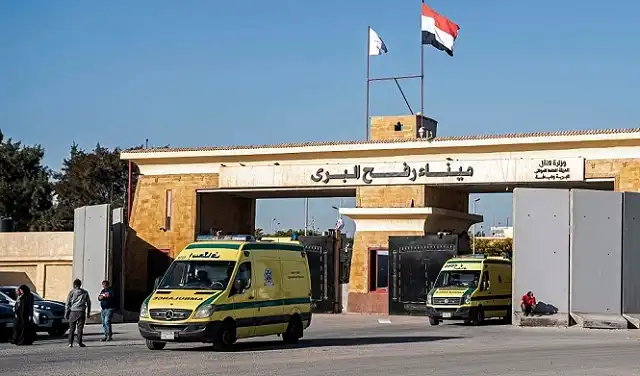
Haddad considers that the continued cessation of humanitarian work, in parallel with the opening of the Rafah crossing for entry and exit without guaranteeing the flow of aid, will entrench the idea of displacement in the citizen's mind, and create a negative humanitarian reality that pressures residents to remain in a state of permanent waiting for aid.

Encouraging monopoly and raising prices..

Haddad points out that the scarcity of aid, if it enters, may open the door for its exploitation by armed groups or Israeli-backed entities, which infiltrate securely through non-neutral humanitarian facades, leading to control over the distribution process.

Haddad affirms that the halt in the entry of aid through UN institutions will encourage its monopolization and price increases, and prevent its fair distribution, which may negatively affect civil peace, and turn aid into a tool of pressure and influence in the absence of clear arrangements for the "day after" and the failure of any official body capable of managing the scene.

Haddad considers that the worst-case scenario is the complete withdrawal of international organizations and the dismantling of the relief and humanitarian recovery system, which means exacerbating famine, spreading diseases, and undermining the ability of residents to withstand.

Haddad believes that the best-case scenario lies in a pressing international intervention, led by the United Nations and major powers, to restore banned humanitarian institutions and ensure the entry of aid without restrictions or conditions, with the participation of neutral international and Arab organizations, thereby ensuring fair and transparent distribution that protects Palestinian society from complete collapse.

A systematic process to empty the institutional concept..

Writer and political analyst Suleiman Basharat believes that what Israel is doing in the Gaza Strip amounts to a systematic process to empty the institutional concept, at both local and international levels, within a comprehensive vision to reshape the humanitarian and political reality in the Strip to serve Israeli long-term goals.

Basharat explains that this trend has been embodied, over the past two years, in the widespread targeting of local institutions in the Gaza Strip, then moved to a more dangerous level by disrupting the work of international institutions, foremost among them the United Nations Relief and Works Agency for Palestine Refugees (UNRWA), reaching what remains of humanitarian institutions that can form a relief safety net for the population.

Basharat considers that these steps are not to be read as separate measures, but as an integrated path aimed at emptying Gaza of any independent institutional presence.

Basharat points out that the first fundamental result of this path is the creation of a real humanitarian institutional vacuum within the Strip, which opens the door for Israel to propose "alternatives" that are completely subject to its policies and agenda. 

Basharat refers to previous experiences, such as the model of the "Gaza Humanitarian" institution that was promoted with American support and Israeli coordination, as a preliminary attempt to create alternative frameworks for the traditional international humanitarian system, but within a ceiling that serves Israeli interests.

Tightening comprehensive control over the Strip..

Basharat believes that the second goal of this policy is to tighten comprehensive control over the Gaza Strip, so that Israel becomes the primary reference in everything related to the future of the Strip, starting from the humanitarian file, through the economic and social reality, to the security and political dimensions.

Basharat considers that this clearly reflects that any talk of an actual Israeli withdrawal from Gaza is not consistent with the Israeli vision, which seeks to manage the Strip directly or indirectly.

Basharat clarifies that Israel is working, in this context, to create a "dependent shadow" for itself within Gaza, whether through the humanitarian, security, military, or even political gateway, which allows it to remotely control all aspects of life in the absence of direct military presence.

Basharat cites the example of the crossings, which Israel controls completely, where it controls their opening and closing, and what enters or is prevented from entering the Strip, as a practical example of this pattern of control.

Basharat believes that among the goals of this policy is to empty the international dimension of the Gaza issue, and turn it into a bilateral Palestinian-Israeli conflict file, which justifies, from the Israeli point of view, excluding international intervention, and imposing policies that stem from security pretexts that may later develop into clear political goals.

Re-engineering the humanitarian and institutional structure..

Basharat warns of the possibility of the Strip entering a dangerous stage in the process of re-engineering its humanitarian and institutional structure, to become a structure completely subordinate to the Israeli vision, whether in terms of management, decision-making, or priorities.

Basharat suggests that Israel may allow a limited presence of some international institutions, but within a strict ceiling that ensures its complete control and keeps Gaza in a state of permanent humanitarian depletion, making it in continuous need of aid. 

Basharat did not rule out a scenario of effective international or regional action that restores the role of humanitarian institutions, but it is unlikely at the present stage, given the absolute American support for Israel, and the complexity of the humanitarian crisis that requires comprehensive international intervention beyond merely the presence of a number of relief institutions.




Dr. Basem Abu Jrayy: The decision reflects a pre-prepared plan aimed at dismantling the structures supporting the steadfastness of the Palestinian people in the context of genocide..

Akram Attallah: The central goal of the step is to "kill life" and turn the Strip into an uninhabitable area, pushing towards a comprehensive displacement project..

Amjad Al-Shawa: The timing of the decision precedes the second phase, which portends further humanitarian complexity and a tendency to pressure residents and push them towards displacement..

Dr. Ahmed Awad: The closure of these institutions is to prevent the internationalization of the Palestinian issue, weaken Palestinian society, and cut off its communication with the outside world..

Sari Sammour: Israel may seek to monopolize the "management of suffering" in the Strip through institutions linked to it with international facades to achieve financial and security gains..

Dr. Tamara Haddad: The cessation of institutions' work negatively affects civil peace and turns aid into a pressure tool in the absence of "day after" arrangements..

Suleiman Basharat: Israel seeks to create a real humanitarian institutional vacuum in the Strip, which opens the door for it to propose "alternatives" that are completely subject to it... 

Ramallah - Exclusive to "Al-Quds" - The Gaza Strip is preparing to face serious repercussions due to the Israeli occupation's decision to halt the work of humanitarian institutions by the end of this month, which directly threatens the lives of residents and exacerbates crises of food, medicine, and basic services, in the context of escalating pressures leading to a displacement plan.

Officials, specialists, writers, and political analysts explain in separate conversations with "Al-Quds" that this decision comes within a sequential context of systematic targeting of local and international organizations, which began with attempts to undermine the United Nations Relief and Works Agency for Palestine Refugees (UNRWA) and then included human rights institutions and relief organizations, as part of a policy aimed at dismantling the humanitarian structure supporting the steadfastness of the population and controlling it to serve the occupation's agenda.

Officials, specialists, writers, and analysts point out that the step practically aims to turn the Strip into an uninhabitable area, as a political pressure tool to push Palestinians towards forced migration. 

They believe that the decision aims to cut off international oversight channels and the absence of documentation of Israeli violations, which isolates residents from the outside world and weakens civil society, in addition to creating an institutional vacuum, allowing it to fully control the management of suffering, and provide alternatives affiliated with the occupation, thereby strengthening control over the Strip.

Violation of the principles of international humanitarian law..

Dr. Basem Abu Jrayy, a researcher in development and human rights from the Gaza Strip, warns of the serious repercussions of the Israeli occupation's decision to halt the work of humanitarian institutions in the Strip by the end of this month, describing the decision as arbitrary and dangerous, and constituting a clear violation of the principles of international humanitarian law, particularly the principle of facilitating the work of neutral humanitarian organizations.

Abu Jrayy explains that this decision directly contradicts the obligations of the occupying power under the Geneva Conventions, which oblige it to ensure the unimpeded and good-faith access of humanitarian aid to civilian populations under occupation. 

Tools to restrict humanitarian work..

Abu Jrayy clarifies that the conditions imposed by the occupation, related to requesting extensive security information about workers in humanitarian organizations, are merely tools to restrict humanitarian work and undermine its independence, and a pretext to exclude a large number of organizations, including effective international organizations.

Abu Jrayy points out that the exclusion of this wide number of institutions will inevitably lead to a serious decline in access to basic services, foremost among them healthcare, water, food, and protection, at a time when the Gaza Strip is experiencing a catastrophic and unprecedented humanitarian situation.  

Abu Jrayy emphasizes that civilians, especially children, women, and the elderly, face increasing risks that threaten their lives and dignity in light of this accelerating deterioration.

Escalating systematic targeting..

Abu Jrayy explains that the decision comes within an escalating context of systematic targeting, which began with attempts to undermine the role of the United Nations Relief and Works Agency for Palestine Refugees (UNRWA), then expanded to include Palestinian human rights institutions that were subjected to organized smear and criminalization campaigns, reaching the point of imposing sanctions on them by the US Treasury, before extending today to dozens of humanitarian and relief organizations.

Abu Jrayy stresses that this sequence in targeting local and international organizations cannot be separated from each other, but rather reflects the existence of a pre-prepared plan aimed at dismantling the structures supporting the steadfastness of the Palestinian people in the context of ongoing genocide, emptying Palestinian land of any humanitarian or human rights protection, and isolating civilian populations and obliterating their cause.

Abu Jrayy affirms that the protection of humanitarian work is not a procedural or technical matter, but a legal and moral obligation that should not be subjected to political considerations or manipulated under any pretext.

Serious repercussions on the overall humanitarian situation..

Writer and political analyst Akram Attallah confirms that the cessation of humanitarian institutions' work in the Gaza Strip by the end of this month will have serious repercussions on the overall humanitarian and living situation, pointing out that the Strip has become almost entirely dependent on humanitarian work, in the absence of any service or economic infrastructure capable of meeting the needs of the population.

Attallah explains that Israel has succeeded, during the past period, in diverting the compass of dealing with the Gaza Strip from the essence of the conflict and its political and historical dimensions, to reducing the Strip to a purely "humanitarian case," for which no services are provided except through international institutions.

Attallah points out that the continuous tightening of restrictions on the United Nations Relief and Works Agency for Palestine Refugees (UNRWA), and the withdrawal of recognition from it, have led to a reduction in its role, making other international humanitarian institutions almost the sole provider of minimal services to the residents of the Strip.

Attallah notes that halting the work of these institutions practically means depriving Gaza of basic services, or keeping them at their lowest levels, as part of a policy aimed at maintaining the state of suffering and daily torture of residents within the Strip.

Killing life for the sake of displacement..

Attallah considers that this policy tightens the noose on citizens to push them to consider leaving Gaza, citing statements by US President Donald Trump in which he spoke about the readiness of a large part of the Strip's residents to leave if they had the opportunity.

Attallah believes that the central goal of this step is to "kill life" in the Gaza Strip, and turn it into an uninhabitable area, which pushes residents to search for other more livable places, not within the Strip nor even in areas that Israel describes as "safe," but completely outside Gaza, in the context of a comprehensive displacement project.

Attallah points to the existence of more than one scenario related to halting the work of these institutions, but all of them point in one direction, which is the continued tightening of restrictions on parts of the Strip, especially what is known as western Gaza, by preventing humanitarian aid, stopping reconstruction, and disrupting any means of life, to force residents to leave. 

Attallah notes that talking about temporary solutions, such as caravans or transitional residential areas, does not mean providing a stable humanitarian environment, but rather constitutes a transitional phase until residents are pushed to search for an alternative homeland outside the Gaza Strip.

Preventing the entry of international institutions' aid..

Amjad Al-Shawa, head of the Palestinian NGO Network in the Gaza Strip, warns of serious consequences resulting from the Israeli decision to halt the work of international humanitarian institutions in the Strip by the end of this month, stressing that this decision comes in the context of systematic targeting of the already deteriorating humanitarian situation, and represents a dangerous escalation that directly threatens the lives of residents.

Al-Shawa explains that one of the most dangerous indicators of this decision is the Israeli occupation forces' prevention of the entry of humanitarian aid belonging to international institutions, pointing out that thousands of trucks loaded with aid are still prevented from reaching the Gaza Strip, including essential medicines and medical supplies, shelter supplies, water sector needs, in addition to supplies for dealing with escalating malnutrition cases, especially among children and patients.

Al-Shawa affirms that humanitarian institutions operating in the Strip play a pivotal role that is not limited to hospitals, but also includes operating a large number of malnutrition treatment centers, and working in vital sectors such as water and sanitation, in addition to shelter.

Al-Shawa points out that the occupation began, as of Tuesday, preventing the arrival of international staff working in these institutions, whether administrative, technical, or medical, which practically means paralyzing the ability of these organizations to respond to increasing humanitarian needs, at a time when the Strip is witnessing a near-complete collapse in various service sectors.

Al-Shawa notes that this decision coincides with the Israeli occupation's ban on the work of the United Nations Relief and Works Agency for Palestine Refugees (UNRWA), and preventing the entry of its aid into the Gaza Strip, explaining that about 6,000 trucks belonging to the agency are not allowed to reach the Strip, despite the widespread reliance of residents on its basic services.

Al-Shawa clarifies that the impact of this decision will be extremely serious in light of a tragic humanitarian reality, where about one and a half million citizens have lost their homes, and nearly 900,000 of them live in dilapidated tents that do not meet the minimum requirements for a decent life, and do not represent a real or sustainable solution to the ongoing displacement crisis.

Silencing the voice of international institutions..

Al-Shawa affirms that the occupation aims through this decision to achieve several goals, most notably the complete isolation of the Gaza Strip, and silencing the voice of international institutions that have worked for decades in the Strip and the Palestinian territories, in addition to disrupting the provision of basic services, especially in the health sector, where these institutions contribute to providing more than a third of health services through civilian hospitals and medical centers.

Al-Shawa stresses that the presence of international staff and teams constitutes a form of international oversight over what is happening in the Gaza Strip, pointing out that among the goals of the Israeli occupation in disrupting the work of these institutions is to silence their voice, and prevent the issuance of reports that document Israeli violations and reveal the deterioration of humanitarian conditions in the Strip.

Timing of the decision with the start of the second phase..

Al-Shawa stresses that halting the work of these organizations will deepen the humanitarian crisis at all levels, and poses a real threat to the lives of residents, noting that the timing of the decision precedes the start of the second phase of the ceasefire, which portends further humanitarian complexity and escalation, and reflects a tendency to increase pressure on residents and push them towards displacement plans.

Al-Shawa affirms that this decision constitutes a blatant violation of the principles of humanitarian action and international humanitarian law, and of the ceasefire agreement and the humanitarian protocol, as well as the advisory opinion of the International Court of Justice which stressed the need to ensure the access of aid through humanitarian institutions and "UNRWA."

Al-Shawa points to ongoing efforts and pressures to find solutions that ensure the continued work of these institutions, and prevent the expansion of the decision's repercussions on Gaza and the West Bank, including Jerusalem.

Closing the Palestinians' window to the outside world..

Writer and political analyst Dr. Ahmed Rafiq Awad warns of the serious repercussions of the Israeli occupation's decision to halt the work of humanitarian institutions in the Gaza Strip by the end of this month, stressing that the direct impact of this decision is a comprehensive and severe shortage of aid in all its forms, foremost among them medical and humanitarian aid, in addition to closing the "only remaining window" that connects Palestinians to the outside world.

Awad explains that halting the work of these institutions will lead to a widespread deterioration in societal conditions, rising unemployment rates, and the dismissal of large numbers of workers, employees, and beneficiaries of these organizations' programs, which will negatively affect the overall economic and social life in the Gaza Strip. 

Awad considers that this closure practically means a shortage of everything, from food, medicine, services, and training and rehabilitation opportunities, which leads to the systematic impoverishment of the Palestinian people.

Cutting off the lifeline of international oversight..

Awad points out that the closure of international and UN institutions is not limited to stopping the flow of aid, but also means cutting off the lifeline of international oversight, as these institutions play a fundamental role in documenting the damages resulting from the siege, military operations, overcrowding, and the spread of diseases, and submit reliable reports to the international community.

Awad notes that the absence of these reports will deprive the world of knowing the true extent of the violations suffered by Palestinians, which is what Israel seeks by removing any international presence witnessing what is happening in the occupied Palestinian territories.

Awad clarifies that among the main goals of closing these institutions are preventing the internationalization of the Palestinian issue, weakening civil society, and cutting off communication between Palestinians and the outside world, in addition to bypassing international bodies and organizations, foremost among them the United Nations.

Awad considers that targeting UNRWA constituted the beginning of this path, which amounts to a direct assault on the United Nations system, and on European civil society, and even an insult to the European Union, given that most of these institutions have European roots and enjoy widespread official and popular support in Europe.

Awad affirms that Israel seeks through this policy to monopolize the narrative and media discourse, and prevent any independent and credible party from conveying what is happening on the ground, which allows it to control news and information, and monopolize the Palestinian people without international oversight or accountability.

Awad points to the possibility of an attempt by the European Union and humanitarian and social forces in Europe to exert political pressure to reopen the field for the work of these institutions, considering that this path is possible but not guaranteed.

Awad warns of a more severe scenario in which Israel may continue to prevent these institutions, and perhaps expand the targeting to include other organizations.

Awad points to the possibility of some institutions submitting to Israeli conditions and oversight in exchange for being allowed to work, even if that involves a great deal of concession.

Awad affirms that the worst-case scenario is the direct harm to Palestinians from the absence of these institutions, which not only provide aid but also constitute international communication channels, training and employment sources, and oversight and protection tools, warning that the price of their absence will be high at both the humanitarian and political levels.

Another form of "slow killing"..

Writer and political analyst Sari Sammour believes that halting the work of humanitarian institutions in the Gaza Strip by the end of this month will lead to an unprecedented exacerbation of the suffering of residents, stressing that the Strip needs an increase in the number of operating institutions and enhanced intervention, not the disruption of what remains of them or the partial restriction of their work, in light of an extremely harsh humanitarian reality.

Sammour explains that the humanitarian impact of this decision will be direct and profound, as it will increase the levels of poverty, destitution, and misery already experienced by citizens, and will affect the lives of displaced and non-displaced persons in various areas of the Strip, stressing that all residents of the Gaza Strip need the services and aid of these institutions, which makes halting them a step with dire consequences at both the humanitarian and service levels.

Sammour considers that Israel clearly seeks to increase the suffering of the residents of the Gaza Strip, and to move from direct military warfare to another form of "slow killing," through starvation and systematic tightening of restrictions on people, as part of a continuous policy of collective punishment.

Sammour believes that this policy aims to push Palestinians to despair and search for alternatives outside Gaza, in line with attempts to displace the Strip that are managed through frameworks or entities bearing fictitious or borrowed names.

Sammour affirms that this step reflects Israel's disregard for international law and humanitarian treaties and protocols, based on its feeling of impunity, pointing out that Israel has committed widespread crimes including killing tens of thousands, injuring hundreds of thousands, and displacing about two million Palestinians, without facing actual accountability, which encourages it to proceed with disrupting the work of humanitarian institutions without fear of consequences.

Israeli attempt to monopolize "management of suffering"..

Sammour points out that some institutions may resort to adapting to the decision by making concessions to Israel in exchange for continuing to work, warning of the danger of this path, which may forcibly turn these institutions into tools to serve the security objectives of the occupation, by leaking sensitive data or information about beneficiaries, or exploiting this data in monitoring or recruitment operations.

Sammour rules out serious American pressure to freeze the decision, considering it unlikely at the present stage, although he does not rule out sudden developments.

Sammour affirms that action from within Israel through the remaining legal system or by lawyers and human rights activists remains a scenario with limited impact, given the dominance of extremist currents.

Sammour warns that the most likely outcome is the closure of humanitarian institutions and increased suffering for Gazans, with the possibility of Israel seeking to monopolize the "management of suffering" through institutions linked to it with international facades, thereby achieving financial and security gains at the expense of the urgent humanitarian needs of the Strip's residents.

Escalating rates of malnutrition and food insecurity..

Writer and political researcher Dr. Tamara Haddad warns that the cessation of humanitarian institutions' work inside the Gaza Strip will lead to an unprecedented deepening of the state of starvation, in light of the collapse of basic services and the absence of the relief dimension, which constitutes the main pillar for providing food, medicine, and humanitarian supplies to the population, stressing that the expected repercussions will be extremely serious humanitarian, social, and health consequences.

Haddad explains that the cessation of humanitarian organizations' work will lead to an exacerbation of the severe crisis in the Gaza Strip, with escalating rates of malnutrition and food insecurity, as a result of the halt in the entry and distribution of food, medicine, and essential supplies, pointing out that the health situation has become extremely fragile, in the absence of the components of normal healthcare, which directly affects patients and the most vulnerable groups.

Haddad clarifies that the most affected segments by this deterioration are children, women, the elderly, and the sick, who already suffer from a severe shortage of health and nutritional services, noting that the exacerbation of the crisis coincides with winter, when disease rates increase, which portends widespread health complications, in addition to the serious psychological effects resulting from the decline in services, including frustration, social pressure, family disintegration, and deepening the feeling of a lack of horizon and future.

Enhancing the risks of forced displacement..

Haddad points out that the state of frustration is exacerbated by the absence of any indicators of reconstruction or regular entry of aid, in addition to the Israeli occupation linking the opening of crossings to political and security conditions, which reinforces in the minds of citizens the idea that any potential opening of crossings may be linked to pushing them out of the Gaza Strip, in a context that enhances the risks of forced or involuntary displacement.

Haddad considers that the continued cessation of humanitarian work, in parallel with the opening of the Rafah crossing for entry and exit without guaranteeing the flow of aid, will entrench the idea of displacement in the citizen's mind, and create a negative humanitarian reality that pressures residents to remain in a state of permanent waiting for aid.

Encouraging monopoly and raising prices..

Haddad points out that the scarcity of aid, if it enters, may open the door for its exploitation by armed groups or Israeli-backed entities, which infiltrate securely through non-neutral humanitarian facades, leading to control over the distribution process.

Haddad affirms that the halt in the entry of aid through UN institutions will encourage its monopolization and price increases, and prevent its fair distribution, which may negatively affect civil peace, and turn aid into a tool of pressure and influence in the absence of clear arrangements for the "day after" and the failure of any official body capable of managing the scene.

Haddad considers that the worst-case scenario is the complete withdrawal of international organizations and the dismantling of the relief and humanitarian recovery system, which means exacerbating famine, spreading diseases, and undermining the ability of residents to withstand.

Haddad believes that the best-case scenario lies in a pressing international intervention, led by the United Nations and major powers, to restore banned humanitarian institutions and ensure the entry of aid without restrictions or conditions, with the participation of neutral international and Arab organizations, thereby ensuring fair and transparent distribution that protects Palestinian society from complete collapse.

A systematic process to empty the institutional concept..

Writer and political analyst Suleiman Basharat believes that what Israel is doing in the Gaza Strip amounts to a systematic process to empty the institutional concept, at both local and international levels, within a comprehensive vision to reshape the humanitarian and political reality in the Strip to serve Israeli long-term goals.

Basharat explains that this trend has been embodied, over the past two years, in the widespread targeting of local institutions in the Gaza Strip, then moved to a more dangerous level by disrupting the work of international institutions, foremost among them the United Nations Relief and Works Agency for Palestine Refugees (UNRWA), reaching what remains of humanitarian institutions that can form a relief safety net for the population.

Basharat considers that these steps are not to be read as separate measures, but as an integrated path aimed at emptying Gaza of any independent institutional presence.

Basharat points out that the first fundamental result of this path is the creation of a real humanitarian institutional vacuum within the Strip, which opens the door for Israel to propose "alternatives" that are completely subject to its policies and agenda. 

Basharat refers to previous experiences, such as the model of the "Gaza Humanitarian" institution that was promoted with American support and Israeli coordination, as a preliminary attempt to create alternative frameworks for the traditional international humanitarian system, but within a ceiling that serves Israeli interests.

Tightening comprehensive control over the Strip..

Basharat believes that the second goal of this policy is to tighten comprehensive control over the Gaza Strip, so that Israel becomes the primary reference in everything related to the future of the Strip, starting from the humanitarian file, through the economic and social reality, to the security and political dimensions.

Basharat considers that this clearly reflects that any talk of an actual Israeli withdrawal from Gaza is not consistent with the Israeli vision, which seeks to manage the Strip directly or indirectly.

Basharat clarifies that Israel is working, in this context, to create a "dependent shadow" for itself within Gaza, whether through the humanitarian, security, military, or even political gateway, which allows it to remotely control all aspects of life in the absence of direct military presence.

Basharat cites the example of the crossings, which Israel controls completely, where it controls their opening and closing, and what enters or is prevented from entering the Strip, as a practical example of this pattern of control.

Basharat believes that among the goals of this policy is to empty the international dimension of the Gaza issue, and turn it into a bilateral Palestinian-Israeli conflict file, which justifies, from the Israeli point of view, excluding international intervention, and imposing policies that stem from security pretexts that may later develop into clear political goals.

Re-engineering the humanitarian and institutional structure..

Basharat warns of the possibility of the Strip entering a dangerous stage in the process of re-engineering its humanitarian and institutional structure, to become a structure completely subordinate to the Israeli vision, whether in terms of management, decision-making, or priorities.

Basharat suggests that Israel may allow a limited presence of some international institutions, but within a strict ceiling that ensures its complete control and keeps Gaza in a state of permanent humanitarian depletion, making it in continuous need of aid. 

Basharat did not rule out a scenario of effective international or regional action that restores the role of humanitarian institutions, but it is unlikely at the present stage, given the absolute American support for Israel, and the complexity of the humanitarian crisis that requires comprehensive international intervention beyond merely the presence of a number of relief institutions.

ARAB AND WORLD

Wed 07 Jan 2026 8:07 am - Jerusalem Time

Joint Israeli-Syrian Statement: Senior Officials from Israel and Syria Met in Paris

A joint Israeli-Syrian statement issued by the US State Department stated that "senior officials from Israel and Syria met in Paris".

The joint statement said that the leadership of US President Donald Trump facilitated fruitful discussions regarding respect for Syria's sovereignty and Israel's security.

The statement revealed the creation of a joint integration mechanism as a liaison cell for immediate intelligence coordination and de-escalation, and the joint mechanism also includes diplomatic and commercial engagement under American supervision.

And here is the text of the statement:

Joint statement from the governments of the United States of America, the State of Israel, and the Syrian Arab Republic Paris, January 6, 2026

Senior Israeli and Syrian officials met in Paris, under the sponsorship and mediation of the United States. After fruitful discussions within the framework of President Donald J. Trump's plan for peace in the Middle East, respecting Syria's sovereignty, unity, and stability, Israel's security, and the prosperity of both countries, the two parties; the State of Israel and the Syrian Arab Republic reached the following understandings:

The two parties reaffirm their commitment to striving for permanent security and stability arrangements for both countries.

The two parties agreed to establish a joint coordination mechanism - a dedicated communications cell - to facilitate immediate and ongoing coordination on the exchange of intelligence information, military de-escalation, diplomatic engagement, and commercial opportunities, under the supervision of the United States.

This mechanism will serve as a platform to address any disputes immediately and work to prevent misunderstandings.

The United States commends these positive steps and affirms its commitment to supporting the implementation of these understandings, as part of broader efforts to achieve lasting peace in the Middle East; when sovereign nations cooperate in a respectful and productive manner, prosperity will be achieved.

This joint statement reflects the spirit of the meeting held today and the determination of the parties to open a new page in their relations for the benefit of future generations.

PALESTINE

Wed 07 Jan 2026 8:07 am - Jerusalem Time

Israeli artillery bombardment targets areas east of Gaza and Khan Yunis and demolishes residential buildings

Israeli artillery shelled several areas east of the cities of Gaza and Khan Yunis in the Gaza Strip on Tuesday, most notably the Tuffah neighborhood, coinciding with gunfire from military vehicles and the demolition of residential buildings.

The Israeli artillery bombardment also targeted the eastern areas of Khan Yunis city, within areas under its control, without reports of casualties.

This bombardment coincided with tanks and military vehicles firing their machine guns in the eastern areas of Khan Yunis (south) and Gaza and Jabalia (north), while Israeli warships fired towards the coast of Gaza City, without reports of casualties.

In a related context, the Israeli army carried out a series of demolition operations within its deployment areas north and south of the Gaza Strip, affecting buildings and facilities in areas it controls east of Jabalia town.

The sounds of explosions resulting from the demolition operations were heard in several areas north of the Strip, while columns of smoke were seen rising from the areas where the explosions occurred.

South of the Strip, sounds of explosions were also heard resulting from demolition operations in areas east of Khan Yunis city controlled by the Israeli army, while military vehicles fired their weapons towards citizens' homes in the area.

It is not known whether the explosions and gunfire caused casualties or injuries among Palestinians. Earlier on Tuesday, the Israeli army killed a Palestinian child in a bombardment east of Khan Yunis, in an area from which the army withdrew under the ceasefire agreement.

The Israeli army continues its daily violations of the agreement that came into effect on October 10, 2025.

PALESTINE

Wed 07 Jan 2026 8:06 am - Jerusalem Time

New financial piracy.. The occupation seizes 149 million shekels from Palestinian 'clearance' funds

These arbitrary measures remain part of the "collective punishment" policy pursued by the occupation

In a step that consolidates the policy of financial blackmail, what is called the "Enforcement and Collection Authority" affiliated with the occupation announced on Tuesday the seizure of 149 million shekels from Palestinian tax funds (clearance).

The occupation authorities explained that these amounts were transferred in favor of families of Israeli killed and injured, based on local court rulings, which deepens the suffocating financial crisis engulfing the Palestinian national institutions.
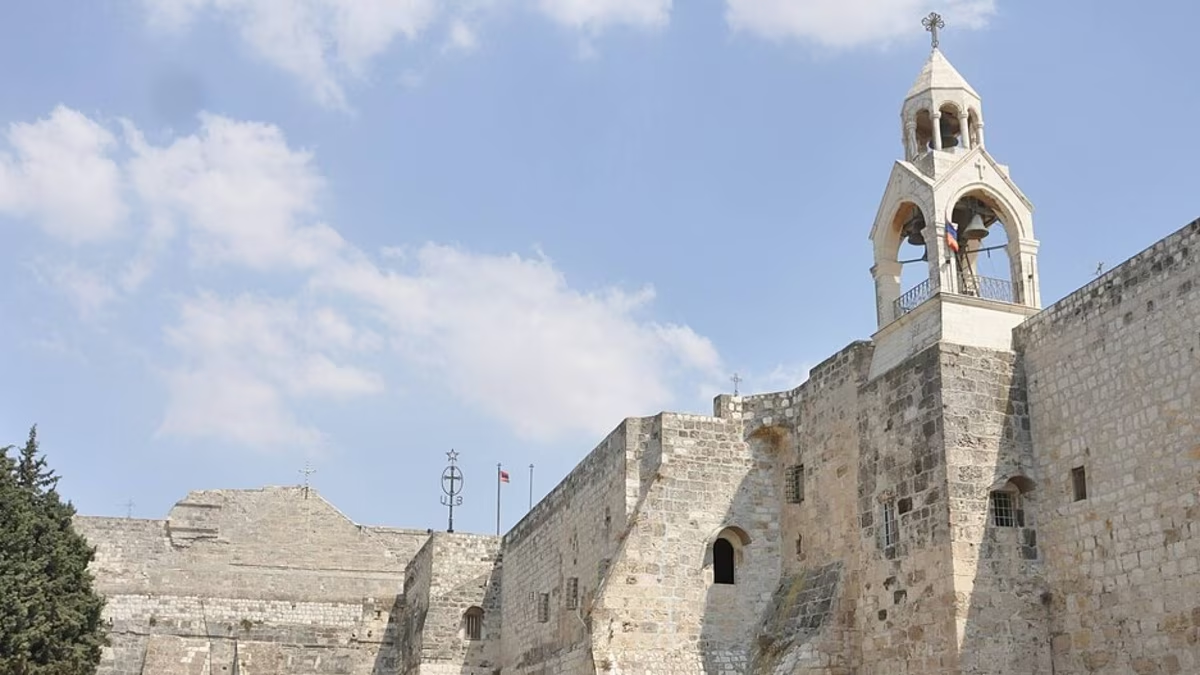
These measures are based on what is known as the "Terror Victims Compensation Law", where the seized amounts were distributed to 124 files related to operations carried out by Palestinians between 2001 and 2024.

The occupation authorities claim that the Palestinian Authority's payment of allowances to prisoners and families of martyrs justifies imposing direct financial liens on its funds held by the Ministry of Finance in the occupation government.

Among the prominent cases covered by the seizure is a case filed against the Palestine Liberation Organization dating back to 2001, where an "Israeli" court recently ruled compensations worth 10 million shekels.

The liens also affected amounts linked to operations that occurred in "Beit Israel" and the "Moment" café, and buses in Jerusalem and Tel Aviv during the Second Intifada years, up to recent operations witnessed in West Bank settlements in 2023.

This deduction comes at a time when the occupation authorities are withholding about 4 billion dollars from clearance funds with various accumulations, which has led to near-total paralysis in the Palestinian Authority's ability to fulfill its obligations.

Economic reports indicate that public sector employees' debts and unpaid dues have exceeded 4.26 billion dollars, which portends an imminent living and social collapse in the occupied territories.

Human rights activists see that using the occupation's judicial and administrative system to seize these funds represents a blatant violation of international financial agreements, including the economic "Paris Protocol".

Transferring tax funds, which are an absolute right of the Palestinian people, into compensations for settlers reflects a trend to turn political pressure into an open economic war aimed at undermining any chance for stability.

These arbitrary measures remain part of the "collective punishment" policy pursued by the occupation, where it attempts to barter financial rights with political positions, amid international silence that fails to curb the Israeli rampage on Palestinian resources

PALESTINE

Wed 07 Jan 2026 8:06 am - Jerusalem Time

The European Union Warns of Undermining Access to Aid for Gaza After Israel Bans 37 Relief Organizations

The European Union warned on Tuesday of undermining access to humanitarian aid in the required volume to the Gaza Strip following the decision by Israeli occupation authorities to ban 37 international relief organizations from operating in the Palestinian territories at the end of December.

The Union emphasized the importance of enabling these organizations to work sustainably in order to deliver aid with the necessary speed, safety, and volume.

This came in a joint statement by the High Representative for Foreign Affairs and Security Policy in the European Union Kaja Kallas, the Union's Commissioner for the Mediterranean Dubravka Šuica, and the Union's Commissioner for Equality, Preparedness, and Crisis Management Hadja Lahbib, regarding the registration procedures for international non-governmental organizations in Palestine.

The statement indicated that the humanitarian situation in the Gaza Strip continues to deteriorate, noting that Palestinians, with the onset of winter, are exposed to heavy rains and severe cold in the absence of safe shelter.

The statement clarified that children are still unable to attend schools, while health facilities are operating in a semi-paralyzed state due to the acute shortage of staff and equipment.

It emphasized the necessity of delivering humanitarian aid on a broad scale, quickly, safely, and without obstacles, to Gaza, while ensuring its sustainable distribution.

With the onset of winter, Palestinians are left exposed to heavy rains and low temperatures, without safe shelter, and children continue to be absent from schools, while medical facilities are on the verge of halting operations due to lack of basic staff and equipment, according to the joint European statement.

On December 18, the European Council welcomed the adoption of United Nations Security Council Resolution 2803 regarding the establishment of a Peace Council and a temporary international stabilization force, in accordance with the comprehensive plan to end the war in Gaza.

The European Council then called on all parties to fully implement the resolution, in line with relevant international legal principles, confirming its commitment to contributing to its implementation.

The European Council also emphasized the need to deliver humanitarian aid quickly, safely, and without obstacles, and its sustainable distribution on a broad scale inside and outside Gaza, and accordingly, called on Israel not to apply the NGO registration law in its current form.

The European Council said: "We call on Israel to allow international non-governmental organizations to operate and provide vital aid to needy civilians in Palestine."

The Council added: "Without these international organizations, humanitarian aid cannot be delivered at the required level to prevent further loss of life in Gaza."

The Council explained: "In order to provide aid quickly, safely, and in the required volume, international non-governmental organizations must be able to operate in a continuous and predictable manner. Without them, vital aid will not reach the beneficiaries."

It pointed out that providing humanitarian aid and services to civilians depends on safe and open access. Under international humanitarian law, the rapid and unobstructed passage of initial humanitarian aid must be allowed and facilitated.

In response, the Israeli Ministry of Foreign Affairs claimed that "political motives" stand behind the European statement, accusing it of being "detached from the reality on the ground and from broader regional operations."

The Israeli Foreign Ministry claimed in its post on the "X" platform that relief organizations are still operating normally inside Gaza, and that the vast majority of registered non-governmental organizations are active and continue their work without interruption.

The Ministry claimed that the registration requirements represent "a necessary security measure," and that "registration is still available and all requests are reviewed and processed according to established procedures."

The Israeli Ministry accused the European statement of "ignoring the ongoing improvement in the humanitarian situation in Gaza."

The Israeli claims come despite what was stated in the report of the United Nations Office for the Coordination of Humanitarian Affairs in the Occupied Palestinian Territories (OCHA) on the humanitarian situation in the Gaza Strip.

The bi-weekly report indicated that acute food insecurity and malnutrition in Gaza remain at critical levels, emphasizing the need to ensure predictable and unobstructed access to aid, alongside increasing supplies and sustainable funding to transition from emergency to early recovery efforts.

The report confirmed that the humanitarian convoys operated by the United Nations

PALESTINE

Wed 07 Jan 2026 8:00 am - Jerusalem Time

Palestinian Factions Demand Activation of the National Action Committee in Gaza

Palestinian factions in Gaza held a meeting in the office of the Palestinian Popular Struggle Front in Gaza, which included, alongside the Popular Struggle Front, representatives from the Arab Liberation Front, the Palestinian Liberation Front, and the Palestinian Arab Front. During the meeting, they discussed the current political situation and what our people are facing due to the genocide war, including daily massacres, economic and starvation blockade, and attempts to impose new facts aimed at geographically and politically dividing Gaza to separate it from its national context and remove it from the national project represented by the Palestine Liberation Organization, the legitimate and sole representative of our Palestinian people in all places of their presence.

The factions emphasized that the Palestine Liberation Organization will remain the most committed to the national project and the most faithful to the great sacrifices of our people, and demanded the renewal and activation of the National Action Committee as a comprehensive national political framework for all components of the national movement in the Gaza Strip, forming an extension of the Palestine Liberation Organization, to confront all the dangers and challenges facing our people, especially the risks of dividing and separating Gaza, displacing its population, and targeting the national identity of our people.

 The factions affirmed the importance of continuing efforts and communications with all components of the national movement, including factions of the Palestine Liberation Organization, national institutions, and national and influential figures, to unify their efforts and mobilize their energies within the framework of the National Action Committee, which enhances the role and status of the Palestine Liberation Organization in the Gaza Strip and enables the alleviation of our people's suffering and confrontation of the serious challenges threatening their national project and political future.

The factions called on the international community to bear its responsibilities towards our people and to emerge from a state of silence and helplessness regarding the genocide war to which our people are subjected, and the factions appreciated the positions of friendly countries and peoples that have stood in solidarity with our people, condemned the occupation's practices, and recognized the independent Palestinian state with Jerusalem as its capital.

ARAB AND WORLD

Wed 07 Jan 2026 7:52 am - Jerusalem Time

US Intervention in Venezuela: Policy of Force and Its Repercussions

In an unprecedented development, the United States has carried out a direct operation on Venezuelan soil, culminating in the kidnapping of President Nicolás Maduro and his wife Cilia Flores, and their transfer abroad in a shocking public spectacle that shook regional and international public opinion. The operation, conducted without any UN authorization or declared international judicial process, represented a dangerous escalation in the American approach to Venezuela, and opened wide the door to questioning the limits of power, respect for sovereignty, and the status of international law in contemporary American policies.

This step cannot be separated from a entrenched approach in American foreign policy, based on imposing will by force, bypassing international legitimacy, and prioritizing strategic interests over any ethical or legal commitment. Despite the slogans promoted about "democracy" and "human rights," the practical reality reveals a different approach, where international crises are managed by the logic of military force, not by the logic of law or international consensus.

Legally, any military intervention outside the framework of the United Nations is considered a clear violation of its charter, which prohibits the use of force against the sovereignty of states except in exceptional and specified cases. Targeting a head of state and his wife outside any recognized international judicial process falls only within the framework of political punishment, and reflects blatant disregard for the rules of international law. Moreover, involving Cilia Flores in this conflict and using her as a pressure card expands the circle of punishment to include the family, and reveals Washington's readiness to bypass the values it claims to defend.

Politically, these policies expose a chronic failure to understand the nature of targeted societies. Recent experiences confirm that external intervention rarely produces democracy, but rather often strengthens authoritarianism, and gives existing regimes justification to intensify repression under the slogan of "confronting foreign aggression." In the Venezuelan case, where citizens live in a suffocating economic crisis, American intervention is not seen as a lever for change, but as a direct assault on national sovereignty, which empties any discourse on human rights or democracy of its content.

Regionally, this behavior brings back to the forefront a long history of American interventions in Latin America, from externally supported coups, to economic sanctions and blockades. Targeting Maduro and his family is read within this historical context, and explains the extent of regional rejection of such policies. Instead of enhancing stability, these practices sow doubt and suspicion, and push regional countries to seek alternative alliances that protect them from similar scenarios, contributing to the erosion of American influence rather than its consolidation.

Internationally, these steps provide Washington's adversaries with free gains. Russia and China, for example, can easily portray the United States as a power that raises the slogan of "a rules-based international order," then violates it whenever it conflicts with its interests. Thus, Washington does not weaken its adversaries, but accelerates the shift toward a more multipolar international system, less willing to accept American hegemony.

Domestically, these interventions reflect a clear crisis in American decision-making mechanisms. The repeated recourse to military force without explicit legislative authorization, and without a comprehensive political strategy, indicates a worrying expansion in executive powers, and an inability to learn lessons from historical failures, from Vietnam to Iraq and Afghanistan. Moreover, prioritizing military solutions over political approaches increases the level of risks, and perpetuates a pattern of repeated mistakes.

The most dangerous thing is that such policies leave behind political and security vacuums that are difficult to contain. Previous experiences confirm that forcibly overthrowing leaders does not necessarily mean building stable institutions, but rather often opens the door to chaos, the rise of militias, and the growth of illicit economies. In Venezuela, where politics intertwines with a complex social and economic structure, any coercive intervention could lead to the disintegration of the state and its transformation into an open battlefield, where the ordinary citizen pays the price first and foremost, as happened in Afghanistan, Libya, and Yemen.

Targeting Maduro and his wife Cilia Flores adds a highly dangerous dimension: using the family as a political pressure tool. This behavior does not serve any democratic project, but deepens internal divisions, and strengthens the existing authority's pretext to justify further repression under the title of "confronting foreign intervention." It is a glaring model of the results of managing international conflicts by the logic of force alone.

In conclusion, American intervention in Venezuela is nothing but a new link in a chain of policies whose failure has been proven. Policies that ignore state sovereignty, undermine international law, and empty the discourse on democracy and human rights of its true content. The expected result is not stability or positive change, but wider chaos, deeper loss of trust, and a more fragile international system. Thus, targeting Maduro and his family, and what is marketed as a political or security achievement, turns into additional evidence of the shortcomings of strategic vision, and of repercussions that may extend to Washington itself, leaving behind crises that are difficult to contain.


ARAB AND WORLD

Wed 07 Jan 2026 7:51 am - Jerusalem Time

Trump Renews His Threats to Iran and Hints at Regime Change

In a highly sensitive regional moment, US President Donald Trump and his administration on Monday revived the discourse of foreign intervention under the banner of "supporting peoples" and "saving protesters," in an escalating context towards Iran where the political mixes with the media, and the humanitarian with the military, reflecting a familiar American approach in managing international crises.

The latest public signals on this path came with Republican Senator Lindsey Graham posting a photo of him with President Trump aboard Air Force One, both wearing a hat inscribed with "Let's Make Iran Great Again." The photo, posted by Graham on the "X" platform, was not a passing detail, but carried a clear political connotation, reflecting an intersection between the President's populist rhetoric and the orientations of the hardline current within the Republican Party, calling for direct confrontation with Tehran.

Graham, known for his steadfast support of the military option, accompanied the photo with a comment praising Trump as a leader who "made America stronger than ever, domestically and abroad," before extending greetings to what he described as "the brave Iranian people standing up to tyranny." This linkage between American power and "liberating peoples" brought back to the forefront terms used repeatedly in previous American interventions, whose results have been widely debated.

It is noted that during the 12-day American-Israeli war against Iran, Trump did not hide his inclinations towards the idea of regime change, even if he tried to linguistically circumvent the term. In a post on the "Truth Social" platform dated June 22, he wrote: "It's not politically correct to use the term regime change, but if the current Iranian regime is unable to make Iran great again, why not have a change in the regime?" This statement was understood in diplomatic circles as an explicit endorsement of the idea of overthrowing the regime, in a roundabout way.

Protests as a Potential Pretext

The most prominent shift in Trump's rhetoric was manifested in his attempt to utilize protests inside Iran as a direct entry point for military intervention. In a subsequent post, he warned that the United States "will intervene to save the protesters" if the Iranian authorities violently suppress them. This threat revived the concept of "humanitarian intervention," which was previously used to justify military operations in countries like Iraq and Libya, before those experiments ended in the collapse of state institutions and the spread of chaos.

This rhetoric comes at a highly significant timing, as it was preceded by hours by a swift American military operation in Venezuela, involving limited bombing and a raid that led to the abduction of President Nicolás Maduro. This precedent raised broad legal and political questions about Washington's readiness to bypass international norms and use direct force to achieve political objectives.

Messages Beyond Iran

The escalation was not limited to Tehran. During the same trip that brought him together with Graham, Trump directed indirect threats to Colombian President Gustavo Petro, hinting at the possibility of executing a similar strike, and also indicated that Cuba "is on the verge of collapse." These simultaneous messages reflected an American approach that considers several regions of the world as open arenas of pressure, from the Middle East to Latin America, in the context of reimposing influence by force.

Observers see that this rhetoric serves more than one purpose: domestically, it aligns with Trump's populist tendency based on displaying strength, and externally, it aims to deter adversaries and reassure allies, especially Israel, which views any escalation against Iran as a strategic gain.

The American allusion to "saving protesters" reflects a fundamental contradiction in Washington's foreign policy, where the humanitarian dimension is used as a tool to justify military intervention. Previous experiences have shown that external force rarely produces stable democratic transformations, but rather often leads to the disintegration of the state and the strengthening of nationalist tendencies within it. In the Iranian case, intervention could turn into a factor that unites the interior behind the authority instead of weakening it.

Moreover, the insistence of influential figures like Lindsey Graham, Netanyahu's top supporter in the US Senate, on linking "America's greatness" to overthrowing other regimes reflects a hegemonic mindset dating back to the Cold War logic. This approach, which marginalizes diplomacy and sanctifies force, not only threatens the stability of targeted countries, but also undermines the foundations of the international order based on law, and reinforces the law of force as the sole reference in international relations.

In conclusion, it seems that Washington is once again testing the limits of using moral slogans to justify policies of force, in a path that may open the door to a broader confrontation, whose cost to the region's stability and peoples will be much higher than the declared promises of "salvation."


PALESTINE

Wed 07 Jan 2026 6:10 am - Jerusalem Time

Tel Aviv transfers 47 million dollars from Palestinian clearance funds to Israeli families

Tel Aviv announced on Tuesday the transfer of 149 million shekels (47 million dollars) from Palestinian clearance funds to dozens of Israeli families claiming that individuals from them were killed in attacks carried out by Palestinians.

The Enforcement Office in Jerusalem collected 149 million shekels from the Palestinian Authority's funds, which were transferred to 124 compensation cases for families of terrorism victims, according to its claim.

The funds were collected at the Enforcement Office in Jerusalem affiliated with the Execution and Collection Authority (affiliated with the Ministry of Justice) and transferred to representatives of the families of the deceased and victims.

It explained that with the "difficulty in collecting these amounts from the perpetrators of the operations sentenced to prison, the seizure of the allocations transferred to them by the Palestinian Authority enabled the implementation of judicial rulings".

"Clearance" is funds imposed on goods imported to the Palestinian side, whether from Israel or through border crossings controlled by Tel Aviv, and collected by the latter on behalf of the Palestinian Authority.

Starting from 2019, Israel decided to deduct amounts from Palestinian clearance funds under various pretexts, which plunged the Authority into a financial crisis that made it unable to pay its employees' salaries in full.

After the start of the war on Gaza on October 8, 2023, the Israeli government began transferring only about 30 percent of the clearance funds, after deducting what the Palestinian government pays to the Gaza Strip in salaries and social affairs.

For the seventh month in a row, Israel has refrained from transferring clearance funds to the Palestinian Authority, and repeatedly, its ministers, headed by Prime Minister Benjamin Netanyahu, have incited against the Authority.

On October 4, Palestinian President Mahmoud Abbas called on the international community to "oblige Israel to stop all its unilateral measures that violate international law, foremost among them stopping settlement, settler terrorism, attacks on holy sites, and withholding Palestinian tax funds".

PALESTINE

Wed 07 Jan 2026 12:25 am - Jerusalem Time

Eastern Churches Celebrate the Glorious Christmas in Bethlehem and the Church of the Nativity Holds Midnight Mass.. Live Broadcast

Christian churches that follow the Eastern calendar are celebrating the Glorious Christmas today in the city of Bethlehem.

The Church of the Nativity hosted a midnight mass, amidst an atmosphere filled with prayers for peace in the Holy Land.

The Deputy President of Palestine, Hussein Al-Sheikh, attended the mass in Bethlehem, representing the Palestinian Presidency.

This attendance came to affirm national unity and the participation of all sons of the Palestinian people in their holidays and religious occasions.

PALESTINE

Wed 07 Jan 2026 12:11 am - Jerusalem Time

Hebrew media: Two killed and serious injuries in a ramming incident against 'Haredi' protesters in Jerusalem

Two protesters belonging to the 'Haredi Jews' stream were killed on Tuesday after a group of people was subjected to a ramming operation carried out by a passenger bus in the heart of the occupied city of Jerusalem.

The incident occurred at the intersection of 'Yirmiyahu' and 'Shamgar' streets, at a time when the area is witnessing violent protests against the mandatory conscription law, which has raised the level of tension in the city to unprecedented levels.

The emergency and rescue teams that rushed to the site reported that their crews dealt with a number of injured people on the spot, where the injuries varied between serious and moderate.

While the critical cases were transferred to central hospitals, a medical spokesperson confirmed that two people died immediately upon arrival due to the force of the impact, while others are still receiving intensive care.

For its part, the occupation police hastened to close the axes leading to the ramming point and imposed a heavy security cordon to facilitate evacuation operations and begin collecting criminal evidence.

The investigators' eyes are now directed towards the bus driver, who was confirmed to be of Arab origin, and he was arrested immediately for interrogation.

Security sources indicate that the occupation authorities are examining the hypothesis that the incident may be a deliberate act with 'national motives', although not ruling out that it was an accidental traffic incident resulting from loss of balance amid the crowds of protesters blocking the roads.

This development comes in a highly charged context, as Jerusalem lives on the edge of daily clashes between 'Haredi' groups and security forces, due to the categorical religious rejection of joining military service, a file that threatens to dismantle the ruling coalition in the occupation authorities.

PALESTINE

Tue 06 Jan 2026 12:59 pm - Jerusalem Time

Netanyahu: No opening of Rafah crossing before recovering the body of the last 'Israeli' prisoner

Netanyahu's recent statements contradict what was previously circulated regarding the imminent opening of Rafah crossing

The Prime Minister of the Occupation, Benjamin Netanyahu, stated that his government is considering setting a deadline for Hamas to disarm.

Netanyahu clarified, during a security assessment he conducted upon his return from the United States, that there are understandings with the American administration stipulating not to reopen Rafah crossing except after recovering the body of the remaining 'Israeli' prisoner in Gaza, 'Ran Guili'.

The first phase of the ceasefire agreement in Gaza entered into force on October 10, 2025, following indirect negotiations between Hamas and the Occupation, sponsored by Egypt, Qatar, the United States, and Turkey, according to a proposal presented by US President Donald Trump.

Netanyahu's recent statements contradict what was previously circulated regarding the imminent opening of Rafah crossing in the coming days, raising questions about the fate of the calm and the parties' commitment to its terms.

PALESTINE

Tue 06 Jan 2026 12:05 pm - Jerusalem Time

Settlers cut agricultural roads and threaten the farming season east of Nablus

In a dangerous escalation targeting the Palestinian presence in vital agricultural areas, extremist settlers intensified their attacks on agricultural lands east of the city of Nablus in the northern West Bank on Tuesday, specifically in the "Beit Furik Plain" area, which is a lifeline for thousands of Palestinian families in the region.

This escalation manifested in groups of settlers closing several agricultural and dirt roads leading to the plain, in an overt attempt to impose a new reality aimed at isolating farmers from their lands and preventing them from accessing them for cultivation.

Palestinian sources reported that a large number of settlers departed from one of the nearby pastoral settlement outposts near the plain, armed with tools, where they placed huge piles of dirt and rocks across the roads leading to the lands, preventing agricultural vehicles and tractors from crossing.

Farmers confirmed that these closures were not an individual or random act, but appeared to be an organized step aimed at completely disrupting the agricultural season, as many farmers were forced to turn back after finding the roads closed before them, which portends heavy losses that may befall them due to their inability to care for their crops or plow their lands in a timely manner.

This attack comes as part of a long series of violations to which the eastern area of Nablus is subjected, where experts in settlement affairs indicate that the Beit Furik Plain is subjected to what resembles a "silent war," led by extremist settlers with the aim of forcibly displacing farmers from their lands in preparation for controlling them and annexing them to the neighboring settlements.

What complicates the scene further is the role played by the occupation forces in providing security cover for these groups; the affected parties reported that occupation soldiers are often present in the area without moving a muscle to prevent the settlers, but instead often suppress the farmers if they try to defend their lands or remove the obstacles, putting the Palestinian farmer between the hammer of the settlers and the anvil of the army.

Rights and agricultural institutions warned of the danger of continuing this policy, confirming that the continued closure of roads and prevention of access to the Beit Furik Plain not only threatens the livelihoods of dozens of families, but also targets the food security of the entire governorate, given the strategic importance of this agricultural plain.

The residents of Beit Furik village and neighboring villages appealed to international and rights institutions for the urgent need to intervene to stop the rampage of the settlers, and to provide international protection for the farmers to enable them to access their lands safely, and to curb the confiscation projects that devour the lands day by day.

PALESTINE

Tue 06 Jan 2026 11:26 am - Jerusalem Time

By sea and land.. The occupation arrests fishermen and escalates its bombing on the Gaza Strip

Occupation forces arrested, on Tuesday, five fishermen while they were working in the waters of the Gaza Strip, as part of the continuing violations of the ceasefire agreement.

Occupation naval boats opened fire towards fishing boats off the coast of Deir al-Balah, before arresting the fishermen: Imad Jalal al-Qara'an, Ahmed Samir al-Masara'a, and Muhammad Wael Salah, while other fishermen were arrested off the beach of al-Shati camp west of Gaza City.

In the same context, occupation boats fired their weapons towards the beach of Khan Yunis.

On the ground, occupation warplanes have been continuing since the early morning hours to carry out destruction operations on residential buildings in the town of Beit Lahia north of the Gaza Strip, coinciding with raids targeting the al-Shujaiya neighborhood east of Gaza City, and areas east of Deir al-Balah.

The artillery shelling and intense gunfire also continue in the eastern areas of Khan Yunis city.

PALESTINE

Tue 06 Jan 2026 10:07 am - Jerusalem Time

Rafah Crossing.. The Serious Test Gate for Commitment to Ceasefire in Gaza

Dr. Saeed Shahin: Opening the crossing does not mean the end of Israeli attempts to disrupt it and place obstacles in its way, coinciding with the return to escalation..

Talal Awaql: Netanyahu will politically accept opening the crossing but will work to impose field realities that allow continuing the displacement plan, even if slowly..

Dr. Raham Auda: Washington will begin implementing the second phase propagandistically, titled Rafah Crossing, to create a positive impression among mediators while ignoring core issues..

Nizar Nazal: Opening Rafah Crossing is considered a prelude to the post-war phase within broader arrangements related to the future of governance in Gaza and disarmament issues..

Dr. Aql Salah: Obliging Israel to open the crossing in both directions is considered a clear failure of the forced displacement plans for Palestinians..

Labeed Tah: Concerns that the crossing may become a tool to facilitate the exit of Palestinians instead of being a step to end the war and improve living conditions..

Attention is turning once again to Rafah Crossing after talks about the possibility of opening it in both directions, as one of the most prominent commitments of the ceasefire agreement, and a pivotal step that directly touches the future of Gaza's humanitarian and political sector. 

And writers, political analysts, specialists, and university professors in separate interviews with "Al-Quds" see that this development, despite its importance, is not separate from deep political and security complexities, as warnings increase about possible Israeli attempts to disrupt the crossing's operation or turn it into a new pressure tool, whether by imposing field and security conditions, or maintaining control over movement and aid entry. 

According to the writers, analysts, specialists, and university professors, there are concerns emerging about the possibility of utilizing the opening of the crossing in the context of displacement plans, by facilitating exit in exchange for hindering return, or using the humanitarian aspect as a cover for broader political goals.

Moreover, Rafah Crossing gains an increasing regional and international dimension according to the writers, analysts, specialists, and university professors, with the return of international and regional parties to manage it, and paving the way for transitioning to the second phase of the agreement, which includes post-war arrangements and the future of governance in Gaza. Between hopes of reconnecting the sector with the world, and warnings of superficial or selective operation.

An important political achievement for the guarantor parties..

The political media professor at Hebron University, Dr. Saeed Shahin, sees that the talks about reaching an agreement to open Rafah Crossing in both directions is an important political achievement for the ceasefire agreement guarantor parties, and reflects a clear retreat in the positions of the occupation government head Benjamin Netanyahu and his far-right government, which insisted on the option of displacing Palestinians and imposing strict security conditions that contradict the crossing management protocol, especially regarding the physical inspection procedures insisted upon by the occupation authorities.

And Shahin explains that opening the crossing in both directions constitutes a pivotal step for the besieged Gaza Strip, as it reconnects it with the outside world, contributes to preventing displacement plans, and enables the return of residents who were forced to leave the sector due to the war, in addition to allowing patients, students, and employees to travel and reach their destinations.

And Shahin considers that this step can alleviate the severity of the worsening humanitarian catastrophe, and open wider political horizons for the sector.

And Shahin points out that opening the crossing paves the way for the return of parties supposed to manage it, primarily the Arab Republic of Egypt, and the Palestinian National Authority, and the European Union, which enhances the international character of the crossing management, and opens the way for transitioning to the second phase of the agreement, which includes the possibility of deploying an international force in specific locations within the sector.

Reducing Netanyahu's ability to return to war..

And Shahin points out that this contributes to reducing Netanyahu's ability to return to war under the pretext of Hamas's non-compliance with the agreement, whether regarding disarmament or the latest Israeli soldier file.

However, Shahin warns that opening the crossing does not mean the end of Israeli disruption attempts, confirming that Israel may place obstacles in its way, and may return to military escalation if Hamas insists on refusing to hand over its weapons or dismantle its tunnel network.

And Shahin notes that the United States, despite Israeli complexities, seems genuinely interested in transitioning to the second phase of the agreement, in the context of its efforts to oversee the reconstruction process and establish a foothold in the sector under the name "Peace Council" headed by Donald Trump, which puts Netanyahu and his government in a real political dilemma that is difficult to evade.

And Shahin confirms that the implementation of the second phase will proceed, most likely, at a slow pace, in light of ongoing Israeli efforts to derail it, in parallel with Hamas's positions, especially the statements of the Qassam Brigades regarding refusing to hand over weapons, which may be used as a pretext to explode the agreement and hinder the transition to the next stage.

Concerns about field realities enabling displacement..

The writer and political analyst Talal Awaql confirms that the Rafah Crossing file cannot be dealt with as a purely procedural issue subject to Israel's approval or rejection of its opening conditions, whether in both directions as proposed by the American plan, or in the exit direction only as insisted upon by the occupation government, confirming that the crossing constitutes a central arena in the struggle over the future of Gaza Strip and displacement plans.

And Awaql explains that the insistence of Arab and Muslim mediators on opening the crossing for the movement of individuals freely in both directions comes in a clear context of rejecting the displacement project, and intersects with the American administration's desire to transition to the second phase of the agreement.

And Awaql points out that Netanyahu realizes that he must politically accept opening the crossing, but in return, he will work to impose field realities that allow continuing the displacement plan, and even if through slower mechanisms and over a longer time period.

And Awaql points out that Israel will resort to repressive field measures after the returnees cross into the sector, through establishing security barriers inside Gaza to arrest those it wants to arrest under the pretext of "security," and humiliating and delaying others, in an attempt to deter Palestinians from returning to the sector. 

And Awaql explains that the road extending from Rafah Crossing to inside Gaza is under complete control of the Israeli army, which gives the occupation wide capabilities to control movement and transportation.

Restrictions on humanitarian aid..

And Awaql notes that the entry of trucks and humanitarian aid and relief materials will remain subject to the Israeli conditions and mechanisms currently in place, which means continuing to use the crossing as a pressure tool, and not as a free humanitarian gateway. 

And Awaql expects that the Israeli army will work to facilitate the exit of Palestinians from the sector, even those with security suspicions, in the context of encouraging departure, while retaining the right to arrest those pursued by its security agencies.

And Awaql explains that Israel has long restricted the travel of patients, allowing only one companion, and sometimes prohibiting companions altogether, but today, in the context of displacement, it allows the entire family to accompany the patient, in a clear indicator of utilizing the humanitarian aspect to serve political goals.

And Awaql sees that the American vision indicates moving things towards the second phase after overcoming some Israeli objections, which is likely to have been discussed during Netanyahu's recent visit to the United States.

And Awaql rules out that Donald Trump will intervene to remove obstacles related to the mechanism of opening the crossing if they do not serve the displacement plan, considering that this goal constitutes a common denominator between the two parties.

Netanyahu's flexibility after obtaining American approvals..

The writer and political analyst Dr. Raham Auda explains that the anticipated announcement of opening Rafah Crossing in both directions reflects a political reality in which the occupation government head Benjamin Netanyahu is forced to respond to the request of the American President Donald Trump.

And Auda points out that Netanyahu cannot reject all Washington's demands, especially in light of Egypt's success in convincing the American administration and the international public opinion of the necessity of opening the crossing in both directions, which refutes fears of "going without return" or the forced migration of Palestinians from Gaza Strip, and allows the return of the stranded.

And Auda explains that Netanyahu resorted to showing flexibility on secondary files, at the forefront of which is the Rafah Crossing file, in exchange for obtaining American approvals in more important strategic files for him.

And Auda notes that among these potential gains is obtaining an American green light to direct a military strike against Iran if it insists on developing its nuclear program, in addition to allowing the Israeli army to carry out a military operation in Gaza to disarm Hamas if it refuses to hand it over, in addition to ignoring the file of the Israeli withdrawal from the zero zone inside the sector.

And Auda considers that these promises constitute winning cards in Netanyahu's hand, enabling him to contain the opposition of the far-right to opening the crossing, considering it a secondary file compared to those major understandings.

Egypt's important role in lifting the siege on Gaza..

And Auda emphasizes the need to appreciate the Egyptian role, which led an international advocacy campaign to lift the siege on Gaza Strip, pointing out that the invitation of the famous American actress Angelina Jolie to visit Rafah Crossing accompanied by the governor of North Sinai contributed to influencing international public opinion, and increased the pressure on Israel and Trump to open the crossing in both directions, and not in one direction only.

Return of Palestinian sovereignty..

And Auda points out that the importance of opening the crossing is the return of Palestinian sovereignty over it, even partially, through its administrative management by the Palestinian Authority in cooperation with the European Union, through employees affiliated with the Authority in Ramallah, considering that this constitutes a positive indicator of the beginning of implementing the second phase of the agreement, and allows the travel of humanitarian cases, students, and patients, with guaranteeing their right to return to the sector.

Rafah Crossing as a positive propaganda title for the second phase..

Regarding whether this step represents an actual move for the second phase of the ceasefire agreement, Auda sees that Washington will begin implementing this phase formally and propagandistically, taking Rafah Crossing as its title, with the aim of creating a positive impression among Arab and Palestinian mediators, while ignoring the core files related to reconstruction and the complete Israeli withdrawal from the sector.

And Auda points out that the next phase may witness the announcement of forming a technocrats committee and a peace council, in the context of gradually withdrawing the administrative file from the Hamas government, and giving time space for negotiating disarmament and the role of international forces, considering that what is happening represents a partial and gradual application of the second phase, and a real test of the sincerity of intentions of all parties.

Alleviating humanitarian pressure on Gaza..

The researcher specialized in Israeli affairs and conflict issues, Nizar Nazal, explains that opening Rafah Crossing transcends the procedural dimension to humanitarian, political, field, and strategic dimensions, in light of the accelerating developments related to the war on Gaza Strip and what comes after.

And Nazal points out that the first dimension of opening the crossing is represented in alleviating the humanitarian pressure on Gaza Strip, by opening it in both directions, which contributes to increasing the flow of humanitarian aid and reducing the severity of needs inside the sector, especially in light of the suffocating humanitarian crisis suffered by the residents, as opening the crossing in this formula limits the use of human suffering as a political pressure tool.

Failure of one-way travel..

And Nazal notes that opening Rafah Crossing constitutes a clear indicator of the strong return of the Egyptian role to the scene, after previous Israeli attempts to marginalize Cairo or blackmail it, especially through seeking to open the crossing in one direction serving the plans of displacing Palestinians from Gaza Strip, while Nazal considers that Egypt's recovery of its role in this file reflects the failure of those Israeli attempts.

And Nazal points out that the step carries important field implications, as it indicates an Israeli intention towards field calm, which reflects a gradual transition from the military phase to a phase with a political character, in which the possibilities of returning to war decrease, and political options are presented instead of military solutions.

And Nazal points out that opening the crossing sends direct political messages to Israel, the most prominent of which is reducing its ability to use the siege weapon to impose its agendas and achieve political gains, which constituted in previous stages one of the most important Israeli pressure tools.

Opening the crossing as a prelude to the post-war phase..

And Nazal confirms that opening Rafah Crossing is considered a prelude to the post-war phase, within broader arrangements related to the future of governance in Gaza and disarmament issues, explaining that this step constitutes a real test of Israel's intentions, and not of the mediators or Palestinian resistance intentions that see in opening the crossing a direct interest.

And Nazal points out that these developments came as a result of simultaneous American-Egyptian pressure, considering that what is happening represents a major political transformation and an American commitment to opening a calculated political path, reminding of the arrangements of 2005 related to opening Rafah Crossing, before Hamas's control over the crossing, in the context of reshaping the political scene in Gaza Strip.

Ambiguity surrounds the crossing's operation mechanisms..

The writer, political researcher, and professor of comparative political systems, Dr. Aql Salah, confirms that the current talks about opening Rafah Crossing came in the context of the latest ceasefire agreement, confirming that the agreement explicitly stipulated opening the crossing since October 10th last year, but the occupation government head Benjamin Netanyahu managed to evade implementing this clause until the current stage.

And Salah explains that the mechanism for operating the crossing is still ambiguous and unclear, in light of the absence of any official announcement specifying the nature of the management or the timing of the full operation, pointing out that Netanyahu and the American President Donald Trump are still the most informed parties on the details and mechanism of the operation, which raises serious concerns about the future of the crossing and its true function.

And Salah points out that there is a real fear that the operation of the crossing will be superficial, through continuing Israeli control over it, and not its operation as an international crossing performing its natural role as before the war, whether in terms of the movement of individuals or the entry of goods. 

Concerns about turning the crossing into a pressure tool..

And Salah warns that this scenario may turn the crossing into a new pressure tool in Netanyahu's hand to manage the conflict instead of ending it, in light of the absence of any official information so far about the nature of the operation.

And Salah addresses a set of important implications related to opening Rafah Crossing, the most prominent of which is that it constitutes a real window to lift the imposed siege on Gaza Strip, as it is the only gateway connecting the sector with the outside world, whether for individuals or goods. 

And Salah points out that obliging Israel to open the crossing in both directions, travel and return, is considered a clear failure of the plans of the far-right Israeli extreme right that sought to open it in one direction only, serving the goal of the forced displacement of Palestinians, and this goal that Israel failed to achieve.

And Salah confirms that the announcement of opening the crossing came as a result of direct American pressure, especially after the last meeting between Trump and Netanyahu, in an American attempt to show Israel's commitment to agreements and improve its image internationally from the humanitarian aspect.

And Salah points out that opening the crossing contributes to ending the suffering of thousands of Palestinians stranded in Egypt and other countries for about two years, who are waiting to return to Gaza Strip.

Important guarantees for the crossing's operation..

And Salah confirms that among the most important implications of opening the crossing is breaking the geographical isolation imposed on the sector, and opening the way for the return of Palestinian sovereignty over the crossing as it was before the war, in addition to European participation in monitoring it, which gives the process an international character and limits direct Israeli control.

And Salah notes that the decision to open the crossing was not in Israel's hands alone, but came as a result of understandings in which the United States, Egypt, Qatar, and other parties participated, which provides international guarantees for its continued operation, despite his expectation that Netanyahu will seek to create new crises to satisfy the far-right, specifically Smotrich and Ben Gvir.

An important entrance to start the reconstruction and the second phase..

And Salah points out that opening the crossing may constitute an actual entrance to start the reconstruction process in Gaza, by lifting restrictions on building materials and housing and increasing humanitarian aid, in addition to it constituting direct pressure on Netanyahu to transition to implementing the second phase of the agreement, which includes the Israeli withdrawal from the yellow line and the areas occupied by the army inside the sector.

And Salah confirms that opening Rafah Crossing represents the real test for Netanyahu to transition to the next stage of implementing the agreement and ceasefire, warning that the occupation government head will continue the policy of evasion and creating new crises, whether by linking the crossing to weapon files or soldiers' remains or withdrawal, in an attempt to hinder the actual implementation of the agreements, as he historically did since derailing the implementation of the Oslo Agreement in 1996.

The pressure that led to opening the crossing..

The researcher and political analyst Labeed Tah confirms that the talk about announcing the opening of Rafah Crossing falls within the commitments stipulated in the ceasefire agreement, confirming that this step is not a favor from the Israeli side, but a political and legal commitment that was supposed to be implemented previously.

And Tah points out that the experience with Israel shows that it does not deal seriously with its commitments, and does not proceed to implement them except under pressure, or considering them a formal concession in exchange for insisting on larger and more dangerous impositions.
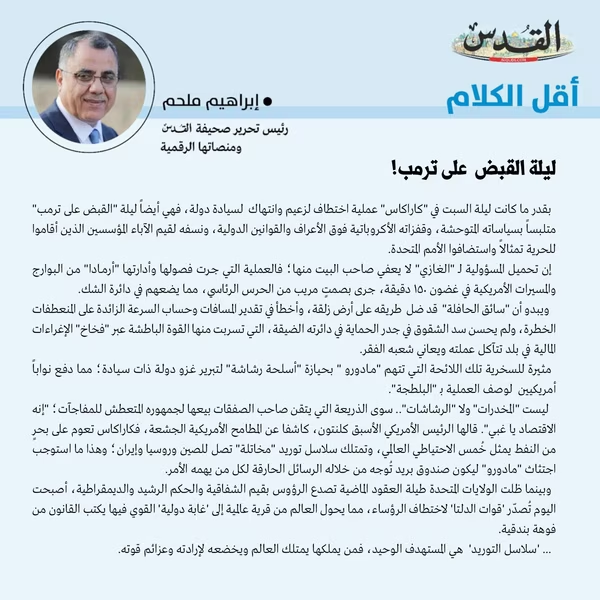
And Tah explains that Israel had tried about a month ago to pass a plan to open Rafah Crossing in one direction only, in a context aimed at facilitating the displacement of Palestinians from Gaza Strip, but this plan failed due to not obtaining regional and international acceptance. And Tah confirms that the American pressures, especially what leaked about the last Florida summit between the American President Donald Trump and the occupation government head Benjamin Netanyahu, played a direct role in imposing the issue of opening the crossing.

Two-way passage is a double-edged sword..

And Tah points out that opening the crossing for the movement of people back and forth may be a double-edged sword, as on the one hand it gives Palestinians a limited margin for movement through Egypt, but on the other hand it may turn into an indirect tool to facilitate the exit of some from Gaza Strip under the pressure of harsh humanitarian conditions, which raises real concerns about utilizing this step in the context of displacement.

And Tah points out that despite the importance of opening Rafah Crossing, there are more urgent humanitarian priorities for the sector's people, at the forefront of which is providing shelter, and introducing medicines and food, and starting practical steps for reconstruction, considering that these issues are no less important, and perhaps exceed in necessity, the issue of opening the crossing itself.

And Tah notes that this step represents a partial response to American pressures and Arab, Islamic, and international appeals that called for improving the living conditions of Palestinians, who live in the open in light of harsh climatic conditions, suggesting that opening the crossing is part of a broader deal in which Israel is given greater freedom to move in other files.

And Tah warns against opening Rafah Crossing turning into a tool to facilitate the exit of Palestinians from their land instead of being a real step towards ending the war and improving living conditions in Gaza Strip.

Continuation of the killing..

Regarding the talk about moving the second phase of the agreement following the inauguration of opening the crossing, Tah expresses his pessimism, confirming the absence of real indicators of its launch, but on the contrary, the field realities indicate the continuation of killing and destruction at a lighter pace than before as in the previous two years, in light of a ceasefire that seems unilateral committed to by the Palestinians only, while aid still enters at less than the agreed level.

And Tah sees that the region is heading towards a highly dangerous regional and international phase, in light of developments in Iran, Syria, Lebanon, and Yemen, in addition to other international crises.

OPINIONS

Tue 06 Jan 2026 10:06 am - Jerusalem Time

Post-Trump-Netanyahu Meeting: A Moment of Testing or Recycling the Crisis?

By: Jamal Zaqout

By: Jamal Zaqout

Opinion Writer

What transpired in the recent meeting between Donald Trump and Benjamin Netanyahu is not merely a protocol station in a well-established political relationship, but a concentrated expression of a strategic dilemma facing the Israeli-American project in the post-genocide war on Gaza phase. A dilemma that concerns not only the future of the war, but the future of the region, and the limits of the ability to continue managing the conflict with the same old mechanisms.


Contrary to the prevailing impression, the core of the divergence between Trump and Netanyahu does not lie in an ideological disagreement or political rupture, but in an increasing difference over the timing of the transition from war to what comes after it, and the conditions and limits of this transition. Trump, returning to the White House with the mindset of a deal-maker, has come to view the war in Gaza as a political and strategic burden that threatens his ability to reorder his international and regional priorities. As for Netanyahu, he sees it as a last chance to reproduce his political survival, even if the price is prolonging the destruction and deepening isolation.


Trump, who appears serious about transitioning to what he calls the “second phase” of his long-term plan, is not motivated by moral reasons or commitment to the national rights of the Palestinian people, but by purely pragmatic calculations; ending an open-ended war, consolidating facts on the ground, and opening a path for conditional reconstruction that reintegrates the region into the American stability equation. This phase, as outlined in Washington, does not mean a sovereign Palestinian state, but a politically defanged entity, security-controlled, and regionally acceptable.


However, this vision collides directly with the obstacle that is Netanyahu. The man is neither capable nor qualified, politically and personally, to accept any formula that could be understood as ending the war or a clear Israeli withdrawal from Gaza. Not only because he rejects it in principle, but because any step of this kind means the disintegration of his coalition, the fall of his government, and perhaps his final exit from the political scene. Hence, Netanyahu continues his policy of buying time by prolonging the war, emptying initiatives of their content, and betting on the erosion of international pressures.


Between managing the cost and the post-war entitlement: Where do the Palestinians stand?


In this context, talking about “differences” between the two men is as accurate as it is misleading. Yes, there is real tension, but it is tension within the same project, not outside it. Trump wants to move to the post-war phase, while Netanyahu wants to stay in it as long as possible. Both do not adopt a project that leads to Palestinian liberation and enables them to determine their destiny, but they differ on managing the cost.


Amid this American-Israeli divergence, the most pressing question emerges: Where do the Palestinians stand and what are they doing?

And the painful answer is that the Palestinian position remains captive to a state of waiting and betting on the “contradictions of others,” instead of actually investing in them. For the absence of Palestinian initiative does not fill the vacuum, but rather fills it with others according to their interests, and often at the expense of the national cause and the cohesion of Palestinian society, which is paying, and continues to pay, the price of Israeli aggression and the absence of an effective Palestinian political role.


Post-meeting: Who fills the political vacuum?


The formation of a national consensus Palestinian government, with a clear political program and inclusive reference, is no longer a political luxury or merely a moral response, but has become a strategic tool capable of disrupting American and Israeli calculations alike. A government of this type does not overthrow the occupation, but it moves the Palestinians from the position of a waiting recipient drowning in illusion to the position of an actor, and imposes itself as an indispensable party in any “day after” path, and embarrasses Washington in front of its discourse on stability and reconstruction.


Moreover, a serious Palestinian initiative can deepen the existing gap between Trump and Netanyahu. For Trump, seeking an exit from the war, needs a Palestinian partner capable of disrupting Netanyahu's plans, which the latter particularly fears what such a Palestinian system can succeed in preventing the isolation of the Gaza Strip and its separation from the West Bank and what that means in reviving the path of seizing the right to self-determination and embodying the Palestinian state on the occupied land since 1967, with Jerusalem as its capital.


As for the Arab side, the possibilities of influence have always existed, but the will remains hesitant. Arab countries possess real pressure cards in the face of the Israeli game, but they still deal with Washington with a reactive logic, not initiative. Without a unified Palestinian position, these cards remain scattered, usable partially, not for decisive influence.


The current moment, with all its complexities, holds a rare political opportunity, but it is not automatic. The gap between Trump and Netanyahu is not an illusion, but it will not turn into a Palestinian gain unless the Palestinians make good use of it. The transition from a policy of waiting to a policy of initiative is no longer a tactical choice, but an urgent national necessity, not only in defense of the cause, but of Palestinian society itself, which is paying the price of occupation, division, and the absence of decision-making at the same time.


In conclusion, it is no longer acceptable for Palestinians to remain captives of the spectator position on others' conflict, or hostages to calculations not managed by their hands. The Palestinian street, and its living social forces from youth and social movements, popular activities, civil society, and national figures with firm positions and everyone who seeks change, are called upon today to break the cycle of waiting and exert serious pressure towards rebuilding national political action. For the absence of Palestinian initiative does not neutralize our people from the conflict, but leaves it naked in the face of unleashed Israeli aggression, and projects crafted over its heads. Restoring the role does not begin with slogans, but with imposing the priority of unity, accountability, and genuine representation, as conditions for protecting society before the cause, and transforming the sacrifices of Gaza and all Palestine from an open human cost into an effective political force. At this very moment, silence becomes complicity, and waiting a confirmed loss, while initiative alone is the only way to seize a place for Palestinians at a table being reshaped anew.

In a world being reshaped by force, there is no place for those who wait for others' justice, but for those who impose themselves as an indispensable party.

OPINIONS

Tue 06 Jan 2026 10:04 am - Jerusalem Time

The Night of Catching Trump!

Ibrahim Milhem

Ibrahim Milhem

Opinion Writer

As much as the Saturday night in "Caracas" was an abduction operation for a leader and a violation  of a state's sovereignty, it is also the night of "catching Trump" red-handed with his savage policies, his acrobatic leaps over international norms and laws, and his demolition of the values of the founding fathers who erected a statue for freedom and hosted the United Nations. 
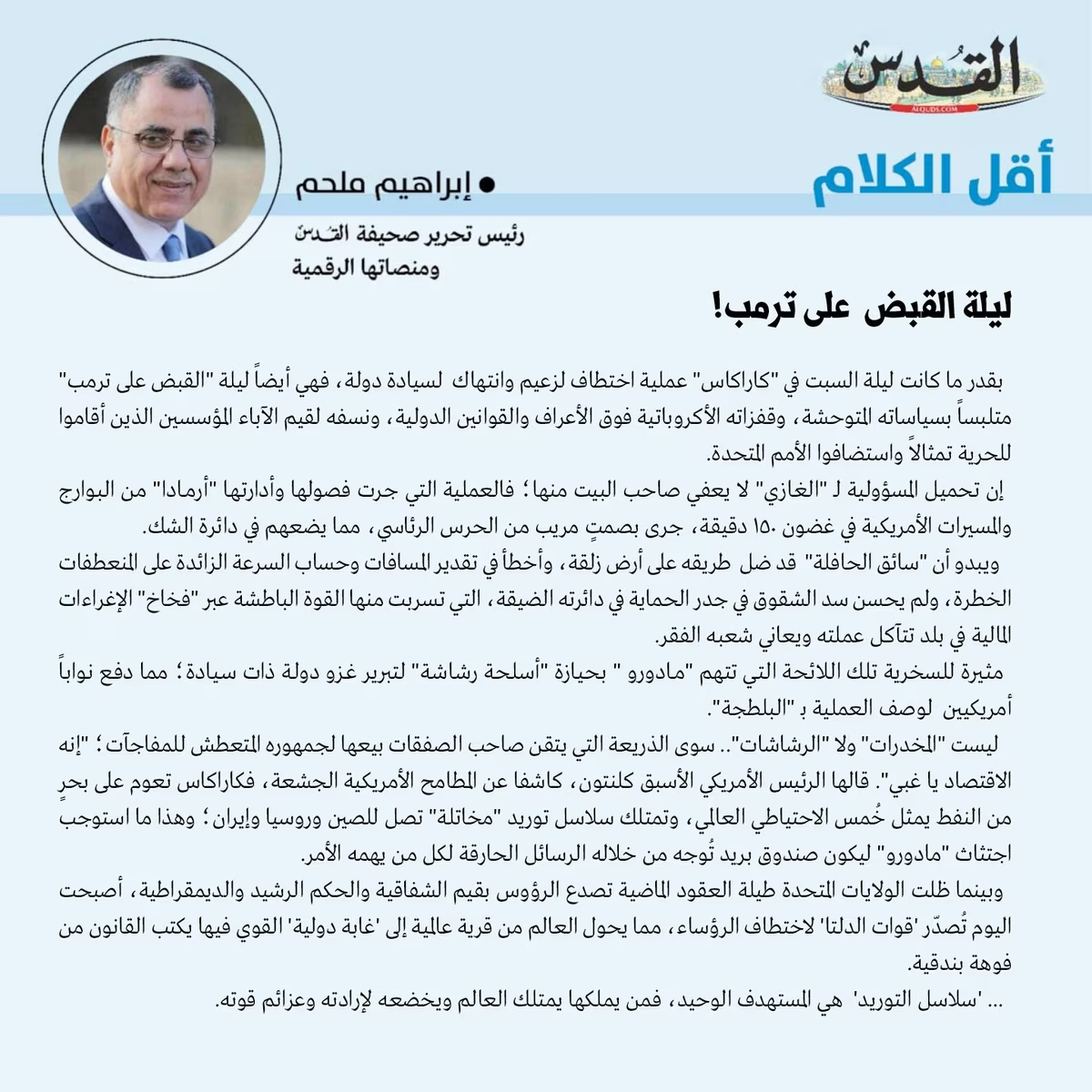
Blaming the "invader" does not absolve the homeowner of responsibility; the operation whose chapters unfolded and was managed by an "armada" of American battleships and drones within 150 minutes, took place with suspicious silence from the presidential guard, which puts them in the circle of suspicion.

 And it seems that the "bus driver"  has lost  his way on slippery ground, erred in estimating distances and calculating excessive speed on dangerous turns, and did not properly seal the cracks in the protective walls in his narrow circle, from which the oppressive force leaked through "traps" of financial temptations in a country whose currency is eroding and whose people suffer poverty.

Ridiculous is that list accusing "Maduro " of possessing "machine guns" to justify invading a sovereign state; which prompted American deputies  to describe the operation as "thuggery".

 Neither "drugs" nor "machine guns".. are anything but the pretext that the deal-maker excels at selling to his audience thirsty for surprises; "It's the economy, stupid." Said by the former American president Clinton, revealing the greedy American ambitions, for Caracas floats on a sea of oil representing a fifth of the global reserve, and possesses "deceptive" supply chains reaching China, Russia, and Iran; and this necessitated uprooting "Maduro" to be a mailbox through which burning messages are directed to everyone concerned.

While the United States has been deafening heads for decades with values of transparency, good governance, and democracy, today it exports 'Delta forces' to kidnap presidents, which turns the world from a global village into an 'international jungle' where the strong write the law from the barrel of a gun.

... 'Supply chains'  are the sole target, for whoever owns them owns the world and subjugates it to his will and determinations of his power.

PALESTINE

Tue 06 Jan 2026 10:03 am - Jerusalem Time

Trump Prepares to Announce the Start of the Second Phase in Gaza from Davos

All eyes are on the World Economic Forum in Davos, scheduled to be held between January 19 and 23, amid intersecting reports indicating that US President Donald Trump intends to exploit this international gathering to announce details of what is known as the 'second phase' of the American plan for the Gaza Strip. According to these reports, the plan is not limited to temporary humanitarian or security arrangements, but includes a comprehensive vision for reshaping the political, security, and administrative structure of the sector, under direct international supervision and with a central American role.

According to political and media sources, the plan includes announcing the formation of an international 'Peace Council' that will oversee the transitional phase in Gaza, composed of high-level international figures, whose task is to manage the general political and security path after the war. It is assumed that this council will operate as a supreme reference above local institutions, including overseeing reconstruction, controlling the security scene, and coordinating the work of international parties participating in the next phase.

One of the fundamental elements in this plan is the creation of what is called the 'International Stabilization Force' (ISF), a multinational force tasked with deploying inside the Gaza Strip, with the aim of maintaining security, protecting civilians, and ensuring the implementation of transitional arrangements, including monitoring disarmament and preventing the return of armed confrontations. Although the official proposal indicates an international character for the force, the United States is seen as the primary political and military engineer of this mechanism, whether in terms of authorization or indirect command.

In addition to the security dimension, the plan includes forming a temporary technocratic Palestinian government, consisting of non-partisan figures, tasked with managing daily civil affairs in Gaza, such as services, health, education, and reconstruction. This government, according to the American vision, will operate under the supervision of the International Peace Council, which practically means reducing the political role of Palestinian factions and redefining the concept of 'self-governance' in the sector within a transitional framework subject to international oversight.

As for the issue of American military presence, it remains one of the most controversial points. While some leaks confirm that Washington does not plan to deploy extensive combat US forces inside Gaza, talk revolves around indirect military presence, including advisors, security experts, and logistical support elements, in addition to a leading role in directing the work of the International Stabilization Force. This presence, even if marketed as part of a collective international effort, reflects the continuation of the dominant American role in shaping the contours of the 'day after' in Gaza.

The choice of the Davos Forum to announce this plan is not a minor detail. Davos, as a platform that brings together global political and economic leaders, provides Trump with an opportunity to present the plan as an international project for stability and development, not just a unilateral American initiative. It also allows him to rally political and financial support for reconstruction and link Gaza's future to a network of international economic and security interests.

However, this plan raises fundamental questions about its political legitimacy and feasibility. The absence of genuine Palestinian representation and the marginalization of key factions weaken the chances of popular acceptance, turning the project into a form of external management more than a path to a fair political solution. Moreover, the focus on security before politics reproduces previous approaches that have proven their limitations, if not their failure, in achieving sustainable stability.

In conclusion, what is being prepared in Davos seems to go beyond being a technical announcement of a new phase, to constitute a comprehensive attempt to politically and security-wise re-engineer Gaza, according to an American vision that sees temporary international administration as an alternative to radical political solutions. And the fundamental question remains: Does this plan represent a step towards stability, or a new chapter in crisis management instead of resolving it?
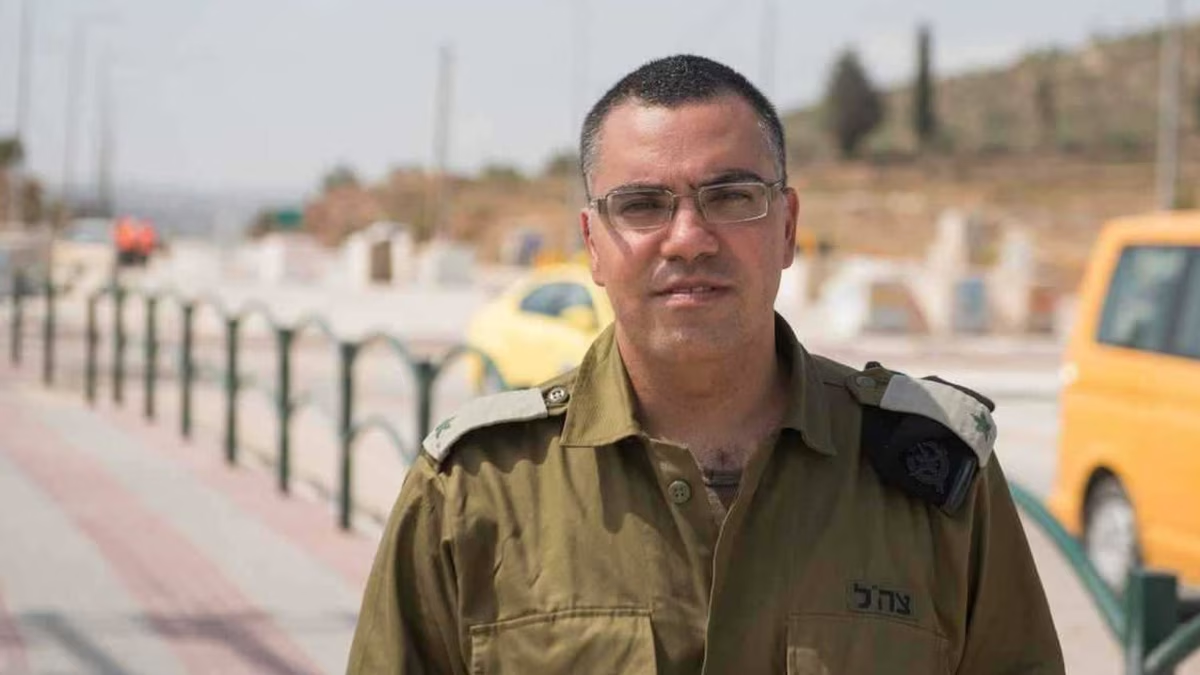
The proposed American plan reflects a clear tendency to manage the conflict rather than address it from its roots. It focuses on creating new administrative and security structures without addressing the fundamental political issues, at the forefront of which is the Palestinians' right to self-determination. This approach, although it may seem practical in the short term, carries within it the risks of reproducing tension, because any arrangement that ignores the political and national dimension will remain fragile and exposed to collapse at the first real test.
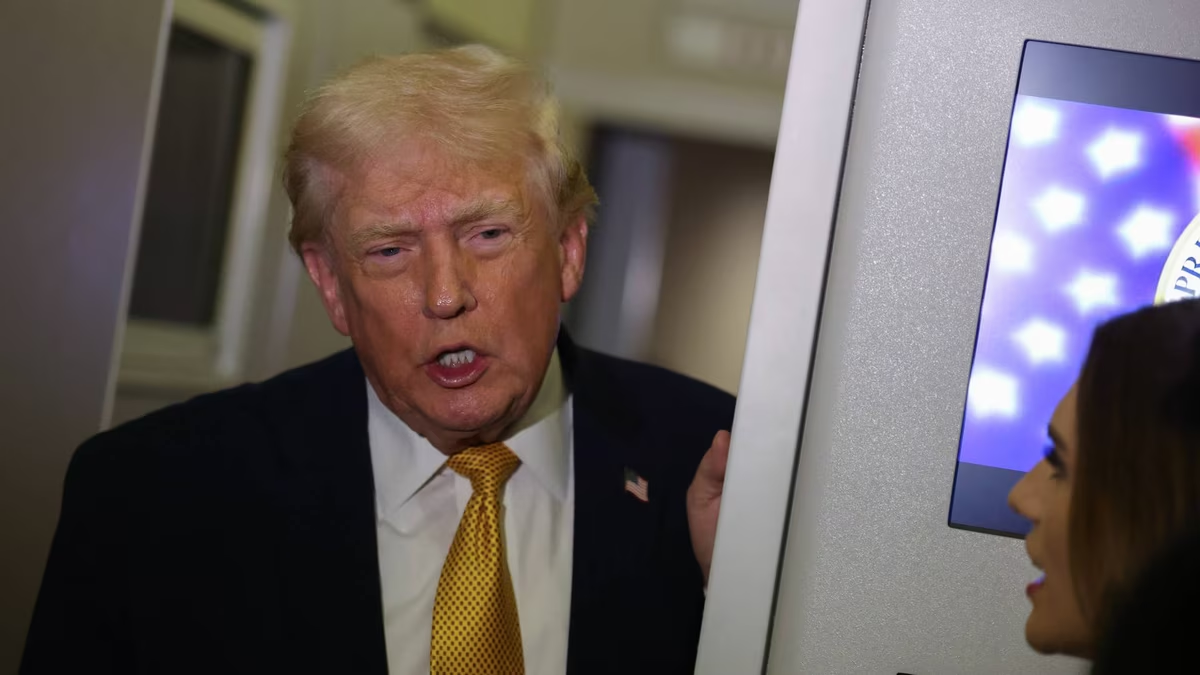
Moreover, relying on a technocratic government under international supervision reflects a deep crisis of confidence in local political actors, but at the same time, it empties the concept of governance of its democratic content. Technocrats, no matter how competent they are, lack popular mandate, making them susceptible to accusations of being a facade for external administration. This issue may undermine the proposed government's ability to enforce its decisions or gain genuine societal legitimacy.

As for the bet on the International Stabilization Force, it brings to mind previous international experiences that have shown the limited effectiveness of multinational forces in complex conflict environments. The absence of local political consensus and the conflicting agendas of participating countries may turn this force from a stabilizing factor into an additional party in the conflict equation. Without a clear political horizon, the international force will remain a temporary containment tool, not a permanent solution.

ARAB AND WORLD

Tue 06 Jan 2026 8:36 am - Jerusalem Time

The occupation army announces bombing of weapon depots and infrastructure for 'Hezbollah' and 'Hamas' in Lebanon

The Israeli occupation army announced, on Tuesday morning, the execution of a series of extensive aerial raids that targeted military infrastructure and weapon depots belonging to both 'Hezbollah' and the Islamic Resistance Movement 'Hamas' in scattered areas of Lebanese territory, considering that these activities represent a 'breach of understandings' existing between the two sides.

In a statement issued by the spokesperson for the occupation army, it was clarified that the raids launched on Monday targeted several weapon depots and military buildings - some of which are above ground and others underground - that were used by 'Hezbollah' to rebuild the organization's structure and advance operational plans, according to the occupation's claims.

In a related context, the occupation's statement claimed targeting sites dedicated to weapon production belonging to the 'Hamas' movement in the south Lebanon area, alleging that these sites are used to arm the movement and carry out attacks against the occupation army forces and 'Israel'.

The occupation army justified the nature of the targets and their locations by saying that these sites were deliberately placed in the 'heart of civilian areas', considering it additional evidence of what it described as 'the factions' use of Lebanese residents as human shields' to cover their activities.

The military spokesperson claimed that his forces took concrete steps before executing the raids to reduce the likelihood of civilian casualties, including issuing prior warnings to residents in those areas to evacuate, concluding his statement by affirming that the occupation army will continue to work to remove any security threat, considering the activity of these factions a 'violation' of the concluded understandings.

ARAB AND WORLD

Tue 06 Jan 2026 2:30 am - Jerusalem Time

Trump: We are not at war with Venezuela.. and elections will not be held next month

Trump: We are not at war with Venezuela

Trump: We may support oil companies' efforts to rebuild Venezuela's energy infrastructure

Trump: Venezuela will not witness new elections in the next thirty days

Trump: Venezuela must be reformed first and elections cannot be held next month

In the context of arranging the priorities of the American administration for the post-"Nicolas Maduro" phase, President "Donald Trump" affirmed that the United States is not in a state of war with Venezuela.

Trump clarified that the current vision focuses on the necessity of reforming the structures of the Venezuelan state first, completely ruling out the possibility of any electoral process in the near future.

Postponing ballot boxes for the sake of stability

The American president also cut off speculations regarding a rapid political transition, affirming that Venezuela will not witness new elections in the coming thirty days.

Read also: After the "shock" of Maduro's kidnapping.. Rodriguez sends a message to Trump: We want a relationship based on respect, not war

This approach reflects Washington's desire to impose structural stability and establish the foundations of the new administration before resorting to ballot boxes, especially given the exceptional circumstances the country is experiencing.

Rebuilding the "backbone" of the economy

On the reconstruction front, Trump revealed a plan to support the efforts of major oil companies aimed at repairing and building Venezuela's energy infrastructure.

These statements come to confirm that the recovery of the oil sector represents the cornerstone of the American strategy, not only to secure Washington's interests, but to reinject life into the dilapidated Venezuelan economic artery.

These positions reflect the White House's insistence on managing the Venezuelan file with a direct grip, considering that the radical reform of institutions and the energy sector is the mandatory path before talking about any democratic future.

ARAB AND WORLD

Tue 06 Jan 2026 1:17 am - Jerusalem Time

With 200 personnel and 150 aircraft.. Washington reveals the backstage of the 'swift operation' to kidnap Maduro in the heart of Caracas

In the first official disclosure of the size of the military force that carried out the most violent breach of sovereignty in Latin America, US Secretary of War "Pete Hegseth" revealed new details on Monday about the operation to kidnap Venezuelan President Nicolas Maduro.

Hegseth confirmed that about 200 elite American personnel managed to infiltrate the heart of the capital Caracas and abduct Maduro and his wife, in a swift military operation that ended the left-wing rule that lasted twelve years.

According to the details provided by the Secretary of Defense during a speech before sailors in Virginia, the field force was supported by a massive air cover involving more than 150 military aircraft.

These aircraft undertook multiple tasks, starting from striking and paralyzing Venezuelan air defenses, up to transporting forces via helicopters to ground zero in the heart of the capital.

Hegseth emphasized the success of the operation with ease without recording any human losses among the American forces.

This operation comes as a culmination of years of pursuit, where Washington had offered a huge financial reward of 50 million dollars for any information leading to the arrest of Maduro, whom it accuses of leading a drug trafficking cartel.

In a new legal confrontation, Maduro and his wife Cilia Flores appeared on Monday before a court in New York, where they pleaded not guilty to all charges against them.

It is worth noting that Maduro had clung to power for more than a decade through elections described by international circles as tainted by fraud, while he ruled the country with what resembles an "iron fist".

While Washington views this operation as a victory for "law enforcement", observers see that this dramatic shift will open the door to a new phase of political uncertainty in Venezuela.

ARAB AND WORLD

Mon 05 Jan 2026 10:28 pm - Jerusalem Time

Hebrew media: New 'Israeli' airstrikes target southern Lebanon and cause damage in the Manara area

Southern Lebanon is witnessing a new and intense wave of 'Israeli' airstrikes, where Channel 12 reported that the air force has begun launching extensive attacks targeting scattered sites in the area.

In the field details, significant material damage to properties was recorded due to a raid targeting the 'Manara' area, where the damage affected areas about 500 meters away from the main target site.

News also came about the areas between 'Sarafand' and 'Zahrani' being subjected to a series of violent raids.

These developments come amid a state of great security alert, amid fears of expanding the targeting scope to include additional residential areas and vital facilities in the Lebanese depth.