ARAB AND WORLD

Fri 09 Jan 2026 11:08 pm - Jerusalem Time

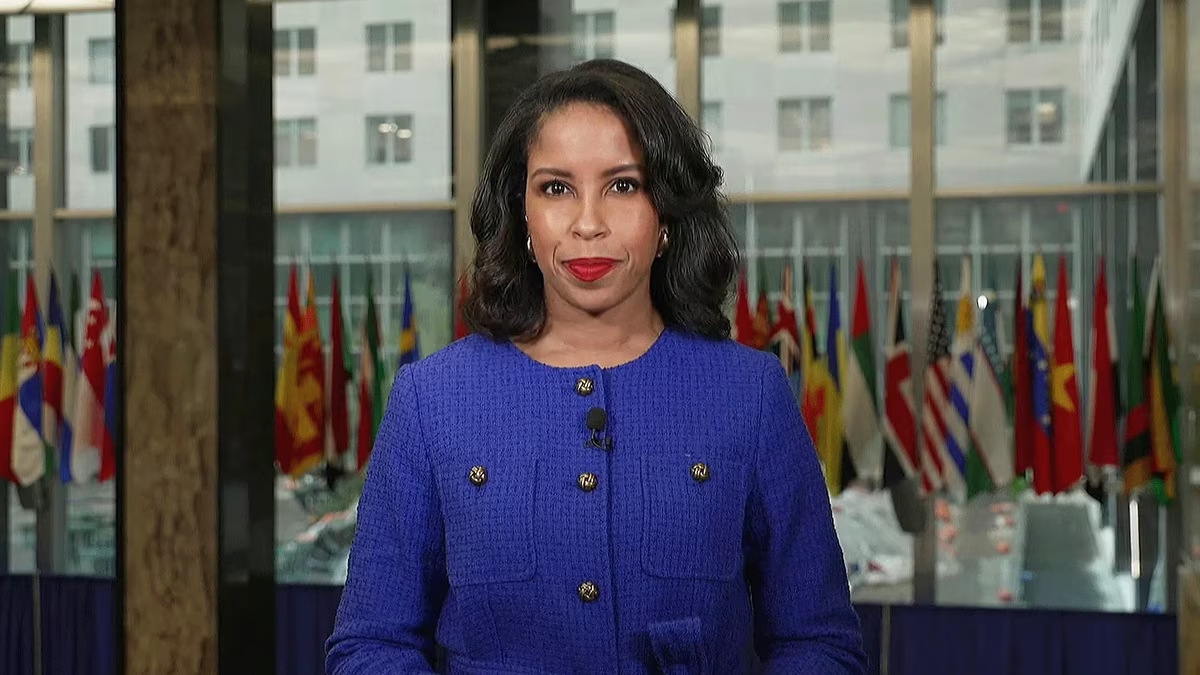
Deputy Spokesperson for the US State Department: Washington is closely monitoring the situation in Iran and is ready to support the Iranian people

Mignon Houston, Deputy Spokesperson for the US Department of State, said that the recent protests in Iran reflect the Iranian people's dissatisfaction with the lack of food, energy, and basic services, noting that the US government wishes to see Iran abandon its support for enemies and its nuclear and missile programs, and achieve a better life for its people.

She affirmed that Washington is closely monitoring the situation and is ready to support the Iranian people in achieving stability and a dignified life.

Houston clarified that the US administration's policy on all Middle East issues is "clear and transparent," emphasizing that the United States will remain committed to protecting its interests, working for regional stability, and achieving a secure and prosperous future for the concerned Arab peoples, while closely monitoring all field and political developments.

She added that the United States' policy towards Syria focuses on stability, prosperity, territorial integrity, and respect for minority rights, stressing the importance of preventing the use of Syrian territory as a safe haven for terrorist organizations or a source of threat to American and regional security.

She explained that the US administration seeks to ensure that the Syrian government uses its resources to support and protect the Syrian people, while calling for comprehensive dialogue among all Syrian parties to achieve the interests of the country and its people, affirming that Syria's future will be promising if the government and politicians commit to paths of cooperation and constructive solutions.

Regarding the American balance between the Syrian government and the Syrian Democratic Forces (SDF), Houston said that the absolute priority is American national security, and that Washington is working with its regional partners to ensure that Syria does not become a haven for terrorist threats, noting that the United States expects the Syrian government to implement its security and political commitments within the framework of comprehensive solutions for the region.

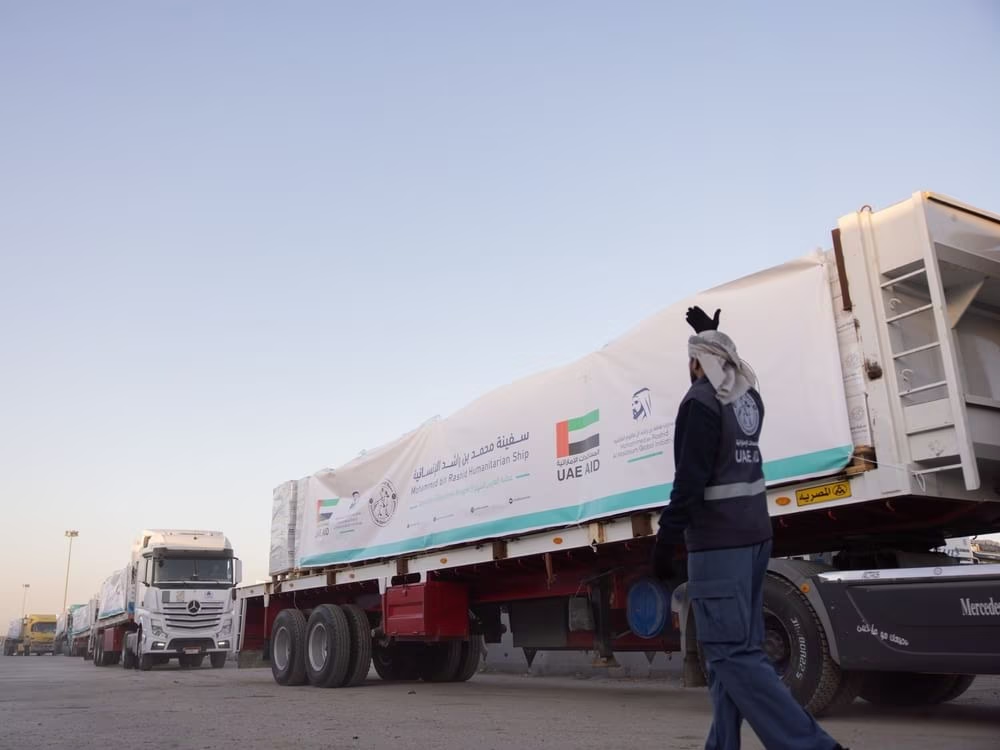
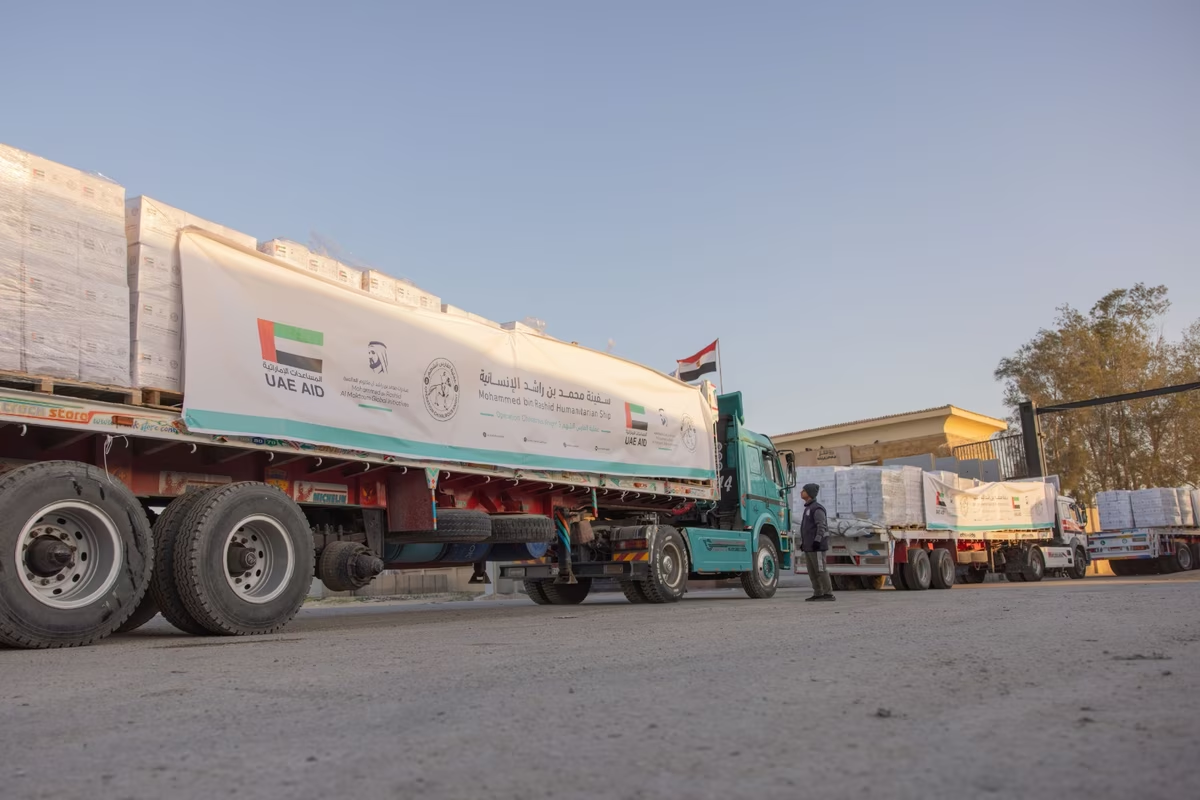
Concerning the second phase of the US-sponsored peace plan in Gaza, Houston affirmed that the plan aims to end suffering and achieve stability for both Palestinians and Israelis, explaining that tangible progress has been made in the humanitarian and relief file since the agreement was signed, with thousands of trucks and humanitarian aid entering the sector, but she noted the necessity for the Hamas movement to adhere to the terms of the agreement, including disarmament and not obstructing reconstruction, to ensure the transition to the second phase of the plan.

She mentioned that the United States is working to form a Palestinian technocratic committee under the supervision of the Peace Council to ensure stable governance in Gaza, while monitoring the effectiveness of security and the stabilization force, affirming that the success of this phase is linked to the commitment of all concerned parties to the preconditions for the full completion of the transition.

PALESTINE

Fri 09 Jan 2026 11:08 pm - Jerusalem Time

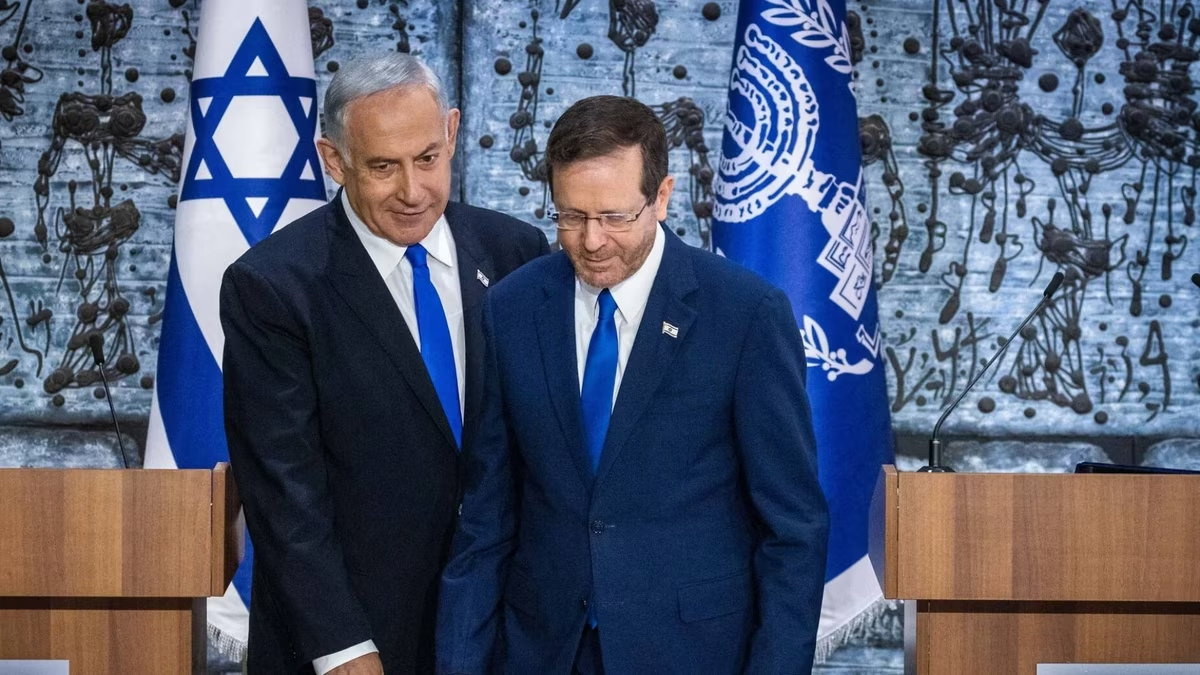
Leaks about a "secret deal" between Netanyahu and Herzog.. a businessman talks about "amnesty" in exchange for the presidency

Herzog feared Netanyahu would nominate another Likud party figure who enjoyed right-wing support.

The "Israeli" businessman and strategic consultant, Moti Sander, dropped a heavy political bombshell by revealing the existence of a "secret deal" concluded five years ago between the president of the occupation state, Isaac Herzog, and Prime Minister Benjamin Netanyahu.

According to Sander's claim, this deal stipulated Netanyahu's support for Herzog's election as president in exchange for the latter granting Netanyahu a presidential pardon that would prevent his prosecution in the corruption cases attributed to him.

Moti Sander is an influential figure in the political circles of the occupation, having led successful election campaigns for prominent figures such as Ehud Barak, and has close ties with both Netanyahu and Herzog.

The revelation of this information came in an interview with Hebrew media, where Sander confirmed that he was Herzog's messenger to Netanyahu to propose this offer.

According to the details provided by Sander, Netanyahu and his wife Sara faced significant pressure to accept the deal to avoid imprisonment.

Sander recounted a moving scene in which Sara Netanyahu cried before her husband convinced her that this move was in their best interest.

Herzog feared that Netanyahu would nominate another Likud party figure who enjoyed right-wing support, or that Netanyahu himself would run for president to stop his prosecution process according to the law.

Sander explained that he decided to reveal this "scandal" now because Herzog went too far in trying to appease Netanyahu with a pardon that does not include admitting guilt or waiving the sentence, which Sander considered a crime against the purity of governance.

He affirmed that he is in favor of granting a pardon and stopping the trial that harms Israel, but on the condition that Netanyahu admits his guilt and completely retires from political life.

For its part, President Herzog's office strongly denied these allegations, emphasizing key points:

Denial of the deal: There was no agreement or understanding, whether explicit or implicit, linking the presidential elections to Netanyahu's legal files.

Pardon request: Any pardon request will only be processed according to the law and with the recommendation of the Pardon Department in the Ministry of Justice.

Sander's refutation: Herzog expressed his regret for what his friend Sander said, and rejected his claims, describing them as false and defamatory.

In contrast, the Likud party accused Sander of lying, while the latter responded that the attempt by Herzog's men to question his mental faculties under the pretext of "Alzheimer's" is a despicable attempt to tarnish his reputation and hide the truth.

These leaks place the presidency and the government in an embarrassing position before public opinion and the judiciary.

With the widening gap of mutual denial, the question remains about the extent of the impact of these allegations on the course of Netanyahu's cases pending before the courts, and whether they will lead to new investigations into suspicions of abuse of influence to immunize officials from legal accountability.

PALESTINE

Fri 09 Jan 2026 9:48 pm - Jerusalem Time

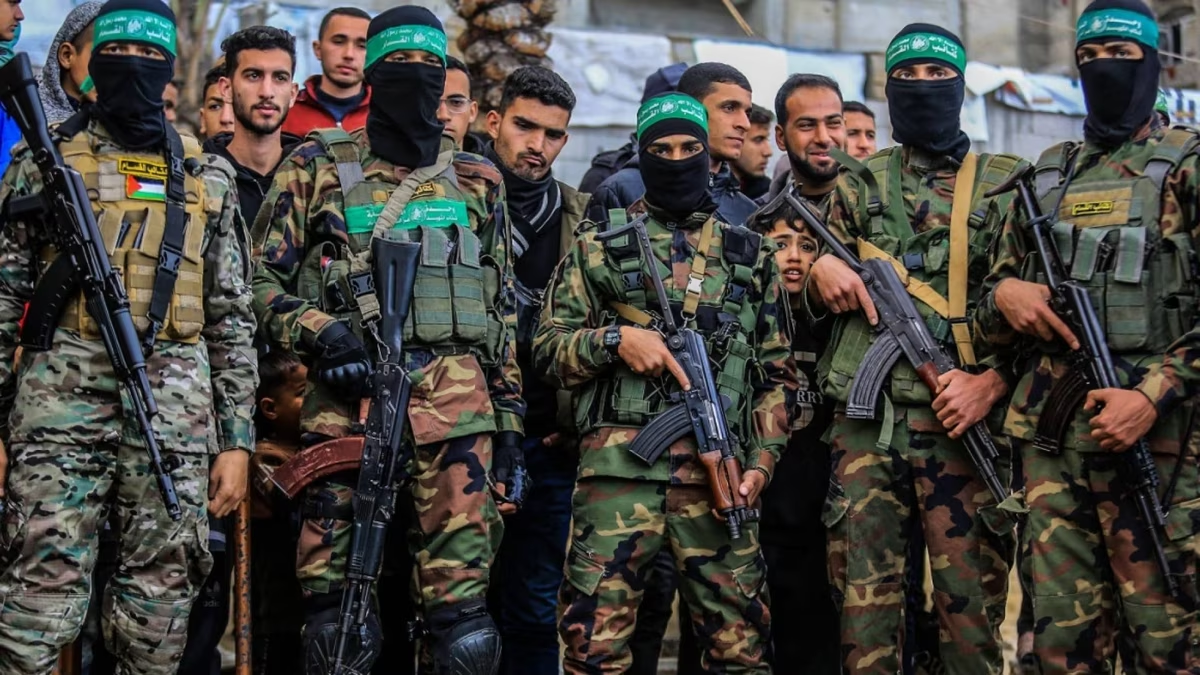
"Hamas" accuses Washington of providing "cover" for occupation raids.. and confirms: Netanyahu obstructs "second phase"

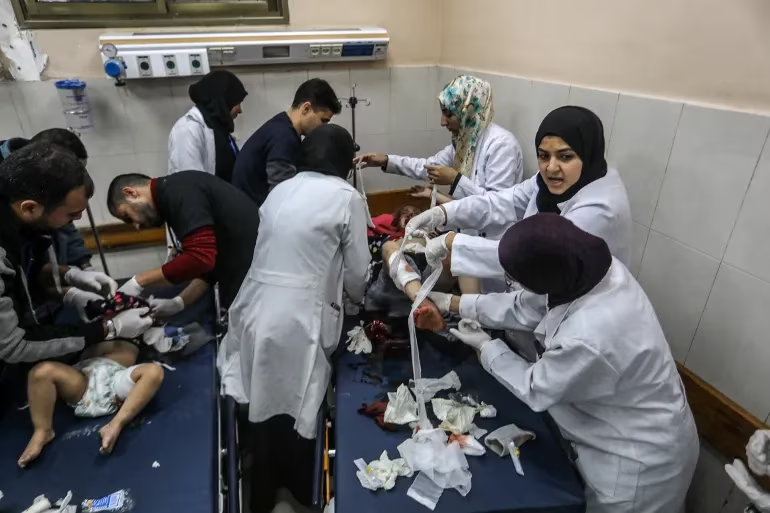
At least 13 people, including five children, were killed, according to Gaza Civil Defense data.

Hamas accused the United States on Friday of providing "cover" and a green light for the Israeli occupation army to carry out new raids on the Gaza Strip.

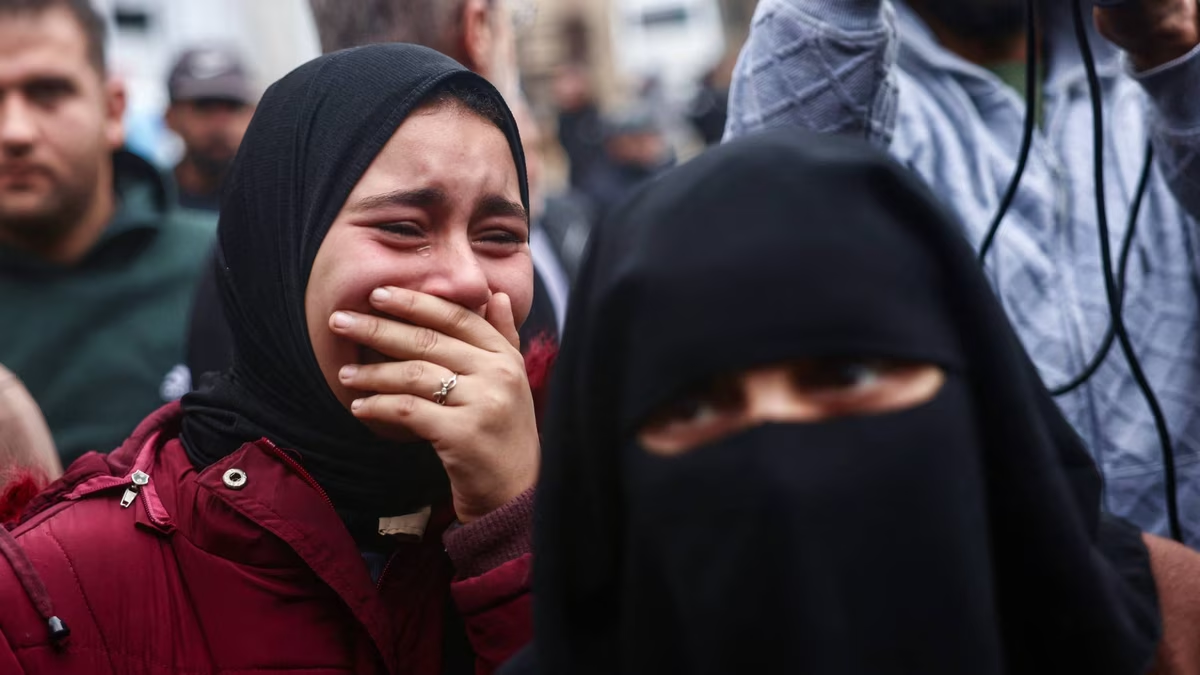
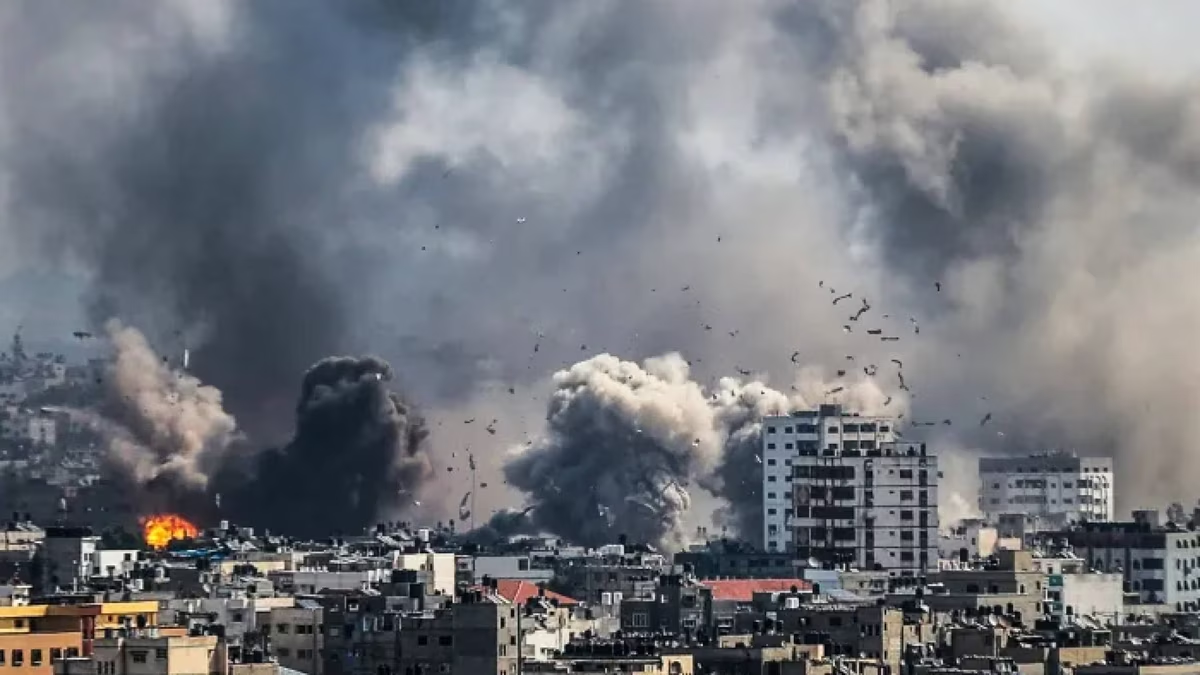
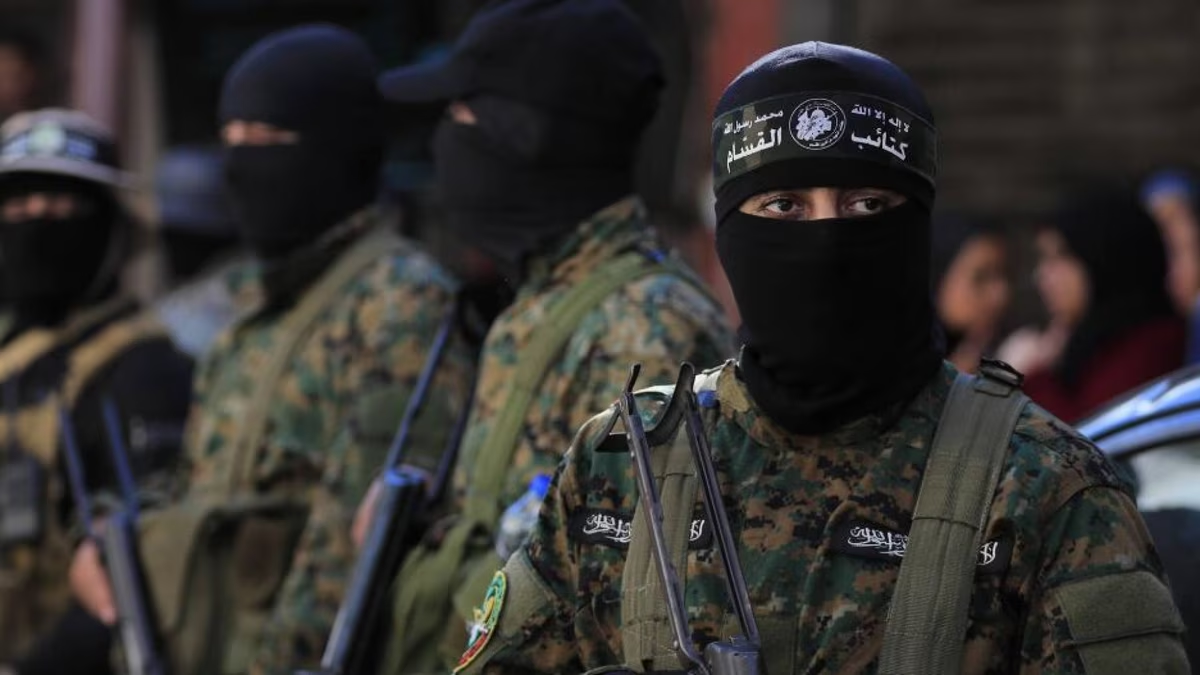
These accusations come after strikes carried out by the occupation on Thursday, which resulted in the death of at least 13 people, including five children, according to the Civil Defense data in the Strip, despite the ongoing ceasefire agreement.

Basem Naim, a member of the movement's political bureau, stated via "Telegram" that the calm plan is faltering due to the insistence of the head of the Israeli occupation government, Benjamin Netanyahu, on "evading his commitments" and escalating militarily to sabotage the agreement and return to a state of comprehensive war.

Naim affirmed that the movement "has fulfilled all its obligations" and is ready to deal positively with the "second phase" of the plan, despite the Israeli occupation's conditions for disarmament.

On the ground, sources in the movement revealed the resumption of search operations for the detainee's body after a halt due to bad weather conditions, a file that the occupation clings to before moving on to the next negotiations.

Since the truce came into effect on October 10, significant violations have been recorded, leading to the death of more than 425 Palestinians, while the occupation army announced the killing of three of its soldiers during the same period, which puts the future of the agreement at stake.

PALESTINE

Fri 09 Jan 2026 8:52 pm - Jerusalem Time

The occupation army claims to target Hamas leaders specializing in anti-tank warfare and weapons manufacturing

These claims coincided with reports of sharp discrepancies in estimates between army commanders and the political leadership of the occupation regarding the feasibility of moving to the second phase of the plan.

The occupation army, in cooperation with the General Security Service, claimed to have assassinated prominent Hamas officials during attacks launched in the northern and southern Gaza Strip.

While the occupation claimed that these operations came in response to the firing of a rocket towards its controlled areas, the Palestinian resistance denied the narrative, considering these assassinations deliberate violations aimed at thwarting "Trump's plan" to stop the war, which is supported by an international resolution.

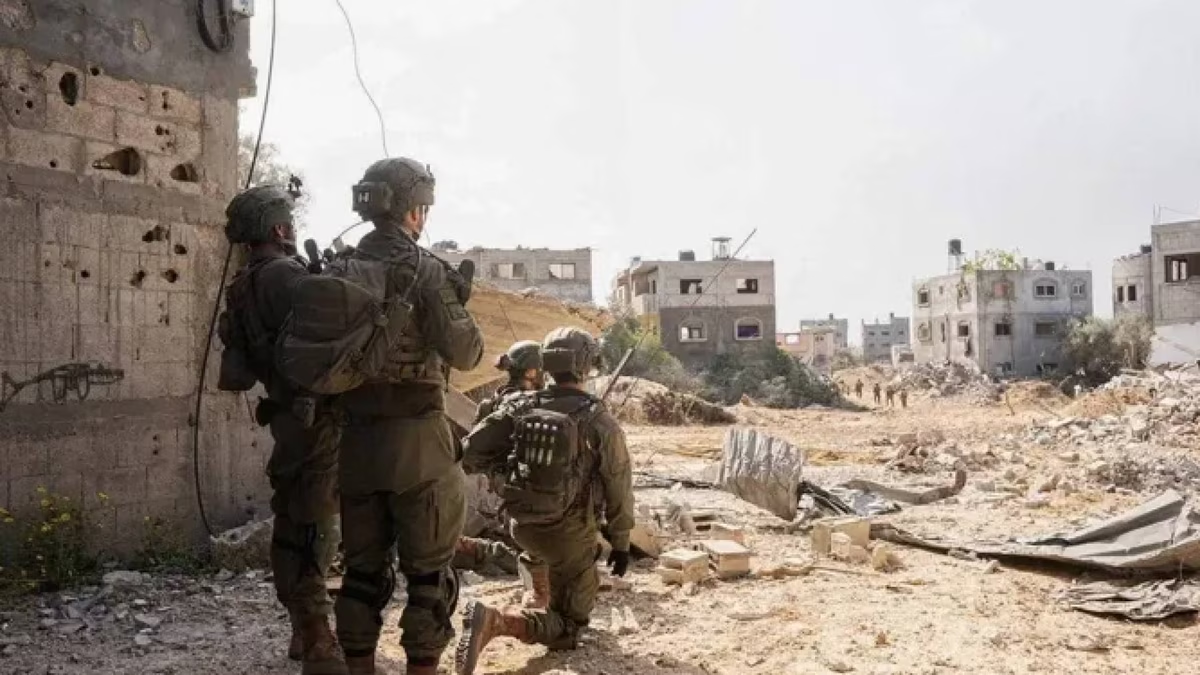
These developments come after Hebrew reports claimed that the occupation army is preparing for a partial withdrawal from the city of Rafah to establish gatherings for displaced persons.

These claims coincided with reports of sharp discrepancies in estimates between army commanders and the political leadership of the occupation regarding the feasibility of moving to the second phase of the plan.

According to the occupation army, the recent operations targeted infrastructure and leaders in Hamas, where it published a statement including some names to confirm the success of its claims, including:

Kamal Abdul Rahman Mohammed Awad: whom the occupation army claimed heads the anti-tank department in Hamas.

Ahmed Thabet: who was described, according to their claim, as the head of a workshop for weapons production.

In contrast, the Hamas movement rejected these allegations, assuring mediators that the occupation is using "fabricated and false" pretexts to carry out field assassinations.

The movement's leader, Basem Naim, explained that the occupation's prime minister, Benjamin Netanyahu, is working to sabotage the agreement to save himself politically after failing to achieve his goals.

Movement sources stressed that the resistance adhered to all commitments, while the occupation continues its violations, which led to the death and injury of hundreds after the announcement of the ceasefire understandings.

The movement also warned that these "violations" cannot occur without American cover or a "green light."

These conflicting statements and claims put "Trump's plan" at risk, as Netanyahu appears to be seeking to prolong the conflict to avoid a miserable political fate.

In light of the catastrophic humanitarian conditions, the question remains about the ability of mediators and the American guarantor to curb these actions and prevent a wider escalation of the situation.

PALESTINE

Fri 09 Jan 2026 8:08 pm - Jerusalem Time

Warnings against undermining the de-escalation path.. Hamas accuses Netanyahu of escalation to thwart the internationally supported "Trump plan"

Naeem criticized the continued American cover for Netanyahu's actions, considering that the continuation of the "occupation" in killing and destruction operations cannot happen without a "green light" from Washington.

Basem Naeem, a leader in the Hamas movement, warned of the seriousness of the intransigence shown by the occupation government towards completing the terms of the ceasefire agreement, pointing out that Prime Minister Benjamin Netanyahu deliberately sabotages the plan proposed by US President Donald Trump, which received international adoption through the Security Council, for personal political purposes aimed at escaping field failure.

These statements come at a sensitive time after the issuance of international resolution No. 2803, which transformed the American initiative to stop the war in the Gaza Strip into an internationally binding roadmap, aimed at ending military operations and reconstruction.

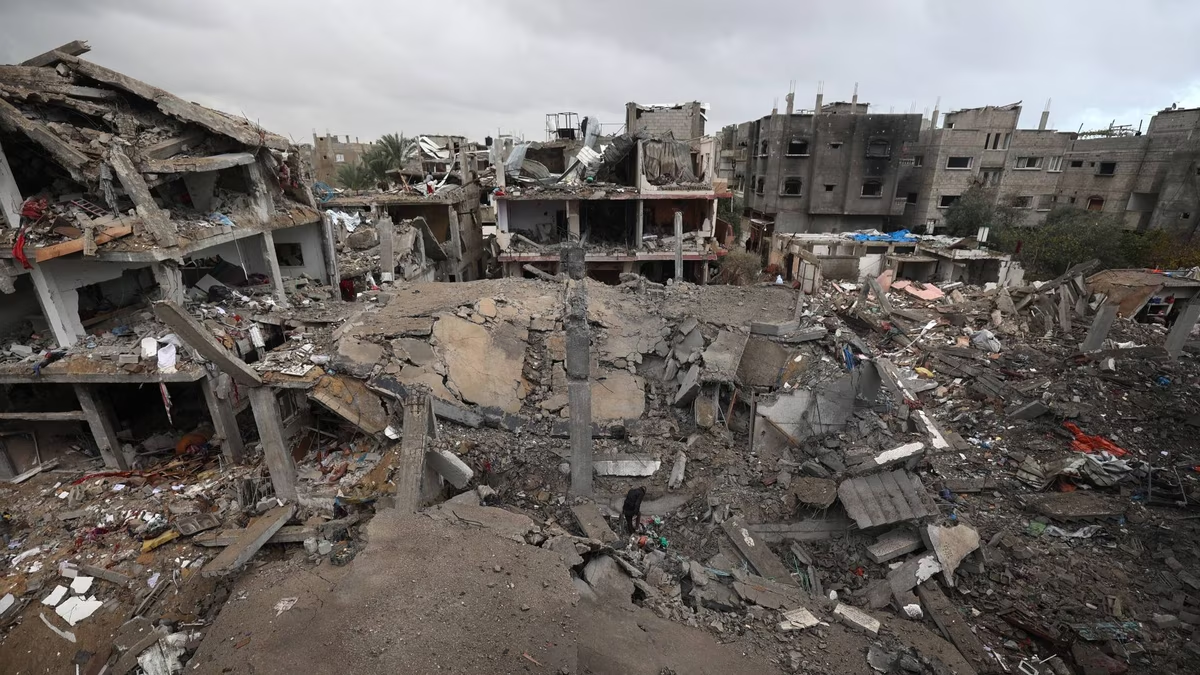
Despite the state of optimism that prevailed after President Trump announced his vision for peace, the field still witnesses continuous violations, as the parties exchange accusations regarding obstructing implementation, while popular and international pressures escalate to stop the humanitarian bleeding in the sector, which suffers from catastrophic conditions.

Naeem explained that Netanyahu is systematically working to escalate the field situation to abort the agreement and divert attention from his inability to achieve the declared war goals.

The Hamas leader pointed out that Thursday witnessed the martyrdom of 13 Palestinians in various areas under pretexts he described as "fabricated," stressing that hundreds of victims fell after the announcement of the initial understandings, which puts the credibility of the "American guarantor" to the test.

Basem Naeem said, in clarification of the movement's position: "The resistance has adhered to all its commitments, as testified by the mediators and America itself, and we are ready to deal constructively with the second phase of the plan."

He added that this phase includes Hamas's complete withdrawal from the governmental scene, the formation of an immediate Palestinian body to administer the Gaza Strip, with the opening of all crossings in both directions to ensure the flow of aid.

Naeem also criticized the continued American cover for Netanyahu's actions, considering that the continuation of the "occupation" in killing and destruction operations cannot happen without a "green light" from Washington, which reinforces doubts about the true desire to end the conflict.

These developments put the region before open scenarios, as observers warn that the failure of the Trump plan could lead to a wider explosion whose effects are not limited to the borders of the Strip.

The coming days will reveal the extent of the international mediators' ability to curb the escalation and compel all parties to what was agreed upon under the umbrella of the United Nations, to avoid the region sliding into a comprehensive war sought by the far-right in the occupation government.

PALESTINE

Fri 09 Jan 2026 7:54 pm - Jerusalem Time

Moves to activate the "Peace Council": Hussein Al-Sheikh discusses with Mladenov the path to settlement in the Gaza Strip

Palestinian Deputy President, Hussein Al-Sheikh, met on Friday in Ramallah with former UN envoy Nikolay Mladenov, who is nominated to assume the position of coordinator of the international "Peace Council."

This meeting comes at a sensitive time, as diplomatic efforts are escalating to move to the second phase of US President Donald Trump's plan to end the war in the Gaza Strip, amidst anticipation for the formation of the transitional body that will oversee the administration of the Strip away from factional disputes.

The visit of Bulgarian diplomat Nikolay Mladenov to Ramallah comes a day after a series of talks he held in Tel Aviv with occupation Prime Minister Benjamin Netanyahu and President Isaac Herzog.

Mladenov, who served as the UN envoy for the peace process between 2015 and 2020, is a pivotal figure accepted by international parties, which enhances his chances of coordinating the "Peace Council" personally headed by Trump.

The American plan, approved by the UN Security Council last November under Resolution No. 2803, is based on managing Gaza through a temporary Palestinian technocratic committee, operating under the supervision of the International Council to ensure disarmament and the start of reconstruction operations.

In a statement on the "X" platform, Hussein Al-Sheikh explained that the meeting involved an extensive discussion of field and political developments. The talks focused on three main axes:

Implementation of Trump's plan: Discussing mechanisms for transitioning to the second phase, which includes a gradual withdrawal of occupation forces from Gaza in exchange for Hamas laying down its weapons.

International force: The two sides discussed the deployment of an international force to stabilize the afflicted Strip and prevent the resumption of hostilities.

Settler escalation: The West Bank issue was not absent from the table, as warnings were made about the escalation of settler attacks against Palestinian citizens, which could undermine comprehensive peace opportunities.

Despite the success of the ceasefire agreement in ending two years of fighting, White House officials expressed concern about the "slowness" of the parties in implementing the commitments of the second phase, which explains Mladenov's role as the "driver" of this phase.

Mladenov's moves place the region on a serious executive path for Trump's 2026 plan.

The success of the "Peace Council" in imposing its authority largely depends on the extent of cooperation from the Palestinian leadership in Ramallah and the acceptance of field forces in Gaza to relinquish their weapons.

While the West Bank remains an open arena for tension due to settlers, Mladenov's appointment - if officially approved - will represent a starting point for the anticipated technocratic rule, in a final international attempt to rescue the Strip from the rubble and place it on the map of regional stability.

ARAB AND WORLD

Fri 09 Jan 2026 7:08 pm - Jerusalem Time

On the Brink of Explosion: The Logic of Force in the Trump Administration and the Intersection of American-Israeli Calculations with Iran

Washington – Said Arikat


News Analysis

US President Donald Trump did not hesitate on Thursday to renew his public threats of retaliation against Iran if Iranian authorities target protesters who have taken to the streets over the past two weeks. However, the danger of this statement lies not only in its direct content but also in its reflection of a political mindset that views force as a legitimate tool in itself, and treats American military influence as an open mandate for intervention, deterrence, and punishment, with little regard for geographical or legal boundaries. In this logic, sovereignty is no longer an obstacle, and international law does not constitute a regulating framework; rather, it becomes a detail that can be bypassed when its provisions conflict with the will of power.

As of early 2026, the Middle East region is entering a highly critical phase, where military data intertwines with political precedents, and deterrence calculations mix with direct coercion signals. Amid escalating talk of a potential confrontation between the United States and Israel on one side, and Iran on the other, the features of a recurring American behavior are crystallizing, based on expanding the definition of threat, solidifying the logic of pre-emptive strike, and bypassing international legal frameworks. This approach, no longer exclusive to the Middle East but recently manifested in Latin America, is now clearly reflected in Washington's approach to the Iranian file.

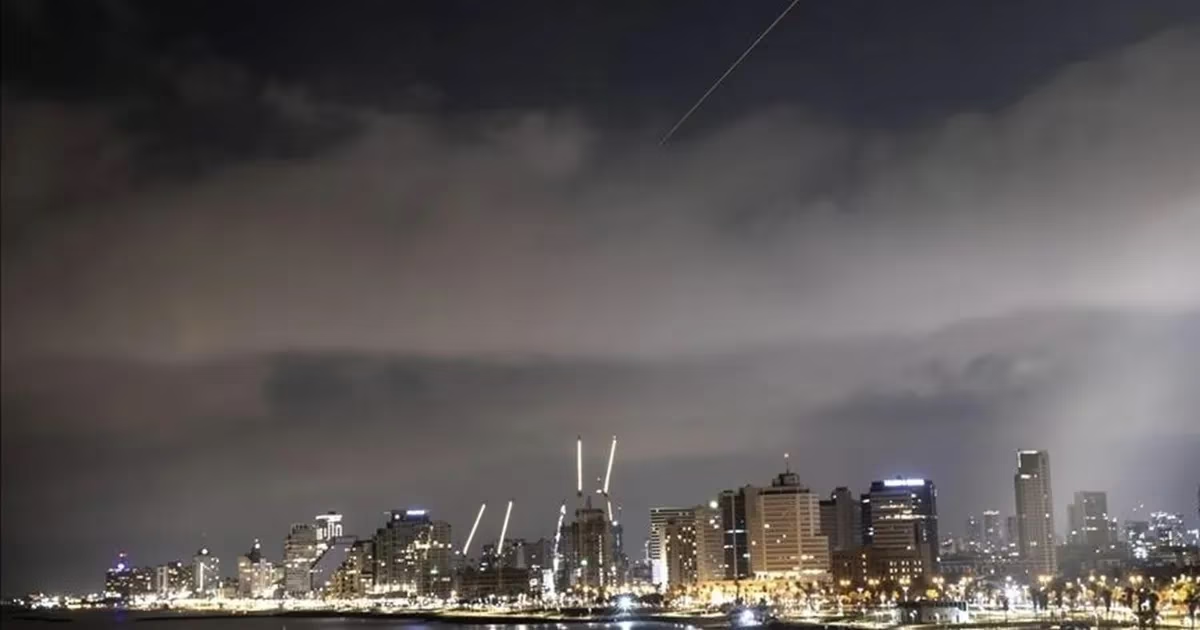
The military confrontation between Israel and Iran in June 2025 marked a turning point in the conflict. Although it did not escalate to an all-out war, it broke the unwritten rules of engagement that had governed the relationship between the two parties for years. The widespread Israeli strikes deep inside Iranian territory, politically and militarily supported by the United States, established a new reality based on an open, unsettled conflict, fragile deterrence, and an almost complete lack of trust. No party emerged decisively victorious, but the message was clear: the ceiling of prohibitions had lowered, and the next phase would be more dangerous.

In Tehran, this conviction translated into a reorganization of the security decision-making system, through the establishment of a Supreme Defense Council that explicitly announced that Iran would not wait for the first strike if it detected what it described as an "imminent threat." This shift was not merely a change in rhetoric but reflected a growing realization that the strategic environment was no longer governed by traditional rules. When presumed intentions become the basis for military action, waiting turns into an existential risk, and pre-emption, from the decision-makers' perspective, becomes a defensive option.

In contrast, Israel continued to solidify its security doctrine based on preventing any strategic shift that might undermine its superiority, especially concerning the Iranian nuclear program. Despite the absence of conclusive indications of an immediate decision to launch an attack, Israeli political and security discourse has not receded. The repeated talk of the "last moment," the hinting at unexpected options, and the leaking of intelligence assessments are all pressure tools aimed at keeping Iran under constant threat, and psychologically and politically exhausting it.

Some experts believe that Washington appears to be walking a tightrope between escalation and containment. Trump's statements reflect a willingness to use force, whether under the pretext of the nuclear program or through vague headings such as "protecting civilians" and "preventing chaos." At the same time, American institutions are keen to suggest that there is no imminent decision to engage in war. This contradiction does not inspire reassurance as much as it exacerbates anxiety, especially in light of recent experiences.

Venezuela stands out as a revealing model for understanding this behavior. The storming of Caracas and the arrest of President Nicolás Maduro and his wife constituted a dangerous precedent in violating the sovereignty of an independent state, without international authorization or a declared legal process. Regardless of the justifications marketed, the message picked up by Washington's adversaries was clear: force has replaced legitimacy, and action precedes justification. In this context, it becomes difficult to convince Tehran that American-Israeli threats do not go beyond the framework of deterrence.

The Iranian nuclear program remains at the heart of the conflict, but at the same time, it is transforming into a flexible and adaptable pretext. Even in the absence of conclusive evidence of a transition to the weapon production phase, technical progress or deliberate ambiguity is sufficient to keep the option of attack on the table. This logic closes the door to interim solutions and pushes towards a zero-sum equation: either full compliance or confrontation.

This equation is reinforced by internal Iranian factors, foremost among them economic pressures, protests, and social tension. These elements make the leadership more sensitive to any external threat and more inclined to adopt a discourse of steadfastness and defiance. In such an environment, the risk of miscalculation doubles, not necessarily as a result of deliberate impulsiveness, but due to the blockage of alternatives.

The summary of the scene is that the available indicators do not confirm an imminent American-Israeli decision to attack Iran. However, the rush towards this option is fueled by an Israeli conviction that time is not on its side, an American behavior characterized by a decline in commitment to international restrictions, and a growing Iranian realization that waiting could be fatally costly. In a world where rules are being redefined by the logic of force, the line between deterrence and aggression erodes, and war becomes a cumulative result of an escalating trajectory, not a declared decision.

PALESTINE

Fri 09 Jan 2026 5:44 pm - Jerusalem Time

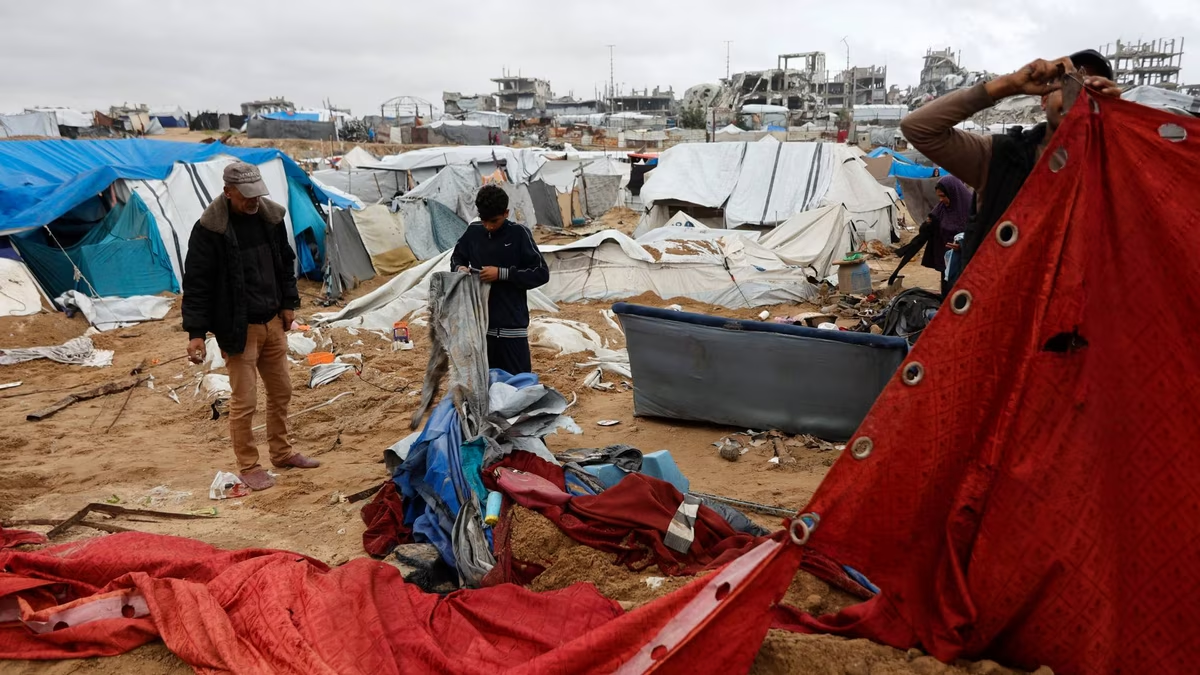
Winter hunts Gaza: Tents drown in rain.. and bitter cold gnaws at the bodies of the displaced

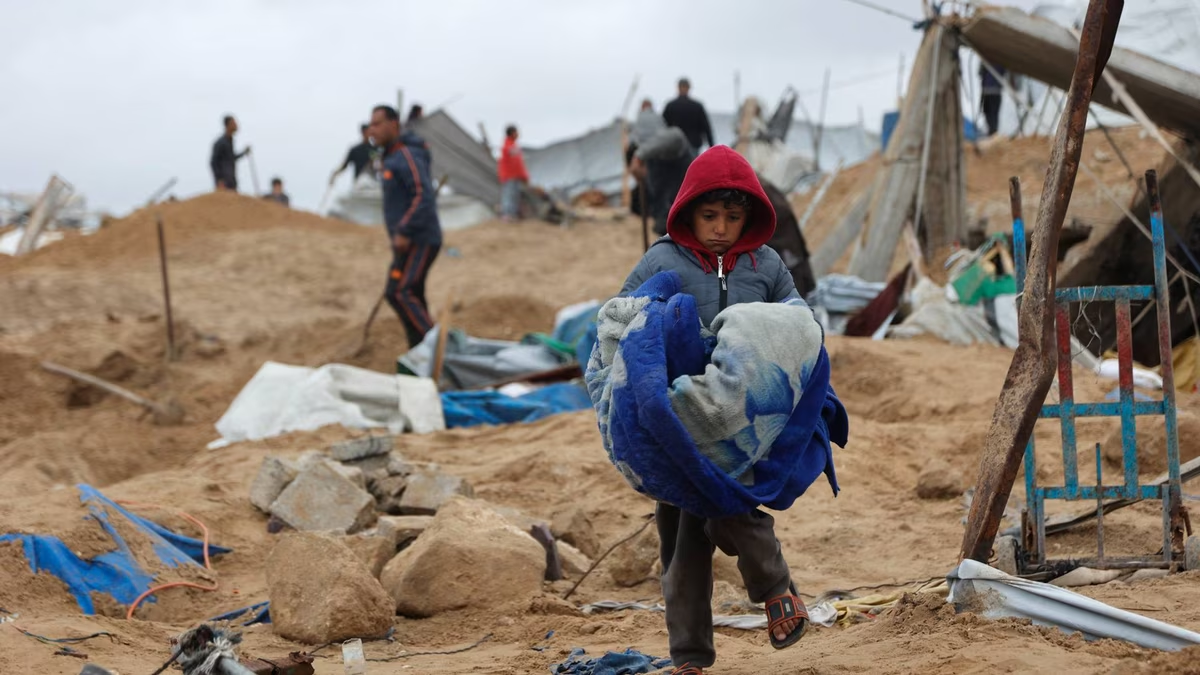
As the winter atmospheric depression deepens over Palestine, the rain showers, which the world awaits as good tidings, have turned into a nightmare haunting hundreds of thousands of displaced people in the Gaza Strip.

The fires of war are no longer the only threat; they have been joined by a "silent" and harsh enemy, represented by waves of bitter cold and strong winds that find no strong barrier other than worn-out fabrics and thin nylon sheets.

In the town of Beit Lahia, north of the Strip, the tragedy manifested in its worst forms; a child was injured when a cracked wall collapsed on him due to the strong winds accompanying the depression.

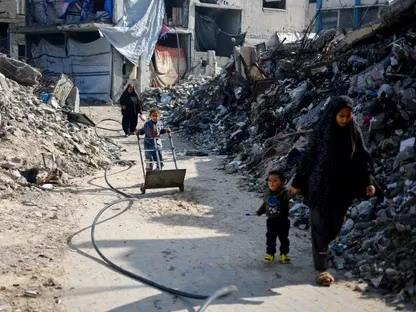
This incident reflects the bitter reality of thousands of families who were forced to remain in dilapidated buildings, after the occupation army destroyed their homes and prevented the entry of any building materials or even mobile homes (caravans).

As for the playgrounds and public squares, heavy rains have turned these areas into watery swamps that submerged tents, while winds uprooted others, forcing hundreds of families to go out into the open in very cold weather, searching for a dry refuge that does not exist.

Tents made of nylon and thin fabric lack the minimum elements of protection; they do not prevent water from flowing through them, nor do they ward off the bitter cold of winter that seeps into the frail bodies of children.

The absence of fuel and energy deepens the crisis; families are unable to secure any means of heating, making scarce firewood the only way to survive the night.

The continued prevention of entry of shelter materials and the deliberate abandonment of hundreds of thousands without material or health cover portends an inevitable humanitarian catastrophe.

Winter in Gaza is no longer a season for rain, but has become a season for death by hunger and cold under a roof that has no roof. The question remains in the mind of every child trembling with fear and cold: "How long will winter remain another enemy threatening what is left of our lives?"

PALESTINE

Fri 09 Jan 2026 3:26 pm - Jerusalem Time

Clarification to the Occupation regarding the "Egyptian Ship Incident".. Warning Shots and Confirmation of "Continued Coordination"

The Israeli occupation army issued an official statement commenting on the shooting incident off the coast of Gaza on Thursday evening, confirming that its naval forces "acted according to established procedures."

The statement clarified that naval units intervened after detecting an Egyptian warship entering a prohibited area, where they fired "warning shots in the air" after the ship failed to respond to initial requests to stop, which prompted it to change its course and return to Egyptian waters.

In a notable development to de-escalate the crisis, the Hebrew channel "i24NEWS" reported that Egyptian authorities expressed regret for the incident, described as "unusual," and confirmed their responsibility for it within the framework of mutual keenness to prevent escalation.

The Israeli army stressed in its statement that Egypt remains "a key partner in the peace agreement," confirming that security coordination between Cairo and Tel Aviv continues as usual and was not affected by this field friction.

The "Walla News" website indicated that the Israeli navy's handling prevented the ship from reaching the shores of the Gaza Strip.

The Israeli army confirmed that the incident did not result in any human casualties or material damage on either side, which reinforces the hypothesis of a "technical or navigational error" that was quickly addressed through military channels to ensure the preservation of maritime stability in this sensitive region.

PALESTINE

Fri 09 Jan 2026 2:23 pm - Jerusalem Time

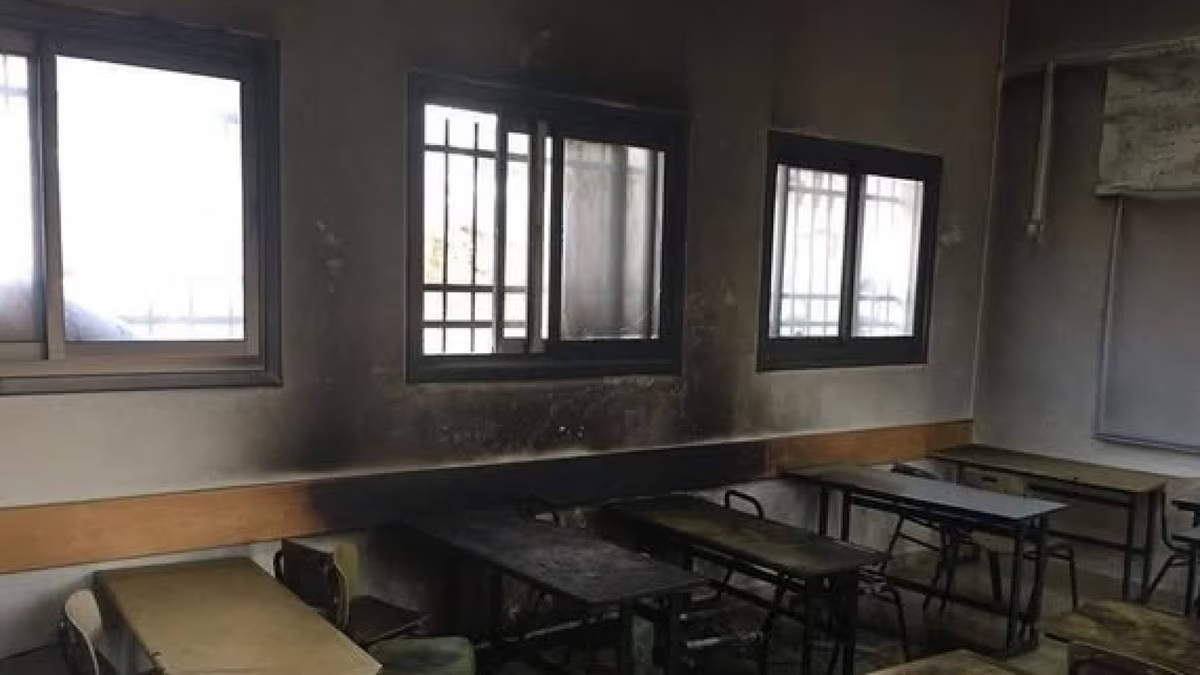
Settlers burn a classroom in Jalud school and write racist slogans

A group of settlers launched a racist attack in the early hours of Friday morning targeting the Jalud Mixed Secondary School, located south of Nablus city in the occupied West Bank. They deliberately set fire to one of the classrooms and vandalized school facilities, in a dangerous escalation targeting Palestinian educational institutions.

Infiltration, Arson, and Intimidation Field details indicated that the settlers secretly infiltrated the school campus, taking advantage of the dawn quiet, and set fire inside a classroom, which led to the complete burning of its contents and caused severe material damage to the building.

The matter did not stop at material sabotage; the attackers also wrote racist and hostile slogans on the school walls before withdrawing, in a move clearly aimed at spreading fear, terror, and intimidation among students and educational staff.

Read also: Settlers carry out a series of attacks in the West Bank

Official Condemnation and Calls for Intervention For his part, the Director-General of Education, Mr. Samer Al-Jamal, condemned this brutal attack, considering it a "direct and explicit targeting of the educational process" and a blatant violation of students' right to safe and stable education away from danger.

Al-Jamal issued an urgent appeal to all human rights organizations and relevant international bodies, calling on them to intervene immediately to put an end to these repeated attacks and provide the necessary protection for Palestinian schools.

Continuous Targeting It is worth noting that Jalud Secondary School is not immune to such attacks; it is continuously and semi-periodically subjected to settler attacks, due to its location in a friction zone suffering from continuous settlement ambitions, which poses a constant threat to the educational process there.

OPINIONS

Fri 09 Jan 2026 1:02 pm - Jerusalem Time

Universities as a Military Target

Baha Rahal

Baha Rahal

Opinion Writer

The repeated incursions into Birzeit University are clear and blatant evidence that Palestinian universities bother and anger them, because they are beacons of knowledge and learning, national strongholds that carry the country's ideology, and raise its intellectual and scientific banners in the world in the name of Palestine. They compete and excel in many fields, achieve important ranks, and provide knowledge in the fields of science, development, and artificial intelligence, supplying Palestinian society with creative energies and innovations in various fields. For this reason, we find the occupation raiding universities, wreaking havoc on property, intellectual and educational tools, and classrooms, arresting students, and firing bullets and poisonous gas bombs at students and professors, in revenge against the educational institutions that build the Palestinian individual, refine them with science, knowledge, and experience, and push them to be a worthy builder for the present and future.

And it is not far-fetched, as Gaza's universities were bombed by warplanes, some of them completely destroyed, and no college, institute, or university was spared, just as schools and kindergartens were not spared from bombing, burning, and destruction.

The incident of raiding Birzeit University two days ago is not the first, nor is it the only university against which such tampering and sabotage are practiced. All universities are subjected to such heinous aggressions, which the occupation sees as national strongholds, and they are indeed fortified with science, knowledge, and human development. This drives the occupation to repeatedly raid all universities and engage in deliberate sabotage, and it goes beyond that to even more absurd acts, with abuse and beating of students, professors, and all staff working at the university.

A few days before the raid on Birzeit University, Al-Quds University witnessed a similar raid, and convoys of military tanks and soldiers heavily armed with equipment and weapons entered the university campus. The university squares turned into a military barracks, and the soldiers practiced intimidation as they indulged in their hobby of firing bullets, gas, and smoke bombs. In every university in the homeland that is raided, the scene turns into something resembling a battlefield, with heavily armed soldiers and unarmed students and academic professors.

These incursions have no justification other than being the doctrine of the army that continues its rampage against everything Palestinian, in the university as in the field and factory, and on the roads and through retaliatory military checkpoints that abuse people and disrupt their lives. In light of all this, and in the absence of serious international intervention to protect the Palestinian people from this brutal arrogance, Palestinians must face their destiny and confront these policies aimed at disturbing people's lives with repressive and humiliating measures, where no one is safe from these practices, and the evidence is daily and repeated, across the entire land with its cities, villages, and camps.

PALESTINE

Fri 09 Jan 2026 12:24 pm - Jerusalem Time

American basketball star Kyrie Irving wears a shirt with a picture of Palestinian journalist and athlete Saleh Al-Jaafrawi

Social media platforms circulated - in the past hours - a video clip showing American basketball star Kyrie Irving wearing a shirt with a picture of Palestinian journalist and athlete Saleh Al-Jaafrawi, in a gesture that received wide interaction and brought renewed attention to Al-Jaafrawi's biography after his martyrdom.

Saleh Al-Jaafrawi is known as a young Palestinian journalist, in addition to his athletic career, as he was a table tennis champion and represented Palestine in several international competitions.

After his martyrdom, photos of him participating in sports tournaments spread, showing him carrying the Palestinian flag, in scenes that reintroduced him to the public not only as a journalist but as an athlete who carried his cause to the arenas of competition.

The circulated footage showed Irving wearing the shirt with Al-Jaafrawi's picture during a tournament, in a move that followers considered a message of solidarity and tribute to the memory of the Palestinian sports journalist, and an affirmation of his human and athletic presence, far from being reduced to just a name on the lists of martyrs.

On October 12, 2025, days after the announcement of the cessation of the war in Gaza; Palestinian sources reported the martyrdom of Al-Jaafrawi by bullets from armed men collaborating with the occupation in the Tal al-Hawa neighborhood south of Gaza City, while he was documenting scenes of destruction with his camera.

PALESTINE

Fri 09 Jan 2026 12:23 pm - Jerusalem Time

Occupation arrests widow of Yahya Ayyash in West Bank

On Friday, Israeli occupation forces launched a wide arrest campaign in various areas of the West Bank, targeting the widow of the martyr engineer Yahya Ayyash, on charges of incitement via the Internet.

Palestinian sources stated that the occupation army stormed neighborhoods in Nablus, including the northern mountain area, raided and searched a number of citizens' homes, before arresting the Palestinian Hiyam Ayyash.

The sources added that the army hung a sign at the entrance to Ayyash's house after her arrest, which read: "Umm Al-Baraa was arrested for incitement on the Internet," accompanied by a picture of a post attributed to her on "Facebook."

Yahya Ayyash is considered one of the most prominent leaders of the "Al-Qassam Brigades," the armed wing of the "Hamas" movement. He was assassinated by the occupation forces in the Gaza Strip on January 5, 1996, with an explosive device planted in a mobile phone.

Today's arrest is part of campaigns carried out by the Israeli occupation army in cities and towns of the West Bank, for multiple reasons, including what the Israeli authorities describe as "incitement" through social media.

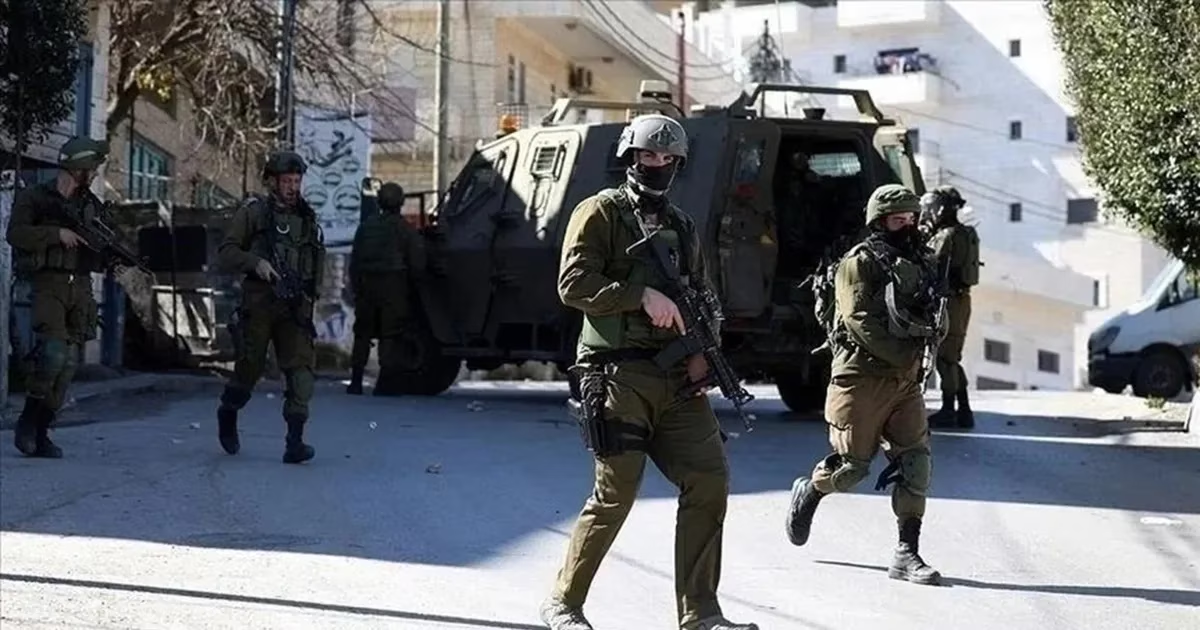
Meanwhile, the occupation forces arrested two Palestinians and detained dozens during a raid on a number of homes during their storming of several areas in the Hebron governorate, south of the West Bank.

Security sources reported that the occupation forces stormed the towns of Taffuh, Tarqumiya, Deir Samit, and Beit Ummar in the Hebron governorate, raided and searched a number of citizens' homes and tampered with their contents, before arresting citizens Bakr Khalil Ghraib and Muhammad Hussein Awad.

It indicated that the Israeli occupation forces, with a large number of their military vehicles, stormed the town of Yatta, spread in several neighborhoods of the town and around citizens' homes, raided a number of them, and detained dozens of them for long hours in the Al-Maidan area in the center of the town, including ambulance crews, and subjected them to field interrogation.

PALESTINE

Fri 09 Jan 2026 12:22 pm - Jerusalem Time

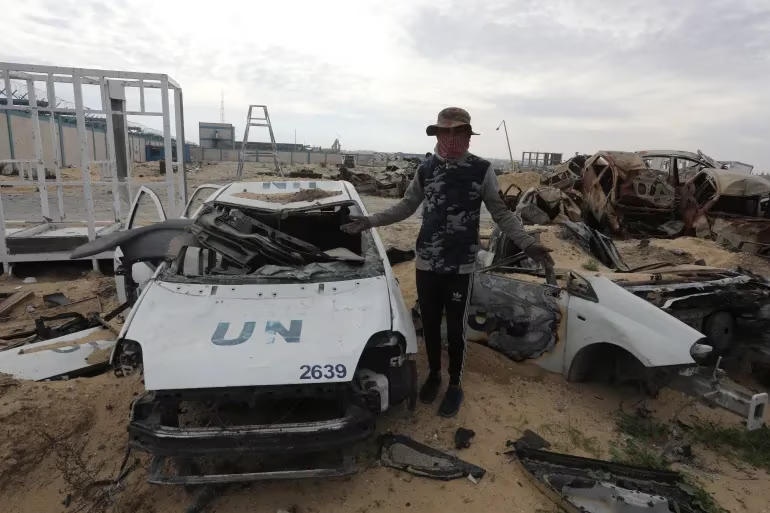
UNRWA's Decision to Dismiss Hundreds of Employees from Gaza: A Crime and a Death Sentence

With sadness and anger, Ismail Ayash describes the decision by the United Nations Relief and Works Agency for Palestine Refugees (UNRWA) to dismiss him and hundreds of other employees located outside the Gaza Strip as "a crime and a death sentence for us and our families."

Ayash, speaking by phone from Cairo, was overcome with tears more than once as he talked about the decision's impact on his family of 7, including 3 university students, who have no source of income other than his job. He explained that he has worked as a teacher for 30 years in UNRWA schools in Gaza.

"Is this how I am rewarded after dedicating my life and youth as a teacher in the organization?" asks Ayash (54), who was forced to travel with his family in February 2024 to escape the Israeli war.

On January 6th, the UNRWA Commissioner-General, Philippe Lazzarini, decided to terminate the contracts of employees located outside the Strip, after about a year of placing them on exceptional unpaid leave. Specialized committees for refugee affairs informed me that this decision affects 622 male and female employees who left Gaza during the war for various destinations, including approximately 580 in Egypt, the majority of whom are female employees, and most of them work in education.

In March 2025, UNRWA placed its employees abroad on exceptional leave for 12 months, ending next February 28th, justifying it with a financial crisis. In a message sent to those affected by the decision, it stated that it "continued to make every possible effort to provide and secure the necessary funds to support current programs and meet obligations related to staff salaries without being able to do so."

The message, which it considered an official notice of immediate termination of services, concluded by saying, "We express our sincere appreciation for your service and valuable contributions to the Agency's work for Palestine refugees."

Ayash wondered, "Is this how our services are appreciated? Is not the miserable life we have been living without salaries for about a year enough? Our dignity as employees has been violated as we chase aid packages, and many of us cannot afford the rent for the house where we live with our families." He affirmed, "We are also displaced, and we did not leave Gaza for luxury or tourism, but to escape death and extermination. We lost our loved ones and our homes, and now the Agency's decision to dismiss us comes to destroy us and our children's future."

He explained, "In the first week of the war, the Agency warned us to evacuate the northern Strip and head south, and later no decision was issued preventing employees from traveling outside Gaza to save themselves and their families."

On the first day Ayash and his family sought refuge in the home of his niece, Lina Mohammed Ayash, in Deir al-Balah city in the central Strip, a massive explosion occurred due to a raid targeting a neighboring house. Lina (30) was martyred while praying Fajr, leaving behind 4 children, and 4 others were injured among about 25 people, most of whom were displaced in that house.

Ayash continued, "We survived death, but my mother, who insisted on staying in her home in Gaza City, did not survive a similar raid and was martyred, as was Engineer Tawfiq, Lina's brother, due to an airstrike while he was walking in the street. I had no choice but to save my family."

Ayash was among those UNRWA placed on exceptional leave and whose monthly salaries have not been paid since then. He said that debts accumulated on him and that "many employees who were generous in their jobs and homes are now living on aid and donations from benefactors."

He and his fellow male and female teachers received the decision while they were working remotely to teach students in educational points and schools managed by the Agency in Gaza, following the massive destruction of hundreds of schools due to the war. Ayash was waiting for the reopening of the Rafah crossing to return to the Strip, and he explained his current feeling by saying, "I feel paralyzed and unable to think. What will I do? And why should I return when I have lost my job and my livelihood, and my home is destroyed?"

An UNRWA official contacted refused to comment on the decision, merely stating, "Unfortunately, we are prohibited from discussing this decision."

In turn, Basil Al-Wahidi, a member of the "Joint Committee for Refugees," who worked as an UNRWA employee for about 40 years, described the decision as a "massacre" against hundreds of male and female employees and consistent with displacement plans and the liquidation of the refugee issue. He rejected UNRWA's justification that it was due to a financial crisis, and said that the agency is awaiting responses from various concerned parties and host countries to proceed with similar decisions, which may not be limited to Gaza alone, and include other areas of its operations.

According to him, 100 employees in Lebanon are currently threatened with dismissal, while UNRWA suspended 20 security guards in Jordan and replaced them with a private security company "that costs more than their salaries," asking, "Where is the justification for the financial crisis when it uses a private security company? Why does the termination decision focus on male and female teachers who were working remotely?"

Al-Wahidi added that "these employees did not leave Gaza for luxury or a picnic, but to escape certain death, bombing, and starvation. Most of them are sick or accompanying sick people, and instead of being treated fairly and protected, they are punished with dismissal and expulsion, as if saving one's life has become a crime that deserves punishment."

He held the UNRWA Commissioner-General responsible, stating that "he is at the end of his term, with only a few weeks left, to leave the institution with a black record titled 'dismissal of teachers and employees, and starvation of refugee families.'" He considered that this decision "dangerously aligns with the occupation's policies aimed at breaking Palestinian society, undermining its stability, and dismantling its social, food, and employment security."

For its part, the Department of Refugee Affairs in the Palestine Liberation Organization said that "the UN agency is taking decisions and measures that go beyond the funding crisis and amount to systematic administrative execution."

The head of the department, Ahmed Abu Houli, considered in a statement that the 20% reduction in salaries of Gaza and West Bank employees, the termination of contracts of hundreds of Gaza cadres abroad, and the suspension of UNRWA headquarters security guards in Jordan in favor of a private security company, represents "a stab in the back of employees who formed a safety valve for the agency and provided 382 martyrs from their best cadres under direct Israeli shelling."

For its part, the Islamic Resistance Movement (Hamas), in a statement, described the decision as "unjust and violates the fundamental rights of employees who are prevented by the conditions of the war of extermination, and the fascist occupation's closure of the Rafah crossing, from returning to the Gaza Strip."

The "Democratic Gathering of Teachers," in a statement, considered that the decision "largely aligns with the occupation's plans aimed at targeting UNRWA and undermining its historical and legal role," and expressed its categorical rejection that "workers pay the price for the measures and harassment the agency is subjected to by the occupation; for the employee is the first line of defense for the institution and not a scapegoat for its financial or political failure."


ARAB AND WORLD

Fri 09 Jan 2026 10:47 am - Jerusalem Time

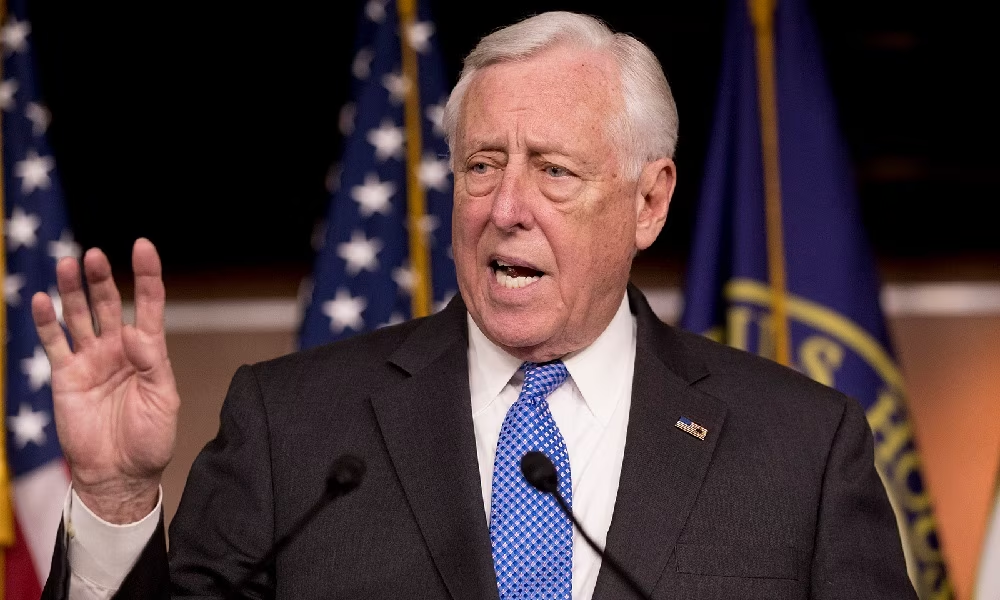
Steny Hoyer Retires from Congress After Decades of Pro-Israel Influence and Loyalty to AIPAC

News Analysis

Veteran Democratic Congressman from Maryland, Steny Hoyer, announced on Thursday his intention to retire after more than four decades in the U.S. Congress. Hoyer's retirement from the House of Representatives not only marks the end of a long political career but also opens a wide door for a re-evaluation of the role of one of the most prominent architects of the special relationship between the United States and Israel within the American legislative institution. Hoyer, who held high leadership positions in the House of Representatives and was known as AIPAC's primary man, was for many years a symbol of what is known as the "pro-Israel consensus" within the Democratic Party, and a central link between the party leadership and pro-Tel Aviv lobbying groups, foremost among them AIPAC.

Since his election in 1981, Hoyer established himself as a pragmatic, centrist politician, but on the issue of Israel, he adopted a firm and unequivocal stance: unconditional support for military aid, and providing political and diplomatic cover for Israeli policies, even when they clearly contradicted international law or the stated American discourse on the two-state solution. This steadfastness was not merely an ideological position, but part of an integrated structure of influence, in which Hoyer used his leadership position to guide internal party debate and contain critical voices, especially with the rise of the progressive wing.

One of the most significant manifestations of this influence was his repeated leadership of congressional delegations to Israel, trips that were organized and funded through the "American Israel Education Foundation" (AIEF), an arm associated with the AIPAC lobby. These trips, often held every two years during parliamentary recesses, became a semi-institutional political ritual, involving a large number of newly elected representatives in each election cycle (usually in August of every other year).

These trips were not merely protocol visits; they were carefully designed to shape the mindset of new representatives regarding "Israel's security" and "regional threats," through field tours and meetings with military leaders and Israeli officials, in contrast to a limited – or symbolic – presence of the Palestinian narrative. Under Hoyer's leadership, these delegations acquired an organized partisan character, as they were seen as part of the process of integrating new representatives into the "traditional parliamentary consensus" on supporting everything Israel does, including the Israeli war of annihilation.

Here lies the fundamental problem: while these trips are presented as legitimate educational activities, observers see them as a form of effective soft influence exercised by lobbying groups, especially when targeting legislators early in their political careers, before their independent positions are solidified. In this context, Hoyer played the role of "political guarantor" of this process, leveraging his organizational weight and his close ties with pro-Israel campaign donors.

However, recent years have witnessed a clear crack in this model. With the escalation of criticism within the Democratic Party of Israeli policies in Gaza and the West Bank, and with increasing talk about settlements and human rights, the number of new representatives participating in these trips has begun to decline. Some Democrats have also openly declared their refusal to accept AIPAC support, indicating a gradual shift in party sentiment, especially among young people and progressive voters.

Hoyer's departure, at this particular time, carries deep symbolic significance. It not only means the exit of an influential figure but also indicates the decline of an entire political generation that viewed supporting Israel as a matter beyond partisan debate. With his absence, the debate within the Democratic Party is expected to intensify regarding the conditions of military aid, the limits of the relationship with the Israeli government, and the role of lobbying groups in shaping American foreign policy.

The model of funded trips (for new representatives and their families) to Israel demonstrates how political influence can be exercised without direct legislation or pressure. Personal experience, when carefully crafted and presented at an early political moment, becomes an effective tool for reproducing long-term political positions. Hoyer's role here was not only organizational but also educational in its political sense, as he contributed to "forming" generations of legislators with a single vision of the conflict.

It should be noted that the shift within the Democratic Party does not necessarily mean a break with Israel, but rather reflects a growing desire to redefine the relationship away from blind alignment. Resistance to this shift by traditional leaders like Hoyer delayed the debate, but did not stop it. With his exit from the scene, critical voices may find more space to link American support to human rights values and international law.

The most important aspect of Hoyer's retirement is not what has ended, but what may begin. The question now is: will new leaders fill the void and reproduce the same model, or does the political moment allow for a genuine review of the role of lobbies in guiding foreign policy? The answer will determine the future of the American debate on Israel, and perhaps redraw the boundaries of the "consensus" that governed Washington for decades.

OPINIONS

Fri 09 Jan 2026 10:40 am - Jerusalem Time

Political Awareness and the Possible in the Palestinian Mind Today

Yazan Sammaro

Yazan Sammaro

Opinion Writer

At a Palestinian moment burdened by complex crises, where occupation intertwines with division, and politics recedes before the management of daily crises, political awareness emerges as an urgent and undeniable need. However, the fundamental question is no longer: Do we need awareness? Rather, what kind of awareness do we want, and for what political mind is it intended? Between an excess of discourse and a scarcity of critical thinking, the paradox appears stark in the current Palestinian scene.

Political awareness, in its deep meaning, is not a transfer of information nor a reproduction of slogans, but a critical practice aimed at rebuilding the relationship between reality and the possibilities of changing it. However, what is often presented today does not go beyond describing the predicament or adapting to it, without radical questioning of its causes or serious thought about ways out of it. Here lies the flaw: when awareness turns into a repetitive explanation of what we already know, it loses its ability to make a real impact on collective consciousness.

In the Palestinian context, political awareness cannot be separated from its responsibility to expose the mechanisms of producing helplessness, whether imposed from outside or accumulated internally. Insisting on attributing every imbalance solely to the external factor, despite its centrality, exempts local political and social structures from any accountability, and weakens society's ability to honestly review its experience. And consciousness that does not practice self-criticism quickly turns into defensive consciousness, justifying more than it changes.

As for the Palestinian intellectual, they find themselves facing a delicate equation: how to maintain their intellectual independence in a highly polarized environment, without their criticism turning into a position of isolation or misunderstanding? However, the gravity of the stage dictates that the critical mind should not be content with balanced analysis, but should contribute to expanding the horizon of public debate, and restore the importance of a culture of questioning and accountability, as two essential conditions for any conscious political action.

From here, talking about the “possible” becomes an intellectual necessity, not a theoretical luxury. The Palestinian possible is not what we wish for, nor what the moment alone allows, but what can be gradually built through a precise understanding of the balance of power, and an accumulation of social awareness capable of transforming knowledge into action. It is a possible that takes shape when we realize the limits of power and the limits of discourse together, and when we distinguish between political realism and surrender disguised in the language of rationality.

The biggest challenge facing political awareness today lies not in the scarcity of platforms, but in the narrow ceiling within which thought is allowed to move. When political discussion is reduced to improving the conditions of the existing reality, without raising fundamental questions about its alternatives, consciousness becomes a tool of control, not a tool of liberation. And awareness that does not disturb assumptions or stimulate different thinking risks becoming part of the problem it seeks to address.

The Palestinian possible begins with restoring confidence in the mind, and in its ability to understand and influence, and with reconnecting knowledge with political and social action. When a Palestinian understands their position in the conflict, and comprehends its complexities without exaggeration or simplification, they become more capable of resisting misinformation, and less susceptible to being drawn behind emotional or simplistic discourse.

In conclusion, political awareness is not an elitist discourse delivered from above, but an interactive process that accumulates consciousness and restores the importance of collective action. In a time when questions multiply and ready answers narrow, the reliance remains on a critical mind that sees thinking itself as a form of resistance, and in expanding the horizon of the possible as a condition for any viable national liberation project.

PALESTINE

Fri 09 Jan 2026 9:27 am - Jerusalem Time

The Occupation launches air and ground attacks on Hamas sites in the Gaza Strip

The Israeli army and the Shin Bet General Security Service announced, in a joint statement issued on Friday, the implementation of a series of air and ground attacks targeting sites of the "Hamas" movement in the Gaza Strip, in response to what the statement described as a "failed launch operation" carried out on Thursday towards Tel Aviv.

The occupation army's statement clarified that the attacks targeted "armed elements and infrastructure" belonging to the Hamas movement in both the southern and northern Gaza Strip.

The target bank - according to the occupation's narrative - included targeting a number of the movement's activists, in addition to bombing rocket launch sites and additional military infrastructure.

In a sharp political message, the occupation army considered the firing of rockets from Gaza to constitute a "flagrant violation of the existing ceasefire agreement," holding Palestinian factions responsible for this breach.

The statement stressed that the Israeli security establishment views any violation of the agreement "with extreme seriousness," vowing that the army and Shin Bet "will continue to act against any attempt by organizations in Gaza to carry out plans against army forces and citizens of Israel."

PALESTINE

Thu 08 Jan 2026 11:27 pm - Jerusalem Time

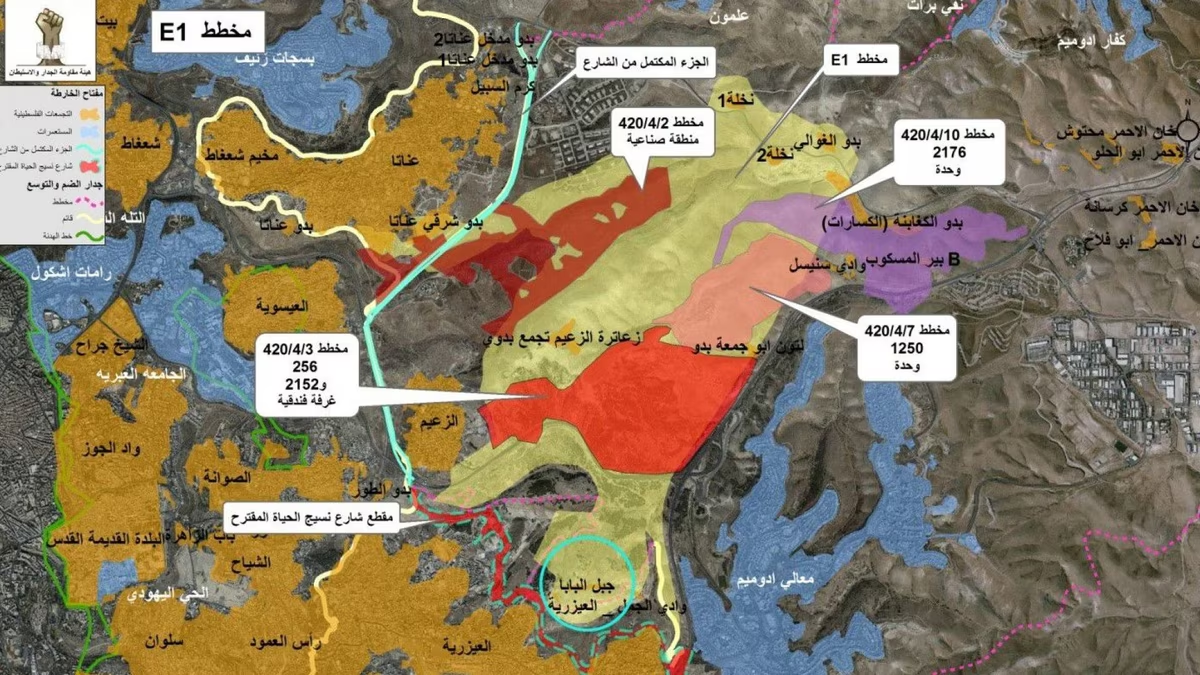
The occupation officially notifies of the start of implementing the "Fabric of Life" settlement project to isolate and annex areas east of Jerusalem

The occupation authorities officially notified the lawyer of the Bedouin communities and the municipality of Al-Eizariya of their intention to actually begin implementing their settlement project.

The Jerusalem Governorate reported that the "Israeli" occupation authorities officially notified the lawyer of the Bedouin communities and the municipality of Al-Eizariya of their intention to actually begin implementing their dangerous settlement project known as the "Fabric of Life", after a 45-day period from the date of the notification issued by what is called the occupation's military prosecution.

The Governorate clarified in a statement issued on Thursday that this project represents the practical implementation of the Israeli annexation plan for the area classified as "E1", as it aims to achieve complete geographical continuity between the "Ma'ale Adumim" settlement and occupied Jerusalem, which will lead to the separation of the northern West Bank from its south and the swallowing of approximately 3% of the West Bank's area to officially annex it within the "Greater Jerusalem" scheme.

The Governorate affirmed that the catastrophic repercussions of the project are represented in establishing a traffic "apartheid" system, where Palestinians will be prevented from using the main road number "1" and will be confined to an underground tunnel near the Al-Zaim checkpoint, while the surface road will be exclusively allocated to settlers.

This scheme will isolate the communities of Jabal al-Baba, Wadi al-Jamal, and the town of Al-Eizariya, and threatens to demolish and evacuate dozens of structures that recently received at least 43 notifications in preparation for the expansion of the project.

The Governorate added that the occupation is practicing financial piracy to fund this colonial project; as the extremist occupation's Minister of Finance, Bezalel Smotrich, approved funding for the road, which costs 98 million dollars, from the withheld Palestinian clearing funds, in an attempt to mislead the international community by claiming that the road serves Palestinians, while the engineering plans attached to the notification show that it aims to facilitate the movement of settlers and remove visible obstacles in front of them at the expense of the Palestinian presence.

The Jerusalem Governorate concluded its statement by warning that this project is the harshest blow to the possibility of establishing a contiguous Palestinian state, calling on the international community to take effective positions that go beyond condemnation to stop the process of ethnic cleansing and creeping annexation targeting the Palestinian presence in East Jerusalem and its surroundings.

PALESTINE

Thu 08 Jan 2026 9:15 pm - Jerusalem Time

Dead and wounded in the bombing of a displaced persons' tent in Mawasi Khan Yunis

Four Palestinians were martyred and three others were injured, one seriously, as a result of an Israeli occupation forces' bombing targeting a tent belonging to the "Al-Abadla" family, sheltering displaced persons, in the vicinity of Street (5) in the Mawasi Khan Yunis area, south of the Gaza Strip.

Local sources reported that among the martyrs who died as a result of the bombing were children, identified as:

Abdullah Al-Hussein Muhammad Al-Abadla (7 years old). Omar Al-Hussein Muhammad Al-Abadla (5 years old). Layan Omar Abu Shaqra.

Earlier, a Palestinian child was martyred on Thursday by Israeli occupation forces' bullets, as part of a series of new attacks and violations that affected various areas of the Gaza Strip, in a continuous breach of what is known as the "Gaza truce."
Palestinian medical sources in the ambulance and emergency unit reported that the child Hamsa Nidal Huso (11 years old) died after being targeted by the occupation forces in the Al-Faluja area, west of Jabalia refugee camp for refugees and displaced persons in the northern Gaza Strip.

In the same context, the occupation forces intensified their artillery and aerial bombardment since dawn today; their artillery targeted the Al-Tuffah neighborhood east of Gaza City, coinciding with gunfire from military vehicles in several axes.

PALESTINE

Thu 08 Jan 2026 2:08 pm - Jerusalem Time

Detention of journalists, storming of Youth Village, and declaration of it as a closed military zone for 24 hours

Sharek Youth Forum organized today, Thursday, a field tour for local, Arab, and international media in the Youth Village, with the aim of direct observation of the violations and coercive measures to which the village and its surroundings are subjected.


During the journey to the village, Israeli occupation forces and settlers detained the Palestine TV crew, before violations escalated immediately upon the arrival of the media delegation to the Youth Village, where occupation forces, accompanied by settlers, stormed the village, detained journalists and the Sharek Youth Forum crew, and subjected them to a field investigation.


The occupation forces informed the detainees that the Youth Village is located within what is called "Area C," and declared the place a closed military zone for 24 hours, despite the fact that approximately 70% of the Youth Village's lands are classified within "Area (B)," and without presenting any military order or legal decision justifying this declaration or permitting the prevention of entry or the exercise of civilian activities, which constitutes a blatant violation of international law and the provisions of signed agreements.


Sharek Youth Forum affirms that the Youth Village is a civilian educational and community facility protected under the rules of international humanitarian law, specifically the Fourth Geneva Convention, which prohibits targeting civilian objects, or converting them into military targets, or imposing arbitrary restrictions on workers, visitors, and journalists.


The forum emphasizes that this assault comes in the context of a systematic policy pursued by the occupation authorities aimed at restricting Palestinian civilian spaces, preventing youth and community work, restricting media and press freedom, and imposing coercive realities on the ground by declaring civilian areas as closed military zones without a legal basis.


Sharek Youth Forum calls on local, Arab, and international media to continue monitoring what is happening in the Youth Village, intensify professional coverage, and convey the reality of the violations occurring in this civilian area, thereby ensuring the public's right to know, and contributing to the protection of Palestinian civilian spaces from targeting and demolition.


These violations constitute a clear breach of the provisions of the Fourth Geneva Convention, which prohibits the occupying power from destroying or targeting civilian property, and also violates the rules of international humanitarian law related to the protection of civilians and civilian installations.

ARAB AND WORLD

Thu 08 Jan 2026 11:12 am - Jerusalem Time

Israeli Army warns of limited escalation with Hezbollah despite no preparations detected

- Nevertheless, the Israeli army warns of the possibility of a limited escalation involving missile launches,

- Netanyahu informed his ministers that Trump gave him 'the green light' to attack Lebanon, claiming Hezbollah refused to disarm, according to the Broadcasting Authority

The Hebrew newspaper "Haaretz" reported on Thursday that the Israeli army has not detected any preparations by "Hezbollah" for a potential military escalation, yet the army warns of the possibility of a limited confrontation involving missile launches from Lebanon.

On Wednesday evening, the official Hebrew Broadcasting Authority stated that Israeli Prime Minister Benjamin Netanyahu informed his ministers that US President Donald Trump had given him "the green light" to attack Lebanon, claiming that "Hezbollah" refused to disarm.

"Haaretz" quoted unnamed Israeli security sources: "Reports in recent days have not detected the deployment of Hezbollah militants in Lebanon in preparation for a possible confrontation with Israel."
It added: "Nevertheless, the army emphasizes that even in the absence of indicators of immediate action, there could be a limited but continuous escalation, whereby Hezbollah launches a limited number of missiles daily."

It continued: "In the event of renewed hostilities, the Israeli army estimates that the organization is still capable of causing prolonged paralysis in the north of the country (settlements) and inflicting widespread damage on the home front."

According to military assessments, "Hezbollah" is suffering from "a deep economic crisis, increasing political pressure, and local and international demands for its disarmament, and therefore the Israeli army says that the party is trying to maintain its image as a deterrent force," according to the newspaper.

It added that "the Israeli military establishment realizes that Hezbollah is likely to respond militarily to one of the Israeli army's actions, even if it is not interested in a wide-scale escalation."

Security sources say that "such a scenario could quickly turn into a major conflict that does not serve the interests of either party," according to the newspaper.

In October 2023, Israel began an aggression against Lebanon, which it turned into a full-scale war in September 2024, killing more than 4,000 people and injuring about 17,000 others.

Since a ceasefire agreement between "Hezbollah" and Israel came into effect on November 27, 2024, the latter and its ally the United States have been pressuring the party to dismantle its weapons, which it refuses.

The newspaper continued: "Although assessments focus on (the possibility of carrying out) a relatively limited (military) operation, the military establishment fears that it could lead to severe consequences for the northern communities (settlements)."

It explained: "The repeated evacuation of residents, according to the army, could turn into a step whose consequences are difficult to predict, especially since many residents of the north, especially from (the settlement of) Kiryat Shmona, have not returned to their homes" since the last war.

On a daily basis, Israel violates the agreement by launching raids on Lebanese areas, especially in the south, resulting in hundreds of deaths, in addition to widespread destruction.

In defiance of the agreement, Israel continues to occupy 5 Lebanese hills it seized in the last war, in addition to other Lebanese areas it has occupied for decades.

The newspaper pointed out that "another option the military establishment is preparing for is to re-enter Lebanese territory with large forces."

It added: "But according to security sources' assessments, the possibility of this large-scale move remains low at the current stage."

And "the organization (Hezbollah) currently possesses a vast military arsenal that includes tens of thousands of missiles of various ranges, drones, and other weapons," according to the newspaper.

It added: "The Israeli army admits that in some places, especially north of the Litani River, the organization is succeeding in rehabilitating some of its capabilities."

Israel claims that the Lebanese army is not disarming "Hezbollah" south of the Litani River as it had expected.

On Thursday, the Lebanese army announced that its plan to confine weapons to the state had achieved the goals of its first phase, and had entered an "advanced stage," but Israel's aggressions and its occupation of Lebanese sites "negatively affect" its completion.

On August 5, 2025, the Lebanese government approved confining weapons to the state, including those possessed by "Hezbollah," and then the army developed a 5-stage plan to implement the decision.

"Hezbollah" clings to its weapons, and emphasizes that it is a "resistance" movement against the occupation, and calls for an end to Israel's aggression against Lebanon and its withdrawal from its occupied territories.

In addition to these Lebanese territories, Israel occupies Palestine and Syrian territories, and refuses to withdraw and establish an independent Palestinian state.

PALESTINE

Thu 08 Jan 2026 10:58 am - Jerusalem Time

"Palestine 36" faces a smear and piracy campaign hindering its path to Oscar 2026

The makers of the film "Palestine 36" revealed that the work is being subjected to an organized and fierce smear campaign, aimed at "assassinating" it artistically and commercially while it is still in the early stages of cinematic screenings.

The film's organizers issued an "urgent" statement through their official accounts, confirming the monitoring of a series of pirated leaks, offensive comments, and misleading ratings on global platforms.

The statement clarified that these movements are not spontaneous, but rather aim at one goal: to "break public turnout" and reduce the film's chances of widespread distribution.

The creators warned of the danger of watching the film via IPTV links or leaked copies, stressing that piracy in this context goes beyond the concept of "free viewing" to become "direct harm" that affects the continuation of screenings in cinemas and threatens the future of Palestinian films in reaching the big screens.

This campaign takes on special importance and temporal sensitivity; as "Palestine 36" is the "official choice of the State of Palestine" to represent it in the 2026 Academy Awards for the International Feature Film category, and observers believe that attempts to lower the film's digital rating primarily aim to influence its reputation before arbitration committees and international forums.

The filmmakers called on their audience to respond in the "simplest and strongest" way, which is to fill cinema seats, considering that every ticket sold is a clear message that "Palestine deserves to be seen and heard," and they urged followers to:

Write honest reviews on platforms to counter fake ratings.

Report pirated links and do not contribute to their dissemination.

Talk about the film to encourage others without revealing spoilers.

The statement concluded by emphasizing the cinematic work's message: "Cinema is a testimony," and the makers of the film "Palestine 36" revealed that the work is being subjected to an organized and fierce smear campaign, aimed at "assassinating" it artistically and commercially, and the importance of supporting independent Palestinian cultural production.

PALESTINE

Thu 08 Jan 2026 10:58 am - Jerusalem Time

Trump to Announce Formation of Gaza Peace Council Next Week

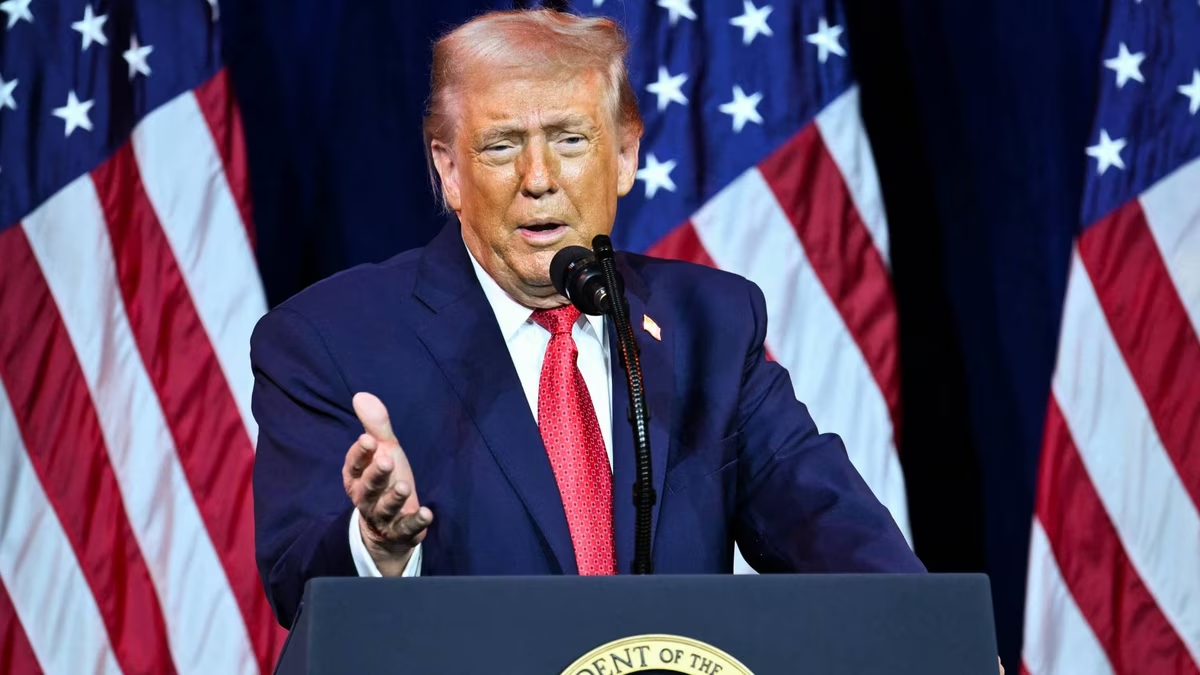
US President Donald Trump intends to announce the formation of a Gaza Peace Council next week, as part of the transition to the second phase of the ceasefire agreement in the Palestinian territory, according to Axios.

Axios quoted American officials and two informed sources as saying that Trump will chair the council, which will include about 15 world leaders, with the aim of overseeing a Palestinian technocratic government whose formation has not yet been announced, and will also oversee the reconstruction process.

An informed source said that "invitations are currently being extended to key countries to participate in the Peace Council." Among the countries expected to join the council are "the United Kingdom, Germany, France, Italy, Saudi Arabia, Qatar, Egypt, and Turkey."

US officials indicated that the plan is still subject to modification, depending on developments in other issues on Trump's foreign policy agenda, such as Venezuela and the peace talks between Russia and Ukraine.

According to Axios, the Peace Council is also expected to be represented on the ground by former UN envoy to the Middle East, Nikolay Mladenov.

Mladenov is visiting Israel this week to hold meetings with Prime Minister Benjamin Netanyahu and other officials, in preparation for Trump's anticipated announcement.

The first meeting of the Peace Council is also likely to be held on the sidelines of the World Economic Forum in Davos later this month.

The Day After Plan's Timeline

In late December, the newspaper "Israel Hayom" reported that US President Donald Trump informed the Israeli Prime Minister during their meeting in Florida that he would reveal his "Day After" plan for Gaza on January 15, 2026, which includes the formation of an international oversight body.

The newspaper added that Trump announced during the meeting that a civilian entity to manage Gaza's affairs would be formed in the coming weeks, and would prepare to take over control from the "Hamas" movement.

According to diplomats, Netanyahu did not object to Trump's statements, while the Israeli delegation considered that the statements lacked implementation mechanisms on the ground.

Another diplomatic official indicated that "the matter was presented as a presidential decree, not a proposal, and Netanyahu was unable to challenge it."

The Economist previously quoted US officials as saying that Washington intends to launch the reconstruction project "within weeks," while acknowledging that disarming "Hamas" will take much longer.

Trump's plan calls for Israel to withdraw from the Gaza Strip, and for "Hamas" to lay down its weapons and relinquish any role in governing the Strip. The first phase of the ceasefire included a partial Israeli withdrawal, an increase in aid, and an exchange of Israeli detainees for Palestinian prisoners and detainees.

The head of "Hamas" in the Gaza Strip and the head of its negotiating delegation, Khalil al-Hayya, had previously announced that the movement is open to considering any proposals regarding weapons, but on the condition that it maintains that "resistance and its weapons are a right guaranteed by international laws."

PALESTINE

Thu 08 Jan 2026 10:58 am - Jerusalem Time

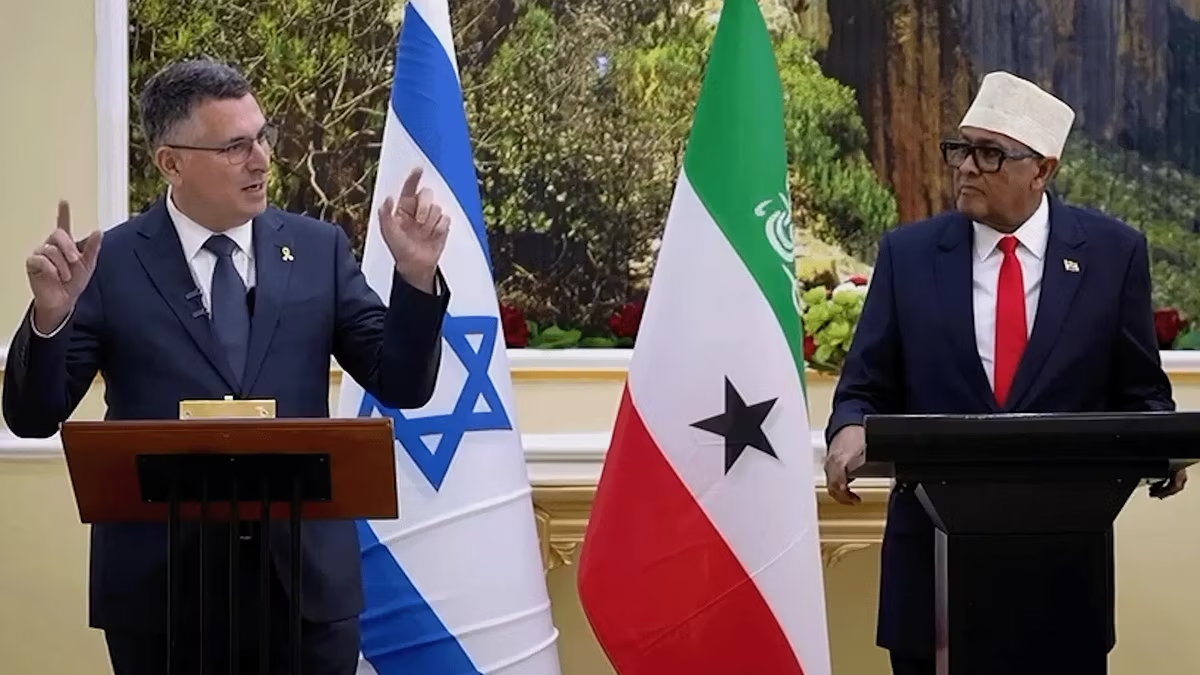
Israeli Foreign Minister mocks Palestine, calls it a "virtual state"

Israeli Foreign Minister Gideon Sa'ar mocked the State of Palestine, describing it as a "virtual state," during a press conference with the president of the separatist Somaliland region yesterday, Tuesday.

Israeli websites and accounts published today, Wednesday, the Israeli minister's statements during his visit to the separatist region less than two weeks after Israel recognized the region as an "independent state," which sparked rejecting Arab and international reactions.

Sa'ar said during his speech that "unlike Palestine, Somaliland is not a virtual state. It is an existing and effective state. Somaliland is a fully functioning state, based on the principles of international law," he claimed.

Sa'ar added that "Somaliland is loyal to the West and friendly to Israel."

Sa'ar arrived in the separatist region, which Somalia considers part of its territory, yesterday, Tuesday, and met with the region's president, Abdirahman Irro.

Israel officially recognized the separatist region on December 26th last year as an "independent and sovereign state."

The Israeli decision sparked sharp criticism from the African Union, Egypt, and the European Union, which emphasize the sovereignty of Somalia, which is experiencing war and unrest.

Somali President Hassan Sheikh Mohamud said last week that the separatist "Somaliland" region accepted 3 conditions from Israel: "resettling Palestinians on the region's lands, establishing a military base on the Gulf of Aden, and joining the Abraham Accords to normalize relations with Israel."

PALESTINE

Thu 08 Jan 2026 10:57 am - Jerusalem Time

New Crisis in UNRWA: Hamas Denounces Termination of Contracts for Staff Stranded Outside Gaza

The Islamic Resistance Movement (Hamas) issued a press statement on Wednesday, condemning the decision by the United Nations Relief and Works Agency for Palestine Refugees (UNRWA) to terminate the contracts of its employees located outside the Gaza Strip, who were previously placed under "exceptional leave."

The movement described this measure as "unjust," asserting that it violates the employment rights of hundreds of workers whose return was prevented by the war conditions and the occupation's closure of the Rafah crossing, thus adding a new dimension to the humanitarian and administrative crises plaguing the Strip.

This crisis comes at a time when the Gaza Strip is suffering from the repercussions of a devastating war that has led to the displacement of hundreds of thousands and the disruption of professional life in most sectors.

A large number of UNRWA employees had left the Strip during periods of escalation or for medical and humanitarian reasons, only to find themselves stranded abroad after the fascist occupation took control of the Rafah crossing and closed it completely.

UNRWA has faced significant financial and political pressures since 2024, having been subjected to incitement campaigns by the occupation to reduce its role, which prompted the administration to take a series of austerity measures, the latest of which was this decision targeting "traveling" employees.

In its statement, Hamas stressed that the timing of this decision contradicts the relief role entrusted to the international agency, considering that the continued closure of the crossings is part of the "genocidal war" practiced by the occupation, and international organizations should not punish employees for circumstances beyond their control.

The movement's demands centered on three main points:

Immediate Reversal: Demanding the agency to cancel the decision to terminate contracts and maintain job security for employees. Bearing Responsibility: UNRWA's commitment to its legal and moral duty towards refugees and its employees alike. International Pressure: Mobilizing a global stance to pressure the occupation to break the restrictions imposed on humanitarian operations and open the crossings. Observers believe that this development could lead to an escalation of union protests within the agency's institutions, especially since a large number of educational and medical staff are included in this decision, which could negatively affect the quality of services provided to refugees in light of the current humanitarian catastrophe.

This crisis places UNRWA in a complex diplomatic position; between its need to reduce expenses and its commitment to protecting the rights of its affiliates. As 2026 approaches, it seems that the issue of refugees and international organizations will remain an arena for political conflict, where the occupation tries to exploit any loophole to dismantle the agency, while Palestinian forces cling to its survival as an official witness to the right of return.

The coming days will reveal whether the agency will respond to humanitarian pressures, or whether the decision will become a fait accompli that increases the suffering of Palestinians in forced diaspora.

PALESTINE

Thu 08 Jan 2026 10:57 am - Jerusalem Time

Child killed in Jabalia, artillery shelling east of the Central Governorate in Gaza

A source in the ambulance and emergency services reported the martyrdom of a child this Thursday morning due to gunfire from Israeli occupation vehicles in the city of Jabalia, north of the Gaza Strip, outside the deployment area of the occupation army. Earlier, Israel stated that it had targeted a prominent leader of the Islamic Resistance Movement (Hamas) in the northern Strip.

Ambulance and emergency services in Gaza stated that the child, Hamsa Hawsou (11 years old), was martyred due to gunfire from occupation vehicles in the Faluja area of Jabalia city, west of Jabalia camp, and outside the yellow zone controlled by Israel within the Strip.

Local sources reported hearing repeated gunfire from helicopter aircraft east of Khan Yunis city in the southern Strip. The eastern areas of the Central Governorate in Deir al-Balah city and al-Bureij refugee camp have also been witnessing intense artillery shelling and gunfire from occupation vehicles and helicopters since the morning hours.

Yesterday, Wednesday, two Palestinians were injured in an Israeli raid on a house in the al-Tuffah neighborhood, northeast of Gaza City. The raid targeted a house on Yafa Street, outside the Israeli army's deployment areas in the neighborhood located east of Gaza City. A medical source at the Baptist Hospital described the injuries of the wounded as serious.

The Israeli army said in a statement yesterday evening, Wednesday, that its soldiers attacked a prominent leader of the Hamas movement who was planning to launch attacks against army forces in northern Gaza, and that the army responded to gunfire directed at its forces, according to the Israeli statement.

The statement added that Hamas militants fired at an area where its forces were stationed in the northern Gaza Strip, and the army considered the firing a blatant violation of the ceasefire agreement, as it put it.

Israeli army radio reported that the target of the army's attack in Gaza was a leader in the Al-Qassam Brigades with the rank of battalion commander.

This comes amidst ongoing Israeli violations of the ceasefire agreement that came into effect on October 10th last year, resulting in the martyrdom of more than 424 Palestinians and the injury of 1199 others, according to the latest figures from the Ministry of Health in the Strip.

On October 7, 2023, Israel began a two-year genocide in Gaza, with a death toll exceeding 71,000 martyrs and 171,000 injured Palestinians, in addition to massive destruction affecting 90% of civilian infrastructure, with reconstruction costs estimated by the United Nations at approximately 70 billion dollars.

PALESTINE

Thu 08 Jan 2026 10:55 am - Jerusalem Time

Israeli Weizmann Institute out of top 100 global academic institutions for the first time

Recent data released by the "Nature Index" scientific indicator revealed a strong blow to the Weizmann Institute of Science.

It reported that the institute has, for the first time in its history, fallen out of the list of the top 100 academic institutions in the world, in an unprecedented decline since its establishment.

The data, as reported, clarified that this sharp decline came as part of the cumulative repercussions of the "Al-Aqsa Flood" operation launched by the Palestinian resistance on October 7, 2023, and the subsequent widespread military escalation and Iranian missile attacks, in addition to the growing international academic boycott of the occupying state in the wake of the ongoing war of annihilation in Gaza.

The 2025 ranking showed that the Weizmann Institute ranked 111th among academic institutions, and 122nd in the overall global ranking, after having held advanced positions in previous years.

Israeli reports attributed this decline to direct damage to research infrastructure, following Iranian missile strikes that targeted the institute's campus in Rehovot last year, which led to dozens of laboratories and research buildings going out of service, causing a paralysis of nearly a quarter of the institution's research activity.

The index showed that the decline was not limited to the Weizmann Institute, as most major Israeli universities recorded a significant drop in their rankings, including the Hebrew University of Jerusalem, the Technion in Haifa, and Ben-Gurion University in the Negev, indicating a deep crisis affecting the Israeli academic system.

Observers attributed this decline to a decrease in scientific output, disruption of research, and emigration of competencies, in addition to the increasing isolation Israel faces within international academic circles since the outbreak of the war.

Analysts pointed out that these data reflect that the repercussions of the "Al-Aqsa Flood" have gone beyond the military and security frameworks, extending to the scientific and intellectual depth of the occupying state, targeting one of its most sensitive sectors, at a time when it was marketing itself as a "state of science and innovation," before missiles and academic boycotts exposed the fragility of this claim and pushed its research institutions into an unprecedented decline on the global stage.

PALESTINE

Thu 08 Jan 2026 9:35 am - Jerusalem Time

Supported by the UAE International Aid Agency .. The first shipments of the "Mohammed bin Rashid Humanitarian" ship enter Gaza

The 272nd Emirati humanitarian convoy, part of Operation "Gallant Knight 3", entered the Gaza Strip, carrying approximately 387 tons of food parcels, marking the first shipments arriving from the Mohammed bin Rashid Humanitarian ship to the Strip.

The "Mohammed bin Rashid Humanitarian" ship had docked in Al-Arish port last week, carrying food aid designated to meet urgent needs in Gaza, including approximately 10 million meals provided by Mohammed bin Rashid Al Maktoum Global Initiatives, as part of the continuous Emirati efforts to enhance food security and support the most affected groups.

Mohammed Al Kaabi, the media coordinator for Operation "Gallant Knight 3" in Al-Arish, stated that "the Emirati humanitarian aid team in Al-Arish city works day and night, around the clock, to ensure aid reaches its beneficiaries in Gaza as quickly as possible. The team has made great efforts in unloading, discharging, and preparing the cargo of the Mohammed bin Rashid Humanitarian ship since its arrival in Al-Arish, with the first batches of its cargo entering Gaza a week after the ship's arrival." 

The arrival of the convoy is part of an integrated logistical system supervised by the Emirati humanitarian aid team in Al-Arish city, starting from unloading the ship's cargo according to organized operating procedures, then transferring the shipments to the Emirati Humanitarian Aid Logistics Center in Al-Arish to complete the technical processing stages, where the team works around the clock to ensure speed of execution, accuracy of procedures, and safety of materials.


At the logistics center, parcels are inspected, sorted, and checked for readiness, with any damaged shipments re-packaged according to precise standards that consider content quality and validity, before storing the aid inside warehouses according to their classification and type, ensuring ease of preparation and accelerating response to field needs.

After completing the inspection, sorting, and storage stages, food items are prepared within the humanitarian supply chain for successive transfer to the Gaza Strip via Emirati humanitarian aid convoys, as part of continuous efforts to secure relief support and meet the basic needs of Palestinian brethren.

It is worth noting that Operation "Gallant Knight 3" continues its humanitarian efforts to support the Palestinian people, through an integrated relief system that includes operating land convoys, airlifts, and sea shipments, and implementing relief, health, and food projects and initiatives, reflecting the UAE's steadfast commitment to supporting brethren and alleviating their suffering.


PALESTINE

Thu 08 Jan 2026 9:23 am - Jerusalem Time

Washington moves to establish post-war Gaza before Hamas's weapons are resolved

In a delicate political moment, the United States is moving to redraw the path of the Gaza ceasefire agreement by pushing for the start of its second phase, without pre-linking it to the disarmament of the Hamas movement or the recovery of the body of the last Israeli hostage killed during the war. This approach, which the administration of US President Donald Trump informed Israeli Prime Minister Benjamin Netanyahu about, reflects a tactical shift in Washington's approach to the issue, and at the same time reveals a growing gap between American priorities and Israeli concerns.

The second phase of the agreement, according to the American vision, goes beyond the immediate security dimension to address more complex issues, most notably the reconstruction of the Gaza Strip, its post-war administration arrangements, and the launch of a political-economic path aimed at stabilizing the calm and preventing a rapid return to confrontation. However, Netanyahu's government still believes that any progress in this path must be conditional on achieving two clear goals: recovering the remains of hostage Ran Gvili, and completely disarming Hamas.

The United States, for its part, is not backing down from its commitment to these two goals, according to a source for Al-Quds newspaper, but it refuses to make them a hindering condition. Washington, according to informed sources, has become convinced that linking reconstruction and moving Gaza to the “post-war” phase with highly complex issues such as weapons and hostages will practically lead to political paralysis, and perhaps to the collapse of the already fragile ceasefire.

In this context, the US administration intensified its contacts with regional mediators, especially Egypt, Qatar, and Turkey, who conveyed assurances that Hamas might agree to a gradual disarmament process, starting with giving up heavy weapons, and accompanied by a program to buy light weapons from fighters. However, this proposal still faces Israeli reservations, in light of public assurances from Hamas leadership that its weapons will not be subject to negotiation except within a comprehensive political settlement leading to the establishment of a Palestinian state.

In parallel, Washington is preparing to announce the formation of a “Peace Council,” an international framework that includes Arab and European countries, in addition to international financial institutions, with the aim of providing political and financial cover for the next phase. The US administration aspires for this council to be a platform for fundraising, coordinating reconstruction efforts, and perhaps later using it as a model for addressing other conflicts around the world.

In addition to the Peace Council, the United States is working to establish a more involved interim executive committee in daily details, comprising prominent political and diplomatic figures, and serving as a link with a technocratic Palestinian committee responsible for managing civil affairs in Gaza. This committee, whose formation efforts are led by Egypt, consists of non-factional figures, in an attempt to overcome Palestinian division and reassure Israel at the same time. Despite the Palestinian Authority's pressure for direct participation, Israel insists on excluding any official representation for it, content with the presence of figures with previous administrative backgrounds.

As for the security aspect, the idea of an “international stabilization force” still faces significant obstacles. The countries nominated to participate are hesitant to send forces to an unstable environment, despite Washington's attempts to reassure them that the mandate will be limited and will not include direct confrontation with Hamas. This hesitation raises questions about the international community's ability to fill the security vacuum that will be left by the gradual Israeli withdrawal.

The reconstruction file, in turn, is no less complex. The model projects being discussed, including the construction of residential complexes to house tens of thousands of Palestinians, clash with strict Israeli restrictions on the entry of materials classified as “dual-use.” The United Nations warns that the continuation of these restrictions will make any talk of real reconstruction closer to an illusion, given the difficulty of introducing the simplest humanitarian necessities, let alone heavy building materials.


In the background of all this, the file of the last Israeli captive's remains remains strongly present. The search operations for Gvili's remains were affected by military strikes and the killing of field commanders who were overseeing this file. Despite the recent resumption of efforts, the delay has become a factor of internal political pressure on Netanyahu, who links the opening of the Rafah crossing and the completion of some commitments to the return of the body.

The American move to separate the start of reconstruction from disarmament reflects a belated realization of the limits of power in imposing comprehensive solutions all at once. Washington is betting on “managing the conflict” instead of resolving it, believing that improving living conditions in Gaza may create new dynamics that weaken the armed incubator. However, this bet is fraught with risks, as it may be interpreted by Israel as a free concession, and by Palestinians as an alternative to a real political solution, threatening to turn reconstruction into a temporary palliative at best.

Experts believe that Netanyahu's insistence on linking every step to the weapons and hostage file focuses on the internal security angle, but it also reveals a deeper dilemma: the absence of an integrated Israeli vision for the day after in Gaza. The refusal to involve the Palestinian Authority, and the hesitation regarding an international force, leave a vacuum that cannot be filled by security solutions alone. In this vacuum, Washington is trying to play a balancing role, but it clashes with the reality that any sustainable stability will remain hostage to a postponed political process. 

PALESTINE

Thu 08 Jan 2026 12:43 am - Jerusalem Time

American Media: Trump Expected to Announce Peace Council and Transition to Second Phase in Gaza Next Week

The news network "Axios" quoted American officials as saying that President Donald Trump intends to announce, within the next few weeks of January 2026, the official transition to the second phase of his peace plan in the Gaza Strip.

This phase includes the establishment of a new governance structure called the "Board of Peace," which Trump intends to personally chair, in a move that reflects the American administration's desire for direct oversight of the reconstruction file and the establishment of stability after decades of conflict.

These developments come as a continuation of the first phase, which resulted from the fragile truce that began in October 2025, and witnessed an exchange of detainees and prisoners and a partial withdrawal of occupation forces.

Despite mutual violations, America insists on pushing towards the "second phase," which is based on the philosophy of civil rule away from traditional factional tensions.

Trump had postponed the announcement of the details of this council, which was scheduled before last Christmas, to give American diplomacy more time to coordinate with regional and international partners, and to overcome the obstacles placed by Benjamin Netanyahu's government regarding some provisions of the plan.

The new plan is based on five main pillars aimed at radically changing the reality of the Strip.

Militarily, the plan stipulates the withdrawal of occupation forces from additional areas in Gaza, to be replaced by the deployment of an "International Stabilization Force" (ISF) that will undertake security tasks and monitor the gradual disarmament of Hamas.

Politically, Washington seeks to establish a Palestinian technocratic government, not affiliated with Hamas or Fatah, to be responsible for managing the daily affairs of the population. The "Board of Peace" will be the umbrella for these movements, with Trump joined by figures such as Jared Kushner and Steve Witkoff, with expectations of participation from prominent leaders in the region, including Saudi Crown Prince Mohammed bin Salman, to ensure financial and political support for reconstruction.

Despite this momentum, reports indicate Netanyahu's adherence to cautious positions, especially regarding the role of countries like Turkey and Qatar in this path, which creates a noticeable tension between Tel Aviv and Washington.

The occupation desires strict security guarantees before any additional withdrawal, while Trump believes that his chairmanship of the council is the greatest guarantee for all parties.

Trump's vision for 2026 represents an attempt to reframe the Palestinian crisis from a direct economic and security perspective, away from the complexities of traditional negotiations.

If the anticipated announcement in January succeeds, the Gaza Strip will enter an unprecedented phase of internationalization, where America and its allies will have the upper hand in shaping the future.

The biggest challenge remains the ability of this new structure to withstand field violations and political reservations that continue to hinder the path to lasting peace.